CONJUNCTIONS
Kinds of Conjunction:
1.Coordinating Conjunctions.
2.Correlative Conjunctions.
3.Subordinating Conjunctions
A coordinating conjunction is a
word that joins words, phrases
or clauses.
AND
1. “and” joins two similar ideas and add a new idea.
Examples:
a. I like candy. I like cake.
b. Most children like cookies. Most children like milk.
c. She spoke angrily about the war. She spoke bitterly
about the war.
d. Susan raised her hand. Susan snapped her fingers.
e. Amber reached the station. She met the ticket collector
BUT
2. “but” joins two contrasting ideas.
Examples:
a. The shoes are old. The shoes are comfortable.
b. Tom is tall. Paul is short.
c. Dave likes reading. He doesn’t like Math.
d. Joe waited for the train. The train was late.
e. Tom studied a lot. He didn’t pass the test.
OR
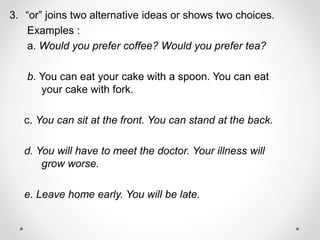
3. “or” joins two alternative ideas or shows two choices.
Examples :
a. Would you prefer coffee? Would you prefer tea?
b. You can eat your cake with a spoon. You can eat
your cake with fork.
c. You can sit at the front. You can stand at the back.
d. You will have to meet the doctor. Your illness will
grow worse.
e. Leave home early. You will be late.
SO
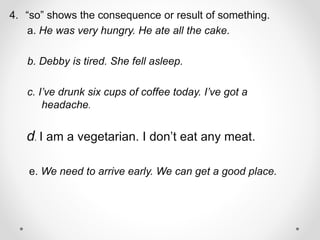
4. “so” shows the consequence or result of something.
a. He was very hungry. He ate all the cake.
b. Debby is tired. She fell asleep.
c. I’ve drunk six cups of coffee today. I’ve got a
headache.
d. I am a vegetarian. I don’t eat any meat.
e. We need to arrive early. We can get a good place.
Correlative Conjunctions
a correlative conjunction is a paired
conjunction that links words, phrases,
and clauses.
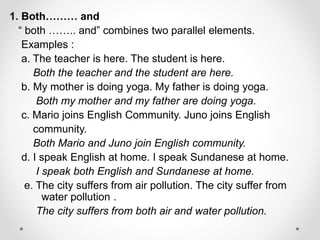
1. Both……… and
“ both …….. and” combines two parallel elements.
Examples :
a. The teacher is here. The student is here.
Both the teacher and the student are here.
b. My mother is doing yoga. My father is doing yoga.
Both my mother and my father are doing yoga.
c. Mario joins English Community. Juno joins English
community.
Both Mario and Juno join English community.
d. I speak English at home. I speak Sundanese at home.
I speak both English and Sundanese at home.
e. The city suffers from air pollution. The city suffer from
water pollution .
The city suffers from both air and water pollution.
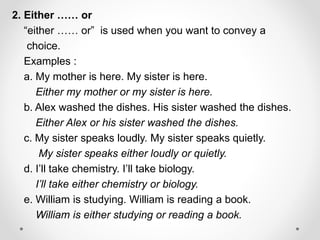
2. Either …… or
“either …… or” is used when you want to convey a
choice.
Examples :
a. My mother is here. My sister is here.
Either my mother or my sister is here.
b. Alex washed the dishes. His sister washed the dishes.
Either Alex or his sister washed the dishes.
c. My sister speaks loudly. My sister speaks quietly.
My sister speaks either loudly or quietly.
d. I’ll take chemistry. I’ll take biology.
I’ll take either chemistry or biology.
e. William is studying. William is reading a book.
William is either studying or reading a book.
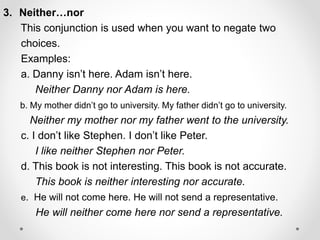
3. Neither…nor
This conjunction is used when you want to negate two
choices.
Examples:
a. Danny isn’t here. Adam isn’t here.
Neither Danny nor Adam is here.
b. My mother didn’t go to university. My father didn’t go to university.
Neither my mother nor my father went to the university.
c. I don’t like Stephen. I don’t like Peter.
I like neither Stephen nor Peter.
d. This book is not interesting. This book is not accurate.
This book is neither interesting nor accurate.
e. He will not come here. He will not send a representative.
He will neither come here nor send a representative.
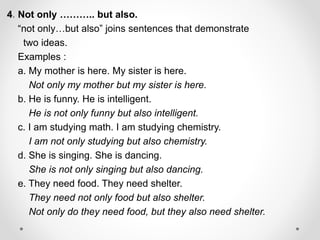
4. Not only ……….. but also.
“not only…but also” joins sentences that demonstrate
two ideas.
Examples :
a. My mother is here. My sister is here.
Not only my mother but my sister is here.
b. He is funny. He is intelligent.
He is not only funny but also intelligent.
c. I am studying math. I am studying chemistry.
I am not only studying but also chemistry.
d. She is singing. She is dancing.
She is not only singing but also dancing.
e. They need food. They need shelter.
They need not only food but also shelter.
Not only do they need food, but they also need shelter.

Conjunctions

  • 1.
  • 2.
    Kinds of Conjunction: 1.CoordinatingConjunctions. 2.Correlative Conjunctions. 3.Subordinating Conjunctions
  • 3.
    A coordinating conjunctionis a word that joins words, phrases or clauses.
  • 4.
  • 5.
    1. “and” joinstwo similar ideas and add a new idea. Examples: a. I like candy. I like cake. b. Most children like cookies. Most children like milk. c. She spoke angrily about the war. She spoke bitterly about the war. d. Susan raised her hand. Susan snapped her fingers. e. Amber reached the station. She met the ticket collector
  • 6.
  • 7.
    2. “but” joinstwo contrasting ideas. Examples: a. The shoes are old. The shoes are comfortable. b. Tom is tall. Paul is short. c. Dave likes reading. He doesn’t like Math. d. Joe waited for the train. The train was late. e. Tom studied a lot. He didn’t pass the test.
  • 8.
  • 9.
    3. “or” joinstwo alternative ideas or shows two choices. Examples : a. Would you prefer coffee? Would you prefer tea? b. You can eat your cake with a spoon. You can eat your cake with fork. c. You can sit at the front. You can stand at the back. d. You will have to meet the doctor. Your illness will grow worse. e. Leave home early. You will be late.
  • 10.
  • 11.
    4. “so” showsthe consequence or result of something. a. He was very hungry. He ate all the cake. b. Debby is tired. She fell asleep. c. I’ve drunk six cups of coffee today. I’ve got a headache. d. I am a vegetarian. I don’t eat any meat. e. We need to arrive early. We can get a good place.
  • 12.
    Correlative Conjunctions a correlativeconjunction is a paired conjunction that links words, phrases, and clauses.
  • 13.
    1. Both……… and “both …….. and” combines two parallel elements. Examples : a. The teacher is here. The student is here. Both the teacher and the student are here. b. My mother is doing yoga. My father is doing yoga. Both my mother and my father are doing yoga. c. Mario joins English Community. Juno joins English community. Both Mario and Juno join English community. d. I speak English at home. I speak Sundanese at home. I speak both English and Sundanese at home. e. The city suffers from air pollution. The city suffer from water pollution . The city suffers from both air and water pollution.
  • 14.
    2. Either ……or “either …… or” is used when you want to convey a choice. Examples : a. My mother is here. My sister is here. Either my mother or my sister is here. b. Alex washed the dishes. His sister washed the dishes. Either Alex or his sister washed the dishes. c. My sister speaks loudly. My sister speaks quietly. My sister speaks either loudly or quietly. d. I’ll take chemistry. I’ll take biology. I’ll take either chemistry or biology. e. William is studying. William is reading a book. William is either studying or reading a book.
  • 15.
    3. Neither…nor This conjunctionis used when you want to negate two choices. Examples: a. Danny isn’t here. Adam isn’t here. Neither Danny nor Adam is here. b. My mother didn’t go to university. My father didn’t go to university. Neither my mother nor my father went to the university. c. I don’t like Stephen. I don’t like Peter. I like neither Stephen nor Peter. d. This book is not interesting. This book is not accurate. This book is neither interesting nor accurate. e. He will not come here. He will not send a representative. He will neither come here nor send a representative.
  • 16.
    4. Not only……….. but also. “not only…but also” joins sentences that demonstrate two ideas. Examples : a. My mother is here. My sister is here. Not only my mother but my sister is here. b. He is funny. He is intelligent. He is not only funny but also intelligent. c. I am studying math. I am studying chemistry. I am not only studying but also chemistry. d. She is singing. She is dancing. She is not only singing but also dancing. e. They need food. They need shelter. They need not only food but also shelter. Not only do they need food, but they also need shelter.