Conjunction
Coordinating conjunction
Correlative conjunction
What Are Conjunctions?
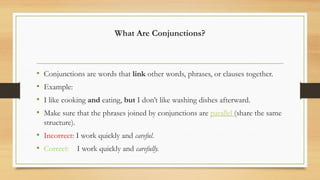
• Conjunctions are words that link other words, phrases, or clauses together.
• Example:
• I like cooking and eating, but I don’t like washing dishes afterward.
• Make sure that the phrases joined by conjunctions are parallel (share the same
structure).
• Incorrect: I work quickly and careful.
• Correct: I work quickly and carefully.
What are Coordinating Conjunctions?
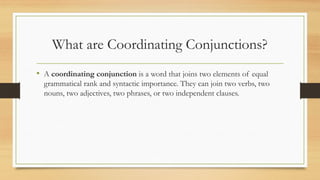
• A coordinating conjunction is a word that joins two elements of equal
grammatical rank and syntactic importance. They can join two verbs, two
nouns, two adjectives, two phrases, or two independent clauses.
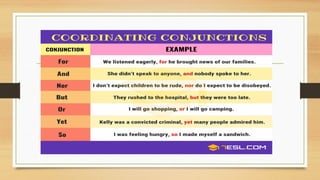
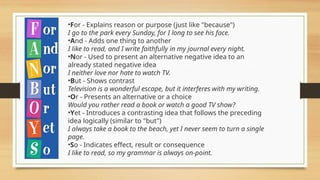
•For - Explains reason or purpose (just like "because")
I go to the park every Sunday, for I long to see his face.
•And - Adds one thing to another
I like to read, and I write faithfully in my journal every night.
•Nor - Used to present an alternative negative idea to an
already stated negative idea
I neither love nor hate to watch TV.
•But - Shows contrast
Television is a wonderful escape, but it interferes with my writing.
•Or - Presents an alternative or a choice
Would you rather read a book or watch a good TV show?
•Yet - Introduces a contrasting idea that follows the preceding
idea logically (similar to "but")
I always take a book to the beach, yet I never seem to turn a single
page.
•So - Indicates effect, result or consequence
I like to read, so my grammar is always on-point.
• I’d like pizza or a salad for lunch. We needed a place to concentrate, so we
packed up our things and went to the library. Jesse didn’t have much money,
but she got by.
• Notice the use of the
comma when a coordinating conjunction is joining two independent clauses.
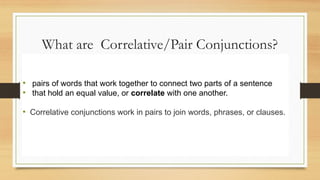
What are Correlative/Pair Conjunctions?
• pairs of words that work together to connect two parts of a sentence
• that hold an equal value, or correlate with one another.
• Correlative conjunctions work in pairs to join words, phrases, or clauses.
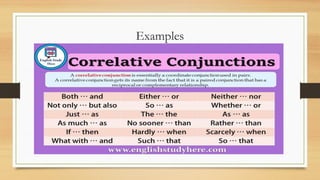
Examples
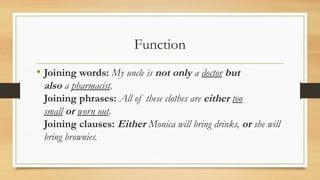
Function
• Joining words: My uncle is not only a doctor but
also a pharmacist.
Joining phrases: All of these clothes are either too
small or worn out.
Joining clauses: Either Monica will bring drinks, or she will
bring brownies.
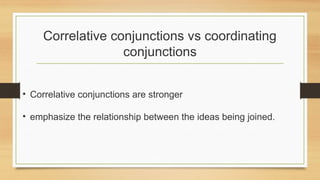
Correlative conjunctions vs coordinating
conjunctions
• Correlative conjunctions are stronger
• emphasize the relationship between the ideas being joined.
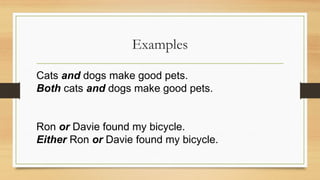
Examples
Cats and dogs make good pets.
Both cats and dogs make good pets.
Ron or Davie found my bicycle.
Either Ron or Davie found my bicycle.
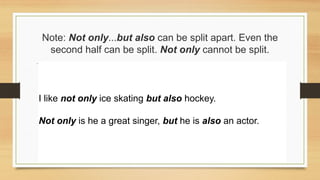
Note: Not only...but also can be split apart. Even the
second half can be split. Not only cannot be split.
I like not only ice skating but also hockey.
Not only is he a great singer, but he is also an actor.
Note: Be careful of the placement of the
parts of the conjunction.
Confusing: Either you must bring in your permission slip or stay home.
(The reader is left hanging waiting for the second clause.)
Better: You must either bring in your permission slip or stay home.
(You must do one of these two actions.)
Also better: Either you must bring in your permission slip, or you must stay home.
emy won not only a trophy but also money.
Confusing: It was not only a long movie but also exciting.
Better: The movie was not only long but also exciting.
Better: It was not only a long movie but also an exciting one.
Confusing: Jeremy not only won a trophy but also money.
Better: Jeremy won not only a trophy but also money.
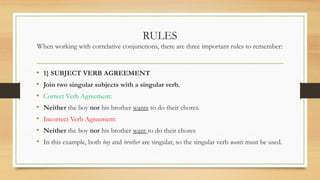
RULES
When working with correlative conjunctions, there are three important rules to remember:
• 1} SUBJECT VERB AGREEMENT
• Join two singular subjects with a singular verb.
• Correct Verb Agreement:
• Neither the boy nor his brother wants to do their chores.
• Incorrect Verb Agreement:
• Neither the boy nor his brother want to do their chores
• In this example, both boy and brother are singular, so the singular verb wants must be used.
• Join two plural subjects with a plural verb.
• Correct Verb Agreement:
• Either the students or their parents were expected to pick up supplies for the project.
• Incorrect Verb Agreement:
• Either the students or their parents was expected to pick up supplies for the project.
• In this example, both students and parents are plural, so the plural verb were must be used
• Join a singular subject and a plural subject with the verb form used for the subject closest
to the verb.
• Correct Verb Agreement:
• Both the captain and the soldiers run two miles every day.
• Both the soldiers and the captain runs two miles every day.
• Incorrect Verb Agreement:
• Both the captain and the soldiers runs two miles every day.
• In this example, the plural word soldiers is closest to the verb, so the plural verb run must be used.
2.Ensuring Pronoun Agreement with Correlative Conjunctions
• Both Joey and Sam completed his part of the project.
• Both Sam and Joey completed her part of the project.
• Not only the painting but also the sculptures show their unique style when put on display.
• Not only the sculptures but also the painting show its unique style when put on display.
• Either the doctors or the nurses will visit their patients at least once a day.
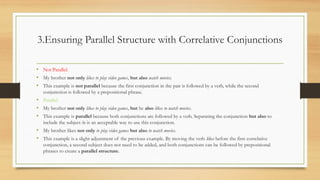
3.Ensuring Parallel Structure with Correlative Conjunctions
• Not Parallel:
• My brother not only likes to play video games, but also watch movies.
• This example is not parallel because the first conjunction in the pair is followed by a verb, while the second
conjunction is followed by a prepositional phrase.
• Parallel:
• My brother not only likes to play video games, but he also likes to watch movies.
• This example is parallel because both conjunctions are followed by a verb. Separating the conjunction but also to
include the subject he is an acceptable way to use this conjunction.
• My brother likes not only to play video games but also to watch movies.
• This example is a slight adjustment of the previous example. By moving the verb likes before the first correlative
conjunction, a second subject does not need to be added, and both conjunctions can be followed by prepositional
phrases to create a parallel structure.
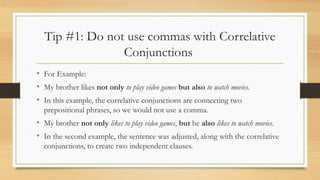
Tip #1: Do not use commas with Correlative
Conjunctions
• For Example:
• My brother likes not only to play video games but also to watch movies.
• In this example, the correlative conjunctions are connecting two
prepositional phrases, so we would not use a comma.
• My brother not only likes to play video games, but he also likes to watch movies.
• In the second example, the sentence was adjusted, along with the correlative
conjunctions, to create two independent clauses.
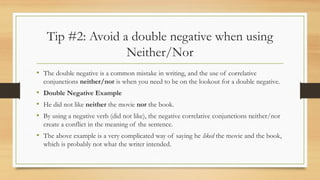
Tip #2: Avoid a double negative when using
Neither/Nor
• The double negative is a common mistake in writing, and the use of correlative
conjunctions neither/nor is when you need to be on the lookout for a double negative.
• Double Negative Example
• He did not like neither the movie nor the book.
• By using a negative verb (did not like), the negative correlative conjunctions neither/nor
create a conflict in the meaning of the sentence.
• The above example is a very complicated way of saying he liked the movie and the book,
which is probably not what the writer intended.
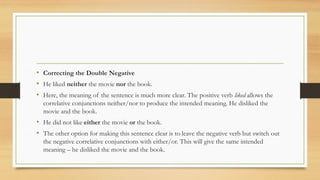
• Correcting the Double Negative
• He liked neither the movie nor the book.
• Here, the meaning of the sentence is much more clear. The positive verb liked allows the
correlative conjunctions neither/nor to produce the intended meaning. He disliked the
movie and the book.
• He did not like either the movie or the book.
• The other option for making this sentence clear is to leave the negative verb but switch out
the negative correlative conjunctions with either/or. This will give the same intended
meaning – he disliked the movie and the book.

482556252-Correlative-Conjunction-pptx.pptx

  • 1.
  • 2.
    What Are Conjunctions? •Conjunctions are words that link other words, phrases, or clauses together. • Example: • I like cooking and eating, but I don’t like washing dishes afterward. • Make sure that the phrases joined by conjunctions are parallel (share the same structure). • Incorrect: I work quickly and careful. • Correct: I work quickly and carefully.
  • 3.
    What are CoordinatingConjunctions? • A coordinating conjunction is a word that joins two elements of equal grammatical rank and syntactic importance. They can join two verbs, two nouns, two adjectives, two phrases, or two independent clauses.
  • 5.
    •For - Explainsreason or purpose (just like "because") I go to the park every Sunday, for I long to see his face. •And - Adds one thing to another I like to read, and I write faithfully in my journal every night. •Nor - Used to present an alternative negative idea to an already stated negative idea I neither love nor hate to watch TV. •But - Shows contrast Television is a wonderful escape, but it interferes with my writing. •Or - Presents an alternative or a choice Would you rather read a book or watch a good TV show? •Yet - Introduces a contrasting idea that follows the preceding idea logically (similar to "but") I always take a book to the beach, yet I never seem to turn a single page. •So - Indicates effect, result or consequence I like to read, so my grammar is always on-point.
  • 6.
    • I’d likepizza or a salad for lunch. We needed a place to concentrate, so we packed up our things and went to the library. Jesse didn’t have much money, but she got by. • Notice the use of the comma when a coordinating conjunction is joining two independent clauses.
  • 7.
    What are Correlative/PairConjunctions? • pairs of words that work together to connect two parts of a sentence • that hold an equal value, or correlate with one another. • Correlative conjunctions work in pairs to join words, phrases, or clauses.
  • 8.
  • 9.
    Function • Joining words:My uncle is not only a doctor but also a pharmacist. Joining phrases: All of these clothes are either too small or worn out. Joining clauses: Either Monica will bring drinks, or she will bring brownies.
  • 10.
    Correlative conjunctions vscoordinating conjunctions • Correlative conjunctions are stronger • emphasize the relationship between the ideas being joined.
  • 11.
    Examples Cats and dogsmake good pets. Both cats and dogs make good pets. Ron or Davie found my bicycle. Either Ron or Davie found my bicycle.
  • 12.
    Note: Not only...butalso can be split apart. Even the second half can be split. Not only cannot be split. I like not only ice skating but also hockey. Not only is he a great singer, but he is also an actor.
  • 13.
    Note: Be carefulof the placement of the parts of the conjunction. Confusing: Either you must bring in your permission slip or stay home. (The reader is left hanging waiting for the second clause.) Better: You must either bring in your permission slip or stay home. (You must do one of these two actions.) Also better: Either you must bring in your permission slip, or you must stay home. emy won not only a trophy but also money.
  • 14.
    Confusing: It wasnot only a long movie but also exciting. Better: The movie was not only long but also exciting. Better: It was not only a long movie but also an exciting one. Confusing: Jeremy not only won a trophy but also money. Better: Jeremy won not only a trophy but also money.
  • 15.
    RULES When working withcorrelative conjunctions, there are three important rules to remember: • 1} SUBJECT VERB AGREEMENT • Join two singular subjects with a singular verb. • Correct Verb Agreement: • Neither the boy nor his brother wants to do their chores. • Incorrect Verb Agreement: • Neither the boy nor his brother want to do their chores • In this example, both boy and brother are singular, so the singular verb wants must be used.
  • 16.
    • Join twoplural subjects with a plural verb. • Correct Verb Agreement: • Either the students or their parents were expected to pick up supplies for the project. • Incorrect Verb Agreement: • Either the students or their parents was expected to pick up supplies for the project. • In this example, both students and parents are plural, so the plural verb were must be used • Join a singular subject and a plural subject with the verb form used for the subject closest to the verb. • Correct Verb Agreement: • Both the captain and the soldiers run two miles every day. • Both the soldiers and the captain runs two miles every day. • Incorrect Verb Agreement: • Both the captain and the soldiers runs two miles every day. • In this example, the plural word soldiers is closest to the verb, so the plural verb run must be used.
  • 17.
    2.Ensuring Pronoun Agreementwith Correlative Conjunctions • Both Joey and Sam completed his part of the project. • Both Sam and Joey completed her part of the project. • Not only the painting but also the sculptures show their unique style when put on display. • Not only the sculptures but also the painting show its unique style when put on display. • Either the doctors or the nurses will visit their patients at least once a day.
  • 18.
    3.Ensuring Parallel Structurewith Correlative Conjunctions • Not Parallel: • My brother not only likes to play video games, but also watch movies. • This example is not parallel because the first conjunction in the pair is followed by a verb, while the second conjunction is followed by a prepositional phrase. • Parallel: • My brother not only likes to play video games, but he also likes to watch movies. • This example is parallel because both conjunctions are followed by a verb. Separating the conjunction but also to include the subject he is an acceptable way to use this conjunction. • My brother likes not only to play video games but also to watch movies. • This example is a slight adjustment of the previous example. By moving the verb likes before the first correlative conjunction, a second subject does not need to be added, and both conjunctions can be followed by prepositional phrases to create a parallel structure.
  • 19.
    Tip #1: Donot use commas with Correlative Conjunctions • For Example: • My brother likes not only to play video games but also to watch movies. • In this example, the correlative conjunctions are connecting two prepositional phrases, so we would not use a comma. • My brother not only likes to play video games, but he also likes to watch movies. • In the second example, the sentence was adjusted, along with the correlative conjunctions, to create two independent clauses.
  • 20.
    Tip #2: Avoida double negative when using Neither/Nor • The double negative is a common mistake in writing, and the use of correlative conjunctions neither/nor is when you need to be on the lookout for a double negative. • Double Negative Example • He did not like neither the movie nor the book. • By using a negative verb (did not like), the negative correlative conjunctions neither/nor create a conflict in the meaning of the sentence. • The above example is a very complicated way of saying he liked the movie and the book, which is probably not what the writer intended.
  • 21.
    • Correcting theDouble Negative • He liked neither the movie nor the book. • Here, the meaning of the sentence is much more clear. The positive verb liked allows the correlative conjunctions neither/nor to produce the intended meaning. He disliked the movie and the book. • He did not like either the movie or the book. • The other option for making this sentence clear is to leave the negative verb but switch out the negative correlative conjunctions with either/or. This will give the same intended meaning – he disliked the movie and the book.