CONJUNCTIONS
CONJUNCTIONS
BSED-ENGLISH1A—GROUP5
a
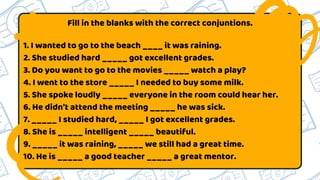
Fill in the blanks with the correct conjuntions.
1. I wanted to go to the beach ____ it was raining.
2. She studied hard _____ got excellent grades.
3. Do you want to go to the movies _____ watch a play?
4. I went to the store _____ I needed to buy some milk.
5. She spoke loudly _____ everyone in the room could hear her.
6. He didn't attend the meeting _____ he was sick.
7. _____ I studied hard, _____ I got excellent grades.
8. She is _____ intelligent _____ beautiful.
9. _____ it was raining, _____ we still had a great time.
10. He is _____ a good teacher _____ a great mentor.
A conjunction is a word that is used to
connect words, phrases, and clauses.
There are many conjunctions in the
English language, but some common
ones include and, or, but, because, for, if,
and when.
They are useful in writing and speech to
connect related ideas, and they help us
make our sentences shorter, less repetitive,
or less confusing. They can also be termed
as connectors as they are employed in
sentences to make connections.
There are three basic types of
conjunctions: Coordinating,
Subordinating, and Correlative.
COORDINATING
CONJUNCTION
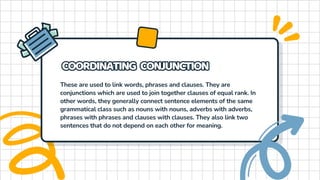
These are used to link words, phrases and clauses. They are
conjunctions which are used to join together clauses of equal rank. In
other words, they generally connect sentence elements of the same
grammatical class such as nouns with nouns, adverbs with adverbs,
phrases with phrases and clauses with clauses. They also link two
sentences that do not depend on each other for meaning.
COORDINATING CONJUNCTION
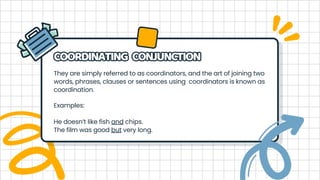
They are simply referred to as coordinators, and the art of joining two
words, phrases, clauses or sentences using coordinators is known as
coordination.
COORDINATING CONJUNCTION
Examples:
He doesn’t like fish and chips.
The film was good but very long.
7
7 Examples of Coordinating
Conjunctions
The most common coordinating
conjunctions are summed up in the
acronym FANBOYS.
Using the conjunction “for” indicates a relationship
between two main clauses by indicating that one
clause is the reason that the other is happening.
Example:
“I want to go to the pizza parlor, for it is my birthday.
FOR
Using “and” indicates additional information of
equal weight to the information provided in the first
clause.
Example:
“I went to the grocery store and bought snacks for
the party.”
AND
It connects two clauses that have negative
modifiers.
Example:
“I don’t get enough sleep, nor do I try.”
NOR
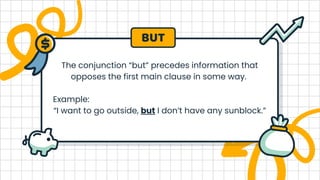
The conjunction “but” precedes information that
opposes the first main clause in some way.
Example:
“I want to go outside, but I don’t have any sunblock.”
BUT
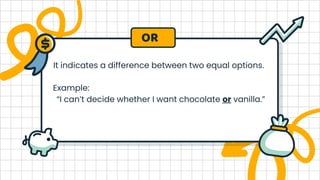
It indicates a difference between two equal options.
Example:
“I can’t decide whether I want chocolate or vanilla.”
OR
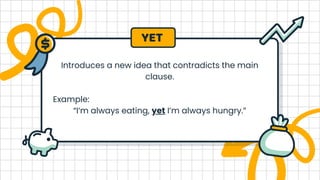
Introduces a new idea that contradicts the main
clause.
Example:
“I’m always eating, yet I’m always hungry.”
YET
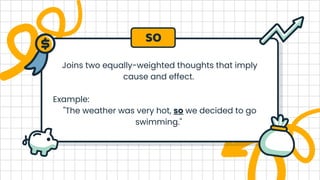
Joins two equally-weighted thoughts that imply
cause and effect.
Example:
"The weather was very hot, so we decided to go
swimming."
SO
When to use Commas with
Coordinating Conjunctions?
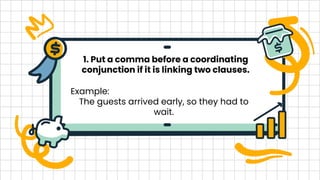
1. Put a comma before a coordinating
conjunction if it is linking two clauses.
Example:
The guests arrived early, so they had to
wait.
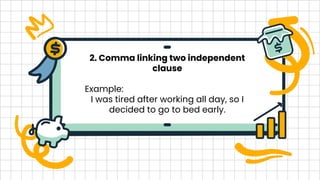
2. Comma linking two independent
clause
Example:
I was tired after working all day, so I
decided to go to bed early.
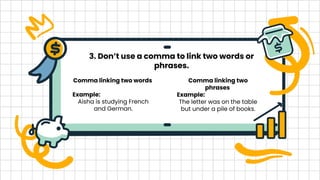
3. Don’t use a comma to link two words or
phrases.
Comma linking two words
Example:
Aisha is studying French
and German.
Comma linking two
phrases
Example:
The letter was on the table
but under a pile of books.
SUBORDINATING
CONJUNCTION
A subordinating conjunction is a word or
phrase that connects a dependent clause
to an independent clause, showing the
relationship between them.
A dependent clause (also called a subordinate
clause) is a group of words that contains a subject
and a verb but does not express a complete
thought.
An independent clause is a group of words that
contains a subject and a verb and expresses a
complete thought.
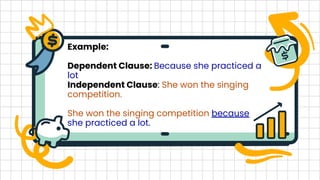
Example:
Dependent Clause: Because she practiced a
lot
Independent Clause: She won the singing
competition.
She won the singing competition because
she practiced a lot.
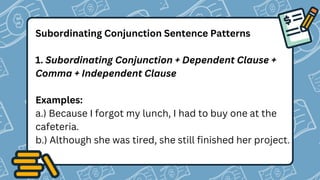
Subordinating Conjunction Sentence Patterns
1. Subordinating Conjunction + Dependent Clause +
Comma + Independent Clause
Examples:
a.) Because I forgot my lunch, I had to buy one at the
cafeteria.
b.) Although she was tired, she still finished her project.
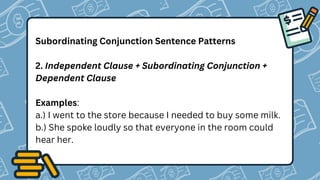
Subordinating Conjunction Sentence Patterns
2. Independent Clause + Subordinating Conjunction +
Dependent Clause
Examples:
a.) I went to the store because I needed to buy some milk.
b.) She spoke loudly so that everyone in the room could
hear her.
"Categories of Subordinating
Conjunctions"
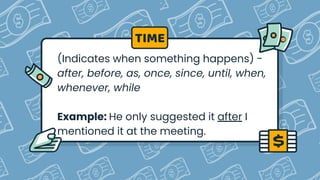
(Indicates when something happens) -
after, before, as, once, since, until, when,
whenever, while
Example: He only suggested it after I
mentioned it at the meeting.
TIME
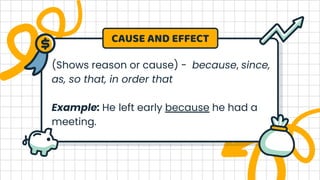
(Shows reason or cause) - because, since,
as, so that, in order that
Example: He left early because he had a
meeting.
CAUSE AND EFFECT
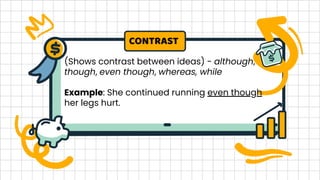
(Shows contrast between ideas) - although,
though, even though, whereas, while
Example: She continued running even though
her legs hurt.
CONTRAST
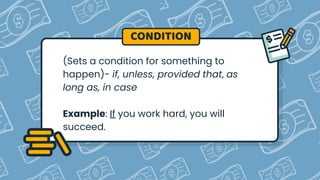
(Sets a condition for something to
happen)- if, unless, provided that, as
long as, in case
Example: If you work hard, you will
succeed.
CONDITION
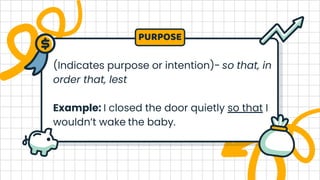
(Indicates purpose or intention)- so that, in
order that, lest
Example: I closed the door quietly so that I
wouldn’t wake the baby.
PURPOSE
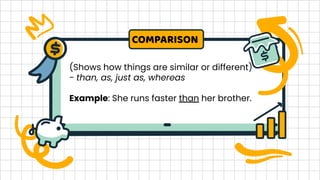
(Shows how things are similar or different)
- than, as, just as, whereas
Example: She runs faster than her brother.
COMPARISON
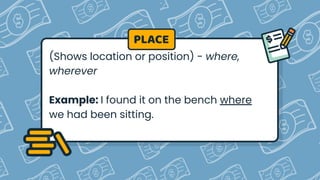
(Shows location or position) - where,
wherever
Example: I found it on the bench where
we had been sitting.
PLACE
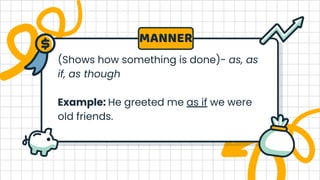
(Shows how something is done)- as, as
if, as though
Example: He greeted me as if we were
old friends.
MANNER
CORRELATIVE
CONJUCTIONS
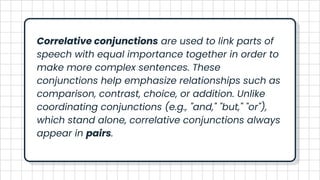
Correlative conjunctions are used to link parts of
speech with equal importance together in order to
make more complex sentences. These
conjunctions help emphasize relationships such as
comparison, contrast, choice, or addition. Unlike
coordinating conjunctions (e.g., "and," "but," "or"),
which stand alone, correlative conjunctions always
appear in pairs.
Common Correlative
Conjunctions
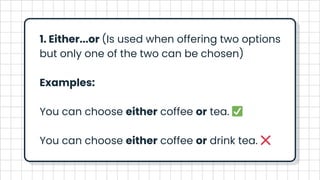
1. Either...or (Is used when offering two options
but only one of the two can be chosen)
Examples:
You can choose either coffee or tea. ✅️
You can choose either coffee or drink tea. ❌️
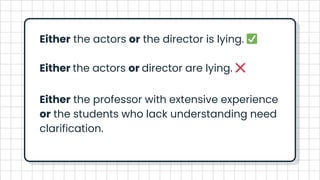
Either the actors or the director is lying. ✅️
Either the actors or director are lying. ❌️
Either the professor with extensive experience
or the students who lack understanding need
clarification.
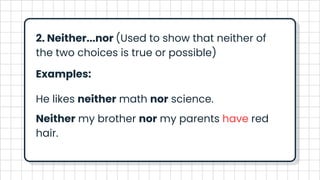
2. Neither...nor (Used to show that neither of
the two choices is true or possible)
Examples:
He likes neither math nor science.
Neither my brother nor my parents have red
hair.
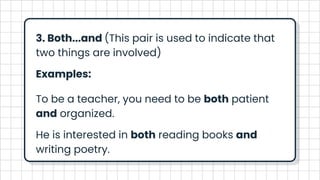
3. Both...and (This pair is used to indicate that
two things are involved)
Examples:
To be a teacher, you need to be both patient
and organized.
He is interested in both reading books and
writing poetry.
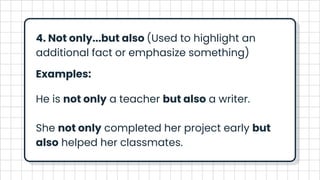
4. Not only...but also (Used to highlight an
additional fact or emphasize something)
Examples:
He is not only a teacher but also a writer.
She not only completed her project early but
also helped her classmates.
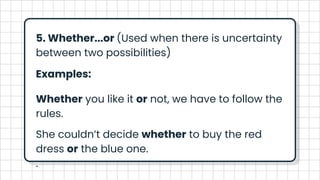
5. Whether...or (Used when there is uncertainty
between two possibilities)
Examples:
Whether you like it or not, we have to follow the
rules.
She couldn’t decide whether to buy the red
dress or the blue one.
.
6. No sooner...than (Used to show that one
action happened immediately after another)
Examples:
No sooner had she entered the room than the
lights went out.
No sooner will I finish my report than I will join
the meeting.
.
7. As...as (Used to compare two things or
people of equal degree)
Examples:
The storm was as sudden as a flash of
lightning.
The students worked as diligently on their
research as the professor did on hers.
.
8. So...that (Used to show that one action leads
to another)
Examples:
She was so tired that she fell asleep instantly.
The problem was so complicated that no one
could solve it.
THANK YOU!

STRUCTURE OF ENGRISH ppt. conjunctions

  • 1.
  • 2.
    a Fill in theblanks with the correct conjuntions. 1. I wanted to go to the beach ____ it was raining. 2. She studied hard _____ got excellent grades. 3. Do you want to go to the movies _____ watch a play? 4. I went to the store _____ I needed to buy some milk. 5. She spoke loudly _____ everyone in the room could hear her. 6. He didn't attend the meeting _____ he was sick. 7. _____ I studied hard, _____ I got excellent grades. 8. She is _____ intelligent _____ beautiful. 9. _____ it was raining, _____ we still had a great time. 10. He is _____ a good teacher _____ a great mentor.
  • 3.
    A conjunction isa word that is used to connect words, phrases, and clauses. There are many conjunctions in the English language, but some common ones include and, or, but, because, for, if, and when.
  • 4.
    They are usefulin writing and speech to connect related ideas, and they help us make our sentences shorter, less repetitive, or less confusing. They can also be termed as connectors as they are employed in sentences to make connections.
  • 5.
    There are threebasic types of conjunctions: Coordinating, Subordinating, and Correlative.
  • 6.
  • 7.
    These are usedto link words, phrases and clauses. They are conjunctions which are used to join together clauses of equal rank. In other words, they generally connect sentence elements of the same grammatical class such as nouns with nouns, adverbs with adverbs, phrases with phrases and clauses with clauses. They also link two sentences that do not depend on each other for meaning. COORDINATING CONJUNCTION COORDINATING CONJUNCTION
  • 8.
    They are simplyreferred to as coordinators, and the art of joining two words, phrases, clauses or sentences using coordinators is known as coordination. COORDINATING CONJUNCTION COORDINATING CONJUNCTION Examples: He doesn’t like fish and chips. The film was good but very long.
  • 9.
    7 7 Examples ofCoordinating Conjunctions
  • 10.
    The most commoncoordinating conjunctions are summed up in the acronym FANBOYS.
  • 11.
    Using the conjunction“for” indicates a relationship between two main clauses by indicating that one clause is the reason that the other is happening. Example: “I want to go to the pizza parlor, for it is my birthday. FOR
  • 12.
    Using “and” indicatesadditional information of equal weight to the information provided in the first clause. Example: “I went to the grocery store and bought snacks for the party.” AND
  • 13.
    It connects twoclauses that have negative modifiers. Example: “I don’t get enough sleep, nor do I try.” NOR
  • 14.
    The conjunction “but”precedes information that opposes the first main clause in some way. Example: “I want to go outside, but I don’t have any sunblock.” BUT
  • 15.
    It indicates adifference between two equal options. Example: “I can’t decide whether I want chocolate or vanilla.” OR
  • 16.
    Introduces a newidea that contradicts the main clause. Example: “I’m always eating, yet I’m always hungry.” YET
  • 17.
    Joins two equally-weightedthoughts that imply cause and effect. Example: "The weather was very hot, so we decided to go swimming." SO
  • 18.
    When to useCommas with Coordinating Conjunctions?
  • 19.
    1. Put acomma before a coordinating conjunction if it is linking two clauses. Example: The guests arrived early, so they had to wait.
  • 20.
    2. Comma linkingtwo independent clause Example: I was tired after working all day, so I decided to go to bed early.
  • 21.
    3. Don’t usea comma to link two words or phrases. Comma linking two words Example: Aisha is studying French and German. Comma linking two phrases Example: The letter was on the table but under a pile of books.
  • 22.
  • 23.
    A subordinating conjunctionis a word or phrase that connects a dependent clause to an independent clause, showing the relationship between them.
  • 24.
    A dependent clause(also called a subordinate clause) is a group of words that contains a subject and a verb but does not express a complete thought. An independent clause is a group of words that contains a subject and a verb and expresses a complete thought.
  • 25.
    Example: Dependent Clause: Becauseshe practiced a lot Independent Clause: She won the singing competition. She won the singing competition because she practiced a lot.
  • 26.
    Subordinating Conjunction SentencePatterns 1. Subordinating Conjunction + Dependent Clause + Comma + Independent Clause Examples: a.) Because I forgot my lunch, I had to buy one at the cafeteria. b.) Although she was tired, she still finished her project.
  • 27.
    Subordinating Conjunction SentencePatterns 2. Independent Clause + Subordinating Conjunction + Dependent Clause Examples: a.) I went to the store because I needed to buy some milk. b.) She spoke loudly so that everyone in the room could hear her.
  • 28.
  • 29.
    (Indicates when somethinghappens) - after, before, as, once, since, until, when, whenever, while Example: He only suggested it after I mentioned it at the meeting. TIME
  • 30.
    (Shows reason orcause) - because, since, as, so that, in order that Example: He left early because he had a meeting. CAUSE AND EFFECT
  • 31.
    (Shows contrast betweenideas) - although, though, even though, whereas, while Example: She continued running even though her legs hurt. CONTRAST
  • 32.
    (Sets a conditionfor something to happen)- if, unless, provided that, as long as, in case Example: If you work hard, you will succeed. CONDITION
  • 33.
    (Indicates purpose orintention)- so that, in order that, lest Example: I closed the door quietly so that I wouldn’t wake the baby. PURPOSE
  • 34.
    (Shows how thingsare similar or different) - than, as, just as, whereas Example: She runs faster than her brother. COMPARISON
  • 35.
    (Shows location orposition) - where, wherever Example: I found it on the bench where we had been sitting. PLACE
  • 36.
    (Shows how somethingis done)- as, as if, as though Example: He greeted me as if we were old friends. MANNER
  • 37.
  • 38.
    Correlative conjunctions areused to link parts of speech with equal importance together in order to make more complex sentences. These conjunctions help emphasize relationships such as comparison, contrast, choice, or addition. Unlike coordinating conjunctions (e.g., "and," "but," "or"), which stand alone, correlative conjunctions always appear in pairs.
  • 39.
  • 40.
    1. Either...or (Isused when offering two options but only one of the two can be chosen) Examples: You can choose either coffee or tea. ✅️ You can choose either coffee or drink tea. ❌️
  • 41.
    Either the actorsor the director is lying. ✅️ Either the actors or director are lying. ❌️ Either the professor with extensive experience or the students who lack understanding need clarification.
  • 42.
    2. Neither...nor (Usedto show that neither of the two choices is true or possible) Examples: He likes neither math nor science. Neither my brother nor my parents have red hair.
  • 43.
    3. Both...and (Thispair is used to indicate that two things are involved) Examples: To be a teacher, you need to be both patient and organized. He is interested in both reading books and writing poetry.
  • 44.
    4. Not only...butalso (Used to highlight an additional fact or emphasize something) Examples: He is not only a teacher but also a writer. She not only completed her project early but also helped her classmates.
  • 45.
    5. Whether...or (Usedwhen there is uncertainty between two possibilities) Examples: Whether you like it or not, we have to follow the rules. She couldn’t decide whether to buy the red dress or the blue one. .
  • 46.
    6. No sooner...than(Used to show that one action happened immediately after another) Examples: No sooner had she entered the room than the lights went out. No sooner will I finish my report than I will join the meeting. .
  • 47.
    7. As...as (Usedto compare two things or people of equal degree) Examples: The storm was as sudden as a flash of lightning. The students worked as diligently on their research as the professor did on hers. .
  • 48.
    8. So...that (Usedto show that one action leads to another) Examples: She was so tired that she fell asleep instantly. The problem was so complicated that no one could solve it.
  • 49.