Group 4 : Command, exclamation,
concord
• Hoàng Thị Phương
• Trần Thị Lan
• Đặng Thùy Trang
• Phạm Thị Hồng Dương
What is type of this sentence?
Close the door,please!
COMMANDS
COMMANDS (imperative)
(Presenter : Hoàng Thị Phương )
1,Definition : commands are sentences which mormally
have no overt grammatical subject,and whose verb is in
the imperative.
Example: Get me some water,please
Go to the store for me
*Note: commands is always used in present tense
and verb infinitive (not “ to “)
2.Types of commands
There are 4 types of commands:
* Without an subject
* With an subject
* With “let”
* Persuative imperatives
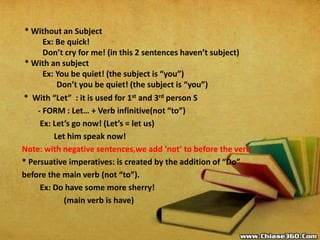
* Without an Subject
Ex: Be quick!
Don’t cry for me! (in this 2 sentences haven’t subject)
* With an subject
Ex: You be quiet! (the subject is “you”)
Don’t you be quiet! (the subject is “you”)
* With “Let” : it is used for 1st and 3rd person S
- FORM : Let… + Verb infinitive(not “to”)
Ex: Let’s go now! (Let’s = let us)
Let him speak now!
Note: with negative sentences,we add ‘not’ to before the verb
* Persuative imperatives: is created by the addition of “Do”
before the main verb (not “to”).
Ex: Do have some more sherry!
(main verb is have)
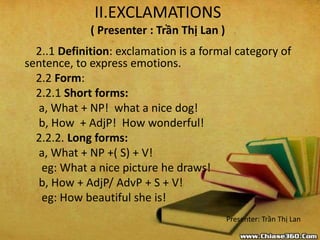
II.EXCLAMATIONS
( Presenter : Trần Thị Lan )
2..1 Definition: exclamation is a formal category of
sentence, to express emotions.
2.2 Form:
2.2.1 Short forms:
a, What + NP! what a nice dog!
b, How + AdjP! How wonderful!
2.2.2. Long forms:
a, What + NP +( S) + V!
eg: What a nice picture he draws!
b, How + AdjP/ AdvP + S + V!
eg: How beautiful she is!
Presenter: Trần Thị Lan
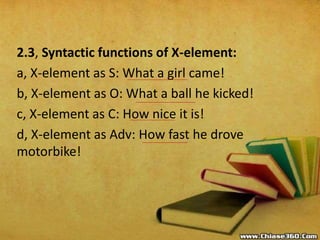
2.3, Syntactic functions of X-element:
a, X-element as S: What a girl came!
b, X-element as O: What a ball he kicked!
c, X-element as C: How nice it is!
d, X-element as Adv: How fast he drove
motorbike!
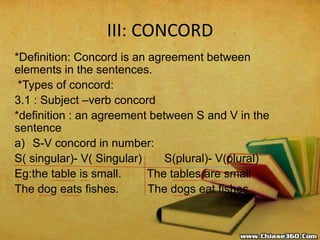
III: CONCORD
*Definition: Concord is an agreement between
elements in the sentences.
*Types of concord:
3.1 : Subject –verb concord
*definition : an agreement between S and V in the
sentence
a) S-V concord in number:
S( singular)- V( Singular) S(plural)- V(plural)
Eg:the table is small. The tables are small
The dog eats fishes. The dogs eat fishes
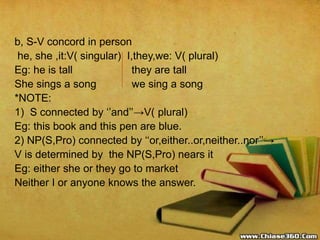
b, S-V concord in person
he, she ,it:V( singular) I,they,we: V( plural)
Eg: he is tall they are tall
She sings a song we sing a song
*NOTE:
1) S connected by ‘’and’’→V( plural)
Eg: this book and this pen are blue.
2) NP(S,Pro) connected by ‘‘or,either..or,neither..nor’’→
V is determined by the NP(S,Pro) nears it
Eg: either she or they go to market
Neither I or anyone knows the answer.
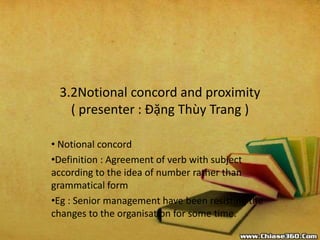
3.2Notional concord and proximity
( presenter : Đặng Thùy Trang )
• Notional concord
•Definition : Agreement of verb with subject
according to the idea of number rather than
grammatical form
•Eg : Senior management have been resisting the
changes to the organisation for some time.
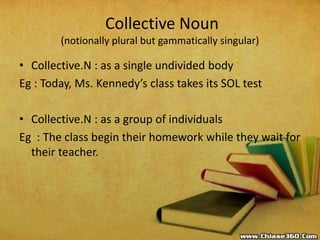
Collective Noun
(notionally plural but gammatically singular)
• Collective.N : as a single undivided body
Eg : Today, Ms. Kennedy’s class takes its SOL test
• Collective.N : as a group of individuals
Eg : The class begin their homework while they wait for
their teacher.
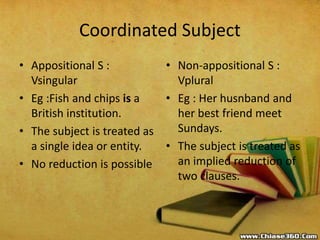
Coordinated Subject
• Appositional S :
Vsingular
• Eg :Fish and chips is a
British institution.
• The subject is treated as
a single idea or entity.
• No reduction is possible
• Non-appositional S :
Vplural
• Eg : Her husnband and
her best friend meet
Sundays.
• The subject is treated as
an implied reduction of
two clauses.
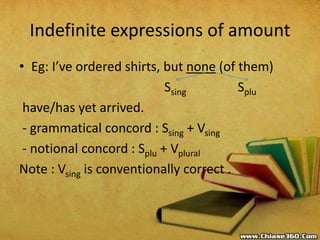
Indefinite expressions of amount
• Eg: I’ve ordered shirts, but none (of them)
Ssing Splu
have/has yet arrived.
- grammatical concord : Ssing + Vsing
- notional concord : Splu + Vplural
Note : Vsing is conventionally correct .
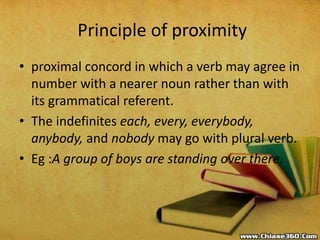
Principle of proximity
• proximal concord in which a verb may agree in
number with a nearer noun rather than with
its grammatical referent.
• The indefinites each, every, everybody,
anybody, and nobody may go with plural verb.
• Eg :A group of boys are standing over there.
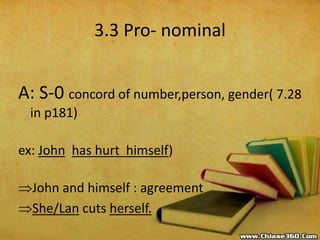
3.3 Pro- nominal
A: S-0 concord of number,person, gender( 7.28
in p181)
ex: John has hurt himself)
John and himself : agreement
She/Lan cuts herself.
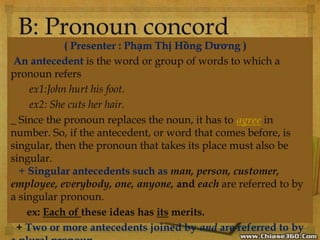
( Presenter : Phạm Thị Hồng Dương )
An antecedent is the word or group of words to which a
pronoun refers
ex1:John hurt his foot.
ex2: She cuts her hair.
_ Since the pronoun replaces the noun, it has to agree in
number. So, if the antecedent, or word that comes before, is
singular, then the pronoun that takes its place must also be
singular.
+ Singular antecedents such as man, person, customer,
employee, everybody, one, anyone, and each are referred to by
a singular pronoun.
ex: Each of these ideas has its merits.
+ Two or more antecedents joined by and are referred to by
+ With two or more antecedents joined by or or nor, the
pronoun agrees with the nearer antecedent.
ex:Neither John nor David eat his food.(pronoun
agree withr David)
+ Collective nouns are referred to by singular or plural
pronouns, depending upon whether the sense of the
collective noun is singular or plural
ex:The committee has submitted its proposals. (The
committee acts as a singular unit – it)
ex:The group have been arguing among themselves.
(The sense is "group members have been arguing"; the sense
is plural.)
+ personal head Ns =>” who”
ex: The girl is standing there.
She is my friend.
=> The girl who is standing there is my friend.
+ non-personal Ns => “which”
ex: The pen is lost.
It is my present.
=> The pen which is lost is my present.
+ collective head Ns:
are treated as personal when they have plural concord. Non-
personal when they have singular.
ex: The group which was responsible for this decision
who were

 1.Commands: Always used in present tense and
verb infinitive not “to”.
 *4 types of commands:
 + Without an subject
 + With an subject
 + With ‘let’
 + Persuative imperatives
Summary
Commands
Exclamation
2.EXCLAMATIONS is a formal category of sentence, to express
emotions.
Form: Short forms: , What + NP!
How + AdjP!
Long forms: What + NP +( S) + V!
How + AdjP/ AdvP + S + V!
Syntactic functions of X-element: X- elements as
S,V,O,A
Concord
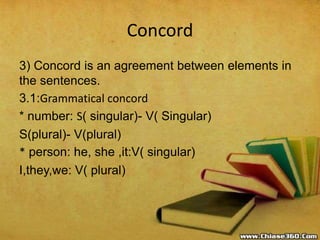
3) Concord is an agreement between elements in
the sentences.
3.1:Grammatical concord
* number: S( singular)- V( Singular)
S(plural)- V(plural)
* person: he, she ,it:V( singular)
I,they,we: V( plural)
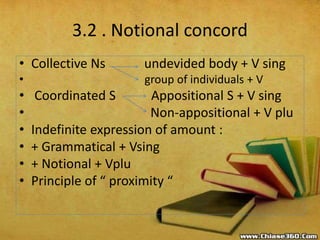
3.2 . Notional concord
• Collective Ns undevided body + V sing
• group of individuals + V
• Coordinated S Appositional S + V sing
• Non-appositional + V plu
• Indefinite expression of amount :
• + Grammatical + Vsing
• + Notional + Vplu
• Principle of “ proximity “
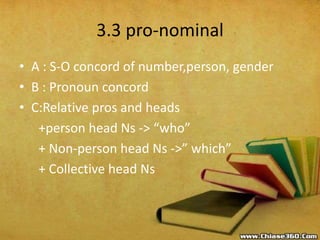
• A : S-O concord of number,person, gender
• B : Pronoun concord
• C:Relative pros and heads
+person head Ns -> “who”
+ Non-person head Ns ->” which”
+ Collective head Ns
3.3 pro-nominal
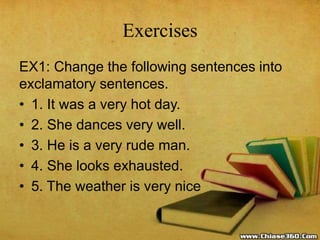
Exercises
EX1: Change the following sentences into
exclamatory sentences.
• 1. It was a very hot day.
• 2. She dances very well.
• 3. He is a very rude man.
• 4. She looks exhausted.
• 5. The weather is very nice
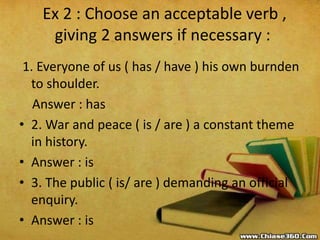
Ex 2 : Choose an acceptable verb ,
giving 2 answers if necessary :
1. Everyone of us ( has / have ) his own burnden
to shoulder.
Answer : has
• 2. War and peace ( is / are ) a constant theme
in history.
• Answer : is
• 3. The public ( is/ are ) demanding an official
enquiry.
• Answer : is
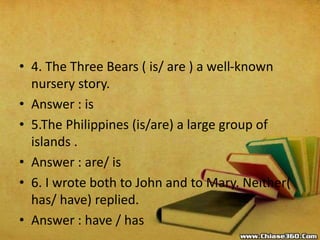
• 4. The Three Bears ( is/ are ) a well-known
nursery story.
• Answer : is
• 5.The Philippines (is/are) a large group of
islands .
• Answer : are/ is
• 6. I wrote both to John and to Mary. Neither(
has/ have) replied.
• Answer : have / has

Command, Exclamation and Concord

  • 1.
    Group 4 :Command, exclamation, concord • Hoàng Thị Phương • Trần Thị Lan • Đặng Thùy Trang • Phạm Thị Hồng Dương
  • 2.
    What is typeof this sentence? Close the door,please! COMMANDS
  • 3.
    COMMANDS (imperative) (Presenter :Hoàng Thị Phương ) 1,Definition : commands are sentences which mormally have no overt grammatical subject,and whose verb is in the imperative. Example: Get me some water,please Go to the store for me *Note: commands is always used in present tense and verb infinitive (not “ to “)
  • 4.
    2.Types of commands Thereare 4 types of commands: * Without an subject * With an subject * With “let” * Persuative imperatives
  • 5.
    * Without anSubject Ex: Be quick! Don’t cry for me! (in this 2 sentences haven’t subject) * With an subject Ex: You be quiet! (the subject is “you”) Don’t you be quiet! (the subject is “you”) * With “Let” : it is used for 1st and 3rd person S - FORM : Let… + Verb infinitive(not “to”) Ex: Let’s go now! (Let’s = let us) Let him speak now! Note: with negative sentences,we add ‘not’ to before the verb * Persuative imperatives: is created by the addition of “Do” before the main verb (not “to”). Ex: Do have some more sherry! (main verb is have)
  • 6.
    II.EXCLAMATIONS ( Presenter :Trần Thị Lan ) 2..1 Definition: exclamation is a formal category of sentence, to express emotions. 2.2 Form: 2.2.1 Short forms: a, What + NP! what a nice dog! b, How + AdjP! How wonderful! 2.2.2. Long forms: a, What + NP +( S) + V! eg: What a nice picture he draws! b, How + AdjP/ AdvP + S + V! eg: How beautiful she is! Presenter: Trần Thị Lan
  • 7.
    2.3, Syntactic functionsof X-element: a, X-element as S: What a girl came! b, X-element as O: What a ball he kicked! c, X-element as C: How nice it is! d, X-element as Adv: How fast he drove motorbike!
  • 8.
    III: CONCORD *Definition: Concordis an agreement between elements in the sentences. *Types of concord: 3.1 : Subject –verb concord *definition : an agreement between S and V in the sentence a) S-V concord in number: S( singular)- V( Singular) S(plural)- V(plural) Eg:the table is small. The tables are small The dog eats fishes. The dogs eat fishes
  • 9.
    b, S-V concordin person he, she ,it:V( singular) I,they,we: V( plural) Eg: he is tall they are tall She sings a song we sing a song *NOTE: 1) S connected by ‘’and’’→V( plural) Eg: this book and this pen are blue. 2) NP(S,Pro) connected by ‘‘or,either..or,neither..nor’’→ V is determined by the NP(S,Pro) nears it Eg: either she or they go to market Neither I or anyone knows the answer.
  • 10.
    3.2Notional concord andproximity ( presenter : Đặng Thùy Trang ) • Notional concord •Definition : Agreement of verb with subject according to the idea of number rather than grammatical form •Eg : Senior management have been resisting the changes to the organisation for some time.
  • 11.
    Collective Noun (notionally pluralbut gammatically singular) • Collective.N : as a single undivided body Eg : Today, Ms. Kennedy’s class takes its SOL test • Collective.N : as a group of individuals Eg : The class begin their homework while they wait for their teacher.
  • 12.
    Coordinated Subject • AppositionalS : Vsingular • Eg :Fish and chips is a British institution. • The subject is treated as a single idea or entity. • No reduction is possible • Non-appositional S : Vplural • Eg : Her husnband and her best friend meet Sundays. • The subject is treated as an implied reduction of two clauses.
  • 13.
    Indefinite expressions ofamount • Eg: I’ve ordered shirts, but none (of them) Ssing Splu have/has yet arrived. - grammatical concord : Ssing + Vsing - notional concord : Splu + Vplural Note : Vsing is conventionally correct .
  • 14.
    Principle of proximity •proximal concord in which a verb may agree in number with a nearer noun rather than with its grammatical referent. • The indefinites each, every, everybody, anybody, and nobody may go with plural verb. • Eg :A group of boys are standing over there.
  • 15.
    3.3 Pro- nominal A:S-0 concord of number,person, gender( 7.28 in p181) ex: John has hurt himself) John and himself : agreement She/Lan cuts herself.
  • 16.
    ( Presenter :Phạm Thị Hồng Dương ) An antecedent is the word or group of words to which a pronoun refers ex1:John hurt his foot. ex2: She cuts her hair. _ Since the pronoun replaces the noun, it has to agree in number. So, if the antecedent, or word that comes before, is singular, then the pronoun that takes its place must also be singular. + Singular antecedents such as man, person, customer, employee, everybody, one, anyone, and each are referred to by a singular pronoun. ex: Each of these ideas has its merits. + Two or more antecedents joined by and are referred to by
  • 17.
    + With twoor more antecedents joined by or or nor, the pronoun agrees with the nearer antecedent. ex:Neither John nor David eat his food.(pronoun agree withr David) + Collective nouns are referred to by singular or plural pronouns, depending upon whether the sense of the collective noun is singular or plural ex:The committee has submitted its proposals. (The committee acts as a singular unit – it) ex:The group have been arguing among themselves. (The sense is "group members have been arguing"; the sense is plural.)
  • 18.
    + personal headNs =>” who” ex: The girl is standing there. She is my friend. => The girl who is standing there is my friend. + non-personal Ns => “which” ex: The pen is lost. It is my present. => The pen which is lost is my present. + collective head Ns: are treated as personal when they have plural concord. Non- personal when they have singular. ex: The group which was responsible for this decision who were
  • 19.
      1.Commands: Alwaysused in present tense and verb infinitive not “to”.  *4 types of commands:  + Without an subject  + With an subject  + With ‘let’  + Persuative imperatives Summary Commands
  • 20.
    Exclamation 2.EXCLAMATIONS is aformal category of sentence, to express emotions. Form: Short forms: , What + NP! How + AdjP! Long forms: What + NP +( S) + V! How + AdjP/ AdvP + S + V! Syntactic functions of X-element: X- elements as S,V,O,A
  • 21.
    Concord 3) Concord isan agreement between elements in the sentences. 3.1:Grammatical concord * number: S( singular)- V( Singular) S(plural)- V(plural) * person: he, she ,it:V( singular) I,they,we: V( plural)
  • 22.
    3.2 . Notionalconcord • Collective Ns undevided body + V sing • group of individuals + V • Coordinated S Appositional S + V sing • Non-appositional + V plu • Indefinite expression of amount : • + Grammatical + Vsing • + Notional + Vplu • Principle of “ proximity “
  • 23.
    • A :S-O concord of number,person, gender • B : Pronoun concord • C:Relative pros and heads +person head Ns -> “who” + Non-person head Ns ->” which” + Collective head Ns 3.3 pro-nominal
  • 24.
    Exercises EX1: Change thefollowing sentences into exclamatory sentences. • 1. It was a very hot day. • 2. She dances very well. • 3. He is a very rude man. • 4. She looks exhausted. • 5. The weather is very nice
  • 25.
    Ex 2 :Choose an acceptable verb , giving 2 answers if necessary : 1. Everyone of us ( has / have ) his own burnden to shoulder. Answer : has • 2. War and peace ( is / are ) a constant theme in history. • Answer : is • 3. The public ( is/ are ) demanding an official enquiry. • Answer : is
  • 26.
    • 4. TheThree Bears ( is/ are ) a well-known nursery story. • Answer : is • 5.The Philippines (is/are) a large group of islands . • Answer : are/ is • 6. I wrote both to John and to Mary. Neither( has/ have) replied. • Answer : have / has