Analytic Geometry
SPECIFIC OBJECTIVES:
At the end of the lesson, the student is expected to
be able to:
•Familiarize with the use of Cartesian Coordinate System.
•Determine the distance between two points.
•Define and determine the angle of inclinations and slopes
of a single line, parallel lines, perpendicular lines and
intersecting lines.
•Determine the coordinates of a point of division of a line
segment.
•Define the median of the triangle and find the intersection
point of the medians of the triangle.
FUNDAMENTAL CONCEPTS
DEFINITIONS
Analytic Geometry – is the branch of mathematics,
which deals with the properties, behaviors, and solution of
points, lines, curves, angles, surfaces and solids by means of
algebraic methods in relation to a coordinate system.
Two Parts of Analytic Geometry
1. Plane Analytic Geometry – deals with figures
on a plane surface
2. Solid Analytic Geometry – deals with solid
figures
Directed Line – a line in which one direction is chosen as
positive and the opposite direction as negative.
Directed Line Segment – consisting of any two points
and the part between them.
Directed Distance – the distance between two points
either positive or negative depending upon the direction of
the line.
RECTANGULAR COORDINATES
A pair of number (x, y) in which x is the first and y
being the second number is called an ordered
pair.
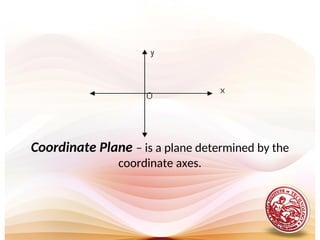
A vertical line and a horizontal line meeting at an
origin, O, are drawn which determines the
coordinate axes.
Coordinate Plane – is a plane determined by the
coordinate axes.
X – axis – is usually drawn horizontally and is called
as the horizontal axis.
Y – axis – is drawn vertically and is called as the
vertical axis.
O – the origin
Coordinate – a number corresponds to a point in
the axis, which is defined in terms of the
perpendicular distance from the axes to the point.
DISTANCE BETWEEN TWO POINTS
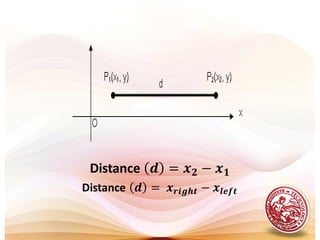
1. Horizontal
The length of a horizontal line segment is the
abscissa (x coordinate) of the point on the right
minus the abscissa (x coordinate) of the point on the
left.
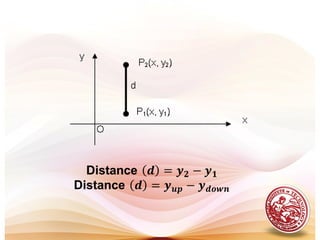
2. Vertical
The length of a vertical line segment is the
ordinate (y coordinate) of the upper point
minus the ordinate (y coordinate) of the
lower point.
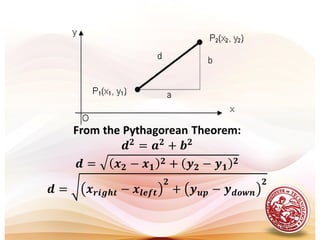
3. Slant
To determine the distance between two
points of a slant line segment add the
square of the difference of the abscissa to
the square of the difference of the
ordinates and take the positive square
root of the sum.
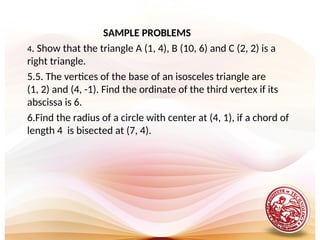
SAMPLE PROBLEMS
4. Show that the triangle A (1, 4), B (10, 6) and C (2, 2) is a
right triangle.
5.5. The vertices of the base of an isosceles triangle are
(1, 2) and (4, -1). Find the ordinate of the third vertex if its
abscissa is 6.
6.Find the radius of a circle with center at (4, 1), if a chord of
length 4 is bisected at (7, 4).
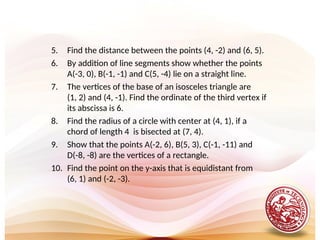
5. Find the distance between the points (4, -2) and (6, 5).
6. By addition of line segments show whether the points
A(-3, 0), B(-1, -1) and C(5, -4) lie on a straight line.
7. The vertices of the base of an isosceles triangle are
(1, 2) and (4, -1). Find the ordinate of the third vertex if
its abscissa is 6.
8. Find the radius of a circle with center at (4, 1), if a
chord of length 4 is bisected at (7, 4).
9. Show that the points A(-2, 6), B(5, 3), C(-1, -11) and
D(-8, -8) are the vertices of a rectangle.
10. Find the point on the y-axis that is equidistant from
(6, 1) and (-2, -3).
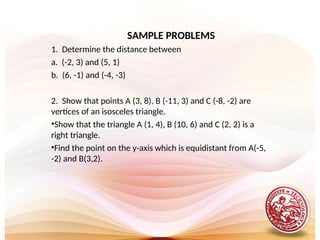
SAMPLE PROBLEMS
1. Determine the distance between
a. (-2, 3) and (5, 1)
b. (6, -1) and (-4, -3)
2. Show that points A (3, 8), B (-11, 3) and C (-8, -2) are
vertices of an isosceles triangle.
•Show that the triangle A (1, 4), B (10, 6) and C (2, 2) is a
right triangle.
•Find the point on the y-axis which is equidistant from A(-5,
-2) and B(3,2).
5. Find the distance between the points (4, -2) and (6, 5).
6. By addition of line segments show whether the points
A(-3, 0), B(-1, -1) and C(5, -4) lie on a straight line.
7. The vertices of the base of an isosceles triangle are
(1, 2) and (4, -1). Find the ordinate of the third vertex if
its abscissa is 6.
8. Find the radius of a circle with center at (4, 1), if a
chord of length 4 is bisected at (7, 4).
9. Show that the points A(-2, 6), B(5, 3), C(-1, -11) and
D(-8, -8) are the vertices of a rectangle.
10. Find the point on the y-axis that is equidistant from
(6, 1) and (-2, -3).


DAY 1 - distance between twoooooooooo points.ppt

  • 1.
  • 2.
    SPECIFIC OBJECTIVES: At theend of the lesson, the student is expected to be able to: •Familiarize with the use of Cartesian Coordinate System. •Determine the distance between two points. •Define and determine the angle of inclinations and slopes of a single line, parallel lines, perpendicular lines and intersecting lines. •Determine the coordinates of a point of division of a line segment. •Define the median of the triangle and find the intersection point of the medians of the triangle.
  • 3.
    FUNDAMENTAL CONCEPTS DEFINITIONS Analytic Geometry– is the branch of mathematics, which deals with the properties, behaviors, and solution of points, lines, curves, angles, surfaces and solids by means of algebraic methods in relation to a coordinate system.
  • 4.
    Two Parts ofAnalytic Geometry 1. Plane Analytic Geometry – deals with figures on a plane surface 2. Solid Analytic Geometry – deals with solid figures
  • 5.
    Directed Line –a line in which one direction is chosen as positive and the opposite direction as negative. Directed Line Segment – consisting of any two points and the part between them. Directed Distance – the distance between two points either positive or negative depending upon the direction of the line.
  • 6.
    RECTANGULAR COORDINATES A pairof number (x, y) in which x is the first and y being the second number is called an ordered pair. A vertical line and a horizontal line meeting at an origin, O, are drawn which determines the coordinate axes.
  • 7.
    Coordinate Plane –is a plane determined by the coordinate axes.
  • 8.
    X – axis– is usually drawn horizontally and is called as the horizontal axis. Y – axis – is drawn vertically and is called as the vertical axis. O – the origin Coordinate – a number corresponds to a point in the axis, which is defined in terms of the perpendicular distance from the axes to the point.
  • 9.
    DISTANCE BETWEEN TWOPOINTS 1. Horizontal The length of a horizontal line segment is the abscissa (x coordinate) of the point on the right minus the abscissa (x coordinate) of the point on the left.
  • 11.
    2. Vertical The lengthof a vertical line segment is the ordinate (y coordinate) of the upper point minus the ordinate (y coordinate) of the lower point.
  • 13.
    3. Slant To determinethe distance between two points of a slant line segment add the square of the difference of the abscissa to the square of the difference of the ordinates and take the positive square root of the sum.
  • 15.
    SAMPLE PROBLEMS 4. Showthat the triangle A (1, 4), B (10, 6) and C (2, 2) is a right triangle. 5.5. The vertices of the base of an isosceles triangle are (1, 2) and (4, -1). Find the ordinate of the third vertex if its abscissa is 6. 6.Find the radius of a circle with center at (4, 1), if a chord of length 4 is bisected at (7, 4).
  • 16.
    5. Find thedistance between the points (4, -2) and (6, 5). 6. By addition of line segments show whether the points A(-3, 0), B(-1, -1) and C(5, -4) lie on a straight line. 7. The vertices of the base of an isosceles triangle are (1, 2) and (4, -1). Find the ordinate of the third vertex if its abscissa is 6. 8. Find the radius of a circle with center at (4, 1), if a chord of length 4 is bisected at (7, 4). 9. Show that the points A(-2, 6), B(5, 3), C(-1, -11) and D(-8, -8) are the vertices of a rectangle. 10. Find the point on the y-axis that is equidistant from (6, 1) and (-2, -3).
  • 17.
    SAMPLE PROBLEMS 1. Determinethe distance between a. (-2, 3) and (5, 1) b. (6, -1) and (-4, -3) 2. Show that points A (3, 8), B (-11, 3) and C (-8, -2) are vertices of an isosceles triangle. •Show that the triangle A (1, 4), B (10, 6) and C (2, 2) is a right triangle. •Find the point on the y-axis which is equidistant from A(-5, -2) and B(3,2).
  • 18.
    5. Find thedistance between the points (4, -2) and (6, 5). 6. By addition of line segments show whether the points A(-3, 0), B(-1, -1) and C(5, -4) lie on a straight line. 7. The vertices of the base of an isosceles triangle are (1, 2) and (4, -1). Find the ordinate of the third vertex if its abscissa is 6. 8. Find the radius of a circle with center at (4, 1), if a chord of length 4 is bisected at (7, 4). 9. Show that the points A(-2, 6), B(5, 3), C(-1, -11) and D(-8, -8) are the vertices of a rectangle. 10. Find the point on the y-axis that is equidistant from (6, 1) and (-2, -3).