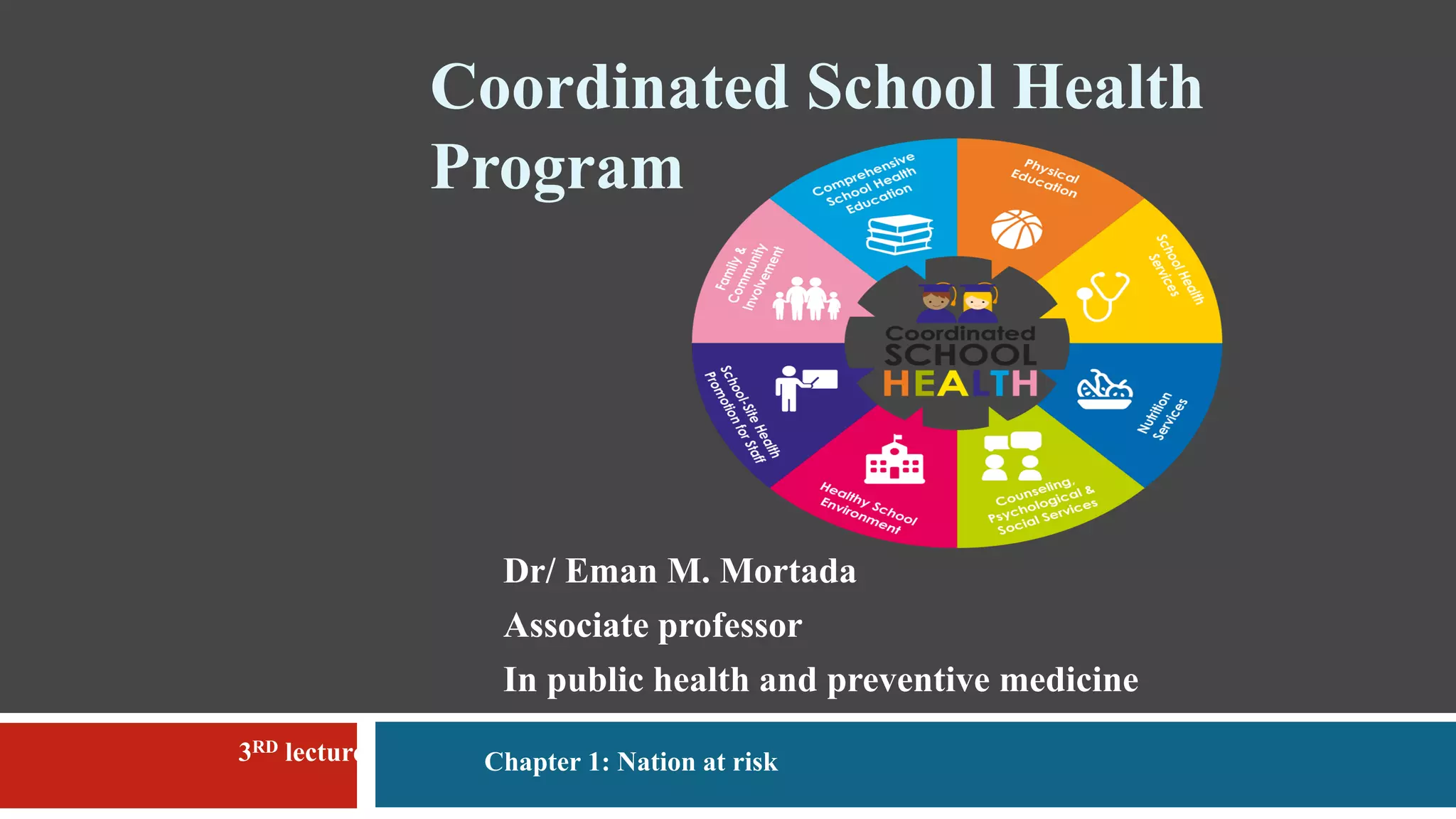
Coordinated School Health
Program
Dr/ Eman M. Mortada
Associate professor
In public health and preventive medicine
3RD lecture Chapter 1: Nation at risk
 An organized set of policies, procedures, and activities
designed to protect, promote, and improve the health and
well-being of students and staff, thus improving the
student’s ability to learn.
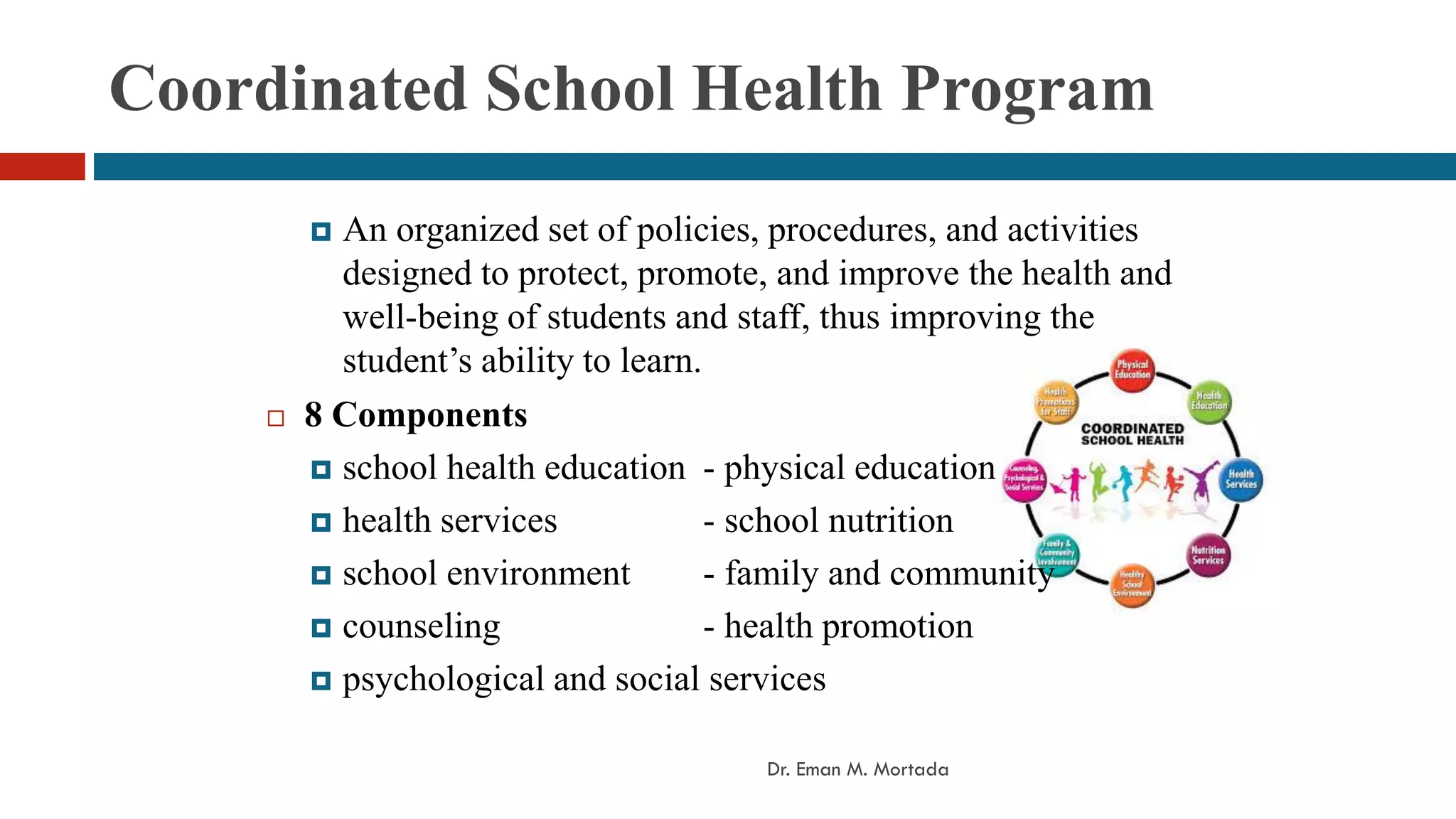
 8 Components
 school health education - physical education
 health services - school nutrition
 school environment - family and community
 counseling - health promotion
 psychological and social services
Coordinated School Health Program
Dr. Eman M. Mortada
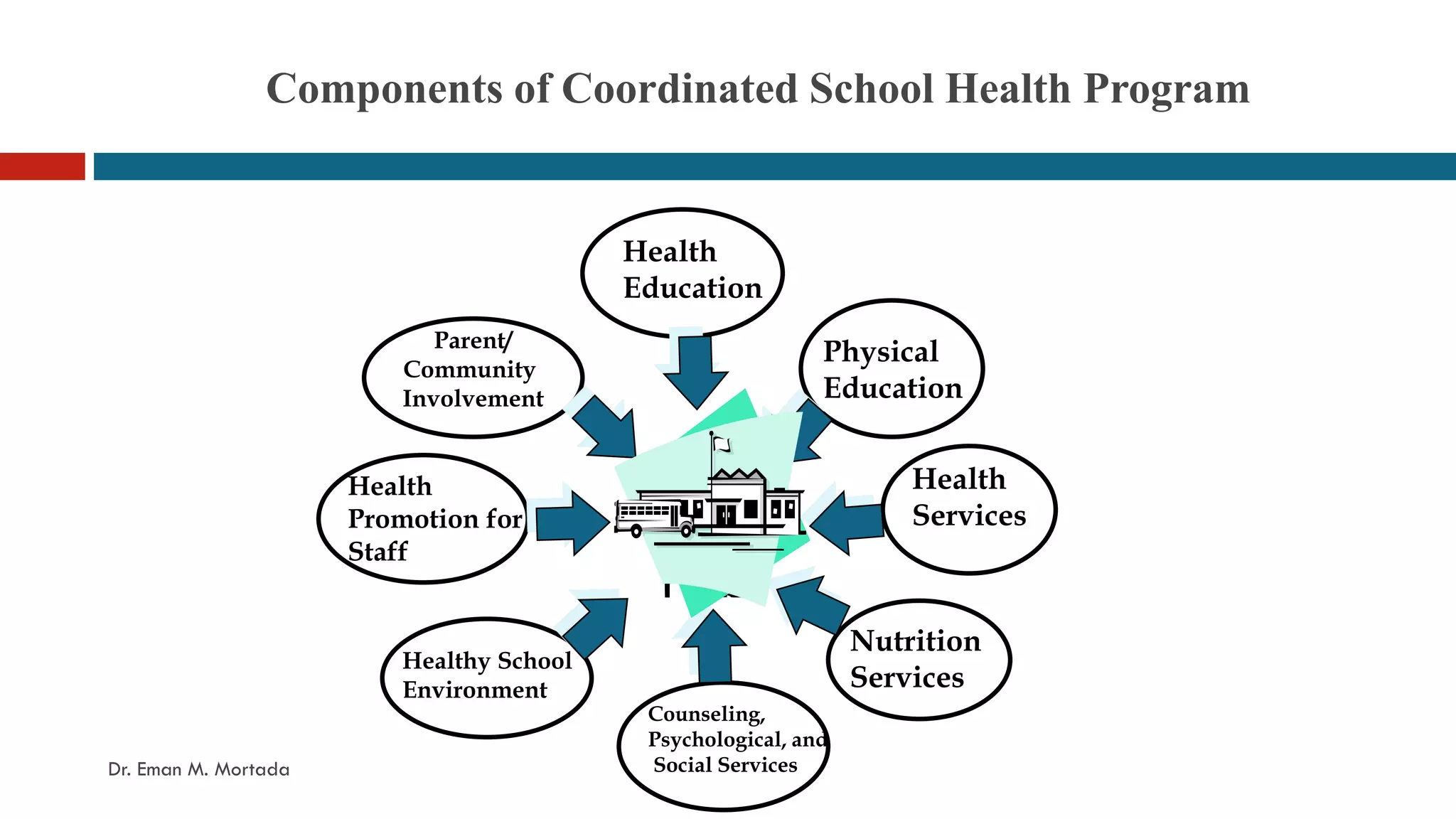
Components of Coordinated School Health Program
Health
Education
Physical
Education
Health
Services
Nutrition
Services
Counseling,
Psychological, and
Social Services
Healthy School
Environment
Health
Promotion for
Staff
Parent/
Community
Involvement
Dr. Eman M. Mortada
1- Health Education
Dr. Eman M. Mortada
1. Health Education
 Implement health education that provides students with the
knowledge, and skills, needed for healthy eating and physical
activity.
 That can increase the likelihood that students engage in healthy
behaviors and avoid or reduce health risks to become successful
learners and productive adults.
 Health education instruction in all grades
 Sequential health education curriculum
Dr. Eman M. Mortada
Essential topics to be covered:
One of the objectives of healthy people 2020 is to increase the
proportion of elementary, middle and high schools that provide
comprehensive school health education to prevent health problems
in the following areas:
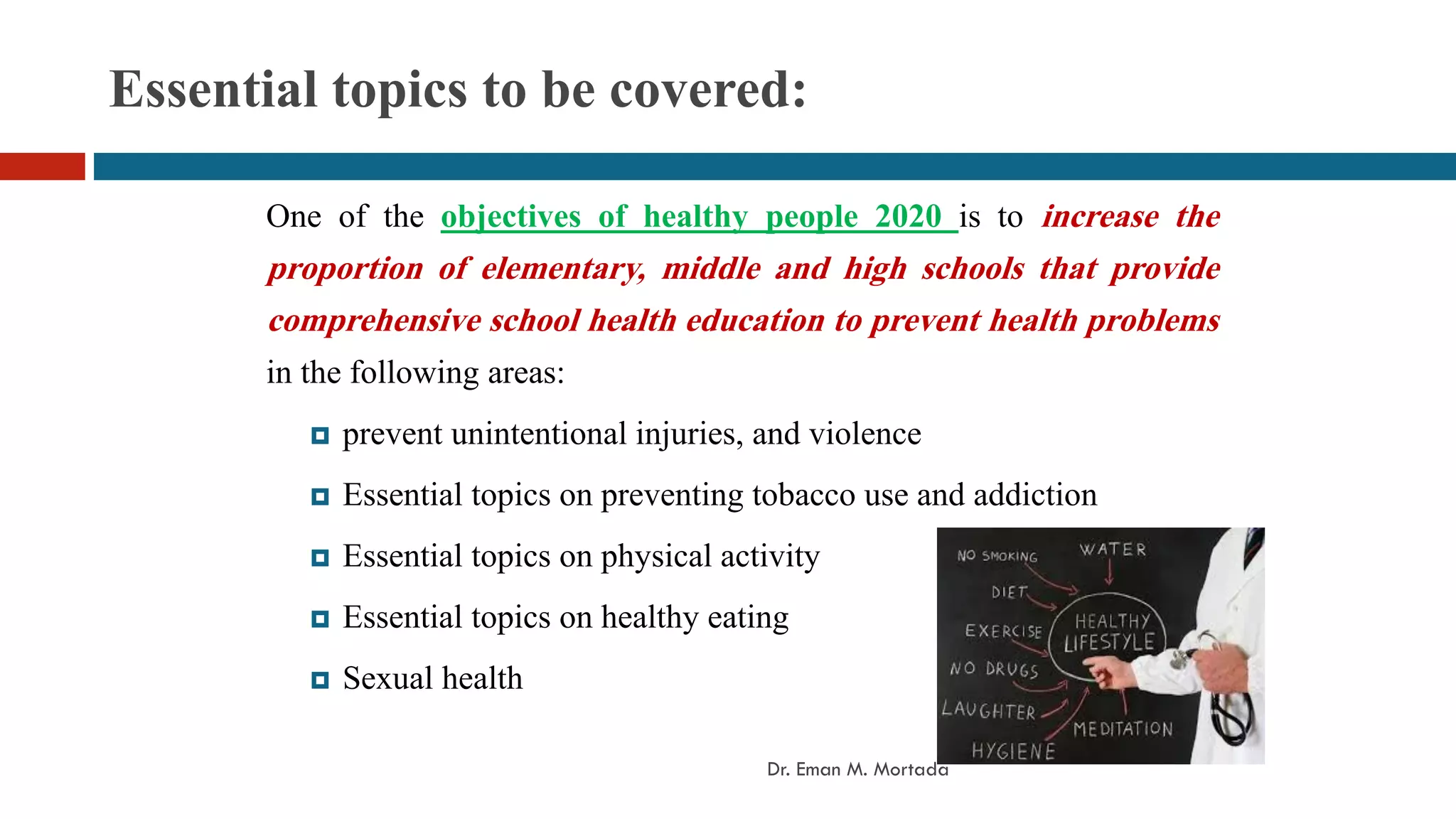
 prevent unintentional injuries, and violence
 Essential topics on preventing tobacco use and addiction
 Essential topics on physical activity
 Essential topics on healthy eating
 Sexual health
Dr. Eman M. Mortada
It is recommended that health education
 Be culturally appropriate for all students.
 Have a clear set of behavioral outcomes.
 Be based on national standards.
 Follow a planned progression in health lessons that are appropriate for the age,
growth, and development of students.
 Be consistent with scientific evidence and effectiveness.
 Active learning strategies
 Instructional methods should be interactive and encourage
 student participation through teacher demonstrations,
 teacher role modeling of healthy behavior,
 student rehearsal and teacher feedback (role-playing), and goal setting for behavior
change
Dr. Eman M. Mortada
2. School Health Services
Dr. Eman M. Mortada
2. School Health Services
 Are services designed to appraise, protect and promote
students' health
 School are ideal place for providing health services
 Because students spend a majority of their day in schools,
schools are responsible for students’ physical health, mental
health, and safety during the school day.
 Because students’ academic success and well-being are
intertwined with their physical and mental health and safety
Dr. Eman M. Mortada
School Health Services provided mainly by:
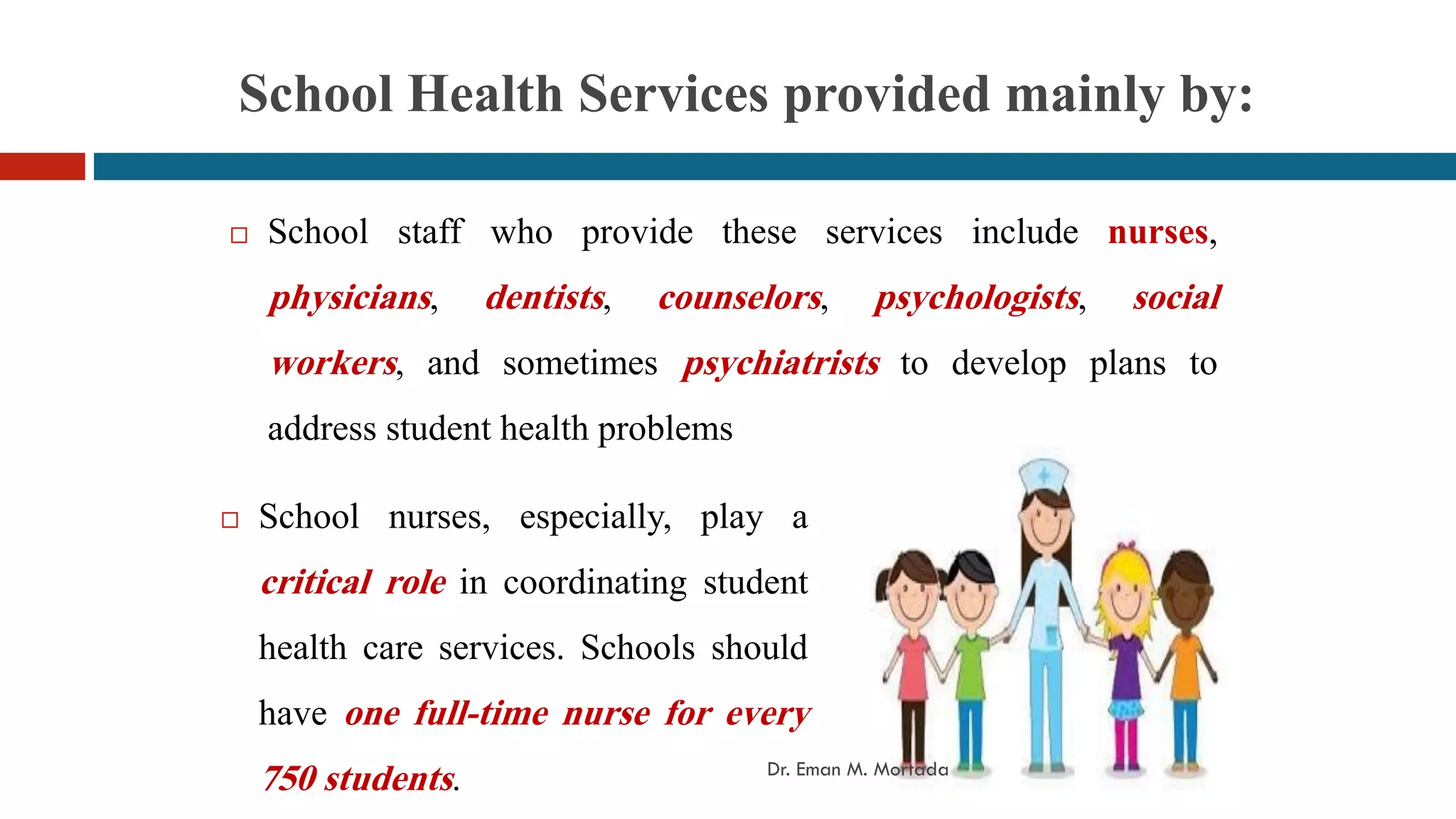
 School nurses, especially, play a
critical role in coordinating student
health care services. Schools should
have one full-time nurse for every
750 students.
 School staff who provide these services include nurses,
physicians, dentists, counselors, psychologists, social
workers, and sometimes psychiatrists to develop plans to
address student health problems
Dr. Eman M. Mortada
8
Examples of Health Services offered in schools:
 Urgent and Emergency care
 Timely identification and appropriate intervention for health problems
 Screening
 Health services for special needs children
 Assistance with medication during school day
 Health counseling
 Preventive health services: immunization
 Referral
Dr. Eman M. Mortada
Will be displayed
in
Separate lecture
3. Healthful and safe School Environment
Dr. Eman M. Mortada
Will be displayed
in
Separate lecture
4. Physical Education
Dr. Eman M. Mortada
4. Physical Education
 Implement a comprehensive, school-based physical activity
program with quality physical education as the cornerstone.
 Physical Education involves a planned, sequential K12 curriculum
that provides cognitive content and learning experiences in a variety of
activity
 More importantly, the students need to understand that physical
activity is critical to the development and maintenance of good
health.
 CDC recommends 150 minutes of physical education per week
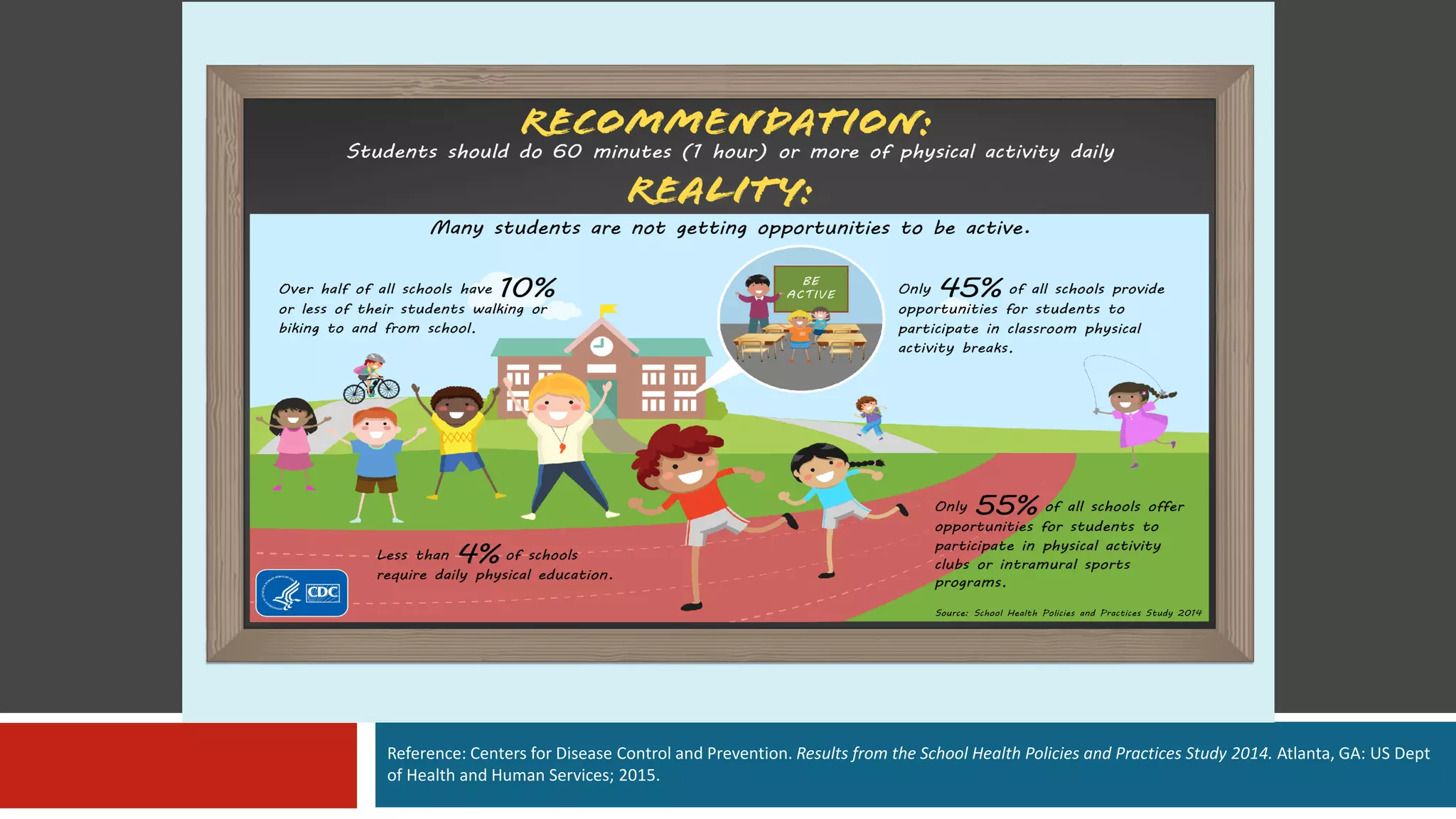
 Federal physical activity guidelines state that children and adolescents
should participate in at least 60 minutes of physical activity daily.
Dr. Eman M. Mortada
Reference: Centers for Disease Control and Prevention. Results from the School Health Policies and Practices Study 2014. Atlanta, GA: US Dept
of Health and Human Services; 2015.
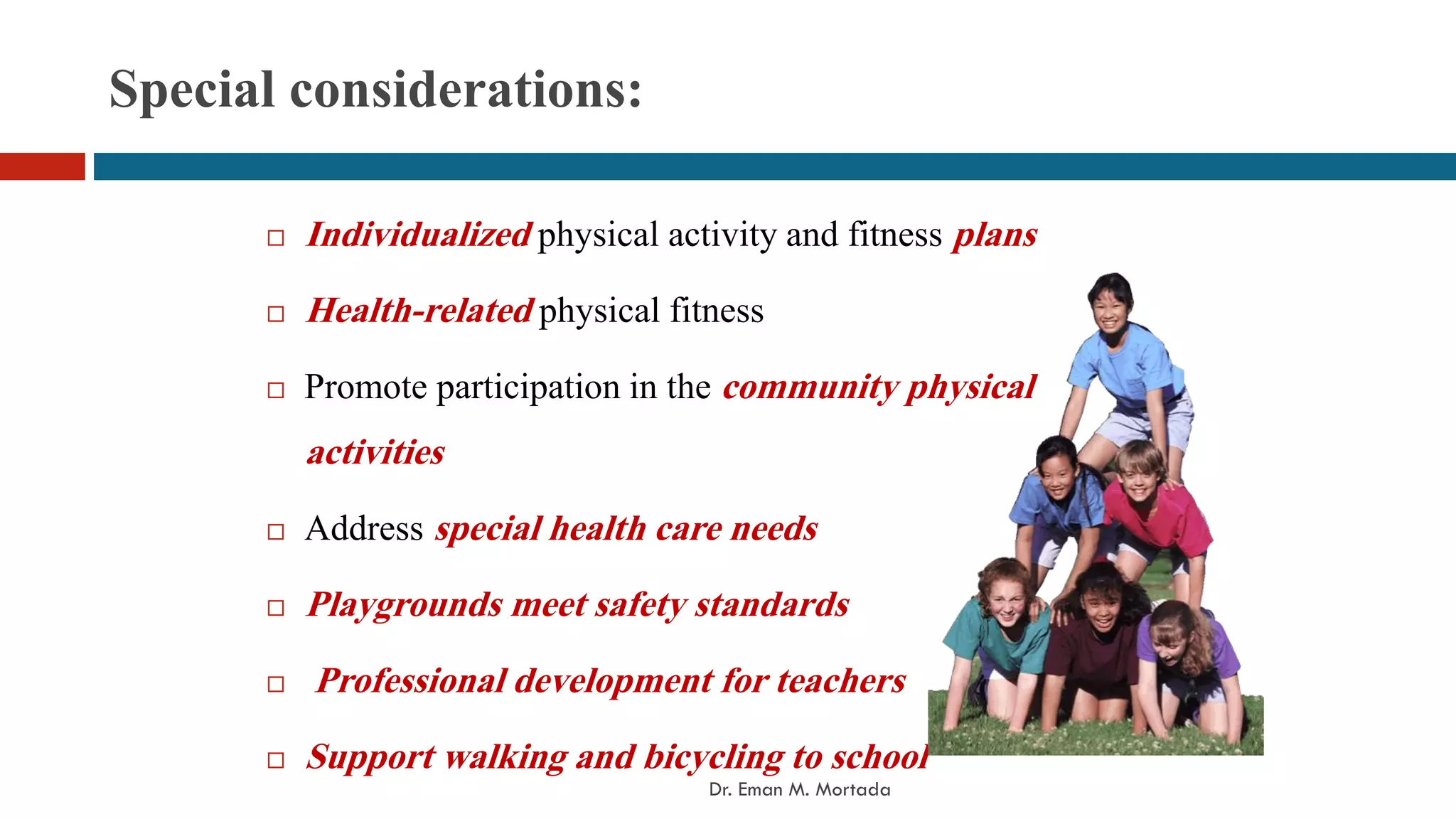
Special considerations:
 Individualized physical activity and fitness plans
 Health-related physical fitness
 Promote participation in the community physical
activities
 Address special health care needs
 Playgrounds meet safety standards
 Professional development for teachers
 Support walking and bicycling to school
Dr. Eman M. Mortada
5. Nutrition Services
Dr. Eman M. Mortada
5. Nutrition Services
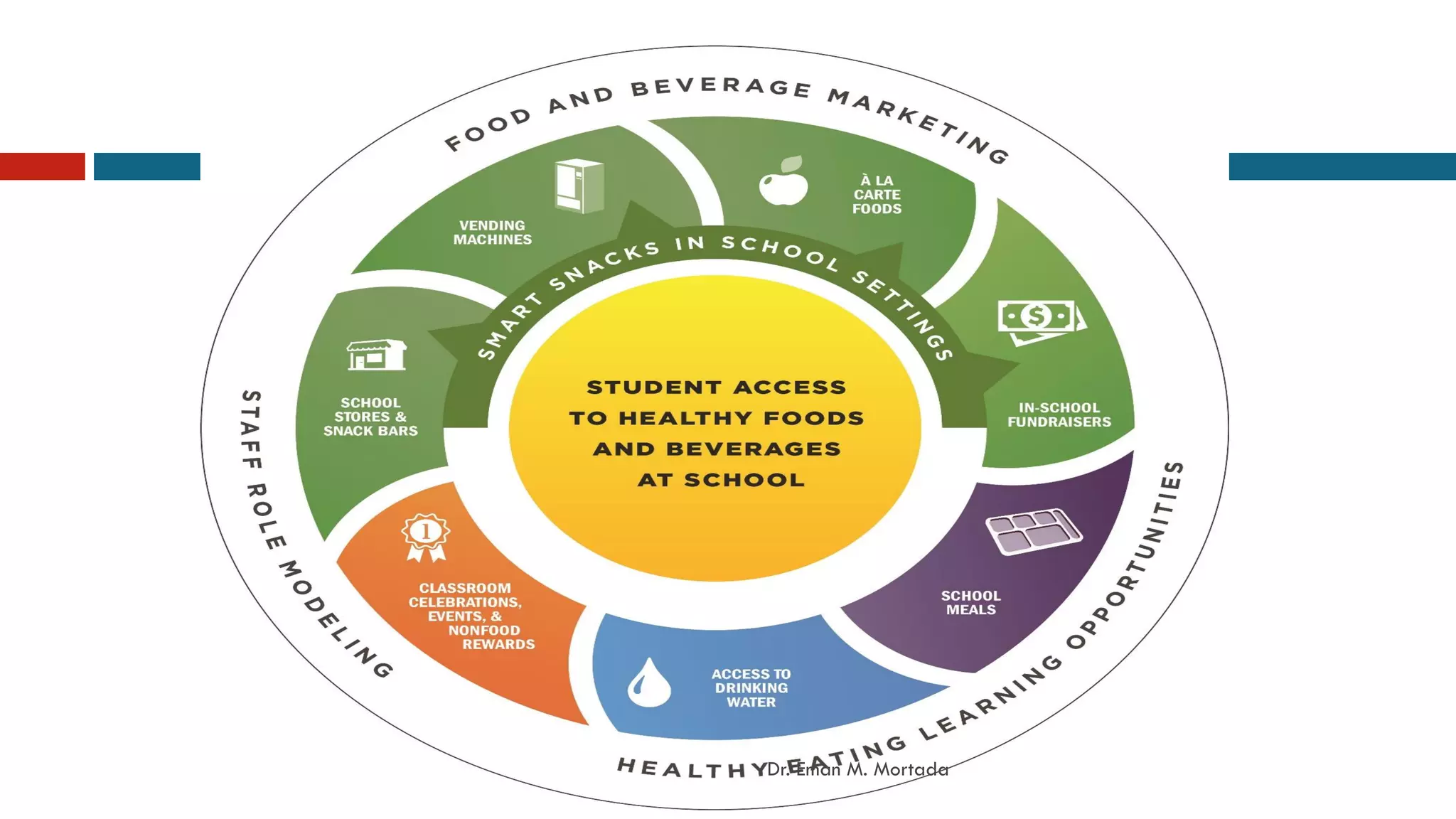
 Provide a quality school meal program and ensure that
students have only appealing, healthy food choices offered
outside of the school meal program.
 Schools are in a unique position to promote healthy dietary
behaviors and help ensure a quality diet among their students.
 School offer school meals (breakfast and lunch programs)
that is fully accessible to all students
 Variety of offerings in school meals such as, fruits ,whole
grain-rich food items and food that address the cultural
practices
Dr. Eman M. Mortada
Reference: Centers for Disease Control and Prevention. Results from the School Health Policies and Practices Study 2014. Atlanta, GA: US Dept
of Health and Human Services; 2015.
Requirement of Nutrition Services
 School nutrition services staff be trained at food safety,
nutrition standards updates in school meals, food
sensitivities and allergies
 Clean, safe, pleasant cafeteria
 Preparedness for food emergencies such as severe food
allergy reactions and choking
 Farm to School activities
Dr. Eman M. Mortada
Dr. Eman M. Mortada
6. School Counseling, Psychological, and Social
Services
 Individual and group assessments, interventions, and referrals.
 Professionals such as certified school counselors,
psychologists, and social workers provide these services.
 Organizational assessment and consultation skills of
counselors and psychologists contribute not only to the health
of students but also to the health of the school environment.
Dr. Eman M. Mortada
6. School Counseling, Psychological, and Social
Services
 School counseling and psychological services are capable of
intervening in areas of:
-assertiveness training,
-life skills training,
-peer interaction,
-self esteem,
-problem solving and
-conflict resolution.
Dr. Eman M. Mortada
7. Health Promotion for Staff
Dr. Eman M. Mortada
7. Health Promotion for Staff
 Schools are one of the nations largest employers
 CDC Recommends to implement a Health promotion for staff members
 Health assessments for staff members (provide accessible and free or low-cost health
assessments at least once a year)
 Breastfeeding policy
Dr. Eman M. Mortada
Health Promotion for Staff
 Promote staff member participation in health
promotion programs
 Stress management programs for staff
 Training for staff members on conflict resolution
 Training for staff members on first aid and CPR
 Programs for staff members on physical
activity/fitness
 Programs for staff members on healthy
eating/weight management
 Modeling healthy eating and physical activity
behaviors
 Programs for staff members on tobacco-use
cessation
Dr. Eman M. Mortada
The rationale for staff health promotion:
 Keeping employees healthy will result in:
 Decreased health care costs for staff
 Decreased absenteeism
 Increased job satisfaction
Dr. Eman M. Mortada
8. Family and Community
Involvement
Dr. Eman M. Mortada
8. Family and Community Involvement
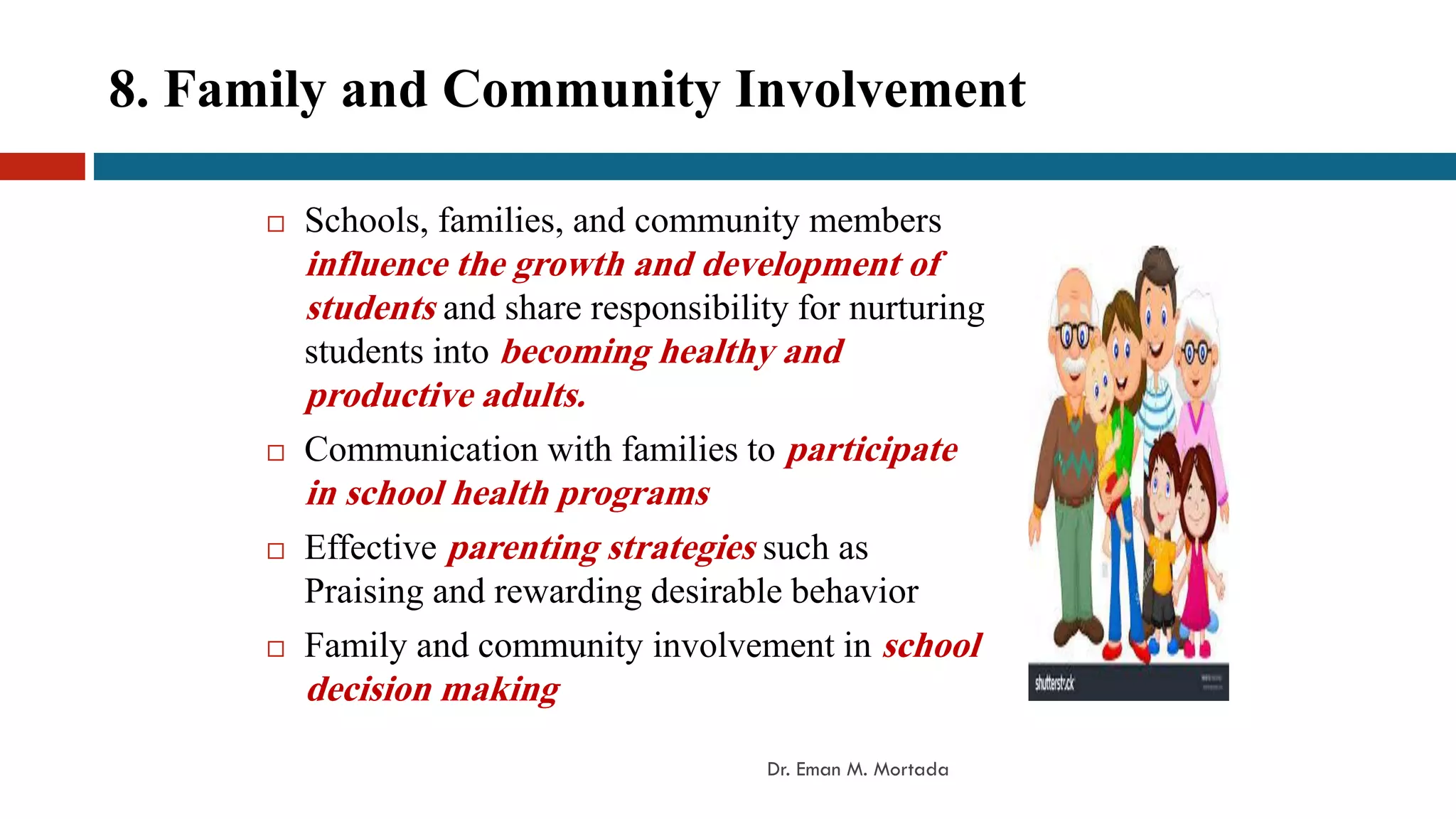
 Schools, families, and community members
influence the growth and development of
students and share responsibility for nurturing
students into becoming healthy and
productive adults.
 Communication with families to participate
in school health programs
 Effective parenting strategies such as
Praising and rewarding desirable behavior
 Family and community involvement in school
decision making
Dr. Eman M. Mortada
Questions?
Dr. Eman M. Mortada
Dr. Eman Mortada
Associate Prof. of public health
Director of epidemiology program
emmortada@pnu.edu.sa
0118240725
Dr. Eman M. Mortada

Coordinated school health program

  • 1.
    Coordinated School Health Program Dr/Eman M. Mortada Associate professor In public health and preventive medicine 3RD lecture Chapter 1: Nation at risk
  • 2.
     An organizedset of policies, procedures, and activities designed to protect, promote, and improve the health and well-being of students and staff, thus improving the student’s ability to learn.  8 Components  school health education - physical education  health services - school nutrition  school environment - family and community  counseling - health promotion  psychological and social services Coordinated School Health Program Dr. Eman M. Mortada
  • 3.
    Components of CoordinatedSchool Health Program Health Education Physical Education Health Services Nutrition Services Counseling, Psychological, and Social Services Healthy School Environment Health Promotion for Staff Parent/ Community Involvement Dr. Eman M. Mortada
  • 4.
    1- Health Education Dr.Eman M. Mortada
  • 5.
    1. Health Education Implement health education that provides students with the knowledge, and skills, needed for healthy eating and physical activity.  That can increase the likelihood that students engage in healthy behaviors and avoid or reduce health risks to become successful learners and productive adults.  Health education instruction in all grades  Sequential health education curriculum Dr. Eman M. Mortada
  • 6.
    Essential topics tobe covered: One of the objectives of healthy people 2020 is to increase the proportion of elementary, middle and high schools that provide comprehensive school health education to prevent health problems in the following areas:  prevent unintentional injuries, and violence  Essential topics on preventing tobacco use and addiction  Essential topics on physical activity  Essential topics on healthy eating  Sexual health Dr. Eman M. Mortada
  • 7.
    It is recommendedthat health education  Be culturally appropriate for all students.  Have a clear set of behavioral outcomes.  Be based on national standards.  Follow a planned progression in health lessons that are appropriate for the age, growth, and development of students.  Be consistent with scientific evidence and effectiveness.  Active learning strategies  Instructional methods should be interactive and encourage  student participation through teacher demonstrations,  teacher role modeling of healthy behavior,  student rehearsal and teacher feedback (role-playing), and goal setting for behavior change Dr. Eman M. Mortada
  • 8.
    2. School HealthServices Dr. Eman M. Mortada
  • 9.
    2. School HealthServices  Are services designed to appraise, protect and promote students' health  School are ideal place for providing health services  Because students spend a majority of their day in schools, schools are responsible for students’ physical health, mental health, and safety during the school day.  Because students’ academic success and well-being are intertwined with their physical and mental health and safety Dr. Eman M. Mortada
  • 10.
    School Health Servicesprovided mainly by:  School nurses, especially, play a critical role in coordinating student health care services. Schools should have one full-time nurse for every 750 students.  School staff who provide these services include nurses, physicians, dentists, counselors, psychologists, social workers, and sometimes psychiatrists to develop plans to address student health problems Dr. Eman M. Mortada
  • 11.
  • 12.
    Examples of HealthServices offered in schools:  Urgent and Emergency care  Timely identification and appropriate intervention for health problems  Screening  Health services for special needs children  Assistance with medication during school day  Health counseling  Preventive health services: immunization  Referral Dr. Eman M. Mortada Will be displayed in Separate lecture
  • 13.
    3. Healthful andsafe School Environment Dr. Eman M. Mortada Will be displayed in Separate lecture
  • 14.
  • 15.
    4. Physical Education Implement a comprehensive, school-based physical activity program with quality physical education as the cornerstone.  Physical Education involves a planned, sequential K12 curriculum that provides cognitive content and learning experiences in a variety of activity  More importantly, the students need to understand that physical activity is critical to the development and maintenance of good health.  CDC recommends 150 minutes of physical education per week  Federal physical activity guidelines state that children and adolescents should participate in at least 60 minutes of physical activity daily. Dr. Eman M. Mortada
  • 16.
    Reference: Centers forDisease Control and Prevention. Results from the School Health Policies and Practices Study 2014. Atlanta, GA: US Dept of Health and Human Services; 2015.
  • 17.
    Special considerations:  Individualizedphysical activity and fitness plans  Health-related physical fitness  Promote participation in the community physical activities  Address special health care needs  Playgrounds meet safety standards  Professional development for teachers  Support walking and bicycling to school Dr. Eman M. Mortada
  • 18.
  • 19.
    5. Nutrition Services Provide a quality school meal program and ensure that students have only appealing, healthy food choices offered outside of the school meal program.  Schools are in a unique position to promote healthy dietary behaviors and help ensure a quality diet among their students.  School offer school meals (breakfast and lunch programs) that is fully accessible to all students  Variety of offerings in school meals such as, fruits ,whole grain-rich food items and food that address the cultural practices Dr. Eman M. Mortada
  • 20.
    Reference: Centers forDisease Control and Prevention. Results from the School Health Policies and Practices Study 2014. Atlanta, GA: US Dept of Health and Human Services; 2015.
  • 21.
    Requirement of NutritionServices  School nutrition services staff be trained at food safety, nutrition standards updates in school meals, food sensitivities and allergies  Clean, safe, pleasant cafeteria  Preparedness for food emergencies such as severe food allergy reactions and choking  Farm to School activities Dr. Eman M. Mortada
  • 22.
    Dr. Eman M.Mortada
  • 23.
    6. School Counseling,Psychological, and Social Services  Individual and group assessments, interventions, and referrals.  Professionals such as certified school counselors, psychologists, and social workers provide these services.  Organizational assessment and consultation skills of counselors and psychologists contribute not only to the health of students but also to the health of the school environment. Dr. Eman M. Mortada
  • 24.
    6. School Counseling,Psychological, and Social Services  School counseling and psychological services are capable of intervening in areas of: -assertiveness training, -life skills training, -peer interaction, -self esteem, -problem solving and -conflict resolution. Dr. Eman M. Mortada
  • 25.
    7. Health Promotionfor Staff Dr. Eman M. Mortada
  • 26.
    7. Health Promotionfor Staff  Schools are one of the nations largest employers  CDC Recommends to implement a Health promotion for staff members  Health assessments for staff members (provide accessible and free or low-cost health assessments at least once a year)  Breastfeeding policy Dr. Eman M. Mortada
  • 27.
    Health Promotion forStaff  Promote staff member participation in health promotion programs  Stress management programs for staff  Training for staff members on conflict resolution  Training for staff members on first aid and CPR  Programs for staff members on physical activity/fitness  Programs for staff members on healthy eating/weight management  Modeling healthy eating and physical activity behaviors  Programs for staff members on tobacco-use cessation Dr. Eman M. Mortada
  • 28.
    The rationale forstaff health promotion:  Keeping employees healthy will result in:  Decreased health care costs for staff  Decreased absenteeism  Increased job satisfaction Dr. Eman M. Mortada
  • 29.
    8. Family andCommunity Involvement Dr. Eman M. Mortada
  • 30.
    8. Family andCommunity Involvement  Schools, families, and community members influence the growth and development of students and share responsibility for nurturing students into becoming healthy and productive adults.  Communication with families to participate in school health programs  Effective parenting strategies such as Praising and rewarding desirable behavior  Family and community involvement in school decision making Dr. Eman M. Mortada
  • 31.
  • 32.
    Dr. Eman Mortada AssociateProf. of public health Director of epidemiology program emmortada@pnu.edu.sa 0118240725
  • 33.
    Dr. Eman M.Mortada