The School Health
   Program: A
  Component of
Community Health


    Chapter 6
Introduction
• The school health program has great potential
  for affecting health of the community
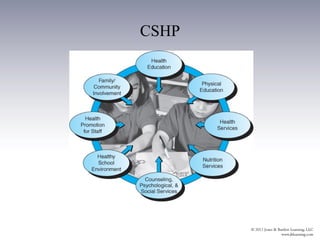
Coordinated School Health Program
• An organized set of policies, procedures, and
  activities designed to protect, promote, and
  improve the health and well-being of students
  and staff
CSHP
The School Health Council
• Individuals from a school or school district
  and its community who work together to
  provide advice and aspects of the school health
  program
  • Should include diverse representation
• Primary role – provide coordination of the
  CSHP components
The School Nurse
•   Can provide great leadership for the CSHP
•   Has medical knowledge and formal training
•   Has multiple responsibilities
•   Often districts do not have resources to hire
    full-time nurses
Teachers
• Heavy responsibility in making sure the CSHP
  works
• Often spend more waking hours with children
  than parents
The Need for School Health
• An unhealthy child has a difficult time
  learning
• Health and success in schools are interrelated
• A CSHP provides the integration of education
  and health
Foundations of the School Health Program
• School administration that supports the effort
• A well-organized school health council
• Written school health policies
School Health Policies
• Steps for creating local health-related policies
  include
     • Identify the policy development team
     • Assess the district’s needs
     • Prioritize needs and develop an action plan
     • Draft a policy
     • Build awareness and support
     • Adopt and implement the policy
     • Maintain, measure, and evaluate
Policy Development
• Should be executed by the school health
  council
• Should cover all facets of the school health
  program
• Gain approval from key stakeholders
Policy Implementation
• Policies only effective if implemented
  • Distribute policies to those affected
     • Distribute with a memorandum of explanation
     • Place in faculty, staff, and student handbooks
     • Present them at group meetings (PTO)
     • Hold a special meeting for explaining policies
     • Place them in the school district newsletter
Monitoring Policy Status
• National survey conducted by CDC every 6
  years
• Assesses:
  • School health policies
  • School health practices at the state, district,
    school, and classroom levels
Components of a CSHP
•   Administration and organization
•   School health services
•   Healthy school environment
•   School health education
•   Counseling, psychological, and social services
•   Physical education
•   School nutrition services
•   Family/community involvement
•   School-site health promotion for staff
Administration and Organization
• A CSHP should be administered by a School
  Health Coordinator
  • Multiple responsibilities
  • Often not a position required by states
School Health Services
• Health services provided by school health
  workers to appraise, protect, and promote
  health
     • Health screenings, emergency care for injury
       and sudden illness, chronic disease
       management, communicable disease prevention
       and control, health counseling
• Advantages: equitability, confidentiality,
  breadth of coverage, user friendliness,
  convenience
Healthy School Environment
• By law, school districts are required to provide
  a safe school environment
• Physical environment
  • Buildings and structures, and the behaviors of
    those using them
  • Location, age, air quality, food service,
    temperature, etc.
• Psychosocial environment
  • Attitudes, values, feelings of students and staff
School Health Education
• The development, delivery, and evaluation of a
  planned curriculum
  • Priority health content:
     • Alcohol and other drugs, healthy eating, mental
       and emotional health, personal health and
       wellness, physical activity, safety/unintentional
       injury prevention, sexual health (abstinence and
       risk avoidance), tobacco, violence prevention
Development of and Sources of Health
         Education Curricula
• Many available from national specialists
• Approved curricula from state departments of
  education or health
• Health agencies and associations
• Commercially produced curricula
Issues and Concerns of the School Health
                   Program
•   Lack of support for CSHP
•   School health curriculum challenges
•   School-based health centers
•   Violence in schools
Lack of Support for CSHP
• Limited success in getting CSHP implemented
  across the country
• Need supportive legislation
School Health Curriculum Challenges
• Controversy
  • Strong opinions on various topics
• Improper implementation
  • Often provided by individuals other than health
    education specialists
  • Barriers to school health education
School-Based Health Centers or
       School-Linked Health Centers
• Rapidly growing concept
• Provided in different ways; most common is in
  school building
• Common features among various centers
• “Cultural wars”
• Funding challenges
Violence in Schools
•   High profile incidents of violence in schools
•   Bullying
•   Electronic aggression
•   Recommendations for improving school
    climate as it relates to violence
Discussion Questions
• Why is a CSHP so challenging to implement
  in every school district?

• How can schools have more effective health
  programs with limited funding?

Ch06 outline

  • 1.
    The School Health Program: A Component of Community Health Chapter 6
  • 2.
    Introduction • The schoolhealth program has great potential for affecting health of the community
  • 3.
    Coordinated School HealthProgram • An organized set of policies, procedures, and activities designed to protect, promote, and improve the health and well-being of students and staff
  • 4.
  • 5.
    The School HealthCouncil • Individuals from a school or school district and its community who work together to provide advice and aspects of the school health program • Should include diverse representation • Primary role – provide coordination of the CSHP components
  • 6.
    The School Nurse • Can provide great leadership for the CSHP • Has medical knowledge and formal training • Has multiple responsibilities • Often districts do not have resources to hire full-time nurses
  • 7.
    Teachers • Heavy responsibilityin making sure the CSHP works • Often spend more waking hours with children than parents
  • 8.
    The Need forSchool Health • An unhealthy child has a difficult time learning • Health and success in schools are interrelated • A CSHP provides the integration of education and health
  • 9.
    Foundations of theSchool Health Program • School administration that supports the effort • A well-organized school health council • Written school health policies
  • 10.
    School Health Policies •Steps for creating local health-related policies include • Identify the policy development team • Assess the district’s needs • Prioritize needs and develop an action plan • Draft a policy • Build awareness and support • Adopt and implement the policy • Maintain, measure, and evaluate
  • 11.
    Policy Development • Shouldbe executed by the school health council • Should cover all facets of the school health program • Gain approval from key stakeholders
  • 12.
    Policy Implementation • Policiesonly effective if implemented • Distribute policies to those affected • Distribute with a memorandum of explanation • Place in faculty, staff, and student handbooks • Present them at group meetings (PTO) • Hold a special meeting for explaining policies • Place them in the school district newsletter
  • 13.
    Monitoring Policy Status •National survey conducted by CDC every 6 years • Assesses: • School health policies • School health practices at the state, district, school, and classroom levels
  • 14.
    Components of aCSHP • Administration and organization • School health services • Healthy school environment • School health education • Counseling, psychological, and social services • Physical education • School nutrition services • Family/community involvement • School-site health promotion for staff
  • 15.
    Administration and Organization •A CSHP should be administered by a School Health Coordinator • Multiple responsibilities • Often not a position required by states
  • 16.
    School Health Services •Health services provided by school health workers to appraise, protect, and promote health • Health screenings, emergency care for injury and sudden illness, chronic disease management, communicable disease prevention and control, health counseling • Advantages: equitability, confidentiality, breadth of coverage, user friendliness, convenience
  • 17.
    Healthy School Environment •By law, school districts are required to provide a safe school environment • Physical environment • Buildings and structures, and the behaviors of those using them • Location, age, air quality, food service, temperature, etc. • Psychosocial environment • Attitudes, values, feelings of students and staff
  • 18.
    School Health Education •The development, delivery, and evaluation of a planned curriculum • Priority health content: • Alcohol and other drugs, healthy eating, mental and emotional health, personal health and wellness, physical activity, safety/unintentional injury prevention, sexual health (abstinence and risk avoidance), tobacco, violence prevention
  • 19.
    Development of andSources of Health Education Curricula • Many available from national specialists • Approved curricula from state departments of education or health • Health agencies and associations • Commercially produced curricula
  • 20.
    Issues and Concernsof the School Health Program • Lack of support for CSHP • School health curriculum challenges • School-based health centers • Violence in schools
  • 21.
    Lack of Supportfor CSHP • Limited success in getting CSHP implemented across the country • Need supportive legislation
  • 22.
    School Health CurriculumChallenges • Controversy • Strong opinions on various topics • Improper implementation • Often provided by individuals other than health education specialists • Barriers to school health education
  • 23.
    School-Based Health Centersor School-Linked Health Centers • Rapidly growing concept • Provided in different ways; most common is in school building • Common features among various centers • “Cultural wars” • Funding challenges
  • 24.
    Violence in Schools • High profile incidents of violence in schools • Bullying • Electronic aggression • Recommendations for improving school climate as it relates to violence
  • 25.
    Discussion Questions • Whyis a CSHP so challenging to implement in every school district? • How can schools have more effective health programs with limited funding?