Dr. Eman M. Mortada
Professor
In public health and preventive medicine
Avoiding Scientific Misconduct -
by Ethical regulations
Define basic concepts related to research
ethics
The Consequences of Scientific Misconduct
Need and objectives for Research Ethics
Historical Perspective of Unethical Practices
Development of code of ethics
Ethical principals
Lecture Outline
▪ Research with human subjects is of paramount importance for:
▪ the individual,
▪ Society & public health,
▪ Science and
▪ The economy.
Introduction
Dr. Eman Mortada
❑ The progressive development &Major expansion in the
biomedical research raised the concern about the research ethics
Research ethics
✓Defined as a set of guidelines to be followed
during carrying out research for protection of the
participants right
Dr / Eman Mortada
Recently, A lot of debates have been raised regarding:
Researcher
Dr. Eman Mortada
❑ researchers awareness of ethical, moral and legal
responsibilities
❑ If they are well trained to avoid ethical pitfalls
Every research, we face situations that require
ethical judgment and challenged by:
Ethical questions and dilemmas.
Some are relatively easy to answer
Others are much more difficult
Dr. Eman Mortada
Hypothetical example
Dr. Eman Mortada
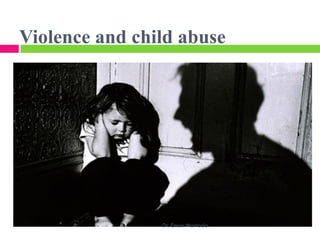
Violence and child abuse
Dr. Eman Mortada
So you spent time preparing for the
research
Best methodology
Best
practice
Dr. Eman Mortada
What is the simplest
study design???
Dr. Eman Mortada
Dr. Eman Mortada
Pilot testing
Team faces
unanticipated
problems
Dr. Eman Mortada
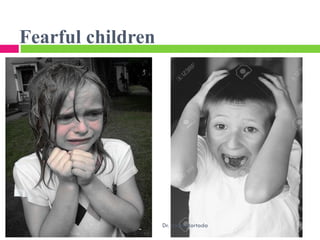
Fearful children
Dr. Eman Mortada
Parents forbid them from
participation
Dr. Eman Mortada
❑ Will our research do more harm than
good?
❑ How will we ensure the safety of people
we interview???
The answer is not easy
It is a clear example of ethical
dilemma
Dr. Eman Mortada
10/25/2021
17
Ethical Dilemma:
Situations necessitating a choice
between two equal (usually
undesirable) alternatives.
Significant technological and
scientific advances
changes in clinical practice and
research
have produced totally new ethical
dilemmas and exacerbated old ones
Dr. Eman Mortada
Perceived Body Image
Created anxiety among them
Dr. Eman Mortada
CAN APPLICATION OF
ETHICAL PRINCIPALS
HELP
RESEARCHER ANSWER
DIFFICULT QUESTIONS?
The answer is: YES
Ethics is about making
choices…
Dr. Eman Mortada
❑ All researchers should be familiar with the basic
ethical principles and have up-to-date knowledge
about policies and procedures designed to:
❖ ensure the safety of research subjects and
❖ to prevent sloppy or irresponsible research,
❑ because ignorance of policies designed to protect
research subjects is not considered a viable excuse for
ethically questionable projects. Dr. Eman Mortada
The Consequences of Scientific
Misconduct
❑ Blacklisted in the scientific
community
❑ Banned from future research or
publication
❑ Banned from requesting or receiving
grant funds
❑ Possible monetary fines
❑ Termination of Employment
❑ Increasing need for experimentation on human subjects.
Dr. Eman Mortada
Need for Research Ethics
Dr. Eman Mortada
❑Increasing acceptance and appreciation of
human rights.
Need for Research Ethics
Dr. Eman Mortada
Paternalism Autonomy
❑ The change in philosophy from (passive to active
participant)
Need for Research Ethics
❑ To protect right and welfare of the
participants
❑ To examine research activities for their ethical
soundness
❑ To ensure that research is conducted in a way
that serves interests of individuals, groups
and/or society as a whole
Dr. Eman Mortada
Objectives of Research Ethics
▪ Research is however not only associated with
social benefits, it also involves risks.
▪ Scientific advances are ethically justifiable only
if respect for the human dignity of all persons is
guaranteed.
Protection of
Subject
Welfare/Rights
Advancement
of Science
Without an Adequate Framework of Research Ethics
Balancing Twin Goals
Dr. Eman Mortada
Evolution of
Human Subjects
Protections
Historical Perspective
of Unethical Practices
Horror Stories
Dr. Eman Mortada
1979
1934 1964
2011
1982 1996 2004
Historical Events
http://www.humanresearch.msu.edu/requiredtraining.html
Historical
Timeline
UPTILL NOW
1932
2011
❑ US Public Health Services began to study the
natural progression of untreated syphilis,
❑ 399 rural African-American men who had
contracted syphilis
❑ Joined Tuskegee Institute for free medical care,
meals
Historical
Timeline
1- Tuskegee syphilis study (1932-72)
What do you know about
syphilis ?
Syphilis is a sexually transmitted
infectious disease.
Dr. Eman Mortada
1928
Dr. Eman Mortada
❑ Deception and withholding information and ttt:
➢ Study participants were never told they had syphilis, nor
were they ever treated for it
➢ Although, penicillin proven to be effective treatment for
syphilis
➢ Researchers prevented men from being treated elsewhere
❑ Putting men and their families at risk
They were
betrayed
Ethical problems
Tuskegee syphilis study cont..1
The tragedy
By the time the study was exposed in 1972:
❑ 28 men had died of syphilis,
❑ 100 others were dead of related complications,
❑ at least 40 wives had been infected and
❑ About 20 child had contracted the disease at birth."
Dr. Eman Mortada
Tuskegee syphilis study cont..2
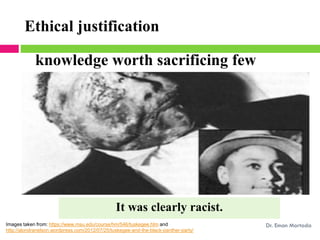
knowledge worth sacrificing few
Ethical justification
Images taken from: https://www.msu.edu/course/hm/546/tuskegee.htm and
http://alondranelson.wordpress.com/2012/07/25/tuskegee-and-the-black-panther-party/
Dr. Eman Mortada
It was clearly racist.
2011
2011
1938
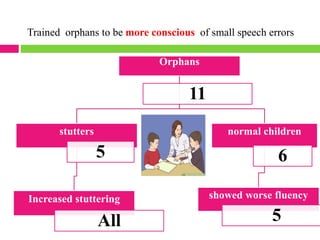
❑ Johnson’s theory was that
Punishing fluency errors made them
worse.
Historical
Timeline
2- The Monster Study
Orphans
11
stutters
5
Increased stuttering
All
normal children
6
showed worse fluency
5
Trained orphans to be more conscious of small speech errors
2011
❑ The experiment, referred to by some as the
“Monster Experiment” turned some of the children into
lifelong stutters despite later efforts to reverse the damage.
The Monster Study
2011
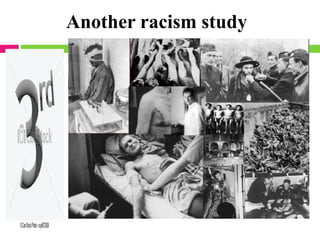
Another racism study
2011
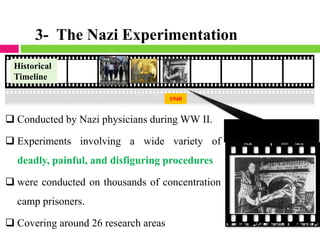
1940
❑ Conducted by Nazi physicians during WW II.
❑ Experiments involving a wide variety of
deadly, painful, and disfiguring procedures
❑ were conducted on thousands of concentration
camp prisoners.
❑ Covering around 26 research areas
Historical
Timeline
3- The Nazi Experimentation
2011
The goal of this type
of experiments was
to determine:
how long German
pilots would
survive after
parachuting into
the cold north sea.
A- Hypothermia Experiments
A prisoner is submerged in a
tank filled with cold water.
The Nazi experimentation cont..1
2011
B- High Altitude Experiments
❑High altitude experiments were performed to test how long pilots
would survive after being ejected from their planes.
❑Many of those who did not die immediately were put under water
until they died.
❑Prisoners were put into low-pressure tanks with little oxygen.
The Nazi experimentation cont..2
C- other horrible actions
❑ Sterilization tests
❑ Scaring then infect with bacteria
❑ Inject sea water and gasoline
❑ Female Jewish victim
❑ Children in concentration camps who
had been used for medical
experiments
The image is from been the website:
http://fcit.usf.edu/holocaust/resource/gallery/n1945.htm
The Nazi experimentation cont..3
Experiments on twins (1943-1944)
Bone, muscle, and nerve transplantation experiments (1942-1943)
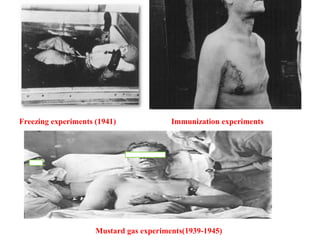
Freezing experiments (1941) Immunization experiments
Mustard gas experiments(1939-1945)
Sea water experiments(1944-1944) Sterilization experiments(1941-1945)
Experiments with poison(1943-1944) High altitude experiments(early 1942)
Artificial Insemination Nazi concentration camp
1- War allows everything
2- Sacrifice few to benefit
many
Ethical justification
The Nazi experimentation cont..4
Dr. Eman Mortada
Consequences of Nazi Experiments
Experiments led to foundation of Nuremberg Code to
control future trials involving human subjects
2011
1945
❑ During and after WWII, American
soldiers were forced to observe nuclear
blasts within 50 miles of ground zero.
❑ Thousands of these soldiers later died of
leukemia and other rare forms of cancer.
Historical
Timeline
4- Human Radiation Experimentation
2011
1950
❑ More than 100 boys living in an orphanage
were fed Quaker Oats with radioactive iron
and calcium in the 1950's.
❑ The diet was part of an experiment to prove
that the nutrients in Quaker oatmeal travel
throughout the body.
Historical
Timeline
5- Oatmeal study
2011
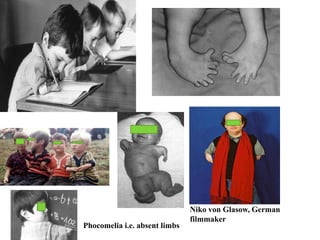
❑ Thalidomide was used in the 1960s to
combat unpleasant symptoms associated with
pregnancy
❑ After women in Europe, Canada, and the U.S.
were treated with the drug it was discovered
that the drug had teratogenic effects, causing
severe deformities in the fetus.
1960
Historical
Timeline
6- Thalidomide use
Niko von Glasow, German
filmmaker
Phocomelia i.e. absent limbs
2011
2010
❑ A Korean researcher, Woo Suk Hwang,
fabricated evidence that he had
successfully cloned human embryos.
❑ The journal Science, retracted two studies
he had published.
Recently
7- Cloning Fraud
Outcome of these Unethical Researches
several codes of action
Year Benchmark
Pre-1900 Edward Jenner smallpox vaccines
1900 Walter Reed’s ‘consent’ for yellow fever experiments
1947 The Nuremberg Code
1964 World Medical Association (WMA) published the Declaration of Helsinki (DOH)
1966 Dr. Beecher’s Article “Ethics and Clinical Research”
1975 WMA updates DOH (Tokyo)
1979 The Belmont Report
1981 US Common rule updated
1983 WMA updates DOH (Venice)
1989 WMA updates DOH (Hong Kong)
1991 US CFR title 45, Part 46 issued CIOMS Guidelines for Epidemiological studies
1993 CIOMS guidelines for biomedical research involving human subjects
1996 WMA updates DOH (South Africa)
1998 Tri-Council Policy Statement (TCPS)published in Canada
2000 WMA updates DOH (Edinburgh)
The Nuremberg
Code
Declarations
of Helsinki
Belmont
report
Dr. Eman Mortada
1948
❑ Issued in 1948, in Nuremberg, Germany
❑ 1st international code in research ethics
❑ In response to the experiments of Nazi
doctors, by American judges sitting in
judgment of Nazi doctors accused of
conducting murderous and torturous cruel
experiments conducted on humans during
WWII 15 of 23 guilty, 7 hanged
1900 10 20 30 40 50 60 70 80 90 2000
1- Nuremberg Code
Nuremberg Code
Science corrupted by politics
Dr. Eman Mortada
15
7
2011
Nuremberg Code
Concept of Human
Rights
+
Do No Harm
Nuremberg Code
Dr. Eman Mortada
Nuremberg Code
Dr. Eman Mortada
Nuremberg Code
Dr. Eman Mortada
Dr. Eman Mortada
1) Voluntary Informed consent.
2) Anticipate scientific benefits, Useful. For good of society
3) Animal experimentation first.
4) Avoid any unnecessary (physical and mental) suffering.
5) Benefits outweigh risks.
6) No intentional death or disability.
7) Protection from harm.
8) Subject free to withdraw.
9) Qualified investigators.
10) Investigator will stop if harm occurs.
Main features of Nuremberg code
2011
1964
1947
❑ 1st issued in 1964 in Helsinki, Finland
❑ The Helsinki Declaration was developed
by the World Medical Association
(WMA).
❑ Responding to thalidomide use
❑ has been revised and updated
periodically since 1964, several times
2- The Declaration of Helsinki(DoH)
Dr. Eman Mortada
Year Benchmark
Pre-1900 Edward Jenner smallpox vaccines
1900 Walter Reed’s ‘consent’ for yellow fever experiments
1947 The Nuremberg Code
1964 World Medical Association (WMA) published the Declaration of Helsinki (DOH)
1966 Dr. Beecher’s Article “Ethics and Clinical Research”
1975 WMA updates DOH (Tokyo)
1979 The Belmont Report
1981 US Common rule updated
1983 WMA updates DOH (Venice)
1989 WMA updates DOH (Hong Kong)
1991 US CFR title 45, Part 46 issued CIOMS Guidelines for Epidemiological studies
1993 CIOMS guidelines for biomedical research involving human subjects
1996 WMA updates DOH (South Africa)
1998 Tri-Council Policy Statement (TCPS)published in Canada
2000 WMA updates DOH (Edinburgh)
2002 WMA updates DOH (Washington) CIOMS Guidelines updated
2004 WMA updates DOH (Tokyo)
2008 WMA updates DOH (Seoul)
2010 TCPS updated
2013 WMA updates DOH (Brazil)
Main features:
Subject
wellbeing
• 1- Emphasized on:
Wellbeing of subject
takes higher priority
over interests of
science and society
Ethics
committee
• 2 - introduced the
concept of oversight
by an 'independent
committee” Or ethics
committees
Helsinki declaration cont..1
2011
1979
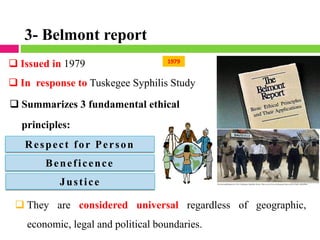
❑ Issued in 1979
❑ In response to Tuskegee Syphilis Study
❑ Summarizes 3 fundamental ethical
principles:
Respect for Person
Beneficence
Justice
❑ They are considered universal regardless of geographic,
economic, legal and political boundaries.
3- Belmont report
2011
Saudi council for health specialists set guidelines, 2003 has
three different documents referring to the regulation of
research ethics
❑ Which ensure the conformity with sharia
❑ Benefits must outweigh the potential harm
❑ Research must be by a qualified researcher
4- Ethical guidelines in Saudi Arabia
Saudi Arabia is the only country that has three different
documents referring to the regulation of research ethics
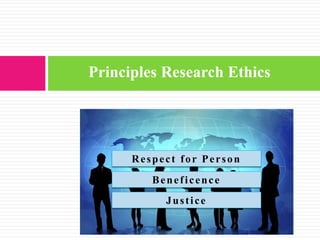
Respect for Person
Beneficence
Justice
Principles Research Ethics
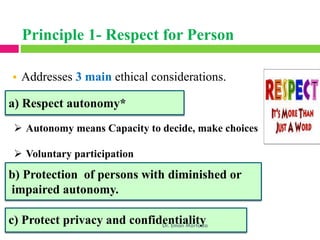
a) Respect autonomy*
➢ Autonomy means Capacity to decide, make choices
➢ Voluntary participation
b) Protection of persons with diminished or
impaired autonomy.
• Addresses 3 main ethical considerations.
c) Protect privacy and confidentiality
Dr. Eman Mortada
Principle 1- Respect for Person
**
 Individuals should be treated as an autonomous
agents; avoid paternalism; let subject make
decision about what will or will not happen
 However, not every human being is capable of self-
determination. Therefore, those with diminished
autonomy should be protected
Consent is Defined as permission,
approval
Informed Consent means: permission
given by the participant based on
knowledge of the procedure to be
performed*
Dr. Eman Mortada
Application → Informed Consent
It is no longer an option.
It is now a must under the current guidelines
& regulations
Understand nature of research
Respect Subject’s Will and freedom in
self determination.
Dr. Eman Mortada
Voluntariness Disclosure
Competence Understanding
1 2
3
4
The 4 fundamental aspects of informed
consent that ensure its validity, are:
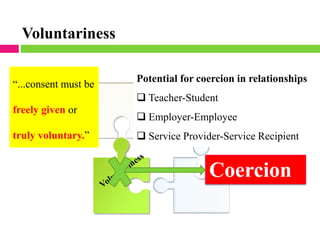
“...consent must be
freely given or
truly voluntary.”
Coercion
Potential for coercion in relationships
❑ Teacher-Student
❑ Employer-Employee
❑ Service Provider-Service Recipient
Voluntariness
 Individuals ppting in the study shouldn’t be
influenced by anyone conducting the study
 However, voluntariness may be compromised when
use coercion to ppt, pressure by authorized body
Voluntariness
Disclosing the information in
order to make an informed
decision.
Researchers
disclose:
Basic=
Mandatory
Additional
Required Optional
Disclosure
Statement Risks benefits
Confidentiality Compensation
Contact Voluntary
Informed consent Basic Elements
The Mandatory Elements of Informed Consent
Informed consent Basic Elements
1.Statement that the study involves research
2.Description of Risks
3.Description of Benefits
4.Confidentiality
5.If more than minimal risk, compensation
and/or medical treatment
6.Whom to Contact
7.Participation is voluntary
Dr. Eman Mortada
termination costs
be provided Number
Unexpected
Risks
Consequences of
Withdrawal
Informed consent additional Elements
When Appropriate
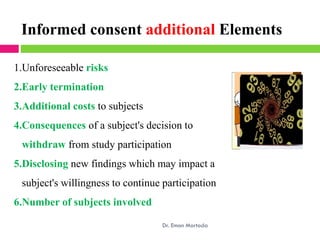
Informed consent additional Elements
1.Unforeseeable risks
2.Early termination
3.Additional costs to subjects
4.Consequences of a subject's decision to
withdraw from study participation
5.Disclosing new findings which may impact a
subject's willingness to continue participation
6.Number of subjects involved
Dr. Eman Mortada
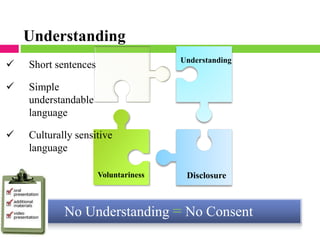
Voluntariness Disclosure
Understanding
No Understanding = No Consent
✓ Short sentences
✓ Simple
understandable
language
✓ Culturally sensitive
language
Understanding
Voluntariness Disclosure
Competence Understanding
Individuals must
have the mental
or decisional
capacity to
understand the
information
presented to them
Competence
Informed Consent process
Informed consent is not only a document.
It is a process:
a dialogue between the researcher and the subject.
Information exchange needs to take place before,
during, and sometimes after the study.
Dr. Eman Mortada
Informed Consent = Shared Decision-Making
Vulnerable Groups
Pregnant women
Children
Prisoners
Mentally ill
Limited education
Poor
Terminally ill
Women in some
circumstances
Additional protection
Those persons who are
relatively or absolutely
incapable of protecting
their own interests.
Protection of persons with diminished or
impaired autonomy.
An individual’s autonomy can be affected by several factors
including age, cognitive impairment, illness, and treatments.
Proxy
Dr. Eman Mortada
$$
• Not every individual is, however, capable of
decision-making.
• Lack of maturity (as in the case of children),
• mental disability, or
• circumstances that severely restrict liberty (as in the
case of prisoners),
• may all decrease the capacity for decision-
making.
Pregnant Women
Father is not reasonably
available
The pregnancy is the result
of rape
The father’s signature is required unless:
Dr. Eman Mortada
18
17
16
15
14
13
12
11
10
9
8
7
6
5
For children under 7 years of age, Parent/Guardian,
consent sign the IC
Child Age 7–11 years, Verbal Assent is obtained
Minors 12 – 17– Written Assent Required
A
s
s
e
n
t
Consent
Children and minors
Age >/=18
Yes
No
Dr. Eman Mortada
Cognitively Impaired
The signature
of Representative
mental retardation
dementia
coma
Diminish the
individual’s
Capacity to give
informed consent
Cognitive
Impairment
Regains
ability
Re-consent
Dr. Eman Mortada
Deception
At times, researchers may choose to hide from participants the
true nature of the study
❑ Deception by Omission
 Withholding important facts from the participants
❑ Deception by Commission
 Lie to or purposely mislead research participants
❑Subjects should be debriefed after the study
❑given the option to withdraw from the study, have their data removed.
Dr. Eman Mortada
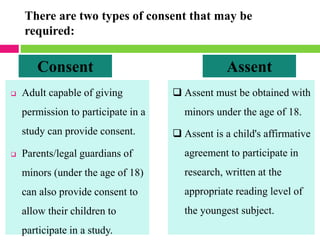
There are two types of consent that may be
required:
❑ Adult capable of giving
permission to participate in a
study can provide consent.
❑ Parents/legal guardians of
minors (under the age of 18)
can also provide consent to
allow their children to
participate in a study.
Consent Assent
❑ Assent must be obtained with
minors under the age of 18.
❑ Assent is a child's affirmative
agreement to participate in
research, written at the
appropriate reading level of
the youngest subject.
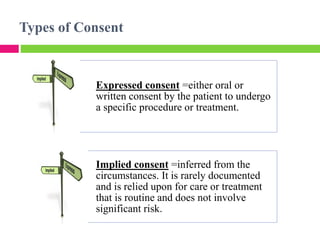
Types of Consent
Expressed consent =either oral or
written consent by the patient to undergo
a specific procedure or treatment.
Implied consent =inferred from the
circumstances. It is rarely documented
and is relied upon for care or treatment
that is routine and does not involve
significant risk.
Whistle-blowing
 Researchers are in a privileged position
 They may come across information about
wrong-doing or danger to the public
 The reporting of this information may go
against any confidentiality agreement
 The reporting of such information is likely to
damage their career
 The Public Disclosure Act 1998 protects
certain classes of workers from the
consequences of whistle-blowing
Types of justice
 Individual justice requires that investigators“ should not offer
potentially beneficial research only to some patients who are in
their favor or select only ‘undesirable’ persons for risky
research .
”
 Social justice“ requires that distinction be drawn between classes
of subjects that ought, and ought not, to participate in any
particular kind of research, based on the ability of members of
that class to bear burdens and on the appropriateness of placing
further burdens on already burdened persons .
”
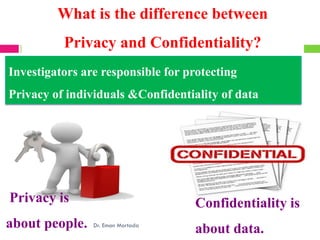
Privacy is
about people.
Confidentiality is
about data.
Investigators are responsible for protecting
Privacy of individuals &Confidentiality of data
Dr. Eman Mortada
Confidentiality vs. Privacy
What is the difference between
Privacy and Confidentiality?
Confidentiality vs. Privacy
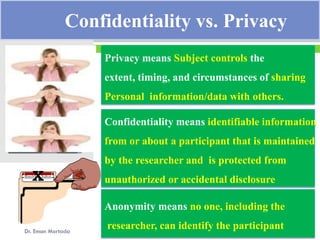
Privacy means Subject controls the
extent, timing, and circumstances of sharing
Personal information/data with others.
Confidentiality means identifiable information
from or about a participant that is maintained
by the researcher and is protected from
unauthorized or accidental disclosure
Anonymity means no one, including the
researcher, can identify the participant
Smith, John
X
Dr. Eman Mortada
Are there any exceptions to maintaining
confidentiality?
Protect subject himself from harm:
1. Child abuse
2. Domestic violence
Protect others:
1. Infectious diseases(e.g., AIDS)
Dr. Eman Mortada
 Design your informed consent
Physical, mental and social well-being
Application:
Assessment of risks and benefits
Minimising the risks
Maximising the potential benefits
Dr. Eman Mortada
* this assessment includes evaluation
of the study design and the ability of the researcher
Principal 2- Beneficence
A. Medical Risks:
1. Therapeutics: (Tuskegee experiment)
2. Preventive: (Trials of polio vaccine)
3. Diagnostic:
◼ Irradiation:
- Teratogenic effect to the fetus.
- Carcinogenic effect.
◼ Samplings:
- Biopsies: tissues that contain genetic information about the
participant.
- Surgical hazards.
- Too risky procedures (under anesthesia)
Forms of Harm to Human Subjects in Research
The Forgotten Risks
B. Social Risks:
Stigma (e.g. research on HIV-AIDS, STDs).
Social stigma –Social risks can range from loss of reputation and
social standing, to placing the individual at-risk of political or social
reprisals.
C.Emotional Risks:
On families when their children were chosen for trial of new
vaccine; research in war.
D. Psychological Risks:
Questionnaires with sensitive questions to participants
in sensitive positions, as to ask poor people about there
nutrition and houses.
Psychological harm include: anxiety, sadness, regret and emotional
distress, among others. Specially in behavioral studies.
Risk to the Society
❖ Manipulating environmental factors (Pathogenic organisms and
toxic chemicals).
❖ Economic risk
Economic risks may exist if knowledge of one’s participation in
research, for example, could make it difficult for a research
participant to retain a job or to find a job, or if insurance
premiums increase or loss of insurance is a result of the
disclosure of research data.
❖ Legal risks:
Vulnerable groups, e.g., prisoners, children, pregnant women.
Legal risks include the exposure of activities of a research subject
“that could reasonably place the subjects at risk of criminal or
civil liability
Responsibilities of Researchers
Qualification and competent
Integrity and legality
Honesty and transparency
The Investigator bears
primary
responsibility for the
protection of human
subjects in the study
Dr. Eman Mortada
Risks Benefit
To Whom Individual, investigators and the community
Duration Short term, i.e., only for the study period
Long term. i.e., extends beyond the study period
Forms Major potential risks to
participants
Major potential benefits to
participants
Risk/ Benefit Ratio
Dr. Eman Mortada
Benefits and risks…
 Research on vulnerable groups may be justified in special
circumstances:
 the health advantages clearly outweigh the minimal risks
 the problem to be studied is clearly relevant to the unique health
problem of the vulnerable group
 every effort is made to maximize the right of the group to self
direction and protection
Dr. Eman Mortada
Ethical Obligation:
fair sharing of burdens and benefits
of research
Application:
Equitable selection of research subjects;
Fairness in inclusion and exclusion criteria
Dr. Eman Mortada
Principal 3- Justice
Third Ethical Principle: Justice**
 Distribute benefits and burdens of the research
fairly and without bias
 Do not select or restrict participants based on
gender, class, ethnicity, socioeconomic status, or
language ability (unless justified by study objectives)
 Avoid selection of participants based on
➢ Convenience of researcher
➢ Participant availability
➢ Compromised position of participants
➢ Ability to manipulate participants
Equity vs. Equality in Human Subjects
Research
 The meanings of “equity” and “equality” not the same.
 “equitably ”means to deal fairly;
 “ equally ”means to deal in exactly the same way.
How to Apply the 3 Principles?
Ethical principle Ethical rule
Respect for persons Obtain the informed consent of prospective
research subjects
Protect the confidentiality of private
information
Beneficence Qualifications of PI
Good research design
Risk -benefit analysis
Justice Subject selection procedures must be fair
Ethical principles and rules
Dr. Eman Mortada
‫القسم‬
‫العظيم‬ ‫باهلل‬ ‫أقسم‬
▪
‫هللا‬ ‫اراقب‬ ‫أن‬
‫فى‬
‫مهنتى‬
▪
‫اإلنسان‬ ‫حياة‬ ‫أصون‬ ‫وأن‬
‫فى‬
‫أدوارها‬ ‫كافة‬
.
‫فى‬
‫واألحوال‬ ‫الظروف‬ ‫كل‬
‫وسعى‬ ‫باذال‬
‫فى‬
‫نقاذها‬
‫والقلق‬ ‫وااللم‬ ‫والمرض‬ ‫الهالك‬ ‫من‬
.
▪
‫كرامتهم‬ ‫للناس‬ ‫احفظ‬ ‫وأن‬
,
‫سرهم‬ ‫وأكتم‬ ‫عورتهم‬ ‫وأستر‬
.
▪
‫هللا‬ ‫رحمة‬ ‫وسائل‬ ‫من‬ ‫الدوام‬ ‫على‬ ‫اكون‬ ‫وأن‬
,
‫باذال‬
‫رعايتى‬
‫للق‬ ‫الطبية‬
‫ريب‬
‫والبعيد‬
,
‫والعدو‬ ‫والصديق‬ ‫والخاطئ‬ ‫والصالح‬
.
▪
‫العلم‬ ‫طلب‬ ‫على‬ ‫أثابر‬ ‫وأن‬
,
‫ألذاه‬ ‫ال‬ ‫اإلنسان‬ ‫لنفع‬ ‫أسخره‬
.
▪
‫من‬ ‫أوقر‬ ‫وأن‬
‫علمنى‬
.
‫من‬ ‫وأعلم‬
‫يصغرنى‬
.
‫زميل‬ ‫لكل‬ ‫أخا‬ ‫وأكون‬
‫فى‬
‫والتقوى‬ ‫البر‬ ‫على‬ ‫متعاونين‬ ‫الطبية‬ ‫المهنة‬
.
▪
‫تكون‬ ‫وأن‬
‫حياتى‬
‫مصداق‬
‫إيمانى‬
‫فى‬
‫سرى‬
‫وعالنيتى‬
,
‫ب‬ ‫مما‬ ‫نقية‬
‫ينها‬
‫تجاة‬
‫والمؤمنين‬ ‫ورسوله‬ ‫هللا‬
(
‫على‬ ‫وهللا‬
‫ماأقول‬
‫شهيد‬
)
Dr. Eman Mortada
1st
Case scenario
Dr. Eman Mortada
1. Recruit the students in her upper level classes and the
technicians from her lab to participate in the study
From which population would you
advise the researcher to recruit?
Dr. Eman Mortada
2. Post fliers around campus to recruit participants from the
campus population (students, faculty and staff)
2nd
Case scenario
Dr. Eman Mortada
 Which of these two consent documents would you
choose to use ?
Dr. Eman Mortada
Choose Consent Document 2
• Choose Consent Document 1
3rd
Case scenario
Dr. Eman Mortada
Treatment and Prevention
Research in Adolescents
 A study proposes to examine the effectiveness of a medical
treatment and prevention program for adolescents in a
location where the legal age for consent to such treatment
is 12. The adolescents involved range from ages 12 to 17.
Does this study require additional protections
be provided for the subject population?
Dr. Eman Mortada

# 3rd lect research ethics

  • 1.
    Dr. Eman M.Mortada Professor In public health and preventive medicine Avoiding Scientific Misconduct - by Ethical regulations
  • 2.
    Define basic conceptsrelated to research ethics The Consequences of Scientific Misconduct Need and objectives for Research Ethics Historical Perspective of Unethical Practices Development of code of ethics Ethical principals Lecture Outline
  • 3.
    ▪ Research withhuman subjects is of paramount importance for: ▪ the individual, ▪ Society & public health, ▪ Science and ▪ The economy. Introduction
  • 4.
    Dr. Eman Mortada ❑The progressive development &Major expansion in the biomedical research raised the concern about the research ethics
  • 5.
    Research ethics ✓Defined asa set of guidelines to be followed during carrying out research for protection of the participants right Dr / Eman Mortada
  • 6.
    Recently, A lotof debates have been raised regarding: Researcher Dr. Eman Mortada ❑ researchers awareness of ethical, moral and legal responsibilities ❑ If they are well trained to avoid ethical pitfalls
  • 7.
    Every research, weface situations that require ethical judgment and challenged by: Ethical questions and dilemmas. Some are relatively easy to answer Others are much more difficult Dr. Eman Mortada
  • 8.
  • 9.
    Violence and childabuse Dr. Eman Mortada
  • 10.
    So you spenttime preparing for the research Best methodology Best practice Dr. Eman Mortada
  • 11.
    What is thesimplest study design??? Dr. Eman Mortada
  • 12.
  • 13.
  • 14.
  • 15.
    Parents forbid themfrom participation Dr. Eman Mortada
  • 16.
    ❑ Will ourresearch do more harm than good? ❑ How will we ensure the safety of people we interview??? The answer is not easy It is a clear example of ethical dilemma Dr. Eman Mortada
  • 17.
  • 18.
    Ethical Dilemma: Situations necessitatinga choice between two equal (usually undesirable) alternatives. Significant technological and scientific advances changes in clinical practice and research have produced totally new ethical dilemmas and exacerbated old ones
  • 19.
  • 20.
    Perceived Body Image Createdanxiety among them Dr. Eman Mortada
  • 21.
    CAN APPLICATION OF ETHICALPRINCIPALS HELP RESEARCHER ANSWER DIFFICULT QUESTIONS?
  • 22.
    The answer is:YES Ethics is about making choices… Dr. Eman Mortada
  • 23.
    ❑ All researchersshould be familiar with the basic ethical principles and have up-to-date knowledge about policies and procedures designed to: ❖ ensure the safety of research subjects and ❖ to prevent sloppy or irresponsible research, ❑ because ignorance of policies designed to protect research subjects is not considered a viable excuse for ethically questionable projects. Dr. Eman Mortada
  • 24.
    The Consequences ofScientific Misconduct ❑ Blacklisted in the scientific community ❑ Banned from future research or publication ❑ Banned from requesting or receiving grant funds ❑ Possible monetary fines ❑ Termination of Employment
  • 25.
    ❑ Increasing needfor experimentation on human subjects. Dr. Eman Mortada Need for Research Ethics
  • 26.
    Dr. Eman Mortada ❑Increasingacceptance and appreciation of human rights. Need for Research Ethics
  • 27.
    Dr. Eman Mortada PaternalismAutonomy ❑ The change in philosophy from (passive to active participant) Need for Research Ethics
  • 28.
    ❑ To protectright and welfare of the participants ❑ To examine research activities for their ethical soundness ❑ To ensure that research is conducted in a way that serves interests of individuals, groups and/or society as a whole Dr. Eman Mortada Objectives of Research Ethics
  • 29.
    ▪ Research ishowever not only associated with social benefits, it also involves risks. ▪ Scientific advances are ethically justifiable only if respect for the human dignity of all persons is guaranteed. Protection of Subject Welfare/Rights Advancement of Science Without an Adequate Framework of Research Ethics Balancing Twin Goals
  • 30.
    Dr. Eman Mortada Evolutionof Human Subjects Protections
  • 31.
    Historical Perspective of UnethicalPractices Horror Stories
  • 32.
  • 33.
    1979 1934 1964 2011 1982 19962004 Historical Events http://www.humanresearch.msu.edu/requiredtraining.html Historical Timeline UPTILL NOW
  • 35.
    1932 2011 ❑ US PublicHealth Services began to study the natural progression of untreated syphilis, ❑ 399 rural African-American men who had contracted syphilis ❑ Joined Tuskegee Institute for free medical care, meals Historical Timeline 1- Tuskegee syphilis study (1932-72)
  • 36.
    What do youknow about syphilis ? Syphilis is a sexually transmitted infectious disease.
  • 37.
  • 38.
  • 39.
    ❑ Deception andwithholding information and ttt: ➢ Study participants were never told they had syphilis, nor were they ever treated for it ➢ Although, penicillin proven to be effective treatment for syphilis ➢ Researchers prevented men from being treated elsewhere ❑ Putting men and their families at risk They were betrayed Ethical problems Tuskegee syphilis study cont..1
  • 40.
    The tragedy By thetime the study was exposed in 1972: ❑ 28 men had died of syphilis, ❑ 100 others were dead of related complications, ❑ at least 40 wives had been infected and ❑ About 20 child had contracted the disease at birth." Dr. Eman Mortada Tuskegee syphilis study cont..2
  • 41.
    knowledge worth sacrificingfew Ethical justification Images taken from: https://www.msu.edu/course/hm/546/tuskegee.htm and http://alondranelson.wordpress.com/2012/07/25/tuskegee-and-the-black-panther-party/ Dr. Eman Mortada It was clearly racist.
  • 42.
  • 43.
    2011 1938 ❑ Johnson’s theorywas that Punishing fluency errors made them worse. Historical Timeline 2- The Monster Study
  • 44.
    Orphans 11 stutters 5 Increased stuttering All normal children 6 showedworse fluency 5 Trained orphans to be more conscious of small speech errors
  • 45.
    2011 ❑ The experiment,referred to by some as the “Monster Experiment” turned some of the children into lifelong stutters despite later efforts to reverse the damage. The Monster Study
  • 46.
  • 47.
    2011 1940 ❑ Conducted byNazi physicians during WW II. ❑ Experiments involving a wide variety of deadly, painful, and disfiguring procedures ❑ were conducted on thousands of concentration camp prisoners. ❑ Covering around 26 research areas Historical Timeline 3- The Nazi Experimentation
  • 48.
    2011 The goal ofthis type of experiments was to determine: how long German pilots would survive after parachuting into the cold north sea. A- Hypothermia Experiments A prisoner is submerged in a tank filled with cold water. The Nazi experimentation cont..1
  • 49.
    2011 B- High AltitudeExperiments ❑High altitude experiments were performed to test how long pilots would survive after being ejected from their planes. ❑Many of those who did not die immediately were put under water until they died. ❑Prisoners were put into low-pressure tanks with little oxygen. The Nazi experimentation cont..2
  • 50.
    C- other horribleactions ❑ Sterilization tests ❑ Scaring then infect with bacteria ❑ Inject sea water and gasoline ❑ Female Jewish victim ❑ Children in concentration camps who had been used for medical experiments The image is from been the website: http://fcit.usf.edu/holocaust/resource/gallery/n1945.htm The Nazi experimentation cont..3
  • 51.
    Experiments on twins(1943-1944) Bone, muscle, and nerve transplantation experiments (1942-1943)
  • 52.
    Freezing experiments (1941)Immunization experiments Mustard gas experiments(1939-1945)
  • 53.
    Sea water experiments(1944-1944)Sterilization experiments(1941-1945) Experiments with poison(1943-1944) High altitude experiments(early 1942)
  • 54.
    Artificial Insemination Naziconcentration camp
  • 55.
    1- War allowseverything 2- Sacrifice few to benefit many Ethical justification The Nazi experimentation cont..4 Dr. Eman Mortada Consequences of Nazi Experiments Experiments led to foundation of Nuremberg Code to control future trials involving human subjects
  • 56.
    2011 1945 ❑ During andafter WWII, American soldiers were forced to observe nuclear blasts within 50 miles of ground zero. ❑ Thousands of these soldiers later died of leukemia and other rare forms of cancer. Historical Timeline 4- Human Radiation Experimentation
  • 57.
    2011 1950 ❑ More than100 boys living in an orphanage were fed Quaker Oats with radioactive iron and calcium in the 1950's. ❑ The diet was part of an experiment to prove that the nutrients in Quaker oatmeal travel throughout the body. Historical Timeline 5- Oatmeal study
  • 58.
    2011 ❑ Thalidomide wasused in the 1960s to combat unpleasant symptoms associated with pregnancy ❑ After women in Europe, Canada, and the U.S. were treated with the drug it was discovered that the drug had teratogenic effects, causing severe deformities in the fetus. 1960 Historical Timeline 6- Thalidomide use
  • 59.
    Niko von Glasow,German filmmaker Phocomelia i.e. absent limbs
  • 60.
    2011 2010 ❑ A Koreanresearcher, Woo Suk Hwang, fabricated evidence that he had successfully cloned human embryos. ❑ The journal Science, retracted two studies he had published. Recently 7- Cloning Fraud
  • 61.
    Outcome of theseUnethical Researches several codes of action
  • 62.
    Year Benchmark Pre-1900 EdwardJenner smallpox vaccines 1900 Walter Reed’s ‘consent’ for yellow fever experiments 1947 The Nuremberg Code 1964 World Medical Association (WMA) published the Declaration of Helsinki (DOH) 1966 Dr. Beecher’s Article “Ethics and Clinical Research” 1975 WMA updates DOH (Tokyo) 1979 The Belmont Report 1981 US Common rule updated 1983 WMA updates DOH (Venice) 1989 WMA updates DOH (Hong Kong) 1991 US CFR title 45, Part 46 issued CIOMS Guidelines for Epidemiological studies 1993 CIOMS guidelines for biomedical research involving human subjects 1996 WMA updates DOH (South Africa) 1998 Tri-Council Policy Statement (TCPS)published in Canada 2000 WMA updates DOH (Edinburgh) The Nuremberg Code Declarations of Helsinki Belmont report Dr. Eman Mortada
  • 63.
    1948 ❑ Issued in1948, in Nuremberg, Germany ❑ 1st international code in research ethics ❑ In response to the experiments of Nazi doctors, by American judges sitting in judgment of Nazi doctors accused of conducting murderous and torturous cruel experiments conducted on humans during WWII 15 of 23 guilty, 7 hanged 1900 10 20 30 40 50 60 70 80 90 2000 1- Nuremberg Code
  • 64.
    Nuremberg Code Science corruptedby politics Dr. Eman Mortada
  • 65.
  • 66.
  • 67.
    2011 Nuremberg Code Concept ofHuman Rights + Do No Harm
  • 68.
  • 69.
  • 70.
  • 71.
    Dr. Eman Mortada 1)Voluntary Informed consent. 2) Anticipate scientific benefits, Useful. For good of society 3) Animal experimentation first. 4) Avoid any unnecessary (physical and mental) suffering. 5) Benefits outweigh risks. 6) No intentional death or disability. 7) Protection from harm. 8) Subject free to withdraw. 9) Qualified investigators. 10) Investigator will stop if harm occurs. Main features of Nuremberg code
  • 72.
    2011 1964 1947 ❑ 1st issuedin 1964 in Helsinki, Finland ❑ The Helsinki Declaration was developed by the World Medical Association (WMA). ❑ Responding to thalidomide use ❑ has been revised and updated periodically since 1964, several times 2- The Declaration of Helsinki(DoH)
  • 73.
    Dr. Eman Mortada YearBenchmark Pre-1900 Edward Jenner smallpox vaccines 1900 Walter Reed’s ‘consent’ for yellow fever experiments 1947 The Nuremberg Code 1964 World Medical Association (WMA) published the Declaration of Helsinki (DOH) 1966 Dr. Beecher’s Article “Ethics and Clinical Research” 1975 WMA updates DOH (Tokyo) 1979 The Belmont Report 1981 US Common rule updated 1983 WMA updates DOH (Venice) 1989 WMA updates DOH (Hong Kong) 1991 US CFR title 45, Part 46 issued CIOMS Guidelines for Epidemiological studies 1993 CIOMS guidelines for biomedical research involving human subjects 1996 WMA updates DOH (South Africa) 1998 Tri-Council Policy Statement (TCPS)published in Canada 2000 WMA updates DOH (Edinburgh) 2002 WMA updates DOH (Washington) CIOMS Guidelines updated 2004 WMA updates DOH (Tokyo) 2008 WMA updates DOH (Seoul) 2010 TCPS updated 2013 WMA updates DOH (Brazil)
  • 74.
    Main features: Subject wellbeing • 1-Emphasized on: Wellbeing of subject takes higher priority over interests of science and society Ethics committee • 2 - introduced the concept of oversight by an 'independent committee” Or ethics committees Helsinki declaration cont..1
  • 75.
    2011 1979 ❑ Issued in1979 ❑ In response to Tuskegee Syphilis Study ❑ Summarizes 3 fundamental ethical principles: Respect for Person Beneficence Justice ❑ They are considered universal regardless of geographic, economic, legal and political boundaries. 3- Belmont report
  • 76.
    2011 Saudi council forhealth specialists set guidelines, 2003 has three different documents referring to the regulation of research ethics ❑ Which ensure the conformity with sharia ❑ Benefits must outweigh the potential harm ❑ Research must be by a qualified researcher 4- Ethical guidelines in Saudi Arabia
  • 77.
    Saudi Arabia isthe only country that has three different documents referring to the regulation of research ethics
  • 78.
  • 79.
    a) Respect autonomy* ➢Autonomy means Capacity to decide, make choices ➢ Voluntary participation b) Protection of persons with diminished or impaired autonomy. • Addresses 3 main ethical considerations. c) Protect privacy and confidentiality Dr. Eman Mortada Principle 1- Respect for Person
  • 80.
    **  Individuals shouldbe treated as an autonomous agents; avoid paternalism; let subject make decision about what will or will not happen  However, not every human being is capable of self- determination. Therefore, those with diminished autonomy should be protected
  • 81.
    Consent is Definedas permission, approval Informed Consent means: permission given by the participant based on knowledge of the procedure to be performed* Dr. Eman Mortada Application → Informed Consent
  • 82.
    It is nolonger an option. It is now a must under the current guidelines & regulations Understand nature of research Respect Subject’s Will and freedom in self determination. Dr. Eman Mortada
  • 83.
    Voluntariness Disclosure Competence Understanding 12 3 4 The 4 fundamental aspects of informed consent that ensure its validity, are:
  • 84.
    “...consent must be freelygiven or truly voluntary.” Coercion Potential for coercion in relationships ❑ Teacher-Student ❑ Employer-Employee ❑ Service Provider-Service Recipient Voluntariness
  • 85.
     Individuals pptingin the study shouldn’t be influenced by anyone conducting the study  However, voluntariness may be compromised when use coercion to ppt, pressure by authorized body
  • 86.
    Voluntariness Disclosing the informationin order to make an informed decision. Researchers disclose: Basic= Mandatory Additional Required Optional Disclosure
  • 87.
    Statement Risks benefits ConfidentialityCompensation Contact Voluntary Informed consent Basic Elements The Mandatory Elements of Informed Consent
  • 88.
    Informed consent BasicElements 1.Statement that the study involves research 2.Description of Risks 3.Description of Benefits 4.Confidentiality 5.If more than minimal risk, compensation and/or medical treatment 6.Whom to Contact 7.Participation is voluntary Dr. Eman Mortada
  • 89.
    termination costs be providedNumber Unexpected Risks Consequences of Withdrawal Informed consent additional Elements When Appropriate
  • 90.
    Informed consent additionalElements 1.Unforeseeable risks 2.Early termination 3.Additional costs to subjects 4.Consequences of a subject's decision to withdraw from study participation 5.Disclosing new findings which may impact a subject's willingness to continue participation 6.Number of subjects involved Dr. Eman Mortada
  • 91.
    Voluntariness Disclosure Understanding No Understanding= No Consent ✓ Short sentences ✓ Simple understandable language ✓ Culturally sensitive language Understanding
  • 92.
    Voluntariness Disclosure Competence Understanding Individualsmust have the mental or decisional capacity to understand the information presented to them Competence
  • 93.
    Informed Consent process Informedconsent is not only a document. It is a process: a dialogue between the researcher and the subject. Information exchange needs to take place before, during, and sometimes after the study. Dr. Eman Mortada Informed Consent = Shared Decision-Making
  • 94.
    Vulnerable Groups Pregnant women Children Prisoners Mentallyill Limited education Poor Terminally ill Women in some circumstances Additional protection Those persons who are relatively or absolutely incapable of protecting their own interests. Protection of persons with diminished or impaired autonomy. An individual’s autonomy can be affected by several factors including age, cognitive impairment, illness, and treatments. Proxy Dr. Eman Mortada
  • 95.
    $$ • Not everyindividual is, however, capable of decision-making. • Lack of maturity (as in the case of children), • mental disability, or • circumstances that severely restrict liberty (as in the case of prisoners), • may all decrease the capacity for decision- making.
  • 96.
    Pregnant Women Father isnot reasonably available The pregnancy is the result of rape The father’s signature is required unless: Dr. Eman Mortada
  • 97.
    18 17 16 15 14 13 12 11 10 9 8 7 6 5 For children under7 years of age, Parent/Guardian, consent sign the IC Child Age 7–11 years, Verbal Assent is obtained Minors 12 – 17– Written Assent Required A s s e n t Consent Children and minors Age >/=18 Yes No Dr. Eman Mortada
  • 98.
    Cognitively Impaired The signature ofRepresentative mental retardation dementia coma Diminish the individual’s Capacity to give informed consent Cognitive Impairment Regains ability Re-consent Dr. Eman Mortada
  • 99.
    Deception At times, researchersmay choose to hide from participants the true nature of the study ❑ Deception by Omission  Withholding important facts from the participants ❑ Deception by Commission  Lie to or purposely mislead research participants ❑Subjects should be debriefed after the study ❑given the option to withdraw from the study, have their data removed. Dr. Eman Mortada
  • 100.
    There are twotypes of consent that may be required: ❑ Adult capable of giving permission to participate in a study can provide consent. ❑ Parents/legal guardians of minors (under the age of 18) can also provide consent to allow their children to participate in a study. Consent Assent ❑ Assent must be obtained with minors under the age of 18. ❑ Assent is a child's affirmative agreement to participate in research, written at the appropriate reading level of the youngest subject.
  • 101.
    Types of Consent Expressedconsent =either oral or written consent by the patient to undergo a specific procedure or treatment. Implied consent =inferred from the circumstances. It is rarely documented and is relied upon for care or treatment that is routine and does not involve significant risk.
  • 102.
    Whistle-blowing  Researchers arein a privileged position  They may come across information about wrong-doing or danger to the public  The reporting of this information may go against any confidentiality agreement  The reporting of such information is likely to damage their career  The Public Disclosure Act 1998 protects certain classes of workers from the consequences of whistle-blowing
  • 103.
    Types of justice Individual justice requires that investigators“ should not offer potentially beneficial research only to some patients who are in their favor or select only ‘undesirable’ persons for risky research . ”  Social justice“ requires that distinction be drawn between classes of subjects that ought, and ought not, to participate in any particular kind of research, based on the ability of members of that class to bear burdens and on the appropriateness of placing further burdens on already burdened persons . ”
  • 104.
    Privacy is about people. Confidentialityis about data. Investigators are responsible for protecting Privacy of individuals &Confidentiality of data Dr. Eman Mortada Confidentiality vs. Privacy What is the difference between Privacy and Confidentiality?
  • 105.
    Confidentiality vs. Privacy Privacymeans Subject controls the extent, timing, and circumstances of sharing Personal information/data with others. Confidentiality means identifiable information from or about a participant that is maintained by the researcher and is protected from unauthorized or accidental disclosure Anonymity means no one, including the researcher, can identify the participant Smith, John X Dr. Eman Mortada
  • 106.
    Are there anyexceptions to maintaining confidentiality? Protect subject himself from harm: 1. Child abuse 2. Domestic violence Protect others: 1. Infectious diseases(e.g., AIDS) Dr. Eman Mortada
  • 107.
     Design yourinformed consent
  • 108.
    Physical, mental andsocial well-being Application: Assessment of risks and benefits Minimising the risks Maximising the potential benefits Dr. Eman Mortada * this assessment includes evaluation of the study design and the ability of the researcher Principal 2- Beneficence
  • 109.
    A. Medical Risks: 1.Therapeutics: (Tuskegee experiment) 2. Preventive: (Trials of polio vaccine) 3. Diagnostic: ◼ Irradiation: - Teratogenic effect to the fetus. - Carcinogenic effect. ◼ Samplings: - Biopsies: tissues that contain genetic information about the participant. - Surgical hazards. - Too risky procedures (under anesthesia) Forms of Harm to Human Subjects in Research
  • 110.
    The Forgotten Risks B.Social Risks: Stigma (e.g. research on HIV-AIDS, STDs). Social stigma –Social risks can range from loss of reputation and social standing, to placing the individual at-risk of political or social reprisals. C.Emotional Risks: On families when their children were chosen for trial of new vaccine; research in war. D. Psychological Risks: Questionnaires with sensitive questions to participants in sensitive positions, as to ask poor people about there nutrition and houses. Psychological harm include: anxiety, sadness, regret and emotional distress, among others. Specially in behavioral studies.
  • 111.
    Risk to theSociety ❖ Manipulating environmental factors (Pathogenic organisms and toxic chemicals). ❖ Economic risk Economic risks may exist if knowledge of one’s participation in research, for example, could make it difficult for a research participant to retain a job or to find a job, or if insurance premiums increase or loss of insurance is a result of the disclosure of research data. ❖ Legal risks: Vulnerable groups, e.g., prisoners, children, pregnant women. Legal risks include the exposure of activities of a research subject “that could reasonably place the subjects at risk of criminal or civil liability
  • 112.
    Responsibilities of Researchers Qualificationand competent Integrity and legality Honesty and transparency The Investigator bears primary responsibility for the protection of human subjects in the study Dr. Eman Mortada
  • 113.
    Risks Benefit To WhomIndividual, investigators and the community Duration Short term, i.e., only for the study period Long term. i.e., extends beyond the study period Forms Major potential risks to participants Major potential benefits to participants Risk/ Benefit Ratio Dr. Eman Mortada
  • 114.
    Benefits and risks… Research on vulnerable groups may be justified in special circumstances:  the health advantages clearly outweigh the minimal risks  the problem to be studied is clearly relevant to the unique health problem of the vulnerable group  every effort is made to maximize the right of the group to self direction and protection Dr. Eman Mortada
  • 115.
    Ethical Obligation: fair sharingof burdens and benefits of research Application: Equitable selection of research subjects; Fairness in inclusion and exclusion criteria Dr. Eman Mortada Principal 3- Justice
  • 116.
    Third Ethical Principle:Justice**  Distribute benefits and burdens of the research fairly and without bias  Do not select or restrict participants based on gender, class, ethnicity, socioeconomic status, or language ability (unless justified by study objectives)  Avoid selection of participants based on ➢ Convenience of researcher ➢ Participant availability ➢ Compromised position of participants ➢ Ability to manipulate participants
  • 117.
    Equity vs. Equalityin Human Subjects Research  The meanings of “equity” and “equality” not the same.  “equitably ”means to deal fairly;  “ equally ”means to deal in exactly the same way.
  • 118.
    How to Applythe 3 Principles? Ethical principle Ethical rule Respect for persons Obtain the informed consent of prospective research subjects Protect the confidentiality of private information Beneficence Qualifications of PI Good research design Risk -benefit analysis Justice Subject selection procedures must be fair Ethical principles and rules Dr. Eman Mortada
  • 119.
    ‫القسم‬ ‫العظيم‬ ‫باهلل‬ ‫أقسم‬ ▪ ‫هللا‬‫اراقب‬ ‫أن‬ ‫فى‬ ‫مهنتى‬ ▪ ‫اإلنسان‬ ‫حياة‬ ‫أصون‬ ‫وأن‬ ‫فى‬ ‫أدوارها‬ ‫كافة‬ . ‫فى‬ ‫واألحوال‬ ‫الظروف‬ ‫كل‬ ‫وسعى‬ ‫باذال‬ ‫فى‬ ‫نقاذها‬ ‫والقلق‬ ‫وااللم‬ ‫والمرض‬ ‫الهالك‬ ‫من‬ . ▪ ‫كرامتهم‬ ‫للناس‬ ‫احفظ‬ ‫وأن‬ , ‫سرهم‬ ‫وأكتم‬ ‫عورتهم‬ ‫وأستر‬ . ▪ ‫هللا‬ ‫رحمة‬ ‫وسائل‬ ‫من‬ ‫الدوام‬ ‫على‬ ‫اكون‬ ‫وأن‬ , ‫باذال‬ ‫رعايتى‬ ‫للق‬ ‫الطبية‬ ‫ريب‬ ‫والبعيد‬ , ‫والعدو‬ ‫والصديق‬ ‫والخاطئ‬ ‫والصالح‬ . ▪ ‫العلم‬ ‫طلب‬ ‫على‬ ‫أثابر‬ ‫وأن‬ , ‫ألذاه‬ ‫ال‬ ‫اإلنسان‬ ‫لنفع‬ ‫أسخره‬ . ▪ ‫من‬ ‫أوقر‬ ‫وأن‬ ‫علمنى‬ . ‫من‬ ‫وأعلم‬ ‫يصغرنى‬ . ‫زميل‬ ‫لكل‬ ‫أخا‬ ‫وأكون‬ ‫فى‬ ‫والتقوى‬ ‫البر‬ ‫على‬ ‫متعاونين‬ ‫الطبية‬ ‫المهنة‬ . ▪ ‫تكون‬ ‫وأن‬ ‫حياتى‬ ‫مصداق‬ ‫إيمانى‬ ‫فى‬ ‫سرى‬ ‫وعالنيتى‬ , ‫ب‬ ‫مما‬ ‫نقية‬ ‫ينها‬ ‫تجاة‬ ‫والمؤمنين‬ ‫ورسوله‬ ‫هللا‬ ( ‫على‬ ‫وهللا‬ ‫ماأقول‬ ‫شهيد‬ )
  • 120.
  • 121.
  • 122.
    1. Recruit thestudents in her upper level classes and the technicians from her lab to participate in the study From which population would you advise the researcher to recruit? Dr. Eman Mortada 2. Post fliers around campus to recruit participants from the campus population (students, faculty and staff)
  • 123.
  • 124.
     Which ofthese two consent documents would you choose to use ? Dr. Eman Mortada Choose Consent Document 2 • Choose Consent Document 1
  • 125.
  • 126.
    Treatment and Prevention Researchin Adolescents  A study proposes to examine the effectiveness of a medical treatment and prevention program for adolescents in a location where the legal age for consent to such treatment is 12. The adolescents involved range from ages 12 to 17. Does this study require additional protections be provided for the subject population? Dr. Eman Mortada