K to12
PHYSICAL EDUCATION
CURRICULAR FRAMEWORK
Prepared by:
ALAJAR, RIA BAUTISTA, JENNIFER JOYCE DORONIO, IZA NAZ, MARISOL
NACION, DEBRA JANIS MARTINES, ARJEN MIRANDA, MARY ANN
The Curricular Philosophy of the K to 12
PE Curriculum
Fitness and movement education content is the core of the K
to 12 PE Curriculum. It includes value, knowledge, skills and
experiences in physical activity participation in order to (1) achieve
and maintain health-related fitness (HRF), as well as (2) optimize
health. In particular, it hopes to instill an understanding of why
is important so that the learner can translate HRF knowledge into
action. Thus, self-management is an important skill.
In addition, this curriculum recognizes the view
that fitness and healthy physical activity (PA)
behaviors must take the family and other
environmental settings (e.g. school, community and
larger society) into consideration. This curricular
orientation is a paradigm shift from the previous
sports-dominated PE curriculum aimed at athletic
achievement.
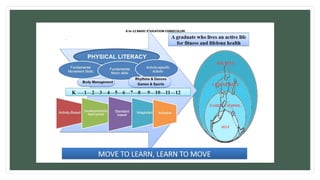
Move to learn is the context of physical activity as the
means for learning, while Learn to move embodies the
learning of skills, and techniques and the acquisition of
understanding that are requisites to participation in a
variety of physical activities that include exercise, games,
sports, dance and recreation.
Learning Outcomes
OF
P.E CURRICULUM
Learning Outcomes
•OF
•P.E CURRICULUM
The K to 12 PE Curriculum develops the
students’ skills in accessing,
synthesizing and evaluating
information, making informed
decisions, enhancing and advocating
their own and others’ fitness and
health.
The knowledge understanding and skills
underpin the competence, confidence and
commitment required of all students to live
an active life for fitness and health.
http://lrmds.deped.gov.ph/.
The K to 12 PE Curriculum prioritizes the following
standards:
1.Habitual physical activity participation to achieve and
maintain health-enhancing levels of fitness.
2.Competence in movement and motor skills requisite to
various physical activity performances.
3.Valuing physical activities for enjoyment, challenge, social
interaction and career opportunities.
4.Understanding various movement concepts, principles,
strategies and tactics as they apply to the learning of
physical activity.
LEARNING APPROACHES
Physical literacy is consists of movement, motor- and activity-
specific skills. In the early grades the learners are taught the
‘what,’ ‘why’ and ‘how’ of the movement. This progresses to an
understanding of the ‘why’ of the movement which is achieved by
developing more mature movement patterns and motor skills in a
wide range and variety of exercise, sports and dance activities to
specifically enhance fitness parameters.
The learners builds on these knowledge and skills in order to plan,
set goals and monitor their participation in physical activities
(exercise, sports and dance) and constantly evaluate how well they
have integrated this their personal lifestyle. This implies the provision
of ongoing and developmentally-appropriate activities so that the
learners can practice, create, apply and evaluate the knowledge,
understanding and skills necessary to maintain and enhance their
own as well as others’ fitness and health through participation in
physical activities.
The curriculum also allows for an inclusive approach that understands and
respects the diverse range of learners; thus, the program takes into account their
needs, strengths and abilities. This is to ensure that all learners have equivalent
opportunities and choices in Physical Education.
The curriculum emphasizes knowing the ‘what’, ‘how’ and ‘why’ of movement.
It focuses on developing the learners’ understanding of how the body responds,
adjusts and adapts to physical activities. This will equip the learner to become
self-regulated and self-directed as a result of knowing what should be done and
actually doing it; is the learners are equally confident in influencing their peers,
family, immediate community, and ultimately, society. These are all valuable 21st
century skills which the K to 12 PE Curriculum aspires for the learners to develop.
FIVE LEARNING
STRANDS
Naz, Marisol L.
1. Body Management
-which includes body awareness,
space awareness, qualities and
relationships of movements and
how these are used dynamically in
various physical activities.
2. Movement Skills
-related to the fundamental
movement patterns and motor skills
that form the basis of all physical
activities.
3. Games and Sports
-consisting of simple, lead-up and
indigenous games, as well as
individual, dual, and team sports in
competitive and recreational
settings.
4. Rhythm and dances
-include rhythmical movement
patterns, the promotion and
appreciation of Phil. Folk dance,
indigenous and traditional dances
as well as other dance forms.
5. Physical Fitness
-includes assessment through
fitness tests and records,
interpreting, planning and
implementing appropriate
programs that support fitness and
health goals.
KTO12
CURRICULUM
GUIDE
HEALTH
Conceptual Framework
 The Kindergarten to Grade 12 (“k to 12”)
Health Curriculum aims to assist the Filipino
learner in attaining and promoting life- long
health and wellness. The learning experience
through the program provides opportunities for
the development of health literacy
competencies among students to enhance
their over- all well- being.
 It focuses on the physical, mental, emotional, as
well as the social, moral and spiritual dimensions
of holistic health.
 It enables the learners to acquire essential
knowledge, attitudes, and skills that are
necessary to promote good nutrition; to prevent
and control diseases; to prevent substance
misuse and abuse; to reduce health- related risk
behaviors; to prevent and control injuries with the
end- view of maintaining and improving personal,
family, community, as well as global health.
 Health Education emphasizes the development of
positive health attitudes and relevant skills in order to
achieve a good quality of living.
 Thus, the focus on skills development is explicitly
demonstrated In the primary grade levels. Meanwhile,
a comprehensive body of knowledge is provided in
the upper year levels to serve as a foundation in
developing desirable health attitudes, habits and
practicies.
 In order to facilitate the development of health literacy
competencies, the teacher is highly encouraged to use
developmentally- appropriate learner- centered teaching
approaches. This includes scaffolding on student
experience and prior learning; utilizing culture- responsive
scenarios and materials; incorporating arts, and music in
imparting health messages; engaging learners in
meaningful games and cooperative learning activities; and
using life skills and value- based strategies particularly in
discussing sensitive topics such as substance abuse and
sexuality.
Health Content Areas
 Injury Prevention, Safety and
First Aid: Discusses the causes,
costs and prevention of accidents
and injuries while performing
various activities at homes, in
school, or in the community.
 Community and Environment Health: Situates the learner as
integral part of the community and the environment, with a great
responsibility of the environment, with the support of individual and
community actions and legislation promoting a standard of health,
hygiene and safety in food and water supply, waste management,
pollution control, as well as the delivery of primary health care.
 Consumer Health: Focuses on the application of consumer
knowledge and skills in the affective evaluation, selection and use of
health information, products, and services.
 Family Health: Covers information on the human life cycle
and also on family dynamics that influence and individuals
development of ideals, values and standards of behavior with
the regard to sexuality and responsible parenthood.
 Growth and Development: Emphasizes developmental
milestones and health concerns during puberty and
adolescence with focus on personal health and the
development of self- management skills to cope with life’s
changes.
 Nutrition: Addresses the importance of eating
healthy and establishing good eating habits
especially for children and adolescents as a way
to enhance health and prevent diseases.
 Personal Health: Comprises personal health
habits and practices that promote physical,
mental, social, emotional and moral- spiritual
health and prevent or manage personal health
issues and concerns.
 Prevention and Control of Diseases and
Disorders: Involves the prevention and
control of both communicable and non-
communicable diseases and disorders
through the development of health
and practices and the adaption of
programs supported by legislation with
provisions on school and community
health services.
 Substance Use and Abuse:
Highlights the prevention and control of
the use and abuse of substances and
drugs by providing comprehensive
information on the nature of abused
substances, the negative impact of
substance abuse on the individual, family
and society in general; and the
importance of learning and using
resistance skills to protect oneself from
drugs and risk- taking behaviors.
Characteristic of the Health Education
 Culture- responsive: Uses the cultural
knowledge, prior experiences, and
performance styles of the diverse student body
to make learning more appropriate and
effective for them.
 Epidemiological: Relates to the incidence,
prevalence, and distribution of diseases in
populations, including detection of the sources
and causes of epidemics.
 Health and Life skill-based: Applies life skills
to specific health choices and behaviors.
 Holistic: Analyzes the interrelationship
among the factors that influence the health
status, the areas of health, and the dimensions
of health (physical, mental, social, emotional,
moral and spiritual)
 Learner- Centered: Focuses on the student’s
student’s needs, abilities, interests, and
learning styles with the teacher as a facilitator
of learning.
 Preventive: Characterizes something
that helps people take positive health
action in order to prevent diseases and
to achieve optimum health.
 Rights- based: Advances the
understanding and recognition of human
rights, as laid down in the Universal
Declaration of Human Rights and other
international human rights instruments.
 Standards and outcome- based:
Requires students to demonstrate that
they have learned the academic
standards set on specific content and
competencies.
 Value- based: Promotes an
educational philosophy based on valuing
self, others and environment, through the
consideration of ethical values as the
bases of good educational practice.
THANKYOU!

P.e curriculum framework

  • 1.
    K to12 PHYSICAL EDUCATION CURRICULARFRAMEWORK Prepared by: ALAJAR, RIA BAUTISTA, JENNIFER JOYCE DORONIO, IZA NAZ, MARISOL NACION, DEBRA JANIS MARTINES, ARJEN MIRANDA, MARY ANN
  • 3.
    The Curricular Philosophyof the K to 12 PE Curriculum Fitness and movement education content is the core of the K to 12 PE Curriculum. It includes value, knowledge, skills and experiences in physical activity participation in order to (1) achieve and maintain health-related fitness (HRF), as well as (2) optimize health. In particular, it hopes to instill an understanding of why is important so that the learner can translate HRF knowledge into action. Thus, self-management is an important skill.
  • 4.
    In addition, thiscurriculum recognizes the view that fitness and healthy physical activity (PA) behaviors must take the family and other environmental settings (e.g. school, community and larger society) into consideration. This curricular orientation is a paradigm shift from the previous sports-dominated PE curriculum aimed at athletic achievement.
  • 5.
    Move to learnis the context of physical activity as the means for learning, while Learn to move embodies the learning of skills, and techniques and the acquisition of understanding that are requisites to participation in a variety of physical activities that include exercise, games, sports, dance and recreation.
  • 6.
    Learning Outcomes OF P.E CURRICULUM LearningOutcomes •OF •P.E CURRICULUM
  • 7.
    The K to12 PE Curriculum develops the students’ skills in accessing, synthesizing and evaluating information, making informed decisions, enhancing and advocating their own and others’ fitness and health.
  • 8.
    The knowledge understandingand skills underpin the competence, confidence and commitment required of all students to live an active life for fitness and health. http://lrmds.deped.gov.ph/.
  • 9.
    The K to12 PE Curriculum prioritizes the following standards: 1.Habitual physical activity participation to achieve and maintain health-enhancing levels of fitness. 2.Competence in movement and motor skills requisite to various physical activity performances. 3.Valuing physical activities for enjoyment, challenge, social interaction and career opportunities. 4.Understanding various movement concepts, principles, strategies and tactics as they apply to the learning of physical activity.
  • 10.
    LEARNING APPROACHES Physical literacyis consists of movement, motor- and activity- specific skills. In the early grades the learners are taught the ‘what,’ ‘why’ and ‘how’ of the movement. This progresses to an understanding of the ‘why’ of the movement which is achieved by developing more mature movement patterns and motor skills in a wide range and variety of exercise, sports and dance activities to specifically enhance fitness parameters.
  • 11.
    The learners buildson these knowledge and skills in order to plan, set goals and monitor their participation in physical activities (exercise, sports and dance) and constantly evaluate how well they have integrated this their personal lifestyle. This implies the provision of ongoing and developmentally-appropriate activities so that the learners can practice, create, apply and evaluate the knowledge, understanding and skills necessary to maintain and enhance their own as well as others’ fitness and health through participation in physical activities.
  • 12.
    The curriculum alsoallows for an inclusive approach that understands and respects the diverse range of learners; thus, the program takes into account their needs, strengths and abilities. This is to ensure that all learners have equivalent opportunities and choices in Physical Education. The curriculum emphasizes knowing the ‘what’, ‘how’ and ‘why’ of movement. It focuses on developing the learners’ understanding of how the body responds, adjusts and adapts to physical activities. This will equip the learner to become self-regulated and self-directed as a result of knowing what should be done and actually doing it; is the learners are equally confident in influencing their peers, family, immediate community, and ultimately, society. These are all valuable 21st century skills which the K to 12 PE Curriculum aspires for the learners to develop.
  • 13.
  • 14.
    1. Body Management -whichincludes body awareness, space awareness, qualities and relationships of movements and how these are used dynamically in various physical activities.
  • 15.
    2. Movement Skills -relatedto the fundamental movement patterns and motor skills that form the basis of all physical activities.
  • 16.
    3. Games andSports -consisting of simple, lead-up and indigenous games, as well as individual, dual, and team sports in competitive and recreational settings.
  • 17.
    4. Rhythm anddances -include rhythmical movement patterns, the promotion and appreciation of Phil. Folk dance, indigenous and traditional dances as well as other dance forms.
  • 18.
    5. Physical Fitness -includesassessment through fitness tests and records, interpreting, planning and implementing appropriate programs that support fitness and health goals.
  • 19.
  • 20.
    Conceptual Framework  TheKindergarten to Grade 12 (“k to 12”) Health Curriculum aims to assist the Filipino learner in attaining and promoting life- long health and wellness. The learning experience through the program provides opportunities for the development of health literacy competencies among students to enhance their over- all well- being.
  • 21.
     It focuseson the physical, mental, emotional, as well as the social, moral and spiritual dimensions of holistic health.  It enables the learners to acquire essential knowledge, attitudes, and skills that are necessary to promote good nutrition; to prevent and control diseases; to prevent substance misuse and abuse; to reduce health- related risk behaviors; to prevent and control injuries with the end- view of maintaining and improving personal, family, community, as well as global health.
  • 22.
     Health Educationemphasizes the development of positive health attitudes and relevant skills in order to achieve a good quality of living.  Thus, the focus on skills development is explicitly demonstrated In the primary grade levels. Meanwhile, a comprehensive body of knowledge is provided in the upper year levels to serve as a foundation in developing desirable health attitudes, habits and practicies.
  • 23.
     In orderto facilitate the development of health literacy competencies, the teacher is highly encouraged to use developmentally- appropriate learner- centered teaching approaches. This includes scaffolding on student experience and prior learning; utilizing culture- responsive scenarios and materials; incorporating arts, and music in imparting health messages; engaging learners in meaningful games and cooperative learning activities; and using life skills and value- based strategies particularly in discussing sensitive topics such as substance abuse and sexuality.
  • 25.
    Health Content Areas Injury Prevention, Safety and First Aid: Discusses the causes, costs and prevention of accidents and injuries while performing various activities at homes, in school, or in the community.
  • 26.
     Community andEnvironment Health: Situates the learner as integral part of the community and the environment, with a great responsibility of the environment, with the support of individual and community actions and legislation promoting a standard of health, hygiene and safety in food and water supply, waste management, pollution control, as well as the delivery of primary health care.  Consumer Health: Focuses on the application of consumer knowledge and skills in the affective evaluation, selection and use of health information, products, and services.
  • 27.
     Family Health:Covers information on the human life cycle and also on family dynamics that influence and individuals development of ideals, values and standards of behavior with the regard to sexuality and responsible parenthood.  Growth and Development: Emphasizes developmental milestones and health concerns during puberty and adolescence with focus on personal health and the development of self- management skills to cope with life’s changes.
  • 28.
     Nutrition: Addressesthe importance of eating healthy and establishing good eating habits especially for children and adolescents as a way to enhance health and prevent diseases.  Personal Health: Comprises personal health habits and practices that promote physical, mental, social, emotional and moral- spiritual health and prevent or manage personal health issues and concerns.
  • 29.
     Prevention andControl of Diseases and Disorders: Involves the prevention and control of both communicable and non- communicable diseases and disorders through the development of health and practices and the adaption of programs supported by legislation with provisions on school and community health services.
  • 30.
     Substance Useand Abuse: Highlights the prevention and control of the use and abuse of substances and drugs by providing comprehensive information on the nature of abused substances, the negative impact of substance abuse on the individual, family and society in general; and the importance of learning and using resistance skills to protect oneself from drugs and risk- taking behaviors.
  • 31.
    Characteristic of theHealth Education  Culture- responsive: Uses the cultural knowledge, prior experiences, and performance styles of the diverse student body to make learning more appropriate and effective for them.  Epidemiological: Relates to the incidence, prevalence, and distribution of diseases in populations, including detection of the sources and causes of epidemics.
  • 32.
     Health andLife skill-based: Applies life skills to specific health choices and behaviors.  Holistic: Analyzes the interrelationship among the factors that influence the health status, the areas of health, and the dimensions of health (physical, mental, social, emotional, moral and spiritual)  Learner- Centered: Focuses on the student’s student’s needs, abilities, interests, and learning styles with the teacher as a facilitator of learning.
  • 33.
     Preventive: Characterizessomething that helps people take positive health action in order to prevent diseases and to achieve optimum health.  Rights- based: Advances the understanding and recognition of human rights, as laid down in the Universal Declaration of Human Rights and other international human rights instruments.
  • 34.
     Standards andoutcome- based: Requires students to demonstrate that they have learned the academic standards set on specific content and competencies.  Value- based: Promotes an educational philosophy based on valuing self, others and environment, through the consideration of ethical values as the bases of good educational practice.
  • 35.