Coolstore
Refrigeration in a
Post R22 World
Matthew Darby
Coolstore Refrigeration In A Post R22World
Forces affecting choices
Retain, Retrofit or
Replace?
Refrigerant Characteristics
Refrigeration systems
Case Study
Making a Decision
Disposing of R22
www.ecochill.kiwi
Matthew Darby
R22 phase out and regulatory pressures are creating
change in the refrigeration industry…
EcoChill 3
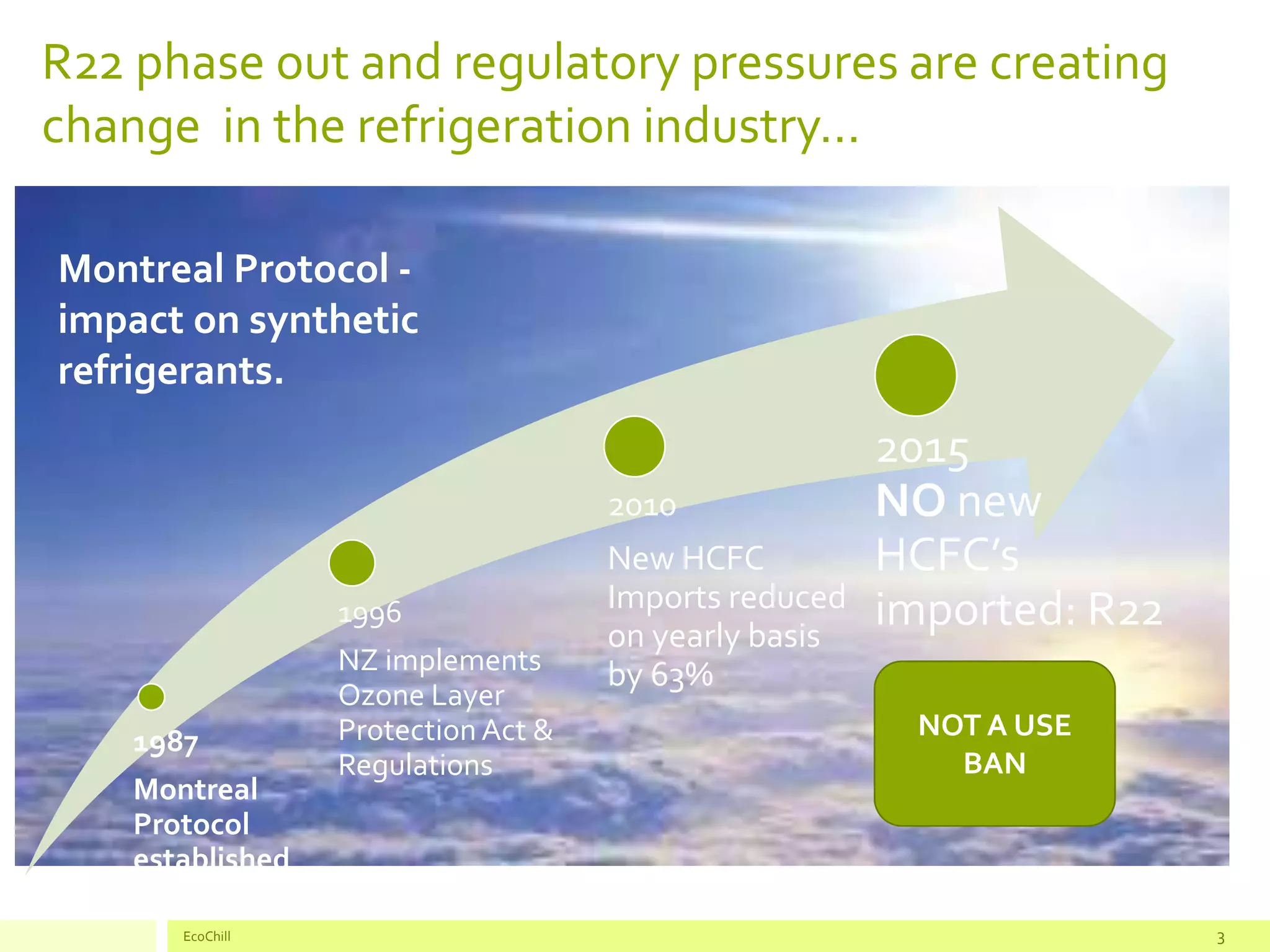
1987
Montreal
Protocol
established
1996
NZ implements
Ozone Layer
Protection Act &
Regulations
2010
New HCFC
Imports reduced
on yearly basis
by 63%
2015
NO new
HCFC’s
imported: R22
Montreal Protocol -
impact on synthetic
refrigerants.
NOT A USE
BAN
…while market demands are driving system
selection…
EcoChill 4
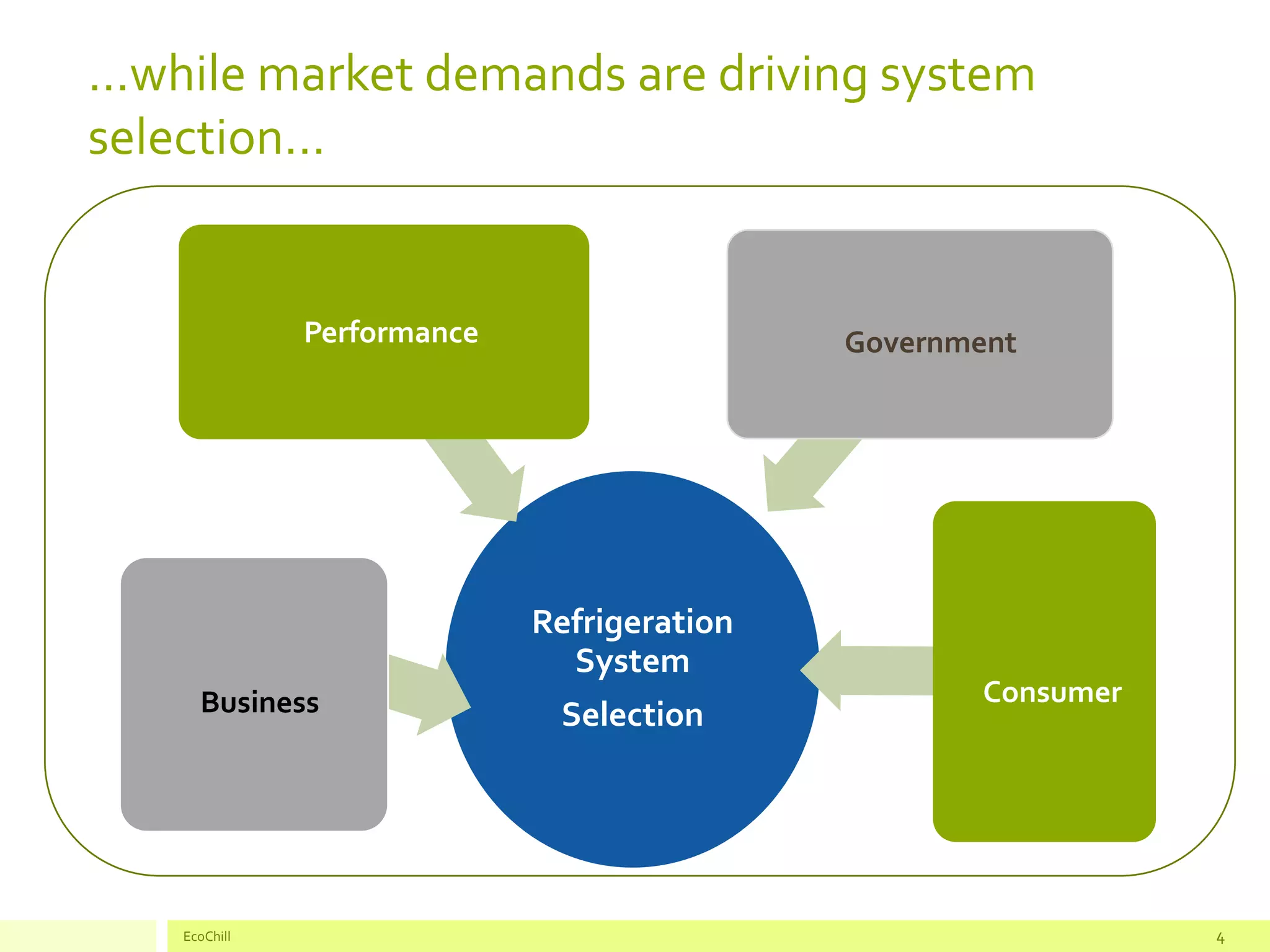
Refrigeration
System
SelectionBusiness
Performance Government
Consumer
Deciding how to manage refrigeration can seem
complicated; but when it comes down to it there are
3 real options…
EcoChill 5
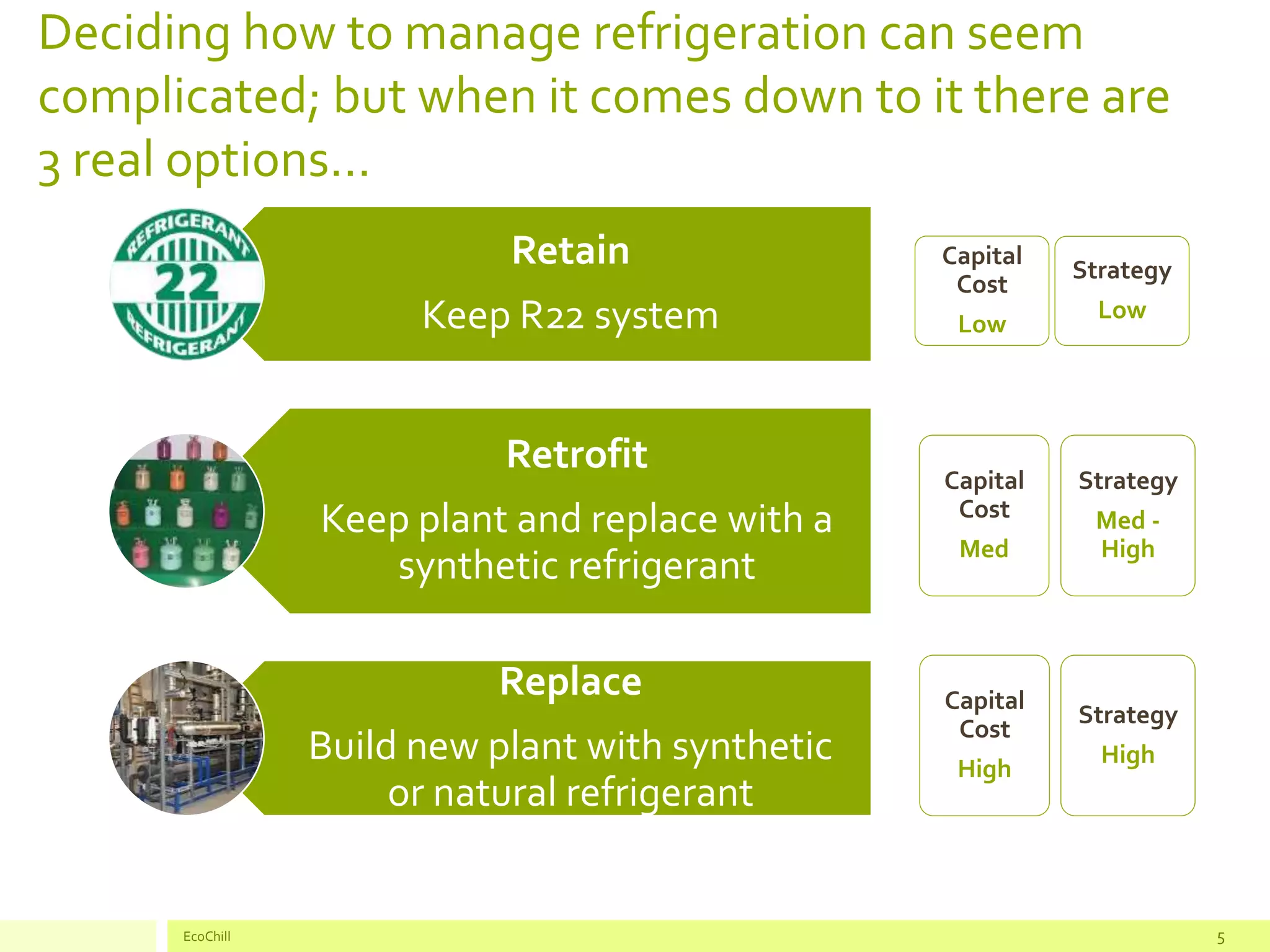
Retain
Keep R22 system
Retrofit
Keep plant and replace with a
synthetic refrigerant
Replace
Build new plant with synthetic
or natural refrigerant
Capital
Cost
Low
Strategy
Low
Capital
Cost
Med
Strategy
Med -
High
Capital
Cost
High
Strategy
High
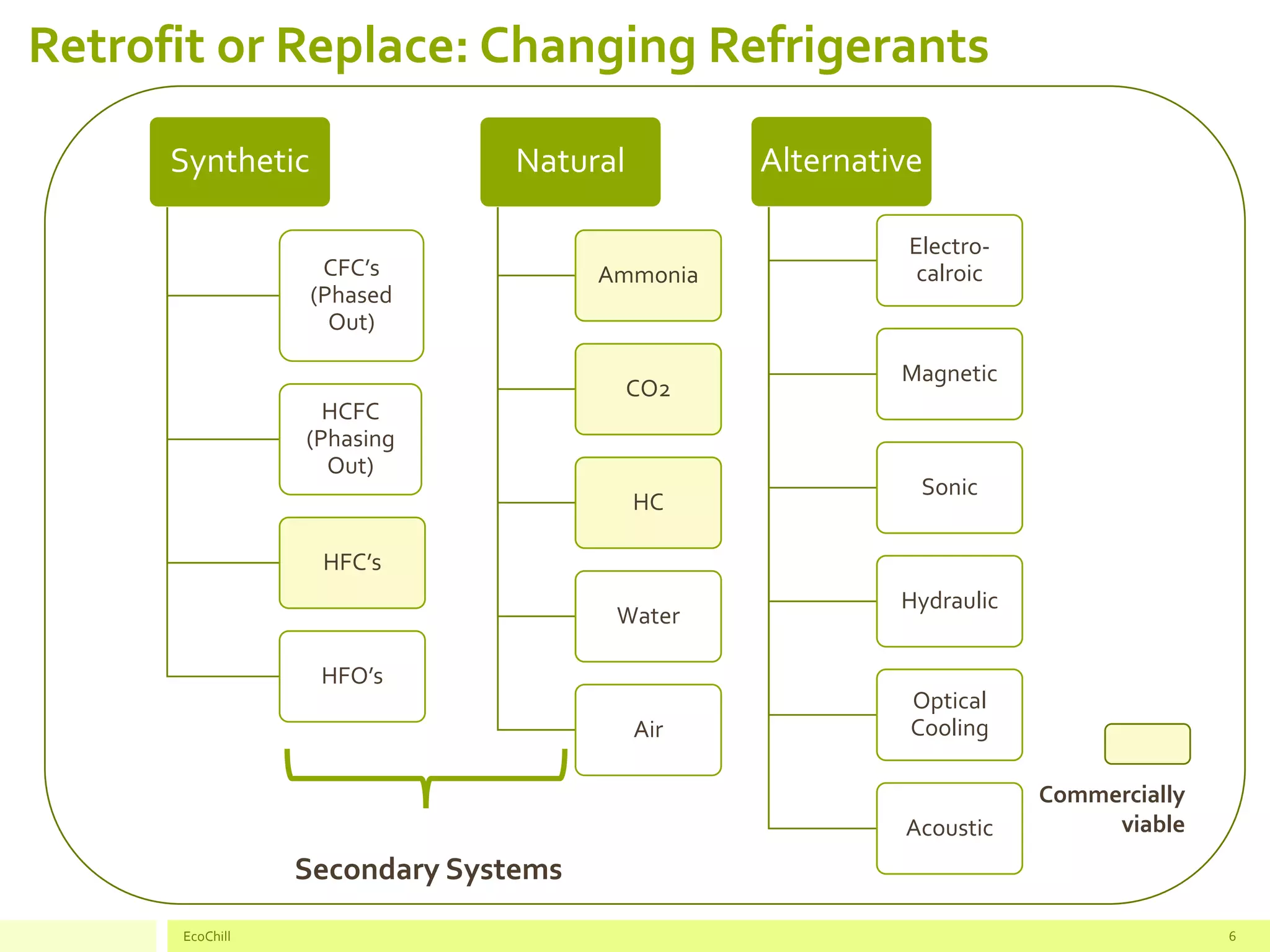
Retrofit or Replace: Changing Refrigerants
Synthetic
CFC’s
(Phased
Out)
HCFC
(Phasing
Out)
HFC’s
HFO’s
Natural
Ammonia
CO2
HC
Water
Air
Alternative
Electro-
calroic
Magnetic
Sonic
Hydraulic
Optical
Cooling
Acoustic
EcoChill 6
Secondary Systems
Commercially
viable
Safety
Performance
Economics
Environment
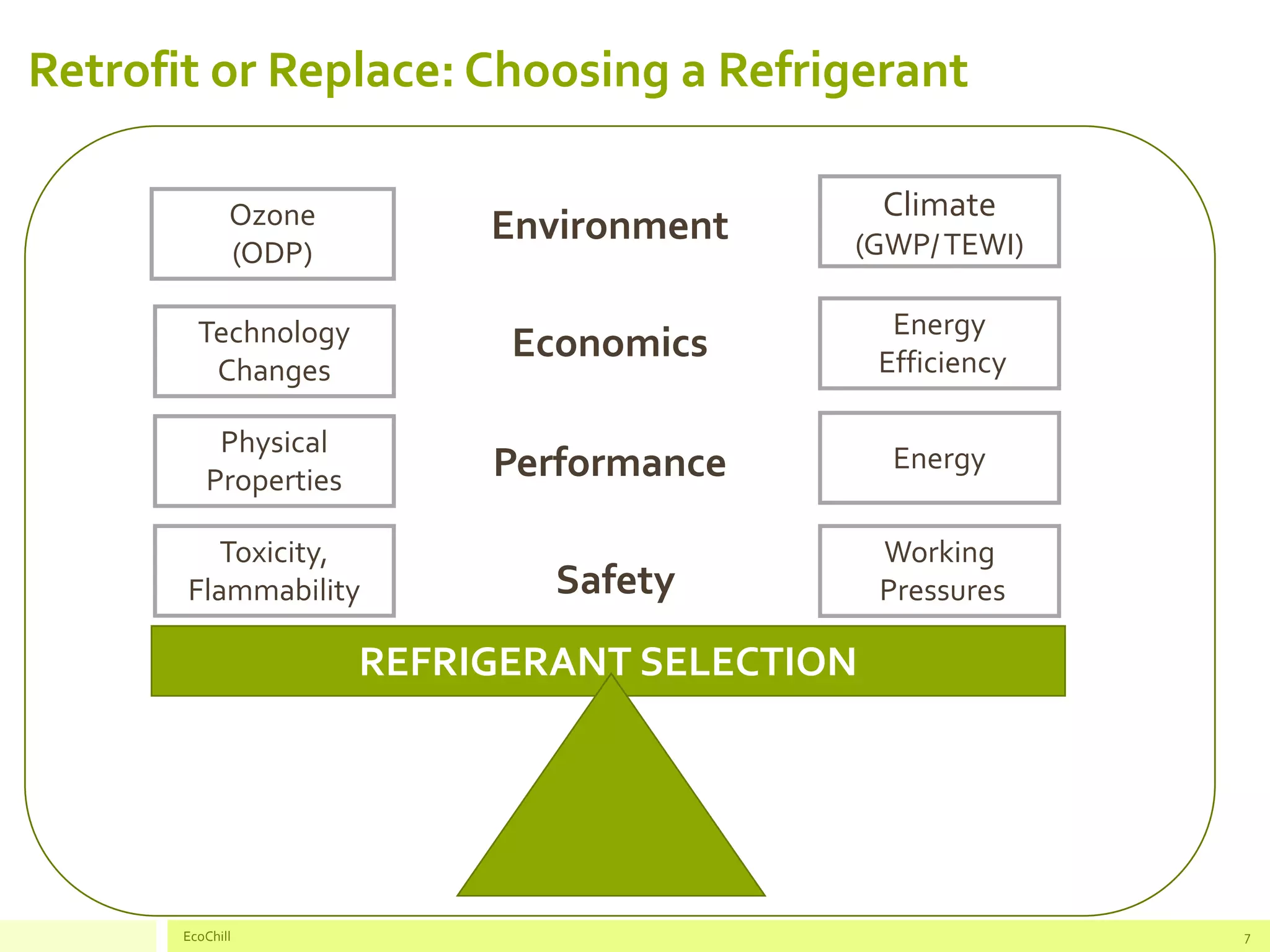
Retrofit or Replace: Choosing a Refrigerant
EcoChill 7
REFRIGERANT SELECTION
Toxicity,
Flammability
Working
Pressures
Physical
Properties
Energy
Technology
Changes
Energy
Efficiency
Ozone
(ODP)
Climate
(GWP/TEWI)
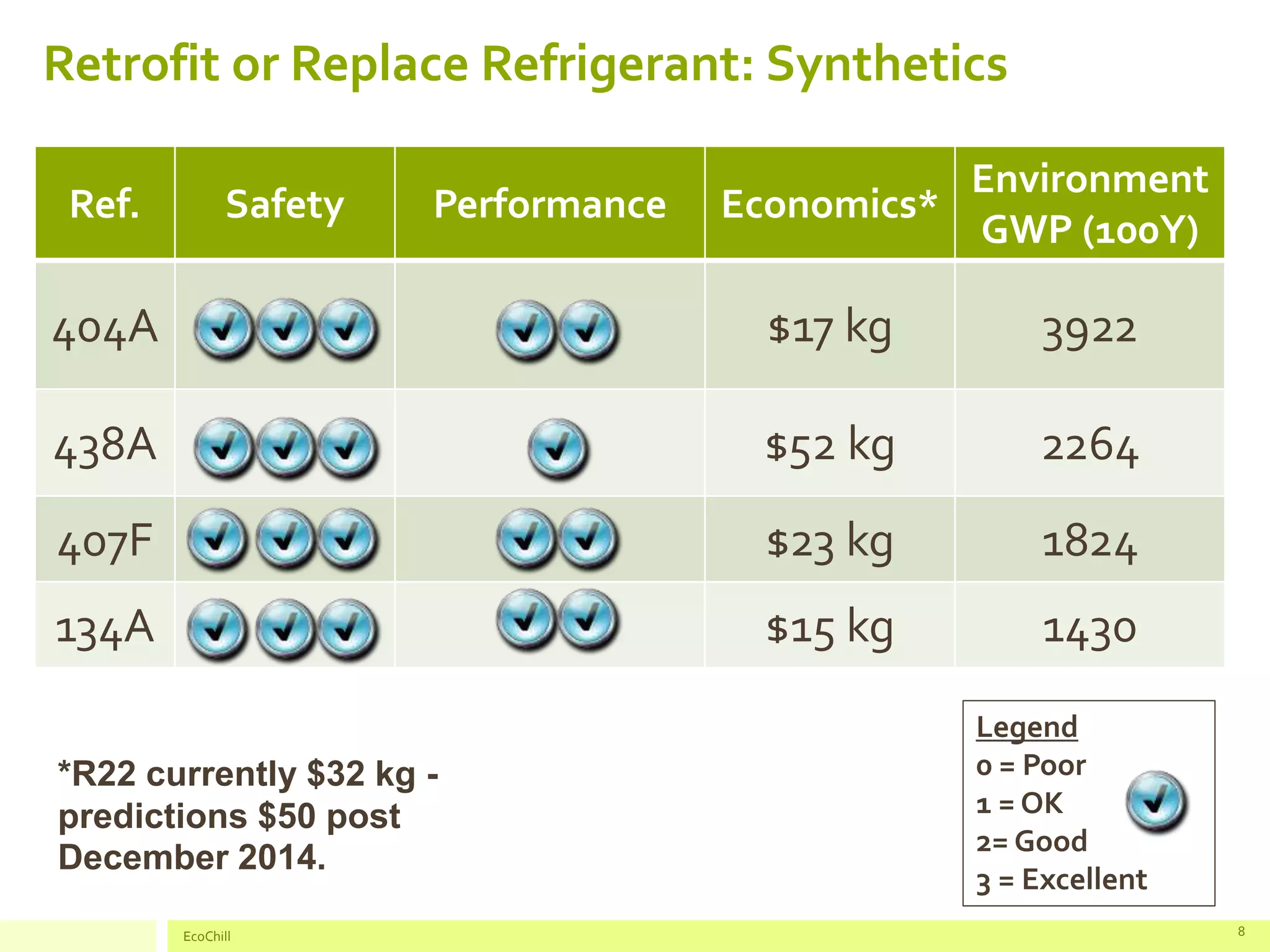
Retrofit or Replace Refrigerant: Synthetics
Ref. Safety Performance Economics*
Environment
GWP (100Y)
404A $17 kg 3922
438A $52 kg 2264
407F $23 kg 1824
134A $15 kg 1430
EcoChill 8
*R22 currently $32 kg -
predictions $50 post
December 2014.
Legend
0 = Poor
1 = OK
2= Good
3 = Excellent
Globally synthetic F-Gas
refrigerants are facing
ongoing regulation and
phase out…
EcoChill 9
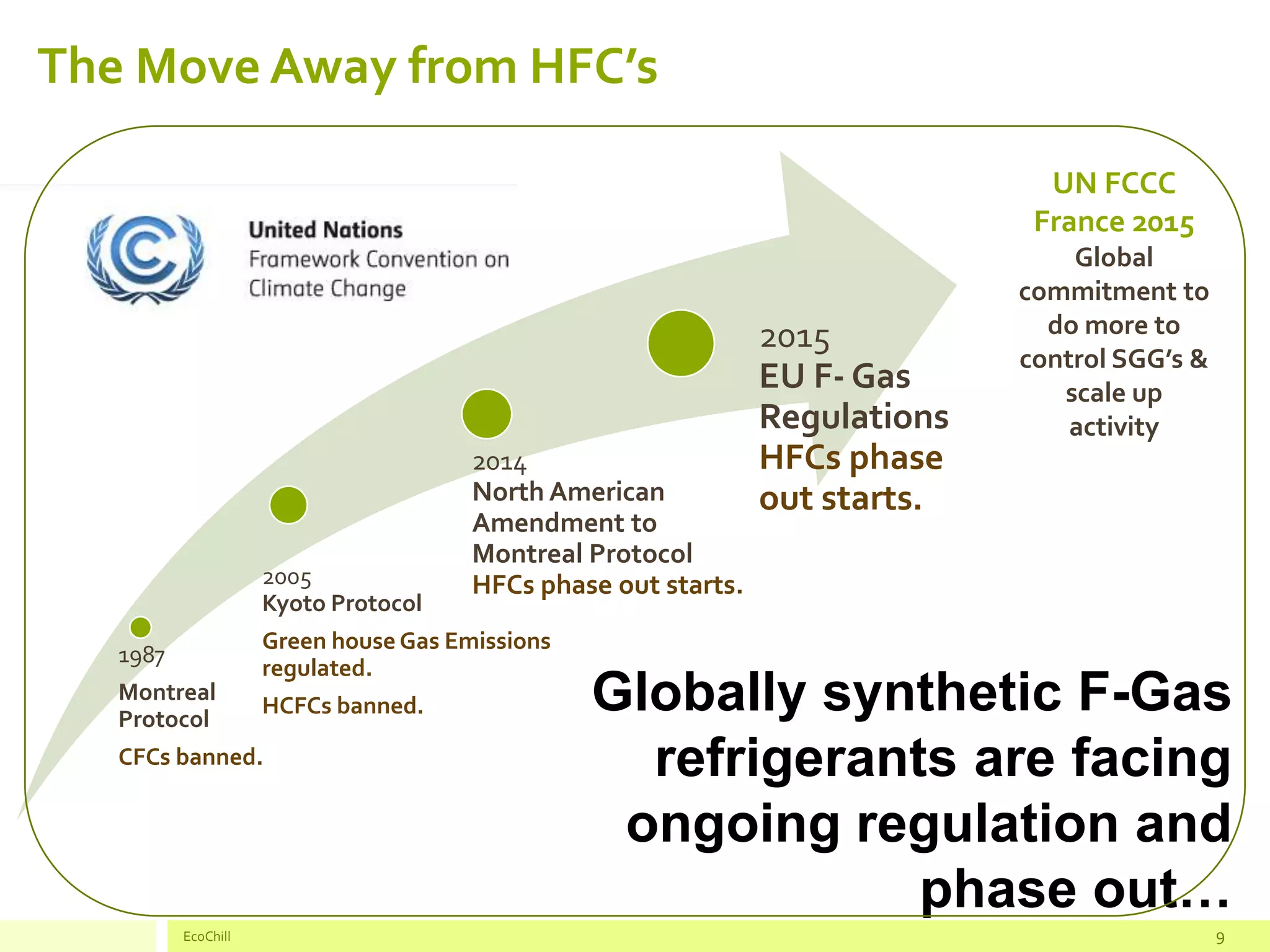
The Move Away from HFC’s
1987
Montreal
Protocol
CFCs banned.
2005
Kyoto Protocol
Green house Gas Emissions
regulated.
HCFCs banned.
2014
North American
Amendment to
Montreal Protocol
HFCs phase out starts.
2015
EU F- Gas
Regulations
HFCs phase
out starts.
UN FCCC
France 2015
Global
commitment to
do more to
control SGG’s &
scale up
activity
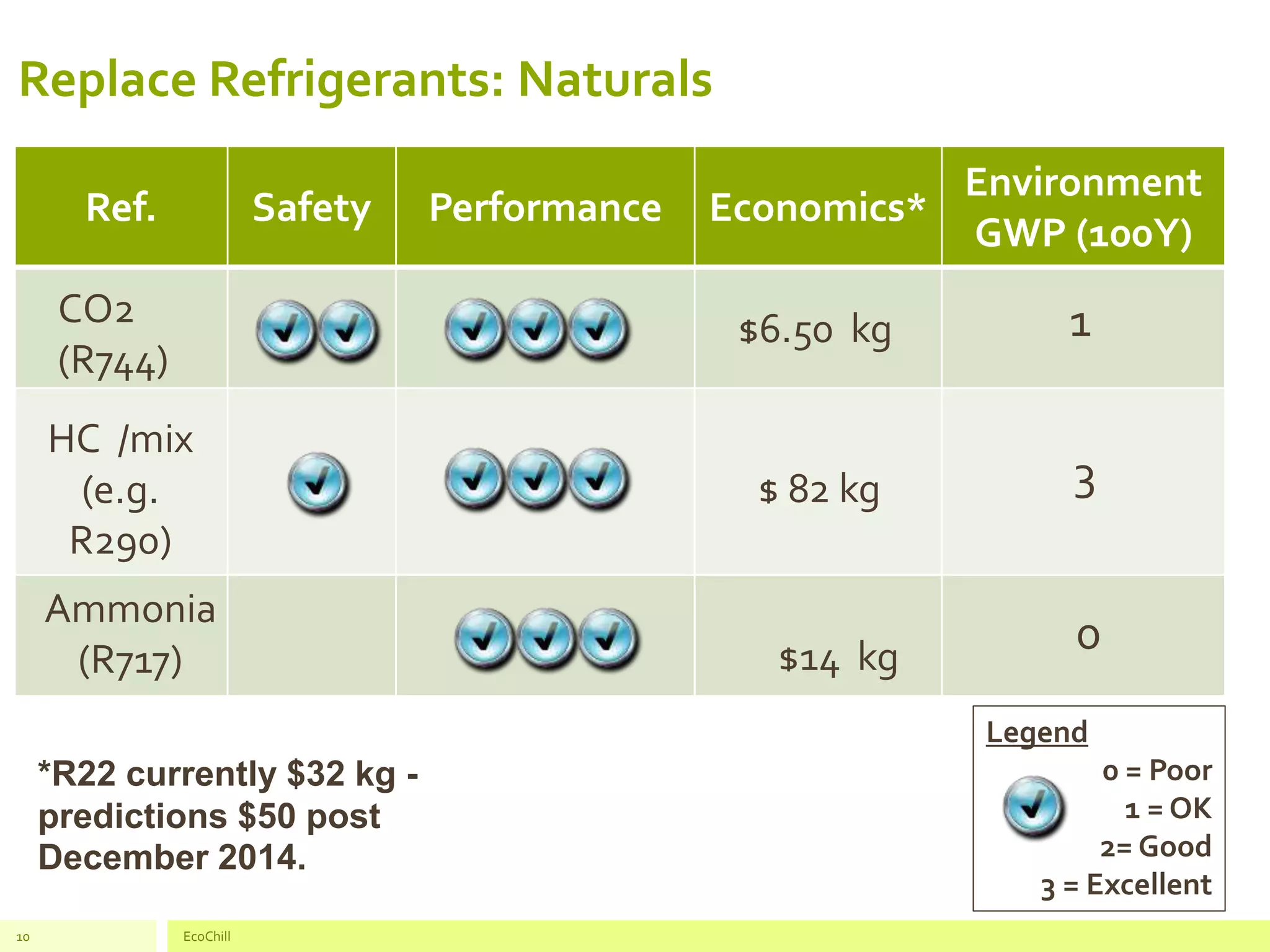
Replace Refrigerants: Naturals
Ref. Safety Performance Economics*
Environment
GWP (100Y)
EcoChill10
$6.50 kg 1
3
0
$ 82 kg
$14 kg
CO2
(R744)
Ammonia
(R717)
HC /mix
(e.g.
R290)
*R22 currently $32 kg -
predictions $50 post
December 2014.
Legend
0 = Poor
1 = OK
2= Good
3 = Excellent
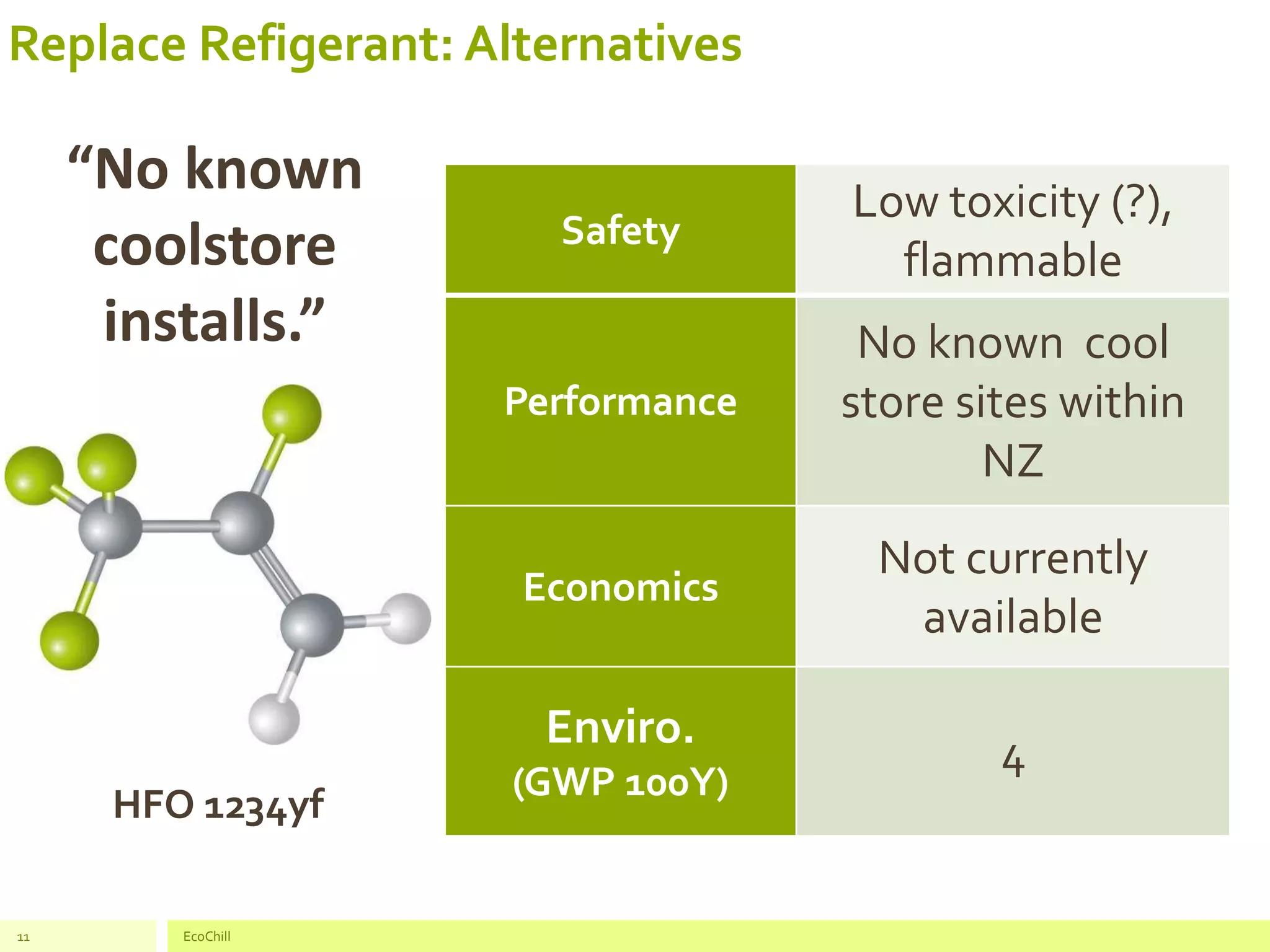
Replace Refigerant: Alternatives
Safety
Low toxicity (?),
flammable
Performance
No known cool
store sites within
NZ
Economics
Not currently
available
Enviro.
(GWP 100Y)
4
EcoChill11
“No known
coolstore
installs.”
HFO 1234yf
Replace Systems: CO2 for Kiwifruit Coolstores
Advantages
• Use single refrigerant.
• Increased energy efficiency.
• Low cost of CO2.
• High humidity.
• Safe refrigerant.
• Environmentally good choice.
Disadvantages
• Not widely used.
• Limited knowledge/ skill.
• Capital and servicing costs
(though gap closing).
EcoChill12
“Becoming more viable:
situation specific.”
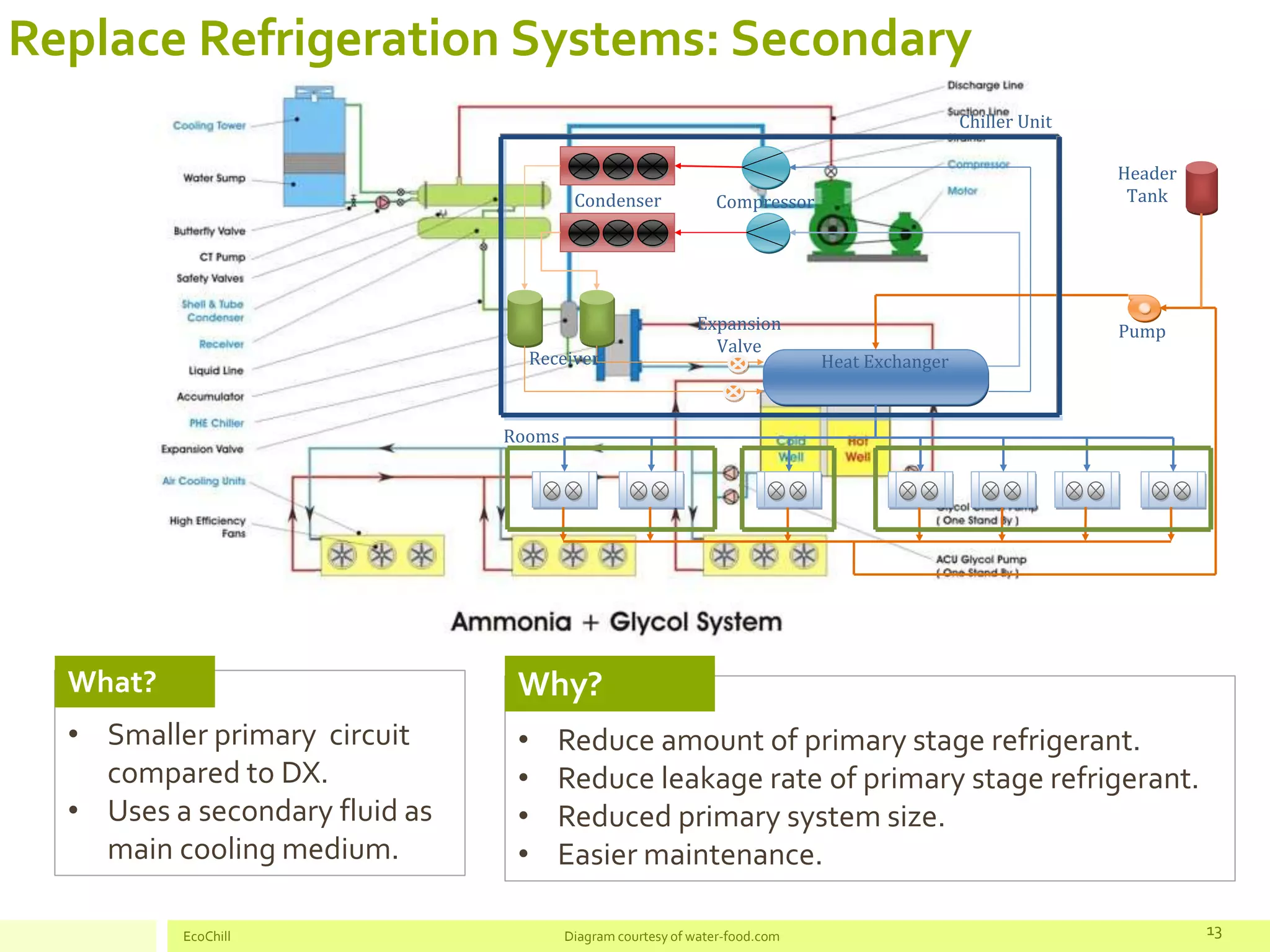
Replace Refrigeration Systems: Secondary
EcoChill Diagram courtesy of water-food.com 13
• Reduce amount of primary stage refrigerant.
• Reduce leakage rate of primary stage refrigerant.
• Reduced primary system size.
• Easier maintenance.
Why?
• Smaller primary circuit
compared to DX.
• Uses a secondary fluid as
main cooling medium.
What?
Replace: Advancements in Secondary Systems
• Reduced refrigerant charge
• Increased energy efficiency
• Increased system reliability
• Reduced operating costs
• Reduced stored product risk
• Guaranteed system safety and
compliance
Standard Secondary EcoChill
ExpansionValves Likely Mechanical Electronic
Capacity Control Likely Unloaders VSD
Primary Circuit Size Likely Standard
Optimised for Critical
Charge
Primary Refrigerant
Quantity
Likely Standard Minimised through design
EcoChill 14
EcoChill15
Replace Systems: Maintaining Optimal Conditions
• Pack
• Precool
• UniformTemperature
• High Humidity
• NoAirTempVariations
• Energy Efficient
• Low Maintenance
• Increased margin
• Higher “vine to table”
volumes
“Refrigeration:
providing
competitive
advantage.”
Zespri images courtesy zespri.com
Case Study
16
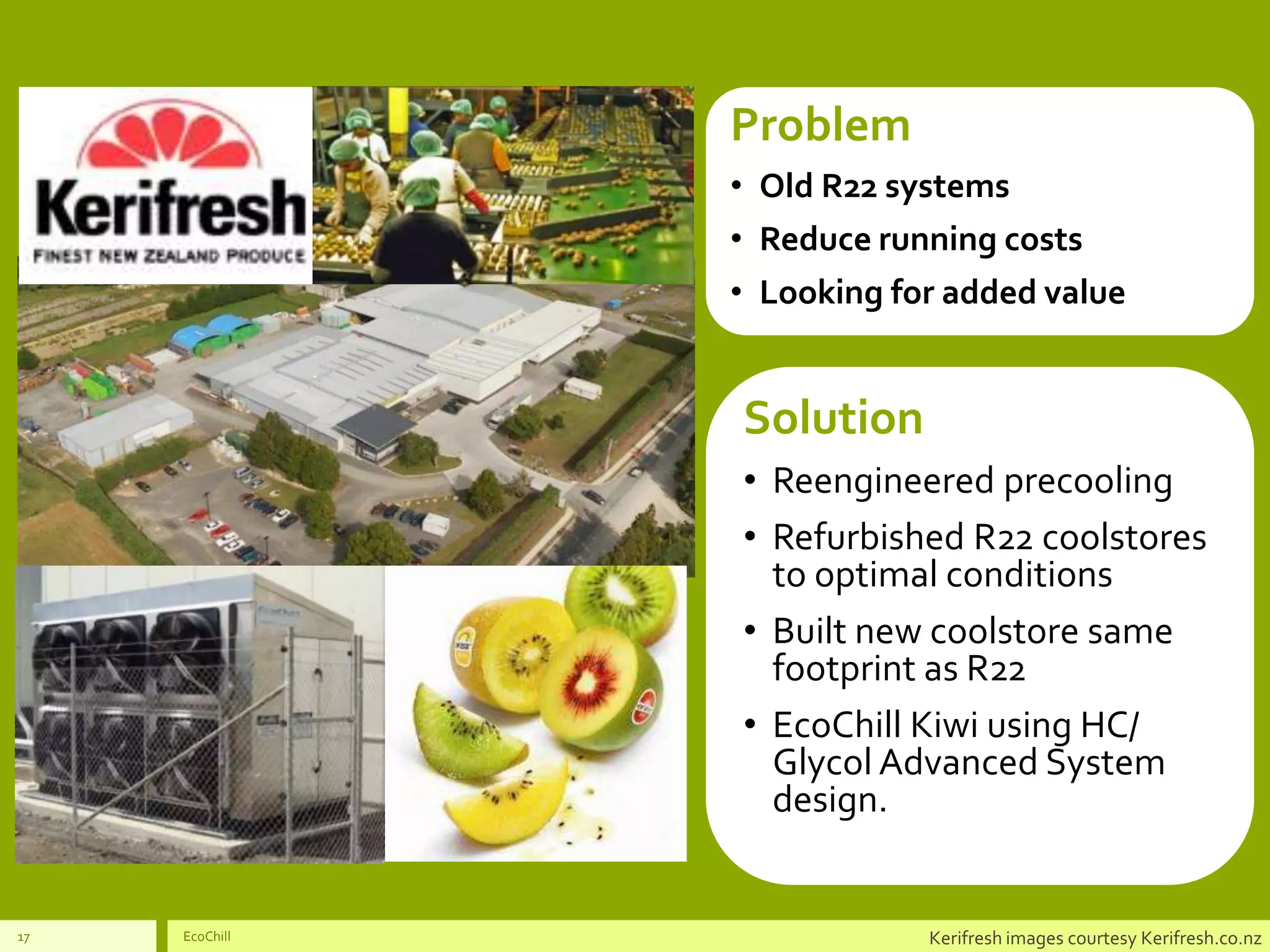
Problem
• Old R22 systems
• Reduce running costs
• Looking for added value
EcoChill17
Solution
• Reengineered precooling
• Refurbished R22 coolstores
to optimal conditions
• Built new coolstore same
footprint as R22
• EcoChill Kiwi using HC/
Glycol Advanced System
design.
Kerifresh images courtesy Kerifresh.co.nz
EcoChill18
Store capacity
(Pallets)
Cost to Cool
(Per Pallet/
Day
%
improvement
R22 840 $0.34 Baseline
EcoChill 864 $0.25 36%
“36% saving on
energy costs while
cooling more pallets”
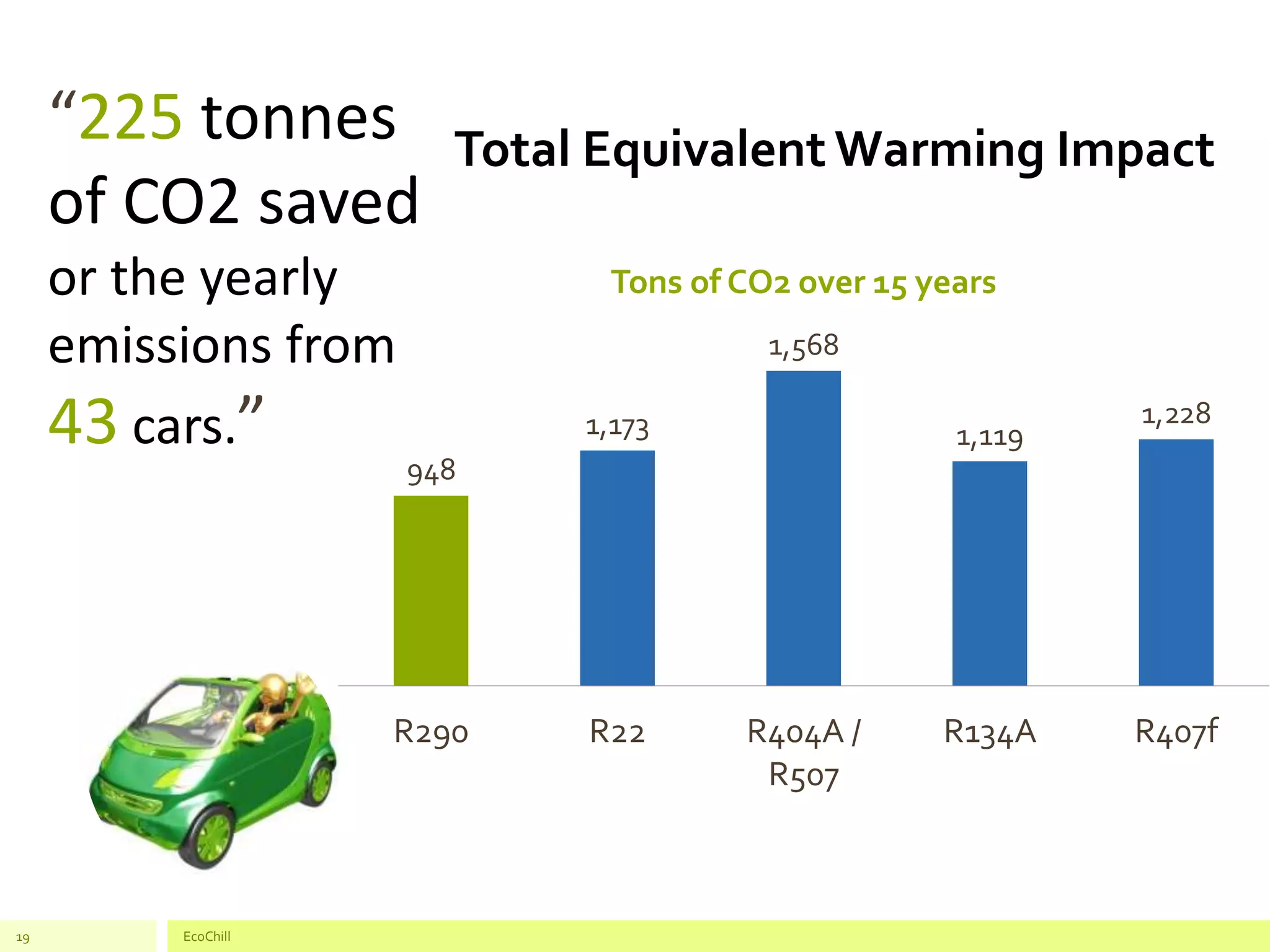
EcoChill19
948
1,173
1,568
1,119
1,228
R290 R22 R404A /
R507
R134A R407f
Tons of CO2 over 15 years
Total Equivalent Warming Impact
“225 tonnes
of CO2 saved
or the yearly
emissions from
43 cars.”
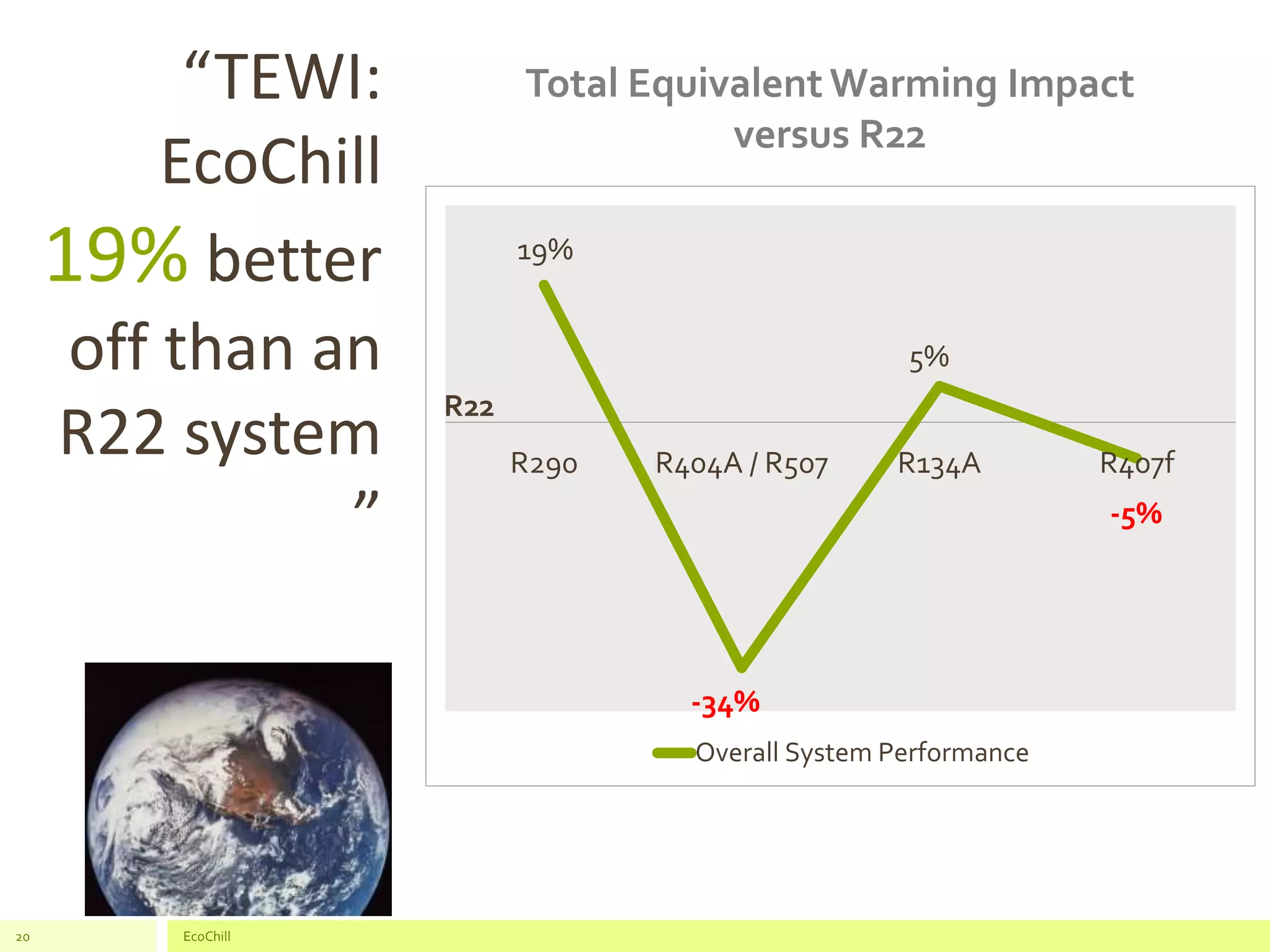
EcoChill20
19%
-34%
5%
-5%
R290 R404A / R507 R134A R407f
Overall System Performance
R22
“TEWI:
EcoChill
19% better
off than an
R22 system
”
Total Equivalent Warming Impact
versus R22
EcoChill21
Refrigerant Costs by Comparison
3,280 3,400 3,375
4,600
164 170 169 230
$0
$500
$1,000
$1,500
$2,000
$2,500
$3,000
$3,500
$4,000
$4,500
$5,000
R290 R404A / R507 R134A R407f
Initial System Charge Annual Leakage Rate 5%
EcoChill22
Refrigeration
System Options
EcoChill23
Secondary
Direct
Exp
CO2
Advanced
Secondary
LowHigh
High
Low
Capital Cost
Operating
Cost
Taking Action
24
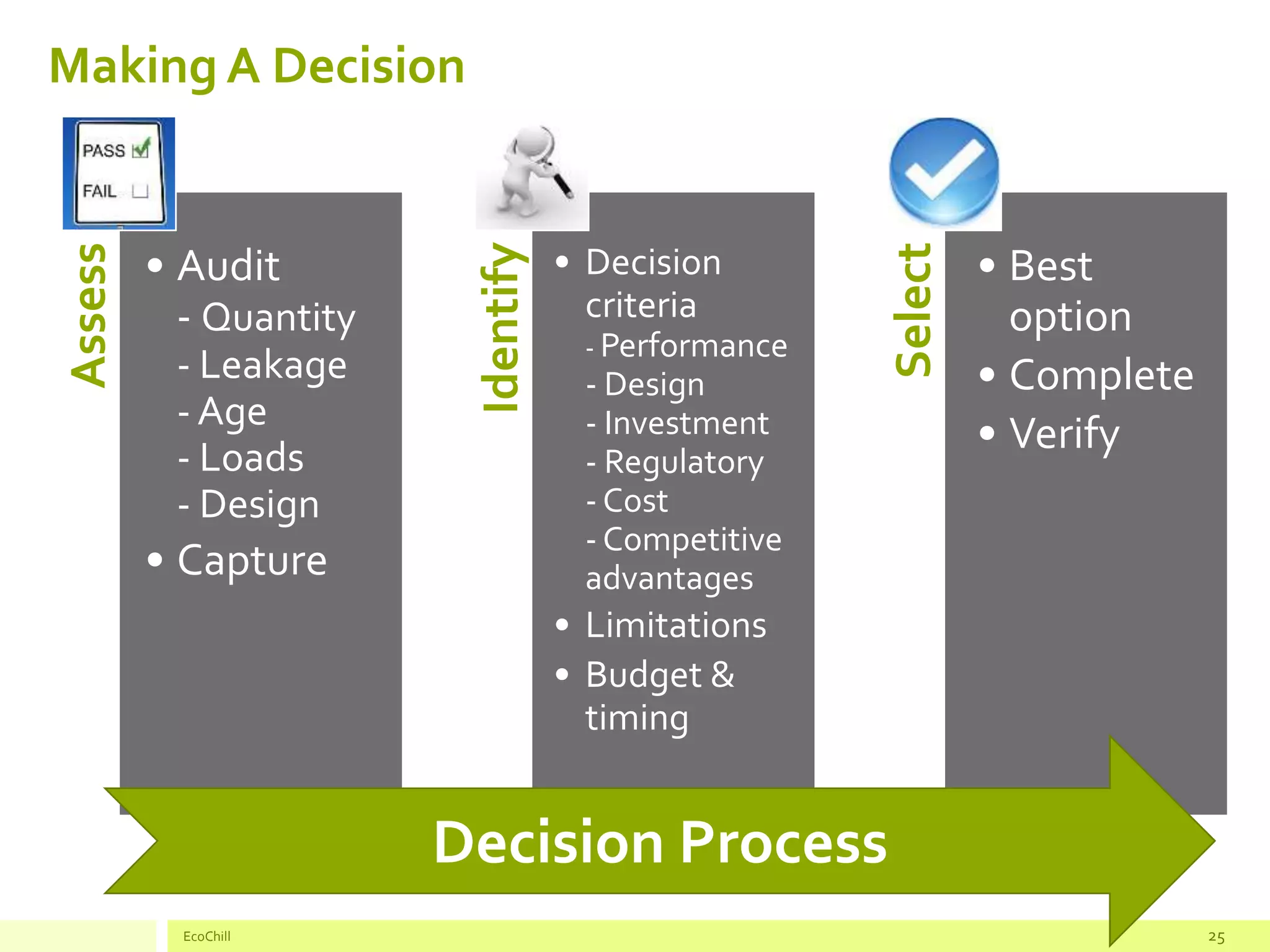
Assess
• Audit
- Quantity
- Leakage
- Age
- Loads
- Design
• Capture
Identify
• Decision
criteria
- Performance
- Design
- Investment
- Regulatory
- Cost
- Competitive
advantages
• Limitations
• Budget &
timing
Select
• Best
option
• Complete
• Verify
Making A Decision
EcoChill 25
Decision Process
WorkingWithYour Refrigeration Partner
EcoChill 26
Expertise
Reliability
Safety
Licensed
Experience
Energy Efficiency
Service Offering
Product Offering (Parts)
CCCA/ IRHACE members
R22 – Ask How It’s Disposed.
• Response to public and legislative
concern - refrigerant industry set up
the Refrigerant RecoveryTrust.
• Not for profit that collects a levy on
SGG’s purchases - pays for disposal/
ensures not released into the
atmosphere.
• Illegal to knowingly release R22 into
the environment when servicing,
maintaining or disposing of
refrigeration & AC plant and
equipment.
• Fines of up to $100,000.
• More information on obligations:
www.epa.govt.nz
EcoChill 27
www.RefrigerantRecovery.co.nz
www.ecochill.kiwi
QUESTIONS?

Coolstore refrigeration in a Post R22 World

  • 1.
    Coolstore Refrigeration in a PostR22 World Matthew Darby
  • 2.
    Coolstore Refrigeration InA Post R22World Forces affecting choices Retain, Retrofit or Replace? Refrigerant Characteristics Refrigeration systems Case Study Making a Decision Disposing of R22 www.ecochill.kiwi Matthew Darby
  • 3.
    R22 phase outand regulatory pressures are creating change in the refrigeration industry… EcoChill 3 1987 Montreal Protocol established 1996 NZ implements Ozone Layer Protection Act & Regulations 2010 New HCFC Imports reduced on yearly basis by 63% 2015 NO new HCFC’s imported: R22 Montreal Protocol - impact on synthetic refrigerants. NOT A USE BAN
  • 4.
    …while market demandsare driving system selection… EcoChill 4 Refrigeration System SelectionBusiness Performance Government Consumer
  • 5.
    Deciding how tomanage refrigeration can seem complicated; but when it comes down to it there are 3 real options… EcoChill 5 Retain Keep R22 system Retrofit Keep plant and replace with a synthetic refrigerant Replace Build new plant with synthetic or natural refrigerant Capital Cost Low Strategy Low Capital Cost Med Strategy Med - High Capital Cost High Strategy High
  • 6.
    Retrofit or Replace:Changing Refrigerants Synthetic CFC’s (Phased Out) HCFC (Phasing Out) HFC’s HFO’s Natural Ammonia CO2 HC Water Air Alternative Electro- calroic Magnetic Sonic Hydraulic Optical Cooling Acoustic EcoChill 6 Secondary Systems Commercially viable
  • 7.
    Safety Performance Economics Environment Retrofit or Replace:Choosing a Refrigerant EcoChill 7 REFRIGERANT SELECTION Toxicity, Flammability Working Pressures Physical Properties Energy Technology Changes Energy Efficiency Ozone (ODP) Climate (GWP/TEWI)
  • 8.
    Retrofit or ReplaceRefrigerant: Synthetics Ref. Safety Performance Economics* Environment GWP (100Y) 404A $17 kg 3922 438A $52 kg 2264 407F $23 kg 1824 134A $15 kg 1430 EcoChill 8 *R22 currently $32 kg - predictions $50 post December 2014. Legend 0 = Poor 1 = OK 2= Good 3 = Excellent
  • 9.
    Globally synthetic F-Gas refrigerantsare facing ongoing regulation and phase out… EcoChill 9 The Move Away from HFC’s 1987 Montreal Protocol CFCs banned. 2005 Kyoto Protocol Green house Gas Emissions regulated. HCFCs banned. 2014 North American Amendment to Montreal Protocol HFCs phase out starts. 2015 EU F- Gas Regulations HFCs phase out starts. UN FCCC France 2015 Global commitment to do more to control SGG’s & scale up activity
  • 10.
    Replace Refrigerants: Naturals Ref.Safety Performance Economics* Environment GWP (100Y) EcoChill10 $6.50 kg 1 3 0 $ 82 kg $14 kg CO2 (R744) Ammonia (R717) HC /mix (e.g. R290) *R22 currently $32 kg - predictions $50 post December 2014. Legend 0 = Poor 1 = OK 2= Good 3 = Excellent
  • 11.
    Replace Refigerant: Alternatives Safety Lowtoxicity (?), flammable Performance No known cool store sites within NZ Economics Not currently available Enviro. (GWP 100Y) 4 EcoChill11 “No known coolstore installs.” HFO 1234yf
  • 12.
    Replace Systems: CO2for Kiwifruit Coolstores Advantages • Use single refrigerant. • Increased energy efficiency. • Low cost of CO2. • High humidity. • Safe refrigerant. • Environmentally good choice. Disadvantages • Not widely used. • Limited knowledge/ skill. • Capital and servicing costs (though gap closing). EcoChill12 “Becoming more viable: situation specific.”
  • 13.
    Replace Refrigeration Systems:Secondary EcoChill Diagram courtesy of water-food.com 13 • Reduce amount of primary stage refrigerant. • Reduce leakage rate of primary stage refrigerant. • Reduced primary system size. • Easier maintenance. Why? • Smaller primary circuit compared to DX. • Uses a secondary fluid as main cooling medium. What?
  • 14.
    Replace: Advancements inSecondary Systems • Reduced refrigerant charge • Increased energy efficiency • Increased system reliability • Reduced operating costs • Reduced stored product risk • Guaranteed system safety and compliance Standard Secondary EcoChill ExpansionValves Likely Mechanical Electronic Capacity Control Likely Unloaders VSD Primary Circuit Size Likely Standard Optimised for Critical Charge Primary Refrigerant Quantity Likely Standard Minimised through design EcoChill 14
  • 15.
    EcoChill15 Replace Systems: MaintainingOptimal Conditions • Pack • Precool • UniformTemperature • High Humidity • NoAirTempVariations • Energy Efficient • Low Maintenance • Increased margin • Higher “vine to table” volumes “Refrigeration: providing competitive advantage.” Zespri images courtesy zespri.com
  • 16.
  • 17.
    Problem • Old R22systems • Reduce running costs • Looking for added value EcoChill17 Solution • Reengineered precooling • Refurbished R22 coolstores to optimal conditions • Built new coolstore same footprint as R22 • EcoChill Kiwi using HC/ Glycol Advanced System design. Kerifresh images courtesy Kerifresh.co.nz
  • 18.
    EcoChill18 Store capacity (Pallets) Cost toCool (Per Pallet/ Day % improvement R22 840 $0.34 Baseline EcoChill 864 $0.25 36% “36% saving on energy costs while cooling more pallets”
  • 19.
    EcoChill19 948 1,173 1,568 1,119 1,228 R290 R22 R404A/ R507 R134A R407f Tons of CO2 over 15 years Total Equivalent Warming Impact “225 tonnes of CO2 saved or the yearly emissions from 43 cars.”
  • 20.
    EcoChill20 19% -34% 5% -5% R290 R404A /R507 R134A R407f Overall System Performance R22 “TEWI: EcoChill 19% better off than an R22 system ” Total Equivalent Warming Impact versus R22
  • 21.
    EcoChill21 Refrigerant Costs byComparison 3,280 3,400 3,375 4,600 164 170 169 230 $0 $500 $1,000 $1,500 $2,000 $2,500 $3,000 $3,500 $4,000 $4,500 $5,000 R290 R404A / R507 R134A R407f Initial System Charge Annual Leakage Rate 5%
  • 22.
  • 23.
  • 24.
  • 25.
    Assess • Audit - Quantity -Leakage - Age - Loads - Design • Capture Identify • Decision criteria - Performance - Design - Investment - Regulatory - Cost - Competitive advantages • Limitations • Budget & timing Select • Best option • Complete • Verify Making A Decision EcoChill 25 Decision Process
  • 26.
    WorkingWithYour Refrigeration Partner EcoChill26 Expertise Reliability Safety Licensed Experience Energy Efficiency Service Offering Product Offering (Parts) CCCA/ IRHACE members
  • 27.
    R22 – AskHow It’s Disposed. • Response to public and legislative concern - refrigerant industry set up the Refrigerant RecoveryTrust. • Not for profit that collects a levy on SGG’s purchases - pays for disposal/ ensures not released into the atmosphere. • Illegal to knowingly release R22 into the environment when servicing, maintaining or disposing of refrigeration & AC plant and equipment. • Fines of up to $100,000. • More information on obligations: www.epa.govt.nz EcoChill 27 www.RefrigerantRecovery.co.nz
  • 28.

Editor's Notes

  • #5 Business: Profit/ Growth Targets, Reducing Operating Costs & Production Savings, Product development and lifecycle, Social Responsibility Performance: Site Conditions, Operating Criteria, Usability, Support Government: Legislation in Food Safety, Environmental: Montreal, Greenhouse Gas, Health & Safety Consumer: Product Demands Quality, Value, the “Green” $
  • #6 Option 1: Retain existing systems Reason for doing: End of life equipment with replacement strategy, capital or timing issues. Risks: 1. No new R22 available within NZ - some may be stockpiled / recycled. Currently $39 kg predictions $50 Dec. 2.Virgin R22 cannot be brought in; recycled can from qualifying countries though an approved process (under review). 3.Lack of availability may impact length of time to fix systems. 4. Old technology; not capitalising on business advantages. 5. Poor economic returns. Technical strategy: 1. CONTAINMENT: Leak detection /preventative maintenance critical 2. Needs strong refrigeration partner support program 3. Ask refrigeration partner about recycled R22 availability and how they will be able to support / delivery timeframes Option 2: Modify systems – replace R22 in existing systems with alternative refrigerants Reason for doing: Serviceable equipment with long life expectancy, difficult site/significant build work needed to change to a new system, gain immediate cost savings/ ROI opportunities. Risks: 1. Some plants unable to be modified. 2. Cannot solve existing issues / extend plant life if at end of cycle. 3. Future proofing as better alternatives become available. 4. Choice of refrigerant: - Efficiencies & capacity may not be the same as existing - Changes to operating costs - Implementation issues e.g. leakages /breakdowns (drop in) - Synthetic refrigerants target for future regulation (GWP) Technical strategy: 1. Term “Drop in” misleading – systems often require recalibration /component changes 2. Resolve existing issues prior to carrying out work. 3. Save money – do at same time as other work e.g. leak/ component replacement 4. If you have multiple systems of the same type these can provide a “testing ground” to watch performance as well as provide a source of recycled R22 Option 3: Replace systems –with synthetic or natural refrigerant Reason for doing: Gain immediate cost savings/ ROI opportunities, business efficiencies, operational & product advantages . End of life equipment/ age & life expectancy, maintenance and repair costs. Meet current & future regulatory and environmental requirements. Risks: 1. Choice of system and future proofing. 2. Choice of provider; provider knowledge and management of implementation. 3. For synthetic refrigerants: target for future regulation (GWP) Technical strategy: 1. Assess providers and look for an expert with specialised knowledge (CCCA members) 2. Evaluate refrigerant options available 3. Understand ROI, costs and benefits
  • #7 Synthetics: Introduced as safe/efficient – now several being phased out through legislation HFC’s most commonly used HFOs relatively new and number of challenges Naturals: Fell out of favour with intro of synthetics New technology makes more energy efficient/ safer (ammonia & HCs) Requires right skills Blends Synthetic / natural mixes been used as CFC/ HCFC replacements. Interim solution as fall under SGG legislation Question of impact of cross contamination & impact on operational life and efficiencies. Alternatives: Not commercially viable in the main CFO, Electocaloric and magnetic furthest ahead & for coolstores magnetic solution 7-10 years away.
  • #8 Historically cost, safety & performance have driven selection. Environmental issues have now become a major criteria as refrigerants become increasing regulated and government controls been put in place. As limited options available critical to make the right choice
  • #9 404 A - With work able to replicate existing performance. Replace expansion valves / metering devices / system seals /system drier and oil . 438A - Operates at similar pressure and temperature. Requires system seals/ drier to be replaced. Reportedly does not require oil change – our experience differs from this 407F - Requires system seals /system drier replaced and oil changes. Gas has “temperature glide” so may require expansion valve changes if original valves marginal. Higher discharge temperature may affect condensers. SAFETY: High level of industry knowledge of install and management Non flammable and high safety ratings – still require proper safety and licensed handling
  • #11 CO2 Notes: Safety Lower toxicity, non-flammable , high pressures . Performance:Climate dependent – work well in NZ with excellent efficiency. Discharge pressure high, critical temp low. HC: Safety Lower toxicity, higher flammability – requires specialist design and management. Performance: Pressure/ capacity similar to R22. Temp behavior . Non corrosive. Compatible mineral oils. Proven. Amm: Safety: Higher toxicity, lower flammability – requires specialist design and management. Perf: High efficiency & low power. High discharge temp. Small plants not suitable lubricants. Corrosive on copper. Overview Notes Increasing evidence suggests most economic solution given regulatory issues - higher capital costs up front as require new build. Can provide energy efficiency gains & heat recovery benefits Often require specialist skill set and advice to manage Rapidly changing industry advances - lot of misinformation exists
  • #12 For cool stores HFO’s closest commercially viable option though no cool stores in NZ have been converted to/ running on Supermarket chain in Australia currently trialling Debate surrounding toxicity, performance and GWP ratings – though significantly less than SGG’s. Some good progress being made in magnetic refrigeration in retail cabinets . Completely revolutionary refrigeration system that does not require refrigerant. Watching for further developments
  • #14 Instead of direct expansion refrigeration system uses 1 refrigerant; secondary systems that reduce the amount of refrigerant.
  • #16 All fruit at a uniform temperature High humidity No air temperature variations Cost Savings as - Low maintenance inside room Energy efficient both during pull down and while holding
  • #27 The right partner will be working with you to improve efficiencies, ROI & environmental impacts, updating you with regulatory changes & system performance opportunities, reporting on system metrics and benchmarking against optimum levels.