Delivering Marginal Gains –
How the 1% really matters
Boris van Thiel
CEO Middle East
thyssenkrupp Industrial Solutions
Agenda
• thyssenkrupp @ a glance
• Ongoing trends in Middle East
• Marginal Gains by
- Innovative technologies
- Process improvements
- Asset Management
• Summary
thyssenkrupp @ a glance
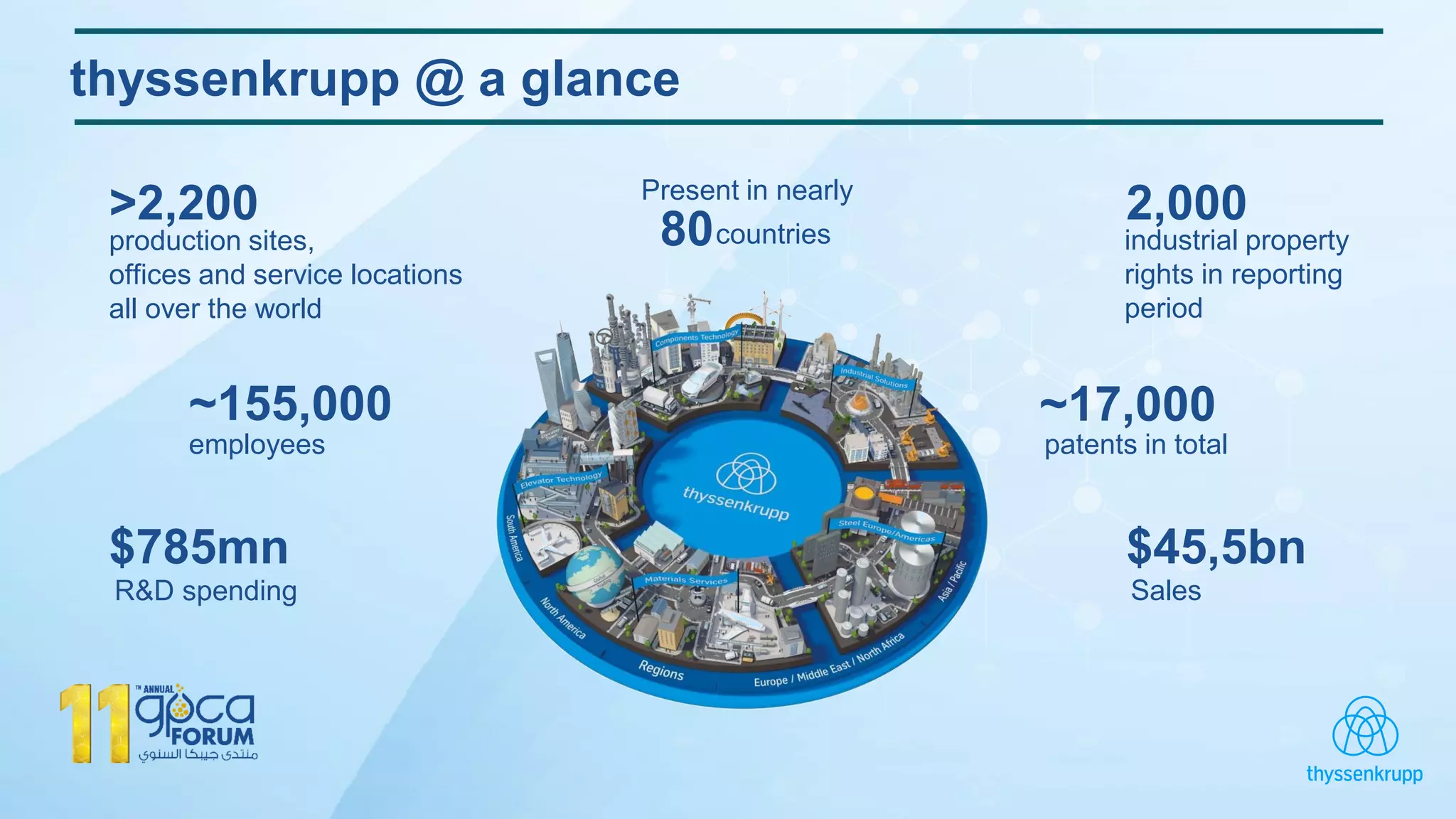
Present in nearly
80countries
~17,000
patents in total
$45,5bn
Sales
production sites,
offices and service locations
all over the world
>2,200
employees
~155,000
R&D spending
$785mn
2,000
industrial property
rights in reporting
period
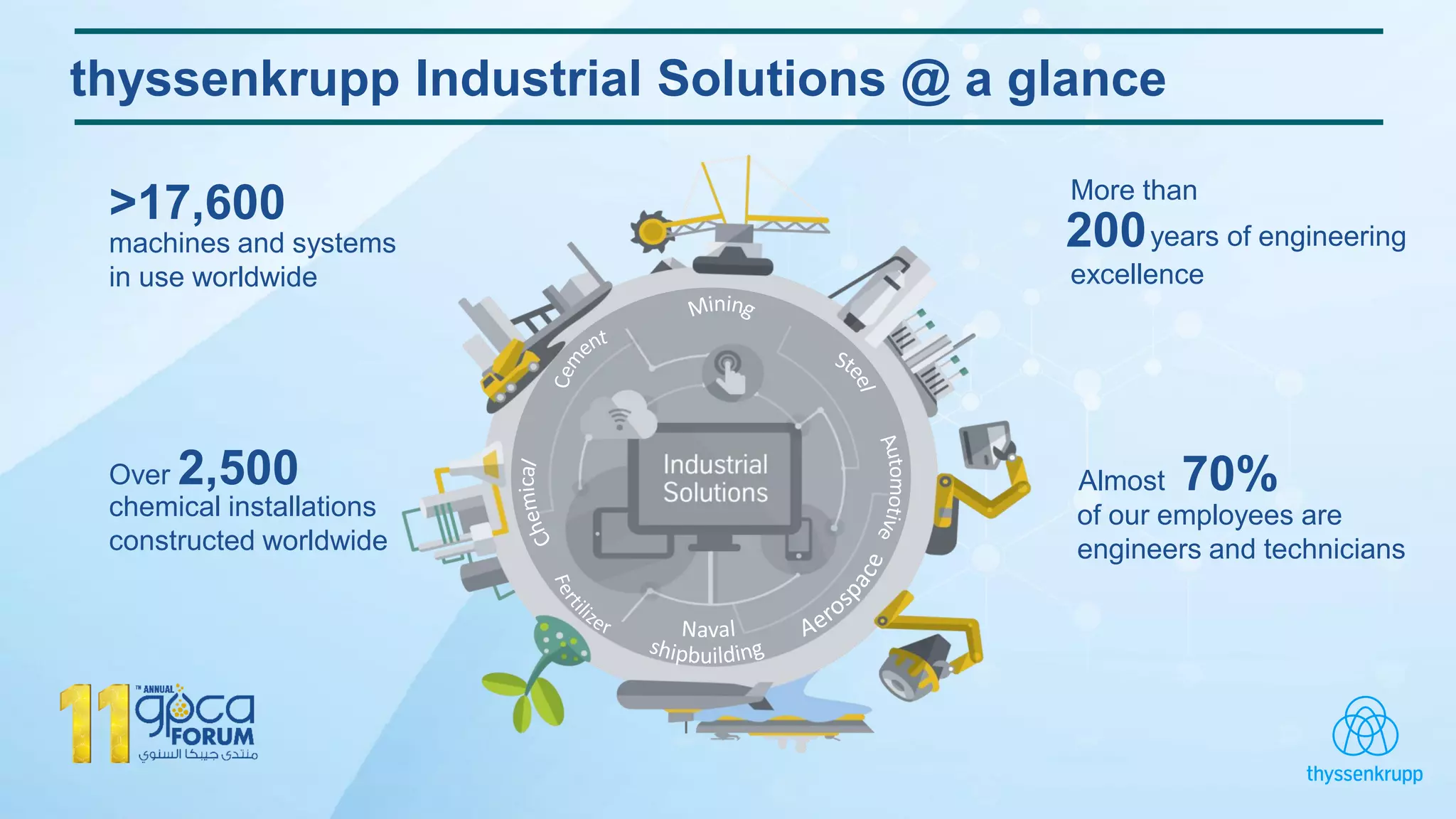
machines and systems
in use worldwide
>17,600
of our employees are
engineers and technicians
Almost 70%
chemical installations
constructed worldwide
Over 2,500
thyssenkrupp Industrial Solutions @ a glance
More than
years of engineering200
excellence
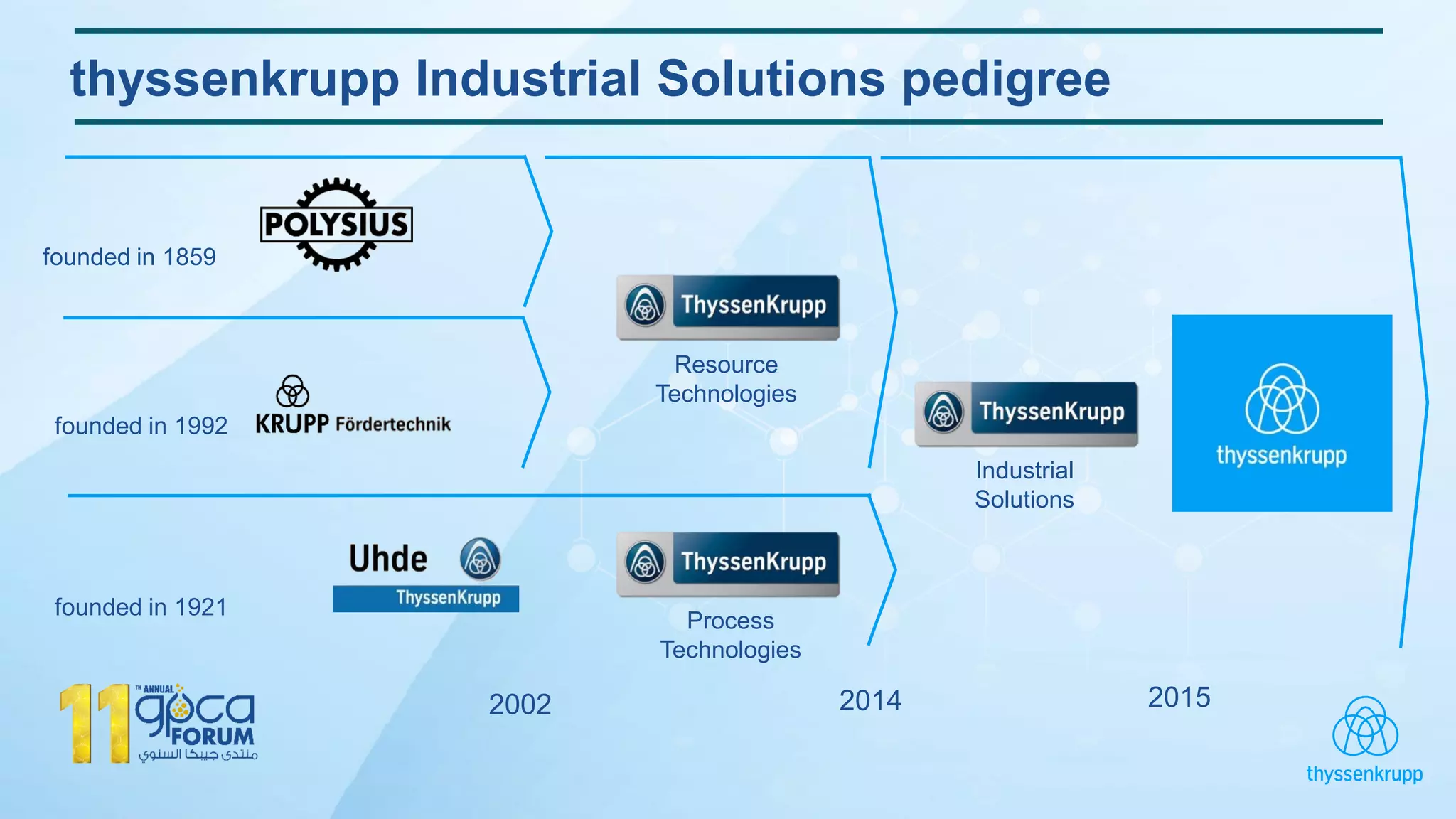
thyssenkrupp Industrial Solutions pedigree
20142002
founded in 1859
founded in 1992
founded in 1921
Resource
Technologies
Process
Technologies
Industrial
Solutions
2015
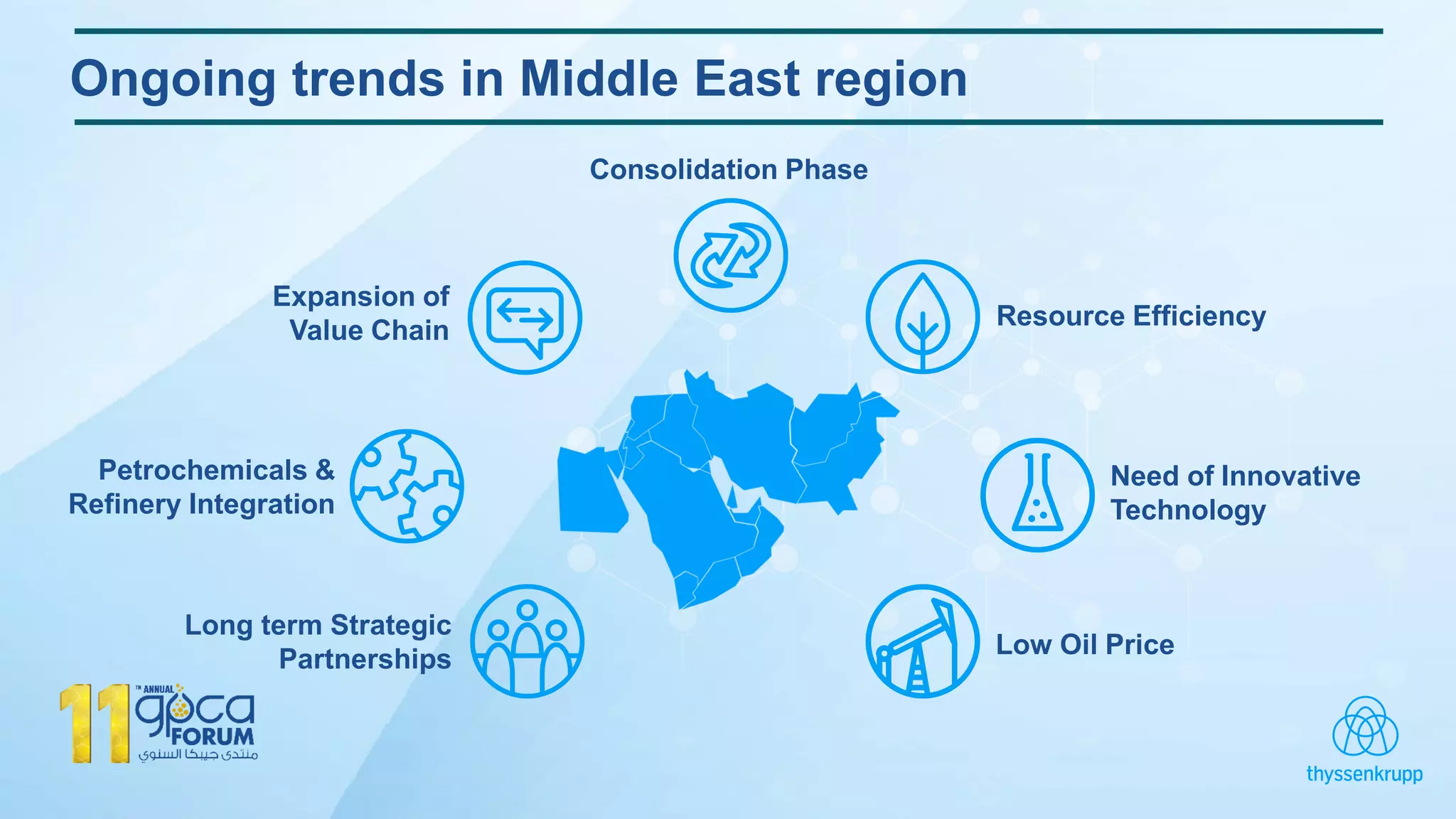
Ongoing trends in Middle East region
Consolidation Phase
Resource Efficiency
Expansion of
Value Chain
Long term Strategic
Partnerships
Petrochemicals &
Refinery Integration
Need of Innovative
Technology
Low Oil Price
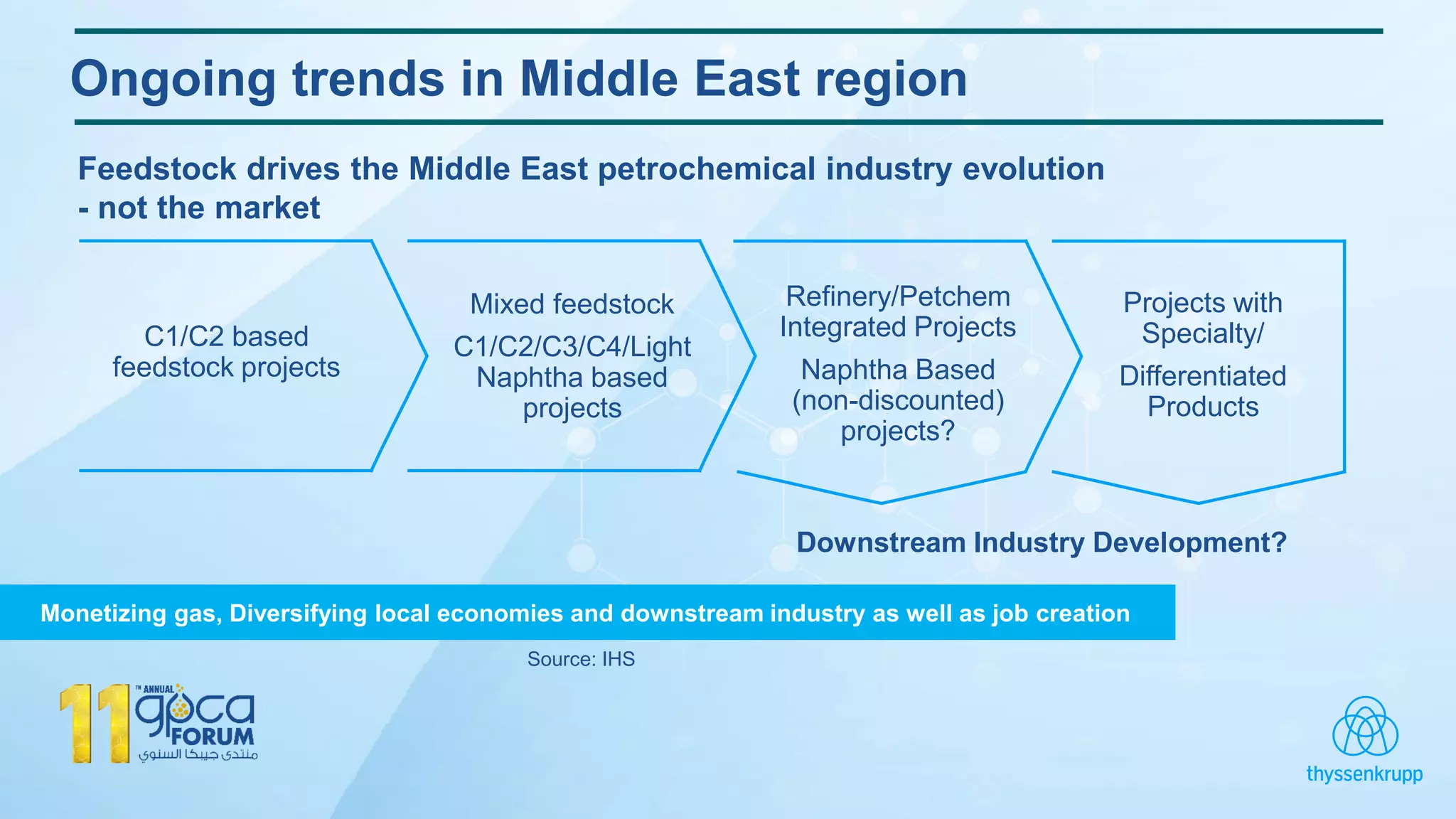
Ongoing trends in Middle East region
Monetizing gas, Diversifying local economies and downstream industry as well as job creation
C1/C2 based
feedstock projects
Projects with
Specialty/
Differentiated
Products
Refinery/Petchem
Integrated Projects
Naphtha Based
(non-discounted)
projects?
Downstream Industry Development?
Feedstock drives the Middle East petrochemical industry evolution
- not the market
Source: IHS
Mixed feedstock
C1/C2/C3/C4/Light
Naphtha based
projects
0%
20%
40%
60%
80%
100%
0
1
2
3
4
5
6
7
8
9
10
1995 2000 2005 2010 2015 2020
%ofWorldTotal
Ethylene Propylene Paraxylene Benzene Methanol Chlorine
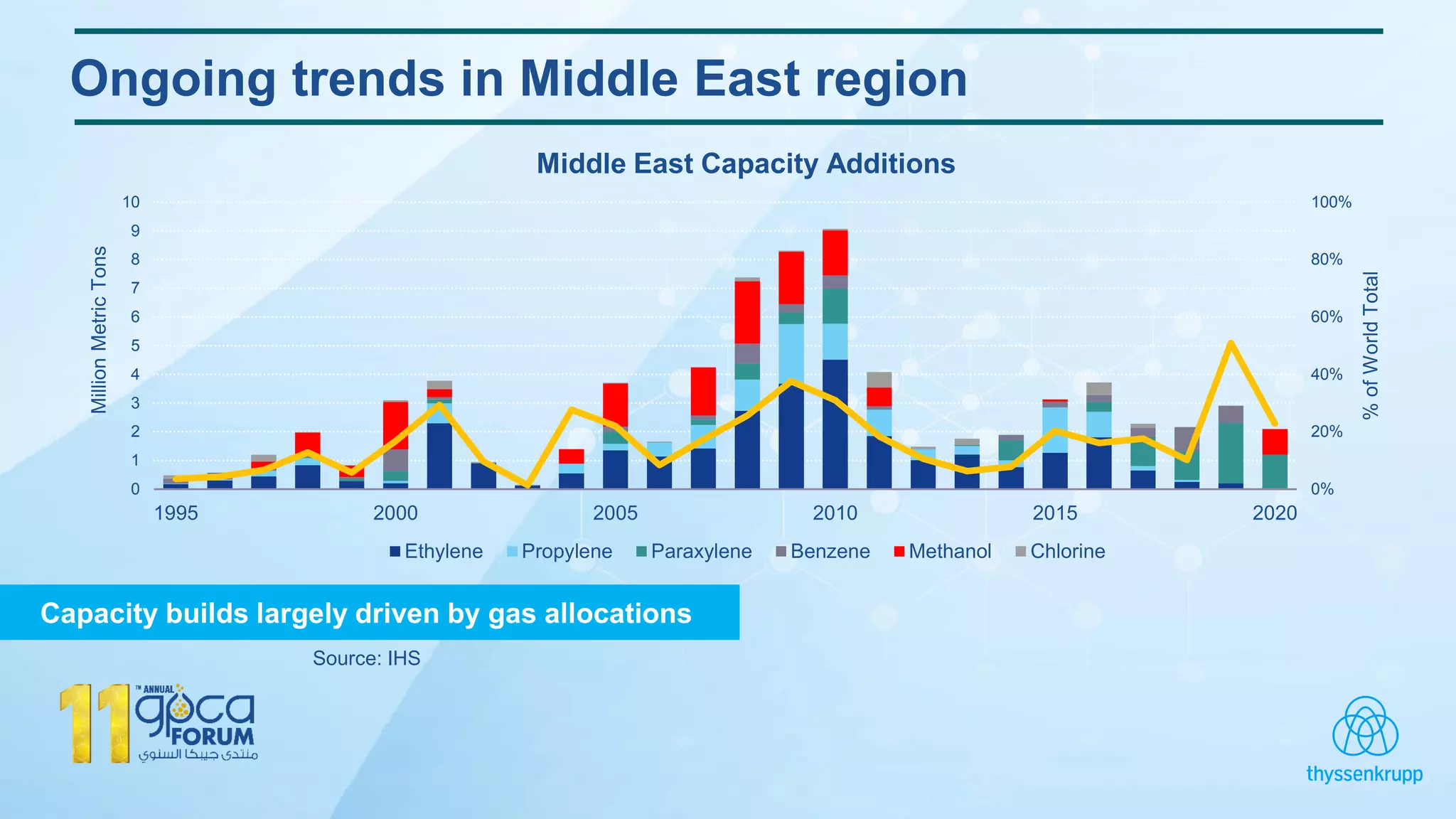
Middle East Capacity Additions
MillionMetricTons
Source: IHS
Ongoing trends in Middle East region
Capacity builds largely driven by gas allocations
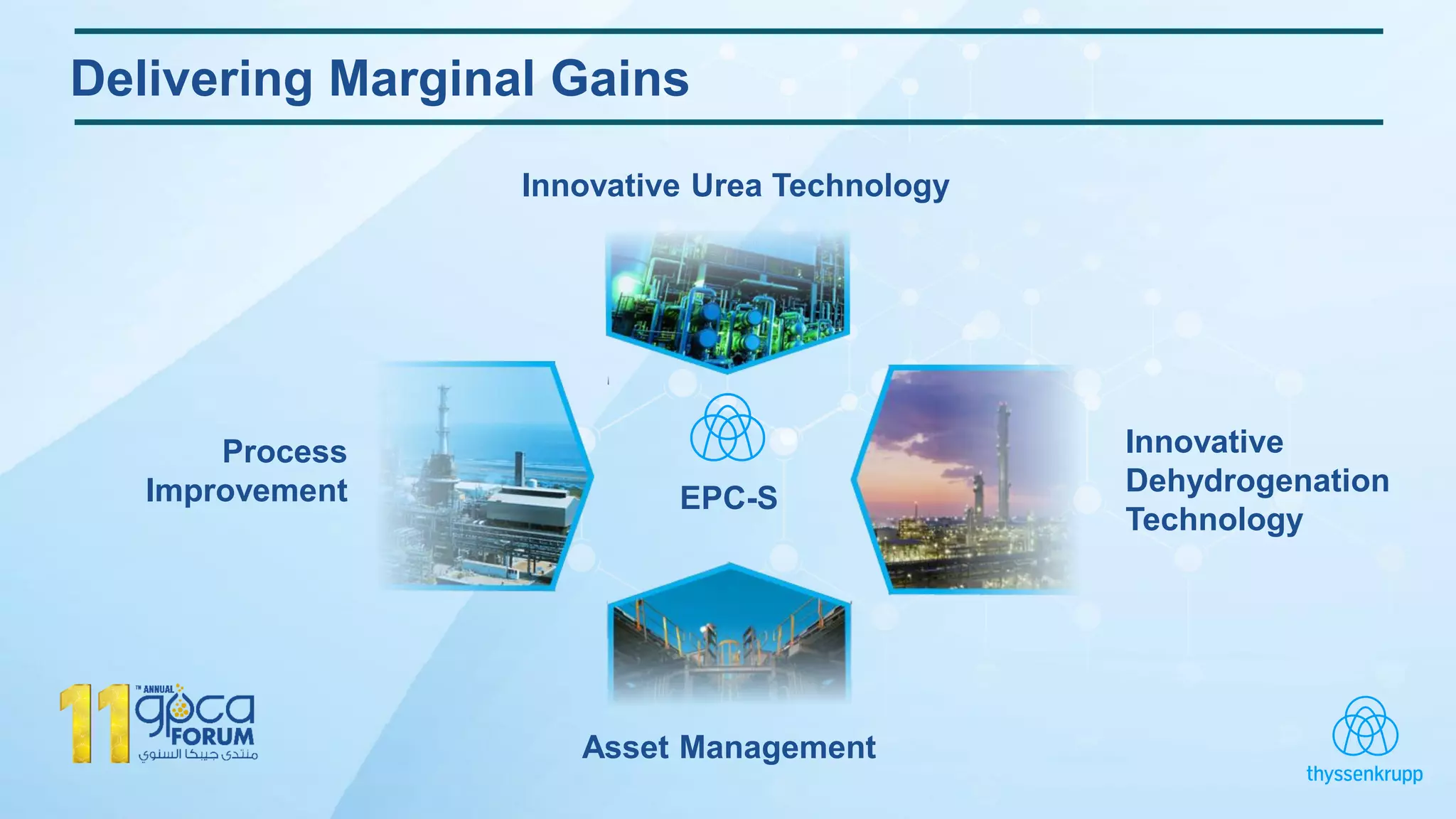
Delivering Marginal Gains
Asset Management
Innovative
Dehydrogenation
Technology
Process
Improvement EPC-S
Innovative Urea Technology
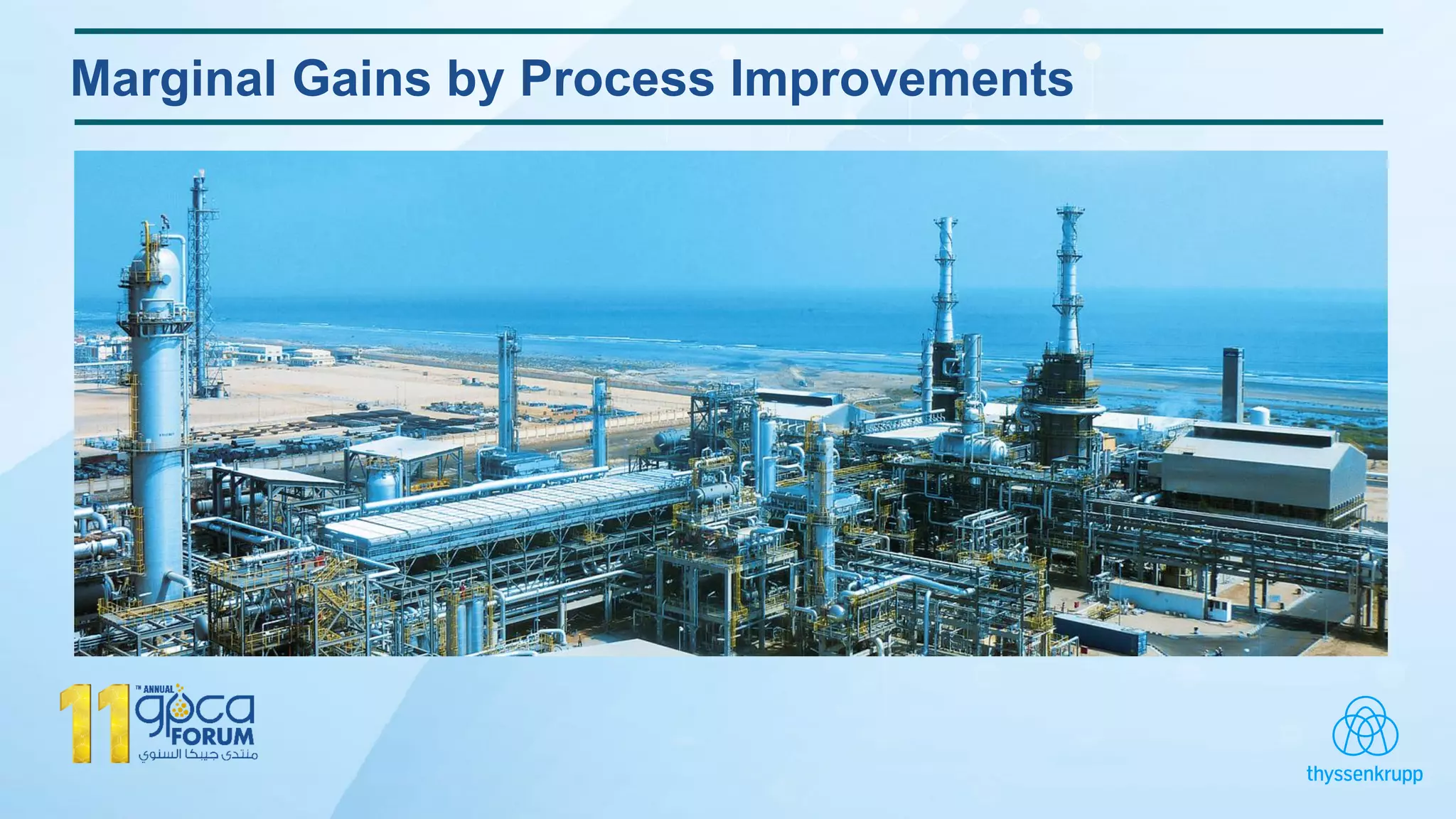
Marginal Gains by Process Improvements
Key Drivers for Process Improvement
Economic Motivation
Profit Maximization
Competitive Edge
Public Requirements
Regulatory
Social Responsibility
Implementing Process Improvements
The
Evolution
Path
The
Revolution
Path
Evolutionary Process Improvement
• Electrolysis: Chlorine and caustic
soda production from salt
• Power makes up 70-85% of costs in
chlorine process
• Approx. 7% power saving achieved
• Improvement via mechanical design
and process control improvements
• Widely deployed in Middle East
2,070
2,170
2,130
2,055
2,020
v3
v4
v5plus
v5
v6
PowerconsumptioninkWh/tNaOH1)
2008 20111997 20122005
Revolutionary Process Improvement
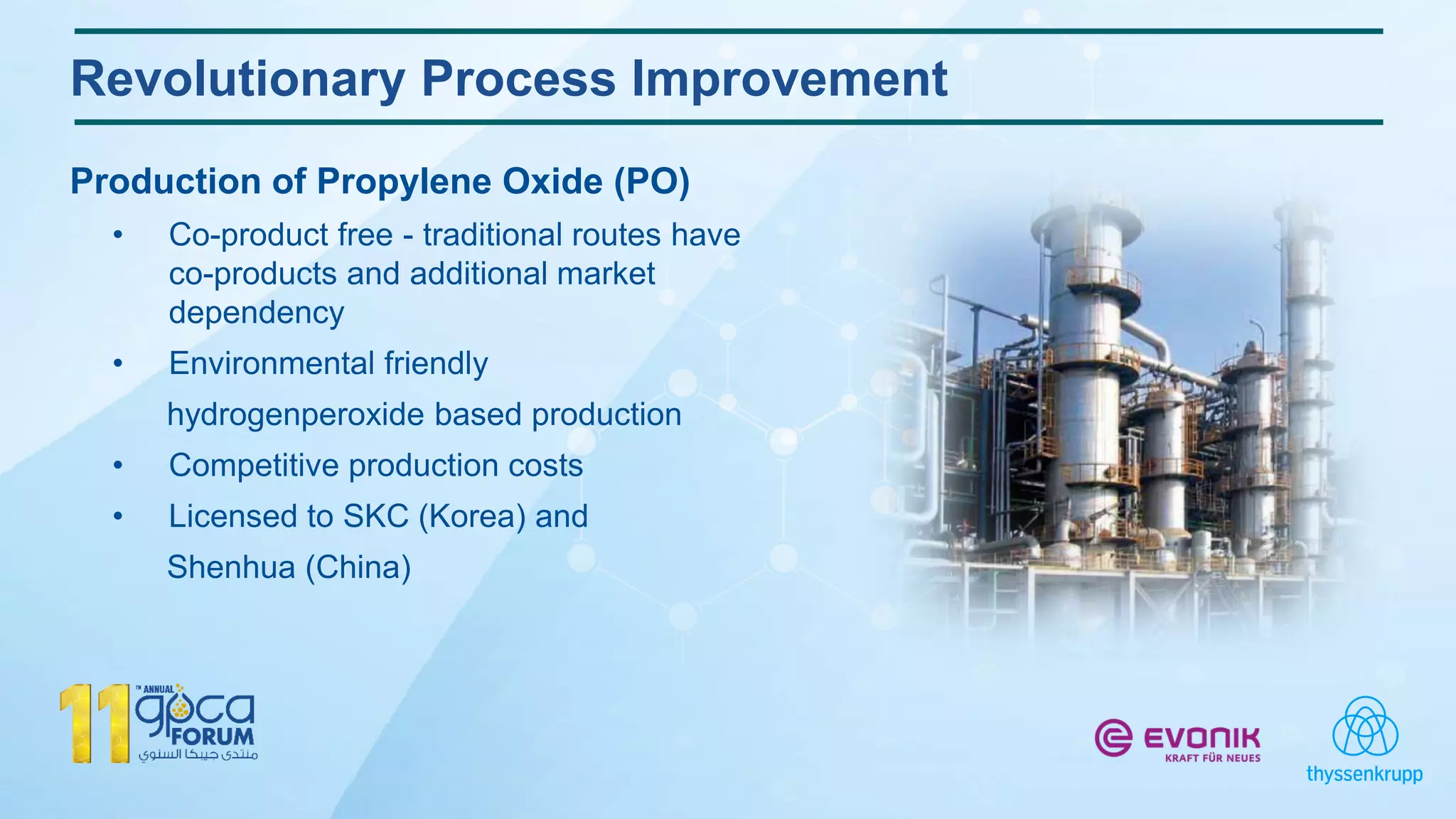
Production of Propylene Oxide (PO)
• Co-product free - traditional routes have
co-products and additional market
dependency
• Environmental friendly
hydrogenperoxide based production
• Competitive production costs
• Licensed to SKC (Korea) and
Shenhua (China)
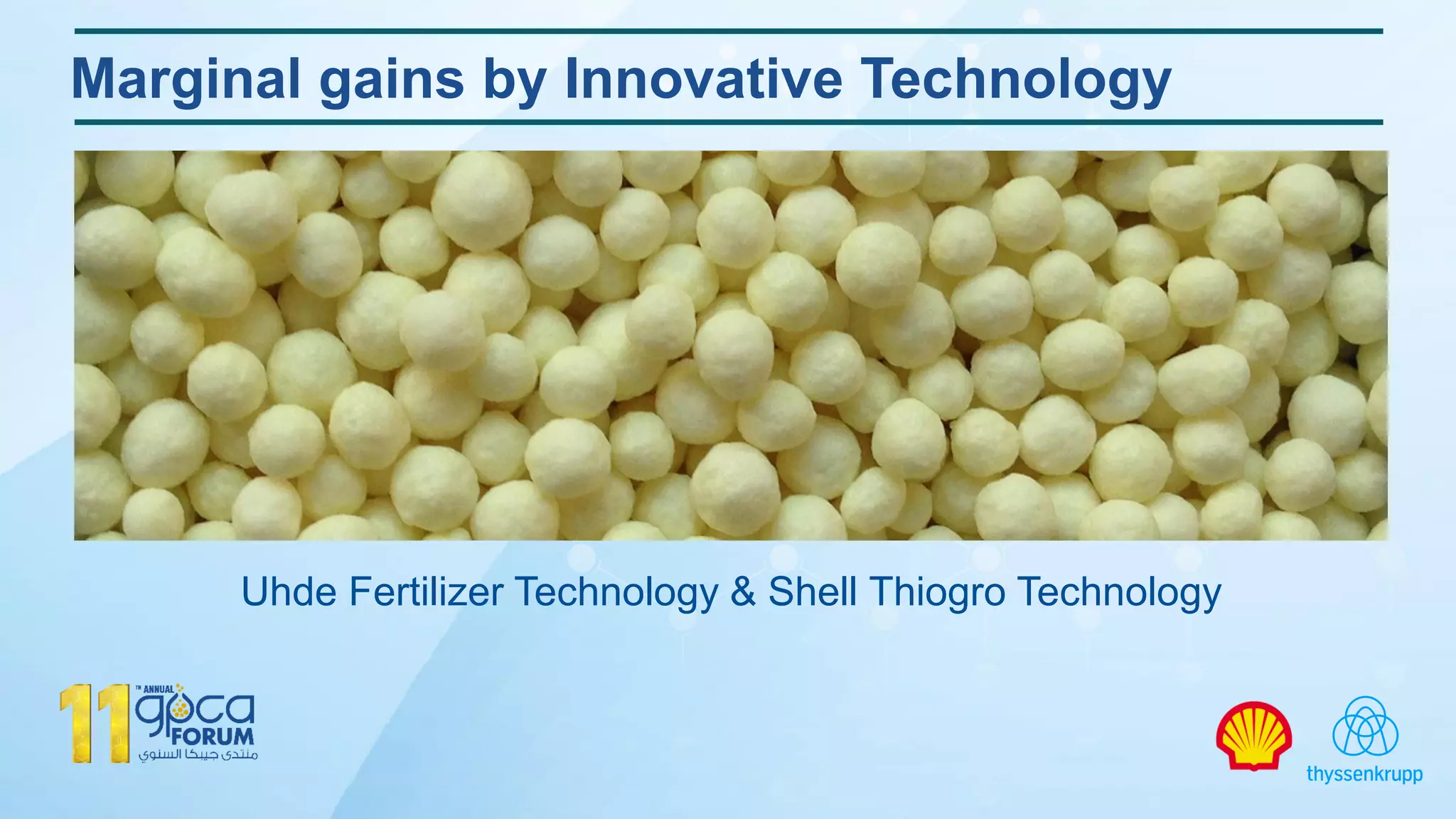
Marginal gains by Innovative Technology
Uhde Fertilizer Technology & Shell Thiogro Technology
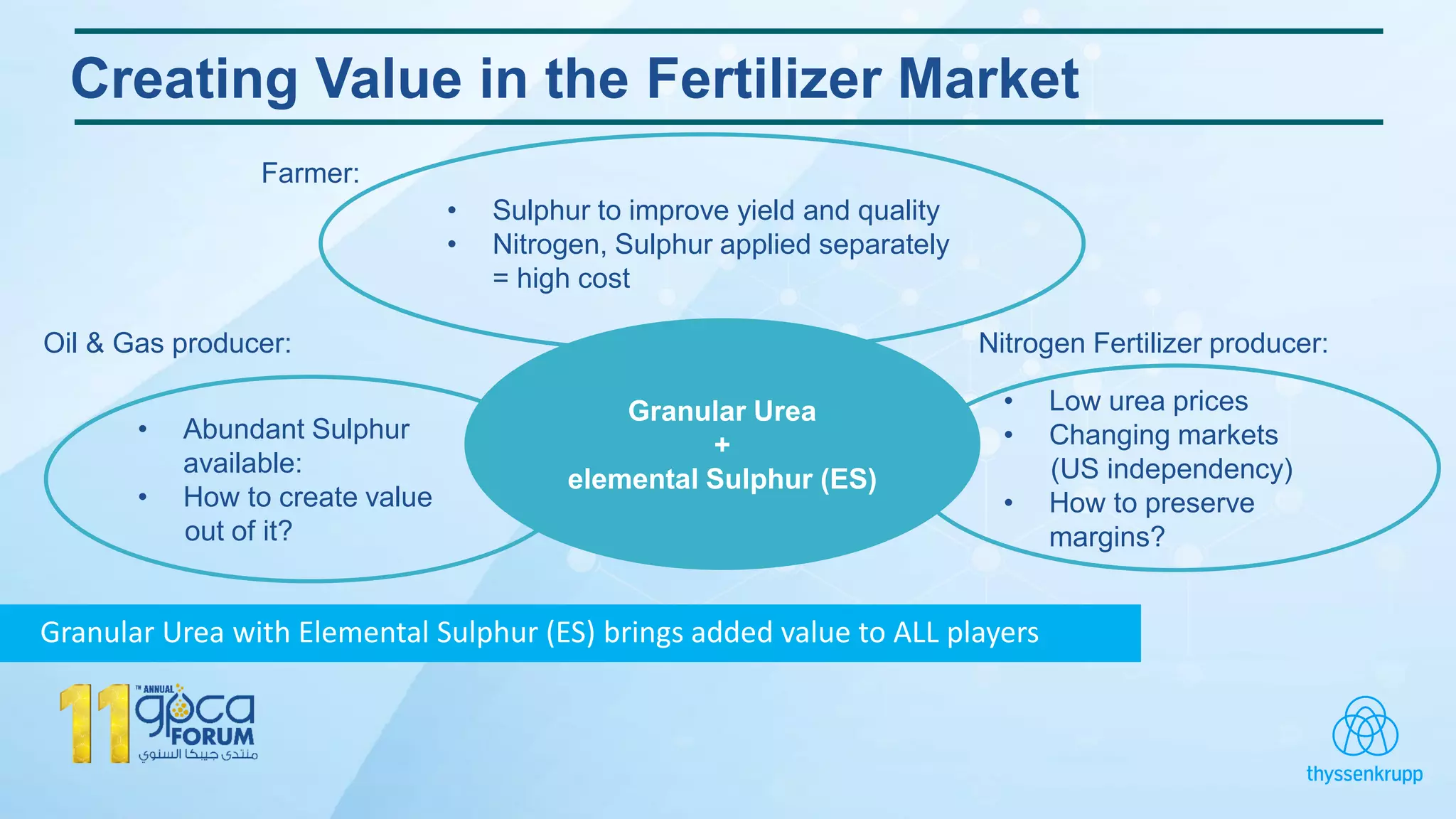
Creating Value in the Fertilizer Market
Granular Urea with Elemental Sulphur (ES) brings added value to ALL players
• Sulphur to improve yield and quality
• Nitrogen, Sulphur applied separately
= high cost
Farmer:
• Low urea prices
• Changing markets
(US independency)
• How to preserve
margins?
Nitrogen Fertilizer producer:
• Abundant Sulphur
available:
• How to create value
out of it?
Oil & Gas producer:
Granular Urea
+
elemental Sulphur (ES)
Granular Urea + ES: Market Situation
~ 10 MMt/a of sulphur needs addition to soil
~ 2 MMt/a covered by other sulphur applications
Urea Granulation Middle East Africa
Annual Production [MMt/a] 20 13
No of plants 24 14
No of producers 10 8
Elemental Sulphur
Annual Production [MMt/a] 12 1.6
No of plants 63 17
No of producers 44 17
Urea is used as carrier for sulphur Source: IHS Chemical Economics Handbook Sulphur
12.5 MMt S/
year world
wide deficit
by 2015
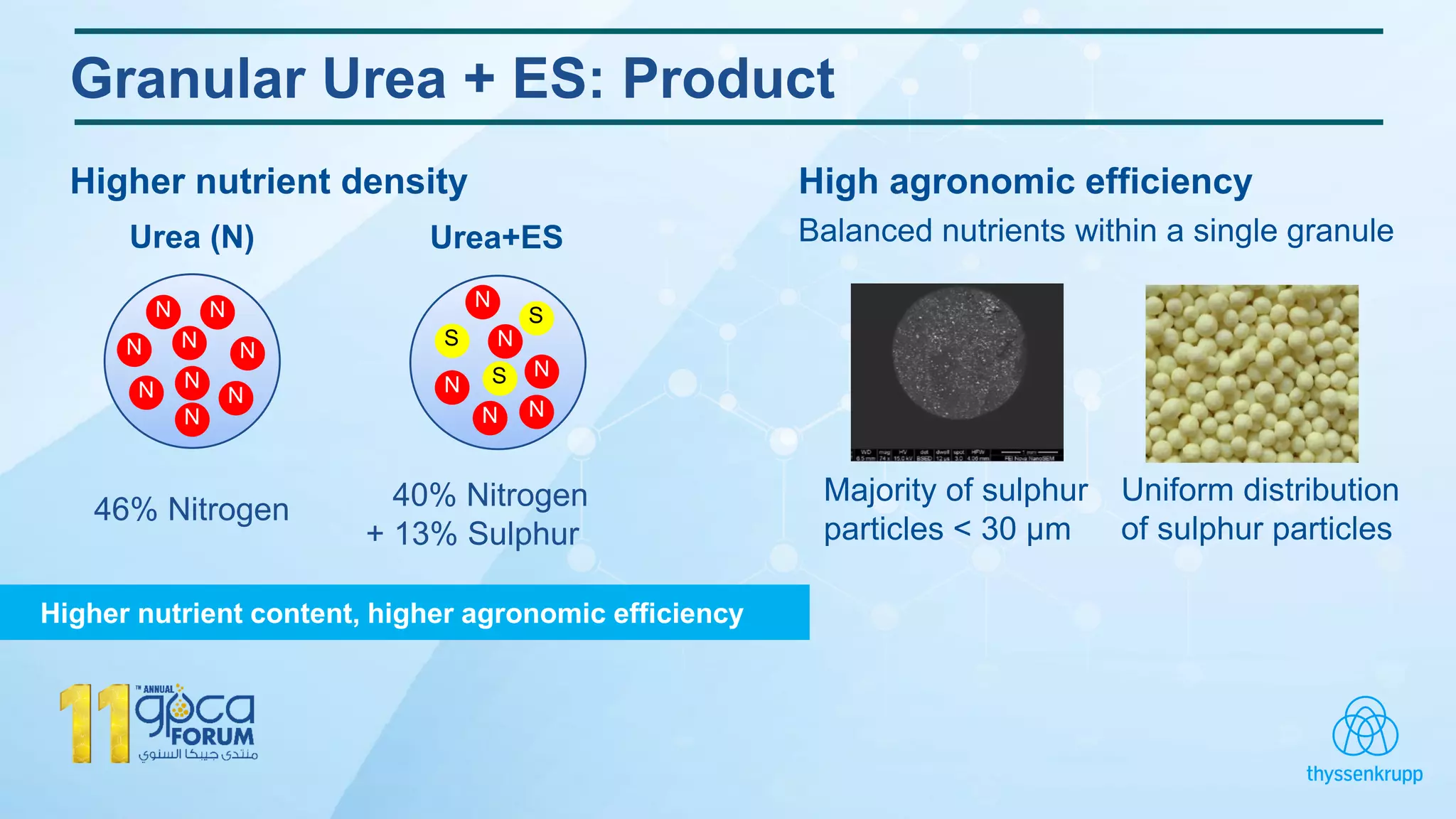
Granular Urea + ES: Product
Higher nutrient density High agronomic efficiency
Balanced nutrients within a single granule
Higher nutrient content, higher agronomic efficiency
Majority of sulphur
particles < 30 µm
Uniform distribution
of sulphur particles
Urea (N) Urea+ES
46% Nitrogen 40% Nitrogen
+ 13% Sulphur
N
N
N
S
N
NN
S
S
N
N
NN
NN
N
N
N
Granular Urea + ES: Technology
Process
condensate
Make
up
Atomising air
Air
Gran. Additive
SC
To Storage
Air
Process
Condensate
S-Acid
Urea solution
from evaporat.
Fluidisation air
Stack
Bleed
Screen
Crusher
SC
Granulator
Scrubber
Bucket elevator
Final
Cooler
First
Cooler
Scrubber
Tank
Start-
up Bin
Cooler
Scrubber
Granulator
Safety
Screen
Fluid bed urea
granulation plant
adapted
Micronized
dispersion of
elemental sulphur in
urea solution
(Shell Thiogro)
1 plant
2 products
Recycle
Vacuum
Evaporation
Liq. Sulphur
ThioAdd
Sulphur
Dispersion
Unit
Granular Urea + ES: The Value Proposition
Farmer needs 5
tons/acre less for same
nutrient content
Fertilizer required (tons/acre):
Urea AS 45.66
Urea ES 40.70
Cost for application
(US-Middle East comparison)
by adding 6 $USD for
sulphur producer gains
92,00 $USD per ton
higher revenues!
Additional value for urea producer
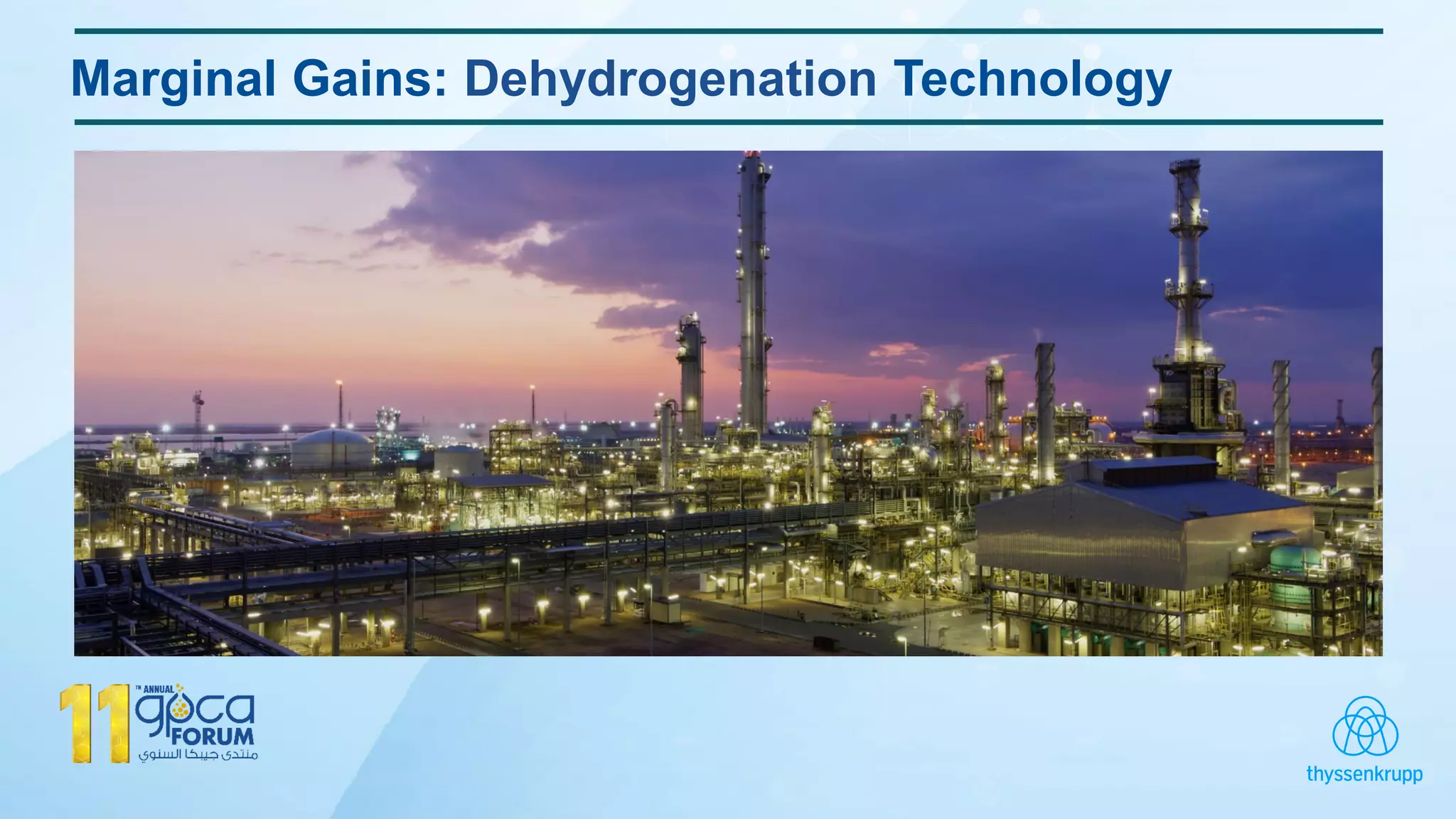
Marginal Gains: Dehydrogenation Technology
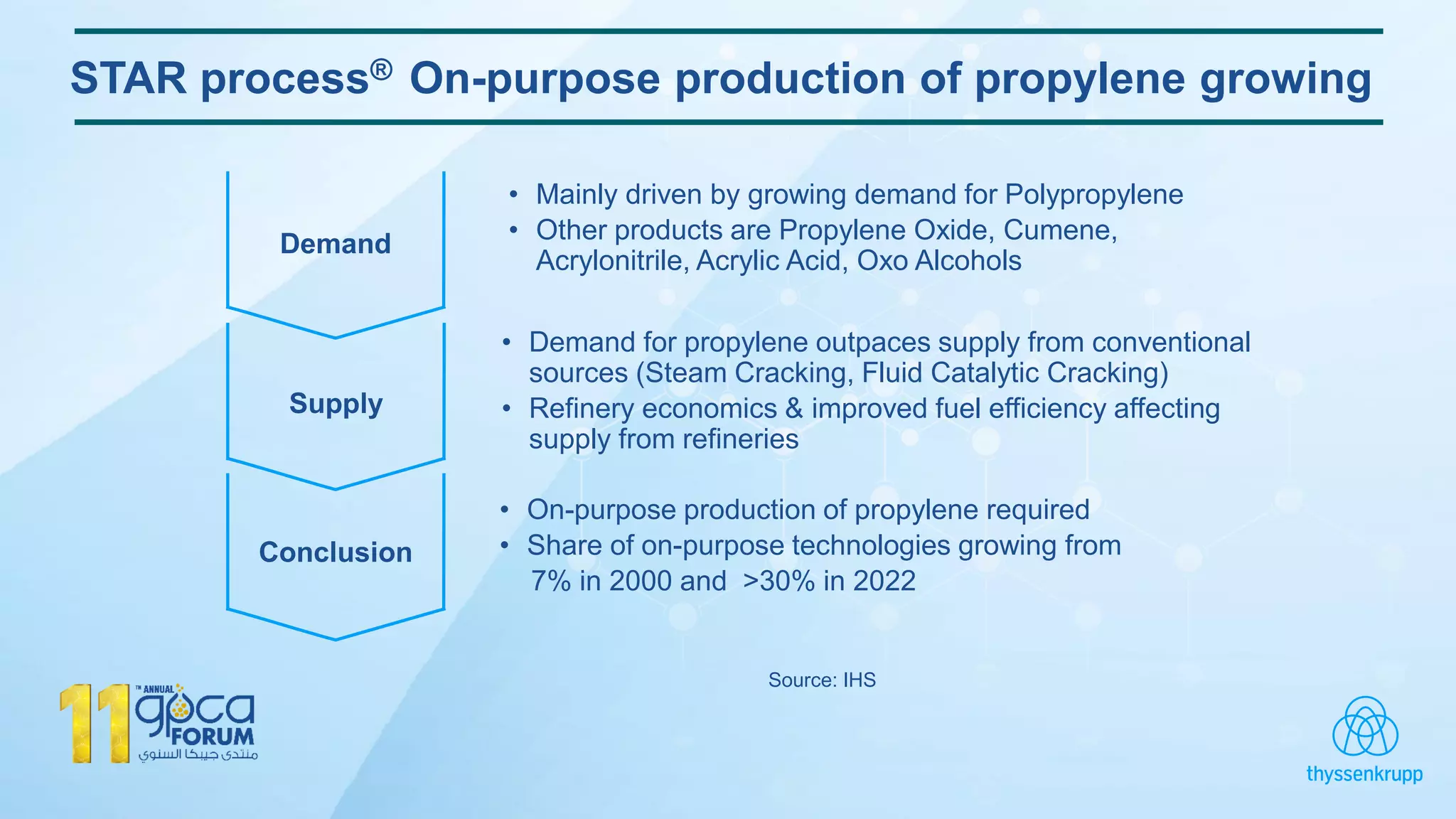
STAR process® On-purpose production of propylene growing
• Mainly driven by growing demand for Polypropylene
• Other products are Propylene Oxide, Cumene,
Acrylonitrile, Acrylic Acid, Oxo Alcohols
• Demand for propylene outpaces supply from conventional
sources (Steam Cracking, Fluid Catalytic Cracking)
• Refinery economics & improved fuel efficiency affecting
supply from refineries
• On-purpose production of propylene required
• Share of on-purpose technologies growing from
7% in 2000 and >30% in 2022
Source: IHS
Demand
Supply
Conclusion
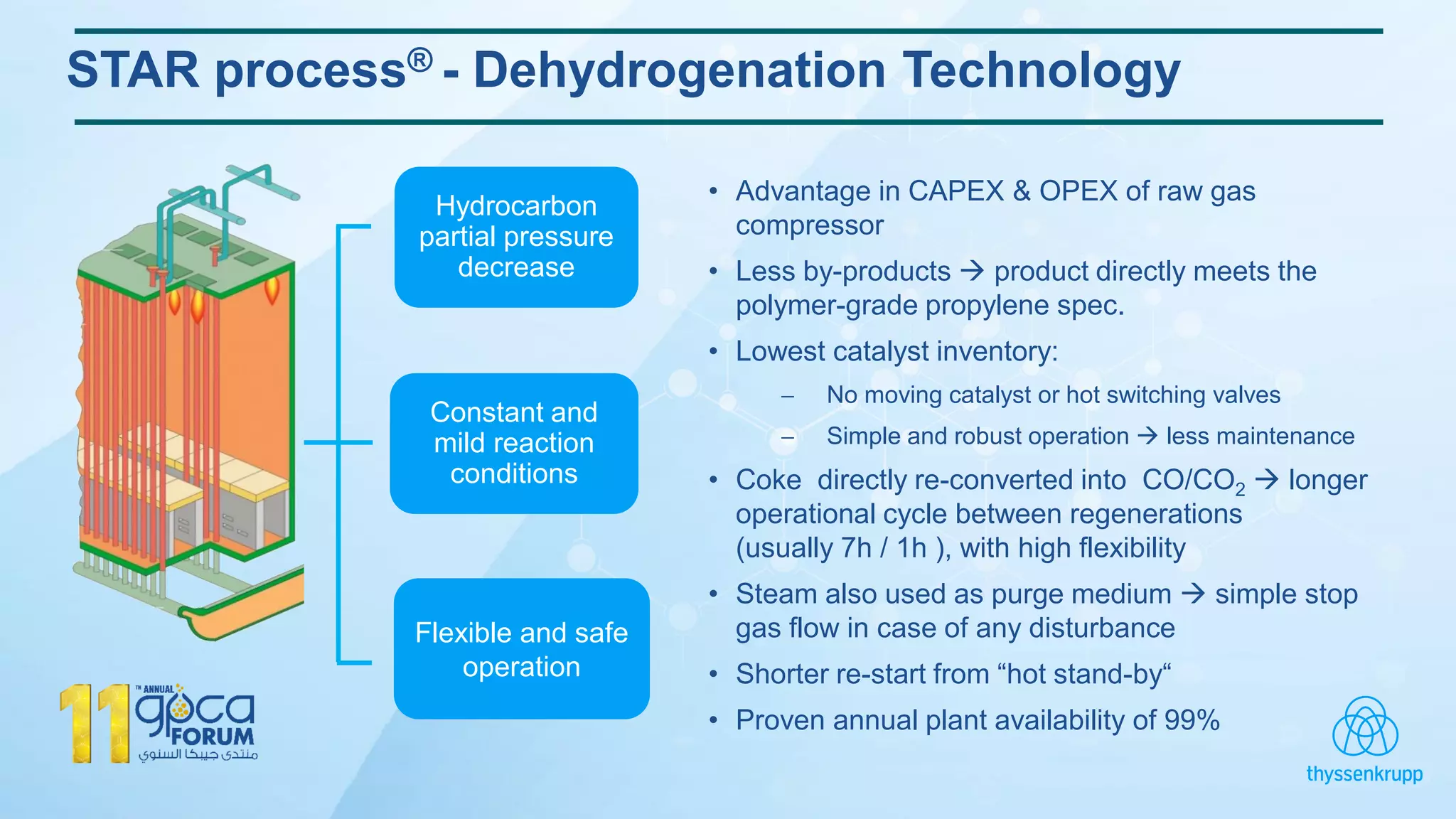
STAR process® - Dehydrogenation Technology
Hydrocarbon
partial pressure
decrease
Constant and
mild reaction
conditions
Flexible and safe
operation
• Advantage in CAPEX & OPEX of raw gas
compressor
• Less by-products  product directly meets the
polymer-grade propylene spec.
• Lowest catalyst inventory:
 No moving catalyst or hot switching valves
 Simple and robust operation  less maintenance
• Coke directly re-converted into CO/CO2  longer
operational cycle between regenerations
(usually 7h / 1h ), with high flexibility
• Steam also used as purge medium  simple stop
gas flow in case of any disturbance
• Shorter re-start from “hot stand-by“
• Proven annual plant availability of 99%
Marginal Gains by Asset Management
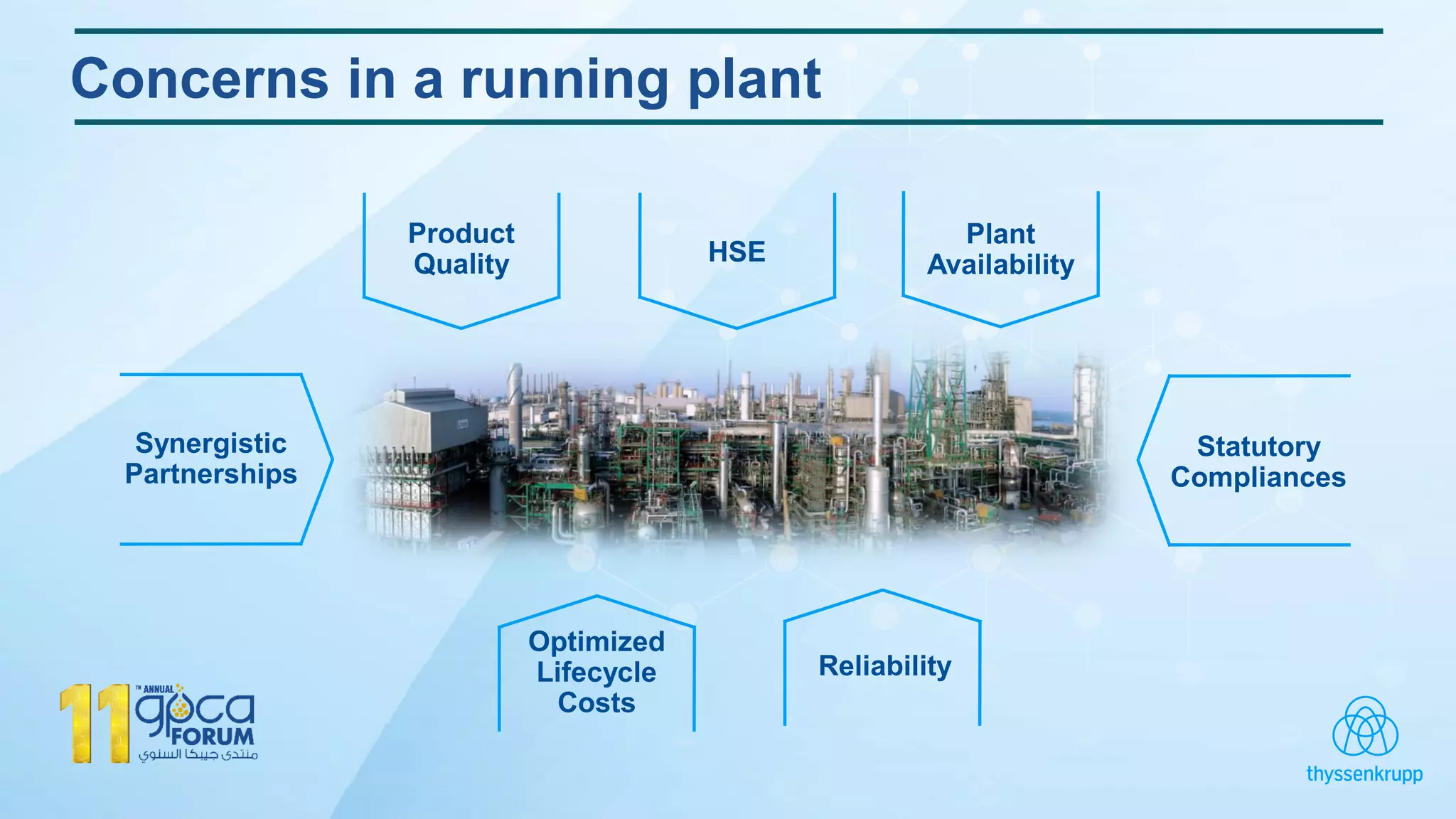
Concerns in a running plant
HSE
Reliability
Product
Quality
Plant
Availability
Optimized
Lifecycle
Costs
Synergistic
Partnerships
Statutory
Compliances
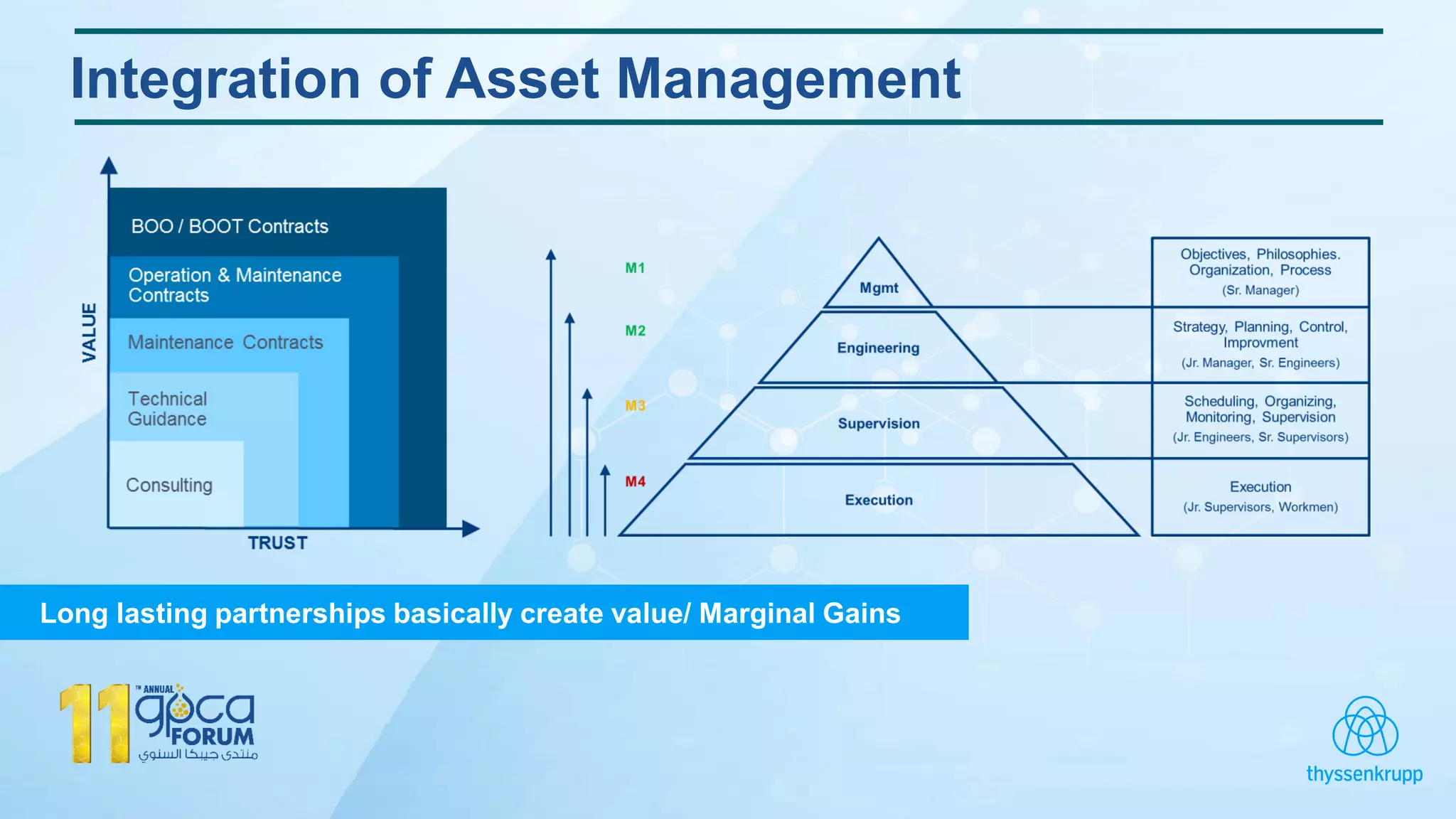
Integration of Asset Management
Long lasting partnerships basically create value/ Marginal Gains
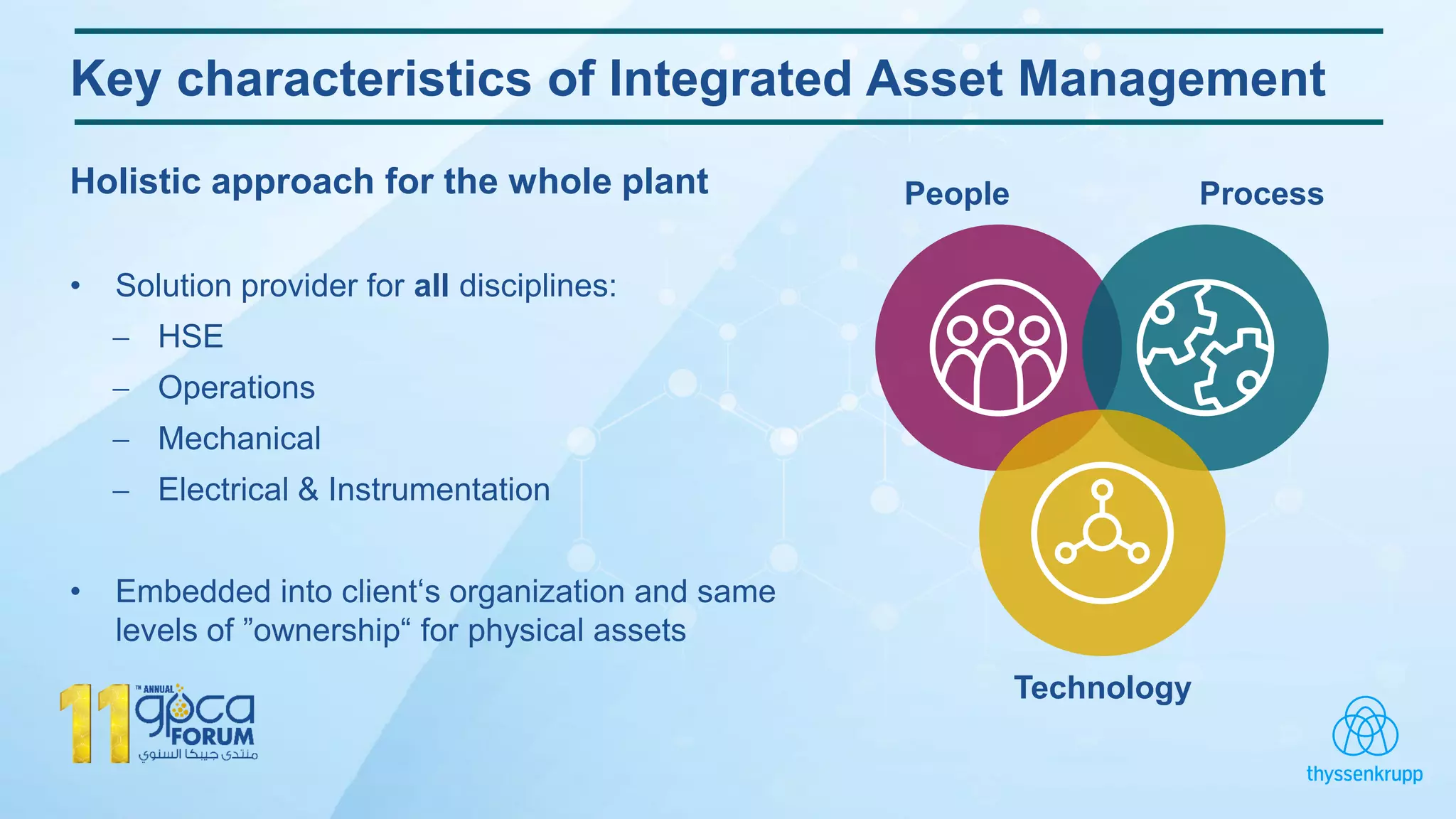
Key characteristics of Integrated Asset Management
Holistic approach for the whole plant
• Solution provider for all disciplines:
 HSE
 Operations
 Mechanical
 Electrical & Instrumentation
• Embedded into client‘s organization and same
levels of ”ownership“ for physical assets
People Process
Technology
Eliminating the hidden costs
Visible
Invisible
Poor quality
Delivery issues
Reduced asset life
Lost production
Reputation damages
Safety/ environment risk
Services
Personnel
Materials
Energy
Success
Delivering Marginal Gains
f
Marginal Gains
Your contacts
Head of Business Development
thyssenkrupp Industrial Solutions,
KSA
KSA KUWAIT BAHRAIN
Harald KuttnerAyman El Moghly
Head of Sales & Process
thyssenkrupp Industrial
Solutions, Egypt
EGYPT JORDAN LEBANON
TUNISIA
Vice President Business
Development,
thyssenkrupp Industrial Solutions,
Regionalcluster Gulf States
QATAR UAE OMAN + OTHERS
Malcolm Cook
21-Boris-van-Thiel

21-Boris-van-Thiel

  • 1.
    Delivering Marginal Gains– How the 1% really matters Boris van Thiel CEO Middle East thyssenkrupp Industrial Solutions
  • 3.
    Agenda • thyssenkrupp @a glance • Ongoing trends in Middle East • Marginal Gains by - Innovative technologies - Process improvements - Asset Management • Summary
  • 4.
    thyssenkrupp @ aglance Present in nearly 80countries ~17,000 patents in total $45,5bn Sales production sites, offices and service locations all over the world >2,200 employees ~155,000 R&D spending $785mn 2,000 industrial property rights in reporting period
  • 5.
    machines and systems inuse worldwide >17,600 of our employees are engineers and technicians Almost 70% chemical installations constructed worldwide Over 2,500 thyssenkrupp Industrial Solutions @ a glance More than years of engineering200 excellence
  • 6.
    thyssenkrupp Industrial Solutionspedigree 20142002 founded in 1859 founded in 1992 founded in 1921 Resource Technologies Process Technologies Industrial Solutions 2015
  • 7.
    Ongoing trends inMiddle East region Consolidation Phase Resource Efficiency Expansion of Value Chain Long term Strategic Partnerships Petrochemicals & Refinery Integration Need of Innovative Technology Low Oil Price
  • 8.
    Ongoing trends inMiddle East region Monetizing gas, Diversifying local economies and downstream industry as well as job creation C1/C2 based feedstock projects Projects with Specialty/ Differentiated Products Refinery/Petchem Integrated Projects Naphtha Based (non-discounted) projects? Downstream Industry Development? Feedstock drives the Middle East petrochemical industry evolution - not the market Source: IHS Mixed feedstock C1/C2/C3/C4/Light Naphtha based projects
  • 9.
    0% 20% 40% 60% 80% 100% 0 1 2 3 4 5 6 7 8 9 10 1995 2000 20052010 2015 2020 %ofWorldTotal Ethylene Propylene Paraxylene Benzene Methanol Chlorine Middle East Capacity Additions MillionMetricTons Source: IHS Ongoing trends in Middle East region Capacity builds largely driven by gas allocations
  • 10.
    Delivering Marginal Gains AssetManagement Innovative Dehydrogenation Technology Process Improvement EPC-S Innovative Urea Technology
  • 11.
    Marginal Gains byProcess Improvements
  • 12.
    Key Drivers forProcess Improvement Economic Motivation Profit Maximization Competitive Edge Public Requirements Regulatory Social Responsibility
  • 13.
  • 14.
    Evolutionary Process Improvement •Electrolysis: Chlorine and caustic soda production from salt • Power makes up 70-85% of costs in chlorine process • Approx. 7% power saving achieved • Improvement via mechanical design and process control improvements • Widely deployed in Middle East 2,070 2,170 2,130 2,055 2,020 v3 v4 v5plus v5 v6 PowerconsumptioninkWh/tNaOH1) 2008 20111997 20122005
  • 15.
    Revolutionary Process Improvement Productionof Propylene Oxide (PO) • Co-product free - traditional routes have co-products and additional market dependency • Environmental friendly hydrogenperoxide based production • Competitive production costs • Licensed to SKC (Korea) and Shenhua (China)
  • 16.
    Marginal gains byInnovative Technology Uhde Fertilizer Technology & Shell Thiogro Technology
  • 17.
    Creating Value inthe Fertilizer Market Granular Urea with Elemental Sulphur (ES) brings added value to ALL players • Sulphur to improve yield and quality • Nitrogen, Sulphur applied separately = high cost Farmer: • Low urea prices • Changing markets (US independency) • How to preserve margins? Nitrogen Fertilizer producer: • Abundant Sulphur available: • How to create value out of it? Oil & Gas producer: Granular Urea + elemental Sulphur (ES)
  • 18.
    Granular Urea +ES: Market Situation ~ 10 MMt/a of sulphur needs addition to soil ~ 2 MMt/a covered by other sulphur applications Urea Granulation Middle East Africa Annual Production [MMt/a] 20 13 No of plants 24 14 No of producers 10 8 Elemental Sulphur Annual Production [MMt/a] 12 1.6 No of plants 63 17 No of producers 44 17 Urea is used as carrier for sulphur Source: IHS Chemical Economics Handbook Sulphur 12.5 MMt S/ year world wide deficit by 2015
  • 19.
    Granular Urea +ES: Product Higher nutrient density High agronomic efficiency Balanced nutrients within a single granule Higher nutrient content, higher agronomic efficiency Majority of sulphur particles < 30 µm Uniform distribution of sulphur particles Urea (N) Urea+ES 46% Nitrogen 40% Nitrogen + 13% Sulphur N N N S N NN S S N N NN NN N N N
  • 20.
    Granular Urea +ES: Technology Process condensate Make up Atomising air Air Gran. Additive SC To Storage Air Process Condensate S-Acid Urea solution from evaporat. Fluidisation air Stack Bleed Screen Crusher SC Granulator Scrubber Bucket elevator Final Cooler First Cooler Scrubber Tank Start- up Bin Cooler Scrubber Granulator Safety Screen Fluid bed urea granulation plant adapted Micronized dispersion of elemental sulphur in urea solution (Shell Thiogro) 1 plant 2 products Recycle Vacuum Evaporation Liq. Sulphur ThioAdd Sulphur Dispersion Unit
  • 21.
    Granular Urea +ES: The Value Proposition Farmer needs 5 tons/acre less for same nutrient content Fertilizer required (tons/acre): Urea AS 45.66 Urea ES 40.70 Cost for application (US-Middle East comparison) by adding 6 $USD for sulphur producer gains 92,00 $USD per ton higher revenues! Additional value for urea producer
  • 22.
  • 23.
    STAR process® On-purposeproduction of propylene growing • Mainly driven by growing demand for Polypropylene • Other products are Propylene Oxide, Cumene, Acrylonitrile, Acrylic Acid, Oxo Alcohols • Demand for propylene outpaces supply from conventional sources (Steam Cracking, Fluid Catalytic Cracking) • Refinery economics & improved fuel efficiency affecting supply from refineries • On-purpose production of propylene required • Share of on-purpose technologies growing from 7% in 2000 and >30% in 2022 Source: IHS Demand Supply Conclusion
  • 24.
    STAR process® -Dehydrogenation Technology Hydrocarbon partial pressure decrease Constant and mild reaction conditions Flexible and safe operation • Advantage in CAPEX & OPEX of raw gas compressor • Less by-products  product directly meets the polymer-grade propylene spec. • Lowest catalyst inventory:  No moving catalyst or hot switching valves  Simple and robust operation  less maintenance • Coke directly re-converted into CO/CO2  longer operational cycle between regenerations (usually 7h / 1h ), with high flexibility • Steam also used as purge medium  simple stop gas flow in case of any disturbance • Shorter re-start from “hot stand-by“ • Proven annual plant availability of 99%
  • 25.
    Marginal Gains byAsset Management
  • 26.
    Concerns in arunning plant HSE Reliability Product Quality Plant Availability Optimized Lifecycle Costs Synergistic Partnerships Statutory Compliances
  • 27.
    Integration of AssetManagement Long lasting partnerships basically create value/ Marginal Gains
  • 28.
    Key characteristics ofIntegrated Asset Management Holistic approach for the whole plant • Solution provider for all disciplines:  HSE  Operations  Mechanical  Electrical & Instrumentation • Embedded into client‘s organization and same levels of ”ownership“ for physical assets People Process Technology
  • 29.
    Eliminating the hiddencosts Visible Invisible Poor quality Delivery issues Reduced asset life Lost production Reputation damages Safety/ environment risk Services Personnel Materials Energy
  • 30.
  • 31.
    Your contacts Head ofBusiness Development thyssenkrupp Industrial Solutions, KSA KSA KUWAIT BAHRAIN Harald KuttnerAyman El Moghly Head of Sales & Process thyssenkrupp Industrial Solutions, Egypt EGYPT JORDAN LEBANON TUNISIA Vice President Business Development, thyssenkrupp Industrial Solutions, Regionalcluster Gulf States QATAR UAE OMAN + OTHERS Malcolm Cook