

Adam H. Berger and Abhoyjit S. Bhown 
Electric Power Research Institute (EPRI) 
Palo Alto, California 
UKCCSRC Natural Gas CCS Panel 
International Conference on Greenhouse Gas Technologies (GHGT-12) 
Austin, Texas, October 5-9, 2014 
Selection of Optimal Solid Sorbents for CO2 Capture Based on Gas Phase CO2 Composition
© 2014 Electric Power Research Institute, Inc. All rights reserved. 2 
About The Electric Power Research Institute 
• 
Established 1973 as independent non-profit for collaborative research in electric sector 
• 
Major locations in Palo Alto, CA; Charlotte, NC; Knoxville, TN 
• 
Nearly every area of electricity: generation, delivery, use, health, environment, and efficiency 
• 
Members include 450+ participants in more than 30 countries
© 2014 Electric Power Research Institute, Inc. All rights reserved. 3 
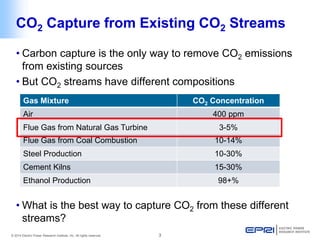
CO2 Capture from Existing CO2 Streams 
• 
Carbon capture is the only way to remove CO2 emissions from existing sources 
• 
But CO2 streams have different compositions 
• 
What is the best way to capture CO2 from these different streams? 
Gas Mixture 
CO2 Concentration 
Air 
400 ppm 
Flue Gas from Natural Gas Turbine 
3-5% 
Flue Gas from Coal Combustion 
10-14% 
Steel Production 
10-30% 
Cement Kilns 
15-30% 
Ethanol Production 
98+%
© 2014 Electric Power Research Institute, Inc. All rights reserved. 4 
Thermodynamic Minimum Work revWE=min 
• 
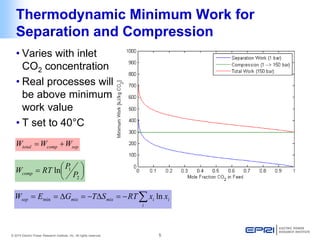
Thermodynamic minimum work for separation is equal to the work required to overcome entropy of mixing 
()()[]Σ−−+−=−=Δ−=Δ= iCOCOCOCOiimixmixxxxxRTxxRTSTGE2222min1ln1lnln
© 2014 Electric Power Research Institute, Inc. All rights reserved. 5 
Thermodynamic Minimum Work for Separation and Compression 
Σ−=Δ−=Δ== iiimixmixsepxxRTSTGEWlnmin   = 21lnPPRTWcompsepcomptotalWWW+= 
• 
Varies with inlet CO2 concentration 
• 
Real processes will be above minimum work value 
• 
T set to 40°C
© 2014 Electric Power Research Institute, Inc. All rights reserved. 6 
Solid Sorbents for CO2 Capture 
• 
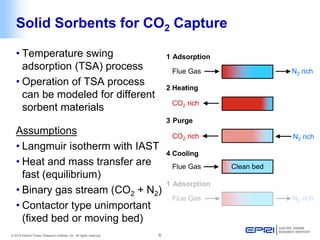
Temperature swing adsorption (TSA) process 
• 
Operation of TSA process can be modeled for different sorbent materials Assumptions 
• 
Langmuir isotherm with IAST 
• 
Heat and mass transfer are fast (equilibrium) 
• 
Binary gas stream (CO2 + N2) 
• 
Contactor type unimportant (fixed bed or moving bed) 
Flue Gas 
CO2 rich 
Flue Gas 
N2 rich 
N2 rich 
CO2 rich 
4 Cooling 
1 Adsorption 
2 Heating 
3 Purge 
Clean bed 
Flue Gas 
N2 rich 
1 Adsorption
© 2014 Electric Power Research Institute, Inc. All rights reserved. 7 
• 
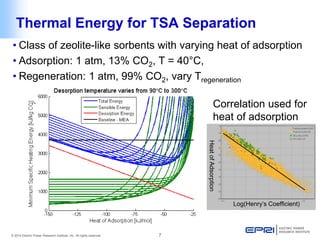
Class of zeolite-like sorbents with varying heat of adsorption 
• 
Adsorption: 1 atm, 13% CO2, T = 40°C, 
• 
Regeneration: 1 atm, 99% CO2, vary Tregeneration 
Thermal Energy for TSA Separation 
Log(Henry’s Coefficient) 
Heat of Adsorption 
Correlation used for 
heat of adsorption
© 2014 Electric Power Research Institute, Inc. All rights reserved. 8 
Total Work Required for CO2 capture 
• 
Total work is compression work + impact of thermal load 
• 
Compression work: ηs = 85%, 40°C intercooling, PR <2.5 
• 
Thermal energy is converted to work in power plants at an efficiency that varies with the temperature 
0.1 
0.15 
0.2 
0.25 
0.3 
0.35 
80 
100 
120 
140 
160 
180 
Efficiency [Wlost/Q] 
Saturation Temperature [C] at Extraction Pressure 
Imposed Load from Steam Extraction 
Linear Fit 
Simulated Result 
ELost = Q*(-0.08037+0.002326*T) 
lostcomptotalEWW+= 
For a TSA system
© 2014 Electric Power Research Institute, Inc. All rights reserved. 9 
• 
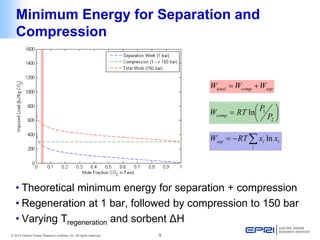
Theoretical minimum energy for separation + compression 
• 
Regeneration at 1 bar, followed by compression to 150 bar 
• 
Varying Tregeneration and sorbent ΔH 
Minimum Energy for Separation and Compression 
Σ−= iiisepxxRTWln   = 21lnPPRTWcompsepcomptotalWWW+=
© 2014 Electric Power Research Institute, Inc. All rights reserved. 10 
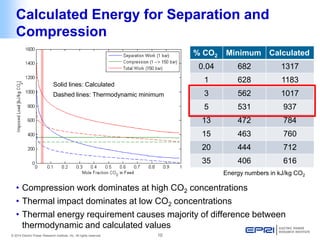
Calculated Energy for Separation and Compression 
Solid lines: Calculated 
Dashed lines: Thermodynamic minimum 
% CO2 
Minimum 
Calculated 
0.04 
682 
1317 
1 
628 
1183 
3 
562 
1017 
5 
531 
937 
13 
472 
784 
15 
463 
760 
20 
444 
712 
35 
406 
616 
Energy numbers in kJ/kg CO2 
• 
Compression work dominates at high CO2 concentrations 
• 
Thermal impact dominates at low CO2 concentrations 
• 
Thermal energy requirement causes majority of difference between thermodynamic and calculated values
© 2014 Electric Power Research Institute, Inc. All rights reserved. 11 
Optimal Separation Conditions 
• 
Low CO2 concentration requires high heats of adsorption and temperatures of desorption, leading to high energy requirements 
• 
Natural gas CCS: optimal ΔH: -57 to 60 kJ/mol CO2, Tregen: 120-129°C 
% CO2 
ΔH [kJ/mol] 
Tregen [°C] 
0.04 
-72 
159 
1 
-67 
147 
3 
-60 
129 
5 
-57 
120 
13 
-52 
101 
15 
-51 
98 
20 
-49 
91 
35 
-45 
77
© 2014 Electric Power Research Institute, Inc. All rights reserved. 12 
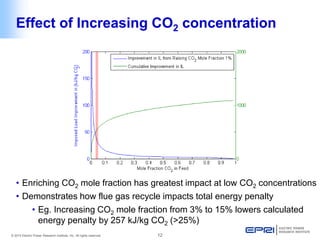
Effect of Increasing CO2 concentration 
• 
Enriching CO2 mole fraction has greatest impact at low CO2 concentrations 
• 
Demonstrates how flue gas recycle impacts total energy penalty 
• 
Eg. Increasing CO2 mole fraction from 3% to 15% lowers calculated energy penalty by 257 kJ/kg CO2 (>25%)
© 2014 Electric Power Research Institute, Inc. All rights reserved. 13 
Summary and Conclusions 
• 
Optimal material properties and performance modeled for natural gas CCS 
• 
The tradeoff between increasing CO2 concentration and the performance of the rest of the plant can be estimated 
• 
Low concentrations of CO2 require greater temperatures and heats of adsorption to desorb CO2 at 1 atm 
Emin [kJ/kg CO2] 
E (TSA) 
Tregen [°C] 
ΔH [kJ/mol] 
Natural Gas (3-5%) 
531-562 
937-1017 
120-129 
-57 to -60 
Coal (13-15%) 
463-472 
760-784 
98-101 
-51 to -52
© 2014 Electric Power Research Institute, Inc. All rights reserved. 14 
Together…Shaping the Future of Electricity

Selection of Optimal Solid Sorbents for CO2 Capture Based on Gas Phase CO2 Composition

  • 1.
    Adam H. Bergerand Abhoyjit S. Bhown Electric Power Research Institute (EPRI) Palo Alto, California UKCCSRC Natural Gas CCS Panel International Conference on Greenhouse Gas Technologies (GHGT-12) Austin, Texas, October 5-9, 2014 Selection of Optimal Solid Sorbents for CO2 Capture Based on Gas Phase CO2 Composition
  • 2.
    © 2014 ElectricPower Research Institute, Inc. All rights reserved. 2 About The Electric Power Research Institute • Established 1973 as independent non-profit for collaborative research in electric sector • Major locations in Palo Alto, CA; Charlotte, NC; Knoxville, TN • Nearly every area of electricity: generation, delivery, use, health, environment, and efficiency • Members include 450+ participants in more than 30 countries
  • 3.
    © 2014 ElectricPower Research Institute, Inc. All rights reserved. 3 CO2 Capture from Existing CO2 Streams • Carbon capture is the only way to remove CO2 emissions from existing sources • But CO2 streams have different compositions • What is the best way to capture CO2 from these different streams? Gas Mixture CO2 Concentration Air 400 ppm Flue Gas from Natural Gas Turbine 3-5% Flue Gas from Coal Combustion 10-14% Steel Production 10-30% Cement Kilns 15-30% Ethanol Production 98+%
  • 4.
    © 2014 ElectricPower Research Institute, Inc. All rights reserved. 4 Thermodynamic Minimum Work revWE=min • Thermodynamic minimum work for separation is equal to the work required to overcome entropy of mixing ()()[]Σ−−+−=−=Δ−=Δ= iCOCOCOCOiimixmixxxxxRTxxRTSTGE2222min1ln1lnln
  • 5.
    © 2014 ElectricPower Research Institute, Inc. All rights reserved. 5 Thermodynamic Minimum Work for Separation and Compression Σ−=Δ−=Δ== iiimixmixsepxxRTSTGEWlnmin   = 21lnPPRTWcompsepcomptotalWWW+= • Varies with inlet CO2 concentration • Real processes will be above minimum work value • T set to 40°C
  • 6.
    © 2014 ElectricPower Research Institute, Inc. All rights reserved. 6 Solid Sorbents for CO2 Capture • Temperature swing adsorption (TSA) process • Operation of TSA process can be modeled for different sorbent materials Assumptions • Langmuir isotherm with IAST • Heat and mass transfer are fast (equilibrium) • Binary gas stream (CO2 + N2) • Contactor type unimportant (fixed bed or moving bed) Flue Gas CO2 rich Flue Gas N2 rich N2 rich CO2 rich 4 Cooling 1 Adsorption 2 Heating 3 Purge Clean bed Flue Gas N2 rich 1 Adsorption
  • 7.
    © 2014 ElectricPower Research Institute, Inc. All rights reserved. 7 • Class of zeolite-like sorbents with varying heat of adsorption • Adsorption: 1 atm, 13% CO2, T = 40°C, • Regeneration: 1 atm, 99% CO2, vary Tregeneration Thermal Energy for TSA Separation Log(Henry’s Coefficient) Heat of Adsorption Correlation used for heat of adsorption
  • 8.
    © 2014 ElectricPower Research Institute, Inc. All rights reserved. 8 Total Work Required for CO2 capture • Total work is compression work + impact of thermal load • Compression work: ηs = 85%, 40°C intercooling, PR <2.5 • Thermal energy is converted to work in power plants at an efficiency that varies with the temperature 0.1 0.15 0.2 0.25 0.3 0.35 80 100 120 140 160 180 Efficiency [Wlost/Q] Saturation Temperature [C] at Extraction Pressure Imposed Load from Steam Extraction Linear Fit Simulated Result ELost = Q*(-0.08037+0.002326*T) lostcomptotalEWW+= For a TSA system
  • 9.
    © 2014 ElectricPower Research Institute, Inc. All rights reserved. 9 • Theoretical minimum energy for separation + compression • Regeneration at 1 bar, followed by compression to 150 bar • Varying Tregeneration and sorbent ΔH Minimum Energy for Separation and Compression Σ−= iiisepxxRTWln   = 21lnPPRTWcompsepcomptotalWWW+=
  • 10.
    © 2014 ElectricPower Research Institute, Inc. All rights reserved. 10 Calculated Energy for Separation and Compression Solid lines: Calculated Dashed lines: Thermodynamic minimum % CO2 Minimum Calculated 0.04 682 1317 1 628 1183 3 562 1017 5 531 937 13 472 784 15 463 760 20 444 712 35 406 616 Energy numbers in kJ/kg CO2 • Compression work dominates at high CO2 concentrations • Thermal impact dominates at low CO2 concentrations • Thermal energy requirement causes majority of difference between thermodynamic and calculated values
  • 11.
    © 2014 ElectricPower Research Institute, Inc. All rights reserved. 11 Optimal Separation Conditions • Low CO2 concentration requires high heats of adsorption and temperatures of desorption, leading to high energy requirements • Natural gas CCS: optimal ΔH: -57 to 60 kJ/mol CO2, Tregen: 120-129°C % CO2 ΔH [kJ/mol] Tregen [°C] 0.04 -72 159 1 -67 147 3 -60 129 5 -57 120 13 -52 101 15 -51 98 20 -49 91 35 -45 77
  • 12.
    © 2014 ElectricPower Research Institute, Inc. All rights reserved. 12 Effect of Increasing CO2 concentration • Enriching CO2 mole fraction has greatest impact at low CO2 concentrations • Demonstrates how flue gas recycle impacts total energy penalty • Eg. Increasing CO2 mole fraction from 3% to 15% lowers calculated energy penalty by 257 kJ/kg CO2 (>25%)
  • 13.
    © 2014 ElectricPower Research Institute, Inc. All rights reserved. 13 Summary and Conclusions • Optimal material properties and performance modeled for natural gas CCS • The tradeoff between increasing CO2 concentration and the performance of the rest of the plant can be estimated • Low concentrations of CO2 require greater temperatures and heats of adsorption to desorb CO2 at 1 atm Emin [kJ/kg CO2] E (TSA) Tregen [°C] ΔH [kJ/mol] Natural Gas (3-5%) 531-562 937-1017 120-129 -57 to -60 Coal (13-15%) 463-472 760-784 98-101 -51 to -52
  • 14.
    © 2014 ElectricPower Research Institute, Inc. All rights reserved. 14 Together…Shaping the Future of Electricity