
REPLACING HCFC IN REFRIGERATION AND AIR-CONDITININGTechnology and introduction to UNEP case study reportBogota, April 2010Klas Berglöf, Berglof Refrigeration Technology Ltd SWEDENklas@berglof-kylteknologi.seTel. int +46 70 594 95 52
What is affected by HCFC phase out?HCFC refrigerants main product and applicationsR-22 used in Air-conditioningSplit and unitary systemsChillersIndustrial RefrigerationCommercial RefrigerationSuper market, Specialty shopsCold rooms, Restaurants, barsTransport refrigerationTrucksTrains BoatsR-123, R-124, “Service Blends” with R-22 and/or R-124
Need for alternatives to HCFC inNew installationsExisting plantsRetrofitsStandard HFCDrop in blendsReplacement of systemMinimize leaks
Evaluate situation firstApplication and system status should be evaluated before decision Replacement might be a more cost/energy efficient alternativeRetrofits to standard HFC ensure availability of refrigerants at serviceRefrigerant from retrofitted systems important for re-useRetrofit to “standard” HFC ODS is often possible from R-22More focus on proper installation and service methods requiredKnowledge and experience is important to avoid problems
Four main routes to replace HCFCs in the RAC sector.Ammonia			NH3Hydrocarbons		Isobutane, Propane and propylene Carbon dioxide		CO2Hydrofluoro carbons	HFCa. “Standard HFCs”, R-134a, R-404A, R-407C, R-410Ab. Drop-in blends to extend life in existing systems at lower costThe three first low global warming but more challenging to use cost effectively and safe.	Future may include new alterantives? 	Low GWP options from chemical industry - HFO1234yf +
UNEP Report onAlternatives to HCFC with case studiesReport describe Markets using HCFC (in particular R-22)Available alternativesTechnical options and challengesCases from different technologies and applications
AmmoniaGood refrigerant properties except not compatible with copperToxicWell known refrigerant in industrial applicationsIncreased market chare in these applicationsSome introduction in larger air-conditioning chillers
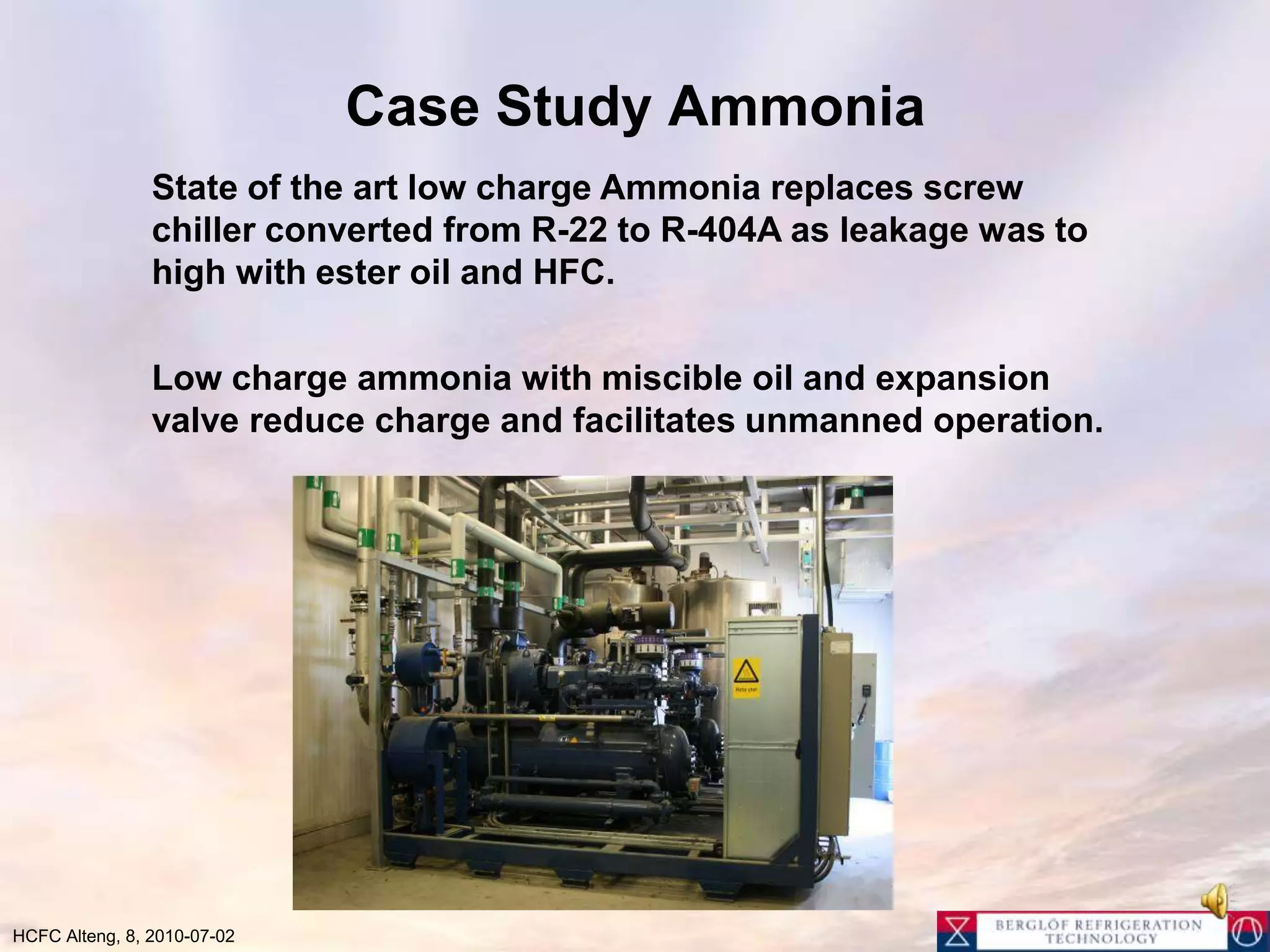
Case Study AmmoniaState of the art low charge Ammonia replaces screw chiller converted from R-22 to R-404A as leakage was to high with ester oil and HFC.Low charge ammonia with miscible oil and expansion valve reduce charge and facilitates unmanned operation.
HydrocarbonsGood refrigerants but flammableExtremely soluble in traditional refrigeration oils need attention/change of oil and/or designR-600a iso-butaneFully accepted in domestic appliances R-290 propaneIntroduced in domestic heat pumps but withdrawn due to high rate of compressor failuresIntroduction in compact systems and air to water chillers and water to water chillers placed outside or with special exhaust ventilationTested in many other applications as similar to R-22 and low GWPR-1270 propylene (mainly same market as R-290)Less capacity loss relative R-22 than R-290Otherwise as R-290Mixtures of hydrocarbons to match existing CFCs/HCFCs
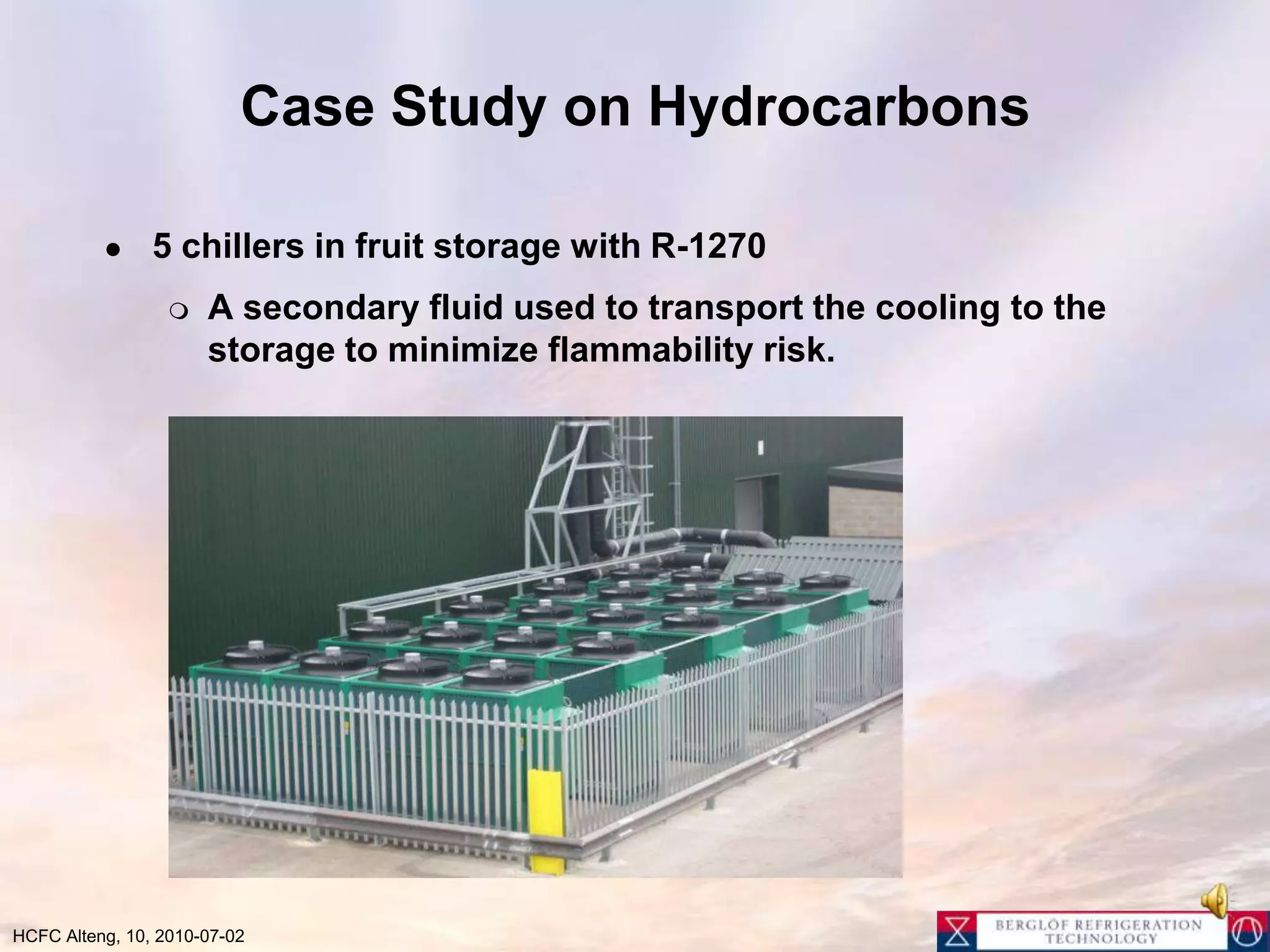
Case Study on Hydrocarbons5 chillers in fruit storage with R-1270A secondary fluid used to transport the cooling to the storage to minimize flammability risk.
Carbon dioxideUsed in refrigeration before “safety refrigerants”High pressures require totally new design ( 100 Bar(g) +) Low critical temperature (32 deg. C) - COP is normally negatively affected in supercritical operationSupercritical operation at normal condensing temperatures at high ambientIntroduced in larger low temperature cascade systemsField tests in supercritical supermarket systems especially in colder regions with average low ambient = condensingLarge introduced in domestic hot water heat pumps in Japan (subsidised)Some introduction in Scandinavia in domestic heat pump for space heating
Carbon Dioxide applicationsSub critical (condensing <32 dgC)Low temperature stage industrial cascade systemsField tests low temperature cascade in super marketSuper critical (condensing >32dgC)Heat pumps air to water for domestic hot watercommercialised in Japan with assistance of subsidiesAutomotive air-conditioning large scale field testField test in supermarket good COP claimed in colder climateEvaluated in many projects issues are:- Pressure,  COP and price
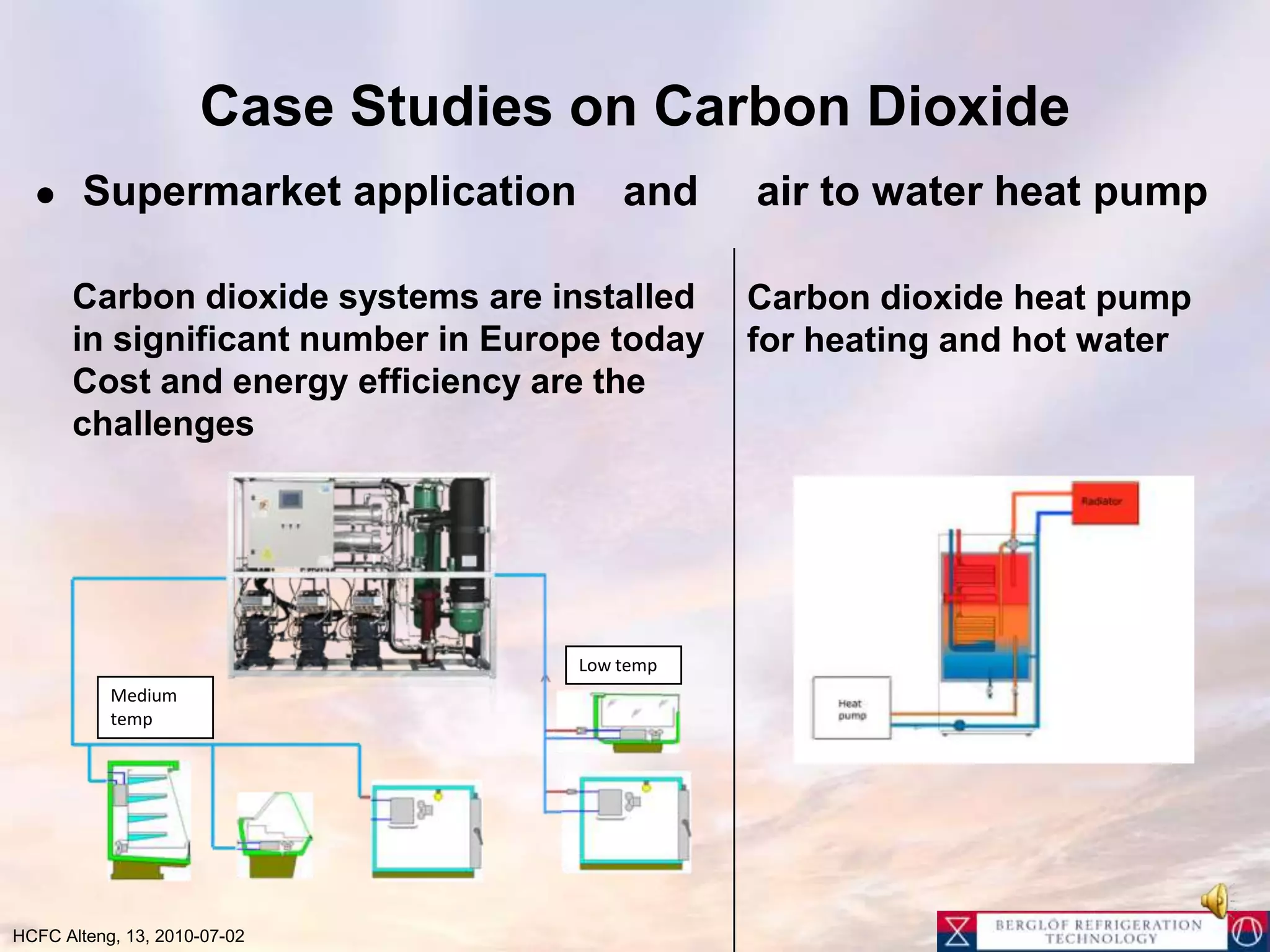
Low tempMedium tempCase Studies on Carbon DioxideSupermarket application    and     air to water heat pumpCarbon dioxide systems are installed in significant number in Europe todayCost and energy efficiency are the challengesCarbon dioxide heat pump for heating and hot water
HFC alternatives ”standard” rangeR-134a  to replace R-12 and R22 in some sectors (i.e larger chillers)R-404A and R-507 to replace 	R-502 (very similar) (i.e. commercial refr.) 				R-22 in commercial refrigerationR-407C, R-410A, R-134a to replace 	R-22 in ACR-410A mainly in smaller AC-systems such as split air conditioning High pressure/capacity without glideR-407C most common in medium sized systemsSimilar to R-22 in pressure and capacity but have  ”glide”R-134a mainly in larger chiller systems (in particular screw/centrifugal)Lower pressure/capacity but cost effective in larger system
Alternatives to R-22 in air conditioning R-134a Lower capacity (60%) Often preferred in larger chillers R407CClosest match in pressure and capacity Have a “Glide” of 4-6 K which require relevant knowledgeOften the preferred alternative in small and medium sized chillersR407A Marketed again after several years on the shelf due to low GWPR410AHigh pressure alternative (+ 40 Bar(g)) High capacity > compact systemsOften preferred alternative in reversible unitary and split systems
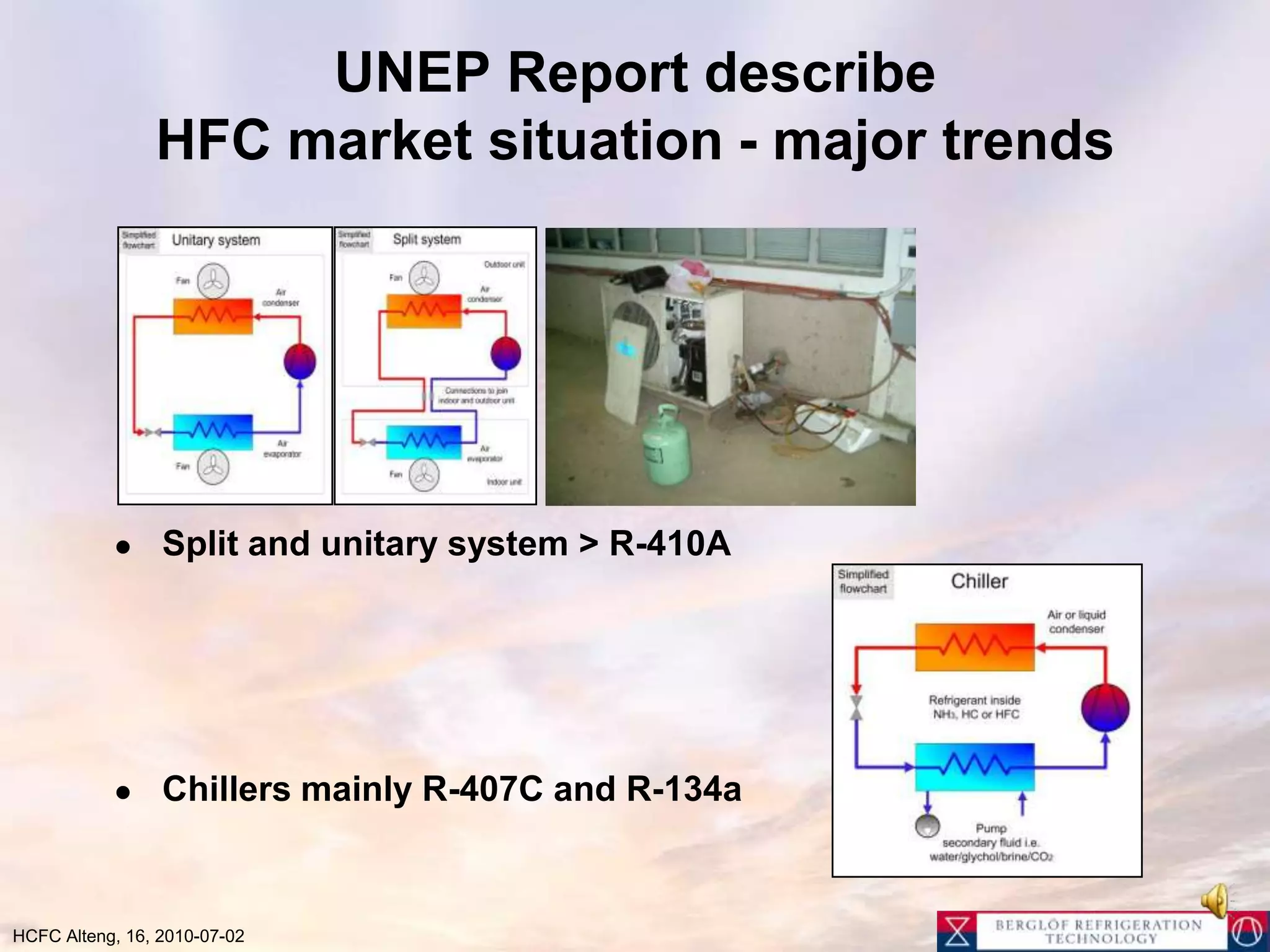
UNEP Report describeHFC market situation - major trendsSplit and unitary system > R-410AChillers mainly R-407C and R-134a
R-404A/R-507 as alternative to R-22 R-404A/R-507 are optimized for commercial refrigeration (i.e. high compression ratio without excessive discharge temp.)Most suitable below –10°C evaporation Used as single refrigerant in commercial application to avoid several refrigerants in one siteInsignificant ”glide” and low discharge temperatureReduced COP compared to R-22 (and R-407C) at high evaporation.Higher condensing pressure  than R-22 can result in operation problems at high ambient.Poor COP and high pressures result in high load on electrical motor at high evaporation can result in overload
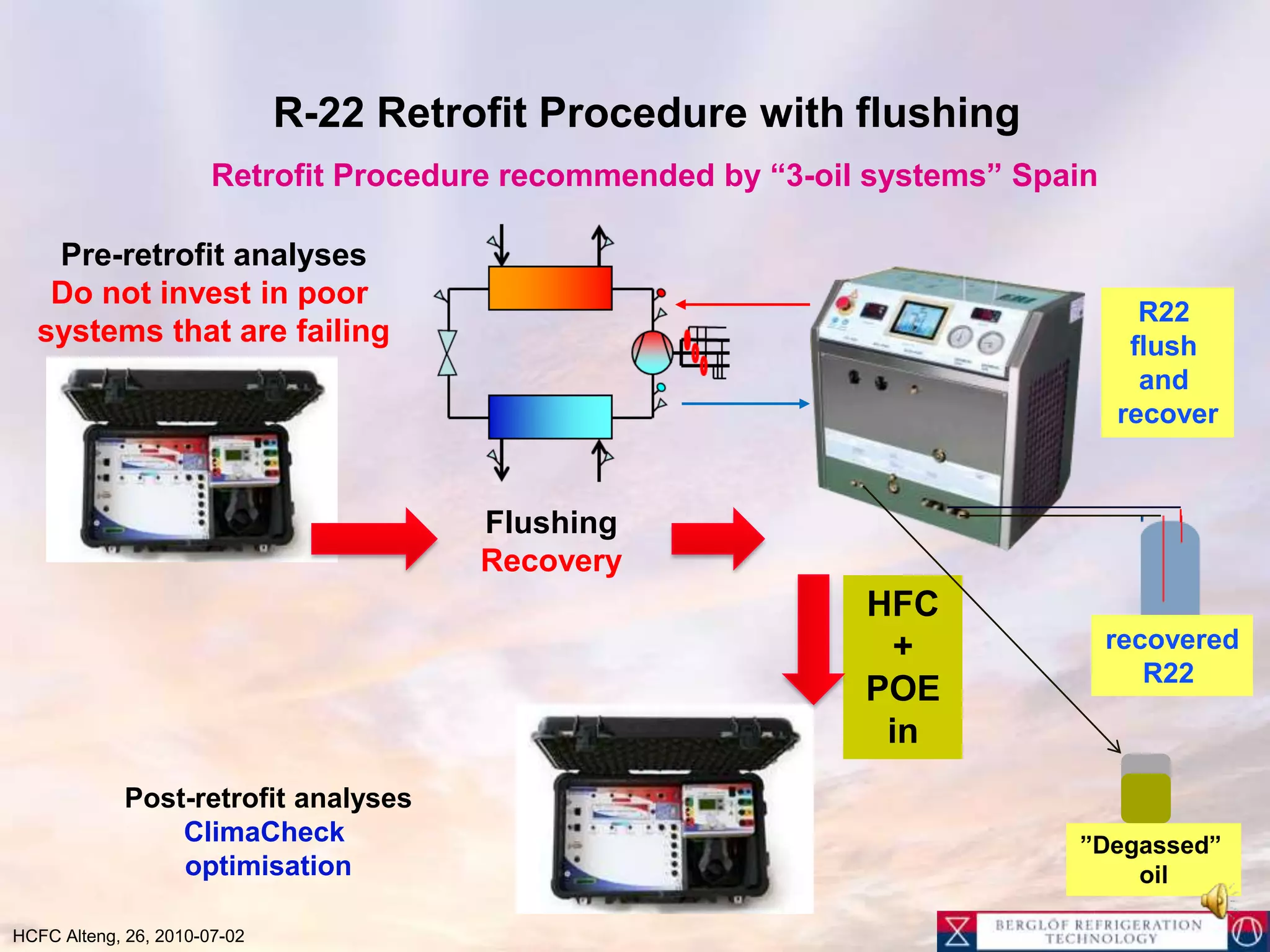
3 Retrofit routesDrop in – service blendsFix oil transport with hydrocarbons that dissolves in oil“Standard HFC” alternatives – oil changeWith repeated oil change = oil change method“Long term” alternatives - flushingFlushing with the old refrigerant to remove oil in one go (special flushing equipment modified recycling unit)Method with flushing with solvent raise questions as it creates a waste problem with solvent contaminated with chlorine containing oil
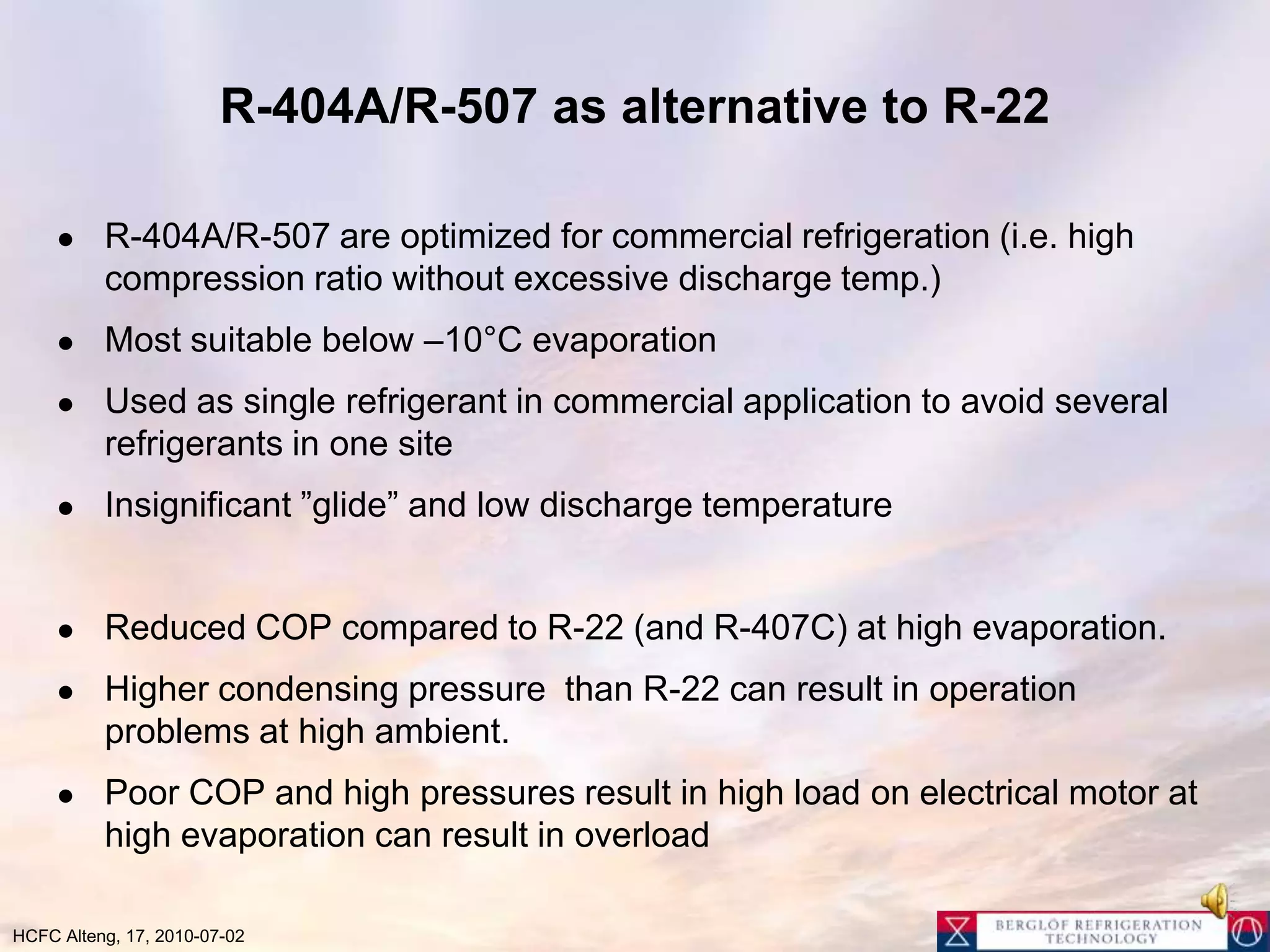
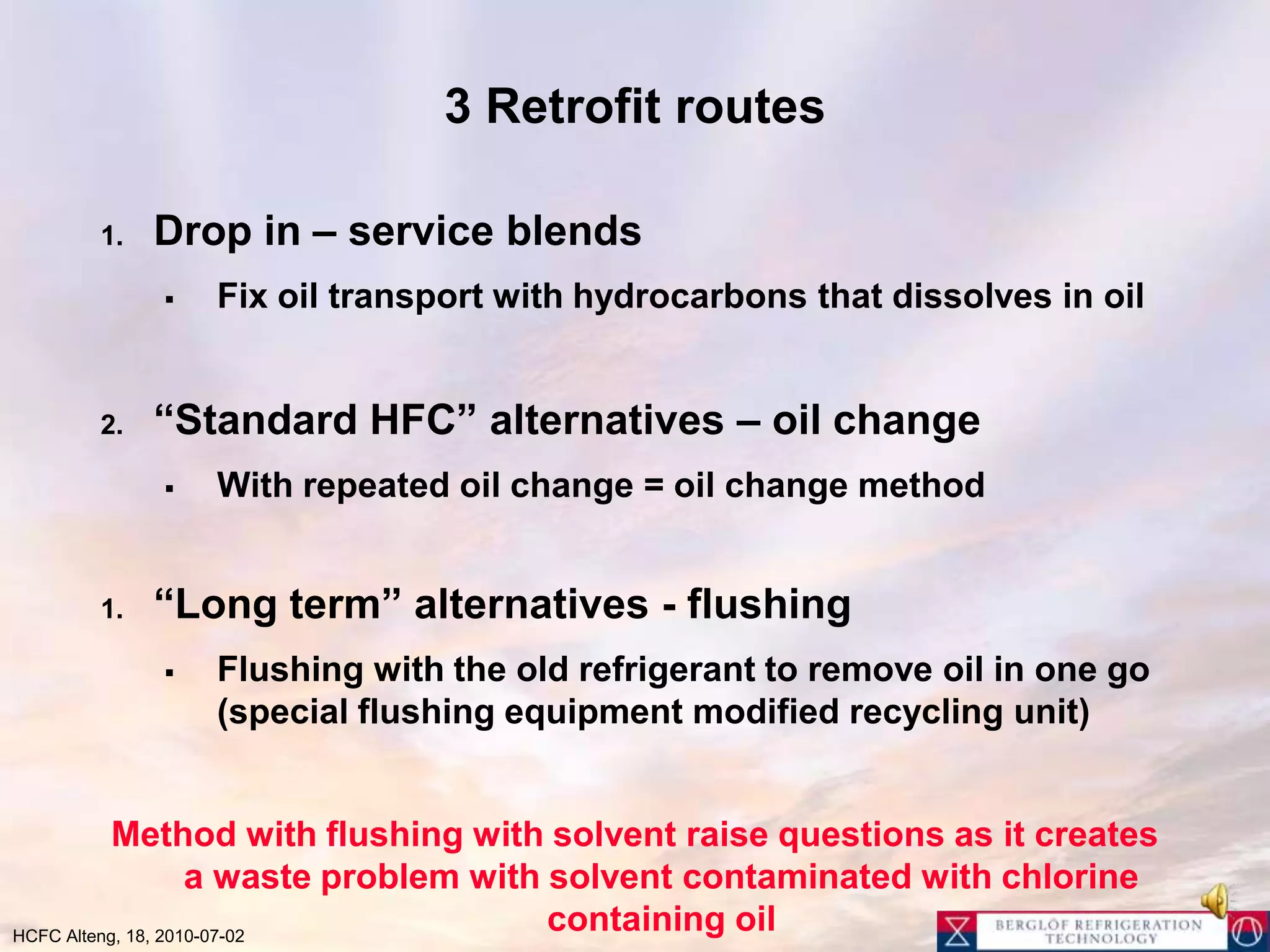
UNEP Case studyCommercial refrigeration Retrofit to R-404ASplit air-conditioning retrofit to R-407C
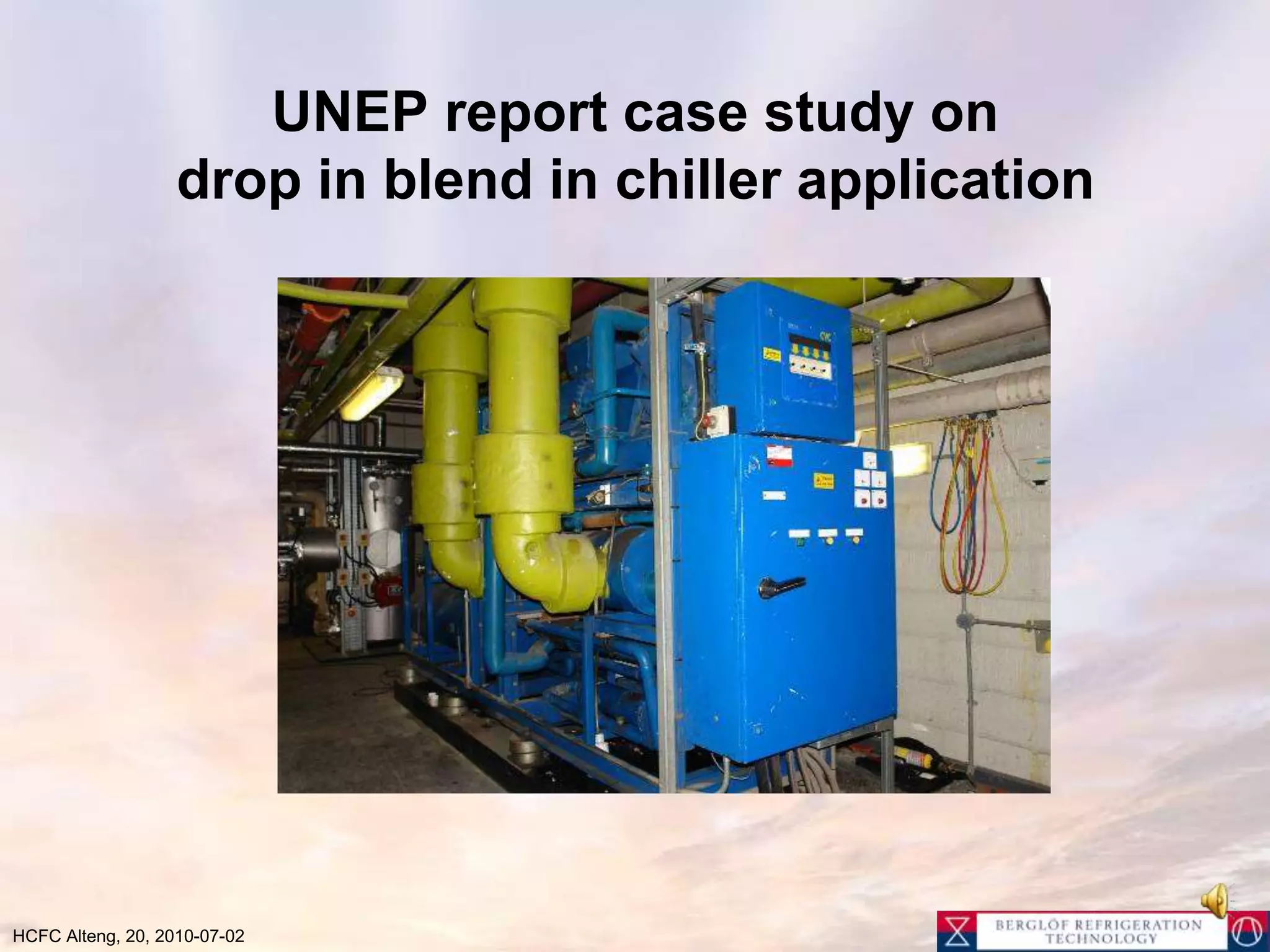
UNEP report case study on drop in blend in chiller application
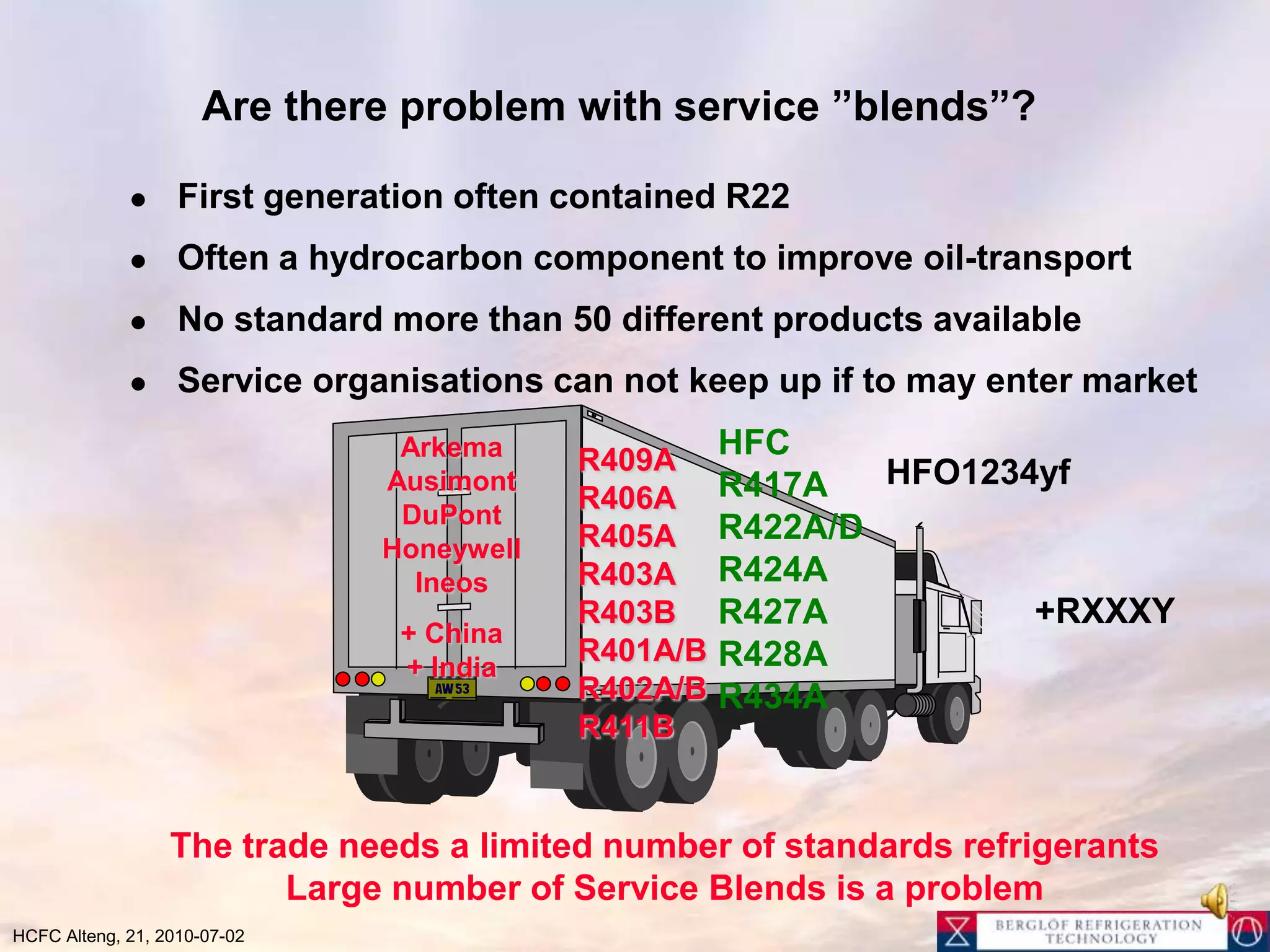
Are there problem with service ”blends”?First generation often contained R22 Often a hydrocarbon component to improve oil-transportNo standard more than 50 different products availableService organisations can not keep up if to may enter marketHFCR417AR422A/DR424AR427AR428AR434AArkemaAusimontDuPontHoneywellIneos+ China+ IndiaR409AR406AR405AR403AR403BR401A/BR402A/BR411BHFO1234yf+RXXXYThe trade needs a limited number of standards refrigerantsLarge number of ServiceBlends is a problem
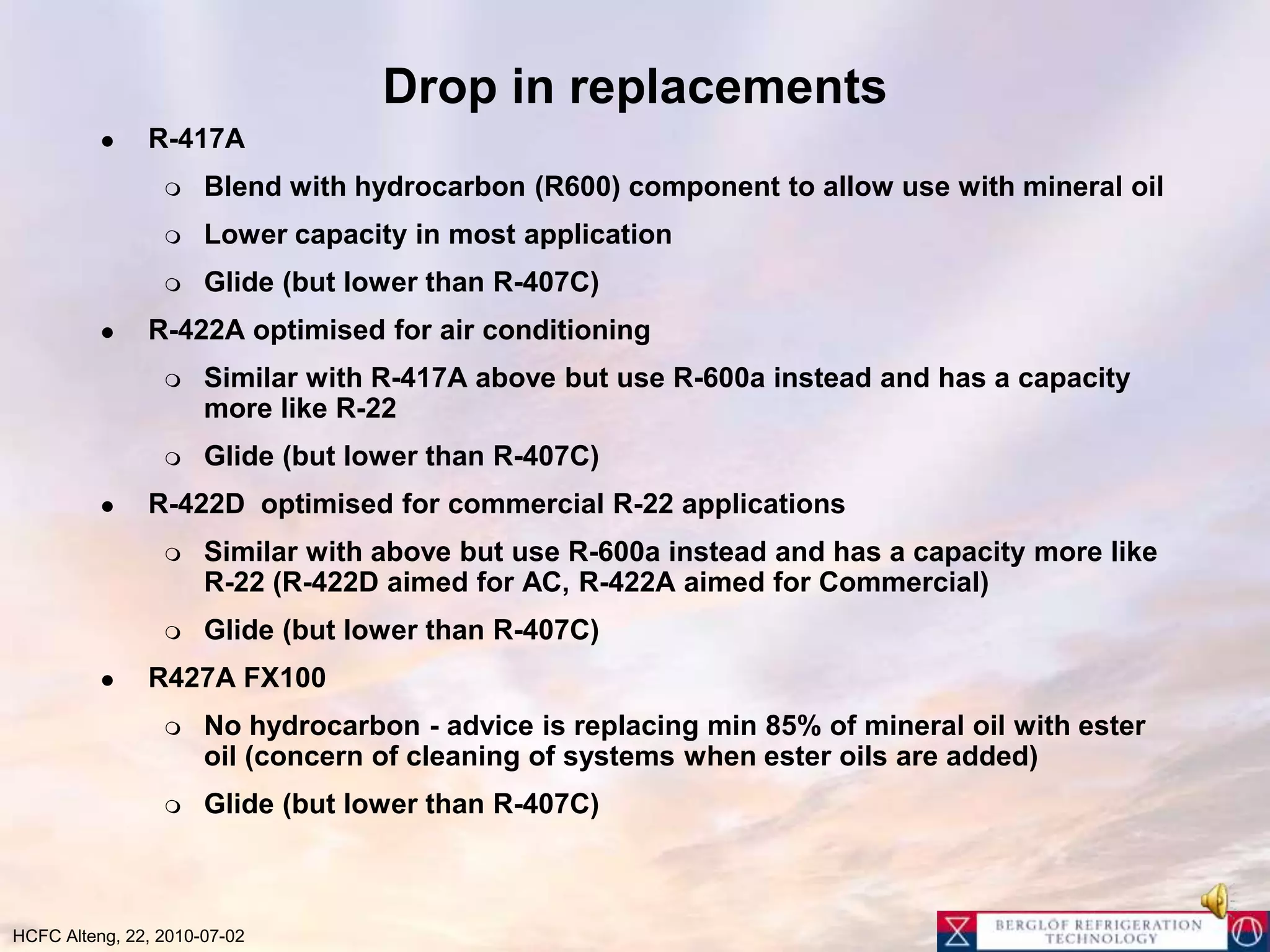
Drop in replacementsR-417ABlend with hydrocarbon (R600) component to allow use with mineral oilLower capacity in most applicationGlide (but lower than R-407C)R-422A optimised for air conditioningSimilar with R-417A above but use R-600a instead and has a capacity more like R-22Glide (but lower than R-407C)R-422D  optimised for commercial R-22 applicationsSimilar with above but use R-600a instead and has a capacity more like R-22 (R-422D aimed for AC, R-422A aimed for Commercial)Glide (but lower than R-407C)R427A FX100  No hydrocarbon - advice is replacing min 85% of mineral oil with ester oil (concern of cleaning of systems when ester oils are added)Glide (but lower than R-407C)
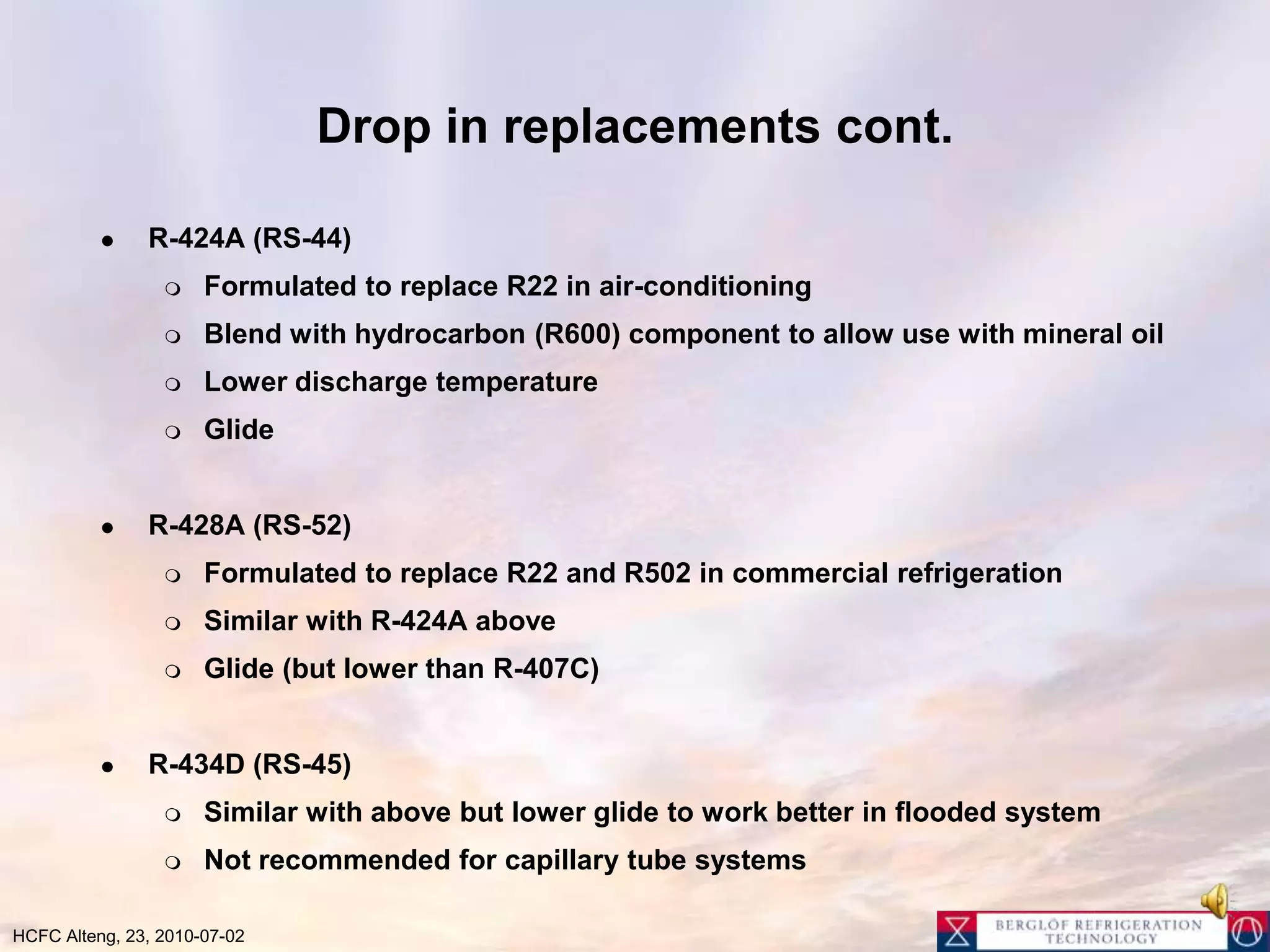
Drop in replacements cont.R-424A (RS-44)Formulated to replace R22 in air-conditioningBlend with hydrocarbon (R600) component to allow use with mineral oilLower discharge temperatureGlideR-428A (RS-52)Formulated to replace R22 and R502 in commercial refrigeration Similar with R-424A above Glide (but lower than R-407C)R-434D (RS-45)Similar with above but lower glide to work better in flooded systemNot recommended for capillary tube systems
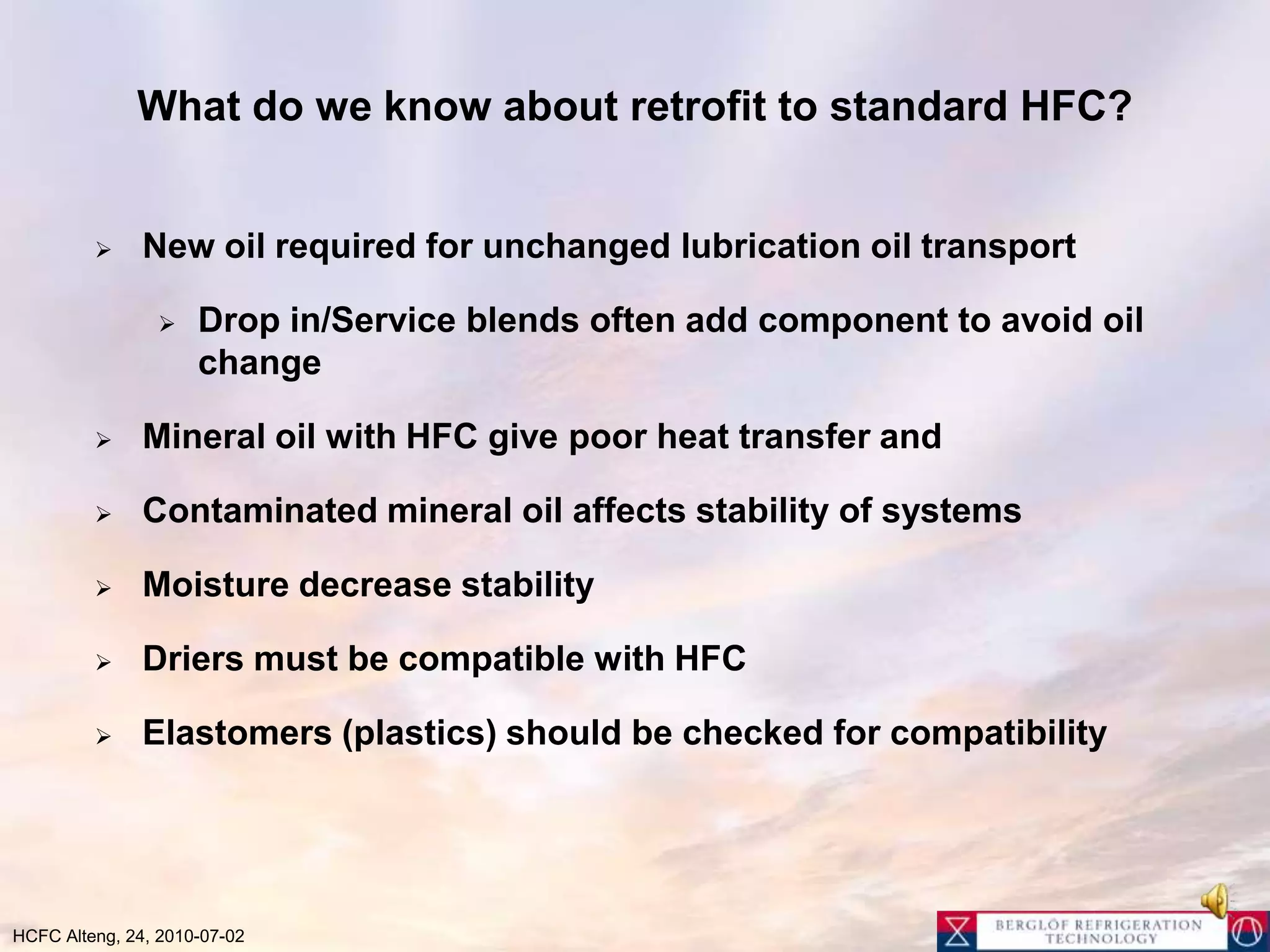
What do we know about retrofit to standard HFC?New oil required for unchanged lubrication oil transport
Drop in/Service blends often add component to avoid oil change
Mineral oil with HFC give poor heat transfer and
Contaminated mineral oil affects stability of systems
Moisture decrease stability
Driers must be compatible with HFC
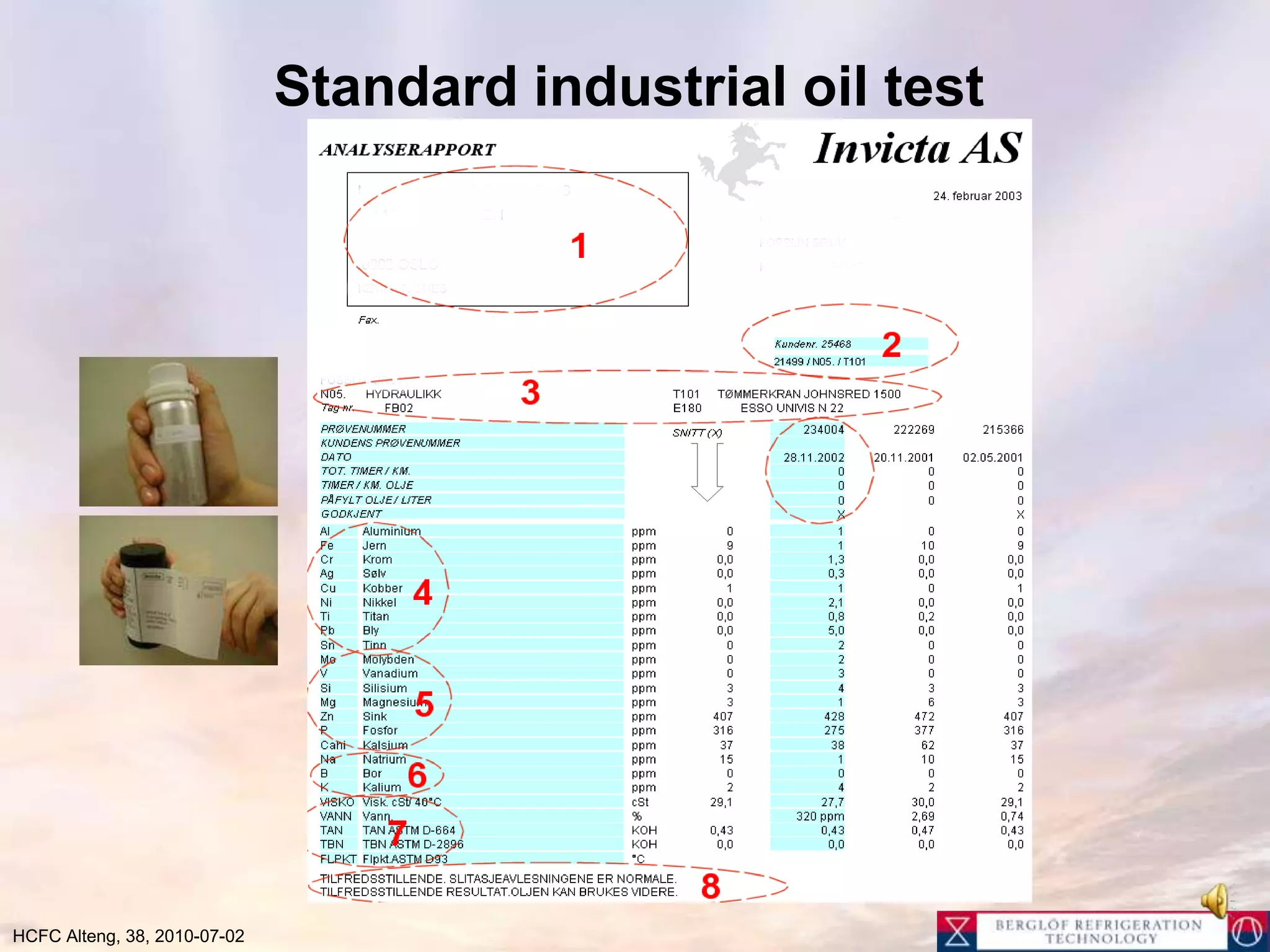
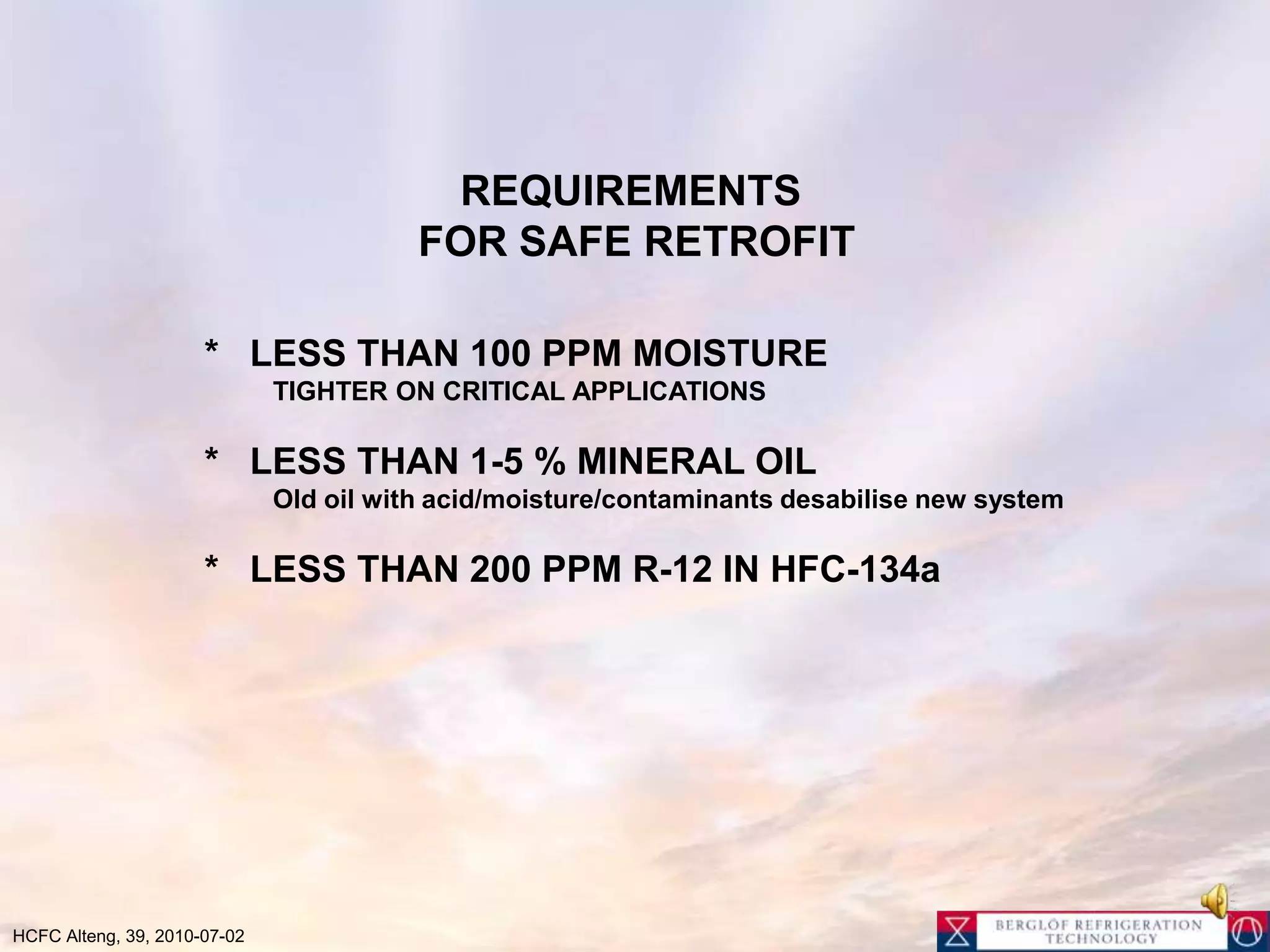
Elastomers (plastics) should be checked for compatibilityRetrofit do not fix old problemCheck status before if possibleEven if a compressor is replaced with a new HFC compressor this should be considered as a retrofitRetrofit is low cost when compressor or condensing unit is replaced ButCare should be taken so remaining oil of bad quality (acids/particles) destroy the new compressor
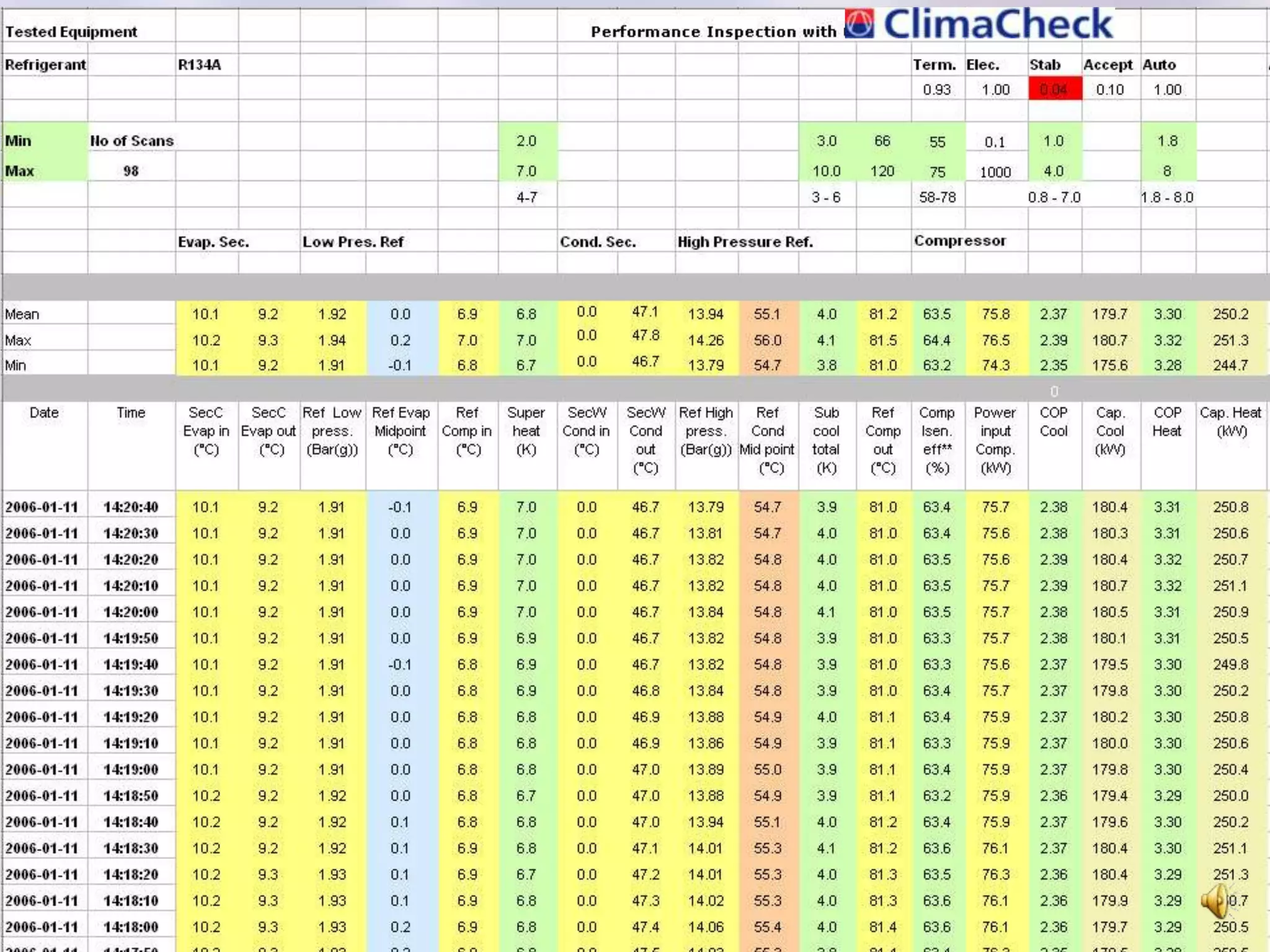
R-22 Retrofit Procedure with flushingRetrofit Procedure recommended by “3-oil systems” SpainPre-retrofit analysesDo not invest in poor systems that are failingR22 flush and recoverFlushingRecoveryHFC+POEinrecoveredR22 Post-retrofit analysesClimaCheck optimisation”Degassed” oil
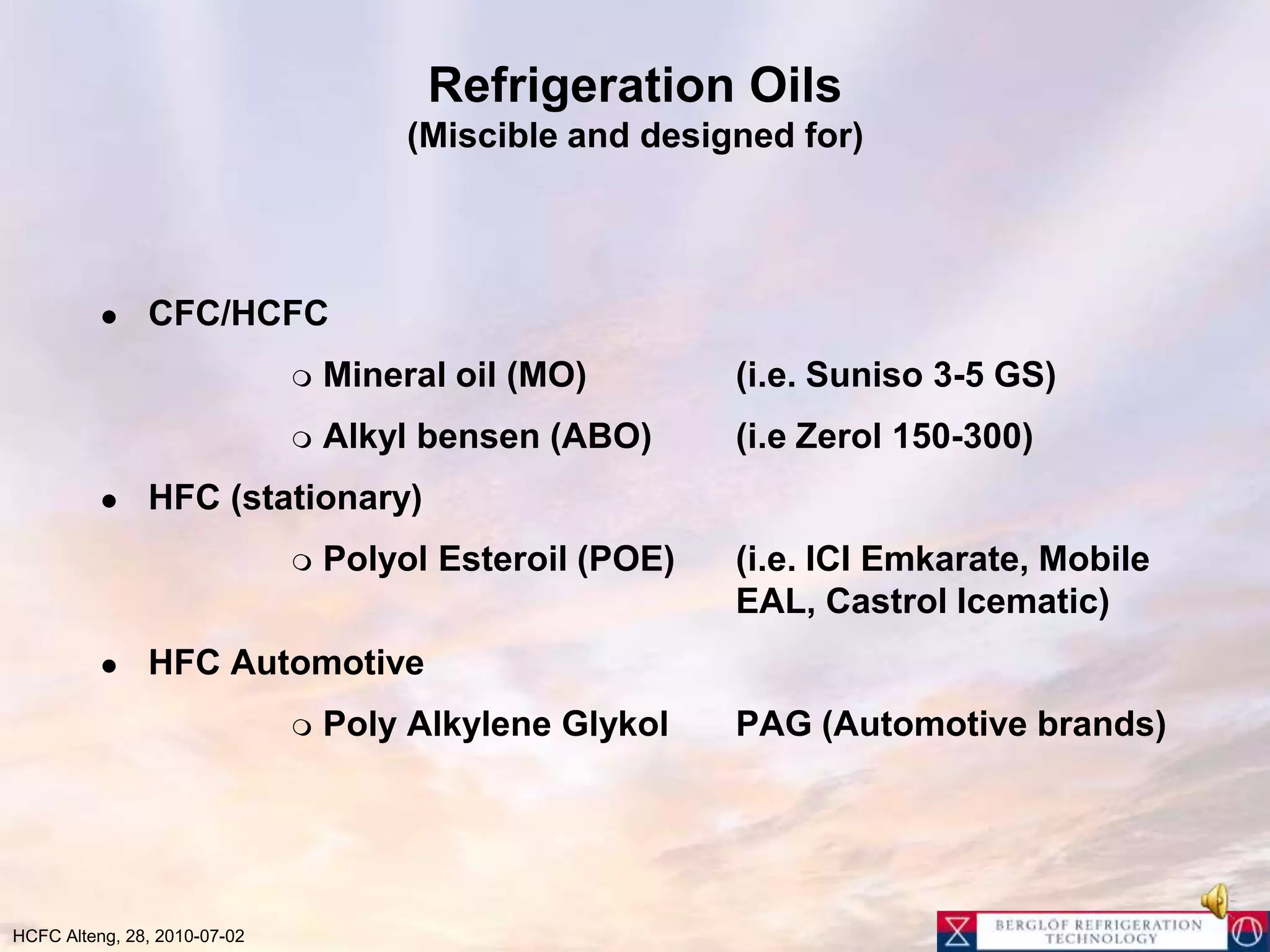
Refrigeration Oils(Miscible and designed for)CFC/HCFC			Mineral oil (MO)		(i.e. Suniso 3-5 GS)Alkyl bensen (ABO)	(i.e Zerol 150-300)HFC (stationary)	Polyol Esteroil (POE)	(i.e. ICI Emkarate, Mobile 				EAL, Castrol Icematic)HFC Automotive	Poly Alkylene Glykol	PAG (Automotive brands)
RETROFIT STEP BY STEP*	IDENTIFY SUITABLE OBJECT, MAKE A LIST OF COMPONENTS*	VERIFY FUNCTION OF SYSTEM,*	CORRECT PROBLEMS AND LEAKS IF ANY*	VERIFY COMPONENTS COMPATIBILITY WITH HFC/ESTEROIL*	REMOVE MINERAL OIL WITH OIL CHANGES OR FLUSHING *	CHANGE DRIER AND OTHER COMPONENTS *	EVACUATE CAREFULLY*	START UP, ADJUST EXPANSION VALVE, VERIFY FUNCTION*	MARK INSTALLATION CLEARLY WITH OIL AND REFRIGERANT *	TAKE OIL SAMPLE AFTER APPROX.. 100 HOURS
None ODS alternatives and conventional oils Mineral and alkylbenzen oil used with traditional refrigerants These had good miscibility with good oil returnViscosity selected based on solubility with refrigerantsWithout solubility with refrigerant oil get high viscosityPoor oil transport – lubricationODS-free service blends often use HC (i.e. R600/R-600a) that thins the oil but it does not create miscibilityWorks best in “simple” systems without complex tubing or “groves” on tubesCaution need to be taken if
Risk for poor oil transport in suction line
Oil can collect on top of liquid in receiver (lower density than refrigerant and not miscible)
Tubes with expanded surfaces “groves” tend to be clogged by oilBitzer Refrigerant Handbook about this type of service blends “On account of the good miscibility of R-600a, conventional lubricants can also be used under favourable conditions.”
Internet powerful toolCheck Compressor manufacturers webBitzer Excellent Refrigerant report and software www.bitzer.de/eng/HomeCopeland a lot of data and softwareRefrigerant supplierswww.R744.com lobby group for CO2UNEP web http://www.uneptie.org/ozonAction/topics/hcfc.asp
Handling oils for alternative New handling required“ESTEROILS/POEs and PAGs absorb moisture from airHumidity cause brake down of oil during operation  Oil must be handled carefully Buy in smallest suitable containerDo not let open container be exposed to ambient airPractical solution is to keep oil in pressure vessels (refrigerant cylinder) first evacuated then put under pressure with nitrogen that allows quick injection without pumpingCompressors with oils should be kept sealed until it is connected and evacuation should start immediately
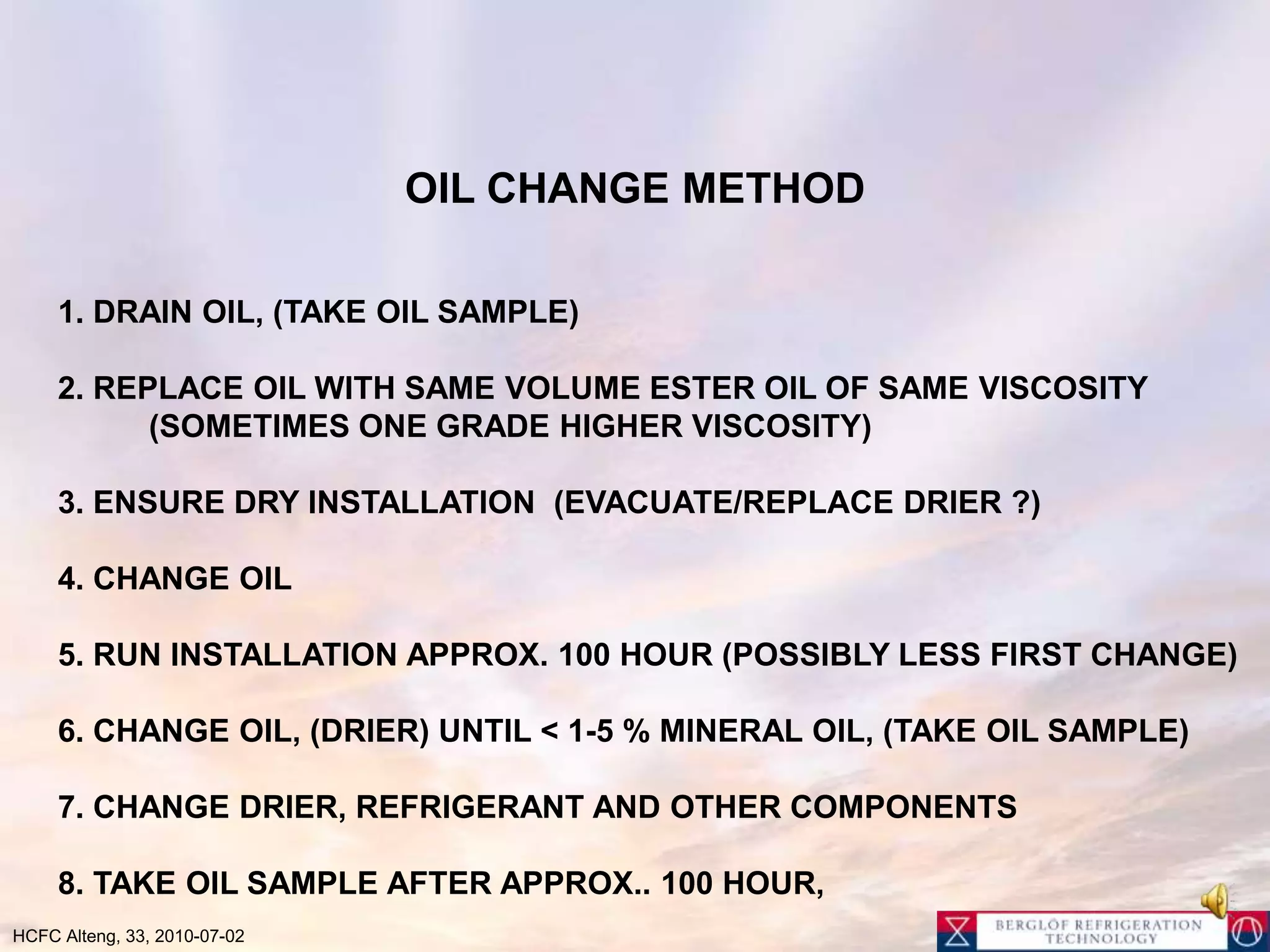
OIL CHANGE METHOD1. DRAIN OIL, (TAKE OIL SAMPLE)2. REPLACE OIL WITH SAME VOLUME ESTER OIL OF SAME VISCOSITY 	(SOMETIMES ONE GRADE HIGHER VISCOSITY)3. ENSURE DRY INSTALLATION  (EVACUATE/REPLACE DRIER ?)4. CHANGE OIL5. RUN INSTALLATION APPROX. 100 HOUR (POSSIBLY LESS FIRST CHANGE) 6. CHANGE OIL, (DRIER) UNTIL < 1-5 % MINERAL OIL, (TAKE OIL SAMPLE) 7. CHANGE DRIER, REFRIGERANT AND OTHER COMPONENTS8. TAKE OIL SAMPLE AFTER APPROX.. 100 HOUR,
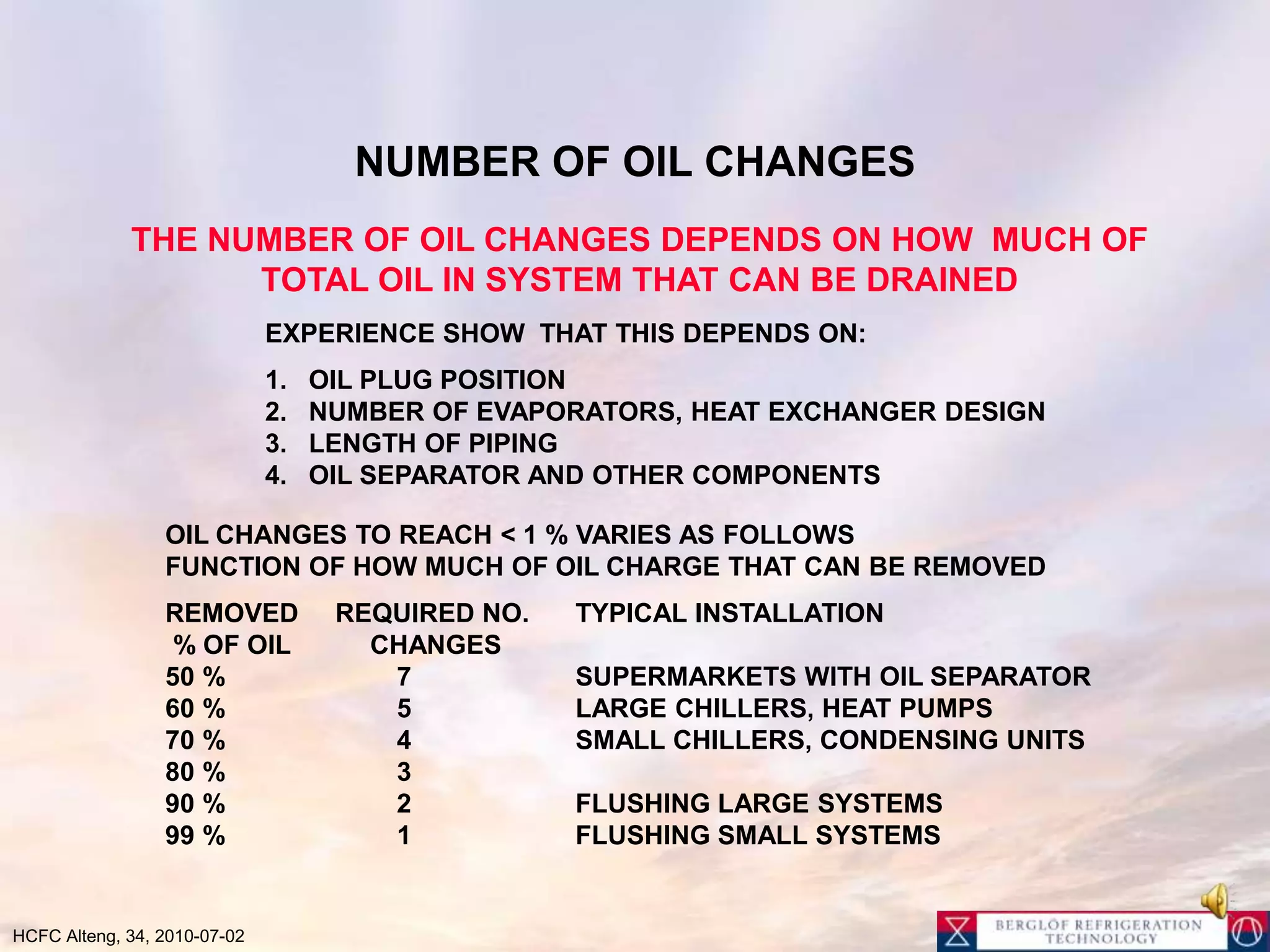
NUMBER OF OIL CHANGESTHE NUMBER OF OIL CHANGES DEPENDS ON HOW  MUCH OFTOTAL OIL IN SYSTEM THAT CAN BE DRAINEDEXPERIENCE SHOW  THAT THIS DEPENDS ON:1.   OIL PLUG POSITION2.   NUMBER OF EVAPORATORS, HEAT EXCHANGER DESIGN3.   LENGTH OF PIPING4.   OIL SEPARATOR AND OTHER COMPONENTSOIL CHANGES TO REACH < 1 % VARIES AS FOLLOWS FUNCTION OF HOW MUCH OF OIL CHARGE THAT CAN BE REMOVEDREMOVED     REQUIRED NO.	TYPICAL INSTALLATION % OF OIL		CHANGES50 %		7		SUPERMARKETS WITH OIL SEPARATOR 60 % 		5		LARGE CHILLERS, HEAT PUMPS70 %		4		SMALL CHILLERS, CONDENSING UNITS80 % 		3		90 % 		2		FLUSHING LARGE SYSTEMS99 % 		1		FLUSHING SMALL SYSTEMS

Replacing HCFC in Refrigeration and Air Conditioning, Bogota

  • 1.
    REPLACING HCFC INREFRIGERATION AND AIR-CONDITININGTechnology and introduction to UNEP case study reportBogota, April 2010Klas Berglöf, Berglof Refrigeration Technology Ltd SWEDENklas@berglof-kylteknologi.seTel. int +46 70 594 95 52
  • 2.
    What is affectedby HCFC phase out?HCFC refrigerants main product and applicationsR-22 used in Air-conditioningSplit and unitary systemsChillersIndustrial RefrigerationCommercial RefrigerationSuper market, Specialty shopsCold rooms, Restaurants, barsTransport refrigerationTrucksTrains BoatsR-123, R-124, “Service Blends” with R-22 and/or R-124
  • 3.
    Need for alternativesto HCFC inNew installationsExisting plantsRetrofitsStandard HFCDrop in blendsReplacement of systemMinimize leaks
  • 4.
    Evaluate situation firstApplicationand system status should be evaluated before decision Replacement might be a more cost/energy efficient alternativeRetrofits to standard HFC ensure availability of refrigerants at serviceRefrigerant from retrofitted systems important for re-useRetrofit to “standard” HFC ODS is often possible from R-22More focus on proper installation and service methods requiredKnowledge and experience is important to avoid problems
  • 5.
    Four main routesto replace HCFCs in the RAC sector.Ammonia NH3Hydrocarbons Isobutane, Propane and propylene Carbon dioxide CO2Hydrofluoro carbons HFCa. “Standard HFCs”, R-134a, R-404A, R-407C, R-410Ab. Drop-in blends to extend life in existing systems at lower costThe three first low global warming but more challenging to use cost effectively and safe. Future may include new alterantives? Low GWP options from chemical industry - HFO1234yf +
  • 6.
    UNEP Report onAlternativesto HCFC with case studiesReport describe Markets using HCFC (in particular R-22)Available alternativesTechnical options and challengesCases from different technologies and applications
  • 7.
    AmmoniaGood refrigerant propertiesexcept not compatible with copperToxicWell known refrigerant in industrial applicationsIncreased market chare in these applicationsSome introduction in larger air-conditioning chillers
  • 8.
    Case Study AmmoniaStateof the art low charge Ammonia replaces screw chiller converted from R-22 to R-404A as leakage was to high with ester oil and HFC.Low charge ammonia with miscible oil and expansion valve reduce charge and facilitates unmanned operation.
  • 9.
    HydrocarbonsGood refrigerants butflammableExtremely soluble in traditional refrigeration oils need attention/change of oil and/or designR-600a iso-butaneFully accepted in domestic appliances R-290 propaneIntroduced in domestic heat pumps but withdrawn due to high rate of compressor failuresIntroduction in compact systems and air to water chillers and water to water chillers placed outside or with special exhaust ventilationTested in many other applications as similar to R-22 and low GWPR-1270 propylene (mainly same market as R-290)Less capacity loss relative R-22 than R-290Otherwise as R-290Mixtures of hydrocarbons to match existing CFCs/HCFCs
  • 10.
    Case Study onHydrocarbons5 chillers in fruit storage with R-1270A secondary fluid used to transport the cooling to the storage to minimize flammability risk.
  • 11.
    Carbon dioxideUsed inrefrigeration before “safety refrigerants”High pressures require totally new design ( 100 Bar(g) +) Low critical temperature (32 deg. C) - COP is normally negatively affected in supercritical operationSupercritical operation at normal condensing temperatures at high ambientIntroduced in larger low temperature cascade systemsField tests in supercritical supermarket systems especially in colder regions with average low ambient = condensingLarge introduced in domestic hot water heat pumps in Japan (subsidised)Some introduction in Scandinavia in domestic heat pump for space heating
  • 12.
    Carbon Dioxide applicationsSubcritical (condensing <32 dgC)Low temperature stage industrial cascade systemsField tests low temperature cascade in super marketSuper critical (condensing >32dgC)Heat pumps air to water for domestic hot watercommercialised in Japan with assistance of subsidiesAutomotive air-conditioning large scale field testField test in supermarket good COP claimed in colder climateEvaluated in many projects issues are:- Pressure, COP and price
  • 13.
    Low tempMedium tempCaseStudies on Carbon DioxideSupermarket application and air to water heat pumpCarbon dioxide systems are installed in significant number in Europe todayCost and energy efficiency are the challengesCarbon dioxide heat pump for heating and hot water
  • 14.
    HFC alternatives ”standard”rangeR-134a to replace R-12 and R22 in some sectors (i.e larger chillers)R-404A and R-507 to replace R-502 (very similar) (i.e. commercial refr.) R-22 in commercial refrigerationR-407C, R-410A, R-134a to replace R-22 in ACR-410A mainly in smaller AC-systems such as split air conditioning High pressure/capacity without glideR-407C most common in medium sized systemsSimilar to R-22 in pressure and capacity but have ”glide”R-134a mainly in larger chiller systems (in particular screw/centrifugal)Lower pressure/capacity but cost effective in larger system
  • 15.
    Alternatives to R-22in air conditioning R-134a Lower capacity (60%) Often preferred in larger chillers R407CClosest match in pressure and capacity Have a “Glide” of 4-6 K which require relevant knowledgeOften the preferred alternative in small and medium sized chillersR407A Marketed again after several years on the shelf due to low GWPR410AHigh pressure alternative (+ 40 Bar(g)) High capacity > compact systemsOften preferred alternative in reversible unitary and split systems
  • 16.
    UNEP Report describeHFCmarket situation - major trendsSplit and unitary system > R-410AChillers mainly R-407C and R-134a
  • 17.
    R-404A/R-507 as alternativeto R-22 R-404A/R-507 are optimized for commercial refrigeration (i.e. high compression ratio without excessive discharge temp.)Most suitable below –10°C evaporation Used as single refrigerant in commercial application to avoid several refrigerants in one siteInsignificant ”glide” and low discharge temperatureReduced COP compared to R-22 (and R-407C) at high evaporation.Higher condensing pressure than R-22 can result in operation problems at high ambient.Poor COP and high pressures result in high load on electrical motor at high evaporation can result in overload
  • 18.
    3 Retrofit routesDropin – service blendsFix oil transport with hydrocarbons that dissolves in oil“Standard HFC” alternatives – oil changeWith repeated oil change = oil change method“Long term” alternatives - flushingFlushing with the old refrigerant to remove oil in one go (special flushing equipment modified recycling unit)Method with flushing with solvent raise questions as it creates a waste problem with solvent contaminated with chlorine containing oil
  • 19.
    UNEP Case studyCommercialrefrigeration Retrofit to R-404ASplit air-conditioning retrofit to R-407C
  • 20.
    UNEP report casestudy on drop in blend in chiller application
  • 21.
    Are there problemwith service ”blends”?First generation often contained R22 Often a hydrocarbon component to improve oil-transportNo standard more than 50 different products availableService organisations can not keep up if to may enter marketHFCR417AR422A/DR424AR427AR428AR434AArkemaAusimontDuPontHoneywellIneos+ China+ IndiaR409AR406AR405AR403AR403BR401A/BR402A/BR411BHFO1234yf+RXXXYThe trade needs a limited number of standards refrigerantsLarge number of ServiceBlends is a problem
  • 22.
    Drop in replacementsR-417ABlendwith hydrocarbon (R600) component to allow use with mineral oilLower capacity in most applicationGlide (but lower than R-407C)R-422A optimised for air conditioningSimilar with R-417A above but use R-600a instead and has a capacity more like R-22Glide (but lower than R-407C)R-422D optimised for commercial R-22 applicationsSimilar with above but use R-600a instead and has a capacity more like R-22 (R-422D aimed for AC, R-422A aimed for Commercial)Glide (but lower than R-407C)R427A FX100 No hydrocarbon - advice is replacing min 85% of mineral oil with ester oil (concern of cleaning of systems when ester oils are added)Glide (but lower than R-407C)
  • 23.
    Drop in replacementscont.R-424A (RS-44)Formulated to replace R22 in air-conditioningBlend with hydrocarbon (R600) component to allow use with mineral oilLower discharge temperatureGlideR-428A (RS-52)Formulated to replace R22 and R502 in commercial refrigeration Similar with R-424A above Glide (but lower than R-407C)R-434D (RS-45)Similar with above but lower glide to work better in flooded systemNot recommended for capillary tube systems
  • 24.
    What do weknow about retrofit to standard HFC?New oil required for unchanged lubrication oil transport
  • 25.
    Drop in/Service blendsoften add component to avoid oil change
  • 26.
    Mineral oil withHFC give poor heat transfer and
  • 27.
    Contaminated mineral oilaffects stability of systems
  • 28.
  • 29.
    Driers must becompatible with HFC
  • 30.
    Elastomers (plastics) shouldbe checked for compatibilityRetrofit do not fix old problemCheck status before if possibleEven if a compressor is replaced with a new HFC compressor this should be considered as a retrofitRetrofit is low cost when compressor or condensing unit is replaced ButCare should be taken so remaining oil of bad quality (acids/particles) destroy the new compressor
  • 31.
    R-22 Retrofit Procedurewith flushingRetrofit Procedure recommended by “3-oil systems” SpainPre-retrofit analysesDo not invest in poor systems that are failingR22 flush and recoverFlushingRecoveryHFC+POEinrecoveredR22 Post-retrofit analysesClimaCheck optimisation”Degassed” oil
  • 33.
    Refrigeration Oils(Miscible anddesigned for)CFC/HCFC Mineral oil (MO) (i.e. Suniso 3-5 GS)Alkyl bensen (ABO) (i.e Zerol 150-300)HFC (stationary) Polyol Esteroil (POE) (i.e. ICI Emkarate, Mobile EAL, Castrol Icematic)HFC Automotive Poly Alkylene Glykol PAG (Automotive brands)
  • 34.
    RETROFIT STEP BYSTEP* IDENTIFY SUITABLE OBJECT, MAKE A LIST OF COMPONENTS* VERIFY FUNCTION OF SYSTEM,* CORRECT PROBLEMS AND LEAKS IF ANY* VERIFY COMPONENTS COMPATIBILITY WITH HFC/ESTEROIL* REMOVE MINERAL OIL WITH OIL CHANGES OR FLUSHING * CHANGE DRIER AND OTHER COMPONENTS * EVACUATE CAREFULLY* START UP, ADJUST EXPANSION VALVE, VERIFY FUNCTION* MARK INSTALLATION CLEARLY WITH OIL AND REFRIGERANT * TAKE OIL SAMPLE AFTER APPROX.. 100 HOURS
  • 35.
    None ODS alternativesand conventional oils Mineral and alkylbenzen oil used with traditional refrigerants These had good miscibility with good oil returnViscosity selected based on solubility with refrigerantsWithout solubility with refrigerant oil get high viscosityPoor oil transport – lubricationODS-free service blends often use HC (i.e. R600/R-600a) that thins the oil but it does not create miscibilityWorks best in “simple” systems without complex tubing or “groves” on tubesCaution need to be taken if
  • 36.
    Risk for pooroil transport in suction line
  • 37.
    Oil can collecton top of liquid in receiver (lower density than refrigerant and not miscible)
  • 38.
    Tubes with expandedsurfaces “groves” tend to be clogged by oilBitzer Refrigerant Handbook about this type of service blends “On account of the good miscibility of R-600a, conventional lubricants can also be used under favourable conditions.”
  • 39.
    Internet powerful toolCheckCompressor manufacturers webBitzer Excellent Refrigerant report and software www.bitzer.de/eng/HomeCopeland a lot of data and softwareRefrigerant supplierswww.R744.com lobby group for CO2UNEP web http://www.uneptie.org/ozonAction/topics/hcfc.asp
  • 40.
    Handling oils foralternative New handling required“ESTEROILS/POEs and PAGs absorb moisture from airHumidity cause brake down of oil during operation Oil must be handled carefully Buy in smallest suitable containerDo not let open container be exposed to ambient airPractical solution is to keep oil in pressure vessels (refrigerant cylinder) first evacuated then put under pressure with nitrogen that allows quick injection without pumpingCompressors with oils should be kept sealed until it is connected and evacuation should start immediately
  • 41.
    OIL CHANGE METHOD1.DRAIN OIL, (TAKE OIL SAMPLE)2. REPLACE OIL WITH SAME VOLUME ESTER OIL OF SAME VISCOSITY (SOMETIMES ONE GRADE HIGHER VISCOSITY)3. ENSURE DRY INSTALLATION (EVACUATE/REPLACE DRIER ?)4. CHANGE OIL5. RUN INSTALLATION APPROX. 100 HOUR (POSSIBLY LESS FIRST CHANGE) 6. CHANGE OIL, (DRIER) UNTIL < 1-5 % MINERAL OIL, (TAKE OIL SAMPLE) 7. CHANGE DRIER, REFRIGERANT AND OTHER COMPONENTS8. TAKE OIL SAMPLE AFTER APPROX.. 100 HOUR,
  • 42.
    NUMBER OF OILCHANGESTHE NUMBER OF OIL CHANGES DEPENDS ON HOW MUCH OFTOTAL OIL IN SYSTEM THAT CAN BE DRAINEDEXPERIENCE SHOW THAT THIS DEPENDS ON:1. OIL PLUG POSITION2. NUMBER OF EVAPORATORS, HEAT EXCHANGER DESIGN3. LENGTH OF PIPING4. OIL SEPARATOR AND OTHER COMPONENTSOIL CHANGES TO REACH < 1 % VARIES AS FOLLOWS FUNCTION OF HOW MUCH OF OIL CHARGE THAT CAN BE REMOVEDREMOVED REQUIRED NO. TYPICAL INSTALLATION % OF OIL CHANGES50 % 7 SUPERMARKETS WITH OIL SEPARATOR 60 % 5 LARGE CHILLERS, HEAT PUMPS70 % 4 SMALL CHILLERS, CONDENSING UNITS80 % 3 90 % 2 FLUSHING LARGE SYSTEMS99 % 1 FLUSHING SMALL SYSTEMS
  • 43.
    FORCED FLUSHING CLEANS AWAY MINERAL OIL WITH THE "OLD" REFRIGERANT
  • 44.
    NOCOMPONENTS ARE REMOVED
  • 45.
    INSMALLER SYSTEMS 1 % CAN BE REACHED IN 1-4 HOURS
  • 46.
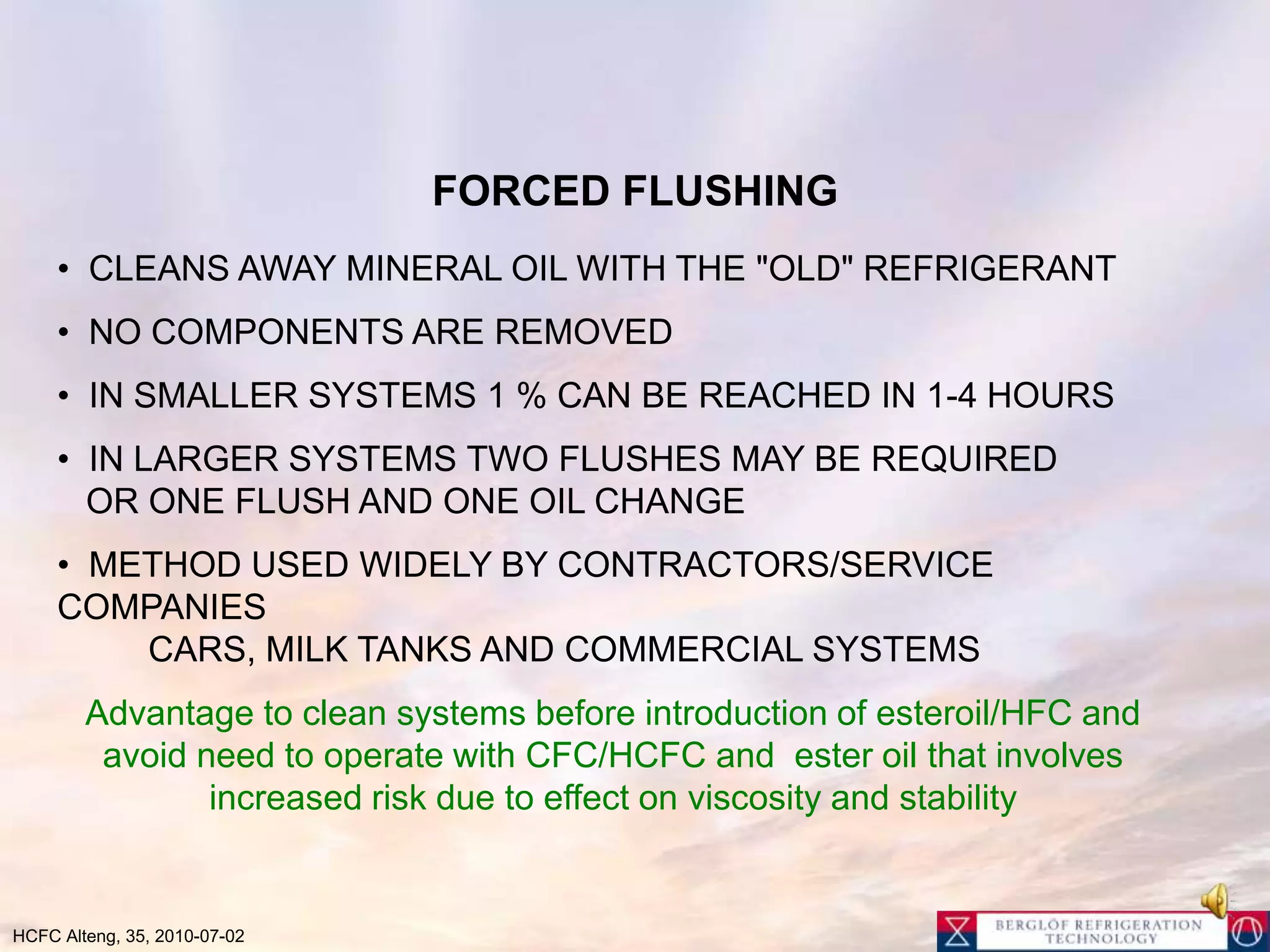
    INLARGER SYSTEMS TWO FLUSHES MAY BE REQUIRED OR ONE FLUSH AND ONE OIL CHANGE METHOD USED WIDELY BY CONTRACTORS/SERVICE COMPANIES CARS, MILK TANKS AND COMMERCIAL SYSTEMSAdvantage to clean systems before introduction of esteroil/HFC and avoid need to operate with CFC/HCFC and ester oil that involves increased risk due to effect on viscosity and stability
  • 47.
    FORCED FLUSHINGRETROFIT CANNORMALLY BE PERFORMED IN ONE VISIT
  • 48.
  • 49.
    LESS CHLORINE CONTAININGOIL TO DISPOSE OF
  • 50.
    LESS LEAKAGE DUETO FEWER OPERATION
  • 51.
    THE SYSTEM ISCLEANED FROM ACID AND OTHER CONTAMINATES PRIOR TO INTRODUCTION OF HFC AND ESTEROILS
  • 52.
  • 53.
    LONGER SHUT DOWNTIME AT ONE OCCASION- SPECIAL UNIT REQUIRED
  • 54.
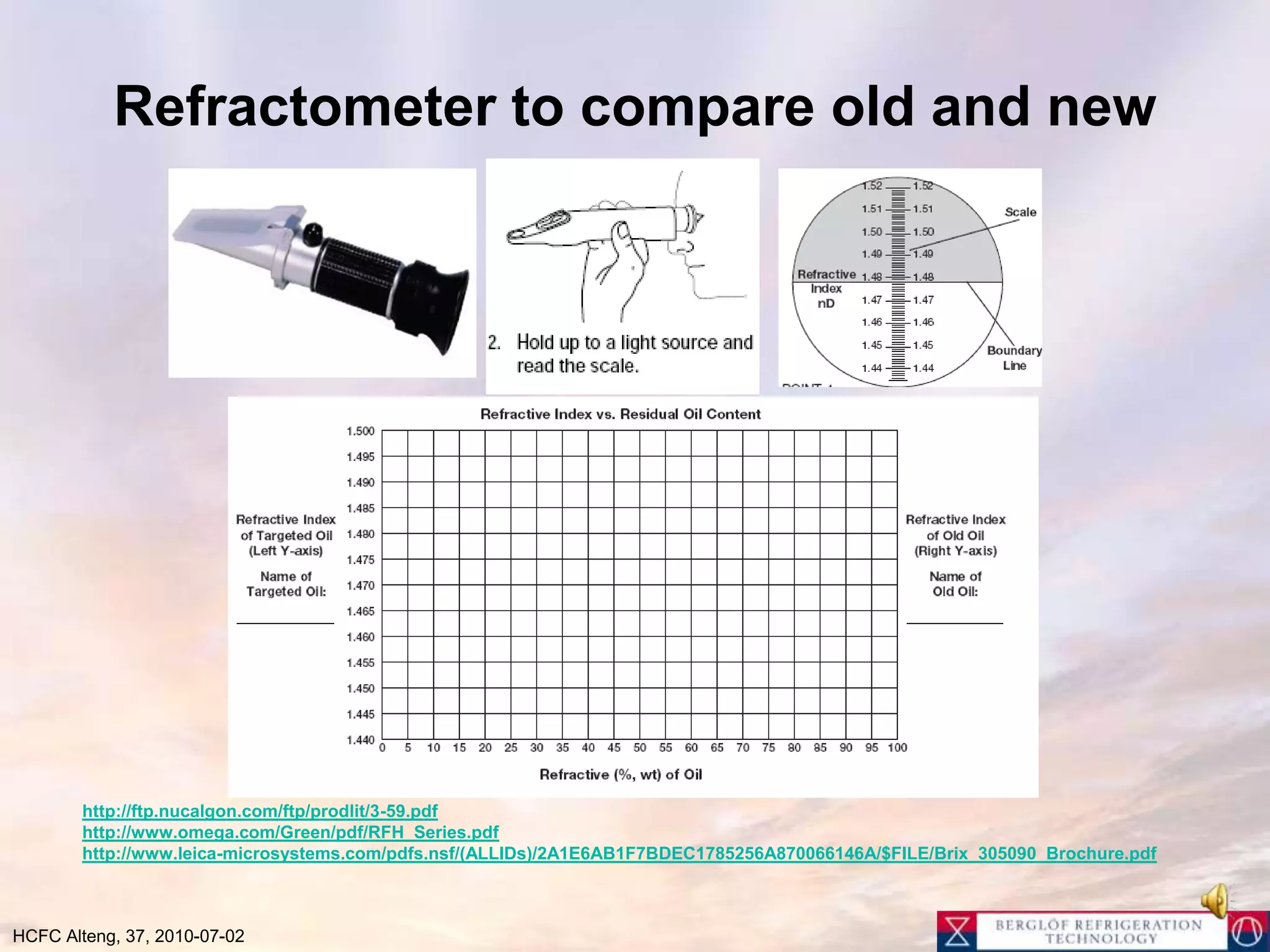
    Refractometer to compareold and newhttp://ftp.nucalgon.com/ftp/prodlit/3-59.pdfhttp://www.omega.com/Green/pdf/RFH_Series.pdfhttp://www.leica-microsystems.com/pdfs.nsf/(ALLIDs)/2A1E6AB1F7BDEC1785256A870066146A/$FILE/Brix_305090_Brochure.pdf
  • 55.
  • 56.
    REQUIREMENTS FOR SAFERETROFIT* LESS THAN 100 PPM MOISTURETIGHTER ON CRITICAL APPLICATIONS* LESS THAN 1-5 % MINERAL OILOld oil with acid/moisture/contaminants desabilise new system* LESS THAN 200 PPM R-12 IN HFC-134a
  • 57.
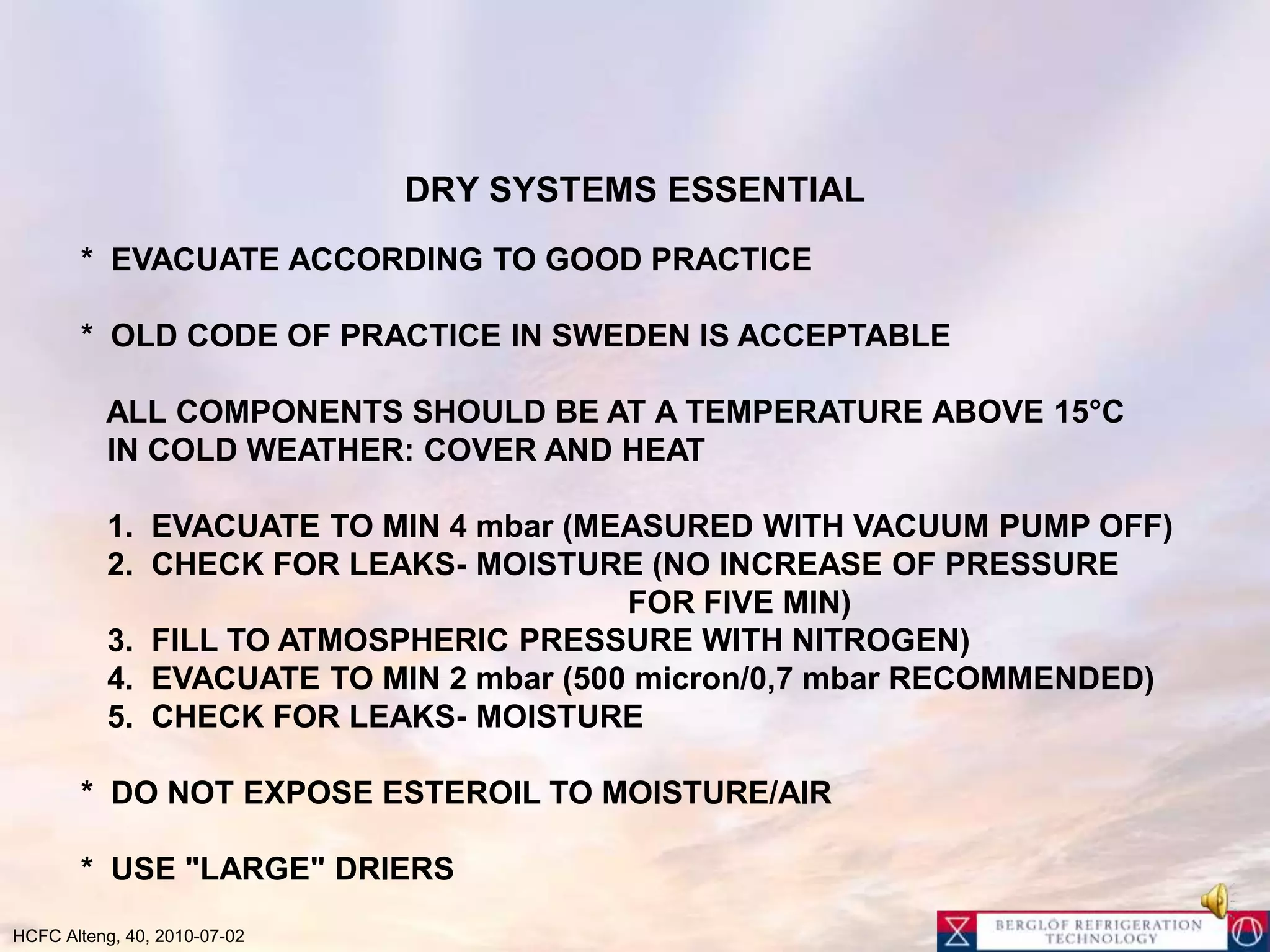
    DRY SYSTEMS ESSENTIAL* EVACUATE ACCORDING TO GOOD PRACTICE* OLD CODE OF PRACTICE IN SWEDEN IS ACCEPTABLE ALL COMPONENTS SHOULD BE AT A TEMPERATURE ABOVE 15°C IN COLD WEATHER: COVER AND HEAT 1. EVACUATE TO MIN 4 mbar (MEASURED WITH VACUUM PUMP OFF) 2. CHECK FOR LEAKS- MOISTURE (NO INCREASE OF PRESSURE FOR FIVE MIN) 3. FILL TO ATMOSPHERIC PRESSURE WITH NITROGEN) 4. EVACUATE TO MIN 2 mbar (500 micron/0,7 mbar RECOMMENDED) 5. CHECK FOR LEAKS- MOISTURE * DO NOT EXPOSE ESTEROIL TO MOISTURE/AIR * USE "LARGE" DRIERS
  • 58.
    EXPERIENCE OF RETROFITSTO HFC HUNDREDS OF THOUSANDS RETROFITTED SYSTEMS PERFORMANCE SIMILAR TO THAT OF CFC/HCFC
  • 59.
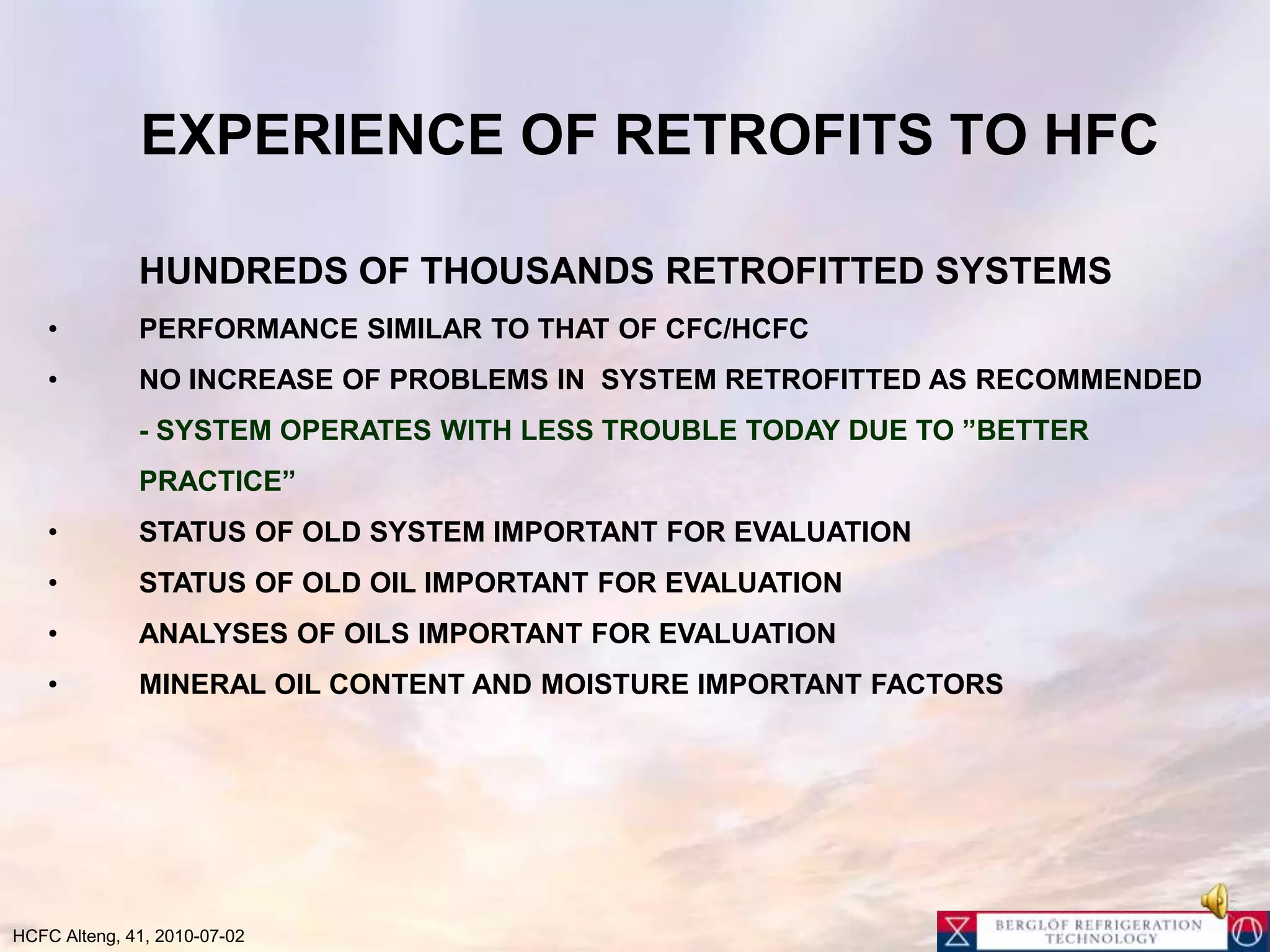
    NO INCREASE OFPROBLEMS IN SYSTEM RETROFITTED AS RECOMMENDED- SYSTEM OPERATES WITH LESS TROUBLE TODAY DUE TO ”BETTER PRACTICE” STATUS OF OLD SYSTEM IMPORTANT FOR EVALUATION
  • 60.
    STATUS OF OLDOIL IMPORTANT FOR EVALUATION
  • 61.
    ANALYSES OF OILSIMPORTANT FOR EVALUATION
  • 62.
    MINERAL OILCONTENT AND MOISTURE IMPORTANT FACTORSIDENTIFIED PROBLEMSESTER OILS ARE HYGROSCOPIC (ABSORB MOISTURE)SPECIAL HANDLING OF OIL NECESSARYA FEW COMPONENTS MIGHT BE UNSUITABLEEQUIPMENT SHOULD BE CHECKED PRIOR TO RETROFITHFC WILL CHANGE OIL CHARACTERISTICS IN SYSTEMCARE SHOULD BE TAKEN SPECIALLY IN SCREW AND ROTARY COMPRESSORS NEED SPECIAL ATTENTION
  • 63.