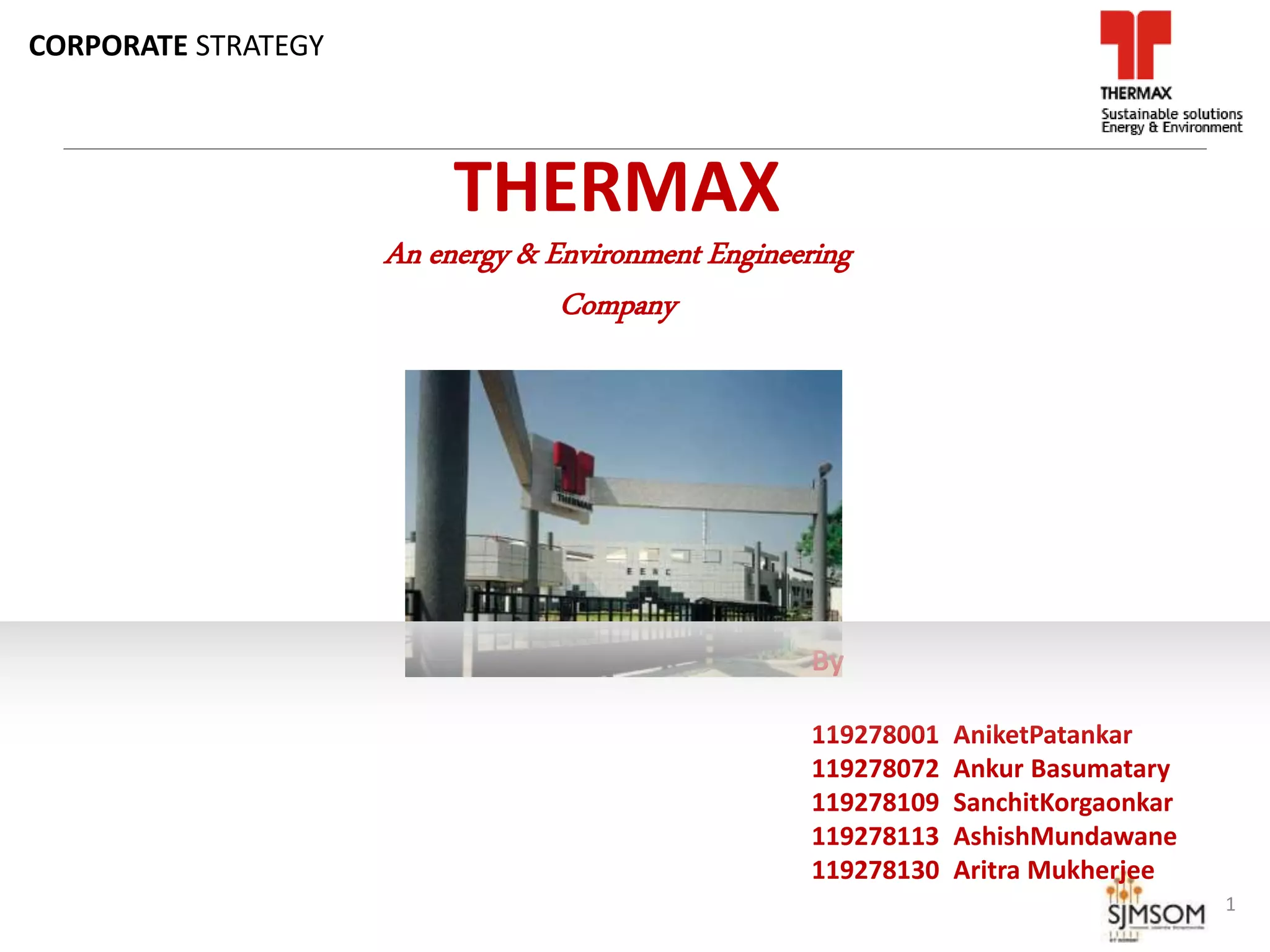
THERMAX
An energy & Environment Engineering
Company
By
119278001 AniketPatankar
119278072 Ankur Basumatary
119278109 SanchitKorgaonkar
119278113 AshishMundawane
119278130 Aritra Mukherjee
1
CORPORATE STRATEGY
Index
Industry Overview
Thermax Overview
Strategic Initiatives for Sustainable Growth
Sequential Combination Strategies
Environment and Organizational Appraisal
2
CORPORATE STRATEGY
• Product/
equipment of
high value,
durable
• Economic asset
life 3 years
.
Used as plant and
machinery for
agricultural, industrial
and commercial
(transportation etc.)
purpose in production/
service delivery process
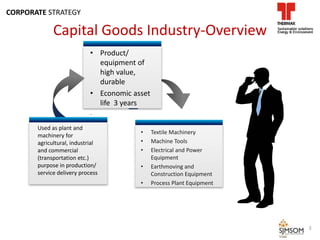
• Textile Machinery
• Machine Tools
• Electrical and Power
Equipment
• Earthmoving and
Construction Equipment
• Process Plant Equipment
Capital Goods Industry-Overview
3
CORPORATE STRATEGY
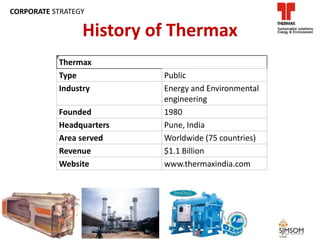
History of Thermax
Thermax
Type Public
Industry Energy and Environmental
engineering
Founded 1980
Headquarters Pune, India
Area served Worldwide (75 countries)
Revenue $1.1 Billion
Website www.thermaxindia.com
4
CORPORATE STRATEGY
To be a globally respected, high performance organization, offering
sustainable solutions in energy & environment
• Aspire to become a leading technology company with a global outlook
delivering world-class products and services to customers.
• Fulfill the needs of our customers – best understood through an
enlightened partnership with him.
• Expand and define new markets by expanding the frontiers of research
and engineering and customer applications in our chosen field of
business..
• Contribute substantially to the global priority areas of energy
conservation, environment protection and enrichment of society..
• Respect
• Commitment
• Honesty and integrity
• Concern for Society and the Environment
5
CORPORATE STRATEGY
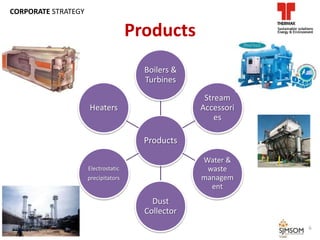
Products
Boilers &
Turbines
Stream
Accessori
es
Water &
waste
managem
ent
Dust
Collector
Electrostatic
precipitators
Heaters
Products
6
CORPORATE STRATEGY
7
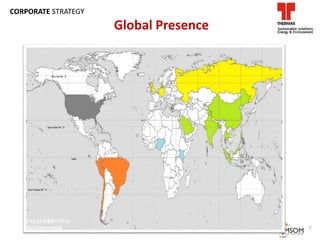
Global Presence
CORPORATE STRATEGY
Pune
Spread across 50 acres with manufacturing set-up of 65000 sq meters
capable of producing boilers and chillers
Manufacturing Facility
Paudh
Spread across 47 acres with manufacturing area of 110000 sq meters.
This plant has capacity to manufacture 20000 cu.m/yr of resin
Savli
Spread across 100 acres capable to address the need of large size field
erected boilers & heaters
Mundra
Spread across 10 acres. Port based assembly facility developed for
shipment of large –size plants
China
Spread across 6.5 acres. Green-field project completed with an
investment of USD 11 Million 8
CORPORATE STRATEGY
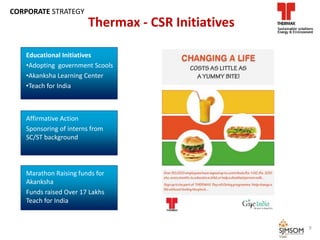
Educational Initiatives
•Adopting government Scools
•Akanksha Learning Center
•Teach for India
Affirmative Action
Sponsoring of interns from
SC/ST background
Marathon Raising funds for
Akanksha
Funds raised Over 17 Lakhs
Teach for India
9
Thermax - CSR Initiatives
CORPORATE STRATEGY
10
CORPORATE STRATEGY
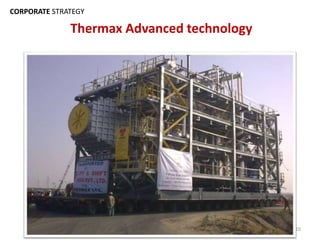
Thermax Advanced technology
Strategic Initiatives for Sustainable Growth
Capitalize on fossil growth
Through Efficiency Improvement
•Introduction of
supercritical and emission
control technologies to
improve efficiency and
reduce carbon emissions of
upcoming power plants
•Combined Cycle Offerings
•Large Size
CFBC’s(circulating FBC)
Creating a Green Portfolio / Focus on
Environmental Businesses
•Waste to Energy
•Renewable energy
•Environmental Businesses
11
CORPORATE STRATEGY
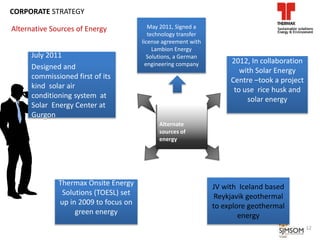
Alternate
sources of
energy
JV with Iceland based
Reykjavik geothermal
to explore geothermal
energy
May 2011, Signed a
technology transfer
license agreement with
Lambion Energy
Solutions, a German
engineering company
Thermax Onsite Energy
Solutions (TOESL) set
up in 2009 to focus on
green energy
July 2011
Designed and
commissioned first of its
kind solar air
conditioning system at
Solar Energy Center at
Gurgon
2012, In collaboration
with Solar Energy
Centre –took a project
to use rice husk and
solar energy
12
Alternative Sources of Energy
CORPORATE STRATEGY
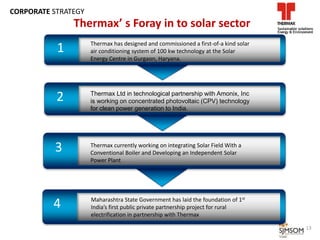
1
2
3
4
Thermax Ltd in technological partnership with Amonix, Inc
is working on concentrated photovoltaic (CPV) technology
for clean power generation to India.
Thermax has designed and commissioned a first-of-a kind solar
air conditioning system of 100 kw technology at the Solar
Energy Centre in Gurgaon, Haryana.
Thermax currently working on integrating Solar Field With a
Conventional Boiler and Developing an Independent Solar
Power Plant
Maharashtra State Government has laid the foundation of 1st
India’s first public private partnership project for rural
electrification in partnership with Thermax
Thermax’ s Foray in to solar sector
13
CORPORATE STRATEGY
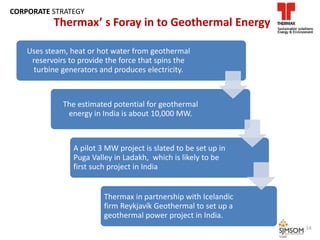
Uses steam, heat or hot water from geothermal
reservoirs to provide the force that spins the
turbine generators and produces electricity.
The estimated potential for geothermal
energy in India is about 10,000 MW.
A pilot 3 MW project is slated to be set up in
Puga Valley in Ladakh, which is likely to be
first such project in India
Thermax in partnership with Icelandic
firm Reykjavík Geothermal to set up a
geothermal power project in India.
14
Thermax’ s Foray in to Geothermal Energy
CORPORATE STRATEGY
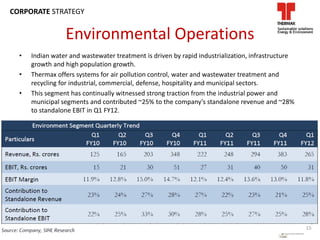
Environmental Operations
• Indian water and wastewater treatment is driven by rapid industrialization, infrastructure
growth and high population growth.
• Thermax offers systems for air pollution control, water and wastewater treatment and
recycling for industrial, commercial, defense, hospitality and municipal sectors.
• This segment has continually witnessed strong traction from the industrial power and
municipal segments and contributed ~25% to the company’s standalone revenue and ~28%
to standalone EBIT in Q1 FY12.
15
CORPORATE STRATEGY
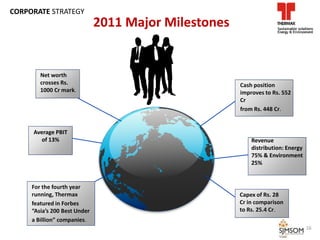
Cash position
improves to Rs. 552
Cr
from Rs. 448 Cr.
Capex of Rs. 28
Cr in comparison
to Rs. 25.4 Cr.
Net worth
crosses Rs.
1000 Cr mark.
For the fourth year
running, Thermax
featured in Forbes
“Asia’s 200 Best Under
a Billion” companies.
2011 Major Milestones
Average PBIT
of 13%
16
Revenue
distribution: Energy
75% & Environment
25%
CORPORATE STRATEGY
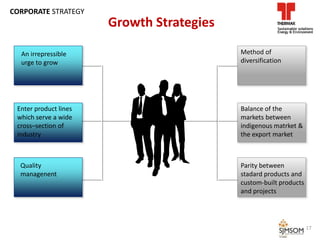
Method of
diversification
Balance of the
markets between
indigenous matrket &
the export market
Parity between
stadard products and
custom-built products
and projects
An irrepressible
urge to grow
Enter product lines
which serve a wide
cross–section of
industry
Quality
managenent
Growth Strategies
17
CORPORATE STRATEGY
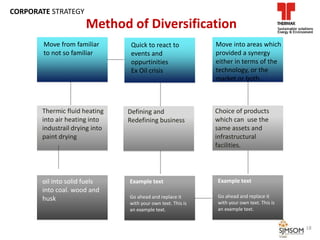
Thermic fluid heating
into air heating into
industrail drying into
paint drying
Move from familiar
to not so familiar
oil into solid fuels
into coal. wood and
husk
Defining and
Redefining business
Quick to react to
events and
oppurtinities
Ex Oil crisis
Example text
Go ahead and replace it
with your own text. This is
an example text.
Choice of products
which can use the
same assets and
infrastructural
facilities.
Move into areas which
provided a synergy
either in terms of the
technology, or the
market or both.
Example text
Go ahead and replace it
with your own text. This is
an example text.
Method of Diversification
18
CORPORATE STRATEGY
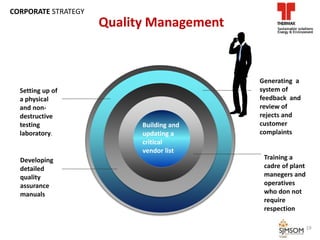
Training a
cadre of plant
manegers and
operatives
who don not
require
respection
Setting up of
a physical
and non-
destructive
testing
laboratory.
Developing
detailed
quality
assurance
manuals
Building and
updating a
critical
vendor list
Generating a
system of
feedback and
review of
rejects and
customer
complaints
Quality Management
19
CORPORATE STRATEGY
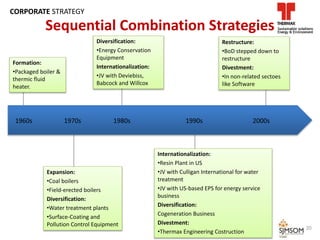
Sequential Combination Strategies
Formation:
•Packaged boiler &
thermic fluid
heater.
Internationalization:
•Resin Plant in US
•JV with Culligan International for water
treatment
•JV with US-based EPS for energy service
business
Diversification:
Cogeneration Business
Divestment:
•Thermax Engineering Costruction
Expansion:
•Coal boilers
•Field-erected boilers
Diversification:
•Water treatment plants
•Surface-Coating and
Pollution Control Equipment
Diversification:
•Energy Conservation
Equipment
Internationalization:
•JV with Deviebiss,
Babcock and Willcox
Restructure:
•BoD stepped down to
restructure
Divestment:
•In non-related sectoes
like Software
1960s 1970s 1980s 1990s 2000s
20
CORPORATE STRATEGY
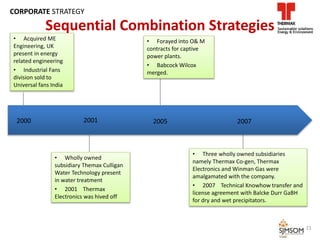
Sequential Combination Strategies
• Acquired ME
Engineering, UK
present in energy
related engineering
• Industrial Fans
division sold to
Universal fans India
• Three wholly owned subsidiaries
namely Thermax Co-gen, Thermax
Electronics and Winman Gas were
amalgamated with the company.
• 2007 Technical Knowhow transfer and
license agreement with Balcke Durr GaBH
for dry and wet precipitators.
• Wholly owned
subsidiary Themax Culligan
Water Technology present
in water treatment
• 2001 Thermax
Electronics was hived off
• Forayed into O& M
contracts for captive
power plants.
• Babcock Wilcox
merged.
2000 2001 2005 2007
21
CORPORATE STRATEGY
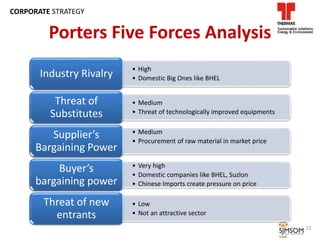
Porters Five Forces Analysis
• High
• Domestic Big Ones like BHELIndustry Rivalry
• Medium
• Threat of technologically improved equipments
Threat of
Substitutes
• Medium
• Procurement of raw material in market price
Supplier’s
Bargaining Power
• Very high
• Domestic companies like BHEL, Suzlon
• Chinese Imports create pressure on price
Buyer’s
bargaining power
• Low
• Not an attractive sector
Threat of new
entrants
22
CORPORATE STRATEGY
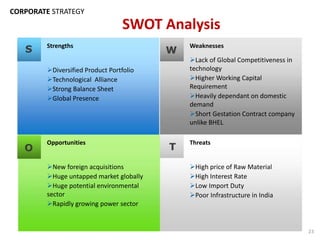
Strengths
Diversified Product Portfolio
Technological Alliance
Strong Balance Sheet
Global Presence
Opportunities
New foreign acquisitions
Huge untapped market globally
Huge potential environmental
sector
Rapidly growing power sector
Threats
High price of Raw Material
High Interest Rate
Low Import Duty
Poor Infrastructure in India
Weaknesses
Lack of Global Competitiveness in
technology
Higher Working Capital
Requirement
Heavily dependant on domestic
demand
Short Gestation Contract company
unlike BHEL
S W
TO
SWOT Analysis
CORPORATE STRATEGY
23
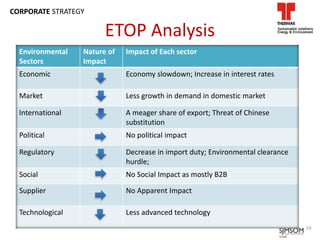
ETOP Analysis
24
Environmental
Sectors
Nature of
Impact
Impact of Each sector
Economic Economy slowdown; Increase in interest rates
Market Less growth in demand in domestic market
International A meager share of export; Threat of Chinese
substitution
Political No political impact
Regulatory Decrease in import duty; Environmental clearance
hurdle;
Social No Social Impact as mostly B2B
Supplier No Apparent Impact
Technological Less advanced technology
CORPORATE STRATEGY
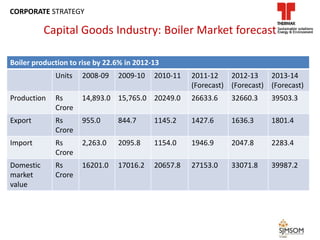
Boiler production to rise by 22.6% in 2012-13
Units 2008-09 2009-10 2010-11 2011-12
(Forecast)
2012-13
(Forecast)
2013-14
(Forecast)
Production Rs
Crore
14,893.0 15,765.0 20249.0 26633.6 32660.3 39503.3
Export Rs
Crore
955.0 844.7 1145.2 1427.6 1636.3 1801.4
Import Rs
Crore
2,263.0 2095.8 1154.0 1946.9 2047.8 2283.4
Domestic
market
value
Rs
Crore
16201.0 17016.2 20657.8 27153.0 33071.8 39987.2
Capital Goods Industry: Boiler Market forecast
CORPORATE STRATEGY
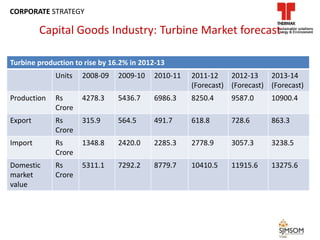
Turbine production to rise by 16.2% in 2012-13
Units 2008-09 2009-10 2010-11 2011-12
(Forecast)
2012-13
(Forecast)
2013-14
(Forecast)
Production Rs
Crore
4278.3 5436.7 6986.3 8250.4 9587.0 10900.4
Export Rs
Crore
315.9 564.5 491.7 618.8 728.6 863.3
Import Rs
Crore
1348.8 2420.0 2285.3 2778.9 3057.3 3238.5
Domestic
market
value
Rs
Crore
5311.1 7292.2 8779.7 10410.5 11915.6 13275.6
Capital Goods Industry: Turbine Market forecast
CORPORATE STRATEGY
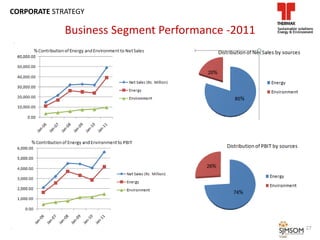
Business Segment Performance -2011
27
CORPORATE STRATEGY
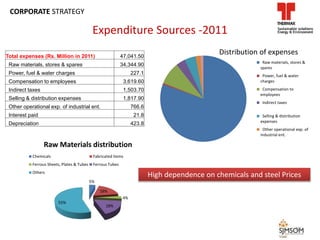
Expenditure Sources -2011
28
CORPORATE STRATEGY
Total expenses (Rs. Million in 2011) 47,041.50
Raw materials, stores & spares 34,344.90
Power, fuel & water charges 227.1
Compensation to employees 3,619.60
Indirect taxes 1,503.70
Selling & distribution expenses 1,817.90
Other operational exp. of industrial ent. 766.6
Interest paid 21.8
Depreciation 423.8
Raw materials, stores &
spares
Power, fuel & water
charges
Compensation to
employees
Indirect taxes
Selling & distribution
expenses
Other operational exp. of
industrial ent.
Distribution of expenses
5%
18%
4%
18%
55%
Raw Materials distribution
Chemicals Fabricated Items
Ferrous Sheets, Plates & Tubes Ferrous Tubes
Others
High dependence on chemicals and steel Prices
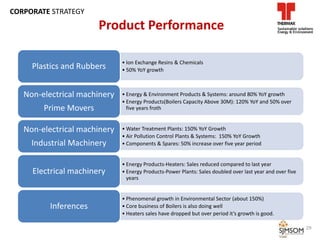
• Ion Exchange Resins & Chemicals
• 50% YoY growthPlastics and Rubbers
• Energy & Environment Products & Systems: around 80% YoY growth
• Energy Products(Boilers Capacity Above 30M): 120% YoY and 50% over
five years froth
Non-electrical machinery
Prime Movers
• Water Treatment Plants: 150% YoY Growth
• Air Pollution Control Plants & Systems: 150% YoY Growth
• Components & Spares: 50% increase over five year period
Non-electrical machinery
Industrial Machinery
• Energy Products-Heaters: Sales reduced compared to last year
• Energy Products-Power Plants: Sales doubled over last year and over five
years
Electrical machinery
• Phenomenal growth in Environmental Sector (about 150%)
• Core business of Boilers is also doing well
• Heaters sales have dropped but over period it’s growth is good.
Inferences
Product Performance
29
CORPORATE STRATEGY
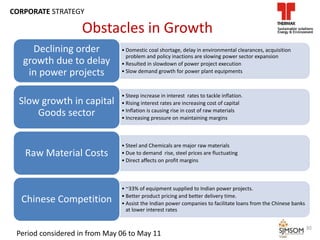
Obstacles in Growth
Period considered in from May 06 to May 11
• Domestic coal shortage, delay in environmental clearances, acquisition
problem and policy inactions are slowing power sector expansion
• Resulted in slowdown of power project execution
• Slow demand growth for power plant equipments
Declining order
growth due to delay
in power projects
• Steep increase in interest rates to tackle inflation.
• Rising interest rates are increasing cost of capital
• Inflation is causing rise in cost of raw materials
• Increasing pressure on maintaining margins
Slow growth in capital
Goods sector
• Steel and Chemicals are major raw materials
• Due to demand rise, steel prices are fluctuating
• Direct affects on profit margins
Raw Material Costs
• ~33% of equipment supplied to Indian power projects.
• Better product pricing and better delivery time.
• Assist the Indian power companies to facilitate loans from the Chinese banks
at lower interest rates
Chinese Competition
30
CORPORATE STRATEGY
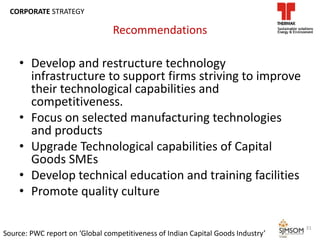
Recommendations
• Develop and restructure technology
infrastructure to support firms striving to improve
their technological capabilities and
competitiveness.
• Focus on selected manufacturing technologies
and products
• Upgrade Technological capabilities of Capital
Goods SMEs
• Develop technical education and training facilities
• Promote quality culture
Source: PWC report on ‘Global competitiveness of Indian Capital Goods Industry’
31
CORPORATE STRATEGY
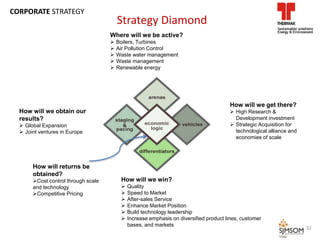
How will we win?
 Quality
 Speed to Market
 After-sales Service
 Enhance Market Position
 Build technology leadership
 Increase emphasis on diversified product lines, customer
bases, and markets
How will we get there?
 High Research &
Development investment
 Strategic Acquisition for
technological alliance and
economies of scale
Where will we be active?
 Boilers, Turbines
 Air Pollution Control
 Waste water management
 Waste management
 Renewable energy
How will we obtain our
results?
 Global Expansion
 Joint ventures in Europe
How will returns be
obtained?
Cost control through scale
and technology
Competitive Pricing
32
Strategy Diamond
CORPORATE STRATEGY
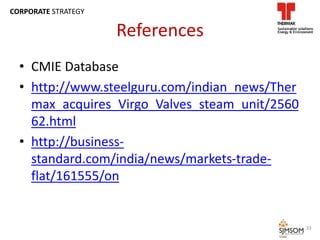
References
• CMIE Database
• http://www.steelguru.com/indian_news/Ther
max_acquires_Virgo_Valves_steam_unit/2560
62.html
• http://business-
standard.com/india/news/markets-trade-
flat/161555/on
33
CORPORATE STRATEGY
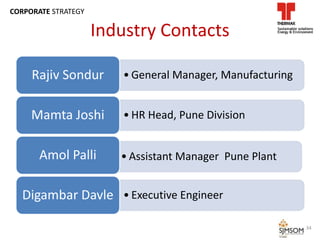
Industry Contacts
• General Manager, ManufacturingRajiv Sondur
• HR Head, Pune DivisionMamta Joshi
• Assistant Manager Pune PlantAmol Palli
• Executive EngineerDigambar Davle
34
CORPORATE STRATEGY
35

Thermax presentation

  • 1.
    THERMAX An energy &Environment Engineering Company By 119278001 AniketPatankar 119278072 Ankur Basumatary 119278109 SanchitKorgaonkar 119278113 AshishMundawane 119278130 Aritra Mukherjee 1 CORPORATE STRATEGY
  • 2.
    Index Industry Overview Thermax Overview StrategicInitiatives for Sustainable Growth Sequential Combination Strategies Environment and Organizational Appraisal 2 CORPORATE STRATEGY
  • 3.
    • Product/ equipment of highvalue, durable • Economic asset life 3 years . Used as plant and machinery for agricultural, industrial and commercial (transportation etc.) purpose in production/ service delivery process • Textile Machinery • Machine Tools • Electrical and Power Equipment • Earthmoving and Construction Equipment • Process Plant Equipment Capital Goods Industry-Overview 3 CORPORATE STRATEGY
  • 4.
    History of Thermax Thermax TypePublic Industry Energy and Environmental engineering Founded 1980 Headquarters Pune, India Area served Worldwide (75 countries) Revenue $1.1 Billion Website www.thermaxindia.com 4 CORPORATE STRATEGY
  • 5.
    To be aglobally respected, high performance organization, offering sustainable solutions in energy & environment • Aspire to become a leading technology company with a global outlook delivering world-class products and services to customers. • Fulfill the needs of our customers – best understood through an enlightened partnership with him. • Expand and define new markets by expanding the frontiers of research and engineering and customer applications in our chosen field of business.. • Contribute substantially to the global priority areas of energy conservation, environment protection and enrichment of society.. • Respect • Commitment • Honesty and integrity • Concern for Society and the Environment 5 CORPORATE STRATEGY
  • 6.
  • 7.
  • 8.
    Pune Spread across 50acres with manufacturing set-up of 65000 sq meters capable of producing boilers and chillers Manufacturing Facility Paudh Spread across 47 acres with manufacturing area of 110000 sq meters. This plant has capacity to manufacture 20000 cu.m/yr of resin Savli Spread across 100 acres capable to address the need of large size field erected boilers & heaters Mundra Spread across 10 acres. Port based assembly facility developed for shipment of large –size plants China Spread across 6.5 acres. Green-field project completed with an investment of USD 11 Million 8 CORPORATE STRATEGY
  • 9.
    Educational Initiatives •Adopting governmentScools •Akanksha Learning Center •Teach for India Affirmative Action Sponsoring of interns from SC/ST background Marathon Raising funds for Akanksha Funds raised Over 17 Lakhs Teach for India 9 Thermax - CSR Initiatives CORPORATE STRATEGY
  • 10.
  • 11.
    Strategic Initiatives forSustainable Growth Capitalize on fossil growth Through Efficiency Improvement •Introduction of supercritical and emission control technologies to improve efficiency and reduce carbon emissions of upcoming power plants •Combined Cycle Offerings •Large Size CFBC’s(circulating FBC) Creating a Green Portfolio / Focus on Environmental Businesses •Waste to Energy •Renewable energy •Environmental Businesses 11 CORPORATE STRATEGY
  • 12.
    Alternate sources of energy JV withIceland based Reykjavik geothermal to explore geothermal energy May 2011, Signed a technology transfer license agreement with Lambion Energy Solutions, a German engineering company Thermax Onsite Energy Solutions (TOESL) set up in 2009 to focus on green energy July 2011 Designed and commissioned first of its kind solar air conditioning system at Solar Energy Center at Gurgon 2012, In collaboration with Solar Energy Centre –took a project to use rice husk and solar energy 12 Alternative Sources of Energy CORPORATE STRATEGY
  • 13.
    1 2 3 4 Thermax Ltd intechnological partnership with Amonix, Inc is working on concentrated photovoltaic (CPV) technology for clean power generation to India. Thermax has designed and commissioned a first-of-a kind solar air conditioning system of 100 kw technology at the Solar Energy Centre in Gurgaon, Haryana. Thermax currently working on integrating Solar Field With a Conventional Boiler and Developing an Independent Solar Power Plant Maharashtra State Government has laid the foundation of 1st India’s first public private partnership project for rural electrification in partnership with Thermax Thermax’ s Foray in to solar sector 13 CORPORATE STRATEGY
  • 14.
    Uses steam, heator hot water from geothermal reservoirs to provide the force that spins the turbine generators and produces electricity. The estimated potential for geothermal energy in India is about 10,000 MW. A pilot 3 MW project is slated to be set up in Puga Valley in Ladakh, which is likely to be first such project in India Thermax in partnership with Icelandic firm Reykjavík Geothermal to set up a geothermal power project in India. 14 Thermax’ s Foray in to Geothermal Energy CORPORATE STRATEGY
  • 15.
    Environmental Operations • Indianwater and wastewater treatment is driven by rapid industrialization, infrastructure growth and high population growth. • Thermax offers systems for air pollution control, water and wastewater treatment and recycling for industrial, commercial, defense, hospitality and municipal sectors. • This segment has continually witnessed strong traction from the industrial power and municipal segments and contributed ~25% to the company’s standalone revenue and ~28% to standalone EBIT in Q1 FY12. 15 CORPORATE STRATEGY
  • 16.
    Cash position improves toRs. 552 Cr from Rs. 448 Cr. Capex of Rs. 28 Cr in comparison to Rs. 25.4 Cr. Net worth crosses Rs. 1000 Cr mark. For the fourth year running, Thermax featured in Forbes “Asia’s 200 Best Under a Billion” companies. 2011 Major Milestones Average PBIT of 13% 16 Revenue distribution: Energy 75% & Environment 25% CORPORATE STRATEGY
  • 17.
    Method of diversification Balance ofthe markets between indigenous matrket & the export market Parity between stadard products and custom-built products and projects An irrepressible urge to grow Enter product lines which serve a wide cross–section of industry Quality managenent Growth Strategies 17 CORPORATE STRATEGY
  • 18.
    Thermic fluid heating intoair heating into industrail drying into paint drying Move from familiar to not so familiar oil into solid fuels into coal. wood and husk Defining and Redefining business Quick to react to events and oppurtinities Ex Oil crisis Example text Go ahead and replace it with your own text. This is an example text. Choice of products which can use the same assets and infrastructural facilities. Move into areas which provided a synergy either in terms of the technology, or the market or both. Example text Go ahead and replace it with your own text. This is an example text. Method of Diversification 18 CORPORATE STRATEGY
  • 19.
    Training a cadre ofplant manegers and operatives who don not require respection Setting up of a physical and non- destructive testing laboratory. Developing detailed quality assurance manuals Building and updating a critical vendor list Generating a system of feedback and review of rejects and customer complaints Quality Management 19 CORPORATE STRATEGY
  • 20.
    Sequential Combination Strategies Formation: •Packagedboiler & thermic fluid heater. Internationalization: •Resin Plant in US •JV with Culligan International for water treatment •JV with US-based EPS for energy service business Diversification: Cogeneration Business Divestment: •Thermax Engineering Costruction Expansion: •Coal boilers •Field-erected boilers Diversification: •Water treatment plants •Surface-Coating and Pollution Control Equipment Diversification: •Energy Conservation Equipment Internationalization: •JV with Deviebiss, Babcock and Willcox Restructure: •BoD stepped down to restructure Divestment: •In non-related sectoes like Software 1960s 1970s 1980s 1990s 2000s 20 CORPORATE STRATEGY
  • 21.
    Sequential Combination Strategies •Acquired ME Engineering, UK present in energy related engineering • Industrial Fans division sold to Universal fans India • Three wholly owned subsidiaries namely Thermax Co-gen, Thermax Electronics and Winman Gas were amalgamated with the company. • 2007 Technical Knowhow transfer and license agreement with Balcke Durr GaBH for dry and wet precipitators. • Wholly owned subsidiary Themax Culligan Water Technology present in water treatment • 2001 Thermax Electronics was hived off • Forayed into O& M contracts for captive power plants. • Babcock Wilcox merged. 2000 2001 2005 2007 21 CORPORATE STRATEGY
  • 22.
    Porters Five ForcesAnalysis • High • Domestic Big Ones like BHELIndustry Rivalry • Medium • Threat of technologically improved equipments Threat of Substitutes • Medium • Procurement of raw material in market price Supplier’s Bargaining Power • Very high • Domestic companies like BHEL, Suzlon • Chinese Imports create pressure on price Buyer’s bargaining power • Low • Not an attractive sector Threat of new entrants 22 CORPORATE STRATEGY
  • 23.
    Strengths Diversified Product Portfolio TechnologicalAlliance Strong Balance Sheet Global Presence Opportunities New foreign acquisitions Huge untapped market globally Huge potential environmental sector Rapidly growing power sector Threats High price of Raw Material High Interest Rate Low Import Duty Poor Infrastructure in India Weaknesses Lack of Global Competitiveness in technology Higher Working Capital Requirement Heavily dependant on domestic demand Short Gestation Contract company unlike BHEL S W TO SWOT Analysis CORPORATE STRATEGY 23
  • 24.
    ETOP Analysis 24 Environmental Sectors Nature of Impact Impactof Each sector Economic Economy slowdown; Increase in interest rates Market Less growth in demand in domestic market International A meager share of export; Threat of Chinese substitution Political No political impact Regulatory Decrease in import duty; Environmental clearance hurdle; Social No Social Impact as mostly B2B Supplier No Apparent Impact Technological Less advanced technology CORPORATE STRATEGY
  • 25.
    Boiler production torise by 22.6% in 2012-13 Units 2008-09 2009-10 2010-11 2011-12 (Forecast) 2012-13 (Forecast) 2013-14 (Forecast) Production Rs Crore 14,893.0 15,765.0 20249.0 26633.6 32660.3 39503.3 Export Rs Crore 955.0 844.7 1145.2 1427.6 1636.3 1801.4 Import Rs Crore 2,263.0 2095.8 1154.0 1946.9 2047.8 2283.4 Domestic market value Rs Crore 16201.0 17016.2 20657.8 27153.0 33071.8 39987.2 Capital Goods Industry: Boiler Market forecast CORPORATE STRATEGY
  • 26.
    Turbine production torise by 16.2% in 2012-13 Units 2008-09 2009-10 2010-11 2011-12 (Forecast) 2012-13 (Forecast) 2013-14 (Forecast) Production Rs Crore 4278.3 5436.7 6986.3 8250.4 9587.0 10900.4 Export Rs Crore 315.9 564.5 491.7 618.8 728.6 863.3 Import Rs Crore 1348.8 2420.0 2285.3 2778.9 3057.3 3238.5 Domestic market value Rs Crore 5311.1 7292.2 8779.7 10410.5 11915.6 13275.6 Capital Goods Industry: Turbine Market forecast CORPORATE STRATEGY
  • 27.
    Business Segment Performance-2011 27 CORPORATE STRATEGY
  • 28.
    Expenditure Sources -2011 28 CORPORATESTRATEGY Total expenses (Rs. Million in 2011) 47,041.50 Raw materials, stores & spares 34,344.90 Power, fuel & water charges 227.1 Compensation to employees 3,619.60 Indirect taxes 1,503.70 Selling & distribution expenses 1,817.90 Other operational exp. of industrial ent. 766.6 Interest paid 21.8 Depreciation 423.8 Raw materials, stores & spares Power, fuel & water charges Compensation to employees Indirect taxes Selling & distribution expenses Other operational exp. of industrial ent. Distribution of expenses 5% 18% 4% 18% 55% Raw Materials distribution Chemicals Fabricated Items Ferrous Sheets, Plates & Tubes Ferrous Tubes Others High dependence on chemicals and steel Prices
  • 29.
    • Ion ExchangeResins & Chemicals • 50% YoY growthPlastics and Rubbers • Energy & Environment Products & Systems: around 80% YoY growth • Energy Products(Boilers Capacity Above 30M): 120% YoY and 50% over five years froth Non-electrical machinery Prime Movers • Water Treatment Plants: 150% YoY Growth • Air Pollution Control Plants & Systems: 150% YoY Growth • Components & Spares: 50% increase over five year period Non-electrical machinery Industrial Machinery • Energy Products-Heaters: Sales reduced compared to last year • Energy Products-Power Plants: Sales doubled over last year and over five years Electrical machinery • Phenomenal growth in Environmental Sector (about 150%) • Core business of Boilers is also doing well • Heaters sales have dropped but over period it’s growth is good. Inferences Product Performance 29 CORPORATE STRATEGY
  • 30.
    Obstacles in Growth Periodconsidered in from May 06 to May 11 • Domestic coal shortage, delay in environmental clearances, acquisition problem and policy inactions are slowing power sector expansion • Resulted in slowdown of power project execution • Slow demand growth for power plant equipments Declining order growth due to delay in power projects • Steep increase in interest rates to tackle inflation. • Rising interest rates are increasing cost of capital • Inflation is causing rise in cost of raw materials • Increasing pressure on maintaining margins Slow growth in capital Goods sector • Steel and Chemicals are major raw materials • Due to demand rise, steel prices are fluctuating • Direct affects on profit margins Raw Material Costs • ~33% of equipment supplied to Indian power projects. • Better product pricing and better delivery time. • Assist the Indian power companies to facilitate loans from the Chinese banks at lower interest rates Chinese Competition 30 CORPORATE STRATEGY
  • 31.
    Recommendations • Develop andrestructure technology infrastructure to support firms striving to improve their technological capabilities and competitiveness. • Focus on selected manufacturing technologies and products • Upgrade Technological capabilities of Capital Goods SMEs • Develop technical education and training facilities • Promote quality culture Source: PWC report on ‘Global competitiveness of Indian Capital Goods Industry’ 31 CORPORATE STRATEGY
  • 32.
    How will wewin?  Quality  Speed to Market  After-sales Service  Enhance Market Position  Build technology leadership  Increase emphasis on diversified product lines, customer bases, and markets How will we get there?  High Research & Development investment  Strategic Acquisition for technological alliance and economies of scale Where will we be active?  Boilers, Turbines  Air Pollution Control  Waste water management  Waste management  Renewable energy How will we obtain our results?  Global Expansion  Joint ventures in Europe How will returns be obtained? Cost control through scale and technology Competitive Pricing 32 Strategy Diamond CORPORATE STRATEGY
  • 33.
    References • CMIE Database •http://www.steelguru.com/indian_news/Ther max_acquires_Virgo_Valves_steam_unit/2560 62.html • http://business- standard.com/india/news/markets-trade- flat/161555/on 33 CORPORATE STRATEGY
  • 34.
    Industry Contacts • GeneralManager, ManufacturingRajiv Sondur • HR Head, Pune DivisionMamta Joshi • Assistant Manager Pune PlantAmol Palli • Executive EngineerDigambar Davle 34 CORPORATE STRATEGY
  • 35.