BURNS
By
HimaSri Reddy
INTRODUCTION:-
• Heat is form of energy which when transferred to body produces
thermal injury in the form scalds &burns.
• Scalds :-
produced due to application of moist heat to body. The Boiling
liquids that can scald include water ,milk, oil etc.
• Burns:- produced due to application of dry heat.
min. temp for producing burn is 440 c for exposure of about 5 to
6 hours while 65 0 c for 2 seconds is sufficient to cause burns.
DEFINITION:-
•A burn is an injury which is
caused by application of heat /
chemical substance to external
or internal surface of body
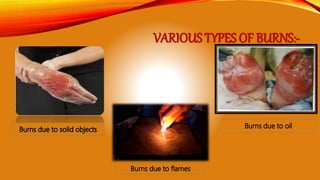
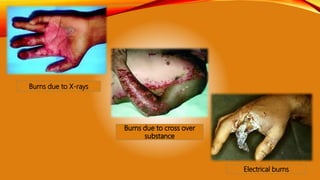
VARIOUS TYPES OF BURNS:-
Burns due to X-rays
Electrical burns
CLASSIFICATION:-
Based on depth
Based on surface area
Based on depth –
1)Hebra’s classification
2)Wilson’s classification
3)Dupuytren’s classification
DUPUYTREN’S CLASSIFICATION
• Classified depending on severity of burns.
• First degree- erythema then desquamation of superficial layer of
epidermis.
• Second degree- blister formation
• Third degree- destruction of epidermis
• Fourth degree- destruction of whole thickness of skin
• Fifth degree- destruction of muscles
• Sixth degree- destruction of bone,nerve trunks etc.
In practical situations Dupuytren’s
classification is limited to three degrees.
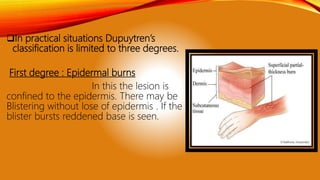
First degree : Epidermal burns
In this the lesion is
confined to the epidermis. There may be
Blistering without lose of epidermis . If the
blister bursts reddened base is seen.
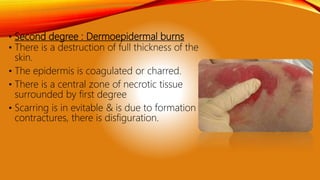
• Second degree : Dermoepidermal burns
• There is a destruction of full thickness of the
skin.
• The epidermis is coagulated or charred.
• There is a central zone of necrotic tissue
surrounded by first degree
• Scarring is in evitable & is due to formation
contractures, there is disfiguration.
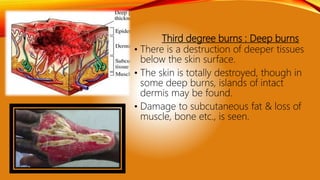
Third degree burns : Deep burns
• There is a destruction of deeper tissues
below the skin surface.
• The skin is totally destroyed, though in
some deep burns, islands of intact
dermis may be found.
• Damage to subcutaneous fat & loss of
muscle, bone etc., is seen.
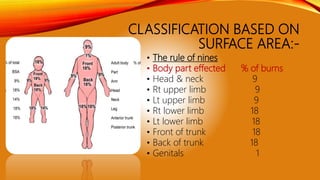
CLASSIFICATION BASED ON
SURFACE AREA:-
• The rule of nines
• Body part effected % of burns
• Head & neck 9
• Rt upper limb 9
• Lt upper limb 9
• Rt lower limb 18
• Lt lower limb 18
• Front of trunk 18
• Back of trunk 18
• Genitals 1
• Burn injury is more severe if heat applied is of great intensity
& exposure to heat is for long time.
• It also depends on area involved. Burns to face, genital,
lower part of abdomen is more dangerous.
• Infants & elderly people are more susceptible to
complications of burns.
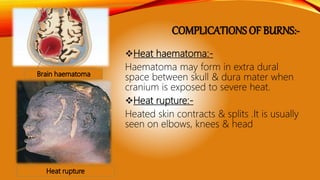
COMPLICATIONS OF BURNS:-
Heat haematoma:-
Haematoma may form in extra dural
space between skull & dura mater when
cranium is exposed to severe heat.
Heat rupture:-
Heated skin contracts & splits .It is usually
seen on elbows, knees & head
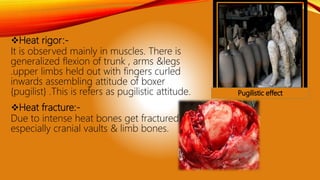
Heat rigor:-
It is observed mainly in muscles. There is
generalized flexion of trunk , arms &legs
.upper limbs held out with fingers curled
inwards assembling attitude of boxer
{pugilist} .This is refers as pugilistic attitude.
Heat fracture:-
Due to intense heat bones get fractured
especially cranial vaults & limb bones.
MANAGEMENT OF BURNS
• Mild or moderately severe-
First aid-
• Cool area with running water for 20 min.
• For chemical and eye burns, irrigate with copious volumes of water.
Pain relief-
• Paracetamol,codeine,morphine
• Airway and breathing should be ensured
• Circulation- signs for circulatory obstruction should be checked.
• Severe
 Airway and breathing-
• In case of airway burn and lung injury,arrange intubation before
airway swelling occurs.
Circulation-
• If > 10% body surface involved,commence fluid resuscitation.
• If > 10% deep partial thickness or full thickness burns,start feeding
within 6-18 hrs.
• Analgesia should be adequate.
• Closed dressing recommended for partial thickness burns.
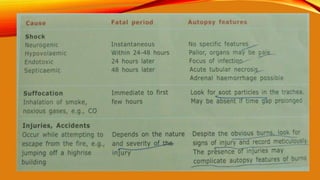
CAUSES OF DEATH IN BURNS
• Primary shock or neurogenic shock
• Secondary shock due to fluid loss
• Smoke inhalation
• Toxaemia
• Septicaemia
• biochemical disturbances
• Acute renal failure
• oedema of glottis & pulmonary oedema
• Malignant transformation of burns scar {marjolin’s ulcer} after years
of recovery
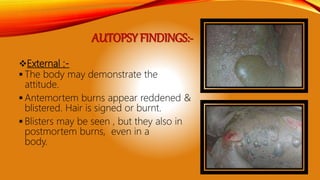
AUTOPSY FINDINGS:-
External :-
 The body may demonstrate the
attitude.
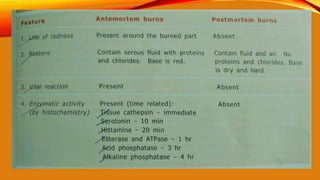
 Antemortem burns appear reddened &
blistered. Hair is signed or burnt.
 Blisters may be seen , but they also in
postmortem burns, even in a
body.
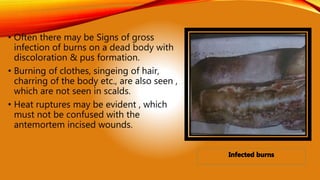
• Often there may be Signs of gross
infection of burns on a dead body with
discoloration & pus formation.
• Burning of clothes, singeing of hair,
charring of the body etc., are also seen ,
which are not seen in scalds.
• Heat ruptures may be evident , which
must not be confused with the
antemortem incised wounds.
Internal :-
• Blood may be cherry red in colour, due to the presence of
carboxyhaemoglobin.
• Extra dural heat haematoma may be seen
• Soot particles or carbonaceous material may be seen in the
respiratory passages due to smoke inhalation.
• Curling’s ulcers may be seen on stomach are duodenum.
• Serous pleural are common. Lungs are congested & appear
“cooked”
• Spleen & adrenal gland may be enlarged, congested & softened.
REFERENCES:-
• V.v.pillay
Text book of Forensic science & Toxicology.
• Dr. Ks. Narayan Reddy
The synopsis of Forensic Science & Toxicology.
THANK
YOU….

Burns by himasri reddy

  • 1.
  • 2.
    INTRODUCTION:- • Heat isform of energy which when transferred to body produces thermal injury in the form scalds &burns. • Scalds :- produced due to application of moist heat to body. The Boiling liquids that can scald include water ,milk, oil etc. • Burns:- produced due to application of dry heat. min. temp for producing burn is 440 c for exposure of about 5 to 6 hours while 65 0 c for 2 seconds is sufficient to cause burns.
  • 3.
    DEFINITION:- •A burn isan injury which is caused by application of heat / chemical substance to external or internal surface of body
  • 4.
  • 5.
    Burns due toX-rays Electrical burns
  • 6.
    CLASSIFICATION:- Based on depth Basedon surface area Based on depth – 1)Hebra’s classification 2)Wilson’s classification 3)Dupuytren’s classification
  • 7.
    DUPUYTREN’S CLASSIFICATION • Classifieddepending on severity of burns. • First degree- erythema then desquamation of superficial layer of epidermis. • Second degree- blister formation • Third degree- destruction of epidermis • Fourth degree- destruction of whole thickness of skin • Fifth degree- destruction of muscles • Sixth degree- destruction of bone,nerve trunks etc.
  • 8.
    In practical situationsDupuytren’s classification is limited to three degrees. First degree : Epidermal burns In this the lesion is confined to the epidermis. There may be Blistering without lose of epidermis . If the blister bursts reddened base is seen.
  • 9.
    • Second degree: Dermoepidermal burns • There is a destruction of full thickness of the skin. • The epidermis is coagulated or charred. • There is a central zone of necrotic tissue surrounded by first degree • Scarring is in evitable & is due to formation contractures, there is disfiguration.
  • 10.
    Third degree burns: Deep burns • There is a destruction of deeper tissues below the skin surface. • The skin is totally destroyed, though in some deep burns, islands of intact dermis may be found. • Damage to subcutaneous fat & loss of muscle, bone etc., is seen.
  • 11.
    CLASSIFICATION BASED ON SURFACEAREA:- • The rule of nines • Body part effected % of burns • Head & neck 9 • Rt upper limb 9 • Lt upper limb 9 • Rt lower limb 18 • Lt lower limb 18 • Front of trunk 18 • Back of trunk 18 • Genitals 1
  • 12.
    • Burn injuryis more severe if heat applied is of great intensity & exposure to heat is for long time. • It also depends on area involved. Burns to face, genital, lower part of abdomen is more dangerous. • Infants & elderly people are more susceptible to complications of burns.
  • 13.
    COMPLICATIONS OF BURNS:- Heathaematoma:- Haematoma may form in extra dural space between skull & dura mater when cranium is exposed to severe heat. Heat rupture:- Heated skin contracts & splits .It is usually seen on elbows, knees & head
  • 14.
    Heat rigor:- It isobserved mainly in muscles. There is generalized flexion of trunk , arms &legs .upper limbs held out with fingers curled inwards assembling attitude of boxer {pugilist} .This is refers as pugilistic attitude. Heat fracture:- Due to intense heat bones get fractured especially cranial vaults & limb bones.
  • 15.
    MANAGEMENT OF BURNS •Mild or moderately severe- First aid- • Cool area with running water for 20 min. • For chemical and eye burns, irrigate with copious volumes of water. Pain relief- • Paracetamol,codeine,morphine • Airway and breathing should be ensured • Circulation- signs for circulatory obstruction should be checked.
  • 16.
    • Severe  Airwayand breathing- • In case of airway burn and lung injury,arrange intubation before airway swelling occurs. Circulation- • If > 10% body surface involved,commence fluid resuscitation. • If > 10% deep partial thickness or full thickness burns,start feeding within 6-18 hrs. • Analgesia should be adequate. • Closed dressing recommended for partial thickness burns.
  • 17.
    CAUSES OF DEATHIN BURNS • Primary shock or neurogenic shock • Secondary shock due to fluid loss • Smoke inhalation • Toxaemia • Septicaemia • biochemical disturbances • Acute renal failure • oedema of glottis & pulmonary oedema • Malignant transformation of burns scar {marjolin’s ulcer} after years of recovery
  • 19.
    AUTOPSY FINDINGS:- External :- The body may demonstrate the attitude.  Antemortem burns appear reddened & blistered. Hair is signed or burnt.  Blisters may be seen , but they also in postmortem burns, even in a body.
  • 21.
    • Often theremay be Signs of gross infection of burns on a dead body with discoloration & pus formation. • Burning of clothes, singeing of hair, charring of the body etc., are also seen , which are not seen in scalds. • Heat ruptures may be evident , which must not be confused with the antemortem incised wounds.
  • 22.
    Internal :- • Bloodmay be cherry red in colour, due to the presence of carboxyhaemoglobin. • Extra dural heat haematoma may be seen • Soot particles or carbonaceous material may be seen in the respiratory passages due to smoke inhalation. • Curling’s ulcers may be seen on stomach are duodenum. • Serous pleural are common. Lungs are congested & appear “cooked” • Spleen & adrenal gland may be enlarged, congested & softened.
  • 23.
    REFERENCES:- • V.v.pillay Text bookof Forensic science & Toxicology. • Dr. Ks. Narayan Reddy The synopsis of Forensic Science & Toxicology.
  • 24.