Convolution and Linear
Time Invariant Systems
Presented by
Dr. Amany AbdElSamea
1
Outline
• Impulse Response
• Convolution Integrals
• Properties of Convolution
• Convolution and LTI systems
• Step Response
• Properties of LTI systems
2
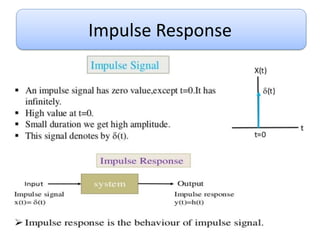
Impulse Response
Example
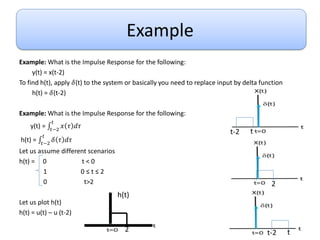
Example: What is the Impulse Response for the following:
y(t) = x(t-2)
To find h(t), apply 𝛿(t) to the system or basically you need to replace input by delta function
h(t) = 𝛿(t-2)
Example: What is the Impulse Response for the following:
y(t) = 𝑡−2
𝑡
𝑥 𝜏 𝑑𝜏
h(t) = 𝑡−2
𝑡
𝛿 𝜏 𝑑𝜏
Let us assume different scenarios
h(t) = 0 t < 0
1 0 ≤ t ≤ 2
0 t>2
Let us plot h(t)
h(t) = u(t) – u (t-2)
2
t-2 t
2
h(t)
t-2 t
Examples cont.,
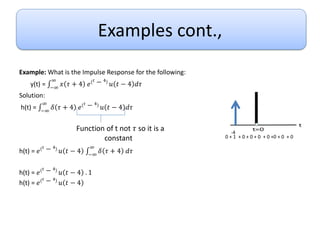
Example: What is the Impulse Response for the following:
y(t) = −∞
∞
𝑥 𝜏 + 4 𝑒
𝑡 − 4
𝑢 𝑡 − 4 𝑑𝜏
Solution:
h(t) = −∞
∞
𝛿 𝜏 + 4 𝑒
𝑡 − 4
𝑢 𝑡 − 4 𝑑𝜏
h(t) = 𝑒
𝑡 − 4
𝑢 𝑡 − 4 −∞
∞
𝛿 𝜏 + 4 𝑑𝜏
h(t) = 𝑒
𝑡 − 4
𝑢 𝑡 − 4 . 1
h(t) = 𝑒
𝑡 − 4
𝑢 𝑡 − 4
Function of t not 𝜏 so it is a
constant
-4
0 + 1 + 0 + 0 + 0 + 0 +0 + 0 + 0
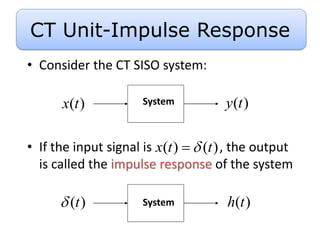
• Consider the CT SISO system:
• If the input signal is , the output
is called the impulse response of the system
( )
h t
( )
t

( ) ( )
x t t


( )
y t
( )
x t System
System
CT Unit-Impulse Response
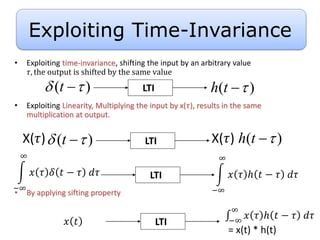
• Exploiting time-invariance, shifting the input by an arbitrary value
𝜏, the output is shifted by the same value
• Exploiting Linearity, Multiplying the input by x(𝜏), results in the same
multiplication at output.
• By applying sifting property
( )
h t 

( )
t
 
 LTI
( )
h t 

( )
t
 
 LTI
X(𝜏) X(𝜏)
LTI
−∞
∞
𝑥 𝜏 𝛿 𝑡 − 𝜏 𝑑𝜏
−∞
∞
𝑥 𝜏 ℎ 𝑡 − 𝜏 𝑑𝜏
LTI
𝑥 𝑡 −∞
∞
𝑥 𝜏 ℎ 𝑡 − 𝜏 𝑑𝜏
= x(t) * h(t)
Exploiting Time-Invariance
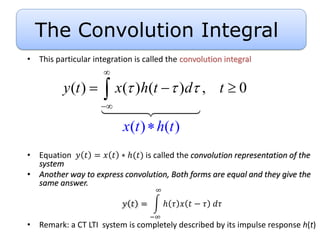
• This particular integration is called the convolution integral
• Equation 𝑦 𝑡 = 𝑥 𝑡 ∗ ℎ(𝑡) is called the convolution representation of the
system
• Another way to express convolution, Both forms are equal and they give the
same answer.
𝑦 𝑡 =
−∞
∞
ℎ 𝜏 𝑥 𝑡 − 𝜏 𝑑𝜏
• Remark: a CT LTI system is completely described by its impulse response h(t)
( ) ( )
x t h t

( ) ( ) ( ) , 0
y t x h t d t
  


  

The Convolution Integral
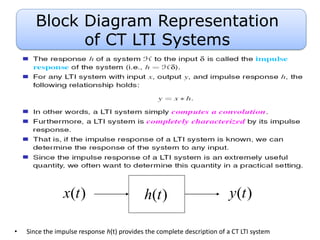
• Since the impulse response h(t) provides the complete description of a CT LTI system
( )
y t
( )
x t ( )
h t
Block Diagram Representation
of CT LTI Systems
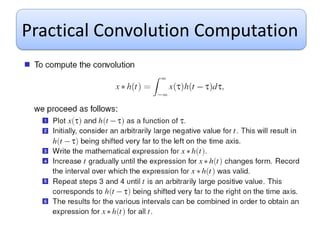
Practical Convolution Computation
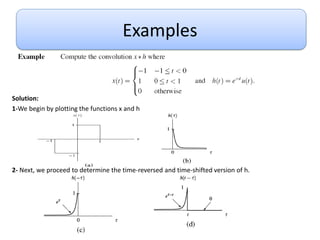
Examples
Solution:
1-We begin by plotting the functions x and h
2- Next, we proceed to determine the time-reversed and time-shifted version of h.
Examples cont.,
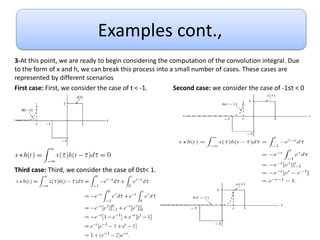
3-At this point, we are ready to begin considering the computation of the convolution integral. Due
to the form of x and h, we can break this process into a small number of cases. These cases are
represented by different scenarios
First case: First, we consider the case of t < -1. Second case: we consider the case of -1≤t < 0
Third case: Third, we consider the case of 0≤t< 1.
Examples cont.,
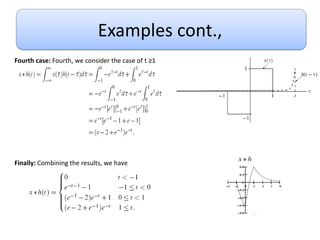
Fourth case: Fourth, we consider the case of t ≥1
Finally: Combining the results, we have
Examples cont.,
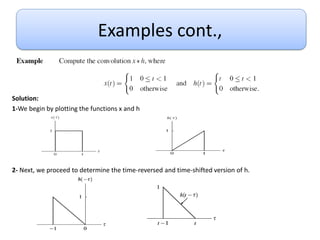
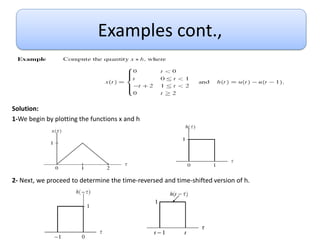
Solution:
1-We begin by plotting the functions x and h
2- Next, we proceed to determine the time-reversed and time-shifted version of h.
Examples cont.,
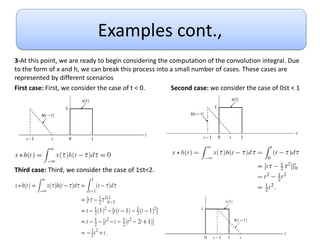
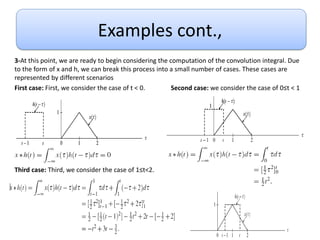
3-At this point, we are ready to begin considering the computation of the convolution integral. Due
to the form of x and h, we can break this process into a small number of cases. These cases are
represented by different scenarios
First case: First, we consider the case of t < 0. Second case: we consider the case of 0≤t < 1
Third case: Third, we consider the case of 1≤t<2.
Examples cont.,
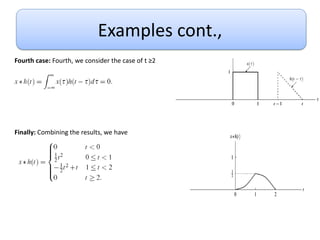
Fourth case: Fourth, we consider the case of t ≥2
Finally: Combining the results, we have
Examples cont.,
Solution:
1-We begin by plotting the functions x and h
2- Next, we proceed to determine the time-reversed and time-shifted version of h.
Examples cont.,
3-At this point, we are ready to begin considering the computation of the convolution integral. Due
to the form of x and h, we can break this process into a small number of cases. These cases are
represented by different scenarios
First case: First, we consider the case of t < 0. Second case: we consider the case of 0≤t < 1
Third case: Third, we consider the case of 1≤t<2.
Examples cont.,
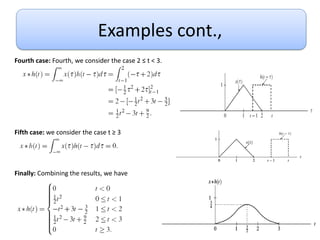
Fourth case: Fourth, we consider the case 2 ≤ t < 3.
Fifth case: we consider the case t ≥ 3
Finally: Combining the results, we have
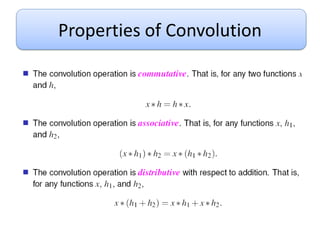
Properties of Convolution
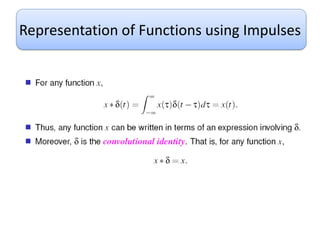
Representation of Functions using Impulses
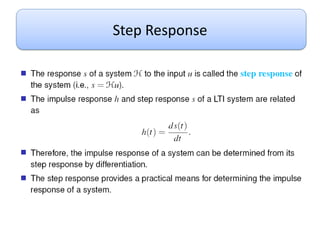
Step Response
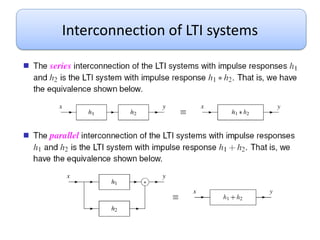
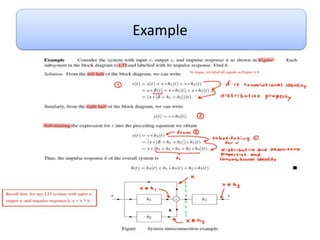
Interconnection of LTI systems
Example
Example
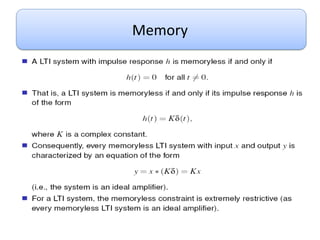
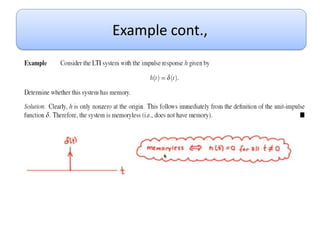
Memory
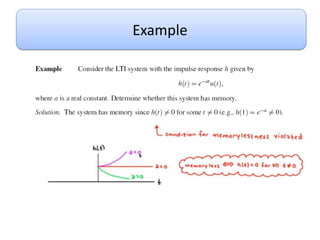
Example
Example cont.,
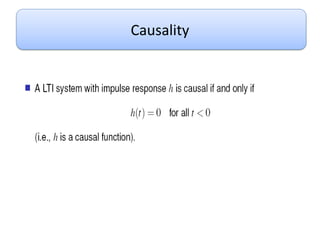
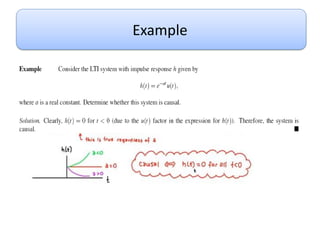
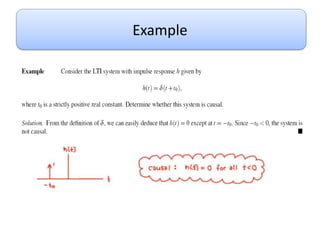
Causality
Example
Example
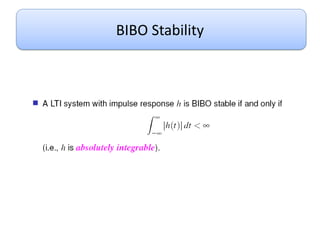
BIBO Stability
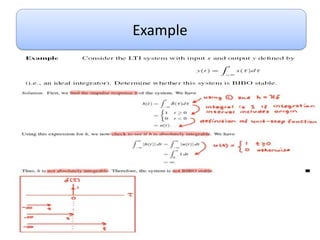
Example
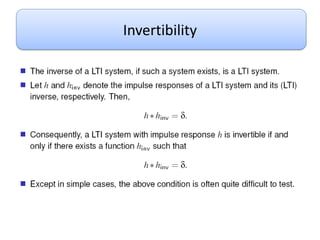
Invertibility
Questions

Lect4-LTI-signal-processing1.pdf

  • 1.
    Convolution and Linear TimeInvariant Systems Presented by Dr. Amany AbdElSamea 1
  • 2.
    Outline • Impulse Response •Convolution Integrals • Properties of Convolution • Convolution and LTI systems • Step Response • Properties of LTI systems 2
  • 3.
  • 4.
    Example Example: What isthe Impulse Response for the following: y(t) = x(t-2) To find h(t), apply 𝛿(t) to the system or basically you need to replace input by delta function h(t) = 𝛿(t-2) Example: What is the Impulse Response for the following: y(t) = 𝑡−2 𝑡 𝑥 𝜏 𝑑𝜏 h(t) = 𝑡−2 𝑡 𝛿 𝜏 𝑑𝜏 Let us assume different scenarios h(t) = 0 t < 0 1 0 ≤ t ≤ 2 0 t>2 Let us plot h(t) h(t) = u(t) – u (t-2) 2 t-2 t 2 h(t) t-2 t
  • 5.
    Examples cont., Example: Whatis the Impulse Response for the following: y(t) = −∞ ∞ 𝑥 𝜏 + 4 𝑒 𝑡 − 4 𝑢 𝑡 − 4 𝑑𝜏 Solution: h(t) = −∞ ∞ 𝛿 𝜏 + 4 𝑒 𝑡 − 4 𝑢 𝑡 − 4 𝑑𝜏 h(t) = 𝑒 𝑡 − 4 𝑢 𝑡 − 4 −∞ ∞ 𝛿 𝜏 + 4 𝑑𝜏 h(t) = 𝑒 𝑡 − 4 𝑢 𝑡 − 4 . 1 h(t) = 𝑒 𝑡 − 4 𝑢 𝑡 − 4 Function of t not 𝜏 so it is a constant -4 0 + 1 + 0 + 0 + 0 + 0 +0 + 0 + 0
  • 6.
    • Consider theCT SISO system: • If the input signal is , the output is called the impulse response of the system ( ) h t ( ) t  ( ) ( ) x t t   ( ) y t ( ) x t System System CT Unit-Impulse Response
  • 7.
    • Exploiting time-invariance,shifting the input by an arbitrary value 𝜏, the output is shifted by the same value • Exploiting Linearity, Multiplying the input by x(𝜏), results in the same multiplication at output. • By applying sifting property ( ) h t   ( ) t    LTI ( ) h t   ( ) t    LTI X(𝜏) X(𝜏) LTI −∞ ∞ 𝑥 𝜏 𝛿 𝑡 − 𝜏 𝑑𝜏 −∞ ∞ 𝑥 𝜏 ℎ 𝑡 − 𝜏 𝑑𝜏 LTI 𝑥 𝑡 −∞ ∞ 𝑥 𝜏 ℎ 𝑡 − 𝜏 𝑑𝜏 = x(t) * h(t) Exploiting Time-Invariance
  • 8.
    • This particularintegration is called the convolution integral • Equation 𝑦 𝑡 = 𝑥 𝑡 ∗ ℎ(𝑡) is called the convolution representation of the system • Another way to express convolution, Both forms are equal and they give the same answer. 𝑦 𝑡 = −∞ ∞ ℎ 𝜏 𝑥 𝑡 − 𝜏 𝑑𝜏 • Remark: a CT LTI system is completely described by its impulse response h(t) ( ) ( ) x t h t  ( ) ( ) ( ) , 0 y t x h t d t          The Convolution Integral
  • 9.
    • Since theimpulse response h(t) provides the complete description of a CT LTI system ( ) y t ( ) x t ( ) h t Block Diagram Representation of CT LTI Systems
  • 10.
  • 11.
    Examples Solution: 1-We begin byplotting the functions x and h 2- Next, we proceed to determine the time-reversed and time-shifted version of h.
  • 12.
    Examples cont., 3-At thispoint, we are ready to begin considering the computation of the convolution integral. Due to the form of x and h, we can break this process into a small number of cases. These cases are represented by different scenarios First case: First, we consider the case of t < -1. Second case: we consider the case of -1≤t < 0 Third case: Third, we consider the case of 0≤t< 1.
  • 13.
    Examples cont., Fourth case:Fourth, we consider the case of t ≥1 Finally: Combining the results, we have
  • 14.
    Examples cont., Solution: 1-We beginby plotting the functions x and h 2- Next, we proceed to determine the time-reversed and time-shifted version of h.
  • 15.
    Examples cont., 3-At thispoint, we are ready to begin considering the computation of the convolution integral. Due to the form of x and h, we can break this process into a small number of cases. These cases are represented by different scenarios First case: First, we consider the case of t < 0. Second case: we consider the case of 0≤t < 1 Third case: Third, we consider the case of 1≤t<2.
  • 16.
    Examples cont., Fourth case:Fourth, we consider the case of t ≥2 Finally: Combining the results, we have
  • 17.
    Examples cont., Solution: 1-We beginby plotting the functions x and h 2- Next, we proceed to determine the time-reversed and time-shifted version of h.
  • 18.
    Examples cont., 3-At thispoint, we are ready to begin considering the computation of the convolution integral. Due to the form of x and h, we can break this process into a small number of cases. These cases are represented by different scenarios First case: First, we consider the case of t < 0. Second case: we consider the case of 0≤t < 1 Third case: Third, we consider the case of 1≤t<2.
  • 19.
    Examples cont., Fourth case:Fourth, we consider the case 2 ≤ t < 3. Fifth case: we consider the case t ≥ 3 Finally: Combining the results, we have
  • 20.
  • 21.
  • 22.
  • 23.
  • 24.
  • 25.
  • 26.
  • 27.
  • 28.
  • 29.
  • 30.
  • 31.
  • 32.
  • 33.
  • 34.
  • 35.