Date : 30-7-2020
Time Domain Analysis of Signals and Systems
ECEN341 Signals and Systems
Chapter-2 – Convolution Sum and Convolution Integral
Chapter-2 Time Domain Analysis of systems
Date : 30-7-2020
LTI – Systems Analysis
LTI stands for Linear Time Invariant
Why Linear Time-Invariant (LTI) Systems?
• Very powerful mathematical tools have been developed for analyzing LTI
systems
• LTI systems are much easier to analyze than systems that are not LTI
• In practice, systems that are not LTI can be well approximated using LTI
models.
Chapter-2 Time Domain Analysis of systems
Date : 30-7-2020
How LTI – Systems Analyzed
LTI stands for Linear Time Invariant
• Break the input into small parts and find the output for every small part.
• Finally combine the outputs for small parts using the principle of
superposition.
• A system is said to obey the property of superposition if it obeys the
properties of homogeneity and additivity and is then called a linear system.
Superposition is a powerful tool for analyzing complicated input signals.
Chapter-2 Time Domain Analysis of systems
Date : 30-7-2020
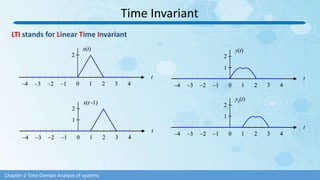
Time Invariant
LTI stands for Linear Time Invariant
Chapter-2 Time Domain Analysis of systems
t
0
x(t)
1 2 3 4
4 3 2 1
2
t
0
x(t)
1 2 3 4
1 2 3 4
4 3 2 1
4 3 2 1
2
t
0
y(t)
1 2 3 4
4 3 2 1
2
1
t
0
y(t)
1 2 3 4
1 2 3 4
4 3 2 1
4 3 2 1
2
1
t
0
x(t1)
1 2 3 4
4 3 2 1
2
1
t
0
x(t1)
1 2 3 4
4 3 2 1
2
t
0
x(t1)
1 2 3 4
1 2 3 4
4 3 2 1
4 3 2 1
2
1
1
t
0
y2(t)
1 2 3 4
4 3 2 1
2
1
t
0
y2(t)
1 2 3 4
1 2 3 4
4 3 2 1
4 3 2 1
2
1
Date : 30-7-2020
Representation of DT Signals in Terms of Delta Functions
Chapter-2 Time Domain Analysis of systems
Eg. Consider a sequence given by
Decompose the sequence in linear combination of impulses and find the response to
input x[n].
Date : 30-7-2020
What is Convolution ?
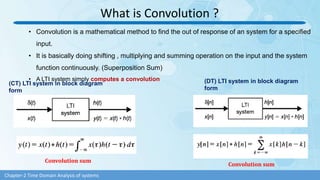
• Convolution is a mathematical method to find the out of response of an system for a specified
input.
• It is basically doing shifting , multiplying and summing operation on the input and the system
function continuously. (Superposition Sum)
• A LTI system simply computes a convolution
Chapter-2 Time Domain Analysis of systems
(CT) LTI system in block diagram
form
(DT) LTI system in block diagram
form
Convolution sum
Convolution sum
Date : 30-7-2020
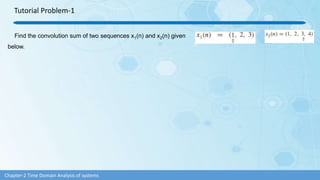
Tutorial Problem-1
Find the convolution sum of two sequences x1(n) and x2(n) given
below.
Chapter-2 Time Domain Analysis of systems
Date : 30-7-2020
8
References
• “Signals and Systems” by Oppenhehim, Willsky and Hamid,,
2nd edition, Pearson Education India, 2015.
• Signals and Systems :Principles and Applications by
Shaila Dinkar Apte , Cambridge University Press
Chapter-1

Chapter-2 Time Domain Analysis-Part 1.pptx

  • 1.
    Date : 30-7-2020 TimeDomain Analysis of Signals and Systems ECEN341 Signals and Systems Chapter-2 – Convolution Sum and Convolution Integral Chapter-2 Time Domain Analysis of systems
  • 2.
    Date : 30-7-2020 LTI– Systems Analysis LTI stands for Linear Time Invariant Why Linear Time-Invariant (LTI) Systems? • Very powerful mathematical tools have been developed for analyzing LTI systems • LTI systems are much easier to analyze than systems that are not LTI • In practice, systems that are not LTI can be well approximated using LTI models. Chapter-2 Time Domain Analysis of systems
  • 3.
    Date : 30-7-2020 HowLTI – Systems Analyzed LTI stands for Linear Time Invariant • Break the input into small parts and find the output for every small part. • Finally combine the outputs for small parts using the principle of superposition. • A system is said to obey the property of superposition if it obeys the properties of homogeneity and additivity and is then called a linear system. Superposition is a powerful tool for analyzing complicated input signals. Chapter-2 Time Domain Analysis of systems
  • 4.
    Date : 30-7-2020 TimeInvariant LTI stands for Linear Time Invariant Chapter-2 Time Domain Analysis of systems t 0 x(t) 1 2 3 4 4 3 2 1 2 t 0 x(t) 1 2 3 4 1 2 3 4 4 3 2 1 4 3 2 1 2 t 0 y(t) 1 2 3 4 4 3 2 1 2 1 t 0 y(t) 1 2 3 4 1 2 3 4 4 3 2 1 4 3 2 1 2 1 t 0 x(t1) 1 2 3 4 4 3 2 1 2 1 t 0 x(t1) 1 2 3 4 4 3 2 1 2 t 0 x(t1) 1 2 3 4 1 2 3 4 4 3 2 1 4 3 2 1 2 1 1 t 0 y2(t) 1 2 3 4 4 3 2 1 2 1 t 0 y2(t) 1 2 3 4 1 2 3 4 4 3 2 1 4 3 2 1 2 1
  • 5.
    Date : 30-7-2020 Representationof DT Signals in Terms of Delta Functions Chapter-2 Time Domain Analysis of systems Eg. Consider a sequence given by Decompose the sequence in linear combination of impulses and find the response to input x[n].
  • 6.
    Date : 30-7-2020 Whatis Convolution ? • Convolution is a mathematical method to find the out of response of an system for a specified input. • It is basically doing shifting , multiplying and summing operation on the input and the system function continuously. (Superposition Sum) • A LTI system simply computes a convolution Chapter-2 Time Domain Analysis of systems (CT) LTI system in block diagram form (DT) LTI system in block diagram form Convolution sum Convolution sum
  • 7.
    Date : 30-7-2020 TutorialProblem-1 Find the convolution sum of two sequences x1(n) and x2(n) given below. Chapter-2 Time Domain Analysis of systems
  • 8.
    Date : 30-7-2020 8 References •“Signals and Systems” by Oppenhehim, Willsky and Hamid,, 2nd edition, Pearson Education India, 2015. • Signals and Systems :Principles and Applications by Shaila Dinkar Apte , Cambridge University Press Chapter-1

Editor's Notes

  • #2 You can safely remove this slide. This slide design was provided by SlideModel.com – You can download more templates, shapes and elements for PowerPoint from http://slidemodel.com/
  • #3 You can safely remove this slide. This slide design was provided by SlideModel.com – You can download more templates, shapes and elements for PowerPoint from http://slidemodel.com/
  • #4 You can safely remove this slide. This slide design was provided by SlideModel.com – You can download more templates, shapes and elements for PowerPoint from http://slidemodel.com/
  • #5 You can safely remove this slide. This slide design was provided by SlideModel.com – You can download more templates, shapes and elements for PowerPoint from http://slidemodel.com/
  • #6 You can safely remove this slide. This slide design was provided by SlideModel.com – You can download more templates, shapes and elements for PowerPoint from http://slidemodel.com/
  • #7 You can safely remove this slide. This slide design was provided by SlideModel.com – You can download more templates, shapes and elements for PowerPoint from http://slidemodel.com/
  • #8 You can safely remove this slide. This slide design was provided by SlideModel.com – You can download more templates, shapes and elements for PowerPoint from http://slidemodel.com/
  • #9 You can safely remove this slide. This slide design was provided by SlideModel.com – You can download more templates, shapes and elements for PowerPoint from http://slidemodel.com/