ORAL
COMMUNICATION
QUARTER 2: LESSON 3
SPEECH ACT
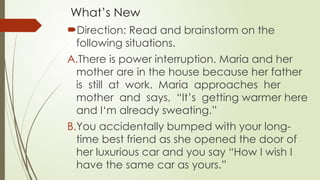
What’s New
Direction: Read and brainstorm on the
following situations.
A.There is power interruption. Maria and her
mother are in the house because her father
is still at work. Maria approaches her
mother and says, “It’s getting warmer here
and I‘m already sweating.”
B.You accidentally bumped with your long-
time best friend as she opened the door of
her luxurious car and you say “How I wish I
have the same car as yours.”
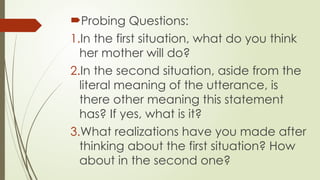
Probing Questions:
1.In the first situation, what do you think
her mother will do?
2.In the second situation, aside from the
literal meaning of the utterance, is
there other meaning this statement
has? If yes, what is it?
3.What realizations have you made after
thinking about the first situation? How
about in the second one?
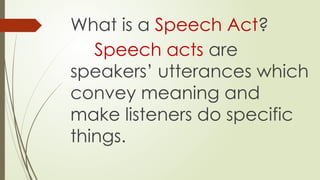
What is a Speech Act?
Speech acts are
speakers’ utterances which
convey meaning and
make listeners do specific
things.
There are three types
of Speech Act:
1. Locutionary Act refers to the actual
utterance of the speaker.
Example:
When you ask someone, “Can you
pass the salt?” – The literal meaning
concerns the hearer’s ability to pass
the salt.
2. Illocutionary Act refers to the
intended utterance by the
speaker (performance).
Example: “Can you pass the
salt?” - In illocution, it is being
interpreted by the receiver
that the speaker requested him
to pass the salt.
Illocutionary acts are
classified into five
distinct categories:
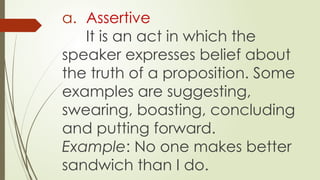
a. Assertive
It is an act in which the
speaker expresses belief about
the truth of a proposition. Some
examples are suggesting,
swearing, boasting, concluding
and putting forward.
Example: No one makes better
sandwich than I do.
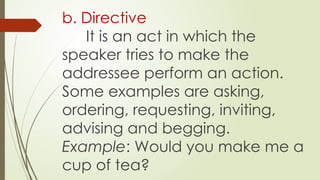
b. Directive
It is an act in which the
speaker tries to make the
addressee perform an action.
Some examples are asking,
ordering, requesting, inviting,
advising and begging.
Example: Would you make me a
cup of tea?
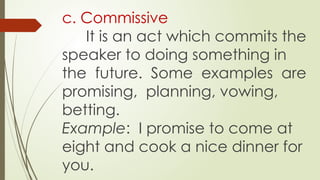
c. Commissive
It is an act which commits the
speaker to doing something in
the future. Some examples are
promising, planning, vowing,
betting.
Example: I promise to come at
eight and cook a nice dinner for
you.
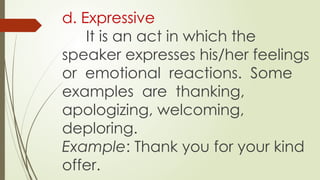
d. Expressive
It is an act in which the
speaker expresses his/her feelings
or emotional reactions. Some
examples are thanking,
apologizing, welcoming,
deploring.
Example: Thank you for your kind
offer.
e. Declaration
It is an act which brings a
change in the external situation.
Some examples of declarations
are blessing, firing, baptizing,
bidding, passing a sentence
and excommunicating.
Example: I bequeath all my
property to my beloved fiancée.
3. Perlocutionary Act refers to the
actions that result from the locution or
what we bring about or achieve by
saying something such as convincing,
persuading, deterring or surprising.
Example:
“Can you pass the salt?”- if illocutions
cause listeners to do something, they
are perlocutions.
TYPES OF SPEECH ACT
Locutionary Act: What we
say…
Illocutionary Act: What we
mean we say it…
Perlocutionary Act: What we
accomplish by saying it…

Second Quarter Lesson Three Speech Act.pptx

  • 1.
  • 2.
    What’s New Direction: Readand brainstorm on the following situations. A.There is power interruption. Maria and her mother are in the house because her father is still at work. Maria approaches her mother and says, “It’s getting warmer here and I‘m already sweating.” B.You accidentally bumped with your long- time best friend as she opened the door of her luxurious car and you say “How I wish I have the same car as yours.”
  • 3.
    Probing Questions: 1.In thefirst situation, what do you think her mother will do? 2.In the second situation, aside from the literal meaning of the utterance, is there other meaning this statement has? If yes, what is it? 3.What realizations have you made after thinking about the first situation? How about in the second one?
  • 4.
    What is aSpeech Act? Speech acts are speakers’ utterances which convey meaning and make listeners do specific things.
  • 5.
    There are threetypes of Speech Act:
  • 6.
    1. Locutionary Actrefers to the actual utterance of the speaker. Example: When you ask someone, “Can you pass the salt?” – The literal meaning concerns the hearer’s ability to pass the salt.
  • 7.
    2. Illocutionary Actrefers to the intended utterance by the speaker (performance). Example: “Can you pass the salt?” - In illocution, it is being interpreted by the receiver that the speaker requested him to pass the salt.
  • 8.
    Illocutionary acts are classifiedinto five distinct categories:
  • 9.
    a. Assertive It isan act in which the speaker expresses belief about the truth of a proposition. Some examples are suggesting, swearing, boasting, concluding and putting forward. Example: No one makes better sandwich than I do.
  • 10.
    b. Directive It isan act in which the speaker tries to make the addressee perform an action. Some examples are asking, ordering, requesting, inviting, advising and begging. Example: Would you make me a cup of tea?
  • 11.
    c. Commissive It isan act which commits the speaker to doing something in the future. Some examples are promising, planning, vowing, betting. Example: I promise to come at eight and cook a nice dinner for you.
  • 12.
    d. Expressive It isan act in which the speaker expresses his/her feelings or emotional reactions. Some examples are thanking, apologizing, welcoming, deploring. Example: Thank you for your kind offer.
  • 13.
    e. Declaration It isan act which brings a change in the external situation. Some examples of declarations are blessing, firing, baptizing, bidding, passing a sentence and excommunicating. Example: I bequeath all my property to my beloved fiancée.
  • 14.
    3. Perlocutionary Actrefers to the actions that result from the locution or what we bring about or achieve by saying something such as convincing, persuading, deterring or surprising. Example: “Can you pass the salt?”- if illocutions cause listeners to do something, they are perlocutions.
  • 15.
    TYPES OF SPEECHACT Locutionary Act: What we say… Illocutionary Act: What we mean we say it… Perlocutionary Act: What we accomplish by saying it…