Unexplained Infertility
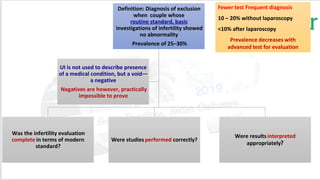
Fewer test Frequent diagnosis
10 – 20% without laparoscopy
<10% after laparoscopy
Prevalence decreases with
advanced test for evaluation
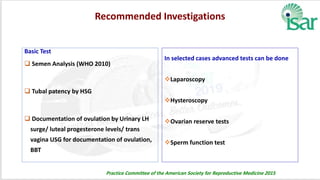
Recommended Investigations
Basic Test
 Semen Analysis (WHO 2010)
 Tubal patency by HSG
 Documentation of ovulation by Urinary LH
surge/ luteal progesterone levels/ trans
vagina USG for documentation of ovulation,
BBT
In selected cases advanced tests can be done
Laparoscopy
Hysteroscopy
Ovarian reserve tests
Sperm function test
Practice Committee of the American Society for Reproductive Medicine 2015
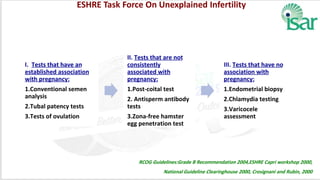
ESHRE Task Force On Unexplained Infertility
RCOG Guidelines:Grade B Recommendation 2004,ESHRE Capri workshop 2000,
National Guideline Clearinghouse 2000, Crosignani and Rubin, 2000
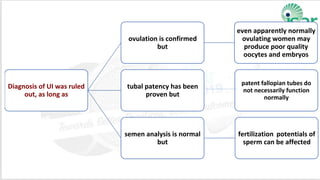
patent fallopian tubes do
not necessarily function
normally
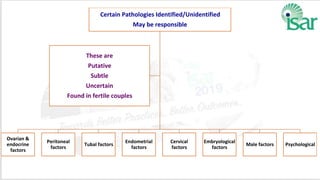
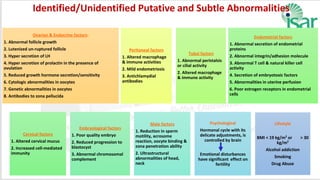
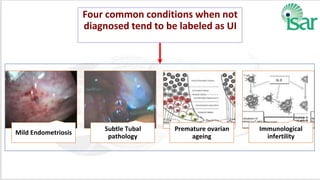
Identified/Unidentified Putative and Subtle Abnormalities
Four common conditions when not
diagnosed tend to be labeled as UI
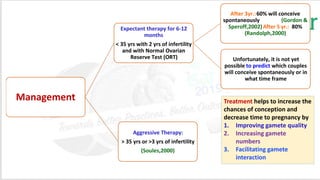
Treatment helps to increase the
chances of conception and
decrease time to pregnancy by
1. Improving gamete quality
2. Increasing gamete
numbers
3. Facilitating gamete
interaction
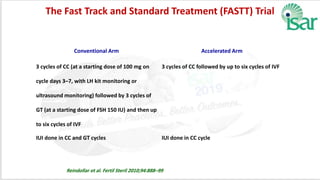
The Fast Track and Standard Treatment (FASTT) Trial
Conventional Arm Accelerated Arm
3 cycles of CC (at a starting dose of 100 mg on
cycle days 3–7, with LH kit monitoring or
ultrasound monitoring) followed by 3 cycles of
GT (at a starting dose of FSH 150 IU) and then up
to six cycles of IVF
3 cycles of CC followed by up to six cycles of IVF
IUI done in CC and GT cycles IUI done in CC cycle
Reindollar et al. Fertil Steril 2010;94:888–99
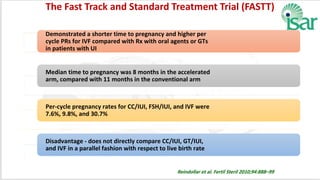
The Fast Track and Standard Treatment Trial (FASTT)
Reindollar et al. Fertil Steril 2010;94:888–99
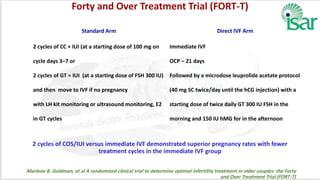
Forty and Over Treatment Trial (FORT-T)
2 cycles of COS/IUI versus immediate IVF demonstrated superior pregnancy rates with fewer
treatment cycles in the immediate IVF group
Marlene B. Goldman, et al A randomized clinical trial to determine optimal infertility treatment in older couples: the Forty
and Over Treatment Trial (FORT-T)
Standard Arm Direct IVF Arm
2 cycles of CC + IUI (at a starting dose of 100 mg on
cycle days 3–7 or
2 cycles of GT = IUI (at a starting dose of FSH 300 IU)
and then move to IVF if no pregnancy
with LH kit monitoring or ultrasound monitoring, E2
in GT cycles
Immediate IVF
OCP – 21 days
Followed by a microdose leuprolide acetate protocol
(40 mg SC twice/day until the hCG injection) with a
starting dose of twice daily GT 300 IU FSH in the
morning and 150 IU hMG for in the afternoon
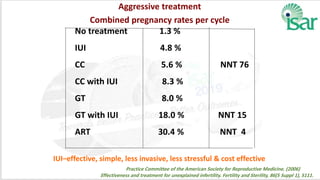
No treatment 1.3 %
IUI 4.8 %
CC 5.6 % NNT 76
CC with IUI 8.3 %
GT 8.0 %
GT with IUI 18.0 % NNT 15
ART 30.4 % NNT 4
Aggressive treatment
Combined pregnancy rates per cycle
IUI–effective, simple, less invasive, less stressful & cost effective
Practice Committee of the American Society for Reproductive Medicine. (2006)
Effectiveness and treatment for unexplained infertility. Fertility and Sterility, 86(5 Suppl 1), S111.
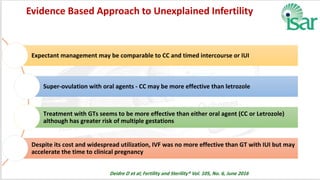
Deidre D et al; Fertility and Sterility® Vol. 105, No. 6, June 2016
Evidence Based Approach to Unexplained Infertility
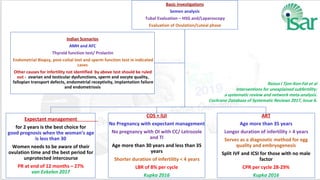
Raissa I Tjon-Kon-Fat et al
Interventions for unexplained subfertility:
a systematic review and network meta-analysis.
Cochrane Database of Systematic Reviews 2017, Issue 6.
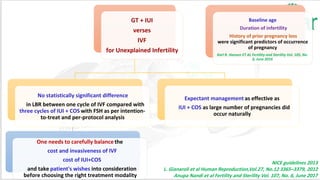
NICE guidelines 2013
L. Gianaroli et al Human Reproduction,Vol.27, No.12 3365–3379, 2012
Anupa Nandi et al Fertility and Sterility Vol. 107, No. 6, June 2017
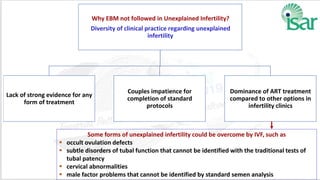
Some forms of unexplained infertility could be overcome by IVF, such as
 occult ovulation defects
 subtle disorders of tubal function that cannot be identified with the traditional tests of
tubal patency
 cervical abnormalities
 male factor problems that cannot be identified by standard semen analysis

15. Unexplained infertility (1).ppt

  • 1.
  • 2.
    Fewer test Frequentdiagnosis 10 – 20% without laparoscopy <10% after laparoscopy Prevalence decreases with advanced test for evaluation
  • 3.
    Recommended Investigations Basic Test Semen Analysis (WHO 2010)  Tubal patency by HSG  Documentation of ovulation by Urinary LH surge/ luteal progesterone levels/ trans vagina USG for documentation of ovulation, BBT In selected cases advanced tests can be done Laparoscopy Hysteroscopy Ovarian reserve tests Sperm function test Practice Committee of the American Society for Reproductive Medicine 2015
  • 4.
    ESHRE Task ForceOn Unexplained Infertility RCOG Guidelines:Grade B Recommendation 2004,ESHRE Capri workshop 2000, National Guideline Clearinghouse 2000, Crosignani and Rubin, 2000
  • 5.
    patent fallopian tubesdo not necessarily function normally
  • 8.
  • 9.
    Four common conditionswhen not diagnosed tend to be labeled as UI
  • 11.
    Treatment helps toincrease the chances of conception and decrease time to pregnancy by 1. Improving gamete quality 2. Increasing gamete numbers 3. Facilitating gamete interaction
  • 12.
    The Fast Trackand Standard Treatment (FASTT) Trial Conventional Arm Accelerated Arm 3 cycles of CC (at a starting dose of 100 mg on cycle days 3–7, with LH kit monitoring or ultrasound monitoring) followed by 3 cycles of GT (at a starting dose of FSH 150 IU) and then up to six cycles of IVF 3 cycles of CC followed by up to six cycles of IVF IUI done in CC and GT cycles IUI done in CC cycle Reindollar et al. Fertil Steril 2010;94:888–99
  • 13.
    The Fast Trackand Standard Treatment Trial (FASTT) Reindollar et al. Fertil Steril 2010;94:888–99
  • 14.
    Forty and OverTreatment Trial (FORT-T) 2 cycles of COS/IUI versus immediate IVF demonstrated superior pregnancy rates with fewer treatment cycles in the immediate IVF group Marlene B. Goldman, et al A randomized clinical trial to determine optimal infertility treatment in older couples: the Forty and Over Treatment Trial (FORT-T) Standard Arm Direct IVF Arm 2 cycles of CC + IUI (at a starting dose of 100 mg on cycle days 3–7 or 2 cycles of GT = IUI (at a starting dose of FSH 300 IU) and then move to IVF if no pregnancy with LH kit monitoring or ultrasound monitoring, E2 in GT cycles Immediate IVF OCP – 21 days Followed by a microdose leuprolide acetate protocol (40 mg SC twice/day until the hCG injection) with a starting dose of twice daily GT 300 IU FSH in the morning and 150 IU hMG for in the afternoon
  • 15.
    No treatment 1.3% IUI 4.8 % CC 5.6 % NNT 76 CC with IUI 8.3 % GT 8.0 % GT with IUI 18.0 % NNT 15 ART 30.4 % NNT 4 Aggressive treatment Combined pregnancy rates per cycle IUI–effective, simple, less invasive, less stressful & cost effective Practice Committee of the American Society for Reproductive Medicine. (2006) Effectiveness and treatment for unexplained infertility. Fertility and Sterility, 86(5 Suppl 1), S111.
  • 16.
    Deidre D etal; Fertility and Sterility® Vol. 105, No. 6, June 2016 Evidence Based Approach to Unexplained Infertility
  • 17.
    Raissa I Tjon-Kon-Fatet al Interventions for unexplained subfertility: a systematic review and network meta-analysis. Cochrane Database of Systematic Reviews 2017, Issue 6.
  • 18.
    NICE guidelines 2013 L.Gianaroli et al Human Reproduction,Vol.27, No.12 3365–3379, 2012 Anupa Nandi et al Fertility and Sterility Vol. 107, No. 6, June 2017
  • 19.
    Some forms ofunexplained infertility could be overcome by IVF, such as  occult ovulation defects  subtle disorders of tubal function that cannot be identified with the traditional tests of tubal patency  cervical abnormalities  male factor problems that cannot be identified by standard semen analysis