11
Muscle Physiology
Prof. Dr. Rashid Mahmood
Contractile Mechanism of Skeletal Muscle I
Prof. Dr. Rashid MahmoodProf. Dr. Rashid Mahmood
Video of muscle contraction
ObjectivesObjectives
Goal/Aim (Main Objective):
To explain the mechanism of muscle contraction
At the end of this lecture students will be able toAt the end of this lecture students will be able to
Classify muscles
Describe organization of skeletal muscle
Describe general mechanism of skeletal muscle
contraction.
Describe molecular mechanism of skeletal
muscle contraction.
Outline different steps of Cross-bridge Cycle
Explain walk along theory...
Lesson contents
ClassesClasses of Muscleof Muscle
Physiological AnatomyPhysiological Anatomy of Skeletal Muscleof Skeletal Muscle
SarcomereSarcomere
Actin & Myosin FilamentsActin & Myosin Filaments
The T Tubules and Sarcoplasmic ReticulumThe T Tubules and Sarcoplasmic Reticulum
Sequence of events inSequence of events in neuromuscularneuromuscular
transmissiontransmission
Synthesis & Release ofSynthesis & Release of AcetylcholineAcetylcholine
Steps ofSteps of General mechanism of muscleGeneral mechanism of muscle
contractioncontraction
33Prof. Dr. Rashid MahmoodProf. Dr. Rashid Mahmood
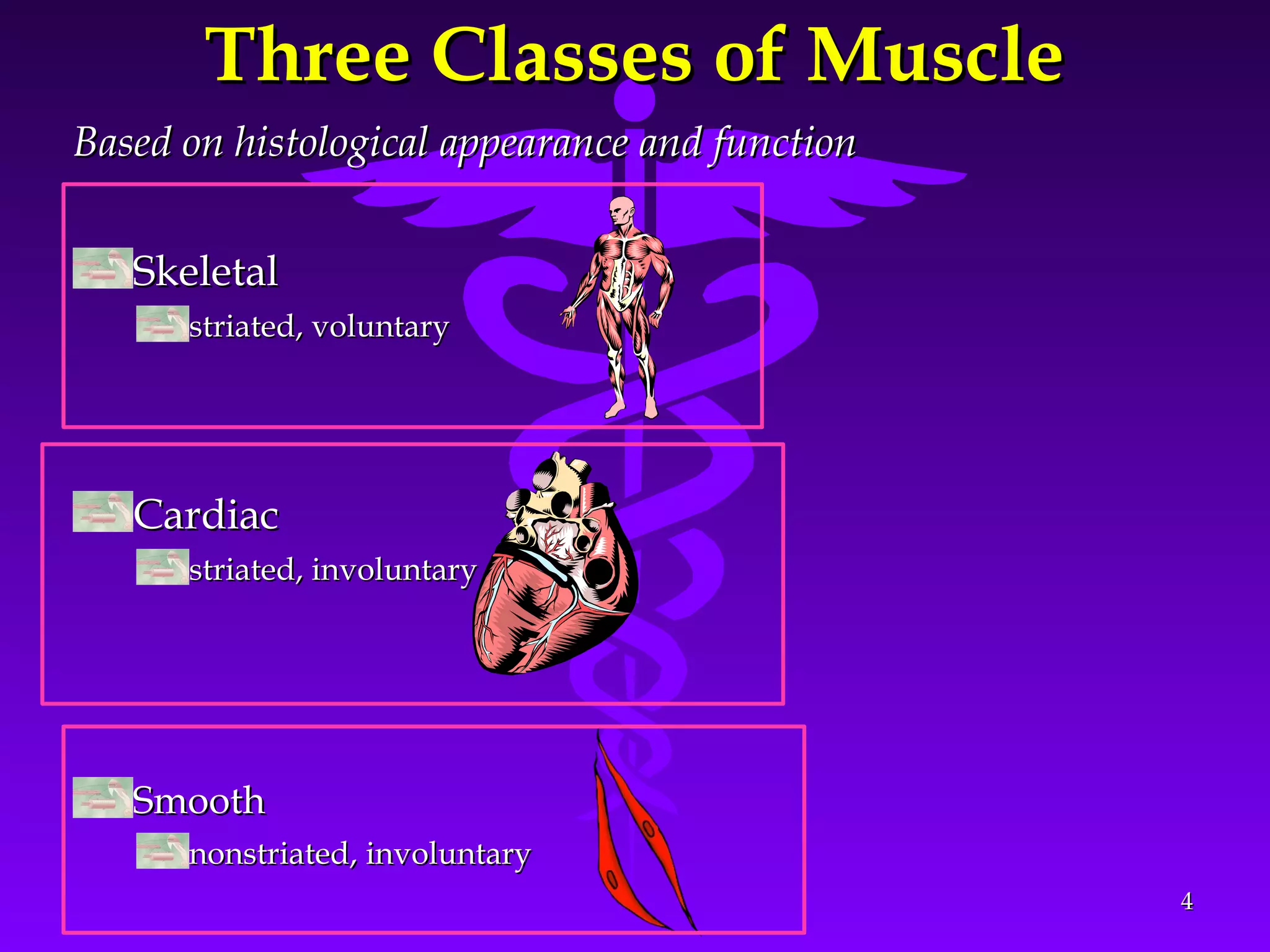
Three Classes of MuscleThree Classes of Muscle
Based on histological appearance and functionBased on histological appearance and function
SkeletalSkeletal
striated, voluntarystriated, voluntary
CardiacCardiac
striated, involuntarystriated, involuntary
SmoothSmooth
nonstriated, involuntarynonstriated, involuntary
44
55
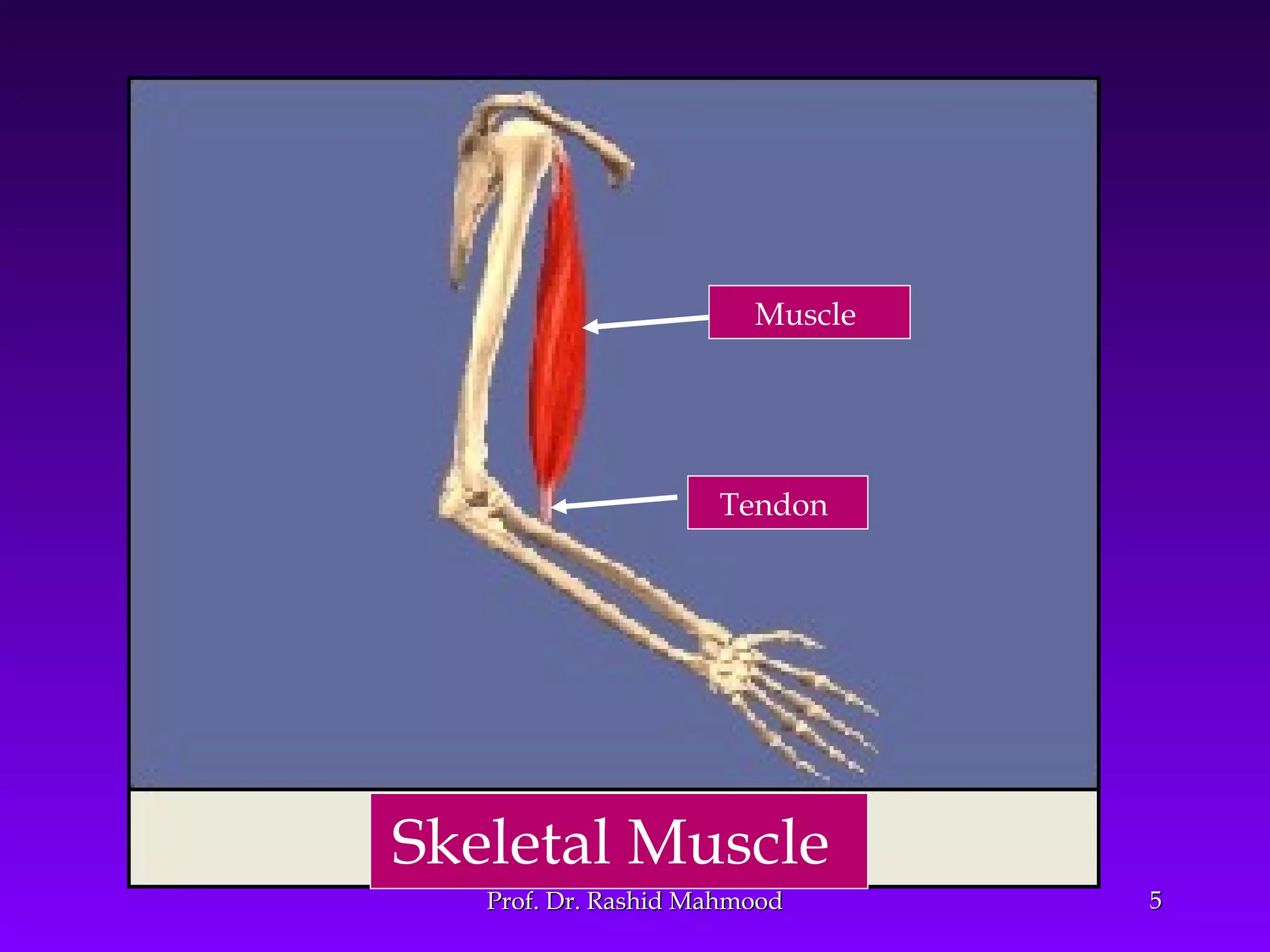
Muscle
Tendon
Prof. Dr. Rashid MahmoodProf. Dr. Rashid Mahmood
Skeletal Muscle
PhysiologicalPhysiological
Anatomy ofAnatomy of
MuscleMuscle
77Prof. Dr. Rashid MahmoodProf. Dr. Rashid Mahmood
88
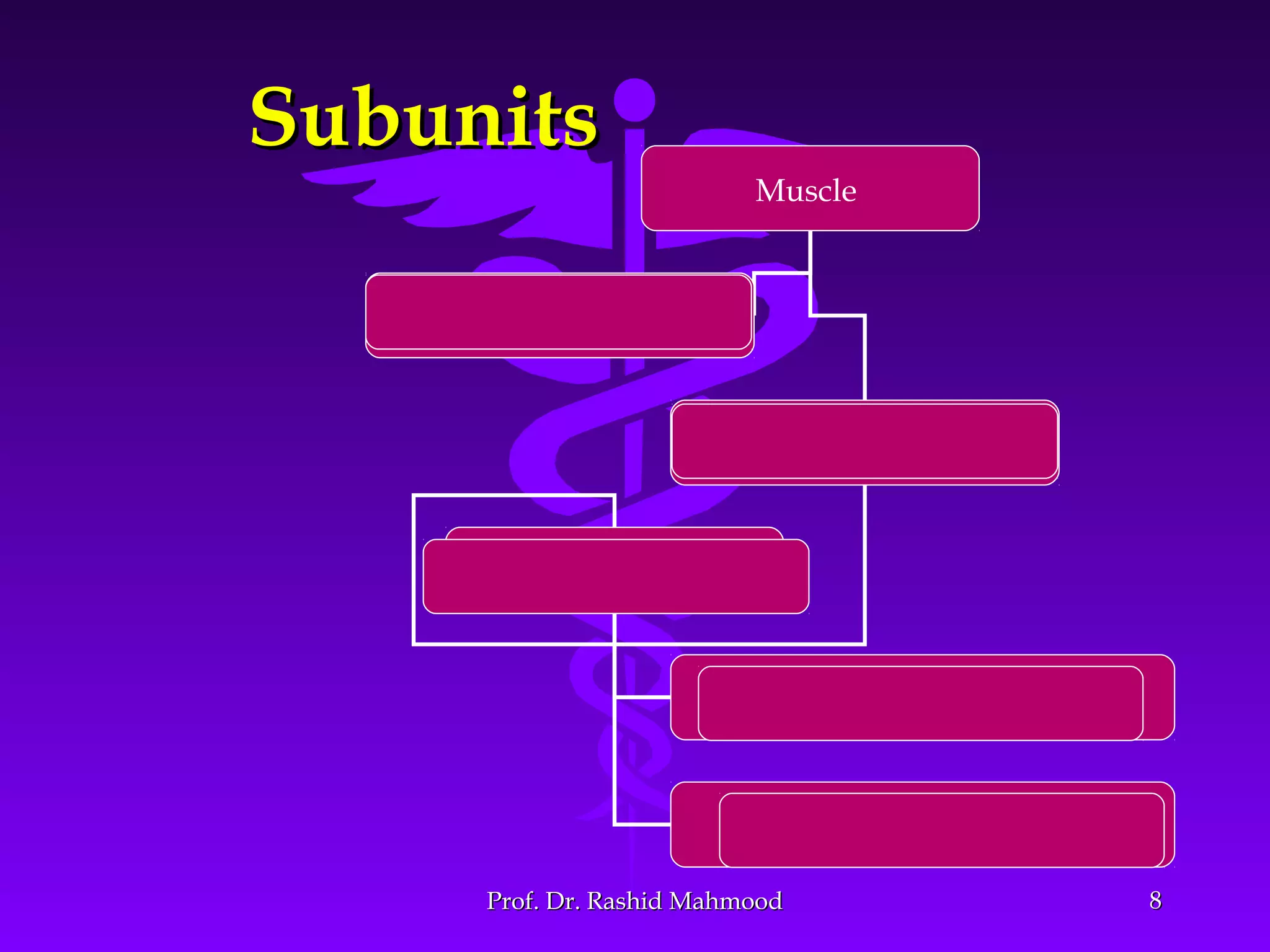
SubunitsSubunits
Muscle
Muscle Fiber
Myofibrils
Myosin Filaments
Actin Filaments
Muscle fasciculus
Prof. Dr. Rashid MahmoodProf. Dr. Rashid Mahmood
99
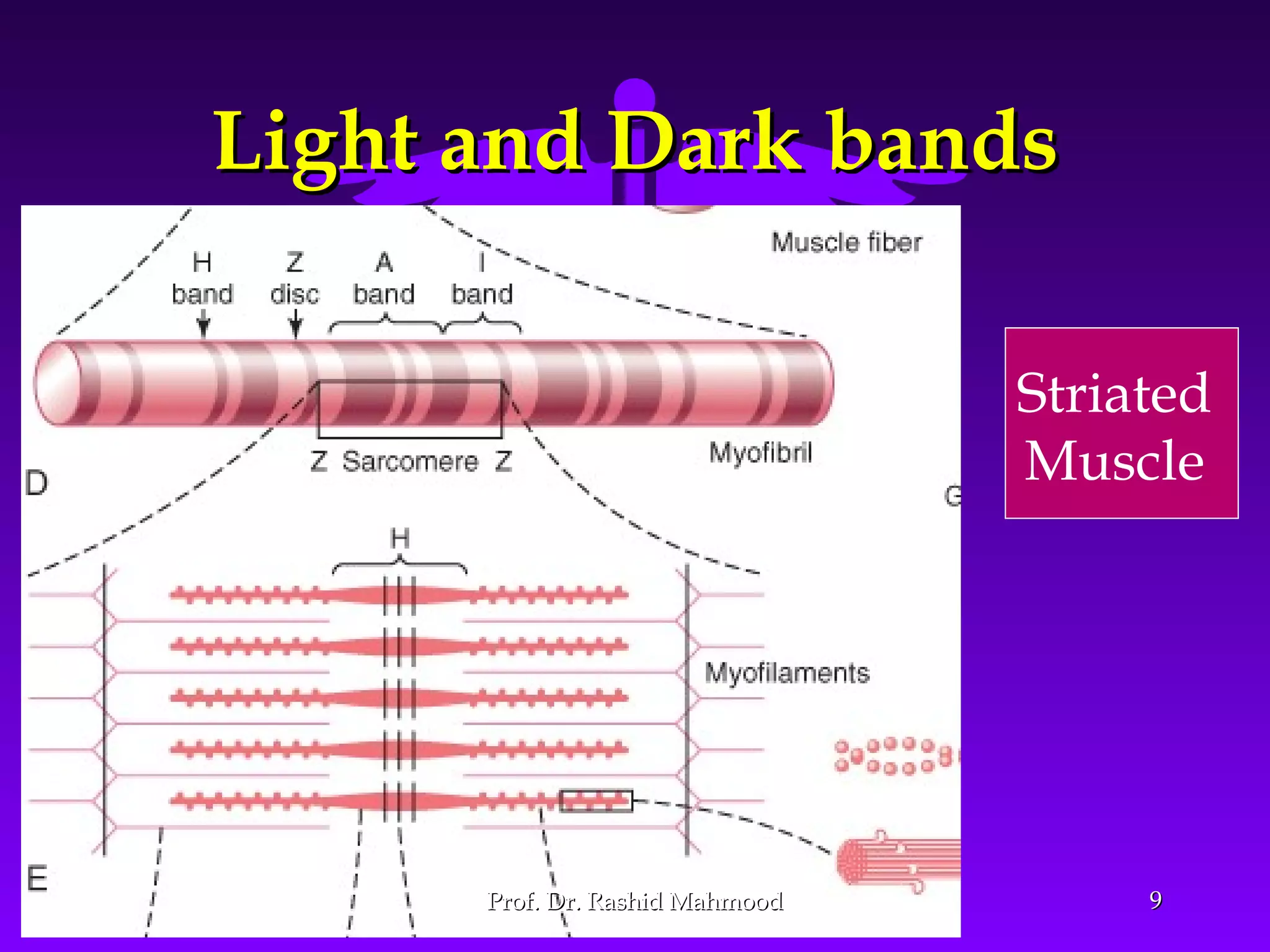
Light and Dark bandsLight and Dark bands
Striated
Muscle
Prof. Dr. Rashid MahmoodProf. Dr. Rashid Mahmood
Assessment Q. 1Assessment Q. 1
Name the THREE types of MuscleName the THREE types of Muscle
1010Prof. Dr. Rashid MahmoodProf. Dr. Rashid Mahmood
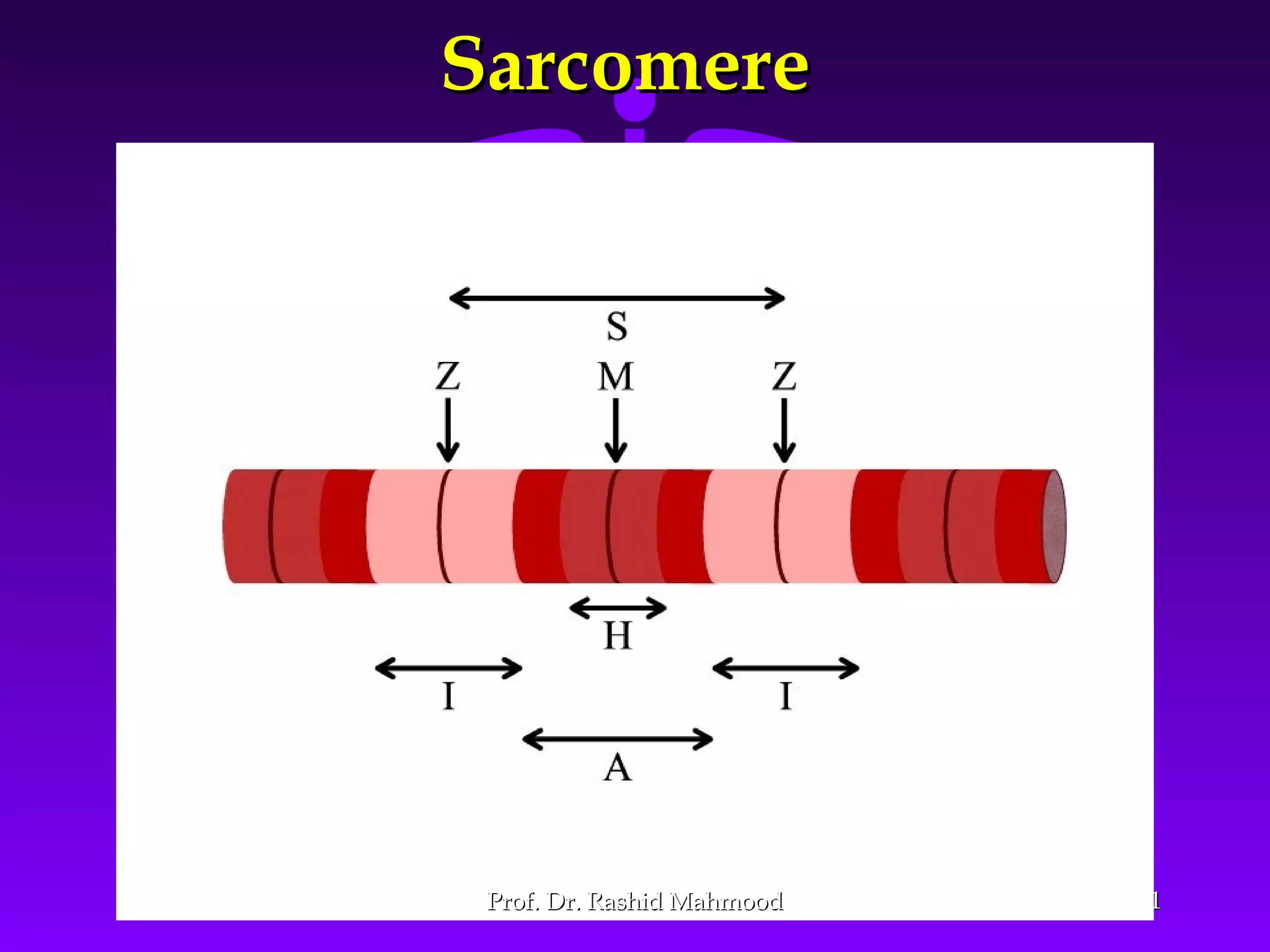
SarcomereSarcomere
1111Prof. Dr. Rashid MahmoodProf. Dr. Rashid Mahmood
1212
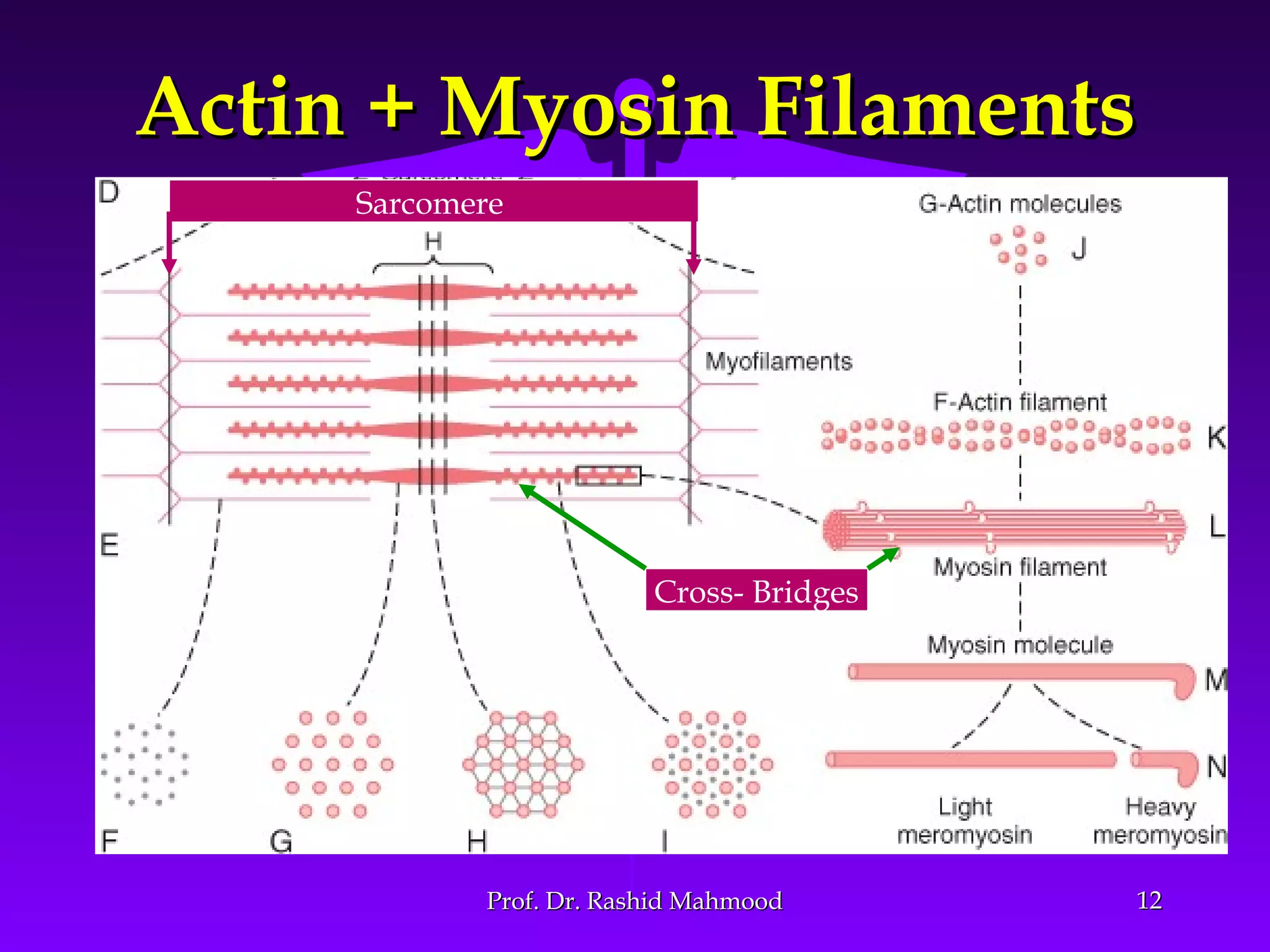
Actin + Myosin FilamentsActin + Myosin Filaments
Cross- Bridges
Sarcomere
Prof. Dr. Rashid MahmoodProf. Dr. Rashid Mahmood
1313
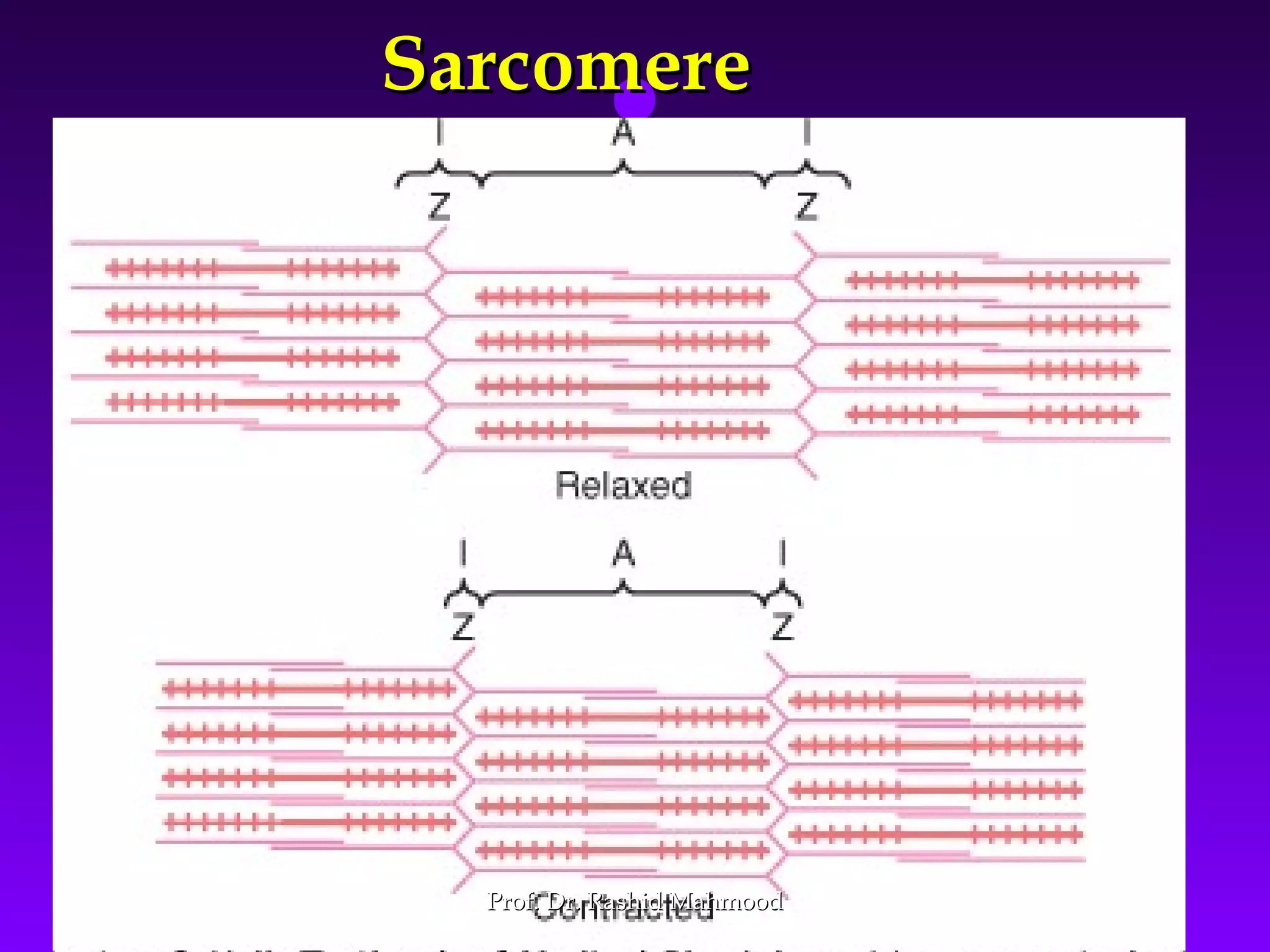
SarcomereSarcomere
Prof. Dr. Rashid MahmoodProf. Dr. Rashid Mahmood
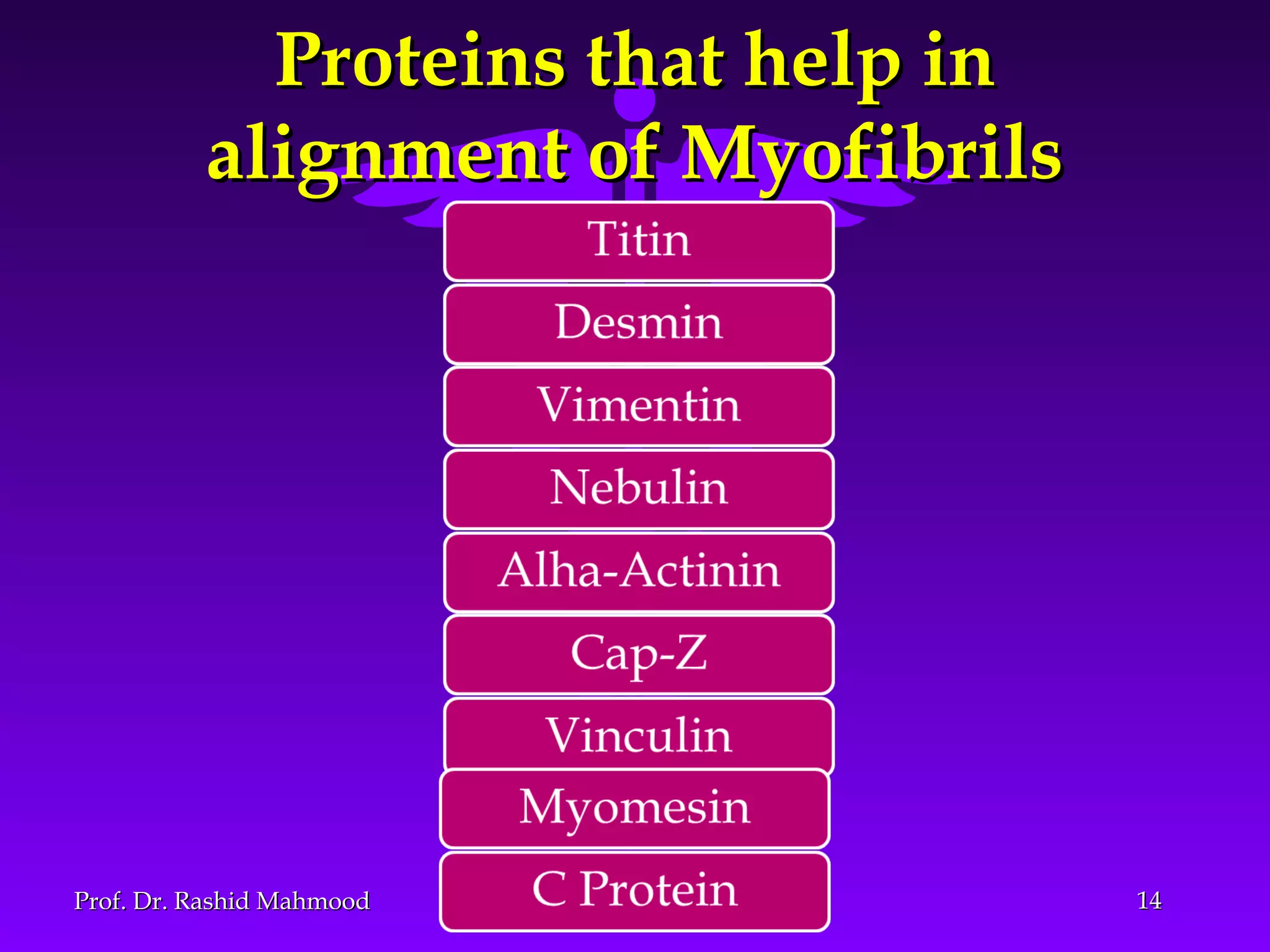
Proteins that help inProteins that help in
alignment of Myofibrilsalignment of Myofibrils
1414Prof. Dr. Rashid MahmoodProf. Dr. Rashid Mahmood
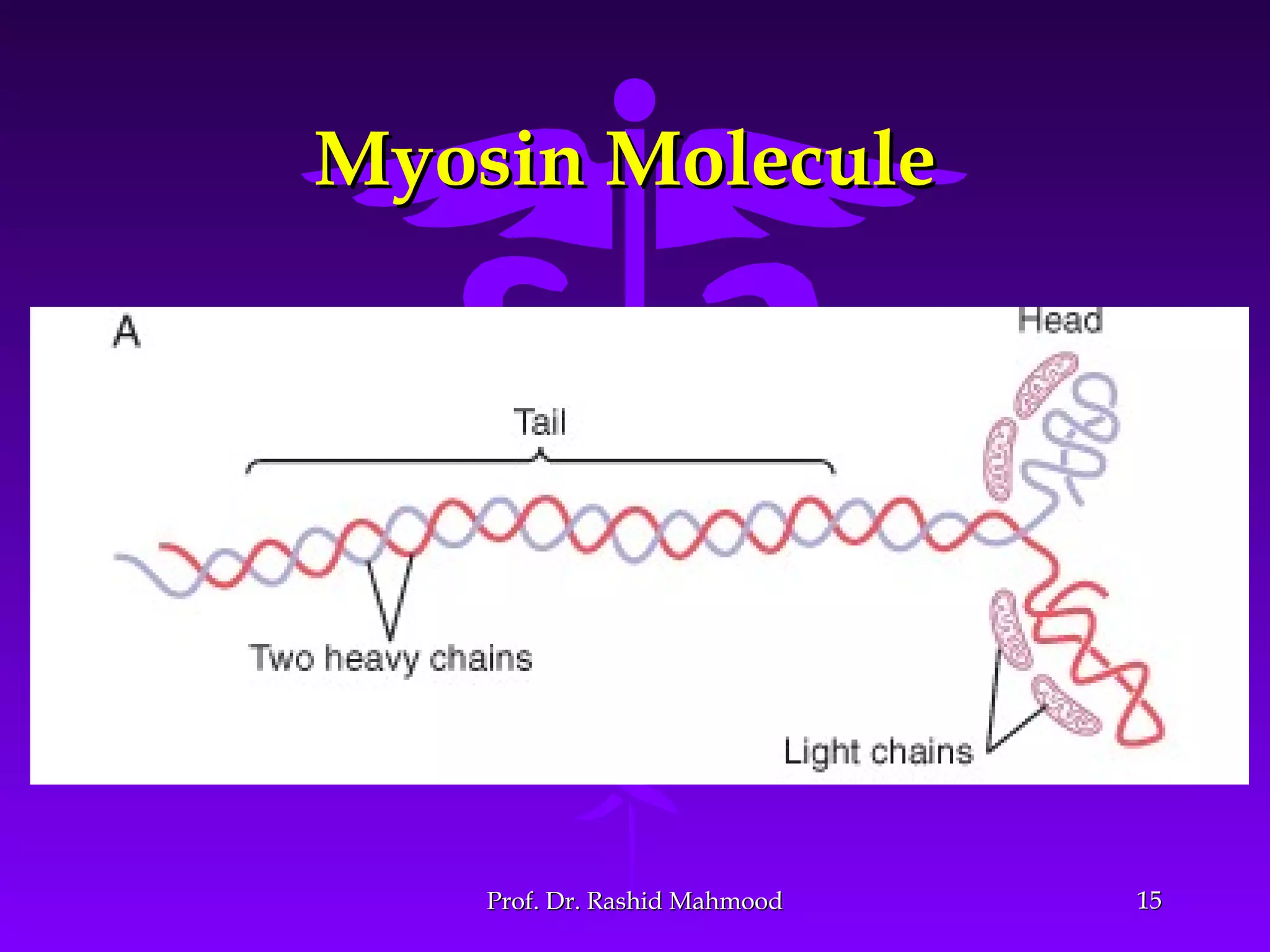
1515
Myosin MoleculeMyosin Molecule
Prof. Dr. Rashid MahmoodProf. Dr. Rashid Mahmood
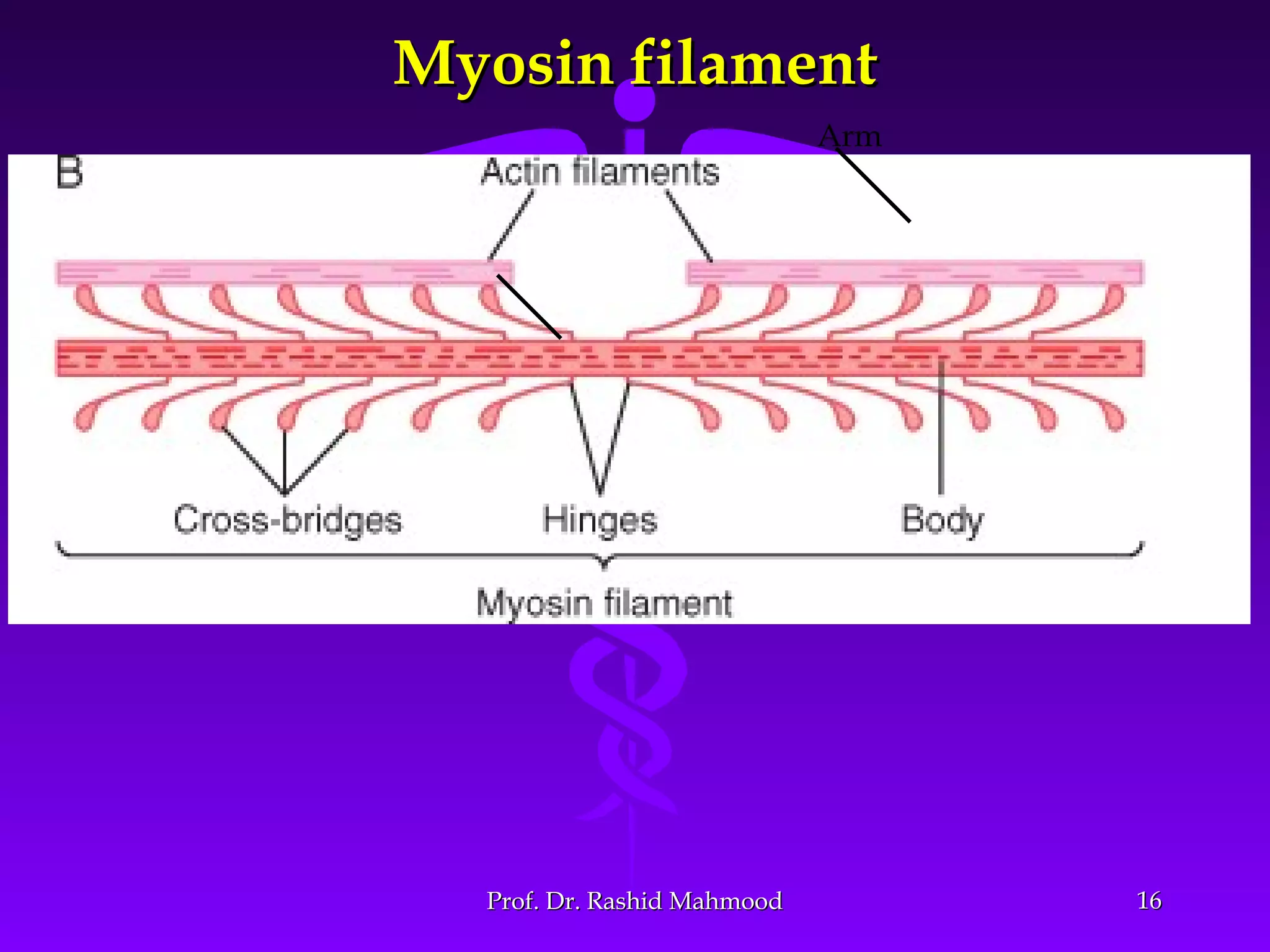
1616
Myosin filamentMyosin filament
Arm
Prof. Dr. Rashid MahmoodProf. Dr. Rashid Mahmood
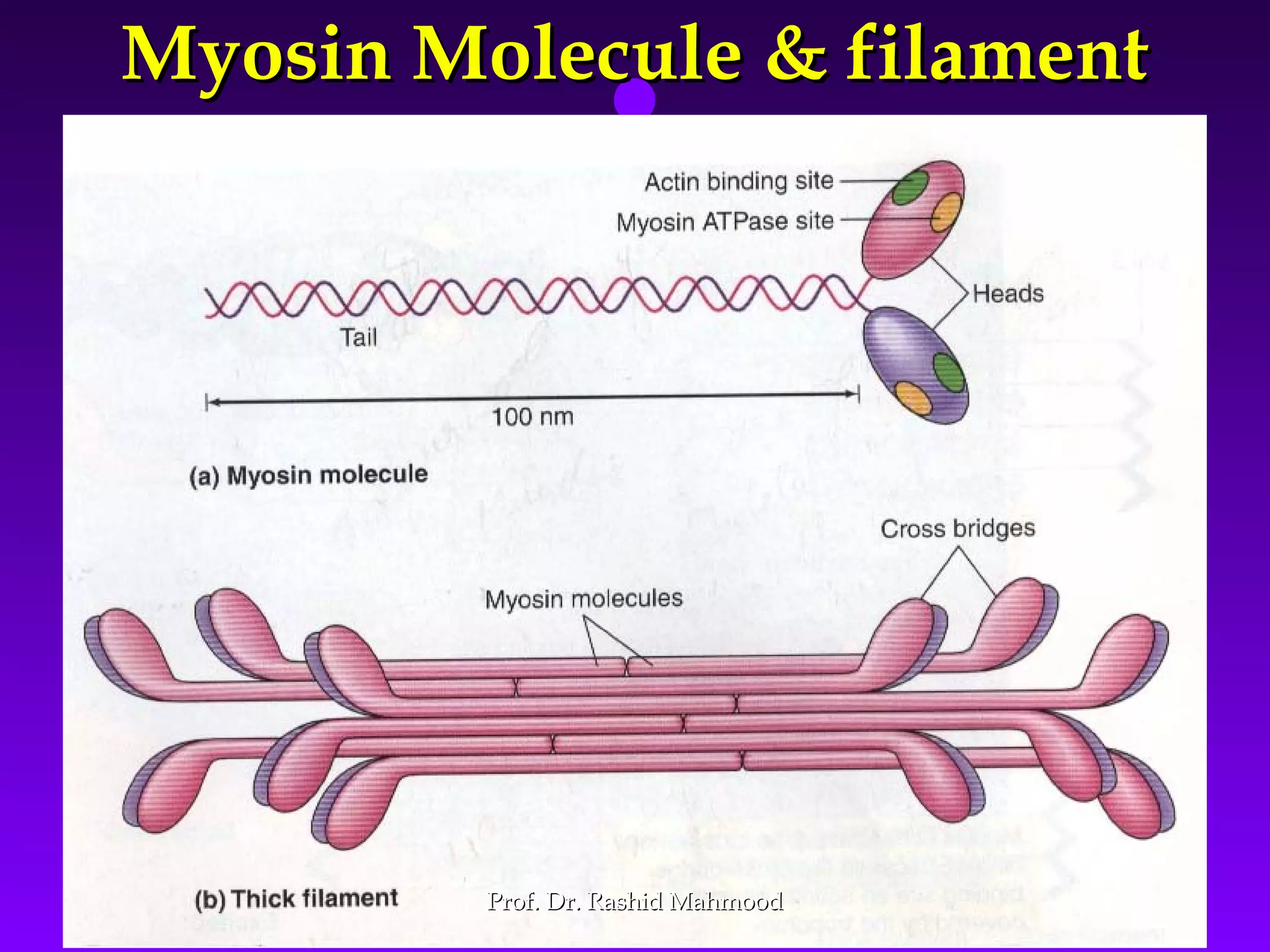
1717
Myosin Molecule & filamentMyosin Molecule & filament
Prof. Dr. Rashid MahmoodProf. Dr. Rashid Mahmood
Assessment Q. 2Assessment Q. 2
Name any THREE parts of MyosinName any THREE parts of Myosin
FilamentFilament
1818Prof. Dr. Rashid MahmoodProf. Dr. Rashid Mahmood
1919
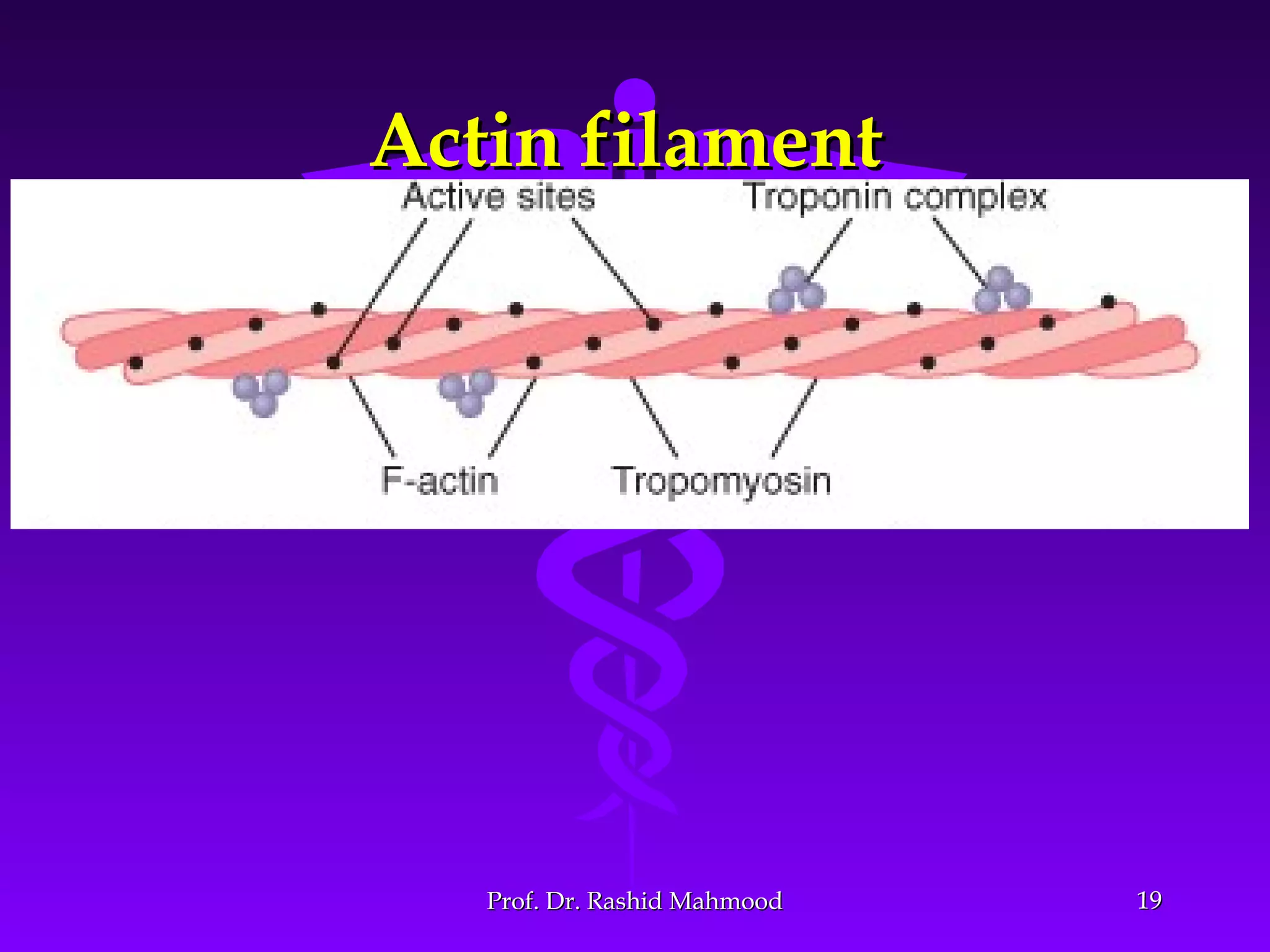
Actin filamentActin filament
Prof. Dr. Rashid MahmoodProf. Dr. Rashid Mahmood
2020
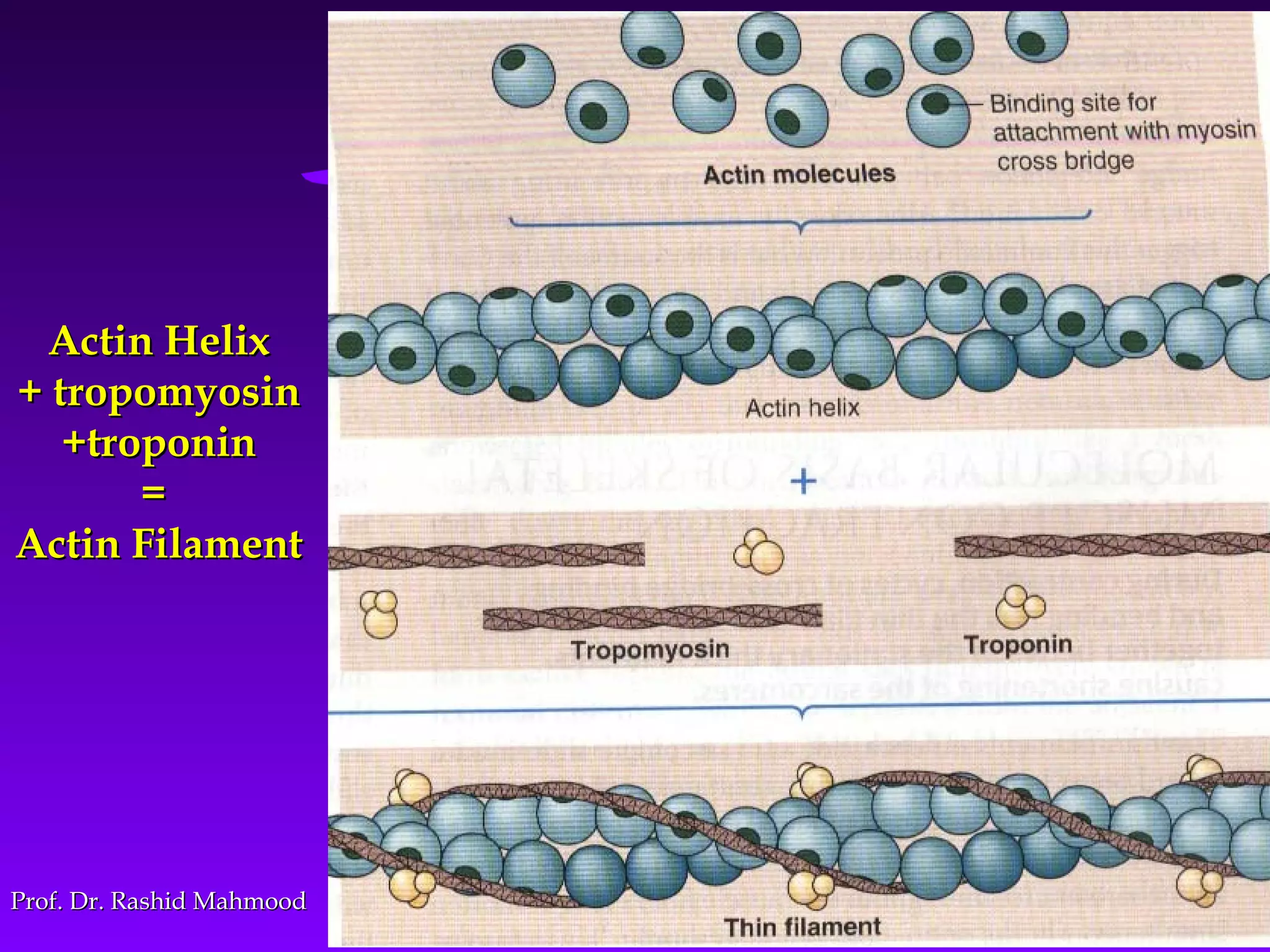
Actin HelixActin Helix
+ tropomyosin+ tropomyosin
+troponin+troponin
==
Actin FilamentActin Filament
Prof. Dr. Rashid MahmoodProf. Dr. Rashid Mahmood
2121
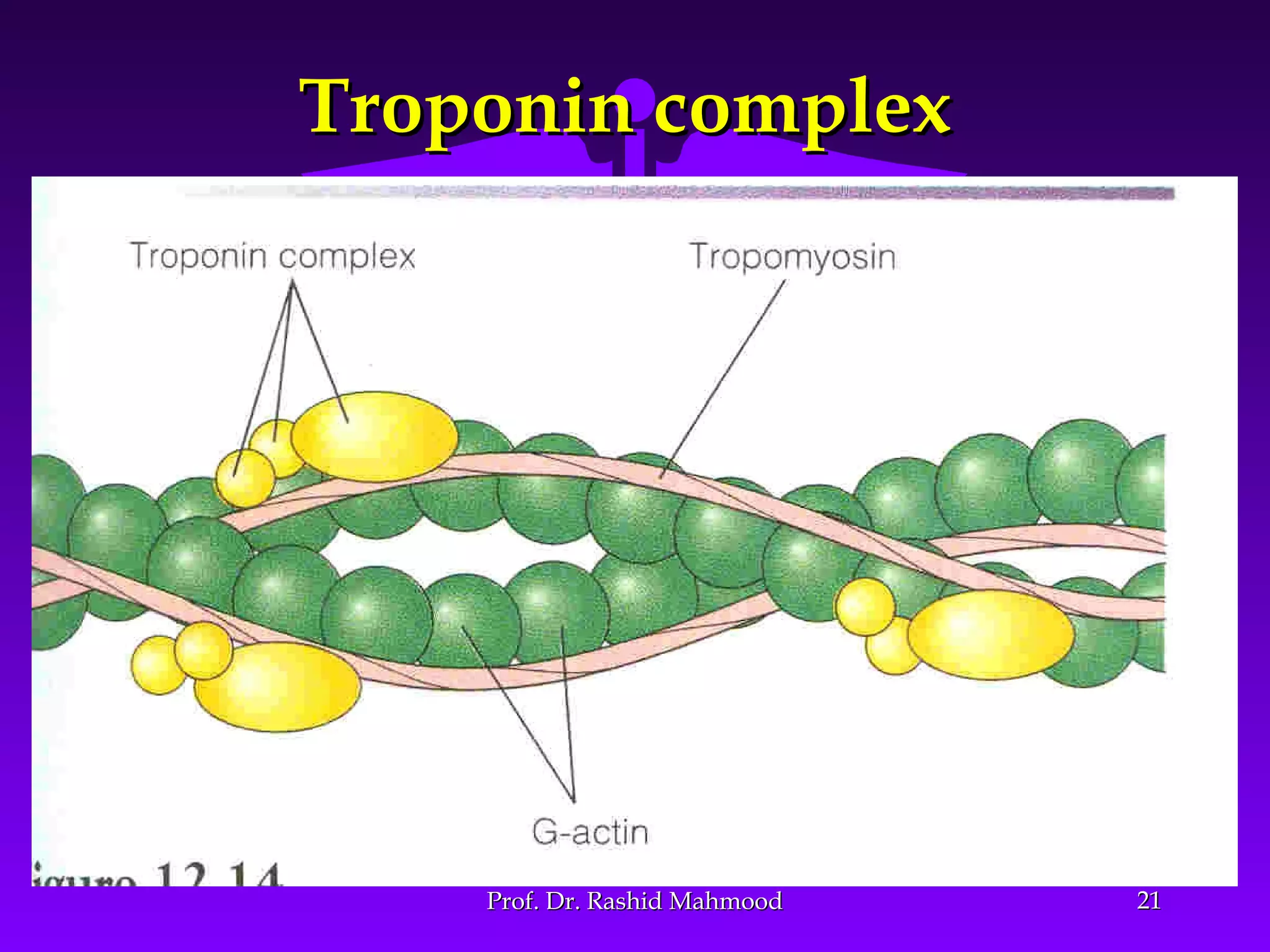
Troponin complexTroponin complex
Prof. Dr. Rashid MahmoodProf. Dr. Rashid Mahmood
2222
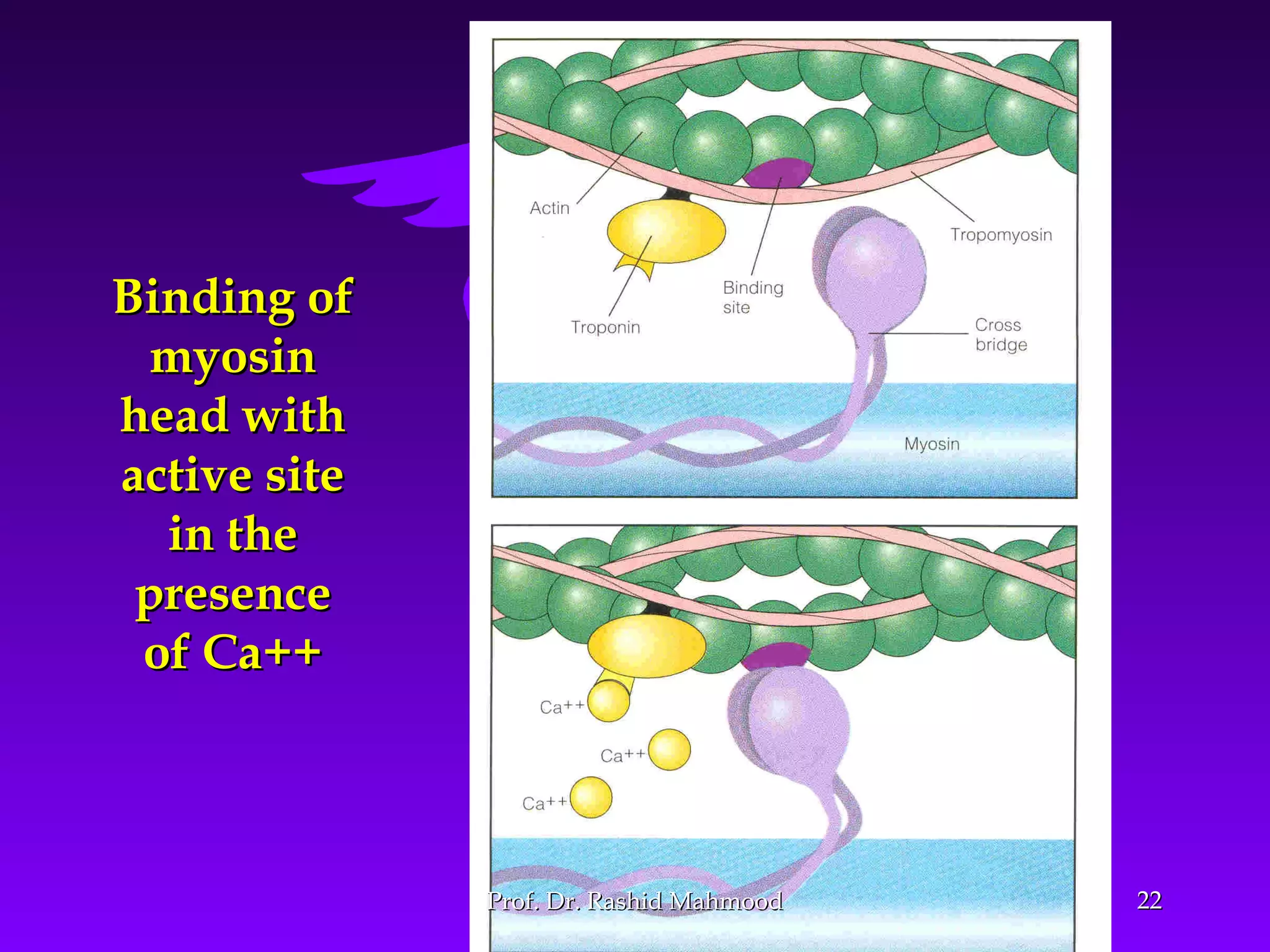
Binding ofBinding of
myosinmyosin
head withhead with
active siteactive site
in thein the
presencepresence
of Ca++of Ca++
Prof. Dr. Rashid MahmoodProf. Dr. Rashid Mahmood
2323
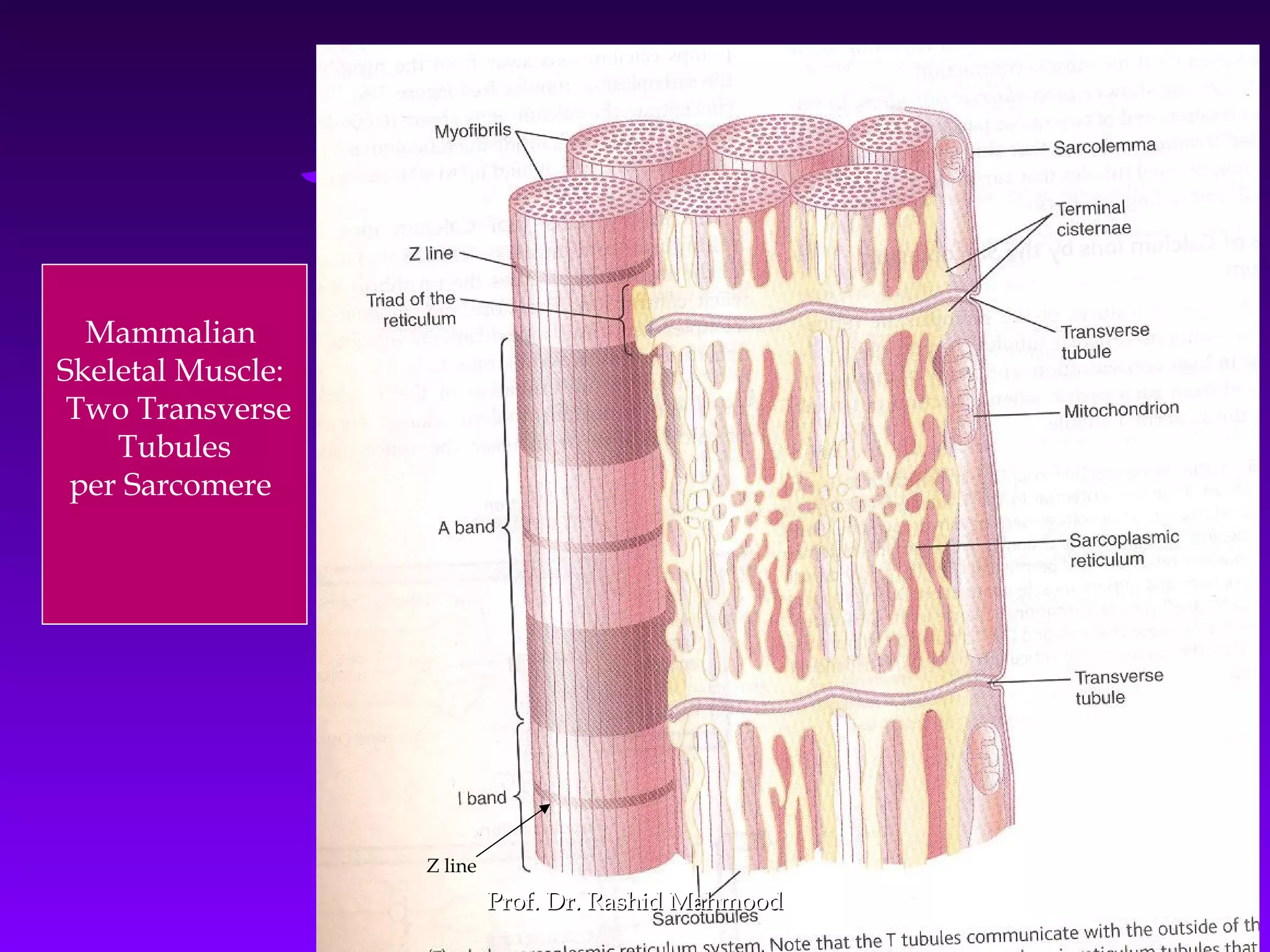
Mammalian
Skeletal Muscle:
Two Transverse
Tubules
per Sarcomere
Z line
Prof. Dr. Rashid MahmoodProf. Dr. Rashid Mahmood
2424
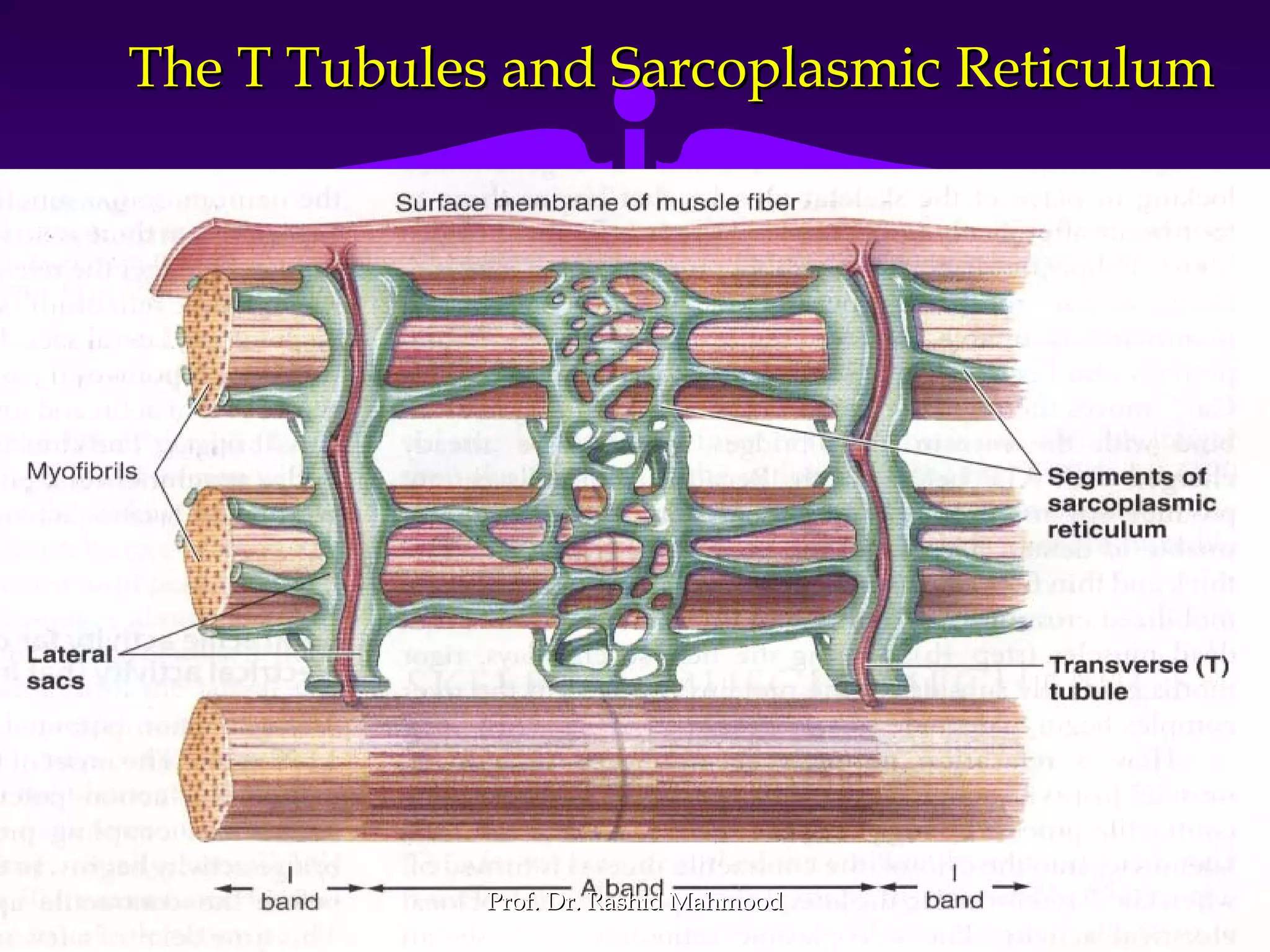
The T Tubules and Sarcoplasmic ReticulumThe T Tubules and Sarcoplasmic Reticulum
Prof. Dr. Rashid MahmoodProf. Dr. Rashid Mahmood
2525
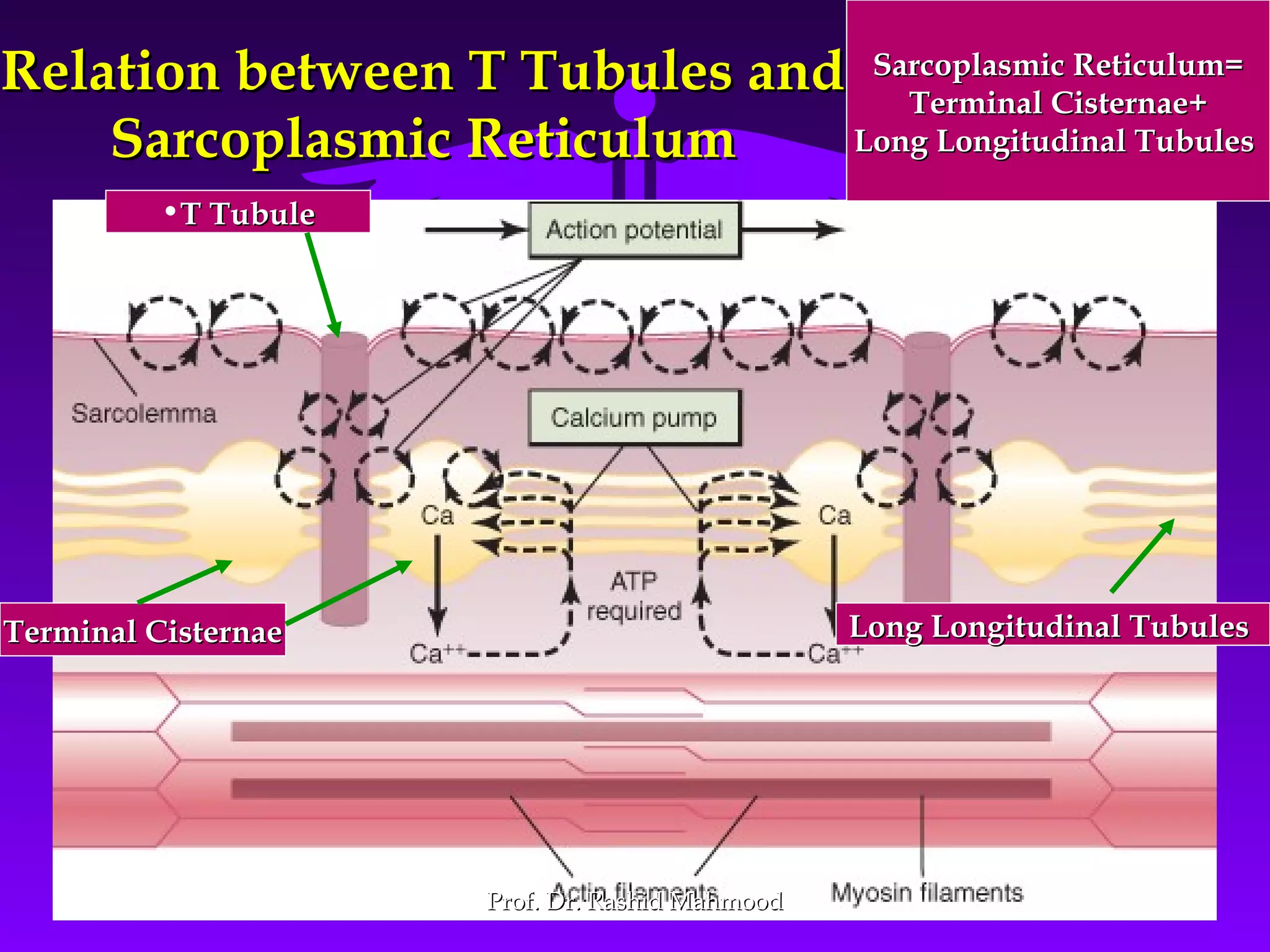
Relation between T Tubules andRelation between T Tubules and
Sarcoplasmic ReticulumSarcoplasmic Reticulum
Sarcoplasmic Reticulum=Sarcoplasmic Reticulum=
Terminal Cisternae+Terminal Cisternae+
Long Longitudinal TubulesLong Longitudinal Tubules
Terminal CisternaeTerminal Cisternae Long Longitudinal TubulesLong Longitudinal Tubules
•T TubuleT Tubule
Prof. Dr. Rashid MahmoodProf. Dr. Rashid Mahmood
Assessment Q. 3Assessment Q. 3
Name the THREE parts of ActinName the THREE parts of Actin
FilamentFilament
2626Prof. Dr. Rashid MahmoodProf. Dr. Rashid Mahmood
2727
StepsSteps ofof
GeneralGeneral
mechanismmechanism ofof
muscle contractionmuscle contraction
Prof. Dr. Rashid MahmoodProf. Dr. Rashid Mahmood
2828
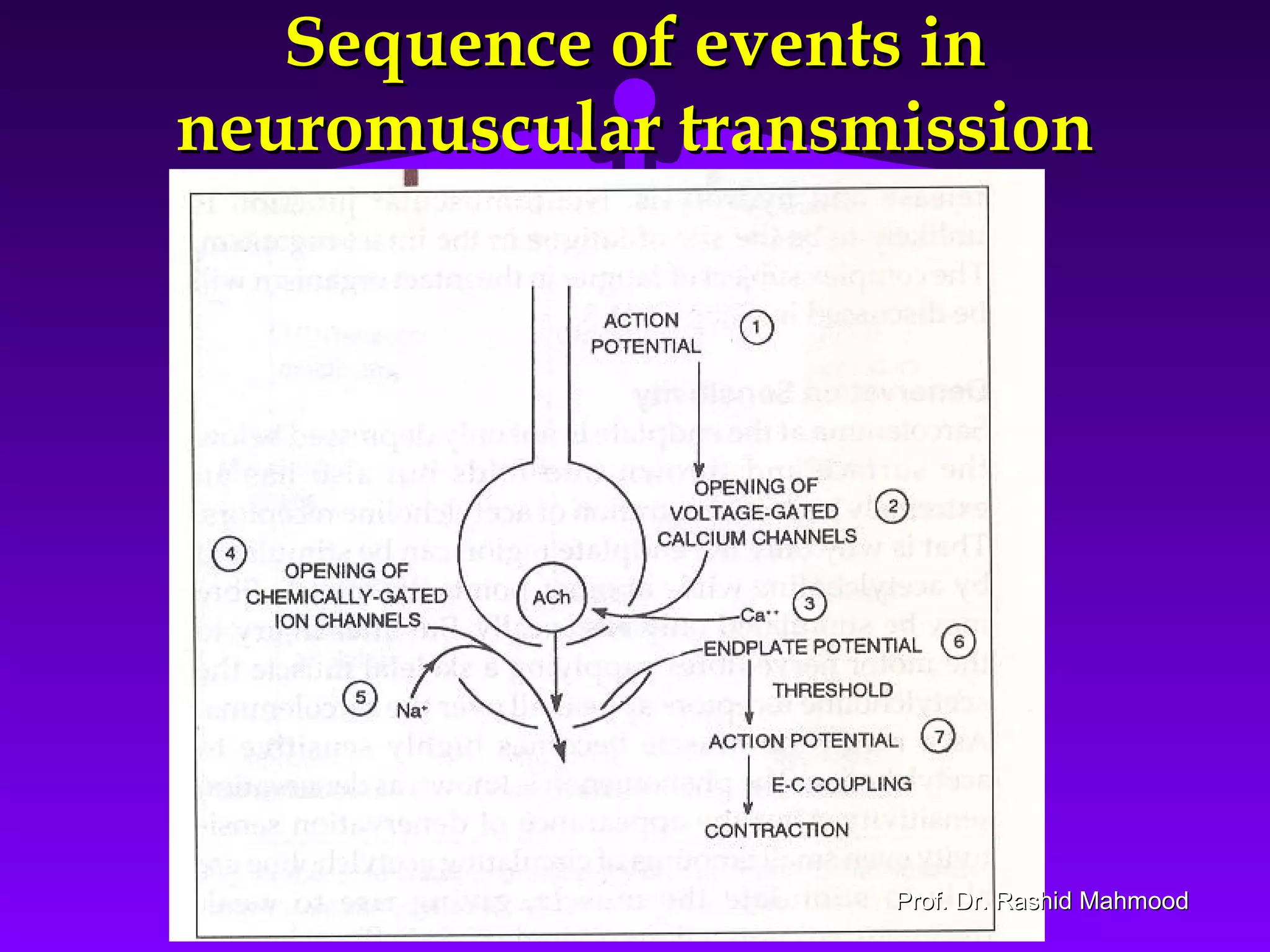
Sequence of events inSequence of events in
neuromuscular transmissionneuromuscular transmission
Prof. Dr. Rashid MahmoodProf. Dr. Rashid Mahmood
2929
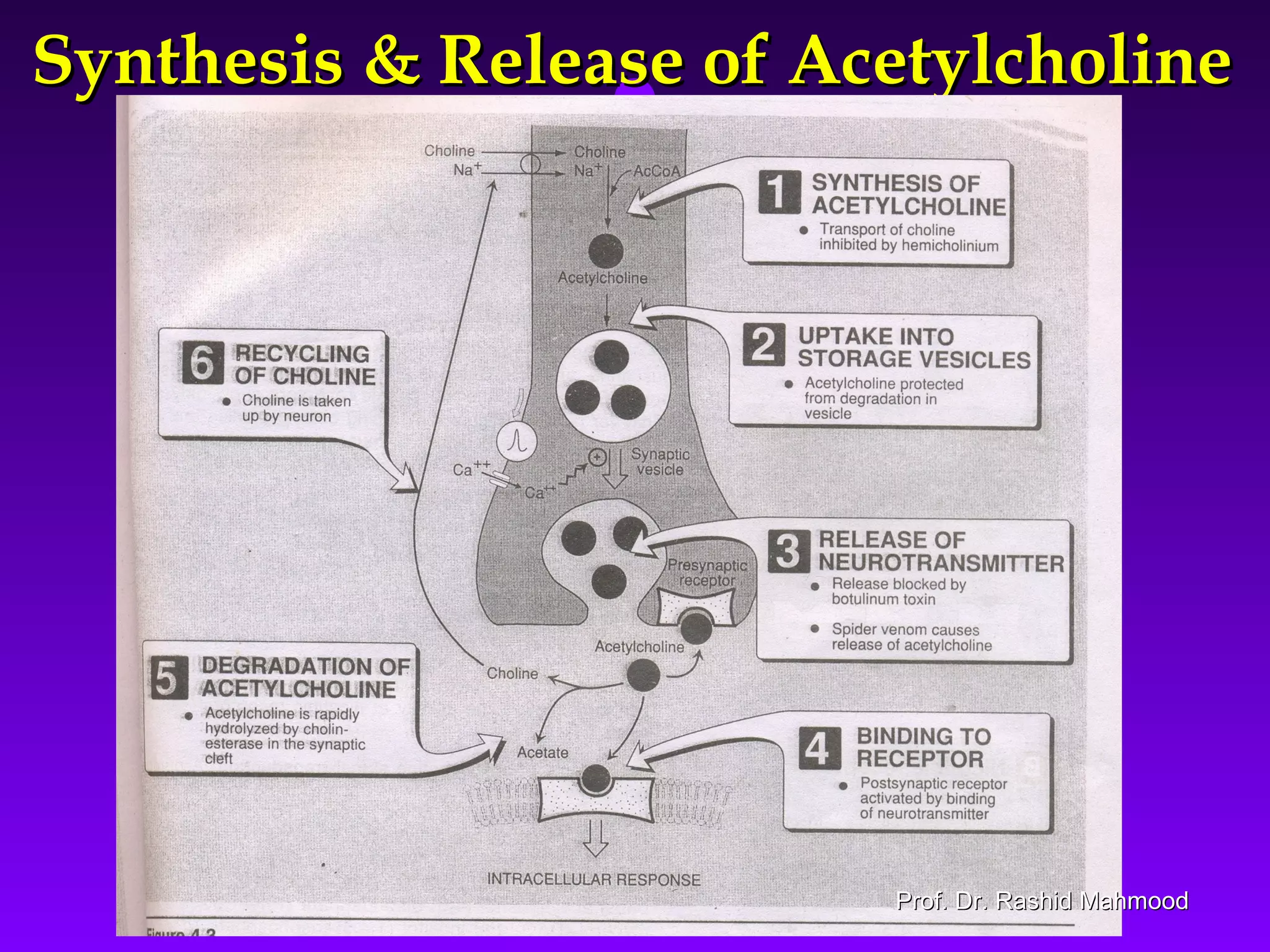
Synthesis & Release of AcetylcholineSynthesis & Release of Acetylcholine
Prof. Dr. Rashid MahmoodProf. Dr. Rashid Mahmood
3030
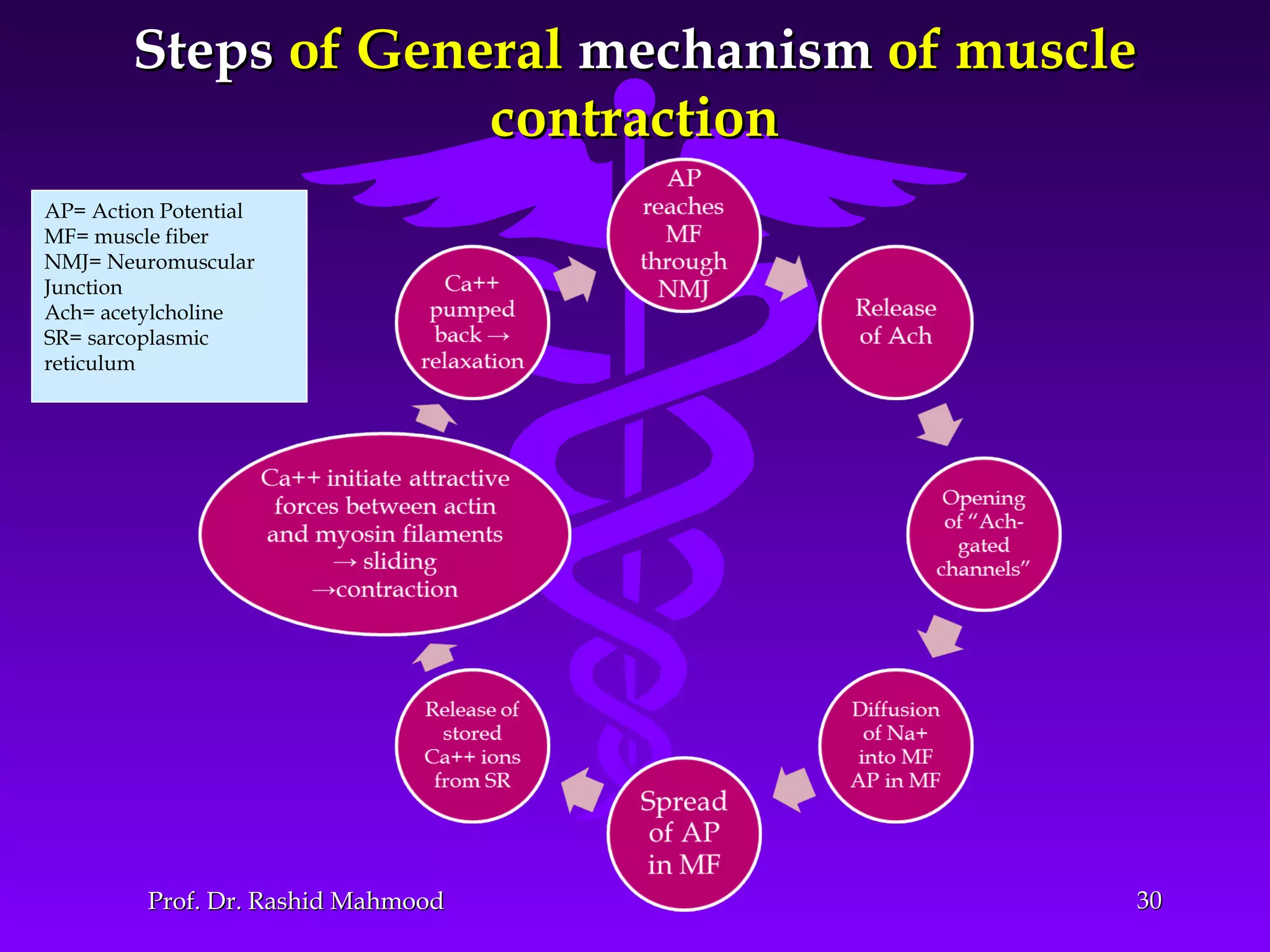
StepsSteps of Generalof General mechanismmechanism of muscleof muscle
contractioncontraction
Prof. Dr. Rashid MahmoodProf. Dr. Rashid Mahmood
AP= Action Potential
MF= muscle fiber
NMJ= Neuromuscular
Junction
Ach= acetylcholine
SR= sarcoplasmic
reticulum
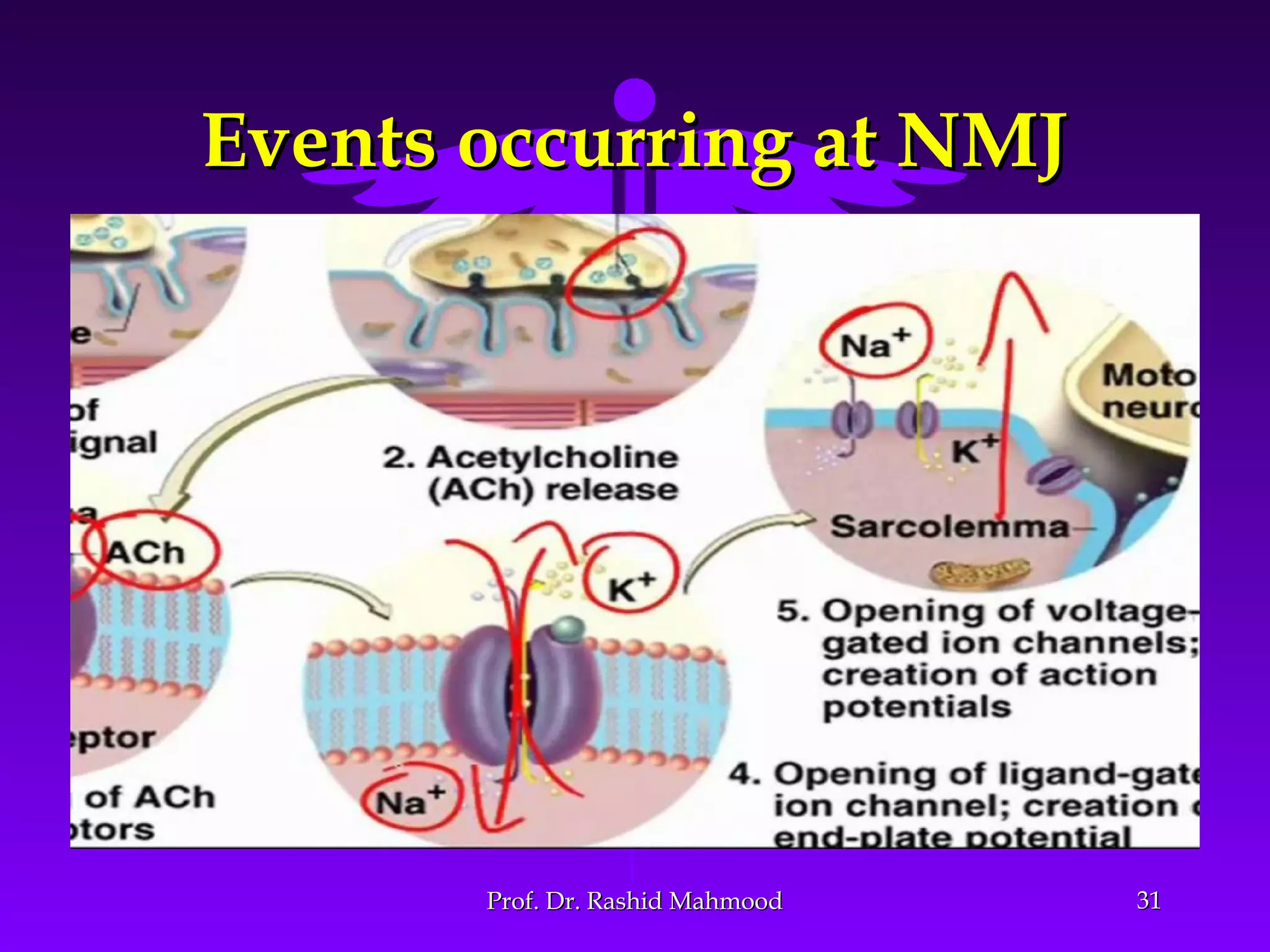
Events occurring at NMJEvents occurring at NMJ
3131Prof. Dr. Rashid MahmoodProf. Dr. Rashid Mahmood
3232
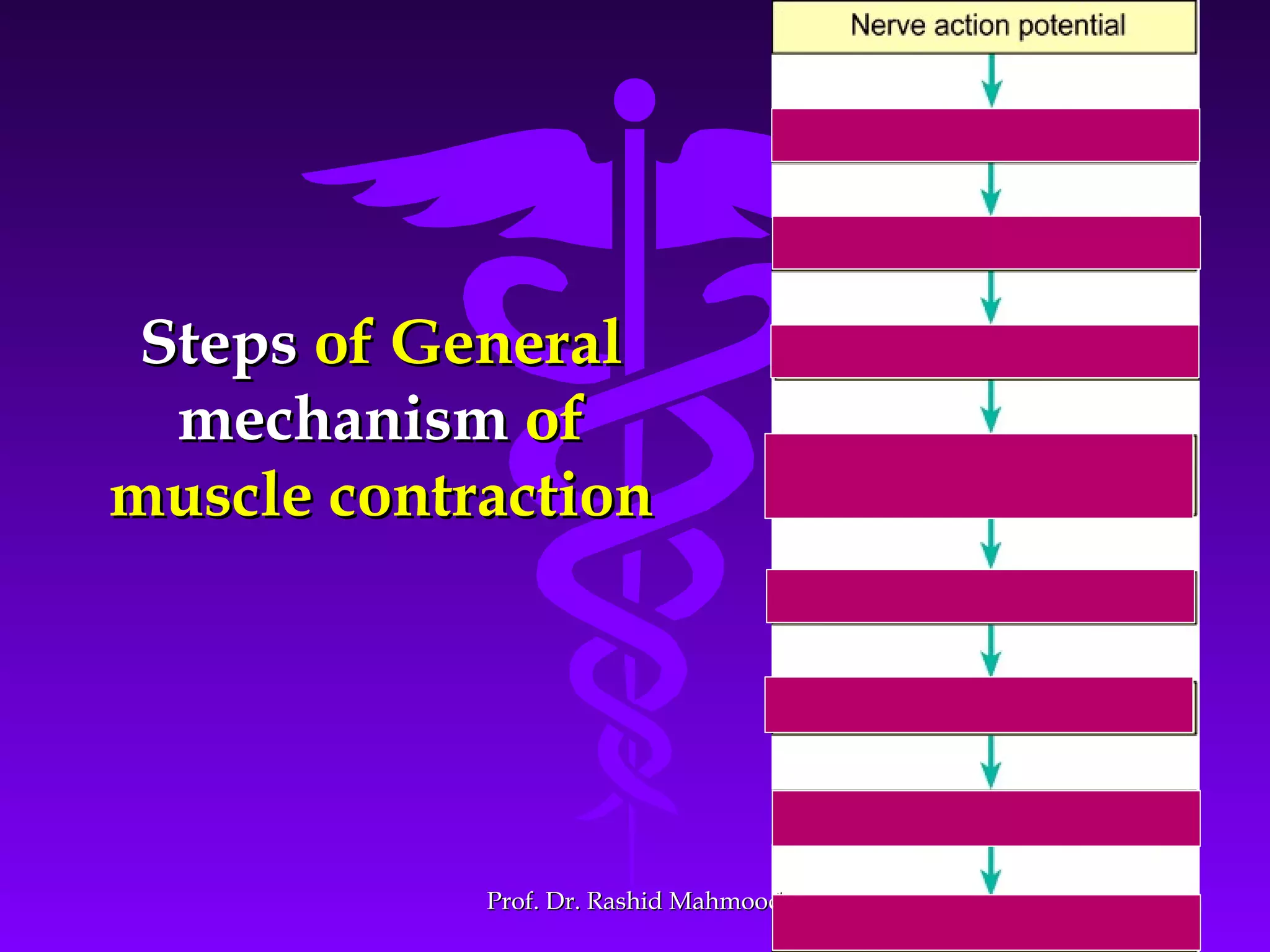
StepsSteps of Generalof General
mechanismmechanism ofof
muscle contractionmuscle contraction
Prof. Dr. Rashid MahmoodProf. Dr. Rashid Mahmood
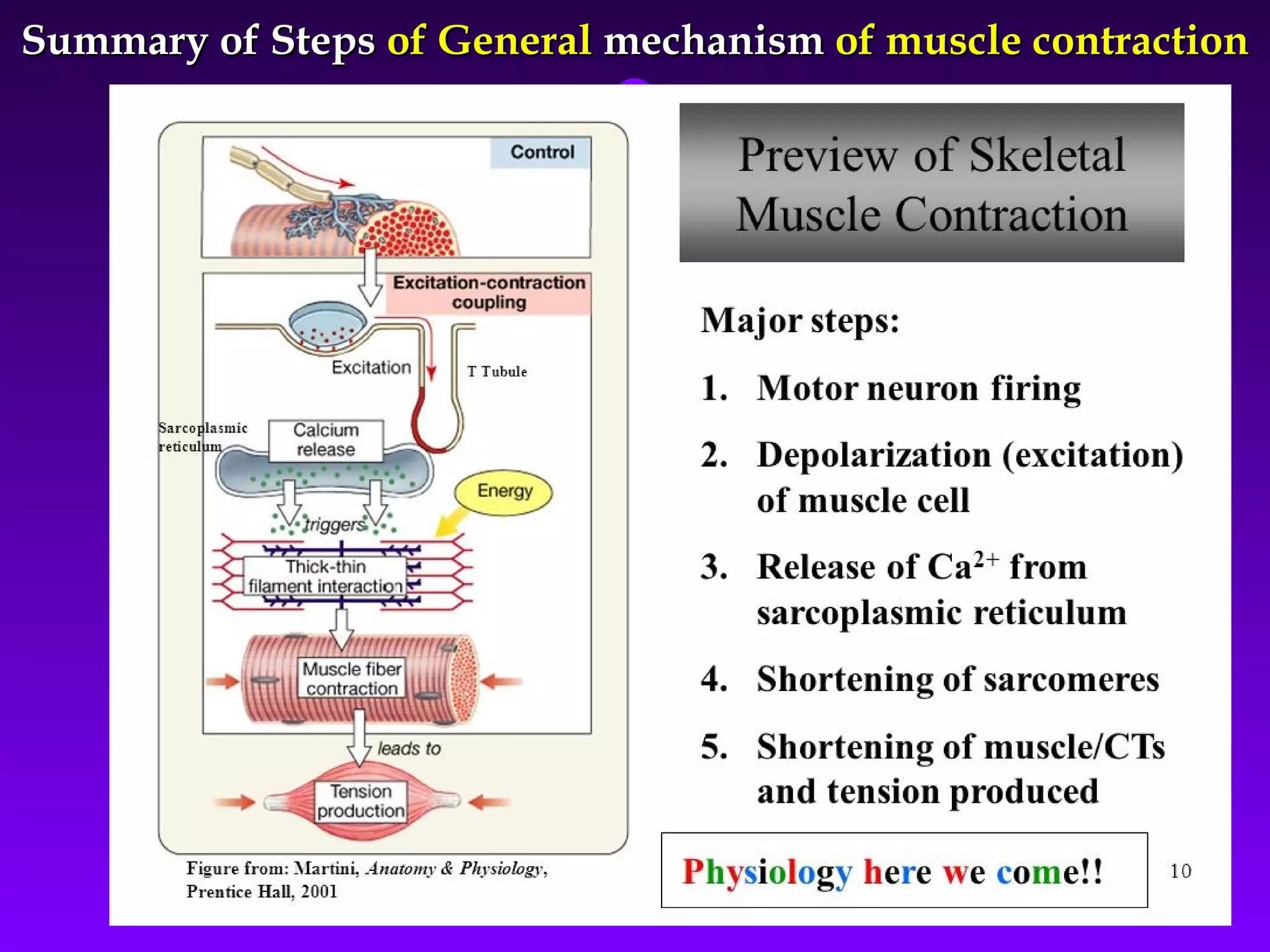
Summary of StepsSummary of Steps of Generalof General mechanismmechanism of muscle contractionof muscle contraction
3333Prof. Dr. Rashid MahmoodProf. Dr. Rashid Mahmood
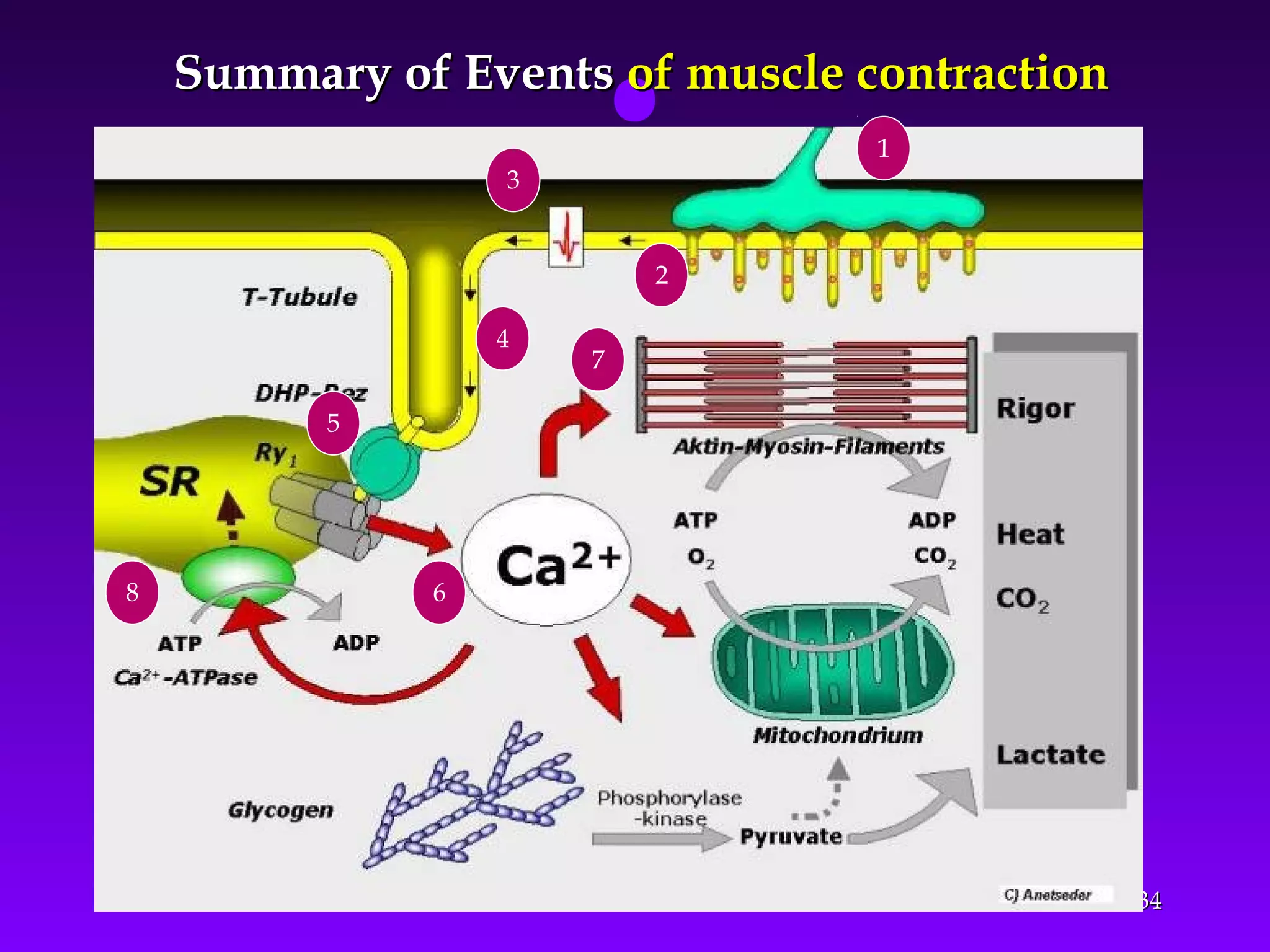
Summary of EventsSummary of Events of muscle contractionof muscle contraction
3434Prof. Dr. Rashid MahmoodProf. Dr. Rashid Mahmood
1
2
3
4
5
6
7
8
Take Home PointsTake Home Points
Three Classes of MuscleThree Classes of Muscle are Skeletal, Cardiac, & Smooth.are Skeletal, Cardiac, & Smooth.
Functional unit of Muscles is muscle fibre, composed of manyFunctional unit of Muscles is muscle fibre, composed of many myofibrilsmyofibrils..
Each myofibril is composed ofEach myofibril is composed of myofilamentsmyofilaments:: actinactin && myosinmyosin..
AA Sequence of eventSequence of events occurs ats occurs at neuromuscular junctioneuromuscular junction that finally resultsn that finally results
in muscle contractionin muscle contraction
AnAn Action potentialAction potential reachesreaches nerve fiber endingnerve fiber ending at neuromuscular junction,at neuromuscular junction,
causingcausing release of acetylcholinerelease of acetylcholine
Acetylcholine binds with its receptors atAcetylcholine binds with its receptors at motor-end platemotor-end plate, resulting in, resulting in
opening ofopening of “acetylcholine-gated Sodium channels“acetylcholine-gated Sodium channels””
Diffusion of Na+ into muscle fiberDiffusion of Na+ into muscle fiber causes action potential in muscle fibercauses action potential in muscle fiber
Action potential spreads in muscle fiber throughAction potential spreads in muscle fiber through T-Tubule system, thatT-Tubule system, that
causescauses release of stored calcium ions fromrelease of stored calcium ions from sarcoplasmic reticulumsarcoplasmic reticulum
Ca++ ions initiateCa++ ions initiate attractive forcesattractive forces between actin and myosin filamentsbetween actin and myosin filaments
causing sliding of actin over myosincausing sliding of actin over myosin (Sliding Filament Mechanism)(Sliding Filament Mechanism)
TheThe cross-bridge cyclecross-bridge cycle is repeated again & again till the completion ofis repeated again & again till the completion of
contractioncontraction
Sliding of actin filaments over myosin filaments through cross-bridge cycleSliding of actin filaments over myosin filaments through cross-bridge cycle
is explained byis explained by Walk-Along Theory (or Ratchet Theory)Walk-Along Theory (or Ratchet Theory)
3535
Assessment Q. 4Assessment Q. 4
Name that current theory that explainsName that current theory that explains
Sliding of actin filaments over myosinSliding of actin filaments over myosin
filaments through cross-bridge cyclefilaments through cross-bridge cycle
3636Prof. Dr. Rashid MahmoodProf. Dr. Rashid Mahmood
Learning ResourcesLearning Resources
Guyton and Hall (Text book ofGuyton and Hall (Text book of
physiology), 13th Editionphysiology), 13th Edition
Ganong (Text book of physiology),Ganong (Text book of physiology),
24th Edition24th Edition
Human Physiology : from cells toHuman Physiology : from cells to
system Lauralee Sherwood,9system Lauralee Sherwood,9thth
EditionEdition
Human Physiology Stuart Ira Fox, 13thHuman Physiology Stuart Ira Fox, 13th
EditionEdition
InternetInternet Prof. Dr. Rashid MahmoodProf. Dr. Rashid Mahmood3737
Next topic
Contractile Mechanism of Skeletal
Muscle II
14/1/2017, 0930 am: 1030 am
Prior knowledge required: Contractile
Mechanism of Skeletal Muscle I
3838Prof. Dr. Rashid MahmoodProf. Dr. Rashid Mahmood
ANY QUESTIONS?
Prof. Dr. Rashid MahmoodProf. Dr. Rashid Mahmood3939

Contractile mechanism of skeletal muscle 1

  • 1.
    11 Muscle Physiology Prof. Dr.Rashid Mahmood Contractile Mechanism of Skeletal Muscle I Prof. Dr. Rashid MahmoodProf. Dr. Rashid Mahmood Video of muscle contraction
  • 2.
    ObjectivesObjectives Goal/Aim (Main Objective): Toexplain the mechanism of muscle contraction At the end of this lecture students will be able toAt the end of this lecture students will be able to Classify muscles Describe organization of skeletal muscle Describe general mechanism of skeletal muscle contraction. Describe molecular mechanism of skeletal muscle contraction. Outline different steps of Cross-bridge Cycle Explain walk along theory...
  • 3.
    Lesson contents ClassesClasses ofMuscleof Muscle Physiological AnatomyPhysiological Anatomy of Skeletal Muscleof Skeletal Muscle SarcomereSarcomere Actin & Myosin FilamentsActin & Myosin Filaments The T Tubules and Sarcoplasmic ReticulumThe T Tubules and Sarcoplasmic Reticulum Sequence of events inSequence of events in neuromuscularneuromuscular transmissiontransmission Synthesis & Release ofSynthesis & Release of AcetylcholineAcetylcholine Steps ofSteps of General mechanism of muscleGeneral mechanism of muscle contractioncontraction 33Prof. Dr. Rashid MahmoodProf. Dr. Rashid Mahmood
  • 4.
    Three Classes ofMuscleThree Classes of Muscle Based on histological appearance and functionBased on histological appearance and function SkeletalSkeletal striated, voluntarystriated, voluntary CardiacCardiac striated, involuntarystriated, involuntary SmoothSmooth nonstriated, involuntarynonstriated, involuntary 44
  • 5.
    55 Muscle Tendon Prof. Dr. RashidMahmoodProf. Dr. Rashid Mahmood Skeletal Muscle
  • 6.
  • 7.
    88 SubunitsSubunits Muscle Muscle Fiber Myofibrils Myosin Filaments ActinFilaments Muscle fasciculus Prof. Dr. Rashid MahmoodProf. Dr. Rashid Mahmood
  • 8.
    99 Light and DarkbandsLight and Dark bands Striated Muscle Prof. Dr. Rashid MahmoodProf. Dr. Rashid Mahmood
  • 9.
    Assessment Q. 1AssessmentQ. 1 Name the THREE types of MuscleName the THREE types of Muscle 1010Prof. Dr. Rashid MahmoodProf. Dr. Rashid Mahmood
  • 10.
    SarcomereSarcomere 1111Prof. Dr. RashidMahmoodProf. Dr. Rashid Mahmood
  • 11.
    1212 Actin + MyosinFilamentsActin + Myosin Filaments Cross- Bridges Sarcomere Prof. Dr. Rashid MahmoodProf. Dr. Rashid Mahmood
  • 12.
    1313 SarcomereSarcomere Prof. Dr. RashidMahmoodProf. Dr. Rashid Mahmood
  • 13.
    Proteins that helpinProteins that help in alignment of Myofibrilsalignment of Myofibrils 1414Prof. Dr. Rashid MahmoodProf. Dr. Rashid Mahmood
  • 14.
    1515 Myosin MoleculeMyosin Molecule Prof.Dr. Rashid MahmoodProf. Dr. Rashid Mahmood
  • 15.
    1616 Myosin filamentMyosin filament Arm Prof.Dr. Rashid MahmoodProf. Dr. Rashid Mahmood
  • 16.
    1717 Myosin Molecule &filamentMyosin Molecule & filament Prof. Dr. Rashid MahmoodProf. Dr. Rashid Mahmood
  • 17.
    Assessment Q. 2AssessmentQ. 2 Name any THREE parts of MyosinName any THREE parts of Myosin FilamentFilament 1818Prof. Dr. Rashid MahmoodProf. Dr. Rashid Mahmood
  • 18.
    1919 Actin filamentActin filament Prof.Dr. Rashid MahmoodProf. Dr. Rashid Mahmood
  • 19.
    2020 Actin HelixActin Helix +tropomyosin+ tropomyosin +troponin+troponin == Actin FilamentActin Filament Prof. Dr. Rashid MahmoodProf. Dr. Rashid Mahmood
  • 20.
    2121 Troponin complexTroponin complex Prof.Dr. Rashid MahmoodProf. Dr. Rashid Mahmood
  • 21.
    2222 Binding ofBinding of myosinmyosin headwithhead with active siteactive site in thein the presencepresence of Ca++of Ca++ Prof. Dr. Rashid MahmoodProf. Dr. Rashid Mahmood
  • 22.
    2323 Mammalian Skeletal Muscle: Two Transverse Tubules perSarcomere Z line Prof. Dr. Rashid MahmoodProf. Dr. Rashid Mahmood
  • 23.
    2424 The T Tubulesand Sarcoplasmic ReticulumThe T Tubules and Sarcoplasmic Reticulum Prof. Dr. Rashid MahmoodProf. Dr. Rashid Mahmood
  • 24.
    2525 Relation between TTubules andRelation between T Tubules and Sarcoplasmic ReticulumSarcoplasmic Reticulum Sarcoplasmic Reticulum=Sarcoplasmic Reticulum= Terminal Cisternae+Terminal Cisternae+ Long Longitudinal TubulesLong Longitudinal Tubules Terminal CisternaeTerminal Cisternae Long Longitudinal TubulesLong Longitudinal Tubules •T TubuleT Tubule Prof. Dr. Rashid MahmoodProf. Dr. Rashid Mahmood
  • 25.
    Assessment Q. 3AssessmentQ. 3 Name the THREE parts of ActinName the THREE parts of Actin FilamentFilament 2626Prof. Dr. Rashid MahmoodProf. Dr. Rashid Mahmood
  • 26.
    2727 StepsSteps ofof GeneralGeneral mechanismmechanism ofof musclecontractionmuscle contraction Prof. Dr. Rashid MahmoodProf. Dr. Rashid Mahmood
  • 27.
    2828 Sequence of eventsinSequence of events in neuromuscular transmissionneuromuscular transmission Prof. Dr. Rashid MahmoodProf. Dr. Rashid Mahmood
  • 28.
    2929 Synthesis & Releaseof AcetylcholineSynthesis & Release of Acetylcholine Prof. Dr. Rashid MahmoodProf. Dr. Rashid Mahmood
  • 29.
    3030 StepsSteps of GeneralofGeneral mechanismmechanism of muscleof muscle contractioncontraction Prof. Dr. Rashid MahmoodProf. Dr. Rashid Mahmood AP= Action Potential MF= muscle fiber NMJ= Neuromuscular Junction Ach= acetylcholine SR= sarcoplasmic reticulum
  • 30.
    Events occurring atNMJEvents occurring at NMJ 3131Prof. Dr. Rashid MahmoodProf. Dr. Rashid Mahmood
  • 31.
    3232 StepsSteps of GeneralofGeneral mechanismmechanism ofof muscle contractionmuscle contraction Prof. Dr. Rashid MahmoodProf. Dr. Rashid Mahmood
  • 32.
    Summary of StepsSummaryof Steps of Generalof General mechanismmechanism of muscle contractionof muscle contraction 3333Prof. Dr. Rashid MahmoodProf. Dr. Rashid Mahmood
  • 33.
    Summary of EventsSummaryof Events of muscle contractionof muscle contraction 3434Prof. Dr. Rashid MahmoodProf. Dr. Rashid Mahmood 1 2 3 4 5 6 7 8
  • 34.
    Take Home PointsTakeHome Points Three Classes of MuscleThree Classes of Muscle are Skeletal, Cardiac, & Smooth.are Skeletal, Cardiac, & Smooth. Functional unit of Muscles is muscle fibre, composed of manyFunctional unit of Muscles is muscle fibre, composed of many myofibrilsmyofibrils.. Each myofibril is composed ofEach myofibril is composed of myofilamentsmyofilaments:: actinactin && myosinmyosin.. AA Sequence of eventSequence of events occurs ats occurs at neuromuscular junctioneuromuscular junction that finally resultsn that finally results in muscle contractionin muscle contraction AnAn Action potentialAction potential reachesreaches nerve fiber endingnerve fiber ending at neuromuscular junction,at neuromuscular junction, causingcausing release of acetylcholinerelease of acetylcholine Acetylcholine binds with its receptors atAcetylcholine binds with its receptors at motor-end platemotor-end plate, resulting in, resulting in opening ofopening of “acetylcholine-gated Sodium channels“acetylcholine-gated Sodium channels”” Diffusion of Na+ into muscle fiberDiffusion of Na+ into muscle fiber causes action potential in muscle fibercauses action potential in muscle fiber Action potential spreads in muscle fiber throughAction potential spreads in muscle fiber through T-Tubule system, thatT-Tubule system, that causescauses release of stored calcium ions fromrelease of stored calcium ions from sarcoplasmic reticulumsarcoplasmic reticulum Ca++ ions initiateCa++ ions initiate attractive forcesattractive forces between actin and myosin filamentsbetween actin and myosin filaments causing sliding of actin over myosincausing sliding of actin over myosin (Sliding Filament Mechanism)(Sliding Filament Mechanism) TheThe cross-bridge cyclecross-bridge cycle is repeated again & again till the completion ofis repeated again & again till the completion of contractioncontraction Sliding of actin filaments over myosin filaments through cross-bridge cycleSliding of actin filaments over myosin filaments through cross-bridge cycle is explained byis explained by Walk-Along Theory (or Ratchet Theory)Walk-Along Theory (or Ratchet Theory) 3535
  • 35.
    Assessment Q. 4AssessmentQ. 4 Name that current theory that explainsName that current theory that explains Sliding of actin filaments over myosinSliding of actin filaments over myosin filaments through cross-bridge cyclefilaments through cross-bridge cycle 3636Prof. Dr. Rashid MahmoodProf. Dr. Rashid Mahmood
  • 36.
    Learning ResourcesLearning Resources Guytonand Hall (Text book ofGuyton and Hall (Text book of physiology), 13th Editionphysiology), 13th Edition Ganong (Text book of physiology),Ganong (Text book of physiology), 24th Edition24th Edition Human Physiology : from cells toHuman Physiology : from cells to system Lauralee Sherwood,9system Lauralee Sherwood,9thth EditionEdition Human Physiology Stuart Ira Fox, 13thHuman Physiology Stuart Ira Fox, 13th EditionEdition InternetInternet Prof. Dr. Rashid MahmoodProf. Dr. Rashid Mahmood3737
  • 37.
    Next topic Contractile Mechanismof Skeletal Muscle II 14/1/2017, 0930 am: 1030 am Prior knowledge required: Contractile Mechanism of Skeletal Muscle I 3838Prof. Dr. Rashid MahmoodProf. Dr. Rashid Mahmood
  • 38.
    ANY QUESTIONS? Prof. Dr.Rashid MahmoodProf. Dr. Rashid Mahmood3939

Editor's Notes

  • #5 I now want to talk about the three classes of muscle, and these three classes were generated based on histological appearance and function. Let’s start with a brief overview. Skeletal muscle is striated, in other words, it looks like it has lines running through an individual muscle cell. Skeletal muscle is also voluntary, in other words, you have conscious control over your skeletal muscles, well at least most of them. Skeletal muscle is also multi-nucleated, and when we speak of an individual skeletal cell, we call it a myofiber. Cardiac muscle is also striated, in other words, it looks like there are lines running through the cell. It is involuntary, you do not really have conscious control over how your heart muscle beats. Next, the cardiac muscle appears branched, and I’ll show you an example of that in a little while, and when we speak of cardiac cells we speak of cardiocytes. Smooth muscle is non-striated, and is involuntary, and is fusiform in shape, in other words it looks like a spindle.
  • #7 The word muscle means little mouse, and its because when you flex the muscle the ball of muscle underneath your skin was thought to look like a little mouse. Some properties of muscle include being excitable, that’s means they can generate an electrical response, there are conductive, that means the electrical excitation can spread, in other words travel. Next it has contractility, that means it can shorten, and it has extensibility, in other words you can stretch your muscle. Lastly the muscle has elastic properties, and that basically means it can recoil back into its original shape. The prefixes “myo” and “sarco” also means muscle.
  • #37 Walk-Along Theory (or Ratchet Theory)