CONTROL SYSTEMS
ENGINEERING
Course Code: MEB 4101
Course Credit 4
Dynamic response
Prepared by;
Masoud Kamoleka Mlela
BSc, Electromechanical Eng. (UDSM)
MSc, Renewable Energy (UDSM)
PhD, Mechanical Engineering (HEU, CN).
OVERVIEW ON ON/OFF AND CONTINUOUS
CONTROL OF MECHANICAL, THERMAL AND
CHEMICAL SYSTEMS
CONTROL SYSTEMS ENGINEERING
• In an industrial plant, a closed-loop control system has
the role of keeping a measured physical signal to a
predefined value (set point). The physical signal, also
called controlled variable, can be of any kind,
electrical (voltage, current, power), mechanical
(position, speed, force, torque), hydraulic (pressure,
flow) or thermal (temperature). The difference between
the controlled variable (measured) and the predefined
value is called error.
• The input of the controller is the error and the controller
output is an actuation signal which is send to an
actuator. The controlled variable is further measured with
a sensor and the information is feed back to the
controller.
On-off control system
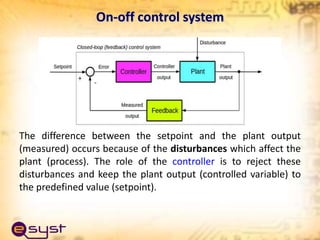
The difference between the setpoint and the plant output
(measured) occurs because of the disturbances which affect the
plant (process). The role of the controller is to reject these
disturbances and keep the plant output (controlled variable) to
the predefined value (setpoint).
On-off control system
• In industrial applications there are several control laws used, most of
them being on-off control, PID control or other more advanced laws
(fuzzy, neuro-fuzzy, optimal, etc.).
• The on-off control is the simplest form of a controller, which switches
ON when the error is positive and switches OFF when the error is zero
or negative. An on-off controller doesn’t have intermediate states but
only fully ON or fully OFF states. Due to the switching logic, an on-off
controller is often called a bang-bang controller or a two-step
controller
On-off control system
Regardless of the size of the error, the
output of the on-off controller can only
be fully ON or fully OFF, it is not
proportional with the error.
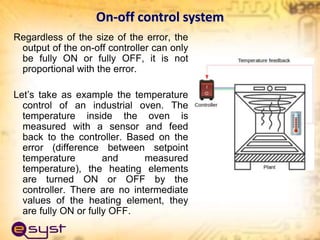
Let’s take as example the temperature
control of an industrial oven. The
temperature inside the oven is
measured with a sensor and feed
back to the controller. Based on the
error (difference between setpoint
temperature and measured
temperature), the heating elements
are turned ON or OFF by the
controller. There are no intermediate
values of the heating element, they
are fully ON or fully OFF.
On-off control system
• The industrial oven has two important characteristics which
need to be explained, because they affect the response of the
controller:
– dead time
– capacitance (inertia)
• In most of the control systems with feedback loop, the system
can not respond instantly to any disturbance and it takes time
(delay) until the controller output has any effect on the
measured (plant) output. This time delay is know as dead time.
In the case of the industrial oven, if the access door is opened, it
takes time until the temperature drops, the controller senses
the difference, turns the heaters on and the temperature is
brought back to setpoint. Dead time has the effect of hiding the
disturbance from the controller and limits its ability to react
quickly.
On-off control system
The capacitance of a system is seen as the resistance to
changing inputs. The higher the capacitance of a system, the
longer the time it takes to react to changes. With the oven cold,
even if turning the heaters on, takes time for the temperature
to start increasing and reach the nominal value. The advantage
is that capacitance has the tendency to filter (dampen) out the
effect of disturbances on a system.
On-off control system
LECTURE 3_On-off_Control Systems Engineering_MEB 4101.pptx

LECTURE 3_On-off_Control Systems Engineering_MEB 4101.pptx

  • 1.
    CONTROL SYSTEMS ENGINEERING Course Code:MEB 4101 Course Credit 4 Dynamic response Prepared by; Masoud Kamoleka Mlela BSc, Electromechanical Eng. (UDSM) MSc, Renewable Energy (UDSM) PhD, Mechanical Engineering (HEU, CN).
  • 2.
    OVERVIEW ON ON/OFFAND CONTINUOUS CONTROL OF MECHANICAL, THERMAL AND CHEMICAL SYSTEMS CONTROL SYSTEMS ENGINEERING
  • 3.
    • In anindustrial plant, a closed-loop control system has the role of keeping a measured physical signal to a predefined value (set point). The physical signal, also called controlled variable, can be of any kind, electrical (voltage, current, power), mechanical (position, speed, force, torque), hydraulic (pressure, flow) or thermal (temperature). The difference between the controlled variable (measured) and the predefined value is called error. • The input of the controller is the error and the controller output is an actuation signal which is send to an actuator. The controlled variable is further measured with a sensor and the information is feed back to the controller. On-off control system
  • 4.
    The difference betweenthe setpoint and the plant output (measured) occurs because of the disturbances which affect the plant (process). The role of the controller is to reject these disturbances and keep the plant output (controlled variable) to the predefined value (setpoint). On-off control system
  • 5.
    • In industrialapplications there are several control laws used, most of them being on-off control, PID control or other more advanced laws (fuzzy, neuro-fuzzy, optimal, etc.). • The on-off control is the simplest form of a controller, which switches ON when the error is positive and switches OFF when the error is zero or negative. An on-off controller doesn’t have intermediate states but only fully ON or fully OFF states. Due to the switching logic, an on-off controller is often called a bang-bang controller or a two-step controller On-off control system
  • 6.
    Regardless of thesize of the error, the output of the on-off controller can only be fully ON or fully OFF, it is not proportional with the error. Let’s take as example the temperature control of an industrial oven. The temperature inside the oven is measured with a sensor and feed back to the controller. Based on the error (difference between setpoint temperature and measured temperature), the heating elements are turned ON or OFF by the controller. There are no intermediate values of the heating element, they are fully ON or fully OFF. On-off control system
  • 7.
    • The industrialoven has two important characteristics which need to be explained, because they affect the response of the controller: – dead time – capacitance (inertia) • In most of the control systems with feedback loop, the system can not respond instantly to any disturbance and it takes time (delay) until the controller output has any effect on the measured (plant) output. This time delay is know as dead time. In the case of the industrial oven, if the access door is opened, it takes time until the temperature drops, the controller senses the difference, turns the heaters on and the temperature is brought back to setpoint. Dead time has the effect of hiding the disturbance from the controller and limits its ability to react quickly. On-off control system
  • 8.
    The capacitance ofa system is seen as the resistance to changing inputs. The higher the capacitance of a system, the longer the time it takes to react to changes. With the oven cold, even if turning the heaters on, takes time for the temperature to start increasing and reach the nominal value. The advantage is that capacitance has the tendency to filter (dampen) out the effect of disturbances on a system. On-off control system