CONTRACT ADMINISTRATION
1
Contract: The word contract can be defined in short as
an agreement between the parties enforceable under
the law.
A contract is a legally binding agreement between the
parties identified in the agreement to fulfill all the terms
and conditions outlined in the agreement.
2
• A prerequisite requirement for the enforcement of a contract,
amongst other things, is the condition that all the parties to
the contract accept the terms of the claimed contract.
• One who is in charge of the project is known as the
Employer.
• One who agrees to execute or perform is known as the
Contractor .
Contract Administration / management-
owners perspective
3
Types of Contract
• Contracts can be broadly classified as Cash Contract, and BOT
Contracts.
• In cash contract the consideration for the agreement is payment
in cash to the contractor as per the terms and conditions of the
agreement by the Employer.
• In a Built Operate and Transfer type of project, the contractor
invests the capital cost and consideration is recovery rights like
toll, rent etc. over an agreed period.
• There are various models in Built Operate Transfer type
contracts. Some of these are BOT, BOOT, BOLT.
4
• Contracts can be further classified as Service
Contracts, Management Contract, Lease Contract,
Sales Contracts (including leases), Purchasing
Contracts, Partnership Agreements, Trade
Agreements, and Intellectual Property Agreements
Etc.
5
– Service contract could be an agreement to provide agreed kind of
services to the customer. Service delivery management ensures that the
service is being delivered as agreed, to the required level of performance
and quality. In civil engineering a routine maintenance contract for
sweeping cleaning of Roads, Flyovers, security at site etc are relative
examples of the service contractor
– Sales Contract is a contract between a company (the Seller) and a
Customer that you are promising to sell products and/or services. The
customer in return is obligated to pay for the product/services bought
– Purchasing Contract is a contract between your company (the Buyer)
and a Supplier who is promising to sell you products and/or services.
6
– Partnership Agreement may be a contract, which formally establishes
the terms of a partnership between two legal entities such that they
regard each other as „partners‟ in a commercial arrangement.
– Lease Agreement is generally an agreement related to rights to enjoy
property for certain period as per the terms and conditions of the
agreement. A standard consideration is the agreed Lease rent. Typical
example will be renting a flat, Advertisement permits
– Divestiture is the disposition or sale of an asset by a company. A
company will often divest an asset, which is not performing well, which is
not vital to the company's core business, or which is worth more to a
potential buyer or as a separate entity than as part of the company.
7
What is contract management?
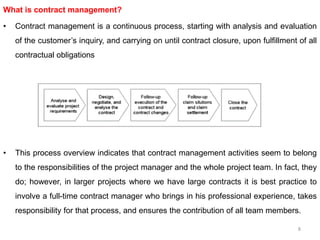
• Contract management is a continuous process, starting with analysis and evaluation
of the customer’s inquiry, and carrying on until contract closure, upon fulfillment of all
contractual obligations
• This process overview indicates that contract management activities seem to belong
to the responsibilities of the project manager and the whole project team. In fact, they
do; however, in larger projects where we have large contracts it is best practice to
involve a full-time contract manager who brings in his professional experience, takes
responsibility for that process, and ensures the contribution of all team members.
8
9
Contract Administration:
The management of all actions, after the award of
a contract, that must be taken to assure
compliance with contract.
Effective contract management ensures customer
satisfaction and contractor profit
10
What Effective Contract Management Accomplishes
• Serves Client by providing them with a controlled
effective job and good communications
• Establishes clear expectations of both parties
• Anticipates and handles disputes as they arise
• Ensures compensation for the deliverables
achieved.
11
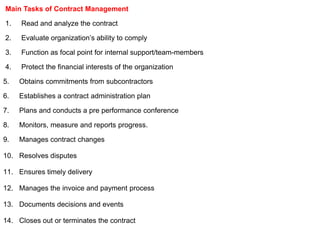
Main Tasks of Contract Management
1. Read and analyze the contract
2. Evaluate organization’s ability to comply
3. Function as focal point for internal support/team-members
4. Protect the financial interests of the organization
5. Obtains commitments from subcontractors
6. Establishes a contract administration plan
7. Plans and conducts a pre performance conference
8. Monitors, measure and reports progress.
9. Manages contract changes
10. Resolves disputes
11. Ensures timely delivery
12. Manages the invoice and payment process
13. Documents decisions and events
14. Closes out or terminates the contract
12
Contract Manager’s Role in Team Effort
• The focal point for the team and all
communications on contractual issues
• Should know who does what, when, where, and
why, and how is documented by team
• Should ensure that everything contractually
required is done by appropriate members of the
team
13
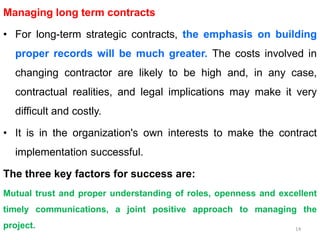
Key Elements in Contract Management and Control
• Contract Administration Plan
• Control over correspondence/communication
• Risk Management
• Pre-performance Conference
• Monitoring and Ensuring Progress
• Change Management
• Dispute/Conflict Resolution
• Inspection/ Acceptance
• Contract Closeout
Managing long term contracts
• For long-term strategic contracts, the emphasis on building
proper records will be much greater. The costs involved in
changing contractor are likely to be high and, in any case,
contractual realities, and legal implications may make it very
difficult and costly.
• It is in the organization's own interests to make the contract
implementation successful.
The three key factors for success are:
Mutual trust and proper understanding of roles, openness and excellent
timely communications, a joint positive approach to managing the
project. 14
1 Communication
• The key to successful contract execution is clear and adequate
communication between employer and contractor at all times. The timely
sharing of plans and communication of designs about future item executions
can help ensure the parties develop confidence in the construction
programme. This should be a two-way process. An important point is that
the arrangement should be that these levels of communication are
preserved even when problems arise.
• Contractors should realize that it would not be appropriate for them to
go „to the top‟ and liaise directly with the top management, as it will
undermine the contract manager. Similarly, it would be inappropriate
for staff on the contractor side to complain about their internal
grievances to the contract manager in the employer organization.
15
• Good communication is an enabler of a particular culture between employer and
contractor: one built on openness, trust and mutual interest. Communication will pave
the way for more openness between the parties and the individuals involved in the
contractual relationships. In addition, the way people get involved in the project and
the attitudes they hold about other organisations, about the project, and about the
concept as a whole, are crucial to the successful implementation of the contract.
• Careful thought needs be given in identifying the skills and attitudes of staff that will
fill key posts and to the behaviors and personal attitudes that are required for the
proper execution of the work. Commitment to managing the project and to long-term
success requires proactive and assertive people, and not passive and submissive, or
indifferent behavior. In most cases a discussion on the problem, will be all that is
required to secure agreement on remedial action. Negotiations whether informal or
formal during the contract, are a valuable means of resolving any problems, disputes
or outstanding issues
16
2 Professional Consultants as Contract manager
• Where contract management expertise is not available in-house, it may be
appropriate to appoint professional consultants, or even appoint a
professional contract manager. Such arrangements should be clearly
defined in the construction contract to ensure that ownership of the
arrangement as a whole continues to rest with the employer organization.
• The key contract management issues that are anticipated can be addressed
in the contract conditions and specifications; they will also have a bearing on
the subsequent procurement strategy of the employer organization.
17
• The contract manager acts as the interface between the contractor and the
employer organisation in handling requests for incorporating variations into
the contract. A preliminary investigation into the new requirement, possibly
with the assistance of the contractor, will usually be required to determine
whether it should be the formal change or otherwise. It is particularly
important that additional works in the contract should be carefully controlled.
• In other cases, especially where additional costs are involved, contract
managers may have to submit the proposal to the competent authorities
within specified budgetary and technical constraints in the consultancy
contract or delegated authorities. Formal authorization will be required to
ensure that only those additional requirements that can be justified are
added to the contract.
• Changes to contract, procedures or works may have an effect on
completion, performance; on costs and on whether the contract remains
financially viable or otherwise.
18
Contract Administration
• Contract administration involves making decisions and the
timely flow of information and decisions to enable completion of
the project as required by the contract documents including
review and observation of the construction project. This is
important to the Owner and Consultant not only to determine
that the work is proceeding in conformity with the contract
documents, but also because it allows a final opportunity to
detect any inaccuracies, ambiguities or inconsistencies in the
design.
19
Contract Administration ....
• Good project preparation and the right contract are essential
foundations for effective contract management. The
arrangement must also be flexible enough to accommodate
change. In long term contracts, where interdependency
between employer and contractor is inevitable, it is in both their
interests to make the relationship work.
• Contract administration handles the formal governance of the
contract and changes to the contract documentation. All these
areas must be managed successfully if the arrangement is to
be a success.
20
Contract Administration ....
The three key factors for success are trust,
communication, and recognition of mutual aims.
• Management structures for the contract need to be
designed to facilitate effective implementation; staff
involved at all levels must show their commitment to it.
• Information flows and proper communication should be
stipulated at the beginning of a contract, and maintained
throughout contract period. There should be set
procedures for raising issues and resolving disputes, so
that they are dealt with as early as possible and at the
appropriate level in the organization.
21
Contract Administration
• Contract administration, the formal governance of the contract, includes such tasks as
1. contract maintenance and change control,
2. charges and cost monitoring,
3. variation order process and payment procedures,
4. management reporting, and so on.
• The importance of contract administration to the success of the contract, and to the relationship
between employer and contractor, cannot be underestimated.
• Clear administrative procedures will ensure that the parties to the contract understand who
does what, when, and how.
• The contract documentation itself must continue to accurately reflect the arrangement, and
changes to it as per stipulated procedures, and carefully controlled.
• Responsibility for authorizing different types of variations will often rest with top management,
and documented internal procedures should reflect this.
22
Contract Administration
• The importance of contract administration to the success of the contract implementation, and to
the customer and contractor relations, should not be underestimated. Contract administration
will require appropriate resourcing. It may be that the responsibility falls on the contract
manager. Otherwise the responsibility is shared across a contract management team. It is
important that all members of the team deal promptly with contract administration tasks, during
the various stages of implementation. Some typical procedures that combine to make up
contract administration are as follows:
– Contract document maintenance and variation/change control
– Cost monitoring
– Variation ordering procedures
– Payment procedures
– Funding procedures
– Resource management and planning
– Management reporting
– Project Asset management
23
• These procedures will need to be designed to reflect the
specific works in the contract and the organisation. It should
be borne in mind that additional administrative procedures
may also be needed. Contractual relationships evolve and
must respond to changes in the work environment. It follows
that the contract document itself must be capable of evolving
efficiently and effectively, through formal change control
procedures and by mutual consent, in response to changing
requirements. It is preferable to update documentation as
changes occur rather than relying on informal arrangements.
24
Elements of Contract Administration T
• To keep the contract documentation up to date is an important
activity, and should be entrusted to an experienced person.
• The effort required may be reduced by prescribing the formats
for variation, order interim payments etc.
• The contract must clearly stipulate provisions to enable
required changes and pricing mechanism within agreed
parameters, without needing to change the contract
documentation or conditions. Procedures should be established
to keep the contract documentation up to date and to ensure
that all documents relating to the contract are consistent.
25
• For a large or complex contract, some form of change control
procedure is needed. Applying document management
principles involves:
– Identifying all relevant documentation (including contract
clauses and schedules, procedures manuals etc)
– Change control, variation procedures, and ensuring no
changes are made without appropriate authorisation from
the competent authorities.
– Recording the status of every document (current/historic,
draft/final)
– Ensuring consistency across various documents.
26
Contract Administration : Supervision
• The supervision of the project needs to be handled by an
experienced team of persons or experts of relevant fields.
• For infrastructure contracts, there is a practice to invite bids
from consultants with relevant experience.
• The bid document for the consultancy services typically
comprise Terms of Reference (TOR), standard conditions of
consultancy contract, period of completion, payment schedule
etc. The TOR includes the type of personnel to be appointed by
the consultant for the job and their qualifications, experience,
period on the project (man-months) etc.
27
• The role of the supervision consultant is very crucial for the
contract management and completion of the project. Apart from
the day-to-day supervision, the Project Management Consultant
(PMC) has to carry out documentation of the contract and the
project.
• Generally, the entire correspondence with the Contractor is
made through the PMC. It is therefore important to have a
capable, qualified and experienced PMC on the job who
understands the various provisions of the contract.
• FIDIC has also published “Client-Consultant Agreement
(White Book) Guide” 2nd Ed. This document can be used
with project specific changes. 28
Contract Administration :Contract Monitoring
• The exact monitoring requirements and methodology will depend on the
nature of the contract and the project to be completed. There are some
standard practices that can apply. These include:
– Monitoring the contractor's performance against the specific targets and
milestones laid down in the contract i.e. a particular milestone being
reached in stipulated time
– Inspection of completed work or random sample checks
– The contractor providing information and reports on his own performance
– Regular review meetings held between the Employer and contractor
– Recording complaints received from client, specific systems may need to
be set up where a good complaints or customer satisfaction procedure
like ISO 9000 can be prescribed.
29
Contract Administration :Quality Assurance System-(QAS)
• In standard contracts, the Contractor is expected to institute a quality
assurance system to demonstrate compliance with the requirements of the
Contract. The system should be in accordance with the details stated in the
Contract. The Engineer shall be entitled to audit any aspect of the system.
Details of all procedures and compliance documents shall be submitted to
the Engineer for information before each design and execution stage is
commenced. When any document of a technical nature is issued to the
Engineer, evidence of the prior approval by the Contractor himself should be
apparent on the document itself. Compliance with the quality assurance
system shall not relieve the Contractor of any of his duties, obligations or
responsibilities under the Contract.
30
Contract Administration : Construction Programme (CP)
Construction programme in simple words is the activity chart of the contractor as to
how he intends to complete the project within the prescribed time schedule.
• The contractor has to submit the CP immediately on commencement of the contract.
• The PMC has to monitor the performance and achievement of the contractor with
reference to this CP.
• The periodic review will indicate the status of the project as well as how contractor is
performing.
• The monitoring of CP will also help PMC and the Employer to take timely, corrective
measures.
• The contractor has to revise and submit the CP if required as per the provisions of
the contract.
• The PMC may ask for modifications in the programme if found necessary.
• The approved programme becomes the basis for the performance evaluation and
project monitoring.
• The contractor has to submit the cash-flow, equipment, manpower details to the PMC
for evaluation of the CP. The Engineer‟s decision in the CP is final and binding on the
contractor.
31
Contract Administration : Construction Programme (CP)
• The progress of the contract is monitored with reference to the
approved contraction programme.
• Generally, monthly progress reports are to be prepared by the
Contractor and submitted to the Engineer in multiple copies.
• The first report shall cover the period up to the end of the first
calendar month following the Commencement Date.
• Reports shall be submitted monthly thereafter, each within 7
days after the last day of the period to which it relates.
• Reporting should continue until the Contractor has completed
all work.
32
• Each report should typically include:
– Charts and detailed descriptions of progress, including each stage of design (if
any), Contractor‟s Documents, procurement, manufacture, delivery to Site,
construction, erection and testing; and including these stages for work by each
nominated Subcontractor
– (b) Photographs showing the status of manufacture and of progress on the Site
– (c) For the manufacture of each main item of Plant and Materials, the name of
the manufacturer, manufacture location, percentage progress, and the actual or
expected dates of: (i) commencement of manufacture,(ii) Contractor‟s
inspections,(iii) tests, and (iv) shipment and arrival at the Site;
– (d) Details described in contract
– (e) copies of quality assurance documents, test results and certificates of
Materials
– (f) list of notices given under contract [Employer‟s Claims] and notices given
under contract [Contractor‟s Claims]
– (g) safety statistics, including details of any hazardous incidents and activities
relating to environmental aspects and public relations; and
– (h) Comparisons of actual and planned progress, with details of any events or
circumstances which may jeopardise the completion in accordance with the
Contract, and the measures being adopted to overcome delays.
33
Contract Administration : Effective Control
• Effective control ensures that both parties fulfil their contractual obligations.
The contract manager must record, co-ordinate and communicate what is
and has happened with the contract. This information can then be used for
forward planning and any future contracts likely to be undertaken. A skill that
is required for effective control is the ability to identify problems that require
corrective action. The types of problems that might occur are:
– Unsatisfactory performance
– Misunderstanding the requirement
– Inadequate channels of communication
– Changes to the contract, brought about by unexpected requirements
34
• Contract control involves actively keeping the contractor‟s performance to
the required standard.
• Participation by both parties is needed if this is to be successful, to enable
any problems to be quickly identified and resolved.
• If monitoring indicates that a contractor‟s performance has deteriorated,
action will need to be taken as provided in the contract.
• The nature of the action will depend upon the level of the under-performance
or shortfall. If regular monitoring is effectively carried out, problems will be
spotted early and the degree of any disruption from the target and corrective
action will be minimised.
35
Contract Administration :Extension of Time (EOT)
• Every contract provides for the extension of the time for completion of the project for
reasons beyond the control of the contractor. For e.g. it may be noted that in civil
infrastructure contracts the land required for execution of the project is generally to
be provided by the Employer. Similarly, there are various utility services in the city,
like, electric poles, water supply lines etc. These are required to be shifted with the
help of the Employer. The delays on this count are generally beyond the capacity of
the contractor.
• The contractor has to continuously report to the engineer delays occurring in the
project, which entitles him for extension. The Engineer shall assess and determine
the admissible extension to the contractor due to these delays. The Engineer shall
satisfy that the delays are beyond the control of the contractor and he is entitled to
the extension as per the provisions of the contract. In that case the Engineer shall
notify the contractor and the Employer, the certificate of extension.
36
• The Contractor shall be entitled subject to contract provisions to an extension of the time
for completion if and to the extent that completion for the purposes of contract [taking-
over of the works and sections] is or will be delayed by any of the following causes:
– Variation (unless an adjustment to the Time for Completion has been agreed under
the contract‟s Variation Procedure) or other substantial change in the quantity of an
item of work included in the Contract
– b) Cause of delay giving an entitlement to extension of time under contract conditions
– c) Exceptionally adverse climatic conditions
– d) Unforeseeable shortages in the availability of personnel or Goods caused by
epidemic or governmental actions, or
– e) Any delay, impediment or prevention caused by or attributable to the Employer, the
Employer‟s Personnel, or the Employer‟s other contractors.
• If the Contractor considers himself to be entitled to an extension of the Time for
Completion, the Contractor shall give notice to the Engineer in accordance with the
provisions of the contract. When determining each extension of time under the contract,
the Engineer shall review previous determinations and may increase, but shall not
decrease, the total extension of time.
37
Contract Administration : Liquidated Damages
• Liquidated damage is the predetermined amount to be paid by the contractor
to the Employer for the delays in completion of the project or achievement of
a stipulated milestone. A milestone is the pre-decided stage of the project to
be completed by the contractor in the prescribed period as per contract. For
e.g. number of kilometres of road to be completed, foundations of a bridge
etc.
• Non-achievement of a stipulated milestone will render contractor liable to
pay the stipulated liquidated damages to the Employer unless the period is
extended.
• The liquidated damages are prescribed in the contract, as an amount to be
paid per day or per week. This amount, payable by the contractor, is
generally deducted from the interim payments due to the contractor. It needs
to be noted that this is not a source of revenue to the Employer, nor a
penalty to the contractor in the strict sense. It is an estimated predetermined
damage to be paid by the contractor to the Employer on failure of
performance like non-achievement of stipulated milestone in the contract.
38
Contract Administration: Managing Change - Change Control
• A successful arrangement requires a mutual commitment to meeting evolving
business requirements and adapting to changing circumstances. Reasons for
change during contracts can come from a range of sources, both internal and
external. Whatever the reasons, it is important to realise the implications of
change for the contract and all parties involved. There could be implications or
concerns in areas such as continuing value for money, and the possibility of
moving beyond the original scope of the requirement. Change is easier to deal
with when preparations are made. Not every possibility can be foreseen and
planned for, but it is desirable that the contract includes some flexibility as well
as the necessary procedures for handling changes. A properly managed change
can be a good opportunity to alter or improve the project, prompted by:
– Significant revisions to the corporate strategy/business objectives of either
party.
– Developments, changes in technology
– Public demand
– Change in the requirements of the Employer
– Changes in local legislations or development plans etc.
– Financial or other restraints
Contract Administration / management-
owners perspective
39
Contract Administration: Managing Change - Change Control
– The importance of understanding the implications of change from the
perspective of both parties cannot be overemphasised. Change to a
contractual arrangement affects the scope, and thus the viability of the
contract, for either or both parties. To an extent, both parties are taking a
calculated risk when they enter long term contract arrangements that the
cumulative effect of change over the term will balance out for both. Joint
planning of change is vital if risks are to be minimised. It is essential that
both parties have realistic expectations of what the contract will deliver at
the outset: that the contract is neither intentionally nor inadvertently
„over-sold‟ by either party. This „foundation of realism‟ is essential if the
expectations generated by both the customer‟s and the contractor‟s
business cases are to be met.
– This is not as straightforward as it may seem, as there is often a tendency
within both employer and contractor organisations during the
procurement phase to „over-sell‟ the prospects for the contract in order to
gain the necessary management approvals to proceed. This temptation
must be resisted if the viability of the contract is to be maintained for both
parties.
Contract Administration / management-
owners perspective
40
Contract Administration: Managing Change - Change Control
– Care must also be taken not to distort the original competition, particularly the
original value for money equation, as this could conflict with procurement policy
and rules. If the cumulative effect of change is to reduce the scope of the contract,
clearly the customer will be concerned about the overall profitability of the
relationship from its perspective. In legal terms, the customer must ensure that it is
not open to claims from the contractor for misrepresentation. The employer must
also ensure that the variations do not take the resulting contract outside the scope
of the original advertisement, or outside the permitted extensions to existing
contracts. The original scope advertised will have a strong influence on later
situations where change increases the scope of the contract. In order to prevent
this, it is important that the requirement set out is sufficiently broad to allow for
some changes in scope and/or volumes. Again, in any cases of doubt, specialist or
legal advice must be sought.
– Changes are always easier to manage when they are planned. Even where they
occur without warning, it is often possible to foresee what might happen and
plan for what can be done. Change in external factors may make change hard to
avoid. According to the type of contract, the contractor may be closely involved in
planning the changes, or may even be entirely accountable for them. Changes will
always need to be negotiated with the contractor by the Engineer.
Contract Administration / management-
owners perspective
41
Contract Administration: Managing Change - Types of Change or Variation
• In all cases, it is likely that there will be consequent changes, leading to a
contract variation that will need to be negotiated with the contractor.
• Key principles of this re-negotiation are that: the contract(s) should have
provisions for such change; and the employer should always be aware of the
possibility of the contractor seeking to increase their profitability. Therefore,
solutions and the associated costs proposed by the contractor should always
be rigorously audited by the expert for best value.
• Major change will require the revision of a construction programme, and
management mode of operation for monitoring a completion period.
• Change control procedures should be included in the contract.
• The respective roles and responsibilities of both parties in the change control
process must be clearly identified, along with the procedures for raising,
evaluating, costing and approving change requests.
• A change control procedure should apply to all changes, although there may
be certain delegated or shortened procedures available in defined
circumstances – such as delegated budget tolerance levels within which a
contract manager or the Engineer would not have to seek senior management
approval. Contract Administration / management-
owners perspective
42
Contract Administration: Managing Change - Types of Change or Variation
• However, flexibility needs to be built into this procedure to deal with issues such as
emergencies. A change control procedure should provide a clear set of steps and clearly
allocated responsibilities covering:
1. requesting changes
2. assessment of impact
3. Prioritisation and authorisation
4. agreement with contractor
5. control of implementation
6. documentation of change assessments and variation orders
• Responsibility for authorising different types of change will often rest with competent
authorities, and documented internal procedures should reflect this.
• In particular, changes to the overall contract, such as changes to prices outside the
scope of agreed price variation mechanisms, must have senior management approval.
• In many cases, it will be possible to delegate limited powers to authorise minor changes
using agreed processes.
• Appropriate structures need to be established, with representatives of both employer
and contractor management, for reviewing and authorising change requests.
Contract Administration / management-
owners perspective
43
Contract Administration: - Managing Changes in Construction Contracts
• Construction contracts are fundamentally different from major
service contracts. There are various types of construction
contract.
• The choice of contract depends on the basis of pricing, and the
contract strategy that best meets the project objectives.
• The various types offer different ways of handling pricing, risk
transfer, responsibility for performance, cost certainty, and
complexity.
• The main customer-side roles involved in handling construction
contracts are the project manager and the project sponsor.
• The project manager manages the contract on behalf of the
customer, co-ordinating the design and construction and
managing claims and disputes in an impartial manner. On large-
scale projects, the project sponsor fulfills a higher level, less
hands-on role, overseeing the project manager and monitoring
budgets etc.
Contract Administration / management-
owners perspective
44
Contract Administration: - Managing Changes in Construction Contracts
• “Variation” means any change to the Works, which is
instructed or approved as a variation under the contract. In
construction contracts, there is a provision for variation and
determination of rate for such variation. The variations are well
defined in the contract. Ideally, it is desirable to prepare detailed
estimate with full investigations and analysis. Once the estimate is
put to tender changes, variations during execution should be
avoided. However due to certain unforeseen circumstances such
variations become imperative. In that situation it should be dealt
with as per the provisions of the contract. If the variation or the
additional work is separable from the main work, then it should
be dealt under a separate contract. In variations, applicability of a
tender rate to a new or varied item is always a contentious issue.
The same need to be decided by the Engineer as per the contract
provisions.
Contract Administration / management-
owners perspective
45
Contract Administration: - Managing Changes in Construction Contracts
• However, a new rate or price shall be appropriate for an item of work if (Typical
provision)
– (a)
• (i) the measured quantity of the item is changed by more than (25%) from the
quantity of this item in the Bill of Quantities or other Schedule,
• (ii) this change in quantity multiplied by such specified rate for this item
exceeds (0.25%) of the Accepted Contract Amount
• (iii) this change in quantity directly changes the Cost per unit quantity of this
item by more than (1%, or 2%) and
• (iv) this item is not specified in the Contract as a “fixed rate item”
OR
– (b)
• (i) the work is instructed under the contract [Variations and Adjustments],
• (ii) no rate or price is specified in the Contract for this item, and
• (iii) no specified rate or price is appropriate because the item of work is not of
similar character, or is not executed under similar conditions, as any item in
the Contract.
Contract Administration / management-
owners perspective
46
Contract Administration: - Managing Changes in Construction Contracts
• Each new rate or price shall be derived from any relevant rates or prices in the Contract,
with reasonable adjustments to take account of the matters described in sub-paragraph
(a) and/or (b), as applicable. If no rates or prices are relevant for the derivation of a new
rate or price, it shall be derived from the reasonable cost of executing the work,
together with profit, taking account of any other relevant matters. Until such time as an
appropriate rate or price is agreed or determined, the Engineer shall determine a
provisional rate or price for the purposes of Interim Payment Certificates as soon as the
concerned Works commences. Whenever the omission of any work forms part (or all) of
a Variation, the value of which has not been agreed, if:
– (a) the Contractor will incur (or has incurred) cost which, if the work had not been
omitted, would have been deemed to be covered by a sum forming part of the
Accepted Contract Amount;
– (b) the omission of the work will result (or has resulted) in this sum not forming part
of the Contract Price; and
– (c) this cost is not deemed to be included in the evaluation of any substituted work;
• ... then the Contractor shall give notice to the Engineer accordingly, with supporting
particulars. Upon receiving this notice, the Engineer shall proceed in accordance with
contract [Determinations] to agree or determine this cost, which shall be included in the
Contract Price.
Contract Administration / management-
owners perspective
47
Contract Administration: - Managing Changes in Construction Contracts
• The Engineer may initiate variations at any time prior to issuing the Taking-Over Certificate for the
Woks, either by an instruction or by a request for the Contractor to submit a proposal. The
Contractor shall execute and be bound by each Variation, unless the Contractor promptly gives
notice to the Engineer stating (with supporting particulars) that (i) the Contractor cannot readily
obtain the Goods required for the Variation, or (ii) such Variation triggers a substantial change in the
sequence or progress of the Works.
• Upon receiving this notice, the Engineer shall cancel, confirm or vary the instruction. Each Variation
may include:
– (a) Changes to the quantities of any item of work included in the Contract (however, such
changes do not necessarily constitute a Variation)
– (b) Changes to the quality and other characteristics of any item of work
– © Changes to the levels, positions and/or dimensions of any part of the Works
– (d) Omission of any work unless it is to be carried out by others
– (e) Any additional work, Plant, Materials or services necessary for the Permanent Works,
including any associated Tests on Completion, boreholes and other testing and exploratory
work, or
– (f) Changes to the sequence or timing of the execution of the Works.
• The Contractor shall not make any alteration and/or modification of the
Permanent Works, unless and until the Engineer instructs or approves a
Variation.
Contract Administration / management-
owners perspective
48
Contract Administration: - Managing Changes in Construction Contracts
• The Contractor may, at any time, submit to the Engineer a written proposal
which will, if adopted, (i) accelerate completion, (ii) reduce the cost to the
Employer of executing, maintaining or operating the Works, (iii) improve the
efficiency or value to the Employer of the completed Works, or (iv) otherwise
be of benefit to the Employer. The proposal shall be prepared at the cost of the
Contractor and shall include the items listed in the contract [Variation
Procedure].
• If a proposal, which is approved by the Engineer, includes a change in the
design of part of the Permanent Works, then unless otherwise agreed by both
Parties:
– (a) The Contractor shall design this part,
– (b) Contractor‟s General Obligations shall apply, and
– (c) If this change results in a reduction in the contract value of this part, the Engineer shall
proceed in accordance with the contract [Determinations] to agree or determine a fee, which
shall be included in the Contract Price. This fee shall be decided as per the provisions of the
contract.
Contract Administration / management-
owners perspective
49
Contract Administration: - Managing Changes in Construction Contracts :
Variation Procedure/ Price Adjustment
• If this Sub-Clause applies, the amounts payable to the Contractor shall be adjusted for rises or
falls in the cost of Labour, Goods and other inputs to the Works, by the addition or deduction of
the amounts determined by the formulae prescribed in this Sub-Clause. To the extent that full
compensation for any rise or fall in Costs is not covered by the provisions of this or other
Clauses, the Accepted Contract Amount shall be deemed to have included amounts to cover the
contingency of other rises and falls in costs.
• The adjustment to be applied to the amount otherwise payable to the Contractor, as valued in
accordance with the appropriate Schedule and certified in Payment Certificates, shall be
determined from formulae for each of the currencies in which the Contract Price is payable. No
adjustment is to be applied to work valued on the basis of Cost or current prices. The formulae
shall be included in the contract with base indices for calculating the price adjustment.
• It may not always be possible to predict all variations. Changes to the requirements normally
affect the cost and so will need to be recorded. It may be decided that during the course of the
contract, a slight change to the requirement is needed due to external factors. Changes to the
contract may affect: The stipulated specifications; the quantity of items in BOQ; completion
times or milestones.
• It will normally be the role of the contract manager to ensure that the need for any contract
variation is recorded and is varied in line with the procurement procedures for variations. The
variation must be clearly tied in with the main contract so a clear audit trail is possible.
Contract Administration / management-
owners perspective
50
Contract Administration: PAYMENT : Performance Security, or Security
Deposit
• This is the amount to be paid by the
contractor to the Employer before signing
of contract as a security against
performance. The amount varies from 5 %
to 10 % of the estimated cost put to
tender. This security can be furnished in
form of a bank guarantee in the prescribed
form.
51
Contract Administration: Advance Payments
• Some contracts provide for mobilisation advance to the contractor @ 5 % of the contract
amount against a bank guarantee in the prescribed form. These advances are paid at the
beginning of the contract or commencement of the work. The purpose is to provide cash to the
contractor for initial infrastructure required to be created to take up the actual construction work.
The Employer shall make an advance payment, at a stipulated interest for mobilisation and
cash flow support, when the Contractor submits a guarantee in accordance with the contract.
The total advance payment, the number and timing of instalments (if more than one), and the
applicable currencies and proportions, shall be as stated in the Contract Data.
• Unless and until the Employer receives this guarantee, or if the total advance payment is not
stated in the Contract Data, then no advance shall be payable. If there is a provision for
advance payment in the contract then the Engineer shall deliver to the Employer and to the
Contractor an Interim Payment Certificate for the advance payment or its first instalment after
receiving a Statement under the provisions for [Application for Interim Payment Certificates])
and after the Employer receives (i) the Performance Security in accordance with the provision
for [Performance Security] and (ii) a guarantee in amounts and currencies equal to the advance
payment. This guarantee shall be issued by an entity and from within a country approved by the
Employer, and shall be in the form approved by the Employer.
52
• The Contractor shall ensure that the guarantee is
valid and enforceable until the advance payment
has been repaid, but its amount shall be
progressively reduced by the amount repaid by the
Contractor as indicated in the Payment Certificates.
If the terms of the guarantee specify its expiry date,
and the advance payment has not been repaid prior
to the expiry date, the Contractor shall extend the
validity of the guarantee until the advance payment
has been repaid.
53
Contract Administration: Running Bills
• The Contract should provide for the period, minimum amount of interim amount to be
paid to the contractor. It should also provide for interest on delayed payments. It
needs to be borne in mind that it is the responsibility of the Employer to make
payment in time as this affects the cash flow of the contractor and in turn the
performance and completion of the project.
• Further the contract can also provide for interim payments to the contractor at
prescribed interval for the work completed. Payment to the contractor should be
made as prescribed and provided in the contract. Generally the Contractor shall
submit a Statement in multiple copies to the Engineer after the end of each month, in
a form approved by the Engineer. This bill shall indicate showing in detail the
amounts to which the Contractor considers himself to be entitled, together with
supporting documents. Thereafter, the Engineer shall, within prescribed period after
receiving a Statement and supporting documents, deliver to the Employer and to the
Contractor an Interim Payment Certificate which shall state the amount which the
Engineer fairly determines to be due, with all supporting particulars for any reduction
or withholding made by the Engineer on the Statement if any.
54
• The Employer has to then make payment as
per the certificate of the Engineer. The
Employer should carry out some in-house
checking so as to avoid in correct payment. As
per the standard contract provisions all
payments to the contractor are running or
advance payments. Hence any over payment or
mistake in payment can be rectified in the
subsequent or the final bill.
55
Contract Administration: Final Bills
• Within the prescribed period after receiving the Performance Certificate, the
Contractor shall submit, to the Engineer, multiple copies of a draft final
statement with supporting documents showing in detail in a form approved
by the Engineer:(a) the value of all work done in accordance with the
Contract, and (b) any further sums which the Contractor considers to be due
to him under the Contract or otherwise. If the Engineer disagrees with the
draft final statement, the Contractor shall submit such further information as
the Engineer may reasonably require within the prescribed period and shall
make such changes in the draft as may be agreed between them. The
Contractor shall then prepare and submit to the Engineer the final statement
as agreed. This agreed statement is generally referred to as the “Final
Statement”.
56
• However if, there is any dispute to the draft final statement, the Engineer
shall deliver to the Employer an Interim Payment Certificate for the agreed
parts of the draft final statement. Thereafter, if the dispute is finally resolved
under the contract, the Contractor shall then prepare and submit to the
Employer a Final Statement.
• When submitting the Final Statement, the Contractor shall submit a
discharge, which confirms that the total of the Final Statement represents full
and final settlement of all moneys due to the Contractor under the Contract.
This discharge may state that it becomes effective when the Contractor has
received the Performance Security and the outstanding balance of this total,
in which event the discharge shall be effective on such date. After receiving
the Final Statement and discharge in accordance with the contract, the
Engineer shall deliver, to the Employer and to the Contractor the Final
Payment Certificate which shall state:
57
• The amount is finally due, and After giving credit to the Employer for all
amounts previously paid by the Employer and for all sums to which the
Employer is entitled, the balance (if any) due from the Employer to the
Contractor or from the Contractor to the Employer, as the case may be.
• If the Contractor has not applied for a Final Payment Certificate in
accordance with the contract, the Engineer shall request the Contractor to
do so. If the Contractor fails to submit an application
• within a prescribed period, the Engineer shall issue the Final Payment
Certificate for such amount as he fairly determines to be due. The Employer
shall not be liable to the Contractor for any matter or thing under or in
connection with the Contract or execution of the Works, except to the extent
that the Contractor shall have included an amount expressly for it: in the
Final Statement; and also things arising after the issue of the Taking-Over
Certificate
58
Contract Administration: Retention Money
• “Retention Money” means the accumulated retention moneys which the
Employer retains under the contract”. Retention money is the amount
deducted, generally 5 % from interim payments for remedying the defects if
any in the work. When the Taking-Over Certificate is issued for the Works,
generally the Engineer shall certify the first half of the Retention Money for
payment to the Contractor. If a Taking-Over Certificate is issued for a Section
or part of the Works, a proportion of the Retention Money shall be certified
and paid. This proportion shall be half (50%) of the proportion calculated by
dividing the estimated contract value of the Section or part, by the estimated
final Contract Price. Promptly after the latest of the expiry dates of the
Defects Notification Periods, the outstanding balance of the Retention
Money shall be certified by the Engineer for payment to the Contractor.
• If a Taking-Over Certificate was issued for a Section, a proportion of the
second half of the Retention Money shall be certified and paid promptly after
the expiry date of the Defects Notification Period for the Section. This
proportion shall be half (50%) of the proportion calculated by dividing the
estimated contract value of the Section by the estimated final Contract Price.
59
Contract Administration: DISPUTE RESOLUTION : Handling problems
• Whatever the nature of the problem, it is vital that:
– Problems are recorded as they occur, in order to
highlight any trends and to help in assessing overall
performance and value for money
– the contractor is notified of problems by an
appropriate route and at an appropriate level
– approaches to resolving problems are clear and
documented
– escalation procedures are followed.
60
Contract Administration: DISPUTE RESOLUTION : Handling problems
• If a dispute cannot be resolved at the level where it arises, it will be necessary to
involve a higher level of authority. This escalation process needs to be managed.
Escalation procedures should allow for successive levels of response depending on
the nature of the problem and the outcome of action taken at lower levels. The levels
for escalation should match those of the interfaces established between contractor
and customer. Every effort should be made to resolve the problem at the lowest
practicable level. For more serious problems, the contract should specify the
circumstances under which the organisation would have the right to terminate the
contract. The contract manager must consult senior management and contractual
advisors as soon as this possibility arises. The contract manager should collate
information on the number and severity of problems, as well as the way they were
resolved, during the life of the contract. This information will provide useful input to
reviews. The contract manager should periodically arrange for a check on the
financial viability of the contractor, as well as continually monitoring any changes in
ownership of the contractor. Where potential problems are identified the contract
manager should seek specialist advice as soon as possible. Normally, most
problems should be resolved before they become major issues; contract managers
on both sides should meet regularly to raise any issues promptly as they occur. In
extreme cases, where agreement cannot be reached, the Employer and contractor
should seek the assistance of mediators before resorting to legal action.
61
Contract Administration: DISPUTE RESOLUTION : Handling problems
• Handling problems/ Settlement of Disputes - Every
standard contract document provides for the
settlement of dispute between the parties to the
contract. A provision comprises reference to the
Engineer within a stipulated period. The Engineer has
to give his decision within the prescribed period. On
failure or dissatisfaction of the either party with the
decision of the Engineer the dispute can be taken
further or referred to the Appellate authorities
stipulated in the contract.
• Where notice of dissatisfaction has been given under
the contract, both Parties shall attempt to settle the
dispute amicably before the commencement of
arbitration. 62
Contract Administration: DISPUTE RESOLUTION : Multilevel Settlement of
Dispute
• Settlement of dispute should be the responsibility of the Advisory /steering
committees, if provided for. If either party is not satisfied the dispute could be
further referred to an Arbitrator to be nominated by the designated party. The
Arbitrator so appointed then deals the dispute as per the Arbitration act. In
some Government contracts, the provision of Arbitration is replaced by a
hierarchical clause. The dispute is first referred to the Engineer and if the
contractor is not satisfied by the decision of the Engineer the dispute is
further referred to the Appellate Authorities/higher ups in the organization.
• The Arbitrator is supposed to give reasoned award within the stipulated time.
The expenses towards arbitration are to be shared by the parties to the
contract. The contractor has to continue to work during pending disputes.
63
Contract Administration: DISPUTE RESOLUTION : Arbitration
• However, unless both Parties agree otherwise, arbitration may be commenced on or after the
day on which a notice of dissatisfaction and intention to commence arbitration was given, even
if no attempt at amicable settlement has been made. Unless indicated otherwise in the
Particular Conditions of contract, any dispute not settled amicably and in respect of which the
Dispute Board (DB)‟s decision (if any) has not become final and binding shall be finally settled
by arbitration. Unless otherwise agreed by both Parties.
• Some standard provisions of the Arbitration clause are reproduced for guidance- (a) the place
of arbitration shall be the city where the headquarters of the appointed arbitration institution is
located, (b) the arbitration shall be conducted in the language for communications defined in the
contract [Law and Language], and (c) for contracts with domestic contractors, arbitration with
proceedings conducted in accordance with the laws of the Employer‟s country.
• The arbitrators shall have full power to open up, review and revise any certificate,
determination, instruction, opinion or valuation of the Engineer, and any decision of the DB,
relevant to the dispute. Nothing shall disqualify representatives of the Parties and the Engineer
from being called as a witness and giving evidence before the arbitrators on any matter
whatsoever relevant to the dispute.
64
• Neither Party shall be limited in the proceedings before the arbitrators to the
evidence, nor arguments previously put before the DB, to obtain its decision,
or to the reasons for dissatisfaction given in its notice of dissatisfaction. Any
decision of the DB shall be admissible in evidence in the arbitration.
Arbitration may be commenced prior to or after completion of the Works. The
obligations of the Parties, the Engineer and the DB shall not be altered by
reason of any arbitration being conducted during the progress of the Works.
In the event that a Party fails to comply with a final and binding DB decision,
then the other Party may, without prejudice to any other rights it may have,
refer the failure itself to arbitration.
• If a dispute arises between the Parties in connection with, or arising out of,
the Contract or the execution of the Works and there is no DB in place,
whether by reason of the expiry of the DB‟s appointment or otherwise:
provisions of Obtaining Dispute Board’s Decision and Amicable Settlement
shall not apply, and the dispute may be referred directly to arbitration
65
Contract Administration: ESCALATION : Price Adjustment
• The contractor is expected to consider the prices of the construction material and other factors
while submitting the Bid. Further price adjustment is carried out through the provisions of the
contract. If this factor is not accounted then offers are likely to be unrealistic and loaded for
uncertain price rise. In fact if the prices fall during the contract period then the price adjustment
could be negative. The salient features of the price adjustment are as follows:
– Price adjustment clause is provided in the contract to account variation in labour, material,
fuel, and prices during the contract period.
– Subsequent legislations during the contract period may also change the price structure. To
account for the same price adjustment is provided in the contract
– For working out the price adjustment the Base indices, base rates needs to be defined in
the contract
– The price adjustment is worked out by a prescribed formula in the contract
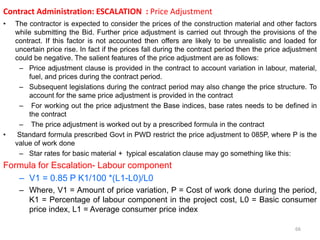
• Standard formula prescribed Govt in PWD restrict the price adjustment to 085P, where P is the
value of work done
– Star rates for basic material + typical escalation clause may go something like this:
Formula for Escalation- Labour component
– V1 = 0.85 P K1/100 *(L1-L0)/L0
– Where, V1 = Amount of price variation, P = Cost of work done during the period,
K1 = Percentage of labour component in the project cost, L0 = Basic consumer
price index, L1 = Average consumer price index
66
Contract Administration: ESCALATION : Price Adjustment
• Formula for material component shall be similar as above with appropriate changes
to the material specific.
• Similarly the price rise due to fuel component is calculated. All these prise rise are
then added to work out the total escalation payable to the contractor.
• In earlier days there was a practice not to provide for price adjustment during first
twelve months period.
• The contractor was expected to consider the same and load it in his offer. However
in many cases the work could not be completed in the first 12 months period and
then contractors submitted claims to the employer, as there was no provision for
the price adjustment.
• It is therefore desirable to provide for the price adjustment in the contract with
required restrictions.
• The same becomes operational in such peculiar situations. Some times the star
rate are prescribed for the main construction material like cement, Steel etc. The
idea is to compensate for the actual increased rates during the contract period. The
basis for selection of the star rates need to be decided carefully.
67
• Contract Administration: Suspension of Work
• The standard contract shall contain a provision to suspend the
work. Though this may not happen but there might be situation
when the Employer may like to suspend the work for some
period due to other requirements. Typical provisions on
suspension of the work are as follows:
– Engineer or Employer can suspend work
– Contractor to protect work during suspension period
– No duty to instruct suspension if reason are obvious
– Entitlement for extension, payment,
– No payment if suspension is due to contractor
– Long suspensions may entitle contractor as variation
68
Contract Administration: Termination
• If contractor defaults or there is a breach of contract the contract can be terminated.
The typical provisions for the breach of contract are as below:
– If the Engineer certifies that the Contractor:
• Repudiated the contract;
• Failed to commence or proceed with the work;
• Failed to comply with a notice;
• Persistently or flagrantly neglecting his obligations then employer can
terminate the contract
• Typical provisions related to the termination of the contract are listed below
– In the event of default contract can be terminated
– Notice of termination issued by Engineer after approval from Employer
– Termination payments as per contract
– Contractor expelled from site
– Work to be completed by other contractor
69
• If the contractor continually fails to perform, this may
constitute a breach of contract. The severity of the failure and
the cost to the Employer will need to be assessed. Legal
advice may be required before any further action is
considered. Although it is sometimes difficult to predict
accurately where problems may arise, good contract
management with regular dialogue between the contractor
and employer will help to identify potential problems. This will
enable problems to be dealt with swiftly and effectively and
so prevent major disputes.
70
Contract Administration: Contractor claims
• The contract should provide for the procedure for raising claims
by the contractor. The main provisions for the claims can be-
– Notice of Claims
– Contractor to give notice to Engineer for claims
– Contractor to keep records of claims
– Payment of Claims
– Maintaining Audit Trail
• It is essential to keep records of dealings with contractor
whether written or verbal. All information should be kept in the
contracts file held in the procurement section. Records will be
required for: information if problems arise; reviewing meetings
and re-negotiations; audit purposes; and planning for any
subsequent re-tendering processes
71