Contract
Management
Gazi Sanaul Hasan
B.Sc in Logistics & Supply Chain
Management
What is Contract Management?
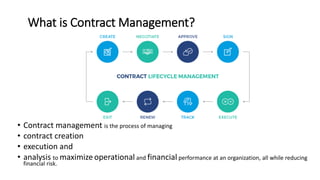
• Contract management is the process of managing
• contract creation
• execution and
• analysis to maximize operational and financial performance at an organization, all while reducing
financial risk.
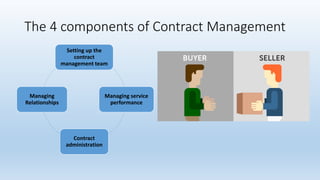
The 4 components of Contract Management
Setting up the
contract
management team
Managing service
performance
Contract
administration
Managing
Relationships
Why contract management can be an adequate
activity
• Lack of investment in contract management
• Inadequate contract reviews
• Failure to manage contract change
• Lack of attention to risk management
• Lack of engagement with stakeholders
• Lack of detailed knowledge of the contract
• Failure to take decisive action when contract default occurs
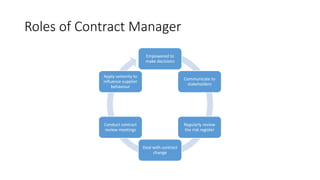
Roles of Contract Manager
Empowered to
make decisions
Communicate to
stakeholders
Regularly review
the risk register
Deal with contract
change
Conduct contract
review meetings
Apply seniority to
influence supplier
behaviour
Life of a Contract Manager
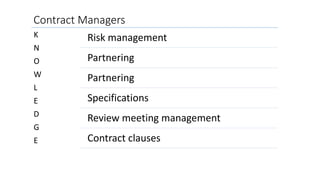
Contract Managers
S
K
I
LL
S
Leadership
Negotiation
Communication
Communication
Team working
Relationship management
K
N
O
W
L
E
D
G
E
Risk management
Partnering
Partnering
Specifications
Review meeting management
Contract clauses
Contract Managers
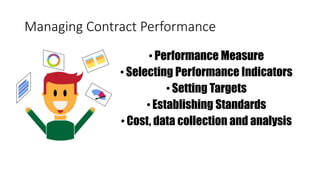
Managing Contract Performance
•Performance Measure
•Selecting Performance Indicators
•Setting Targets
•Establishing Standards
•Cost, data collection and analysis
Contract Management Checklist
• Does the contract manager have the required level of skills and experience?
• Does the contract manager have a satisfactory level of understanding of the
contract and of the relevant subject matter
• Have risks to the management of the contract been identified and risk treatments
identified?
• Is it clear who is responsible for implementing/actioning any necessary risk
treatments?
Contract Management Checklist
• Has responsibility for all aspects of managing the contract been clearly assigned?
• Do delegations exist for the approval of contracts, contract variations and the
approval of expenditure?
• Have all stakeholders been identified and arrangements agreed to obtain
feedback/input throughout the life of the contract?
• Have the benefits of visualizing internal processes been considered?
Contract Provision
• Access to premises
• Audit rights
• Assignments
• Assistance to the supplier
• Confidential information
• Contract change
• Contract Variations
• Key personnel
• Liabilities and indemnities
• Milestones
• Payment & Price
• Penalties & incentives
• Rejection
• Security arrangements
• Dispute Resolution
• Guarantees
• Warranties
• Securities
• Sub-contracting
• Step in rights
• Termination
• Insurance
Conclusion
• BENEFITS OF CONTRACT MANAGEMENT
• Standardized Processes and Procedures
• Spend Visibility
• Improved Compliance
• Solid Foundation for Spend and Performance Analysis
• Rebate Management
• Reduced Maverick Spending
• Evergreen Contract Elimination

Contract Management

  • 1.
    Contract Management Gazi Sanaul Hasan B.Scin Logistics & Supply Chain Management
  • 2.
    What is ContractManagement? • Contract management is the process of managing • contract creation • execution and • analysis to maximize operational and financial performance at an organization, all while reducing financial risk.
  • 3.
    The 4 componentsof Contract Management Setting up the contract management team Managing service performance Contract administration Managing Relationships
  • 4.
    Why contract managementcan be an adequate activity • Lack of investment in contract management • Inadequate contract reviews • Failure to manage contract change • Lack of attention to risk management • Lack of engagement with stakeholders • Lack of detailed knowledge of the contract • Failure to take decisive action when contract default occurs
  • 5.
    Roles of ContractManager Empowered to make decisions Communicate to stakeholders Regularly review the risk register Deal with contract change Conduct contract review meetings Apply seniority to influence supplier behaviour
  • 6.
    Life of aContract Manager
  • 7.
  • 8.
  • 9.
    Managing Contract Performance •PerformanceMeasure •Selecting Performance Indicators •Setting Targets •Establishing Standards •Cost, data collection and analysis
  • 10.
    Contract Management Checklist •Does the contract manager have the required level of skills and experience? • Does the contract manager have a satisfactory level of understanding of the contract and of the relevant subject matter • Have risks to the management of the contract been identified and risk treatments identified? • Is it clear who is responsible for implementing/actioning any necessary risk treatments?
  • 11.
    Contract Management Checklist •Has responsibility for all aspects of managing the contract been clearly assigned? • Do delegations exist for the approval of contracts, contract variations and the approval of expenditure? • Have all stakeholders been identified and arrangements agreed to obtain feedback/input throughout the life of the contract? • Have the benefits of visualizing internal processes been considered?
  • 12.
    Contract Provision • Accessto premises • Audit rights • Assignments • Assistance to the supplier • Confidential information • Contract change • Contract Variations • Key personnel • Liabilities and indemnities • Milestones • Payment & Price • Penalties & incentives • Rejection • Security arrangements • Dispute Resolution • Guarantees • Warranties • Securities • Sub-contracting • Step in rights • Termination • Insurance
  • 13.
    Conclusion • BENEFITS OFCONTRACT MANAGEMENT • Standardized Processes and Procedures • Spend Visibility • Improved Compliance • Solid Foundation for Spend and Performance Analysis • Rebate Management • Reduced Maverick Spending • Evergreen Contract Elimination