1
Contract Administration
Purpose of Contract Administration
Contract Administration & Contract Management
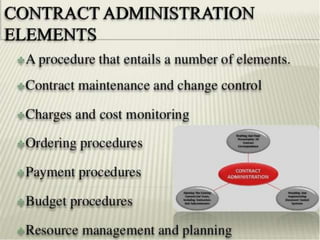
Elements of Contract Administration
Key Stakeholders of a Contract
Duties & Responsibility of Stakeholders
Contract Risk Management
Dispute Resolution Mechanisms: Negotiation &
Mediation
2
BACK
3
Contract administration, is, the management of
the contract between the employer, or client,
and the building contractor.
A contract administrator or employer's agent is
required to manage, negotiate, support and
execute the contract process.
BACK
4
Contract administration involves the management of
risks.
Its basic purpose is to monitor performance to ensure
the objectives of the contract are met on time and
within the intended budget, and also to detect any
deficiencies and find a remedy (including suspension
or termination of the contract) before it's too late.
Resolve any conflicts and disputes related to
the contract. Follow up to ensure that
all contractual agreements and payments are
actioned.
BACK
5
Contract administration is concerned with the
state of the agreement between the two parties in
the period before the contract has been finalized.
Contract management is focused on the
implementation of the contract after it has been
finalized.
BACK
6
BACK
7
8
9
10
BACK
11
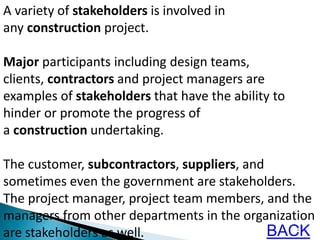
A variety of stakeholders is involved in
any construction project.
Major participants including design teams,
clients, contractors and project managers are
examples of stakeholders that have the ability to
hinder or promote the progress of
a construction undertaking.
The customer, subcontractors, suppliers, and
sometimes even the government are stakeholders.
The project manager, project team members, and the
managers from other departments in the organization
are stakeholders as well. BACK
12
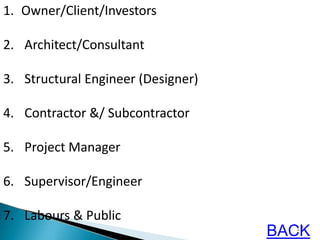
1. Owner/Client/Investors
2. Architect/Consultant
3. Structural Engineer (Designer)
4. Contractor &/ Subcontractor
5. Project Manager
6. Supervisor/Engineer
7. Labours & Public
BACK
13
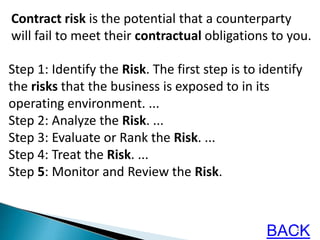
Contract risk is the potential that a counterparty
will fail to meet their contractual obligations to you.
Step 1: Identify the Risk. The first step is to identify
the risks that the business is exposed to in its
operating environment. ...
Step 2: Analyze the Risk. ...
Step 3: Evaluate or Rank the Risk. ...
Step 4: Treat the Risk. ...
Step 5: Monitor and Review the Risk.
BACK
14
15
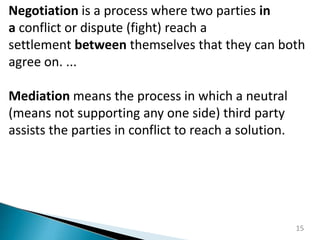
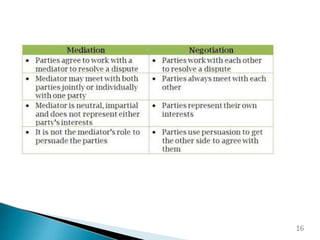
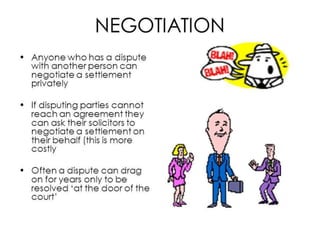
Negotiation is a process where two parties in
a conflict or dispute (fight) reach a
settlement between themselves that they can both
agree on. ...
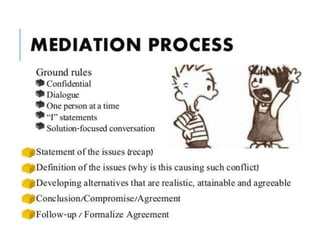
Mediation means the process in which a neutral
(means not supporting any one side) third party
assists the parties in conflict to reach a solution.
16
17
Negotiation Stages:
There are five collaborative stages of the
negotiation process: Prepare, Information
Exchange, Bargain, Conclude, Execute.
There is no shortcut to negotiation preparation.
Building trust in negotiations is key.
Communication skills are critical
during bargaining.
18
19
The Mediation Process and Dispute Resolution
1. Planning: Before the mediation process begins,
the mediator helps the parties decide where they
should meet and who should be present. ...
2. Mediator's introduction....
3. Opening remarks....
4. Joint discussion....
5. Conclusion...
When parties want to get on with their
lives, mediation allows a more reasonable
timetable for resolving a dispute. Less
Expensive: Mediation is vastly less
expensive than a typical lawsuit.
20
21
BACK

contract administration PPT

  • 1.
  • 2.
    Contract Administration Purpose ofContract Administration Contract Administration & Contract Management Elements of Contract Administration Key Stakeholders of a Contract Duties & Responsibility of Stakeholders Contract Risk Management Dispute Resolution Mechanisms: Negotiation & Mediation 2 BACK
  • 3.
    3 Contract administration, is,the management of the contract between the employer, or client, and the building contractor. A contract administrator or employer's agent is required to manage, negotiate, support and execute the contract process. BACK
  • 4.
    4 Contract administration involvesthe management of risks. Its basic purpose is to monitor performance to ensure the objectives of the contract are met on time and within the intended budget, and also to detect any deficiencies and find a remedy (including suspension or termination of the contract) before it's too late. Resolve any conflicts and disputes related to the contract. Follow up to ensure that all contractual agreements and payments are actioned. BACK
  • 5.
    5 Contract administration isconcerned with the state of the agreement between the two parties in the period before the contract has been finalized. Contract management is focused on the implementation of the contract after it has been finalized. BACK
  • 6.
  • 7.
  • 8.
  • 9.
  • 10.
  • 11.
    11 A variety ofstakeholders is involved in any construction project. Major participants including design teams, clients, contractors and project managers are examples of stakeholders that have the ability to hinder or promote the progress of a construction undertaking. The customer, subcontractors, suppliers, and sometimes even the government are stakeholders. The project manager, project team members, and the managers from other departments in the organization are stakeholders as well. BACK
  • 12.
    12 1. Owner/Client/Investors 2. Architect/Consultant 3.Structural Engineer (Designer) 4. Contractor &/ Subcontractor 5. Project Manager 6. Supervisor/Engineer 7. Labours & Public BACK
  • 13.
    13 Contract risk isthe potential that a counterparty will fail to meet their contractual obligations to you. Step 1: Identify the Risk. The first step is to identify the risks that the business is exposed to in its operating environment. ... Step 2: Analyze the Risk. ... Step 3: Evaluate or Rank the Risk. ... Step 4: Treat the Risk. ... Step 5: Monitor and Review the Risk. BACK
  • 14.
  • 15.
    15 Negotiation is aprocess where two parties in a conflict or dispute (fight) reach a settlement between themselves that they can both agree on. ... Mediation means the process in which a neutral (means not supporting any one side) third party assists the parties in conflict to reach a solution.
  • 16.
  • 17.
    17 Negotiation Stages: There arefive collaborative stages of the negotiation process: Prepare, Information Exchange, Bargain, Conclude, Execute. There is no shortcut to negotiation preparation. Building trust in negotiations is key. Communication skills are critical during bargaining.
  • 18.
  • 19.
    19 The Mediation Processand Dispute Resolution 1. Planning: Before the mediation process begins, the mediator helps the parties decide where they should meet and who should be present. ... 2. Mediator's introduction.... 3. Opening remarks.... 4. Joint discussion.... 5. Conclusion... When parties want to get on with their lives, mediation allows a more reasonable timetable for resolving a dispute. Less Expensive: Mediation is vastly less expensive than a typical lawsuit.
  • 20.
  • 21.