1
Contract Farming
by
Rudy van Gent
Overview
• What is contract farming
• Opportunities, limitations and threats
• Contract farming models
• Organization of outgrower schemes
• Farmer organizations
• Facilitating intermediary organizations
• Role of Government
2
Overview
• Examples of outgrower schemes
• Characterization of outgrower schemes
• Lessons learned
• Outgrower best practices
Contract Farming
• Large-scale (commercial) and/or
smallholder farmers
• Agreement between farmer and private
agribusiness processing/marketing
company
• Range of activities (services) to secure
access to produce
3
Typical Services
• Provision of inputs on credit
• Extension advice
• Packaging materials
• Transport of poduce
• Ploughing
• Crop spraying
Cost recouped when produce is sold*
Opportunities
• Market linkages - assured market for
smallholder produce
• Commercialization of smallholder farmers*
• Especially for high-value crops, e.g.
horticulture
4
Limitations
• Often restricted to more accessible areas
• Production base among smallholder
farmers often weak
• Productivity levels generally low
Threats
• Contract default
• Scale of smallholder farmer operations
5
Contract Default
• By company:
• Failure to deliver inputs/services at correct time
• Refusal to accept produce
• Arbitrarily raising quality standards
Usually strong incentive to maintain good relationships
with farmers to secure future access to produce
• By farmer:
• Production failure
• Avoiding repayment credits – strategic default*
Scale of Farmer Operations
• Potentially high transaction costs*
• Production risks smallholder cultivation
higher, especially when rain-fed
• Lack of crop management skills
• Exclusion of weaker farmers
6
Nevertheless …….
• Cotton industry in Zambia:
260,000 smallholder farmers
• Paprika industry in Zambia, Malawi,
Mozambique:
30,000 smallholder farmers
Types of Contract Farming
• Centralized model
• Nucleus Estate model
• Multipartite model
• Informal model
• Intermediary model
7
Centralized Model - Outgrower
Schemes
• Contracting company provides support to the
production of the crop by smallholder farmers,
purchases the crop from the farmers, and then
processes, packages and markets the product,
thereby tightly controlling its quality.
• Crops such as tobacco, cotton, paprika, sugar
cane, banana, coffee, tea, cocoa and rubber
• May involve tens of thousands of farmers
• Level of involvement of the contracting company
in production may vary
Nucleus Estate Model
• Variation of the centralized model
• Promoter also owns and manages an estate
plantation (usually close to a processing plant)
• Estate is often fairly large in order to provide
some guarantee of throughput for the plant
• Mainly tree crops, but also e.g. fresh vegetables
and fruits for export
• Focus on smaller number of emergent or semi-
commercial ‘satellite’ growers
• Close supervision of production
8
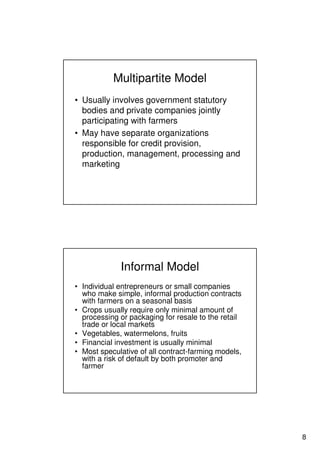
Multipartite Model
• Usually involves government statutory
bodies and private companies jointly
participating with farmers
• May have separate organizations
responsible for credit provision,
production, management, processing and
marketing
Informal Model
• Individual entrepreneurs or small companies
who make simple, informal production contracts
with farmers on a seasonal basis
• Crops usually require only minimal amount of
processing or packaging for resale to the retail
trade or local markets
• Vegetables, watermelons, fruits
• Financial investment is usually minimal
• Most speculative of all contract-farming models,
with a risk of default by both promoter and
farmer
9
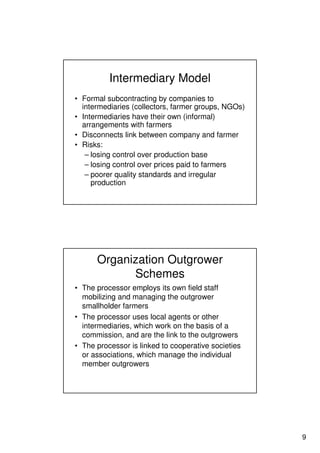
Intermediary Model
• Formal subcontracting by companies to
intermediaries (collectors, farmer groups, NGOs)
• Intermediaries have their own (informal)
arrangements with farmers
• Disconnects link between company and farmer
• Risks:
– losing control over production base
– losing control over prices paid to farmers
– poorer quality standards and irregular
production
Organization Outgrower
Schemes
• The processor employs its own field staff
mobilizing and managing the outgrower
smallholder farmers
• The processor uses local agents or other
intermediaries, which work on the basis of a
commission, and are the link to the outgrowers
• The processor is linked to cooperative societies
or associations, which manage the individual
member outgrowers
10
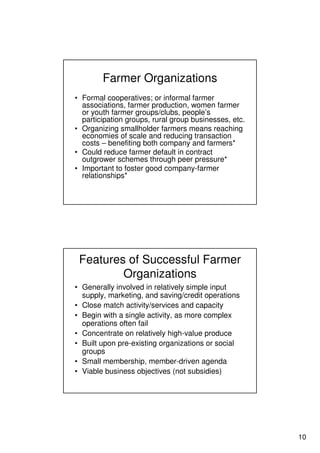
Farmer Organizations
• Formal cooperatives; or informal farmer
associations, farmer production, women farmer
or youth farmer groups/clubs, people’s
participation groups, rural group businesses, etc.
• Organizing smallholder farmers means reaching
economies of scale and reducing transaction
costs – benefiting both company and farmers*
• Could reduce farmer default in contract
outgrower schemes through peer pressure*
• Important to foster good company-farmer
relationships*
Features of Successful Farmer
Organizations
• Generally involved in relatively simple input
supply, marketing, and saving/credit operations
• Close match activity/services and capacity
• Begin with a single activity, as more complex
operations often fail
• Concentrate on relatively high-value produce
• Built upon pre-existing organizations or social
groups
• Small membership, member-driven agenda
• Viable business objectives (not subsidies)
11
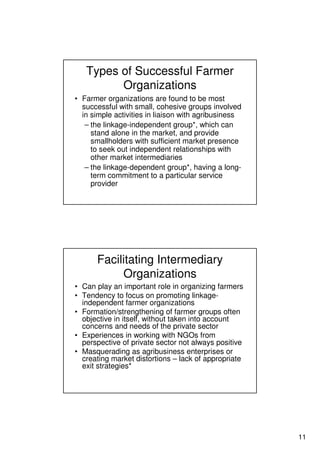
Types of Successful Farmer
Organizations
• Farmer organizations are found to be most
successful with small, cohesive groups involved
in simple activities in liaison with agribusiness
– the linkage-independent group*, which can
stand alone in the market, and provide
smallholders with sufficient market presence
to seek out independent relationships with
other market intermediaries
– the linkage-dependent group*, having a long-
term commitment to a particular service
provider
Facilitating Intermediary
Organizations
• Can play an important role in organizing farmers
• Tendency to focus on promoting linkage-
independent farmer organizations
• Formation/strengthening of farmer groups often
objective in itself, without taken into account
concerns and needs of the private sector
• Experiences in working with NGOs from
perspective of private sector not always positive
• Masquerading as agribusiness enterprises or
creating market distortions – lack of appropriate
exit strategies*
12
But …….
Despite these criticisms it is believed that donors
and/or NGO’s still have a role to play in:
• facilitating group formation,
• assisting in reducing transaction costs,
• adding value at producers’ level through
promoting quality control and/or processing,
• promoting savings by farmers, and
• understanding of the role and use of credit to
make such farmer groups stronger
Critical Requirements
• NGOs to operate complementary to the
functions undertaken by the private sector
• Role of each partner (companies, farmers,
and facilitating organizations) is to be
clearly defined and understood*
13
Role of Governments
• Regulatory and enabling role
– Appropriate laws and efficient legal system*
– Arbitration or dispute resolution role*
– Provision of training in technological and
managerial skills
– Initiation and facilitation of research activities
into the products under contract
– Provision of agricultural extension services
– Specialized services (phytosanitary controls,
plant pathology clinics, research stations )
Role of Governments
• Development role
– Reallocation of development resources
towards promotion of contract farming by
bringing together agribusiness and interested
farmers or farmer groups
– Dissemination of market information on
products for which there is a demand
– Strengthening managerial skills of farmer
organizations
– Checking that outgrower companies are bona
fide
14
Examples of outgrower models*
• Paprika – Cheetah Zambia/Malawi
• Cotton – Dunavant Zambia
• Export vegetables – York Farm
• Tobacco – Tombwe Processing
Characterization Outgrower
Schemes
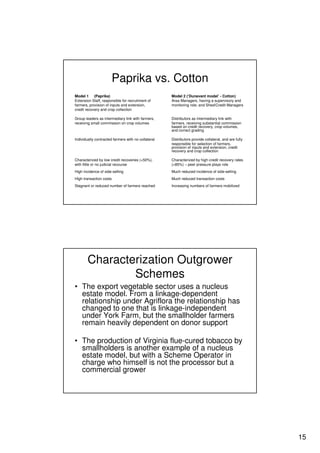
• The paprika sector uses a centralized outgrower
model in a linkage-dependent relationship with
smallholder farmers, employing its own
extension staff
• The cotton sector uses a centralized outgrower
model in a linkage-dependent relationship with
smallholder farmers, using local agents called
Distributors as the link to the outgrowers
15
Paprika vs. Cotton
Model 1 (Paprika) Model 2 (‘Dunavant model’ - Cotton)
Extension Staff, responsible for recruitment of Area Managers, having a supervisory and
farmers, provision of inputs and extension, monitoring role; and Shed/Credit Managers
credit recovery and crop collection
Group leaders as intermediary link with farmers, Distributors as intermediary link with
receiving small commission on crop volumes farmers, receiving substantial commission
based on credit recovery, crop volumes,
and correct grading
Individually contracted farmers with no collateral Distributors provide collateral, and are fully
responsible for selection of farmers,
provision of inputs and extension, credit
recovery and crop collection
Characterized by low credit recoveries (<50%), Characterized by high credit recovery rates
with little or no judicial recourse (>85%) – peer pressure plays role
High incidence of side-selling Much reduced incidence of side-selling
High transaction costs Much reduced transaction costs
Stagnant or reduced number of farmers reached Increasing numbers of farmers mobilized
Characterization Outgrower
Schemes
• The export vegetable sector uses a nucleus
estate model. From a linkage-dependent
relationship under Agriflora the relationship has
changed to one that is linkage-independent
under York Farm, but the smallholder farmers
remain heavily dependent on donor support
• The production of Virginia flue-cured tobacco by
smallholders is another example of a nucleus
estate model, but with a Scheme Operator in
charge who himself is not the processor but a
commercial grower
16
Lessons Learned*
• There is not a single outgrower model that is ‘the
best’ and would suit all crops, as different crops
have different requirements - outgrower models
relate to specific crop quality requirements
• Outgrower models are not static - changes are
being made all the time to address certain
constraints (especially defaulting)
• Elements of various outgrower models are not
mutually exclusive
• One element that the various models have in
common is linkage-dependent relationships
Lessons Learned*
• There is a need for development of selection
criteria to ensure that potential participants in
outgrower schemes meet minimum standards
• There is a need to develop transparent pricing
systems to allow farmers to make informed
decisions on which crops to grow
• The role and responsibilities of donor-funded
NGOs in supporting of smallholder-private sector
linkages need to be reviewed.
17
Outgrower Best Practices
• Various outgrower schemes have different
modalities in terms of the type and number
farmers, their spatial distribution, contract
arrangements, delivery of technical support
(extension services), marketing mechanisms,
and quality requirements
• To recommend a single best practice outgrower
model that suits all of these diverse scenarios
will be difficult, if not impossible.
Outgrower Best Practices
• Any model should promote the move away from
donor-dependency and distortion towards self-
sufficient, economically viable supply chains,
with each party knowing and recognizing its role
and responsibilities and undertaking them in a
responsible, profitable and sustainable fashion
• Outgrower schemes are not an end-goal in itself
but should be seen as a transition phase from
linkage-dependent relationships between
producers and processors towards linkage-
independent, self-sustainable farmers and/or
farmer groups.
18
Important Elements of
Outgrower Best Practices*
• Criteria for grower selection
• Registration of growers and maintenance of
records
• Contracts
• Input supply and loan recovery
• Extension services
• Marketing arrangements
• Pricing mechanisms
• Payment modalities
• Group development facilitation
Criteria for Grower Selection
• There often appear to be no strict criteria for the
selection of farmers
• Focus has to be placed on ensuring that the
right caliber producers are contracted
• Selection criteria could include land availability,
location and conditions, agricultural knowledge
and experience, basic business-awareness,
willingness to learn, and minimum acceptable
production standards
19
Registration of growers and
maintenance of records
• Detailed information regarding personal details,
registration number, location, credit provision,
and previous crop history of individual farmers is
to be recorded
• Computer programmes should be designed to
facilitate monitoring the performance of
individual smallholder farmers
– e.g. for assessing the eligibility of farmers for higher
input packages
Contracts
• To be transparent and comprehensive,
incorporating as a minimum personal details of
the individual farmer, identification/registration
number, area contracted, period of agreement,
quality requirements, grades and descriptions,
input costs and repayment modalities, extension
provision, and obligations/responsibilities of the
involved parties
• Must be understood by farmers
• Company should keep a record of all contracts,
if only for monitoring purposes
20
Input Supply and Loan
Recovery
• Conditions that apply to the provision of
inputs, range of inputs made available,
cost, farmer contributions towards value of
inputs, interest charged and repayment
modalities must be clearly stipulated
• Timely delivery of inputs and other
services needs to be properly planned
Extension Services
• There may be a need for companies to
perform a full training and extension needs
analysis
• Costs of extension services are usually
reflected in the prices paid but perceived
by farmers as being for ‘free’ – needs to
be made transparent
• Provision of extension services is ideally
linked closely to production cycle
21
Marketing Arrangements
• Establishment of a network of depots and
buying centres
• Staff positioned at these depots should be
well trained in grading procedures, and
closely monitored
• Grading standards should be clear and
transparent (visual aids)
• Farmers need to be well trained in grading
of the produce
Pricing Mechanisms
• Expectations for minimum pre-planting
price often unrealistic
• Relationship to international market prices
often not understood
• Uncertainty about price levels leads to
mistrust and feeling of exploitation
• Development of transparent pricing
systems important to alleviate constraints
22
Payment Modalities
• Should be as prompt as possible,
preferably when produce changes hands
• Any transaction should be properly
recorded, indicating grades, corresponding
weights and prices, total value of the
delivery, and any deductions for inputs or,
if applicable, other services provided
Group Development Facilitation
• Not economical for outgrower companies to
service each and every farmer individually
• Group approaches to farmer organization means
reaching economies of scale
• Farmer groups are usually mere ‘interest’
groups, and should be the cornerstone for group
development
• Good communication and close monitoring
remain particularly critical issues
23
Code of Conduct
• Objective would be to promote ethical and
transparent trading
– Agricultural inputs are both adequate and
appropriate
– Open and transparent marketing services
– Increasing capacity of smallholder farmers to
become efficient and competent commercial
producers
– Developing self-reliance and sustainability
– Fostering safe and responsible agricultural
practices
Donors/NGOs
• Have a role to play in:
– facilitating group formation
– assisting in reducing transaction costs
– adding value at producers’ level through
promoting quality control and/or processing
– promoting savings by farmers
– promote understanding of role and use of
credit
• Operating complementary to private sector

Contract Farming

  • 1.
    1 Contract Farming by Rudy vanGent Overview • What is contract farming • Opportunities, limitations and threats • Contract farming models • Organization of outgrower schemes • Farmer organizations • Facilitating intermediary organizations • Role of Government
  • 2.
    2 Overview • Examples ofoutgrower schemes • Characterization of outgrower schemes • Lessons learned • Outgrower best practices Contract Farming • Large-scale (commercial) and/or smallholder farmers • Agreement between farmer and private agribusiness processing/marketing company • Range of activities (services) to secure access to produce
  • 3.
    3 Typical Services • Provisionof inputs on credit • Extension advice • Packaging materials • Transport of poduce • Ploughing • Crop spraying Cost recouped when produce is sold* Opportunities • Market linkages - assured market for smallholder produce • Commercialization of smallholder farmers* • Especially for high-value crops, e.g. horticulture
  • 4.
    4 Limitations • Often restrictedto more accessible areas • Production base among smallholder farmers often weak • Productivity levels generally low Threats • Contract default • Scale of smallholder farmer operations
  • 5.
    5 Contract Default • Bycompany: • Failure to deliver inputs/services at correct time • Refusal to accept produce • Arbitrarily raising quality standards Usually strong incentive to maintain good relationships with farmers to secure future access to produce • By farmer: • Production failure • Avoiding repayment credits – strategic default* Scale of Farmer Operations • Potentially high transaction costs* • Production risks smallholder cultivation higher, especially when rain-fed • Lack of crop management skills • Exclusion of weaker farmers
  • 6.
    6 Nevertheless ……. • Cottonindustry in Zambia: 260,000 smallholder farmers • Paprika industry in Zambia, Malawi, Mozambique: 30,000 smallholder farmers Types of Contract Farming • Centralized model • Nucleus Estate model • Multipartite model • Informal model • Intermediary model
  • 7.
    7 Centralized Model -Outgrower Schemes • Contracting company provides support to the production of the crop by smallholder farmers, purchases the crop from the farmers, and then processes, packages and markets the product, thereby tightly controlling its quality. • Crops such as tobacco, cotton, paprika, sugar cane, banana, coffee, tea, cocoa and rubber • May involve tens of thousands of farmers • Level of involvement of the contracting company in production may vary Nucleus Estate Model • Variation of the centralized model • Promoter also owns and manages an estate plantation (usually close to a processing plant) • Estate is often fairly large in order to provide some guarantee of throughput for the plant • Mainly tree crops, but also e.g. fresh vegetables and fruits for export • Focus on smaller number of emergent or semi- commercial ‘satellite’ growers • Close supervision of production
  • 8.
    8 Multipartite Model • Usuallyinvolves government statutory bodies and private companies jointly participating with farmers • May have separate organizations responsible for credit provision, production, management, processing and marketing Informal Model • Individual entrepreneurs or small companies who make simple, informal production contracts with farmers on a seasonal basis • Crops usually require only minimal amount of processing or packaging for resale to the retail trade or local markets • Vegetables, watermelons, fruits • Financial investment is usually minimal • Most speculative of all contract-farming models, with a risk of default by both promoter and farmer
  • 9.
    9 Intermediary Model • Formalsubcontracting by companies to intermediaries (collectors, farmer groups, NGOs) • Intermediaries have their own (informal) arrangements with farmers • Disconnects link between company and farmer • Risks: – losing control over production base – losing control over prices paid to farmers – poorer quality standards and irregular production Organization Outgrower Schemes • The processor employs its own field staff mobilizing and managing the outgrower smallholder farmers • The processor uses local agents or other intermediaries, which work on the basis of a commission, and are the link to the outgrowers • The processor is linked to cooperative societies or associations, which manage the individual member outgrowers
  • 10.
    10 Farmer Organizations • Formalcooperatives; or informal farmer associations, farmer production, women farmer or youth farmer groups/clubs, people’s participation groups, rural group businesses, etc. • Organizing smallholder farmers means reaching economies of scale and reducing transaction costs – benefiting both company and farmers* • Could reduce farmer default in contract outgrower schemes through peer pressure* • Important to foster good company-farmer relationships* Features of Successful Farmer Organizations • Generally involved in relatively simple input supply, marketing, and saving/credit operations • Close match activity/services and capacity • Begin with a single activity, as more complex operations often fail • Concentrate on relatively high-value produce • Built upon pre-existing organizations or social groups • Small membership, member-driven agenda • Viable business objectives (not subsidies)
  • 11.
    11 Types of SuccessfulFarmer Organizations • Farmer organizations are found to be most successful with small, cohesive groups involved in simple activities in liaison with agribusiness – the linkage-independent group*, which can stand alone in the market, and provide smallholders with sufficient market presence to seek out independent relationships with other market intermediaries – the linkage-dependent group*, having a long- term commitment to a particular service provider Facilitating Intermediary Organizations • Can play an important role in organizing farmers • Tendency to focus on promoting linkage- independent farmer organizations • Formation/strengthening of farmer groups often objective in itself, without taken into account concerns and needs of the private sector • Experiences in working with NGOs from perspective of private sector not always positive • Masquerading as agribusiness enterprises or creating market distortions – lack of appropriate exit strategies*
  • 12.
    12 But ……. Despite thesecriticisms it is believed that donors and/or NGO’s still have a role to play in: • facilitating group formation, • assisting in reducing transaction costs, • adding value at producers’ level through promoting quality control and/or processing, • promoting savings by farmers, and • understanding of the role and use of credit to make such farmer groups stronger Critical Requirements • NGOs to operate complementary to the functions undertaken by the private sector • Role of each partner (companies, farmers, and facilitating organizations) is to be clearly defined and understood*
  • 13.
    13 Role of Governments •Regulatory and enabling role – Appropriate laws and efficient legal system* – Arbitration or dispute resolution role* – Provision of training in technological and managerial skills – Initiation and facilitation of research activities into the products under contract – Provision of agricultural extension services – Specialized services (phytosanitary controls, plant pathology clinics, research stations ) Role of Governments • Development role – Reallocation of development resources towards promotion of contract farming by bringing together agribusiness and interested farmers or farmer groups – Dissemination of market information on products for which there is a demand – Strengthening managerial skills of farmer organizations – Checking that outgrower companies are bona fide
  • 14.
    14 Examples of outgrowermodels* • Paprika – Cheetah Zambia/Malawi • Cotton – Dunavant Zambia • Export vegetables – York Farm • Tobacco – Tombwe Processing Characterization Outgrower Schemes • The paprika sector uses a centralized outgrower model in a linkage-dependent relationship with smallholder farmers, employing its own extension staff • The cotton sector uses a centralized outgrower model in a linkage-dependent relationship with smallholder farmers, using local agents called Distributors as the link to the outgrowers
  • 15.
    15 Paprika vs. Cotton Model1 (Paprika) Model 2 (‘Dunavant model’ - Cotton) Extension Staff, responsible for recruitment of Area Managers, having a supervisory and farmers, provision of inputs and extension, monitoring role; and Shed/Credit Managers credit recovery and crop collection Group leaders as intermediary link with farmers, Distributors as intermediary link with receiving small commission on crop volumes farmers, receiving substantial commission based on credit recovery, crop volumes, and correct grading Individually contracted farmers with no collateral Distributors provide collateral, and are fully responsible for selection of farmers, provision of inputs and extension, credit recovery and crop collection Characterized by low credit recoveries (<50%), Characterized by high credit recovery rates with little or no judicial recourse (>85%) – peer pressure plays role High incidence of side-selling Much reduced incidence of side-selling High transaction costs Much reduced transaction costs Stagnant or reduced number of farmers reached Increasing numbers of farmers mobilized Characterization Outgrower Schemes • The export vegetable sector uses a nucleus estate model. From a linkage-dependent relationship under Agriflora the relationship has changed to one that is linkage-independent under York Farm, but the smallholder farmers remain heavily dependent on donor support • The production of Virginia flue-cured tobacco by smallholders is another example of a nucleus estate model, but with a Scheme Operator in charge who himself is not the processor but a commercial grower
  • 16.
    16 Lessons Learned* • Thereis not a single outgrower model that is ‘the best’ and would suit all crops, as different crops have different requirements - outgrower models relate to specific crop quality requirements • Outgrower models are not static - changes are being made all the time to address certain constraints (especially defaulting) • Elements of various outgrower models are not mutually exclusive • One element that the various models have in common is linkage-dependent relationships Lessons Learned* • There is a need for development of selection criteria to ensure that potential participants in outgrower schemes meet minimum standards • There is a need to develop transparent pricing systems to allow farmers to make informed decisions on which crops to grow • The role and responsibilities of donor-funded NGOs in supporting of smallholder-private sector linkages need to be reviewed.
  • 17.
    17 Outgrower Best Practices •Various outgrower schemes have different modalities in terms of the type and number farmers, their spatial distribution, contract arrangements, delivery of technical support (extension services), marketing mechanisms, and quality requirements • To recommend a single best practice outgrower model that suits all of these diverse scenarios will be difficult, if not impossible. Outgrower Best Practices • Any model should promote the move away from donor-dependency and distortion towards self- sufficient, economically viable supply chains, with each party knowing and recognizing its role and responsibilities and undertaking them in a responsible, profitable and sustainable fashion • Outgrower schemes are not an end-goal in itself but should be seen as a transition phase from linkage-dependent relationships between producers and processors towards linkage- independent, self-sustainable farmers and/or farmer groups.
  • 18.
    18 Important Elements of OutgrowerBest Practices* • Criteria for grower selection • Registration of growers and maintenance of records • Contracts • Input supply and loan recovery • Extension services • Marketing arrangements • Pricing mechanisms • Payment modalities • Group development facilitation Criteria for Grower Selection • There often appear to be no strict criteria for the selection of farmers • Focus has to be placed on ensuring that the right caliber producers are contracted • Selection criteria could include land availability, location and conditions, agricultural knowledge and experience, basic business-awareness, willingness to learn, and minimum acceptable production standards
  • 19.
    19 Registration of growersand maintenance of records • Detailed information regarding personal details, registration number, location, credit provision, and previous crop history of individual farmers is to be recorded • Computer programmes should be designed to facilitate monitoring the performance of individual smallholder farmers – e.g. for assessing the eligibility of farmers for higher input packages Contracts • To be transparent and comprehensive, incorporating as a minimum personal details of the individual farmer, identification/registration number, area contracted, period of agreement, quality requirements, grades and descriptions, input costs and repayment modalities, extension provision, and obligations/responsibilities of the involved parties • Must be understood by farmers • Company should keep a record of all contracts, if only for monitoring purposes
  • 20.
    20 Input Supply andLoan Recovery • Conditions that apply to the provision of inputs, range of inputs made available, cost, farmer contributions towards value of inputs, interest charged and repayment modalities must be clearly stipulated • Timely delivery of inputs and other services needs to be properly planned Extension Services • There may be a need for companies to perform a full training and extension needs analysis • Costs of extension services are usually reflected in the prices paid but perceived by farmers as being for ‘free’ – needs to be made transparent • Provision of extension services is ideally linked closely to production cycle
  • 21.
    21 Marketing Arrangements • Establishmentof a network of depots and buying centres • Staff positioned at these depots should be well trained in grading procedures, and closely monitored • Grading standards should be clear and transparent (visual aids) • Farmers need to be well trained in grading of the produce Pricing Mechanisms • Expectations for minimum pre-planting price often unrealistic • Relationship to international market prices often not understood • Uncertainty about price levels leads to mistrust and feeling of exploitation • Development of transparent pricing systems important to alleviate constraints
  • 22.
    22 Payment Modalities • Shouldbe as prompt as possible, preferably when produce changes hands • Any transaction should be properly recorded, indicating grades, corresponding weights and prices, total value of the delivery, and any deductions for inputs or, if applicable, other services provided Group Development Facilitation • Not economical for outgrower companies to service each and every farmer individually • Group approaches to farmer organization means reaching economies of scale • Farmer groups are usually mere ‘interest’ groups, and should be the cornerstone for group development • Good communication and close monitoring remain particularly critical issues
  • 23.
    23 Code of Conduct •Objective would be to promote ethical and transparent trading – Agricultural inputs are both adequate and appropriate – Open and transparent marketing services – Increasing capacity of smallholder farmers to become efficient and competent commercial producers – Developing self-reliance and sustainability – Fostering safe and responsible agricultural practices Donors/NGOs • Have a role to play in: – facilitating group formation – assisting in reducing transaction costs – adding value at producers’ level through promoting quality control and/or processing – promoting savings by farmers – promote understanding of role and use of credit • Operating complementary to private sector