Agricultural Innovation Systems: An Introduction Andy Hall LINK-United Nations University-MERIT Learning INnovation Knowledge Policy-relevant Resources for Rural Innovation
Important definitions No. 1: Innovation Innovation: The process of creating and  putting into use  combinations of knowledge from many different sources This knowledge may be brand-new, but usually it is new combinations of existing knowledge To be termed innovation, the use of this knowledge has to be novel to the farmer or the firm, neighbours and competitors, but not necessarily new globally Invention, on the other hand, is the creation of new knowledge new to the world, usually by research organisations, but also by artisans and others   Learning INnovation Knowledge Policy-relevant Resources for Rural Innovation
Important definitions No. 2: Institutions The difference between institutions and organisations is as follows: Organisations are bodies such as enterprises, research institutes, farmer cooperatives and government or non-government organisations (NGOs), while institutions are the sets of common habits, routines, practices, rules or laws that regulate the relationships and interactions between individuals and groups (Edquist, 1997).  Learning INnovation Knowledge Policy-relevant Resources for Rural Innovation
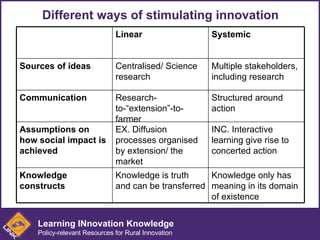
Different ways of stimulating innovation Knowledge only has meaning in its domain of existence Knowledge is truth and can be transferred Knowledge constructs INC. Interactive learning give rise to concerted action EX. Diffusion processes organised by extension/ the market Assumptions on how social impact is achieved Structured around action Research-to-“extension”-to-farmer Communication Multiple stakeholders, including research Centralised/ Science research Sources of ideas Systemic Linear Learning INnovation Knowledge Policy-relevant Resources for Rural Innovation
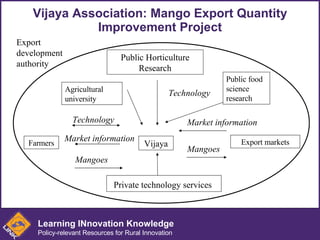
Vijaya Association: Mango Export Quantity Improvement Project Export development authority Farmers Export markets Vijaya Public Horticulture Research Private technology services   Technology Market information Technology Market information Mangoes Mangoes Agricultural university Public food science research Learning INnovation Knowledge Policy-relevant Resources for Rural Innovation
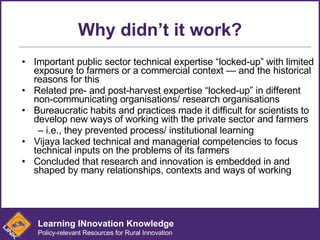
Why didn’t it work? Important public sector technical expertise “locked-up” with limited exposure to farmers or a commercial context — and the historical reasons for this Related pre- and post-harvest expertise “locked-up” in different non-communicating organisations/ research organisations Bureaucratic habits and practices made it difficult for scientists to develop new ways of working with the private sector and farmers –  i.e., they prevented process/ institutional learning Vijaya lacked technical and managerial competencies to focus technical inputs on the problems of its farmers Concluded that research and innovation is embedded in and shaped by many relationships, contexts and ways of working Learning INnovation Knowledge Policy-relevant Resources for Rural Innovation
Innovation systems: What is it? Concept to help reveal and deal with the partnership and institutional issues that shape innovation processes and shape the contribution of research to that process Learning INnovation Knowledge Policy-relevant Resources for Rural Innovation
Innovation Systems: Definition A system of innovation involves all the actors and their interactions involved in the production, use of knowledge, and the institutional and policy context that shapes the processes of interacting, knowledge sharing and learning It recognises: Multiple knowledge bases, including research but also others It is a capability to innovate, not just today but in ever-changing environments — i.e., it is a dynamic adaptive capability It is embedded in and defined by the institutional and policy contexts that shape the ways actors and organisations behave Learning INnovation Knowledge Policy-relevant Resources for Rural Innovation
Why research-to-innovation? Old challenges for agricultural research Operation and management of large public agencies Difficulties of matching supply with demand for technology and dealing with heterogeneous social and physical contexts New challenges for agricultural research   Increasing complexity of mandate: Growth, Poverty and Environment Emergence of new players beyond the State The emergence and dynamics of New Agriculture and the changing relationship of the poor with the sector Learning INnovation Knowledge Policy-relevant Resources for Rural Innovation
Innovation and new agriculture  Sectors:  Livestock and aquiculture, flowers, horticulture, medicinal plants, agro-processing, biofuels, fibers, forest products Drivers : Opening up of world markets, changing trade and IPR rules, new technology urbanisation, industrialisation of the food chain Features:  Players outside of the state. Diversity. Small niche sectors but dynamic. Reaches the poor through employment. Knowledge-intensive.  Challenges:  Requires continuous knowledge-intensive innovation to compete and cope in rapidly-changing conditions, to strengthen equity and sustain the environment Learning INnovation Knowledge Policy-relevant Resources for Rural Innovation
Learning INnovation Knowledge Policy-relevant Resources for Rural Innovation
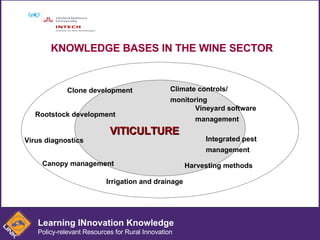
Clone development Rootstock development Virus diagnostics Canopy management Irrigation and drainage Climate controls/ monitoring Vineyard software  management Integrated pest  management Harvesting methods VITICULTURE KNOWLEDGE BASES IN THE WINE SECTOR Learning INnovation Knowledge Policy-relevant Resources for Rural Innovation
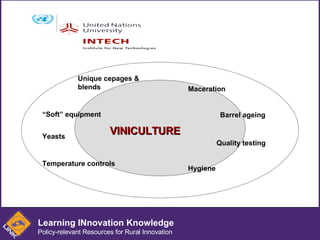
Unique cepages & blends “ Soft” equipment Yeasts Temperature controls Hygiene Maceration Barrel ageing Quality testing VINICULTURE Learning INnovation Knowledge Policy-relevant Resources for Rural Innovation
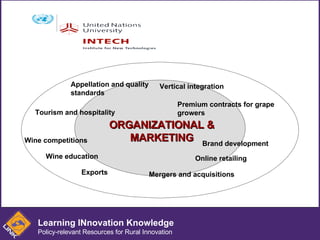
Appellation and quality standards Tourism and hospitality Wine competitions Wine education Exports Mergers and acquisitions Vertical integration Premium contracts for grape growers Brand development Online retailing ORGANIZATIONAL & MARKETING Learning INnovation Knowledge Policy-relevant Resources for Rural Innovation
Origins of the  Innovation Systems Concept Limited ability of economic models that relied on linear assumptions about R&D leading to innovation to inform policy of how to promote innovation-based competition in dynamic and rapidly-changing technical, institutional and economic environments  Create space for more systemic, interactive and evolutionary models of Nelson and Winter, Dosi, Freeman, Lundval and, later, others. Initially discussed in terms of national systems of innovation. Now in terms of sectors, including agriculture Learning INnovation Knowledge Policy-relevant Resources for Rural Innovation
Key insights from the framework Focus on innovation Neither science nor technology nor invention, but the application of knowledge. Can be acquired through learning, research or experiences. Often it comprises new combinations of existing knowledge Linkages between partnerships and networks Acquiring knowledge and learning are interactive experiences, requiring linkages with different knowledge bases. Not just linking, but linking for learning and acquiring knowledge. Learning INnovation Knowledge Policy-relevant Resources for Rural Innovation
Key insights (continued) New actors, new roles Broad range of actors outside the State Relative importance of different actors changes during innovation process As circumstances change roles evolve Actors can play multiple roles  Less compartmentalised The role of institutions The habits and practices of organisations that shape their propensity to interact, to learn, to access and share knowledge and to take risks Determines the way actors respond to triggers to innovate and to policy incentives Very context-specific and has to be factored in to efforts to develop innovation capacity Embeddedness Learning INnovation Knowledge Policy-relevant Resources for Rural Innovation
Key insights (continued) The role of policies Support of innovation, not the outcome of single policy, but a set that works together to shape innovative behavior Habits and practices interact with policies and need to be accounted for and counterbalanced. E.g., public-private sector partnerships; participation The inclusion of stakeholders and the demand side Demand is a signal for innovation. Habits and practices are required if systems are to sensitive to the agendas of stakeholders. Non-market linkages are important, particularly where stakeholders are poor Learning INnovation Knowledge Policy-relevant Resources for Rural Innovation
Key Insights (continued) Dynamic nature of innovation systems Habits and practices are learnt behaviors emerging through experiences.  Institutional innovations New approaches and ways of working often require new partners Co-evolution of contexts and connections Reconfiguring linkages is the classic response of successful innovation systems in the face of external shocks Because innovation is an adaptive capacity, having the networks that provide early warning information and the skills and social capital to respond to shocks is a central attribute of successful innovation systems Learning INnovation Knowledge Policy-relevant Resources for Rural Innovation
Agricultural Learning INnovation Knowledge Policy-relevant Resources for Rural Innovation
Measures of Success Static — Survival of the sector, growth rates, value, labour absorption Dynamic — Preparedness to deal with change. Increased innovation capacity denoted by widening (more links, better social capital) and deepening (new competencies, habits and practices) of the system Learning INnovation Knowledge Policy-relevant Resources for Rural Innovation
Hypothesis The creation of a dynamic innovation capability requires habits and practices/ institutions, policies and support structures that promote interaction, learning, knowledge flows, inclusiveness and risk taking Learning INnovation Knowledge Policy-relevant Resources for Rural Innovation
Insights from a recent study Even strong incentives to innovate are not enough to create new networks for learning  Habits and practices are the main bottlenecks to new arrangements emerging and to innovation, more generally Technical and institutional change are interelated There is a need to simultaneously strengthen market-based linkages as well as knowledge-based linkages Learning INnovation Knowledge Policy-relevant Resources for Rural Innovation
What does this mean for research organisations? Centrality of partnerships Network development Development of a stakeholder dialogue New governance mechanisms New agenda of systems capacity development New research  New roles  New organisational culture and ILAC New skills and disciplinary mixes Learning INnovation Knowledge Policy-relevant Resources for Rural Innovation
Options Beware of local contexts and apply flexibly and experimentally and adjust accordingly Concentrate on process as well as product outcomes Within agricultural research organisations Team building across disciplines; training in partnering, reflection and learning; ILAC programmes Between research organisations and private companies Stipulation of competitive grant schemes, use of third party agencies, joint supervision of students, industrial placements, joint advisory committees, joint reviews and ILAC exercises  Between governments, private companies, research organisations and NGOs Foresight exercises, commodity associations, joint task forces and committees of enquiry Learning INnovation Knowledge Policy-relevant Resources for Rural Innovation
LINK is a specialist network of regional innovation policy studies hubs established by the United Nations University-MERIT (UNU-MERIT)  and the Food and Agriculture Organization of the United Nations (FAO) to strengthen the interface between rural innovation studies,  policy and practice and to promote North-South and South-South learning on rural innovation. Learning INnovation Knowledge Policy-relevant Resources for Rural Innovation

Agricultural Innovation Systems: An Introduction

  • 1.
    Agricultural Innovation Systems:An Introduction Andy Hall LINK-United Nations University-MERIT Learning INnovation Knowledge Policy-relevant Resources for Rural Innovation
  • 2.
    Important definitions No.1: Innovation Innovation: The process of creating and putting into use combinations of knowledge from many different sources This knowledge may be brand-new, but usually it is new combinations of existing knowledge To be termed innovation, the use of this knowledge has to be novel to the farmer or the firm, neighbours and competitors, but not necessarily new globally Invention, on the other hand, is the creation of new knowledge new to the world, usually by research organisations, but also by artisans and others Learning INnovation Knowledge Policy-relevant Resources for Rural Innovation
  • 3.
    Important definitions No.2: Institutions The difference between institutions and organisations is as follows: Organisations are bodies such as enterprises, research institutes, farmer cooperatives and government or non-government organisations (NGOs), while institutions are the sets of common habits, routines, practices, rules or laws that regulate the relationships and interactions between individuals and groups (Edquist, 1997). Learning INnovation Knowledge Policy-relevant Resources for Rural Innovation
  • 4.
    Different ways ofstimulating innovation Knowledge only has meaning in its domain of existence Knowledge is truth and can be transferred Knowledge constructs INC. Interactive learning give rise to concerted action EX. Diffusion processes organised by extension/ the market Assumptions on how social impact is achieved Structured around action Research-to-“extension”-to-farmer Communication Multiple stakeholders, including research Centralised/ Science research Sources of ideas Systemic Linear Learning INnovation Knowledge Policy-relevant Resources for Rural Innovation
  • 5.
    Vijaya Association: MangoExport Quantity Improvement Project Export development authority Farmers Export markets Vijaya Public Horticulture Research Private technology services Technology Market information Technology Market information Mangoes Mangoes Agricultural university Public food science research Learning INnovation Knowledge Policy-relevant Resources for Rural Innovation
  • 6.
    Why didn’t itwork? Important public sector technical expertise “locked-up” with limited exposure to farmers or a commercial context — and the historical reasons for this Related pre- and post-harvest expertise “locked-up” in different non-communicating organisations/ research organisations Bureaucratic habits and practices made it difficult for scientists to develop new ways of working with the private sector and farmers – i.e., they prevented process/ institutional learning Vijaya lacked technical and managerial competencies to focus technical inputs on the problems of its farmers Concluded that research and innovation is embedded in and shaped by many relationships, contexts and ways of working Learning INnovation Knowledge Policy-relevant Resources for Rural Innovation
  • 7.
    Innovation systems: Whatis it? Concept to help reveal and deal with the partnership and institutional issues that shape innovation processes and shape the contribution of research to that process Learning INnovation Knowledge Policy-relevant Resources for Rural Innovation
  • 8.
    Innovation Systems: DefinitionA system of innovation involves all the actors and their interactions involved in the production, use of knowledge, and the institutional and policy context that shapes the processes of interacting, knowledge sharing and learning It recognises: Multiple knowledge bases, including research but also others It is a capability to innovate, not just today but in ever-changing environments — i.e., it is a dynamic adaptive capability It is embedded in and defined by the institutional and policy contexts that shape the ways actors and organisations behave Learning INnovation Knowledge Policy-relevant Resources for Rural Innovation
  • 9.
    Why research-to-innovation? Oldchallenges for agricultural research Operation and management of large public agencies Difficulties of matching supply with demand for technology and dealing with heterogeneous social and physical contexts New challenges for agricultural research Increasing complexity of mandate: Growth, Poverty and Environment Emergence of new players beyond the State The emergence and dynamics of New Agriculture and the changing relationship of the poor with the sector Learning INnovation Knowledge Policy-relevant Resources for Rural Innovation
  • 10.
    Innovation and newagriculture Sectors: Livestock and aquiculture, flowers, horticulture, medicinal plants, agro-processing, biofuels, fibers, forest products Drivers : Opening up of world markets, changing trade and IPR rules, new technology urbanisation, industrialisation of the food chain Features: Players outside of the state. Diversity. Small niche sectors but dynamic. Reaches the poor through employment. Knowledge-intensive. Challenges: Requires continuous knowledge-intensive innovation to compete and cope in rapidly-changing conditions, to strengthen equity and sustain the environment Learning INnovation Knowledge Policy-relevant Resources for Rural Innovation
  • 11.
    Learning INnovation KnowledgePolicy-relevant Resources for Rural Innovation
  • 12.
    Clone development Rootstockdevelopment Virus diagnostics Canopy management Irrigation and drainage Climate controls/ monitoring Vineyard software management Integrated pest management Harvesting methods VITICULTURE KNOWLEDGE BASES IN THE WINE SECTOR Learning INnovation Knowledge Policy-relevant Resources for Rural Innovation
  • 13.
    Unique cepages &blends “ Soft” equipment Yeasts Temperature controls Hygiene Maceration Barrel ageing Quality testing VINICULTURE Learning INnovation Knowledge Policy-relevant Resources for Rural Innovation
  • 14.
    Appellation and qualitystandards Tourism and hospitality Wine competitions Wine education Exports Mergers and acquisitions Vertical integration Premium contracts for grape growers Brand development Online retailing ORGANIZATIONAL & MARKETING Learning INnovation Knowledge Policy-relevant Resources for Rural Innovation
  • 15.
    Origins of the Innovation Systems Concept Limited ability of economic models that relied on linear assumptions about R&D leading to innovation to inform policy of how to promote innovation-based competition in dynamic and rapidly-changing technical, institutional and economic environments Create space for more systemic, interactive and evolutionary models of Nelson and Winter, Dosi, Freeman, Lundval and, later, others. Initially discussed in terms of national systems of innovation. Now in terms of sectors, including agriculture Learning INnovation Knowledge Policy-relevant Resources for Rural Innovation
  • 16.
    Key insights fromthe framework Focus on innovation Neither science nor technology nor invention, but the application of knowledge. Can be acquired through learning, research or experiences. Often it comprises new combinations of existing knowledge Linkages between partnerships and networks Acquiring knowledge and learning are interactive experiences, requiring linkages with different knowledge bases. Not just linking, but linking for learning and acquiring knowledge. Learning INnovation Knowledge Policy-relevant Resources for Rural Innovation
  • 17.
    Key insights (continued)New actors, new roles Broad range of actors outside the State Relative importance of different actors changes during innovation process As circumstances change roles evolve Actors can play multiple roles Less compartmentalised The role of institutions The habits and practices of organisations that shape their propensity to interact, to learn, to access and share knowledge and to take risks Determines the way actors respond to triggers to innovate and to policy incentives Very context-specific and has to be factored in to efforts to develop innovation capacity Embeddedness Learning INnovation Knowledge Policy-relevant Resources for Rural Innovation
  • 18.
    Key insights (continued)The role of policies Support of innovation, not the outcome of single policy, but a set that works together to shape innovative behavior Habits and practices interact with policies and need to be accounted for and counterbalanced. E.g., public-private sector partnerships; participation The inclusion of stakeholders and the demand side Demand is a signal for innovation. Habits and practices are required if systems are to sensitive to the agendas of stakeholders. Non-market linkages are important, particularly where stakeholders are poor Learning INnovation Knowledge Policy-relevant Resources for Rural Innovation
  • 19.
    Key Insights (continued)Dynamic nature of innovation systems Habits and practices are learnt behaviors emerging through experiences. Institutional innovations New approaches and ways of working often require new partners Co-evolution of contexts and connections Reconfiguring linkages is the classic response of successful innovation systems in the face of external shocks Because innovation is an adaptive capacity, having the networks that provide early warning information and the skills and social capital to respond to shocks is a central attribute of successful innovation systems Learning INnovation Knowledge Policy-relevant Resources for Rural Innovation
  • 20.
    Agricultural Learning INnovationKnowledge Policy-relevant Resources for Rural Innovation
  • 21.
    Measures of SuccessStatic — Survival of the sector, growth rates, value, labour absorption Dynamic — Preparedness to deal with change. Increased innovation capacity denoted by widening (more links, better social capital) and deepening (new competencies, habits and practices) of the system Learning INnovation Knowledge Policy-relevant Resources for Rural Innovation
  • 22.
    Hypothesis The creationof a dynamic innovation capability requires habits and practices/ institutions, policies and support structures that promote interaction, learning, knowledge flows, inclusiveness and risk taking Learning INnovation Knowledge Policy-relevant Resources for Rural Innovation
  • 23.
    Insights from arecent study Even strong incentives to innovate are not enough to create new networks for learning Habits and practices are the main bottlenecks to new arrangements emerging and to innovation, more generally Technical and institutional change are interelated There is a need to simultaneously strengthen market-based linkages as well as knowledge-based linkages Learning INnovation Knowledge Policy-relevant Resources for Rural Innovation
  • 24.
    What does thismean for research organisations? Centrality of partnerships Network development Development of a stakeholder dialogue New governance mechanisms New agenda of systems capacity development New research New roles New organisational culture and ILAC New skills and disciplinary mixes Learning INnovation Knowledge Policy-relevant Resources for Rural Innovation
  • 25.
    Options Beware oflocal contexts and apply flexibly and experimentally and adjust accordingly Concentrate on process as well as product outcomes Within agricultural research organisations Team building across disciplines; training in partnering, reflection and learning; ILAC programmes Between research organisations and private companies Stipulation of competitive grant schemes, use of third party agencies, joint supervision of students, industrial placements, joint advisory committees, joint reviews and ILAC exercises Between governments, private companies, research organisations and NGOs Foresight exercises, commodity associations, joint task forces and committees of enquiry Learning INnovation Knowledge Policy-relevant Resources for Rural Innovation
  • 26.
    LINK is aspecialist network of regional innovation policy studies hubs established by the United Nations University-MERIT (UNU-MERIT) and the Food and Agriculture Organization of the United Nations (FAO) to strengthen the interface between rural innovation studies, policy and practice and to promote North-South and South-South learning on rural innovation. Learning INnovation Knowledge Policy-relevant Resources for Rural Innovation