METHODS OF CONTRACEPTION
Dr Samarjeet Kaur
Associate Professor
Deptt. Of Community Medicine
GSVM Medical College, Kanpur
Specific Learning Objectives (SLO)
• After the end of the lecture, students should be able to:
• Describe various family planning methods (temporary as well as permanent).
• Advantages and disadvantages of various family planning methods.
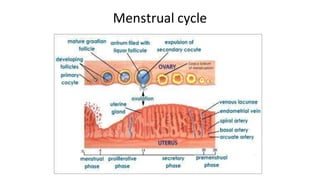
Menstrual cycle
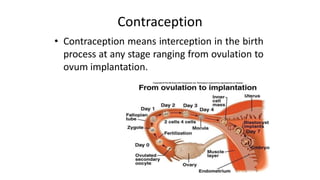
Contraception
• Contraception means interception in the birth
process at any stage ranging from ovulation to
ovum implantation.
Definition-
“Methods and practices that allow
intercourse yet prevent conception
are called contraceptive methods”
Contraceptive methods
Classification
Broadly grouped in two classes:
A. Spacing methods (temporary methods):
1. To space between two children Or
2. To delay birth of first child.
B. Terminal methods (permanent methods):
1. To stop conception when family is completed Or
2. When couple desire no more children.
A. Spacing methods
1. Barrier methods : Male & Female condom.
2. Vaginal methods : Spermicides, Diaphragm,
Cervical cap.
3. Intrauterine devices (IUDs) : Lippes loop, Cu
T-200, Multi Load-Cu-250. CuT-380A
4. Hormonal methods : OCPs, POP, Injectable,
Implants.
Spacing methods: cont.
5. Non hormonal contraceptive pill –
Centchromen (Saheli)
6. Post-coital contraception (Emergency
contraception ) – E-Pill, IUD
7. Fertility awareness based methods (Natural
Methods) – Calendar or Rhythm method,
Basal Body Temp, Cx Secretions
8. Lactational Amenorrhea Method (LAM).
B. Terminal methods
1. Male Sterilization (Vasectomy)
2. Female Sterilization (Tubectomy)
Spacing Methods
1. Barrier Methods
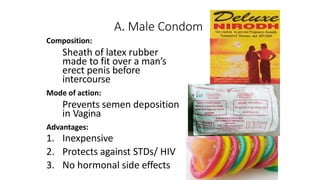
A. Male Condom
Composition:
Sheath of latex rubber
made to fit over a man’s
erect penis before
intercourse
Mode of action:
Prevents semen deposition
in Vagina
Advantages:
1. Inexpensive
2. Protects against STDs/ HIV
3. No hormonal side effects
Male condom contd.
Disadvantages:
• Require high degree of motivation
• Interfere with sex sensation
• May slip off & tear during coitus due to incorrect use
Contraindication:
• Allergy to latex
Failure rate: 2-3 to 14 pregnancy per HWY
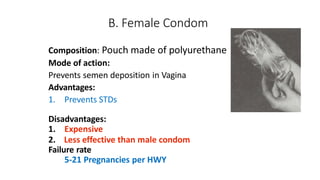
B. Female Condom
Composition: Pouch made of polyurethane
Mode of action:
Prevents semen deposition in Vagina
Advantages:
1. Prevents STDs
Disadvantages:
1. Expensive
2. Less effective than male condom
Failure rate
5-21 Pregnancies per HWY
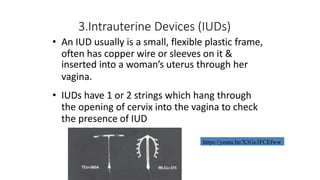
3.Intrauterine Devices (IUDs)
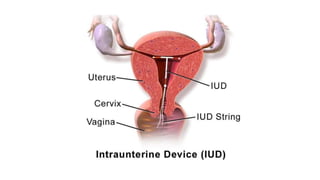
• An IUD usually is a small, flexible plastic frame,
often has copper wire or sleeves on it &
inserted into a woman’s uterus through her
vagina.
• IUDs have 1 or 2 strings which hang through
the opening of cervix into the vagina to check
the presence of IUD
https://youtu.be/X3Ge3FCEfww
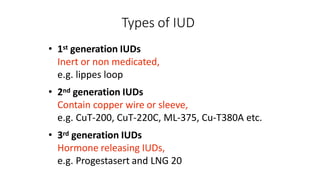
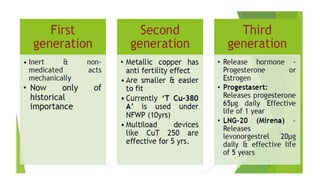
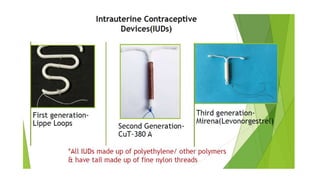
Types of IUD
• 1st generation IUDs
Inert or non medicated,
e.g. lippes loop
• 2nd generation IUDs
Contain copper wire or sleeve,
e.g. CuT-200, CuT-220C, ML-375, Cu-T380A etc.
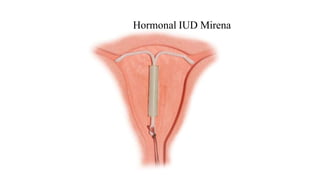
• 3rd generation IUDs
Hormone releasing IUDs,
e.g. Progestasert and LNG 20
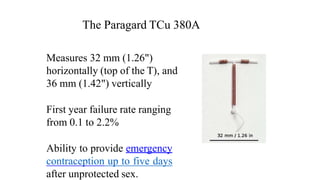
The Paragard TCu 380A
Measures 32 mm (1.26")
horizontally (top of the T), and
36 mm (1.42") vertically
First year failure rate ranging
from 0.1 to 2.2%
Ability to provide emergency
contraception up to five days
after unprotected sex.
Hormonal IUD Mirena
Mode of action (IUD)
• 1st generation:
foreign body reaction in the uterus, impairs
the viability of gamete and thus reduces
chances of fertilization, rather than its
implantation.
• 2nd generation:
Foreign body reaction Plus
i)Alteration in composition of cervical mucus,
ii) Reduced sperm motility and
iii) Reduced sperm survival due to copper ions
Mode of action (IUD)
• 3rd generation:
Mainly local hormonal effects i.e.
increased cervical mucus viscosity thus
preventing sperm entry in cervix,
inducing high level of progesterone and
low level of estrogen thus making the
endometrium unfavorable for
implantation.
Advantages
• Simple and inexpensive procedure
• Single partner motivation required
• Long term effect
• Reversible contraception
• Free from systemic side effects of
hormonal contraceptives
• No interference with sex
CONTRAINDICATIONS
• Absolute
• Suspected pregnancy
• Pelvic inflammatory diseases
• Vaginal bleeding of undiagnosed aetiology
• Cancer of cervix, uterus, or adnexia and other pelvic tumours
• Previous ectopic pregnancy
• Relative
• Anaemia
• Menorrhagia
• History of PID since last pregnancy
• Purulent cervical discharge
• Distortion of uterine cavity (congenital malformation, fibroid)
• Unmotivated person
SIDE-EFFECTS AND COMPLICATIONS
1. Bleeding
2. Pain
3. Pelvic infection
4. Uterine perforation
5. Pregnancy
6. Ectopic pregnancy
7. Expulsion
8. Fertility after removal
9. Cancer and teratogenesis
10. Mortality
• Bleeding
• The commonest complaint is increased vaginal bleeding
• Accounts for 10-20% of all IUD removals
• Bleeding can be in the form of a greater volume of blood loss during menstruation,
longer menstrual periods, or mid-cycle bleeding.
• Bleeding may result in iron deficiency anaemia.
• Pain
• Second major side effect leading to IUD removal
• Pain may be in the form of low backache, cramps in the lower abdomen and
occasionally pain down the thighs (symptoms usually disappear by the 3rd month)
• Pain can be because of device being incorrectly placed in the uterus, disparity in size,
uterine perforation, or infection)
• Pelvic infection
• Pelvic inflammatory diseases is a collective term that includes acute, subacute
and chronic conditions of the ovaries, tubes, uterus, connective tissue and
pelvic peritoneum and usually the result of infection
• Clinical manifestation of PID are vaginal discharge, pelvic pain and tenderness,
abnormal bleeding, chills and fever.
• PID is more 2-8 times more likely to develop in IUD users than non users.
• More common with women having multiple sexual partners
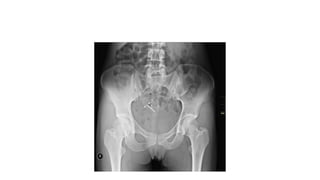
• Uterine perforation
• More commonly occurs when insertions are performed between 48 hours
and 6 weeks postpartum
• Conclusive diagnosis of perforation is usually made by a pelvic X-ray
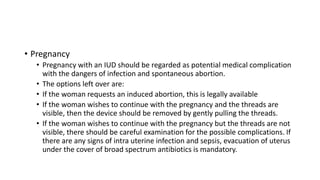
• Pregnancy
• Pregnancy with an IUD should be regarded as potential medical complication
with the dangers of infection and spontaneous abortion.
• The options left over are:
• If the woman requests an induced abortion, this is legally available
• If the woman wishes to continue with the pregnancy and the threads are
visible, then the device should be removed by gently pulling the threads.
• If the woman wishes to continue with the pregnancy but the threads are not
visible, there should be careful examination for the possible complications. If
there are any signs of intra uterine infection and sepsis, evacuation of uterus
under the cover of broad spectrum antibiotics is mandatory.
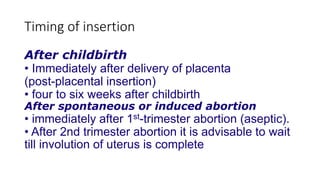
Timing of insertion
After childbirth
• Immediately after delivery of placenta
(post-placental insertion)
• four to six weeks after childbirth
After spontaneous or induced abortion
• immediately after 1st-trimester abortion (aseptic).
• After 2nd trimester abortion it is advisable to wait
till involution of uterus is complete
Menstrual cycle
• Can be inserted any time, during menstrual cycle, if reasonably sure
that woman is not pregnant and has not been having sex without
contraception. But it should be preferably inserted-
During menstruation or within 10 days of beginning of
menstruation
• Insertion during menstruation offers following advantages :
– Pregnancy is ruled out
– Insertion is easier due to open cervical canal
– Any minor bleeding caused by insertion is less likely to upset the
client
HORMONAL CONTRACEPTIVES
• Oral pills
1. Combined pills
2. Progesterone-only pill
3. Post-coital pill
4. Once a month (long-acting) pill
5. Male pill
• Depot (slow-release) formulations
1. Injectables
2. implants
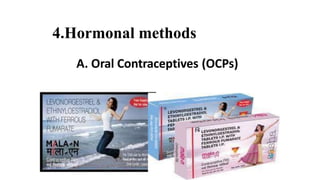
A. Oral Contraceptives (OCPs)
4.Hormonal methods
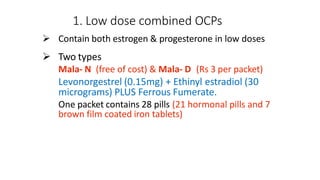
1. Low dose combined OCPs
 Contain both estrogen & progesterone in low doses
 Two types
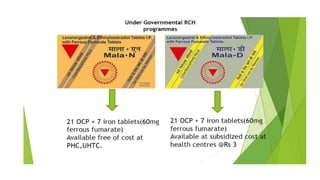
Mala- N (free of cost) & Mala- D (Rs 3 per packet)
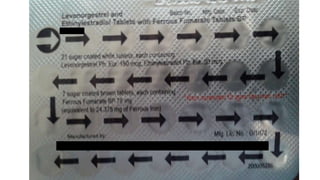
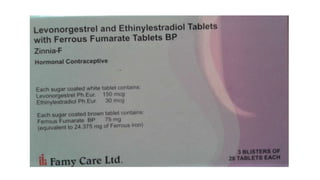
Levonorgestrel (0.15mg) + Ethinyl estradiol (30
micrograms) PLUS Ferrous Fumerate.
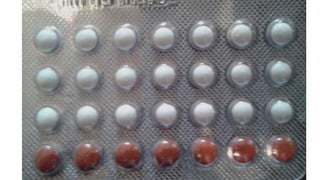
One packet contains 28 pills (21 hormonal pills and 7
brown film coated iron tablets)
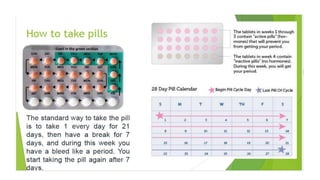
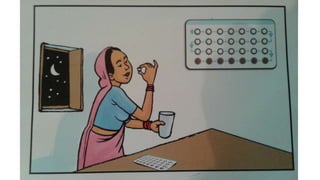
Pill-teach
• First pill is to be taken on fifth day of menstrual cycle and thereafter
one pill daily till next menstrual period.
• Contraception is immediate if the woman starts the pill between days
1 and 5 of her cycle.
• If her first pill is after day 5, other contraception is needed for 7 days.
• Take the pill the same time every day, preferably before going to bed at
night
• One pill daily for 21 days followed by 7 pill-free days. Some
formulations have 7 ‘dummy pills’, rather than the pill-free interval.
• When the bleeding occurs, it is considered to be first day of the next
cycle.
• The bleeding that occurs is not like normal menstruation, but is an
episode of uterine bleeding from an incompletely formed
endometrium caused by the withdrawal of exogenous hormones,
hence called withdrawal bleeding.
Missed pill:
• Missed pills may lead to failed contraception.
• The risk of pregnancy is greatest at the beginning and the end of the pack
• If 1 pill is missed:
Take the missed pill as soon as possible
Continue the rest of the pack as usual
• If 2 or more pills are missed:
Take recent as soon as possible
Need additional cover until 7 days
Mode of action
• Prevent the release of ovum from the
ovary (by blocking the pituitary
secretion of Gonadotropins)
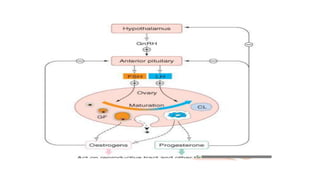
Mechanism of action of OC pills
• Suppression of ovulation by inhibiting the
release of FSH and LH (mainly estrogenic
effect)
• Disruption of proliferative and secretory
phases of endometrium, reducing the chances
of implantation of ovum.
• Progestogenic effects increase the viscocity of
cervical mucus.
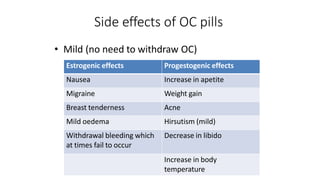
Side effects of OC pills
• Mild (no need to withdraw OC)
Estrogenic effects Progestogenic effects
Nausea Increase in apetite
Migraine Weight gain
Breast tenderness Acne
Mild oedema Hirsutism (mild)
Withdrawal bleeding which
at times fail to occur
Decrease in libido
Increase in body
temperature
Side effects of OC pills
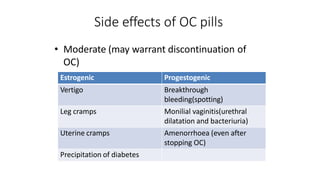
• Moderate (may warrant discontinuation of
OC)
Estrogenic Progestogenic
Vertigo Breakthrough
bleeding(spotting)
Leg cramps Monilial vaginitis(urethral
dilatation and bacteriuria)
Uterine cramps Amenorrhoea (even after
stopping OC)
Precipitation of diabetes
Side effects of OC pills
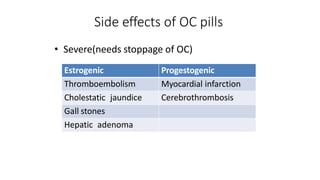
• Severe(needs stoppage of OC)
Estrogenic Progestogenic
Thromboembolism Myocardial infarction
Cholestatic jaundice Cerebrothrombosis
Gall stones
Hepatic adenoma
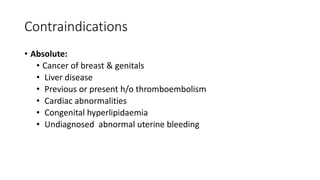
Contraindications
• Absolute:
• Cancer of breast & genitals
• Liver disease
• Previous or present h/o thromboembolism
• Cardiac abnormalities
• Congenital hyperlipidaemia
• Undiagnosed abnormal uterine bleeding
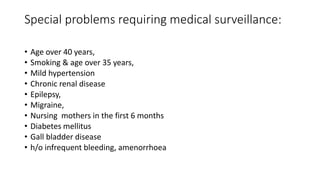
Special problems requiring medical surveillance:
• Age over 40 years,
• Smoking & age over 35 years,
• Mild hypertension
• Chronic renal disease
• Epilepsy,
• Migraine,
• Nursing mothers in the first 6 months
• Diabetes mellitus
• Gall bladder disease
• h/o infrequent bleeding, amenorrhoea
Contraindications of OC pills(absolute)
• Thromboembolic, coronary and cerebrovascular
disease or a history of it.
• Moderate to severe hypertension;
hyperlipidemia.
• Active liver disease, hepatoma or h/o jaundice
during past pregnancy.
• Suspected/overt malignancy of genitals/breast.
• Porphyria
• Impending major surgery- to avoid postoperative
thromboembolism.
Contraindications of OC pills(relative)
• Diabetes
• Obesity
• Smoking
• Undiagnosed vaginal bleeding
• Age above 35 years
• Migraine
• Gall bladder disease
Side effects
• Estrogens-  risk of endometrial ca.
• Progesterone-  LDL cholesterol
• Progesterone -  bone mineral density.
Non contraceptive health benefits of oral
contraceptives
• The estrogen-progesterone pill is associated
with reduced risk of functional ovarian cysts,
ovarian cancer, endometrial cancer, fibrocystic
breast disease, bleeding uterine fibroids.
• The menses become more regular, with
reduced blood loss, less premenstrual tension
and dysmennorhoea.
Non contraceptive health benefits of oral
contraceptives
• Lower incidence of ectopic pregnancy,
endometriosis, and pelvic inflammatory
disease.
• Combined pills with newer progestins
e.g.,desogestrel are more safe for women who
suffer from weight gain, acne, hirsutism or
raised LDL-c because desogestrel lacks
androgenic side effects.
Non contraceptive health benefits of oral
contraceptives
• A combination pill of estrogen with an anti
androgen (cyproterone acetate) is useful for
treating acne and hirsutism.
2. Progestogen-only pills (POPs)
Also known as “minipill” or “micropill”.
Contains only progestogen.
Given in small doses throughout the cycle.
 Commonly used progestogens
are Norethisterone &
Levonorgestrel.
POPs contd. : Mode of action
 Stops the ovulation in about half of
menstrual cycles.
Render cervical mucus thick & scanty,
inhibit sperm penetration.
Inhibit tubal motility, delay transport of
sperm & ovum to uterine cavity.
POPs contd. : Advantages
Can be used by nursing mothers, no change in
quality & quantity of milk.
No estrogen side effects.
Very effective during breastfeeding.
Can be given to older women, less cardiovascular
risks.
Helps prevent: Benign breast disease,
Endometrial & ovarian cancer, PID
POPs contd. : Disadvantages
 Poor cycle control: irregular periods,
spotting in between periods & missed
periods.
 Less effective than combined OCPs.
Side effects: mild headaches , breast
tenderness
B. Depot methods
1.Injectable contraceptives
Two types:
I. Progestogen only:
a.DMPA: IM injection of Depot
Medroxy Progesterone Acetate,
150 mg given every 3 months.
b.NET-EN: IM injection of
Norethistetrone Enantate, 200 mg is
given in every 2 months.
Injectable contraceptives contd.
II. Combined injectable contraceptives:
 Contains both progestogen & estrogen
Given at monthly interval, plus or minus 3
days.
Injectable contraceptives contd.
Mode of action, advantages,
disadvantages & contraindications are
same as hormonal contraceptive pills
with an additional advantage, that
single motivation provides long term
pregnancy prevention, no daily pill
taking.
2.Implants(Norplant)
Composition:
A set of 6 small silastic (silicone rubber)
capsules, containing 35 mg each of
levonorgestrel
More recent device comprise of 2 small rods:
Norplant (R)-2
Mode of action: same as POPs
Implants(Norplant) contd.
Advantages:
Same as hormonal contraceptive pills with an additional
advantage, that single motivation provides long term
pregnancy prevention, up to 5 years, no daily pill taking.
[
Disadvantages:
 Minor surgical procedures required to insert & remove
capsules.
Other disadvantages are same as hormonal contraceptive
pills.
5. Non hormonal contraceptive pill
Composition:
“CENTCHROMAN”
Mode of action:
Prevents implantation through endometrial changes. It has a
strong anti-estrogenic action at peripheral
receptor level.
Dose:
30 mg started on 1st day of menses and taken
twice weekly for 12 weeks and weekly
thereafter
Side effect:
Prolonged cycles and oligomenorrhoea in 8%
Failure Rate: 1.83 pregnancy per HWY
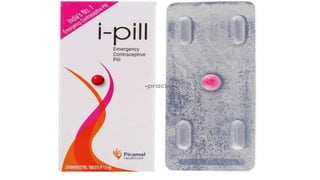
6. Post-coital Contraception
(Emergency contraception)
 Also called “morning after” contraception,
recommended within 48 hours of an
unprotected intercourse. Two methods are
available:
A) IUD: simplest technique is to insert an IUD,
especially a copper device within 7 days.
B) Hormonal:
1. Depending on estrogen content, 2-4
combined oral pills should be taken
Post-coital Contraception contd.
2. Stilbesterol 50 mg daily for 5 days
3. Levonorgestrel 0.75 mg tab immediately &
repeated once after 12 hrs
C) RU 486 (Mifepristone): 25 mg daily orally
for 4 days or a single dose of 600 mg
7.Fertility awareness-based methods
Various methods are:
1. Calendar calculation:
A woman can count calendar days to identify the
start and end of fertile time.
The shortest cycle minus 18 days gives the first day
of fertile period and longest cycle minus 11 days
gives the last day of fertile period
2. Cervical secretions:
Also known as “Billings method”: When a woman
sees or feels cervical secretions, she may be fertile.
Fertility awareness-based methods contd.
3. Basal body temperature:
A woman’s resting body temperature goes
up slightly around the time of ovulation
4. Feel of the cervix:
As the fertile time begins, the opening of the
cervix feels softer, opens slightly, and is
moist.
A combination of all these methods can
also be used to be more effective.
Advantages
• No physical side effects
• No cost required
• Once learned, may require no further help
from health care providers.
• Immediately reversible
• No hormonal side effects
• No effect on breast feeding
Disadvantages
• Not an effective method
• Takes time to learn the duration of menstrual
cycle
• Can become unreliable or hard to use if the
woman has a fever, has a vaginal infection or
is breast feeding
• May not be effective for women with irregular
menstrual cycles
• Does not protect against STDs, HIV/AIDS
8.Lactational amenorrhea method
• Use of breast feeding as a temporary family
planning method.
• A female is naturally protected against
pregnancy when:
a.Her baby gets at least 85% of his or her
feedings as breast milk and she breastfeeds
her baby often, both day and night
b. Her menstrual periods have not returned
c. Her baby is less than 6 months old
Advantages
• Effectively prevents pregnancy for at least 6
months
• Encourages the best breastfeeding practices
• No need to do anything at time of sexual
intercourse
• No hormonal side effects
• No direct costs, supplies or procedures
Disadvantages
• Effectiveness after 6 months is not certain
• No protection against sexually transmitted infections
including HIV/AIDS.
• If the mother has HIV, there is a chance that breast
milk will pass HIV to the baby
Effectiveness
 Effective as commonly used- 2 pregnancies
per HWY in the first 6 months after child birth
 Very effective when used correctly and
consistently- 0.5 pregnancies per HWY in the
first 6 months after childbirth
2. Terminal Methods
• Effective contraceptive procedure for couples who have completed their family size
• Currently female sterilization accounts for
about 85 % and male sterilization 10-15% of
all sterilizations in India
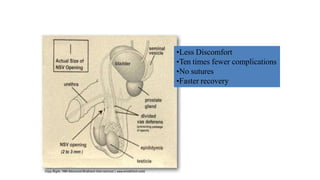
Male Sterilization
Method:
Done under LA, a small incision is made in scrotal
skin and a piece of vas at least 1 cm removed after
clamping and ends ligated and folded back on
themselves and sutured into position.
Mode of action:
No sperm in semen.
Effectiveness: 0.15 pregnancies per 100 men
in the first year after the procedure
Precaution:
Use additional contraceptive procedure until
approx. 30 ejaculations or for 3 months after
the procedure
•Less Discomfort
•Ten times fewer complications
•No sutures
•Faster recovery
Advantages
• Very effective
• Permanent: a single, quick procedure leads to
lifelong, safe, and very effective family
planning
• No interference with sex.
• No apparent long term health risks.
• No supplies to get, and no repeated clinic
visits required
Disadvantages
1. Complications:
A: common complications: Pain in scrotum,
swelling and bruising
B: Sperm granules
C: Spontaneous recanalization (0-6 %)
D: Autoimmune response to sperm
E: Psychosocial effects
2. Requires minor surgery by a specially trained
provider
3. Reversal is difficult
4. No protection against STDs including HIV/AIDS
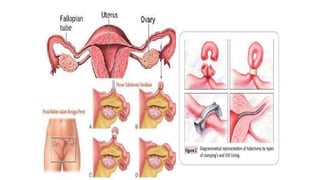
Female Sterilization
1. Laparoscopy: First the abdomen is distended
with CO2 or NO2. A small sub naval incision is
made and laparoscope is inserted, after accessing
the tubes, they are closed by a clip, a ring, or by
electro coagulation.
2. Minilap operation: A small incision (under LA) is
made in abdomen just above pubic hair line,
uterus is raised and turned with an elevator to
bring fallopian tubes under the incision and then
each tube is tied and cut, or else closed with a
clip or ring.
Female sterilization contd.
Mode of action:
Prevents ovum from being fertilized by the sperm.
Effectiveness:
0.5 pregnancies per 100 women during the first year
after the procedure
“Postpartum tubal ligation” is one of the most effective
female sterilization techniques. (failure rate: 0.05
pregnancies per 100 women yrs during the first year after
the procedure)”
Advantages
• Very effective
• Permanent: a single procedure leads to
lifelong, safe and very effective family
planning
• Nothing to remember, no supplies needed,
and no repeated clinic visits required
• No interference with sex
• No long term or hormonal side effects
• No effect on breast feeding
Disadvantages
1. Complications:
a: Pain after the procedure or local
infection or bleeding
b: internal infection or bleeding
C: Injury to internal organs
2. Requires physical examination and minor
surgery by a specially trained provider
3. Reversal surgery is difficult, expensive and not
available in most areas
4. No protection against STDs including HIV/AIDS
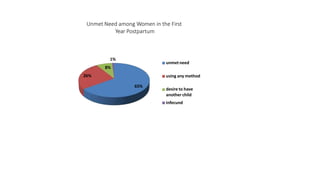
65%
26%
1%
8%
Unmet Need among Women in the First
Year Postpartum
unmetneed
using any method
desire to have
another child
infecund
methods of contraception.pptx

methods of contraception.pptx

  • 1.
    METHODS OF CONTRACEPTION DrSamarjeet Kaur Associate Professor Deptt. Of Community Medicine GSVM Medical College, Kanpur
  • 2.
    Specific Learning Objectives(SLO) • After the end of the lecture, students should be able to: • Describe various family planning methods (temporary as well as permanent). • Advantages and disadvantages of various family planning methods.
  • 3.
  • 4.
    Contraception • Contraception meansinterception in the birth process at any stage ranging from ovulation to ovum implantation.
  • 5.
    Definition- “Methods and practicesthat allow intercourse yet prevent conception are called contraceptive methods” Contraceptive methods
  • 6.
    Classification Broadly grouped intwo classes: A. Spacing methods (temporary methods): 1. To space between two children Or 2. To delay birth of first child. B. Terminal methods (permanent methods): 1. To stop conception when family is completed Or 2. When couple desire no more children.
  • 7.
    A. Spacing methods 1.Barrier methods : Male & Female condom. 2. Vaginal methods : Spermicides, Diaphragm, Cervical cap. 3. Intrauterine devices (IUDs) : Lippes loop, Cu T-200, Multi Load-Cu-250. CuT-380A 4. Hormonal methods : OCPs, POP, Injectable, Implants.
  • 8.
    Spacing methods: cont. 5.Non hormonal contraceptive pill – Centchromen (Saheli) 6. Post-coital contraception (Emergency contraception ) – E-Pill, IUD 7. Fertility awareness based methods (Natural Methods) – Calendar or Rhythm method, Basal Body Temp, Cx Secretions 8. Lactational Amenorrhea Method (LAM).
  • 9.
    B. Terminal methods 1.Male Sterilization (Vasectomy) 2. Female Sterilization (Tubectomy)
  • 10.
  • 11.
    A. Male Condom Composition: Sheathof latex rubber made to fit over a man’s erect penis before intercourse Mode of action: Prevents semen deposition in Vagina Advantages: 1. Inexpensive 2. Protects against STDs/ HIV 3. No hormonal side effects
  • 12.
    Male condom contd. Disadvantages: •Require high degree of motivation • Interfere with sex sensation • May slip off & tear during coitus due to incorrect use Contraindication: • Allergy to latex Failure rate: 2-3 to 14 pregnancy per HWY
  • 13.
    B. Female Condom Composition:Pouch made of polyurethane Mode of action: Prevents semen deposition in Vagina Advantages: 1. Prevents STDs Disadvantages: 1. Expensive 2. Less effective than male condom Failure rate 5-21 Pregnancies per HWY
  • 14.
    3.Intrauterine Devices (IUDs) •An IUD usually is a small, flexible plastic frame, often has copper wire or sleeves on it & inserted into a woman’s uterus through her vagina. • IUDs have 1 or 2 strings which hang through the opening of cervix into the vagina to check the presence of IUD https://youtu.be/X3Ge3FCEfww
  • 16.
    Types of IUD •1st generation IUDs Inert or non medicated, e.g. lippes loop • 2nd generation IUDs Contain copper wire or sleeve, e.g. CuT-200, CuT-220C, ML-375, Cu-T380A etc. • 3rd generation IUDs Hormone releasing IUDs, e.g. Progestasert and LNG 20
  • 19.
    The Paragard TCu380A Measures 32 mm (1.26") horizontally (top of the T), and 36 mm (1.42") vertically First year failure rate ranging from 0.1 to 2.2% Ability to provide emergency contraception up to five days after unprotected sex.
  • 20.
  • 22.
    Mode of action(IUD) • 1st generation: foreign body reaction in the uterus, impairs the viability of gamete and thus reduces chances of fertilization, rather than its implantation. • 2nd generation: Foreign body reaction Plus i)Alteration in composition of cervical mucus, ii) Reduced sperm motility and iii) Reduced sperm survival due to copper ions
  • 23.
    Mode of action(IUD) • 3rd generation: Mainly local hormonal effects i.e. increased cervical mucus viscosity thus preventing sperm entry in cervix, inducing high level of progesterone and low level of estrogen thus making the endometrium unfavorable for implantation.
  • 25.
    Advantages • Simple andinexpensive procedure • Single partner motivation required • Long term effect • Reversible contraception • Free from systemic side effects of hormonal contraceptives • No interference with sex
  • 26.
    CONTRAINDICATIONS • Absolute • Suspectedpregnancy • Pelvic inflammatory diseases • Vaginal bleeding of undiagnosed aetiology • Cancer of cervix, uterus, or adnexia and other pelvic tumours • Previous ectopic pregnancy • Relative • Anaemia • Menorrhagia • History of PID since last pregnancy • Purulent cervical discharge • Distortion of uterine cavity (congenital malformation, fibroid) • Unmotivated person
  • 27.
    SIDE-EFFECTS AND COMPLICATIONS 1.Bleeding 2. Pain 3. Pelvic infection 4. Uterine perforation 5. Pregnancy 6. Ectopic pregnancy 7. Expulsion 8. Fertility after removal 9. Cancer and teratogenesis 10. Mortality
  • 28.
    • Bleeding • Thecommonest complaint is increased vaginal bleeding • Accounts for 10-20% of all IUD removals • Bleeding can be in the form of a greater volume of blood loss during menstruation, longer menstrual periods, or mid-cycle bleeding. • Bleeding may result in iron deficiency anaemia. • Pain • Second major side effect leading to IUD removal • Pain may be in the form of low backache, cramps in the lower abdomen and occasionally pain down the thighs (symptoms usually disappear by the 3rd month) • Pain can be because of device being incorrectly placed in the uterus, disparity in size, uterine perforation, or infection)
  • 29.
    • Pelvic infection •Pelvic inflammatory diseases is a collective term that includes acute, subacute and chronic conditions of the ovaries, tubes, uterus, connective tissue and pelvic peritoneum and usually the result of infection • Clinical manifestation of PID are vaginal discharge, pelvic pain and tenderness, abnormal bleeding, chills and fever. • PID is more 2-8 times more likely to develop in IUD users than non users. • More common with women having multiple sexual partners • Uterine perforation • More commonly occurs when insertions are performed between 48 hours and 6 weeks postpartum • Conclusive diagnosis of perforation is usually made by a pelvic X-ray
  • 30.
    • Pregnancy • Pregnancywith an IUD should be regarded as potential medical complication with the dangers of infection and spontaneous abortion. • The options left over are: • If the woman requests an induced abortion, this is legally available • If the woman wishes to continue with the pregnancy and the threads are visible, then the device should be removed by gently pulling the threads. • If the woman wishes to continue with the pregnancy but the threads are not visible, there should be careful examination for the possible complications. If there are any signs of intra uterine infection and sepsis, evacuation of uterus under the cover of broad spectrum antibiotics is mandatory.
  • 31.
    Timing of insertion Afterchildbirth • Immediately after delivery of placenta (post-placental insertion) • four to six weeks after childbirth After spontaneous or induced abortion • immediately after 1st-trimester abortion (aseptic). • After 2nd trimester abortion it is advisable to wait till involution of uterus is complete
  • 32.
    Menstrual cycle • Canbe inserted any time, during menstrual cycle, if reasonably sure that woman is not pregnant and has not been having sex without contraception. But it should be preferably inserted- During menstruation or within 10 days of beginning of menstruation • Insertion during menstruation offers following advantages : – Pregnancy is ruled out – Insertion is easier due to open cervical canal – Any minor bleeding caused by insertion is less likely to upset the client
  • 33.
    HORMONAL CONTRACEPTIVES • Oralpills 1. Combined pills 2. Progesterone-only pill 3. Post-coital pill 4. Once a month (long-acting) pill 5. Male pill • Depot (slow-release) formulations 1. Injectables 2. implants
  • 34.
    A. Oral Contraceptives(OCPs) 4.Hormonal methods
  • 35.
    1. Low dosecombined OCPs  Contain both estrogen & progesterone in low doses  Two types Mala- N (free of cost) & Mala- D (Rs 3 per packet) Levonorgestrel (0.15mg) + Ethinyl estradiol (30 micrograms) PLUS Ferrous Fumerate. One packet contains 28 pills (21 hormonal pills and 7 brown film coated iron tablets)
  • 42.
    Pill-teach • First pillis to be taken on fifth day of menstrual cycle and thereafter one pill daily till next menstrual period. • Contraception is immediate if the woman starts the pill between days 1 and 5 of her cycle. • If her first pill is after day 5, other contraception is needed for 7 days. • Take the pill the same time every day, preferably before going to bed at night • One pill daily for 21 days followed by 7 pill-free days. Some formulations have 7 ‘dummy pills’, rather than the pill-free interval.
  • 43.
    • When thebleeding occurs, it is considered to be first day of the next cycle. • The bleeding that occurs is not like normal menstruation, but is an episode of uterine bleeding from an incompletely formed endometrium caused by the withdrawal of exogenous hormones, hence called withdrawal bleeding.
  • 44.
    Missed pill: • Missedpills may lead to failed contraception. • The risk of pregnancy is greatest at the beginning and the end of the pack • If 1 pill is missed: Take the missed pill as soon as possible Continue the rest of the pack as usual • If 2 or more pills are missed: Take recent as soon as possible Need additional cover until 7 days
  • 45.
    Mode of action •Prevent the release of ovum from the ovary (by blocking the pituitary secretion of Gonadotropins)
  • 46.
    Mechanism of actionof OC pills • Suppression of ovulation by inhibiting the release of FSH and LH (mainly estrogenic effect) • Disruption of proliferative and secretory phases of endometrium, reducing the chances of implantation of ovum. • Progestogenic effects increase the viscocity of cervical mucus.
  • 48.
    Side effects ofOC pills • Mild (no need to withdraw OC) Estrogenic effects Progestogenic effects Nausea Increase in apetite Migraine Weight gain Breast tenderness Acne Mild oedema Hirsutism (mild) Withdrawal bleeding which at times fail to occur Decrease in libido Increase in body temperature
  • 49.
    Side effects ofOC pills • Moderate (may warrant discontinuation of OC) Estrogenic Progestogenic Vertigo Breakthrough bleeding(spotting) Leg cramps Monilial vaginitis(urethral dilatation and bacteriuria) Uterine cramps Amenorrhoea (even after stopping OC) Precipitation of diabetes
  • 50.
    Side effects ofOC pills • Severe(needs stoppage of OC) Estrogenic Progestogenic Thromboembolism Myocardial infarction Cholestatic jaundice Cerebrothrombosis Gall stones Hepatic adenoma
  • 51.
    Contraindications • Absolute: • Cancerof breast & genitals • Liver disease • Previous or present h/o thromboembolism • Cardiac abnormalities • Congenital hyperlipidaemia • Undiagnosed abnormal uterine bleeding
  • 52.
    Special problems requiringmedical surveillance: • Age over 40 years, • Smoking & age over 35 years, • Mild hypertension • Chronic renal disease • Epilepsy, • Migraine, • Nursing mothers in the first 6 months • Diabetes mellitus • Gall bladder disease • h/o infrequent bleeding, amenorrhoea
  • 53.
    Contraindications of OCpills(absolute) • Thromboembolic, coronary and cerebrovascular disease or a history of it. • Moderate to severe hypertension; hyperlipidemia. • Active liver disease, hepatoma or h/o jaundice during past pregnancy. • Suspected/overt malignancy of genitals/breast. • Porphyria • Impending major surgery- to avoid postoperative thromboembolism.
  • 54.
    Contraindications of OCpills(relative) • Diabetes • Obesity • Smoking • Undiagnosed vaginal bleeding • Age above 35 years • Migraine • Gall bladder disease
  • 55.
    Side effects • Estrogens- risk of endometrial ca. • Progesterone-  LDL cholesterol • Progesterone -  bone mineral density.
  • 56.
    Non contraceptive healthbenefits of oral contraceptives • The estrogen-progesterone pill is associated with reduced risk of functional ovarian cysts, ovarian cancer, endometrial cancer, fibrocystic breast disease, bleeding uterine fibroids. • The menses become more regular, with reduced blood loss, less premenstrual tension and dysmennorhoea.
  • 57.
    Non contraceptive healthbenefits of oral contraceptives • Lower incidence of ectopic pregnancy, endometriosis, and pelvic inflammatory disease. • Combined pills with newer progestins e.g.,desogestrel are more safe for women who suffer from weight gain, acne, hirsutism or raised LDL-c because desogestrel lacks androgenic side effects.
  • 58.
    Non contraceptive healthbenefits of oral contraceptives • A combination pill of estrogen with an anti androgen (cyproterone acetate) is useful for treating acne and hirsutism.
  • 59.
    2. Progestogen-only pills(POPs) Also known as “minipill” or “micropill”. Contains only progestogen. Given in small doses throughout the cycle.  Commonly used progestogens are Norethisterone & Levonorgestrel.
  • 60.
    POPs contd. :Mode of action  Stops the ovulation in about half of menstrual cycles. Render cervical mucus thick & scanty, inhibit sperm penetration. Inhibit tubal motility, delay transport of sperm & ovum to uterine cavity.
  • 61.
    POPs contd. :Advantages Can be used by nursing mothers, no change in quality & quantity of milk. No estrogen side effects. Very effective during breastfeeding. Can be given to older women, less cardiovascular risks. Helps prevent: Benign breast disease, Endometrial & ovarian cancer, PID
  • 62.
    POPs contd. :Disadvantages  Poor cycle control: irregular periods, spotting in between periods & missed periods.  Less effective than combined OCPs. Side effects: mild headaches , breast tenderness
  • 63.
  • 64.
    1.Injectable contraceptives Two types: I.Progestogen only: a.DMPA: IM injection of Depot Medroxy Progesterone Acetate, 150 mg given every 3 months. b.NET-EN: IM injection of Norethistetrone Enantate, 200 mg is given in every 2 months.
  • 65.
    Injectable contraceptives contd. II.Combined injectable contraceptives:  Contains both progestogen & estrogen Given at monthly interval, plus or minus 3 days.
  • 66.
    Injectable contraceptives contd. Modeof action, advantages, disadvantages & contraindications are same as hormonal contraceptive pills with an additional advantage, that single motivation provides long term pregnancy prevention, no daily pill taking.
  • 67.
    2.Implants(Norplant) Composition: A set of6 small silastic (silicone rubber) capsules, containing 35 mg each of levonorgestrel More recent device comprise of 2 small rods: Norplant (R)-2 Mode of action: same as POPs
  • 68.
    Implants(Norplant) contd. Advantages: Same ashormonal contraceptive pills with an additional advantage, that single motivation provides long term pregnancy prevention, up to 5 years, no daily pill taking. [ Disadvantages:  Minor surgical procedures required to insert & remove capsules. Other disadvantages are same as hormonal contraceptive pills.
  • 69.
    5. Non hormonalcontraceptive pill Composition: “CENTCHROMAN” Mode of action: Prevents implantation through endometrial changes. It has a strong anti-estrogenic action at peripheral receptor level. Dose: 30 mg started on 1st day of menses and taken twice weekly for 12 weeks and weekly thereafter Side effect: Prolonged cycles and oligomenorrhoea in 8% Failure Rate: 1.83 pregnancy per HWY
  • 70.
    6. Post-coital Contraception (Emergencycontraception)  Also called “morning after” contraception, recommended within 48 hours of an unprotected intercourse. Two methods are available: A) IUD: simplest technique is to insert an IUD, especially a copper device within 7 days. B) Hormonal: 1. Depending on estrogen content, 2-4 combined oral pills should be taken
  • 71.
    Post-coital Contraception contd. 2.Stilbesterol 50 mg daily for 5 days 3. Levonorgestrel 0.75 mg tab immediately & repeated once after 12 hrs C) RU 486 (Mifepristone): 25 mg daily orally for 4 days or a single dose of 600 mg
  • 73.
    7.Fertility awareness-based methods Variousmethods are: 1. Calendar calculation: A woman can count calendar days to identify the start and end of fertile time. The shortest cycle minus 18 days gives the first day of fertile period and longest cycle minus 11 days gives the last day of fertile period 2. Cervical secretions: Also known as “Billings method”: When a woman sees or feels cervical secretions, she may be fertile.
  • 74.
    Fertility awareness-based methodscontd. 3. Basal body temperature: A woman’s resting body temperature goes up slightly around the time of ovulation 4. Feel of the cervix: As the fertile time begins, the opening of the cervix feels softer, opens slightly, and is moist. A combination of all these methods can also be used to be more effective.
  • 75.
    Advantages • No physicalside effects • No cost required • Once learned, may require no further help from health care providers. • Immediately reversible • No hormonal side effects • No effect on breast feeding
  • 76.
    Disadvantages • Not aneffective method • Takes time to learn the duration of menstrual cycle • Can become unreliable or hard to use if the woman has a fever, has a vaginal infection or is breast feeding • May not be effective for women with irregular menstrual cycles • Does not protect against STDs, HIV/AIDS
  • 77.
    8.Lactational amenorrhea method •Use of breast feeding as a temporary family planning method. • A female is naturally protected against pregnancy when: a.Her baby gets at least 85% of his or her feedings as breast milk and she breastfeeds her baby often, both day and night b. Her menstrual periods have not returned c. Her baby is less than 6 months old
  • 78.
    Advantages • Effectively preventspregnancy for at least 6 months • Encourages the best breastfeeding practices • No need to do anything at time of sexual intercourse • No hormonal side effects • No direct costs, supplies or procedures
  • 79.
    Disadvantages • Effectiveness after6 months is not certain • No protection against sexually transmitted infections including HIV/AIDS. • If the mother has HIV, there is a chance that breast milk will pass HIV to the baby Effectiveness  Effective as commonly used- 2 pregnancies per HWY in the first 6 months after child birth  Very effective when used correctly and consistently- 0.5 pregnancies per HWY in the first 6 months after childbirth
  • 80.
    2. Terminal Methods •Effective contraceptive procedure for couples who have completed their family size • Currently female sterilization accounts for about 85 % and male sterilization 10-15% of all sterilizations in India
  • 81.
    Male Sterilization Method: Done underLA, a small incision is made in scrotal skin and a piece of vas at least 1 cm removed after clamping and ends ligated and folded back on themselves and sutured into position. Mode of action: No sperm in semen. Effectiveness: 0.15 pregnancies per 100 men in the first year after the procedure Precaution: Use additional contraceptive procedure until approx. 30 ejaculations or for 3 months after the procedure
  • 82.
    •Less Discomfort •Ten timesfewer complications •No sutures •Faster recovery
  • 84.
    Advantages • Very effective •Permanent: a single, quick procedure leads to lifelong, safe, and very effective family planning • No interference with sex. • No apparent long term health risks. • No supplies to get, and no repeated clinic visits required
  • 85.
    Disadvantages 1. Complications: A: commoncomplications: Pain in scrotum, swelling and bruising B: Sperm granules C: Spontaneous recanalization (0-6 %) D: Autoimmune response to sperm E: Psychosocial effects 2. Requires minor surgery by a specially trained provider 3. Reversal is difficult 4. No protection against STDs including HIV/AIDS
  • 86.
    Female Sterilization 1. Laparoscopy:First the abdomen is distended with CO2 or NO2. A small sub naval incision is made and laparoscope is inserted, after accessing the tubes, they are closed by a clip, a ring, or by electro coagulation. 2. Minilap operation: A small incision (under LA) is made in abdomen just above pubic hair line, uterus is raised and turned with an elevator to bring fallopian tubes under the incision and then each tube is tied and cut, or else closed with a clip or ring.
  • 87.
    Female sterilization contd. Modeof action: Prevents ovum from being fertilized by the sperm. Effectiveness: 0.5 pregnancies per 100 women during the first year after the procedure “Postpartum tubal ligation” is one of the most effective female sterilization techniques. (failure rate: 0.05 pregnancies per 100 women yrs during the first year after the procedure)”
  • 88.
    Advantages • Very effective •Permanent: a single procedure leads to lifelong, safe and very effective family planning • Nothing to remember, no supplies needed, and no repeated clinic visits required • No interference with sex • No long term or hormonal side effects • No effect on breast feeding
  • 89.
    Disadvantages 1. Complications: a: Painafter the procedure or local infection or bleeding b: internal infection or bleeding C: Injury to internal organs 2. Requires physical examination and minor surgery by a specially trained provider 3. Reversal surgery is difficult, expensive and not available in most areas 4. No protection against STDs including HIV/AIDS
  • 90.
    65% 26% 1% 8% Unmet Need amongWomen in the First Year Postpartum unmetneed using any method desire to have another child infecund