Presented To:
Dr. Riaz Sheikh
Presented By:
Shamim Mukhtar13
Maliha Hussain 14
Rimsha Rubab 07
Contents:
 What is landform?
 How it forms?
 Type of landforms
 Mountains
 Hills
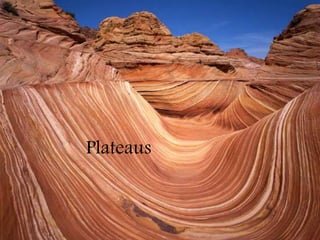
 Plateaus
 Plains
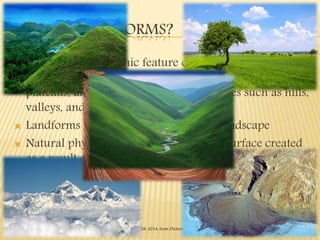
WHAT IS LANDFORMS?
 A specific geomorphic feature on the surface of the
earth, ranging from large-scale features such as plains,
plateaus, and mountains to minor features such as hills,
valleys, and alluvial fans.
 Landforms are natural features of the landscape
 Natural physical features of the earth's surface created
as a result of various forces of nature
landform. (n.d.). Dictionary.com Unabridged. Retrieved September 28, 2014, from Dictionary.com website: http://dictionary.reference.com/browse/landform
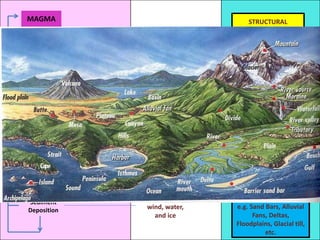
HOW ARE LANDFORMS MADE?
MAGMA
solidification
ROCKS
Weathering
DEBRIS
Sediment
Erosion
LOAD
Sediment
Deposition
Tectonic
Processes
Folding, Faulting,
Tectonic, Uplift, and
Land subsidence
Decomposition
& Disintegration
of rocks and
minerals by
Physical and
Chemical
Processes
Detachment &
Transport by
wind, water,
and ice
Deposition by
wind, water,
and ice
STRUCTURAL
LANDFORMS
e.g. Mountains, Fault,
Scarps, Valleys, etc.
WEATHERING
LANDFORMS
e.g. Soils, Karst Caves,
talus cones etc.
EROSIONAL
LANDFORMS
e.g. Rivers and Glacial,
Valleys, Gullies etc.
DEPOSITIONAL
LANDFORMS
e.g. Sand Bars, Alluvial
Fans, Deltas,
Floodplains, Glacial till,
etc.
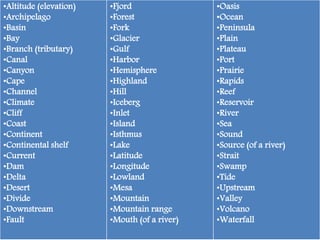
•Altitude (elevation)
•Archipelago
•Basin
•Bay
•Branch (tributary)
•Canal
•Canyon
•Cape
•Channel
•Climate
•Cliff
•Coast
•Continent
•Continental shelf
•Current
•Dam
•Delta
•Desert
•Divide
•Downstream
•Fault
•Fjord
•Forest
•Fork
•Glacier
•Gulf
•Harbor
•Hemisphere
•Highland
•Hill
•Iceberg
•Inlet
•Island
•Isthmus
•Lake
•Latitude
•Longitude
•Lowland
•Mesa
•Mountain
•Mountain range
•Mouth (of a river)
•Oasis
•Ocean
•Peninsula
•Plain
•Plateau
•Port
•Prairie
•Rapids
•Reef
•Reservoir
•River
•Sea
•Sound
•Source (of a river)
•Strait
•Swamp
•Tide
•Upstream
•Valley
•Volcano
•Waterfall
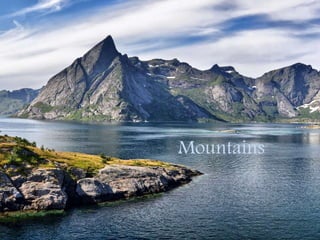
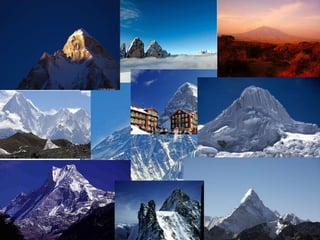
Mountains
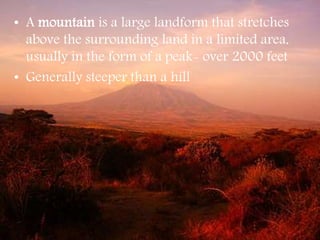
• A mountain is a large landform that stretches
above the surrounding land in a limited area,
usually in the form of a peak- over 2000 feet
• Generally steeper than a hill
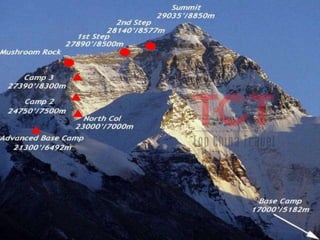
The highest mountain on Earth is Mount
Everest in the Himalayas of Asia, whose
summit is 8,850 m (29,035 ft) above mean
sea level.
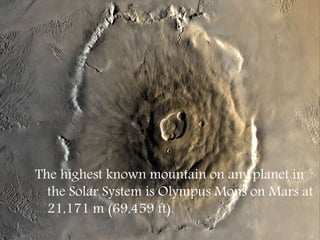
The highest known mountain on any planet in
the Solar System is Olympus Mons on Mars at
21,171 m (69,459 ft).
Plateaus
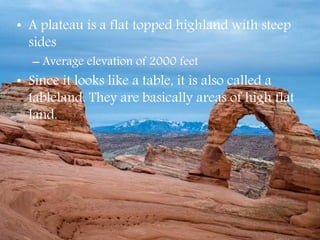
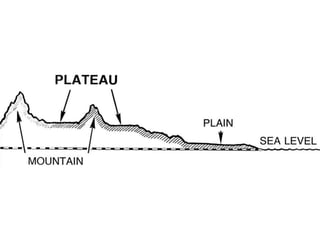
• A plateau is a flat topped highland with steep
sides
– Average elevation of 2000 feet
• Since it looks like a table, it is also called a
tableland. They are basically areas of high flat
land.
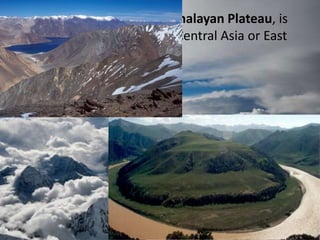
• The Tibetan Plateau or Himalayan Plateau, is
a vast elevated plateau in Central Asia or East
Asia.
Plains
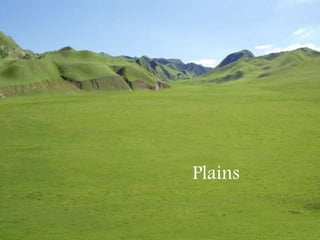
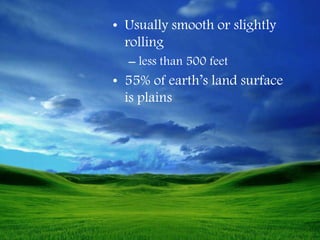
• Usually smooth or slightly
rolling
– less than 500 feet
• 55% of earth’s land surface
is plains
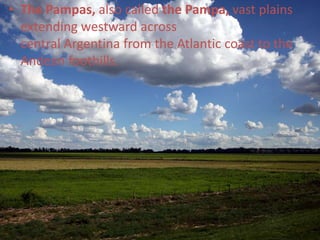
• The Pampas, also called the Pampa, vast plains
extending westward across
central Argentina from the Atlantic coast to the
Andean foothills.
Hills
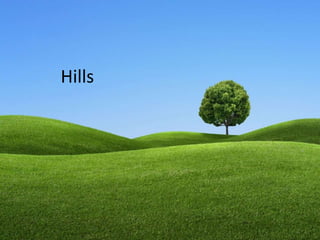
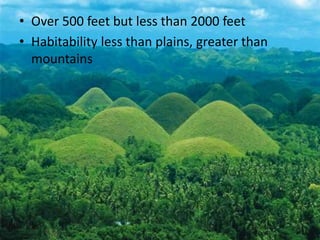
• Over 500 feet but less than 2000 feet
• Habitability less than plains, greater than
mountains
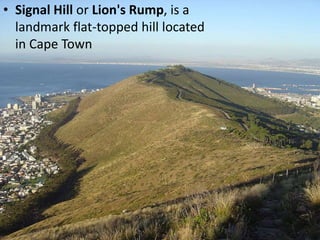
• Signal Hill or Lion's Rump, is a
landmark flat-topped hill located
in Cape Town
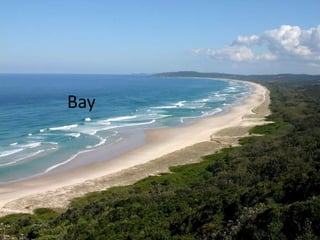
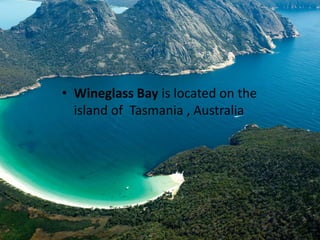
Bay
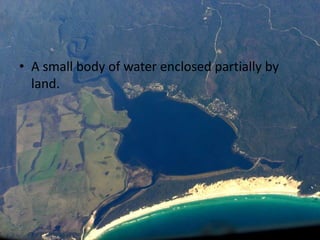
• A small body of water enclosed partially by
land.
• Wineglass Bay is located on the
island of Tasmania , Australia
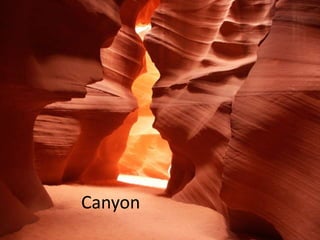
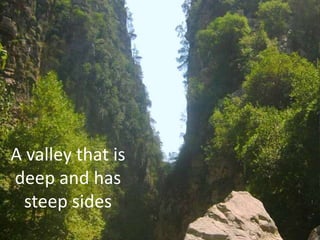
Canyon
A valley that is
deep and has
steep sides
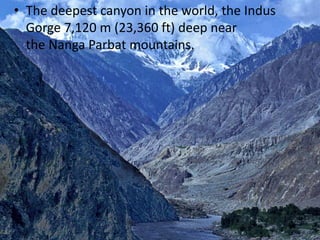
• The deepest canyon in the world, the Indus
Gorge 7,120 m (23,360 ft) deep near
the Nanga Parbat mountains.
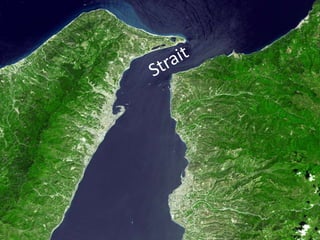
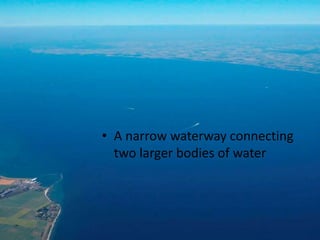
• A narrow waterway connecting
two larger bodies of water
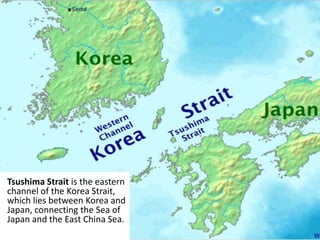
Tsushima Strait is the eastern
channel of the Korea Strait,
which lies between Korea and
Japan, connecting the Sea of
Japan and the East China Sea.
Now let’s review!
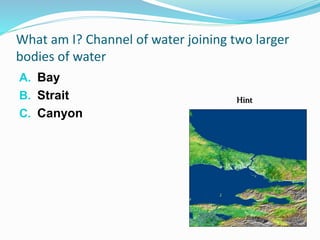
What am I? Channel of water joining two larger
bodies of water
A. Bay
B. Strait
C. Canyon
Hint
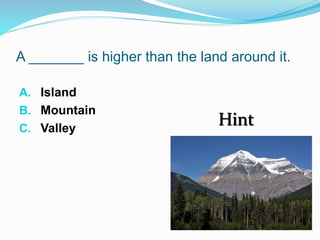
A _______ is higher than the land around it.
A. Island
B. Mountain
C. Valley
Hint

Landforms

  • 2.
    Presented To: Dr. RiazSheikh Presented By: Shamim Mukhtar13 Maliha Hussain 14 Rimsha Rubab 07
  • 4.
    Contents:  What islandform?  How it forms?  Type of landforms  Mountains  Hills  Plateaus  Plains
  • 5.
    WHAT IS LANDFORMS? A specific geomorphic feature on the surface of the earth, ranging from large-scale features such as plains, plateaus, and mountains to minor features such as hills, valleys, and alluvial fans.  Landforms are natural features of the landscape  Natural physical features of the earth's surface created as a result of various forces of nature landform. (n.d.). Dictionary.com Unabridged. Retrieved September 28, 2014, from Dictionary.com website: http://dictionary.reference.com/browse/landform
  • 6.
  • 7.
    MAGMA solidification ROCKS Weathering DEBRIS Sediment Erosion LOAD Sediment Deposition Tectonic Processes Folding, Faulting, Tectonic, Uplift,and Land subsidence Decomposition & Disintegration of rocks and minerals by Physical and Chemical Processes Detachment & Transport by wind, water, and ice Deposition by wind, water, and ice STRUCTURAL LANDFORMS e.g. Mountains, Fault, Scarps, Valleys, etc. WEATHERING LANDFORMS e.g. Soils, Karst Caves, talus cones etc. EROSIONAL LANDFORMS e.g. Rivers and Glacial, Valleys, Gullies etc. DEPOSITIONAL LANDFORMS e.g. Sand Bars, Alluvial Fans, Deltas, Floodplains, Glacial till, etc.
  • 8.
    •Altitude (elevation) •Archipelago •Basin •Bay •Branch (tributary) •Canal •Canyon •Cape •Channel •Climate •Cliff •Coast •Continent •Continentalshelf •Current •Dam •Delta •Desert •Divide •Downstream •Fault •Fjord •Forest •Fork •Glacier •Gulf •Harbor •Hemisphere •Highland •Hill •Iceberg •Inlet •Island •Isthmus •Lake •Latitude •Longitude •Lowland •Mesa •Mountain •Mountain range •Mouth (of a river) •Oasis •Ocean •Peninsula •Plain •Plateau •Port •Prairie •Rapids •Reef •Reservoir •River •Sea •Sound •Source (of a river) •Strait •Swamp •Tide •Upstream •Valley •Volcano •Waterfall
  • 9.
  • 11.
    • A mountainis a large landform that stretches above the surrounding land in a limited area, usually in the form of a peak- over 2000 feet • Generally steeper than a hill
  • 12.
    The highest mountainon Earth is Mount Everest in the Himalayas of Asia, whose summit is 8,850 m (29,035 ft) above mean sea level.
  • 13.
    The highest knownmountain on any planet in the Solar System is Olympus Mons on Mars at 21,171 m (69,459 ft).
  • 14.
  • 15.
    • A plateauis a flat topped highland with steep sides – Average elevation of 2000 feet • Since it looks like a table, it is also called a tableland. They are basically areas of high flat land.
  • 16.
    • The TibetanPlateau or Himalayan Plateau, is a vast elevated plateau in Central Asia or East Asia.
  • 17.
  • 18.
    • Usually smoothor slightly rolling – less than 500 feet • 55% of earth’s land surface is plains
  • 19.
    • The Pampas,also called the Pampa, vast plains extending westward across central Argentina from the Atlantic coast to the Andean foothills.
  • 21.
  • 22.
    • Over 500feet but less than 2000 feet • Habitability less than plains, greater than mountains
  • 23.
    • Signal Hillor Lion's Rump, is a landmark flat-topped hill located in Cape Town
  • 24.
  • 25.
    • A smallbody of water enclosed partially by land.
  • 26.
    • Wineglass Bayis located on the island of Tasmania , Australia
  • 27.
  • 28.
    A valley thatis deep and has steep sides
  • 29.
    • The deepestcanyon in the world, the Indus Gorge 7,120 m (23,360 ft) deep near the Nanga Parbat mountains.
  • 31.
    • A narrowwaterway connecting two larger bodies of water
  • 32.
    Tsushima Strait isthe eastern channel of the Korea Strait, which lies between Korea and Japan, connecting the Sea of Japan and the East China Sea.
  • 33.
  • 34.
    What am I?Channel of water joining two larger bodies of water A. Bay B. Strait C. Canyon Hint
  • 35.
    A _______ ishigher than the land around it. A. Island B. Mountain C. Valley Hint

Editor's Notes

  • #4 When you look at the earth’s surface .. What can you say about it..?? The earth’s surface is not flat. When we look at it we are looking at the different landforms shaped by all of earth’s processes
  • #6 A Landform is a physical, natural or manmade structure which is situated on earth's surface, whereas a Landscape is the combined natural and cultural features of an area on the earth's surface.
  • #8 Tectonic plate movement under the Earth can create landforms by pushing up mountains and hills. Erosion by water and wind can wear down land and create landforms like valleys and canyons. Both processes happen over a long period of time, sometimes millions of years.