Design and Selection of V – Belt drives
using PSG design data book
DEPARTMENT OF MECHANICAL
ENGINEERING
By
Mr. B.Balavairavan
Assistant Professor
Mechanical Engineering
Kamaraj College of Engg and Tech
Virudhunagar
V – Belt Types
Based on the manufacture
specifications the v-belts are
classified into many types.
For example : Cog Belt, Wedge Belt,
Chipper Belt, Double angle belt, v-flat
belt etc..
Cross Section of V-Belt
Advantages of V-Belt drives
• Smooth starting and running.
• Permit a wide range of driven speeds, using
standard electric motors.
• They’re rugged and provide years of trouble-
free performance with minimal attention . . .
even under adverse conditions.
• Capable of transmitting power around
corners or out of plane drives.
• Clean—require no lubrication. • Highly
efficient.
• Extremely wide horsepower ranges.
• Dampen vibration between driver and driven
machines.
• Silent operation. • Long service life. • Easy
installation.
• Can be used as an effective means of
clutching.
• They act as a “safety fuse” refusing to
transmit severe power overload, except for a
very brief period.
• V-belts and sheaves wear gradually-making
preventive corrective maintenance simple and
easy.
V belt pulley
All pulley grooves are to be the same size.
Uneven wear of grooves causes belts
running on different diameter levels in the
pulley. That generates excessive slip of the
belts on one side.
Tight side and slack side
For the selection of a two-pulley power transmission
V - belt the following data are required:
Motor power or power to be transmitted (in kW)
Speed of drives
Number of revolutions of driving pulley (n)
Number of revolutions of driven pulley (N)
Diameter of pulley
Diameter of driving pulley (d)
Diameter of driven pulley (D)
Transmission ratio or velocity ratio (i)
Center distance (C)
Procedure Stages
1. Selection of belt section.
2. Selection of standard pulleys.
3. Approximate or Maximum centre distance.
4. Nominal pitch length selection.
5. Modification factors “length correction, Service factor, Arc of contact factor”
6. Calculating of maximum power capacity.
7. No of belts.
8. Actual centre distance
9. Pulley dimensions
Problem 1
Problem Statement:
A centrifugal pump running at 340
rpm is to be driven by a 100 kW
motor running at 1440 rpm. The drive
is to work for atleast 20 hours a day.
The centre distance between motor
and pump shaft is 1200 mm. Sugest
a suitable v-belt drive.
Given Data:
Power = 100 kW
Driver speed (n) = 1440 rpm
Driven speed (N) = 340 rpm
Centre Distance (c) = 1200 mm
Step - 1 “Selection of belt section”
From page no: 7.58
Based on the power of motor, the cross section of belt is selected, as D
Step - 2 “Selection of Std. Pulleys”
i =
340
1440
i = 4.235
4.235 =
355
D
D = 1503.33 mm
From page No: 7.58 for the selected cross section, d value is given
d = 355 mm
d = 355 mm
D = 1600 mm
from page no: 7.54
Standard pulley diameters are
Step - 3 “Centre distance”
If centre distance is not given, it can be approimated using the table in page no: 7.61
Given, Centre distance (C) = 1200 mm
Step - 4 “Nominal pitch length selection”
= 5793.83 mm
Length of belt =
4 x 1200
2 x 1200 +
2
𝜋 (1600+355)+ (1600 - 355)2
The standard nominal length is selected based on the cross section of belt from
page no:7.59 to 7.60
Standard Nominal Length = 6124 mm
Step - 5 “Modification factors”
Length Correction Factor (Fc)
from page no: 7.58 – 7.60
Based on cross section of belt
selected its choosen
Load Correcting factor = 1
Arc of Contact Factor (Fd)
from page no: 7.68
Arc of contact =
1200
1600 - 355
x 60 ൦180 ൦ -
= 117.75 ൦
Arc of contact factor = 0.81
for arc of contact 117.75 ൦
Service Factor (Fa)
from page no: 7.69
The working over 16 hrs
Service factor = 1.3
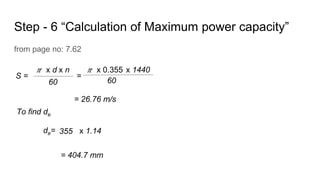
Step - 6 “Calculation of Maximum power capacity”
from page no: 7.62
Step - 6 “Calculation of Maximum power capacity”
from page no: 7.62
S =
= 26.76 m/s
x n
60
𝜋 x d
=
x 1440
60
𝜋 x 0.355
de= 355
= 404.7 mm
x 1.14
To find de
Power in kW=
= 25 kW
3.22 x 2.76-0.09 -
506.7
404.7
- 4.78 25 x 10 -4 x 26.762 26.76
Step – 7 “Determination of number of belts”
from page no. 7.70
= 7.486
=
21.44 x 1
100 x 1.3
x 0.81
= 8
Step - 8 “Actual Centre Distance”
from page no: 7.61
Step - 9 “Pulley Dimensions”
from page no: 7.70, for the selected “D” cros section v-belt, the pulley
dimensions follows
d = 355 mm
D = 1600 mm
Pitch Width (lp) = 27 mm
Angle (A) = 36 o
Centre to centre distance (e) = 37 mm
Edge of pulley to first grove (f) = 24 mm
Minimum distance down to pitch line = 8.1 mm
Result (dimensions in mm)
C =1386.83
D = 1600
d = 355
36 o
27
b = 8.1
A
37 24
lp
e f
t = 19
32
w
for “D” cross section V-Belt
Difference between Flat Belt and V- belt Drives
1. Frictional engagement between the
lateral wedge surfaces of the belt profile.
2. Large bending cross-section, large
mass.
3. Different effective diameters and thus
varying speeds of individual belts.
1. Frictional engagement on the outer
pulley diameter.
2. Small bending cross-section, small
mass.
3. Precisely defined effective diameters
across the belt width and therefore exact
speeds.
1. Differences in the effective diameter
2. Uneven distribution of tension across
individual belts.
3. Unequal speed conditions in individual
belts cause tensions, vibrations and
fluttering.
4. Vibrations cause premature bearing
damages.
1. Precisely defined diameter across the
entire belt width.
2. Even distribution of tension across the
entire belt width.
3. Smooth running as a result of exactly
defined speed conditions across the entire
belt width, even at high speed.
4. Smooth running assures longer bearing
life.
3. v belt and sample problem

3. v belt and sample problem

  • 1.
    Design and Selectionof V – Belt drives using PSG design data book DEPARTMENT OF MECHANICAL ENGINEERING By Mr. B.Balavairavan Assistant Professor Mechanical Engineering Kamaraj College of Engg and Tech Virudhunagar
  • 2.
    V – BeltTypes Based on the manufacture specifications the v-belts are classified into many types. For example : Cog Belt, Wedge Belt, Chipper Belt, Double angle belt, v-flat belt etc..
  • 3.
  • 4.
    Advantages of V-Beltdrives • Smooth starting and running. • Permit a wide range of driven speeds, using standard electric motors. • They’re rugged and provide years of trouble- free performance with minimal attention . . . even under adverse conditions. • Capable of transmitting power around corners or out of plane drives. • Clean—require no lubrication. • Highly efficient. • Extremely wide horsepower ranges. • Dampen vibration between driver and driven machines. • Silent operation. • Long service life. • Easy installation. • Can be used as an effective means of clutching. • They act as a “safety fuse” refusing to transmit severe power overload, except for a very brief period. • V-belts and sheaves wear gradually-making preventive corrective maintenance simple and easy.
  • 5.
    V belt pulley Allpulley grooves are to be the same size. Uneven wear of grooves causes belts running on different diameter levels in the pulley. That generates excessive slip of the belts on one side.
  • 6.
    Tight side andslack side
  • 8.
    For the selectionof a two-pulley power transmission V - belt the following data are required: Motor power or power to be transmitted (in kW) Speed of drives Number of revolutions of driving pulley (n) Number of revolutions of driven pulley (N) Diameter of pulley Diameter of driving pulley (d) Diameter of driven pulley (D) Transmission ratio or velocity ratio (i) Center distance (C)
  • 9.
    Procedure Stages 1. Selectionof belt section. 2. Selection of standard pulleys. 3. Approximate or Maximum centre distance. 4. Nominal pitch length selection. 5. Modification factors “length correction, Service factor, Arc of contact factor” 6. Calculating of maximum power capacity. 7. No of belts. 8. Actual centre distance 9. Pulley dimensions
  • 10.
    Problem 1 Problem Statement: Acentrifugal pump running at 340 rpm is to be driven by a 100 kW motor running at 1440 rpm. The drive is to work for atleast 20 hours a day. The centre distance between motor and pump shaft is 1200 mm. Sugest a suitable v-belt drive. Given Data: Power = 100 kW Driver speed (n) = 1440 rpm Driven speed (N) = 340 rpm Centre Distance (c) = 1200 mm
  • 11.
    Step - 1“Selection of belt section” From page no: 7.58 Based on the power of motor, the cross section of belt is selected, as D
  • 12.
    Step - 2“Selection of Std. Pulleys” i = 340 1440 i = 4.235 4.235 = 355 D D = 1503.33 mm From page No: 7.58 for the selected cross section, d value is given d = 355 mm
  • 13.
    d = 355mm D = 1600 mm from page no: 7.54 Standard pulley diameters are
  • 14.
    Step - 3“Centre distance” If centre distance is not given, it can be approimated using the table in page no: 7.61 Given, Centre distance (C) = 1200 mm
  • 15.
    Step - 4“Nominal pitch length selection” = 5793.83 mm Length of belt = 4 x 1200 2 x 1200 + 2 𝜋 (1600+355)+ (1600 - 355)2
  • 16.
    The standard nominallength is selected based on the cross section of belt from page no:7.59 to 7.60 Standard Nominal Length = 6124 mm
  • 17.
    Step - 5“Modification factors” Length Correction Factor (Fc) from page no: 7.58 – 7.60 Based on cross section of belt selected its choosen Load Correcting factor = 1
  • 18.
    Arc of ContactFactor (Fd) from page no: 7.68 Arc of contact = 1200 1600 - 355 x 60 ൦180 ൦ - = 117.75 ൦ Arc of contact factor = 0.81 for arc of contact 117.75 ൦
  • 19.
    Service Factor (Fa) frompage no: 7.69 The working over 16 hrs Service factor = 1.3
  • 20.
    Step - 6“Calculation of Maximum power capacity” from page no: 7.62
  • 21.
    Step - 6“Calculation of Maximum power capacity” from page no: 7.62 S = = 26.76 m/s x n 60 𝜋 x d = x 1440 60 𝜋 x 0.355 de= 355 = 404.7 mm x 1.14 To find de
  • 22.
    Power in kW= =25 kW 3.22 x 2.76-0.09 - 506.7 404.7 - 4.78 25 x 10 -4 x 26.762 26.76
  • 23.
    Step – 7“Determination of number of belts” from page no. 7.70 = 7.486 = 21.44 x 1 100 x 1.3 x 0.81 = 8
  • 24.
    Step - 8“Actual Centre Distance” from page no: 7.61
  • 25.
    Step - 9“Pulley Dimensions” from page no: 7.70, for the selected “D” cros section v-belt, the pulley dimensions follows d = 355 mm D = 1600 mm Pitch Width (lp) = 27 mm Angle (A) = 36 o Centre to centre distance (e) = 37 mm Edge of pulley to first grove (f) = 24 mm Minimum distance down to pitch line = 8.1 mm
  • 26.
    Result (dimensions inmm) C =1386.83 D = 1600 d = 355 36 o 27 b = 8.1 A 37 24 lp e f t = 19 32 w for “D” cross section V-Belt
  • 27.
    Difference between FlatBelt and V- belt Drives 1. Frictional engagement between the lateral wedge surfaces of the belt profile. 2. Large bending cross-section, large mass. 3. Different effective diameters and thus varying speeds of individual belts. 1. Frictional engagement on the outer pulley diameter. 2. Small bending cross-section, small mass. 3. Precisely defined effective diameters across the belt width and therefore exact speeds.
  • 28.
    1. Differences inthe effective diameter 2. Uneven distribution of tension across individual belts. 3. Unequal speed conditions in individual belts cause tensions, vibrations and fluttering. 4. Vibrations cause premature bearing damages. 1. Precisely defined diameter across the entire belt width. 2. Even distribution of tension across the entire belt width. 3. Smooth running as a result of exactly defined speed conditions across the entire belt width, even at high speed. 4. Smooth running assures longer bearing life.

Editor's Notes

  • #12 Calculate D and d from the data available. Select proper std. pulled diameters based on calculated values from Manufactures Database
  • #13 Calculate D and d from the data available. Select proper std. pulled diameters based on calculated values from Manufactures Database
  • #14 Select the nearest available pulley diameter or next available diameter from table