International Islamic University Islamabad.
Abbas Raza
Asst.Prof.
Ch 11: p325
The belts or ropes are used to transmit power from one shaft to
another by means of pulleys which rotate at the same speed or at
different speeds.
The amount of power transmitted depends upon the following
factors :
1. The velocity of the belt.
2. The tension under which the belt is placed on the pulleys.
3. The arc of contact between the belt and the smaller pulley.
4. The conditions under which the belt is used.
(a) The shafts should be properly in line to insure uniform tension
across the belt section.
(b) The pulleys should not be too close together, in order that the arc
of contact on the smaller pulley may be as large as possible.
(c) The pulleys should not be so far apart as to cause the belt to weigh
heavily on the shafts.
(d) A long belt tends to swing from side to side, which in turn
develops crooked spots in the belt.
(e) The tight side of the belt should be at the bottom, so that
whatever sag is present on the loose side will increase the arc of
contact at the pulleys.
(f) In flat belt, the maximum distance between the shafts should not
exceed 10 meters and the minimum should not be less than 3.5 times
the diameter of the larger pulley.
1. Speed of the driving and driven shafts,
2. Speed reduction ratio,
3. Power to be transmitted,
4. Centre distance between the shafts,
5. Shafts layout,
6. Space available, and
7. Service conditions.
1. Light drives. These are used to transmit small powers at belt speeds
upto about 10 m/s, as in agricultural machines and small machine
tools.
2. Medium drives. These are used to transmit medium power at belt
speeds over 10 m/s but up to 22 m/s, as in machine tools.
3. Heavy drives. These are used to transmit large powers at belt
speeds above 22 m/s, as in compressors and generators.
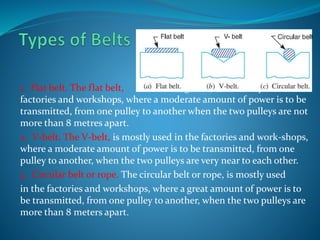
1. Flat belt. The flat belt, shown in Fig. 11.1 (a), is mostly used in the
factories and workshops, where a moderate amount of power is to be
transmitted, from one pulley to another when the two pulleys are not
more than 8 metres apart.
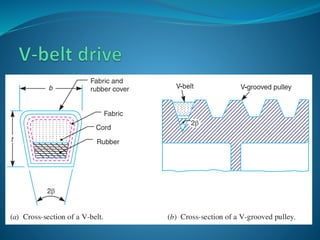
2. V-belt. The V-belt, is mostly used in the factories and work-shops,
where a moderate amount of power is to be transmitted, from one
pulley to another, when the two pulleys are very near to each other.
3. Circular belt or rope. The circular belt or rope, is mostly used
in the factories and workshops, where a great amount of power is to
be transmitted, from one pulley to another, when the two pulleys are
more than 8 meters apart.
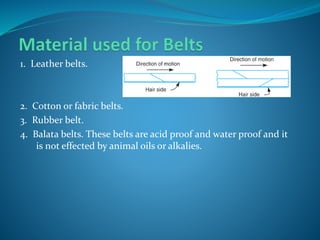
1. Leather belts.
2. Cotton or fabric belts.
3. Rubber belt.
4. Balata belts. These belts are acid proof and water proof and it
is not effected by animal oils or alkalies.
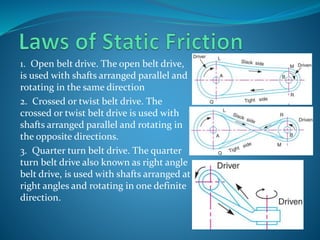
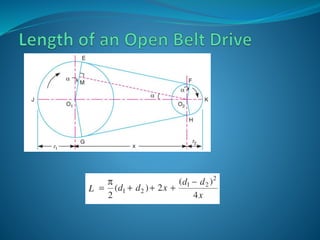
1. Open belt drive. The open belt drive,
is used with shafts arranged parallel and
rotating in the same direction
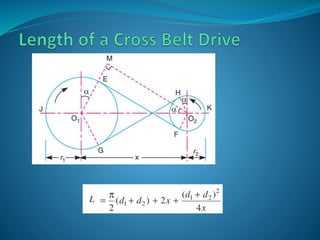
2. Crossed or twist belt drive. The
crossed or twist belt drive is used with
shafts arranged parallel and rotating in
the opposite directions.
3. Quarter turn belt drive. The quarter
turn belt drive also known as right angle
belt drive, is used with shafts arranged at
right angles and rotating in one definite
direction.
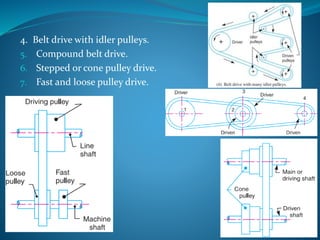
4. Belt drive with idler pulleys.
5. Compound belt drive.
6. Stepped or cone pulley drive.
7. Fast and loose pulley drive.
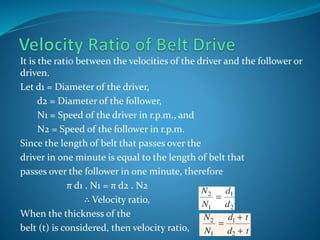
It is the ratio between the velocities of the driver and the follower or
driven.
Let d1 = Diameter of the driver,
d2 = Diameter of the follower,
N1 = Speed of the driver in r.p.m., and
N2 = Speed of the follower in r.p.m.
Since the length of belt that passes over the
driver in one minute is equal to the length of belt that
passes over the follower in one minute, therefore
π d1 . N1 = π d2 . N2
∴ Velocity ratio,
When the thickness of the
belt (t) is considered, then velocity ratio,
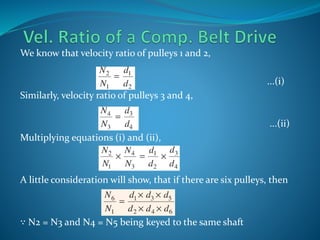
We know that velocity ratio of pulleys 1 and 2,
...(i)
Similarly, velocity ratio of pulleys 3 and 4,
...(ii)
Multiplying equations (i) and (ii),
A little consideration will show, that if there are six pulleys, then
∵ N2 = N3 and N4 = N5 being keyed to the same shaft
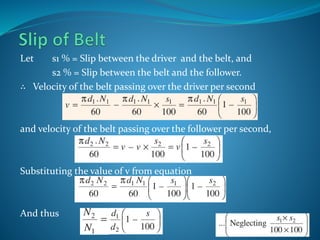
Let s1 % = Slip between the driver and the belt, and
s2 % = Slip between the belt and the follower.
∴ Velocity of the belt passing over the driver per second
and velocity of the belt passing over the follower per second,
Substituting the value of v from equation
And thus
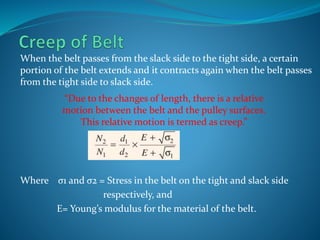
When the belt passes from the slack side to the tight side, a certain
portion of the belt extends and it contracts again when the belt passes
from the tight side to slack side.
Where σ1 and σ2 = Stress in the belt on the tight and slack side
respectively, and
E= Young’s modulus for the material of the belt.
“Due to the changes of length, there is a relative
motion between the belt and the pulley surfaces.
This relative motion is termed as creep.”
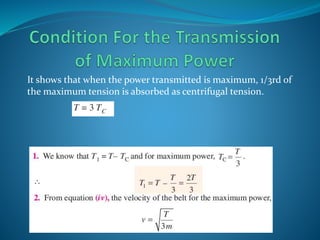
It shows that when the power transmitted is maximum, 1/3rd of
the maximum tension is absorbed as centrifugal tension.
Advantages
1. The V-belt drive gives compactness due to the small distance
between the centres of pulleys.
2. The drive is positive, because the slip between the belt and
the pulley groove is negligible.
3. Since the V-belts are made endless and there is no joint
trouble, therefore the drive is
smooth.
4. It provides longer life, 3 to 5 years.
5. It can be easily installed and removed.
6. The operation of the belt and pulley is quiet.
7. The belts have the ability to cushion the shock when machines are
started.
8. The high velocity ratio (maximum 10) may be obtained.
9. The wedging action of the belt in the groove gives high value of
limiting ratio of tensions.
Therefore the power transmitted by V-belts is more than flat belts for
the same coefficient of friction,
arc of contact and allowable tension in the belts.
10. The V-belt may be operated in either direction with tight side of
the belt at the top or
bottom. The centre line may be horizontal, vertical or inclined
Disadvantages
1. The V-belt drive cannot be used with large centre distances.
2. The V-belts are not so durable as flat belts.
3. The construction of pulleys for V-belts is more complicated than
pulleys for flat belts.
4. Since the V-belts are subjected to certain amount of creep,
therefore these are not suitable
for constant speed application such as synchronous machines, and
timing devices.
5. The belt life is greatly influenced with temperature changes,
improper belt tension and
mismatching of belt lengths.
6. The centrifugal tension prevents the use of V-belts at speeds below
5 m/s and above 50m/s.
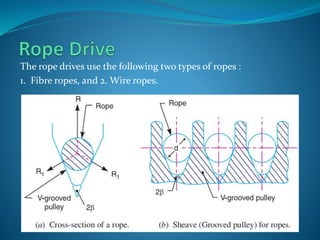
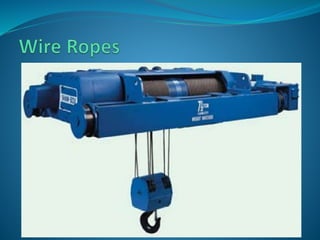
The rope drives use the following two types of ropes :
1. Fibre ropes, and 2. Wire ropes.
Advantages of Fibre Rope Drives
The fibre rope drives have the following advantages :
1. They give smooth, steady and quiet service.
2. They are little affected by out door conditions.
3. The shafts may be out of strict alignment.
4. The power may be taken off in any direction and in fractional
parts of the whole amount.
5. They give high mechanical efficiency.
Advantages
1. These are lighter in weight,
2. These offer silent operation,
3. These can withstand shock loads,
4. These are more reliable,
5. They do not fail suddenly,
6. These are more durable,
7. The efficiency is high, and 8. The cost is low.

Lec5.pptx

  • 1.
    International Islamic UniversityIslamabad. Abbas Raza Asst.Prof. Ch 11: p325
  • 2.
    The belts orropes are used to transmit power from one shaft to another by means of pulleys which rotate at the same speed or at different speeds. The amount of power transmitted depends upon the following factors : 1. The velocity of the belt. 2. The tension under which the belt is placed on the pulleys. 3. The arc of contact between the belt and the smaller pulley. 4. The conditions under which the belt is used.
  • 3.
    (a) The shaftsshould be properly in line to insure uniform tension across the belt section. (b) The pulleys should not be too close together, in order that the arc of contact on the smaller pulley may be as large as possible. (c) The pulleys should not be so far apart as to cause the belt to weigh heavily on the shafts. (d) A long belt tends to swing from side to side, which in turn develops crooked spots in the belt. (e) The tight side of the belt should be at the bottom, so that whatever sag is present on the loose side will increase the arc of contact at the pulleys. (f) In flat belt, the maximum distance between the shafts should not exceed 10 meters and the minimum should not be less than 3.5 times the diameter of the larger pulley.
  • 4.
    1. Speed ofthe driving and driven shafts, 2. Speed reduction ratio, 3. Power to be transmitted, 4. Centre distance between the shafts, 5. Shafts layout, 6. Space available, and 7. Service conditions.
  • 5.
    1. Light drives.These are used to transmit small powers at belt speeds upto about 10 m/s, as in agricultural machines and small machine tools. 2. Medium drives. These are used to transmit medium power at belt speeds over 10 m/s but up to 22 m/s, as in machine tools. 3. Heavy drives. These are used to transmit large powers at belt speeds above 22 m/s, as in compressors and generators.
  • 6.
    1. Flat belt.The flat belt, shown in Fig. 11.1 (a), is mostly used in the factories and workshops, where a moderate amount of power is to be transmitted, from one pulley to another when the two pulleys are not more than 8 metres apart. 2. V-belt. The V-belt, is mostly used in the factories and work-shops, where a moderate amount of power is to be transmitted, from one pulley to another, when the two pulleys are very near to each other. 3. Circular belt or rope. The circular belt or rope, is mostly used in the factories and workshops, where a great amount of power is to be transmitted, from one pulley to another, when the two pulleys are more than 8 meters apart.
  • 7.
    1. Leather belts. 2.Cotton or fabric belts. 3. Rubber belt. 4. Balata belts. These belts are acid proof and water proof and it is not effected by animal oils or alkalies.
  • 8.
    1. Open beltdrive. The open belt drive, is used with shafts arranged parallel and rotating in the same direction 2. Crossed or twist belt drive. The crossed or twist belt drive is used with shafts arranged parallel and rotating in the opposite directions. 3. Quarter turn belt drive. The quarter turn belt drive also known as right angle belt drive, is used with shafts arranged at right angles and rotating in one definite direction.
  • 9.
    4. Belt drivewith idler pulleys. 5. Compound belt drive. 6. Stepped or cone pulley drive. 7. Fast and loose pulley drive.
  • 10.
    It is theratio between the velocities of the driver and the follower or driven. Let d1 = Diameter of the driver, d2 = Diameter of the follower, N1 = Speed of the driver in r.p.m., and N2 = Speed of the follower in r.p.m. Since the length of belt that passes over the driver in one minute is equal to the length of belt that passes over the follower in one minute, therefore π d1 . N1 = π d2 . N2 ∴ Velocity ratio, When the thickness of the belt (t) is considered, then velocity ratio,
  • 11.
    We know thatvelocity ratio of pulleys 1 and 2, ...(i) Similarly, velocity ratio of pulleys 3 and 4, ...(ii) Multiplying equations (i) and (ii), A little consideration will show, that if there are six pulleys, then ∵ N2 = N3 and N4 = N5 being keyed to the same shaft
  • 12.
    Let s1 %= Slip between the driver and the belt, and s2 % = Slip between the belt and the follower. ∴ Velocity of the belt passing over the driver per second and velocity of the belt passing over the follower per second, Substituting the value of v from equation And thus
  • 13.
    When the beltpasses from the slack side to the tight side, a certain portion of the belt extends and it contracts again when the belt passes from the tight side to slack side. Where σ1 and σ2 = Stress in the belt on the tight and slack side respectively, and E= Young’s modulus for the material of the belt. “Due to the changes of length, there is a relative motion between the belt and the pulley surfaces. This relative motion is termed as creep.”
  • 20.
    It shows thatwhen the power transmitted is maximum, 1/3rd of the maximum tension is absorbed as centrifugal tension.
  • 23.
    Advantages 1. The V-beltdrive gives compactness due to the small distance between the centres of pulleys. 2. The drive is positive, because the slip between the belt and the pulley groove is negligible. 3. Since the V-belts are made endless and there is no joint trouble, therefore the drive is smooth. 4. It provides longer life, 3 to 5 years.
  • 24.
    5. It canbe easily installed and removed. 6. The operation of the belt and pulley is quiet. 7. The belts have the ability to cushion the shock when machines are started. 8. The high velocity ratio (maximum 10) may be obtained. 9. The wedging action of the belt in the groove gives high value of limiting ratio of tensions. Therefore the power transmitted by V-belts is more than flat belts for the same coefficient of friction, arc of contact and allowable tension in the belts. 10. The V-belt may be operated in either direction with tight side of the belt at the top or bottom. The centre line may be horizontal, vertical or inclined
  • 25.
    Disadvantages 1. The V-beltdrive cannot be used with large centre distances. 2. The V-belts are not so durable as flat belts. 3. The construction of pulleys for V-belts is more complicated than pulleys for flat belts. 4. Since the V-belts are subjected to certain amount of creep, therefore these are not suitable for constant speed application such as synchronous machines, and timing devices. 5. The belt life is greatly influenced with temperature changes, improper belt tension and mismatching of belt lengths. 6. The centrifugal tension prevents the use of V-belts at speeds below 5 m/s and above 50m/s.
  • 27.
    The rope drivesuse the following two types of ropes : 1. Fibre ropes, and 2. Wire ropes.
  • 28.
    Advantages of FibreRope Drives The fibre rope drives have the following advantages : 1. They give smooth, steady and quiet service. 2. They are little affected by out door conditions. 3. The shafts may be out of strict alignment. 4. The power may be taken off in any direction and in fractional parts of the whole amount. 5. They give high mechanical efficiency.
  • 30.
    Advantages 1. These arelighter in weight, 2. These offer silent operation, 3. These can withstand shock loads, 4. These are more reliable, 5. They do not fail suddenly, 6. These are more durable, 7. The efficiency is high, and 8. The cost is low.