Continuous Improvement
The Active Learning Cycle
09.06.2015 - Scrum Meetup Berlin
Ray Hausmann | Stefan Süring
What is Continuous Improvement?
Continuous Improvement
Agenda
Agenda
1. Continuous Improvement
2. Active Learning Cycle
3. Q&A
4. Feedback
Agenda
Continuous
Improvement
History I
• After WW II american forces in Japan
• Lowell Mellen
• W. Edwards Deming
• "Improvement in 4 Steps" (Kaizen eno Yon Dankai).
Continuous Improvement
History II
• 1986 Book - Kaizen: The Key to Japan’s Competitive
Success
• Continuous Improvement is built in into XP, Scrum,
Kanban
• Worldwide an important pillar of a long-term competitive
strategy.
Continuous Improvement
Definition
“Kaizen, also known as continuous improvement, is a long-
term approach to work that systematically seeks to achieve
small, incremental changes in processes in order to
improve efficiency and quality.”
Continuous Improvement
http://searchmanufacturingerp.techtarget.com/definition/kaizen
Continuous improvement eliminates
• muri - overburden
• mura - unevenness
• muda - waste
Continuous Improvement
Muri, Mura, Muda
1t1t1t
1t
1t1t
Mura - unevenness, fluctuation, variation
1t1t 1t1t 1t1t
Muda - waste
1t1t1t
1t1t1t
Muri - overburden
1t1t1t 1t1t1t
No Muri, Mura or Muda
http://www.lean.org/Common/LexiconTerm.cfm?TermId=264
Continuous Improvement
Practices/ Methods/ Techniques
• Kaizen 5S Framework
• Toyota Kata
• Improvement Theme (Spotify)
• Active Learning Cycle
Continuous Improvement
Kaizen 5S Framework
• Sort
• Straighten
• Shine
• Standardise
• Sustain
Continuous Improvement
Toyota Kata
• Current conditions
• Target conditions
• Iterate to target
Continuous Improvement
Improvement Theme (Spotifiy)
Continuous Improvement
http://blog.crisp.se/2013/05/14/jimmyjanlen/improvement-theme-simple-and-practical-toyota-kata
The Active
Learning Cycle
First learned at Agile 42
How did you implement
Continuous
Improvement in your
working environment?
The Active Learning Cycle
The Board
● Keep: DoD, DoR, WA
● Tries: agreed rules
temporarily extending
the keep
● Retrospective area:
gather data, generate
insights, agree on
tries
The Active Learning Cycle
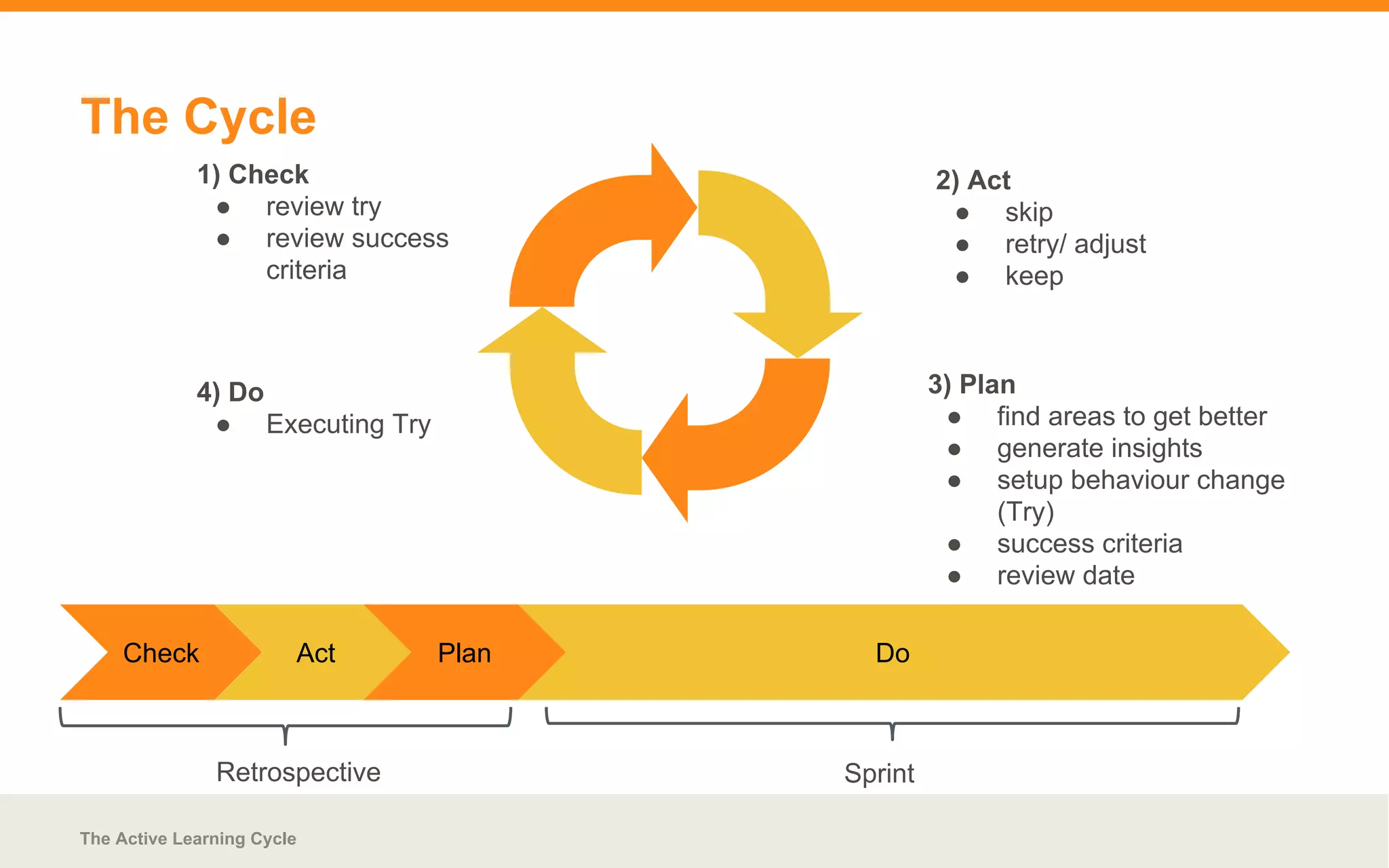
The Cycle
The Active Learning Cycle
2) Act
● skip
● retry/ adjust
● keep
3) Plan
● find areas to get better
● generate insights
● setup behaviour change
(Try)
● success criteria
● review date
4) Do
● Executing Try
1) Check
● review try
● review success
criteria
DoActCheck Plan
Retrospective Sprint
Example
The Active Learning Cycle
Advantages
• Improvement of artefacts is implicit
• Inspect & adapt implicit
• Commitment of the whole team
• Less resistance
• Easy activity
The Active Learning Cycle
Failure Patterns
● Cycle not consequently implemented
● Too much tries at the same time (avoid more than 3)
● Resistance to experiment inside the group
● Success criteria not clear enough or missing
The Active Learning Cycle
Questions
&
Answers
The Active Learning Cycle
Feedback
Feedback

Continuous improvement - The active learning cycle

  • 1.
    Continuous Improvement The ActiveLearning Cycle 09.06.2015 - Scrum Meetup Berlin Ray Hausmann | Stefan Süring
  • 2.
    What is ContinuousImprovement? Continuous Improvement
  • 3.
  • 4.
    Agenda 1. Continuous Improvement 2.Active Learning Cycle 3. Q&A 4. Feedback Agenda
  • 5.
  • 6.
    History I • AfterWW II american forces in Japan • Lowell Mellen • W. Edwards Deming • "Improvement in 4 Steps" (Kaizen eno Yon Dankai). Continuous Improvement
  • 7.
    History II • 1986Book - Kaizen: The Key to Japan’s Competitive Success • Continuous Improvement is built in into XP, Scrum, Kanban • Worldwide an important pillar of a long-term competitive strategy. Continuous Improvement
  • 8.
    Definition “Kaizen, also knownas continuous improvement, is a long- term approach to work that systematically seeks to achieve small, incremental changes in processes in order to improve efficiency and quality.” Continuous Improvement http://searchmanufacturingerp.techtarget.com/definition/kaizen
  • 9.
    Continuous improvement eliminates •muri - overburden • mura - unevenness • muda - waste Continuous Improvement
  • 10.
    Muri, Mura, Muda 1t1t1t 1t 1t1t Mura- unevenness, fluctuation, variation 1t1t 1t1t 1t1t Muda - waste 1t1t1t 1t1t1t Muri - overburden 1t1t1t 1t1t1t No Muri, Mura or Muda http://www.lean.org/Common/LexiconTerm.cfm?TermId=264 Continuous Improvement
  • 11.
    Practices/ Methods/ Techniques •Kaizen 5S Framework • Toyota Kata • Improvement Theme (Spotify) • Active Learning Cycle Continuous Improvement
  • 12.
    Kaizen 5S Framework •Sort • Straighten • Shine • Standardise • Sustain Continuous Improvement
  • 13.
    Toyota Kata • Currentconditions • Target conditions • Iterate to target Continuous Improvement
  • 14.
    Improvement Theme (Spotifiy) ContinuousImprovement http://blog.crisp.se/2013/05/14/jimmyjanlen/improvement-theme-simple-and-practical-toyota-kata
  • 15.
  • 16.
    How did youimplement Continuous Improvement in your working environment? The Active Learning Cycle
  • 17.
    The Board ● Keep:DoD, DoR, WA ● Tries: agreed rules temporarily extending the keep ● Retrospective area: gather data, generate insights, agree on tries The Active Learning Cycle
  • 18.
    The Cycle The ActiveLearning Cycle 2) Act ● skip ● retry/ adjust ● keep 3) Plan ● find areas to get better ● generate insights ● setup behaviour change (Try) ● success criteria ● review date 4) Do ● Executing Try 1) Check ● review try ● review success criteria DoActCheck Plan Retrospective Sprint
  • 19.
  • 20.
    Advantages • Improvement ofartefacts is implicit • Inspect & adapt implicit • Commitment of the whole team • Less resistance • Easy activity The Active Learning Cycle
  • 21.
    Failure Patterns ● Cyclenot consequently implemented ● Too much tries at the same time (avoid more than 3) ● Resistance to experiment inside the group ● Success criteria not clear enough or missing The Active Learning Cycle
  • 22.
  • 23.
  • 24.
  • 25.