1
UC: Manage Continual Improvement
RVU
Geda Compass
HNS-L-4
June 2023
By Meresa H.
What is Continuous Improvement
(Continual Improvement )?
• A quality philosophy that assumes
further improvements are always
possible and that processes should be
continuously re-evaluated and
improvements implemented.
• The seeking of small improvements in
processes and products, with the
objective of increasing quality and
reducing waste.
2
By Meresa H.
• The belief that an organization must
constantly measure the effectiveness of
its processes and strive to meet more
difficult objectives to satisfy customers.
• Continuous improvement is an ongoing
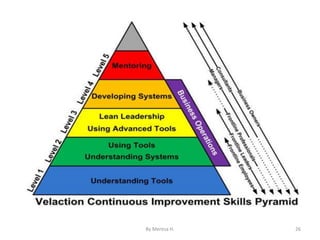
effort to improve products, services or
processes. These efforts can seek
“incremental” improvement over time or
“breakthrough” improvement all at once
3
By Meresa H.
Rationale for Continual Improvement
1. Continual improvement is
fundamental to success in a global
environment.
2. Customer needs are not static, they
change continually.
3. The only way a company can hope to
compete in the modern marketplace is
to improve continually.
4
By Meresa H.
Management’s Role in
Continual Improvement
Management can play the necessary
leadership role by doing the following:
5
1. Provide necessary moral and physical support.
Physical support comes in the form of resources
needed to accomplish the quality improvement
objectives.
2. Schedule periodic progress reviews and give
recognition where it is deserved.
3. Build continual quality improvement in the
regular reward system, including promotions and
pay increases.
By Meresa H.
Essential Improvement Activities
Peter R. Sholtes and his colleagues
recommend the following 5 activities :
1. Maintain communication: Communication
is essential to continual improvement.
2. Correct Obvious Problems: In such cases,
the problem should be corrected
immediately
3. Look upstream : Look for causes, not
symptoms ‫األعراض‬.
6
By Meresa H.
4. Document problems and progress: It
is not uncommon for an organization to
continue solving the same problem over
and over again because nobody took the
time to document the problems that
have been dealt with and how they were
solved.
5. Monitor changes: Because the solution
may not solve the problem or only
partially solve the problem.
7
By Meresa H.
Industry Recognized Theories,
Models & Tools
• 1- TQM – Total Quality Management
(Organization management of quality),
includes 14 principles. CI is one of two
elements in TQM, the other is customer
satisfaction.
8
By Meresa H.
• 2- Kaizen: Kaizen Refers to any
improvement, one-time or continuous,
large or small.
Kaizen is the name given by Japanese
to the concept of continuous
improvement (continual
improvement), Kai means change,
Zen means good .
9
By Meresa H.
➢Kaizen means continuous improvement.
➢Moreover, Kaizen means continuing
improvement in personal life, home life,
social life, and working life.
➢When applied to the workplace, Kaizen
means continuing improvement
involving everyone, every managers and
every workers .
10
By Meresa H.
• Kaizen is the concept of continual
improvement of people, processes, and
products, and any other factor that can affect
quality.
• The main Kaizen implementation tools
are :
A. Kaizen 5 W, and one H (who ,what ,where,
when, why, how)
B. Kaizen Five-M check list (man, machine,
material, method, and measurement).
C. 5S: (Seiri, Seiton, Seiso, Seiketsu, Shitsuke).
11
By Meresa H.
• 3- Lean Manufacturing: Focuses
on the elimination of waste or
“muda” Includes tools such as
Value Stream Mapping, the Five
S’s, Kanban, Poka-Yoke JIT – Just
in Time Business, CI is a major
principle and goal of JIT.
12
By Meresa H.
• What is Muda?? Muda ( 無 駄 ) is
a Japanese word meaning "futility;
uselessness; idleness; superfluity; waste;
wastage; wastefulness“, and is a key
concept in the Toyota Production
System (TPS) as one of the three types of
variation:
➢muda ‫الهدر‬
‫والضياع‬
➢mura ‫المخالفة‬
‫والتفاوت‬
‫وعدم‬
‫االتساق‬
➢muri ‫المستحيل‬.
13
By Meresa H.
• What is Poka-yoke ( ポ カ ヨ ケ ?)?? ‫تجنب‬
‫األخطاء‬ [poka yoke] is a Japanese term that
means "mistake-proofing". A poka-yoke is any
mechanism in a lean manufacturing process
that helps an equipment operator avoid
(yokeru) mistakes (poka). Its purpose is to
eliminate product defects by preventing,
correcting, or drawing attention to human
errors as they occur ‫لفت‬
‫االنتباه‬
‫الى‬
‫األخطاء‬
‫البشرية‬
14
By Meresa H.
• 4- SMAIC Model: Select,
Measure, Analyze, Improve,
Control.
• 5- Awards: Deming Prize,
Baldridge Award.
15
By Meresa H.
• 6- Six Sigma: Designed to improve processes
and eliminate defects; includes the Define,
measure, analyze, improve, and
control(DMAIC) and Define—Measure—
Analyze—Design—Verify(DMADV) models
inspired by Plan-Do-Study-Act/PDSA (PDCA ).
• Six Sigma is a concept introduced by
Motorola to improve the performance of
processes to the point where the defect rate
is 3.4 per million or less.
16
By Meresa H.
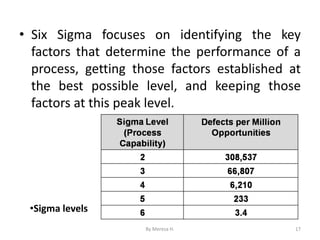
• Six Sigma focuses on identifying the key
factors that determine the performance of a
process, getting those factors established at
the best possible level, and keeping those
factors at this peak level.
17
•Sigma levels
By Meresa H.
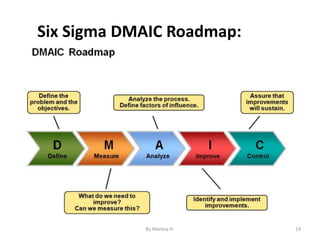
Six Sigma DMAIC Roadmap:
• The Six Sigma DMAIC (Define,
Measure, Analyze, Improve, Control)
methodology can be thought of as a
roadmap for problem solving and
product/process improvement.
Most companies begin implementing
Six Sigma using the following DMAIC
methodology:
18
By Meresa H.
Six Sigma DMAIC Roadmap:
19
By Meresa H.
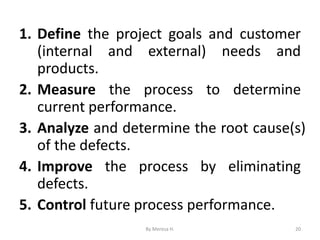
1. Define the project goals and customer
(internal and external) needs and
products.
2. Measure the process to determine
current performance.
3. Analyze and determine the root cause(s)
of the defects.
4. Improve the process by eliminating
defects.
5. Control future process performance.
20
By Meresa H.
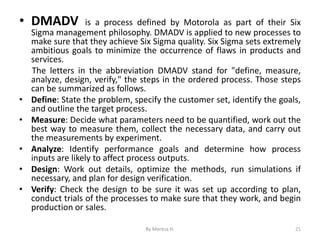
• DMADV is a process defined by Motorola as part of their Six
Sigma management philosophy. DMADV is applied to new processes to
make sure that they achieve Six Sigma quality. Six Sigma sets extremely
ambitious goals to minimize the occurrence of flaws in products and
services.
The letters in the abbreviation DMADV stand for "define, measure,
analyze, design, verify," the steps in the ordered process. Those steps
can be summarized as follows.
• Define: State the problem, specify the customer set, identify the goals,
and outline the target process.
• Measure: Decide what parameters need to be quantified, work out the
best way to measure them, collect the necessary data, and carry out
the measurements by experiment.
• Analyze: Identify performance goals and determine how process
inputs are likely to affect process outputs.
• Design: Work out details, optimize the methods, run simulations if
necessary, and plan for design verification.
• Verify: Check the design to be sure it was set up according to plan,
conduct trials of the processes to make sure that they work, and begin
production or sales.
21
By Meresa H.
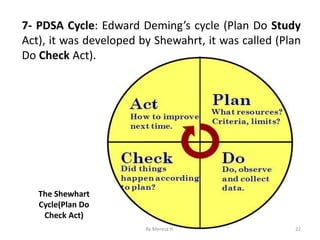
22
The Shewhart
Cycle(Plan Do
Check Act)
7- PDSA Cycle: Edward Deming’s cycle (Plan Do Study
Act), it was developed by Shewahrt, it was called (Plan
Do Check Act).
By Meresa H.
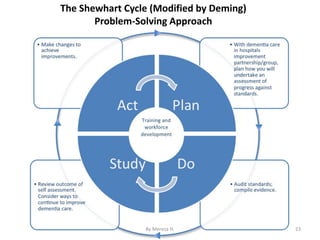
The Shewhart Cycle (Modified by Deming)
Problem-Solving Approach
23
By Meresa H.
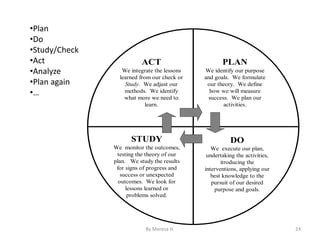
ACT
We integrate the lessons
learned from our check or
Study. We adjust our
methods. We identify
what more we need to
learn.
PLAN
We identify our purpose
and goals. We formulate
our theory. We define
how we will measure
success. We plan our
activities.
DO
We execute our plan,
undertaking the activities,
itroducing the
interventions, applying our
best knowledge to the
pursuit of our desired
purpose and goals.
STUDY
We monitor the outcomes,
testing the theory of our
plan. We study the results
for signs of progress and
success or unexpected
outcomes. We look for
lessons learned or
problems solved.
•Plan
•Do
•Study/Check
•Act
•Analyze
•Plan again
•…
24
By Meresa H.
25
By Meresa H.
26
By Meresa H.
Challenges of Continuous Improvement
1. Unclear objectives or lack of strategy.
2. Lack of stakeholder support.
3. Poor participation, and poor feedback.
4. Organizational or industry change.
5. Ineffective metrics.
6. Pragmatic initiatives expand and get out of
control.
7. Attempting to resolve issues that don’t exist.
27
By Meresa H.
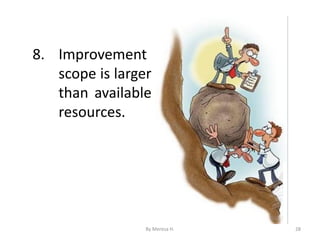
8. Improvement
scope is larger
than available
resources.
28
By Meresa H.
Key Success Factors for effective
Continuous Improvement
1. Clarity, Clarity, Clarity...
2. Align initiatives with organizational goals.
3. Empower participants.
4. Ensure value to the participants.
5. Effectively identify when the initiative is off
track.
6. Scale or adapt initiatives to ensure success
7. Celebrate successes and failures.
29
By Meresa H.
Benefits of Continuous Improvement
Continuous Improvement can help the company to:
1. Reduce waste
2. Increase efficiency
3. Improve quality
4. Reduce cost
5. Eliminate Bottlenecks
6. Reduce Fluctuation
7. Increase Knowledge.
8. Visual Management ‫البصيرة‬ ‫االدارة‬.
30
By Meresa H.
continuous improvement Requirement s
1. Build a quality (continuous improvement)
culture. Positive and Constructive.
2. Drive out fear.
3. Provide organization-structural assurance for
continuing feedback system.
4. Respond to customers needs and solve
problems timely.
5. Standardize the procedure and continuously
improve it.
31
By Meresa H.
Major Implications of Continuous
Improvement
1. Standardization
2. Safety
3. Quality
4. Ergonomics
5. Lean
6. 5S
32
By Meresa H.
1- Standardization
• Best, easiest, safest way known today
• Basis for training
• Basis for root cause analysis
• By standardizing processes, consistent results are
produced in Safety, Quality and Efficiency
• Documentation of know-how.
33
By Meresa H.
2- Safety
• A safe work environment is one of
the corner-stones of a successful
business.
• Continuous Improvement supports
the idea that no change should ever
be made to a process that has a
negative impact on safety.
34
By Meresa H.
3- Quality
• There are quality standards and
expectations demanded of any
manufacturing product.
• Changes to the process should never
decrease the quality of the product
provided to the customer.
35
By Meresa H.
4- Ergonomics
• Ergonomics is the science of adapting the job
and/or the equipment and the human to each
other for optimal safety and productivity.
• The ergonomic impact of work should always
be examined to see if improvements can be
made.
• Any changes to tools or processes should be
analyzed with a critical eye towards any
impact on ergonomics.
36
By Meresa H.
5- Lean
• Lean Manufacturing focuses on the
identification and elimination of the 7 forms
of waste:
✓Overproduction
✓Inventory
✓Unnecessary Motion
✓Transportation
✓Waiting
✓Overprocessing
✓Defects/Repair/Rework
37
By Meresa H.
• Lean means doing more with less and doing it
better.
• Lean is about getting the right things to the right
place at the right time and in the right amounts.
• At the heart of the concept are the reduction of
waste and the improvement of work flow.
• Lean focuses on reducing and ideally eliminating
: overproduction waste, inventory waste, motion
waste, Transportation waste, over processing
waste, defects waste, waiting waste, and
underutilization waste.
38
By Meresa H.
Lean Six Sigma:
• Lean is a continual improvement method
that focuses on reducing waste and
improving process flow.
• Six Sigma is a continual improvement
method.
• Lean Six Sigma combines the best of
these two concepts.
39
By Meresa H.
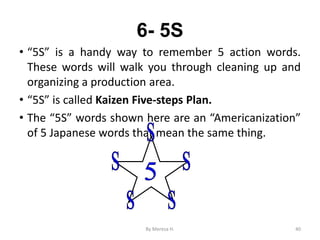
6- 5S
• “5S” is a handy way to remember 5 action words.
These words will walk you through cleaning up and
organizing a production area.
• “5S” is called Kaizen Five-steps Plan.
• The “5S” words shown here are an “Americanization”
of 5 Japanese words that mean the same thing.
40
By Meresa H.
• “5S” is Developed by the Japanese.
• “5S” is a Housekeeping System
• “5S” Helps Create a Better Working
Environment and a Consistently High
Quality Process
• 5S improves organization, visual management, and
standardization. The 5S status of an area is assessed
to help identify potential problems and 5S should be
maintained as improvements are made.
41
By Meresa H.
• SEIRI – Sort out (Organisation).
• SEITON –Systemize- SIFT (Arrangement: Put
things in order).
• SEISO – SANITIZE- Shining (Personal & non-
personal cleaning: Equipments were so clean and
well maintained that any problem such as a loose
bolt or leaking oil could be easily seen).
• SEIKETSU – STANDARDIZE (SWEEP).
• SHITSUKE – Sustain (Discipline: Means support
and motivate kindness & good habits, Involve the
whole workforce, Make it a way of life).
42
By Meresa H.
43
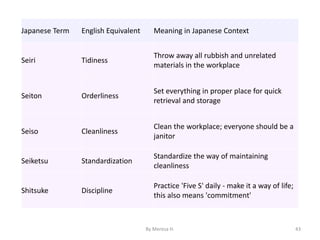
Japanese Term English Equivalent Meaning in Japanese Context
Seiri Tidiness
Throw away all rubbish and unrelated
materials in the workplace
Seiton Orderliness
Set everything in proper place for quick
retrieval and storage
Seiso Cleanliness
Clean the workplace; everyone should be a
janitor
Seiketsu Standardization
Standardize the way of maintaining
cleanliness
Shitsuke Discipline
Practice 'Five S' daily - make it a way of life;
this also means 'commitment'
By Meresa H.
5S Leads to 30 SECOND RULE
• ONE MUST LOCATE THE ITEM
WITHIN 30 SECOND IF 5S IS
PROPERLY IMPLEMENTED.
• ALSO APPLIES TO THE ELECTRONIC
RECORDS RETRIEVAL.
44
By Meresa H.
Principles of Continuous
Improvement
• The person doing the work is the expert
• “Us” –vs.- “Them”.
• Leadership needs to partner with all employees
to empower them to make decisions that can
improve our quality standards.
• Managers must support their unit strategically
and developmentally.
• Teamwork—everyone must work for the goal(s)
of the unit.
45
By Meresa H.
• Delivering value is an overarching goal
• Working together beats competition
• Learning about work is a never-ending process
• Simple statistical, problem solving and team
tools are effective and must be used
• Structured problem solving approach helps to
standardize the process
• Focus our energy on fixing processes and
systems, not people. People want to do good
work.
46
By Meresa H.
Problem Solving: A Continuous Effort
1. Identify problems as an opportunity
2. Analyze the problem: to find root causes
3. Develop optimal and cost effective solutions
4. Implement changes: system wide
5. Study the results: worked or not? Need
adjustment?
6. Standardize solution: Keep problems from
reoccurring.
47
By Meresa H.

Managing Continuous Improvement Syst.pdf

  • 1.
    1 UC: Manage ContinualImprovement RVU Geda Compass HNS-L-4 June 2023 By Meresa H.
  • 2.
    What is ContinuousImprovement (Continual Improvement )? • A quality philosophy that assumes further improvements are always possible and that processes should be continuously re-evaluated and improvements implemented. • The seeking of small improvements in processes and products, with the objective of increasing quality and reducing waste. 2 By Meresa H.
  • 3.
    • The beliefthat an organization must constantly measure the effectiveness of its processes and strive to meet more difficult objectives to satisfy customers. • Continuous improvement is an ongoing effort to improve products, services or processes. These efforts can seek “incremental” improvement over time or “breakthrough” improvement all at once 3 By Meresa H.
  • 4.
    Rationale for ContinualImprovement 1. Continual improvement is fundamental to success in a global environment. 2. Customer needs are not static, they change continually. 3. The only way a company can hope to compete in the modern marketplace is to improve continually. 4 By Meresa H.
  • 5.
    Management’s Role in ContinualImprovement Management can play the necessary leadership role by doing the following: 5 1. Provide necessary moral and physical support. Physical support comes in the form of resources needed to accomplish the quality improvement objectives. 2. Schedule periodic progress reviews and give recognition where it is deserved. 3. Build continual quality improvement in the regular reward system, including promotions and pay increases. By Meresa H.
  • 6.
    Essential Improvement Activities PeterR. Sholtes and his colleagues recommend the following 5 activities : 1. Maintain communication: Communication is essential to continual improvement. 2. Correct Obvious Problems: In such cases, the problem should be corrected immediately 3. Look upstream : Look for causes, not symptoms ‫األعراض‬. 6 By Meresa H.
  • 7.
    4. Document problemsand progress: It is not uncommon for an organization to continue solving the same problem over and over again because nobody took the time to document the problems that have been dealt with and how they were solved. 5. Monitor changes: Because the solution may not solve the problem or only partially solve the problem. 7 By Meresa H.
  • 8.
    Industry Recognized Theories, Models& Tools • 1- TQM – Total Quality Management (Organization management of quality), includes 14 principles. CI is one of two elements in TQM, the other is customer satisfaction. 8 By Meresa H.
  • 9.
    • 2- Kaizen:Kaizen Refers to any improvement, one-time or continuous, large or small. Kaizen is the name given by Japanese to the concept of continuous improvement (continual improvement), Kai means change, Zen means good . 9 By Meresa H.
  • 10.
    ➢Kaizen means continuousimprovement. ➢Moreover, Kaizen means continuing improvement in personal life, home life, social life, and working life. ➢When applied to the workplace, Kaizen means continuing improvement involving everyone, every managers and every workers . 10 By Meresa H.
  • 11.
    • Kaizen isthe concept of continual improvement of people, processes, and products, and any other factor that can affect quality. • The main Kaizen implementation tools are : A. Kaizen 5 W, and one H (who ,what ,where, when, why, how) B. Kaizen Five-M check list (man, machine, material, method, and measurement). C. 5S: (Seiri, Seiton, Seiso, Seiketsu, Shitsuke). 11 By Meresa H.
  • 12.
    • 3- LeanManufacturing: Focuses on the elimination of waste or “muda” Includes tools such as Value Stream Mapping, the Five S’s, Kanban, Poka-Yoke JIT – Just in Time Business, CI is a major principle and goal of JIT. 12 By Meresa H.
  • 13.
    • What isMuda?? Muda ( 無 駄 ) is a Japanese word meaning "futility; uselessness; idleness; superfluity; waste; wastage; wastefulness“, and is a key concept in the Toyota Production System (TPS) as one of the three types of variation: ➢muda ‫الهدر‬ ‫والضياع‬ ➢mura ‫المخالفة‬ ‫والتفاوت‬ ‫وعدم‬ ‫االتساق‬ ➢muri ‫المستحيل‬. 13 By Meresa H.
  • 14.
    • What isPoka-yoke ( ポ カ ヨ ケ ?)?? ‫تجنب‬ ‫األخطاء‬ [poka yoke] is a Japanese term that means "mistake-proofing". A poka-yoke is any mechanism in a lean manufacturing process that helps an equipment operator avoid (yokeru) mistakes (poka). Its purpose is to eliminate product defects by preventing, correcting, or drawing attention to human errors as they occur ‫لفت‬ ‫االنتباه‬ ‫الى‬ ‫األخطاء‬ ‫البشرية‬ 14 By Meresa H.
  • 15.
    • 4- SMAICModel: Select, Measure, Analyze, Improve, Control. • 5- Awards: Deming Prize, Baldridge Award. 15 By Meresa H.
  • 16.
    • 6- SixSigma: Designed to improve processes and eliminate defects; includes the Define, measure, analyze, improve, and control(DMAIC) and Define—Measure— Analyze—Design—Verify(DMADV) models inspired by Plan-Do-Study-Act/PDSA (PDCA ). • Six Sigma is a concept introduced by Motorola to improve the performance of processes to the point where the defect rate is 3.4 per million or less. 16 By Meresa H.
  • 17.
    • Six Sigmafocuses on identifying the key factors that determine the performance of a process, getting those factors established at the best possible level, and keeping those factors at this peak level. 17 •Sigma levels By Meresa H.
  • 18.
    Six Sigma DMAICRoadmap: • The Six Sigma DMAIC (Define, Measure, Analyze, Improve, Control) methodology can be thought of as a roadmap for problem solving and product/process improvement. Most companies begin implementing Six Sigma using the following DMAIC methodology: 18 By Meresa H.
  • 19.
    Six Sigma DMAICRoadmap: 19 By Meresa H.
  • 20.
    1. Define theproject goals and customer (internal and external) needs and products. 2. Measure the process to determine current performance. 3. Analyze and determine the root cause(s) of the defects. 4. Improve the process by eliminating defects. 5. Control future process performance. 20 By Meresa H.
  • 21.
    • DMADV isa process defined by Motorola as part of their Six Sigma management philosophy. DMADV is applied to new processes to make sure that they achieve Six Sigma quality. Six Sigma sets extremely ambitious goals to minimize the occurrence of flaws in products and services. The letters in the abbreviation DMADV stand for "define, measure, analyze, design, verify," the steps in the ordered process. Those steps can be summarized as follows. • Define: State the problem, specify the customer set, identify the goals, and outline the target process. • Measure: Decide what parameters need to be quantified, work out the best way to measure them, collect the necessary data, and carry out the measurements by experiment. • Analyze: Identify performance goals and determine how process inputs are likely to affect process outputs. • Design: Work out details, optimize the methods, run simulations if necessary, and plan for design verification. • Verify: Check the design to be sure it was set up according to plan, conduct trials of the processes to make sure that they work, and begin production or sales. 21 By Meresa H.
  • 22.
    22 The Shewhart Cycle(Plan Do CheckAct) 7- PDSA Cycle: Edward Deming’s cycle (Plan Do Study Act), it was developed by Shewahrt, it was called (Plan Do Check Act). By Meresa H.
  • 23.
    The Shewhart Cycle(Modified by Deming) Problem-Solving Approach 23 By Meresa H.
  • 24.
    ACT We integrate thelessons learned from our check or Study. We adjust our methods. We identify what more we need to learn. PLAN We identify our purpose and goals. We formulate our theory. We define how we will measure success. We plan our activities. DO We execute our plan, undertaking the activities, itroducing the interventions, applying our best knowledge to the pursuit of our desired purpose and goals. STUDY We monitor the outcomes, testing the theory of our plan. We study the results for signs of progress and success or unexpected outcomes. We look for lessons learned or problems solved. •Plan •Do •Study/Check •Act •Analyze •Plan again •… 24 By Meresa H.
  • 25.
  • 26.
  • 27.
    Challenges of ContinuousImprovement 1. Unclear objectives or lack of strategy. 2. Lack of stakeholder support. 3. Poor participation, and poor feedback. 4. Organizational or industry change. 5. Ineffective metrics. 6. Pragmatic initiatives expand and get out of control. 7. Attempting to resolve issues that don’t exist. 27 By Meresa H.
  • 28.
    8. Improvement scope islarger than available resources. 28 By Meresa H.
  • 29.
    Key Success Factorsfor effective Continuous Improvement 1. Clarity, Clarity, Clarity... 2. Align initiatives with organizational goals. 3. Empower participants. 4. Ensure value to the participants. 5. Effectively identify when the initiative is off track. 6. Scale or adapt initiatives to ensure success 7. Celebrate successes and failures. 29 By Meresa H.
  • 30.
    Benefits of ContinuousImprovement Continuous Improvement can help the company to: 1. Reduce waste 2. Increase efficiency 3. Improve quality 4. Reduce cost 5. Eliminate Bottlenecks 6. Reduce Fluctuation 7. Increase Knowledge. 8. Visual Management ‫البصيرة‬ ‫االدارة‬. 30 By Meresa H.
  • 31.
    continuous improvement Requirements 1. Build a quality (continuous improvement) culture. Positive and Constructive. 2. Drive out fear. 3. Provide organization-structural assurance for continuing feedback system. 4. Respond to customers needs and solve problems timely. 5. Standardize the procedure and continuously improve it. 31 By Meresa H.
  • 32.
    Major Implications ofContinuous Improvement 1. Standardization 2. Safety 3. Quality 4. Ergonomics 5. Lean 6. 5S 32 By Meresa H.
  • 33.
    1- Standardization • Best,easiest, safest way known today • Basis for training • Basis for root cause analysis • By standardizing processes, consistent results are produced in Safety, Quality and Efficiency • Documentation of know-how. 33 By Meresa H.
  • 34.
    2- Safety • Asafe work environment is one of the corner-stones of a successful business. • Continuous Improvement supports the idea that no change should ever be made to a process that has a negative impact on safety. 34 By Meresa H.
  • 35.
    3- Quality • Thereare quality standards and expectations demanded of any manufacturing product. • Changes to the process should never decrease the quality of the product provided to the customer. 35 By Meresa H.
  • 36.
    4- Ergonomics • Ergonomicsis the science of adapting the job and/or the equipment and the human to each other for optimal safety and productivity. • The ergonomic impact of work should always be examined to see if improvements can be made. • Any changes to tools or processes should be analyzed with a critical eye towards any impact on ergonomics. 36 By Meresa H.
  • 37.
    5- Lean • LeanManufacturing focuses on the identification and elimination of the 7 forms of waste: ✓Overproduction ✓Inventory ✓Unnecessary Motion ✓Transportation ✓Waiting ✓Overprocessing ✓Defects/Repair/Rework 37 By Meresa H.
  • 38.
    • Lean meansdoing more with less and doing it better. • Lean is about getting the right things to the right place at the right time and in the right amounts. • At the heart of the concept are the reduction of waste and the improvement of work flow. • Lean focuses on reducing and ideally eliminating : overproduction waste, inventory waste, motion waste, Transportation waste, over processing waste, defects waste, waiting waste, and underutilization waste. 38 By Meresa H.
  • 39.
    Lean Six Sigma: •Lean is a continual improvement method that focuses on reducing waste and improving process flow. • Six Sigma is a continual improvement method. • Lean Six Sigma combines the best of these two concepts. 39 By Meresa H.
  • 40.
    6- 5S • “5S”is a handy way to remember 5 action words. These words will walk you through cleaning up and organizing a production area. • “5S” is called Kaizen Five-steps Plan. • The “5S” words shown here are an “Americanization” of 5 Japanese words that mean the same thing. 40 By Meresa H.
  • 41.
    • “5S” isDeveloped by the Japanese. • “5S” is a Housekeeping System • “5S” Helps Create a Better Working Environment and a Consistently High Quality Process • 5S improves organization, visual management, and standardization. The 5S status of an area is assessed to help identify potential problems and 5S should be maintained as improvements are made. 41 By Meresa H.
  • 42.
    • SEIRI –Sort out (Organisation). • SEITON –Systemize- SIFT (Arrangement: Put things in order). • SEISO – SANITIZE- Shining (Personal & non- personal cleaning: Equipments were so clean and well maintained that any problem such as a loose bolt or leaking oil could be easily seen). • SEIKETSU – STANDARDIZE (SWEEP). • SHITSUKE – Sustain (Discipline: Means support and motivate kindness & good habits, Involve the whole workforce, Make it a way of life). 42 By Meresa H.
  • 43.
    43 Japanese Term EnglishEquivalent Meaning in Japanese Context Seiri Tidiness Throw away all rubbish and unrelated materials in the workplace Seiton Orderliness Set everything in proper place for quick retrieval and storage Seiso Cleanliness Clean the workplace; everyone should be a janitor Seiketsu Standardization Standardize the way of maintaining cleanliness Shitsuke Discipline Practice 'Five S' daily - make it a way of life; this also means 'commitment' By Meresa H.
  • 44.
    5S Leads to30 SECOND RULE • ONE MUST LOCATE THE ITEM WITHIN 30 SECOND IF 5S IS PROPERLY IMPLEMENTED. • ALSO APPLIES TO THE ELECTRONIC RECORDS RETRIEVAL. 44 By Meresa H.
  • 45.
    Principles of Continuous Improvement •The person doing the work is the expert • “Us” –vs.- “Them”. • Leadership needs to partner with all employees to empower them to make decisions that can improve our quality standards. • Managers must support their unit strategically and developmentally. • Teamwork—everyone must work for the goal(s) of the unit. 45 By Meresa H.
  • 46.
    • Delivering valueis an overarching goal • Working together beats competition • Learning about work is a never-ending process • Simple statistical, problem solving and team tools are effective and must be used • Structured problem solving approach helps to standardize the process • Focus our energy on fixing processes and systems, not people. People want to do good work. 46 By Meresa H.
  • 47.
    Problem Solving: AContinuous Effort 1. Identify problems as an opportunity 2. Analyze the problem: to find root causes 3. Develop optimal and cost effective solutions 4. Implement changes: system wide 5. Study the results: worked or not? Need adjustment? 6. Standardize solution: Keep problems from reoccurring. 47 By Meresa H.