AGILE CHEF
THE
Powered byTHEAGILECHEF.COM Powered by
20 APRIL 2016
AGILE CHEF
THE
FROM FAST FOOD TO FRENCHCUISINE
Scrumban
Pieter Rijken
AGILE CHEF
THE
Powered by
Job
Clients
Contact
Pieter Rijken
Agile coach & trainer
KPN, ING, ANVA, Rabobank, Nationale
Nederlanden, Aegon
prijken@xebia.com
+31 6 83036743
pieterjrijken
@pieter_rijken
AGILE CHEF
THE
Powered by
Job
Clients
Contact
Jasper Sonnevelt
Agile Consultant
jsonnevelt@xebia.com
+31 6 35118058
jaspersonnevelt
@jaspersonnevelt
AGILE CHEF
THE
Powered by
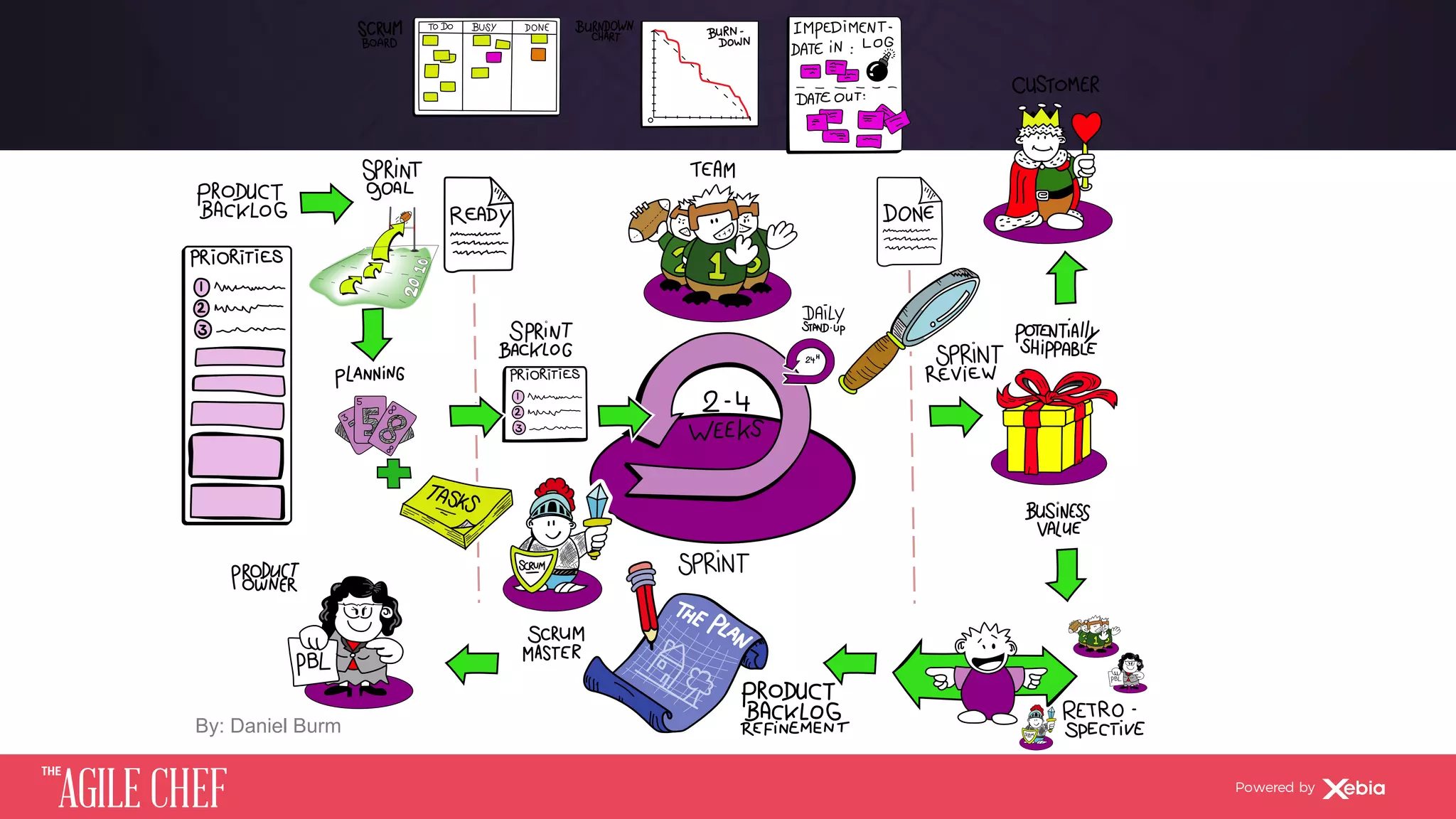
By: Daniel Burm
AGILE CHEF
THE
Powered by
AGILE CHEF
THE
Powered by
Why did the approach work?
•  Principles
­  Current process as starting point
­  Respecting existing roles & responsibilities
­  Gradual change
•  Practices
­  Transparency
­  Feedback loops
•  Emerging process!
AGILE CHEF
THE
Powered by
Top 10 reasons…
Why agile adoptions fail
AGILE CHEF
THE
Powered by
Reasons agile adoptions fail
•  ‘Why are we changing?’ is not clear
•  Failure to identify the right problems and tampering with
things that work
•  Top-down change forced upon team
•  Coaching style does not match the team phase
•  Forcing to overcome the resistance to change
•  Focus on changing existing roles (threatening jobs)
•  Lack of discipline
•  Forcing Scrum in challenging environment
AGILE CHEF
THE
Powered by
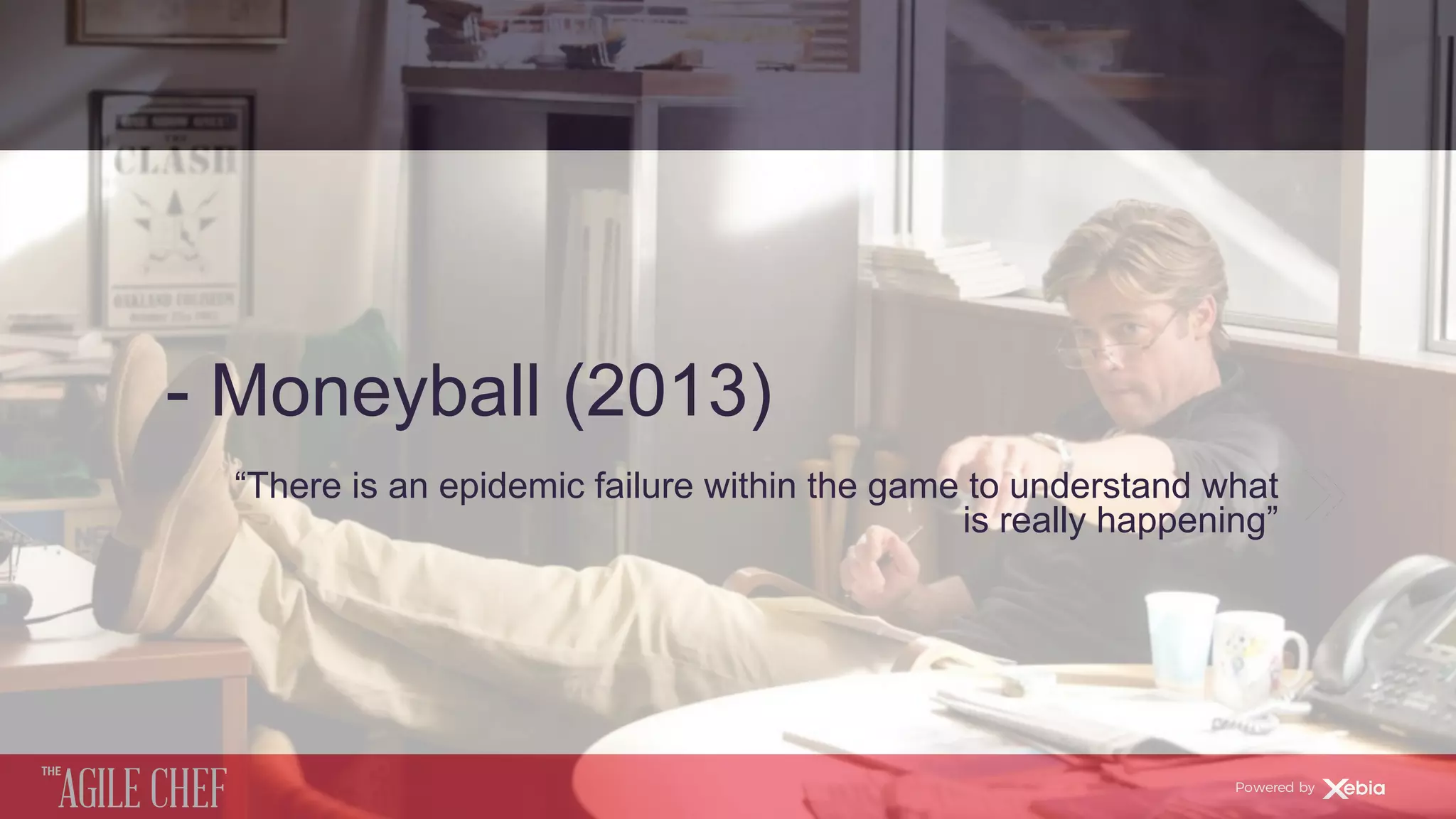
- Moneyball (2013)
“There is an epidemic failure within the game to understand what
is really happening”
AGILE CHEF
THE
Powered by
Applying
the Kanban Method
in a Scrum context
Scrumban is…..
AGILE CHEF
THE
Powered by
Kanban principles & practices
•  Principles:
­  Start with what you do now
­  Agree to pursue
evolutionary change
­  Initially, respect current
roles an responsibilities
­  Encourage acts of
leadership on all levels
•  Practices:
­  Visualize
­  Limit WiP
­  Manage flow
­  Make policies explicit
­  Feedback loops
­  Evolve collaboratively
AGILE CHEF
THE
Powered by
Kanban lens
12
AGILE CHEF
THE
Powered by
Start with understanding
1.  Purpose
2.  Sources of dissatisfaction
3.  Analyze demand & capability
4.  Identify work item types
5.  Model the knowledge discovery process
6.  Classes of Service
7.  Design the kanban system
8.  Roll-out
AGILE CHEF
THE
Powered by
Why Scrumban is useful
•  In certain situations disruptive changes are not wanted
•  As a coaching tool
­  If tutoring and mentoring are not appropriate
­  Team phase calls for a non-directive coaching style
­  Improving situations perceived as scrumbut
•  ….thereby building shared commitment
AGILE CHEF
THE
Powered by
Cases & Examples
AGILE CHEF
THE
Powered by
Top 10 patterns
•  Continuous demo’s
•  Fast lane
•  Ad hoc planning
•  Intangibles
•  Testing/Hardening/Deployment (DoS)
•  ERP implementations
•  Urgent (side) request
•  ‘Folded board’ pattern
•  Coping with external dependencies
•  Narrowly skilled team members
AGILE CHEF
THE
Powered by
Case: Development & Test Team
Scrum board Test team
WiP limit & Policy:
Maximum of
1 ½ sprint
End2End
AGILE CHEF
THE
Powered by
Work in Progress
Test Team
Scrum Team
Time
Amountofwork
Scrum team
delivers faster
Test in
progress
AGILE CHEF
THE
Powered by
Case: ERP Implementation
Expedite
Standard
Intangible
Wait for
External
RiskcategoriesParkinglot
Top 10 Selected Design Live
Steps in (development)process
ReviewDevelopment
4 6 4
Doing Done Doing done
4
AGILE CHEF
THE
Powered by
Case: ERP Implementation
Expedite
Standard
Intangible
Wait for
external
RiskcategoriesParkinglot
Top 10 Selected Design Live
Steps in (development)process
ReviewDevelopment
4 6 4
Doing Done Doing done
4
WiP limits per column to
reduce multi tasking
Split into Doing & Done to deal
with variations in flow and squa
d members see the work that
can be pulled
Top 10 backlog priorities
Parking lot for external dependen
cies. Doesn’t count towards WiP l
imit
AGILE CHEF
THE
Powered by
Case: Much ad hoc work
Incidents
Standard
Daily jobs
Business Requests
Different
expectations
(SLAs)
Different
expectations
(SLAs)
Different
expectations
(SLAs)
Different
expectations
(SLAs)
AGILE CHEF
THE
Powered by
Case: ‘Folded board’ pattern
AGILE CHEF
THE
Powered by
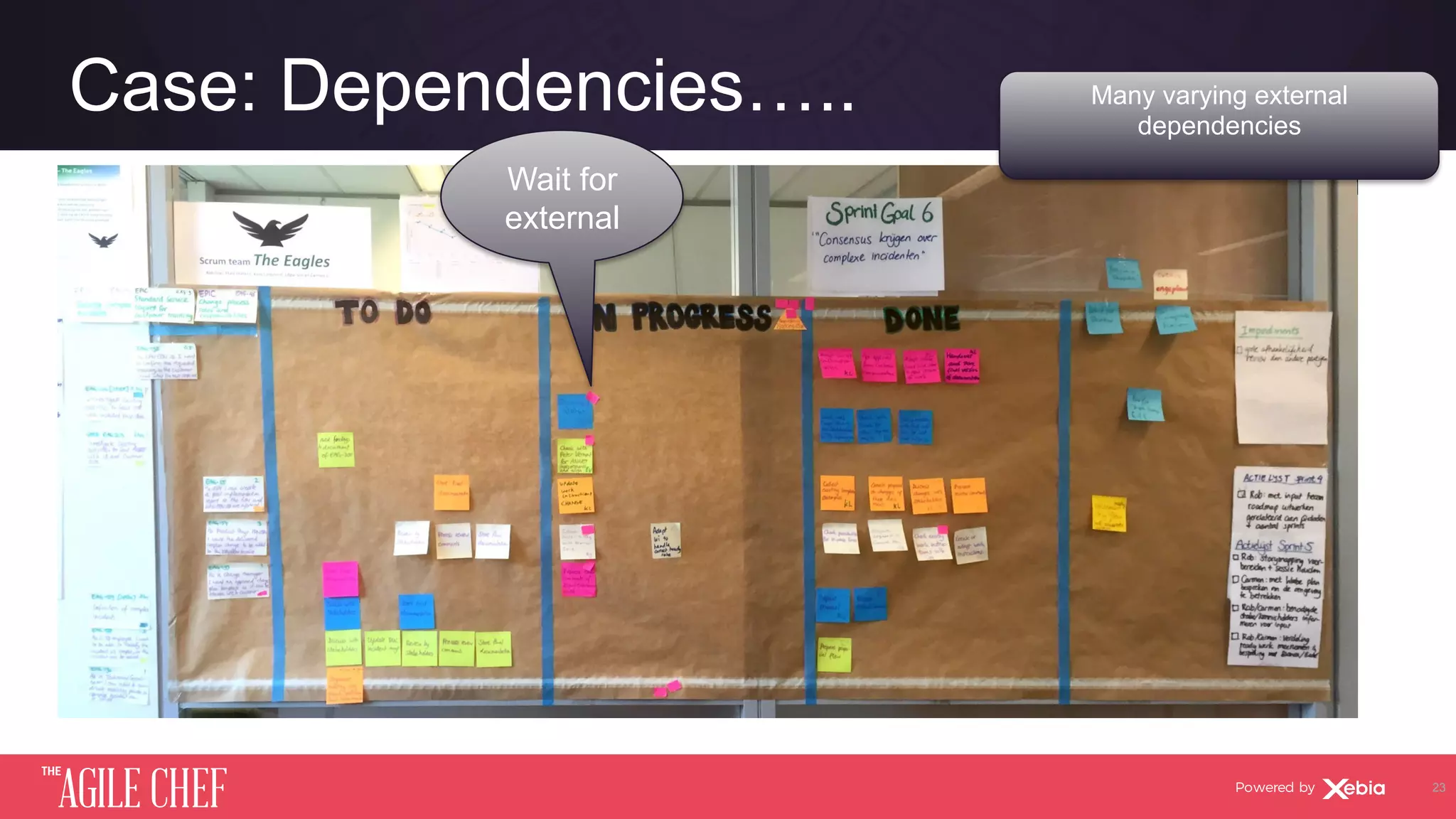
Case: Dependencies…..
23
Wait for
external
Many varying external
dependencies
AGILE CHEF
THE
Powered by
Case: Narrowly skilled team
24
•  Initially, respect roles:
•  Each person a single row
•  Provide avatars for multi skilled
persons (and no row)
•  Visualizes the team’s ability to
cross function
•  Encourages collaboration
AGILE CHEF
THE
Powered by
Unexpainable long lead
times
Low quality in the team
AGILE CHEF
THE
Powered by
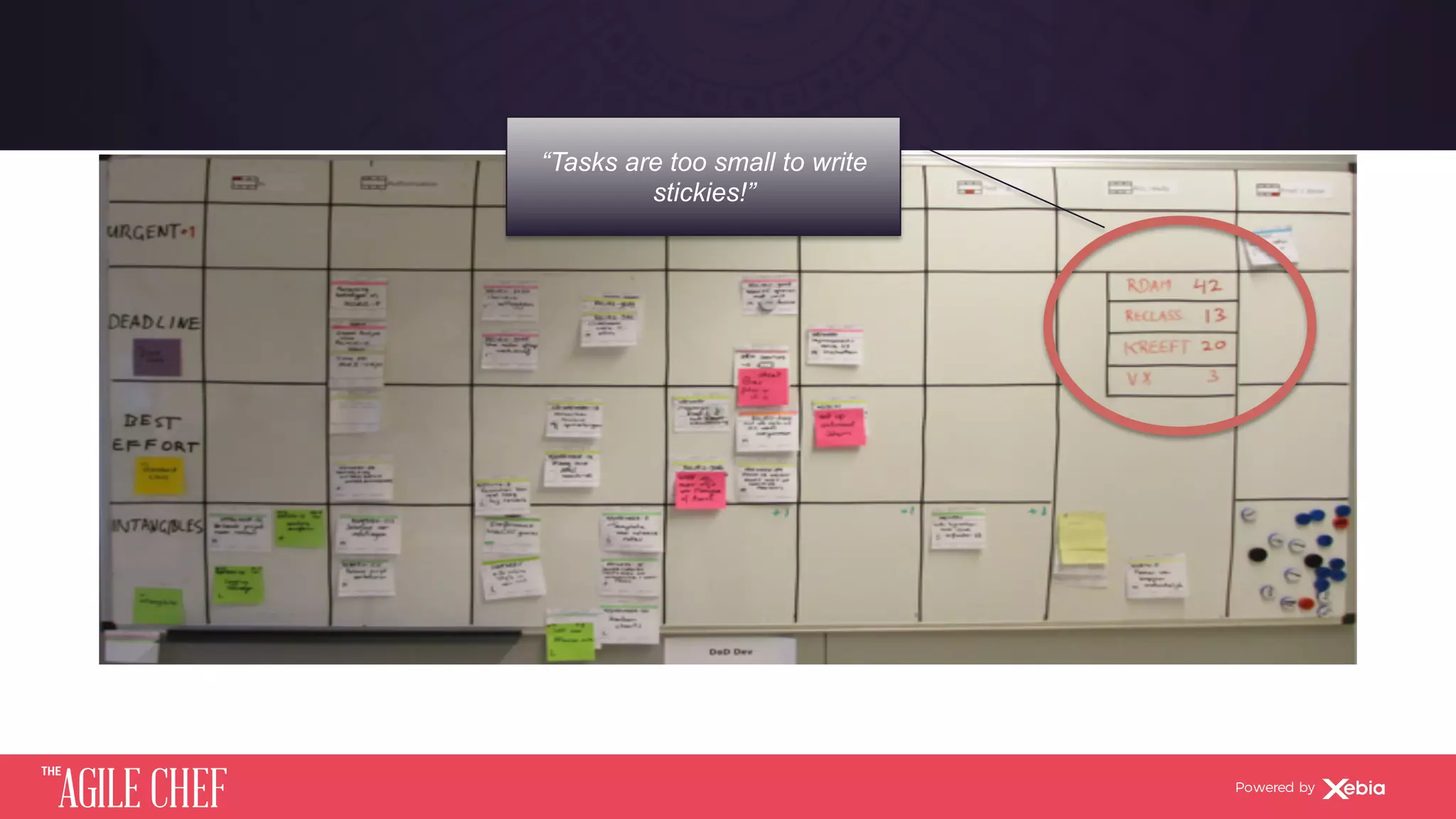
“Tasks are too small to write
stickies!”
AGILE CHEF
THE
Powered by
Many Stakeholders/POs
Parking space for external
dependencies
AGILE CHEF
THE
Powered by
My little cheat sheet* on when to introduce Kanban practices
Too much Ad-Hoc
(unplannable) work
Long Lead times
(>30 days)
Many external
dependencies
Low predictability
of lead times
High amount of work
items that are discarded
mid process 
High degree of
specialization. Strong
need for knowledge
sharing
Kanban Board
 yes
 yes
 with “parking space”
 yes
mainly for refinement
process
yes
Risk categories
 on board
with post-it color or on
board
op board
WIP limits
 per person
 per column
yes, not on the parking
space
per person
Operations Review
Meeting
monthly
 monthly
 monthly
Backlog Refinement
 weekly
Demo
 yes
 ja
 ja
Retrospective
 every 2 weeks
 monthly
 monthly
 every 2 weeks
 every 2 weeks
 every 2 weeks
Daily Stand up
 yes
1-2 x per week. More if
needed
1-2 x per week. More if
needed
yes
 yes
 yes
Lead Time / Control
Chart
yes
 yes
*Empty cells are optional, but recommended *) Thanks to Jasper Sonnevelt
AGILE CHEF
THE
Powered by
Scrumban
29
AGILE CHEF
THE
Powered by
Scrumban works because…
•  …..starts with current situation
•  …..focusses on managing the work and not on the roles
•  …..improves continuously from here
•  …..improves upon the team’s common goal
AGILE CHEF
THE
Powered by
Communities
•  NL Scrum
•  Lean Kanban Benelux
•  Lean Kanban University
AGILE CHEF
THE
Powered by
Scrumban
32
AGILE CHEF
THE
Powered by
We’re Doing Scrum, But…
•  The business doesn’t want to be
involved.
•  Everyone wants their features first
and can’t agree on a priority.
•  Teams don’t know how to self-
organize.
•  People aren’t available to work on
teams full-time.
•  Timeboxes aren’t adhered to.
•  Teams don’t see a need for a daily
Scrum.
•  Teams can’t get a piece of
functionality done in one Sprint.
•  Teams don’t have the skills to do
something.
•  Teams can’t fit testing into the
same Sprint as development.
•  The Scrum Master tells the team
what to do and how to do it.
•  Other managers can’t stay out of
a Sprint.
•  Important things come up that
require interrupting the Sprint.
•  The Sprints can’t start until all of
the other groups do their up-front
work.
•  Other groups are building
hardware or using waterfall.
Xebia Agile Consulting & Training
33
AGILE CHEF
THE
Powered by
Principles applied
•  Start with what you do now
•  Agree to pursue evolutionary change
•  Initially, respect current roles and responsibilities
•  Encourage acts of leadership on all levels
•  We can apply this to Scrum teams too!!
AGILE CHEF
THE
Powered by
Primaire doelen
•  K – Hoe gebruik je Kanban in een Agile team
•  K – Welke tools kun je inzetten
•  K – Wat is Scrumban
•  K – Practices om veel voorkomende problemen aan te
pakken
AGILE CHEF
THE
Powered by
Secondaire doelen
•  Publiciteit rondom Kanban (trainingen)
•  Community events en groups bekend maken
•  Kanban awareness vergroten
AGILE CHEF
THE
Powered by
Alternative path to agility
Changing by taking small steps
AGILE CHEF
THE
Powered by
AGILE CHEF
THE
Powered by
Cases
•  Self-kicked-off team using scrum after 6 months…..ING
case
•  Dev team vs Test team: Aegon case
AGILE CHEF
THE
Powered by 40
AGILE CHEF
THE
Powered by
Three additional values
•  Empiricism
•  Humility
•  Constructive Interaction
•  (scrumban p 65)
AGILE CHEF
THE
Powered by
How did this work?
•  Part new: scrum, and part existing process of testing after
developing
•  Respect role of the test test
•  Focus on the service: whole chain
•  Implemented feedback loop on the service of the team
•  Transparency
­  Visualization of the whole chain
­  Charts showing measurements
AGILE CHEF
THE
Powered by
When to use Scrumban?
•  In my experience:
•  Kick-starting teams in challenging environments
•  Coaching teams that
­  Scrumbutts and passed mentoring
­  Want/need to experiment with scrum
AGILE CHEF
THE
Powered by
Why Scrumban is useful
•  In certain situations disruptive changes are wanted
•  Introducing scrum in an evolutionary way
•  Improving situations perceived as scrumbutt
•  As a coaching tool: building a shared commitment
•  Deal with dysfunctions in agile teams
­  Not delivering in production in sprint
­  Coping with dependencies
­  Ad hoc work, e.g. incidents, business requests, daily operations, ….. [24 devops
team]
­  2 or more DoDs….. [harmonica bord]
­  Separate test team [Aegon voorbeeld, met grafiek]
­  Team with (super)specialists
AGILE CHEF
THE
Powered by
How
•  Kata for doing improvements:
­  (re)evaluate the team’s purpose
­  How does customer/team experience the service?
­  (re)examine work types
­  (re)visit the work type risk profiles
­  (re)think the board design
­  Go!
•  [Team’s vision statement from Mike Burrows]
AGILE CHEF
THE
Powered by
Tools
•  Vision/service/purpose statement of Mike Burrows
•  Work type template from Dave White
•  Risk profiles from Alexei Zhirkov
•  STATIK
•  Kanban practices
AGILE CHEF
THE
Powered by
Kanban Practices
•  Visualize
•  Limit WiP
•  Manage flow
•  Make policies explicit
•  Implement feedback loops
•  Improve Collaboratively, Evolve Experimentally
AGILE CHEF
THE
Powered by
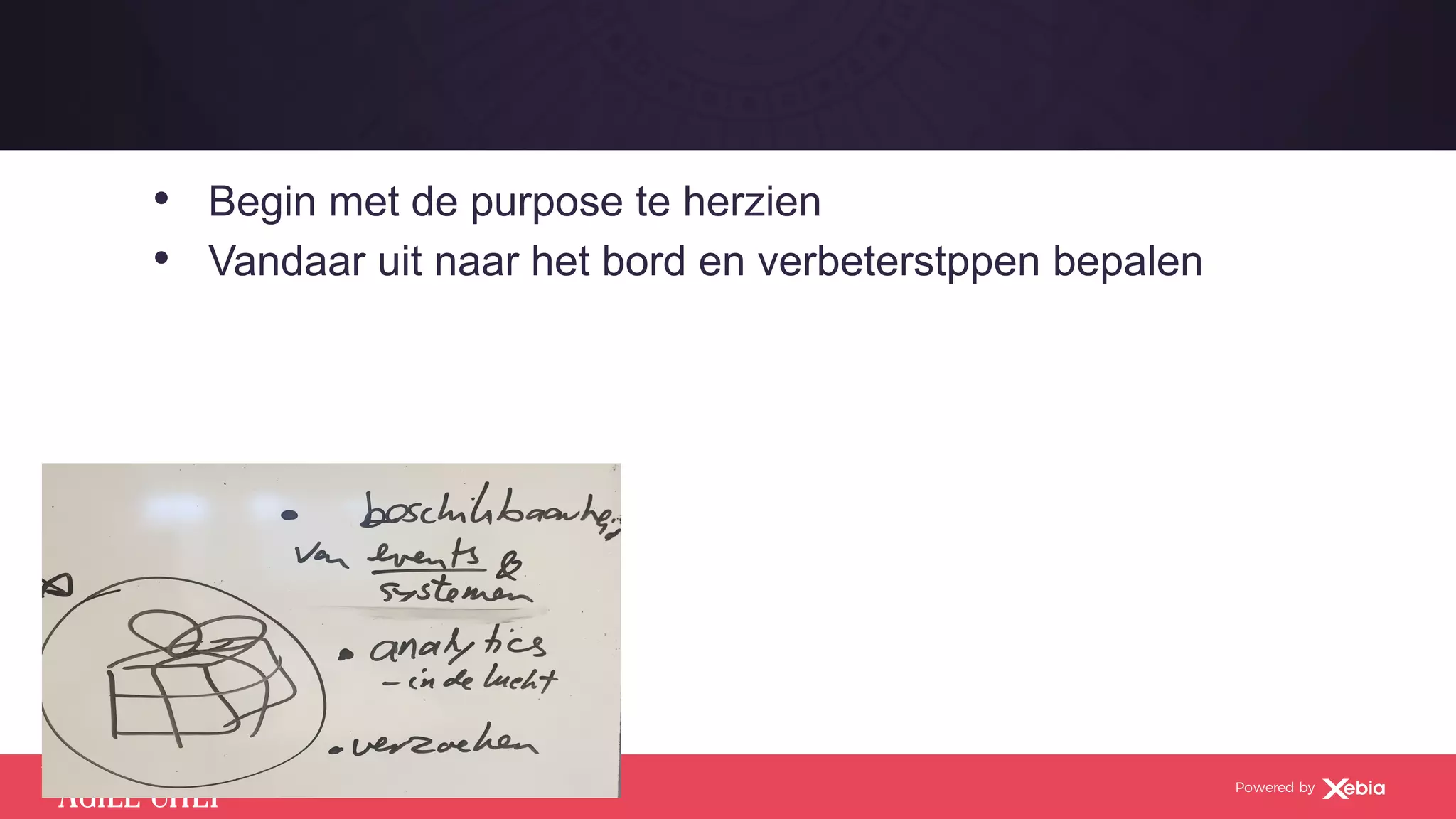
•  Begin met de purpose te herzien
•  Vandaar uit naar het bord en verbeterstppen bepalen
AGILE CHEF
THE
Powered by
Thank You!
AGILE CHEF
THE
Powered by
What is Scrumban?
AGILE CHEF
THE
Powered by
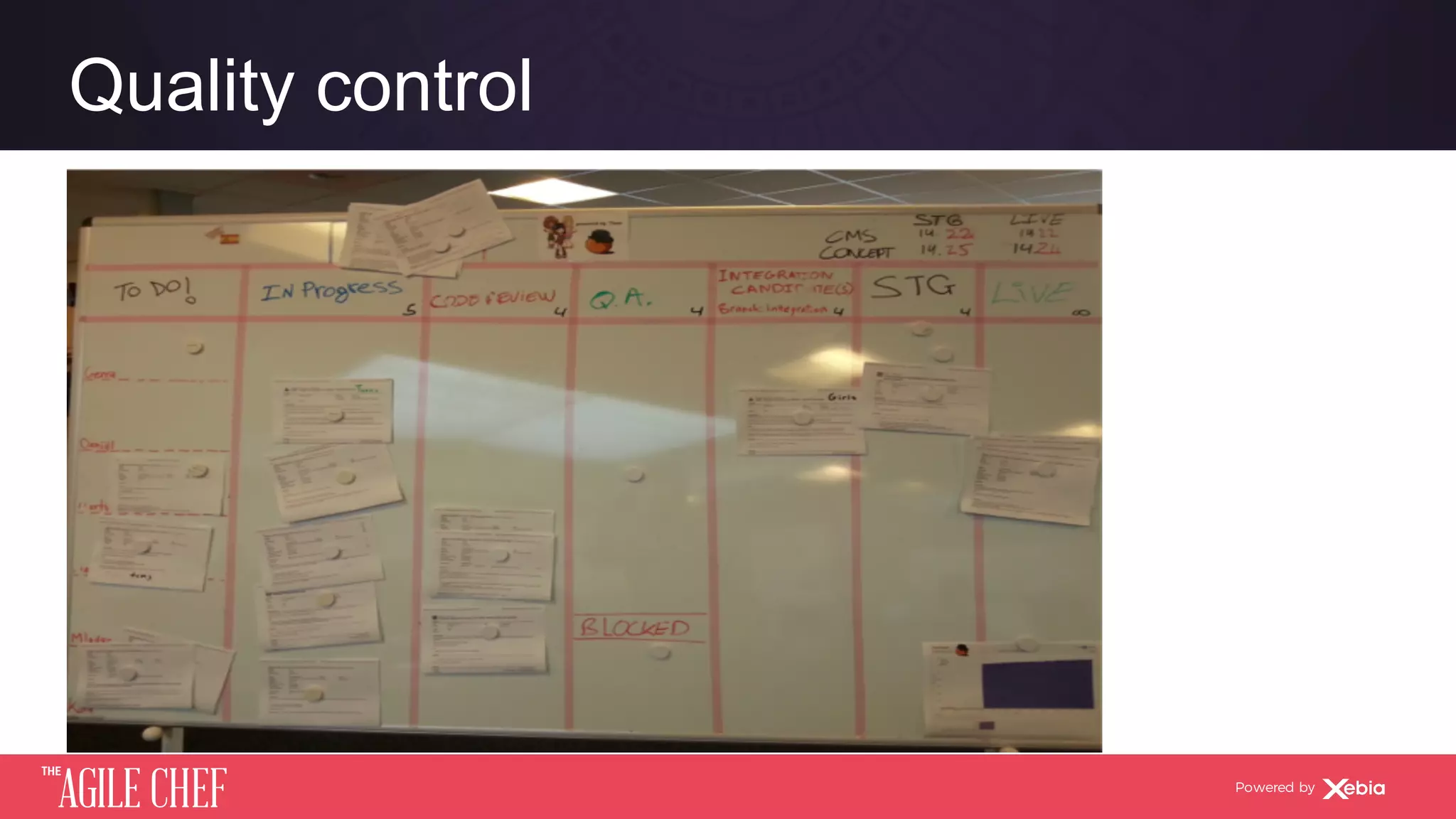
Quality control
AGILE CHEF
THE
Powered by
Kanban Method
Method for introducing evolutionary change
AGILE CHEF
THE
Powered by
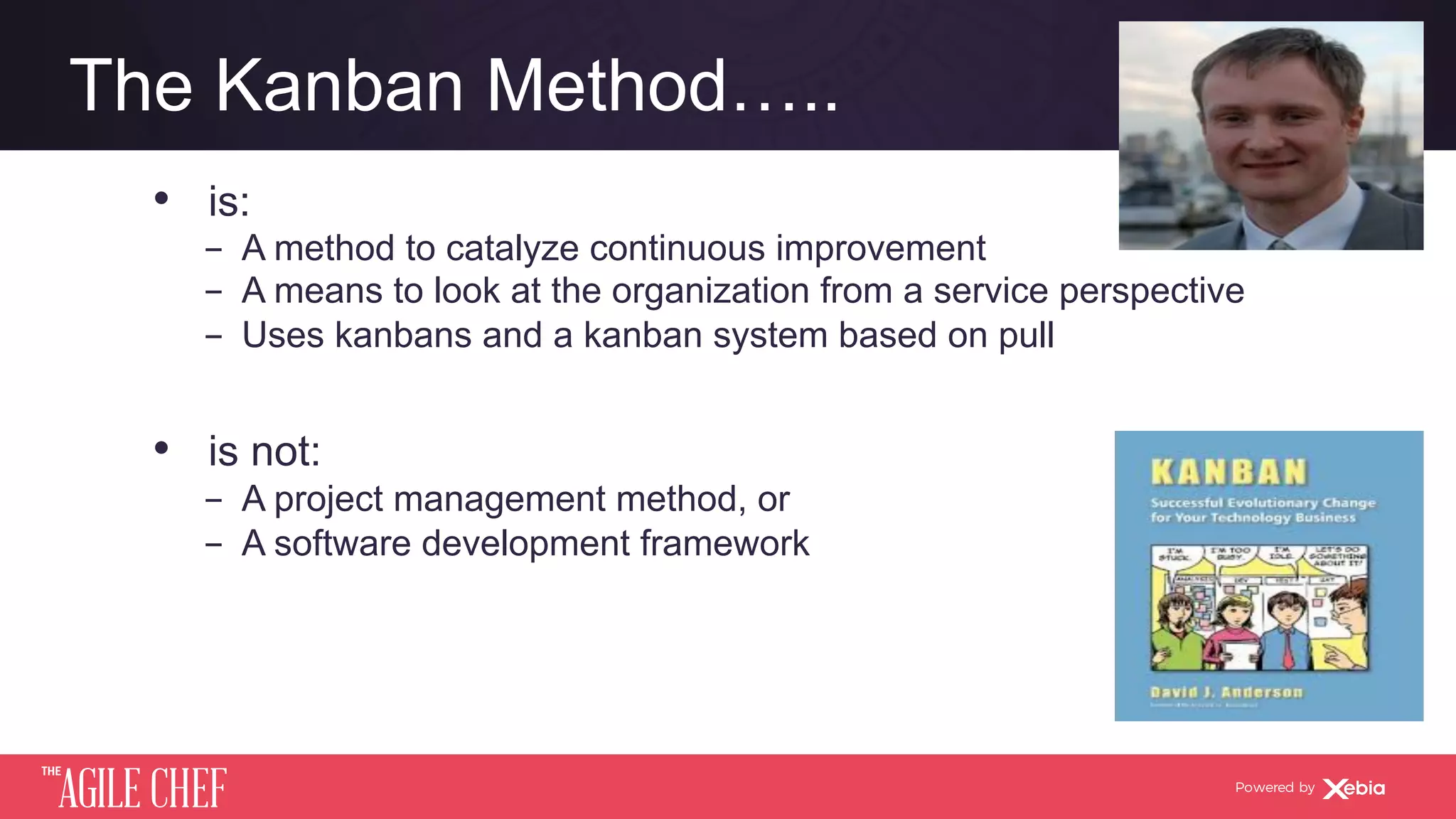
The Kanban Method…..
•  is:
­  A method to catalyze continuous improvement
­  A means to look at the organization from a service perspective
­  Uses kanbans and a kanban system based on pull
•  is not:
­  A project management method, or
­  A software development framework
AGILE CHEF
THE
Powered by
Kanban lens
•  Service-orientation
•  Service delivery involves workflow
•  Work flows through a series of knowledge discovery
activities
AGILE CHEF
THE
Powered by
STATIK
STATIK = Systems Thinking Approach To Introducing Kanban
1.  Purpose
2.  Sources of dissatisfaction
3.  Analyze demand & capability
4.  Identify work item types
5.  Model the discovery process
6.  Classes of Service
7.  Design the board
8.  Implement!
AGILE CHEF
THE
Powered by
As a coaching tool…..
•  Hersey & Blanchard •  Tuckman
AGILE CHEF
THE
Powered by
Shu Level / M1 Teams
•  Example: Kick-starting a new team
•  The agile coach should provide structure
•  Great timing to introduce new processes, e.g. Scrum
AGILE CHEF
THE
Powered by
Ha/Ri Level / M2 Teams
•  Example:
Team struggling for months to get scrum working for them
in their context (Shu)
•  Example:
Experienced team ready to start experimenting with Scrum
(Ha & Ri)
•  Calls for a different coaching style!
AGILE CHEF
THE
Powered by
With Scrumban, teams
can figure out for themselves
what is the next best thing to do
AGILE CHEF
THE
Powered by
References
AGILE CHEF
THE
Powered by
Te veel Ad-Hoc
(onplanbaar) werk
Lange doorlooptijden
(>30 dgn)
Veel externe
afhankelijkheden
Lage voorspelbaarheid
van doorlooptijden
Veel uitval tijdens
proces
Hoge mate van
specialisatie. Sterke
behoefte aan
kennisdeling
Kanban Board
 ja
 ja
 met "parkeervak"
 ja
met name ook refinement
proces
ja
Risico categorieen
 op board
via post-it kleur of op
board
op board
WIP limieten
 Per persoon
 per kolom
 ja, niet op parkeervak
 per persoon
Operations Review
Meeting
Maandelijks
 Maandelijks
 Maandelijks
Backlog Refinement
 wekelijks
Demo
 ja
 ja
 ja
Retrospective
 twee wekelijks
 maandelijks
 maandelijks
 twee wekelijks
 twee wekelijks
 twee wekelijks
Daily Stand up
 ja
1-2 x per week indien
gewenst vaker
1-2 x per week indien
gewenst vaker
ja
 ja
 ja
Lead Time / Control
Chart
Ja
 Ja
AGILE CHEF
THE
Powered by 62

Scrumban

  • 1.
    AGILE CHEF THE Powered byTHEAGILECHEF.COMPowered by 20 APRIL 2016 AGILE CHEF THE FROM FAST FOOD TO FRENCHCUISINE Scrumban Pieter Rijken
  • 2.
    AGILE CHEF THE Powered by Job Clients Contact PieterRijken Agile coach & trainer KPN, ING, ANVA, Rabobank, Nationale Nederlanden, Aegon prijken@xebia.com +31 6 83036743 pieterjrijken @pieter_rijken
  • 3.
    AGILE CHEF THE Powered by Job Clients Contact JasperSonnevelt Agile Consultant jsonnevelt@xebia.com +31 6 35118058 jaspersonnevelt @jaspersonnevelt
  • 4.
  • 5.
  • 6.
    AGILE CHEF THE Powered by Whydid the approach work? •  Principles ­  Current process as starting point ­  Respecting existing roles & responsibilities ­  Gradual change •  Practices ­  Transparency ­  Feedback loops •  Emerging process!
  • 7.
    AGILE CHEF THE Powered by Top10 reasons… Why agile adoptions fail
  • 8.
    AGILE CHEF THE Powered by Reasonsagile adoptions fail •  ‘Why are we changing?’ is not clear •  Failure to identify the right problems and tampering with things that work •  Top-down change forced upon team •  Coaching style does not match the team phase •  Forcing to overcome the resistance to change •  Focus on changing existing roles (threatening jobs) •  Lack of discipline •  Forcing Scrum in challenging environment
  • 9.
    AGILE CHEF THE Powered by -Moneyball (2013) “There is an epidemic failure within the game to understand what is really happening”
  • 10.
    AGILE CHEF THE Powered by Applying theKanban Method in a Scrum context Scrumban is…..
  • 11.
    AGILE CHEF THE Powered by Kanbanprinciples & practices •  Principles: ­  Start with what you do now ­  Agree to pursue evolutionary change ­  Initially, respect current roles an responsibilities ­  Encourage acts of leadership on all levels •  Practices: ­  Visualize ­  Limit WiP ­  Manage flow ­  Make policies explicit ­  Feedback loops ­  Evolve collaboratively
  • 12.
  • 13.
    AGILE CHEF THE Powered by Startwith understanding 1.  Purpose 2.  Sources of dissatisfaction 3.  Analyze demand & capability 4.  Identify work item types 5.  Model the knowledge discovery process 6.  Classes of Service 7.  Design the kanban system 8.  Roll-out
  • 14.
    AGILE CHEF THE Powered by WhyScrumban is useful •  In certain situations disruptive changes are not wanted •  As a coaching tool ­  If tutoring and mentoring are not appropriate ­  Team phase calls for a non-directive coaching style ­  Improving situations perceived as scrumbut •  ….thereby building shared commitment
  • 15.
  • 16.
    AGILE CHEF THE Powered by Top10 patterns •  Continuous demo’s •  Fast lane •  Ad hoc planning •  Intangibles •  Testing/Hardening/Deployment (DoS) •  ERP implementations •  Urgent (side) request •  ‘Folded board’ pattern •  Coping with external dependencies •  Narrowly skilled team members
  • 17.
    AGILE CHEF THE Powered by Case:Development & Test Team Scrum board Test team WiP limit & Policy: Maximum of 1 ½ sprint End2End
  • 18.
    AGILE CHEF THE Powered by Workin Progress Test Team Scrum Team Time Amountofwork Scrum team delivers faster Test in progress
  • 19.
    AGILE CHEF THE Powered by Case:ERP Implementation Expedite Standard Intangible Wait for External RiskcategoriesParkinglot Top 10 Selected Design Live Steps in (development)process ReviewDevelopment 4 6 4 Doing Done Doing done 4
  • 20.
    AGILE CHEF THE Powered by Case:ERP Implementation Expedite Standard Intangible Wait for external RiskcategoriesParkinglot Top 10 Selected Design Live Steps in (development)process ReviewDevelopment 4 6 4 Doing Done Doing done 4 WiP limits per column to reduce multi tasking Split into Doing & Done to deal with variations in flow and squa d members see the work that can be pulled Top 10 backlog priorities Parking lot for external dependen cies. Doesn’t count towards WiP l imit
  • 21.
    AGILE CHEF THE Powered by Case:Much ad hoc work Incidents Standard Daily jobs Business Requests Different expectations (SLAs) Different expectations (SLAs) Different expectations (SLAs) Different expectations (SLAs)
  • 22.
    AGILE CHEF THE Powered by Case:‘Folded board’ pattern
  • 23.
    AGILE CHEF THE Powered by Case:Dependencies….. 23 Wait for external Many varying external dependencies
  • 24.
    AGILE CHEF THE Powered by Case:Narrowly skilled team 24 •  Initially, respect roles: •  Each person a single row •  Provide avatars for multi skilled persons (and no row) •  Visualizes the team’s ability to cross function •  Encourages collaboration
  • 25.
    AGILE CHEF THE Powered by Unexpainablelong lead times Low quality in the team
  • 26.
    AGILE CHEF THE Powered by “Tasksare too small to write stickies!”
  • 27.
    AGILE CHEF THE Powered by ManyStakeholders/POs Parking space for external dependencies
  • 28.
    AGILE CHEF THE Powered by Mylittle cheat sheet* on when to introduce Kanban practices Too much Ad-Hoc (unplannable) work Long Lead times (>30 days) Many external dependencies Low predictability of lead times High amount of work items that are discarded mid process High degree of specialization. Strong need for knowledge sharing Kanban Board yes yes with “parking space” yes mainly for refinement process yes Risk categories on board with post-it color or on board op board WIP limits per person per column yes, not on the parking space per person Operations Review Meeting monthly monthly monthly Backlog Refinement weekly Demo yes ja ja Retrospective every 2 weeks monthly monthly every 2 weeks every 2 weeks every 2 weeks Daily Stand up yes 1-2 x per week. More if needed 1-2 x per week. More if needed yes yes yes Lead Time / Control Chart yes yes *Empty cells are optional, but recommended *) Thanks to Jasper Sonnevelt
  • 29.
  • 30.
    AGILE CHEF THE Powered by Scrumbanworks because… •  …..starts with current situation •  …..focusses on managing the work and not on the roles •  …..improves continuously from here •  …..improves upon the team’s common goal
  • 31.
    AGILE CHEF THE Powered by Communities • NL Scrum •  Lean Kanban Benelux •  Lean Kanban University
  • 32.
  • 33.
    AGILE CHEF THE Powered by We’reDoing Scrum, But… •  The business doesn’t want to be involved. •  Everyone wants their features first and can’t agree on a priority. •  Teams don’t know how to self- organize. •  People aren’t available to work on teams full-time. •  Timeboxes aren’t adhered to. •  Teams don’t see a need for a daily Scrum. •  Teams can’t get a piece of functionality done in one Sprint. •  Teams don’t have the skills to do something. •  Teams can’t fit testing into the same Sprint as development. •  The Scrum Master tells the team what to do and how to do it. •  Other managers can’t stay out of a Sprint. •  Important things come up that require interrupting the Sprint. •  The Sprints can’t start until all of the other groups do their up-front work. •  Other groups are building hardware or using waterfall. Xebia Agile Consulting & Training 33
  • 34.
    AGILE CHEF THE Powered by Principlesapplied •  Start with what you do now •  Agree to pursue evolutionary change •  Initially, respect current roles and responsibilities •  Encourage acts of leadership on all levels •  We can apply this to Scrum teams too!!
  • 35.
    AGILE CHEF THE Powered by Primairedoelen •  K – Hoe gebruik je Kanban in een Agile team •  K – Welke tools kun je inzetten •  K – Wat is Scrumban •  K – Practices om veel voorkomende problemen aan te pakken
  • 36.
    AGILE CHEF THE Powered by Secondairedoelen •  Publiciteit rondom Kanban (trainingen) •  Community events en groups bekend maken •  Kanban awareness vergroten
  • 37.
    AGILE CHEF THE Powered by Alternativepath to agility Changing by taking small steps
  • 38.
  • 39.
    AGILE CHEF THE Powered by Cases • Self-kicked-off team using scrum after 6 months…..ING case •  Dev team vs Test team: Aegon case
  • 40.
  • 41.
    AGILE CHEF THE Powered by Threeadditional values •  Empiricism •  Humility •  Constructive Interaction •  (scrumban p 65)
  • 42.
    AGILE CHEF THE Powered by Howdid this work? •  Part new: scrum, and part existing process of testing after developing •  Respect role of the test test •  Focus on the service: whole chain •  Implemented feedback loop on the service of the team •  Transparency ­  Visualization of the whole chain ­  Charts showing measurements
  • 43.
    AGILE CHEF THE Powered by Whento use Scrumban? •  In my experience: •  Kick-starting teams in challenging environments •  Coaching teams that ­  Scrumbutts and passed mentoring ­  Want/need to experiment with scrum
  • 44.
    AGILE CHEF THE Powered by WhyScrumban is useful •  In certain situations disruptive changes are wanted •  Introducing scrum in an evolutionary way •  Improving situations perceived as scrumbutt •  As a coaching tool: building a shared commitment •  Deal with dysfunctions in agile teams ­  Not delivering in production in sprint ­  Coping with dependencies ­  Ad hoc work, e.g. incidents, business requests, daily operations, ….. [24 devops team] ­  2 or more DoDs….. [harmonica bord] ­  Separate test team [Aegon voorbeeld, met grafiek] ­  Team with (super)specialists
  • 45.
    AGILE CHEF THE Powered by How • Kata for doing improvements: ­  (re)evaluate the team’s purpose ­  How does customer/team experience the service? ­  (re)examine work types ­  (re)visit the work type risk profiles ­  (re)think the board design ­  Go! •  [Team’s vision statement from Mike Burrows]
  • 46.
    AGILE CHEF THE Powered by Tools • Vision/service/purpose statement of Mike Burrows •  Work type template from Dave White •  Risk profiles from Alexei Zhirkov •  STATIK •  Kanban practices
  • 47.
    AGILE CHEF THE Powered by KanbanPractices •  Visualize •  Limit WiP •  Manage flow •  Make policies explicit •  Implement feedback loops •  Improve Collaboratively, Evolve Experimentally
  • 48.
    AGILE CHEF THE Powered by • Begin met de purpose te herzien •  Vandaar uit naar het bord en verbeterstppen bepalen
  • 49.
  • 50.
  • 51.
  • 52.
    AGILE CHEF THE Powered by KanbanMethod Method for introducing evolutionary change
  • 53.
    AGILE CHEF THE Powered by TheKanban Method….. •  is: ­  A method to catalyze continuous improvement ­  A means to look at the organization from a service perspective ­  Uses kanbans and a kanban system based on pull •  is not: ­  A project management method, or ­  A software development framework
  • 54.
    AGILE CHEF THE Powered by Kanbanlens •  Service-orientation •  Service delivery involves workflow •  Work flows through a series of knowledge discovery activities
  • 55.
    AGILE CHEF THE Powered by STATIK STATIK= Systems Thinking Approach To Introducing Kanban 1.  Purpose 2.  Sources of dissatisfaction 3.  Analyze demand & capability 4.  Identify work item types 5.  Model the discovery process 6.  Classes of Service 7.  Design the board 8.  Implement!
  • 56.
    AGILE CHEF THE Powered by Asa coaching tool….. •  Hersey & Blanchard •  Tuckman
  • 57.
    AGILE CHEF THE Powered by ShuLevel / M1 Teams •  Example: Kick-starting a new team •  The agile coach should provide structure •  Great timing to introduce new processes, e.g. Scrum
  • 58.
    AGILE CHEF THE Powered by Ha/RiLevel / M2 Teams •  Example: Team struggling for months to get scrum working for them in their context (Shu) •  Example: Experienced team ready to start experimenting with Scrum (Ha & Ri) •  Calls for a different coaching style!
  • 59.
    AGILE CHEF THE Powered by WithScrumban, teams can figure out for themselves what is the next best thing to do
  • 60.
  • 61.
    AGILE CHEF THE Powered by Teveel Ad-Hoc (onplanbaar) werk Lange doorlooptijden (>30 dgn) Veel externe afhankelijkheden Lage voorspelbaarheid van doorlooptijden Veel uitval tijdens proces Hoge mate van specialisatie. Sterke behoefte aan kennisdeling Kanban Board ja ja met "parkeervak" ja met name ook refinement proces ja Risico categorieen op board via post-it kleur of op board op board WIP limieten Per persoon per kolom ja, niet op parkeervak per persoon Operations Review Meeting Maandelijks Maandelijks Maandelijks Backlog Refinement wekelijks Demo ja ja ja Retrospective twee wekelijks maandelijks maandelijks twee wekelijks twee wekelijks twee wekelijks Daily Stand up ja 1-2 x per week indien gewenst vaker 1-2 x per week indien gewenst vaker ja ja ja Lead Time / Control Chart Ja Ja
  • 62.