CONTINUOUS AND
DISCONTINUOUS VARIABLES
SIVASANGARI SHANMUGAM
VARIABLES IN RESEARCH
A variable is something that can change, such as ‘gender’
and are typically the focus of a study.
A variable is a measurable characteristic that varies.
It may change from group to group, person to person, or
even within one person over time.
CHARACTERISTICS OF
VARIABLE
1. Capable of assuming several values representing a
certain category.
2. Values that may arise from counting and or form
measurement.
3. Raw data or figure gathered by a research for statistical
purpose.
4. Predicted values for one variable on the basis of another.
5. Observable characteristics of a person (or) object being
studied.
TYPES OF VARIABLES
variables
Categorical (or) Qualitative Numerical (or) Quantitative
Discrete Continuous
Nominal Ordinal Ratio Intervel
CATEGORICAL (or)
QUALITATIVE VARIABLES
Described in words.
Particularly important for observing changes.
EX; Color,Gender
NUMERICA (or) QUANTITATIVE
VARIABLES
Described in numbers.
Easy to count.
EX; Age,Salary,
They are divided into two types;
1. Discontinuous variables
2. Continuous variables
DISCRETE VARIABLE
 It is a type of statistical variable.
 Can assume only fixed number of distinct values and
lacks an inherent order.
 Also known as a categorical variable , because it has
separate, invisible categories.
 Can only take on discrete specific values.
 Not continuous.
 A limited number of values which cannot be divided
into fractions.
DISCRETE VARIABLE
They are divided into 2 variable scale measurements;
1. Nominal
2. Ordinal
DISCRETE VARIABLE
NOMINAL VARIABLES
Named variables .
A scale that categorizes items.
No ordering , No direction.
EX; Marital status (married/unmarried).
ORDINAL VARIABLES
Named variables + Ordered variables
Rankings,Orders or Scalling.
EX; Student letter grade,
EXAMPLES OF DESCRETE
VARIABLE
Number of printing mistakes in a book.
Number of road accidents in new Delhi.
Number of siblings of an individual.
A person (Live/Dead).
Result (Fail/Pass).
CONTINUOUS VARIABLE
It is a random variable that assumes all the possibles
values in a continuum.
It can take any value within the given range.
It defined over an interval of values,meaning that can
suppose any values in between the minimum and
maximum value.
Infinite number of value.
CONTINUOUS VARIABLE
They are divided into two types of variables scale
measurements;
1. Interval
2. Ratio
CONTINUOUS VARIABLE
INTERVAL VARIABLES:
Named variables + Ordered variables + difference between
measurements.
No true zero.
EX; Temperature in Fahrenheit,Standardized exam score.
RATIO VARIABLES:
Named variables + Ordered variables + Difference between
measurements+ Accommodate absolute zero.
True zero exit.
EX; Height ,Weight,Age.
EXAMPLES OF CONTINUOUS
VARIABLE
Height of a person.
Age of a person.
Profit earned by the company or other.
Temperature of a day.
Income of employee.
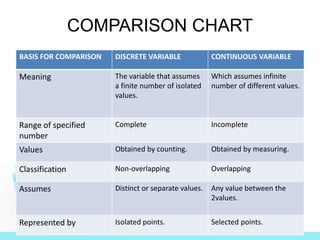
COMPARISON CHART
BASIS FOR COMPARISON DISCRETE VARIABLE CONTINUOUS VARIABLE
Meaning The variable that assumes
a finite number of isolated
values.
Which assumes infinite
number of different values.
Range of specified
number
Complete Incomplete
Values Obtained by counting. Obtained by measuring.
Classification Non-overlapping Overlapping
Assumes Distinct or separate values. Any value between the
2values.
Represented by Isolated points. Selected points.
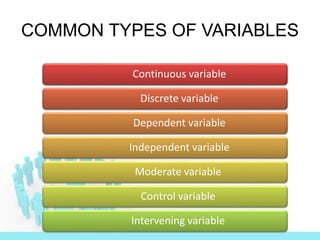
COMMON TYPES OF VARIABLES
Continuous variable
Discrete variable
Dependent variable
Independent variable
Moderate variable
Control variable
Intervening variable
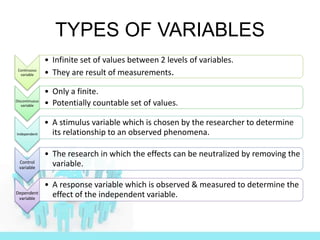
TYPES OF VARIABLES
Continuous
variable
• Infinite set of values between 2 levels of variables.
• They are result of measurements.
Discontinuous
variable
• Only a finite.
• Potentially countable set of values.
Independent
• A stimulus variable which is chosen by the researcher to determine
its relationship to an observed phenomena.
Control
variable
• The research in which the effects can be neutralized by removing the
variable.
Dependent
variable
• A response variable which is observed & measured to determine the
effect of the independent variable.
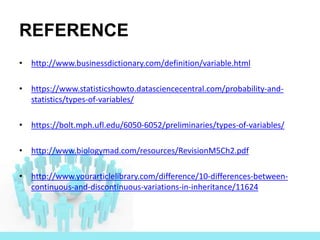
REFERENCE
• http://www.businessdictionary.com/definition/variable.html
• https://www.statisticshowto.datasciencecentral.com/probability-and-
statistics/types-of-variables/
• https://bolt.mph.ufl.edu/6050-6052/preliminaries/types-of-variables/
• http://www.biologymad.com/resources/RevisionM5Ch2.pdf
• http://www.yourarticlelibrary.com/difference/10-differences-between-
continuous-and-discontinuous-variations-in-inheritance/11624
THANK YOU

Continuous and discontinuous variable

  • 1.
  • 2.
    VARIABLES IN RESEARCH Avariable is something that can change, such as ‘gender’ and are typically the focus of a study. A variable is a measurable characteristic that varies. It may change from group to group, person to person, or even within one person over time.
  • 3.
    CHARACTERISTICS OF VARIABLE 1. Capableof assuming several values representing a certain category. 2. Values that may arise from counting and or form measurement. 3. Raw data or figure gathered by a research for statistical purpose. 4. Predicted values for one variable on the basis of another. 5. Observable characteristics of a person (or) object being studied.
  • 4.
    TYPES OF VARIABLES variables Categorical(or) Qualitative Numerical (or) Quantitative Discrete Continuous Nominal Ordinal Ratio Intervel
  • 5.
    CATEGORICAL (or) QUALITATIVE VARIABLES Describedin words. Particularly important for observing changes. EX; Color,Gender
  • 6.
    NUMERICA (or) QUANTITATIVE VARIABLES Describedin numbers. Easy to count. EX; Age,Salary, They are divided into two types; 1. Discontinuous variables 2. Continuous variables
  • 7.
    DISCRETE VARIABLE  Itis a type of statistical variable.  Can assume only fixed number of distinct values and lacks an inherent order.  Also known as a categorical variable , because it has separate, invisible categories.  Can only take on discrete specific values.  Not continuous.  A limited number of values which cannot be divided into fractions.
  • 8.
    DISCRETE VARIABLE They aredivided into 2 variable scale measurements; 1. Nominal 2. Ordinal
  • 9.
    DISCRETE VARIABLE NOMINAL VARIABLES Namedvariables . A scale that categorizes items. No ordering , No direction. EX; Marital status (married/unmarried). ORDINAL VARIABLES Named variables + Ordered variables Rankings,Orders or Scalling. EX; Student letter grade,
  • 10.
    EXAMPLES OF DESCRETE VARIABLE Numberof printing mistakes in a book. Number of road accidents in new Delhi. Number of siblings of an individual. A person (Live/Dead). Result (Fail/Pass).
  • 11.
    CONTINUOUS VARIABLE It isa random variable that assumes all the possibles values in a continuum. It can take any value within the given range. It defined over an interval of values,meaning that can suppose any values in between the minimum and maximum value. Infinite number of value.
  • 12.
    CONTINUOUS VARIABLE They aredivided into two types of variables scale measurements; 1. Interval 2. Ratio
  • 13.
    CONTINUOUS VARIABLE INTERVAL VARIABLES: Namedvariables + Ordered variables + difference between measurements. No true zero. EX; Temperature in Fahrenheit,Standardized exam score. RATIO VARIABLES: Named variables + Ordered variables + Difference between measurements+ Accommodate absolute zero. True zero exit. EX; Height ,Weight,Age.
  • 14.
    EXAMPLES OF CONTINUOUS VARIABLE Heightof a person. Age of a person. Profit earned by the company or other. Temperature of a day. Income of employee.
  • 15.
    COMPARISON CHART BASIS FORCOMPARISON DISCRETE VARIABLE CONTINUOUS VARIABLE Meaning The variable that assumes a finite number of isolated values. Which assumes infinite number of different values. Range of specified number Complete Incomplete Values Obtained by counting. Obtained by measuring. Classification Non-overlapping Overlapping Assumes Distinct or separate values. Any value between the 2values. Represented by Isolated points. Selected points.
  • 16.
    COMMON TYPES OFVARIABLES Continuous variable Discrete variable Dependent variable Independent variable Moderate variable Control variable Intervening variable
  • 17.
    TYPES OF VARIABLES Continuous variable •Infinite set of values between 2 levels of variables. • They are result of measurements. Discontinuous variable • Only a finite. • Potentially countable set of values. Independent • A stimulus variable which is chosen by the researcher to determine its relationship to an observed phenomena. Control variable • The research in which the effects can be neutralized by removing the variable. Dependent variable • A response variable which is observed & measured to determine the effect of the independent variable.
  • 18.
    REFERENCE • http://www.businessdictionary.com/definition/variable.html • https://www.statisticshowto.datasciencecentral.com/probability-and- statistics/types-of-variables/ •https://bolt.mph.ufl.edu/6050-6052/preliminaries/types-of-variables/ • http://www.biologymad.com/resources/RevisionM5Ch2.pdf • http://www.yourarticlelibrary.com/difference/10-differences-between- continuous-and-discontinuous-variations-in-inheritance/11624
  • 19.