Data and
Classification
of Data
Score/Data
 Measurement obtained for each individual
is called a datum or, more commonly, a
score or raw score. The complete set of
scores is called the data set, or simply the
data.
 More often populations and samples are
referred in terms of individuals but they can
also be used in terms of populations or
samples of scores.
Variables
 Specific characteristics of the individuals in the population or in
the sample (height, weight, gender, or personality).
 or they are interested in outside factors that may influence the
individuals e.g. as temperature, time of day, or the size of the
room.
 E.g. how weather influences people’s moods.
 A variable is a characteristic or condition that changes or
has different values for different individuals.
 To demonstrate changes in variables, it is necessary to make
measurements of the variables.
 In contrast to variable, the measure which never changes
from one individual to another.
 If a study is conducted on male college students only then,
gender is constant.
Qualitative Vs. Quantitative
 The variable which holds a numeric value is
termed as quantitative variable e.g. EQ score,
age, no. of social media forum used and the
like.
 The variable which does not hold a numeric
value is termed as qualitative variable e.g.
Occupation, Car name etc.
Discrete Vs. Continuous
 Discrete variables: The variables which hold specific
values within a specified range of values; for 1----50
which includes 1, 2, 3,……50 e.g. no. of children, family
size, strength of class e.tc.
 There are no intermediate values between two adjacent
categories.
 Continuous variables: The variables which hold non-
specific values within a specified range. These include
the values with decimal place e.g. age, height, weight
etc.
 These are not limited to a fixed set of separate,
indivisible, categories (free to choose the degree of
precision).
Cont…
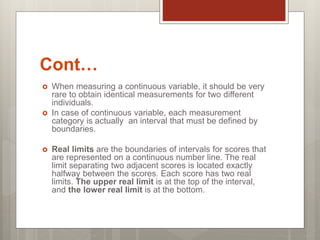
 When measuring a continuous variable, it should be very
rare to obtain identical measurements for two different
individuals.
 In case of continuous variable, each measurement
category is actually an interval that must be defined by
boundaries.
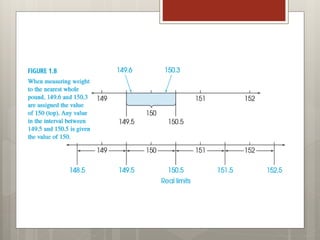
 Real limits are the boundaries of intervals for scores that
are represented on a continuous number line. The real
limit separating two adjacent scores is located exactly
halfway between the scores. Each score has two real
limits. The upper real limit is at the top of the interval,
and the lower real limit is at the bottom.
Levels/Scales of Measurement
Nominal
 It includes all those which can be categorized. The
variable that two or more categories but they
have no intrinsic order in the categories. Only =
and ≠ differentiation is possible.
Ordinal
 Here categories can be ranked in order too.
Therefore, in addition to = and ≠ differentiation
can be done about </≤ and >/≥.
Cont…
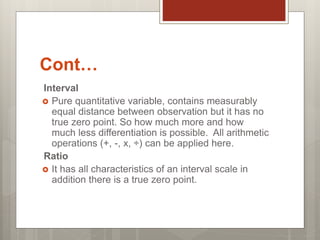
Interval
 Pure quantitative variable, contains measurably
equal distance between observation but it has no
true zero point. So how much more and how
much less differentiation is possible. All arithmetic
operations (+, -, x, ÷) can be applied here.
Ratio
 It has all characteristics of an interval scale in
addition there is a true zero point.
Statistical Notations
 X = Raw scores (original, unchanged scores obtained in the
study)
 For example, if performance in your statistics course is
measured by tests and you obtain a 35 on the first test, then we
could state that X = 35.
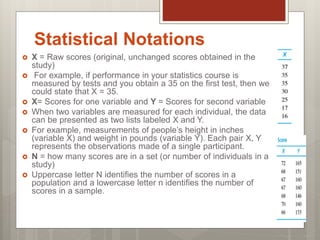
 X= Scores for one variable and Y = Scores for second variable
 When two variables are measured for each individual, the data
can be presented as two lists labeled X and Y.
 For example, measurements of people’s height in inches
(variable X) and weight in pounds (variable Y). Each pair X, Y
represents the observations made of a single participant.
 N = how many scores are in a set (or number of individuals in a
study)
 Uppercase letter N identifies the number of scores in a
population and a lowercase letter n identifies the number of
scores in a sample.
Cont…
 Greek letter sigma, or ∑, is used to stand for ‘summation’ or ‘the sum of.’
 The expression ∑ X means to add all the scores for variable X so is read as ‘the sum
of the scores.’
 The summation sign, o, is always followed by a symbol or mathematical expression.
 ∑ X , ∑(X – 1)2
 Used in combination with other mathematical operators, be used in correct
sequence.
 Order of Mathematical Operations
 1. Any calculation contained within parentheses is done first.
 2. Squaring (or raising to other exponents) is done second.
 3. Multiplying and/or dividing is done third.
 A series of multiplication and/or division operations should be done in order from left
to right.
 4. Summation using the ∑ notation is done next.
 5. Finally, any other addition and/or subtraction is done.

Data Types and Graphical Representation.pptx

  • 1.
  • 2.
    Score/Data  Measurement obtainedfor each individual is called a datum or, more commonly, a score or raw score. The complete set of scores is called the data set, or simply the data.  More often populations and samples are referred in terms of individuals but they can also be used in terms of populations or samples of scores.
  • 3.
    Variables  Specific characteristicsof the individuals in the population or in the sample (height, weight, gender, or personality).  or they are interested in outside factors that may influence the individuals e.g. as temperature, time of day, or the size of the room.  E.g. how weather influences people’s moods.  A variable is a characteristic or condition that changes or has different values for different individuals.  To demonstrate changes in variables, it is necessary to make measurements of the variables.  In contrast to variable, the measure which never changes from one individual to another.  If a study is conducted on male college students only then, gender is constant.
  • 4.
    Qualitative Vs. Quantitative The variable which holds a numeric value is termed as quantitative variable e.g. EQ score, age, no. of social media forum used and the like.  The variable which does not hold a numeric value is termed as qualitative variable e.g. Occupation, Car name etc.
  • 5.
    Discrete Vs. Continuous Discrete variables: The variables which hold specific values within a specified range of values; for 1----50 which includes 1, 2, 3,……50 e.g. no. of children, family size, strength of class e.tc.  There are no intermediate values between two adjacent categories.  Continuous variables: The variables which hold non- specific values within a specified range. These include the values with decimal place e.g. age, height, weight etc.  These are not limited to a fixed set of separate, indivisible, categories (free to choose the degree of precision).
  • 6.
    Cont…  When measuringa continuous variable, it should be very rare to obtain identical measurements for two different individuals.  In case of continuous variable, each measurement category is actually an interval that must be defined by boundaries.  Real limits are the boundaries of intervals for scores that are represented on a continuous number line. The real limit separating two adjacent scores is located exactly halfway between the scores. Each score has two real limits. The upper real limit is at the top of the interval, and the lower real limit is at the bottom.
  • 8.
    Levels/Scales of Measurement Nominal It includes all those which can be categorized. The variable that two or more categories but they have no intrinsic order in the categories. Only = and ≠ differentiation is possible. Ordinal  Here categories can be ranked in order too. Therefore, in addition to = and ≠ differentiation can be done about </≤ and >/≥.
  • 9.
    Cont… Interval  Pure quantitativevariable, contains measurably equal distance between observation but it has no true zero point. So how much more and how much less differentiation is possible. All arithmetic operations (+, -, x, ÷) can be applied here. Ratio  It has all characteristics of an interval scale in addition there is a true zero point.
  • 10.
    Statistical Notations  X= Raw scores (original, unchanged scores obtained in the study)  For example, if performance in your statistics course is measured by tests and you obtain a 35 on the first test, then we could state that X = 35.  X= Scores for one variable and Y = Scores for second variable  When two variables are measured for each individual, the data can be presented as two lists labeled X and Y.  For example, measurements of people’s height in inches (variable X) and weight in pounds (variable Y). Each pair X, Y represents the observations made of a single participant.  N = how many scores are in a set (or number of individuals in a study)  Uppercase letter N identifies the number of scores in a population and a lowercase letter n identifies the number of scores in a sample.
  • 11.
    Cont…  Greek lettersigma, or ∑, is used to stand for ‘summation’ or ‘the sum of.’  The expression ∑ X means to add all the scores for variable X so is read as ‘the sum of the scores.’  The summation sign, o, is always followed by a symbol or mathematical expression.  ∑ X , ∑(X – 1)2  Used in combination with other mathematical operators, be used in correct sequence.  Order of Mathematical Operations  1. Any calculation contained within parentheses is done first.  2. Squaring (or raising to other exponents) is done second.  3. Multiplying and/or dividing is done third.  A series of multiplication and/or division operations should be done in order from left to right.  4. Summation using the ∑ notation is done next.  5. Finally, any other addition and/or subtraction is done.