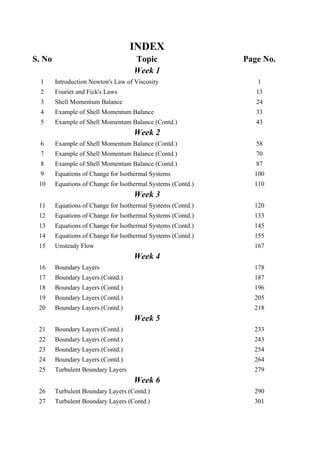
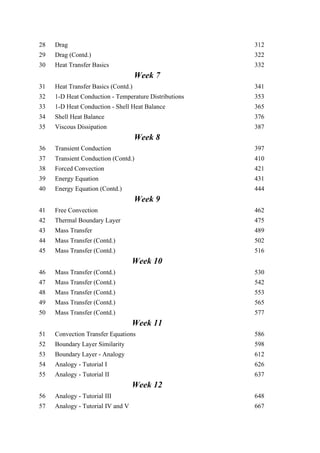
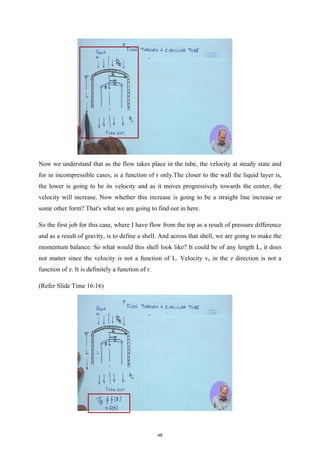
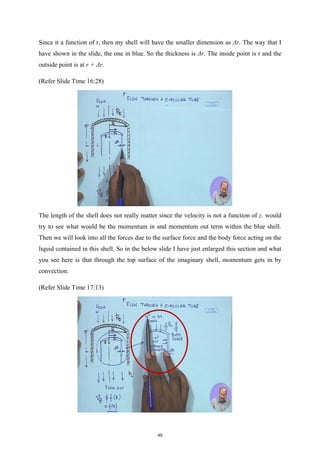
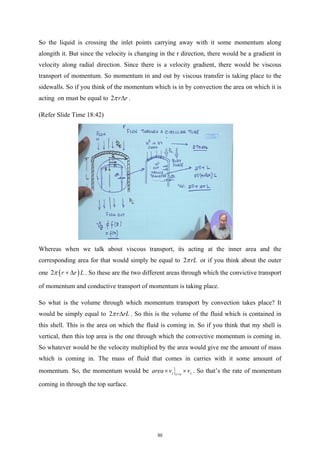
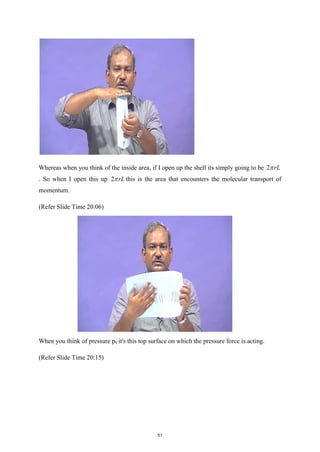
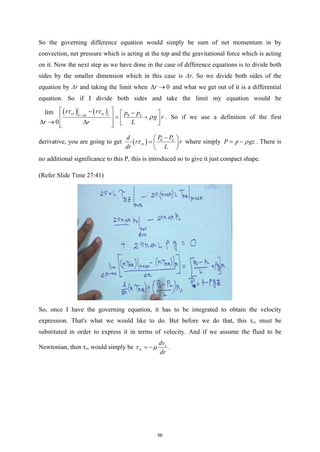
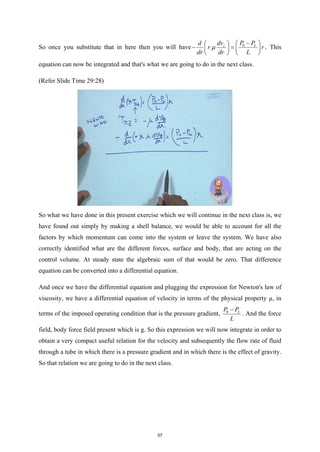
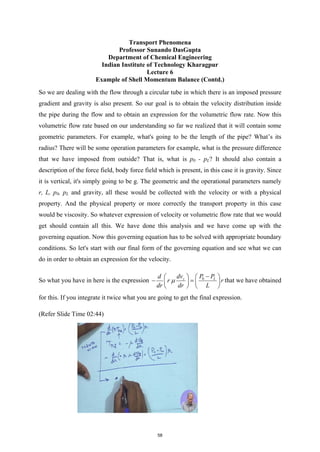
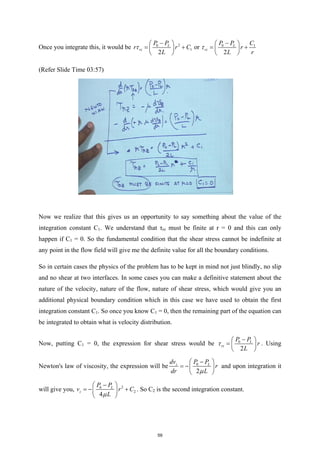
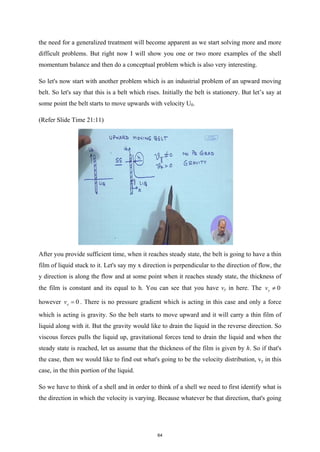
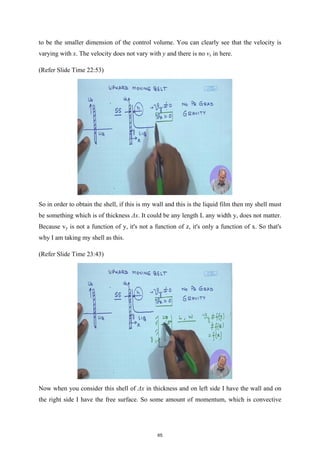
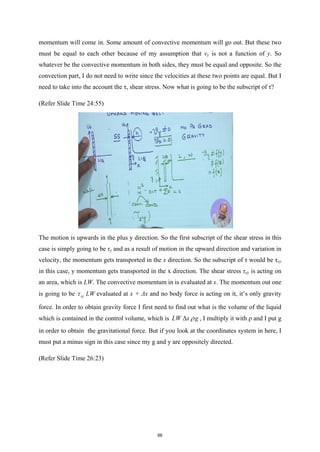
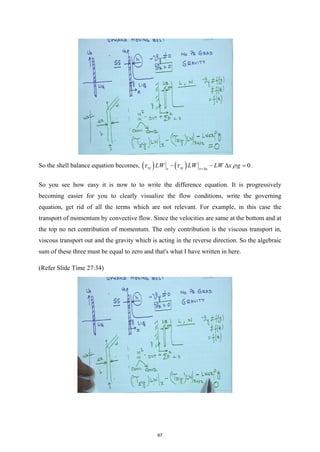
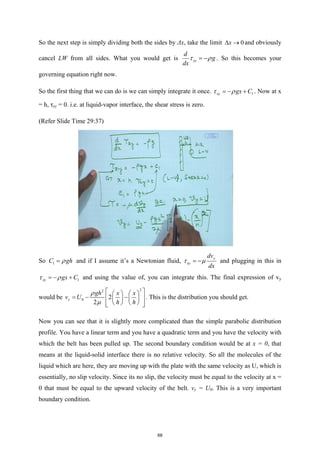
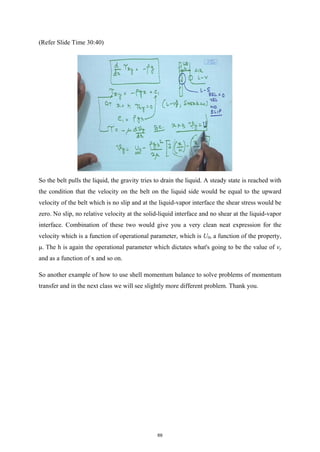
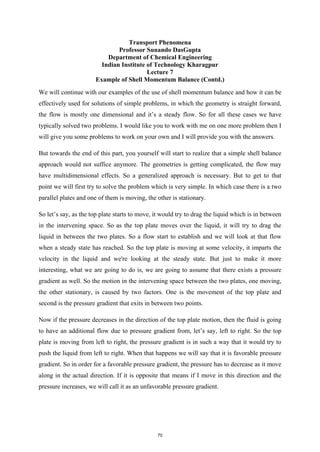
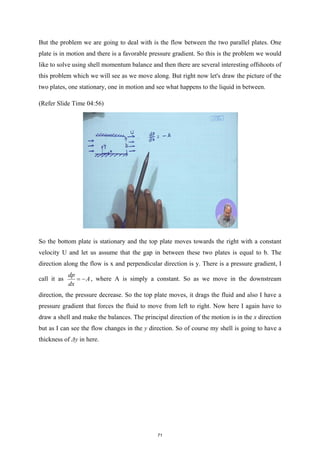
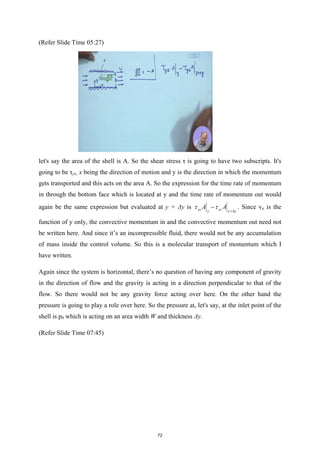
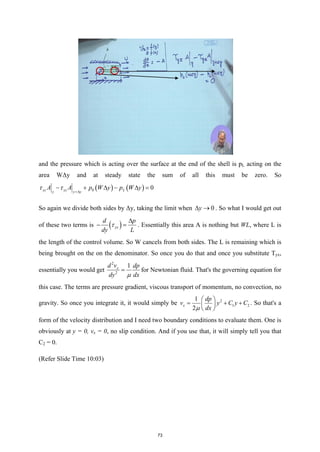
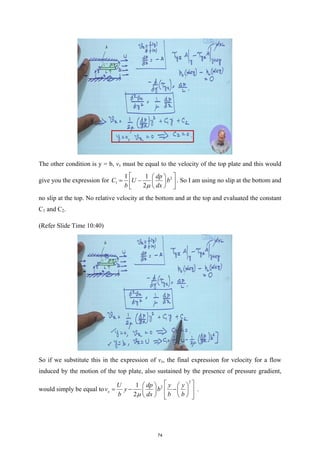
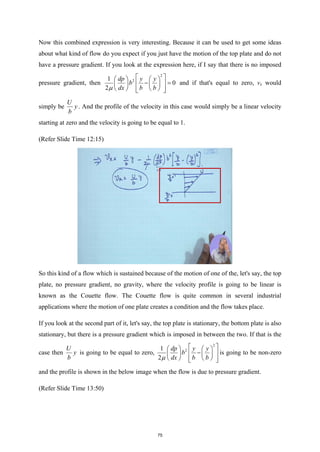
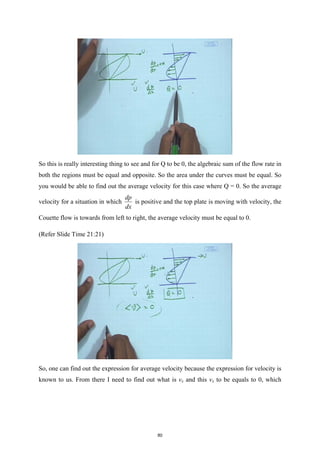
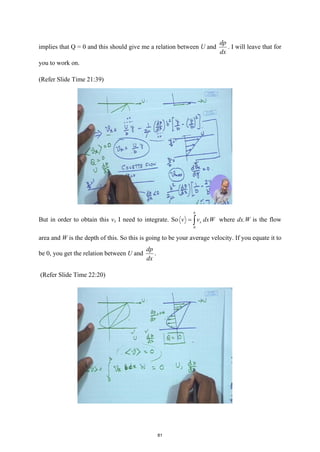
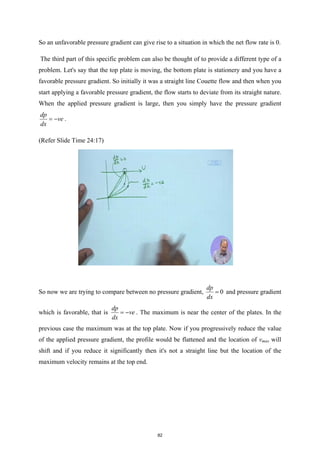
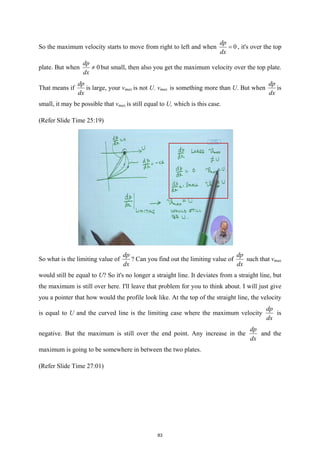
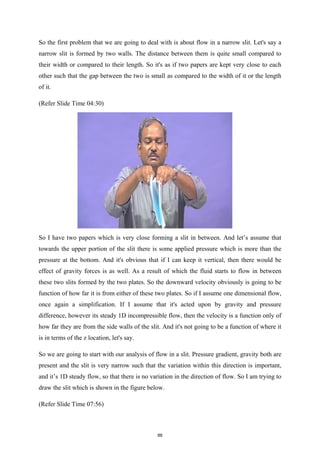
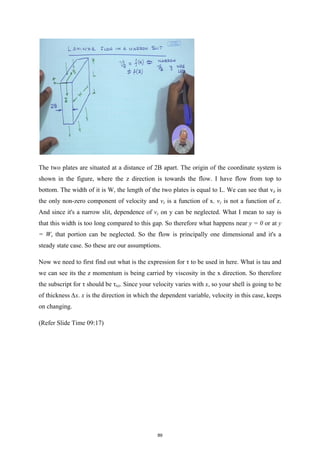
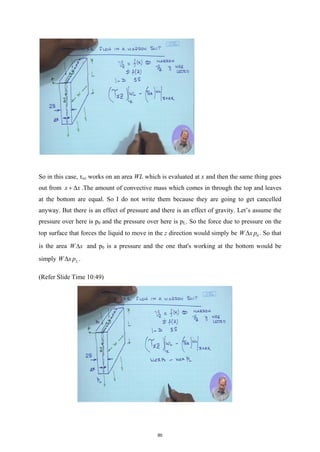
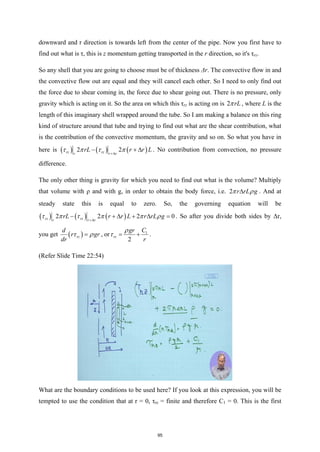
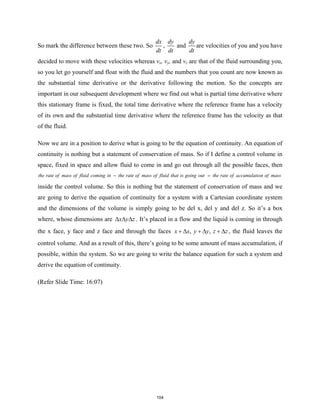
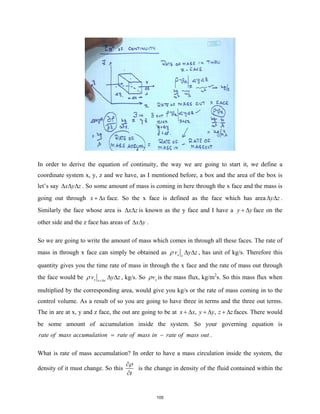
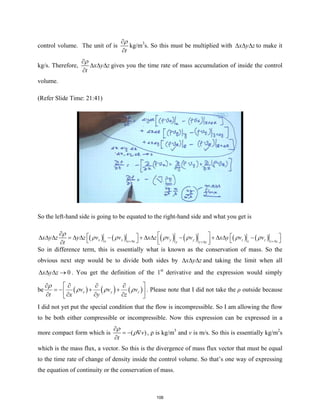
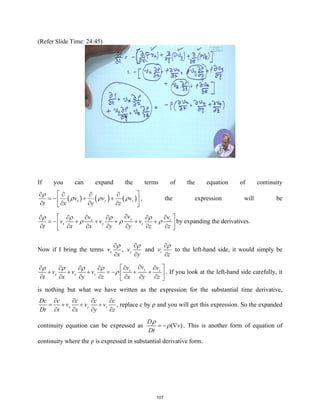
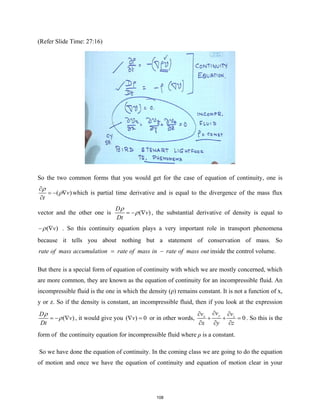
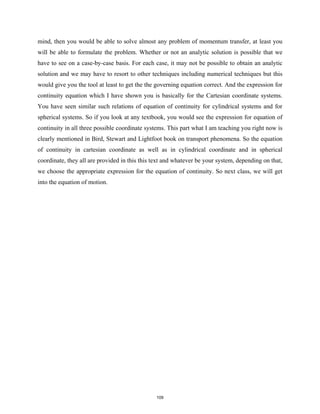
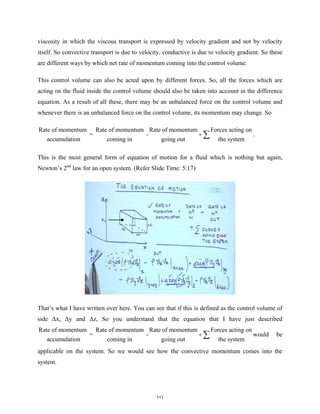
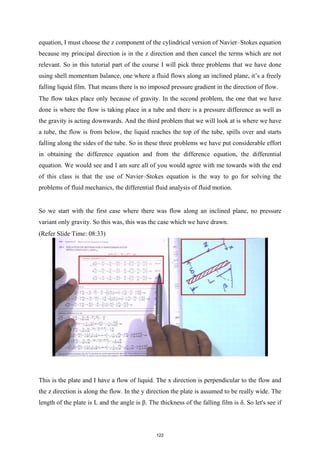
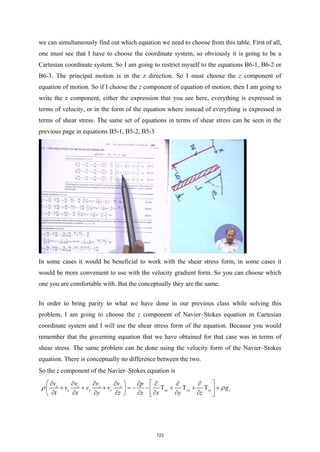
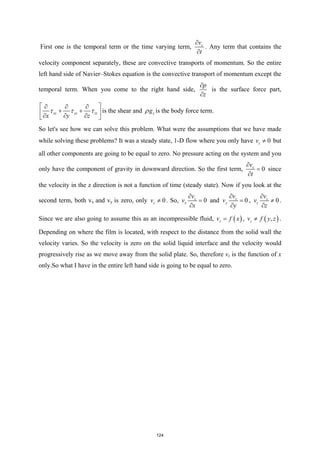
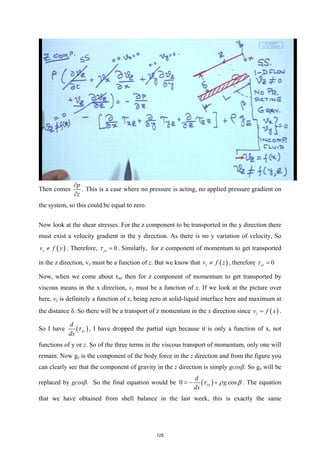
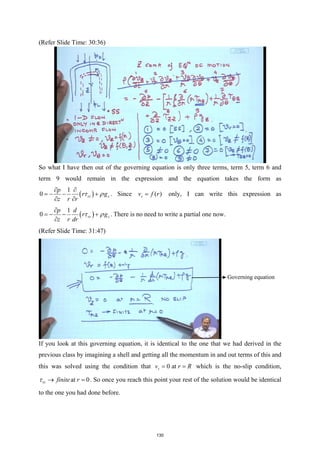
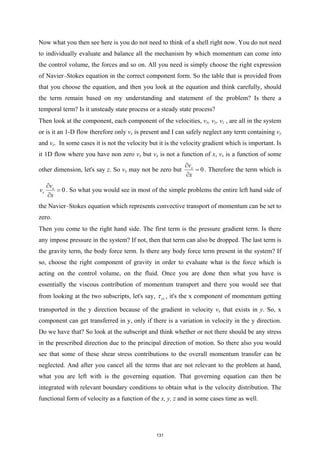
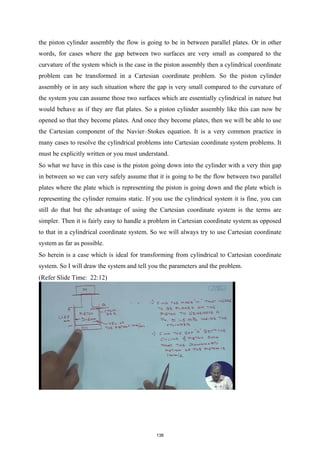
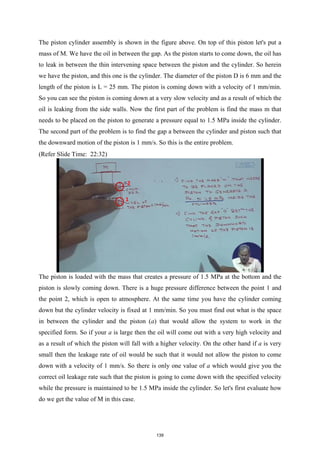
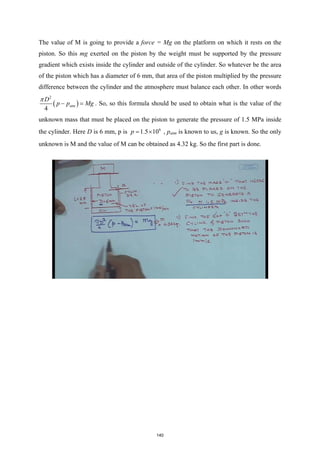
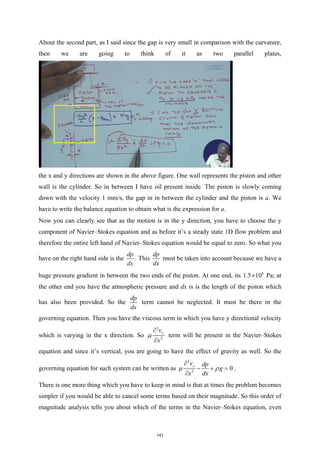
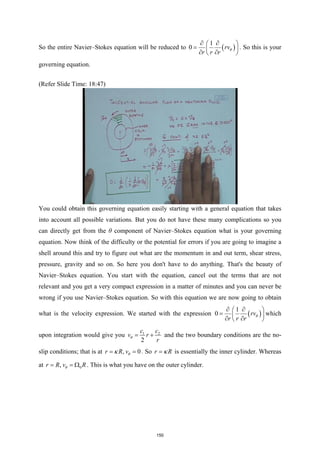
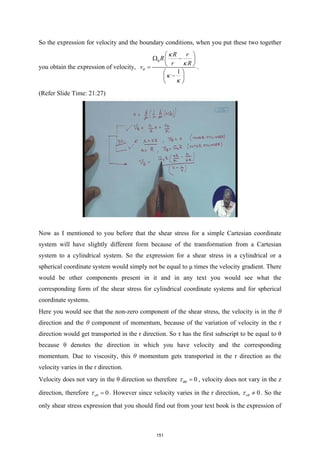
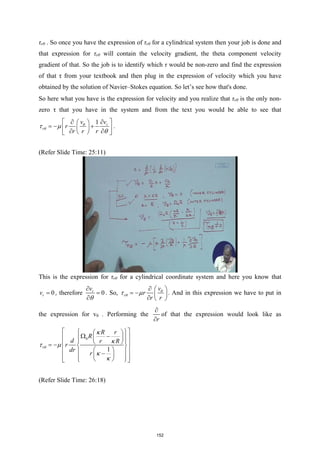
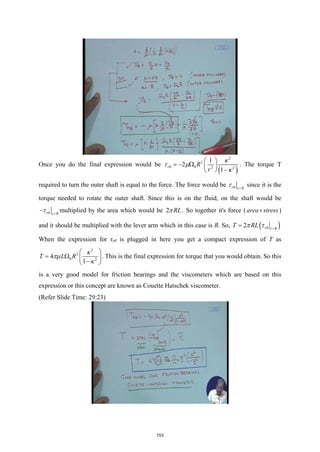
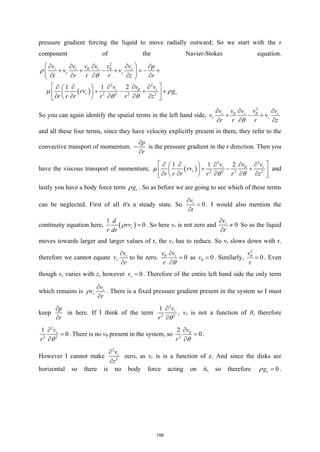
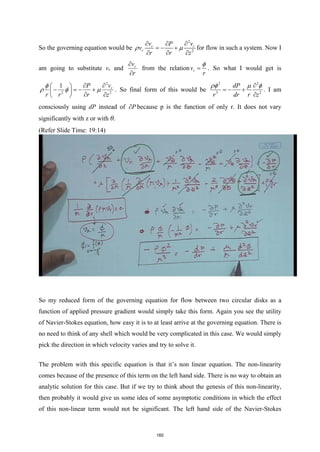
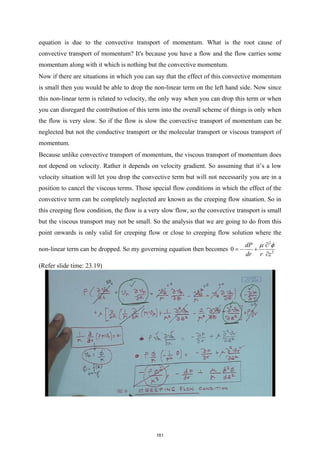
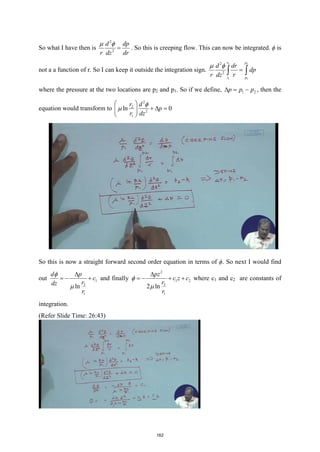
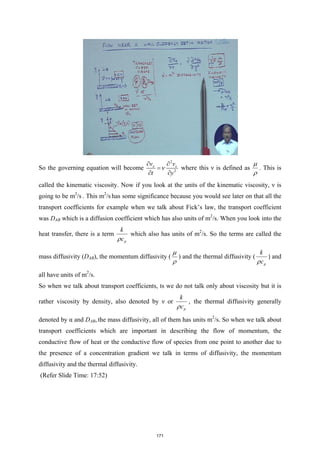
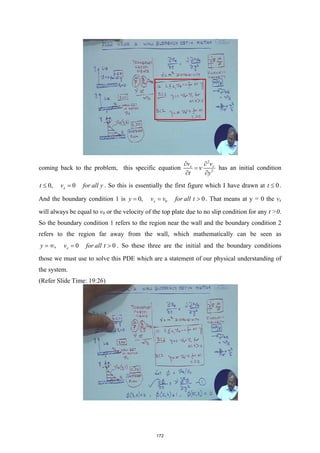
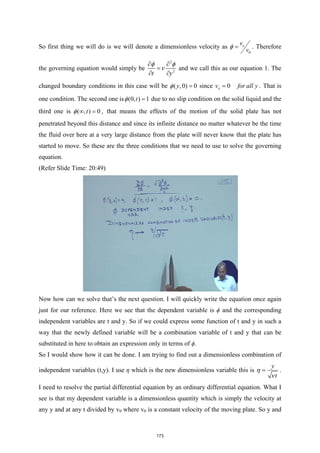
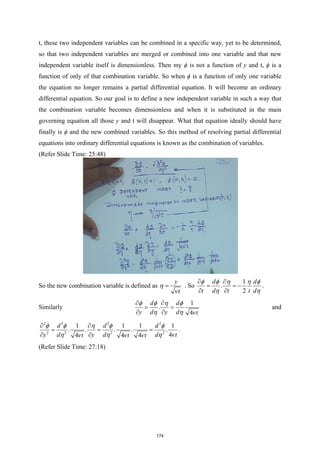
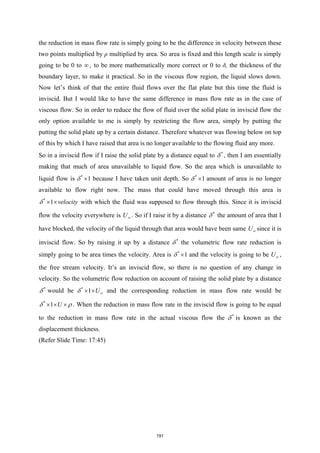
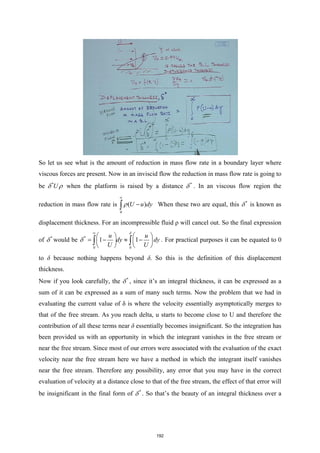
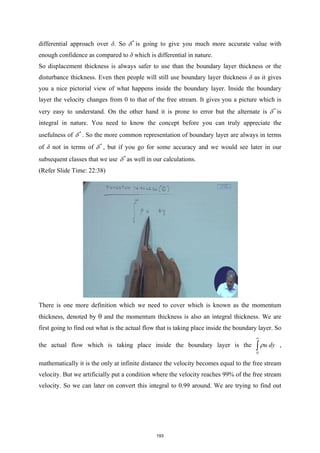
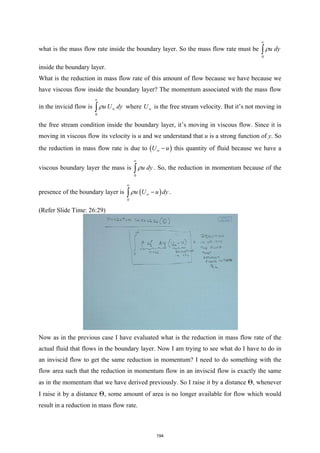
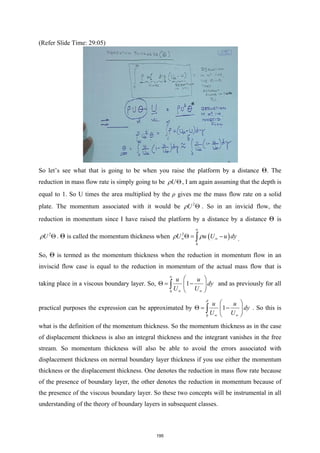
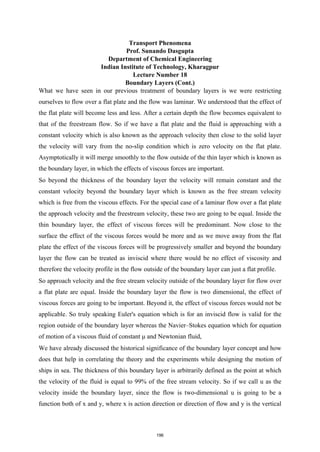
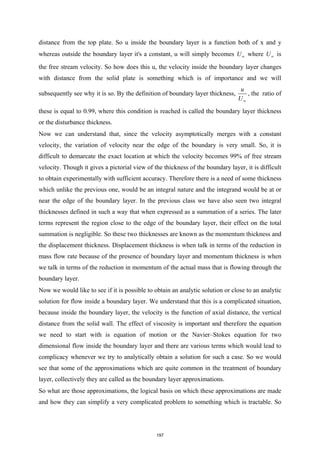
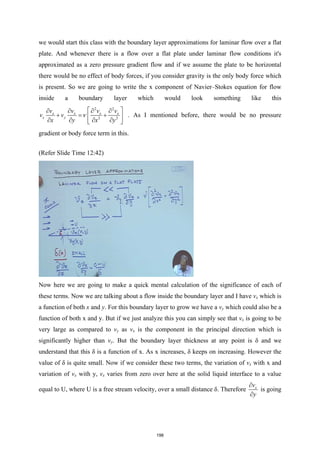
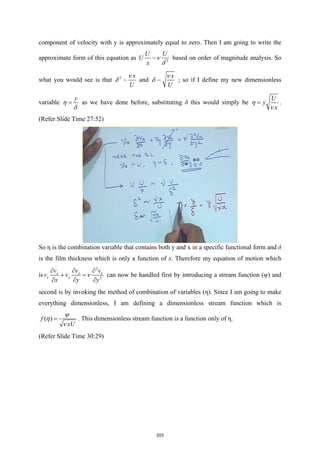
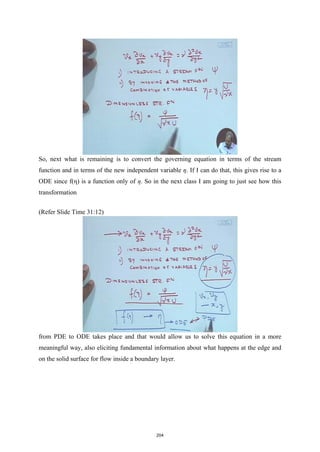
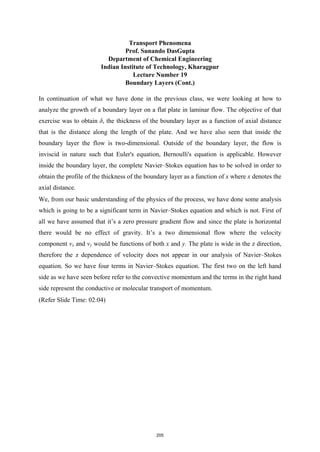
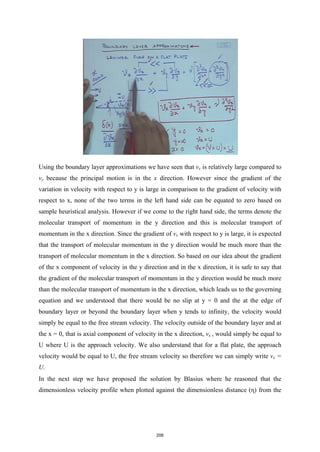
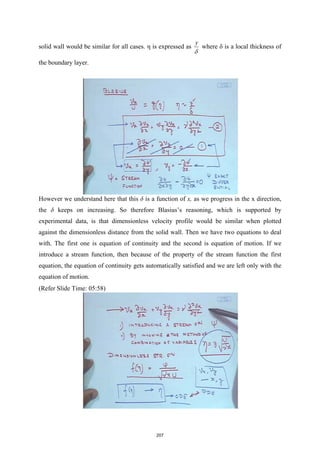
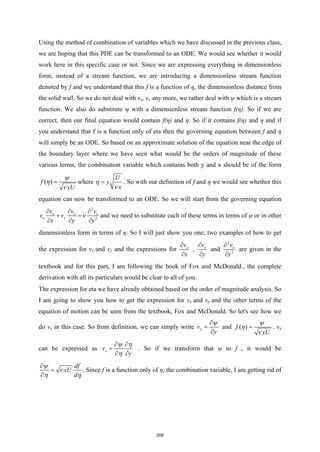
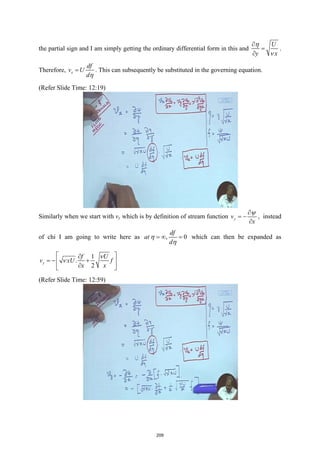
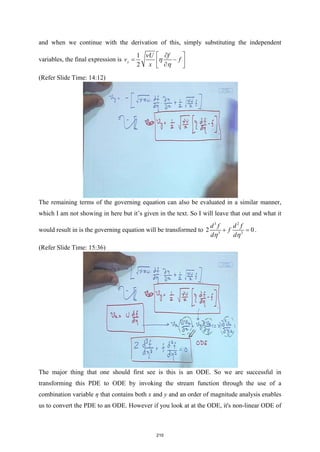
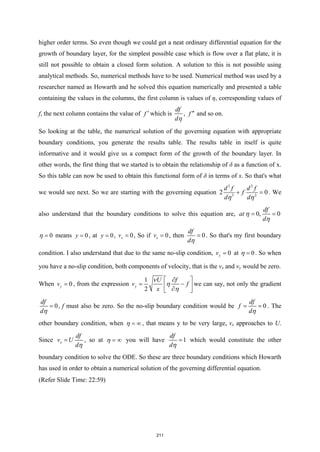
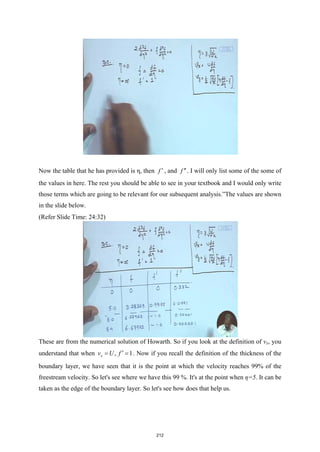
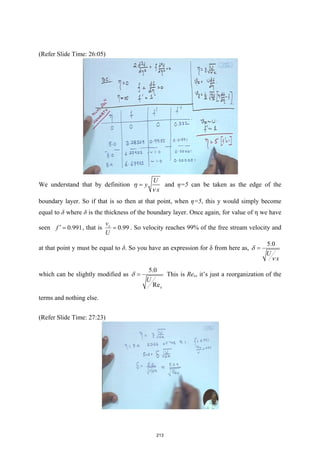
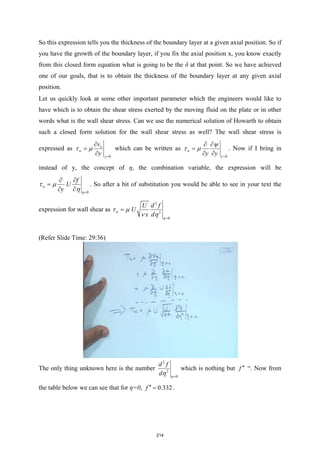
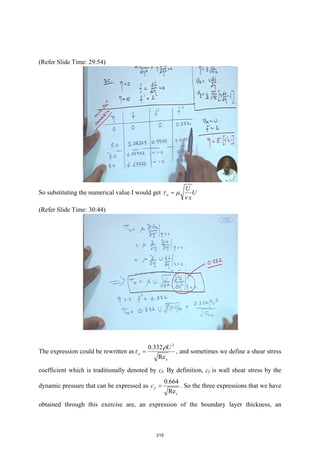
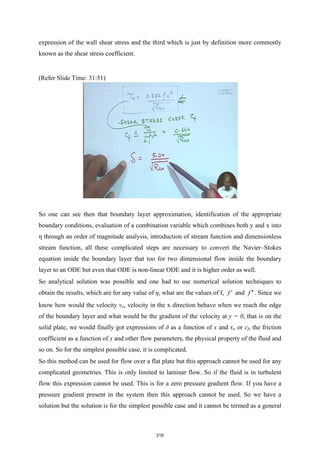
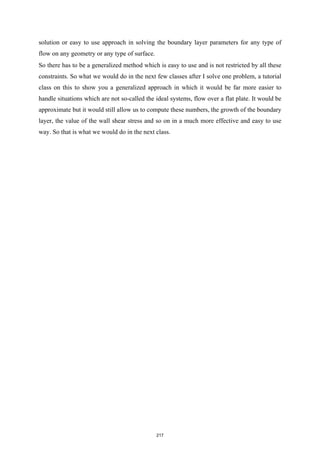
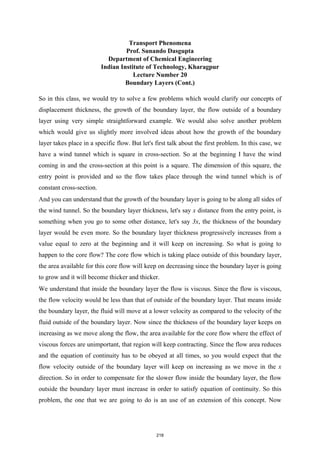
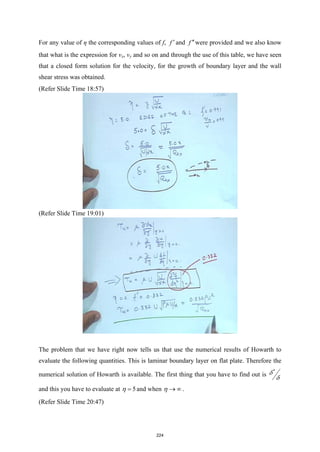
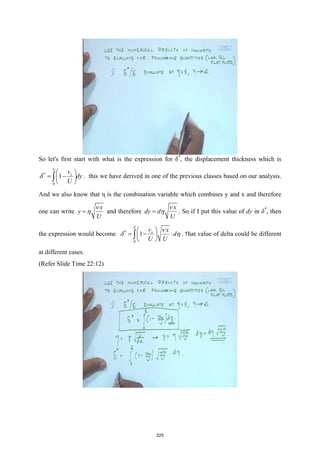
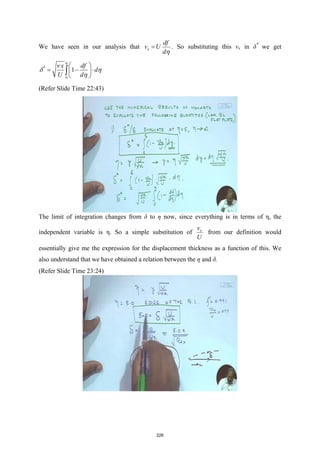
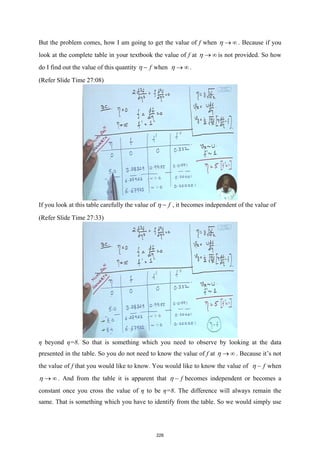
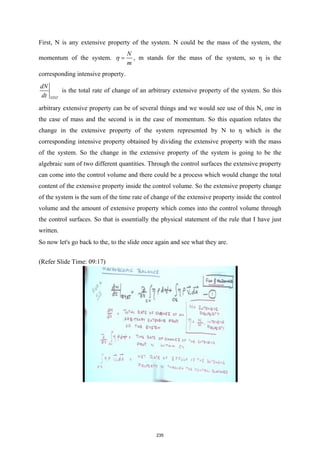
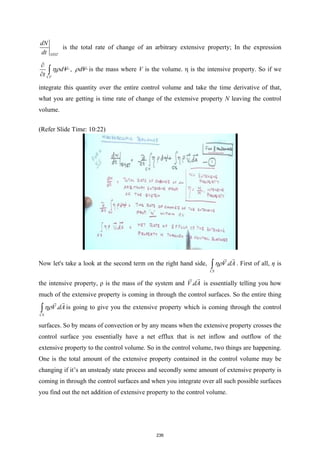
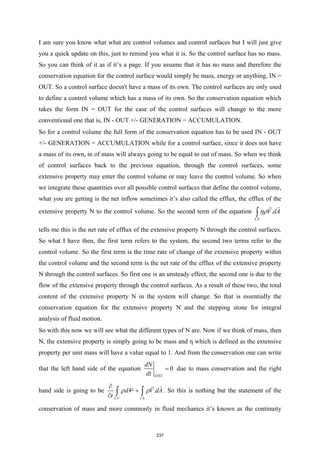
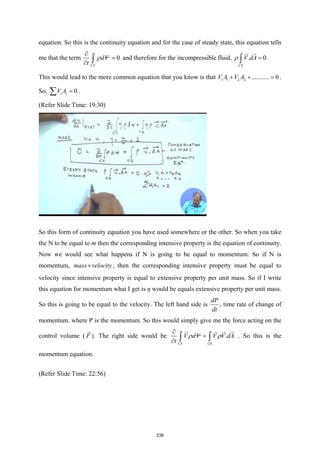
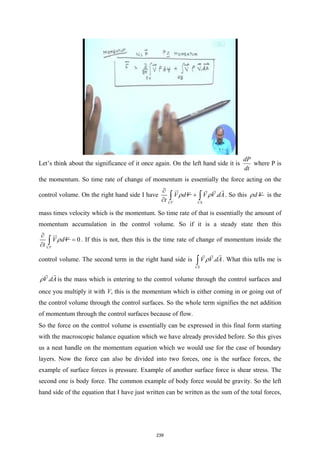
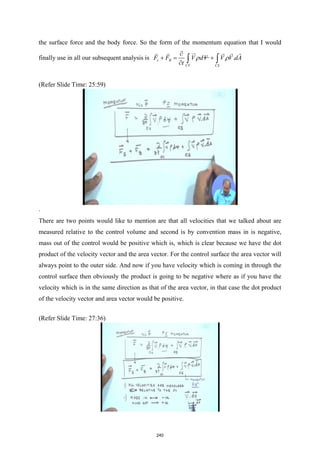
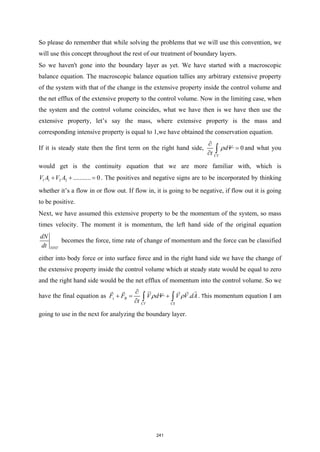
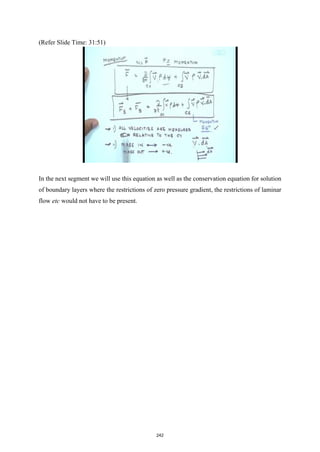
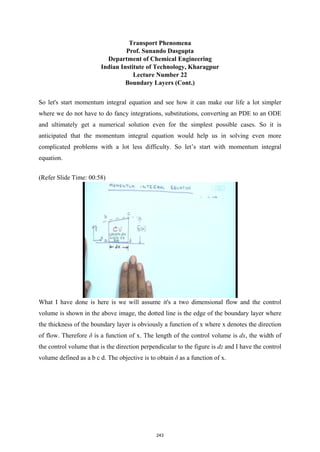
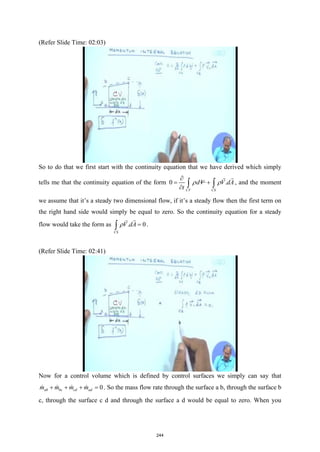
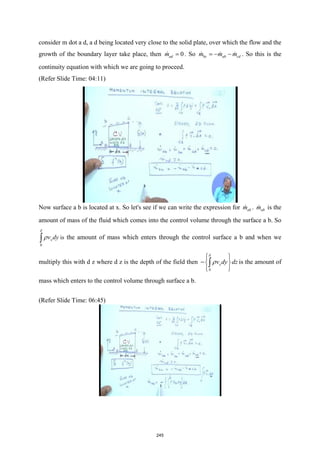
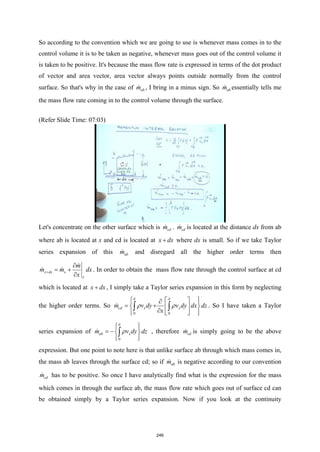
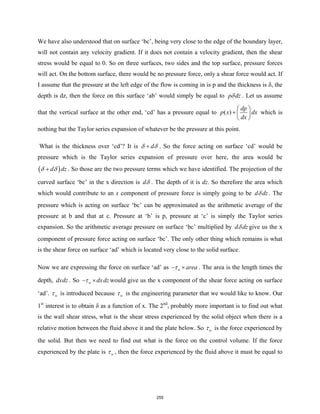
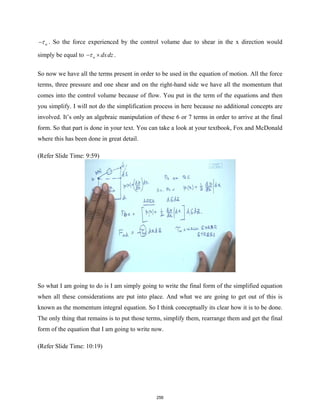
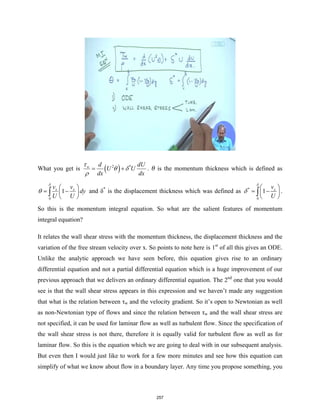
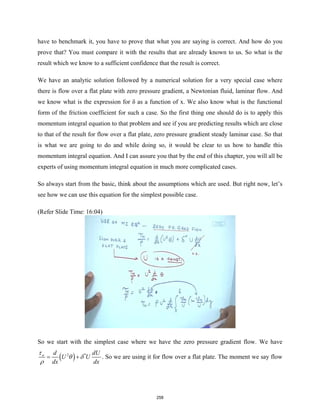
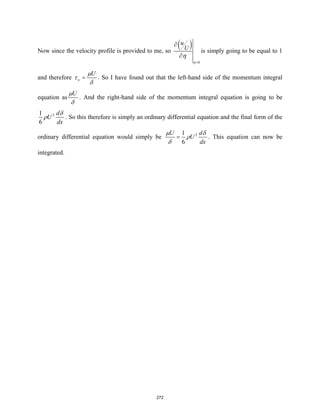
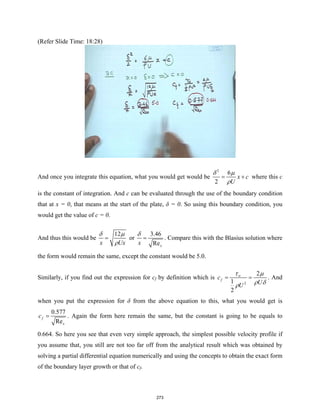
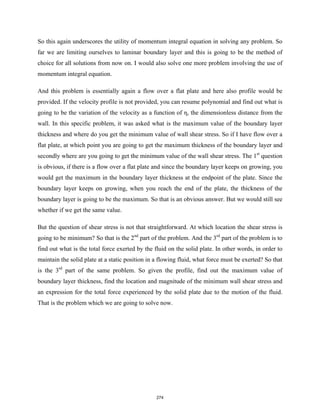
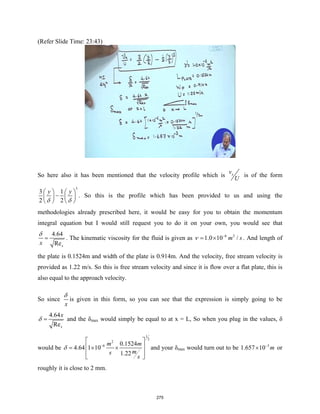
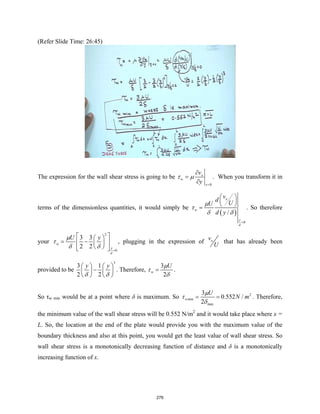
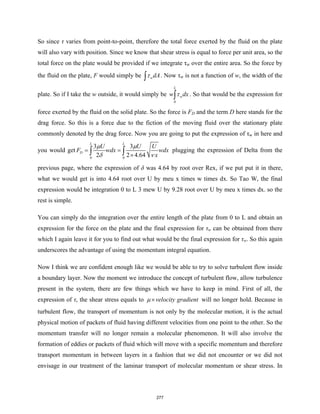
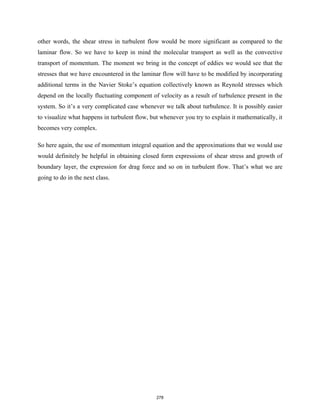
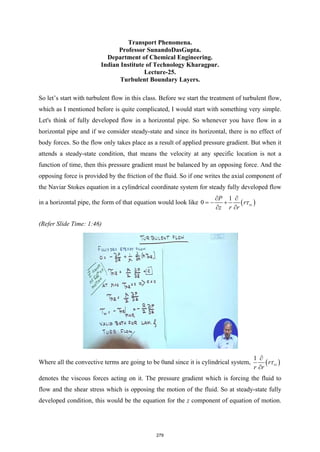
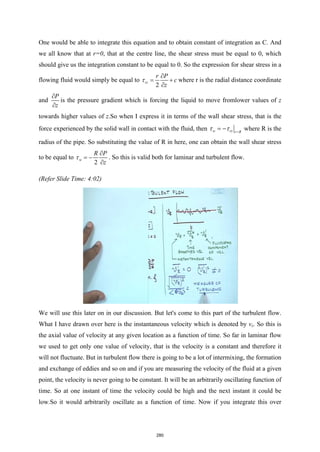
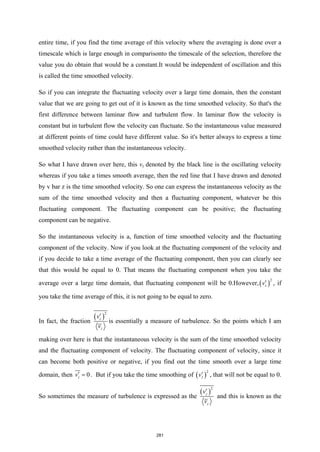
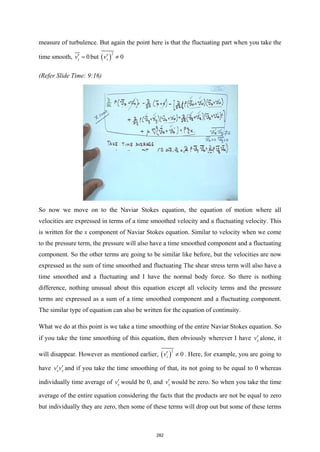
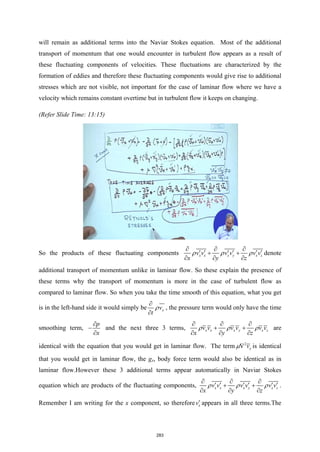
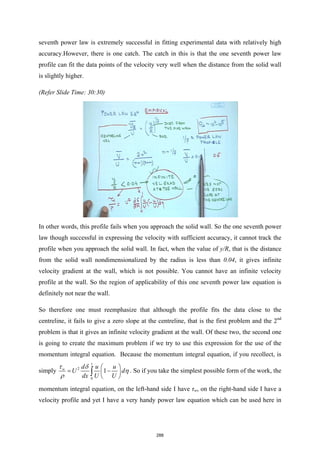
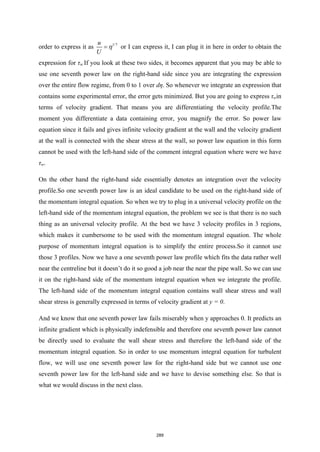
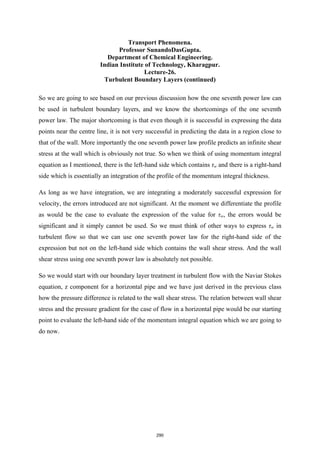
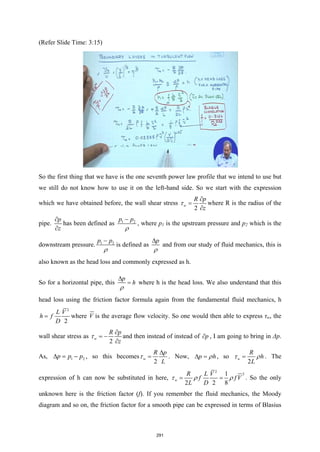
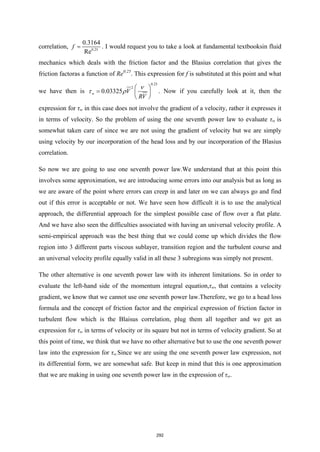
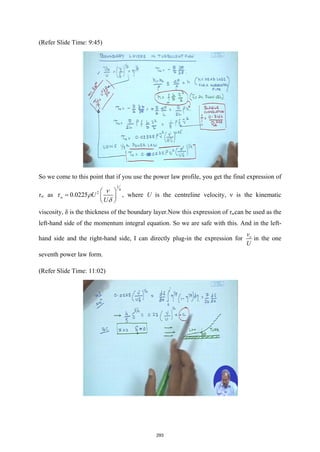
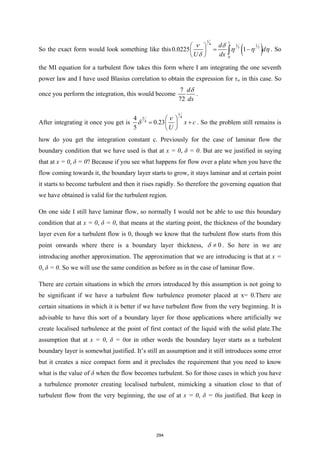
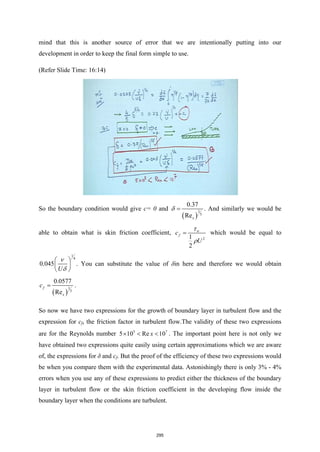
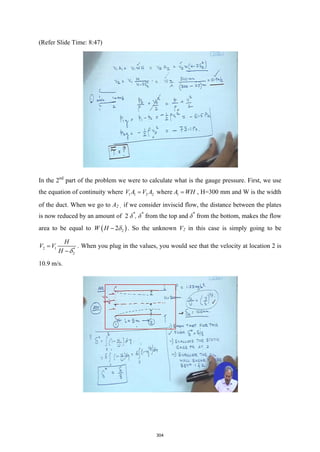
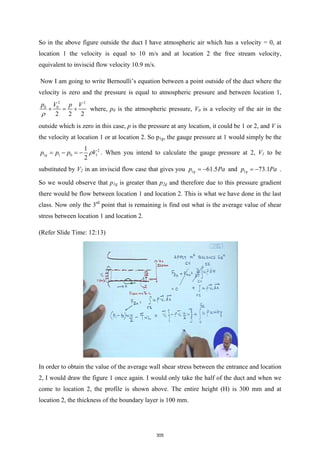
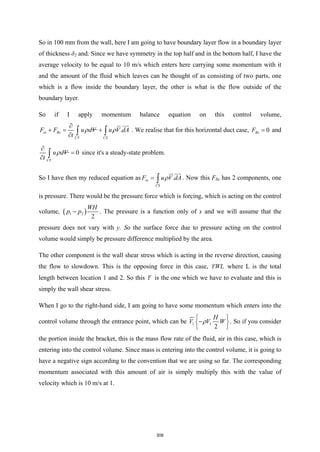
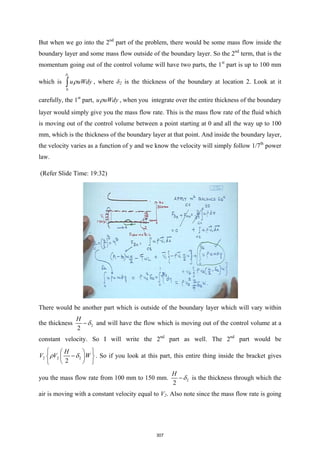
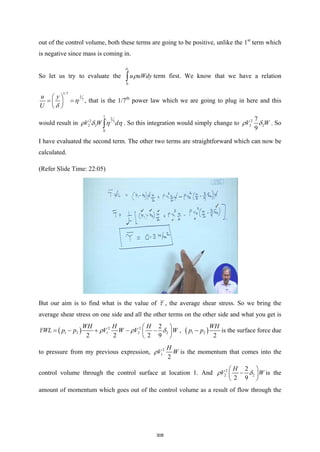
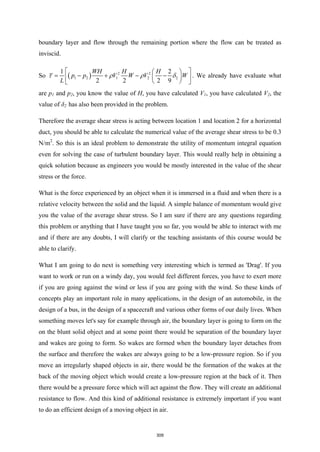
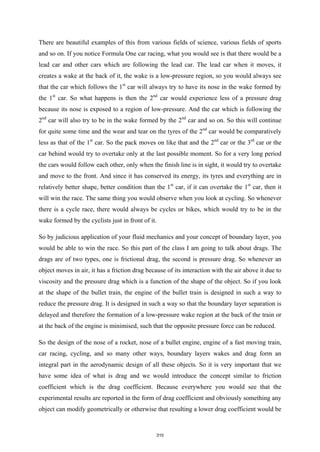
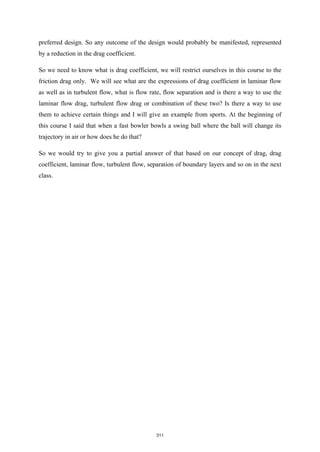
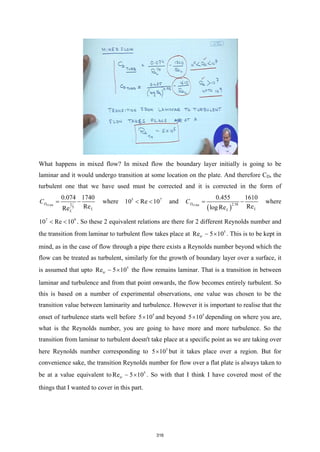
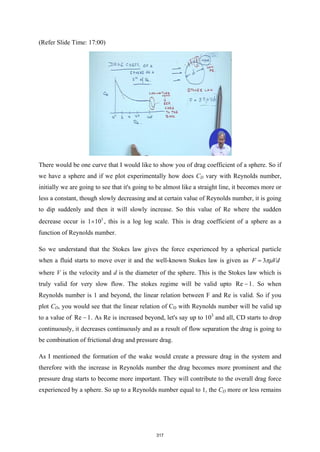
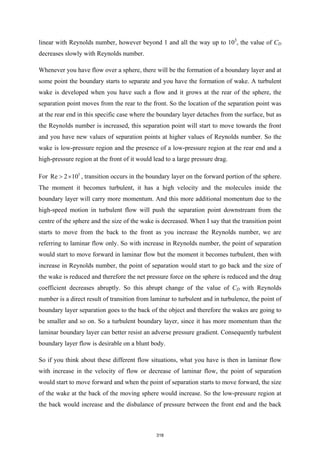
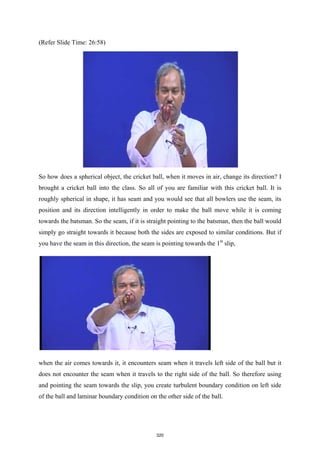
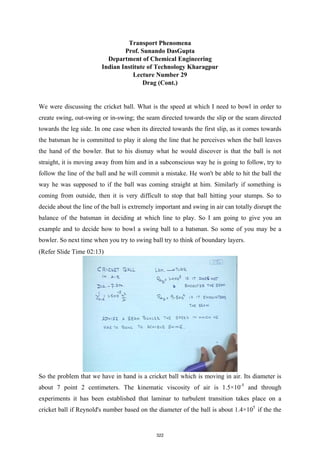
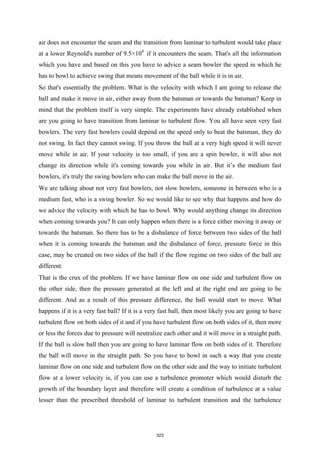
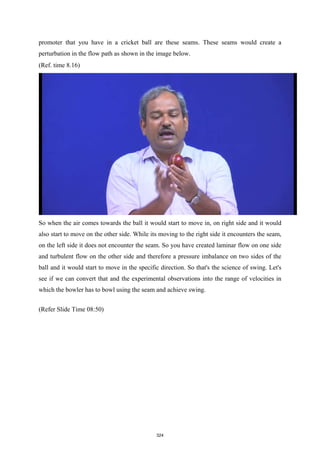
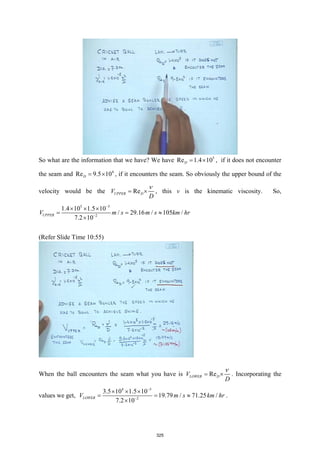
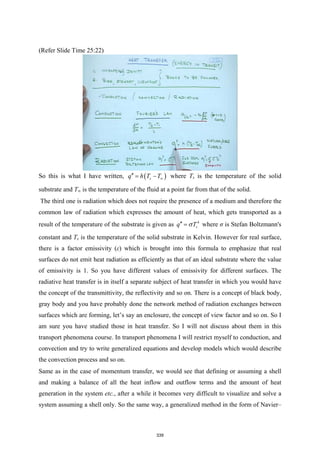
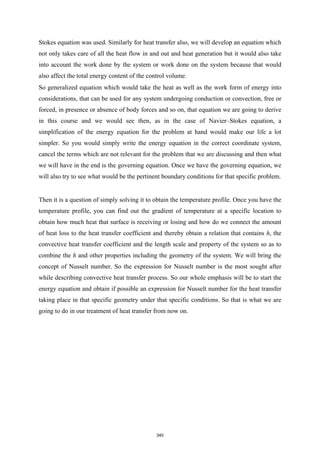
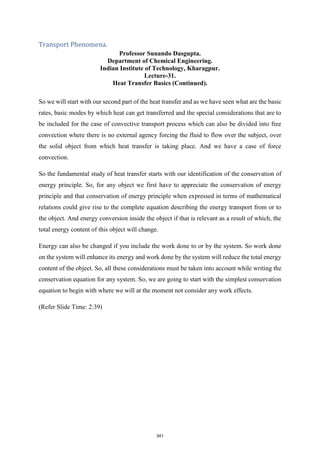
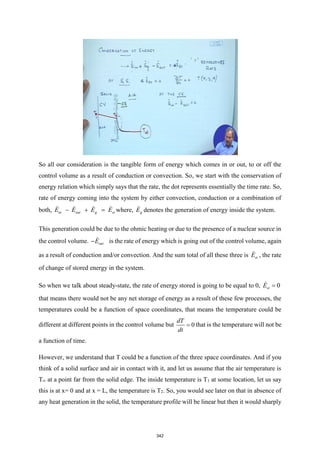
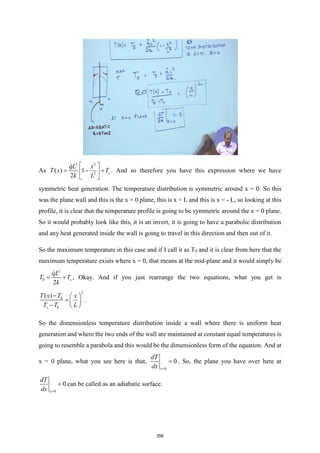
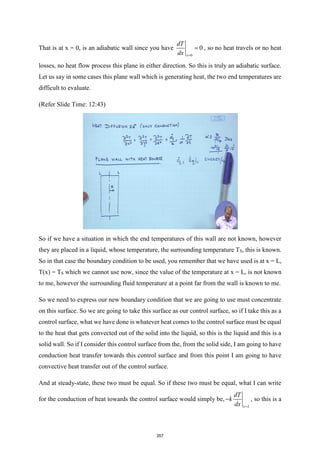
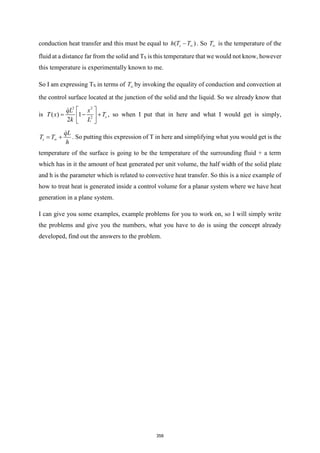
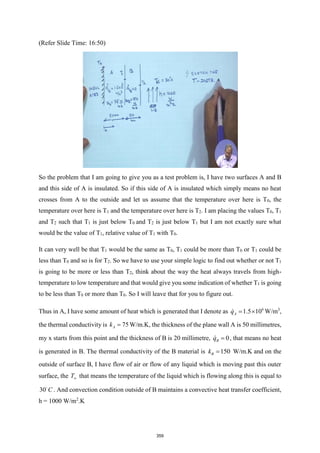
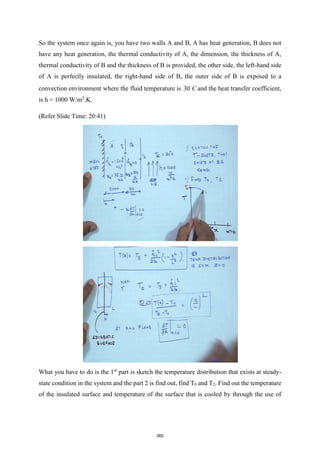
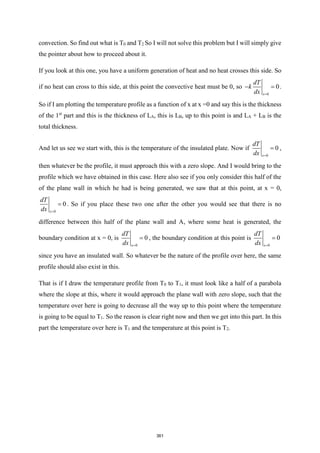
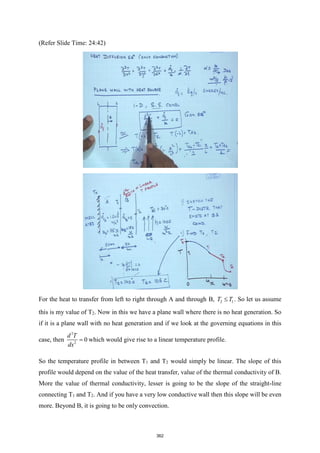
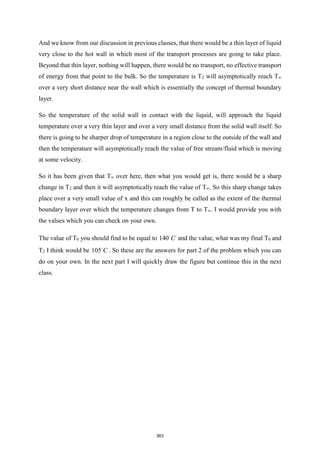
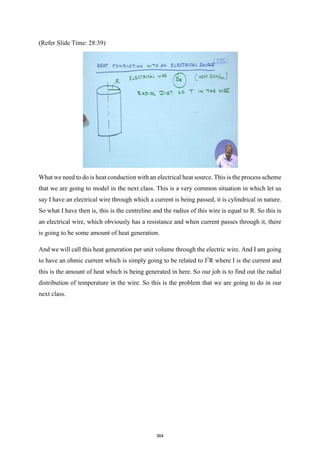
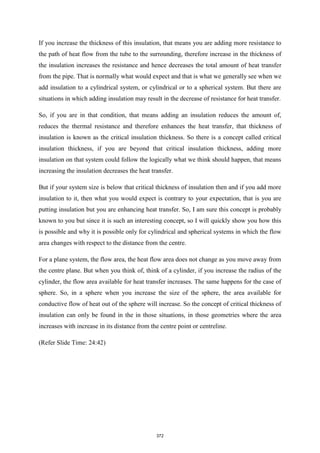
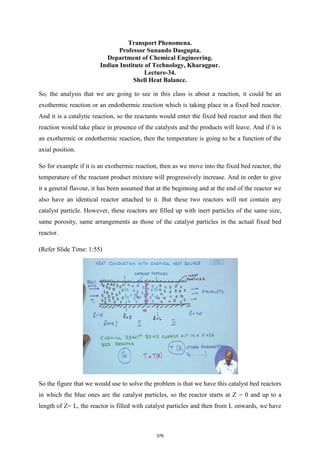
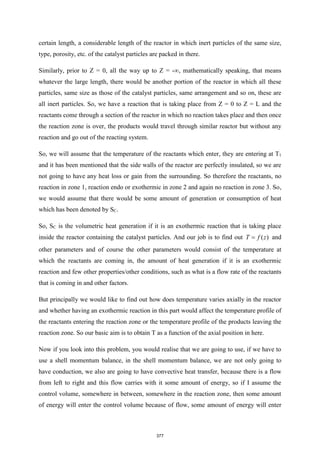
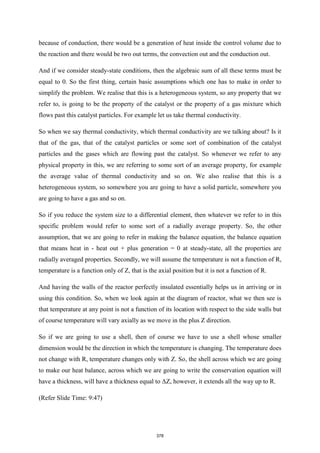
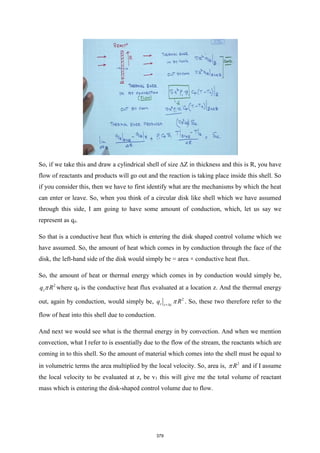
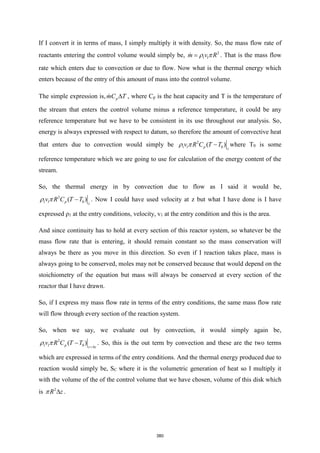
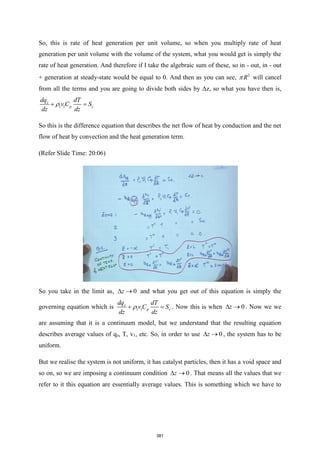
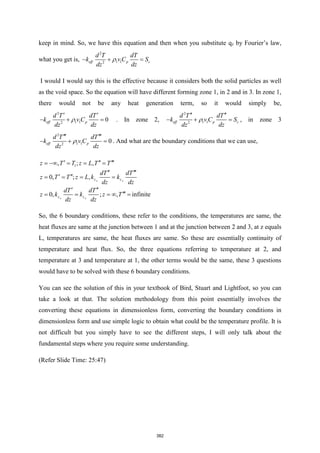
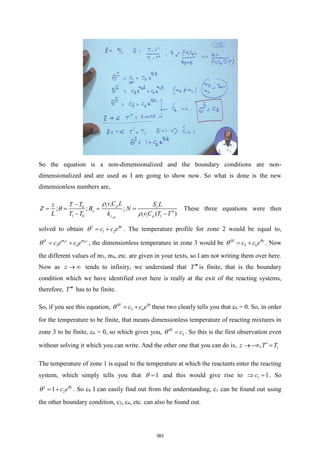
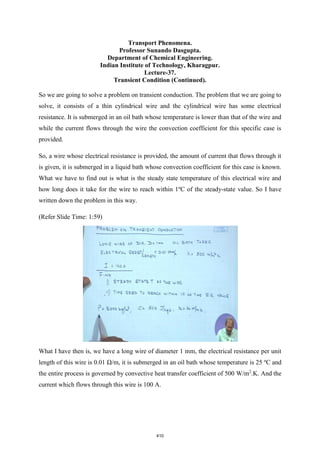
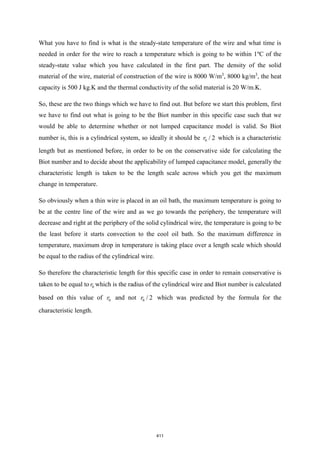
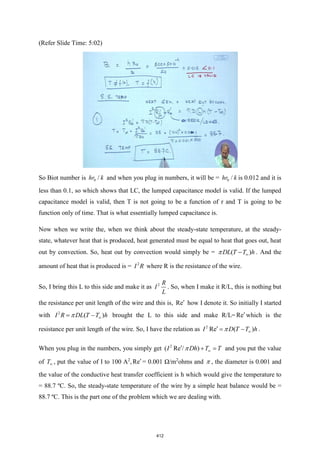
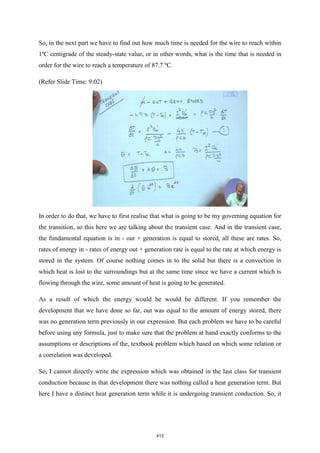
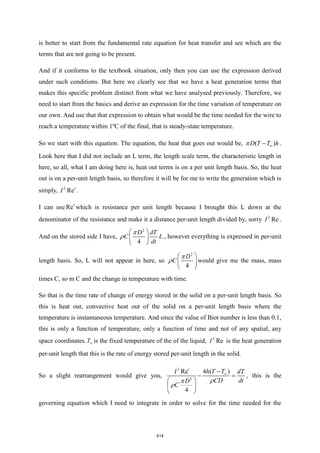
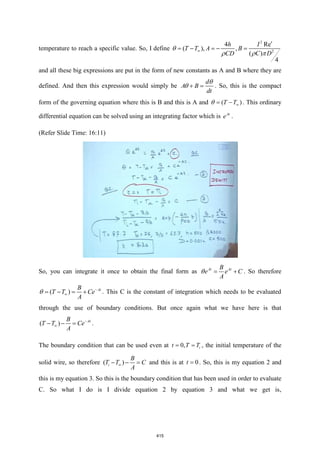
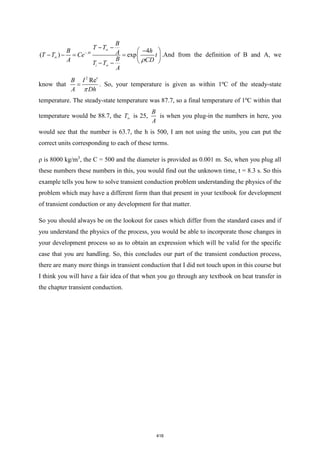
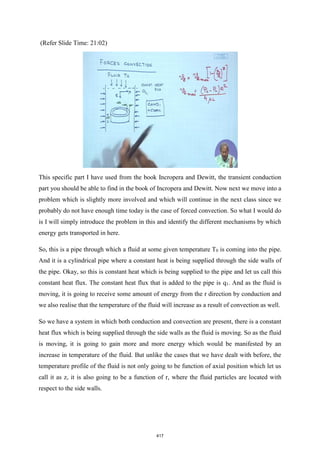
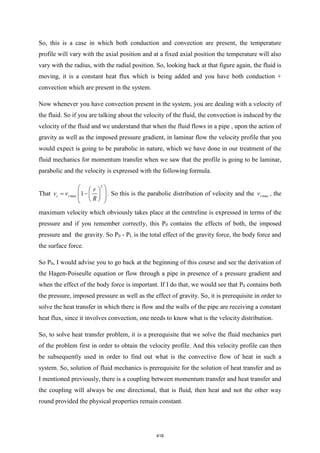
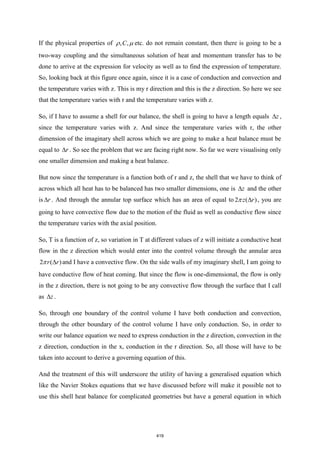
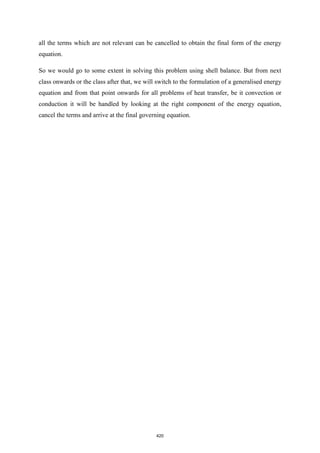
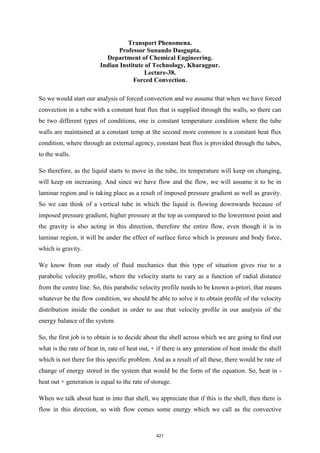
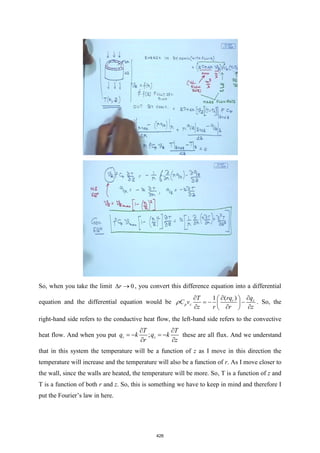
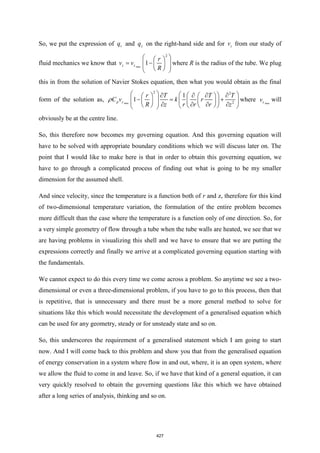
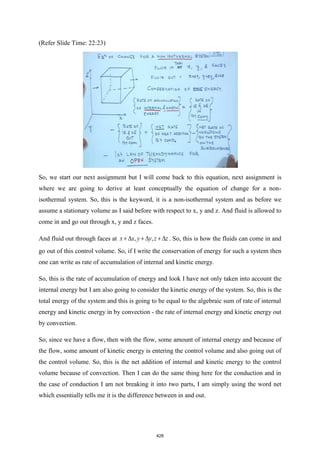
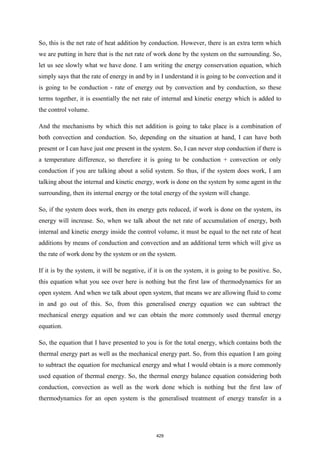
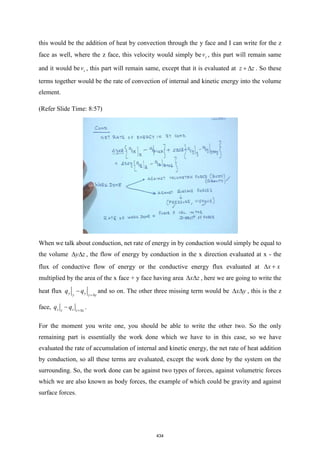
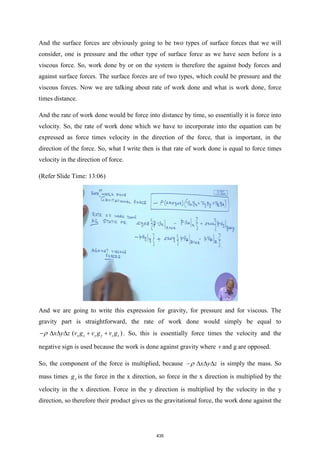
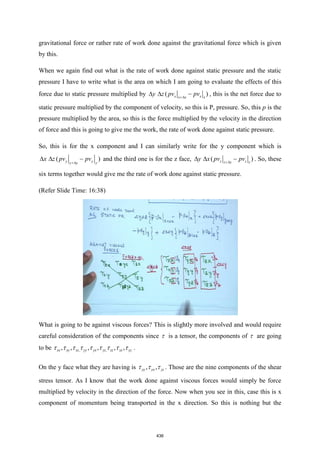
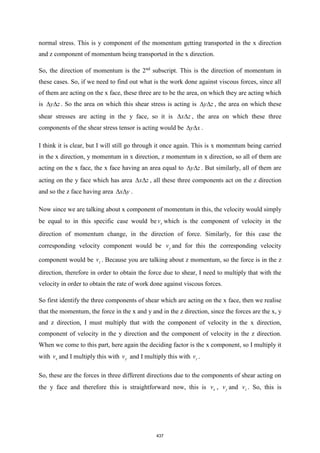
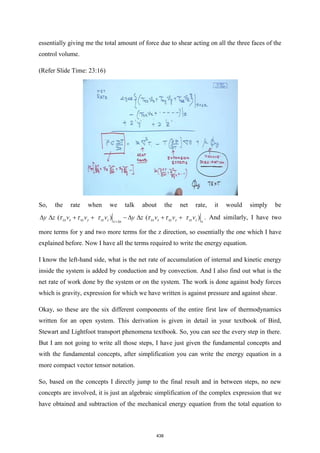
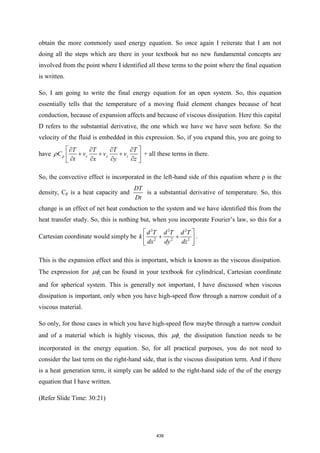
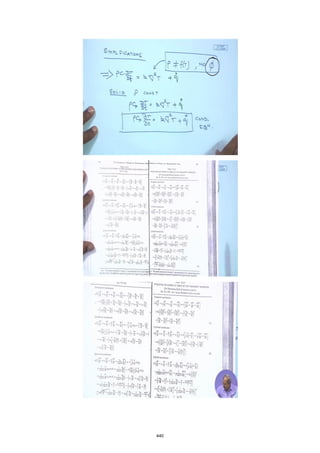
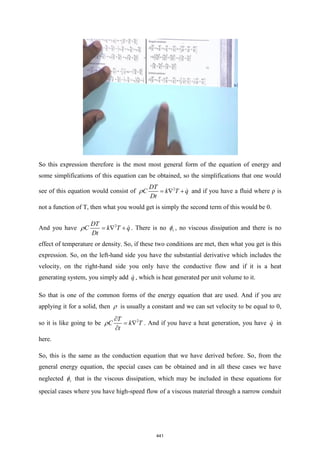
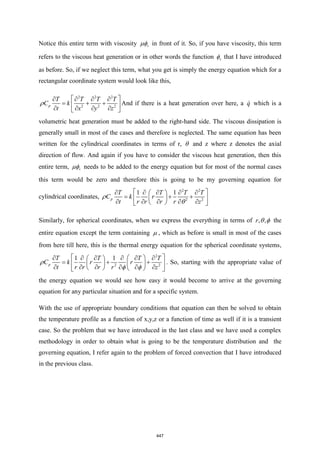
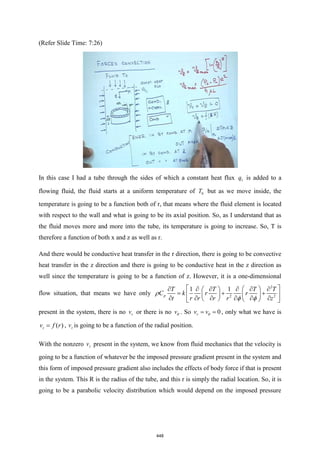
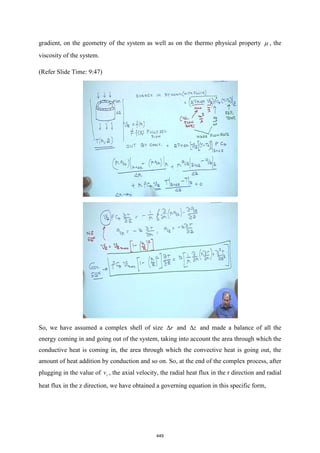
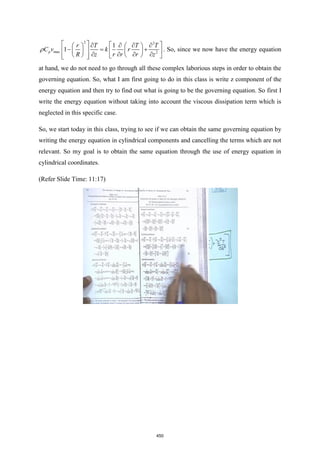
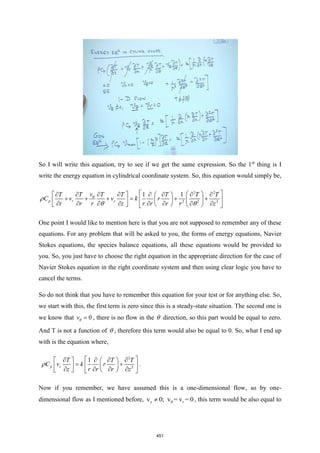
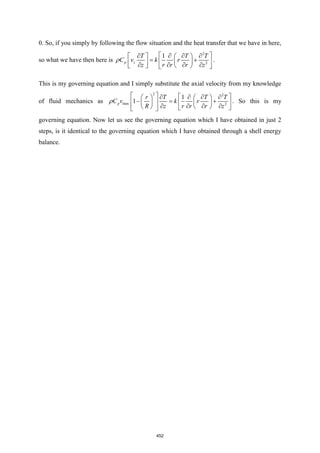
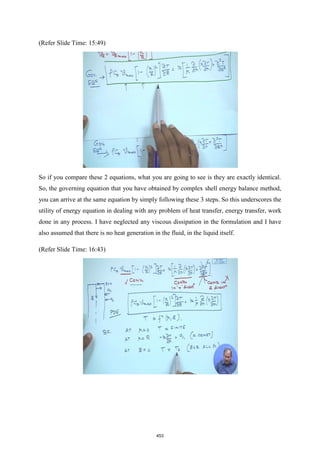
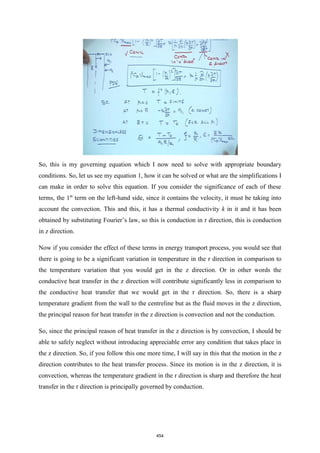
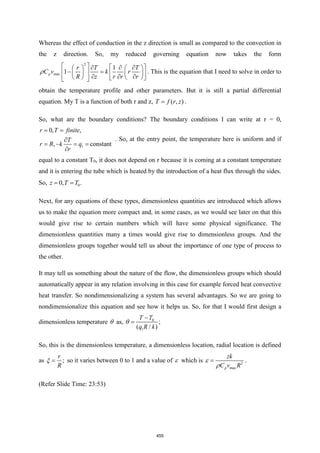
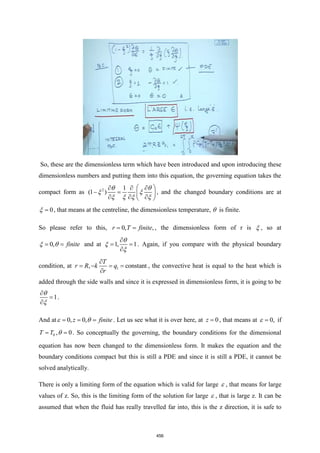
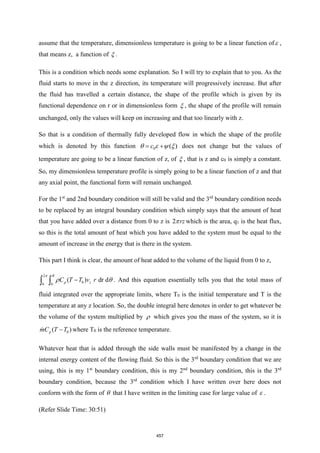
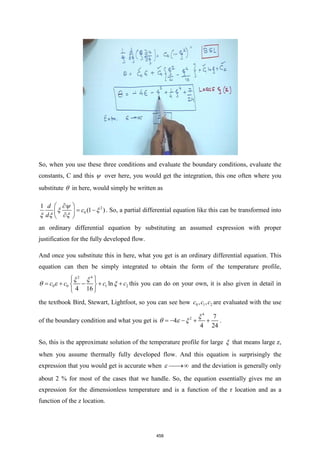
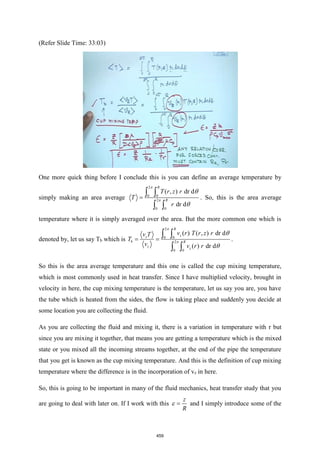
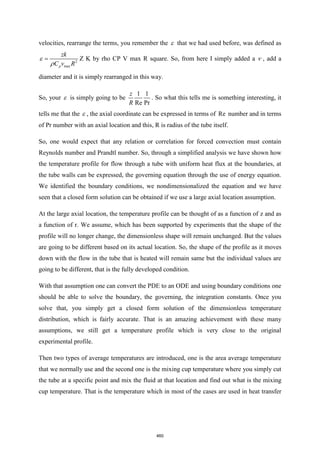
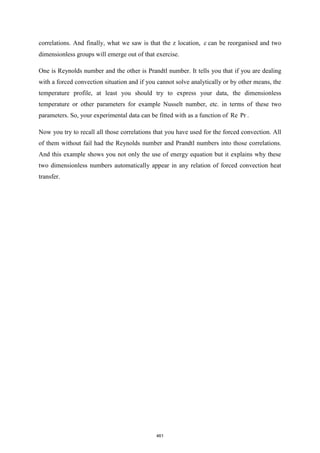
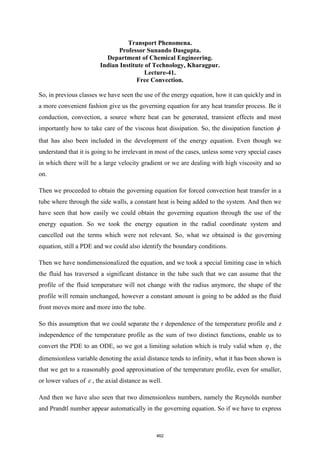
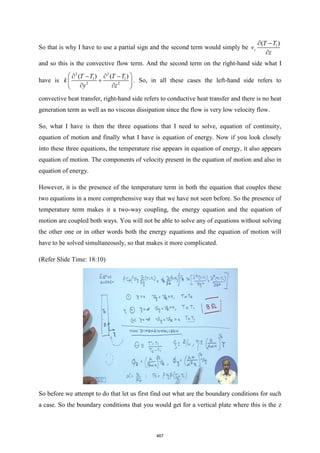
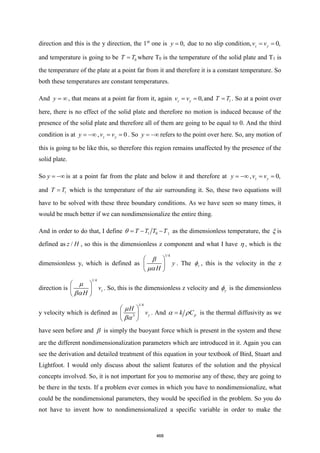
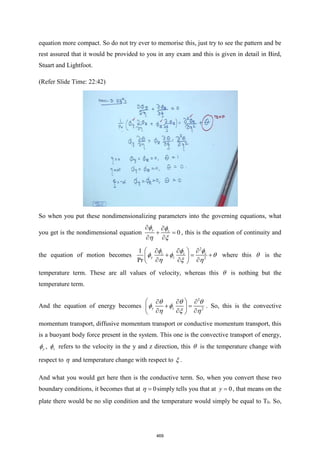
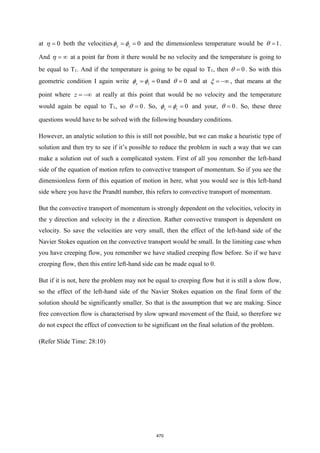
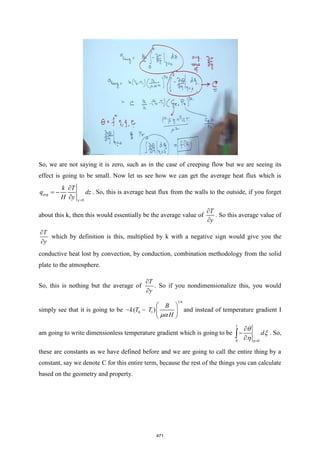
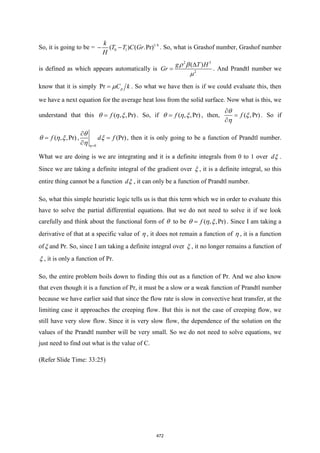
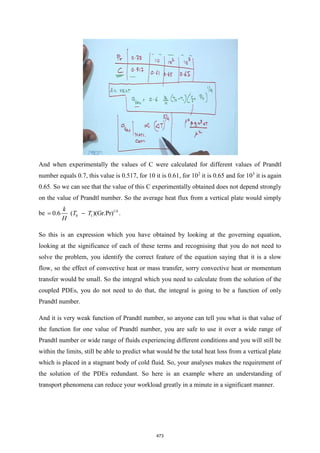
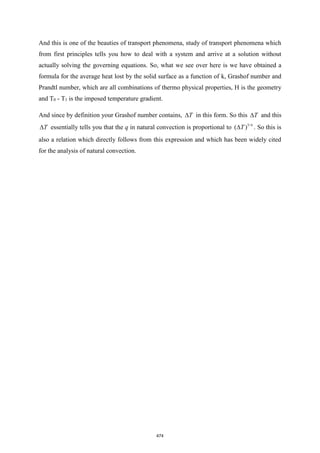
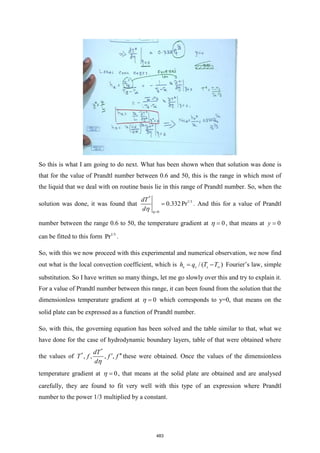
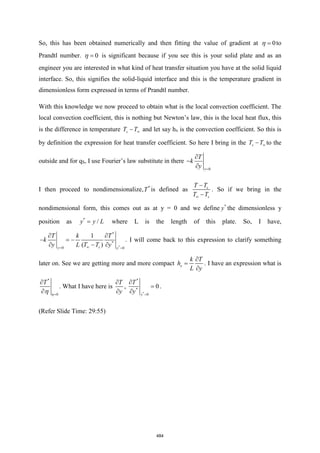
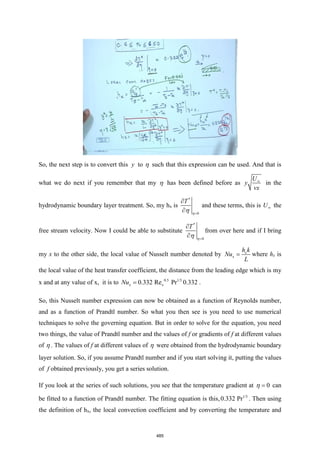
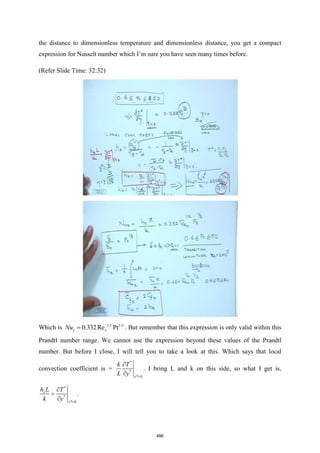
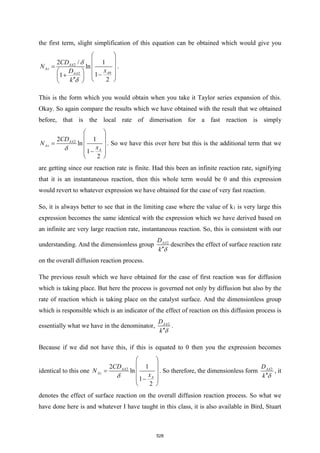
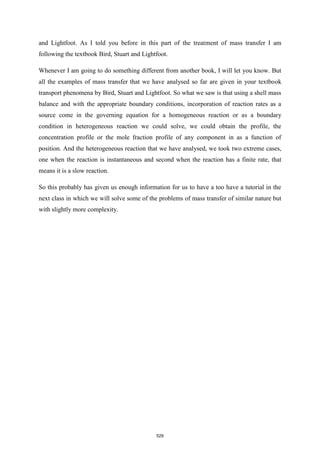
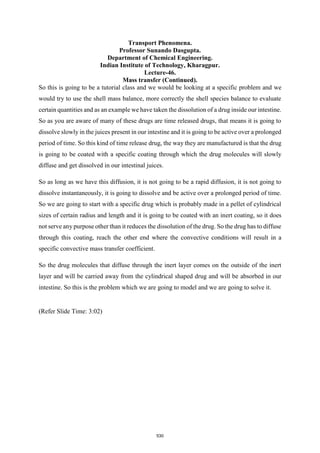
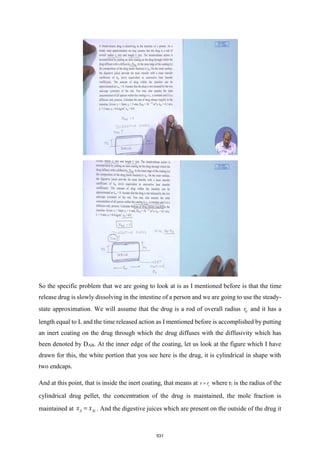
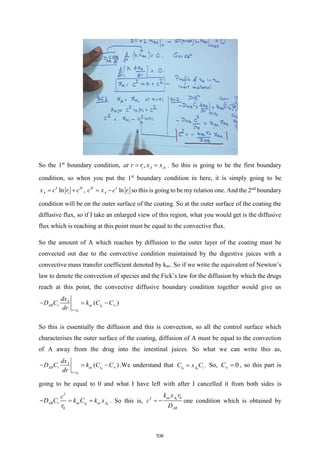
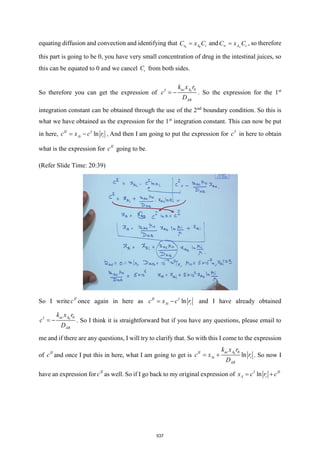
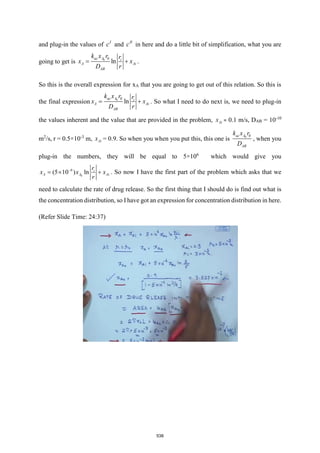
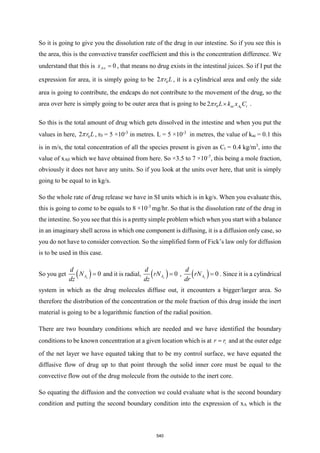
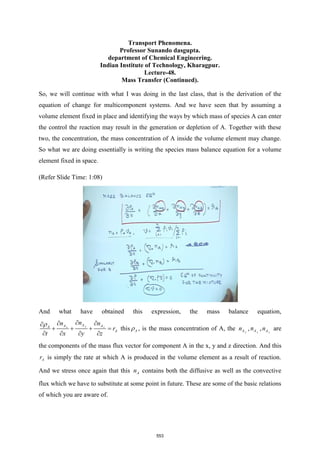
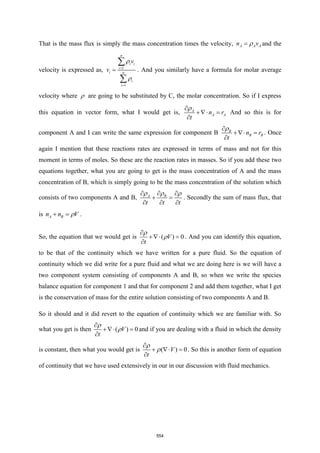
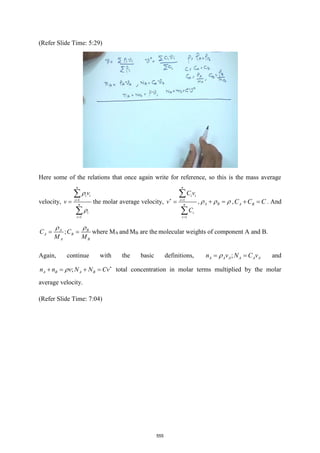
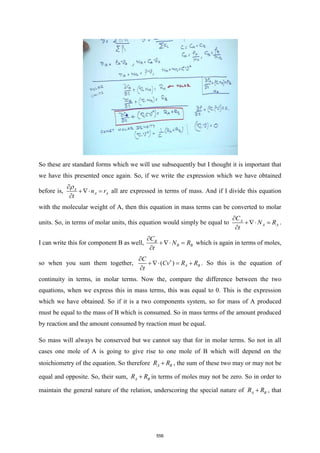
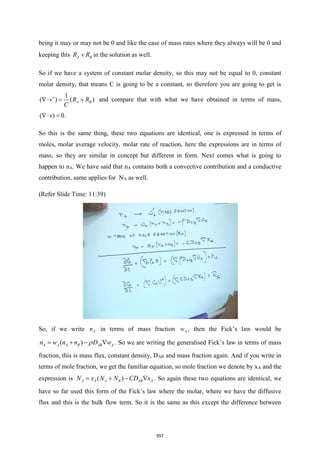
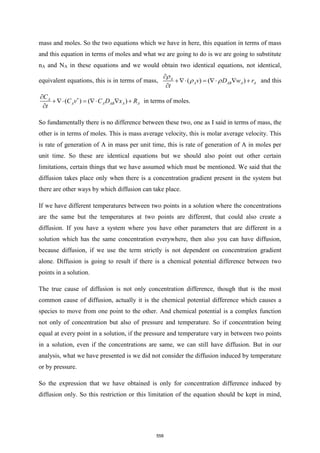
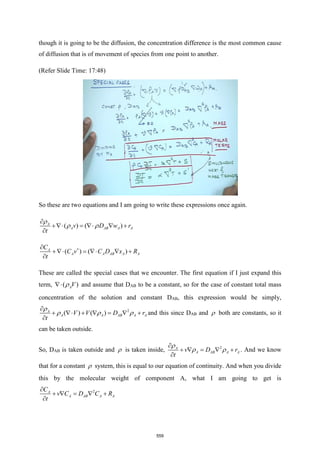
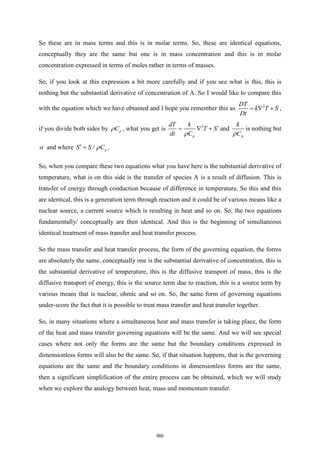
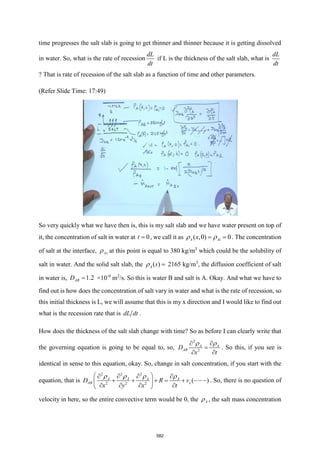
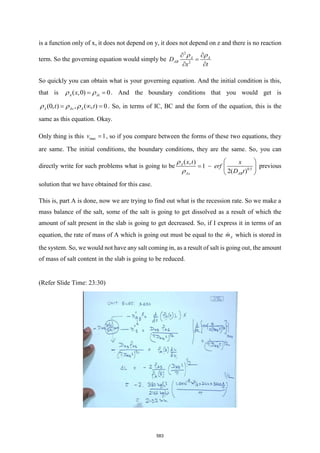
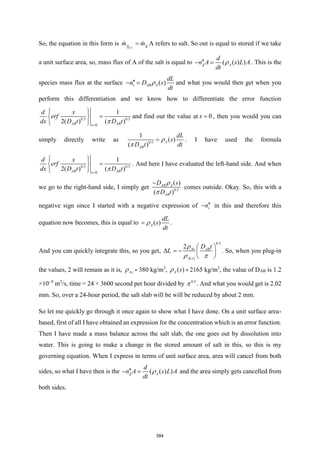
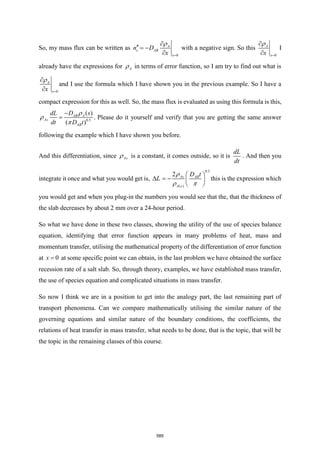
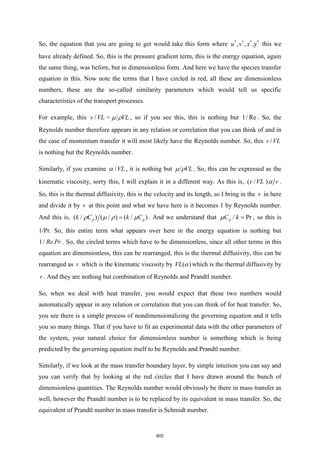
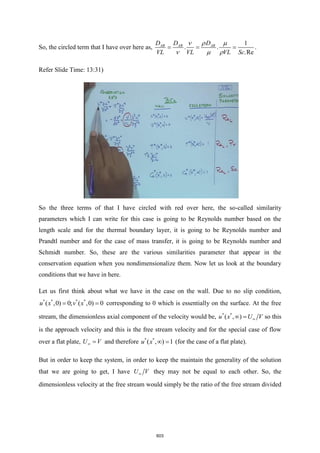
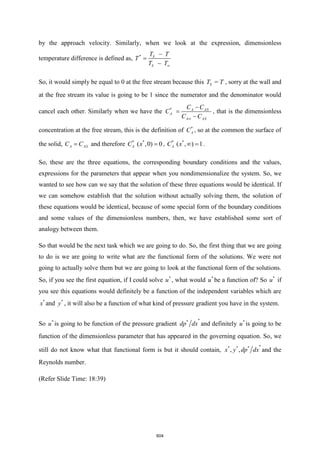
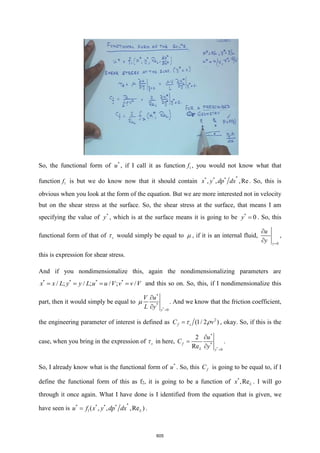
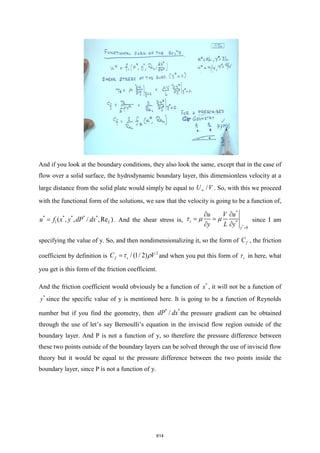
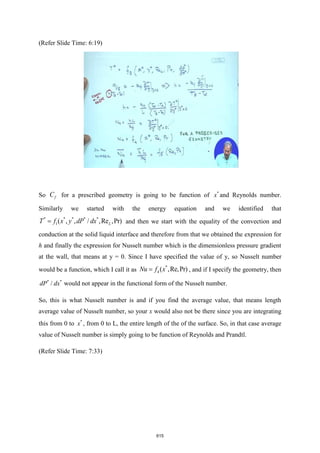
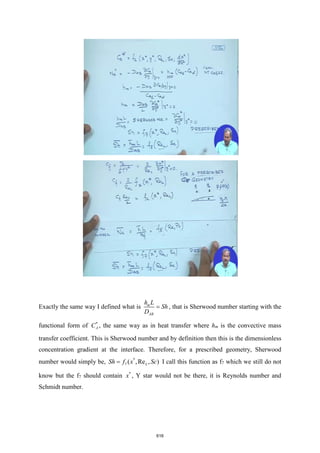
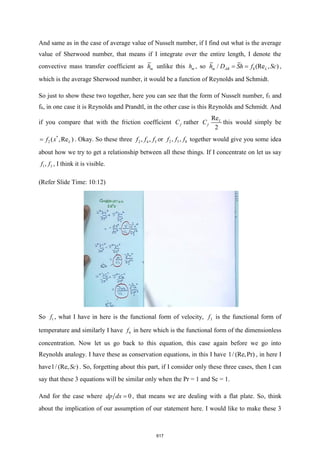
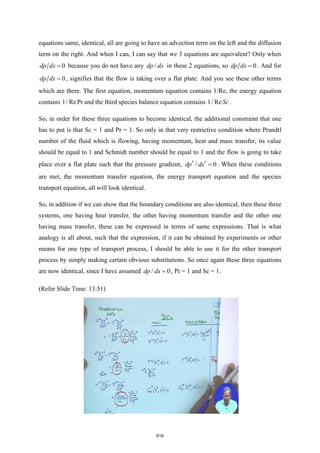
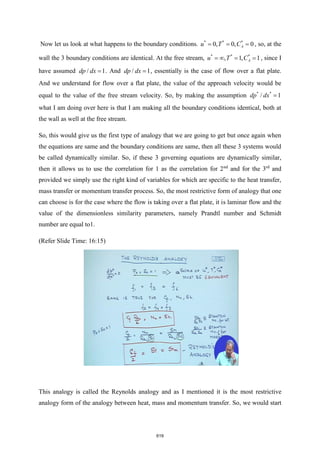
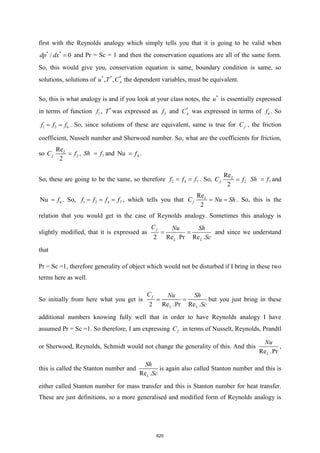
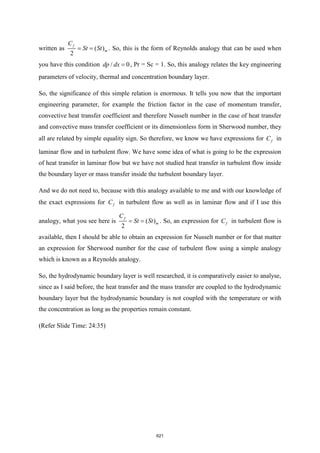
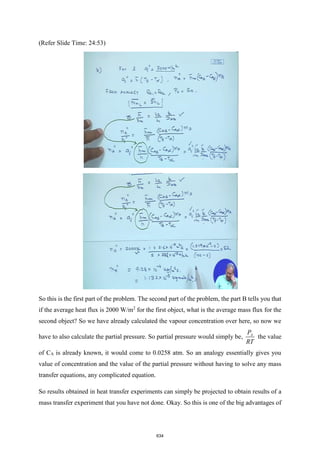
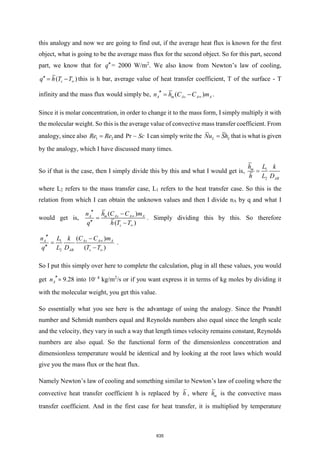
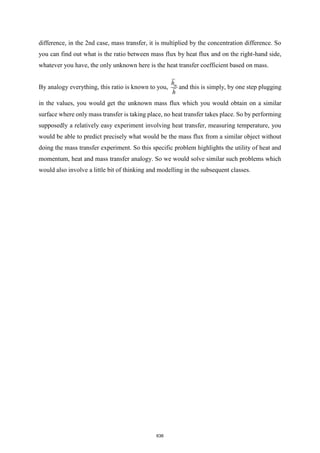
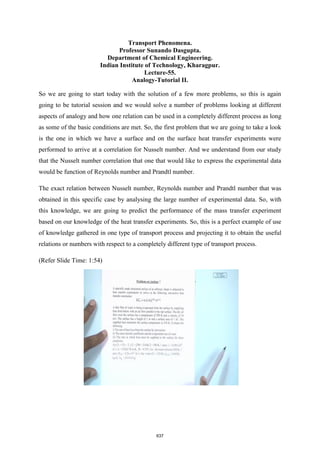
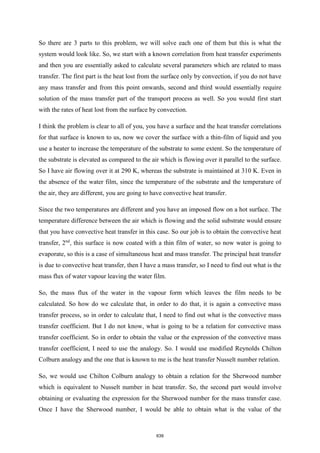
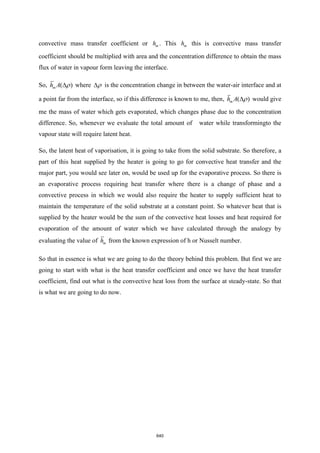
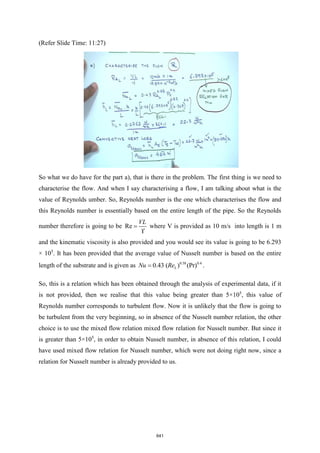
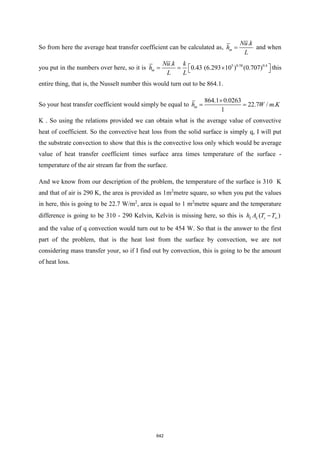
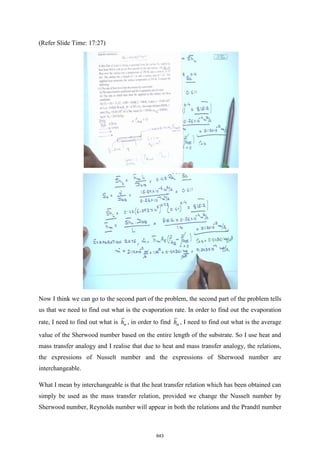
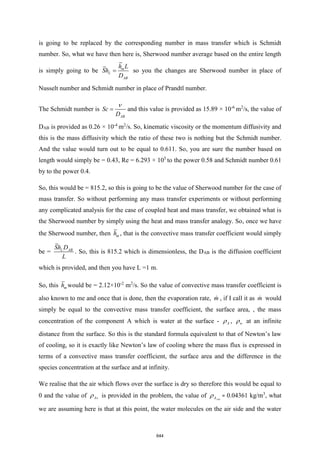
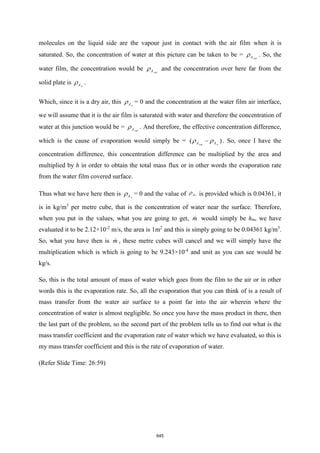
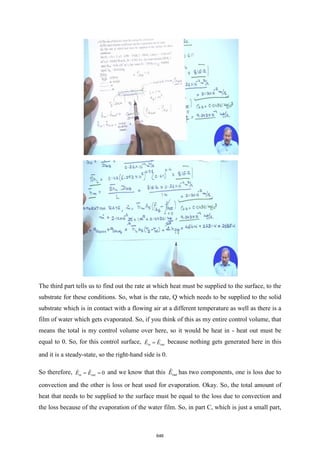
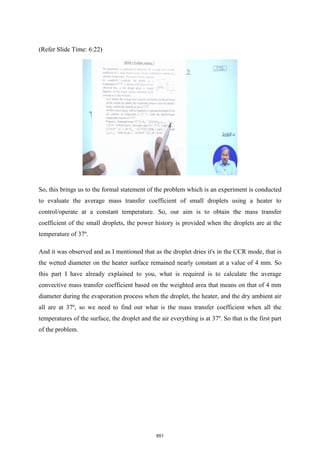
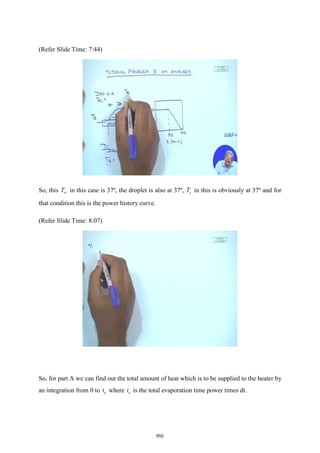
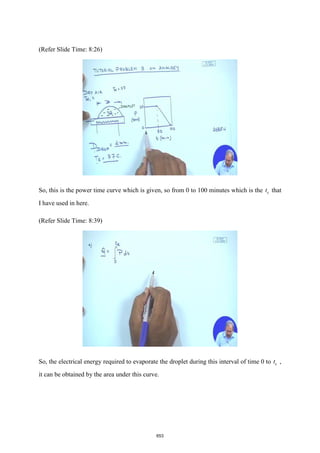
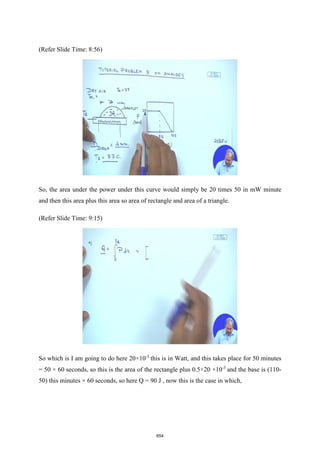
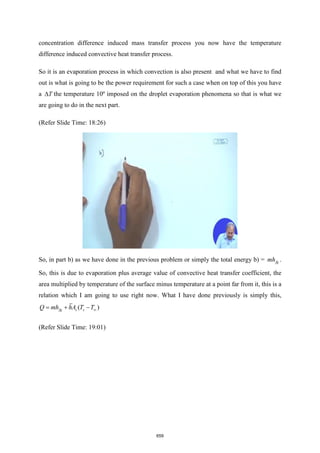
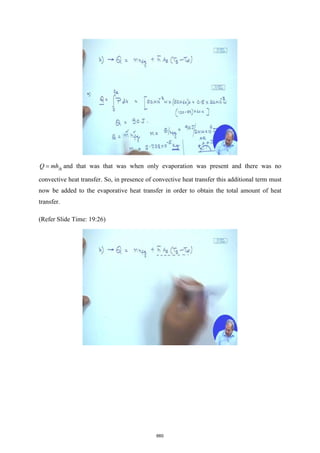
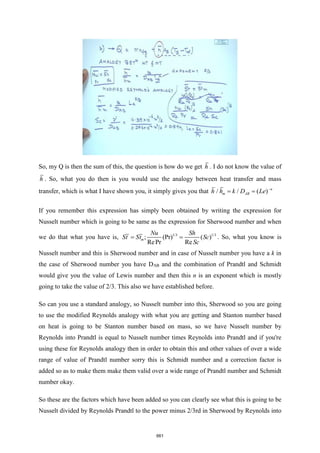
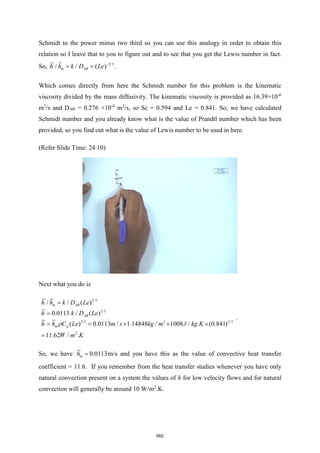
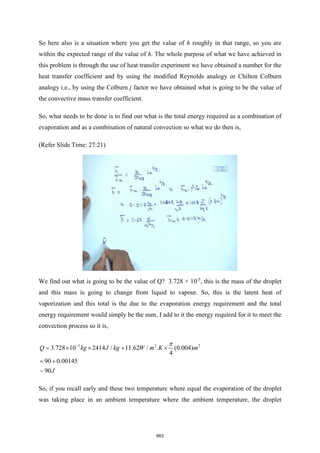
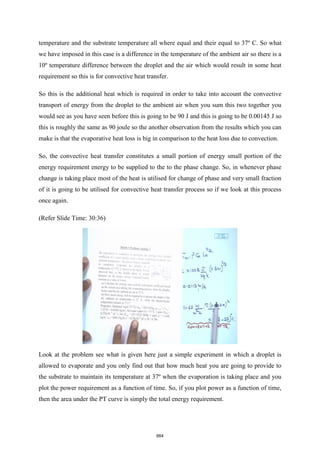
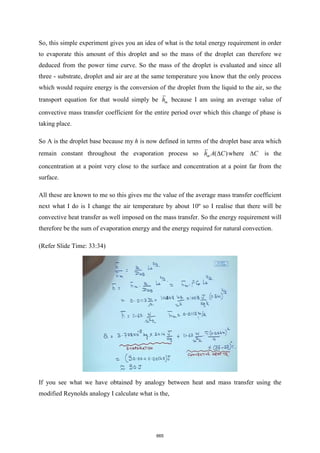
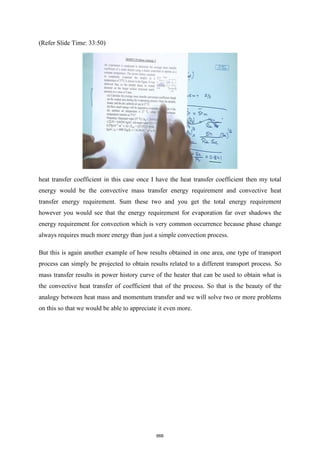
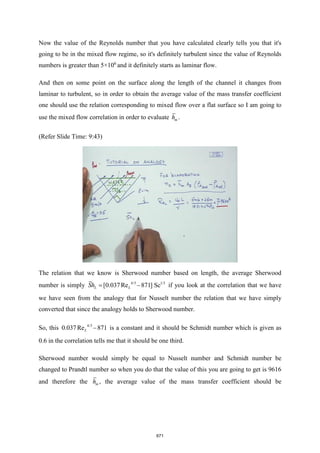
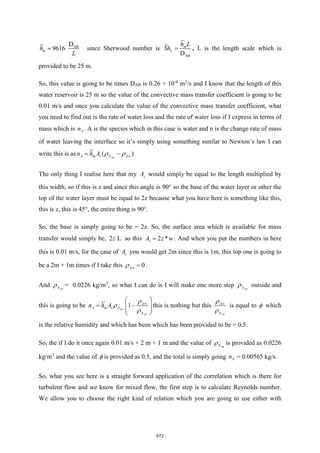
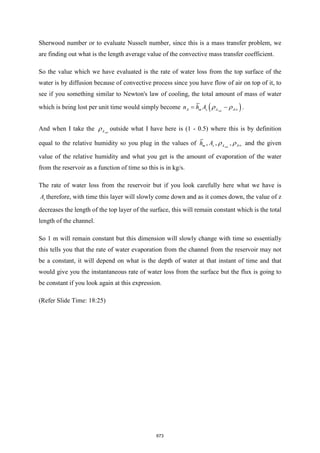
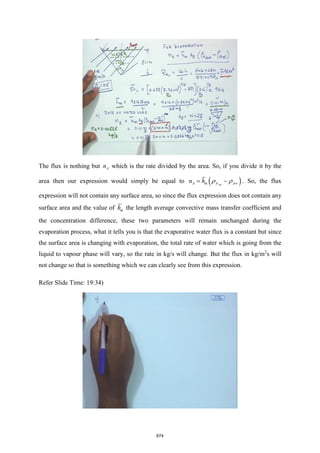
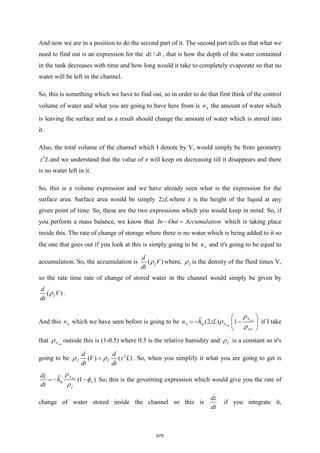
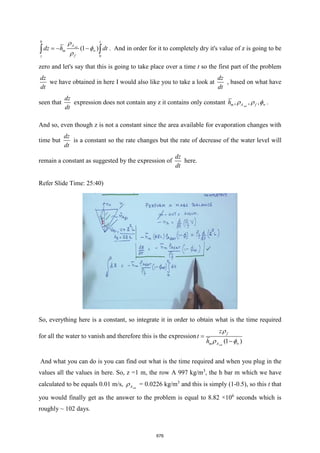
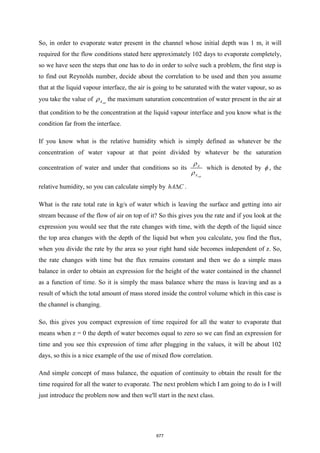
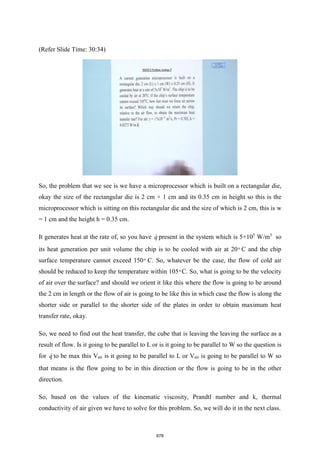
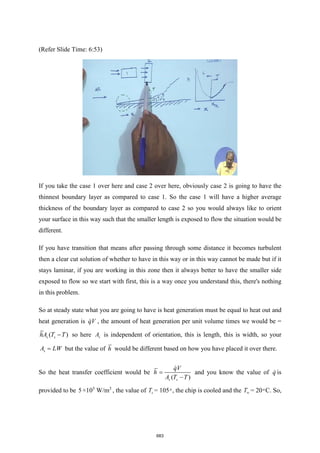
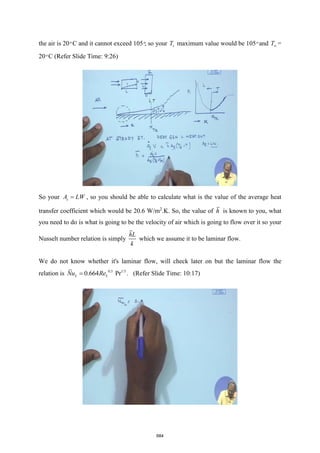
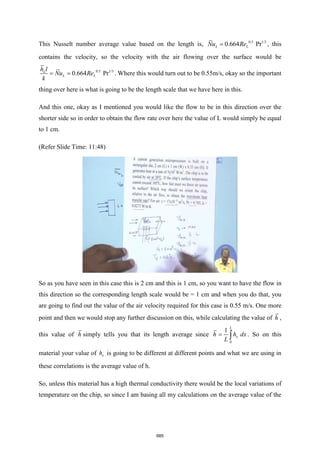
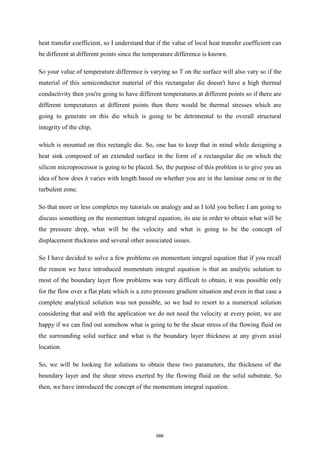
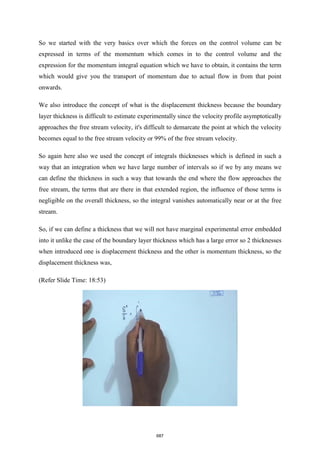
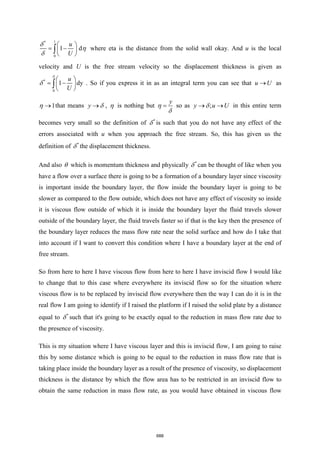
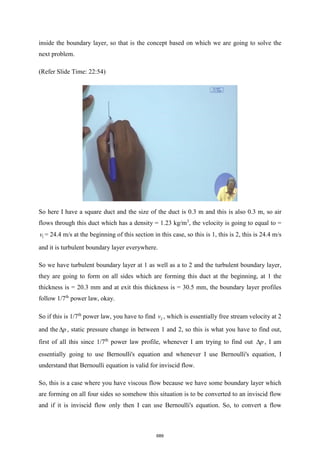
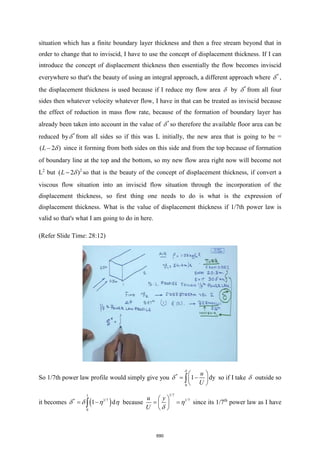
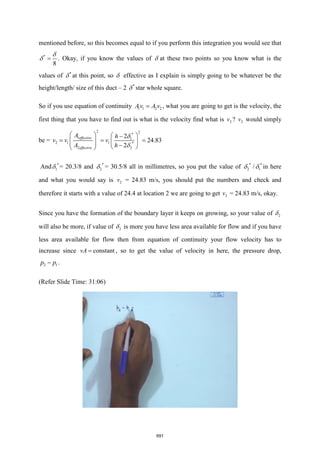
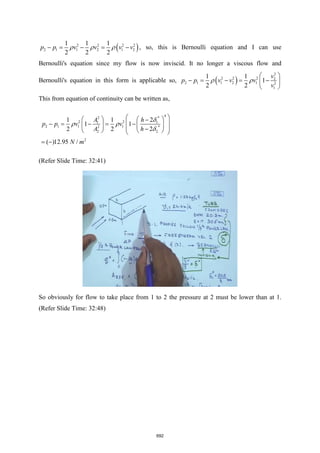
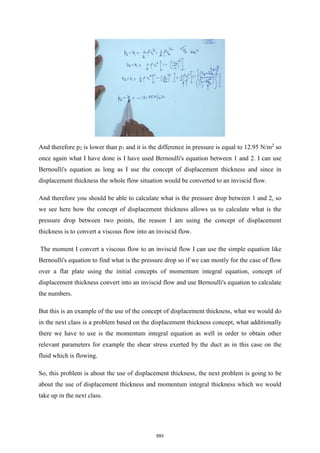
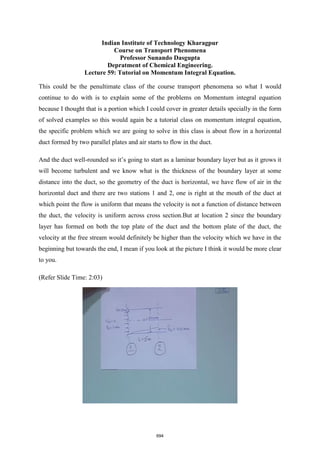
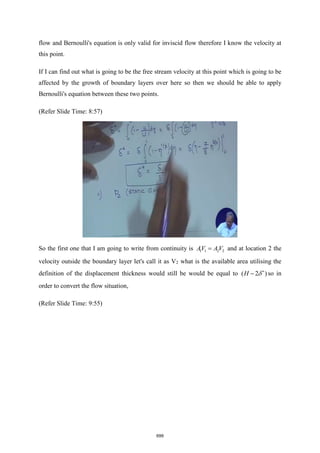
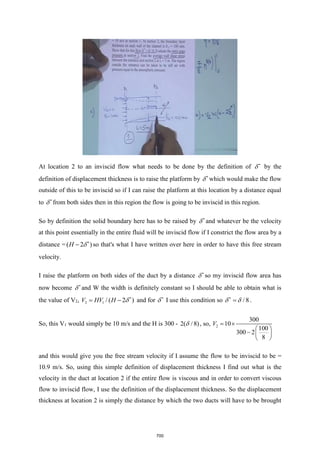
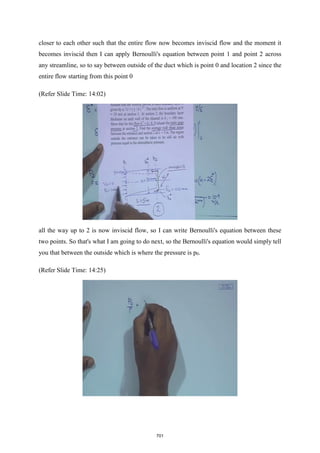
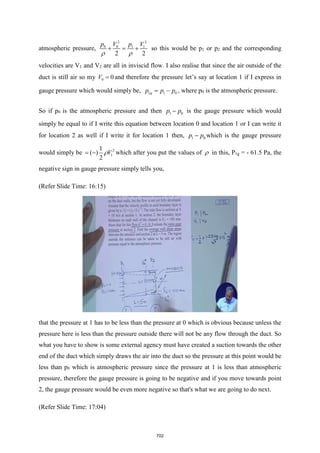
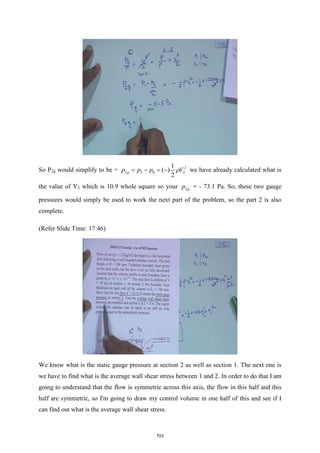
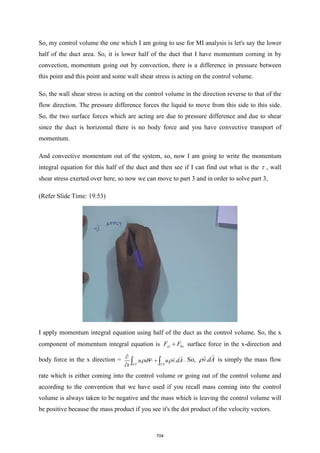
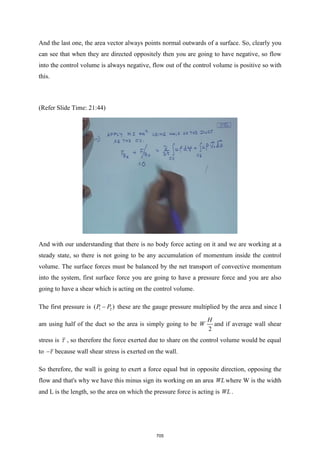
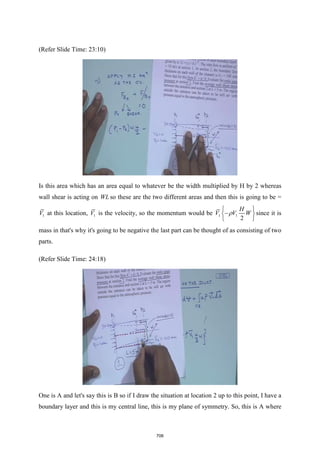
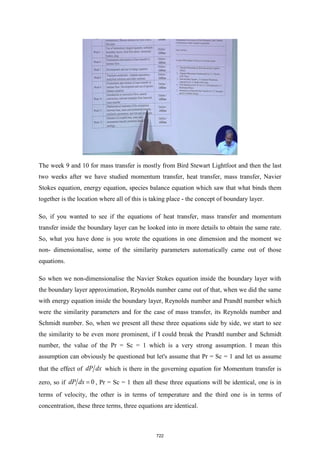
INDEX
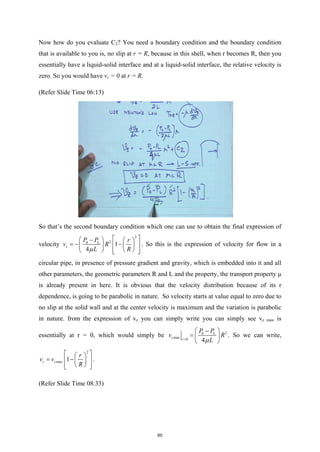
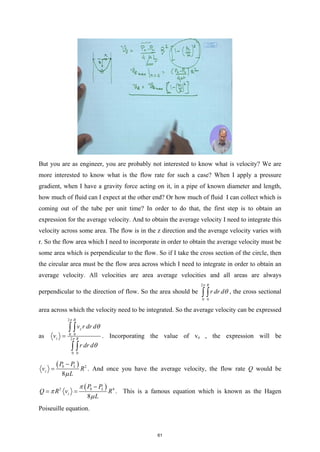
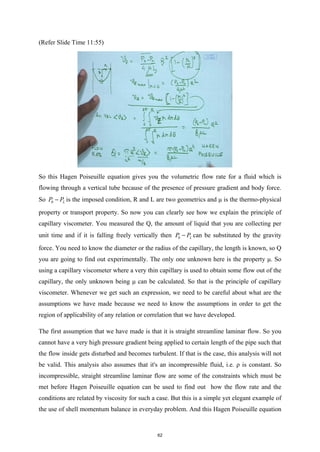
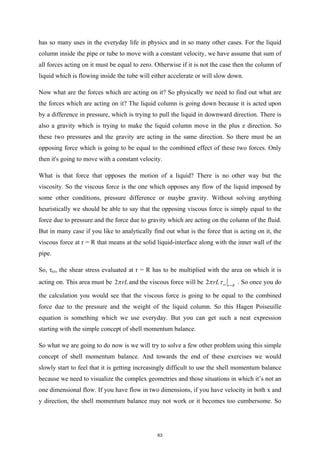
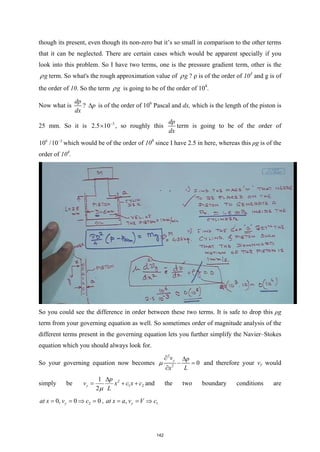
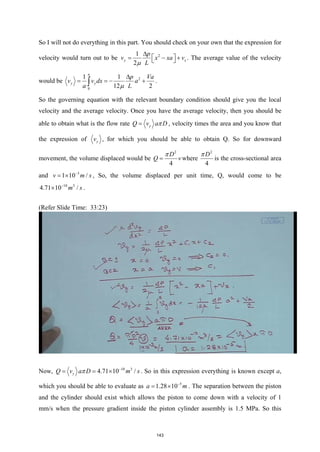
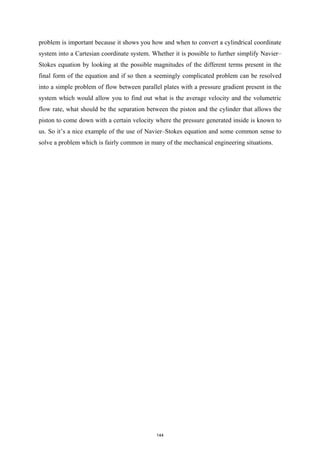
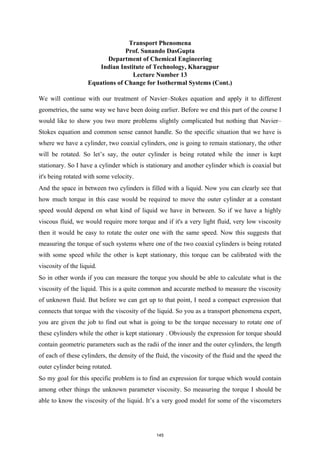
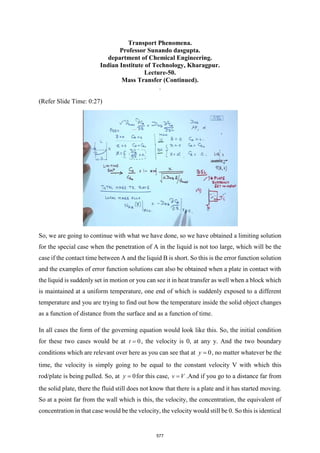
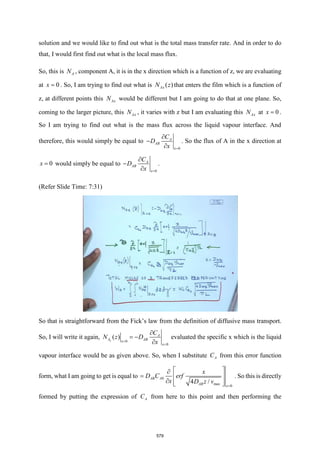
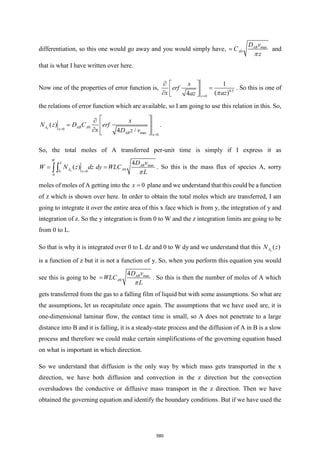
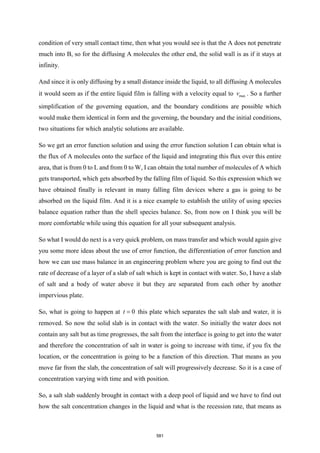
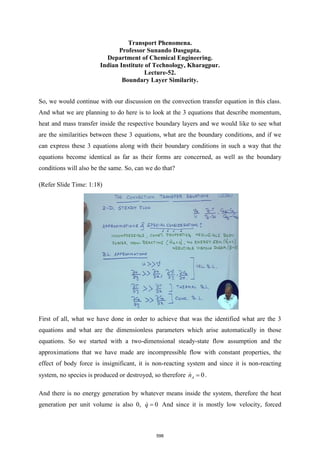
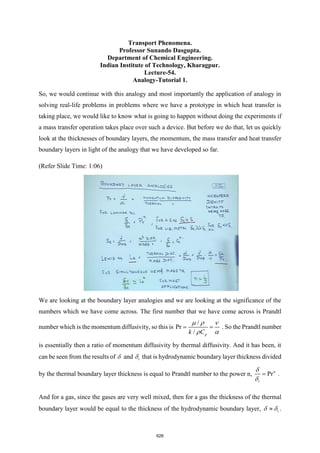
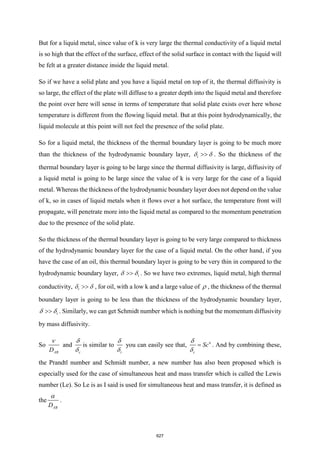
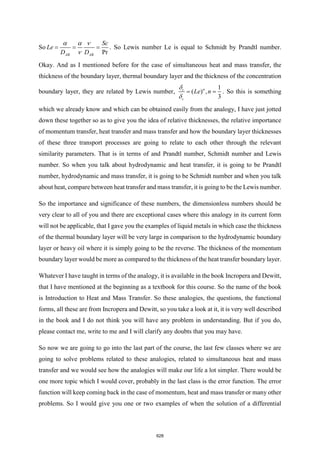
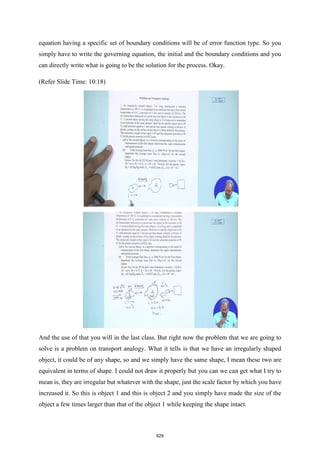
S. No Topic Page No.
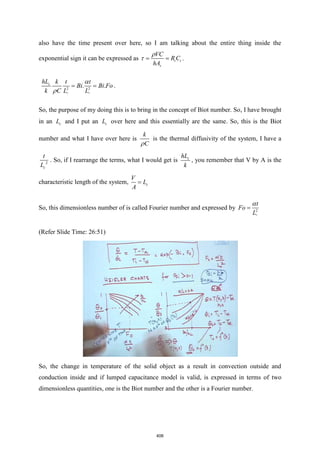
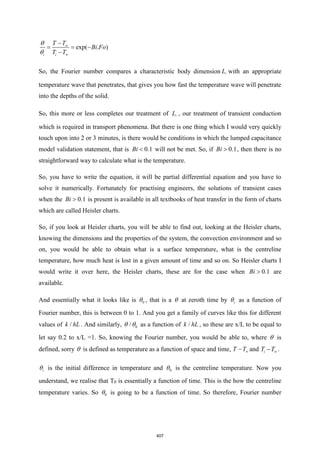
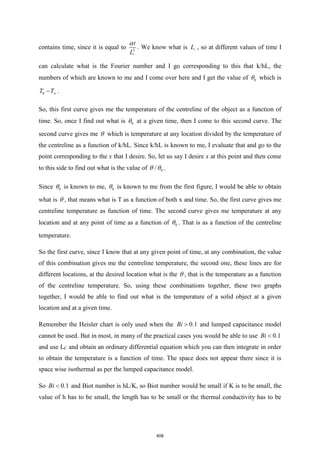
Week 1
1 Introduction Newton's Law of Viscosity 1
2 Fourier and Fick's Laws 13
3 Shell Momentum Balance 24
4 Example of Shell Momentum Balance 33
5 Example of Shell Momentum Balance (Contd.) 43
Week 2
6 Example of Shell Momentum Balance (Contd.) 58
7 Example of Shell Momentum Balance (Contd.) 70
8 Example of Shell Momentum Balance (Contd.) 87
9 Equations of Change for Isothermal Systems 100
10 Equations of Change for Isothermal Systems (Contd.) 110
Week 3
11 Equations of Change for Isothermal Systems (Contd.) 120
12 Equations of Change for Isothermal Systems (Contd.) 133
13 Equations of Change for Isothermal Systems (Contd.) 145
14 Equations of Change for Isothermal Systems (Contd.) 155
15 Unsteady Flow 167
Week 4
16 Boundary Layers 178
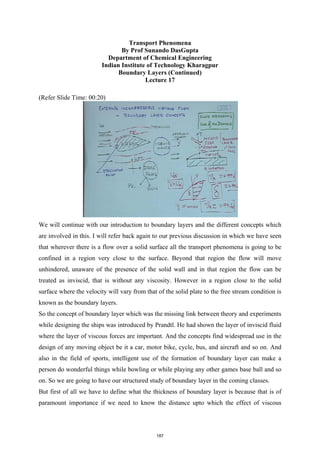
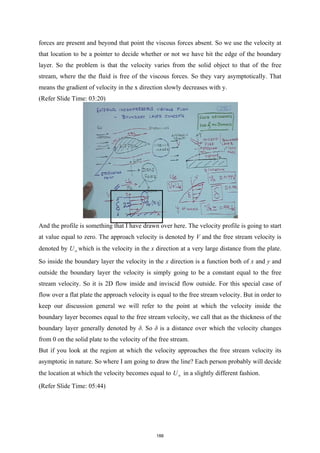
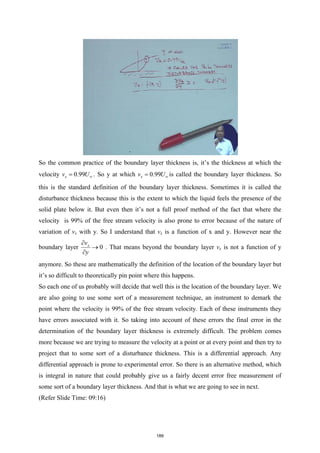
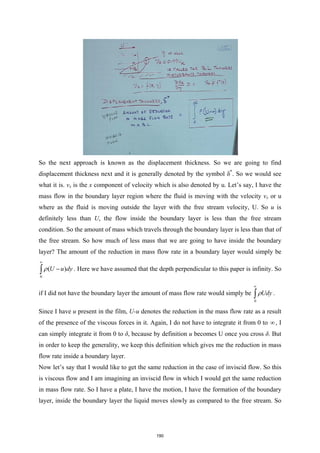
17 Boundary Layers (Contd.) 187
18 Boundary Layers (Contd.) 196
19 Boundary Layers (Contd.) 205
20 Boundary Layers (Contd.) 218
Week 5
21 Boundary Layers (Contd.) 233
22 Boundary Layers (Contd.) 243
23 Boundary Layers (Contd.) 254
24 Boundary Layers (Contd.) 264
25 Turbulent Boundary Layers 279
Week 6
26 Turbulent Boundary Layers (Contd.) 290
27 Turbulent Boundary Layers (Contd.) 301
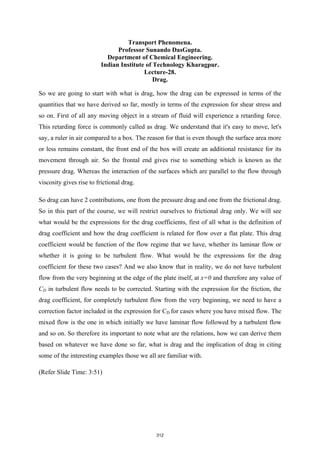
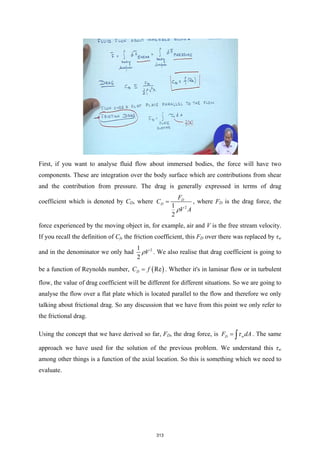
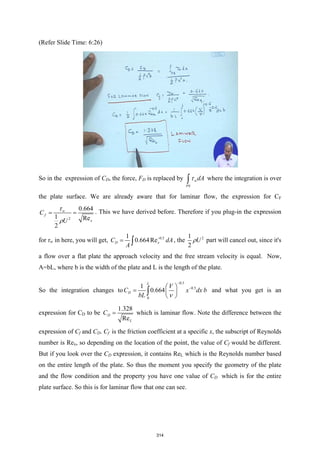
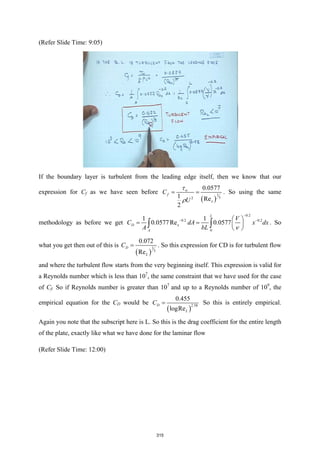
28 Drag 312
29 Drag (Contd.) 322
30 Heat Transfer Basics 332
Week 7
31 Heat Transfer Basics (Contd.) 341
32 1-D Heat Conduction - Temperature Distributions 353
33 1-D Heat Conduction - Shell Heat Balance 365
34 Shell Heat Balance 376
35 Viscous Dissipation 387
Week 8
36 Transient Conduction 397
37 Transient Conduction (Contd.) 410
38 Forced Convection 421
39 Energy Equation 431
40 Energy Equation (Contd.) 444
Week 9
41 Free Convection 462
42 Thermal Boundary Layer 475
43 Mass Transfer 489
44 Mass Transfer (Contd.) 502
45 Mass Transfer (Contd.) 516
Week 10
46 Mass Transfer (Contd.) 530
47 Mass Transfer (Contd.) 542
48 Mass Transfer (Contd.) 553
49 Mass Transfer (Contd.) 565
50 Mass Transfer (Contd.) 577
Week 11
51 Convection Transfer Equations 586
52 Boundary Layer Similarity 598
53 Boundary Layer - Analogy 612
54 Analogy - Tutorial I 626
55 Analogy - Tutorial II 637
Week 12
56 Analogy - Tutorial III 648
57 Analogy - Tutorial IV and V 667
58 Tutorial on Displacement Thickness 679
59 Tutorial on Momentum Integral Equation 694
60 Summary of the Course 711
Transport Phenomena.
Professor Sunando DasGupta.
Department of Chemical Engineering.
Indian Institute of Technology Kharagpur.
Lecture-01.
Introduction Newton’s Law of Viscosity.
Good morning, today we are going to start a very basic fundamental course in chemical
engineering which is also of relevance in several other disciplines, for example in mechanical
engineering, in biotechnology and several such disciplines where we would get a transport of
momentum, mass or heat and in many cases these processes are coupled. So, in this course
we are going to see how these seemingly different processes are interrelated and whether or
not a unified approach to heat, mass and momentum transfer can be provided within the
framework of several governing differential equations and their solutions.
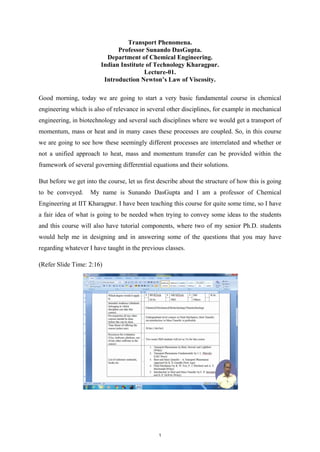
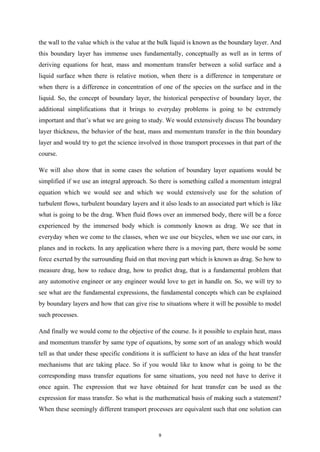
But before we get into the course, let us first describe about the structure of how this is going
to be conveyed. My name is Sunando DasGupta and I am a professor of Chemical
Engineering at IIT Kharagpur. I have been teaching this course for quite some time, so I have
a fair idea of what is going to be needed when trying to convey some ideas to the students
and this course will also have tutorial components, where two of my senior Ph.D. students
would help me in designing and in answering some of the questions that you may have
regarding whatever I have taught in the previous classes.
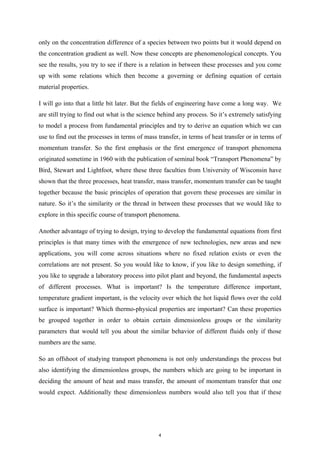
(Refer Slide Time: 2:16)
1
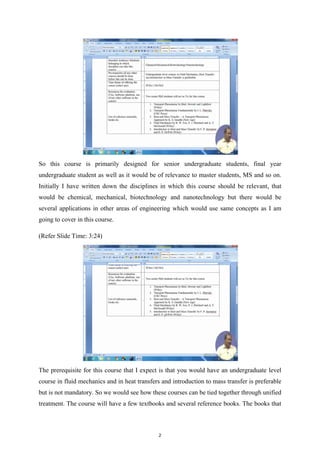
So this course is primarily designed for senior undergraduate students, final year
undergraduate student as well as it would be of relevance to master students, MS and so on.
Initially I have written down the disciplines in which this course should be relevant, that
would be chemical, mechanical, biotechnology and nanotechnology but there would be
several applications in other areas of engineering which would use same concepts as I am
going to cover in this course.
(Refer Slide Time: 3:24)
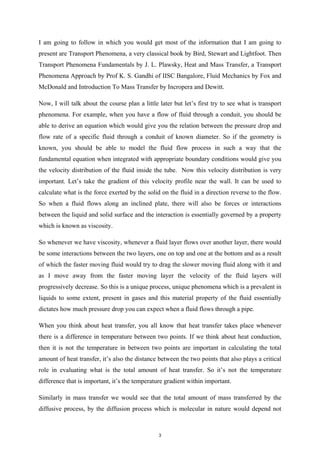
The prerequisite for this course that I expect is that you would have an undergraduate level
course in fluid mechanics and in heat transfers and introduction to mass transfer is preferable
but is not mandatory. So we would see how these courses can be tied together through unified
treatment. The course will have a few textbooks and several reference books. The books that
2
I am going to follow in which you would get most of the information that I am going to
present are Transport Phenomena, a very classical book by Bird, Stewart and Lightfoot. Then
Transport Phenomena Fundamentals by J. L. Plawsky, Heat and Mass Transfer, a Transport
Phenomena Approach by Prof K. S. Gandhi of IISC Bangalore, Fluid Mechanics by Fox and
McDonald and Introduction To Mass Transfer by Incropera and Dewitt.
Now, I will talk about the course plan a little later but let’s first try to see what is transport
phenomena. For example, when you have a flow of fluid through a conduit, you should be
able to derive an equation which would give you the relation between the pressure drop and
flow rate of a specific fluid through a conduit of known diameter. So if the geometry is
known, you should be able to model the fluid flow process in such a way that the
fundamental equation when integrated with appropriate boundary conditions would give you
the velocity distribution of the fluid inside the tube. Now this velocity distribution is very
important. Let’s take the gradient of this velocity profile near the wall. It can be used to
calculate what is the force exerted by the solid on the fluid in a direction reverse to the flow.
So when a fluid flows along an inclined plate, there will also be forces or interactions
between the liquid and solid surface and the interaction is essentially governed by a property
which is known as viscosity.
So whenever we have viscosity, whenever a fluid layer flows over another layer, there would
be some interactions between the two layers, one on top and one at the bottom and as a result
of which the faster moving fluid would try to drag the slower moving fluid along with it and
as I move away from the faster moving layer the velocity of the fluid layers will
progressively decrease. So this is a unique process, unique phenomena which is a prevalent in
liquids to some extent, present in gases and this material property of the fluid essentially
dictates how much pressure drop you can expect when a fluid flows through a pipe.
When you think about heat transfer, you all know that heat transfer takes place whenever
there is a difference in temperature between two points. If we think about heat conduction,
then it is not the temperature in between two points are important in calculating the total
amount of heat transfer, it’s also the distance between the two points that also plays a critical
role in evaluating what is the total amount of heat transfer. So it’s not the temperature
difference that is important, it’s the temperature gradient within important.
Similarly in mass transfer we would see that the total amount of mass transferred by the
diffusive process, by the diffusion process which is molecular in nature would depend not
3
only on the concentration difference of a species between two points but it would depend on
the concentration gradient as well. Now these concepts are phenomenological concepts. You
see the results, you try to see if there is a relation in between these processes and you come
up with some relations which then become a governing or defining equation of certain
material properties.
I will go into that a little bit later. But the fields of engineering have come a long way. We
are still trying to find out what is the science behind any process. So it’s extremely satisfying
to model a process from fundamental principles and try to derive an equation which we can
use to find out the processes in terms of mass transfer, in terms of heat transfer or in terms of
momentum transfer. So the first emphasis or the first emergence of transport phenomena
originated sometime in 1960 with the publication of seminal book “Transport Phenomena” by
Bird, Stewart and Lightfoot, where these three faculties from University of Wisconsin have
shown that the three processes, heat transfer, mass transfer, momentum transfer can be taught
together because the basic principles of operation that govern these processes are similar in
nature. So it’s the similarity or the thread in between these processes that we would like to
explore in this specific course of transport phenomena.
Another advantage of trying to design, trying to develop the fundamental equations from first
principles is that many times with the emergence of new technologies, new areas and new
applications, you will come across situations where no fixed relation exists or even the
correlations are not present. So you would like to know, if you like to design something, if
you like to upgrade a laboratory process into pilot plant and beyond, the fundamental aspects
of different processes. What is important? Is the temperature difference important,
temperature gradient important, is the velocity over which the hot liquid flows over the cold
surface is important? Which thermo-physical properties are important? Can these properties
be grouped together in order to obtain certain dimensionless groups or the similarity
parameters that would tell you about the similar behavior of different fluids only if those
numbers are the same.
So an offshoot of studying transport phenomena is not only understandings the process but
also identifying the dimensionless groups, the numbers which are going to be important in
deciding the amount of heat and mass transfer, the amount of momentum transfer that one
would expect. Additionally these dimensionless numbers would also tell you that if these
4
numbers are constant, then it is possible , I will show in the later part of the course how, to
use the correlation developed for heat transfer as the correlation for mass transfer.
The only thing you need to know is that an appropriate dimensionless constant must be used
for heat transfer, for mass transfer and for momentum transfer. So if it is possible that the
equation for, let’s say mass transfer, can be solved for a specific process using certain
simplifications, then you need not have to solve the heat transfer equation once again. You
simply use the relation that has been obtained for mass transfer as the relation for heat
transfer if you simply substitute the dimensionless numbers for relevant to mass transfer by
that of the heat transfer and so on. So the ideas developed in this course give us a very strong
handle on the understanding part. It’s the science of engineering with which we will be more
interested and try to see the fundamental guiding principle of designing and modeling an
engineering process and how the development is across different processes. As I mentioned
before that with the advent of new technologies, new areas, new concepts, you would always
like to have a strong background of these transport processes. For all these processes how to
scale up and go from the laboratory scale to the commercial production, you need to have an
idea of the determining steps in terms of fundamental concepts as developed in this course.
5
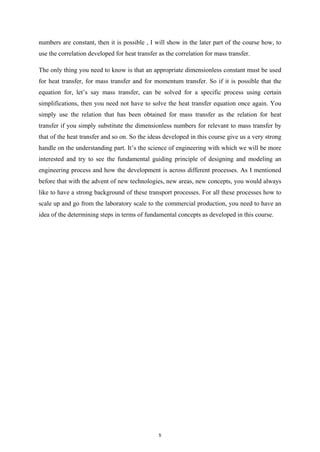
(Refer Slide Time: 12:10)
So, first few lectures should be on fundamental concepts of momentum transfer that you
already know through your studies of fluid mechanics. Then we are going to talk about a new
concept which is Shell balance. It’s essentially a force balance method that we are going to
see in this and how this Shell balance can lead to the governing equations for the case of, let’s
say momentum transfer, and what are the relevant boundary conditions one would expect in
the case of fluid flow or momentum transfer. So the formation and solution of momentum
transfer in laminar flow we would see. And then it would automatically be apparent that
many of the processes, many of the processes that can be handled by a simple Shell balance
are very simple in nature.
Whenever the geometry is slightly complicated, you would probably like to have more
generalized approach and the Shell balance methods cannot be used in such cases. So one of
the generalized methods of analyzing any momentum transfer comes from the application of
Newton’s second law for open systems and this should give us an equation which is known as
the equation of motion and or in more common terms it is known as the Navier Stokes
equation. Navier Stokes equation is a very powerful tool which can be applied. It’s a long
equation, but in many cases by simply using the geometrical constraints or your
understanding of the length scales, you would be able to discard many of the terms in Naviar
Stokes equation which would give you very compact differential equation to solve with
appropriate boundary conditions giving rise to fundamentally what is the velocity
distribution.
6
So this approach is also known as the differential approach. Any equation that comes out of
your interest of your work with differential approach is going to be valid at every point in the
flow field. So the velocity expression that you are going to get, if you can formulate the
problem appropriately, would be valid at every point. So that is differential approach, which
is important, but there is another approach which is known as integral approach and we will
work about that as well wherein we are not interested in what happens at every point in the
flow field but what happens on an average basis. So we are talking about the average velocity
and not the point velocity in the integral approach that will come later on.
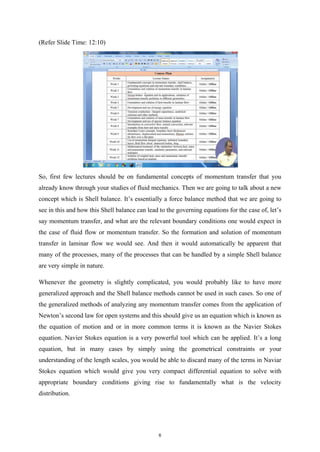
(Refer Slide Time: 14:53)
Similar to momentum transfer, we are going to formulate and solve few heat transfer
problems in laminar flow and then again with Navier Stokes equation we would try to
develop an energy equation which is a fundamental equation that takes into account all sorts
of energy transport modes. For example, conduction, convection and in a system it is possible
that there may be heat generation. It could be a nuclear reactor which you are trying to model,
so there will be heat generation term. There could be the fluid is probably flowing at a very
high velocity, so the layers of fluid will flow past each other with sufficiently high relative
velocity such that the there would be frictions between these liquid layers exactly same as
that between two solid surfaces. And these frictions will give rise to some heat generation. So
heat generation by external sources, heat generation by the flow of fluids, flowing past each
other, the work done by the system or the work done on the system, all these will constitute
different terms of the energy equation. So we will derive and we will discuss, simplify and
solve energy equations with relevant boundary conditions Again, the goal is to obtain the
7
temperature field, the temperature at every point in the flow field which can then be used to
derive quantities of engineering importance, such as what is the convective heat transfer
coefficient, we will see that subsequently.
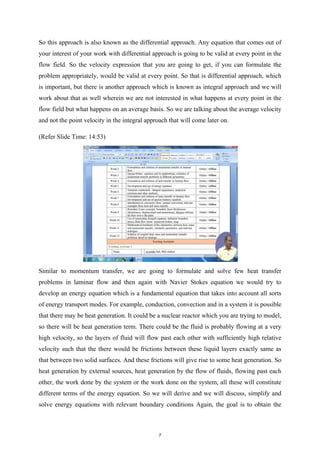
(Refer Slide Time: 16:31)
The same can be done for mass transfer in laminar flow and we will use equation as in Navier
Stokes equation or in energy equation, the species balance equation which is nothing but the
mass balance equation, the equation of continuity, the conservation of heat and mass transfer.
And towards the second part of this course, we will introduce a very important concept which
is known as the boundary layer concept.
What we would see later on, it becomes apparent that all these transport processes that we are
talking about, discussing about will take place in a region very close to the interface. So if we
are thinking about heat transfer and a liquid is in contact with a solid, then most of the heat
transfer between the liquid and the solid takes place in a layer which is very close to the solid
surface. So across the interface the temperature changes rapidly from the wall temperature to
a temperature which more or less remains constant for throughout the body of the fluid. So
this region in which the temperature essentially drops from that of the wall to that of the
liquid which more or less remains constant, this region is known as the boundary layer. The
same concept is also valid when a fluid layers moves over a solid layer and then it can be
shown that the velocity of the fluid which is moving on the stationary plate, it varies from a
value equal to 0 to a value equal to the free stream velocity, the velocity of the bulk air
moving above the plate in a region which is very close to the solid surface. So, this thin layer
in which the velocity, the temperature or the species concentration changes from its value on
8
the wall to the value which is the value at the bulk liquid is known as the boundary layer. And
this boundary layer has immense uses fundamentally, conceptually as well as in terms of
deriving equations for heat, mass and momentum transfer between a solid surface and a
liquid surface when there is relative motion, when there is a difference in temperature or
when there is a difference in concentration of one of the species on the surface and in the
liquid. So, the concept of boundary layer, the historical perspective of boundary layer, the
additional simplifications that it brings to everyday problems is going to be extremely
important and that’s what we are going to study. We would extensively discuss The boundary
layer thickness, the behavior of the heat, mass and momentum transfer in the thin boundary
layer and would try to get the science involved in those transport processes in that part of the
course.
We will also show that in some cases the solution of boundary layer equations would be
simplified if we use an integral approach. So there is something called a momentum integral
equation which we would see and which we would extensively use for the solution of
turbulent flows, turbulent boundary layers and it also leads to an associated part which is like
what is going to be the drag. When fluid flows over an immersed body, there will be a force
experienced by the immersed body which is commonly known as drag. We see that in
everyday when we come to the classes, when we use our bicycles, when we use our cars, in
planes and in rockets. In any application where there is a moving part, there would be some
force exerted by the surrounding fluid on that moving part which is known as drag. So how to
measure drag, how to reduce drag, how to predict drag, that is a fundamental problem that
any automotive engineer or any engineer would love to get in handle on. So, we will try to
see what are the fundamental expressions, the fundamental concepts which can be explained
by boundary layers and how that can give rise to situations where it will be possible to model
such processes.
And finally we would come to the objective of the course. Is it possible to explain heat, mass
and momentum transfer by same type of equations, by some sort of an analogy which would
tell as that under these specific conditions it is sufficient to have an idea of the heat transfer
mechanisms that are taking place. So if you would like to know what is going to be the
corresponding mass transfer equations for same situations, you need not have to derive it
once again. The expression that we have obtained for heat transfer can be used as the
expression for mass transfer. So what is the mathematical basis of making such a statement?
When these seemingly different transport processes are equivalent such that one solution can
9
be used for the other type of transport processes as well. So these analogies are extremely
powerful tools because in many real-life applications you would come across situations
where it would be extremely difficult to conduct experiments, develop a relation and then do
another set of experiments and try to develop another set of expressions for, let’s say, mass
transfer.
So it’s possible to do heat transfer experiments that are easy to do but it’s difficult to do the
mass transfer experiment. So you do not perform mass transfer experiments at all. You take
the system in such a way that these two systems are geometrically similar and you ensure
based on your knowledge that you have gathered in these courses that what do you have to do
in order to make the mass transfer process equivalent to a heat transfer situation. So if you
can make these two things equivalent, you do not need to work with the complicated mass
transfer experiments anymore. So you do all your experiments on the heat transfer which is
easy to do, derive relations and then simply project these relations for the mass transfer case
that you haven’t done any experiment on.
So these similarities between heat, mass and momentum transfer is an extremely powerful
tool for practicing engineers as well as for scientists to predict what would be the transport
process, what would be the quantity of heat transfer or mass transfer or momentum transfer if
you know what is going to be the amount of that transport in any one of these processes. So
there are hundreds of different types of situations one can encounter, one will encounter in
these cases where these processes are coupled. These coupled transport processes are
mathematically very difficult to handle. Because they would give rise to differential
equations which depend on each other and a comprehensive solution of those cases in many
of the situations would be extremely difficult. So, these analogies give us a powerful tool to
analyze, to understand and to obtain results for similar such cases. So in a nutshell, that is
what we are going to cover in this course.
Starting with the very fundamental transport phenomena modeling, type of cases where with
a shell balence you would be able to obtain a difference equation, from a difference equation
to a differential equation, you need to identify the boundary conditions, solve the differential
equation with these boundary conditions and obtain an expression of velocity. That is what
we are going to do in the first few classes. Then it would automatically automatically be
apparent that these simple approaches would not be viable for cases which are complex
10
geometric, complex flow type and so on, so a generalized approach is needed. And we come
up with Navier Stokes equation.
(Refer Slide Time: 26:32)
So what I have tried to give you is in a nutshell what is the objective of the course, what are
the topics that I am going to cover in this course, how they are structured and so on. After I
teach, maybe 3 or 4 such lectures, there would be tutorial components and the 2 TAs, which
are 2 of my Ph.D. students, these 2 TAs would be available to you to answer any of your
queries and also to assist you in your understanding. I expect that you are going to have
questions and I would encourage questions all the time from you and these 2 Ph.D. students
of mine, they would help you in your understanding, they would give you problems to work
on and they would also provide you with assignments that you need to solve, submit and
which would be continuously evaluated by the TAs. So together I think we are embarking on
a journey to understand the transport phenomena, the transport processes starting with the
very basic fundamentals.
It’s going to be an interesting course because you are going to have a paradigm shift of your
understanding about how different processes can be modeled. And whenever you start to see
the beauty of looking at different things in the same way, then it would not only broaden your
horizon, it would give you a scientific impetus to solve problems, to model unknown systems
and at least try to see if you can get an approximate solutions to certain situations that are
almost intractable if you would like to go through the rigorous mathematical way.
11
So there is a rigorous mathematical way for problems, for trying to model a situation and
there is a simpler way if you understand the process. If you understand the interplay of the
forces and if you can clearly identify under which condition a specific type of force is going
to be important and predominate, so that you need to consider only that and neglect all others.
So when you would be able to decide about the importance of these forces, then you would
see that modeling a system from the fundamental point of view is going to be a fun exercise.
So my objective of this course and I hope you would be able to appreciate and together we
would come up with solutions of unique problems that we encounter which seems very
difficult. But with your transport phenomena understanding, I am sure that we would be able
to to work together in a more structured way or solutions that you would have never thought
possible is in just these taking the three courses heat, mass, momentum transfer separately. So
unification is the key to this course, thank you.
12
Transport Phenomena.
Professor Sunando DasGupta.
Department of Chemical Engineering.
Indian Institute of Technology, Kharagpur.
Lecture-02.
Fourier and Fick’s Law.
With an understanding of the transport phenomena, I think we are ready now to work with
some fundamental concepts, something which we all of us experience every day, the concept
of viscosity. So what is viscosity? I know that we have all noticed that if I put a drop of a
heavy liquid on a surface, it does not spread. If you like to move one layer of a thick liquid on
top of the other, if you would like to stir a thick cream as compared to that of water in a glass,
in the 1st
case you are going to require more energy, more force to turn the spoon inside the
glass.
(Refer Slide Time: 2:06)
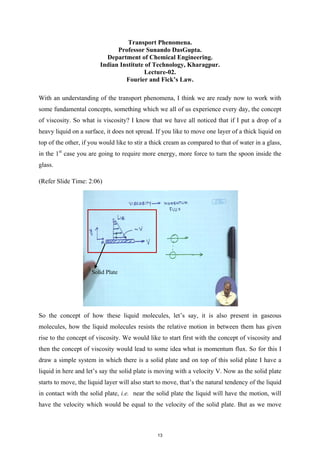
So the concept of how these liquid molecules, let’s say, it is also present in gaseous
molecules, how the liquid molecules resists the relative motion in between them has given
rise to the concept of viscosity. We would like to start first with the concept of viscosity and
then the concept of viscosity would lead to some idea what is momentum flux. So for this I
draw a simple system in which there is a solid plate and on top of this solid plate I have a
liquid in here and let’s say the solid plate is moving with a velocity V. Now as the solid plate
starts to move, the liquid layer will also start to move, that’s the natural tendency of the liquid
in contact with the solid plate, i.e. near the solid plate the liquid will have the motion, will
have the velocity which would be equal to the velocity of the solid plate. But as we move
Solid Plate
13
away from the plate, the effect of the plate will be felt lesser and lesser by the liquid layers on
top of the plate.
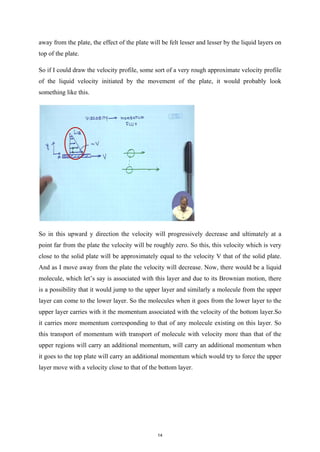
So if I could draw the velocity profile, some sort of a very rough approximate velocity profile
of the liquid velocity initiated by the movement of the plate, it would probably look
something like this.
So in this upward y direction the velocity will progressively decrease and ultimately at a
point far from the plate the velocity will be roughly zero. So this, this velocity which is very
close to the solid plate will be approximately equal to the velocity V that of the solid plate.
And as I move away from the plate the velocity will decrease. Now, there would be a liquid
molecule, which let’s say is associated with this layer and due to its Brownian motion, there
is a possibility that it would jump to the upper layer and similarly a molecule from the upper
layer can come to the lower layer. So the molecules when it goes from the lower layer to the
upper layer carries with it the momentum associated with the velocity of the bottom layer.So
it carries more momentum corresponding to that of any molecule existing on this layer. So
this transport of momentum with transport of molecule with velocity more than that of the
upper regions will carry an additional momentum, will carry an additional momentum when
it goes to the top plate will carry an additional momentum which would try to force the upper
layer move with a velocity close to that of the bottom layer.
14
(Refer Slide Time: 4:51)
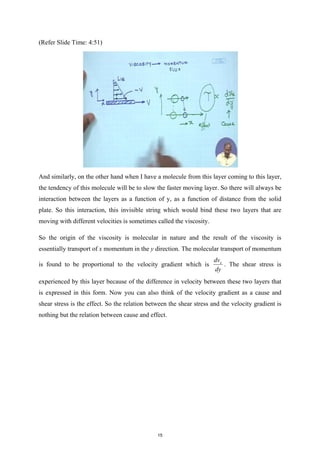
And similarly, on the other hand when I have a molecule from this layer coming to this layer,
the tendency of this molecule will be to slow the faster moving layer. So there will always be
interaction between the layers as a function of y, as a function of distance from the solid
plate. So this interaction, this invisible string which would bind these two layers that are
moving with different velocities is sometimes called the viscosity.
So the origin of the viscosity is molecular in nature and the result of the viscosity is
essentially transport of x momentum in the y direction. The molecular transport of momentum
is found to be proportional to the velocity gradient which is x
dv
dy
. The shear stress is
experienced by this layer because of the difference in velocity between these two layers that
is expressed in this form. Now you can also think of the velocity gradient as a cause and
shear stress is the effect. So the relation between the shear stress and the velocity gradient is
nothing but the relation between cause and effect.
15
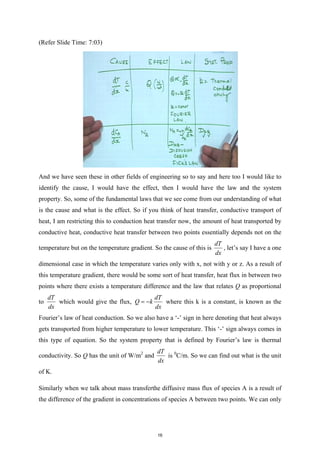
(Refer Slide Time: 7:03)
And we have seen these in other fields of engineering so to say and here too I would like to
identify the cause, I would have the effect, then I would have the law and the system
property. So, some of the fundamental laws that we see come from our understanding of what
is the cause and what is the effect. So if you think of heat transfer, conductive transport of
heat, I am restricting this to conduction heat transfer now, the amount of heat transported by
conductive heat, conductive heat transfer between two points essentially depends not on the
temperature but on the temperature gradient. So the cause of this is
dT
dx
, let’s say I have a one
dimensional case in which the temperature varies only with x, not with y or z. As a result of
this temperature gradient, there would be some sort of heat transfer, heat flux in between two
points where there exists a temperature difference and the law that relates Q as proportional
to
dT
dx
which would give the flux,
dT
Q k
dx
= − where this k is a constant, is known as the
Fourier’s law of heat conduction. So we also have a ‘-’ sign in here denoting that heat always
gets transported from higher temperature to lower temperature. This ‘-’ sign always comes in
this type of equation. So the system property that is defined by Fourier’s law is thermal
conductivity. So Q has the unit of W/m2
and
dT
dx
is 0
C/m. So we can find out what is the unit
of K.
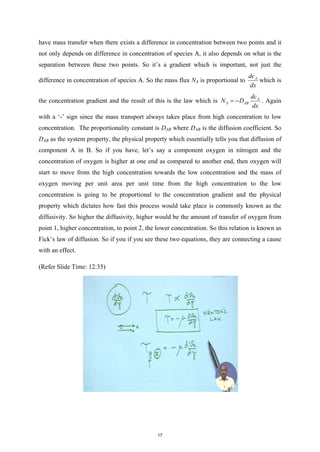
Similarly when we talk about mass transferthe diffusive mass flux of species A is a result of
the difference of the gradient in concentrations of species A between two points. We can only
16
have mass transfer when there exists a difference in concentration between two points and it
not only depends on difference in concentration of species A, it also depends on what is the
separation between these two points. So it’s a gradient which is important, not just the
difference in concentration of species A. So the mass flux NA is proportional to A
dc
dx
which is
the concentration gradient and the result of this is the law which is A
A AB
dc
N D
dx
= − . Again
with a ‘-’ sign since the mass transport always takes place from high concentration to low
concentration. The proportionality constant is DAB where DAB is the diffusion coefficient. So
DAB as the system property, the physical property which essentially tells you that diffusion of
component A in B. So if you have, let’s say a component oxygen in nitrogen and the
concentration of oxygen is higher at one end as compared to another end, then oxygen will
start to move from the high concentration towards the low concentration and the mass of
oxygen moving per unit area per unit time from the high concentration to the low
concentration is going to be proportional to the concentration gradient and the physical
property which dictates how fast this process would take place is commonly known as the
diffusivity. So higher the diffusivity, higher would be the amount of transfer of oxygen from
point 1, higher concentration, to point 2, the lower concentration. So this relation is known as
Fick’s law of diffusion. So if you if you see these two equations, they are connecting a cause
with an effect.
(Refer Slide Time: 12:35)
17
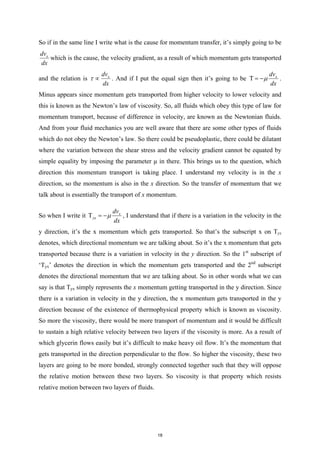
So if in the same line I write what is the cause for momentum transfer, it’s simply going to be
x
dv
dx
which is the cause, the velocity gradient, as a result of which momentum gets transported
and the relation is x
dv
dx
τ ∝ . And if I put the equal sign then it’s going to be x
dv
dx
µ
Τ = − .
Minus appears since momentum gets transported from higher velocity to lower velocity and
this is known as the Newton’s law of viscosity. So, all fluids which obey this type of law for
momentum transport, because of difference in velocity, are known as the Newtonian fluids.
And from your fluid mechanics you are well aware that there are some other types of fluids
which do not obey the Newton’s law. So there could be pseudoplastic, there could be dilatant
where the variation between the shear stress and the velocity gradient cannot be equated by
simple equality by imposing the parameter µ in there. This brings us to the question, which
direction this momentum transport is taking place. I understand my velocity is in the x
direction, so the momentum is also in the x direction. So the transfer of momentum that we
talk about is essentially the transport of x momentum.
So when I write it x
yx
dv
dx
µ
Τ =
− , I understand that if there is a variation in the velocity in the
y direction, it’s the x momentum which gets transported. So that’s the subscript x on Tyx
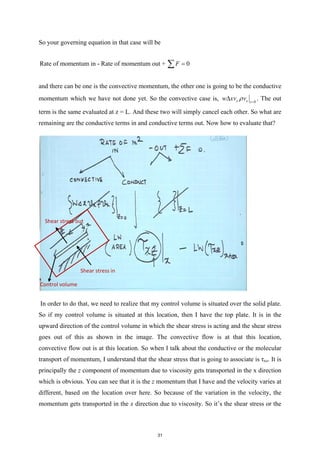
denotes, which directional momentum we are talking about. So it’s the x momentum that gets
transported because there is a variation in velocity in the y direction. So the 1st
subscript of
‘Tyx’ denotes the direction in which the momentum gets transported and the 2nd
subscript
denotes the directional momentum that we are talking about. So in other words what we can
say is that Tyx simply represents the x momentum getting transported in the y direction. Since
there is a variation in velocity in the y direction, the x momentum gets transported in the y
direction because of the existence of thermophysical property which is known as viscosity.
So more the viscosity, there would be more transport of momentum and it would be difficult
to sustain a high relative velocity between two layers if the viscosity is more. As a result of
which glycerin flows easily but it’s difficult to make heavy oil flow. It’s the momentum that
gets transported in the direction perpendicular to the flow. So higher the viscosity, these two
layers are going to be more bonded, strongly connected together such that they will oppose
the relative motion between these two layers. So viscosity is that property which resists
relative motion between two layers of fluids.
18
We should keep in mind that whatever we are discussing, we are restricting ourselves for
laminar flow where the principal reason of heat transfer or momentum transfer are molecular
in nature. So due to the molecular motion, which is Brownian motion, the momentum gets
transported. In conductive heat transfer, due to the vibration of the molecules or atoms, while
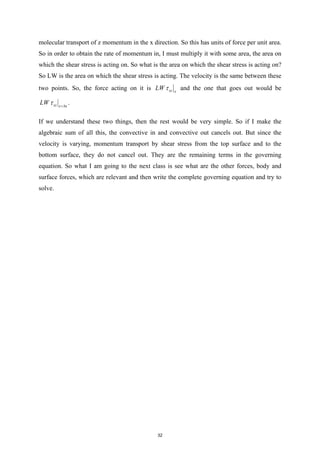
keeping the average position intact the energy transfers from one point to the other.
In species transport, the concentration gradient makes the component move from one point to
the other. There can be other type of motion which will result in the conductive motion. So I
may have a, let’s say, a slab of salt in contact with water and this water may remain
stationary, in which the dissolution of this salt will be due to the molecular motion. But if the
top layer starts to move, then apart from dissolution and molecular motion, there can be
convective motion as well.
(Refer Slide Time: 17:43)
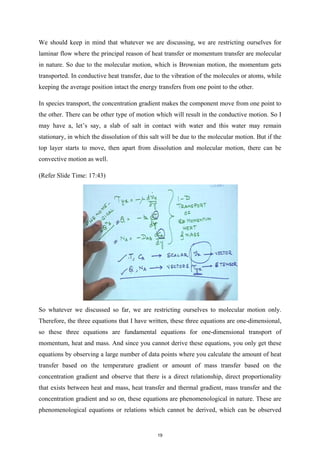
So whatever we discussed so far, we are restricting ourselves to molecular motion only.
Therefore, the three equations that I have written, these three equations are one-dimensional,
so these three equations are fundamental equations for one-dimensional transport of
momentum, heat and mass. And since you cannot derive these equations, you only get these
equations by observing a large number of data points where you calculate the amount of heat
transfer based on the temperature gradient or amount of mass transfer based on the
concentration gradient and observe that there is a direct relationship, direct proportionality
that exists between heat and mass, heat transfer and thermal gradient, mass transfer and the
concentration gradient and so on, these equations are phenomenological in nature. These are
phenomenological equations or relations which cannot be derived, which can be observed
19
and then you make laws out of these. So, these three are going to be the fundamental relations
of heat, mass and momentum transfer that we are going to use in this course.
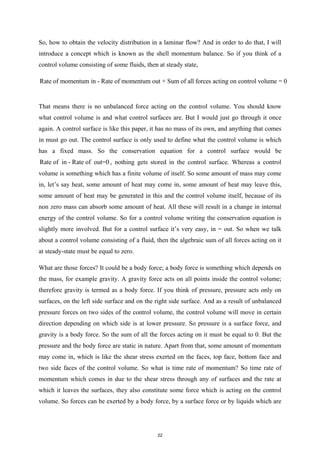
These three equations are similar, they look the same, conceptually they are the same but
there exists one very basic fundamental difference. If you look at these three equations, then
the heat transfer and mass transfer equations are identical in nature. One talks about the
gradient of temperature, the other talks about the gradient in concentration. If you think of τ
and cA, mathematically both are scalar, both are scalar quantities. So therefore, this Q and the
mass flux NA, they are going to be vectors, since you are taking the gradient of scalar
quantities, you end up with vectors. On the other hand Vx in the first equation is a vector
quantity. So therefore τyx is the gradient of the vector quantity is going to be a tensor. So these
three equations are identical conceptually, but since one deals with the gradient of a vector,
the final the left-hand side is going to be a tensor. So shear stress is a tensor, it has 9
components, we will discuss about that more. On the other hand the heat transfer governing
equation and the mass transfer one, both the temperature and the concentration are scalar in
nature. So there gradient, the heat flux and the mass flux are vector in nature. So the three
equations conceptually are the same but mathematically there exists a difference between the
two. So we should keep these things in mind as the complexity due to the vector nature of the
velocity and therefore the nine possible components of τ will come back. We will explore it
further in our subsequent lectures.
(Refer Slide Time: 22:14)
But in the 1st
part I am going to be concerned with the Newton’s law of viscosity and the use
of Newton’s law of viscosity under different conditions. So the property which comes out of
20
this equation is the viscosity. And we all understand that viscosity is a very important
property in the case of a fluid and this viscosity is a strong function of temperature and it’s
also, especially in the case of gases, it’s a function of pressure as well. So there are various
ways to measure the viscosity for gases. you can also predict that what would be the value of
viscosity using certain theories, but mostly we deal with the variation of viscosity from a
large number of experimental data. You would be able to obtain the units of viscosity directly
from the expression x
yx
dv
dx
τ µ
= − , where the shear stress (τ) has units of N/m2
and then you
have m/s for velocity and then 1/m for 1/dy part. Therefore, your viscosity has unit Ns/m2
. So
in other words this is Pa s, the most common unit for viscosity and that’s the unit of viscosity
in SI units. So this dependence of viscosity with temperature mostly is for liquids. Viscosities
increase with increase in temperature. So hot water will flow faster for the same pressure
gradient as compared to cold water and so on. So the thermophysical properties, their
evaluation, their dependence on conditions such as temperature, pressure, and so on are given
in detail in any of the textbooks that I have mentioned, specially you can see the first chapter
of Bird, Stewart and Lightfoot to know more about the viscosity of different liquids or more
importantly the variation of viscosity of liquids and gases at different temperatures and
pressure. I would expect you to go through it quickly and see what are the sources of these
data and if you would like to know what is the viscosity of a liquid at the specific temperature
and pressure, how to obtain them use your textbook. But the one that I am going to discuss
more in this class is velocity distribution in laminar flow.
(Refer Slide Time: 25:32)
Control
volume
21
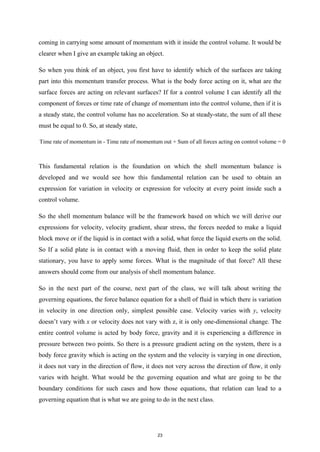
So, how to obtain the velocity distribution in a laminar flow? And in order to do that, I will
introduce a concept which is known as the shell momentum balance. So if you think of a
control volume consisting of some fluids, then at steady state,
Rate of momentum in - Rate of momentum out + Sum of all forces acting on control volume = 0
That means there is no unbalanced force acting on the control volume. You should know
what control volume is and what control surfaces are. But I would just go through it once
again. A control surface is like this paper, it has no mass of its own, and anything that comes
in must go out. The control surface is only used to define what the control volume is which
has a fixed mass. So the conservation equation for a control surface would be
Rate of in - Rate of out=0 , nothing gets stored in the control surface. Whereas a control
volume is something which has a finite volume of itself. So some amount of mass may come
in, let’s say heat, some amount of heat may come in, some amount of heat may leave this,
some amount of heat may be generated in this and the control volume itself, because of its
non zero mass can absorb some amount of heat. All these will result in a change in internal
energy of the control volume. So for a control volume writing the conservation equation is
slightly more involved. But for a control surface it’s very easy, in = out. So when we talk
about a control volume consisting of a fluid, then the algebraic sum of all forces acting on it
at steady-state must be equal to zero.
What are those forces? It could be a body force; a body force is something which depends on
the mass, for example gravity. A gravity force acts on all points inside the control volume;
therefore gravity is termed as a body force. If you think of pressure, pressure acts only on
surfaces, on the left side surface and on the right side surface. And as a result of unbalanced
pressure forces on two sides of the control volume, the control volume will move in certain
direction depending on which side is at lower pressure. So pressure is a surface force, and
gravity is a body force. So the sum of all the forces acting on it must be equal to 0. But the
pressure and the body force are static in nature. Apart from that, some amount of momentum
may come in, which is like the shear stress exerted on the faces, top face, bottom face and
two side faces of the control volume. So what is time rate of momentum? So time rate of
momentum which comes in due to the shear stress through any of surfaces and the rate at
which it leaves the surfaces, they also constitute some force which is acting on the control
volume. So forces can be exerted by a body force, by a surface force or by liquids which are
22
coming in carrying some amount of momentum with it inside the control volume. It would be
clearer when I give an example taking an object.
So when you think of an object, you first have to identify which of the surfaces are taking
part into this momentum transfer process. What is the body force acting on it, what are the
surface forces are acting on relevant surfaces? If for a control volume I can identify all the
component of forces or time rate of change of momentum into the control volume, then if it is
a steady state, the control volume has no acceleration. So at steady-state, the sum of all these
must be equal to 0. So, at steady state,
Time rate of momentum in - Time rate of momentum out + Sum of all forces acting on control volume = 0
This fundamental relation is the foundation on which the shell momentum balance is
developed and we would see how this fundamental relation can be used to obtain an
expression for variation in velocity or expression for velocity at every point inside such a
control volume.
So the shell momentum balance will be the framework based on which we will derive our
expressions for velocity, velocity gradient, shear stress, the forces needed to make a liquid
block move or if the liquid is in contact with a solid, what force the liquid exerts on the solid.
So If a solid plate is in contact with a moving fluid, then in order to keep the solid plate
stationary, you have to apply some forces. What is the magnitude of that force? All these
answers should come from our analysis of shell momentum balance.
So in the next part of the course, next part of the class, we will talk about writing the
governing equations, the force balance equation for a shell of fluid in which there is variation
in velocity in one direction only, simplest possible case. Velocity varies with y, velocity
doesn’t vary with x or velocity does not vary with z, it is only one-dimensional change. The
entire control volume is acted by body force, gravity and it is experiencing a difference in
pressure between two points. So there is a pressure gradient acting on the system, there is a
body force gravity which is acting on the system and the velocity is varying in one direction,
it does not vary in the direction of flow, it does not very across the direction of flow, it only
varies with height. What would be the governing equation and what are going to be the
boundary conditions for such cases and how those equations, that relation can lead to a
governing equation that is what we are going to do in the next class.
23
Transport Phenomena.
Professor Sunando DasGupta.
Department of Chemical Engineering.
Indian Institute of Technology, Kharagpur.
Lecture-03.
Shell Momentum Balance.
We are going to talk about the fundamental shell momentum balance approach and how it
can be used to solve a very simple problem. So we have identified that in a shell of a fluid,
some fluid is coming in, some fluid is going out and there can be also variation in velocity
which exists in a fluid. So when something is flowing into a control volume, it comes in with
a velocity, some mass of fluid coming in with a fixed velocity carries with it some amount of
momentum. And the time rate of this momentum which comes in to the control volume and
the rate at which it leaves the control volume, there would be a net addition of momentum to
the control volume per unit time. Also due to the variation in velocity, there can also be
momentum fluxes as per the Newton’s law of viscosity. So there can be molecular transport
of momentum which is given by Newton’s law and there can be the overall convective
transport of momentum which is due to the flow.
Apart from that, the other forces which are acting on it can be divided into two parts, one is
the body force and the second is the surface force. The most common examples of body and
surface forces are the gravity and the pressure difference respectively. So if I can write in
mathematical terms what I just said, it’s going to give rise to an equation which is a
difference equation which is written in terms of Δx, Δy, Δz, where Δx, Δy, Δz are the
components that specify the space and it’s also going to have ΔP, the pressure gradient and it
will have the effect of g which is gravity. So if we can write these difference equations and
then if we can convert the difference equation to a differential equation, what I then would
have is the governing equation for the flow, let’s say over a flat plate. And if I can solve this
fundamental equation with appropriate boundary conditions, then I would get the velocity
profile which is my ultimate aim.
(Refer Slide Time: 4:29)
24
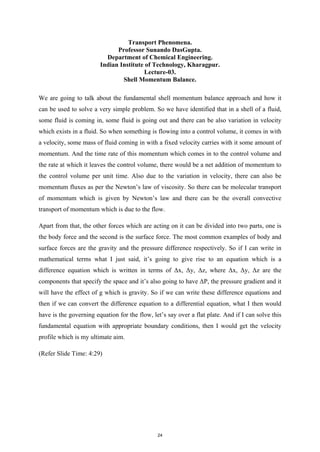
In order to do that, I first need to identify what are the relevant boundary conditions that we
can think of when a solid and liquid are in contact. So let’s assume that I have a solid plate
(shown in above slide), I have liquid. The solid plate is slightly inclined so the liquid starts to
flow along the solid plate. So this is my y = 0 and there is a film of the liquid, let’s assume
that the thickness of the liquid is δ. So y = δ at the end of the film.
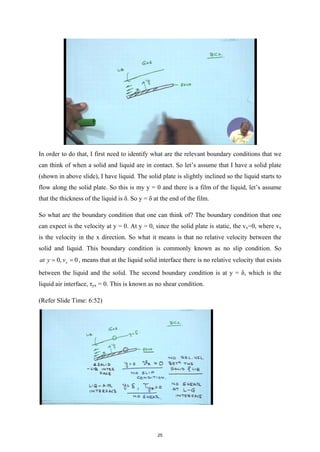
So what are the boundary condition that one can think of? The boundary condition that one
can expect is the velocity at y = 0. At y = 0, since the solid plate is static, the vx=0, where vx
is the velocity in the x direction. So what it means is that no relative velocity between the
solid and liquid. This boundary condition is commonly known as no slip condition. So
0, 0
x
at y v
= = , means that at the liquid solid interface there is no relative velocity that exists
between the liquid and the solid. The second boundary condition is at y = δ, which is the
liquid air interface, τyx = 0. This is known as no shear condition.
(Refer Slide Time: 6:52)
25
These two are the fundamental boundary conditions which are grounded in our concepts
because if the liquid molecules are clinging to the surface of the solid, this simply cannot
move. But the layer of molecules just above these stationary molecules, they are free to
move. So if the solid is stationary, velocities always start at a value equal to zero and it would
progressively increase as I move away from the solid plate. So at every solid liquid interface,
in most of the cases, relative velocity would be zero. So if the solid is static, the liquid
molecules on top of these, on top of this solid plate will also be static. This is known as no
slip condition.
There are some special cases where this no slip condition would not be valid. There is a
special branch of fluid mechanics which deals with fluid mechanics at very small-scale where
the flow through a nano tube or micro tube is being considered, where the flow of gas is
being considered at a very low pressure. In some special cases like that, the no slip condition
would not be valid and you are probably going to get a case in which there would be a slip
flow, there would be a nonzero velocity component that exists at the solid liquid interface.
But those special cases we will not consider in this course. For the majority of the situations,
for the vast majority of the situations, the flow at the liquid solid interface will always be
obey zero relative velocity, so it’s in no slip condition.
The other condition is again, there exists a significant difference between the viscosities of
the liquid and the gas. So because of this difference in viscosities, the momentum transfer τyx,
x component being transported in the y direction would be insignificant at the liquid vapor
interface. No matter the liquid velocity, the moving liquid film will not be able to impart
momentum onto the gas and vice versa. Therefore even if the gas is flowing, the liquid can
still remain stationary and no momentum from the gas gets transported to the liquid and so
on. The exceptions are when the relative velocity between the liquid and the gas is large, then
this relation would not be valid. So you would see the formation of the waves, the shearing or
entrainment of the liquid when there is a fast moving vapor on top of the static liquid film.
Those are exceptions; those are situations in which the no shear at the liquid vapor interface,
that relation would not be valid. But again for the time being we are assuming where the
relative velocity between the liquid and the gas is not too high, the no shear condition would
prevail.
So we will use two major boundary conditions which are physical observations, principles
written mathematical form, one is the velocity is 0 at the solid liquid interface and shear is
26
zero at the liquid vapor interface. These two will be our governing equations. With that
background clarified, now we will try to solve a problem which is the simplest problem
where there is an inclined plate and the liquid is flowing. Because of gravity there is no
imposed pressure gradient. So the flow is taking place only because of gravity, the body force
but there is no pressure force, no surface force. So when it starts to flow along the inclined
plate with some thickness, what we can clearly see from commonsense is that the no slip
condition is valid at the liquid solid interface and at that the velocity is zero. And as we move
away from the solid plate, the velocity will progressively increase and the maximum velocity
will be at the top layer of the liquid which is farthest from this solid plate.
(Refer Slide Time: 11:57)
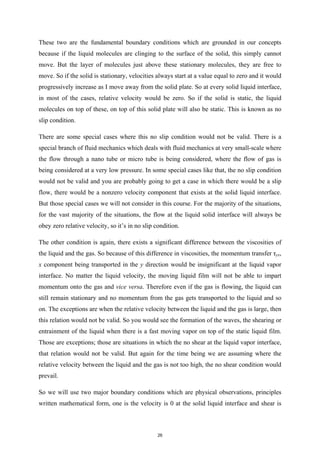
So we will try to see based on shell momentum balance how that can be done. The problem
that we are looking at is flow of a falling film in which I have a solid plate of some length L
and it is making an angle with the vertical and this is the liquid film. x direction is along the
solid plate and y direction is the perpendicular direction and it is a 1-D flow case. So, 0
x
v ≠
but 0
y z
v v
= = and you would see that ( ) ( )
x
v f y f z
= ≠ . The gravity is acting in the
downward direction and due to the variation in velocity there would be shear force which is
acting in the y direction. So this system is to be modeled thinking about what is going to be
the different forces acting on a differential control volume that one can assume.
When I say differential control volume for this 1-D case, there would be a finite length, a
finite width and a finite depth, finite thickness of this. We understand that the variation in
velocity is only in the y direction, it does not vary with z and it’s not going to vary with x
27
direction. So the film is falling freely along the side of the solid. Whenever you encounter
such a situation, the smaller dimension of the imaginary control volume will always be the
dimension across which the variation in velocity is taking place. So in this specific case it
does not matter what is the length of the control volume that you take, what is the width of
the control volume that you take but what you are going to take as the thickness of the film,
that is going to be important. The control volume will have any dimension in x, any
dimension in z but Δy in the y direction. The top layer is moving with the highest velocity
and the bottom layer, in contact with the solid is static, it does not move. So there is a
variation in this direction in the y direction in velocity. So in that case in order to model such
a process, I will take this plate as a layer, this is going to be my differential control volume
which is situated at an arbitrary distance x from here. So the bottom face of this imaginary
control volume is situated by a distance x from the solid plate. It’s of thickness Δy and we are
going to find out what are the different ways by which the momentum can come into this
control volume.
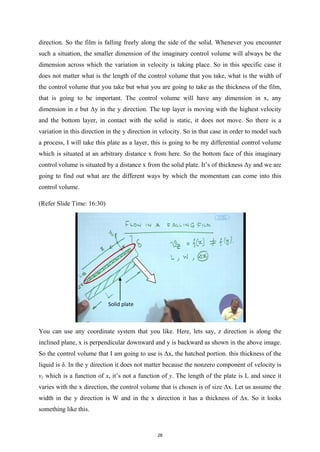
(Refer Slide Time: 16:30)
You can use any coordinate system that you like. Here, lets say, z direction is along the
inclined plane, x is perpendicular downward and y is backward as shown in the above image.
So the control volume that I am going to use is Δx, the hatched portion. this thickness of the
liquid is δ. In the y direction it does not matter because the nonzero component of velocity is
vz which is a function of x, it’s not a function of y. The length of the plate is L and since it
varies with the x direction, the control volume that is chosen is of size Δx. Let us assume the
width in the y direction is W and in the x direction it has a thickness of Δx. So it looks
something like this.
Solid plate
28
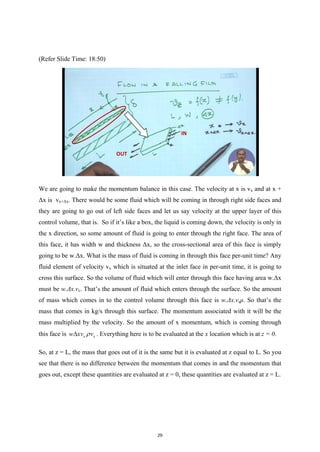
(Refer Slide Time: 18:50)
We are going to make the momentum balance in this case. The velocity at x is vx and at x +
Δx is vx+Δx. There would be some fluid which will be coming in through right side faces and
they are going to go out of left side faces and let us say velocity at the upper layer of this
control volume, that is. So if it’s like a box, the liquid is coming down, the velocity is only in
the x direction, so some amount of fluid is going to enter through the right face. The area of
this face, it has width w and thickness Δx, so the cross-sectional area of this face is simply
going to be w.Δx. What is the mass of fluid is coming in through this face per-unit time? Any
fluid element of velocity vx which is situated at the inlet face in per-unit time, it is going to
cross this surface. So the volume of fluid which will enter through this face having area w.Δx
must be w.Δx.vx. That’s the amount of fluid which enters through the surface. So the amount
of mass which comes in to the control volume through this face is w.Δx.vxρ. So that’s the
mass that comes in kg/s through this surface. The momentum associated with it will be the
mass multiplied by the velocity. So the amount of x momentum, which is coming through
this face is x x
w xv v
ρ
∆ . Everything here is to be evaluated at the x location which is at z = 0.
So, at z = L, the mass that goes out of it is the same but it is evaluated at z equal to L. So you
see that there is no difference between the momentum that comes in and the momentum that
goes out, except these quantities are evaluated at z = 0, these quantities are evaluated at z = L.
IN
OUT
29
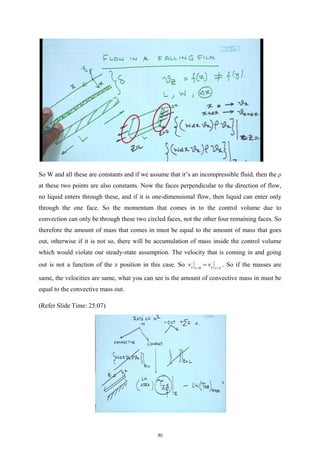
So W and all these are constants and if we assume that it’s an incompressible fluid, then the ρ
at these two points are also constants. Now the faces perpendicular to the direction of flow,
no liquid enters through these, and if it is one-dimensional flow, then liquid can enter only
through the one face. So the momentum that comes in to the control volume due to
convection can only be through these two circled faces, not the other four remaining faces. So
therefore the amount of mass that comes in must be equal to the amount of mass that goes
out, otherwise if it is not so, there will be accumulation of mass inside the control volume
which would violate our steady-state assumption. The velocity that is coming in and going
out is not a function of the z position in this case. So 0
x x
z z L
v v
= =
= . So if the masses are
same, the velocities are same, what you can see is the amount of convective mass in must be
equal to the convective mass out.
(Refer Slide Time: 25:07)
30
So your governing equation in that case will be
Rate of momentum in - Rate of momentum out + 0
F =
∑
and there can be one is the convective momentum, the other one is going to be the conductive
momentum which we have not done yet. So the convective case is, 0
x x z
w xv v
ρ =
∆ . The out
term is the same evaluated at z = L. And these two will simply cancel each other. So what are
remaining are the conductive terms in and conductive terms out. Now how to evaluate that?
In order to do that, we need to realize that my control volume is situated over the solid plate.
So if my control volume is situated at this location, then I have the top plate. It is in the
upward direction of the control volume in which the shear stress is acting and the shear stress
goes out of this as shown in the image. The convective flow is at that this location,
convective flow out is at this location. So when I talk about the conductive or the molecular
transport of momentum, I understand that the shear stress that is going to associate is τxz. It is
principally the z component of momentum due to viscosity gets transported in the x direction
which is obvious. You can see that it is the z momentum that I have and the velocity varies at
different, based on the location over here. So because of the variation in the velocity, the
momentum gets transported in the x direction due to viscosity. So it’s the shear stress or the
Control volume
Shear stress in
Shear stress out
31
molecular transport of z momentum in the x direction. So this has units of force per unit area.
So in order to obtain the rate of momentum in, I must multiply it with some area, the area on
which the shear stress is acting on. So what is the area on which the shear stress is acting on?
So LW is the area on which the shear stress is acting. The velocity is the same between these
two points. So, the force acting on it is xz x
LW τ and the one that goes out would be
xz x x
LW τ +∆
.
If we understand these two things, then the rest would be very simple. So if I make the
algebraic sum of all this, the convective in and convective out cancels out. But since the
velocity is varying, momentum transport by shear stress from the top surface and to the
bottom surface, they do not cancel out. They are the remaining terms in the governing
equation. So what I am going to the next class is see what are the other forces, body and
surface forces, which are relevant and then write the complete governing equation and try to
solve.
32
Transport Phenomena.
Professor Sunando DasGupta.
Department of Chemical Engineering.
Indian Institute of Technology, Kharagpur.
Lecture-04.
Example of Shell Momentum Balance.
We were discussing about modeling of the flow of a falling film. I will once again tell you
the salient features of the problem that we are trying to model. It’s liquid which is in contact
with an inclined plane and its falling, while maintaining constant thickness of delta on the
solid plate. The coordinate system is drawn in such a way that in the direction of flow its z,
across the depth of the fluid its x and this is the y direction. So the velocity changes only in
the x direction, it does not change in the z direction or it does not change in the y direction.
((Refer Slide Time: 02:08)
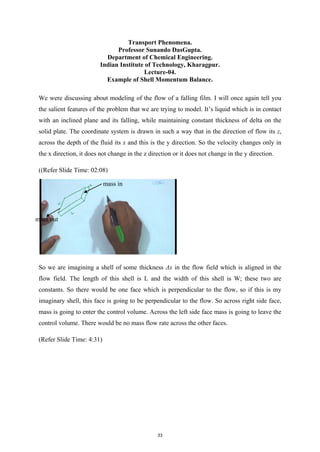
So we are imagining a shell of some thickness Δx in the flow field which is aligned in the
flow field. The length of this shell is L and the width of this shell is W; these two are
constants. So there would be one face which is perpendicular to the flow, so if this is my
imaginary shell, this face is going to be perpendicular to the flow. So across right side face,
mass is going to enter the control volume. Across the left side face mass is going to leave the
control volume. There would be no mass flow rate across the other faces.
(Refer Slide Time: 4:31)
mass in
mass out
33
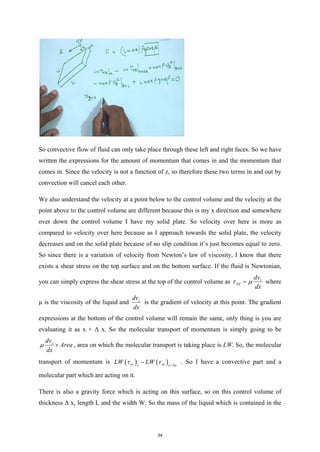
So convective flow of fluid can only take place through these left and right faces. So we have
written the expressions for the amount of momentum that comes in and the momentum that
comes in. Since the velocity is not a function of z, so therefore these two terms in and out by
convection will cancel each other.
We also understand the velocity at a point below to the control volume and the velocity at the
point above to the control volume are different because this is my x direction and somewhere
over down the control volume I have my solid plate. So velocity over here is more as
compared to velocity over here because as I approach towards the solid plate, the velocity
decreases and on the solid plate because of no slip condition it’s just becomes equal to zero.
So since there is a variation of velocity from Newton’s law of viscosity, I know that there
exists a shear stress on the top surface and on the bottom surface. If the fluid is Newtonian,
you can simply express the shear stress at the top of the control volume as z
XZ
dv
dx
τ µ
= where
µ is the viscosity of the liquid and z
dv
dx
is the gradient of velocity at this point. The gradient
expressions at the bottom of the control volume will remain the same, only thing is you are
evaluating it as x + Δ x. So the molecular transport of momentum is simply going to be
z
dv
Area
dx
µ × , area on which the molecular transport is taking place is LW. So, the molecular
transport of momentum is ( ) ( )
xz xz
x x x
LW LW
τ τ +∆
− . So I have a convective part and a
molecular part which are acting on it.
There is also a gravity force which is acting on this surface, so on this control volume of
thickness Δ x, length L and the width W. So the mass of the liquid which is contained in the
34
volume is LWΔxρ, and cos
g β is the component of the body force. So cos
LW x g
ρ β
∆ total it
gives me the force which is acting on the system.
So if I write the total momentum balance equation now, it will becomes
2 2
0
cos 0
xz xz z z
x x x z z L
LW LW W x v W x v LW x g
τ τ ρ ρ ρ β
+∆ = =
− + ∆ − ∆ + ∆ = Since is at steady-
state, all these forces, the algebraic sum of all these forces must be equal to 0. So I have
defined a control volume, identified all the sources of momentum that comes that can come
into the system and I have also identified the only relevant component of force present in the
system. I identify that it’s the body force which is present in the system, there is no surface
force, because it is a freely falling film, so the pressure on both sides are the same.
So Now I have a complete equation, now if you see this equation, this equation has Δx in it.
So it’s an expression which is valid over this control volume defined by W, L and Δx. What I
am going to do next is cancel the terms which are not relevant. In this case convective flow of
momentum cancels out as 2 2
0
z z
z z L
v v
= =
= and cancel out the LW from the equation as well.
Now divide both sides by Δx and taking the limit when 0
x
∆ → you will get
lim
cos
0
xz xz
x x x
g
x x
τ τ
ρ β
+∆
−
=
∆ → ∆
And you would see that this would lead to the definition of the 1st
derivative and from this
difference equation I would be able to obtain the differential equation.
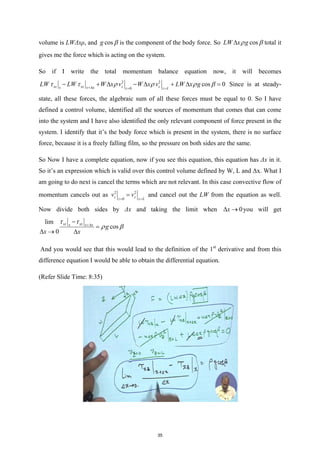
(Refer Slide Time: 8:35)
35
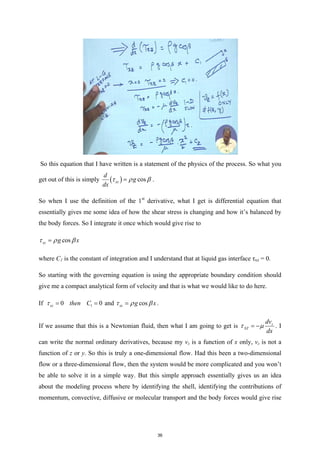
So this equation that I have written is a statement of the physics of the process. So what you
get out of this is simply ( ) cos
xz
d
g
dx
τ ρ β
= .
So when I use the definition of the 1st
derivative, what I get is differential equation that
essentially gives me some idea of how the shear stress is changing and how it’s balanced by
the body forces. So I integrate it once which would give rise to
cos
xz g x
τ ρ β
=
where C1 is the constant of integration and I understand that at liquid gas interface τxz = 0.
So starting with the governing equation is using the appropriate boundary condition should
give me a compact analytical form of velocity and that is what we would like to do here.
If 1
0 0
xz then C
τ
= = and cos
xz g x
τ ρ β
= .
If we assume that this is a Newtonian fluid, then what I am going to get is z
XZ
dv
dx
τ µ
= − . I
can write the normal ordinary derivatives, because my vz is a function of x only, vz is not a
function of z or y. So this is truly a one-dimensional flow. Had this been a two-dimensional
flow or a three-dimensional flow, then the system would be more complicated and you won’t
be able to solve it in a simple way. But this simple approach essentially gives us an idea
about the modeling process where by identifying the shell, identifying the contributions of
momentum, convective, diffusive or molecular transport and the body forces would give rise
36
to a governing equation that can be solved to obtain a compact equation for the velocity as in
this case.
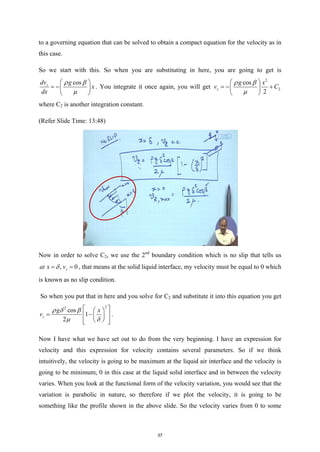
So we start with this. So when you are substituting in here, you are going to get is
cos
z
dv g
x
dx
ρ β
µ
 
= − 
 
. You integrate it once again, you will get
2
2
cos
2
z
g x
v C
ρ β
µ
 
=
− +
 
 
where C2 is another integration constant.
(Refer Slide Time: 13:48)
Now in order to solve C2, we use the 2nd
boundary condition which is no slip that tells us
, 0
z
at x v
δ
= = , that means at the solid liquid interface, my velocity must be equal to 0 which
is known as no slip condition.
So when you put that in here and you solve for C2 and substitute it into this equation you get
2
2
cos
1
2
z
g x
v
ρ δ β
µ δ
 
 
= −
 
 
 
 
 
.
Now I have what we have set out to do from the very beginning. I have an expression for
velocity and this expression for velocity contains several parameters. So if we think
intuitively, the velocity is going to be maximum at the liquid air interface and the velocity is
going to be minimum, 0 in this case at the liquid solid interface and in between the velocity
varies. When you look at the functional form of the velocity variation, you would see that the
variation is parabolic in nature, so therefore if we plot the velocity, it is going to be
something like the profile shown in the above slide. So the velocity varies from 0 to some
37
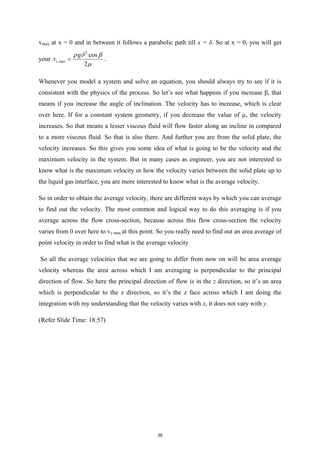
vmax at x = 0 and in between it follows a parabolic path till x = δ. So at x = 0, you will get
your
2
,max
cos
2
z
g
v
ρ δ β
µ
= .
Whenever you model a system and solve an equation, you should always try to see if it is
consistent with the physics of the process. So let’s see what happens if you increase β, that
means if you increase the angle of inclination. The velocity has to increase, which is clear
over here. If for a constant system geometry, if you decrease the value of µ, the velocity
increases. So that means a lesser viscous fluid will flow faster along an incline in compared
to a more viscous fluid. So that is also there. And further you are from the solid plate, the
velocity increases. So this gives you some idea of what is going to be the velocity and the
maximum velocity in the system. But in many cases as engineer, you are not interested to
know what is the maximum velocity or how the velocity varies between the solid plate up to
the liquid gas interface, you are more interested to know what is the average velocity.
So in order to obtain the average velocity, there are different ways by which you can average
to find out the velocity. The most common and logical way to do this averaging is if you
average across the flow cross-section, because across this flow cross-section the velocity
varies from 0 over here to vz max at this point. So you really need to find out an area average of
point velocity in order to find what is the average velocity
So all the average velocities that we are going to differ from now on will be area average
velocity whereas the area across which I am averaging is perpendicular to the principal
direction of flow. So here the principal direction of flow is in the z direction, so it’s an area
which is perpendicular to the z direction, so it’s the z face across which I am doing the
integration with my understanding that the velocity varies with x, it does not vary with y.
(Refer Slide Time: 18:57)
38
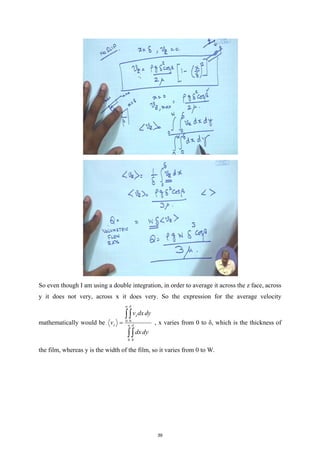
So even though I am using a double integration, in order to average it across the z face, across
y it does not very, across x it does very. So the expression for the average velocity
mathematically would be 0 0
0 0
w
x
z w
v dx dy
v
dx dy
δ
δ
=
∫∫
∫∫
, x varies from 0 to δ, which is the thickness of
the film, whereas y is the width of the film, so it varies from 0 to W.
39
And when you do this integration, since dx does not depend on y, so you can take this out and
your vz would be
0
1
z z
v v dx
δ
δ
= ∫ ,. And the expression of vz you are going to plug it in from
the previous one and what you would get is
2
cos
3
z
g
v
ρ δ β
µ
= .
Once you have the average velocity, then you would also like to know what is the volumetric
flow rate. So the volumetric flow rate would simply be
3
cos
3
z
gW
Q W v
ρ δ β
δ
µ
= = . So you
can you that starting with a very fundamental concept
rate of momentum in - rate of momentum out + Sum of all forces acting on control volume = 0
When you use that concept and define a control volume, the smaller size would be denoted
by the direction in which the flow is changing. In this case flow is changing with the x
direction, so therefore you have Δx as one of the dimensions of the control volume. And you
also identify that we are dealing with the simplest possible case which is one-dimensional
flow, so velocity is a function of x, it’s not a function of z or a function of y. You divide both
sides by Δx, use the definition of 1st
derivative and what you get is a differential equation.
Solve differential equation with boundary conditions, no slip and no shear, you get a compact
expression for velocity. Once you have the expression for velocity, then you would be able to
obtain the average velocity and the total volumetric flow rate.
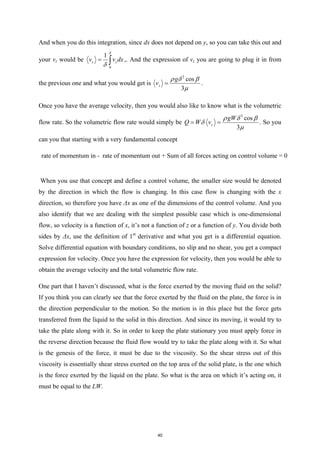
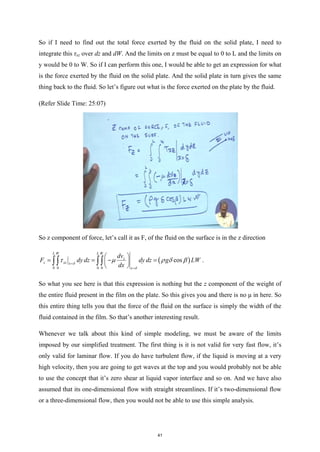
One part that I haven’t discussed, what is the force exerted by the moving fluid on the solid?
If you think you can clearly see that the force exerted by the fluid on the plate, the force is in
the direction perpendicular to the motion. So the motion is in this place but the force gets
transferred from the liquid to the solid in this direction. And since its moving, it would try to
take the plate along with it. So in order to keep the plate stationary you must apply force in
the reverse direction because the fluid flow would try to take the plate along with it. So what
is the genesis of the force, it must be due to the viscosity. So the shear stress out of this
viscosity is essentially shear stress exerted on the top area of the solid plate, is the one which
is the force exerted by the liquid on the plate. So what is the area on which it’s acting on, it
must be equal to the LW.
40
So if I need to find out the total force exerted by the fluid on the solid plate, I need to
integrate this τxz over dz and dW. And the limits on z must be equal to 0 to L and the limits on
y would be 0 to W. So if I can perform this one, I would be able to get an expression for what
is the force exerted by the fluid on the solid plate. And the solid plate in turn gives the same
thing back to the fluid. So let’s figure out what is the force exerted on the plate by the fluid.
(Refer Slide Time: 25:07)
So z component of force, let’s call it as F, of the fluid on the surface is in the z direction
( )
0 0 0 0
cos
L W L W
z
z xz x
x
dv
F dy dz dy dz g LW
dx
δ
δ
τ µ ρ δ β
=
=
 
= =
− =
 
 
∫∫ ∫∫ .
So what you see here is that this expression is nothing but the z component of the weight of
the entire fluid present in the film on the plate. So this gives you and there is no μ in here. So
this entire thing tells you that the force of the fluid on the surface is simply the width of the
fluid contained in the film. So that’s another interesting result.
Whenever we talk about this kind of simple modeling, we must be aware of the limits
imposed by our simplified treatment. The first thing is it is not valid for very fast flow, it’s
only valid for laminar flow. If you do have turbulent flow, if the liquid is moving at a very
high velocity, then you are going to get waves at the top and you would probably not be able
to use the concept that it’s zero shear at liquid vapor interface and so on. And we have also
assumed that its one-dimensional flow with straight streamlines. If it’s two-dimensional flow
or a three-dimensional flow, then you would not be able to use this simple analysis.
41
And finally whether or not its laminar flow or turbulent flow, you would be able to obtain
that, you will be able to get an idea by calculating what’s the Reynolds number for the flow.
And for certain range of Reynolds number, lower values of Reynolds number, this analysis is
perfectly valid. And this is an ideal example to show how it can be done. The other
complexity that we did not consider, let’s say that solid plate on which the inclined plate on
which the flow takes place is at an elevated temperature.
If it is at an elevated temperature, then the viscosity that we have used to express the shear
stress using Newton’s law of viscosity, that Tao is equal to mu times the velocity gradient,
that mu would also be a function of x. So mu near the plate, since the temperature is more
would be lower as compared to the mu near the top. So this variation in the physical property,
the transport properties of the system can cause additional problems and you won’t be able to
obtain such a closed form simplified solution.
If you also have, if you have the plate at a higher temperature, then that could set in, that will
set in heat transfer across the film as well. So not only the thermo-physical property would
vary, the temperature would vary, as a result of which the flow field, the velocity field would
be different than what we have done here. So this is just a tiny baby step that we took in this
class towards understanding fluid flow, towards trying to see how the shell momentum
balance in the simplest possible term can be used to find out what is the velocity field.
But the real-life is much more complex. As we progress in this course, we would try to get,
we would try to model, simulate situation is which are closer to reality and this course should
teach all of you the tools to analyze such real-life problems ultimately.
42
Transport Phenomena
Professor unando DasGupta
Department of Chemical Engineering
Indian Institute of Technology Kharagpur
Lecture 5
Example of Shell Momentum Balance (Contd.)
In our introductory class we have seen how important viscosity is in transfer of momentum.
Now viscosity plays a critical role whenever there is a difference in velocity between two
adjacent layers. So when two adjacent layers of fluids pass by one another, there would be
some amount of momentum transferred due to molecular motion. So molecules with higher
velocity would jump from one layer to the slower moving layer thereby transferring the
momentum from the faster moving layer to the slower moving layer. And the same thing
happens when a molecules from slower moving layer would come to the faster moving layer.
This has given rise to a transfer of momentum in a direction perpendicular to the flow which
we commonly call as the shear stress.
We have seen how the shear stress is generally represented. It's represented with double
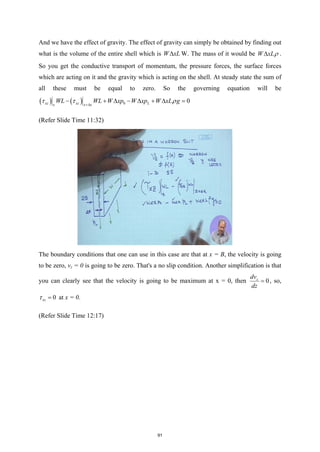
subscript. The first subscript refers to the principal direction of motion and the second
subscript refers to the direction perpendicular to the principal direction of motion in which
the momentum gets transported. So if you think of a layer which is moving in the x direction
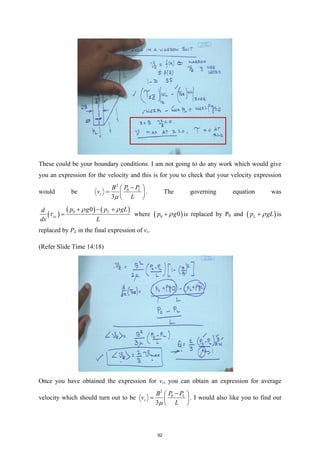
and another layer on top of it also being dragged in the x direction but with a lower velocity,
then the x momentum of flow gets transported because of viscosity in the y direction. So,
layers above the faster moving layer, then the next layer and the layer above that, all will start
to move in the x direction as a result of the invisible string which is the viscosity which binds
these two layers. So the momentum even though it is in the x direction it gets transported in
the y direction. This is also called the molecular transport of momentum and the double
subscript is a very common way to represent the shear stress. That means the stress being
exerted by the moving fluid on the layer just above it. So the area which is in contact with the
layer below it, it gets some stress, force per unit area, which is a direct result of viscosity.
The defining equation of viscosity as we have seen previously is the Newton's law of
viscosity where the shear stress is directly proportional to the cause, the velocity gradient and
the proportionality constant of this is known as the viscosity. So the fluids which follow
Newton's law of viscosity, can be expressed as velocity gradient
τ µ
=
− × . The minus
signifies that the momentum always gets transported in the direction of decreasing velocity.
Those kind of fluids which follow this law are commonly known as Newtonian fluid.
43
Examples of different behaviors are quite common. There could be some fluids which would
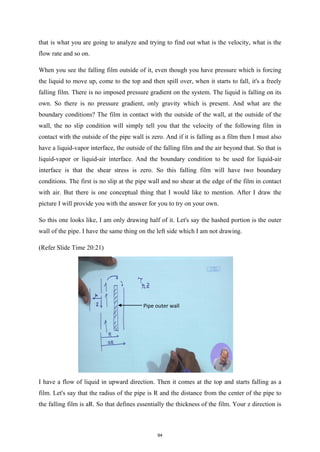
first resist motion, but once a threshold stress is applied on it, it would automatically start to
move and from that point onwards the stress is going to be proportional to the velocity
gradient. So those kind of fluids which have a threshold stress which must be applied for it to
start its motion are called Bingham plastics and common example of Bingham plastic is the
toothpaste. You have to push the tube with a certain force. If we do not go beyond that force,
nothing will come out of the tube. So the toothpaste is an example of Bingham plastic.
And then in the subsequent classes we have seen that it is useful to define a shell in a moving
fluid and find out what are the forces, what are the momentum that are acting on that shell. So
these shells are generally defined and the smaller dimension of the shell is the direction in
which the velocity is changing. So in the previous class we saw the example of flow along a
flat plate. There would be a flow of liquid along a flat plate and obviously the velocity is
going to change in the perpendicular direction.
So at the solid-liquid interface the boundary condition is going to be no slip condition which
we know that at liquid-solid interface there cannot be any motion of the liquid molecules. So
the liquid molecules adjacent to the solid boundary will have zero relative velocity. So that's
called the no slip condition. At the other end where we have the liquid vapor interface, the
shear stress across the interface would be equal to zero. True for most of the cases when the
velocity differences are not too great or the air is not moving with a very high velocity
creating waves and so on. There we have seen since the velocity vary in the perpendicular
direction of flow, the shell that we are going to have a smaller dimension of Δx, let's say the
direction of velocity change is the x direction. It can be any length and any width and since
we are assuming its one dimensional laminar flow, incompressible flow, where the density
remains constant the velocity is not going to be a function of the axial distance, it is not going
to be a function of the width. It is only going to be the function of depth of the film. So for
those 1-D cases, we should always define the shell as having any length L, any width W, but
the depth of the shell is going to be Δx. Since between x and Δx, the velocity can change
substantially, we express the physics in the form of a difference equation
44
Let's say if this is the shell as shown in the figure above, then I am going to have some
amount of fluid which comes into the shell along z direction because of its flow but since I
don't have any velocity component either in this direction or in this direction nothing comes
in due to flow through the other four surfaces. So flow in along z direction will carry some
momentum along with it and flow out will take some momentum out of the control volume.
So these are the momentum in by convection. Since the velocity is changing in the x direction
so some shear stress will be felt by the bottom surface and some shear stress would be felt by
the top surface. So the forces due to the share which would act on the two sides of this shell
would be τ with the appropriate subscript multiplied with the bottom area and τ with again
with the right subscript multiplied by the top area. These are the net momentum in and out by
conduction, by molecular means, by viscous transport of momentum. There may be other
forces acting on it. For example this is freely falling so there is no pressure difference
between these two points. However since it’s inclined the component of gravity would act on
the volume of the liquid contained in this control volume. So the only force which is acting
on it would be the gravity force. In steady state, the sum of all these would be zero. So the
fundamental equation that we are going to write for any shell is,
Rate of momentum in-Rate of momentum out + Sum of all forces acting on it = 0, at steady
state.
And then we identify that the momentum can come in as a result of convection and as a result
of conduction. Convection is with the flow, conduction is perpendicular to the flow due the
presence of the shear stress. So once we have the difference equation then we are successful
45
in expressing the physics of the problem in the form of difference equation which contains
the smaller dimension, let's say Δx, if x is the direction in which the velocity is changing. So
the next step would be to divide both sides by Δx and taking the limit when 0
x
∆ → . So that
would essentially be using the definition of the first derivative and out of the difference
equation you get the differential equation. So that was the fundamental of shell balance which
we have discussed in the previous class. And we have used an example of flow along an
inclined flat plate to clarify some of the concepts.
Once we have the governing differential equation we need boundary conditions, since we are
going to integrate that in order to obtain the expression for velocity for certain case. The two
common boundary conditions that one would expect in momentum transport is no slip at the
solid-liquid interface and no shear at the liquid-vapor interface. So we have used those two
conditions to obtain a compact expression for the velocity as a function of depth.
Once we have the expression for velocity, we would be able to obtain what is the maximum
velocity and then we should also be able to express not the point value of velocity but the
average velocity. All such kinds of averages are always done across the flow cross-sections,
across a face which is perpendicular to the flow direction. So if I have flow in this direction,
then I need to find out what is the velocity at every point in an area that is perpendicular to
the direction of flow. So with that we have obtained what is the expression for average
velocity and once we have the average velocity then we can calculate what is the volumetric
flow rate and the mass flow rate of the falling film along the incline. In two or three classes
we would see some examples of the use of shell momentum balance in in everyday situations
that we know of.
So the most common fluid flow phenomena that you see almost every day is, flow of water
let's say, through a circular pipe. So you would like to see in this exercise how we can use the
shell momentum balance to obtain an expression for velocity in a tube through which the
liquid is flowing. Now we are going to assume in this case is that the tube is vertical. So there
will be effect of gravity. Gravity would try to pull the liquid towards the downward direction.
There is also pressure gradient. There would be some pressure at the top and a slightly lower
pressure at the bottom. So the pressure gradient, the pressure force is forcing the liquid to
move downwards. There would be gravity force which is going to pull the liquid downwards.
So the effect of pressure gradient and gravity is to create a flow in the downward direction.
Now as the fluid starts to flow, it is going to interact with the walls of the tube and the way it
46
is going to interact is through viscous forces. But when it reaches steady state, the sum of all
forces acting on the control volume suitably define for flow in a pipe must be equal to zero.
So if I can define a control volume for flow in a pipe then we are going to find out what is the
rate of momentum into the control volume by convection and by conduction. What is the
surface force that is acting on the control volume, namely pressure in this case. The force due
to gravity that is acting on it would be the total amount of liquid contained in this control
volume multiplied by ρ and g. So, at steady state the sum of all these would be equal to zero.
So with that difference equation we should be able to obtain a differential equation and we
should be able to use appropriate boundary condition for this case to obtain what is the
velocity distribution of a flowing fluid in a tube subjected to pressure gradient and subjected
to gravity.
That is what we are going to look in this class and in the next classes because this would give
rise to some of the equations which are quite known to us and some equations which are
going to play a very important role. Let's say if you are designing an experiment to measure
the viscosity of a liquid, all of you probably have used capital viscometer. So what is the
principle on which capital viscometer work? So how do you design the experiment? How you
can relate viscosity with the flow rate? So there will be many such examples which you
would be able to understand once we solve the problem of flow through a pipe. So that's the
first problem that we are going to look at in this class, flow through a circular tube. What you
see here is the pipe which has a radius equal to R. There is flow from the top. The pressure at
the top is p0 and pressure at the bottom is pL. The length of the tube is L and the r and the z, z
coordinates are shown in figure below.
(Refer Slide Time 14:58)
47
Now we understand that as the flow takes place in the tube, the velocity at steady state and
for in incompressible cases, is a function of r only.The closer to the wall the liquid layer is,
the lower is going to be its velocity and as it moves progressively towards the center, the
velocity will increase. Now whether this increase is going to be a straight line increase or
some other form? That's what we are going to find out in here.
So the first job for this case, where I have flow from the top as a result of pressure difference
and as a result of gravity, is to define a shell. And across that shell, we are going to make the
momentum balance. So what would this shell look like? It could be of any length L, it does
not matter since the velocity is not a function of L. Velocity vz in the z direction is not a
function of z. It is definitely a function of r.
(Refer Slide Time 16:16)
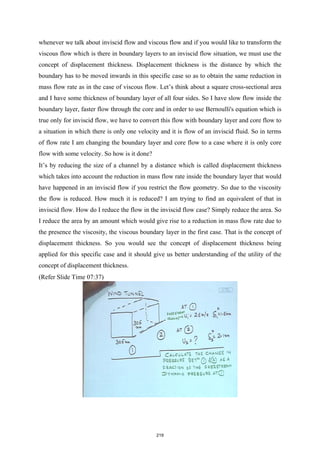
48
Since it a function of r, then my shell will have the smaller dimension as Δr. The way that I
have shown in the slide, the one in blue. So the thickness is Δr. The inside point is r and the
outside point is at r + Δr.
(Refer Slide Time 16:28)
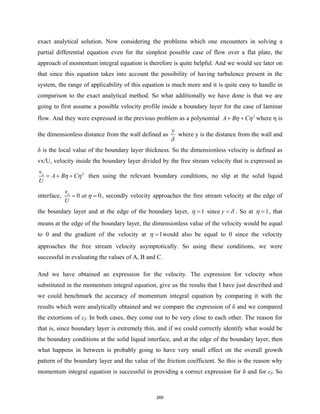
The length of the shell does not really matter since the velocity is not a function of z. would
try to see what would be the momentum in and momentum out term within the blue shell.
Then we will look into all the forces due to the surface force and the body force acting on the
liquid contained in this shell. So in the below slide I have just enlarged this section and what
you see here is that through the top surface of the imaginary shell, momentum gets in by
convection.
(Refer Slide Time 17:13)
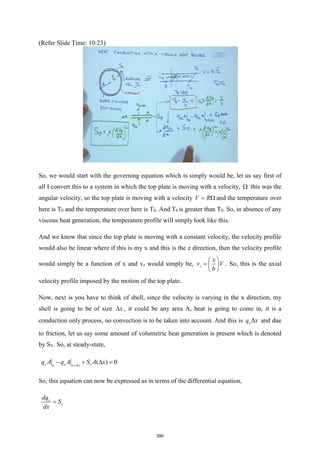
49
So the liquid is crossing the inlet points carrying away with it some momentum along
alongith it. But since the velocity is changing in the r direction, there would be a gradient in
velocity along radial direction. Since there is a velocity gradient, there would be viscous
transport of momentum. So momentum in and out by viscous transfer is taking place to the
sidewalls. So if you think of the momentum which is in by convection the area on which it is
acting on must be equal to 2 r r
π ∆ .
(Refer Slide Time 18:42)
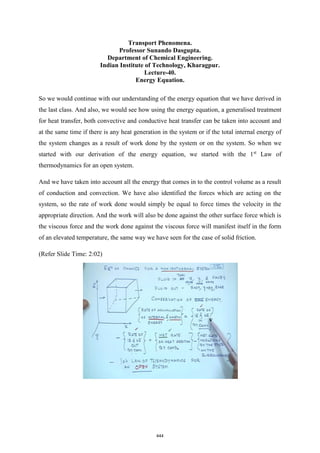
Whereas when we talk about viscous transport, its acting at the inner area and the
corresponding area for that would simply be equal to 2 rL
π or if you think about the outer
one ( )
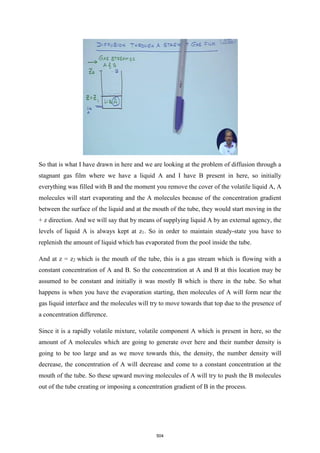
2 r r L
π + ∆ . So these are the two different areas through which the convictive transport
of momentum and conductive transport of momentum is taking place.
So what is the volume through which momentum transport by convection takes place? It
would be simply equal to 2 r rL
π ∆ . So this is the volume of the fluid which is contained in
this shell. This is the area on which the fluid is coming in. So if you think that my shell is
vertical, then this top area is the one through which the convective momentum is coming in.
So whatever would be the velocity multiplied by the area would give me the amount of mass
which is coming in. The mass of fluid that comes in carries with it some amount of
momentum. So, the momentum would be z z
z o
area v v
=
× × . So that’s the rate of momentum
coming in through the top surface.
50
Whereas when you think of the inside area, if I open up the shell its simply going to be 2 rL
π
. So when I open this up 2 rL
π this is the area that encounters the molecular transport of
momentum.
(Refer Slide Time 20:06)
When you think of pressure p0 it's this top surface on which the pressure force is acting.
(Refer Slide Time 20:15)
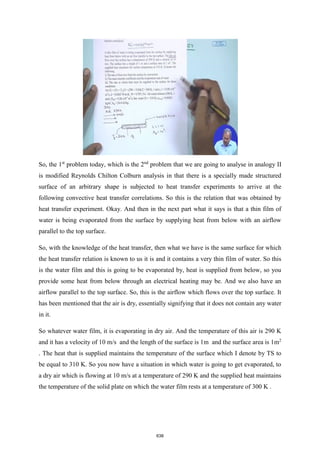
51
pL is acting at the bottom and whatever be the liquid contained in this thin strip of imaginary
shell that is also being acted on by the gravity force.
(Refer Slide Time 20:19)
So the mass of the fluid contained in this strip is 2 rL g
π ρ that would give me the total body
force which is acting on this shell.
So what I am going to do now is to write each of these terms and then see if it is possible for
me from the basic physics or our basic understanding to cancel the terms that are not
important or that are equal to each other. The momentum in term is going to be
( )
2 z z z o
r rv v
π ρ =
∆ . 2 z
r rv
π ∆ is the volumetric flow rate, m3
/s. I will multiply that with ρ,
which is kg/m3
. So that makes it kg/s second, the mass flow rate. This mass flow rate is again
52
multiplied by a velocity, vz with units of m/s which makes it the total amount of convective
momentum which is coming into this. So this has units of force
(Refer Slide Time 21:54)
So this is the convective momentum into the system and the convective momentum out of the
system would simply be equal to again ( )
2 z z z L
r rv v
π ρ =
∆ .
(Refer Slide Time 22:31)
Now vz is not a function of z. So whatever be the value of vz at z = 0, must be equal to the
value of vz at z = L. vz does not vary with z. And therefore these two terms will cancel out
each other. So the convective momentum in and the convective momentum out would simply
be equal in this case.
53
(Refer Slide Time 22:59)
So with that then we are going to write what is going to be the molecular transport of
momentum. The area on which it is working on is 2 rL
π and the shear stress is the z
component of momentum due to viscosity that gets transported in the r direction. So therefore
the the momentum gets transported due to the presence of viscosity at r would be 2 rz r r
rL
π τ =
and the one that goes out would be 2 rz r r r
rL
π τ = +∆
. So this is the viscous momentum in,
viscous momentum out.
(Refer Slide Time 23:56)
54
What is remaining is then is the pressure force? The pressure force acting at the top would
simply be the area multiplied by whatever be the pressure that is p0. So the expression of
pressure force at z=0 would be 0
2 r rp
π ∆ and at z = L, 2 L
r rp
π ∆
(Refer Slide Time 24:46)
And I also have body force which is acting on it. In order to obtain the body force, I need to
first find out the total volume of fluid that is present in here. The total volume is 2 r rL
π ∆ . So
the gravity force would be 2 r rL g
π ρ
∆ which is going to pull the liquid in the direction of
increase in z.
(Refer Slide Time 25:14)
55
So the governing difference equation would simply be sum of net momentum in by
convection, net pressure which is acting at the top and the gravitational force which is acting
on it. Now the next step as we have done in the case of difference equations is to divide both
sides by the smaller dimension which in this case is Δr. So we divide both sides of the
equation by Δr and taking the limit when 0
r
∆ → and what we get out of it is a differential
equation. So if I divide both sides and take the limit my equation would be
( ) ( ) 0
0
lim rz rz r L
r r
r r p p
g r
r L
r
τ τ
ρ
+∆
 
− −
 
 
= +
 
∆  
 
 
∆ →
. So if we use a definition of the first
derivative, you are going to get ( ) 0 L
rz
P P
d
r r
dr L
τ
−
 
=  
 
where simply P p gz
ρ
= − . There is
no additional significance to this P, this is introduced so to give it just compact shape.
(Refer Slide Time 27:41)
So, once I have the governing equation, it has to be integrated to obtain the velocity
expression. That's what we would like to do. But before we do that, this τrz must be
substituted in order to express it in terms of velocity. And if we assume the fluid to be
Newtonian, then τrz would simply be z
rz
dv
dr
τ µ
= − .
56
So once you substitute that in here then you will have 0 L
z P P
dv
d
r r
dr dr L
µ
−
 
 
− =
   
   
. This
equation can now be integrated and that's what we are going to do in the next class.
(Refer Slide Time 29:28)
So what we have done in this present exercise which we will continue in the next class is, we
have found out simply by making a shell balance, we would be able to account for all the
factors by which momentum can come into the system or leave the system. We have also
correctly identified what are the different forces, surface and body, that are acting on the
control volume. At steady state the algebraic sum of that would be zero. That difference
equation can be converted into a differential equation.
And once we have the differential equation and plugging the expression for Newton's law of
viscosity, we have a differential equation of velocity in terms of the physical property µ, in
terms of the imposed operating condition that is the pressure gradient, 0 L
P P
L
−
. And the force
field, body force field present which is g. So this expression we will now integrate in order to
obtain a very compact useful relation for the velocity and subsequently the flow rate of fluid
through a tube in which there is a pressure gradient and in which there is the effect of gravity.
So that relation we are going to do in the next class.
57
Transport Phenomena
Professor Sunando DasGupta
Department of Chemical Engineering
Indian Institute of Technology Kharagpur
Lecture 6
Example of Shell Momentum Balance (Contd.)
So we are dealing with the flow through a circular tube in which there is an imposed pressure
gradient and gravity is also present. So our goal is to obtain the velocity distribution inside
the pipe during the flow and to obtain an expression for the volumetric flow rate. Now this
volumetric flow rate based on our understanding so far we realized that it will contain some
geometric parameters. For example, what's going to be the length of the pipe? What’s its
radius? There will be some operation parameters for example, what is the pressure difference
that we have imposed from outside? That is, what is p0 - pL? It should also contain a
description of the force field, body force field which is present, in this case it is gravity. Since
it is vertical, it's simply going to be g. The geometric and the operational parameters namely
r, L, p0, pL and gravity, all these would be collected with the velocity or with a physical
property. And the physical property or more correctly the transport property in this case
would be viscosity. So whatever expression of velocity or volumetric flow rate that we would
get should contain all this. We have done this analysis and we have come up with the
governing equation. Now this governing equation has to be solved with appropriate boundary
conditions. So let's start with our final form of the governing equation and see what we can
do in order to obtain an expression for the velocity.
So what you have in here is the expression 0 L
z P P
dv
d
r r
dr dr L
µ
−
 
 
− =
   
   
that we have obtained
for this. If you integrate it twice what you are going to get the final expression.
(Refer Slide Time 02:44)
58
Once you integrate this, it would be 2
0
1
2
L
rz
P P
r r C
L
τ
−
 
= +
 
 
or 0 1
2
L
rz
P P C
r
L r
τ
−
 
= +
 
 
(Refer Slide Time 03:57)
Now we realize that this gives us an opportunity to say something about the value of the
integration constant C1. We understand that τrz must be finite at r = 0 and this can only
happen if C1 = 0. So the fundamental condition that the shear stress cannot be indefinite at
any point in the flow field will give me the definite value for all the boundary conditions.
So in certain cases the physics of the problem has to be kept in mind not just blindly, no slip
and no shear at two interfaces. In some cases you can make a definitive statement about the
nature of the velocity, nature of the flow, nature of shear stress, which would give you an
additional physical boundary condition which in this case we have used to obtain the first
integration constant C1. So once you know C1 = 0, then the remaining part of the equation can
be integrated to obtain what is velocity distribution.
Now, putting C1 = 0, the expression for shear stress would be 0
2
L
rz
P P
r
L
τ
−
 
=  
 
. Using
Newton's law of viscosity, the expression will be 0
2
L
z P P
dv
r
dr L
µ
 − 
= − 
 
and upon integration it
will give you, 2
0
2
4
L
z
P P
v r C
L
µ
 − 
=
− +
 
 
. So C2 is the second integration constant.
59
Now how do you evaluate C2? You need a boundary condition and the boundary condition
that is available to you is, no slip at r = R, because in this shell, when r becomes R, then you
essentially have a liquid-solid interface and at a liquid-solid interface, the relative velocity is
zero. So you would have vz = 0 at r = R.
(Refer Slide Time 06:13)
So that’s the second boundary condition which one can use to obtain the final expression of
velocity
2
2
0
1
4
L
z
P P r
v R
L R
µ
 
 −   
=
− −
 
 
 
 
   
 
. So this is the expression of velocity for flow in a
circular pipe, in presence of pressure gradient and gravity, which is embedded into it and all
other parameters, the geometric parameters R and L and the property, the transport property μ
is already present in here. It is obvious that the velocity distribution because of its r
dependence, is going to be parabolic in nature. So velocity starts at value equal to zero due to
no slip at the solid wall and at the center velocity is maximum and the variation is parabolic
in nature. from the expression of vz you can simply write you can simply see vz max is
essentially at r = 0, which would simply be 2
0
max 0 4
L
z r
P P
v R
L
µ
=
 − 
=  
 
. So we can write,
2
max 1
z z
r
v v
R
 
 
= −
 
 
 
 
 
.
(Refer Slide Time 08:33)
60
But you are as engineer, you are probably not interested to know what is velocity? We are
more interested to know what is the flow rate for such a case? When I apply a pressure
gradient, when I have a gravity force acting on it, in a pipe of known diameter and length,
how much of fluid can I expect at the other end? Or how much of fluid I can collect which is
coming out of the tube per unit time? In order to do that, the first step is to obtain an
expression for the average velocity. And to obtain the average velocity I need to integrate this
velocity across some area. The flow is in the z direction and the average velocity varies with
r. So the flow area which I need to incorporate in order to obtain the average velocity must be
some area which is perpendicular to the flow. So if I take the cross section of the circle, then
the circular area must be the flow area across which I need to integrate in order to obtain an
average velocity. All velocities are area average velocities and all areas are always
perpendicular to the direction of flow. So the area should be
2
0 0
R
r dr d
π
θ
∫ ∫ , the cross sectional
area across which the velocity need to be integrated. So the average velocity can be expressed
as
2
0 0
2
0 0
R
z
z R
v r dr d
v
r dr d
π
π
θ
θ
=
∫ ∫
∫ ∫
. Incorporating the value of vz , the expression will be
( )
0 2
8
L
z
P P
v R
L
µ
−
= . And once you have the average velocity, the flow rate Q would be
( )
0
2 4
8
L
z
P P
Q R v R
L
π
π
µ
−
= = . This is a famous equation which is known as the Hagen
Poiseuille equation.
61
(Refer Slide Time 11:55)
So this Hagen Poiseuille equation gives you the volumetric flow rate for a fluid which is
flowing through a vertical tube because of the presence of pressure gradient and body force.
So 0 L
P P
− is the imposed condition, R and L are two geometrics and μ is the thermo-physical
property or transport property. So now you can clearly see how we explain the principle of
capillary viscometer. You measured the Q, the amount of liquid that you are collecting per
unit time and if it is falling freely vertically then 0 L
P P
− can be substituted by the gravity
force. You need to know the diameter or the radius of the capillary, the length is known, so Q
you are going to find out experimentally. The only one unknown here is the property μ. So
using a capillary viscometer where a very thin capillary is used to obtain some flow out of the
capillary, the only unknown being μ can be calculated. So that is the principle of capillary
viscometer. Whenever we get such an expression, we need to be careful about what are the
assumptions we have made because we need to know the assumptions in order to get the
region of applicability of any relation or correlation that we have developed.
The first assumption that we have made is that it is straight streamline laminar flow. So you
cannot have a very high pressure gradient being applied to certain length of the pipe such that
the flow inside gets disturbed and becomes turbulent. If that is the case, this analysis will not
be valid. This analysis also assumes that it's an incompressible fluid, i.e. ρ is constant. So
incompressible, straight streamline laminar flow are some of the constraints which must be
met before Hagen Poiseuille equation can be used to find out how the flow rate and the
conditions are related by viscosity for such a case. But this is a simple yet elegant example of
the use of shell momentum balance in everyday problem. And this Hagen Poiseuille equation
62
has so many uses in the everyday life in physics and in so many other cases. For the liquid
column inside the pipe or tube to move with a constant velocity, we have assume that sum of
all forces acting on it must be equal to zero. Otherwise if it is not the case then the column of
liquid which is flowing inside the tube will either accelerate or will slow down.
Now what are the forces which are acting on it? So physically we need to find out what are
the forces which are acting on it? The liquid column is going down because it is acted upon
by a difference in pressure, which is trying to pull the liquid in downward direction. There is
also a gravity which is trying to make the liquid column move in the plus z direction. So
these two pressures and the gravity are acting in the same direction. So there must be an
opposing force which is going to be equal to the combined effect of these two forces. Only
then it's going to move with a constant velocity.
What is that force that opposes the motion of a liquid? There is no other way but the
viscosity. So the viscous force is the one which opposes any flow of the liquid imposed by
some other conditions, pressure difference or maybe gravity. Without solving anything
heuristically we should be able to say that the opposing viscous force is simply equal to the
force due to pressure and the force due to gravity which are acting on the column of the fluid.
But in many case if you like to analytically find out what is the force that is acting on it, the
viscous force at r = R that means at the solid liquid-interface along with the inner wall of the
pipe.
So, τrz, the shear stress evaluated at r = R has to be multiplied with the area on which it is
acting on. This area must be 2 rL
π and the viscous force will be 2 rz r R
rL
π τ =
. So once you do
the calculation you would see that the viscous force is going to be equal to the combined
force due to the pressure and the weight of the liquid column. So this Hagen Poiseuille
equation is something which we use everyday. But you can get such a neat expression
starting with the simple concept of shell momentum balance.
So what we are going to do now is we will try to solve a few other problem using this simple
concept of shell momentum balance. And towards the end of these exercises we would
slowly start to feel that it is getting increasingly difficult to use the shell momentum balance
because we need to visualize the complex geometries and those situations in which it’s not an
one dimensional flow. If you have flow in two dimensions, if you have velocity in both x and
y direction, the shell momentum balance may not work or it becomes too cumbersome. So
63
the need for a generalized treatment will become apparent as we start solving more and more
difficult problems. But right now I will show you one or two more examples of the shell
momentum balance and then do a conceptual problem which is also very interesting.
So let's now start with another problem which is an industrial problem of an upward moving
belt. So let's say that this is a belt which rises. Initially the belt is stationery. But let’s say at
some point the belt starts to move upwards with velocity U0.
(Refer Slide Time 21:11)
After you provide sufficient time, when it reaches steady state, the belt is going to have a thin
film of liquid stuck to it. Let's say my x direction is perpendicular to the direction of flow, the
y direction is along the flow and at some point when it reaches steady state, the thickness of
the film is constant and its equal to h. You can see that you have vy in here. The 0
y
v ≠
however 0
x
v = . There is no pressure gradient which is acting in this case and only a force
which is acting is gravity. So the belt starts to move upward and it will carry a thin film of
liquid along with it. But the gravity would like to drain the liquid in the reverse direction. So
viscous forces pulls the liquid up, gravitational forces tend to drain the liquid and when the
steady state is reached, let us assume that the thickness of the film is given by h. So if that's
the case, then we would like to find out what's going to be the velocity distribution, vy in this
case, in the thin portion of the liquid.
So we have to think of a shell and in order to think of a shell we need to first identify what is
the direction in which the velocity is varying. Because whatever be that direction, that's going
64
to be the smaller dimension of the control volume. You can clearly see that the velocity is
varying with x. The velocity does not vary with y and there is no vx in here.
(Refer Slide Time 22:53)
So in order to obtain the shell, if this is my wall and this is the liquid film then my shell must
be something which is of thickness Δx. It could be any length L any width y, does not matter.
Because vy is not a function of y, it's not a function of z, it's only a function of x. So that's
why I am taking my shell as this.
(Refer Slide Time 23:43)
Now when you consider this shell of Δx in thickness and on left side I have the wall and on
the right side I have the free surface. So some amount of momentum, which is convective
65
momentum will come in. Some amount of convective momentum will go out. But these two
must be equal to each other because of my assumption that vy is not a function of y. So
whatever be the convective momentum in both sides, they must be equal and opposite. So the
convection part, I do not need to write since the velocities at these two points are equal. But I
need to take into the account the τ, shear stress. Now what is going to be the subscript of τ?
(Refer Slide Time 24:55)
The motion is upwards in the plus y direction. So the first subscript of the shear stress in this
case is simply going to be τy and as a result of motion in the upward direction and variation in
velocity, the momentum gets transported in the x direction. So the subscript of τ would be τxy
in this case, y momentum gets transported in the x direction. The shear stress τxy is acting on
an area, which is LW. The convective momentum in is evaluated at x. The momentum out one
is going to be xy LW
τ evaluated at x + Δx and no body force is acting on it, it’s only gravity
force. In order to obtain gravity force I first need to find out what is the volume of the liquid
which is contained in the control volume, which is LW x g
ρ
∆ , I multiply it with ρ and I put g
in order to obtain the gravitational force. But if you look at the coordinates system in here, I
must put a minus sign in this case since my g and y are oppositely directed.
(Refer Slide Time 26:23)
66
So the shell balance equation becomes, ( ) ( ) 0
xy xy
x x x
LW LW LW x g
τ τ ρ
+∆
− − ∆ =
.
So you see how easy it is now to to write the difference equation. It is progressively
becoming easier for you to clearly visualize the flow conditions, write the governing
equation, get rid of all the terms which are not relevant. For example, in this case the
transport of momentum by convective flow. Since the velocities are same at the bottom and at
the top no net contribution of momentum. The only contribution is the viscous transport in,
viscous transport out and the gravity which is acting in the reverse direction. So the algebraic
sum of these three must be equal to zero and that's what I have written in here.
(Refer Slide Time 27:34)
67
So the next step is simply dividing both the sides by Δx, take the limit 0
x
∆ → and obviously
cancel LW from all sides. What you would get is xy
d
g
dx
τ ρ
= − . So this becomes your
governing equation right now.
So the first thing that we can do is we can simply integrate it once. 1
xy gx C
τ ρ
=
− + . Now at x
= h, τxy = 0. i.e. at liquid-vapor interface, the shear stress is zero.
(Refer Slide Time 29:37)
So 1
C gh
ρ
= and if I assume it’s a Newtonian fluid,
y
xy
dv
dx
τ µ
= − and plugging in this in
1
xy gx C
τ ρ
=
− + and using the value of, you can integrate this. The final expression of vy
would be
2
2
0 2
2
y
gh x x
v U
h h
ρ
µ
 
   
=
− −
 
   
   
 
 
. This is the distribution you should get.
Now you can see that it is slightly more complicated than the simple parabolic distribution
profile. You have a linear term and you have a quadratic term and you have the velocity with
which the belt has been pulled up. The second boundary condition would be at x = 0, that
means at the liquid-solid interface there is no relative velocity. So all the molecules of the
liquid which are here, they are moving up with the plate with the same velocity as U, which is
essentially, no slip velocity. Since its no slip, the velocity must be equal to the velocity at x =
0 that must be equal to the upward velocity of the belt. vy = U0. This is a very important
boundary condition.
68
(Refer Slide Time 30:40)
So the belt pulls the liquid, the gravity tries to drain the liquid. A steady state is reached with
the condition that the velocity on the belt on the liquid side would be equal to the upward
velocity of the belt which is no slip and at the liquid-vapor interface the shear stress would be
zero. No slip, no relative velocity at the solid-liquid interface and no shear at the liquid-vapor
interface. Combination of these two would give you a very clean neat expression for the
velocity which is a function of operational parameter, which is U0, a function of the property,
μ. The h is again the operational parameter which dictates what's going to be the value of vy
and as a function of x and so on.
So another example of how to use shell momentum balance to solve problems of momentum
transfer and in the next class we will see slightly more different problem. Thank you.
69
Transport Phenomena
Professor Sunando DasGupta
Department of Chemical Engineering
Indian Institute of Technology Kharagpur
Lecture 7
Example of Shell Momentum Balance (Contd.)
We will continue with our examples of the use of shell momentum balance and how it can be
effectively used for solutions of simple problems, in which the geometry is straight forward,
the flow is mostly one dimensional and it’s a steady flow. So for all these cases we have
typically solved two problems. I would like you to work with me on one more problem then I
will give you some problems to work on your own and I will provide you with the answers.
But towards the end of this part, you yourself will start to realize that a simple shell balance
approach would not suffice anymore. The geometries is getting complicated, the flow may
have multidimensional effects. So a generalized approach is necessary. But to get to that
point we will first try to solve the problem which is very simple. In which case there is a two
parallel plates and one of them is moving, the other is stationary.
So let’s say, as the top plate starts to move, it would try to drag the liquid which is in between
in the intervening space. So as the top plate moves over the liquid, it will try to drag the
liquid in between the two plates. So a flow start to establish and we will look at that flow
when a steady state has reached. So the top plate is moving at some velocity, it imparts the
velocity in the liquid and we're looking at the steady state. But just to make it more
interesting, what we are going to do is, we are going to assume that there exists a pressure
gradient as well. So the motion in the intervening space between the two plates, one moving,
the other stationary, is caused by two factors. One is the movement of the top plate and
second is the pressure gradient that exits in between two points.
Now if the pressure decreases in the direction of the top plate motion, then the fluid is going
to have an additional flow due to pressure gradient from, let’s say, left to right. So the top
plate is moving from left to right, the pressure gradient is in such a way that it would try to
push the liquid from left to right. When that happens we will say that it is favorable pressure
gradient. So in order for a favorable pressure gradient, the pressure has to decrease as it move
along in the actual direction. If it is opposite that means if I move in this direction and the
pressure increases, we will call it as an unfavorable pressure gradient.
70
But the problem we are going to deal with is the flow between the two parallel plates. One
plate is in motion and there is a favorable pressure gradient. So this is the problem we would
like to solve using shell momentum balance and then there are several interesting offshoots of
this problem which we will see as we move along. But right now let's draw the picture of the
two plates, one stationary, one in motion and see what happens to the liquid in between.
(Refer Slide Time 04:56)
So the bottom plate is stationary and the top plate moves towards the right with a constant
velocity U and let us assume that the gap in between these two plates is equal to b. The
direction along the flow is x and perpendicular direction is y. There is a pressure gradient, I
call it as
dp
A
dx
= − , where A is simply a constant. So as we move in the downstream
direction, the pressure decrease. So the top plate moves, it drags the fluid and also I have a
pressure gradient that forces the fluid to move from left to right. Now here I again have to
draw a shell and make the balances. The principal direction of the motion is in the x direction
but as I can see the flow changes in the y direction. So of course my shell is going to have a
thickness of Δy in here.
71
(Refer Slide Time 05:27)
let's say the area of the shell is A. So the shear stress τ is going to have two subscripts. It's
going to be τyx, x being the direction of motion and y is the direction in which the momentum
gets transported and this acts on the area A. So the expression for the time rate of momentum
in through the bottom face which is located at y and the time rate of momentum out would
again be the same expression but evaluated at y + Δy is yz yz
y y y
A A
τ τ +∆
− . Since vx is the
function of y only, the convective momentum in and the convective momentum out need not
be written here. And since it’s an incompressible fluid, there would not be any accumulation
of mass inside the control volume. So this is a molecular transport of momentum which I
have written.
Again since the system is horizontal, there’s no question of having any component of gravity
in the direction of flow and the gravity is acting in a direction perpendicular to that of the
flow. So there would not be any gravity force acting over here. On the other hand the
pressure is going to play a role over here. So the pressure at, let's say, at the inlet point of the
shell is p0 which is acting on an area width W and thickness Δy.
(Refer Slide Time 07:45)
72
and the pressure which is acting over the surface at the end of the shell is pL acting on the
area WΔy and at steady state the sum of all this must be zero. So
( ) ( )
0 0
yz yz L
y y y
A A p W y p W y
τ τ +∆
− + ∆ − ∆ =
So again we divide both sides by Δy, taking the limit when 0
y
∆ → . So what I would get out
of these two terms is ( )
yx
d p
dy L
τ
∆
− =
. Essentially this area A is nothing but WL, where L is
the length of the control volume. So W cancels from both sides. The L is remaining which is
being brought on the on the denominator. So once you do that and once you substitute Tyx,
essentially you would get
2
2
1
x
d v dp
dy dx
µ
= for Newtonian fluid. That's the governing equation for
this case. The terms are pressure gradient, viscous transport of momentum, no convection, no
gravity. So once you integrate it, it would simply be 2
1 2
1
2
x
dp
v y C y C
dx
µ
 
= + +
 
 
. So that's a
form of the velocity distribution and I need two boundary conditions to evaluate them. One is
obviously at y = 0, vx = 0, no slip condition. And if you use that, it will simply tell you that
C2 = 0.
(Refer Slide Time 10:03)
73
The other condition is y = b, vx must be equal to the velocity of the top plate and this would
give you the expression for 2
1
1 1
2
dp
C U b
b dx
µ
 
 
= −  
 
 
 
. So I am using no slip at the bottom and
no slip at the top. No relative velocity at the bottom and at the top and evaluated the constant
C1 and C2.
(Refer Slide Time 10:40)
So if we substitute this in the expression of vx, the final expression for velocity for a flow
induced by the motion of the top plate, also sustained by the presence of pressure gradient,
would simply be equal to
2
2
1
2
x
U dp y y
v y b
b dx b b
µ
 
   
=
− −
 
   
   
 
 
.
74
Now this combined expression is very interesting. Because it can be used to get some ideas
about what kind of flow do you expect if you just have the motion of the top plate and do not
have a pressure gradient. If you look at the expression here, if I say that there is no imposed
pressure gradient, then
2
2
1
0
2
dp y y
b
dx b b
µ
 
   
− =
 
   
   
 
 
and if that's equal to zero, vx would
simply be
U
y
b
. And the profile of the velocity in this case would simply be a linear velocity
starting at zero and the velocity is going to be equal to 1.
(Refer Slide Time 12:15)
So this kind of a flow which is sustained because of the motion of one of the, let's say, the top
plate, no pressure gradient, no gravity, where the velocity profile is going to be linear is
known as the Couette flow. The Couette flow is quite common in several industrial
applications where the motion of one plate creates a condition and the flow takes place.
If you look at the second part of it, let's say, the top plate is stationary, the bottom plate is also
stationary, but there is a pressure gradient which is imposed in between the two. If that is the
case then
U
y
b
is going to be equal to zero,
2
2
1
2
dp y y
b
dx b b
µ
 
   
−
 
   
   
 
 
is going to be non-zero
and the profile is shown in the below image when the flow is due to pressure gradient.
(Refer Slide Time 13:50)
75
I will a slightly deeper into this, then it would clarify many of the concepts. When there is no
applied pressure gradient, I simply get a linear distribution. Now if I apply a pressure gradient
in this case, let's assume that the pressure on the left side is more than the pressure on the
right side, what we call as a favorable pressure gradient. So as we move in the x direction, the
pressure gradient progressively decreases or in other words 0
dp
dx
< . So if 0
dp
dx
< that is
called a favorable pressure gradient and you would get the pressure. The condition is
probably going to be something shown in the below image.
(Refer Slide Time 14:21)
So you have a favorable pressure gradient and top plate is moving with some velocity. So this
situation is unique because there is a departure from the straight line behavior of the velocity
76
and it tries to closely resemble the second part of it. So it’s the superimposition of the Couette
flow over the pressure driven flow, when the pressure gradients going to be negative.
It can also happen that the pressure on the right side is going to be more than the pressure on
the left side or the case of an unfavorable pressure gradient. If it is an unfavorable pressure
gradient, then the profile would look like opposite of the previous one. So in this case,
0
dp
dx
> . That means as I move from this side to this side, the pressure increases. Therefore
the pressure gradient is positive and it is the unfavorable pressure gradient. So on one hand
you have Couette flow, where you get a linear distribution, favorable pressure gradient and
unfavorable pressure gradient.
(Refer Slide Time 15:38)
There is one more interesting thing to see here is, in Couette flow the maximum takes place at
y = b. But if you have an unfavorable pressure gradient or a favorable pressure gradient, the
location of the maximum velocity could be different. It's not going to be at y = b, it could be
at some point in between y = b and y = 0. So if someone tells you that what’s the location of
the maximum velocity, vmax? We understand for vmax, the 0
x
dv
dy
= and you substitute the
expression of vx in here, differentiated with respect to y and make it equal to 0, what you get
is
2
2
2
1
2
m m
y U
b dp
dx b b b
µ
 
 
− =
  
  
. So ym is the location of y at which U becomes Um. So this is the
77
Um is the maximum velocity and ym is the location of the maximum velocity. So you simplify
get 2
2
1
2
m
b U dp
y where A
Ab dx
µ
 
=
+ =
−
 
 
.
(Refer Slide Time 17:36)
So you now have seen the location of the vmax which depends on the pressure gradient, the top
plate velocity, the geometry, the separation between the two plates and the transport property
which is μ. So the vmax will not lie over at the top plate. vmax will lie somewhere in between
these two.
(Refer Slide Time 18:09)
78
There's one more interesting thing that one can see from here. Let's again draw this Couette
flow diagram where we have two plates, no pressure gradient, linear distribution, negative
pressure gradient, pressure gradient and Couette flow both are acting in the same direction,
unfavorable pressure gradient but the pressure gradient is trying to force it from right to left.
Couette flow tries to drag it from left to right. So you should be able to find out what is the
negative pressure gradient.
(Refer Slide Time 19:49)
Suppose it is asked what is the pressure gradient that needs to be imposed such that there is
no net flow? So what you see here is, for this case, so I am I am drawing the case for Couette
flow and the flow when I have the positive pressure gradient. So if you see here, partly the
flow is from left to right. So this is an unique case where the pressure gradient is unfavorable,
that means
dp
ve
dx
= + and you have towards the bottom the liquid is flowing in the left
direction, towards the top due to the Couette flow, the fluid is moving in the right direction.
So if someone asks you, what should be the relation between U and
dp
dx
that would give you
zero net flow that is Q = 0. I need to find out the relation between the velocity of the top plate
and the imposed pressure gradient such that the net flow rate to be equal to 0.
(Refer Slide Time 20:14)
79
So this is really interesting thing to see and for Q to be 0, the algebraic sum of the flow rate in
both the regions must be equal and opposite. So the area under the curves must be equal. So
you would be able to find out the average velocity for this case where Q = 0. So the average
velocity for a situation in which
dp
dx
is positive and the top plate is moving with velocity, the
Couette flow is towards from left to right, the average velocity must be equal to 0.
(Refer Slide Time 21:21)
So, one can find out the expression for average velocity because the expression for velocity is
known to us. From there I need to find out what is vx and this vx to be equals to 0, which
80
implies that Q = 0 and this should give me a relation between U and
dp
dx
. I will leave that for
you to work on.
(Refer Slide Time 21:39)
But in order to obtain this vx I need to integrate. So
0
b
x
v v dxW
= ∫ where dx.W is the flow
area and W is the depth of this. So this is going to be your average velocity. If you equate it to
be 0, you get the relation between U and
dp
dx
.
(Refer Slide Time 22:20)
81
So an unfavorable pressure gradient can give rise to a situation in which the net flow rate is 0.
The third part of this specific problem can also be thought of to provide a different type of a
problem. Let's say that the top plate is moving, the bottom plate is stationery and you have a
favorable pressure gradient. So initially it was a straight line Couette flow and then when you
start applying a favorable pressure gradient, the flow starts to deviate from its straight nature.
When the applied pressure gradient is large, then you simply have the pressure gradient
dp
ve
dx
= − .
(Refer Slide Time 24:17)
So now we are trying to compare between no pressure gradient, 0
dp
dx
= and pressure gradient
which is favorable, that is
dp
ve
dx
= − . The maximum is near the center of the plates. In the
previous case the maximum was at the top plate. Now if you progressively reduce the value
of the applied pressure gradient, the profile would be flattened and the location of vmax will
shift and if you reduce it significantly then it's not a straight line but the location of the
maximum velocity remains at the top end.
82
So the maximum velocity starts to move from right to left and when 0
dp
dx
= , it's over the top
plate. But when 0
dp
dx
≠ but small, then also you get the maximum velocity over the top plate.
That means if
dp
dx
is large, your vmax is not U. vmax is something more than U. But when
dp
dx
is
small, it may be possible that vmax is still equal to U, which is this case.
(Refer Slide Time 25:19)
So what is the limiting value of
dp
dx
? Can you find out the limiting value of
dp
dx
such that vmax
would still be equal to U? So it's no longer a straight line. It deviates from a straight line, but
the maximum is still over here. I'll leave that problem for you to think about. I will just give
you a pointer that how would the profile look like. At the top of the straight line, the velocity
is equal to U and the curved line is the limiting case where the maximum velocity
dp
dx
is
negative. But the maximum is still over the end point. Any increase in the
dp
dx
and the
maximum is going to be somewhere in between the two plates.
(Refer Slide Time 27:01)
83
So what is, how do you find out what is the value of the
dp
dx
? Look at the profile over here. If
I expand this, the limiting value can be obtained by looking at the profile. That means the
slope of the curve, when it reaches the top is going to be equal to 0 or in other words
0
x
y b
dv
dy =
= for the limiting case.
(Refer Slide Time 27:34)
If it is large, it’s not linear but the maximum is not over the top plate. So this is the limiting
case which is at the junction where the maximum velocity is over here and any slight increase
84
in
dp
dx
tilts it from left to right and you can get new maximum. It can be asked like, in order
to move the top plate, you need to pull it. You need to apply some force in order to allow it to
move at a constant velocity over a film of liquid which has a finite depth. What would be the
force which needs to be applied when you pull the top plate? What is the force needed at the
limiting
dp
dx
? The one that we have just described.
So the limiting
dp
dx
, what we define as the value of the pressure gradient, if you go beyond
that the maximum of fluid velocity will not lie at the top plate. It would be somewhere in
between the top plate and the bottom plate. But
dp
dx
limiting is that value, the maximum
pressure gradient that you can apply while maintaining the velocity maximum at the top
plate. And we have seen how would the profile look like. So looking at the profile I think I
have given you a pointer about what is the force needed to pull that plate in that case, the
force is simply the viscous forces. The viscous force is given as mu times the velocity
gradient. Now if you look at the profile that we have drawn over here, the value of 0
x
dv
dy
=
under the limiting condition.
So if this value is equal to 0 under the limiting condition then what you get is an interesting
result. That under the limiting pressure gradient, you do not need any force to sustain the
motion of the top plate. So the top plate would perpetually move if you can maintain the
limiting condition as it is. So it's an interesting problem the one we have described or
discussed. First of all it gives you an idea of Couette flow. Only the motion of the plate can
drag fluid which is known as couette flow. You can also impose the pressure difference either
assisting the couette flow or opposing the couette flow. And in both cases you get the
profiles. In the case where the pressure gradient is opposing the couette flow, then near the
plate, top plate the fluid will still be moving towards the right. Near the bottom plate because
of the pressure gradient, the flow will be towards the left maintaining the no slip condition at
the bottom plate. And you can think of a condition in which you have an opposing pressure
gradient.
Couette flow towards the right the combination is such that there would be zero net flow. The
trick to do that problem is to find out what is the cross-sectional average velocity equated to
85
zero and you get what is the opposing pressure that you need to apply in order to obtain a
zero net flow. And the last part of the problem what we have seen is that maximum velocity
in Couette flow will always be at the top plate which is moving with some velocity.
If you start applying a favorable pressure gradient, the linear nature of the curve will start to
deviate. If we apply too higher pressure gradient, then the maxima is not going to be
somewhere between the top plate and the bottom plate. But if you apply just the right
pressure, there would be a maximum pressure gradient in which the velocity maxima will still
be at the top plate. Any slight increase and location of the maxima will come down. That is
what we call as a limiting pressure gradient.
And under that limiting pressure gradient condition, there would be no force required to pull
the plate over the film. So a single problem would clarify the concepts of pressure gradient
flow, no slip condition, no net flow and so on. What I would do in the next class is to show
you, to give you some of the problem to work on. So I will introduce the problem, explain a
bit of it and provide you with the answer. And I would expect you to do it on your own and
come up and check with the solutions.
86
Transport Phenomena
Professor Sunando DasgGupta
Department of Chemical Engineering
Indian Institute of Technology Kharagpur
Lecture 8
Example of Shell Momentum Balance (Contd.)
So we will continue with examples of shell momentum balance. In this class I would show
you two problems. I will not solve them completely. I’ll leave that to you and I will provide
you with answer. But you would see that it's no longer easy to think of the right kind of shell.
And what happens if it's an unsteady state problem in which velocity hasn’t stabilized with
time? How do we tackle such problems? What if, let's say I have a plate and a liquid on top of
it, everything is stationary. So at time t < 0, nothing moves. The plate is stationary, the fluid
is stationary. At time t equals zero suddenly the bottom plate is set in motion. So as the
bottom plate is set in motion, the layer just about it, the liquid layer just above it, due to no
slip condition will start to move. But the top layer slightly above it still doesn't know that a
motion has been initiated somewhere down below. So it would take some time before by
viscous transport the top layer would realize that there is motion towards the right.
Therefore you would see that the velocity is not only a function of, let's say y, distance from
top plate, but it is also a function of time. Because at this location if I fix the y location, the
velocity keep on changing with y as the effect of the motion of the bottom plate will be felt
more and more at this y location till we reach the steady state. But whenever we have a flow
suddenly set in motion, the flow will no longer remain one-dimensional. How to handle that
problem with a simple shell balance? It is not possible. In some cases, like we have dealt,
previously with the flow in a tube in presence of a pressure gradient and in presence of
gravity. What if it is not a straight tube? What if the shape of the tube changes, the diameter
does not remain same, the diameter is constant for some length and then it changes its shape.
What if the flow is no longer inside the tube but it comes from inside the tube and then starts
to spill over and flow along the outside of the tube? All these are possibilities.
All these are situations which one must know how to analyze in order to provide solutions for
everyday problems. So we cannot restrict ourselves to the simplest possible case of one
dimensional steady flow. So before we move on to a systematic study of the equations or set
of equations that can provide a complete solution for such cases, two more examples to see
how still at a rudimentary level we can use the shell momentum balance.
87
So the first problem that we are going to deal with is about flow in a narrow slit. Let's say a
narrow slit is formed by two walls. The distance between them is quite small compared to
their width or compared to their length. So it's as if two papers are kept very close to each
other such that the gap between the two is small as compared to the width of it or the length
of it.
(Refer Slide Time 04:30)
So I have two papers which is very close forming a slit in between. And let’s assume that
towards the upper portion of the slit there is some applied pressure which is more than the
pressure at the bottom. And it's obvious that if I can keep it vertical, then there would be
effect of gravity forces is as well. As a result of which the fluid starts to flow in between
these two slits formed by the two plates. So the downward velocity obviously is going to be
function of how far it is from either of these two plates. So if I assume one dimensional flow,
once again a simplification. If I assume that it's acted upon by gravity and pressure
difference, however its steady 1D incompressible flow, then the velocity is a function only of
how far they are from the side walls of the slit. And it's not going to be a function of where it
is in terms of the z location, let's say.
So we are going to start with our analysis of flow in a slit. Pressure gradient, gravity both are
present and the slit is very narrow such that the variation within this direction is important,
and it’s 1D steady flow, so that there is no variation in the direction of flow. So I am trying to
draw the slit which is shown in the figure below.
(Refer Slide Time 07:56)
88
The two plates are situated at a distance of 2B apart. The origin of the coordinate system is
shown in the figure, where the z direction is towards the flow. I have flow from top to
bottom. The width of it is W, the length of the two plates is equal to L. We can see that vz is
the only non-zero component of velocity and vz is a function of x. vz is not a function of z.
And since it's a narrow slit, dependence of vz on y can be neglected. What I mean to say is
that this width is too long compared to this gap. So therefore what happens near y = 0 or at y
= W, that portion can be neglected. So the flow is principally one dimensional and it's a
steady state case. So these are our assumptions.
Now we need to first find out what is the expression for τ to be used in here. What is tau and
we can see its the z momentum is being carried by viscosity in the x direction. So therefore
the subscript for τ should be τxz. Since your velocity varies with x, so your shell is going to be
of thickness ∆x. x is the direction in which the dependent variable, velocity in this case, keeps
on changing.
(Refer Slide Time 09:17)
89
So in this case, τxz works on an area WL which is evaluated at x and then the same thing goes
out from x x
+ ∆ .The amount of convective mass which comes in through the top and leaves
at the bottom are equal. So I do not write them because they are going to get cancelled
anyway. But there is an effect of pressure and there is an effect of gravity. Let’s assume the
pressure over here is p0 and the pressure over here is pL. So the force due to pressure on the
top surface that forces the liquid to move in the z direction would simply be 0
W x p
∆ . So that
is the area W x
∆ and p0 is a pressure and the one that's working at the bottom would be
simply L
W x p
∆ .
(Refer Slide Time 10:49)
90
And we have the effect of gravity. The effect of gravity can simply be obtained by finding out
what is the volume of the entire shell which is W xL
∆ W. The mass of it would be W xLρ
∆ .
So you get the conductive transport of momentum, the pressure forces, the surface forces
which are acting on it and the gravity which is acting on the shell. At steady state the sum of
all these must be equal to zero. So the governing equation will be
( ) ( ) 0 0
xz xz L
x x x
WL WL W xp W xp W xL g
τ τ ρ
+∆
− + ∆ − ∆ + ∆ =
(Refer Slide Time 11:32)
The boundary conditions that one can use in this case are that at x = B, the velocity is going
to be zero, vz = 0 is going to be zero. That's a no slip condition. Another simplification is that
you can clearly see that the velocity is going to be maximum at x = 0, then 0
z
dv
dz
= , so,
0
xz
τ = at x = 0.
(Refer Slide Time 12:17)
91
These could be your boundary conditions. I am not going to do any work which would give
you an expression for the velocity and this is for you to check that your velocity expression
would be
2
0
3
L
z
P P
B
v
L
µ
−
 
=  
 
. The governing equation was
( )
( ) ( )
0 0 L
xz
p g p gL
d
dx L
ρ ρ
τ
+ − +
= where ( )
0 0
p g
ρ
+ is replaced by P0 and ( )
L
p gL
ρ
+ is
replaced by PL in the final expression of vz.
(Refer Slide Time 14:18)
Once you have obtained the expression for vz, you can obtain an expression for average
velocity which should turn out to be
2
0
3
L
z
P P
B
v
L
µ
−
 
=  
 
. I would also like you to find out
92
what is the relation between vz and vmax and if you work out you would see that the relation is
going to be max
2
3
z
v v
= . And the volumetric flow rate would be
( )
0 3
2
3
L
P P
Q B W
L
µ
−
= . So
you are going to find out what is a velocity, what is the average velocity, what is the relation
between average velocity and the maximum velocity, and what is the relation between the
volumetric flow rate and the imposed conditions, the geometry and the property, the viscosity
in here. If there is any question, you can always ask the TA to about, if, if you have any
questions on whatever I am teaching so far, you should always contact the two TAs, contact
me and we will try to clarify any doubts that you may have either in the concepts or in the
problems that I am giving you or will give you in future and for you to practice on. So please
ask questions, send us your queries and we will try to answer them. The last problem before
we formally close this session on shell momentum balance and go into something deeper is a
case in which let’s say there is a pipe and through this pipe as liquid comes in, there is a
pressure gradient which forces the liquid to come to the top.
(Refer Slide Time 16:14)
As the liquid comes to the top, it spills over and as it spills over, it starts to fall along the
outside of the pipe wall creating a film of some known thickness on it. So we have flow in, at
the top it reverses its direction and starts to flow along the walls of the pipe. We need to
analyze this problem. So you have to be careful in here. You are not dealing with what is
happening inside the pipe, you are dealing with what is happening on the outside of the pipe.
And in the outside of the pipe, the region is, at the radius and beyond, not the point where in
between, from 0 to R. So 0 to R is not your domain of interest. It’s R to some film thickness,
93
that is what you are going to analyze and trying to find out what is the velocity, what is the
flow rate and so on.
When you see the falling film outside of it, even though you have pressure which is forcing
the liquid to move up, come to the top and then spill over, when it starts to fall, it's a freely
falling film. There is no imposed pressure gradient on the system. The liquid is falling on its
own. So there is no pressure gradient, only gravity which is present. And what are the
boundary conditions? The film in contact with the outside of the wall, at the outside of the
wall, the no slip condition will simply tell you that the velocity of the following film in
contact with the outside of the pipe wall is zero. And if it is falling as a film then I must also
have a liquid-vapor interface, the outside of the falling film and the air beyond that. So that is
liquid-vapor or liquid-air interface. And the boundary condition to be used for liquid-air
interface is that the shear stress is zero. So this falling film will have two boundary
conditions. The first is no slip at the pipe wall and no shear at the edge of the film in contact
with air. But there is one conceptual thing that I would like to mention. After I draw the
picture I will provide you with the answer for you to try on your own.
So this one looks like, I am only drawing half of it. Let's say the hashed portion is the outer
wall of the pipe. I have the same thing on the left side which I am not drawing.
(Refer Slide Time 20:21)
I have a flow of liquid in upward direction. Then it comes at the top and starts falling as a
film. Let's say that the radius of the pipe is R and the distance from the center of the pipe to
the falling film is aR. So that defines essentially the thickness of the film. Your z direction is
Pipe outer wall
94
downward and r direction is towards left from the center of the pipe. Now you first have to
find out what is τ, this is z momentum getting transported in the r direction, so it's τrz.
So any shell that you are going to choose must be of thickness Δr. The convective flow in and
the convective flow out are equal and they will cancel each other. So I need to only find out
the force due to shear coming in, the force due to shear going out. There is no pressure, only
gravity which is acting on it. So the area on which this τrz is acting on is 2 rL
π , where L is the
length of this imaginary shell wrapped around the tube. So I am making a balance on this ring
kind of structure around that tube and trying to find out what are the shear contribution, what
is the contribution of the convective momentum, the gravity and so on. So what you have in
here is ( ) ( ) ( )
2 2
rz rz
r r r
rL r r L
τ π τ π
+∆
− + ∆ . No contribution from convection, no pressure
difference.
The only other thing is gravity for which you need to find out what is the volume? Multiply
that volume with ρ and with g, in order to obtain the body force, i.e. 2 r rL g
π ρ
∆ . And at
steady state this is equal to zero. So, the governing equation will be
( ) ( ) ( )
2 2 2 0
rz rz
r r r
rL r r L r rL g
τ π τ π π ρ
+∆
− + ∆ + ∆ = . So after you divide both sides by Δr,
you get ( )
rz
d
r gr
dr
τ ρ
= , or 1
2
rz
C
gr
r
ρ
τ
= + .
(Refer Slide Time 22:54)
What are the boundary conditions to be used here? If you look at this expression, you will be
tempted to use the condition that at r = 0, τrz = finite and therefore C1 = 0. This is the first
95
thing that may come to your mind. But this is wrong because the governing equation that you
have written is valid for a space outside of the tube, not inside of the tube. So the equation
that you have written essentially tells you what happens in the falling film of the liquid
outside of the tube. So your domain of applicability of the governing equations starts at r = R
and extends all the way to aR, which is specifically the outside of the film. It is not valid for
any value of r which is less than R. Therefore you cannot use a condition at r = 0.
This is an important lesson which we must keep in mind is that whenever we write a
governing equation, whenever we choose the boundary condition, we should be careful about
what is the region of the applicability of this governing equation. Whatever boundary
condition that I am choosing, is that valid for the case that we are handling? Is that within the
domain of applicability of the governing equation? That is something one has to keep in mind
in order to solve for this. Then the only option here is, we have to substitute the τrz and using
Newton’s law and when you do Newton's law and do the integration you would get
1 2
ln
4
z
gr
v C r C
ρ
µ
=
− − + and C1 and C2 in this expression can be obtained by the boundary
conditions which are no slip.
(Refer Slide Time 25:25)
At r = R, vz = 0 (no slip) and at r = aR, 0
z
dv
dr
= (no shear). So the first one is liquid-solid
interface, the second is liquid-vapor interface. When you put the boundary conditions in the
96
expressions, the final expressions you would get is
2
2
2
1 2 ln
4
z
gR r r
v a
R R
ρ
µ
 
   
= − +
 
   
   
 
 
. This
is going to be the final expression for velocity, for flow outside of a tube.
(Refer Slide Time 26:29)
And I think you can see slowly that, especially in the last problem, what would be the shear
that is becoming an issue. There are cases as I have told you at the beginning of the classes,
unsteady state problems for a flow suddenly set in motion or in the previous problem we have
made a very grave assumption that I think I should point it out. Let's look at this figure more
carefully.
(Refer Slide Time 27:11)
97
Whatever expressions that we have used, it's essentially true for one dimensional flow. That
means the flow is only in the z direction. There is no flow in the r direction and there is no
flow in thick direction. That may be true when we are somewhere in the middle area. But
what happens in the top region, when the flow suddenly changes from its motion in the minus
z direction and start to flow in the reverse direction. So there is bound to be 2D effects near
this region which cannot be modeled by a simple shell balance like this.
(Refer Slide Time 27:54)
So the applicability of this shell balance for this specific problem is way below the top of the
plate, where all these 2D effects have subsided. You cannot account for 2D effects by simply
expressing it in terms of a shell momentum balance. So this is valid for Newtonian steady
state 1D flow. But leaving aside a section near the top plate where your mode of analysis is
no longer valid.
So for unsteady state cases, for cases where there is change in the flow direction resulting in
situations where you can get multidimensional effects, the shell balance method fails.
Similarly we are assuming that it's laminar flow. That means all the transport of momentum
is due to viscosity only. If it’s a turbulent flow, then most of the momentum would be carried
not by this viscosity or the molecular momentum but it would be due to the formation of
eddies. So eddies is a packet of fluids which generate in turbulent flow and which carry with
the momentum from one point to the other. So the transport of momentum by eddies will
supersede that by the simple molecular transport in laminar flow which we have modeled in
this up to this point.
98
So we can clearly see a need for a more generalized treatment, for situations where we have
multidimensional effects, the effect of unsteady behavior. And not laminar, but beyond
laminar there may be turbulent flow as well. How do we take in the account the additional
momentum transport due to the formation of eddies. So there has to be a general treatment.
There has to be an equation which would be complicated to begin with but if you cancel the
terms which are not relevant then they would reduce to a very compact neat expression.
And we do not have to worry about the shell. We do not have to worry about the
multidimensional effects and so on. So in our next part I would try to explain to you what is
the momentum balance for an open system? If you think of the conversation of mass, what is
the equation of continuity? And finally what is equation of motion or more commonly known
as the Navier Stokes equation? So Navier Stokes equation would do exactly the same thing
that we have done so far but in a more structured manner. So in the next classes we will deal
with the concept of Navier Stokes equation and more importantly how to use them for
solving the problems that we have already solved and beyond.
99
Course on Transport Phenomena
Professor Sunando DasGupta
Department of Chemical Engineering
Indian Institute of Technology Kharagpur
Module No 2
Lecture 09
Equations of Change for Isothermal Systems
We are going to start with something new this morning. So far what we have seen is that using a
simplified shell momentum balance it is possible to account for all the forces acting on the
different surfaces of the shell and we can express the convective momentum that comes into the
system, the conductive momentum, in other words, the molecular transport of momentum or the
shear stress which is acting on the lateral surfaces of the of the control volume. We have also
identified that the forces which can act on such a control volume would be the surface forces and
body forces. And in our example so far we have seen pressure force is the only surface force and
gravity as the body force. If the system is at steady state, then we understand that the sum total of
all these, that is rate of momentum in by two different mechanisms, minus rate of momentum out
plus some of all forces acting on the system must be zero in order to maintain the steady state.
So this gives us a different situation where the smaller dimension is allowed to approach zero. In
other words we have used the definition of the 1st
derivative when let’s say 0
x
∆ → . The
definition of the 1st
derivative would give rise to a differential equation too. So that differential
equation describes the laminar motion of fluid layers slipping past one another. It’s at steady-
state and there are no unbalanced forces acting on the system. Many of our everyday examples
are at steady-state and it is possible to use this shell momentum balance to obtain concrete
expressions for velocity for such systems. We have used the case of flow through a pipe, and we
have seen how the velocity varies as the function of radius. All these cases that we have analyzed
are one-dimensional flow.
So for example in the case of flow through a vertical tube, on the application of pressure
difference and gravity, the velocity was a function of radius but it was not a function of the axial
distance which is z. So velocity at a fixed r location and velocity at some other value of z at the
same r location, these two velocities are same. So the velocity does not vary axially, it only
varies radially. And we have also found out that the velocity distribution was parabolic in nature
with the maximum at the central line and from the expression of the velocity, when we get the
100
parameter of interest, in this case at every point in the flow domain we could differentiate this
velocity profile and if this is a Newtonian fluid, then we understand that the shear stress is simply
going to be velocity gradient
τ µ
=
− × at some specific value of R, where R is the radius of the
tube
So with this approach, we did find what is the wall shear stress exerted by the fluid on the walls
of the tube. And we also derived what will be the formula for average velocity. This is axial
average velocity, velocity across an area which is perpendicular to the direction of motion. So
it’s the cross-sectional area of the tube across which we average the velocity and we have
obtained an expression for the average velocity. This average velocity profile multiplied by the
area would give us the volumetric flow rate. That’s the well-known Hagen-Poiseuille equation.
So there are some few other examples that we have solved in previous classes- the flow along an
inclined plate or the flow along the outer wall of a tube where the flow comes from below,
comes to the top of the tube, spills over and starts to fall along the outer side walls of the tube.
Progressively what we have seen is that the approach that we have used so far is appropriate for
simple systems, where the flow is one-dimensional, laminar, steady and the geometry is rather
straightforward but the problems soon start to creep in when these conditions are not met. So we
have increasingly felt the need to formalize our treatment of transport through any system even
at unsteady state cases. In order to do that, one must first start with some of 2 or 3 basic
definitions of how do we define the derivatives of a system in this class and the next class, I will
talk about what is going to be the partial time derivative, the total time derivative and the
substantial time derivative. These are important concepts which must be clarified before we get
into the next part which is the simple continuity equation. I will not talk about the entire
derivation in this class, I will tell you the textbook where its available. And then we will go into
the equation of motion or a special form of equation of motion of a fluid which is known as the
Navier Stokes equation. Now once we have been Navier Stokes equations with us, then we
would see that all the problems that we have handled so far can be handled quite easily by
choosing the appropriate Navier Stokes equation for the flow situation. And once that’s done, we
will solve a few more involved problems and then move into the next chapter.
101
We will now start the topic of our today’s lecture, the equations of change for isothermal
systems. Now when we talk about equations of change, there are certain definition which needs
to be clarified. You are trying to measure something as a function of time and depending on
where you are, what are you doing, the values of the quantity that you measure as a function of
time can greatly vary. So I will try to give you an example so that you can have a clearer
understanding of these different derivatives.
Let’s see, you pick the busiest intersection of some place in your town where roads have come
from all sides at that crossing. Now you are standing right at the centre of this intersection and
you have been told that please count the number of people who are wearing a blue shirt. So you
are standing at the middle of a crossing and counting people who are wearing blue shirt. You are
static at that point and you are measuring the number of such people as a function of time. So
every second you try to see how many blue shirts you can see while you are stuck at a position.
So you are at the centre of the reference frame which is static and any quantity that you measure
as a function of time is known as the partial time derivative,
c
t
∂
∂
where c denotes the number of
persons who are wearing a blue shirt, variation of that with respect to time where x, y, z are
constant. You are right at the centre of the intersection and measuring what is the value of c.
Now let’s say you are, while standing there for some time, you are definitely bound to get bored.
So you get bored and you have decided that you are not going to be at that intersection for a long
time. I need to walk around a bit in the area where I am trying to count the number of persons
with a blue shirt. So you start to move around. You have a velocity of your own. So you can go
in any direction that you want with some velocity. You would still being a very conscious
walker, counting the number of persons with a blue shirt. But since now you have a velocity of
your own, the numbers that you are counting would definitely be different had you been struck to
the place where x, y, z are constant. So if you measure the number of people while standing at
the intersection and if you measure the number of people while you start to move around with a
velocity of your own, these two numbers must be different. So when you measure the variation
of the number of people wearing blue shirt as a function of time while you have a velocity of
your own, by definition its known as the total time derivative which is denoted by
dc
dt
and this
102
dc
dt
is simply expressed as
dc c c dx c dy c dz
dt t x dt y dt z dt
∂ ∂ ∂ ∂
= + + +
∂ ∂ ∂ ∂
where
dx
dt
,
dy
dt
and
dy
dt
are the
components of your velocity. Obviously the velocity of you will have an impact on the numbers
that you count and that’s why it is called the total time derivative and expressed as
dc
dt
.
The next one is just an extension of the previous one. How long you can stand so you decided to
move with a velocity. How long you can move around? At some point of time, you get tired and
being a busy intersection, there is a lot of crowd which is going in all possible directions. So at
some point of time, you decide that I had enough, let’s I will simply float with the crowd. No
matter which way the maximum number of people are moving, I will move with them with their
average velocity and I will always move with the velocity of the prevailing crowd at that point of
time. But you are still counting the number of persons with the blue shirt. So now you do not
have a velocity of your own. Whatever be the local fluid velocity, that is the velocity of the
reference frame and the numbers that you are counting is some sort of time derivative of the
number of persons where the reference frame moves with the fluid with its average velocity. Or
it can also be said that it is a derivative following the motion. So this is generally called the
substantial time derivative. In essence, it is a derivative following the the motion of the fluid and
it is expressed as x y z
Dc c c c c
v v v
Dt t x y z
∂ ∂ ∂ ∂
= + + +
∂ ∂ ∂ ∂
where vx, vy, and vz are the velocities of the fluid
at that instant of time.
103
So mark the difference between these two. So
dx
dt
,
dy
dt
and
dy
dt
are velocities of you and you have
decided to move with these velocities whereas vx, vy, and vz are that of the fluid surrounding you,
so you let go yourself and float with the fluid and the numbers that you count are now known as
the substantial time derivative or the derivative following the motion. So the concepts are
important in our subsequent development where we find out what is partial time derivative where
this stationary frame is fixed, the total time derivative where the reference frame has a velocity
of its own and the substantial time derivative where the reference frame has the velocity as that
of the fluid.
Now we are in a position to derive what is going to be the equation of continuity. An equation of
continuity is nothing but a statement of conservation of mass. So if I define a control volume in
space, fixed in space and allow fluid to come in and go out through all the possible faces, then
the rate of mass of fluid coming in the rate of mass of fluid that is going out the rate of accumulation of mass
− =
inside the control volume. So this is nothing but the statement of conservation of mass and we
are going to derive the equation of continuity for a system with a Cartesian coordinate system
and the dimensions of the volume is simply going to be del x, del y and del z. So it’s a box
where, whose dimensions are x y z
∆ ∆ ∆ . It’s placed in a flow and the liquid is coming in through
the x face, y face and z face and through the faces , ,
x x y y z z
+ ∆ + ∆ + ∆ , the fluid leaves the
control volume. And as a result of this, there’s going to be some amount of mass accumulation, if
possible, within the system. So we are going to write the balance equation for such a system and
derive the equation of continuity.
(Refer Slide Time: 16:07)
104
In order to derive the equation of continuity, the way we are going to start it, we define a
coordinate system x, y, z and we have, as I mentioned before, a box and the area of the box is
let’s say x y z
∆ ∆ ∆ . So some amount of mass is coming in here through the x face and the mass is
going out through x x
+ ∆ face. So the x face is defined as the face which has area y z
∆ ∆ .
Similarly the face whose area is x z
∆ ∆ is known as the y face and I have a y y
+ ∆ face on the
other side and the z face has areas of x y
∆ ∆ .
So we are going to write the amount of mass which comes in through all these faces. The rate of
mass in through x face can simply be obtained as x x
v y z
ρ ∆ ∆ , has unit of kg/s. Therefore this
quantity gives you the time rate of mass in through the x face and the rate of mass out through
the face would be x x x
v y z
ρ +∆
∆ ∆ , kg/s. So x
v
ρ is the mass flux, kg/m2
s. So this mass flux when
multiplied by the corresponding area, would give you kg/s or the rate of mass coming in to the
control volume. As a result of so you are going to have three in terms and the three out terms.
The in are at x, y and z face, the out are going to be at , ,
x x y y z z
+ ∆ + ∆ + ∆ faces. There would
be some amount of accumulation inside the system. So your governing equation is
rate of mass accumulation rate of mass in rate of mass out
= − .
What is rate of mass accumulation? In order to have a mass circulation inside the system, the
density of it must change. So this
t
ρ
∂
∂
is the change in density of the fluid contained within the
105
control volume. The unit of is
t
ρ
∂
∂
kg/m3
s. So this must be multiplied with x y z
∆ ∆ ∆ to make it
kg/s. Therefore, x y z
t
ρ
∂
∆ ∆ ∆
∂
gives you the time rate of mass accumulation of inside the control
volume.
(Refer Slide Time: 21:41)
So the left-hand side is going to be equated to the right-hand side and what you get is
( ) ( ) ( ) ( ) ( ) ( )
x x y y z z
x x x z z z
y y y
x y z y z v v x z v v x y v v
t
ρ
ρ ρ ρ ρ ρ ρ
+∆ +∆
+∆
∂  
   
∆ ∆ ∆ =∆ ∆ − + ∆ ∆ − + ∆ ∆ −
 
   
 
∂
So in difference term, this is essentially what is known as the conservation of mass. So the
obvious next step would be to divide both sides by x y z
∆ ∆ ∆ and taking the limit when all
0
x y z
∆ ∆ ∆ → . You get the definition of the 1st
derivative and the expression would simply
be ( ) ( ) ( )
x y z
v v v
t x y z
ρ
ρ ρ ρ
 
∂ ∂ ∂ ∂
=
− + +
 
∂ ∂ ∂ ∂
 
. Please note that I did not take the ρ outside because
I did not yet put the special condition that the flow is incompressible. So I am allowing the flow
to be both either compressible or incompressible. Now this expression can be expressed in a
more compact form which is ( )
v
t
ρ
ρ
∂
=
− ∇
∂
, ρ is kg/m3
and v is m/s. So this is essentially kg/m2
s
which is the mass flux, a vector. So this is the divergence of mass flux vector that must be equal
to the time rate of change of density inside the control volume. So that’s one way of expressing
the equation of continuity or the conservation of mass.
106
(Refer Slide Time: 24:45)
If you can expand the terms of the equation of continuity
( ) ( ) ( )
x y z
v v v
t x y z
ρ
ρ ρ ρ
 
∂ ∂ ∂ ∂
=
− + +
 
∂ ∂ ∂ ∂
 
, the expression will be
y
x z
x y z
v
v v
v v v
t x x y y z z
ρ ρ ρ ρ
ρ ρ ρ
∂
 
∂ ∂
∂ ∂ ∂ ∂
=
− + + + + +
 
∂ ∂ ∂ ∂ ∂ ∂ ∂
 
by expanding the derivatives.
Now if I bring the terms x
v
x
ρ
∂
∂
, y
v
y
ρ
∂
∂
and z
v
z
ρ
∂
∂
to the left-hand side, it would simply be
y
x z
x y z
v
v v
v v v
t x y z x y z
ρ ρ ρ ρ
ρ
∂
 
∂ ∂
∂ ∂ ∂ ∂
+ + + =
− + +
 
∂ ∂ ∂ ∂ ∂ ∂ ∂
 
. If you look at the left-hand side carefully, it
is nothing but what we have written as the expression for the substantial time derivative,
x y z
Dc c c c c
v v v
Dt t x y z
∂ ∂ ∂ ∂
= + + +
∂ ∂ ∂ ∂
, replace c by ρ and you will get this expression. So the expanded
continuity equation can be expressed as ( )
D
v
Dt
ρ
ρ
=
− ∇ . This is another form of equation of
continuity where the ρ is expressed in substantial derivative form.
107
(Refer Slide Time: 27:16)
So the two common forms that you would get for the case of equation of continuity, one is
( )
v
t
ρ
ρ
∂
=
− ∇
∂
which is partial time derivative and is equal to the divergence of the mass flux
vector and the other one is ( )
D
v
Dt
ρ
ρ
=
− ∇ , the substantial derivative of density is equal to
( )
v
ρ
− ∇ . So this continuity equation plays a very important role in transport phenomena
because it tells you about nothing but a statement of conservation of mass. So
rate of mass accumulation rate of mass in rate of mass out
= − inside the control volume.
But there is a special form of equation of continuity with which we are mostly concerned, which
are more common, they are known as the equation of continuity for an incompressible fluid. An
incompressible fluid is the one in which the density (ρ) remains constant. It is not a function of x,
y or z. So if the density is constant, an incompressible fluid, then if you look at the expression
( )
D
v
Dt
ρ
ρ
=
− ∇ , it would give you ( ) 0
v
∇ =or in other words, 0
y
x z
v
v v
x y z
∂
∂ ∂
+ + =
∂ ∂ ∂
. So this is the
form of the continuity equation for incompressible fluid where ρ is a constant.
So we have done the equation of continuity. In the coming class we are going to do the equation
of motion and once we have the equation of continuity and equation of motion clear in your
108
mind, then you would be able to solve almost any problem of momentum transfer, at least you
will be able to formulate the problem. Whether or not an analytic solution is possible that we
have to see on a case-by-case basis. For each case, it may not be possible to obtain an analytic
solution and we may have to resort to other techniques including numerical techniques but this
would give you the tool at least to get the the governing equation correct. And the expression for
continuity equation which I have shown you is basically for the Cartesian coordinate systems.
You have seen similar such relations of equation of continuity for cylindrical systems and for
spherical systems. So if you look at any textbook, you would see the expression for equation of
continuity in all three possible coordinate systems. This part what I am teaching you right now is
clearly mentioned in Bird, Stewart and Lightfoot book on transport phenomena. So the equation
of continuity in cartesian coordinate as well as in cylindrical coordinate and in spherical
coordinate, they all are provided in this this text and whatever be your system, depending on that,
we choose the appropriate expression for the equation of continuity. So next class, we will get
into the equation of motion.
109
Course on Transport Phenomena
Professor Sunando DasGupta
Department of Chemical Engineering
Indian Institute of Technology Kharagpur
Module No 2
Lecture 10
Equations for Isothermal Systems (Contd.)
This class we are going to talk about equation of motion. So what is equation of motion and how
it can be derived? The derivation itself is not that important because ultimately we are going to
use the various forms of equation of motion, the one which is relevant to the system, to the
geometry. We are trying to find out what’s the velocity distribution.
But for any system, if one wants to write the equation of motion essentially what we are doing
for a fluidic system is we are writing the equation of Newton’s 2nd
law of motion for an open
system in which the fluid is allowed to enter and leave the system. So there is some momentum
which is being added to the system due to the motion of the fluid and there are two ways by
which due to the motion of the fluid, momentum can come into the system which we have seen
before. One is the convective momentum which is due to the flow of the fluid. So some amount
of mass of fluid per unit time is coming, crossing the surface area. The amount of mass which
crosses the surface area has a velocity at that point. So mass flow rate, mass velocity
× would
give you amount of momentum which comes in due to the actual motion, crossing the interface
which is nothing but the convective flow of momentum into the control volume.
There are certain cases in which let’s say the fluid is moving in upward direction (y direction)
along a vertical plane which is the control surface and there is a gradient in velocity between two
vertical planes. So y momentum gets transported in the x direction (horizontal direction) due to
viscosity which is going to manifest itself as shear stress on the surface. So the y momentum
getting transported in the x direction must also be taken into account as a source of momentum
coming in to the control volume. Since its taking place in a direction perpendicular to that of the
motion and since the principle reason by which this kind of momentum transfer takes place is
molecular in nature, it’s also known as the molecular transport of momentum or conductive
transport of momentum. So we have two different momentum due to the flow of the fluid, one is
the convective transport of momentum which is due to velocity and the second is conductive
transport of momentum which is due to the velocity gradient. You remember Newton’s law of
110
viscosity in which the viscous transport is expressed by velocity gradient and not by velocity
itself. So convective transport is due to velocity, conductive is due to velocity gradient. So these
are different ways by which net rate of momentum coming into the control volume.
This control volume can also be acted upon by different forces. So, all the forces which are
acting on the fluid inside the control volume should also be taken into account in the difference
equation. As a result of all these, there may be an unbalanced force on the control volume and
whenever there is an unbalanced force on the control volume, its momentum may change. So
Rate of momentum Rate of momentum Rate of momentum Forces acting on
= -
accumulation coming in going out the system
+ ∑ .
This is the most general form of equation of motion for a fluid which is nothing but again,
Newton’s 2nd
law for an open system. (Refer Slide Time: 5:17)
That’s what I have written over here. You can see that if this is defined as the control volume of
side Δx, Δy and Δz, So you understand that the equation that I have just described
Rate of momentum Rate of momentum Rate of momentum Forces acting on
= -
accumulation coming in going out the system
+ ∑ would be
applicable on the system. So we would see how the convective momentum comes into the
system.
vx
111
If I only look at the face y z
∆ ∆ , and let’s assume that the velocity here is vx, so the amount of
mass which comes in through the y z
∆ ∆ face must be equal to x
y z v
ρ
∆ ∆ kg/s. Now in order to
obtain the momentum multiply it with another vx. So the x component of momentum must be
equal to x x
y z v v
ρ
∆ ∆ . So, rate of momentum coming into the control volume is x x x
y z v v
ρ
∆ ∆ . And
when we talk about the momentum that is going out, so this would be x x x x
y z v v
ρ +∆
∆ ∆ . Similarly
when we talk about the x z
∆ ∆ face, the amount of mass which is coming in through the face must
be equal to y
y z v
ρ
∆ ∆ . But this amount of mass has an x component of velocity. So in order to
obtain the x component contribution of this much of mass, this must be multiplied with vx. So
mass coming in multiplied by the component of velocity in the x direction at that point would
give me the amount of momentum that comes in to the control volume through the face x z
∆ ∆ at
y. So, y x y
y z v v
ρ
∆ ∆ is the total amount of momentum coming in through the y face. And the x
momentum that goes out of the control volume through the face at y would be y x y y
y z v v
ρ +∆
∆ ∆ .
Similarly I can write the z component, the amount of mass coming in through the z face is the
area, density and velocity of z component, z
y x v
ρ
∆ ∆ . Now this amount of mass has some x
component of momentum associated with it. In order to obtain that, I simply multiply it with vx.
So momentum in through the z face is z x z
y z v v
ρ
∆ ∆ and out is z x z z
y z v v
ρ +∆
∆ ∆ . So all are x
momentum. So these six terms tells us the x component contribution of momentum to the control
volume.
(Refer Slide Time: 11:54)
112
Next we go into the contribution of molecular momentum or conductive momentum or viscous
momentum. Let’s start with the y face. The area of the y face is x z
∆ ∆ . So the x component of
momentum getting transported in the y direction must act on an area which is x z
∆ ∆ . So y
direction has this much of surface area associated with it. So the x component contribution in the
y direction must be equal to x z
∆ ∆ × the shear stress acting on the y face. The one that goes out
would also be same thing but evaluated at y + Δy.
Let us try to again work out this. x component of momentum getting transported in the z
direction. So if x component of momentum gets transported in the z direction, in order to obtain
113
the total amount of viscous momentum which is coming in through the z face, I must multiply
this τzx with the area of the z face which is x y
∆ ∆ . So x component getting transported in the z
direction multiplied by the area of the z direction, this gives me the rate of viscous momentum in
through the z face. So, the rate of x momentum in z dirction is zx z
x yτ
∆ ∆ , and rate of x
momentum getting out of the z face is zx z z
x yτ +∆
∆ ∆ . So what is τxx? τxx is the x component of
momentum getting transported in the x direction. This is slightly unusual. the packets of fluid
and this is the.
Let us say three packets of fluids are coming towards the x face which is x y
∆ ∆ and there is a
variation on velocity between the 3 packets. So since there is a variation in vx in the x direction,
that means 0
x
dv
dx
≠ . Then by Newton’s law, over our understanding of viscosity, there must be a
stress between these 3 packets of fluids which will also be transmitted on this face. So this kind
of stress where the principle direction of motion and the direction in which the momentum gets
transported are identical, they are commonly called as the normal stress. So τxx is nothing but the
normal stress exerted by the fluid on the x face due to a variation in velocity of the x component.
So xx x
y zτ
∆ ∆ is going to be the in term and xx x x
y zτ +∆
∆ ∆ is going to be the out terms. So these 6
terms in total would give you the amount of momentum which is coming in to the control
volume as a result of viscous transport of momentum.
114
So we have correctly identified in our equation of motion, the rate of momentum in and the rate
of momentum out, both for convective motion and the conductive motion.
(Refer Slide Time: 16:21)
So what is left right now is to identify what is going to be the pressure forces and what is going
to be the body forces. So let us assume that the pressure at x is x
p and the pressure at x + ∆x is
x x
p +∆
. So, the difference in pressure force acting on the x face is ( )
x x x
y z p p +∆
∆ ∆ − , the other
pressure differences do not contribute to the x component of momentum. Only the pressure over
on acting on the x face and on the x + ∆x face, they have contribution in the x direction.
Please remember I am pointing out once again that we are writing this equation for the x
component of the forces, be it pressure or be it other body forces. All the other components, y
and z components, can be written in a similar fashion and you do not have to write each one of
those components separately. So we have identified the momentum, we have identified the
pressure forces, the only thing that is remaining is the body force which is acting on it.
So what is the body force? Body force must be equal to the M, the total mass of the system
multiplied by the component of gravity, if gravity is the only body force. Component of gravity
in the x direction is gx, since we are writing this equation for the x component of equation of
motion. So the mass of the control volume would be x y zρ
∆ ∆ ∆ which makes it kg multiplied by
gx would be the x component of the body force. And the rate of accumulation of momentum
115
inside the control volume would simply be ( )
x
x y z v
t
ρ
∂
∆ ∆ ∆
∂
kg/m2
s. So if I take the convective
momentum, conductive momentum, the x component of the pressure force, the x component of
the body force and the rate of accumulation of the x momentum, then according to the equation,
which we have written,
Rate of momentum Rate of momentum Rate of momentum Forces acting on
= -
accumulation coming in going out the system
+ ∑
all these terms together can be written and I am not going to write the full form of the
expression.
(Refer Slide Time: 21:00)
What I am going to do is I am going to simply give you the compact form of this equation after
some simplification which is [ ]
.
Dv
p g
Dt
ρ τ ρ
= −∇ − ∇ + . This equation in tensor notation is
known as the equation of motion, where the
Dv
Dt
ρ is essentially
mass per unit volume(
ρ)×acceleration
Dv
Dt
 
 
 
. p
∇ is pressure, Newton, force per unit volume.
Then you have .τ
∇ which is ( )
x
τ
∂
∂
, shear force per unit volume and g
ρ is gravitational force
116
per unit volume. So how did we get to this equation from all the previous equations. Remember
what we have done for the case of x component of equation of motion. I have identified all the
terms those can be put into the equation which is
Rate of momentum Rate of momentum Rate of momentum Forces acting on
= -
accumulation coming in going out the system
+ ∑
So both sides can then be divided by x y z
∆ ∆ ∆ and in the limit 0
x y z
∆ ∆ ∆ → , then one can get a
differential equation which is the x component of equation of motion.
Hence in a similar fashion, one can write the y component of equation of motion and the z
component of equation of motion. All these three equations can be added to obtain the compact
equation of motion once you express them in a vector-tensor notation. So no new concepts are
involved beyond what I have taught you in this part. So you can see the text and you can yourself
see the simplifications that are made which are only algebraic in nature without the involvement
of any additional concepts.
So I did not derive the entire equation in this. I have given you enough pointers for the
fundamental development of equation, fundamental development of the equation and then I have
told you how to combine these 3 equations in vector tensor notation and what you get is the
equation of motion considering all the 3 directions. I would like to draw your attention to this
equation once again, because each term of this equation is essentially force per unit volume and
everything possible has been taken into account in here. So if in this equation you introduce the
restriction of constant ρ and constant μ and if you add the equation of continuity, the previous
equation simply boils down to 2
Dv
p v g
Dt
ρ µ ρ
= −∇ + ∇ + . This is known as the famous Navier
Stoke’s equation.
(Refer Slide Time: 26:02)
117
So the equation of motion for the special case when the row and mue of the fluid are constant,
then what we get is Navier Stoke’s equation and this is the one which we are going to use in all
our subsequent studies of fluid motion. There is one more simplification that can be thought of,
is if viscous effects are absent, that means we are dealing with an invicid fluid, in that case,
Dv
p g
Dt
ρ ρ
= −∇ + . This special form of Navier Stoke’s equation is known as the well-known
Euler equation.
So what we have done in this class and the previous class is introduced the concept of different
derivatives, introduced the concept of equation of continuity, equation of motion, the equation of
motion for the special case where the density and viscosity of the fluid are constant, would revert
to an equation which is more commonly known as the Navier Stoke’s equation. But all these
equations, the equation of motion or the Navier Stoke’s equation are nothing but the statement of
the Newton’s 2nd
law for an open system. Another fundamental relation in fluid mechanics can
be the special case of Navier Stoke’s equation where there is no effect of viscosity. So for a fluid
of very low viscosity or in other words truly for an invicid fluid under idealized condition, what
you get is from Navier Stoke’s equation is known as the Euler’s equation. Euler’s equation has
so many fundamental uses in fluid mechanics. It is the starting point from where you can start to
obtain the the Bernoulli’s equation. So Euler equation is for invicid fluid, Navier Stoke’s
equation is more common for viscous fluids in which case ρ and μ are assumed to be constant. If
they are not, then one has to go back to the fundamental equation which is valid both for steady
118
and unsteady, constant ρ or variable ρ, so constant μ and variable μ, Newtonian or non-
Newtonian.
So equation of motion itself is a complete expression that gives you the the entire physics behind
the motion of fluids and the momentum transfer. Now all these equations, the Navier Stoke’s
equation as well as equation of motion are available in different coordinate systems. What would
be the equation for x component in cartesian, cylindrical and spherical coordinates or similarly
for other components, in all 3 coordinate systems, are available in your textbook.
So what we would do is in the next class we would see these components and we will try to
figure out how to use those for all the problems that we have dealt with so far using a shell
momentum balance. And I am sure you will see with me that the use of the right components of
Navier Stoke’s equation for the problems that we have dealt before would essentially simplify
our life a lot. We would be able to much more conveniently handle problems of momentum
transfer if we start with the right component of the Navier Stoke’s equation. And from our
understanding we would cancel the terms which are not relevant and what would be left with is a
compact governing equation that we should be able to solve using appropriate boundary
conditions. That’s what we are going to do in the next class.
119
Transport Phenomena
Prof. Sunando DasGupta
Department of Chemical Engineering
Indian Institute of Technology, Kharagpur
Lecture 11
Equations of Change for Isothermal Systems (Cont.)
This is going to be a tutorial class on the concept that we have covered in, for equations of
motion, mostly Navier–Stokes equation. What we have seen in the previous two classes is the
fundamental concepts of derivatives, they are different types. The equations of continuity and
the equation of motion, we have a comprehensive system right now which could address any
of the fluid mechanics problems at least up to the point of governing equation. The concepts
behind choosing the boundary condition will remain unchanged from whatever we have
discussed previously. So just a quick recapitulation of what we have done over here is, we
have seen the equation of motion [ ]
.
Dv
p g
Dt
ρ τ ρ
= −∇ − ∇ + . When in the equation of motion
you add the constant ρ and constant μ and equation of continuity what you get is Navier–
Stokes equation 2
Dv
p v g
Dt
ρ µ ρ
= −∇ + ∇ + .
So
Dv
Dt
ρ is mass per unit volume multiplied by acceleration, so this becomes force per unit
volume. Similarly, p
∇ is also force due to pressure per unit volume. 2
v
µ∇ is viscous force
per unit volume and ρg is the gravitational force or the body force per unit volume. So all
terms in Navier–Stokes equation are nothing but force per unit volume. And the special case
would emerge if you assume that it is an inviscid fluid or the viscosity of fluid is
insignificant. What you get from Navier–Stokes equation is something which is known as
Euler's equation for inviscid flow of liquids
Dv
p g
Dt
ρ ρ
= −∇ + where this μ term would
simply be dropped. Now the expressions for different components, x, y, z components of
Navier–Stokes equation in Cartesian, cylindrical and spherical coordinates are given in any
textbook. You can refer either to Bird, Stewart and Lightfoot or or Fox McDonald, or any of
the textbooks will contain the expression for Navier–Stokes equation in different coordinate
systems.
So what you need to do in that is first see what kind of geometry you have in hand. Then
accordingly choose whether it is Cartesian, spherical or cylindrical coordinate has to be
120
chosen. Then find out what is the principal direction of motion. If it is one-dimensional flow,
let's say in the z direction, then you choose the z component of equation of motion and
simplify the terms which are not relevant in that context. If the flow is two dimensional, then
you have to, analyze both, lets say, the x component of equation of motion as well as y
component of equation of motion and then see what kind of simplifications you can suggest
in order to make the set of equations solvable hopefully by analytic method. If not, we have
to think of other methods including numerical techniques to solve such problems. So the table
for these equations would look something like this.
(Refer Slide Time: 04:14)
This is from Bird, Stewart and Lightfoot and what you see the equation of motion in
Cartesian coordinate (x,y,z components), Cylindrical coordinates (r, θ and z), and in
Spherical coordinates (r, θ and φ), the different components of motion in three different
directions. So these are available in any standard textbook. So what you need to do is from
these nine equations, first you have to see which equation is going to be relevant in your case.
Is this Cartesian, is this cylindrical or spherical? Let's say for the case of flow through the
tube that we have analyzed so far, the direction of the motion of the fluid was in the z
direction.
So first of all in a tube we must choose the Cartesian coordinate system. Once I choose the
Cartesian coordinate system, I will also have to choose what is the principal direction of
motion, that is the z component. So in that lists the different components of Navier–Stokes
121
equation, I must choose the z component of the cylindrical version of Navier–Stokes equation
because my principal direction is in the z direction and then cancel the terms which are not
relevant. So in this tutorial part of the course I will pick three problems that we have done
using shell momentum balance, one where a fluid flows along an inclined plane, it’s a freely
falling liquid film. That means there is no imposed pressure gradient in the direction of flow.
The flow takes place only because of gravity. In the second problem, the one that we have
done is where the flow is taking place in a tube and there is a pressure difference as well as
the gravity is acting downwards. And the third problem that we will look at is where we have
a tube, the flow is from below, the liquid reaches the top of the tube, spills over and starts
falling along the sides of the tube. So in these three problems we have put considerable effort
in obtaining the difference equation and from the difference equation, the differential
equation. We would see and I am sure all of you would agree with me towards with the end
of this class is that the use of Navier–Stokes equation is the way to go for solving the
problems of fluid mechanics, the differential fluid analysis of fluid motion.
So we start with the first case where there was flow along an inclined plane, no pressure
variant only gravity. So this was, this was the case which we have drawn.
(Refer Slide Time: 08:33)
This is the plate and I have a flow of liquid. The x direction is perpendicular to the flow and
the z direction is along the flow. In the y direction the plate is assumed to be really wide. The
length of the plate is L and the angle is β. The thickness of the falling film is δ. So let's see if
122
we can simultaneously find out which equation we need to choose from this table. First of all,
one must see that I have to choose the coordinate system, so obviously it is going to be a
Cartesian coordinate system. So I am going to restrict myself to the equations B6-1, B6-2 or
B6-3. The principal motion is in the z direction. So I must choose the z component of
equation of motion. So if I choose the z component of equation of motion, then I am going to
write the z component, either the expression that you see here, everything is expressed in
terms of velocity, or in the form of the equation where instead of everything is expressed in
terms of shear stress. The same set of equations in terms of shear stress can be seen in the
previous page in equations B5-1, B5-2, B5-3
In some cases it would be beneficial to work with the shear stress form, in some cases it
would be more convenient to use with the velocity gradient form. So you can choose which
one you are comfortable with. But the conceptually they are the same.
In order to bring parity to what we have done in our previous class while solving this
problem, I am going to choose the z component of Navier–Stokes equation in Cartesian
coordinate system and I will use the shear stress form of the equation. Because you would
remember that the governing equation that we have obtained for that case was in terms of
shear stress. The same problem can be done using the velocity form of the Navier–Stokes
equation. There is conceptually no difference between the two.
So the z component of the Navier–Stokes equation is
z z z z
x y z xz yz zz z
v v v v p
v v v g
t x y z z x y z
ρ ρ
   
∂ ∂ ∂ ∂ ∂ ∂ ∂ ∂
+ + + =
− − Τ + Τ + Τ +
   
∂ ∂ ∂ ∂ ∂ ∂ ∂ ∂
   
123
First one is the temporal term or the time varying term, z
v
t
∂
∂
. Any term that contains the
velocity component separately, these are convective transports of momentum. So the entire
left hand side of Navier–Stokes equation is the convective transport of momentum except the
temporal term. When you come to the right hand side,
p
z
∂
∂
is the surface force part,
xz yz zz
x y z
τ τ τ
 
∂ ∂ ∂
+ +
 
∂ ∂ ∂
 
is the shear and z
g
ρ is the body force term.
So let's see how we can solve this problem. What were the assumptions that we have made
while solving these problems? It was a steady state, 1-D flow where you only have 0
z
v ≠ but
all other components are going to be equal to zero. No pressure acting on the system and you
only have the component of gravity in downward direction. So the first term, 0
z
v
t
∂
=
∂
since
the velocity in the z direction is not a function of time (steady state). Now if you look at the
second term, both vx and vy is zero, only 0
z
v ≠ . So, 0
z
x
v
v
x
∂
=
∂
and 0
z
y
v
v
y
∂
=
∂
, 0
z
z
v
v
z
∂
≠
∂
.
Since we are also going to assume this as an incompressible fluid, ( )
z
v f x
= , ( )
,
z
v f y z
≠ .
Depending on where the film is located, with respect to the distance from the solid wall the
velocity varies. So the velocity is zero on the solid liquid interface and the velocity would
progressively rise as we move away from the solid plate. So, therefore vz is the function of x
only.So what I have in the entire left hand side is going to be equal to zero.
124
Then comes
p
z
∂
∂
. This is a case where no pressure is acting, no applied pressure gradient on
the system, so this could be equal to zero.
Now look at the shear stresses. For the z component to be transported in the y direction there
must exist a velocity gradient in the y direction. As there is no y variation of velocity, So
( )
z
v f y
≠ . Therefore, 0
yz
τ = . Similarly, for z component of momentum to get transported
in the z direction, vz must be a function of z. But we know that ( )
z
v f z
≠ , therefore 0
zz
τ =
Now, when we come about τxz then for z component of momentum to get transported by
viscous means in the x direction, vz must be a function of x. If we look at the picture over
here, vz is definitely a function of x, being zero at solid-liquid interface here and maximum at
the distance δ. So there will be a transport of z momentum in the x direction since ( )
z
v f x
= .
So I have ( )
xz
d
dx
τ , I have dropped the partial sign because it is only a function of x, not
functions of y or z. So of the three terms in the viscous transport of momentum, only one will
remain. Now gz is the component of the body force in the z direction and from the figure you
can clearly see that the component of gravity in the z direction is simply gcosβ. So gz will be
replaced by gcosβ. So the final equation would be ( )
0 cos
xz
d
g
dx
τ ρ β
=
− + . The equation
that we have obtained from shell balance in the last week, this is exactly the same
125
governing equation. So there is no need at all to think about a shell, make balances along and
across the surfaces, find out what are the pressure forces and so on. The only job that you
need to do is simply you choose the right component for Navier–Stokes equation in the
appropriate coordinate system. After that use your understanding, the description, the physics
of the problem, cancel the terms which are not relevant. What you will be left with is the
governing equation. So it's a very simple way to arrive at the governing equation and once
you arrive at the governing equation the rest will be identical. That means we are going to
integrate in the same way, we are going to use the same boundary conditions and you will
end up with the same solution but in a much more structured and easy way.
So in the next problem what we are going to see is the same problem where we have a flow
through a tube, in which there is going to be a pressure gradient and there's going to be the
action of gravity which has led to the Hagen–Poiseuille equation in the problems that we
have dealt with before. So our next problem is analysis of flow through a vertical tube when
there is a pressure gradient active in the system. So we have a vertical tube where r is the
radial direction and z is the axial direction from the central axis of the tube.
You have some pressure p0 at the top of the pipe and pL at the bottom of the pipe and as a
result of which you are going to have flow in and flow out of the system. If you remember
previously we had to think of a shell and in that shell we have found out what is the amount
of liquid coming through the annular top surface, what is the shear stress that is acting inside
and so on. Here we need not do anything of that sort right now. What I need to do only is to
find out the right component of the equation over here.
126
This is a cylindrical coordinate problem, r, θ, z. So, I am going to choose the cylindrical
coordinates. The principle direction of the motion is in the z direction. So I would choose the
equation B.5-6 which is nothing but the z component of equation of motion in cylindrical
coordinate.
(Refer Slide Time: 23:28)
I am going to choose as the starting point to derive the governing equation for this specific
problem. So I am going to write this equation in first. The equation is from the text would
simply be the z component equation of motion in cylindrical coordinate system
( )
1
0 rz z
p
r g
z r r
τ ρ
∂ ∂
=
− − +
∂ ∂
127
The terms are slightly more involved and complicated but ultimately it wouldn’t matter
because we would be able to simplify it to a large extent.
(Refer Slide Time: 25:26)
Now I will write this as term 1, 2, 3, 4, 5, 6, 7, 8 and 9 as shown in the below slide
So the assumptions of the problem was that it is 1-D steady state flow, flow only in z
direction, it's incompressible flow, 0
z
v ≠ and ( )
z
v f r
= , ( , )
z
v f z
θ
≠ and all the other
components 0
r
v vθ
= = . So these were the basic assumptions that we have made in solving
the previous problem. So we would like to see whether or the terms remain in the governing
equation or it cancels out. If you look at term one, z
v
t
∂
∂
, at steady state term one has to be zero
since it's a steady state problem. Term 2, 0
z
r
v
v
r
∂
=
∂
since 0
r
v = . The term 3,
0
v v
r
θ θ
θ
∂
=
∂
since 0
vθ = . Term 4, 0
z
z
v
v
z
∂
=
∂
as 0
z
v ≠ but 0
z
v
z
∂
=
∂
, since ( )
z
v f z
≠ . So the
entire left hand side of the expression is zero.
(Refer Slide Time: 28:13)
128
The temporal and the convective transport of momentum in for this specific problem is going
to be equal to zero. Now what about term 5,
p
z
∂
−
∂
? The variation of pressure with z, I know
that the pressure over the top of the cylinder is p0 and the pressure at the bottom is pL, so term
5 is not equal to zero. There is a pressure variant that acts on the system. Now remaining is
the rz
τ , z component gets transported in r direction. For z component to get transported in the
r direction there must be variation in vz with r. The velocity ( )
z
v f r
= , so obviously the
velocity varies with r and therefore rz
τ is non-zero and cannot be neglected from this
equation. How about z component getting transported in the θ direction? For that to happen
velocity must change with the θ direction which it does not because ( )
z
v f θ
≠ . So your
seventh term
1
0
z
r
θ
τ
θ
∂
=
∂
. Eighth term, zz
τ , z component in z direction, for that to happen,
velocity must be a function of z but ( )
z
v f z
≠ . So your term 8, 0
zz
z
τ
∂
=
∂
. Now, term nine is
z
g
ρ , there is definitely a non-zero component of gravity in the z direction. So this is not
equal to zero.
129
(Refer Slide Time: 30:36)
So what I have then out of the governing equation is only three terms, term 5, term 6 and
term 9 would remain in the expression and the equation takes the form as
( )
1
0 rz z
p
r g
z r r
τ ρ
∂ ∂
=
− − +
∂ ∂
. Since ( )
z
v f r
= only, I can write this expression as
( )
1
0 rz z
p d
r g
z r dr
τ ρ
∂
=
− − +
∂
. There is no need to write a partial one now.
(Refer Slide Time: 31:47)
If you look at this governing equation, it is identical to the one that we had derived in the
previous class by imagining a shell and getting all the momentum in and out terms of this and
this was solved using the condition that 0 at
z
v r R
= = which is the no-slip condition,
at 0
rz finite r
τ → =
. So once you reach this point your rest of the solution would be identical
to the one you had done before.
Governing equation
130
Now what you then see here is you do not need to think of a shell right now. You do not need
to individually evaluate and balance all the mechanism by which momentum can come into
the control volume, the forces and so on. All you need is simply choose the right expression
of Navier–Stokes equation in the correct component form. So the table that is provided from
that you choose the equation, and then you look at the equation and think carefully, should
the term remain based on my understanding and statement of the problem? Is there a
temporal term? Is it unsteady state process or a steady state process?
Then look at the component, each component of the velocities, vx, vy, vz , are all in the system
or is it an 1-D flow therefore only vx is present and I can safely neglect any term containing vy
and vz. In some cases it is not the velocity but it is the velocity gradient which is important. Is
it 1D flow where you have non zero vx but vx is not a function of x, vx is a function of some
other dimension, let's say z. So vx may not be zero but 0
x
v
x
∂
=
∂
. Therefore the term which is
0
x
x
v
v
x
∂
=
∂
. So what you would see in most of the simple problems the entire left hand side of
the Navier–Stokes equation which represents convective transport of momentum can be set to
zero.
Then you come to the right hand side. The first term is the pressure gradient term. Is there
any impose pressure in the system? If not, then that term can also be dropped. The last term is
the gravity term, the body force term. Is there any body force term present in the system? If
so, choose the right component of gravity in order to evaluate what is the force which is
acting on the control volume, on the fluid. Once you are done then what you have is
essentially the viscous contribution of momentum transport and there you would see that
from looking at the two subscripts, let's say, yz
τ , it's the x component of momentum getting
transported in the y direction because of the gradient in velocity vx that exists in y. So, x
component can get transferred in y, only if there is a variation in velocity in the y direction.
Do we have that? So look at the subscript and think whether or not there should be any stress
in the prescribed direction due to the principal direction of motion. So there also you would
see that some of these shear stress contributions to the overall momentum transfer can be
neglected. And after you cancel all the terms that are not relevant to the problem at hand,
what you are left with is the governing equation. That governing equation can then be
integrated with relevant boundary conditions to obtain what is the velocity distribution. The
functional form of velocity as a function of the x, y, z and in some cases time as well.
131
So this differential approach of using Navier–Stokes equation would give rise to a compact
velocity expression in many of the cases, not in all but in many of the cases. So in subsequent
lectures we would see applications of Navier–Stokes equation in slightly more complicated
geometry and how to solve them. In some cases we will get a nice compact analytical
solution, in some cases we may not, but the concepts behind the Navier–Stokes equation and
the ease of using Navier–Stokes equation to obtain the governing equation for a given flow
condition will always supersede any other method, specially the shell momentum balance.
That's all I wanted to convey in this lecture. Thank you.
132
Transport Phenomena
Prof. Sunando DasGupta
Department of Chemical Engineering
Indian Institute of Technology, Kharagpur
Lecture 12
Equations of Change for Isothermal Systems (Cont.)
We have so far covered the Navier–Stokes equation, the equation of motion, the special form
of which is Euler's equation and we have seen how in conjunction with equation of continuity
the Navier–Stokes equation can be simplified for different situations and to obtain the
governing equation for flow. Once the governing equation is obtained, it's easy to solve with
appropriate boundary conditions that defines the physics of the process. We, in the previous
classes, have seen some of the simple problems which we have done using shell momentum
balance. We have reworked those problems using Navier–Stokes equation. In this and two
more classes we would look at different problems which are slightly more complicated and
therein we would be able to appreciate the utility of Navier–Stokes equation to obtain the
governing equation for flow in such complicated systems. So I would draw your attention to
this
(Refer Slide Time: 01:27)
which you should be able to see more clearly in your textbook where the equation of motion
for a Newtonian fluid with constant density and viscosity are provided for Cartesian
coordinate systems, cylindrical coordinate systems and for spherical coordinate systems. In
133
the previous table the same equations are provided in terms of shear stress again in Cartesian,
cylindrical and spherical coordinates.
(Refer Slide Time: 01:53)
So depending on which kind of geometry you are handling, you would, you should be able to
choose which equation out of these would be applicable for your case. In most of the cases
what you do is you choose the equation which is in the direction of principal motion. There is
flow in x direction, let's say on an inclined plane. Then you should choose the x component
of the Navier–Stokes equation and cancel the terms which are not relevant to obtain the
governing equation. What I would do in this class is I would give a problem for you to try on
and I will also provide the answers. If you have any questions you can ask either me or the
TA’s for this course and we would try to answer your query. So the first problem, It would be
your job to arrive at the solution based on whatever we have discussed so far.
So the problem that we have is a laminar flow between two infinite parallel plates. The upper
plate moves to the right with a velocity U = 3 m/s. There is no pressure variation in the x
direction, i.e. in the direction of flow. Y direction is perpendicular to the plate as shown in the
figure below.
134
(Refer Slide Time: 06:37)
However there is an electric field which is given by 2
800 /
x
B N m
ρ = . So the body force is
provided by an electric field. The gap between these two plates 0.1
h mm
= and the viscosity
of the liquid, 0.02 /
kg m s
µ = . You have to find out what is the velocity profile, u(y), and the
second part of the same problem is to compute the volumetric flow rate past a vertical
section. And here you can assume the width of these plates to be unity.
Now you have to write the assumptions. It's one dimensional steady incompressible flow, so
there is no variation of velocity, u, which is x component of the velocity, with x but you can
clearly see that u is going to vary with y. It’s going to be no-slip condition at the lower plate
and at the top plate. So you should use the Navier–Stokes equation for Newtonian fluid and
since the boundary conditions are in terms of velocities, so probably it would be better if you
use the velocity gradient form of the Navier–Stokes equation and not the shear stress. The
shear stress form would probably have been useful or appropriate if you have, instead of a
liquid solid interface at both ends, at one end you have a liquid vapor interface. Then the
prevalent boundary condition at that point would be in terms of shear stress, T. So T would
be zero at the liquid vapor interface. So if that’s the condition you have in your system then it
is probably better to start with the the shear stress form of the equation of motion rather than
the equation of motion expressed in terms of the velocity gradient. So look at the problem,
see what are the boundary conditions you can use and then choose the relevant governing
equation.
Since, in our case, the motion is in the x direction, we must choose the x component of
motion for Navier–Stokes equation for a fluid which is Newtonian and we understand the
other parameters which are relevant here is the x component of velocity denoted by u is a
function of y only. It does not vary with x, it does not vary with z. It’s a horizontal system, so
135
there is no body force present in the system. However there is an electric body force denoted
by x
B
ρ , the value of which is provided. We also note that there is no pressure gradient
present in the system so the
dp
dx
part in the Navier–Stokes equation would be zero. And if you
work out this problem then you would see as before the entire left hand side of the Navier–
Stokes equation which has one temporal term and the other three terms denoting the
convective transport of momentum, they will be zero and you would be left with the right
hand side. The first term on the right hand side which is
dp
dx
, that would be zero as stated in
the problem and then you have the viscosity terms, the terms which denote shear stress and a
body force term.
So you would clearly see that in this specific problem, the principle momentum is in the x
direction. So, x momentum is getting transported because of a variation in the velocity in the
y direction. So that's the only shear stress term that would be left in the governing equation,
and the body force term. So these two terms would remain in your governing equation which
you are going to solve and I will just simply give you the final expression for the velocity and
the expression for the volumetric flow rate. So the expression for velocity which you would
find is
2
2
2
x
x
B h
Uy y y
v
h h h
ρ
µ
 
 
=
+ −
 
 
 
 
 
.
If you did not have the body force then the entire second term would be zero and what you
end up with is the Couette flow expression x
Uy
v
h
= , which simply says that the velocity
varies linearly with y and its maximum value of velocity would be at the top plate which is
equal to U. So the first term is the Couette flow part and because of the body force you have
these additional term present in the expression. So once you have the velocity you should also
be able to obtain what is the area average velocity and you should get it to be in the form of
2
2 12
x
x
B h
U
v
ρ
µ
= −
This is the area average velocity that means if you put a plate which is perpendicular to the
direction of flow and average the velocity out as whatever we have done before, this is what
you are going to get as your average velocity and the volumetric flow rate would be the
average velocity multiplied by area which in this case is 1
x
Q v h
= × × where 1
h× is the area
since we have assumed that the plates are one meter in width. When you plug in the numbers
136
the value of Q would be 4 3
1.5 10 /
Q m s
−
= × .
(Refer Slide Time: 12:18)
So this is the quick problem which would give you some idea about how to use the Navier–
Stokes equation, how to get a form, the velocity, the average velocity and so on. So this
problem is for you to work and to see if you are getting the right expression.
Next problem that we are going to deal with is slightly more complicated. Herein we have a
piston and a cylinder. So it’s a piston cylinder apparatus assembly where there is sufficient
pressure which is generated or which is provided on the piston. As a result of which the
piston slowly starts to come into the cylinder. The cylinder initially contains a liquid, an an
oil, viscous oil which is used as a lubricant. So as this piston starts to come inside the cylinder
the oil which is contained in the cylinder must come out in between the thin gap between the
piston and the cylinder. So as the piston starts to come inside, since the liquid present inside
is incompressible it must leak through the very small gap that exists between the the cylinder
and the piston. So it's a piston cylinder assembly, very close fitting that means the outer
diameter of the piston is slightly smaller than the inside diameter of the piston. Or in other
words, the gap in between the piston and the cylinder is extremely small. We have to make an
assumption in this case which is very common for systems in which the curvature is small
compared to the radius of the system. Now if the piston and the cylinder are very close fitting
and if the piston has a large radius then what would happen is that for a very small section in
137
the piston cylinder assembly the flow is going to be in between parallel plates. Or in other
words, for cases where the gap between two surfaces are very small as compared to the
curvature of the system which is the case in the piston assembly then a cylindrical coordinate
problem can be transformed in a Cartesian coordinate problem. So the piston cylinder
assembly or in any such situation where the gap is very small compared to the curvature of
the system you can assume those two surfaces which are essentially cylindrical in nature but
would behave as if they are flat plates. So a piston cylinder assembly like this can now be
opened so that they become plates. And once they become plates, then we will be able to use
the Cartesian component of the Navier–Stokes equation. It is a very common practice in
many cases to resolve the cylindrical problems into Cartesian coordinate system problems. It
must be explicitly written or you must understand.
So what we have in this case is the piston going down into the cylinder with a very thin gap
in between so we can very safely assume that it is going to be the flow between two parallel
plates where the plate which is representing the piston is going down and the plate which is
representing the cylinder remains static. If you use the cylindrical system it is fine, you can
still do that but the advantage of using the Cartesian coordinate system is the terms are
simpler. Then it is fairly easy to handle a problem in Cartesian coordinate system as opposed
to that in a cylindrical coordinate system. So we will always try to use Cartesian coordinate
system as far as possible.
So herein is a case which is ideal for transforming from cylindrical to Cartesian coordinate
system. So I will draw the system and tell you the parameters and the problem.
(Refer Slide Time: 22:12)
138
The piston cylinder assembly is shown in the figure above. On top of this piston let's put a
mass of M. We have the oil in between the gap. As the piston starts to come down, the oil has
to leak in between the thin intervening space between the piston and the cylinder. So herein
we have the piston, and this one is the cylinder. The diameter of the piston D is 6 mm and the
length of the piston is L = 25 mm. The piston is coming down with a velocity of 1 mm/min.
So you can see the piston is coming down at a very slow velocity and as a result of which the
oil is leaking from the side walls. Now the first part of the problem is find the mass m that
needs to be placed on the piston to generate a pressure equal to 1.5 MPa inside the cylinder.
The second part of the problem is to find the gap a between the cylinder and piston such that
the downward motion of the piston is 1 mm/s. So this is the entire problem.
(Refer Slide Time: 22:32)
The piston is loaded with the mass that creates a pressure of 1.5 MPa at the bottom and the
piston is slowly coming down. There is a huge pressure difference between the point 1 and
the point 2, which is open to atmosphere. At the same time you have the cylinder coming
down but the cylinder velocity is fixed at 1 mm/min. So you must find out what is the space
in between the cylinder and the piston (a) that would allow the system to work in the
specified form. So if your a is large then the oil will come out with a very high velocity and
as a result of which the piston will fall with a higher velocity. On the other hand if a is very
small then the leakage rate of oil would be such that it would not allow the piston to come
down with a velocity of 1 mm/s. So there is only one value of a which would give you the
correct oil leakage rate such that the piston is going to come down with the specified velocity
while the pressure is maintained to be 1.5 MPa inside the cylinder. So let's first evaluate how
do we get the value of M in this case.
2
1
139
The value of M is going to provide a force = Mg on the platform on which it rests on the
piston. So this mg exerted on the piston by the weight must be supported by the pressure
gradient which exists inside the cylinder and outside of the cylinder. So whatever be the area
of the piston which has a diameter of 6 mm, that area of the piston multiplied by the pressure
difference between the cylinder and the atmosphere must balance each other. In other words
( )
2
4
atm
D
p p Mg
π
− =
. So, so this formula should be used to obtain what is the value of the
unknown mass that must be placed on the piston to generate the pressure of 1.5 MPa inside
the cylinder. Here D is 6 mm, p is 6
1.5 10
p
= × , patm is known to us, g is known. So the only
unknown is M and the value of M can be obtained as 4.32 kg. So the first part is done.
140
About the second part, as I said since the gap is very small in comparison with the curvature,
then we are going to think of it as two parallel plates,
the x and y directions are shown in the above figure. One wall represents the piston and other
wall is the cylinder. So in between I have oil present inside. The piston is slowly coming
down with the velocity 1 mm/s, the gap in in between the cylinder and the piston is a. We
have to write the balance equation to obtain what is the expression for a.
Now you can clearly see that as the motion is in the y direction, you have to choose the y
component of Navier–Stokes equation and as before it’s a steady state 1D flow problem and
therefore the entire left hand of Navier–Stokes equation would be equal to zero. So what you
have on the right hand side is the
dp
dx
. This
dp
dx
must be taken into account because we have a
huge pressure gradient in between the two ends of the piston. At one end, its 6
1.5 10
× Pa; at
the other end you have the atmospheric pressure and dx is is the length of the piston which
has also been provided. So the
dp
dx
term cannot be neglected. It must be there in the
governing equation. Then you have the viscous term in which you have y directional velocity
which is varying in the x direction. So
2
2
y
v
x
µ
∂
∂
term will be present in the Navier–Stokes
equation and since it’s vertical, you are going to have the effect of gravity as well. So the
governing equation for such system can be written as
2
2
0
y
v dp
g
x dx
µ ρ
∂
− + =
∂
.
There is one more thing which you have to keep in mind is that at times the problem becomes
simpler if you would be able to cancel some terms based on their magnitude. So this order of
magnitude analysis tells you about which of the terms in the Navier–Stokes equation, even
141
though its present, even though its non-zero but it’s so small in comparison to the other terms
that it can be neglected. There are certain cases which would be apparent specially if you
look into this problem. So I have two terms, one is the pressure gradient term, other is the
g
ρ term. So what's the rough approximation value of g
ρ ? ρ is of the order of 103
and g is of
the order of 10. So the term g
ρ is going to be of the order of 104
.
Now what is
dp
dx
? p
∆ is of the order of 106
Pascal and dx, which is the length of the piston is
25 mm. So it is 3
2.5 10−
× , so roughly this
dp
dx
term is going to be of the order of
6 3
10 /10−
which would be of the order of 108
since I have 2.5 in here, whereas this ρg is of the
order of 104
.
So you could see the difference in order between these two terms. It is safe to drop this ρg
term from your governing equation as well. So sometimes order of magnitude analysis of the
different terms present in the governing equation lets you further simplify the Navier–Stokes
equation which you should always look for.
So your governing equation now becomes
2
2
0
y
v p
x L
µ
∂ ∆
− =
∂
and therefore your vy would
simply be 2
1 2
1
2
y
p
v x c x c
L
µ
∆
= + + and the two boundary conditions are
2
0, 0 0
y
at x v c
= = ⇒ = , 1
, y
at x a v V c
= = ⇒
142
So I will not do everything in this part. You should check on your own that the expression for
velocity would turn out to be 2
1
2
y x
p
v x xa v
L
µ
∆
 
= − +
  . The average value of the velocity
would be 2
0
1 1
12 2
a
y y
p Va
v v dx a
a L
µ
∆
=
=
− +
∫ .
So the governing equation with the relevant boundary condition should give you the local
velocity and the average velocity. Once you have the average velocity, then you should be
able to obtain what is the flow rate y
Q v a D
π
= , velocity times the area and you know that
the expression of y
v , for which you should be able to obtain Q. So for downward
movement, the volume displaced would be
2
4
D
Q v
π
= where
2
4
D
π
is the cross-sectional area
and 3
1 10 /
v m s
−
= × , So, the volume displaced per unit time, Q, would come to be
10 3
4.71 10 /
m s
−
× .
(Refer Slide Time: 33:23)
Now, 10 3
4.71 10 /
y
Q v a D m s
π −
= = × . So in this expression everything is known except a,
which you should be able to evaluate as 5
1.28 10
a m
−
= × . The separation between the piston
and the cylinder should exist which allows the piston to come down with a velocity of 1
mm/s when the pressure gradient inside the piston cylinder assembly is 1.5 MPa. So this
143
problem is important because it shows you how and when to convert a cylindrical coordinate
system into a Cartesian coordinate system. Whether it is possible to further simplify Navier–
Stokes equation by looking at the possible magnitudes of the different terms present in the
final form of the equation and if so then a seemingly complicated problem can be resolved
into a simple problem of flow between parallel plates with a pressure gradient present in the
system which would allow you to find out what is the average velocity and the volumetric
flow rate, what should be the separation between the piston and the cylinder that allows the
piston to come down with a certain velocity where the pressure generated inside is known to
us. So it’s a nice example of the use of Navier–Stokes equation and some common sense to
solve a problem which is fairly common in many of the mechanical engineering situations.
144
Transport Phenomena
Prof. Sunando DasGupta
Department of Chemical Engineering
Indian Institute of Technology, Kharagpur
Lecture Number 13
Equations of Change for Isothermal Systems (Cont.)
We will continue with our treatment of Navier–Stokes equation and apply it to different
geometries, the same way we have been doing earlier. Before we end this part of the course I
would like to show you two more problems slightly complicated but nothing that Navier–
Stokes equation and common sense cannot handle. So the specific situation that we have is
where we have a cylinder, two coaxial cylinders, one is going to remain stationary, the other
will be rotated. So let’s say, the outer cylinder is being rotated while the inner is kept
stationary. So I have a cylinder which is stationary and another cylinder which is coaxial but
it's being rotated with some velocity.
And the space in between two cylinders is filled with a liquid. Now you can clearly see that
how much torque in this case would be required to move the outer cylinder at a constant
speed would depend on what kind of liquid we have in between. So if we have a highly
viscous fluid, we would require more torque and if it's a very light fluid, very low viscosity
then it would be easy to rotate the outer one with the same speed. Now this suggests that
measuring the torque of such systems where one of the two coaxial cylinders is being rotated
with some speed while the other is kept stationary, this torque can be calibrated with the
viscosity of the liquid.
So in other words if you can measure the torque you should be able to calculate what is the
viscosity of the liquid. This is a quite common and accurate method to measure the viscosity
of unknown fluid. But before we can get up to that point, I need a compact expression that
connects that torque with the viscosity of the liquid. So you as a transport phenomena expert,
you are given the job to find out what is going to be the torque necessary to rotate one of
these cylinders while the other is kept stationary . Obviously the expression for torque should
contain geometric parameters such as the radii of the inner and the outer cylinders, the length
of each of these cylinders, the density of the fluid, the viscosity of the fluid and the speed the
outer cylinder being rotated.
So my goal for this specific problem is to find an expression for torque which would contain
among other things the unknown parameter viscosity. So measuring the torque I should be
able to know the viscosity of the liquid. It’s a very good model for some of the viscometers
145
which measure the viscosity of certain liquid. Now when we talk about the viscosity
measurement, the first instrument that comes to our mind is the capillary viscometer, where a
liquid is allowed to fall through the very narrow capillary and you know from your high
school physics how to connect the viscosity with the flow rate, nothing but the Hagen Poisson
equation which you have derived.
But this becomes problematic if you have a viscous fluid to deal with. Then in order to collect
sizeable quantity of the liquid to predict what is the flow rate it would take a very long time.
So for those liquids, you must device other ways to measure the viscosity. The present
situation that we are going to discuss and model is an ideal candidate to be used to measure
the unknown viscosity of the liquid. So we are looking at the tangential annular flow of a
Newtonian fluid and the system in which this annular flow takes place is in between two
cylinders and I am looking at the top and the outer cylinder is moving with an angular
velocity ω0. The inner radius is kR. The outer radius is equal to R. The inner cylinder is
stationary and the outer one is rotating. And of course you can imagine what kind of a flow
profile it's going to be. So near the outer wall it will have a higher velocity and as
progressively you come inside the velocity will start to decrease. The velocity at the inner
wall must be equal to zero since you have no-slip over the inner wall. Also on the outer wall
you have no slip condition valid.
(Refer Slide Time: 07:31)
So, you can also write that 0
r z
v v
= = . So its 1D flow that means there is no velocity in the r
direction and there is no velocity in the z direction. So, both in r and z direction the velocity
would be zero. And since I don't have a pressure gradient, I also assume that there is no
pressure gradient in the θ direction. So, in the theta direction you can assume it is almost like
146
a Couette flow because in this direction the liquid is dragged in the θ direction because of the
motion of the outer cylinder. There exists no pressure gradient to drive the flow and since it's
vertical therefore this plane is parallel to the ground, therefore there is no effect of gravity in
the theta direction. So there is no pressure gradient and no body force in the theta direction.
The only motion of the fluid in the theta direction is initiated by the motion of the outer
cylinder which is rotating. So in that sense it's like a Couette flow, however there are some
dissimilarities.
The Couette flow in this case is not in Cartesian coordinate system and the separation
between the cylinders is significant, such that the Couette flow approximation or the parallel
plate approximation which we have done in the previous problems cannot be used in this
case. So the two cylinders are sufficiently apart from each other which does not allow you to
use the approximation by which a cylindrical problem can be converted to a Cartesian
coordinate problem. So we have to deal with the Navier–Stokes equation in cylindrical
component.
So I have 3 choices. One is the component equation in r direction, the component equation
for θ component motion equation and the z component motion. Since 0
r
v = there is no
motion in the r direction. Since the bottom of the cylinder is blocked therefore there is no
motion in z direction as well. So if you solve the r component of Navier–Stokes equation and
the θ component of Navier–Stokes equation you will simply get the expression for the
pressure gradient. Since there are no velocities the entire left hand side would be zero. Since
there is no velocity gradient the viscous term would be zero so what you get is, for example
for the z component,
dp
g
dx
ρ
− =.
In the z direction since gravity is working so therefore the variation of pressure in the z
direction is to be related by a body force which in the case of the z component will simply be
the gravity. So for
dp
dr
and
dp
dz
, the corresponding body forces, in one case it will be the
centrifugal force, and in other case it’s going to be the gravity force, So these can be used to
obtain the pressure but these two expressions tell us nothing about the velocity expression.
But my aim is to obtain the expression for velocity and somehow connect this velocity
expression or the gradient of the velocity to the shear stress prevalent in the system. Once I
have the shear stress evaluated, from the known expression of velocity I should be able to
relate this shear stress to force and then force to torque. That is the approach that we should
147
take. So I start with an equation that upon solution would give me the expression for velocity.
Once I have the velocity I will find out what is the velocity gradient. If I know the velocity
gradient, then I need to use the appropriate form for the stress of a cylindrical coordinate
system which is slightly different from that of the Cartesian coordinate system.
So from the velocity gradient and the expression for shear stress I should be able to get the
complete expression for shear stress which definitely will contain the unknown parameter
viscosity. Once I have the shear stress, I then multiply it with the relevant area to obtain what
is the force. Once I have the force I multiply that with the lever arm, in this case capital R to
obtain what is the torque and again the viscosity that we had in the velocity expression, in the
shear stress expression, in the force expression and in the torque expression will remain the
only unknown in that expression.
So if I can measure what is the torque needed to rotate the outer cylinder with some velocity
then I should be able to calculate using that expression what is the viscosity. Thus my aim is
to obtain the velocity. In order to obtain the velocity I need to use that component of Navier–
Stokes equation in which we can foresee some motion. And for that the only direction in
which there is motion is the θ component. So we must write the θ component of the equation
of motion in cylindrical coordinate system and try to see if we can obtain an expression for
velocity. So that is what we are going to do next.
So if you write the θ component of the Navier–Stokes equation, the complete expression
would be,
( )
2 2
2 2 2 2
1 1 1 2
r
r z
r
v v v v v v v
v v
t r r r z
v v
v
p
rv g
r r r r r r z
θ θ θ θ θ θ
θ θ
θ θ
ρ
θ
µ ρ
θ θ θ
∂ ∂ ∂ ∂
 
+ + + +
 
∂ ∂ ∂ ∂
 
 
∂ ∂
∂
∂ ∂ ∂
 
=
− + + + + +
 
 
∂ ∂ ∂ ∂ ∂ ∂
 
 
which is available in your textbook as well. Even though it looks ominous to start with, but
you would see that after you cancel the terms it is going to be very compact. So let's start
with the first one which is the temporal term. 0
v
t
θ
∂
=
∂
, since we are dealing with steady state.
Come to the next term, 0
r
v
v
r
θ
∂
=
∂
. Here I have a vr but there is no velocity in the r direction.
So 0
r
v = . For the next term,
v v
r
θ θ
θ
∂
∂
, although, vθ is non zero but the 0
vθ
θ
∂
=
∂
which is the
148
statement of the fact that the velocity is not a function of θ if you fix the r. The next term,
0
r
v v
r
θ
= as 0
r
v = and in the case of z
v
v
z
θ
∂
∂
, 0
z
v = .
We have mentioned that there is no pressure gradient in the θ direction, so the outer one is
simply rotating. There is no pressure gradient to force the liquid to move in the θ direction.
(Refer Slide Time: 17:23)
Therefore 0
p
θ
∂
=
∂
and ( )
v f r
θ = , so I cannot neglect the term ( )
1
rv
r r r
θ
∂ ∂
 
 
∂ ∂
 
. If I move to
the next term, ( )
v f
θ θ
≠ , so
2
2 2
1
0
v
r
θ
θ
∂
=
∂
. Then there is no question of vr, so 2
2
0
r
v
r θ
∂
=
∂
and
( )
v f z
θ ≠ , so
2
2
0
v
z
θ
∂
=
∂
. As well as there is no body force, no component of g in the θ
direction, therefore 0
gθ
ρ = . (Refer Slide Time: 18:09)
149
So the entire Navier–Stokes equation will be reduced to ( )
1
0 rv
r r r
θ
∂ ∂
 
=  
∂ ∂
 
. So this is your
governing equation.
(Refer Slide Time: 18:47)
You could obtain this governing equation easily starting with a general equation that takes
into account all possible variations. But you do not have these many complications so you
can directly get from the θ component of Navier–Stokes equation what is your governing
equation. Now think of the difficulty or the potential for errors if you are going to imagine a
shell around this and try to figure out what are the momentum in and out term, shear stress,
pressure, gravity and so on. So here you don't have to do anything. That's the beauty of
Navier–Stokes equation. You start with the equation, cancel out the terms that are not
relevant and you get a very compact expression in a matter of minutes and you can never be
wrong if you use Navier–Stokes equation. So with this equation we are now going to obtain
what is the velocity expression. We started with the expression ( )
1
0 rv
r r r
θ
∂ ∂
 
=  
∂ ∂
 
which
upon integration would give you 1 2
2
c c
v r
r
θ
= + and the two boundary conditions are the no-
slip conditions; that is at , 0
r R vθ
κ
= = . So r R
κ
= is essentially the inner cylinder. Whereas
at 0
,
r R v R
θ
= = Ω . This is what you have on the outer cylinder.
150
So the expression for velocity and the boundary conditions, when you put these two together
you obtain the expression of velocity,
0
1
R r
R
r R
vθ
κ
κ
κ
κ
 
Ω −
 
 
=
 
−
 
 
.
(Refer Slide Time: 21:27)
Now as I mentioned to you before that the shear stress for a simple Cartesian coordinate
system will have slightly different form because of the transformation from a Cartesian
system to a cylindrical system. So the expression for a shear stress in a cylindrical or a
spherical coordinate system would simply not be equal to μ times the velocity gradient. There
would be other components present in it and in any text you would see what the
corresponding form of the shear stress for cylindrical coordinate systems and for spherical
coordinate systems.
Here you would see that the non-zero component of the shear stress, the velocity is in the θ
direction and the θ component of momentum, because of the variation of velocity in the r
direction would get transported in the r direction. So τ has the first subscript to be equal to θ
because θ denotes the direction in which you have velocity and the corresponding
momentum. Due to viscosity, this θ momentum gets transported in the r direction as the
velocity varies in the r direction.
Velocity does not vary in the θ direction so therefore 0
θθ
τ = , velocity does not vary in the z
direction, therefore 0
zθ
τ = . However since velocity varies in the r direction, 0
rθ
τ ≠ . So the
only shear stress expression that you should find out from your text book is the expression of
151
τrθ . So once you have the expression of τrθ for a cylindrical system then your job is done and
that expression for τrθ will contain the velocity gradient, the theta component velocity
gradient of that. So the job is to identify which τ would be non-zero and find the expression
of that τ from your textbook and then plug in the expression of velocity which you have
obtained by the solution of Navier–Stokes equation. So let’s see how that's done.
So here what you have is the expression for velocity and you realize that τrθ is the only non-
zero τ that you have in the system and from the text you would be able to see that
1 r
r
v v
r
r r r
θ
θ
τ µ
θ
 
∂
∂  
=
− +
 
 
∂ ∂
 
 
.
(Refer Slide Time: 25:11)
This is the expression for τrθ for a cylindrical coordinate system and here you know that
0
r
v = , therefore 0
r
v
θ
∂
=
∂
. So, r
v
r
r r
θ
θ
τ µ
∂  
= −  
∂  
. And in this expression we have to put in
the expression for vθ . Performing the
r
∂
∂
of that the expression would look like as
0
1
r
R r
R
d r R
r
dr
r
θ
κ
κ
τ µ
κ
κ
 
 
 
Ω −
 
 
 
 
 
 
= −  
 
 
 
−
 
 
 
 
 
 
(Refer Slide Time: 26:18)
152
Once you do the final expression would be
( )
2
2
0 2 2
1
2
1
r R
r
θ
κ
τ µ
κ
 
=
− Ω  
−
 
. The torque T
required to turn the outer shaft is equal to the force. The force would be r r R
θ
τ =
since it is the
torque needed to rotate the outer shaft. Since this is on the fluid, on the shaft would be
r r R
θ
τ =
− multiplied by the area which would be 2 RL
π . So together it's force ( area stress
× )
and it should be multiplied with the lever arm which in this case is R. So, ( )
2 r r R
T RL θ
π τ =
=
When the expression for τrθ is plugged in here you get a compact expression of T as
2
2
0 2
4
1
T L R
κ
πµ
κ
 
= Ω  
−
 
. This is the final expression for torque that you would obtain. So this
is a very good model for friction bearings and the viscometers which are based on this
expression or this concept are known as Couette Hatschek viscometer.
(Refer Slide Time: 29:23)
153
So what we have done so far is we have obtained an expression for torque when we have two
cylinders, one is kept stationary, the outer one is being rotated and the torque expression
contains the geometric parameters which are L, R and κ, the operational parameters which are
Ω0 and the property of the liquid that is of interest as τ. So once the torque is measured, the
velocity, the geometry, the length etc. are known. Then the only unknown μ in this case can
be accurately calculated. The viscometers which are based on this principle are known as
Couette Hatschek viscometer.
There is only one more thing to add before we close the discussion on rotating viscometers.
Here you have seen that inner cylinder is kept stationary, the outer one is being rotated. What
happens if we do the reverse way? That is the outer is kept stationary, the inner is being
rotated. If that's the case, let's review what are the assumptions that we have made in this
case. The first and prominent assumption that we have made is that it’s one dimensional
steady state laminar flow. The moment you start to rotate the inner cylinder keeping the outer
cylinder as fixed, the packets of fluid will have a tendency to move towards the outer edge
across the flow because the packets of fluid which are close to the inner rotating inner
cylinder, they have a high velocity. What they see next to them is a region of low velocity. So
the tendency of that faster moving fluid packet would be due to centrifugal action to move
towards the outer edge across the flow. When that happens the straight streamline nature of
the flow is going to get disturbed and our assumption of laminar flow will be put into severe
test. So in order to maintain the assumptions in the system it is always customary to rotate the
outer one and not the inner one, such that the laminar flow can be maintained for a longer
duration for a higher value of Ω0, higher value of the rotational speed and you can still use
the expression to obtain what is the unknown μ.
So that's something one has to keep in mind while working with viscometers where one
cylinder is kept stationary, the other one is rotating. It's always the outer one which rotates
and not the inner one.
Thank you.
154
Transport Phenomena
Prof. Sunando DasGupta
Department of Chemical Engineering
Indian Institute of Technology, Kharagpur
Lecture Number 14
Equations of Change for Isothermal Systems (Cont.)
We would look at one more problem involving Navier-Stokes equation and this would
probably be the last problem to deal with in this specific part of the course and we would
move on to something different. However I would supply you with a number of problems
with answers which you can try on your own and if there are any questions I would be glad to
answer those queries. So far we have seen one dimensional velocity case. But there are
situations that have come into our every day experience where the velocity can vary with
more than one dimension. It could be a function of x and y, r and θ and so on. So in those
cases you would see that it is still better to start with Navier-Stokes equation, it's impossible
to use the shell momentum balance in such cases. So we start with Navier-Stokes equation
and you get the governing equation and identify what would be the boundary conditions. In
some of the cases it is possible to use certain simplifying assumptions. So those assumptions
must be mentioned clearly in order to obtain a closed form solution for velocity. And these
assumptions sometimes can be used as the asymptotic solutions of the governing equation
under certain special conditions which would tell us something about the physics of the
process and it could be extremely helpful in many such situations.
So what we are going to do of the last problem in this series, we are going to look at the flow
between two parallel plates where the fluid enters through one of the plates at the center and
then distributes itself in the intervening space between the two disks. So we have two circular
disks one on top of the other with a certain separation in between and through the top disk at
the center, through a hole the liquid enters the space in between the two disks and then they
start flowing radially outward in between two disks once they enter from the top at the center.
There is a pressure gradient and since these two disks are horizontal there is no effective body
force to speak about. It’s only the pressure gradient which drives the fluid radially outward. It
is also clear that the no-slip conditions on the top plate and on the bottom plate must be
adhered to. Therefore the velocity is going to be zero at the top plate and on the bottom plate
as well.
(Refer slide time: 7:38)
155
So the principle motion is clear from the figure that I have drawn over here. We are looking
at the radial flow between parallel disks and two disks that I have drawn, the top one has a
hole at the center and in between the two disks the fluid starts to move out outside. So it's
definitely a cylindrical coordinate system. But in this cylindrical coordinate system there can
be three components of velocity, vr which is in the radial direction, vθ which is in the θ
direction or vz.
So if you look carefully at the space in between the two disks its only vr, the velocity in the
radial direction which exist. All other components of velocity namely, vz and vθ are zero.
However there is an assumption involved in this. Think about the hole at the top plate. The
liquid enters through that hole, comes the space in between the two, changes its direction and
then starts to flow radially outward. So there is a region very close to the inlet where the flow
changes its direction, that can be a function of z and r and so on. So in our analysis we are not
taking into account the region which is very close to the inlet.
So all our analysis is valid from the hole to the outside of the disk and not right under the hole
where the flow situation is extremely complex. So now you see that in the space between two
disks you only have velocity in the r direction. Now this velocity in the r direction is a
function of z and as the fluid moves outward the area available for flow keeps on increasing
because the area available for flow is simply 2 rh
π if h is the distance between the two disks.
So as the flow goes to higher and higher radius the flow area, 2 rh
π , which is perpendicular
to the flow direction, also keeps on increasing. So as the flow area increases the velocity must
decrease in order to satisfy equation of continuity. So vr is not only a function of z, it's also a
function of r. So we are dealing with a velocity which is a function of r and as well which is a
function of z. Whenever we come across such a problem we first try to see if use of equation
156
of continuity can somehow simplify the situation. So that's what we are going to do first. We
are trying to see if a simplification is possible. So the separation distance between the two
discs are 2b and the flow comes in through a hole whose radius is r1, the radii of both the
disks are r2 and the flow is moving radially outward. As the flow comes towards the outer
edge the cross-sectional area increases, so the velocity reduces and we are not going to deal
with the region below r1 because we understand that the flow situation over there is extremely
complicated. So as I said the first thing to do is to use the equation of continuity and from the
equation of continuity try to see if any compact formation is possible. So the r component of
equation of continuity in cylindrical coordinate system would simply be ( )
1
0
r
d
rv
r dr
ρ =
where vr is the r component of velocity. And since vθ and vz are zero, vr is the only non-zero
term in the equation. Therefore, r
v
r
φ
= .
(Refer slide time: 10:15)
Now we realize that velocity in the r direction is a function of z and r. Now since ( )
r
d
rv
dr
is
a constant, then ( ) 0
d
dr
φ = . So, ϕ is not a function of r. Since vr is a function of z and r, phi
has to be a function of z. So that's the first thing that we can obtain and we have an
expression for vr . The only thing we need to do is try to see how can we evaluate ϕ? Now
which component of Navier-Stokes equation that we are going to do next?
Now it's a cylindrical coordinate system, 0
vθ = , 0
z
v = . So we must start with the r
component of Navier-Stokes Equation in cylindrical coordinate system that will describe the
flow in two parallel disks when they are separated by a distance 2b and when there is a
157
pressure gradient forcing the liquid to move radially outward; So we start with the r
component of the Navier-Stokes equation.
( )
2
2 2
2 2 2 2
1 1 2
r r r r
r z
r r
r r
v v
v v v v p
v v
t r r r z r
v
v v
rv g
r r r r r z
θ θ
θ
ρ
θ
µ ρ
θ θ
 
∂ ∂ ∂ ∂ ∂
+ + − + =
− +
 
∂ ∂ ∂ ∂ ∂
 
 
∂
∂ ∂
∂ ∂
 
+ − + +
 
 
∂ ∂ ∂ ∂ ∂
 
 
So you can again identify the spatial terms in the left hand side,
2
r r r
r z
v v
v v v
v v
r r r z
θ θ
θ
∂ ∂ ∂
+ − +
∂ ∂ ∂
and all these four terms, since they have velocity explicitly present in them, they refer to the
convective transport of momentum.
p
r
∂
−
∂
is the pressure gradient in the r direction. Then you
have the viscous transport of momentum; ( )
2 2
2 2 2 2
1 1 2
r r
r
v
v v
rv
r r r r r z
θ
µ
θ θ
 
∂
∂ ∂
∂ ∂
 
+ − +
 
 
∂ ∂ ∂ ∂ ∂
 
 
and
lastly you have a body force term r
g
ρ . So as before we are going to see which of these terms
can be neglected. First of all it's a steady state. So 0
r
v
t
∂
=
∂
. I would also mention the
continuity equation here, ( )
1
0
r
d
rv
r dr
ρ = . So here vr is not zero and 0
r
v
r
∂
≠
∂
So as the liquid
moves towards larger and larger values of r, the vr has to reduce. So vr slows down with r.
therefore we cannot equate r
r
v
v
r
∂
∂
to be zero. 0
r
v v
r
θ
θ
∂
=
∂
as 0
vθ = . Similarly,
2
0
v
r
θ
= . Even
though vr varies with z, however 0
z
v = . Therefore of the entire left hand side the only term
which remains is r
r
v
v
r
ρ
∂
∂
. There is a fixed pressure gradient present in the system so I must
keep
p
r
∂
∂
in here. If I think of the term
2
2 2
1 r
v
r θ
∂
∂
, vr is not a function of θ, therefore
2
2 2
1
0
r
v
r θ
∂
=
∂
. There is no vθ present in the system, so 2
2
0
v
r
θ
θ
∂
=
∂
.
However I cannot make
2
2
r
v
z
∂
∂
zero, as vr is is a function of z. And since the disks are
horizontal so there is no body force acting on it, so therefore 0
r
g
ρ = .
158
(Refer Slide Time: 15:02)
So of all the terms in the right hand side, the remaining terms in the governing equation are
( )
2
2
1 r
r
v
rv
r r r z
µ
 
∂
∂ ∂
 
+
 
 
∂ ∂ ∂
 
 
. Now we come back to the term ( )
1
r
rv
r r
∂
∂
. Now from the
continuity equation we have seen r
v
r
φ
= . and we also realized that it's a function of z only.
So if it is a function of z only, so ( )
r
rv
r
φ
∂
=
∂
. So I can replace ( )
r
rv
r
∂
∂
with ϕ and since ϕ is
a function of z only, the differentiation of ϕ with respect to r must therefore be equal to zero
which would allow me to cancel the term ( )
1
r
rv
r r
∂
∂
as well.
(Refer Slide Time: 17:03)
159
So the governing equation would be
2
2
r r
r
v v
P
v
r r z
ρ µ
∂ ∂
∂
=
− +
∂ ∂ ∂
for flow in such a system. Now I
am going to substitute vr and r
v
r
∂
∂
from the relation r
v
r
φ
= . So what I would get is
2
2 2
1 r
v
P
r r r z
φ
ρ φ µ
∂
∂
 
− =
− +
 
∂ ∂
 
. So final form of this would be
2 2
3 2
dP
r dr r z
ρφ µ φ
∂
=
− +
∂
. I am
consciously using dP instead of P
∂ because p is the function of only r. It does not vary
significantly with z or with θ.
(Refer Slide Time: 19:14)
So my reduced form of the governing equation for flow between two circular disks as a
function of applied pressure gradient would simply take this form. Again you see the utility
of Navier-Stokes equation, how easy it is to at least arrive at the governing equation. There is
no need to think of any shell which would be very complicated in this case. We would simply
pick the direction in which velocity varies and try to solve it.
The problem with this specific equation is that it’s non linear equation. The non-linearity
comes because of the presence of this term on the left hand side. There is no way to obtain an
analytic solution for this case. But if we try to think about the genesis of this non-linearity,
then probably it would give us some idea of some asymptotic conditions in which the effect
of this non-linear term would not be significant. The left hand side of the Navier-Stokes
160
equation is due to the convective transport of momentum. What is the root cause of
convective transport of momentum? It's because you have a flow and the flow carries some
momentum along with it which is nothing but the convective momentum.
Now if there are situations in which you can say that the effect of this convective momentum
is small then you would be able to drop the non-linear term on the left hand side. Now since
this non-linear term is related to velocity, the only way when you can drop this term or when
you can disregard the contribution of this term into the overall scheme of things is only when
the flow is very slow. So if the flow is slow the convective transport of momentum can be
neglected but not the conductive transport or the molecular transport or viscous transport of
momentum.
Because unlike convective transport of momentum, the viscous transport of momentum does
not depend on velocity. Rather it depends on velocity gradient. So assuming that it’s a low
velocity situation will let you drop the convective term but will not necessarily you are in a
position to cancel the viscous terms. Those special flow conditions in which the effect of the
convective term can be completely neglected are known as the creeping flow situation. So in
this creeping flow condition, the flow is a very slow flow, so the convective transport is small
but the viscous transport may not be small. So the analysis that we are going to do from this
point onwards is only valid for creeping flow or close to creeping flow solution where the
non-linear term can be dropped. So my governing equation then becomes
2
2
0
dP
dr r z
µ φ
∂
=
− +
∂
(Refer slide time: 23.19)
161
So what I have then is
2
2
d dp
r dz dr
µ φ
= . So this is creeping flow. This can now be integrated. ϕ is
not a a function of r. So I can keep it outside the integration sign.
2 2
1 1
2
2
r p
r p
d dr
dp
r dz r
µ φ
=
∫ ∫
where the pressure at the two locations are p2 and p1. So if we define, 1 2
p p p
∆ = − , then the
equation would transform to
2
2
2
1
ln 0
r d
p
r dz
φ
µ
 
+ ∆ =
 
 
So this is now a straight forward second order equation in terms of ϕ. So next I would find
out 1
2
1
ln
d p
c
r
dz
r
φ
µ
∆
=
− + and finally
2
1 2
2
1
2 ln
pz
c z c
r
r
φ
µ
∆
=
− + + where c1 and c2 are constants of
integration.
(Refer Slide Time: 26:43)
162
If c1 and c2 are constants of integration then they should be evaluated using the appropriate
boundary conditions. Our aim is to obtain an expression for ϕ. The expression for ϕ can be
obtained if we write the r component of Navier-Stokes Equation in cylindrical coordinate
systems. That's what we have written. But we have seen that unlike in previous cases, there is
a contribution from convective momentum. There is a contribution from the left hand side of
Navier-Stokes Equation. On the right hand side, the terms which would remain are the
pressure gradient and the variation of velocity vr with z. The other terms can be cancelled
based on our understanding and based on the use of the continuity equation. The first viscous
term can be cancelled through the use of the continuity equation. So there will be 3 terms in
the equation. One, the convective transport of momentum, one is a pressure gradient and the
other is a viscous transport. The presence of the convective term makes the equation
nonlinear. We have to get rid of it if we would like to find analytic solution. So
fundamentally we understand that the convective contribution comes from velocity, the
velocity in the r direction and the change in the surface area in the r direction, so we have the
convective contribution.
This convective contribution can be neglected when the velocity itself is small. So velocity is
small will let me allow as a special case in the limit when the convective term can be
completely ignored. Mathematically that is known as the creeping flow case. So the non
linear term is neglected since we are dealing with a very low values of vr but that does not
mean that the viscous transport can be neglected because it depends on the gradient and not
on the value of the velocity itself. So if we use the creeping flow then we have only 2 terms
present in it. One is the pressure gradient term and one is the variation of velocity with
respect to z, that term.
We already have an expression for vr which is
r
φ . So somehow I have to obtain an
expression for ϕ. So I put that expression into the governing equation and what I obtain is an
expression of ϕ only. This equation can now be integrated and this is the final form of ϕ
where c1 and c2 are two constants of integration which will have to be evaluated. ϕ would
give me vr which is a function of r and z.
2
2
1
2
1
2 ln
r
c
pz z
v c
r
r r r
r
r
φ
µ
∆
=
=
− + + .
What are the boundary conditions? The boundary conditions are essentially no-slip at the top
plate and bottom plate. In other words, mathematically
163
1 2
1 2
( , ) 0
r
v r z at z b for r r r
at z b for r r r
= =
+ < <
=
− < <
where r1 is the radius of the hole at the top through which the liquid comes into the space
between the two discs and r2 is the outer radius of the two discs. So the domain of
applicability of these two equations is only between r1 to r2. So with these two boundary
conditions one should be able to evaluate what is c1 which would turn out to be equal to zero
and the expression for c2 would be
2
2
2
1
2 ln
pb
c
r
r
µ
∆
= . So your vr which is a function of r and z,
with these expressions for c1 and c2 , would finally come to be
2
2
2
1
( , ) 1
2 ln
r
pb z
v r z
r b
r
r
µ
 
∆  
= −
 
 
 
 
 
.
(Refer Slide Time: 33:20)
So this is the final form of the velocity expression for the case of pressure gradient driven
flow between two parallel plates which are separated by the distance 2b where the geometric
parameters are: r1 is the radius of the hole through which the liquid comes in, r2 is the, is the,
is the outer radius of the both the plates, Δp is the applied pressure gradient and µ is the
viscosity of the liquid in between. Since we have the value of vr, it is then easy to calculate
what would be the value of Q. Because here, most of the times we are not interested in
164
finding out what is the velocity at every point in the flow field. We would rather more
comfortable in dealing with the average values, for example the average velocity, or from the
average velocity one can obtain what is the flow rate. So the flow rate would simply be
2
b
r
b
q rv dz
π
+
−
= ∫ . So this is area averaged volumetric flow rate where the dz can vary from -b to
+b and r
rv φ
= from our equation of continuity and we understand that ϕ is a function only
of z. So this expression of Q is consistent with our understanding and it follows the physics of
the problem. So Q would simply be
2
2
2
1
2
1
2 ln
b
b
pb z
Q dz
r b
r
π
µ
+
−
 
∆  
= −
 
 
 
 
 
∫ and after integration we get,
3
2
1
4
3 ln
pb
Q
r
r
π
µ
∆
= .
(Refer Slide Time: 35:41)
So here you see how we get compact expression for the flow of Newtonian liquid in between
two plates in laminar flow when there is a pressure gradient and when there is no effect of
gravity. But the major assumption that we have incorporated here is that the flow is very
slow. That means the flow is called and can be termed the creeping flow. What is the
specialty of creeping flow? There is no contribution from the convective transport. The only
contribution to momentum transfer is due to the viscous transport or the pressure gradient and
body force if it is present but momentum transport due to convection is absent in the case of
creeping flow.
165
So a non-linear equation which we have quickly obtained from our analysis of the Navier-
Stokes Equation has led to the complicated expression which with the use of the right
assumption has given rise to a governing equation that can be integrated to obtain the value of
ϕ where ϕ is the z direction dependence of velocity and we can obtain the expression for
average velocity and expression for volumetric flow rate as we have done here. So this is
another nice example of the use of Navier-Stokes Equation to solve problems like this.
There can be many other problems, more complicated problems of Navier-Stokes Equation,
some of which I would try to give as exercise problems to you and there would be more
complicated problems which are beyond the scope of of this specific course. But whatever it
is, I would like to summarize so far what I tried to convey to you is that shell momentum
balance is for beginners, it's a good thing because it gives you some handle on the concepts
involved, but the moment you deal with slightly complicated problems you feel the need for a
more generalized approach which is provided by Navier-Stokes Equation. And I think I have
solved 5 or 6 problems in this part of the course to give you some idea of how to handle such
situations. And we would, solve similar few more problems in our tutorial part.
So I think I will end here and this would be like the conclusion of our part of Navier-Stokes
Equation and what I am going to do from next class onwards is try to introduce the concept of
boundary layers, which is extremely important in transport phenomena and I would give you
an overview of the boundary layer, how it can be solved, how they are connected with many
of the problems that we encounter in everyday lives and I would try to give you examples to
which you can relate to, and this would give us some idea about what is the effect of
boundary layers, the utility of boundary layers, how you can modulate the boundary layers to
get more transport and you would see most of the transport is confined near solid fluid
interface. So if we can manage that, understand the physics of that then we are in a very good
position to alter the boundary layer and to get the desired transport from the specific system.
So that's what we are going to start in the next class. Thank you.
166
Transport Phenomena
By Prof Sunando DasGupta
Department of Chemical Engineering
Indian Institute of Technology Kharagpur
Unsteady Flow
Lecture 15
By now you must be comfortable with the concept of equation of motion and how the right
component of equation of motion can be used to derive the governing equation for flow in a
channel or in a tube or in any other complicated geometry both in one dimension and in some
special cases in two dimensions in which analytic solutions are possible and in all other cases
one has to resolve the numerical solution techniques.
So before we finally leave this chapter behind I would quickly show you a result a specific
case which would have applications in a subsequent chapter that we are going to get into. So
far all the problems that we have dealt with are steady in nature. That means the velocity at
any given location does not change with time. But there will be many cases in which the
velocity can be a function of time. So if you fix the location the velocity at that location can
also change. So I am going to give you just one example of unsteady state motion in which a
compact closed form solution is possible. There are numerous other cases each involving
more complicated mathematics or numerical techniques that would give you the value of
velocity at a given location in unsteady flow.
So in order to analyze the simplest possible problem in unsteady flow we think of the
situation in which we have a plate and on top of the plate we have a large layer of liquid. So
initially the plate and the fluid above it are at rest. So at 0
t ≤ , the velocity of the fluid is 0
everywhere, but at 0
t = suddenly the bottom plate adjoining the fluid is set into motion with
a constant velocity v. So as time progresses the presence of the moving solid boundary will
be felt at a greater depth of the liquid.
So initially when the plate starts to move only the layer very closed to that solid surface will
sense that the solid plate has started to move. As time progresses the effect of the motion of
the solid plate will penetrate more and more into greater depths, in this case greater heights of
the liquid. So this would create a condition in which the flow is not only going to be a
function of y, which is the distance from the from the from the plate but also it is going to be
a function of time, how much time has elapsed before this the measurement of velocity at a
given y has been done.
So it’s the velocity in the x direction, in the direction of motion of the plate is going to be
function both of y and time. We realize that the plate velocity is not too large. Therefore the
167
nominality of flow will still be maintained and once the plate starts to move it will try to drag
the fluid with it because its viscous flow. It’s a one dimensional flow in which the non
vanishing component of velocity is vx in the x direction and there is no vy and and obviously
no vz. And it’s just a pool of liquid above a solid plate and all the motion is initiated because
of the motion of the bottom plate. Therefore there is no pressure gradient and since the fluid
and the solid plate they are horizontal so there is no effect of gravity as well.
So when you think of the process it’s a unsteady state problem in which the only the x
component of velocity is present which is a function of y as well as a function of time. We
are trying to see what kind of a solution we can obtain for a situation like this.
(Refer Slide Time: 05:15)
So I will draw the first scenario in at time is less than 0 I have a liquid on the solid plate and y
direction is perpendicular to the plate. So at 0
t < there is no velocity that means velocity of
the solid plate is equal to 0. So velocity of the liquid velocity is 0 for all y.
(Refer Slide Time: 06:00)
168
The second scenario is, at 0
t = the wall is set in motion with a velocity v0. So I have now the
wall is moving with velocity v0. Then comes the third part where some time has passed, the
same wall is moving with velocity equal to v0 and I have the same y in here. So this is a case
of a unsteady flow. The velocity of the plate is v0 and what you are going to see in here is the
velocity of a layer just above it will be slightly less than v0 and this is going to be lesser until
a point has come where the velocity is still 0. So I have the velocity profile as shown in the
slide. The velocity profile is a function of y as well as it’s a function of t. So this is 0
t > .
So if you look at the three situations that I have drawn, the first one is the initial condition
where the velocity is 0 and therefore the velocity of the adjoin liquid is also 0. At 0
t = the
wall is set in motion with a constant velocity v0, the liquid is still stationary. But as time
progresses, for 0
t > , an unsteady flow pattern sets in to the adjoining liquid with the velocity
being maximum (v0) due to no slip condition at this solid liquid interface. But as we move
deeper and deeper into the fluid the velocity decreases and at some distance, in some point
the velocity will come to zero. That means from this point onwards the velocity of the fluid is
0 and the fluid here does not know that a moving plate exists at some distance from it.
Now you can clearly see that as time progresses, when t becomes quite large, the penetration
depth of the effect of the plate will keep on increasing and the velocity profile will also be
different. So this is definitely an unsteady flow problem and you would like to see if we can
get an analytic, close form solution for this specific case.
So what we are going to do first is we are going first going to write the governing equation
for this specific case. Now when we write the governing equation we keep in mind that its
only one component of velocity vx, 0; 0
y z
v v
= = , and vx does not vary in the x direction. So
Case 1
Case 2
Case 3
169
you have to think about the Navier Stokes equation in the Cartesian coordinate system along
x direction, because x is the direction in which the flow takes place.
2 2 2
2 2 2
x x x x x x x
x y z x
v v v v v v v
p
v v v g
t x y z x x y z
ρ µ ρ
 
 
∂ ∂ ∂ ∂ ∂ ∂ ∂
∂
+ + + =
− + + + +
   
∂ ∂ ∂ ∂ ∂ ∂ ∂ ∂
   
The first term is x
v
t
∂
∂
.
Now in all our previous cases since we were dealing with steady state x
v
t
∂
∂
was set equal to 0.
There is a ρ outside. So, x
v
t
ρ
∂
∂
term cannot be neglected in here. The second term on the left
hand side of Navier Stokes equation contains x
x
v
v
x
∂
∂
, since 0
x
v
x
∂
=
∂
, the second term
becomes zero. The third and the fourth term contain vy and vz , since both are equal to 0, in the
entire left hand side only term which will remain is the unsteady state term x
v
t
ρ
∂
∂
. Now we
come to the right hand side of Navier Stokes equation.
The right hand side of the Navier Stokes equation the first term is the gradient of applied
pressure. Since it’s a case of a plate which is moving in a static liquid, there is no applied
pressure in the direction of flow. So
p
x
∂
∂
, the first term on the right hand side of Navier
Stokes equation would be 0. Then comes the viscous terms. Since vx does not vary with x,
2
2
0
x
v
x
µ
∂
=
∂
.
2
2
x
v
y
µ
∂
∂
denotes the transport of molecular momentum in a direction
perpendicular to the motion in the x direction that means in the y direction. This term must be
present in the governing equation because that is the term which accounts for the motion of
the layers of the fluid above the plate. So, entire flow is caused by the viscous interaction of
the layers, one top of the other. The third term would be
2
2
x
v
z
µ
∂
∂
and since vx does not very
with z that term can also be dropped. The last remaining term of Navier Stokes equation in
this case will be x
g
ρ where gx denotes the gravity component in the x direction. This system
being a horizontal system this term would be equal to 0. So in the right hand side of Navier
Stokes equation only one term of the viscous transport,
2
2
x
v
y
µ
∂
∂
will survive.
So your entire governing equation now becomes
2
2
x x
v v
t y
ρ µ
∂ ∂
=
∂ ∂
.
(Refer Slide Time: 13:55)
170
So the governing equation will become
2
2
x x
v v
t y
ν
∂ ∂
=
∂ ∂
where this ν is defined as
µ
ρ
. This is
called the kinematic viscosity. Now if you look at the units of the kinematic viscosity, ν is
going to be m2
/s . This m2
/s has some significance because you would see later on that all the
transport coefficients for example when we talk about Fick’s law, the transport coefficient
was DAB which is a diffusion coefficient which has also units of m2
/s. When you look into the
heat transfer, there is a term
p
k
c
ρ
which also has units of m2
/s. So the terms are called the
mass diffusivity (DAB), the momentum diffusivity (
µ
ρ
) and the thermal diffusivity (
p
k
c
ρ
) and
all have units of m2
/s.
So when we talk about transport coefficients, ts we do not talk only about viscosity but it is
rather viscosity by density, also denoted by ν or
p
k
c
ρ
, the thermal diffusivity generally
denoted by α and DAB, the mass diffusivity, all of them has units m2
/s. So when we talk about
transport coefficients which are important in describing the flow of momentum, the
conductive flow of heat or the conductive flow of species from one point to another due to
the presence of a concentration gradient we talk in terms of diffusivity, the momentum
diffusivity and the thermal diffusivity.
(Refer Slide Time: 17:52)
171
coming back to the problem, this specific equation
2
2
x x
v v
t y
ν
∂ ∂
=
∂ ∂
has an initial condition
0, 0
x
t v for all y
≤ = . So this is essentially the first figure which I have drawn at 0
t ≤ .
And the boundary condition 1 is 0
0, 0
x
y v v for all t
= = > . That means at y = 0 the vx
will always be equal to v0 or the velocity of the top plate due to no slip condition for any t >0.
So the boundary condition 1 refers to the region near the wall and the boundary condition 2
refers to the region far away from the wall, which mathematically can be seen as
, 0 0
x
y v for all t
=
∞ = > . So these three are the initial and the boundary conditions
those we must use to solve this PDE which are a statement of our physical understanding of
the system.
(Refer Slide Time: 19:26)
172
So first thing we will do is we will denote a dimensionless velocity as
0
x
v
v
φ = . Therefore
the governing equation would simply be
2
2
t y
φ φ
ν
∂ ∂
=
∂ ∂
and we call this as our equation 1. The
changed boundary conditions in this case will be ( ,0) 0
y
φ = since 0
x
v for all y
= . That is
one condition. The second one is (0, ) 1
t
φ = due to no slip condition on the solid liquid and the
third one is ( , ) 0
t
φ ∞ =
, that means the effects of the motion of the solid plate has not
penetrated beyond this distance and since its infinite distance no matter whatever be the time
the fluid over here at a very large distance from the plate will never know that the plate has
started to move. So these are the three conditions that we need to use to solve the governing
equation.
(Refer Slide Time: 20:49)
Now how can we solve that’s the next question. I will quickly write the equation once again
just for our reference. Here we see that the dependent variable is ϕ and the corresponding
independent variables are t and y. So if we could express some function of t and y in such a
way that the newly defined variable will be a combination variable of t and y that can be
substituted in here to obtain an expression only in terms of ϕ.
So I would show how it can be done. I am trying to find out a dimensionless combination of
independent variables (t,y). I use η which is the new dimensionless variable this is
y
t
η
ν
= .
I need to resolve the partial differential equation by an ordinary differential equation. What I
see is that my dependent variable is a dimensionless quantity which is simply the velocity at
any y and at any t divided by v0 where v0 is a constant velocity of the moving plate. So y and
173
t, these two independent variables can be combined in a specific way, yet to be determined,
so that two independent variables are merged or combined into one variable and that new
independent variable itself is dimensionless. Then my ϕ is not a function of y and t, ϕ is a
function of only of that combination variable. So when ϕ is a function of only one variable
the equation no longer remains a partial differential equation. It will become an ordinary
differential equation. So our goal is to define a new independent variable in such a way that
the combination variable becomes dimensionless and when it is substituted in the main
governing equation all those y and t will disappear. What that equation ideally should have
finally is ϕ and the new combined variables. So this method of resolving partial differential
equations into ordinary differential equations is known as the combination of variables.
(Refer Slide Time: 25:48)
So the new combination variable is defined as
y
t
η
ν
= . So
1
.
2
d d
t d t t d
φ φ η η φ
η η
∂ ∂
= = −
∂ ∂
.
Similarly
1
.
4
d d
y d y d t
φ φ η φ
η η ν
∂ ∂
= =
∂ ∂
and
2 2 2 2
2 2 2 2
1 1 1 1
. . . . .
4
4 4 4
d d d
y d y d d t
t t t
φ φ η φ φ
η η η ν
ν ν ν
∂ ∂
= = =
∂ ∂
.
(Refer Slide Time: 27:18)
174
When all of these substituted in the governing equation 1, it becomes
2
2
2 0
d d
d d
φ φ
η
η η
+ =
. And
the important point to note here is that my ϕ is a function of only η so it’s an ordinary
differential equation, it’s no longer a partial differential equation. And the two boundary
conditions are 0, 1
at η φ
= = and , 0
at η φ
=
∞ =
. The first one is boundary condition 1
and the second one is the initial condition plus the boundary condition 2 of my previous
discussion. So this now becomes easy to integrate. First you have to just define that
d
d
φ
ψ
η
= ,
some other function, which is going to be the integration factor. When you do this
integration factor then this is simply going to be 2
1 exp( )
d
c
d
φ
η
η
= − . Integrating it once, you
get 2
1 2
0
exp( )
c d c
η
φ η η
= − +
∫ . So c1 and c2 are the constants of integration.
175
(Refer Slide Time: 29:20)
Now applying the boundary condition 1, you will get 2 1
c = . Then applying the second
boundary condition 1
2
0
1
exp( )
c
d
η η
∞
=
−
∫
. So your final equation would be
2
0
2
0
exp( )
( ) 1 ( )
exp( )
d
erf
d
η
η η
φ η η
η η
∞
−
=
− =
−
∫
∫
. So this is called the error function and your ( )
φ η is going
to be
0
( , )
( ) 1
4
x
v y t y
erf
v t
φ η
ν
 
= = −  
 
. So this is a complete expression in terms of a known
mathematical function which is error function and there is one more property of error
function which I must say before I conclude this.
176
(Refer Slide Time: 31:20)
The property of error function is when 2, ( ) ~1 ( , ) 0
x
erf v y t
η η
→ ⇒ ≈ . So when
2, 4 t
η δ ν
= = . δ is essentially y, this would be a natural length scale to define what is
going to be the distance at which the effect of the plate can be felt by the fluid. So we would
get an error function solution in this specific case and the behaviour of error function is when
2, ( ) ~1 ( , ) 0
x
erf v y t
η η
→ ⇒ ≈ . So it’s a combination of time and distance which would
give you an idea of the penetration depth of the effect of the motion of the plate below it and
beyond that point there is no effect of the motion of the bottom plate. So this is essentially
giving you an idea of the effect at a specific location and at a specific point of time.
So this is just one example of use the solution or the treatment of an unsteady state problem
when the velocity is a function of one space variable and time as well. But it is also giving us
some idea that there exists a large region of the fluid where the motion is not felt at all. So
this is what is giving us the concept of something which is known as boundary layer which I
will introduce in the next class.
177
Transport Phenomena
By Prof Sunando DasGupta
Department of Chemical Engineering
Indian Institute of Technology Kharagpur
Boundary Layers
Lecture 16
We have seen in the last class how to treat unsteady flow behavior. While treating unsteady flow
behavior, we have also seen that for the very simple case of a plate sub set in motion in an infinite
body of fluid the penetration depth of the effect of motion of the plate is something which can be
expressed in terms of an error function. Beyond that point the effect of the motion of the plate is
simply nonexistent. So any velocity gradient, that you would expect is only going to be between the
point and the penetration distance because in these layers of the fluid, the velocity varies from that of
the solid plate to zero because the fluid flow is stagnant. So any velocity gradient that would exist in
this distance only and beyond that distance the gradient is essentially zero.
Now, that is interesting because unless and until you have a velocity gradient, you would not have
transport of momentum because the viscous transport of momentum is only mode by which
momentum gets transported in laminar flow, it can work only when there is a velocity gradient. If
there is no velocity gradient, there is no transport of momentum. So all the transport phenomenon that
you can think of in terms of momentum transferred, is limited in a layer close to the plate and nothing
happens beyond that point.
So with that understanding, from our previous problem we now embark on a journey to understand
what happens near a solid-liquid, solid-fluid interface. This is extremely important with applications
in a multitude of problems that we encounter every day, in the design of a fast moving vehicle, to the
design of a rocket to the sports, everywhere you will see what we are going to discuss in the four or
five classes from now onwards. And I will give you examples of that.
But it’s time for a brief lesson in history. This theoretical hydrodynamics was existed for a long time.
The concept of viscosity and the Navier Stokes equation came a bit late. So in the early 1800, the
major industry at that point was to design ships, how good the design of your ship is, how effortlessly
you can move that ship at a high velocity in water, that was the big thing at that instant of time. So the
Euler’s equation was available at that time. Now the problem that the designers of ships at that time,
is that the existing equations do not tell you much about the force which is needed to move the ship
in sea water, for example. So the reason that it’s the effect of viscosity, so to say the effect of drag
178
was not incorporated into their calculations. And then came the Navier - Stokes equation and all
which took into account the viscosity, and therefore the drag of the fluid on the surrounding fluid, on
the moving ship. But the problem is not solved as it is. First of all, there is a huge departure between
the theoretical results predicted from Euler’s equation and the practical drag that is experienced by
the moving ship. Even when the concept of Navier- Stokes equation came, it was almost impossible
to solve. It’s a very complicated equation and if it’s a two dimensional flow case then a solution of
that Navier -Stokes equation in the entire flow domain surrounding the moving ship was impossible
at that time. So then came someone with a bright idea. His name was Prandtl. What he conceptualized
and demonstrated is that all these viscous transport of momentum is taking place in a layer very close
to the surface of the ship. So if a ship moves in water, only in a layer very close to that of the ship, the
effect of viscous transport of momentum is important or in other words the Navier- Stokes equation is
applicable.
Viscosity is important, the velocity varies from that of the ship to the surrounding fluid to the sea
water whose velocity is, say zero. So the velocity varies from that of the ship to that of the sea in a
region very close to the surface of the ship. So, all the velocity gradients that you can think of is
confined to a very narrow region close to the ship. You need to solve the complete Navier- Stokes
equation for that thin region. And once you understand and you define the region to be very thin
where viscous forces are important there would be some other approximations which can then be
introduced to make our life simpler. Any point beyond that region the fluid can be treated as inviscid
and therefore Euler’s equation, can safely be used for that region. So the entire flow domain, around
the ship can now be defined as consisting of a very thin region and any region beyond that is inviscid
flow. So this was the missing link between theory and experiment which Prandtl provided with the
concept which we called as boundary layers.
So boundary layer is that layer, that thickness of the fluid in which there is a gradient in velocity and
when we talk about the thermal boundary layer, there is going to be a gradient in temperature. When
we talk about the mass boundary layer, the concentration boundary layer there is a concentration
gradient. So, velocity gradient for hydrodynamic boundary layer, temperature gradient for thermal
boundary layer and concentration gradient for the concentration or mass transfer boundary layer these
three boundary layers are different. So this is the concept which is extremely important, which gave
rise to the ideas of hydrodynamic boundary layer, in which momentum transport takes place, a
thermal boundary layer in which the the transport of heat is taking place, and the concentration
179
boundary layer in which the transport of a species is taking place. In essence these boundary layers
combine the collective heat, mass and momentum transport process which are taking place near a
solid liquid interface and which is physically the most important region that one should examine to
predict what would be the total transport of heat, mass and momentum or what can be done as an
engineer to ensure that you have higher heat transport, mass transport or momentum transport from
that point.
And where it is going to be used? All of you have probably seen the racing cars. The racing cars
when they are all aligned and start to move you would rarely see they all follow a pattern. There
would be one car in the front, there would be another car very close to the rear end of the front car
and its going to stay as long as possible in this location and there would be a third car which is going
to follow the second car and its going to be close to the end of the second car. So each car would like
to have its nose at the end of the car just in front of it. Now why does that happen? Whenever a car
moves in at a high speed, a boundary layer is formed on the car. Each car is streamlined so as to
reduce the drag as much as possible. So when it is moving at a very fast speed it’s going to encounter
the air over it. So the air flows from the boundary layer, comes to the back end point, and then it goes
away. The air molecules which are at the front, they have a certain momentum associated with it. But
at some point the boundary layer which was attached to the surface, it is going to detach itself from
the point which is called the boundary layer detachment and will form the wake.
All of us know what wakes are. When anything moves at a very fast velocity, there would be a region
at the back end which is a wake and which is essentially the low pressure region. So, in racing cars
you would see something which is called as spoiler. So you have a spoiler which is something like a
projected part near the end. The only purpose of that is to break the wakes which are formed on such
surfaces. Because if this is the low pressure at the back side and the high pressure at the front side,
due to the stagnation pressure, since the air is going to come, heat it and will probably at some point it
will come to a zero velocity, the pressure drag is going to slow this car down.
So pressure drag and fiction drag these are the two major drags, but the pressure drag is going to
create a low pressure region in it. So if I am in the second car and if I have studied my transport
phenomenon, and I am doing intelligently, I would always like to keep the front end of my car in the
wake which is formed by the first car. So the wake region over here is low pressure, so my front end
does not experience a high pressure, it would experience an artificially low pressure created by the
wakes formed by the first car.
180
So the second car would always follow the first car keeping its nose in the wake of the first car, and
the third car, fourth car and so on. So if you do it this way, then the wear and tear on your tyres, on
your engine, on your fuel consumption, everything would be less and you try to overtake and take the
lead position only during the last lap where you would like to come to the front. So by the time the
front car it has endured enough of high pressure, which will slow it down in the final lap. So you try
to overtake it as late as possible and take the lead position and you are fresh because your front end
all this time has been exposed to a low pressure.
So thats an example from the design of streamlining of cars, the shapes that you see in modern cars ,
in buses, in trains , in planes, in space shuttle, in all of them the outer surface is designed in such a
way to reduce drag, to improve fuel efficiency, and so on.
In fact the re-entry of rockets back into the earth’s atmosphere, the velocity gradient is so large near
the surface that it will create such a huge friction, that it is going to blow, the pictures of which we
have seen. In the field of sports, the use of boundary layers is extremely interesting. Towards the end
of this part of this course, I will tell you that. Many of you are probably interested in cricket and you
know that when the fast bowler bowls at you, it may start to swing. What exactly is swing? That is
the ball is coming straight towards you, you have taken a stance to go into the line of the ball and to
play, but suddenly in mid air the ball changes its direction. Either it moves away from you which is
out swing, or comes towards you which is in swing. But at that point of time, you are already
committed to play in a certain way. You have already picked the line of the ball. In the last moment
the ball starts to deviate from its line, then you are bound to make a mistake. So the seam bowlers
always do this, and as their name suggests, the seam, they use the seam of the cricket ball to move the
ball in the air either out swing or in swing. They are essentially trying to control the boundary layers
on both sides of the ball. So they would purposefully try to keep one side of the ball under laminar
flow conditions, the other side of the ball in turbulent flow conditions. If you have two sides of the
ball having two different roughnesses and you are using the seam to disturb the flow, then something
interesting happens. So we will see mathematically what it is later on. But always remember now
when you watch a cricket game, if you see the ball moving in air, you know that its due to the
formation of different types of boundary layers on two different surfaces. It is also the reason that you
would see the fielders and the bowlers always trying to keep one end of the ball shining. They will
never do the same thing on the other side. So purposefully they would like to have one surface
roughened and other surface smooth. If a surface is smooth, it is more likely that the laminar
181
condition will prevail and obviously a rough surface will initiate turbulent flow. So the bowler
always try to rub the ball, keep the shine of the ball on one side and use it, let the other side gets
rough.
So from automobiles, to aero planes, to cricket balls, to basket ball, even to golf, you would see
applications of boundary layers. You have seen the shape of the golf balls. The golf balls are never
smooth. They have dimples on it. If you take a golf ball in your hand you will see that they have
dimples in it. When you hit the golf ball with a high velocity, the dimples present on the surface of
the ball is going to disturb the boundary layers on it and it would reduce the formation of the wake,
therefore reduce the drag. So if you keep two balls identical in size, shape and weight, only one is a
golf ball and the other is a ball whose surface is very smooth, hit it with equal force in the same
direction, our normal understanding would be that the golf ball with dimples on it will not go further
and the smooth ball will go further. But it’s just the reverse. The golf ball with dimples on it will
cover a larger distance as compared to the very smooth ball which is due to the presence of the
dimples, how they affect the growth of the boundary layer and the formation of the wake.
So the applications and the possibilities are endless. I have just talked about the hydrodynamic part of
the boundary layer, so there exists a thermal boundary layer, a concentration boundary layer, and
situations in which all these three boundary layers are present.
So think of a hot object, let us say bullet, which is moving in air. It is going to have a thin
hydrodynamic boundary layer, in which the velocity of the air varies from that of the object to the
velocity of the air well above it. So if it is moving in still air the velocity is zero, but the velocity
varies from that of the bullet to that of the air far from it. But, when I say far from it, it’s essentially a
very thin region because all boundary layers are very, very thin. All your transport phenomena are
taking place in a thin layer. Now the bullet is let us say is hot and the air is cooler. So the temperature
of the air close to the bullet will vary from that of the bullet, since the temperature has to be equal at
the solid liquid interface, to that of the fluid. That is called the extent to which the effect of
temperature has penetrated, the thermal boundary layer. Now think that the bullet is made of
naphthalene right now. So if a naphthalene bullet travels through air, the naphthalene is going through
the sublimation process and the concentration of naphthalene very close to the bullet is going to be
maximum and as you move away, the concentration of naphthalene is going to fall to a value equal to
zero, because the air does not contain any naphthalene. As a result of which, a mass transfer boundary
layer will form around the moving naphthalene bullet.
182
So you can see that three different types of boundary layers are possible. One is a hydrodynamic
boundary layer where we deal with velocity, the second is a thermal boundary layer where we deal
with the temperature, and the third is the concentration boundary layer, where we speak about the
species concentration as a function of its distance from the moving object. The thickness of all these
three layers can be and in most cases will be different. So we will have different governing equations
as well. The approximations which are used to reduce to simplify those equations are fundamentally
similar in nature.
So the combined application of thermal, hydrodynamic and concentration boundary layer, the field is
enormous. It is well researched field, but still we do not have all the answers. So far we are restricting
ourselves to laminar flow, but the boundary layer is never going to be laminar. Beyond certain
distance, the disturbance of the moving object would be such that the flow inside the boundary layer,
will change itself from laminar to turbulent layer. The moment it becomes turbulent, the amount of
momentum transfer, heat transfer or mass transfer will increase significantly. The layer close to the
surface of the solid which is called the boundary layer, the thickness of that boundary layer in a
laminar flow grows slowly. But the moment it becomes turbulent, it starts to grow rapidly. So the
behavior of the transport, the thickness of the boundary layer, all are going to be different when we
go for the transition from laminar to turbulent flow.
So that is something which we have to keep in mind. And we would to see that it is not possible
always to get an analytical solution, we will have to resort to numerical techniques and especially in
the case of turbulent flow, we will have to use some approximations. Instead of the differential
analysis of motion, which would give you the velocity at every point in the flow field, at certain point
we would have to resort to other techniques, which are known as integral techniques to deal with flow
where you are more interested in finding out the averages, not the values at every point. So all those
will come into our discussion of boundary layers.
183
(Refer Slide Time: 24:57)
But let’s look at this figure first, we have drawn an air foil which is moving in air. So the upstream
velocity, you can think of this as a relative velocity, U∞ ,i with which the air approach the air foil.
There is the stagnation point. There are streamlines of the liquid, which form around the air foil. And
the point where it hits the air foil is called the stagnation point. The stagnation point would give you
the highest pressure and at this point the boundary layer starts to form. It is first going to form along
the red dotted line over here, initially it will remain laminar, so its laminar boundary layer and at
some point it will become turbulent and the thickness will rise rapidly and it may even detach itself
from the surface of the air foil which is going to give rise to viscous wakes that we talked about.
As a result of these layers the air foil experiences a net force as a result of shear and pressure forces
acting on its surfaces. We all know how the aero planes lifts from the ground, and the forces which
are experienced by the air foil, because of its shape, there is going to be a component parallel to the
flow which is called the drag force, and there will be a component perpendicular to it up to infinity
which is known as the lift. So the drag force also has two components, one which is called the
pressure drag and the second which is called the viscous drag or the shear drag. So these are
something which we are going to discuss in over here.
184
(Refer Slide Time: 27:26)
Now the situation here is complicated as you can see. There are so many things we have to keep in
mind. Let’s see the simplest possible case: I have a solid plate over which some fluid is approaching.
The y direction is perpendicular to the plate and the x direction is along the flow. So on the solid plate
the velocity is going to be zero. But if I move slightly up, there is going to be a velocity which is not
going to be equal to the velocity of the approach velocity, V. So if I draw the contour of the point at
which I can sense the velocity, then this is known as the boundary layer thickness. So the velocity is
going to be zero over the solid plate and the velocity is going to be equal to the approach velocity at
the boundary line of the layer. The imaginary layer is known as the boundary layer. So if I simply
magnify this region the velocity is going to be increasing from zero to the approach velocity V. So the
profile looks something like a curved line as shown in the figure above.
So the velocity changes from value equal to zero to that of the approach velocity for flow over a flat
plate over certain distance and this distance over which the velocity changes from zero to V is called
the boundary layer thickness or the disturbance thickness. Beyond this point, the velocity does not
vary at all. So the location at which the velocity reaches the free stream velocity is called the
boundary layer thickness. The point beyond that, there is no change in velocity and the flow here is
inviscid. In the boundary layer the flow is viscous. But generally it is not the attainment of the
approach velocity which is used to demarcate the boundary layer. It’s when we say that vx is about
99% of V, 99% of the approach velocity for a flat plate. This y location where 0.99
x
v V
= is called
the boundary layer thickness δ. So the boundary layer thickness δ is defined as the y location, where
the velocity reaches 99% of the free stream velocity. Why is it called free string velocity, because its
185
free from the effects of viscosity and for the case of a flat plate, this approach velocity and free stream
velocities are equal. In general free string velocity is defined as U∞ . So whether you write 0.99V or
0.99U∞ it really does not matter for for flat plate, because V and U∞ are same. But on a curved
surface, U∞ can be different from V. So I think the correct definition would be 0.99U∞ . We will
discuss it once again in the next class but what I have done here is introduced the concept of
boundary layers from a historical perspective, discussed some of the interesting applications of it and
started to give you the definition of what is a boundary layer thickness. There are so many things to
cover in this part.
So we will start with the thickness of the boundary layer, the approach velocity, free stream velocity
and we would see that it is very difficult to experimentally measure what is a boundary layer
thickness because it varies slowly and merges asymptotically with the free stream. So if it is varying
slowly and merging asymptotically with the free stream, it is difficult to pin point the exact location
where the velocity inside the boundary layer becomes equal to 99% of the free stream velocity. So
different methods have been suggested to address this problem where we can say with some
confidence that whatever we call as the thickness of the boundary layer, it is correct. There could be
large experimental errors to decide the location where the velocity inside the boundary layer is 99%
of the free stream velocity. So those more detailed description of boundary layers, both descriptive as
well as mathematical one, we will take up in the next class.
186
Transport Phenomena
By Prof Sunando DasGupta
Department of Chemical Engineering
Indian Institute of Technology Kharagpur
Boundary Layers (Continued)
Lecture 17
(Refer Slide Time: 00:20)
We will continue with our introduction to boundary layers and the different concepts which
are involved in this. I will refer back again to our previous discussion in which we have seen
that wherever there is a flow over a solid surface all the transport phenomena is going to be
confined in a region very close to the surface. Beyond that region the flow will move
unhindered, unaware of the presence of the solid wall and in that region the flow can be
treated as inviscid, that is without any viscosity. However in a region close to the solid
surface where the velocity will vary from that of the solid plate to the free stream condition is
known as the boundary layers.
So the concept of boundary layer which was the missing link between theory and experiments
while designing the ships was introduced by Prandtl. He had shown the layer of inviscid fluid
where the layer of viscous forces are important. And the concepts find widespread use in the
design of any moving object be it a car, motor bike, cycle, bus, and aircraft and so on. And
also in the field of sports, intelligent use of the formation of boundary layer can make a
person do wonderful things while bowling or while playing any other games base ball and so
on. So we are going to have our structured study of boundary layer in the coming classes.
But first of all we have to define what the thickness of boundary layer is because that is of
paramount importance if we need to know the distance upto which the effect of viscous
187
forces are present and beyond that point the viscous forces absent. So we use the velocity at
that location to be a pointer to decide whether or not we have hit the edge of the boundary
layer. So the problem is that the velocity varies from the solid object to that of the free
stream, where the the fluid is free of the viscous forces. So they vary asymptotically. That
means the gradient of velocity in the x direction slowly decreases with y.
(Refer Slide Time: 03:20)
And the profile is something that I have drawn over here. The velocity profile is going to start
at value equal to zero. The approach velocity is denoted by V and the free stream velocity is
denoted by U∞ which is the velocity in the x direction at a very large distance from the plate.
So inside the boundary layer the velocity in the x direction is a function both of x and y and
outside the boundary layer the velocity is simply going to be a constant equal to the free
stream velocity. So it is 2D flow inside and inviscid flow outside. For this special case of
flow over a flat plate the approach velocity is equal to the free stream velocity. But in order to
keep our discussion general we will refer to the point at which the velocity inside the
boundary layer becomes equal to the free stream velocity, we call that as the thickness of the
boundary layer generally denoted by δ. So δ is a distance over which the velocity changes
from 0 on the solid plate to the velocity of the free stream.
But if you look at the region at which the velocity approaches the free stream velocity its
asymptotic in nature. So where I am going to draw the line? Each person probably will decide
the location at which the velocity becomes equal to U∞ in a slightly different fashion.
(Refer Slide Time: 05:44)
188
So the common practice of the boundary layer thickness is, it’s the thickness at which the
velocity 0.99
x
v U∞
= . So y at which 0.99
x
v U∞
= is called the boundary layer thickness. So
this is the standard definition of the boundary layer thickness. Sometimes it is called the
disturbance thickness because this is the extent to which the liquid feels the presence of the
solid plate below it. But even then it’s not a full proof method of the fact that where the
velocity is 99% of the free stream velocity is also prone to error because of the nature of
variation of vx with y. So I understand that vx is a function of x and y. However near the
boundary layer 0
x
v
y
∂
→
∂
. That means beyond the boundary layer vx is not a function of y
anymore. So these are mathematically the definition of the location of the boundary layer but
it’s so difficult to theoretically pin point where this happens.
So each one of us probably will decide that well this is the location of the boundary layer. We
are also going to use some sort of a measurement technique, an instrument to demark the
point where the velocity is 99% of the free stream velocity. Each of these instruments they
have errors associated with it. So taking into account of these errors the final error in the
determination of the boundary layer thickness is extremely difficult. The problem comes
more because we are trying to measure the velocity at a point or at every point and then try to
project that to some sort of a disturbance thickness. This is a differential approach. Any
differential approach is prone to experimental error. So there is an alternative method, which
is integral in nature that could probably give us a fairly decent error free measurement of
some sort of a boundary layer thickness. And that is what we are going to see in next.
(Refer Slide Time: 09:16)
189
So the next approach is known as the displacement thickness. So we are going to find
displacement thickness next and it is generally denoted by the symbol δ*
. So we would see
what it is. vx is the x component of velocity which is also denoted by u. Let’s say, I have the
mass flow in the boundary layer region where the fluid is moving with the velocity vx or u
where as the fluid is moving outside the layer with the free stream velocity, U. So u is
definitely less than U, the flow inside the boundary layer is less than the free stream
condition. So the amount of mass which travels through the boundary layer is less than that of
the free stream. So how much of less mass that we are going to have inside the boundary
layer? The amount of the reduction in mass flow rate in a boundary layer would simply be
0
( )
U u dy
ρ
∞
−
∫ . Here we have assumed that the depth perpendicular to this paper is infinity. So
if I did not have the boundary layer the amount of mass flow rate would simply be
0
Udy
ρ
∞
∫ .
Since I have u present in the film, U-u denotes the reduction in the mass flow rate as a result
of the presence of the viscous forces in it. Again, I do not have to integrate it from 0 to ∞ , I
can simply integrate it from 0 to δ, because by definition u becomes U once you cross δ. But
in order to keep the generality, we keep this definition which gives me the reduction in mass
flow rate inside a boundary layer.
Now let’s say that I would like to get the same reduction in the case of inviscid flow. So this
is viscous flow and I am imagining an inviscid flow in which I would get the same reduction
in mass flow rate. So I have a plate, I have the motion, I have the formation of the boundary
layer, inside the boundary layer the liquid moves slowly as compared to the free stream. So
190
the reduction in mass flow rate is simply going to be the difference in velocity between these
two points multiplied by ρ multiplied by area. So area is fixed and this length scale is simply
going to be 0 to ∞ , to be more mathematically more correct or 0 to δ, the thickness of the
boundary layer, to make it practical. So in the viscous flow region, the liquid slows down.
Now let’s think of that the entire fluid flows over the flat plate but this time the fluid is
inviscid. But I would like to have the same difference in mass flow rate as in the case of
viscous flow. So in order to reduce the flow of fluid over the solid plate in inviscid flow the
only option available to me is simply by restricting the flow area, simply by putting the
putting the solid plate up by a certain distance. Therefore whatever was flowing below on top
of this by which I have raised that area is no longer available to the flowing fluid any more.
So in a inviscid flow if I raise the solid plate by a distance equal to *
δ , then I am essentially
making that much of area unavailable to liquid flow. So the area which is unavailable to
liquid flow is *
1
δ × because I have taken unit depth. So *
1
δ × amount of area is no longer
available to flow right now. The mass that could have moved through this area is
*
1 velocity
δ × × with which the fluid was supposed to flow through this. Since it is inviscid
flow the velocity everywhere is U∞ . So if I raise it by a distance *
δ the amount of area that I
have blocked, the velocity of the liquid through that area would have been same U∞ since it is
inviscid flow. So by raising it up by a distance *
δ the volumetric flow rate reduction is
simply going to be area times the velocity. Area is *
1
δ × and the velocity is going to be U∞ ,
the free stream velocity. It’s an inviscid flow, so there is no question of any change in
velocity. So the volumetric flow reduction on account of raising the solid plate by a distance
*
δ would be *
1 U
δ ∞
× × and the corresponding reduction in mass flow rate would be
*
1 U
δ ρ
× × × . When the reduction in mass flow rate in the inviscid flow is going to be equal
to the reduction in mass flow rate in the actual viscous flow the *
δ is known as the
displacement thickness.
(Refer Slide Time: 17:45)
191
So let us see what is the amount of reduction in mass flow rate in a boundary layer where
viscous forces are present. Now in an inviscid flow the reduction in mass flow rate is going to
be *
U
δ ρ when the platform is raised by a distance *
δ . In an viscous flow region the
reduction in mass flow rate is
0
( )
U u dy
ρ
∞
−
∫ When these two are equal, this *
δ is known as
displacement thickness. For an incompressible fluid ρ will cancel out. So the final expression
of *
δ would be *
0 0
1 1
u u
dy dy
U U
δ
δ
∞
   
= − ≈ −
   
   
∫ ∫ . For practical purposes it can be equated to 0
to δ because nothing happens beyond δ. So this is the definition of this displacement
thickness.
Now if you look carefully, the *
δ , since it’s an integral thickness, it can be expressed as a
sum of it can be expressed as a sum of many such terms. Now the problem that we had in
evaluating the current value of δ is where the velocity essentially asymptotically merges to
that of the free stream. As you reach delta, u starts to become close to U and therefore the
contribution of all these terms near δ essentially becomes insignificant. So the integration has
been provided us with an opportunity in which the integrant vanishes in the free stream or
near the free stream. Since most of our errors were associated with the evaluation of the exact
velocity near the free stream here we have a method in which the integrant itself vanishes
near the free stream. Therefore any possibility, any error that you may have in the correct
evaluation of velocity at a distance close to that of the free stream, the effect of that error will
be insignificant in the final form of *
δ . So that’s the beauty of an integral thickness over a
192
differential approach over δ. So *
δ is going to give you much more accurate value with
enough confidence as compared to δ which is differential in nature.
So displacement thickness is always safer to use than the boundary layer thickness or the
disturbance thickness. Even then people will still use boundary layer thickness δ as it gives
you a nice pictorial view of what happens inside the boundary layer. Inside the boundary
layer the velocity changes from 0 to that of the free stream. It gives you a picture which is
very easy to understand. On the other hand it is prone to error but the alternate is *
δ is
integral in nature. You need to know the concept before you can truly appreciate the
usefulness of *
δ . So the more common representation of boundary layer are always in terms
of δ not in terms of *
δ , but if you go for some accuracy and we would see later in our
subsequent classes that we use *
δ as well in our calculations.
(Refer Slide Time: 22:38)
There is one more definition which we need to cover which is known as the momentum
thickness, denoted by θ and the momentum thickness is also an integral thickness. We are
first going to find out what is the actual flow that is taking place inside the boundary layer. So
the actual flow which is taking place inside the boundary layer is the
0
u dy
ρ
∞
∫ ,
mathematically it is the only at infinite distance the velocity becomes equal to the free stream
velocity. But we artificially put a condition where the velocity reaches 99% of the free stream
velocity. So we can later on convert this integral to 0.99 around. We are trying to find out
193
what is the mass flow rate inside the boundary layer. So the mass flow rate must be
0
u dy
ρ
∞
∫
inside the boundary layer.
What is the reduction in mass flow rate of this amount of flow because we have because we
have viscous flow inside the boundary layer? The momentum associated with the mass flow
in the invicid flow is
0
u U dy
ρ
∞
∞
∫ where U∞ is the free stream velocity. But it’s not moving in
the free stream condition inside the boundary layer, it’s moving in viscous flow. Since it is
moving in viscous flow its velocity is u and we understand that u is a strong function of y. So
the reduction in mass flow rate is due to ( )
U u
∞ − this quantity of fluid because we have a
viscous boundary layer the mass is
0
u dy
ρ
∞
∫ . So, the reduction in momentum because of the
presence of the boundary layer is ( )
0
u U u dy
ρ
∞
∞ −
∫ .
(Refer Slide Time: 26:29)
Now as in the previous case I have evaluated what is the reduction in mass flow rate of the
actual fluid that flows in the boundary layer. Now I am trying to see what do I have to do in
an inviscid flow to get the same reduction in momentum? I need to do something with the
flow area such that the reduction in momentum flow in an inviscid flow is exactly the same
as in the momentum that we have derived previously. So I raise it by a distance Θ, whenever
I raise it by a distance Θ, some amount of area is no longer available for flow which would
result in a reduction in mass flow rate.
194
(Refer Slide Time: 29:05)
So let’s see what that is going to be when you raise the platform by a distance Θ. The
reduction in mass flow rate is simply going to be U
ρ Θ, I am again assuming that the depth is
equal to 1. So U times the area multiplied by the ρ gives me the mass flow rate on a solid
plate. The momentum associated with it would be 2
U
ρ Θ . So in an invicid flow, the
reduction in momentum since I have raised the platform by a distance by a distance Θ is
2
U
ρ Θ . Θ is called the momentum thickness when ( )
2
0
U u U u dy
ρ ρ
∞
∞ ∞
Θ
= −
∫ .
So, Θ is termed as the momentum thickness when the reduction in momentum flow in an
inviscid flow case is equal to the reduction in momentum of the actual mass flow that is
taking place in a viscous boundary layer. So,
0
1
u u
dy
U U
∞
∞ ∞
 
Θ
= −
 
 
∫ and as previously for all
practical purposes the expression can be approximated by
0
1
u u
dy
U U
δ
∞ ∞
 
Θ
= −
 
 
∫ . So this is
what is the definition of the momentum thickness. So the momentum thickness as in the case
of displacement thickness is also an integral thickness and the integrant vanishes in the free
stream. So momentum thickness will also be able to avoid the errors associated with
displacement thickness on normal boundary layer thickness if you use either the momentum
thickness or the displacement thickness. One denotes the reduction in mass flow rate because
of the presence of boundary layer, the other denotes the reduction in momentum because of
the presence of the viscous boundary layer. So these two concepts will be instrumental in all
understanding of the theory of boundary layers in subsequent classes.
195
Transport Phenomena
Prof. Sunando Dasgupta
Department of Chemical Engineering
Indian Institute of Technology, Kharagpur
Lecture Number 18
Boundary Layers (Cont.)
What we have seen in our previous treatment of boundary layers is we were restricting
ourselves to flow over a flat plate and the flow was laminar. We understood that the effect of
the flat plate will become less and less. After a certain depth the flow becomes equivalent to
that of the freestream flow. So if we have a flat plate and the fluid is approaching with a
constant velocity which is also known as the approach velocity then close to the solid layer
the velocity will vary from the no-slip condition which is zero velocity on the flat plate.
Asymptotically it will merge smoothly to the flow outside of the thin layer which is known as
the boundary layer, in which the effects of viscous forces are important.
So beyond the thickness of the boundary layer the velocity will remain constant and the
constant velocity beyond the boundary layer which is known as the free stream velocity
which is free from the viscous effects. For the special case of a laminar flow over a flat plate
the approach velocity and the freestream velocity, these two are going to be equal. Inside the
thin boundary layer, the effect of viscous forces will be predominant. Now close to the
surface the effect of the viscous forces would be more and as we move away from the flat
plate the effect of the viscous forces will be progressively smaller and beyond the boundary
layer the flow can be treated as inviscid where there would be no effect of viscosity and
therefore the velocity profile in the flow outside of the boundary layer can just a flat profile.
So approach velocity and the free stream velocity outside of the boundary layer for flow over
a flat plate are equal. Inside the boundary layer the flow is two dimensional, the effect of
viscous forces are going to be important. Beyond it, the effect of viscous forces would not be
applicable. So truly speaking Euler's equation which is for an inviscid flow is valid for the
region outside of the boundary layer whereas the Navier–Stokes equation which for equation
of motion of a viscous fluid of constant μ and Newtonian fluid,
We have already discussed the historical significance of the boundary layer concept and how
does that help in correlating the theory and the experiments while designing the motion of
ships in sea. The thickness of this boundary layer is arbitrarily defined as the point at which
the velocity of the fluid is equal to 99% of the free stream velocity. So if we call u as the
velocity inside the boundary layer, since the flow is two-dimensional u is going to be a
function both of x and y, where x is action direction or direction of flow and y is the vertical
196
distance from the top plate. So u inside the boundary layer is a function both of x and y
whereas outside the boundary layer it's a constant, u will simply becomes U∞ where U∞ is
the free stream velocity. So how does this u, the velocity inside the boundary layer changes
with distance from the solid plate is something which is of importance and we will
subsequently see why it is so. By the definition of boundary layer thickness,
u
U∞
, the ratio of
these is equal to 0.99, where this condition is reached is called the boundary layer thickness
or the disturbance thickness.
Now we can understand that, since the velocity asymptotically merges with a constant
velocity, the variation of velocity near the edge of the boundary is very small. So, it is
difficult to demarcate the exact location at which the velocity becomes 99% of free stream
velocity. Though it gives a pictorial view of the thickness of the boundary layer, it is difficult
to obtain experimentally with sufficient accuracy. Therefore there is a need of some thickness
which unlike the previous one, would be an integral nature and the integrand would be at or
near the edge of the boundary layer. In the previous class we have also seen two integral
thicknesses defined in such a way that when expressed as a summation of a series. The later
terms represent the region close to the edge of the boundary layer, their effect on the total
summation is negligible. So these two thicknesses are known as the momentum thickness and
the displacement thickness. Displacement thickness is when talk in terms of the reduction in
mass flow rate because of the presence of boundary layer and momentum thickness is when
we talk in terms of the reduction in momentum of the actual mass that is flowing through the
boundary layer.
Now we would like to see if it is possible to obtain an analytic solution or close to an analytic
solution for flow inside a boundary layer. We understand that this is a complicated situation,
because inside the boundary layer, the velocity is the function of axial distance, the vertical
distance from the solid wall. The effect of viscosity is important and therefore the equation
we need to start with is equation of motion or the Navier–Stokes equation for two
dimensional flow inside the boundary layer and there are various terms which would lead to
complicacy whenever we try to analytically obtain a solution for such a case. So we would
see that some of the approximations which are quite common in the treatment of boundary
layer, collectively they are called as the boundary layer approximations.
So what are those approximations, the logical basis on which these approximations are made
and how they can simplify a very complicated problem to something which is tractable. So
197
we would start this class with the boundary layer approximations for laminar flow over a flat
plate. And whenever there is a flow over a flat plate under laminar flow conditions it's
approximated as a zero pressure gradient flow and if we assume the plate to be horizontal
there would be no effect of body forces, if you consider gravity is the only body force which
is present. So we are going to write the x component of Navier–Stokes equation for flow
inside a boundary layer which would look something like this
2 2
2 2
x x x x
x y
v v v v
v v
x y x y
ν
 
∂ ∂ ∂ ∂
+ = +
 
∂ ∂ ∂ ∂
 
. As I mentioned before, there would be no pressure
gradient or body force term in this.
(Refer Slide Time 12:42)
Now here we are going to make a quick mental calculation of the significance of each of
these terms. Now we are talking about a flow inside the boundary layer and I have vx which is
a function of both x and y. For this boundary layer to grow we have a vy which could also be a
function of both x and y. But if we just analyze this you can simply see that vx is going to be
very large as compared to vy as vx is the component in the principal direction which is
significantly higher than vy. But the boundary layer thickness at any point is δ and we
understand that this δ is a function of x. As x increases, δ keeps on increasing. However the
value of δ is quite small. Now if we consider these two terms, the variation of vx with x and
variation of vx with y, vx varies from zero over here at the solid liquid interface to a value
equal to U, where U is a free stream velocity, over a small distance δ. Therefore x
v
y
∂
∂
is going
198
to be quite large as compared to x
v
x
∂
∂
. In the other words, the gradient in velocity in the
vertical direction is going to be quite large as compared to the axial velocity gradient. Now,
vx is large as compared to vy and x
v
y
∂
∂
is large in comparison to x
v
x
∂
∂
., We cannot make any
judgment about the product of these two, which one is going to be significant. So the each
term contains two terms and the nature of the variation or the magnitude of these terms are
such that you need to keep both of these terms in the Navier–Stokes equation.
Now when we come to the right hand part over here, we see that the terms are essentially
telling me about the gradient of viscous transport in the x direction and gradient of viscous
transport in the y direction. From our discussion over here, we understand that the second
term is going to predominate and the first term can simply be neglected.
So the final form of Navier–Stokes equation for flow for inside a boundary layer on a flat
plate can be written as
2
2
x x x
x y
v v v
v v
x y y
ν
∂ ∂ ∂
+ =
∂ ∂ ∂
.
(Refer Slide Time 14:56)
Whatever I have discussed so far in terms of the relative magnitudes of these terms and their
inter-relation, they are collectively known as the boundary layer approximations or boundary
layer assumptions. So, one has to solve this equation for flow inside a boundary layer with
appropriate boundary conditions. And what we need is we need two conditions on y. The two
conditions on y are, 0, 0
x
at y v
= = for no-slip condition and , x
at y v U
=
∞ = where U is the
free stream velocity. Now the initial condition is 0, x
at x v V
= = at where V is the approach
199
velocity and we understand for special case of flow over a flat plate, V U
= . So these are the
three conditions that are needed to solve this equation
(Refer Slide Time 16:25)
The equation was first solved by Blasius and it's also known as the Blasius solution. What
Blasius reasoned that the dimensionless velocity profile should be similar for all values of x
when plotted against the non-dimensional distance from the wall. So he has reasoned that
( )
x
v
g
U
η
= where
y
η
δ
 , y is the distance from the wall, δ is the boundary layer thickness at
that point. So the dimensionless velocity is going to be a function of dimensionless distance
from the solid wall, which is logical because if you think of the dimensionless velocity profile
it is definitely going to be a function of distance from the solid wall. But since the velocity is
non-dimensionalized we need to non-dimensionalize the distance from the solid wall as well.
So the only dimension which is physically significant in a direction perpendicular to that of
the flow has to be the thickness of the boundary layer. So, η which is the independent
variable in this case is defined as
y
η
δ
 where δ is the dimensionless thickness. But if you go
to the previous slide where I have written down the equation to be solved for the case of flow
inside the boundary layer,
2
2
x x x
x y
v v v
v v
x y y
ν
∂ ∂ ∂
+ =
∂ ∂ ∂
, this is not the only equation that needs to
solved. Whatever be the solution that must also satisfy the equation of continuity, which
being the equation of conservation of mass must always be satisfied. So the two equations
which are to be satisfied for describing flow inside a boundary layer, the first one being
200
equation of continuity, conservation of mass, that has to be respected at all times and the
second one is the reduced form of equation of motion using the boundary layer
approximations. So I have two equations to deal with.
(Refer Slide Time 21:12)
Now it is sometimes advisable that instead of using two equations, if I could reduce it to one
equation then it would probably be easier to handle. So I need to do something such that these
two equations would reduce to only one equation. Then I need to solve one equation instead
of the two equations that I have right now. And the way to do that is to define something
which would automatically ensure that the equation of continuity is satisfied and the way to
do that is to introduce the concept of stream function which from your fluid mechanics you
already know. In this case the velocities in the x direction and the y direction can be
expressed in terms of a stream function which describes the flow and you also probably
remember that what are the properties of the stream function like, the distance between the
stream functions essentially denote what is the volumetric flow rate between these two, two
stream functions can never cross each other and the tangent to the streamline is essentially
gives you the direction of the velocity at the specific point. We know that velocities can be
expressed in terms of stream function. So we understand that by definition x
v
y
ψ
∂
=
∂
where ψ
is the stream function and y
v
x
ψ
∂
= −
∂
. So if you plug them into equation of continuity, it is
going to be 0
x y x y
ψ ψ
∂ ∂
− =
∂ ∂ ∂ ∂
. ψ being an exact differential, the order of the derivative is
unimportant. So the result of this would be equal to zero.
201
(Refer Slide Time 22:15)
The equation of continuity automatically gets satisfied the moment we start to express
velocities in terms of a stream function. So now we do not have the equation of continuity
any more. It's automatically satisfied. We just have one equation to deal with which is the the
equation of motion. So bringing in the concept of stream function allows me to substantially
reduce the complexity of the problem.
It’s still a partial differential equation, vx and vy are functions of both x and y where x and y
are both independent variables. So is it possible somehow to club these two independent
variables and define a new independent variable which is a result of x and y in a certain form
related to the new dimensionless variable? Then express vx , vy and ψ in terms of the new
variable. So, in that case, instead of a partial differential equation I then have an ordinary
differential equation where vx and vy are functions of only one variable which is some sort of
the combination of the two independent variables x and y. So the method of converting a
partial differential equation to an ordinary differential equation by combining the independent
variables in a specific way is known as the method of combination of variables. So we will
see how the method of combination of variables can give a solution to this specific problem.
And for that we would first, our aim is to obtain a relation between x and y. So I start with the
equation
2
2
x x x
x y
v v v
v v
x y y
ν
∂ ∂ ∂
+ =
∂ ∂ ∂
again and try to see what’s going to happen if I do an order
of magnitude analysis of this equation near the boundary layer.
Near the boundary layer, x
v U
 , y δ
 and since the velocity does not change beyond the
boundary layer, 0
x
v
y
∂
≈
∂
. So at the edge of the boundary layer the variation in axial
202
component of velocity with y is approximately equal to zero. Then I am going to write the
approximate form of this equation as 2
U U
U
x
ν
δ
 based on order of magnitude analysis. So
what you would see is that 2 x
U
ν
δ  and
x
U
ν
δ  ; so if I define my new dimensionless
variable
y
η
δ
= as we have done before, substituting δ this would simply be
U
y
x
η
ν
= .
(Refer Slide Time 27:52)
So η is the combination variable that contains both y and x in a specific functional form and δ
is the film thickness which is only a function of x. Therefore my equation of motion which
is
2
2
x x x
x y
v v v
v v
x y y
ν
∂ ∂ ∂
+ =
∂ ∂ ∂
can now be handled first by introducing a stream function (ψ) and
second is by invoking the method of combination of variables (η). Since I am going to make
everything dimensionless, I am defining a dimensionless stream function which is
( )
f
xU
ψ
η
ν
= . This dimensionless stream function is a function only of η.
(Refer Slide Time 30:29)
203
So, next what is remaining is to convert the governing equation in terms of the stream
function and in terms of the new independent variable η. If I can do that, this gives rise to a
ODE since f(η) is a function only of η. So in the next class I am going to just see how this
transformation
(Refer Slide Time 31:12)
from PDE to ODE takes place and that would allow us to solve this equation in a more
meaningful way, also eliciting fundamental information about what happens at the edge and
on the solid surface for flow inside a boundary layer.
204
Transport Phenomena
Prof. Sunando DasGupta
Department of Chemical Engineering
Indian Institute of Technology, Kharagpur
Lecture Number 19
Boundary Layers (Cont.)
In continuation of what we have done in the previous class, we were looking at how to
analyze the growth of a boundary layer on a flat plate in laminar flow. The objective of that
exercise was to obtain δ, the thickness of the boundary layer as a function of axial distance
that is the distance along the length of the plate. And we have also seen that inside the
boundary layer the flow is two-dimensional. Outside of the boundary layer, the flow is
inviscid in nature such that Euler's equation, Bernoulli's equation is applicable. However
inside the boundary layer, the complete Navier–Stokes equation has to be solved in order to
obtain the profile of the thickness of the boundary layer as a function of x where x denotes the
axial distance.
We, from our basic understanding of the physics of the process, we have done some analysis
which is going to be a significant term in Navier–Stokes equation and which is not. First of
all we have assumed that it’s a zero pressure gradient flow and since the plate is horizontal
there would be no effect of gravity. It’s a two dimensional flow where the velocity
component vx and vy would be functions of both x and y. The plate is wide in the z direction,
therefore the z dependence of velocity does not appear in our analysis of Navier–Stokes
equation. So we have four terms in Navier–Stokes equation. The first two on the left hand
side as we have seen before refer to the convective momentum and the terms in the right hand
side represent the conductive or molecular transport of momentum.
(Refer Slide Time: 02:04)
205
Using the boundary layer approximations we have seen that vx is relatively large compared to
vy because the principal motion is in the x direction. However since the gradient of the
variation in velocity with respect to y is large in comparison to the gradient of velocity with
respect to x, none of the two terms in the left hand side can be equated to zero based on
sample heuristical analysis. However if we come to the right hand side, the terms denote the
molecular transport of momentum in the y direction and this is molecular transport of
momentum in the x direction. Since the gradient of vx with respect to y is large, it is expected
that the transport of molecular momentum in the y direction would be much more than the
transport of molecular momentum in the x direction. So based on our idea about the gradient
of the x component of velocity in the y direction and in the x direction, it is safe to say that
the gradient of the molecular transport of momentum in the y direction would be much more
than the molecular transport of momentum in the x direction, which leads us to the governing
equation and we understood that there would be no slip at y = 0 and the at the edge of
boundary layer or beyond the boundary layer when y tends to infinity, the velocity would
simply be equal to the free stream velocity. The velocity outside of the boundary layer and at
the x = 0, that is axial component of velocity in the x direction, vx , would simply be equal to
U where U is the approach velocity. We also understand that for a flat plate, the approach
velocity would be equal to U, the free stream velocity so therefore we can simply write vx =
U.
In the next step we have proposed the solution by Blasius where he reasoned that the
dimensionless velocity profile when plotted against the dimensionless distance (η) from the
206
solid wall would be similar for all cases. η is expressed as
y
δ
where δ is a local thickness of
the boundary layer.
However we understand here that this δ is a function of x, as we progress in the x direction,
the δ keeps on increasing. So therefore Blasius’s reasoning, which is supported by
experimental data, is that dimensionless velocity profile would be similar when plotted
against the dimensionless distance from the solid wall. Then we have two equations to deal
with. The first one is equation of continuity and the second is equation of motion. If we
introduce a stream function, then because of the property of the stream function the first
equation, the equation of continuity gets automatically satisfied and we are left only with the
equation of motion.
(Refer Slide Time: 05:58)
207
Using the method of combination of variables which we have discussed in the previous class,
we are hoping that this PDE can be transformed to an ODE. We would see whether it would
work here in this specific case or not. Since we are expressing everything in dimensionless
form, instead of a stream function, we are introducing a dimensionless stream function
denoted by f and we understand that this f is a function of η, the dimensionless distance from
the solid wall. So we do not deal with vx, vy any more, we rather deal with ψ which is a stream
function. We also do substitute ψ with a dimensionless stream function f(η). So if we are
correct, then our final equation would contain f(η) and η. So if it contains f(η) and η and if
you understand that f is a function only of eta then the governing equation between f and η
will simply be an ODE. So based on an approximate solution of the equation near the edge of
the boundary layer where we have seen what would be the orders of magnitude of these
various terms, the combination variable which contains both y and x should be of the form
( )
f
xU
ψ
η
ν
= where
U
y
x
η
ν
= . So with our definition of f and η we would see whether this
equation can now be transformed to an ODE. So we will start from the governing equation
2
2
x x x
x y
v v v
v v
x y y
ν
∂ ∂ ∂
+ =
∂ ∂ ∂
and we need to substitute each of these terms in terms of ψ or in other
dimensionless form in terms of η. So I will just show you one, two examples of how to get
the expression for vx and vy and the expressions for x
v
x
∂
∂
, x
v
y
∂
∂
and
2
2
x
v
y
∂
∂
are given in the
textbook and for this part, I am following the book of Fox and McDonald., the complete
derivation with all its particulars would be clear to all of you.
The expression for eta we have already obtained based on the order of magnitude analysis. So
I am going to show you how to get the expression for vx and vy and the other terms of the
equation of motion can be seen from the textbook, Fox and McDonald. So let's see how we
do vx in this case. So from definition, we can simply write x
v
y
ψ
∂
=
∂
and ( )
f
xU
ψ
η
ν
= . vx
can be expressed as x
v
y
ψ η
η
∂ ∂
=
∂ ∂
. So if we transform that ψ to f , it would be
df
xU
d
ψ
ν
η η
∂
=
∂
. Since f is a function only of η, the combination variable, I am getting rid of
208
the partial sign and I am simply getting the ordinary differential form in this and
U
y x
η
ν
∂
=
∂
.
Therefore, x
df
v U
dη
= . This can subsequently be substituted in the governing equation.
(Refer Slide Time: 12:19)
Similarly when we start with vy which is by definition of stream function y
v
x
ψ
∂
= −
∂
, instead
of chi I am going to write here as , 0
df
at
d
η
η
=
∞ =
which can then be expanded as
1
.
2
y
f U
v xU f
x x
ν
ν
 
∂
=
− +
 
∂
 
(Refer Slide Time: 12:59)
209
and when we continue with the derivation of this, simply substituting the independent
variables, the final expression is
1
2
y
U f
v f
x
ν
η
η
 
∂
= −
 
∂
 
(Refer Slide Time: 14:12)
The remaining terms of the governing equation can also be evaluated in a similar manner,
which I am not showing in here but it’s given in the text. So I will leave that out and what it
would result in is the governing equation will be transformed to
3 2
3 2
2 0
d f d f
f
d d
η η
+ =
.
(Refer Slide Time: 15:36)
The major thing that one should first see is this is an ODE. So we are successful in
transforming this PDE to ODE by invoking the stream function through the use of a
combination variable η that contains both x and y and an order of magnitude analysis enables
us to convert the PDE to an ODE. However if you look at at the ODE, it's non-linear ODE of
210
higher order terms. So even though we could get a neat ordinary differential equation for the
growth of boundary layer, for the simplest possible case which is flow over a flat plate, it is
still not possible to obtain a closed form solution. A solution to this is not possible using
analytical methods. So, numerical methods have to be used. Numerical method was used by a
researcher named as Howarth and he solved this equation numerically and presented a table
containing the values in the columns, the first column is values of η, corresponding values of
f, the next column contains the value of f ′ which is
df
dη
, f ′′ and so on.
So looking at the table, the numerical solution of the governing equation with appropriate
boundary conditions, you generate the results table. The results table in itself is quite
informative and it would give us a compact form of the growth of the boundary layer. In
other words, the first thing that we started is to obtain the relationship of δ as a function of x.
So this table can now be used to obtain this functional form of δ in terms of x. So that's what
we would see next. So we are starting with the governing equation
3 2
3 2
2 0
d f d f
f
d d
η η
+ =
. We
also understand that the boundary conditions to solve this equation are, 0, 0
df
at
d
η
η
= =
0
η = means 0
y = , at 0
y = , 0
x
v = , So if 0
x
v = , then 0
df
dη
= . So that's my first boundary
condition. I also understand that due to the same no-slip condition, 0
y
v = at 0
η = . So when
you have a no-slip condition, both components of velocity, that is the vx and vy would be zero.
When 0
y
v = , from the expression
1
2
y
U f
v f
x
ν
η
η
 
∂
= −
 
∂
 
we can say, not only the gradient
0
df
dη
= , f must also be zero. So the no-slip boundary condition would be 0
df
f
dη
= = . The
other boundary condition, when η = ∞ , that means y to be very large, vx approaches to U.
Since x
df
v U
dη
= , so at η = ∞ you will have 1
df
dη
= which would constitute the other
boundary condition to solve the ODE. So these are three boundary conditions which Howarth
has used in order to obtain a numerical solution of the governing differential equation.
(Refer Slide Time: 22:59)
211
Now the table that he has provided is η, then f ′ , and f ′′. I will only list some of the some of
the values in here. The rest you should be able to see in your textbook and I would only write
those terms which are going to be relevant for our subsequent analysis.”The values are shown
in the slide below.
(Refer Slide Time: 24:32)
These are from the numerical solution of Howarth. So if you look at the definition of vx, you
understand that when , 1
x
v U f ′
= = . Now if you recall the definition of the thickness of the
boundary layer, we have seen that it is the point at which the velocity reaches 99% of the
freestream velocity. So let's see where we have this 99 %. It's at the point when η=5. It can be
taken as the edge of the boundary layer. So let's see how does that help us.
212
(Refer Slide Time: 26:05)
We understand that by definition
U
y
x
η
ν
= and η=5 can be taken as the edge of the
boundary layer. So if that is so then at that point, when η=5, this y would simply become
equal to δ where δ is the thickness of the boundary layer. Once again, for value of η we have
seen 0.991
f ′ = , that is 0.99
x
v
U
= . So velocity reaches 99% of the free stream velocity and
at that point y must be equal to δ. So you have an expression for δ from here as,
5.0
U
x
δ
ν
=
which can be slightly modified as
5.0
Rex
U
δ = This is Rex, it’s just a reorganization of the
terms and nothing else.
(Refer Slide Time: 27:23)
213
So this expression tells you the thickness of the boundary layer at a given axial position. So if
you have the growth of the boundary layer, if you fix the axial position x, you know exactly
from this closed form equation what is going to be the δ at that point. So we have achieved
one of our goals, that is to obtain the thickness of the boundary layer at any given axial
position.
Let us quickly look at some other important parameter which the engineers would like to
have which is to obtain the shear stress exerted by the moving fluid on the plate or in other
words what is the wall shear stress. Can we use the numerical solution of Howarth to obtain
such a closed form solution for the wall shear stress as well? The wall shear stress is
expressed as
0
x
w
y
v
y
τ µ
=
∂
=
∂
which can be written as
0
w
y
y y
ψ
τ µ
=
∂ ∂
=
∂ ∂
. Now if I bring in
instead of y, the concept of η, the combination variable, the expression will be
0
w
f
U
y η
τ µ
η =
∂ ∂
=
∂ ∂
. So after a bit of substitution you would be able to see in your text the
expression for wall shear as
2
2
0
w
U d f
U
x d η
τ µ
ν η =
=
(Refer Slide Time: 29:36)
The only thing unknown here is the number
2
2
0
d f
d η
η =
which is nothing but f ′′ “. Now from
the table below we can see that for η=0, 0.332
f ′′ = .
214
(Refer Slide Time: 29:54)
So substituting the numerical value I would get w
U
U
x
τ µ
ν
=
(Refer Slide Time: 30:44)
The expression could be rewritten as
2
0.332
Re
w
x
U
ρ
τ = , and sometimes we define a shear stress
coefficient which is traditionally denoted by cf. By definition, cf is wall shear stress by the
dynamic pressure that can be expressed as
0.664
Re
f
x
c = . So the three expressions that we have
obtained through this exercise are, an expression of the boundary layer thickness, an
215
expression of the wall shear stress and the third which is just by definition more commonly
known as the shear stress coefficient.
(Refer Slide Time: 31:51)
So one can see then that boundary layer approximation, identification of the appropriate
boundary conditions, evaluation of a combination variable which combines both y and x into
η through an order of magnitude analysis, introduction of stream function and dimensionless
stream function, all these complicated steps are necessary to convert the Navier–Stokes
equation inside the boundary layer that too for two dimensional flow inside the boundary
layer to an ODE but even that ODE is non-linear ODE and it is higher order as well.
So analytical solution was possible and one had to use numerical solution techniques to
obtain the results, which are for any value of η, what are the values of f, f ′ and f ′′. Since we
know how would the velocity vx, velocity in the x direction behave when we reach the edge
of the boundary layer and what would be the gradient of the velocity at y = 0, that is on the
solid plate, we would finally got expressions of δ as a function of x and τw or cf, the friction
coefficient as a function of x and other flow parameters, the physical property of the fluid and
so on. So for the simplest possible case, it is complicated.
So this method can be used for flow over a flat plate but this approach cannot be used for any
complicated geometries. This is only limited to laminar flow. So if the fluid is in turbulent
flow this expression cannot be used. This is for a zero pressure gradient flow. If you have a
pressure gradient present in the system then this approach cannot be used. So we have a
solution but the solution is for the simplest possible case and it cannot be termed as a general
216
solution or easy to use approach in solving the boundary layer parameters for any type of
flow on any geometry or any type of surface.
So there has to be a generalized method which is easy to use and is not restricted by all these
constraints. So what we would do in the next few classes after I solve one problem, a tutorial
class on this to show you a generalized approach in which it would be far more easier to
handle situations which are not so-called the ideal systems, flow over a flat plate. It would be
approximate but it would still allow us to compute these numbers, the growth of the boundary
layer, the value of the wall shear stress and so on in a much more effective and easy to use
way. So that is what we would do in the next class.
217
Transport Phenomena
Prof. Sunando Dasgupta
Department of Chemical Engineering
Indian Institute of Technology, Kharagpur
Lecture Number 20
Boundary Layers (Cont.)
So in this class, we would try to solve a few problems which would clarify our concepts of
displacement thickness, the growth of the boundary layer, the flow outside of a boundary
layer using very simple straightforward example. We would also solve another problem
which would give us slightly more involved ideas about how the growth of the boundary
layer takes place in a specific flow. But let's first talk about the first problem. In this case, we
have a wind tunnel which is square in cross-section. So at the beginning I have the wind
coming in and the cross-section at this point is a square. The dimension of this square, the
entry point is provided and so the flow takes place through the wind tunnel which is of
constant cross-section.
And you can understand that the growth of the boundary layer is going to be along all sides of
the wind tunnel. So the boundary layer thickness, let's say x distance from the entry point, is
something when you go to some other distance, let's say 3x, the thickness of the boundary
layer would be even more. So the boundary layer thickness progressively increases from a
value equal to zero at the beginning and it will keep on increasing. So what is going to
happen to the core flow? The core flow which is taking place outside of this boundary layer,
the area available for this core flow will keep on decreasing since the boundary layer is going
to grow and it will become thicker and thicker.
We understand that inside the boundary layer the flow is viscous. Since the flow is viscous,
the flow velocity would be less than that of outside of the boundary layer. That means inside
the boundary layer, the fluid will move at a lower velocity as compared to the velocity of the
fluid outside of the boundary layer. Now since the thickness of the boundary layer keeps on
increasing as we move along the flow, the area available for the core flow where the effect of
viscous forces are unimportant, that region will keep contracting. Since the flow area reduces
and the equation of continuity has to be obeyed at all times, so you would expect that the
flow velocity outside of the boundary layer will keep on increasing as we move in the x
direction. So in order to compensate for the slower flow inside the boundary layer, the flow
outside the boundary layer must increase in order to satisfy equation of continuity. So this
problem, the one that we are going to do is an use of an extension of this concept. Now
218
whenever we talk about inviscid flow and viscous flow and if you would like to transform the
viscous flow which is there in boundary layers to an inviscid flow situation, we must use the
concept of displacement thickness. Displacement thickness is the distance by which the
boundary has to be moved inwards in this specific case so as to obtain the same reduction in
mass flow rate as in the case of viscous flow. Let’s think about a square cross-sectional area
and I have some thickness of boundary layer of all four sides. So I have slow flow inside the
boundary layer, faster flow through the core and in order to use Bernoulli's equation which is
true only for inviscid flow, we have to convert this flow with boundary layer and core flow to
a situation in which there is only one velocity and it is flow of an inviscid fluid. So in terms
of flow rate I am changing the boundary layer and core flow to a case where it is only core
flow with some velocity. So how is it done?
It’s by reducing the size of a channel by a distance which is called displacement thickness
which takes into account the reduction in mass flow rate inside the boundary layer that would
have happened in an inviscid flow if you restrict the flow geometry. So due to the viscosity
the flow is reduced. How much it is reduced? I am trying to find an equivalent of that in
inviscid flow. How do I reduce the flow in the inviscid flow case? Simply reduce the area. So
I reduce the area by an amount which would give rise to a reduction in mass flow rate due to
the presence the viscosity, the viscous boundary layer in the first case. That is the concept of
displacement thickness. So you would see the concept of displacement thickness being
applied for this specific case and it should give us better understanding of the utility of the
concept of displacement thickness.
(Refer Slide Time 07:37)
219
Therefore the problem that we are going to see here is wind tunnel which is 305 mm by 305
mm. Let's assume that the 1 and 2 are two stations in it where the velocities are measured. At
station 1 the freestream velocity is found to be 26 m/s and the corresponding value of
displacement thickness is measured to be 1.5 mmr. At some point downstream, at another
station 2, the boundary layer thickness has been calculated. The displacement thickness has
been calculated to be 2.1 mm. What is required is calculate the change in pressure between
station 1 and 2 as a fraction of freestream dynamic pressure at station 1.
(Refer Slide Time 08:28)
What is the freestream dynamic pressure at 1? By definition, we know that the freestream
dynamic pressure is 2
1
1
2
U
ρ where U1 is the freestream velocity at 1. So I would like to find
out what is 1 2
2
1
1
2
p p
U
ρ
−
.
Whenever we are trying to find out what is the difference in pressure between one point and
the other, the first equation that comes to our mind is use of Bernoulli's equation. But while
using Bernoulli's equation we have to make sure that this is an inviscid flow case since
Bernoulli's equation is ideally applicable for the case of inviscid flow. Had it not been the
case then the head loss or the frictional loss factors would have to be incorporated in the
Bernoulli’s equation of which we do not have any idea at this moment. So in order to use the
ideal form of the Bernoulli's equation, I need to write the Bernoulli's equation between station
1 and station 2 for the streamline outside of the boundary layer because outside of the
220
boundary layer the flow is inviscid and therefore the use of Bernoulli's equation is justified.
So I am writing Bernoulli's equation between station 1 and station 2, when both station 1 and
station 2 are either located outside the boundary layer or the flow situation in 1 or and 2 are
replaced by the corresponding inviscid flow case. In order to convert viscous flow, that
means with boundary layers, to inviscid flow one has to invoke the concept of displacement
thickness. Displacement thickness allows me to convert a viscous flow to an inviscid flow
raising the platform by certain amount which is the displacement thickness and then treating
that everything on that platform is moving as if it's an inviscid flow.
So that is the concept of displacement thickness. So in this specific problem, the sides are 305
mm by 305 mm. The values of displacement thickness are provided. So I can safely say that I
am going to raise the platform by that displacement thickness and bring in this side also by
the displacement thickness. Then the smaller square is raised by δ1
*
, other side reduced by
δ1
*
. So whatever area that I have I can safely say since these two are displacement
thicknesses, through this square, only inviscid flow is taking place. So what was taking place
in the square, 305 mm by 305 mm, in terms of mass flow rate, will be identical to, if I reduce
bring one side down by δ1
*
and raise up other side by δ1
*
.
So my square where everything is inviscid flow right now has a dimension equal to 305-2δ1
*
.
Initially the box was 305 by 305. The square area which I have right now, in which only
inviscid flow takes place by the definition of displacement thickness, has a dimension equal
to 305-2δ1
*
. on all four sides and then equation of continuity can be used. Bernoulli's equation
can be used. And that's what we are going to do in this problem. I am going to write the
Bernoulli's equation between location 1 and 2 which is
2 2
1 1 2 2
1 2
2 2
p V p V
gz gz
ρ ρ
+ + = + + . I
would assume that the wind tunnel is horizontal, then ( )
2 2
1 2 2 1
1
2
p p V V
ρ
−= − which can be
written as ( )
2 2
1 2 2 1
1
2
p p U U
ρ
−= − where U2 and U1 are the freestream velocities. Bringing
out the term 2
1
1
2
U
ρ , the equation will become
2
2 2
1 2 1 2
1
1
1
2
U
p p U
U
ρ
 
−
= −
 
 
which is nothing but
the dynamic pressure at position 1.
221
(Refer Slide Time 13:39)
1 2
2
1
1
2
p p
U
ρ
−
is the difference in pressure as a fraction of the freestream dynamic pressure at 1.
The quantity that needs to be calculated would simply be equal to
2
2
2
1
1
U
U
− .
(Refer Slide Time 15:00)
From equation of continuity, we also know that 1 1 2 2
U A U A
= , ρ is the same at every point and
therefore 2 1
1 2
U A
U A
= . Now,
As I mentioned earlier that the flow area available for inviscid flow at station 1 and at station
2, through the use of the concept of displacement thickness, would simply be reduced by
1
2
L δ∗
− and 2
2
L δ∗
− , respectively because everything is reduced by δ1
*
and δ2
*
. Therefore,
222
( )
( )
2
1
2 1
2
1 2 2
2
2
L
U A
U A L
δ
δ
∗
∗
−
= =
−
. So,
( )
( )
2
2
1
1 2
2
2
2
1
2
1
1 2
2
L
p p
L
U
δ
δ
ρ
∗
∗
 
−
−  
= −
 
−
 
. This is going to be the pressure
change between locations 1 and 2 as a fraction of the dynamic pressure at location 1 and the
value will be equal to 0.0161 or 1.6%
(Refer Slide Time 17:14)
This is a nice example where you would get an idea of what is the use of the displacement
thickness in order to obtain the freestream velocity, what would be new area and the
freestream velocity when we replace the viscous flow, that is flow within the boundary layer
to a inviscid flow where at all points the fluid is moving with the same velocity. So it would
give you an idea how to find out the pressure difference between two points through the use
of boundary layers and through the concept of the displacement thickness.
So we will move on to our next problem now. This problem tells us that the numerical results
of Howarth that we have obtained earlier which contains the value of η.
(Refer Slide Time 18:18)
223
For any value of η the corresponding values of f, f ′ and f ′′were provided and we also know
that what is the expression for vx, vy and so on and through the use of this table, we have seen
that a closed form solution for the velocity, for the growth of boundary layer and the wall
shear stress was obtained.
(Refer Slide Time 18:57)
(Refer Slide Time 19:01)
The problem that we have right now tells us that use the numerical results of Howarth to
evaluate the following quantities. This is laminar boundary layer on flat plate. Therefore the
numerical solution of Howarth is available. The first thing that you have to find out is
*
δ
δ
and this you have to evaluate at 5
η = and when η → ∞ .
(Refer Slide Time 20:47)
224
So let's first start with what is the expression for δ*
, the displacement thickness which is
*
0
1 x
v
dy
U
δ
δ
 
= −
 
 
∫ . this we have derived in one of the previous classes based on our analysis.
And we also know that η is the combination variable which combines y and x and therefore
one can write
x
y
U
ν
η
= and therefore
x
dy d
U
ν
η
= . So if I put this value of dy in δ*
, then
the expression would become *
0
1 x
v x
d
U U
δ
ν
δ η
 
=− ⋅
 
 
∫ . That value of delta could be different
at different cases.
(Refer Slide Time 22:12)
225
We have seen in our analysis that x
df
v U
dη
= . So substituting this vx in δ*
we get
*
0
1
x df
d
U d
η
ν
δ η
η
 
= − ⋅
 
 
∫
(Refer Slide Time 22:43)
The limit of integration changes from δ to η now, since everything is in terms of η, the
independent variable is η. So a simple substitution of x
v
U
from our definition would
essentially give me the expression for the displacement thickness as a function of this. We
also understand that we have obtained a relation between the η and δ.
(Refer Slide Time 23:24)
226
For 5
η = , y δ
= and the expression for δ will be
5.0
U
x
δ
ν
= . So if I replace
U
x
ν
in the
expression of δ*
, then it is simply going to be *
0
1
5
df
d
d
η
δ
δ η
η
 
= − ⋅
 
 
∫
(Refer Slide Time 24:00)
I will perform the integration now. So after integration, [ ]
*
0
1
5
f
η
δ
η
δ
= −
Now this is the complete expression that I am going to use to obtain the solution to the
problem where the value of
*
δ
δ
to be evaluated for 5
η = and as η → ∞ . The corresponding
values f is to be provided from the table.
(Refer Slide Time 25:59)
For 5
η = , the expression would become, [ ]
*
1
5 3.28324 0.34334
5
δ
δ
=− =
227
But the problem comes, how I am going to get the value of f when η → ∞ . Because if you
look at the complete table in your textbook the value of f at η → ∞ is not provided. So how
do I find out the value of this quantity f
η − when η → ∞ .
(Refer Slide Time 27:08)
If you look at this table carefully the value of f
η − , it becomes independent of the value of
(Refer Slide Time 27:33)
η beyond η=8. So that is something which you need to observe by looking at the data
presented in the table. So you do not need to know the value of f at η → ∞ . Because it’s not
the value of f that you would like to know. You would like to know the value of f
η − when
η → ∞ . And from the table it is apparent that f
η − becomes independent or becomes a
constant once you cross the value of η to be η=8. The difference will always remain the
same. That is something which you have to identify from the table. So we would simply use
228
*
δ
δ
at η=8 which is same as η → ∞ would be [ ]
*
1
8 6.27923 0.34415
5
δ
δ
=− = . So you can
compare these two values and can see that
* *
5
η η
δ δ
δ δ
= →∞
≈
(Refer Slide Time 30:05)
So just the use of the table would give you some idea of how does displacement thickness
varies for different values of η, for different values of y and so on.
The next question that I posed to you to calculate the value of y
v
U
at the edge of the boundary
layer. I will write the expression for vy which we have derived before which is
1
2
y
U f
v f
x
ν
η
η
 
∂
= −
 
∂
 
. So y
v
U
would simply be
1
2
y
v f
f
U Ux
ν
η
η
 
∂
= −
 
∂
 
. This can be
expressed in terms of [ ]
1
2 Re
y
x
v
f f
U
η ′
= − .
(Refer Slide Time 31:48)
229
So, at the edge of the boundary layer, that means at η=5,
[ ]
1
5 0.99155 3.28329
2 Re
y
x
v
U
= × − , this you get from the table. Therefore,
0.84
Re
y
x
v
U
= .
(Refer Slide Time 33:07)
This gives me another insight into this boundary layer. On the solid surface you have vx and
vy both zero. You have vx inside the boundary layer and outside this vx is going to be equal to
U but what happens to vy in here? In other words can you call the edge of the boundary layer
as a streamline? Now in order for it to be streamline, it has to satisfy the basic properties of
the streamline which is that the particle which is on a streamline will remain on that
streamline and no particle, no fluid can cross a streamline. The moment you have flow across
a line, then that line cannot be a streamline. So you have yourself found out in the previous
problem that at the edge of the boundary layer, vy is not zero. vy is a function of Reynolds
230
number which you have obtained to be
0.84
Re
y
x
v
U
= . So if vy is not zero at the edge of the
boundary layer then the edge of the boundary layer cannot be a streamline. Since you have
flow through the edge of the boundary layer, it is not a streamline. And of course since the
boundary layer keeps on growing, its thickness keeps on increasing, in order to sustain the the
progressive growth of the boundary layer along with flow you must have flow through the
edge of the boundary layer. So the edge of the boundary layer is definitely not a streamline.
So through these two examples I have tried to provide you with some insights into the
concept of displacement thickness, the utility of the numerical solution of Howarth and how
we can use it to find the thickness of the boundary layer, the change in the pressure, the
growth of the boundary layer, the concept that the edge of the boundary layer is not a
streamline and so on.
However I would stress on the limitations of this approach once again. It is valid for laminar
flow. It is valid for the simplest possible geometry of flow over a flat plate only. It therefore
represents a situation which is an ideal situation. In practical situation you are probably going
to get a turbulent flow and you are going to get a flow which is not over a flat surface and
therefore the pressure gradient is not going to be equal to zero. So how do you handle such a
problem?
In order to handle this problem, the simplest problem I had to solve numerically, first convert
a PDE to an ODE and then numerically solve it. So this cannot be a convenient method to
solve for complicated systems. So in the next classes I would show you a method which is
known as the integral method or momentum integral equation which can be conveniently
used to tackle problems of those types where the flow could be turbulent and where the flow
could be on a surface which is not flat. So that approach would be much more convenient
than this approach. However as the name suggests, it’s an integral method.
Whatever we have done so far is a differential approach where the information about the
profile can be obtained at each and every point in the flow domain; that is differential
approach. But when you go to the integral approach we are not interested in what happens at
every point in the flow field. I would like to know what is the condition, what happens only at
those places, which are places of interest for me, for example, what happens on the surface
and what happens on the edge of the boundary layer?
What happens in between, I do not need to know exactly, a rough idea would do. But I would
precisely like to know what happens at the interface, liquid-solid interface because that is
231
essentially what is going to give me the expression for drag force, the force exerted by the
moving fluid on the solid plate. So that is where I would like to know what is happening
precisely. But in-between I am not interested that much. So I am ready to accept little bit of
approximation and errors; if I can quickly get to the solution of finding the drag force at the
solid-liquid interface and not knowing everything in-between. So momentum integral
approach is a convenient approach but it is also an approximate approach; so we would try to
do that in our subsequent classes.
232
Transport Phenomena
Prof. Sunando Dasgupta
Department of Chemical Engineering
Indian Institute of Technology, Kharagpur
Lecture Number 21
Boundary Layers (Cont.)
We are going to start with an alternative treatment of the boundary layer as we have seen
before that the analytical differential treatment of boundary layer is possible only for the
simplest flow situation which is flow over a flat plate, zero pressure gradient, no body force
and limited to laminar flow only. Now of course in real life you are most likely going to get
turbulent flow over a curved surface in any of the applications that you can think of. You are
not going to get a flow over a straight flat plate and the flow should be in laminar condition.
So in order to address this type of problems I have discussed before that instead of a
differential approach, an integral approach would probably be better to start with.
In integral approach unlike in differential approach we are not interested in obtaining, let’s
say the velocity or the velocity gradient in the every point in the flow field. We are more
interested in finding out what would be velocity or velocity gradient at crucial points where
we need to know the value in order to predict for example what would be a drag force of a
submerged object when there is flow over it. So we would like to know what the velocity
gradient at the liquid solid interface is. By using the integral approach which we understand is
going to be approximate we would see towards the end of this class how good these
approximations are going to be in terms of predicting something which is very close to those
cases for which analytic solution is available.
So whenever you propose anything new, you must show that the approach you are proposing
is going to provide values which are close to those which are already established. It would be
better if you can match your proposed methodology with the results from an analytic
approach. So once you establish the correctness of your method by benchmarking it with
established results then you can proceed to obtain more involved cases using the
methodology proposed by you. So in the case of momentum approach or the momentum
integral equation we would do the same.
I will not do all the steps of derivation in this, you are going to take a look at your textbook.
In this case I am following Fox and McDonald. So you take the look at the derivation I would
only explain the important conceptual steps of the derivation and the rest you can look and if
there is any question I would be happy to answer them. This equation is an integral approach,
233
is for a macroscopic balance and when we say macroscopic balance it could be a balance of
mass, it could be a balance of momentum, or it could be balance of anything so to say. So we
would first see what that equation is and then start using that equation in order to obtain what
would be the profile, what would be the thickness of the boundary layer as a function of axial
distance because that is our ultimate objective. We would like to know how does δ which is
the boundary layer thickness vary with x, the axial distance and is it possible to use that
information to obtain what would be the velocity gradient at the solid liquid interface?
Because if we know the velocity gradient at the solid liquid interface then it would be
possible for us to obtain the expression of the shear stress and shear stress integrated over the
entire flow area would give us the drag experienced by a moving object in a fluid.
So that's our goal but in order to do that we must first establish what is the macroscopic
balance equations or rather starting with the macroscopic balance equation we will slowly
move on to the momentum integral equations and we would see applications of momentum
integral equations for situations in which the answers are known to us may be from Blasius
solution or we would also use the momentum integral approach for solving situations in
which no analytical solution is possible. But the first and important step is benchmarking.
Before we go to that point let's start with the macroscopic balance equation which I have
written over here. If you would look at the macroscopic balance equation
(Refer Slide Time: 06:06)
the one that in this case I am following is the treatment provided in Fox and McDonald. So
for any control volume .
SYST CV CS
dN
dV V dA
dt t
ηρ ηρ
∂
= +
∂ ∫ ∫


. So I would slowly go through
each of the steps what they are and then I will explain them.
234
First, N is any extensive property of the system. N could be the mass of the system, the
momentum of the system.
N
m
η = , m stands for the mass of the system, so η is the
corresponding intensive property.
SYST
dN
dt
is the total rate of change of an arbitrary extensive property of the system. So this
arbitrary extensive property can be of several things and we would see use of this N, one in
the case of mass and the second is in the case of momentum. So this equation relates the
change in the extensive property of the system represented by N to η which is the
corresponding intensive property obtained by dividing the extensive property with the mass
of the system. So the change in the extensive property of the system is going to be the
algebraic sum of two different quantities. Through the control surfaces the extensive property
can come into the control volume and there could be a process which would change the total
content of the extensive property inside the control volume. So the extensive property change
of the system is the sum of the time rate of change of the extensive property inside the control
volume and the amount of extensive property which comes into the control volume through
the control surfaces. So that is essentially the physical statement of the rule that I have just
written.
So now let's go back to the, to the slide once again and see what they are.
(Refer Slide Time: 09:17)
235
SYST
dN
dt
is the total rate of change of an arbitrary extensive property; In the expression
CV
dV
t
ηρ
∂
∂ ∫ , dV
ρ is the mass where V is the volume. η is the intensive property. So if we
integrate this quantity over the entire control volume and take the time derivative of that,
what you are getting is time rate of change of the extensive property N leaving the control
volume.
(Refer Slide Time: 10:22)
Now let's take a look at the second term on the right hand side, .
CS
V dA
ηρ
∫


. First of all, η is
the intensive property, ρ is the mass of the system and .
V dA


is essentially telling you how
much of the extensive property is coming in through the control surfaces. So the entire thing
.
CS
V dA
ηρ
∫


is going to give you the extensive property which is coming through the control
surfaces. So by means of convection or by any means when the extensive property crosses the
control surface you essentially have a net efflux that is net inflow and outflow of the
extensive property to the control volume. So in the control volume, two things are happening.
One is the total amount of the extensive property contained in the control volume may be
changing if it’s an unsteady state process and secondly some amount of extensive property is
coming in through the control surfaces and when you integrate over all such possible surfaces
you find out the net addition of extensive property to the control volume.
236
I am sure you know what what are control volumes and control surfaces but I will just give
you a quick update on this, just to remind you what it is. So the control surface has no mass.
So you can think of it as if it’s a page. If you assume that it has no mass and therefore the
conservation equation for the control surface would simply be mass, energy or anything, IN =
OUT. So a control surface doesn't have a mass of its own. The control surfaces are only used
to define a control volume which has a mass of its own. So the conservation equation which
takes the form IN = OUT for the case of the control surfaces will change to the more
conventional one that is, IN - OUT +/- GENERATION = ACCUMULATION.
So for a control volume the full form of the conservation equation has to be used IN - OUT
+/- GENERATION = ACCUMULATION while for a control surface, since it does not have
a mass of its own, in of mass will always going to be equal to out of mass. So when we think
of control surfaces back to the previous equation, through the control surfaces, some
extensive property may enter the control volume or may leave the control volume. So when
we integrate these quantities over all possible control surfaces that define the control volume,
what you are getting is the net inflow sometimes it’s also called the efflux, the efflux of the
extensive property N to the control volume. So the second term of the equation .
CS
V dA
ηρ
∫


tells me this is the net rate of efflux of the extensive property N through the control surfaces.
So what I have then, the first term refers to the system, the second two terms refer to the
control volume. So the first term is the time rate of change of the extensive property within
the control volume and the second term is the net rate of the efflux of the extensive property
N through the control surfaces. So first one is an unsteady effect, the second one is due to the
flow of the extensive property through the control surfaces. As a result of these two, the total
content of the extensive property N in the system will change. So that is essentially the
conservation equation for the extensive property N and the stepping stone for integral
analysis of fluid motion.
So with this now we will see what the different types of N are. Now if we think of mass, then
N, the extensive property is simply going to be mass and η which is defined as the extensive
property per unit mass will have a value equal to 1. And from the conservation one can write
that the left hand side of the equation 0
SYST
dN
dt
= due to mass conservation and the right
hand side is going to be .
CV CS
dV V dA
t
ρ ρ
∂
+
∂ ∫ ∫


. So this is nothing but the statement of the
conservation of mass and more commonly in fluid mechanics it’s known as the continuity
237
equation. So this is the continuity equation and for the case of steady state, this equation tells
me that the term 0
CV
dV
t
ρ
∂
=
∂ ∫ and therefore for the incompressible fluid, . 0
CS
V dA
ρ =
∫


.
This would lead to the more common equation that you know is that 1 1 2 2 ........... 0
V A V A
+ + =
.
So, 0
i i
V A =
∑ .
(Refer Slide Time: 19:30)
So this form of continuity equation you have used somewhere or the other. So when you take
the N to be equal to m then the corresponding intensive property is the equation of continuity.
Now we would see what happens if N is going to be equal to momentum. So if N is
momentum, mass velocity
× , then the corresponding intensive property must be equal to
velocity since intensive property is equal to extensive property per unit mass. So if I write
this equation for momentum what I get is η would be equals extensive property per unit mass.
So this is going to be equal to the velocity. The left hand side is
dP
dt
, time rate of change of
momentum. where P is the momentum. So this would simply give me the force acting on the
control volume ( F

). The right side would be .
CV CS
V dV V V dA
t
ρ ρ
∂
+
∂ ∫ ∫

 
 
. So this is the
momentum equation.
(Refer Slide Time: 22:56)
238
Let’s think about the significance of it once again. On the left hand side it is
dP
dt
where P is
the momentum. So time rate of change of momentum is essentially the force acting on the
control volume. On the right hand side I have .
CV CS
V dV V V dA
t
ρ ρ
∂
+
∂ ∫ ∫

 
 
. So this d V
ρ is the
mass times velocity which is the momentum. So time rate of that is essentially the amount of
momentum accumulation in the control volume. So if it is a steady state then this
0
CV
V dV
t
ρ
∂
=
∂ ∫


. If this is not, then this is the time rate of change of momentum inside the
control volume. The second term in the right hand side is .
CS
V V dA
ρ
∫

 
. What this tells me is
.
V dA
ρ


is the mass which is entering to the control volume through the control surfaces and
once you multiply it with V, this is the momentum which is either coming in or going out of
the control volume through the control surfaces. So the whole term signifies the net addition
of momentum through the control surfaces because of flow.
So the force on the control volume is essentially can be expressed in this final form starting
with the macroscopic balance equation which we have already provided before. So this gives
us a neat handle on the momentum equation which we would use for the case of boundary
layers. Now the force can also be divided into two forces, one is the surface forces, the
example of surface forces is pressure. Example of another surface force is shear stress. The
second one is body force. The common example of body force would be gravity. So the left
hand side of the equation that I have just written can be written as the sum of the total forces,
239
the surface force and the body force. So the form of the momentum equation that I would
finally use in all our subsequent analysis is .
s B
CV CS
F F V dV V V dA
t
ρ ρ
∂
+
= +
∂ ∫ ∫

 
   
(Refer Slide Time: 25:59)
.
There are two points would like to mention are that all velocities that we talked about are
measured relative to the control volume and second is by convention mass in is negative,
mass out of the control would be positive which is, which is clear because we have the dot
product of the velocity vector and the area vector. For the control surface the area vector will
always point to the outer side. And now if you have velocity which is coming in through the
control surface then obviously the product is going to be negative where as if you have the
velocity which is in the same direction as that of the area vector, in that case the dot product
of the velocity vector and area vector would be positive.
(Refer Slide Time: 27:36)
240
So please do remember that while solving the problems that we will use this convention, we
will use this concept throughout the rest of our treatment of boundary layers.
So we haven't gone into the boundary layer as yet. We have started with a macroscopic
balance equation. The macroscopic balance equation tallies any arbitrary extensive property
of the system with that of the change in the extensive property inside the control volume and
the net efflux of the extensive property to the control volume. Now in the limiting case, when
the system and the control volume coincides, what we have then is we have then use the
extensive property, let’s say the mass, where extensive property is the mass and
corresponding intensive property is equal to 1,we have obtained the conservation equation.
If it is steady state then the first term on the right hand side, 0
CV
dV
t
ρ
∂
=
∂ ∫ and what you
would get is the continuity equation that we are more familiar with, which is
1 1 2 2 ........... 0
V A V A
+ + =
. The positives and negative signs are to be incorporated by thinking
whether it’s a flow in or flow out. If flow in, it is going to be negative, if flow out it is going
to be positive.
Next, we have assumed this extensive property to be the momentum of the system, so mass
times velocity. The moment it is momentum, the left hand side of the original equation
SYST
dN
dt
becomes the force, time rate of change of momentum and the force can be classified
either into body force or into surface force and in the right hand side we have the change of
the extensive property inside the control volume which at steady state would be equal to zero
and the right hand side would be the net efflux of momentum into the control volume. So we
have the final equation as .
s B
CV CS
F F V dV V V dA
t
ρ ρ
∂
+
= +
∂ ∫ ∫

 
   
. This momentum equation I am
going to use in the next for analyzing the boundary layer.
241
(Refer Slide Time: 31:51)
In the next segment we will use this equation as well as the conservation equation for solution
of boundary layers where the restrictions of zero pressure gradient, the restrictions of laminar
flow etc would not have to be present.
242
Transport Phenomena
Prof. Sunando Dasgupta
Department of Chemical Engineering
Indian Institute of Technology, Kharagpur
Lecture Number 22
Boundary Layers (Cont.)
So let's start momentum integral equation and see how it can make our life a lot simpler
where we do not have to do fancy integrations, substitutions, converting an PDE to an ODE
and ultimately get a numerical solution even for the simplest possible cases. So it is
anticipated that the momentum integral equation would help us in solving even more
complicated problems with a lot less difficulty. So let’s start with momentum integral
equation.
(Refer Slide Time: 00:58)
What I have done is here is we will assume it's a two dimensional flow and the control
volume is shown in the above image, the dotted line is the edge of the boundary layer where
the thickness of the boundary layer is obviously a function of x where x denotes the direction
of flow. Therefore δ is a function of x. The length of the control volume is dx, the width of
the control volume that is the direction perpendicular to the figure is dz and I have the control
volume defined as a b c d. The objective is to obtain δ as a function of x.
243
(Refer Slide Time: 02:03)
So to do that we first start with the continuity equation that we have derived which simply
tells me that the continuity equation of the form 0 .
CV CS
dV V dA
t
ρ ρ
∂
= +
∂ ∫ ∫


, and the moment
we assume that it’s a steady two dimensional flow, if it’s a steady flow then the first term on
the right hand side would simply be equal to zero. So the continuity equation for a steady
flow would take the form as . 0
CS
V dA
ρ =
∫


.
(Refer Slide Time: 02:41)
Now for a control volume which is defined by control surfaces we simply can say that
0
ab bc cd ad
m m m m
+ + + =
    . So the mass flow rate through the surface a b, through the surface b
c, through the surface c d and through the surface a d would be equal to zero. When you
244
consider m dot a d, a d being located very close to the solid plate, over which the flow and the
growth of the boundary layer take place, then 0
ad
m =
 . So bc ab cd
m m m
=
− −
   . So this is the
continuity equation with which we are going to proceed.
(Refer Slide Time: 04:11)
Now surface a b is located at x. So let's see if we can write the expression for ab
m
 . ab
m
 is the
amount of mass of the fluid which comes into the control volume through the surface a b. So
0
x
v dy
δ
ρ
∫ is the amount of mass which enters through the control surface a b and when we
multiply this with d z where d z is the depth of the field then
0
x
v dy dz
δ
ρ
 
 
− 
 
 
∫ is the amount of
mass which enters to the control volume through surface a b.
(Refer Slide Time: 06:45)
245
So according to the convention which we are going to use is whenever mass comes in to the
control volume it is to be taken as negative, whenever mass goes out of the control volume it
is taken to be positive. It's because the mass flow rate is expressed in terms of the dot product
of vector and area vector, area vector always points outside normally from the control
surface. So that's why in the case of ab
m
 , I bring in a minus sign. So ab
m
 essentially tells me
the mass flow rate coming in to the control volume through the surface.
(Refer Slide Time: 07:03)
Let's concentrate on the other surface which is cd
m
 . cd
m
 is located at the distance dx from ab
where ab is located at x and cd is located at x dx
+ where dx is small. So if we take Taylor
series expansion of this ab
m
 and disregard all the higher order terms then
x dx x
x
m
m m dx
x
+
∂
= +
∂

  . In order to obtain the mass flow rate through the control surface at cd
which is located at x dx
+ , I simply take a Taylor series expansion in this form by neglecting
the higher order terms. So
0 0
cd x x
m v dy v dy dx dz
x
δ δ
ρ ρ
 
 
∂
 
= +
 
 
∂
 
 
 
∫ ∫
 . So I have taken a Taylor
series expansion of
0
ab x
m v dy dz
δ
ρ
 
 
= − 
 
 
∫
 , therefore cd
m
 is simply going to be the above
expression. But one point to note here is that unlike surface ab through which mass comes in,
the mass ab leaves through the surface cd; so if ab
m
 is negative according to our convention
cd
m
 has to be positive. So once I have analytically find what is the expression for the mass
which comes in through the surface ab, the mass flow rate which goes out of surface cd can
be obtained simply by a Taylor series expansion. Now if you look at the continuity
246
expression bc ab cd
m m m
=
− −
   , what you get out of this that bc
m
 would simply be
0
bc x
m v dy dx dz
x
δ
ρ
 
 
∂
 
= − 
 
∂
 
 
 
∫

(Refer Slide Time: 11:08)
So through all these three surfaces, ab, bc and cd I now know what is the mass which come in
through each of them. Whenever mass comes in to the control volume, due to its velocity it
will carry some momentum along with it. So the next step would be to write the momentum
equation utilizing the expressions of the mass flow rate that we already have. So we will keep
in mind what are the expressions for ab, cd and bc and try to project them to the momentum
flow into the control volume.
So the next step after the use of continuity equation is the use of momentum equation
.
sx Bx x x
CV CS
F F v dV v V dA
t
ρ ρ
∂
+
= +
∂ ∫ ∫

  
. Since it is a steady state case therefore the first term on
the right hand side of the momentum equation is zero. So sx Bx
F F
+
 
is going to be equal to the
net efflux of momentum to the control volume because of flow through three surfaces. So it’s
in steady flow and no effect of body forces are present. So 0
Bx
F =

and 0
x
CV
v dV
t
ρ
∂
=
∂ ∫ . So
let's write that equation and see if we can solve it to obtain δ as a function of x. At steady
state .
sx x
CS
F v V dA
ρ
= ∫

 
, which is the efflux of momentum through the control surfaces. So, if
we denote the momentum as mf, then Sx ab bc cd
F mf mf mf
= + + . We understand that there is no
flow of momentum, 0
ad
mf = since 0
x
v = at ‘ad’.
247
So I will bring this figure once again in here which simply shows us that the surface ‘ad’ is
located very close to the solid surface. So, 0
x
v = due to no-slip condition.
(Refer Slide Time: 17:38)
Therefore no flow enters through the surface ‘ad’ and therefore no momentum can come in to
the control volume. Now the next step is we have to find out what are going to be these three
cases, ab
mf , bc
mf , cd
mf .
When we talk about surface ‘ab’, ab
mf would simply be,
0
ab x x
mf v v dy dz
δ
ρ
 
 
= − 
 
 
∫ . ab
m
 was
the mass flow rate and in order to obtain ab
mf the only additional thing that we have
incorporated is vx.. Because multiplying it with vx must give us the momentum flow through
the surface ‘ab’ into the control volume. Similarly since ab
m
 is at x and cd
m
 is at x+dx, then
cd
mf can simply be written as a Taylor series expansion of this. So ( )
cd ab ab
mf mf mf dx
x
∂
= +
∂
this. This is a Taylor series expansion the same way we have done before. However you
understand that since momentum is leaving the surface ‘cd’, therefore it's going to be positive
and since momentum is coming into cv through surface ‘ab’ therefore ab
m
 is negative, same
convention as before. So
0 0
cd x x x x
mf v v dy v v dy dx dz
x
δ δ
ρ ρ
 
 
∂
 
= +
 
 
∂
 
 
 
∫ ∫ where dz is the direction
perpendicular to this.
(Refer Slide Time: 20:14)
248
So now I need to find out what is bc
mf . From my previous analysis we have seen that
0
bc x
m v dy dx dz
x
δ
ρ
 
 
∂
 
= − 
 
∂
 
 
 
∫
 . Now we need to just think a little bit here and find out what is
going to be the contribution of this mass of fluid that is entering through the surface ‘bc’ to
the control volume. So I have a compact expression for bc
m
 . So, if this bc
m
 which enters
through the surface of ‘bc’ per unit time, this mass of fluid must have an x component of
velocity. This x component of velocity multiplied by the mass which enters through ‘bc’
would give me the x component contribution of momentum due to flow which crosses ‘bc’.
So it is clear that in order to obtain the x component of momentum associated with bc
m
 I must
multiply bc
m
 with the x component of velocity at or near ‘bc’. Now we have an expression for
bc
m
 . From the figure we have to find out the x component of velocity near ‘bc’. So if you
think of the x component it's zero near the solid wall, it keeps on increasing and when it
reaches the edge of the boundary layer, at the edge of the boundary layer the velocity would
simply be equal to the free stream velocity which is U, with which the fluid is flowing outside
of the boundary layer.
249
(Refer Slide Time: 24:18)
So to the expression of bc
m
 , I must multiply with U, the x component of velocity near ‘bc’ to
obtain what is the x component of momentum contribution due to the flow through ‘bc’. So
bc bc
mf Um
=  . Therefore,
0
bc x
mf U v dy dx dz
x
δ
ρ
 
 
∂
 
= −  
 
∂
 
 
 
∫ .
So the net momentum through the control surfaces would
be
0 0
.
x x x x
CS
v V dA v v dy dx U v dy dx dz
x x
δ δ
ρ ρ ρ
 
   
∂ ∂
 
= −
 
   
∂ ∂
 
   
 
∫ ∫ ∫


. So this is going to be the total
momentum that you add to the surface.
(Refer Slide Time: 26:18)
250
Now let’s think of what are the surface forces on CV in the x direction. For that I draw this
exaggerated view of the boundary layer and I draw a projection. The small portion above δ is
going to be equal to dδ and the distance between a and d is dx. (Refer Slide Time: 27:12)
Now this, when I talk about these surface forces Fsx, it has two contributions. One is due to
pressure and the other is due to shear. When you talk about shear, since the shear is
proportional to velocity gradient, the velocity gradient near the edge of the boundary layer is
essentially zero because at or near the boundary layer the velocity asymptotically merges
with the free stream velocity. So
y
dv
dy δ
=
is extremely small, theoretically speaking its zero. So
on surface ‘bc’ there cannot be any shear force. However the same is not true for the surface
‘bc’ which is located very close to the solid liquid interface where there can be substantial
velocity gradient. The side two surfaces, ‘ab’ and ‘cd’ being normal to the x direction, they
do not contribute to any shear force. So when we talk about the shear force we only need to
consider surface ‘ad’.
However the side two surfaces will play an important role in terms of the other surface force
present, which is pressure. So you have some pressure, p(x), on the surface ‘ab’ and the
pressure ( )
dp
p x dx
dx
 
+  
 
over the surface ‘cd’. So the pressure forces on these two sides are
going to be different. On the other hand the top surface is not a flat surface. It is a curved
surface. So the projection of this curved surface on the right hand side which is denoted by dδ
(Refer Slide Time: 30:08)
251
So I have to think of what is the surface force on surface ‘ab’, which is only pressure. So
ab
F p dz
δ
= , where dz is a direction perpendicular to the plane. So the force on surface ‘ab’ is
principally due to pressure which can be expressed as the local value of pressure multiplied
by the local value of the boundary layer thickness and the depth of the flow field. What is
going to be at the surface ‘cd’? On surface ‘cd’, ( )
cd
x
dp
F p dx d dz
dx
δ δ
 
=
+ +
 
 
.
(Refer Slide Time: 31:29)
So d
δ δ
+ is the new thickness of δ at this point and the new pressure at ‘cd’ is the Taylor
series expansion of pressure. What is going to be ‘bc’? It must be equal to whatever be the
average pressure acting on ‘bc’ multiplied by the projected area and the projected area is
simply dδ dz.
252
pressure, average pressure on ‘bc’ should be equal to
1
( )
2
dp
p x dx
dx
+ . So the force acting on
‘bc’ is
1
( )
2
bc
dp
F p x dx d dz
dx
δ
 
= +
 
 
. The only thing which is remaining is Fad, and we
understand that force on ‘ad’ is equal to is the shear force multiplied by the area dx dz .
(Refer Slide Time: 34:19)
ad w
F dxdz
τ
= − If w
τ is the wall shear stress which is acting on the wall, then the force acting
on the fluid would be ad w
F dxdz
τ
= − . I will do the rest in the next segment. We have
identified the forces on ‘ab’, ‘bc’, ‘cd’ and ‘ad’. We realize that on ‘ab’, ‘bc’ and ‘cd’ forces
due to pressures act. On surface ‘ad’ there is no force due to pressure but there is force due to
shear.
253
Transport Phenomena
Professor Sunando DasGupta
Department of Chemical Engineering
Indian Institute of Technology Kharagpur
Module No 5
Lecture 23
Boundary Layers (Contd.)
So we would continue with the development of momentum integral equation on which I am
spending so much time because conceptually you should be very clear in terms of the different
contributions of momentum through the control surfaces in a flow field. Once these concepts are
clear, you should be able to handle problems which are slightly out of the ordinary and you
would be able to use your concepts in those problems to obtain solutions to even more complex
problems than what are discussed in some of the textbooks.
So what we have shown here is that starting with the momentum equation and with the
imposition of the conditions that these are steady two-dimensional flows, constant property, we
identified what are the forces on the left-hand side of the momentum equation. The forces on the
left-hand side of the momentum equation, they constitute of body force and surface forces. We
have assumed that there are no body forces present in the system. So if I write the equation for
the x component, what I have is .
sx x
CS
F v V dA
ρ
= ∫

 
. Since it is steady-state, the 1st
term on the
right-hand side 0
x
CV
v dV
t
ρ
∂
=
∂ ∫ and what I have is the net efflux of momentum into the control
volume because of flow. So when we have drawn a control volume abcd where bc is located very
close to the edge of the boundary layer and ad is located very close to the solid liquid interface.
So what I have is mf, the momentum flow through a surface ab, bc, cd and ad. We have also
identified that when we talk about the forces, since only the surface forces will remain on the
left-hand side of the equation, what could be the surface forces? We realize that two surfaces
‘ab’ and ‘cd’, being perpendicular to the direction of flow are exposed to pressure force. The
surface ‘ad’ which is parallel to the flow direction, will not have any force in the x direction, any
force due to pressure in the x direction. Whereas the surface at the top, ‘bc’ which is slightly
curved will have a x contribution of force. Since the surface is curved, the force which is acting
on this curved surface, multiplied by the projection of this curved surface in the x direction
would give me the force due to pressure on surface ‘bc’.
254
We have also understood that on surface ‘bc’, being very close to the edge of the boundary layer,
will not contain any velocity gradient. If it does not contain a velocity gradient, then the shear
stress would be equal to 0. So on three surfaces, two sides and the top surface, pressure forces
will act. On the bottom surface, there would be no pressure force, only a shear force would act. If
I assume that the pressure at the left edge of the flow is coming in is p and the thickness is δ, the
depth is dz, then the force on this surface ‘ab’ would simply be equal to p dz
δ . Let us assume
that the vertical surface at the other end, ‘cd’ has a pressure equal to ( )
dp
p x dx
dx
 
+  
 
which is
nothing but the Taylor series expansion of whatever be the pressure at this point.
What is the thickness over ‘cd’? It is d
δ δ
+ . So the force acting on surface ‘cd’ would be
pressure which is the Taylor series expansion of pressure over here, the area would be
( )
d dz
δ δ
+ . So those are the two pressure terms which we have identified. The projection of the
curved surface ‘bc’ in the x direction is dδ . The depth of it is dz. So therefore the area which
which would contribute to an x component of pressure force is simply going to be d dz
δ . The
pressure which is acting on surface ‘bc’ can be approximated as the arithmetic average of the
pressure at b and that at c. Pressure at ‘b’ is p, pressure at ‘c’ is simply the Taylor series
expansion. So the arithmetic average pressure on surface ‘bc’ multiplied by d dz
δ give us the x
component of pressure force acting on surface ‘bc’. The only other thing which remains is what
is the shear force on surface ‘ad’ which is located very close to the solid surface.
Now we are expressing the force on surface ‘ad’ as w area
τ
− × . The area is the length times the
depth, dxdz . So w dxdz
τ
− × would give us the x component of the shear force acting on surface
‘ad’. w
τ is introduced because w
τ is the engineering parameter that we would like to know. Our
1st
interest is to obtain δ as a function of x. The 2nd
, probably more important is to find out what
is the wall shear stress, what is the shear stress experienced by the solid object when there is a
relative motion between the fluid above it and the plate below. So w
τ is the force experienced by
the solid. But then we need to find out what is the force on the control volume. If the force
experienced by the plate is w
τ , then the force experienced by the fluid above it must be equal to
255
w
τ
− . So the force experienced by the control volume due to shear in the x direction would
simply be equal to w dxdz
τ
− × .
So now we have all the terms present in order to be used in the equation of motion. All the force
terms, three pressure and one shear and on the right-hand side we have all the momentum that
comes into the control volume because of flow. You put in the term of the equations and then
you simplify. I will not do the simplification process in here because no additional concepts are
involved. It’s only an algebraic manipulation of these 6 or 7 terms in order to arrive at the final
form. So that part is done in your text. You can take a look at your textbook, Fox and McDonald
where this has been done in great detail.
(Refer Slide Time: 9:59)
So what I am going to do is I am simply going to write the final form of the simplified equation
when all these considerations are put into place. And what we are going to get out of this is
known as the momentum integral equation. So I think conceptually its clear how it is to be done.
The only thing that remains is to put those terms, simplify them, rearrange them and get the final
form of the equation that I am going to write now.
(Refer Slide Time: 10:19)
256
What you get is ( )
2 *
w d dU
U U
dx dx
τ
θ δ
ρ
= + . θ is the momentum thickness which is defined as
0
1
x x
v v
dy
U U
δ
θ
 
= −
 
 
∫ and δ*
is the displacement thickness which was defined as *
0
1 x
v
U
δ
δ
 
= −
 
 
∫ .
So this is the momentum integral equation. So what are the salient features of momentum
integral equation?
It relates the wall shear stress with the momentum thickness, the displacement thickness and the
variation of the free stream velocity over x. So points to note here is 1st
of all this gives an ODE.
Unlike the analytic approach we have seen before, this equation gives rise to an ordinary
differential equation and not a partial differential equation which is a huge improvement of our
previous approach that we delivers an ordinary differential equation. The 2nd
one that you would
see is that the wall shear stress appears in this expression and we haven’t made any suggestion
that what is the relation between τw and the velocity gradient. So it’s open to Newtonian as well
as non-Newtonian type of flows and since the relation between τw and the wall shear stress are
not specified, it can be used for laminar flow as well as turbulent flow. Since the specification of
the wall shear stress is not there, therefore it is equally valid for turbulent flow as well as for
laminar flow. So this is the equation which we are going to deal with in our subsequent analysis.
But even then I would just like to work for a few more minutes and see how this equation can
simplify of what we know about flow in a boundary layer. Any time you propose something, you
257
have to benchmark it, you have to prove that what you are saying is correct. And how do you
prove that? You must compare it with the results that are already known to us. So what is the
result which we know to a sufficient confidence that the result is correct.
We have an analytic solution followed by a numerical solution for a very special case where
there is flow over a flat plate with zero pressure gradient, a Newtonian fluid, laminar flow. And
we know what is the expression for δ as a function of x. We also know what is the functional
form of the friction coefficient for such a case. So the first thing one should do is to apply this
momentum integral equation to that problem and see if you are predicting results which are close
to that of the result for flow over a flat plate, zero pressure gradient steady laminar case. So that
is what we are going to do and while doing so, it would be clear to us how to handle this
momentum integral equation. And I can assure you that by the end of this chapter, you will all be
experts of using momentum integral equation in much more complicated cases.
So always start from the basic, think about the assumptions which are used. But right now, let’s
see how we can use this equation for the simplest possible case.
(Refer Slide Time: 16:04)
So we start with the simplest case where we have the zero pressure gradient flow. We have
( )
2 *
w d dU
U U
dx dx
τ
θ δ
ρ
= + . So we are using it for flow over a flat plate. The moment we say flow
258
over a flat plate, and it is a zero pressure gradient flow, we understand that U is a constant. The
moment U is a constant, this equation will simply revert to ( )
2
w d
U
dx
τ
θ
ρ
= . So for the situation
where we have a flow over a flat plate, zero pressure gradient, this would be the form of the
equation. So, 2
0
1
x x
w
v v
d
U dy
dx U U
δ
τ ρ
 
= −
 
 
∫ . So this is simply the definition of the momentum
thickness.
(Refer Slide Time: 18:10)
Now, we will say that
y
η
δ
= since the velocity in the previous equation is dimensionless. Since
we are dividing y by δ, the limit would simply be equal to 0 to 1 and the expression of τw would
be
1
2
0
1
x x
w
v v
d
U d
dx U U
τ ρ δ η
 
= −
 
 
∫ , to the previous equation, I substitute dy by δ dη and I would
clearly write
1
2
0
1
x x
w
v v
d
U d
dx U U
δ
τ ρ η
 
 
= −
 
 
 
 
∫ . Now if you look at the 3rd
bracket, it’s a definite
integral. If it is a definite integral, then what we are going to get out of this is a constant. So
2
w
d
U
dx
δ
τ ρ β
= where β is a constant. Therefore in order find out β, one must know what is x
v
U
as a function of η. Then by substituting this functional form in here, I should be able to obtain the
numerical values of β. And I am integrating it over a fixed interval. So what I would get out of
259
this is just a constant. So the only job that one has to do in solving a problem with momentum
integral equation is to suggest what would be x
v
U
in terms of η. Now one can choose a linear
profile, a parabolic profile, a cubic profile or or some other profile. Surprisingly, you would see
that the results are going to be very close to the one that we have obtained from the Blasius
solution. That we will discuss later. But let us start with some assumed profile of x
v
U
in terms of
η, the dimensionless distance. Lets first assume it to be a parabolic profile. So 2
x
v
a b c
U
η η
= + +
where a, b and c are constants. Whenever you propose such a profile, you must have a way to
evaluate a, b and c. In order to evaluate that, you should know the variation of x
v
U
at different
values of η.
y
η
δ
= and y is the distance from the solid plate over which the flow takes place. So
what is the condition on the solid plate? At the solid plate, at y=0, 0
x
v = , no slip condition. So
you can say that at 0, 0
x
v
U
η
= = . But you need two more conditions to obtain the values of the
other two constants. What is the other boundary that you can think of? Where is the edge of the
boundary layer and what happens at the edge of the boundary layer? What is going to be the
value of x
v
U
at the edge of the boundary layer? At the edge of the boundary layer, i.e. at y=δ,
x
v U
= . So, at 1, 1
x
v
U
η
= = . Another characteristic of the profile that you know is that the
gradient of the velocity with respect to y disappears when y is equal to δ, i.e. at y=δ, 0
x
v
y
∂
=
∂
. So,
at 1, 1
x
v
U
η
η
∂
= =
∂
. So these are the conditions which are to be used with this equation to obtain
the the values of a, b and c.
260
(Refer Slide Time: 26:07)
So when you evaluate the values of a, b and c using these fundamental physical relations, what
you get is 2
2
x
v
U
η η
= − . So now it becomes pretty straightforward. My equation was for the flow
of a zero pressure gradient flow. Now,
1
2
0
1
x x
w
v v
d
U d
dx U U
δ
τ ρ η
 
 
= −
 
 
 
 
∫ , when I express it in
terms of dimensionless quantities, it becomes, ( )( )
1
2 2 2
0
2 1 2
w
d
U d
dx
δ
τ ρ η η η η η
 
= − − +
 
 
∫ . I
assume that it is a Newtonian fluid. If it is a Newtonian fluid, then. When you use this over here,
you would simply get is to be
2
w
U
µ
τ
δ
= .Perform the integration. I will not do it over here. What
you would get is
2 2
15
d
U dx
µ δ
δρ
= . Remember since this is a definite integral, you are just going to
get a constant and which turns out to be
2
15
. So your choice of Newtonian fluid and your choice
of any arbitrary profile has given rise to a compact, ordinary differential equation connecting δ
with x in terms of the properties μ and ρ, the unknown δ and the velocity at the outside of the
boundary layer.
261
(Refer Slide Time: 29:01)
So integrate it once and what you get is
2
15
2
x c
U
δ µ
ρ
= + where c is the constant of integration. So
at x = 0, at just the beginning of the flat plate, δ = 0 which would give rise to c = 0. So therefore
when you substitute it,
ex
5.48
R
x
δ
= . So this is the thickness of the boundary layer as a function of
axial distance, thermo physical properties and so on. If you look at the expression of Cf , which is
friction factor,
2
4
1
2
w
f
c
U
U
τ µ
ρ δ
ρ
= = . And when you substitute the value of δ in here, you get
0.73
Re
f
x
c = . So these quick solutions give you the growth of the boundary layer and what is the
frictional coefficient.
What we have obtained in Blasius solution,
ex
5
R
x
δ
= . And from Blasius solution we have
obtained
0.664
Re
f
x
c = . That is the beauty of it. See the form of the two equations are identical
between a method which is integral, which is easy to use, which does not assume most of the
things that are required in Blasius solution was the solution is so simple and you get a relation of
δ which was only 10% different from that of the exact solution of Blasius, exact coupled with the
262
numerical solution by Howard. So if we just look at these 2 things together, they will highlight
the utility of momentum integral equation. That means you are getting 2 cases, one is so
complicated to use, you are working with PDEs, with numerical solutions and the other, you are
working with an ODE which is versatile, easy to use and at the end both are giving you almost
same results, same form and almost same numerical values. So definitely momentum integral
equation is the method of choice for solving flow for boundary layer problems. And later on we
would see how this momentum integral equation can be used for other type of geometries as
well. But at the end of the day, still the question persists, why was momentum integral equation
successful in getting a result which is within 10% of the accurate result from Blasius.
What is the secret of the momentum integral equation? The secret lies in the fact that we are
dealing with a very thin boundary layer. And in a very thin boundary layer, if you can correctly
identify what is the boundary condition on the solid plate which is no shear and what is the
condition at the edge of the plate that is the velocity is equal to the free stream velocity and the
gradient of the velocity is zero. So you have identified three boundary conditions at the edge of
the boundary layer and on the surface and the entire thing is very thin. So if in a thin flow
domain, your three boundary conditions are correctly specified, then no matter whether you take
is as 2
a b c
η η
+ + or 3
a bη
+ or any other form, the chances are that it is almost sure that you are
going to get results which are to be very close to the differential approach, the velocities etc. are
going to be validated every point.
In the integral approach, it’s not accurate but it is so easy to use. Since momentum integral
equation is in order of magnitude simpler to use and it is not restricted to the type of flow,
unsteady flow, presence of a pressure gradient. So it’s a flexible equation to begin with and
depending on the complexity of the problem that you are dealing with you have to solve
sequentially. But at the end of the day, it is an ordinary differential equation, unlike the Blasius
solution case. So momentum integral equation is therefore the method of choice for handling
most of the boundary layer problems. So in our subsequent classes we would see the use of
momentum integral equations for the most complicated case, for turbulent flow as well and see
how good they can represent or predict the experimental results and that would underscore the
utility of momentum integral equation even more.
263
Course on Transport Phenomena
Professor Sunando Dasgupta
Department of Chemical Engineering
Indian Institute of Technology Kharagpur
Module No 5
Lecture 24
Boundary Layers (Contd.)
Just a quick recap of what we have done in previous classes. We started with the macroscopic
balance where we have seen how the extensive property of a system change inside a control
volume as a result of unsteady state effect and as a result of convective motion of fluid coming
into the control volume.
(Refer Slide Time: 0:46)
Based on that we have started with an equation which looks like
.
SYST CV CS
dN
dV V dA
dt t
ηρ ηρ
∂
= +
∂ ∫ ∫


for a control volume. This is the expression which was the
starting point of all our previous discussions where the
SYST
dN
dt
is the total rate of change of an
arbitrary extensive property of the system. The 2nd
term is the time rate of change of the
extensive property N. It could be anything within the control volume. and the corresponding
intensive property is η. So η is nothing but
N
M
where M is the mass. So η is the intensive
264
property corresponding to the extensive property denoted by N. The last term on the right-hand
side gives us the net rate of efflux that is the algebraic sum of inflow and outflow of the
extensive property N through the control surfaces. So with this equation we took this N in the 1st
case to be the mass of the system and if N is the mass of the system, then obviously the
corresponding intensive property would simply be equal to 1.
(Refer Slide Time: 1:58)
And the equation which we have obtained out of that is nothing but the conservation of mass,
equation of conservation of mass or the integral form of the continuity equation. In the 2nd
part,
we take the extensive property to be equal to momentum such that capital N is now the
momentum. Therefore the corresponding intensive property would simply be equal to the
velocity of the control volume.
So if N is equal to P where P denotes the momentum, the corresponding intensive property
would be v and the
dN
dt
which now becomes equal to
dP
dt
, the time rate of change of momentum
which is nothing but the force acting on the system. So here also, instead of η, we are going to
put v the velocity and therefore the this is going to be our steady-state term and this is the net
efflux of momentum through the control surfaces into the control volume.
265
So
SYST
dN
dt
is at the limiting condition when the system and the control volume coincide and in
that case,
dN
dt
would simply refer to the forces acting on the control volume.
(Refer Slide Time: 3:23)
So when we have forces acting on the control volume, the relation that they have obtained is the
force acting on the control volume is equal to the time rate of change of momentum of the
control volume and the net momentum efflux into the control volume. And forces are identified
as either the surface force or the body force. The common examples of surface forces are the
pressure and shear whereas an example of body force could be the gravity force acting in the
system.
So this equation is known as the momentum equation or rather the integral form of the equation
of motion. The points to note here are that all velocities that we refer here are measured relative
to the control volume and by convention, mass in is always taken to be negative because of the
dot product of the velocity and the area vector where the area vector is always directed
perpendicular to the control surface and mass out would be positive.
266
(Refer Slide Time: 4:41)
Starting with this and some more simplifications we have ultimately obtained an ordinary
differential equation ( )
2 *
w d dU
U U
dx dx
τ
θ δ
ρ
= + where U is the free stream velocity, theta is the
momentum thickness. δ*
is the is the displacement thickness which is of the form *
0
1 x
v
U
δ
δ
 
= −
 
 
∫ .
So the beauty of this equation is that it is an ODE and it does not say anything about the nature
of τw, whether its laminar flow or turbulent flow.
So therefore the momentum integral equation in its present form is equally valid both for
turbulent flow and for laminar flow. And since we have the variation of the free stream velocity
incorporated into the equation, therefore this equation is also valid for cases in which it’s a
curved surface such that free stream velocity is also a function of the axial position. So this is a
very general equation and we have seen the use of this equation in solving some of the problems
that we have done before.
267
(Refer Slide Time: 6:07)
And we have obtained the final form for the case of flow over a flat plate in the previous class,
where
x
δ
, the growth of the boundary layer is a function of axial position and function of other
parameters including the imposed condition of the approach velocity which is embedded into
Reynolds number and the properties of the fluids, also incorporated in the Reynolds number.
If you recollect the exact solution for flow over a flat plate, the exact solution which is also
known as the Blasius solution, the form of the equation was exactly the same, only difference is
the variation in the value of the constant. In the case of exact solution, it was 5 whereas in the
case of the momentum integral equation, it was 5.48. Similarly we have defined what is the shear
stress coefficient cf, the wall shear stress τw, divided by 2
1
2
U
ρ where U is the free stream
velocity.
So following this and incorporating the expression of δ, we have obtained the expression for the
shear stress coefficient to be
0.73
Re
f
x
c = and our result from the right solution of Blasius was the
same form. Only difference is in the value of the constant. So we can predict the growth of the
boundary layer within an accuracy of + or - 10% when in comparison with the Blasius solution.
Similarly, the friction coefficient is also very close to the fiction coefficient obtained from the
268
exact analytical solution. Now considering the problems which one encounters in solving a
partial differential equation even for the simplest possible case of flow over a flat plate, the
approach of momentum integral equation is therefore is quite helpful. And we would see later on
that since this equation takes into account the possibility of having turbulence present in the
system, the range of applicability of this equation is much more and it is quite easy to handle in
comparison to the exact analytical method. So what additionally we have done is that we are
going to first assume a possible velocity profile inside a boundary layer for the case of laminar
flow. And they were expressed in the previous problem as a polynomial 2
A B C
η η
+ + where η is
the dimensionless distance from the wall defined as
y
δ
where y is the distance from the wall and
δ is the local value of the boundary layer thickness. So the dimensionless velocity is defined as
vx/U, velocity inside the boundary layer divided by the free stream velocity that is expressed as
2
x
v
A B C
U
η η
= + + then using the relevant boundary conditions, no slip at the solid liquid
interface, 0 0
x
v
at
U
η
= = , secondly velocity approaches the free stream velocity at the edge of
the boundary layer and at the edge of the boundary layer, 1
η = since y δ
= . So at 1
η = , that
means at the edge of the boundary layer, the dimensionless value of the velocity would be equal
to 0 and the gradient of the velocity at 1
η = would also be equal to 0 since the velocity
approaches the free stream velocity asymptotically. So using these conditions, we were
successful in evaluating the values of A, B and C.
And we have obtained an expression for the velocity. The expression for velocity when
substituted in the momentum integral equation, give us the results that I have just described and
we could benchmark the accuracy of momentum integral equation by comparing it with the
results which were analytically obtained and we compare the expression of δ and we compared
the extortions of cf. In both cases, they come out to be very close to each other. The reason for
that is, since boundary layer is extremely thin, and if we could correctly identify what would be
the boundary conditions at the solid liquid interface, and at the edge of the boundary layer, then
what happens in between is probably going to have very small effect on the overall growth
pattern of the boundary layer and the value of the friction coefficient. So this is the reason why
momentum integral equation is successful in providing a correct expression for δ and for cf. So
269
these are reasonably accurate, within 10% accuracy considering the less amount of effort that we
have to provide in terms of getting the solution. So from now onwards, we will restrict ourselves
to the solution of boundary layer phenomena using momentum integral equation.
Before I move onto the treatment of the turbulent boundary layer which was not possible using
any analytic method, we would first try to see how to solve one more problem where the profile
of velocity inside the boundary layer is provided. With that velocity profile, we would again see
how close we are to the actual value of the boundary layer. So the 1st
problem that we would do
in this tutorial class is, given a velocity profile, can we find out what is the expression for the
growth of the boundary layer and what is the expression for the friction coefficient normally
denoted by cf. So in this problem it has been mentioned that the velocity profile inside the
boundary layer is simply linear. So that is the simplest possible variation. So it varies with a
value equal to 0 on the solid surface to a value equal to v at the edge of the boundary where this
velocity is essentially the free stream velocity. So if I express the non-dimensional velocity as
x
v
U
where U is the free stream velocity that has a value equal to 0 at 0
η = . And x
v
U
would be 1
when 1
η = , that means at the edge of the boundary layer.
Remember that η is defined as
y
δ
where δ is the local film thickness. Therefore, the simplest
possible functional form of velocity variation inside the boundary layer that we can think of is
x
v
U
η
= . We would quickly see how this can be used with the help of momentum integral
equation to obtain an expression for δ, the thickness of the boundary layer and an expression for
cf.
So we start with our analysis with the assumed profile that x
v
U
η
= and see from there how to
proceed in order to obtain the expressions of δ and cf.
270
(Refer Slide Time: 14:47)
So we start with the momentum integral equation which is ( )
1
2
0
1
w
d u u y
U d
dx U U
δ
τ ρ δ
 
= −
 
 
∫ .
And the note here that it has been given that
u
U
η
= , that is linear velocity profile is prescribed
for this condition. So this can be now written as 2
w
d
U
dx
δ
τ ρ β
= where this β is going to have
just a numerical value. Since the velocity profile is given so we can find out what is going to be
the definite integral, which is a very simple step,
1 1
0 0
1
(1 ) (1 )
6
u u
d d
U U
η η η η
− = − ⇒
∫ ∫ . So this β
is therefore equal to
1
6
since we have assumed linear velocity profile. And also if the fluid is
Newtonian, then wall shear stress can simply be written as following Newton’s law of viscosity
( )
( )
( )
0
0
0
w
y
y
u u
u U U
U U
y
y
η
δ
µ µ
τ µ
δ δ η
δ
=
=
=
∂ ∂
∂
= = =
∂ ∂
∂
. So this is for a Newtonian fluid.
271
Now since the velocity profile is provided to me, so
( )
0
u
U
η
η
=
∂
∂
is simply going to be equal to 1
and therefore w
U
µ
τ
δ
= . So I have found out that the left-hand side of the momentum integral
equation as
U
µ
δ
. And the right-hand side of the momentum integral equation is going to be
2
1
6
d
U
dx
δ
ρ . So this therefore is simply an ordinary differential equation and the final form of the
ordinary differential equation would simply be 2
1
6
U d
U
dx
µ δ
ρ
δ
= . This equation can now be
integrated.
272
(Refer Slide Time: 18:28)
And once you integrate this equation, what you would get would be
2
6
2
x c
U
δ µ
ρ
= + where this c
is the constant of integration. And c can be evaluated through the use of the boundary condition
that at x = 0, that means at the start of the plate, δ = 0. So using this boundary condition, you
would get the value of c = 0.
And thus this would be
12
x Ux
δ µ
ρ
= or
3.46
Rex
x
δ
= . Compare this with the Blasius solution where
the form would remain the same, except the constant would be 5.0.
Similarly, if you find out the expression for cf by definition which is
2
2
1
2
w
f
c
U
U
τ µ
ρ δ
ρ
= = . And
when you put the expression for δ from the above equation to this, what you would get is
0.577
Re
f
x
c = . Again the form here remain the same, but the constant is going to be equals to
0.664. So here you see that even very simple approach, the simplest possible velocity profile if
you assume that, you still are not too far off from the analytical result which was obtained by
solving a partial differential equation numerically and using the concepts to obtain the exact form
of the boundary layer growth or that of cf.
273
So this again underscores the utility of momentum integral equation in solving any problem. So
far we are limiting ourselves to laminar boundary layer and this is going to be the method of
choice for all solutions from now on. I would also solve one more problem involving the use of
momentum integral equation.
And this problem is essentially again a flow over a flat plate and here also profile would be
provided. If the velocity profile is not provided, you can resume polynomial and find out what is
going to be the variation of the velocity as a function of η, the dimensionless distance from the
wall. In this specific problem, it was asked what is the maximum value of the boundary layer
thickness and where do you get the minimum value of wall shear stress. So if I have flow over a
flat plate, at which point you are going to get the maximum thickness of the boundary layer and
secondly where are you going to get the minimum value of the wall shear stress. The 1st
question
is obvious, if there is a flow over a flat plate and since the boundary layer keeps on growing, you
would get the maximum in the boundary layer thickness at the endpoint of the plate. Since the
boundary layer keeps on growing, when you reach the end of the plate, the thickness of the
boundary layer is going to be the maximum. So that is an obvious answer. But we would still see
whether if we get the same value.
But the question of shear stress is not that straightforward. At which location the shear stress is
going to be minimum? So that is the 2nd
part of the problem. And the 3rd
part of the problem is to
find out what is the total force exerted by the fluid on the solid plate. In other words, in order to
maintain the solid plate at a static position in a flowing fluid, what force must be exerted? So that
is the 3rd
part of the same problem. So given the profile, find out the maximum value of
boundary layer thickness, find the location and magnitude of the minimum wall shear stress and
an expression for the total force experienced by the solid plate due to the motion of the fluid.
That is the problem which we are going to solve now.
274
(Refer Slide Time: 23:43)
So here also it has been mentioned that the velocity profile which is x
v
U
is of the form
3
3 1
2 2
y y
δ δ
   
−
   
   
. So this is the profile which has been provided to us and using the
methodologies already prescribed here, it would be easy for you to obtain the momentum
integral equation but I would still request you to do it on your own, you would see that
4.64
Rex
x
δ
= . The kinematic viscosity for the fluid is given as 6 2
1.0 10 /
m s
ν −
= × . And length of
the plate is 0.1524m and width of the plate is 0.914m. And the velocity, free stream velocity is
provided as 1.22 m/s. So this is free stream velocity and since it is flow over a flat plate, this is
also equal to the approach velocity.
So since
x
δ
is given in this form, so you can see that the expression is simply going to be
4.64
Rex
x
δ = and the δmax would simply be equal to at x = L, So when you plug in the values, δ
would be
1
2
2
6 0.1524
4.64 1 10
1.22
m m
m
s
s
δ −
 
 
= × ×
 
 
and your δmax would turn out to be 3
1.657 10 m
−
× or
roughly it is close to 2 mm.
275
(Refer Slide Time: 26:45)
The expression for the wall shear stress is going to be
0
x
w
y
v
y
τ µ
=
∂
=
∂
. When you transform it in
terms of the dimensionless quantities, it would simply be
( )
0
/
x
w
y
v
d
U
U
d y
δ
µ
τ
δ δ
=
 
 
 
= . So therefore
your
2
0
3 3
2 2
w
y
U y
δ
µ
τ
δ δ =
 
 
= −
 
 
 
 
 
, plugging in the expression of x
v
U
that has already been
provided to be
3
3 1
2 2
y y
δ δ
   
−
   
   
. Therefore,
3
2
w
U
µ
τ
δ
= .
So τw min would be at a point where δ is maximum. So 2
min
max
3
0.552 /
2
w
U
N m
µ
τ
δ
= = . Therefore,
the minimum value of the wall shear stress will be 0.552 N/m2
and it would take place where x =
L. So, the location at the end of the plate would provide you with the maximum value of the
boundary thickness and also at this point, you would get the least value of wall shear stress. So
wall shear stress is a monotonically decreasing function of distance and δ is a monotonically
increasing function of x.
276
So since τ varies from point-to-point, therefore the total force exerted by the fluid on the plate
will also vary with position. Since we know that shear stress is equal to force per unit area, so the
total force on the plate would be provided if we integrate τw over the entire area. So the force by
the fluid on the plate, F would simply be wdA
τ
∫ . Now τw is not a function of w, the width of the
plate. So if I take the w outside, it would simply be
0
L
w
w dx
τ
∫ . So that would be the expression for
force exerted by the fluid on the solid plate. So the force is FD and the term D here stands for the
drag force. So this is a force due to the fiction of the moving fluid over the stationary plate
commonly denoted by the drag force. Now you are going to put the expression of τw in here and
you would get
0 0
3 3
2 2 4.64
L L
D
U U U
F wdx wdx
x
µ µ
δ ν
= =
×
∫ ∫ plugging the expression of Delta from the
previous page, where the expression of δ was 4.64 by root over Rex, if we put put it in there,
what we would get is into 4.64 root over U by meu x times w times dx. So Tao W, the final
expression would be integration 0 to L 3 mew U by 9.28 root over U by meu x times dx. so the
rest is simple.
You can simply do the integration over the entire length of the plate from 0 to L and obtain an
expression for the force on the plate and the final expression for τw can be obtained from there
which I again leave it for you to find out what would be the final expression for τw. So this again
underscores the advantage of using the momentum integral equation.
Now I think we are confident enough like we would be able to try to solve turbulent flow inside
a boundary layer. Now the moment we introduce the concept of turbulent flow, allow turbulence
present in the system, there are few things which we have to keep in mind. First of all, the
expression of τ, the shear stress equals to velocity gradient
µ × will no longer hold. Because in
turbulent flow, the transport of momentum is not only by the molecular motion, it is the actual
physical motion of packets of fluid having different velocities from one point to the other. So the
momentum transfer will no longer remain a molecular phenomenon. It will also involve the
formation of eddies or packets of fluid which will move with a specific momentum and therefore
transport momentum in between layers in a fashion that we did not encounter or we did not
envisage in our treatment of the laminar transport of molecular momentum or shear stress. In
277
other words, the shear stress in turbulent flow would be more significant as compared to the
laminar flow. So we have to keep in mind the molecular transport as well as the convective
transport of momentum. The moment we bring in the concept of eddies we would see that the
stresses that we have encountered in the laminar flow will have to be modified by incorporating
additional terms in the Navier Stoke’s equation collectively known as Reynold stresses which
depend on the locally fluctuating component of velocity as a result of turbulence present in the
system. So it’s a very complicated case whenever we talk about turbulence. It is possibly easier
to visualize what happens in turbulent flow, but whenever you try to explain it mathematically, it
becomes very complex.
So here again, the use of momentum integral equation and the approximations that we would use
would definitely be helpful in obtaining closed form expressions of shear stress and growth of
boundary layer, the expression for drag force and so on in turbulent flow. That’s what we are
going to do in the next class.
278
Transport Phenomena.
Professor SunandoDasGupta.
Department of Chemical Engineering.
Indian Institute of Technology Kharagpur.
Lecture-25.
Turbulent Boundary Layers.
So let’s start with turbulent flow in this class. Before we start the treatment of turbulent flow,
which as I mentioned before is quite complicated, I would start with something very simple.
Let's think of fully developed flow in a horizontal pipe. So whenever you have flow in a
horizontal pipe and if we consider steady-state and since its horizontal, there is no effect of
body forces. So the flow only takes place as a result of applied pressure gradient. But when it
attends a steady-state condition, that means the velocity at any specific location is not a
function of time, then this pressure gradient must be balanced by an opposing force. And the
opposing force is provided by the friction of the fluid. So if one writes the axial component of
the Naviar Stokes equation in a cylindrical coordinate system for steady fully developed flow
in a horizontal pipe, the form of that equation would look like ( )
1
0 rz
P
r
z r r
τ
∂ ∂
=
− +
∂ ∂
(Refer Slide Time: 1:46)
Where all the convective terms are going to be 0and since it is cylindrical system, ( )
1
rz
r
r r
τ
∂
∂
denotes the viscous forces acting on it. The pressure gradient which is forcing the fluid to
flow and the shear stress which is opposing the motion of the fluid. So at steady-state fully
developed condition, this would be the equation for the z component of equation of motion.
279
One would be able to integrate this equation and to obtain constant of integration as C. And
we all know that at r=0, that at the centre line, the shear stress must be equal to 0, which
should give us the integration constant to be equal to 0. So the expression for shear stress in a
flowing fluid would simply be equal to
2
rz
r P
c
z
τ
∂
= +
∂
where r is the radial distance coordinate
and
P
z
∂
∂
is the pressure gradient which is forcing the liquid to move fromlower values of z
towards higher values of z.So when I express it in terms of the wall shear stress, that is the
force experienced by the solid wall in contact with the fluid, then w rz r R
τ τ =
= − where R is the
radius of the pipe. So substituting the value of R in here, one can obtain the wall shear stress
to be equal to
2
w
R P
z
τ
∂
= −
∂
. So this is valid both for laminar and turbulent flow.
(Refer Slide Time: 4:02)
We will use this later on in our discussion. But let's come to this part of the turbulent flow.
What I have drawn over here is the instantaneous velocity which is denoted by vz. So this is
the axial value of velocity at any given location as a function of time. So far in laminar flow
we used to get only one value of velocity, that is the velocity is a constant and therefore it
will not fluctuate. But in turbulent flow there is going to be a lot of intermixing, the formation
and exchange of eddies and so on and if you are measuring the velocity of the fluid at a given
point, the velocity is never going to be constant. It will be an arbitrarily oscillating function of
time. So at one instant of time the velocity could be high and the next instant it could be
low.So it would arbitrarily oscillate as a function of time. Now if you integrate this over
280
entire time, if you find the time average of this velocity where the averaging is done over a
timescale which is large enough in comparisonto the timescale of the selection, therefore the
value you do obtain that would be a constant.It would be independent of oscillation and this
is called the time smoothed velocity.
So if you can integrate the fluctuating velocity over a large time domain, then the constant
value that we are going to get out of it is known as the time smoothed velocity. So that's the
first difference between laminar flow and turbulent flow. In laminar flow the velocity is
constant but in turbulent flow the velocity can fluctuate. So the instantaneous value measured
at different points of time could have different value. So it's better always to express a time
smoothed velocity rather than the instantaneous velocity.
So what I have drawn over here, this vz denoted by the black line is the oscillating velocity
whereas if you take a times smooth average, then the red line that I have drawn and denoted
by v bar z is the time smoothed velocity. So one can express the instantaneous velocity as the
sum of the time smoothed velocity and then a fluctuating component, whatever be this
fluctuating component. The fluctuating component can be positive; the fluctuating
component can be negative.
So the instantaneous velocity is a, function of time smoothed velocity and the fluctuating
component of the velocity. Now if you look at the fluctuating component of the velocity and
if you decide to take a time average of the fluctuating component, then you can clearly see
that this would be equal to 0. That means the fluctuating component when you take the
average over a large time domain, that fluctuating component will be 0.However,( )
2
z
v′ , if
you take the time average of this, it is not going to be equal to zero.
In fact, the fraction
( )
2
z
z
v
v
′
is essentially a measure of turbulence. So the points which I am
making over here is that the instantaneous velocity is the sum of the time smoothed velocity
and the fluctuating component of velocity. The fluctuating component of velocity, since it
can become both positive or negative, if you find out the time smooth over a large time
domain, then 0
z
v′ = . But if you take the time smoothing of ( )
2
z
v′ , that will not be equal to 0.
So sometimes the measure of turbulence is expressed as the
( )
2
z
z
v
v
′
and this is known as the
281
measure of turbulence. But again the point here is that the fluctuating part when you take the
time smooth, 0
z
v′ = but ( )
2
0
z
v′ ≠
(Refer Slide Time: 9:16)
So now we move on to the Naviar Stokes equation, the equation of motion where all
velocities are expressed in terms of a time smoothed velocity and a fluctuating velocity. This
is written for the x component of Naviar Stokes equation. Similar to velocity when we come
to the pressure term, the pressure will also have a time smoothed component and a fluctuating
component. So the other terms are going to be similar like before, but the velocities are now
expressed as the sum of time smoothed and fluctuating The shear stress term will also have a
time smoothed and a fluctuating and I have the normal body force. So there is nothing
difference, nothing unusual about this equation except all velocity terms and the pressure
terms are expressed as a sum of a time smoothed component and a fluctuating component.
The similar type of equation can also be written for the equation of continuity.
What we do at this point is we take a time smoothing of the entire Naviar Stokes equation. So
if you take the time smoothing of this equation, then obviously wherever I have x
v′ alone, it
will disappear. However as mentioned earlier, ( )
2
0
z
v′ ≠ . Here, for example, you are going to
have x y
v v
′ ′ and if you take the time smoothing of that, its not going to be equal to 0 whereas
individually time average of x
v′ would be 0, and y
v′ would be zero. So when you take the time
average of the entire equation considering the facts that the products are not be equal to zero
but individually they are zero, then some of these terms will drop out but some of these terms
282
will remain as additional terms into the Naviar Stokes equation. Most of the additional
transport of momentum that one would encounter in turbulent flow appears as a result of
these fluctuating components of velocities. These fluctuations are characterized by the
formation of eddies and therefore these fluctuating components would give rise to additional
stresses which are not visible, not important for the case of laminar flow where we have a
velocity which remains constant overtime but in turbulent flow it keeps on changing.
(Refer Slide Time: 13:15)
So the products of these fluctuating components x x x y x z
v v v v v v
x y z
ρ ρ ρ
∂ ∂ ∂
′ ′ ′ ′ ′ ′
+ +
∂ ∂ ∂
denote
additional transport of momentum unlike in laminar flow. So these explain the presence of
these terms why the transport of momentum is more in the case of turbulent flow as
compared to laminar flow. So when you take the time smooth of this equation, what you get
is in the left-hand side it would simply be x
v
t
ρ
∂
∂
, the pressure term would only have the time
smoothing term,
p
x
∂
−
∂
and the next three 3 terms, x x x y x z
v v v v v v
x y z
ρ ρ ρ
∂ ∂ ∂
+ +
∂ ∂ ∂
are
identical with the equation that you would get in laminar flow. The term 2
x
v
µ∇ is identical
that you would get in laminar flow, the gx, body force term would also be identical as in
laminar flow.However these 3 additional terms appear automatically in Naviar Stokes
equation which are products of the fluctuating components, x x x y x z
v v v v v v
x y z
ρ ρ ρ
∂ ∂ ∂
′ ′ ′ ′ ′ ′
+ +
∂ ∂ ∂
.
Remember I am writing for the x component, so therefore x
v′ appears in all three terms.The
283
time smoothing of the product of these fluctuating components will not be zero and
collectively they are referred to as Reynolds stresses. And the Reynolds stresses, they are
responsible for the additional transport, turbulent transport of momentum and above that one
would expect in the case of laminar flow.
So the next question is, we understand that in the case of laminar flow of liquid through a
pipe, we get a velocity profile. We know that the velocity profile is parabolic in nature with a
maximum in the velocity at the centre line. We also have an idea of how would the velocity
vary inside the boundary layer in laminar flow. But can there be anuniversal velocity profile
which would tellus about how the velocity varies in the case of turbulent flow. Unfortunately,
till today there is no such universal velocity profile which can be used from a point very close
to the solid surface all the way up to the centerline of flow when the flow is taking place in a
pipe. Rather it is customary to express velocity profiles in three distinct layers depending on
which forces and which mechanism is important in those three layers.
So if you think of the layer which is very close to the solid surface, the effects of viscosity are
important. So this region where the effect of viscous forces are important, this region is
termed as the viscous sublayer. In the viscous sublayer, the viscous forces are
important.Whereas if you go towards the core of the pipe, in that zone which is far from the
pipe wall, the effect of viscosity would be negligible and most of the momentum transport is
going to be governed by the formation, exchange and transport of eddies. So the momentum
transport in the core region is controlled by the formation of eddies. So that's the turbulent
core region.
So we have a turbulent core region and a viscous sublayer very close to the wall. And in
between the two, in between the viscous sublayer and the turbulent core, there exists another
hypothetical layer which is known as the transition region and in this region both the viscous
forces and the eddies, the turbulent transport of momentum, both are going to be important.
So in a turbulent flow field three distinct regions are introduced, the viscous sublayer, the
transition region and the turbulent core. We have three distinct expressions for velocity in
turbulent flow, in the viscous sublayer, in the transition region and in the turbulent core,
unlike in laminar flow where we just have one expression for velocity for the entire flow
field. So turbulent velocity profile is much more complicated than that of the laminar velocity
profile. Additionally, the expressions of velocity in turbulent flow, be it in viscous sublayer
or in turbulent core, they are obtained using a semi-empirical approach.
284
So the expressions are provided in the literature.These expressions are essentially averages of
a huge amount of experimental data points. So these are semi-empirical in nature and they
essentially denote averaging over a large amount of experimental data and their Genesis is
however semiempirical in nature. So I would simply provide you with the 3 velocity profiles,
just for the sake of completeness and to show how complicated turbulent flow is even for the
case of flow in a pipe.
(Refer Slide Time: 20:10)
The first is the viscous sublayer where z
v+
, the axial component of velocity in dimensionless
form, which is
*
z
v
v
, which is equal to *
yv
ν
, where ν is the kinematic viscosity and *
w
v
τ
ρ
= ,
which has the same unit as that of velocity, so this is used to non-dimensionalized velocity
and it is called the frictional velocity. *
yv
ν
is the non-dimensionalized distance from the wall
so it is denoted by y+
. So for viscous sublayer where the viscous forces are important, the
velocity profile would simply be equal to z
v+
which is by definition the time smooth axial
velocity divided by friction velocity.So z
v y
+ +
= and the extent of the viscous sublayer is
denoted by 0 5
y+
≤ ≤ .
285
(Refer Slide Time: 22:29)
In transition region, the proposed profile is *
*
2.5ln 5.0
z
z
v yv
v
v ν
+
= = + where the region of
applicability is5 26
y+
< < . So this expression which is obtained semiempirically and the
constants essentially are derived from a large experimental dataset. So they are averages over
many experiments.For the turbulent core, the expression is
1
ln 3.8
0.36
z
v y
+ +
= + , where
26
y+
≥ .
So in other words, there is nothing called an universal velocity profile in turbulent flow.
People have trieddifferent statistical techniques to obtain an expression for velocity profile in
turbulent flow. However, the most common accepted way of treating turbulent velocity
profile is to use three different zones and 3 different expressions for velocity that are obtained
semi-empirically and the constants are essentially averages over a huge quantity of
experimental data which are obtained.You are obviously can sense how difficult it is to
express everything in terms of a universal velocity profile in turbulent flow.
However, there is a velocity profile entirely empirical in nature which is known as the one
seventh power law, that has been very successful in expressing the experimental results over
a large domain of distance from the solid wall. So here we have an expression of velocity as a
function of distance from the solid wall which is totally empirical in nature. But for some
reason this empirical velocity profile has been proven to be very successful in expressing the
286
velocities over a large value of Reynolds number and this is known as the one seventh power
law profile.
(Refer Slide Time: 25:49)
The power law equation simply tells that
1
7
z
v y
U R
 
=  
 
where U is the centreline velocity, the R
is the radius, the y is distance from the pipe wall. The region of applicability of this equation
is, if Reynolds number is within the range of 104
– 105
. This is also known as the one seventh
power law profile. Now, if you integrate it and you find the average velocity whichwill be
( )
2
2
1 (2 1)
V n
U n n
=
+ +
where n in this case we have taken it to be equal to 1/7, so for n equal to
1/7, 0.8
V
U
= . Compare this with the case of laminar flow where this constant is equal to 0.5.
So compared to a linear velocity, laminar velocity profile, the profile in turbulent flow is
going to be flatter near the centre.
So for the case of laminar flow the velocity profile is parabolic in nature and for the case of
turbulent flow it is going to be flat at the Centre. Higher the value of Reynolds number, the
more turbulent it is, the length of this flat region, relatively flat region where the velocity
profile is not a function of R will keep on increasing. So in the extreme limit when you have a
very highly turbulent flow at the entire pipe can also, can approach a velocity profile which is
flat. So you are going to go from a parabolic velocity distribution in the case of laminar flow
to almost like a plug flow in the case of highly turbulent flow. So this expression, the one
287
seventh power law is extremely successful in fitting experimental data with relatively high
accuracy.However, there is one catch. The catch in this is that the one seventh power law
profile can fit the data points of the velocity very well when the distance from the solid wall
is slightly higher.
(Refer Slide Time: 30:30)
In other words, this profile fails when you approach the solid wall. So the one seventh power
law though successful in expressing the velocity with sufficient accuracy, it cannot track the
profile when you approach the solid wall. In fact, when the value of y/R, that is the distance
from the solid wall nondimensionalized by the radius is less than 0.04, it gives infinite
velocity gradient at the wall, which is not possible. You cannot have an infinite velocity
profile at the wall. So the region of applicability of this one seventh power law equation is
definitely not near the wall.
So therefore one must reemphasize that although the profile fits the data close to the
centreline, it fails to give a zero slope at the centreline, that is the first problem and the 2nd
problem is that it gives an infinite velocity gradient at the wall. Of these two, the second one
is going to create the maximum problem if we try to use this expression for the use of the
momentum integral equation. Because the momentum integral equation, if you recollect, is
simply
1
2
0
1
w d u u
U d
dx U U
τ δ
η
ρ
 
= −
 
 
∫ . So if you take the simplest possible form of the work, the
momentum integral equation, on the left-hand side I have τw, on the right-hand side I have a
velocity profile and yet I have a very handy power law equation which can be used here in
288
order to express it as 1/7
u
U
η
= or I can express it, I can plug it in here in order to obtain the
expression for τw.If you look at these two sides, it becomes apparent that you may be able to
use one seventh power law on the right-hand side since you are integrating the expression
over the entire flow regime, from 0 to 1 over dη. So whenever we integrate an expression that
contains some experimental error, the error gets minimized. But you are going to express τwin
terms of velocity gradient. That means you are differentiating the velocity profile.The
moment you differentiate a data containing error, you magnify the error. So power law
equation since it fails and gives infinite velocity gradient at the wall and the velocity gradient
at the wall is connected with the shear stress at the wall, so power law equation in this form
cannot be used with the left-hand side of the comment integral equation where were we have
τw.
On the other hand the right-hand side essentially denotes an integration over the velocity
profile.So one seventh power law is an ideal candidate to be used on the right-hand side of
the momentum integral equation. So when we try to plug in a universal velocity profile on the
left-hand side of the momentum integral equation, the problem we see is that there is no such
thing as an universal velocity profile. At the best we have 3 velocity profiles in 3 regions,
which makes it cumbersome to be used with the momentum integral equation. The whole
purpose of momentum integral equation is to simplify the entire process.So it cannot use
those 3 profiles. Now we have a one seventh power law profile which fits the data rather well
near the centreline but it doesn’t do it so good a job near the near the pipe wall. So we can use
it on the right-hand side of the momentum integral equation when we integrate the profile.
The left-hand side of the momentum integral equation contains wall shear stress and wall
shear stress is generally expressed in terms of velocity gradient at y = 0.
And we know that one seventh power law fails miserably when y approaches 0. It predicts an
infinite gradient which is physically indefensible and therefore one seventh power law cannot
be directly used to evaluate the wall shear stress and therefore the left-hand side of the
momentum integral equation. So in order to use momentum integral equation for turbulent
flow, we will use one seventh power law for the right-hand side but we cannot use one
seventh power law for the left-hand side and we have to devise something else. So that is
what we would discuss in the next class.
289
Transport Phenomena.
Professor SunandoDasGupta.
Department of Chemical Engineering.
Indian Institute of Technology, Kharagpur.
Lecture-26.
Turbulent Boundary Layers (continued)
So we are going to see based on our previous discussion how the one seventh power law can
be used in turbulent boundary layers, and we know the shortcomings of the one seventh
power law. The major shortcoming is that even though it is successful in expressing the data
points near the centre line, it is not very successful in predicting the data in a region close to
that of the wall. More importantly the one seventh power law profile predicts an infinite shear
stress at the wall which is obviously not true. So when we think of using momentum integral
equation as I mentioned, there is the left-hand side which contains τw and there is a right-hand
side which is essentially an integration of the profile of the momentum integral thickness.
As long as we have integration, we are integrating a moderately successful expression for
velocity, the errors introduced are not significant. At the moment we differentiate the profile
as would be the case to evaluate the expression of the value for τw, the errors would be
significant and it simply cannot be used. So we must think of other ways to express τw in
turbulent flow so that we can use one seventh power law for the right-hand side of the
expression but not on the left-hand side which contains the wall shear stress. And the wall
shear stress using one seventh power law is absolutely not possible.
So we would start with our boundary layer treatment in turbulent flow with the Naviar Stokes
equation, z component for a horizontal pipe and we have just derived in the previous class
how the pressure difference is related to the wall shear stress. The relation between wall shear
stress and the pressure gradient for the case of flow in a horizontal pipe would be our starting
point to evaluate the left-hand side of the momentum integral equation which we are going to
do now.
290
(Refer Slide Time: 3:15)
So the first thing that we have is the one seventh power law profile that we intend to use but
we still do not know how to use it on the left-hand side. So we start with the expression
which we have obtained before, the wall shear stress
2
w
R p
z
τ
∂
=
∂
where R is the radius of the
pipe.
p
z
∂
∂
has been defined as 1 2
p p
ρ
−
, where p1 is the upstream pressure and p2 which is the
downstream pressure. 1 2
p p
ρ
−
is defined as
p
ρ
∆
and from our study of fluid mechanics, this is
also known as the head loss and commonly expressed as h.
So for a horizontal pipe, this
p
h
ρ
∆
= where h is the head loss. We also understand that this
head loss using the friction factor formula again from the fundamental fluid mechanics, h
2
2
L V
h f
D
= where V is the average flow velocity. So one would then able to express τw, the
wall shear stress as
2
w
R p
z
τ
∂
= −
∂
and then instead of instead of p
∂ , I am going to bring in Δp.
As, 1 2
p p p
∆ = − , so this becomes
2
w
R p
L
τ
∆
= . Now, p h
ρ
∆ = , so
2
w
R
h
L
τ ρ
= . The
expression of h can now be substituted in here,
2
2
1
2 2 8
w
R L V
f f V
L D
τ ρ ρ
= = . So the only
unknown here is the friction factor (f). If you remember the fluid mechanics, the Moody
diagram and so on, the friction factor for a smooth pipe can be expressed in terms of Blasius
291
correlation, 0.25
0.3164
Re
f = . I would request you to take a look at fundamental textbooksin fluid
mechanics which deals with the friction factor and the Blasius correlation that gives the
friction factoras a function of Re0.25
. This expression for f is substituted at this point and what
we have then is
0.25
2
0.03325
w V
RV
ν
τ ρ
 
=  
 
. Now if you carefully look at it, then the
expression for τw in this case does not involve the gradient of a velocity, rather it expresses it
in terms of velocity. So the problem of using the one seventh power law to evaluate τw is
somewhat taken care of since we are not using the gradient of velocity but we are simply
using velocity by our incorporation of the head loss and by our incorporation of the Blasius
correlation.
So now we are going to use one seventh power law.We understand that at this point this
involves some approximation, we are introducing some errors into our analysis but as long as
we are aware of the point where errors can creep in and later on we can always go and find
out if this error is acceptable or not. We have seen how difficult it is to use the analytical
approach, the differential approach for the simplest possible case of flow over a flat plate.
And we have also seen the difficulties associated with having an universal velocity profile. A
semi-empirical approach was the best thing that we could come up which divides the flow
region into 3 different parts viscous sublayer, transition region and the turbulent course and
an universal velocity profile equally valid in all these 3 subregions was simply not present.
The other alternative is one seventh power law with its inherent limitations. So in order to
evaluate the left-hand side of the momentum integral equation,τw, that contains a velocity
gradient, we know that we cannot use one seventh power law.Therefore, we go to a head loss
formula and the concept of friction factor and the empirical expression of friction factor in
turbulent flow which is the Blaisus correlation, plug them all together and we get an
expression for τw in terms of velocity or its square but not in terms of velocity gradient. So at
this point of time, we think that we have no other alternative but to use the one seventh power
law into the expression for τw.Since we are using the one seventh power law expression, not
its differential form, we are somewhat safe. But keep in mind that this is one approximation
that we are making in using one seventh power law in the expression of τw.
292
(Refer Slide Time: 9:45)
So we come to this point that if you use the power law profile, you get the final expression of
τw as
1
4
2
0.0225
w U
U
ν
τ ρ
δ
 
=  
 
, where U is the centreline velocity, ν is the kinematic
viscosity, δ is the thickness of the boundary layer.Now this expression of τwcan be used as the
left-hand side of the momentum integral equation. So we are safe with this. And in the left-
hand side and the right-hand side, I can directly plug-in the expression for x
v
U
in the one
seventh power law form.
(Refer Slide Time: 11:02)
293
So the exact form would look something like this ( )
1 1
4 1 1
7 7
0
0.0225 1
d
d
U dx
ν δ
η η η
δ
 
= −
 
 
∫ . So
the MI equation for a turbulent flow takes this form where I am integrating the one seventh
power law and I have used Blasius correlation to obtain the expression for τw in this case. So
once you perform the integration, this would become
7
72
d
dx
δ
.
After integrating it once you get is
1
4
5
4
4
0.23
5
x c
U
ν
δ
 
= +
 
 
. So the problem still remains is
how do you get the integration constant c. Previously for the case of laminar flow the
boundary condition that we have used is that at x = 0, δ = 0. But are we justified in saying
that at x = 0, δ = 0? Because if you see what happens for flow over a plate when you have the
flow coming towards it, the boundary layer starts to grow, it stays laminar and at certain point
it starts to become turbulent and then it rises rapidly. So therefore the governing equation that
we have obtained is valid for the turbulent region.
On one side I still have laminar flow, so normally I would not be able to use this boundary
condition that at x = 0, δ = 0, that means at the starting point, the thickness of the boundary
layer even for a turbulent flow is 0, though we know that the turbulent flow starts from this
point onwards where there is a boundary layer thickness, 0
δ ≠ . So here in we are
introducing another approximation. The approximation that we are introducing is that at x =
0, δ = 0. So we will use the same condition as before as in the case of laminar flow.
There are certain situations in which the errors introduced by this assumption is not going to
be significant if we have a turbulent flow turbulence promoter placed at x= 0.There are
certain situations in which it is better if we have turbulent flow from the very beginning. It is
advisable to have this sort of a boundary layer for those applications where artificially we
create localised turbulence at the point of first contact of the liquid with the solid plate.The
assumption that at x = 0, δ = 0or in other words the boundary layer starts as a turbulent
boundary layer is somewhat justified. It’s still an assumption and it still introduces some error
but it creates a nice compact form and it precludes the requirement that you need to know
what is the value of δ when the flow becomes turbulent. So for those cases in which you have
a turbulence promoter creating localised turbulent, mimicking a situation close to that of
turbulent flow from the very beginning, the use of at x = 0, δ = 0is justified. But keep in
294
mind that this is another source of error that we are intentionally putting into our
development in order to keep the final form simple to use.
(Refer Slide Time: 16:14)
So the boundary condition would give c= 0 and
( )
1
5
0.37
Rex
δ = . And similarly we would be
able to obtain what is skin friction coefficient,
2
1
2
w
f
c
U
τ
ρ
= which would be equal to
1
4
0.045
U
ν
δ
 
 
 
. You can substitute the value of δin here and therefore we would obtain
( )
1
5
0.0577
Re
f
x
c = .
So now we have two expressions for the growth of boundary layer in turbulent flow and the
expression for cf, the friction factor in turbulent flow.The validity of these two expressions
are for the Reynolds number 5 7
5 10 Re 10
x
× < < . The important point here is not only we
have obtained two expressions quite easily using certain approximations which we are aware
of, the expressions for δ and cf. But the proof of the efficiency of these two expressions would
be when you compare them with the experimental data. Astonishingly there is only 3% - 4%
errors when you use any of these expressions to predict either the thickness of the boundary
layer in turbulent flow or the skin friction coefficient in the developing flow inside the
boundary layer when the conditions are turbulent.
295
So with all these approximations you are still able to predict the results within 3% of error.
That shows the utility of momentum integral equations and even with all these
approximations, the importance of these 2 expressions in expressing turbulent flow, the
growth of the boundary layer and the friction coefficient. So that is the beauty of the
approach that we have used so far.
One more point I would like you to appreciate is that δ here depends on ( )
1
5
Rex
−
which
correctly identifies the rapid growth of boundary layer with x once the flow becomes
turbulent. So the figure that I have drawn over here as the growth of the boundary layer, its
going to be very slow as long as the flow is laminar and then it starts rapidly growing by the
flow becomes turbulent. So turbulent boundary layer develops more rapidly than the laminar
boundary layer and the agreement with experimental results shows the use of momentum
integral equation as an effective method. So these 2 are the take-home points from the
exercise that we have done so far.
296
(Refer Slide Time: 21:15)
Next what I would do is I will try to show you the use of these concepts in the form of a
problem which I will solve and discuss with you. So the problem that I am going to solve
over here is essentially deals with a pipe, which is a horizontal duct, the intersection is well
rounded, the red dotted line is the centreline and at the entry point, the velocity is 10 m/s.
There are 2 sections, section 1 at the upstream and section 2 is at some point downstream. It
is air which is flowing into this and the density (ρ) of air is 1.23 kg per metre cube. The
height of the duct which I denote by H = 300 mm. And the conditions are such that the
turbulent boundary layer starts to grow from the very beginning itself. The flow is not fully
developed and it can be assumed that the velocity profile in the boundary layer which forms
both from the top and from the bottom is given by
1
7
u y
U δ
 
=  
 
. The inlet flow is uniform at 10
m/s at section 1, at section 2 the boundary layer thickness on each of the wall of the channel,
δ2 = 100 mm. So the duct size is 300 mm but at section 2, the boundary layer thickness at the
top and at the bottom is equal to 100 mm. The first thing you have to do is show that for this
flow the displacement thickness, *
8
δ
δ = and the second part of the problem is evaluate the
static gauge pressure at section 2. Thethird is evaluate the average wall shear stress between
section 1 and 2, where this length is equal to 5m.
So you can see that the flow is going in.Outside the duct we have the atmosphere present.So
thefirst thing that we need to realise is that there must be a suction present which pulls the air
into the duct. So you have atmospheric pressure at the inlet. At section 1 the pressure must be
297
lower than atmosphere, and as you move over here, since the flow is taking place in this
direction, this pressure is going to be lower than pressure at section 1 and the gauge pressure
here therefore is going to benegative.
(Refer Slide Time: 25:15)
But let us first try to see how the first part can be done. The definition of δ*
is *
0
1
u
dy
U
δ
δ
 
= −
 
 
∫
, or if you express it in dimensionless form, it will be
1
*
0
1
u
d
U
δ η
 
= −
 
 
∫ . And since 1/7 power
law is provided here, I can simply write it as ( )
1
1
* 7
0
1 d
δ η η
= −
∫ and when you perform this
integration, you should be able to see that *
8
δ
δ = . So the first part therefore is
straightforward.
But you also have to keep in mind is that if I would like to find out what is the pressure at this
point, I am going to use Bernoulli’s equation. And the Bernoulli’s equation can only be used
if the flow is inviscid in nature. But we have a situation here where there is a viscous flow
taking place along the sides, the boundary layer is growing. So the concept of displacement
thickness will play a critical role in this. Now if you refer back to our discussion of what is
displacement thickness, it is the distance by which the solid plate will have to be raised in an
inviscid flow situation so as to get the same amount of reduction in mass flow rate which is
there due to the presence of the boundary layer. So if this problem is to be considered as an
298
inviscid flow problem so that we can use Bernoulli’s equation, we need to realise that at the
entry point, the distance between the two plates is equal to 300 mm or H. But at location 2, if
I incorporate the concept of displacement thickness, the distance between the two plates has
to be reduced by δ from δ*
from the top and δ*
from the bottom. So to transform this problem
into an inviscid flow problem, at the entry point, the distance between the 2 plates and the
area would be equivalent into 300 mm multiplied by whatever be the width. Whereas at
location 2, the distance between the 2 plates is going to be *
2
H δ
− where δ*
is the
displacement thickness×W. Only when we make this approximation, we can use Bernoulli’s
equation for a situation in which we have frictional forces present and in which the flow is
still developing. If you understand this concept, then the rest of the problem is simple. So one
hand I have growing boundary layer, viscous flow, the moment I use the concept of
displacement thickness, I simply reduce the flow area by a distance equal to the displacement
thickness twice because boundary layer grows from the top and from the bottom, so the floor
area at location 1 is H × W, and the flow area at location 2 is ( )
*
2
H W
δ
− .
(Refer Slide Time: 29:39)
Now I use Bernoulli’s equation between a point which is outside of the duct, at the inlet of
the duct and at location 2 of the duct. So with that understoodfirst of all from the continuity
equation we can write ( )
1 1 1 2 2 2 2
2
V A VWH V A V W H δ
= = = − , W is the width which remains
constant.So 2 1 *
2
H
V V
H δ
=
−
, where putting the value we get
299
( )
2
300
10 10.9 /
300 25
m mm
V m s
s mm
=
−
So, at the location 2, its going to be 10.9 m/s, the flow
area has now been reduced by this amount.
So if the flow area has been reduced, the velocity has to increase. So if you use Bernoulli’s
equation now
2 2
0 0
2 2 2
p V p V
ρ
+ = + , then for a point outside where it is P0, the atmospheric
pressure and since there is no flow over there, so 0 0
V = , So the gauge pressure at location p1
would simply be 2
1 0 1
1
61.5
2
p p V Pa
ρ
− =
− =
− and the gauge pressure at location p1 wouldbe
2
2 2
1
73.1
2
g
p V Pa
ρ
=
− =
− .
So precondition for the use of the Bernoulli’s equation is that we must transform this viscous
flow to an inviscid flow problem. And I can change viscous flow to inviscid flow only when
we use the concept of displacement thickness. The moment we use the concept of
displacement thickness, the area available for flow has now reduced by an amount equal to
*
2
2δ from the top and the bottom. And since the flow area has reduced, the velocity has to
increase. So we calculate what is the velocity at these 2 points. And outside of the duct, the
air is still with no velocity, the pressure is 1 atmosphere. So using Bernoulli’s equation once
between the outside air and at location 1 we calculate what is the gauge pressure at location 1
since we know the velocity. And then we use the Bernoulli’s equation for the outside
atmosphere and location 2 where we know what is the increased value of velocity. And there
we would see that the gauge pressure would be something negative at 1 and even more
negative at 2 each essentially drives the fluid from location 1 to location 2. So this is a nice
example of the use of displacement thickness.
In the next class since I would quickly go through the solution of the 3rd
part of the problem
which essentially tells us to find out what is the average shear stress for this condition
between location 1 and 2.
300
Transport Phenomena.
Professor Sunando DasGupta.
Department of Chemical Engineering.
Indian Institute of Technology, Kharagpur.
Lecture-27.
Turbulent Boundary Layers (continued).
In the last class we were working on a problem in which there was a horizontal duct and air is
sucked into the horizontal duct. So outside of the horizontal duct its atmospheric air, the
pressure is equal to 1 atm and there must be a suction created downstream into the duct,
which would cause the air to come from outside into the duct. It has been mentioned that at
the entry point which is well rounded, the velocity of the air entering the duct is provided
equal to 10 m/s. At a point slightly downstream from the location 1, that is the entry of the
duct, the thickness of the boundary layer has been measured and it has been also mentioned
that the flow turbulent from the very beginning. The profile of velocity inside the turbulent
boundary layer is following the 1/7th
power law.
So there were 3 parts of the question, the first part we have to show that δ*
, which is the
displacement thickness, is related to δ, the thickness of the boundary layer at a given location,
they are related by *
8
δ
δ = . In the second part it has been asked that find out what is the
gauge pressure at location 1 and at location 2. So the way we have handled the problem is,
since the velocity profile is known to us, using the definition of displacement thickness we
should be able to evaluate. What is the value of displacement thickness at location 2. Now
this is important because in order to obtain the pressure difference between location 1 and
location 2, we intend to use the Bernoulli’s equation. We also realise that Bernoulli’s
equation is valid only for inviscid flow. If viscous forces are present, that will cause a
reduction in the pressure as a result of friction of the fluid with the solid surface. The way the
frictional effects are included in Bernoulli’s equation is by the head loss, where head loss
denoted normally by H which is related to the friction factor and other parameters. But since
we do not know for this problem how the frictional effects are to be included in Bernoulli’s
equation, then we would like to convert this situation into an inviscid flow problem.
In order to use inviscid flow, we must ensure that we are only considering the core region of
the flow in which the velocities are equal to the free stream velocity without the effect of
friction losses in between 1 and 2. The way to do that, if you recall the definition of
displacement thickness, it is the distance by which the platform has to be raised in an inviscid
301
flow to obtain the same pressure drop. So between 1 and 2 there would be pressure drop due
to viscosity, due to friction, due to fluid friction. However if we want to use Bernoulli’s
equation and convert this to an inviscid flow situation, we need to raise the platform by a
distance equal to the displacement thickness. Once we do that, then the flow area at location 2
is going to be constricted in comparison to location 1. However the Bernoulli’s equation can
now be used. Because by definition of displacement thickness, the flow entirely is going to be
in the inviscid flow regime. So at location 1 we understand that the thickness of the boundary
layer is zero, the thickness of the displacement thickness is also zero.
But at location 2, since velocity profile inside the boundary layer is given and in the first part
of the problem I have a relation between δ*
with δ, then I should be able to compute what is
δ*
at location 2. So if I constrict the area from the top and from the bottom by a distance equal
to δ*
, then whatever be the flow along a streamline, Bernoulli’s equation in its inviscid form
can be used. So we are going to use the concept of displacement thickness, the Bernoulli’s
equation and equation of continuity in order to obtain the pressure at 1 and pressure at 2. So
that is what we have done in the previous class, I will very quickly show you the derivation,
the solution once again.
But the 3rd
part of the problem is more interesting. In the 3rd
part of the problem we were
asked to calculate what is going to be average shear stress between 1 and 2 on the control
volume of fluid that is flowing through the duct. The physical property of the fluid, air, in this
case is provided. So, we first need to show or derive the relation between δ*
and δ and
secondly using Bernoulli’s equation in an inviscid flow situation find out what is the gauge
pressure at 1 and at 2.
We understand from the beginning, since outside of the duct, the pressure is atmospheric, at
the entry point, the pressure must be lower than the atmospheric pressure and at location 2 it
will be even lower as compared to 1 and obviously as compared to the pressure outside. So if
try to find out the gauge pressure at 1, its going to be negative since the pressure at that point
would be less than the atmospheric pressure and at location 2, its going to be even more
negative such that a pressure gradient between point 1 and point 2 would exist that would
cause the fluid to move from 1 to 2. So the way we handle the 1st
part of the problem, the
relation between δ*
and δ , in our previous class we would refer to that now.
(Refer Slide Time: 7:04)
302
So the figure of the problem is shown above. where we have air at atmospheric pressure. At
the entry point the velocity was given as 10 m/s and at location 2, the thickness of the
boundary layer was given as 100 mm. It has been given in the problem that the flow velocity
U inside the boundary layer is related to the free stream velocity and the distance from the
wall denoted by y. δ is the boundary layer thickness at that point and through the use of 1/7th
power law we know that it is quite good in terms of fitting the experimental data in turbulent
flow.
So the 3 things that we have to calculate is: first show this relation *
8
δ
δ = , second to
evaluate the static gauge pressure that location 2 and finally evaluate the average wall shear
stress between 1 and 2.
So we started with the definition of displacement thickness which is *
0
1
u
dy
U
δ
δ
 
= −
 
 
∫ .
Beyond δ, u = U ; and therefore there would not be any contribution of this integration for a
value of y>δ. So we plug-in the expression of u/U and we can simply obtain the relation
*
8
δ
δ = .
303
(Refer Slide Time: 8:47)
In the 2nd
part of the problem we were to calculate what is the gauge pressure. First, we use
the equation of continuity where 1 1 2 2
V A V A
= where 1
A WH
= , H=300 mm and W is the width
of the duct. When we go to A2 , if we consider inviscid flow, the distance between the plates
is now reduced by an amount of 2 δ*
, δ*
from the top and δ*
from the bottom, makes the flow
area to be equal to ( )
2
2
W H δ
− . So the unknown V2 in this case is simply going to be
2 1 *
2
H
V V
H δ
=
−
. When you plug in the values, you would see that the velocity at location 2 is
10.9 m/s.
304
So in the above figure outside the duct I have atmospheric air which has a velocity = 0, at
location 1 the velocity is equal to 10 m/s and at location 2 the free stream velocity,
equivalent to inviscid flow velocity 10.9 m/s.
Now I am going to write Bernoulli’s equation between a point outside of the duct where the
velocity is zero and the pressure is equal to atmospheric pressure and between location 1,
2 2
0 0
2 2 2
p V p V
ρ
+ = + where, p0 is the atmospheric pressure, V0 is a velocity of the air in the
outside which is zero in this case, p is the pressure at any location, it could be 1 or 2, and V is
the velocity at location 1 or at location 2. So p1g, the gauge pressure at 1 would simply be the
2
1 1 0 1
1
2
g
p p p V
ρ
=− =
− . When you intend to calculate the gauge pressure at 2, V1 to be
substituted by V2 in an inviscid flow case that gives you 1 61.5
g
p Pa
= − and 1 73.1
g
p Pa
= − .
So we would observe that p1g is greater than p2g and therefore due to this pressure gradient
there would be flow between location 1 and location 2. This is what we have done in the last
class. Now only the 3rd
point that is remaining is find out what is the average value of shear
stress between location 1 and location 2.
(Refer Slide Time: 12:13)
In order to obtain the value of the average wall shear stress between the entrance and location
2, I would draw the figure 1 once again. I would only take the half of the duct and when we
come to location 2, the profile is shown above. The entire height (H) is 300 mm and at
location 2, the thickness of the boundary layer is 100 mm.
305
So in 100 mm from the wall, here I am going to have boundary layer flow in a boundary layer
of thickness δ2 and. Since we have symmetry in the top half and in the bottom half, I have the
average velocity to be equal to 10 m/s which enters here carrying some momentum with it
and the amount of the fluid which leaves can be thought of as consisting of two parts, one
which is a flow inside the boundary layer, the other is what is the flow outside of the
boundary layer.
So if I apply momentum balance equation on this control volume,
.
sx Bx
CV CS
F F u dV u V dA
t
ρ ρ
∂
+
= +
∂ ∫ ∫

 
. We realise that for this horizontal duct case, 0
Bx
F = and
0
CV
u dV
t
ρ
∂
=
∂ ∫ since it's a steady-state problem.
So I have then my reduced equation as .
sx
CS
F u V dA
ρ
= ∫

 
. Now this FSx has 2 components, one
is pressure. There would be the pressure force which is forcing, which is acting on the control
volume, ( )
1 2
2
WH
p p
− . The pressure is a function only of x and we will assume that the
pressure does not vary with y. So the surface force due to pressure acting on the control
volume would simply be pressure difference multiplied by the area.
The other component is the wall shear stress which is acting in the reverse direction, causing
the flow to slowdown. This is the opposing force in this case, WL
τ where L is the total
length between location 1 and 2. So this τ is the one which we have to evaluate and this is
simply the wall shear stress.
When I go to the right-hand side, I am going to have some momentum which enters into the
control volume through the entrance point, which can be 1 1
2
H
V V W
ρ
 
−
 
 
. So if you consider
the portion inside the bracket, this is the mass flow rate of the fluid, air in this case, which is
entering into the control volume. Since mass is entering into the control volume, it is going to
have a negative sign according to the convention that we are using so far. The corresponding
momentum associated with this amount of air is simply multiply this with the value of
velocity which is 10 m/s at 1.
306
But when we go into the 2nd
part of the problem, there would be some mass flow inside the
boundary layer and some mass flow outside of the boundary layer. So the 2nd
term, that is the
momentum going out of the control volume will have two parts, the 1st
part is up to 100 mm
which is
2
0
u uWdy
δ
ρ
∫ , where δ2 is the thickness of the boundary at location 2. Look at it
carefully, the 1st
part, u uWdy
ρ , when you integrate over the entire thickness of the boundary
layer would simply give you the mass flow rate. This is the mass flow rate of the fluid which
is moving out of the control volume between a point starting at 0 and all the way up to 100
mm, which is the thickness of the boundary layer at that point. And inside the boundary layer,
the velocity varies as a function of y and we know the velocity will simply follow 1/7th
power
law.
(Refer Slide Time: 19:32)
There would be another part which is outside of the boundary layer which will vary within
the thickness 2
2
H
δ
− and will have the flow which is moving out of the control volume at a
constant velocity. So I will write the 2nd
part as well. The 2nd
part would be
2 2 2
2
H
V V W
ρ δ
 
 
−
 
 
 
 
. So if you look at this part, this entire thing inside the bracket gives
you the mass flow rate from 100 mm to 150 mm. 2
2
H
δ
− is the thickness through which the
air is moving with a constant velocity equal to V2. Also note since the mass flow rate is going
307
out of the control volume, both these terms are going to be positive, unlike the 1st
term which
is negative since mass is coming in.
So let us try to evaluate the
2
0
u uWdy
δ
ρ
∫ term first. We know that we have a relation
1/7
1
7
u y
U
η
δ
 
= =
 
 
, that is the 1/7th
power law which we are going to plug in here and this
would result in
1
2
2 7
2 2
0
V W d
ρ δ η η
∫ . So this integration would simply change to 2
2 2
7
9
V W
ρ δ . So
I have evaluated the second term. The other two terms are straightforward which can now be
calculated.
(Refer Slide Time: 22:05)
But our aim is to find what is the value of τ , the average shear stress. So we bring the
average shear stress on one side and all the other terms on the other side and what you get is
( ) 2 2
1 2 1 2 2
2
2 2 2 9
WH H H
WL p p V W V W
τ ρ ρ δ
 
=
− + − −
 
 
, ( )
1 2
2
WH
p p
− is the surface force due
to pressure from my previous expression, 2
1
2
H
V W
ρ is the momentum that comes into the
control volume through the control surface at location 1. And 2
2 2
2
2 9
H
V W
ρ δ
 
−
 
 
is the
amount of momentum which goes out of the control volume as a result of flow through the
308
boundary layer and flow through the remaining portion where the flow can be treated as
inviscid.
So ( ) 2 2
1 2 1 2 2
1 2
2 2 2 9
WH H H
p p V W V W
L
τ ρ ρ δ
 
 
= − + − −
 
 
 
 
. We already have evaluate what
are p1 and p2, you know the value of H, you have calculated V1, you have calculated V2, the
value of δ2 has also been provided in the problem.
Therefore the average shear stress is acting between location 1 and location 2 for a horizontal
duct, you should be able to calculate the numerical value of the average shear stress to be 0.3
N/m2
. So this is an ideal problem to demonstrate the utility of momentum integral equation
even for solving the case of turbulent boundary layer. This would really help in obtaining a
quick solution because as engineers you would be mostly interested in the value of the shear
stress or the force.
What is the force experienced by an object when it is immersed in a fluid and when there is a
relative velocity between the solid and the liquid. A simple balance of momentum would give
you the value of the average shear stress. So I am sure if there are any questions regarding
this problem or anything that I have taught you so far, you would be able to interact with me
and if there are any doubts, I will clarify or the teaching assistants of this course would be
able to clarify.
What I am going to do next is something very interesting which is termed as 'Drag'. If you
want to work or run on a windy day, you would feel different forces, you have to exert more
if you are going against the wind or less if you are going with the wind. So these kinds of
concepts play an important role in many applications, in the design of an automobile, in the
design of a bus, in the design of a spacecraft and various other forms of our daily lives. When
something moves let's say for example through air, the boundary layer is going to form on the
on the blunt solid object and at some point there would be separation of the boundary layer
and wakes are going to form. So wakes are formed when the boundary layer detaches from
the surface and therefore the wakes are always going to be a low-pressure region. So if you
move an irregularly shaped objects in air, there would be the formation of the wakes at the
back of the moving object which would create a low-pressure region at the back of it. Then
there would be a pressure force which will act against the flow. They will create an additional
resistance to flow. And this kind of additional resistance is extremely important if you want
to do an efficient design of a moving object in air.
309
There are beautiful examples of this from various fields of science, various fields of sports
and so on. If you notice Formula One car racing, what you would see is that there would be a
lead car and other cars which are following the lead car. The lead car when it moves, it
creates a wake at the back of it, the wake is a low-pressure region, so you would always see
that the car which follows the 1st
car will always try to have its nose in the wake formed by
the 1st
car. So what happens is then the 2nd
car would experience less of a pressure drag
because its nose is exposed to a region of low-pressure. And the car which is following the
2nd
car will also try to be in the wake formed by the 2nd
car and so on. So this will continue
for quite some time and the wear and tear on the tyres of the 2nd
car would be comparatively
less as that of the 1st
car. So the pack moves on like that and the 2nd
car or the 3rd
car or the
car behind would try to overtake only at the last possible moment. So for a very long period
the cars would follow each other, only when the finish line is in sight, it would try to overtake
and move to the front. And since it has conserved its energy, its tyres and everything are in
relatively better shape, better condition than the 1st
car, if it can overtake the 1st
car, then it
will win the race. The same thing you would observe when you look at cycling. So whenever
there is a cycle race, there would always be cycles or bikes, which would try to be in the
wake formed by the cyclists just in front of it.
So by judicious application of your fluid mechanics and your concept of boundary layer, you
would be able to win the race. So this part of the class I am going to talk about drags. The
drags are of two types, one is frictional drag, the second is pressure drag. So whenever an
object moves in air, it has a friction drag because of its interaction with the air above it due to
viscosity and the pressure drag which is a function of the shape of the object. So if you look
at the shape of the bullet train, the engine of the bullet train is designed in such a way to
reduce the pressure drag. It is designed in such a way so that the boundary layer separation is
delayed and therefore the formation of a low-pressure wake region at the back of the train or
at the back of the engine is minimised, such that the opposite pressure force can be reduced.
So the design of the nose of a rocket, nose of a bullet engine, engine of a fast moving train,
car racing, cycling, and so many other ways, boundary layers wakes and drag form an
integral part in the aerodynamic design of all these objects. So it is very important that we
have some idea of what is drag and we would introduce the concept similar to friction
coefficient which is the drag coefficient. Because everywhere you would see that the
experimental results are reported in the form of drag coefficient and obviously something any
object can modify geometrically or otherwise that resulting a lower drag coefficient would be
310
preferred design. So any outcome of the design would probably be manifested, represented
by a reduction in the drag coefficient.
So we need to know what is drag coefficient, we will restrict ourselves in this course to the
friction drag only. We will see what are the expressions of drag coefficient in laminar flow
as well as in turbulent flow, what is flow rate, flow separation and is there a way to use the
laminar flow drag, turbulent flow drag or combination of these two? Is there a way to use
them to achieve certain things and I will give an example from sports. At the beginning of
this course I said that when a fast bowler bowls a swing ball where the ball will change its
trajectory in air or how does he do that?
So we would try to give you a partial answer of that based on our concept of drag, drag
coefficient, laminar flow, turbulent flow, separation of boundary layers and so on in the next
class.
311
Transport Phenomena.
Professor Sunando DasGupta.
Department of Chemical Engineering.
Indian Institute of Technology Kharagpur.
Lecture-28.
Drag.
So we are going to start with what is drag, how the drag can be expressed in terms of the
quantities that we have derived so far, mostly in terms of the expression for shear stress and
so on. First of all any moving object in a stream of fluid will experience a retarding force.
This retarding force is commonly called as drag. We understand that it's easy to move, let's
say, a ruler in air compared to a box. The reason for that is even though the surface area more
or less remains constant, the front end of the box will create an additional resistance for its
movement through air. So the frontal end gives rise to something which is known as the
pressure drag. Whereas the interaction of the surfaces which are parallel to the flow through
viscosity gives rise to frictional drag.
So drag can have 2 contributions, one from the pressure drag and one from the frictional drag.
So in this part of the course, we will restrict ourselves to frictional drag only. We will see
what would be the expressions for the drag coefficients, first of all what is the definition of
drag coefficient and how the drag coefficient is related for flow over a flat plate. This drag
coefficient would be function of the flow regime that we have, whether its laminar flow or
whether it is going to be turbulent flow. What would be the expressions for the drag
coefficient for these two cases? And we also know that in reality, we do not have turbulent
flow from the very beginning at the edge of the plate itself, at x=0 and therefore any value of
CD in turbulent flow needs to be corrected. Starting with the expression for the friction, the
drag coefficient, for completely turbulent flow from the very beginning, we need to have a
correction factor included in the expression for CD for cases where you have mixed flow. The
mixed flow is the one in which initially we have laminar flow followed by a turbulent flow
and so on. So therefore its important to note what are the relations, how we can derive them
based on whatever we have done so far, what is drag and the implication of drag in citing
some of the interesting examples those we all are familiar with.
(Refer Slide Time: 3:51)
312
First, if you want to analyse fluid flow about immersed bodies, the force will have two
components. These are integration over the body surface which are contributions from shear
and the contribution from pressure. The drag is generally expressed in terms of drag
coefficient which is denoted by CD, where
2
1
2
D
D
F
C
V A
ρ
= , where FD is the drag force, the
force experienced by the moving object in, for example, air and V is the free stream velocity.
If you recall the definition of Cf, the friction coefficient, this FD over there was replaced by τw
and in the denominator we only had 2
1
2
V
ρ . We also realise that drag coefficient is going to
be a function of Reynolds number, ( )
Re
D
C f
= . Whether it's in laminar flow or in turbulent
flow, the value of drag coefficient will be different for different situations. So we are going to
analyse the flow over a flat plate which is located parallel to the flow and therefore we only
talking about frictional drag. So any discussion that we have from this point we only refer to
the frictional drag.
Using the concept that we have derived so far, FD, the drag force, is D w
F dA
τ
= ∫ . The same
approach we have used for the solution of the previous problem. We understand this τw
among other things is a function of the axial location. So this is something which we need to
evaluate.
313
(Refer Slide Time: 6:26)
So in the expression of CD, the force, FD is replaced by w
PS
dA
τ
∫ where the integration is over
the plate surface. We are already aware that for laminar flow, the expression for CF
2
0.664
1 Re
2
w
f
x
C
U
τ
ρ
= = . This we have derived before. Therefore if you plug-in the expression
for τw in here, you will get, 0.5
1
0.664Re
D x
C dA
A
−
= ∫ , the 2
1
2
U
ρ part will cancel out, since it's
a flow over a flat plate the approach velocity and the free stream velocity is equal. Now,
A=bL, where b is the width of the plate and L is the length of the plate.
So the integration changes to
0.5
0.5
0
1
0.664
L
D
V
C x dx b
bL ν
−
−
 
=  
 
∫ and what you get is an
expression for CD to be
1.328
Re
D
L
C = which is laminar flow. Note the difference between the
expression of Cf and CD. Cf is the friction coefficient at a specific x, the subscript of Reynolds
number is Rex, so depending on the location of the point, the value of Cf would be different.
But if you look over the CD expression, it contains ReL which is the Reynolds number based
on the entire length of the plate. So thus the moment you specify the geometry of the plate
and the flow condition and the property you have one value of CD which is for the entire
plate surface. So this is for laminar flow that one can see.
314
(Refer Slide Time: 9:05)
If the boundary layer is turbulent from the leading edge itself, then we know that our
expression for Cf as we have seen before
( )
1
5
2
0.0577
1 Re
2
w
f
x
C
U
τ
ρ
= = . So using the same
methodology as before we get
0.2
0.2 0.2
0
1 1
0.0577Re 0.0577
L
D x
A
V
C dA x dx
A bL ν
−
− −
 
= =  
 
∫ ∫ . So
what you get then out of this is
( )
1
5
0.072
Re
D
L
C = . So this expression for CD is for turbulent flow
and where the turbulent flow starts from the very beginning itself. This expression is valid for
a Reynolds number which is less than 107
, the same constraint that we have used for the case
of Cf. So if Reynolds number is greater than 107
and up to a Reynolds number of 109
, the
empirical equation for the CD would be
( )
2.58
0.455
logRe
D
L
C = So this is entirely empirical.
Again you note that the subscript here is L. So this is the drag coefficient for the entire length
of the plate, exactly like what we have done for the laminar flow
(Refer Slide Time: 12:00)
315
What happens in mixed flow? In mixed flow the boundary layer initially is going to be
laminar and it would undergo transition at some location on the plate. And therefore CD, the
turbulent one that we have used must be corrected and it is corrected in the form of
1
5
0.074 1740
Re
Re
TURB
D
L
L
C
= − where 5 7
10 Re 10
< < and
( )
2.58
0.455 1610
Re
log Re
TURB
D
L
L
C
= − where
7 9
10 Re 10
< < . So these 2 equivalent relations are there for 2 different Reynolds number and
the transition from laminar to turbulent flow takes place at 5
Re 5 10
tr ×
 . This is to be kept in
mind, as in the case of flow through a pipe there exists a Reynolds number beyond which the
flow can be treated as turbulent, similarly for the growth of boundary layer over a surface, it
is assumed that upto 5
Re 5 10
tr ×
 the flow remains laminar. That is a transition in between
laminar and turbulence and from that point onwards, the flow becomes entirely turbulent. So
this is based on a number of experimental observations, one value was chosen to be the
transition value between laminarity and turbulence. However it is important to realise that the
onset of turbulence starts well before 5
5 10
× and beyond 5
5 10
× depending on where you are,
what is the Reynolds number, you are going to have more and more turbulence. So the
transition from laminar to turbulent doesn't take place at a specific point as we are taking over
here Reynolds number corresponding to 5
5 10
× but it takes place over a region. But for
convenience sake, the transition Reynolds number for flow over a flat plate is always taken to
be at a value equivalent to 5
Re 5 10
tr ×
 . So with that I think I have covered most of the
things that I wanted to cover in this part.
316
(Refer Slide Time: 17:00)
There would be one curve that I would like to show you of drag coefficient of a sphere. So if
we have a sphere and if we plot experimentally how does CD vary with Reynolds number,
initially we are going to see that it's going to be almost like a straight line, it becomes more or
less a constant, though slowly decreasing and at certain value of Reynolds number, it is going
to dip suddenly and then it will slowly increase. So this value of Re where the sudden
decrease occur is 5
1 10
× , this is a log log scale. This is drag coefficient of a sphere as a
function of Reynolds number.
So we understand that the Stokes law gives the force experienced by a spherical particle
when a fluid starts to move over it and the well-known Stokes law is given as 3
F Vd
πµ
=
where V is the velocity and d is the diameter of the sphere. This is the Stokes law which is
truly valid for very slow flow. The stokes regime will be valid upto Re 1
 . So when
Reynolds number is 1 and beyond, the linear relation between F and Re is valid. So if you
plot CD, you would see that the linear relation of CD with Reynolds number will be valid up
to a value of Re 1
 . As Re is increased beyond, let's say up to 103
and all, CD starts to drop
continuously, it decreases continuously and as a result of flow separation the drag is going to
be combination of frictional drag and pressure drag.
As I mentioned the formation of the wake would create a pressure drag in the system and
therefore with the increase in Reynolds number the drag becomes more prominent and the
pressure drag starts to become more important. They will contribute to the overall drag force
experienced by a sphere. So up to a Reynolds number equal to 1, the CD more or less remains
317
linear with Reynolds number, however beyond 1 and all the way up to 103
, the value of CD
decreases slowly with Reynolds number.
Whenever you have flow over a sphere, there will be the formation of a boundary layer and at
some point the boundary starts to separate and you have the formation of wake. A turbulent
wake is developed when you have such a flow and it grows at the rear of the sphere, the
separation point moves from the rear to the front. So the location of the separation point was
at the rear end in this specific case where the boundary layer detaches from the surface, but as
the Reynolds number is increased, this separation point will start to move towards the front
and you have new values of separation points at higher values of Reynolds number. So the
wake is low-pressure region and the presence of a low-pressure region at the rear end and a
high-pressure region at the front of it would lead to a large pressure drag.
For 5
Re 2 10
> × , transition occurs in the boundary layer on the forward portion of the sphere.
The moment it becomes turbulent, it has a high velocity and the molecules inside the
boundary layer will carry more momentum. And this more additional momentum due to the
high-speed motion in turbulent flow will push the separation point downstream from the
centre of the sphere and the size of the wake is decreased. When I say that the transition point
starts to move from the back to the front as you increase the Reynolds number, we are
referring to laminar flow only. So with increase in Reynolds number, the point of separation
would start to move forward in laminar flow but the moment it becomes turbulent, then with
increase in Reynolds number, the point of separation would start to go back and the size of
the wake is reduced and therefore the net pressure force on the sphere is reduced and the drag
coefficient decreases abruptly. So this abrupt change of the value of CD with Reynolds
number is a direct result of transition from laminar to turbulent and in turbulence, the point of
boundary layer separation goes to the back of the object and therefore the wakes are going to
be smaller and so on. So a turbulent boundary layer, since it has more momentum than the
laminar boundary layer can better resist an adverse pressure gradient. Consequently turbulent
boundary layer flow is desirable on a blunt body.
So if you think about these different flow situations, what you have is then in laminar flow
with increase in the velocity of flow or decrease of laminar flow, the point of separation
would start to move forward and when the point of separation starts to move forward, the size
of the wake at the back of the moving sphere would increase. So the low-pressure region at
the back would increase and the disbalance of pressure between the front end and the back
318
end would give rise to significant pressure drag. In fact most of the drag that is experienced
by the moving spherical object in air is due to pressure drag.
It's the frictional drag constitutes only about 5 to 10%. But the situation gets reversed when
you go into turbulent boundary layer. The turbulent boundary layer, since the fluid molecules
carry more momentum with it, the point of separation on the sphere would start to move
backwards resulting in smaller wakes and smaller adverse pressure gradient. This is the
reason that turbulent boundary layer is often preferred over a blunt body. So for a blunt
object, we would rather have turbulent flow rather than laminar flow on a boundary layer.
So the below figure of CD vs Re is a very well-known figure and of course for different
objects, the values of this CD would be different and its variation with Re would also be
different. But this roughly gives you an idea, starting at the Stokes regime, the laminar flow
and the turbulent flow, how CD changes, how wakes are formed, how wakes are reduced and
so on.
(Refer Slide Time: 26:16)
So if the red circle is a car, then the next car [the red rectangle] would like to be in the wake
formed by the first car and so on, such that it would have a pressure drag. So sometimes
intelligent use of the wake formed by the previous object would allow the object next to it in
a more intelligent fashion with less effort. So that is what we are going to explore further with
our example from cricket.
319
(Refer Slide Time: 26:58)
So how does a spherical object, the cricket ball, when it moves in air, change its direction? I
brought a cricket ball into the class. So all of you are familiar with this cricket ball. It is
roughly spherical in shape, it has seam and you would see that all bowlers use the seam, its
position and its direction intelligently in order to make the ball move while it is coming
towards the batsman. So the seam, if it is straight pointing to the batsman, then the ball would
simply go straight towards it because both the sides are exposed to similar conditions. But if
you have the seam in this direction, the seam is pointing towards the 1st
slip,
when the air comes towards it, it encounters seam when it travels left side of the ball but it
does not encounter the seam when it travels to the right side of the ball. So therefore using
and pointing the seam towards the slip, you create turbulent boundary condition on left side
of the ball and laminar boundary condition on the other side of the ball.
320
The situation would be different if it is pointed like as shown in the figure
(Ref. time :28:20)
Then you have laminar at the left side of the ball and the presence of the seam disturbs the
flow and creates a turbulent condition on the other side. And you know when your seam
points towards the slip position like the first case, and if you bowl to a batsman, you would
see swing. That means the ball while moving, it would start to change its direction and it
would move away from the batsman, which is commonly called as the outswing.
On the other hand if it is like in the second case, and if you can bowl it perfectly in the right
way, then the ball will start to move outside of the off stump and would come towards you
which is known as the in swing. So through the use of a problem in the next segment we
would try to show you the physics of swing ball.
321
Transport Phenomena
Prof. Sunando DasGupta
Department of Chemical Engineering
Indian Institute of Technology Kharagpur
Lecture Number 29
Drag (Cont.)
We were discussing the cricket ball. What is the speed at which I need to bowl in order to
create swing, out-swing or in-swing; the seam directed towards the slip or the seam directed
towards the leg side. In one case when its directed towards the first slip, as it comes towards
the batsman he is committed to play it along the line that he perceives when the ball leaves
the hand of the bowler. But to his dismay what he would discover is that the ball is not
straight, it is moving away from him and in a subconscious way he is going to follow, try to
follow the line of the ball and he will commit a mistake. He won't be able to hit the ball the
way he was supposed to if the ball was coming straight at him. Similarly if something is
coming from outside, then it is very difficult to stop that ball hitting your stumps. So to
decide about the line of the ball is extremely important and swing in air can totally disrupt the
balance of the batsman in deciding at which line to play. So I am going to give you an
example and to decide how to bowl a swing ball to a batsman. So some of you may be a
bowler. So next time when you try to swing ball try to think of boundary layers.
(Refer Slide Time 02:13)
So the problem that we have in hand is a cricket ball which is moving in air. Its diameter is
about 7 point 2 centimeters. The kinematic viscosity of air is 1.5×10⁻⁵
and through
experiments it has been established that laminar to turbulent transition takes place on a
cricket ball if Reynold's number based on the diameter of the ball is about 1.4×10⁵
if the the
322
air does not encounter the seam and the transition from laminar to turbulent would take place
at a lower Reynold's number of 9.5×10⁴
if it encounters the seam. That's all the information
which you have and based on this you have to advice a seam bowler the speed in which he
has to bowl to achieve swing that means movement of the ball while it is in air.
So that's essentially the problem. What is the velocity with which I am going to release the
ball and make it move in air, either away from the batsman or towards the batsman? Keep in
mind that the problem itself is very simple. The experiments have already established when
are you going to have transition from laminar to turbulent flow. You all have seen very fast
bowlers. The very fast bowlers could depend on the speed only to beat the batsman, they do
not swing. In fact they cannot swing. If you throw the ball at a very high speed it will never
move while in air. If your velocity is too small, if you are a spin bowler, it will also not
change its direction while it's coming towards you while in air. But it’s the medium fast
bowlers, it's truly the swing bowlers who can make the ball move in the air.
We are talking about not very fast bowlers, not slow bowlers, someone in between who is a
medium fast, who is a swing bowler. So we would like to see why that happens and how do
we advice the velocity with which he has to bowl. Why would anything change its direction
when coming towards you? It can only happen when there is a force either moving it away or
towards the batsman. So there has to be a disbalance of force between two sides of the ball
when it is coming towards the batsman and the disbalance of force, pressure force in this
case, may be created on two sides of the ball if the flow regime on two sides of the ball are
different.
That is the crux of the problem. If we have laminar flow on one side and turbulent flow on
the other side, then the pressure generated at the left and at the right end are going to be
different. And as a result of this pressure difference, the ball would start to move. What
happens if it is a very fast ball? If it is a very fast ball, then most likely you are going to have
turbulent flow on both sides of it and if you have turbulent flow on both sides of it, then more
or less the forces due to pressure will neutralize each other and it will move in a straight path.
If the ball is slow ball then you are going to have laminar flow on both sides of it. Therefore
the ball will move in the straight path. So you have to bowl in such a way that you create
laminar flow on one side and turbulent flow on the other side and the way to initiate turbulent
flow at a lower velocity is, if you can use a turbulence promoter which would disturb the
growth of the boundary layer and therefore will create a condition of turbulence at a value
lesser than the prescribed threshold of laminar to turbulent transition and the turbulence
323
promoter that you have in a cricket ball are these seams. These seams would create a
perturbation in the flow path as shown in the image below.
(Ref. time 8.16)
So when the air comes towards the ball it would start to move in, on right side and it would
also start to move on the other side. While its moving to the right side it encounters the seam,
on the left side it does not encounter the seam. So you have created laminar flow on one side
and turbulent flow on the other side and therefore a pressure imbalance on two sides of the
ball and it would start to move in the specific direction. So that's the science of swing. Let's
see if we can convert that and the experimental observations into the range of velocities in
which the bowler has to bowl using the seam and achieve swing.
(Refer Slide Time 08:50)
324
So what are the information that we have? We have 5
Re 1.4 10
D
= × , if it does not encounter
the seam and 4
Re 9.5 10
D
= × , if it encounters the seam. So obviously the upper bound of the
velocity would be the Re
UPPER D
V
D
ν
= × , this ν is the kinematic viscosity. So,
5 5
2
1.4 10 1.5 10
/ 29.16 / 105 /
7.2 10
UPPER
V m s m s km hr
−
−
× × ×
= = ≈
×
(Refer Slide Time 10:55)
When the ball encounters the seam what you have is Re
LOWER D
V
D
ν
= × . Incorporating the
values we get,
4 5
2
3.5 10 1.5 10
19.79 / 71.25 /
7.2 10
LOWER
V m s km hr
−
−
× × ×
= = ≈
×
.
325
So these two essentially give you the range of the speed of the ball. So in order to achieve
swing, a bowler has to bowl with a speed in between 105 and 71 km/hr. In this range you are
going to create, turbulent flow on one side and the laminar flow on the other side. So if you
bowl within this range with the, through the use of seam, you can move the ball in air out-
swing or in-swing. So if the velocity is 115 km/hr then irrespective of whether you use the
seam or not you are going to have turbulent flow on both sides of the ball and therefore the
pressures will cancel each other and it will not swing. If your velocity is less than 71 km/hr
then even if we use the seam it will still be laminar, you will have laminar flow on the plain
side and laminar flow on the side facing the seam. As a result it will move in a straight path.
Therefore, next time when you try to deliver a swing ball, make sure your velocity is less
than 105 km/hr but more than 70 km/hr. The batsman will intently look at the seam position
of the ball in the hand of the bowler and decide the ball that he is going to face. Is it going to
be an out-swing or is it going to be an in-swing? Batsman will know what he may expect as
the behavior of the ball while in air. So it's important that the batsman is able to see the seam
location of the bowler when he delivers the ball, especially for fast and seam bowlers.
The second part of the problem is even more interesting. There is another class of bowl which
are even more unplayable than a swing ball. It is something which is called late swing. What
is late swing? You see the seam position. You know that its coming to you but the moment
the bowler releases the ball it comes straight towards you. So as a batsman you are committed
to play assuming that the ball coming towards you in a straight path. It's going to reach you at
a specific line but inexplicably at the middle when you are physically and mentally
committed to play in a specific way it starts to move and that is very difficult to adjust to.
Your body and eyes cannot adjust to a fast ball which is coming to towards you at a, straight
line and suddenly when it has crossed may be half of the crease, it starts to move in a specific
direction. That is what is called late swings. So late swings are probably one of the most
difficult balls a batsman may face. So our next part of the problem deals with late swing.
We are providing the mass of the ball is 0.156 kg, the diameter remains same as in the
previous part, 7.2 cm and it's being bowled with a velocity V0 which is greater than the upper
limit which we have seen to be equal to 105 km/hr. Since the release velocity is greater than
the upper limit, you have turbulent flow on both sides of the ball. And therefore it cannot
swing. The drag coefficient in this case is 0.15 which is provided and you need to find out
find V0 such that it starts to swing at a distance of 15 m from the bowling end.
326
(Refer Slide Time 16:57)
We already know from the previous part that VUPPER=29.167 m/s which is equivalent to 105
km/hr when does not encounter the seam and VLOWER=19.79 m/s or 71 km/hr. First think how
do you solve the problem. What happens when you throw the ball at a speed higher than the
upper limit of the speed. You have turbulent flow on both sides. If you have turbulent flow it
does not swing. But as it moves in air, the drag due to air acts on the ball and slows it down.
So as it is slowing down, there is a possibility that even though you have thrown, the ball let's
say, 110 km/hr while coming towards the batsman the drag of air has reduced the velocity
within the range at which the ball is going to swing.
So you start with 110 km/hr, the drag acting on the ball will keep on reducing the speed of it
and before it reaches the batsman the velocity is less than the upper range of the velocity
which is 105 km/hr. If that happens, from that point onwards it will start to move in a specific
direction because the position of the seam will come into play when the velocity is less than
105 km/hr. So you throw the ball at more than 105 km/hr, you understand that there is a drag
in air which will slow it down but you try to throw it with such a velocity that the drag of air
would bring it down within the range of velocity at which the ball can swing. So the batsman
who sees the ball coming straight at him and slowing down, at some point it will start to
move away. That is what is late swing. So we need to make the force balance of the forces
acting on the moving ball and t the starting velocity and the end velocity keeping in mind the
length of the pitch which is available to me within that 15 meter the velocity has to reach 105
km/hr so that it can swing.
That's essentially the problem. The drag coefficient is provided to you. You know what is the
force acting in it, mass of the cricket ball times acceleration, which must be equal to the drag
327
force. So if you think in that way it's an easy problem so to say. So let's quickly work out the
numbers and see what one has to do in order to bowl a late swing. So we start with that the
drag force acting on the ball must be equal to
dv
m
dt
− where m is the mass of the ball and
dv
dt
is the acceleration and by definition the drag force is
2
2
1
2 4
D
D
C V
π
ρ where
2
4
D
π
is the
frontal area of the ball.
(Refer Slide Time 21:54)
So, by equating both the sides,
2
2
1
2 4
D
D dv
C V m
dt
π
ρ = − . Now put the numbers and integrate
it, which will give
( )
2
2
2
0
7.2 10
1 1
0.15 1.22
2 4 0.156
Cr
i
V
t
V
dv
dt
v
π −
×
× × × × =
−
∫ ∫ where, Vi is the
velocity at which the ball has left the hand of the bowler and its going to bring it down to Vcr
which is the upper limit of the swing ball. So when you perform the integration and calculate
the numbers what you get is 3
1 1
2.39 10
i cr
t
V V
−
 
− − = ×
 
 
. So this is a relation which connects
the time,
(Refer Slide Time 23:29)
328
The critical value of the velocity we know is 105 km/hr. So we can approximate t
as
15
i i
L m
t
V V
≈ = that would give,
1 1 0.0358
cr i i
V V V
− =
(Refer Slide Time 24:12)
So this is the desired relation between the critical velocity at which the speed has to be
reduced for it to start swing. The numbers essentially suggest contribution from CD, the
length after which it should start swing. So this is a nice example of the drag force, reducing
the value of the velocity of the cricket ball to a point where the position of the seam will start
to play a role. So if your velocity is very high then you will not be able to come down to the
critical velocity by the time it reaches the batsman. So therefore the ball will move in a
straight path and the batsman will probably be able to play the ball without much of a
difficulty. So you have to be very precise to decide what is the velocity of the ball. So let's
just work out the numbers and it would be interesting to see what is going to be the velocity
329
of the delivery of the ball. So if you put in the numbers, the velocity of the ball should be
1.036
i cr
V V
= and cr UPPER
V V
= that we have that we have obtained in the previous case. So the
final result is this.
(Refer Slide Time 26:17)
Now when you put in the value of v critical, this should be about 109 km/hr. So as a bowler
you have to bowl very close to the upper bound of the velocity but not right at the upper
bound of velocity. Because if you bowl at the upper bound of the velocity then it would start
to swing the moment it has left your hand and looking at the seam position at the time you
deliver the bowl the batsman will have an idea how to play it, which way it's going to swing.
But if you bowl just slightly above the critical velocity then looking at the position of the
seam in your hand at the time of delivery, the batsman would think that it would swing, either
out-swing or will be an in-swing delivery but he will be perplexed to see that instead of
moving in the direction that it would move based on the location of the seam it is coming
directly at him in a straight path. But as it is coming towards him at the straight path, the drag
force acting on the moving ball is slowing down. The velocity which was more than the
critical velocity is slowly coming down to the point where it would hit the upper bound of the
velocity and the moment it does it would start to swing.
So there are two important things, first is to fool the batsman into thinking it is going to be a
straight ball but he would realize his mistake quite late. It would start swinging late and that's
why it is called a swing ball. But as a bowler, the challenge is to bowl only at 1.036Vcr so if
your upper bound is 105 km/hr. You are allowed to bowl at a velocity of 108 km/hr only. If
your velocity is higher than that it will swing so late that it would reach the batsman before it
330
starts to swing. If your velocity is just slightly above 105.5 km/hr then it would start to swing
almost the moment it leaves your hand and therefore the batsman will be prepared.
So it is often said that late swing or to bowl a late swing is more a matter of chance than that
of design. So mostly late swings are extremely difficult to play and extremely difficult to
bowl because of the small threshold in velocity that you have 108 km/hr and 105 km/hr. Only
that if you can bowl perfectly within that velocity then it would swing. So it's more like a
matter of chance but this demonstrate the role boundary layers interaction between a moving
object and the surrounding fluid, the type of the boundary layer, the growth of the boundary
layer, the laminar boundary layer and the turbulent boundary layer, the forces experienced by
a moving object in a fluid, the drag, all this would contribute to something which we often
see but do not think about. So next time when you watch cricket, think about transport
phenomena.
331
Transport Phenomena
Prof. Sunando DasGupta
Department of Chemical Engineering
Indian Institute of Technology, Kharagpur
Lecture Number 30
Heat Transfer Basics
So far we have studied fluid mechanics, that is momentum transfer and details about the
boundary layers. What we saw is that the flow of momentum because of a difference in
velocity in between adjacent layers of fluid can be expressed in terms of Newton's law. So it's
the shear stress which also signifies the molecular transport of momentum, that was the basis
of our analysis of fluid motion. And there we have chosen initially a control volume and saw
what are the different methods, ways by which momentum is entering into the control
volume. So the rate of momentum coming into the control volume through convection as well
as molecular means which is conductive momentum transfer. So at steady state
rate of in - rate of out + sum of all forces = 0 and when I say all forces they can be body
force, for example gravity, or surface force acting on the control volume. If it is not at steady
state that means if all these contributions are not balanced then the control volume is going to
have an acceleration or deceleration of its own. So that was that was the starting point for the
derivation of Navier Stokes equation of motion of which Navier Stokes equation is a special
case where the viscosity and other properties are constant. So when we got to Navier Stokes
equation, [ ]
.
Dv
p g
Dt
ρ τ ρ
= −∇ − ∇ + , we saw that the left hand side of Navier Stokes equation
was
Dv
Dt
ρ which contains not only the transient effects, that means
v
t
∂
∂
, at the same time it
also has all the convective transport of momentum terms associated with it.
When we move to the right hand side of Navier–Stokes equation, we got a gradient in
pressure, p
−∇ , which is one of the surface forces, another term was due to viscous forces,
[ ]
.τ
− ∇ , and the third term that we got in Navier–Stokes equation was the effect of body
forces denoted by g
ρ where g is the acceleration due to gravity. So that was the equation of
motion which we have derived out of the simple consideration of Newton's second law for an
open system in which mass is allowed to come in with some velocity and go out as well. We
have seen examples of the use of Navier Stokes equation in different coordinate systems and
we saw how the use of Navier Stokes equation has simplified the overall treatment of fluid
mechanics leading to the accurate evaluation of the velocity in a flowing fluid.
332
The next part of our study in transport phenomena dealt with the concept of boundary layers.
What we know now is that all the transport processes are located, are taking place in a region
which is very close to the solid liquid interface. Outside of the solid liquid interface there is
no effect of the interaction of the fluid with that of the solid. So Navier Stokes equation in its
full form has to be solved in a very thin layer close to a solid surface. Outside of which a
simple Euler's equation which is valid for inviscid flow can be used. And because of the
length scale and because of the velocities in the x and in the y direction and the relative values
of their magnitudes, that is x
v
x
∂
∂
or x
v
y
∂
∂
we could simplify Navier–Stokes equation and we
have shown that for the simplest possible case of flow over a flat plate, the Navier–Stokes
equation in absence of a body force can simply be reduced to
2
2
x x x
x y
v v v
v v
x y y
ν
∂ ∂ ∂
+ =
∂ ∂ ∂
where ν
is the kinematic viscosity.
We then solved that equation using Blasius solution method by combining the two
independent variables x and y into one independent variable which is η and vx and vy are both
expressed in terms of the stream function. So when all these are combined from a partial
differential equation we obtain an ordinary differential equation in terms of the dimensionless
stream function and in terms of the dimensionless distance which we refer to as η. Even after
all these simplifications an analytical solution was not possible, a numerical solution was
used. We then used an approximate method known as the momentum integral method which
is not limited to the case of laminar flow or flow over a flat plate, which also allows the
possibility of variation in the free stream velocity with the actual distance. So the momentum
integral distance that we have obtained out of this exercise is more general and it takes care
of all the simplifying assumptions that one had to make for the case for Blasius solution.
So momentum integral equation is easy to use. It gives an ODE instead of a PDE for the
growth of the boundary layer and we have solved the momentum integral equation for simple
cases of flow over a flat plate and we establish that our method is correct. It more or less
gives within about 5 to 10% errors. It gives the same form of the equation for the growth of
boundary layer, for the shear stress coefficient and so on. So having established the utility
and accuracy of momentum integral equation, we then proceeded to obtain the growth of the
boundary layer thickness and the value of the friction coefficient for the cases of turbulent
flow.
333
There also we had to use some simplifications which I have discussed in detail and this has
given us the variation of boundary layer thickness and we saw the variation of boundary layer
thickness unlike in the case of laminar flow varies with
1
5
Re
−
. So it shows that the boundary
layer grows more rapidly for the case of turbulent flow. We also obtain an expression for the
friction coefficient Cf and we could see the difference in the expression and the magnitude of
δ for laminar and turbulent cases as well as the values of Cf between laminar and turbulent
cases. With all these approximations the predictions from momentum integral equation are
surprisingly close to the experimental data and which was a direct result of the very small
thickness of the boundary layer and our correct identification of the boundary conditions at
the solid liquid interface and at the edge of the boundary layer.
The next important thing which we have done is the concept of drag. Whenever a solid object
is in a flowing fluid stream, it experiences certain forces. One is the drag force which the
solid experiences in the direction of the flow and the other is due to the pressure difference
which is called as pressure drag. So we have pressure drag and we have friction drag. In the
last part we have seen what is drag coefficient, its definition, its value or its expression for the
case of laminar flow and turbulent flow when the flow is turbulent from x = 0. I have also
given you the expressions for CD, the drag coefficient for the case of mixed flow.
Initially the flow, as it should be, is laminar and beyond a certain point, mostly characterized
by a 5
Re 5 10
×
 , it changes from laminar to turbulent flow. So the kind of correction that
one has to incorporate in the expression of CD when we have mixed flow on such a case.
Finally we have solved some of the very interesting practical examples of how the different
types of boundary layer on different surfaces can lead to some interesting phenomena what
we see in real life.
I am going to change the topic in the remaining part of the course. So far we were discussing
about fluid flow and momentum transfer. I think we have now learned enough to go into the
same type of modeling exercise for the case of heat transfer and for the case of mass transfer.
We will not only go through what the basics that you have probably already read in your heat
transfer and your introductory mass transfer but we will quickly shift to the point where you
would be able to model a specific heat transfer process based on the modes of heat transfer as
well as on fundamental modeling the same that you have used for momentum transfer.
So in the case of momentum transfer the fundamental equation which you have used is
Rate of momentum Rate of momentum Rate of momentum Forces acting on
= -
accumulation coming in going out the system
+ ∑ .
334
So we would do the same thing for heat transfer and for mass transfer. At the final part of
this course I would try to show you that all these three different transport processes, heat,
mass and momentum transfer are essentially similar. That means if you know how to solve
one problem you should be able to extend the same type of methodology and in many cases
the same expression to solve the heat transfer coefficient, the mass transfer coefficient or the
friction coefficient. These three are the most important engineering parameters that we come
across in heat transfer, momentum transfer and in mass transfer namely in all these transport
processes. So what is the relation between all these three parameters, the friction coefficient,
the heat transfer coefficient and the mass transfer coefficient in terms of dimensionless
parameters? You would express everything in terms of dimensionless parameters and you
would see how and when these different transport processes can be expressed by same or
similar governing equations and identical boundary conditions. So that kind of similarity
between systems having or experiencing heat transfer in one case and mass transfer in the
other case, how do we relate these two? That was the objective of this specific course. After a
brief discussion on heat and mass transfer, we would quickly move in to the modeling of
these processes for slightly complicated systems and ultimately we will establish the
similarity between these processes and see how one relation, for example in heat transfer, can
be interchangeably used for mass transport process. So that was the broad objective and that
is what I am going to do in this part of the course. But let's first start with heat transfer.
So what is heat transfer? Whenever we talk about heat transfer, the other thing comes to our
mind is thermodynamics. So if you have a system at a state ' a ' and a system at a state 'b' and
if you know the conditions of the state, the thermodynamics would tell you what has changed
between 'a' and 'b'. So thermodynamics essentially deals with the end states of the process.
But how you are going to get heat transfer from one point to the other, through the transport
of heat from system 'a' to system 'b' is defined as heat transfer. So the transport of energy
from a system to another system is described by the heat transfer process.
Thermodynamics deals with the end states but heat transfer deals with how and when the
energy can get transported from system 1 to system 2. So that is why we call heat transfer as
its energy in transit. Now when we talk about heat transfer, we also know there are three
types of heat transfer which are possible. One is the conductive heat transfer in which you
require a medium, but there is no net movement of the medium. So the heat conduction, like
most of the other conduction processes in other fields, there is no net motion of the molecules
335
and heat gets transported from one point to the other point through a medium, it could be
solid, liquid or even gas and heat always travels from high temperature to low temperature.
And whether or not heat can pass easily through a system is denoted by a property of the
system which we all of us know to be the thermal conductivity of the system. And the
fundamental law which dictates the amount of conductive heat transfer from point 1 to point
2 is Fourier's law of conduction.
So what is Fourier's law of conduction? The Fourier's law of conduction is a
phenomenological equation. You cannot derive Fourier's Law from first principles. It's a
result of seeing and analyzing a large amount of experimental data and to establish a relation
between the heat flux which is the amount of heat flowing per unit area per unit time. If you
have heat transport only in the x direction, so the qx , the amount of heat that gets transported
in the x direction is proportional to
dT
dx
. So it's not proportional to the temperature difference.
It's the temperature gradient. Then you plug in the proportionality constant which is going to
be the property of the medium that would dictate the ease or difficulty with which heat gets
transported is known as thermal conductivity and the complete form of equation is
x
dT
q k
dx
′′ = − . The q′′ denotes the flux and not total quantity. The minus sign denotes the
physical observation that heat always flows from high temperature to low temperature.
(Refer Slide Time 18:27)
The two books which I am going to follow for my treatment of heat transfer, one is Incropera
and DeWitt on heat and mass transfer and the other textbook of transport phenomena is Bird,
336
Steward and Lightfoot . These two books I am going to follow in the rest of the course that,
we will deal with heat transfer as well as mass transfer and the similarity between heat, mass
and momentum transfer.
Now, there are three modes of heat transfer, conduction, convection and radiation. So when
you come to conduction, it's the Fourier's Law which is going to be most important, which as
I said for one dimension conduction case, x
dT
q k
dx
′′ = − . In difference form,
dT
dx
can be
expressed as 2 1
T T
L
−
where L is distance between point 1 and point 2. So there is no net
motion in this case. However you still require the presence of a medium. So that is the
fundamental of conduction.
(Refer Slide Time 19:43)
Next we come to convection in which we still require a medium but the medium is moving.
Therefore, many of the common examples of what we see around us is a combination of
conduction and convection process. In some cases convection is more common than
conduction. So if you are sitting in a room listening to my lecture and if you have a fan or an
air conditioner, the flow of air above you which helps to cool or reduce your body
temperature is an ideal example of convection. So you have movement of the medium past
you and that is the basic requirement of convective heat transfer process. But you still require
a medium. One more thing I would like to point out here is that you can never have
convection without conduction. You can have a system in which you have only conduction.
For example, if you have a solid object and if you maintain one side of it at a higher
temperature as compared to this side, there would be transport of heat even when there is no
337
convection. But let's say the same solid object is at 1000
C and you keep it in a room, in which
a fan, a blower is making the air moving over the hot object with a certain velocity, then you
are going to have convection. But even at that point the air molecules which are very close to
the solid surface, they will cling to it due to no-slip condition and they are going to gain,
energy from the hot object by means of conduction and then it will transfer that energy to the
mobile molecules just above it by means of convection.
So in the convection process between the solid and the convective flow of air above it, you
have a layer of molecules which due to no-slip condition is not moving. So through that layer
you have conduction. So conduction is there in convection process but you can have a purely
conductive heat transfer. But you do not have something called purely convective heat
transfer. There would be one stagnant layer which is going to get energy or lose energy
through the adjoining surface by means of conduction. The law which describes the
convective heat transfer process, you already know, is known as the Newton's law of cooling,
which simply tells us the amount of heat lost from the surface per unit time, q h T
= ∆ and
this h, the convective heat transfer coefficient, is one of the most important engineering
parameters in heat transfer.
Many of our studies in convective heat transfer, if you recall from your heat transfer course is
essentially to find what is the expression of h, the convective heat transfer coefficient, at
different conditions. And the amount of heat transfer by convection from a surface would be
different based on whether you have laminar flow or you have turbulent flow around the solid
object. And of course if your velocity is more, if your flow is in the turbulent region, you will
lose or gain more energy by convection. So a natural convection or a free convection is going
to dissipate lesser amount of heat by convection as compared to the forced convection
method in which you are forcing the fluid by an external agency to move over the solid at a
higher velocity and thereby creating the right conditions for additional heat transfer. Whereas
in free or natural convection you are not forcing, there is no external agency which forces the
fluid to move.
The fluid adjoining to a hot plate simply gets heated and it will rise to be replaced by cooler
air from the surrounding. So a hot object placed in a room full of static air will create a
current in that static room due to the change in buoyancy of the gas or the air, let's say of the
air, which is caused by its interaction with another solid object of higher temperature. So this
convective process will start in without the aid of an external agency and its known as the
natural or free convection.
338
(Refer Slide Time 25:22)
So this is what I have written, ( )
s
q h T T∞
′′
= − where Ts is the temperature of the solid
substrate and T∞ is the temperature of the fluid at a point far from that of the solid.
The third one is radiation which does not require the presence of a medium and therefore the
common law of radiation which expresses the amount of heat, which gets transported as a
result of the temperature of the substrate is given as 4
s
q T
σ
′′ = where σ is Stefan Boltzmann's
constant and Ts is the temperature of the solid substrate in Kelvin. However for real surface,
there is a factor emissivity (ε) which is brought into this formula to emphasize that real
surfaces do not emit heat radiation as efficiently as that of an ideal substrate where the value
of emissivity is 1. So you have different values of emissivity for different surfaces. The
radiative heat transfer is in itself a separate subject of heat transfer in which you would have
the concept of the transmittivity, the reflectivity and so on. There is a concept of black body,
gray body and you have probably done the network method of radiation exchanges between
surfaces which are forming, let’s say an enclosure, the concept of view factor and so on. So I
am sure you have studied those in heat transfer. So I will not discuss about them in this
transport phenomena course. In transport phenomena I will restrict myself to conduction, and
convection and try to write generalized equations and develop models which would describe
the convection process and so on.
Same as in the case of momentum transfer, we would see that defining or assuming a shell
and making a balance of all the heat inflow and outflow terms and the amount of heat
generation in the system etc., after a while it becomes very difficult to visualize and solve a
system assuming a shell only. So the same way, a generalized method in the form of Navier–
339
Stokes equation was used. Similarly for heat transfer also, we will develop an equation which
not only takes care of all the heat flow in and out and heat generation but it would also take
into account the work done by the system or work done on the system because that would
also affect the total energy content of the control volume.
So generalized equation which would take the heat as well as the work form of energy into
considerations, that can be used for any system undergoing conduction or convection, free or
forced, in presence or absence of body forces and so on, that equation we are going to derive
in this course and we would see then, as in the case of Navier–Stokes equation, a
simplification of the energy equation for the problem at hand would make our life a lot
simpler. So you would simply write the energy equation in the correct coordinate system,
cancel the terms which are not relevant for the problem that we are discussing and then what
we will have in the end is the governing equation. Once we have the governing equation, we
will also try to see what would be the pertinent boundary conditions for that specific problem.
Then it is a question of simply solving it to obtain the temperature profile. Once you have the
temperature profile, you can find out the gradient of temperature at a specific location to
obtain how much heat that surface is receiving or losing and how do we connect the amount
of heat loss to the heat transfer coefficient and thereby obtain a relation that contains h, the
convective heat transfer coefficient and the length scale and property of the system so as to
combine the h and other properties including the geometry of the system. We will bring the
concept of Nusselt number. So the expression for Nusselt number is the most sought after
while describing convective heat transfer process. So our whole emphasis will be to start the
energy equation and obtain if possible an expression for Nusselt number for the heat transfer
taking place in that specific geometry under that specific conditions. So that is what we are
going to do in our treatment of heat transfer from now on.
340
Transport Phenomena.
Professor Sunando Dasgupta.
Department of Chemical Engineering.
Indian Institute of Technology, Kharagpur.
Lecture-31.
Heat Transfer Basics (Continued).
So we will start with our second part of the heat transfer and as we have seen what are the basic
rates, basic modes by which heat can get transferred and the special considerations that are to
be included for the case of convective transport process which can also be divided into free
convection where there is no external agency forcing the fluid to flow over the subject, over
the solid object from which heat transfer is taking place. And we have a case of force
convection.
So the fundamental study of heat transfer starts with our identification of the conservation of
energy principle. So, for any object we first have to appreciate the conservation of energy
principle and that conservation of energy principle when expressed in terms of mathematical
relations could give rise to the complete equation describing the energy transport from or to
the object. And energy conversion inside the object if that is relevant as a result of which, the
total energy content of this object will change.
Energy can also be changed if you include the work done to or by the system. So work done
on the system will enhance its energy and work done by the system will reduce the total energy
content of the object. So, all these considerations must be taken into account while writing the
conservation equation for any system. So, we are going to start with the simplest conservation
equation to begin with where we will at the moment not consider any work effects.
(Refer Slide Time: 2:39)
341
So all our consideration is the tangible form of energy which comes in or out, to or off the
control volume as a result of conduction or convection. So, we start with the conservation of
energy relation which simply says that the rate, the dot represents essentially the time rate. So,
rate of energy coming into the system by either convection, conduction or a combination of
both, in out g st
E E E E
− + = where, g
E denotes the generation of energy inside the system.
This generation could be due to the ohmic heating or due to the presence of a nuclear source in
the control volume. out
E
− is the rate of energy which is going out of the control volume, again
as a result of conduction and/or convection. And the sum total of all these three is st
E , the rate
of change of stored energy in the system.
So when we talk about steady-state, the rate of energy stored is going to be equal to 0, 0
st
E =
that means there would not be any net storage of energy as a result of these few processes, the
temperatures could be a function of space coordinates, that means the temperature could be
different at different points in the control volume but 0
dT
dt
= that is the temperature will not be
a function of time.
However, we understand that T could be a function of the three space coordinates. And if you
think of a solid surface and air in contact with it, and let us assume that the air temperature is
T∞ at a point far from the solid edge. The inside temperature is T1 at some location, let us say
this is at x= 0 and at x = L, the temperature is T2. So, you would see later on that in absence of
any heat generation in the solid, the temperature profile will be linear but then it would sharply
342
reduce and asymptotically merge with the temperature T∞, that is the temperature at a point far
from it.
So, if you consider this region which is very close to the solid surface in the fluid where the
temperature sharply changes from T2 to that of T∞ far from the plate. And yet you see that the
temperature asymptotically approaches the free stream temperature, so this by analogy with
our previous discussion, you can clearly see that this essentially establishes the concept of a
thermal boundary layer.
So same way as in velocity boundary layer, where the velocity increases as we move away
from the flat plate and reaches the value equal to the free stream velocity, the same way the
temperature changes from that of the solid and it gradually approaches to the bulk temperature
or T∞, that is the temperature at a point far outside of the effect of the solid present in contact
with the fluid. So, the distance over which this temperature variation takes place will in a proper
way be expressed as the extent in which the heat transfer is taking place.
Because outside of that the temperature does not vary with distance anymore. So, no heat
transfer, convective or conductive is taking place in the region where the temperature reaches
T∞. So ultimately we will try to bring in the same concept as that of velocity or hydrodynamic
boundary layer in the case of heat transfer as well in the form of thermal boundary layer. But
coming back to the problem that we were discussing about, so if this is my control volume, this
expression in out g st
E E E E
− + = applies to the control volume, if this is a nuclear fuel
element, then some amount of heat would be generated.
If it is not, then 0
g
E = and out
E is the energy which goes out to the air surrounding it as a result
of which the net energy content of the control volume may change and if it does not change,
then what we have is a steady-state situation. So, in absence of energy generation and if it is a
steady-state system, in out
E E
= . Now what is a control surface? The dotted line which I have
drawn can be thought of a control surface which by the definition does not have any mass of
its own.
So if it does not have any mass of its own, then it cannot store any energy and no energy is
generated in it. So, at the control surface, in out
E E
= . So, these are the some of the concepts
which we would use in our subsequent analysis.
(Refer Slide Time: 8:35)
343
The next part that we are going to do is the heat diffusion equation, which I am sure you have
done before but very quickly it tells me that if I now have a control volume of size dx dy dz
and if we consider only conduction, let us say x
q is the amount of heat or the flux which is
coming through x face and x dx
q + is going out, z
q is coming in through the z face, z dz
q + is going
out of the z face, y
q is coming in and y dy
q + is going out.
And x dx
q + , that is can simply be expressed in the Taylor’s series expansion, the same way we
have done before. So, this is for x dx
q + , same way you can write for y dy
q + and z dz
q + . So, you can
simply write it and if we assume that q is the energy generated by some means would be nuclear
per unit volume inside this, then the total amount of heat generation in this control volume
would simply be, g
E q dx dy dz
= and x
st
dT
C y z
dt
E p
 
=   would be the energy stored.
If you see this x y z
    is simply equal to the mass (m) of the control volume. So,
m
dT
Cp
dt
is the time rate of change of energy stored in the system. So, you can see it any
textbooks, when you write the balance equation as, in out g st
E E E E
− + = in this.
And plug-in the values of x
q , x dx
q + , y dy
q + and so on. And you simplify, what we would get is
p
T T T T
k k k q C
x x y y z z t

 
      
   
+ + + =
 
   
      
   
 
This is the amount of energy, net
conductive heat flux into the control volume from the x direction, from the y direction and from
the z direction.
344
So if we assume that it is a constant k case, that is the thermal conductivity of the system is
constant, then k can simply be taken out of it and what you get is,
2 2 2
2 2 2
1
p
C
T T T q T T
x y z k k t t


    
+ + + = =
    
, where α is simply defined as
p
k
C
 . So, there is a
reason why α is expressed in here instead of p
C
k

, I simply write 1/α because α has units of
m2
/s.
So, this α is called the thermal diffusivity of the system. When we spoke about the momentum
diffusivity which was denoted by


, which was the kinematic viscosity, its unit was also m2
/s.
So


is sometimes called as the momentum diffusivity.
So these two, the momentum diffusivity or the thermal diffusivity having the same units as
m2
/s, it came from the concept of diffusion coefficient which we would discuss when we will
talk about the Newton’s law, when we will talk about the mass transfer process, the conductive
mass transfer process which is Fick’s 1st
law for diffusion which connects the amount of
diffusive transport of mass is equal to A
AB
dC
D
dx
− , where DAB is the diffusion coefficient of A
in B, if it is a one-dimensional conduction, one-dimensional mass transfer process.
And this DAB is the mass diffusivity and has units of m2
/s. So simply by rearranging the terms
in the form of


in momentum transfer and
p
k
C
 in heat transfer and DAB, since all of them
have the same units as m2
/s, so borrowing the term from mass transfer,


is called the
momentum diffusivity,
p
k
C
 is called the thermal diffusivity and DAB is simply called the
diffusivity or mass diffusivity.
So that is why that the equation of energy is generally expressed not in terms of k, ρ or Cp but
the combination variable which is called the thermal diffusivity. So, this is the equation what
you would get for only for heat conduction, where the temperature can vary in x, y and z
direction. This is the heat generated per unit volume and this entire thing is the total amount of
energy stored or lost in the control volume per unit volume.
345
(Refer Slide Time: 15:51)
So this is the starting point. And if I write this equation one more time, what we have is,
2 2 2
2 2 2
1
T T T q T
x y z k t

   
+ + + =
   
. So, if it is at steady-state, then, 0
T
t

=

and what you will get is
2 2 2
2 2 2
0
T T T q
x y z k
  
+ + + =
  
.
If it is 1-D conduction in steady-state and let’s say the heat is only getting transported in the x
direction, and without heat generation, then what you would get is,
2
2
0
T
k
x

=

there is no reason
for writing it in partial form, or you can simply write as
2
2
0
d T
k
dx
= or in other words what you
can write is, ( ) 0
x
d
q
dx
 = since, x
dT
k q
dx

= − . The double prime denotes the flux.
So, this analysis simply tells me that for one-dimensional conduction only case at steady-state,
2
2
0
d T
k
dx
= which directly follows from the previous equation and obviously there is no heat
generation.
So, these expressions are very common and would give rise to several other simplifying cases.
So this is in Cartesian coordinate system, so if you write it in cylindrical coordinate systems,
then you should be able to see it from the text, you would, you would see that for the cylindrical
346
coordinate system, 2
1
1
0
T T T
kr k k
r r r r z z
 
 
     
   
+ + =
   
 
     
   
 
there was no new concept
involved in the cylindrical coordinate expression, it is only that when you transform from
Cartesian coordinate system to cylindrical coordinate system, you express everything in terms
of r, ϕ and z. Where r is the radial distance, ϕ is this direction and z is the axial direction.
So, when you transform the coordinate, the form of the equation gets slightly more complicated
but fundamentally it still remains the same. Similarly, in the case of spherical coordinate
systems, in your textbooks you would be able to see which form the fundamental equation
takes when you transform it from Cartesian coordinate system to the spherical coordinate
systems, that means in terms of r, θ and ϕ. So depending on which coordinate system you are
using you have to choose your conduction equation.
I have derived the equation in Cartesian coordinate system but in your text you would see the
same equations are given in cylindrical coordinate systems as well as in spherical coordinate
systems. In the Cartesian coordinate system, the conductive heat transport in the x direction is
equal to x
dT
k q
dx

− = ; y
dT
k q
dy

− = and so on.
In cylindrical and in spherical coordinates, these expressions, for example qr, that is the flux of
heat in the radial direction, for cylindrical systems, for spherical systems would be slightly
different and new terms would appear in the expression for qr in cylindrical and qr in spherical
systems. But fundamentally there is no new concept involved. It still can be derived from the
basic fundamental equation that in out g st
E E E E
− + = .
So, the transformation of the coordinate system would slightly modify the expression of qx, qr
or qθ, qϕ and so on. But there is no fundamental difference. So one should start with the right
equation, cancel the term which are not relevant and then apply the relevant boundary
conditions to obtain what would be the temperature variation in a solid, be it a rectangular, a
cylindrical or a spherical solid and to get a complete picture of the temperature profile, present
in such a case.
So, when we talk about boundary conditions which are present in the system experiencing heat
transfer, let us see what are the possible boundary condition that can that can be there. The first
boundary condition is the temperature at a point can be specified, so you precisely know what
is the temperature at a specific point. So, if a solid let us say is in contact with a fluid and you
347
know what is the temperature of the solid at the edge, at x = 0, when it is in contact with the
liquid, then the temperature at this point is specified. So, the first condition that you should
look for while solving the equation is, if the temperature at any point in the control volume is
provided to us.
(Refer Slide Time: 23:24)
So, the first boundary condition which is relevant in heat transfer is surface temperature known.
So, let us say this is the x direction and this T surface is known and over here the temperature
may vary as a function of x and T but we know that at ( , ) s
T x t T
= where Ts is a constant. The
second point can be, it is a constant surface heat flux. What is a constant surface heat flux?
That means you have a way, a means by creating a condition, let us say this is the temperature
profile where ( , )
T x t is known and if I draw a slope to this line, so this is essentially
0
x
dT
dx =
So, if you multiply this with - k, then,
0
s
x
dT
k q
dx =

− = which is nothing but the heat flux at the
surface. So it could be such that this value of s
qis provided to you. The meaning of s
q at the
surface provided to you, it could be that you have a resistance heater in here. The resistance
heater is providing a certain amount of heat into the solid which is in contact with the liquid.
So at steady-state, the amount of heat which is generated, which is supplied by the heater has
to come and has to go out of the surface. So at this point which is the junction of liquid-solid
interface, the heat flux is a constant. And if this is the profile, then as we understand that you
348
can never have convection without conduction, so conduction is the means by which heat gets
transferred to the 1st
layer of liquid molecules.
So
0
s
x
dT
k q
dx =

− = which is the heat flux lost by the solid to the liquid, this must be equal to the
amount of heat which is supplied to the solid. So
0
s
x
dT
k q
dx =

− = is another way of saying that
the surface heat flux at that point is known to us. So that is the second boundary condition one
can, you can think of. There is the third type of boundary condition is where by an artificial
means you do not allow any heat to cross a specific interface.
So, you have this solid and you are going to place a perfect insulation at the side, so if you
place a perfect insulation denoted by this black object, what happens is no heat can cross
through this insulation and come out on the other side. So, if you can apply a perfect insulation
on one side of it, then going back to what we have said, this 0
s
q = . So if you have an insulated
surface, then your 0
s
q = , so I call it as 2A, it is a special case of this.
So, this would give rise to
0
0
x
dT
k
dx =
− = , so, if by some means you could insulate a surface
perfectly which is an idealised condition, then no heat can cross this interface 0
s
q = , so
therefore
0
0
x
dT
dx =
= . So, this is known as insulated surface or an adiabatic surface, the
condition for this would simply be 0
s
q = ;
0
0
x
dT
dx =
= .
(Refer Slide Time: 28:20)
349
In some cases, I am describing this adiabatic surface in slightly more detail, let us say you have
a solid, on two sides of it you have liquids and some amount of heat is being generated in here
uniformly. So everywhere there is some amount of heat which is generated. I would show you
later on but the profile would look something like this, with the centre line passing, let us see
this at x = 0, this is at x = L, this is at x = - L.
So, when you consider this plane which is located at x = 0, if you see this region, this is your
temperature versus x profile. At this point T at x = 0, if you see close to this location, what you
would see is 0
dT
dx
= . The nature of the curve tells you that for the special case when you have
a solid and some amount of heat is generated uniformly and you would see later on that the
profile would be like an inverted parabola, then the apex of the parabola which is located on x
= 0, will have a slope 0
dT
dx
= .
So, the x = 0 plane, no heat crosses from the left to the right or from the right to the left, so the
x = 0 plane is known as the adiabatic plane. So, for an adiabatic plane or for an insulated surface
as we have seen before would be the same which is in the case of one-dimensional conduction
case, 0
dT
dx
= .
350
(Refer Slide Time: 30:48)
And the third condition could be that I have a convection surface condition where you have
surface which is solid, on this side you have a liquid let’s say and the profile of temperature is
this where you have T , the temperature over here is T and the heat transfer coefficient
involved is h. So heat will come from here by means of conduction and from here to out by
means of convection.
So what happens at steady-state is then
0
0
x
dT
k
dx =
− = , this essentially denotes the amount of
heat which comes in by conduction from the interior up to this point has to be equal to the heat
which goes out of the convection and if I use Newton’s law which would simply be
[ (0, ) ]
h T t T
− .
So, the convective heat loss must be equal to the convective heat which is coming to the
interface. So by conduction you have some amount of heat coming in and by convection the
same amount of heat is going out. So, this (0, )
T t denotes the temperature of the interface at
any given time at location x = 0 and T is the constant temperature of the bulk fluid situated far
from the solid wall. So, this is the convection surface condition.
So, we would use the conduction equation to start with the appropriate coordinate systems with
appropriate boundary conditions. And quickly try to solve and see if we can get the temperature
profile of a solid object which is experiencing conduction. Initially we would restrict ourselves
to the case of steady-state where the temperature could be a function of x, y, z or , ,
r z
 or
351
, ,
r   but it is not a function of time. But from our experience we know that heat, or
temperature can not only change with spatial coordinates, it can change with time as well.
When you let a hot object in air, it slowly cools. There are specific metallurgical processes in
which you try to control the cooling rate to impart special properties in the industry in the
material that you are preparing, which is called quenching. So the quenching rates play a very
important role in the final property of the solid. So in all these quenching processes, the
temperature is going to be a function of time. So how temperature varies with time, which is
commonly called as the transient problem or transient conduction problem will also play a very
critical role in many processes of industrial importance.
So therefore, we would try to model a few problems of heat transfer at steady-state where the
temperature can be a function of both x and y and so on, we would also try to solve problems
in which temperature could be function of time as well. And we would see whether it is possible
to make certain special assumptions such that the system can be brought in such a way that we
can club all those resistances present in such a system and the method of that clubbing or
lumping all the resistances into one parameter or the lumped capacitance model, we will talk
about the lumped capacitance model as well.
And then we will move to convection and finally to the generalised energy equation which
would be used for all subsequent problems.
352
Transport Phenomena.
Professor Sunando Dasgupta.
Department of Chemical Engineering.
Indian Institute of Technology, Kharagpur.
Lecture-32.
1-D Heat Conduction – Temperature Distributions.
So previously we have discussed about the heat diffusion equation, the different modes of heat
transfer, realising that heat transfer is nothing but an energy in transit where thermodynamics
tells us the states, the conditions of the end states, the energy content etc. of the end states but
how energy gets transferred from one point to the other, from one control to the other control
volume, the process is essentially the heat transfer process.
We identify the different modes of heat transfer, the requirement of having a medium in
conduction and convection, that the convection can be divided into natural or free convection
in which there is no imposed velocity and forced convection wherein an external energy forces
the fluid surrounding the solid object over it, therefore enhancing the heat transfer from the
solid object.
We have also seen that based on a simple energy balance, where the rate of energy in - the rate
of energy out + any amount of heat which may be generated inside the control volume, the
algebraic sum of these 3 terms would give rise to a time rate of change of the total internal
energy content of the control volume. So we wrote that in out g
E E E
− + where g
E is the energy
generated per unit within the control volume should be equal to the time rate of change of
energy of the control volume, that is
g
E
q
V
= .
We did not consider the effects of work done by the system or on the system which would
change the total energy content of the control volume. So we would have a generalised equation
that would take care of all possible sources of energy and all possible processes in which the
total energy content of the control volume would change. But that we would pick up at a later
point of time, so right now we are restricting ourselves to conduction only processes.
As a result of conduction in and out of the control volume, the total energy content of the
system will change and there may or may not be energy generation and this energy generation
could be simply an ohmic heating or it could even be a nuclear heat source which is distributed
inside the control volume. So we would like to see using simple methodology and towards the
353
end of this class using a shell heat balance, same way as we have done shell momentum
balance, a shell heat balance to obtain the temperature profile in a system where we have heat
generation.
And we would also see that this kind of shell balance would work for systems with simple
geometry. As the geometry gets more complicated, it would not be possible to use a shell
momentum balance, thereby underlining the need for a more general scheme to solve such kind
of problems or in other words the need for the development of energy equation would be felt
as we move into move to problems with more and more complicated geometries for systems in
which let us say the distribution of heat throughout or inside the control volume could be non-
uniform and so on.
(Refer Slide Time: 4:34)
And how to handle force convection in which you not only have conductive heat transfer but
you also have significant convective heat transfer process. So we will talk about that
subsequently but let us concentrate on the heat diffusion equation which we have derived in
the last class. So these are temperature variations with x, y and z and this q is the energy
generated per unit volume, this g
E is the rate of energy generation by V where V is the volume
of the, so
g
E
q
V
= is simply energy generated per unit volume.
This k is the thermal conductivity and α is the thermal diffusivity which is defined and I have
discussed what is the significance of α which is,
p
k
C


= and the unit of α would be m2
/s. In
354
this way it is going to be similar in concept to



= and DAB which is the diffusion coefficient
of A in B, all three, the thermal diffusivity, the momentum diffusivity and the mass diffusivity
will have the same unit as m2
/s.
But let us come back to this problem in which we have a plane wall with a heat source that is
distributed uniformly inside the control volume, so some heat is going to be generated in this
and on these two sides it is open to, let us say atmosphere and we would like to solve this
equation at steady-state for this system in which you have a q some amount of heat which is
generated inside the control volume for whatever reasons, it could be ohmic heating or it could
be a heat source system which is distributed inside the control volume.
And if we assume it is a one-dimensional steady-state condition and this is a solid and if this is
my x direction, then ( , , )
T f y z t
 and it is definitely not a function of time, since it is assumed
it is steady-state. So what you have then is,
2
2
0
d T q
dx k
+ = . So this is the governing equation for
conductive heat transfer in a plane wall system where the heat conduction is one-dimensional,
it is only in the x direction and it is at steady-state, so therefore there is no time term present in
here.
And let us assume that T, the boundary conditions which are available to us are,
1 2
( ) ; ( )
S S
T x L T T x L T
= = = − = . So the two temperatures at these 2 points, they could be
different, these are 1
S
T and 2
S
T . So when you solve these equations and these boundary
conditions, the temperature profile that you are going to get is
2 1 2 1
2 2
2
( )
( ) 1
2 2 2
S S S S
T T T T
qL x x
T x
k L L
− +
 
= − + +
 
 
So this is the complete profile of the temperature
inside this solid. So if you see that for the case where 1
S
T and 2
S
T are different. So if you have a
symmetric situation in which the two end temperatures are identical or in other words, 1 2
S S
T T
=
, so if you look at the discussion, and if we assume that 1 2
S S s
T T T
= = then this expression would
result in the following simplified expression,
2 2
2
( ) 1
2
s
qL x
T x T
k L
 
= − +
 
 
(Refer Slide Time: 9:06)
355
As
2 2
2
( ) 1
2
s
qL x
T x T
k L
 
= − +
 
 
. And so therefore you have this expression where we have
symmetric heat generation. The temperature distribution is symmetric around x = 0. So this
was the plane wall and this is the x = 0 plane, this is x = L and this is x = - L, so looking at this
profile, it is clear that the temperature profile is going to be symmetric around the x = 0 plane.
So it would probably look like this, it is an invert, it is going to have a parabolic distribution
and any heat generated inside the wall is going to travel in this direction and then out of it.
So the maximum temperature in this case and if I call it as T0 and it is clear from here that the
maximum temperature exists where x = 0, that means at the mid-plane and it would simply be
2
0
2
s
qL
T T
k
= + , Okay. And if you just rearrange the two equations, what you get is
2
0
0
( )
s
T x T x
T T L
−  
=  
−  
.
So the dimensionless temperature distribution inside a wall where there is uniform heat
generation and where the two ends of the wall are maintained at constant equal temperatures is
going to resemble a parabola and this would be the dimensionless form of the equation. And at
x = 0 plane, what you see here is that,
0
0
x
dT
dx =
= . So, the plane you have over here at
0
0
x
dT
dx =
= can be called as an adiabatic surface.
356
That is at x = 0, is an adiabatic wall since you have
0
0
x
dT
dx =
= , so no heat travels or no heat
losses, no heat flow process this plane in either direction. So this is truly an adiabatic surface.
Let us say in some cases this plane wall which is generating heat, the two end temperatures are
difficult to evaluate.
(Refer Slide Time: 12:43)
So if we have a situation in which the end temperatures of this wall are not known, however
they are placed in a liquid, whose temperature, the surrounding temperature TS, this is known.
So in that case the boundary condition to be used, you remember that we have used is at x = L,
T(x) = TS which we cannot use now, since the value of the temperature at x = L, is not known
to me, however the surrounding fluid temperature at a point far from the wall is known to me.
So we need to express our new boundary condition that we are going to use must concentrate
on this surface. So we are going to take this surface as our control surface, so if I take this as a
control surface, what we have done is whatever heat comes to the control surface must be equal
to the heat that gets convected out of the solid into the liquid, so this is the liquid and this is a
solid wall. So if I consider this control surface from the, from the solid side, I am going to have
conduction heat transfer towards this control surface and from this point I am going to have
convective heat transfer out of the control surface.
And at steady-state, these two must be equal. So if these two must be equal, what I can write
for the conduction of heat towards the control surface would simply be,
x L
dT
k
dx =
− , so this is a
357
conduction heat transfer and this must be equal to ( )
s
h T T
− . So T is the temperature of the
fluid at a distance far from the solid and TS is this temperature that we would not know, however
this temperature is experimentally known to me.
So I am expressing TS in terms of T by invoking the equality of conduction and convection at
the control surface located at the junction of the solid and the liquid. So we already know that
is
2 2
2
( ) 1
2
s
qL x
T x T
k L
 
= − +
 
 
, so when I put that in here and what I would get is simply,
s
qL
T T
h

= + . So putting this expression of T in here and simplifying what you would get is the
temperature of the surface is going to be the temperature of the surrounding fluid + a term
which has in it the amount of heat generated per unit volume, the half width of the solid plate
and h is the parameter which is related to convective heat transfer. So this is a nice example of
how to treat heat is generated inside a control volume for a planar system where we have heat
generation in a plane system.
I can give you some examples, example problems for you to work on, so I will simply write
the problems and give you the numbers, what you have to do is using the concept already
developed, find out the answers to the problem.
358
(Refer Slide Time: 16:50)
So the problem that I am going to give you as a test problem is, I have two surfaces A and B
and this side of A is insulated. So if this side of A is insulated which simply means no heat
crosses from A to the outside and let us assume that the temperature over here is T0, the
temperature over here is T1 and the temperature over here is T2. I am placing the values T0, T1
and T2 such that T1 is just below T0 and T2 is just below T1 but I am not exactly sure what
would be the value of T1, relative value of T1 with T0.
It can very well be that T1 would be the same as T0, T1 could be more than T0 or T1 could be
less than T0 and so is for T2. So we have to use your simple logic to find out whether or not T1
is going to be more or less than T2, think about the way the heat always travels from high-
temperature to low temperature and that would give you some indication of whether T1 is going
to be less than T0 or more than T0. So I will leave that for you to figure out.
Thus in A, I have some amount of heat which is generated that I denote as 6
1.5 10
A
q =  W/m3
,
the thermal conductivity is 75
A
k = W/m.K, the thickness of the plane wall A is 50 millimetres,
my x starts from this point and the thickness of B is 20 millimetre, 0
B
q = , that means no heat
is generated in B. The thermal conductivity of the B material is 150
B
k = W/m.K and on the
outside of surface B, I have flow of air or flow of any liquid which is moving past this outer
surface, the T that means the temperature of the liquid which is flowing along this is equal to
30 C . And convection condition outside of B maintains a convective heat transfer coefficient,
h = 1000 W/m2
.K
359
So the system once again is, you have two walls A and B, A has heat generation, B does not
have any heat generation, the thermal conductivity of A, the dimension, the thickness of A,
thermal conductivity of B and the thickness of B is provided, the other side, the left-hand side
of A is perfectly insulated, the right-hand side of B, the outer side of B is exposed to a
convection environment where the fluid temperature is 30 C and the heat transfer coefficient,
is h = 1000 W/m2
.K.
(Refer Slide Time: 20:41)
What you have to do is the 1st
part is sketch the temperature distribution that exists at steady-
state condition in the system and the part 2 is find out, find T0 and T2. Find out the temperature
of the insulated surface and temperature of the surface that is cooled by through the use of
360
convection. So find out what is T0 and T2 So I will not solve this problem but I will simply give
the pointer about how to proceed about it.
If you look at this one, you have a uniform generation of heat and no heat crosses this side. So
if no heat can cross to this side, at this point the convective heat must be 0, so
0
0
x
dT
k
dx =
− = .
So if I am plotting the temperature profile as a function of x at x =0 and say this is the thickness
of the 1st
part and this is the thickness of LA, this is LB, up to this point is and LA + LB is the
total thickness.
And let us see we start with, this is the temperature of the insulated plate. Now if
0
0
x
dT
dx =
= ,
then whatever be the profile, it must approach this with a zero slope. And I would bring to the
profile which we have obtained in this case. Here also see if you only consider this half of the
of the plane wall in which he had is being generated, we saw that at this point, at x = 0,
0
0
x
dT
dx =
= . So if you place these two one after the other you would see that there is no
difference between this half of the plane wall and A, where some heat is generated, the
boundary condition at x = 0, is
0
0
x
dT
dx =
= , the boundary condition at this point is
0
0
x
dT
dx =
=
since you have an insulated wall. So whatever be the nature of the profile over here, the same
profile should also exist in this.
That is if I draw the temperature profile from T0 to T1, it must look like a half of a parabola
where the slope at this, where it would approach the plane wall with zero slope, such that the
temperature over here is going to decrease all the way up to this point where the temperature
is going to be equal to T1. So the reason is clear right now and then we get into this part. In this
part the temperature over here is T1 and the temperature at this point is T2.
361
(Refer Slide Time: 24:42)
For the heat to transfer from left to right through A and through B, 2 1
T T
 . So let us assume
this is my value of T2. Now in this we have a plane wall where there is no heat generation. So
if it is a plane wall with no heat generation and if we look at the governing equations in this
case, then
2
2
0
d T
dx
= which would give rise to a linear temperature profile.
So the temperature profile in between T1 and T2 would simply be linear. The slope of this
profile would depend on the value of the heat transfer, value of the thermal conductivity of B.
More the value of thermal conductivity, lesser is going to be the slope of the straight-line
connecting T1 and T2. And if you have a very low conductive wall then this slope will be even
more. Beyond B, it is going to be only convection.
362
And we know from our discussion in previous classes, that there would be a thin layer of liquid
very close to the hot wall in which most of the transport processes are going to take place.
Beyond that thin layer, nothing will happen, there would be no transport, no effective transport
of energy from that point to the bulk. So the temperature is T2 will asymptotically reach T∞
over a very short distance near the wall which is essentially the concept of thermal boundary
layer.
So the temperature of the solid wall in contact with the liquid, will approach the liquid
temperature over a very thin layer and over a very small distance from the solid wall itself. So
there is going to be sharper drop of temperature in a region close to the outside of the wall and
then the temperature will asymptotically reach the value of free stream/fluid which is moving
at some velocity.
So it has been given that T∞ over here, then what you would get is, there would be a sharp
change in T2 and then it will asymptotically reach the value of T∞. So this sharp change takes
place over a very small value of x and this can roughly be called as the extent of the thermal
boundary layer over which the temperature changes from T to T∞. I would provide you with
the values which you can check on your own.
The value of T0 you should find to be equal to 140 C and the value, what was my final T0 and
T2 I think would be 105 C . So these are the answers for part 2 of the problem which you can
do on your own. In the next part I will quickly draw the figure but continue this in the next
class.
363
(Refer Slide Time: 28:39)
What we need to do is heat conduction with an electrical heat source. This is the process scheme
that we are going to model in the next class. This is a very common situation in which let us
say I have an electrical wire through which a current is being passed, it is cylindrical in nature.
So what I have then is, this is the centreline and the radius of this wire is equal to R. So this is
an electrical wire, which obviously has a resistance and when current passes through it, there
is going to be some amount of heat generation.
And we will call this heat generation per unit volume through the electric wire. And I am going
to have an ohmic current which is simply going to be related to I2
R where I is the current and
this is the amount of heat which is being generated in here. So our job is to find out the radial
distribution of temperature in the wire. So this is the problem that we are going to do in our
next class.
364
Transport Phenomena.
Professor Sunando Dasgupta.
Department of Chemical Engineering.
Indian Institute of Technology, Kharagpur.
Lecture-33.
1-D Heat Conduction – Shell Heat Balance.
So, as I mentioned I am going to continue with a system in which let us say we have an
electrical wire and some amount of heat is generated when current passes through it, it is
simple, that due to the resistance, there will be some heat generation and let us assume that
this heat generation can be termed as Se, which is the heat generated per unit volume. And we
would like to find out from first principles what would be the solution of temperature, the
form of the temperature distribution inside such a wire.
What we have seen for the case of plane wall, now we are going to do it for a cylindrical
system in which we consider the radial distribution of temperature. So, what we assume is
that the temperature varies only with r, it does not vary with z or with θ and that we are
dealing with a steady-state system, so heat in - heat out + heat generation or in terms of rates
must be equal to 0. Since it is a steady-state, so no accumulation or depletion of heat inside
the control volume which is this case.
So, the same way we have done for the case of shell momentum balance, here also I will have
to assume a shell of some thickness, of some small dimension and write the corresponding
terms of in and out and generation if any and then equate them to at steady-state to 0. And the
same way for the case that we have done for the case of momentum transfer, the trick is to
choose the smaller dimension of the control volume is to realise in which direction the
temperature is changing.
(Refer Slide Time: 2:36)
365
So, if you consider the problem at hand over here, temperature will change with r,
temperature will not be a function of z and temperature is definitely not going to be a
function of θ. So, since the temperature is changing with r, my choice of the control volume
should have a thickness which we can call it as Δr. So, this is a cylindrical shell which is
coaxial with the axis of the electric wire and we are talking about this shell.
So, if you think of this cylindrical shell, then I am going to have some amount of heat which
is coming in by conduction, the heat which is going out of the shell by conduction and some
amount of heat will be generated in this control volume because of the heat generation term
which is heated generation per unit volume. So, if we think r
q is the heat flux at r, so this is
r r
q which is entering and r r r
q +
, say the thickness is, Δr that is leaving this interface.
So, if this is heat flux at r, then the total amount of heat in would simply be, 2 rL
 this is
essentially the area of the inner surface of the assumed shell multiplied by r r
q heat out would
be , 2 ( ) r r r
r r Lq
 +
+  . So look at the similarity of the shell momentum balance that we have
done previously and the heat generated would simply be, equals the volume 2 ( )
r r L
  .
So this is essentially the volume of the control volume that we have chosen. So, this has units
of volume, multiplied by Se, which is heat is generated per unit volume. So, these are all rates
of heat coming in, rates of heat going out and rates of heat which are generated in here. So,
what you do is you write this equation, 0
in out generation
− + = at steady-state.
(Refer Slide Time: 6:38)
366
So we put these terms over here in 0
in out generation
− + = and divide both sides by Δr,
cancel out π, L, etc. and when you do that this difference in question would definitely be
converted into the differential equation, ( ) ( )
r e
d
rq S r
dr
= . So, this becomes the governing
equation for heat transfer when you have generation of heat inside a cylindrical system.
This can be integrated to obtain 1
2
e
r
S r c
q
r
= + where c1 is the constant of integration. Now we
have to evaluate c1. As you can see the form suggests that, qr cannot be finite when r = 0.
367
So, at r = 0, qr has to be finite. So, if qr has to be finite at r = 0, then c1 = 0. So if c1 = 0, then
what you would get is,
2
e
r
S r
q = , and substitute Fourier’s law which is, r
dT
q k
dr
= − in here
and what you would get is
2
e
S
dT
k r
dr
− = and you integrate it once to get, 2
2
4
e
S
T r c
k
= − +
And the second boundary condition could be that at r = R that is the at the outer edge of the
electrical wire, the temperature is some known temperatures T0 and if you use this boundary
condition, then the temperature distribution would simply be,
2 2
0 2
1
4
e
S R r
T T
k R
 
− = −
 
 
So, what you see here then, I will point to this equation once again.
The temperature distribution which is a function of r, T0 is the temperature of the outside of
the wire is a parabolic function of r and terms such as the thermal conductivity of the solid
wire and the heat generation per unit volume due to the passage of current through it. So, it is
a parabolic distribution and with the maximum temperature, Tmax would obviously be at a
point where r = 0,
2
max 0
4
e
S R
T T
k
= +
(Refer Slide Time: 10:23)
So, this would be the maximum temperature rise of the wire. And additionally, if you are
interested not only in the temperature at every point but some sort of an average temperature
rise and all these averages are mostly area averages. So, what I have to do is I have to find out
the area average of temperature which is,
368
2
0
0 0
0 2
0 0
( ( ) )
R
R
T r T rdrd
T T
rdrd




−
− =
 
 
Where, rdrd is the cross-sectional area.
So, this is a standard method of expressing the average temperature rise the same way we
have expressed the average velocity when I have a parabolic distribution of velocity inside a
pipe will result in less pressure difference, applied pressure gradient at the liquid flows
follows a parabolic velocity profile. Same way when you have heat generated inside a wire,
the temperature distribution will turn out to be parabolic in nature.
And we did the averaging of velocity, it was always averaged over the flow cross-sectional
area. So simply replace fluid flow by heat flow and the temperature is therefore averaged
over the average flow area that is perpendicular to the direction of current passage. So, to
obtain the temperature average, you are averaging over the entire cross-sectional area.
And for an electrical system, the entire cross-sectional area is going to be double integration
and when you do this in this specific form, you would see the result for this would simply be
equal to,
2
0
8
e
S R
T T
k
− = . And the last part that remains is what is the heat flow at the
surface, at the outer surface?
The heat flow at the outer surface, if I denote it as qr=R should be equal to the area which is,
2 r r R
rLq
 =
. Which when you do it, it would turn out to be,
2
e
r L
S

. If you look carefully,
2
r L
 is simply the volume of the control volume and Se is the heat generated per unit
volume. So, the heat flow at the outer surface, these two volumes will cancel, so the heat flow
at the surface must be equal to the heat generated.
That is a condition which must be maintained in order to reach the steady-state. So, at steady-
state, all the heat which is generated inside the control volume must be conducted out of the
control volume and you would see by plugging in our expressions for T, expression for Q,
multiplying it with the volume and so on you get the exact same result. So, our results are
consistent with our physical understanding of the basic fundamentals of the process.
So, this example essentially shows you how to start with the model, how to start converting
your understanding of the problem in terms of difference equation by the choice of a shell
369
across which you are going to make heat balance. And from that choice of your shell, you
would be able to derive what is the governing equation. Once you have the governing
equation, use appropriate boundary conditions to get the temperature distribution. The same
way we have done for the velocity distribution.
Once you have the temperature distribution you can find out what is the average temperature
by averaging it across the cross-sectional area of your control volume. And if you have the
average temperature, then the average temperature can be related to other parameters which
you would see later but this example establishes or re-establishes the ease with which one can
use a shell heat balance to obtain that temperature distribution inside a control volume.
However the moment we have this is true for the case of conductive heat transfer, the
moment we have convective heat transfer the system starts to get complicated and a simple
shell balance will probably turn out to be inadequate in addressing slightly more complicated
problems, so we will see them next. What I will like very quickly to do is to give you again a
problem to practice on.
(Refer Slide Time: 16:17)
And the problem you are going to practice is, let us assume that you have again a plane wall
where one surface is maintained at T0, this is located at x = 0 and this surface is insulated at x
= L. And it says that at exposed surface and by exposed surface I obviously mean at x = 0. Its
thermal conductivity is k is subjected to microwave radiation which causes heat generation
370
inside the wall according to the function as Q, the heat generation which is a function of x is
given as, 0
( ) (1 )
x
Q x Q
L
= −
The things that you have to find is derive equation for the temperature profile and second is
obtain the temperature profile with appropriate boundary conditions. So once again we have a
wall, one side of it is insulated, the other side is exposed to microwave radiation. So, you
have radiation falling on it and getting absorbed inside the wall material and the radiation
causes the heat generation inside the wall as, 0
( ) (1 )
x
Q x Q
L
= − .
So as x increases, the amount of heat which is generated gets smaller and smaller. The
boundary at x = L is kept at insulated condition and the boundary at x = 0 is maintained at a
temperature T0. So as before you can either think of a thin shell of thickness Δx and do the
balance or you can directly write, since it is a conduction only case, you can directly write the
governing equation,
2
2
0
d T q
dx k
+ =
Put in the expressions, integrate, use the appropriate boundary conditions which I would not
discuss and what you would get is, the answer you should get is,
2 3
2
0
0 2 3
1
2 3
Q x x x
T T L
k L L L
 
− = − +
 
 
So, this is the temperature profile which you should get. That is for this example problem,
you can use the appropriate boundary conditions, write the equations, solve it and this is
going to be one of your practice problems.
Now we move onto something which you probably have done in your heat transfer, so I need
not spend too much time on it. The system of the heat conduction in a cylindrical system is
slightly different than the heat conduction in the planar system. And it would give rise to
interesting phenomena where you would see that in most of the cases when you add
insulation to pipe, the heat transfer from the pipe would reduce. So if you have a pipe which
is carrying steam and if you put an insulation around it, the total amount of heat transfer from
the pipe to the surrounding would decrease.
371
If you increase the thickness of this insulation, that means you are adding more resistance to
the path of heat flow from the tube to the surrounding, therefore increase in the thickness of
the insulation increases the resistance and hence decreases the total amount of heat transfer
from the pipe. That is normally what would expect and that is what we generally see when we
add insulation to a cylindrical system, or cylindrical or to a spherical system. But there are
situations in which adding insulation may result in the decrease of resistance for heat transfer.
So, if you are in that condition, that means adding an insulation reduces the amount of,
reduces the thermal resistance and therefore enhances the heat transfer, that thickness of
insulation is known as the critical insulation thickness. So there is a concept called critical
insulation thickness, if you are beyond that critical insulation thickness, adding more
insulation on that system could follow the logically what we think should happen, that means
increasing the insulation decreases the heat transfer.
But if your system size is below that critical thickness of insulation then and if you add more
insulation to it, then what you would expect is contrary to your expectation, that is you are
putting insulation but you are enhancing heat transfer. So, I am sure this concept is probably
known to you but since it is such an interesting concept, so I will quickly show you how this
is possible and why it is possible only for cylindrical and spherical systems in which the flow
area changes with respect to the distance from the centre.
For a plane system, the flow area, the heat flow area does not change as you move away from
the centre plane. But when you think of, think of a cylinder, if you increase the radius of the
cylinder, the flow area available for heat transfer increases. The same happens for the case of
sphere. So, in a sphere when you increase the size of the sphere, the area available for
conductive flow of heat out of the sphere will increase. So the concept of critical thickness of
insulation can only be found in the in those situations, in those geometries where the area
increases with increase in its distance from the centre point or centreline.
(Refer Slide Time: 24:42)
372
So, I will quickly show you what is critical thickness of insulation, where you have a system,
you have a pipe and an insulation around it. So, this is an insulation around it, let us assume
that the radius, inner radius of this is ri and the temperature at this point, that is over here is
equals Ti and let us see the radius of the insulation is r0. So, the total amount of heat flow,
total amount of heat flow from the system is simply the potential difference which is Ti - T∞
and divided by the resistance, the conductive resistance of heat transfer and it is in contact
with a fluid with a value of h, where h is the convective heat transfer coefficient and the
temperature as T∞.
So, we are drawing the circuit between Ti, which is the inner temperature of the insulation
and this could be some temperature T0 which is the outside temperature of the insulation and
this is T∞. And some heat q is flowing from the inside to the outside. So, q is going to be
equal to the cause, the temperature difference and the sum of resistances. And we know that
for cylindrical systems, it is simply going to be,
ln
1
2 (2 )
i
o
i
o
T T
r
r
kL h r L
 

−
 
 
  +
where h is the
convective heat transfer coefficient and A = 2 o
r L
 is the area available for convection.
In order to evaluate the radius of the insulation, which is r0, that would maximise heat transfer
0
0
dq
dr
= , so this is maximum heat transfer with respect to the thickness of insulation. So, if
you put,
0
0
dq
dr
= this, I will not do this math, you can do it on your own, what you would see
373
is 0
k
r
h
= . So, 0
k
r
h
= is an interesting formula. It simply tells you that if your radius of
insulation is less than this value of r0, then by putting more insulation you increase your heat
transfer. And this will keep on increasing till you reach r0. The moment you reach r0, the heat
transfer at that point from the cylindrical system is maximum. Beyond r0, if you keep on
adding insulation, the amount of heat transfer from the cylindrical system will keep on
decreasing, that is what we would normally expect.
So your heat transfer starts to increase with r, so if I plot heat transfer on the Y axis and
radius of insulation on the X axis, you would see that it, the heat transfer would increase,
reach a point where it is maximum corresponding to r0 which is equal to k/h and since it is
maximum, if you go beyond that, the heat transfer would start to fall. So, this r0 is known as
the critical thickness of insulation.
Now if you see the values of k and the values of h, in normal applications you do not come
across the critical insulation thickness because the thermal conductivity of most of the
common metals or common objects and the value of heat transfer coefficient that is available
to us are such that the value of r0, whenever you have even a thin layer of insulation on
something, you are beyond that critical thickness of insulation.
So, in a steam pipe, if you add insulation you reduce heat transfer. But there are only a few
examples, one example being that of an electrical wire. In an electrical wire, the combination
of conductivity and the value of the heat transfer coefficient is such that you will probably be
within the limit of critical thickness and therefore by adding an insulation and enhance heat
transfer from the electric wire. I will give you some of the numbers which would which
would be easier for you to understand.
So for the case of an electrical wire, for a typical insulation, thermal conductivity is about
0.03 W/m.K and the value of h for the case of air, heat transfer of the air is about 10 W/m.K.
So your rc =k/h = 0.003 m. So mostly what you would get is ri > rcritical. So ri > rcritical and
therefore you do not encounter the effect that by increasing the insulation thickness you are
going to get enhanced heat transfer.
But for some situations this is there and even though the basic purpose of providing
insulation is to reduce heat transfer. So if you cannot do that, if you enhance the heat transfer
by adding insulation, then you are defeating the purpose of putting the insulation in the first
374
place. Fortunately as I said in almost all of the cases you do not encounter this. But if you are
really working with a very thin electrical wire and you put a thin insulation, the combination
would be such that by putting insulation you enhance heat transfer, which is good for the case
of electrical wires because in electrical wires, when current passes through it, it generates
heat. Unless you dissipate that heat, if you are putting an insulation on top of it, to make it
electrical insulation on top of for safe handling, then what you would expect is that the heat
transfer, the wire would get more heated, wire will get hotter which you do not want. What
we have then is it a thin insulation, enhance heat transfer and let the wire operate at a safe
temperature. So critical thickness for insulation may be desirable in certain very special
cases.
But mostly the fact we do not encounter because of the relative values of k and h in most of
the heat transfer systems will always operate beyond the critical insulation thickness values.
So, what I would do in the next class is show you some more interesting examples of shell
heat balance in a reactor. So, if we have a catalyst field reactor with a zone which is not
where there are no catalysts, a zone where there is a catalyst and a zone where again there is
no catalyst, so if the reactant mixture is coming preheated at some point and then it
encounters a catalyst and a reaction is going to take place.
As we move along and reach the end of the reactor, when it goes out of it, then obviously the
reaction stops. It is an exothermic reaction and we would like to see whether having an
exothermic or endo in a catalytic reactor, how does that affect the temperature profile of the
reacting gases as they approach the reacting zone, inside the reacting zone and as they leave
the reacting zone. So that process from the fundamentals will try to model using the shell heat
balance method that we have adopted so far.
375
Transport Phenomena.
Professor Sunando Dasgupta.
Department of Chemical Engineering.
Indian Institute of Technology, Kharagpur.
Lecture-34.
Shell Heat Balance.
So, the analysis that we are going to see in this class is about a reaction, it could be an
exothermic reaction or an endothermic reaction which is taking place in a fixed bed reactor.
And it is a catalytic reaction, so the reactants would enter the fixed bed reactor and then the
reaction would take place in presence of the catalysts and the products will leave. And if it is
an exothermic or endothermic reaction, then the temperature is going to be a function of the
axial position.
So for example if it is an exothermic reaction, then as we move into the fixed bed reactor, the
temperature of the reactant product mixture will progressively increase. And in order to give
it a general flavour, it has been assumed that at the beginning and at the end of the reactor we
also have an identical reactor attached to it. But these two reactors will not contain any
catalyst particle. However, these reactors are filled up with inert particles of the same size,
same porosity, same arrangements as those of the catalyst particles in the actual fixed bed
reactor.
(Refer Slide Time: 1:55)
So the figure that we would use to solve the problem is that we have this catalyst bed reactors
in which the blue ones are the catalyst particles, so the reactor starts at Z = 0 and up to a
length of Z= L, the reactor is filled with catalyst particles and then from L onwards, we have
376
certain length, a considerable length of the reactor in which inert particles of the same size,
type, porosity, etc. of the catalyst particles are packed in there.
Similarly, prior to Z = 0, all the way up to Z = -∞, mathematically speaking, that means
whatever the large length, there would be another portion of the reactor in which all these
particles, same size as those of the catalyst particles, same arrangement and so on, these are
all inert particles. So, we have a reaction that is taking place from Z = 0 to Z = L and the
reactants come through a section of the reactor in which no reaction takes place and then once
the reaction zone is over, the products would travel through similar reactor but without any
reaction and go out of the reacting system.
So, we will assume that the temperature of the reactants which enter, they are entering at T1
and it has been mentioned that the side walls of the reactor are perfectly insulated, so we are
not going to have any heat loss or gain from the surrounding. So therefore the reactants, no
reaction in zone 1, reaction endo or exothermic in zone 2 and again no reaction in zone 3. So,
we would assume that there would be some amount of generation or consumption of heat
which has been denoted by SC.
So, SC is the volumetric heat generation if it is an exothermic reaction that is taking place
inside the reactor containing the catalyst particles. And our job is to find out ( )
T f z
= and
other parameters and of course the other parameters would consist of the temperature at
which the reactants are coming in, the amount of heat generation if it is an exothermic
reaction and few other properties/other conditions, such as what is a flow rate of the reactants
that is coming in and other factors.
But principally we would like to find out how does temperature varies axially in the reactor
and whether having an exothermic reaction in this part would affect the temperature profile of
the reactants entering the reaction zone or the temperature profile of the products leaving the
reaction zone. So our basic aim is to obtain T as a function of the axial position in here.
Now if you look into this problem, you would realise that we are going to use, if we have to
use a shell momentum balance, in the shell momentum balance, we are not only going to
have conduction, we also are going to have convective heat transfer, because there is a flow
from left to right and this flow carries with it some amount of energy, so if I assume the
control volume, somewhere in between, somewhere in the reaction zone, then some amount
of energy will enter the control volume because of flow, some amount of energy will enter
377
because of conduction, there would be a generation of heat inside the control volume due to
the reaction and there would be two out terms, the convection out and the conduction out.
And if we consider steady-state conditions, then the algebraic sum of all these terms must be
equal to 0. So the first thing, certain basic assumptions which one has to make in order to
simplify the problem. We realise that this is a heterogeneous system, so any property that we
refer to, is going to be the property of the catalyst or the property of a gas mixture which
flows past this catalyst particles. For example let us take thermal conductivity.
So when we say thermal conductivity, which thermal conductivity are we talking about? Is it
that of the gas, that of the catalyst particles or some sort of combination of the catalyst
particles and the gases which are flowing past the catalyst. So whenever we refer to any
physical property in this, we are referring to some sort of an average property, for example
the average value of thermal conductivity and so on. We also realise that this is a
heterogeneous system, so somewhere you are going to have a solid particle, somewhere you
are going to have a gas and so on.
So if you reduce the system size to a differential element, then whatever we refer to in this
specific problem would refer to some sort of a radially average property. So, the other
assumption, that we are going to refer in making the balance equation, the balance equation
that means heat in - heat out + plus generation = 0 at steady-state, all the properties are
radially averaged properties. Secondly, we will assume the temperature is not a function of R,
temperature is a function only of Z, that is the axial position but it is not a function of R.
And having the walls of the reactor perfectly insulated essentially helps us in arriving or in
using this condition. So, when we look again at the diagram of reactor, what we then see is
that temperature at any point is not a function of its location with respect to the side walls but
of course temperature will vary axially as we move in the plus Z direction.
So if we are going to use a shell, then of course we have to use a shell whose smaller
dimension would be the direction in which the temperature is changing. The temperature does
not change with R, temperature changes only with Z. So, the shell across which we are going
to make our heat balance, across which we are going to write the conservation equation will
have a thickness, will have a thickness equal to ΔZ, however, it extends all the way up to R.
(Refer Slide Time: 9:47)
378
So, if we take this and draw a cylindrical shell of size ΔZ in thickness and this is R, you have
flow of reactants and products will go out and the reaction is taking place inside this shell. So
if you consider this, then we have to first identify what are the mechanisms by which the heat
can enter or leave. So, when you think of a circular disk like shell which we have assumed
through this side, I am going to have some amount of conduction, which, let us say we
represent as qz.
So that is a conductive heat flux which is entering the disk shaped control volume which we
have assumed. So, the amount of heat which comes in by conduction through the face of the
disk, the left-hand side of the disk would simply be = area × conductive heat flux.
So, the amount of heat or thermal energy which comes in by conduction would simply be,
2
z
q R
 where qz is the conductive heat flux evaluated at a location z. And the thermal energy
out, again by conduction, would simply be, 2
z z z
q R

+
. So, these two therefore refer to the
flow of heat into this shell due to conduction.
And next we would see what is the thermal energy in by convection. And when we mention
convection, what I refer to is essentially due to the flow of the stream, the reactants which are
coming in to this shell. So the amount of material which comes into the shell must be equal to
in volumetric terms the area multiplied by the local velocity. So, area is, 2
R
 and if I assume
the local velocity to be evaluated at z, be v1 this will give me the total volume of reactant
mass which is entering the disk-shaped control volume due to flow.
379
If I convert it in terms of mass, I simply multiply it with density. So, the mass flow rate of
reactants entering the control volume would simply be, 2
1 1
m v R
 
= . That is the mass flow
rate which enters due to convection or due to flow. Now what is the thermal energy which
enters because of the entry of this amount of mass into the control volume.
The simple expression is, p
mC T
 , where Cp is the heat capacity and T is the temperature of
the stream that enters the control volume minus a reference temperature, it could be any
reference temperature but we have to be consistent in its use throughout our analysis. So,
energy is always expressed with respect to datum, so therefore the amount of convective heat
that enters due to convection would simply be 2
1 1 0
( )
p z
v R C T T
  − where T0 is some
reference temperature which we are going to use for calculation of the energy content of the
stream.
So, the thermal energy in by convection due to flow as I said it would be,
2
1 1 0
( )
p z
v R C T T
  − . Now I could have used velocity at z but what I have done is I have
expressed ρ1 at the entry conditions, velocity, v1 at the entry condition and this is the area.
And since continuity has to hold at every section of this reactor system, so whatever be the
mass flow rate that is entering, it should remain constant so the mass conservation will
always be there as you move in this direction. So even if I reaction takes place, mass is
always going to be conserved, moles may not be conserved because that would depend on the
stoichiometry of the equation but mass will always be conserved at every section of the
reactor that I have drawn.
So, if I express my mass flow rate in terms of the entry conditions, the same mass flow rate
will flow through every section of the reaction system.
So, when we say, we evaluate out by convection, it would simply again be,
2
1 1 0
( )
p z z
v R C T T
  +
− . So, this is the out term by convection and these are the two terms
which are expressed in terms of the entry conditions. And the thermal energy produced due to
reaction would simply be, SC where it is the volumetric generation of heat so I multiply it
with the volume of the of the control volume that we have chosen, volume of this disk which
is 2
R z
  .
380
So, this is rate of heat generation per unit volume, so when you multiply rate of heat
generation per unit volume with the volume of the system, what you would get is simply the
rate of heat generation. And therefore if I take the algebraic sum of these, so in - out, in - out
+ generation at steady-state would be equal to 0. And then as you can see, 2
R
 will cancel
from all the terms and you are going to divide both sides by Δz, so what you have then is,
1 1
z
p c
dq dT
v C S
dz dz

+ =
So this is the difference equation that describes the net flow of heat by conduction and the net
flow of heat by convection and the heat generation term.
(Refer Slide Time: 20:06)
So you take in the limit as, 0
z
 → and what you get out of this equation is simply the
governing equation which is 1 1
z
p c
dq dT
v C S
dz dz

+ = . Now this is when 0
z
 → . Now we we
are assuming that it is a continuum model, but we understand that the resulting equation
describes average values of qz, T, v1, etc. So, in order to use 0
z
 → , the system has to be
uniform.
But we realise the system is not uniform, it has catalyst particles, then it has a void space and
so on, so we are imposing a continuum condition 0
z
 → . That means all the values that we
refer to it this equation are essentially average values. This is something which we have to
381
keep in mind. So, we have this equation and then when you substitute qz by Fourier’s law,
what you get is,
2
1 1
2
eff p c
d T dT
k v C S
dz dz

− + =
I would I would say this is the effective because it considers both the solid particles as well
as the void space. So the equation will have different forming zone 1, in 2 and in 3. In zone 1,
there would not be any heat generation term, so it would simply be,
2
1 1
2
0
eff p
d T dT
k v C
dz dz

 
− + = . In zone 2,
2
1 1
2
eff p c
d T dT
k v C S
dz dz

 
− + = , in zone 3
2
1 1
2
0
eff p
d T dT
k v C
dz dz

 
− + = . And what are the boundary conditions that we can use,
1
, ; ,
0, ; ,
0, ; , infinite
e e
e e
z z
z z
z T T z L T T
dT dT
z T T z L k k
dz dz
dT dT
z k k z T
dz dz
  
= − = = =
 
 
= = = =
 

= = =  =
So, the 6 boundary conditions, these refer to the conditions, the temperatures are same, the
heat fluxes are same at the junction between 1 and at the junction between 2 and 3, at z equals
L, temperatures are same, the heat fluxes are same. So these are essentially continuity of
temperature and heat flux. So, the three equations referring to temperature at 2, and
temperature at 3 and temperature at 1, the other terms would be the same, these 3 questions
would have to be solved with these 6 boundary conditions.
You can see the solution of this in your textbook of Bird, Stuart and Lightfoot, so you can
take a look at that. The solution methodology from this point essentially involves the
converting these equations in dimensionless form, converting the boundary conditions in
dimensionless form and use simple logic to obtain what could be the temperature profile. It is
not difficult but you simply have to see the different steps, I will only talk about the
fundamental steps where you require some understanding.
(Refer Slide Time: 25:47)
382
So the equation is a non-dimensionalized and the boundary conditions are non-
dimensionalized and are used as I am going to show now. So what is done is the new
dimensionless numbers are,
1 1
0
0
1 0 1 1 1
; ; ;
( )
eff
p c
o
z p
v C L
T T S L
z
Z B N
L T T k v C T T



−
= = = =
− −
These three equations were then
solved to obtain 1 2
I Bz
c c e
 = + . The temperature profile for zone 2 would be equal to,
3 4
3 4
m z m z
II
c e c e
 = + , the dimensionless temperature in zone 3 would be 5 6
III Bz
c c e
 = + . Now
the different values of m3, m4, etc. are given in your texts, so I am not writing them over here.
Now as z →  tends to infinity, we understand that T is finite, that is the boundary
condition which we have identified over here is really at the exit of the reacting systems,
therefore, T has to be finite.
So, if you see this equation, 5 6
III Bz
c c e
 = + these two clearly tells you that c6 = 0. So, in order
for the temperature to be finite, that means dimensionless temperature of reacting mixtures in
zone 3 to be finite, c6 = 0, so which gives you, 5
III
c
 = . So this is the first observation even
without solving it which you can write. And the other one that you can do is, 1
,
z T T

→ − =
The temperature of zone 1 is equal to the temperature at which the reactants enter the reacting
system, which simply tells you that 1
 = and this would give rise to 1 1
c
 = . So
2
1
I Bz
c e
 = + . So c6 I can easily find out from the understanding, c1 can be found out using
the other boundary condition, c3, c4, etc. can also be found out.
383
(Refer Slide Time: 29:13)
The plot of this temperature profile which is 0
1 0
T T
T T

−
=
−
this is ;
z
Z
L
= and these are the 3
zones. So what I have seen here is that 2
1
I Bz
c e
 = + . The temperature profile for zone 2
would be equal to, 3 4
3 4
m z m z
II
c e c e
 = + , the dimensionless temperature in zone 3 would be
5
III
c
 = Temperature in zone 1 is slowly going to rise till it enters zone 3 where it is going to
increase, since it is an exothermic reaction and will asymptotically merge with 3.
So, this is T , this refers to T, this refers to T . So there is no problem in understanding T
since this is an exothermic reaction, so the temperature of the reactant and product mixture
will increase. Our analysis tells me that 5
III
c
 = which is a constant, so the temperature of
zone 3 will not change, it is a constant. However, if we look at the temperature of zone 1,
which has been given by 2
1
I Bz
c e
 = + , the temperature of zone 1 will slowly increase.
The conditions that are to be maintained at these two junctions are that T at this junction
must be equal to T at this junction. The
dT dT
dz dz
 
= and similarly at this you have the
temperature equality T T
 
= . So the last condition gives me it is a constant profile, if it is a
constant profile it has a zero slope, so from on this side it should approach the junction
between 2 and 3 with a zero slope. Okay. So this condition is to be maintained.
Whereas the condition over here is like this, temperature equality and gradient inequality. So
since no reaction is taking place in so 1, how come the temperature is increasing? That is the
384
only question that we need to answer. You have flow of gas, the reactants in this direction.
The reactants and products in this direction and the products are going out in this direction.
However the temperature at this point is more than the temperature at this point.
So, the convective flow is going from left to right but due to this temperature difference, there
will always be a conductive heat transfer which will be in the direction from 2 to 1. We have
to understand that this is very clear. The convection is from left to right but due to the
difference in temperature, since it is an exothermic reaction is taking place over here, so the
temperature at this point must be greater than the temperature at this point and whenever
there is a temperature difference, there would be a conductive flow of heat which you cannot
stop.
So the entering reactants are going to be preheated due to the exothermic nature of the
reaction which starts at zone 2. So the entry of zone 2 will result in an increase in temperature
of the mixture. Since the temperature is more, the one stream which is entering, even though
no reaction is taking place, this is going to receive some amount of energy from the higher
temperature mixture of reactants and products by conduction.
So, convection is in this direction but at the junction between 1 and 2, we may have
conduction in the reverse to that of convective heat transfer, which would result in the
preheating of the mixture which is entering the reaction zone, that is reaction 2. But when we
consider the junction between 2 and 3, we do not have any such condition because in the zone
3, the temperature is constant and the zone 2 temperature approaches the junction between 2
and 3 with a zero slope.
So, we do not have a difference in temperature between the two sides of the junction 2 and 3.
So therefore we do not have any conductive heat transfer in between zone 2 and zone 3 at the
boundary between the 2. So there is no question of change in temperature beyond zone 2
when we enter zone 3. So there may be preheating if it is an exothermic reaction, a cooling
effect if it is an endothermic reaction but since it approaches the junction of 2 and 3 with a
zero slope, there is not going to be any change in temperature or any effects of zone 2 on
zone 3 except for a constant temperature which is going to be higher for exothermic and
lower for the endothermic reaction.
So, this example essentially gives you an idea of how to use the shell balance when both
conduction and convection are present, the concept of preheating or precooling when we have
385
some amount of heat generation or consumption, exothermic or endothermic reaction in a
reactor. So in the next class we will pick up another problem, another interesting problem like
this.
386
Transport Phenomena.
Professor Sunando Dasgupta.
Department of Chemical Engineering.
Indian Institute of Technology, Kharagpur.
Lecture-35.
Viscous Dissipation.
In this class we are going to solve another problem which is quite common in many of the
bearing systems. So, let us say we have two cylindrical elements, coaxial, one inside the other
and there is a very thin gap in between. One of them, let us say the outer one is rotating at a
higher angular velocity while the inner one is stationary, so a stationary inner cylinder and a
rotating outer cylinder.
It is a very common occurrence in many applications, in order to reduce the friction in
between the two cylinders, one of the most common ways to reduce the friction is to fill the
gap in between the two cylinders by a properly chosen lubricant. So, the lubricant essentially
reduces the friction between the two cylinders. The choice of the lubricant in this is very
important. And let us also assume that the outer and the inner cylinders are maintained at two
different temperatures.
So, suppose the two cylinders, none of the cylinders is moving, then simply I am going to
have a temperature of the outer cylinder and a temperature of the inner cylinder. The gap
between the two cylinders is too small and we have seen before while working with the
problems of momentum transfer that if the separation between the two surfaces is very small
in comparison to the radius or in other words, if the curvature of the system is not too small,
then you can convert a radial system into a planar system.
So, the cylindrical system where we talk about two cylinders and the gap between them is
extremely small, then it is, we can simplify the system by simply opening up the cylinder and
making it as if it is a system of two parallel plates separated by the small distance. So, this is
how we have done some of the problems of the cylindrical bearings and if one of the
cylinders is moving, then a Couette type flow will be established in the intervening space
between the two cylinders.
So first of all, if the radius of the cylindrical system is large in comparison to the gap in
between the two cylinders, then I can simply cut open the cylinders and make them as if they
are two parallel plates with one plate moving with some velocity, the other stationary. And
387
any liquid in between, in between in the intervening space is simply going to going to have a
Couette type flow because of the motion of the top plate.
So, in this specific case we can also treat the system as if it is a case of flow between two
parallel plates, a lubricant which is placed between two parallel plates, one plate is moving
with some velocity and the temperatures of the two plates are different. So, the difference in
this problem as compared to the problem that we have done in fluid mechanics is that here is
that here the temperatures of the two plates are different. If the temperatures of the two plates
are different and if the gap in between them is very small, then viscous forces will ensure that
there is going to be a negligible effect of convective heat transfer and most of the heat
transfer between the two plates due to the difference in temperature will be due to
conduction.
So, this is a situation in which conduction will prevail and the entire problem can be thought
of as if it is a flow between two parallel, which are maintained at two different temperatures
with a liquid in between where there is no convection. So, if it is a conduction problem, then
we know that in absence of any heat generation in the liquid in between, it is simply going to
be linear distribution of temperature.
And the linear distribution because in this case there is no variation of temperature with z, no
variation with y, only with respect to x the temperature will change. So, if I think of the
equation that describes conductive heat transport at steady-state in absence of any heat
generation, we simply have
2
2
0
d T
k
dx
= and this would give rise to a linear temperature profile
and the two constants of the profile can simply be evaluated by through the use of boundary
conditions that at one point, at one plate the temperature is T0 and on the other plate the
temperature is T1.
So, there would be the profile of the temperature would be linear between T0 and T1, that is in
absence of any heat generation. Now whenever we have a fluid, lubricant which is placed in
between two rotating substances, two rotating surfaces and the gap is small, what you see is
that there would be a very strong velocity gradient present in the system. A velocity is zero
over here and the other plate, the top plate moves at a very high velocity and the gap in
between them is very small.
388
So, the velocity gradient, which is in this case
0
0
V V
x x
−
=
−
, V is large and x is small, so the
value of the velocity gradient would be very large. If the value of the velocity gradient is
large, then the adjacent layers would start to slip past one another, move past one another
with a very high relative velocity difference. Now whenever if you think of a solid object
which is being pulled over another solid surface with some velocity, you are going to raise
the temperature of the solid block due to friction.
So, friction will ensure that the frictional losses will manifest itself into a temperature rise of
both these solids. So, these two surfaces are going to have an increase in temperature due to
friction, due to solid friction. The same thing we can also or may also take place for the case
of liquids when the layers in laminar flow slip past one another at a very high velocity. So,
this is something which can loosely be called as liquid friction.
And this type of frictional heat generation is quite common. It is a volumetric heat
generation, due to friction. So, this kind of volumetric heat generation will have to be taken in
to account whenever you have the velocity gradient present in the system is very high. So, we
do not see the heat generation effect during the flow of the liquid quite often.
But only in very special cases, for example in the flow of the lubricant or when a spacecraft
re-enters the Earth’s atmosphere, the velocity gradient is so high that you get substantially
high generation of heat and the entire spacecraft will glow red due to the temperature
increase. So, in this specific case we understand that the temperature profile is going to be
linear but due to the volumetric heat generation due to viscosity its linear nature of the
distribution will no longer remain linear.
So, we have to recall, in the governing equation itself we cannot now neglect 0
q  which is
the heat generation per unit volume. So,
2
2
0
d T
k
dx
 for a system in which we have viscous
heat generation. The heat generation which is due to viscosity, the heat generation due to the
property of the fluid which resists the motion of adjacent layers. So that is why it is called the
viscous heat generation. So,
2
2
0
d T
k q
dx
+ = . We cannot neglect heat generation due to
frictional forces.
389
(Refer Slide Time: 10:23)
So, we would start with the governing equation which is simply would be, let us say first of
all I convert this to a system in which the top plate is moving with a velocity,  this was the
angular velocity, so the top plate is moving with a velocity V R
=  and the temperature over
here is T0 and the temperature over here is Tb. And Tb is greater than T0. So, in absence of any
viscous heat generation, the temperature profile will simply look like this.
And we know that since the top plate is moving with a constant velocity, the velocity profile
would also be linear where if this is my x and this is the z direction, then the velocity profile
would simply be a function of x and vz would simply be, z
x
v V
b
 
=  
 
. So, this is the axial
velocity profile imposed by the motion of the top plate.
Now, next is you have to think of shell, since the velocity is varying in the x direction, my
shell is going to be of size x
 , it could be any area A, heat is going to come in, it is a
conduction only process, no convection is to be taken into account. And this is x
q x
 and due
to friction, let us say some amount of volumetric heat generation is present which is denoted
by SV. So, at steady-state,
( ) 0
x x v
x x x
q A q A S A x
+
− +  =
So, this equation can now be expressed as in terms of the differential equation,
x
v
dq
S
dx
=
390
Now this, the expression for SV, the volumetric generation of heat can be expressed as the
velocity gradient square. I will not be able to explain why this is so unless and until we derive
equation of energy. Until and unless energy equation is introduced, the form of the viscous
heat generation due to the presence of a velocity gradient would not be clear to you.
So right now, please accept that the volumetric heat generation and the form as,
2
z
v
dv
S
dx

 
=  
 
. But in the subsequent classes we would see why, how such a form can be
prescribed for viscous heat generation. So, for the time being we are assuming that the
volumetric heat generation is simply as given above. So, the only velocity gradient that exists
is in the x direction, only velocity that we have in the system is in the z direction.
So vz is the nonzero component of velocity which varies with x. And this is an example and if
you see the expression over here, then your velocity would simply be,
2
v
V
S
b

 
=  
 
. So, in
the presence of the heat generation, the viscous heat generation essentially couples two these
two equations.
The momentum transfer equation and the heat transfer equation get coupled because of the
presence of velocity or velocity gradient in the energy equation. So, which also means that
you have to solve for the velocity profile, you have to solve the momentum equation first
before you can attempt to solve the energy equation.
So, the coupling that we see here is one-way coupling, that is energy equation is coupled to
the momentum equation but if you look at the momentum equation, the momentum equation
is not coupled with the energy equation. So, in most of the cases, you would see the presence
of one-way coupling. You have to solve for the momentum equation first, get the velocity
profile and then derive the energy equation where a velocity expression would arise either
because of the presence of convection which we are not considering at this moment or the
coupling due to the presence of the viscous dissipation term.
So viscous dissipation term appears only in specialised cases where the velocity gradient is
very large, in most of the normal ordinary energy equations we do not need to include that
term. But if we do include, then the velocity expression must be obtained up a-priori before
we attempt to solve the energy equation. So as long as the thermo physical properties of the
391
system remain constant, there will always be a one-way coupling between momentum
transfer and heat transfer.
But if the properties start to change, then those equations, the momentum equation and the
energy equation will have to be solved simultaneously. But as long as the equations are
coupled in only one direction, you need to solve independently the expression for velocity
and then plug that in to the energy equation that we have just derived which is the case here
in.
(Refer Slide Time: 17:59)
So, with this I would be able to express this in terms of Fourier’s law and with the Fourier’s
Law, the temperature expression can be obtained, this you can find out on your own, it is
going to be
2 2
1
2
2
c
V x
T x c
k b k
  
= − + +
 
 
And the two boundary conditions that we have,
0
= 0, =
, = b
at x T T
at x b T T
=
With these boundary conditions, this temperature profile be written in dimensionless form
as, 0
0
1
1
2
b
T T x x x
Br
T T b b b
−   
= + −
  
−   
.
This Br, is known as the Brinkman number, which is defined as,
2
0
( )
b
V
Br
k T T

=
−
which
would come directly if you solve this equation with these boundary conditions and express
392
the dimensionless form. So, the Brinkman number essentially tells you how far viscous
heating is important relative to the heat flow from the imposed temperature difference. Once
again, I will come to that later. If you do not have any viscous heat generation in the system,
what is going to happen to the expression that we have just derived? If you do not have any
heat generation present in the system, the entire term, the second term on the right-hand side
would be zero.
And what we would get is a linear distribution of temperature. Since you have viscous heat
generation where the Brinkman number essentially tells you the importance of the generation
of viscous heat with respect to, with respect to the heat that would flow because of an
imposed temperature difference, I am going to have a non-linear term present in the
expression for temperature. So, Brinkman number tells me how important viscous heating is.
And if viscous heating is important, the value of Brinkman number would increase and an
interesting thing would, can be seen for a value of Br > 2. If value of Br > 2 then you would
see the existence of a maximum temperature between the top and the bottom plate.
So here I have two plates, one is at Tb and the other is that T0. Normally I would get a profile
like this. So, the maximum temperature would be at the temperature of the top plate. But as
this effect of viscous heating starts to become important, that means the value of Brinkman
number starts to increase, there would be a value of Br > 2, and for all values of Brinkman
number greater than 2, the profile would probably look something like this.
That means the maximum temperature which was here when Brinkman number is 0 or < 2
and for these cases the Br > 2, as it progressively becomes more and more, the maximum is
going to be somewhere in between the top plate and the bottom plate. I leave the derivation of
this that whether, when Brinkman number is greater than 2, the maximum temperature is
going to be located in between the top and the bottom plate.
So now comes the question of the selection of the lubricant. Each lubricant has a specific
value of temperature up to which it will retain its lubrication properties. So, if it is within the
lubrication zone, if it is within that temperature, the lubricant will work perfectly.
But if for some reason the temperature in between the two moving surfaces, if the
temperature of the lubricant exceeds that of the that of the higher temperature surface and it
will keep on increasing as the velocity, relative velocity between the two plates increase, then
you may get a temperature which is more than the safe operating temperature of the lubricant.
393
So, before you choose the lubricant, you first find out what is the temperature at which the
lubricant can work safely.
And then try to solve the problem with the known velocity differences between the top and
the bottom plates and see what is the maximum temperature that can be attained by the
lubricant due to the motion of one of the plates. So, the frictional heat generation plays a
critical role in the choice of the lubricant. And for the performance of the lubricant, what kind
of a velocity difference in a lubricant can sustain that is something which one has to consider
before choosing the lubricant.
And Brinkman number would tell you, whether or not you are going to get a higher
temperature in the lubricant as compared to any of the two temperatures of the two solid
plates which are in motion.
(Refer Slide Time: 25:52)
So viscous heat dissipation is can be important in some applications. Now let us move onto a
different type of phenomena which we have not, which we have not talked about before and
it is transient conduction. Transient conduction, is something which you can easily visualize,
let’s say this is a coolant liquid which is there, whose temperature is T . And I have an
object, it is a spherical ball whose temperature is Ti, so 0
at t  , the temperature of the solid
object is equal to Ti.
Then you drop it into the coolant liquid, then what you see is that the temperature of the solid
object is now a function of time. So, any t > 0, the temperature would simply be a function of
394
time. So as long as the ( )
T f t
= , that is temperature is going to be a function of time, this is a
transient, conduction problem where the temperature is a function of time as well as the
temperature could be a function of x, y, z or r, θ, z or r, θ, ϕ depending on whether it is
spherical object, a rectangular object or a cylindrical object.
So, the presence of this time term makes the situation much more complicated in the sense
that my temperature is not a function of spatial coordinates, it is a function of time. So, any
problem that deals with the temperature, where the temperature can vary with respect to time
is commonly termed as the transient conduction. Spatial as well as time-dependent, it is
called the transient conduction.
Now, if we think of a spherical ball which is dropped and the liquid coolant at a temperature
is lower than the temperature of the hot spherical ball, then if I write the conservation
equation as, =
IN OUT GENERATION st
E E E E
− + . There 0
IN
E = , that means no heat that comes
into the spherical ball, there is a heat out, so OUT
E would be there, there is no heat generation
in the system. However, there is a change, on the right-hand side there is a change in the
energy stored in the spherical object because it is now in contact with the cooler liquid.
So, the governing equation, which would describe transient conduction is - E dot out is equal
to energy stored. And what is E dot out, the energy that goes out of the spherical balls is
mostly by convection. So, if h is the convective heat transfer coefficient, then,
( ( ) )
dT
hA T t T VC
dt


− − = So, this would be the governing equation for transient conduction
problems.
And we realise that the temperature of the solid object is a function of time as well. So if we
define θ, the temperature to be as, ( )
T t T
 
= − then this equation takes the form as
s
VC d
hA dt
 

= − . Now one thing has to be mentioned here is that the assumptions we can make
is that T is a function only of time, T is not a function of space coordinates like x, y, z, or r, θ,
ϕ or r, θ, z.
If this assumption is valid, then the governing equation can simply be transformed to this and
can be integrated. But the assumption that the temperature of the solid object is a function of
time but it is not a function of positions, this is called the lumped capacitance model. So, a
395
lumped capacitance model allows me to simply integrate the equation with respect to time
while assuming that at any point the object, the solid object is space wise isothermal.
That is the temperature of the solid ball is going to vary depending on time but I take a
specific time, there is no variation of temperature inside the solid ball. Its centre at a point
halfway between the centre and the periphery, all these temperatures are the same. If that
condition, if that assumption is valid, then it would be easy to solve the problem of transient
conduction and the assumption that the temperature of the solid object is space wise
isothermal, it depends only on time, this assumption is known as the lumped capacitance
model.
How and when we can make this assumption and how does that help us in solving problems
of transient conduction, those two things we are going to look into the next class with the
help of examples and numbers and you would see that there would be many conditions, many
cases in which these assumptions can be made. So, from next class onwards we are going to
start with our treatment, our analysis, our study of the transient conduction process with
lumped capacitance as the first step.
396
Transport Phenomena.
Professor Sunando Dasgupta.
Department of Chemical Engineering.
Indian Institute of Technology, Kharagpur.
Lecture-36.
Transient Condition.
We will continue with our treatment of transient conduction in this part of the class. What we
have discussed previously is that in transient conduction the temperature of a solid object can
be a function of the space coordinates, for example x,y,z and it is also a function of time. So,
when you have a hot solid object being cooled in a stream of cold air, depending on the
dimensions, properties and other conditions of the solid block, the temperature inside the
block can be function of x, y and z.
And since with time it is going to get cooled, it is going to be function of time as well.
Handling a situation in which the dependent variable which is temperature in this case is a
function of three space coordinates, as well as time is difficult and that would give rise to a
partial differential equation which would require a special technique for their solution.
However one can make an assumption which would simplify the problem significantly.
And one of those assumptions which I have mentioned in the last class is if we assume that
the temperature in the solid object is a function only of time but it is not a function of the
space coordinates, then what we would get out of the physical statement of the problem is an
ordinary differential equation, which then can be solved using appropriate boundary
conditions and you would get the temperature profile, the temperature variation of the solid
as a function of time only.
397
(Refer Slide Time: 2:24)
So that is what we have started in the previous class, our introduction to transient conduction.
The reason that I have included introduction of transient conduction in this course is to show
you how the physical concepts can be used in modelling a process which would play a major
role in all our future development of model equations of a system of which we would like to
express the physics in terms of a differential equation.
So here we have the case of a transient conduction in which there is a liquid whose
temperature is T and the temperature of the object initially i
T T
 . So, this is essentially a
quenching process in which the temperature of the object would reduce with time because of
convective heat transfer from the walls of the solid to the liquid. So, the temperature inside
the solid is going to be a function only of time if we assume that lumped capacitance model is
valid.
So if the lumped capacitance model is valid, then the temperature is a function of time but it
is not a function of the space coordinates, for example x, y, z, or r,  ,  or r,  and z
depending on the coordinate system we are using. If we write the governing equation, that is
;
in out g st out st
E E E E E E
− + = − = .
However, in this case there is no energy which comes in to the control volume since its
temperature is higher than that of the surrounding fluid, so energy will go out of the solid
object through a convection process. I have written the convection process in terms of a
convective heat transfer coefficient, the surface area which is interacting with the liquid, the
398
temperature at any given instant and T is the temperature of the fluid which is far from the
solid.
And we would also assume that the thermal capacity of the liquid or the amount of liquid is
really large and therefore quenching one solid particle or sphere would not alter the
temperature of the liquid. So T is essentially a constant which does not vary with time. So,
this is going to be the energy out of this. And there is no generation, so as a result of the
energy leaving this solid object, the thermal energy storage term will also change with time.
So, the amount of stored energy change inside the control volume would be simply in
( ( ) )
s
dT
VC hA T t T
dt
 
= − − where, C is the heat capacity of the solid material times change in
temperature with time. So, if I define a dimensionless temperature as T T
− then this
equation would reduce to
s
VC d
hA dt
 

= − . Now if you see this VC
 , it is some sort of the
thermal capacity of the system.
So V
 is mass, mass times C, so this is the thermal capacity of the solid in terms of the
energy that it can store. Whereas
1
s
hA
is a resistance because from Newton’s law we know
that ( ( ) )
s
Q hA T t T
= − . And therefore,
s
Q
T
hA
 = or I would rather express it as
1/ s
T
Q
hA

=
So this is the effect, the heat flow and this is the cause.
So, this can be termed as T
 by resistance due to convection. So, the 1/ s
hA , where AS
denotes the surface area, is some sort of a resistance to convective heat transfer. So therefore
if you look at this system, I have a capacity term and a resistance term. And the differential
equation that relates the change in temperature with time, this data is defined simply as
( ( ) )
T t T
− in this specific form if I use the lumped capacitance model.
So when I use this lumped capacitance model, the question would obviously come is, when
we can say that the lumped capacitance model is valid? What exactly happens in the case of
lumped capacitance or when it would be prudent to use the lumped capacitance model?
399
(Refer Slide Time: 8:05)
In order to address this question, what we have done is, I am looking into the validity of the
lumped capacitance model and I think, let us say this is a solid object which is in contact with
a liquid, the temperature of the solid at 0
X = at this location is arbitrarily denoted by 1
S
T and
the temperature at the other end of the solid which is in contact with the liquid, is 2
S
T and the
temperature of the liquid far from the solid wall is T . There is a flow of a fluid past the solid
object which would carry heat away from the solid because of convection. So, the boundary
X L
= of the solid is experiencing a convective heat transfer process due to its interaction
with the fluid whose temperature is T and the flow of the liquid maintains a convective heat
transfer coefficient denoted by h.
And it is further assumed that 1
S
T , the temperature at this location is more than 2
S
T , the
temperature at the interface and it is greater than T . So of course, the heat is going to flow
from 0
X = to X L
= and then by convection to beyond. So, if I do this surface energy
balance at X L
= , what I can say is that at steady-state, the amount of heat which comes from
the location 0
X = at a temperature 1
S
T to a location X L
= which could be a temperature of
2
S
T .
And the conductive flow of heat would simply be 1 2
S S
T T
KA
L
−
, A which is a cross-sectional
area, L is the distance between these two, 1 2
S S
T T
− . So, 1 2
S S
T T
L
−
essentially gives you the
400
temperature gradient; the temperature gradient multiplied by the thermal conductivity and it
would give you the heat flow from 0
X = to X L
= . At the other side of the interface, this
heat is going to be convected out by the Newton’s law of cooling where h is the convective
heat transfer coefficient, and sorry, this should be T .
And this temperature is going to be equal to 2
S
T T
− . So, if I take the ratio of these
temperature drops, what I can write, 1 2
2
/
1/
S S
S
T T L KA
T T hA

−
=
−
. If you recall from the studies of
conductive heat transfer, you know that /
L KA is simply the conduction resistance and I have
just described that 1/ hA is nothing but the resistance due to convection.
And if you simplify this, it is going to be equal to /
hL K . Where h is the convective heat
transfer coefficient, L is the length scale and here L is the length of the solid object and K is
the thermal conductivity of the solid. And this is defined as Biot number. And the Biot
number is the dimensionless number expressed as Bi. So, /
hL K is termed as Biot number.
So therefore, you can see in order to have less temperature gradient between in the solid, that
is between 0
X = and X L
= the value of the Biot number must be small.
So, if your conduction resistance is quite small in comparison with the convective resistance,
then the temperature drop in the solid, 1 2
S S
T T
− is going to be small. In order for LC model to
be valid, you would like this to be small, the temperature drop in the solid. Therefore, in
order for LC to be valid, the /
hL K should be small.
So, a small value of Biot number essentially tells us that we can simplify the system using the
lumped capacitance model. So Biot number has to be quite small in comparison to 1 and the
small value of your number is an indication of whether or not we can used lumped
capacitance model. Normally Biot number (Bi) which is defined as /
hL K and this L, I
would now substitute with c
L .
So c
L is nothing but the characteristic length of the solid. So, this 0.1
Bi  . So experimental
values suggest that one can safely use lumped capacitance model if the Biot number based on
the combination of convective heat transfer coefficient, the characteristic length of the system
and K, the thermal connectivity of the solid is less than 0.1. So, while trying to solve any
transient conduction problem, the first thing one should do is to check what is the value of the
Biot number.
401
If it is less than 0.1, then the radiation of temperature inside the solid object or the spatial
distribution of temperature inside the solid can be neglected. And therefore at any instant of
time the solid can be treated as space wise isothermal. At every point the temperature would
be the same if I fix the time. But obviously with time, the temperature of the solid will change
and depending on whether or not it is exposed to a hot environment or a cooler environment,
the temperature may reduce or may increase, however it will remain spacewise isothermal as
long as 0.1
Bi  .
Now again from the studies of heat transfer, you probably have seen a dimensionless number
which is /
hL K . Normally /
hL K , we term it, the more common one is the Nusselt number.
So, what is the difference between Nusselt number which is also explained by /
hL K and
Biot number, again expressed as /
hL K . The difference between the two is that for Nusselt
number, the K that you have in the denominator of the expression refers to that of the fluid,
whereas in the Biot number the K that you have is the thermal conductivity of the solid.
So depending on what you use, whether it is the thermal conductivity of the solid or the
thermal conductivity of the surrounding liquid, you either have Biot number or you have
Nusselt number. Biot number therefore plays a very important role in transient conduction
and the value of which would let you know whether or not lumped capacitance model is valid
and can be used. Now when we talk about this characteristic length, how do I know what is
the characteristic length?
402
(Refer Slide Time: 17:19)
That is the characteristic length c
L is defined as, c
s
V
L
A
= , where this V is the volume of the
solid and As is the surface area. Therefore, a simple simple geometry would tell you that for a
plane wall of thickness 2L with convection from both sides, the figure that I have drawn
initially from both sides. So, you have a system like this, the total thickness of the solid is 2L
and you have convection here as well as here. This c
L will turn out to be equal to L where L
is simply the half of thickness.
And if you take a long cylinder, this c
L would turn out to be 0
2
c
r
L = where r0 is the radius of
the cylinder. And for the case of a sphere, this c
L is going to be equal to 0
3
r
. So, by definition
one should choose the characteristic length while calculating the Biot number for a system,
the Biot number defined as /
c
hL K then c
L should be this.
But the common practice is to make your assumption more conservative, the length scale is
chosen across which the maximum temperature difference takes place. So this is a
conservative estimate of what would be the characteristic length. So therefore you can see the
maximum temperature difference takes place over L and therefore this is correct. So, for
plane wall we can take c
L L
= but if we think of a long cylinder, the maximum temperature
difference would take place between the centreline and the outside.
403
Therefore, for this case, c
L for a cylinder, the conservative estimate would take the 0
c
L r
= and
similarly c
L for a sphere is taken to be equal to ask you again. So, though the mathematical
definition of c
L is this, the conservative estimate to calculate Biot number is taken as this,
this is the dimension across which you get maximum temperature difference.
(Refer Slide Time: 20:49)
Now I go back to this formulation where we have,
s
VC d
hA dt
 

= − this is the governing
equation which we have we have written. This is essentially out st
E E
− = and you get this
404
expression. So, if you integrate this expression, what you would get is simply,
0
ln
exp[( ) ]
exp[( ) ]
i
t
s
s i
s
i
s
i i
VC d
dt
hA
VC
t
hA
hA
t
VC
hA
T T
t
T T VC


 

 


 

 


= −
= −
= −
−
= = −
−
 
And looking at, therefore the temperature of the object would change in exponential fashion
with time and the time constant of the process is simply the inverse of what I have written
inside the bracket.
So, this is the convective heat transfer coefficient, this is the surface area, As, VC
 . So, the
time constant of the process can be written as
1
s
VC
hA
 . And as I mentioned before,
1
s
hA
is
the resistance due to conduction and VC
 is some sort of thermal capacitance of the system.
So, the thermal constant of a process of quenching or of the process of changing the
temperature of a solid when it is exposed to a convection environment would be, this thermal
constant would depend upon the resistance to convection and the thermal capacity of the
system.
So, the behaviour of the variation of temperature with time is analogous to the voltage decay
that occurs when a capacitor is discharged through a resistor in an electrical circuit. So of
course, the higher the value of  , the system will respond slowly in terms of the change in
temperature with time. But this gives you a very simple way to treat the transient conduction
in solid, provided you can use the lumped capacitance model.
So next we will quickly see how this constant, the  that I have referred to in terms of s
hA
VC

how it can be combined to give you some more insight into the process. So, I am going to
start with the expression for  which is s
hA
VC

. And therefore this can be written, this and I
405
also have the time present over here, so I am talking about the entire thing inside the
exponential sign it can be expressed as t t
s
VC
R C
hA

 = = .
2 2
. .
c c
c
hL k t t
Bi Bi Fo
k C L L


= = .
So, the purpose of my doing this is to bring in the concept of Biot number. So, I have brought
in an c
L and I put an c
L over here and this essentially are the same. So, this is the Biot
number and what I have over here is
k
C

is the thermal diffusivity of the system, I have a
2
c
t
L
. So, if I rearrange the terms, what I would get is c
hL
k
, you remember that V by A is the
characteristic length of the system, c
V
L
A
=
So, this dimensionless number of is called Fourier number and expressed by 2
c
t
Fo
L

=
(Refer Slide Time: 26:51)
So, the change in temperature of the solid object as a result in convection outside and
conduction inside and if lumped capacitance model is valid, is expressed in terms of two
dimensionless quantities, one is the Biot number and the other is a Fourier number.
406
exp( . )
i i
T T
Bi Fo
T T




−
= = −
−
So, the Fourier number compares a characteristic body dimension c
L with an appropriate
temperature wave that penetrates, that gives you how fast the temperature wave will penetrate
into the depths of the solid.
So, this more or less completes our treatment of c
L , our treatment of transient conduction
which is required in transport phenomena. But there is one thing which I would very quickly
touch upon into 2 or 3 minutes, is there would be conditions in which the lumped capacitance
model validation statement, that is 0.1
Bi  will not be met. So, if 0.1
Bi  , then there is no
straightforward way to calculate what is the temperature.
So, you have to write the equation, it will be partial differential equation and you have to
solve it numerically. Fortunately for practising engineers, the solutions of transient cases
when the 0.1
Bi  is present is available in all textbooks of heat transfer in the form of charts
which are called Heisler charts.
So, if you look at Heisler charts, you will be able to find out, looking at the Heisler charts,
knowing the dimensions and the properties of the system, the convection environment and so
on, you would be able to obtain what is a surface temperature, what is the centreline
temperature, how much heat is lost in a given amount of time and so on. So Heisler charts I
would write it over here, the Heisler charts, these are for the case when 0.1
Bi  are
available.
And essentially what it looks like is 0
 , that is a  at zeroth time by i
 as a function of
Fourier number, this is between 0 to 1. And you get a family of curves like this for different
values of /
k hL . And similarly, 0
/
  as a function of /
k hL , so these are x/L to be equal to
let say 0.2 to x/L =1. So, knowing the Fourier number, you would be able to, where  is
defined, sorry  is defined as temperature as a function of space and time, T T
− and i
T T
− .
i
 is the initial difference in temperature and 0
 is the centreline temperature. Now you
understand, we realise that T0 is essentially a function of time. This is the how the centreline
temperature varies. So 0
 is going to be a function of time. So therefore, Fourier number
407
contains time, since it is equal to 2
c
t
L

. We know what is c
L , so at different values of time I
can calculate what is the Fourier number and I go corresponding to this that k/hL, the
numbers of which are known to me and I come over here and I get the value of 0
 which is
0
T T
− .
So, this first curve gives me the temperature of the centreline of the object as a function of
time. So, once I find out what is 0
 at a given time, then I come to this second curve. The
second curve gives me  which is temperature at any location divided by the temperature of
the centreline as a function of k/hL. Since k/hL is known to me, I evaluate that and go to the
point corresponding to the x that I desire. So, let us say I desire x at this point and then come
to this side to find out what is the value of 0
/
  .
Since 0
 is known to me, 0
 is known to me from the first figure, I would be able to obtain
what is  , that means what is T as a function of both x and time. So, the first curve gives me
centreline temperature as function of time. The second curve gives me temperature at any
location and at any point of time as a function of 0
 . That is as a function of the centreline
temperature.
So the first curve, since I know that at any given point of time, at any combination, the value
of this combination gives me the centreline temperature, the second one, these lines are for
different locations, at the desired location what is the  , that is the temperature as a function
of the centreline temperature. So, using these combinations together, these two graphs
together, I would be able to find out what is the temperature of a solid object at a given
location and at a given time.
Remember the Heisler chart is only used when the 0.1
Bi  and lumped capacitance model
cannot be used. But in most, in many of the practical cases you would be able to use 0.1
Bi 
and use LC and obtain an ordinary differential equation which you can then integrate in order
to obtain the temperature is a function of time. The space does not appear there since it is
space wise isothermal as per the lumped capacitance model.
So 0.1
Bi  and Biot number is hL/K, so Biot number would be small if K is to be small, the
value of h has to be small, the length has to be small or the thermal conductivity has to be
408
large. So these situations arise if it is open to natural convection, if the length scale is too
small or if you are working with a material which has a very high conductivity.
So this property combination and the geometric observations, geometric parameters would
give you the value of Biot number. So that is more or less that I wanted to cover in the
transient conduction problem. We would solve one problem on this in the next class just to
give you an idea of how to model a process, how to model a process in which the temperature
is changing with time and this would be a useful exercise to know more about modelling the
transport processes around a solid sphere which is losing heat to the surrounding fluid.
409
Transport Phenomena.
Professor Sunando Dasgupta.
Department of Chemical Engineering.
Indian Institute of Technology, Kharagpur.
Lecture-37.
Transient Condition (Continued).
So we are going to solve a problem on transient conduction. The problem that we are going to
solve, it consists of a thin cylindrical wire and the cylindrical wire has some electrical
resistance. It is submerged in an oil bath whose temperature is lower than that of the wire and
while the current flows through the wire the convection coefficient for this specific case is
provided.
So, a wire whose electrical resistance is provided, the amount of current that flows through it
is given, it is submerged in a liquid bath whose convection coefficient for this case is known.
What we have to find out is what is the steady state temperature of this electrical wire and
how long does it take for the wire to reach within 1ºC of the steady-state value. So I have
written down the problem in this way.
(Refer Slide Time: 1:59)
What I have then is, we have a long wire of diameter 1 mm, the electrical resistance per unit
length of this wire is 0.01 Ω/m, it is submerged in an oil bath whose temperature is 25 ºC and
the entire process is governed by convective heat transfer coefficient of 500 W/m2
.K. And the
current which flows through this wire is 100 A.
410
What you have to find is what is the steady-state temperature of the wire and what time is
needed in order for the wire to reach a temperature which is going to be within 1ºC of the
steady-state value which you have calculated in the first part. The density of the solid
material of the wire, material of construction of the wire is 8000 W/m3
, 8000 kg/m3
, the heat
capacity is 500 J kg.K and the thermal conductivity of the solid material is 20 W/m.K.
So, these are the two things which we have to find out. But before we start this problem, first
we have to find out what is going to be the Biot number in this specific case such that we
would be able to determine whether or not lumped capacitance model is valid. So Biot
number is, this is a cylindrical system, so ideally it should be 0 / 2
r which is a characteristic
length but as mentioned before, in order to be on the conservative side for calculating the
Biot number and to decide about the applicability of lumped capacitance model, generally the
characteristic length is taken to be the length scale across which you get the maximum
change in temperature.
So obviously when a thin wire is placed in an oil bath, the maximum temperature is going to
be at the centre line of the wire and as we go towards the periphery, the temperature will
decrease and right at the periphery of the solid cylindrical wire, the temperature is going to be
the least before it starts convection to the cool oil bath. So the maximum difference in
temperature, maximum drop in temperature is taking place over a length scale which should
be equal to the radius of the cylindrical wire.
So therefore the characteristic length for this specific case in order to remain conservative is
taken to be equal to 0
r which is the radius of the cylindrical wire and Biot number is calculated
based on this value of 0
r and not 0 / 2
r which was predicted by the formula for the
characteristic length.
411
(Refer Slide Time: 5:02)
So Biot number is 0 /
hr k and when you plug in numbers, it will be = 0 /
hr k is 0.012 and it is
less than 0.1, so which shows that LC, the lumped capacitance model is valid. If the lumped
capacitance model is valid, then T is not going to be a function of r and T is going to be
function only of time. That is what essentially lumped capacitance is.
Now when we write the, when we think about the steady-state temperature, at the steady-
state, whatever heat that is produced, heat generated must be equal to heat that goes out, heat
out by convection. So, heat out by convection would simply be = ( )
DL T T h

−
 . And the
amount of heat that is produced is = 2
I R where R is the resistance of the wire.
So, I bring this L to this side and make it as 2 R
I
L
. So, when I make it R/L, this is nothing but
the resistance per unit length of the wire and this is, Re how I denote it. So initially I started
with 2
( )
I R DL T T h

= −
 brought the L to this side and make R/L= Re which is the
resistance per unit length of the wire. So, I have the relation as 2
Re ( )
I D T T h

 = −
 .
When you plug in the numbers, you simply get 2
( Re / )
I Dh T T

 + =
 and you put the value
of T , put the value of I to 100 A2
,Re = 0.001 Ω/m2
ohms and  , the diameter is 0.001 and
the value of the conductive heat transfer coefficient is h which would give the temperature to
= 88.7 ºC. So, the steady-state temperature of the wire by a simple heat balance would be =
88.7 ºC. This is the part one of the problem which we are dealing with.
412
So, in the next part we have to find out how much time is needed for the wire to reach within
1ºC centigrade of the steady-state value, or in other words, what is the time that is needed in
order for the wire to reach a temperature of 87.7 ºC.
(Refer Slide Time: 9:02)
In order to do that, we have to first realise that what is going to be my governing equation for
the transition, so this here we are talking about the transient case. And in the transient case,
the fundamental equation is in - out + generation is equal to stored, all these are rates. So,
rates of energy in - rates of energy out + generation rate is equal to the rate at which energy is
stored in the system. Of course nothing comes in to the solid but there is a convection in
which heat is lost to the surroundings but at the same time since we have a current which is
flowing through the wire, some amount of heat is going to be generated.
As a result of which the energy would be would be different. If you remember the
development that we have done so far, out was equal to the amount of energy stored, there
was no generation term previously in our expression. But each problem we have to be careful
before using any formula, just to make sure that the problem at hand exactly conforms to the
assumptions or descriptions of the, textbook problem which based on which some relation or
a correlation was developed.
So, I cannot directly write the expression which was obtained in the last class for transient
conduction because in that development there was nothing called a heat generation term. But
here I have a distinct heat generation term while it is undergoing transient conduction. So, it
413
is better to start from the fundamental rate equation for heat transfer and see which are the
terms that are not going to be present.
And if it conforms to the textbook situation, only then you can use the expression derived
under such conditions. But here we clearly see that we have a heat generation terms that
makes this specific problem distinct from what we have analysed previously. Therefore, we
need to start from the basics and derive an expression for the time variation of temperature on
our own. And use that that expression to obtain what would be the time needed for the wire to
reach a temperature within 1ºC of the final, that is steady-state temperature.
So we start with this equation. The equation, the heat that goes out would be, ( )
D T T h

−
 .
Look here that I did not include an L term, the length scale term, the characteristic length in
here, so all, what I am doing here is, heat out terms is on a per unit length basis. So, the heat
out is on a per-unit length basis, so therefore it will be for me to write the generation which is
simply, 2
Re
I .
I can use Re which is resistance per unit length because I brought this L down at the
denominator of the resistance and make it a distance per-unit length divided by, sorry 2
Re
I .
And on the stored side I have,
2
4
D dT
C L
dt
 
 
 

 , however everything is expressed in per-unit
length basis. So, L will not appear in here, so
2
4
D
C
 
 
 

 would give me the mass, mass
times C, so m C and the change in temperature with time.
So that is the time rate of change of energy stored in the solid on a per-unit length basis. So
this is heat out, convective heat out of the solid on a per-unit length basis where the
temperature is instantaneous temperature. And since the value of Biot number is less than 0.1,
this is only a function of temperature, only a function of time and not of any spatial, any
space coordinates.T is the fixed temperature of the of the liquid, 2
Re
I is the heat generation
per-unit length that this is the rate of energy stored per-unit length in the solid.
So a slight rearrangement would give you,
2
2
4 ( )
Re
4
h T T
I dT
CD dt
D
C

 −
− =
 
 
 



, this is the
governing equation which I need to integrate in order to solve for the time needed for the
414
temperature to reach a specific value. So, I define
2
2
4 Re
( ), ,
( )
4
h I
T T A B
C D
CD


= − = − =

 

and all these big expressions are put in the form of new constants as A and B where they are
defined. And then this expression would simply be
d
A B
dt
+ =

 . So, this is the compact
form of the governing equation where this is B and this is A and ( )
T T
= −
 . This ordinary
differential equation can be solved using an integrating factor which is At
e .
(Refer Slide Time: 16:11)
So, you can integrate it once to obtain the final form as At At
B
e e C
A
= +
 . So therefore
( ) At
B
T T Ce
A
−

= − = +
 . This C is the constant of integration which needs to be evaluated
through the use of boundary conditions. But once again what we have here is that
( ) At
B
T T Ce
A
−

− − = .
The boundary condition that can be used even at 0, i
t T T
= = , the initial temperature of the
solid wire, so therefore ( )
i
B
T T C
A

− − = and this is at 0
t = . So, this is my equation 2 and
this is my equation 3. So this is the boundary condition that has been used in order to evaluate
C. So what I do is I divide equation 2 by equation 3 and what we get is,
415
4
( ) exp
At
i
B
T T
B h
A
T T Ce t
B
A CD
T T
A

−


− −
 
−
− − = =  
 
− − 
.And from the definition of B and A, we
know that
2
Re
B I
A Dh

=

. So, your temperature is given as within 1ºC of the steady-state
temperature. The steady-state temperature was 87.7, so a final temperature of 1ºC within that
temperature would be 88.7, the T is 25,
B
A
is when you plug-in the numbers in here, you
would see that the number is 63.7, the h is 500, I am not using the units, you can put the
correct units corresponding to each of these terms.
ρ is 8000 kg/m3
, the C = 500 and the diameter is provided as 0.001 m. So, when you plug all
these numbers these numbers in this, you would find out the unknown time, t = 8.3 s. So this
example tells you how to solve transient conduction problem understanding the physics of the
problem which may have a different form than that present in your textbook for development
of transient conduction or any development for that matter.
So you should always be on the lookout for cases which differ from the standard cases and if
you understand the physics of the process, you would be able to incorporate those changes in
your development process so as to obtain an expression which will be valid for the specific
case that you are handling. So, this concludes our part of the transient conduction process,
there are many more things in transient conduction that I did not touch upon in this course but
I think you will have a fair idea of that when you go through any textbook on heat transfer in
the chapter transient conduction.
416
(Refer Slide Time: 21:02)
This specific part I have used from the book Incropera and Dewitt, the transient conduction
part you should be able to find in the book of Incropera and Dewitt. Now next we move into a
problem which is slightly more involved and which will continue in the next class since we
probably do not have enough time today is the case of forced convection. So what I would do
is I will simply introduce the problem in this and identify the different mechanisms by which
energy gets transported in here.
So, this is a pipe through which a fluid at some given temperature T0 is coming into the pipe.
And it is a cylindrical pipe where a constant heat is being supplied through the side walls of
the pipe. Okay, so this is constant heat which is being supplied to the pipe and let us call this
constant heat flux. The constant heat flux that is added to the pipe is q1. And as the fluid is
moving, it is going to receive some amount of energy from the r direction by conduction and
we also realise that the temperature of the fluid will increase as a result of convection as well.
So we have a system in which both conduction and convection are present, there is a constant
heat flux which is being supplied through the side walls as the fluid is moving. So as the fluid
is moving, it is going to gain more and more energy which would be manifested by an
increase in temperature of the fluid. But unlike the cases that we have dealt with before, the
temperature profile of the fluid is not only going to be function of axial position which let us
call it as z, it is also going to be a function of r, where the fluid particles are located with
respect to the side walls.
417
So, this is a case in which both conduction and convection are present, the temperature
profile will vary with the axial position and at a fixed axial position the temperature will also
vary with the radius, with the radial position. So, looking back at that figure again, the fluid is
moving, it is a constant heat flux which is being added and you have both conduction +
convection which are present in the system.
Now whenever you have convection present in the system, you are dealing with a velocity of
the fluid. So if you are talking about the velocity of the fluid, the convection is induced by the
velocity of the fluid and we understand that when the fluid flows in a pipe , upon the action of
gravity as well as the imposed pressure gradient, in laminar flow the velocity profile that you
would expect is going to be parabolic in nature, which we have done in our treatment of the
fluid mechanics for momentum transfer when we saw that the profile is going to be laminar,
parabolic and the velocity is expressed with the following formula.
That
2
max 1
z z
r
v v
R
 
 
= −
 
 
 
 
 
. So this is the parabolic distribution of velocity and the max
z
v , the
maximum velocity which obviously takes place at the centreline is expressed in terms of the
pressure and if you remember correctly, this P0 contains the effects of both, the imposed
pressure and the gravity. So P0 - PL is the total effect of the gravity force, the body force and
the surface force.
So P0, I would advise you to go back at the beginning of this course and see the derivation of
the Hagen-Poiseulle equation or flow through a pipe in presence of a pressure gradient and
when the effect of the body force is important. If I do that, we would see that P0 contains both
the pressure, imposed pressure as well as the effect of gravity. So, it is prerequisite in order to
solve the heat transfer in which there is flow and the walls of the pipe are receiving a constant
heat flux, since it involves convection, one needs to know what is the velocity distribution.
So, to solve heat transfer problem, it is a prerequisite that we solve the fluid mechanics part
of the problem first in order to obtain the velocity profile. And this velocity profile can then
be subsequently used in order to find out what is the convective flow of heat in such a
system. So, solution of fluid mechanics is prerequisite for the solution of heat transfer and as
I mentioned previously, there is a coupling between momentum transfer and heat transfer and
the coupling will always be one directional, that is fluid, then heat and not the other way
round provided the physical properties remain constant.
418
If the physical properties of , ,
C
  etc. do not remain constant, then there is going to be a
two-way coupling and the simultaneous solution of heat and momentum transfer has to be
done to arrive at the expression for velocity as well as to find the expression of temperature.
So, looking back at this figure once again, since it is a case of conduction and convection and
the temperature varies with z. This is my r direction and this is the z direction. So here we see
that the temperature varies with r and the temperature varies with z.
So, if I have to assume a shell for our balance, the shell is going to have a length equals z
 ,
since the temperature varies with z. And since the temperature varies with r, the other
dimension of the imaginary shell across which we are going to make a heat balance must be
equal to r
 . So see the problem that we are facing right now. So far we were visualising only
one smaller dimension and making a heat balance.
But now since the temperature is a function both of r and z, the shell that we have to think of
across which all heat has to be balanced has two smaller dimensions, one is z
 and the other
is r
 . And through the annular top surface which has an area of equal to 2 ( )
z r

 , you are
going to have convective flow due to the motion of the fluid as well as conductive flow since
the temperature varies with the axial position.
So, T is a function of z, so variation in T at different values of z will initiate a conductive heat
flow in the z direction which would enter into the control volume through the annular area
2 ( )
r r

 and I have a convective flow. On the side walls of my imaginary shell, I am going to
have conductive flow of heat coming. But since the flow is one-dimensional, the flow is only
in the z direction, there is not going to be any convective flow through the surface that I call
as z
 .
So, through one boundary of the control volume I have both conduction and convection,
through the other boundary of the control volume I have only conduction. So, in order to
write our balance equation we need to express conduction in the z direction, convection in the
z direction, conduction in the x, conduction in the r direction. So, all those will have to be
taken into account to derive a governing equation of this.
And the treatment of this will underscore the utility of having a generalised equation which
like the Navier Stokes equations that we have discussed before will make it possible not to
use this shell heat balance for complicated geometries but have a general equation in which
419
all the terms which are not relevant can be cancelled to obtain the final form of the energy
equation.
So we would go to some extent in solving this problem using shell balance. But from next
class onwards or the class after that, we will switch to the formulation of a generalised energy
equation and from that point onwards for all problems of heat transfer, be it convection or
conduction it will be handled by looking at the right component of the energy equation,
cancel the terms and arrive at the final governing equation.
420
Transport Phenomena.
Professor Sunando Dasgupta.
Department of Chemical Engineering.
Indian Institute of Technology, Kharagpur.
Lecture-38.
Forced Convection.
So we would start our analysis of forced convection and we assume that when we have forced
convection in a tube with a constant heat flux that is supplied through the walls, so there can
be two different types of conditions, one is constant temperature condition where the tube
walls are maintained at a constant temp at the second more common is a constant heat flux
condition, where through an external agency, constant heat flux is provided through the tubes,
to the walls.
So therefore, as the liquid starts to move in the tube, its temperature will keep on changing,
will keep on increasing. And since we have flow and the flow, we will assume it to be in
laminar region and is taking place as a result of imposed pressure gradient as well as gravity.
So we can think of a vertical tube in which the liquid is flowing downwards because of
imposed pressure gradient, higher pressure at the top as compared to the lowermost point and
the gravity is also acting in this direction, therefore the entire flow, even though it is in
laminar region, it will be under the effect of surface force which is pressure and body force,
which is gravity.
We know from our study of fluid mechanics that this type of situation gives rise to a
parabolic velocity profile, where the velocity starts to vary as a function of radial distance
from the centre line. So, this parabolic velocity profile needs to be known a-priori, that means
whatever be the flow condition, we should be able to solve it to obtain profile of the velocity
distribution inside the conduit in order to use that velocity profile in our analysis of the
energy balance of the system.
So, the first job is to obtain is to decide about the shell across which we are going to find out
what is the rate of heat in, rate of heat out, + if there is any generation of heat inside the shell
which is not there for this specific problem. And as a result of all these, there would be rate of
change of energy stored in the system that would be the form of the equation. So, heat in -
heat out + generation is equal to the rate of storage.
When we talk about heat in into that shell, we appreciate that if this is the shell, then there is
flow in this direction, so with flow comes some energy which we call as the convective
421
transport of energy. And since there is a temperature gradient with the axial position during
flow, since the tube walls are heated, there would be temperature gradient in this direction
which would also create a flow, this time conductive heat flow in the z direction where z is
the axial direction.
I have a tube wall like this and the temperature would obviously be maximum near the tube
and as I move in this direction, that temperature would progressively decrease. So, there is a
gradient in temperature in the r direction as well. So, there would be conductive flow of heat
from a value of higher r towards the value of lower r. That means from the tube wall, there
would be flow of heat towards the centre line.
If the system is different, that means a hot fluid is flowing and the tube wall is being cooled,
then the direction of this heat would simply be the opposite. We are deciding about the
smaller dimension of shell based on which the direction in which the temperature is
changing. So, we realise that the temperature in this case is changing with z as well as with r.
So, any shell that we assume must contain two smaller dimensions ,
r z
  .
(Refer Slide Time: 5:17)
So, in order to tackle this type of problem in which the temperature can be a function of both
r and of z, the assumed shell across which we are going to make the energy balance will
probably look something like this, which we have drawn in the previous class. So, we have a
fluid which is coming in and some amount of heat, constant heat flux 1
q being added to the
side walls. So, it is a problem of conduction and convection, especially if you consider the z
direction in which since the temperature is changing and we have flow, so we will have both
422
conduction and convection, whereas, since we are assuming that it is a 1-D flow, there is no
r
v component. So, if there is no r
v component of velocity for the flowing fluid, then there
cannot be any convection in the r direction. So, the velocity is zero in the r direction and
therefore no convection. However, the temperature is changing in the r direction, so therefore
there would always be conduction in the r direction.
So, the conduction + convection in the z direction and only conduction is going to be there in
the r direction. So, this is the situation and therefore the shell that we are assuming is of
length z
 and the difference in radius is r
 . So, we are considering an annular shaped
cylinder inside the flowing fluid and we are going to find out what is the flow of heat into this
control volume due to conduction and convection.
So, we are first going to write the first condition which is energy in by conduction at any r.
And we assume that energy flows in this direction from r to r r
+  , that is the usual
convention that we always use, so in is always going to be at r and the out is always going to
be at r r
+  . And once we use this specific convention and stick to it, then the profile will
automatically adjust itself based on the boundary conditions that are provided.
So the energy in by conduction at r, if I take this the flux to be r r
q which is evaluated at r
and it has to be multiplied by the area, so it is going to be inside area of the annulus, which
would simply be = 2 ( )
r z

 . So think of it in this way that when you have the annular area
and you are talking about flow of heat in this direction, so the area that it faces will simply be
2 ( )
r z

 , so where( )
z
 is the length of the shell that is assumed, r is the inner radius, so
therefore 2 ( )
r z

 would give you the area through which the conductive heat in the r
direction is entering the imagined shell.
So, the in term would be 2 ( )
r z

 and the out term would obviously be at r r
+  which will
be 2 ( )( )
r r
q r r z
+
= +  
 . So that is the out term at z. Similarly, in by conduction at z would
be 2 ( )
z z
q r r
= 
 . So 2 ( )
r

 is essentially the top annular area. So, the top annular area
multiplied by the conductive heat flux in the z direction can be written as 2 ( )
z z
q r r
= 
 .
And therefore, out by conduction at ( )
z z
+  , that is at this point would be 2 ( )
z z z
q r r
+
= 
 .
So, these are all due to conduction.
(Refer Slide Time: 10:24)
423
When we think about convection, I am drawing the figure once again. I have a flow, therefore
the flow which goes out, this is z
 and this is r
 . So, the heat that energy which is coming
in by convection, that means with the fluid would be = 2 ( ) z
r r v

 . I will mark this as one
part of it times 0
( )
p z
C T T
−
 . Let me explain this once again but I think you all will
remember from your study of fluid mechanics that 2 ( )
r r

 is essentially this area.
So, when you multiply the annular area with the velocity which is in m/s, so essentially these
two together would give you in m3
/s which is nothing but the volumetric flow rate. So, this
entire part is the volumetric flow rate. When you multiply it with  , which is the density,
that is in kg/ m3
, so this together would be the mass flow rate. And the mass flow rate, m is
this whole thing together up to this point, m which is ( )
p
mC T
 .
So, this is essentially 0
T which is some reference temperature because we cannot express
energy in explicit form, it is always expressed in relative and therefore this 0
T is some
reference temperature. You can define any temperature as a reference temperature as long as
you are consistent and you use the same value of temperature everywhere.
So it is 2 ( ) ( )
z p z
r r v C T
 
 , that is energy in by convection and therefore the energy out by
convection which is at this point would be simply was the same area 2 ( )
r r

 this velocity
which is z
v , the temperature difference which is 0
( )
T T
− , the entire thing is evaluated at
0
2 ( ) ( )
z p z z
r r v C T T
+
 −
 . However, this 0
( )
T T
− is evaluated at z z
+  . This z
v is also
424
evaluated at this point but from our study of fluid mechanics we understand that z
v is a
function of r only and z
v is not a function of z. So if z
v is not a function of z for fully
developed flow which we have assumed in order to obtain our expression for the velocity
profile, therefore this z
v can be taken out of this this sign and therefore your 0
( )
T T
− where
the T is changing with z as you move in this direction, the temperature will change.
(Refer Slide Time: 15:51)
So, T is a function of z but z
v is not a function of z, so we can take the z
v out of this. And T0
is just the datum temperature. So, we add the all the four terms that we have, that is two terms
for conduction in and out and two terms for convection in and out. So, when we do that and
express and divide both sides are 2 ( )
r r

 , what we get is
0
r r z z
r r z z
r z z z z
p z
rq rq rq rq T T
r C v
r z z
+ + +
− − −
+ + =
  
 . This is essentially the net addition
of heat by conduction in the z direction.
And also, we have the convective term z
v . So, this is the net addition of heat by conduction
for heat flow in the r direction. This is the net addition of heat by conduction in the zdirection
and this is the amount of convective heat flow into this control volume by convection.
(Refer Slide Time: 16:46)
425
So, when you take the limit 0
r
 → , you convert this difference equation into a differential
equation and the differential equation would be
( )
1 r z
p z
rq q
T
C v
z r r z
 
  
= − −
 
  
 
 . So, the
right-hand side refers to the conductive heat flow, the left-hand side refers to the convective
heat flow. And when you put ;
r z
T T
q k q k
r z
 
= − = −
 
these are all flux. And we understand
that in this system the temperature will be a function of z as I move in this direction the
temperature will increase and the temperature will also be a function of r. As I move closer to
the wall, since the walls are heated, the temperature will be more. So, T is a function of z and
T is a function of both r and z. So, this is something we have to keep in mind and therefore I
put the Fourier’s law in here.
426
So, we put the expression of r
q and z
q on the right-hand side and for z
v from our study of
fluid mechanics we know that max
2
1
z z
r
v v
R
 
 
= −
 
 
 
 
 
where R is the radius of the tube. We plug
this in from the solution of Navier Stokes equation, then what you would obtain as the final
form of the solution as, max
2 2
2
1
1
p z
r T T T
C v k r
R z r r r z
   
     
   
− = +
   
   
 
     
   
 
 
 
 where max
z
v will
obviously be at the centre line.
So, this therefore now becomes my governing equation. And this governing equation will
have to be solved with appropriate boundary conditions which we will discuss later on. The
point that I would like to make here is that in order to obtain this governing equation, we
have to go through a complicated process of finding out what is going to be my smaller
dimension for the assumed shell.
And since velocity, since the temperature is a function both of r and z, therefore for this kind
of two-dimensional temperature variation, the formulation of the entire problem becomes
more difficult than the case where the temperature is a function only of one direction. So, for
a very simple geometry of flow through a tube when the tube walls are heated, we see that we
are having problems in visualizing this shell and we have to ensure that we are putting the
expressions correctly and finally we arrive at a complicated governing equation starting with
the fundamentals.
We cannot expect to do this every time we come across a problem. So anytime we see a two-
dimensional or even a three-dimensional problem, if you have to go to this process, then that
is repetitive, that is unnecessary and there must be a more general method to solve for
situations like this which would necessitate the development of a generalised equation which
can be used for any geometry, steady or for unsteady state and so on.
So, this underscores the requirement of a generalised statement which I am going to start
now. And I will come back to this problem and show you that from the generalised equation
of energy conservation in a system where flow in and out, where, it is an open system, where
we allow the fluid to come in and leave. So, if we have that kind of a general equation, it can
very quickly resolved to obtain the governing questions like this which we have obtained
after a long series of analysis, thinking and so on.
427
(Refer Slide Time: 22:23)
So, we start our next assignment but I will come back to this equation, next assignment is
where we are going to derive at least conceptually the equation of change for a non-
isothermal system. So, this is the keyword, it is a non-isothermal system and as before we
assume a stationary volume as I said before with respect to x, y and z. And fluid is allowed to
come in and go out through x, y and z faces.
And fluid out through faces at , ,
x x y y z z
+  +  +  . So, this is how the fluids can come in and
go out of this control volume. So, if I write the conservation of energy for such a system then
one can write as rate of accumulation of internal and kinetic energy.
So, this is the rate of accumulation of energy and look I have not only taken into account the
internal energy but I am also going to consider the kinetic energy of the system. So, this is the
total energy of the system and this is going to be equal to the algebraic sum of rate of internal
energy and kinetic energy in by convection - the rate of internal energy and kinetic energy out
by convection.
So, since we have a flow, then with the flow, some amount of internal energy and because of
the flow, some amount of kinetic energy is entering the control volume and also going out of
the control volume. So, this is the net addition of internal and kinetic energy to the control
volume because of convection. Then I can do the same thing here for the conduction and in
the case of conduction I am not breaking it into two parts, I am simply using the word net
which essentially tells me it is the difference between in and out.
428
So, this is the net rate of heat addition by conduction. However, there is an extra term which
we are putting in here that is the net rate of work done by the system on the surrounding. So,
let us see slowly what we have done. I am writing the energy conservation equation, which
simply says that the rate of energy in and by in I understand it is going to be convection and it
is going to be conduction - rate of energy out by convection and by conduction, so these
terms together, it is essentially the net rate of internal and kinetic energy which is added to
the control volume.
And the mechanisms by which this net addition is going to take place is a combination of
both convection and conduction. So, depending on the situation at hand, I can have both
present or I can have just one present in the system. So, I can never stop conduction if there is
a temperature difference, so therefore it is going to be conduction + convection or only
conduction if you are talking about a solid system. So thus, if the system does work, I am
talking about the internal and kinetic energy, work is done on the system by some agent in the
surrounding, then its internal energy or the total energy of the system will change.
So, if the system does work, then its energy gets reduced, if work is done on the system, its
energy will increase. So, when we talk about the net rate of accumulation of energy, both
internal and kinetic energy inside the control volume, it must be equal to the net rate of heat
additions by means of conduction and convection and an additional term which will give us
the rate of work done by the system or on the system.
If it is by the system, it will be negative, if it is on the system, it is going to be positive. So,
this equation what you see over here is nothing but the first law of thermodynamics for an
open system. And when we talk about open system, that means we are allowing fluid to come
in and go out of this. So, from this generalised energy equation we can subtract the
mechanical energy equation and we can obtain the more commonly used thermal energy
equation.
So, the equation that I have presented to you is for the total energy, which contains both the
thermal energy part as well as the mechanical energy part. So, from this equation I am going
to subtract the equation for mechanical energy and what I would obtain is a more commonly
used equation of thermal energy. So, the thermal energy balance equation considering both
conduction, convection as well as the work done which is nothing but the first law of
thermodynamics for an open system is the generalised treatment of energy transfer in a
429
system which should give rise to the general equation for energy transfer that we are looking
after.
So, this is the one which I am going to continue in the next class. And we will revert to the
problem of forced convection in a tube with constant heat flux. And we will see how quickly
one would be able to obtain the governing equation by choosing the right component of
energy equation and cancelling the terms which are not relevant for the problem at hand, the
same way we have done for the Navier Stokes equation.
430
Transport Phenomena.
Professor Sunando Dasgupta.
Department of Chemical Engineering.
Indian Institute of Technology, Kharagpur.
Lecture-39.
Energy Equation.
So we are going to continue with our treatment of the energy equation or the development of
an equation of change for a non-isothermal system. And in order to do that, what we have
written down is the first law of thermodynamics for an open system where the net
accumulation of energy inside the system is expressed as the algebraic sum of net heat
addition to the system both by convection and conduction. As well as we consider the effect
of work done by the system or on the system.
(Refer Slide Time: 0:57)
So, this is equation which we have written for open system and I am going to continue
evaluating each of these terms considering that all are in at x, y and z faces. x face having an
area equal to x
 , sorry y
 , z
 . y face has an area equal to x z
  and the z face is going to
have area which is x y
  . So through all these faces energy is going to come in by conduction
and by convection. So, when we talk about convection, we simply have to multiply the area
with the corresponding expression for corresponding component of velocity.
So if we have to find out what is the total energy that comes in by convection through the x
face, I simply have to multiply the area of the x face with the velocity x
v which is a
component of velocity in the x direction, multiply that with  to make it the mass flow rate
431
multiply it with Cp and T
 . So that would essentially give me the total amount of convective
heat being added to the control volume because of flow with a component of x
v through the
x face.
(Refer Slide Time: 2:39)
So, we are going to do that but before let us first evaluate the left-hand side of this equation
which is the rate of accumulation of internal and kinetic energy present in the system. So, the
first one is rate of accumulation of internal energy and kinetic energy of the system which is
the volume x y z
   and the time rate of 2
1
2
U v
 
+ . So what is U, U is the internal energy
per unit mass of the fluid.
432
And obviously internal energy as we all know would depend among other things on the
temperature of the fluid. Andv is the magnitude of local fluid velocity. So, if it is a magnitude
of local fluid velocity, then 2
1
2
v
 would be the kinetic energy per unit mass of the fluid. This
is going to be the kinetic energy and when you multiply this with x y z
   , you simply get
the time rate of accumulation of internal and kinetic energy present in the system.
So, my left-hand side of the equation is evaluated. So, when we talk about the next term, that
is the rate of internal and kinetic energy in by convection and out by convection. So now I am
going to evaluate these two terms. So, the next step is rate of convection of internal energy
and kinetic energy into the system into the element that we have chosen of volume x y z
   .
So, what I am doing here is this is the x face, in the x face the area is y z
  . And I have the
velocity at that point, so x
y z v
  would give me the volumetric rate of fluid which is entering
through the x face. And it carries with it the internal energy and the kinetic energy as we have
seen before. So, this is m3
/s, this is kg/ m3
and the U is energy per unit mass.
So, when you take all of them together, what you find is that if the rate of energy, both the
internal energy and kinetic energy that you are adding to the system because of flow, because
of this x
v which is the velocity through the x face. Once again just try to think what is the area
of the x face which is y z
  . What is the velocity through the face, that is x
v . So, x
y z v
 
would give you the volumetric rate of flow in the x direction through the x face.
So this volumetric flow will carry some amount of internal and kinetic energy. So U is the
internal energy per unit mass, this is m3
/s, this is kg/ m3
, this is energy per unit mass. So what
you get out of this is the rate of energy that is being added, that is being accumulated in the
system. So, this is the so-called in term and the out term, whatever be the velocity at location
x x
+  , this is the out term and then I simply have 2
1
2
U v
 
+ where everything is evaluated
at x x
+  .
So, this is the net addition of heat due to convection through the x face. So, if this is the net
addition of heat through the x face, I would be able to write what is the net addition, this is
my y face and since we are talking about the y face, velocity component of velocity would be
simply y
v . And this part will remain unchanged at y - the same thing evaluated at y y
+  . So,
433
this would be the addition of heat by convection through the y face and I can write for the z
face as well, where the z face, this velocity would simply be z
v , this part will remain same
and it would be z
v , this part will remain same, except that it is evaluated at z z
+  . So these
terms together would be the rate of convection of internal and kinetic energy into the volume
element.
(Refer Slide Time: 8:57)
When we talk about conduction, net rate of energy in by conduction would simply be equal to
the volume y z
  , the flow of energy by conduction in the x direction evaluated at x - the
flux of conductive flow of energy or the conductive energy flux evaluated at x x
 +
multiplied by the area of the x face + y face having area x z
  , here we are going to write the
heat flux y y
y y y
q q
+
− and so on. The other three missing term would be x y
  , this is the z
face, z z
z z z
q q +
− .
For the moment you write one, you should be able to write the other two. So the only
remaining part is essentially the work done which we have to in this case, so we have
evaluated the rate of accumulation of internal and kinetic energy, the net rate of heat addition
by conduction, so all these terms are evaluated, except the work done by the system on the
surrounding. So, the work done can be against two types of forces, against volumetric forces
which we are also known as body forces, the example of which could be gravity and against
surface forces.
434
And the surface forces are obviously going to be two types of surface forces that we will
consider, one is pressure and the other type of surface force as we have seen before is a
viscous force. So, work done by or on the system is therefore the against body forces and
against surface forces. The surface forces are of two types, which could be pressure and the
viscous forces. Now we are talking about rate of work done and what is work done, force
times distance.
And the rate of work done would be force into distance by time, so essentially it is force into
velocity. So, the rate of work done which we have to incorporate into the equation can be
expressed as force times velocity in the direction of the force, that is important, in the
direction of the force. So, what I write then is that rate of work done is equal to force times
velocity in the direction of force.
(Refer Slide Time: 13:06)
And we are going to write this expression for gravity, for pressure and for viscous. The
gravity part is straightforward, the rate of work done would simply be equal to
( )
x x y y z z
x y z v g v g v g

−    + + . So, this is essentially force times the velocity and the
negative sign is used because the work is done against gravity where v and g are opposed.
So, the component of the force is multiplied, because x y z

−    is simply the mass. So
mass times x
g is the force in the x direction, so force in the x direction is multiplied by the
velocity in the x direction. Force in the y direction is multiplied by the velocity in the y
direction, so therefore their product gives us the gravitational force, the work done against the
435
gravitational force or rather rate of work done against the gravitational force which is given
by this.
When we again find out what is the rate of work done against static pressure and the static
pressure I have to write what is the area on which I am going to evaluate the effects of this
force due to static pressure multiplied by ( )
x x
x x x
y z pv pv
+
  − , this is the net force due to
static pressure multiplied by the component of velocity, so this is P, pressure. So, this p is the
pressure multiplied by the area, so this is the force multiplied by the velocity in the direction
of force and this is going to give me the work, the rate of work done against static pressure.
So, this is for the x component and I can similarly write for the y component which is
( )
y y
y y y
x z pv pv
+
  − and the third one is for the z face, ( )
z z
z z z
y x pv pv
+
  − . So, these
six terms together would give me the rate of work done against static pressure.
(Refer Slide Time: 16:38)
What is going to be against viscous forces? This is slightly more involved and would require
careful consideration of the components since  is a tensor, the components of  are going
to be , , .
, , , , , ,
xx xy xz yy yx yz zz zx zy
         .
On the y face what they are having is , ,
yy yx yz
   . Those are the nine components of the shear
stress tensor. As I know that the work done against viscous forces would simply be force
multiplied by velocity in the direction of the force. Now when you see in this, case this is x
component of momentum being transported in the x direction. So this is nothing but the
436
normal stress. This is y component of the momentum getting transported in the x direction
and z component of momentum being transported in the x direction.
So, the direction of momentum is the 2nd
subscript. This is the direction of momentum in
these cases. So, if we need to find out what is the work done against viscous forces, since all
of them are acting on the x face, these three are to be the area, on which they are acting which
is y z
  . So the area on which this shear stress is acting is y z
  , the area on which these
shear stresses are acting in the y face, so it is x z
  , the area on which these three
components of the shear stress tensor is acting would be y x
  .
I think it is clear, but I will still go through it once again. This is x momentum being carried
in the x direction, y momentum in x direction, z momentum in x direction, so all of them are
acting on the x face, the x face having an area equal to y z
  . But similarly, all of them are
acting on the y face which has area x z
  , all these three components act on the z direction
and so the z face having area x y
  .
Now since we are talking about x component of momentum in this, the velocity would simply
be equal to in this specific case would be x
v which is the component of velocity in the
direction of momentum change, in the direction of force. Similarly, for this case the
corresponding velocity component would be y
v and for this the corresponding velocity
component would be z
v . Because you are talking about z momentum, so the force is in the z
direction, therefore in order to obtain the force due to shear, I need to multiply that with the
velocity in order to obtain the rate of work done against viscous forces.
So first identify the three components of shear which are acting on the x face, then we realise
that the momentum, the force in the x and y and in the z direction, since the forces are the x, y
and z direction, I must multiply that with the component of velocity in the x direction,
component of velocity in the y direction and the component of velocity in the z direction.
When we come to this part, here again the deciding factor is the x component, so I multiply it
with x
v and I multiply this with y
v and I multiply this with z
v .
So, these are the forces in three different directions due to the components of shear acting on
the y face and therefore this is straightforward now, this is x
v , y
v and z
v . So, this is
437
essentially giving me the total amount of force due to shear acting on all the three faces of the
control volume.
(Refer Slide Time: 23:16)
So, the rate when we talk about the net rate, it would simply be
( ( )
)
x x
xx x xy y xz z xx x xy y x
xz z
y z v v v y z v v v
+
  + −  +
+ +

      . And similarly, I have two
more terms for y and two more terms for the z direction, so essentially the one which I have
explained before. Now I have all the terms required to write the energy equation.
I know the left-hand side, what is the net rate of accumulation of internal and kinetic energy
inside the system is added by conduction and by convection. And I also find out what is the
net rate of work done by the system or on the system. The work is done against body forces
which is gravity, expression for which we have written is against pressure and against shear.
Okay, so these are the six different components of the entire first law of thermodynamics
written for an open system. This derivation is given in detail in your textbook of Bird,
Stewart and Lightfoot transport phenomena textbook. So, you can see the every step in there.
But I am not going to write all those steps, I have just given the fundamental concepts and
with the fundamental concepts, after simplification you can write the energy equation in a
more compact vector tensor notation.
So, based on the concepts I directly jump to the final result and in between steps, no new
concepts are involved, it is just an algebraic simplification of the complex expression that we
have obtained and subtraction of the mechanical energy equation from the total equation to
438
obtain the more commonly used energy equation. So once again I reiterate that I am not
doing all the steps which are there in your textbook but no new fundamental concepts are
involved from the point where I identified all these terms to the point where the final equation
is written.
So, I am going to write the final energy equation for an open system. So, this equation
essentially tells that the temperature of a moving fluid element changes because of heat
conduction, because of expansion affects and because of viscous dissipation. Here this capital
D refers to the substantial derivative, the one which we have we have seen before. So the
velocity of the fluid is embedded in this expression. So, if you expand this, you are going to
have p x y z
T T T T
C v v v
t x y z
 
   
+ + +
 
   
 
 + all these terms in there.
So, the convective effect is incorporated in the left-hand side of this equation where ρ is the
density, Cp is a heat capacity and
DT
Dt
is a substantial derivative of temperature. So, this
change is an effect of net heat conduction to the system and we have identified this from the
heat transfer study. So, this is nothing but, when you incorporate Fourier’s law, so this for a
Cartesian coordinate would simply be
2 2 2
2 2 2
d T d T d T
k
dx dy dz
 
+ +
 
 
.
This is the expansion effect and this is important, which is known as the viscous dissipation.
The expression for v
 can be found in your textbook for cylindrical, Cartesian coordinate
and for spherical system. This is generally not important, I have discussed when viscous
dissipation is important, only when you have high-speed flow through a narrow conduit of a
viscous material.
So only, for those cases in which you have high-speed flow maybe through a narrow conduit
and of a material which is highly viscous, this v
 the dissipation function needs to be
incorporated in the energy equation. So, for all practical purposes, you do not need to
consider the last term on the right-hand side, that is the viscous dissipation term. And if there
is a heat generation term, it simply can be added to the right-hand side of the of the energy
equation that I have written.
(Refer Slide Time: 30:21)
439
440
So this expression therefore is the most most general form of the equation of energy and
some simplifications of this equation can be obtained, so the simplifications that one would
see of this equation would consist of 2
DT
C k T q
Dt
=  +
 and if you have a fluid where ρ is
not a function of T, then what you would get is simply the second term of this would be 0.
And you have 2
DT
C k T q
Dt
=  +
 . There is no v
 , no viscous dissipation and there is no
effect of temperature or density. So, if these two conditions are met, then what you get is this
expression. So, on the left-hand side you have the substantial derivative which includes the
velocity, on the right-hand side you only have the conductive flow and if it is a heat
generating system, you simply add q , which is heat generated per unit volume to it.
So that is one of the common forms of the energy equation that are used. And if you are
applying it for a solid, then  is usually a constant and we can set velocity to be equal to 0,
so it is like going to be 2
T
C k T
t

= 

 . And if you have a heat generation, you have q in
here.
So, this is the same as the conduction equation that we have derived before. So, from the
general energy equation, the special cases can be obtained and in all these cases we have
neglected v
 that is the viscous dissipation, which may be included in these equations for
special cases where you have high-speed flow of a viscous material through a narrow conduit
441
giving rise to large values of velocity gradient. So, the expressions of v
 are there in your
texts and you can also see the different forms.
This is from the text, all, whatever I am teaching in this part is from Bird, Stewart and
Lighfoot and the energy equation in its full form for rectangular coordinates, cylindrical
coordinates or spherical coordinates are given in the textbook that you would see any term
that contains  , the term over here and the term at this point, this entire part is due to viscous
dissipation. So, if for a system, viscous dissipation is unimportant, you can simply drop this
part of the energy equation.
So, you are only dealing with these two combinations of terms. So, any these terms contain
 are for viscous dissipation which generally we neglect. And if we do neglect this, then the
equation is exactly same to the conduction equation which we have obtained before. And if it
is for solid, then there is no question of ,
x y
v v and z
v so we will only have the first on the left-
hand side which is
2 2 2
2 2 2
p
T d T d T d T
C k
t dx dy dz
 

= + +
 
  
 q
+ which if there is an heat generating
system.
So, this is what we have for rectangular coordinates, not taking into account the viscous
dissipation term for a cylindrical coordinate and this is for spherical coordinates, again these
terms are not to be taken into account as they are for viscous dissipation. So, for the
cylindrical system you simply start with this equation, cancel the term which are not there
and you would see that you would obtain the same expression for forced convection that we
were dealing with at the beginning of this class.
But I will pick that up in the next class and we will show you that starting with the cylindrical
coordinate energy equation how quickly and how easily we can get to the governing equation
for forced convection in a tube. And once we have this tool, for rest of the problem is coming
to or obtaining the governing equation.
From the physical understanding of the problem you should be able to write the boundary
conditions and then we have to see whether it is possible to obtain analytic solution based on
the form of the governing equation or we have to take recourse of specialised solution
techniques and or numerical techniques if that is required.
442
But the governing equation part should not be any problem from this point onwards. And that
was one of the objectives of the course transport phenomena, is that you should be able to
obtain the model equation of a process without any problem.
443
Transport Phenomena.
Professor Sunando Dasgupta.
Department of Chemical Engineering.
Indian Institute of Technology, Kharagpur.
Lecture-40.
Energy Equation.
So we would continue with our understanding of the energy equation that we have derived in
the last class. And also, we would see how using the energy equation, a generalised treatment
for heat transfer, both convective and conductive heat transfer can be taken into account and
at the same time if there is any heat generation in the system or if the total internal energy of
the system changes as a result of work done by the system or on the system. So when we
started with our derivation of the energy equation, we started with the 1st
Law of
thermodynamics for an open system.
And we have taken into account all the energy that comes in to the control volume as a result
of conduction and convection. We have also identified the forces which are acting on the
system, so the rate of work done would simply be equal to force times the velocity in the
appropriate direction. And the work will also be done against the other surface force which is
the viscous force and the work done against the viscous force will manifest itself in the form
of an elevated temperature, the same way we have seen for the case of solid friction.
(Refer Slide Time: 2:02)
444
So we started with the analysis of the 1st
Law of thermodynamics for an open system using
the figure that I have drawn over here. So rate of accumulation of internal and kinetic energy
must be equal to the rate of internal and kinetic energy in by convection, out by convection,
net rate of heat addition by conduction and net rate of work done by the system on the
surroundings. So from this generalised conservation of energy equation, the equation for
mechanical energy is subtracted and what we obtained was the general form for the energy
equation taking into consideration the work done as well as heat generation.
The work done against volumetric forces like gravity, against surface forces as I said pressure
and viscous forces, where the rate of work done would simply be equal to force times
velocity in the direction of force. So, after we simplify this, we have obtained the equation of
energy for a system in which both convection which is embedded into the substantial
445
derivative in this form, 2
v
DT P
C k T T v
Dt T

 
=  −  +
 

 
  the conduction, the expansion
effects and a function v
 ,which is known as the viscous dissipation which takes into account
all the work done against the viscous forces.
(Refer Slide Time: 3:31)
The simplification of this equation which I have shown before results in the following
equation, 2
DT
C k T q
Dt
=  +
 where the v
 , which is the viscous heat generation is usually
small unless it is a special situation like high-speed flow through a narrow conduit or very
high viscous fluid flowing with a high velocity. So, this term is generally dropped and if we
drop the viscous dissipation, then what we have is the left-hand side which has the transient
effect as well as the convection effect, this is the conduction effect and this is the rate of heat
generation.
So this is the conduction equation which we have obtained in vector tensor notation. And if
you refer to your textbook, what you would see here is the equation of energy is given in a
tabular form with 2 columns. The 1st
column refers to energy, the convective heat in the form
of ,
x y
q q and z
q in rectangular coordinates. Whereas on the right-hand side of the table, the
Fourier’s law has been substituted in here and if we assume the thermal conductivity k to be
independent of position, then this would be the form of the equation of energy for a
rectangular coordinate system.
446
Notice this entire term with viscosity v
 in front of it. So, if you have viscosity, this term
refers to the viscous heat generation or in other words the function v
 that I have introduced
as before. So, if we neglect this term, what you get is simply the energy equation which for a
rectangular coordinate system would look like this,
2 2 2
2 2 2
p
T T T T
C k
t x y z
 
   
= + +
 
   
 
 And if there is a heat generation over here, a q which is a
volumetric heat generation must be added to the right-hand side. The viscous dissipation is
generally small in most of the cases and therefore is neglected. The same equation has been
written for the cylindrical coordinates in terms of r,  and z where z denotes the axial
direction of flow. And again if you have to consider the viscous heat generation, then this
entire term, v
 needs to be added to the energy equation but for most of the normal cases
this term would be zero and therefore this is going to be my governing equation for
cylindrical coordinates,
2 2
2 2
1 1
p
T T T T
C k r
t r r r r z
 
    
 
= + +
 
 
    
 
 


Similarly, for spherical coordinates, when we express the everything in terms of , ,
r   the
entire equation except the term containing  , which as before is small in most of the cases
from here till here, this is the thermal energy equation for the spherical coordinate systems,
2
2 2
1 1
p
T T T T
C k r r
t r r r r z
 
 
     
 
= + +
 
   
     
   
 

 
. So, starting with the appropriate value of
the energy equation we would see how easy it would become to arrive at the governing
equation for any particular situation and for a specific system.
With the use of appropriate boundary conditions that equation can then be solved to obtain
the temperature profile as a function of x,y,z or a function of time as well if it is a transient
case. So the problem that we have introduced in the last class and we have used a complex
methodology in order to obtain what is going to be the temperature distribution and the
governing equation, I refer again to the problem of forced convection that I have introduced
in the previous class.
447
(Refer Slide Time: 7:26)
In this case I had a tube through the sides of which a constant heat flux 1
q is added to a
flowing fluid, the fluid starts at a uniform temperature of 0
T but as we move inside, the
temperature is going to be a function both of r, that means where the fluid element is located
with respect to the wall and what is going to be its axial position. So, as I understand that as
the fluid moves more and more into the tube, its temperature is going to increase. So, T is
therefore a function of both x and z as well as r.
And there would be conductive heat transfer in the r direction, there is going to be convective
heat transfer in the z direction and there is going to be conductive heat in the z direction as
well since the temperature is going to be a function of z. However, it is a one-dimensional
flow situation, that means we have only
2
2 2
1 1
p
T T T T
C k r r
t r r r r z
 
 
     
 
= + +
 
   
     
   
 

 
present in the system, there is no r
v or there is no v . So 0
r
v v
= =
 , only what we have is
( )
z
v f r
= , z
v is going to be a function of the radial position.
With the nonzero z
v present in the system, we know from fluid mechanics that the velocity is
going to be a function of whatever be the imposed pressure gradient present in the system and
this form of imposed pressure gradient also includes the effects of body force if that is present
in the system. This R is the radius of the tube, and this r is simply the radial location. So, it is
going to be a parabolic velocity distribution which would depend on the imposed pressure
448
gradient, on the geometry of the system as well as on the thermo physical property  , the
viscosity of the system.
(Refer Slide Time: 9:47)
So, we have assumed a complex shell of size r
 and z
 and made a balance of all the
energy coming in and going out of the system, taking into account the area through which the
conductive heat is coming in, the area through which the convective heat is going out, the
amount of heat addition by conduction and so on. So, at the end of the complex process, after
plugging in the value of z
v , the axial velocity, the radial heat flux in the r direction and radial
heat flux in the z direction, we have obtained a governing equation in this specific form,
449
2 2
max 2
1
1
p
r T T T
C v k r
R z r r r z
   
   
   
− = +
 
   
 
   
   
   
 
 . So, since we now have the energy equation
at hand, we do not need to go through all these complex laborious steps in order to obtain the
governing equation. So, what I am first going to do in this class is write z component of the
energy equation and then try to find out what is going to be the governing equation. So first I
write the energy equation without taking into account the viscous dissipation term which is
neglected in this specific case.
So, we start today in this class, trying to see if we can obtain the same governing equation by
writing the energy equation in cylindrical components and cancelling the terms which are not
relevant. So my goal is to obtain the same equation through the use of energy equation in
cylindrical coordinates.
(Refer Slide Time: 11:17)
450
So I will write this equation, try to see if we get the same expression. So the 1st
thing is I
write the energy equation in cylindrical coordinate system. So, this equation would simply be,
2 2
2 2 2
1 1
p r z
v
T T T T T T T
C v v k r
t r r z r r r r z
 
 
       
   
+ + + = + +
 
 
 
 
       
 
   
 


 
One point I would like to mention here is that you are not supposed to remember any of these
equations. For any problem that will be asked to you, the forms of energy equations, Navier
Stokes equations, the species balance equations, all these equations would be provided to
you. So, you just have to choose the right equation in the appropriate direction for the case of
Navier Stokes equation in the right coordinate system and then using clear logic you have to
cancel the terms.
So do not think that you have to remember this equation for your test or for anything else. So,
we start with this, the first term is zero since this is a steady-state situation. The second one is
we know that 0
v =
 , there is no flow in the  direction, so this part would be equal to zero.
And T is not a function of  , therefore this term would also be equal to 0. So, what I end up
with is the equation where,
2
2
1
p z
T T T
C v k r
z r r r z
 
   
   
= +
 
 
 
   
   
 
 .
Now if you remember, we have assumed this is a one-dimensional flow, so by one-
dimensional flow as I mentioned before, z
v 0; v = v = 0
r
  , this term would be also equal to
451
0. So, if you simply by following the flow situation and the heat transfer that we have in here,
so what we have then here is
2
2
1
p z
T T T
C v k r
z r r r z
 
   
   
= +
 
 
 
   
   
 
 .
This is my governing equation and I simply substitute the axial velocity from my knowledge
of fluid mechanics as
2 2
max 2
1
1
p
r T T T
C v k r
R z r r r z
   
   
   
− = +
 
   
 
   
   
   
 
 . So this is my
governing equation. Now let us see the governing equation which I have obtained in just 2
steps, is it identical to the governing equation which I have obtained through a shell energy
balance.
452
(Refer Slide Time: 15:49)
So if you compare these 2 equations, what you are going to see is they are exactly identical.
So, the governing equation that you have obtained by complex shell energy balance method,
you can arrive at the same equation by simply following these 3 steps. So this underscores the
utility of energy equation in dealing with any problem of heat transfer, energy transfer, work
done in any process. I have neglected any viscous dissipation in the formulation and I have
also assumed that there is no heat generation in the fluid, in the liquid itself.
(Refer Slide Time: 16:43)
453
So, this is my governing equation which I now need to solve with appropriate boundary
conditions. So, let us see my equation 1, how it can be solved or what are the simplifications I
can make in order to solve this equation. If you consider the significance of each of these
terms, the 1st
term on the left-hand side, since it contains the velocity, it must be taking into
account the convection. This and this, it has a thermal conductivity k in it and it has been
obtained by substituting Fourier’s law, so this is conduction in r direction, this is conduction
in z direction.
Now if you consider the effect of these terms in energy transport process, you would see that
there is going to be a significant variation in temperature in the r direction in comparison to
the temperature variation that you would get in the z direction. Or in other words the
conductive heat transfer in the z direction will contribute significantly less in comparison to
the conductive heat transfer that we would get in the r direction. So, there is a sharp
temperature gradient from the wall to the centreline but as the fluid moves in the z direction,
the principal reason for heat transfer in the z direction is convection and not the conduction.
So, since the principal reason of heat transfer in the z direction is by convection, I should be
able to safely neglect without introducing appreciable error any condition that takes place in
the z direction. So, if you follow this one more time, I will say in this that the motion in the z
direction contributes to the heat transfer process. Since its motion is in the z direction, it is
convection, whereas the temperature gradient in the r direction is sharp and therefore the heat
transfer in the r direction is principally governed by conduction.
454
Whereas the effect of conduction in the z direction is small as compared to the convection in
the z direction. So, my reduced governing equation now takes the form
2
max
1
1
p
r T T
C v k r
R z r r r
      
   
− =
 
   
 
  
   
 
 
 
 . This is the equation that I need to solve in order to
obtain the temperature profile and other parameters. But it is still a partial differential
equation. My T is a function of both r and z, ( , )
T f r z
= .
So, what are the boundary conditions? The boundary conditions I can write at r = 0,
1
0, ,
, constant
r T finite
T
r R k q
r
= =

= − = =

. So, at the entry point, the temperature here is uniform and if
equal to a constant T0, it does not depend on r because it is coming at a constant temperature
and it is entering the tube which is heated by the introduction of a heat flux through the sides.
So, 0
0, .
z T T
= =
Next, for any equations of these types, dimensionless quantities are introduced which allows
us to make the equation more compact and, in some cases, as we would see later on that this
would give rise to certain numbers which will have some physical significance. The
dimensionless quantities many a times would give rise to dimensionless groups. And the
dimensionless groups together would tell us about the importance of one type of process to
the other.
It may tell us something about the nature of the flow, the dimensionless groups which should
automatically appear in any relation involving in this case for example forced heat convective
heat transfer. So nondimensionalizing a system has several advantages. So we are going to
nondimensionalize this equation and see how it helps us. So, for that I would first design a
dimensionless temperature  as, 0
1
;
( / )
T T
q R k
−
=

So, this is the dimensionless temperature, a dimensionless location, radial location is defined
as ;
r
R
=
 so it varies between 0 to 1 and a value of  which is 2
max
p
zk
C v R
=


.
(Refer Slide Time: 23:53)
455
So, these are the dimensionless term which have been introduced and upon introducing these
dimensionless numbers and putting them into this equation, the governing equation takes the
compact form as 2 1
(1 )
 
  
− =  
  
 
 
 
   
, and the changed boundary conditions are at
0
=
 , that means at the centreline, the dimensionless temperature,  is finite.
So please refer to this, 0, ,
r T finite
= = , the dimensionless form of r is  , so at
0, finite
= =
  and at 1, 1

= =




. Again, if you compare with the physical boundary
condition, at 1
, constant
T
r R k q
r

= − = =

, the convective heat is equal to the heat which is
added through the side walls and since it is expressed in dimensionless form, it is going to be
1

=



.
And at 0, 0,
z finite
= = =
  . Let us see what it is over here, at 0
z = , that means at 0,
=
 if
0
T T
= , 0
=
 . So conceptually the governing, the boundary conditions for the dimensional
equation has now been changed to the dimensionless form. It makes the equation and the
boundary conditions compact but this is still a PDE and since it is still a PDE, it cannot be
solved analytically.
There is only a limiting form of the equation which is valid for large  , that means for large
values of z. So, this is the limiting form of the solution for large  , that is large z. It can be
assumed that when the fluid has really travelled far into, this is the z direction, it is safe to
456
assume that the temperature, dimensionless temperature is going to be a linear function of ,
that means z, a function of  .
This is a condition which needs some explanation. So I will try to explain that to you. As the
fluid starts to move in the z direction, its temperature will progressively increase. But after
the fluid has travelled a certain distance, the shape of the profile which is given by its
functional dependence on r or in dimensionless form  , the shape of the profile will remain
unchanged, only the values will keep on increasing and that too linearly with z.
So that is a condition of thermally fully developed flow in which the shape of the profile
which is denoted by this function 0 ( )
c
= +
    does not change but the values of
temperature are going to be a linear function of z, of  , that is z and c0 is simply a constant.
So, my dimensionless temperature profile is simply going to be a linear function of z and that
any axial point, the functional form will remain unchanged.
For the 1st
and 2nd boundary condition will still be valid and the 3rd
boundary condition needs
to be replaced by an integral boundary condition which simply says that the amount of heat
that you have added over a distance from 0 to z is 2 rz
 which is the area, q1 is the heat flux,
so this is the total amount of heat which you have added to the system must be equal to the
amount of increase in the energy that is there in the system.
This part I think is clear, the amount of heat added to the volume of the liquid from 0 to z,
2
0
0 0
( ) dr d
R
p z
C T T v r
−
 

  . And this equation essentially tells you that the total mass of
fluid integrated over the appropriate limits, where T0 is the initial temperature and T is the
temperature at any z location. So, the double integral here denotes in order to get whatever be
the volume of the system multiplied by  which gives you the mass of the system, so it is
0
( )
p
mC T T
− where T0 is the reference temperature.
Whatever heat that is added through the side walls must be manifested by a change in the
internal energy content of the flowing fluid. So this is the 3rd
boundary condition that we are
using, this is my 1st
boundary condition, this is my 2nd
boundary condition, this is the 3rd
boundary condition, because the 3rd
condition which I have written over here does not
conform with the form of  that I have written in the limiting case for large value of  .
(Refer Slide Time: 30:51)
457
So, when you use these three conditions and evaluate the boundary conditions, evaluate the
constants, C and this  over here, you would get the integration, this one often where you
substitute  in here, would simply be written as
2
0
1
(1 )
d
c
d
 

= −
 

 

 
  
. So, a partial differential equation like this can be transformed into
an ordinary differential equation by substituting an assumed expression with proper
justification for the fully developed flow.
And once you substitute this in here, what you get is an ordinary differential equation. This
equation can then be simply integrated to obtain the form of the temperature profile,
2 4
0 0 1 2
ln
4 16
c c c c
 
= + − + +
 
 
 
   this you can do on your own, it is also given in detail in
the textbook Bird, Stewart, Lightfoot, so you can see how 0 1 2
, ,
c c c are evaluated with the use
of the boundary condition and what you get is
4
2 7
4
4 24
= − − + +

   .
So, this is the approximate solution of the temperature profile for large  that means large z,
when you assume thermally fully developed flow. And this equation is surprisingly the
expression that you would get is accurate when ⎯⎯
→
 and the deviation is generally only
about 2 % for most of the cases that we handle. So, the equation essentially gives me an
expression for the dimensionless temperature and is a function of the r location and as a
function of the z location.
458
(Refer Slide Time: 33:03)
One more quick thing before I conclude this is you can define an average temperature by
simply making an area average
2
0 0
2
0 0
( , ) dr d
dr d
R
R
T r z r
T
r
=
 
 




. So, this is the area average
temperature where it is simply averaged over the area. But the more common one which is
denoted by, let us say Tb which is
2
0 0
2
0 0
( ) ( , ) dr d
( ) dr d
R
z
z
b R
z
z
v r T r z r
v T
T
v v r r
= =
 
 




.
So this is the area average temperature and this one is called the cup mixing temperature,
which is most commonly used in heat transfer. Since I have multiplied velocity, brought in
velocity in here, the cup mixing temperature is the temperature, let us say you are, you have
the tube which is heated from the sides, the flow is taking place and suddenly you decide at
some location you are collecting the fluid.
As you are collecting the fluid and mixing it, there is a variation in temperature with r but
since you are mixing it together, that means you are getting a temperature which is the mixed
state or you mixed all the incoming streams together, at the end of the pipe the temperature
that you get is known as the cup mixing temperature. And this is the definition of cup mixing
temperature where the difference is in the incorporation of vz in here.
So, this is going to be important in many of the fluid mechanics, heat transfer study that you
are going to deal with later on. If I work with this
z
R
=
 and I simply introduce some of the
459
velocities, rearrange the terms, you remember the  that we had used before, was defined as
2
max
p
zk
C v R
=


Z K by rho CP V max R square. So, from here I simply added a  , add a
diameter and it is simply rearranged in this way.
So, your  is simply going to be
1 1
Re Pr
z
R
. So what this tells me is something interesting, it
tells me that the  , the axial coordinate can be expressed in terms of Re number and in terms
of Pr number with an axial location and this, R is radius of the tube itself.
So, one would expect that any relation or correlation for forced convection must contain
Reynolds number and Prandtl number. So, through a simplified analysis we have shown how
the temperature profile for flow through a tube with uniform heat flux at the boundaries, at
the tube walls can be expressed, the governing equation through the use of energy equation.
We identified the boundary conditions, we nondimensionalized the equation and we have
seen that a closed form solution can be obtained if we use a large axial location assumption.
At the large axial location, the temperature profile can be thought of as a function of z and as
a function of r. We assume, which has been supported by experiments that the shape of the
profile will no longer change, the dimensionless shape will remain unchanged. But the values
are going to be different based on its actual location. So, the shape of the profile as it moves
down with the flow in the tube that is heated will remain same but the individual values are
going to be different, that is the fully developed condition.
With that assumption one can convert the PDE to an ODE and using boundary conditions one
should be able to solve the boundary, the governing, the integration constants. Once you
solve that, you simply get a closed form solution of the dimensionless temperature
distribution, which is fairly accurate. That is an amazing achievement with these many
assumptions, we still get a temperature profile which is very close to the original
experimental profile.
Then two types of average temperatures are introduced, one is the area average temperature
that we normally use and the second one is the mixing cup temperature where you simply cut
the tube at a specific point and mix the fluid at that location and find out what is the mixing
cup temperature. That is the temperature which in most of the cases are used in heat transfer
460
correlations. And finally, what we saw is that the z location,  can be reorganised and two
dimensionless groups will emerge out of that exercise.
One is Reynolds number and the other is Prandtl number. It tells you that if you are dealing
with a forced convection situation and if you cannot solve analytically or by other means, the
temperature profile, at least you should try to express your data, the dimensionless
temperature or other parameters for example Nusselt number, etc. in terms of these two
parameters. So, your experimental data can be fitted with as a function of Re Pr .
Now you try to recall all those correlations that you have used for the forced convection. All
of them without fail had the Reynolds number and Prandtl numbers into those correlations.
And this example shows you not only the use of energy equation but it explains why these
two dimensionless numbers automatically appear in any relation of forced convection heat
transfer.
461
Transport Phenomena.
Professor Sunando Dasgupta.
Department of Chemical Engineering.
Indian Institute of Technology, Kharagpur.
Lecture-41.
Free Convection.
So, in previous classes we have seen the use of the energy equation, how it can quickly and in
a more convenient fashion give us the governing equation for any heat transfer process. Be it
conduction, convection, a source where heat can be generated, transient effects and most
importantly how to take care of the viscous heat dissipation. So, the dissipation function 
that has also been included in the development of the energy equation. Even though we
understand that it is going to be irrelevant in most of the cases, unless some very special cases
in which there will be a large velocity gradient or we are dealing with high viscosity and so
on.
Then we proceeded to obtain the governing equation for forced convection heat transfer in a
tube where through the side walls, a constant heat is being added to the system. And then we
have seen that how easily we could obtain the governing equation through the use of the
energy equation. So we took the energy equation in the radial coordinate system and
cancelled out the terms which were not relevant. So, what we obtained is the governing
equation, still a PDE and we could also identify the boundary conditions.
Then we have nondimensionalized the equation, and we took a special limiting case in which
the fluid has traversed a significant distance in the tube such that we can assume that the
profile of the fluid temperature will not change with the radius anymore, the shape of the
profile will remain unchanged, however a constant amount is going to be added as the fluid
front moves more and more into the tube.
So this assumption that we could separate the r dependence of the temperature profile and z
independence of the temperature profile as the sum of two distinct functions, enable us to
convert the PDE to an ODE, so we got a limiting solution which is truly valid when  , the
dimensionless variable denoting the axial distance tends to infinity, what it has been shown is
that we get to a reasonably good approximation of the temperature profile, even for smaller,
or lower values of  , the axial distance as well.
And then we have also seen that two dimensionless numbers, namely the Reynolds number
and Prandtl number appear automatically in the governing equation. So if we have to express
462
or if we have to represent the data of force convection for which, let us say for a situation for
which no standard relations can be obtained, so it would be customary, it would be expected
that the data should be fitted with some function of Reynolds number and Prandtl number.
So, the utility, the importance of dimensionless groups has been underscored by the analysis
where we could identify the important terms and the important dimensionless numbers in the
description of the entire process. Since we have worked with forced convection in the last
class, let us try to see what would be the case when we have free convection or natural
convection. So natural convection is there everywhere, okay, it is the most common form of
heat transfer. Even if you do not have any forced flow of fluid over a surface which is hot or
cold, you will always have natural convection.
So the process is characterised by a change in buoyancy, so the change in buoyancy as a
function of temperature will create lighter fluid near the top and heavy fluid near the bottom,
so if this is an object, whose temperature is different, higher than that of the surrounding
fluid, then the fluid closest to the hot surface, its buoyancy will be changed and therefore it
would start to rise and as it rises, its temperature will progressively increase and then it will
go to the bulk. And whatever is rising from here is going to be replaced by cooler fluid from
the side.
So therefore a cycle will start in which the cooler air will extract heat from the hot surface
and this process, even though the heat transfer coefficient is significantly lower than that of
forced convection, but the ubiquitous nature of the free convection would ensure that there
would be substantial heat losses, even in the absence of imposed flow. And in many of the
conditions you need to take into account the heat transfer, both due to forced convection as
well as free convection. So mixed condition most of the times exists when heat transfer is
taking place from a hot surface.
So the free convection is characterised by no imposed flow, a change in buoyancy resulting in
upward for the case of hot surface, upwards flow of the fluid to be replaced by the cooler
fluid from the surrounding and thereby it has thereby the heat transfer process continues as
long as there is a temperature difference between the hot surface and the fluid surrounding it.
(Refer Slide Time: 6:49)
463
So, we are going to first start with a free convection heat transfer from the simplest possible
geometry, that is that of a vertical plate. So let us assume that we have a vertical plate which
is in contact with air, so this is a vertical solid plate whose length is H and whose temperature
is maintained at a constant temperature of T0. So T0 is the temperature of the solid and we
have the coordinate system as this is z direction and this is the y direction and we will assume
that in the x direction, it is wide enough such that the process is not going to be dependent on
whatever happens in the z direction.
So, then what you would have is the air over here has a temperature, the temperature which is
different from the temperature of the solid and let us assume that the temperature here is at 1
T
So if you draw the picture profile for such a case, it would probably look something like this,
when it would asymptotically reach 1
T . So I am plotting T the temperature of the air near the
wall - T1. So 1
T T
− would slowly approach 0 as we move away from the plate.
So this is the temperature profile or rather a temperature difference profile which one would
expect for the case of a hot plate in contact with the cooler fluid. So what happens is the fluid
near the walls, its buoyant force would force it to move in the upwards direction and cooler
fluid from the surrounding is going to come and replace it. So is going to be a motion in this
direction and a filling up of the void left by the upwards moving fluid by that from the
surrounding.
So if I draw the velocity profile, it would probably be, this, because of no slip condition, it
will start with velocity equal to 0 and then it would rise and then slowly decrease till it comes
to be equal to 0. So, this is going to be the velocity profile, however my drawing it is greatly
464
exaggerated and this profile would be skewed towards the solid plate. That means ideally it
would probably look like something like this. Okay, in order to bring in clarity I have drawn
it in this way but the peak is going to be towards the solid plate and that is what the profile
would be.
So, this ( )
z
v y , the velocity in the z direction is definitely going to be a function of y. Now
the problem statement therefore is that a flat plate heated to a temperature T0 is suspended in
a large motionless body of fluid which is at a temperature T1. And we need to find out what
would be the heat loss from such a system in terms of the velocity, physical properties, for
example  and k and so on. So, in this case the free convection, this is a case of free
convection and the equation of continuity which is 0
y z
v v
y z
 
+ =
 
.
There would be some y
v , otherwise if there is no y
v , then there would not be any replacement
of the hot air that has left this space. So y
v , even small, it would still be present in the
governing equation. So, this is equation of continuity and then I am writing the equation of
motion, which is
2 2
1
2 2
( )
y
z z z
y z
v
v v v
v v g T T
y z y z
 

 
  
+ = + + −
 
   
   
   
    , this is the z
component because most of the motion is in the z direction, these are the viscous transport
terms.
So, this is the additional term which appears in the equation of motion, z component of
equation of motion, this essentially tells us the buoyant force and the  is the coefficient of
thermal expansion. So, if  is the coefficient of thermal expansion it is simply defined as
1 V
V T

=

 the change in volume with a change in temperature, nondimensionalized by the
volume. So this is the change in volume with respect to the original volume as a result of
change in temperature.
So I write the change in volume as, V V T
 = 
 and therefore the buoyant force would
simply be ( ) ( )
g V g T V
=  = 
   and the buoyant force per unit volume when everything
in equation of motion is expressed in per-unit volume, so the buoyant force per unit volume
would simply be ( )
g T
= 
  . So this is the form of the buoyant force per unit volume which
is used in here.
465
Because unlike gravity, the motion here is sustained by a change in temperature. So,
everything is expressed in terms of the thermal expansion coefficient which is measured
experimentally for most of the gases over a wide range of temperature. So it is customary to
express the buoyant force in terms of the thermal expansion coefficient. So, utilising the
definition of thermal expansion coefficient, I would be able to obtain what is the change in
volume as a result of change in temperature and therefore we can find out what is the buoyant
force per unit volume which can then be used in equation of motion as the prevalent body
force.
So fundamentally I am not doing anything new, I am simply substituting, I am simply
separating the expression of buoyant force in the body as the body force term in the equation
of motion. So now with this equation of motion in place, I think we are now in a position to
write the equation of energy as well.
(Refer Slide Time: 14:57)
So the equation of energy in this case would simply be
2 2
1 1 1 1
2 2
( ) ( ) ( ) ( )
p y z
T T T T T T T T
C v v k
y z y z
 
 
 −  −  −  −
+ = +
 
 
   
   
 where T is the temperature at
any point in the rising film of the fluid and 1
T is a constant reference temperature and we
take this reference temperature to be the temperature far from the wall. So, this is the constant
fluid temperature that you would get when you move away from the plate. So this is simply a
constant. However, the temperature in here is going to be a function of both of z and of y.
466
So that is why I have to use a partial sign and the second term would simply be 1
( )
z
T T
v
z
 −

and so this is the convective flow term. And the second term on the right-hand side what I
have is
2 2
1 1
2 2
( ) ( )
T T T T
k
y z
 
 −  −
+
 
 
 
. So, in all these cases the left-hand side refers to
convective heat transfer, right-hand side refers to conductive heat transfer and there is no heat
generation term as well as no viscous dissipation since the flow is very low velocity flow.
So, what I have is then the three equations that I need to solve, equation of continuity,
equation of motion and finally what I have is equation of energy. Now if you look closely
into these three equations, the temperature rise appears in equation of energy, it also appears
equation of motion. The components of velocity present in the equation of motion and also in
equation of energy.
However, it is the presence of the temperature term in both the equation that couples these
two equations in a more comprehensive way that we have not seen before. So the presence of
temperature term makes it a two-way coupling, the energy equation and the equation of
motion are coupled both ways. You will not be able to solve any of equations without solving
the other one or in other words both the energy equations and the equation of motion will
have to be solved simultaneously, so that makes it more complicated.
(Refer Slide Time: 18:10)
So before we attempt to do that let us first find out what are the boundary conditions for such
a case. So the boundary conditions that you would get for a vertical plate where this is the z
467
direction and this is the y direction, the 1st
one is 0,
y = due to no slip condition, 0,
z y
v v
= =
and temperature is going to be 0
T T
= where T0 is the temperature of the solid plate and T1 is
the temperature of the plate at a point far from it and therefore it is a constant temperature. So
both these temperatures are constant temperatures.
And y = , that means at a point far from it, again 0,
z y
v v
= = and 1
T T
= . So at a point over
here, there is no effect of the solid plate and therefore no motion is induced because of the
presence of the solid plate and therefore all of them are going to be equal to 0. And the third
condition is at y = − , 0
z y
v v
= = . So y = − refers to the point over here. So, any motion of
this is going to be like this, so therefore this region remains unaffected by the presence of the
solid plate.
So y = − is at a point far from the plate and below it and therefore at y = − , 0,
z y
v v
= =
and 1
T T
= which is the temperature of the air surrounding it. So, these two equations will
have to be solved with these three boundary conditions. As we have seen so many times, it
would be much better if we can nondimensionalize the entire thing.
And in order to do that, I define 1 0 1
T T T T
= − −
 as the dimensionless temperature, the  is
defined as /
z H , so this is the dimensionless z component and what I have  , which is the
dimensionless y, which is defined as
1/4
y
H
 
 
 


. The z
 , this is the velocity in the z
direction is
1/4
z
v
H
 
 
 


. So, this is the dimensionless z velocity and y
 is the dimensionless
y velocity which is defined as
1/4
3 y
H
v
 
 
 


. And p
k C
=
  is the thermal diffusivity as we
have seen before and  is simply the buoyant force which is present in the system and these
are the different nondimensionalization parameters which are introduced in it. Again you can
see the derivation and detailed treatment of this equation in your textbook of Bird, Stuart and
Lightfoot. I would only discuss about the salient features of the solution and the physical
concepts involved. So, it is not important for you to memorise any of these, they are going to
be there in the texts. If a problem ever comes in which you have to nondimensionalize, what
could be the nondimensional parameters, they would be specified in the problem. So you do
not have to invent how to nondimensionalized a specific variable in order to make the
468
equation more compact. So do not try ever to memorise this, just try to see the pattern and be
rest assured that it would be provided to you in any exam and this is given in detail in Bird,
Stuart and Lightfoot.
(Refer Slide Time: 22:42)
So when you put these nondimensionalizing parameters into the governing equations, what
you get is the nondimensional equation 0
y z
 
+ =
 
 
 
, this is the equation of continuity and
the equation of motion becomes
2
2
1
Pr
z z z
y z
 
  
+ = +
 
  
 
  
  
  
where this  is the
temperature term. These are all values of velocity, whereas this  is nothing but the
temperature term.
And the equation of energy becomes
2
2
y z
 
  
+ =
 
  
 
  
 
  
. So, this is the convective
momentum transport, diffusive momentum transport or conductive momentum transport, this
is a buoyant body force present in the system. This one is the convective transport of energy,
y
 , z
 refers to the velocity in the y and z direction, this  is the temperature change with
respect to  and temperature change with respect to  .
And what you would get here then is the conductive term. So, when you convert these two
boundary conditions, it becomes that at 0
=
 simply tells you that at 0
y = , that means on the
plate there would be no slip condition and the temperature would simply be equal to T0. So,
469
at 0
=
 both the velocities 0
y z
= =
  and the dimensionless temperature would be 1
=
 .
And = 
 at a point far from it there would be no velocity and the temperature is going to
be equal to T1. And if the temperature is going to be equal to T1, then 0
=
 . So with this
geometric condition I again write 0
y z
= =
  and 0
=
 and at = −
 , that means at the
point where z = − at really at this point that would be no velocity and the temperature
would again be equal to T1, so 0
=
 . So, 0
y z
= =
  and your, 0
=
 . So, these three
questions would have to be solved with the following boundary conditions.
However, an analytic solution to this is still not possible, but we can make a heuristic type of
solution and then try to see if it’s possible to reduce the problem in such a way that we can
make a solution out of such a complicated system. First of all you remember the left-hand
side of the equation of motion refers to convective transport of momentum. So if you see the
dimensionless form of this equation of motion in here, what you would see is this left-hand
side where you have the Prandtl number, this refers to convective transport of momentum.
But the convective transport of momentum is strongly dependent on the velocities, velocity in
the y direction and velocity in the z direction. Rather convective transport is dependent on
velocity. So save the velocities are very small, then the effect of the left-hand side of the
Navier Stokes equation on the convective transport would be small. In the limiting case when
you have creeping flow, you remember we have studied creeping flow before. So if we have
creeping flow, then this entire left-hand side can be made equal to 0.
But if it is not, here the problem may not be equal to creeping flow but it is still a slow flow,
so the effect of the left-hand side of the Navier Stokes equation on the final form of the
solution should be significantly smaller. So that is the assumption that we are making. Since
free convection flow is characterised by slow upward movement of the fluid, so therefore we
do not expect the effect of convection to be significant on the final solution of the problem.
(Refer Slide Time: 28:10)
470
So, we are not saying it is zero, such as in the case of creeping flow but we are seeing its
effect is going to be small. Now let us see how we can get the average heat flux which is
0
avg
y
k T
q dz
H y =

= −

. So, this is average heat flux from the walls to the outside, if you forget
about this k, then this would essentially be the average value of
T
y


. So this average value of
T
y


which by definition is this, multiplied by k with a negative sign would give you the
conductive heat lost by convection, by conduction, combination methodology from the solid
plate to the atmosphere.
So, this is nothing but the average of
T
y


. So if you nondimensionalize this, you would
simply see that it is going to be
1/4
0 1
( )
B
k T T
H
 
− −  
 

and instead of temperature gradient I
am going to write dimensionless temperature gradient which is going to be
1
0 0
d
=

−

 



. So,
these are constants as we have defined before and we are going to call the entire thing by a
constant, say we denote C for this entire term, because the rest of the things you can calculate
based on the geometry and property.
471
So, it is going to be = 1/4
0 1
( ) ( .Pr)
k
T T C Gr
H
− − . So, what is Grashof number, Grashof number
is defined as which appears automatically is
2 3
2
( )
g T H
Gr

=
 

. And Prandtl number we
know that it is simply Pr p
C k
=  . So what we have then is if we could evaluate this, then
we have a next equation for the average heat loss from the solid surface. Now what is this, we
understand that this , ,P
( r)
f
= 
  . So, if , ,P
( r)
f
= 
  , then, ( ,Pr)
f

=




. So if
, ,P
( r)
f
= 
  ,
0
Pr)
(
d f
=

=
 



, then it is only going to be a function of Prandtl number.
What we are doing is we are integrating and it is a definite integrals from 0 to 1 over d .
Since we are taking a definite integral of the gradient over  , it is a definite integral, so this
entire thing cannot be a function d , it can only be a function of Prandtl number.
So, what this simple heuristic logic tells us is that this term which we in order to evaluate this
have to solve the partial differential equations. But we do not need to solve it if we look
carefully and think about the functional form of  to be , ,P
( r)
f
= 
  . Since I am taking a
derivative of that at a specific value of  , it does not remain a function of  , it is a function
of and Pr. So, since I am taking a definite integral over  , it no longer remains a function of
 , it is only a function of Pr.
So, the entire problem boils down to finding this out as a function of Pr. And we also know
that even though it is a function of Pr, it must be a slow or a weak function of Prandtl number
because we have earlier said that since the flow rate is slow in convective heat transfer, at the
limiting case it approaches the creeping flow. But this is not the case of creeping flow, we
still have very slow flow. Since it is very slow flow, the dependence of the solution on the
values of the Prandtl number will be very small. So we do not need to solve equations, we
just need to find out what is the value of C.
(Refer Slide Time: 33:25)
472
And when experimentally the values of C were calculated for different values of Prandtl
number equals 0.7, this value is 0.517, for 10 it is 0.61, for 102
it is 0.65 and for 103
it is again
0.65. So we can see that the value of this C experimentally obtained does not depend strongly
on the value of Prandtl number. So the average heat flux from a vertical plate would simply
be 1/4
0 1
0.6 ( )(Gr.Pr)
k
T T
H
= − .
So this is an expression which you have obtained by looking at the governing equation,
looking at the significance of each of these terms and recognising that you do not need to
solve the problem, you identify the correct feature of the equation saying that it is a slow
flow, so the effect of convective heat or mass transfer, sorry convective heat or momentum
transfer would be small. So the integral which you need to calculate from the solution of the
coupled PDEs, you do not need to do that, the integral is going to be a function of only
Prandtl number.
And it is very weak function of Prandtl number, so anyone can tell you what is that value of
the function for one value of Prandtl number, you are safe to use it over a wide range of
Prandtl number or wide range of fluids experiencing different conditions and you will still be
within the limits, still be able to predict what would be the total heat loss from a vertical plate
which is placed in a stagnant body of cold fluid. So, your analyses makes the requirement of
the solution of the PDEs redundant. So here is an example where an understanding of
transport phenomena can reduce your workload greatly in a minute in a significant manner.
473
And this is one of the beauties of transport phenomena, study of transport phenomena which
from first principles tells you how to deal with a system and arrive at a solution without
actually solving the governing equations. So, what we see over here is we have obtained a
formula for the average heat lost by the solid surface as a function of k, Grashof number and
Prandtl number, which are all combinations of thermo physical properties, H is the geometry
and T0 - T1 is the imposed temperature gradient.
And since by definition your Grashof number contains, T
 in this form. So this T
 and this
T
 essentially tells you that the q in natural convection is proportional to 5/4
( )
T
 . So this is
also a relation which directly follows from this expression and which has been widely cited
for the analysis of natural convection.
474
Transport Phenomena.
Professor Sunando dasgupta.
Department of Chemical Engineering.
Indian Institute of Technology, Kharagpur.
Lecture-42.
Thermal Boundary Layer.
In this class we are going to shift to something which we have done for the case of
momentum transfer. We are going to look at the transport processes which are taking place at
a point very close to a hot surface. Let us say a flat plate is in contact with a hot fluid and
there is going to be simultaneous free and forced convection and let’s say the fluid is moving
over the hotplate with some velocity. So, a hydrodynamic boundary layer as well as a thermal
boundary layer is going to form on the plate.
So, if you start at the beginning, the temperature of the approaching air and the velocity of the
approaching fluid will have some value. The moment it starts to flow on the hotplate, the
velocity is going to be equal to the velocity of the hotplate, so that means if it is stationary
plate, the velocity will be zero which is in no slip condition and the temperature of the fluid
in direct contact with the solid plate will be that of the solid plate.
So from that point onwards the velocity would start to grow as we move deeper and deeper
into the fluid till it reaches the free stream velocity. Since we are dealing with a flat plate, the
approach and the free stream velocities are going to be equal. Similarly, as we move away
from the hotplate, the temperature of the fluid will decrease and will slowly approach the
temperature of the free stream. So therefore there is going to be a gradual change in the value
of the velocity as well as in the value of temperature, both will asymptotically merge to the
free stream.
So, we understand that most of the momentum transfer as well as the heat transfer is taking
place in a very thin layer close to the surface of the solid. And we have worked with this in
our analysis of hydrodynamic boundary layer to obtain the velocity profile as well as to
obtain the expression of the important parameter in engineering which is the expression for
the friction coefficient. Such that we can find out what is the frictional drag force exerted by
the moving fluid on the stationary solid.
So our objective was two-fold to simplify the equation of motion in such a way that we get a
compact partial differential equation and then try different methods, the differential approach
475
which has led to the Blasius solution or an integral approach which has turned out to be very
successful and very handy in order to get an ODE out of the system. And both these
approaches go parallel and they give more or less identical results for the case of the integral
approach within acceptable errors. And therefore the ease of use of integral approach makes
it a better alternative as compared to the differential approach.
So we are going to do the same for the growth of the thermal boundary layer. But in thermal
boundary layer we are interested in finding out what is the temperature in the boundary layer
at every point, but we are more interested to find the engineering parameters just like friction
coefficient in the case of hydrodynamic boundary layer, we would like to find out what
would be the expression for the convective heat transfer coefficient generally denoted by
small h.
So, it our job in this part of the class to obtain an expression for h, the convective heat
transfer coefficient for flow of a fluid over a flat plate where the temperature of the fluid and
that of the solid plate are different. So, we will be having heat transfer, what is the expression
for the heat transfer coefficient. So that is what we are going to do in this class. So in order to
do that first we will start with what is the convection transfer problem. So we have a, let us
say we have an object whose area is AS and it is at a constant temperature of TS.
(Refer Slide Time: 5:24)
And it is losing some amount of heat, convective heat out of this and the area from which the
heat loss is taking place is dAS. So, you know from Newton’s law of cooling, the local heat
flux is provided by, ( )
s
q h T T
 = − where h is the local convection coefficient and this is the
476
differential area. So if we try to find out what is the total heat loss from the entire object, I
simply have to integrate this local heat flux over the entire area and if I put the expression of
the local heat flux in it, ( ) ( )
s s
s s s s s
A A
q q dA T T h dA T T A h
 

= = − = −
  since( )
s
T T
− is
constant, it comes out of this and I have ( )
s s
T T A h

= − . So, if I define an average value of
heat transfer coefficient as, h , then h by definition, if you look at here is simply going to be
1
s
s
s A
h h dA
A
=  . This expression becomes slightly more straightforward for the case of a flat
plate. And we know that for the case of a flat plate, the width over here is very large. So, it
does not play any part in the overall convection process, so the average heat transfer
coefficient is simply going to be,
0
1
h dx
L
h
L
=  where L is the length of the hot plate.
And the value for the heat transfer coefficient is going to be a function of properties like
, , , p
k C
  , it is going to be a function of the geometry among other things. So essentially the
job of the convective heat transfer is to obtain an expression for h in terms of these
parameters or in terms of dimensionless groups which will arise by the combination of these
parameters. So that is what we are going to do, we are going to obtain the expression for h,
the convective heat transfer coefficient in terms of all these parameters.
(Refer Slide Time: 7:51)
So we would start first with the case of a solid plate and you have a flow, the two
temperatures are different, this temperature is TS and at the temperature over here is going to
477
be at T , so this is the exaggerated view of the boundary layer thickness, this is the thermal
boundary layer, the thickness of which is going to be a function of x. As we move in the x
direction, obviously the thickness of the boundary layer will keep on increasing and the
boundary layer thickness is defined as before where the dimensionless temperature difference
0.99
s
s
T T
T T
−
=
−
and here we assume that s
T T

(Refer Slide Time: 9:21)
So, the y location where we have reached this condition, corresponds to these conditions is
called t
 , that is the thermal boundary layer thickness. So, we understand what would be the
equations, so we would start our part of the analysis of flat plate in parallel flow. So, if it is a
flat plate in parallel flow and if it is laminar flow over a flat plate in which there is a
temperature difference between the solid and the liquid, the governing equations, equation of
continuity, equation of motion, these two we have seen before.
And the equation of energy would simply be
2 2
2 2
x y
T T T T
v v
x y x y
 
   
+ = +
 
   
 
 . And we assume
there is no heat generation, etc. The same way we have decided about the importance of each
of these terms, here we see that x y
v v
 , however
T T
y x
 

 
. So, you have this over here,
this is my y and this is the x, so there is going to be principal motion in in the x direction, so
x y
v v
 .
478
However, the temperature changes to Ts from T over a very small y. So,
T
x


does not
change that much in the x direction, so this is going to be small compared to
T
y


, so none of
the terms on the left-hand side can be neglected. On the right-hand side, these 2 terms refer to
conductive heat transfer which is a strong function of the temperature gradient. Now if you
see the temperature gradient in the y direction, it is going to be very large in comparison to
the temperature gradients in the x direction. The same logic as over here.
So, since the temperature gradient in this direction is significantly larger than the temperature
gradient in this direction, this term can be neglected in comparison to this term. So, the
governing equation for heat transfer inside a thermal boundary layer can be expressed by this
form of the energy equation where the first term on the right-hand side which signifies
conduction in the x direction is neglected. And if you look at these two equations, the first
two equations are uncoupled from the third equation.
But the third equation is coupled because it contains ,
x y
v v in it, however these two equations
do not contain any temperature term. So, the 1st
two equations are uncoupled from the third
equation but the third equation, the energy equation is coupled to this. So it is a prerequisite
that we need to solve these two equations first, obtain expression for ,
x y
v v , plug them in here
and only then we should attempt to solve the temperature profile, that is temperature as a
function of x and y.
One more time, these two equations are independent of the third, these 2 equations should be
solved first to obtain expression for x
v and y
v in terms of x, y, v , etc. Once ,
x y
v v are obtained,
they can now be put into this equation and only after we obtain an expression for ,
x y
v v ,
incorporate into this energy equation, we should proceed to solve for T. So, we need to have
expressions for x
v and y
v which we already have from the Blasius solution. This is the stream
function if you remember this is, ; ;
x y
v v
y x
 
= = −
 
 
.
So, by definition the expression for x
v and y
v , we have also defined a dimensionless stream
function as
U
y
x

=


. And with this we have converted these two equations into a non-
479
linear but ordinary differential equation which was then solved numerically and it is
essentially the Blasius solution. The Blasius solution as we have seen has given us for
different values of  what is the value of , ,
f f f
 and we know that from and
f f  we could
obtain what is x
v and y
v .
(Refer Slide Time: 15:27)
So we have solved this equation, obtained the expression for  , we know what is going to be
x
v , y
v and so on. So, we obtained
5
Rex
x
=
 and we obtained the shear stress to be,
2
0.332
Re
s
x
U
=

 . And the local friction coefficient was defined as
2
0.664 / Re
1
2
x
s
f
C
U
= =


. So, all this we have done before. Now since x
v , y
v , everything
is known to me, I should be able to solve the energy equation.
This is the energy equation inside the boundary layer, we can try to solve the equation now.
So this is a requirement for starting t he solution over here. So, first what we do is we define a
dimensionless temperature as s
s
T T
T T

−
−
and as before we say that this is going to be function of
 which is a combination variable . The same way as we have done, we should be able to
480
convert this equation and equation that we would get
2 * *
2
Pr
0
2
d T dT
f
d d
+ =
 
Please look
carefully into what I have done over here.
What we have obtained is from the partial differential equation, that is for heat transfer inside
a thermal boundary layer, we have substituted dimensionless temperature, we have identified
that this dimensionless temperature is going to be a function only of  where  is the
combination variable. With this you are able to convert the equation from an PDE to an ODE.
But look here, the appearance of f in the energy equation, if you remember f is the
dimensionless stream function, so f essentially contains x
v , y
v , etc. So, the presence of f in
the energy equation couples it with the momentum equation.
So, the momentum equation inside the boundary layer must be solved a-priori before you
even attempt to solve this. Now this equation cannot be solved and these are the conditions,
that is this term is 0 on the plate and this term is equal to 1 when → 
 . So, this is
essentially y = 0 and y =  . At 0, s
y T T
= = so therefore *
0
T = . At *
, , 1
y T T T

=  = = .
So even at this condition, you will not be able to solve the problem analytically.
So, what can be done is we can assume different values of Prandtl number, let us say starting
at 0.01, 0.1, 1, 10, 100, or any numbers in between. So, we define different values of realistic
values of Prandtl number, what we get is a series of equations for different values of Prandtl
number. Once I have these values of Prandtl number, then I should be able to solve this
equation, since my value of f is known from my previous analysis of momentum equation. I
will discuss it one more time.
I get an equation which I should be able to evaluate, the only problem is I have Prandtl
number and f present in there. The solution methodology since f is known to me from the
solution of the momentum boundary layer. Therefore, if I choose the value of Prandtl number
to be something, let us say 1, I get an equation
2 * *
2
0
2
d T f dT
d d
+ =
 
. So, what I need to do is I
will bring your attention to this equation once again.
Prandtl number is 1, so this becomes half, I choose a value of  , the moment I choose a value
of  from my analysis of the Blasius solution, the values of , ,
f f f
 are all known to me. So,
choice of  would give me the value of f from the momentum part of the momentum
481
boundary layer. So, when we start the thermal boundary layer, I choose a value of  and I get
the value of f if I know the Prandtl number.
So, the moment I choose the value of  and I get the value of f, I should be able to
numerically solve this equation. In other words, for each value of Prandtl number I will be
able to solve this equation for different values of  provided I know the corresponding value
of f which I already know from this table. So the steps would be, assume the value of Prandtl
number, whatever be the value of Prandtl number, then start solving the energy equation, for
each value of  you get the value of f, the value of Prandtl number is already known to me,
so I should be able to obtain *
( )
T f
=  .
(Refer Slide Time: 22:59)
482
So this is what I am going to do next. What has been shown when that solution was done is
that for the value of Prandtl number between 0.6 and 50, this is the range in which most of
the liquid that we deal with on routine basis lie in this range of Prandtl number. So, when the
solution was done, it was found that
*
1/3
0
0.332Pr
dT
d =
=


. And this for a value of Prandtl
number between the range 0.6 to 50, the temperature gradient at 0
=
 , that means at 0
y =
can be fitted to this form 1/3
Pr .
So, with this we now proceed with this experimental and numerical observation, we now find
out what is the local convection coefficient, which is / ( )
x s s
h q T T
= − Fourier’s law, simple
substitution. So I have written so many things, let me go slowly over this and try to explain it.
For a value of Prandtl number between this range, it can been found from the solution that the
dimensionless temperature gradient at 0
=
 which corresponds to y=0, that means on the
solid plate can be expressed as a function of Prandtl number.
So, with this, the governing equation has been solved and the table similar to that, what we
have done for the case of hydrodynamic boundary layers, table of that were obtained where
the values of
*
*
, , , ,
dT
T f f f
d
 

these were obtained. Once the values of the dimensionless
temperature gradient at 0
=
 , that means at the solid plate are obtained and are analysed
carefully, they are found to fit very well with this type of an expression where Prandtl
number to the power 1/3 multiplied by a constant.
483
So, this has been obtained numerically and then fitting the value of gradient at 0
=
 to
Prandtl number. 0
=
 is significant because if you see this is your solid plate and as an
engineer you are interested in what kind of heat transfer situation you have at the solid liquid
interface. So, this signifies the solid-liquid interface and this is the temperature gradient in
dimensionless form expressed in terms of Prandtl number.
With this knowledge we now proceed to obtain what is the local convection coefficient. The
local convection coefficient, this is nothing but Newton’s law, this is the local heat flux, this
is the difference in temperature s
T T
− and let say hx is the convection coefficient. So this is
by definition the expression for heat transfer coefficient. So here I bring in the s
T T
− to the
outside and for qS, I use Fourier’s law substitute in there
0
y
T
k
y =

−

I then proceed to nondimensionalize, *
T is defined as s
s
T T
T T

−
−
. So if we bring in the
nondimensional form, this comes out as at y = 0 and we define *
y the dimensionless y
position as *
/
y y L
= where L is the length of this plate. So, I have,
*
*
*
0 0
1
( )
s
y y
T k T
k
y L T T y

= =
 
− = −
 − 
. I will come back to this expression to clarify something
later on. See we are getting more and more compact x
k T
h
L y

=

. I have an expression what is
*
0
T
=

 

. What I have here is
T
y


,
*
*
*
0
0
y
T
y =

=

.
(Refer Slide Time: 29:55)
484
So, the next step is to convert this y to  such that this expression can be used. And that is
what we do next if you remember that my  has been defined before as
U
y
vx

in the
hydrodynamic boundary layer treatment. So, my hx is
*
0
T
=

 

and these terms, this is U the
free stream velocity. Now I could be able to substitute
*
0
T
=

 

from over here and if I bring
my x to the other side, the local value of Nusselt number denoted by x
x
h k
Nu
L
= where hx is
the local value of the heat transfer coefficient, the distance from the leading edge which is my
x and at any value of x, it is to 0.5 1/3
x
0.332 Re Pr
x
Nu = 0.332 .
So, this Nusselt number expression can now be obtained as a function of Reynolds number,
and as a function of Prandtl number. So what you then see is you need to use numerical
techniques to solve the governing equation. But in order to solve for the equation, you need
two things, the value of Prandtl number and the values of f or gradients of f at different values
of  . The values of f at different values of  were obtained from the hydrodynamic boundary
layer solution. So, if you assume Prandtl number and if you start solving it, putting the values
of f obtained previously, you get a series solution.
If you look at the series of such solutions, you see that the temperature gradient at 0
=
 can
be fitted to a function of Prandtl number. The fitting equation is this, 1/3
0.332 Pr . Then using
the definition of hx, the local convection coefficient and by converting the temperature and
485
the distance to dimensionless temperature and dimensionless distance, you get a compact
expression for Nusselt number which I’m sure you have seen many times before.
(Refer Slide Time: 32:32)
Which is 1/2 1/3
0.332Re Pr
x x
Nu = . But remember that this expression is only valid within this
Prandtl number range. We cannot use the expression beyond these values of the Prandtl
number. But before I close, I will tell you to take a look at this. Which says that local
convection coefficient is =
*
*
* 0
y
k T
L y =


. I bring L and k on this side, so what I get is,
*
*
* 0
x
y
h L T
k y =

=

.
486
What is x
h L
k
, this is nothing but all of you realise that this is the Nusselt number. So the true
definition of Nusselt number if you look at the expression once again is the dimensionless
temperature gradient at the solid liquid interface. So the scientific definition of Nusselt
number is therefore the dimensionless temperature gradient at the solid liquid interface.
But anyway we are here where we have obtained in Nusselt number expression and you
would be also able to see that if you find out what is / t
  , the thickness of the momentum
boundary layer by the thickness of the thermal boundary layer, this is 1/3
Pr and therefore of
course it follows that t
=
  when Pr = 1. And does not happen in most of the cases, therefore
you either have the hydrodynamic boundary layer to be thicker than the thermal boundary
layer and so on.
And as before the transition from laminar to turbulent, the cut-off number is Re = 5×10⁵
. So,
at the value of Reynolds number 5×10⁵
, it gets converted from laminar to turbulent. So if hx,
is known, I can find the average value of the heat transfer coefficient 0 to x, hx dx, this would
be 2 hx, so Nusselt number average value over the entire x is 1/2 1/3
0.664Re Pr
x
x
kh
Nu
L
= = .
So, this value of hx is the local value of the heat transfer coefficient, this is the average value
of heat transfer coefficient from 0 to x.
So if this is x for the solid plate, this expression gives you what is the value of heat transfer
coefficient at this point. Whereas this expression would give you what is the average value of
heat transfer from x = 0 to x equals some specific x. So this is for the local value and this is
for the average value and as before it is valid for a Prandtl number range between 0.6 to 50.
So, we can take a corollary of this with friction coefficient which we have obtained for the
case of hydrodynamic boundary layer which was found to be 2Cfx.
So, the average value of the friction coefficient is twice the local value of the friction
coefficient. Similarly, x
h the average value of the convective heat transfer coefficient is twice
the value of the local heat transfer coefficient. So, this is more or less what I wanted to cover
in the treatment of the laminar boundary layer where heat convection is taking place. And we
have seen how our understanding and analysis of the hydrodynamic boundary layer helped us
in obtaining the final form of the Nusselt number, the engineering parameter of interest, and
the average value of the heat transfer coefficient in a more quicker way.
487
And now we understand what are the physical significance of each of these terms and why it
is imperative that to have the solution of the hydrodynamic boundary layer in place before we
even start solving the thermal boundary layer. And in solving the thermal boundary layer we
assume a specific value of Prandtl number, we know what is f at different values of  from
our previous solution and then I can proceed and find out how does the dimensionless
temperature varies with  , the dimensionless distance at a specific value of Prandtl number.
So, if we try to make a generalised solution out of this which would be valid over a large
range of Prandtl number, we look at the solution and see that the temperature gradient at the
interface can be expressed as an empirically fitted function of Prandtl number. So this would
extend the validity of the entire analysis and we obtained a compact expression of Nusselt
number in terms of Prandtl member and in terms of Reynolds number. These dimensionless
groups must appear as I mentioned before in any expression of forced convection heat
transfer.
And the same way we have seen for the case of hydrodynamic boundary layer, average value
of the friction coefficient is twice the local value of the friction coefficient. So those are the
similarities between these processes, between momentum transfer and heat transfer.
So in next subsequent classes we will look at mass transfer process and then bring in the
concept of concentration boundary layer and then we relate the hydrodynamic boundary
layer, the thermal boundary layer and the concentration boundary layer together to get the
similarities between these different processes. That was the goal of transport phenomena
course which we would address towards the end of this course.
488
Transport Phenomena.
Professor Sunando Dasgupta.
Department of Chemical Engineering.
Indian institute of Technology, Kharagpur.
Lecture-43.
Mass Transfer.
So far we have discussed momentum transfer and heat transfer and we have also worked what
would be the type of transport, how can we press mathematically the transport inside a
hydrodynamic boundary layer and inside a thermal boundary layer. For the case of
hydrodynamic boundary layer, we have seen how to obtain an analytical solution by converting
a PDE which originated out of the simplification of Navier Stokes equation for flow inside a
boundary layer on a flat plate.
So we used the method of combination of variables to obtain not only the velocity vx and vy
inside the boundary layer, but also the gradient of velocity or at y = 0, that means that liquid
solid interface, which was then used to obtain an expression for the friction coefficient Cf. We
then proceeded for solution of the or treatment of the turbulent boundary layers. And in
turbulent boundary layers we saw that the situation became so complicated that it is not possible
even to write the governing equation, the statistically it is having a universal velocity profile
which would be valid in all regions of turbulent flow for even for a flow over a flat plate is
extremely difficult.
So we have seen dividing the flow regime into three layers like viscous sublayer, the transition
region and a turbulent core for the case of pipe flow. For each of these regions, there was a
velocity profile. And there was also an entirely empirical velocity profile known as the one 7th
power law which can be used to fit the experimental data, especially for those points situated
near the centre. However, this expression, even though it fits the data wells, it fails on the solid
wall because you cannot evaluate the gradient of the velocity at y = 0, that means on the flat
plate using one 7th
power law, that was a major limitation.
So then we proceeded to an integral approach which resulted in a momentum integral equation
and there with some approximation with an assumed value, assumed expression of velocity
profile where the constants were evaluated with the boundary conditions that we have on the
plate, namely no slip condition and at the edge of the boundary layer, that means where the
velocity in the x direction would be equal to the free stream velocity and the velocity profile
approaches the free stream with zero slope. Using these conditions and assumed velocity
489
profile, we could move ahead to obtain the, what would be the boundary layer growth in the
case of turbulent flow and what would be the friction factor expression.
We then used the same concepts for the treatment of the thermal boundary layer. In thermal
boundary layer before that it is the equation of energy applicable inside the thermal boundary
layer after the standard simplifications which are boundary layer approximations, this equation
is coupled to the velocity boundary layer equation, namely the Navier Stokes equation for flow
inside the boundary layer. The coupling appears because of the appearance of velocity vx and
vy in the energy equation. So it is a one-way coupling.
We showed in previous classes how to solve this thermal boundary layer growth and the
velocity, when the temperature gradient at the solid liquid interface through the simultaneous
solution of the momentum equation as well as the energy equation. So for laminar flow we
have obtained an expression for Nusselt number which is
hL
k
the convective heat transfer
coefficient multiplied by length scale divided by the thermal conductivity of the fluid, this
Nusselt number was related to 2 dimensionless groups which appeared automatically through
the non-dimensionalization of the governing equation, namely Reynolds number and the
Prandtl number.
So we got compact expressions of Nusselt number, with the engineering parameter convective
heat transfer coefficient embedded into the Nusselt number. So the h is the one that we would
like to evaluate and the corresponding dimensionless group is Nusselt number. So we got
relationship between Nusselt number, Prandtl number and Reynolds number with a constant in
front of it. But that was for laminar flow, I did not say anything about the turbulent flow inside
a thermal boundary layer.
The treatment of turbulent flow inside a thermal boundary layer is more complicated, more
complex because you are going to have transfer of heat not only by convection but there will
be the formation of eddies and these eddies would carry additional heat, additional energy for
flow when for the case when the flow inside the boundary layer turns to be turbulent. So the
presence of eddies creates or imposes additional problems in solving the energy equation. First
of all we do not know what would be the right form of energy equation.
So even if we express the energy equation in the same way as we have done for the case of
momentum boundary layer, that is in terms of fluctuating components, it is almost intractable.
490
So we have to think of some ways to use the solutions that we have already obtained for the
case of momentum boundary layer, both in laminar flow as well as in turbulent flow is there
any way to use, to project those relations and or correlations for the case of turbulent flow in
thermal boundary layer. So that means I am trying to find an analogy, a logical set of conditions
which must be met, so that the results of momentum transfer in turbulent flow can be projected
and to obtain the results connecting the relevant dimensionless groups for the case of turbulent
flow inside a thermal boundary layer.
And if we can establish this transformation, then the same logic can also be used to obtain the
relation between the relevant parameters for mass transfer inside the concentration boundary
layer. The way we have the velocity boundary layer, we have seen what is the thermal boundary
layer. Similar to thermal boundary layer, I will also have the concentration boundary layer in
which the species concentration would change from some value on the solid plate to a constant
value in the free stream of the flowing solution above the solid plate.
So the objectives would be, as I mentioned at the beginning of the course why and when we
can transform the relations obtained in solution of the hydrodynamic boundary layer, how can
you use that as a solution of the thermal boundary layer and then for the concentration or the
mass transfer boundary layer. So I am not going to do that right now, that would be the last
topic of this course. So I would very quickly go through some of the salient features of the
mass transfer process which is complicated because now we are dealing with mixtures of at
least two components, maybe a solute and a solvent.
So at least two species are present in the case when we are having net transport of one species
from the one point to the other. Now the net transport of the species from one point to the other
exactly like in the case of heat transfer, it can take place because of actual flow from point A
to point B which carries component 1 from A to B. So that is due to the imposed flow of the
solutions from point A to point B carrying component A from one location to the other, which
is nothing but the motion of the species due to convection imposed on the flow field.
There would be another way by which mass gets transported which is similar to the heat transfer
by conduction. So, whenever there is a temperature gradient, even if there is no flow, we will
still have heat transfer because of molecular mechanism. So, this conductive heat transfer
which depends not only on the temperature difference but on the gradient of temperature
between two points, exactly similar phenomena exist for mass transfer as well which are aptly
called the diffusive mass transfer.
491
So, in diffusion or diffusive mass transfer, mass travels from one location to the other if there
is an imposed concentration gradient, the concentration gradient may exist as a result of several
conditions. But if there is a concentration gradient, then mass gets transferred from one point
to the other. So similar to heat flux, similar to Fourier’s law, similar to Newton’s law of
viscosity, the mass flux as in the case of heat flux is proportional to the concentration gradient.
Think of this similarity with the temperature gradient.
So mass flux is proportional to the concentration gradient and the proportionality constant with
a negative sign, since mass always travels from high concentration to low concentration, the
concept of this expression is commonly known as the diffusivity of one in two. It is expressed
in the form DAB which is the constant, which is the diffusion coefficient of A in B. Now in
some of the relations this is known as the Fick’s law of diffusion which like Newton’s law or
Fourier’s law is a phenomenological equation, it cannot be derived, it was arrived by looking
at the data of many experiments over a large range of concentrations and it was found that a
mass flux is always proportional to the concentration gradient.
So before we use Fick’s law and other physical boundary conditions in solving, in modelling
the mass transfer process, the same way we have done for heat transfer, I would like to go
quickly through the established relations in mass transfer that I am sure you already know, it is
only going to be a recapitulation of what you have studied in your mass transfer 1 and mass
transfer 2 courses. So, our study of mass transfer and modelling of processes involving mass
transport process, with the realisation that mass transfer is a more complicated process as
compared to a momentum transfer all heat transfer because more than one species is involved.
So you will have at least two species and in multicomponent systems, which are present in the
system and therefore not only the diffusion coefficients are going to be different, the motion of
the molecules of one species in a medium will start to affect the molecules of the medium as
well. So when component A is rapidly diffusing through a stagnant medium of B, then the
motion of A molecules can create a movement, a flow of the B molecules as well.
So mass transfer is definitely more complicated than heat and momentum transfer, so we will
quickly go through some of the modelling exercises of mass transfer, some of the relevant
boundary conditions of mass transfer and then we will come back to last part of the course
which is analogy between these different processes.
(Refer Slide Time: 14:37)
492
So our study of mass transfer begins with some of the definitions that I am sure all of you are
aware of or you have studied at some point of time, but I will go through it once again. So the
mass concentration, i
 is essentially the mass of species i per unit volume of the solution,
similarly the molar concentration is simply, i
i
i
C
M

= , where Mi is the molecular weight of
component i. So this is the number of moles of i per unit volume of the solution. The mass
fraction is simply i
i
w


= , the mole fraction is i
i
C
x
C
= the molar concentration of one species
divided by a total molar concentration.
And ofcourse for a binary mixture, A B
  
+ = then the mass concentration of A and mass
concentration of B when added together would give you the mass density of the solution. And
this, , A
A A A A
C M w



= = . As with the case of mass density, similarly the molar density of the
solution is simply a sum of the individual molar densities and we understand that 1
A B
x x
+ = ,
the same way weight fraction 1
A B
w w
+ = and these relations are self-explanatory.
So we have all seen these expressions before and we will see how these expressions will be
used later on to express the mass transport process in a system where we have both convection
as well as the diffusive mass transfer. So coming back to some of the other equations, other
definitions that one can think of, one uses in mass transfer process.
(Refer Slide Time: 16:35)
493
There is something called local mass average velocity which is simply, 1
1
n
i i
i
n
i
i
v
v


=
=
=


. So ,this is
the mass average velocity, the same way you have the mass average velocity, you can also
express the molar average velocity where simply the mass concentration is replaced by the
molar concentration, 1
1
n
i i
i
n
i
i
C v
v
C
 =
=
=


. So the denominator is the total mass concentration whereas
the denominator over here is the total molar concentration of the solution. Now whenever a
component moves in the solution, then you can either fix the coordinate systems or keep them
moving.
So the two definitions of mass average velocity and molar average velocity that I have shown
you before are with respect to stationary axes. Now the mass average velocity can also be used,
let us say I have a portion of a solution in which there is a diffusing species A and this entire
species has some mass average velocity with which it is let us say moving in this direction.
However, the species A present in it has a different velocity because it is also diffusing as a
result of the bulk flow as well as a result of a concentration gradient imposed on it.
(Refer Slide Time: 18:41)
494
So if we want to separate the diffusion from the bulk motion of the fluid, then the diffusion
velocity is something which is exclusively due to diffusion for a species A and therefore the
diffusion velocity is expressed as vi, that is the velocity of the ith
species, subtract from that the
local mass average velocity, so the difference in velocity, the additional velocity that the ith
component has is over the mass average velocity is termed as the diffusion velocity. So vi, the
velocity of the ith
species - the local mass average velocity is termed as the diffusion velocity
of i with respect to v.
Now the way you have expressed the diffusion velocity where the basis is taken as the local
mass average velocity, you can take the basis as local molar average as in v*
. So the relative
velocity of the component can be expressed with respect to the mass average velocity or with
respect to the molar average velocity, both are diffusion velocities, one with respect to v, the
other is with respect to the molar average velocity. So these are the two diffusion velocities
that are commonly used for in mass transfer.
(Refer Slide Time: 19:51)
495
And this velocity if you expand it, is simply going to be ( )
1
A A B B A A B B
v v v w v w v
 

= + = +
and similarly v
which is a local molar average velocity. If you expand this, it is simply going
to, ( )
1
A A B B A A B B
v v v x v x v
 

= + = + . So these two relations directly follow from the
definition of the mass average velocity or the molar average velocity.
(Refer Slide Time: 21:17)
496
Now since we have defined the diffusion velocities in this way, the diffusion velocities can
then be converted to fluxes. So one would be a molar flux and the other would be mass flux,
so in terms of stationary coordinates, it is simply going to be i i i
n v

= , if you express it in terms
of mass or if express in terms of moles, it is simply going to be i i i
N C v
= these are with respect
to stationary coordinates. When you bring the same mass flux or molar flux and take the
average velocity to be the basis, so relative to the mass average velocity, the mass flux or the
molar flux denoted by j or capital J for the ith species is simply going to be,
( ) ( )
,
i i i i i i
j v v J C v v

= − = − So it can either be expressed in terms of mass or it can be
expressed in terms of moles. Same thing if we do in terms of molar average velocity, so this is
in terms of stationary coordinates. If I have a mass average velocity and I express relative to
the mass average velocity, it is simply going to be ( )
i
v v
− . If I do it in terms of molar average
velocity, is simply going to be Ci that is ( ) ( )
,
i i i i i i
j v v J C v v

   
= − = − .
If you look at i
J 
, this is the molar flux of the ith species when the flux is relative to the molar
average velocity. This molar flux is proportional to the concentration gradient. That is the
statement of Fick’s law. So, Fick’s law is simply the molar flux of component A when
expressed with respect to the average, molar average velocity is simply AB A
CD x
−  .
So if C is constant, I can put C inside, it is simply the other way of writing CA. So this for a
rectangular coordinate system can be written as A A A
AB
C C C
D
x y z
 
  
− + +
 
  
 
. So see the
similarity that we have for the case, with heat transfer and with mass transfer. So this is the
497
statement of Fick’s law and from our definition of molar flux, this is the definition of molar
flux when expressed in terms of v
.So if I expand it the formula would simply be,
( )
( )
A
A
A
=N
=N
N
A A A A A
A A B B
A
A
A B
A A B
J C v C v
C v C v
C
C C
C
N N
C
x N N
 
= −
 
− +
 
 
− +
= − +
Plug it in here and what you have is another form of Fick’s law. So, this is NA relative to
stationary coordinate and what it tells is that the molar flux of component A relative to
stationary coordinates where ( )
A A B
x N N
+ is the flux due to the bulk motion of the fluid. So
if we have a bulk velocity present, bulk motion present in the fluid, it is also going to contribute
to a flux of A.
As I said the species A can move from point A to point B if there is a bulk motion. There may
not be any difference in concentration, so a sugar solution, a constant concentration sugar
solution may be allowed to move from point A to point B by imposing a pressure gradient.
There is no diffusion, since the concentration is same everywhere, but what you have a bulk
motion of the sugar molecules from point A to point B. So, this kind of bulk motion imposed
by the flow only is the significance of the first term that we have here which is ( )
A A B
x N N
+
So this is due to bulk motion. Sometimes in addition to bulk motion or even in the absence of
bulk motion you have concentration difference. So if you have concentration difference or
more correctly if you have a concentration gradient present in the system, then this is going to
give rise to say diffusive motion of species A. So the total effective motion of species A is the
algebraic sum of the species movement due to bulk motion and or the species movement due
to the concentration gradient imposed due to certain conditions present in it. So therefore the
problem of Fick’s law is to be resolved, the first thing that needs to be resolved is what is, how
to get rid of NB from the expression of NA.
So, ( ) ( )
A
N AB A A A B AB A A A B
CD x x N N D C x N N
= −  + + = −  + + .
So first of all it may be mentioned that it is diffusion only process, that means there is no
imposed bulk flow. So if it is a diffusion only process, then the first term on the right-hand side
which signifies bulk motion can be dropped. So that is one way of getting rid of NB which is
498
the unknown, which is which appears in this expression. So if it is a bulk motion, if it is a
diffusive motion only situation, then this can be dropped. In some cases, there would be a
relation between NA and NB which arises due to some other factors.
For example, it could be case of equimolar counter diffusion. That means for one mole of A
moving in this direction, one mole of B is moving in the opposite direction. So, if this is a case
of equimolar counter diffusion where A B
N N
= − and therefore the contribution of this term
would be zero. So the expression would be same as that of diffusive motion only situation but
for different reasons. Since it is equimolar counter diffusion, NA and NB would cancel out each
other.
There are, in some cases the stoichiometry of the reaction if it is a reacting system, let us say 3
moles of A comes and reacts on a catalyst surface generating 2 moles of B which then travel
in the reverse direction towards the bulk. So for every 3 molecules of A coming to a specific
direction 2 molecules of B would have to travel in the opposite direction at steady-state in order
to maintain the concentration at each point, either independent of time. So the concentration of
A may vary, concentration of B may vary but the concentration at the fixed location will not
vary with time. So that is that is what the steady-state is.
So in some cases stoichiometry of the reaction taking place between two reacting components
would give you some idea between the relation between what, how NA is related to NB. So in
absence of any such generalisation, any such simplification, the expression to be used for the
molar flux of component A will consist of 2 terms, one due to bulk motion and other due to the
concentration gradient. So this DAB which is the diffusion coefficient of A and B for, they
behave slightly differently for gases and for liquids, okay.
So both of them increase with an increase in temperature, this DAB it is a function of pressure,
temperature and it could be function of composition of the gas mixture. So for gases and liquids,
with increasing temperature DAB increases and at low-density it is almost composition
independent for the case of or for the case of gases. So, what we have then we need to see the
similarity between DAB which is the mass diffusion coefficient expressed either in terms of
mass or in terms of mole, compare that with ,
p
k
C
= =

 
 
499
So if you compare DAB, the diffusion coefficient of A and B, =



which is the kinematic
viscosity and
p
k
C


= which is the thermal diffusivity, so momentum diffusivity, thermal
diffusivity and mass diffusivity, all will have units of m2
/s. So these three are similar in nature,
the mass diffusivity, the momentum diffusivity and the thermal diffusivity, they have the same
unit as m2
/s and all of them denote the transport of mass, the transport of momentum or the
transport of energy when you impose a concentration gradient, velocity gradient or a
temperature gradient.
So this would be the beginning of finding the analogy between different processes of heat
transfer, mass transfer and momentum transfer. But before we reach that point what I would
do in the subsequent 3 or 4, 4 or 5 classes after today is to show you examples by where first
of all a shell component balance can be used to obtain the concentration profile of a specific
component in a system where it is a diffusion only process, where both diffusion and diffusion
and bulk motion convection is present and different ways by which NA can be related to NB.
The molar flux of A and the molar flux of B, what is the relation between them apart from
counter diffusion, equimolar counter diffusion and so on. And finally like heat generation in
the case of energy generation, we can also have generation or depletion of species due to
reaction in a medium in which A is diffusing. So if A is diffusing and as it defuses, it reacts
with another reactant B present in it, then A is going to get depleted as it moves in the solution.
So homogeneous chemical reaction can act as a source or a sink term in the mass balance
equation. So when we write the shell balance or shell component balance, the same way we
have done for, for the previous cases, heat transfer and momentum transfer. The source or sink
term, for example in nuclear heat source or an electrical heat source, the equivalent of that in
the case of mass transfer would be, if there is a reaction which is consuming A or a reaction
which is producing A in the entire domain of transfer of A from point 1 to point 2.
So a homogeneous reaction would appear as a source or sink term in the governing equation.
So contrary to that if it is a heterogenous reaction, that means if it is let us say a catalytic
reaction, well this is the catalyst surface and the reaction of A getting converted to B is going
to take place only on the catalyst surface, it is a heterogeneous reaction. Therefore, A has to
diffuse and reach at this point when it gets converted to B and the products will diffuse back to
the mainstream. In that case, since in the path of diffusing A, it does not encounter any reaction,
500
generation or depletion, takes place only at a specified location, that is on the catalyst,
heterogeneous reaction, this condition would appear as a boundary condition in the governing
equation. So, we have to keep in mind the difference between the heterogenous reaction and
the homogeneous reaction, one in which it appears as a source or sink term in the governing
equation itself and the other variant appears as a boundary condition. So, we will see examples
of modelling the process in the coming 4 or 5 classes and then we will finally move to the final
part of this course which is to evaluate the analogy between heat, mass and momentum transfer.
501
Transport Phenomena.
Professor Sunando Dasgupta.
Department of Chemical Engineering.
Indian Institute of Technology, Kharagpur.
Lecture-44.
Mass Transfer (Continued).
So, we have discussed about the basics of mass transfer, the first introduction to mass transfer
which we have understood from our discussion that it has two components. Any mass flux of
a species A has two ways by which it can get transported from one point to the other. The
first one is due to the convection, if there is any bulk convective flow present in the system,
then species A would get transferred from one point to the other. Apart from that if there is a
concentration gradient present, then a diffusive flux of A will also result.
So therefore the total mass flux of component A in any system in the algebraic sum of
convective flow and diffusive flow. So we have also seen how to diffusive flux in the form of
Fick’s law. And we have defined two relative velocities, one when we have the mass average
velocity and the second is the molar average velocity. So the diffusion velocities were
defined either with respect to the mass average velocity or with respect to the molar average
velocity.
(Refer Slide Time: 1:49)
So when we saw the expanded full form of Fick’s law, this is what we have seen in the last
class, where the mass flux is essentially proportional to the gradient of concentration, if C is
constant, you can bring the C inside, so this so the gradient of concentration, well, this would
give rise to the mass flux vector. And the definition of mass flux, since we have a * which
502
denotes in terms of the molar average velocity so this is the definition of molar flux which we
have the molar flux due to diffusion and due to convection.
So when we substitute this in here, what we get is relative to stationary coordinates, whatever
be the molar flux, this is a result of a bulk motion which is denoted by xA where xA is the
mole fraction of A, NA + NB are the molar fluxes of component A and that of component B.
And we also have a concentration difference or concentration gradient imposed diffusive
motion of NA here. And the diffusion coefficient which has units of m2
/s and it is analogous
to the other numbers are for example   
= which is the kinematic viscosity having the
same unit and the thermal diffusivity k Cp
 
= again having the same unit as m2
/s.
So therefore in order to model such a system, one can express the flux, be it on mass basis or
moles basis as the algebraic sum of diffusive flux and convective flux. So with this we are in
a position right now to start modelling a system, simple system in which there is maybe a
convective flow, there may be a diffusive flow and we may have reactions taking place in the
diffusing mixture. So these A and B, the two components that are present in this, they may
react with each other throughout the volume of the mass in which case it is called a
homogeneous reaction or A may react to form B and B will diffuse back on, let us say on a
catalyst surface.
So a reaction which takes place everywhere in the system, homogeneous reaction, then the
source or sink term in the form of generation of B or depletion of A will appear in the
governing equation itself. On the other hand, if A gets transformed into B on the catalyst
surface, then this heterogeneous reaction will appear as a boundary condition to the
governing equation. So these two things will have to be kept in mind, where does the effect
of heterogeneous or how does the fact of homogeneous/ heterogeneous reaction is included in
either in the governing equation or in the form of boundary conditions.
So the first problem that we will try to model in this class is about a tube which is partially
filled with the liquid that is volatile. So initially the liquid is kept separated, it was not
allowed to evaporate by some sort of a cover. And the tube, since it contains a small quantity
of the volatile liquid, the moment you remove the so-called protective covering, the liquid
will start to evaporate, the vapours are going to form and those vapour molecules will then
travel through the tube up towards its mouth.
(Refer Slide Time: 5:58)
503
So that is what I have drawn in here and we are looking at the problem of diffusion through a
stagnant gas film where we have a liquid A and I have B present in here, so initially
everything was filled with B and the moment you remove the cover of the volatile liquid A, A
molecules will start evaporating and the A molecules because of the concentration gradient
between the surface of the liquid and at the mouth of the tube, they would start moving in the
+ z direction. And we will say that by means of supplying liquid A by an external agency, the
levels of liquid A is always kept at z1. So in order to maintain steady-state you have to
replenish the amount of liquid which has evaporated from the pool inside the tube.
And at z = z2 which is the mouth of the tube, this is a gas stream which is flowing with a
constant concentration of A and B. So the concentration at A and B at this location may be
assumed to be constant and initially it was mostly B which is there in the tube. So what
happens is when you have the evaporation starting, then molecules of A will form near the
gas liquid interface and the molecules will try to move towards that top due to the presence of
a concentration difference.
Since it is a rapidly volatile mixture, volatile component A which is present in here, so the
amount of A molecules which are going to generate over here and their number density is
going to be too large and as we move towards this, the density, the number density will
decrease, the concentration of A will decrease and come to a constant concentration at the
mouth of the tube. So these upward moving molecules of A will try to push the B molecules
out of the tube creating or imposing a concentration gradient of B in the process.
504
I will go through it once again just to make sure that we understand the process is that the
molecules of A which are formed near the liquid vapour interface since they are moving out
rapidly through the tube towards its mouth, the concentration of B which was initially
uniform to begin with will start to become skewed. The concentration of B near the liquid air,
liquid vapour interface will be reduced and most of the B molecules will be pushed out of the
tube.
And as the concentration difference of B between the surface of the liquid and the top of the
tube is increased there would be diffusive motion of B which will start in the reverse
direction. So, B molecules because of the imposed concentration gradient created by the
rapidly diffusing A molecules, B molecules will try to come towards the liquid surface from
the top of the tube. So, A molecules will move away from this surface, whereas B molecules
will try to move towards the surface since the diffusing A molecules has created a
concentration gradient of B.
Now this process will go on till the time when the motion of the B molecules out of the tube
due to the motion of A molecules is exactly counterbalanced by the diffusion of B molecules
in the reverse direction. So the B being pushed out and the B diffusing towards the surface,
these two will balance each other at a certain point. And the moment that happens, what you
will have is the dynamic state in which the net movement of B molecules will be zero. And
that is what I call as stagnant B or stagnant gas film. There is a movement of B upwards and
the movement of B downwards for two different reasons but they cancel each other.
Since they cancel each other to the diffusing A molecules, the B molecules will appear as
stagnant. So the problem that we are trying to handle, trying to model in this case is diffusion
of one species through a stagnant film of another species. So that is what we are going to do
over here.
(Refer Slide Time: 10:54)
505
So therefore the flux of NA in the z direction, this is the z direction from the previous
expression which you have seen is going to be Z Z Z
A A
N (N )
A B
x N
= + where they say the
convective flux A
AB
dx
CD
dz
− . We also understand that the concentration is a function of only z
and that is why I can use the ordinary differential sign. It is not a function of any of the
coordinates, so that is why it is simply A
dx
dz
. So, this is the convective or the bulk motion and
this is the diffusive or molecular motion.
According to whatever we have discussed so far Z
B
N is essentially stagnant, so, B
N 0
Z
= , do
not have any net motion of B in the z direction, the movement of B is exactly
counterbalanced by the convective movement of B out of the tube. So, since B
N 0
Z
= your
NAZ would simply be equal to A
N
(1 )
Z
AB A
A
CD dx
x dz
−
=
−
. Just a quick observation here it is
mentioned that liquid A is not highly volatile, let us say it is just water and the water
molecules when they change phase, the number density of water molecules would not be
large and therefore the entire motion of the air molecules towards the mouth of the tube will
be governed by only diffusion.
So there would be no convection created by the rapid evaporation of A for those liquids
which have higher temperature of boiling. So, if it boils at a higher temperature than the
number of molecules there would be less, there would be no convection, so for a diffusion-
506
only case, the form of this equation would simply be, A
N A
z AB
dx
CD
dz
= − . So, this is the case
for diffusion only and it has to be mentioned specifically in the problem that it is a diffusion
only case. Otherwise if it is a stagnant medium of component B then this is the form that we
are going to take.
Exactly like before we have now have to think of a small shell across which we are going to
make a species balance. Since the concentration is changing in the z direction, this is going to
be my shell of some thickness Δz and across which I am going to make a balance of A. So for
an incremental height, Δz, the rate of A in the z direction coming in at z must be equal to the
rate of A in the z direction which is going out of z + Δz. So this S, is simply the cross-
sectional area of the tube.
So area multiplied by flux gives you the moles per unit time of A coming in and moles per
unit time of A going out. Since A and B are non-reacting, there is no source or sink term, so
that is why I put 0. And at steady-state this must be equal to 0 as well. So rate of number of
molecules of A coming in to this imaginary shell and what is going out must be equal. So this
can then be divided by Δz and what you have then is 0
Z
A
dN
dz
= , and I put the expression of
NAZ from here at this point, so what you get is 0
(1 )
AB A
A
CD dx
d
dz x dz
 
−
=
 
−
 
.So this is going to be
your governing equation for this process. Once I have that, then I should be able to integrate
it without any problem and if it is an ideal gas mixture, C is not going to be a function, the
concentration is not going to be function of z and therefore C can be cancelled out and DAB is
also a constant, so the modified form of governing equation would simply be,
1
0
(1 )
A
A
dx
d
dz x dz
 
=
 
−
 
. So, this becomes the new governing equation since C and DAB for this
system are constants.
507
(Refer Slide Time: 16:30)
So once you integrate this, the form of the variation in the mole fraction of component A is
going to be 1 2
ln(1 )
A
x c z c
− − = + , where, c1 and c2 are constants of integration which can be
evaluated through the boundary condition that, 1 2
1 2
at z = z , ;at z = z , .
A A A A
x x x x
= = So the
concentration of A at these two locations, 1 2
at z = z ;z = z are known. So with the help of
these boundary conditions, the constants of integration can be evaluated. So, when you
evaluate this and substitute it back into the expression, what you get is,
2
1 1
1
2 1
z z
z z
(1 )
(1 )
(1 ) (1 )
A
A
A A
x
x
x x
−
−
−
−
=
− −
.
So, this is the variation of mole fraction of A as a function of z. And we know that, for a
binary mixture 1 A B
x x
− = where xB is the mole fraction of B. So, this equation can also be
written as
1
2
1
2
1
1
z z
z z
B
B
B B
x
x
x x
−
−
 
=  
 
 
. So these two equivalent forms of distribution of either A or B
can be expressed as a function of z, that is distance from the liquid surface. It is not only the
concentration at any specific point, sometimes we would like to find out what is the average
concentration of let us say B in this case.
508
So average concentration of B which is xB average in the dimensionless form would simply
be, ( ) 2 1
2
1
( )
ln
B B
B avg
B
B
x x
x
x
x
−
=
 
 
 
 
. So, this is xB average is nothing but the length average value of the
mole fraction of B along the entire length of the tube. So, this you can plug this in here,
perform the integration and what you would see is what we would expect and we know that
this kind of difference, has a special name which is known as the log mean temperature
difference.
(Refer Slide Time: 20:04)
Log mean temperature difference, so this time it is going to be log mean concentration
difference. Another thing of interest is from this profile can you obtain what is the mass flux
at z = z1, which from my previous analysis we understand that the mass flux is,
1
1
; 1
(1 )
z
AB A
A A B
z z
A z z
CD dx
N x x
x dz
=
=
−
= + =
−
So if I have to find out what is the mass flux at this
point, I simply have to evaluate this mass flux at z = z1.
I also understand that since it is a non-reacting system, 0
z
A
dN
dz
= which only shows that NAZ
is not going to be a function of z. So NAZ is simply going to be constant, so whatever gets
evaporated, the entire amount at steady-state will travel through the tube to the outside. But in
order to obtain NAZ at z = z1, understand that it is going to be the same at any value of z is
509
1
1
(1 )
z
AB A
A z z
A z z
CD dx
N
x dz
=
=
−
=
−
which when expanded could be written as
1
1
z
AB B
A z z
B z z
CD dx
N
x dz
=
=
=
at z = z1, simply using the definition that (1 )
A B
x x
− = .
And since 1
A B
x x
+ = , so, A B
dx dx
dz dz
= − , so the negative sign disappears from here and if we
use the previous relation
( )
1 2
2 1
( )
z
A A
AB
A
B
x x
CD
N
x z z
−
=
−
. This equation is important. Why it is
important, because you can think of an experiment around this expression. What you have
here is A + B and what flows above it is also A + B. Since the evaporation is taking place, in
order to maintain the level at this level, you need to supply some amount of liquid A to
maintain the level.
The amount of liquid A that you need to supply to maintain the level can be measured, since
you are supplying it from outside. So if you know what is the amount, then the amount is
essentially S NAZ. NAZ is the flux of A which is going out of the tube. So this NAZ when
multiplied by the cross-sectional area would simply give you in kg/s or in kg/mol.s the
amount of A which is evaporating per-unit time. So you can precisely calculate
experimentally what is the amount of A in mol/s that is evaporating as a result of diffusion
and imposed convection taken together for the highly volatile liquid.
And if you see the right-hand side of the expression, everything in this expression is known
to you. The total concentration is known to you, the geometric values of z1 and z2 are known
to you, so you can measure what is xA2, the concentration of A that you are maintaining at the
mouth, you can make an estimate of xA1 which could be just at the interface, the
concentration is going to be the saturation concentration of A in B. So xA1 is also known to
you and (xb)ln is known to you. So everything in this expression is known, except DAB. So if
you experimentally measure what is the z1 and z2 and you know the values of xA1 and xA2,
then you can evaluate the diffusion coefficient of A in B experimentally.
So this is a nice and clean experiment by which you can measure the diffusion coefficient of
A in B and since it is so easy to control, the temperature of a tube containing some small
quantities of a liquid, you can measure DAB at different temperatures as well. So not only you
measure the diffusion coefficient of A in B but you also find out how does the diffusion
510
coefficient changes with temperature. So for experimental determination of diffusivities used
in film theories of mass transfer and so on, this type of experiment has been extensively used.
(Refer Slide Time: 26:07)
The next problem that we are going to look at is diffusion with a homogeneous chemical
reaction. So this is a case in which a chemical reaction takes place throughout the body of the
liquid. So we have a liquid which is B and you have a gas A. So A is solubilised in the
system and then A starts to diffuse in B. As A starts to diffuse in B, there is going to be a
reaction which is taking place. So A undergoes an irreversible first-order reaction.
So if that is the case, then we have to find out what is going to be the concentration
distribution of A in the liquid B. So first of all since we understand, let us say this is, at z=0
and this is at z=L, this could be a beaker, it could be container, it could even be a concrete
tank where a gas gets dissolved in B and it starts to diffuse towards the bottom and as it
travels, it reacts with B through an irreversible first-order reaction. So, the first thing that we
are going to do is we are going to see what is going to be my flux A
N Z
,
Z Z
A A
N (N )
Z
A
AB A B
dx
CD x N
dz
= − + +
511
Now if A is sparingly soluble, soluble in B, then xA is going to be very small and the entire
motion of A in the z direction in B is going to be as a result of diffusive flow. The A
molecules small in number due to the sparingly soluble nature of A in B, the small numbers
of A molecules which are getting dissolved in B, they cannot create a convective current. So
the entire process therefore can be treated as a diffusion only process.
So, if it is a diffusion only process, can be neglected and your A
N Z
is simply going to be
A
N Z
A
AB
dx
CD
dz
= − . As before this is going to be a shell across which I am going to make a
species balance, A coming in, A going out through a diffusive process only. So,
A A 1 0
N N
Z Z
z z z A
S S k C S
+

− − = where S is the cross-sectional area. So this is going to be in
- out or - generation or depletion, at steady-state this is going to be 0.
Now what is the generation and depletion? Since it is a first-order reaction, let us assume the
reaction rate constant as 1
k and as I mentioned triple prime refers to homogeneous reaction
whereas double prime refers to heterogenous reaction. So, the governing equation would
therefore be, A A 1 0
N N
Z Z
z z z A
S S k C S
+

− − = . First-order reaction where A gets converted
to B, since A gets converted to B, it is not a generation, it is a depletion and that is why we
have the negative sign.
And since in order to make it the uniform, the units to be the same, it is also multiplied with
the cross-sectional area. So what you do in and this is taking place over a thickness Δz, so
this is equal to 0. So A
N Z z
S , and the reaction that is taking place by first-order and you
multiply it with the volume. So this is the volumetric, this is the reaction rate constant in
volumetric basis, so we multiply it with the volume to make it into moles /time.
So, you divide both sides by S Δz and what you get is the governing equation to be,
1
A
0
N Z
A
d
k
dz
C

+  = . So, this is your governing equation and for A
N Z
you are only going to
plug this in, without the second term which is not relevant for such cases.
512
(Refer Slide Time: 32:03)
So, when you do that, the equation takes the form 2 1
2
0
AB
A
A
k
d
z
C
D
d
C
− 
+  = . So this equation
will now have to be integrated, before integration we need to find out what are the boundary
conditions. The boundary conditions could be, 0
0, A A
C
Z C
= = at Z = 0, that means that the
liquid air level, the concentration of A is maintained at 0
A
C and this could be just the interface
concentration. So if it is the interface concentration, it could be the solubility of A in the
liquid. So here Z = 0 refers to this and when the diffusing molecules come to Z = L, this
essentially behaves like an insulated surface in heat transfer.
No diffusing A molecules can penetrate beyond Z = 0. So if you are making if you have a
reaction taking place in a beaker, then when the diffusing molecules reach the bottom of the
513
beaker, it cannot penetrate, it cannot go beyond that surface. So at Z = L the physical
boundary condition which you are going to use is that the mass or molar flux of A at that
point is going to be equal to 0. And we know the mass flux or molar flux is simply going to
be 0
0,
Z
A
A
dC
N
dz
= = at Z L
= .
So this is an impervious boundary condition that is commonly used in mass transfer so as to
denote that there cannot be any flow of mass beyond a certain boundary which is a rigid
impermeable barrier and which behaves like the insulated wall in heat transfer giving the
concentration gradient at that point will have to be zero, the same way the temperature
gradient was zero on the insulated surface.
So this is boundary condition one and this is boundary condition two and when you use this
boundary condition, the concentration profile which is available in your text, you would see
that it is going to be,
0
2
1
1
1
1
cosh 1
where,
cosh AB
A
A
z
b
k
C L
L
b
D
C b
 
−
  
 
= =
So this is the profile of A and since you have the profile of A in here, the average
concentration can also be calculated. So 0
0
0
1
1
0
1
tanh
A
A
A
L
L
A
d
z
C
C
C
z
C
b
b
d
 
 
 
 
= =


. So this is a clean
example of a homogeneous reaction taking place in a medium and using a shell balance,
using the situation or taking the situation to be diffusion only process you would be able to
obtain a clean expression and concise expression for the concentration distribution of A
inside this.
And we understand that since A cannot go beyond a certain level because of the presence of
the solid impervious wall, so we are going to use the condition that 0
A
dC
dz
= . And the
solution to this is provided and once you have the concentration expression there, you can use
it to obtain what is going to be the average concentration and you can also find out what is
going to be the amount of dissolution of A in the liquid.
514
(Refer Slide Time: 37:11)
The amount of dissolution of A in the liquid if you again look at this figure, it is going to be,
whatever be the flux of A at Z = 0 multiplied by the surface area. So S NAZ at Z = 0 is going
to be the amount of A which is getting dissolved in A. But remember unlike the last problem,
NAZ is now a function of Z. 0
Z
A
dN
dz
 , there is a sink term present, so value of NAZ will
reduce till it comes to a value equal to 0 and this. So in order to obtain the dissolution of A in
the liquid, you have to find out what is the value of NAZ at Z = 0. One more point is that
whatever I am showing, whatever I have showed in the previous class, the problem that I
have discussed today are all there in the textbook of Bird, Stuart and Lightfoot. So the initial
part of the mass transfer study, I have taken completely from Bird, Stuart and Lightfoot, if
you follow that book, then you would see all these problems are provided in the text and you
would be able to follow.
At some point I will start giving examples from other books or other resources and I will tell
you exactly where I am taking those from so that you would be able to read them but it is
mostly going to be Bird, Stuart and Lightfoot as far as mass transfer is concerned. Once we
have a few more problems on mass transfer solved, then we will move to the last part of this
course which is establishing the analogy between heat, mass and momentum transfer.
515
Transport Phenomena.
Professor Sunando dasgupta.
Department of Chemical Engineering.
Indian Institute of Technology, Kharagpur.
Lecture-45.
Mass transfer (Continued).
We were discussing about diffusion, probably with convection in a system in which there is a
homogeneous chemical reaction taking place. So the problem which we have attempted in the
last class is about a gas which gets dissolved in a liquid and then it starts its diffusion towards
the other end of it. So it could be a solid container in which a liquid B is kept and A gets
slowly dissolved at the top and A molecules as it starts moving towards the bottom of the
container, it reacts with B, therefore destroying A in the process and we wanted to find out
what is the distribution of concentration of A in the solution of B which is kept.
So we wanted to know what is the concentration distribution of A in the liquid. And ofcourse
the maximum concentration would be at the top where A gets dissolved and as we move
progressively downwards, the concentration of A will slowly get diminished. So since it is a
homogeneous reaction, the term would appear in the governing equation itself as a source or
sink term. So if we if we take a slab of the liquid and the amount of A in moles or mass, let us
say in moles, amount of moles of A coming in at the at the top of the slab and the amount of
A that goes out, so in - out and since it is a reaction in which A gets consumed, so in-out+
generation- depletion should be equal to 0 at steady-state.
And we assumed the order of the reaction, so the amount of A that comes in, the one that
goes out, the amount of A that comes in was NA which is a molar flux multiplied by S, where
S is the cross-sectional area of the assumed shell. So this is what we have done in that class.
(Refer Slide Time: 2:38)
516
So, A A 1
N N ( ) 0
Z Z A
z z z
S S k C S z
+

− −  = where, 1
k  triple prime represents a homogeneous
reaction and since it is first-order it is going to be 1 ( )
A
k C S z
  where S is the cross-sectional
area and where the thickness of the assumed shell is z
 .
(Refer Slide Time: 3:33)
So dividing both sides by z
 , we got this,
A
1
dN
0
Z
A
k C
dz

+ = as the differential equation,
governing equation. And after putting in the expression of NAZ, using Fick’s law and
assuming that it is a one-dimensional diffusion only case, where A diffuses in the z direction,
the form of the equation is,
2
1
2
d
0
A
AB A
C
D k C
dz

− + = and the two boundary conditions that we
517
have used were at z=0, that means that the liquid air interface, the concentration of A is
maintained at CA0, where CA0 could be the interface solubility, the solubility of A in the
liquid. And at the other end what we have done is that at z = L, that means at the other end of
this system, since this layer is impervious to the A molecules, so the flux of A at that point
would be equal to zero and therefore
d
0
A
C
dz
= .
So, it acts like an adiabatic wall like in the case of heat transfer. So, the concentration
distribution was obtained as,
1
0 1
cosh 1
cosh
A
A
z
b
C L
C b
 
−
 
 
=
And the average concentration is obtained by averaging over the entire length of the liquid
pool, so between 0 to L, 0
0
1
0 1
0
1
tanh
avg
L
A
A A
L
A
C
dz
C C
b
C b
dz
 
 
 
= =


where this b1 is simply a constant,
2
1
1
AB
k L
b
D

=
(Refer Slide Time: 5:20)
518
What we are going to do in this class is we are going to look at what would be the form of the
governing equation and the relevant boundary conditions if we have diffusion with a
heterogeneous reaction. So, we can either have a slow reaction have a fast reaction. So first
what we are going to do is a fast heterogeneous reaction, therefore this will be our problem 1
and the slow heterogenous direction would be our problem 2.
So the first thing is what we are going to do, we have a very fast reaction in which the
product, the moment it reaches the heterogeneous surface, heterogenous reaction occurs and
perfect example of heterogenous reaction is a catalytic reaction, where you have catalyst
particles present in it, so a species will travel through the film, the thin film which surrounds,
thin film of a gas which surrounds this catalyst pellet, reaches the surface and immediately
upon reaching the surface the instantaneous reaction takes place and whole of A gets
consumed, gets converted to some products.
But as it diffuses through the film, nothing happens to A. So, it is diffusion only that is taking
place in the thin film without it getting converted to any product. The conversion comes only
at specific location in the system, that means on the catalyst pellet. Since there is no
distributed generation or distributed depletion of A as it travels through this thin-film, the
reaction term will not does not appear in the governing equation. The governing equation will
be considering only diffusion, it is a diffusion only case when we have a thin-film.
The surface reaction will come as a boundary condition while solving the governing equation.
So, we will see that and the example that we are going to do is that of a catalytic reactor. We
519
all know that catalytic reactors are added to cause, in order to convert the toxic gases and to
convert gases from the lower oxides to higher oxides of carbon, nitrogen and so on.
So, carbon monoxide coming in to this catalytic reactor, example could be in a car where we
have a gas A which comes in and there are catalyst particles distributed everywhere where A
gets converted to let say A2 and then what you are going to get out of this is gases A and A2.
So, the reaction that takes place as 2 molecules of A will react on the catalyst surface to
produce one molecule of A2. So this is the reactant, this is the product. Now these catalytic
particles are at times fundamentally easier to handle if you assume that the catalyst surface
looks something like this. So, this is the catalyst surface on which the reaction takes place
which is surrounded by a thin stagnant film.
So, this is at z 
= and this is at 0
z = . So what you have here is then A molecules are
moving over this stagnant film that surrounds the catalyst surface, so A starts diffusing in this
direction, the reaction from A to A2 takes place on the surface and A2 starts diffusing back
towards the bulk stream of the gas mixture which is going. So here you have A + A2. So this
the edge of a hypothetical gas film which exists around each particle or in other words the
conceptual modelling tells us that each particle is surrounded by a stagnant gas film through
which A diffuses to reach the catalyst surface, it gets converted into the product A2 and then
A2 starts moving back, its journey back towards the bulk flow where both A and A2 gets
carried away towards the exit of the catalyst reactor.
So this is a simplified modelling of the catalytic reactor that we are attempting here and we
are trying to find out what would be the concentration profile of the reactant A in the stagnant
gas film. And once we have the concentration profile then we would be able to deduce from
that what is the conversion rate of A to A2 and that would help us in designing such a
catalytic reactor. So that is the practical example use of such a modelling exercise and we
would like to do that over here.
So, we also know that for one mole of A2, 2 moles of A moves in the + z direction. So, for
one mole of A2 moving in the - z direction, we have 2 moles of A which is moving in the + z
direction. So, 2 moles of A coming and getting over here to form A2, so 2 moles of A has to
move in the + z direction for one mole of A2 to move in the - z direction. And at steady-state
the rate at which 2 moles of A comes in and the rate at which A2 moves out must be equal.
520
So, in other words what we can say is, 2
2
Az
A z
N
N = − . So, this is the direct result of the
stoichiometry of the reaction in which 2 moles of A reacts to form one mole A2. So therefore
in flux term with the introduction of appropriate sign I can write that,
2
2 ( )
A
Az AA A Az A z
dx
N CD x N N
dz
= − + + . So, this is the Fick’s law and here we know what is the
relation between Az
N and 2
A z
N from here.
So, substituting the expression of 2
A z
N from this to over here, what we can get,
2
(1 )
2
AA A
Az
A
CD dx
N
x dz
−
=
−
. So, this is now the correct form of the flux of A in the z direction. And
the stoichiometry of the reaction gives me the relation between Az
N and 2
A z
N , so this is my
flux reaction. As before I can think of a thin shell over here, and what I would get out of this
is A A
N N 0
Z Z
z z z
S S
+
− = . Since no reaction is taking place in here, the equation would be
simply in - out at steady-state would be equal to 0.
Reaction is only taking place on the catalyst. So, you can divide both sides by Δz and the
governing equation out of this would simply be ( )
A
N 0
Z
d
dz
=
(Refer Slide Time: 15:38)
521
So this is the governing equation for the modelling exercise which we were doing. And when
you plug-in the expression for A
N Z
it would simply be,
1
0
1
2
A
A
dx
d
x
dz dz
 
 
=
 
 
−
 
. Had this been a
case of diffusion only situation, that is, A is moving towards the z, towards the catalyst
surface only by diffusion, in that case the 2nd
terms, that means this term on the right-hand
side of the species balance equation would be 0 and A
N Z
would be equal to the diffusive
flux.
So if A
N Z
is reaching the catalyst surface by diffusion only process, then your governing
equation, would simply get
2
2
0
A
d x
dz
= and you would get a linear profile of A in such a
system. So, once you solve this equation, the solution of this equation is going to be,
1 2
x
2 (1 ) =
2
A
ln c z c
− − + . And the boundary conditions 1 and 2, the one is going to be at
0
0, = ;
A A
z x x
= the mole fraction of A is some known value xA0. So, one condition that we
have for the film is that the concentration at the outer edge of the film, the bulk flow is known
to me. But it is interesting to see what would be the boundary condition at the other end, that
is on the catalyst surface. As I have mentioned before, on the catalyst surface A
instantaneously gets converted to 2A2. So that means on the catalyst surface, there cannot be
any free A present.
Or in other words, the concentration of A on the catalyst surface must be equal to 0, which is
true only if the reaction rate is very high or it is, there is an instantaneous reaction. So, A
immediately gets converted to A2. And therefore, the second boundary condition in this case
would be at , = 0;
A
z x

= So this is true, since we have an instantaneous reaction. It is an
instantaneous or very reaction, so xA is going to be equal to 0.
So, when you plug these two boundary conditions and evaluate c1 and c2, what you get as a
final form is
1
0
x
x
1 = 1
2 2
z
A
A

 
−
 
 
 
− −
 
 
. So, this is going to be the distribution of mole
fraction of A in the thin-film as a function of z, as a function of the thickness of the film
which surrounds its each particle and the concentration of A in the free stream condition.
522
(Refer Slide Time: 19:56)
This is fine but we are probably more interested to know what is the molar flux, what is the
molar flux of A through the film. So, the molar flux of A through the film and we understand
that NAZ is constant. So, you can evaluate NAZ at z = 0 or z 
= it does not matter for any
point in between. So, your NAZ would be, 2
(1 )
2
AA A
Az
A
CD dx
N
x dz
−
=
−
. And this A
dx
dz
evaluated from
this would simply be, the rate at which A is approaching in this film towards the surface is,
2
2 1
ln
1
2
AA
Az
A
CD
N
x

 
 
=  
 
−
 
Now the reaction A giving A2 is simply a dimerisation reaction. 2
moles of A giving A2, that was the reaction which we have used. So, it is essentially 2
molecules of A are forming a dimer A2. So since at steady-state whatever be the rate at which
the molar flow rate of A coming towards the surface, that gets converted into A2.
So NAZ can also be written as, this is the local rate of dimerisation. So, the flow of A, the
molar flux of A is essentially the rate at which A is going to form the product which is a
dimerisation reaction. So this is a concrete example of what happens when we have the
reaction that is taking place on the catalyst surface, a heterogeneous reaction. A slight
variation to this problem can be given if instead of an instantaneous reaction, if it is a slow
reaction. That is the rate of conversion of A to A2, the rate constant is not infinite, it is finite.
So therefore, the rate at which A gets converted to A2 has a finite rate. So it is dictated by a
rate expression or by a rate constant which is not infinite. So, the next extension of this
523
problem can be if we need to find out what is going to be the profile and what is going to be
the rate of dimerisation if instead of a very fast reaction, we are dealing with a slow reaction,
everything else will remain same. Since no reaction is taking place in the bulk, therefore the
governing equation will remain unchanged. So therefore, ( )
A
N 0
Z
d
dz
= that is your
governing equation.
The expression for NAz in terms of Fick’s law, that will also remain the same since the
stoichiometry is same, so for each 2 moles of A coming towards the catalyst surface, one
mole of A2 has to travel in the reverse direction. Okay. So that relation will also remain
unchanged. So, my governing equation will remain unchanged, the expression by which NAZ
can be replaced in the governing equation will also be the same. The only difference that we
would see is what is going to be the boundary condition on the catalyst surface. Previously
we took the boundary condition of the catalyst surface to be that the concentration of A on
the catalyst surface is 0.
No A can exist on the surface. But since it has a finite rate of reaction right now, so we have
to take that into account in our description of the second boundary condition of the problem.
So, the next problem is an extension of this problem that we are going to do is what is going
to happen if it is a slow reaction.
(Refer Slide Time: 25:23)
So, the problem that we are going to do is the diffusion with a slow heterogeneous reaction.
So let us say that the rate at which A disappears on the surface is given by this rate
524
expression. Remember the note the double prime that I have used for the rate constant. So
double Prime is for heterogeneous reactions and as I mentioned before, triple prime for
homogeneous reactions. So this is a double prime which is conventionally used for this case.
So, the governing equation will remain the same as I have said before, ( )
A
N 0
Z
d
dz
= .
And the boundary condition 1 will remain unchanged, that is at 0
0, =
A A
z x x
= . The
boundary condition previously used is , = 0;
A
z x

= then what I am going to use here is,
1
, = z
A
A
N
z x
C k

=

. At steady-state the flux of A coming towards the catalyst surface, NAz, it is
getting consumed on the catalyst surface.
So the rate at which A comes in towards the catalyst surface must be equal to the rate at
which it gets converted into products. So, if this does not happen, then what is going to
happen is that the concentration of A on the catalyst surface will keep on changing with time.
So, if we have more of A coming towards the surface than getting converted to A2, then with
time the concentration of A on the catalyst surface will increase.
And if less of A is coming, then the amount of A, concentration of A molecules on the
catalyst surface will decrease with time. Both of them violate our steady-state assumption.
That is the concentration of A or A2, is a function only of z but it is not a function of time. So
a steady-state can be attained only when the molar flow of A towards that catalyst surface is
equal to the rate at which it gets converted into the products. So therefore, equating the flux
to the reaction rate, the flux of A in the z direction to the reaction rate, we can write the
condition at
1
, = z
A
A
N
z x
C k

=

.
(Refer Slide Time: 29:16)
525
And when you solve this and the boundary, the governing equation will remain the same, so
when you plug the expression of NAz exactly like the previous one into this and integrate and
use the boundary conditions, the final form that you are going to get is,
1
0
1
x
x
1 = 1 1
2 2 2
z
z z
A A
A
N
Ck
 
   
−
   
   
   
− − −
   
  
 
. Just compare this with the expression which we
have obtained when it was an instantaneous reaction. So, this is for a slow reaction and this is
for an instantaneous reaction. So, you would see that this one, this additional term
1
1
2
z
z
A
N
Ck

 
 
 
 
−
 

 
appears in the expression of the concentration distribution of the mole fraction
or the variation of mole fraction as a function of z. So comparing these two you would see
that this is the additional term that comes because of the nature of the reaction being slow as
526
opposed to instantaneous as in the previous case. So, you can evaluate NAz as we have done
before and this NAz, would simply be 2 1
1
2
ln
1
2
2
z
A
AA
Az
A
CD
x
C
N
N
k

−

 
 
 
=

−

 



(Refer Slide Time: 32:28)
So here you can again see the difference between these two. So, this term remains the same,
but this one over here, the derivatives are same but the numerator is different. So, this the rate
of conversion of A in terms of the other parameters. Since this is logarithmic, if this term is
small, logarithm of the numerator can be expressed in the Taylor series and considering only
527
the first term, slight simplification of this equation can be obtained which would give you
2
0
2
2 /
ln
1
1
2
1
AA
Az
A
AA
CD
N
x
D
k


 
 
=  
   
−
+
   
 

.
This is the form which you would obtain when you take it Taylor series expansion of this.
Okay. So again compare the results which we have obtained with the result that we obtained
before, that is the local rate of dimerisation for a fast reaction is simply
2
2 1
ln
1
2
AA
Az
A
CD
N
x

 
 
=  
 
−
 
. So we have this over here but this is the additional term that we
are getting since our reaction rate is finite. Had this been an infinite reaction rate, signifying
that it is an instantaneous reaction, then this whole term would be 0 and this expression
would revert to whatever expression we have obtained for the case of very fast reaction.
So, it is always better to see that in the limiting case where the value of k1 is very large this
expression becomes the same identical with the expression which we have derived based on
an infinite are very large reaction rate, instantaneous reaction. So, this is consistent with our
understanding. And the dimensionless group 2
AA
D
k 

describes the effect of surface reaction rate
on the overall diffusion reaction process.
The previous result which we have obtained for the case of first reaction was for diffusion
which is taking place. But here the process is governed not only by diffusion but also by the
rate of reaction which is taking place on the catalyst surface. And the dimensionless group
which is responsible which is an indicator of the effect of reaction on this diffusion process is
essentially what we have in the denominator, 2
AA
D
k 

.
Because if we did not have this, if this is equated to 0 then you the expression becomes
identical to this one 2
2 1
ln
1
2
AA
Az
A
CD
N
x

 
 
=  
 
−
 
. So therefore, the dimensionless form 2
AA
D
k 

, it
denotes the effect of surface reaction on the overall diffusion reaction process. So what we
have done here is and whatever I have taught in this class, it is also available in Bird, Stuart
528
and Lightfoot. As I told you before in this part of the treatment of mass transfer I am
following the textbook Bird, Stuart and Lightfoot.
Whenever I am going to do something different from another book, I will let you know. But
all the examples of mass transfer that we have analysed so far are given in your textbook
transport phenomena by Bird, Stuart and Lightfoot. So what we saw is that using a shell mass
balance and with the appropriate boundary conditions, incorporation of reaction rates as a
source come in the governing equation for a homogeneous reaction or as a boundary
condition in heterogeneous reaction we could solve, we could obtain the profile, the
concentration profile or the mole fraction profile of any component in as a function of
position. And the heterogeneous reaction that we have analysed, we took two extreme cases,
one when the reaction is instantaneous and second when the reaction has a finite rate, that
means it is a slow reaction.
So this probably has given us enough information for us to have a too have a tutorial in the
next class in which we will solve some of the problems of mass transfer of similar nature but
with slightly more complexity.
529
Transport Phenomena.
Professor Sunando Dasgupta.
Department of Chemical Engineering.
Indian Institute of Technology, Kharagpur.
Lecture-46.
Mass transfer (Continued).
So this is going to be a tutorial class and we would be looking at a specific problem and we
would try to use the shell mass balance, more correctly the shell species balance to evaluate
certain quantities and as an example we have taken the dissolution of a drug inside our intestine.
So as you are aware of many of these drugs are time released drugs, that means it is going to
dissolve slowly in the juices present in our intestine and it is going to be active over a prolonged
period of time. So this kind of time release drug, the way they are manufactured is that the drug
is going to be coated with a specific coating through which the drug molecules will slowly
diffuse and get dissolved in our intestinal juices.
So as long as we have this diffusion, it is not going to be a rapid diffusion, it is not going to
dissolve instantaneously, it is going to dissolve and be active over a prolonged period of time.
So we are going to start with a specific drug which is probably made in a pellet of cylindrical
sizes of certain radius and length and it is going to be coated with an inert coating, so it does
not serve any purpose other than it reduces the dissolution of the drug. So the drug has to diffuse
through this coating, reach the other end where the convective conditions will result in a
specific convective mass transfer coefficient.
So the drug molecules that diffuse through the inert layer comes on the outside of the inert
layer and will be carried away from the cylindrical shaped drug and will be absorbed in our
intestine. So this is the problem which we are going to model and we are going to solve it.
(Refer Slide Time: 3:02)
530
So the specific problem that we are going to look at is as I mentioned before is that the time
release drug is slowly dissolving in the intestine of a person and we are going to use the steady-
state approximation. We will assume that the drug is a rod of overall radius 0
r and it has a
length equal to L and the time released action as I mentioned before is accomplished by putting
an inert coating on the drug through which the drug diffuses with the diffusivity which has
been denoted by DAB. At the inner edge of the coating, let us look at the figure which I have
drawn for this, the white portion that you see here is the drug, it is cylindrical in shape with
two endcaps.
And at this point, that is inside the inert coating, that means at i
r r
= where ri is the radius of the
cylindrical drug pellet, the concentration of the drug is maintained, the mole fraction is
maintained at A Ai
x x
= . And the digestive juices which are present on the outside of the drug it
531
maintains a coefficient of mass transfer which is similar to that of a convective heat transfer
coefficient as denoted by the ac
k .
So any molecule which comes on the outside through diffusion, through this inert layer which
is the blue shaded region, the drug molecules will then be moved away by a convective mass
transfer coefficient and the concentration at the outside of the drug at a point far from it is
maintained at zero concentration. So 0
A
x  = , it has also been assumed that the drug is not
going to be released by these two endcaps. So the drug is only going to be released through the
inner core, that is through the cylindrical surface of the drug. So as I said, on the outer surface,
the digestive juices provide for a mass transfer coefficient which is denoted by ac
k , units of m/s
and the amount of drug within the intestine can be approximated as 0
A
x  = . So at a point far
from the drug, the concentration is assumed to be zero and it is also not released by these two
endcaps. And you can also assume that the total concentration of all these species within the
coating is ct, which is a constant, so there can be other species present in this coating apart from
that of the drug and the total concentration of everything which is present inside the coating
material is denoted by ct. And we will assume that it is a diffusion only process and we need to
calculate the rate of drug release in mg/hr in the intestine.
So how much of drug is going to diffuse through the inert layer, come to the other side and get
convected out of the drug into our intestinal juices. So this we have to calculate, the rate of
drug release in mg/hr and the geometric and other information which are provided is the inner
radius of the drug that is without the coating is ri = 3 mm and when you put the inert coating
on it, the radius is going to be equal to r0 = 5 mm, the diffusion coefficient is, DAB = 10-10
m2
/s,
the convective mass transfer coefficient is kac = 0.1 m/s, the entire length of the drug is, L= 5
mm, the concentration including the drug, all the species present in the inert material, inert
cover including that of the drug is 0.4 kg/m3
and Ai
x which is the mole fraction of the drug at
the inner layer of the coating, that means at this point, Ai
x = 0.9.
So what we need to find out is the rate of drug released in mg/hr in the intestine. So you can
see this is just a diffusion only process and if you take a thin slice in the inner core, inert cover
of the drug, then we should be able to write what is the shell species balance, the species in this
case is that of the drug. So the drug diffuses through the inner core, reaches outside and will
532
move out of the of the drug into the intestine. So it is a one-dimensional diffusion only process
where the drug is moving only in the r direction.
So therefore we understand that the concentration or the mole fraction of the drug is going to
be a function of r, its not going to be function of length, that is z in here and definitely it is not
going to be function of  . So irrespective of the position of the shell with respect to  , the
concentration/ the mole fraction is going to be same at all  . So we are going to assume a shell
which lies inside the inner core and we are going to make a balance and no reaction is taking
place. So we are going to make a balance of the drug molecules coming at the core, going out
on the other side through the other side of the shell.
And in the shell there is no reaction which is taking place. So the flux multiplied by the area is
simply going to be = 2 rL
 , this is the inner surface area of the imaginary shell. So, 2 rL
 that
is going to be the area through which the diffusion takes place. So that multiplied with the
radial molar flux of the drug is going to be the amount /moles of drug which is coming to the
inner surface per-unit time.
On the other side, the radius is going of the imaginary shell is going to be r r
+  and will have
another flux which goes out of it. There is no generation term, no depletion term, that is no
reaction is taking place and at steady-state rate of a molecules in, rate of in - rate of out = 0,
since there is no generation and since it is at steady-state, the right-hand side of the species
conservation equation will also be 0. So essentially what we are saying is that the rate in - rate
out = 0. So that is the species balance equation, in this case being that of the drug, so we will
start from that point.
Therefore, I hope the figure is self-explanatory. So the drug, the coating, the outside where we
have the digestive juices, the convective coefficient and the boundary conditions are provided,
at the inner core, the mole fraction is provided and at a point far from the drugs, the
concentration of the drug in the digestive juices would be equal to 0. ri, r0, the values are
provided, the length is provided, the total concentration of all the species present in the inner
core is provided and the mole fraction of the drug at the inner core is also given. So we will
start with the derivation of the governing equation.
(Refer Slide Time: 11:21)
533
So my governing equation in this case as I have mentioned in which is,
2 2 ( ) 0
A A
r r r
rL N r r L N +
− +  =
  . So what you get by dividing both sides by r, and using
the definition of the 1st
derivative, we would simply get this to be equal to 0, ( ) 0
r
A
d
rN
dr
=
So this is your governing equation and which can then be integrated and since it is a diffusion
only process you can simply write r AB A
A D C x
N − 
= and you plug this in here, ( ) 0
r
A
d
rN
dr
=
and since C and DAB is a constant, we can cancel this and what we have then is 0
A
dx
d
r
dr dr
 
=
 
 
, at steady-state would be equal to 0. So we have used Fick’s law for a diffusion only case, plug
that in for the molar flux of the component A in the r direction and since C and DAB are
constants, this 0
A
dx
d
r
dr dr
 
=
 
 
is going to be my governing equation.
So once you integrate it twice, you are simply going to get ln
I II
A
x c r c
= + , where I
c is one
constant of integration. So this would be the profile of xA in the inert material. Had this been a
case of constant surface area, for example in a plane wall, the distribution is going to be linear.
But in this case as the drug molecules move upwards, it experiences more flux. So for these
types of cylindrical cases, the concentration distribution, exactly like temperature distribution
is going to be a logarithmic function of the radial position. So therefore the mole fraction of A
which is the drug inside the inert material in absence of any reaction will simply follow a
logarithmic distribution.
534
And that is what we have obtained in here and we now need to solve for I
c and II
c , the 2
constants of integration using the boundary conditions which are available to us. One boundary
condition is straightforward, that is known concentration at a specific location. We understand
that at the inner core of the inert material, the mole fraction of A, the drug molecule is specified.
(Refer Slide Time: 15:06)
535
So the 1st
boundary condition, ,
i A Ai
at r r x x
= = . So this is going to be the first boundary
condition, so when you put the 1st
boundary condition in here, it is simply going to be
ln
I II
A i
x c r c
= + , ln
II I
A i
c x c r
= − so this is going to be my relation one. And the 2nd
boundary
condition will be on the outer surface of the coating. So at the outer surface of the coating the
diffusive flux, so if I take an enlarged view of this region, what you would get is the diffusive
flux which is reaching at this point must be equal to the convective flux.
So the amount of A which reaches by diffusion to the outer layer of the coating must be
convected out due to the convective condition maintained by the digestive juices with a
convective mass transfer coefficient denoted by kac. So if we write the equivalent of Newton’s
law to denote the convection of species and the Fick’s law for the diffusion by which the drugs
reach at this point, the convective diffusive boundary condition together would give us
0
0
( )
A
AB t ac r
r r
dx
D C k C C
dr

=
− = −
So this is essentially the diffusion and this is convection, so all the control surface which
characterises the outer surface of the coating, diffusion of A must be equal to the convection
of A away from the drug into the intestinal juices. So what we can write this as,
0
0
( )
A
AB t ac r
r r
dx
D C k C C
dr

=
− = − .We understand that 0 0
r A t
C x C
= . So, 0
C = , so this part is
going to be equal to 0 and what I have left with after I cancelled it from both sides is
0 0
0
I
AB t ac r ac A
c
D C k C k x
r
− = = . So this is, 0 0
ac A
I
AB
k x r
c
D
= − one condition which is obtained by
536
equating diffusion and convection and identifying that 0 0
r A t
C x C
= and A t
C x C

 = , so therefore
this part is going to be 0, you have very small concentration of drug in the intestinal juices, so
this can be equated to 0 and we cancel t
C from both sides.
So therefore you can get the expression of 0 0
ac A
I
AB
k x r
c
D
= − . So the expression for the 1st
integration constant can be obtained through the use of the 2nd
boundary condition. So this is
what we have obtained as the expression for the 1st
integration constant. This can now be put
in here, ln
II I
Ai i
c x c r
= − , And then I am going to put the expression for I
c in here to obtain
what is the expression for II
c going to be.
(Refer Slide Time: 20:39)
So I write II
c once again in here as ln
II I
Ai i
c x c r
= − and I have already obtained
0 0
ac A
I
AB
k x r
c
D
= − . So I think it is straightforward but if you have any questions, please email to
me and if there are any questions, I will try to clarify that. So with this I come to the expression
of II
c and once I put this in here, what I am going to get is 0 0
ln
ac
II
Ai i
A
AB
k x r
D
c x r
= + . So now I
have an expression for II
c as well. So if I go back to my original expression of ln
I II
A i
x c r c
= +
537
and plug-in the values of I
c and II
c in here and do a little bit of simplification, what you are
going to get is 0 0
ln i
a
A A
A
i
c
AB
k x r
D
r
x x
r
= + .
So this is the overall expression for xA that you are going to get out of this relation. So this is
the final expression 0 0
ln i
a
A A
A
i
c
AB
k x r
D
r
x x
r
= + . So what I need to do next is, we need to plug-in
the values inherent and the value that are provided in the problem, Ai
x = 0.1 m/s, DAB = 10-10
m2
/s, r = 0.5×10⁻³
m, Ai
x = 0.9. So when you when you put this, this one is 0 0
ac A
AB
k x r
D
, when you
plug-in the numbers, they will be equal to 5×10⁶
which would give you
0
6
(5 10 ) ln i
Ai
A
A x
r
x x
r
−
=  + . So now I have the first part of the problem which asks that we
need to calculate the rate of drug release. So the first thing that I should do is find out what is
the concentration distribution, so I have got an expression for concentration distribution in here.
(Refer Slide Time: 24:37)
538
I will write it once again that 0
6
(5 10 ) ln i
Ai
A
A x
r
x x
r
−
=  + . Okay. So we realise that at 0
r r
=
that means at the outer edge of the inert coating, my 0
A
A
x x
= , let us call it at 0
A
x and we
understand that at Ai
x = 0.9, the value of 3
10
3
i
r −

= m and 3
0 0
5 1
r −

= m. So when you put
these values in here, what you are going to get is 0
A
x which is the mole fraction of component
A at the outside of the inert layer and is simply going to be 0
6 3
(5 10 ) ln
5
Ai A
A i
x x
x −
=  +
So 0
A
x = 7
3.527 10−
 . So it essentially tells the concentration of the drug on the outside is simply
going to be 7
3.527 10−
 . The next that is remaining is rate of drug release which has been
asked, into the intestine that as a drug designer you must find out and we understand that since
I know 0
A
x , I should be able to multiply the convective movement of the drug away from the
outside of the inner core to the digestive juices.
So I am going to have this as 0
[ ]
ac A A t
area k x x C

 − . So, ideally if you look at the total amount
of convection of the species away from the outer core of the inert material it is simply going to
be the convective mass transfer coefficient multiplied by the concentration difference. So that
when you multiply with the outer area of the inert coating it would give you in kg/s, in SI units,
what is the total amount of drugs that will diffuse through the inert layer, reach the outside of
the net layer and by a convection process initiated by the movement of the intestinal juices
inside the intestine that is going to get dissolved.
539
So it is going to give you the dissolution rate of the drug in our intestine. So if you see this is
the area, this is the convective transfer coefficient and this is the concentration difference. We
understand that this is 0
A
x  = , that means no drug exists in the intestinal juices. So if I put the
expression for area, it is simply going to be 0
2 r L
 , it is a cylindrical area and only the side
area is going to contribute, the endcaps do not contribute to the movement of the drug, so the
area over here is simply going to be outer area that is going to be 0
0
2 ac A t
r L k x C

 .
So this is the total amount of drug which gets dissolved in the intestine and when you put the
values in here, 0
2 r L
 , r0 = 5 ×10⁻³
in metres. L = 5 ×10⁻³
in metres, the value of kac = 0.1 this
is in m/s, the total concentration of all the species present is given as Ct = 0.4 kg/m3
, into the
value of xA0 which we have obtained from here. So ×3.5 to 7 ×10⁻⁷
, this being a mole fraction,
obviously it does not have any units. So if you look at the units over here, that unit is simply
going to be equal to in kg/s.
So the whole rate of drug release we have in SI units which is in kg/s. When you evaluate this,
this is going to come to be equals to 8 ×10⁻³
mg/hr. So that is the dissolution rate of the drug in
the intestine. So you see that this is a pretty simple problem which when you start with a balance
in an imaginary shell across in which one component is diffusing, it is a diffusion only case, so
you do not have to consider convection. So the simplified form of Fick’s law only for diffusion
is to be used in this case.
So you get ( ) 0
z
A
d
N
dz
= and it is radial, ( ) 0
z
A
d
rN
dz
= , ( ) 0
z
A
d
rN
dr
= . Since it is a cylindrical
system in which as the drug molecules diffuse out, it encounters a bigger/larger area. So
therefore the distribution of the concentration or the mole fraction of this drug inside the inert
material is going to be a logarithmic function of the radial position.
There are two boundary conditions which are needed and we have identified the boundary
conditions to be known concentration at a given location which is at i
r r
= and at the outer edge
of the net layer we have equated taking that to be my control surface, we have equated the
diffusive flow of drug up to that point through the solid inner core must be equal to the
convective flow out of the drug molecule from the outside to the inert core.
So equating the diffusion and the convection we could evaluate what is the second boundary
condition and putting the second boundary condition into the expression of xA which is the
540
mole fraction of A, we could also obtain what is the first constant of integration. So we have
obtained this as the concentration profile after plugging in the numbers, we have obtained what
is the concentration distribution and since we know at 0
r r
= , let 0
A
x x
= = , we obtained what
is the numerical value of 0
x = after putting in the values that we know and the rate of drug
release is simply the product of area, the convection coefficient and the concentration
distribution.
See the concentration distribution here which is the common practice in many mass transfer
cases is expressed not in terms of concentration difference but in terms of the mole fraction
difference and the mole fraction multiplied by the total concentration would give you the mole
fraction of component A at two locations. We know at infinity, at a point far from the drug, the
mole fraction is 0, so we put that equal to 0 and we get a compact expression and obtain what
is the dissolution rate of the drug in our intestine.
So next I would also upload a few other problems on mass transfer that you can try on your
own. And if there are questions I would provide you with the answers as well with short
pointers of how to solve them and you have any questions then we can discuss it further off-
line. In the next class what I am going to do is, the same way that I have developed the equation
of energy and equation of conservation of momentum, I would do it for a species balance
equation which would be straightforward since we are only going to deal not with momentum
transfer, heat transfer, we are simply going to write the conservation equation of a species.
It could react with another species, it could be a process which is transient in nature, , I am
going to derive the general form of the concentration distribution of one species as a function
of xyz, the positional coordinates as well as time. And when I have that in cylindrical
coordinates, Cartesian coordinates and spherical coordinates, then you as before no longer
would need to do the shell momentum, shell mass balance anymore. You simply pick the
equation in the right coordinate systems and start with the species transport equation with the
appropriate coordinate system, let us say cylindrical coordinate systems.
Cancel the terms using simple logic and what you would get at the end of the process is your
governing equation for the species transport in that case. It is going to be extremely important
to deal with cases where the geometry is complicated, where you may have the concentration
varying in x and y directions or more importantly when we are dealing with transient mass
transfer situations. So that would be the topic of the next class.
541
Transport Phenomena.
Professor Sunando Dasgupta.
Department of Chemical Engineering.
Indian Institute of Technology, Kharagpur.
Lecture-47.
Mass transfer (Continued).
So, we are going to work on another problem, this is going to be a tutorial class again, where
we are going to look at the diffusion of one specific exhaust gas from an automobile where it
reaches the catalyst surface of a catalytic converter through a one-dimensional diffusion only
process. On the catalyst surface, the reaction takes place and the exhaust gas is converted to
its higher oxides which is less harmful than the initial product which was coming out of the
engine. So nitrous oxide is going to be converted to nitrogen oxide on the catalyst surface.
(Refer Slide Time: 1:06)
So in words, the problem that we are going to look at is that we have nitric oxide emissions
which are coming from an automobile, it can be reduced by catalytic converter and the
reaction that takes place is 2 2
1
=
2
N CO N O
O C
+ + . The rate equation on the catalyst
surface is given as 1
k  it should be double prime, not triple prime. Since it is a heterogenous
reaction, by our convention, the reaction rate constant has two primes on it showing that it is
a heterogenous reaction taking place only on the surface of the catalyst. It can be assumed
that NO reaches the catalyst surface by one-dimensional diffusion only process through a thin
gas film of thickness L.
542
So if you can see this figure, we have a catalyst surface where, whose area is 200 cm² and the
reaction rate constant of this reaction, that is 1
k  = 0.05m/s. And there is a thin film which is
stagnant, whose thickness is 1 mm and Z is measured from the catalyst surface. So the molar
flux of nitrous oxide, tries to reach the catalyst surface by a one-dimensional diffusion
process. The diffusion coefficient is provided as 10- 4
m/s and it has been measured that the
concentration of NO at the exhaust gases, in exhaust gases is equal to 0.15.
The pressure of the exhaust gases and the temperatures are provided as 500°C and 1.2 bar, the
diffusion coefficient, the mole fraction that is provided, you have to evaluate the two,
following two numbers. What is the mole fraction of NO at the catalyst surface? So the
number that you have to calculate are the mole fraction of NO on the catalyst surface which
is over here and what is the rate of NO removal for a surface area of 200 cm2
. So how much
NO is going to be converted to nitrogen when you have the reaction that is taking place over
here and when the catalyst surface area is 200 cm2
.
If you think of this problem, it is somewhat similar to a problem which we have done before,
an exercise problem in which we have seen what would be the profile of concentration when
we have instantaneous reaction taking place, that means the reactant that reaches the catalyst
surface will immediately get converted into the product. But here we have a situation in
which there is a finite reaction rate, so it would take some time for the reactant to get
converted into the product and the rate of reaction is going to be proportional to the
concentration of the reactant on the catalyst surface.
543
Now if you think of the steady-state, then whatever be the amount of the reactant which is
coming through the film to the catalyst surface must get converted by the reaction to the
products. So in order to maintain steady-state, the rate of diffusion of the reactant towards the
catalyst surface must be equal to the rate at which it gets converted into products. If that is
not the case, then the concentration of the reactant or the product at a given point inside the
film or on the catalyst surface will vary with time. So by our assumption of steady-state, we
can now equate these two rates that is the rate of diffusion to rate of reaction on the catalyst
surface. So it essentially gives us the two boundary conditions which would be required in
order to solve the governing equations.
The first is known concentration at a given point where it has been given that the
concentration of the reactant at the edge of the stagnant film is provided in terms of mole
fraction and on the catalyst surface by our assumption of steady-state, the two rates, the rate
of diffusion must be equal to the rate of reaction. So our first objective for this problem
would be to evaluate what is going to be the mole fraction of the reactant on the catalyst
surface. So we would start this problem and once we are through with this problem, then we
will shift towards deriving the species balance equation which we can use by choosing the
proper coordinate system of the problem that we are interested to solve and cancelling the
terms one would be able to obtain the governing equation in a two-step process.
So we do not have to assume a shell across which we have to make the species balance. But
that would be the next topic of today’s class, initially in the first class we will start with the
solution of the problem where automobile exhaust gases are converted to rather harmless
products by a reaction taking place on a catalytic surface. So we would start with this. Now if
you see this problem, you have done it before, what we need to do is, we need to assume a
shell of some thickness Z
 and we know that that the flux is coming in and some flux is
going out, this is the flux of NO and no reaction is taking place in this shell, all the reaction
that are taking place on the catalyst surface.
So there would be no source or sink terms in here and it is a diffusion only process. So what
you have then is, if I say this is NNO, this is the flux multiplied by the area evaluated at Z - the
same thing evaluated at Z + Z
 would be equal to 0. So this would be the governing
equation for solution of this problem.
(Refer Slide Time: 7:56)
544
And when you divide both sides by Z
 , your governing equation would look like
( ) 0
AZ
d
N
dz
= and in this governing equation I have to substitute the expression for NAZ from
Fick’s law, since it is, since it is a diffusion only process, the flux of A in the Z direction can
be expect as A
AZ AB
dC
N D
dz
= −
So when you substitute that in here, what you are going to get is,
2 2 2
2 2 2
=0 -C =0 =0
A A A
d C d x d x
dz dz dz
− So your governing equation would simply be,
2
2
=0
A
d x
dz
where this is the mole fraction of component A which is this case is NO. So once you solve
this, you get, 1 2
A
x c Z c
= + a linear dissipation of xA in terms of Z and where c1,c2 etc. are
constants of integration which are to be evaluated through the use of boundary conditions. So
the first boundary condition is known concentration at a specific location at
1 2; ( ) . . ,
A A AL
x c Z c I BC Z L x x
= + = = And if you look at this figure, the value of xAL = 0.15.
So I know that at one end of the stagnant film, the concentration of A is provided, so that is
the first boundary condition. And of course the second boundary condition would be the
equality of diffusion rate and reaction rate on the catalyst surface. So when we use the second
boundary condition, what we are going to get is AB 1
( ) . . -D A
As
dx
II B C C k Cx
dz

= − so this is
equality of diffusion rate and reaction rate. That is the relevant boundary condition at the
catalyst surface. So what you would get from here is the concentration will cancel from both
545
sides and if you look at this expression, then, AB 1
D A
As
dx
k x
dz

= , 1
1
AB
D
As
k x
c

= so what you have
by plugging in this expression of xA, it would simply be 1
2
AB
D
As
A
k x
x Z c

= + . So this is the first
condition that this is a simplified expression which we have obtained after evaluation of c1.
But I still have to evaluate c2 which will follow from the first boundary condition which is at
( ) . . , A AL
I BC Z L x x
= = .This would give me the expression for c2 as, 1
2
AB
D
As
AL
k x
c x L

= −
(Refer Slide Time: 12:30)
So the final form of the mole fraction distribution of component A in the thin film near the
catalyst surface would be, 1 1
AB AB
D D
As As
A AL
k x k x
x Z x L
 
= + − .
So we have written over here but this As
x is still unknown because we have said that at Z= 0
A As
x x
= this we have assumed it to be As
x , so an expression for As
x then can be obtained
from here as
1
AB
1
D
AL
As
x
x
k L
=

+
. So I have obtained an expression for As
x , the mole fraction of
component A on the catalyst surface in terms of the mole fraction of component A in the
exhaust gases, the rate constant of the reaction, the diffusion coefficient of A in B, and the
thickness of the film.
546
So once we have that, then I should be able to plug-in the numbers over here, so
-4
0.15
0.1
0.001 0.05
1
10
As
x = =

+
So, this gives me the first part, part one of the problem, this is the
concentration of the reactant in this case NO at the catalyst surface to be equal to 0.1.
So if you go back to the problem which we have, the picture of the problems, xAL = 0.15 and
we have just now evaluated at xAS = 0.1. So therefore the diffusion from high concentration
towards the low concentration would take place because of the difference in concentration in
terms of mole fraction that exists between the film and on the catalyst surface. And through
this, the diffusion starts and when the reactants reach the catalyst surface, it gets converted to
a product which then diffuses back to the mainstream. So at steady-state this must be equal to
the rate at which it is taking place. So the first part of the problem has already been evaluated
and now we should be able to find out what is going to be the expression and then the value
of AS
N .
(Refer Slide Time: 17:07)
So starting with the expression which we have already obtained, this NA double prime that is
the flux S, that is the flux, molar flux of A towards S would simply be
1 1
AS As As
N k C k Cx
 
 = − = − . So the rate of diffusion is equal to the rate of reaction, so you get
this formula and when you substitute the expression of xAS that we had just obtained in here,
in this expression, what you would get 1
1
AB
1
D
AL
AS
k Cx
N
k L

−
 =

+
. This part we have already evaluated,
547
so only thing which is remaining is the unknown C. So let us see if we assume NO to be an
ideal gas, can be the total concentration be written in the form of an ideal gas using the ideal
gas equation,
3
2 3
0.0187 /
(500
1.2
8.314 1 273
0 / )
bar
m bar k
p
C kmol m
RT mol K
−
= = =
  +
. So when you evaluate that,
this C is going to be equal to 0.0187 kmol/m3
. Now you can plug this value of C in here, this
part is already known, so AS
N = - 9.35 ×10- 5
kmol/m2
.s.
You know the negative sign that appears in the value of AS
N and if you look at the picture
once again, the flux of NO nitric oxide is essentially in the direction of - Z. So that is why the
expression, the value of the molar flux of A, that is going to have a negative sign in front of
it. So the molar rate of NO removal for the entire surface, which we denote as NAS would be,
5 6
9.35 10 0.02 1.86 10 /
AS AS kmol s
N N A − −

=  = −   = −  =
So this is the second part of the problem. So in terms, so in terms of kilo mole per second,
this gives you the total amount of A which gets converted into the products and through this
methodology, this simple use of the governing equation, the boundary condition with the
understanding that the rate of NO which is coming towards the surface must be equal to the
rate at which it gets converted into other products and a known concentration at the edge of
the film, we were able to obtain what is the distribution in terms of mole fraction, distribution
of the reactant in the thin film and equating the two rates, the diffusion rate and the reaction
rate, we have also obtained the rate of removal of NO for the catalyst area provided to us.
So this is another example of the use of shell balance, the boundary conditions and simple
realisation of the fact that what steady-state means when it is a case of one-dimensional
diffusion only process. So I hope that the problem is straightforward and you do not have any
questions but if you do, please write to us and if there is any confusion, I will try to clarify it.
So the next what we are going to do is imagining a shell, making the balance is easy as we
have seen before, be it momentum balance, energy balance or in this case species balance, it
would be easy if the geometry is pretty straightforward and if you have a situation in which
there is only, let us the concentration, the temperature or the velocity is a function only of x,
let us say only of one direction, it is not a transient case.
But if it is a case of transient heat, mass or momentum transfer, where the heat, mass or the,
where the temperature, the concentration or the velocity can be a function of both x and y,
548
two directions, two dimensions, then to imagine an area, to imagine a shell and taking care of
all the in and out terms through convection, conduction, any source term, the presence of any
time-dependent effects, they are complicated. So as before we will very quickly derive what
is the species balance equation for such cases and then what will be the form of them in
different coordinate systems. So your job then reduces to only identifying which is the
equation that you have to use, which coordinate system you have to use, right it, cancel the
terms which are not relevant and then get to your governing equation in a two-step process.
(Refer Slide Time: 25:10)
But the first step for that is to know how we are going to solve, how we are going to derive
equation, the component balance equation where diffusion and time-dependent effects,
transient effects of, all are present. So we are going to solve for the generalised species
549
balance equation. So what we are doing is then the equation of change for multicomponent
systems. And for that I am not going to draw everything here because we have done it
extensively for other cases, so we are again taking the help of sum of a surface which has
x y z
   and we are going to use the conservation of mass of species A which is flowing into
this.
So we have to take care of both conduction, which is essentially diffusion and convection
which is with the flow. So mass can enter, the species A can enter this control volume by
diffusion as well as by convection. So the first thing that we are going to write is in - out, that
is the time rate of species A coming into the volume by a convection and conduction process
out + any generation or depletion, this generation or depletion due to the reaction which is
taking place inside the control volume must be equal to the rate of change of the species A in
the control volume.
So we are going to do this, so first start with, let us call it as 1, this is 2 which is in by
convection, this is 3 which is in by conduction and this is 4 which is the rate at which A gets
converted into other products. And for this I have 2’ which would be the rate of convective
transport of A out of the control volume and there will be 3’ which is going to be the rate of
conduction of A out of the control volume. So the first one is the time rate of change of A
contained within the control volume, the second one is the rate at which A enters the control
volume by convection and this is the rate at which A enters the control volume by
conduction, 2’and 3’ are simply the corresponding out terms for 2 and 3 respectively.
So we start first with 1 which is the rate of change the mass of A inside the volume element.
So this would simply be A
x y z
t


  

. So this is the time rate of change of mass
concentration of A inside the control volume and when I multiply it with the volume of the
element, x y z
   what I would get is simply the term 1 which is the time rate of change of
mass A inside the volume element.
And let us write 3, let us write 2 + 3 together, that means the rate at which species is being
added to the control volume, I am not differentiating between convection and conduction
right at this moment, so this is the rate at which A enters the volume element, we realise that
it is going to have a contribution of convection and conduction. So 2 + 3 would basically give
you the mass flux of A in the x direction which is, x
A x
n y z
  .
550
Now we realise that the species A can enter through the x face, leave at the face at x x
+  . It
is going to enter through the y face, leave at y y
+  , it is going to enter through the z face and
leave at z z
+  . So there would total be as we have seen before total 6 terms which would
represent the net inflow of A inside the control volume. We are not distinguishing between
convection and conductive mode of species transferred at this moment. The mass flux of A
that we are writing, A
n we understand that it will have these two components embedded into
it and we will at some point have to put in the right expression of A
n that will consist of both
conductive and convective mass transfer in and out.
So what I have done for the first term, that is A is this, and 2 + 3 which is going out, so this is
the in term and the term which is at x and this is the out term at x x
+  would be is
x
A x x
n y z
+
  . Similarly, I will have 2 + 3 in through the y face and 2 + 3 out through y y
+ 
same for z face and z z
+  face. So these terms, there will be total 6 terms, 3 for in and 3 for
out, I am not writing all of them. The derivation of this is provided in Bird, Stuart, Lightfoot,
so you can see the Bird, Stuart, Lightfoot for complete derivation but fundamentally the rate
of change of A in the volume element is this and these represents the in and out of x face.
Similarly I should have in and out at y face, in and out at z z
+  face. And let us see the sum,
the rate of production of A and we understand this is going to be by chemical reaction, if it is
by chemical reaction, then this is going to be A
r x y z
   , so this is the mass of A generated or
consumed by reaction multiplied by the volume element. So now I have identified all terms,
the time-dependent term, the generation or reaction terms which is this and all these are in
and out which are these terms.
(Refer Slide Time: 33:50)
551
So the when I express the algebraic sum of this, divide both sides by x y z
   and taking the
limit when x y z
   tend to 0 as we have done previously so many times, the final
expression, the mass balance equation would simply turn to be,
y
x z
A
A A
A
A
n
n n
r
t x y z
 
 

+ + + =
   
. So this equation then is the species balance equation, where
this gives you the time rate of change of mass concentration of A inside the volume element,
A
t



, these 3 are the net rate at which the species A is being added to the control volume. But
we understand, that this A
n will have two contributions, one contribution is going to be from
the diffusive mass transfer, the second contribution will have to be from a convective mass
transfer. We are not separating them out at this point but we will have to do that eventually in
order to obtain the variation of concentration of A in appropriate terms considering all these
different ways by which A can be added to the system.
And the last term on this would be the rate of reaction, that is the rate at which A is produced
or A is consumed in the system. So in the next part of the class I am going to substitute the
appropriate expressions for x
A
n , Ay
n and z
A
n and then see how a compact expression for the
variation of the species concentration inside a volume at a point fixed in space can be
obtained in terms of all these inflow terms, the reaction terms and the sum total of this result
would be change in mass concentration of A with time at a fixed location in space. So this is
the background, this equation is the background based on which we will develop slightly
more advanced expression for the species balance equation.
552
Transport Phenomena.
Professor Sunando dasgupta.
department of Chemical Engineering.
Indian Institute of Technology, Kharagpur.
Lecture-48.
Mass Transfer (Continued).
So, we will continue with what I was doing in the last class, that is the derivation of the
equation of change for multicomponent systems. And we have seen that by assuming a
volume element fixed in place and identifying the ways by which mass of species A can enter
the control the reaction may result in the generation or depletion of A. Together with these
two, the concentration, the mass concentration of A inside the volume element may change.
So what we are doing essentially is writing the species mass balance equation for a volume
element fixed in space.
(Refer Slide Time: 1:08)
And what have obtained this expression, the mass balance equation,
y
x z
A
A A
A
A
n
n n
r
t x y z
 
 

+ + + =
   
this A
 , is the mass concentration of A, the x
A
n , y
A
n , z
A
n are
the components of the mass flux vector for component A in the x, y and z direction. And this
A
r is simply the rate at which A is produced in the volume element as a result of reaction.
And we stress once again that this A
n contains both the diffusive as well as the convective
flux which we have to substitute at some point in future. These are some of the basic relations
of which you are aware of.
553
That is the mass flux is simply the mass concentration times the velocity, A A A
n v

= and the
velocity is expressed as, 1
1
n
i i
i
i n
i
i
v
v


=
=
=


. And you similarly have a formula for molar average
velocity where  are going to be substituted by C, the molar concentration. So if I express
this equation in vector form, what I would get is, A
A A
n r
t


+ =

And so this is for
component A and I can write the same expression for component B B
B B
n r
t


+ =

. Once
again I mention that these reactions rates are expressed in terms of mass and not for this
moment in terms of moles. So these are the reaction rates in masses. So if you add these two
equations together, what you are going to get is the mass concentration of A and the mass
concentration of B, which is simply going to be the mass concentration of the solution which
consists of two components A and B, A B
t t t
  
  
+ =
  
. Secondly the sum of mass flux, that
is A B
n n V

+ = .
So, the equation that we would get is ( ) 0
V
t



+ =

. And you can identify this equation,
to be that of the continuity which we have written for a pure fluid. So the equation of
continuity which we did write for a pure fluid and what we are doing here is we will have a
two component system consisting of components A and B, so when we write the species
balance equation for component 1 and that for component 2 and add them together, what I get
is the conservation of mass for the entire solution consisting of two components A and B.
So it should and it did revert to the equation of continuity which we are familiar with. So
what you get is then ( ) 0
V
t



+ =

and if you are dealing with a fluid in which the density
is constant, then what you would get is ( ) 0
V
t



+  =

. So this is another form of equation
of continuity that we have used extensively in our in our discussion with fluid mechanics.
554
(Refer Slide Time: 5:29)
Here some of the relations that once again write for reference, so this is the mass average
velocity, 1
1
n
i i
i
n
i
i
v
v


=
=
=


the molar average velocity, 1
1
n
i i
i
n
i
i
C v
v
C
 =
=
=


, A B
  
+ = , A B
C C C
+ = . And
;
A B
A B
A B
C C
M M
 
= = where MA and MB are the molecular weights of component A and B.
Again, continue with the basic definitions, ;
A A A A A A
n v N C v

= = and
;
A B A B
n n v N N Cv
 
+ = + = total concentration in molar terms multiplied by the molar
average velocity.
(Refer Slide Time: 7:04)
555
So these are standard forms which we will use subsequently but I thought it is important that
we have this presented once again. So, if we write the expression which we have obtained
before is, A
A A
n r
t


+ =

all are expressed in terms of mass. And if I divide this equation
with the molecular weight of A, then this equation in mass terms can be converted to molar
units. So, in terms of molar units, this equation would simply be equal to A
A A
C
N R
t

+ =

.
I can write this for component B as well, B
B B
C
N R
t

+ =

which is again in terms of moles,
so when you sum them together, ( ) A B
C
Cv R R
t


+ = +

. So this is the equation of
continuity in terms, in molar terms. Now the, compare the difference between the two
equations, when we express this in mass terms, this was equal to 0. This is the expression
which we have obtained. So if it is a two components system, so for mass of A produced
must be equal to the mass of B which is consumed. So in mass terms of the amount produced
by reaction and the amount consumed by reaction must be equal.
So mass will always be conserved but we cannot say that for in molar terms. So not in all
cases one mole of A is going to give rise to one mole of B which will depend on the
stoichiometry of the equation. So therefore A B
R R
+ , the sum of these two may or may not be
equal and opposite. So, their sum, A B
R R
+ in terms of moles may not be zero. So in order to
maintain the general nature of the relation, underscoring the special nature of A B
R R
+ , that
556
being it may or may not be 0 and like the case of mass rates where they always will be 0 and
keeping this A B
R R
+ in the solution as well.
So if we have a system of constant molar density, so this may not be equal to 0, constant
molar density, that means C is going to be a constant, so therefore you are going to get is
1
( ) ( )
A B
v R R
C

 = + and compare that with what we have obtained in terms of mass,
( ) 0
v
 = .
So this is the same thing, these two equations are identical, one is expressed in terms of
moles, molar average velocity, molar rate of reaction, here the expressions are in terms of
mass, so they are similar in concept but different in form. Next comes what is going to
happen to nA. We have said that nA contains both a convective contribution and a conductive
contribution, same applies for NA as well.
(Refer Slide Time: 11:39)
So, if we write A
n in terms of mass fraction A
w , then the Fick’s law would be
( )
A A A B AB A
n w n n D w

= + −  . So we are writing the generalised Fick’s law in terms of mass
fraction, this is mass flux, constant density, DAB and mass fraction again. And if you write in
terms of mole fraction, we get the familiar equation, so mole fraction we denote by xA and the
expression is ( )
A A A B AB A
N x N N CD x
= + −  . So again these two equations are identical, we
have so far used this form of the Fick’s law where the molar, where we have the diffusive
flux and this is the bulk flow term. So it is the same as this except the difference between
557
mass and moles. So the two equations which we have in here, this equation in terms of mass
and this equation in terms of moles and what we are going to do is we are going to substitute
nA and NA in these equations and we would obtain two identical equations, not identical,
equivalent equations, this is in terms of mass, ( ) ( )
A
A AB A A
v D w r
t

 

+ =   +

and this
( ) ( )
A
A A AB A A
C
C v C D x R
t


+ =   +

in terms of moles.
So fundamentally there is no difference between these two, one as I said in terms of mass, the
other is in terms of moles. This is mass average velocity, this is molar average velocity. This
is rate of generation of A in mass per unit time, this is rate of generation of A in moles per
unit time. So these are identical equations but we should also point out other certain
limitations, certain things that we have assumed which must be mentioned. We said that the
diffusion takes place only when there is a concentration gradient present in the system but
there are other ways by which diffusion can take place.
If we have different temperatures between two points in a solution where the concentrations
are the same but the temperatures at two points are different, that could also create a
diffusion. If you have a system where you have other parameters that are different in a
solution which has the same concentration everywhere, then also you can have diffusion,
because diffusion, if we use the term strictly is not dependent on concentration gradient
alone. Diffusion is going to result if there is a chemical potential difference between two
points in a solution.
The true cause of diffusion is not only concentration difference, though that is the most
common cause of diffusion, actually it is the chemical potential difference which causes a
species to move from one point to the other. And chemical potential is a complex function
not only of concentration but also of pressure and temperature. So if concentration being
equal at every point in a solution, if the pressure and temperature vary in between two points
in a solution, even if the concentrations are same, we can still have diffusion. But in our
analysis, what we have presented is we did not consider the diffusion induced by temperature
or by pressure.
So the expression that we have obtained is only for concentration difference induced by
diffusion only. So this restriction or this limitation of the equation should be kept in mind,
558
though it is going to be the diffusion, the concentration difference is the most common cause
of diffusion that is of movement of species from one point to another.
(Refer Slide Time: 17:48)
So these are two equations and I am going to write these expressions once again.
( ) ( )
A
A AB A A
v D w r
t

 

+ =   +

( ) ( )
A
A A AB A A
C
C v C D x R
t


+ =   +

These are called the special cases that we encounter. The first equation if I just expand this
term, ( )
AV

 and assume that DAB to be a constant, so for the case of constant total mass
concentration of the solution and constant DAB, this expression would be simply,
2
( ) ( )
A
A A AB A A
V V D r
t

  

+  +  =  +

and this since DAB and  both are constants, so it
can be taken outside.
So, DAB is taken outside and  is taken inside, 2
A
A AB A A
v D r
t

 

+  =  +

. And we know
that for a constant  system, this is equal to our equation of continuity. And when you divide
this by the molecular weight of component A, what I am going to get is
2
A
A AB A A
C
v C D C R
t

+  =  +

559
So these are in mass terms and this is in molar terms. So, these are identical equations,
conceptually they are the same but one is in mass concentration and this is in molar
concentration expressed in terms of moles rather in terms of masses.
So, if you look at this expression a bit more carefully and if you see what is this, this is
nothing but the substantial derivative of concentration of A. So I would like to compare this
with the equation which we have obtained and I hope you remember this as 2
DT
k T S
Dt
=  + ,
if you divide both sides by p
C
 , what you get is 2
p
dT k
T S
dt C

=  +

and
p
k
C

is nothing but
 and where / p
S S C
 =  .
So, when you compare these two equations what you have here is the substantial derivative of
temperature, what is on this side is the transfer of species A is a result of diffusion. This is
transfer of energy through conduction because of difference in temperature. So this and this
are identical, this is a generation term through reaction and it could be of various means like a
nuclear source, a current source which is resulting in heat and so on. So, the two equations
fundamentally/ conceptually are then identical. And this is the beginning of simultaneous
identical treatment of mass transfer and heat transfer process.
So the mass transfer and heat transfer process, the form of the governing equation, the forms
are absolutely the same, conceptually one is the substantial derivative of concentration, this is
the substantial derivative of temperature, this is the diffusive transport of mass, this is the
diffusive transport of energy, this is the source term due to reaction, this is a source term by
various means that is nuclear, ohmic and so on. So, the same form of governing equations
under-score the fact that it is possible to treat mass transfer and heat transfer together.
So, in many situations where a simultaneous heat and mass transfer is taking place, the form
of the heat and mass transfer governing equations will be the same. And we will see special
cases where not only the forms are the same but the boundary conditions expressed in
dimensionless forms will also be the same. So, if that situation happens, that is the governing
equations are the same and the boundary conditions in dimensionless forms are the same,
then a significant simplification of the entire process can be obtained, which we will study
when we explore the analogy between heat, mass and momentum transfer.
560
But it would be sufficient mention here to or to underline the same form of heat transfer and
of mass transfer in these cases. So these two equations are to be kept in mind, the similarities
between them when we are going to solve for the problem. So this is a starting point for
simultaneous heat and mass transfer. So whenever we deal with simultaneous heat and mass
transfer, we have to think in terms of the normal nature of the equations.
(Refer Slide Time: 26:00)
561
So, coming back to the equation for mass transfer, what we have then is
2
A
A A A
dC
v C C R
dt
+  =  + when everything is in terms of moles. So, this equation can
therefore be found in Cartesian, cylindrical and in spherical coordinate. So we choose the
equation and its form and cancel the terms which are irrelevant, what you get is your
governing equation. So in the next part, what I am going to do is I will show you a problem
which is difficult to visualize when you try to do a shell momentum or mass balance and
getting to the governing equation is a lengthy exercise. But if you do that with this equation,
the generalised species transport equation, how easy it would be to get to the final form of the
governing equation. So in the remaining two or three minutes that I have for this class, I will
simply introduce the problem and show you what kind of a shell one has to assume in order
to obtain the governing equation. And then in the next class I will show you how to use the
species balance equation to solve for the problem.
So the one that I am going to do right now is a solid wall and a liquid film is falling on the
solid wall, okay. And there is a species, so this is liquid B and liquid A gets dissolved, so
from this point onwards, the falling film of B sees the component A. So if we talk about this
being the z direction, this being the x direction and this being the y direction, then at 0
z =
and we have z L
= . And we will assume that the film is wide enough, such that none of the
parameters are going to be function of y. So as the film falls, it sees component A only at
0
z = up to z L
= .
And this component A gets dissolved in the liquid B and let us assume I do not make any
comment on whether A is sparingly soluble or highly soluble. The moment A molecules gets
562
dissolved, it starts its downward journey. But there is a difference in concentration in this
direction, so A must diffuse in this direction and A is going to go in this direction by
convection. And we are going to assume that I have only one component of velocity 0
z
v 
but both 0
x y
v v
= = . So it is the one-dimensional motion of the liquid that after A gets
dissolved carries it in this direction.
And this distance, the thickness of the film is  . So, we have no A present in it, some A
present up to this and the penetration of A inside the liquid film will keep on increasing as we
move in this direction. So, some sort of a profile of A will be developed in here. I would like
to find out how much A is going to get dissolved in liquid B and when it falls with, so A has
a velocity z
v , I would like to find out the variation of CA and I understand the concentration
of A going to be function of x, it is also going to be function of y. So, it is going to be
function of x and it is going to be function of y.
So I would like to find out the profile A in the liquid film. And we understand there is a
diffusion in this process and convection in this process. So, this is my diffusion in the x
direction, I have diffusion in the y direction and I have convection, sorry, in the z direction, I
am sorry CA has to be function of x and z. So, these three are taking place, the question then
comes, how am I going to take a shell, because we generally take a shell, is it going to be of
size x
 since CA is a function of x. What is it going to be of shell z
 , since CA is a function
of z, so should my shell be of x
 thickness or of z
 thickness?
And you can clearly see, since CA is both the function of x and z, the shell that you are going
to design is going to be a function both of x and of z. So therefore this, the shell is going to be
a shell like this which is z
 and a shell like this which is going to be x
 . So, this is the shell
across which you going to take all the balances. So, your shell is going to be of area x
 z
 .
And it could be of any y, it does not matter, all the parameters are going to be function of x

and z
 , z
 is not relevant. Now you see the problem, so far you are dealing with a shell with
one dimension, now we have a shell in which the smaller dimension could be 2.
So instead of a thin page type shell like this in x
 or in z
 , now you have a shell which has
some x
 and some z
 , how do you do that? You can still do it but you have to maintain and
visualize through this face I am having conduction and convection both, through this face,
since I do not have any bulk velocity, I am only having conduction. So the top faces of the
563
imagined shell will be exposed both to conduction as well as to convection, the side face of
the shell is only exposed to diffusion.
And in this way, in the y direction, it is not relevant since the concentration is not a function
of y. So, for a two-dimensional system your entire shell momentum balance starts to break
apart. Now consider this to be a situation in which the transient effects are added to it, how
the complexity increases when you start having a velocity or a concentration which is
dependent both on x and y and as well as t. If you look at your textbook Bird, Stuart,
Lighfoot, this specific problem has been done using a shell species balance.
So you would be able to visualize it. But since now you know the species balance equation,
what am I going to do in the next class is solve the same problem but start with the species
balance equation and cancel the terms and you would see what has required one-page of the
text and some visualising, imagining of the different transport processes on an imaginary
shell, how easily it can be done when you pick the right component of the equation and
cancel terms which are not relevant in this specific case. So this is the one which we are
going to see in the next class.
564
Transport Phenomena.
Professor Sunando dasgupta.
department of Chemical Engineering.
Indian Institute of Technology, Kharagpur.
Lecture-49.
Mass Transfer (Continued).
We would be discussing about the application of species balance equation which is nothing
but the conservation of mass for species A and we have seen how the conservation of species
A, B, C etc. when they are added together, it would give the continuity equation that we are
familiar with. So, when we see these species balance equations, there is a temporal term
which denotes the variation in concentration of one species at a with respect to time and there
are other terms which would talk about the convective mass transport of species A. And on
the right-hand side we have the diffusive transport of species A because of the existence of a
concentration gradient.
And the last term that we have included, that we have identified to be something which
would result in a change in concentration of the species A as a function of time and position
is a generation term. So, the most common generation/depletion term that we can think of in
mass transfer is through reactions. So the species balance equation is a statement of
conservation of mass, it has temporal terms, it has terms containing velocities which denote
the convective transport of mass which is due to the flow and so on. So it would also be
useful to start with a problem where we would see the increasing difficulty of expressing the
species balance through a shell mass balance approach.
So far the shell balance approach was very successful but as we have seen before with the
case of momentum transfer and with the case of heat transfer, the geometry becomes a bit
more complicated and where we have to take into account the variation in the measurable
quantity which in this case is concentration is a function of more than one space coordinates
or if it is a function of time as well, then expressing that in terms of an imaginary shell
becomes increasingly difficult. So we would start with the problem of diffusion in a falling
film, so we have a wall and across along the side of the wall and a film is falling vertically.
So, let us say that liquid film, we denote the liquid solvent here as B and there is the gas
present in contact with the falling film, let us say A. So, A is the gas which is going to be
absorbed in the liquid which is B and then the species of A will start its downward journey
along with the film.
565
(Refer Slide Time: 3:37)
And we would try to find out what is the concentration distribution of A in the falling film or
more importantly what is the rate of absorption of A into the falling film and pictorially it can
be represented in this way. So this is a solid wall of width W and length L, then I have the
liquid film is coming down as there is a gas A which is going to be absorbed at the liquid gas
interface. And as the A molecules get into the falling liquid, it is going to start its downward
journey.
But as it starts its onward journey, there exists a strong concentration gradient on this side, so
it will start its convective motion downwards and there is going to be a diffusive motion of
the species in the x direction as well. So in the z direction I have the presence of both
convection and since the concentration of A will vary depending on where we are in the z
location. There could also be a diffusive motion of A molecules in the z direction.
So the system is then a gas being absorbed in the liquid and the gas starts its diffusion
convection motion in the falling film and we need to find out what is the concentration profile
of A in the film and how much of A is going to get absorbed in the falling film as a function
of parameters which could be the geometric parameters like the thickness, width and length
of the wall, the diffusivity of A in the liquid B and several other factors. So if we start with
our shell balance approach, we have always assumed the smaller dimension of the shell was
the direction in which the concentration or the temperature or the velocity is changing.
But if you think of the figure that I have just described to you, the concentration is changing
not only with z but it is also changing with y, not only with along the film but across the film
566
as well. So, if I have to choose a shell, it is going to be of size z
 x
 and it could be any y
because none of the parameters would depend on y. So coming back to the figure once again,
so this is my z
 , since my concentration changes with z, so this is going to be one of the
smaller dimensions, it is a function of x since we have a concentration gradient in this
direction. So x
 is going to be another one, so what I would get is some sort of a rod-like
structure in which this is z
 , this is x
 and it could be any y. And across these faces, there is
going to be convection and diffusive motion.
So, you can see it is coming to a point where it is easy to make a mistake in identifying what
would be the mechanism by which the species A enters the control volume or leaves the
control volume and so on. So, this problem has been presented in Bird, Stewart and Lightfoot
using this shell species balance. So you can take a look at that but what we are going to do
now is we are simply going to write the species balance equation in the Cartesian coordinate
system and we will simply cancel the terms which are not relevant.
(Refer Slide Time: 8:02)
So we will skip the requirement of defining a shell, identifying the mechanisms by which the
species A enters into the shell and arrive at the governing equation. So this is going to be the
case, so I know that in Cartesian coordinate system, the species balance equation which is
also there in any of your textbooks is, this is the one which we have discussed in the last
class.
2
A
A AB A A
C
v C D C R
t

+  =  +

567
So this is the concentration of species A as a function of time and since it has velocity in it, so
it is going to be the convective term, this has the diffusion coefficient, so this is the diffusive
term and we have the rate of reaction which consumes or produces A.
So first of all we are going to make certain assumptions, there is no reaction, that means that
A does not react with B, and we have a steady-state which is reached in this case. So we are
solving the problem only at steady-state and the third one is A is slightly soluble in B. That
means the  is a constant and the fourth one is diffusion of A into B is a slow process. Then
what this simply tells us is that the penetration of A into the B is taking place over a period of
time, it is not a very fast penetration.
So other one is, it is laminar 1-D flow such that we have only 0
z
v  there is no velocity in
the y direction and no velocity in the x direction. So now I am going to expand this, if I
expand this, it is simply going to be
2 2 2
2 2 2
A A A A A A A
x y z AB A
C C C C C C C
v v v D R
t x y z x y z
 
      
+ + + = + + +
 
      
 
I am not writing the RA term since I have already assumed that there is no reaction which is
taking place, so there is no question of generation or depletion of A in the liquid gas mixture
when the gas gets absorbed in the liquid.
So the reaction term is dropped. So, because of assumption 2, it is a steady-state and this
would be 0 because of my assumption 5 which says it is a one-dimensional flow, so z
v is the
only nonzero term, so this would be equal to 0. For the same logic I am going to get y
v to be 0
as well since again it is laminar 1-D flow. But I understand that 0
z
v  and CA is going to be a
function of z. As I move in this direction, what I am going to see is that at a fixed z, the
concentration is going to change with z, it is going to increase with z since it is being
absorbed by the liquid.
So the entire left-hand side then I am going to have is A
z
C
v
z


is equal to, then I am going to
think about the right-hand side. So in the right-hand side what I have then is DAB will
obviously be there and
2
2
A
C
x


because CA is a function of x, so this term must be there
2
2
A
C
z


.
568
CA is not a function of y because it is independent of y, this term,
2
2
A
C
y


can be cancelled and
what we have is this as the governing equation,
2 2
2 2
A A A
z AB
C C C
v D
z x z
 
  
= +
 
  
 
. So let us see
what is the significance of each term.
So, this A
z
C
v
z


is convection in z, this
2
2
A
C
x


one is diffusion in x and this multiplied by DAB
2
2
A
C
z


is diffusion in z. So at this point I think we can make a judgement which is going to be
important in this case. There is substantial convection in the falling film because of the
predominant velocity z
v that in the z direction. So molecules of species A which are being
absorbed in the liquid will travel towards the bottom at a high rate, so convection in the z
direction can never be neglected. So the first term in here must remain in my governing
equation.
CA as a function of x, the concentration of A at this point is probably the highest which could
be the interface solubility of A in B. And as I move in this direction, the concentration will
change very rapidly since A is slightly soluble in B, so the concentration of A will change
rapidly and therefore this term,
2
2
A
C
x


the diffusion of A in the x direction is going to be
significant and cannot be neglected. However, when we talk about the diffusion in z, the
transport of A in the z direction is principally by convection. There would be slight change in
concentration as we move in z direction but the concentration change is going to be
insignificant as compared to the concentration change which you are going to see in the x
direction.
So concentration change in z direction is going to be small as compared to the concentration
change which you are going to see in the x direction. So if that is the case, this
2
2
A
C
z


term can
be neglected as compared to
2
2
A
C
x


term. So the principal summary of this is that the
principal reason for A to gets transported in the z direction is by convection and the way A
can get transported in the x direction is by diffusion and since convection predominates over
diffusion in the z direction, therefore the contribution of diffusive species transport in the z
569
direction can safely be neglected in comparison to convection in the z direction or diffusion
in the x direction.
So if you are comfortable with this, then we can proceed to solve it. But it is important to
understand, what is important in any transport process, so in which direction the convection is
important, in which direction the diffusion is important, you will always have to keep that in
mind and try to use a sound logic to cancel, if possible the contribution of a term with respect
to relative to other terms present in the equation. So a simple analysis, picturisation,
understanding of the transport of the species in the x direction and in the z direction would
ensure that we realise in the z direction it is because of flow, the motion in the x direction is
because of concentration gradient.
Concentration gradient present in the z direction is very small in comparison to the
concentration gradient which is present in the x direction. So diffusive transport prevails in
the species transport in x direction and convective transport overshadows any diffusive effect,
any diffusive transport of the species in the z direction. So this would result in the compact
governing equation which you would have obtained if you have used the shell species
balance but as I, as we have seen it is going to be complicated. (Refer Slide Time: 18:15)
It is much better to start with the species balance equation in the right coordinate system and
then cancel the terms from that point on to arrive at the final governing equation which would
then be equals
2
2
A A
z AB
C C
v D
z x
 
=
 
. So this is going to be my governing equation but I would
like to draw your attention to this to the dependence of the species transport equation to the
570
solution of the momentum transfer equation. So, in order to solve the problem, the
prerequisite is that you have an idea of the expression of z
v from the solution of Navier
Stokes equation.
Because you understand in this figure, z
v the velocity in the z direction is going to be a
strong function of position which is in this direction. So, this is your 0
z
v = , due to no slip
condition on the wall and since we have a liquid gas interface at z, 0, 0
z
v
x
x

= =

. So the
conditions that were used to obtain the solution of z
v which is from Navier Stokes equation,
so when you write the Navier Stokes equation in the z component and it is a free flow, so it is
only due to gravity and the boundary conditions, that we have used at 0, 0
z
x v
= =
0, 0
z
v
x
x

= =

which in other words is saying that 0
=
 .
So this is no slip condition at the liquid solid interface, this is no shear condition at the liquid
gas interface. So, when you do that, this shows the coupling between the mass transfer and
the momentum transport equation, unless you solve the momentum transfer equation in order
to obtain an expression for velocity you will not be able to solve the species balance equation.
So this appearance of velocity in the governing equation of mass transfer couples the mass
transport process with the momentum transport process.
So as I mentioned many times before, there is a one-way coupling between momentum
transfer and mass transfer as long as the properties remain constant. So  is not going to be a
function of position,  is not going to be function of concentration since the gas A is
sparingly soluble in B, this ensures that  is a constant. And therefore the solution of Navier
Stokes equation is decoupled from the species transport equation and the Navier Stokes
equation can be solved independently to obtain the expression of velocity in the z direction.
Had it not been the case, then both the momentum transport and the species transport
equations will have to be solved simultaneously creating enough complexities, which would
probably require a solution by numerical techniques only. So we know what this z
v is going
to be equal to
2
max 1
z
x
v v
 
 
= −
 
 
 
 
 

and this max
v is the maximum velocity which is there
obviously at this point.
571
So, the expression for max
v is provided, I will not be going to that once again. So, your final
form is going to be max
v which is,
2 2
max 2
1 A A
AB
C C
x
v D
z x
   
 
− =
 
 
 
 
 
 

. Okay. So, this is the final
governing equation after you bring in the expression of z
v . So the boundary conditions which
are required in here is that at 0
z = , this was the figure, this is the wall and you have the film
of liquid which is falling, so this is your liquid and this is x, y and z, the same figure that I
have drawn over here, this is δ , this is w and this is l okay.
So, at 0
z = , that means at the beginning, at the top, the liquid starts as a pure liquid, so liquid
film begins as pure liquid. So no A is present in the liquid when it comes in contact with the
wall. So, at 0
z = , that means in this plane, the liquid is pure liquid as it starts to travel
downwards, it is going to absorb A and so on. And then at 0
0, A A
x C C
= = , so this 0
A
C is the
interface concentration of A in B and in many cases, it is the solubility of A in B. So, what
you get here is that at 0
x = , for any value of z and of course any value of y, the
concentration of A remains constant which is equal to the equal to the interface concentration
or the solubility of A in B.
At the other end which is at x =  , we have the solid wall, so no diffusing A can penetrate
this solid wall, therefore the solid wall will behave as if it is an impermeable wall as far as A
is concerned. So, we understand this is going to be , 0
A
C
x
x

= =

 . So these are the three
boundary conditions which one must use in order to solve for it. In this form an analytic
solution for this is not possible, so we are going for a limiting solution.
So what is a limiting solution? We will assume that we are going to solve this equation for a
very short contact time. So what is the implication of a short contact time between the liquid
film and the gas? So if we have a short contact time, then if this is the liquid film, then
species A which gets absorbed at the liquid vapour interface, it does not have enough time to
penetrate deep into the liquid. Before it penetrates deep into the liquid, it reaches L, that is the
end of the contacting process and therefore during this contacting process, it cannot penetrate
much into the falling film of B.
So, we understand what velocity profile that is going to be, the velocity profile is definitely a
parabolic velocity profile, so it is something like this. So the velocities are going to be this, a
parabolic velocity profile. So, if this is a parabolic velocity profile and if this is the A
572
molecule which will only penetrate a little bit into the falling film, so what velocity of the
falling film does this diffusing A molecule sense? If you are the A molecule and you jump
into a liquid stream where the velocity is parabolic in nature, where you meet the velocity has
reached its the plateau, the top of the parabola, what you would expect is that for the
diffusing A molecule as if the entire film is moving with max
v .
So coming back to this picture once again, if the A molecule cannot penetrate far into the
falling film, in that case for all the A molecules which have gone into the liquid B, it would
seem that there is no variation in the velocity of the falling film, it is because of the nature of
the velocity profile. And as if the entire film is falling with a constant max
v and the variation
of v with x to the diffusing molecules, this part is as good as absent. So, the diffusing A
molecules, will not sense that a velocity profile exists in such a case, what it would see is that
as if the entire film is coming down with a constant velocity and that velocity is equal to max
v .
So, if that is the case, for a short contact time when the penetration depth is small, the
modified form of the equation would then be, that this part would not be present and it is as if
max
z
v v
=
(Refer Slide Time: 29:44)
573
So, the modified equation for a short contact time, I can write it here itself is going to be
2
max 2
A A
AB
C C
v D
z x
 
=
 
. So, this dependence of velocity on x is no longer relevant for the case
of short contact time. So, I would start with the modified equation again,
2
max 2
A A
AB
C C
v D
z x
 
=
 
. So, at 0, 0
A
z C
= = this was what we have used in the previous case
and now I can use the same that at 0, 0
A
z C
= = . And at 0
0, A A
x C C
= = , I use the same over
here, that is at the interface, the concentration is going to be equal to some interface
concentration which could be the solubility of A in B.
And the third condition that I have used if the impermeable wall condition, that is at
, 0
A
C
x
x

= =

 . But what happens in here, in this case of a falling film, this is the wall, this is
the liquid, this is the gas and the velocity profile is something like this and we understand that
the A molecules can only diffuse, only up to a small distance. So, if it only goes into the film
up to a short distance, then for the diffusing A molecules,  which is the thickness of the
film is as good as situated at an infinite distance. So, the A molecules since it cannot go far
into the film, for the diffusing molecules this  is close to x =  .
So  is essentially then  to the diffusing A molecules. And what is the condition that we
should use for x =  ? This question is no longer valid, it is meaningless since no A exists at
that point. So, we will use the same condition as we have done for boundary layers and I
would simply say that 0
A
C = , which is true. Because if this is the thickness of the film and A
molecules are only very close to this point because it cannot penetrate much, so whatever
574
happens over here, at a point far from the interface, this is essentially mathematically
speaking is at an infinite distance as far as A molecules are concerned.
And what is the concentration of A in here, nothing, no A exists at that point since A exists
only up to this point. So, in order to have some more mathematical handle on this equation, I
will modify the condition not as the impermeable wall but as x →  , the 0
A
C = . So, if you
look at this partial differential equation, this is my IC and these two are the boundary
conditions.
Now if we compare that with the standard solutions which we have obtained for the case of a
plate with liquid on top of it, initially it is 0 but suddenly at 0
t = it is set with a velocity
equal to V. And we are trying to find out how the velocity profile exists, starts to go into the
deeper of the liquid as a function of time. And any form of equation with these set of
boundary conditions and initial conditions is a prime example of method of combination of
variables, this I have done in the case of while solving the problem where a plate is suddenly
set into motion and I am trying to find out velocity as a function of distance, let us say z and
as a function of time and then we have seen these are going to give rise to an error function
solution.
I will not do this since I have already done it in the class. What you can once again check is
how it is done by looking at the text book which is Bird, Stuart and Lightfoot. So the type of
situations which would give you an error function solution are when a plate suddenly is set in
motion. The second could be when you have let’s say, this is a solid object, temperature is
initially uniform, at time 0
t = , one of the boundary conditions, temperature is changed to a
new value. So, it was i
T to begin with and suddenly it has been changed to 0
T . And how
would the temperature front penetrate in here?
You will get the same of boundary, same type of initial condition, same type of boundary
conditions and the solution would simply be an error function. So this error function solution
is quite common in many fields of transport phenomena. If you get the equation in this form,
you can directly write, if your initial condition and boundary conditions are like this, one is at
0, 0,
z x x
= = =  , if these are the forms, then the dimensionless concentration can be written
in the form of error functions.
And you can simply cite any one of these two which is solved in detail in Bird, Stewart and
Lightfoot and you can check how you are going to get this which I will not use any more. So
575
this is a limiting solution that you get for the case of concentration distribution. In the next
part of the class I would show you how to use this limiting solution to obtain the total amount
of mass transfer from the gas to the film and what are the parameters on which it would
depend on.
576
Transport Phenomena.
Professor Sunando dasgupta.
department of Chemical Engineering.
Indian Institute of Technology, Kharagpur.
Lecture-50.
Mass Transfer (Continued).
.
(Refer Slide Time: 0:27)
So, we are going to continue with what we have done, so we have obtained a limiting solution
for the special case when the penetration of A in the liquid is not too large, which will be the
case if the contact time between A and the liquid B is short. So this is the error function solution
and the examples of error function solutions can also be obtained when a plate in contact with
the liquid is suddenly set in motion or you can see it in heat transfer as well when a block which
is maintained at a uniform temperature, one end of which is suddenly exposed to a different
temperature and you are trying to find out how the temperature inside the solid object changes
as a function of distance from the surface and as a function of time.
In all cases the form of the governing equation would look like this. So, the initial condition
for these two cases would be at 0
t = , the velocity is 0, at any y. And the two boundary
conditions which are relevant over here as you can see that at 0
y = , no matter whatever be the
time, the velocity is simply going to be equal to the constant velocity V with which this
rod/plate is being pulled. So, at 0
y = for this case, v V
= .And if you go to a distance far from
the solid plate, there the fluid still does not know that there is a plate and it has started moving.
So at a point far from the wall which is this, the velocity, the concentration, the equivalent of
concentration in that case would be the velocity, the velocity would still be 0. So this is identical
577
with what we have written here in terms of the boundary conditions and when you think of the
temperature, when one its end is suddenly changed, we know that at 0
z = , the equivalent of
that in this case is time 0
t = , the dimensionless temperature, the way we defined it, the
dimensionless temperature is 0, so i
T T
= , so 0
i
T T
− = . At 0
x = , that means at this point the
temperature is going to be equal to 0
T , the new changed temperature which remains constant.
So at 0
x = , that means on this plate at which the temperature has changed, it is a constant and
since if you move far from the wall, from the face at which the temperature is changed, the
temperature there will still remain equal to i
T . So the dimensionless temperature would be
equal to 0. So I would advise you to read, to see these three problems together and see what is
the similarity between the governing equations, the coefficients, important is the transport
coefficients which arise automatically in the governing equations, look at the similarities
between the initial condition and boundary conditions and for one of them follow the solution
methodology.
So once you have the same form of governing equation, same initial and boundary conditions,
then the solution obtained in one can obviously be written as a solution of the one which you
are dealing with provided you change accordingly. For example, dimensionless velocity would
be replaced by a dimensionless concentration, the time would be replaced by z in this case.
Time would be replaced by z in this case and the boundary conditions are at 0
x = and x =  .
And the transport coefficient which is which is DAB for the case of mass transfer, when you do
it for plate suddenly set in motion, you would see that it is going to be


or the kinematic
viscosity.
And when look at the governing equation for heat transfer, you would see that it is going to be
 or
p
C


, that is the thermal diffusivity. So, these three equations, these three situations, will
not only give you identical boundary and initial conditions, it would also identify the transport
coefficients of interest of relevance in these problems, namely the diffusion coefficient, the
kinematic viscosity and the thermal diffusivity, all having units of m2
/s.
And if you follow any one solution, you should be able to write the solution for the case at
hand using the same steps. So that is why I am not solving the problem, simply writing the final
form of the solution based on our knowledge of the previous cases. So here we have the limiting
578
solution and we would like to find out what is the total mass transfer rate. And in order to do
that, I would first find out what is the local mass flux.
So, this is A
N , component A, it is in the x direction which is a function of z, we are evaluating
at 0
x = . So, I am trying to find out what is ( )
Ax
N z that enters the film which is a function of
z, at different points this Ax
N would be different but I am going to do that at one plane. So,
coming to the larger picture, this Ax
N , it varies with z but I am evaluating this Ax
N at 0
x = .
So I am trying to find out what is the mass flux across the liquid vapour interface. And
therefore, this would simply be equal to
0
A
AB
x
C
D
x =

−

. So the flux of A in the x direction at
0
x = would simply be equal to
0
A
AB
x
C
D
x =

−

.
(Refer Slide Time: 7:31)
So that is straightforward from the Fick’s law from the definition of diffusive mass transport.
So, I will write it again,
0
0
( )
x
A
A AB
x
x
C
N z D
x
=
=

= −

evaluated the specific x which is the liquid
vapour interface would be as given above. So, when I substitute A
C from this error function
form, what I am going to get is equal to 0
max 0
4 /
AB A
AB x
x
D C erf
x D z v
=
 

=  
  
 
. So this is directly
formed by putting the expression of A
C from here to this point and then performing the
579
differentiation, so this one would go away and you would simply have, max
0
AB
A
D v
C
z
=

and
that is what I have written over here.
Now one of the properties of error function is, 0.5
0
1
( )
4 z
x
erf
x az
az =
  
=
 
   
. So this is one of
the relations of error function which are available, so I am going to use this relation in this. So,
0
0
max 0
( )
4 /
x
A AB A
x
AB x
x
N z D C erf
x D z v
=
=
 

=  
  
 
.
So, the total moles of A transferred per-unit time is simply if I express it as
max
0
0
0
0
4
( )
x
W
L
AB
A A
x
D v
W N z dz dy WLC
L
=
= =
 
. So this is the mass flux of species A, sorry
moles of moles of A getting into the 0
x = plane and we understand that this could be a function
of z which is shown over here. In order to obtain the total moles which are transferred, I am
going to integrate it over the entire area of this x face which is from y, the integration of y and
integration of z. So the y integration is from 0 to W and the z integration limits are going to be
from 0 to L.
So that is why it is integrated over 0 to L dz and 0 to W dy and we understand that this ( )
x
A
N z
is a function of z but it is not a function of y. So, when you perform this equation you would
see this is going to be max
0
4 AB
A
D v
WLC
L
=

. So this is then the number of moles of A which
gets transferred from the gas to a falling film of liquid but with some assumptions. So what are
the assumptions, let us recapitulate once again. The assumptions that we have used are, it is
one-dimensional laminar flow, the contact time is small, so A does not penetrate to a large
distance into B and it is falling, it is a steady-state process and the diffusion of A in B is a slow
process and therefore we could make certain simplifications of the governing equation based
on what is important in which direction.
So we understand that diffusion is the only way by which mass gets transported in the x
direction, we have both diffusion and convection in the z direction but the convection
overshadows the conductive or diffusive mass transport in the z direction. Then we have
obtained the governing equation and identify the boundary conditions. But if we have used the
580
condition of very small contact time, then what you would see is that the A does not penetrate
much into B, so for the diffusing A molecules the other end, the solid wall is as if it stays at
infinity.
And since it is only diffusing by a small distance inside the liquid, to all diffusing A molecules
it would seem as if the entire liquid film is falling with a velocity equal to max
v . So a further
simplification of the governing equation, and the boundary conditions are possible which
would make them identical in form and the governing, the boundary and the initial conditions,
two situations for which analytic solutions are available.
So we get an error function solution and using the error function solution I can obtain what is
the flux of A molecules onto the surface of the liquid and integrating this flux over this entire
area, that is from 0 to L and from 0 to W, I can obtain the total number of molecules of A which
gets transported, which gets absorbed by the falling film of liquid. So this expression which we
have obtained finally is relevant in many falling film devices where a gas is going to be
absorbed on the liquid film. And it is a nice example to establish the utility of using species
balance equation rather than the shell species balance. So, from now on I think you will be
more comfortable while using this equation for all your subsequent analysis.
So what I would do next is a very quick problem, on mass transfer and which would again give
you some more ideas about the use of error function, the differentiation of error function and
how we can use mass balance in an engineering problem where you are going to find out the
rate of decrease of a layer of a slab of salt which is kept in contact with water. So, I have a slab
of salt and a body of water above it but they are separated from each other by another
impervious plate.
So, what is going to happen at 0
t = this plate which separates the salt slab and water, it is
removed. So now the solid slab is in contact with the water. So initially the water does not
contain any salt but as time progresses, the salt from the interface is going to get into the water
and therefore the concentration of salt in water is going to increase with time, if you fix the
location, or the concentration is going to be a function of this direction. That means as you
move far from the slab, the concentration of salt will progressively decrease. So it is a case of
concentration varying with time and with position.
So, a salt slab suddenly brought in contact with a deep pool of liquid and we have to find out
how the salt concentration changes in the liquid and what is the recession rate, that means as
581
time progresses the salt slab is going to get thinner and thinner because it is getting dissolved
in water. So, what is the rate of recession
dL
dt
if L is the thickness of the salt slab, what is
dL
dt
? That is rate of recession of the salt slab as a function of time and other parameters.
(Refer Slide Time: 17:49)
So very quickly what we have then is, this is my salt slab and we have water present on top of
it, the concentration of salt in water at 0
t = , we call it as ( ,0) 0
A Ai
x = =
  . The concentration
of salt at the interface, As
 at this point is equal to 380 kg/m3
which could be the solubility of
salt in water. And the solid salt slab, the ( )
A s =
 2165 kg/m3
, the diffusion coefficient of salt
in water is, 1.2
AB
D = ×10-9
m2
/s. So this is water B and salt is A. Okay. And what we have to
find out is how does the concentration of salt vary in water and what is the rate of recession, so
this initial thickness is L, we will assume that this is my x direction and I would like to find out
what is the recession rate that is dL dt .
How does the thickness of the salt slab change with time? So as before I can clearly write that
the governing equation is going to be equal to, so,
2
2
A A
AB
D
x t
 
=
 
 
. So this, if you see is
identical in sense to this equation, okay. So, change in salt concentration, if you start with the
equation, that is
2 2 2
2 2 2
( )
A A A A
AB x
D R v
x y x t
 
   
+ + + = + − − −
 
   
 
   
. So, there is no question of
velocity in here, so the entire convective term would be 0, the A
 , the salt mass concentration
582
is a function only of x, it does not depend on y, it does not depend on z and there is no reaction
term. So the governing equation would simply be
2
2
A A
AB
D
x t
 
=
 
 
So quickly you can obtain what is your governing equation. And the initial condition is this,
that is ( ,0) 0
A Ai
x = =
  . And the boundary conditions that you would get is
(0, ) , ( , ) 0
A As A
t t
=  =
   . So, in terms of IC, BC and the form of the equation, this is the
same as this equation. Okay.
Only thing is this max 1
v = , so if you compare between the forms of these two equations, they
are same. The initial conditions, the boundary conditions, they are the same. So, you can
directly write for such problems what is going to be 0.5
1
2( )
( , )
AB
A
As
x
erf
x
D
t
t
 
= −  
 


previous
solution that we have obtained for this case.
This is, part A is done, now we are trying to find out what is the recession rate. So we make a
mass balance of the salt, some of the salt is going to get dissolved as a result of which the
amount of salt present in the slab is going to get decreased. So, if I express it in terms of an
equation, the rate of mass of A which is going out must be equal to the A
m which is stored in
the system. So, we would not have any salt coming in, as a result of salt is going out, the amount
of mass of salt content in the slab is going to be reduced.
(Refer Slide Time: 23:30)
583
So, the equation in this form is st
OUT
A A
m m
= A refers to salt. So out is equal to stored if we take
a unit surface area, so, mass flux of A of the salt is equal to ( ( ) )
s
A A
d
n A s L A
dt

− =  . This is the
species mass flux at the surface ( )
s AB A
dL
n D s
dt

− =  and what you would then get when you
perform this differentiation and we know how to differentiate the error function
0.5 0.5
0
1
2( ) ( )
AB AB
x
d x
erf
dx D t D t
=
 
=
 
  
and find out the value at 0
x = , then you would you can
simply directly write as 0.5
1
( )
( )
A
AB
dL
s
D t dt
= 

. I have used the formula
0.5 0.5
0
1
2( ) ( )
AB AB
x
d x
erf
dx D t D t
=
 
=
 
  
. And here I have evaluated the left-hand side. And when
we go to the right-hand side, I simply get 0.5
( )
( )
AB A
AB
D s
D t
− 

comes outside. Okay. So, this with a
negative sign since I started with a negative expression of s
n
− in this and therefore this
equation now becomes, this is equal to ( )
A
dL
s
dt
=  .
And you can quickly integrate this, so you get, L

0.5
( )
2 As AB
A s
D t
 
= −  
 

 
. So, when you plug-in
the values, 2 will remain as it is, As
 = 380 kg/m3
, ( )
A s
 = 2165 kg/m3
, the value of DAB is 1.2
×10- 9
m2
/s, time = 24 × 3600 second per hour divided by 0.5
 . And what you would get is 2.02
mm. So, over a 24-hour period, the salt slab will be will be reduced by about 2 mm.
So let me quickly go through it once again to show what I have done. On a unit surface area-
based, first of all I have obtained an expression for the concentration which is an error function.
Then I have made a mass balance across the salt slab, the one goes out by dissolution into
water. This is going to make a change in the stored amount of salt in this, so this is my
governing equation. When I express in terms of unit surface area, area will cancel from both
sides, so what I have then is the ( ( ) )
s
A A
d
n A s L A
dt

− =  and the area simply gets cancelled from
both sides.
584
So, my mass flux can be written as
0
A
s AB
x
n D
x =

 = −


with a negative sign. So this
0
A
x
x =



I
already have the expressions for A
 in terms of error function, so I am try to find out what is
0
A
x
x =



and I use the formula which I have shown you in the previous example. So I have a
compact expression for this as well. So, the mass flux is evaluated as using this formula is this,
0.5
( )
( )
AB A
As
AB
D s
dL
dt D t
−
=



. Please do it yourself and verify that you are getting the same answer
following the example which I have shown you before.
And this differentiation, since As
 is a constant, it comes outside, so it is
dL
dt
. And then you
integrate it once and what you would get is, L

0.5
( )
2 As AB
A s
D t
 
= −  
 

 
this is the expression which
you would get and when you plug-in the numbers you would see that the, that the thickness of
the slab decreases by about 2 mm over a 24-hour period.
So what we have done in these two classes, showing the utility of the use of species balance
equation, identifying that error function appears in many problems of heat, mass and
momentum transfer, utilising the mathematical property of the differentiation of error function
at 0
x = at some specific point we can obtain, in the last problem we have obtained the surface
recession rate of a salt slab. So, through theory, examples, we have established mass transfer,
the use of species equation and complicated situations in mass transfer.
So now I think we are in a position to get into the analogy part, the last remaining part of
transport phenomena. Can we compare mathematically utilising the similar nature of the
governing equations and similar nature of the boundary conditions, the coefficients, the
relations of heat transfer in mass transfer, what needs to be done, that is the topic, that will be
the topic in the remaining classes of this course.
585
Transport Phenomena.
Professor Sunando Dasgupta.
Department of Chemical Engineering.
Indian Institute of Technology, Kharagpur.
Lecture-51.
Convection Transfer Equations.
So, we will start the last major part of this course which is to see the analogy between heat,
mass and momentum transfer and to see under what conditions we can use the correlation
developed for one type of flow can be used interchangeably as the relation for transport in
another type of flow. For example, heat transfer equations, if they are derived can they be used
for mass transfer as well and vice versa. So, we would see that it is possible under some special
cases and if we can add some approximations to it, then this type of analogy will remain valid
over a large range of operating conditions to be characterised by the grouping of them together
leading to the formation of the dimensionless groups.
So, some of the dimensionless groups would be relevant for heat transfer, for momentum
transfer and for the mass transfer process. So, the first job of would be to identify what these
different dimensionless groups can be and we should start fundamentally such that these
dimensionless groups would appear automatically looking at the governing equation for
transport, for any type of transport. Now whenever we talk about transport, we also know from
our study so far that all these transport phenomena are going to be prevalent in a very thin layer
close to the solid surface where we have a solid fluid interface.
So these boundary layers the heat, mass and momentum transfer are going to take place within
this thin boundary layer and outside of this boundary layer the flow can be treated as inviscid
where the temperature will remain constant or where the concentration will be equal to the bulk
concentration and therefore it is going to remain constant. So, we are going to concentrate more
on the thin boundary layer that forms close to a solid surface. And write the equations which
are valid inside the thin boundary layer and working with these equations, can we identify the
relevant dimensionless groups and under what conditions the relations let us say velocity or of
temperature which would give rise to an expression for concentration distribution.
So the 3 major parameters which will be of relevance here are the velocity inside the boundary
layer, the temperature or its variation inside the boundary layer and the concentration variation
inside the mass transfer boundary layer. We also realise that the thicknesses of these three
586
layers are going to be different. So whether the thickness of the hydrodynamic boundary layer
is going to be equal or different from that of thermal boundary layer would be covered by again
a parameter that should automatically appear in the equation describing the growth of the
hydrodynamic boundary layer or the growth of the thermal boundary layer.
Of these three we have extensively studied the behaviour of the momentum boundary layer or
hydrodynamic boundary layer. That we could do that because the hydrodynamic boundary
layer, it only has the velocity in x and y direction and variation of velocity with either x or y.
We are only dealing with two-dimensional steady flow, so the study was a function of x and y.
So, the Navier Stokes equation which in its special form is used inside the boundary layer will
therefore contain
2
2
x x x
x y
v v v
v v
x y y


 
  
+ =  
  
 
.
This was the starting point for the Blasius solution of hydrodynamic boundary layer under
laminar flow condition. So, this partial differentiation equation along with the continuity
equation which is simply 0
x x
v v
x y
 
+ =
 
so these two equations were solved simultaneously by
the introduction of a stream function, of a dimensionless stream function. So, the entire
equation was not converted in the dimensionless form and instead of the two independent
variables x and y, we introduce the combination variable and by an order of magnitude analysis
we could get what would be the approximate form of this combination variable which we have
denoted as 
So, with the help of this combination variable, the partial differential equation describing flow
inside a hydrodynamic boundary layer could be converted to a higher order nonlinear ordinary
differential equation. This higher order nonlinear ordinary differential equation was then solved
numerically and we obtained a table containing the value of the dimensionless variable and the
value of the stream function or its gradient in terms of the defined dimensionless independent
parameter eta.
So, with the use of the numerical results present in this table, we could obtain what is the
expression for  in terms of Reynolds number and x where x is the axial distance and we could
also obtain what is the shear stress exerted by the fluid on the solid plate. So, this type of
analysis even though complicated was possible only for the simplest situation, that is laminar
flow of a Newtonian fluid over a flat plate in absence of any pressure gradient such that the
587
approach velocity is equal to the free stream velocity which is the velocity outside of the
boundary layer.
We then used an approximate method, since in any other situation, for example introduction of
turbulence in the system could not be handled by an analytic solution or even a numerical
solution because it is so complicated and it is almost impossible to obtain an universal velocity
profile which will be valid near the wall, far away from the wall or in the intermediate region
or the transition region between the faraway part, the flow can be treated as almost inviscid and
to the point where the flow is very close to the solid surface, it can be treated as if it is
terminated by viscous forces only.
And the transport of momentum in turbulent flow will not only be due to the velocity gradient,
there would be the formation of eddies which will carry, which will cause additional transport
of momentum between layers of fluids. So these additional complicacies of turbulent flow
prompted us to use an approximate solution method for hydrodynamic boundary layer which
was momentum integral equation, which we have discussed again in detail. And there we saw
that the momentum integral equation would give rise to an ordinary differential equation, the
only requirement is we have to suggest a form of the variation of velocity with distance from
the walls.
So, the dimensionless velocity in the x direction, x
v
U
where U is the free stream velocity and
could be a polynomial, for example 2
a b c
x x
+ + where x is the distance from the solid wall. The
constants a, b and c are to be evaluated with the use of appropriate boundary conditions. So the
boundary conditions were no slip at the fluid solid interface and as we move far from the plate,
what you would see is that the edge of the boundary layer, the axial velocity v would be equal
to the free stream velocity and the velocity profile inside the boundary layer would approach
this free stream velocity asymptotically, that means the velocity gradient would disappear at
the edge of the boundary layer.
So 0
x
y
dv
dy 
=
= and with the use of these boundary conditions which could open the profile and
then we have seen that one can use one 7th
power law which is completely empirical to express
the velocity in turbulent flow. But we realised that what are the shortcomings of use of the one
7th
power law that it cannot be used to obtain the shear stress at the liquid solid interface since
it gives you an infinite velocity gradient at the solid liquid interface.
588
So, we handle that part of the momentum integral equation using Blasius correlation which we
have obtained from our definition of friction factor and so on. So, the left-hand side of the
momentum integral equation was solved using Blasius correlation friction factor and so on, the
right-hand side which involves integration of the velocity profile over the entire thickness of
the boundary layer, there we could substitute the one 7th
power law for the velocity in the x
direction.
So with these approximations and assumptions we finally obtain the variation of  , that is the
thickness of turbulent boundary layer as a function of operational parameters, for example what
is the imposed velocity and the geometry of the system in terms of the length of the plate over
which this flow takes place and relevant physical properties which are µ, the viscosity and ρ,
the density. So as in the case of laminar boundary layer, the boundary layer growth in turbulent
boundary layer was also expressed in terms of Reynolds number.
But it was shown that the growth of the turbulent boundary layer is going to be much more
faster than that of that laminar boundary layer. And with this knowledge of the growth of the
boundary layer we were also able to obtain what is going to be the shear stress, what will be
the friction coefficient for the case of turbulent flow and now we have the laminar flow results
and the turbulent flow results and we could see the variation of these relevant engineering
parameters, for example the friction factor in laminar flow and turbulent flow and the growth
of the turbulent, boundary layers in laminar flow and in turbulent flow.
But in the case of the development of turbulent flow it has been assumed that the flow is
turbulent from the very beginning. That means at the beginning of the plate, the flow starts as
turbulent which we know that it does not happen. You really have to cross certain length, which
corresponds to a Re = 5×10⁵
, 5
5 10
x
Lv 

=  and the value of L that you get by this equality, is
the length over which the flow will remain laminar and beyond that line the flow is going to be
turbulent.
But our analysis of turbulent flow has assumed that the flow is going to be turbulent from the
very beginning of the plate. Therefore, to account for mixed flow cases where the flow is
initially going to be laminar, followed by turbulence after you reach a certain value of Reynolds
number, the relations of friction factor that were obtained for turbulent flow were modified and
we got relations for mixed flow which we have discussed previously as well. We have also
589
understood that the parameters of interest in many cases is not only the friction factor but it is
the drag coefficient.
And the drag is of two types, one is friction drag and the second is the pressure drag. So, we
have also obtained relations from the expression of Cf, we have obtained the expressions for
Cd which is the drag coefficient. Then we have proceeded to solve for the laminar flow heat
transfer cases and there we saw the emergence of the coupling between the momentum transfer
and the heat transfer by the appearance of velocity in the thermal energy equation. So, the
thermal energy equation was
2
2
x y
T T T
v v
x y y

 
  
+ =  
  
 
in absence of any heat generation.
So, in order to solve for this equation, one must know vx, etc., the velocity components which
are present inside the boundary layer. So, the solution, the hydrodynamic part of the boundary
layer has to be solved up before you even start to solve the thermal boundary layer equation.
And there where we nondimensionalized it, like previously, we saw the emergence of Prandtl
number which would appear in the hydrodynamic boundary layer equation.
So once a specific value of Pr number was chosen and with the help of the data that we have
from the momentum boundary layer, the temperature profile, more importantly the temperature
gradient at the solid liquid interface could be obtained. So,
0
T



=


which signifies that it is on
the solid surface, this engineering parameter that is the dimensionless temperature gradient at
the solid liquid interface could be expressed as a function of Pr number.
So
0
T



=


where  is the combination variable was expressed in the form of 1/3
Pr and a
constant associated with it. So, working with this fitted value of the solution, one would be able
to obtain what is the expression for Nusselt number which is the most important parameter that
one refers to in heat transfer, the Nusselt number for the case of laminar flow heat transfer in a
thermal boundary layer. So, what we obtained was a Nusselt number relation which equal to
some constant, function of Reynolds number and a function of Prandtl number.
So, this we have obtained within certain ranges of Prandtl number, as well as range of Reynolds
number because the relation which we have obtained so far is only valid for laminar flow heat
transfer process. But how do we extend that to turbulent flow? The same way we have done
590
for heat transfer, similarly what is the expression for the engineering parameter which is
convective mass transfer coefficient and the associated dimensionless group is the Sherwood
number. So what Nusselt number is to heat transfer, Sherwood number is to mass transfer.
So, if we have an expression for Nusselt number, using the same logic, same methodology, I
should be able to obtain an expression for Sherwood number for the case of laminar flow mass
transfer in the thin boundary layer from the interaction of the fluid with a solid surface. And as
before the relation thus obtained would be valid only within a certain range of a parameter that
is equivalent to Prandtl number in heat transfer. So, the number, the dimensionless number
which would see how they appear, the dimensionless number which is equal into Prandtl
number in heat transfer, so Prandtl number in heat transfer and the corresponding number in
mass transfer would be the Schmidt number.
So, the Schmidt number is
AB
D


= . So Prandtl number and Schmidt number are same in terms
of concepts, as the same way the Nusselt number and Sherwood number are identical in terms
of conceptual development. So far what I have described to you is whatever we have done in
the treatment of hydrodynamic, thermal and concentration boundary layer. We were successful
in obtaining a solution, not a closed form solution better numerical solution for the case of
hydrodynamic boundary layer under laminar flow and an approximation would give us the
value of those parameters for the case of turbulent flow.
Extension of the laminar flow solution gave us the Nusselt number relation for heat transfer
and Sherwood number relation for the case of laminar heat transfer and laminar flow mass
transfer. But we were not successful, we still do not know how to converse, how to extend the
relations of laminar flow heat transfer and mass transfer to turbulent flow situations.
Because in turbulent flow situation, the appearance of the eddies would make the situation
much more difficult to handle and therefore we have simplified the situation with the use of
momentum integral equation, it will not be easy or other there must be a better way, looking at
the similarities between these processes, can we derive relations, or can we suggest proposed
relations by simply looking at the relation that we have for the case of hydrodynamic boundary
layer.
So, the Cf, the friction coefficient or the Cd, the drag coefficient, the relations for which way
we have some confidence in the relations of Cf and Cd, both in laminar and turbulent flow as
591
well as mixed flow in the case of hydrodynamic boundary layer, is there a way to extend these
relations without going into the complex mathematical treatment of turbulence in heat transfer
or in mass transfer? Is there a way? So, the remaining classes will therefore be devoted to find
this link by which we could connect all these processes.
And once that is done, then we are going to solve certain interesting problems of heat transfer
results being applied to mass transfer and vice versa. So, from our discussion so far, we
understand that the convection transfer equations inside thermal hydrodynamic and
concentration boundary layers, they play a very important role in deciding about the similarities
between these transfer processes. So, our first job would be to examine these equations, to
examine the development of these convective transport equations for all these three transport
operations in greater detail and to try to see where we can start our similarity exercise.
Refer Slide Time: 23:10)
So, the first thing that we are going to do here is the convection transfer equations that we see
over here. So, we are going to start with two-dimensional steady flow situations and we know
the dimensionless velocity is defined as x
v
U
where U is the free stream velocity, s
s
T T
T T
−
−
this
is the dimensionless temperature, TS being the temperature of the solid substrate, T∞ being the
temperature at a point far from the solid wall or the bulk temperature, where s
s
A A
A A
C C
C C 
−
−
, CAS
is the concentration of the component A on the surface and CA∞ is the concentration of
component A at a point far from the surface. And CA, T and vx are the concentration, the
592
temperature and the velocity which are functions of both x and y where x denotes the axial
distance and y denotes the distance perpendicular to that of the solid plate.
So, let us see what are the approximations and special considerations we are going to invoke
in order to solve these analogies, first is we are going to assume that it is an incompressible
fluid, the fluid properties are going to remain constant, there is the absence of body force, so
the effect of gravity, etc. would be unimportant. It is a non-reacting system, so therefore there
is not going to be any production, any generation or depletion of the component A by reaction
and it is also there is going to be no energy generation, so the 0
q = . And the flow velocities
are going to be moderate and therefore we are going to have negligible viscous dissipation or
the viscous dissipation function, 0
 = . So, these are the special considerations which we are
going to use in order to tackle the problem of simultaneous heat, mass and momentum transfer
and our starting point would be the convective transfer equations in the form of equations inside
the boundary layer. So, what we then do is, we are going to see what are the boundary layer
approximations, that we have used so far, the velocity in the axial direction is going to be very
large, in terms, in comparison to the component of velocity which is perpendicular to the
direction of flow.
And variation of axial velocity with y is going to be significantly larger than variation of the
velocity with respect to x, ;
u u v v
y x y x
   
 
   
. Together these are known as the boundary
layer approximations for velocity boundary layer.
The second one that we have is
T T
y x
 

 
, So T the temperature, the variation in temperature
over the thickness of the boundary layer, would be significantly higher than the axial
temperature and this is the approximation we are going to use for the thermal boundary layer
where all these assumptions are reasonable since the thickness of each type of boundary layer
is very small.
So, since the velocity boundary layer is small, the variation in velocity over this variation in
velocity from a value equal to 0 due to no slip condition, on the solid and its velocity which is
a constant velocity, which is U throughout the rest of the region outside of the boundary layer.
So therefore, the variation in velocity with respect to y will be significantly more than the
variation in velocity with respect to x.
593
So vertical direction, velocity gradient of the x component of velocity would be much more as
compared to the gradient in the axial direction. Using the same logic, the temperature varies
from TS, which is the temperature of the solid substrate to T∞, which is the temperature outside
of the thermal boundary layer, this changeover takes place over a very thin boundary layer.
Therefore, this gradient is going to be very large as compared to
T
x


. Using the same logic,
one can write A A
C C
y x
 

 
. So, this is for the concentration boundary layer. So, these are the
approximations which we have used and which we are going to use in our subsequent studies
of the analogy. Some special considerations here, one must say that, there will be situations in
which, let say a species transport is taking place from a solid surface, so would the species
transport affect the transfer inside the boundary layer? So, let us say you have sublimation
taking place from a solid surface into air. So would this sublimation, that means the velocity
may not be equal to 0 on the solid plate since you have a free stream, sublimation taking place.
So, if you have situations like that, is it reasonable to assume that the transport operations are
going to be unaffected by the presence of this, by the absence of the no slip condition at the
solid surface. What has been shown, what has been observed is unless you are talking about a
significantly high transport taking place, transformation taking place at the solid liquid
interface, all the concentrations that we had discussed so far will still prevail. So only in the
case where steam is condensing on the solid surface, the additional heat transfer process is
going to affect the growth of the velocity boundary layer or the growth of the concentration
boundary layer.
But for most of the practical considerations, the effect of species transport can be neglected
while developing these boundary conditions.
(Refer Slide Time: 30:54)
594
So now I think we can state the equations, I would simply write these equations for this class
and then we will discuss about their implications in the next class.
0 (1)
u v
x y
 
+ = −
 
2
2
1
(2)
u u p u
u v
x y x y
 
   
+ = − + −
 
   
 


So, for the case of velocity boundary layer, we have the continuity equation and the x
momentum equation for the situation inside the boundary layer and this is the continuity
equation. So, this is my equation number 1, this is the equation number 2. Now if you see
carefully that I have kept this
p
x


comes in the x momentum equation signifying that I am not
restricting myself to the case of flow over a flat plate only. So as long as I have this
p
x


in here,
my situation therefore is equally applicable for flow over curved surfaces as well. So, the
equations in these forms refer to laminar flow over a solid surface that may be flat in which
case
p
x


may be 0 or it could be also for a curved surface with
p
x


which may not be equal to
0. Similarly, the energy equation would be,
2
2
-(3)
T T T
u v
x y y

 
  
+ =  
  
 
. And we have
discussed already,
2
2
T
x


can be neglected in this case, since temperature varies sharply with y,
595
therefore this, since, this is valid,
2 2
2 2
T T
y x
 

 
therefore the right-hand side of the equation
refers to conductive flow of heat and the conduction in the y direction will far out-shadow the
conduction in the x direction.
Therefore, there is going to be only one term. I do not have a q which is heat generation per
unit volume, as well as I do not have this term which is  where  is the viscous dissipation
term. So, these two terms are not present under the conditions that I am describing right now.
So, this is my third equation which is about the energy equation inside the boundary layer and
then for concentration boundary layer, what we then have is,
2
2
-(4)
A A A
AB
C C C
u v D
x y y
  
+ =
  
So as before I am not considering any reaction which is taking place inside the boundary layer.
Therefore, the effect of reaction would be 0. And the transport of species A through diffusion
in the y direction will be significantly more than the diffusion of A in the x direction so that
2
2
A
C
x


term is neglected, the same way I have neglected
2
2
T
x


. So, conduction and diffusion in
the y direction predominates over conduction and diffusion in the x direction.
And if you again notice that the transport coefficient here is kinematic viscosity which is


,
this is thermal diffusivity which is
p
C


and this is simply the mass diffusivity. So, these
transport coefficients essentially will dictate how the diffusive transport process is taking place.
So, these equations can then be used to identify key boundary layer parameters, the similarity
parameters as well as the important analogies between heat transfer, mass transfer and
momentum transfer.
So in the next class what we are going to do is we will start with these three equations,
expressed in dimensionless form, express them again, all the boundary conditions are also
expressed in dimensionless form and then we will try to see under what special conditions, the
governing equations will look identical, the boundary condition will be identical and if we have
the same type of form of governing equation and same form of dimensionless boundary
conditions, then the two systems, one having let us say heat transfer and the one having mass
transfer, these two systems will become dynamically similar.
596
So, in order to become dynamically similar, the governing equations should be the same, the
boundary conditions in dimensionless form should be the same and when the two systems
become dynamically similar, the expression for one type of process can be used as the
expression for another type of process. In other words, the heat transfer equations can be used
as mass transfer equations and this is important, as long as we change the relevant
dimensionless parameters of heat transfer by the equivalent relevant parameters for the case of
mass transfer.
So, whatever be the parameters of heat transfer we have to identify that first for mass transfer
and for momentum transfer. And then we will have to see mathematically when these three
different types of, when the three equations, these three systems along with their boundary
conditions become dynamically similar. So that is what we would do in the next class.
597
Transport Phenomena.
Professor Sunando Dasgupta.
Department of Chemical Engineering.
Indian Institute of Technology, Kharagpur.
Lecture-52.
Boundary Layer Similarity.
So, we would continue with our discussion on the convection transfer equation in this class.
And what we are planning to do here is to look at the 3 equations that describe momentum,
heat and mass transfer inside the respective boundary layers and we would like to see what
are the similarities between these 3 equations, what are the boundary conditions, and if we
can express these 3 equations along with their boundary conditions in such a way that the
equations become identical as far as their forms are concerned, as well as the boundary
conditions will also be the same. So, can we do that?
(Refer Slide Time: 1:18)
First of all, what we have done in order to achieve that was the identified what are the 3
equations and what are the dimensionless parameters which arise automatically in those
equations. So we started with a two-dimensional steady-state flow assumption and the
approximations that we have made are incompressible flow with constant properties, the
effect of body force is insignificant, it is non-reacting system and since it is non-reacting
system, no species is produced or destroyed, so therefore 0
A
n = .
And there is no energy generation by whatever means inside the system, therefore the heat
generation per unit volume is also 0, 0
q = And since it is mostly low velocity, forced
598
convection system, the viscous dissipation arises only when the velocity gradient itself is very
high, so this is also negligible and therefore the dissipation function  that we have defined
in case of energy transfer would also be 0. The approximation that we have used for velocity
boundary layer is that the axial component of velocity is very large compared to the
component of velocity which is perpendicular to the direction of flow.
The gradient of axial velocity with distance from the solid wall is significantly higher
compared to the gradient of the velocity with respect to x,
v v
y x
 

 
. For thermal boundary
layer, we understand that since for all these cases, these conditions arise since the thickness
of the boundary layer is very thin, therefore the change in velocity over the vertical distance
from the wall will overshadow the change in temperature with respect to the axial positions.
And similarly, the change in concentration of species A over the thickness of the boundary
layer will be significantly greater than the species concentration change with respect to the
axial distance. So, these equations together form the concentration boundary layer which
would help us in resolving the corresponding equations by cancelling some of the terms
which are not going to be relevant here.
(Refer Slide Time: 3:35)
So, the continuity equation and the x momentum equation would simply be these advection
terms, this is an axial pressure gradient term and then we have a diffusive transport of
momentum in the y direction. The energy equation would simply, again be the advection
599
terms on this side, the property which is  , the thermal diffusivity and its variation, it is
2
2
T
y


, there is no q and 0
=
 . For the concentration boundary layer, we get similar expressions,
so we see that all the changes in concentration or that of temperature are associated with a
velocity, so therefore these convection terms together are called advection terms, so there are
advection terms on the left and diffusion terms on the right.
So, we have these are the advection terms in the transport equations where these are the
diffusive transport of momentum, energy and species. And the corresponding properties are
the kinematic viscosity which is   , the thermal diffusivity which is p
k C
 and the mass
diffusivity which is DAB. So, with this starting point, I think we are now in a position to look
at the boundary layer similarity and in order to do the boundary layer similarity, we are first
going to normalise the convection equations that we have written over here, so we would like
to express them in terms of dimensionless forms and the nondimensionalizing parameters are
*
/
x x L
= where L is the length of the plate, it is actual length scale. *
/
y y L
= , *
/
u u V
= ,
where V is the approach velocity.
So this V is the approach velocity, and *
v is similarly defined, the dimensionless temperature
is S
S
T T
T T

−
−
where T is the temperature of the bulk fluid and in a similar way
*
A
C , that is the
dimensionless concentration gradient is also expressed as A
C which is the species
concentration and which we understand can be function of both, x and y or in dimensionless
form, *
x and *
y . So, its A AS
A AS
C C
C C

−
−
.
The reason that all these equations are nondimensionalized is that when you
nondimensionalize, the equations become more stable, they vary between the limits of 0 to 1
as in the case of let say velocity, where the velocity is going to be 0 or at the solid liquid
interface and it is going to be equal to the free stream velocity. So, the range of dimensionless
velocities will always be from 0 to 1 and similarly the range of temperature gradient and
concentration would also vary between 0 to 1.
There are other advantages of nondimensionalizing any governing equation for some cases
you would see that certain numbers would appear. The collection of numbers would appear,
which are dimensionless and which essentially specify the process, they tell us something
600
about the dynamics of the process, or they tell us thing about the nature of the process, the
importance of each of the terms, different mechanisms which are present in any process. So,
it is always advisable to nondimensionalize a set of governing equations to get more insights
into the physics of the problem.
So that is what we have done and then based on the nondimensionalizing parameters that I
have just described, the 3 previous transport equations, the equation of momentum, the
thermal energy equation and the species balance equation, in the momentum, thermal and the
mass transfer boundary layer are nondimensionalized. And what we get is the following form
of the equation.
(Refer Slide Time: 8:06)
601
So, the equation that you are going to get would take this form where * * * *
, , ,y
u v x this we
have already defined. So, this is the pressure gradient term, this is the energy equation, again
the same thing, was before, but in dimensionless form. And here we have the species transfer
equation in this. Now note the terms that I have circled in red, all these are dimensionless
numbers, these are the so-called similarity parameters which would tell us specific
characteristics of the transport processes.
For example, this / = /
v VL VL
  , so if you see this, this is nothing but 1/ Re . So, the
Reynolds number therefore appears in any relation or correlation that you can think of and in
the case of momentum transfer it will most likely have the Reynolds number. So, this /
v VL
is nothing but the Reynolds number.
Similarly, if you examine /VL
 , it is nothing but / VL
  . So, this can be expressed as the
kinematic viscosity, sorry this, I will explain it in a different way. As this is, ( / )
v VL v
 .
So, this is the thermal diffusivity, this is the velocity and its length, so I bring in the v in here
and divide it by v at this point and what we have here is it becomes 1 by Reynolds number.
And this is, ( / ) ( / ) ( / )
p p
k C k C
=
    . And we understand that / Pr
p
C k =
 , so this is
1/Pr. So, this entire term what appears over here in the energy equation is nothing but
1/ .
Re Pr . So, the circled terms which have to be dimensionless, since all other terms in this
equation are dimensionless, this can be rearranged, this is the thermal diffusivity, this can be
rearranged as v which is the kinematic viscosity by ( )
VL  which is the thermal diffusivity by
v . And they are nothing but combination of Reynolds and Prandtl number.
So, when we deal with heat transfer, you would expect that these two numbers would
automatically appear in any relation or correlation that you can think of for heat transfer. So,
you see there is a simple process of nondimensionalizing the governing equation and it tells
you so many things. That if you have to fit an experimental data with the other parameters of
the system, your natural choice for dimensionless number is something which is being
predicted by the governing equation itself to be Reynolds and Prandtl number.
Similarly, if we look at the mass transfer boundary layer, by simple intuition you can say and
you can verify that by looking at the red circles that I have drawn around the bunch of
dimensionless quantities. The Reynolds number would obviously be there in mass transfer as
well, however the Prandtl number is to be replaced by its equivalent in mass transfer. So, the
equivalent of Prandtl number in mass transfer is Schmidt number.
602
So, the circled term that I have over here as,
1
. .
.Re
AB AB AB
D D D
VL VL VL Sc
= = =

 
  
.
Refer Slide Time: 13:31)
So the three terms of that I have circled with red over here, the so-called similarity
parameters which I can write for this case is going to be Reynolds number based on the
length scale and for the thermal boundary layer, it is going to be Reynolds number and
Prandtl number and for the case of mass transfer, it is going to be Reynolds number and
Schmidt number. So, these are the various similarities parameter that appear in the
conservation equation when you nondimensionalize them. Now let us look at the boundary
conditions that we have in here.
Let us first think about what we have in the case on the wall. Due to no slip condition,
* * * *
( ,0) 0; ( ,0) 0
u x v x
= = corresponding to 0 which is essentially on the surface. At the free
stream, the dimensionless axial component of the velocity would be, * *
( , )
u x U V

 = so this
is the approach velocity and this is the free stream velocity and for the special case of flow
over a flat plate, U V
 = and therefore * *
( , ) 1
u x  = (for the case of a flat plate).
But in order to keep the system, in order to keep the maintain the generality of the solution
that we are going to get, I have U V
 they may not be equal to each other. So, the
dimensionless velocity at the free stream would simply be the ratio of the free stream divided
603
by the approach velocity. Similarly, when we look at the expression, dimensionless
temperature difference is defined as, * S
S
T T
T
T T
−
=
−
So, it would simply be equal to 0 at the free stream because this =
S
T T , sorry at the wall and
at the free stream its value is going to be 1 since the numerator and the denominator would
cancel each other. Similarly when we have the * A AS
A
A AS
C C
C
C C

−
=
−
, that is the dimensionless
concentration at the free stream, this is the definition of *
A
C , so at the common the surface of
the solid, A AS
C C
= and therefore * *
( ,0) 0
A
C x = , * *
( , ) 1
A
C x  = .
So, these are the three equations, the corresponding boundary conditions and the values,
expressions for the parameters that appear when you nondimensionalize the system. So, we
wanted to see how can we say that the solution of these three equations would be identical. If
we can somehow establish that the solution without actually solving them, the solution of
these equations would be identical, because of some special form of the boundary conditions
and some values of the dimensionless numbers, then, we have established some sort of
analogy between them.
So that would be the next task which we are going to do. So, the first thing that we are going
to do is we are going to write what are the functional form of the solutions. We were not
going to actually solve them but we are going to look at the functional form of the solutions.
So, if you see the first equation, if I could solve *
u , what would *
u be a function of? So *
u if
you see this equations would definitely be a function of the independent variables which are
*
x and *
y , it will also be a function of what kind of pressure gradient you have in the system.
So *
u is going to be function of the pressure gradient
*
*
dp dx and definitely *
u is going to be
function of the dimensionless parameter that has appeared in the governing equation. So, we
still do not know what that functional form is but it should contain,
*
* * *
, ,
x y dp dx and the
Reynolds number.
(Refer Slide Time: 18:39)
604
So, the functional form of *
u , if I call it as function 1
f , you would not know what that
function 1
f is but we do know now that it should contain
*
* * *
, , ,Re
x y dp dx . So, this is
obvious when you look at the form of the equation. But we are more interested not in velocity
but on the shear stress at the surface. So, the shear stress at the surface, that means I am
specifying the value of *
y , which is at the surface means it is going to be *
0
y = . So, this
functional form of that of s
 would simply be equal to  , if it is an internal fluid,
0
y
u
y =


,
this is expression for shear stress.
And if you nondimensionalize this, again the nondimensionalizing parameters are
* * * *
/ ; / ; / ; /
x x L y y L u u V v v V
= = = = and this so on. So, this, if I nondimensionalize this
part, then it would simply be equal to
*
*
*
0
y
V u
L y =


 . And we know that the friction coefficient,
the engineering parameter of interest is defined as 2
(1/ 2 )
f s
C v
=  , okay. So, if this is the
case, when you bring in the expression of s
 in here,
*
*
*
0
2
Re
f
L y
u
C
y =

=

.
So, I already know what is the functional form of *
u . So, this f
C is going to be equal to, if I
define the functional form of this as f2, it is going to be a function of *
,ReL
x . I will go
through it once again. What I have done is I identified from the equation that is given, we
have seen is
*
* * * *
1( , , ,Re )
L
u f x y dp dx
= .
605
Then I decide to find out what would be the expression for friction coefficient. We know that
friction coefficient is defined as s
 which is the wall shear stress divided by 2
(1/ 2 )
v
 . And
what is s
 , for a Newtonian fluid s
 is simply
0
y
u
y =


 . So, this velocity gradient,
u
y


, I
express them in dimensionless form. So, what I get for the case, for s
 is simply this form
*
*
*
0
y
V u
L y =


 where everything is expressed in dimensionless form,
So,
*
*
2
*
0
2
(1/ 2 )
Re
f s
L y
u
C v
y =

= =

  . If you look at this expression, since I have specified
the value of *
0
y = , therefore the function that I am going to write for f2, will not contain *
y .
Because I am evaluating this at a fixed value of *
y , therefore I have fixed *
y , so therefore
this is no longer a variable in the expression, therefore f2 should not contain *
y . But I did not
say anything about *
x , so my *
x appears over here. I did not specify what is Reynolds
number, so Reynolds number appears in the functional form.
*
y , I specified, so *
y does not appear in here is but at the same time
*
*
dp dx does not appear
in this expression and so for that I write a specialised condition that for a prescribed
geometry, so if this is a surface, whatever be the shape of the surface, this is the boundary
layer, I can find out what is dp dx by analysing the flow outside of the boundary layer. And
since my pressure is a function of y only, so if I can calculate what is P1 and what is P2, then
if I can calculate 2 1
( )
P P x
−  .
So that means dp dx can be calculated based on inviscid flow theory outside of the boundary
layer. We realise that inside the boundary layer the flow is viscous, so Navier Stokes equation
will have to be solved in order to obtain what is the pressure difference, between these two
points. But I need not do that because I understand my pressure is a function of y only, so
whatever be the value of dp dx at this point outside of the boundary layer would be the value
of dp dx inside the boundary layer. And since the flow outside boundary layer is inviscid, so
Bernoulli’s equation or some other such equation can be used to obtain what is 2 1
( )
P P x
−  .
606
So, if I prescribe geometry, then I have an inviscid flow theory that can independently give
me what is the pressure gradient. So as long as the geometry is known, the pressure gradient
between two points in the inviscid flow field can be obtained easily without having to solve
Navier Stokes equation. So, the moment the geometry is prescribed, the pressure gradient is
known to me. And since the pressure gradient is known to me, therefore the pressure gradient
does not appear in the functional form f2 that I have written.
So f2 does not contain the, the f2 does not contain the *
y since I have specified the value of
*
0
y = . And f2 will not contain any dp dx if I prescribe a-priori what kind of a geometry we
are encountering during the flow, so dp dx is known to me. Therefore, the expression for
*
2 ( ,Re )
f L
C f x
= .
(Refer Slide Time: 27:06)
While in a similar way I am going to find out what my *
T would contain. So, let us say that
*
T is some function and I am looking at this equation and I am trying to see what would be
the functional form of *
T . So *
T must contain the independent variables * *
, ,ReL
x y . And
since U and V are involved, so *
T would contain all the functions, all the parameters which
are used in expressing * *
,
u v .
So therefore, my *
T would be function of * * * *
, ,Re , /
L
x y dp dx all these were there for *
u . Now
since in the equation that I have, * * *
( , )
T f u v
= and so on, therefore my expression for *
T
would contain all these which was there in the expression of *
u . So, my f3 would contain
607
* * * *
, ,Re , /
L
x y dp dx . If you see this governing equation one more time, you would see that
*
T would contain not only the functions of corresponding to *
u , it should also contain what
are the similarity parameters.
So 1/ Re.Pr
VL =
 . So, it will not only be a function of Reynolds number, it would also be
a function of Prandtl number. So therefore, the temperature expression would contain Prandtl
number as well. So that is the only difference which we have in the functional relationship of
*
T . We still do not know what f3 is, how *
x is connected with *
T or how Reynolds number is
connected with *
T and so on. But in functional form this is the form that we have. And as
before in the case of momentum transfer, we wanted to find out what is the shear stress and
shear stress coefficient.
So in the case of heat transfer it is going to be, whatever be the heat that is lost, whatever be
the heat transferred from the solid surface which would simply be
0
F
y
T
k
y =

−

, that is at the
interface between the solid and the liquid and we know that this heat which is lost from the
solid surface is = ( )
s
h T T
− where this h is an engineering parameter of interest which is
nothing but the convective heat transfer coefficient. So, this is the Newton’s law of cooling,
and at the solid liquid interface, the convective heat transfer is equal to the conductive heat
transfer and therefore this equation defines what is the convective heat transfer, that we have
described before.
So, this would simply give you
0
1
( )
F
s y
T
h k
T T y
 =

= −
− 
. So that is the classical definition of
the convective heat transfer coefficient which is the conductive heat flux divided by the
temperature difference which comes from the equality of convection and conduction at the
liquid vapour interface. So, I am going to nondimensionalize this T, y, etc. So,
*
*
*
0
F y
hL T
k y =

=

.
So, nothing new in here, I am simply expressing this T and Y in dimensionless forms. So,
these two will cancel the - sign would also disappear because of the nature of these. So what
you have then is
F
hL
k
, that we know as Nusselt number, the same way we have obtained the
expression of f
C in the case of momentum transfer, we are getting what is Nusselt number in
608
here which you would see is
*
*
*
0
y
T
y =


. So, the correct classical definition of Nusselt number
would be it is the dimensionless temperature gradient at the solid-fluid interface.
And now you can see why Nusselt number is equal to
*
*
*
0
y
T
y =


where *
T is the dimensionless
temperature and *
y is the dimensionless distance from the solid wall. So, when you find out
*
*
T
y


, the way we have defined *
T and *
y , you precisely get what is nothing but the
expression for the Nusselt number. So, we will look at this and we are trying to see what is
the functional form of Nusselt number. So, let us call it as f4, so if you see the functional form
of Nusselt number would contain *
,Re,Pr
x .
Since we have specified the value of *
y , *
0
y = , so *
y does not appear in the functional form
and since we know what this is for prescribed geometry and since the prescribed geometry is
known to me, so therefore
*
*
dp dx can be obtained independently and that is why it does not
appear in this expression and therefore Nusselt number is equal to *
,Re,Pr
x .
If I have to find out the average value of Nusselt number, I will simply integrate this
expression over the entire length of the substrate and therefore that is simply denoted by the
average value, the bar over here denotes the length average value of
F
hL
k
and which if I call it
as f5, it will only be a function of Reynolds and Prandtl number. So, since I have integrated
over this x, therefore *
x does not appear in my functional relationship anymore. So, this is a
fundamentally important result which simply tells you that the average value of Nusselt
number will only be a function of Reynolds number and Prandtl number. Now we are trying
to recall all the expressions of convective heat transfer, the relations and correlations of
convective heat transfer that you have come across in your study of heat transfer.
So, in all the expressions that you can think of, were or are functions of Reynolds and Prandtl
number. So, for any question for convective heat flow, the relations are always expressed in
terms of Reynolds number and Prandtl number. And now you know why that expression of
Nusselt number should always contain the Prandtl number and Reynolds number. So, since
609
we have done this for heat transfer, I can very quickly do it for mass transfer as well. (Refer
Slide Time: 35:35)
So, the mass transfer * *
* * *
6 , ,Re , ,
( / )
A L
x y Sc d
f p dx
C = and then again, I am looking at the
same way it was done for the temperature, exactly the same way, so I am not spending any
more time. And we are more interested in finding out what is the flux, mass flux which is -
0
A
AB
y
C
D
y =

−

which the same way as in convective heat transfer would be As A
C C 
− and this
m
h is the convective mass transfer coefficient. So, your definition of m
h would therefore be
=
0
1 A
AB
As A y
C
D
C C y
 =

−
− 
and which when you nondimensionalize,
*
*
*
0
AB A
y
m
D C
h
L y =

−

= .
610
And you bring this to other side, so it becomes,
*
*
*
0
A
AB
m
y
h
D
L C
Sh
y =

=

= which in mass transfer
terms is known as the Sherwood number which is the same as Nusselt number in heat
transfer. So, Sherwood number is nothing but the dimensionless concentration gradient at the
interface.
So, your Sherwood number would simply be a function, I call it as *
7 ( ,Re , )
L
Sh f x Sc
= and
same again for a specific prescribed geometry. So, if you look at this, A
C
y


would not contain
any y, it should contain Reynolds number, Schmidt number and since the geometry is
specified, so * *
/
dp dy would also not appear over here. And the length average value of
Sherwood number which I call it as 8 (Re , )
L
Sh f Sc
= which is,
A
m
B
L
D
h
Sh
= the length average
value of the convective mass transfer coefficient by DAB would be a function of Reynolds
number and Schmidt number.
So if you compare these two expressions, average value of the Nusselt number is
F
hL
Nu
k
=
and is a function of Reynolds and Prandtl number, here you see, using the same logic we
obtained the average value of the Sherwood number which is
A
m
B
L
D
h
Sh
= in functional form it
should only contain Reynolds and Schmidt number. So therefore we are slowly coming to a
point where we start to see a picture is slowly emerging where we can see that all these are
coming into place and they are becoming similar, the expression of Nusselt number, the
expression of Sherwood number and the expression for the friction coefficient, they all start
to look like the same.
So, they are converging to a point. So, what we need to identify in the coming two classes is
what are the special conditions which we must specify so that all these relations at some point
of time would become identical. And therefore, any relation of mass transfer can be
interchangeably used as the relation for heat transfer, provided we substitute the similarity
parameters relevant in heat transfer by the similarity parameters relevant in mass transfer. So
that is what we will establish in the next class.
611
Transport Phenomena.
Professor Sunando Dasgupta.
Department of Chemical Engineering.
Indian Institute of Technology, Kharagpur.
Lecture-53.
Boundary Layer-Analogy.
I will quickly go through what I have covered in the last class as a prelude to establishing the
different analogies between heat, mass and momentum transfer. So, we started with the
conservation equations, nondimensionalized those conservation equations using standard
nondimensionalizing parameters and there we saw that the form of the equations is slowly
coming to mimic one another. And more importantly, the emergence of dimensionless groups
out of the nondimensionalizing process is automatic. So, what you are going to see is you
would be able to identify the dimensionless similarity parameters which are going to be
relevant in each of these cases.
So, we saw that Reynolds number is going to be important in the case of momentum transfer,
both Reynolds and Prandtl number in the case of heat transfer and Reynolds and Schmidt
number in the case of mass transfer. So, we wrote those equations and we also wrote what are
the boundary conditions which can be used to solve this specific process. And we have
divided the boundary conditions into two different types of categories, one is what is going to
happen at the free stream and what is going to happen at the intersection/interface between
the liquid and the solid surface. (Refer Slide Time: 2:28)
612
So, one set of boundary condition for the solid surface, the other is in the free stream. And we
have written the similarity parameters for each of these processes. So, this is what we have
seen, starting with the conservation equation which is the momentum transfer, the x
component of Navier Stokes equation written for flow inside the boundary layer, so utilising
all the boundary layer approximations that I have discussed before. And the circled one is the
dimensionless similarity parameter which is Reynolds number.
The sets of boundary conditions at wall and free stream are no slip and the velocity at free
stream is equal to /
U V
 where U is the free stream velocity at the given x location and V is
the approach velocity. For the case of the flow over a flat plate, in absence of any /
dP dx ,
that is pressure gradient, U V
 = . But in order to maintain the general nature of the boundary
conditions we have kept it in the form of /
U V
 . Now next let us look at the energy equation
which again is same, that is the advection, these terms are on the left-hand side and the
diffusive terms are on the right-hand side and again the circled one would resolve into the
product of the Reynolds number and Prandtl number.
The conditions are, as since we have defined T
in this form,
s
s
T T
T
T T


−
=
−
so the value of the
dimensionless temperature at any axial location on the solid plate, that is, ( ,0) 0
T x
 
= and
the temperature at a point far from the solid plate would be, ( , ) 1
T x
 
 = . Similarly, for mass
transfer, species balance equation, this is nothing but Reynolds and Schmidt number, the
conditions are identical as this. So, these equations are more or less look like the same, except
they have Reynolds number or 1 by Reynolds number, 1 by Reynolds and Prandtl number
and 1 by Reynolds and Schmidt number.
(Refer Slide Time: 4:51)
613
And if you look at the boundary conditions, they also look the same, except that in the case of
flow over a solid surface, the hydrodynamic boundary layer, this dimensionless velocity at a
large distance from the solid plate would simply be equal to /
U V
 . So, with this we proceed
with the functional form of the solutions, we saw that the velocity is going to be a function of,
* * * * *
1( , , / ,Re )
L
u f x y dP dx
= . And the shear stress is,
*
*
*
0
s
y
u V u
y L y =
 
= =
 
   since I am
specifying the value of y. So, and then nondimensionalizing it, so the form of f
C , the friction
coefficient by definition is
2
/ (1/ 2)
f s
C V
=  and when you put this form of s
 in here, what
you get is this form of the friction coefficient.
And the friction coefficient would obviously be a function of *
x , it will not be a function of
*
y since the specific value of y is mentioned here. It is going to be a function of Reynolds
number but if you find the geometry, then
* *
/
dP dx the pressure gradient can be obtained
through the use of let’s say Bernoulli’s equation in the inviscid flow region outside of the
boundary layer. And P is not a function of y, so therefore the pressure difference between
these two points outside of the boundary layers can be solved through the use of inviscid flow
theory but it would be equal to the pressure difference between the two points inside the
boundary layer, since P is not a function of y.
614
(Refer Slide Time: 6:19)
So f
C for a prescribed geometry is going to be function of *
x and Reynolds number.
Similarly we started with the energy equation and we identified that
* * * * *
1( , , / ,Re ,Pr)
L
T f x y dP dx
= and then we start with the equality of the convection and
conduction at the solid liquid interface and therefore from that we obtained the expression for
h and finally the expression for Nusselt number which is the dimensionless pressure gradient
at the wall, that means at y = 0. Since I have specified the value of y, so Nusselt number
would be a function, which I call it as
*
4 ( ,Re,Pr)
Nu f x
= , and if I specify the geometry, then
* *
/
dP dx would not appear in the functional form of the Nusselt number.
So, this is what Nusselt number is and if you find the average value, that means length
average value of Nusselt number, so your x would also not be there since you are integrating
this from 0 to *
x , from 0 to L, the entire length of the of the surface. So, in that case average
value of Nusselt number is simply going to be function of Reynolds and Prandtl.
(Refer Slide Time: 7:33)
615
Exactly the same way I defined what is m
AB
h L
Sh
D
= , that is Sherwood number starting with the
functional form of *
A
C , the same way as in heat transfer where hm is the convective mass
transfer coefficient. This is Sherwood number and by definition then this is the dimensionless
concentration gradient at the interface. Therefore, for a prescribed geometry, Sherwood
number would simply be, *
7 ( ,Re , )
L
Sh f x Sc
= I call this function as f7 which we still do not
know but the f7 should contain *
x , Y star would not be there, it is Reynolds number and
Schmidt number.
616
And same as in the case of average value of Nusselt number, if I find out what is the average
value of Sherwood number, that means if I integrate over the entire length, I denote the
convective mass transfer coefficient as m
h unlike this m
h , so 8
/ (Re , )
m AB L
h D Sh f Sc
= = ,
which is the average Sherwood number, it would be a function of Reynolds and Schmidt.
So just to show these two together, here you can see that the form of Nusselt number, f5 and
f8, in one case it is Reynolds and Prandtl, in the other case is this Reynolds and Schmidt. And
if you compare that with the friction coefficient f
C rather
Re
2
L
f
C this would simply be
*
2 ( ,Re )
L
f x
= . Okay. So these three 2 4 5
, ,
f f f or 2 5 8
, ,
f f f together would give you some idea
about how we try to get a relationship between all these things. If I concentrate on let us say
1 3
,
f f , I think it is visible.
(Refer Slide Time: 10:12)
So 1
f , what I have in here is the functional form of velocity, 3
f is the functional form of
temperature and similarly I have 6
f in here which is the functional form of the dimensionless
concentration. Now let us go back to this equation, this case again before we go into
Reynolds analogy. I have these as conservation equations, in this I have 1/ (Re,Pr) , in here I
have1/ (Re, )
Sc . So, forgetting about this part, if I consider only these three cases, then I can
say that these 3 equations will be similar only when the Pr = 1 and Sc = 1.
And for the case where 0
dp dx = , that means we are dealing with a flat plate. So, think
about the implication of our assumption of our statement here. I would like to make these 3
617
equations same, identical, all are going to have an advection term on the left and the diffusion
term on the right. And when I can, I can say that we 3 equations are equivalent? Only when
0
dp dx = because you do not have any /
dp dx in these 2 equations, so 0
dp dx = . And for
0
dp dx = , signifies that the flow is taking over a flat plate. And you see these other terms
which are there. The first equation, momentum equation contains 1/Re, the energy equation
contains 1/ RePr and the third species balance equation contains 1/ Re Sc .
So, in order for these three equations to become identical, the additional constraint that one
has to put is that Sc = 1 and Pr = 1. So only in that very restrictive condition where Prandtl
number of the fluid which is flowing, having momentum, heat and mass transfer, its value
should be equal to 1 and Schmidt number should be equal to 1 and the flow is going to take
place over a flat plate such that the pressure gradient, * *
/ 0
dp dx = . When these conditions
are met, the momentum transfer equation, the energy transport equation and the species
transport equation, all will look identical.
So, in addition if we can show that the boundary conditions are also identical, then these three
systems, one having heat transfer, the other having momentum transfer and the other one
having mass transfer, these can be expressed in terms of same expressions. That is what
analogy is all about, such that the expression, if it can be obtained by experiments or other
means for one type of transport process, I should be able to use it for the other transport
process by simply making certain obvious substitutions. So once again these three equations
are now identical, since I have assumed / 0
dp dx = , Pr = 1 and Sc = 1.
(Refer Slide Time: 13:51)
618
Now let us look at what happens to the boundary conditions. * * *
0, 0, 0
A
u T C
= = = , so, at the
wall the 3 boundary conditions are identical. At the free stream, * * *
, 1, 1
A
u T C
=  = = , since I
have assumed / 1
dp dx = . And / 1
dp dx = , essentially is the case of flow over a flat plate.
And we understand for flow over a flat plate, the value of the approach velocity would be
equal to the value of the free stream velocity. So, by making the assumption * *
/ 1
dp dx =
what I am doing over here is that I am making all the boundary conditions identical, both at
the wall as well at the free stream.
So, this would give us the first type of analogy that we are going to get but once again when
the equations are same and the boundary conditions are same, then all these 3 systems would
be called dynamically similar. So, if these 3 governing equations are dynamically similar,
then it allows us to use the correlation for 1 as the correlation for 2nd
and for the 3rd
and
provided we simply use the right kind of variables for which are specific to the heat transfer,
mass transfer or momentum transfer process. So, the most restrictive form of analogy that one
can choose is for the case where the flow is taking over a flat plate, it is laminar flow and the
value of the dimensionless similarity parameters, namely Prandtl number and Schmidt
number are equal to1.
(Refer Slide Time: 16:15)
This analogy is called the Reynolds analogy and as I mentioned it is the most restrictive
analogy form of the analogy between heat, mass and momentum transfer. So, we would start
619
first with the Reynolds analogy which simply tells you that it is going to be valid when
* *
/ 0
dp dx = and Pr = Sc = 1 and then the conservation equations are all of the same form.
So, this would give you, conservation equation is same, boundary condition is same, so
solutions, solutions of * * *
, , A
u T C the dependent variables, must be equivalent.
So, this is what analogy is and if you look at your class notes, the *
u is essentially expressed
in terms of function 1
f , *
T was expressed as 3
f and *
A
C was expressed in terms of 6
f . So
1 3 6
f f f
= = . So, since solutions of these are equivalent, same is true for f
C , the friction
coefficient, Nusselt number and Sherwood number. So, what are the coefficients for friction,
so 2
Re
2
L
f
C f
= , 7
Sh f
= and 4
Nu f
= .
So, these are going to be the same, so therefore 2 4 7
f f f
= = . So, 2
Re
2
L
f
C f
= 7
Sh f
= and
4
Nu f
= . So, 1 2 4 7
f f f f
= = = , which tells you that
Re
2
L
f
C Nu Sh
= = . So, this is the
relation that you would get in the case of Reynolds analogy. Sometimes this analogy is
slightly modified, that it is expressed as
2 Re .Pr Re .
f
L L
C Nu Sh
Sc
= = and since we understand
that
Pr = Sc =1, therefore generality of object which would not be disturbed if I bring in these two
terms here as well.
So initially from here what you get is
2 Re .Pr Re .
f
L L
C Nu Sh
Sc
= = but you just bring in these
additional numbers knowing fully well that in order to have Reynolds analogy I have
assumed Pr = Sc =1. So therefore, I am expressing f
C in terms of Nusselt, Reynolds, Prandtl
or Sherwood, Reynolds, Schmidt would not change the generality of this. And this
Re .Pr
L
Nu
,
this is called the Stanton number and
Re .
L
Sh
Sc
is again also called Stanton number and this is
either called Stanton number for mass transfer and this is Stanton number for heat transfer.
These are just definitions, so a more generalised and modified form of Reynolds analogy is
620
written as ( )
2
f
m
C
St St
= = . So, this is the form of Reynolds analogy that can be used when
you have this condition / 0
dp dx = , Pr = Sc = 1. So, this analogy relates the key engineering
parameters of velocity, thermal and concentration boundary layer.
So, the significance of this simple relation is enormous. It tells you now that the important
engineering parameter, for example the friction factor in the case of momentum transfer,
convective heat transfer coefficient and therefore Nusselt number in the case of heat transfer
and convective mass transfer coefficient or its dimensionless form in Sherwood number, they
all are related by simple equality sign. So therefore, we know we have expressions for f
C in
laminar flow and in turbulent flow. We have some idea of what is going to be the expression
of heat transfer in laminar flow but we have not studied heat transfer in turbulent flow inside
the boundary layer or mass transfer inside the turbulent boundary layer.
And we do not need to, because with this analogy available to me and with our knowledge of
the exact expressions for f
C in turbulent flow as well as in laminar flow and if I use this
analogy, what you see here is ( )
2
f
m
C
St St
= = . So, an expression for f
C in turbulent flow is
available, then I should be able to obtain an expression for Nusselt number or for that matter
an expression for Sherwood number for the case of turbulent flow using a simple analogy
which is known as a Reynolds analogy.
So, the hydrodynamic boundary layer is well researched, it is comparatively easier to analyse,
since as I said before, the heat transfer and the mass transfer are coupled to the hydrodynamic
boundary layer but the hydrodynamic boundary is not coupled with the temperature or with
the concentration as long as the properties remain constant.
(Refer Slide Time: 24:35)
621
So, which would become even more clear if you look at this expression once again. Here I
have the velocity but neither the temperature nor the concentration appears. On the other
hand, if you look at the thermal boundary layer equation or the species boundary layer
equation, you have the presence of *
u in both cases. So, in that way the momentum transfer
can be solved independent to the solution of the thermal boundary layer or the species
boundary layer.
So that is the reason why this has been explored in greater details, both for the case of
laminar flow as we have seen in the case of Blasius solution and the case of the turbulent
flow in which we have used the 1/7th
power law, the Blasius correlation and so many other
things which gave us a compressive idea of the variation of the engineering parameters which
is f
C for the case of laminar as well as turbulent flow.
What we do not have is the luxury in the case of heat transfer boundary layer or species
boundary layer, they are more complicated because of the appearance of U and V in here. So,
the simultaneous solution of these two are needed. But we do not have to do that anymore,
since we have the Reynolds analogy which directly relates Nusselt number with the
expression of the friction coefficient either in laminar flow or in turbulent flow. So, an
expression for Nusselt number can thus be obtained from the expression of f
C in the various
types of flow.
So that is a big advantage but let us think about the disadvantage now. What is the
disadvantage? The conditions which I have to specify to obtain this Reynolds analogy is
extremely strict, it is unrealistic. Because it is unlikely that you are going to get a liquid
622
whose Pr = 1 or whose Sc = 1. That is a very restrictive unrealistic boundary condition to
have. So, what is the solution? You may have / 0
dp dx = if it is a flow over a flat plate and the
case of turbulent flow, the pressure drop, it does not depend that much on the shape of the
surface over which the flow is taking place.
So, / 0
dp dx = is also approximately valid for the case of turbulent flow. So we need not
worry too much about / 0
dp dx = or nonzero, specially, for the case of turbulent flow but
NPTEL TP Notes full.pdf

NPTEL TP Notes full.pdf

  • 2.
    INDEX S. No TopicPage No. Week 1 1 Introduction Newton's Law of Viscosity 1 2 Fourier and Fick's Laws 13 3 Shell Momentum Balance 24 4 Example of Shell Momentum Balance 33 5 Example of Shell Momentum Balance (Contd.) 43 Week 2 6 Example of Shell Momentum Balance (Contd.) 58 7 Example of Shell Momentum Balance (Contd.) 70 8 Example of Shell Momentum Balance (Contd.) 87 9 Equations of Change for Isothermal Systems 100 10 Equations of Change for Isothermal Systems (Contd.) 110 Week 3 11 Equations of Change for Isothermal Systems (Contd.) 120 12 Equations of Change for Isothermal Systems (Contd.) 133 13 Equations of Change for Isothermal Systems (Contd.) 145 14 Equations of Change for Isothermal Systems (Contd.) 155 15 Unsteady Flow 167 Week 4 16 Boundary Layers 178 17 Boundary Layers (Contd.) 187 18 Boundary Layers (Contd.) 196 19 Boundary Layers (Contd.) 205 20 Boundary Layers (Contd.) 218 Week 5 21 Boundary Layers (Contd.) 233 22 Boundary Layers (Contd.) 243 23 Boundary Layers (Contd.) 254 24 Boundary Layers (Contd.) 264 25 Turbulent Boundary Layers 279 Week 6 26 Turbulent Boundary Layers (Contd.) 290 27 Turbulent Boundary Layers (Contd.) 301
  • 3.
    28 Drag 312 29Drag (Contd.) 322 30 Heat Transfer Basics 332 Week 7 31 Heat Transfer Basics (Contd.) 341 32 1-D Heat Conduction - Temperature Distributions 353 33 1-D Heat Conduction - Shell Heat Balance 365 34 Shell Heat Balance 376 35 Viscous Dissipation 387 Week 8 36 Transient Conduction 397 37 Transient Conduction (Contd.) 410 38 Forced Convection 421 39 Energy Equation 431 40 Energy Equation (Contd.) 444 Week 9 41 Free Convection 462 42 Thermal Boundary Layer 475 43 Mass Transfer 489 44 Mass Transfer (Contd.) 502 45 Mass Transfer (Contd.) 516 Week 10 46 Mass Transfer (Contd.) 530 47 Mass Transfer (Contd.) 542 48 Mass Transfer (Contd.) 553 49 Mass Transfer (Contd.) 565 50 Mass Transfer (Contd.) 577 Week 11 51 Convection Transfer Equations 586 52 Boundary Layer Similarity 598 53 Boundary Layer - Analogy 612 54 Analogy - Tutorial I 626 55 Analogy - Tutorial II 637 Week 12 56 Analogy - Tutorial III 648 57 Analogy - Tutorial IV and V 667
  • 4.
    58 Tutorial onDisplacement Thickness 679 59 Tutorial on Momentum Integral Equation 694 60 Summary of the Course 711
  • 5.
    Transport Phenomena. Professor SunandoDasGupta. Department of Chemical Engineering. Indian Institute of Technology Kharagpur. Lecture-01. Introduction Newton’s Law of Viscosity. Good morning, today we are going to start a very basic fundamental course in chemical engineering which is also of relevance in several other disciplines, for example in mechanical engineering, in biotechnology and several such disciplines where we would get a transport of momentum, mass or heat and in many cases these processes are coupled. So, in this course we are going to see how these seemingly different processes are interrelated and whether or not a unified approach to heat, mass and momentum transfer can be provided within the framework of several governing differential equations and their solutions. But before we get into the course, let us first describe about the structure of how this is going to be conveyed. My name is Sunando DasGupta and I am a professor of Chemical Engineering at IIT Kharagpur. I have been teaching this course for quite some time, so I have a fair idea of what is going to be needed when trying to convey some ideas to the students and this course will also have tutorial components, where two of my senior Ph.D. students would help me in designing and in answering some of the questions that you may have regarding whatever I have taught in the previous classes. (Refer Slide Time: 2:16) 1
  • 6.
    So this courseis primarily designed for senior undergraduate students, final year undergraduate student as well as it would be of relevance to master students, MS and so on. Initially I have written down the disciplines in which this course should be relevant, that would be chemical, mechanical, biotechnology and nanotechnology but there would be several applications in other areas of engineering which would use same concepts as I am going to cover in this course. (Refer Slide Time: 3:24) The prerequisite for this course that I expect is that you would have an undergraduate level course in fluid mechanics and in heat transfers and introduction to mass transfer is preferable but is not mandatory. So we would see how these courses can be tied together through unified treatment. The course will have a few textbooks and several reference books. The books that 2
  • 7.
    I am goingto follow in which you would get most of the information that I am going to present are Transport Phenomena, a very classical book by Bird, Stewart and Lightfoot. Then Transport Phenomena Fundamentals by J. L. Plawsky, Heat and Mass Transfer, a Transport Phenomena Approach by Prof K. S. Gandhi of IISC Bangalore, Fluid Mechanics by Fox and McDonald and Introduction To Mass Transfer by Incropera and Dewitt. Now, I will talk about the course plan a little later but let’s first try to see what is transport phenomena. For example, when you have a flow of fluid through a conduit, you should be able to derive an equation which would give you the relation between the pressure drop and flow rate of a specific fluid through a conduit of known diameter. So if the geometry is known, you should be able to model the fluid flow process in such a way that the fundamental equation when integrated with appropriate boundary conditions would give you the velocity distribution of the fluid inside the tube. Now this velocity distribution is very important. Let’s take the gradient of this velocity profile near the wall. It can be used to calculate what is the force exerted by the solid on the fluid in a direction reverse to the flow. So when a fluid flows along an inclined plate, there will also be forces or interactions between the liquid and solid surface and the interaction is essentially governed by a property which is known as viscosity. So whenever we have viscosity, whenever a fluid layer flows over another layer, there would be some interactions between the two layers, one on top and one at the bottom and as a result of which the faster moving fluid would try to drag the slower moving fluid along with it and as I move away from the faster moving layer the velocity of the fluid layers will progressively decrease. So this is a unique process, unique phenomena which is a prevalent in liquids to some extent, present in gases and this material property of the fluid essentially dictates how much pressure drop you can expect when a fluid flows through a pipe. When you think about heat transfer, you all know that heat transfer takes place whenever there is a difference in temperature between two points. If we think about heat conduction, then it is not the temperature in between two points are important in calculating the total amount of heat transfer, it’s also the distance between the two points that also plays a critical role in evaluating what is the total amount of heat transfer. So it’s not the temperature difference that is important, it’s the temperature gradient within important. Similarly in mass transfer we would see that the total amount of mass transferred by the diffusive process, by the diffusion process which is molecular in nature would depend not 3
  • 8.
    only on theconcentration difference of a species between two points but it would depend on the concentration gradient as well. Now these concepts are phenomenological concepts. You see the results, you try to see if there is a relation in between these processes and you come up with some relations which then become a governing or defining equation of certain material properties. I will go into that a little bit later. But the fields of engineering have come a long way. We are still trying to find out what is the science behind any process. So it’s extremely satisfying to model a process from fundamental principles and try to derive an equation which we can use to find out the processes in terms of mass transfer, in terms of heat transfer or in terms of momentum transfer. So the first emphasis or the first emergence of transport phenomena originated sometime in 1960 with the publication of seminal book “Transport Phenomena” by Bird, Stewart and Lightfoot, where these three faculties from University of Wisconsin have shown that the three processes, heat transfer, mass transfer, momentum transfer can be taught together because the basic principles of operation that govern these processes are similar in nature. So it’s the similarity or the thread in between these processes that we would like to explore in this specific course of transport phenomena. Another advantage of trying to design, trying to develop the fundamental equations from first principles is that many times with the emergence of new technologies, new areas and new applications, you will come across situations where no fixed relation exists or even the correlations are not present. So you would like to know, if you like to design something, if you like to upgrade a laboratory process into pilot plant and beyond, the fundamental aspects of different processes. What is important? Is the temperature difference important, temperature gradient important, is the velocity over which the hot liquid flows over the cold surface is important? Which thermo-physical properties are important? Can these properties be grouped together in order to obtain certain dimensionless groups or the similarity parameters that would tell you about the similar behavior of different fluids only if those numbers are the same. So an offshoot of studying transport phenomena is not only understandings the process but also identifying the dimensionless groups, the numbers which are going to be important in deciding the amount of heat and mass transfer, the amount of momentum transfer that one would expect. Additionally these dimensionless numbers would also tell you that if these 4
  • 9.
    numbers are constant,then it is possible , I will show in the later part of the course how, to use the correlation developed for heat transfer as the correlation for mass transfer. The only thing you need to know is that an appropriate dimensionless constant must be used for heat transfer, for mass transfer and for momentum transfer. So if it is possible that the equation for, let’s say mass transfer, can be solved for a specific process using certain simplifications, then you need not have to solve the heat transfer equation once again. You simply use the relation that has been obtained for mass transfer as the relation for heat transfer if you simply substitute the dimensionless numbers for relevant to mass transfer by that of the heat transfer and so on. So the ideas developed in this course give us a very strong handle on the understanding part. It’s the science of engineering with which we will be more interested and try to see the fundamental guiding principle of designing and modeling an engineering process and how the development is across different processes. As I mentioned before that with the advent of new technologies, new areas, new concepts, you would always like to have a strong background of these transport processes. For all these processes how to scale up and go from the laboratory scale to the commercial production, you need to have an idea of the determining steps in terms of fundamental concepts as developed in this course. 5
  • 10.
    (Refer Slide Time:12:10) So, first few lectures should be on fundamental concepts of momentum transfer that you already know through your studies of fluid mechanics. Then we are going to talk about a new concept which is Shell balance. It’s essentially a force balance method that we are going to see in this and how this Shell balance can lead to the governing equations for the case of, let’s say momentum transfer, and what are the relevant boundary conditions one would expect in the case of fluid flow or momentum transfer. So the formation and solution of momentum transfer in laminar flow we would see. And then it would automatically be apparent that many of the processes, many of the processes that can be handled by a simple Shell balance are very simple in nature. Whenever the geometry is slightly complicated, you would probably like to have more generalized approach and the Shell balance methods cannot be used in such cases. So one of the generalized methods of analyzing any momentum transfer comes from the application of Newton’s second law for open systems and this should give us an equation which is known as the equation of motion and or in more common terms it is known as the Navier Stokes equation. Navier Stokes equation is a very powerful tool which can be applied. It’s a long equation, but in many cases by simply using the geometrical constraints or your understanding of the length scales, you would be able to discard many of the terms in Naviar Stokes equation which would give you very compact differential equation to solve with appropriate boundary conditions giving rise to fundamentally what is the velocity distribution. 6
  • 11.
    So this approachis also known as the differential approach. Any equation that comes out of your interest of your work with differential approach is going to be valid at every point in the flow field. So the velocity expression that you are going to get, if you can formulate the problem appropriately, would be valid at every point. So that is differential approach, which is important, but there is another approach which is known as integral approach and we will work about that as well wherein we are not interested in what happens at every point in the flow field but what happens on an average basis. So we are talking about the average velocity and not the point velocity in the integral approach that will come later on. (Refer Slide Time: 14:53) Similar to momentum transfer, we are going to formulate and solve few heat transfer problems in laminar flow and then again with Navier Stokes equation we would try to develop an energy equation which is a fundamental equation that takes into account all sorts of energy transport modes. For example, conduction, convection and in a system it is possible that there may be heat generation. It could be a nuclear reactor which you are trying to model, so there will be heat generation term. There could be the fluid is probably flowing at a very high velocity, so the layers of fluid will flow past each other with sufficiently high relative velocity such that the there would be frictions between these liquid layers exactly same as that between two solid surfaces. And these frictions will give rise to some heat generation. So heat generation by external sources, heat generation by the flow of fluids, flowing past each other, the work done by the system or the work done on the system, all these will constitute different terms of the energy equation. So we will derive and we will discuss, simplify and solve energy equations with relevant boundary conditions Again, the goal is to obtain the 7
  • 12.
    temperature field, thetemperature at every point in the flow field which can then be used to derive quantities of engineering importance, such as what is the convective heat transfer coefficient, we will see that subsequently. (Refer Slide Time: 16:31) The same can be done for mass transfer in laminar flow and we will use equation as in Navier Stokes equation or in energy equation, the species balance equation which is nothing but the mass balance equation, the equation of continuity, the conservation of heat and mass transfer. And towards the second part of this course, we will introduce a very important concept which is known as the boundary layer concept. What we would see later on, it becomes apparent that all these transport processes that we are talking about, discussing about will take place in a region very close to the interface. So if we are thinking about heat transfer and a liquid is in contact with a solid, then most of the heat transfer between the liquid and the solid takes place in a layer which is very close to the solid surface. So across the interface the temperature changes rapidly from the wall temperature to a temperature which more or less remains constant for throughout the body of the fluid. So this region in which the temperature essentially drops from that of the wall to that of the liquid which more or less remains constant, this region is known as the boundary layer. The same concept is also valid when a fluid layers moves over a solid layer and then it can be shown that the velocity of the fluid which is moving on the stationary plate, it varies from a value equal to 0 to a value equal to the free stream velocity, the velocity of the bulk air moving above the plate in a region which is very close to the solid surface. So, this thin layer in which the velocity, the temperature or the species concentration changes from its value on 8
  • 13.
    the wall tothe value which is the value at the bulk liquid is known as the boundary layer. And this boundary layer has immense uses fundamentally, conceptually as well as in terms of deriving equations for heat, mass and momentum transfer between a solid surface and a liquid surface when there is relative motion, when there is a difference in temperature or when there is a difference in concentration of one of the species on the surface and in the liquid. So, the concept of boundary layer, the historical perspective of boundary layer, the additional simplifications that it brings to everyday problems is going to be extremely important and that’s what we are going to study. We would extensively discuss The boundary layer thickness, the behavior of the heat, mass and momentum transfer in the thin boundary layer and would try to get the science involved in those transport processes in that part of the course. We will also show that in some cases the solution of boundary layer equations would be simplified if we use an integral approach. So there is something called a momentum integral equation which we would see and which we would extensively use for the solution of turbulent flows, turbulent boundary layers and it also leads to an associated part which is like what is going to be the drag. When fluid flows over an immersed body, there will be a force experienced by the immersed body which is commonly known as drag. We see that in everyday when we come to the classes, when we use our bicycles, when we use our cars, in planes and in rockets. In any application where there is a moving part, there would be some force exerted by the surrounding fluid on that moving part which is known as drag. So how to measure drag, how to reduce drag, how to predict drag, that is a fundamental problem that any automotive engineer or any engineer would love to get in handle on. So, we will try to see what are the fundamental expressions, the fundamental concepts which can be explained by boundary layers and how that can give rise to situations where it will be possible to model such processes. And finally we would come to the objective of the course. Is it possible to explain heat, mass and momentum transfer by same type of equations, by some sort of an analogy which would tell as that under these specific conditions it is sufficient to have an idea of the heat transfer mechanisms that are taking place. So if you would like to know what is going to be the corresponding mass transfer equations for same situations, you need not have to derive it once again. The expression that we have obtained for heat transfer can be used as the expression for mass transfer. So what is the mathematical basis of making such a statement? When these seemingly different transport processes are equivalent such that one solution can 9
  • 14.
    be used forthe other type of transport processes as well. So these analogies are extremely powerful tools because in many real-life applications you would come across situations where it would be extremely difficult to conduct experiments, develop a relation and then do another set of experiments and try to develop another set of expressions for, let’s say, mass transfer. So it’s possible to do heat transfer experiments that are easy to do but it’s difficult to do the mass transfer experiment. So you do not perform mass transfer experiments at all. You take the system in such a way that these two systems are geometrically similar and you ensure based on your knowledge that you have gathered in these courses that what do you have to do in order to make the mass transfer process equivalent to a heat transfer situation. So if you can make these two things equivalent, you do not need to work with the complicated mass transfer experiments anymore. So you do all your experiments on the heat transfer which is easy to do, derive relations and then simply project these relations for the mass transfer case that you haven’t done any experiment on. So these similarities between heat, mass and momentum transfer is an extremely powerful tool for practicing engineers as well as for scientists to predict what would be the transport process, what would be the quantity of heat transfer or mass transfer or momentum transfer if you know what is going to be the amount of that transport in any one of these processes. So there are hundreds of different types of situations one can encounter, one will encounter in these cases where these processes are coupled. These coupled transport processes are mathematically very difficult to handle. Because they would give rise to differential equations which depend on each other and a comprehensive solution of those cases in many of the situations would be extremely difficult. So, these analogies give us a powerful tool to analyze, to understand and to obtain results for similar such cases. So in a nutshell, that is what we are going to cover in this course. Starting with the very fundamental transport phenomena modeling, type of cases where with a shell balence you would be able to obtain a difference equation, from a difference equation to a differential equation, you need to identify the boundary conditions, solve the differential equation with these boundary conditions and obtain an expression of velocity. That is what we are going to do in the first few classes. Then it would automatically automatically be apparent that these simple approaches would not be viable for cases which are complex 10
  • 15.
    geometric, complex flowtype and so on, so a generalized approach is needed. And we come up with Navier Stokes equation. (Refer Slide Time: 26:32) So what I have tried to give you is in a nutshell what is the objective of the course, what are the topics that I am going to cover in this course, how they are structured and so on. After I teach, maybe 3 or 4 such lectures, there would be tutorial components and the 2 TAs, which are 2 of my Ph.D. students, these 2 TAs would be available to you to answer any of your queries and also to assist you in your understanding. I expect that you are going to have questions and I would encourage questions all the time from you and these 2 Ph.D. students of mine, they would help you in your understanding, they would give you problems to work on and they would also provide you with assignments that you need to solve, submit and which would be continuously evaluated by the TAs. So together I think we are embarking on a journey to understand the transport phenomena, the transport processes starting with the very basic fundamentals. It’s going to be an interesting course because you are going to have a paradigm shift of your understanding about how different processes can be modeled. And whenever you start to see the beauty of looking at different things in the same way, then it would not only broaden your horizon, it would give you a scientific impetus to solve problems, to model unknown systems and at least try to see if you can get an approximate solutions to certain situations that are almost intractable if you would like to go through the rigorous mathematical way. 11
  • 16.
    So there isa rigorous mathematical way for problems, for trying to model a situation and there is a simpler way if you understand the process. If you understand the interplay of the forces and if you can clearly identify under which condition a specific type of force is going to be important and predominate, so that you need to consider only that and neglect all others. So when you would be able to decide about the importance of these forces, then you would see that modeling a system from the fundamental point of view is going to be a fun exercise. So my objective of this course and I hope you would be able to appreciate and together we would come up with solutions of unique problems that we encounter which seems very difficult. But with your transport phenomena understanding, I am sure that we would be able to to work together in a more structured way or solutions that you would have never thought possible is in just these taking the three courses heat, mass, momentum transfer separately. So unification is the key to this course, thank you. 12
  • 17.
    Transport Phenomena. Professor SunandoDasGupta. Department of Chemical Engineering. Indian Institute of Technology, Kharagpur. Lecture-02. Fourier and Fick’s Law. With an understanding of the transport phenomena, I think we are ready now to work with some fundamental concepts, something which we all of us experience every day, the concept of viscosity. So what is viscosity? I know that we have all noticed that if I put a drop of a heavy liquid on a surface, it does not spread. If you like to move one layer of a thick liquid on top of the other, if you would like to stir a thick cream as compared to that of water in a glass, in the 1st case you are going to require more energy, more force to turn the spoon inside the glass. (Refer Slide Time: 2:06) So the concept of how these liquid molecules, let’s say, it is also present in gaseous molecules, how the liquid molecules resists the relative motion in between them has given rise to the concept of viscosity. We would like to start first with the concept of viscosity and then the concept of viscosity would lead to some idea what is momentum flux. So for this I draw a simple system in which there is a solid plate and on top of this solid plate I have a liquid in here and let’s say the solid plate is moving with a velocity V. Now as the solid plate starts to move, the liquid layer will also start to move, that’s the natural tendency of the liquid in contact with the solid plate, i.e. near the solid plate the liquid will have the motion, will have the velocity which would be equal to the velocity of the solid plate. But as we move Solid Plate 13
  • 18.
    away from theplate, the effect of the plate will be felt lesser and lesser by the liquid layers on top of the plate. So if I could draw the velocity profile, some sort of a very rough approximate velocity profile of the liquid velocity initiated by the movement of the plate, it would probably look something like this. So in this upward y direction the velocity will progressively decrease and ultimately at a point far from the plate the velocity will be roughly zero. So this, this velocity which is very close to the solid plate will be approximately equal to the velocity V that of the solid plate. And as I move away from the plate the velocity will decrease. Now, there would be a liquid molecule, which let’s say is associated with this layer and due to its Brownian motion, there is a possibility that it would jump to the upper layer and similarly a molecule from the upper layer can come to the lower layer. So the molecules when it goes from the lower layer to the upper layer carries with it the momentum associated with the velocity of the bottom layer.So it carries more momentum corresponding to that of any molecule existing on this layer. So this transport of momentum with transport of molecule with velocity more than that of the upper regions will carry an additional momentum, will carry an additional momentum when it goes to the top plate will carry an additional momentum which would try to force the upper layer move with a velocity close to that of the bottom layer. 14
  • 19.
    (Refer Slide Time:4:51) And similarly, on the other hand when I have a molecule from this layer coming to this layer, the tendency of this molecule will be to slow the faster moving layer. So there will always be interaction between the layers as a function of y, as a function of distance from the solid plate. So this interaction, this invisible string which would bind these two layers that are moving with different velocities is sometimes called the viscosity. So the origin of the viscosity is molecular in nature and the result of the viscosity is essentially transport of x momentum in the y direction. The molecular transport of momentum is found to be proportional to the velocity gradient which is x dv dy . The shear stress is experienced by this layer because of the difference in velocity between these two layers that is expressed in this form. Now you can also think of the velocity gradient as a cause and shear stress is the effect. So the relation between the shear stress and the velocity gradient is nothing but the relation between cause and effect. 15
  • 20.
    (Refer Slide Time:7:03) And we have seen these in other fields of engineering so to say and here too I would like to identify the cause, I would have the effect, then I would have the law and the system property. So, some of the fundamental laws that we see come from our understanding of what is the cause and what is the effect. So if you think of heat transfer, conductive transport of heat, I am restricting this to conduction heat transfer now, the amount of heat transported by conductive heat, conductive heat transfer between two points essentially depends not on the temperature but on the temperature gradient. So the cause of this is dT dx , let’s say I have a one dimensional case in which the temperature varies only with x, not with y or z. As a result of this temperature gradient, there would be some sort of heat transfer, heat flux in between two points where there exists a temperature difference and the law that relates Q as proportional to dT dx which would give the flux, dT Q k dx = − where this k is a constant, is known as the Fourier’s law of heat conduction. So we also have a ‘-’ sign in here denoting that heat always gets transported from higher temperature to lower temperature. This ‘-’ sign always comes in this type of equation. So the system property that is defined by Fourier’s law is thermal conductivity. So Q has the unit of W/m2 and dT dx is 0 C/m. So we can find out what is the unit of K. Similarly when we talk about mass transferthe diffusive mass flux of species A is a result of the difference of the gradient in concentrations of species A between two points. We can only 16
  • 21.
    have mass transferwhen there exists a difference in concentration between two points and it not only depends on difference in concentration of species A, it also depends on what is the separation between these two points. So it’s a gradient which is important, not just the difference in concentration of species A. So the mass flux NA is proportional to A dc dx which is the concentration gradient and the result of this is the law which is A A AB dc N D dx = − . Again with a ‘-’ sign since the mass transport always takes place from high concentration to low concentration. The proportionality constant is DAB where DAB is the diffusion coefficient. So DAB as the system property, the physical property which essentially tells you that diffusion of component A in B. So if you have, let’s say a component oxygen in nitrogen and the concentration of oxygen is higher at one end as compared to another end, then oxygen will start to move from the high concentration towards the low concentration and the mass of oxygen moving per unit area per unit time from the high concentration to the low concentration is going to be proportional to the concentration gradient and the physical property which dictates how fast this process would take place is commonly known as the diffusivity. So higher the diffusivity, higher would be the amount of transfer of oxygen from point 1, higher concentration, to point 2, the lower concentration. So this relation is known as Fick’s law of diffusion. So if you if you see these two equations, they are connecting a cause with an effect. (Refer Slide Time: 12:35) 17
  • 22.
    So if inthe same line I write what is the cause for momentum transfer, it’s simply going to be x dv dx which is the cause, the velocity gradient, as a result of which momentum gets transported and the relation is x dv dx τ ∝ . And if I put the equal sign then it’s going to be x dv dx µ Τ = − . Minus appears since momentum gets transported from higher velocity to lower velocity and this is known as the Newton’s law of viscosity. So, all fluids which obey this type of law for momentum transport, because of difference in velocity, are known as the Newtonian fluids. And from your fluid mechanics you are well aware that there are some other types of fluids which do not obey the Newton’s law. So there could be pseudoplastic, there could be dilatant where the variation between the shear stress and the velocity gradient cannot be equated by simple equality by imposing the parameter µ in there. This brings us to the question, which direction this momentum transport is taking place. I understand my velocity is in the x direction, so the momentum is also in the x direction. So the transfer of momentum that we talk about is essentially the transport of x momentum. So when I write it x yx dv dx µ Τ = − , I understand that if there is a variation in the velocity in the y direction, it’s the x momentum which gets transported. So that’s the subscript x on Tyx denotes, which directional momentum we are talking about. So it’s the x momentum that gets transported because there is a variation in velocity in the y direction. So the 1st subscript of ‘Tyx’ denotes the direction in which the momentum gets transported and the 2nd subscript denotes the directional momentum that we are talking about. So in other words what we can say is that Tyx simply represents the x momentum getting transported in the y direction. Since there is a variation in velocity in the y direction, the x momentum gets transported in the y direction because of the existence of thermophysical property which is known as viscosity. So more the viscosity, there would be more transport of momentum and it would be difficult to sustain a high relative velocity between two layers if the viscosity is more. As a result of which glycerin flows easily but it’s difficult to make heavy oil flow. It’s the momentum that gets transported in the direction perpendicular to the flow. So higher the viscosity, these two layers are going to be more bonded, strongly connected together such that they will oppose the relative motion between these two layers. So viscosity is that property which resists relative motion between two layers of fluids. 18
  • 23.
    We should keepin mind that whatever we are discussing, we are restricting ourselves for laminar flow where the principal reason of heat transfer or momentum transfer are molecular in nature. So due to the molecular motion, which is Brownian motion, the momentum gets transported. In conductive heat transfer, due to the vibration of the molecules or atoms, while keeping the average position intact the energy transfers from one point to the other. In species transport, the concentration gradient makes the component move from one point to the other. There can be other type of motion which will result in the conductive motion. So I may have a, let’s say, a slab of salt in contact with water and this water may remain stationary, in which the dissolution of this salt will be due to the molecular motion. But if the top layer starts to move, then apart from dissolution and molecular motion, there can be convective motion as well. (Refer Slide Time: 17:43) So whatever we discussed so far, we are restricting ourselves to molecular motion only. Therefore, the three equations that I have written, these three equations are one-dimensional, so these three equations are fundamental equations for one-dimensional transport of momentum, heat and mass. And since you cannot derive these equations, you only get these equations by observing a large number of data points where you calculate the amount of heat transfer based on the temperature gradient or amount of mass transfer based on the concentration gradient and observe that there is a direct relationship, direct proportionality that exists between heat and mass, heat transfer and thermal gradient, mass transfer and the concentration gradient and so on, these equations are phenomenological in nature. These are phenomenological equations or relations which cannot be derived, which can be observed 19
  • 24.
    and then youmake laws out of these. So, these three are going to be the fundamental relations of heat, mass and momentum transfer that we are going to use in this course. These three equations are similar, they look the same, conceptually they are the same but there exists one very basic fundamental difference. If you look at these three equations, then the heat transfer and mass transfer equations are identical in nature. One talks about the gradient of temperature, the other talks about the gradient in concentration. If you think of τ and cA, mathematically both are scalar, both are scalar quantities. So therefore, this Q and the mass flux NA, they are going to be vectors, since you are taking the gradient of scalar quantities, you end up with vectors. On the other hand Vx in the first equation is a vector quantity. So therefore τyx is the gradient of the vector quantity is going to be a tensor. So these three equations are identical conceptually, but since one deals with the gradient of a vector, the final the left-hand side is going to be a tensor. So shear stress is a tensor, it has 9 components, we will discuss about that more. On the other hand the heat transfer governing equation and the mass transfer one, both the temperature and the concentration are scalar in nature. So there gradient, the heat flux and the mass flux are vector in nature. So the three equations conceptually are the same but mathematically there exists a difference between the two. So we should keep these things in mind as the complexity due to the vector nature of the velocity and therefore the nine possible components of τ will come back. We will explore it further in our subsequent lectures. (Refer Slide Time: 22:14) But in the 1st part I am going to be concerned with the Newton’s law of viscosity and the use of Newton’s law of viscosity under different conditions. So the property which comes out of 20
  • 25.
    this equation isthe viscosity. And we all understand that viscosity is a very important property in the case of a fluid and this viscosity is a strong function of temperature and it’s also, especially in the case of gases, it’s a function of pressure as well. So there are various ways to measure the viscosity for gases. you can also predict that what would be the value of viscosity using certain theories, but mostly we deal with the variation of viscosity from a large number of experimental data. You would be able to obtain the units of viscosity directly from the expression x yx dv dx τ µ = − , where the shear stress (τ) has units of N/m2 and then you have m/s for velocity and then 1/m for 1/dy part. Therefore, your viscosity has unit Ns/m2 . So in other words this is Pa s, the most common unit for viscosity and that’s the unit of viscosity in SI units. So this dependence of viscosity with temperature mostly is for liquids. Viscosities increase with increase in temperature. So hot water will flow faster for the same pressure gradient as compared to cold water and so on. So the thermophysical properties, their evaluation, their dependence on conditions such as temperature, pressure, and so on are given in detail in any of the textbooks that I have mentioned, specially you can see the first chapter of Bird, Stewart and Lightfoot to know more about the viscosity of different liquids or more importantly the variation of viscosity of liquids and gases at different temperatures and pressure. I would expect you to go through it quickly and see what are the sources of these data and if you would like to know what is the viscosity of a liquid at the specific temperature and pressure, how to obtain them use your textbook. But the one that I am going to discuss more in this class is velocity distribution in laminar flow. (Refer Slide Time: 25:32) Control volume 21
  • 26.
    So, how toobtain the velocity distribution in a laminar flow? And in order to do that, I will introduce a concept which is known as the shell momentum balance. So if you think of a control volume consisting of some fluids, then at steady state, Rate of momentum in - Rate of momentum out + Sum of all forces acting on control volume = 0 That means there is no unbalanced force acting on the control volume. You should know what control volume is and what control surfaces are. But I would just go through it once again. A control surface is like this paper, it has no mass of its own, and anything that comes in must go out. The control surface is only used to define what the control volume is which has a fixed mass. So the conservation equation for a control surface would be Rate of in - Rate of out=0 , nothing gets stored in the control surface. Whereas a control volume is something which has a finite volume of itself. So some amount of mass may come in, let’s say heat, some amount of heat may come in, some amount of heat may leave this, some amount of heat may be generated in this and the control volume itself, because of its non zero mass can absorb some amount of heat. All these will result in a change in internal energy of the control volume. So for a control volume writing the conservation equation is slightly more involved. But for a control surface it’s very easy, in = out. So when we talk about a control volume consisting of a fluid, then the algebraic sum of all forces acting on it at steady-state must be equal to zero. What are those forces? It could be a body force; a body force is something which depends on the mass, for example gravity. A gravity force acts on all points inside the control volume; therefore gravity is termed as a body force. If you think of pressure, pressure acts only on surfaces, on the left side surface and on the right side surface. And as a result of unbalanced pressure forces on two sides of the control volume, the control volume will move in certain direction depending on which side is at lower pressure. So pressure is a surface force, and gravity is a body force. So the sum of all the forces acting on it must be equal to 0. But the pressure and the body force are static in nature. Apart from that, some amount of momentum may come in, which is like the shear stress exerted on the faces, top face, bottom face and two side faces of the control volume. So what is time rate of momentum? So time rate of momentum which comes in due to the shear stress through any of surfaces and the rate at which it leaves the surfaces, they also constitute some force which is acting on the control volume. So forces can be exerted by a body force, by a surface force or by liquids which are 22
  • 27.
    coming in carryingsome amount of momentum with it inside the control volume. It would be clearer when I give an example taking an object. So when you think of an object, you first have to identify which of the surfaces are taking part into this momentum transfer process. What is the body force acting on it, what are the surface forces are acting on relevant surfaces? If for a control volume I can identify all the component of forces or time rate of change of momentum into the control volume, then if it is a steady state, the control volume has no acceleration. So at steady-state, the sum of all these must be equal to 0. So, at steady state, Time rate of momentum in - Time rate of momentum out + Sum of all forces acting on control volume = 0 This fundamental relation is the foundation on which the shell momentum balance is developed and we would see how this fundamental relation can be used to obtain an expression for variation in velocity or expression for velocity at every point inside such a control volume. So the shell momentum balance will be the framework based on which we will derive our expressions for velocity, velocity gradient, shear stress, the forces needed to make a liquid block move or if the liquid is in contact with a solid, what force the liquid exerts on the solid. So If a solid plate is in contact with a moving fluid, then in order to keep the solid plate stationary, you have to apply some forces. What is the magnitude of that force? All these answers should come from our analysis of shell momentum balance. So in the next part of the course, next part of the class, we will talk about writing the governing equations, the force balance equation for a shell of fluid in which there is variation in velocity in one direction only, simplest possible case. Velocity varies with y, velocity doesn’t vary with x or velocity does not vary with z, it is only one-dimensional change. The entire control volume is acted by body force, gravity and it is experiencing a difference in pressure between two points. So there is a pressure gradient acting on the system, there is a body force gravity which is acting on the system and the velocity is varying in one direction, it does not vary in the direction of flow, it does not very across the direction of flow, it only varies with height. What would be the governing equation and what are going to be the boundary conditions for such cases and how those equations, that relation can lead to a governing equation that is what we are going to do in the next class. 23
  • 28.
    Transport Phenomena. Professor SunandoDasGupta. Department of Chemical Engineering. Indian Institute of Technology, Kharagpur. Lecture-03. Shell Momentum Balance. We are going to talk about the fundamental shell momentum balance approach and how it can be used to solve a very simple problem. So we have identified that in a shell of a fluid, some fluid is coming in, some fluid is going out and there can be also variation in velocity which exists in a fluid. So when something is flowing into a control volume, it comes in with a velocity, some mass of fluid coming in with a fixed velocity carries with it some amount of momentum. And the time rate of this momentum which comes in to the control volume and the rate at which it leaves the control volume, there would be a net addition of momentum to the control volume per unit time. Also due to the variation in velocity, there can also be momentum fluxes as per the Newton’s law of viscosity. So there can be molecular transport of momentum which is given by Newton’s law and there can be the overall convective transport of momentum which is due to the flow. Apart from that, the other forces which are acting on it can be divided into two parts, one is the body force and the second is the surface force. The most common examples of body and surface forces are the gravity and the pressure difference respectively. So if I can write in mathematical terms what I just said, it’s going to give rise to an equation which is a difference equation which is written in terms of Δx, Δy, Δz, where Δx, Δy, Δz are the components that specify the space and it’s also going to have ΔP, the pressure gradient and it will have the effect of g which is gravity. So if we can write these difference equations and then if we can convert the difference equation to a differential equation, what I then would have is the governing equation for the flow, let’s say over a flat plate. And if I can solve this fundamental equation with appropriate boundary conditions, then I would get the velocity profile which is my ultimate aim. (Refer Slide Time: 4:29) 24
  • 29.
    In order todo that, I first need to identify what are the relevant boundary conditions that we can think of when a solid and liquid are in contact. So let’s assume that I have a solid plate (shown in above slide), I have liquid. The solid plate is slightly inclined so the liquid starts to flow along the solid plate. So this is my y = 0 and there is a film of the liquid, let’s assume that the thickness of the liquid is δ. So y = δ at the end of the film. So what are the boundary condition that one can think of? The boundary condition that one can expect is the velocity at y = 0. At y = 0, since the solid plate is static, the vx=0, where vx is the velocity in the x direction. So what it means is that no relative velocity between the solid and liquid. This boundary condition is commonly known as no slip condition. So 0, 0 x at y v = = , means that at the liquid solid interface there is no relative velocity that exists between the liquid and the solid. The second boundary condition is at y = δ, which is the liquid air interface, τyx = 0. This is known as no shear condition. (Refer Slide Time: 6:52) 25
  • 30.
    These two arethe fundamental boundary conditions which are grounded in our concepts because if the liquid molecules are clinging to the surface of the solid, this simply cannot move. But the layer of molecules just above these stationary molecules, they are free to move. So if the solid is stationary, velocities always start at a value equal to zero and it would progressively increase as I move away from the solid plate. So at every solid liquid interface, in most of the cases, relative velocity would be zero. So if the solid is static, the liquid molecules on top of these, on top of this solid plate will also be static. This is known as no slip condition. There are some special cases where this no slip condition would not be valid. There is a special branch of fluid mechanics which deals with fluid mechanics at very small-scale where the flow through a nano tube or micro tube is being considered, where the flow of gas is being considered at a very low pressure. In some special cases like that, the no slip condition would not be valid and you are probably going to get a case in which there would be a slip flow, there would be a nonzero velocity component that exists at the solid liquid interface. But those special cases we will not consider in this course. For the majority of the situations, for the vast majority of the situations, the flow at the liquid solid interface will always be obey zero relative velocity, so it’s in no slip condition. The other condition is again, there exists a significant difference between the viscosities of the liquid and the gas. So because of this difference in viscosities, the momentum transfer τyx, x component being transported in the y direction would be insignificant at the liquid vapor interface. No matter the liquid velocity, the moving liquid film will not be able to impart momentum onto the gas and vice versa. Therefore even if the gas is flowing, the liquid can still remain stationary and no momentum from the gas gets transported to the liquid and so on. The exceptions are when the relative velocity between the liquid and the gas is large, then this relation would not be valid. So you would see the formation of the waves, the shearing or entrainment of the liquid when there is a fast moving vapor on top of the static liquid film. Those are exceptions; those are situations in which the no shear at the liquid vapor interface, that relation would not be valid. But again for the time being we are assuming where the relative velocity between the liquid and the gas is not too high, the no shear condition would prevail. So we will use two major boundary conditions which are physical observations, principles written mathematical form, one is the velocity is 0 at the solid liquid interface and shear is 26
  • 31.
    zero at theliquid vapor interface. These two will be our governing equations. With that background clarified, now we will try to solve a problem which is the simplest problem where there is an inclined plate and the liquid is flowing. Because of gravity there is no imposed pressure gradient. So the flow is taking place only because of gravity, the body force but there is no pressure force, no surface force. So when it starts to flow along the inclined plate with some thickness, what we can clearly see from commonsense is that the no slip condition is valid at the liquid solid interface and at that the velocity is zero. And as we move away from the solid plate, the velocity will progressively increase and the maximum velocity will be at the top layer of the liquid which is farthest from this solid plate. (Refer Slide Time: 11:57) So we will try to see based on shell momentum balance how that can be done. The problem that we are looking at is flow of a falling film in which I have a solid plate of some length L and it is making an angle with the vertical and this is the liquid film. x direction is along the solid plate and y direction is the perpendicular direction and it is a 1-D flow case. So, 0 x v ≠ but 0 y z v v = = and you would see that ( ) ( ) x v f y f z = ≠ . The gravity is acting in the downward direction and due to the variation in velocity there would be shear force which is acting in the y direction. So this system is to be modeled thinking about what is going to be the different forces acting on a differential control volume that one can assume. When I say differential control volume for this 1-D case, there would be a finite length, a finite width and a finite depth, finite thickness of this. We understand that the variation in velocity is only in the y direction, it does not vary with z and it’s not going to vary with x 27
  • 32.
    direction. So thefilm is falling freely along the side of the solid. Whenever you encounter such a situation, the smaller dimension of the imaginary control volume will always be the dimension across which the variation in velocity is taking place. So in this specific case it does not matter what is the length of the control volume that you take, what is the width of the control volume that you take but what you are going to take as the thickness of the film, that is going to be important. The control volume will have any dimension in x, any dimension in z but Δy in the y direction. The top layer is moving with the highest velocity and the bottom layer, in contact with the solid is static, it does not move. So there is a variation in this direction in the y direction in velocity. So in that case in order to model such a process, I will take this plate as a layer, this is going to be my differential control volume which is situated at an arbitrary distance x from here. So the bottom face of this imaginary control volume is situated by a distance x from the solid plate. It’s of thickness Δy and we are going to find out what are the different ways by which the momentum can come into this control volume. (Refer Slide Time: 16:30) You can use any coordinate system that you like. Here, lets say, z direction is along the inclined plane, x is perpendicular downward and y is backward as shown in the above image. So the control volume that I am going to use is Δx, the hatched portion. this thickness of the liquid is δ. In the y direction it does not matter because the nonzero component of velocity is vz which is a function of x, it’s not a function of y. The length of the plate is L and since it varies with the x direction, the control volume that is chosen is of size Δx. Let us assume the width in the y direction is W and in the x direction it has a thickness of Δx. So it looks something like this. Solid plate 28
  • 33.
    (Refer Slide Time:18:50) We are going to make the momentum balance in this case. The velocity at x is vx and at x + Δx is vx+Δx. There would be some fluid which will be coming in through right side faces and they are going to go out of left side faces and let us say velocity at the upper layer of this control volume, that is. So if it’s like a box, the liquid is coming down, the velocity is only in the x direction, so some amount of fluid is going to enter through the right face. The area of this face, it has width w and thickness Δx, so the cross-sectional area of this face is simply going to be w.Δx. What is the mass of fluid is coming in through this face per-unit time? Any fluid element of velocity vx which is situated at the inlet face in per-unit time, it is going to cross this surface. So the volume of fluid which will enter through this face having area w.Δx must be w.Δx.vx. That’s the amount of fluid which enters through the surface. So the amount of mass which comes in to the control volume through this face is w.Δx.vxρ. So that’s the mass that comes in kg/s through this surface. The momentum associated with it will be the mass multiplied by the velocity. So the amount of x momentum, which is coming through this face is x x w xv v ρ ∆ . Everything here is to be evaluated at the x location which is at z = 0. So, at z = L, the mass that goes out of it is the same but it is evaluated at z equal to L. So you see that there is no difference between the momentum that comes in and the momentum that goes out, except these quantities are evaluated at z = 0, these quantities are evaluated at z = L. IN OUT 29
  • 34.
    So W andall these are constants and if we assume that it’s an incompressible fluid, then the ρ at these two points are also constants. Now the faces perpendicular to the direction of flow, no liquid enters through these, and if it is one-dimensional flow, then liquid can enter only through the one face. So the momentum that comes in to the control volume due to convection can only be through these two circled faces, not the other four remaining faces. So therefore the amount of mass that comes in must be equal to the amount of mass that goes out, otherwise if it is not so, there will be accumulation of mass inside the control volume which would violate our steady-state assumption. The velocity that is coming in and going out is not a function of the z position in this case. So 0 x x z z L v v = = = . So if the masses are same, the velocities are same, what you can see is the amount of convective mass in must be equal to the convective mass out. (Refer Slide Time: 25:07) 30
  • 35.
    So your governingequation in that case will be Rate of momentum in - Rate of momentum out + 0 F = ∑ and there can be one is the convective momentum, the other one is going to be the conductive momentum which we have not done yet. So the convective case is, 0 x x z w xv v ρ = ∆ . The out term is the same evaluated at z = L. And these two will simply cancel each other. So what are remaining are the conductive terms in and conductive terms out. Now how to evaluate that? In order to do that, we need to realize that my control volume is situated over the solid plate. So if my control volume is situated at this location, then I have the top plate. It is in the upward direction of the control volume in which the shear stress is acting and the shear stress goes out of this as shown in the image. The convective flow is at that this location, convective flow out is at this location. So when I talk about the conductive or the molecular transport of momentum, I understand that the shear stress that is going to associate is τxz. It is principally the z component of momentum due to viscosity gets transported in the x direction which is obvious. You can see that it is the z momentum that I have and the velocity varies at different, based on the location over here. So because of the variation in the velocity, the momentum gets transported in the x direction due to viscosity. So it’s the shear stress or the Control volume Shear stress in Shear stress out 31
  • 36.
    molecular transport ofz momentum in the x direction. So this has units of force per unit area. So in order to obtain the rate of momentum in, I must multiply it with some area, the area on which the shear stress is acting on. So what is the area on which the shear stress is acting on? So LW is the area on which the shear stress is acting. The velocity is the same between these two points. So, the force acting on it is xz x LW τ and the one that goes out would be xz x x LW τ +∆ . If we understand these two things, then the rest would be very simple. So if I make the algebraic sum of all this, the convective in and convective out cancels out. But since the velocity is varying, momentum transport by shear stress from the top surface and to the bottom surface, they do not cancel out. They are the remaining terms in the governing equation. So what I am going to the next class is see what are the other forces, body and surface forces, which are relevant and then write the complete governing equation and try to solve. 32
  • 37.
    Transport Phenomena. Professor SunandoDasGupta. Department of Chemical Engineering. Indian Institute of Technology, Kharagpur. Lecture-04. Example of Shell Momentum Balance. We were discussing about modeling of the flow of a falling film. I will once again tell you the salient features of the problem that we are trying to model. It’s liquid which is in contact with an inclined plane and its falling, while maintaining constant thickness of delta on the solid plate. The coordinate system is drawn in such a way that in the direction of flow its z, across the depth of the fluid its x and this is the y direction. So the velocity changes only in the x direction, it does not change in the z direction or it does not change in the y direction. ((Refer Slide Time: 02:08) So we are imagining a shell of some thickness Δx in the flow field which is aligned in the flow field. The length of this shell is L and the width of this shell is W; these two are constants. So there would be one face which is perpendicular to the flow, so if this is my imaginary shell, this face is going to be perpendicular to the flow. So across right side face, mass is going to enter the control volume. Across the left side face mass is going to leave the control volume. There would be no mass flow rate across the other faces. (Refer Slide Time: 4:31) mass in mass out 33
  • 38.
    So convective flowof fluid can only take place through these left and right faces. So we have written the expressions for the amount of momentum that comes in and the momentum that comes in. Since the velocity is not a function of z, so therefore these two terms in and out by convection will cancel each other. We also understand the velocity at a point below to the control volume and the velocity at the point above to the control volume are different because this is my x direction and somewhere over down the control volume I have my solid plate. So velocity over here is more as compared to velocity over here because as I approach towards the solid plate, the velocity decreases and on the solid plate because of no slip condition it’s just becomes equal to zero. So since there is a variation of velocity from Newton’s law of viscosity, I know that there exists a shear stress on the top surface and on the bottom surface. If the fluid is Newtonian, you can simply express the shear stress at the top of the control volume as z XZ dv dx τ µ = where µ is the viscosity of the liquid and z dv dx is the gradient of velocity at this point. The gradient expressions at the bottom of the control volume will remain the same, only thing is you are evaluating it as x + Δ x. So the molecular transport of momentum is simply going to be z dv Area dx µ × , area on which the molecular transport is taking place is LW. So, the molecular transport of momentum is ( ) ( ) xz xz x x x LW LW τ τ +∆ − . So I have a convective part and a molecular part which are acting on it. There is also a gravity force which is acting on this surface, so on this control volume of thickness Δ x, length L and the width W. So the mass of the liquid which is contained in the 34
  • 39.
    volume is LWΔxρ,and cos g β is the component of the body force. So cos LW x g ρ β ∆ total it gives me the force which is acting on the system. So if I write the total momentum balance equation now, it will becomes 2 2 0 cos 0 xz xz z z x x x z z L LW LW W x v W x v LW x g τ τ ρ ρ ρ β +∆ = = − + ∆ − ∆ + ∆ = Since is at steady- state, all these forces, the algebraic sum of all these forces must be equal to 0. So I have defined a control volume, identified all the sources of momentum that comes that can come into the system and I have also identified the only relevant component of force present in the system. I identify that it’s the body force which is present in the system, there is no surface force, because it is a freely falling film, so the pressure on both sides are the same. So Now I have a complete equation, now if you see this equation, this equation has Δx in it. So it’s an expression which is valid over this control volume defined by W, L and Δx. What I am going to do next is cancel the terms which are not relevant. In this case convective flow of momentum cancels out as 2 2 0 z z z z L v v = = = and cancel out the LW from the equation as well. Now divide both sides by Δx and taking the limit when 0 x ∆ → you will get lim cos 0 xz xz x x x g x x τ τ ρ β +∆ − = ∆ → ∆ And you would see that this would lead to the definition of the 1st derivative and from this difference equation I would be able to obtain the differential equation. (Refer Slide Time: 8:35) 35
  • 40.
    So this equationthat I have written is a statement of the physics of the process. So what you get out of this is simply ( ) cos xz d g dx τ ρ β = . So when I use the definition of the 1st derivative, what I get is differential equation that essentially gives me some idea of how the shear stress is changing and how it’s balanced by the body forces. So I integrate it once which would give rise to cos xz g x τ ρ β = where C1 is the constant of integration and I understand that at liquid gas interface τxz = 0. So starting with the governing equation is using the appropriate boundary condition should give me a compact analytical form of velocity and that is what we would like to do here. If 1 0 0 xz then C τ = = and cos xz g x τ ρ β = . If we assume that this is a Newtonian fluid, then what I am going to get is z XZ dv dx τ µ = − . I can write the normal ordinary derivatives, because my vz is a function of x only, vz is not a function of z or y. So this is truly a one-dimensional flow. Had this been a two-dimensional flow or a three-dimensional flow, then the system would be more complicated and you won’t be able to solve it in a simple way. But this simple approach essentially gives us an idea about the modeling process where by identifying the shell, identifying the contributions of momentum, convective, diffusive or molecular transport and the body forces would give rise 36
  • 41.
    to a governingequation that can be solved to obtain a compact equation for the velocity as in this case. So we start with this. So when you are substituting in here, you are going to get is cos z dv g x dx ρ β µ   = −    . You integrate it once again, you will get 2 2 cos 2 z g x v C ρ β µ   = − +     where C2 is another integration constant. (Refer Slide Time: 13:48) Now in order to solve C2, we use the 2nd boundary condition which is no slip that tells us , 0 z at x v δ = = , that means at the solid liquid interface, my velocity must be equal to 0 which is known as no slip condition. So when you put that in here and you solve for C2 and substitute it into this equation you get 2 2 cos 1 2 z g x v ρ δ β µ δ     = −           . Now I have what we have set out to do from the very beginning. I have an expression for velocity and this expression for velocity contains several parameters. So if we think intuitively, the velocity is going to be maximum at the liquid air interface and the velocity is going to be minimum, 0 in this case at the liquid solid interface and in between the velocity varies. When you look at the functional form of the velocity variation, you would see that the variation is parabolic in nature, so therefore if we plot the velocity, it is going to be something like the profile shown in the above slide. So the velocity varies from 0 to some 37
  • 42.
    vmax at x= 0 and in between it follows a parabolic path till x = δ. So at x = 0, you will get your 2 ,max cos 2 z g v ρ δ β µ = . Whenever you model a system and solve an equation, you should always try to see if it is consistent with the physics of the process. So let’s see what happens if you increase β, that means if you increase the angle of inclination. The velocity has to increase, which is clear over here. If for a constant system geometry, if you decrease the value of µ, the velocity increases. So that means a lesser viscous fluid will flow faster along an incline in compared to a more viscous fluid. So that is also there. And further you are from the solid plate, the velocity increases. So this gives you some idea of what is going to be the velocity and the maximum velocity in the system. But in many cases as engineer, you are not interested to know what is the maximum velocity or how the velocity varies between the solid plate up to the liquid gas interface, you are more interested to know what is the average velocity. So in order to obtain the average velocity, there are different ways by which you can average to find out the velocity. The most common and logical way to do this averaging is if you average across the flow cross-section, because across this flow cross-section the velocity varies from 0 over here to vz max at this point. So you really need to find out an area average of point velocity in order to find what is the average velocity So all the average velocities that we are going to differ from now on will be area average velocity whereas the area across which I am averaging is perpendicular to the principal direction of flow. So here the principal direction of flow is in the z direction, so it’s an area which is perpendicular to the z direction, so it’s the z face across which I am doing the integration with my understanding that the velocity varies with x, it does not vary with y. (Refer Slide Time: 18:57) 38
  • 43.
    So even thoughI am using a double integration, in order to average it across the z face, across y it does not very, across x it does very. So the expression for the average velocity mathematically would be 0 0 0 0 w x z w v dx dy v dx dy δ δ = ∫∫ ∫∫ , x varies from 0 to δ, which is the thickness of the film, whereas y is the width of the film, so it varies from 0 to W. 39
  • 44.
    And when youdo this integration, since dx does not depend on y, so you can take this out and your vz would be 0 1 z z v v dx δ δ = ∫ ,. And the expression of vz you are going to plug it in from the previous one and what you would get is 2 cos 3 z g v ρ δ β µ = . Once you have the average velocity, then you would also like to know what is the volumetric flow rate. So the volumetric flow rate would simply be 3 cos 3 z gW Q W v ρ δ β δ µ = = . So you can you that starting with a very fundamental concept rate of momentum in - rate of momentum out + Sum of all forces acting on control volume = 0 When you use that concept and define a control volume, the smaller size would be denoted by the direction in which the flow is changing. In this case flow is changing with the x direction, so therefore you have Δx as one of the dimensions of the control volume. And you also identify that we are dealing with the simplest possible case which is one-dimensional flow, so velocity is a function of x, it’s not a function of z or a function of y. You divide both sides by Δx, use the definition of 1st derivative and what you get is a differential equation. Solve differential equation with boundary conditions, no slip and no shear, you get a compact expression for velocity. Once you have the expression for velocity, then you would be able to obtain the average velocity and the total volumetric flow rate. One part that I haven’t discussed, what is the force exerted by the moving fluid on the solid? If you think you can clearly see that the force exerted by the fluid on the plate, the force is in the direction perpendicular to the motion. So the motion is in this place but the force gets transferred from the liquid to the solid in this direction. And since its moving, it would try to take the plate along with it. So in order to keep the plate stationary you must apply force in the reverse direction because the fluid flow would try to take the plate along with it. So what is the genesis of the force, it must be due to the viscosity. So the shear stress out of this viscosity is essentially shear stress exerted on the top area of the solid plate, is the one which is the force exerted by the liquid on the plate. So what is the area on which it’s acting on, it must be equal to the LW. 40
  • 45.
    So if Ineed to find out the total force exerted by the fluid on the solid plate, I need to integrate this τxz over dz and dW. And the limits on z must be equal to 0 to L and the limits on y would be 0 to W. So if I can perform this one, I would be able to get an expression for what is the force exerted by the fluid on the solid plate. And the solid plate in turn gives the same thing back to the fluid. So let’s figure out what is the force exerted on the plate by the fluid. (Refer Slide Time: 25:07) So z component of force, let’s call it as F, of the fluid on the surface is in the z direction ( ) 0 0 0 0 cos L W L W z z xz x x dv F dy dz dy dz g LW dx δ δ τ µ ρ δ β = =   = = − =     ∫∫ ∫∫ . So what you see here is that this expression is nothing but the z component of the weight of the entire fluid present in the film on the plate. So this gives you and there is no μ in here. So this entire thing tells you that the force of the fluid on the surface is simply the width of the fluid contained in the film. So that’s another interesting result. Whenever we talk about this kind of simple modeling, we must be aware of the limits imposed by our simplified treatment. The first thing is it is not valid for very fast flow, it’s only valid for laminar flow. If you do have turbulent flow, if the liquid is moving at a very high velocity, then you are going to get waves at the top and you would probably not be able to use the concept that it’s zero shear at liquid vapor interface and so on. And we have also assumed that its one-dimensional flow with straight streamlines. If it’s two-dimensional flow or a three-dimensional flow, then you would not be able to use this simple analysis. 41
  • 46.
    And finally whetheror not its laminar flow or turbulent flow, you would be able to obtain that, you will be able to get an idea by calculating what’s the Reynolds number for the flow. And for certain range of Reynolds number, lower values of Reynolds number, this analysis is perfectly valid. And this is an ideal example to show how it can be done. The other complexity that we did not consider, let’s say that solid plate on which the inclined plate on which the flow takes place is at an elevated temperature. If it is at an elevated temperature, then the viscosity that we have used to express the shear stress using Newton’s law of viscosity, that Tao is equal to mu times the velocity gradient, that mu would also be a function of x. So mu near the plate, since the temperature is more would be lower as compared to the mu near the top. So this variation in the physical property, the transport properties of the system can cause additional problems and you won’t be able to obtain such a closed form simplified solution. If you also have, if you have the plate at a higher temperature, then that could set in, that will set in heat transfer across the film as well. So not only the thermo-physical property would vary, the temperature would vary, as a result of which the flow field, the velocity field would be different than what we have done here. So this is just a tiny baby step that we took in this class towards understanding fluid flow, towards trying to see how the shell momentum balance in the simplest possible term can be used to find out what is the velocity field. But the real-life is much more complex. As we progress in this course, we would try to get, we would try to model, simulate situation is which are closer to reality and this course should teach all of you the tools to analyze such real-life problems ultimately. 42
  • 47.
    Transport Phenomena Professor unandoDasGupta Department of Chemical Engineering Indian Institute of Technology Kharagpur Lecture 5 Example of Shell Momentum Balance (Contd.) In our introductory class we have seen how important viscosity is in transfer of momentum. Now viscosity plays a critical role whenever there is a difference in velocity between two adjacent layers. So when two adjacent layers of fluids pass by one another, there would be some amount of momentum transferred due to molecular motion. So molecules with higher velocity would jump from one layer to the slower moving layer thereby transferring the momentum from the faster moving layer to the slower moving layer. And the same thing happens when a molecules from slower moving layer would come to the faster moving layer. This has given rise to a transfer of momentum in a direction perpendicular to the flow which we commonly call as the shear stress. We have seen how the shear stress is generally represented. It's represented with double subscript. The first subscript refers to the principal direction of motion and the second subscript refers to the direction perpendicular to the principal direction of motion in which the momentum gets transported. So if you think of a layer which is moving in the x direction and another layer on top of it also being dragged in the x direction but with a lower velocity, then the x momentum of flow gets transported because of viscosity in the y direction. So, layers above the faster moving layer, then the next layer and the layer above that, all will start to move in the x direction as a result of the invisible string which is the viscosity which binds these two layers. So the momentum even though it is in the x direction it gets transported in the y direction. This is also called the molecular transport of momentum and the double subscript is a very common way to represent the shear stress. That means the stress being exerted by the moving fluid on the layer just above it. So the area which is in contact with the layer below it, it gets some stress, force per unit area, which is a direct result of viscosity. The defining equation of viscosity as we have seen previously is the Newton's law of viscosity where the shear stress is directly proportional to the cause, the velocity gradient and the proportionality constant of this is known as the viscosity. So the fluids which follow Newton's law of viscosity, can be expressed as velocity gradient τ µ = − × . The minus signifies that the momentum always gets transported in the direction of decreasing velocity. Those kind of fluids which follow this law are commonly known as Newtonian fluid. 43
  • 48.
    Examples of differentbehaviors are quite common. There could be some fluids which would first resist motion, but once a threshold stress is applied on it, it would automatically start to move and from that point onwards the stress is going to be proportional to the velocity gradient. So those kind of fluids which have a threshold stress which must be applied for it to start its motion are called Bingham plastics and common example of Bingham plastic is the toothpaste. You have to push the tube with a certain force. If we do not go beyond that force, nothing will come out of the tube. So the toothpaste is an example of Bingham plastic. And then in the subsequent classes we have seen that it is useful to define a shell in a moving fluid and find out what are the forces, what are the momentum that are acting on that shell. So these shells are generally defined and the smaller dimension of the shell is the direction in which the velocity is changing. So in the previous class we saw the example of flow along a flat plate. There would be a flow of liquid along a flat plate and obviously the velocity is going to change in the perpendicular direction. So at the solid-liquid interface the boundary condition is going to be no slip condition which we know that at liquid-solid interface there cannot be any motion of the liquid molecules. So the liquid molecules adjacent to the solid boundary will have zero relative velocity. So that's called the no slip condition. At the other end where we have the liquid vapor interface, the shear stress across the interface would be equal to zero. True for most of the cases when the velocity differences are not too great or the air is not moving with a very high velocity creating waves and so on. There we have seen since the velocity vary in the perpendicular direction of flow, the shell that we are going to have a smaller dimension of Δx, let's say the direction of velocity change is the x direction. It can be any length and any width and since we are assuming its one dimensional laminar flow, incompressible flow, where the density remains constant the velocity is not going to be a function of the axial distance, it is not going to be a function of the width. It is only going to be the function of depth of the film. So for those 1-D cases, we should always define the shell as having any length L, any width W, but the depth of the shell is going to be Δx. Since between x and Δx, the velocity can change substantially, we express the physics in the form of a difference equation 44
  • 49.
    Let's say ifthis is the shell as shown in the figure above, then I am going to have some amount of fluid which comes into the shell along z direction because of its flow but since I don't have any velocity component either in this direction or in this direction nothing comes in due to flow through the other four surfaces. So flow in along z direction will carry some momentum along with it and flow out will take some momentum out of the control volume. So these are the momentum in by convection. Since the velocity is changing in the x direction so some shear stress will be felt by the bottom surface and some shear stress would be felt by the top surface. So the forces due to the share which would act on the two sides of this shell would be τ with the appropriate subscript multiplied with the bottom area and τ with again with the right subscript multiplied by the top area. These are the net momentum in and out by conduction, by molecular means, by viscous transport of momentum. There may be other forces acting on it. For example this is freely falling so there is no pressure difference between these two points. However since it’s inclined the component of gravity would act on the volume of the liquid contained in this control volume. So the only force which is acting on it would be the gravity force. In steady state, the sum of all these would be zero. So the fundamental equation that we are going to write for any shell is, Rate of momentum in-Rate of momentum out + Sum of all forces acting on it = 0, at steady state. And then we identify that the momentum can come in as a result of convection and as a result of conduction. Convection is with the flow, conduction is perpendicular to the flow due the presence of the shear stress. So once we have the difference equation then we are successful 45
  • 50.
    in expressing thephysics of the problem in the form of difference equation which contains the smaller dimension, let's say Δx, if x is the direction in which the velocity is changing. So the next step would be to divide both sides by Δx and taking the limit when 0 x ∆ → . So that would essentially be using the definition of the first derivative and out of the difference equation you get the differential equation. So that was the fundamental of shell balance which we have discussed in the previous class. And we have used an example of flow along an inclined flat plate to clarify some of the concepts. Once we have the governing differential equation we need boundary conditions, since we are going to integrate that in order to obtain the expression for velocity for certain case. The two common boundary conditions that one would expect in momentum transport is no slip at the solid-liquid interface and no shear at the liquid-vapor interface. So we have used those two conditions to obtain a compact expression for the velocity as a function of depth. Once we have the expression for velocity, we would be able to obtain what is the maximum velocity and then we should also be able to express not the point value of velocity but the average velocity. All such kinds of averages are always done across the flow cross-sections, across a face which is perpendicular to the flow direction. So if I have flow in this direction, then I need to find out what is the velocity at every point in an area that is perpendicular to the direction of flow. So with that we have obtained what is the expression for average velocity and once we have the average velocity then we can calculate what is the volumetric flow rate and the mass flow rate of the falling film along the incline. In two or three classes we would see some examples of the use of shell momentum balance in in everyday situations that we know of. So the most common fluid flow phenomena that you see almost every day is, flow of water let's say, through a circular pipe. So you would like to see in this exercise how we can use the shell momentum balance to obtain an expression for velocity in a tube through which the liquid is flowing. Now we are going to assume in this case is that the tube is vertical. So there will be effect of gravity. Gravity would try to pull the liquid towards the downward direction. There is also pressure gradient. There would be some pressure at the top and a slightly lower pressure at the bottom. So the pressure gradient, the pressure force is forcing the liquid to move downwards. There would be gravity force which is going to pull the liquid downwards. So the effect of pressure gradient and gravity is to create a flow in the downward direction. Now as the fluid starts to flow, it is going to interact with the walls of the tube and the way it 46
  • 51.
    is going tointeract is through viscous forces. But when it reaches steady state, the sum of all forces acting on the control volume suitably define for flow in a pipe must be equal to zero. So if I can define a control volume for flow in a pipe then we are going to find out what is the rate of momentum into the control volume by convection and by conduction. What is the surface force that is acting on the control volume, namely pressure in this case. The force due to gravity that is acting on it would be the total amount of liquid contained in this control volume multiplied by ρ and g. So, at steady state the sum of all these would be equal to zero. So with that difference equation we should be able to obtain a differential equation and we should be able to use appropriate boundary condition for this case to obtain what is the velocity distribution of a flowing fluid in a tube subjected to pressure gradient and subjected to gravity. That is what we are going to look in this class and in the next classes because this would give rise to some of the equations which are quite known to us and some equations which are going to play a very important role. Let's say if you are designing an experiment to measure the viscosity of a liquid, all of you probably have used capital viscometer. So what is the principle on which capital viscometer work? So how do you design the experiment? How you can relate viscosity with the flow rate? So there will be many such examples which you would be able to understand once we solve the problem of flow through a pipe. So that's the first problem that we are going to look at in this class, flow through a circular tube. What you see here is the pipe which has a radius equal to R. There is flow from the top. The pressure at the top is p0 and pressure at the bottom is pL. The length of the tube is L and the r and the z, z coordinates are shown in figure below. (Refer Slide Time 14:58) 47
  • 52.
    Now we understandthat as the flow takes place in the tube, the velocity at steady state and for in incompressible cases, is a function of r only.The closer to the wall the liquid layer is, the lower is going to be its velocity and as it moves progressively towards the center, the velocity will increase. Now whether this increase is going to be a straight line increase or some other form? That's what we are going to find out in here. So the first job for this case, where I have flow from the top as a result of pressure difference and as a result of gravity, is to define a shell. And across that shell, we are going to make the momentum balance. So what would this shell look like? It could be of any length L, it does not matter since the velocity is not a function of L. Velocity vz in the z direction is not a function of z. It is definitely a function of r. (Refer Slide Time 16:16) 48
  • 53.
    Since it afunction of r, then my shell will have the smaller dimension as Δr. The way that I have shown in the slide, the one in blue. So the thickness is Δr. The inside point is r and the outside point is at r + Δr. (Refer Slide Time 16:28) The length of the shell does not really matter since the velocity is not a function of z. would try to see what would be the momentum in and momentum out term within the blue shell. Then we will look into all the forces due to the surface force and the body force acting on the liquid contained in this shell. So in the below slide I have just enlarged this section and what you see here is that through the top surface of the imaginary shell, momentum gets in by convection. (Refer Slide Time 17:13) 49
  • 54.
    So the liquidis crossing the inlet points carrying away with it some momentum along alongith it. But since the velocity is changing in the r direction, there would be a gradient in velocity along radial direction. Since there is a velocity gradient, there would be viscous transport of momentum. So momentum in and out by viscous transfer is taking place to the sidewalls. So if you think of the momentum which is in by convection the area on which it is acting on must be equal to 2 r r π ∆ . (Refer Slide Time 18:42) Whereas when we talk about viscous transport, its acting at the inner area and the corresponding area for that would simply be equal to 2 rL π or if you think about the outer one ( ) 2 r r L π + ∆ . So these are the two different areas through which the convictive transport of momentum and conductive transport of momentum is taking place. So what is the volume through which momentum transport by convection takes place? It would be simply equal to 2 r rL π ∆ . So this is the volume of the fluid which is contained in this shell. This is the area on which the fluid is coming in. So if you think that my shell is vertical, then this top area is the one through which the convective momentum is coming in. So whatever would be the velocity multiplied by the area would give me the amount of mass which is coming in. The mass of fluid that comes in carries with it some amount of momentum. So, the momentum would be z z z o area v v = × × . So that’s the rate of momentum coming in through the top surface. 50
  • 55.
    Whereas when youthink of the inside area, if I open up the shell its simply going to be 2 rL π . So when I open this up 2 rL π this is the area that encounters the molecular transport of momentum. (Refer Slide Time 20:06) When you think of pressure p0 it's this top surface on which the pressure force is acting. (Refer Slide Time 20:15) 51
  • 56.
    pL is actingat the bottom and whatever be the liquid contained in this thin strip of imaginary shell that is also being acted on by the gravity force. (Refer Slide Time 20:19) So the mass of the fluid contained in this strip is 2 rL g π ρ that would give me the total body force which is acting on this shell. So what I am going to do now is to write each of these terms and then see if it is possible for me from the basic physics or our basic understanding to cancel the terms that are not important or that are equal to each other. The momentum in term is going to be ( ) 2 z z z o r rv v π ρ = ∆ . 2 z r rv π ∆ is the volumetric flow rate, m3 /s. I will multiply that with ρ, which is kg/m3 . So that makes it kg/s second, the mass flow rate. This mass flow rate is again 52
  • 57.
    multiplied by avelocity, vz with units of m/s which makes it the total amount of convective momentum which is coming into this. So this has units of force (Refer Slide Time 21:54) So this is the convective momentum into the system and the convective momentum out of the system would simply be equal to again ( ) 2 z z z L r rv v π ρ = ∆ . (Refer Slide Time 22:31) Now vz is not a function of z. So whatever be the value of vz at z = 0, must be equal to the value of vz at z = L. vz does not vary with z. And therefore these two terms will cancel out each other. So the convective momentum in and the convective momentum out would simply be equal in this case. 53
  • 58.
    (Refer Slide Time22:59) So with that then we are going to write what is going to be the molecular transport of momentum. The area on which it is working on is 2 rL π and the shear stress is the z component of momentum due to viscosity that gets transported in the r direction. So therefore the the momentum gets transported due to the presence of viscosity at r would be 2 rz r r rL π τ = and the one that goes out would be 2 rz r r r rL π τ = +∆ . So this is the viscous momentum in, viscous momentum out. (Refer Slide Time 23:56) 54
  • 59.
    What is remainingis then is the pressure force? The pressure force acting at the top would simply be the area multiplied by whatever be the pressure that is p0. So the expression of pressure force at z=0 would be 0 2 r rp π ∆ and at z = L, 2 L r rp π ∆ (Refer Slide Time 24:46) And I also have body force which is acting on it. In order to obtain the body force, I need to first find out the total volume of fluid that is present in here. The total volume is 2 r rL π ∆ . So the gravity force would be 2 r rL g π ρ ∆ which is going to pull the liquid in the direction of increase in z. (Refer Slide Time 25:14) 55
  • 60.
    So the governingdifference equation would simply be sum of net momentum in by convection, net pressure which is acting at the top and the gravitational force which is acting on it. Now the next step as we have done in the case of difference equations is to divide both sides by the smaller dimension which in this case is Δr. So we divide both sides of the equation by Δr and taking the limit when 0 r ∆ → and what we get out of it is a differential equation. So if I divide both sides and take the limit my equation would be ( ) ( ) 0 0 lim rz rz r L r r r r p p g r r L r τ τ ρ +∆   − −     = +   ∆       ∆ → . So if we use a definition of the first derivative, you are going to get ( ) 0 L rz P P d r r dr L τ −   =     where simply P p gz ρ = − . There is no additional significance to this P, this is introduced so to give it just compact shape. (Refer Slide Time 27:41) So, once I have the governing equation, it has to be integrated to obtain the velocity expression. That's what we would like to do. But before we do that, this τrz must be substituted in order to express it in terms of velocity. And if we assume the fluid to be Newtonian, then τrz would simply be z rz dv dr τ µ = − . 56
  • 61.
    So once yousubstitute that in here then you will have 0 L z P P dv d r r dr dr L µ −     − =         . This equation can now be integrated and that's what we are going to do in the next class. (Refer Slide Time 29:28) So what we have done in this present exercise which we will continue in the next class is, we have found out simply by making a shell balance, we would be able to account for all the factors by which momentum can come into the system or leave the system. We have also correctly identified what are the different forces, surface and body, that are acting on the control volume. At steady state the algebraic sum of that would be zero. That difference equation can be converted into a differential equation. And once we have the differential equation and plugging the expression for Newton's law of viscosity, we have a differential equation of velocity in terms of the physical property µ, in terms of the imposed operating condition that is the pressure gradient, 0 L P P L − . And the force field, body force field present which is g. So this expression we will now integrate in order to obtain a very compact useful relation for the velocity and subsequently the flow rate of fluid through a tube in which there is a pressure gradient and in which there is the effect of gravity. So that relation we are going to do in the next class. 57
  • 62.
    Transport Phenomena Professor SunandoDasGupta Department of Chemical Engineering Indian Institute of Technology Kharagpur Lecture 6 Example of Shell Momentum Balance (Contd.) So we are dealing with the flow through a circular tube in which there is an imposed pressure gradient and gravity is also present. So our goal is to obtain the velocity distribution inside the pipe during the flow and to obtain an expression for the volumetric flow rate. Now this volumetric flow rate based on our understanding so far we realized that it will contain some geometric parameters. For example, what's going to be the length of the pipe? What’s its radius? There will be some operation parameters for example, what is the pressure difference that we have imposed from outside? That is, what is p0 - pL? It should also contain a description of the force field, body force field which is present, in this case it is gravity. Since it is vertical, it's simply going to be g. The geometric and the operational parameters namely r, L, p0, pL and gravity, all these would be collected with the velocity or with a physical property. And the physical property or more correctly the transport property in this case would be viscosity. So whatever expression of velocity or volumetric flow rate that we would get should contain all this. We have done this analysis and we have come up with the governing equation. Now this governing equation has to be solved with appropriate boundary conditions. So let's start with our final form of the governing equation and see what we can do in order to obtain an expression for the velocity. So what you have in here is the expression 0 L z P P dv d r r dr dr L µ −     − =         that we have obtained for this. If you integrate it twice what you are going to get the final expression. (Refer Slide Time 02:44) 58
  • 63.
    Once you integratethis, it would be 2 0 1 2 L rz P P r r C L τ −   = +     or 0 1 2 L rz P P C r L r τ −   = +     (Refer Slide Time 03:57) Now we realize that this gives us an opportunity to say something about the value of the integration constant C1. We understand that τrz must be finite at r = 0 and this can only happen if C1 = 0. So the fundamental condition that the shear stress cannot be indefinite at any point in the flow field will give me the definite value for all the boundary conditions. So in certain cases the physics of the problem has to be kept in mind not just blindly, no slip and no shear at two interfaces. In some cases you can make a definitive statement about the nature of the velocity, nature of the flow, nature of shear stress, which would give you an additional physical boundary condition which in this case we have used to obtain the first integration constant C1. So once you know C1 = 0, then the remaining part of the equation can be integrated to obtain what is velocity distribution. Now, putting C1 = 0, the expression for shear stress would be 0 2 L rz P P r L τ −   =     . Using Newton's law of viscosity, the expression will be 0 2 L z P P dv r dr L µ  −  = −    and upon integration it will give you, 2 0 2 4 L z P P v r C L µ  −  = − +     . So C2 is the second integration constant. 59
  • 64.
    Now how doyou evaluate C2? You need a boundary condition and the boundary condition that is available to you is, no slip at r = R, because in this shell, when r becomes R, then you essentially have a liquid-solid interface and at a liquid-solid interface, the relative velocity is zero. So you would have vz = 0 at r = R. (Refer Slide Time 06:13) So that’s the second boundary condition which one can use to obtain the final expression of velocity 2 2 0 1 4 L z P P r v R L R µ    −    = − −               . So this is the expression of velocity for flow in a circular pipe, in presence of pressure gradient and gravity, which is embedded into it and all other parameters, the geometric parameters R and L and the property, the transport property μ is already present in here. It is obvious that the velocity distribution because of its r dependence, is going to be parabolic in nature. So velocity starts at value equal to zero due to no slip at the solid wall and at the center velocity is maximum and the variation is parabolic in nature. from the expression of vz you can simply write you can simply see vz max is essentially at r = 0, which would simply be 2 0 max 0 4 L z r P P v R L µ =  −  =     . So we can write, 2 max 1 z z r v v R     = −           . (Refer Slide Time 08:33) 60
  • 65.
    But you areas engineer, you are probably not interested to know what is velocity? We are more interested to know what is the flow rate for such a case? When I apply a pressure gradient, when I have a gravity force acting on it, in a pipe of known diameter and length, how much of fluid can I expect at the other end? Or how much of fluid I can collect which is coming out of the tube per unit time? In order to do that, the first step is to obtain an expression for the average velocity. And to obtain the average velocity I need to integrate this velocity across some area. The flow is in the z direction and the average velocity varies with r. So the flow area which I need to incorporate in order to obtain the average velocity must be some area which is perpendicular to the flow. So if I take the cross section of the circle, then the circular area must be the flow area across which I need to integrate in order to obtain an average velocity. All velocities are area average velocities and all areas are always perpendicular to the direction of flow. So the area should be 2 0 0 R r dr d π θ ∫ ∫ , the cross sectional area across which the velocity need to be integrated. So the average velocity can be expressed as 2 0 0 2 0 0 R z z R v r dr d v r dr d π π θ θ = ∫ ∫ ∫ ∫ . Incorporating the value of vz , the expression will be ( ) 0 2 8 L z P P v R L µ − = . And once you have the average velocity, the flow rate Q would be ( ) 0 2 4 8 L z P P Q R v R L π π µ − = = . This is a famous equation which is known as the Hagen Poiseuille equation. 61
  • 66.
    (Refer Slide Time11:55) So this Hagen Poiseuille equation gives you the volumetric flow rate for a fluid which is flowing through a vertical tube because of the presence of pressure gradient and body force. So 0 L P P − is the imposed condition, R and L are two geometrics and μ is the thermo-physical property or transport property. So now you can clearly see how we explain the principle of capillary viscometer. You measured the Q, the amount of liquid that you are collecting per unit time and if it is falling freely vertically then 0 L P P − can be substituted by the gravity force. You need to know the diameter or the radius of the capillary, the length is known, so Q you are going to find out experimentally. The only one unknown here is the property μ. So using a capillary viscometer where a very thin capillary is used to obtain some flow out of the capillary, the only unknown being μ can be calculated. So that is the principle of capillary viscometer. Whenever we get such an expression, we need to be careful about what are the assumptions we have made because we need to know the assumptions in order to get the region of applicability of any relation or correlation that we have developed. The first assumption that we have made is that it is straight streamline laminar flow. So you cannot have a very high pressure gradient being applied to certain length of the pipe such that the flow inside gets disturbed and becomes turbulent. If that is the case, this analysis will not be valid. This analysis also assumes that it's an incompressible fluid, i.e. ρ is constant. So incompressible, straight streamline laminar flow are some of the constraints which must be met before Hagen Poiseuille equation can be used to find out how the flow rate and the conditions are related by viscosity for such a case. But this is a simple yet elegant example of the use of shell momentum balance in everyday problem. And this Hagen Poiseuille equation 62
  • 67.
    has so manyuses in the everyday life in physics and in so many other cases. For the liquid column inside the pipe or tube to move with a constant velocity, we have assume that sum of all forces acting on it must be equal to zero. Otherwise if it is not the case then the column of liquid which is flowing inside the tube will either accelerate or will slow down. Now what are the forces which are acting on it? So physically we need to find out what are the forces which are acting on it? The liquid column is going down because it is acted upon by a difference in pressure, which is trying to pull the liquid in downward direction. There is also a gravity which is trying to make the liquid column move in the plus z direction. So these two pressures and the gravity are acting in the same direction. So there must be an opposing force which is going to be equal to the combined effect of these two forces. Only then it's going to move with a constant velocity. What is that force that opposes the motion of a liquid? There is no other way but the viscosity. So the viscous force is the one which opposes any flow of the liquid imposed by some other conditions, pressure difference or maybe gravity. Without solving anything heuristically we should be able to say that the opposing viscous force is simply equal to the force due to pressure and the force due to gravity which are acting on the column of the fluid. But in many case if you like to analytically find out what is the force that is acting on it, the viscous force at r = R that means at the solid liquid-interface along with the inner wall of the pipe. So, τrz, the shear stress evaluated at r = R has to be multiplied with the area on which it is acting on. This area must be 2 rL π and the viscous force will be 2 rz r R rL π τ = . So once you do the calculation you would see that the viscous force is going to be equal to the combined force due to the pressure and the weight of the liquid column. So this Hagen Poiseuille equation is something which we use everyday. But you can get such a neat expression starting with the simple concept of shell momentum balance. So what we are going to do now is we will try to solve a few other problem using this simple concept of shell momentum balance. And towards the end of these exercises we would slowly start to feel that it is getting increasingly difficult to use the shell momentum balance because we need to visualize the complex geometries and those situations in which it’s not an one dimensional flow. If you have flow in two dimensions, if you have velocity in both x and y direction, the shell momentum balance may not work or it becomes too cumbersome. So 63
  • 68.
    the need fora generalized treatment will become apparent as we start solving more and more difficult problems. But right now I will show you one or two more examples of the shell momentum balance and then do a conceptual problem which is also very interesting. So let's now start with another problem which is an industrial problem of an upward moving belt. So let's say that this is a belt which rises. Initially the belt is stationery. But let’s say at some point the belt starts to move upwards with velocity U0. (Refer Slide Time 21:11) After you provide sufficient time, when it reaches steady state, the belt is going to have a thin film of liquid stuck to it. Let's say my x direction is perpendicular to the direction of flow, the y direction is along the flow and at some point when it reaches steady state, the thickness of the film is constant and its equal to h. You can see that you have vy in here. The 0 y v ≠ however 0 x v = . There is no pressure gradient which is acting in this case and only a force which is acting is gravity. So the belt starts to move upward and it will carry a thin film of liquid along with it. But the gravity would like to drain the liquid in the reverse direction. So viscous forces pulls the liquid up, gravitational forces tend to drain the liquid and when the steady state is reached, let us assume that the thickness of the film is given by h. So if that's the case, then we would like to find out what's going to be the velocity distribution, vy in this case, in the thin portion of the liquid. So we have to think of a shell and in order to think of a shell we need to first identify what is the direction in which the velocity is varying. Because whatever be that direction, that's going 64
  • 69.
    to be thesmaller dimension of the control volume. You can clearly see that the velocity is varying with x. The velocity does not vary with y and there is no vx in here. (Refer Slide Time 22:53) So in order to obtain the shell, if this is my wall and this is the liquid film then my shell must be something which is of thickness Δx. It could be any length L any width y, does not matter. Because vy is not a function of y, it's not a function of z, it's only a function of x. So that's why I am taking my shell as this. (Refer Slide Time 23:43) Now when you consider this shell of Δx in thickness and on left side I have the wall and on the right side I have the free surface. So some amount of momentum, which is convective 65
  • 70.
    momentum will comein. Some amount of convective momentum will go out. But these two must be equal to each other because of my assumption that vy is not a function of y. So whatever be the convective momentum in both sides, they must be equal and opposite. So the convection part, I do not need to write since the velocities at these two points are equal. But I need to take into the account the τ, shear stress. Now what is going to be the subscript of τ? (Refer Slide Time 24:55) The motion is upwards in the plus y direction. So the first subscript of the shear stress in this case is simply going to be τy and as a result of motion in the upward direction and variation in velocity, the momentum gets transported in the x direction. So the subscript of τ would be τxy in this case, y momentum gets transported in the x direction. The shear stress τxy is acting on an area, which is LW. The convective momentum in is evaluated at x. The momentum out one is going to be xy LW τ evaluated at x + Δx and no body force is acting on it, it’s only gravity force. In order to obtain gravity force I first need to find out what is the volume of the liquid which is contained in the control volume, which is LW x g ρ ∆ , I multiply it with ρ and I put g in order to obtain the gravitational force. But if you look at the coordinates system in here, I must put a minus sign in this case since my g and y are oppositely directed. (Refer Slide Time 26:23) 66
  • 71.
    So the shellbalance equation becomes, ( ) ( ) 0 xy xy x x x LW LW LW x g τ τ ρ +∆ − − ∆ = . So you see how easy it is now to to write the difference equation. It is progressively becoming easier for you to clearly visualize the flow conditions, write the governing equation, get rid of all the terms which are not relevant. For example, in this case the transport of momentum by convective flow. Since the velocities are same at the bottom and at the top no net contribution of momentum. The only contribution is the viscous transport in, viscous transport out and the gravity which is acting in the reverse direction. So the algebraic sum of these three must be equal to zero and that's what I have written in here. (Refer Slide Time 27:34) 67
  • 72.
    So the nextstep is simply dividing both the sides by Δx, take the limit 0 x ∆ → and obviously cancel LW from all sides. What you would get is xy d g dx τ ρ = − . So this becomes your governing equation right now. So the first thing that we can do is we can simply integrate it once. 1 xy gx C τ ρ = − + . Now at x = h, τxy = 0. i.e. at liquid-vapor interface, the shear stress is zero. (Refer Slide Time 29:37) So 1 C gh ρ = and if I assume it’s a Newtonian fluid, y xy dv dx τ µ = − and plugging in this in 1 xy gx C τ ρ = − + and using the value of, you can integrate this. The final expression of vy would be 2 2 0 2 2 y gh x x v U h h ρ µ       = − −               . This is the distribution you should get. Now you can see that it is slightly more complicated than the simple parabolic distribution profile. You have a linear term and you have a quadratic term and you have the velocity with which the belt has been pulled up. The second boundary condition would be at x = 0, that means at the liquid-solid interface there is no relative velocity. So all the molecules of the liquid which are here, they are moving up with the plate with the same velocity as U, which is essentially, no slip velocity. Since its no slip, the velocity must be equal to the velocity at x = 0 that must be equal to the upward velocity of the belt. vy = U0. This is a very important boundary condition. 68
  • 73.
    (Refer Slide Time30:40) So the belt pulls the liquid, the gravity tries to drain the liquid. A steady state is reached with the condition that the velocity on the belt on the liquid side would be equal to the upward velocity of the belt which is no slip and at the liquid-vapor interface the shear stress would be zero. No slip, no relative velocity at the solid-liquid interface and no shear at the liquid-vapor interface. Combination of these two would give you a very clean neat expression for the velocity which is a function of operational parameter, which is U0, a function of the property, μ. The h is again the operational parameter which dictates what's going to be the value of vy and as a function of x and so on. So another example of how to use shell momentum balance to solve problems of momentum transfer and in the next class we will see slightly more different problem. Thank you. 69
  • 74.
    Transport Phenomena Professor SunandoDasGupta Department of Chemical Engineering Indian Institute of Technology Kharagpur Lecture 7 Example of Shell Momentum Balance (Contd.) We will continue with our examples of the use of shell momentum balance and how it can be effectively used for solutions of simple problems, in which the geometry is straight forward, the flow is mostly one dimensional and it’s a steady flow. So for all these cases we have typically solved two problems. I would like you to work with me on one more problem then I will give you some problems to work on your own and I will provide you with the answers. But towards the end of this part, you yourself will start to realize that a simple shell balance approach would not suffice anymore. The geometries is getting complicated, the flow may have multidimensional effects. So a generalized approach is necessary. But to get to that point we will first try to solve the problem which is very simple. In which case there is a two parallel plates and one of them is moving, the other is stationary. So let’s say, as the top plate starts to move, it would try to drag the liquid which is in between in the intervening space. So as the top plate moves over the liquid, it will try to drag the liquid in between the two plates. So a flow start to establish and we will look at that flow when a steady state has reached. So the top plate is moving at some velocity, it imparts the velocity in the liquid and we're looking at the steady state. But just to make it more interesting, what we are going to do is, we are going to assume that there exists a pressure gradient as well. So the motion in the intervening space between the two plates, one moving, the other stationary, is caused by two factors. One is the movement of the top plate and second is the pressure gradient that exits in between two points. Now if the pressure decreases in the direction of the top plate motion, then the fluid is going to have an additional flow due to pressure gradient from, let’s say, left to right. So the top plate is moving from left to right, the pressure gradient is in such a way that it would try to push the liquid from left to right. When that happens we will say that it is favorable pressure gradient. So in order for a favorable pressure gradient, the pressure has to decrease as it move along in the actual direction. If it is opposite that means if I move in this direction and the pressure increases, we will call it as an unfavorable pressure gradient. 70
  • 75.
    But the problemwe are going to deal with is the flow between the two parallel plates. One plate is in motion and there is a favorable pressure gradient. So this is the problem we would like to solve using shell momentum balance and then there are several interesting offshoots of this problem which we will see as we move along. But right now let's draw the picture of the two plates, one stationary, one in motion and see what happens to the liquid in between. (Refer Slide Time 04:56) So the bottom plate is stationary and the top plate moves towards the right with a constant velocity U and let us assume that the gap in between these two plates is equal to b. The direction along the flow is x and perpendicular direction is y. There is a pressure gradient, I call it as dp A dx = − , where A is simply a constant. So as we move in the downstream direction, the pressure decrease. So the top plate moves, it drags the fluid and also I have a pressure gradient that forces the fluid to move from left to right. Now here I again have to draw a shell and make the balances. The principal direction of the motion is in the x direction but as I can see the flow changes in the y direction. So of course my shell is going to have a thickness of Δy in here. 71
  • 76.
    (Refer Slide Time05:27) let's say the area of the shell is A. So the shear stress τ is going to have two subscripts. It's going to be τyx, x being the direction of motion and y is the direction in which the momentum gets transported and this acts on the area A. So the expression for the time rate of momentum in through the bottom face which is located at y and the time rate of momentum out would again be the same expression but evaluated at y + Δy is yz yz y y y A A τ τ +∆ − . Since vx is the function of y only, the convective momentum in and the convective momentum out need not be written here. And since it’s an incompressible fluid, there would not be any accumulation of mass inside the control volume. So this is a molecular transport of momentum which I have written. Again since the system is horizontal, there’s no question of having any component of gravity in the direction of flow and the gravity is acting in a direction perpendicular to that of the flow. So there would not be any gravity force acting over here. On the other hand the pressure is going to play a role over here. So the pressure at, let's say, at the inlet point of the shell is p0 which is acting on an area width W and thickness Δy. (Refer Slide Time 07:45) 72
  • 77.
    and the pressurewhich is acting over the surface at the end of the shell is pL acting on the area WΔy and at steady state the sum of all this must be zero. So ( ) ( ) 0 0 yz yz L y y y A A p W y p W y τ τ +∆ − + ∆ − ∆ = So again we divide both sides by Δy, taking the limit when 0 y ∆ → . So what I would get out of these two terms is ( ) yx d p dy L τ ∆ − = . Essentially this area A is nothing but WL, where L is the length of the control volume. So W cancels from both sides. The L is remaining which is being brought on the on the denominator. So once you do that and once you substitute Tyx, essentially you would get 2 2 1 x d v dp dy dx µ = for Newtonian fluid. That's the governing equation for this case. The terms are pressure gradient, viscous transport of momentum, no convection, no gravity. So once you integrate it, it would simply be 2 1 2 1 2 x dp v y C y C dx µ   = + +     . So that's a form of the velocity distribution and I need two boundary conditions to evaluate them. One is obviously at y = 0, vx = 0, no slip condition. And if you use that, it will simply tell you that C2 = 0. (Refer Slide Time 10:03) 73
  • 78.
    The other conditionis y = b, vx must be equal to the velocity of the top plate and this would give you the expression for 2 1 1 1 2 dp C U b b dx µ     = −         . So I am using no slip at the bottom and no slip at the top. No relative velocity at the bottom and at the top and evaluated the constant C1 and C2. (Refer Slide Time 10:40) So if we substitute this in the expression of vx, the final expression for velocity for a flow induced by the motion of the top plate, also sustained by the presence of pressure gradient, would simply be equal to 2 2 1 2 x U dp y y v y b b dx b b µ       = − −               . 74
  • 79.
    Now this combinedexpression is very interesting. Because it can be used to get some ideas about what kind of flow do you expect if you just have the motion of the top plate and do not have a pressure gradient. If you look at the expression here, if I say that there is no imposed pressure gradient, then 2 2 1 0 2 dp y y b dx b b µ       − =               and if that's equal to zero, vx would simply be U y b . And the profile of the velocity in this case would simply be a linear velocity starting at zero and the velocity is going to be equal to 1. (Refer Slide Time 12:15) So this kind of a flow which is sustained because of the motion of one of the, let's say, the top plate, no pressure gradient, no gravity, where the velocity profile is going to be linear is known as the Couette flow. The Couette flow is quite common in several industrial applications where the motion of one plate creates a condition and the flow takes place. If you look at the second part of it, let's say, the top plate is stationary, the bottom plate is also stationary, but there is a pressure gradient which is imposed in between the two. If that is the case then U y b is going to be equal to zero, 2 2 1 2 dp y y b dx b b µ       −               is going to be non-zero and the profile is shown in the below image when the flow is due to pressure gradient. (Refer Slide Time 13:50) 75
  • 80.
    I will aslightly deeper into this, then it would clarify many of the concepts. When there is no applied pressure gradient, I simply get a linear distribution. Now if I apply a pressure gradient in this case, let's assume that the pressure on the left side is more than the pressure on the right side, what we call as a favorable pressure gradient. So as we move in the x direction, the pressure gradient progressively decreases or in other words 0 dp dx < . So if 0 dp dx < that is called a favorable pressure gradient and you would get the pressure. The condition is probably going to be something shown in the below image. (Refer Slide Time 14:21) So you have a favorable pressure gradient and top plate is moving with some velocity. So this situation is unique because there is a departure from the straight line behavior of the velocity 76
  • 81.
    and it triesto closely resemble the second part of it. So it’s the superimposition of the Couette flow over the pressure driven flow, when the pressure gradients going to be negative. It can also happen that the pressure on the right side is going to be more than the pressure on the left side or the case of an unfavorable pressure gradient. If it is an unfavorable pressure gradient, then the profile would look like opposite of the previous one. So in this case, 0 dp dx > . That means as I move from this side to this side, the pressure increases. Therefore the pressure gradient is positive and it is the unfavorable pressure gradient. So on one hand you have Couette flow, where you get a linear distribution, favorable pressure gradient and unfavorable pressure gradient. (Refer Slide Time 15:38) There is one more interesting thing to see here is, in Couette flow the maximum takes place at y = b. But if you have an unfavorable pressure gradient or a favorable pressure gradient, the location of the maximum velocity could be different. It's not going to be at y = b, it could be at some point in between y = b and y = 0. So if someone tells you that what’s the location of the maximum velocity, vmax? We understand for vmax, the 0 x dv dy = and you substitute the expression of vx in here, differentiated with respect to y and make it equal to 0, what you get is 2 2 2 1 2 m m y U b dp dx b b b µ     − =       . So ym is the location of y at which U becomes Um. So this is the 77
  • 82.
    Um is themaximum velocity and ym is the location of the maximum velocity. So you simplify get 2 2 1 2 m b U dp y where A Ab dx µ   = + = −     . (Refer Slide Time 17:36) So you now have seen the location of the vmax which depends on the pressure gradient, the top plate velocity, the geometry, the separation between the two plates and the transport property which is μ. So the vmax will not lie over at the top plate. vmax will lie somewhere in between these two. (Refer Slide Time 18:09) 78
  • 83.
    There's one moreinteresting thing that one can see from here. Let's again draw this Couette flow diagram where we have two plates, no pressure gradient, linear distribution, negative pressure gradient, pressure gradient and Couette flow both are acting in the same direction, unfavorable pressure gradient but the pressure gradient is trying to force it from right to left. Couette flow tries to drag it from left to right. So you should be able to find out what is the negative pressure gradient. (Refer Slide Time 19:49) Suppose it is asked what is the pressure gradient that needs to be imposed such that there is no net flow? So what you see here is, for this case, so I am I am drawing the case for Couette flow and the flow when I have the positive pressure gradient. So if you see here, partly the flow is from left to right. So this is an unique case where the pressure gradient is unfavorable, that means dp ve dx = + and you have towards the bottom the liquid is flowing in the left direction, towards the top due to the Couette flow, the fluid is moving in the right direction. So if someone asks you, what should be the relation between U and dp dx that would give you zero net flow that is Q = 0. I need to find out the relation between the velocity of the top plate and the imposed pressure gradient such that the net flow rate to be equal to 0. (Refer Slide Time 20:14) 79
  • 84.
    So this isreally interesting thing to see and for Q to be 0, the algebraic sum of the flow rate in both the regions must be equal and opposite. So the area under the curves must be equal. So you would be able to find out the average velocity for this case where Q = 0. So the average velocity for a situation in which dp dx is positive and the top plate is moving with velocity, the Couette flow is towards from left to right, the average velocity must be equal to 0. (Refer Slide Time 21:21) So, one can find out the expression for average velocity because the expression for velocity is known to us. From there I need to find out what is vx and this vx to be equals to 0, which 80
  • 85.
    implies that Q= 0 and this should give me a relation between U and dp dx . I will leave that for you to work on. (Refer Slide Time 21:39) But in order to obtain this vx I need to integrate. So 0 b x v v dxW = ∫ where dx.W is the flow area and W is the depth of this. So this is going to be your average velocity. If you equate it to be 0, you get the relation between U and dp dx . (Refer Slide Time 22:20) 81
  • 86.
    So an unfavorablepressure gradient can give rise to a situation in which the net flow rate is 0. The third part of this specific problem can also be thought of to provide a different type of a problem. Let's say that the top plate is moving, the bottom plate is stationery and you have a favorable pressure gradient. So initially it was a straight line Couette flow and then when you start applying a favorable pressure gradient, the flow starts to deviate from its straight nature. When the applied pressure gradient is large, then you simply have the pressure gradient dp ve dx = − . (Refer Slide Time 24:17) So now we are trying to compare between no pressure gradient, 0 dp dx = and pressure gradient which is favorable, that is dp ve dx = − . The maximum is near the center of the plates. In the previous case the maximum was at the top plate. Now if you progressively reduce the value of the applied pressure gradient, the profile would be flattened and the location of vmax will shift and if you reduce it significantly then it's not a straight line but the location of the maximum velocity remains at the top end. 82
  • 87.
    So the maximumvelocity starts to move from right to left and when 0 dp dx = , it's over the top plate. But when 0 dp dx ≠ but small, then also you get the maximum velocity over the top plate. That means if dp dx is large, your vmax is not U. vmax is something more than U. But when dp dx is small, it may be possible that vmax is still equal to U, which is this case. (Refer Slide Time 25:19) So what is the limiting value of dp dx ? Can you find out the limiting value of dp dx such that vmax would still be equal to U? So it's no longer a straight line. It deviates from a straight line, but the maximum is still over here. I'll leave that problem for you to think about. I will just give you a pointer that how would the profile look like. At the top of the straight line, the velocity is equal to U and the curved line is the limiting case where the maximum velocity dp dx is negative. But the maximum is still over the end point. Any increase in the dp dx and the maximum is going to be somewhere in between the two plates. (Refer Slide Time 27:01) 83
  • 88.
    So what is,how do you find out what is the value of the dp dx ? Look at the profile over here. If I expand this, the limiting value can be obtained by looking at the profile. That means the slope of the curve, when it reaches the top is going to be equal to 0 or in other words 0 x y b dv dy = = for the limiting case. (Refer Slide Time 27:34) If it is large, it’s not linear but the maximum is not over the top plate. So this is the limiting case which is at the junction where the maximum velocity is over here and any slight increase 84
  • 89.
    in dp dx tilts it fromleft to right and you can get new maximum. It can be asked like, in order to move the top plate, you need to pull it. You need to apply some force in order to allow it to move at a constant velocity over a film of liquid which has a finite depth. What would be the force which needs to be applied when you pull the top plate? What is the force needed at the limiting dp dx ? The one that we have just described. So the limiting dp dx , what we define as the value of the pressure gradient, if you go beyond that the maximum of fluid velocity will not lie at the top plate. It would be somewhere in between the top plate and the bottom plate. But dp dx limiting is that value, the maximum pressure gradient that you can apply while maintaining the velocity maximum at the top plate. And we have seen how would the profile look like. So looking at the profile I think I have given you a pointer about what is the force needed to pull that plate in that case, the force is simply the viscous forces. The viscous force is given as mu times the velocity gradient. Now if you look at the profile that we have drawn over here, the value of 0 x dv dy = under the limiting condition. So if this value is equal to 0 under the limiting condition then what you get is an interesting result. That under the limiting pressure gradient, you do not need any force to sustain the motion of the top plate. So the top plate would perpetually move if you can maintain the limiting condition as it is. So it's an interesting problem the one we have described or discussed. First of all it gives you an idea of Couette flow. Only the motion of the plate can drag fluid which is known as couette flow. You can also impose the pressure difference either assisting the couette flow or opposing the couette flow. And in both cases you get the profiles. In the case where the pressure gradient is opposing the couette flow, then near the plate, top plate the fluid will still be moving towards the right. Near the bottom plate because of the pressure gradient, the flow will be towards the left maintaining the no slip condition at the bottom plate. And you can think of a condition in which you have an opposing pressure gradient. Couette flow towards the right the combination is such that there would be zero net flow. The trick to do that problem is to find out what is the cross-sectional average velocity equated to 85
  • 90.
    zero and youget what is the opposing pressure that you need to apply in order to obtain a zero net flow. And the last part of the problem what we have seen is that maximum velocity in Couette flow will always be at the top plate which is moving with some velocity. If you start applying a favorable pressure gradient, the linear nature of the curve will start to deviate. If we apply too higher pressure gradient, then the maxima is not going to be somewhere between the top plate and the bottom plate. But if you apply just the right pressure, there would be a maximum pressure gradient in which the velocity maxima will still be at the top plate. Any slight increase and location of the maxima will come down. That is what we call as a limiting pressure gradient. And under that limiting pressure gradient condition, there would be no force required to pull the plate over the film. So a single problem would clarify the concepts of pressure gradient flow, no slip condition, no net flow and so on. What I would do in the next class is to show you, to give you some of the problem to work on. So I will introduce the problem, explain a bit of it and provide you with the answer. And I would expect you to do it on your own and come up and check with the solutions. 86
  • 91.
    Transport Phenomena Professor SunandoDasgGupta Department of Chemical Engineering Indian Institute of Technology Kharagpur Lecture 8 Example of Shell Momentum Balance (Contd.) So we will continue with examples of shell momentum balance. In this class I would show you two problems. I will not solve them completely. I’ll leave that to you and I will provide you with answer. But you would see that it's no longer easy to think of the right kind of shell. And what happens if it's an unsteady state problem in which velocity hasn’t stabilized with time? How do we tackle such problems? What if, let's say I have a plate and a liquid on top of it, everything is stationary. So at time t < 0, nothing moves. The plate is stationary, the fluid is stationary. At time t equals zero suddenly the bottom plate is set in motion. So as the bottom plate is set in motion, the layer just about it, the liquid layer just above it, due to no slip condition will start to move. But the top layer slightly above it still doesn't know that a motion has been initiated somewhere down below. So it would take some time before by viscous transport the top layer would realize that there is motion towards the right. Therefore you would see that the velocity is not only a function of, let's say y, distance from top plate, but it is also a function of time. Because at this location if I fix the y location, the velocity keep on changing with y as the effect of the motion of the bottom plate will be felt more and more at this y location till we reach the steady state. But whenever we have a flow suddenly set in motion, the flow will no longer remain one-dimensional. How to handle that problem with a simple shell balance? It is not possible. In some cases, like we have dealt, previously with the flow in a tube in presence of a pressure gradient and in presence of gravity. What if it is not a straight tube? What if the shape of the tube changes, the diameter does not remain same, the diameter is constant for some length and then it changes its shape. What if the flow is no longer inside the tube but it comes from inside the tube and then starts to spill over and flow along the outside of the tube? All these are possibilities. All these are situations which one must know how to analyze in order to provide solutions for everyday problems. So we cannot restrict ourselves to the simplest possible case of one dimensional steady flow. So before we move on to a systematic study of the equations or set of equations that can provide a complete solution for such cases, two more examples to see how still at a rudimentary level we can use the shell momentum balance. 87
  • 92.
    So the firstproblem that we are going to deal with is about flow in a narrow slit. Let's say a narrow slit is formed by two walls. The distance between them is quite small compared to their width or compared to their length. So it's as if two papers are kept very close to each other such that the gap between the two is small as compared to the width of it or the length of it. (Refer Slide Time 04:30) So I have two papers which is very close forming a slit in between. And let’s assume that towards the upper portion of the slit there is some applied pressure which is more than the pressure at the bottom. And it's obvious that if I can keep it vertical, then there would be effect of gravity forces is as well. As a result of which the fluid starts to flow in between these two slits formed by the two plates. So the downward velocity obviously is going to be function of how far it is from either of these two plates. So if I assume one dimensional flow, once again a simplification. If I assume that it's acted upon by gravity and pressure difference, however its steady 1D incompressible flow, then the velocity is a function only of how far they are from the side walls of the slit. And it's not going to be a function of where it is in terms of the z location, let's say. So we are going to start with our analysis of flow in a slit. Pressure gradient, gravity both are present and the slit is very narrow such that the variation within this direction is important, and it’s 1D steady flow, so that there is no variation in the direction of flow. So I am trying to draw the slit which is shown in the figure below. (Refer Slide Time 07:56) 88
  • 93.
    The two platesare situated at a distance of 2B apart. The origin of the coordinate system is shown in the figure, where the z direction is towards the flow. I have flow from top to bottom. The width of it is W, the length of the two plates is equal to L. We can see that vz is the only non-zero component of velocity and vz is a function of x. vz is not a function of z. And since it's a narrow slit, dependence of vz on y can be neglected. What I mean to say is that this width is too long compared to this gap. So therefore what happens near y = 0 or at y = W, that portion can be neglected. So the flow is principally one dimensional and it's a steady state case. So these are our assumptions. Now we need to first find out what is the expression for τ to be used in here. What is tau and we can see its the z momentum is being carried by viscosity in the x direction. So therefore the subscript for τ should be τxz. Since your velocity varies with x, so your shell is going to be of thickness ∆x. x is the direction in which the dependent variable, velocity in this case, keeps on changing. (Refer Slide Time 09:17) 89
  • 94.
    So in thiscase, τxz works on an area WL which is evaluated at x and then the same thing goes out from x x + ∆ .The amount of convective mass which comes in through the top and leaves at the bottom are equal. So I do not write them because they are going to get cancelled anyway. But there is an effect of pressure and there is an effect of gravity. Let’s assume the pressure over here is p0 and the pressure over here is pL. So the force due to pressure on the top surface that forces the liquid to move in the z direction would simply be 0 W x p ∆ . So that is the area W x ∆ and p0 is a pressure and the one that's working at the bottom would be simply L W x p ∆ . (Refer Slide Time 10:49) 90
  • 95.
    And we havethe effect of gravity. The effect of gravity can simply be obtained by finding out what is the volume of the entire shell which is W xL ∆ W. The mass of it would be W xLρ ∆ . So you get the conductive transport of momentum, the pressure forces, the surface forces which are acting on it and the gravity which is acting on the shell. At steady state the sum of all these must be equal to zero. So the governing equation will be ( ) ( ) 0 0 xz xz L x x x WL WL W xp W xp W xL g τ τ ρ +∆ − + ∆ − ∆ + ∆ = (Refer Slide Time 11:32) The boundary conditions that one can use in this case are that at x = B, the velocity is going to be zero, vz = 0 is going to be zero. That's a no slip condition. Another simplification is that you can clearly see that the velocity is going to be maximum at x = 0, then 0 z dv dz = , so, 0 xz τ = at x = 0. (Refer Slide Time 12:17) 91
  • 96.
    These could beyour boundary conditions. I am not going to do any work which would give you an expression for the velocity and this is for you to check that your velocity expression would be 2 0 3 L z P P B v L µ −   =     . The governing equation was ( ) ( ) ( ) 0 0 L xz p g p gL d dx L ρ ρ τ + − + = where ( ) 0 0 p g ρ + is replaced by P0 and ( ) L p gL ρ + is replaced by PL in the final expression of vz. (Refer Slide Time 14:18) Once you have obtained the expression for vz, you can obtain an expression for average velocity which should turn out to be 2 0 3 L z P P B v L µ −   =     . I would also like you to find out 92
  • 97.
    what is therelation between vz and vmax and if you work out you would see that the relation is going to be max 2 3 z v v = . And the volumetric flow rate would be ( ) 0 3 2 3 L P P Q B W L µ − = . So you are going to find out what is a velocity, what is the average velocity, what is the relation between average velocity and the maximum velocity, and what is the relation between the volumetric flow rate and the imposed conditions, the geometry and the property, the viscosity in here. If there is any question, you can always ask the TA to about, if, if you have any questions on whatever I am teaching so far, you should always contact the two TAs, contact me and we will try to clarify any doubts that you may have either in the concepts or in the problems that I am giving you or will give you in future and for you to practice on. So please ask questions, send us your queries and we will try to answer them. The last problem before we formally close this session on shell momentum balance and go into something deeper is a case in which let’s say there is a pipe and through this pipe as liquid comes in, there is a pressure gradient which forces the liquid to come to the top. (Refer Slide Time 16:14) As the liquid comes to the top, it spills over and as it spills over, it starts to fall along the outside of the pipe wall creating a film of some known thickness on it. So we have flow in, at the top it reverses its direction and starts to flow along the walls of the pipe. We need to analyze this problem. So you have to be careful in here. You are not dealing with what is happening inside the pipe, you are dealing with what is happening on the outside of the pipe. And in the outside of the pipe, the region is, at the radius and beyond, not the point where in between, from 0 to R. So 0 to R is not your domain of interest. It’s R to some film thickness, 93
  • 98.
    that is whatyou are going to analyze and trying to find out what is the velocity, what is the flow rate and so on. When you see the falling film outside of it, even though you have pressure which is forcing the liquid to move up, come to the top and then spill over, when it starts to fall, it's a freely falling film. There is no imposed pressure gradient on the system. The liquid is falling on its own. So there is no pressure gradient, only gravity which is present. And what are the boundary conditions? The film in contact with the outside of the wall, at the outside of the wall, the no slip condition will simply tell you that the velocity of the following film in contact with the outside of the pipe wall is zero. And if it is falling as a film then I must also have a liquid-vapor interface, the outside of the falling film and the air beyond that. So that is liquid-vapor or liquid-air interface. And the boundary condition to be used for liquid-air interface is that the shear stress is zero. So this falling film will have two boundary conditions. The first is no slip at the pipe wall and no shear at the edge of the film in contact with air. But there is one conceptual thing that I would like to mention. After I draw the picture I will provide you with the answer for you to try on your own. So this one looks like, I am only drawing half of it. Let's say the hashed portion is the outer wall of the pipe. I have the same thing on the left side which I am not drawing. (Refer Slide Time 20:21) I have a flow of liquid in upward direction. Then it comes at the top and starts falling as a film. Let's say that the radius of the pipe is R and the distance from the center of the pipe to the falling film is aR. So that defines essentially the thickness of the film. Your z direction is Pipe outer wall 94
  • 99.
    downward and rdirection is towards left from the center of the pipe. Now you first have to find out what is τ, this is z momentum getting transported in the r direction, so it's τrz. So any shell that you are going to choose must be of thickness Δr. The convective flow in and the convective flow out are equal and they will cancel each other. So I need to only find out the force due to shear coming in, the force due to shear going out. There is no pressure, only gravity which is acting on it. So the area on which this τrz is acting on is 2 rL π , where L is the length of this imaginary shell wrapped around the tube. So I am making a balance on this ring kind of structure around that tube and trying to find out what are the shear contribution, what is the contribution of the convective momentum, the gravity and so on. So what you have in here is ( ) ( ) ( ) 2 2 rz rz r r r rL r r L τ π τ π +∆ − + ∆ . No contribution from convection, no pressure difference. The only other thing is gravity for which you need to find out what is the volume? Multiply that volume with ρ and with g, in order to obtain the body force, i.e. 2 r rL g π ρ ∆ . And at steady state this is equal to zero. So, the governing equation will be ( ) ( ) ( ) 2 2 2 0 rz rz r r r rL r r L r rL g τ π τ π π ρ +∆ − + ∆ + ∆ = . So after you divide both sides by Δr, you get ( ) rz d r gr dr τ ρ = , or 1 2 rz C gr r ρ τ = + . (Refer Slide Time 22:54) What are the boundary conditions to be used here? If you look at this expression, you will be tempted to use the condition that at r = 0, τrz = finite and therefore C1 = 0. This is the first 95
  • 100.
    thing that maycome to your mind. But this is wrong because the governing equation that you have written is valid for a space outside of the tube, not inside of the tube. So the equation that you have written essentially tells you what happens in the falling film of the liquid outside of the tube. So your domain of applicability of the governing equations starts at r = R and extends all the way to aR, which is specifically the outside of the film. It is not valid for any value of r which is less than R. Therefore you cannot use a condition at r = 0. This is an important lesson which we must keep in mind is that whenever we write a governing equation, whenever we choose the boundary condition, we should be careful about what is the region of the applicability of this governing equation. Whatever boundary condition that I am choosing, is that valid for the case that we are handling? Is that within the domain of applicability of the governing equation? That is something one has to keep in mind in order to solve for this. Then the only option here is, we have to substitute the τrz and using Newton’s law and when you do Newton's law and do the integration you would get 1 2 ln 4 z gr v C r C ρ µ = − − + and C1 and C2 in this expression can be obtained by the boundary conditions which are no slip. (Refer Slide Time 25:25) At r = R, vz = 0 (no slip) and at r = aR, 0 z dv dr = (no shear). So the first one is liquid-solid interface, the second is liquid-vapor interface. When you put the boundary conditions in the 96
  • 101.
    expressions, the finalexpressions you would get is 2 2 2 1 2 ln 4 z gR r r v a R R ρ µ       = − +               . This is going to be the final expression for velocity, for flow outside of a tube. (Refer Slide Time 26:29) And I think you can see slowly that, especially in the last problem, what would be the shear that is becoming an issue. There are cases as I have told you at the beginning of the classes, unsteady state problems for a flow suddenly set in motion or in the previous problem we have made a very grave assumption that I think I should point it out. Let's look at this figure more carefully. (Refer Slide Time 27:11) 97
  • 102.
    Whatever expressions thatwe have used, it's essentially true for one dimensional flow. That means the flow is only in the z direction. There is no flow in the r direction and there is no flow in thick direction. That may be true when we are somewhere in the middle area. But what happens in the top region, when the flow suddenly changes from its motion in the minus z direction and start to flow in the reverse direction. So there is bound to be 2D effects near this region which cannot be modeled by a simple shell balance like this. (Refer Slide Time 27:54) So the applicability of this shell balance for this specific problem is way below the top of the plate, where all these 2D effects have subsided. You cannot account for 2D effects by simply expressing it in terms of a shell momentum balance. So this is valid for Newtonian steady state 1D flow. But leaving aside a section near the top plate where your mode of analysis is no longer valid. So for unsteady state cases, for cases where there is change in the flow direction resulting in situations where you can get multidimensional effects, the shell balance method fails. Similarly we are assuming that it's laminar flow. That means all the transport of momentum is due to viscosity only. If it’s a turbulent flow, then most of the momentum would be carried not by this viscosity or the molecular momentum but it would be due to the formation of eddies. So eddies is a packet of fluids which generate in turbulent flow and which carry with the momentum from one point to the other. So the transport of momentum by eddies will supersede that by the simple molecular transport in laminar flow which we have modeled in this up to this point. 98
  • 103.
    So we canclearly see a need for a more generalized treatment, for situations where we have multidimensional effects, the effect of unsteady behavior. And not laminar, but beyond laminar there may be turbulent flow as well. How do we take in the account the additional momentum transport due to the formation of eddies. So there has to be a general treatment. There has to be an equation which would be complicated to begin with but if you cancel the terms which are not relevant then they would reduce to a very compact neat expression. And we do not have to worry about the shell. We do not have to worry about the multidimensional effects and so on. So in our next part I would try to explain to you what is the momentum balance for an open system? If you think of the conversation of mass, what is the equation of continuity? And finally what is equation of motion or more commonly known as the Navier Stokes equation? So Navier Stokes equation would do exactly the same thing that we have done so far but in a more structured manner. So in the next classes we will deal with the concept of Navier Stokes equation and more importantly how to use them for solving the problems that we have already solved and beyond. 99
  • 104.
    Course on TransportPhenomena Professor Sunando DasGupta Department of Chemical Engineering Indian Institute of Technology Kharagpur Module No 2 Lecture 09 Equations of Change for Isothermal Systems We are going to start with something new this morning. So far what we have seen is that using a simplified shell momentum balance it is possible to account for all the forces acting on the different surfaces of the shell and we can express the convective momentum that comes into the system, the conductive momentum, in other words, the molecular transport of momentum or the shear stress which is acting on the lateral surfaces of the of the control volume. We have also identified that the forces which can act on such a control volume would be the surface forces and body forces. And in our example so far we have seen pressure force is the only surface force and gravity as the body force. If the system is at steady state, then we understand that the sum total of all these, that is rate of momentum in by two different mechanisms, minus rate of momentum out plus some of all forces acting on the system must be zero in order to maintain the steady state. So this gives us a different situation where the smaller dimension is allowed to approach zero. In other words we have used the definition of the 1st derivative when let’s say 0 x ∆ → . The definition of the 1st derivative would give rise to a differential equation too. So that differential equation describes the laminar motion of fluid layers slipping past one another. It’s at steady- state and there are no unbalanced forces acting on the system. Many of our everyday examples are at steady-state and it is possible to use this shell momentum balance to obtain concrete expressions for velocity for such systems. We have used the case of flow through a pipe, and we have seen how the velocity varies as the function of radius. All these cases that we have analyzed are one-dimensional flow. So for example in the case of flow through a vertical tube, on the application of pressure difference and gravity, the velocity was a function of radius but it was not a function of the axial distance which is z. So velocity at a fixed r location and velocity at some other value of z at the same r location, these two velocities are same. So the velocity does not vary axially, it only varies radially. And we have also found out that the velocity distribution was parabolic in nature with the maximum at the central line and from the expression of the velocity, when we get the 100
  • 105.
    parameter of interest,in this case at every point in the flow domain we could differentiate this velocity profile and if this is a Newtonian fluid, then we understand that the shear stress is simply going to be velocity gradient τ µ = − × at some specific value of R, where R is the radius of the tube So with this approach, we did find what is the wall shear stress exerted by the fluid on the walls of the tube. And we also derived what will be the formula for average velocity. This is axial average velocity, velocity across an area which is perpendicular to the direction of motion. So it’s the cross-sectional area of the tube across which we average the velocity and we have obtained an expression for the average velocity. This average velocity profile multiplied by the area would give us the volumetric flow rate. That’s the well-known Hagen-Poiseuille equation. So there are some few other examples that we have solved in previous classes- the flow along an inclined plate or the flow along the outer wall of a tube where the flow comes from below, comes to the top of the tube, spills over and starts to fall along the outer side walls of the tube. Progressively what we have seen is that the approach that we have used so far is appropriate for simple systems, where the flow is one-dimensional, laminar, steady and the geometry is rather straightforward but the problems soon start to creep in when these conditions are not met. So we have increasingly felt the need to formalize our treatment of transport through any system even at unsteady state cases. In order to do that, one must first start with some of 2 or 3 basic definitions of how do we define the derivatives of a system in this class and the next class, I will talk about what is going to be the partial time derivative, the total time derivative and the substantial time derivative. These are important concepts which must be clarified before we get into the next part which is the simple continuity equation. I will not talk about the entire derivation in this class, I will tell you the textbook where its available. And then we will go into the equation of motion or a special form of equation of motion of a fluid which is known as the Navier Stokes equation. Now once we have been Navier Stokes equations with us, then we would see that all the problems that we have handled so far can be handled quite easily by choosing the appropriate Navier Stokes equation for the flow situation. And once that’s done, we will solve a few more involved problems and then move into the next chapter. 101
  • 106.
    We will nowstart the topic of our today’s lecture, the equations of change for isothermal systems. Now when we talk about equations of change, there are certain definition which needs to be clarified. You are trying to measure something as a function of time and depending on where you are, what are you doing, the values of the quantity that you measure as a function of time can greatly vary. So I will try to give you an example so that you can have a clearer understanding of these different derivatives. Let’s see, you pick the busiest intersection of some place in your town where roads have come from all sides at that crossing. Now you are standing right at the centre of this intersection and you have been told that please count the number of people who are wearing a blue shirt. So you are standing at the middle of a crossing and counting people who are wearing blue shirt. You are static at that point and you are measuring the number of such people as a function of time. So every second you try to see how many blue shirts you can see while you are stuck at a position. So you are at the centre of the reference frame which is static and any quantity that you measure as a function of time is known as the partial time derivative, c t ∂ ∂ where c denotes the number of persons who are wearing a blue shirt, variation of that with respect to time where x, y, z are constant. You are right at the centre of the intersection and measuring what is the value of c. Now let’s say you are, while standing there for some time, you are definitely bound to get bored. So you get bored and you have decided that you are not going to be at that intersection for a long time. I need to walk around a bit in the area where I am trying to count the number of persons with a blue shirt. So you start to move around. You have a velocity of your own. So you can go in any direction that you want with some velocity. You would still being a very conscious walker, counting the number of persons with a blue shirt. But since now you have a velocity of your own, the numbers that you are counting would definitely be different had you been struck to the place where x, y, z are constant. So if you measure the number of people while standing at the intersection and if you measure the number of people while you start to move around with a velocity of your own, these two numbers must be different. So when you measure the variation of the number of people wearing blue shirt as a function of time while you have a velocity of your own, by definition its known as the total time derivative which is denoted by dc dt and this 102
  • 107.
    dc dt is simply expressedas dc c c dx c dy c dz dt t x dt y dt z dt ∂ ∂ ∂ ∂ = + + + ∂ ∂ ∂ ∂ where dx dt , dy dt and dy dt are the components of your velocity. Obviously the velocity of you will have an impact on the numbers that you count and that’s why it is called the total time derivative and expressed as dc dt . The next one is just an extension of the previous one. How long you can stand so you decided to move with a velocity. How long you can move around? At some point of time, you get tired and being a busy intersection, there is a lot of crowd which is going in all possible directions. So at some point of time, you decide that I had enough, let’s I will simply float with the crowd. No matter which way the maximum number of people are moving, I will move with them with their average velocity and I will always move with the velocity of the prevailing crowd at that point of time. But you are still counting the number of persons with the blue shirt. So now you do not have a velocity of your own. Whatever be the local fluid velocity, that is the velocity of the reference frame and the numbers that you are counting is some sort of time derivative of the number of persons where the reference frame moves with the fluid with its average velocity. Or it can also be said that it is a derivative following the motion. So this is generally called the substantial time derivative. In essence, it is a derivative following the the motion of the fluid and it is expressed as x y z Dc c c c c v v v Dt t x y z ∂ ∂ ∂ ∂ = + + + ∂ ∂ ∂ ∂ where vx, vy, and vz are the velocities of the fluid at that instant of time. 103
  • 108.
    So mark thedifference between these two. So dx dt , dy dt and dy dt are velocities of you and you have decided to move with these velocities whereas vx, vy, and vz are that of the fluid surrounding you, so you let go yourself and float with the fluid and the numbers that you count are now known as the substantial time derivative or the derivative following the motion. So the concepts are important in our subsequent development where we find out what is partial time derivative where this stationary frame is fixed, the total time derivative where the reference frame has a velocity of its own and the substantial time derivative where the reference frame has the velocity as that of the fluid. Now we are in a position to derive what is going to be the equation of continuity. An equation of continuity is nothing but a statement of conservation of mass. So if I define a control volume in space, fixed in space and allow fluid to come in and go out through all the possible faces, then the rate of mass of fluid coming in the rate of mass of fluid that is going out the rate of accumulation of mass − = inside the control volume. So this is nothing but the statement of conservation of mass and we are going to derive the equation of continuity for a system with a Cartesian coordinate system and the dimensions of the volume is simply going to be del x, del y and del z. So it’s a box where, whose dimensions are x y z ∆ ∆ ∆ . It’s placed in a flow and the liquid is coming in through the x face, y face and z face and through the faces , , x x y y z z + ∆ + ∆ + ∆ , the fluid leaves the control volume. And as a result of this, there’s going to be some amount of mass accumulation, if possible, within the system. So we are going to write the balance equation for such a system and derive the equation of continuity. (Refer Slide Time: 16:07) 104
  • 109.
    In order toderive the equation of continuity, the way we are going to start it, we define a coordinate system x, y, z and we have, as I mentioned before, a box and the area of the box is let’s say x y z ∆ ∆ ∆ . So some amount of mass is coming in here through the x face and the mass is going out through x x + ∆ face. So the x face is defined as the face which has area y z ∆ ∆ . Similarly the face whose area is x z ∆ ∆ is known as the y face and I have a y y + ∆ face on the other side and the z face has areas of x y ∆ ∆ . So we are going to write the amount of mass which comes in through all these faces. The rate of mass in through x face can simply be obtained as x x v y z ρ ∆ ∆ , has unit of kg/s. Therefore this quantity gives you the time rate of mass in through the x face and the rate of mass out through the face would be x x x v y z ρ +∆ ∆ ∆ , kg/s. So x v ρ is the mass flux, kg/m2 s. So this mass flux when multiplied by the corresponding area, would give you kg/s or the rate of mass coming in to the control volume. As a result of so you are going to have three in terms and the three out terms. The in are at x, y and z face, the out are going to be at , , x x y y z z + ∆ + ∆ + ∆ faces. There would be some amount of accumulation inside the system. So your governing equation is rate of mass accumulation rate of mass in rate of mass out = − . What is rate of mass accumulation? In order to have a mass circulation inside the system, the density of it must change. So this t ρ ∂ ∂ is the change in density of the fluid contained within the 105
  • 110.
    control volume. Theunit of is t ρ ∂ ∂ kg/m3 s. So this must be multiplied with x y z ∆ ∆ ∆ to make it kg/s. Therefore, x y z t ρ ∂ ∆ ∆ ∆ ∂ gives you the time rate of mass accumulation of inside the control volume. (Refer Slide Time: 21:41) So the left-hand side is going to be equated to the right-hand side and what you get is ( ) ( ) ( ) ( ) ( ) ( ) x x y y z z x x x z z z y y y x y z y z v v x z v v x y v v t ρ ρ ρ ρ ρ ρ ρ +∆ +∆ +∆ ∂       ∆ ∆ ∆ =∆ ∆ − + ∆ ∆ − + ∆ ∆ −         ∂ So in difference term, this is essentially what is known as the conservation of mass. So the obvious next step would be to divide both sides by x y z ∆ ∆ ∆ and taking the limit when all 0 x y z ∆ ∆ ∆ → . You get the definition of the 1st derivative and the expression would simply be ( ) ( ) ( ) x y z v v v t x y z ρ ρ ρ ρ   ∂ ∂ ∂ ∂ = − + +   ∂ ∂ ∂ ∂   . Please note that I did not take the ρ outside because I did not yet put the special condition that the flow is incompressible. So I am allowing the flow to be both either compressible or incompressible. Now this expression can be expressed in a more compact form which is ( ) v t ρ ρ ∂ = − ∇ ∂ , ρ is kg/m3 and v is m/s. So this is essentially kg/m2 s which is the mass flux, a vector. So this is the divergence of mass flux vector that must be equal to the time rate of change of density inside the control volume. So that’s one way of expressing the equation of continuity or the conservation of mass. 106
  • 111.
    (Refer Slide Time:24:45) If you can expand the terms of the equation of continuity ( ) ( ) ( ) x y z v v v t x y z ρ ρ ρ ρ   ∂ ∂ ∂ ∂ = − + +   ∂ ∂ ∂ ∂   , the expression will be y x z x y z v v v v v v t x x y y z z ρ ρ ρ ρ ρ ρ ρ ∂   ∂ ∂ ∂ ∂ ∂ ∂ = − + + + + +   ∂ ∂ ∂ ∂ ∂ ∂ ∂   by expanding the derivatives. Now if I bring the terms x v x ρ ∂ ∂ , y v y ρ ∂ ∂ and z v z ρ ∂ ∂ to the left-hand side, it would simply be y x z x y z v v v v v v t x y z x y z ρ ρ ρ ρ ρ ∂   ∂ ∂ ∂ ∂ ∂ ∂ + + + = − + +   ∂ ∂ ∂ ∂ ∂ ∂ ∂   . If you look at the left-hand side carefully, it is nothing but what we have written as the expression for the substantial time derivative, x y z Dc c c c c v v v Dt t x y z ∂ ∂ ∂ ∂ = + + + ∂ ∂ ∂ ∂ , replace c by ρ and you will get this expression. So the expanded continuity equation can be expressed as ( ) D v Dt ρ ρ = − ∇ . This is another form of equation of continuity where the ρ is expressed in substantial derivative form. 107
  • 112.
    (Refer Slide Time:27:16) So the two common forms that you would get for the case of equation of continuity, one is ( ) v t ρ ρ ∂ = − ∇ ∂ which is partial time derivative and is equal to the divergence of the mass flux vector and the other one is ( ) D v Dt ρ ρ = − ∇ , the substantial derivative of density is equal to ( ) v ρ − ∇ . So this continuity equation plays a very important role in transport phenomena because it tells you about nothing but a statement of conservation of mass. So rate of mass accumulation rate of mass in rate of mass out = − inside the control volume. But there is a special form of equation of continuity with which we are mostly concerned, which are more common, they are known as the equation of continuity for an incompressible fluid. An incompressible fluid is the one in which the density (ρ) remains constant. It is not a function of x, y or z. So if the density is constant, an incompressible fluid, then if you look at the expression ( ) D v Dt ρ ρ = − ∇ , it would give you ( ) 0 v ∇ =or in other words, 0 y x z v v v x y z ∂ ∂ ∂ + + = ∂ ∂ ∂ . So this is the form of the continuity equation for incompressible fluid where ρ is a constant. So we have done the equation of continuity. In the coming class we are going to do the equation of motion and once we have the equation of continuity and equation of motion clear in your 108
  • 113.
    mind, then youwould be able to solve almost any problem of momentum transfer, at least you will be able to formulate the problem. Whether or not an analytic solution is possible that we have to see on a case-by-case basis. For each case, it may not be possible to obtain an analytic solution and we may have to resort to other techniques including numerical techniques but this would give you the tool at least to get the the governing equation correct. And the expression for continuity equation which I have shown you is basically for the Cartesian coordinate systems. You have seen similar such relations of equation of continuity for cylindrical systems and for spherical systems. So if you look at any textbook, you would see the expression for equation of continuity in all three possible coordinate systems. This part what I am teaching you right now is clearly mentioned in Bird, Stewart and Lightfoot book on transport phenomena. So the equation of continuity in cartesian coordinate as well as in cylindrical coordinate and in spherical coordinate, they all are provided in this this text and whatever be your system, depending on that, we choose the appropriate expression for the equation of continuity. So next class, we will get into the equation of motion. 109
  • 114.
    Course on TransportPhenomena Professor Sunando DasGupta Department of Chemical Engineering Indian Institute of Technology Kharagpur Module No 2 Lecture 10 Equations for Isothermal Systems (Contd.) This class we are going to talk about equation of motion. So what is equation of motion and how it can be derived? The derivation itself is not that important because ultimately we are going to use the various forms of equation of motion, the one which is relevant to the system, to the geometry. We are trying to find out what’s the velocity distribution. But for any system, if one wants to write the equation of motion essentially what we are doing for a fluidic system is we are writing the equation of Newton’s 2nd law of motion for an open system in which the fluid is allowed to enter and leave the system. So there is some momentum which is being added to the system due to the motion of the fluid and there are two ways by which due to the motion of the fluid, momentum can come into the system which we have seen before. One is the convective momentum which is due to the flow of the fluid. So some amount of mass of fluid per unit time is coming, crossing the surface area. The amount of mass which crosses the surface area has a velocity at that point. So mass flow rate, mass velocity × would give you amount of momentum which comes in due to the actual motion, crossing the interface which is nothing but the convective flow of momentum into the control volume. There are certain cases in which let’s say the fluid is moving in upward direction (y direction) along a vertical plane which is the control surface and there is a gradient in velocity between two vertical planes. So y momentum gets transported in the x direction (horizontal direction) due to viscosity which is going to manifest itself as shear stress on the surface. So the y momentum getting transported in the x direction must also be taken into account as a source of momentum coming in to the control volume. Since its taking place in a direction perpendicular to that of the motion and since the principle reason by which this kind of momentum transfer takes place is molecular in nature, it’s also known as the molecular transport of momentum or conductive transport of momentum. So we have two different momentum due to the flow of the fluid, one is the convective transport of momentum which is due to velocity and the second is conductive transport of momentum which is due to the velocity gradient. You remember Newton’s law of 110
  • 115.
    viscosity in whichthe viscous transport is expressed by velocity gradient and not by velocity itself. So convective transport is due to velocity, conductive is due to velocity gradient. So these are different ways by which net rate of momentum coming into the control volume. This control volume can also be acted upon by different forces. So, all the forces which are acting on the fluid inside the control volume should also be taken into account in the difference equation. As a result of all these, there may be an unbalanced force on the control volume and whenever there is an unbalanced force on the control volume, its momentum may change. So Rate of momentum Rate of momentum Rate of momentum Forces acting on = - accumulation coming in going out the system + ∑ . This is the most general form of equation of motion for a fluid which is nothing but again, Newton’s 2nd law for an open system. (Refer Slide Time: 5:17) That’s what I have written over here. You can see that if this is defined as the control volume of side Δx, Δy and Δz, So you understand that the equation that I have just described Rate of momentum Rate of momentum Rate of momentum Forces acting on = - accumulation coming in going out the system + ∑ would be applicable on the system. So we would see how the convective momentum comes into the system. vx 111
  • 116.
    If I onlylook at the face y z ∆ ∆ , and let’s assume that the velocity here is vx, so the amount of mass which comes in through the y z ∆ ∆ face must be equal to x y z v ρ ∆ ∆ kg/s. Now in order to obtain the momentum multiply it with another vx. So the x component of momentum must be equal to x x y z v v ρ ∆ ∆ . So, rate of momentum coming into the control volume is x x x y z v v ρ ∆ ∆ . And when we talk about the momentum that is going out, so this would be x x x x y z v v ρ +∆ ∆ ∆ . Similarly when we talk about the x z ∆ ∆ face, the amount of mass which is coming in through the face must be equal to y y z v ρ ∆ ∆ . But this amount of mass has an x component of velocity. So in order to obtain the x component contribution of this much of mass, this must be multiplied with vx. So mass coming in multiplied by the component of velocity in the x direction at that point would give me the amount of momentum that comes in to the control volume through the face x z ∆ ∆ at y. So, y x y y z v v ρ ∆ ∆ is the total amount of momentum coming in through the y face. And the x momentum that goes out of the control volume through the face at y would be y x y y y z v v ρ +∆ ∆ ∆ . Similarly I can write the z component, the amount of mass coming in through the z face is the area, density and velocity of z component, z y x v ρ ∆ ∆ . Now this amount of mass has some x component of momentum associated with it. In order to obtain that, I simply multiply it with vx. So momentum in through the z face is z x z y z v v ρ ∆ ∆ and out is z x z z y z v v ρ +∆ ∆ ∆ . So all are x momentum. So these six terms tells us the x component contribution of momentum to the control volume. (Refer Slide Time: 11:54) 112
  • 117.
    Next we gointo the contribution of molecular momentum or conductive momentum or viscous momentum. Let’s start with the y face. The area of the y face is x z ∆ ∆ . So the x component of momentum getting transported in the y direction must act on an area which is x z ∆ ∆ . So y direction has this much of surface area associated with it. So the x component contribution in the y direction must be equal to x z ∆ ∆ × the shear stress acting on the y face. The one that goes out would also be same thing but evaluated at y + Δy. Let us try to again work out this. x component of momentum getting transported in the z direction. So if x component of momentum gets transported in the z direction, in order to obtain 113
  • 118.
    the total amountof viscous momentum which is coming in through the z face, I must multiply this τzx with the area of the z face which is x y ∆ ∆ . So x component getting transported in the z direction multiplied by the area of the z direction, this gives me the rate of viscous momentum in through the z face. So, the rate of x momentum in z dirction is zx z x yτ ∆ ∆ , and rate of x momentum getting out of the z face is zx z z x yτ +∆ ∆ ∆ . So what is τxx? τxx is the x component of momentum getting transported in the x direction. This is slightly unusual. the packets of fluid and this is the. Let us say three packets of fluids are coming towards the x face which is x y ∆ ∆ and there is a variation on velocity between the 3 packets. So since there is a variation in vx in the x direction, that means 0 x dv dx ≠ . Then by Newton’s law, over our understanding of viscosity, there must be a stress between these 3 packets of fluids which will also be transmitted on this face. So this kind of stress where the principle direction of motion and the direction in which the momentum gets transported are identical, they are commonly called as the normal stress. So τxx is nothing but the normal stress exerted by the fluid on the x face due to a variation in velocity of the x component. So xx x y zτ ∆ ∆ is going to be the in term and xx x x y zτ +∆ ∆ ∆ is going to be the out terms. So these 6 terms in total would give you the amount of momentum which is coming in to the control volume as a result of viscous transport of momentum. 114
  • 119.
    So we havecorrectly identified in our equation of motion, the rate of momentum in and the rate of momentum out, both for convective motion and the conductive motion. (Refer Slide Time: 16:21) So what is left right now is to identify what is going to be the pressure forces and what is going to be the body forces. So let us assume that the pressure at x is x p and the pressure at x + ∆x is x x p +∆ . So, the difference in pressure force acting on the x face is ( ) x x x y z p p +∆ ∆ ∆ − , the other pressure differences do not contribute to the x component of momentum. Only the pressure over on acting on the x face and on the x + ∆x face, they have contribution in the x direction. Please remember I am pointing out once again that we are writing this equation for the x component of the forces, be it pressure or be it other body forces. All the other components, y and z components, can be written in a similar fashion and you do not have to write each one of those components separately. So we have identified the momentum, we have identified the pressure forces, the only thing that is remaining is the body force which is acting on it. So what is the body force? Body force must be equal to the M, the total mass of the system multiplied by the component of gravity, if gravity is the only body force. Component of gravity in the x direction is gx, since we are writing this equation for the x component of equation of motion. So the mass of the control volume would be x y zρ ∆ ∆ ∆ which makes it kg multiplied by gx would be the x component of the body force. And the rate of accumulation of momentum 115
  • 120.
    inside the controlvolume would simply be ( ) x x y z v t ρ ∂ ∆ ∆ ∆ ∂ kg/m2 s. So if I take the convective momentum, conductive momentum, the x component of the pressure force, the x component of the body force and the rate of accumulation of the x momentum, then according to the equation, which we have written, Rate of momentum Rate of momentum Rate of momentum Forces acting on = - accumulation coming in going out the system + ∑ all these terms together can be written and I am not going to write the full form of the expression. (Refer Slide Time: 21:00) What I am going to do is I am going to simply give you the compact form of this equation after some simplification which is [ ] . Dv p g Dt ρ τ ρ = −∇ − ∇ + . This equation in tensor notation is known as the equation of motion, where the Dv Dt ρ is essentially mass per unit volume( ρ)×acceleration Dv Dt       . p ∇ is pressure, Newton, force per unit volume. Then you have .τ ∇ which is ( ) x τ ∂ ∂ , shear force per unit volume and g ρ is gravitational force 116
  • 121.
    per unit volume.So how did we get to this equation from all the previous equations. Remember what we have done for the case of x component of equation of motion. I have identified all the terms those can be put into the equation which is Rate of momentum Rate of momentum Rate of momentum Forces acting on = - accumulation coming in going out the system + ∑ So both sides can then be divided by x y z ∆ ∆ ∆ and in the limit 0 x y z ∆ ∆ ∆ → , then one can get a differential equation which is the x component of equation of motion. Hence in a similar fashion, one can write the y component of equation of motion and the z component of equation of motion. All these three equations can be added to obtain the compact equation of motion once you express them in a vector-tensor notation. So no new concepts are involved beyond what I have taught you in this part. So you can see the text and you can yourself see the simplifications that are made which are only algebraic in nature without the involvement of any additional concepts. So I did not derive the entire equation in this. I have given you enough pointers for the fundamental development of equation, fundamental development of the equation and then I have told you how to combine these 3 equations in vector tensor notation and what you get is the equation of motion considering all the 3 directions. I would like to draw your attention to this equation once again, because each term of this equation is essentially force per unit volume and everything possible has been taken into account in here. So if in this equation you introduce the restriction of constant ρ and constant μ and if you add the equation of continuity, the previous equation simply boils down to 2 Dv p v g Dt ρ µ ρ = −∇ + ∇ + . This is known as the famous Navier Stoke’s equation. (Refer Slide Time: 26:02) 117
  • 122.
    So the equationof motion for the special case when the row and mue of the fluid are constant, then what we get is Navier Stoke’s equation and this is the one which we are going to use in all our subsequent studies of fluid motion. There is one more simplification that can be thought of, is if viscous effects are absent, that means we are dealing with an invicid fluid, in that case, Dv p g Dt ρ ρ = −∇ + . This special form of Navier Stoke’s equation is known as the well-known Euler equation. So what we have done in this class and the previous class is introduced the concept of different derivatives, introduced the concept of equation of continuity, equation of motion, the equation of motion for the special case where the density and viscosity of the fluid are constant, would revert to an equation which is more commonly known as the Navier Stoke’s equation. But all these equations, the equation of motion or the Navier Stoke’s equation are nothing but the statement of the Newton’s 2nd law for an open system. Another fundamental relation in fluid mechanics can be the special case of Navier Stoke’s equation where there is no effect of viscosity. So for a fluid of very low viscosity or in other words truly for an invicid fluid under idealized condition, what you get is from Navier Stoke’s equation is known as the Euler’s equation. Euler’s equation has so many fundamental uses in fluid mechanics. It is the starting point from where you can start to obtain the the Bernoulli’s equation. So Euler equation is for invicid fluid, Navier Stoke’s equation is more common for viscous fluids in which case ρ and μ are assumed to be constant. If they are not, then one has to go back to the fundamental equation which is valid both for steady 118
  • 123.
    and unsteady, constantρ or variable ρ, so constant μ and variable μ, Newtonian or non- Newtonian. So equation of motion itself is a complete expression that gives you the the entire physics behind the motion of fluids and the momentum transfer. Now all these equations, the Navier Stoke’s equation as well as equation of motion are available in different coordinate systems. What would be the equation for x component in cartesian, cylindrical and spherical coordinates or similarly for other components, in all 3 coordinate systems, are available in your textbook. So what we would do is in the next class we would see these components and we will try to figure out how to use those for all the problems that we have dealt with so far using a shell momentum balance. And I am sure you will see with me that the use of the right components of Navier Stoke’s equation for the problems that we have dealt before would essentially simplify our life a lot. We would be able to much more conveniently handle problems of momentum transfer if we start with the right component of the Navier Stoke’s equation. And from our understanding we would cancel the terms which are not relevant and what would be left with is a compact governing equation that we should be able to solve using appropriate boundary conditions. That’s what we are going to do in the next class. 119
  • 124.
    Transport Phenomena Prof. SunandoDasGupta Department of Chemical Engineering Indian Institute of Technology, Kharagpur Lecture 11 Equations of Change for Isothermal Systems (Cont.) This is going to be a tutorial class on the concept that we have covered in, for equations of motion, mostly Navier–Stokes equation. What we have seen in the previous two classes is the fundamental concepts of derivatives, they are different types. The equations of continuity and the equation of motion, we have a comprehensive system right now which could address any of the fluid mechanics problems at least up to the point of governing equation. The concepts behind choosing the boundary condition will remain unchanged from whatever we have discussed previously. So just a quick recapitulation of what we have done over here is, we have seen the equation of motion [ ] . Dv p g Dt ρ τ ρ = −∇ − ∇ + . When in the equation of motion you add the constant ρ and constant μ and equation of continuity what you get is Navier– Stokes equation 2 Dv p v g Dt ρ µ ρ = −∇ + ∇ + . So Dv Dt ρ is mass per unit volume multiplied by acceleration, so this becomes force per unit volume. Similarly, p ∇ is also force due to pressure per unit volume. 2 v µ∇ is viscous force per unit volume and ρg is the gravitational force or the body force per unit volume. So all terms in Navier–Stokes equation are nothing but force per unit volume. And the special case would emerge if you assume that it is an inviscid fluid or the viscosity of fluid is insignificant. What you get from Navier–Stokes equation is something which is known as Euler's equation for inviscid flow of liquids Dv p g Dt ρ ρ = −∇ + where this μ term would simply be dropped. Now the expressions for different components, x, y, z components of Navier–Stokes equation in Cartesian, cylindrical and spherical coordinates are given in any textbook. You can refer either to Bird, Stewart and Lightfoot or or Fox McDonald, or any of the textbooks will contain the expression for Navier–Stokes equation in different coordinate systems. So what you need to do in that is first see what kind of geometry you have in hand. Then accordingly choose whether it is Cartesian, spherical or cylindrical coordinate has to be 120
  • 125.
    chosen. Then findout what is the principal direction of motion. If it is one-dimensional flow, let's say in the z direction, then you choose the z component of equation of motion and simplify the terms which are not relevant in that context. If the flow is two dimensional, then you have to, analyze both, lets say, the x component of equation of motion as well as y component of equation of motion and then see what kind of simplifications you can suggest in order to make the set of equations solvable hopefully by analytic method. If not, we have to think of other methods including numerical techniques to solve such problems. So the table for these equations would look something like this. (Refer Slide Time: 04:14) This is from Bird, Stewart and Lightfoot and what you see the equation of motion in Cartesian coordinate (x,y,z components), Cylindrical coordinates (r, θ and z), and in Spherical coordinates (r, θ and φ), the different components of motion in three different directions. So these are available in any standard textbook. So what you need to do is from these nine equations, first you have to see which equation is going to be relevant in your case. Is this Cartesian, is this cylindrical or spherical? Let's say for the case of flow through the tube that we have analyzed so far, the direction of the motion of the fluid was in the z direction. So first of all in a tube we must choose the Cartesian coordinate system. Once I choose the Cartesian coordinate system, I will also have to choose what is the principal direction of motion, that is the z component. So in that lists the different components of Navier–Stokes 121
  • 126.
    equation, I mustchoose the z component of the cylindrical version of Navier–Stokes equation because my principal direction is in the z direction and then cancel the terms which are not relevant. So in this tutorial part of the course I will pick three problems that we have done using shell momentum balance, one where a fluid flows along an inclined plane, it’s a freely falling liquid film. That means there is no imposed pressure gradient in the direction of flow. The flow takes place only because of gravity. In the second problem, the one that we have done is where the flow is taking place in a tube and there is a pressure difference as well as the gravity is acting downwards. And the third problem that we will look at is where we have a tube, the flow is from below, the liquid reaches the top of the tube, spills over and starts falling along the sides of the tube. So in these three problems we have put considerable effort in obtaining the difference equation and from the difference equation, the differential equation. We would see and I am sure all of you would agree with me towards with the end of this class is that the use of Navier–Stokes equation is the way to go for solving the problems of fluid mechanics, the differential fluid analysis of fluid motion. So we start with the first case where there was flow along an inclined plane, no pressure variant only gravity. So this was, this was the case which we have drawn. (Refer Slide Time: 08:33) This is the plate and I have a flow of liquid. The x direction is perpendicular to the flow and the z direction is along the flow. In the y direction the plate is assumed to be really wide. The length of the plate is L and the angle is β. The thickness of the falling film is δ. So let's see if 122
  • 127.
    we can simultaneouslyfind out which equation we need to choose from this table. First of all, one must see that I have to choose the coordinate system, so obviously it is going to be a Cartesian coordinate system. So I am going to restrict myself to the equations B6-1, B6-2 or B6-3. The principal motion is in the z direction. So I must choose the z component of equation of motion. So if I choose the z component of equation of motion, then I am going to write the z component, either the expression that you see here, everything is expressed in terms of velocity, or in the form of the equation where instead of everything is expressed in terms of shear stress. The same set of equations in terms of shear stress can be seen in the previous page in equations B5-1, B5-2, B5-3 In some cases it would be beneficial to work with the shear stress form, in some cases it would be more convenient to use with the velocity gradient form. So you can choose which one you are comfortable with. But the conceptually they are the same. In order to bring parity to what we have done in our previous class while solving this problem, I am going to choose the z component of Navier–Stokes equation in Cartesian coordinate system and I will use the shear stress form of the equation. Because you would remember that the governing equation that we have obtained for that case was in terms of shear stress. The same problem can be done using the velocity form of the Navier–Stokes equation. There is conceptually no difference between the two. So the z component of the Navier–Stokes equation is z z z z x y z xz yz zz z v v v v p v v v g t x y z z x y z ρ ρ     ∂ ∂ ∂ ∂ ∂ ∂ ∂ ∂ + + + = − − Τ + Τ + Τ +     ∂ ∂ ∂ ∂ ∂ ∂ ∂ ∂     123
  • 128.
    First one isthe temporal term or the time varying term, z v t ∂ ∂ . Any term that contains the velocity component separately, these are convective transports of momentum. So the entire left hand side of Navier–Stokes equation is the convective transport of momentum except the temporal term. When you come to the right hand side, p z ∂ ∂ is the surface force part, xz yz zz x y z τ τ τ   ∂ ∂ ∂ + +   ∂ ∂ ∂   is the shear and z g ρ is the body force term. So let's see how we can solve this problem. What were the assumptions that we have made while solving these problems? It was a steady state, 1-D flow where you only have 0 z v ≠ but all other components are going to be equal to zero. No pressure acting on the system and you only have the component of gravity in downward direction. So the first term, 0 z v t ∂ = ∂ since the velocity in the z direction is not a function of time (steady state). Now if you look at the second term, both vx and vy is zero, only 0 z v ≠ . So, 0 z x v v x ∂ = ∂ and 0 z y v v y ∂ = ∂ , 0 z z v v z ∂ ≠ ∂ . Since we are also going to assume this as an incompressible fluid, ( ) z v f x = , ( ) , z v f y z ≠ . Depending on where the film is located, with respect to the distance from the solid wall the velocity varies. So the velocity is zero on the solid liquid interface and the velocity would progressively rise as we move away from the solid plate. So, therefore vz is the function of x only.So what I have in the entire left hand side is going to be equal to zero. 124
  • 129.
    Then comes p z ∂ ∂ . Thisis a case where no pressure is acting, no applied pressure gradient on the system, so this could be equal to zero. Now look at the shear stresses. For the z component to be transported in the y direction there must exist a velocity gradient in the y direction. As there is no y variation of velocity, So ( ) z v f y ≠ . Therefore, 0 yz τ = . Similarly, for z component of momentum to get transported in the z direction, vz must be a function of z. But we know that ( ) z v f z ≠ , therefore 0 zz τ = Now, when we come about τxz then for z component of momentum to get transported by viscous means in the x direction, vz must be a function of x. If we look at the picture over here, vz is definitely a function of x, being zero at solid-liquid interface here and maximum at the distance δ. So there will be a transport of z momentum in the x direction since ( ) z v f x = . So I have ( ) xz d dx τ , I have dropped the partial sign because it is only a function of x, not functions of y or z. So of the three terms in the viscous transport of momentum, only one will remain. Now gz is the component of the body force in the z direction and from the figure you can clearly see that the component of gravity in the z direction is simply gcosβ. So gz will be replaced by gcosβ. So the final equation would be ( ) 0 cos xz d g dx τ ρ β = − + . The equation that we have obtained from shell balance in the last week, this is exactly the same 125
  • 130.
    governing equation. Sothere is no need at all to think about a shell, make balances along and across the surfaces, find out what are the pressure forces and so on. The only job that you need to do is simply you choose the right component for Navier–Stokes equation in the appropriate coordinate system. After that use your understanding, the description, the physics of the problem, cancel the terms which are not relevant. What you will be left with is the governing equation. So it's a very simple way to arrive at the governing equation and once you arrive at the governing equation the rest will be identical. That means we are going to integrate in the same way, we are going to use the same boundary conditions and you will end up with the same solution but in a much more structured and easy way. So in the next problem what we are going to see is the same problem where we have a flow through a tube, in which there is going to be a pressure gradient and there's going to be the action of gravity which has led to the Hagen–Poiseuille equation in the problems that we have dealt with before. So our next problem is analysis of flow through a vertical tube when there is a pressure gradient active in the system. So we have a vertical tube where r is the radial direction and z is the axial direction from the central axis of the tube. You have some pressure p0 at the top of the pipe and pL at the bottom of the pipe and as a result of which you are going to have flow in and flow out of the system. If you remember previously we had to think of a shell and in that shell we have found out what is the amount of liquid coming through the annular top surface, what is the shear stress that is acting inside and so on. Here we need not do anything of that sort right now. What I need to do only is to find out the right component of the equation over here. 126
  • 131.
    This is acylindrical coordinate problem, r, θ, z. So, I am going to choose the cylindrical coordinates. The principle direction of the motion is in the z direction. So I would choose the equation B.5-6 which is nothing but the z component of equation of motion in cylindrical coordinate. (Refer Slide Time: 23:28) I am going to choose as the starting point to derive the governing equation for this specific problem. So I am going to write this equation in first. The equation is from the text would simply be the z component equation of motion in cylindrical coordinate system ( ) 1 0 rz z p r g z r r τ ρ ∂ ∂ = − − + ∂ ∂ 127
  • 132.
    The terms areslightly more involved and complicated but ultimately it wouldn’t matter because we would be able to simplify it to a large extent. (Refer Slide Time: 25:26) Now I will write this as term 1, 2, 3, 4, 5, 6, 7, 8 and 9 as shown in the below slide So the assumptions of the problem was that it is 1-D steady state flow, flow only in z direction, it's incompressible flow, 0 z v ≠ and ( ) z v f r = , ( , ) z v f z θ ≠ and all the other components 0 r v vθ = = . So these were the basic assumptions that we have made in solving the previous problem. So we would like to see whether or the terms remain in the governing equation or it cancels out. If you look at term one, z v t ∂ ∂ , at steady state term one has to be zero since it's a steady state problem. Term 2, 0 z r v v r ∂ = ∂ since 0 r v = . The term 3, 0 v v r θ θ θ ∂ = ∂ since 0 vθ = . Term 4, 0 z z v v z ∂ = ∂ as 0 z v ≠ but 0 z v z ∂ = ∂ , since ( ) z v f z ≠ . So the entire left hand side of the expression is zero. (Refer Slide Time: 28:13) 128
  • 133.
    The temporal andthe convective transport of momentum in for this specific problem is going to be equal to zero. Now what about term 5, p z ∂ − ∂ ? The variation of pressure with z, I know that the pressure over the top of the cylinder is p0 and the pressure at the bottom is pL, so term 5 is not equal to zero. There is a pressure variant that acts on the system. Now remaining is the rz τ , z component gets transported in r direction. For z component to get transported in the r direction there must be variation in vz with r. The velocity ( ) z v f r = , so obviously the velocity varies with r and therefore rz τ is non-zero and cannot be neglected from this equation. How about z component getting transported in the θ direction? For that to happen velocity must change with the θ direction which it does not because ( ) z v f θ ≠ . So your seventh term 1 0 z r θ τ θ ∂ = ∂ . Eighth term, zz τ , z component in z direction, for that to happen, velocity must be a function of z but ( ) z v f z ≠ . So your term 8, 0 zz z τ ∂ = ∂ . Now, term nine is z g ρ , there is definitely a non-zero component of gravity in the z direction. So this is not equal to zero. 129
  • 134.
    (Refer Slide Time:30:36) So what I have then out of the governing equation is only three terms, term 5, term 6 and term 9 would remain in the expression and the equation takes the form as ( ) 1 0 rz z p r g z r r τ ρ ∂ ∂ = − − + ∂ ∂ . Since ( ) z v f r = only, I can write this expression as ( ) 1 0 rz z p d r g z r dr τ ρ ∂ = − − + ∂ . There is no need to write a partial one now. (Refer Slide Time: 31:47) If you look at this governing equation, it is identical to the one that we had derived in the previous class by imagining a shell and getting all the momentum in and out terms of this and this was solved using the condition that 0 at z v r R = = which is the no-slip condition, at 0 rz finite r τ → = . So once you reach this point your rest of the solution would be identical to the one you had done before. Governing equation 130
  • 135.
    Now what youthen see here is you do not need to think of a shell right now. You do not need to individually evaluate and balance all the mechanism by which momentum can come into the control volume, the forces and so on. All you need is simply choose the right expression of Navier–Stokes equation in the correct component form. So the table that is provided from that you choose the equation, and then you look at the equation and think carefully, should the term remain based on my understanding and statement of the problem? Is there a temporal term? Is it unsteady state process or a steady state process? Then look at the component, each component of the velocities, vx, vy, vz , are all in the system or is it an 1-D flow therefore only vx is present and I can safely neglect any term containing vy and vz. In some cases it is not the velocity but it is the velocity gradient which is important. Is it 1D flow where you have non zero vx but vx is not a function of x, vx is a function of some other dimension, let's say z. So vx may not be zero but 0 x v x ∂ = ∂ . Therefore the term which is 0 x x v v x ∂ = ∂ . So what you would see in most of the simple problems the entire left hand side of the Navier–Stokes equation which represents convective transport of momentum can be set to zero. Then you come to the right hand side. The first term is the pressure gradient term. Is there any impose pressure in the system? If not, then that term can also be dropped. The last term is the gravity term, the body force term. Is there any body force term present in the system? If so, choose the right component of gravity in order to evaluate what is the force which is acting on the control volume, on the fluid. Once you are done then what you have is essentially the viscous contribution of momentum transport and there you would see that from looking at the two subscripts, let's say, yz τ , it's the x component of momentum getting transported in the y direction because of the gradient in velocity vx that exists in y. So, x component can get transferred in y, only if there is a variation in velocity in the y direction. Do we have that? So look at the subscript and think whether or not there should be any stress in the prescribed direction due to the principal direction of motion. So there also you would see that some of these shear stress contributions to the overall momentum transfer can be neglected. And after you cancel all the terms that are not relevant to the problem at hand, what you are left with is the governing equation. That governing equation can then be integrated with relevant boundary conditions to obtain what is the velocity distribution. The functional form of velocity as a function of the x, y, z and in some cases time as well. 131
  • 136.
    So this differentialapproach of using Navier–Stokes equation would give rise to a compact velocity expression in many of the cases, not in all but in many of the cases. So in subsequent lectures we would see applications of Navier–Stokes equation in slightly more complicated geometry and how to solve them. In some cases we will get a nice compact analytical solution, in some cases we may not, but the concepts behind the Navier–Stokes equation and the ease of using Navier–Stokes equation to obtain the governing equation for a given flow condition will always supersede any other method, specially the shell momentum balance. That's all I wanted to convey in this lecture. Thank you. 132
  • 137.
    Transport Phenomena Prof. SunandoDasGupta Department of Chemical Engineering Indian Institute of Technology, Kharagpur Lecture 12 Equations of Change for Isothermal Systems (Cont.) We have so far covered the Navier–Stokes equation, the equation of motion, the special form of which is Euler's equation and we have seen how in conjunction with equation of continuity the Navier–Stokes equation can be simplified for different situations and to obtain the governing equation for flow. Once the governing equation is obtained, it's easy to solve with appropriate boundary conditions that defines the physics of the process. We, in the previous classes, have seen some of the simple problems which we have done using shell momentum balance. We have reworked those problems using Navier–Stokes equation. In this and two more classes we would look at different problems which are slightly more complicated and therein we would be able to appreciate the utility of Navier–Stokes equation to obtain the governing equation for flow in such complicated systems. So I would draw your attention to this (Refer Slide Time: 01:27) which you should be able to see more clearly in your textbook where the equation of motion for a Newtonian fluid with constant density and viscosity are provided for Cartesian coordinate systems, cylindrical coordinate systems and for spherical coordinate systems. In 133
  • 138.
    the previous tablethe same equations are provided in terms of shear stress again in Cartesian, cylindrical and spherical coordinates. (Refer Slide Time: 01:53) So depending on which kind of geometry you are handling, you would, you should be able to choose which equation out of these would be applicable for your case. In most of the cases what you do is you choose the equation which is in the direction of principal motion. There is flow in x direction, let's say on an inclined plane. Then you should choose the x component of the Navier–Stokes equation and cancel the terms which are not relevant to obtain the governing equation. What I would do in this class is I would give a problem for you to try on and I will also provide the answers. If you have any questions you can ask either me or the TA’s for this course and we would try to answer your query. So the first problem, It would be your job to arrive at the solution based on whatever we have discussed so far. So the problem that we have is a laminar flow between two infinite parallel plates. The upper plate moves to the right with a velocity U = 3 m/s. There is no pressure variation in the x direction, i.e. in the direction of flow. Y direction is perpendicular to the plate as shown in the figure below. 134
  • 139.
    (Refer Slide Time:06:37) However there is an electric field which is given by 2 800 / x B N m ρ = . So the body force is provided by an electric field. The gap between these two plates 0.1 h mm = and the viscosity of the liquid, 0.02 / kg m s µ = . You have to find out what is the velocity profile, u(y), and the second part of the same problem is to compute the volumetric flow rate past a vertical section. And here you can assume the width of these plates to be unity. Now you have to write the assumptions. It's one dimensional steady incompressible flow, so there is no variation of velocity, u, which is x component of the velocity, with x but you can clearly see that u is going to vary with y. It’s going to be no-slip condition at the lower plate and at the top plate. So you should use the Navier–Stokes equation for Newtonian fluid and since the boundary conditions are in terms of velocities, so probably it would be better if you use the velocity gradient form of the Navier–Stokes equation and not the shear stress. The shear stress form would probably have been useful or appropriate if you have, instead of a liquid solid interface at both ends, at one end you have a liquid vapor interface. Then the prevalent boundary condition at that point would be in terms of shear stress, T. So T would be zero at the liquid vapor interface. So if that’s the condition you have in your system then it is probably better to start with the the shear stress form of the equation of motion rather than the equation of motion expressed in terms of the velocity gradient. So look at the problem, see what are the boundary conditions you can use and then choose the relevant governing equation. Since, in our case, the motion is in the x direction, we must choose the x component of motion for Navier–Stokes equation for a fluid which is Newtonian and we understand the other parameters which are relevant here is the x component of velocity denoted by u is a function of y only. It does not vary with x, it does not vary with z. It’s a horizontal system, so 135
  • 140.
    there is nobody force present in the system. However there is an electric body force denoted by x B ρ , the value of which is provided. We also note that there is no pressure gradient present in the system so the dp dx part in the Navier–Stokes equation would be zero. And if you work out this problem then you would see as before the entire left hand side of the Navier– Stokes equation which has one temporal term and the other three terms denoting the convective transport of momentum, they will be zero and you would be left with the right hand side. The first term on the right hand side which is dp dx , that would be zero as stated in the problem and then you have the viscosity terms, the terms which denote shear stress and a body force term. So you would clearly see that in this specific problem, the principle momentum is in the x direction. So, x momentum is getting transported because of a variation in the velocity in the y direction. So that's the only shear stress term that would be left in the governing equation, and the body force term. So these two terms would remain in your governing equation which you are going to solve and I will just simply give you the final expression for the velocity and the expression for the volumetric flow rate. So the expression for velocity which you would find is 2 2 2 x x B h Uy y y v h h h ρ µ     = + −           . If you did not have the body force then the entire second term would be zero and what you end up with is the Couette flow expression x Uy v h = , which simply says that the velocity varies linearly with y and its maximum value of velocity would be at the top plate which is equal to U. So the first term is the Couette flow part and because of the body force you have these additional term present in the expression. So once you have the velocity you should also be able to obtain what is the area average velocity and you should get it to be in the form of 2 2 12 x x B h U v ρ µ = − This is the area average velocity that means if you put a plate which is perpendicular to the direction of flow and average the velocity out as whatever we have done before, this is what you are going to get as your average velocity and the volumetric flow rate would be the average velocity multiplied by area which in this case is 1 x Q v h = × × where 1 h× is the area since we have assumed that the plates are one meter in width. When you plug in the numbers 136
  • 141.
    the value ofQ would be 4 3 1.5 10 / Q m s − = × . (Refer Slide Time: 12:18) So this is the quick problem which would give you some idea about how to use the Navier– Stokes equation, how to get a form, the velocity, the average velocity and so on. So this problem is for you to work and to see if you are getting the right expression. Next problem that we are going to deal with is slightly more complicated. Herein we have a piston and a cylinder. So it’s a piston cylinder apparatus assembly where there is sufficient pressure which is generated or which is provided on the piston. As a result of which the piston slowly starts to come into the cylinder. The cylinder initially contains a liquid, an an oil, viscous oil which is used as a lubricant. So as this piston starts to come inside the cylinder the oil which is contained in the cylinder must come out in between the thin gap between the piston and the cylinder. So as the piston starts to come inside, since the liquid present inside is incompressible it must leak through the very small gap that exists between the the cylinder and the piston. So it's a piston cylinder assembly, very close fitting that means the outer diameter of the piston is slightly smaller than the inside diameter of the piston. Or in other words, the gap in between the piston and the cylinder is extremely small. We have to make an assumption in this case which is very common for systems in which the curvature is small compared to the radius of the system. Now if the piston and the cylinder are very close fitting and if the piston has a large radius then what would happen is that for a very small section in 137
  • 142.
    the piston cylinderassembly the flow is going to be in between parallel plates. Or in other words, for cases where the gap between two surfaces are very small as compared to the curvature of the system which is the case in the piston assembly then a cylindrical coordinate problem can be transformed in a Cartesian coordinate problem. So the piston cylinder assembly or in any such situation where the gap is very small compared to the curvature of the system you can assume those two surfaces which are essentially cylindrical in nature but would behave as if they are flat plates. So a piston cylinder assembly like this can now be opened so that they become plates. And once they become plates, then we will be able to use the Cartesian component of the Navier–Stokes equation. It is a very common practice in many cases to resolve the cylindrical problems into Cartesian coordinate system problems. It must be explicitly written or you must understand. So what we have in this case is the piston going down into the cylinder with a very thin gap in between so we can very safely assume that it is going to be the flow between two parallel plates where the plate which is representing the piston is going down and the plate which is representing the cylinder remains static. If you use the cylindrical system it is fine, you can still do that but the advantage of using the Cartesian coordinate system is the terms are simpler. Then it is fairly easy to handle a problem in Cartesian coordinate system as opposed to that in a cylindrical coordinate system. So we will always try to use Cartesian coordinate system as far as possible. So herein is a case which is ideal for transforming from cylindrical to Cartesian coordinate system. So I will draw the system and tell you the parameters and the problem. (Refer Slide Time: 22:12) 138
  • 143.
    The piston cylinderassembly is shown in the figure above. On top of this piston let's put a mass of M. We have the oil in between the gap. As the piston starts to come down, the oil has to leak in between the thin intervening space between the piston and the cylinder. So herein we have the piston, and this one is the cylinder. The diameter of the piston D is 6 mm and the length of the piston is L = 25 mm. The piston is coming down with a velocity of 1 mm/min. So you can see the piston is coming down at a very slow velocity and as a result of which the oil is leaking from the side walls. Now the first part of the problem is find the mass m that needs to be placed on the piston to generate a pressure equal to 1.5 MPa inside the cylinder. The second part of the problem is to find the gap a between the cylinder and piston such that the downward motion of the piston is 1 mm/s. So this is the entire problem. (Refer Slide Time: 22:32) The piston is loaded with the mass that creates a pressure of 1.5 MPa at the bottom and the piston is slowly coming down. There is a huge pressure difference between the point 1 and the point 2, which is open to atmosphere. At the same time you have the cylinder coming down but the cylinder velocity is fixed at 1 mm/min. So you must find out what is the space in between the cylinder and the piston (a) that would allow the system to work in the specified form. So if your a is large then the oil will come out with a very high velocity and as a result of which the piston will fall with a higher velocity. On the other hand if a is very small then the leakage rate of oil would be such that it would not allow the piston to come down with a velocity of 1 mm/s. So there is only one value of a which would give you the correct oil leakage rate such that the piston is going to come down with the specified velocity while the pressure is maintained to be 1.5 MPa inside the cylinder. So let's first evaluate how do we get the value of M in this case. 2 1 139
  • 144.
    The value ofM is going to provide a force = Mg on the platform on which it rests on the piston. So this mg exerted on the piston by the weight must be supported by the pressure gradient which exists inside the cylinder and outside of the cylinder. So whatever be the area of the piston which has a diameter of 6 mm, that area of the piston multiplied by the pressure difference between the cylinder and the atmosphere must balance each other. In other words ( ) 2 4 atm D p p Mg π − = . So, so this formula should be used to obtain what is the value of the unknown mass that must be placed on the piston to generate the pressure of 1.5 MPa inside the cylinder. Here D is 6 mm, p is 6 1.5 10 p = × , patm is known to us, g is known. So the only unknown is M and the value of M can be obtained as 4.32 kg. So the first part is done. 140
  • 145.
    About the secondpart, as I said since the gap is very small in comparison with the curvature, then we are going to think of it as two parallel plates, the x and y directions are shown in the above figure. One wall represents the piston and other wall is the cylinder. So in between I have oil present inside. The piston is slowly coming down with the velocity 1 mm/s, the gap in in between the cylinder and the piston is a. We have to write the balance equation to obtain what is the expression for a. Now you can clearly see that as the motion is in the y direction, you have to choose the y component of Navier–Stokes equation and as before it’s a steady state 1D flow problem and therefore the entire left hand of Navier–Stokes equation would be equal to zero. So what you have on the right hand side is the dp dx . This dp dx must be taken into account because we have a huge pressure gradient in between the two ends of the piston. At one end, its 6 1.5 10 × Pa; at the other end you have the atmospheric pressure and dx is is the length of the piston which has also been provided. So the dp dx term cannot be neglected. It must be there in the governing equation. Then you have the viscous term in which you have y directional velocity which is varying in the x direction. So 2 2 y v x µ ∂ ∂ term will be present in the Navier–Stokes equation and since it’s vertical, you are going to have the effect of gravity as well. So the governing equation for such system can be written as 2 2 0 y v dp g x dx µ ρ ∂ − + = ∂ . There is one more thing which you have to keep in mind is that at times the problem becomes simpler if you would be able to cancel some terms based on their magnitude. So this order of magnitude analysis tells you about which of the terms in the Navier–Stokes equation, even 141
  • 146.
    though its present,even though its non-zero but it’s so small in comparison to the other terms that it can be neglected. There are certain cases which would be apparent specially if you look into this problem. So I have two terms, one is the pressure gradient term, other is the g ρ term. So what's the rough approximation value of g ρ ? ρ is of the order of 103 and g is of the order of 10. So the term g ρ is going to be of the order of 104 . Now what is dp dx ? p ∆ is of the order of 106 Pascal and dx, which is the length of the piston is 25 mm. So it is 3 2.5 10− × , so roughly this dp dx term is going to be of the order of 6 3 10 /10− which would be of the order of 108 since I have 2.5 in here, whereas this ρg is of the order of 104 . So you could see the difference in order between these two terms. It is safe to drop this ρg term from your governing equation as well. So sometimes order of magnitude analysis of the different terms present in the governing equation lets you further simplify the Navier–Stokes equation which you should always look for. So your governing equation now becomes 2 2 0 y v p x L µ ∂ ∆ − = ∂ and therefore your vy would simply be 2 1 2 1 2 y p v x c x c L µ ∆ = + + and the two boundary conditions are 2 0, 0 0 y at x v c = = ⇒ = , 1 , y at x a v V c = = ⇒ 142
  • 147.
    So I willnot do everything in this part. You should check on your own that the expression for velocity would turn out to be 2 1 2 y x p v x xa v L µ ∆   = − +   . The average value of the velocity would be 2 0 1 1 12 2 a y y p Va v v dx a a L µ ∆ = = − + ∫ . So the governing equation with the relevant boundary condition should give you the local velocity and the average velocity. Once you have the average velocity, then you should be able to obtain what is the flow rate y Q v a D π = , velocity times the area and you know that the expression of y v , for which you should be able to obtain Q. So for downward movement, the volume displaced would be 2 4 D Q v π = where 2 4 D π is the cross-sectional area and 3 1 10 / v m s − = × , So, the volume displaced per unit time, Q, would come to be 10 3 4.71 10 / m s − × . (Refer Slide Time: 33:23) Now, 10 3 4.71 10 / y Q v a D m s π − = = × . So in this expression everything is known except a, which you should be able to evaluate as 5 1.28 10 a m − = × . The separation between the piston and the cylinder should exist which allows the piston to come down with a velocity of 1 mm/s when the pressure gradient inside the piston cylinder assembly is 1.5 MPa. So this 143
  • 148.
    problem is importantbecause it shows you how and when to convert a cylindrical coordinate system into a Cartesian coordinate system. Whether it is possible to further simplify Navier– Stokes equation by looking at the possible magnitudes of the different terms present in the final form of the equation and if so then a seemingly complicated problem can be resolved into a simple problem of flow between parallel plates with a pressure gradient present in the system which would allow you to find out what is the average velocity and the volumetric flow rate, what should be the separation between the piston and the cylinder that allows the piston to come down with a certain velocity where the pressure generated inside is known to us. So it’s a nice example of the use of Navier–Stokes equation and some common sense to solve a problem which is fairly common in many of the mechanical engineering situations. 144
  • 149.
    Transport Phenomena Prof. SunandoDasGupta Department of Chemical Engineering Indian Institute of Technology, Kharagpur Lecture Number 13 Equations of Change for Isothermal Systems (Cont.) We will continue with our treatment of Navier–Stokes equation and apply it to different geometries, the same way we have been doing earlier. Before we end this part of the course I would like to show you two more problems slightly complicated but nothing that Navier– Stokes equation and common sense cannot handle. So the specific situation that we have is where we have a cylinder, two coaxial cylinders, one is going to remain stationary, the other will be rotated. So let’s say, the outer cylinder is being rotated while the inner is kept stationary. So I have a cylinder which is stationary and another cylinder which is coaxial but it's being rotated with some velocity. And the space in between two cylinders is filled with a liquid. Now you can clearly see that how much torque in this case would be required to move the outer cylinder at a constant speed would depend on what kind of liquid we have in between. So if we have a highly viscous fluid, we would require more torque and if it's a very light fluid, very low viscosity then it would be easy to rotate the outer one with the same speed. Now this suggests that measuring the torque of such systems where one of the two coaxial cylinders is being rotated with some speed while the other is kept stationary, this torque can be calibrated with the viscosity of the liquid. So in other words if you can measure the torque you should be able to calculate what is the viscosity of the liquid. This is a quite common and accurate method to measure the viscosity of unknown fluid. But before we can get up to that point, I need a compact expression that connects that torque with the viscosity of the liquid. So you as a transport phenomena expert, you are given the job to find out what is going to be the torque necessary to rotate one of these cylinders while the other is kept stationary . Obviously the expression for torque should contain geometric parameters such as the radii of the inner and the outer cylinders, the length of each of these cylinders, the density of the fluid, the viscosity of the fluid and the speed the outer cylinder being rotated. So my goal for this specific problem is to find an expression for torque which would contain among other things the unknown parameter viscosity. So measuring the torque I should be able to know the viscosity of the liquid. It’s a very good model for some of the viscometers 145
  • 150.
    which measure theviscosity of certain liquid. Now when we talk about the viscosity measurement, the first instrument that comes to our mind is the capillary viscometer, where a liquid is allowed to fall through the very narrow capillary and you know from your high school physics how to connect the viscosity with the flow rate, nothing but the Hagen Poisson equation which you have derived. But this becomes problematic if you have a viscous fluid to deal with. Then in order to collect sizeable quantity of the liquid to predict what is the flow rate it would take a very long time. So for those liquids, you must device other ways to measure the viscosity. The present situation that we are going to discuss and model is an ideal candidate to be used to measure the unknown viscosity of the liquid. So we are looking at the tangential annular flow of a Newtonian fluid and the system in which this annular flow takes place is in between two cylinders and I am looking at the top and the outer cylinder is moving with an angular velocity ω0. The inner radius is kR. The outer radius is equal to R. The inner cylinder is stationary and the outer one is rotating. And of course you can imagine what kind of a flow profile it's going to be. So near the outer wall it will have a higher velocity and as progressively you come inside the velocity will start to decrease. The velocity at the inner wall must be equal to zero since you have no-slip over the inner wall. Also on the outer wall you have no slip condition valid. (Refer Slide Time: 07:31) So, you can also write that 0 r z v v = = . So its 1D flow that means there is no velocity in the r direction and there is no velocity in the z direction. So, both in r and z direction the velocity would be zero. And since I don't have a pressure gradient, I also assume that there is no pressure gradient in the θ direction. So, in the theta direction you can assume it is almost like 146
  • 151.
    a Couette flowbecause in this direction the liquid is dragged in the θ direction because of the motion of the outer cylinder. There exists no pressure gradient to drive the flow and since it's vertical therefore this plane is parallel to the ground, therefore there is no effect of gravity in the theta direction. So there is no pressure gradient and no body force in the theta direction. The only motion of the fluid in the theta direction is initiated by the motion of the outer cylinder which is rotating. So in that sense it's like a Couette flow, however there are some dissimilarities. The Couette flow in this case is not in Cartesian coordinate system and the separation between the cylinders is significant, such that the Couette flow approximation or the parallel plate approximation which we have done in the previous problems cannot be used in this case. So the two cylinders are sufficiently apart from each other which does not allow you to use the approximation by which a cylindrical problem can be converted to a Cartesian coordinate problem. So we have to deal with the Navier–Stokes equation in cylindrical component. So I have 3 choices. One is the component equation in r direction, the component equation for θ component motion equation and the z component motion. Since 0 r v = there is no motion in the r direction. Since the bottom of the cylinder is blocked therefore there is no motion in z direction as well. So if you solve the r component of Navier–Stokes equation and the θ component of Navier–Stokes equation you will simply get the expression for the pressure gradient. Since there are no velocities the entire left hand side would be zero. Since there is no velocity gradient the viscous term would be zero so what you get is, for example for the z component, dp g dx ρ − =. In the z direction since gravity is working so therefore the variation of pressure in the z direction is to be related by a body force which in the case of the z component will simply be the gravity. So for dp dr and dp dz , the corresponding body forces, in one case it will be the centrifugal force, and in other case it’s going to be the gravity force, So these can be used to obtain the pressure but these two expressions tell us nothing about the velocity expression. But my aim is to obtain the expression for velocity and somehow connect this velocity expression or the gradient of the velocity to the shear stress prevalent in the system. Once I have the shear stress evaluated, from the known expression of velocity I should be able to relate this shear stress to force and then force to torque. That is the approach that we should 147
  • 152.
    take. So Istart with an equation that upon solution would give me the expression for velocity. Once I have the velocity I will find out what is the velocity gradient. If I know the velocity gradient, then I need to use the appropriate form for the stress of a cylindrical coordinate system which is slightly different from that of the Cartesian coordinate system. So from the velocity gradient and the expression for shear stress I should be able to get the complete expression for shear stress which definitely will contain the unknown parameter viscosity. Once I have the shear stress, I then multiply it with the relevant area to obtain what is the force. Once I have the force I multiply that with the lever arm, in this case capital R to obtain what is the torque and again the viscosity that we had in the velocity expression, in the shear stress expression, in the force expression and in the torque expression will remain the only unknown in that expression. So if I can measure what is the torque needed to rotate the outer cylinder with some velocity then I should be able to calculate using that expression what is the viscosity. Thus my aim is to obtain the velocity. In order to obtain the velocity I need to use that component of Navier– Stokes equation in which we can foresee some motion. And for that the only direction in which there is motion is the θ component. So we must write the θ component of the equation of motion in cylindrical coordinate system and try to see if we can obtain an expression for velocity. So that is what we are going to do next. So if you write the θ component of the Navier–Stokes equation, the complete expression would be, ( ) 2 2 2 2 2 2 1 1 1 2 r r z r v v v v v v v v v t r r r z v v v p rv g r r r r r r z θ θ θ θ θ θ θ θ θ θ ρ θ µ ρ θ θ θ ∂ ∂ ∂ ∂   + + + +   ∂ ∂ ∂ ∂     ∂ ∂ ∂ ∂ ∂ ∂   = − + + + + +     ∂ ∂ ∂ ∂ ∂ ∂     which is available in your textbook as well. Even though it looks ominous to start with, but you would see that after you cancel the terms it is going to be very compact. So let's start with the first one which is the temporal term. 0 v t θ ∂ = ∂ , since we are dealing with steady state. Come to the next term, 0 r v v r θ ∂ = ∂ . Here I have a vr but there is no velocity in the r direction. So 0 r v = . For the next term, v v r θ θ θ ∂ ∂ , although, vθ is non zero but the 0 vθ θ ∂ = ∂ which is the 148
  • 153.
    statement of thefact that the velocity is not a function of θ if you fix the r. The next term, 0 r v v r θ = as 0 r v = and in the case of z v v z θ ∂ ∂ , 0 z v = . We have mentioned that there is no pressure gradient in the θ direction, so the outer one is simply rotating. There is no pressure gradient to force the liquid to move in the θ direction. (Refer Slide Time: 17:23) Therefore 0 p θ ∂ = ∂ and ( ) v f r θ = , so I cannot neglect the term ( ) 1 rv r r r θ ∂ ∂     ∂ ∂   . If I move to the next term, ( ) v f θ θ ≠ , so 2 2 2 1 0 v r θ θ ∂ = ∂ . Then there is no question of vr, so 2 2 0 r v r θ ∂ = ∂ and ( ) v f z θ ≠ , so 2 2 0 v z θ ∂ = ∂ . As well as there is no body force, no component of g in the θ direction, therefore 0 gθ ρ = . (Refer Slide Time: 18:09) 149
  • 154.
    So the entireNavier–Stokes equation will be reduced to ( ) 1 0 rv r r r θ ∂ ∂   =   ∂ ∂   . So this is your governing equation. (Refer Slide Time: 18:47) You could obtain this governing equation easily starting with a general equation that takes into account all possible variations. But you do not have these many complications so you can directly get from the θ component of Navier–Stokes equation what is your governing equation. Now think of the difficulty or the potential for errors if you are going to imagine a shell around this and try to figure out what are the momentum in and out term, shear stress, pressure, gravity and so on. So here you don't have to do anything. That's the beauty of Navier–Stokes equation. You start with the equation, cancel out the terms that are not relevant and you get a very compact expression in a matter of minutes and you can never be wrong if you use Navier–Stokes equation. So with this equation we are now going to obtain what is the velocity expression. We started with the expression ( ) 1 0 rv r r r θ ∂ ∂   =   ∂ ∂   which upon integration would give you 1 2 2 c c v r r θ = + and the two boundary conditions are the no- slip conditions; that is at , 0 r R vθ κ = = . So r R κ = is essentially the inner cylinder. Whereas at 0 , r R v R θ = = Ω . This is what you have on the outer cylinder. 150
  • 155.
    So the expressionfor velocity and the boundary conditions, when you put these two together you obtain the expression of velocity, 0 1 R r R r R vθ κ κ κ κ   Ω −     =   −     . (Refer Slide Time: 21:27) Now as I mentioned to you before that the shear stress for a simple Cartesian coordinate system will have slightly different form because of the transformation from a Cartesian system to a cylindrical system. So the expression for a shear stress in a cylindrical or a spherical coordinate system would simply not be equal to μ times the velocity gradient. There would be other components present in it and in any text you would see what the corresponding form of the shear stress for cylindrical coordinate systems and for spherical coordinate systems. Here you would see that the non-zero component of the shear stress, the velocity is in the θ direction and the θ component of momentum, because of the variation of velocity in the r direction would get transported in the r direction. So τ has the first subscript to be equal to θ because θ denotes the direction in which you have velocity and the corresponding momentum. Due to viscosity, this θ momentum gets transported in the r direction as the velocity varies in the r direction. Velocity does not vary in the θ direction so therefore 0 θθ τ = , velocity does not vary in the z direction, therefore 0 zθ τ = . However since velocity varies in the r direction, 0 rθ τ ≠ . So the only shear stress expression that you should find out from your text book is the expression of 151
  • 156.
    τrθ . Soonce you have the expression of τrθ for a cylindrical system then your job is done and that expression for τrθ will contain the velocity gradient, the theta component velocity gradient of that. So the job is to identify which τ would be non-zero and find the expression of that τ from your textbook and then plug in the expression of velocity which you have obtained by the solution of Navier–Stokes equation. So let’s see how that's done. So here what you have is the expression for velocity and you realize that τrθ is the only non- zero τ that you have in the system and from the text you would be able to see that 1 r r v v r r r r θ θ τ µ θ   ∂ ∂   = − +     ∂ ∂     . (Refer Slide Time: 25:11) This is the expression for τrθ for a cylindrical coordinate system and here you know that 0 r v = , therefore 0 r v θ ∂ = ∂ . So, r v r r r θ θ τ µ ∂   = −   ∂   . And in this expression we have to put in the expression for vθ . Performing the r ∂ ∂ of that the expression would look like as 0 1 r R r R d r R r dr r θ κ κ τ µ κ κ       Ω −             = −         −             (Refer Slide Time: 26:18) 152
  • 157.
    Once you dothe final expression would be ( ) 2 2 0 2 2 1 2 1 r R r θ κ τ µ κ   = − Ω   −   . The torque T required to turn the outer shaft is equal to the force. The force would be r r R θ τ = since it is the torque needed to rotate the outer shaft. Since this is on the fluid, on the shaft would be r r R θ τ = − multiplied by the area which would be 2 RL π . So together it's force ( area stress × ) and it should be multiplied with the lever arm which in this case is R. So, ( ) 2 r r R T RL θ π τ = = When the expression for τrθ is plugged in here you get a compact expression of T as 2 2 0 2 4 1 T L R κ πµ κ   = Ω   −   . This is the final expression for torque that you would obtain. So this is a very good model for friction bearings and the viscometers which are based on this expression or this concept are known as Couette Hatschek viscometer. (Refer Slide Time: 29:23) 153
  • 158.
    So what wehave done so far is we have obtained an expression for torque when we have two cylinders, one is kept stationary, the outer one is being rotated and the torque expression contains the geometric parameters which are L, R and κ, the operational parameters which are Ω0 and the property of the liquid that is of interest as τ. So once the torque is measured, the velocity, the geometry, the length etc. are known. Then the only unknown μ in this case can be accurately calculated. The viscometers which are based on this principle are known as Couette Hatschek viscometer. There is only one more thing to add before we close the discussion on rotating viscometers. Here you have seen that inner cylinder is kept stationary, the outer one is being rotated. What happens if we do the reverse way? That is the outer is kept stationary, the inner is being rotated. If that's the case, let's review what are the assumptions that we have made in this case. The first and prominent assumption that we have made is that it’s one dimensional steady state laminar flow. The moment you start to rotate the inner cylinder keeping the outer cylinder as fixed, the packets of fluid will have a tendency to move towards the outer edge across the flow because the packets of fluid which are close to the inner rotating inner cylinder, they have a high velocity. What they see next to them is a region of low velocity. So the tendency of that faster moving fluid packet would be due to centrifugal action to move towards the outer edge across the flow. When that happens the straight streamline nature of the flow is going to get disturbed and our assumption of laminar flow will be put into severe test. So in order to maintain the assumptions in the system it is always customary to rotate the outer one and not the inner one, such that the laminar flow can be maintained for a longer duration for a higher value of Ω0, higher value of the rotational speed and you can still use the expression to obtain what is the unknown μ. So that's something one has to keep in mind while working with viscometers where one cylinder is kept stationary, the other one is rotating. It's always the outer one which rotates and not the inner one. Thank you. 154
  • 159.
    Transport Phenomena Prof. SunandoDasGupta Department of Chemical Engineering Indian Institute of Technology, Kharagpur Lecture Number 14 Equations of Change for Isothermal Systems (Cont.) We would look at one more problem involving Navier-Stokes equation and this would probably be the last problem to deal with in this specific part of the course and we would move on to something different. However I would supply you with a number of problems with answers which you can try on your own and if there are any questions I would be glad to answer those queries. So far we have seen one dimensional velocity case. But there are situations that have come into our every day experience where the velocity can vary with more than one dimension. It could be a function of x and y, r and θ and so on. So in those cases you would see that it is still better to start with Navier-Stokes equation, it's impossible to use the shell momentum balance in such cases. So we start with Navier-Stokes equation and you get the governing equation and identify what would be the boundary conditions. In some of the cases it is possible to use certain simplifying assumptions. So those assumptions must be mentioned clearly in order to obtain a closed form solution for velocity. And these assumptions sometimes can be used as the asymptotic solutions of the governing equation under certain special conditions which would tell us something about the physics of the process and it could be extremely helpful in many such situations. So what we are going to do of the last problem in this series, we are going to look at the flow between two parallel plates where the fluid enters through one of the plates at the center and then distributes itself in the intervening space between the two disks. So we have two circular disks one on top of the other with a certain separation in between and through the top disk at the center, through a hole the liquid enters the space in between the two disks and then they start flowing radially outward in between two disks once they enter from the top at the center. There is a pressure gradient and since these two disks are horizontal there is no effective body force to speak about. It’s only the pressure gradient which drives the fluid radially outward. It is also clear that the no-slip conditions on the top plate and on the bottom plate must be adhered to. Therefore the velocity is going to be zero at the top plate and on the bottom plate as well. (Refer slide time: 7:38) 155
  • 160.
    So the principlemotion is clear from the figure that I have drawn over here. We are looking at the radial flow between parallel disks and two disks that I have drawn, the top one has a hole at the center and in between the two disks the fluid starts to move out outside. So it's definitely a cylindrical coordinate system. But in this cylindrical coordinate system there can be three components of velocity, vr which is in the radial direction, vθ which is in the θ direction or vz. So if you look carefully at the space in between the two disks its only vr, the velocity in the radial direction which exist. All other components of velocity namely, vz and vθ are zero. However there is an assumption involved in this. Think about the hole at the top plate. The liquid enters through that hole, comes the space in between the two, changes its direction and then starts to flow radially outward. So there is a region very close to the inlet where the flow changes its direction, that can be a function of z and r and so on. So in our analysis we are not taking into account the region which is very close to the inlet. So all our analysis is valid from the hole to the outside of the disk and not right under the hole where the flow situation is extremely complex. So now you see that in the space between two disks you only have velocity in the r direction. Now this velocity in the r direction is a function of z and as the fluid moves outward the area available for flow keeps on increasing because the area available for flow is simply 2 rh π if h is the distance between the two disks. So as the flow goes to higher and higher radius the flow area, 2 rh π , which is perpendicular to the flow direction, also keeps on increasing. So as the flow area increases the velocity must decrease in order to satisfy equation of continuity. So vr is not only a function of z, it's also a function of r. So we are dealing with a velocity which is a function of r and as well which is a function of z. Whenever we come across such a problem we first try to see if use of equation 156
  • 161.
    of continuity cansomehow simplify the situation. So that's what we are going to do first. We are trying to see if a simplification is possible. So the separation distance between the two discs are 2b and the flow comes in through a hole whose radius is r1, the radii of both the disks are r2 and the flow is moving radially outward. As the flow comes towards the outer edge the cross-sectional area increases, so the velocity reduces and we are not going to deal with the region below r1 because we understand that the flow situation over there is extremely complicated. So as I said the first thing to do is to use the equation of continuity and from the equation of continuity try to see if any compact formation is possible. So the r component of equation of continuity in cylindrical coordinate system would simply be ( ) 1 0 r d rv r dr ρ = where vr is the r component of velocity. And since vθ and vz are zero, vr is the only non-zero term in the equation. Therefore, r v r φ = . (Refer slide time: 10:15) Now we realize that velocity in the r direction is a function of z and r. Now since ( ) r d rv dr is a constant, then ( ) 0 d dr φ = . So, ϕ is not a function of r. Since vr is a function of z and r, phi has to be a function of z. So that's the first thing that we can obtain and we have an expression for vr . The only thing we need to do is try to see how can we evaluate ϕ? Now which component of Navier-Stokes equation that we are going to do next? Now it's a cylindrical coordinate system, 0 vθ = , 0 z v = . So we must start with the r component of Navier-Stokes Equation in cylindrical coordinate system that will describe the flow in two parallel disks when they are separated by a distance 2b and when there is a 157
  • 162.
    pressure gradient forcingthe liquid to move radially outward; So we start with the r component of the Navier-Stokes equation. ( ) 2 2 2 2 2 2 2 1 1 2 r r r r r z r r r r v v v v v v p v v t r r r z r v v v rv g r r r r r z θ θ θ ρ θ µ ρ θ θ   ∂ ∂ ∂ ∂ ∂ + + − + = − +   ∂ ∂ ∂ ∂ ∂     ∂ ∂ ∂ ∂ ∂   + − + +     ∂ ∂ ∂ ∂ ∂     So you can again identify the spatial terms in the left hand side, 2 r r r r z v v v v v v v r r r z θ θ θ ∂ ∂ ∂ + − + ∂ ∂ ∂ and all these four terms, since they have velocity explicitly present in them, they refer to the convective transport of momentum. p r ∂ − ∂ is the pressure gradient in the r direction. Then you have the viscous transport of momentum; ( ) 2 2 2 2 2 2 1 1 2 r r r v v v rv r r r r r z θ µ θ θ   ∂ ∂ ∂ ∂ ∂   + − +     ∂ ∂ ∂ ∂ ∂     and lastly you have a body force term r g ρ . So as before we are going to see which of these terms can be neglected. First of all it's a steady state. So 0 r v t ∂ = ∂ . I would also mention the continuity equation here, ( ) 1 0 r d rv r dr ρ = . So here vr is not zero and 0 r v r ∂ ≠ ∂ So as the liquid moves towards larger and larger values of r, the vr has to reduce. So vr slows down with r. therefore we cannot equate r r v v r ∂ ∂ to be zero. 0 r v v r θ θ ∂ = ∂ as 0 vθ = . Similarly, 2 0 v r θ = . Even though vr varies with z, however 0 z v = . Therefore of the entire left hand side the only term which remains is r r v v r ρ ∂ ∂ . There is a fixed pressure gradient present in the system so I must keep p r ∂ ∂ in here. If I think of the term 2 2 2 1 r v r θ ∂ ∂ , vr is not a function of θ, therefore 2 2 2 1 0 r v r θ ∂ = ∂ . There is no vθ present in the system, so 2 2 0 v r θ θ ∂ = ∂ . However I cannot make 2 2 r v z ∂ ∂ zero, as vr is is a function of z. And since the disks are horizontal so there is no body force acting on it, so therefore 0 r g ρ = . 158
  • 163.
    (Refer Slide Time:15:02) So of all the terms in the right hand side, the remaining terms in the governing equation are ( ) 2 2 1 r r v rv r r r z µ   ∂ ∂ ∂   +     ∂ ∂ ∂     . Now we come back to the term ( ) 1 r rv r r ∂ ∂ . Now from the continuity equation we have seen r v r φ = . and we also realized that it's a function of z only. So if it is a function of z only, so ( ) r rv r φ ∂ = ∂ . So I can replace ( ) r rv r ∂ ∂ with ϕ and since ϕ is a function of z only, the differentiation of ϕ with respect to r must therefore be equal to zero which would allow me to cancel the term ( ) 1 r rv r r ∂ ∂ as well. (Refer Slide Time: 17:03) 159
  • 164.
    So the governingequation would be 2 2 r r r v v P v r r z ρ µ ∂ ∂ ∂ = − + ∂ ∂ ∂ for flow in such a system. Now I am going to substitute vr and r v r ∂ ∂ from the relation r v r φ = . So what I would get is 2 2 2 1 r v P r r r z φ ρ φ µ ∂ ∂   − = − +   ∂ ∂   . So final form of this would be 2 2 3 2 dP r dr r z ρφ µ φ ∂ = − + ∂ . I am consciously using dP instead of P ∂ because p is the function of only r. It does not vary significantly with z or with θ. (Refer Slide Time: 19:14) So my reduced form of the governing equation for flow between two circular disks as a function of applied pressure gradient would simply take this form. Again you see the utility of Navier-Stokes equation, how easy it is to at least arrive at the governing equation. There is no need to think of any shell which would be very complicated in this case. We would simply pick the direction in which velocity varies and try to solve it. The problem with this specific equation is that it’s non linear equation. The non-linearity comes because of the presence of this term on the left hand side. There is no way to obtain an analytic solution for this case. But if we try to think about the genesis of this non-linearity, then probably it would give us some idea of some asymptotic conditions in which the effect of this non-linear term would not be significant. The left hand side of the Navier-Stokes 160
  • 165.
    equation is dueto the convective transport of momentum. What is the root cause of convective transport of momentum? It's because you have a flow and the flow carries some momentum along with it which is nothing but the convective momentum. Now if there are situations in which you can say that the effect of this convective momentum is small then you would be able to drop the non-linear term on the left hand side. Now since this non-linear term is related to velocity, the only way when you can drop this term or when you can disregard the contribution of this term into the overall scheme of things is only when the flow is very slow. So if the flow is slow the convective transport of momentum can be neglected but not the conductive transport or the molecular transport or viscous transport of momentum. Because unlike convective transport of momentum, the viscous transport of momentum does not depend on velocity. Rather it depends on velocity gradient. So assuming that it’s a low velocity situation will let you drop the convective term but will not necessarily you are in a position to cancel the viscous terms. Those special flow conditions in which the effect of the convective term can be completely neglected are known as the creeping flow situation. So in this creeping flow condition, the flow is a very slow flow, so the convective transport is small but the viscous transport may not be small. So the analysis that we are going to do from this point onwards is only valid for creeping flow or close to creeping flow solution where the non-linear term can be dropped. So my governing equation then becomes 2 2 0 dP dr r z µ φ ∂ = − + ∂ (Refer slide time: 23.19) 161
  • 166.
    So what Ihave then is 2 2 d dp r dz dr µ φ = . So this is creeping flow. This can now be integrated. ϕ is not a a function of r. So I can keep it outside the integration sign. 2 2 1 1 2 2 r p r p d dr dp r dz r µ φ = ∫ ∫ where the pressure at the two locations are p2 and p1. So if we define, 1 2 p p p ∆ = − , then the equation would transform to 2 2 2 1 ln 0 r d p r dz φ µ   + ∆ =     So this is now a straight forward second order equation in terms of ϕ. So next I would find out 1 2 1 ln d p c r dz r φ µ ∆ = − + and finally 2 1 2 2 1 2 ln pz c z c r r φ µ ∆ = − + + where c1 and c2 are constants of integration. (Refer Slide Time: 26:43) 162
  • 167.
    If c1 andc2 are constants of integration then they should be evaluated using the appropriate boundary conditions. Our aim is to obtain an expression for ϕ. The expression for ϕ can be obtained if we write the r component of Navier-Stokes Equation in cylindrical coordinate systems. That's what we have written. But we have seen that unlike in previous cases, there is a contribution from convective momentum. There is a contribution from the left hand side of Navier-Stokes Equation. On the right hand side, the terms which would remain are the pressure gradient and the variation of velocity vr with z. The other terms can be cancelled based on our understanding and based on the use of the continuity equation. The first viscous term can be cancelled through the use of the continuity equation. So there will be 3 terms in the equation. One, the convective transport of momentum, one is a pressure gradient and the other is a viscous transport. The presence of the convective term makes the equation nonlinear. We have to get rid of it if we would like to find analytic solution. So fundamentally we understand that the convective contribution comes from velocity, the velocity in the r direction and the change in the surface area in the r direction, so we have the convective contribution. This convective contribution can be neglected when the velocity itself is small. So velocity is small will let me allow as a special case in the limit when the convective term can be completely ignored. Mathematically that is known as the creeping flow case. So the non linear term is neglected since we are dealing with a very low values of vr but that does not mean that the viscous transport can be neglected because it depends on the gradient and not on the value of the velocity itself. So if we use the creeping flow then we have only 2 terms present in it. One is the pressure gradient term and one is the variation of velocity with respect to z, that term. We already have an expression for vr which is r φ . So somehow I have to obtain an expression for ϕ. So I put that expression into the governing equation and what I obtain is an expression of ϕ only. This equation can now be integrated and this is the final form of ϕ where c1 and c2 are two constants of integration which will have to be evaluated. ϕ would give me vr which is a function of r and z. 2 2 1 2 1 2 ln r c pz z v c r r r r r r φ µ ∆ = = − + + . What are the boundary conditions? The boundary conditions are essentially no-slip at the top plate and bottom plate. In other words, mathematically 163
  • 168.
    1 2 1 2 (, ) 0 r v r z at z b for r r r at z b for r r r = = + < < = − < < where r1 is the radius of the hole at the top through which the liquid comes into the space between the two discs and r2 is the outer radius of the two discs. So the domain of applicability of these two equations is only between r1 to r2. So with these two boundary conditions one should be able to evaluate what is c1 which would turn out to be equal to zero and the expression for c2 would be 2 2 2 1 2 ln pb c r r µ ∆ = . So your vr which is a function of r and z, with these expressions for c1 and c2 , would finally come to be 2 2 2 1 ( , ) 1 2 ln r pb z v r z r b r r µ   ∆   = −           . (Refer Slide Time: 33:20) So this is the final form of the velocity expression for the case of pressure gradient driven flow between two parallel plates which are separated by the distance 2b where the geometric parameters are: r1 is the radius of the hole through which the liquid comes in, r2 is the, is the, is the outer radius of the both the plates, Δp is the applied pressure gradient and µ is the viscosity of the liquid in between. Since we have the value of vr, it is then easy to calculate what would be the value of Q. Because here, most of the times we are not interested in 164
  • 169.
    finding out whatis the velocity at every point in the flow field. We would rather more comfortable in dealing with the average values, for example the average velocity, or from the average velocity one can obtain what is the flow rate. So the flow rate would simply be 2 b r b q rv dz π + − = ∫ . So this is area averaged volumetric flow rate where the dz can vary from -b to +b and r rv φ = from our equation of continuity and we understand that ϕ is a function only of z. So this expression of Q is consistent with our understanding and it follows the physics of the problem. So Q would simply be 2 2 2 1 2 1 2 ln b b pb z Q dz r b r π µ + −   ∆   = −           ∫ and after integration we get, 3 2 1 4 3 ln pb Q r r π µ ∆ = . (Refer Slide Time: 35:41) So here you see how we get compact expression for the flow of Newtonian liquid in between two plates in laminar flow when there is a pressure gradient and when there is no effect of gravity. But the major assumption that we have incorporated here is that the flow is very slow. That means the flow is called and can be termed the creeping flow. What is the specialty of creeping flow? There is no contribution from the convective transport. The only contribution to momentum transfer is due to the viscous transport or the pressure gradient and body force if it is present but momentum transport due to convection is absent in the case of creeping flow. 165
  • 170.
    So a non-linearequation which we have quickly obtained from our analysis of the Navier- Stokes Equation has led to the complicated expression which with the use of the right assumption has given rise to a governing equation that can be integrated to obtain the value of ϕ where ϕ is the z direction dependence of velocity and we can obtain the expression for average velocity and expression for volumetric flow rate as we have done here. So this is another nice example of the use of Navier-Stokes Equation to solve problems like this. There can be many other problems, more complicated problems of Navier-Stokes Equation, some of which I would try to give as exercise problems to you and there would be more complicated problems which are beyond the scope of of this specific course. But whatever it is, I would like to summarize so far what I tried to convey to you is that shell momentum balance is for beginners, it's a good thing because it gives you some handle on the concepts involved, but the moment you deal with slightly complicated problems you feel the need for a more generalized approach which is provided by Navier-Stokes Equation. And I think I have solved 5 or 6 problems in this part of the course to give you some idea of how to handle such situations. And we would, solve similar few more problems in our tutorial part. So I think I will end here and this would be like the conclusion of our part of Navier-Stokes Equation and what I am going to do from next class onwards is try to introduce the concept of boundary layers, which is extremely important in transport phenomena and I would give you an overview of the boundary layer, how it can be solved, how they are connected with many of the problems that we encounter in everyday lives and I would try to give you examples to which you can relate to, and this would give us some idea about what is the effect of boundary layers, the utility of boundary layers, how you can modulate the boundary layers to get more transport and you would see most of the transport is confined near solid fluid interface. So if we can manage that, understand the physics of that then we are in a very good position to alter the boundary layer and to get the desired transport from the specific system. So that's what we are going to start in the next class. Thank you. 166
  • 171.
    Transport Phenomena By ProfSunando DasGupta Department of Chemical Engineering Indian Institute of Technology Kharagpur Unsteady Flow Lecture 15 By now you must be comfortable with the concept of equation of motion and how the right component of equation of motion can be used to derive the governing equation for flow in a channel or in a tube or in any other complicated geometry both in one dimension and in some special cases in two dimensions in which analytic solutions are possible and in all other cases one has to resolve the numerical solution techniques. So before we finally leave this chapter behind I would quickly show you a result a specific case which would have applications in a subsequent chapter that we are going to get into. So far all the problems that we have dealt with are steady in nature. That means the velocity at any given location does not change with time. But there will be many cases in which the velocity can be a function of time. So if you fix the location the velocity at that location can also change. So I am going to give you just one example of unsteady state motion in which a compact closed form solution is possible. There are numerous other cases each involving more complicated mathematics or numerical techniques that would give you the value of velocity at a given location in unsteady flow. So in order to analyze the simplest possible problem in unsteady flow we think of the situation in which we have a plate and on top of the plate we have a large layer of liquid. So initially the plate and the fluid above it are at rest. So at 0 t ≤ , the velocity of the fluid is 0 everywhere, but at 0 t = suddenly the bottom plate adjoining the fluid is set into motion with a constant velocity v. So as time progresses the presence of the moving solid boundary will be felt at a greater depth of the liquid. So initially when the plate starts to move only the layer very closed to that solid surface will sense that the solid plate has started to move. As time progresses the effect of the motion of the solid plate will penetrate more and more into greater depths, in this case greater heights of the liquid. So this would create a condition in which the flow is not only going to be a function of y, which is the distance from the from the from the plate but also it is going to be a function of time, how much time has elapsed before this the measurement of velocity at a given y has been done. So it’s the velocity in the x direction, in the direction of motion of the plate is going to be function both of y and time. We realize that the plate velocity is not too large. Therefore the 167
  • 172.
    nominality of flowwill still be maintained and once the plate starts to move it will try to drag the fluid with it because its viscous flow. It’s a one dimensional flow in which the non vanishing component of velocity is vx in the x direction and there is no vy and and obviously no vz. And it’s just a pool of liquid above a solid plate and all the motion is initiated because of the motion of the bottom plate. Therefore there is no pressure gradient and since the fluid and the solid plate they are horizontal so there is no effect of gravity as well. So when you think of the process it’s a unsteady state problem in which the only the x component of velocity is present which is a function of y as well as a function of time. We are trying to see what kind of a solution we can obtain for a situation like this. (Refer Slide Time: 05:15) So I will draw the first scenario in at time is less than 0 I have a liquid on the solid plate and y direction is perpendicular to the plate. So at 0 t < there is no velocity that means velocity of the solid plate is equal to 0. So velocity of the liquid velocity is 0 for all y. (Refer Slide Time: 06:00) 168
  • 173.
    The second scenariois, at 0 t = the wall is set in motion with a velocity v0. So I have now the wall is moving with velocity v0. Then comes the third part where some time has passed, the same wall is moving with velocity equal to v0 and I have the same y in here. So this is a case of a unsteady flow. The velocity of the plate is v0 and what you are going to see in here is the velocity of a layer just above it will be slightly less than v0 and this is going to be lesser until a point has come where the velocity is still 0. So I have the velocity profile as shown in the slide. The velocity profile is a function of y as well as it’s a function of t. So this is 0 t > . So if you look at the three situations that I have drawn, the first one is the initial condition where the velocity is 0 and therefore the velocity of the adjoin liquid is also 0. At 0 t = the wall is set in motion with a constant velocity v0, the liquid is still stationary. But as time progresses, for 0 t > , an unsteady flow pattern sets in to the adjoining liquid with the velocity being maximum (v0) due to no slip condition at this solid liquid interface. But as we move deeper and deeper into the fluid the velocity decreases and at some distance, in some point the velocity will come to zero. That means from this point onwards the velocity of the fluid is 0 and the fluid here does not know that a moving plate exists at some distance from it. Now you can clearly see that as time progresses, when t becomes quite large, the penetration depth of the effect of the plate will keep on increasing and the velocity profile will also be different. So this is definitely an unsteady flow problem and you would like to see if we can get an analytic, close form solution for this specific case. So what we are going to do first is we are going first going to write the governing equation for this specific case. Now when we write the governing equation we keep in mind that its only one component of velocity vx, 0; 0 y z v v = = , and vx does not vary in the x direction. So Case 1 Case 2 Case 3 169
  • 174.
    you have tothink about the Navier Stokes equation in the Cartesian coordinate system along x direction, because x is the direction in which the flow takes place. 2 2 2 2 2 2 x x x x x x x x y z x v v v v v v v p v v v g t x y z x x y z ρ µ ρ     ∂ ∂ ∂ ∂ ∂ ∂ ∂ ∂ + + + = − + + + +     ∂ ∂ ∂ ∂ ∂ ∂ ∂ ∂     The first term is x v t ∂ ∂ . Now in all our previous cases since we were dealing with steady state x v t ∂ ∂ was set equal to 0. There is a ρ outside. So, x v t ρ ∂ ∂ term cannot be neglected in here. The second term on the left hand side of Navier Stokes equation contains x x v v x ∂ ∂ , since 0 x v x ∂ = ∂ , the second term becomes zero. The third and the fourth term contain vy and vz , since both are equal to 0, in the entire left hand side only term which will remain is the unsteady state term x v t ρ ∂ ∂ . Now we come to the right hand side of Navier Stokes equation. The right hand side of the Navier Stokes equation the first term is the gradient of applied pressure. Since it’s a case of a plate which is moving in a static liquid, there is no applied pressure in the direction of flow. So p x ∂ ∂ , the first term on the right hand side of Navier Stokes equation would be 0. Then comes the viscous terms. Since vx does not vary with x, 2 2 0 x v x µ ∂ = ∂ . 2 2 x v y µ ∂ ∂ denotes the transport of molecular momentum in a direction perpendicular to the motion in the x direction that means in the y direction. This term must be present in the governing equation because that is the term which accounts for the motion of the layers of the fluid above the plate. So, entire flow is caused by the viscous interaction of the layers, one top of the other. The third term would be 2 2 x v z µ ∂ ∂ and since vx does not very with z that term can also be dropped. The last remaining term of Navier Stokes equation in this case will be x g ρ where gx denotes the gravity component in the x direction. This system being a horizontal system this term would be equal to 0. So in the right hand side of Navier Stokes equation only one term of the viscous transport, 2 2 x v y µ ∂ ∂ will survive. So your entire governing equation now becomes 2 2 x x v v t y ρ µ ∂ ∂ = ∂ ∂ . (Refer Slide Time: 13:55) 170
  • 175.
    So the governingequation will become 2 2 x x v v t y ν ∂ ∂ = ∂ ∂ where this ν is defined as µ ρ . This is called the kinematic viscosity. Now if you look at the units of the kinematic viscosity, ν is going to be m2 /s . This m2 /s has some significance because you would see later on that all the transport coefficients for example when we talk about Fick’s law, the transport coefficient was DAB which is a diffusion coefficient which has also units of m2 /s. When you look into the heat transfer, there is a term p k c ρ which also has units of m2 /s. So the terms are called the mass diffusivity (DAB), the momentum diffusivity ( µ ρ ) and the thermal diffusivity ( p k c ρ ) and all have units of m2 /s. So when we talk about transport coefficients, ts we do not talk only about viscosity but it is rather viscosity by density, also denoted by ν or p k c ρ , the thermal diffusivity generally denoted by α and DAB, the mass diffusivity, all of them has units m2 /s. So when we talk about transport coefficients which are important in describing the flow of momentum, the conductive flow of heat or the conductive flow of species from one point to another due to the presence of a concentration gradient we talk in terms of diffusivity, the momentum diffusivity and the thermal diffusivity. (Refer Slide Time: 17:52) 171
  • 176.
    coming back tothe problem, this specific equation 2 2 x x v v t y ν ∂ ∂ = ∂ ∂ has an initial condition 0, 0 x t v for all y ≤ = . So this is essentially the first figure which I have drawn at 0 t ≤ . And the boundary condition 1 is 0 0, 0 x y v v for all t = = > . That means at y = 0 the vx will always be equal to v0 or the velocity of the top plate due to no slip condition for any t >0. So the boundary condition 1 refers to the region near the wall and the boundary condition 2 refers to the region far away from the wall, which mathematically can be seen as , 0 0 x y v for all t = ∞ = > . So these three are the initial and the boundary conditions those we must use to solve this PDE which are a statement of our physical understanding of the system. (Refer Slide Time: 19:26) 172
  • 177.
    So first thingwe will do is we will denote a dimensionless velocity as 0 x v v φ = . Therefore the governing equation would simply be 2 2 t y φ φ ν ∂ ∂ = ∂ ∂ and we call this as our equation 1. The changed boundary conditions in this case will be ( ,0) 0 y φ = since 0 x v for all y = . That is one condition. The second one is (0, ) 1 t φ = due to no slip condition on the solid liquid and the third one is ( , ) 0 t φ ∞ = , that means the effects of the motion of the solid plate has not penetrated beyond this distance and since its infinite distance no matter whatever be the time the fluid over here at a very large distance from the plate will never know that the plate has started to move. So these are the three conditions that we need to use to solve the governing equation. (Refer Slide Time: 20:49) Now how can we solve that’s the next question. I will quickly write the equation once again just for our reference. Here we see that the dependent variable is ϕ and the corresponding independent variables are t and y. So if we could express some function of t and y in such a way that the newly defined variable will be a combination variable of t and y that can be substituted in here to obtain an expression only in terms of ϕ. So I would show how it can be done. I am trying to find out a dimensionless combination of independent variables (t,y). I use η which is the new dimensionless variable this is y t η ν = . I need to resolve the partial differential equation by an ordinary differential equation. What I see is that my dependent variable is a dimensionless quantity which is simply the velocity at any y and at any t divided by v0 where v0 is a constant velocity of the moving plate. So y and 173
  • 178.
    t, these twoindependent variables can be combined in a specific way, yet to be determined, so that two independent variables are merged or combined into one variable and that new independent variable itself is dimensionless. Then my ϕ is not a function of y and t, ϕ is a function of only of that combination variable. So when ϕ is a function of only one variable the equation no longer remains a partial differential equation. It will become an ordinary differential equation. So our goal is to define a new independent variable in such a way that the combination variable becomes dimensionless and when it is substituted in the main governing equation all those y and t will disappear. What that equation ideally should have finally is ϕ and the new combined variables. So this method of resolving partial differential equations into ordinary differential equations is known as the combination of variables. (Refer Slide Time: 25:48) So the new combination variable is defined as y t η ν = . So 1 . 2 d d t d t t d φ φ η η φ η η ∂ ∂ = = − ∂ ∂ . Similarly 1 . 4 d d y d y d t φ φ η φ η η ν ∂ ∂ = = ∂ ∂ and 2 2 2 2 2 2 2 2 1 1 1 1 . . . . . 4 4 4 4 d d d y d y d d t t t t φ φ η φ φ η η η ν ν ν ν ∂ ∂ = = = ∂ ∂ . (Refer Slide Time: 27:18) 174
  • 179.
    When all ofthese substituted in the governing equation 1, it becomes 2 2 2 0 d d d d φ φ η η η + = . And the important point to note here is that my ϕ is a function of only η so it’s an ordinary differential equation, it’s no longer a partial differential equation. And the two boundary conditions are 0, 1 at η φ = = and , 0 at η φ = ∞ = . The first one is boundary condition 1 and the second one is the initial condition plus the boundary condition 2 of my previous discussion. So this now becomes easy to integrate. First you have to just define that d d φ ψ η = , some other function, which is going to be the integration factor. When you do this integration factor then this is simply going to be 2 1 exp( ) d c d φ η η = − . Integrating it once, you get 2 1 2 0 exp( ) c d c η φ η η = − + ∫ . So c1 and c2 are the constants of integration. 175
  • 180.
    (Refer Slide Time:29:20) Now applying the boundary condition 1, you will get 2 1 c = . Then applying the second boundary condition 1 2 0 1 exp( ) c d η η ∞ = − ∫ . So your final equation would be 2 0 2 0 exp( ) ( ) 1 ( ) exp( ) d erf d η η η φ η η η η ∞ − = − = − ∫ ∫ . So this is called the error function and your ( ) φ η is going to be 0 ( , ) ( ) 1 4 x v y t y erf v t φ η ν   = = −     . So this is a complete expression in terms of a known mathematical function which is error function and there is one more property of error function which I must say before I conclude this. 176
  • 181.
    (Refer Slide Time:31:20) The property of error function is when 2, ( ) ~1 ( , ) 0 x erf v y t η η → ⇒ ≈ . So when 2, 4 t η δ ν = = . δ is essentially y, this would be a natural length scale to define what is going to be the distance at which the effect of the plate can be felt by the fluid. So we would get an error function solution in this specific case and the behaviour of error function is when 2, ( ) ~1 ( , ) 0 x erf v y t η η → ⇒ ≈ . So it’s a combination of time and distance which would give you an idea of the penetration depth of the effect of the motion of the plate below it and beyond that point there is no effect of the motion of the bottom plate. So this is essentially giving you an idea of the effect at a specific location and at a specific point of time. So this is just one example of use the solution or the treatment of an unsteady state problem when the velocity is a function of one space variable and time as well. But it is also giving us some idea that there exists a large region of the fluid where the motion is not felt at all. So this is what is giving us the concept of something which is known as boundary layer which I will introduce in the next class. 177
  • 182.
    Transport Phenomena By ProfSunando DasGupta Department of Chemical Engineering Indian Institute of Technology Kharagpur Boundary Layers Lecture 16 We have seen in the last class how to treat unsteady flow behavior. While treating unsteady flow behavior, we have also seen that for the very simple case of a plate sub set in motion in an infinite body of fluid the penetration depth of the effect of motion of the plate is something which can be expressed in terms of an error function. Beyond that point the effect of the motion of the plate is simply nonexistent. So any velocity gradient, that you would expect is only going to be between the point and the penetration distance because in these layers of the fluid, the velocity varies from that of the solid plate to zero because the fluid flow is stagnant. So any velocity gradient that would exist in this distance only and beyond that distance the gradient is essentially zero. Now, that is interesting because unless and until you have a velocity gradient, you would not have transport of momentum because the viscous transport of momentum is only mode by which momentum gets transported in laminar flow, it can work only when there is a velocity gradient. If there is no velocity gradient, there is no transport of momentum. So all the transport phenomenon that you can think of in terms of momentum transferred, is limited in a layer close to the plate and nothing happens beyond that point. So with that understanding, from our previous problem we now embark on a journey to understand what happens near a solid-liquid, solid-fluid interface. This is extremely important with applications in a multitude of problems that we encounter every day, in the design of a fast moving vehicle, to the design of a rocket to the sports, everywhere you will see what we are going to discuss in the four or five classes from now onwards. And I will give you examples of that. But it’s time for a brief lesson in history. This theoretical hydrodynamics was existed for a long time. The concept of viscosity and the Navier Stokes equation came a bit late. So in the early 1800, the major industry at that point was to design ships, how good the design of your ship is, how effortlessly you can move that ship at a high velocity in water, that was the big thing at that instant of time. So the Euler’s equation was available at that time. Now the problem that the designers of ships at that time, is that the existing equations do not tell you much about the force which is needed to move the ship in sea water, for example. So the reason that it’s the effect of viscosity, so to say the effect of drag 178
  • 183.
    was not incorporatedinto their calculations. And then came the Navier - Stokes equation and all which took into account the viscosity, and therefore the drag of the fluid on the surrounding fluid, on the moving ship. But the problem is not solved as it is. First of all, there is a huge departure between the theoretical results predicted from Euler’s equation and the practical drag that is experienced by the moving ship. Even when the concept of Navier- Stokes equation came, it was almost impossible to solve. It’s a very complicated equation and if it’s a two dimensional flow case then a solution of that Navier -Stokes equation in the entire flow domain surrounding the moving ship was impossible at that time. So then came someone with a bright idea. His name was Prandtl. What he conceptualized and demonstrated is that all these viscous transport of momentum is taking place in a layer very close to the surface of the ship. So if a ship moves in water, only in a layer very close to that of the ship, the effect of viscous transport of momentum is important or in other words the Navier- Stokes equation is applicable. Viscosity is important, the velocity varies from that of the ship to the surrounding fluid to the sea water whose velocity is, say zero. So the velocity varies from that of the ship to that of the sea in a region very close to the surface of the ship. So, all the velocity gradients that you can think of is confined to a very narrow region close to the ship. You need to solve the complete Navier- Stokes equation for that thin region. And once you understand and you define the region to be very thin where viscous forces are important there would be some other approximations which can then be introduced to make our life simpler. Any point beyond that region the fluid can be treated as inviscid and therefore Euler’s equation, can safely be used for that region. So the entire flow domain, around the ship can now be defined as consisting of a very thin region and any region beyond that is inviscid flow. So this was the missing link between theory and experiment which Prandtl provided with the concept which we called as boundary layers. So boundary layer is that layer, that thickness of the fluid in which there is a gradient in velocity and when we talk about the thermal boundary layer, there is going to be a gradient in temperature. When we talk about the mass boundary layer, the concentration boundary layer there is a concentration gradient. So, velocity gradient for hydrodynamic boundary layer, temperature gradient for thermal boundary layer and concentration gradient for the concentration or mass transfer boundary layer these three boundary layers are different. So this is the concept which is extremely important, which gave rise to the ideas of hydrodynamic boundary layer, in which momentum transport takes place, a thermal boundary layer in which the the transport of heat is taking place, and the concentration 179
  • 184.
    boundary layer inwhich the transport of a species is taking place. In essence these boundary layers combine the collective heat, mass and momentum transport process which are taking place near a solid liquid interface and which is physically the most important region that one should examine to predict what would be the total transport of heat, mass and momentum or what can be done as an engineer to ensure that you have higher heat transport, mass transport or momentum transport from that point. And where it is going to be used? All of you have probably seen the racing cars. The racing cars when they are all aligned and start to move you would rarely see they all follow a pattern. There would be one car in the front, there would be another car very close to the rear end of the front car and its going to stay as long as possible in this location and there would be a third car which is going to follow the second car and its going to be close to the end of the second car. So each car would like to have its nose at the end of the car just in front of it. Now why does that happen? Whenever a car moves in at a high speed, a boundary layer is formed on the car. Each car is streamlined so as to reduce the drag as much as possible. So when it is moving at a very fast speed it’s going to encounter the air over it. So the air flows from the boundary layer, comes to the back end point, and then it goes away. The air molecules which are at the front, they have a certain momentum associated with it. But at some point the boundary layer which was attached to the surface, it is going to detach itself from the point which is called the boundary layer detachment and will form the wake. All of us know what wakes are. When anything moves at a very fast velocity, there would be a region at the back end which is a wake and which is essentially the low pressure region. So, in racing cars you would see something which is called as spoiler. So you have a spoiler which is something like a projected part near the end. The only purpose of that is to break the wakes which are formed on such surfaces. Because if this is the low pressure at the back side and the high pressure at the front side, due to the stagnation pressure, since the air is going to come, heat it and will probably at some point it will come to a zero velocity, the pressure drag is going to slow this car down. So pressure drag and fiction drag these are the two major drags, but the pressure drag is going to create a low pressure region in it. So if I am in the second car and if I have studied my transport phenomenon, and I am doing intelligently, I would always like to keep the front end of my car in the wake which is formed by the first car. So the wake region over here is low pressure, so my front end does not experience a high pressure, it would experience an artificially low pressure created by the wakes formed by the first car. 180
  • 185.
    So the secondcar would always follow the first car keeping its nose in the wake of the first car, and the third car, fourth car and so on. So if you do it this way, then the wear and tear on your tyres, on your engine, on your fuel consumption, everything would be less and you try to overtake and take the lead position only during the last lap where you would like to come to the front. So by the time the front car it has endured enough of high pressure, which will slow it down in the final lap. So you try to overtake it as late as possible and take the lead position and you are fresh because your front end all this time has been exposed to a low pressure. So thats an example from the design of streamlining of cars, the shapes that you see in modern cars , in buses, in trains , in planes, in space shuttle, in all of them the outer surface is designed in such a way to reduce drag, to improve fuel efficiency, and so on. In fact the re-entry of rockets back into the earth’s atmosphere, the velocity gradient is so large near the surface that it will create such a huge friction, that it is going to blow, the pictures of which we have seen. In the field of sports, the use of boundary layers is extremely interesting. Towards the end of this part of this course, I will tell you that. Many of you are probably interested in cricket and you know that when the fast bowler bowls at you, it may start to swing. What exactly is swing? That is the ball is coming straight towards you, you have taken a stance to go into the line of the ball and to play, but suddenly in mid air the ball changes its direction. Either it moves away from you which is out swing, or comes towards you which is in swing. But at that point of time, you are already committed to play in a certain way. You have already picked the line of the ball. In the last moment the ball starts to deviate from its line, then you are bound to make a mistake. So the seam bowlers always do this, and as their name suggests, the seam, they use the seam of the cricket ball to move the ball in the air either out swing or in swing. They are essentially trying to control the boundary layers on both sides of the ball. So they would purposefully try to keep one side of the ball under laminar flow conditions, the other side of the ball in turbulent flow conditions. If you have two sides of the ball having two different roughnesses and you are using the seam to disturb the flow, then something interesting happens. So we will see mathematically what it is later on. But always remember now when you watch a cricket game, if you see the ball moving in air, you know that its due to the formation of different types of boundary layers on two different surfaces. It is also the reason that you would see the fielders and the bowlers always trying to keep one end of the ball shining. They will never do the same thing on the other side. So purposefully they would like to have one surface roughened and other surface smooth. If a surface is smooth, it is more likely that the laminar 181
  • 186.
    condition will prevailand obviously a rough surface will initiate turbulent flow. So the bowler always try to rub the ball, keep the shine of the ball on one side and use it, let the other side gets rough. So from automobiles, to aero planes, to cricket balls, to basket ball, even to golf, you would see applications of boundary layers. You have seen the shape of the golf balls. The golf balls are never smooth. They have dimples on it. If you take a golf ball in your hand you will see that they have dimples in it. When you hit the golf ball with a high velocity, the dimples present on the surface of the ball is going to disturb the boundary layers on it and it would reduce the formation of the wake, therefore reduce the drag. So if you keep two balls identical in size, shape and weight, only one is a golf ball and the other is a ball whose surface is very smooth, hit it with equal force in the same direction, our normal understanding would be that the golf ball with dimples on it will not go further and the smooth ball will go further. But it’s just the reverse. The golf ball with dimples on it will cover a larger distance as compared to the very smooth ball which is due to the presence of the dimples, how they affect the growth of the boundary layer and the formation of the wake. So the applications and the possibilities are endless. I have just talked about the hydrodynamic part of the boundary layer, so there exists a thermal boundary layer, a concentration boundary layer, and situations in which all these three boundary layers are present. So think of a hot object, let us say bullet, which is moving in air. It is going to have a thin hydrodynamic boundary layer, in which the velocity of the air varies from that of the object to the velocity of the air well above it. So if it is moving in still air the velocity is zero, but the velocity varies from that of the bullet to that of the air far from it. But, when I say far from it, it’s essentially a very thin region because all boundary layers are very, very thin. All your transport phenomena are taking place in a thin layer. Now the bullet is let us say is hot and the air is cooler. So the temperature of the air close to the bullet will vary from that of the bullet, since the temperature has to be equal at the solid liquid interface, to that of the fluid. That is called the extent to which the effect of temperature has penetrated, the thermal boundary layer. Now think that the bullet is made of naphthalene right now. So if a naphthalene bullet travels through air, the naphthalene is going through the sublimation process and the concentration of naphthalene very close to the bullet is going to be maximum and as you move away, the concentration of naphthalene is going to fall to a value equal to zero, because the air does not contain any naphthalene. As a result of which, a mass transfer boundary layer will form around the moving naphthalene bullet. 182
  • 187.
    So you cansee that three different types of boundary layers are possible. One is a hydrodynamic boundary layer where we deal with velocity, the second is a thermal boundary layer where we deal with the temperature, and the third is the concentration boundary layer, where we speak about the species concentration as a function of its distance from the moving object. The thickness of all these three layers can be and in most cases will be different. So we will have different governing equations as well. The approximations which are used to reduce to simplify those equations are fundamentally similar in nature. So the combined application of thermal, hydrodynamic and concentration boundary layer, the field is enormous. It is well researched field, but still we do not have all the answers. So far we are restricting ourselves to laminar flow, but the boundary layer is never going to be laminar. Beyond certain distance, the disturbance of the moving object would be such that the flow inside the boundary layer, will change itself from laminar to turbulent layer. The moment it becomes turbulent, the amount of momentum transfer, heat transfer or mass transfer will increase significantly. The layer close to the surface of the solid which is called the boundary layer, the thickness of that boundary layer in a laminar flow grows slowly. But the moment it becomes turbulent, it starts to grow rapidly. So the behavior of the transport, the thickness of the boundary layer, all are going to be different when we go for the transition from laminar to turbulent flow. So that is something which we have to keep in mind. And we would to see that it is not possible always to get an analytical solution, we will have to resort to numerical techniques and especially in the case of turbulent flow, we will have to use some approximations. Instead of the differential analysis of motion, which would give you the velocity at every point in the flow field, at certain point we would have to resort to other techniques, which are known as integral techniques to deal with flow where you are more interested in finding out the averages, not the values at every point. So all those will come into our discussion of boundary layers. 183
  • 188.
    (Refer Slide Time:24:57) But let’s look at this figure first, we have drawn an air foil which is moving in air. So the upstream velocity, you can think of this as a relative velocity, U∞ ,i with which the air approach the air foil. There is the stagnation point. There are streamlines of the liquid, which form around the air foil. And the point where it hits the air foil is called the stagnation point. The stagnation point would give you the highest pressure and at this point the boundary layer starts to form. It is first going to form along the red dotted line over here, initially it will remain laminar, so its laminar boundary layer and at some point it will become turbulent and the thickness will rise rapidly and it may even detach itself from the surface of the air foil which is going to give rise to viscous wakes that we talked about. As a result of these layers the air foil experiences a net force as a result of shear and pressure forces acting on its surfaces. We all know how the aero planes lifts from the ground, and the forces which are experienced by the air foil, because of its shape, there is going to be a component parallel to the flow which is called the drag force, and there will be a component perpendicular to it up to infinity which is known as the lift. So the drag force also has two components, one which is called the pressure drag and the second which is called the viscous drag or the shear drag. So these are something which we are going to discuss in over here. 184
  • 189.
    (Refer Slide Time:27:26) Now the situation here is complicated as you can see. There are so many things we have to keep in mind. Let’s see the simplest possible case: I have a solid plate over which some fluid is approaching. The y direction is perpendicular to the plate and the x direction is along the flow. So on the solid plate the velocity is going to be zero. But if I move slightly up, there is going to be a velocity which is not going to be equal to the velocity of the approach velocity, V. So if I draw the contour of the point at which I can sense the velocity, then this is known as the boundary layer thickness. So the velocity is going to be zero over the solid plate and the velocity is going to be equal to the approach velocity at the boundary line of the layer. The imaginary layer is known as the boundary layer. So if I simply magnify this region the velocity is going to be increasing from zero to the approach velocity V. So the profile looks something like a curved line as shown in the figure above. So the velocity changes from value equal to zero to that of the approach velocity for flow over a flat plate over certain distance and this distance over which the velocity changes from zero to V is called the boundary layer thickness or the disturbance thickness. Beyond this point, the velocity does not vary at all. So the location at which the velocity reaches the free stream velocity is called the boundary layer thickness. The point beyond that, there is no change in velocity and the flow here is inviscid. In the boundary layer the flow is viscous. But generally it is not the attainment of the approach velocity which is used to demarcate the boundary layer. It’s when we say that vx is about 99% of V, 99% of the approach velocity for a flat plate. This y location where 0.99 x v V = is called the boundary layer thickness δ. So the boundary layer thickness δ is defined as the y location, where the velocity reaches 99% of the free stream velocity. Why is it called free string velocity, because its 185
  • 190.
    free from theeffects of viscosity and for the case of a flat plate, this approach velocity and free stream velocities are equal. In general free string velocity is defined as U∞ . So whether you write 0.99V or 0.99U∞ it really does not matter for for flat plate, because V and U∞ are same. But on a curved surface, U∞ can be different from V. So I think the correct definition would be 0.99U∞ . We will discuss it once again in the next class but what I have done here is introduced the concept of boundary layers from a historical perspective, discussed some of the interesting applications of it and started to give you the definition of what is a boundary layer thickness. There are so many things to cover in this part. So we will start with the thickness of the boundary layer, the approach velocity, free stream velocity and we would see that it is very difficult to experimentally measure what is a boundary layer thickness because it varies slowly and merges asymptotically with the free stream. So if it is varying slowly and merging asymptotically with the free stream, it is difficult to pin point the exact location where the velocity inside the boundary layer becomes equal to 99% of the free stream velocity. So different methods have been suggested to address this problem where we can say with some confidence that whatever we call as the thickness of the boundary layer, it is correct. There could be large experimental errors to decide the location where the velocity inside the boundary layer is 99% of the free stream velocity. So those more detailed description of boundary layers, both descriptive as well as mathematical one, we will take up in the next class. 186
  • 191.
    Transport Phenomena By ProfSunando DasGupta Department of Chemical Engineering Indian Institute of Technology Kharagpur Boundary Layers (Continued) Lecture 17 (Refer Slide Time: 00:20) We will continue with our introduction to boundary layers and the different concepts which are involved in this. I will refer back again to our previous discussion in which we have seen that wherever there is a flow over a solid surface all the transport phenomena is going to be confined in a region very close to the surface. Beyond that region the flow will move unhindered, unaware of the presence of the solid wall and in that region the flow can be treated as inviscid, that is without any viscosity. However in a region close to the solid surface where the velocity will vary from that of the solid plate to the free stream condition is known as the boundary layers. So the concept of boundary layer which was the missing link between theory and experiments while designing the ships was introduced by Prandtl. He had shown the layer of inviscid fluid where the layer of viscous forces are important. And the concepts find widespread use in the design of any moving object be it a car, motor bike, cycle, bus, and aircraft and so on. And also in the field of sports, intelligent use of the formation of boundary layer can make a person do wonderful things while bowling or while playing any other games base ball and so on. So we are going to have our structured study of boundary layer in the coming classes. But first of all we have to define what the thickness of boundary layer is because that is of paramount importance if we need to know the distance upto which the effect of viscous 187
  • 192.
    forces are presentand beyond that point the viscous forces absent. So we use the velocity at that location to be a pointer to decide whether or not we have hit the edge of the boundary layer. So the problem is that the velocity varies from the solid object to that of the free stream, where the the fluid is free of the viscous forces. So they vary asymptotically. That means the gradient of velocity in the x direction slowly decreases with y. (Refer Slide Time: 03:20) And the profile is something that I have drawn over here. The velocity profile is going to start at value equal to zero. The approach velocity is denoted by V and the free stream velocity is denoted by U∞ which is the velocity in the x direction at a very large distance from the plate. So inside the boundary layer the velocity in the x direction is a function both of x and y and outside the boundary layer the velocity is simply going to be a constant equal to the free stream velocity. So it is 2D flow inside and inviscid flow outside. For this special case of flow over a flat plate the approach velocity is equal to the free stream velocity. But in order to keep our discussion general we will refer to the point at which the velocity inside the boundary layer becomes equal to the free stream velocity, we call that as the thickness of the boundary layer generally denoted by δ. So δ is a distance over which the velocity changes from 0 on the solid plate to the velocity of the free stream. But if you look at the region at which the velocity approaches the free stream velocity its asymptotic in nature. So where I am going to draw the line? Each person probably will decide the location at which the velocity becomes equal to U∞ in a slightly different fashion. (Refer Slide Time: 05:44) 188
  • 193.
    So the commonpractice of the boundary layer thickness is, it’s the thickness at which the velocity 0.99 x v U∞ = . So y at which 0.99 x v U∞ = is called the boundary layer thickness. So this is the standard definition of the boundary layer thickness. Sometimes it is called the disturbance thickness because this is the extent to which the liquid feels the presence of the solid plate below it. But even then it’s not a full proof method of the fact that where the velocity is 99% of the free stream velocity is also prone to error because of the nature of variation of vx with y. So I understand that vx is a function of x and y. However near the boundary layer 0 x v y ∂ → ∂ . That means beyond the boundary layer vx is not a function of y anymore. So these are mathematically the definition of the location of the boundary layer but it’s so difficult to theoretically pin point where this happens. So each one of us probably will decide that well this is the location of the boundary layer. We are also going to use some sort of a measurement technique, an instrument to demark the point where the velocity is 99% of the free stream velocity. Each of these instruments they have errors associated with it. So taking into account of these errors the final error in the determination of the boundary layer thickness is extremely difficult. The problem comes more because we are trying to measure the velocity at a point or at every point and then try to project that to some sort of a disturbance thickness. This is a differential approach. Any differential approach is prone to experimental error. So there is an alternative method, which is integral in nature that could probably give us a fairly decent error free measurement of some sort of a boundary layer thickness. And that is what we are going to see in next. (Refer Slide Time: 09:16) 189
  • 194.
    So the nextapproach is known as the displacement thickness. So we are going to find displacement thickness next and it is generally denoted by the symbol δ* . So we would see what it is. vx is the x component of velocity which is also denoted by u. Let’s say, I have the mass flow in the boundary layer region where the fluid is moving with the velocity vx or u where as the fluid is moving outside the layer with the free stream velocity, U. So u is definitely less than U, the flow inside the boundary layer is less than the free stream condition. So the amount of mass which travels through the boundary layer is less than that of the free stream. So how much of less mass that we are going to have inside the boundary layer? The amount of the reduction in mass flow rate in a boundary layer would simply be 0 ( ) U u dy ρ ∞ − ∫ . Here we have assumed that the depth perpendicular to this paper is infinity. So if I did not have the boundary layer the amount of mass flow rate would simply be 0 Udy ρ ∞ ∫ . Since I have u present in the film, U-u denotes the reduction in the mass flow rate as a result of the presence of the viscous forces in it. Again, I do not have to integrate it from 0 to ∞ , I can simply integrate it from 0 to δ, because by definition u becomes U once you cross δ. But in order to keep the generality, we keep this definition which gives me the reduction in mass flow rate inside a boundary layer. Now let’s say that I would like to get the same reduction in the case of inviscid flow. So this is viscous flow and I am imagining an inviscid flow in which I would get the same reduction in mass flow rate. So I have a plate, I have the motion, I have the formation of the boundary layer, inside the boundary layer the liquid moves slowly as compared to the free stream. So 190
  • 195.
    the reduction inmass flow rate is simply going to be the difference in velocity between these two points multiplied by ρ multiplied by area. So area is fixed and this length scale is simply going to be 0 to ∞ , to be more mathematically more correct or 0 to δ, the thickness of the boundary layer, to make it practical. So in the viscous flow region, the liquid slows down. Now let’s think of that the entire fluid flows over the flat plate but this time the fluid is inviscid. But I would like to have the same difference in mass flow rate as in the case of viscous flow. So in order to reduce the flow of fluid over the solid plate in inviscid flow the only option available to me is simply by restricting the flow area, simply by putting the putting the solid plate up by a certain distance. Therefore whatever was flowing below on top of this by which I have raised that area is no longer available to the flowing fluid any more. So in a inviscid flow if I raise the solid plate by a distance equal to * δ , then I am essentially making that much of area unavailable to liquid flow. So the area which is unavailable to liquid flow is * 1 δ × because I have taken unit depth. So * 1 δ × amount of area is no longer available to flow right now. The mass that could have moved through this area is * 1 velocity δ × × with which the fluid was supposed to flow through this. Since it is inviscid flow the velocity everywhere is U∞ . So if I raise it by a distance * δ the amount of area that I have blocked, the velocity of the liquid through that area would have been same U∞ since it is inviscid flow. So by raising it up by a distance * δ the volumetric flow rate reduction is simply going to be area times the velocity. Area is * 1 δ × and the velocity is going to be U∞ , the free stream velocity. It’s an inviscid flow, so there is no question of any change in velocity. So the volumetric flow reduction on account of raising the solid plate by a distance * δ would be * 1 U δ ∞ × × and the corresponding reduction in mass flow rate would be * 1 U δ ρ × × × . When the reduction in mass flow rate in the inviscid flow is going to be equal to the reduction in mass flow rate in the actual viscous flow the * δ is known as the displacement thickness. (Refer Slide Time: 17:45) 191
  • 196.
    So let ussee what is the amount of reduction in mass flow rate in a boundary layer where viscous forces are present. Now in an inviscid flow the reduction in mass flow rate is going to be * U δ ρ when the platform is raised by a distance * δ . In an viscous flow region the reduction in mass flow rate is 0 ( ) U u dy ρ ∞ − ∫ When these two are equal, this * δ is known as displacement thickness. For an incompressible fluid ρ will cancel out. So the final expression of * δ would be * 0 0 1 1 u u dy dy U U δ δ ∞     = − ≈ −         ∫ ∫ . For practical purposes it can be equated to 0 to δ because nothing happens beyond δ. So this is the definition of this displacement thickness. Now if you look carefully, the * δ , since it’s an integral thickness, it can be expressed as a sum of it can be expressed as a sum of many such terms. Now the problem that we had in evaluating the current value of δ is where the velocity essentially asymptotically merges to that of the free stream. As you reach delta, u starts to become close to U and therefore the contribution of all these terms near δ essentially becomes insignificant. So the integration has been provided us with an opportunity in which the integrant vanishes in the free stream or near the free stream. Since most of our errors were associated with the evaluation of the exact velocity near the free stream here we have a method in which the integrant itself vanishes near the free stream. Therefore any possibility, any error that you may have in the correct evaluation of velocity at a distance close to that of the free stream, the effect of that error will be insignificant in the final form of * δ . So that’s the beauty of an integral thickness over a 192
  • 197.
    differential approach overδ. So * δ is going to give you much more accurate value with enough confidence as compared to δ which is differential in nature. So displacement thickness is always safer to use than the boundary layer thickness or the disturbance thickness. Even then people will still use boundary layer thickness δ as it gives you a nice pictorial view of what happens inside the boundary layer. Inside the boundary layer the velocity changes from 0 to that of the free stream. It gives you a picture which is very easy to understand. On the other hand it is prone to error but the alternate is * δ is integral in nature. You need to know the concept before you can truly appreciate the usefulness of * δ . So the more common representation of boundary layer are always in terms of δ not in terms of * δ , but if you go for some accuracy and we would see later in our subsequent classes that we use * δ as well in our calculations. (Refer Slide Time: 22:38) There is one more definition which we need to cover which is known as the momentum thickness, denoted by θ and the momentum thickness is also an integral thickness. We are first going to find out what is the actual flow that is taking place inside the boundary layer. So the actual flow which is taking place inside the boundary layer is the 0 u dy ρ ∞ ∫ , mathematically it is the only at infinite distance the velocity becomes equal to the free stream velocity. But we artificially put a condition where the velocity reaches 99% of the free stream velocity. So we can later on convert this integral to 0.99 around. We are trying to find out 193
  • 198.
    what is themass flow rate inside the boundary layer. So the mass flow rate must be 0 u dy ρ ∞ ∫ inside the boundary layer. What is the reduction in mass flow rate of this amount of flow because we have because we have viscous flow inside the boundary layer? The momentum associated with the mass flow in the invicid flow is 0 u U dy ρ ∞ ∞ ∫ where U∞ is the free stream velocity. But it’s not moving in the free stream condition inside the boundary layer, it’s moving in viscous flow. Since it is moving in viscous flow its velocity is u and we understand that u is a strong function of y. So the reduction in mass flow rate is due to ( ) U u ∞ − this quantity of fluid because we have a viscous boundary layer the mass is 0 u dy ρ ∞ ∫ . So, the reduction in momentum because of the presence of the boundary layer is ( ) 0 u U u dy ρ ∞ ∞ − ∫ . (Refer Slide Time: 26:29) Now as in the previous case I have evaluated what is the reduction in mass flow rate of the actual fluid that flows in the boundary layer. Now I am trying to see what do I have to do in an inviscid flow to get the same reduction in momentum? I need to do something with the flow area such that the reduction in momentum flow in an inviscid flow is exactly the same as in the momentum that we have derived previously. So I raise it by a distance Θ, whenever I raise it by a distance Θ, some amount of area is no longer available for flow which would result in a reduction in mass flow rate. 194
  • 199.
    (Refer Slide Time:29:05) So let’s see what that is going to be when you raise the platform by a distance Θ. The reduction in mass flow rate is simply going to be U ρ Θ, I am again assuming that the depth is equal to 1. So U times the area multiplied by the ρ gives me the mass flow rate on a solid plate. The momentum associated with it would be 2 U ρ Θ . So in an invicid flow, the reduction in momentum since I have raised the platform by a distance by a distance Θ is 2 U ρ Θ . Θ is called the momentum thickness when ( ) 2 0 U u U u dy ρ ρ ∞ ∞ ∞ Θ = − ∫ . So, Θ is termed as the momentum thickness when the reduction in momentum flow in an inviscid flow case is equal to the reduction in momentum of the actual mass flow that is taking place in a viscous boundary layer. So, 0 1 u u dy U U ∞ ∞ ∞   Θ = −     ∫ and as previously for all practical purposes the expression can be approximated by 0 1 u u dy U U δ ∞ ∞   Θ = −     ∫ . So this is what is the definition of the momentum thickness. So the momentum thickness as in the case of displacement thickness is also an integral thickness and the integrant vanishes in the free stream. So momentum thickness will also be able to avoid the errors associated with displacement thickness on normal boundary layer thickness if you use either the momentum thickness or the displacement thickness. One denotes the reduction in mass flow rate because of the presence of boundary layer, the other denotes the reduction in momentum because of the presence of the viscous boundary layer. So these two concepts will be instrumental in all understanding of the theory of boundary layers in subsequent classes. 195
  • 200.
    Transport Phenomena Prof. SunandoDasgupta Department of Chemical Engineering Indian Institute of Technology, Kharagpur Lecture Number 18 Boundary Layers (Cont.) What we have seen in our previous treatment of boundary layers is we were restricting ourselves to flow over a flat plate and the flow was laminar. We understood that the effect of the flat plate will become less and less. After a certain depth the flow becomes equivalent to that of the freestream flow. So if we have a flat plate and the fluid is approaching with a constant velocity which is also known as the approach velocity then close to the solid layer the velocity will vary from the no-slip condition which is zero velocity on the flat plate. Asymptotically it will merge smoothly to the flow outside of the thin layer which is known as the boundary layer, in which the effects of viscous forces are important. So beyond the thickness of the boundary layer the velocity will remain constant and the constant velocity beyond the boundary layer which is known as the free stream velocity which is free from the viscous effects. For the special case of a laminar flow over a flat plate the approach velocity and the freestream velocity, these two are going to be equal. Inside the thin boundary layer, the effect of viscous forces will be predominant. Now close to the surface the effect of the viscous forces would be more and as we move away from the flat plate the effect of the viscous forces will be progressively smaller and beyond the boundary layer the flow can be treated as inviscid where there would be no effect of viscosity and therefore the velocity profile in the flow outside of the boundary layer can just a flat profile. So approach velocity and the free stream velocity outside of the boundary layer for flow over a flat plate are equal. Inside the boundary layer the flow is two dimensional, the effect of viscous forces are going to be important. Beyond it, the effect of viscous forces would not be applicable. So truly speaking Euler's equation which is for an inviscid flow is valid for the region outside of the boundary layer whereas the Navier–Stokes equation which for equation of motion of a viscous fluid of constant μ and Newtonian fluid, We have already discussed the historical significance of the boundary layer concept and how does that help in correlating the theory and the experiments while designing the motion of ships in sea. The thickness of this boundary layer is arbitrarily defined as the point at which the velocity of the fluid is equal to 99% of the free stream velocity. So if we call u as the velocity inside the boundary layer, since the flow is two-dimensional u is going to be a function both of x and y, where x is action direction or direction of flow and y is the vertical 196
  • 201.
    distance from thetop plate. So u inside the boundary layer is a function both of x and y whereas outside the boundary layer it's a constant, u will simply becomes U∞ where U∞ is the free stream velocity. So how does this u, the velocity inside the boundary layer changes with distance from the solid plate is something which is of importance and we will subsequently see why it is so. By the definition of boundary layer thickness, u U∞ , the ratio of these is equal to 0.99, where this condition is reached is called the boundary layer thickness or the disturbance thickness. Now we can understand that, since the velocity asymptotically merges with a constant velocity, the variation of velocity near the edge of the boundary is very small. So, it is difficult to demarcate the exact location at which the velocity becomes 99% of free stream velocity. Though it gives a pictorial view of the thickness of the boundary layer, it is difficult to obtain experimentally with sufficient accuracy. Therefore there is a need of some thickness which unlike the previous one, would be an integral nature and the integrand would be at or near the edge of the boundary layer. In the previous class we have also seen two integral thicknesses defined in such a way that when expressed as a summation of a series. The later terms represent the region close to the edge of the boundary layer, their effect on the total summation is negligible. So these two thicknesses are known as the momentum thickness and the displacement thickness. Displacement thickness is when talk in terms of the reduction in mass flow rate because of the presence of boundary layer and momentum thickness is when we talk in terms of the reduction in momentum of the actual mass that is flowing through the boundary layer. Now we would like to see if it is possible to obtain an analytic solution or close to an analytic solution for flow inside a boundary layer. We understand that this is a complicated situation, because inside the boundary layer, the velocity is the function of axial distance, the vertical distance from the solid wall. The effect of viscosity is important and therefore the equation we need to start with is equation of motion or the Navier–Stokes equation for two dimensional flow inside the boundary layer and there are various terms which would lead to complicacy whenever we try to analytically obtain a solution for such a case. So we would see that some of the approximations which are quite common in the treatment of boundary layer, collectively they are called as the boundary layer approximations. So what are those approximations, the logical basis on which these approximations are made and how they can simplify a very complicated problem to something which is tractable. So 197
  • 202.
    we would startthis class with the boundary layer approximations for laminar flow over a flat plate. And whenever there is a flow over a flat plate under laminar flow conditions it's approximated as a zero pressure gradient flow and if we assume the plate to be horizontal there would be no effect of body forces, if you consider gravity is the only body force which is present. So we are going to write the x component of Navier–Stokes equation for flow inside a boundary layer which would look something like this 2 2 2 2 x x x x x y v v v v v v x y x y ν   ∂ ∂ ∂ ∂ + = +   ∂ ∂ ∂ ∂   . As I mentioned before, there would be no pressure gradient or body force term in this. (Refer Slide Time 12:42) Now here we are going to make a quick mental calculation of the significance of each of these terms. Now we are talking about a flow inside the boundary layer and I have vx which is a function of both x and y. For this boundary layer to grow we have a vy which could also be a function of both x and y. But if we just analyze this you can simply see that vx is going to be very large as compared to vy as vx is the component in the principal direction which is significantly higher than vy. But the boundary layer thickness at any point is δ and we understand that this δ is a function of x. As x increases, δ keeps on increasing. However the value of δ is quite small. Now if we consider these two terms, the variation of vx with x and variation of vx with y, vx varies from zero over here at the solid liquid interface to a value equal to U, where U is a free stream velocity, over a small distance δ. Therefore x v y ∂ ∂ is going 198
  • 203.
    to be quitelarge as compared to x v x ∂ ∂ . In the other words, the gradient in velocity in the vertical direction is going to be quite large as compared to the axial velocity gradient. Now, vx is large as compared to vy and x v y ∂ ∂ is large in comparison to x v x ∂ ∂ ., We cannot make any judgment about the product of these two, which one is going to be significant. So the each term contains two terms and the nature of the variation or the magnitude of these terms are such that you need to keep both of these terms in the Navier–Stokes equation. Now when we come to the right hand part over here, we see that the terms are essentially telling me about the gradient of viscous transport in the x direction and gradient of viscous transport in the y direction. From our discussion over here, we understand that the second term is going to predominate and the first term can simply be neglected. So the final form of Navier–Stokes equation for flow for inside a boundary layer on a flat plate can be written as 2 2 x x x x y v v v v v x y y ν ∂ ∂ ∂ + = ∂ ∂ ∂ . (Refer Slide Time 14:56) Whatever I have discussed so far in terms of the relative magnitudes of these terms and their inter-relation, they are collectively known as the boundary layer approximations or boundary layer assumptions. So, one has to solve this equation for flow inside a boundary layer with appropriate boundary conditions. And what we need is we need two conditions on y. The two conditions on y are, 0, 0 x at y v = = for no-slip condition and , x at y v U = ∞ = where U is the free stream velocity. Now the initial condition is 0, x at x v V = = at where V is the approach 199
  • 204.
    velocity and weunderstand for special case of flow over a flat plate, V U = . So these are the three conditions that are needed to solve this equation (Refer Slide Time 16:25) The equation was first solved by Blasius and it's also known as the Blasius solution. What Blasius reasoned that the dimensionless velocity profile should be similar for all values of x when plotted against the non-dimensional distance from the wall. So he has reasoned that ( ) x v g U η = where y η δ  , y is the distance from the wall, δ is the boundary layer thickness at that point. So the dimensionless velocity is going to be a function of dimensionless distance from the solid wall, which is logical because if you think of the dimensionless velocity profile it is definitely going to be a function of distance from the solid wall. But since the velocity is non-dimensionalized we need to non-dimensionalize the distance from the solid wall as well. So the only dimension which is physically significant in a direction perpendicular to that of the flow has to be the thickness of the boundary layer. So, η which is the independent variable in this case is defined as y η δ  where δ is the dimensionless thickness. But if you go to the previous slide where I have written down the equation to be solved for the case of flow inside the boundary layer, 2 2 x x x x y v v v v v x y y ν ∂ ∂ ∂ + = ∂ ∂ ∂ , this is not the only equation that needs to solved. Whatever be the solution that must also satisfy the equation of continuity, which being the equation of conservation of mass must always be satisfied. So the two equations which are to be satisfied for describing flow inside a boundary layer, the first one being 200
  • 205.
    equation of continuity,conservation of mass, that has to be respected at all times and the second one is the reduced form of equation of motion using the boundary layer approximations. So I have two equations to deal with. (Refer Slide Time 21:12) Now it is sometimes advisable that instead of using two equations, if I could reduce it to one equation then it would probably be easier to handle. So I need to do something such that these two equations would reduce to only one equation. Then I need to solve one equation instead of the two equations that I have right now. And the way to do that is to define something which would automatically ensure that the equation of continuity is satisfied and the way to do that is to introduce the concept of stream function which from your fluid mechanics you already know. In this case the velocities in the x direction and the y direction can be expressed in terms of a stream function which describes the flow and you also probably remember that what are the properties of the stream function like, the distance between the stream functions essentially denote what is the volumetric flow rate between these two, two stream functions can never cross each other and the tangent to the streamline is essentially gives you the direction of the velocity at the specific point. We know that velocities can be expressed in terms of stream function. So we understand that by definition x v y ψ ∂ = ∂ where ψ is the stream function and y v x ψ ∂ = − ∂ . So if you plug them into equation of continuity, it is going to be 0 x y x y ψ ψ ∂ ∂ − = ∂ ∂ ∂ ∂ . ψ being an exact differential, the order of the derivative is unimportant. So the result of this would be equal to zero. 201
  • 206.
    (Refer Slide Time22:15) The equation of continuity automatically gets satisfied the moment we start to express velocities in terms of a stream function. So now we do not have the equation of continuity any more. It's automatically satisfied. We just have one equation to deal with which is the the equation of motion. So bringing in the concept of stream function allows me to substantially reduce the complexity of the problem. It’s still a partial differential equation, vx and vy are functions of both x and y where x and y are both independent variables. So is it possible somehow to club these two independent variables and define a new independent variable which is a result of x and y in a certain form related to the new dimensionless variable? Then express vx , vy and ψ in terms of the new variable. So, in that case, instead of a partial differential equation I then have an ordinary differential equation where vx and vy are functions of only one variable which is some sort of the combination of the two independent variables x and y. So the method of converting a partial differential equation to an ordinary differential equation by combining the independent variables in a specific way is known as the method of combination of variables. So we will see how the method of combination of variables can give a solution to this specific problem. And for that we would first, our aim is to obtain a relation between x and y. So I start with the equation 2 2 x x x x y v v v v v x y y ν ∂ ∂ ∂ + = ∂ ∂ ∂ again and try to see what’s going to happen if I do an order of magnitude analysis of this equation near the boundary layer. Near the boundary layer, x v U  , y δ  and since the velocity does not change beyond the boundary layer, 0 x v y ∂ ≈ ∂ . So at the edge of the boundary layer the variation in axial 202
  • 207.
    component of velocitywith y is approximately equal to zero. Then I am going to write the approximate form of this equation as 2 U U U x ν δ  based on order of magnitude analysis. So what you would see is that 2 x U ν δ  and x U ν δ  ; so if I define my new dimensionless variable y η δ = as we have done before, substituting δ this would simply be U y x η ν = . (Refer Slide Time 27:52) So η is the combination variable that contains both y and x in a specific functional form and δ is the film thickness which is only a function of x. Therefore my equation of motion which is 2 2 x x x x y v v v v v x y y ν ∂ ∂ ∂ + = ∂ ∂ ∂ can now be handled first by introducing a stream function (ψ) and second is by invoking the method of combination of variables (η). Since I am going to make everything dimensionless, I am defining a dimensionless stream function which is ( ) f xU ψ η ν = . This dimensionless stream function is a function only of η. (Refer Slide Time 30:29) 203
  • 208.
    So, next whatis remaining is to convert the governing equation in terms of the stream function and in terms of the new independent variable η. If I can do that, this gives rise to a ODE since f(η) is a function only of η. So in the next class I am going to just see how this transformation (Refer Slide Time 31:12) from PDE to ODE takes place and that would allow us to solve this equation in a more meaningful way, also eliciting fundamental information about what happens at the edge and on the solid surface for flow inside a boundary layer. 204
  • 209.
    Transport Phenomena Prof. SunandoDasGupta Department of Chemical Engineering Indian Institute of Technology, Kharagpur Lecture Number 19 Boundary Layers (Cont.) In continuation of what we have done in the previous class, we were looking at how to analyze the growth of a boundary layer on a flat plate in laminar flow. The objective of that exercise was to obtain δ, the thickness of the boundary layer as a function of axial distance that is the distance along the length of the plate. And we have also seen that inside the boundary layer the flow is two-dimensional. Outside of the boundary layer, the flow is inviscid in nature such that Euler's equation, Bernoulli's equation is applicable. However inside the boundary layer, the complete Navier–Stokes equation has to be solved in order to obtain the profile of the thickness of the boundary layer as a function of x where x denotes the axial distance. We, from our basic understanding of the physics of the process, we have done some analysis which is going to be a significant term in Navier–Stokes equation and which is not. First of all we have assumed that it’s a zero pressure gradient flow and since the plate is horizontal there would be no effect of gravity. It’s a two dimensional flow where the velocity component vx and vy would be functions of both x and y. The plate is wide in the z direction, therefore the z dependence of velocity does not appear in our analysis of Navier–Stokes equation. So we have four terms in Navier–Stokes equation. The first two on the left hand side as we have seen before refer to the convective momentum and the terms in the right hand side represent the conductive or molecular transport of momentum. (Refer Slide Time: 02:04) 205
  • 210.
    Using the boundarylayer approximations we have seen that vx is relatively large compared to vy because the principal motion is in the x direction. However since the gradient of the variation in velocity with respect to y is large in comparison to the gradient of velocity with respect to x, none of the two terms in the left hand side can be equated to zero based on sample heuristical analysis. However if we come to the right hand side, the terms denote the molecular transport of momentum in the y direction and this is molecular transport of momentum in the x direction. Since the gradient of vx with respect to y is large, it is expected that the transport of molecular momentum in the y direction would be much more than the transport of molecular momentum in the x direction. So based on our idea about the gradient of the x component of velocity in the y direction and in the x direction, it is safe to say that the gradient of the molecular transport of momentum in the y direction would be much more than the molecular transport of momentum in the x direction, which leads us to the governing equation and we understood that there would be no slip at y = 0 and the at the edge of boundary layer or beyond the boundary layer when y tends to infinity, the velocity would simply be equal to the free stream velocity. The velocity outside of the boundary layer and at the x = 0, that is axial component of velocity in the x direction, vx , would simply be equal to U where U is the approach velocity. We also understand that for a flat plate, the approach velocity would be equal to U, the free stream velocity so therefore we can simply write vx = U. In the next step we have proposed the solution by Blasius where he reasoned that the dimensionless velocity profile when plotted against the dimensionless distance (η) from the 206
  • 211.
    solid wall wouldbe similar for all cases. η is expressed as y δ where δ is a local thickness of the boundary layer. However we understand here that this δ is a function of x, as we progress in the x direction, the δ keeps on increasing. So therefore Blasius’s reasoning, which is supported by experimental data, is that dimensionless velocity profile would be similar when plotted against the dimensionless distance from the solid wall. Then we have two equations to deal with. The first one is equation of continuity and the second is equation of motion. If we introduce a stream function, then because of the property of the stream function the first equation, the equation of continuity gets automatically satisfied and we are left only with the equation of motion. (Refer Slide Time: 05:58) 207
  • 212.
    Using the methodof combination of variables which we have discussed in the previous class, we are hoping that this PDE can be transformed to an ODE. We would see whether it would work here in this specific case or not. Since we are expressing everything in dimensionless form, instead of a stream function, we are introducing a dimensionless stream function denoted by f and we understand that this f is a function of η, the dimensionless distance from the solid wall. So we do not deal with vx, vy any more, we rather deal with ψ which is a stream function. We also do substitute ψ with a dimensionless stream function f(η). So if we are correct, then our final equation would contain f(η) and η. So if it contains f(η) and η and if you understand that f is a function only of eta then the governing equation between f and η will simply be an ODE. So based on an approximate solution of the equation near the edge of the boundary layer where we have seen what would be the orders of magnitude of these various terms, the combination variable which contains both y and x should be of the form ( ) f xU ψ η ν = where U y x η ν = . So with our definition of f and η we would see whether this equation can now be transformed to an ODE. So we will start from the governing equation 2 2 x x x x y v v v v v x y y ν ∂ ∂ ∂ + = ∂ ∂ ∂ and we need to substitute each of these terms in terms of ψ or in other dimensionless form in terms of η. So I will just show you one, two examples of how to get the expression for vx and vy and the expressions for x v x ∂ ∂ , x v y ∂ ∂ and 2 2 x v y ∂ ∂ are given in the textbook and for this part, I am following the book of Fox and McDonald., the complete derivation with all its particulars would be clear to all of you. The expression for eta we have already obtained based on the order of magnitude analysis. So I am going to show you how to get the expression for vx and vy and the other terms of the equation of motion can be seen from the textbook, Fox and McDonald. So let's see how we do vx in this case. So from definition, we can simply write x v y ψ ∂ = ∂ and ( ) f xU ψ η ν = . vx can be expressed as x v y ψ η η ∂ ∂ = ∂ ∂ . So if we transform that ψ to f , it would be df xU d ψ ν η η ∂ = ∂ . Since f is a function only of η, the combination variable, I am getting rid of 208
  • 213.
    the partial signand I am simply getting the ordinary differential form in this and U y x η ν ∂ = ∂ . Therefore, x df v U dη = . This can subsequently be substituted in the governing equation. (Refer Slide Time: 12:19) Similarly when we start with vy which is by definition of stream function y v x ψ ∂ = − ∂ , instead of chi I am going to write here as , 0 df at d η η = ∞ = which can then be expanded as 1 . 2 y f U v xU f x x ν ν   ∂ = − +   ∂   (Refer Slide Time: 12:59) 209
  • 214.
    and when wecontinue with the derivation of this, simply substituting the independent variables, the final expression is 1 2 y U f v f x ν η η   ∂ = −   ∂   (Refer Slide Time: 14:12) The remaining terms of the governing equation can also be evaluated in a similar manner, which I am not showing in here but it’s given in the text. So I will leave that out and what it would result in is the governing equation will be transformed to 3 2 3 2 2 0 d f d f f d d η η + = . (Refer Slide Time: 15:36) The major thing that one should first see is this is an ODE. So we are successful in transforming this PDE to ODE by invoking the stream function through the use of a combination variable η that contains both x and y and an order of magnitude analysis enables us to convert the PDE to an ODE. However if you look at at the ODE, it's non-linear ODE of 210
  • 215.
    higher order terms.So even though we could get a neat ordinary differential equation for the growth of boundary layer, for the simplest possible case which is flow over a flat plate, it is still not possible to obtain a closed form solution. A solution to this is not possible using analytical methods. So, numerical methods have to be used. Numerical method was used by a researcher named as Howarth and he solved this equation numerically and presented a table containing the values in the columns, the first column is values of η, corresponding values of f, the next column contains the value of f ′ which is df dη , f ′′ and so on. So looking at the table, the numerical solution of the governing equation with appropriate boundary conditions, you generate the results table. The results table in itself is quite informative and it would give us a compact form of the growth of the boundary layer. In other words, the first thing that we started is to obtain the relationship of δ as a function of x. So this table can now be used to obtain this functional form of δ in terms of x. So that's what we would see next. So we are starting with the governing equation 3 2 3 2 2 0 d f d f f d d η η + = . We also understand that the boundary conditions to solve this equation are, 0, 0 df at d η η = = 0 η = means 0 y = , at 0 y = , 0 x v = , So if 0 x v = , then 0 df dη = . So that's my first boundary condition. I also understand that due to the same no-slip condition, 0 y v = at 0 η = . So when you have a no-slip condition, both components of velocity, that is the vx and vy would be zero. When 0 y v = , from the expression 1 2 y U f v f x ν η η   ∂ = −   ∂   we can say, not only the gradient 0 df dη = , f must also be zero. So the no-slip boundary condition would be 0 df f dη = = . The other boundary condition, when η = ∞ , that means y to be very large, vx approaches to U. Since x df v U dη = , so at η = ∞ you will have 1 df dη = which would constitute the other boundary condition to solve the ODE. So these are three boundary conditions which Howarth has used in order to obtain a numerical solution of the governing differential equation. (Refer Slide Time: 22:59) 211
  • 216.
    Now the tablethat he has provided is η, then f ′ , and f ′′. I will only list some of the some of the values in here. The rest you should be able to see in your textbook and I would only write those terms which are going to be relevant for our subsequent analysis.”The values are shown in the slide below. (Refer Slide Time: 24:32) These are from the numerical solution of Howarth. So if you look at the definition of vx, you understand that when , 1 x v U f ′ = = . Now if you recall the definition of the thickness of the boundary layer, we have seen that it is the point at which the velocity reaches 99% of the freestream velocity. So let's see where we have this 99 %. It's at the point when η=5. It can be taken as the edge of the boundary layer. So let's see how does that help us. 212
  • 217.
    (Refer Slide Time:26:05) We understand that by definition U y x η ν = and η=5 can be taken as the edge of the boundary layer. So if that is so then at that point, when η=5, this y would simply become equal to δ where δ is the thickness of the boundary layer. Once again, for value of η we have seen 0.991 f ′ = , that is 0.99 x v U = . So velocity reaches 99% of the free stream velocity and at that point y must be equal to δ. So you have an expression for δ from here as, 5.0 U x δ ν = which can be slightly modified as 5.0 Rex U δ = This is Rex, it’s just a reorganization of the terms and nothing else. (Refer Slide Time: 27:23) 213
  • 218.
    So this expressiontells you the thickness of the boundary layer at a given axial position. So if you have the growth of the boundary layer, if you fix the axial position x, you know exactly from this closed form equation what is going to be the δ at that point. So we have achieved one of our goals, that is to obtain the thickness of the boundary layer at any given axial position. Let us quickly look at some other important parameter which the engineers would like to have which is to obtain the shear stress exerted by the moving fluid on the plate or in other words what is the wall shear stress. Can we use the numerical solution of Howarth to obtain such a closed form solution for the wall shear stress as well? The wall shear stress is expressed as 0 x w y v y τ µ = ∂ = ∂ which can be written as 0 w y y y ψ τ µ = ∂ ∂ = ∂ ∂ . Now if I bring in instead of y, the concept of η, the combination variable, the expression will be 0 w f U y η τ µ η = ∂ ∂ = ∂ ∂ . So after a bit of substitution you would be able to see in your text the expression for wall shear as 2 2 0 w U d f U x d η τ µ ν η = = (Refer Slide Time: 29:36) The only thing unknown here is the number 2 2 0 d f d η η = which is nothing but f ′′ “. Now from the table below we can see that for η=0, 0.332 f ′′ = . 214
  • 219.
    (Refer Slide Time:29:54) So substituting the numerical value I would get w U U x τ µ ν = (Refer Slide Time: 30:44) The expression could be rewritten as 2 0.332 Re w x U ρ τ = , and sometimes we define a shear stress coefficient which is traditionally denoted by cf. By definition, cf is wall shear stress by the dynamic pressure that can be expressed as 0.664 Re f x c = . So the three expressions that we have obtained through this exercise are, an expression of the boundary layer thickness, an 215
  • 220.
    expression of thewall shear stress and the third which is just by definition more commonly known as the shear stress coefficient. (Refer Slide Time: 31:51) So one can see then that boundary layer approximation, identification of the appropriate boundary conditions, evaluation of a combination variable which combines both y and x into η through an order of magnitude analysis, introduction of stream function and dimensionless stream function, all these complicated steps are necessary to convert the Navier–Stokes equation inside the boundary layer that too for two dimensional flow inside the boundary layer to an ODE but even that ODE is non-linear ODE and it is higher order as well. So analytical solution was possible and one had to use numerical solution techniques to obtain the results, which are for any value of η, what are the values of f, f ′ and f ′′. Since we know how would the velocity vx, velocity in the x direction behave when we reach the edge of the boundary layer and what would be the gradient of the velocity at y = 0, that is on the solid plate, we would finally got expressions of δ as a function of x and τw or cf, the friction coefficient as a function of x and other flow parameters, the physical property of the fluid and so on. So for the simplest possible case, it is complicated. So this method can be used for flow over a flat plate but this approach cannot be used for any complicated geometries. This is only limited to laminar flow. So if the fluid is in turbulent flow this expression cannot be used. This is for a zero pressure gradient flow. If you have a pressure gradient present in the system then this approach cannot be used. So we have a solution but the solution is for the simplest possible case and it cannot be termed as a general 216
  • 221.
    solution or easyto use approach in solving the boundary layer parameters for any type of flow on any geometry or any type of surface. So there has to be a generalized method which is easy to use and is not restricted by all these constraints. So what we would do in the next few classes after I solve one problem, a tutorial class on this to show you a generalized approach in which it would be far more easier to handle situations which are not so-called the ideal systems, flow over a flat plate. It would be approximate but it would still allow us to compute these numbers, the growth of the boundary layer, the value of the wall shear stress and so on in a much more effective and easy to use way. So that is what we would do in the next class. 217
  • 222.
    Transport Phenomena Prof. SunandoDasgupta Department of Chemical Engineering Indian Institute of Technology, Kharagpur Lecture Number 20 Boundary Layers (Cont.) So in this class, we would try to solve a few problems which would clarify our concepts of displacement thickness, the growth of the boundary layer, the flow outside of a boundary layer using very simple straightforward example. We would also solve another problem which would give us slightly more involved ideas about how the growth of the boundary layer takes place in a specific flow. But let's first talk about the first problem. In this case, we have a wind tunnel which is square in cross-section. So at the beginning I have the wind coming in and the cross-section at this point is a square. The dimension of this square, the entry point is provided and so the flow takes place through the wind tunnel which is of constant cross-section. And you can understand that the growth of the boundary layer is going to be along all sides of the wind tunnel. So the boundary layer thickness, let's say x distance from the entry point, is something when you go to some other distance, let's say 3x, the thickness of the boundary layer would be even more. So the boundary layer thickness progressively increases from a value equal to zero at the beginning and it will keep on increasing. So what is going to happen to the core flow? The core flow which is taking place outside of this boundary layer, the area available for this core flow will keep on decreasing since the boundary layer is going to grow and it will become thicker and thicker. We understand that inside the boundary layer the flow is viscous. Since the flow is viscous, the flow velocity would be less than that of outside of the boundary layer. That means inside the boundary layer, the fluid will move at a lower velocity as compared to the velocity of the fluid outside of the boundary layer. Now since the thickness of the boundary layer keeps on increasing as we move along the flow, the area available for the core flow where the effect of viscous forces are unimportant, that region will keep contracting. Since the flow area reduces and the equation of continuity has to be obeyed at all times, so you would expect that the flow velocity outside of the boundary layer will keep on increasing as we move in the x direction. So in order to compensate for the slower flow inside the boundary layer, the flow outside the boundary layer must increase in order to satisfy equation of continuity. So this problem, the one that we are going to do is an use of an extension of this concept. Now 218
  • 223.
    whenever we talkabout inviscid flow and viscous flow and if you would like to transform the viscous flow which is there in boundary layers to an inviscid flow situation, we must use the concept of displacement thickness. Displacement thickness is the distance by which the boundary has to be moved inwards in this specific case so as to obtain the same reduction in mass flow rate as in the case of viscous flow. Let’s think about a square cross-sectional area and I have some thickness of boundary layer of all four sides. So I have slow flow inside the boundary layer, faster flow through the core and in order to use Bernoulli's equation which is true only for inviscid flow, we have to convert this flow with boundary layer and core flow to a situation in which there is only one velocity and it is flow of an inviscid fluid. So in terms of flow rate I am changing the boundary layer and core flow to a case where it is only core flow with some velocity. So how is it done? It’s by reducing the size of a channel by a distance which is called displacement thickness which takes into account the reduction in mass flow rate inside the boundary layer that would have happened in an inviscid flow if you restrict the flow geometry. So due to the viscosity the flow is reduced. How much it is reduced? I am trying to find an equivalent of that in inviscid flow. How do I reduce the flow in the inviscid flow case? Simply reduce the area. So I reduce the area by an amount which would give rise to a reduction in mass flow rate due to the presence the viscosity, the viscous boundary layer in the first case. That is the concept of displacement thickness. So you would see the concept of displacement thickness being applied for this specific case and it should give us better understanding of the utility of the concept of displacement thickness. (Refer Slide Time 07:37) 219
  • 224.
    Therefore the problemthat we are going to see here is wind tunnel which is 305 mm by 305 mm. Let's assume that the 1 and 2 are two stations in it where the velocities are measured. At station 1 the freestream velocity is found to be 26 m/s and the corresponding value of displacement thickness is measured to be 1.5 mmr. At some point downstream, at another station 2, the boundary layer thickness has been calculated. The displacement thickness has been calculated to be 2.1 mm. What is required is calculate the change in pressure between station 1 and 2 as a fraction of freestream dynamic pressure at station 1. (Refer Slide Time 08:28) What is the freestream dynamic pressure at 1? By definition, we know that the freestream dynamic pressure is 2 1 1 2 U ρ where U1 is the freestream velocity at 1. So I would like to find out what is 1 2 2 1 1 2 p p U ρ − . Whenever we are trying to find out what is the difference in pressure between one point and the other, the first equation that comes to our mind is use of Bernoulli's equation. But while using Bernoulli's equation we have to make sure that this is an inviscid flow case since Bernoulli's equation is ideally applicable for the case of inviscid flow. Had it not been the case then the head loss or the frictional loss factors would have to be incorporated in the Bernoulli’s equation of which we do not have any idea at this moment. So in order to use the ideal form of the Bernoulli's equation, I need to write the Bernoulli's equation between station 1 and station 2 for the streamline outside of the boundary layer because outside of the 220
  • 225.
    boundary layer theflow is inviscid and therefore the use of Bernoulli's equation is justified. So I am writing Bernoulli's equation between station 1 and station 2, when both station 1 and station 2 are either located outside the boundary layer or the flow situation in 1 or and 2 are replaced by the corresponding inviscid flow case. In order to convert viscous flow, that means with boundary layers, to inviscid flow one has to invoke the concept of displacement thickness. Displacement thickness allows me to convert a viscous flow to an inviscid flow raising the platform by certain amount which is the displacement thickness and then treating that everything on that platform is moving as if it's an inviscid flow. So that is the concept of displacement thickness. So in this specific problem, the sides are 305 mm by 305 mm. The values of displacement thickness are provided. So I can safely say that I am going to raise the platform by that displacement thickness and bring in this side also by the displacement thickness. Then the smaller square is raised by δ1 * , other side reduced by δ1 * . So whatever area that I have I can safely say since these two are displacement thicknesses, through this square, only inviscid flow is taking place. So what was taking place in the square, 305 mm by 305 mm, in terms of mass flow rate, will be identical to, if I reduce bring one side down by δ1 * and raise up other side by δ1 * . So my square where everything is inviscid flow right now has a dimension equal to 305-2δ1 * . Initially the box was 305 by 305. The square area which I have right now, in which only inviscid flow takes place by the definition of displacement thickness, has a dimension equal to 305-2δ1 * . on all four sides and then equation of continuity can be used. Bernoulli's equation can be used. And that's what we are going to do in this problem. I am going to write the Bernoulli's equation between location 1 and 2 which is 2 2 1 1 2 2 1 2 2 2 p V p V gz gz ρ ρ + + = + + . I would assume that the wind tunnel is horizontal, then ( ) 2 2 1 2 2 1 1 2 p p V V ρ −= − which can be written as ( ) 2 2 1 2 2 1 1 2 p p U U ρ −= − where U2 and U1 are the freestream velocities. Bringing out the term 2 1 1 2 U ρ , the equation will become 2 2 2 1 2 1 2 1 1 1 2 U p p U U ρ   − = −     which is nothing but the dynamic pressure at position 1. 221
  • 226.
    (Refer Slide Time13:39) 1 2 2 1 1 2 p p U ρ − is the difference in pressure as a fraction of the freestream dynamic pressure at 1. The quantity that needs to be calculated would simply be equal to 2 2 2 1 1 U U − . (Refer Slide Time 15:00) From equation of continuity, we also know that 1 1 2 2 U A U A = , ρ is the same at every point and therefore 2 1 1 2 U A U A = . Now, As I mentioned earlier that the flow area available for inviscid flow at station 1 and at station 2, through the use of the concept of displacement thickness, would simply be reduced by 1 2 L δ∗ − and 2 2 L δ∗ − , respectively because everything is reduced by δ1 * and δ2 * . Therefore, 222
  • 227.
    ( ) ( ) 2 1 21 2 1 2 2 2 2 L U A U A L δ δ ∗ ∗ − = = − . So, ( ) ( ) 2 2 1 1 2 2 2 2 1 2 1 1 2 2 L p p L U δ δ ρ ∗ ∗   − −   = −   −   . This is going to be the pressure change between locations 1 and 2 as a fraction of the dynamic pressure at location 1 and the value will be equal to 0.0161 or 1.6% (Refer Slide Time 17:14) This is a nice example where you would get an idea of what is the use of the displacement thickness in order to obtain the freestream velocity, what would be new area and the freestream velocity when we replace the viscous flow, that is flow within the boundary layer to a inviscid flow where at all points the fluid is moving with the same velocity. So it would give you an idea how to find out the pressure difference between two points through the use of boundary layers and through the concept of the displacement thickness. So we will move on to our next problem now. This problem tells us that the numerical results of Howarth that we have obtained earlier which contains the value of η. (Refer Slide Time 18:18) 223
  • 228.
    For any valueof η the corresponding values of f, f ′ and f ′′were provided and we also know that what is the expression for vx, vy and so on and through the use of this table, we have seen that a closed form solution for the velocity, for the growth of boundary layer and the wall shear stress was obtained. (Refer Slide Time 18:57) (Refer Slide Time 19:01) The problem that we have right now tells us that use the numerical results of Howarth to evaluate the following quantities. This is laminar boundary layer on flat plate. Therefore the numerical solution of Howarth is available. The first thing that you have to find out is * δ δ and this you have to evaluate at 5 η = and when η → ∞ . (Refer Slide Time 20:47) 224
  • 229.
    So let's firststart with what is the expression for δ* , the displacement thickness which is * 0 1 x v dy U δ δ   = −     ∫ . this we have derived in one of the previous classes based on our analysis. And we also know that η is the combination variable which combines y and x and therefore one can write x y U ν η = and therefore x dy d U ν η = . So if I put this value of dy in δ* , then the expression would become * 0 1 x v x d U U δ ν δ η   =− ⋅     ∫ . That value of delta could be different at different cases. (Refer Slide Time 22:12) 225
  • 230.
    We have seenin our analysis that x df v U dη = . So substituting this vx in δ* we get * 0 1 x df d U d η ν δ η η   = − ⋅     ∫ (Refer Slide Time 22:43) The limit of integration changes from δ to η now, since everything is in terms of η, the independent variable is η. So a simple substitution of x v U from our definition would essentially give me the expression for the displacement thickness as a function of this. We also understand that we have obtained a relation between the η and δ. (Refer Slide Time 23:24) 226
  • 231.
    For 5 η =, y δ = and the expression for δ will be 5.0 U x δ ν = . So if I replace U x ν in the expression of δ* , then it is simply going to be * 0 1 5 df d d η δ δ η η   = − ⋅     ∫ (Refer Slide Time 24:00) I will perform the integration now. So after integration, [ ] * 0 1 5 f η δ η δ = − Now this is the complete expression that I am going to use to obtain the solution to the problem where the value of * δ δ to be evaluated for 5 η = and as η → ∞ . The corresponding values f is to be provided from the table. (Refer Slide Time 25:59) For 5 η = , the expression would become, [ ] * 1 5 3.28324 0.34334 5 δ δ =− = 227
  • 232.
    But the problemcomes, how I am going to get the value of f when η → ∞ . Because if you look at the complete table in your textbook the value of f at η → ∞ is not provided. So how do I find out the value of this quantity f η − when η → ∞ . (Refer Slide Time 27:08) If you look at this table carefully the value of f η − , it becomes independent of the value of (Refer Slide Time 27:33) η beyond η=8. So that is something which you need to observe by looking at the data presented in the table. So you do not need to know the value of f at η → ∞ . Because it’s not the value of f that you would like to know. You would like to know the value of f η − when η → ∞ . And from the table it is apparent that f η − becomes independent or becomes a constant once you cross the value of η to be η=8. The difference will always remain the same. That is something which you have to identify from the table. So we would simply use 228
  • 233.
    * δ δ at η=8 whichis same as η → ∞ would be [ ] * 1 8 6.27923 0.34415 5 δ δ =− = . So you can compare these two values and can see that * * 5 η η δ δ δ δ = →∞ ≈ (Refer Slide Time 30:05) So just the use of the table would give you some idea of how does displacement thickness varies for different values of η, for different values of y and so on. The next question that I posed to you to calculate the value of y v U at the edge of the boundary layer. I will write the expression for vy which we have derived before which is 1 2 y U f v f x ν η η   ∂ = −   ∂   . So y v U would simply be 1 2 y v f f U Ux ν η η   ∂ = −   ∂   . This can be expressed in terms of [ ] 1 2 Re y x v f f U η ′ = − . (Refer Slide Time 31:48) 229
  • 234.
    So, at theedge of the boundary layer, that means at η=5, [ ] 1 5 0.99155 3.28329 2 Re y x v U = × − , this you get from the table. Therefore, 0.84 Re y x v U = . (Refer Slide Time 33:07) This gives me another insight into this boundary layer. On the solid surface you have vx and vy both zero. You have vx inside the boundary layer and outside this vx is going to be equal to U but what happens to vy in here? In other words can you call the edge of the boundary layer as a streamline? Now in order for it to be streamline, it has to satisfy the basic properties of the streamline which is that the particle which is on a streamline will remain on that streamline and no particle, no fluid can cross a streamline. The moment you have flow across a line, then that line cannot be a streamline. So you have yourself found out in the previous problem that at the edge of the boundary layer, vy is not zero. vy is a function of Reynolds 230
  • 235.
    number which youhave obtained to be 0.84 Re y x v U = . So if vy is not zero at the edge of the boundary layer then the edge of the boundary layer cannot be a streamline. Since you have flow through the edge of the boundary layer, it is not a streamline. And of course since the boundary layer keeps on growing, its thickness keeps on increasing, in order to sustain the the progressive growth of the boundary layer along with flow you must have flow through the edge of the boundary layer. So the edge of the boundary layer is definitely not a streamline. So through these two examples I have tried to provide you with some insights into the concept of displacement thickness, the utility of the numerical solution of Howarth and how we can use it to find the thickness of the boundary layer, the change in the pressure, the growth of the boundary layer, the concept that the edge of the boundary layer is not a streamline and so on. However I would stress on the limitations of this approach once again. It is valid for laminar flow. It is valid for the simplest possible geometry of flow over a flat plate only. It therefore represents a situation which is an ideal situation. In practical situation you are probably going to get a turbulent flow and you are going to get a flow which is not over a flat surface and therefore the pressure gradient is not going to be equal to zero. So how do you handle such a problem? In order to handle this problem, the simplest problem I had to solve numerically, first convert a PDE to an ODE and then numerically solve it. So this cannot be a convenient method to solve for complicated systems. So in the next classes I would show you a method which is known as the integral method or momentum integral equation which can be conveniently used to tackle problems of those types where the flow could be turbulent and where the flow could be on a surface which is not flat. So that approach would be much more convenient than this approach. However as the name suggests, it’s an integral method. Whatever we have done so far is a differential approach where the information about the profile can be obtained at each and every point in the flow domain; that is differential approach. But when you go to the integral approach we are not interested in what happens at every point in the flow field. I would like to know what is the condition, what happens only at those places, which are places of interest for me, for example, what happens on the surface and what happens on the edge of the boundary layer? What happens in between, I do not need to know exactly, a rough idea would do. But I would precisely like to know what happens at the interface, liquid-solid interface because that is 231
  • 236.
    essentially what isgoing to give me the expression for drag force, the force exerted by the moving fluid on the solid plate. So that is where I would like to know what is happening precisely. But in-between I am not interested that much. So I am ready to accept little bit of approximation and errors; if I can quickly get to the solution of finding the drag force at the solid-liquid interface and not knowing everything in-between. So momentum integral approach is a convenient approach but it is also an approximate approach; so we would try to do that in our subsequent classes. 232
  • 237.
    Transport Phenomena Prof. SunandoDasgupta Department of Chemical Engineering Indian Institute of Technology, Kharagpur Lecture Number 21 Boundary Layers (Cont.) We are going to start with an alternative treatment of the boundary layer as we have seen before that the analytical differential treatment of boundary layer is possible only for the simplest flow situation which is flow over a flat plate, zero pressure gradient, no body force and limited to laminar flow only. Now of course in real life you are most likely going to get turbulent flow over a curved surface in any of the applications that you can think of. You are not going to get a flow over a straight flat plate and the flow should be in laminar condition. So in order to address this type of problems I have discussed before that instead of a differential approach, an integral approach would probably be better to start with. In integral approach unlike in differential approach we are not interested in obtaining, let’s say the velocity or the velocity gradient in the every point in the flow field. We are more interested in finding out what would be velocity or velocity gradient at crucial points where we need to know the value in order to predict for example what would be a drag force of a submerged object when there is flow over it. So we would like to know what the velocity gradient at the liquid solid interface is. By using the integral approach which we understand is going to be approximate we would see towards the end of this class how good these approximations are going to be in terms of predicting something which is very close to those cases for which analytic solution is available. So whenever you propose anything new, you must show that the approach you are proposing is going to provide values which are close to those which are already established. It would be better if you can match your proposed methodology with the results from an analytic approach. So once you establish the correctness of your method by benchmarking it with established results then you can proceed to obtain more involved cases using the methodology proposed by you. So in the case of momentum approach or the momentum integral equation we would do the same. I will not do all the steps of derivation in this, you are going to take a look at your textbook. In this case I am following Fox and McDonald. So you take the look at the derivation I would only explain the important conceptual steps of the derivation and the rest you can look and if there is any question I would be happy to answer them. This equation is an integral approach, 233
  • 238.
    is for amacroscopic balance and when we say macroscopic balance it could be a balance of mass, it could be a balance of momentum, or it could be balance of anything so to say. So we would first see what that equation is and then start using that equation in order to obtain what would be the profile, what would be the thickness of the boundary layer as a function of axial distance because that is our ultimate objective. We would like to know how does δ which is the boundary layer thickness vary with x, the axial distance and is it possible to use that information to obtain what would be the velocity gradient at the solid liquid interface? Because if we know the velocity gradient at the solid liquid interface then it would be possible for us to obtain the expression of the shear stress and shear stress integrated over the entire flow area would give us the drag experienced by a moving object in a fluid. So that's our goal but in order to do that we must first establish what is the macroscopic balance equations or rather starting with the macroscopic balance equation we will slowly move on to the momentum integral equations and we would see applications of momentum integral equations for situations in which the answers are known to us may be from Blasius solution or we would also use the momentum integral approach for solving situations in which no analytical solution is possible. But the first and important step is benchmarking. Before we go to that point let's start with the macroscopic balance equation which I have written over here. If you would look at the macroscopic balance equation (Refer Slide Time: 06:06) the one that in this case I am following is the treatment provided in Fox and McDonald. So for any control volume . SYST CV CS dN dV V dA dt t ηρ ηρ ∂ = + ∂ ∫ ∫   . So I would slowly go through each of the steps what they are and then I will explain them. 234
  • 239.
    First, N isany extensive property of the system. N could be the mass of the system, the momentum of the system. N m η = , m stands for the mass of the system, so η is the corresponding intensive property. SYST dN dt is the total rate of change of an arbitrary extensive property of the system. So this arbitrary extensive property can be of several things and we would see use of this N, one in the case of mass and the second is in the case of momentum. So this equation relates the change in the extensive property of the system represented by N to η which is the corresponding intensive property obtained by dividing the extensive property with the mass of the system. So the change in the extensive property of the system is going to be the algebraic sum of two different quantities. Through the control surfaces the extensive property can come into the control volume and there could be a process which would change the total content of the extensive property inside the control volume. So the extensive property change of the system is the sum of the time rate of change of the extensive property inside the control volume and the amount of extensive property which comes into the control volume through the control surfaces. So that is essentially the physical statement of the rule that I have just written. So now let's go back to the, to the slide once again and see what they are. (Refer Slide Time: 09:17) 235
  • 240.
    SYST dN dt is the totalrate of change of an arbitrary extensive property; In the expression CV dV t ηρ ∂ ∂ ∫ , dV ρ is the mass where V is the volume. η is the intensive property. So if we integrate this quantity over the entire control volume and take the time derivative of that, what you are getting is time rate of change of the extensive property N leaving the control volume. (Refer Slide Time: 10:22) Now let's take a look at the second term on the right hand side, . CS V dA ηρ ∫   . First of all, η is the intensive property, ρ is the mass of the system and . V dA   is essentially telling you how much of the extensive property is coming in through the control surfaces. So the entire thing . CS V dA ηρ ∫   is going to give you the extensive property which is coming through the control surfaces. So by means of convection or by any means when the extensive property crosses the control surface you essentially have a net efflux that is net inflow and outflow of the extensive property to the control volume. So in the control volume, two things are happening. One is the total amount of the extensive property contained in the control volume may be changing if it’s an unsteady state process and secondly some amount of extensive property is coming in through the control surfaces and when you integrate over all such possible surfaces you find out the net addition of extensive property to the control volume. 236
  • 241.
    I am sureyou know what what are control volumes and control surfaces but I will just give you a quick update on this, just to remind you what it is. So the control surface has no mass. So you can think of it as if it’s a page. If you assume that it has no mass and therefore the conservation equation for the control surface would simply be mass, energy or anything, IN = OUT. So a control surface doesn't have a mass of its own. The control surfaces are only used to define a control volume which has a mass of its own. So the conservation equation which takes the form IN = OUT for the case of the control surfaces will change to the more conventional one that is, IN - OUT +/- GENERATION = ACCUMULATION. So for a control volume the full form of the conservation equation has to be used IN - OUT +/- GENERATION = ACCUMULATION while for a control surface, since it does not have a mass of its own, in of mass will always going to be equal to out of mass. So when we think of control surfaces back to the previous equation, through the control surfaces, some extensive property may enter the control volume or may leave the control volume. So when we integrate these quantities over all possible control surfaces that define the control volume, what you are getting is the net inflow sometimes it’s also called the efflux, the efflux of the extensive property N to the control volume. So the second term of the equation . CS V dA ηρ ∫   tells me this is the net rate of efflux of the extensive property N through the control surfaces. So what I have then, the first term refers to the system, the second two terms refer to the control volume. So the first term is the time rate of change of the extensive property within the control volume and the second term is the net rate of the efflux of the extensive property N through the control surfaces. So first one is an unsteady effect, the second one is due to the flow of the extensive property through the control surfaces. As a result of these two, the total content of the extensive property N in the system will change. So that is essentially the conservation equation for the extensive property N and the stepping stone for integral analysis of fluid motion. So with this now we will see what the different types of N are. Now if we think of mass, then N, the extensive property is simply going to be mass and η which is defined as the extensive property per unit mass will have a value equal to 1. And from the conservation one can write that the left hand side of the equation 0 SYST dN dt = due to mass conservation and the right hand side is going to be . CV CS dV V dA t ρ ρ ∂ + ∂ ∫ ∫   . So this is nothing but the statement of the conservation of mass and more commonly in fluid mechanics it’s known as the continuity 237
  • 242.
    equation. So thisis the continuity equation and for the case of steady state, this equation tells me that the term 0 CV dV t ρ ∂ = ∂ ∫ and therefore for the incompressible fluid, . 0 CS V dA ρ = ∫   . This would lead to the more common equation that you know is that 1 1 2 2 ........... 0 V A V A + + = . So, 0 i i V A = ∑ . (Refer Slide Time: 19:30) So this form of continuity equation you have used somewhere or the other. So when you take the N to be equal to m then the corresponding intensive property is the equation of continuity. Now we would see what happens if N is going to be equal to momentum. So if N is momentum, mass velocity × , then the corresponding intensive property must be equal to velocity since intensive property is equal to extensive property per unit mass. So if I write this equation for momentum what I get is η would be equals extensive property per unit mass. So this is going to be equal to the velocity. The left hand side is dP dt , time rate of change of momentum. where P is the momentum. So this would simply give me the force acting on the control volume ( F  ). The right side would be . CV CS V dV V V dA t ρ ρ ∂ + ∂ ∫ ∫      . So this is the momentum equation. (Refer Slide Time: 22:56) 238
  • 243.
    Let’s think aboutthe significance of it once again. On the left hand side it is dP dt where P is the momentum. So time rate of change of momentum is essentially the force acting on the control volume. On the right hand side I have . CV CS V dV V V dA t ρ ρ ∂ + ∂ ∫ ∫      . So this d V ρ is the mass times velocity which is the momentum. So time rate of that is essentially the amount of momentum accumulation in the control volume. So if it is a steady state then this 0 CV V dV t ρ ∂ = ∂ ∫   . If this is not, then this is the time rate of change of momentum inside the control volume. The second term in the right hand side is . CS V V dA ρ ∫    . What this tells me is . V dA ρ   is the mass which is entering to the control volume through the control surfaces and once you multiply it with V, this is the momentum which is either coming in or going out of the control volume through the control surfaces. So the whole term signifies the net addition of momentum through the control surfaces because of flow. So the force on the control volume is essentially can be expressed in this final form starting with the macroscopic balance equation which we have already provided before. So this gives us a neat handle on the momentum equation which we would use for the case of boundary layers. Now the force can also be divided into two forces, one is the surface forces, the example of surface forces is pressure. Example of another surface force is shear stress. The second one is body force. The common example of body force would be gravity. So the left hand side of the equation that I have just written can be written as the sum of the total forces, 239
  • 244.
    the surface forceand the body force. So the form of the momentum equation that I would finally use in all our subsequent analysis is . s B CV CS F F V dV V V dA t ρ ρ ∂ + = + ∂ ∫ ∫        (Refer Slide Time: 25:59) . There are two points would like to mention are that all velocities that we talked about are measured relative to the control volume and second is by convention mass in is negative, mass out of the control would be positive which is, which is clear because we have the dot product of the velocity vector and the area vector. For the control surface the area vector will always point to the outer side. And now if you have velocity which is coming in through the control surface then obviously the product is going to be negative where as if you have the velocity which is in the same direction as that of the area vector, in that case the dot product of the velocity vector and area vector would be positive. (Refer Slide Time: 27:36) 240
  • 245.
    So please doremember that while solving the problems that we will use this convention, we will use this concept throughout the rest of our treatment of boundary layers. So we haven't gone into the boundary layer as yet. We have started with a macroscopic balance equation. The macroscopic balance equation tallies any arbitrary extensive property of the system with that of the change in the extensive property inside the control volume and the net efflux of the extensive property to the control volume. Now in the limiting case, when the system and the control volume coincides, what we have then is we have then use the extensive property, let’s say the mass, where extensive property is the mass and corresponding intensive property is equal to 1,we have obtained the conservation equation. If it is steady state then the first term on the right hand side, 0 CV dV t ρ ∂ = ∂ ∫ and what you would get is the continuity equation that we are more familiar with, which is 1 1 2 2 ........... 0 V A V A + + = . The positives and negative signs are to be incorporated by thinking whether it’s a flow in or flow out. If flow in, it is going to be negative, if flow out it is going to be positive. Next, we have assumed this extensive property to be the momentum of the system, so mass times velocity. The moment it is momentum, the left hand side of the original equation SYST dN dt becomes the force, time rate of change of momentum and the force can be classified either into body force or into surface force and in the right hand side we have the change of the extensive property inside the control volume which at steady state would be equal to zero and the right hand side would be the net efflux of momentum into the control volume. So we have the final equation as . s B CV CS F F V dV V V dA t ρ ρ ∂ + = + ∂ ∫ ∫        . This momentum equation I am going to use in the next for analyzing the boundary layer. 241
  • 246.
    (Refer Slide Time:31:51) In the next segment we will use this equation as well as the conservation equation for solution of boundary layers where the restrictions of zero pressure gradient, the restrictions of laminar flow etc would not have to be present. 242
  • 247.
    Transport Phenomena Prof. SunandoDasgupta Department of Chemical Engineering Indian Institute of Technology, Kharagpur Lecture Number 22 Boundary Layers (Cont.) So let's start momentum integral equation and see how it can make our life a lot simpler where we do not have to do fancy integrations, substitutions, converting an PDE to an ODE and ultimately get a numerical solution even for the simplest possible cases. So it is anticipated that the momentum integral equation would help us in solving even more complicated problems with a lot less difficulty. So let’s start with momentum integral equation. (Refer Slide Time: 00:58) What I have done is here is we will assume it's a two dimensional flow and the control volume is shown in the above image, the dotted line is the edge of the boundary layer where the thickness of the boundary layer is obviously a function of x where x denotes the direction of flow. Therefore δ is a function of x. The length of the control volume is dx, the width of the control volume that is the direction perpendicular to the figure is dz and I have the control volume defined as a b c d. The objective is to obtain δ as a function of x. 243
  • 248.
    (Refer Slide Time:02:03) So to do that we first start with the continuity equation that we have derived which simply tells me that the continuity equation of the form 0 . CV CS dV V dA t ρ ρ ∂ = + ∂ ∫ ∫   , and the moment we assume that it’s a steady two dimensional flow, if it’s a steady flow then the first term on the right hand side would simply be equal to zero. So the continuity equation for a steady flow would take the form as . 0 CS V dA ρ = ∫   . (Refer Slide Time: 02:41) Now for a control volume which is defined by control surfaces we simply can say that 0 ab bc cd ad m m m m + + + =     . So the mass flow rate through the surface a b, through the surface b c, through the surface c d and through the surface a d would be equal to zero. When you 244
  • 249.
    consider m dota d, a d being located very close to the solid plate, over which the flow and the growth of the boundary layer take place, then 0 ad m =  . So bc ab cd m m m = − −    . So this is the continuity equation with which we are going to proceed. (Refer Slide Time: 04:11) Now surface a b is located at x. So let's see if we can write the expression for ab m  . ab m  is the amount of mass of the fluid which comes into the control volume through the surface a b. So 0 x v dy δ ρ ∫ is the amount of mass which enters through the control surface a b and when we multiply this with d z where d z is the depth of the field then 0 x v dy dz δ ρ     −      ∫ is the amount of mass which enters to the control volume through surface a b. (Refer Slide Time: 06:45) 245
  • 250.
    So according tothe convention which we are going to use is whenever mass comes in to the control volume it is to be taken as negative, whenever mass goes out of the control volume it is taken to be positive. It's because the mass flow rate is expressed in terms of the dot product of vector and area vector, area vector always points outside normally from the control surface. So that's why in the case of ab m  , I bring in a minus sign. So ab m  essentially tells me the mass flow rate coming in to the control volume through the surface. (Refer Slide Time: 07:03) Let's concentrate on the other surface which is cd m  . cd m  is located at the distance dx from ab where ab is located at x and cd is located at x dx + where dx is small. So if we take Taylor series expansion of this ab m  and disregard all the higher order terms then x dx x x m m m dx x + ∂ = + ∂    . In order to obtain the mass flow rate through the control surface at cd which is located at x dx + , I simply take a Taylor series expansion in this form by neglecting the higher order terms. So 0 0 cd x x m v dy v dy dx dz x δ δ ρ ρ     ∂   = +     ∂       ∫ ∫  . So I have taken a Taylor series expansion of 0 ab x m v dy dz δ ρ     = −      ∫  , therefore cd m  is simply going to be the above expression. But one point to note here is that unlike surface ab through which mass comes in, the mass ab leaves through the surface cd; so if ab m  is negative according to our convention cd m  has to be positive. So once I have analytically find what is the expression for the mass which comes in through the surface ab, the mass flow rate which goes out of surface cd can be obtained simply by a Taylor series expansion. Now if you look at the continuity 246
  • 251.
    expression bc abcd m m m = − −    , what you get out of this that bc m  would simply be 0 bc x m v dy dx dz x δ ρ     ∂   = −    ∂       ∫  (Refer Slide Time: 11:08) So through all these three surfaces, ab, bc and cd I now know what is the mass which come in through each of them. Whenever mass comes in to the control volume, due to its velocity it will carry some momentum along with it. So the next step would be to write the momentum equation utilizing the expressions of the mass flow rate that we already have. So we will keep in mind what are the expressions for ab, cd and bc and try to project them to the momentum flow into the control volume. So the next step after the use of continuity equation is the use of momentum equation . sx Bx x x CV CS F F v dV v V dA t ρ ρ ∂ + = + ∂ ∫ ∫     . Since it is a steady state case therefore the first term on the right hand side of the momentum equation is zero. So sx Bx F F +   is going to be equal to the net efflux of momentum to the control volume because of flow through three surfaces. So it’s in steady flow and no effect of body forces are present. So 0 Bx F =  and 0 x CV v dV t ρ ∂ = ∂ ∫ . So let's write that equation and see if we can solve it to obtain δ as a function of x. At steady state . sx x CS F v V dA ρ = ∫    , which is the efflux of momentum through the control surfaces. So, if we denote the momentum as mf, then Sx ab bc cd F mf mf mf = + + . We understand that there is no flow of momentum, 0 ad mf = since 0 x v = at ‘ad’. 247
  • 252.
    So I willbring this figure once again in here which simply shows us that the surface ‘ad’ is located very close to the solid surface. So, 0 x v = due to no-slip condition. (Refer Slide Time: 17:38) Therefore no flow enters through the surface ‘ad’ and therefore no momentum can come in to the control volume. Now the next step is we have to find out what are going to be these three cases, ab mf , bc mf , cd mf . When we talk about surface ‘ab’, ab mf would simply be, 0 ab x x mf v v dy dz δ ρ     = −      ∫ . ab m  was the mass flow rate and in order to obtain ab mf the only additional thing that we have incorporated is vx.. Because multiplying it with vx must give us the momentum flow through the surface ‘ab’ into the control volume. Similarly since ab m  is at x and cd m  is at x+dx, then cd mf can simply be written as a Taylor series expansion of this. So ( ) cd ab ab mf mf mf dx x ∂ = + ∂ this. This is a Taylor series expansion the same way we have done before. However you understand that since momentum is leaving the surface ‘cd’, therefore it's going to be positive and since momentum is coming into cv through surface ‘ab’ therefore ab m  is negative, same convention as before. So 0 0 cd x x x x mf v v dy v v dy dx dz x δ δ ρ ρ     ∂   = +     ∂       ∫ ∫ where dz is the direction perpendicular to this. (Refer Slide Time: 20:14) 248
  • 253.
    So now Ineed to find out what is bc mf . From my previous analysis we have seen that 0 bc x m v dy dx dz x δ ρ     ∂   = −    ∂       ∫  . Now we need to just think a little bit here and find out what is going to be the contribution of this mass of fluid that is entering through the surface ‘bc’ to the control volume. So I have a compact expression for bc m  . So, if this bc m  which enters through the surface of ‘bc’ per unit time, this mass of fluid must have an x component of velocity. This x component of velocity multiplied by the mass which enters through ‘bc’ would give me the x component contribution of momentum due to flow which crosses ‘bc’. So it is clear that in order to obtain the x component of momentum associated with bc m  I must multiply bc m  with the x component of velocity at or near ‘bc’. Now we have an expression for bc m  . From the figure we have to find out the x component of velocity near ‘bc’. So if you think of the x component it's zero near the solid wall, it keeps on increasing and when it reaches the edge of the boundary layer, at the edge of the boundary layer the velocity would simply be equal to the free stream velocity which is U, with which the fluid is flowing outside of the boundary layer. 249
  • 254.
    (Refer Slide Time:24:18) So to the expression of bc m  , I must multiply with U, the x component of velocity near ‘bc’ to obtain what is the x component of momentum contribution due to the flow through ‘bc’. So bc bc mf Um =  . Therefore, 0 bc x mf U v dy dx dz x δ ρ     ∂   = −     ∂       ∫ . So the net momentum through the control surfaces would be 0 0 . x x x x CS v V dA v v dy dx U v dy dx dz x x δ δ ρ ρ ρ       ∂ ∂   = −       ∂ ∂         ∫ ∫ ∫   . So this is going to be the total momentum that you add to the surface. (Refer Slide Time: 26:18) 250
  • 255.
    Now let’s thinkof what are the surface forces on CV in the x direction. For that I draw this exaggerated view of the boundary layer and I draw a projection. The small portion above δ is going to be equal to dδ and the distance between a and d is dx. (Refer Slide Time: 27:12) Now this, when I talk about these surface forces Fsx, it has two contributions. One is due to pressure and the other is due to shear. When you talk about shear, since the shear is proportional to velocity gradient, the velocity gradient near the edge of the boundary layer is essentially zero because at or near the boundary layer the velocity asymptotically merges with the free stream velocity. So y dv dy δ = is extremely small, theoretically speaking its zero. So on surface ‘bc’ there cannot be any shear force. However the same is not true for the surface ‘bc’ which is located very close to the solid liquid interface where there can be substantial velocity gradient. The side two surfaces, ‘ab’ and ‘cd’ being normal to the x direction, they do not contribute to any shear force. So when we talk about the shear force we only need to consider surface ‘ad’. However the side two surfaces will play an important role in terms of the other surface force present, which is pressure. So you have some pressure, p(x), on the surface ‘ab’ and the pressure ( ) dp p x dx dx   +     over the surface ‘cd’. So the pressure forces on these two sides are going to be different. On the other hand the top surface is not a flat surface. It is a curved surface. So the projection of this curved surface on the right hand side which is denoted by dδ (Refer Slide Time: 30:08) 251
  • 256.
    So I haveto think of what is the surface force on surface ‘ab’, which is only pressure. So ab F p dz δ = , where dz is a direction perpendicular to the plane. So the force on surface ‘ab’ is principally due to pressure which can be expressed as the local value of pressure multiplied by the local value of the boundary layer thickness and the depth of the flow field. What is going to be at the surface ‘cd’? On surface ‘cd’, ( ) cd x dp F p dx d dz dx δ δ   = + +     . (Refer Slide Time: 31:29) So d δ δ + is the new thickness of δ at this point and the new pressure at ‘cd’ is the Taylor series expansion of pressure. What is going to be ‘bc’? It must be equal to whatever be the average pressure acting on ‘bc’ multiplied by the projected area and the projected area is simply dδ dz. 252
  • 257.
    pressure, average pressureon ‘bc’ should be equal to 1 ( ) 2 dp p x dx dx + . So the force acting on ‘bc’ is 1 ( ) 2 bc dp F p x dx d dz dx δ   = +     . The only thing which is remaining is Fad, and we understand that force on ‘ad’ is equal to is the shear force multiplied by the area dx dz . (Refer Slide Time: 34:19) ad w F dxdz τ = − If w τ is the wall shear stress which is acting on the wall, then the force acting on the fluid would be ad w F dxdz τ = − . I will do the rest in the next segment. We have identified the forces on ‘ab’, ‘bc’, ‘cd’ and ‘ad’. We realize that on ‘ab’, ‘bc’ and ‘cd’ forces due to pressures act. On surface ‘ad’ there is no force due to pressure but there is force due to shear. 253
  • 258.
    Transport Phenomena Professor SunandoDasGupta Department of Chemical Engineering Indian Institute of Technology Kharagpur Module No 5 Lecture 23 Boundary Layers (Contd.) So we would continue with the development of momentum integral equation on which I am spending so much time because conceptually you should be very clear in terms of the different contributions of momentum through the control surfaces in a flow field. Once these concepts are clear, you should be able to handle problems which are slightly out of the ordinary and you would be able to use your concepts in those problems to obtain solutions to even more complex problems than what are discussed in some of the textbooks. So what we have shown here is that starting with the momentum equation and with the imposition of the conditions that these are steady two-dimensional flows, constant property, we identified what are the forces on the left-hand side of the momentum equation. The forces on the left-hand side of the momentum equation, they constitute of body force and surface forces. We have assumed that there are no body forces present in the system. So if I write the equation for the x component, what I have is . sx x CS F v V dA ρ = ∫    . Since it is steady-state, the 1st term on the right-hand side 0 x CV v dV t ρ ∂ = ∂ ∫ and what I have is the net efflux of momentum into the control volume because of flow. So when we have drawn a control volume abcd where bc is located very close to the edge of the boundary layer and ad is located very close to the solid liquid interface. So what I have is mf, the momentum flow through a surface ab, bc, cd and ad. We have also identified that when we talk about the forces, since only the surface forces will remain on the left-hand side of the equation, what could be the surface forces? We realize that two surfaces ‘ab’ and ‘cd’, being perpendicular to the direction of flow are exposed to pressure force. The surface ‘ad’ which is parallel to the flow direction, will not have any force in the x direction, any force due to pressure in the x direction. Whereas the surface at the top, ‘bc’ which is slightly curved will have a x contribution of force. Since the surface is curved, the force which is acting on this curved surface, multiplied by the projection of this curved surface in the x direction would give me the force due to pressure on surface ‘bc’. 254
  • 259.
    We have alsounderstood that on surface ‘bc’, being very close to the edge of the boundary layer, will not contain any velocity gradient. If it does not contain a velocity gradient, then the shear stress would be equal to 0. So on three surfaces, two sides and the top surface, pressure forces will act. On the bottom surface, there would be no pressure force, only a shear force would act. If I assume that the pressure at the left edge of the flow is coming in is p and the thickness is δ, the depth is dz, then the force on this surface ‘ab’ would simply be equal to p dz δ . Let us assume that the vertical surface at the other end, ‘cd’ has a pressure equal to ( ) dp p x dx dx   +     which is nothing but the Taylor series expansion of whatever be the pressure at this point. What is the thickness over ‘cd’? It is d δ δ + . So the force acting on surface ‘cd’ would be pressure which is the Taylor series expansion of pressure over here, the area would be ( ) d dz δ δ + . So those are the two pressure terms which we have identified. The projection of the curved surface ‘bc’ in the x direction is dδ . The depth of it is dz. So therefore the area which which would contribute to an x component of pressure force is simply going to be d dz δ . The pressure which is acting on surface ‘bc’ can be approximated as the arithmetic average of the pressure at b and that at c. Pressure at ‘b’ is p, pressure at ‘c’ is simply the Taylor series expansion. So the arithmetic average pressure on surface ‘bc’ multiplied by d dz δ give us the x component of pressure force acting on surface ‘bc’. The only other thing which remains is what is the shear force on surface ‘ad’ which is located very close to the solid surface. Now we are expressing the force on surface ‘ad’ as w area τ − × . The area is the length times the depth, dxdz . So w dxdz τ − × would give us the x component of the shear force acting on surface ‘ad’. w τ is introduced because w τ is the engineering parameter that we would like to know. Our 1st interest is to obtain δ as a function of x. The 2nd , probably more important is to find out what is the wall shear stress, what is the shear stress experienced by the solid object when there is a relative motion between the fluid above it and the plate below. So w τ is the force experienced by the solid. But then we need to find out what is the force on the control volume. If the force experienced by the plate is w τ , then the force experienced by the fluid above it must be equal to 255
  • 260.
    w τ − . Sothe force experienced by the control volume due to shear in the x direction would simply be equal to w dxdz τ − × . So now we have all the terms present in order to be used in the equation of motion. All the force terms, three pressure and one shear and on the right-hand side we have all the momentum that comes into the control volume because of flow. You put in the term of the equations and then you simplify. I will not do the simplification process in here because no additional concepts are involved. It’s only an algebraic manipulation of these 6 or 7 terms in order to arrive at the final form. So that part is done in your text. You can take a look at your textbook, Fox and McDonald where this has been done in great detail. (Refer Slide Time: 9:59) So what I am going to do is I am simply going to write the final form of the simplified equation when all these considerations are put into place. And what we are going to get out of this is known as the momentum integral equation. So I think conceptually its clear how it is to be done. The only thing that remains is to put those terms, simplify them, rearrange them and get the final form of the equation that I am going to write now. (Refer Slide Time: 10:19) 256
  • 261.
    What you getis ( ) 2 * w d dU U U dx dx τ θ δ ρ = + . θ is the momentum thickness which is defined as 0 1 x x v v dy U U δ θ   = −     ∫ and δ* is the displacement thickness which was defined as * 0 1 x v U δ δ   = −     ∫ . So this is the momentum integral equation. So what are the salient features of momentum integral equation? It relates the wall shear stress with the momentum thickness, the displacement thickness and the variation of the free stream velocity over x. So points to note here is 1st of all this gives an ODE. Unlike the analytic approach we have seen before, this equation gives rise to an ordinary differential equation and not a partial differential equation which is a huge improvement of our previous approach that we delivers an ordinary differential equation. The 2nd one that you would see is that the wall shear stress appears in this expression and we haven’t made any suggestion that what is the relation between τw and the velocity gradient. So it’s open to Newtonian as well as non-Newtonian type of flows and since the relation between τw and the wall shear stress are not specified, it can be used for laminar flow as well as turbulent flow. Since the specification of the wall shear stress is not there, therefore it is equally valid for turbulent flow as well as for laminar flow. So this is the equation which we are going to deal with in our subsequent analysis. But even then I would just like to work for a few more minutes and see how this equation can simplify of what we know about flow in a boundary layer. Any time you propose something, you 257
  • 262.
    have to benchmarkit, you have to prove that what you are saying is correct. And how do you prove that? You must compare it with the results that are already known to us. So what is the result which we know to a sufficient confidence that the result is correct. We have an analytic solution followed by a numerical solution for a very special case where there is flow over a flat plate with zero pressure gradient, a Newtonian fluid, laminar flow. And we know what is the expression for δ as a function of x. We also know what is the functional form of the friction coefficient for such a case. So the first thing one should do is to apply this momentum integral equation to that problem and see if you are predicting results which are close to that of the result for flow over a flat plate, zero pressure gradient steady laminar case. So that is what we are going to do and while doing so, it would be clear to us how to handle this momentum integral equation. And I can assure you that by the end of this chapter, you will all be experts of using momentum integral equation in much more complicated cases. So always start from the basic, think about the assumptions which are used. But right now, let’s see how we can use this equation for the simplest possible case. (Refer Slide Time: 16:04) So we start with the simplest case where we have the zero pressure gradient flow. We have ( ) 2 * w d dU U U dx dx τ θ δ ρ = + . So we are using it for flow over a flat plate. The moment we say flow 258
  • 263.
    over a flatplate, and it is a zero pressure gradient flow, we understand that U is a constant. The moment U is a constant, this equation will simply revert to ( ) 2 w d U dx τ θ ρ = . So for the situation where we have a flow over a flat plate, zero pressure gradient, this would be the form of the equation. So, 2 0 1 x x w v v d U dy dx U U δ τ ρ   = −     ∫ . So this is simply the definition of the momentum thickness. (Refer Slide Time: 18:10) Now, we will say that y η δ = since the velocity in the previous equation is dimensionless. Since we are dividing y by δ, the limit would simply be equal to 0 to 1 and the expression of τw would be 1 2 0 1 x x w v v d U d dx U U τ ρ δ η   = −     ∫ , to the previous equation, I substitute dy by δ dη and I would clearly write 1 2 0 1 x x w v v d U d dx U U δ τ ρ η     = −         ∫ . Now if you look at the 3rd bracket, it’s a definite integral. If it is a definite integral, then what we are going to get out of this is a constant. So 2 w d U dx δ τ ρ β = where β is a constant. Therefore in order find out β, one must know what is x v U as a function of η. Then by substituting this functional form in here, I should be able to obtain the numerical values of β. And I am integrating it over a fixed interval. So what I would get out of 259
  • 264.
    this is justa constant. So the only job that one has to do in solving a problem with momentum integral equation is to suggest what would be x v U in terms of η. Now one can choose a linear profile, a parabolic profile, a cubic profile or or some other profile. Surprisingly, you would see that the results are going to be very close to the one that we have obtained from the Blasius solution. That we will discuss later. But let us start with some assumed profile of x v U in terms of η, the dimensionless distance. Lets first assume it to be a parabolic profile. So 2 x v a b c U η η = + + where a, b and c are constants. Whenever you propose such a profile, you must have a way to evaluate a, b and c. In order to evaluate that, you should know the variation of x v U at different values of η. y η δ = and y is the distance from the solid plate over which the flow takes place. So what is the condition on the solid plate? At the solid plate, at y=0, 0 x v = , no slip condition. So you can say that at 0, 0 x v U η = = . But you need two more conditions to obtain the values of the other two constants. What is the other boundary that you can think of? Where is the edge of the boundary layer and what happens at the edge of the boundary layer? What is going to be the value of x v U at the edge of the boundary layer? At the edge of the boundary layer, i.e. at y=δ, x v U = . So, at 1, 1 x v U η = = . Another characteristic of the profile that you know is that the gradient of the velocity with respect to y disappears when y is equal to δ, i.e. at y=δ, 0 x v y ∂ = ∂ . So, at 1, 1 x v U η η ∂ = = ∂ . So these are the conditions which are to be used with this equation to obtain the the values of a, b and c. 260
  • 265.
    (Refer Slide Time:26:07) So when you evaluate the values of a, b and c using these fundamental physical relations, what you get is 2 2 x v U η η = − . So now it becomes pretty straightforward. My equation was for the flow of a zero pressure gradient flow. Now, 1 2 0 1 x x w v v d U d dx U U δ τ ρ η     = −         ∫ , when I express it in terms of dimensionless quantities, it becomes, ( )( ) 1 2 2 2 0 2 1 2 w d U d dx δ τ ρ η η η η η   = − − +     ∫ . I assume that it is a Newtonian fluid. If it is a Newtonian fluid, then. When you use this over here, you would simply get is to be 2 w U µ τ δ = .Perform the integration. I will not do it over here. What you would get is 2 2 15 d U dx µ δ δρ = . Remember since this is a definite integral, you are just going to get a constant and which turns out to be 2 15 . So your choice of Newtonian fluid and your choice of any arbitrary profile has given rise to a compact, ordinary differential equation connecting δ with x in terms of the properties μ and ρ, the unknown δ and the velocity at the outside of the boundary layer. 261
  • 266.
    (Refer Slide Time:29:01) So integrate it once and what you get is 2 15 2 x c U δ µ ρ = + where c is the constant of integration. So at x = 0, at just the beginning of the flat plate, δ = 0 which would give rise to c = 0. So therefore when you substitute it, ex 5.48 R x δ = . So this is the thickness of the boundary layer as a function of axial distance, thermo physical properties and so on. If you look at the expression of Cf , which is friction factor, 2 4 1 2 w f c U U τ µ ρ δ ρ = = . And when you substitute the value of δ in here, you get 0.73 Re f x c = . So these quick solutions give you the growth of the boundary layer and what is the frictional coefficient. What we have obtained in Blasius solution, ex 5 R x δ = . And from Blasius solution we have obtained 0.664 Re f x c = . That is the beauty of it. See the form of the two equations are identical between a method which is integral, which is easy to use, which does not assume most of the things that are required in Blasius solution was the solution is so simple and you get a relation of δ which was only 10% different from that of the exact solution of Blasius, exact coupled with the 262
  • 267.
    numerical solution byHoward. So if we just look at these 2 things together, they will highlight the utility of momentum integral equation. That means you are getting 2 cases, one is so complicated to use, you are working with PDEs, with numerical solutions and the other, you are working with an ODE which is versatile, easy to use and at the end both are giving you almost same results, same form and almost same numerical values. So definitely momentum integral equation is the method of choice for solving flow for boundary layer problems. And later on we would see how this momentum integral equation can be used for other type of geometries as well. But at the end of the day, still the question persists, why was momentum integral equation successful in getting a result which is within 10% of the accurate result from Blasius. What is the secret of the momentum integral equation? The secret lies in the fact that we are dealing with a very thin boundary layer. And in a very thin boundary layer, if you can correctly identify what is the boundary condition on the solid plate which is no shear and what is the condition at the edge of the plate that is the velocity is equal to the free stream velocity and the gradient of the velocity is zero. So you have identified three boundary conditions at the edge of the boundary layer and on the surface and the entire thing is very thin. So if in a thin flow domain, your three boundary conditions are correctly specified, then no matter whether you take is as 2 a b c η η + + or 3 a bη + or any other form, the chances are that it is almost sure that you are going to get results which are to be very close to the differential approach, the velocities etc. are going to be validated every point. In the integral approach, it’s not accurate but it is so easy to use. Since momentum integral equation is in order of magnitude simpler to use and it is not restricted to the type of flow, unsteady flow, presence of a pressure gradient. So it’s a flexible equation to begin with and depending on the complexity of the problem that you are dealing with you have to solve sequentially. But at the end of the day, it is an ordinary differential equation, unlike the Blasius solution case. So momentum integral equation is therefore the method of choice for handling most of the boundary layer problems. So in our subsequent classes we would see the use of momentum integral equations for the most complicated case, for turbulent flow as well and see how good they can represent or predict the experimental results and that would underscore the utility of momentum integral equation even more. 263
  • 268.
    Course on TransportPhenomena Professor Sunando Dasgupta Department of Chemical Engineering Indian Institute of Technology Kharagpur Module No 5 Lecture 24 Boundary Layers (Contd.) Just a quick recap of what we have done in previous classes. We started with the macroscopic balance where we have seen how the extensive property of a system change inside a control volume as a result of unsteady state effect and as a result of convective motion of fluid coming into the control volume. (Refer Slide Time: 0:46) Based on that we have started with an equation which looks like . SYST CV CS dN dV V dA dt t ηρ ηρ ∂ = + ∂ ∫ ∫   for a control volume. This is the expression which was the starting point of all our previous discussions where the SYST dN dt is the total rate of change of an arbitrary extensive property of the system. The 2nd term is the time rate of change of the extensive property N. It could be anything within the control volume. and the corresponding intensive property is η. So η is nothing but N M where M is the mass. So η is the intensive 264
  • 269.
    property corresponding tothe extensive property denoted by N. The last term on the right-hand side gives us the net rate of efflux that is the algebraic sum of inflow and outflow of the extensive property N through the control surfaces. So with this equation we took this N in the 1st case to be the mass of the system and if N is the mass of the system, then obviously the corresponding intensive property would simply be equal to 1. (Refer Slide Time: 1:58) And the equation which we have obtained out of that is nothing but the conservation of mass, equation of conservation of mass or the integral form of the continuity equation. In the 2nd part, we take the extensive property to be equal to momentum such that capital N is now the momentum. Therefore the corresponding intensive property would simply be equal to the velocity of the control volume. So if N is equal to P where P denotes the momentum, the corresponding intensive property would be v and the dN dt which now becomes equal to dP dt , the time rate of change of momentum which is nothing but the force acting on the system. So here also, instead of η, we are going to put v the velocity and therefore the this is going to be our steady-state term and this is the net efflux of momentum through the control surfaces into the control volume. 265
  • 270.
    So SYST dN dt is at thelimiting condition when the system and the control volume coincide and in that case, dN dt would simply refer to the forces acting on the control volume. (Refer Slide Time: 3:23) So when we have forces acting on the control volume, the relation that they have obtained is the force acting on the control volume is equal to the time rate of change of momentum of the control volume and the net momentum efflux into the control volume. And forces are identified as either the surface force or the body force. The common examples of surface forces are the pressure and shear whereas an example of body force could be the gravity force acting in the system. So this equation is known as the momentum equation or rather the integral form of the equation of motion. The points to note here are that all velocities that we refer here are measured relative to the control volume and by convention, mass in is always taken to be negative because of the dot product of the velocity and the area vector where the area vector is always directed perpendicular to the control surface and mass out would be positive. 266
  • 271.
    (Refer Slide Time:4:41) Starting with this and some more simplifications we have ultimately obtained an ordinary differential equation ( ) 2 * w d dU U U dx dx τ θ δ ρ = + where U is the free stream velocity, theta is the momentum thickness. δ* is the is the displacement thickness which is of the form * 0 1 x v U δ δ   = −     ∫ . So the beauty of this equation is that it is an ODE and it does not say anything about the nature of τw, whether its laminar flow or turbulent flow. So therefore the momentum integral equation in its present form is equally valid both for turbulent flow and for laminar flow. And since we have the variation of the free stream velocity incorporated into the equation, therefore this equation is also valid for cases in which it’s a curved surface such that free stream velocity is also a function of the axial position. So this is a very general equation and we have seen the use of this equation in solving some of the problems that we have done before. 267
  • 272.
    (Refer Slide Time:6:07) And we have obtained the final form for the case of flow over a flat plate in the previous class, where x δ , the growth of the boundary layer is a function of axial position and function of other parameters including the imposed condition of the approach velocity which is embedded into Reynolds number and the properties of the fluids, also incorporated in the Reynolds number. If you recollect the exact solution for flow over a flat plate, the exact solution which is also known as the Blasius solution, the form of the equation was exactly the same, only difference is the variation in the value of the constant. In the case of exact solution, it was 5 whereas in the case of the momentum integral equation, it was 5.48. Similarly we have defined what is the shear stress coefficient cf, the wall shear stress τw, divided by 2 1 2 U ρ where U is the free stream velocity. So following this and incorporating the expression of δ, we have obtained the expression for the shear stress coefficient to be 0.73 Re f x c = and our result from the right solution of Blasius was the same form. Only difference is in the value of the constant. So we can predict the growth of the boundary layer within an accuracy of + or - 10% when in comparison with the Blasius solution. Similarly, the friction coefficient is also very close to the fiction coefficient obtained from the 268
  • 273.
    exact analytical solution.Now considering the problems which one encounters in solving a partial differential equation even for the simplest possible case of flow over a flat plate, the approach of momentum integral equation is therefore is quite helpful. And we would see later on that since this equation takes into account the possibility of having turbulence present in the system, the range of applicability of this equation is much more and it is quite easy to handle in comparison to the exact analytical method. So what additionally we have done is that we are going to first assume a possible velocity profile inside a boundary layer for the case of laminar flow. And they were expressed in the previous problem as a polynomial 2 A B C η η + + where η is the dimensionless distance from the wall defined as y δ where y is the distance from the wall and δ is the local value of the boundary layer thickness. So the dimensionless velocity is defined as vx/U, velocity inside the boundary layer divided by the free stream velocity that is expressed as 2 x v A B C U η η = + + then using the relevant boundary conditions, no slip at the solid liquid interface, 0 0 x v at U η = = , secondly velocity approaches the free stream velocity at the edge of the boundary layer and at the edge of the boundary layer, 1 η = since y δ = . So at 1 η = , that means at the edge of the boundary layer, the dimensionless value of the velocity would be equal to 0 and the gradient of the velocity at 1 η = would also be equal to 0 since the velocity approaches the free stream velocity asymptotically. So using these conditions, we were successful in evaluating the values of A, B and C. And we have obtained an expression for the velocity. The expression for velocity when substituted in the momentum integral equation, give us the results that I have just described and we could benchmark the accuracy of momentum integral equation by comparing it with the results which were analytically obtained and we compare the expression of δ and we compared the extortions of cf. In both cases, they come out to be very close to each other. The reason for that is, since boundary layer is extremely thin, and if we could correctly identify what would be the boundary conditions at the solid liquid interface, and at the edge of the boundary layer, then what happens in between is probably going to have very small effect on the overall growth pattern of the boundary layer and the value of the friction coefficient. So this is the reason why momentum integral equation is successful in providing a correct expression for δ and for cf. So 269
  • 274.
    these are reasonablyaccurate, within 10% accuracy considering the less amount of effort that we have to provide in terms of getting the solution. So from now onwards, we will restrict ourselves to the solution of boundary layer phenomena using momentum integral equation. Before I move onto the treatment of the turbulent boundary layer which was not possible using any analytic method, we would first try to see how to solve one more problem where the profile of velocity inside the boundary layer is provided. With that velocity profile, we would again see how close we are to the actual value of the boundary layer. So the 1st problem that we would do in this tutorial class is, given a velocity profile, can we find out what is the expression for the growth of the boundary layer and what is the expression for the friction coefficient normally denoted by cf. So in this problem it has been mentioned that the velocity profile inside the boundary layer is simply linear. So that is the simplest possible variation. So it varies with a value equal to 0 on the solid surface to a value equal to v at the edge of the boundary where this velocity is essentially the free stream velocity. So if I express the non-dimensional velocity as x v U where U is the free stream velocity that has a value equal to 0 at 0 η = . And x v U would be 1 when 1 η = , that means at the edge of the boundary layer. Remember that η is defined as y δ where δ is the local film thickness. Therefore, the simplest possible functional form of velocity variation inside the boundary layer that we can think of is x v U η = . We would quickly see how this can be used with the help of momentum integral equation to obtain an expression for δ, the thickness of the boundary layer and an expression for cf. So we start with our analysis with the assumed profile that x v U η = and see from there how to proceed in order to obtain the expressions of δ and cf. 270
  • 275.
    (Refer Slide Time:14:47) So we start with the momentum integral equation which is ( ) 1 2 0 1 w d u u y U d dx U U δ τ ρ δ   = −     ∫ . And the note here that it has been given that u U η = , that is linear velocity profile is prescribed for this condition. So this can be now written as 2 w d U dx δ τ ρ β = where this β is going to have just a numerical value. Since the velocity profile is given so we can find out what is going to be the definite integral, which is a very simple step, 1 1 0 0 1 (1 ) (1 ) 6 u u d d U U η η η η − = − ⇒ ∫ ∫ . So this β is therefore equal to 1 6 since we have assumed linear velocity profile. And also if the fluid is Newtonian, then wall shear stress can simply be written as following Newton’s law of viscosity ( ) ( ) ( ) 0 0 0 w y y u u u U U U U y y η δ µ µ τ µ δ δ η δ = = = ∂ ∂ ∂ = = = ∂ ∂ ∂ . So this is for a Newtonian fluid. 271
  • 276.
    Now since thevelocity profile is provided to me, so ( ) 0 u U η η = ∂ ∂ is simply going to be equal to 1 and therefore w U µ τ δ = . So I have found out that the left-hand side of the momentum integral equation as U µ δ . And the right-hand side of the momentum integral equation is going to be 2 1 6 d U dx δ ρ . So this therefore is simply an ordinary differential equation and the final form of the ordinary differential equation would simply be 2 1 6 U d U dx µ δ ρ δ = . This equation can now be integrated. 272
  • 277.
    (Refer Slide Time:18:28) And once you integrate this equation, what you would get would be 2 6 2 x c U δ µ ρ = + where this c is the constant of integration. And c can be evaluated through the use of the boundary condition that at x = 0, that means at the start of the plate, δ = 0. So using this boundary condition, you would get the value of c = 0. And thus this would be 12 x Ux δ µ ρ = or 3.46 Rex x δ = . Compare this with the Blasius solution where the form would remain the same, except the constant would be 5.0. Similarly, if you find out the expression for cf by definition which is 2 2 1 2 w f c U U τ µ ρ δ ρ = = . And when you put the expression for δ from the above equation to this, what you would get is 0.577 Re f x c = . Again the form here remain the same, but the constant is going to be equals to 0.664. So here you see that even very simple approach, the simplest possible velocity profile if you assume that, you still are not too far off from the analytical result which was obtained by solving a partial differential equation numerically and using the concepts to obtain the exact form of the boundary layer growth or that of cf. 273
  • 278.
    So this againunderscores the utility of momentum integral equation in solving any problem. So far we are limiting ourselves to laminar boundary layer and this is going to be the method of choice for all solutions from now on. I would also solve one more problem involving the use of momentum integral equation. And this problem is essentially again a flow over a flat plate and here also profile would be provided. If the velocity profile is not provided, you can resume polynomial and find out what is going to be the variation of the velocity as a function of η, the dimensionless distance from the wall. In this specific problem, it was asked what is the maximum value of the boundary layer thickness and where do you get the minimum value of wall shear stress. So if I have flow over a flat plate, at which point you are going to get the maximum thickness of the boundary layer and secondly where are you going to get the minimum value of the wall shear stress. The 1st question is obvious, if there is a flow over a flat plate and since the boundary layer keeps on growing, you would get the maximum in the boundary layer thickness at the endpoint of the plate. Since the boundary layer keeps on growing, when you reach the end of the plate, the thickness of the boundary layer is going to be the maximum. So that is an obvious answer. But we would still see whether if we get the same value. But the question of shear stress is not that straightforward. At which location the shear stress is going to be minimum? So that is the 2nd part of the problem. And the 3rd part of the problem is to find out what is the total force exerted by the fluid on the solid plate. In other words, in order to maintain the solid plate at a static position in a flowing fluid, what force must be exerted? So that is the 3rd part of the same problem. So given the profile, find out the maximum value of boundary layer thickness, find the location and magnitude of the minimum wall shear stress and an expression for the total force experienced by the solid plate due to the motion of the fluid. That is the problem which we are going to solve now. 274
  • 279.
    (Refer Slide Time:23:43) So here also it has been mentioned that the velocity profile which is x v U is of the form 3 3 1 2 2 y y δ δ     −         . So this is the profile which has been provided to us and using the methodologies already prescribed here, it would be easy for you to obtain the momentum integral equation but I would still request you to do it on your own, you would see that 4.64 Rex x δ = . The kinematic viscosity for the fluid is given as 6 2 1.0 10 / m s ν − = × . And length of the plate is 0.1524m and width of the plate is 0.914m. And the velocity, free stream velocity is provided as 1.22 m/s. So this is free stream velocity and since it is flow over a flat plate, this is also equal to the approach velocity. So since x δ is given in this form, so you can see that the expression is simply going to be 4.64 Rex x δ = and the δmax would simply be equal to at x = L, So when you plug in the values, δ would be 1 2 2 6 0.1524 4.64 1 10 1.22 m m m s s δ −     = × ×     and your δmax would turn out to be 3 1.657 10 m − × or roughly it is close to 2 mm. 275
  • 280.
    (Refer Slide Time:26:45) The expression for the wall shear stress is going to be 0 x w y v y τ µ = ∂ = ∂ . When you transform it in terms of the dimensionless quantities, it would simply be ( ) 0 / x w y v d U U d y δ µ τ δ δ =       = . So therefore your 2 0 3 3 2 2 w y U y δ µ τ δ δ =     = −           , plugging in the expression of x v U that has already been provided to be 3 3 1 2 2 y y δ δ     −         . Therefore, 3 2 w U µ τ δ = . So τw min would be at a point where δ is maximum. So 2 min max 3 0.552 / 2 w U N m µ τ δ = = . Therefore, the minimum value of the wall shear stress will be 0.552 N/m2 and it would take place where x = L. So, the location at the end of the plate would provide you with the maximum value of the boundary thickness and also at this point, you would get the least value of wall shear stress. So wall shear stress is a monotonically decreasing function of distance and δ is a monotonically increasing function of x. 276
  • 281.
    So since τvaries from point-to-point, therefore the total force exerted by the fluid on the plate will also vary with position. Since we know that shear stress is equal to force per unit area, so the total force on the plate would be provided if we integrate τw over the entire area. So the force by the fluid on the plate, F would simply be wdA τ ∫ . Now τw is not a function of w, the width of the plate. So if I take the w outside, it would simply be 0 L w w dx τ ∫ . So that would be the expression for force exerted by the fluid on the solid plate. So the force is FD and the term D here stands for the drag force. So this is a force due to the fiction of the moving fluid over the stationary plate commonly denoted by the drag force. Now you are going to put the expression of τw in here and you would get 0 0 3 3 2 2 4.64 L L D U U U F wdx wdx x µ µ δ ν = = × ∫ ∫ plugging the expression of Delta from the previous page, where the expression of δ was 4.64 by root over Rex, if we put put it in there, what we would get is into 4.64 root over U by meu x times w times dx. So Tao W, the final expression would be integration 0 to L 3 mew U by 9.28 root over U by meu x times dx. so the rest is simple. You can simply do the integration over the entire length of the plate from 0 to L and obtain an expression for the force on the plate and the final expression for τw can be obtained from there which I again leave it for you to find out what would be the final expression for τw. So this again underscores the advantage of using the momentum integral equation. Now I think we are confident enough like we would be able to try to solve turbulent flow inside a boundary layer. Now the moment we introduce the concept of turbulent flow, allow turbulence present in the system, there are few things which we have to keep in mind. First of all, the expression of τ, the shear stress equals to velocity gradient µ × will no longer hold. Because in turbulent flow, the transport of momentum is not only by the molecular motion, it is the actual physical motion of packets of fluid having different velocities from one point to the other. So the momentum transfer will no longer remain a molecular phenomenon. It will also involve the formation of eddies or packets of fluid which will move with a specific momentum and therefore transport momentum in between layers in a fashion that we did not encounter or we did not envisage in our treatment of the laminar transport of molecular momentum or shear stress. In 277
  • 282.
    other words, theshear stress in turbulent flow would be more significant as compared to the laminar flow. So we have to keep in mind the molecular transport as well as the convective transport of momentum. The moment we bring in the concept of eddies we would see that the stresses that we have encountered in the laminar flow will have to be modified by incorporating additional terms in the Navier Stoke’s equation collectively known as Reynold stresses which depend on the locally fluctuating component of velocity as a result of turbulence present in the system. So it’s a very complicated case whenever we talk about turbulence. It is possibly easier to visualize what happens in turbulent flow, but whenever you try to explain it mathematically, it becomes very complex. So here again, the use of momentum integral equation and the approximations that we would use would definitely be helpful in obtaining closed form expressions of shear stress and growth of boundary layer, the expression for drag force and so on in turbulent flow. That’s what we are going to do in the next class. 278
  • 283.
    Transport Phenomena. Professor SunandoDasGupta. Departmentof Chemical Engineering. Indian Institute of Technology Kharagpur. Lecture-25. Turbulent Boundary Layers. So let’s start with turbulent flow in this class. Before we start the treatment of turbulent flow, which as I mentioned before is quite complicated, I would start with something very simple. Let's think of fully developed flow in a horizontal pipe. So whenever you have flow in a horizontal pipe and if we consider steady-state and since its horizontal, there is no effect of body forces. So the flow only takes place as a result of applied pressure gradient. But when it attends a steady-state condition, that means the velocity at any specific location is not a function of time, then this pressure gradient must be balanced by an opposing force. And the opposing force is provided by the friction of the fluid. So if one writes the axial component of the Naviar Stokes equation in a cylindrical coordinate system for steady fully developed flow in a horizontal pipe, the form of that equation would look like ( ) 1 0 rz P r z r r τ ∂ ∂ = − + ∂ ∂ (Refer Slide Time: 1:46) Where all the convective terms are going to be 0and since it is cylindrical system, ( ) 1 rz r r r τ ∂ ∂ denotes the viscous forces acting on it. The pressure gradient which is forcing the fluid to flow and the shear stress which is opposing the motion of the fluid. So at steady-state fully developed condition, this would be the equation for the z component of equation of motion. 279
  • 284.
    One would beable to integrate this equation and to obtain constant of integration as C. And we all know that at r=0, that at the centre line, the shear stress must be equal to 0, which should give us the integration constant to be equal to 0. So the expression for shear stress in a flowing fluid would simply be equal to 2 rz r P c z τ ∂ = + ∂ where r is the radial distance coordinate and P z ∂ ∂ is the pressure gradient which is forcing the liquid to move fromlower values of z towards higher values of z.So when I express it in terms of the wall shear stress, that is the force experienced by the solid wall in contact with the fluid, then w rz r R τ τ = = − where R is the radius of the pipe. So substituting the value of R in here, one can obtain the wall shear stress to be equal to 2 w R P z τ ∂ = − ∂ . So this is valid both for laminar and turbulent flow. (Refer Slide Time: 4:02) We will use this later on in our discussion. But let's come to this part of the turbulent flow. What I have drawn over here is the instantaneous velocity which is denoted by vz. So this is the axial value of velocity at any given location as a function of time. So far in laminar flow we used to get only one value of velocity, that is the velocity is a constant and therefore it will not fluctuate. But in turbulent flow there is going to be a lot of intermixing, the formation and exchange of eddies and so on and if you are measuring the velocity of the fluid at a given point, the velocity is never going to be constant. It will be an arbitrarily oscillating function of time. So at one instant of time the velocity could be high and the next instant it could be low.So it would arbitrarily oscillate as a function of time. Now if you integrate this over 280
  • 285.
    entire time, ifyou find the time average of this velocity where the averaging is done over a timescale which is large enough in comparisonto the timescale of the selection, therefore the value you do obtain that would be a constant.It would be independent of oscillation and this is called the time smoothed velocity. So if you can integrate the fluctuating velocity over a large time domain, then the constant value that we are going to get out of it is known as the time smoothed velocity. So that's the first difference between laminar flow and turbulent flow. In laminar flow the velocity is constant but in turbulent flow the velocity can fluctuate. So the instantaneous value measured at different points of time could have different value. So it's better always to express a time smoothed velocity rather than the instantaneous velocity. So what I have drawn over here, this vz denoted by the black line is the oscillating velocity whereas if you take a times smooth average, then the red line that I have drawn and denoted by v bar z is the time smoothed velocity. So one can express the instantaneous velocity as the sum of the time smoothed velocity and then a fluctuating component, whatever be this fluctuating component. The fluctuating component can be positive; the fluctuating component can be negative. So the instantaneous velocity is a, function of time smoothed velocity and the fluctuating component of the velocity. Now if you look at the fluctuating component of the velocity and if you decide to take a time average of the fluctuating component, then you can clearly see that this would be equal to 0. That means the fluctuating component when you take the average over a large time domain, that fluctuating component will be 0.However,( ) 2 z v′ , if you take the time average of this, it is not going to be equal to zero. In fact, the fraction ( ) 2 z z v v ′ is essentially a measure of turbulence. So the points which I am making over here is that the instantaneous velocity is the sum of the time smoothed velocity and the fluctuating component of velocity. The fluctuating component of velocity, since it can become both positive or negative, if you find out the time smooth over a large time domain, then 0 z v′ = . But if you take the time smoothing of ( ) 2 z v′ , that will not be equal to 0. So sometimes the measure of turbulence is expressed as the ( ) 2 z z v v ′ and this is known as the 281
  • 286.
    measure of turbulence.But again the point here is that the fluctuating part when you take the time smooth, 0 z v′ = but ( ) 2 0 z v′ ≠ (Refer Slide Time: 9:16) So now we move on to the Naviar Stokes equation, the equation of motion where all velocities are expressed in terms of a time smoothed velocity and a fluctuating velocity. This is written for the x component of Naviar Stokes equation. Similar to velocity when we come to the pressure term, the pressure will also have a time smoothed component and a fluctuating component. So the other terms are going to be similar like before, but the velocities are now expressed as the sum of time smoothed and fluctuating The shear stress term will also have a time smoothed and a fluctuating and I have the normal body force. So there is nothing difference, nothing unusual about this equation except all velocity terms and the pressure terms are expressed as a sum of a time smoothed component and a fluctuating component. The similar type of equation can also be written for the equation of continuity. What we do at this point is we take a time smoothing of the entire Naviar Stokes equation. So if you take the time smoothing of this equation, then obviously wherever I have x v′ alone, it will disappear. However as mentioned earlier, ( ) 2 0 z v′ ≠ . Here, for example, you are going to have x y v v ′ ′ and if you take the time smoothing of that, its not going to be equal to 0 whereas individually time average of x v′ would be 0, and y v′ would be zero. So when you take the time average of the entire equation considering the facts that the products are not be equal to zero but individually they are zero, then some of these terms will drop out but some of these terms 282
  • 287.
    will remain asadditional terms into the Naviar Stokes equation. Most of the additional transport of momentum that one would encounter in turbulent flow appears as a result of these fluctuating components of velocities. These fluctuations are characterized by the formation of eddies and therefore these fluctuating components would give rise to additional stresses which are not visible, not important for the case of laminar flow where we have a velocity which remains constant overtime but in turbulent flow it keeps on changing. (Refer Slide Time: 13:15) So the products of these fluctuating components x x x y x z v v v v v v x y z ρ ρ ρ ∂ ∂ ∂ ′ ′ ′ ′ ′ ′ + + ∂ ∂ ∂ denote additional transport of momentum unlike in laminar flow. So these explain the presence of these terms why the transport of momentum is more in the case of turbulent flow as compared to laminar flow. So when you take the time smooth of this equation, what you get is in the left-hand side it would simply be x v t ρ ∂ ∂ , the pressure term would only have the time smoothing term, p x ∂ − ∂ and the next three 3 terms, x x x y x z v v v v v v x y z ρ ρ ρ ∂ ∂ ∂ + + ∂ ∂ ∂ are identical with the equation that you would get in laminar flow. The term 2 x v µ∇ is identical that you would get in laminar flow, the gx, body force term would also be identical as in laminar flow.However these 3 additional terms appear automatically in Naviar Stokes equation which are products of the fluctuating components, x x x y x z v v v v v v x y z ρ ρ ρ ∂ ∂ ∂ ′ ′ ′ ′ ′ ′ + + ∂ ∂ ∂ . Remember I am writing for the x component, so therefore x v′ appears in all three terms.The 283
  • 288.
    time smoothing ofthe product of these fluctuating components will not be zero and collectively they are referred to as Reynolds stresses. And the Reynolds stresses, they are responsible for the additional transport, turbulent transport of momentum and above that one would expect in the case of laminar flow. So the next question is, we understand that in the case of laminar flow of liquid through a pipe, we get a velocity profile. We know that the velocity profile is parabolic in nature with a maximum in the velocity at the centre line. We also have an idea of how would the velocity vary inside the boundary layer in laminar flow. But can there be anuniversal velocity profile which would tellus about how the velocity varies in the case of turbulent flow. Unfortunately, till today there is no such universal velocity profile which can be used from a point very close to the solid surface all the way up to the centerline of flow when the flow is taking place in a pipe. Rather it is customary to express velocity profiles in three distinct layers depending on which forces and which mechanism is important in those three layers. So if you think of the layer which is very close to the solid surface, the effects of viscosity are important. So this region where the effect of viscous forces are important, this region is termed as the viscous sublayer. In the viscous sublayer, the viscous forces are important.Whereas if you go towards the core of the pipe, in that zone which is far from the pipe wall, the effect of viscosity would be negligible and most of the momentum transport is going to be governed by the formation, exchange and transport of eddies. So the momentum transport in the core region is controlled by the formation of eddies. So that's the turbulent core region. So we have a turbulent core region and a viscous sublayer very close to the wall. And in between the two, in between the viscous sublayer and the turbulent core, there exists another hypothetical layer which is known as the transition region and in this region both the viscous forces and the eddies, the turbulent transport of momentum, both are going to be important. So in a turbulent flow field three distinct regions are introduced, the viscous sublayer, the transition region and the turbulent core. We have three distinct expressions for velocity in turbulent flow, in the viscous sublayer, in the transition region and in the turbulent core, unlike in laminar flow where we just have one expression for velocity for the entire flow field. So turbulent velocity profile is much more complicated than that of the laminar velocity profile. Additionally, the expressions of velocity in turbulent flow, be it in viscous sublayer or in turbulent core, they are obtained using a semi-empirical approach. 284
  • 289.
    So the expressionsare provided in the literature.These expressions are essentially averages of a huge amount of experimental data points. So these are semi-empirical in nature and they essentially denote averaging over a large amount of experimental data and their Genesis is however semiempirical in nature. So I would simply provide you with the 3 velocity profiles, just for the sake of completeness and to show how complicated turbulent flow is even for the case of flow in a pipe. (Refer Slide Time: 20:10) The first is the viscous sublayer where z v+ , the axial component of velocity in dimensionless form, which is * z v v , which is equal to * yv ν , where ν is the kinematic viscosity and * w v τ ρ = , which has the same unit as that of velocity, so this is used to non-dimensionalized velocity and it is called the frictional velocity. * yv ν is the non-dimensionalized distance from the wall so it is denoted by y+ . So for viscous sublayer where the viscous forces are important, the velocity profile would simply be equal to z v+ which is by definition the time smooth axial velocity divided by friction velocity.So z v y + + = and the extent of the viscous sublayer is denoted by 0 5 y+ ≤ ≤ . 285
  • 290.
    (Refer Slide Time:22:29) In transition region, the proposed profile is * * 2.5ln 5.0 z z v yv v v ν + = = + where the region of applicability is5 26 y+ < < . So this expression which is obtained semiempirically and the constants essentially are derived from a large experimental dataset. So they are averages over many experiments.For the turbulent core, the expression is 1 ln 3.8 0.36 z v y + + = + , where 26 y+ ≥ . So in other words, there is nothing called an universal velocity profile in turbulent flow. People have trieddifferent statistical techniques to obtain an expression for velocity profile in turbulent flow. However, the most common accepted way of treating turbulent velocity profile is to use three different zones and 3 different expressions for velocity that are obtained semi-empirically and the constants are essentially averages over a huge quantity of experimental data which are obtained.You are obviously can sense how difficult it is to express everything in terms of a universal velocity profile in turbulent flow. However, there is a velocity profile entirely empirical in nature which is known as the one seventh power law, that has been very successful in expressing the experimental results over a large domain of distance from the solid wall. So here we have an expression of velocity as a function of distance from the solid wall which is totally empirical in nature. But for some reason this empirical velocity profile has been proven to be very successful in expressing the 286
  • 291.
    velocities over alarge value of Reynolds number and this is known as the one seventh power law profile. (Refer Slide Time: 25:49) The power law equation simply tells that 1 7 z v y U R   =     where U is the centreline velocity, the R is the radius, the y is distance from the pipe wall. The region of applicability of this equation is, if Reynolds number is within the range of 104 – 105 . This is also known as the one seventh power law profile. Now, if you integrate it and you find the average velocity whichwill be ( ) 2 2 1 (2 1) V n U n n = + + where n in this case we have taken it to be equal to 1/7, so for n equal to 1/7, 0.8 V U = . Compare this with the case of laminar flow where this constant is equal to 0.5. So compared to a linear velocity, laminar velocity profile, the profile in turbulent flow is going to be flatter near the centre. So for the case of laminar flow the velocity profile is parabolic in nature and for the case of turbulent flow it is going to be flat at the Centre. Higher the value of Reynolds number, the more turbulent it is, the length of this flat region, relatively flat region where the velocity profile is not a function of R will keep on increasing. So in the extreme limit when you have a very highly turbulent flow at the entire pipe can also, can approach a velocity profile which is flat. So you are going to go from a parabolic velocity distribution in the case of laminar flow to almost like a plug flow in the case of highly turbulent flow. So this expression, the one 287
  • 292.
    seventh power lawis extremely successful in fitting experimental data with relatively high accuracy.However, there is one catch. The catch in this is that the one seventh power law profile can fit the data points of the velocity very well when the distance from the solid wall is slightly higher. (Refer Slide Time: 30:30) In other words, this profile fails when you approach the solid wall. So the one seventh power law though successful in expressing the velocity with sufficient accuracy, it cannot track the profile when you approach the solid wall. In fact, when the value of y/R, that is the distance from the solid wall nondimensionalized by the radius is less than 0.04, it gives infinite velocity gradient at the wall, which is not possible. You cannot have an infinite velocity profile at the wall. So the region of applicability of this one seventh power law equation is definitely not near the wall. So therefore one must reemphasize that although the profile fits the data close to the centreline, it fails to give a zero slope at the centreline, that is the first problem and the 2nd problem is that it gives an infinite velocity gradient at the wall. Of these two, the second one is going to create the maximum problem if we try to use this expression for the use of the momentum integral equation. Because the momentum integral equation, if you recollect, is simply 1 2 0 1 w d u u U d dx U U τ δ η ρ   = −     ∫ . So if you take the simplest possible form of the work, the momentum integral equation, on the left-hand side I have τw, on the right-hand side I have a velocity profile and yet I have a very handy power law equation which can be used here in 288
  • 293.
    order to expressit as 1/7 u U η = or I can express it, I can plug it in here in order to obtain the expression for τw.If you look at these two sides, it becomes apparent that you may be able to use one seventh power law on the right-hand side since you are integrating the expression over the entire flow regime, from 0 to 1 over dη. So whenever we integrate an expression that contains some experimental error, the error gets minimized. But you are going to express τwin terms of velocity gradient. That means you are differentiating the velocity profile.The moment you differentiate a data containing error, you magnify the error. So power law equation since it fails and gives infinite velocity gradient at the wall and the velocity gradient at the wall is connected with the shear stress at the wall, so power law equation in this form cannot be used with the left-hand side of the comment integral equation where were we have τw. On the other hand the right-hand side essentially denotes an integration over the velocity profile.So one seventh power law is an ideal candidate to be used on the right-hand side of the momentum integral equation. So when we try to plug in a universal velocity profile on the left-hand side of the momentum integral equation, the problem we see is that there is no such thing as an universal velocity profile. At the best we have 3 velocity profiles in 3 regions, which makes it cumbersome to be used with the momentum integral equation. The whole purpose of momentum integral equation is to simplify the entire process.So it cannot use those 3 profiles. Now we have a one seventh power law profile which fits the data rather well near the centreline but it doesn’t do it so good a job near the near the pipe wall. So we can use it on the right-hand side of the momentum integral equation when we integrate the profile. The left-hand side of the momentum integral equation contains wall shear stress and wall shear stress is generally expressed in terms of velocity gradient at y = 0. And we know that one seventh power law fails miserably when y approaches 0. It predicts an infinite gradient which is physically indefensible and therefore one seventh power law cannot be directly used to evaluate the wall shear stress and therefore the left-hand side of the momentum integral equation. So in order to use momentum integral equation for turbulent flow, we will use one seventh power law for the right-hand side but we cannot use one seventh power law for the left-hand side and we have to devise something else. So that is what we would discuss in the next class. 289
  • 294.
    Transport Phenomena. Professor SunandoDasGupta. Departmentof Chemical Engineering. Indian Institute of Technology, Kharagpur. Lecture-26. Turbulent Boundary Layers (continued) So we are going to see based on our previous discussion how the one seventh power law can be used in turbulent boundary layers, and we know the shortcomings of the one seventh power law. The major shortcoming is that even though it is successful in expressing the data points near the centre line, it is not very successful in predicting the data in a region close to that of the wall. More importantly the one seventh power law profile predicts an infinite shear stress at the wall which is obviously not true. So when we think of using momentum integral equation as I mentioned, there is the left-hand side which contains τw and there is a right-hand side which is essentially an integration of the profile of the momentum integral thickness. As long as we have integration, we are integrating a moderately successful expression for velocity, the errors introduced are not significant. At the moment we differentiate the profile as would be the case to evaluate the expression of the value for τw, the errors would be significant and it simply cannot be used. So we must think of other ways to express τw in turbulent flow so that we can use one seventh power law for the right-hand side of the expression but not on the left-hand side which contains the wall shear stress. And the wall shear stress using one seventh power law is absolutely not possible. So we would start with our boundary layer treatment in turbulent flow with the Naviar Stokes equation, z component for a horizontal pipe and we have just derived in the previous class how the pressure difference is related to the wall shear stress. The relation between wall shear stress and the pressure gradient for the case of flow in a horizontal pipe would be our starting point to evaluate the left-hand side of the momentum integral equation which we are going to do now. 290
  • 295.
    (Refer Slide Time:3:15) So the first thing that we have is the one seventh power law profile that we intend to use but we still do not know how to use it on the left-hand side. So we start with the expression which we have obtained before, the wall shear stress 2 w R p z τ ∂ = ∂ where R is the radius of the pipe. p z ∂ ∂ has been defined as 1 2 p p ρ − , where p1 is the upstream pressure and p2 which is the downstream pressure. 1 2 p p ρ − is defined as p ρ ∆ and from our study of fluid mechanics, this is also known as the head loss and commonly expressed as h. So for a horizontal pipe, this p h ρ ∆ = where h is the head loss. We also understand that this head loss using the friction factor formula again from the fundamental fluid mechanics, h 2 2 L V h f D = where V is the average flow velocity. So one would then able to express τw, the wall shear stress as 2 w R p z τ ∂ = − ∂ and then instead of instead of p ∂ , I am going to bring in Δp. As, 1 2 p p p ∆ = − , so this becomes 2 w R p L τ ∆ = . Now, p h ρ ∆ = , so 2 w R h L τ ρ = . The expression of h can now be substituted in here, 2 2 1 2 2 8 w R L V f f V L D τ ρ ρ = = . So the only unknown here is the friction factor (f). If you remember the fluid mechanics, the Moody diagram and so on, the friction factor for a smooth pipe can be expressed in terms of Blasius 291
  • 296.
    correlation, 0.25 0.3164 Re f =. I would request you to take a look at fundamental textbooksin fluid mechanics which deals with the friction factor and the Blasius correlation that gives the friction factoras a function of Re0.25 . This expression for f is substituted at this point and what we have then is 0.25 2 0.03325 w V RV ν τ ρ   =     . Now if you carefully look at it, then the expression for τw in this case does not involve the gradient of a velocity, rather it expresses it in terms of velocity. So the problem of using the one seventh power law to evaluate τw is somewhat taken care of since we are not using the gradient of velocity but we are simply using velocity by our incorporation of the head loss and by our incorporation of the Blasius correlation. So now we are going to use one seventh power law.We understand that at this point this involves some approximation, we are introducing some errors into our analysis but as long as we are aware of the point where errors can creep in and later on we can always go and find out if this error is acceptable or not. We have seen how difficult it is to use the analytical approach, the differential approach for the simplest possible case of flow over a flat plate. And we have also seen the difficulties associated with having an universal velocity profile. A semi-empirical approach was the best thing that we could come up which divides the flow region into 3 different parts viscous sublayer, transition region and the turbulent course and an universal velocity profile equally valid in all these 3 subregions was simply not present. The other alternative is one seventh power law with its inherent limitations. So in order to evaluate the left-hand side of the momentum integral equation,τw, that contains a velocity gradient, we know that we cannot use one seventh power law.Therefore, we go to a head loss formula and the concept of friction factor and the empirical expression of friction factor in turbulent flow which is the Blaisus correlation, plug them all together and we get an expression for τw in terms of velocity or its square but not in terms of velocity gradient. So at this point of time, we think that we have no other alternative but to use the one seventh power law into the expression for τw.Since we are using the one seventh power law expression, not its differential form, we are somewhat safe. But keep in mind that this is one approximation that we are making in using one seventh power law in the expression of τw. 292
  • 297.
    (Refer Slide Time:9:45) So we come to this point that if you use the power law profile, you get the final expression of τw as 1 4 2 0.0225 w U U ν τ ρ δ   =     , where U is the centreline velocity, ν is the kinematic viscosity, δ is the thickness of the boundary layer.Now this expression of τwcan be used as the left-hand side of the momentum integral equation. So we are safe with this. And in the left- hand side and the right-hand side, I can directly plug-in the expression for x v U in the one seventh power law form. (Refer Slide Time: 11:02) 293
  • 298.
    So the exactform would look something like this ( ) 1 1 4 1 1 7 7 0 0.0225 1 d d U dx ν δ η η η δ   = −     ∫ . So the MI equation for a turbulent flow takes this form where I am integrating the one seventh power law and I have used Blasius correlation to obtain the expression for τw in this case. So once you perform the integration, this would become 7 72 d dx δ . After integrating it once you get is 1 4 5 4 4 0.23 5 x c U ν δ   = +     . So the problem still remains is how do you get the integration constant c. Previously for the case of laminar flow the boundary condition that we have used is that at x = 0, δ = 0. But are we justified in saying that at x = 0, δ = 0? Because if you see what happens for flow over a plate when you have the flow coming towards it, the boundary layer starts to grow, it stays laminar and at certain point it starts to become turbulent and then it rises rapidly. So therefore the governing equation that we have obtained is valid for the turbulent region. On one side I still have laminar flow, so normally I would not be able to use this boundary condition that at x = 0, δ = 0, that means at the starting point, the thickness of the boundary layer even for a turbulent flow is 0, though we know that the turbulent flow starts from this point onwards where there is a boundary layer thickness, 0 δ ≠ . So here in we are introducing another approximation. The approximation that we are introducing is that at x = 0, δ = 0. So we will use the same condition as before as in the case of laminar flow. There are certain situations in which the errors introduced by this assumption is not going to be significant if we have a turbulent flow turbulence promoter placed at x= 0.There are certain situations in which it is better if we have turbulent flow from the very beginning. It is advisable to have this sort of a boundary layer for those applications where artificially we create localised turbulence at the point of first contact of the liquid with the solid plate.The assumption that at x = 0, δ = 0or in other words the boundary layer starts as a turbulent boundary layer is somewhat justified. It’s still an assumption and it still introduces some error but it creates a nice compact form and it precludes the requirement that you need to know what is the value of δ when the flow becomes turbulent. So for those cases in which you have a turbulence promoter creating localised turbulent, mimicking a situation close to that of turbulent flow from the very beginning, the use of at x = 0, δ = 0is justified. But keep in 294
  • 299.
    mind that thisis another source of error that we are intentionally putting into our development in order to keep the final form simple to use. (Refer Slide Time: 16:14) So the boundary condition would give c= 0 and ( ) 1 5 0.37 Rex δ = . And similarly we would be able to obtain what is skin friction coefficient, 2 1 2 w f c U τ ρ = which would be equal to 1 4 0.045 U ν δ       . You can substitute the value of δin here and therefore we would obtain ( ) 1 5 0.0577 Re f x c = . So now we have two expressions for the growth of boundary layer in turbulent flow and the expression for cf, the friction factor in turbulent flow.The validity of these two expressions are for the Reynolds number 5 7 5 10 Re 10 x × < < . The important point here is not only we have obtained two expressions quite easily using certain approximations which we are aware of, the expressions for δ and cf. But the proof of the efficiency of these two expressions would be when you compare them with the experimental data. Astonishingly there is only 3% - 4% errors when you use any of these expressions to predict either the thickness of the boundary layer in turbulent flow or the skin friction coefficient in the developing flow inside the boundary layer when the conditions are turbulent. 295
  • 300.
    So with allthese approximations you are still able to predict the results within 3% of error. That shows the utility of momentum integral equations and even with all these approximations, the importance of these 2 expressions in expressing turbulent flow, the growth of the boundary layer and the friction coefficient. So that is the beauty of the approach that we have used so far. One more point I would like you to appreciate is that δ here depends on ( ) 1 5 Rex − which correctly identifies the rapid growth of boundary layer with x once the flow becomes turbulent. So the figure that I have drawn over here as the growth of the boundary layer, its going to be very slow as long as the flow is laminar and then it starts rapidly growing by the flow becomes turbulent. So turbulent boundary layer develops more rapidly than the laminar boundary layer and the agreement with experimental results shows the use of momentum integral equation as an effective method. So these 2 are the take-home points from the exercise that we have done so far. 296
  • 301.
    (Refer Slide Time:21:15) Next what I would do is I will try to show you the use of these concepts in the form of a problem which I will solve and discuss with you. So the problem that I am going to solve over here is essentially deals with a pipe, which is a horizontal duct, the intersection is well rounded, the red dotted line is the centreline and at the entry point, the velocity is 10 m/s. There are 2 sections, section 1 at the upstream and section 2 is at some point downstream. It is air which is flowing into this and the density (ρ) of air is 1.23 kg per metre cube. The height of the duct which I denote by H = 300 mm. And the conditions are such that the turbulent boundary layer starts to grow from the very beginning itself. The flow is not fully developed and it can be assumed that the velocity profile in the boundary layer which forms both from the top and from the bottom is given by 1 7 u y U δ   =     . The inlet flow is uniform at 10 m/s at section 1, at section 2 the boundary layer thickness on each of the wall of the channel, δ2 = 100 mm. So the duct size is 300 mm but at section 2, the boundary layer thickness at the top and at the bottom is equal to 100 mm. The first thing you have to do is show that for this flow the displacement thickness, * 8 δ δ = and the second part of the problem is evaluate the static gauge pressure at section 2. Thethird is evaluate the average wall shear stress between section 1 and 2, where this length is equal to 5m. So you can see that the flow is going in.Outside the duct we have the atmosphere present.So thefirst thing that we need to realise is that there must be a suction present which pulls the air into the duct. So you have atmospheric pressure at the inlet. At section 1 the pressure must be 297
  • 302.
    lower than atmosphere,and as you move over here, since the flow is taking place in this direction, this pressure is going to be lower than pressure at section 1 and the gauge pressure here therefore is going to benegative. (Refer Slide Time: 25:15) But let us first try to see how the first part can be done. The definition of δ* is * 0 1 u dy U δ δ   = −     ∫ , or if you express it in dimensionless form, it will be 1 * 0 1 u d U δ η   = −     ∫ . And since 1/7 power law is provided here, I can simply write it as ( ) 1 1 * 7 0 1 d δ η η = − ∫ and when you perform this integration, you should be able to see that * 8 δ δ = . So the first part therefore is straightforward. But you also have to keep in mind is that if I would like to find out what is the pressure at this point, I am going to use Bernoulli’s equation. And the Bernoulli’s equation can only be used if the flow is inviscid in nature. But we have a situation here where there is a viscous flow taking place along the sides, the boundary layer is growing. So the concept of displacement thickness will play a critical role in this. Now if you refer back to our discussion of what is displacement thickness, it is the distance by which the solid plate will have to be raised in an inviscid flow situation so as to get the same amount of reduction in mass flow rate which is there due to the presence of the boundary layer. So if this problem is to be considered as an 298
  • 303.
    inviscid flow problemso that we can use Bernoulli’s equation, we need to realise that at the entry point, the distance between the two plates is equal to 300 mm or H. But at location 2, if I incorporate the concept of displacement thickness, the distance between the two plates has to be reduced by δ from δ* from the top and δ* from the bottom. So to transform this problem into an inviscid flow problem, at the entry point, the distance between the 2 plates and the area would be equivalent into 300 mm multiplied by whatever be the width. Whereas at location 2, the distance between the 2 plates is going to be * 2 H δ − where δ* is the displacement thickness×W. Only when we make this approximation, we can use Bernoulli’s equation for a situation in which we have frictional forces present and in which the flow is still developing. If you understand this concept, then the rest of the problem is simple. So one hand I have growing boundary layer, viscous flow, the moment I use the concept of displacement thickness, I simply reduce the flow area by a distance equal to the displacement thickness twice because boundary layer grows from the top and from the bottom, so the floor area at location 1 is H × W, and the flow area at location 2 is ( ) * 2 H W δ − . (Refer Slide Time: 29:39) Now I use Bernoulli’s equation between a point which is outside of the duct, at the inlet of the duct and at location 2 of the duct. So with that understoodfirst of all from the continuity equation we can write ( ) 1 1 1 2 2 2 2 2 V A VWH V A V W H δ = = = − , W is the width which remains constant.So 2 1 * 2 H V V H δ = − , where putting the value we get 299
  • 304.
    ( ) 2 300 10 10.9/ 300 25 m mm V m s s mm = − So, at the location 2, its going to be 10.9 m/s, the flow area has now been reduced by this amount. So if the flow area has been reduced, the velocity has to increase. So if you use Bernoulli’s equation now 2 2 0 0 2 2 2 p V p V ρ + = + , then for a point outside where it is P0, the atmospheric pressure and since there is no flow over there, so 0 0 V = , So the gauge pressure at location p1 would simply be 2 1 0 1 1 61.5 2 p p V Pa ρ − = − = − and the gauge pressure at location p1 wouldbe 2 2 2 1 73.1 2 g p V Pa ρ = − = − . So precondition for the use of the Bernoulli’s equation is that we must transform this viscous flow to an inviscid flow problem. And I can change viscous flow to inviscid flow only when we use the concept of displacement thickness. The moment we use the concept of displacement thickness, the area available for flow has now reduced by an amount equal to * 2 2δ from the top and the bottom. And since the flow area has reduced, the velocity has to increase. So we calculate what is the velocity at these 2 points. And outside of the duct, the air is still with no velocity, the pressure is 1 atmosphere. So using Bernoulli’s equation once between the outside air and at location 1 we calculate what is the gauge pressure at location 1 since we know the velocity. And then we use the Bernoulli’s equation for the outside atmosphere and location 2 where we know what is the increased value of velocity. And there we would see that the gauge pressure would be something negative at 1 and even more negative at 2 each essentially drives the fluid from location 1 to location 2. So this is a nice example of the use of displacement thickness. In the next class since I would quickly go through the solution of the 3rd part of the problem which essentially tells us to find out what is the average shear stress for this condition between location 1 and 2. 300
  • 305.
    Transport Phenomena. Professor SunandoDasGupta. Department of Chemical Engineering. Indian Institute of Technology, Kharagpur. Lecture-27. Turbulent Boundary Layers (continued). In the last class we were working on a problem in which there was a horizontal duct and air is sucked into the horizontal duct. So outside of the horizontal duct its atmospheric air, the pressure is equal to 1 atm and there must be a suction created downstream into the duct, which would cause the air to come from outside into the duct. It has been mentioned that at the entry point which is well rounded, the velocity of the air entering the duct is provided equal to 10 m/s. At a point slightly downstream from the location 1, that is the entry of the duct, the thickness of the boundary layer has been measured and it has been also mentioned that the flow turbulent from the very beginning. The profile of velocity inside the turbulent boundary layer is following the 1/7th power law. So there were 3 parts of the question, the first part we have to show that δ* , which is the displacement thickness, is related to δ, the thickness of the boundary layer at a given location, they are related by * 8 δ δ = . In the second part it has been asked that find out what is the gauge pressure at location 1 and at location 2. So the way we have handled the problem is, since the velocity profile is known to us, using the definition of displacement thickness we should be able to evaluate. What is the value of displacement thickness at location 2. Now this is important because in order to obtain the pressure difference between location 1 and location 2, we intend to use the Bernoulli’s equation. We also realise that Bernoulli’s equation is valid only for inviscid flow. If viscous forces are present, that will cause a reduction in the pressure as a result of friction of the fluid with the solid surface. The way the frictional effects are included in Bernoulli’s equation is by the head loss, where head loss denoted normally by H which is related to the friction factor and other parameters. But since we do not know for this problem how the frictional effects are to be included in Bernoulli’s equation, then we would like to convert this situation into an inviscid flow problem. In order to use inviscid flow, we must ensure that we are only considering the core region of the flow in which the velocities are equal to the free stream velocity without the effect of friction losses in between 1 and 2. The way to do that, if you recall the definition of displacement thickness, it is the distance by which the platform has to be raised in an inviscid 301
  • 306.
    flow to obtainthe same pressure drop. So between 1 and 2 there would be pressure drop due to viscosity, due to friction, due to fluid friction. However if we want to use Bernoulli’s equation and convert this to an inviscid flow situation, we need to raise the platform by a distance equal to the displacement thickness. Once we do that, then the flow area at location 2 is going to be constricted in comparison to location 1. However the Bernoulli’s equation can now be used. Because by definition of displacement thickness, the flow entirely is going to be in the inviscid flow regime. So at location 1 we understand that the thickness of the boundary layer is zero, the thickness of the displacement thickness is also zero. But at location 2, since velocity profile inside the boundary layer is given and in the first part of the problem I have a relation between δ* with δ, then I should be able to compute what is δ* at location 2. So if I constrict the area from the top and from the bottom by a distance equal to δ* , then whatever be the flow along a streamline, Bernoulli’s equation in its inviscid form can be used. So we are going to use the concept of displacement thickness, the Bernoulli’s equation and equation of continuity in order to obtain the pressure at 1 and pressure at 2. So that is what we have done in the previous class, I will very quickly show you the derivation, the solution once again. But the 3rd part of the problem is more interesting. In the 3rd part of the problem we were asked to calculate what is going to be average shear stress between 1 and 2 on the control volume of fluid that is flowing through the duct. The physical property of the fluid, air, in this case is provided. So, we first need to show or derive the relation between δ* and δ and secondly using Bernoulli’s equation in an inviscid flow situation find out what is the gauge pressure at 1 and at 2. We understand from the beginning, since outside of the duct, the pressure is atmospheric, at the entry point, the pressure must be lower than the atmospheric pressure and at location 2 it will be even lower as compared to 1 and obviously as compared to the pressure outside. So if try to find out the gauge pressure at 1, its going to be negative since the pressure at that point would be less than the atmospheric pressure and at location 2, its going to be even more negative such that a pressure gradient between point 1 and point 2 would exist that would cause the fluid to move from 1 to 2. So the way we handle the 1st part of the problem, the relation between δ* and δ , in our previous class we would refer to that now. (Refer Slide Time: 7:04) 302
  • 307.
    So the figureof the problem is shown above. where we have air at atmospheric pressure. At the entry point the velocity was given as 10 m/s and at location 2, the thickness of the boundary layer was given as 100 mm. It has been given in the problem that the flow velocity U inside the boundary layer is related to the free stream velocity and the distance from the wall denoted by y. δ is the boundary layer thickness at that point and through the use of 1/7th power law we know that it is quite good in terms of fitting the experimental data in turbulent flow. So the 3 things that we have to calculate is: first show this relation * 8 δ δ = , second to evaluate the static gauge pressure that location 2 and finally evaluate the average wall shear stress between 1 and 2. So we started with the definition of displacement thickness which is * 0 1 u dy U δ δ   = −     ∫ . Beyond δ, u = U ; and therefore there would not be any contribution of this integration for a value of y>δ. So we plug-in the expression of u/U and we can simply obtain the relation * 8 δ δ = . 303
  • 308.
    (Refer Slide Time:8:47) In the 2nd part of the problem we were to calculate what is the gauge pressure. First, we use the equation of continuity where 1 1 2 2 V A V A = where 1 A WH = , H=300 mm and W is the width of the duct. When we go to A2 , if we consider inviscid flow, the distance between the plates is now reduced by an amount of 2 δ* , δ* from the top and δ* from the bottom, makes the flow area to be equal to ( ) 2 2 W H δ − . So the unknown V2 in this case is simply going to be 2 1 * 2 H V V H δ = − . When you plug in the values, you would see that the velocity at location 2 is 10.9 m/s. 304
  • 309.
    So in theabove figure outside the duct I have atmospheric air which has a velocity = 0, at location 1 the velocity is equal to 10 m/s and at location 2 the free stream velocity, equivalent to inviscid flow velocity 10.9 m/s. Now I am going to write Bernoulli’s equation between a point outside of the duct where the velocity is zero and the pressure is equal to atmospheric pressure and between location 1, 2 2 0 0 2 2 2 p V p V ρ + = + where, p0 is the atmospheric pressure, V0 is a velocity of the air in the outside which is zero in this case, p is the pressure at any location, it could be 1 or 2, and V is the velocity at location 1 or at location 2. So p1g, the gauge pressure at 1 would simply be the 2 1 1 0 1 1 2 g p p p V ρ =− = − . When you intend to calculate the gauge pressure at 2, V1 to be substituted by V2 in an inviscid flow case that gives you 1 61.5 g p Pa = − and 1 73.1 g p Pa = − . So we would observe that p1g is greater than p2g and therefore due to this pressure gradient there would be flow between location 1 and location 2. This is what we have done in the last class. Now only the 3rd point that is remaining is find out what is the average value of shear stress between location 1 and location 2. (Refer Slide Time: 12:13) In order to obtain the value of the average wall shear stress between the entrance and location 2, I would draw the figure 1 once again. I would only take the half of the duct and when we come to location 2, the profile is shown above. The entire height (H) is 300 mm and at location 2, the thickness of the boundary layer is 100 mm. 305
  • 310.
    So in 100mm from the wall, here I am going to have boundary layer flow in a boundary layer of thickness δ2 and. Since we have symmetry in the top half and in the bottom half, I have the average velocity to be equal to 10 m/s which enters here carrying some momentum with it and the amount of the fluid which leaves can be thought of as consisting of two parts, one which is a flow inside the boundary layer, the other is what is the flow outside of the boundary layer. So if I apply momentum balance equation on this control volume, . sx Bx CV CS F F u dV u V dA t ρ ρ ∂ + = + ∂ ∫ ∫    . We realise that for this horizontal duct case, 0 Bx F = and 0 CV u dV t ρ ∂ = ∂ ∫ since it's a steady-state problem. So I have then my reduced equation as . sx CS F u V dA ρ = ∫    . Now this FSx has 2 components, one is pressure. There would be the pressure force which is forcing, which is acting on the control volume, ( ) 1 2 2 WH p p − . The pressure is a function only of x and we will assume that the pressure does not vary with y. So the surface force due to pressure acting on the control volume would simply be pressure difference multiplied by the area. The other component is the wall shear stress which is acting in the reverse direction, causing the flow to slowdown. This is the opposing force in this case, WL τ where L is the total length between location 1 and 2. So this τ is the one which we have to evaluate and this is simply the wall shear stress. When I go to the right-hand side, I am going to have some momentum which enters into the control volume through the entrance point, which can be 1 1 2 H V V W ρ   −     . So if you consider the portion inside the bracket, this is the mass flow rate of the fluid, air in this case, which is entering into the control volume. Since mass is entering into the control volume, it is going to have a negative sign according to the convention that we are using so far. The corresponding momentum associated with this amount of air is simply multiply this with the value of velocity which is 10 m/s at 1. 306
  • 311.
    But when wego into the 2nd part of the problem, there would be some mass flow inside the boundary layer and some mass flow outside of the boundary layer. So the 2nd term, that is the momentum going out of the control volume will have two parts, the 1st part is up to 100 mm which is 2 0 u uWdy δ ρ ∫ , where δ2 is the thickness of the boundary at location 2. Look at it carefully, the 1st part, u uWdy ρ , when you integrate over the entire thickness of the boundary layer would simply give you the mass flow rate. This is the mass flow rate of the fluid which is moving out of the control volume between a point starting at 0 and all the way up to 100 mm, which is the thickness of the boundary layer at that point. And inside the boundary layer, the velocity varies as a function of y and we know the velocity will simply follow 1/7th power law. (Refer Slide Time: 19:32) There would be another part which is outside of the boundary layer which will vary within the thickness 2 2 H δ − and will have the flow which is moving out of the control volume at a constant velocity. So I will write the 2nd part as well. The 2nd part would be 2 2 2 2 H V V W ρ δ     −         . So if you look at this part, this entire thing inside the bracket gives you the mass flow rate from 100 mm to 150 mm. 2 2 H δ − is the thickness through which the air is moving with a constant velocity equal to V2. Also note since the mass flow rate is going 307
  • 312.
    out of thecontrol volume, both these terms are going to be positive, unlike the 1st term which is negative since mass is coming in. So let us try to evaluate the 2 0 u uWdy δ ρ ∫ term first. We know that we have a relation 1/7 1 7 u y U η δ   = =     , that is the 1/7th power law which we are going to plug in here and this would result in 1 2 2 7 2 2 0 V W d ρ δ η η ∫ . So this integration would simply change to 2 2 2 7 9 V W ρ δ . So I have evaluated the second term. The other two terms are straightforward which can now be calculated. (Refer Slide Time: 22:05) But our aim is to find what is the value of τ , the average shear stress. So we bring the average shear stress on one side and all the other terms on the other side and what you get is ( ) 2 2 1 2 1 2 2 2 2 2 2 9 WH H H WL p p V W V W τ ρ ρ δ   = − + − −     , ( ) 1 2 2 WH p p − is the surface force due to pressure from my previous expression, 2 1 2 H V W ρ is the momentum that comes into the control volume through the control surface at location 1. And 2 2 2 2 2 9 H V W ρ δ   −     is the amount of momentum which goes out of the control volume as a result of flow through the 308
  • 313.
    boundary layer andflow through the remaining portion where the flow can be treated as inviscid. So ( ) 2 2 1 2 1 2 2 1 2 2 2 2 9 WH H H p p V W V W L τ ρ ρ δ     = − + − −         . We already have evaluate what are p1 and p2, you know the value of H, you have calculated V1, you have calculated V2, the value of δ2 has also been provided in the problem. Therefore the average shear stress is acting between location 1 and location 2 for a horizontal duct, you should be able to calculate the numerical value of the average shear stress to be 0.3 N/m2 . So this is an ideal problem to demonstrate the utility of momentum integral equation even for solving the case of turbulent boundary layer. This would really help in obtaining a quick solution because as engineers you would be mostly interested in the value of the shear stress or the force. What is the force experienced by an object when it is immersed in a fluid and when there is a relative velocity between the solid and the liquid. A simple balance of momentum would give you the value of the average shear stress. So I am sure if there are any questions regarding this problem or anything that I have taught you so far, you would be able to interact with me and if there are any doubts, I will clarify or the teaching assistants of this course would be able to clarify. What I am going to do next is something very interesting which is termed as 'Drag'. If you want to work or run on a windy day, you would feel different forces, you have to exert more if you are going against the wind or less if you are going with the wind. So these kinds of concepts play an important role in many applications, in the design of an automobile, in the design of a bus, in the design of a spacecraft and various other forms of our daily lives. When something moves let's say for example through air, the boundary layer is going to form on the on the blunt solid object and at some point there would be separation of the boundary layer and wakes are going to form. So wakes are formed when the boundary layer detaches from the surface and therefore the wakes are always going to be a low-pressure region. So if you move an irregularly shaped objects in air, there would be the formation of the wakes at the back of the moving object which would create a low-pressure region at the back of it. Then there would be a pressure force which will act against the flow. They will create an additional resistance to flow. And this kind of additional resistance is extremely important if you want to do an efficient design of a moving object in air. 309
  • 314.
    There are beautifulexamples of this from various fields of science, various fields of sports and so on. If you notice Formula One car racing, what you would see is that there would be a lead car and other cars which are following the lead car. The lead car when it moves, it creates a wake at the back of it, the wake is a low-pressure region, so you would always see that the car which follows the 1st car will always try to have its nose in the wake formed by the 1st car. So what happens is then the 2nd car would experience less of a pressure drag because its nose is exposed to a region of low-pressure. And the car which is following the 2nd car will also try to be in the wake formed by the 2nd car and so on. So this will continue for quite some time and the wear and tear on the tyres of the 2nd car would be comparatively less as that of the 1st car. So the pack moves on like that and the 2nd car or the 3rd car or the car behind would try to overtake only at the last possible moment. So for a very long period the cars would follow each other, only when the finish line is in sight, it would try to overtake and move to the front. And since it has conserved its energy, its tyres and everything are in relatively better shape, better condition than the 1st car, if it can overtake the 1st car, then it will win the race. The same thing you would observe when you look at cycling. So whenever there is a cycle race, there would always be cycles or bikes, which would try to be in the wake formed by the cyclists just in front of it. So by judicious application of your fluid mechanics and your concept of boundary layer, you would be able to win the race. So this part of the class I am going to talk about drags. The drags are of two types, one is frictional drag, the second is pressure drag. So whenever an object moves in air, it has a friction drag because of its interaction with the air above it due to viscosity and the pressure drag which is a function of the shape of the object. So if you look at the shape of the bullet train, the engine of the bullet train is designed in such a way to reduce the pressure drag. It is designed in such a way so that the boundary layer separation is delayed and therefore the formation of a low-pressure wake region at the back of the train or at the back of the engine is minimised, such that the opposite pressure force can be reduced. So the design of the nose of a rocket, nose of a bullet engine, engine of a fast moving train, car racing, cycling, and so many other ways, boundary layers wakes and drag form an integral part in the aerodynamic design of all these objects. So it is very important that we have some idea of what is drag and we would introduce the concept similar to friction coefficient which is the drag coefficient. Because everywhere you would see that the experimental results are reported in the form of drag coefficient and obviously something any object can modify geometrically or otherwise that resulting a lower drag coefficient would be 310
  • 315.
    preferred design. Soany outcome of the design would probably be manifested, represented by a reduction in the drag coefficient. So we need to know what is drag coefficient, we will restrict ourselves in this course to the friction drag only. We will see what are the expressions of drag coefficient in laminar flow as well as in turbulent flow, what is flow rate, flow separation and is there a way to use the laminar flow drag, turbulent flow drag or combination of these two? Is there a way to use them to achieve certain things and I will give an example from sports. At the beginning of this course I said that when a fast bowler bowls a swing ball where the ball will change its trajectory in air or how does he do that? So we would try to give you a partial answer of that based on our concept of drag, drag coefficient, laminar flow, turbulent flow, separation of boundary layers and so on in the next class. 311
  • 316.
    Transport Phenomena. Professor SunandoDasGupta. Department of Chemical Engineering. Indian Institute of Technology Kharagpur. Lecture-28. Drag. So we are going to start with what is drag, how the drag can be expressed in terms of the quantities that we have derived so far, mostly in terms of the expression for shear stress and so on. First of all any moving object in a stream of fluid will experience a retarding force. This retarding force is commonly called as drag. We understand that it's easy to move, let's say, a ruler in air compared to a box. The reason for that is even though the surface area more or less remains constant, the front end of the box will create an additional resistance for its movement through air. So the frontal end gives rise to something which is known as the pressure drag. Whereas the interaction of the surfaces which are parallel to the flow through viscosity gives rise to frictional drag. So drag can have 2 contributions, one from the pressure drag and one from the frictional drag. So in this part of the course, we will restrict ourselves to frictional drag only. We will see what would be the expressions for the drag coefficients, first of all what is the definition of drag coefficient and how the drag coefficient is related for flow over a flat plate. This drag coefficient would be function of the flow regime that we have, whether its laminar flow or whether it is going to be turbulent flow. What would be the expressions for the drag coefficient for these two cases? And we also know that in reality, we do not have turbulent flow from the very beginning at the edge of the plate itself, at x=0 and therefore any value of CD in turbulent flow needs to be corrected. Starting with the expression for the friction, the drag coefficient, for completely turbulent flow from the very beginning, we need to have a correction factor included in the expression for CD for cases where you have mixed flow. The mixed flow is the one in which initially we have laminar flow followed by a turbulent flow and so on. So therefore its important to note what are the relations, how we can derive them based on whatever we have done so far, what is drag and the implication of drag in citing some of the interesting examples those we all are familiar with. (Refer Slide Time: 3:51) 312
  • 317.
    First, if youwant to analyse fluid flow about immersed bodies, the force will have two components. These are integration over the body surface which are contributions from shear and the contribution from pressure. The drag is generally expressed in terms of drag coefficient which is denoted by CD, where 2 1 2 D D F C V A ρ = , where FD is the drag force, the force experienced by the moving object in, for example, air and V is the free stream velocity. If you recall the definition of Cf, the friction coefficient, this FD over there was replaced by τw and in the denominator we only had 2 1 2 V ρ . We also realise that drag coefficient is going to be a function of Reynolds number, ( ) Re D C f = . Whether it's in laminar flow or in turbulent flow, the value of drag coefficient will be different for different situations. So we are going to analyse the flow over a flat plate which is located parallel to the flow and therefore we only talking about frictional drag. So any discussion that we have from this point we only refer to the frictional drag. Using the concept that we have derived so far, FD, the drag force, is D w F dA τ = ∫ . The same approach we have used for the solution of the previous problem. We understand this τw among other things is a function of the axial location. So this is something which we need to evaluate. 313
  • 318.
    (Refer Slide Time:6:26) So in the expression of CD, the force, FD is replaced by w PS dA τ ∫ where the integration is over the plate surface. We are already aware that for laminar flow, the expression for CF 2 0.664 1 Re 2 w f x C U τ ρ = = . This we have derived before. Therefore if you plug-in the expression for τw in here, you will get, 0.5 1 0.664Re D x C dA A − = ∫ , the 2 1 2 U ρ part will cancel out, since it's a flow over a flat plate the approach velocity and the free stream velocity is equal. Now, A=bL, where b is the width of the plate and L is the length of the plate. So the integration changes to 0.5 0.5 0 1 0.664 L D V C x dx b bL ν − −   =     ∫ and what you get is an expression for CD to be 1.328 Re D L C = which is laminar flow. Note the difference between the expression of Cf and CD. Cf is the friction coefficient at a specific x, the subscript of Reynolds number is Rex, so depending on the location of the point, the value of Cf would be different. But if you look over the CD expression, it contains ReL which is the Reynolds number based on the entire length of the plate. So thus the moment you specify the geometry of the plate and the flow condition and the property you have one value of CD which is for the entire plate surface. So this is for laminar flow that one can see. 314
  • 319.
    (Refer Slide Time:9:05) If the boundary layer is turbulent from the leading edge itself, then we know that our expression for Cf as we have seen before ( ) 1 5 2 0.0577 1 Re 2 w f x C U τ ρ = = . So using the same methodology as before we get 0.2 0.2 0.2 0 1 1 0.0577Re 0.0577 L D x A V C dA x dx A bL ν − − −   = =     ∫ ∫ . So what you get then out of this is ( ) 1 5 0.072 Re D L C = . So this expression for CD is for turbulent flow and where the turbulent flow starts from the very beginning itself. This expression is valid for a Reynolds number which is less than 107 , the same constraint that we have used for the case of Cf. So if Reynolds number is greater than 107 and up to a Reynolds number of 109 , the empirical equation for the CD would be ( ) 2.58 0.455 logRe D L C = So this is entirely empirical. Again you note that the subscript here is L. So this is the drag coefficient for the entire length of the plate, exactly like what we have done for the laminar flow (Refer Slide Time: 12:00) 315
  • 320.
    What happens inmixed flow? In mixed flow the boundary layer initially is going to be laminar and it would undergo transition at some location on the plate. And therefore CD, the turbulent one that we have used must be corrected and it is corrected in the form of 1 5 0.074 1740 Re Re TURB D L L C = − where 5 7 10 Re 10 < < and ( ) 2.58 0.455 1610 Re log Re TURB D L L C = − where 7 9 10 Re 10 < < . So these 2 equivalent relations are there for 2 different Reynolds number and the transition from laminar to turbulent flow takes place at 5 Re 5 10 tr ×  . This is to be kept in mind, as in the case of flow through a pipe there exists a Reynolds number beyond which the flow can be treated as turbulent, similarly for the growth of boundary layer over a surface, it is assumed that upto 5 Re 5 10 tr ×  the flow remains laminar. That is a transition in between laminar and turbulence and from that point onwards, the flow becomes entirely turbulent. So this is based on a number of experimental observations, one value was chosen to be the transition value between laminarity and turbulence. However it is important to realise that the onset of turbulence starts well before 5 5 10 × and beyond 5 5 10 × depending on where you are, what is the Reynolds number, you are going to have more and more turbulence. So the transition from laminar to turbulent doesn't take place at a specific point as we are taking over here Reynolds number corresponding to 5 5 10 × but it takes place over a region. But for convenience sake, the transition Reynolds number for flow over a flat plate is always taken to be at a value equivalent to 5 Re 5 10 tr ×  . So with that I think I have covered most of the things that I wanted to cover in this part. 316
  • 321.
    (Refer Slide Time:17:00) There would be one curve that I would like to show you of drag coefficient of a sphere. So if we have a sphere and if we plot experimentally how does CD vary with Reynolds number, initially we are going to see that it's going to be almost like a straight line, it becomes more or less a constant, though slowly decreasing and at certain value of Reynolds number, it is going to dip suddenly and then it will slowly increase. So this value of Re where the sudden decrease occur is 5 1 10 × , this is a log log scale. This is drag coefficient of a sphere as a function of Reynolds number. So we understand that the Stokes law gives the force experienced by a spherical particle when a fluid starts to move over it and the well-known Stokes law is given as 3 F Vd πµ = where V is the velocity and d is the diameter of the sphere. This is the Stokes law which is truly valid for very slow flow. The stokes regime will be valid upto Re 1  . So when Reynolds number is 1 and beyond, the linear relation between F and Re is valid. So if you plot CD, you would see that the linear relation of CD with Reynolds number will be valid up to a value of Re 1  . As Re is increased beyond, let's say up to 103 and all, CD starts to drop continuously, it decreases continuously and as a result of flow separation the drag is going to be combination of frictional drag and pressure drag. As I mentioned the formation of the wake would create a pressure drag in the system and therefore with the increase in Reynolds number the drag becomes more prominent and the pressure drag starts to become more important. They will contribute to the overall drag force experienced by a sphere. So up to a Reynolds number equal to 1, the CD more or less remains 317
  • 322.
    linear with Reynoldsnumber, however beyond 1 and all the way up to 103 , the value of CD decreases slowly with Reynolds number. Whenever you have flow over a sphere, there will be the formation of a boundary layer and at some point the boundary starts to separate and you have the formation of wake. A turbulent wake is developed when you have such a flow and it grows at the rear of the sphere, the separation point moves from the rear to the front. So the location of the separation point was at the rear end in this specific case where the boundary layer detaches from the surface, but as the Reynolds number is increased, this separation point will start to move towards the front and you have new values of separation points at higher values of Reynolds number. So the wake is low-pressure region and the presence of a low-pressure region at the rear end and a high-pressure region at the front of it would lead to a large pressure drag. For 5 Re 2 10 > × , transition occurs in the boundary layer on the forward portion of the sphere. The moment it becomes turbulent, it has a high velocity and the molecules inside the boundary layer will carry more momentum. And this more additional momentum due to the high-speed motion in turbulent flow will push the separation point downstream from the centre of the sphere and the size of the wake is decreased. When I say that the transition point starts to move from the back to the front as you increase the Reynolds number, we are referring to laminar flow only. So with increase in Reynolds number, the point of separation would start to move forward in laminar flow but the moment it becomes turbulent, then with increase in Reynolds number, the point of separation would start to go back and the size of the wake is reduced and therefore the net pressure force on the sphere is reduced and the drag coefficient decreases abruptly. So this abrupt change of the value of CD with Reynolds number is a direct result of transition from laminar to turbulent and in turbulence, the point of boundary layer separation goes to the back of the object and therefore the wakes are going to be smaller and so on. So a turbulent boundary layer, since it has more momentum than the laminar boundary layer can better resist an adverse pressure gradient. Consequently turbulent boundary layer flow is desirable on a blunt body. So if you think about these different flow situations, what you have is then in laminar flow with increase in the velocity of flow or decrease of laminar flow, the point of separation would start to move forward and when the point of separation starts to move forward, the size of the wake at the back of the moving sphere would increase. So the low-pressure region at the back would increase and the disbalance of pressure between the front end and the back 318
  • 323.
    end would giverise to significant pressure drag. In fact most of the drag that is experienced by the moving spherical object in air is due to pressure drag. It's the frictional drag constitutes only about 5 to 10%. But the situation gets reversed when you go into turbulent boundary layer. The turbulent boundary layer, since the fluid molecules carry more momentum with it, the point of separation on the sphere would start to move backwards resulting in smaller wakes and smaller adverse pressure gradient. This is the reason that turbulent boundary layer is often preferred over a blunt body. So for a blunt object, we would rather have turbulent flow rather than laminar flow on a boundary layer. So the below figure of CD vs Re is a very well-known figure and of course for different objects, the values of this CD would be different and its variation with Re would also be different. But this roughly gives you an idea, starting at the Stokes regime, the laminar flow and the turbulent flow, how CD changes, how wakes are formed, how wakes are reduced and so on. (Refer Slide Time: 26:16) So if the red circle is a car, then the next car [the red rectangle] would like to be in the wake formed by the first car and so on, such that it would have a pressure drag. So sometimes intelligent use of the wake formed by the previous object would allow the object next to it in a more intelligent fashion with less effort. So that is what we are going to explore further with our example from cricket. 319
  • 324.
    (Refer Slide Time:26:58) So how does a spherical object, the cricket ball, when it moves in air, change its direction? I brought a cricket ball into the class. So all of you are familiar with this cricket ball. It is roughly spherical in shape, it has seam and you would see that all bowlers use the seam, its position and its direction intelligently in order to make the ball move while it is coming towards the batsman. So the seam, if it is straight pointing to the batsman, then the ball would simply go straight towards it because both the sides are exposed to similar conditions. But if you have the seam in this direction, the seam is pointing towards the 1st slip, when the air comes towards it, it encounters seam when it travels left side of the ball but it does not encounter the seam when it travels to the right side of the ball. So therefore using and pointing the seam towards the slip, you create turbulent boundary condition on left side of the ball and laminar boundary condition on the other side of the ball. 320
  • 325.
    The situation wouldbe different if it is pointed like as shown in the figure (Ref. time :28:20) Then you have laminar at the left side of the ball and the presence of the seam disturbs the flow and creates a turbulent condition on the other side. And you know when your seam points towards the slip position like the first case, and if you bowl to a batsman, you would see swing. That means the ball while moving, it would start to change its direction and it would move away from the batsman, which is commonly called as the outswing. On the other hand if it is like in the second case, and if you can bowl it perfectly in the right way, then the ball will start to move outside of the off stump and would come towards you which is known as the in swing. So through the use of a problem in the next segment we would try to show you the physics of swing ball. 321
  • 326.
    Transport Phenomena Prof. SunandoDasGupta Department of Chemical Engineering Indian Institute of Technology Kharagpur Lecture Number 29 Drag (Cont.) We were discussing the cricket ball. What is the speed at which I need to bowl in order to create swing, out-swing or in-swing; the seam directed towards the slip or the seam directed towards the leg side. In one case when its directed towards the first slip, as it comes towards the batsman he is committed to play it along the line that he perceives when the ball leaves the hand of the bowler. But to his dismay what he would discover is that the ball is not straight, it is moving away from him and in a subconscious way he is going to follow, try to follow the line of the ball and he will commit a mistake. He won't be able to hit the ball the way he was supposed to if the ball was coming straight at him. Similarly if something is coming from outside, then it is very difficult to stop that ball hitting your stumps. So to decide about the line of the ball is extremely important and swing in air can totally disrupt the balance of the batsman in deciding at which line to play. So I am going to give you an example and to decide how to bowl a swing ball to a batsman. So some of you may be a bowler. So next time when you try to swing ball try to think of boundary layers. (Refer Slide Time 02:13) So the problem that we have in hand is a cricket ball which is moving in air. Its diameter is about 7 point 2 centimeters. The kinematic viscosity of air is 1.5×10⁻⁵ and through experiments it has been established that laminar to turbulent transition takes place on a cricket ball if Reynold's number based on the diameter of the ball is about 1.4×10⁵ if the the 322
  • 327.
    air does notencounter the seam and the transition from laminar to turbulent would take place at a lower Reynold's number of 9.5×10⁴ if it encounters the seam. That's all the information which you have and based on this you have to advice a seam bowler the speed in which he has to bowl to achieve swing that means movement of the ball while it is in air. So that's essentially the problem. What is the velocity with which I am going to release the ball and make it move in air, either away from the batsman or towards the batsman? Keep in mind that the problem itself is very simple. The experiments have already established when are you going to have transition from laminar to turbulent flow. You all have seen very fast bowlers. The very fast bowlers could depend on the speed only to beat the batsman, they do not swing. In fact they cannot swing. If you throw the ball at a very high speed it will never move while in air. If your velocity is too small, if you are a spin bowler, it will also not change its direction while it's coming towards you while in air. But it’s the medium fast bowlers, it's truly the swing bowlers who can make the ball move in the air. We are talking about not very fast bowlers, not slow bowlers, someone in between who is a medium fast, who is a swing bowler. So we would like to see why that happens and how do we advice the velocity with which he has to bowl. Why would anything change its direction when coming towards you? It can only happen when there is a force either moving it away or towards the batsman. So there has to be a disbalance of force between two sides of the ball when it is coming towards the batsman and the disbalance of force, pressure force in this case, may be created on two sides of the ball if the flow regime on two sides of the ball are different. That is the crux of the problem. If we have laminar flow on one side and turbulent flow on the other side, then the pressure generated at the left and at the right end are going to be different. And as a result of this pressure difference, the ball would start to move. What happens if it is a very fast ball? If it is a very fast ball, then most likely you are going to have turbulent flow on both sides of it and if you have turbulent flow on both sides of it, then more or less the forces due to pressure will neutralize each other and it will move in a straight path. If the ball is slow ball then you are going to have laminar flow on both sides of it. Therefore the ball will move in the straight path. So you have to bowl in such a way that you create laminar flow on one side and turbulent flow on the other side and the way to initiate turbulent flow at a lower velocity is, if you can use a turbulence promoter which would disturb the growth of the boundary layer and therefore will create a condition of turbulence at a value lesser than the prescribed threshold of laminar to turbulent transition and the turbulence 323
  • 328.
    promoter that youhave in a cricket ball are these seams. These seams would create a perturbation in the flow path as shown in the image below. (Ref. time 8.16) So when the air comes towards the ball it would start to move in, on right side and it would also start to move on the other side. While its moving to the right side it encounters the seam, on the left side it does not encounter the seam. So you have created laminar flow on one side and turbulent flow on the other side and therefore a pressure imbalance on two sides of the ball and it would start to move in the specific direction. So that's the science of swing. Let's see if we can convert that and the experimental observations into the range of velocities in which the bowler has to bowl using the seam and achieve swing. (Refer Slide Time 08:50) 324
  • 329.
    So what arethe information that we have? We have 5 Re 1.4 10 D = × , if it does not encounter the seam and 4 Re 9.5 10 D = × , if it encounters the seam. So obviously the upper bound of the velocity would be the Re UPPER D V D ν = × , this ν is the kinematic viscosity. So, 5 5 2 1.4 10 1.5 10 / 29.16 / 105 / 7.2 10 UPPER V m s m s km hr − − × × × = = ≈ × (Refer Slide Time 10:55) When the ball encounters the seam what you have is Re LOWER D V D ν = × . Incorporating the values we get, 4 5 2 3.5 10 1.5 10 19.79 / 71.25 / 7.2 10 LOWER V m s km hr − − × × × = = ≈ × . 325
  • 330.
    So these twoessentially give you the range of the speed of the ball. So in order to achieve swing, a bowler has to bowl with a speed in between 105 and 71 km/hr. In this range you are going to create, turbulent flow on one side and the laminar flow on the other side. So if you bowl within this range with the, through the use of seam, you can move the ball in air out- swing or in-swing. So if the velocity is 115 km/hr then irrespective of whether you use the seam or not you are going to have turbulent flow on both sides of the ball and therefore the pressures will cancel each other and it will not swing. If your velocity is less than 71 km/hr then even if we use the seam it will still be laminar, you will have laminar flow on the plain side and laminar flow on the side facing the seam. As a result it will move in a straight path. Therefore, next time when you try to deliver a swing ball, make sure your velocity is less than 105 km/hr but more than 70 km/hr. The batsman will intently look at the seam position of the ball in the hand of the bowler and decide the ball that he is going to face. Is it going to be an out-swing or is it going to be an in-swing? Batsman will know what he may expect as the behavior of the ball while in air. So it's important that the batsman is able to see the seam location of the bowler when he delivers the ball, especially for fast and seam bowlers. The second part of the problem is even more interesting. There is another class of bowl which are even more unplayable than a swing ball. It is something which is called late swing. What is late swing? You see the seam position. You know that its coming to you but the moment the bowler releases the ball it comes straight towards you. So as a batsman you are committed to play assuming that the ball coming towards you in a straight path. It's going to reach you at a specific line but inexplicably at the middle when you are physically and mentally committed to play in a specific way it starts to move and that is very difficult to adjust to. Your body and eyes cannot adjust to a fast ball which is coming to towards you at a, straight line and suddenly when it has crossed may be half of the crease, it starts to move in a specific direction. That is what is called late swings. So late swings are probably one of the most difficult balls a batsman may face. So our next part of the problem deals with late swing. We are providing the mass of the ball is 0.156 kg, the diameter remains same as in the previous part, 7.2 cm and it's being bowled with a velocity V0 which is greater than the upper limit which we have seen to be equal to 105 km/hr. Since the release velocity is greater than the upper limit, you have turbulent flow on both sides of the ball. And therefore it cannot swing. The drag coefficient in this case is 0.15 which is provided and you need to find out find V0 such that it starts to swing at a distance of 15 m from the bowling end. 326
  • 331.
    (Refer Slide Time16:57) We already know from the previous part that VUPPER=29.167 m/s which is equivalent to 105 km/hr when does not encounter the seam and VLOWER=19.79 m/s or 71 km/hr. First think how do you solve the problem. What happens when you throw the ball at a speed higher than the upper limit of the speed. You have turbulent flow on both sides. If you have turbulent flow it does not swing. But as it moves in air, the drag due to air acts on the ball and slows it down. So as it is slowing down, there is a possibility that even though you have thrown, the ball let's say, 110 km/hr while coming towards the batsman the drag of air has reduced the velocity within the range at which the ball is going to swing. So you start with 110 km/hr, the drag acting on the ball will keep on reducing the speed of it and before it reaches the batsman the velocity is less than the upper range of the velocity which is 105 km/hr. If that happens, from that point onwards it will start to move in a specific direction because the position of the seam will come into play when the velocity is less than 105 km/hr. So you throw the ball at more than 105 km/hr, you understand that there is a drag in air which will slow it down but you try to throw it with such a velocity that the drag of air would bring it down within the range of velocity at which the ball can swing. So the batsman who sees the ball coming straight at him and slowing down, at some point it will start to move away. That is what is late swing. So we need to make the force balance of the forces acting on the moving ball and t the starting velocity and the end velocity keeping in mind the length of the pitch which is available to me within that 15 meter the velocity has to reach 105 km/hr so that it can swing. That's essentially the problem. The drag coefficient is provided to you. You know what is the force acting in it, mass of the cricket ball times acceleration, which must be equal to the drag 327
  • 332.
    force. So ifyou think in that way it's an easy problem so to say. So let's quickly work out the numbers and see what one has to do in order to bowl a late swing. So we start with that the drag force acting on the ball must be equal to dv m dt − where m is the mass of the ball and dv dt is the acceleration and by definition the drag force is 2 2 1 2 4 D D C V π ρ where 2 4 D π is the frontal area of the ball. (Refer Slide Time 21:54) So, by equating both the sides, 2 2 1 2 4 D D dv C V m dt π ρ = − . Now put the numbers and integrate it, which will give ( ) 2 2 2 0 7.2 10 1 1 0.15 1.22 2 4 0.156 Cr i V t V dv dt v π − × × × × × = − ∫ ∫ where, Vi is the velocity at which the ball has left the hand of the bowler and its going to bring it down to Vcr which is the upper limit of the swing ball. So when you perform the integration and calculate the numbers what you get is 3 1 1 2.39 10 i cr t V V −   − − = ×     . So this is a relation which connects the time, (Refer Slide Time 23:29) 328
  • 333.
    The critical valueof the velocity we know is 105 km/hr. So we can approximate t as 15 i i L m t V V ≈ = that would give, 1 1 0.0358 cr i i V V V − = (Refer Slide Time 24:12) So this is the desired relation between the critical velocity at which the speed has to be reduced for it to start swing. The numbers essentially suggest contribution from CD, the length after which it should start swing. So this is a nice example of the drag force, reducing the value of the velocity of the cricket ball to a point where the position of the seam will start to play a role. So if your velocity is very high then you will not be able to come down to the critical velocity by the time it reaches the batsman. So therefore the ball will move in a straight path and the batsman will probably be able to play the ball without much of a difficulty. So you have to be very precise to decide what is the velocity of the ball. So let's just work out the numbers and it would be interesting to see what is going to be the velocity 329
  • 334.
    of the deliveryof the ball. So if you put in the numbers, the velocity of the ball should be 1.036 i cr V V = and cr UPPER V V = that we have that we have obtained in the previous case. So the final result is this. (Refer Slide Time 26:17) Now when you put in the value of v critical, this should be about 109 km/hr. So as a bowler you have to bowl very close to the upper bound of the velocity but not right at the upper bound of velocity. Because if you bowl at the upper bound of the velocity then it would start to swing the moment it has left your hand and looking at the seam position at the time you deliver the bowl the batsman will have an idea how to play it, which way it's going to swing. But if you bowl just slightly above the critical velocity then looking at the position of the seam in your hand at the time of delivery, the batsman would think that it would swing, either out-swing or will be an in-swing delivery but he will be perplexed to see that instead of moving in the direction that it would move based on the location of the seam it is coming directly at him in a straight path. But as it is coming towards him at the straight path, the drag force acting on the moving ball is slowing down. The velocity which was more than the critical velocity is slowly coming down to the point where it would hit the upper bound of the velocity and the moment it does it would start to swing. So there are two important things, first is to fool the batsman into thinking it is going to be a straight ball but he would realize his mistake quite late. It would start swinging late and that's why it is called a swing ball. But as a bowler, the challenge is to bowl only at 1.036Vcr so if your upper bound is 105 km/hr. You are allowed to bowl at a velocity of 108 km/hr only. If your velocity is higher than that it will swing so late that it would reach the batsman before it 330
  • 335.
    starts to swing.If your velocity is just slightly above 105.5 km/hr then it would start to swing almost the moment it leaves your hand and therefore the batsman will be prepared. So it is often said that late swing or to bowl a late swing is more a matter of chance than that of design. So mostly late swings are extremely difficult to play and extremely difficult to bowl because of the small threshold in velocity that you have 108 km/hr and 105 km/hr. Only that if you can bowl perfectly within that velocity then it would swing. So it's more like a matter of chance but this demonstrate the role boundary layers interaction between a moving object and the surrounding fluid, the type of the boundary layer, the growth of the boundary layer, the laminar boundary layer and the turbulent boundary layer, the forces experienced by a moving object in a fluid, the drag, all this would contribute to something which we often see but do not think about. So next time when you watch cricket, think about transport phenomena. 331
  • 336.
    Transport Phenomena Prof. SunandoDasGupta Department of Chemical Engineering Indian Institute of Technology, Kharagpur Lecture Number 30 Heat Transfer Basics So far we have studied fluid mechanics, that is momentum transfer and details about the boundary layers. What we saw is that the flow of momentum because of a difference in velocity in between adjacent layers of fluid can be expressed in terms of Newton's law. So it's the shear stress which also signifies the molecular transport of momentum, that was the basis of our analysis of fluid motion. And there we have chosen initially a control volume and saw what are the different methods, ways by which momentum is entering into the control volume. So the rate of momentum coming into the control volume through convection as well as molecular means which is conductive momentum transfer. So at steady state rate of in - rate of out + sum of all forces = 0 and when I say all forces they can be body force, for example gravity, or surface force acting on the control volume. If it is not at steady state that means if all these contributions are not balanced then the control volume is going to have an acceleration or deceleration of its own. So that was that was the starting point for the derivation of Navier Stokes equation of motion of which Navier Stokes equation is a special case where the viscosity and other properties are constant. So when we got to Navier Stokes equation, [ ] . Dv p g Dt ρ τ ρ = −∇ − ∇ + , we saw that the left hand side of Navier Stokes equation was Dv Dt ρ which contains not only the transient effects, that means v t ∂ ∂ , at the same time it also has all the convective transport of momentum terms associated with it. When we move to the right hand side of Navier–Stokes equation, we got a gradient in pressure, p −∇ , which is one of the surface forces, another term was due to viscous forces, [ ] .τ − ∇ , and the third term that we got in Navier–Stokes equation was the effect of body forces denoted by g ρ where g is the acceleration due to gravity. So that was the equation of motion which we have derived out of the simple consideration of Newton's second law for an open system in which mass is allowed to come in with some velocity and go out as well. We have seen examples of the use of Navier Stokes equation in different coordinate systems and we saw how the use of Navier Stokes equation has simplified the overall treatment of fluid mechanics leading to the accurate evaluation of the velocity in a flowing fluid. 332
  • 337.
    The next partof our study in transport phenomena dealt with the concept of boundary layers. What we know now is that all the transport processes are located, are taking place in a region which is very close to the solid liquid interface. Outside of the solid liquid interface there is no effect of the interaction of the fluid with that of the solid. So Navier Stokes equation in its full form has to be solved in a very thin layer close to a solid surface. Outside of which a simple Euler's equation which is valid for inviscid flow can be used. And because of the length scale and because of the velocities in the x and in the y direction and the relative values of their magnitudes, that is x v x ∂ ∂ or x v y ∂ ∂ we could simplify Navier–Stokes equation and we have shown that for the simplest possible case of flow over a flat plate, the Navier–Stokes equation in absence of a body force can simply be reduced to 2 2 x x x x y v v v v v x y y ν ∂ ∂ ∂ + = ∂ ∂ ∂ where ν is the kinematic viscosity. We then solved that equation using Blasius solution method by combining the two independent variables x and y into one independent variable which is η and vx and vy are both expressed in terms of the stream function. So when all these are combined from a partial differential equation we obtain an ordinary differential equation in terms of the dimensionless stream function and in terms of the dimensionless distance which we refer to as η. Even after all these simplifications an analytical solution was not possible, a numerical solution was used. We then used an approximate method known as the momentum integral method which is not limited to the case of laminar flow or flow over a flat plate, which also allows the possibility of variation in the free stream velocity with the actual distance. So the momentum integral distance that we have obtained out of this exercise is more general and it takes care of all the simplifying assumptions that one had to make for the case for Blasius solution. So momentum integral equation is easy to use. It gives an ODE instead of a PDE for the growth of the boundary layer and we have solved the momentum integral equation for simple cases of flow over a flat plate and we establish that our method is correct. It more or less gives within about 5 to 10% errors. It gives the same form of the equation for the growth of boundary layer, for the shear stress coefficient and so on. So having established the utility and accuracy of momentum integral equation, we then proceeded to obtain the growth of the boundary layer thickness and the value of the friction coefficient for the cases of turbulent flow. 333
  • 338.
    There also wehad to use some simplifications which I have discussed in detail and this has given us the variation of boundary layer thickness and we saw the variation of boundary layer thickness unlike in the case of laminar flow varies with 1 5 Re − . So it shows that the boundary layer grows more rapidly for the case of turbulent flow. We also obtain an expression for the friction coefficient Cf and we could see the difference in the expression and the magnitude of δ for laminar and turbulent cases as well as the values of Cf between laminar and turbulent cases. With all these approximations the predictions from momentum integral equation are surprisingly close to the experimental data and which was a direct result of the very small thickness of the boundary layer and our correct identification of the boundary conditions at the solid liquid interface and at the edge of the boundary layer. The next important thing which we have done is the concept of drag. Whenever a solid object is in a flowing fluid stream, it experiences certain forces. One is the drag force which the solid experiences in the direction of the flow and the other is due to the pressure difference which is called as pressure drag. So we have pressure drag and we have friction drag. In the last part we have seen what is drag coefficient, its definition, its value or its expression for the case of laminar flow and turbulent flow when the flow is turbulent from x = 0. I have also given you the expressions for CD, the drag coefficient for the case of mixed flow. Initially the flow, as it should be, is laminar and beyond a certain point, mostly characterized by a 5 Re 5 10 ×  , it changes from laminar to turbulent flow. So the kind of correction that one has to incorporate in the expression of CD when we have mixed flow on such a case. Finally we have solved some of the very interesting practical examples of how the different types of boundary layer on different surfaces can lead to some interesting phenomena what we see in real life. I am going to change the topic in the remaining part of the course. So far we were discussing about fluid flow and momentum transfer. I think we have now learned enough to go into the same type of modeling exercise for the case of heat transfer and for the case of mass transfer. We will not only go through what the basics that you have probably already read in your heat transfer and your introductory mass transfer but we will quickly shift to the point where you would be able to model a specific heat transfer process based on the modes of heat transfer as well as on fundamental modeling the same that you have used for momentum transfer. So in the case of momentum transfer the fundamental equation which you have used is Rate of momentum Rate of momentum Rate of momentum Forces acting on = - accumulation coming in going out the system + ∑ . 334
  • 339.
    So we woulddo the same thing for heat transfer and for mass transfer. At the final part of this course I would try to show you that all these three different transport processes, heat, mass and momentum transfer are essentially similar. That means if you know how to solve one problem you should be able to extend the same type of methodology and in many cases the same expression to solve the heat transfer coefficient, the mass transfer coefficient or the friction coefficient. These three are the most important engineering parameters that we come across in heat transfer, momentum transfer and in mass transfer namely in all these transport processes. So what is the relation between all these three parameters, the friction coefficient, the heat transfer coefficient and the mass transfer coefficient in terms of dimensionless parameters? You would express everything in terms of dimensionless parameters and you would see how and when these different transport processes can be expressed by same or similar governing equations and identical boundary conditions. So that kind of similarity between systems having or experiencing heat transfer in one case and mass transfer in the other case, how do we relate these two? That was the objective of this specific course. After a brief discussion on heat and mass transfer, we would quickly move in to the modeling of these processes for slightly complicated systems and ultimately we will establish the similarity between these processes and see how one relation, for example in heat transfer, can be interchangeably used for mass transport process. So that was the broad objective and that is what I am going to do in this part of the course. But let's first start with heat transfer. So what is heat transfer? Whenever we talk about heat transfer, the other thing comes to our mind is thermodynamics. So if you have a system at a state ' a ' and a system at a state 'b' and if you know the conditions of the state, the thermodynamics would tell you what has changed between 'a' and 'b'. So thermodynamics essentially deals with the end states of the process. But how you are going to get heat transfer from one point to the other, through the transport of heat from system 'a' to system 'b' is defined as heat transfer. So the transport of energy from a system to another system is described by the heat transfer process. Thermodynamics deals with the end states but heat transfer deals with how and when the energy can get transported from system 1 to system 2. So that is why we call heat transfer as its energy in transit. Now when we talk about heat transfer, we also know there are three types of heat transfer which are possible. One is the conductive heat transfer in which you require a medium, but there is no net movement of the medium. So the heat conduction, like most of the other conduction processes in other fields, there is no net motion of the molecules 335
  • 340.
    and heat getstransported from one point to the other point through a medium, it could be solid, liquid or even gas and heat always travels from high temperature to low temperature. And whether or not heat can pass easily through a system is denoted by a property of the system which we all of us know to be the thermal conductivity of the system. And the fundamental law which dictates the amount of conductive heat transfer from point 1 to point 2 is Fourier's law of conduction. So what is Fourier's law of conduction? The Fourier's law of conduction is a phenomenological equation. You cannot derive Fourier's Law from first principles. It's a result of seeing and analyzing a large amount of experimental data and to establish a relation between the heat flux which is the amount of heat flowing per unit area per unit time. If you have heat transport only in the x direction, so the qx , the amount of heat that gets transported in the x direction is proportional to dT dx . So it's not proportional to the temperature difference. It's the temperature gradient. Then you plug in the proportionality constant which is going to be the property of the medium that would dictate the ease or difficulty with which heat gets transported is known as thermal conductivity and the complete form of equation is x dT q k dx ′′ = − . The q′′ denotes the flux and not total quantity. The minus sign denotes the physical observation that heat always flows from high temperature to low temperature. (Refer Slide Time 18:27) The two books which I am going to follow for my treatment of heat transfer, one is Incropera and DeWitt on heat and mass transfer and the other textbook of transport phenomena is Bird, 336
  • 341.
    Steward and Lightfoot. These two books I am going to follow in the rest of the course that, we will deal with heat transfer as well as mass transfer and the similarity between heat, mass and momentum transfer. Now, there are three modes of heat transfer, conduction, convection and radiation. So when you come to conduction, it's the Fourier's Law which is going to be most important, which as I said for one dimension conduction case, x dT q k dx ′′ = − . In difference form, dT dx can be expressed as 2 1 T T L − where L is distance between point 1 and point 2. So there is no net motion in this case. However you still require the presence of a medium. So that is the fundamental of conduction. (Refer Slide Time 19:43) Next we come to convection in which we still require a medium but the medium is moving. Therefore, many of the common examples of what we see around us is a combination of conduction and convection process. In some cases convection is more common than conduction. So if you are sitting in a room listening to my lecture and if you have a fan or an air conditioner, the flow of air above you which helps to cool or reduce your body temperature is an ideal example of convection. So you have movement of the medium past you and that is the basic requirement of convective heat transfer process. But you still require a medium. One more thing I would like to point out here is that you can never have convection without conduction. You can have a system in which you have only conduction. For example, if you have a solid object and if you maintain one side of it at a higher temperature as compared to this side, there would be transport of heat even when there is no 337
  • 342.
    convection. But let'ssay the same solid object is at 1000 C and you keep it in a room, in which a fan, a blower is making the air moving over the hot object with a certain velocity, then you are going to have convection. But even at that point the air molecules which are very close to the solid surface, they will cling to it due to no-slip condition and they are going to gain, energy from the hot object by means of conduction and then it will transfer that energy to the mobile molecules just above it by means of convection. So in the convection process between the solid and the convective flow of air above it, you have a layer of molecules which due to no-slip condition is not moving. So through that layer you have conduction. So conduction is there in convection process but you can have a purely conductive heat transfer. But you do not have something called purely convective heat transfer. There would be one stagnant layer which is going to get energy or lose energy through the adjoining surface by means of conduction. The law which describes the convective heat transfer process, you already know, is known as the Newton's law of cooling, which simply tells us the amount of heat lost from the surface per unit time, q h T = ∆ and this h, the convective heat transfer coefficient, is one of the most important engineering parameters in heat transfer. Many of our studies in convective heat transfer, if you recall from your heat transfer course is essentially to find what is the expression of h, the convective heat transfer coefficient, at different conditions. And the amount of heat transfer by convection from a surface would be different based on whether you have laminar flow or you have turbulent flow around the solid object. And of course if your velocity is more, if your flow is in the turbulent region, you will lose or gain more energy by convection. So a natural convection or a free convection is going to dissipate lesser amount of heat by convection as compared to the forced convection method in which you are forcing the fluid by an external agency to move over the solid at a higher velocity and thereby creating the right conditions for additional heat transfer. Whereas in free or natural convection you are not forcing, there is no external agency which forces the fluid to move. The fluid adjoining to a hot plate simply gets heated and it will rise to be replaced by cooler air from the surrounding. So a hot object placed in a room full of static air will create a current in that static room due to the change in buoyancy of the gas or the air, let's say of the air, which is caused by its interaction with another solid object of higher temperature. So this convective process will start in without the aid of an external agency and its known as the natural or free convection. 338
  • 343.
    (Refer Slide Time25:22) So this is what I have written, ( ) s q h T T∞ ′′ = − where Ts is the temperature of the solid substrate and T∞ is the temperature of the fluid at a point far from that of the solid. The third one is radiation which does not require the presence of a medium and therefore the common law of radiation which expresses the amount of heat, which gets transported as a result of the temperature of the substrate is given as 4 s q T σ ′′ = where σ is Stefan Boltzmann's constant and Ts is the temperature of the solid substrate in Kelvin. However for real surface, there is a factor emissivity (ε) which is brought into this formula to emphasize that real surfaces do not emit heat radiation as efficiently as that of an ideal substrate where the value of emissivity is 1. So you have different values of emissivity for different surfaces. The radiative heat transfer is in itself a separate subject of heat transfer in which you would have the concept of the transmittivity, the reflectivity and so on. There is a concept of black body, gray body and you have probably done the network method of radiation exchanges between surfaces which are forming, let’s say an enclosure, the concept of view factor and so on. So I am sure you have studied those in heat transfer. So I will not discuss about them in this transport phenomena course. In transport phenomena I will restrict myself to conduction, and convection and try to write generalized equations and develop models which would describe the convection process and so on. Same as in the case of momentum transfer, we would see that defining or assuming a shell and making a balance of all the heat inflow and outflow terms and the amount of heat generation in the system etc., after a while it becomes very difficult to visualize and solve a system assuming a shell only. So the same way, a generalized method in the form of Navier– 339
  • 344.
    Stokes equation wasused. Similarly for heat transfer also, we will develop an equation which not only takes care of all the heat flow in and out and heat generation but it would also take into account the work done by the system or work done on the system because that would also affect the total energy content of the control volume. So generalized equation which would take the heat as well as the work form of energy into considerations, that can be used for any system undergoing conduction or convection, free or forced, in presence or absence of body forces and so on, that equation we are going to derive in this course and we would see then, as in the case of Navier–Stokes equation, a simplification of the energy equation for the problem at hand would make our life a lot simpler. So you would simply write the energy equation in the correct coordinate system, cancel the terms which are not relevant for the problem that we are discussing and then what we will have in the end is the governing equation. Once we have the governing equation, we will also try to see what would be the pertinent boundary conditions for that specific problem. Then it is a question of simply solving it to obtain the temperature profile. Once you have the temperature profile, you can find out the gradient of temperature at a specific location to obtain how much heat that surface is receiving or losing and how do we connect the amount of heat loss to the heat transfer coefficient and thereby obtain a relation that contains h, the convective heat transfer coefficient and the length scale and property of the system so as to combine the h and other properties including the geometry of the system. We will bring the concept of Nusselt number. So the expression for Nusselt number is the most sought after while describing convective heat transfer process. So our whole emphasis will be to start the energy equation and obtain if possible an expression for Nusselt number for the heat transfer taking place in that specific geometry under that specific conditions. So that is what we are going to do in our treatment of heat transfer from now on. 340
  • 345.
    Transport Phenomena. Professor SunandoDasgupta. Department of Chemical Engineering. Indian Institute of Technology, Kharagpur. Lecture-31. Heat Transfer Basics (Continued). So we will start with our second part of the heat transfer and as we have seen what are the basic rates, basic modes by which heat can get transferred and the special considerations that are to be included for the case of convective transport process which can also be divided into free convection where there is no external agency forcing the fluid to flow over the subject, over the solid object from which heat transfer is taking place. And we have a case of force convection. So the fundamental study of heat transfer starts with our identification of the conservation of energy principle. So, for any object we first have to appreciate the conservation of energy principle and that conservation of energy principle when expressed in terms of mathematical relations could give rise to the complete equation describing the energy transport from or to the object. And energy conversion inside the object if that is relevant as a result of which, the total energy content of this object will change. Energy can also be changed if you include the work done to or by the system. So work done on the system will enhance its energy and work done by the system will reduce the total energy content of the object. So, all these considerations must be taken into account while writing the conservation equation for any system. So, we are going to start with the simplest conservation equation to begin with where we will at the moment not consider any work effects. (Refer Slide Time: 2:39) 341
  • 346.
    So all ourconsideration is the tangible form of energy which comes in or out, to or off the control volume as a result of conduction or convection. So, we start with the conservation of energy relation which simply says that the rate, the dot represents essentially the time rate. So, rate of energy coming into the system by either convection, conduction or a combination of both, in out g st E E E E − + = where, g E denotes the generation of energy inside the system. This generation could be due to the ohmic heating or due to the presence of a nuclear source in the control volume. out E − is the rate of energy which is going out of the control volume, again as a result of conduction and/or convection. And the sum total of all these three is st E , the rate of change of stored energy in the system. So when we talk about steady-state, the rate of energy stored is going to be equal to 0, 0 st E = that means there would not be any net storage of energy as a result of these few processes, the temperatures could be a function of space coordinates, that means the temperature could be different at different points in the control volume but 0 dT dt = that is the temperature will not be a function of time. However, we understand that T could be a function of the three space coordinates. And if you think of a solid surface and air in contact with it, and let us assume that the air temperature is T∞ at a point far from the solid edge. The inside temperature is T1 at some location, let us say this is at x= 0 and at x = L, the temperature is T2. So, you would see later on that in absence of any heat generation in the solid, the temperature profile will be linear but then it would sharply 342
  • 347.
    reduce and asymptoticallymerge with the temperature T∞, that is the temperature at a point far from it. So, if you consider this region which is very close to the solid surface in the fluid where the temperature sharply changes from T2 to that of T∞ far from the plate. And yet you see that the temperature asymptotically approaches the free stream temperature, so this by analogy with our previous discussion, you can clearly see that this essentially establishes the concept of a thermal boundary layer. So same way as in velocity boundary layer, where the velocity increases as we move away from the flat plate and reaches the value equal to the free stream velocity, the same way the temperature changes from that of the solid and it gradually approaches to the bulk temperature or T∞, that is the temperature at a point far outside of the effect of the solid present in contact with the fluid. So, the distance over which this temperature variation takes place will in a proper way be expressed as the extent in which the heat transfer is taking place. Because outside of that the temperature does not vary with distance anymore. So, no heat transfer, convective or conductive is taking place in the region where the temperature reaches T∞. So ultimately we will try to bring in the same concept as that of velocity or hydrodynamic boundary layer in the case of heat transfer as well in the form of thermal boundary layer. But coming back to the problem that we were discussing about, so if this is my control volume, this expression in out g st E E E E − + = applies to the control volume, if this is a nuclear fuel element, then some amount of heat would be generated. If it is not, then 0 g E = and out E is the energy which goes out to the air surrounding it as a result of which the net energy content of the control volume may change and if it does not change, then what we have is a steady-state situation. So, in absence of energy generation and if it is a steady-state system, in out E E = . Now what is a control surface? The dotted line which I have drawn can be thought of a control surface which by the definition does not have any mass of its own. So if it does not have any mass of its own, then it cannot store any energy and no energy is generated in it. So, at the control surface, in out E E = . So, these are the some of the concepts which we would use in our subsequent analysis. (Refer Slide Time: 8:35) 343
  • 348.
    The next partthat we are going to do is the heat diffusion equation, which I am sure you have done before but very quickly it tells me that if I now have a control volume of size dx dy dz and if we consider only conduction, let us say x q is the amount of heat or the flux which is coming through x face and x dx q + is going out, z q is coming in through the z face, z dz q + is going out of the z face, y q is coming in and y dy q + is going out. And x dx q + , that is can simply be expressed in the Taylor’s series expansion, the same way we have done before. So, this is for x dx q + , same way you can write for y dy q + and z dz q + . So, you can simply write it and if we assume that q is the energy generated by some means would be nuclear per unit volume inside this, then the total amount of heat generation in this control volume would simply be, g E q dx dy dz = and x st dT C y z dt E p   =   would be the energy stored. If you see this x y z     is simply equal to the mass (m) of the control volume. So, m dT Cp dt is the time rate of change of energy stored in the system. So, you can see it any textbooks, when you write the balance equation as, in out g st E E E E − + = in this. And plug-in the values of x q , x dx q + , y dy q + and so on. And you simplify, what we would get is p T T T T k k k q C x x y y z z t               + + + =                    This is the amount of energy, net conductive heat flux into the control volume from the x direction, from the y direction and from the z direction. 344
  • 349.
    So if weassume that it is a constant k case, that is the thermal conductivity of the system is constant, then k can simply be taken out of it and what you get is, 2 2 2 2 2 2 1 p C T T T q T T x y z k k t t        + + + = =      , where α is simply defined as p k C  . So, there is a reason why α is expressed in here instead of p C k  , I simply write 1/α because α has units of m2 /s. So, this α is called the thermal diffusivity of the system. When we spoke about the momentum diffusivity which was denoted by   , which was the kinematic viscosity, its unit was also m2 /s. So   is sometimes called as the momentum diffusivity. So these two, the momentum diffusivity or the thermal diffusivity having the same units as m2 /s, it came from the concept of diffusion coefficient which we would discuss when we will talk about the Newton’s law, when we will talk about the mass transfer process, the conductive mass transfer process which is Fick’s 1st law for diffusion which connects the amount of diffusive transport of mass is equal to A AB dC D dx − , where DAB is the diffusion coefficient of A in B, if it is a one-dimensional conduction, one-dimensional mass transfer process. And this DAB is the mass diffusivity and has units of m2 /s. So simply by rearranging the terms in the form of   in momentum transfer and p k C  in heat transfer and DAB, since all of them have the same units as m2 /s, so borrowing the term from mass transfer,   is called the momentum diffusivity, p k C  is called the thermal diffusivity and DAB is simply called the diffusivity or mass diffusivity. So that is why that the equation of energy is generally expressed not in terms of k, ρ or Cp but the combination variable which is called the thermal diffusivity. So, this is the equation what you would get for only for heat conduction, where the temperature can vary in x, y and z direction. This is the heat generated per unit volume and this entire thing is the total amount of energy stored or lost in the control volume per unit volume. 345
  • 350.
    (Refer Slide Time:15:51) So this is the starting point. And if I write this equation one more time, what we have is, 2 2 2 2 2 2 1 T T T q T x y z k t      + + + =     . So, if it is at steady-state, then, 0 T t  =  and what you will get is 2 2 2 2 2 2 0 T T T q x y z k    + + + =    . If it is 1-D conduction in steady-state and let’s say the heat is only getting transported in the x direction, and without heat generation, then what you would get is, 2 2 0 T k x  =  there is no reason for writing it in partial form, or you can simply write as 2 2 0 d T k dx = or in other words what you can write is, ( ) 0 x d q dx  = since, x dT k q dx  = − . The double prime denotes the flux. So, this analysis simply tells me that for one-dimensional conduction only case at steady-state, 2 2 0 d T k dx = which directly follows from the previous equation and obviously there is no heat generation. So, these expressions are very common and would give rise to several other simplifying cases. So this is in Cartesian coordinate system, so if you write it in cylindrical coordinate systems, then you should be able to see it from the text, you would, you would see that for the cylindrical 346
  • 351.
    coordinate system, 2 1 1 0 TT T kr k k r r r r z z               + + =                   there was no new concept involved in the cylindrical coordinate expression, it is only that when you transform from Cartesian coordinate system to cylindrical coordinate system, you express everything in terms of r, ϕ and z. Where r is the radial distance, ϕ is this direction and z is the axial direction. So, when you transform the coordinate, the form of the equation gets slightly more complicated but fundamentally it still remains the same. Similarly, in the case of spherical coordinate systems, in your textbooks you would be able to see which form the fundamental equation takes when you transform it from Cartesian coordinate system to the spherical coordinate systems, that means in terms of r, θ and ϕ. So depending on which coordinate system you are using you have to choose your conduction equation. I have derived the equation in Cartesian coordinate system but in your text you would see the same equations are given in cylindrical coordinate systems as well as in spherical coordinate systems. In the Cartesian coordinate system, the conductive heat transport in the x direction is equal to x dT k q dx  − = ; y dT k q dy  − = and so on. In cylindrical and in spherical coordinates, these expressions, for example qr, that is the flux of heat in the radial direction, for cylindrical systems, for spherical systems would be slightly different and new terms would appear in the expression for qr in cylindrical and qr in spherical systems. But fundamentally there is no new concept involved. It still can be derived from the basic fundamental equation that in out g st E E E E − + = . So, the transformation of the coordinate system would slightly modify the expression of qx, qr or qθ, qϕ and so on. But there is no fundamental difference. So one should start with the right equation, cancel the term which are not relevant and then apply the relevant boundary conditions to obtain what would be the temperature variation in a solid, be it a rectangular, a cylindrical or a spherical solid and to get a complete picture of the temperature profile, present in such a case. So, when we talk about boundary conditions which are present in the system experiencing heat transfer, let us see what are the possible boundary condition that can that can be there. The first boundary condition is the temperature at a point can be specified, so you precisely know what is the temperature at a specific point. So, if a solid let us say is in contact with a fluid and you 347
  • 352.
    know what isthe temperature of the solid at the edge, at x = 0, when it is in contact with the liquid, then the temperature at this point is specified. So, the first condition that you should look for while solving the equation is, if the temperature at any point in the control volume is provided to us. (Refer Slide Time: 23:24) So, the first boundary condition which is relevant in heat transfer is surface temperature known. So, let us say this is the x direction and this T surface is known and over here the temperature may vary as a function of x and T but we know that at ( , ) s T x t T = where Ts is a constant. The second point can be, it is a constant surface heat flux. What is a constant surface heat flux? That means you have a way, a means by creating a condition, let us say this is the temperature profile where ( , ) T x t is known and if I draw a slope to this line, so this is essentially 0 x dT dx = So, if you multiply this with - k, then, 0 s x dT k q dx =  − = which is nothing but the heat flux at the surface. So it could be such that this value of s qis provided to you. The meaning of s q at the surface provided to you, it could be that you have a resistance heater in here. The resistance heater is providing a certain amount of heat into the solid which is in contact with the liquid. So at steady-state, the amount of heat which is generated, which is supplied by the heater has to come and has to go out of the surface. So at this point which is the junction of liquid-solid interface, the heat flux is a constant. And if this is the profile, then as we understand that you 348
  • 353.
    can never haveconvection without conduction, so conduction is the means by which heat gets transferred to the 1st layer of liquid molecules. So 0 s x dT k q dx =  − = which is the heat flux lost by the solid to the liquid, this must be equal to the amount of heat which is supplied to the solid. So 0 s x dT k q dx =  − = is another way of saying that the surface heat flux at that point is known to us. So that is the second boundary condition one can, you can think of. There is the third type of boundary condition is where by an artificial means you do not allow any heat to cross a specific interface. So, you have this solid and you are going to place a perfect insulation at the side, so if you place a perfect insulation denoted by this black object, what happens is no heat can cross through this insulation and come out on the other side. So, if you can apply a perfect insulation on one side of it, then going back to what we have said, this 0 s q = . So if you have an insulated surface, then your 0 s q = , so I call it as 2A, it is a special case of this. So, this would give rise to 0 0 x dT k dx = − = , so, if by some means you could insulate a surface perfectly which is an idealised condition, then no heat can cross this interface 0 s q = , so therefore 0 0 x dT dx = = . So, this is known as insulated surface or an adiabatic surface, the condition for this would simply be 0 s q = ; 0 0 x dT dx = = . (Refer Slide Time: 28:20) 349
  • 354.
    In some cases,I am describing this adiabatic surface in slightly more detail, let us say you have a solid, on two sides of it you have liquids and some amount of heat is being generated in here uniformly. So everywhere there is some amount of heat which is generated. I would show you later on but the profile would look something like this, with the centre line passing, let us see this at x = 0, this is at x = L, this is at x = - L. So, when you consider this plane which is located at x = 0, if you see this region, this is your temperature versus x profile. At this point T at x = 0, if you see close to this location, what you would see is 0 dT dx = . The nature of the curve tells you that for the special case when you have a solid and some amount of heat is generated uniformly and you would see later on that the profile would be like an inverted parabola, then the apex of the parabola which is located on x = 0, will have a slope 0 dT dx = . So, the x = 0 plane, no heat crosses from the left to the right or from the right to the left, so the x = 0 plane is known as the adiabatic plane. So, for an adiabatic plane or for an insulated surface as we have seen before would be the same which is in the case of one-dimensional conduction case, 0 dT dx = . 350
  • 355.
    (Refer Slide Time:30:48) And the third condition could be that I have a convection surface condition where you have surface which is solid, on this side you have a liquid let’s say and the profile of temperature is this where you have T , the temperature over here is T and the heat transfer coefficient involved is h. So heat will come from here by means of conduction and from here to out by means of convection. So what happens at steady-state is then 0 0 x dT k dx = − = , this essentially denotes the amount of heat which comes in by conduction from the interior up to this point has to be equal to the heat which goes out of the convection and if I use Newton’s law which would simply be [ (0, ) ] h T t T − . So, the convective heat loss must be equal to the convective heat which is coming to the interface. So by conduction you have some amount of heat coming in and by convection the same amount of heat is going out. So, this (0, ) T t denotes the temperature of the interface at any given time at location x = 0 and T is the constant temperature of the bulk fluid situated far from the solid wall. So, this is the convection surface condition. So, we would use the conduction equation to start with the appropriate coordinate systems with appropriate boundary conditions. And quickly try to solve and see if we can get the temperature profile of a solid object which is experiencing conduction. Initially we would restrict ourselves to the case of steady-state where the temperature could be a function of x, y, z or , , r z  or 351
  • 356.
    , , r  but it is not a function of time. But from our experience we know that heat, or temperature can not only change with spatial coordinates, it can change with time as well. When you let a hot object in air, it slowly cools. There are specific metallurgical processes in which you try to control the cooling rate to impart special properties in the industry in the material that you are preparing, which is called quenching. So the quenching rates play a very important role in the final property of the solid. So in all these quenching processes, the temperature is going to be a function of time. So how temperature varies with time, which is commonly called as the transient problem or transient conduction problem will also play a very critical role in many processes of industrial importance. So therefore, we would try to model a few problems of heat transfer at steady-state where the temperature can be a function of both x and y and so on, we would also try to solve problems in which temperature could be function of time as well. And we would see whether it is possible to make certain special assumptions such that the system can be brought in such a way that we can club all those resistances present in such a system and the method of that clubbing or lumping all the resistances into one parameter or the lumped capacitance model, we will talk about the lumped capacitance model as well. And then we will move to convection and finally to the generalised energy equation which would be used for all subsequent problems. 352
  • 357.
    Transport Phenomena. Professor SunandoDasgupta. Department of Chemical Engineering. Indian Institute of Technology, Kharagpur. Lecture-32. 1-D Heat Conduction – Temperature Distributions. So previously we have discussed about the heat diffusion equation, the different modes of heat transfer, realising that heat transfer is nothing but an energy in transit where thermodynamics tells us the states, the conditions of the end states, the energy content etc. of the end states but how energy gets transferred from one point to the other, from one control to the other control volume, the process is essentially the heat transfer process. We identify the different modes of heat transfer, the requirement of having a medium in conduction and convection, that the convection can be divided into natural or free convection in which there is no imposed velocity and forced convection wherein an external energy forces the fluid surrounding the solid object over it, therefore enhancing the heat transfer from the solid object. We have also seen that based on a simple energy balance, where the rate of energy in - the rate of energy out + any amount of heat which may be generated inside the control volume, the algebraic sum of these 3 terms would give rise to a time rate of change of the total internal energy content of the control volume. So we wrote that in out g E E E − + where g E is the energy generated per unit within the control volume should be equal to the time rate of change of energy of the control volume, that is g E q V = . We did not consider the effects of work done by the system or on the system which would change the total energy content of the control volume. So we would have a generalised equation that would take care of all possible sources of energy and all possible processes in which the total energy content of the control volume would change. But that we would pick up at a later point of time, so right now we are restricting ourselves to conduction only processes. As a result of conduction in and out of the control volume, the total energy content of the system will change and there may or may not be energy generation and this energy generation could be simply an ohmic heating or it could even be a nuclear heat source which is distributed inside the control volume. So we would like to see using simple methodology and towards the 353
  • 358.
    end of thisclass using a shell heat balance, same way as we have done shell momentum balance, a shell heat balance to obtain the temperature profile in a system where we have heat generation. And we would also see that this kind of shell balance would work for systems with simple geometry. As the geometry gets more complicated, it would not be possible to use a shell momentum balance, thereby underlining the need for a more general scheme to solve such kind of problems or in other words the need for the development of energy equation would be felt as we move into move to problems with more and more complicated geometries for systems in which let us say the distribution of heat throughout or inside the control volume could be non- uniform and so on. (Refer Slide Time: 4:34) And how to handle force convection in which you not only have conductive heat transfer but you also have significant convective heat transfer process. So we will talk about that subsequently but let us concentrate on the heat diffusion equation which we have derived in the last class. So these are temperature variations with x, y and z and this q is the energy generated per unit volume, this g E is the rate of energy generation by V where V is the volume of the, so g E q V = is simply energy generated per unit volume. This k is the thermal conductivity and α is the thermal diffusivity which is defined and I have discussed what is the significance of α which is, p k C   = and the unit of α would be m2 /s. In 354
  • 359.
    this way itis going to be similar in concept to    = and DAB which is the diffusion coefficient of A in B, all three, the thermal diffusivity, the momentum diffusivity and the mass diffusivity will have the same unit as m2 /s. But let us come back to this problem in which we have a plane wall with a heat source that is distributed uniformly inside the control volume, so some heat is going to be generated in this and on these two sides it is open to, let us say atmosphere and we would like to solve this equation at steady-state for this system in which you have a q some amount of heat which is generated inside the control volume for whatever reasons, it could be ohmic heating or it could be a heat source system which is distributed inside the control volume. And if we assume it is a one-dimensional steady-state condition and this is a solid and if this is my x direction, then ( , , ) T f y z t  and it is definitely not a function of time, since it is assumed it is steady-state. So what you have then is, 2 2 0 d T q dx k + = . So this is the governing equation for conductive heat transfer in a plane wall system where the heat conduction is one-dimensional, it is only in the x direction and it is at steady-state, so therefore there is no time term present in here. And let us assume that T, the boundary conditions which are available to us are, 1 2 ( ) ; ( ) S S T x L T T x L T = = = − = . So the two temperatures at these 2 points, they could be different, these are 1 S T and 2 S T . So when you solve these equations and these boundary conditions, the temperature profile that you are going to get is 2 1 2 1 2 2 2 ( ) ( ) 1 2 2 2 S S S S T T T T qL x x T x k L L − +   = − + +     So this is the complete profile of the temperature inside this solid. So if you see that for the case where 1 S T and 2 S T are different. So if you have a symmetric situation in which the two end temperatures are identical or in other words, 1 2 S S T T = , so if you look at the discussion, and if we assume that 1 2 S S s T T T = = then this expression would result in the following simplified expression, 2 2 2 ( ) 1 2 s qL x T x T k L   = − +     (Refer Slide Time: 9:06) 355
  • 360.
    As 2 2 2 ( )1 2 s qL x T x T k L   = − +     . And so therefore you have this expression where we have symmetric heat generation. The temperature distribution is symmetric around x = 0. So this was the plane wall and this is the x = 0 plane, this is x = L and this is x = - L, so looking at this profile, it is clear that the temperature profile is going to be symmetric around the x = 0 plane. So it would probably look like this, it is an invert, it is going to have a parabolic distribution and any heat generated inside the wall is going to travel in this direction and then out of it. So the maximum temperature in this case and if I call it as T0 and it is clear from here that the maximum temperature exists where x = 0, that means at the mid-plane and it would simply be 2 0 2 s qL T T k = + , Okay. And if you just rearrange the two equations, what you get is 2 0 0 ( ) s T x T x T T L −   =   −   . So the dimensionless temperature distribution inside a wall where there is uniform heat generation and where the two ends of the wall are maintained at constant equal temperatures is going to resemble a parabola and this would be the dimensionless form of the equation. And at x = 0 plane, what you see here is that, 0 0 x dT dx = = . So, the plane you have over here at 0 0 x dT dx = = can be called as an adiabatic surface. 356
  • 361.
    That is atx = 0, is an adiabatic wall since you have 0 0 x dT dx = = , so no heat travels or no heat losses, no heat flow process this plane in either direction. So this is truly an adiabatic surface. Let us say in some cases this plane wall which is generating heat, the two end temperatures are difficult to evaluate. (Refer Slide Time: 12:43) So if we have a situation in which the end temperatures of this wall are not known, however they are placed in a liquid, whose temperature, the surrounding temperature TS, this is known. So in that case the boundary condition to be used, you remember that we have used is at x = L, T(x) = TS which we cannot use now, since the value of the temperature at x = L, is not known to me, however the surrounding fluid temperature at a point far from the wall is known to me. So we need to express our new boundary condition that we are going to use must concentrate on this surface. So we are going to take this surface as our control surface, so if I take this as a control surface, what we have done is whatever heat comes to the control surface must be equal to the heat that gets convected out of the solid into the liquid, so this is the liquid and this is a solid wall. So if I consider this control surface from the, from the solid side, I am going to have conduction heat transfer towards this control surface and from this point I am going to have convective heat transfer out of the control surface. And at steady-state, these two must be equal. So if these two must be equal, what I can write for the conduction of heat towards the control surface would simply be, x L dT k dx = − , so this is a 357
  • 362.
    conduction heat transferand this must be equal to ( ) s h T T − . So T is the temperature of the fluid at a distance far from the solid and TS is this temperature that we would not know, however this temperature is experimentally known to me. So I am expressing TS in terms of T by invoking the equality of conduction and convection at the control surface located at the junction of the solid and the liquid. So we already know that is 2 2 2 ( ) 1 2 s qL x T x T k L   = − +     , so when I put that in here and what I would get is simply, s qL T T h  = + . So putting this expression of T in here and simplifying what you would get is the temperature of the surface is going to be the temperature of the surrounding fluid + a term which has in it the amount of heat generated per unit volume, the half width of the solid plate and h is the parameter which is related to convective heat transfer. So this is a nice example of how to treat heat is generated inside a control volume for a planar system where we have heat generation in a plane system. I can give you some examples, example problems for you to work on, so I will simply write the problems and give you the numbers, what you have to do is using the concept already developed, find out the answers to the problem. 358
  • 363.
    (Refer Slide Time:16:50) So the problem that I am going to give you as a test problem is, I have two surfaces A and B and this side of A is insulated. So if this side of A is insulated which simply means no heat crosses from A to the outside and let us assume that the temperature over here is T0, the temperature over here is T1 and the temperature over here is T2. I am placing the values T0, T1 and T2 such that T1 is just below T0 and T2 is just below T1 but I am not exactly sure what would be the value of T1, relative value of T1 with T0. It can very well be that T1 would be the same as T0, T1 could be more than T0 or T1 could be less than T0 and so is for T2. So we have to use your simple logic to find out whether or not T1 is going to be more or less than T2, think about the way the heat always travels from high- temperature to low temperature and that would give you some indication of whether T1 is going to be less than T0 or more than T0. So I will leave that for you to figure out. Thus in A, I have some amount of heat which is generated that I denote as 6 1.5 10 A q =  W/m3 , the thermal conductivity is 75 A k = W/m.K, the thickness of the plane wall A is 50 millimetres, my x starts from this point and the thickness of B is 20 millimetre, 0 B q = , that means no heat is generated in B. The thermal conductivity of the B material is 150 B k = W/m.K and on the outside of surface B, I have flow of air or flow of any liquid which is moving past this outer surface, the T that means the temperature of the liquid which is flowing along this is equal to 30 C . And convection condition outside of B maintains a convective heat transfer coefficient, h = 1000 W/m2 .K 359
  • 364.
    So the systemonce again is, you have two walls A and B, A has heat generation, B does not have any heat generation, the thermal conductivity of A, the dimension, the thickness of A, thermal conductivity of B and the thickness of B is provided, the other side, the left-hand side of A is perfectly insulated, the right-hand side of B, the outer side of B is exposed to a convection environment where the fluid temperature is 30 C and the heat transfer coefficient, is h = 1000 W/m2 .K. (Refer Slide Time: 20:41) What you have to do is the 1st part is sketch the temperature distribution that exists at steady- state condition in the system and the part 2 is find out, find T0 and T2. Find out the temperature of the insulated surface and temperature of the surface that is cooled by through the use of 360
  • 365.
    convection. So findout what is T0 and T2 So I will not solve this problem but I will simply give the pointer about how to proceed about it. If you look at this one, you have a uniform generation of heat and no heat crosses this side. So if no heat can cross to this side, at this point the convective heat must be 0, so 0 0 x dT k dx = − = . So if I am plotting the temperature profile as a function of x at x =0 and say this is the thickness of the 1st part and this is the thickness of LA, this is LB, up to this point is and LA + LB is the total thickness. And let us see we start with, this is the temperature of the insulated plate. Now if 0 0 x dT dx = = , then whatever be the profile, it must approach this with a zero slope. And I would bring to the profile which we have obtained in this case. Here also see if you only consider this half of the of the plane wall in which he had is being generated, we saw that at this point, at x = 0, 0 0 x dT dx = = . So if you place these two one after the other you would see that there is no difference between this half of the plane wall and A, where some heat is generated, the boundary condition at x = 0, is 0 0 x dT dx = = , the boundary condition at this point is 0 0 x dT dx = = since you have an insulated wall. So whatever be the nature of the profile over here, the same profile should also exist in this. That is if I draw the temperature profile from T0 to T1, it must look like a half of a parabola where the slope at this, where it would approach the plane wall with zero slope, such that the temperature over here is going to decrease all the way up to this point where the temperature is going to be equal to T1. So the reason is clear right now and then we get into this part. In this part the temperature over here is T1 and the temperature at this point is T2. 361
  • 366.
    (Refer Slide Time:24:42) For the heat to transfer from left to right through A and through B, 2 1 T T  . So let us assume this is my value of T2. Now in this we have a plane wall where there is no heat generation. So if it is a plane wall with no heat generation and if we look at the governing equations in this case, then 2 2 0 d T dx = which would give rise to a linear temperature profile. So the temperature profile in between T1 and T2 would simply be linear. The slope of this profile would depend on the value of the heat transfer, value of the thermal conductivity of B. More the value of thermal conductivity, lesser is going to be the slope of the straight-line connecting T1 and T2. And if you have a very low conductive wall then this slope will be even more. Beyond B, it is going to be only convection. 362
  • 367.
    And we knowfrom our discussion in previous classes, that there would be a thin layer of liquid very close to the hot wall in which most of the transport processes are going to take place. Beyond that thin layer, nothing will happen, there would be no transport, no effective transport of energy from that point to the bulk. So the temperature is T2 will asymptotically reach T∞ over a very short distance near the wall which is essentially the concept of thermal boundary layer. So the temperature of the solid wall in contact with the liquid, will approach the liquid temperature over a very thin layer and over a very small distance from the solid wall itself. So there is going to be sharper drop of temperature in a region close to the outside of the wall and then the temperature will asymptotically reach the value of free stream/fluid which is moving at some velocity. So it has been given that T∞ over here, then what you would get is, there would be a sharp change in T2 and then it will asymptotically reach the value of T∞. So this sharp change takes place over a very small value of x and this can roughly be called as the extent of the thermal boundary layer over which the temperature changes from T to T∞. I would provide you with the values which you can check on your own. The value of T0 you should find to be equal to 140 C and the value, what was my final T0 and T2 I think would be 105 C . So these are the answers for part 2 of the problem which you can do on your own. In the next part I will quickly draw the figure but continue this in the next class. 363
  • 368.
    (Refer Slide Time:28:39) What we need to do is heat conduction with an electrical heat source. This is the process scheme that we are going to model in the next class. This is a very common situation in which let us say I have an electrical wire through which a current is being passed, it is cylindrical in nature. So what I have then is, this is the centreline and the radius of this wire is equal to R. So this is an electrical wire, which obviously has a resistance and when current passes through it, there is going to be some amount of heat generation. And we will call this heat generation per unit volume through the electric wire. And I am going to have an ohmic current which is simply going to be related to I2 R where I is the current and this is the amount of heat which is being generated in here. So our job is to find out the radial distribution of temperature in the wire. So this is the problem that we are going to do in our next class. 364
  • 369.
    Transport Phenomena. Professor SunandoDasgupta. Department of Chemical Engineering. Indian Institute of Technology, Kharagpur. Lecture-33. 1-D Heat Conduction – Shell Heat Balance. So, as I mentioned I am going to continue with a system in which let us say we have an electrical wire and some amount of heat is generated when current passes through it, it is simple, that due to the resistance, there will be some heat generation and let us assume that this heat generation can be termed as Se, which is the heat generated per unit volume. And we would like to find out from first principles what would be the solution of temperature, the form of the temperature distribution inside such a wire. What we have seen for the case of plane wall, now we are going to do it for a cylindrical system in which we consider the radial distribution of temperature. So, what we assume is that the temperature varies only with r, it does not vary with z or with θ and that we are dealing with a steady-state system, so heat in - heat out + heat generation or in terms of rates must be equal to 0. Since it is a steady-state, so no accumulation or depletion of heat inside the control volume which is this case. So, the same way we have done for the case of shell momentum balance, here also I will have to assume a shell of some thickness, of some small dimension and write the corresponding terms of in and out and generation if any and then equate them to at steady-state to 0. And the same way for the case that we have done for the case of momentum transfer, the trick is to choose the smaller dimension of the control volume is to realise in which direction the temperature is changing. (Refer Slide Time: 2:36) 365
  • 370.
    So, if youconsider the problem at hand over here, temperature will change with r, temperature will not be a function of z and temperature is definitely not going to be a function of θ. So, since the temperature is changing with r, my choice of the control volume should have a thickness which we can call it as Δr. So, this is a cylindrical shell which is coaxial with the axis of the electric wire and we are talking about this shell. So, if you think of this cylindrical shell, then I am going to have some amount of heat which is coming in by conduction, the heat which is going out of the shell by conduction and some amount of heat will be generated in this control volume because of the heat generation term which is heated generation per unit volume. So, if we think r q is the heat flux at r, so this is r r q which is entering and r r r q + , say the thickness is, Δr that is leaving this interface. So, if this is heat flux at r, then the total amount of heat in would simply be, 2 rL  this is essentially the area of the inner surface of the assumed shell multiplied by r r q heat out would be , 2 ( ) r r r r r Lq  + +  . So look at the similarity of the shell momentum balance that we have done previously and the heat generated would simply be, equals the volume 2 ( ) r r L   . So this is essentially the volume of the control volume that we have chosen. So, this has units of volume, multiplied by Se, which is heat is generated per unit volume. So, these are all rates of heat coming in, rates of heat going out and rates of heat which are generated in here. So, what you do is you write this equation, 0 in out generation − + = at steady-state. (Refer Slide Time: 6:38) 366
  • 371.
    So we putthese terms over here in 0 in out generation − + = and divide both sides by Δr, cancel out π, L, etc. and when you do that this difference in question would definitely be converted into the differential equation, ( ) ( ) r e d rq S r dr = . So, this becomes the governing equation for heat transfer when you have generation of heat inside a cylindrical system. This can be integrated to obtain 1 2 e r S r c q r = + where c1 is the constant of integration. Now we have to evaluate c1. As you can see the form suggests that, qr cannot be finite when r = 0. 367
  • 372.
    So, at r= 0, qr has to be finite. So, if qr has to be finite at r = 0, then c1 = 0. So if c1 = 0, then what you would get is, 2 e r S r q = , and substitute Fourier’s law which is, r dT q k dr = − in here and what you would get is 2 e S dT k r dr − = and you integrate it once to get, 2 2 4 e S T r c k = − + And the second boundary condition could be that at r = R that is the at the outer edge of the electrical wire, the temperature is some known temperatures T0 and if you use this boundary condition, then the temperature distribution would simply be, 2 2 0 2 1 4 e S R r T T k R   − = −     So, what you see here then, I will point to this equation once again. The temperature distribution which is a function of r, T0 is the temperature of the outside of the wire is a parabolic function of r and terms such as the thermal conductivity of the solid wire and the heat generation per unit volume due to the passage of current through it. So, it is a parabolic distribution and with the maximum temperature, Tmax would obviously be at a point where r = 0, 2 max 0 4 e S R T T k = + (Refer Slide Time: 10:23) So, this would be the maximum temperature rise of the wire. And additionally, if you are interested not only in the temperature at every point but some sort of an average temperature rise and all these averages are mostly area averages. So, what I have to do is I have to find out the area average of temperature which is, 368
  • 373.
    2 0 0 0 0 2 00 ( ( ) ) R R T r T rdrd T T rdrd     − − =     Where, rdrd is the cross-sectional area. So, this is a standard method of expressing the average temperature rise the same way we have expressed the average velocity when I have a parabolic distribution of velocity inside a pipe will result in less pressure difference, applied pressure gradient at the liquid flows follows a parabolic velocity profile. Same way when you have heat generated inside a wire, the temperature distribution will turn out to be parabolic in nature. And we did the averaging of velocity, it was always averaged over the flow cross-sectional area. So simply replace fluid flow by heat flow and the temperature is therefore averaged over the average flow area that is perpendicular to the direction of current passage. So, to obtain the temperature average, you are averaging over the entire cross-sectional area. And for an electrical system, the entire cross-sectional area is going to be double integration and when you do this in this specific form, you would see the result for this would simply be equal to, 2 0 8 e S R T T k − = . And the last part that remains is what is the heat flow at the surface, at the outer surface? The heat flow at the outer surface, if I denote it as qr=R should be equal to the area which is, 2 r r R rLq  = . Which when you do it, it would turn out to be, 2 e r L S  . If you look carefully, 2 r L  is simply the volume of the control volume and Se is the heat generated per unit volume. So, the heat flow at the outer surface, these two volumes will cancel, so the heat flow at the surface must be equal to the heat generated. That is a condition which must be maintained in order to reach the steady-state. So, at steady- state, all the heat which is generated inside the control volume must be conducted out of the control volume and you would see by plugging in our expressions for T, expression for Q, multiplying it with the volume and so on you get the exact same result. So, our results are consistent with our physical understanding of the basic fundamentals of the process. So, this example essentially shows you how to start with the model, how to start converting your understanding of the problem in terms of difference equation by the choice of a shell 369
  • 374.
    across which youare going to make heat balance. And from that choice of your shell, you would be able to derive what is the governing equation. Once you have the governing equation, use appropriate boundary conditions to get the temperature distribution. The same way we have done for the velocity distribution. Once you have the temperature distribution you can find out what is the average temperature by averaging it across the cross-sectional area of your control volume. And if you have the average temperature, then the average temperature can be related to other parameters which you would see later but this example establishes or re-establishes the ease with which one can use a shell heat balance to obtain that temperature distribution inside a control volume. However the moment we have this is true for the case of conductive heat transfer, the moment we have convective heat transfer the system starts to get complicated and a simple shell balance will probably turn out to be inadequate in addressing slightly more complicated problems, so we will see them next. What I will like very quickly to do is to give you again a problem to practice on. (Refer Slide Time: 16:17) And the problem you are going to practice is, let us assume that you have again a plane wall where one surface is maintained at T0, this is located at x = 0 and this surface is insulated at x = L. And it says that at exposed surface and by exposed surface I obviously mean at x = 0. Its thermal conductivity is k is subjected to microwave radiation which causes heat generation 370
  • 375.
    inside the wallaccording to the function as Q, the heat generation which is a function of x is given as, 0 ( ) (1 ) x Q x Q L = − The things that you have to find is derive equation for the temperature profile and second is obtain the temperature profile with appropriate boundary conditions. So once again we have a wall, one side of it is insulated, the other side is exposed to microwave radiation. So, you have radiation falling on it and getting absorbed inside the wall material and the radiation causes the heat generation inside the wall as, 0 ( ) (1 ) x Q x Q L = − . So as x increases, the amount of heat which is generated gets smaller and smaller. The boundary at x = L is kept at insulated condition and the boundary at x = 0 is maintained at a temperature T0. So as before you can either think of a thin shell of thickness Δx and do the balance or you can directly write, since it is a conduction only case, you can directly write the governing equation, 2 2 0 d T q dx k + = Put in the expressions, integrate, use the appropriate boundary conditions which I would not discuss and what you would get is, the answer you should get is, 2 3 2 0 0 2 3 1 2 3 Q x x x T T L k L L L   − = − +     So, this is the temperature profile which you should get. That is for this example problem, you can use the appropriate boundary conditions, write the equations, solve it and this is going to be one of your practice problems. Now we move onto something which you probably have done in your heat transfer, so I need not spend too much time on it. The system of the heat conduction in a cylindrical system is slightly different than the heat conduction in the planar system. And it would give rise to interesting phenomena where you would see that in most of the cases when you add insulation to pipe, the heat transfer from the pipe would reduce. So if you have a pipe which is carrying steam and if you put an insulation around it, the total amount of heat transfer from the pipe to the surrounding would decrease. 371
  • 376.
    If you increasethe thickness of this insulation, that means you are adding more resistance to the path of heat flow from the tube to the surrounding, therefore increase in the thickness of the insulation increases the resistance and hence decreases the total amount of heat transfer from the pipe. That is normally what would expect and that is what we generally see when we add insulation to a cylindrical system, or cylindrical or to a spherical system. But there are situations in which adding insulation may result in the decrease of resistance for heat transfer. So, if you are in that condition, that means adding an insulation reduces the amount of, reduces the thermal resistance and therefore enhances the heat transfer, that thickness of insulation is known as the critical insulation thickness. So there is a concept called critical insulation thickness, if you are beyond that critical insulation thickness, adding more insulation on that system could follow the logically what we think should happen, that means increasing the insulation decreases the heat transfer. But if your system size is below that critical thickness of insulation then and if you add more insulation to it, then what you would expect is contrary to your expectation, that is you are putting insulation but you are enhancing heat transfer. So, I am sure this concept is probably known to you but since it is such an interesting concept, so I will quickly show you how this is possible and why it is possible only for cylindrical and spherical systems in which the flow area changes with respect to the distance from the centre. For a plane system, the flow area, the heat flow area does not change as you move away from the centre plane. But when you think of, think of a cylinder, if you increase the radius of the cylinder, the flow area available for heat transfer increases. The same happens for the case of sphere. So, in a sphere when you increase the size of the sphere, the area available for conductive flow of heat out of the sphere will increase. So the concept of critical thickness of insulation can only be found in the in those situations, in those geometries where the area increases with increase in its distance from the centre point or centreline. (Refer Slide Time: 24:42) 372
  • 377.
    So, I willquickly show you what is critical thickness of insulation, where you have a system, you have a pipe and an insulation around it. So, this is an insulation around it, let us assume that the radius, inner radius of this is ri and the temperature at this point, that is over here is equals Ti and let us see the radius of the insulation is r0. So, the total amount of heat flow, total amount of heat flow from the system is simply the potential difference which is Ti - T∞ and divided by the resistance, the conductive resistance of heat transfer and it is in contact with a fluid with a value of h, where h is the convective heat transfer coefficient and the temperature as T∞. So, we are drawing the circuit between Ti, which is the inner temperature of the insulation and this could be some temperature T0 which is the outside temperature of the insulation and this is T∞. And some heat q is flowing from the inside to the outside. So, q is going to be equal to the cause, the temperature difference and the sum of resistances. And we know that for cylindrical systems, it is simply going to be, ln 1 2 (2 ) i o i o T T r r kL h r L    −       + where h is the convective heat transfer coefficient and A = 2 o r L  is the area available for convection. In order to evaluate the radius of the insulation, which is r0, that would maximise heat transfer 0 0 dq dr = , so this is maximum heat transfer with respect to the thickness of insulation. So, if you put, 0 0 dq dr = this, I will not do this math, you can do it on your own, what you would see 373
  • 378.
    is 0 k r h = .So, 0 k r h = is an interesting formula. It simply tells you that if your radius of insulation is less than this value of r0, then by putting more insulation you increase your heat transfer. And this will keep on increasing till you reach r0. The moment you reach r0, the heat transfer at that point from the cylindrical system is maximum. Beyond r0, if you keep on adding insulation, the amount of heat transfer from the cylindrical system will keep on decreasing, that is what we would normally expect. So your heat transfer starts to increase with r, so if I plot heat transfer on the Y axis and radius of insulation on the X axis, you would see that it, the heat transfer would increase, reach a point where it is maximum corresponding to r0 which is equal to k/h and since it is maximum, if you go beyond that, the heat transfer would start to fall. So, this r0 is known as the critical thickness of insulation. Now if you see the values of k and the values of h, in normal applications you do not come across the critical insulation thickness because the thermal conductivity of most of the common metals or common objects and the value of heat transfer coefficient that is available to us are such that the value of r0, whenever you have even a thin layer of insulation on something, you are beyond that critical thickness of insulation. So, in a steam pipe, if you add insulation you reduce heat transfer. But there are only a few examples, one example being that of an electrical wire. In an electrical wire, the combination of conductivity and the value of the heat transfer coefficient is such that you will probably be within the limit of critical thickness and therefore by adding an insulation and enhance heat transfer from the electric wire. I will give you some of the numbers which would which would be easier for you to understand. So for the case of an electrical wire, for a typical insulation, thermal conductivity is about 0.03 W/m.K and the value of h for the case of air, heat transfer of the air is about 10 W/m.K. So your rc =k/h = 0.003 m. So mostly what you would get is ri > rcritical. So ri > rcritical and therefore you do not encounter the effect that by increasing the insulation thickness you are going to get enhanced heat transfer. But for some situations this is there and even though the basic purpose of providing insulation is to reduce heat transfer. So if you cannot do that, if you enhance the heat transfer by adding insulation, then you are defeating the purpose of putting the insulation in the first 374
  • 379.
    place. Fortunately asI said in almost all of the cases you do not encounter this. But if you are really working with a very thin electrical wire and you put a thin insulation, the combination would be such that by putting insulation you enhance heat transfer, which is good for the case of electrical wires because in electrical wires, when current passes through it, it generates heat. Unless you dissipate that heat, if you are putting an insulation on top of it, to make it electrical insulation on top of for safe handling, then what you would expect is that the heat transfer, the wire would get more heated, wire will get hotter which you do not want. What we have then is it a thin insulation, enhance heat transfer and let the wire operate at a safe temperature. So critical thickness for insulation may be desirable in certain very special cases. But mostly the fact we do not encounter because of the relative values of k and h in most of the heat transfer systems will always operate beyond the critical insulation thickness values. So, what I would do in the next class is show you some more interesting examples of shell heat balance in a reactor. So, if we have a catalyst field reactor with a zone which is not where there are no catalysts, a zone where there is a catalyst and a zone where again there is no catalyst, so if the reactant mixture is coming preheated at some point and then it encounters a catalyst and a reaction is going to take place. As we move along and reach the end of the reactor, when it goes out of it, then obviously the reaction stops. It is an exothermic reaction and we would like to see whether having an exothermic or endo in a catalytic reactor, how does that affect the temperature profile of the reacting gases as they approach the reacting zone, inside the reacting zone and as they leave the reacting zone. So that process from the fundamentals will try to model using the shell heat balance method that we have adopted so far. 375
  • 380.
    Transport Phenomena. Professor SunandoDasgupta. Department of Chemical Engineering. Indian Institute of Technology, Kharagpur. Lecture-34. Shell Heat Balance. So, the analysis that we are going to see in this class is about a reaction, it could be an exothermic reaction or an endothermic reaction which is taking place in a fixed bed reactor. And it is a catalytic reaction, so the reactants would enter the fixed bed reactor and then the reaction would take place in presence of the catalysts and the products will leave. And if it is an exothermic or endothermic reaction, then the temperature is going to be a function of the axial position. So for example if it is an exothermic reaction, then as we move into the fixed bed reactor, the temperature of the reactant product mixture will progressively increase. And in order to give it a general flavour, it has been assumed that at the beginning and at the end of the reactor we also have an identical reactor attached to it. But these two reactors will not contain any catalyst particle. However, these reactors are filled up with inert particles of the same size, same porosity, same arrangements as those of the catalyst particles in the actual fixed bed reactor. (Refer Slide Time: 1:55) So the figure that we would use to solve the problem is that we have this catalyst bed reactors in which the blue ones are the catalyst particles, so the reactor starts at Z = 0 and up to a length of Z= L, the reactor is filled with catalyst particles and then from L onwards, we have 376
  • 381.
    certain length, aconsiderable length of the reactor in which inert particles of the same size, type, porosity, etc. of the catalyst particles are packed in there. Similarly, prior to Z = 0, all the way up to Z = -∞, mathematically speaking, that means whatever the large length, there would be another portion of the reactor in which all these particles, same size as those of the catalyst particles, same arrangement and so on, these are all inert particles. So, we have a reaction that is taking place from Z = 0 to Z = L and the reactants come through a section of the reactor in which no reaction takes place and then once the reaction zone is over, the products would travel through similar reactor but without any reaction and go out of the reacting system. So, we will assume that the temperature of the reactants which enter, they are entering at T1 and it has been mentioned that the side walls of the reactor are perfectly insulated, so we are not going to have any heat loss or gain from the surrounding. So therefore the reactants, no reaction in zone 1, reaction endo or exothermic in zone 2 and again no reaction in zone 3. So, we would assume that there would be some amount of generation or consumption of heat which has been denoted by SC. So, SC is the volumetric heat generation if it is an exothermic reaction that is taking place inside the reactor containing the catalyst particles. And our job is to find out ( ) T f z = and other parameters and of course the other parameters would consist of the temperature at which the reactants are coming in, the amount of heat generation if it is an exothermic reaction and few other properties/other conditions, such as what is a flow rate of the reactants that is coming in and other factors. But principally we would like to find out how does temperature varies axially in the reactor and whether having an exothermic reaction in this part would affect the temperature profile of the reactants entering the reaction zone or the temperature profile of the products leaving the reaction zone. So our basic aim is to obtain T as a function of the axial position in here. Now if you look into this problem, you would realise that we are going to use, if we have to use a shell momentum balance, in the shell momentum balance, we are not only going to have conduction, we also are going to have convective heat transfer, because there is a flow from left to right and this flow carries with it some amount of energy, so if I assume the control volume, somewhere in between, somewhere in the reaction zone, then some amount of energy will enter the control volume because of flow, some amount of energy will enter 377
  • 382.
    because of conduction,there would be a generation of heat inside the control volume due to the reaction and there would be two out terms, the convection out and the conduction out. And if we consider steady-state conditions, then the algebraic sum of all these terms must be equal to 0. So the first thing, certain basic assumptions which one has to make in order to simplify the problem. We realise that this is a heterogeneous system, so any property that we refer to, is going to be the property of the catalyst or the property of a gas mixture which flows past this catalyst particles. For example let us take thermal conductivity. So when we say thermal conductivity, which thermal conductivity are we talking about? Is it that of the gas, that of the catalyst particles or some sort of combination of the catalyst particles and the gases which are flowing past the catalyst. So whenever we refer to any physical property in this, we are referring to some sort of an average property, for example the average value of thermal conductivity and so on. We also realise that this is a heterogeneous system, so somewhere you are going to have a solid particle, somewhere you are going to have a gas and so on. So if you reduce the system size to a differential element, then whatever we refer to in this specific problem would refer to some sort of a radially average property. So, the other assumption, that we are going to refer in making the balance equation, the balance equation that means heat in - heat out + plus generation = 0 at steady-state, all the properties are radially averaged properties. Secondly, we will assume the temperature is not a function of R, temperature is a function only of Z, that is the axial position but it is not a function of R. And having the walls of the reactor perfectly insulated essentially helps us in arriving or in using this condition. So, when we look again at the diagram of reactor, what we then see is that temperature at any point is not a function of its location with respect to the side walls but of course temperature will vary axially as we move in the plus Z direction. So if we are going to use a shell, then of course we have to use a shell whose smaller dimension would be the direction in which the temperature is changing. The temperature does not change with R, temperature changes only with Z. So, the shell across which we are going to make our heat balance, across which we are going to write the conservation equation will have a thickness, will have a thickness equal to ΔZ, however, it extends all the way up to R. (Refer Slide Time: 9:47) 378
  • 383.
    So, if wetake this and draw a cylindrical shell of size ΔZ in thickness and this is R, you have flow of reactants and products will go out and the reaction is taking place inside this shell. So if you consider this, then we have to first identify what are the mechanisms by which the heat can enter or leave. So, when you think of a circular disk like shell which we have assumed through this side, I am going to have some amount of conduction, which, let us say we represent as qz. So that is a conductive heat flux which is entering the disk shaped control volume which we have assumed. So, the amount of heat which comes in by conduction through the face of the disk, the left-hand side of the disk would simply be = area × conductive heat flux. So, the amount of heat or thermal energy which comes in by conduction would simply be, 2 z q R  where qz is the conductive heat flux evaluated at a location z. And the thermal energy out, again by conduction, would simply be, 2 z z z q R  + . So, these two therefore refer to the flow of heat into this shell due to conduction. And next we would see what is the thermal energy in by convection. And when we mention convection, what I refer to is essentially due to the flow of the stream, the reactants which are coming in to this shell. So the amount of material which comes into the shell must be equal to in volumetric terms the area multiplied by the local velocity. So, area is, 2 R  and if I assume the local velocity to be evaluated at z, be v1 this will give me the total volume of reactant mass which is entering the disk-shaped control volume due to flow. 379
  • 384.
    If I convertit in terms of mass, I simply multiply it with density. So, the mass flow rate of reactants entering the control volume would simply be, 2 1 1 m v R   = . That is the mass flow rate which enters due to convection or due to flow. Now what is the thermal energy which enters because of the entry of this amount of mass into the control volume. The simple expression is, p mC T  , where Cp is the heat capacity and T is the temperature of the stream that enters the control volume minus a reference temperature, it could be any reference temperature but we have to be consistent in its use throughout our analysis. So, energy is always expressed with respect to datum, so therefore the amount of convective heat that enters due to convection would simply be 2 1 1 0 ( ) p z v R C T T   − where T0 is some reference temperature which we are going to use for calculation of the energy content of the stream. So, the thermal energy in by convection due to flow as I said it would be, 2 1 1 0 ( ) p z v R C T T   − . Now I could have used velocity at z but what I have done is I have expressed ρ1 at the entry conditions, velocity, v1 at the entry condition and this is the area. And since continuity has to hold at every section of this reactor system, so whatever be the mass flow rate that is entering, it should remain constant so the mass conservation will always be there as you move in this direction. So even if I reaction takes place, mass is always going to be conserved, moles may not be conserved because that would depend on the stoichiometry of the equation but mass will always be conserved at every section of the reactor that I have drawn. So, if I express my mass flow rate in terms of the entry conditions, the same mass flow rate will flow through every section of the reaction system. So, when we say, we evaluate out by convection, it would simply again be, 2 1 1 0 ( ) p z z v R C T T   + − . So, this is the out term by convection and these are the two terms which are expressed in terms of the entry conditions. And the thermal energy produced due to reaction would simply be, SC where it is the volumetric generation of heat so I multiply it with the volume of the of the control volume that we have chosen, volume of this disk which is 2 R z   . 380
  • 385.
    So, this israte of heat generation per unit volume, so when you multiply rate of heat generation per unit volume with the volume of the system, what you would get is simply the rate of heat generation. And therefore if I take the algebraic sum of these, so in - out, in - out + generation at steady-state would be equal to 0. And then as you can see, 2 R  will cancel from all the terms and you are going to divide both sides by Δz, so what you have then is, 1 1 z p c dq dT v C S dz dz  + = So this is the difference equation that describes the net flow of heat by conduction and the net flow of heat by convection and the heat generation term. (Refer Slide Time: 20:06) So you take in the limit as, 0 z  → and what you get out of this equation is simply the governing equation which is 1 1 z p c dq dT v C S dz dz  + = . Now this is when 0 z  → . Now we we are assuming that it is a continuum model, but we understand that the resulting equation describes average values of qz, T, v1, etc. So, in order to use 0 z  → , the system has to be uniform. But we realise the system is not uniform, it has catalyst particles, then it has a void space and so on, so we are imposing a continuum condition 0 z  → . That means all the values that we refer to it this equation are essentially average values. This is something which we have to 381
  • 386.
    keep in mind.So, we have this equation and then when you substitute qz by Fourier’s law, what you get is, 2 1 1 2 eff p c d T dT k v C S dz dz  − + = I would I would say this is the effective because it considers both the solid particles as well as the void space. So the equation will have different forming zone 1, in 2 and in 3. In zone 1, there would not be any heat generation term, so it would simply be, 2 1 1 2 0 eff p d T dT k v C dz dz    − + = . In zone 2, 2 1 1 2 eff p c d T dT k v C S dz dz    − + = , in zone 3 2 1 1 2 0 eff p d T dT k v C dz dz    − + = . And what are the boundary conditions that we can use, 1 , ; , 0, ; , 0, ; , infinite e e e e z z z z z T T z L T T dT dT z T T z L k k dz dz dT dT z k k z T dz dz    = − = = =     = = = =    = = =  = So, the 6 boundary conditions, these refer to the conditions, the temperatures are same, the heat fluxes are same at the junction between 1 and at the junction between 2 and 3, at z equals L, temperatures are same, the heat fluxes are same. So these are essentially continuity of temperature and heat flux. So, the three equations referring to temperature at 2, and temperature at 3 and temperature at 1, the other terms would be the same, these 3 questions would have to be solved with these 6 boundary conditions. You can see the solution of this in your textbook of Bird, Stuart and Lightfoot, so you can take a look at that. The solution methodology from this point essentially involves the converting these equations in dimensionless form, converting the boundary conditions in dimensionless form and use simple logic to obtain what could be the temperature profile. It is not difficult but you simply have to see the different steps, I will only talk about the fundamental steps where you require some understanding. (Refer Slide Time: 25:47) 382
  • 387.
    So the equationis a non-dimensionalized and the boundary conditions are non- dimensionalized and are used as I am going to show now. So what is done is the new dimensionless numbers are, 1 1 0 0 1 0 1 1 1 ; ; ; ( ) eff p c o z p v C L T T S L z Z B N L T T k v C T T    − = = = = − − These three equations were then solved to obtain 1 2 I Bz c c e  = + . The temperature profile for zone 2 would be equal to, 3 4 3 4 m z m z II c e c e  = + , the dimensionless temperature in zone 3 would be 5 6 III Bz c c e  = + . Now the different values of m3, m4, etc. are given in your texts, so I am not writing them over here. Now as z →  tends to infinity, we understand that T is finite, that is the boundary condition which we have identified over here is really at the exit of the reacting systems, therefore, T has to be finite. So, if you see this equation, 5 6 III Bz c c e  = + these two clearly tells you that c6 = 0. So, in order for the temperature to be finite, that means dimensionless temperature of reacting mixtures in zone 3 to be finite, c6 = 0, so which gives you, 5 III c  = . So this is the first observation even without solving it which you can write. And the other one that you can do is, 1 , z T T  → − = The temperature of zone 1 is equal to the temperature at which the reactants enter the reacting system, which simply tells you that 1  = and this would give rise to 1 1 c  = . So 2 1 I Bz c e  = + . So c6 I can easily find out from the understanding, c1 can be found out using the other boundary condition, c3, c4, etc. can also be found out. 383
  • 388.
    (Refer Slide Time:29:13) The plot of this temperature profile which is 0 1 0 T T T T  − = − this is ; z Z L = and these are the 3 zones. So what I have seen here is that 2 1 I Bz c e  = + . The temperature profile for zone 2 would be equal to, 3 4 3 4 m z m z II c e c e  = + , the dimensionless temperature in zone 3 would be 5 III c  = Temperature in zone 1 is slowly going to rise till it enters zone 3 where it is going to increase, since it is an exothermic reaction and will asymptotically merge with 3. So, this is T , this refers to T, this refers to T . So there is no problem in understanding T since this is an exothermic reaction, so the temperature of the reactant and product mixture will increase. Our analysis tells me that 5 III c  = which is a constant, so the temperature of zone 3 will not change, it is a constant. However, if we look at the temperature of zone 1, which has been given by 2 1 I Bz c e  = + , the temperature of zone 1 will slowly increase. The conditions that are to be maintained at these two junctions are that T at this junction must be equal to T at this junction. The dT dT dz dz   = and similarly at this you have the temperature equality T T   = . So the last condition gives me it is a constant profile, if it is a constant profile it has a zero slope, so from on this side it should approach the junction between 2 and 3 with a zero slope. Okay. So this condition is to be maintained. Whereas the condition over here is like this, temperature equality and gradient inequality. So since no reaction is taking place in so 1, how come the temperature is increasing? That is the 384
  • 389.
    only question thatwe need to answer. You have flow of gas, the reactants in this direction. The reactants and products in this direction and the products are going out in this direction. However the temperature at this point is more than the temperature at this point. So, the convective flow is going from left to right but due to this temperature difference, there will always be a conductive heat transfer which will be in the direction from 2 to 1. We have to understand that this is very clear. The convection is from left to right but due to the difference in temperature, since it is an exothermic reaction is taking place over here, so the temperature at this point must be greater than the temperature at this point and whenever there is a temperature difference, there would be a conductive flow of heat which you cannot stop. So the entering reactants are going to be preheated due to the exothermic nature of the reaction which starts at zone 2. So the entry of zone 2 will result in an increase in temperature of the mixture. Since the temperature is more, the one stream which is entering, even though no reaction is taking place, this is going to receive some amount of energy from the higher temperature mixture of reactants and products by conduction. So, convection is in this direction but at the junction between 1 and 2, we may have conduction in the reverse to that of convective heat transfer, which would result in the preheating of the mixture which is entering the reaction zone, that is reaction 2. But when we consider the junction between 2 and 3, we do not have any such condition because in the zone 3, the temperature is constant and the zone 2 temperature approaches the junction between 2 and 3 with a zero slope. So, we do not have a difference in temperature between the two sides of the junction 2 and 3. So therefore we do not have any conductive heat transfer in between zone 2 and zone 3 at the boundary between the 2. So there is no question of change in temperature beyond zone 2 when we enter zone 3. So there may be preheating if it is an exothermic reaction, a cooling effect if it is an endothermic reaction but since it approaches the junction of 2 and 3 with a zero slope, there is not going to be any change in temperature or any effects of zone 2 on zone 3 except for a constant temperature which is going to be higher for exothermic and lower for the endothermic reaction. So, this example essentially gives you an idea of how to use the shell balance when both conduction and convection are present, the concept of preheating or precooling when we have 385
  • 390.
    some amount ofheat generation or consumption, exothermic or endothermic reaction in a reactor. So in the next class we will pick up another problem, another interesting problem like this. 386
  • 391.
    Transport Phenomena. Professor SunandoDasgupta. Department of Chemical Engineering. Indian Institute of Technology, Kharagpur. Lecture-35. Viscous Dissipation. In this class we are going to solve another problem which is quite common in many of the bearing systems. So, let us say we have two cylindrical elements, coaxial, one inside the other and there is a very thin gap in between. One of them, let us say the outer one is rotating at a higher angular velocity while the inner one is stationary, so a stationary inner cylinder and a rotating outer cylinder. It is a very common occurrence in many applications, in order to reduce the friction in between the two cylinders, one of the most common ways to reduce the friction is to fill the gap in between the two cylinders by a properly chosen lubricant. So, the lubricant essentially reduces the friction between the two cylinders. The choice of the lubricant in this is very important. And let us also assume that the outer and the inner cylinders are maintained at two different temperatures. So, suppose the two cylinders, none of the cylinders is moving, then simply I am going to have a temperature of the outer cylinder and a temperature of the inner cylinder. The gap between the two cylinders is too small and we have seen before while working with the problems of momentum transfer that if the separation between the two surfaces is very small in comparison to the radius or in other words, if the curvature of the system is not too small, then you can convert a radial system into a planar system. So, the cylindrical system where we talk about two cylinders and the gap between them is extremely small, then it is, we can simplify the system by simply opening up the cylinder and making it as if it is a system of two parallel plates separated by the small distance. So, this is how we have done some of the problems of the cylindrical bearings and if one of the cylinders is moving, then a Couette type flow will be established in the intervening space between the two cylinders. So first of all, if the radius of the cylindrical system is large in comparison to the gap in between the two cylinders, then I can simply cut open the cylinders and make them as if they are two parallel plates with one plate moving with some velocity, the other stationary. And 387
  • 392.
    any liquid inbetween, in between in the intervening space is simply going to going to have a Couette type flow because of the motion of the top plate. So, in this specific case we can also treat the system as if it is a case of flow between two parallel plates, a lubricant which is placed between two parallel plates, one plate is moving with some velocity and the temperatures of the two plates are different. So, the difference in this problem as compared to the problem that we have done in fluid mechanics is that here is that here the temperatures of the two plates are different. If the temperatures of the two plates are different and if the gap in between them is very small, then viscous forces will ensure that there is going to be a negligible effect of convective heat transfer and most of the heat transfer between the two plates due to the difference in temperature will be due to conduction. So, this is a situation in which conduction will prevail and the entire problem can be thought of as if it is a flow between two parallel, which are maintained at two different temperatures with a liquid in between where there is no convection. So, if it is a conduction problem, then we know that in absence of any heat generation in the liquid in between, it is simply going to be linear distribution of temperature. And the linear distribution because in this case there is no variation of temperature with z, no variation with y, only with respect to x the temperature will change. So, if I think of the equation that describes conductive heat transport at steady-state in absence of any heat generation, we simply have 2 2 0 d T k dx = and this would give rise to a linear temperature profile and the two constants of the profile can simply be evaluated by through the use of boundary conditions that at one point, at one plate the temperature is T0 and on the other plate the temperature is T1. So, there would be the profile of the temperature would be linear between T0 and T1, that is in absence of any heat generation. Now whenever we have a fluid, lubricant which is placed in between two rotating substances, two rotating surfaces and the gap is small, what you see is that there would be a very strong velocity gradient present in the system. A velocity is zero over here and the other plate, the top plate moves at a very high velocity and the gap in between them is very small. 388
  • 393.
    So, the velocitygradient, which is in this case 0 0 V V x x − = − , V is large and x is small, so the value of the velocity gradient would be very large. If the value of the velocity gradient is large, then the adjacent layers would start to slip past one another, move past one another with a very high relative velocity difference. Now whenever if you think of a solid object which is being pulled over another solid surface with some velocity, you are going to raise the temperature of the solid block due to friction. So, friction will ensure that the frictional losses will manifest itself into a temperature rise of both these solids. So, these two surfaces are going to have an increase in temperature due to friction, due to solid friction. The same thing we can also or may also take place for the case of liquids when the layers in laminar flow slip past one another at a very high velocity. So, this is something which can loosely be called as liquid friction. And this type of frictional heat generation is quite common. It is a volumetric heat generation, due to friction. So, this kind of volumetric heat generation will have to be taken in to account whenever you have the velocity gradient present in the system is very high. So, we do not see the heat generation effect during the flow of the liquid quite often. But only in very special cases, for example in the flow of the lubricant or when a spacecraft re-enters the Earth’s atmosphere, the velocity gradient is so high that you get substantially high generation of heat and the entire spacecraft will glow red due to the temperature increase. So, in this specific case we understand that the temperature profile is going to be linear but due to the volumetric heat generation due to viscosity its linear nature of the distribution will no longer remain linear. So, we have to recall, in the governing equation itself we cannot now neglect 0 q  which is the heat generation per unit volume. So, 2 2 0 d T k dx  for a system in which we have viscous heat generation. The heat generation which is due to viscosity, the heat generation due to the property of the fluid which resists the motion of adjacent layers. So that is why it is called the viscous heat generation. So, 2 2 0 d T k q dx + = . We cannot neglect heat generation due to frictional forces. 389
  • 394.
    (Refer Slide Time:10:23) So, we would start with the governing equation which is simply would be, let us say first of all I convert this to a system in which the top plate is moving with a velocity,  this was the angular velocity, so the top plate is moving with a velocity V R =  and the temperature over here is T0 and the temperature over here is Tb. And Tb is greater than T0. So, in absence of any viscous heat generation, the temperature profile will simply look like this. And we know that since the top plate is moving with a constant velocity, the velocity profile would also be linear where if this is my x and this is the z direction, then the velocity profile would simply be a function of x and vz would simply be, z x v V b   =     . So, this is the axial velocity profile imposed by the motion of the top plate. Now, next is you have to think of shell, since the velocity is varying in the x direction, my shell is going to be of size x  , it could be any area A, heat is going to come in, it is a conduction only process, no convection is to be taken into account. And this is x q x  and due to friction, let us say some amount of volumetric heat generation is present which is denoted by SV. So, at steady-state, ( ) 0 x x v x x x q A q A S A x + − +  = So, this equation can now be expressed as in terms of the differential equation, x v dq S dx = 390
  • 395.
    Now this, theexpression for SV, the volumetric generation of heat can be expressed as the velocity gradient square. I will not be able to explain why this is so unless and until we derive equation of energy. Until and unless energy equation is introduced, the form of the viscous heat generation due to the presence of a velocity gradient would not be clear to you. So right now, please accept that the volumetric heat generation and the form as, 2 z v dv S dx    =     . But in the subsequent classes we would see why, how such a form can be prescribed for viscous heat generation. So, for the time being we are assuming that the volumetric heat generation is simply as given above. So, the only velocity gradient that exists is in the x direction, only velocity that we have in the system is in the z direction. So vz is the nonzero component of velocity which varies with x. And this is an example and if you see the expression over here, then your velocity would simply be, 2 v V S b    =     . So, in the presence of the heat generation, the viscous heat generation essentially couples two these two equations. The momentum transfer equation and the heat transfer equation get coupled because of the presence of velocity or velocity gradient in the energy equation. So, which also means that you have to solve for the velocity profile, you have to solve the momentum equation first before you can attempt to solve the energy equation. So, the coupling that we see here is one-way coupling, that is energy equation is coupled to the momentum equation but if you look at the momentum equation, the momentum equation is not coupled with the energy equation. So, in most of the cases, you would see the presence of one-way coupling. You have to solve for the momentum equation first, get the velocity profile and then derive the energy equation where a velocity expression would arise either because of the presence of convection which we are not considering at this moment or the coupling due to the presence of the viscous dissipation term. So viscous dissipation term appears only in specialised cases where the velocity gradient is very large, in most of the normal ordinary energy equations we do not need to include that term. But if we do include, then the velocity expression must be obtained up a-priori before we attempt to solve the energy equation. So as long as the thermo physical properties of the 391
  • 396.
    system remain constant,there will always be a one-way coupling between momentum transfer and heat transfer. But if the properties start to change, then those equations, the momentum equation and the energy equation will have to be solved simultaneously. But as long as the equations are coupled in only one direction, you need to solve independently the expression for velocity and then plug that in to the energy equation that we have just derived which is the case here in. (Refer Slide Time: 17:59) So, with this I would be able to express this in terms of Fourier’s law and with the Fourier’s Law, the temperature expression can be obtained, this you can find out on your own, it is going to be 2 2 1 2 2 c V x T x c k b k    = − + +     And the two boundary conditions that we have, 0 = 0, = , = b at x T T at x b T T = With these boundary conditions, this temperature profile be written in dimensionless form as, 0 0 1 1 2 b T T x x x Br T T b b b −    = + −    −    . This Br, is known as the Brinkman number, which is defined as, 2 0 ( ) b V Br k T T  = − which would come directly if you solve this equation with these boundary conditions and express 392
  • 397.
    the dimensionless form.So, the Brinkman number essentially tells you how far viscous heating is important relative to the heat flow from the imposed temperature difference. Once again, I will come to that later. If you do not have any viscous heat generation in the system, what is going to happen to the expression that we have just derived? If you do not have any heat generation present in the system, the entire term, the second term on the right-hand side would be zero. And what we would get is a linear distribution of temperature. Since you have viscous heat generation where the Brinkman number essentially tells you the importance of the generation of viscous heat with respect to, with respect to the heat that would flow because of an imposed temperature difference, I am going to have a non-linear term present in the expression for temperature. So, Brinkman number tells me how important viscous heating is. And if viscous heating is important, the value of Brinkman number would increase and an interesting thing would, can be seen for a value of Br > 2. If value of Br > 2 then you would see the existence of a maximum temperature between the top and the bottom plate. So here I have two plates, one is at Tb and the other is that T0. Normally I would get a profile like this. So, the maximum temperature would be at the temperature of the top plate. But as this effect of viscous heating starts to become important, that means the value of Brinkman number starts to increase, there would be a value of Br > 2, and for all values of Brinkman number greater than 2, the profile would probably look something like this. That means the maximum temperature which was here when Brinkman number is 0 or < 2 and for these cases the Br > 2, as it progressively becomes more and more, the maximum is going to be somewhere in between the top plate and the bottom plate. I leave the derivation of this that whether, when Brinkman number is greater than 2, the maximum temperature is going to be located in between the top and the bottom plate. So now comes the question of the selection of the lubricant. Each lubricant has a specific value of temperature up to which it will retain its lubrication properties. So, if it is within the lubrication zone, if it is within that temperature, the lubricant will work perfectly. But if for some reason the temperature in between the two moving surfaces, if the temperature of the lubricant exceeds that of the that of the higher temperature surface and it will keep on increasing as the velocity, relative velocity between the two plates increase, then you may get a temperature which is more than the safe operating temperature of the lubricant. 393
  • 398.
    So, before youchoose the lubricant, you first find out what is the temperature at which the lubricant can work safely. And then try to solve the problem with the known velocity differences between the top and the bottom plates and see what is the maximum temperature that can be attained by the lubricant due to the motion of one of the plates. So, the frictional heat generation plays a critical role in the choice of the lubricant. And for the performance of the lubricant, what kind of a velocity difference in a lubricant can sustain that is something which one has to consider before choosing the lubricant. And Brinkman number would tell you, whether or not you are going to get a higher temperature in the lubricant as compared to any of the two temperatures of the two solid plates which are in motion. (Refer Slide Time: 25:52) So viscous heat dissipation is can be important in some applications. Now let us move onto a different type of phenomena which we have not, which we have not talked about before and it is transient conduction. Transient conduction, is something which you can easily visualize, let’s say this is a coolant liquid which is there, whose temperature is T . And I have an object, it is a spherical ball whose temperature is Ti, so 0 at t  , the temperature of the solid object is equal to Ti. Then you drop it into the coolant liquid, then what you see is that the temperature of the solid object is now a function of time. So, any t > 0, the temperature would simply be a function of 394
  • 399.
    time. So aslong as the ( ) T f t = , that is temperature is going to be a function of time, this is a transient, conduction problem where the temperature is a function of time as well as the temperature could be a function of x, y, z or r, θ, z or r, θ, ϕ depending on whether it is spherical object, a rectangular object or a cylindrical object. So, the presence of this time term makes the situation much more complicated in the sense that my temperature is not a function of spatial coordinates, it is a function of time. So, any problem that deals with the temperature, where the temperature can vary with respect to time is commonly termed as the transient conduction. Spatial as well as time-dependent, it is called the transient conduction. Now, if we think of a spherical ball which is dropped and the liquid coolant at a temperature is lower than the temperature of the hot spherical ball, then if I write the conservation equation as, = IN OUT GENERATION st E E E E − + . There 0 IN E = , that means no heat that comes into the spherical ball, there is a heat out, so OUT E would be there, there is no heat generation in the system. However, there is a change, on the right-hand side there is a change in the energy stored in the spherical object because it is now in contact with the cooler liquid. So, the governing equation, which would describe transient conduction is - E dot out is equal to energy stored. And what is E dot out, the energy that goes out of the spherical balls is mostly by convection. So, if h is the convective heat transfer coefficient, then, ( ( ) ) dT hA T t T VC dt   − − = So, this would be the governing equation for transient conduction problems. And we realise that the temperature of the solid object is a function of time as well. So if we define θ, the temperature to be as, ( ) T t T   = − then this equation takes the form as s VC d hA dt    = − . Now one thing has to be mentioned here is that the assumptions we can make is that T is a function only of time, T is not a function of space coordinates like x, y, z, or r, θ, ϕ or r, θ, z. If this assumption is valid, then the governing equation can simply be transformed to this and can be integrated. But the assumption that the temperature of the solid object is a function of time but it is not a function of positions, this is called the lumped capacitance model. So, a 395
  • 400.
    lumped capacitance modelallows me to simply integrate the equation with respect to time while assuming that at any point the object, the solid object is space wise isothermal. That is the temperature of the solid ball is going to vary depending on time but I take a specific time, there is no variation of temperature inside the solid ball. Its centre at a point halfway between the centre and the periphery, all these temperatures are the same. If that condition, if that assumption is valid, then it would be easy to solve the problem of transient conduction and the assumption that the temperature of the solid object is space wise isothermal, it depends only on time, this assumption is known as the lumped capacitance model. How and when we can make this assumption and how does that help us in solving problems of transient conduction, those two things we are going to look into the next class with the help of examples and numbers and you would see that there would be many conditions, many cases in which these assumptions can be made. So, from next class onwards we are going to start with our treatment, our analysis, our study of the transient conduction process with lumped capacitance as the first step. 396
  • 401.
    Transport Phenomena. Professor SunandoDasgupta. Department of Chemical Engineering. Indian Institute of Technology, Kharagpur. Lecture-36. Transient Condition. We will continue with our treatment of transient conduction in this part of the class. What we have discussed previously is that in transient conduction the temperature of a solid object can be a function of the space coordinates, for example x,y,z and it is also a function of time. So, when you have a hot solid object being cooled in a stream of cold air, depending on the dimensions, properties and other conditions of the solid block, the temperature inside the block can be function of x, y and z. And since with time it is going to get cooled, it is going to be function of time as well. Handling a situation in which the dependent variable which is temperature in this case is a function of three space coordinates, as well as time is difficult and that would give rise to a partial differential equation which would require a special technique for their solution. However one can make an assumption which would simplify the problem significantly. And one of those assumptions which I have mentioned in the last class is if we assume that the temperature in the solid object is a function only of time but it is not a function of the space coordinates, then what we would get out of the physical statement of the problem is an ordinary differential equation, which then can be solved using appropriate boundary conditions and you would get the temperature profile, the temperature variation of the solid as a function of time only. 397
  • 402.
    (Refer Slide Time:2:24) So that is what we have started in the previous class, our introduction to transient conduction. The reason that I have included introduction of transient conduction in this course is to show you how the physical concepts can be used in modelling a process which would play a major role in all our future development of model equations of a system of which we would like to express the physics in terms of a differential equation. So here we have the case of a transient conduction in which there is a liquid whose temperature is T and the temperature of the object initially i T T  . So, this is essentially a quenching process in which the temperature of the object would reduce with time because of convective heat transfer from the walls of the solid to the liquid. So, the temperature inside the solid is going to be a function only of time if we assume that lumped capacitance model is valid. So if the lumped capacitance model is valid, then the temperature is a function of time but it is not a function of the space coordinates, for example x, y, z, or r,  ,  or r,  and z depending on the coordinate system we are using. If we write the governing equation, that is ; in out g st out st E E E E E E − + = − = . However, in this case there is no energy which comes in to the control volume since its temperature is higher than that of the surrounding fluid, so energy will go out of the solid object through a convection process. I have written the convection process in terms of a convective heat transfer coefficient, the surface area which is interacting with the liquid, the 398
  • 403.
    temperature at anygiven instant and T is the temperature of the fluid which is far from the solid. And we would also assume that the thermal capacity of the liquid or the amount of liquid is really large and therefore quenching one solid particle or sphere would not alter the temperature of the liquid. So T is essentially a constant which does not vary with time. So, this is going to be the energy out of this. And there is no generation, so as a result of the energy leaving this solid object, the thermal energy storage term will also change with time. So, the amount of stored energy change inside the control volume would be simply in ( ( ) ) s dT VC hA T t T dt   = − − where, C is the heat capacity of the solid material times change in temperature with time. So, if I define a dimensionless temperature as T T − then this equation would reduce to s VC d hA dt    = − . Now if you see this VC  , it is some sort of the thermal capacity of the system. So V  is mass, mass times C, so this is the thermal capacity of the solid in terms of the energy that it can store. Whereas 1 s hA is a resistance because from Newton’s law we know that ( ( ) ) s Q hA T t T = − . And therefore, s Q T hA  = or I would rather express it as 1/ s T Q hA  = So this is the effect, the heat flow and this is the cause. So, this can be termed as T  by resistance due to convection. So, the 1/ s hA , where AS denotes the surface area, is some sort of a resistance to convective heat transfer. So therefore if you look at this system, I have a capacity term and a resistance term. And the differential equation that relates the change in temperature with time, this data is defined simply as ( ( ) ) T t T − in this specific form if I use the lumped capacitance model. So when I use this lumped capacitance model, the question would obviously come is, when we can say that the lumped capacitance model is valid? What exactly happens in the case of lumped capacitance or when it would be prudent to use the lumped capacitance model? 399
  • 404.
    (Refer Slide Time:8:05) In order to address this question, what we have done is, I am looking into the validity of the lumped capacitance model and I think, let us say this is a solid object which is in contact with a liquid, the temperature of the solid at 0 X = at this location is arbitrarily denoted by 1 S T and the temperature at the other end of the solid which is in contact with the liquid, is 2 S T and the temperature of the liquid far from the solid wall is T . There is a flow of a fluid past the solid object which would carry heat away from the solid because of convection. So, the boundary X L = of the solid is experiencing a convective heat transfer process due to its interaction with the fluid whose temperature is T and the flow of the liquid maintains a convective heat transfer coefficient denoted by h. And it is further assumed that 1 S T , the temperature at this location is more than 2 S T , the temperature at the interface and it is greater than T . So of course, the heat is going to flow from 0 X = to X L = and then by convection to beyond. So, if I do this surface energy balance at X L = , what I can say is that at steady-state, the amount of heat which comes from the location 0 X = at a temperature 1 S T to a location X L = which could be a temperature of 2 S T . And the conductive flow of heat would simply be 1 2 S S T T KA L − , A which is a cross-sectional area, L is the distance between these two, 1 2 S S T T − . So, 1 2 S S T T L − essentially gives you the 400
  • 405.
    temperature gradient; thetemperature gradient multiplied by the thermal conductivity and it would give you the heat flow from 0 X = to X L = . At the other side of the interface, this heat is going to be convected out by the Newton’s law of cooling where h is the convective heat transfer coefficient, and sorry, this should be T . And this temperature is going to be equal to 2 S T T − . So, if I take the ratio of these temperature drops, what I can write, 1 2 2 / 1/ S S S T T L KA T T hA  − = − . If you recall from the studies of conductive heat transfer, you know that / L KA is simply the conduction resistance and I have just described that 1/ hA is nothing but the resistance due to convection. And if you simplify this, it is going to be equal to / hL K . Where h is the convective heat transfer coefficient, L is the length scale and here L is the length of the solid object and K is the thermal conductivity of the solid. And this is defined as Biot number. And the Biot number is the dimensionless number expressed as Bi. So, / hL K is termed as Biot number. So therefore, you can see in order to have less temperature gradient between in the solid, that is between 0 X = and X L = the value of the Biot number must be small. So, if your conduction resistance is quite small in comparison with the convective resistance, then the temperature drop in the solid, 1 2 S S T T − is going to be small. In order for LC model to be valid, you would like this to be small, the temperature drop in the solid. Therefore, in order for LC to be valid, the / hL K should be small. So, a small value of Biot number essentially tells us that we can simplify the system using the lumped capacitance model. So Biot number has to be quite small in comparison to 1 and the small value of your number is an indication of whether or not we can used lumped capacitance model. Normally Biot number (Bi) which is defined as / hL K and this L, I would now substitute with c L . So c L is nothing but the characteristic length of the solid. So, this 0.1 Bi  . So experimental values suggest that one can safely use lumped capacitance model if the Biot number based on the combination of convective heat transfer coefficient, the characteristic length of the system and K, the thermal connectivity of the solid is less than 0.1. So, while trying to solve any transient conduction problem, the first thing one should do is to check what is the value of the Biot number. 401
  • 406.
    If it isless than 0.1, then the radiation of temperature inside the solid object or the spatial distribution of temperature inside the solid can be neglected. And therefore at any instant of time the solid can be treated as space wise isothermal. At every point the temperature would be the same if I fix the time. But obviously with time, the temperature of the solid will change and depending on whether or not it is exposed to a hot environment or a cooler environment, the temperature may reduce or may increase, however it will remain spacewise isothermal as long as 0.1 Bi  . Now again from the studies of heat transfer, you probably have seen a dimensionless number which is / hL K . Normally / hL K , we term it, the more common one is the Nusselt number. So, what is the difference between Nusselt number which is also explained by / hL K and Biot number, again expressed as / hL K . The difference between the two is that for Nusselt number, the K that you have in the denominator of the expression refers to that of the fluid, whereas in the Biot number the K that you have is the thermal conductivity of the solid. So depending on what you use, whether it is the thermal conductivity of the solid or the thermal conductivity of the surrounding liquid, you either have Biot number or you have Nusselt number. Biot number therefore plays a very important role in transient conduction and the value of which would let you know whether or not lumped capacitance model is valid and can be used. Now when we talk about this characteristic length, how do I know what is the characteristic length? 402
  • 407.
    (Refer Slide Time:17:19) That is the characteristic length c L is defined as, c s V L A = , where this V is the volume of the solid and As is the surface area. Therefore, a simple simple geometry would tell you that for a plane wall of thickness 2L with convection from both sides, the figure that I have drawn initially from both sides. So, you have a system like this, the total thickness of the solid is 2L and you have convection here as well as here. This c L will turn out to be equal to L where L is simply the half of thickness. And if you take a long cylinder, this c L would turn out to be 0 2 c r L = where r0 is the radius of the cylinder. And for the case of a sphere, this c L is going to be equal to 0 3 r . So, by definition one should choose the characteristic length while calculating the Biot number for a system, the Biot number defined as / c hL K then c L should be this. But the common practice is to make your assumption more conservative, the length scale is chosen across which the maximum temperature difference takes place. So this is a conservative estimate of what would be the characteristic length. So therefore you can see the maximum temperature difference takes place over L and therefore this is correct. So, for plane wall we can take c L L = but if we think of a long cylinder, the maximum temperature difference would take place between the centreline and the outside. 403
  • 408.
    Therefore, for thiscase, c L for a cylinder, the conservative estimate would take the 0 c L r = and similarly c L for a sphere is taken to be equal to ask you again. So, though the mathematical definition of c L is this, the conservative estimate to calculate Biot number is taken as this, this is the dimension across which you get maximum temperature difference. (Refer Slide Time: 20:49) Now I go back to this formulation where we have, s VC d hA dt    = − this is the governing equation which we have we have written. This is essentially out st E E − = and you get this 404
  • 409.
    expression. So, ifyou integrate this expression, what you would get is simply, 0 ln exp[( ) ] exp[( ) ] i t s s i s i s i i VC d dt hA VC t hA hA t VC hA T T t T T VC                 = − = − = − − = = − −   And looking at, therefore the temperature of the object would change in exponential fashion with time and the time constant of the process is simply the inverse of what I have written inside the bracket. So, this is the convective heat transfer coefficient, this is the surface area, As, VC  . So, the time constant of the process can be written as 1 s VC hA  . And as I mentioned before, 1 s hA is the resistance due to conduction and VC  is some sort of thermal capacitance of the system. So, the thermal constant of a process of quenching or of the process of changing the temperature of a solid when it is exposed to a convection environment would be, this thermal constant would depend upon the resistance to convection and the thermal capacity of the system. So, the behaviour of the variation of temperature with time is analogous to the voltage decay that occurs when a capacitor is discharged through a resistor in an electrical circuit. So of course, the higher the value of  , the system will respond slowly in terms of the change in temperature with time. But this gives you a very simple way to treat the transient conduction in solid, provided you can use the lumped capacitance model. So next we will quickly see how this constant, the  that I have referred to in terms of s hA VC  how it can be combined to give you some more insight into the process. So, I am going to start with the expression for  which is s hA VC  . And therefore this can be written, this and I 405
  • 410.
    also have thetime present over here, so I am talking about the entire thing inside the exponential sign it can be expressed as t t s VC R C hA   = = . 2 2 . . c c c hL k t t Bi Bi Fo k C L L   = = . So, the purpose of my doing this is to bring in the concept of Biot number. So, I have brought in an c L and I put an c L over here and this essentially are the same. So, this is the Biot number and what I have over here is k C  is the thermal diffusivity of the system, I have a 2 c t L . So, if I rearrange the terms, what I would get is c hL k , you remember that V by A is the characteristic length of the system, c V L A = So, this dimensionless number of is called Fourier number and expressed by 2 c t Fo L  = (Refer Slide Time: 26:51) So, the change in temperature of the solid object as a result in convection outside and conduction inside and if lumped capacitance model is valid, is expressed in terms of two dimensionless quantities, one is the Biot number and the other is a Fourier number. 406
  • 411.
    exp( . ) ii T T Bi Fo T T     − = = − − So, the Fourier number compares a characteristic body dimension c L with an appropriate temperature wave that penetrates, that gives you how fast the temperature wave will penetrate into the depths of the solid. So, this more or less completes our treatment of c L , our treatment of transient conduction which is required in transport phenomena. But there is one thing which I would very quickly touch upon into 2 or 3 minutes, is there would be conditions in which the lumped capacitance model validation statement, that is 0.1 Bi  will not be met. So, if 0.1 Bi  , then there is no straightforward way to calculate what is the temperature. So, you have to write the equation, it will be partial differential equation and you have to solve it numerically. Fortunately for practising engineers, the solutions of transient cases when the 0.1 Bi  is present is available in all textbooks of heat transfer in the form of charts which are called Heisler charts. So, if you look at Heisler charts, you will be able to find out, looking at the Heisler charts, knowing the dimensions and the properties of the system, the convection environment and so on, you would be able to obtain what is a surface temperature, what is the centreline temperature, how much heat is lost in a given amount of time and so on. So Heisler charts I would write it over here, the Heisler charts, these are for the case when 0.1 Bi  are available. And essentially what it looks like is 0  , that is a  at zeroth time by i  as a function of Fourier number, this is between 0 to 1. And you get a family of curves like this for different values of / k hL . And similarly, 0 /   as a function of / k hL , so these are x/L to be equal to let say 0.2 to x/L =1. So, knowing the Fourier number, you would be able to, where  is defined, sorry  is defined as temperature as a function of space and time, T T − and i T T − . i  is the initial difference in temperature and 0  is the centreline temperature. Now you understand, we realise that T0 is essentially a function of time. This is the how the centreline temperature varies. So 0  is going to be a function of time. So therefore, Fourier number 407
  • 412.
    contains time, sinceit is equal to 2 c t L  . We know what is c L , so at different values of time I can calculate what is the Fourier number and I go corresponding to this that k/hL, the numbers of which are known to me and I come over here and I get the value of 0  which is 0 T T − . So, this first curve gives me the temperature of the centreline of the object as a function of time. So, once I find out what is 0  at a given time, then I come to this second curve. The second curve gives me  which is temperature at any location divided by the temperature of the centreline as a function of k/hL. Since k/hL is known to me, I evaluate that and go to the point corresponding to the x that I desire. So, let us say I desire x at this point and then come to this side to find out what is the value of 0 /   . Since 0  is known to me, 0  is known to me from the first figure, I would be able to obtain what is  , that means what is T as a function of both x and time. So, the first curve gives me centreline temperature as function of time. The second curve gives me temperature at any location and at any point of time as a function of 0  . That is as a function of the centreline temperature. So the first curve, since I know that at any given point of time, at any combination, the value of this combination gives me the centreline temperature, the second one, these lines are for different locations, at the desired location what is the  , that is the temperature as a function of the centreline temperature. So, using these combinations together, these two graphs together, I would be able to find out what is the temperature of a solid object at a given location and at a given time. Remember the Heisler chart is only used when the 0.1 Bi  and lumped capacitance model cannot be used. But in most, in many of the practical cases you would be able to use 0.1 Bi  and use LC and obtain an ordinary differential equation which you can then integrate in order to obtain the temperature is a function of time. The space does not appear there since it is space wise isothermal as per the lumped capacitance model. So 0.1 Bi  and Biot number is hL/K, so Biot number would be small if K is to be small, the value of h has to be small, the length has to be small or the thermal conductivity has to be 408
  • 413.
    large. So thesesituations arise if it is open to natural convection, if the length scale is too small or if you are working with a material which has a very high conductivity. So this property combination and the geometric observations, geometric parameters would give you the value of Biot number. So that is more or less that I wanted to cover in the transient conduction problem. We would solve one problem on this in the next class just to give you an idea of how to model a process, how to model a process in which the temperature is changing with time and this would be a useful exercise to know more about modelling the transport processes around a solid sphere which is losing heat to the surrounding fluid. 409
  • 414.
    Transport Phenomena. Professor SunandoDasgupta. Department of Chemical Engineering. Indian Institute of Technology, Kharagpur. Lecture-37. Transient Condition (Continued). So we are going to solve a problem on transient conduction. The problem that we are going to solve, it consists of a thin cylindrical wire and the cylindrical wire has some electrical resistance. It is submerged in an oil bath whose temperature is lower than that of the wire and while the current flows through the wire the convection coefficient for this specific case is provided. So, a wire whose electrical resistance is provided, the amount of current that flows through it is given, it is submerged in a liquid bath whose convection coefficient for this case is known. What we have to find out is what is the steady state temperature of this electrical wire and how long does it take for the wire to reach within 1ºC of the steady-state value. So I have written down the problem in this way. (Refer Slide Time: 1:59) What I have then is, we have a long wire of diameter 1 mm, the electrical resistance per unit length of this wire is 0.01 Ω/m, it is submerged in an oil bath whose temperature is 25 ºC and the entire process is governed by convective heat transfer coefficient of 500 W/m2 .K. And the current which flows through this wire is 100 A. 410
  • 415.
    What you haveto find is what is the steady-state temperature of the wire and what time is needed in order for the wire to reach a temperature which is going to be within 1ºC of the steady-state value which you have calculated in the first part. The density of the solid material of the wire, material of construction of the wire is 8000 W/m3 , 8000 kg/m3 , the heat capacity is 500 J kg.K and the thermal conductivity of the solid material is 20 W/m.K. So, these are the two things which we have to find out. But before we start this problem, first we have to find out what is going to be the Biot number in this specific case such that we would be able to determine whether or not lumped capacitance model is valid. So Biot number is, this is a cylindrical system, so ideally it should be 0 / 2 r which is a characteristic length but as mentioned before, in order to be on the conservative side for calculating the Biot number and to decide about the applicability of lumped capacitance model, generally the characteristic length is taken to be the length scale across which you get the maximum change in temperature. So obviously when a thin wire is placed in an oil bath, the maximum temperature is going to be at the centre line of the wire and as we go towards the periphery, the temperature will decrease and right at the periphery of the solid cylindrical wire, the temperature is going to be the least before it starts convection to the cool oil bath. So the maximum difference in temperature, maximum drop in temperature is taking place over a length scale which should be equal to the radius of the cylindrical wire. So therefore the characteristic length for this specific case in order to remain conservative is taken to be equal to 0 r which is the radius of the cylindrical wire and Biot number is calculated based on this value of 0 r and not 0 / 2 r which was predicted by the formula for the characteristic length. 411
  • 416.
    (Refer Slide Time:5:02) So Biot number is 0 / hr k and when you plug in numbers, it will be = 0 / hr k is 0.012 and it is less than 0.1, so which shows that LC, the lumped capacitance model is valid. If the lumped capacitance model is valid, then T is not going to be a function of r and T is going to be function only of time. That is what essentially lumped capacitance is. Now when we write the, when we think about the steady-state temperature, at the steady- state, whatever heat that is produced, heat generated must be equal to heat that goes out, heat out by convection. So, heat out by convection would simply be = ( ) DL T T h  −  . And the amount of heat that is produced is = 2 I R where R is the resistance of the wire. So, I bring this L to this side and make it as 2 R I L . So, when I make it R/L, this is nothing but the resistance per unit length of the wire and this is, Re how I denote it. So initially I started with 2 ( ) I R DL T T h  = −  brought the L to this side and make R/L= Re which is the resistance per unit length of the wire. So, I have the relation as 2 Re ( ) I D T T h   = −  . When you plug in the numbers, you simply get 2 ( Re / ) I Dh T T   + =  and you put the value of T , put the value of I to 100 A2 ,Re = 0.001 Ω/m2 ohms and  , the diameter is 0.001 and the value of the conductive heat transfer coefficient is h which would give the temperature to = 88.7 ºC. So, the steady-state temperature of the wire by a simple heat balance would be = 88.7 ºC. This is the part one of the problem which we are dealing with. 412
  • 417.
    So, in thenext part we have to find out how much time is needed for the wire to reach within 1ºC centigrade of the steady-state value, or in other words, what is the time that is needed in order for the wire to reach a temperature of 87.7 ºC. (Refer Slide Time: 9:02) In order to do that, we have to first realise that what is going to be my governing equation for the transition, so this here we are talking about the transient case. And in the transient case, the fundamental equation is in - out + generation is equal to stored, all these are rates. So, rates of energy in - rates of energy out + generation rate is equal to the rate at which energy is stored in the system. Of course nothing comes in to the solid but there is a convection in which heat is lost to the surroundings but at the same time since we have a current which is flowing through the wire, some amount of heat is going to be generated. As a result of which the energy would be would be different. If you remember the development that we have done so far, out was equal to the amount of energy stored, there was no generation term previously in our expression. But each problem we have to be careful before using any formula, just to make sure that the problem at hand exactly conforms to the assumptions or descriptions of the, textbook problem which based on which some relation or a correlation was developed. So, I cannot directly write the expression which was obtained in the last class for transient conduction because in that development there was nothing called a heat generation term. But here I have a distinct heat generation term while it is undergoing transient conduction. So, it 413
  • 418.
    is better tostart from the fundamental rate equation for heat transfer and see which are the terms that are not going to be present. And if it conforms to the textbook situation, only then you can use the expression derived under such conditions. But here we clearly see that we have a heat generation terms that makes this specific problem distinct from what we have analysed previously. Therefore, we need to start from the basics and derive an expression for the time variation of temperature on our own. And use that that expression to obtain what would be the time needed for the wire to reach a temperature within 1ºC of the final, that is steady-state temperature. So we start with this equation. The equation, the heat that goes out would be, ( ) D T T h  −  . Look here that I did not include an L term, the length scale term, the characteristic length in here, so all, what I am doing here is, heat out terms is on a per unit length basis. So, the heat out is on a per-unit length basis, so therefore it will be for me to write the generation which is simply, 2 Re I . I can use Re which is resistance per unit length because I brought this L down at the denominator of the resistance and make it a distance per-unit length divided by, sorry 2 Re I . And on the stored side I have, 2 4 D dT C L dt         , however everything is expressed in per-unit length basis. So, L will not appear in here, so 2 4 D C         would give me the mass, mass times C, so m C and the change in temperature with time. So that is the time rate of change of energy stored in the solid on a per-unit length basis. So this is heat out, convective heat out of the solid on a per-unit length basis where the temperature is instantaneous temperature. And since the value of Biot number is less than 0.1, this is only a function of temperature, only a function of time and not of any spatial, any space coordinates.T is the fixed temperature of the of the liquid, 2 Re I is the heat generation per-unit length that this is the rate of energy stored per-unit length in the solid. So a slight rearrangement would give you, 2 2 4 ( ) Re 4 h T T I dT CD dt D C   − − =          , this is the governing equation which I need to integrate in order to solve for the time needed for the 414
  • 419.
    temperature to reacha specific value. So, I define 2 2 4 Re ( ), , ( ) 4 h I T T A B C D CD   = − = − =     and all these big expressions are put in the form of new constants as A and B where they are defined. And then this expression would simply be d A B dt + =   . So, this is the compact form of the governing equation where this is B and this is A and ( ) T T = −  . This ordinary differential equation can be solved using an integrating factor which is At e . (Refer Slide Time: 16:11) So, you can integrate it once to obtain the final form as At At B e e C A = +  . So therefore ( ) At B T T Ce A −  = − = +  . This C is the constant of integration which needs to be evaluated through the use of boundary conditions. But once again what we have here is that ( ) At B T T Ce A −  − − = . The boundary condition that can be used even at 0, i t T T = = , the initial temperature of the solid wire, so therefore ( ) i B T T C A  − − = and this is at 0 t = . So, this is my equation 2 and this is my equation 3. So this is the boundary condition that has been used in order to evaluate C. So what I do is I divide equation 2 by equation 3 and what we get is, 415
  • 420.
    4 ( ) exp At i B TT B h A T T Ce t B A CD T T A  −   − −   − − − = =     − −  .And from the definition of B and A, we know that 2 Re B I A Dh  =  . So, your temperature is given as within 1ºC of the steady-state temperature. The steady-state temperature was 87.7, so a final temperature of 1ºC within that temperature would be 88.7, the T is 25, B A is when you plug-in the numbers in here, you would see that the number is 63.7, the h is 500, I am not using the units, you can put the correct units corresponding to each of these terms. ρ is 8000 kg/m3 , the C = 500 and the diameter is provided as 0.001 m. So, when you plug all these numbers these numbers in this, you would find out the unknown time, t = 8.3 s. So this example tells you how to solve transient conduction problem understanding the physics of the problem which may have a different form than that present in your textbook for development of transient conduction or any development for that matter. So you should always be on the lookout for cases which differ from the standard cases and if you understand the physics of the process, you would be able to incorporate those changes in your development process so as to obtain an expression which will be valid for the specific case that you are handling. So, this concludes our part of the transient conduction process, there are many more things in transient conduction that I did not touch upon in this course but I think you will have a fair idea of that when you go through any textbook on heat transfer in the chapter transient conduction. 416
  • 421.
    (Refer Slide Time:21:02) This specific part I have used from the book Incropera and Dewitt, the transient conduction part you should be able to find in the book of Incropera and Dewitt. Now next we move into a problem which is slightly more involved and which will continue in the next class since we probably do not have enough time today is the case of forced convection. So what I would do is I will simply introduce the problem in this and identify the different mechanisms by which energy gets transported in here. So, this is a pipe through which a fluid at some given temperature T0 is coming into the pipe. And it is a cylindrical pipe where a constant heat is being supplied through the side walls of the pipe. Okay, so this is constant heat which is being supplied to the pipe and let us call this constant heat flux. The constant heat flux that is added to the pipe is q1. And as the fluid is moving, it is going to receive some amount of energy from the r direction by conduction and we also realise that the temperature of the fluid will increase as a result of convection as well. So we have a system in which both conduction and convection are present, there is a constant heat flux which is being supplied through the side walls as the fluid is moving. So as the fluid is moving, it is going to gain more and more energy which would be manifested by an increase in temperature of the fluid. But unlike the cases that we have dealt with before, the temperature profile of the fluid is not only going to be function of axial position which let us call it as z, it is also going to be a function of r, where the fluid particles are located with respect to the side walls. 417
  • 422.
    So, this isa case in which both conduction and convection are present, the temperature profile will vary with the axial position and at a fixed axial position the temperature will also vary with the radius, with the radial position. So, looking back at that figure again, the fluid is moving, it is a constant heat flux which is being added and you have both conduction + convection which are present in the system. Now whenever you have convection present in the system, you are dealing with a velocity of the fluid. So if you are talking about the velocity of the fluid, the convection is induced by the velocity of the fluid and we understand that when the fluid flows in a pipe , upon the action of gravity as well as the imposed pressure gradient, in laminar flow the velocity profile that you would expect is going to be parabolic in nature, which we have done in our treatment of the fluid mechanics for momentum transfer when we saw that the profile is going to be laminar, parabolic and the velocity is expressed with the following formula. That 2 max 1 z z r v v R     = −           . So this is the parabolic distribution of velocity and the max z v , the maximum velocity which obviously takes place at the centreline is expressed in terms of the pressure and if you remember correctly, this P0 contains the effects of both, the imposed pressure and the gravity. So P0 - PL is the total effect of the gravity force, the body force and the surface force. So P0, I would advise you to go back at the beginning of this course and see the derivation of the Hagen-Poiseulle equation or flow through a pipe in presence of a pressure gradient and when the effect of the body force is important. If I do that, we would see that P0 contains both the pressure, imposed pressure as well as the effect of gravity. So, it is prerequisite in order to solve the heat transfer in which there is flow and the walls of the pipe are receiving a constant heat flux, since it involves convection, one needs to know what is the velocity distribution. So, to solve heat transfer problem, it is a prerequisite that we solve the fluid mechanics part of the problem first in order to obtain the velocity profile. And this velocity profile can then be subsequently used in order to find out what is the convective flow of heat in such a system. So, solution of fluid mechanics is prerequisite for the solution of heat transfer and as I mentioned previously, there is a coupling between momentum transfer and heat transfer and the coupling will always be one directional, that is fluid, then heat and not the other way round provided the physical properties remain constant. 418
  • 423.
    If the physicalproperties of , , C   etc. do not remain constant, then there is going to be a two-way coupling and the simultaneous solution of heat and momentum transfer has to be done to arrive at the expression for velocity as well as to find the expression of temperature. So, looking back at this figure once again, since it is a case of conduction and convection and the temperature varies with z. This is my r direction and this is the z direction. So here we see that the temperature varies with r and the temperature varies with z. So, if I have to assume a shell for our balance, the shell is going to have a length equals z  , since the temperature varies with z. And since the temperature varies with r, the other dimension of the imaginary shell across which we are going to make a heat balance must be equal to r  . So see the problem that we are facing right now. So far we were visualising only one smaller dimension and making a heat balance. But now since the temperature is a function both of r and z, the shell that we have to think of across which all heat has to be balanced has two smaller dimensions, one is z  and the other is r  . And through the annular top surface which has an area of equal to 2 ( ) z r   , you are going to have convective flow due to the motion of the fluid as well as conductive flow since the temperature varies with the axial position. So, T is a function of z, so variation in T at different values of z will initiate a conductive heat flow in the z direction which would enter into the control volume through the annular area 2 ( ) r r   and I have a convective flow. On the side walls of my imaginary shell, I am going to have conductive flow of heat coming. But since the flow is one-dimensional, the flow is only in the z direction, there is not going to be any convective flow through the surface that I call as z  . So, through one boundary of the control volume I have both conduction and convection, through the other boundary of the control volume I have only conduction. So, in order to write our balance equation we need to express conduction in the z direction, convection in the z direction, conduction in the x, conduction in the r direction. So, all those will have to be taken into account to derive a governing equation of this. And the treatment of this will underscore the utility of having a generalised equation which like the Navier Stokes equations that we have discussed before will make it possible not to use this shell heat balance for complicated geometries but have a general equation in which 419
  • 424.
    all the termswhich are not relevant can be cancelled to obtain the final form of the energy equation. So we would go to some extent in solving this problem using shell balance. But from next class onwards or the class after that, we will switch to the formulation of a generalised energy equation and from that point onwards for all problems of heat transfer, be it convection or conduction it will be handled by looking at the right component of the energy equation, cancel the terms and arrive at the final governing equation. 420
  • 425.
    Transport Phenomena. Professor SunandoDasgupta. Department of Chemical Engineering. Indian Institute of Technology, Kharagpur. Lecture-38. Forced Convection. So we would start our analysis of forced convection and we assume that when we have forced convection in a tube with a constant heat flux that is supplied through the walls, so there can be two different types of conditions, one is constant temperature condition where the tube walls are maintained at a constant temp at the second more common is a constant heat flux condition, where through an external agency, constant heat flux is provided through the tubes, to the walls. So therefore, as the liquid starts to move in the tube, its temperature will keep on changing, will keep on increasing. And since we have flow and the flow, we will assume it to be in laminar region and is taking place as a result of imposed pressure gradient as well as gravity. So we can think of a vertical tube in which the liquid is flowing downwards because of imposed pressure gradient, higher pressure at the top as compared to the lowermost point and the gravity is also acting in this direction, therefore the entire flow, even though it is in laminar region, it will be under the effect of surface force which is pressure and body force, which is gravity. We know from our study of fluid mechanics that this type of situation gives rise to a parabolic velocity profile, where the velocity starts to vary as a function of radial distance from the centre line. So, this parabolic velocity profile needs to be known a-priori, that means whatever be the flow condition, we should be able to solve it to obtain profile of the velocity distribution inside the conduit in order to use that velocity profile in our analysis of the energy balance of the system. So, the first job is to obtain is to decide about the shell across which we are going to find out what is the rate of heat in, rate of heat out, + if there is any generation of heat inside the shell which is not there for this specific problem. And as a result of all these, there would be rate of change of energy stored in the system that would be the form of the equation. So, heat in - heat out + generation is equal to the rate of storage. When we talk about heat in into that shell, we appreciate that if this is the shell, then there is flow in this direction, so with flow comes some energy which we call as the convective 421
  • 426.
    transport of energy.And since there is a temperature gradient with the axial position during flow, since the tube walls are heated, there would be temperature gradient in this direction which would also create a flow, this time conductive heat flow in the z direction where z is the axial direction. I have a tube wall like this and the temperature would obviously be maximum near the tube and as I move in this direction, that temperature would progressively decrease. So, there is a gradient in temperature in the r direction as well. So, there would be conductive flow of heat from a value of higher r towards the value of lower r. That means from the tube wall, there would be flow of heat towards the centre line. If the system is different, that means a hot fluid is flowing and the tube wall is being cooled, then the direction of this heat would simply be the opposite. We are deciding about the smaller dimension of shell based on which the direction in which the temperature is changing. So, we realise that the temperature in this case is changing with z as well as with r. So, any shell that we assume must contain two smaller dimensions , r z   . (Refer Slide Time: 5:17) So, in order to tackle this type of problem in which the temperature can be a function of both r and of z, the assumed shell across which we are going to make the energy balance will probably look something like this, which we have drawn in the previous class. So, we have a fluid which is coming in and some amount of heat, constant heat flux 1 q being added to the side walls. So, it is a problem of conduction and convection, especially if you consider the z direction in which since the temperature is changing and we have flow, so we will have both 422
  • 427.
    conduction and convection,whereas, since we are assuming that it is a 1-D flow, there is no r v component. So, if there is no r v component of velocity for the flowing fluid, then there cannot be any convection in the r direction. So, the velocity is zero in the r direction and therefore no convection. However, the temperature is changing in the r direction, so therefore there would always be conduction in the r direction. So, the conduction + convection in the z direction and only conduction is going to be there in the r direction. So, this is the situation and therefore the shell that we are assuming is of length z  and the difference in radius is r  . So, we are considering an annular shaped cylinder inside the flowing fluid and we are going to find out what is the flow of heat into this control volume due to conduction and convection. So, we are first going to write the first condition which is energy in by conduction at any r. And we assume that energy flows in this direction from r to r r +  , that is the usual convention that we always use, so in is always going to be at r and the out is always going to be at r r +  . And once we use this specific convention and stick to it, then the profile will automatically adjust itself based on the boundary conditions that are provided. So the energy in by conduction at r, if I take this the flux to be r r q which is evaluated at r and it has to be multiplied by the area, so it is going to be inside area of the annulus, which would simply be = 2 ( ) r z   . So think of it in this way that when you have the annular area and you are talking about flow of heat in this direction, so the area that it faces will simply be 2 ( ) r z   , so where( ) z  is the length of the shell that is assumed, r is the inner radius, so therefore 2 ( ) r z   would give you the area through which the conductive heat in the r direction is entering the imagined shell. So, the in term would be 2 ( ) r z   and the out term would obviously be at r r +  which will be 2 ( )( ) r r q r r z + = +    . So that is the out term at z. Similarly, in by conduction at z would be 2 ( ) z z q r r =   . So 2 ( ) r   is essentially the top annular area. So, the top annular area multiplied by the conductive heat flux in the z direction can be written as 2 ( ) z z q r r =   . And therefore, out by conduction at ( ) z z +  , that is at this point would be 2 ( ) z z z q r r + =   . So, these are all due to conduction. (Refer Slide Time: 10:24) 423
  • 428.
    When we thinkabout convection, I am drawing the figure once again. I have a flow, therefore the flow which goes out, this is z  and this is r  . So, the heat that energy which is coming in by convection, that means with the fluid would be = 2 ( ) z r r v   . I will mark this as one part of it times 0 ( ) p z C T T −  . Let me explain this once again but I think you all will remember from your study of fluid mechanics that 2 ( ) r r   is essentially this area. So, when you multiply the annular area with the velocity which is in m/s, so essentially these two together would give you in m3 /s which is nothing but the volumetric flow rate. So, this entire part is the volumetric flow rate. When you multiply it with  , which is the density, that is in kg/ m3 , so this together would be the mass flow rate. And the mass flow rate, m is this whole thing together up to this point, m which is ( ) p mC T  . So, this is essentially 0 T which is some reference temperature because we cannot express energy in explicit form, it is always expressed in relative and therefore this 0 T is some reference temperature. You can define any temperature as a reference temperature as long as you are consistent and you use the same value of temperature everywhere. So it is 2 ( ) ( ) z p z r r v C T    , that is energy in by convection and therefore the energy out by convection which is at this point would be simply was the same area 2 ( ) r r   this velocity which is z v , the temperature difference which is 0 ( ) T T − , the entire thing is evaluated at 0 2 ( ) ( ) z p z z r r v C T T +  −  . However, this 0 ( ) T T − is evaluated at z z +  . This z v is also 424
  • 429.
    evaluated at thispoint but from our study of fluid mechanics we understand that z v is a function of r only and z v is not a function of z. So if z v is not a function of z for fully developed flow which we have assumed in order to obtain our expression for the velocity profile, therefore this z v can be taken out of this this sign and therefore your 0 ( ) T T − where the T is changing with z as you move in this direction, the temperature will change. (Refer Slide Time: 15:51) So, T is a function of z but z v is not a function of z, so we can take the z v out of this. And T0 is just the datum temperature. So, we add the all the four terms that we have, that is two terms for conduction in and out and two terms for convection in and out. So, when we do that and express and divide both sides are 2 ( ) r r   , what we get is 0 r r z z r r z z r z z z z p z rq rq rq rq T T r C v r z z + + + − − − + + =     . This is essentially the net addition of heat by conduction in the z direction. And also, we have the convective term z v . So, this is the net addition of heat by conduction for heat flow in the r direction. This is the net addition of heat by conduction in the zdirection and this is the amount of convective heat flow into this control volume by convection. (Refer Slide Time: 16:46) 425
  • 430.
    So, when youtake the limit 0 r  → , you convert this difference equation into a differential equation and the differential equation would be ( ) 1 r z p z rq q T C v z r r z      = − −         . So, the right-hand side refers to the conductive heat flow, the left-hand side refers to the convective heat flow. And when you put ; r z T T q k q k r z   = − = −   these are all flux. And we understand that in this system the temperature will be a function of z as I move in this direction the temperature will increase and the temperature will also be a function of r. As I move closer to the wall, since the walls are heated, the temperature will be more. So, T is a function of z and T is a function of both r and z. So, this is something we have to keep in mind and therefore I put the Fourier’s law in here. 426
  • 431.
    So, we putthe expression of r q and z q on the right-hand side and for z v from our study of fluid mechanics we know that max 2 1 z z r v v R     = −           where R is the radius of the tube. We plug this in from the solution of Navier Stokes equation, then what you would obtain as the final form of the solution as, max 2 2 2 1 1 p z r T T T C v k r R z r r r z               − = +                            where max z v will obviously be at the centre line. So, this therefore now becomes my governing equation. And this governing equation will have to be solved with appropriate boundary conditions which we will discuss later on. The point that I would like to make here is that in order to obtain this governing equation, we have to go through a complicated process of finding out what is going to be my smaller dimension for the assumed shell. And since velocity, since the temperature is a function both of r and z, therefore for this kind of two-dimensional temperature variation, the formulation of the entire problem becomes more difficult than the case where the temperature is a function only of one direction. So, for a very simple geometry of flow through a tube when the tube walls are heated, we see that we are having problems in visualizing this shell and we have to ensure that we are putting the expressions correctly and finally we arrive at a complicated governing equation starting with the fundamentals. We cannot expect to do this every time we come across a problem. So anytime we see a two- dimensional or even a three-dimensional problem, if you have to go to this process, then that is repetitive, that is unnecessary and there must be a more general method to solve for situations like this which would necessitate the development of a generalised equation which can be used for any geometry, steady or for unsteady state and so on. So, this underscores the requirement of a generalised statement which I am going to start now. And I will come back to this problem and show you that from the generalised equation of energy conservation in a system where flow in and out, where, it is an open system, where we allow the fluid to come in and leave. So, if we have that kind of a general equation, it can very quickly resolved to obtain the governing questions like this which we have obtained after a long series of analysis, thinking and so on. 427
  • 432.
    (Refer Slide Time:22:23) So, we start our next assignment but I will come back to this equation, next assignment is where we are going to derive at least conceptually the equation of change for a non- isothermal system. So, this is the keyword, it is a non-isothermal system and as before we assume a stationary volume as I said before with respect to x, y and z. And fluid is allowed to come in and go out through x, y and z faces. And fluid out through faces at , , x x y y z z +  +  +  . So, this is how the fluids can come in and go out of this control volume. So, if I write the conservation of energy for such a system then one can write as rate of accumulation of internal and kinetic energy. So, this is the rate of accumulation of energy and look I have not only taken into account the internal energy but I am also going to consider the kinetic energy of the system. So, this is the total energy of the system and this is going to be equal to the algebraic sum of rate of internal energy and kinetic energy in by convection - the rate of internal energy and kinetic energy out by convection. So, since we have a flow, then with the flow, some amount of internal energy and because of the flow, some amount of kinetic energy is entering the control volume and also going out of the control volume. So, this is the net addition of internal and kinetic energy to the control volume because of convection. Then I can do the same thing here for the conduction and in the case of conduction I am not breaking it into two parts, I am simply using the word net which essentially tells me it is the difference between in and out. 428
  • 433.
    So, this isthe net rate of heat addition by conduction. However, there is an extra term which we are putting in here that is the net rate of work done by the system on the surrounding. So, let us see slowly what we have done. I am writing the energy conservation equation, which simply says that the rate of energy in and by in I understand it is going to be convection and it is going to be conduction - rate of energy out by convection and by conduction, so these terms together, it is essentially the net rate of internal and kinetic energy which is added to the control volume. And the mechanisms by which this net addition is going to take place is a combination of both convection and conduction. So, depending on the situation at hand, I can have both present or I can have just one present in the system. So, I can never stop conduction if there is a temperature difference, so therefore it is going to be conduction + convection or only conduction if you are talking about a solid system. So thus, if the system does work, I am talking about the internal and kinetic energy, work is done on the system by some agent in the surrounding, then its internal energy or the total energy of the system will change. So, if the system does work, then its energy gets reduced, if work is done on the system, its energy will increase. So, when we talk about the net rate of accumulation of energy, both internal and kinetic energy inside the control volume, it must be equal to the net rate of heat additions by means of conduction and convection and an additional term which will give us the rate of work done by the system or on the system. If it is by the system, it will be negative, if it is on the system, it is going to be positive. So, this equation what you see over here is nothing but the first law of thermodynamics for an open system. And when we talk about open system, that means we are allowing fluid to come in and go out of this. So, from this generalised energy equation we can subtract the mechanical energy equation and we can obtain the more commonly used thermal energy equation. So, the equation that I have presented to you is for the total energy, which contains both the thermal energy part as well as the mechanical energy part. So, from this equation I am going to subtract the equation for mechanical energy and what I would obtain is a more commonly used equation of thermal energy. So, the thermal energy balance equation considering both conduction, convection as well as the work done which is nothing but the first law of thermodynamics for an open system is the generalised treatment of energy transfer in a 429
  • 434.
    system which shouldgive rise to the general equation for energy transfer that we are looking after. So, this is the one which I am going to continue in the next class. And we will revert to the problem of forced convection in a tube with constant heat flux. And we will see how quickly one would be able to obtain the governing equation by choosing the right component of energy equation and cancelling the terms which are not relevant for the problem at hand, the same way we have done for the Navier Stokes equation. 430
  • 435.
    Transport Phenomena. Professor SunandoDasgupta. Department of Chemical Engineering. Indian Institute of Technology, Kharagpur. Lecture-39. Energy Equation. So we are going to continue with our treatment of the energy equation or the development of an equation of change for a non-isothermal system. And in order to do that, what we have written down is the first law of thermodynamics for an open system where the net accumulation of energy inside the system is expressed as the algebraic sum of net heat addition to the system both by convection and conduction. As well as we consider the effect of work done by the system or on the system. (Refer Slide Time: 0:57) So, this is equation which we have written for open system and I am going to continue evaluating each of these terms considering that all are in at x, y and z faces. x face having an area equal to x  , sorry y  , z  . y face has an area equal to x z   and the z face is going to have area which is x y   . So through all these faces energy is going to come in by conduction and by convection. So, when we talk about convection, we simply have to multiply the area with the corresponding expression for corresponding component of velocity. So if we have to find out what is the total energy that comes in by convection through the x face, I simply have to multiply the area of the x face with the velocity x v which is a component of velocity in the x direction, multiply that with  to make it the mass flow rate 431
  • 436.
    multiply it withCp and T  . So that would essentially give me the total amount of convective heat being added to the control volume because of flow with a component of x v through the x face. (Refer Slide Time: 2:39) So, we are going to do that but before let us first evaluate the left-hand side of this equation which is the rate of accumulation of internal and kinetic energy present in the system. So, the first one is rate of accumulation of internal energy and kinetic energy of the system which is the volume x y z    and the time rate of 2 1 2 U v   + . So what is U, U is the internal energy per unit mass of the fluid. 432
  • 437.
    And obviously internalenergy as we all know would depend among other things on the temperature of the fluid. Andv is the magnitude of local fluid velocity. So, if it is a magnitude of local fluid velocity, then 2 1 2 v  would be the kinetic energy per unit mass of the fluid. This is going to be the kinetic energy and when you multiply this with x y z    , you simply get the time rate of accumulation of internal and kinetic energy present in the system. So, my left-hand side of the equation is evaluated. So, when we talk about the next term, that is the rate of internal and kinetic energy in by convection and out by convection. So now I am going to evaluate these two terms. So, the next step is rate of convection of internal energy and kinetic energy into the system into the element that we have chosen of volume x y z    . So, what I am doing here is this is the x face, in the x face the area is y z   . And I have the velocity at that point, so x y z v   would give me the volumetric rate of fluid which is entering through the x face. And it carries with it the internal energy and the kinetic energy as we have seen before. So, this is m3 /s, this is kg/ m3 and the U is energy per unit mass. So, when you take all of them together, what you find is that if the rate of energy, both the internal energy and kinetic energy that you are adding to the system because of flow, because of this x v which is the velocity through the x face. Once again just try to think what is the area of the x face which is y z   . What is the velocity through the face, that is x v . So, x y z v   would give you the volumetric rate of flow in the x direction through the x face. So this volumetric flow will carry some amount of internal and kinetic energy. So U is the internal energy per unit mass, this is m3 /s, this is kg/ m3 , this is energy per unit mass. So what you get out of this is the rate of energy that is being added, that is being accumulated in the system. So, this is the so-called in term and the out term, whatever be the velocity at location x x +  , this is the out term and then I simply have 2 1 2 U v   + where everything is evaluated at x x +  . So, this is the net addition of heat due to convection through the x face. So, if this is the net addition of heat through the x face, I would be able to write what is the net addition, this is my y face and since we are talking about the y face, velocity component of velocity would be simply y v . And this part will remain unchanged at y - the same thing evaluated at y y +  . So, 433
  • 438.
    this would bethe addition of heat by convection through the y face and I can write for the z face as well, where the z face, this velocity would simply be z v , this part will remain same and it would be z v , this part will remain same, except that it is evaluated at z z +  . So these terms together would be the rate of convection of internal and kinetic energy into the volume element. (Refer Slide Time: 8:57) When we talk about conduction, net rate of energy in by conduction would simply be equal to the volume y z   , the flow of energy by conduction in the x direction evaluated at x - the flux of conductive flow of energy or the conductive energy flux evaluated at x x  + multiplied by the area of the x face + y face having area x z   , here we are going to write the heat flux y y y y y q q + − and so on. The other three missing term would be x y   , this is the z face, z z z z z q q + − . For the moment you write one, you should be able to write the other two. So the only remaining part is essentially the work done which we have to in this case, so we have evaluated the rate of accumulation of internal and kinetic energy, the net rate of heat addition by conduction, so all these terms are evaluated, except the work done by the system on the surrounding. So, the work done can be against two types of forces, against volumetric forces which we are also known as body forces, the example of which could be gravity and against surface forces. 434
  • 439.
    And the surfaceforces are obviously going to be two types of surface forces that we will consider, one is pressure and the other type of surface force as we have seen before is a viscous force. So, work done by or on the system is therefore the against body forces and against surface forces. The surface forces are of two types, which could be pressure and the viscous forces. Now we are talking about rate of work done and what is work done, force times distance. And the rate of work done would be force into distance by time, so essentially it is force into velocity. So, the rate of work done which we have to incorporate into the equation can be expressed as force times velocity in the direction of the force, that is important, in the direction of the force. So, what I write then is that rate of work done is equal to force times velocity in the direction of force. (Refer Slide Time: 13:06) And we are going to write this expression for gravity, for pressure and for viscous. The gravity part is straightforward, the rate of work done would simply be equal to ( ) x x y y z z x y z v g v g v g  −    + + . So, this is essentially force times the velocity and the negative sign is used because the work is done against gravity where v and g are opposed. So, the component of the force is multiplied, because x y z  −    is simply the mass. So mass times x g is the force in the x direction, so force in the x direction is multiplied by the velocity in the x direction. Force in the y direction is multiplied by the velocity in the y direction, so therefore their product gives us the gravitational force, the work done against the 435
  • 440.
    gravitational force orrather rate of work done against the gravitational force which is given by this. When we again find out what is the rate of work done against static pressure and the static pressure I have to write what is the area on which I am going to evaluate the effects of this force due to static pressure multiplied by ( ) x x x x x y z pv pv +   − , this is the net force due to static pressure multiplied by the component of velocity, so this is P, pressure. So, this p is the pressure multiplied by the area, so this is the force multiplied by the velocity in the direction of force and this is going to give me the work, the rate of work done against static pressure. So, this is for the x component and I can similarly write for the y component which is ( ) y y y y y x z pv pv +   − and the third one is for the z face, ( ) z z z z z y x pv pv +   − . So, these six terms together would give me the rate of work done against static pressure. (Refer Slide Time: 16:38) What is going to be against viscous forces? This is slightly more involved and would require careful consideration of the components since  is a tensor, the components of  are going to be , , . , , , , , , xx xy xz yy yx yz zz zx zy          . On the y face what they are having is , , yy yx yz    . Those are the nine components of the shear stress tensor. As I know that the work done against viscous forces would simply be force multiplied by velocity in the direction of the force. Now when you see in this, case this is x component of momentum being transported in the x direction. So this is nothing but the 436
  • 441.
    normal stress. Thisis y component of the momentum getting transported in the x direction and z component of momentum being transported in the x direction. So, the direction of momentum is the 2nd subscript. This is the direction of momentum in these cases. So, if we need to find out what is the work done against viscous forces, since all of them are acting on the x face, these three are to be the area, on which they are acting which is y z   . So the area on which this shear stress is acting is y z   , the area on which these shear stresses are acting in the y face, so it is x z   , the area on which these three components of the shear stress tensor is acting would be y x   . I think it is clear, but I will still go through it once again. This is x momentum being carried in the x direction, y momentum in x direction, z momentum in x direction, so all of them are acting on the x face, the x face having an area equal to y z   . But similarly, all of them are acting on the y face which has area x z   , all these three components act on the z direction and so the z face having area x y   . Now since we are talking about x component of momentum in this, the velocity would simply be equal to in this specific case would be x v which is the component of velocity in the direction of momentum change, in the direction of force. Similarly, for this case the corresponding velocity component would be y v and for this the corresponding velocity component would be z v . Because you are talking about z momentum, so the force is in the z direction, therefore in order to obtain the force due to shear, I need to multiply that with the velocity in order to obtain the rate of work done against viscous forces. So first identify the three components of shear which are acting on the x face, then we realise that the momentum, the force in the x and y and in the z direction, since the forces are the x, y and z direction, I must multiply that with the component of velocity in the x direction, component of velocity in the y direction and the component of velocity in the z direction. When we come to this part, here again the deciding factor is the x component, so I multiply it with x v and I multiply this with y v and I multiply this with z v . So, these are the forces in three different directions due to the components of shear acting on the y face and therefore this is straightforward now, this is x v , y v and z v . So, this is 437
  • 442.
    essentially giving methe total amount of force due to shear acting on all the three faces of the control volume. (Refer Slide Time: 23:16) So, the rate when we talk about the net rate, it would simply be ( ( ) ) x x xx x xy y xz z xx x xy y x xz z y z v v v y z v v v +   + −  + + +        . And similarly, I have two more terms for y and two more terms for the z direction, so essentially the one which I have explained before. Now I have all the terms required to write the energy equation. I know the left-hand side, what is the net rate of accumulation of internal and kinetic energy inside the system is added by conduction and by convection. And I also find out what is the net rate of work done by the system or on the system. The work is done against body forces which is gravity, expression for which we have written is against pressure and against shear. Okay, so these are the six different components of the entire first law of thermodynamics written for an open system. This derivation is given in detail in your textbook of Bird, Stewart and Lightfoot transport phenomena textbook. So, you can see the every step in there. But I am not going to write all those steps, I have just given the fundamental concepts and with the fundamental concepts, after simplification you can write the energy equation in a more compact vector tensor notation. So, based on the concepts I directly jump to the final result and in between steps, no new concepts are involved, it is just an algebraic simplification of the complex expression that we have obtained and subtraction of the mechanical energy equation from the total equation to 438
  • 443.
    obtain the morecommonly used energy equation. So once again I reiterate that I am not doing all the steps which are there in your textbook but no new fundamental concepts are involved from the point where I identified all these terms to the point where the final equation is written. So, I am going to write the final energy equation for an open system. So, this equation essentially tells that the temperature of a moving fluid element changes because of heat conduction, because of expansion affects and because of viscous dissipation. Here this capital D refers to the substantial derivative, the one which we have we have seen before. So the velocity of the fluid is embedded in this expression. So, if you expand this, you are going to have p x y z T T T T C v v v t x y z       + + +          + all these terms in there. So, the convective effect is incorporated in the left-hand side of this equation where ρ is the density, Cp is a heat capacity and DT Dt is a substantial derivative of temperature. So, this change is an effect of net heat conduction to the system and we have identified this from the heat transfer study. So, this is nothing but, when you incorporate Fourier’s law, so this for a Cartesian coordinate would simply be 2 2 2 2 2 2 d T d T d T k dx dy dz   + +     . This is the expansion effect and this is important, which is known as the viscous dissipation. The expression for v  can be found in your textbook for cylindrical, Cartesian coordinate and for spherical system. This is generally not important, I have discussed when viscous dissipation is important, only when you have high-speed flow through a narrow conduit of a viscous material. So only, for those cases in which you have high-speed flow maybe through a narrow conduit and of a material which is highly viscous, this v  the dissipation function needs to be incorporated in the energy equation. So, for all practical purposes, you do not need to consider the last term on the right-hand side, that is the viscous dissipation term. And if there is a heat generation term, it simply can be added to the right-hand side of the of the energy equation that I have written. (Refer Slide Time: 30:21) 439
  • 444.
  • 445.
    So this expressiontherefore is the most most general form of the equation of energy and some simplifications of this equation can be obtained, so the simplifications that one would see of this equation would consist of 2 DT C k T q Dt =  +  and if you have a fluid where ρ is not a function of T, then what you would get is simply the second term of this would be 0. And you have 2 DT C k T q Dt =  +  . There is no v  , no viscous dissipation and there is no effect of temperature or density. So, if these two conditions are met, then what you get is this expression. So, on the left-hand side you have the substantial derivative which includes the velocity, on the right-hand side you only have the conductive flow and if it is a heat generating system, you simply add q , which is heat generated per unit volume to it. So that is one of the common forms of the energy equation that are used. And if you are applying it for a solid, then  is usually a constant and we can set velocity to be equal to 0, so it is like going to be 2 T C k T t  =    . And if you have a heat generation, you have q in here. So, this is the same as the conduction equation that we have derived before. So, from the general energy equation, the special cases can be obtained and in all these cases we have neglected v  that is the viscous dissipation, which may be included in these equations for special cases where you have high-speed flow of a viscous material through a narrow conduit 441
  • 446.
    giving rise tolarge values of velocity gradient. So, the expressions of v  are there in your texts and you can also see the different forms. This is from the text, all, whatever I am teaching in this part is from Bird, Stewart and Lighfoot and the energy equation in its full form for rectangular coordinates, cylindrical coordinates or spherical coordinates are given in the textbook that you would see any term that contains  , the term over here and the term at this point, this entire part is due to viscous dissipation. So, if for a system, viscous dissipation is unimportant, you can simply drop this part of the energy equation. So, you are only dealing with these two combinations of terms. So, any these terms contain  are for viscous dissipation which generally we neglect. And if we do neglect this, then the equation is exactly same to the conduction equation which we have obtained before. And if it is for solid, then there is no question of , x y v v and z v so we will only have the first on the left- hand side which is 2 2 2 2 2 2 p T d T d T d T C k t dx dy dz    = + +       q + which if there is an heat generating system. So, this is what we have for rectangular coordinates, not taking into account the viscous dissipation term for a cylindrical coordinate and this is for spherical coordinates, again these terms are not to be taken into account as they are for viscous dissipation. So, for the cylindrical system you simply start with this equation, cancel the term which are not there and you would see that you would obtain the same expression for forced convection that we were dealing with at the beginning of this class. But I will pick that up in the next class and we will show you that starting with the cylindrical coordinate energy equation how quickly and how easily we can get to the governing equation for forced convection in a tube. And once we have this tool, for rest of the problem is coming to or obtaining the governing equation. From the physical understanding of the problem you should be able to write the boundary conditions and then we have to see whether it is possible to obtain analytic solution based on the form of the governing equation or we have to take recourse of specialised solution techniques and or numerical techniques if that is required. 442
  • 447.
    But the governingequation part should not be any problem from this point onwards. And that was one of the objectives of the course transport phenomena, is that you should be able to obtain the model equation of a process without any problem. 443
  • 448.
    Transport Phenomena. Professor SunandoDasgupta. Department of Chemical Engineering. Indian Institute of Technology, Kharagpur. Lecture-40. Energy Equation. So we would continue with our understanding of the energy equation that we have derived in the last class. And also, we would see how using the energy equation, a generalised treatment for heat transfer, both convective and conductive heat transfer can be taken into account and at the same time if there is any heat generation in the system or if the total internal energy of the system changes as a result of work done by the system or on the system. So when we started with our derivation of the energy equation, we started with the 1st Law of thermodynamics for an open system. And we have taken into account all the energy that comes in to the control volume as a result of conduction and convection. We have also identified the forces which are acting on the system, so the rate of work done would simply be equal to force times the velocity in the appropriate direction. And the work will also be done against the other surface force which is the viscous force and the work done against the viscous force will manifest itself in the form of an elevated temperature, the same way we have seen for the case of solid friction. (Refer Slide Time: 2:02) 444
  • 449.
    So we startedwith the analysis of the 1st Law of thermodynamics for an open system using the figure that I have drawn over here. So rate of accumulation of internal and kinetic energy must be equal to the rate of internal and kinetic energy in by convection, out by convection, net rate of heat addition by conduction and net rate of work done by the system on the surroundings. So from this generalised conservation of energy equation, the equation for mechanical energy is subtracted and what we obtained was the general form for the energy equation taking into consideration the work done as well as heat generation. The work done against volumetric forces like gravity, against surface forces as I said pressure and viscous forces, where the rate of work done would simply be equal to force times velocity in the direction of force. So, after we simplify this, we have obtained the equation of energy for a system in which both convection which is embedded into the substantial 445
  • 450.
    derivative in thisform, 2 v DT P C k T T v Dt T    =  −  +        the conduction, the expansion effects and a function v  ,which is known as the viscous dissipation which takes into account all the work done against the viscous forces. (Refer Slide Time: 3:31) The simplification of this equation which I have shown before results in the following equation, 2 DT C k T q Dt =  +  where the v  , which is the viscous heat generation is usually small unless it is a special situation like high-speed flow through a narrow conduit or very high viscous fluid flowing with a high velocity. So, this term is generally dropped and if we drop the viscous dissipation, then what we have is the left-hand side which has the transient effect as well as the convection effect, this is the conduction effect and this is the rate of heat generation. So this is the conduction equation which we have obtained in vector tensor notation. And if you refer to your textbook, what you would see here is the equation of energy is given in a tabular form with 2 columns. The 1st column refers to energy, the convective heat in the form of , x y q q and z q in rectangular coordinates. Whereas on the right-hand side of the table, the Fourier’s law has been substituted in here and if we assume the thermal conductivity k to be independent of position, then this would be the form of the equation of energy for a rectangular coordinate system. 446
  • 451.
    Notice this entireterm with viscosity v  in front of it. So, if you have viscosity, this term refers to the viscous heat generation or in other words the function v  that I have introduced as before. So, if we neglect this term, what you get is simply the energy equation which for a rectangular coordinate system would look like this, 2 2 2 2 2 2 p T T T T C k t x y z       = + +          And if there is a heat generation over here, a q which is a volumetric heat generation must be added to the right-hand side. The viscous dissipation is generally small in most of the cases and therefore is neglected. The same equation has been written for the cylindrical coordinates in terms of r,  and z where z denotes the axial direction of flow. And again if you have to consider the viscous heat generation, then this entire term, v  needs to be added to the energy equation but for most of the normal cases this term would be zero and therefore this is going to be my governing equation for cylindrical coordinates, 2 2 2 2 1 1 p T T T T C k r t r r r r z          = + +                Similarly, for spherical coordinates, when we express the everything in terms of , , r   the entire equation except the term containing  , which as before is small in most of the cases from here till here, this is the thermal energy equation for the spherical coordinate systems, 2 2 2 1 1 p T T T T C k r r t r r r r z             = + +                      . So, starting with the appropriate value of the energy equation we would see how easy it would become to arrive at the governing equation for any particular situation and for a specific system. With the use of appropriate boundary conditions that equation can then be solved to obtain the temperature profile as a function of x,y,z or a function of time as well if it is a transient case. So the problem that we have introduced in the last class and we have used a complex methodology in order to obtain what is going to be the temperature distribution and the governing equation, I refer again to the problem of forced convection that I have introduced in the previous class. 447
  • 452.
    (Refer Slide Time:7:26) In this case I had a tube through the sides of which a constant heat flux 1 q is added to a flowing fluid, the fluid starts at a uniform temperature of 0 T but as we move inside, the temperature is going to be a function both of r, that means where the fluid element is located with respect to the wall and what is going to be its axial position. So, as I understand that as the fluid moves more and more into the tube, its temperature is going to increase. So, T is therefore a function of both x and z as well as r. And there would be conductive heat transfer in the r direction, there is going to be convective heat transfer in the z direction and there is going to be conductive heat in the z direction as well since the temperature is going to be a function of z. However, it is a one-dimensional flow situation, that means we have only 2 2 2 1 1 p T T T T C k r r t r r r r z             = + +                      present in the system, there is no r v or there is no v . So 0 r v v = =  , only what we have is ( ) z v f r = , z v is going to be a function of the radial position. With the nonzero z v present in the system, we know from fluid mechanics that the velocity is going to be a function of whatever be the imposed pressure gradient present in the system and this form of imposed pressure gradient also includes the effects of body force if that is present in the system. This R is the radius of the tube, and this r is simply the radial location. So, it is going to be a parabolic velocity distribution which would depend on the imposed pressure 448
  • 453.
    gradient, on thegeometry of the system as well as on the thermo physical property  , the viscosity of the system. (Refer Slide Time: 9:47) So, we have assumed a complex shell of size r  and z  and made a balance of all the energy coming in and going out of the system, taking into account the area through which the conductive heat is coming in, the area through which the convective heat is going out, the amount of heat addition by conduction and so on. So, at the end of the complex process, after plugging in the value of z v , the axial velocity, the radial heat flux in the r direction and radial heat flux in the z direction, we have obtained a governing equation in this specific form, 449
  • 454.
    2 2 max 2 1 1 p rT T T C v k r R z r r r z             − = +                        . So, since we now have the energy equation at hand, we do not need to go through all these complex laborious steps in order to obtain the governing equation. So, what I am first going to do in this class is write z component of the energy equation and then try to find out what is going to be the governing equation. So first I write the energy equation without taking into account the viscous dissipation term which is neglected in this specific case. So, we start today in this class, trying to see if we can obtain the same governing equation by writing the energy equation in cylindrical components and cancelling the terms which are not relevant. So my goal is to obtain the same equation through the use of energy equation in cylindrical coordinates. (Refer Slide Time: 11:17) 450
  • 455.
    So I willwrite this equation, try to see if we get the same expression. So the 1st thing is I write the energy equation in cylindrical coordinate system. So, this equation would simply be, 2 2 2 2 2 1 1 p r z v T T T T T T T C v v k r t r r z r r r r z                 + + + = + +                             One point I would like to mention here is that you are not supposed to remember any of these equations. For any problem that will be asked to you, the forms of energy equations, Navier Stokes equations, the species balance equations, all these equations would be provided to you. So, you just have to choose the right equation in the appropriate direction for the case of Navier Stokes equation in the right coordinate system and then using clear logic you have to cancel the terms. So do not think that you have to remember this equation for your test or for anything else. So, we start with this, the first term is zero since this is a steady-state situation. The second one is we know that 0 v =  , there is no flow in the  direction, so this part would be equal to zero. And T is not a function of  , therefore this term would also be equal to 0. So, what I end up with is the equation where, 2 2 1 p z T T T C v k r z r r r z           = +                  . Now if you remember, we have assumed this is a one-dimensional flow, so by one- dimensional flow as I mentioned before, z v 0; v = v = 0 r   , this term would be also equal to 451
  • 456.
    0. So, ifyou simply by following the flow situation and the heat transfer that we have in here, so what we have then here is 2 2 1 p z T T T C v k r z r r r z           = +                  . This is my governing equation and I simply substitute the axial velocity from my knowledge of fluid mechanics as 2 2 max 2 1 1 p r T T T C v k r R z r r r z             − = +                        . So this is my governing equation. Now let us see the governing equation which I have obtained in just 2 steps, is it identical to the governing equation which I have obtained through a shell energy balance. 452
  • 457.
    (Refer Slide Time:15:49) So if you compare these 2 equations, what you are going to see is they are exactly identical. So, the governing equation that you have obtained by complex shell energy balance method, you can arrive at the same equation by simply following these 3 steps. So this underscores the utility of energy equation in dealing with any problem of heat transfer, energy transfer, work done in any process. I have neglected any viscous dissipation in the formulation and I have also assumed that there is no heat generation in the fluid, in the liquid itself. (Refer Slide Time: 16:43) 453
  • 458.
    So, this ismy governing equation which I now need to solve with appropriate boundary conditions. So, let us see my equation 1, how it can be solved or what are the simplifications I can make in order to solve this equation. If you consider the significance of each of these terms, the 1st term on the left-hand side, since it contains the velocity, it must be taking into account the convection. This and this, it has a thermal conductivity k in it and it has been obtained by substituting Fourier’s law, so this is conduction in r direction, this is conduction in z direction. Now if you consider the effect of these terms in energy transport process, you would see that there is going to be a significant variation in temperature in the r direction in comparison to the temperature variation that you would get in the z direction. Or in other words the conductive heat transfer in the z direction will contribute significantly less in comparison to the conductive heat transfer that we would get in the r direction. So, there is a sharp temperature gradient from the wall to the centreline but as the fluid moves in the z direction, the principal reason for heat transfer in the z direction is convection and not the conduction. So, since the principal reason of heat transfer in the z direction is by convection, I should be able to safely neglect without introducing appreciable error any condition that takes place in the z direction. So, if you follow this one more time, I will say in this that the motion in the z direction contributes to the heat transfer process. Since its motion is in the z direction, it is convection, whereas the temperature gradient in the r direction is sharp and therefore the heat transfer in the r direction is principally governed by conduction. 454
  • 459.
    Whereas the effectof conduction in the z direction is small as compared to the convection in the z direction. So, my reduced governing equation now takes the form 2 max 1 1 p r T T C v k r R z r r r            − =                       . This is the equation that I need to solve in order to obtain the temperature profile and other parameters. But it is still a partial differential equation. My T is a function of both r and z, ( , ) T f r z = . So, what are the boundary conditions? The boundary conditions I can write at r = 0, 1 0, , , constant r T finite T r R k q r = =  = − = =  . So, at the entry point, the temperature here is uniform and if equal to a constant T0, it does not depend on r because it is coming at a constant temperature and it is entering the tube which is heated by the introduction of a heat flux through the sides. So, 0 0, . z T T = = Next, for any equations of these types, dimensionless quantities are introduced which allows us to make the equation more compact and, in some cases, as we would see later on that this would give rise to certain numbers which will have some physical significance. The dimensionless quantities many a times would give rise to dimensionless groups. And the dimensionless groups together would tell us about the importance of one type of process to the other. It may tell us something about the nature of the flow, the dimensionless groups which should automatically appear in any relation involving in this case for example forced heat convective heat transfer. So nondimensionalizing a system has several advantages. So we are going to nondimensionalize this equation and see how it helps us. So, for that I would first design a dimensionless temperature  as, 0 1 ; ( / ) T T q R k − =  So, this is the dimensionless temperature, a dimensionless location, radial location is defined as ; r R =  so it varies between 0 to 1 and a value of  which is 2 max p zk C v R =   . (Refer Slide Time: 23:53) 455
  • 460.
    So, these arethe dimensionless term which have been introduced and upon introducing these dimensionless numbers and putting them into this equation, the governing equation takes the compact form as 2 1 (1 )      − =                , and the changed boundary conditions are at 0 =  , that means at the centreline, the dimensionless temperature,  is finite. So please refer to this, 0, , r T finite = = , the dimensionless form of r is  , so at 0, finite = =   and at 1, 1  = =     . Again, if you compare with the physical boundary condition, at 1 , constant T r R k q r  = − = =  , the convective heat is equal to the heat which is added through the side walls and since it is expressed in dimensionless form, it is going to be 1  =    . And at 0, 0, z finite = = =   . Let us see what it is over here, at 0 z = , that means at 0, =  if 0 T T = , 0 =  . So conceptually the governing, the boundary conditions for the dimensional equation has now been changed to the dimensionless form. It makes the equation and the boundary conditions compact but this is still a PDE and since it is still a PDE, it cannot be solved analytically. There is only a limiting form of the equation which is valid for large  , that means for large values of z. So, this is the limiting form of the solution for large  , that is large z. It can be assumed that when the fluid has really travelled far into, this is the z direction, it is safe to 456
  • 461.
    assume that thetemperature, dimensionless temperature is going to be a linear function of , that means z, a function of  . This is a condition which needs some explanation. So I will try to explain that to you. As the fluid starts to move in the z direction, its temperature will progressively increase. But after the fluid has travelled a certain distance, the shape of the profile which is given by its functional dependence on r or in dimensionless form  , the shape of the profile will remain unchanged, only the values will keep on increasing and that too linearly with z. So that is a condition of thermally fully developed flow in which the shape of the profile which is denoted by this function 0 ( ) c = +     does not change but the values of temperature are going to be a linear function of z, of  , that is z and c0 is simply a constant. So, my dimensionless temperature profile is simply going to be a linear function of z and that any axial point, the functional form will remain unchanged. For the 1st and 2nd boundary condition will still be valid and the 3rd boundary condition needs to be replaced by an integral boundary condition which simply says that the amount of heat that you have added over a distance from 0 to z is 2 rz  which is the area, q1 is the heat flux, so this is the total amount of heat which you have added to the system must be equal to the amount of increase in the energy that is there in the system. This part I think is clear, the amount of heat added to the volume of the liquid from 0 to z, 2 0 0 0 ( ) dr d R p z C T T v r −      . And this equation essentially tells you that the total mass of fluid integrated over the appropriate limits, where T0 is the initial temperature and T is the temperature at any z location. So, the double integral here denotes in order to get whatever be the volume of the system multiplied by  which gives you the mass of the system, so it is 0 ( ) p mC T T − where T0 is the reference temperature. Whatever heat that is added through the side walls must be manifested by a change in the internal energy content of the flowing fluid. So this is the 3rd boundary condition that we are using, this is my 1st boundary condition, this is my 2nd boundary condition, this is the 3rd boundary condition, because the 3rd condition which I have written over here does not conform with the form of  that I have written in the limiting case for large value of  . (Refer Slide Time: 30:51) 457
  • 462.
    So, when youuse these three conditions and evaluate the boundary conditions, evaluate the constants, C and this  over here, you would get the integration, this one often where you substitute  in here, would simply be written as 2 0 1 (1 ) d c d    = −            . So, a partial differential equation like this can be transformed into an ordinary differential equation by substituting an assumed expression with proper justification for the fully developed flow. And once you substitute this in here, what you get is an ordinary differential equation. This equation can then be simply integrated to obtain the form of the temperature profile, 2 4 0 0 1 2 ln 4 16 c c c c   = + − + +          this you can do on your own, it is also given in detail in the textbook Bird, Stewart, Lightfoot, so you can see how 0 1 2 , , c c c are evaluated with the use of the boundary condition and what you get is 4 2 7 4 4 24 = − − + +     . So, this is the approximate solution of the temperature profile for large  that means large z, when you assume thermally fully developed flow. And this equation is surprisingly the expression that you would get is accurate when ⎯⎯ →  and the deviation is generally only about 2 % for most of the cases that we handle. So, the equation essentially gives me an expression for the dimensionless temperature and is a function of the r location and as a function of the z location. 458
  • 463.
    (Refer Slide Time:33:03) One more quick thing before I conclude this is you can define an average temperature by simply making an area average 2 0 0 2 0 0 ( , ) dr d dr d R R T r z r T r =         . So, this is the area average temperature where it is simply averaged over the area. But the more common one which is denoted by, let us say Tb which is 2 0 0 2 0 0 ( ) ( , ) dr d ( ) dr d R z z b R z z v r T r z r v T T v v r r = =         . So this is the area average temperature and this one is called the cup mixing temperature, which is most commonly used in heat transfer. Since I have multiplied velocity, brought in velocity in here, the cup mixing temperature is the temperature, let us say you are, you have the tube which is heated from the sides, the flow is taking place and suddenly you decide at some location you are collecting the fluid. As you are collecting the fluid and mixing it, there is a variation in temperature with r but since you are mixing it together, that means you are getting a temperature which is the mixed state or you mixed all the incoming streams together, at the end of the pipe the temperature that you get is known as the cup mixing temperature. And this is the definition of cup mixing temperature where the difference is in the incorporation of vz in here. So, this is going to be important in many of the fluid mechanics, heat transfer study that you are going to deal with later on. If I work with this z R =  and I simply introduce some of the 459
  • 464.
    velocities, rearrange theterms, you remember the  that we had used before, was defined as 2 max p zk C v R =   Z K by rho CP V max R square. So, from here I simply added a  , add a diameter and it is simply rearranged in this way. So, your  is simply going to be 1 1 Re Pr z R . So what this tells me is something interesting, it tells me that the  , the axial coordinate can be expressed in terms of Re number and in terms of Pr number with an axial location and this, R is radius of the tube itself. So, one would expect that any relation or correlation for forced convection must contain Reynolds number and Prandtl number. So, through a simplified analysis we have shown how the temperature profile for flow through a tube with uniform heat flux at the boundaries, at the tube walls can be expressed, the governing equation through the use of energy equation. We identified the boundary conditions, we nondimensionalized the equation and we have seen that a closed form solution can be obtained if we use a large axial location assumption. At the large axial location, the temperature profile can be thought of as a function of z and as a function of r. We assume, which has been supported by experiments that the shape of the profile will no longer change, the dimensionless shape will remain unchanged. But the values are going to be different based on its actual location. So, the shape of the profile as it moves down with the flow in the tube that is heated will remain same but the individual values are going to be different, that is the fully developed condition. With that assumption one can convert the PDE to an ODE and using boundary conditions one should be able to solve the boundary, the governing, the integration constants. Once you solve that, you simply get a closed form solution of the dimensionless temperature distribution, which is fairly accurate. That is an amazing achievement with these many assumptions, we still get a temperature profile which is very close to the original experimental profile. Then two types of average temperatures are introduced, one is the area average temperature that we normally use and the second one is the mixing cup temperature where you simply cut the tube at a specific point and mix the fluid at that location and find out what is the mixing cup temperature. That is the temperature which in most of the cases are used in heat transfer 460
  • 465.
    correlations. And finally,what we saw is that the z location,  can be reorganised and two dimensionless groups will emerge out of that exercise. One is Reynolds number and the other is Prandtl number. It tells you that if you are dealing with a forced convection situation and if you cannot solve analytically or by other means, the temperature profile, at least you should try to express your data, the dimensionless temperature or other parameters for example Nusselt number, etc. in terms of these two parameters. So, your experimental data can be fitted with as a function of Re Pr . Now you try to recall all those correlations that you have used for the forced convection. All of them without fail had the Reynolds number and Prandtl numbers into those correlations. And this example shows you not only the use of energy equation but it explains why these two dimensionless numbers automatically appear in any relation of forced convection heat transfer. 461
  • 466.
    Transport Phenomena. Professor SunandoDasgupta. Department of Chemical Engineering. Indian Institute of Technology, Kharagpur. Lecture-41. Free Convection. So, in previous classes we have seen the use of the energy equation, how it can quickly and in a more convenient fashion give us the governing equation for any heat transfer process. Be it conduction, convection, a source where heat can be generated, transient effects and most importantly how to take care of the viscous heat dissipation. So, the dissipation function  that has also been included in the development of the energy equation. Even though we understand that it is going to be irrelevant in most of the cases, unless some very special cases in which there will be a large velocity gradient or we are dealing with high viscosity and so on. Then we proceeded to obtain the governing equation for forced convection heat transfer in a tube where through the side walls, a constant heat is being added to the system. And then we have seen that how easily we could obtain the governing equation through the use of the energy equation. So we took the energy equation in the radial coordinate system and cancelled out the terms which were not relevant. So, what we obtained is the governing equation, still a PDE and we could also identify the boundary conditions. Then we have nondimensionalized the equation, and we took a special limiting case in which the fluid has traversed a significant distance in the tube such that we can assume that the profile of the fluid temperature will not change with the radius anymore, the shape of the profile will remain unchanged, however a constant amount is going to be added as the fluid front moves more and more into the tube. So this assumption that we could separate the r dependence of the temperature profile and z independence of the temperature profile as the sum of two distinct functions, enable us to convert the PDE to an ODE, so we got a limiting solution which is truly valid when  , the dimensionless variable denoting the axial distance tends to infinity, what it has been shown is that we get to a reasonably good approximation of the temperature profile, even for smaller, or lower values of  , the axial distance as well. And then we have also seen that two dimensionless numbers, namely the Reynolds number and Prandtl number appear automatically in the governing equation. So if we have to express 462
  • 467.
    or if wehave to represent the data of force convection for which, let us say for a situation for which no standard relations can be obtained, so it would be customary, it would be expected that the data should be fitted with some function of Reynolds number and Prandtl number. So, the utility, the importance of dimensionless groups has been underscored by the analysis where we could identify the important terms and the important dimensionless numbers in the description of the entire process. Since we have worked with forced convection in the last class, let us try to see what would be the case when we have free convection or natural convection. So natural convection is there everywhere, okay, it is the most common form of heat transfer. Even if you do not have any forced flow of fluid over a surface which is hot or cold, you will always have natural convection. So the process is characterised by a change in buoyancy, so the change in buoyancy as a function of temperature will create lighter fluid near the top and heavy fluid near the bottom, so if this is an object, whose temperature is different, higher than that of the surrounding fluid, then the fluid closest to the hot surface, its buoyancy will be changed and therefore it would start to rise and as it rises, its temperature will progressively increase and then it will go to the bulk. And whatever is rising from here is going to be replaced by cooler fluid from the side. So therefore a cycle will start in which the cooler air will extract heat from the hot surface and this process, even though the heat transfer coefficient is significantly lower than that of forced convection, but the ubiquitous nature of the free convection would ensure that there would be substantial heat losses, even in the absence of imposed flow. And in many of the conditions you need to take into account the heat transfer, both due to forced convection as well as free convection. So mixed condition most of the times exists when heat transfer is taking place from a hot surface. So the free convection is characterised by no imposed flow, a change in buoyancy resulting in upward for the case of hot surface, upwards flow of the fluid to be replaced by the cooler fluid from the surrounding and thereby it has thereby the heat transfer process continues as long as there is a temperature difference between the hot surface and the fluid surrounding it. (Refer Slide Time: 6:49) 463
  • 468.
    So, we aregoing to first start with a free convection heat transfer from the simplest possible geometry, that is that of a vertical plate. So let us assume that we have a vertical plate which is in contact with air, so this is a vertical solid plate whose length is H and whose temperature is maintained at a constant temperature of T0. So T0 is the temperature of the solid and we have the coordinate system as this is z direction and this is the y direction and we will assume that in the x direction, it is wide enough such that the process is not going to be dependent on whatever happens in the z direction. So, then what you would have is the air over here has a temperature, the temperature which is different from the temperature of the solid and let us assume that the temperature here is at 1 T So if you draw the picture profile for such a case, it would probably look something like this, when it would asymptotically reach 1 T . So I am plotting T the temperature of the air near the wall - T1. So 1 T T − would slowly approach 0 as we move away from the plate. So this is the temperature profile or rather a temperature difference profile which one would expect for the case of a hot plate in contact with the cooler fluid. So what happens is the fluid near the walls, its buoyant force would force it to move in the upwards direction and cooler fluid from the surrounding is going to come and replace it. So is going to be a motion in this direction and a filling up of the void left by the upwards moving fluid by that from the surrounding. So if I draw the velocity profile, it would probably be, this, because of no slip condition, it will start with velocity equal to 0 and then it would rise and then slowly decrease till it comes to be equal to 0. So, this is going to be the velocity profile, however my drawing it is greatly 464
  • 469.
    exaggerated and thisprofile would be skewed towards the solid plate. That means ideally it would probably look like something like this. Okay, in order to bring in clarity I have drawn it in this way but the peak is going to be towards the solid plate and that is what the profile would be. So, this ( ) z v y , the velocity in the z direction is definitely going to be a function of y. Now the problem statement therefore is that a flat plate heated to a temperature T0 is suspended in a large motionless body of fluid which is at a temperature T1. And we need to find out what would be the heat loss from such a system in terms of the velocity, physical properties, for example  and k and so on. So, in this case the free convection, this is a case of free convection and the equation of continuity which is 0 y z v v y z   + =   . There would be some y v , otherwise if there is no y v , then there would not be any replacement of the hot air that has left this space. So y v , even small, it would still be present in the governing equation. So, this is equation of continuity and then I am writing the equation of motion, which is 2 2 1 2 2 ( ) y z z z y z v v v v v v g T T y z y z         + = + + −                   , this is the z component because most of the motion is in the z direction, these are the viscous transport terms. So, this is the additional term which appears in the equation of motion, z component of equation of motion, this essentially tells us the buoyant force and the  is the coefficient of thermal expansion. So, if  is the coefficient of thermal expansion it is simply defined as 1 V V T  =   the change in volume with a change in temperature, nondimensionalized by the volume. So this is the change in volume with respect to the original volume as a result of change in temperature. So I write the change in volume as, V V T  =   and therefore the buoyant force would simply be ( ) ( ) g V g T V =  =     and the buoyant force per unit volume when everything in equation of motion is expressed in per-unit volume, so the buoyant force per unit volume would simply be ( ) g T =    . So this is the form of the buoyant force per unit volume which is used in here. 465
  • 470.
    Because unlike gravity,the motion here is sustained by a change in temperature. So, everything is expressed in terms of the thermal expansion coefficient which is measured experimentally for most of the gases over a wide range of temperature. So it is customary to express the buoyant force in terms of the thermal expansion coefficient. So, utilising the definition of thermal expansion coefficient, I would be able to obtain what is the change in volume as a result of change in temperature and therefore we can find out what is the buoyant force per unit volume which can then be used in equation of motion as the prevalent body force. So fundamentally I am not doing anything new, I am simply substituting, I am simply separating the expression of buoyant force in the body as the body force term in the equation of motion. So now with this equation of motion in place, I think we are now in a position to write the equation of energy as well. (Refer Slide Time: 14:57) So the equation of energy in this case would simply be 2 2 1 1 1 1 2 2 ( ) ( ) ( ) ( ) p y z T T T T T T T T C v v k y z y z      −  −  −  − + = +              where T is the temperature at any point in the rising film of the fluid and 1 T is a constant reference temperature and we take this reference temperature to be the temperature far from the wall. So, this is the constant fluid temperature that you would get when you move away from the plate. So this is simply a constant. However, the temperature in here is going to be a function of both of z and of y. 466
  • 471.
    So that iswhy I have to use a partial sign and the second term would simply be 1 ( ) z T T v z  −  and so this is the convective flow term. And the second term on the right-hand side what I have is 2 2 1 1 2 2 ( ) ( ) T T T T k y z    −  − +       . So, in all these cases the left-hand side refers to convective heat transfer, right-hand side refers to conductive heat transfer and there is no heat generation term as well as no viscous dissipation since the flow is very low velocity flow. So, what I have is then the three equations that I need to solve, equation of continuity, equation of motion and finally what I have is equation of energy. Now if you look closely into these three equations, the temperature rise appears in equation of energy, it also appears equation of motion. The components of velocity present in the equation of motion and also in equation of energy. However, it is the presence of the temperature term in both the equation that couples these two equations in a more comprehensive way that we have not seen before. So the presence of temperature term makes it a two-way coupling, the energy equation and the equation of motion are coupled both ways. You will not be able to solve any of equations without solving the other one or in other words both the energy equations and the equation of motion will have to be solved simultaneously, so that makes it more complicated. (Refer Slide Time: 18:10) So before we attempt to do that let us first find out what are the boundary conditions for such a case. So the boundary conditions that you would get for a vertical plate where this is the z 467
  • 472.
    direction and thisis the y direction, the 1st one is 0, y = due to no slip condition, 0, z y v v = = and temperature is going to be 0 T T = where T0 is the temperature of the solid plate and T1 is the temperature of the plate at a point far from it and therefore it is a constant temperature. So both these temperatures are constant temperatures. And y = , that means at a point far from it, again 0, z y v v = = and 1 T T = . So at a point over here, there is no effect of the solid plate and therefore no motion is induced because of the presence of the solid plate and therefore all of them are going to be equal to 0. And the third condition is at y = − , 0 z y v v = = . So y = − refers to the point over here. So, any motion of this is going to be like this, so therefore this region remains unaffected by the presence of the solid plate. So y = − is at a point far from the plate and below it and therefore at y = − , 0, z y v v = = and 1 T T = which is the temperature of the air surrounding it. So, these two equations will have to be solved with these three boundary conditions. As we have seen so many times, it would be much better if we can nondimensionalize the entire thing. And in order to do that, I define 1 0 1 T T T T = − −  as the dimensionless temperature, the  is defined as / z H , so this is the dimensionless z component and what I have  , which is the dimensionless y, which is defined as 1/4 y H         . The z  , this is the velocity in the z direction is 1/4 z v H         . So, this is the dimensionless z velocity and y  is the dimensionless y velocity which is defined as 1/4 3 y H v         . And p k C =   is the thermal diffusivity as we have seen before and  is simply the buoyant force which is present in the system and these are the different nondimensionalization parameters which are introduced in it. Again you can see the derivation and detailed treatment of this equation in your textbook of Bird, Stuart and Lightfoot. I would only discuss about the salient features of the solution and the physical concepts involved. So, it is not important for you to memorise any of these, they are going to be there in the texts. If a problem ever comes in which you have to nondimensionalize, what could be the nondimensional parameters, they would be specified in the problem. So you do not have to invent how to nondimensionalized a specific variable in order to make the 468
  • 473.
    equation more compact.So do not try ever to memorise this, just try to see the pattern and be rest assured that it would be provided to you in any exam and this is given in detail in Bird, Stuart and Lightfoot. (Refer Slide Time: 22:42) So when you put these nondimensionalizing parameters into the governing equations, what you get is the nondimensional equation 0 y z   + =       , this is the equation of continuity and the equation of motion becomes 2 2 1 Pr z z z y z      + = +                 where this  is the temperature term. These are all values of velocity, whereas this  is nothing but the temperature term. And the equation of energy becomes 2 2 y z      + =                . So, this is the convective momentum transport, diffusive momentum transport or conductive momentum transport, this is a buoyant body force present in the system. This one is the convective transport of energy, y  , z  refers to the velocity in the y and z direction, this  is the temperature change with respect to  and temperature change with respect to  . And what you would get here then is the conductive term. So, when you convert these two boundary conditions, it becomes that at 0 =  simply tells you that at 0 y = , that means on the plate there would be no slip condition and the temperature would simply be equal to T0. So, 469
  • 474.
    at 0 =  boththe velocities 0 y z = =   and the dimensionless temperature would be 1 =  . And =   at a point far from it there would be no velocity and the temperature is going to be equal to T1. And if the temperature is going to be equal to T1, then 0 =  . So with this geometric condition I again write 0 y z = =   and 0 =  and at = −  , that means at the point where z = − at really at this point that would be no velocity and the temperature would again be equal to T1, so 0 =  . So, 0 y z = =   and your, 0 =  . So, these three questions would have to be solved with the following boundary conditions. However, an analytic solution to this is still not possible, but we can make a heuristic type of solution and then try to see if it’s possible to reduce the problem in such a way that we can make a solution out of such a complicated system. First of all you remember the left-hand side of the equation of motion refers to convective transport of momentum. So if you see the dimensionless form of this equation of motion in here, what you would see is this left-hand side where you have the Prandtl number, this refers to convective transport of momentum. But the convective transport of momentum is strongly dependent on the velocities, velocity in the y direction and velocity in the z direction. Rather convective transport is dependent on velocity. So save the velocities are very small, then the effect of the left-hand side of the Navier Stokes equation on the convective transport would be small. In the limiting case when you have creeping flow, you remember we have studied creeping flow before. So if we have creeping flow, then this entire left-hand side can be made equal to 0. But if it is not, here the problem may not be equal to creeping flow but it is still a slow flow, so the effect of the left-hand side of the Navier Stokes equation on the final form of the solution should be significantly smaller. So that is the assumption that we are making. Since free convection flow is characterised by slow upward movement of the fluid, so therefore we do not expect the effect of convection to be significant on the final solution of the problem. (Refer Slide Time: 28:10) 470
  • 475.
    So, we arenot saying it is zero, such as in the case of creeping flow but we are seeing its effect is going to be small. Now let us see how we can get the average heat flux which is 0 avg y k T q dz H y =  = −  . So, this is average heat flux from the walls to the outside, if you forget about this k, then this would essentially be the average value of T y   . So this average value of T y   which by definition is this, multiplied by k with a negative sign would give you the conductive heat lost by convection, by conduction, combination methodology from the solid plate to the atmosphere. So, this is nothing but the average of T y   . So if you nondimensionalize this, you would simply see that it is going to be 1/4 0 1 ( ) B k T T H   − −      and instead of temperature gradient I am going to write dimensionless temperature gradient which is going to be 1 0 0 d =  −       . So, these are constants as we have defined before and we are going to call the entire thing by a constant, say we denote C for this entire term, because the rest of the things you can calculate based on the geometry and property. 471
  • 476.
    So, it isgoing to be = 1/4 0 1 ( ) ( .Pr) k T T C Gr H − − . So, what is Grashof number, Grashof number is defined as which appears automatically is 2 3 2 ( ) g T H Gr  =    . And Prandtl number we know that it is simply Pr p C k =  . So what we have then is if we could evaluate this, then we have a next equation for the average heat loss from the solid surface. Now what is this, we understand that this , ,P ( r) f =    . So, if , ,P ( r) f =    , then, ( ,Pr) f  =     . So if , ,P ( r) f =    , 0 Pr) ( d f =  =      , then it is only going to be a function of Prandtl number. What we are doing is we are integrating and it is a definite integrals from 0 to 1 over d . Since we are taking a definite integral of the gradient over  , it is a definite integral, so this entire thing cannot be a function d , it can only be a function of Prandtl number. So, what this simple heuristic logic tells us is that this term which we in order to evaluate this have to solve the partial differential equations. But we do not need to solve it if we look carefully and think about the functional form of  to be , ,P ( r) f =    . Since I am taking a derivative of that at a specific value of  , it does not remain a function of  , it is a function of and Pr. So, since I am taking a definite integral over  , it no longer remains a function of  , it is only a function of Pr. So, the entire problem boils down to finding this out as a function of Pr. And we also know that even though it is a function of Pr, it must be a slow or a weak function of Prandtl number because we have earlier said that since the flow rate is slow in convective heat transfer, at the limiting case it approaches the creeping flow. But this is not the case of creeping flow, we still have very slow flow. Since it is very slow flow, the dependence of the solution on the values of the Prandtl number will be very small. So we do not need to solve equations, we just need to find out what is the value of C. (Refer Slide Time: 33:25) 472
  • 477.
    And when experimentallythe values of C were calculated for different values of Prandtl number equals 0.7, this value is 0.517, for 10 it is 0.61, for 102 it is 0.65 and for 103 it is again 0.65. So we can see that the value of this C experimentally obtained does not depend strongly on the value of Prandtl number. So the average heat flux from a vertical plate would simply be 1/4 0 1 0.6 ( )(Gr.Pr) k T T H = − . So this is an expression which you have obtained by looking at the governing equation, looking at the significance of each of these terms and recognising that you do not need to solve the problem, you identify the correct feature of the equation saying that it is a slow flow, so the effect of convective heat or mass transfer, sorry convective heat or momentum transfer would be small. So the integral which you need to calculate from the solution of the coupled PDEs, you do not need to do that, the integral is going to be a function of only Prandtl number. And it is very weak function of Prandtl number, so anyone can tell you what is that value of the function for one value of Prandtl number, you are safe to use it over a wide range of Prandtl number or wide range of fluids experiencing different conditions and you will still be within the limits, still be able to predict what would be the total heat loss from a vertical plate which is placed in a stagnant body of cold fluid. So, your analyses makes the requirement of the solution of the PDEs redundant. So here is an example where an understanding of transport phenomena can reduce your workload greatly in a minute in a significant manner. 473
  • 478.
    And this isone of the beauties of transport phenomena, study of transport phenomena which from first principles tells you how to deal with a system and arrive at a solution without actually solving the governing equations. So, what we see over here is we have obtained a formula for the average heat lost by the solid surface as a function of k, Grashof number and Prandtl number, which are all combinations of thermo physical properties, H is the geometry and T0 - T1 is the imposed temperature gradient. And since by definition your Grashof number contains, T  in this form. So this T  and this T  essentially tells you that the q in natural convection is proportional to 5/4 ( ) T  . So this is also a relation which directly follows from this expression and which has been widely cited for the analysis of natural convection. 474
  • 479.
    Transport Phenomena. Professor Sunandodasgupta. Department of Chemical Engineering. Indian Institute of Technology, Kharagpur. Lecture-42. Thermal Boundary Layer. In this class we are going to shift to something which we have done for the case of momentum transfer. We are going to look at the transport processes which are taking place at a point very close to a hot surface. Let us say a flat plate is in contact with a hot fluid and there is going to be simultaneous free and forced convection and let’s say the fluid is moving over the hotplate with some velocity. So, a hydrodynamic boundary layer as well as a thermal boundary layer is going to form on the plate. So, if you start at the beginning, the temperature of the approaching air and the velocity of the approaching fluid will have some value. The moment it starts to flow on the hotplate, the velocity is going to be equal to the velocity of the hotplate, so that means if it is stationary plate, the velocity will be zero which is in no slip condition and the temperature of the fluid in direct contact with the solid plate will be that of the solid plate. So from that point onwards the velocity would start to grow as we move deeper and deeper into the fluid till it reaches the free stream velocity. Since we are dealing with a flat plate, the approach and the free stream velocities are going to be equal. Similarly, as we move away from the hotplate, the temperature of the fluid will decrease and will slowly approach the temperature of the free stream. So therefore there is going to be a gradual change in the value of the velocity as well as in the value of temperature, both will asymptotically merge to the free stream. So, we understand that most of the momentum transfer as well as the heat transfer is taking place in a very thin layer close to the surface of the solid. And we have worked with this in our analysis of hydrodynamic boundary layer to obtain the velocity profile as well as to obtain the expression of the important parameter in engineering which is the expression for the friction coefficient. Such that we can find out what is the frictional drag force exerted by the moving fluid on the stationary solid. So our objective was two-fold to simplify the equation of motion in such a way that we get a compact partial differential equation and then try different methods, the differential approach 475
  • 480.
    which has ledto the Blasius solution or an integral approach which has turned out to be very successful and very handy in order to get an ODE out of the system. And both these approaches go parallel and they give more or less identical results for the case of the integral approach within acceptable errors. And therefore the ease of use of integral approach makes it a better alternative as compared to the differential approach. So we are going to do the same for the growth of the thermal boundary layer. But in thermal boundary layer we are interested in finding out what is the temperature in the boundary layer at every point, but we are more interested to find the engineering parameters just like friction coefficient in the case of hydrodynamic boundary layer, we would like to find out what would be the expression for the convective heat transfer coefficient generally denoted by small h. So, it our job in this part of the class to obtain an expression for h, the convective heat transfer coefficient for flow of a fluid over a flat plate where the temperature of the fluid and that of the solid plate are different. So, we will be having heat transfer, what is the expression for the heat transfer coefficient. So that is what we are going to do in this class. So in order to do that first we will start with what is the convection transfer problem. So we have a, let us say we have an object whose area is AS and it is at a constant temperature of TS. (Refer Slide Time: 5:24) And it is losing some amount of heat, convective heat out of this and the area from which the heat loss is taking place is dAS. So, you know from Newton’s law of cooling, the local heat flux is provided by, ( ) s q h T T  = − where h is the local convection coefficient and this is the 476
  • 481.
    differential area. Soif we try to find out what is the total heat loss from the entire object, I simply have to integrate this local heat flux over the entire area and if I put the expression of the local heat flux in it, ( ) ( ) s s s s s s s A A q q dA T T h dA T T A h    = = − = −   since( ) s T T − is constant, it comes out of this and I have ( ) s s T T A h  = − . So, if I define an average value of heat transfer coefficient as, h , then h by definition, if you look at here is simply going to be 1 s s s A h h dA A =  . This expression becomes slightly more straightforward for the case of a flat plate. And we know that for the case of a flat plate, the width over here is very large. So, it does not play any part in the overall convection process, so the average heat transfer coefficient is simply going to be, 0 1 h dx L h L =  where L is the length of the hot plate. And the value for the heat transfer coefficient is going to be a function of properties like , , , p k C   , it is going to be a function of the geometry among other things. So essentially the job of the convective heat transfer is to obtain an expression for h in terms of these parameters or in terms of dimensionless groups which will arise by the combination of these parameters. So that is what we are going to do, we are going to obtain the expression for h, the convective heat transfer coefficient in terms of all these parameters. (Refer Slide Time: 7:51) So we would start first with the case of a solid plate and you have a flow, the two temperatures are different, this temperature is TS and at the temperature over here is going to 477
  • 482.
    be at T, so this is the exaggerated view of the boundary layer thickness, this is the thermal boundary layer, the thickness of which is going to be a function of x. As we move in the x direction, obviously the thickness of the boundary layer will keep on increasing and the boundary layer thickness is defined as before where the dimensionless temperature difference 0.99 s s T T T T − = − and here we assume that s T T  (Refer Slide Time: 9:21) So, the y location where we have reached this condition, corresponds to these conditions is called t  , that is the thermal boundary layer thickness. So, we understand what would be the equations, so we would start our part of the analysis of flat plate in parallel flow. So, if it is a flat plate in parallel flow and if it is laminar flow over a flat plate in which there is a temperature difference between the solid and the liquid, the governing equations, equation of continuity, equation of motion, these two we have seen before. And the equation of energy would simply be 2 2 2 2 x y T T T T v v x y x y       + = +          . And we assume there is no heat generation, etc. The same way we have decided about the importance of each of these terms, here we see that x y v v  , however T T y x      . So, you have this over here, this is my y and this is the x, so there is going to be principal motion in in the x direction, so x y v v  . 478
  • 483.
    However, the temperaturechanges to Ts from T over a very small y. So, T x   does not change that much in the x direction, so this is going to be small compared to T y   , so none of the terms on the left-hand side can be neglected. On the right-hand side, these 2 terms refer to conductive heat transfer which is a strong function of the temperature gradient. Now if you see the temperature gradient in the y direction, it is going to be very large in comparison to the temperature gradients in the x direction. The same logic as over here. So, since the temperature gradient in this direction is significantly larger than the temperature gradient in this direction, this term can be neglected in comparison to this term. So, the governing equation for heat transfer inside a thermal boundary layer can be expressed by this form of the energy equation where the first term on the right-hand side which signifies conduction in the x direction is neglected. And if you look at these two equations, the first two equations are uncoupled from the third equation. But the third equation is coupled because it contains , x y v v in it, however these two equations do not contain any temperature term. So, the 1st two equations are uncoupled from the third equation but the third equation, the energy equation is coupled to this. So it is a prerequisite that we need to solve these two equations first, obtain expression for , x y v v , plug them in here and only then we should attempt to solve the temperature profile, that is temperature as a function of x and y. One more time, these two equations are independent of the third, these 2 equations should be solved first to obtain expression for x v and y v in terms of x, y, v , etc. Once , x y v v are obtained, they can now be put into this equation and only after we obtain an expression for , x y v v , incorporate into this energy equation, we should proceed to solve for T. So, we need to have expressions for x v and y v which we already have from the Blasius solution. This is the stream function if you remember this is, ; ; x y v v y x   = = −     . So, by definition the expression for x v and y v , we have also defined a dimensionless stream function as U y x  =   . And with this we have converted these two equations into a non- 479
  • 484.
    linear but ordinarydifferential equation which was then solved numerically and it is essentially the Blasius solution. The Blasius solution as we have seen has given us for different values of  what is the value of , , f f f  and we know that from and f f  we could obtain what is x v and y v . (Refer Slide Time: 15:27) So we have solved this equation, obtained the expression for  , we know what is going to be x v , y v and so on. So, we obtained 5 Rex x =  and we obtained the shear stress to be, 2 0.332 Re s x U =   . And the local friction coefficient was defined as 2 0.664 / Re 1 2 x s f C U = =   . So, all this we have done before. Now since x v , y v , everything is known to me, I should be able to solve the energy equation. This is the energy equation inside the boundary layer, we can try to solve the equation now. So this is a requirement for starting t he solution over here. So, first what we do is we define a dimensionless temperature as s s T T T T  − − and as before we say that this is going to be function of  which is a combination variable . The same way as we have done, we should be able to 480
  • 485.
    convert this equationand equation that we would get 2 * * 2 Pr 0 2 d T dT f d d + =   Please look carefully into what I have done over here. What we have obtained is from the partial differential equation, that is for heat transfer inside a thermal boundary layer, we have substituted dimensionless temperature, we have identified that this dimensionless temperature is going to be a function only of  where  is the combination variable. With this you are able to convert the equation from an PDE to an ODE. But look here, the appearance of f in the energy equation, if you remember f is the dimensionless stream function, so f essentially contains x v , y v , etc. So, the presence of f in the energy equation couples it with the momentum equation. So, the momentum equation inside the boundary layer must be solved a-priori before you even attempt to solve this. Now this equation cannot be solved and these are the conditions, that is this term is 0 on the plate and this term is equal to 1 when →   . So, this is essentially y = 0 and y =  . At 0, s y T T = = so therefore * 0 T = . At * , , 1 y T T T  =  = = . So even at this condition, you will not be able to solve the problem analytically. So, what can be done is we can assume different values of Prandtl number, let us say starting at 0.01, 0.1, 1, 10, 100, or any numbers in between. So, we define different values of realistic values of Prandtl number, what we get is a series of equations for different values of Prandtl number. Once I have these values of Prandtl number, then I should be able to solve this equation, since my value of f is known from my previous analysis of momentum equation. I will discuss it one more time. I get an equation which I should be able to evaluate, the only problem is I have Prandtl number and f present in there. The solution methodology since f is known to me from the solution of the momentum boundary layer. Therefore, if I choose the value of Prandtl number to be something, let us say 1, I get an equation 2 * * 2 0 2 d T f dT d d + =   . So, what I need to do is I will bring your attention to this equation once again. Prandtl number is 1, so this becomes half, I choose a value of  , the moment I choose a value of  from my analysis of the Blasius solution, the values of , , f f f  are all known to me. So, choice of  would give me the value of f from the momentum part of the momentum 481
  • 486.
    boundary layer. So,when we start the thermal boundary layer, I choose a value of  and I get the value of f if I know the Prandtl number. So, the moment I choose the value of  and I get the value of f, I should be able to numerically solve this equation. In other words, for each value of Prandtl number I will be able to solve this equation for different values of  provided I know the corresponding value of f which I already know from this table. So the steps would be, assume the value of Prandtl number, whatever be the value of Prandtl number, then start solving the energy equation, for each value of  you get the value of f, the value of Prandtl number is already known to me, so I should be able to obtain * ( ) T f =  . (Refer Slide Time: 22:59) 482
  • 487.
    So this iswhat I am going to do next. What has been shown when that solution was done is that for the value of Prandtl number between 0.6 and 50, this is the range in which most of the liquid that we deal with on routine basis lie in this range of Prandtl number. So, when the solution was done, it was found that * 1/3 0 0.332Pr dT d = =   . And this for a value of Prandtl number between the range 0.6 to 50, the temperature gradient at 0 =  , that means at 0 y = can be fitted to this form 1/3 Pr . So, with this we now proceed with this experimental and numerical observation, we now find out what is the local convection coefficient, which is / ( ) x s s h q T T = − Fourier’s law, simple substitution. So I have written so many things, let me go slowly over this and try to explain it. For a value of Prandtl number between this range, it can been found from the solution that the dimensionless temperature gradient at 0 =  which corresponds to y=0, that means on the solid plate can be expressed as a function of Prandtl number. So, with this, the governing equation has been solved and the table similar to that, what we have done for the case of hydrodynamic boundary layers, table of that were obtained where the values of * * , , , , dT T f f f d    these were obtained. Once the values of the dimensionless temperature gradient at 0 =  , that means at the solid plate are obtained and are analysed carefully, they are found to fit very well with this type of an expression where Prandtl number to the power 1/3 multiplied by a constant. 483
  • 488.
    So, this hasbeen obtained numerically and then fitting the value of gradient at 0 =  to Prandtl number. 0 =  is significant because if you see this is your solid plate and as an engineer you are interested in what kind of heat transfer situation you have at the solid liquid interface. So, this signifies the solid-liquid interface and this is the temperature gradient in dimensionless form expressed in terms of Prandtl number. With this knowledge we now proceed to obtain what is the local convection coefficient. The local convection coefficient, this is nothing but Newton’s law, this is the local heat flux, this is the difference in temperature s T T − and let say hx is the convection coefficient. So this is by definition the expression for heat transfer coefficient. So here I bring in the s T T − to the outside and for qS, I use Fourier’s law substitute in there 0 y T k y =  −  I then proceed to nondimensionalize, * T is defined as s s T T T T  − − . So if we bring in the nondimensional form, this comes out as at y = 0 and we define * y the dimensionless y position as * / y y L = where L is the length of this plate. So, I have, * * * 0 0 1 ( ) s y y T k T k y L T T y  = =   − = −  −  . I will come back to this expression to clarify something later on. See we are getting more and more compact x k T h L y  =  . I have an expression what is * 0 T =     . What I have here is T y   , * * * 0 0 y T y =  =  . (Refer Slide Time: 29:55) 484
  • 489.
    So, the nextstep is to convert this y to  such that this expression can be used. And that is what we do next if you remember that my  has been defined before as U y vx  in the hydrodynamic boundary layer treatment. So, my hx is * 0 T =     and these terms, this is U the free stream velocity. Now I could be able to substitute * 0 T =     from over here and if I bring my x to the other side, the local value of Nusselt number denoted by x x h k Nu L = where hx is the local value of the heat transfer coefficient, the distance from the leading edge which is my x and at any value of x, it is to 0.5 1/3 x 0.332 Re Pr x Nu = 0.332 . So, this Nusselt number expression can now be obtained as a function of Reynolds number, and as a function of Prandtl number. So what you then see is you need to use numerical techniques to solve the governing equation. But in order to solve for the equation, you need two things, the value of Prandtl number and the values of f or gradients of f at different values of  . The values of f at different values of  were obtained from the hydrodynamic boundary layer solution. So, if you assume Prandtl number and if you start solving it, putting the values of f obtained previously, you get a series solution. If you look at the series of such solutions, you see that the temperature gradient at 0 =  can be fitted to a function of Prandtl number. The fitting equation is this, 1/3 0.332 Pr . Then using the definition of hx, the local convection coefficient and by converting the temperature and 485
  • 490.
    the distance todimensionless temperature and dimensionless distance, you get a compact expression for Nusselt number which I’m sure you have seen many times before. (Refer Slide Time: 32:32) Which is 1/2 1/3 0.332Re Pr x x Nu = . But remember that this expression is only valid within this Prandtl number range. We cannot use the expression beyond these values of the Prandtl number. But before I close, I will tell you to take a look at this. Which says that local convection coefficient is = * * * 0 y k T L y =   . I bring L and k on this side, so what I get is, * * * 0 x y h L T k y =  =  . 486
  • 491.
    What is x hL k , this is nothing but all of you realise that this is the Nusselt number. So the true definition of Nusselt number if you look at the expression once again is the dimensionless temperature gradient at the solid liquid interface. So the scientific definition of Nusselt number is therefore the dimensionless temperature gradient at the solid liquid interface. But anyway we are here where we have obtained in Nusselt number expression and you would be also able to see that if you find out what is / t   , the thickness of the momentum boundary layer by the thickness of the thermal boundary layer, this is 1/3 Pr and therefore of course it follows that t =   when Pr = 1. And does not happen in most of the cases, therefore you either have the hydrodynamic boundary layer to be thicker than the thermal boundary layer and so on. And as before the transition from laminar to turbulent, the cut-off number is Re = 5×10⁵ . So, at the value of Reynolds number 5×10⁵ , it gets converted from laminar to turbulent. So if hx, is known, I can find the average value of the heat transfer coefficient 0 to x, hx dx, this would be 2 hx, so Nusselt number average value over the entire x is 1/2 1/3 0.664Re Pr x x kh Nu L = = . So, this value of hx is the local value of the heat transfer coefficient, this is the average value of heat transfer coefficient from 0 to x. So if this is x for the solid plate, this expression gives you what is the value of heat transfer coefficient at this point. Whereas this expression would give you what is the average value of heat transfer from x = 0 to x equals some specific x. So this is for the local value and this is for the average value and as before it is valid for a Prandtl number range between 0.6 to 50. So, we can take a corollary of this with friction coefficient which we have obtained for the case of hydrodynamic boundary layer which was found to be 2Cfx. So, the average value of the friction coefficient is twice the local value of the friction coefficient. Similarly, x h the average value of the convective heat transfer coefficient is twice the value of the local heat transfer coefficient. So, this is more or less what I wanted to cover in the treatment of the laminar boundary layer where heat convection is taking place. And we have seen how our understanding and analysis of the hydrodynamic boundary layer helped us in obtaining the final form of the Nusselt number, the engineering parameter of interest, and the average value of the heat transfer coefficient in a more quicker way. 487
  • 492.
    And now weunderstand what are the physical significance of each of these terms and why it is imperative that to have the solution of the hydrodynamic boundary layer in place before we even start solving the thermal boundary layer. And in solving the thermal boundary layer we assume a specific value of Prandtl number, we know what is f at different values of  from our previous solution and then I can proceed and find out how does the dimensionless temperature varies with  , the dimensionless distance at a specific value of Prandtl number. So, if we try to make a generalised solution out of this which would be valid over a large range of Prandtl number, we look at the solution and see that the temperature gradient at the interface can be expressed as an empirically fitted function of Prandtl number. So this would extend the validity of the entire analysis and we obtained a compact expression of Nusselt number in terms of Prandtl member and in terms of Reynolds number. These dimensionless groups must appear as I mentioned before in any expression of forced convection heat transfer. And the same way we have seen for the case of hydrodynamic boundary layer, average value of the friction coefficient is twice the local value of the friction coefficient. So those are the similarities between these processes, between momentum transfer and heat transfer. So in next subsequent classes we will look at mass transfer process and then bring in the concept of concentration boundary layer and then we relate the hydrodynamic boundary layer, the thermal boundary layer and the concentration boundary layer together to get the similarities between these different processes. That was the goal of transport phenomena course which we would address towards the end of this course. 488
  • 493.
    Transport Phenomena. Professor SunandoDasgupta. Department of Chemical Engineering. Indian institute of Technology, Kharagpur. Lecture-43. Mass Transfer. So far we have discussed momentum transfer and heat transfer and we have also worked what would be the type of transport, how can we press mathematically the transport inside a hydrodynamic boundary layer and inside a thermal boundary layer. For the case of hydrodynamic boundary layer, we have seen how to obtain an analytical solution by converting a PDE which originated out of the simplification of Navier Stokes equation for flow inside a boundary layer on a flat plate. So we used the method of combination of variables to obtain not only the velocity vx and vy inside the boundary layer, but also the gradient of velocity or at y = 0, that means that liquid solid interface, which was then used to obtain an expression for the friction coefficient Cf. We then proceeded for solution of the or treatment of the turbulent boundary layers. And in turbulent boundary layers we saw that the situation became so complicated that it is not possible even to write the governing equation, the statistically it is having a universal velocity profile which would be valid in all regions of turbulent flow for even for a flow over a flat plate is extremely difficult. So we have seen dividing the flow regime into three layers like viscous sublayer, the transition region and a turbulent core for the case of pipe flow. For each of these regions, there was a velocity profile. And there was also an entirely empirical velocity profile known as the one 7th power law which can be used to fit the experimental data, especially for those points situated near the centre. However, this expression, even though it fits the data wells, it fails on the solid wall because you cannot evaluate the gradient of the velocity at y = 0, that means on the flat plate using one 7th power law, that was a major limitation. So then we proceeded to an integral approach which resulted in a momentum integral equation and there with some approximation with an assumed value, assumed expression of velocity profile where the constants were evaluated with the boundary conditions that we have on the plate, namely no slip condition and at the edge of the boundary layer, that means where the velocity in the x direction would be equal to the free stream velocity and the velocity profile approaches the free stream with zero slope. Using these conditions and assumed velocity 489
  • 494.
    profile, we couldmove ahead to obtain the, what would be the boundary layer growth in the case of turbulent flow and what would be the friction factor expression. We then used the same concepts for the treatment of the thermal boundary layer. In thermal boundary layer before that it is the equation of energy applicable inside the thermal boundary layer after the standard simplifications which are boundary layer approximations, this equation is coupled to the velocity boundary layer equation, namely the Navier Stokes equation for flow inside the boundary layer. The coupling appears because of the appearance of velocity vx and vy in the energy equation. So it is a one-way coupling. We showed in previous classes how to solve this thermal boundary layer growth and the velocity, when the temperature gradient at the solid liquid interface through the simultaneous solution of the momentum equation as well as the energy equation. So for laminar flow we have obtained an expression for Nusselt number which is hL k the convective heat transfer coefficient multiplied by length scale divided by the thermal conductivity of the fluid, this Nusselt number was related to 2 dimensionless groups which appeared automatically through the non-dimensionalization of the governing equation, namely Reynolds number and the Prandtl number. So we got compact expressions of Nusselt number, with the engineering parameter convective heat transfer coefficient embedded into the Nusselt number. So the h is the one that we would like to evaluate and the corresponding dimensionless group is Nusselt number. So we got relationship between Nusselt number, Prandtl number and Reynolds number with a constant in front of it. But that was for laminar flow, I did not say anything about the turbulent flow inside a thermal boundary layer. The treatment of turbulent flow inside a thermal boundary layer is more complicated, more complex because you are going to have transfer of heat not only by convection but there will be the formation of eddies and these eddies would carry additional heat, additional energy for flow when for the case when the flow inside the boundary layer turns to be turbulent. So the presence of eddies creates or imposes additional problems in solving the energy equation. First of all we do not know what would be the right form of energy equation. So even if we express the energy equation in the same way as we have done for the case of momentum boundary layer, that is in terms of fluctuating components, it is almost intractable. 490
  • 495.
    So we haveto think of some ways to use the solutions that we have already obtained for the case of momentum boundary layer, both in laminar flow as well as in turbulent flow is there any way to use, to project those relations and or correlations for the case of turbulent flow in thermal boundary layer. So that means I am trying to find an analogy, a logical set of conditions which must be met, so that the results of momentum transfer in turbulent flow can be projected and to obtain the results connecting the relevant dimensionless groups for the case of turbulent flow inside a thermal boundary layer. And if we can establish this transformation, then the same logic can also be used to obtain the relation between the relevant parameters for mass transfer inside the concentration boundary layer. The way we have the velocity boundary layer, we have seen what is the thermal boundary layer. Similar to thermal boundary layer, I will also have the concentration boundary layer in which the species concentration would change from some value on the solid plate to a constant value in the free stream of the flowing solution above the solid plate. So the objectives would be, as I mentioned at the beginning of the course why and when we can transform the relations obtained in solution of the hydrodynamic boundary layer, how can you use that as a solution of the thermal boundary layer and then for the concentration or the mass transfer boundary layer. So I am not going to do that right now, that would be the last topic of this course. So I would very quickly go through some of the salient features of the mass transfer process which is complicated because now we are dealing with mixtures of at least two components, maybe a solute and a solvent. So at least two species are present in the case when we are having net transport of one species from the one point to the other. Now the net transport of the species from one point to the other exactly like in the case of heat transfer, it can take place because of actual flow from point A to point B which carries component 1 from A to B. So that is due to the imposed flow of the solutions from point A to point B carrying component A from one location to the other, which is nothing but the motion of the species due to convection imposed on the flow field. There would be another way by which mass gets transported which is similar to the heat transfer by conduction. So, whenever there is a temperature gradient, even if there is no flow, we will still have heat transfer because of molecular mechanism. So, this conductive heat transfer which depends not only on the temperature difference but on the gradient of temperature between two points, exactly similar phenomena exist for mass transfer as well which are aptly called the diffusive mass transfer. 491
  • 496.
    So, in diffusionor diffusive mass transfer, mass travels from one location to the other if there is an imposed concentration gradient, the concentration gradient may exist as a result of several conditions. But if there is a concentration gradient, then mass gets transferred from one point to the other. So similar to heat flux, similar to Fourier’s law, similar to Newton’s law of viscosity, the mass flux as in the case of heat flux is proportional to the concentration gradient. Think of this similarity with the temperature gradient. So mass flux is proportional to the concentration gradient and the proportionality constant with a negative sign, since mass always travels from high concentration to low concentration, the concept of this expression is commonly known as the diffusivity of one in two. It is expressed in the form DAB which is the constant, which is the diffusion coefficient of A in B. Now in some of the relations this is known as the Fick’s law of diffusion which like Newton’s law or Fourier’s law is a phenomenological equation, it cannot be derived, it was arrived by looking at the data of many experiments over a large range of concentrations and it was found that a mass flux is always proportional to the concentration gradient. So before we use Fick’s law and other physical boundary conditions in solving, in modelling the mass transfer process, the same way we have done for heat transfer, I would like to go quickly through the established relations in mass transfer that I am sure you already know, it is only going to be a recapitulation of what you have studied in your mass transfer 1 and mass transfer 2 courses. So, our study of mass transfer and modelling of processes involving mass transport process, with the realisation that mass transfer is a more complicated process as compared to a momentum transfer all heat transfer because more than one species is involved. So you will have at least two species and in multicomponent systems, which are present in the system and therefore not only the diffusion coefficients are going to be different, the motion of the molecules of one species in a medium will start to affect the molecules of the medium as well. So when component A is rapidly diffusing through a stagnant medium of B, then the motion of A molecules can create a movement, a flow of the B molecules as well. So mass transfer is definitely more complicated than heat and momentum transfer, so we will quickly go through some of the modelling exercises of mass transfer, some of the relevant boundary conditions of mass transfer and then we will come back to last part of the course which is analogy between these different processes. (Refer Slide Time: 14:37) 492
  • 497.
    So our studyof mass transfer begins with some of the definitions that I am sure all of you are aware of or you have studied at some point of time, but I will go through it once again. So the mass concentration, i  is essentially the mass of species i per unit volume of the solution, similarly the molar concentration is simply, i i i C M  = , where Mi is the molecular weight of component i. So this is the number of moles of i per unit volume of the solution. The mass fraction is simply i i w   = , the mole fraction is i i C x C = the molar concentration of one species divided by a total molar concentration. And ofcourse for a binary mixture, A B    + = then the mass concentration of A and mass concentration of B when added together would give you the mass density of the solution. And this, , A A A A A C M w    = = . As with the case of mass density, similarly the molar density of the solution is simply a sum of the individual molar densities and we understand that 1 A B x x + = , the same way weight fraction 1 A B w w + = and these relations are self-explanatory. So we have all seen these expressions before and we will see how these expressions will be used later on to express the mass transport process in a system where we have both convection as well as the diffusive mass transfer. So coming back to some of the other equations, other definitions that one can think of, one uses in mass transfer process. (Refer Slide Time: 16:35) 493
  • 498.
    There is somethingcalled local mass average velocity which is simply, 1 1 n i i i n i i v v   = = =   . So ,this is the mass average velocity, the same way you have the mass average velocity, you can also express the molar average velocity where simply the mass concentration is replaced by the molar concentration, 1 1 n i i i n i i C v v C  = = =   . So the denominator is the total mass concentration whereas the denominator over here is the total molar concentration of the solution. Now whenever a component moves in the solution, then you can either fix the coordinate systems or keep them moving. So the two definitions of mass average velocity and molar average velocity that I have shown you before are with respect to stationary axes. Now the mass average velocity can also be used, let us say I have a portion of a solution in which there is a diffusing species A and this entire species has some mass average velocity with which it is let us say moving in this direction. However, the species A present in it has a different velocity because it is also diffusing as a result of the bulk flow as well as a result of a concentration gradient imposed on it. (Refer Slide Time: 18:41) 494
  • 499.
    So if wewant to separate the diffusion from the bulk motion of the fluid, then the diffusion velocity is something which is exclusively due to diffusion for a species A and therefore the diffusion velocity is expressed as vi, that is the velocity of the ith species, subtract from that the local mass average velocity, so the difference in velocity, the additional velocity that the ith component has is over the mass average velocity is termed as the diffusion velocity. So vi, the velocity of the ith species - the local mass average velocity is termed as the diffusion velocity of i with respect to v. Now the way you have expressed the diffusion velocity where the basis is taken as the local mass average velocity, you can take the basis as local molar average as in v* . So the relative velocity of the component can be expressed with respect to the mass average velocity or with respect to the molar average velocity, both are diffusion velocities, one with respect to v, the other is with respect to the molar average velocity. So these are the two diffusion velocities that are commonly used for in mass transfer. (Refer Slide Time: 19:51) 495
  • 500.
    And this velocityif you expand it, is simply going to be ( ) 1 A A B B A A B B v v v w v w v    = + = + and similarly v which is a local molar average velocity. If you expand this, it is simply going to, ( ) 1 A A B B A A B B v v v x v x v    = + = + . So these two relations directly follow from the definition of the mass average velocity or the molar average velocity. (Refer Slide Time: 21:17) 496
  • 501.
    Now since wehave defined the diffusion velocities in this way, the diffusion velocities can then be converted to fluxes. So one would be a molar flux and the other would be mass flux, so in terms of stationary coordinates, it is simply going to be i i i n v  = , if you express it in terms of mass or if express in terms of moles, it is simply going to be i i i N C v = these are with respect to stationary coordinates. When you bring the same mass flux or molar flux and take the average velocity to be the basis, so relative to the mass average velocity, the mass flux or the molar flux denoted by j or capital J for the ith species is simply going to be, ( ) ( ) , i i i i i i j v v J C v v  = − = − So it can either be expressed in terms of mass or it can be expressed in terms of moles. Same thing if we do in terms of molar average velocity, so this is in terms of stationary coordinates. If I have a mass average velocity and I express relative to the mass average velocity, it is simply going to be ( ) i v v − . If I do it in terms of molar average velocity, is simply going to be Ci that is ( ) ( ) , i i i i i i j v v J C v v      = − = − . If you look at i J  , this is the molar flux of the ith species when the flux is relative to the molar average velocity. This molar flux is proportional to the concentration gradient. That is the statement of Fick’s law. So, Fick’s law is simply the molar flux of component A when expressed with respect to the average, molar average velocity is simply AB A CD x −  . So if C is constant, I can put C inside, it is simply the other way of writing CA. So this for a rectangular coordinate system can be written as A A A AB C C C D x y z      − + +        . So see the similarity that we have for the case, with heat transfer and with mass transfer. So this is the 497
  • 502.
    statement of Fick’slaw and from our definition of molar flux, this is the definition of molar flux when expressed in terms of v .So if I expand it the formula would simply be, ( ) ( ) A A A =N =N N A A A A A A A B B A A A B A A B J C v C v C v C v C C C C N N C x N N   = −   − +     − + = − + Plug it in here and what you have is another form of Fick’s law. So, this is NA relative to stationary coordinate and what it tells is that the molar flux of component A relative to stationary coordinates where ( ) A A B x N N + is the flux due to the bulk motion of the fluid. So if we have a bulk velocity present, bulk motion present in the fluid, it is also going to contribute to a flux of A. As I said the species A can move from point A to point B if there is a bulk motion. There may not be any difference in concentration, so a sugar solution, a constant concentration sugar solution may be allowed to move from point A to point B by imposing a pressure gradient. There is no diffusion, since the concentration is same everywhere, but what you have a bulk motion of the sugar molecules from point A to point B. So, this kind of bulk motion imposed by the flow only is the significance of the first term that we have here which is ( ) A A B x N N + So this is due to bulk motion. Sometimes in addition to bulk motion or even in the absence of bulk motion you have concentration difference. So if you have concentration difference or more correctly if you have a concentration gradient present in the system, then this is going to give rise to say diffusive motion of species A. So the total effective motion of species A is the algebraic sum of the species movement due to bulk motion and or the species movement due to the concentration gradient imposed due to certain conditions present in it. So therefore the problem of Fick’s law is to be resolved, the first thing that needs to be resolved is what is, how to get rid of NB from the expression of NA. So, ( ) ( ) A N AB A A A B AB A A A B CD x x N N D C x N N = −  + + = −  + + . So first of all it may be mentioned that it is diffusion only process, that means there is no imposed bulk flow. So if it is a diffusion only process, then the first term on the right-hand side which signifies bulk motion can be dropped. So that is one way of getting rid of NB which is 498
  • 503.
    the unknown, whichis which appears in this expression. So if it is a bulk motion, if it is a diffusive motion only situation, then this can be dropped. In some cases, there would be a relation between NA and NB which arises due to some other factors. For example, it could be case of equimolar counter diffusion. That means for one mole of A moving in this direction, one mole of B is moving in the opposite direction. So, if this is a case of equimolar counter diffusion where A B N N = − and therefore the contribution of this term would be zero. So the expression would be same as that of diffusive motion only situation but for different reasons. Since it is equimolar counter diffusion, NA and NB would cancel out each other. There are, in some cases the stoichiometry of the reaction if it is a reacting system, let us say 3 moles of A comes and reacts on a catalyst surface generating 2 moles of B which then travel in the reverse direction towards the bulk. So for every 3 molecules of A coming to a specific direction 2 molecules of B would have to travel in the opposite direction at steady-state in order to maintain the concentration at each point, either independent of time. So the concentration of A may vary, concentration of B may vary but the concentration at the fixed location will not vary with time. So that is that is what the steady-state is. So in some cases stoichiometry of the reaction taking place between two reacting components would give you some idea between the relation between what, how NA is related to NB. So in absence of any such generalisation, any such simplification, the expression to be used for the molar flux of component A will consist of 2 terms, one due to bulk motion and other due to the concentration gradient. So this DAB which is the diffusion coefficient of A and B for, they behave slightly differently for gases and for liquids, okay. So both of them increase with an increase in temperature, this DAB it is a function of pressure, temperature and it could be function of composition of the gas mixture. So for gases and liquids, with increasing temperature DAB increases and at low-density it is almost composition independent for the case of or for the case of gases. So, what we have then we need to see the similarity between DAB which is the mass diffusion coefficient expressed either in terms of mass or in terms of mole, compare that with , p k C = =      499
  • 504.
    So if youcompare DAB, the diffusion coefficient of A and B, =    which is the kinematic viscosity and p k C   = which is the thermal diffusivity, so momentum diffusivity, thermal diffusivity and mass diffusivity, all will have units of m2 /s. So these three are similar in nature, the mass diffusivity, the momentum diffusivity and the thermal diffusivity, they have the same unit as m2 /s and all of them denote the transport of mass, the transport of momentum or the transport of energy when you impose a concentration gradient, velocity gradient or a temperature gradient. So this would be the beginning of finding the analogy between different processes of heat transfer, mass transfer and momentum transfer. But before we reach that point what I would do in the subsequent 3 or 4, 4 or 5 classes after today is to show you examples by where first of all a shell component balance can be used to obtain the concentration profile of a specific component in a system where it is a diffusion only process, where both diffusion and diffusion and bulk motion convection is present and different ways by which NA can be related to NB. The molar flux of A and the molar flux of B, what is the relation between them apart from counter diffusion, equimolar counter diffusion and so on. And finally like heat generation in the case of energy generation, we can also have generation or depletion of species due to reaction in a medium in which A is diffusing. So if A is diffusing and as it defuses, it reacts with another reactant B present in it, then A is going to get depleted as it moves in the solution. So homogeneous chemical reaction can act as a source or a sink term in the mass balance equation. So when we write the shell balance or shell component balance, the same way we have done for, for the previous cases, heat transfer and momentum transfer. The source or sink term, for example in nuclear heat source or an electrical heat source, the equivalent of that in the case of mass transfer would be, if there is a reaction which is consuming A or a reaction which is producing A in the entire domain of transfer of A from point 1 to point 2. So a homogeneous reaction would appear as a source or sink term in the governing equation. So contrary to that if it is a heterogenous reaction, that means if it is let us say a catalytic reaction, well this is the catalyst surface and the reaction of A getting converted to B is going to take place only on the catalyst surface, it is a heterogeneous reaction. Therefore, A has to diffuse and reach at this point when it gets converted to B and the products will diffuse back to the mainstream. In that case, since in the path of diffusing A, it does not encounter any reaction, 500
  • 505.
    generation or depletion,takes place only at a specified location, that is on the catalyst, heterogeneous reaction, this condition would appear as a boundary condition in the governing equation. So, we have to keep in mind the difference between the heterogenous reaction and the homogeneous reaction, one in which it appears as a source or sink term in the governing equation itself and the other variant appears as a boundary condition. So, we will see examples of modelling the process in the coming 4 or 5 classes and then we will finally move to the final part of this course which is to evaluate the analogy between heat, mass and momentum transfer. 501
  • 506.
    Transport Phenomena. Professor SunandoDasgupta. Department of Chemical Engineering. Indian Institute of Technology, Kharagpur. Lecture-44. Mass Transfer (Continued). So, we have discussed about the basics of mass transfer, the first introduction to mass transfer which we have understood from our discussion that it has two components. Any mass flux of a species A has two ways by which it can get transported from one point to the other. The first one is due to the convection, if there is any bulk convective flow present in the system, then species A would get transferred from one point to the other. Apart from that if there is a concentration gradient present, then a diffusive flux of A will also result. So therefore the total mass flux of component A in any system in the algebraic sum of convective flow and diffusive flow. So we have also seen how to diffusive flux in the form of Fick’s law. And we have defined two relative velocities, one when we have the mass average velocity and the second is the molar average velocity. So the diffusion velocities were defined either with respect to the mass average velocity or with respect to the molar average velocity. (Refer Slide Time: 1:49) So when we saw the expanded full form of Fick’s law, this is what we have seen in the last class, where the mass flux is essentially proportional to the gradient of concentration, if C is constant, you can bring the C inside, so this so the gradient of concentration, well, this would give rise to the mass flux vector. And the definition of mass flux, since we have a * which 502
  • 507.
    denotes in termsof the molar average velocity so this is the definition of molar flux which we have the molar flux due to diffusion and due to convection. So when we substitute this in here, what we get is relative to stationary coordinates, whatever be the molar flux, this is a result of a bulk motion which is denoted by xA where xA is the mole fraction of A, NA + NB are the molar fluxes of component A and that of component B. And we also have a concentration difference or concentration gradient imposed diffusive motion of NA here. And the diffusion coefficient which has units of m2 /s and it is analogous to the other numbers are for example    = which is the kinematic viscosity having the same unit and the thermal diffusivity k Cp   = again having the same unit as m2 /s. So therefore in order to model such a system, one can express the flux, be it on mass basis or moles basis as the algebraic sum of diffusive flux and convective flux. So with this we are in a position right now to start modelling a system, simple system in which there is maybe a convective flow, there may be a diffusive flow and we may have reactions taking place in the diffusing mixture. So these A and B, the two components that are present in this, they may react with each other throughout the volume of the mass in which case it is called a homogeneous reaction or A may react to form B and B will diffuse back on, let us say on a catalyst surface. So a reaction which takes place everywhere in the system, homogeneous reaction, then the source or sink term in the form of generation of B or depletion of A will appear in the governing equation itself. On the other hand, if A gets transformed into B on the catalyst surface, then this heterogeneous reaction will appear as a boundary condition to the governing equation. So these two things will have to be kept in mind, where does the effect of heterogeneous or how does the fact of homogeneous/ heterogeneous reaction is included in either in the governing equation or in the form of boundary conditions. So the first problem that we will try to model in this class is about a tube which is partially filled with the liquid that is volatile. So initially the liquid is kept separated, it was not allowed to evaporate by some sort of a cover. And the tube, since it contains a small quantity of the volatile liquid, the moment you remove the so-called protective covering, the liquid will start to evaporate, the vapours are going to form and those vapour molecules will then travel through the tube up towards its mouth. (Refer Slide Time: 5:58) 503
  • 508.
    So that iswhat I have drawn in here and we are looking at the problem of diffusion through a stagnant gas film where we have a liquid A and I have B present in here, so initially everything was filled with B and the moment you remove the cover of the volatile liquid A, A molecules will start evaporating and the A molecules because of the concentration gradient between the surface of the liquid and at the mouth of the tube, they would start moving in the + z direction. And we will say that by means of supplying liquid A by an external agency, the levels of liquid A is always kept at z1. So in order to maintain steady-state you have to replenish the amount of liquid which has evaporated from the pool inside the tube. And at z = z2 which is the mouth of the tube, this is a gas stream which is flowing with a constant concentration of A and B. So the concentration at A and B at this location may be assumed to be constant and initially it was mostly B which is there in the tube. So what happens is when you have the evaporation starting, then molecules of A will form near the gas liquid interface and the molecules will try to move towards that top due to the presence of a concentration difference. Since it is a rapidly volatile mixture, volatile component A which is present in here, so the amount of A molecules which are going to generate over here and their number density is going to be too large and as we move towards this, the density, the number density will decrease, the concentration of A will decrease and come to a constant concentration at the mouth of the tube. So these upward moving molecules of A will try to push the B molecules out of the tube creating or imposing a concentration gradient of B in the process. 504
  • 509.
    I will gothrough it once again just to make sure that we understand the process is that the molecules of A which are formed near the liquid vapour interface since they are moving out rapidly through the tube towards its mouth, the concentration of B which was initially uniform to begin with will start to become skewed. The concentration of B near the liquid air, liquid vapour interface will be reduced and most of the B molecules will be pushed out of the tube. And as the concentration difference of B between the surface of the liquid and the top of the tube is increased there would be diffusive motion of B which will start in the reverse direction. So, B molecules because of the imposed concentration gradient created by the rapidly diffusing A molecules, B molecules will try to come towards the liquid surface from the top of the tube. So, A molecules will move away from this surface, whereas B molecules will try to move towards the surface since the diffusing A molecules has created a concentration gradient of B. Now this process will go on till the time when the motion of the B molecules out of the tube due to the motion of A molecules is exactly counterbalanced by the diffusion of B molecules in the reverse direction. So the B being pushed out and the B diffusing towards the surface, these two will balance each other at a certain point. And the moment that happens, what you will have is the dynamic state in which the net movement of B molecules will be zero. And that is what I call as stagnant B or stagnant gas film. There is a movement of B upwards and the movement of B downwards for two different reasons but they cancel each other. Since they cancel each other to the diffusing A molecules, the B molecules will appear as stagnant. So the problem that we are trying to handle, trying to model in this case is diffusion of one species through a stagnant film of another species. So that is what we are going to do over here. (Refer Slide Time: 10:54) 505
  • 510.
    So therefore theflux of NA in the z direction, this is the z direction from the previous expression which you have seen is going to be Z Z Z A A N (N ) A B x N = + where they say the convective flux A AB dx CD dz − . We also understand that the concentration is a function of only z and that is why I can use the ordinary differential sign. It is not a function of any of the coordinates, so that is why it is simply A dx dz . So, this is the convective or the bulk motion and this is the diffusive or molecular motion. According to whatever we have discussed so far Z B N is essentially stagnant, so, B N 0 Z = , do not have any net motion of B in the z direction, the movement of B is exactly counterbalanced by the convective movement of B out of the tube. So, since B N 0 Z = your NAZ would simply be equal to A N (1 ) Z AB A A CD dx x dz − = − . Just a quick observation here it is mentioned that liquid A is not highly volatile, let us say it is just water and the water molecules when they change phase, the number density of water molecules would not be large and therefore the entire motion of the air molecules towards the mouth of the tube will be governed by only diffusion. So there would be no convection created by the rapid evaporation of A for those liquids which have higher temperature of boiling. So, if it boils at a higher temperature than the number of molecules there would be less, there would be no convection, so for a diffusion- 506
  • 511.
    only case, theform of this equation would simply be, A N A z AB dx CD dz = − . So, this is the case for diffusion only and it has to be mentioned specifically in the problem that it is a diffusion only case. Otherwise if it is a stagnant medium of component B then this is the form that we are going to take. Exactly like before we have now have to think of a small shell across which we are going to make a species balance. Since the concentration is changing in the z direction, this is going to be my shell of some thickness Δz and across which I am going to make a balance of A. So for an incremental height, Δz, the rate of A in the z direction coming in at z must be equal to the rate of A in the z direction which is going out of z + Δz. So this S, is simply the cross- sectional area of the tube. So area multiplied by flux gives you the moles per unit time of A coming in and moles per unit time of A going out. Since A and B are non-reacting, there is no source or sink term, so that is why I put 0. And at steady-state this must be equal to 0 as well. So rate of number of molecules of A coming in to this imaginary shell and what is going out must be equal. So this can then be divided by Δz and what you have then is 0 Z A dN dz = , and I put the expression of NAZ from here at this point, so what you get is 0 (1 ) AB A A CD dx d dz x dz   − =   −   .So this is going to be your governing equation for this process. Once I have that, then I should be able to integrate it without any problem and if it is an ideal gas mixture, C is not going to be a function, the concentration is not going to be function of z and therefore C can be cancelled out and DAB is also a constant, so the modified form of governing equation would simply be, 1 0 (1 ) A A dx d dz x dz   =   −   . So, this becomes the new governing equation since C and DAB for this system are constants. 507
  • 512.
    (Refer Slide Time:16:30) So once you integrate this, the form of the variation in the mole fraction of component A is going to be 1 2 ln(1 ) A x c z c − − = + , where, c1 and c2 are constants of integration which can be evaluated through the boundary condition that, 1 2 1 2 at z = z , ;at z = z , . A A A A x x x x = = So the concentration of A at these two locations, 1 2 at z = z ;z = z are known. So with the help of these boundary conditions, the constants of integration can be evaluated. So, when you evaluate this and substitute it back into the expression, what you get is, 2 1 1 1 2 1 z z z z (1 ) (1 ) (1 ) (1 ) A A A A x x x x − − − − = − − . So, this is the variation of mole fraction of A as a function of z. And we know that, for a binary mixture 1 A B x x − = where xB is the mole fraction of B. So, this equation can also be written as 1 2 1 2 1 1 z z z z B B B B x x x x − −   =       . So these two equivalent forms of distribution of either A or B can be expressed as a function of z, that is distance from the liquid surface. It is not only the concentration at any specific point, sometimes we would like to find out what is the average concentration of let us say B in this case. 508
  • 513.
    So average concentrationof B which is xB average in the dimensionless form would simply be, ( ) 2 1 2 1 ( ) ln B B B avg B B x x x x x − =         . So, this is xB average is nothing but the length average value of the mole fraction of B along the entire length of the tube. So, this you can plug this in here, perform the integration and what you would see is what we would expect and we know that this kind of difference, has a special name which is known as the log mean temperature difference. (Refer Slide Time: 20:04) Log mean temperature difference, so this time it is going to be log mean concentration difference. Another thing of interest is from this profile can you obtain what is the mass flux at z = z1, which from my previous analysis we understand that the mass flux is, 1 1 ; 1 (1 ) z AB A A A B z z A z z CD dx N x x x dz = = − = + = − So if I have to find out what is the mass flux at this point, I simply have to evaluate this mass flux at z = z1. I also understand that since it is a non-reacting system, 0 z A dN dz = which only shows that NAZ is not going to be a function of z. So NAZ is simply going to be constant, so whatever gets evaporated, the entire amount at steady-state will travel through the tube to the outside. But in order to obtain NAZ at z = z1, understand that it is going to be the same at any value of z is 509
  • 514.
    1 1 (1 ) z AB A Az z A z z CD dx N x dz = = − = − which when expanded could be written as 1 1 z AB B A z z B z z CD dx N x dz = = = at z = z1, simply using the definition that (1 ) A B x x − = . And since 1 A B x x + = , so, A B dx dx dz dz = − , so the negative sign disappears from here and if we use the previous relation ( ) 1 2 2 1 ( ) z A A AB A B x x CD N x z z − = − . This equation is important. Why it is important, because you can think of an experiment around this expression. What you have here is A + B and what flows above it is also A + B. Since the evaporation is taking place, in order to maintain the level at this level, you need to supply some amount of liquid A to maintain the level. The amount of liquid A that you need to supply to maintain the level can be measured, since you are supplying it from outside. So if you know what is the amount, then the amount is essentially S NAZ. NAZ is the flux of A which is going out of the tube. So this NAZ when multiplied by the cross-sectional area would simply give you in kg/s or in kg/mol.s the amount of A which is evaporating per-unit time. So you can precisely calculate experimentally what is the amount of A in mol/s that is evaporating as a result of diffusion and imposed convection taken together for the highly volatile liquid. And if you see the right-hand side of the expression, everything in this expression is known to you. The total concentration is known to you, the geometric values of z1 and z2 are known to you, so you can measure what is xA2, the concentration of A that you are maintaining at the mouth, you can make an estimate of xA1 which could be just at the interface, the concentration is going to be the saturation concentration of A in B. So xA1 is also known to you and (xb)ln is known to you. So everything in this expression is known, except DAB. So if you experimentally measure what is the z1 and z2 and you know the values of xA1 and xA2, then you can evaluate the diffusion coefficient of A in B experimentally. So this is a nice and clean experiment by which you can measure the diffusion coefficient of A in B and since it is so easy to control, the temperature of a tube containing some small quantities of a liquid, you can measure DAB at different temperatures as well. So not only you measure the diffusion coefficient of A in B but you also find out how does the diffusion 510
  • 515.
    coefficient changes withtemperature. So for experimental determination of diffusivities used in film theories of mass transfer and so on, this type of experiment has been extensively used. (Refer Slide Time: 26:07) The next problem that we are going to look at is diffusion with a homogeneous chemical reaction. So this is a case in which a chemical reaction takes place throughout the body of the liquid. So we have a liquid which is B and you have a gas A. So A is solubilised in the system and then A starts to diffuse in B. As A starts to diffuse in B, there is going to be a reaction which is taking place. So A undergoes an irreversible first-order reaction. So if that is the case, then we have to find out what is going to be the concentration distribution of A in the liquid B. So first of all since we understand, let us say this is, at z=0 and this is at z=L, this could be a beaker, it could be container, it could even be a concrete tank where a gas gets dissolved in B and it starts to diffuse towards the bottom and as it travels, it reacts with B through an irreversible first-order reaction. So, the first thing that we are going to do is we are going to see what is going to be my flux A N Z , Z Z A A N (N ) Z A AB A B dx CD x N dz = − + + 511
  • 516.
    Now if Ais sparingly soluble, soluble in B, then xA is going to be very small and the entire motion of A in the z direction in B is going to be as a result of diffusive flow. The A molecules small in number due to the sparingly soluble nature of A in B, the small numbers of A molecules which are getting dissolved in B, they cannot create a convective current. So the entire process therefore can be treated as a diffusion only process. So, if it is a diffusion only process, can be neglected and your A N Z is simply going to be A N Z A AB dx CD dz = − . As before this is going to be a shell across which I am going to make a species balance, A coming in, A going out through a diffusive process only. So, A A 1 0 N N Z Z z z z A S S k C S +  − − = where S is the cross-sectional area. So this is going to be in - out or - generation or depletion, at steady-state this is going to be 0. Now what is the generation and depletion? Since it is a first-order reaction, let us assume the reaction rate constant as 1 k and as I mentioned triple prime refers to homogeneous reaction whereas double prime refers to heterogenous reaction. So, the governing equation would therefore be, A A 1 0 N N Z Z z z z A S S k C S +  − − = . First-order reaction where A gets converted to B, since A gets converted to B, it is not a generation, it is a depletion and that is why we have the negative sign. And since in order to make it the uniform, the units to be the same, it is also multiplied with the cross-sectional area. So what you do in and this is taking place over a thickness Δz, so this is equal to 0. So A N Z z S , and the reaction that is taking place by first-order and you multiply it with the volume. So this is the volumetric, this is the reaction rate constant in volumetric basis, so we multiply it with the volume to make it into moles /time. So, you divide both sides by S Δz and what you get is the governing equation to be, 1 A 0 N Z A d k dz C  +  = . So, this is your governing equation and for A N Z you are only going to plug this in, without the second term which is not relevant for such cases. 512
  • 517.
    (Refer Slide Time:32:03) So, when you do that, the equation takes the form 2 1 2 0 AB A A k d z C D d C −  +  = . So this equation will now have to be integrated, before integration we need to find out what are the boundary conditions. The boundary conditions could be, 0 0, A A C Z C = = at Z = 0, that means that the liquid air level, the concentration of A is maintained at 0 A C and this could be just the interface concentration. So if it is the interface concentration, it could be the solubility of A in the liquid. So here Z = 0 refers to this and when the diffusing molecules come to Z = L, this essentially behaves like an insulated surface in heat transfer. No diffusing A molecules can penetrate beyond Z = 0. So if you are making if you have a reaction taking place in a beaker, then when the diffusing molecules reach the bottom of the 513
  • 518.
    beaker, it cannotpenetrate, it cannot go beyond that surface. So at Z = L the physical boundary condition which you are going to use is that the mass or molar flux of A at that point is going to be equal to 0. And we know the mass flux or molar flux is simply going to be 0 0, Z A A dC N dz = = at Z L = . So this is an impervious boundary condition that is commonly used in mass transfer so as to denote that there cannot be any flow of mass beyond a certain boundary which is a rigid impermeable barrier and which behaves like the insulated wall in heat transfer giving the concentration gradient at that point will have to be zero, the same way the temperature gradient was zero on the insulated surface. So this is boundary condition one and this is boundary condition two and when you use this boundary condition, the concentration profile which is available in your text, you would see that it is going to be, 0 2 1 1 1 1 cosh 1 where, cosh AB A A z b k C L L b D C b   −      = = So this is the profile of A and since you have the profile of A in here, the average concentration can also be calculated. So 0 0 0 1 1 0 1 tanh A A A L L A d z C C C z C b b d         = =   . So this is a clean example of a homogeneous reaction taking place in a medium and using a shell balance, using the situation or taking the situation to be diffusion only process you would be able to obtain a clean expression and concise expression for the concentration distribution of A inside this. And we understand that since A cannot go beyond a certain level because of the presence of the solid impervious wall, so we are going to use the condition that 0 A dC dz = . And the solution to this is provided and once you have the concentration expression there, you can use it to obtain what is going to be the average concentration and you can also find out what is going to be the amount of dissolution of A in the liquid. 514
  • 519.
    (Refer Slide Time:37:11) The amount of dissolution of A in the liquid if you again look at this figure, it is going to be, whatever be the flux of A at Z = 0 multiplied by the surface area. So S NAZ at Z = 0 is going to be the amount of A which is getting dissolved in A. But remember unlike the last problem, NAZ is now a function of Z. 0 Z A dN dz  , there is a sink term present, so value of NAZ will reduce till it comes to a value equal to 0 and this. So in order to obtain the dissolution of A in the liquid, you have to find out what is the value of NAZ at Z = 0. One more point is that whatever I am showing, whatever I have showed in the previous class, the problem that I have discussed today are all there in the textbook of Bird, Stuart and Lightfoot. So the initial part of the mass transfer study, I have taken completely from Bird, Stuart and Lightfoot, if you follow that book, then you would see all these problems are provided in the text and you would be able to follow. At some point I will start giving examples from other books or other resources and I will tell you exactly where I am taking those from so that you would be able to read them but it is mostly going to be Bird, Stuart and Lightfoot as far as mass transfer is concerned. Once we have a few more problems on mass transfer solved, then we will move to the last part of this course which is establishing the analogy between heat, mass and momentum transfer. 515
  • 520.
    Transport Phenomena. Professor Sunandodasgupta. Department of Chemical Engineering. Indian Institute of Technology, Kharagpur. Lecture-45. Mass transfer (Continued). We were discussing about diffusion, probably with convection in a system in which there is a homogeneous chemical reaction taking place. So the problem which we have attempted in the last class is about a gas which gets dissolved in a liquid and then it starts its diffusion towards the other end of it. So it could be a solid container in which a liquid B is kept and A gets slowly dissolved at the top and A molecules as it starts moving towards the bottom of the container, it reacts with B, therefore destroying A in the process and we wanted to find out what is the distribution of concentration of A in the solution of B which is kept. So we wanted to know what is the concentration distribution of A in the liquid. And ofcourse the maximum concentration would be at the top where A gets dissolved and as we move progressively downwards, the concentration of A will slowly get diminished. So since it is a homogeneous reaction, the term would appear in the governing equation itself as a source or sink term. So if we if we take a slab of the liquid and the amount of A in moles or mass, let us say in moles, amount of moles of A coming in at the at the top of the slab and the amount of A that goes out, so in - out and since it is a reaction in which A gets consumed, so in-out+ generation- depletion should be equal to 0 at steady-state. And we assumed the order of the reaction, so the amount of A that comes in, the one that goes out, the amount of A that comes in was NA which is a molar flux multiplied by S, where S is the cross-sectional area of the assumed shell. So this is what we have done in that class. (Refer Slide Time: 2:38) 516
  • 521.
    So, A A1 N N ( ) 0 Z Z A z z z S S k C S z +  − −  = where, 1 k  triple prime represents a homogeneous reaction and since it is first-order it is going to be 1 ( ) A k C S z   where S is the cross-sectional area and where the thickness of the assumed shell is z  . (Refer Slide Time: 3:33) So dividing both sides by z  , we got this, A 1 dN 0 Z A k C dz  + = as the differential equation, governing equation. And after putting in the expression of NAZ, using Fick’s law and assuming that it is a one-dimensional diffusion only case, where A diffuses in the z direction, the form of the equation is, 2 1 2 d 0 A AB A C D k C dz  − + = and the two boundary conditions that we 517
  • 522.
    have used wereat z=0, that means that the liquid air interface, the concentration of A is maintained at CA0, where CA0 could be the interface solubility, the solubility of A in the liquid. And at the other end what we have done is that at z = L, that means at the other end of this system, since this layer is impervious to the A molecules, so the flux of A at that point would be equal to zero and therefore d 0 A C dz = . So, it acts like an adiabatic wall like in the case of heat transfer. So, the concentration distribution was obtained as, 1 0 1 cosh 1 cosh A A z b C L C b   −     = And the average concentration is obtained by averaging over the entire length of the liquid pool, so between 0 to L, 0 0 1 0 1 0 1 tanh avg L A A A L A C dz C C b C b dz       = =   where this b1 is simply a constant, 2 1 1 AB k L b D  = (Refer Slide Time: 5:20) 518
  • 523.
    What we aregoing to do in this class is we are going to look at what would be the form of the governing equation and the relevant boundary conditions if we have diffusion with a heterogeneous reaction. So, we can either have a slow reaction have a fast reaction. So first what we are going to do is a fast heterogeneous reaction, therefore this will be our problem 1 and the slow heterogenous direction would be our problem 2. So the first thing is what we are going to do, we have a very fast reaction in which the product, the moment it reaches the heterogeneous surface, heterogenous reaction occurs and perfect example of heterogenous reaction is a catalytic reaction, where you have catalyst particles present in it, so a species will travel through the film, the thin film which surrounds, thin film of a gas which surrounds this catalyst pellet, reaches the surface and immediately upon reaching the surface the instantaneous reaction takes place and whole of A gets consumed, gets converted to some products. But as it diffuses through the film, nothing happens to A. So, it is diffusion only that is taking place in the thin film without it getting converted to any product. The conversion comes only at specific location in the system, that means on the catalyst pellet. Since there is no distributed generation or distributed depletion of A as it travels through this thin-film, the reaction term will not does not appear in the governing equation. The governing equation will be considering only diffusion, it is a diffusion only case when we have a thin-film. The surface reaction will come as a boundary condition while solving the governing equation. So, we will see that and the example that we are going to do is that of a catalytic reactor. We 519
  • 524.
    all know thatcatalytic reactors are added to cause, in order to convert the toxic gases and to convert gases from the lower oxides to higher oxides of carbon, nitrogen and so on. So, carbon monoxide coming in to this catalytic reactor, example could be in a car where we have a gas A which comes in and there are catalyst particles distributed everywhere where A gets converted to let say A2 and then what you are going to get out of this is gases A and A2. So, the reaction that takes place as 2 molecules of A will react on the catalyst surface to produce one molecule of A2. So this is the reactant, this is the product. Now these catalytic particles are at times fundamentally easier to handle if you assume that the catalyst surface looks something like this. So, this is the catalyst surface on which the reaction takes place which is surrounded by a thin stagnant film. So, this is at z  = and this is at 0 z = . So what you have here is then A molecules are moving over this stagnant film that surrounds the catalyst surface, so A starts diffusing in this direction, the reaction from A to A2 takes place on the surface and A2 starts diffusing back towards the bulk stream of the gas mixture which is going. So here you have A + A2. So this the edge of a hypothetical gas film which exists around each particle or in other words the conceptual modelling tells us that each particle is surrounded by a stagnant gas film through which A diffuses to reach the catalyst surface, it gets converted into the product A2 and then A2 starts moving back, its journey back towards the bulk flow where both A and A2 gets carried away towards the exit of the catalyst reactor. So this is a simplified modelling of the catalytic reactor that we are attempting here and we are trying to find out what would be the concentration profile of the reactant A in the stagnant gas film. And once we have the concentration profile then we would be able to deduce from that what is the conversion rate of A to A2 and that would help us in designing such a catalytic reactor. So that is the practical example use of such a modelling exercise and we would like to do that over here. So, we also know that for one mole of A2, 2 moles of A moves in the + z direction. So, for one mole of A2 moving in the - z direction, we have 2 moles of A which is moving in the + z direction. So, 2 moles of A coming and getting over here to form A2, so 2 moles of A has to move in the + z direction for one mole of A2 to move in the - z direction. And at steady-state the rate at which 2 moles of A comes in and the rate at which A2 moves out must be equal. 520
  • 525.
    So, in otherwords what we can say is, 2 2 Az A z N N = − . So, this is the direct result of the stoichiometry of the reaction in which 2 moles of A reacts to form one mole A2. So therefore in flux term with the introduction of appropriate sign I can write that, 2 2 ( ) A Az AA A Az A z dx N CD x N N dz = − + + . So, this is the Fick’s law and here we know what is the relation between Az N and 2 A z N from here. So, substituting the expression of 2 A z N from this to over here, what we can get, 2 (1 ) 2 AA A Az A CD dx N x dz − = − . So, this is now the correct form of the flux of A in the z direction. And the stoichiometry of the reaction gives me the relation between Az N and 2 A z N , so this is my flux reaction. As before I can think of a thin shell over here, and what I would get out of this is A A N N 0 Z Z z z z S S + − = . Since no reaction is taking place in here, the equation would be simply in - out at steady-state would be equal to 0. Reaction is only taking place on the catalyst. So, you can divide both sides by Δz and the governing equation out of this would simply be ( ) A N 0 Z d dz = (Refer Slide Time: 15:38) 521
  • 526.
    So this isthe governing equation for the modelling exercise which we were doing. And when you plug-in the expression for A N Z it would simply be, 1 0 1 2 A A dx d x dz dz     =     −   . Had this been a case of diffusion only situation, that is, A is moving towards the z, towards the catalyst surface only by diffusion, in that case the 2nd terms, that means this term on the right-hand side of the species balance equation would be 0 and A N Z would be equal to the diffusive flux. So if A N Z is reaching the catalyst surface by diffusion only process, then your governing equation, would simply get 2 2 0 A d x dz = and you would get a linear profile of A in such a system. So, once you solve this equation, the solution of this equation is going to be, 1 2 x 2 (1 ) = 2 A ln c z c − − + . And the boundary conditions 1 and 2, the one is going to be at 0 0, = ; A A z x x = the mole fraction of A is some known value xA0. So, one condition that we have for the film is that the concentration at the outer edge of the film, the bulk flow is known to me. But it is interesting to see what would be the boundary condition at the other end, that is on the catalyst surface. As I have mentioned before, on the catalyst surface A instantaneously gets converted to 2A2. So that means on the catalyst surface, there cannot be any free A present. Or in other words, the concentration of A on the catalyst surface must be equal to 0, which is true only if the reaction rate is very high or it is, there is an instantaneous reaction. So, A immediately gets converted to A2. And therefore, the second boundary condition in this case would be at , = 0; A z x  = So this is true, since we have an instantaneous reaction. It is an instantaneous or very reaction, so xA is going to be equal to 0. So, when you plug these two boundary conditions and evaluate c1 and c2, what you get as a final form is 1 0 x x 1 = 1 2 2 z A A    −       − −     . So, this is going to be the distribution of mole fraction of A in the thin-film as a function of z, as a function of the thickness of the film which surrounds its each particle and the concentration of A in the free stream condition. 522
  • 527.
    (Refer Slide Time:19:56) This is fine but we are probably more interested to know what is the molar flux, what is the molar flux of A through the film. So, the molar flux of A through the film and we understand that NAZ is constant. So, you can evaluate NAZ at z = 0 or z  = it does not matter for any point in between. So, your NAZ would be, 2 (1 ) 2 AA A Az A CD dx N x dz − = − . And this A dx dz evaluated from this would simply be, the rate at which A is approaching in this film towards the surface is, 2 2 1 ln 1 2 AA Az A CD N x      =     −   Now the reaction A giving A2 is simply a dimerisation reaction. 2 moles of A giving A2, that was the reaction which we have used. So, it is essentially 2 molecules of A are forming a dimer A2. So since at steady-state whatever be the rate at which the molar flow rate of A coming towards the surface, that gets converted into A2. So NAZ can also be written as, this is the local rate of dimerisation. So, the flow of A, the molar flux of A is essentially the rate at which A is going to form the product which is a dimerisation reaction. So this is a concrete example of what happens when we have the reaction that is taking place on the catalyst surface, a heterogeneous reaction. A slight variation to this problem can be given if instead of an instantaneous reaction, if it is a slow reaction. That is the rate of conversion of A to A2, the rate constant is not infinite, it is finite. So therefore, the rate at which A gets converted to A2 has a finite rate. So it is dictated by a rate expression or by a rate constant which is not infinite. So, the next extension of this 523
  • 528.
    problem can beif we need to find out what is going to be the profile and what is going to be the rate of dimerisation if instead of a very fast reaction, we are dealing with a slow reaction, everything else will remain same. Since no reaction is taking place in the bulk, therefore the governing equation will remain unchanged. So therefore, ( ) A N 0 Z d dz = that is your governing equation. The expression for NAz in terms of Fick’s law, that will also remain the same since the stoichiometry is same, so for each 2 moles of A coming towards the catalyst surface, one mole of A2 has to travel in the reverse direction. Okay. So that relation will also remain unchanged. So, my governing equation will remain unchanged, the expression by which NAZ can be replaced in the governing equation will also be the same. The only difference that we would see is what is going to be the boundary condition on the catalyst surface. Previously we took the boundary condition of the catalyst surface to be that the concentration of A on the catalyst surface is 0. No A can exist on the surface. But since it has a finite rate of reaction right now, so we have to take that into account in our description of the second boundary condition of the problem. So, the next problem is an extension of this problem that we are going to do is what is going to happen if it is a slow reaction. (Refer Slide Time: 25:23) So, the problem that we are going to do is the diffusion with a slow heterogeneous reaction. So let us say that the rate at which A disappears on the surface is given by this rate 524
  • 529.
    expression. Remember thenote the double prime that I have used for the rate constant. So double Prime is for heterogeneous reactions and as I mentioned before, triple prime for homogeneous reactions. So this is a double prime which is conventionally used for this case. So, the governing equation will remain the same as I have said before, ( ) A N 0 Z d dz = . And the boundary condition 1 will remain unchanged, that is at 0 0, = A A z x x = . The boundary condition previously used is , = 0; A z x  = then what I am going to use here is, 1 , = z A A N z x C k  =  . At steady-state the flux of A coming towards the catalyst surface, NAz, it is getting consumed on the catalyst surface. So the rate at which A comes in towards the catalyst surface must be equal to the rate at which it gets converted into products. So, if this does not happen, then what is going to happen is that the concentration of A on the catalyst surface will keep on changing with time. So, if we have more of A coming towards the surface than getting converted to A2, then with time the concentration of A on the catalyst surface will increase. And if less of A is coming, then the amount of A, concentration of A molecules on the catalyst surface will decrease with time. Both of them violate our steady-state assumption. That is the concentration of A or A2, is a function only of z but it is not a function of time. So a steady-state can be attained only when the molar flow of A towards that catalyst surface is equal to the rate at which it gets converted into the products. So therefore, equating the flux to the reaction rate, the flux of A in the z direction to the reaction rate, we can write the condition at 1 , = z A A N z x C k  =  . (Refer Slide Time: 29:16) 525
  • 530.
    And when yousolve this and the boundary, the governing equation will remain the same, so when you plug the expression of NAz exactly like the previous one into this and integrate and use the boundary conditions, the final form that you are going to get is, 1 0 1 x x 1 = 1 1 2 2 2 z z z A A A N Ck       −             − − −          . Just compare this with the expression which we have obtained when it was an instantaneous reaction. So, this is for a slow reaction and this is for an instantaneous reaction. So, you would see that this one, this additional term 1 1 2 z z A N Ck          −      appears in the expression of the concentration distribution of the mole fraction or the variation of mole fraction as a function of z. So comparing these two you would see that this is the additional term that comes because of the nature of the reaction being slow as 526
  • 531.
    opposed to instantaneousas in the previous case. So, you can evaluate NAz as we have done before and this NAz, would simply be 2 1 1 2 ln 1 2 2 z A AA Az A CD x C N N k  −        =  −       (Refer Slide Time: 32:28) So here you can again see the difference between these two. So, this term remains the same, but this one over here, the derivatives are same but the numerator is different. So, this the rate of conversion of A in terms of the other parameters. Since this is logarithmic, if this term is small, logarithm of the numerator can be expressed in the Taylor series and considering only 527
  • 532.
    the first term,slight simplification of this equation can be obtained which would give you 2 0 2 2 / ln 1 1 2 1 AA Az A AA CD N x D k       =       − +        . This is the form which you would obtain when you take it Taylor series expansion of this. Okay. So again compare the results which we have obtained with the result that we obtained before, that is the local rate of dimerisation for a fast reaction is simply 2 2 1 ln 1 2 AA Az A CD N x      =     −   . So we have this over here but this is the additional term that we are getting since our reaction rate is finite. Had this been an infinite reaction rate, signifying that it is an instantaneous reaction, then this whole term would be 0 and this expression would revert to whatever expression we have obtained for the case of very fast reaction. So, it is always better to see that in the limiting case where the value of k1 is very large this expression becomes the same identical with the expression which we have derived based on an infinite are very large reaction rate, instantaneous reaction. So, this is consistent with our understanding. And the dimensionless group 2 AA D k   describes the effect of surface reaction rate on the overall diffusion reaction process. The previous result which we have obtained for the case of first reaction was for diffusion which is taking place. But here the process is governed not only by diffusion but also by the rate of reaction which is taking place on the catalyst surface. And the dimensionless group which is responsible which is an indicator of the effect of reaction on this diffusion process is essentially what we have in the denominator, 2 AA D k   . Because if we did not have this, if this is equated to 0 then you the expression becomes identical to this one 2 2 1 ln 1 2 AA Az A CD N x      =     −   . So therefore, the dimensionless form 2 AA D k   , it denotes the effect of surface reaction on the overall diffusion reaction process. So what we have done here is and whatever I have taught in this class, it is also available in Bird, Stuart 528
  • 533.
    and Lightfoot. AsI told you before in this part of the treatment of mass transfer I am following the textbook Bird, Stuart and Lightfoot. Whenever I am going to do something different from another book, I will let you know. But all the examples of mass transfer that we have analysed so far are given in your textbook transport phenomena by Bird, Stuart and Lightfoot. So what we saw is that using a shell mass balance and with the appropriate boundary conditions, incorporation of reaction rates as a source come in the governing equation for a homogeneous reaction or as a boundary condition in heterogeneous reaction we could solve, we could obtain the profile, the concentration profile or the mole fraction profile of any component in as a function of position. And the heterogeneous reaction that we have analysed, we took two extreme cases, one when the reaction is instantaneous and second when the reaction has a finite rate, that means it is a slow reaction. So this probably has given us enough information for us to have a too have a tutorial in the next class in which we will solve some of the problems of mass transfer of similar nature but with slightly more complexity. 529
  • 534.
    Transport Phenomena. Professor SunandoDasgupta. Department of Chemical Engineering. Indian Institute of Technology, Kharagpur. Lecture-46. Mass transfer (Continued). So this is going to be a tutorial class and we would be looking at a specific problem and we would try to use the shell mass balance, more correctly the shell species balance to evaluate certain quantities and as an example we have taken the dissolution of a drug inside our intestine. So as you are aware of many of these drugs are time released drugs, that means it is going to dissolve slowly in the juices present in our intestine and it is going to be active over a prolonged period of time. So this kind of time release drug, the way they are manufactured is that the drug is going to be coated with a specific coating through which the drug molecules will slowly diffuse and get dissolved in our intestinal juices. So as long as we have this diffusion, it is not going to be a rapid diffusion, it is not going to dissolve instantaneously, it is going to dissolve and be active over a prolonged period of time. So we are going to start with a specific drug which is probably made in a pellet of cylindrical sizes of certain radius and length and it is going to be coated with an inert coating, so it does not serve any purpose other than it reduces the dissolution of the drug. So the drug has to diffuse through this coating, reach the other end where the convective conditions will result in a specific convective mass transfer coefficient. So the drug molecules that diffuse through the inert layer comes on the outside of the inert layer and will be carried away from the cylindrical shaped drug and will be absorbed in our intestine. So this is the problem which we are going to model and we are going to solve it. (Refer Slide Time: 3:02) 530
  • 535.
    So the specificproblem that we are going to look at is as I mentioned before is that the time release drug is slowly dissolving in the intestine of a person and we are going to use the steady- state approximation. We will assume that the drug is a rod of overall radius 0 r and it has a length equal to L and the time released action as I mentioned before is accomplished by putting an inert coating on the drug through which the drug diffuses with the diffusivity which has been denoted by DAB. At the inner edge of the coating, let us look at the figure which I have drawn for this, the white portion that you see here is the drug, it is cylindrical in shape with two endcaps. And at this point, that is inside the inert coating, that means at i r r = where ri is the radius of the cylindrical drug pellet, the concentration of the drug is maintained, the mole fraction is maintained at A Ai x x = . And the digestive juices which are present on the outside of the drug it 531
  • 536.
    maintains a coefficientof mass transfer which is similar to that of a convective heat transfer coefficient as denoted by the ac k . So any molecule which comes on the outside through diffusion, through this inert layer which is the blue shaded region, the drug molecules will then be moved away by a convective mass transfer coefficient and the concentration at the outside of the drug at a point far from it is maintained at zero concentration. So 0 A x  = , it has also been assumed that the drug is not going to be released by these two endcaps. So the drug is only going to be released through the inner core, that is through the cylindrical surface of the drug. So as I said, on the outer surface, the digestive juices provide for a mass transfer coefficient which is denoted by ac k , units of m/s and the amount of drug within the intestine can be approximated as 0 A x  = . So at a point far from the drug, the concentration is assumed to be zero and it is also not released by these two endcaps. And you can also assume that the total concentration of all these species within the coating is ct, which is a constant, so there can be other species present in this coating apart from that of the drug and the total concentration of everything which is present inside the coating material is denoted by ct. And we will assume that it is a diffusion only process and we need to calculate the rate of drug release in mg/hr in the intestine. So how much of drug is going to diffuse through the inert layer, come to the other side and get convected out of the drug into our intestinal juices. So this we have to calculate, the rate of drug release in mg/hr and the geometric and other information which are provided is the inner radius of the drug that is without the coating is ri = 3 mm and when you put the inert coating on it, the radius is going to be equal to r0 = 5 mm, the diffusion coefficient is, DAB = 10-10 m2 /s, the convective mass transfer coefficient is kac = 0.1 m/s, the entire length of the drug is, L= 5 mm, the concentration including the drug, all the species present in the inert material, inert cover including that of the drug is 0.4 kg/m3 and Ai x which is the mole fraction of the drug at the inner layer of the coating, that means at this point, Ai x = 0.9. So what we need to find out is the rate of drug released in mg/hr in the intestine. So you can see this is just a diffusion only process and if you take a thin slice in the inner core, inert cover of the drug, then we should be able to write what is the shell species balance, the species in this case is that of the drug. So the drug diffuses through the inner core, reaches outside and will 532
  • 537.
    move out ofthe of the drug into the intestine. So it is a one-dimensional diffusion only process where the drug is moving only in the r direction. So therefore we understand that the concentration or the mole fraction of the drug is going to be a function of r, its not going to be function of length, that is z in here and definitely it is not going to be function of  . So irrespective of the position of the shell with respect to  , the concentration/ the mole fraction is going to be same at all  . So we are going to assume a shell which lies inside the inner core and we are going to make a balance and no reaction is taking place. So we are going to make a balance of the drug molecules coming at the core, going out on the other side through the other side of the shell. And in the shell there is no reaction which is taking place. So the flux multiplied by the area is simply going to be = 2 rL  , this is the inner surface area of the imaginary shell. So, 2 rL  that is going to be the area through which the diffusion takes place. So that multiplied with the radial molar flux of the drug is going to be the amount /moles of drug which is coming to the inner surface per-unit time. On the other side, the radius is going of the imaginary shell is going to be r r +  and will have another flux which goes out of it. There is no generation term, no depletion term, that is no reaction is taking place and at steady-state rate of a molecules in, rate of in - rate of out = 0, since there is no generation and since it is at steady-state, the right-hand side of the species conservation equation will also be 0. So essentially what we are saying is that the rate in - rate out = 0. So that is the species balance equation, in this case being that of the drug, so we will start from that point. Therefore, I hope the figure is self-explanatory. So the drug, the coating, the outside where we have the digestive juices, the convective coefficient and the boundary conditions are provided, at the inner core, the mole fraction is provided and at a point far from the drugs, the concentration of the drug in the digestive juices would be equal to 0. ri, r0, the values are provided, the length is provided, the total concentration of all the species present in the inner core is provided and the mole fraction of the drug at the inner core is also given. So we will start with the derivation of the governing equation. (Refer Slide Time: 11:21) 533
  • 538.
    So my governingequation in this case as I have mentioned in which is, 2 2 ( ) 0 A A r r r rL N r r L N + − +  =   . So what you get by dividing both sides by r, and using the definition of the 1st derivative, we would simply get this to be equal to 0, ( ) 0 r A d rN dr = So this is your governing equation and which can then be integrated and since it is a diffusion only process you can simply write r AB A A D C x N −  = and you plug this in here, ( ) 0 r A d rN dr = and since C and DAB is a constant, we can cancel this and what we have then is 0 A dx d r dr dr   =     , at steady-state would be equal to 0. So we have used Fick’s law for a diffusion only case, plug that in for the molar flux of the component A in the r direction and since C and DAB are constants, this 0 A dx d r dr dr   =     is going to be my governing equation. So once you integrate it twice, you are simply going to get ln I II A x c r c = + , where I c is one constant of integration. So this would be the profile of xA in the inert material. Had this been a case of constant surface area, for example in a plane wall, the distribution is going to be linear. But in this case as the drug molecules move upwards, it experiences more flux. So for these types of cylindrical cases, the concentration distribution, exactly like temperature distribution is going to be a logarithmic function of the radial position. So therefore the mole fraction of A which is the drug inside the inert material in absence of any reaction will simply follow a logarithmic distribution. 534
  • 539.
    And that iswhat we have obtained in here and we now need to solve for I c and II c , the 2 constants of integration using the boundary conditions which are available to us. One boundary condition is straightforward, that is known concentration at a specific location. We understand that at the inner core of the inert material, the mole fraction of A, the drug molecule is specified. (Refer Slide Time: 15:06) 535
  • 540.
    So the 1st boundarycondition, , i A Ai at r r x x = = . So this is going to be the first boundary condition, so when you put the 1st boundary condition in here, it is simply going to be ln I II A i x c r c = + , ln II I A i c x c r = − so this is going to be my relation one. And the 2nd boundary condition will be on the outer surface of the coating. So at the outer surface of the coating the diffusive flux, so if I take an enlarged view of this region, what you would get is the diffusive flux which is reaching at this point must be equal to the convective flux. So the amount of A which reaches by diffusion to the outer layer of the coating must be convected out due to the convective condition maintained by the digestive juices with a convective mass transfer coefficient denoted by kac. So if we write the equivalent of Newton’s law to denote the convection of species and the Fick’s law for the diffusion by which the drugs reach at this point, the convective diffusive boundary condition together would give us 0 0 ( ) A AB t ac r r r dx D C k C C dr  = − = − So this is essentially the diffusion and this is convection, so all the control surface which characterises the outer surface of the coating, diffusion of A must be equal to the convection of A away from the drug into the intestinal juices. So what we can write this as, 0 0 ( ) A AB t ac r r r dx D C k C C dr  = − = − .We understand that 0 0 r A t C x C = . So, 0 C = , so this part is going to be equal to 0 and what I have left with after I cancelled it from both sides is 0 0 0 I AB t ac r ac A c D C k C k x r − = = . So this is, 0 0 ac A I AB k x r c D = − one condition which is obtained by 536
  • 541.
    equating diffusion andconvection and identifying that 0 0 r A t C x C = and A t C x C   = , so therefore this part is going to be 0, you have very small concentration of drug in the intestinal juices, so this can be equated to 0 and we cancel t C from both sides. So therefore you can get the expression of 0 0 ac A I AB k x r c D = − . So the expression for the 1st integration constant can be obtained through the use of the 2nd boundary condition. So this is what we have obtained as the expression for the 1st integration constant. This can now be put in here, ln II I Ai i c x c r = − , And then I am going to put the expression for I c in here to obtain what is the expression for II c going to be. (Refer Slide Time: 20:39) So I write II c once again in here as ln II I Ai i c x c r = − and I have already obtained 0 0 ac A I AB k x r c D = − . So I think it is straightforward but if you have any questions, please email to me and if there are any questions, I will try to clarify that. So with this I come to the expression of II c and once I put this in here, what I am going to get is 0 0 ln ac II Ai i A AB k x r D c x r = + . So now I have an expression for II c as well. So if I go back to my original expression of ln I II A i x c r c = + 537
  • 542.
    and plug-in thevalues of I c and II c in here and do a little bit of simplification, what you are going to get is 0 0 ln i a A A A i c AB k x r D r x x r = + . So this is the overall expression for xA that you are going to get out of this relation. So this is the final expression 0 0 ln i a A A A i c AB k x r D r x x r = + . So what I need to do next is, we need to plug-in the values inherent and the value that are provided in the problem, Ai x = 0.1 m/s, DAB = 10-10 m2 /s, r = 0.5×10⁻³ m, Ai x = 0.9. So when you when you put this, this one is 0 0 ac A AB k x r D , when you plug-in the numbers, they will be equal to 5×10⁶ which would give you 0 6 (5 10 ) ln i Ai A A x r x x r − =  + . So now I have the first part of the problem which asks that we need to calculate the rate of drug release. So the first thing that I should do is find out what is the concentration distribution, so I have got an expression for concentration distribution in here. (Refer Slide Time: 24:37) 538
  • 543.
    I will writeit once again that 0 6 (5 10 ) ln i Ai A A x r x x r − =  + . Okay. So we realise that at 0 r r = that means at the outer edge of the inert coating, my 0 A A x x = , let us call it at 0 A x and we understand that at Ai x = 0.9, the value of 3 10 3 i r −  = m and 3 0 0 5 1 r −  = m. So when you put these values in here, what you are going to get is 0 A x which is the mole fraction of component A at the outside of the inert layer and is simply going to be 0 6 3 (5 10 ) ln 5 Ai A A i x x x − =  + So 0 A x = 7 3.527 10−  . So it essentially tells the concentration of the drug on the outside is simply going to be 7 3.527 10−  . The next that is remaining is rate of drug release which has been asked, into the intestine that as a drug designer you must find out and we understand that since I know 0 A x , I should be able to multiply the convective movement of the drug away from the outside of the inner core to the digestive juices. So I am going to have this as 0 [ ] ac A A t area k x x C   − . So, ideally if you look at the total amount of convection of the species away from the outer core of the inert material it is simply going to be the convective mass transfer coefficient multiplied by the concentration difference. So that when you multiply with the outer area of the inert coating it would give you in kg/s, in SI units, what is the total amount of drugs that will diffuse through the inert layer, reach the outside of the net layer and by a convection process initiated by the movement of the intestinal juices inside the intestine that is going to get dissolved. 539
  • 544.
    So it isgoing to give you the dissolution rate of the drug in our intestine. So if you see this is the area, this is the convective transfer coefficient and this is the concentration difference. We understand that this is 0 A x  = , that means no drug exists in the intestinal juices. So if I put the expression for area, it is simply going to be 0 2 r L  , it is a cylindrical area and only the side area is going to contribute, the endcaps do not contribute to the movement of the drug, so the area over here is simply going to be outer area that is going to be 0 0 2 ac A t r L k x C   . So this is the total amount of drug which gets dissolved in the intestine and when you put the values in here, 0 2 r L  , r0 = 5 ×10⁻³ in metres. L = 5 ×10⁻³ in metres, the value of kac = 0.1 this is in m/s, the total concentration of all the species present is given as Ct = 0.4 kg/m3 , into the value of xA0 which we have obtained from here. So ×3.5 to 7 ×10⁻⁷ , this being a mole fraction, obviously it does not have any units. So if you look at the units over here, that unit is simply going to be equal to in kg/s. So the whole rate of drug release we have in SI units which is in kg/s. When you evaluate this, this is going to come to be equals to 8 ×10⁻³ mg/hr. So that is the dissolution rate of the drug in the intestine. So you see that this is a pretty simple problem which when you start with a balance in an imaginary shell across in which one component is diffusing, it is a diffusion only case, so you do not have to consider convection. So the simplified form of Fick’s law only for diffusion is to be used in this case. So you get ( ) 0 z A d N dz = and it is radial, ( ) 0 z A d rN dz = , ( ) 0 z A d rN dr = . Since it is a cylindrical system in which as the drug molecules diffuse out, it encounters a bigger/larger area. So therefore the distribution of the concentration or the mole fraction of this drug inside the inert material is going to be a logarithmic function of the radial position. There are two boundary conditions which are needed and we have identified the boundary conditions to be known concentration at a given location which is at i r r = and at the outer edge of the net layer we have equated taking that to be my control surface, we have equated the diffusive flow of drug up to that point through the solid inner core must be equal to the convective flow out of the drug molecule from the outside to the inert core. So equating the diffusion and the convection we could evaluate what is the second boundary condition and putting the second boundary condition into the expression of xA which is the 540
  • 545.
    mole fraction ofA, we could also obtain what is the first constant of integration. So we have obtained this as the concentration profile after plugging in the numbers, we have obtained what is the concentration distribution and since we know at 0 r r = , let 0 A x x = = , we obtained what is the numerical value of 0 x = after putting in the values that we know and the rate of drug release is simply the product of area, the convection coefficient and the concentration distribution. See the concentration distribution here which is the common practice in many mass transfer cases is expressed not in terms of concentration difference but in terms of the mole fraction difference and the mole fraction multiplied by the total concentration would give you the mole fraction of component A at two locations. We know at infinity, at a point far from the drug, the mole fraction is 0, so we put that equal to 0 and we get a compact expression and obtain what is the dissolution rate of the drug in our intestine. So next I would also upload a few other problems on mass transfer that you can try on your own. And if there are questions I would provide you with the answers as well with short pointers of how to solve them and you have any questions then we can discuss it further off- line. In the next class what I am going to do is, the same way that I have developed the equation of energy and equation of conservation of momentum, I would do it for a species balance equation which would be straightforward since we are only going to deal not with momentum transfer, heat transfer, we are simply going to write the conservation equation of a species. It could react with another species, it could be a process which is transient in nature, , I am going to derive the general form of the concentration distribution of one species as a function of xyz, the positional coordinates as well as time. And when I have that in cylindrical coordinates, Cartesian coordinates and spherical coordinates, then you as before no longer would need to do the shell momentum, shell mass balance anymore. You simply pick the equation in the right coordinate systems and start with the species transport equation with the appropriate coordinate system, let us say cylindrical coordinate systems. Cancel the terms using simple logic and what you would get at the end of the process is your governing equation for the species transport in that case. It is going to be extremely important to deal with cases where the geometry is complicated, where you may have the concentration varying in x and y directions or more importantly when we are dealing with transient mass transfer situations. So that would be the topic of the next class. 541
  • 546.
    Transport Phenomena. Professor SunandoDasgupta. Department of Chemical Engineering. Indian Institute of Technology, Kharagpur. Lecture-47. Mass transfer (Continued). So, we are going to work on another problem, this is going to be a tutorial class again, where we are going to look at the diffusion of one specific exhaust gas from an automobile where it reaches the catalyst surface of a catalytic converter through a one-dimensional diffusion only process. On the catalyst surface, the reaction takes place and the exhaust gas is converted to its higher oxides which is less harmful than the initial product which was coming out of the engine. So nitrous oxide is going to be converted to nitrogen oxide on the catalyst surface. (Refer Slide Time: 1:06) So in words, the problem that we are going to look at is that we have nitric oxide emissions which are coming from an automobile, it can be reduced by catalytic converter and the reaction that takes place is 2 2 1 = 2 N CO N O O C + + . The rate equation on the catalyst surface is given as 1 k  it should be double prime, not triple prime. Since it is a heterogenous reaction, by our convention, the reaction rate constant has two primes on it showing that it is a heterogenous reaction taking place only on the surface of the catalyst. It can be assumed that NO reaches the catalyst surface by one-dimensional diffusion only process through a thin gas film of thickness L. 542
  • 547.
    So if youcan see this figure, we have a catalyst surface where, whose area is 200 cm² and the reaction rate constant of this reaction, that is 1 k  = 0.05m/s. And there is a thin film which is stagnant, whose thickness is 1 mm and Z is measured from the catalyst surface. So the molar flux of nitrous oxide, tries to reach the catalyst surface by a one-dimensional diffusion process. The diffusion coefficient is provided as 10- 4 m/s and it has been measured that the concentration of NO at the exhaust gases, in exhaust gases is equal to 0.15. The pressure of the exhaust gases and the temperatures are provided as 500°C and 1.2 bar, the diffusion coefficient, the mole fraction that is provided, you have to evaluate the two, following two numbers. What is the mole fraction of NO at the catalyst surface? So the number that you have to calculate are the mole fraction of NO on the catalyst surface which is over here and what is the rate of NO removal for a surface area of 200 cm2 . So how much NO is going to be converted to nitrogen when you have the reaction that is taking place over here and when the catalyst surface area is 200 cm2 . If you think of this problem, it is somewhat similar to a problem which we have done before, an exercise problem in which we have seen what would be the profile of concentration when we have instantaneous reaction taking place, that means the reactant that reaches the catalyst surface will immediately get converted into the product. But here we have a situation in which there is a finite reaction rate, so it would take some time for the reactant to get converted into the product and the rate of reaction is going to be proportional to the concentration of the reactant on the catalyst surface. 543
  • 548.
    Now if youthink of the steady-state, then whatever be the amount of the reactant which is coming through the film to the catalyst surface must get converted by the reaction to the products. So in order to maintain steady-state, the rate of diffusion of the reactant towards the catalyst surface must be equal to the rate at which it gets converted into products. If that is not the case, then the concentration of the reactant or the product at a given point inside the film or on the catalyst surface will vary with time. So by our assumption of steady-state, we can now equate these two rates that is the rate of diffusion to rate of reaction on the catalyst surface. So it essentially gives us the two boundary conditions which would be required in order to solve the governing equations. The first is known concentration at a given point where it has been given that the concentration of the reactant at the edge of the stagnant film is provided in terms of mole fraction and on the catalyst surface by our assumption of steady-state, the two rates, the rate of diffusion must be equal to the rate of reaction. So our first objective for this problem would be to evaluate what is going to be the mole fraction of the reactant on the catalyst surface. So we would start this problem and once we are through with this problem, then we will shift towards deriving the species balance equation which we can use by choosing the proper coordinate system of the problem that we are interested to solve and cancelling the terms one would be able to obtain the governing equation in a two-step process. So we do not have to assume a shell across which we have to make the species balance. But that would be the next topic of today’s class, initially in the first class we will start with the solution of the problem where automobile exhaust gases are converted to rather harmless products by a reaction taking place on a catalytic surface. So we would start with this. Now if you see this problem, you have done it before, what we need to do is, we need to assume a shell of some thickness Z  and we know that that the flux is coming in and some flux is going out, this is the flux of NO and no reaction is taking place in this shell, all the reaction that are taking place on the catalyst surface. So there would be no source or sink terms in here and it is a diffusion only process. So what you have then is, if I say this is NNO, this is the flux multiplied by the area evaluated at Z - the same thing evaluated at Z + Z  would be equal to 0. So this would be the governing equation for solution of this problem. (Refer Slide Time: 7:56) 544
  • 549.
    And when youdivide both sides by Z  , your governing equation would look like ( ) 0 AZ d N dz = and in this governing equation I have to substitute the expression for NAZ from Fick’s law, since it is, since it is a diffusion only process, the flux of A in the Z direction can be expect as A AZ AB dC N D dz = − So when you substitute that in here, what you are going to get is, 2 2 2 2 2 2 =0 -C =0 =0 A A A d C d x d x dz dz dz − So your governing equation would simply be, 2 2 =0 A d x dz where this is the mole fraction of component A which is this case is NO. So once you solve this, you get, 1 2 A x c Z c = + a linear dissipation of xA in terms of Z and where c1,c2 etc. are constants of integration which are to be evaluated through the use of boundary conditions. So the first boundary condition is known concentration at a specific location at 1 2; ( ) . . , A A AL x c Z c I BC Z L x x = + = = And if you look at this figure, the value of xAL = 0.15. So I know that at one end of the stagnant film, the concentration of A is provided, so that is the first boundary condition. And of course the second boundary condition would be the equality of diffusion rate and reaction rate on the catalyst surface. So when we use the second boundary condition, what we are going to get is AB 1 ( ) . . -D A As dx II B C C k Cx dz  = − so this is equality of diffusion rate and reaction rate. That is the relevant boundary condition at the catalyst surface. So what you would get from here is the concentration will cancel from both 545
  • 550.
    sides and ifyou look at this expression, then, AB 1 D A As dx k x dz  = , 1 1 AB D As k x c  = so what you have by plugging in this expression of xA, it would simply be 1 2 AB D As A k x x Z c  = + . So this is the first condition that this is a simplified expression which we have obtained after evaluation of c1. But I still have to evaluate c2 which will follow from the first boundary condition which is at ( ) . . , A AL I BC Z L x x = = .This would give me the expression for c2 as, 1 2 AB D As AL k x c x L  = − (Refer Slide Time: 12:30) So the final form of the mole fraction distribution of component A in the thin film near the catalyst surface would be, 1 1 AB AB D D As As A AL k x k x x Z x L   = + − . So we have written over here but this As x is still unknown because we have said that at Z= 0 A As x x = this we have assumed it to be As x , so an expression for As x then can be obtained from here as 1 AB 1 D AL As x x k L =  + . So I have obtained an expression for As x , the mole fraction of component A on the catalyst surface in terms of the mole fraction of component A in the exhaust gases, the rate constant of the reaction, the diffusion coefficient of A in B, and the thickness of the film. 546
  • 551.
    So once wehave that, then I should be able to plug-in the numbers over here, so -4 0.15 0.1 0.001 0.05 1 10 As x = =  + So, this gives me the first part, part one of the problem, this is the concentration of the reactant in this case NO at the catalyst surface to be equal to 0.1. So if you go back to the problem which we have, the picture of the problems, xAL = 0.15 and we have just now evaluated at xAS = 0.1. So therefore the diffusion from high concentration towards the low concentration would take place because of the difference in concentration in terms of mole fraction that exists between the film and on the catalyst surface. And through this, the diffusion starts and when the reactants reach the catalyst surface, it gets converted to a product which then diffuses back to the mainstream. So at steady-state this must be equal to the rate at which it is taking place. So the first part of the problem has already been evaluated and now we should be able to find out what is going to be the expression and then the value of AS N . (Refer Slide Time: 17:07) So starting with the expression which we have already obtained, this NA double prime that is the flux S, that is the flux, molar flux of A towards S would simply be 1 1 AS As As N k C k Cx    = − = − . So the rate of diffusion is equal to the rate of reaction, so you get this formula and when you substitute the expression of xAS that we had just obtained in here, in this expression, what you would get 1 1 AB 1 D AL AS k Cx N k L  −  =  + . This part we have already evaluated, 547
  • 552.
    so only thingwhich is remaining is the unknown C. So let us see if we assume NO to be an ideal gas, can be the total concentration be written in the form of an ideal gas using the ideal gas equation, 3 2 3 0.0187 / (500 1.2 8.314 1 273 0 / ) bar m bar k p C kmol m RT mol K − = = =   + . So when you evaluate that, this C is going to be equal to 0.0187 kmol/m3 . Now you can plug this value of C in here, this part is already known, so AS N = - 9.35 ×10- 5 kmol/m2 .s. You know the negative sign that appears in the value of AS N and if you look at the picture once again, the flux of NO nitric oxide is essentially in the direction of - Z. So that is why the expression, the value of the molar flux of A, that is going to have a negative sign in front of it. So the molar rate of NO removal for the entire surface, which we denote as NAS would be, 5 6 9.35 10 0.02 1.86 10 / AS AS kmol s N N A − −  =  = −   = −  = So this is the second part of the problem. So in terms, so in terms of kilo mole per second, this gives you the total amount of A which gets converted into the products and through this methodology, this simple use of the governing equation, the boundary condition with the understanding that the rate of NO which is coming towards the surface must be equal to the rate at which it gets converted into other products and a known concentration at the edge of the film, we were able to obtain what is the distribution in terms of mole fraction, distribution of the reactant in the thin film and equating the two rates, the diffusion rate and the reaction rate, we have also obtained the rate of removal of NO for the catalyst area provided to us. So this is another example of the use of shell balance, the boundary conditions and simple realisation of the fact that what steady-state means when it is a case of one-dimensional diffusion only process. So I hope that the problem is straightforward and you do not have any questions but if you do, please write to us and if there is any confusion, I will try to clarify it. So the next what we are going to do is imagining a shell, making the balance is easy as we have seen before, be it momentum balance, energy balance or in this case species balance, it would be easy if the geometry is pretty straightforward and if you have a situation in which there is only, let us the concentration, the temperature or the velocity is a function only of x, let us say only of one direction, it is not a transient case. But if it is a case of transient heat, mass or momentum transfer, where the heat, mass or the, where the temperature, the concentration or the velocity can be a function of both x and y, 548
  • 553.
    two directions, twodimensions, then to imagine an area, to imagine a shell and taking care of all the in and out terms through convection, conduction, any source term, the presence of any time-dependent effects, they are complicated. So as before we will very quickly derive what is the species balance equation for such cases and then what will be the form of them in different coordinate systems. So your job then reduces to only identifying which is the equation that you have to use, which coordinate system you have to use, right it, cancel the terms which are not relevant and then get to your governing equation in a two-step process. (Refer Slide Time: 25:10) But the first step for that is to know how we are going to solve, how we are going to derive equation, the component balance equation where diffusion and time-dependent effects, transient effects of, all are present. So we are going to solve for the generalised species 549
  • 554.
    balance equation. Sowhat we are doing is then the equation of change for multicomponent systems. And for that I am not going to draw everything here because we have done it extensively for other cases, so we are again taking the help of sum of a surface which has x y z    and we are going to use the conservation of mass of species A which is flowing into this. So we have to take care of both conduction, which is essentially diffusion and convection which is with the flow. So mass can enter, the species A can enter this control volume by diffusion as well as by convection. So the first thing that we are going to write is in - out, that is the time rate of species A coming into the volume by a convection and conduction process out + any generation or depletion, this generation or depletion due to the reaction which is taking place inside the control volume must be equal to the rate of change of the species A in the control volume. So we are going to do this, so first start with, let us call it as 1, this is 2 which is in by convection, this is 3 which is in by conduction and this is 4 which is the rate at which A gets converted into other products. And for this I have 2’ which would be the rate of convective transport of A out of the control volume and there will be 3’ which is going to be the rate of conduction of A out of the control volume. So the first one is the time rate of change of A contained within the control volume, the second one is the rate at which A enters the control volume by convection and this is the rate at which A enters the control volume by conduction, 2’and 3’ are simply the corresponding out terms for 2 and 3 respectively. So we start first with 1 which is the rate of change the mass of A inside the volume element. So this would simply be A x y z t       . So this is the time rate of change of mass concentration of A inside the control volume and when I multiply it with the volume of the element, x y z    what I would get is simply the term 1 which is the time rate of change of mass A inside the volume element. And let us write 3, let us write 2 + 3 together, that means the rate at which species is being added to the control volume, I am not differentiating between convection and conduction right at this moment, so this is the rate at which A enters the volume element, we realise that it is going to have a contribution of convection and conduction. So 2 + 3 would basically give you the mass flux of A in the x direction which is, x A x n y z   . 550
  • 555.
    Now we realisethat the species A can enter through the x face, leave at the face at x x +  . It is going to enter through the y face, leave at y y +  , it is going to enter through the z face and leave at z z +  . So there would total be as we have seen before total 6 terms which would represent the net inflow of A inside the control volume. We are not distinguishing between convection and conductive mode of species transferred at this moment. The mass flux of A that we are writing, A n we understand that it will have these two components embedded into it and we will at some point have to put in the right expression of A n that will consist of both conductive and convective mass transfer in and out. So what I have done for the first term, that is A is this, and 2 + 3 which is going out, so this is the in term and the term which is at x and this is the out term at x x +  would be is x A x x n y z +   . Similarly, I will have 2 + 3 in through the y face and 2 + 3 out through y y +  same for z face and z z +  face. So these terms, there will be total 6 terms, 3 for in and 3 for out, I am not writing all of them. The derivation of this is provided in Bird, Stuart, Lightfoot, so you can see the Bird, Stuart, Lightfoot for complete derivation but fundamentally the rate of change of A in the volume element is this and these represents the in and out of x face. Similarly I should have in and out at y face, in and out at z z +  face. And let us see the sum, the rate of production of A and we understand this is going to be by chemical reaction, if it is by chemical reaction, then this is going to be A r x y z    , so this is the mass of A generated or consumed by reaction multiplied by the volume element. So now I have identified all terms, the time-dependent term, the generation or reaction terms which is this and all these are in and out which are these terms. (Refer Slide Time: 33:50) 551
  • 556.
    So the whenI express the algebraic sum of this, divide both sides by x y z    and taking the limit when x y z    tend to 0 as we have done previously so many times, the final expression, the mass balance equation would simply turn to be, y x z A A A A A n n n r t x y z      + + + =     . So this equation then is the species balance equation, where this gives you the time rate of change of mass concentration of A inside the volume element, A t    , these 3 are the net rate at which the species A is being added to the control volume. But we understand, that this A n will have two contributions, one contribution is going to be from the diffusive mass transfer, the second contribution will have to be from a convective mass transfer. We are not separating them out at this point but we will have to do that eventually in order to obtain the variation of concentration of A in appropriate terms considering all these different ways by which A can be added to the system. And the last term on this would be the rate of reaction, that is the rate at which A is produced or A is consumed in the system. So in the next part of the class I am going to substitute the appropriate expressions for x A n , Ay n and z A n and then see how a compact expression for the variation of the species concentration inside a volume at a point fixed in space can be obtained in terms of all these inflow terms, the reaction terms and the sum total of this result would be change in mass concentration of A with time at a fixed location in space. So this is the background, this equation is the background based on which we will develop slightly more advanced expression for the species balance equation. 552
  • 557.
    Transport Phenomena. Professor Sunandodasgupta. department of Chemical Engineering. Indian Institute of Technology, Kharagpur. Lecture-48. Mass Transfer (Continued). So, we will continue with what I was doing in the last class, that is the derivation of the equation of change for multicomponent systems. And we have seen that by assuming a volume element fixed in place and identifying the ways by which mass of species A can enter the control the reaction may result in the generation or depletion of A. Together with these two, the concentration, the mass concentration of A inside the volume element may change. So what we are doing essentially is writing the species mass balance equation for a volume element fixed in space. (Refer Slide Time: 1:08) And what have obtained this expression, the mass balance equation, y x z A A A A A n n n r t x y z      + + + =     this A  , is the mass concentration of A, the x A n , y A n , z A n are the components of the mass flux vector for component A in the x, y and z direction. And this A r is simply the rate at which A is produced in the volume element as a result of reaction. And we stress once again that this A n contains both the diffusive as well as the convective flux which we have to substitute at some point in future. These are some of the basic relations of which you are aware of. 553
  • 558.
    That is themass flux is simply the mass concentration times the velocity, A A A n v  = and the velocity is expressed as, 1 1 n i i i i n i i v v   = = =   . And you similarly have a formula for molar average velocity where  are going to be substituted by C, the molar concentration. So if I express this equation in vector form, what I would get is, A A A n r t   + =  And so this is for component A and I can write the same expression for component B B B B n r t   + =  . Once again I mention that these reactions rates are expressed in terms of mass and not for this moment in terms of moles. So these are the reaction rates in masses. So if you add these two equations together, what you are going to get is the mass concentration of A and the mass concentration of B, which is simply going to be the mass concentration of the solution which consists of two components A and B, A B t t t       + =    . Secondly the sum of mass flux, that is A B n n V  + = . So, the equation that we would get is ( ) 0 V t    + =  . And you can identify this equation, to be that of the continuity which we have written for a pure fluid. So the equation of continuity which we did write for a pure fluid and what we are doing here is we will have a two component system consisting of components A and B, so when we write the species balance equation for component 1 and that for component 2 and add them together, what I get is the conservation of mass for the entire solution consisting of two components A and B. So it should and it did revert to the equation of continuity which we are familiar with. So what you get is then ( ) 0 V t    + =  and if you are dealing with a fluid in which the density is constant, then what you would get is ( ) 0 V t    +  =  . So this is another form of equation of continuity that we have used extensively in our in our discussion with fluid mechanics. 554
  • 559.
    (Refer Slide Time:5:29) Here some of the relations that once again write for reference, so this is the mass average velocity, 1 1 n i i i n i i v v   = = =   the molar average velocity, 1 1 n i i i n i i C v v C  = = =   , A B    + = , A B C C C + = . And ; A B A B A B C C M M   = = where MA and MB are the molecular weights of component A and B. Again, continue with the basic definitions, ; A A A A A A n v N C v  = = and ; A B A B n n v N N Cv   + = + = total concentration in molar terms multiplied by the molar average velocity. (Refer Slide Time: 7:04) 555
  • 560.
    So these arestandard forms which we will use subsequently but I thought it is important that we have this presented once again. So, if we write the expression which we have obtained before is, A A A n r t   + =  all are expressed in terms of mass. And if I divide this equation with the molecular weight of A, then this equation in mass terms can be converted to molar units. So, in terms of molar units, this equation would simply be equal to A A A C N R t  + =  . I can write this for component B as well, B B B C N R t  + =  which is again in terms of moles, so when you sum them together, ( ) A B C Cv R R t   + = +  . So this is the equation of continuity in terms, in molar terms. Now the, compare the difference between the two equations, when we express this in mass terms, this was equal to 0. This is the expression which we have obtained. So if it is a two components system, so for mass of A produced must be equal to the mass of B which is consumed. So in mass terms of the amount produced by reaction and the amount consumed by reaction must be equal. So mass will always be conserved but we cannot say that for in molar terms. So not in all cases one mole of A is going to give rise to one mole of B which will depend on the stoichiometry of the equation. So therefore A B R R + , the sum of these two may or may not be equal and opposite. So, their sum, A B R R + in terms of moles may not be zero. So in order to maintain the general nature of the relation, underscoring the special nature of A B R R + , that 556
  • 561.
    being it mayor may not be 0 and like the case of mass rates where they always will be 0 and keeping this A B R R + in the solution as well. So if we have a system of constant molar density, so this may not be equal to 0, constant molar density, that means C is going to be a constant, so therefore you are going to get is 1 ( ) ( ) A B v R R C   = + and compare that with what we have obtained in terms of mass, ( ) 0 v  = . So this is the same thing, these two equations are identical, one is expressed in terms of moles, molar average velocity, molar rate of reaction, here the expressions are in terms of mass, so they are similar in concept but different in form. Next comes what is going to happen to nA. We have said that nA contains both a convective contribution and a conductive contribution, same applies for NA as well. (Refer Slide Time: 11:39) So, if we write A n in terms of mass fraction A w , then the Fick’s law would be ( ) A A A B AB A n w n n D w  = + −  . So we are writing the generalised Fick’s law in terms of mass fraction, this is mass flux, constant density, DAB and mass fraction again. And if you write in terms of mole fraction, we get the familiar equation, so mole fraction we denote by xA and the expression is ( ) A A A B AB A N x N N CD x = + −  . So again these two equations are identical, we have so far used this form of the Fick’s law where the molar, where we have the diffusive flux and this is the bulk flow term. So it is the same as this except the difference between 557
  • 562.
    mass and moles.So the two equations which we have in here, this equation in terms of mass and this equation in terms of moles and what we are going to do is we are going to substitute nA and NA in these equations and we would obtain two identical equations, not identical, equivalent equations, this is in terms of mass, ( ) ( ) A A AB A A v D w r t     + =   +  and this ( ) ( ) A A A AB A A C C v C D x R t   + =   +  in terms of moles. So fundamentally there is no difference between these two, one as I said in terms of mass, the other is in terms of moles. This is mass average velocity, this is molar average velocity. This is rate of generation of A in mass per unit time, this is rate of generation of A in moles per unit time. So these are identical equations but we should also point out other certain limitations, certain things that we have assumed which must be mentioned. We said that the diffusion takes place only when there is a concentration gradient present in the system but there are other ways by which diffusion can take place. If we have different temperatures between two points in a solution where the concentrations are the same but the temperatures at two points are different, that could also create a diffusion. If you have a system where you have other parameters that are different in a solution which has the same concentration everywhere, then also you can have diffusion, because diffusion, if we use the term strictly is not dependent on concentration gradient alone. Diffusion is going to result if there is a chemical potential difference between two points in a solution. The true cause of diffusion is not only concentration difference, though that is the most common cause of diffusion, actually it is the chemical potential difference which causes a species to move from one point to the other. And chemical potential is a complex function not only of concentration but also of pressure and temperature. So if concentration being equal at every point in a solution, if the pressure and temperature vary in between two points in a solution, even if the concentrations are same, we can still have diffusion. But in our analysis, what we have presented is we did not consider the diffusion induced by temperature or by pressure. So the expression that we have obtained is only for concentration difference induced by diffusion only. So this restriction or this limitation of the equation should be kept in mind, 558
  • 563.
    though it isgoing to be the diffusion, the concentration difference is the most common cause of diffusion that is of movement of species from one point to another. (Refer Slide Time: 17:48) So these are two equations and I am going to write these expressions once again. ( ) ( ) A A AB A A v D w r t     + =   +  ( ) ( ) A A A AB A A C C v C D x R t   + =   +  These are called the special cases that we encounter. The first equation if I just expand this term, ( ) AV   and assume that DAB to be a constant, so for the case of constant total mass concentration of the solution and constant DAB, this expression would be simply, 2 ( ) ( ) A A A AB A A V V D r t      +  +  =  +  and this since DAB and  both are constants, so it can be taken outside. So, DAB is taken outside and  is taken inside, 2 A A AB A A v D r t     +  =  +  . And we know that for a constant  system, this is equal to our equation of continuity. And when you divide this by the molecular weight of component A, what I am going to get is 2 A A AB A A C v C D C R t  +  =  +  559
  • 564.
    So these arein mass terms and this is in molar terms. So, these are identical equations, conceptually they are the same but one is in mass concentration and this is in molar concentration expressed in terms of moles rather in terms of masses. So, if you look at this expression a bit more carefully and if you see what is this, this is nothing but the substantial derivative of concentration of A. So I would like to compare this with the equation which we have obtained and I hope you remember this as 2 DT k T S Dt =  + , if you divide both sides by p C  , what you get is 2 p dT k T S dt C  =  +  and p k C  is nothing but  and where / p S S C  =  . So, when you compare these two equations what you have here is the substantial derivative of temperature, what is on this side is the transfer of species A is a result of diffusion. This is transfer of energy through conduction because of difference in temperature. So this and this are identical, this is a generation term through reaction and it could be of various means like a nuclear source, a current source which is resulting in heat and so on. So, the two equations fundamentally/ conceptually are then identical. And this is the beginning of simultaneous identical treatment of mass transfer and heat transfer process. So the mass transfer and heat transfer process, the form of the governing equation, the forms are absolutely the same, conceptually one is the substantial derivative of concentration, this is the substantial derivative of temperature, this is the diffusive transport of mass, this is the diffusive transport of energy, this is the source term due to reaction, this is a source term by various means that is nuclear, ohmic and so on. So, the same form of governing equations under-score the fact that it is possible to treat mass transfer and heat transfer together. So, in many situations where a simultaneous heat and mass transfer is taking place, the form of the heat and mass transfer governing equations will be the same. And we will see special cases where not only the forms are the same but the boundary conditions expressed in dimensionless forms will also be the same. So, if that situation happens, that is the governing equations are the same and the boundary conditions in dimensionless forms are the same, then a significant simplification of the entire process can be obtained, which we will study when we explore the analogy between heat, mass and momentum transfer. 560
  • 565.
    But it wouldbe sufficient mention here to or to underline the same form of heat transfer and of mass transfer in these cases. So these two equations are to be kept in mind, the similarities between them when we are going to solve for the problem. So this is a starting point for simultaneous heat and mass transfer. So whenever we deal with simultaneous heat and mass transfer, we have to think in terms of the normal nature of the equations. (Refer Slide Time: 26:00) 561
  • 566.
    So, coming backto the equation for mass transfer, what we have then is 2 A A A A dC v C C R dt +  =  + when everything is in terms of moles. So, this equation can therefore be found in Cartesian, cylindrical and in spherical coordinate. So we choose the equation and its form and cancel the terms which are irrelevant, what you get is your governing equation. So in the next part, what I am going to do is I will show you a problem which is difficult to visualize when you try to do a shell momentum or mass balance and getting to the governing equation is a lengthy exercise. But if you do that with this equation, the generalised species transport equation, how easy it would be to get to the final form of the governing equation. So in the remaining two or three minutes that I have for this class, I will simply introduce the problem and show you what kind of a shell one has to assume in order to obtain the governing equation. And then in the next class I will show you how to use the species balance equation to solve for the problem. So the one that I am going to do right now is a solid wall and a liquid film is falling on the solid wall, okay. And there is a species, so this is liquid B and liquid A gets dissolved, so from this point onwards, the falling film of B sees the component A. So if we talk about this being the z direction, this being the x direction and this being the y direction, then at 0 z = and we have z L = . And we will assume that the film is wide enough, such that none of the parameters are going to be function of y. So as the film falls, it sees component A only at 0 z = up to z L = . And this component A gets dissolved in the liquid B and let us assume I do not make any comment on whether A is sparingly soluble or highly soluble. The moment A molecules gets 562
  • 567.
    dissolved, it startsits downward journey. But there is a difference in concentration in this direction, so A must diffuse in this direction and A is going to go in this direction by convection. And we are going to assume that I have only one component of velocity 0 z v  but both 0 x y v v = = . So it is the one-dimensional motion of the liquid that after A gets dissolved carries it in this direction. And this distance, the thickness of the film is  . So, we have no A present in it, some A present up to this and the penetration of A inside the liquid film will keep on increasing as we move in this direction. So, some sort of a profile of A will be developed in here. I would like to find out how much A is going to get dissolved in liquid B and when it falls with, so A has a velocity z v , I would like to find out the variation of CA and I understand the concentration of A going to be function of x, it is also going to be function of y. So, it is going to be function of x and it is going to be function of y. So I would like to find out the profile A in the liquid film. And we understand there is a diffusion in this process and convection in this process. So, this is my diffusion in the x direction, I have diffusion in the y direction and I have convection, sorry, in the z direction, I am sorry CA has to be function of x and z. So, these three are taking place, the question then comes, how am I going to take a shell, because we generally take a shell, is it going to be of size x  since CA is a function of x. What is it going to be of shell z  , since CA is a function of z, so should my shell be of x  thickness or of z  thickness? And you can clearly see, since CA is both the function of x and z, the shell that you are going to design is going to be a function both of x and of z. So therefore this, the shell is going to be a shell like this which is z  and a shell like this which is going to be x  . So, this is the shell across which you going to take all the balances. So, your shell is going to be of area x  z  . And it could be of any y, it does not matter, all the parameters are going to be function of x  and z  , z  is not relevant. Now you see the problem, so far you are dealing with a shell with one dimension, now we have a shell in which the smaller dimension could be 2. So instead of a thin page type shell like this in x  or in z  , now you have a shell which has some x  and some z  , how do you do that? You can still do it but you have to maintain and visualize through this face I am having conduction and convection both, through this face, since I do not have any bulk velocity, I am only having conduction. So the top faces of the 563
  • 568.
    imagined shell willbe exposed both to conduction as well as to convection, the side face of the shell is only exposed to diffusion. And in this way, in the y direction, it is not relevant since the concentration is not a function of y. So, for a two-dimensional system your entire shell momentum balance starts to break apart. Now consider this to be a situation in which the transient effects are added to it, how the complexity increases when you start having a velocity or a concentration which is dependent both on x and y and as well as t. If you look at your textbook Bird, Stuart, Lighfoot, this specific problem has been done using a shell species balance. So you would be able to visualize it. But since now you know the species balance equation, what am I going to do in the next class is solve the same problem but start with the species balance equation and cancel the terms and you would see what has required one-page of the text and some visualising, imagining of the different transport processes on an imaginary shell, how easily it can be done when you pick the right component of the equation and cancel terms which are not relevant in this specific case. So this is the one which we are going to see in the next class. 564
  • 569.
    Transport Phenomena. Professor Sunandodasgupta. department of Chemical Engineering. Indian Institute of Technology, Kharagpur. Lecture-49. Mass Transfer (Continued). We would be discussing about the application of species balance equation which is nothing but the conservation of mass for species A and we have seen how the conservation of species A, B, C etc. when they are added together, it would give the continuity equation that we are familiar with. So, when we see these species balance equations, there is a temporal term which denotes the variation in concentration of one species at a with respect to time and there are other terms which would talk about the convective mass transport of species A. And on the right-hand side we have the diffusive transport of species A because of the existence of a concentration gradient. And the last term that we have included, that we have identified to be something which would result in a change in concentration of the species A as a function of time and position is a generation term. So, the most common generation/depletion term that we can think of in mass transfer is through reactions. So the species balance equation is a statement of conservation of mass, it has temporal terms, it has terms containing velocities which denote the convective transport of mass which is due to the flow and so on. So it would also be useful to start with a problem where we would see the increasing difficulty of expressing the species balance through a shell mass balance approach. So far the shell balance approach was very successful but as we have seen before with the case of momentum transfer and with the case of heat transfer, the geometry becomes a bit more complicated and where we have to take into account the variation in the measurable quantity which in this case is concentration is a function of more than one space coordinates or if it is a function of time as well, then expressing that in terms of an imaginary shell becomes increasingly difficult. So we would start with the problem of diffusion in a falling film, so we have a wall and across along the side of the wall and a film is falling vertically. So, let us say that liquid film, we denote the liquid solvent here as B and there is the gas present in contact with the falling film, let us say A. So, A is the gas which is going to be absorbed in the liquid which is B and then the species of A will start its downward journey along with the film. 565
  • 570.
    (Refer Slide Time:3:37) And we would try to find out what is the concentration distribution of A in the falling film or more importantly what is the rate of absorption of A into the falling film and pictorially it can be represented in this way. So this is a solid wall of width W and length L, then I have the liquid film is coming down as there is a gas A which is going to be absorbed at the liquid gas interface. And as the A molecules get into the falling liquid, it is going to start its downward journey. But as it starts its onward journey, there exists a strong concentration gradient on this side, so it will start its convective motion downwards and there is going to be a diffusive motion of the species in the x direction as well. So in the z direction I have the presence of both convection and since the concentration of A will vary depending on where we are in the z location. There could also be a diffusive motion of A molecules in the z direction. So the system is then a gas being absorbed in the liquid and the gas starts its diffusion convection motion in the falling film and we need to find out what is the concentration profile of A in the film and how much of A is going to get absorbed in the falling film as a function of parameters which could be the geometric parameters like the thickness, width and length of the wall, the diffusivity of A in the liquid B and several other factors. So if we start with our shell balance approach, we have always assumed the smaller dimension of the shell was the direction in which the concentration or the temperature or the velocity is changing. But if you think of the figure that I have just described to you, the concentration is changing not only with z but it is also changing with y, not only with along the film but across the film 566
  • 571.
    as well. So,if I have to choose a shell, it is going to be of size z  x  and it could be any y because none of the parameters would depend on y. So coming back to the figure once again, so this is my z  , since my concentration changes with z, so this is going to be one of the smaller dimensions, it is a function of x since we have a concentration gradient in this direction. So x  is going to be another one, so what I would get is some sort of a rod-like structure in which this is z  , this is x  and it could be any y. And across these faces, there is going to be convection and diffusive motion. So, you can see it is coming to a point where it is easy to make a mistake in identifying what would be the mechanism by which the species A enters the control volume or leaves the control volume and so on. So, this problem has been presented in Bird, Stewart and Lightfoot using this shell species balance. So you can take a look at that but what we are going to do now is we are simply going to write the species balance equation in the Cartesian coordinate system and we will simply cancel the terms which are not relevant. (Refer Slide Time: 8:02) So we will skip the requirement of defining a shell, identifying the mechanisms by which the species A enters into the shell and arrive at the governing equation. So this is going to be the case, so I know that in Cartesian coordinate system, the species balance equation which is also there in any of your textbooks is, this is the one which we have discussed in the last class. 2 A A AB A A C v C D C R t  +  =  +  567
  • 572.
    So this isthe concentration of species A as a function of time and since it has velocity in it, so it is going to be the convective term, this has the diffusion coefficient, so this is the diffusive term and we have the rate of reaction which consumes or produces A. So first of all we are going to make certain assumptions, there is no reaction, that means that A does not react with B, and we have a steady-state which is reached in this case. So we are solving the problem only at steady-state and the third one is A is slightly soluble in B. That means the  is a constant and the fourth one is diffusion of A into B is a slow process. Then what this simply tells us is that the penetration of A into the B is taking place over a period of time, it is not a very fast penetration. So other one is, it is laminar 1-D flow such that we have only 0 z v  there is no velocity in the y direction and no velocity in the x direction. So now I am going to expand this, if I expand this, it is simply going to be 2 2 2 2 2 2 A A A A A A A x y z AB A C C C C C C C v v v D R t x y z x y z          + + + = + + +            I am not writing the RA term since I have already assumed that there is no reaction which is taking place, so there is no question of generation or depletion of A in the liquid gas mixture when the gas gets absorbed in the liquid. So the reaction term is dropped. So, because of assumption 2, it is a steady-state and this would be 0 because of my assumption 5 which says it is a one-dimensional flow, so z v is the only nonzero term, so this would be equal to 0. For the same logic I am going to get y v to be 0 as well since again it is laminar 1-D flow. But I understand that 0 z v  and CA is going to be a function of z. As I move in this direction, what I am going to see is that at a fixed z, the concentration is going to change with z, it is going to increase with z since it is being absorbed by the liquid. So the entire left-hand side then I am going to have is A z C v z   is equal to, then I am going to think about the right-hand side. So in the right-hand side what I have then is DAB will obviously be there and 2 2 A C x   because CA is a function of x, so this term must be there 2 2 A C z   . 568
  • 573.
    CA is nota function of y because it is independent of y, this term, 2 2 A C y   can be cancelled and what we have is this as the governing equation, 2 2 2 2 A A A z AB C C C v D z x z      = +        . So let us see what is the significance of each term. So, this A z C v z   is convection in z, this 2 2 A C x   one is diffusion in x and this multiplied by DAB 2 2 A C z   is diffusion in z. So at this point I think we can make a judgement which is going to be important in this case. There is substantial convection in the falling film because of the predominant velocity z v that in the z direction. So molecules of species A which are being absorbed in the liquid will travel towards the bottom at a high rate, so convection in the z direction can never be neglected. So the first term in here must remain in my governing equation. CA as a function of x, the concentration of A at this point is probably the highest which could be the interface solubility of A in B. And as I move in this direction, the concentration will change very rapidly since A is slightly soluble in B, so the concentration of A will change rapidly and therefore this term, 2 2 A C x   the diffusion of A in the x direction is going to be significant and cannot be neglected. However, when we talk about the diffusion in z, the transport of A in the z direction is principally by convection. There would be slight change in concentration as we move in z direction but the concentration change is going to be insignificant as compared to the concentration change which you are going to see in the x direction. So concentration change in z direction is going to be small as compared to the concentration change which you are going to see in the x direction. So if that is the case, this 2 2 A C z   term can be neglected as compared to 2 2 A C x   term. So the principal summary of this is that the principal reason for A to gets transported in the z direction is by convection and the way A can get transported in the x direction is by diffusion and since convection predominates over diffusion in the z direction, therefore the contribution of diffusive species transport in the z 569
  • 574.
    direction can safelybe neglected in comparison to convection in the z direction or diffusion in the x direction. So if you are comfortable with this, then we can proceed to solve it. But it is important to understand, what is important in any transport process, so in which direction the convection is important, in which direction the diffusion is important, you will always have to keep that in mind and try to use a sound logic to cancel, if possible the contribution of a term with respect to relative to other terms present in the equation. So a simple analysis, picturisation, understanding of the transport of the species in the x direction and in the z direction would ensure that we realise in the z direction it is because of flow, the motion in the x direction is because of concentration gradient. Concentration gradient present in the z direction is very small in comparison to the concentration gradient which is present in the x direction. So diffusive transport prevails in the species transport in x direction and convective transport overshadows any diffusive effect, any diffusive transport of the species in the z direction. So this would result in the compact governing equation which you would have obtained if you have used the shell species balance but as I, as we have seen it is going to be complicated. (Refer Slide Time: 18:15) It is much better to start with the species balance equation in the right coordinate system and then cancel the terms from that point on to arrive at the final governing equation which would then be equals 2 2 A A z AB C C v D z x   =   . So this is going to be my governing equation but I would like to draw your attention to this to the dependence of the species transport equation to the 570
  • 575.
    solution of themomentum transfer equation. So, in order to solve the problem, the prerequisite is that you have an idea of the expression of z v from the solution of Navier Stokes equation. Because you understand in this figure, z v the velocity in the z direction is going to be a strong function of position which is in this direction. So, this is your 0 z v = , due to no slip condition on the wall and since we have a liquid gas interface at z, 0, 0 z v x x  = =  . So the conditions that were used to obtain the solution of z v which is from Navier Stokes equation, so when you write the Navier Stokes equation in the z component and it is a free flow, so it is only due to gravity and the boundary conditions, that we have used at 0, 0 z x v = = 0, 0 z v x x  = =  which in other words is saying that 0 =  . So this is no slip condition at the liquid solid interface, this is no shear condition at the liquid gas interface. So, when you do that, this shows the coupling between the mass transfer and the momentum transport equation, unless you solve the momentum transfer equation in order to obtain an expression for velocity you will not be able to solve the species balance equation. So this appearance of velocity in the governing equation of mass transfer couples the mass transport process with the momentum transport process. So as I mentioned many times before, there is a one-way coupling between momentum transfer and mass transfer as long as the properties remain constant. So  is not going to be a function of position,  is not going to be function of concentration since the gas A is sparingly soluble in B, this ensures that  is a constant. And therefore the solution of Navier Stokes equation is decoupled from the species transport equation and the Navier Stokes equation can be solved independently to obtain the expression of velocity in the z direction. Had it not been the case, then both the momentum transport and the species transport equations will have to be solved simultaneously creating enough complexities, which would probably require a solution by numerical techniques only. So we know what this z v is going to be equal to 2 max 1 z x v v     = −            and this max v is the maximum velocity which is there obviously at this point. 571
  • 576.
    So, the expressionfor max v is provided, I will not be going to that once again. So, your final form is going to be max v which is, 2 2 max 2 1 A A AB C C x v D z x       − =              . Okay. So, this is the final governing equation after you bring in the expression of z v . So the boundary conditions which are required in here is that at 0 z = , this was the figure, this is the wall and you have the film of liquid which is falling, so this is your liquid and this is x, y and z, the same figure that I have drawn over here, this is δ , this is w and this is l okay. So, at 0 z = , that means at the beginning, at the top, the liquid starts as a pure liquid, so liquid film begins as pure liquid. So no A is present in the liquid when it comes in contact with the wall. So, at 0 z = , that means in this plane, the liquid is pure liquid as it starts to travel downwards, it is going to absorb A and so on. And then at 0 0, A A x C C = = , so this 0 A C is the interface concentration of A in B and in many cases, it is the solubility of A in B. So, what you get here is that at 0 x = , for any value of z and of course any value of y, the concentration of A remains constant which is equal to the equal to the interface concentration or the solubility of A in B. At the other end which is at x =  , we have the solid wall, so no diffusing A can penetrate this solid wall, therefore the solid wall will behave as if it is an impermeable wall as far as A is concerned. So, we understand this is going to be , 0 A C x x  = =   . So these are the three boundary conditions which one must use in order to solve for it. In this form an analytic solution for this is not possible, so we are going for a limiting solution. So what is a limiting solution? We will assume that we are going to solve this equation for a very short contact time. So what is the implication of a short contact time between the liquid film and the gas? So if we have a short contact time, then if this is the liquid film, then species A which gets absorbed at the liquid vapour interface, it does not have enough time to penetrate deep into the liquid. Before it penetrates deep into the liquid, it reaches L, that is the end of the contacting process and therefore during this contacting process, it cannot penetrate much into the falling film of B. So, we understand what velocity profile that is going to be, the velocity profile is definitely a parabolic velocity profile, so it is something like this. So the velocities are going to be this, a parabolic velocity profile. So, if this is a parabolic velocity profile and if this is the A 572
  • 577.
    molecule which willonly penetrate a little bit into the falling film, so what velocity of the falling film does this diffusing A molecule sense? If you are the A molecule and you jump into a liquid stream where the velocity is parabolic in nature, where you meet the velocity has reached its the plateau, the top of the parabola, what you would expect is that for the diffusing A molecule as if the entire film is moving with max v . So coming back to this picture once again, if the A molecule cannot penetrate far into the falling film, in that case for all the A molecules which have gone into the liquid B, it would seem that there is no variation in the velocity of the falling film, it is because of the nature of the velocity profile. And as if the entire film is falling with a constant max v and the variation of v with x to the diffusing molecules, this part is as good as absent. So, the diffusing A molecules, will not sense that a velocity profile exists in such a case, what it would see is that as if the entire film is coming down with a constant velocity and that velocity is equal to max v . So, if that is the case, for a short contact time when the penetration depth is small, the modified form of the equation would then be, that this part would not be present and it is as if max z v v = (Refer Slide Time: 29:44) 573
  • 578.
    So, the modifiedequation for a short contact time, I can write it here itself is going to be 2 max 2 A A AB C C v D z x   =   . So, this dependence of velocity on x is no longer relevant for the case of short contact time. So, I would start with the modified equation again, 2 max 2 A A AB C C v D z x   =   . So, at 0, 0 A z C = = this was what we have used in the previous case and now I can use the same that at 0, 0 A z C = = . And at 0 0, A A x C C = = , I use the same over here, that is at the interface, the concentration is going to be equal to some interface concentration which could be the solubility of A in B. And the third condition that I have used if the impermeable wall condition, that is at , 0 A C x x  = =   . But what happens in here, in this case of a falling film, this is the wall, this is the liquid, this is the gas and the velocity profile is something like this and we understand that the A molecules can only diffuse, only up to a small distance. So, if it only goes into the film up to a short distance, then for the diffusing A molecules,  which is the thickness of the film is as good as situated at an infinite distance. So, the A molecules since it cannot go far into the film, for the diffusing molecules this  is close to x =  . So  is essentially then  to the diffusing A molecules. And what is the condition that we should use for x =  ? This question is no longer valid, it is meaningless since no A exists at that point. So, we will use the same condition as we have done for boundary layers and I would simply say that 0 A C = , which is true. Because if this is the thickness of the film and A molecules are only very close to this point because it cannot penetrate much, so whatever 574
  • 579.
    happens over here,at a point far from the interface, this is essentially mathematically speaking is at an infinite distance as far as A molecules are concerned. And what is the concentration of A in here, nothing, no A exists at that point since A exists only up to this point. So, in order to have some more mathematical handle on this equation, I will modify the condition not as the impermeable wall but as x →  , the 0 A C = . So, if you look at this partial differential equation, this is my IC and these two are the boundary conditions. Now if we compare that with the standard solutions which we have obtained for the case of a plate with liquid on top of it, initially it is 0 but suddenly at 0 t = it is set with a velocity equal to V. And we are trying to find out how the velocity profile exists, starts to go into the deeper of the liquid as a function of time. And any form of equation with these set of boundary conditions and initial conditions is a prime example of method of combination of variables, this I have done in the case of while solving the problem where a plate is suddenly set into motion and I am trying to find out velocity as a function of distance, let us say z and as a function of time and then we have seen these are going to give rise to an error function solution. I will not do this since I have already done it in the class. What you can once again check is how it is done by looking at the text book which is Bird, Stuart and Lightfoot. So the type of situations which would give you an error function solution are when a plate suddenly is set in motion. The second could be when you have let’s say, this is a solid object, temperature is initially uniform, at time 0 t = , one of the boundary conditions, temperature is changed to a new value. So, it was i T to begin with and suddenly it has been changed to 0 T . And how would the temperature front penetrate in here? You will get the same of boundary, same type of initial condition, same type of boundary conditions and the solution would simply be an error function. So this error function solution is quite common in many fields of transport phenomena. If you get the equation in this form, you can directly write, if your initial condition and boundary conditions are like this, one is at 0, 0, z x x = = =  , if these are the forms, then the dimensionless concentration can be written in the form of error functions. And you can simply cite any one of these two which is solved in detail in Bird, Stewart and Lightfoot and you can check how you are going to get this which I will not use any more. So 575
  • 580.
    this is alimiting solution that you get for the case of concentration distribution. In the next part of the class I would show you how to use this limiting solution to obtain the total amount of mass transfer from the gas to the film and what are the parameters on which it would depend on. 576
  • 581.
    Transport Phenomena. Professor Sunandodasgupta. department of Chemical Engineering. Indian Institute of Technology, Kharagpur. Lecture-50. Mass Transfer (Continued). . (Refer Slide Time: 0:27) So, we are going to continue with what we have done, so we have obtained a limiting solution for the special case when the penetration of A in the liquid is not too large, which will be the case if the contact time between A and the liquid B is short. So this is the error function solution and the examples of error function solutions can also be obtained when a plate in contact with the liquid is suddenly set in motion or you can see it in heat transfer as well when a block which is maintained at a uniform temperature, one end of which is suddenly exposed to a different temperature and you are trying to find out how the temperature inside the solid object changes as a function of distance from the surface and as a function of time. In all cases the form of the governing equation would look like this. So, the initial condition for these two cases would be at 0 t = , the velocity is 0, at any y. And the two boundary conditions which are relevant over here as you can see that at 0 y = , no matter whatever be the time, the velocity is simply going to be equal to the constant velocity V with which this rod/plate is being pulled. So, at 0 y = for this case, v V = .And if you go to a distance far from the solid plate, there the fluid still does not know that there is a plate and it has started moving. So at a point far from the wall which is this, the velocity, the concentration, the equivalent of concentration in that case would be the velocity, the velocity would still be 0. So this is identical 577
  • 582.
    with what wehave written here in terms of the boundary conditions and when you think of the temperature, when one its end is suddenly changed, we know that at 0 z = , the equivalent of that in this case is time 0 t = , the dimensionless temperature, the way we defined it, the dimensionless temperature is 0, so i T T = , so 0 i T T − = . At 0 x = , that means at this point the temperature is going to be equal to 0 T , the new changed temperature which remains constant. So at 0 x = , that means on this plate at which the temperature has changed, it is a constant and since if you move far from the wall, from the face at which the temperature is changed, the temperature there will still remain equal to i T . So the dimensionless temperature would be equal to 0. So I would advise you to read, to see these three problems together and see what is the similarity between the governing equations, the coefficients, important is the transport coefficients which arise automatically in the governing equations, look at the similarities between the initial condition and boundary conditions and for one of them follow the solution methodology. So once you have the same form of governing equation, same initial and boundary conditions, then the solution obtained in one can obviously be written as a solution of the one which you are dealing with provided you change accordingly. For example, dimensionless velocity would be replaced by a dimensionless concentration, the time would be replaced by z in this case. Time would be replaced by z in this case and the boundary conditions are at 0 x = and x =  . And the transport coefficient which is which is DAB for the case of mass transfer, when you do it for plate suddenly set in motion, you would see that it is going to be   or the kinematic viscosity. And when look at the governing equation for heat transfer, you would see that it is going to be  or p C   , that is the thermal diffusivity. So, these three equations, these three situations, will not only give you identical boundary and initial conditions, it would also identify the transport coefficients of interest of relevance in these problems, namely the diffusion coefficient, the kinematic viscosity and the thermal diffusivity, all having units of m2 /s. And if you follow any one solution, you should be able to write the solution for the case at hand using the same steps. So that is why I am not solving the problem, simply writing the final form of the solution based on our knowledge of the previous cases. So here we have the limiting 578
  • 583.
    solution and wewould like to find out what is the total mass transfer rate. And in order to do that, I would first find out what is the local mass flux. So, this is A N , component A, it is in the x direction which is a function of z, we are evaluating at 0 x = . So, I am trying to find out what is ( ) Ax N z that enters the film which is a function of z, at different points this Ax N would be different but I am going to do that at one plane. So, coming to the larger picture, this Ax N , it varies with z but I am evaluating this Ax N at 0 x = . So I am trying to find out what is the mass flux across the liquid vapour interface. And therefore, this would simply be equal to 0 A AB x C D x =  −  . So the flux of A in the x direction at 0 x = would simply be equal to 0 A AB x C D x =  −  . (Refer Slide Time: 7:31) So that is straightforward from the Fick’s law from the definition of diffusive mass transport. So, I will write it again, 0 0 ( ) x A A AB x x C N z D x = =  = −  evaluated the specific x which is the liquid vapour interface would be as given above. So, when I substitute A C from this error function form, what I am going to get is equal to 0 max 0 4 / AB A AB x x D C erf x D z v =    =        . So this is directly formed by putting the expression of A C from here to this point and then performing the 579
  • 584.
    differentiation, so thisone would go away and you would simply have, max 0 AB A D v C z =  and that is what I have written over here. Now one of the properties of error function is, 0.5 0 1 ( ) 4 z x erf x az az =    =       . So this is one of the relations of error function which are available, so I am going to use this relation in this. So, 0 0 max 0 ( ) 4 / x A AB A x AB x x N z D C erf x D z v = =    =        . So, the total moles of A transferred per-unit time is simply if I express it as max 0 0 0 0 4 ( ) x W L AB A A x D v W N z dz dy WLC L = = =   . So this is the mass flux of species A, sorry moles of moles of A getting into the 0 x = plane and we understand that this could be a function of z which is shown over here. In order to obtain the total moles which are transferred, I am going to integrate it over the entire area of this x face which is from y, the integration of y and integration of z. So the y integration is from 0 to W and the z integration limits are going to be from 0 to L. So that is why it is integrated over 0 to L dz and 0 to W dy and we understand that this ( ) x A N z is a function of z but it is not a function of y. So, when you perform this equation you would see this is going to be max 0 4 AB A D v WLC L =  . So this is then the number of moles of A which gets transferred from the gas to a falling film of liquid but with some assumptions. So what are the assumptions, let us recapitulate once again. The assumptions that we have used are, it is one-dimensional laminar flow, the contact time is small, so A does not penetrate to a large distance into B and it is falling, it is a steady-state process and the diffusion of A in B is a slow process and therefore we could make certain simplifications of the governing equation based on what is important in which direction. So we understand that diffusion is the only way by which mass gets transported in the x direction, we have both diffusion and convection in the z direction but the convection overshadows the conductive or diffusive mass transport in the z direction. Then we have obtained the governing equation and identify the boundary conditions. But if we have used the 580
  • 585.
    condition of verysmall contact time, then what you would see is that the A does not penetrate much into B, so for the diffusing A molecules the other end, the solid wall is as if it stays at infinity. And since it is only diffusing by a small distance inside the liquid, to all diffusing A molecules it would seem as if the entire liquid film is falling with a velocity equal to max v . So a further simplification of the governing equation, and the boundary conditions are possible which would make them identical in form and the governing, the boundary and the initial conditions, two situations for which analytic solutions are available. So we get an error function solution and using the error function solution I can obtain what is the flux of A molecules onto the surface of the liquid and integrating this flux over this entire area, that is from 0 to L and from 0 to W, I can obtain the total number of molecules of A which gets transported, which gets absorbed by the falling film of liquid. So this expression which we have obtained finally is relevant in many falling film devices where a gas is going to be absorbed on the liquid film. And it is a nice example to establish the utility of using species balance equation rather than the shell species balance. So, from now on I think you will be more comfortable while using this equation for all your subsequent analysis. So what I would do next is a very quick problem, on mass transfer and which would again give you some more ideas about the use of error function, the differentiation of error function and how we can use mass balance in an engineering problem where you are going to find out the rate of decrease of a layer of a slab of salt which is kept in contact with water. So, I have a slab of salt and a body of water above it but they are separated from each other by another impervious plate. So, what is going to happen at 0 t = this plate which separates the salt slab and water, it is removed. So now the solid slab is in contact with the water. So initially the water does not contain any salt but as time progresses, the salt from the interface is going to get into the water and therefore the concentration of salt in water is going to increase with time, if you fix the location, or the concentration is going to be a function of this direction. That means as you move far from the slab, the concentration of salt will progressively decrease. So it is a case of concentration varying with time and with position. So, a salt slab suddenly brought in contact with a deep pool of liquid and we have to find out how the salt concentration changes in the liquid and what is the recession rate, that means as 581
  • 586.
    time progresses thesalt slab is going to get thinner and thinner because it is getting dissolved in water. So, what is the rate of recession dL dt if L is the thickness of the salt slab, what is dL dt ? That is rate of recession of the salt slab as a function of time and other parameters. (Refer Slide Time: 17:49) So very quickly what we have then is, this is my salt slab and we have water present on top of it, the concentration of salt in water at 0 t = , we call it as ( ,0) 0 A Ai x = =   . The concentration of salt at the interface, As  at this point is equal to 380 kg/m3 which could be the solubility of salt in water. And the solid salt slab, the ( ) A s =  2165 kg/m3 , the diffusion coefficient of salt in water is, 1.2 AB D = ×10-9 m2 /s. So this is water B and salt is A. Okay. And what we have to find out is how does the concentration of salt vary in water and what is the rate of recession, so this initial thickness is L, we will assume that this is my x direction and I would like to find out what is the recession rate that is dL dt . How does the thickness of the salt slab change with time? So as before I can clearly write that the governing equation is going to be equal to, so, 2 2 A A AB D x t   =     . So this, if you see is identical in sense to this equation, okay. So, change in salt concentration, if you start with the equation, that is 2 2 2 2 2 2 ( ) A A A A AB x D R v x y x t       + + + = + − − −             . So, there is no question of velocity in here, so the entire convective term would be 0, the A  , the salt mass concentration 582
  • 587.
    is a functiononly of x, it does not depend on y, it does not depend on z and there is no reaction term. So the governing equation would simply be 2 2 A A AB D x t   =     So quickly you can obtain what is your governing equation. And the initial condition is this, that is ( ,0) 0 A Ai x = =   . And the boundary conditions that you would get is (0, ) , ( , ) 0 A As A t t =  =    . So, in terms of IC, BC and the form of the equation, this is the same as this equation. Okay. Only thing is this max 1 v = , so if you compare between the forms of these two equations, they are same. The initial conditions, the boundary conditions, they are the same. So, you can directly write for such problems what is going to be 0.5 1 2( ) ( , ) AB A As x erf x D t t   = −       previous solution that we have obtained for this case. This is, part A is done, now we are trying to find out what is the recession rate. So we make a mass balance of the salt, some of the salt is going to get dissolved as a result of which the amount of salt present in the slab is going to get decreased. So, if I express it in terms of an equation, the rate of mass of A which is going out must be equal to the A m which is stored in the system. So, we would not have any salt coming in, as a result of salt is going out, the amount of mass of salt content in the slab is going to be reduced. (Refer Slide Time: 23:30) 583
  • 588.
    So, the equationin this form is st OUT A A m m = A refers to salt. So out is equal to stored if we take a unit surface area, so, mass flux of A of the salt is equal to ( ( ) ) s A A d n A s L A dt  − =  . This is the species mass flux at the surface ( ) s AB A dL n D s dt  − =  and what you would then get when you perform this differentiation and we know how to differentiate the error function 0.5 0.5 0 1 2( ) ( ) AB AB x d x erf dx D t D t =   =      and find out the value at 0 x = , then you would you can simply directly write as 0.5 1 ( ) ( ) A AB dL s D t dt =   . I have used the formula 0.5 0.5 0 1 2( ) ( ) AB AB x d x erf dx D t D t =   =      . And here I have evaluated the left-hand side. And when we go to the right-hand side, I simply get 0.5 ( ) ( ) AB A AB D s D t −   comes outside. Okay. So, this with a negative sign since I started with a negative expression of s n − in this and therefore this equation now becomes, this is equal to ( ) A dL s dt =  . And you can quickly integrate this, so you get, L  0.5 ( ) 2 As AB A s D t   = −        . So, when you plug-in the values, 2 will remain as it is, As  = 380 kg/m3 , ( ) A s  = 2165 kg/m3 , the value of DAB is 1.2 ×10- 9 m2 /s, time = 24 × 3600 second per hour divided by 0.5  . And what you would get is 2.02 mm. So, over a 24-hour period, the salt slab will be will be reduced by about 2 mm. So let me quickly go through it once again to show what I have done. On a unit surface area- based, first of all I have obtained an expression for the concentration which is an error function. Then I have made a mass balance across the salt slab, the one goes out by dissolution into water. This is going to make a change in the stored amount of salt in this, so this is my governing equation. When I express in terms of unit surface area, area will cancel from both sides, so what I have then is the ( ( ) ) s A A d n A s L A dt  − =  and the area simply gets cancelled from both sides. 584
  • 589.
    So, my massflux can be written as 0 A s AB x n D x =   = −   with a negative sign. So this 0 A x x =    I already have the expressions for A  in terms of error function, so I am try to find out what is 0 A x x =    and I use the formula which I have shown you in the previous example. So I have a compact expression for this as well. So, the mass flux is evaluated as using this formula is this, 0.5 ( ) ( ) AB A As AB D s dL dt D t − =    . Please do it yourself and verify that you are getting the same answer following the example which I have shown you before. And this differentiation, since As  is a constant, it comes outside, so it is dL dt . And then you integrate it once and what you would get is, L  0.5 ( ) 2 As AB A s D t   = −        this is the expression which you would get and when you plug-in the numbers you would see that the, that the thickness of the slab decreases by about 2 mm over a 24-hour period. So what we have done in these two classes, showing the utility of the use of species balance equation, identifying that error function appears in many problems of heat, mass and momentum transfer, utilising the mathematical property of the differentiation of error function at 0 x = at some specific point we can obtain, in the last problem we have obtained the surface recession rate of a salt slab. So, through theory, examples, we have established mass transfer, the use of species equation and complicated situations in mass transfer. So now I think we are in a position to get into the analogy part, the last remaining part of transport phenomena. Can we compare mathematically utilising the similar nature of the governing equations and similar nature of the boundary conditions, the coefficients, the relations of heat transfer in mass transfer, what needs to be done, that is the topic, that will be the topic in the remaining classes of this course. 585
  • 590.
    Transport Phenomena. Professor SunandoDasgupta. Department of Chemical Engineering. Indian Institute of Technology, Kharagpur. Lecture-51. Convection Transfer Equations. So, we will start the last major part of this course which is to see the analogy between heat, mass and momentum transfer and to see under what conditions we can use the correlation developed for one type of flow can be used interchangeably as the relation for transport in another type of flow. For example, heat transfer equations, if they are derived can they be used for mass transfer as well and vice versa. So, we would see that it is possible under some special cases and if we can add some approximations to it, then this type of analogy will remain valid over a large range of operating conditions to be characterised by the grouping of them together leading to the formation of the dimensionless groups. So, some of the dimensionless groups would be relevant for heat transfer, for momentum transfer and for the mass transfer process. So, the first job of would be to identify what these different dimensionless groups can be and we should start fundamentally such that these dimensionless groups would appear automatically looking at the governing equation for transport, for any type of transport. Now whenever we talk about transport, we also know from our study so far that all these transport phenomena are going to be prevalent in a very thin layer close to the solid surface where we have a solid fluid interface. So these boundary layers the heat, mass and momentum transfer are going to take place within this thin boundary layer and outside of this boundary layer the flow can be treated as inviscid where the temperature will remain constant or where the concentration will be equal to the bulk concentration and therefore it is going to remain constant. So, we are going to concentrate more on the thin boundary layer that forms close to a solid surface. And write the equations which are valid inside the thin boundary layer and working with these equations, can we identify the relevant dimensionless groups and under what conditions the relations let us say velocity or of temperature which would give rise to an expression for concentration distribution. So the 3 major parameters which will be of relevance here are the velocity inside the boundary layer, the temperature or its variation inside the boundary layer and the concentration variation inside the mass transfer boundary layer. We also realise that the thicknesses of these three 586
  • 591.
    layers are goingto be different. So whether the thickness of the hydrodynamic boundary layer is going to be equal or different from that of thermal boundary layer would be covered by again a parameter that should automatically appear in the equation describing the growth of the hydrodynamic boundary layer or the growth of the thermal boundary layer. Of these three we have extensively studied the behaviour of the momentum boundary layer or hydrodynamic boundary layer. That we could do that because the hydrodynamic boundary layer, it only has the velocity in x and y direction and variation of velocity with either x or y. We are only dealing with two-dimensional steady flow, so the study was a function of x and y. So, the Navier Stokes equation which in its special form is used inside the boundary layer will therefore contain 2 2 x x x x y v v v v v x y y        + =        . This was the starting point for the Blasius solution of hydrodynamic boundary layer under laminar flow condition. So, this partial differentiation equation along with the continuity equation which is simply 0 x x v v x y   + =   so these two equations were solved simultaneously by the introduction of a stream function, of a dimensionless stream function. So, the entire equation was not converted in the dimensionless form and instead of the two independent variables x and y, we introduce the combination variable and by an order of magnitude analysis we could get what would be the approximate form of this combination variable which we have denoted as  So, with the help of this combination variable, the partial differential equation describing flow inside a hydrodynamic boundary layer could be converted to a higher order nonlinear ordinary differential equation. This higher order nonlinear ordinary differential equation was then solved numerically and we obtained a table containing the value of the dimensionless variable and the value of the stream function or its gradient in terms of the defined dimensionless independent parameter eta. So, with the use of the numerical results present in this table, we could obtain what is the expression for  in terms of Reynolds number and x where x is the axial distance and we could also obtain what is the shear stress exerted by the fluid on the solid plate. So, this type of analysis even though complicated was possible only for the simplest situation, that is laminar flow of a Newtonian fluid over a flat plate in absence of any pressure gradient such that the 587
  • 592.
    approach velocity isequal to the free stream velocity which is the velocity outside of the boundary layer. We then used an approximate method, since in any other situation, for example introduction of turbulence in the system could not be handled by an analytic solution or even a numerical solution because it is so complicated and it is almost impossible to obtain an universal velocity profile which will be valid near the wall, far away from the wall or in the intermediate region or the transition region between the faraway part, the flow can be treated as almost inviscid and to the point where the flow is very close to the solid surface, it can be treated as if it is terminated by viscous forces only. And the transport of momentum in turbulent flow will not only be due to the velocity gradient, there would be the formation of eddies which will carry, which will cause additional transport of momentum between layers of fluids. So these additional complicacies of turbulent flow prompted us to use an approximate solution method for hydrodynamic boundary layer which was momentum integral equation, which we have discussed again in detail. And there we saw that the momentum integral equation would give rise to an ordinary differential equation, the only requirement is we have to suggest a form of the variation of velocity with distance from the walls. So, the dimensionless velocity in the x direction, x v U where U is the free stream velocity and could be a polynomial, for example 2 a b c x x + + where x is the distance from the solid wall. The constants a, b and c are to be evaluated with the use of appropriate boundary conditions. So the boundary conditions were no slip at the fluid solid interface and as we move far from the plate, what you would see is that the edge of the boundary layer, the axial velocity v would be equal to the free stream velocity and the velocity profile inside the boundary layer would approach this free stream velocity asymptotically, that means the velocity gradient would disappear at the edge of the boundary layer. So 0 x y dv dy  = = and with the use of these boundary conditions which could open the profile and then we have seen that one can use one 7th power law which is completely empirical to express the velocity in turbulent flow. But we realised that what are the shortcomings of use of the one 7th power law that it cannot be used to obtain the shear stress at the liquid solid interface since it gives you an infinite velocity gradient at the solid liquid interface. 588
  • 593.
    So, we handlethat part of the momentum integral equation using Blasius correlation which we have obtained from our definition of friction factor and so on. So, the left-hand side of the momentum integral equation was solved using Blasius correlation friction factor and so on, the right-hand side which involves integration of the velocity profile over the entire thickness of the boundary layer, there we could substitute the one 7th power law for the velocity in the x direction. So with these approximations and assumptions we finally obtain the variation of  , that is the thickness of turbulent boundary layer as a function of operational parameters, for example what is the imposed velocity and the geometry of the system in terms of the length of the plate over which this flow takes place and relevant physical properties which are µ, the viscosity and ρ, the density. So as in the case of laminar boundary layer, the boundary layer growth in turbulent boundary layer was also expressed in terms of Reynolds number. But it was shown that the growth of the turbulent boundary layer is going to be much more faster than that of that laminar boundary layer. And with this knowledge of the growth of the boundary layer we were also able to obtain what is going to be the shear stress, what will be the friction coefficient for the case of turbulent flow and now we have the laminar flow results and the turbulent flow results and we could see the variation of these relevant engineering parameters, for example the friction factor in laminar flow and turbulent flow and the growth of the turbulent, boundary layers in laminar flow and in turbulent flow. But in the case of the development of turbulent flow it has been assumed that the flow is turbulent from the very beginning. That means at the beginning of the plate, the flow starts as turbulent which we know that it does not happen. You really have to cross certain length, which corresponds to a Re = 5×10⁵ , 5 5 10 x Lv   =  and the value of L that you get by this equality, is the length over which the flow will remain laminar and beyond that line the flow is going to be turbulent. But our analysis of turbulent flow has assumed that the flow is going to be turbulent from the very beginning of the plate. Therefore, to account for mixed flow cases where the flow is initially going to be laminar, followed by turbulence after you reach a certain value of Reynolds number, the relations of friction factor that were obtained for turbulent flow were modified and we got relations for mixed flow which we have discussed previously as well. We have also 589
  • 594.
    understood that theparameters of interest in many cases is not only the friction factor but it is the drag coefficient. And the drag is of two types, one is friction drag and the second is the pressure drag. So, we have also obtained relations from the expression of Cf, we have obtained the expressions for Cd which is the drag coefficient. Then we have proceeded to solve for the laminar flow heat transfer cases and there we saw the emergence of the coupling between the momentum transfer and the heat transfer by the appearance of velocity in the thermal energy equation. So, the thermal energy equation was 2 2 x y T T T v v x y y       + =        in absence of any heat generation. So, in order to solve for this equation, one must know vx, etc., the velocity components which are present inside the boundary layer. So, the solution, the hydrodynamic part of the boundary layer has to be solved up before you even start to solve the thermal boundary layer equation. And there where we nondimensionalized it, like previously, we saw the emergence of Prandtl number which would appear in the hydrodynamic boundary layer equation. So once a specific value of Pr number was chosen and with the help of the data that we have from the momentum boundary layer, the temperature profile, more importantly the temperature gradient at the solid liquid interface could be obtained. So, 0 T    =   which signifies that it is on the solid surface, this engineering parameter that is the dimensionless temperature gradient at the solid liquid interface could be expressed as a function of Pr number. So 0 T    =   where  is the combination variable was expressed in the form of 1/3 Pr and a constant associated with it. So, working with this fitted value of the solution, one would be able to obtain what is the expression for Nusselt number which is the most important parameter that one refers to in heat transfer, the Nusselt number for the case of laminar flow heat transfer in a thermal boundary layer. So, what we obtained was a Nusselt number relation which equal to some constant, function of Reynolds number and a function of Prandtl number. So, this we have obtained within certain ranges of Prandtl number, as well as range of Reynolds number because the relation which we have obtained so far is only valid for laminar flow heat transfer process. But how do we extend that to turbulent flow? The same way we have done 590
  • 595.
    for heat transfer,similarly what is the expression for the engineering parameter which is convective mass transfer coefficient and the associated dimensionless group is the Sherwood number. So what Nusselt number is to heat transfer, Sherwood number is to mass transfer. So, if we have an expression for Nusselt number, using the same logic, same methodology, I should be able to obtain an expression for Sherwood number for the case of laminar flow mass transfer in the thin boundary layer from the interaction of the fluid with a solid surface. And as before the relation thus obtained would be valid only within a certain range of a parameter that is equivalent to Prandtl number in heat transfer. So, the number, the dimensionless number which would see how they appear, the dimensionless number which is equal into Prandtl number in heat transfer, so Prandtl number in heat transfer and the corresponding number in mass transfer would be the Schmidt number. So, the Schmidt number is AB D   = . So Prandtl number and Schmidt number are same in terms of concepts, as the same way the Nusselt number and Sherwood number are identical in terms of conceptual development. So far what I have described to you is whatever we have done in the treatment of hydrodynamic, thermal and concentration boundary layer. We were successful in obtaining a solution, not a closed form solution better numerical solution for the case of hydrodynamic boundary layer under laminar flow and an approximation would give us the value of those parameters for the case of turbulent flow. Extension of the laminar flow solution gave us the Nusselt number relation for heat transfer and Sherwood number relation for the case of laminar heat transfer and laminar flow mass transfer. But we were not successful, we still do not know how to converse, how to extend the relations of laminar flow heat transfer and mass transfer to turbulent flow situations. Because in turbulent flow situation, the appearance of the eddies would make the situation much more difficult to handle and therefore we have simplified the situation with the use of momentum integral equation, it will not be easy or other there must be a better way, looking at the similarities between these processes, can we derive relations, or can we suggest proposed relations by simply looking at the relation that we have for the case of hydrodynamic boundary layer. So, the Cf, the friction coefficient or the Cd, the drag coefficient, the relations for which way we have some confidence in the relations of Cf and Cd, both in laminar and turbulent flow as 591
  • 596.
    well as mixedflow in the case of hydrodynamic boundary layer, is there a way to extend these relations without going into the complex mathematical treatment of turbulence in heat transfer or in mass transfer? Is there a way? So, the remaining classes will therefore be devoted to find this link by which we could connect all these processes. And once that is done, then we are going to solve certain interesting problems of heat transfer results being applied to mass transfer and vice versa. So, from our discussion so far, we understand that the convection transfer equations inside thermal hydrodynamic and concentration boundary layers, they play a very important role in deciding about the similarities between these transfer processes. So, our first job would be to examine these equations, to examine the development of these convective transport equations for all these three transport operations in greater detail and to try to see where we can start our similarity exercise. Refer Slide Time: 23:10) So, the first thing that we are going to do here is the convection transfer equations that we see over here. So, we are going to start with two-dimensional steady flow situations and we know the dimensionless velocity is defined as x v U where U is the free stream velocity, s s T T T T − − this is the dimensionless temperature, TS being the temperature of the solid substrate, T∞ being the temperature at a point far from the solid wall or the bulk temperature, where s s A A A A C C C C  − − , CAS is the concentration of the component A on the surface and CA∞ is the concentration of component A at a point far from the surface. And CA, T and vx are the concentration, the 592
  • 597.
    temperature and thevelocity which are functions of both x and y where x denotes the axial distance and y denotes the distance perpendicular to that of the solid plate. So, let us see what are the approximations and special considerations we are going to invoke in order to solve these analogies, first is we are going to assume that it is an incompressible fluid, the fluid properties are going to remain constant, there is the absence of body force, so the effect of gravity, etc. would be unimportant. It is a non-reacting system, so therefore there is not going to be any production, any generation or depletion of the component A by reaction and it is also there is going to be no energy generation, so the 0 q = . And the flow velocities are going to be moderate and therefore we are going to have negligible viscous dissipation or the viscous dissipation function, 0  = . So, these are the special considerations which we are going to use in order to tackle the problem of simultaneous heat, mass and momentum transfer and our starting point would be the convective transfer equations in the form of equations inside the boundary layer. So, what we then do is, we are going to see what are the boundary layer approximations, that we have used so far, the velocity in the axial direction is going to be very large, in terms, in comparison to the component of velocity which is perpendicular to the direction of flow. And variation of axial velocity with y is going to be significantly larger than variation of the velocity with respect to x, ; u u v v y x y x           . Together these are known as the boundary layer approximations for velocity boundary layer. The second one that we have is T T y x      , So T the temperature, the variation in temperature over the thickness of the boundary layer, would be significantly higher than the axial temperature and this is the approximation we are going to use for the thermal boundary layer where all these assumptions are reasonable since the thickness of each type of boundary layer is very small. So, since the velocity boundary layer is small, the variation in velocity over this variation in velocity from a value equal to 0 due to no slip condition, on the solid and its velocity which is a constant velocity, which is U throughout the rest of the region outside of the boundary layer. So therefore, the variation in velocity with respect to y will be significantly more than the variation in velocity with respect to x. 593
  • 598.
    So vertical direction,velocity gradient of the x component of velocity would be much more as compared to the gradient in the axial direction. Using the same logic, the temperature varies from TS, which is the temperature of the solid substrate to T∞, which is the temperature outside of the thermal boundary layer, this changeover takes place over a very thin boundary layer. Therefore, this gradient is going to be very large as compared to T x   . Using the same logic, one can write A A C C y x      . So, this is for the concentration boundary layer. So, these are the approximations which we have used and which we are going to use in our subsequent studies of the analogy. Some special considerations here, one must say that, there will be situations in which, let say a species transport is taking place from a solid surface, so would the species transport affect the transfer inside the boundary layer? So, let us say you have sublimation taking place from a solid surface into air. So would this sublimation, that means the velocity may not be equal to 0 on the solid plate since you have a free stream, sublimation taking place. So, if you have situations like that, is it reasonable to assume that the transport operations are going to be unaffected by the presence of this, by the absence of the no slip condition at the solid surface. What has been shown, what has been observed is unless you are talking about a significantly high transport taking place, transformation taking place at the solid liquid interface, all the concentrations that we had discussed so far will still prevail. So only in the case where steam is condensing on the solid surface, the additional heat transfer process is going to affect the growth of the velocity boundary layer or the growth of the concentration boundary layer. But for most of the practical considerations, the effect of species transport can be neglected while developing these boundary conditions. (Refer Slide Time: 30:54) 594
  • 599.
    So now Ithink we can state the equations, I would simply write these equations for this class and then we will discuss about their implications in the next class. 0 (1) u v x y   + = −   2 2 1 (2) u u p u u v x y x y       + = − + −           So, for the case of velocity boundary layer, we have the continuity equation and the x momentum equation for the situation inside the boundary layer and this is the continuity equation. So, this is my equation number 1, this is the equation number 2. Now if you see carefully that I have kept this p x   comes in the x momentum equation signifying that I am not restricting myself to the case of flow over a flat plate only. So as long as I have this p x   in here, my situation therefore is equally applicable for flow over curved surfaces as well. So, the equations in these forms refer to laminar flow over a solid surface that may be flat in which case p x   may be 0 or it could be also for a curved surface with p x   which may not be equal to 0. Similarly, the energy equation would be, 2 2 -(3) T T T u v x y y       + =        . And we have discussed already, 2 2 T x   can be neglected in this case, since temperature varies sharply with y, 595
  • 600.
    therefore this, since,this is valid, 2 2 2 2 T T y x      therefore the right-hand side of the equation refers to conductive flow of heat and the conduction in the y direction will far out-shadow the conduction in the x direction. Therefore, there is going to be only one term. I do not have a q which is heat generation per unit volume, as well as I do not have this term which is  where  is the viscous dissipation term. So, these two terms are not present under the conditions that I am describing right now. So, this is my third equation which is about the energy equation inside the boundary layer and then for concentration boundary layer, what we then have is, 2 2 -(4) A A A AB C C C u v D x y y    + =    So as before I am not considering any reaction which is taking place inside the boundary layer. Therefore, the effect of reaction would be 0. And the transport of species A through diffusion in the y direction will be significantly more than the diffusion of A in the x direction so that 2 2 A C x   term is neglected, the same way I have neglected 2 2 T x   . So, conduction and diffusion in the y direction predominates over conduction and diffusion in the x direction. And if you again notice that the transport coefficient here is kinematic viscosity which is   , this is thermal diffusivity which is p C   and this is simply the mass diffusivity. So, these transport coefficients essentially will dictate how the diffusive transport process is taking place. So, these equations can then be used to identify key boundary layer parameters, the similarity parameters as well as the important analogies between heat transfer, mass transfer and momentum transfer. So in the next class what we are going to do is we will start with these three equations, expressed in dimensionless form, express them again, all the boundary conditions are also expressed in dimensionless form and then we will try to see under what special conditions, the governing equations will look identical, the boundary condition will be identical and if we have the same type of form of governing equation and same form of dimensionless boundary conditions, then the two systems, one having let us say heat transfer and the one having mass transfer, these two systems will become dynamically similar. 596
  • 601.
    So, in orderto become dynamically similar, the governing equations should be the same, the boundary conditions in dimensionless form should be the same and when the two systems become dynamically similar, the expression for one type of process can be used as the expression for another type of process. In other words, the heat transfer equations can be used as mass transfer equations and this is important, as long as we change the relevant dimensionless parameters of heat transfer by the equivalent relevant parameters for the case of mass transfer. So, whatever be the parameters of heat transfer we have to identify that first for mass transfer and for momentum transfer. And then we will have to see mathematically when these three different types of, when the three equations, these three systems along with their boundary conditions become dynamically similar. So that is what we would do in the next class. 597
  • 602.
    Transport Phenomena. Professor SunandoDasgupta. Department of Chemical Engineering. Indian Institute of Technology, Kharagpur. Lecture-52. Boundary Layer Similarity. So, we would continue with our discussion on the convection transfer equation in this class. And what we are planning to do here is to look at the 3 equations that describe momentum, heat and mass transfer inside the respective boundary layers and we would like to see what are the similarities between these 3 equations, what are the boundary conditions, and if we can express these 3 equations along with their boundary conditions in such a way that the equations become identical as far as their forms are concerned, as well as the boundary conditions will also be the same. So, can we do that? (Refer Slide Time: 1:18) First of all, what we have done in order to achieve that was the identified what are the 3 equations and what are the dimensionless parameters which arise automatically in those equations. So we started with a two-dimensional steady-state flow assumption and the approximations that we have made are incompressible flow with constant properties, the effect of body force is insignificant, it is non-reacting system and since it is non-reacting system, no species is produced or destroyed, so therefore 0 A n = . And there is no energy generation by whatever means inside the system, therefore the heat generation per unit volume is also 0, 0 q = And since it is mostly low velocity, forced 598
  • 603.
    convection system, theviscous dissipation arises only when the velocity gradient itself is very high, so this is also negligible and therefore the dissipation function  that we have defined in case of energy transfer would also be 0. The approximation that we have used for velocity boundary layer is that the axial component of velocity is very large compared to the component of velocity which is perpendicular to the direction of flow. The gradient of axial velocity with distance from the solid wall is significantly higher compared to the gradient of the velocity with respect to x, v v y x      . For thermal boundary layer, we understand that since for all these cases, these conditions arise since the thickness of the boundary layer is very thin, therefore the change in velocity over the vertical distance from the wall will overshadow the change in temperature with respect to the axial positions. And similarly, the change in concentration of species A over the thickness of the boundary layer will be significantly greater than the species concentration change with respect to the axial distance. So, these equations together form the concentration boundary layer which would help us in resolving the corresponding equations by cancelling some of the terms which are not going to be relevant here. (Refer Slide Time: 3:35) So, the continuity equation and the x momentum equation would simply be these advection terms, this is an axial pressure gradient term and then we have a diffusive transport of momentum in the y direction. The energy equation would simply, again be the advection 599
  • 604.
    terms on thisside, the property which is  , the thermal diffusivity and its variation, it is 2 2 T y   , there is no q and 0 =  . For the concentration boundary layer, we get similar expressions, so we see that all the changes in concentration or that of temperature are associated with a velocity, so therefore these convection terms together are called advection terms, so there are advection terms on the left and diffusion terms on the right. So, we have these are the advection terms in the transport equations where these are the diffusive transport of momentum, energy and species. And the corresponding properties are the kinematic viscosity which is   , the thermal diffusivity which is p k C  and the mass diffusivity which is DAB. So, with this starting point, I think we are now in a position to look at the boundary layer similarity and in order to do the boundary layer similarity, we are first going to normalise the convection equations that we have written over here, so we would like to express them in terms of dimensionless forms and the nondimensionalizing parameters are * / x x L = where L is the length of the plate, it is actual length scale. * / y y L = , * / u u V = , where V is the approach velocity. So this V is the approach velocity, and * v is similarly defined, the dimensionless temperature is S S T T T T  − − where T is the temperature of the bulk fluid and in a similar way * A C , that is the dimensionless concentration gradient is also expressed as A C which is the species concentration and which we understand can be function of both, x and y or in dimensionless form, * x and * y . So, its A AS A AS C C C C  − − . The reason that all these equations are nondimensionalized is that when you nondimensionalize, the equations become more stable, they vary between the limits of 0 to 1 as in the case of let say velocity, where the velocity is going to be 0 or at the solid liquid interface and it is going to be equal to the free stream velocity. So, the range of dimensionless velocities will always be from 0 to 1 and similarly the range of temperature gradient and concentration would also vary between 0 to 1. There are other advantages of nondimensionalizing any governing equation for some cases you would see that certain numbers would appear. The collection of numbers would appear, which are dimensionless and which essentially specify the process, they tell us something 600
  • 605.
    about the dynamicsof the process, or they tell us thing about the nature of the process, the importance of each of the terms, different mechanisms which are present in any process. So, it is always advisable to nondimensionalize a set of governing equations to get more insights into the physics of the problem. So that is what we have done and then based on the nondimensionalizing parameters that I have just described, the 3 previous transport equations, the equation of momentum, the thermal energy equation and the species balance equation, in the momentum, thermal and the mass transfer boundary layer are nondimensionalized. And what we get is the following form of the equation. (Refer Slide Time: 8:06) 601
  • 606.
    So, the equationthat you are going to get would take this form where * * * * , , ,y u v x this we have already defined. So, this is the pressure gradient term, this is the energy equation, again the same thing, was before, but in dimensionless form. And here we have the species transfer equation in this. Now note the terms that I have circled in red, all these are dimensionless numbers, these are the so-called similarity parameters which would tell us specific characteristics of the transport processes. For example, this / = / v VL VL   , so if you see this, this is nothing but 1/ Re . So, the Reynolds number therefore appears in any relation or correlation that you can think of and in the case of momentum transfer it will most likely have the Reynolds number. So, this / v VL is nothing but the Reynolds number. Similarly, if you examine /VL  , it is nothing but / VL   . So, this can be expressed as the kinematic viscosity, sorry this, I will explain it in a different way. As this is, ( / ) v VL v  . So, this is the thermal diffusivity, this is the velocity and its length, so I bring in the v in here and divide it by v at this point and what we have here is it becomes 1 by Reynolds number. And this is, ( / ) ( / ) ( / ) p p k C k C =     . And we understand that / Pr p C k =  , so this is 1/Pr. So, this entire term what appears over here in the energy equation is nothing but 1/ . Re Pr . So, the circled terms which have to be dimensionless, since all other terms in this equation are dimensionless, this can be rearranged, this is the thermal diffusivity, this can be rearranged as v which is the kinematic viscosity by ( ) VL  which is the thermal diffusivity by v . And they are nothing but combination of Reynolds and Prandtl number. So, when we deal with heat transfer, you would expect that these two numbers would automatically appear in any relation or correlation that you can think of for heat transfer. So, you see there is a simple process of nondimensionalizing the governing equation and it tells you so many things. That if you have to fit an experimental data with the other parameters of the system, your natural choice for dimensionless number is something which is being predicted by the governing equation itself to be Reynolds and Prandtl number. Similarly, if we look at the mass transfer boundary layer, by simple intuition you can say and you can verify that by looking at the red circles that I have drawn around the bunch of dimensionless quantities. The Reynolds number would obviously be there in mass transfer as well, however the Prandtl number is to be replaced by its equivalent in mass transfer. So, the equivalent of Prandtl number in mass transfer is Schmidt number. 602
  • 607.
    So, the circledterm that I have over here as, 1 . . .Re AB AB AB D D D VL VL VL Sc = = =       . Refer Slide Time: 13:31) So the three terms of that I have circled with red over here, the so-called similarity parameters which I can write for this case is going to be Reynolds number based on the length scale and for the thermal boundary layer, it is going to be Reynolds number and Prandtl number and for the case of mass transfer, it is going to be Reynolds number and Schmidt number. So, these are the various similarities parameter that appear in the conservation equation when you nondimensionalize them. Now let us look at the boundary conditions that we have in here. Let us first think about what we have in the case on the wall. Due to no slip condition, * * * * ( ,0) 0; ( ,0) 0 u x v x = = corresponding to 0 which is essentially on the surface. At the free stream, the dimensionless axial component of the velocity would be, * * ( , ) u x U V   = so this is the approach velocity and this is the free stream velocity and for the special case of flow over a flat plate, U V  = and therefore * * ( , ) 1 u x  = (for the case of a flat plate). But in order to keep the system, in order to keep the maintain the generality of the solution that we are going to get, I have U V  they may not be equal to each other. So, the dimensionless velocity at the free stream would simply be the ratio of the free stream divided 603
  • 608.
    by the approachvelocity. Similarly, when we look at the expression, dimensionless temperature difference is defined as, * S S T T T T T − = − So, it would simply be equal to 0 at the free stream because this = S T T , sorry at the wall and at the free stream its value is going to be 1 since the numerator and the denominator would cancel each other. Similarly when we have the * A AS A A AS C C C C C  − = − , that is the dimensionless concentration at the free stream, this is the definition of * A C , so at the common the surface of the solid, A AS C C = and therefore * * ( ,0) 0 A C x = , * * ( , ) 1 A C x  = . So, these are the three equations, the corresponding boundary conditions and the values, expressions for the parameters that appear when you nondimensionalize the system. So, we wanted to see how can we say that the solution of these three equations would be identical. If we can somehow establish that the solution without actually solving them, the solution of these equations would be identical, because of some special form of the boundary conditions and some values of the dimensionless numbers, then, we have established some sort of analogy between them. So that would be the next task which we are going to do. So, the first thing that we are going to do is we are going to write what are the functional form of the solutions. We were not going to actually solve them but we are going to look at the functional form of the solutions. So, if you see the first equation, if I could solve * u , what would * u be a function of? So * u if you see this equations would definitely be a function of the independent variables which are * x and * y , it will also be a function of what kind of pressure gradient you have in the system. So * u is going to be function of the pressure gradient * * dp dx and definitely * u is going to be function of the dimensionless parameter that has appeared in the governing equation. So, we still do not know what that functional form is but it should contain, * * * * , , x y dp dx and the Reynolds number. (Refer Slide Time: 18:39) 604
  • 609.
    So, the functionalform of * u , if I call it as function 1 f , you would not know what that function 1 f is but we do know now that it should contain * * * * , , ,Re x y dp dx . So, this is obvious when you look at the form of the equation. But we are more interested not in velocity but on the shear stress at the surface. So, the shear stress at the surface, that means I am specifying the value of * y , which is at the surface means it is going to be * 0 y = . So, this functional form of that of s  would simply be equal to  , if it is an internal fluid, 0 y u y =   , this is expression for shear stress. And if you nondimensionalize this, again the nondimensionalizing parameters are * * * * / ; / ; / ; / x x L y y L u u V v v V = = = = and this so on. So, this, if I nondimensionalize this part, then it would simply be equal to * * * 0 y V u L y =    . And we know that the friction coefficient, the engineering parameter of interest is defined as 2 (1/ 2 ) f s C v =  , okay. So, if this is the case, when you bring in the expression of s  in here, * * * 0 2 Re f L y u C y =  =  . So, I already know what is the functional form of * u . So, this f C is going to be equal to, if I define the functional form of this as f2, it is going to be a function of * ,ReL x . I will go through it once again. What I have done is I identified from the equation that is given, we have seen is * * * * * 1( , , ,Re ) L u f x y dp dx = . 605
  • 610.
    Then I decideto find out what would be the expression for friction coefficient. We know that friction coefficient is defined as s  which is the wall shear stress divided by 2 (1/ 2 ) v  . And what is s  , for a Newtonian fluid s  is simply 0 y u y =    . So, this velocity gradient, u y   , I express them in dimensionless form. So, what I get for the case, for s  is simply this form * * * 0 y V u L y =    where everything is expressed in dimensionless form, So, * * 2 * 0 2 (1/ 2 ) Re f s L y u C v y =  = =    . If you look at this expression, since I have specified the value of * 0 y = , therefore the function that I am going to write for f2, will not contain * y . Because I am evaluating this at a fixed value of * y , therefore I have fixed * y , so therefore this is no longer a variable in the expression, therefore f2 should not contain * y . But I did not say anything about * x , so my * x appears over here. I did not specify what is Reynolds number, so Reynolds number appears in the functional form. * y , I specified, so * y does not appear in here is but at the same time * * dp dx does not appear in this expression and so for that I write a specialised condition that for a prescribed geometry, so if this is a surface, whatever be the shape of the surface, this is the boundary layer, I can find out what is dp dx by analysing the flow outside of the boundary layer. And since my pressure is a function of y only, so if I can calculate what is P1 and what is P2, then if I can calculate 2 1 ( ) P P x −  . So that means dp dx can be calculated based on inviscid flow theory outside of the boundary layer. We realise that inside the boundary layer the flow is viscous, so Navier Stokes equation will have to be solved in order to obtain what is the pressure difference, between these two points. But I need not do that because I understand my pressure is a function of y only, so whatever be the value of dp dx at this point outside of the boundary layer would be the value of dp dx inside the boundary layer. And since the flow outside boundary layer is inviscid, so Bernoulli’s equation or some other such equation can be used to obtain what is 2 1 ( ) P P x −  . 606
  • 611.
    So, if Iprescribe geometry, then I have an inviscid flow theory that can independently give me what is the pressure gradient. So as long as the geometry is known, the pressure gradient between two points in the inviscid flow field can be obtained easily without having to solve Navier Stokes equation. So, the moment the geometry is prescribed, the pressure gradient is known to me. And since the pressure gradient is known to me, therefore the pressure gradient does not appear in the functional form f2 that I have written. So f2 does not contain the, the f2 does not contain the * y since I have specified the value of * 0 y = . And f2 will not contain any dp dx if I prescribe a-priori what kind of a geometry we are encountering during the flow, so dp dx is known to me. Therefore, the expression for * 2 ( ,Re ) f L C f x = . (Refer Slide Time: 27:06) While in a similar way I am going to find out what my * T would contain. So, let us say that * T is some function and I am looking at this equation and I am trying to see what would be the functional form of * T . So * T must contain the independent variables * * , ,ReL x y . And since U and V are involved, so * T would contain all the functions, all the parameters which are used in expressing * * , u v . So therefore, my * T would be function of * * * * , ,Re , / L x y dp dx all these were there for * u . Now since in the equation that I have, * * * ( , ) T f u v = and so on, therefore my expression for * T would contain all these which was there in the expression of * u . So, my f3 would contain 607
  • 612.
    * * ** , ,Re , / L x y dp dx . If you see this governing equation one more time, you would see that * T would contain not only the functions of corresponding to * u , it should also contain what are the similarity parameters. So 1/ Re.Pr VL =  . So, it will not only be a function of Reynolds number, it would also be a function of Prandtl number. So therefore, the temperature expression would contain Prandtl number as well. So that is the only difference which we have in the functional relationship of * T . We still do not know what f3 is, how * x is connected with * T or how Reynolds number is connected with * T and so on. But in functional form this is the form that we have. And as before in the case of momentum transfer, we wanted to find out what is the shear stress and shear stress coefficient. So in the case of heat transfer it is going to be, whatever be the heat that is lost, whatever be the heat transferred from the solid surface which would simply be 0 F y T k y =  −  , that is at the interface between the solid and the liquid and we know that this heat which is lost from the solid surface is = ( ) s h T T − where this h is an engineering parameter of interest which is nothing but the convective heat transfer coefficient. So, this is the Newton’s law of cooling, and at the solid liquid interface, the convective heat transfer is equal to the conductive heat transfer and therefore this equation defines what is the convective heat transfer, that we have described before. So, this would simply give you 0 1 ( ) F s y T h k T T y  =  = − −  . So that is the classical definition of the convective heat transfer coefficient which is the conductive heat flux divided by the temperature difference which comes from the equality of convection and conduction at the liquid vapour interface. So, I am going to nondimensionalize this T, y, etc. So, * * * 0 F y hL T k y =  =  . So, nothing new in here, I am simply expressing this T and Y in dimensionless forms. So, these two will cancel the - sign would also disappear because of the nature of these. So what you have then is F hL k , that we know as Nusselt number, the same way we have obtained the expression of f C in the case of momentum transfer, we are getting what is Nusselt number in 608
  • 613.
    here which youwould see is * * * 0 y T y =   . So, the correct classical definition of Nusselt number would be it is the dimensionless temperature gradient at the solid-fluid interface. And now you can see why Nusselt number is equal to * * * 0 y T y =   where * T is the dimensionless temperature and * y is the dimensionless distance from the solid wall. So, when you find out * * T y   , the way we have defined * T and * y , you precisely get what is nothing but the expression for the Nusselt number. So, we will look at this and we are trying to see what is the functional form of Nusselt number. So, let us call it as f4, so if you see the functional form of Nusselt number would contain * ,Re,Pr x . Since we have specified the value of * y , * 0 y = , so * y does not appear in the functional form and since we know what this is for prescribed geometry and since the prescribed geometry is known to me, so therefore * * dp dx can be obtained independently and that is why it does not appear in this expression and therefore Nusselt number is equal to * ,Re,Pr x . If I have to find out the average value of Nusselt number, I will simply integrate this expression over the entire length of the substrate and therefore that is simply denoted by the average value, the bar over here denotes the length average value of F hL k and which if I call it as f5, it will only be a function of Reynolds and Prandtl number. So, since I have integrated over this x, therefore * x does not appear in my functional relationship anymore. So, this is a fundamentally important result which simply tells you that the average value of Nusselt number will only be a function of Reynolds number and Prandtl number. Now we are trying to recall all the expressions of convective heat transfer, the relations and correlations of convective heat transfer that you have come across in your study of heat transfer. So, in all the expressions that you can think of, were or are functions of Reynolds and Prandtl number. So, for any question for convective heat flow, the relations are always expressed in terms of Reynolds number and Prandtl number. And now you know why that expression of Nusselt number should always contain the Prandtl number and Reynolds number. So, since 609
  • 614.
    we have donethis for heat transfer, I can very quickly do it for mass transfer as well. (Refer Slide Time: 35:35) So, the mass transfer * * * * * 6 , ,Re , , ( / ) A L x y Sc d f p dx C = and then again, I am looking at the same way it was done for the temperature, exactly the same way, so I am not spending any more time. And we are more interested in finding out what is the flux, mass flux which is - 0 A AB y C D y =  −  which the same way as in convective heat transfer would be As A C C  − and this m h is the convective mass transfer coefficient. So, your definition of m h would therefore be = 0 1 A AB As A y C D C C y  =  − −  and which when you nondimensionalize, * * * 0 AB A y m D C h L y =  −  = . 610
  • 615.
    And you bringthis to other side, so it becomes, * * * 0 A AB m y h D L C Sh y =  =  = which in mass transfer terms is known as the Sherwood number which is the same as Nusselt number in heat transfer. So, Sherwood number is nothing but the dimensionless concentration gradient at the interface. So, your Sherwood number would simply be a function, I call it as * 7 ( ,Re , ) L Sh f x Sc = and same again for a specific prescribed geometry. So, if you look at this, A C y   would not contain any y, it should contain Reynolds number, Schmidt number and since the geometry is specified, so * * / dp dy would also not appear over here. And the length average value of Sherwood number which I call it as 8 (Re , ) L Sh f Sc = which is, A m B L D h Sh = the length average value of the convective mass transfer coefficient by DAB would be a function of Reynolds number and Schmidt number. So if you compare these two expressions, average value of the Nusselt number is F hL Nu k = and is a function of Reynolds and Prandtl number, here you see, using the same logic we obtained the average value of the Sherwood number which is A m B L D h Sh = in functional form it should only contain Reynolds and Schmidt number. So therefore we are slowly coming to a point where we start to see a picture is slowly emerging where we can see that all these are coming into place and they are becoming similar, the expression of Nusselt number, the expression of Sherwood number and the expression for the friction coefficient, they all start to look like the same. So, they are converging to a point. So, what we need to identify in the coming two classes is what are the special conditions which we must specify so that all these relations at some point of time would become identical. And therefore, any relation of mass transfer can be interchangeably used as the relation for heat transfer, provided we substitute the similarity parameters relevant in heat transfer by the similarity parameters relevant in mass transfer. So that is what we will establish in the next class. 611
  • 616.
    Transport Phenomena. Professor SunandoDasgupta. Department of Chemical Engineering. Indian Institute of Technology, Kharagpur. Lecture-53. Boundary Layer-Analogy. I will quickly go through what I have covered in the last class as a prelude to establishing the different analogies between heat, mass and momentum transfer. So, we started with the conservation equations, nondimensionalized those conservation equations using standard nondimensionalizing parameters and there we saw that the form of the equations is slowly coming to mimic one another. And more importantly, the emergence of dimensionless groups out of the nondimensionalizing process is automatic. So, what you are going to see is you would be able to identify the dimensionless similarity parameters which are going to be relevant in each of these cases. So, we saw that Reynolds number is going to be important in the case of momentum transfer, both Reynolds and Prandtl number in the case of heat transfer and Reynolds and Schmidt number in the case of mass transfer. So, we wrote those equations and we also wrote what are the boundary conditions which can be used to solve this specific process. And we have divided the boundary conditions into two different types of categories, one is what is going to happen at the free stream and what is going to happen at the intersection/interface between the liquid and the solid surface. (Refer Slide Time: 2:28) 612
  • 617.
    So, one setof boundary condition for the solid surface, the other is in the free stream. And we have written the similarity parameters for each of these processes. So, this is what we have seen, starting with the conservation equation which is the momentum transfer, the x component of Navier Stokes equation written for flow inside the boundary layer, so utilising all the boundary layer approximations that I have discussed before. And the circled one is the dimensionless similarity parameter which is Reynolds number. The sets of boundary conditions at wall and free stream are no slip and the velocity at free stream is equal to / U V  where U is the free stream velocity at the given x location and V is the approach velocity. For the case of the flow over a flat plate, in absence of any / dP dx , that is pressure gradient, U V  = . But in order to maintain the general nature of the boundary conditions we have kept it in the form of / U V  . Now next let us look at the energy equation which again is same, that is the advection, these terms are on the left-hand side and the diffusive terms are on the right-hand side and again the circled one would resolve into the product of the Reynolds number and Prandtl number. The conditions are, as since we have defined T in this form, s s T T T T T   − = − so the value of the dimensionless temperature at any axial location on the solid plate, that is, ( ,0) 0 T x   = and the temperature at a point far from the solid plate would be, ( , ) 1 T x    = . Similarly, for mass transfer, species balance equation, this is nothing but Reynolds and Schmidt number, the conditions are identical as this. So, these equations are more or less look like the same, except they have Reynolds number or 1 by Reynolds number, 1 by Reynolds and Prandtl number and 1 by Reynolds and Schmidt number. (Refer Slide Time: 4:51) 613
  • 618.
    And if youlook at the boundary conditions, they also look the same, except that in the case of flow over a solid surface, the hydrodynamic boundary layer, this dimensionless velocity at a large distance from the solid plate would simply be equal to / U V  . So, with this we proceed with the functional form of the solutions, we saw that the velocity is going to be a function of, * * * * * 1( , , / ,Re ) L u f x y dP dx = . And the shear stress is, * * * 0 s y u V u y L y =   = =      since I am specifying the value of y. So, and then nondimensionalizing it, so the form of f C , the friction coefficient by definition is 2 / (1/ 2) f s C V =  and when you put this form of s  in here, what you get is this form of the friction coefficient. And the friction coefficient would obviously be a function of * x , it will not be a function of * y since the specific value of y is mentioned here. It is going to be a function of Reynolds number but if you find the geometry, then * * / dP dx the pressure gradient can be obtained through the use of let’s say Bernoulli’s equation in the inviscid flow region outside of the boundary layer. And P is not a function of y, so therefore the pressure difference between these two points outside of the boundary layers can be solved through the use of inviscid flow theory but it would be equal to the pressure difference between the two points inside the boundary layer, since P is not a function of y. 614
  • 619.
    (Refer Slide Time:6:19) So f C for a prescribed geometry is going to be function of * x and Reynolds number. Similarly we started with the energy equation and we identified that * * * * * 1( , , / ,Re ,Pr) L T f x y dP dx = and then we start with the equality of the convection and conduction at the solid liquid interface and therefore from that we obtained the expression for h and finally the expression for Nusselt number which is the dimensionless pressure gradient at the wall, that means at y = 0. Since I have specified the value of y, so Nusselt number would be a function, which I call it as * 4 ( ,Re,Pr) Nu f x = , and if I specify the geometry, then * * / dP dx would not appear in the functional form of the Nusselt number. So, this is what Nusselt number is and if you find the average value, that means length average value of Nusselt number, so your x would also not be there since you are integrating this from 0 to * x , from 0 to L, the entire length of the of the surface. So, in that case average value of Nusselt number is simply going to be function of Reynolds and Prandtl. (Refer Slide Time: 7:33) 615
  • 620.
    Exactly the sameway I defined what is m AB h L Sh D = , that is Sherwood number starting with the functional form of * A C , the same way as in heat transfer where hm is the convective mass transfer coefficient. This is Sherwood number and by definition then this is the dimensionless concentration gradient at the interface. Therefore, for a prescribed geometry, Sherwood number would simply be, * 7 ( ,Re , ) L Sh f x Sc = I call this function as f7 which we still do not know but the f7 should contain * x , Y star would not be there, it is Reynolds number and Schmidt number. 616
  • 621.
    And same asin the case of average value of Nusselt number, if I find out what is the average value of Sherwood number, that means if I integrate over the entire length, I denote the convective mass transfer coefficient as m h unlike this m h , so 8 / (Re , ) m AB L h D Sh f Sc = = , which is the average Sherwood number, it would be a function of Reynolds and Schmidt. So just to show these two together, here you can see that the form of Nusselt number, f5 and f8, in one case it is Reynolds and Prandtl, in the other case is this Reynolds and Schmidt. And if you compare that with the friction coefficient f C rather Re 2 L f C this would simply be * 2 ( ,Re ) L f x = . Okay. So these three 2 4 5 , , f f f or 2 5 8 , , f f f together would give you some idea about how we try to get a relationship between all these things. If I concentrate on let us say 1 3 , f f , I think it is visible. (Refer Slide Time: 10:12) So 1 f , what I have in here is the functional form of velocity, 3 f is the functional form of temperature and similarly I have 6 f in here which is the functional form of the dimensionless concentration. Now let us go back to this equation, this case again before we go into Reynolds analogy. I have these as conservation equations, in this I have 1/ (Re,Pr) , in here I have1/ (Re, ) Sc . So, forgetting about this part, if I consider only these three cases, then I can say that these 3 equations will be similar only when the Pr = 1 and Sc = 1. And for the case where 0 dp dx = , that means we are dealing with a flat plate. So, think about the implication of our assumption of our statement here. I would like to make these 3 617
  • 622.
    equations same, identical,all are going to have an advection term on the left and the diffusion term on the right. And when I can, I can say that we 3 equations are equivalent? Only when 0 dp dx = because you do not have any / dp dx in these 2 equations, so 0 dp dx = . And for 0 dp dx = , signifies that the flow is taking over a flat plate. And you see these other terms which are there. The first equation, momentum equation contains 1/Re, the energy equation contains 1/ RePr and the third species balance equation contains 1/ Re Sc . So, in order for these three equations to become identical, the additional constraint that one has to put is that Sc = 1 and Pr = 1. So only in that very restrictive condition where Prandtl number of the fluid which is flowing, having momentum, heat and mass transfer, its value should be equal to 1 and Schmidt number should be equal to 1 and the flow is going to take place over a flat plate such that the pressure gradient, * * / 0 dp dx = . When these conditions are met, the momentum transfer equation, the energy transport equation and the species transport equation, all will look identical. So, in addition if we can show that the boundary conditions are also identical, then these three systems, one having heat transfer, the other having momentum transfer and the other one having mass transfer, these can be expressed in terms of same expressions. That is what analogy is all about, such that the expression, if it can be obtained by experiments or other means for one type of transport process, I should be able to use it for the other transport process by simply making certain obvious substitutions. So once again these three equations are now identical, since I have assumed / 0 dp dx = , Pr = 1 and Sc = 1. (Refer Slide Time: 13:51) 618
  • 623.
    Now let uslook at what happens to the boundary conditions. * * * 0, 0, 0 A u T C = = = , so, at the wall the 3 boundary conditions are identical. At the free stream, * * * , 1, 1 A u T C =  = = , since I have assumed / 1 dp dx = . And / 1 dp dx = , essentially is the case of flow over a flat plate. And we understand for flow over a flat plate, the value of the approach velocity would be equal to the value of the free stream velocity. So, by making the assumption * * / 1 dp dx = what I am doing over here is that I am making all the boundary conditions identical, both at the wall as well at the free stream. So, this would give us the first type of analogy that we are going to get but once again when the equations are same and the boundary conditions are same, then all these 3 systems would be called dynamically similar. So, if these 3 governing equations are dynamically similar, then it allows us to use the correlation for 1 as the correlation for 2nd and for the 3rd and provided we simply use the right kind of variables for which are specific to the heat transfer, mass transfer or momentum transfer process. So, the most restrictive form of analogy that one can choose is for the case where the flow is taking over a flat plate, it is laminar flow and the value of the dimensionless similarity parameters, namely Prandtl number and Schmidt number are equal to1. (Refer Slide Time: 16:15) This analogy is called the Reynolds analogy and as I mentioned it is the most restrictive analogy form of the analogy between heat, mass and momentum transfer. So, we would start 619
  • 624.
    first with theReynolds analogy which simply tells you that it is going to be valid when * * / 0 dp dx = and Pr = Sc = 1 and then the conservation equations are all of the same form. So, this would give you, conservation equation is same, boundary condition is same, so solutions, solutions of * * * , , A u T C the dependent variables, must be equivalent. So, this is what analogy is and if you look at your class notes, the * u is essentially expressed in terms of function 1 f , * T was expressed as 3 f and * A C was expressed in terms of 6 f . So 1 3 6 f f f = = . So, since solutions of these are equivalent, same is true for f C , the friction coefficient, Nusselt number and Sherwood number. So, what are the coefficients for friction, so 2 Re 2 L f C f = , 7 Sh f = and 4 Nu f = . So, these are going to be the same, so therefore 2 4 7 f f f = = . So, 2 Re 2 L f C f = 7 Sh f = and 4 Nu f = . So, 1 2 4 7 f f f f = = = , which tells you that Re 2 L f C Nu Sh = = . So, this is the relation that you would get in the case of Reynolds analogy. Sometimes this analogy is slightly modified, that it is expressed as 2 Re .Pr Re . f L L C Nu Sh Sc = = and since we understand that Pr = Sc =1, therefore generality of object which would not be disturbed if I bring in these two terms here as well. So initially from here what you get is 2 Re .Pr Re . f L L C Nu Sh Sc = = but you just bring in these additional numbers knowing fully well that in order to have Reynolds analogy I have assumed Pr = Sc =1. So therefore, I am expressing f C in terms of Nusselt, Reynolds, Prandtl or Sherwood, Reynolds, Schmidt would not change the generality of this. And this Re .Pr L Nu , this is called the Stanton number and Re . L Sh Sc is again also called Stanton number and this is either called Stanton number for mass transfer and this is Stanton number for heat transfer. These are just definitions, so a more generalised and modified form of Reynolds analogy is 620
  • 625.
    written as () 2 f m C St St = = . So, this is the form of Reynolds analogy that can be used when you have this condition / 0 dp dx = , Pr = Sc = 1. So, this analogy relates the key engineering parameters of velocity, thermal and concentration boundary layer. So, the significance of this simple relation is enormous. It tells you now that the important engineering parameter, for example the friction factor in the case of momentum transfer, convective heat transfer coefficient and therefore Nusselt number in the case of heat transfer and convective mass transfer coefficient or its dimensionless form in Sherwood number, they all are related by simple equality sign. So therefore, we know we have expressions for f C in laminar flow and in turbulent flow. We have some idea of what is going to be the expression of heat transfer in laminar flow but we have not studied heat transfer in turbulent flow inside the boundary layer or mass transfer inside the turbulent boundary layer. And we do not need to, because with this analogy available to me and with our knowledge of the exact expressions for f C in turbulent flow as well as in laminar flow and if I use this analogy, what you see here is ( ) 2 f m C St St = = . So, an expression for f C in turbulent flow is available, then I should be able to obtain an expression for Nusselt number or for that matter an expression for Sherwood number for the case of turbulent flow using a simple analogy which is known as a Reynolds analogy. So, the hydrodynamic boundary layer is well researched, it is comparatively easier to analyse, since as I said before, the heat transfer and the mass transfer are coupled to the hydrodynamic boundary layer but the hydrodynamic boundary is not coupled with the temperature or with the concentration as long as the properties remain constant. (Refer Slide Time: 24:35) 621
  • 626.
    So, which wouldbecome even more clear if you look at this expression once again. Here I have the velocity but neither the temperature nor the concentration appears. On the other hand, if you look at the thermal boundary layer equation or the species boundary layer equation, you have the presence of * u in both cases. So, in that way the momentum transfer can be solved independent to the solution of the thermal boundary layer or the species boundary layer. So that is the reason why this has been explored in greater details, both for the case of laminar flow as we have seen in the case of Blasius solution and the case of the turbulent flow in which we have used the 1/7th power law, the Blasius correlation and so many other things which gave us a compressive idea of the variation of the engineering parameters which is f C for the case of laminar as well as turbulent flow. What we do not have is the luxury in the case of heat transfer boundary layer or species boundary layer, they are more complicated because of the appearance of U and V in here. So, the simultaneous solution of these two are needed. But we do not have to do that anymore, since we have the Reynolds analogy which directly relates Nusselt number with the expression of the friction coefficient either in laminar flow or in turbulent flow. So, an expression for Nusselt number can thus be obtained from the expression of f C in the various types of flow. So that is a big advantage but let us think about the disadvantage now. What is the disadvantage? The conditions which I have to specify to obtain this Reynolds analogy is extremely strict, it is unrealistic. Because it is unlikely that you are going to get a liquid 622
  • 627.
    whose Pr =1 or whose Sc = 1. That is a very restrictive unrealistic boundary condition to have. So, what is the solution? You may have / 0 dp dx = if it is a flow over a flat plate and the case of turbulent flow, the pressure drop, it does not depend that much on the shape of the surface over which the flow is taking place. So, / 0 dp dx = is also approximately valid for the case of turbulent flow. So we need not worry too much about / 0 dp dx = or nonzero, specially, for the case of turbulent flow but