CONSUMER BEHAVIOUR
• Behaviors that consumers display in searching for,
  purchasing, using, evaluating and disposing of
  products and services.
• Focused on how an individual consumers or
  households make decisions to spend their available
  resources ( Time, Money, Effort ) on consumption
  related items.
• Study of When, Why, How and Where people do or
  do not buy a product.
• A blend of psychology, Sociology, Social anthropology
  and economics.
CONSUMER BEHAVIOUR AND
      MARKETING
• Marketing is the art and science of influencing
  consumer behaviour.
• Every aspect of marketing is tied to consumer
  behaviour.
• Marketer need to understand the psychology of the
  consumers.
• Customer value is the difference between all the
  benefits derived from a total product and all the costs
  of acquiring those benefits.
• Customer value requires the organisation to do a
  better job of anticipating and reacting to customer
  needs than the competitor.
• Buying behaviour includes
 Recognition of the problem (need to be met)
search for information
consideration of alternatives
purchase, consumption, disposal
• Marketers must be aware of the buying process
  and consumer influences to be effective in
  appealing to, and meeting consumer needs
• Marketers should also aim to create value in the
  mind of the consumer by understanding what the
  consumer values
MARKET SEGMENTATION
• Finding out what kind of consumers with
  different needs exist.
• Consumers grouped according to their similar
  needs and characteristics.
• These market segments are described in terms
  of demographic, geographic location and
  media preferences.
TARGETING
• Preferred segment based on ability to meet
  the needs of this group.
• Choice depends on
• How well the segment is served by other
  manufacturers ?
• How large is the segment
• Do the organisation has the strength to appeal
  to a particular group of consumers.
POSITIONING
• How consumers perceive your product in
  relation to others in the market

• Achieved through understanding the
  customers and applying relevant marketing
  mix strategies
MARKETING STRATEGY
• How an organisation will provide superior
  customer value to a target market
• This requires the formulation of consistent
  marketing mix which includes
 Product
 Price
 Promotions
 Place
 Service
THE PRODUCT
• Product is anything a consumer acquires or
  might acquire to meet a perceived need
• Consumers generally buy for need satisfaction
  not for physical product attributes.
PRICE
• Price is the amount of money paid to obtain
  the right to use the product.
• Price sometimes serves as a signals of quality.
PROMOTION
• Marketing promotions includes advertising,
  sales force, public relations packaging and any
  other signals that the firm provides about
  itself and the product.
DISTRIBUTION
• Distribution means having the product available where target
  customers can buy it. This is essential to the product’s success.
• Good channel decision requires a sound knowledge of where
  target customers shop for the product.
CONSUMER BEHAVIOUR AND ADVERTISING
Factors affecting consumer behavior
• Cultural and social     • Psychological
  influences                influences
   –   Culture              –   Perception
   –   Social Class         –   Learning
   –   Reference groups     –   Motives
   –   Family               –   Attitudes
   –   Demographics         –   Lifestyles
   –   Geography
Cultural and social influences
• Culture

  – Based on norms and values
     • Norms – boundaries a culture establishes for behavior
     • Values - broad preferences concerning appropriate
       courses of action or outcomes


  – Directly influences buying behavior
Cultural and social influences
• Social Class
  – Determined by factors like income , wealth,
    education, occupation, family prestige, value of
    home, and neighborhood

  – It is assumed that people in one class buy
    different products for different reasons.
Cultural and social influences
• Reference Groups

  – Collection of people used as a guide for behavior
    in specific situations.

  – Reference groups have three functions
     • They provide information
     • They serve as comparison
     • They offer guidance
Cultural and social influences
• Family
  – Family consists of two or more people who are
    related by blood, marriage or adoption and live in
    the same household.

  – Family helps develop a lifestyle (how you spend
    time and money and the kinds of activities you
    value)
Cultural and social influences
• Demographics
  – Are statistical, personal, social and economic
    characteristics of a population including
     •   Age
     •   Gender
     •   Education
     •   Income
     •   Occupation
     •   Race/ ethnicity
Cultural and social influences
• Geographic location

  – Difference in buying behavior exists between
    different regions

  – Buying behavior also differs urban areas and rural
    areas.
Psychological Influences
• Perception
  – The process by which we receive information
    through our five senses and assign meaning to it.
     • 3 sets of influences shape perception
        – The physical characteristics of the stimuli
        – The relationship of the stimuli to the surroundings
        – The person’s state of mind.
     • Some stimuli are selected over others
     • Selective perception
        – Screening out some information that does not interest us and
          retaining that information that interests us.
Psychological Influences
• Selective exposure
   – Seeking information that is in line with our beliefs, values,
     experiences, biases, attitudes.


• Selective distortion
   – Changing the meaning of information that is conflicting with
     our beliefs


• Selective retention
   – The process we go through to retain information
Psychological Influences


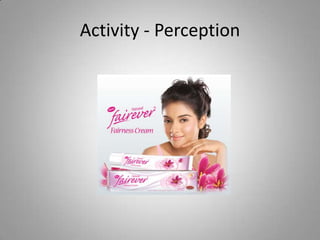
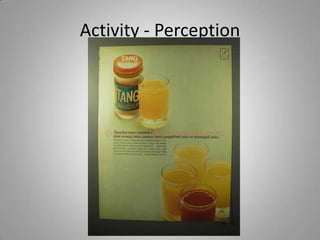
    A little exercise
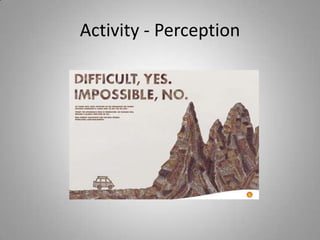
Activity - Perception

• Write down the ads which you remember.

• Write the reason for remembering every add.

• Discuss in class.
Psychological Influences
• Learning
  – Perceptions lead to learning
  – We learn something that we perceive and attach
    meaning to it.
  – Cognitive learning
     • Perception -> Problem solving -> Insight
  – Behavioral conditioning
     • Classic conditioning
         – Pairing one stimulus with another that already is
           associated with a response
         – e.g. associating sound of bell with end of school day
     • Operant conditioning
         – Voluntary occurrences of behavior that are then
           rewarded , ignored or punished.
When you use a mobile while you drive, your head is somewhere else
Psychological Influences
• Motivation and Needs
  – Motive
     • An internal force that forces you to behave in a particular
       way.
     • Advertisers study buying motives.

  – Need
     • Basic forces that motivate us to do something
     • Primary needs: requirements to maintain life
     • Secondary: Acquired needs in response to our culture and
       environment.
     • Needs change over time.
When did you last buy and why?
Psychological Influences
• Attitudes
  – A learned feeling you hold towards an object, a person
    or an idea that leads to a particular behavior.

  – Attitudes are resistant to change.

  – Attitudes are learned, hence can be changed or
    replaced.

  – Attitudes may be positive or negative, weak or strong.
Psychological Influence
• Lifestyle

  – The way a person spends his time and money and
    the activities he likes to perform.
Role of consumer Behavior in
                 Advertising
• Advertisements play an essential role in creating an image of
  a product in the minds of consumers.
• Advertising is basically a type of communication.
• It attempts to persuade potential customers to purchase or
  consume a product or service.
• It is designed in such a way that it creates and reinforces
  brand image and brand loyalty.
• Advertisements must be catchy and communicate relevant
  information to consumers.
Contd…
• Understanding the needs of the consumer is really important
  when it comes to creating the right advertisement for the
  right audience.
• Advertising is usually important for triggering the first time
  purchase of the product.

• it is only through advertisements; individuals are able to
  connect with your brand.
• Identify your target audience. The advertisement in some way
  must touch the hearts of the end-users for them to buy the
  product.
• The advertisement must show what the product is all about. It
  should, in a way give some kind of information about its price,
  benefits, usage, availability.
• Mercedes, I phone advertisement ought to be classy
  for people to recognize these products as status
  symbols.
• Advertisements meant for younger people (college
  goers, young professionals) ought to be colourful and
  trendy for them to be able to relate themselves with
  the product.
• Advertisements for insurance plans, medical
  benefits, hospitals ought to be sensible as they
  convey much serious information and target a
  mature segment of individuals altogether.
Consumer behaviour and marketing

Consumer behaviour and marketing

  • 2.
    CONSUMER BEHAVIOUR • Behaviorsthat consumers display in searching for, purchasing, using, evaluating and disposing of products and services. • Focused on how an individual consumers or households make decisions to spend their available resources ( Time, Money, Effort ) on consumption related items. • Study of When, Why, How and Where people do or do not buy a product. • A blend of psychology, Sociology, Social anthropology and economics.
  • 3.
  • 4.
    • Marketing isthe art and science of influencing consumer behaviour. • Every aspect of marketing is tied to consumer behaviour. • Marketer need to understand the psychology of the consumers. • Customer value is the difference between all the benefits derived from a total product and all the costs of acquiring those benefits. • Customer value requires the organisation to do a better job of anticipating and reacting to customer needs than the competitor.
  • 5.
    • Buying behaviourincludes  Recognition of the problem (need to be met) search for information consideration of alternatives purchase, consumption, disposal • Marketers must be aware of the buying process and consumer influences to be effective in appealing to, and meeting consumer needs • Marketers should also aim to create value in the mind of the consumer by understanding what the consumer values
  • 7.
    MARKET SEGMENTATION • Findingout what kind of consumers with different needs exist. • Consumers grouped according to their similar needs and characteristics. • These market segments are described in terms of demographic, geographic location and media preferences.
  • 9.
    TARGETING • Preferred segmentbased on ability to meet the needs of this group. • Choice depends on • How well the segment is served by other manufacturers ? • How large is the segment • Do the organisation has the strength to appeal to a particular group of consumers.
  • 10.
    POSITIONING • How consumersperceive your product in relation to others in the market • Achieved through understanding the customers and applying relevant marketing mix strategies
  • 11.
    MARKETING STRATEGY • Howan organisation will provide superior customer value to a target market • This requires the formulation of consistent marketing mix which includes  Product  Price  Promotions  Place  Service
  • 12.
    THE PRODUCT • Productis anything a consumer acquires or might acquire to meet a perceived need • Consumers generally buy for need satisfaction not for physical product attributes.
  • 13.
    PRICE • Price isthe amount of money paid to obtain the right to use the product. • Price sometimes serves as a signals of quality.
  • 14.
    PROMOTION • Marketing promotionsincludes advertising, sales force, public relations packaging and any other signals that the firm provides about itself and the product.
  • 15.
    DISTRIBUTION • Distribution meanshaving the product available where target customers can buy it. This is essential to the product’s success. • Good channel decision requires a sound knowledge of where target customers shop for the product.
  • 16.
  • 17.
    Factors affecting consumerbehavior • Cultural and social • Psychological influences influences – Culture – Perception – Social Class – Learning – Reference groups – Motives – Family – Attitudes – Demographics – Lifestyles – Geography
  • 18.
    Cultural and socialinfluences • Culture – Based on norms and values • Norms – boundaries a culture establishes for behavior • Values - broad preferences concerning appropriate courses of action or outcomes – Directly influences buying behavior
  • 19.
    Cultural and socialinfluences • Social Class – Determined by factors like income , wealth, education, occupation, family prestige, value of home, and neighborhood – It is assumed that people in one class buy different products for different reasons.
  • 20.
    Cultural and socialinfluences • Reference Groups – Collection of people used as a guide for behavior in specific situations. – Reference groups have three functions • They provide information • They serve as comparison • They offer guidance
  • 21.
    Cultural and socialinfluences • Family – Family consists of two or more people who are related by blood, marriage or adoption and live in the same household. – Family helps develop a lifestyle (how you spend time and money and the kinds of activities you value)
  • 22.
    Cultural and socialinfluences • Demographics – Are statistical, personal, social and economic characteristics of a population including • Age • Gender • Education • Income • Occupation • Race/ ethnicity
  • 23.
    Cultural and socialinfluences • Geographic location – Difference in buying behavior exists between different regions – Buying behavior also differs urban areas and rural areas.
  • 24.
    Psychological Influences • Perception – The process by which we receive information through our five senses and assign meaning to it. • 3 sets of influences shape perception – The physical characteristics of the stimuli – The relationship of the stimuli to the surroundings – The person’s state of mind. • Some stimuli are selected over others • Selective perception – Screening out some information that does not interest us and retaining that information that interests us.
  • 25.
    Psychological Influences • Selectiveexposure – Seeking information that is in line with our beliefs, values, experiences, biases, attitudes. • Selective distortion – Changing the meaning of information that is conflicting with our beliefs • Selective retention – The process we go through to retain information
  • 26.
    Psychological Influences A little exercise
  • 27.
  • 28.
  • 29.
  • 30.
  • 31.
  • 32.
  • 33.
  • 34.
  • 35.
  • 36.
  • 37.
  • 38.
  • 39.
  • 40.
  • 41.
  • 42.
  • 43.
  • 44.
  • 45.
    Activity - Perception •Write down the ads which you remember. • Write the reason for remembering every add. • Discuss in class.
  • 46.
    Psychological Influences • Learning – Perceptions lead to learning – We learn something that we perceive and attach meaning to it. – Cognitive learning • Perception -> Problem solving -> Insight – Behavioral conditioning • Classic conditioning – Pairing one stimulus with another that already is associated with a response – e.g. associating sound of bell with end of school day • Operant conditioning – Voluntary occurrences of behavior that are then rewarded , ignored or punished.
  • 48.
    When you usea mobile while you drive, your head is somewhere else
  • 49.
    Psychological Influences • Motivationand Needs – Motive • An internal force that forces you to behave in a particular way. • Advertisers study buying motives. – Need • Basic forces that motivate us to do something • Primary needs: requirements to maintain life • Secondary: Acquired needs in response to our culture and environment. • Needs change over time.
  • 50.
    When did youlast buy and why?
  • 51.
    Psychological Influences • Attitudes – A learned feeling you hold towards an object, a person or an idea that leads to a particular behavior. – Attitudes are resistant to change. – Attitudes are learned, hence can be changed or replaced. – Attitudes may be positive or negative, weak or strong.
  • 52.
    Psychological Influence • Lifestyle – The way a person spends his time and money and the activities he likes to perform.
  • 53.
    Role of consumerBehavior in Advertising • Advertisements play an essential role in creating an image of a product in the minds of consumers. • Advertising is basically a type of communication. • It attempts to persuade potential customers to purchase or consume a product or service. • It is designed in such a way that it creates and reinforces brand image and brand loyalty. • Advertisements must be catchy and communicate relevant information to consumers.
  • 54.
    Contd… • Understanding theneeds of the consumer is really important when it comes to creating the right advertisement for the right audience. • Advertising is usually important for triggering the first time purchase of the product. • it is only through advertisements; individuals are able to connect with your brand. • Identify your target audience. The advertisement in some way must touch the hearts of the end-users for them to buy the product. • The advertisement must show what the product is all about. It should, in a way give some kind of information about its price, benefits, usage, availability.
  • 55.
    • Mercedes, Iphone advertisement ought to be classy for people to recognize these products as status symbols. • Advertisements meant for younger people (college goers, young professionals) ought to be colourful and trendy for them to be able to relate themselves with the product. • Advertisements for insurance plans, medical benefits, hospitals ought to be sensible as they convey much serious information and target a mature segment of individuals altogether.