SHRI YOGENDRA SAGAR
INSTITUTE OF
TECHNOLOGY AND
SCIENCE
PRESENTED BY:
MEGHA OMSHREE KUMAWAT
KALPANA SILAWAT
NAMRATA KOTHARI
MBA II YEAR 2013-15
CONSUMER BEHAVIOUR
CONSUMER BEHAVIOR
 The study of how people buy, what they buy, why they buy and when
they buy.
 It attempts to understand the buyer decision making process, both
individually and in groups.
CONSUMER AUDIENCE
 The people who buy or use products to satisfy needs or wants.
 Types of consumers
 Those who buy the product
 Those who use the product
 Target Audience
 Those individuals who will receive the advertising message
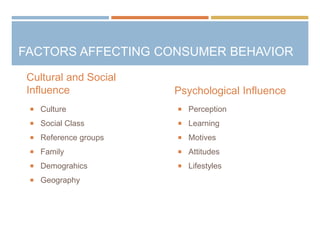
FACTORS AFFECTING CONSUMER BEHAVIOR
Cultural and Social
Influence
 Culture
 Social Class
 Reference groups
 Family
 Demograhics
 Geography
Psychological Influence
 Perception
 Learning
 Motives
 Attitudes
 Lifestyles
 Culture
 Based on norms and values
 Norms – boundaries a culture establishes for behavior
 Values - broad preferences concerning appropriate courses of action
or outcomes
 Directly influences buying behavior
CULTURAL AND SOCIAL INFLUENCES
 Social Class
 Determined by factors like income , wealth, education, occupation,
family prestige, value of home, and neighborhood
 It is assumed that people in one class buy different products than
any other class for different reasons
 Family
 Family consists of two or more people who are related by blood,
marriage or adoption and live in the same household.
 Family helps develop a lifestyle (how you spend time and money
and the kinds of activities you value)
 Demographics
 Are statistical, personal, social and economic characteristics of a
population including
 Age
 Gender
 Education
 Income
 Occupation
 Race/ ethnicity
 Perception
 The process by which we receive information through
our five senses and assign meaning to it.
 3 sets of influences shape perception
 The physical characteristics of the stimuli
 The relationship of the stimuli to the surroundings
 The person’s state of mind.
 Some stimuli are selected over others
 Selective perception
 Screening out some information that does not interest us and
retaining that information that interests us.
PSYCHOLOGICAL INFLUENCES
 Selective exposure
 Seeking information that is in line with our beliefs, values,
experiences, biases, attitudes.
 Selective distortion
 Changing the meaning of information that is conflicting with
our beliefs
 Selective retention
 The process we go through to retain information
 Lifestyle
 The way a person spends his time and money and the activities
he likes to perform.
PSYCHOLOGICAL INFLUENCE
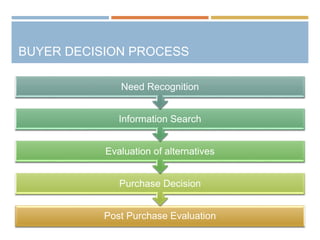
Post Purchase Evaluation
Purchase Decision
Evaluation of alternatives
Information Search
Need Recognition
BUYER DECISION PROCESS
consumer behaviour

consumer behaviour

  • 1.
    SHRI YOGENDRA SAGAR INSTITUTEOF TECHNOLOGY AND SCIENCE PRESENTED BY: MEGHA OMSHREE KUMAWAT KALPANA SILAWAT NAMRATA KOTHARI MBA II YEAR 2013-15 CONSUMER BEHAVIOUR
  • 2.
    CONSUMER BEHAVIOR  Thestudy of how people buy, what they buy, why they buy and when they buy.  It attempts to understand the buyer decision making process, both individually and in groups.
  • 3.
    CONSUMER AUDIENCE  Thepeople who buy or use products to satisfy needs or wants.  Types of consumers  Those who buy the product  Those who use the product  Target Audience  Those individuals who will receive the advertising message
  • 4.
    FACTORS AFFECTING CONSUMERBEHAVIOR Cultural and Social Influence  Culture  Social Class  Reference groups  Family  Demograhics  Geography Psychological Influence  Perception  Learning  Motives  Attitudes  Lifestyles
  • 5.
     Culture  Basedon norms and values  Norms – boundaries a culture establishes for behavior  Values - broad preferences concerning appropriate courses of action or outcomes  Directly influences buying behavior CULTURAL AND SOCIAL INFLUENCES
  • 6.
     Social Class Determined by factors like income , wealth, education, occupation, family prestige, value of home, and neighborhood  It is assumed that people in one class buy different products than any other class for different reasons  Family  Family consists of two or more people who are related by blood, marriage or adoption and live in the same household.  Family helps develop a lifestyle (how you spend time and money and the kinds of activities you value)
  • 7.
     Demographics  Arestatistical, personal, social and economic characteristics of a population including  Age  Gender  Education  Income  Occupation  Race/ ethnicity
  • 8.
     Perception  Theprocess by which we receive information through our five senses and assign meaning to it.  3 sets of influences shape perception  The physical characteristics of the stimuli  The relationship of the stimuli to the surroundings  The person’s state of mind.  Some stimuli are selected over others  Selective perception  Screening out some information that does not interest us and retaining that information that interests us. PSYCHOLOGICAL INFLUENCES
  • 9.
    PSYCHOLOGICAL INFLUENCES  Selectiveexposure  Seeking information that is in line with our beliefs, values, experiences, biases, attitudes.  Selective distortion  Changing the meaning of information that is conflicting with our beliefs  Selective retention  The process we go through to retain information
  • 10.
     Lifestyle  Theway a person spends his time and money and the activities he likes to perform. PSYCHOLOGICAL INFLUENCE
  • 11.
    Post Purchase Evaluation PurchaseDecision Evaluation of alternatives Information Search Need Recognition BUYER DECISION PROCESS