THEORIES OF
MACROECONOMICS
Nta UGC-NET dec-2018
UGC-NET PAPER-2 (ECO)
Online batch ,Lecture-19
Macro eco Topic- 4
AIH, RIH, PIH, LCH
1.Absolute income hypothesis
Intro--
AIH developed by J.M.Keynes.
According to Keynes aggregate consumption is a function of current
disposable income.
AIH is either linear or non-linear consumption function.
This empirical consumption function derived from time series data for
1929-1944 .
His statement of the relationship between income and consumption
was based on the ‘fundamental psychological law’.
He said that consumption is a stable function of current
income (to be more specific, current disposable income—
income after tax payment).
Because of the operation of the ‘psychological law’,
His consumption function may be rewritten here with the form
His consumption function is such that 0 < MPC < 1 and MPC <
APC.
Thus, a non- proportional relationship (i.e., APC > MPC) between
consumption and income exists in the Keynesian absolute income
hypothesis.
C = a + bY,
where a > 0 and 0 < b < 1.
This consumption function is stable in both short run and long run.
In the short run consumption function is non-proportion (APC>MPC).
In long run consumption function is linear and proration.(APC=MPC)
income
consumption
C=Y
C
C2
C1
Y2
Y1
0
C=a+bY
C=bY
APC= C/Y
MPC=Δ C/ΔY
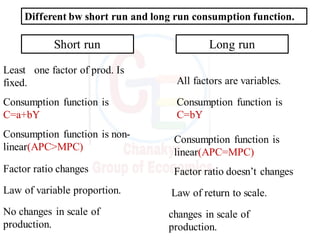
Short run Long run
Least one factor of prod. Is
fixed. All factors are variables.
Law of variable proportion. Law of return to scale.
Consumption function is non-
linear(APC>MPC)
Consumption function is
linear(APC=MPC)
No changes in scale of
production.
changes in scale of
production.
Factor ratio changes Factor ratio doesn’t changes
Consumption function is
C=bY
Consumption function is
C=a+bY
Different bw short run and long run consumption function.
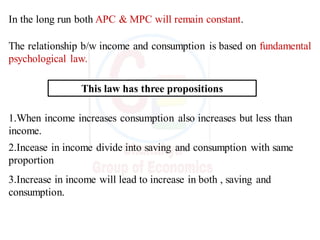
In the long run both APC & MPC will remain constant.
The relationship b/w income and consumption is based on fundamental
psychological law.
This law has three propositions
1.When income increases consumption also increases but less than
income.
2.Incease in income divide into saving and consumption with same
proportion
3.Increase in income will lead to increase in both , saving and
consumption.
This theory also called as cyclical consumption function
Acc. To Keynes consumption function is reversible.
2. Relative income hypothesis.
This theory developed by James Duesenberry(1949).
His theory is based on two assumptions of Keynesian
consumption function.
1.Every individual behavior is not independent but
interdependent.
2.Consmptions relation are irreversible and not reversible..
He used social character of consumption pattern means the
surpass of joneses.(neighbors)
Joneses means rich neighbors.
Duesenberry believed that the basic consumptionfunctionwas long run and
proportional.
This means that average fraction of income consumeddoes not change in the
long run, but there may be variation between consumptionand income within
short run cycles.
Duesenberry’s RIH is based on two hypotheseis first is the relative income hy-
pothesis and second is the past peak income hypothesis.
Duesenberry’s first hypothesis says that consumption depends not on the
‘absolute’level of income but on the ‘relative’ income income relative to the
income of the society in which an individual lives.
A householdsconsumption is determined by the income and expenditure
pattern of his neighbours.
Families with relatively high incomes experience lower APCs and families with
relatively low incomes experience high APCs.
Consumption pattern is effected by neighbors consumptions. This
consumption preferences are interdependent.
If absolute size of income in a country increases then the APC for
entire economy at higher level of absolute income would be constant.
But when income decreases consumption does not fall in same
proportion because of Retched effect/demonstration effect.
This imitative or emulativenature of consumptionhas been described by
Duesenberry as the “demonstrationeffect.”
Specifically, people with relatively low incomes attempt to ‘keep up with the
Joneses’—theyconsumemore and save less.
Second part of his theory is past peak of income hypothesis which
shows short run fluctuations In consumption function.
Duesenberry hypothesizedthat the present consumption of the families is influenced
not just by current incomes but also by the levels of past peak incomes, i.e., C = f(Yri,
Ypi), where Yri is the relative income and Ypi is the peak income.
If current incomes rise, households tend to consume more but slowly.
This is because of the relatively low habitual consumption patternsand peopleadjust
their consumption standardsestablished by the previous peak income slowly to their
present rising income levels.
On other hand, if current incomes declinethese householdsdo not immediately reduce
their consumption as they find if difficult to reduce their consumption established by
the previous peak income.
Thus, during depression consumption rises as a fraction of income and during
prosperityconsumption does increase slowly as a fraction of income.
During recession when current income (Yt) falls below the previews
peak income (Y0) then current consumption-income ratio Ct/Yt will
increase
Retched effect is developed whenever there is a cyclical decline or
recovery in come.
.(Y↓→APC↑)
He introduced retched effect
When Y ↑ →C↑→Living of stand.↑
But When Y↓→C(constant)→dis-saving↑
He refutes the Keynes function of reversible.
RIH assume that there is proportion increase in income and consumption.
There is direct relation bw consumption and income.
The distribution of income almost unchanged with the change in
aggregate level of income..
Consumers consumption is related to his previous peak income.(Yo)
Reverse lighting bolt effect- gradually increased in consumption due to
increase in income.
3.Permanent income hypothesis.
This theory is developed nobel prize winner Milton Friedman(1957).
His theory is contradiction(opposite) to long run proportion and short
run no-proportion consumption function..
Acc. To him current income is not determinant of consumption
expenditure.
He divide consumption and income into permanent and transitory
component .
Consumption of a person depend upon future expected income or
permanent income only.
Like Duesenberry’s RIH, Friedman’s hypothesis holds that the basic
relationship between consumption and income is proportional.
But consumption, according to Friedman, depends neither on ‘absolute’
income, nor on ‘relative’ income but on ‘permanent’ income, based on
expected future income.
His hypothesis is then described as the ‘permanent income
hypothesis’ (PIH)..
Thus, he finds a relationship between consumption and permanent
income.
Friedman’s basic argument is that permanent consumption depends on
permanent income.
Y= Yp+Yt
C=Cp+Ct
income
Consumption.
In the long run consumption is increases to proportion to change in
permanent income
APC or permanent consumption is independent or not depend on size of
income.
In long run APC=MPC.
There is proportion relationship bw permanent income and
consumption.
Permanent income is based on time series.
Permanent income depend partly on current income(Y1) and partly on
previous income.(Yo)
Assumptions
1.There is No co-relationship b/w transitory income and permanent
income
2.No correlation b/w permanet consumption and transitory consumption
.
3.No correlation bw transitory consumption and transitory income.
4. Only permanent income affect the consumption (proportional
relation.)
Permanent income is based on backward looking expectation.
Short run consumption function is non-proportion.(APC>MPC)
Long run consumption function is proportional.(APC=MPC)
Friedman assumed in long run APC of all families(rich or poor) are
same.
Acc. To him consumption neither depend on absolute income nor on
relative income but on permanent income.
The basic relationship of PIH is that permanent
consumption is proportional to permanent income that
exhibits a fairly constant APC.
4.Life cycle hypothesis
This theory developed by Modigliani, Brumberg, and
Ando.(MBA)(1950)
This theory is also known as wealth theory of consumption.
Consumption is the function of life time expected income, wealth, and
number of years until retirement.
This theory states that individuals seek to smooth consumption over the
course of lifetime.
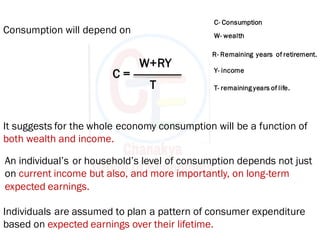
It suggests for the whole economy consumption will be a function of
both wealth and income.
Individuals are assumed to plan a pattern of consumer expenditure
based on expected earnings over their lifetime.
An individual’s or household’s level of consumption depends not just
on current income but also, and more importantly, on long-term
expected earnings.
C =
T
W+RY
C- Consumption
R- Remaining years of retirement.
Y- income
T- remaining years of life.
W- wealth
Consumption will depend on
Lifetime
income
Student loans
Income curve
saving
Retirement
consumption
0 40
20 65
Dis-saving.
This saving during working life enables you to maintain similar levels of
income during your retirement.
Graph shows individuals
save from 20 to 65
As a student, it is rational to borrow
to fund education.
Then during your working life, you pay off studentloans and begin saving for your
retirement.
This theory assumed- consumption is directly related with asset.
Tis theory solve the consumption puzzle .
They used wealth as variable.
ROI on asset is zero.
Net asset are result of consumer own saving.
Maximization of utility depend upon resources available.
Total resources consist of his income and wealth.
The theory states that individuals seek to smooth consumption
over the course of a lifetime – borrowing in times of low-income and
saving during periods of high income.
The theory states consumption will be a function of wealth, expected
lifetime earnings and the number of years until retirement.
Prev. years que.
1.Absolute income hypothesis
This empirical consumption function derived from time
series data for 1929-1944 .
2.Relativeincome hyp.
1948
3.Permanent income hyp.
1957
4.Life cycle hyp
1950
THEORIES OF investment
Nta UGC-NET dec-2018
UGC-NET PAPER-2 (ECO)
Online batch ,Lecture-20
Macro eco Topic- 5

Consumption theories.pdf

  • 1.
    THEORIES OF MACROECONOMICS Nta UGC-NETdec-2018 UGC-NET PAPER-2 (ECO) Online batch ,Lecture-19 Macro eco Topic- 4 AIH, RIH, PIH, LCH
  • 2.
    1.Absolute income hypothesis Intro-- AIHdeveloped by J.M.Keynes. According to Keynes aggregate consumption is a function of current disposable income. AIH is either linear or non-linear consumption function. This empirical consumption function derived from time series data for 1929-1944 . His statement of the relationship between income and consumption was based on the ‘fundamental psychological law’.
  • 3.
    He said thatconsumption is a stable function of current income (to be more specific, current disposable income— income after tax payment). Because of the operation of the ‘psychological law’, His consumption function may be rewritten here with the form His consumption function is such that 0 < MPC < 1 and MPC < APC. Thus, a non- proportional relationship (i.e., APC > MPC) between consumption and income exists in the Keynesian absolute income hypothesis. C = a + bY, where a > 0 and 0 < b < 1.
  • 4.
    This consumption functionis stable in both short run and long run. In the short run consumption function is non-proportion (APC>MPC). In long run consumption function is linear and proration.(APC=MPC)
  • 5.
  • 6.
    Short run Longrun Least one factor of prod. Is fixed. All factors are variables. Law of variable proportion. Law of return to scale. Consumption function is non- linear(APC>MPC) Consumption function is linear(APC=MPC) No changes in scale of production. changes in scale of production. Factor ratio changes Factor ratio doesn’t changes Consumption function is C=bY Consumption function is C=a+bY Different bw short run and long run consumption function.
  • 7.
    In the longrun both APC & MPC will remain constant. The relationship b/w income and consumption is based on fundamental psychological law. This law has three propositions 1.When income increases consumption also increases but less than income. 2.Incease in income divide into saving and consumption with same proportion 3.Increase in income will lead to increase in both , saving and consumption.
  • 8.
    This theory alsocalled as cyclical consumption function Acc. To Keynes consumption function is reversible.
  • 9.
    2. Relative incomehypothesis. This theory developed by James Duesenberry(1949). His theory is based on two assumptions of Keynesian consumption function. 1.Every individual behavior is not independent but interdependent. 2.Consmptions relation are irreversible and not reversible.. He used social character of consumption pattern means the surpass of joneses.(neighbors) Joneses means rich neighbors.
  • 10.
    Duesenberry believed thatthe basic consumptionfunctionwas long run and proportional. This means that average fraction of income consumeddoes not change in the long run, but there may be variation between consumptionand income within short run cycles. Duesenberry’s RIH is based on two hypotheseis first is the relative income hy- pothesis and second is the past peak income hypothesis. Duesenberry’s first hypothesis says that consumption depends not on the ‘absolute’level of income but on the ‘relative’ income income relative to the income of the society in which an individual lives. A householdsconsumption is determined by the income and expenditure pattern of his neighbours. Families with relatively high incomes experience lower APCs and families with relatively low incomes experience high APCs.
  • 11.
    Consumption pattern iseffected by neighbors consumptions. This consumption preferences are interdependent. If absolute size of income in a country increases then the APC for entire economy at higher level of absolute income would be constant. But when income decreases consumption does not fall in same proportion because of Retched effect/demonstration effect. This imitative or emulativenature of consumptionhas been described by Duesenberry as the “demonstrationeffect.” Specifically, people with relatively low incomes attempt to ‘keep up with the Joneses’—theyconsumemore and save less.
  • 12.
    Second part ofhis theory is past peak of income hypothesis which shows short run fluctuations In consumption function. Duesenberry hypothesizedthat the present consumption of the families is influenced not just by current incomes but also by the levels of past peak incomes, i.e., C = f(Yri, Ypi), where Yri is the relative income and Ypi is the peak income. If current incomes rise, households tend to consume more but slowly. This is because of the relatively low habitual consumption patternsand peopleadjust their consumption standardsestablished by the previous peak income slowly to their present rising income levels. On other hand, if current incomes declinethese householdsdo not immediately reduce their consumption as they find if difficult to reduce their consumption established by the previous peak income. Thus, during depression consumption rises as a fraction of income and during prosperityconsumption does increase slowly as a fraction of income.
  • 13.
    During recession whencurrent income (Yt) falls below the previews peak income (Y0) then current consumption-income ratio Ct/Yt will increase Retched effect is developed whenever there is a cyclical decline or recovery in come. .(Y↓→APC↑) He introduced retched effect When Y ↑ →C↑→Living of stand.↑ But When Y↓→C(constant)→dis-saving↑ He refutes the Keynes function of reversible.
  • 14.
    RIH assume thatthere is proportion increase in income and consumption. There is direct relation bw consumption and income. The distribution of income almost unchanged with the change in aggregate level of income.. Consumers consumption is related to his previous peak income.(Yo) Reverse lighting bolt effect- gradually increased in consumption due to increase in income.
  • 15.
    3.Permanent income hypothesis. Thistheory is developed nobel prize winner Milton Friedman(1957). His theory is contradiction(opposite) to long run proportion and short run no-proportion consumption function.. Acc. To him current income is not determinant of consumption expenditure. He divide consumption and income into permanent and transitory component . Consumption of a person depend upon future expected income or permanent income only.
  • 16.
    Like Duesenberry’s RIH,Friedman’s hypothesis holds that the basic relationship between consumption and income is proportional. But consumption, according to Friedman, depends neither on ‘absolute’ income, nor on ‘relative’ income but on ‘permanent’ income, based on expected future income. His hypothesis is then described as the ‘permanent income hypothesis’ (PIH).. Thus, he finds a relationship between consumption and permanent income. Friedman’s basic argument is that permanent consumption depends on permanent income.
  • 17.
  • 18.
    In the longrun consumption is increases to proportion to change in permanent income APC or permanent consumption is independent or not depend on size of income. In long run APC=MPC. There is proportion relationship bw permanent income and consumption. Permanent income is based on time series. Permanent income depend partly on current income(Y1) and partly on previous income.(Yo)
  • 19.
    Assumptions 1.There is Noco-relationship b/w transitory income and permanent income 2.No correlation b/w permanet consumption and transitory consumption . 3.No correlation bw transitory consumption and transitory income. 4. Only permanent income affect the consumption (proportional relation.)
  • 20.
    Permanent income isbased on backward looking expectation. Short run consumption function is non-proportion.(APC>MPC) Long run consumption function is proportional.(APC=MPC) Friedman assumed in long run APC of all families(rich or poor) are same. Acc. To him consumption neither depend on absolute income nor on relative income but on permanent income.
  • 21.
    The basic relationshipof PIH is that permanent consumption is proportional to permanent income that exhibits a fairly constant APC.
  • 22.
    4.Life cycle hypothesis Thistheory developed by Modigliani, Brumberg, and Ando.(MBA)(1950) This theory is also known as wealth theory of consumption. Consumption is the function of life time expected income, wealth, and number of years until retirement. This theory states that individuals seek to smooth consumption over the course of lifetime.
  • 23.
    It suggests forthe whole economy consumption will be a function of both wealth and income. Individuals are assumed to plan a pattern of consumer expenditure based on expected earnings over their lifetime. An individual’s or household’s level of consumption depends not just on current income but also, and more importantly, on long-term expected earnings. C = T W+RY C- Consumption R- Remaining years of retirement. Y- income T- remaining years of life. W- wealth Consumption will depend on
  • 24.
    Lifetime income Student loans Income curve saving Retirement consumption 040 20 65 Dis-saving. This saving during working life enables you to maintain similar levels of income during your retirement. Graph shows individuals save from 20 to 65 As a student, it is rational to borrow to fund education. Then during your working life, you pay off studentloans and begin saving for your retirement.
  • 25.
    This theory assumed-consumption is directly related with asset. Tis theory solve the consumption puzzle . They used wealth as variable. ROI on asset is zero. Net asset are result of consumer own saving. Maximization of utility depend upon resources available. Total resources consist of his income and wealth.
  • 26.
    The theory statesthat individuals seek to smooth consumption over the course of a lifetime – borrowing in times of low-income and saving during periods of high income. The theory states consumption will be a function of wealth, expected lifetime earnings and the number of years until retirement.
  • 27.
  • 30.
    1.Absolute income hypothesis Thisempirical consumption function derived from time series data for 1929-1944 . 2.Relativeincome hyp. 1948 3.Permanent income hyp. 1957 4.Life cycle hyp 1950
  • 34.
    THEORIES OF investment NtaUGC-NET dec-2018 UGC-NET PAPER-2 (ECO) Online batch ,Lecture-20 Macro eco Topic- 5