Ethyl Alcohol, 70% v/v
Safety Data Sheet
according to Federal Register / Vol. 77, No. 58 / Monday, March 26, 2012 / Rules and Regulations
Date of issue: 08/13/2013 Revision date: 02/08/2018 Supersedes: 04/16/2014 Version: 1.3
02/08/2018 EN (English US) Page 1
SECTION 1: Identification of the substance/mixture and of the company/undertaking
1.1. Product identifier
Product form : Mixtures
Product name : Ethyl Alcohol, 70% v/v
Product code : VT270
Other means of identification : Ethanol, Denatured, 70% v/v
1.2. Relevant identified uses of the substance or mixture and uses advised against
Use of the substance/mixture : For laboratory and manufacturing use only.
1.3. Details of the supplier of the safety data sheet
Val Tech Diagnostics, A Division of LabChem Inc
Jackson's Pointe Commerce Park Building 1000
1010 Jackson's Pointe Court
Zelienople, PA 16063
T 412-826-5230
F 724-473-0647
1.4. Emergency telephone number
Emergency number : CHEMTREC: 1-800-424-9300 or 011-703-527-3887
SECTION 2: Hazards identification
2.1. Classification of the substance or mixture
GHS-US classification
Flam. Liq. 3 H226
Skin Irrit. 2 H315
Eye Irrit. 2A H319
Repr. 2 H361
STOT SE 3 H336
STOT SE 1 H370
Full text of H statements : see section 16
2.2. Label elements
GHS-US labeling
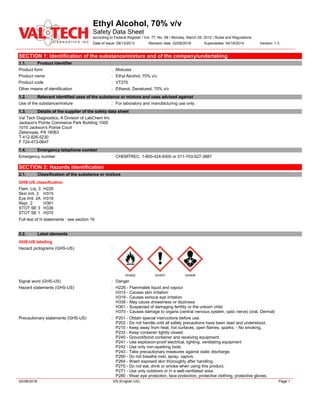
Hazard pictograms (GHS-US) :
GHS02 GHS07 GHS08
Signal word (GHS-US) : Danger
Hazard statements (GHS-US) : H226 - Flammable liquid and vapour
H315 - Causes skin irritation
H319 - Causes serious eye irritation
H336 - May cause drowsiness or dizziness
H361 - Suspected of damaging fertility or the unborn child
H370 - Causes damage to organs (central nervous system, optic nerve) (oral, Dermal)
Precautionary statements (GHS-US) : P201 - Obtain special instructions before use.
P202 - Do not handle until all safety precautions have been read and understood.
P210 - Keep away from heat, hot surfaces, open flames, sparks. - No smoking.
P233 - Keep container tightly closed.
P240 - Ground/bond container and receiving equipment.
P241 - Use explosion-proof electrical, lighting, ventilating equipment
P242 - Use only non-sparking tools.
P243 - Take precautionary measures against static discharge.
P260 - Do not breathe mist, spray, vapors.
P264 - Wash exposed skin thoroughly after handling.
P270 - Do not eat, drink or smoke when using this product.
P271 - Use only outdoors or in a well-ventilated area.
P280 - Wear eye protection, face protection, protective clothing, protective gloves.
Ethyl Alcohol, 70% v/v
Safety Data Sheet
according to Federal Register / Vol. 77, No. 58 / Monday, March 26, 2012 / Rules and Regulations
02/08/2018 EN (English US) 2/13
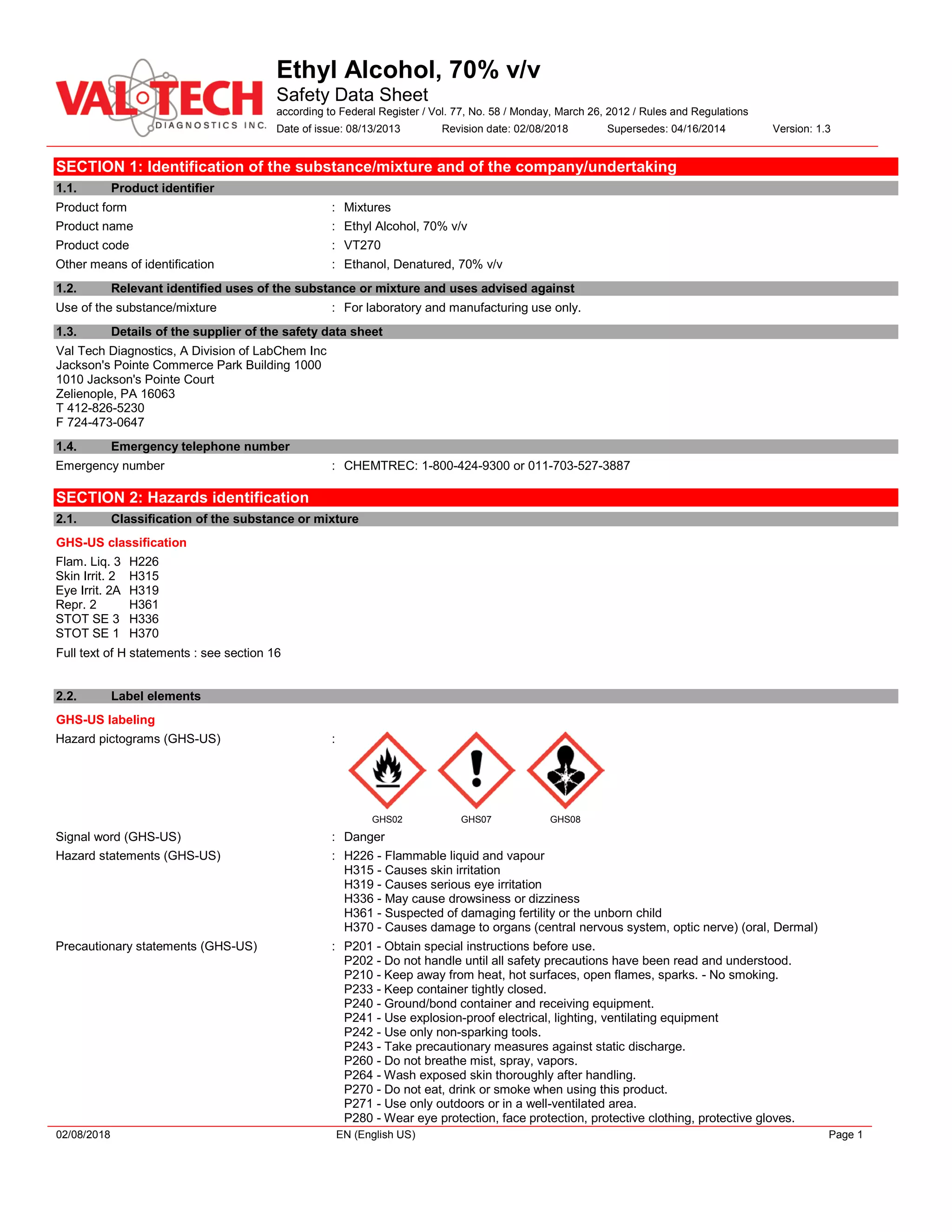
P303+P361+P353 - IF ON SKIN (or hair): Remove/Take off immediately all contaminated
clothing. Rinse skin with water/shower.
P304+P340 - IF INHALED: Remove victim to fresh air and keep at rest in a position
comfortable for breathing.
P305+P351+P338 - If in eyes: Rinse cautiously with water for several minutes. Remove contact
lenses, if present and easy to do. Continue rinsing
P308+P313 - IF exposed or concerned: Get medical advice/attention.
P312 - Call a POISON CENTER or doctor/physician if you feel unwell.
P332+P313 - If skin irritation occurs: Get medical advice/attention.
P337+P313 - If eye irritation persists: Get medical advice/attention.
P363 - Wash contaminated clothing before reuse.
P370+P378 - In case of fire: Use carbon dioxide (CO2), powder, alcohol-resistant foam to
extinguish
P403+P233 - Store in a well-ventilated place. Keep container tightly closed.
P405 - Store locked up.
P501 - Dispose of contents/container to comply with local, state and federal regulations
P235 - Keep cool.
2.3. Other hazards
Other hazards not contributing to the
classification
: None.
2.4. Unknown acute toxicity (GHS US)
No data available
SECTION 3: Composition/Information on ingredients
3.1. Substances
Not applicable
Full text of H-phrases: see section 16
3.2. Mixtures
Name Product identifier % GHS-US classification
Ethanol (CAS-No.) 64-17-5 52.3 - 57.5 Flam. Liq. 2, H225
Carc. 1A, H350
Repr. 2, H361
Water (CAS-No.) 7732-18-5 35.9 - 42.3 Not classified
Isopropyl Alcohol (2-Propanol) (CAS-No.) 67-63-0 2.8 - 3.3 Flam. Liq. 2, H225
Eye Irrit. 2A, H319
STOT SE 3, H335
Methanol (CAS-No.) 67-56-1 2.6 - 3.3 Flam. Liq. 2, H225
Acute Tox. 3 (Oral), H301
Acute Tox. 3 (Dermal), H311
Acute Tox. 3 (Inhalation), H331
STOT SE 1, H370
SECTION 4: First aid measures
4.1. Description of first aid measures
First-aid measures general : Check the vital functions. Unconscious: maintain adequate airway and respiration. Respiratory
arrest: artificial respiration or oxygen. Cardiac arrest: perform resuscitation. Victim conscious
with labored breathing: half-seated. Victim in shock: on his back with legs slightly raised.
Vomiting: prevent asphyxia/aspiration pneumonia. Prevent cooling by covering the victim (no
warming up). Keep watching the victim. Give psychological aid. Keep the victim calm, avoid
physical strain. Depending on the victim's condition: doctor/hospital. Never give alcohol to
drink.
First-aid measures after inhalation : Remove the victim into fresh air. Respiratory problems: consult a doctor/medical service.
First-aid measures after skin contact : Rinse with water. Take victim to a doctor if irritation persists.
First-aid measures after eye contact : Rinse immediately with plenty of water. Do not apply neutralizing agents. Take victim to an
ophthalmologist if irritation persists.
First-aid measures after ingestion : Rinse mouth with water. Do not induce vomiting. Call Poison Information Centre
(www.big.be/antigif.htm). Consult a doctor/medical service if you feel unwell. Ingestion of large
quantities: immediately to hospital.
4.2. Most important symptoms and effects, both acute and delayed
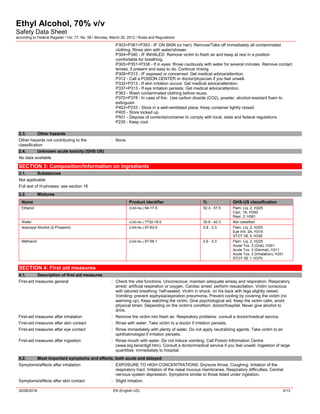
Symptoms/effects after inhalation : EXPOSURE TO HIGH CONCENTRATIONS: Dry/sore throat. Coughing. Irritation of the
respiratory tract. Irritation of the nasal mucous membranes. Respiratory difficulties. Central
nervous system depression. Symptoms similar to those listed under ingestion.
Symptoms/effects after skin contact : Slight irritation.
Ethyl Alcohol, 70% v/v
Safety Data Sheet
according to Federal Register / Vol. 77, No. 58 / Monday, March 26, 2012 / Rules and Regulations
02/08/2018 EN (English US) 3/13
Symptoms/effects after eye contact : Redness of the eye tissue. Lacrimation. ON CONTINUOUS EXPOSURE/CONTACT: Irritation
of the eye tissue.
Symptoms/effects after ingestion : AFTER ABSORPTION OF LARGE QUANTITIES: Risk of aspiration pneumonia. Red skin.
Body temperature rise. Damp/clammy skin. Excited/restless. Accelerated heart action. Central
nervous system depression. Dizziness. Narcosis. Headache. Drunkenness. Nausea. Vomiting.
Disturbed motor response. Coordination disorders. Visual disturbances. Impaired
concentration. Delusions. Disturbed sensation of pain. Disturbances of heart rate. Disturbances
of consciousness. Tremor. Cramps/uncontrolled muscular contractions. Dilated pupils.
Chronic symptoms : ON CONTINUOUS/REPEATED EXPOSURE/CONTACT: Dry skin. Gastrointestinal complaints.
Enlargement/affection of the liver. Change in the haemogramme/blood composition. Cardiac
and blood circulation effects. High arterial pressure. Impairment of the nervous system.
Behavioural disturbances. Mental confusion. Disturbed tactile sensibility. Tremor. Affection of
the bone marrow. Affection of the endocrine system. Weakening of the immune system.
4.3. Indication of any immediate medical attention and special treatment needed
No additional information available
SECTION 5: Firefighting measures
5.1. Extinguishing media
Suitable extinguishing media : Water spray. Alcohol-resistant foam. BC powder. Carbon dioxide.
Unsuitable extinguishing media : Solid water jet ineffective as extinguishing medium.
5.2. Special hazards arising from the substance or mixture
Fire hazard : DIRECT FIRE HAZARD. Highly flammable. Gas/vapor flammable with air within explosion
limits. INDIRECT FIRE HAZARD. May be ignited by sparks. Gas/vapor spreads at floor level:
ignition hazard. Reactions involving a fire hazard: see "Reactivity Hazard".
Explosion hazard : DIRECT EXPLOSION HAZARD. Gas/vapour explosive with air within explosion limits.
INDIRECT EXPLOSION HAZARD. may be ignited by sparks. Reactions with explosion
hazards: see "Reactivity Hazard".
Reactivity : Upon combustion: CO and CO2 are formed. Reacts violently with many compounds e.g.: with
(strong) oxidizers: (increased) risk of fire/explosion. Violent to explosive reaction with (some)
acids.
5.3. Advice for firefighters
Firefighting instructions : Cool tanks/drums with water spray/remove them into safety. Do not move the load if exposed to
heat.
Protection during firefighting : Heat/fire exposure: compressed air/oxygen apparatus.
SECTION 6: Accidental release measures
6.1. Personal precautions, protective equipment and emergency procedures
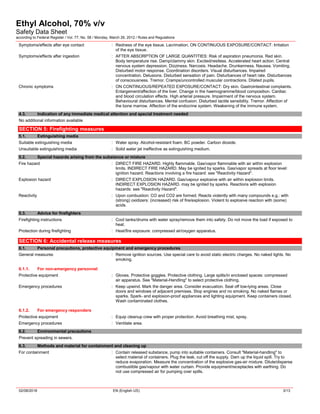
General measures : Remove ignition sources. Use special care to avoid static electric charges. No naked lights. No
smoking.
6.1.1. For non-emergency personnel
Protective equipment : Gloves. Protective goggles. Protective clothing. Large spills/in enclosed spaces: compressed
air apparatus. See "Material-Handling" to select protective clothing.
Emergency procedures : Keep upwind. Mark the danger area. Consider evacuation. Seal off low-lying areas. Close
doors and windows of adjacent premises. Stop engines and no smoking. No naked flames or
sparks. Spark- and explosion-proof appliances and lighting equipment. Keep containers closed.
Wash contaminated clothes.
6.1.2. For emergency responders
Protective equipment : Equip cleanup crew with proper protection. Avoid breathing mist, spray.
Emergency procedures : Ventilate area.
6.2. Environmental precautions
Prevent spreading in sewers.
6.3. Methods and material for containment and cleaning up
For containment : Contain released substance, pump into suitable containers. Consult "Material-handling" to
select material of containers. Plug the leak, cut off the supply. Dam up the liquid spill. Try to
reduce evaporation. Measure the concentration of the explosive gas-air mixture. Dilute/disperse
combustible gas/vapour with water curtain. Provide equipment/receptacles with earthing. Do
not use compressed air for pumping over spills.
Ethyl Alcohol, 70% v/v
Safety Data Sheet
according to Federal Register / Vol. 77, No. 58 / Monday, March 26, 2012 / Rules and Regulations
02/08/2018 EN (English US) 4/13
Methods for cleaning up : Take up liquid spill into a non combustible material e.g.: sand, earth, vermiculite or kieselguhr,
powdered limestone. Scoop absorbed substance into closing containers. See "Material-
handling" for suitable container materials. Carefully collect the spill/leftovers. Damaged/cooled
tanks must be emptied. Do not use compressed air for pumping over spills. Clean
contaminated surfaces with an excess of water. Take collected spill to manufacturer/competent
authority. Wash clothing and equipment after handling.
6.4. Reference to other sections
See Heading 8. Exposure controls and personal protection.
SECTION 7: Handling and storage
7.1. Precautions for safe handling
Precautions for safe handling : Comply with the legal requirements. Remove contaminated clothing immediately. Clean
contaminated clothing. Handle uncleaned empty containers as full ones. Thoroughly clean/dry
the installation before use. Do not discharge the waste into the drain. Do not use compressed
air for pumping over. Use spark-/explosionproof appliances and lighting system. Take
precautions against electrostatic charges. Keep away from naked flames/heat. Keep away from
ignition sources/sparks. Observe normal hygiene standards. Keep container tightly closed.
Measure the concentration in the air regularly. Work under local exhaust/ventilation.
Hygiene measures : Wash exposed skin thoroughly after handling.
7.2. Conditions for safe storage, including any incompatibilities
Technical measures : Proper grounding procedures to avoid static electricity should be followed. Ground/bond
container and receiving equipment. Use explosion-proof electrical/ventilating/lighting/…
equipment.
Storage conditions : Keep container tightly closed. Keep only in the original container in a cool, well ventilated place
away from : incompatible materials. Keep in fireproof place.
Incompatible products : Strong bases. Strong acids.
Incompatible materials : Sources of ignition. Direct sunlight. Heat sources.
Heat-ignition : KEEP SUBSTANCE AWAY FROM: heat sources. ignition sources.
Prohibitions on mixed storage : KEEP SUBSTANCE AWAY FROM: oxidizing agents. strong acids. water/moisture.
Storage area : Keep out of direct sunlight. Store in a dry area. Ventilation at floor level. Fireproof storeroom.
Provide for an automatic sprinkler system. Provide for a tub to collect spills. Provide the tank
with earthing. Meet the legal requirements.
Special rules on packaging : SPECIAL REQUIREMENTS: closing. dry. clean. correctly labelled. meet the legal
requirements. Secure fragile packagings in solid containers.
Packaging materials : SUITABLE MATERIAL: stainless steel. aluminium. iron. copper. nickel. synthetic material.
glass. MATERIAL TO AVOID: No data available.
7.3. Specific end use(s)
No additional information available
SECTION 8: Exposure controls/personal protection
8.1. Control parameters
Ethyl Alcohol, 70% v/v
USA ACGIH ACGIH STEL (ppm) 1000 ppm (Ethanol; USA; Short time value; TLV -
Adopted Value)
USA OSHA OSHA PEL (TWA) (mg/m³) 1900 mg/m³
USA OSHA OSHA PEL (TWA) (ppm) 1000 ppm
Ethanol (64-17-5)
USA ACGIH ACGIH STEL (ppm) 1000 ppm (Ethanol; USA; Short time value; TLV -
Adopted Value)
USA OSHA OSHA PEL (TWA) (mg/m³) 1900 mg/m³
USA OSHA OSHA PEL (TWA) (ppm) 1000 ppm
Isopropyl Alcohol (2-Propanol) (67-63-0)
USA ACGIH ACGIH TWA (ppm) 200 ppm (2-propanol; USA; Time-weighted average
exposure limit 8 h; TLV - Adopted Value)
USA ACGIH ACGIH STEL (ppm) 400 ppm (2-propanol; USA; Short time value; TLV -
Adopted Value)
USA OSHA OSHA PEL (TWA) (mg/m³) 980 mg/m³
USA OSHA OSHA PEL (TWA) (ppm) 400 ppm
Ethyl Alcohol, 70% v/v
Safety Data Sheet
according to Federal Register / Vol. 77, No. 58 / Monday, March 26, 2012 / Rules and Regulations
02/08/2018 EN (English US) 5/13
Methanol (67-56-1)
USA ACGIH ACGIH TWA (ppm) 200 ppm (Methanol; USA; Time-weighted average
exposure limit 8 h; TLV - Adopted Value)
USA ACGIH ACGIH STEL (ppm) 250 ppm (Methanol; USA; Short time value; TLV -
Adopted Value)
USA OSHA OSHA PEL (TWA) (mg/m³) 260 mg/m³
USA OSHA OSHA PEL (TWA) (ppm) 200 ppm
8.2. Exposure controls
Appropriate engineering controls : Emergency eye wash fountains and safety showers should be available in the immediate
vicinity of any potential exposure. Provide local exhaust or general room ventilation.
Personal protective equipment : Safety glasses. Gloves. Protective clothing. High gas/vapor concentration: gas mask with filter
type A.
Materials for protective clothing : GIVE EXCELLENT RESISTANCE: butyl rubber. viton. GIVE GOOD RESISTANCE: neoprene.
tetrafluoroethylene. GIVE LESS RESISTANCE: nitrile rubber. polyethylene. GIVE POOR
RESISTANCE: natural rubber. PVA. PVC.
Hand protection : Gloves.
Eye protection : Safety glasses.
Skin and body protection : Protective clothing.
Respiratory protection : Wear gas mask with filter type A if conc. in air > exposure limit.
Other information : Do not eat, drink or smoke during use.
SECTION 9: Physical and chemical properties
9.1. Information on basic physical and chemical properties
Physical state : Liquid
Appearance : Liquid.
Molecular mass : 46.07 g/mol
Color : Colourless.
Odor : Alcohol odour. Pleasant odour.
Odor threshold : 100 ppm
188 mg/m³
pH : No data available
Relative evaporation rate (butyl acetate=1) : 2.4
Relative evaporation rate (ether=1) : 8.3
Melting point : -115 °C
Freezing point : No data available
Boiling point : 78 °C
Flash point : 25 °C
Critical temperature : 243 °C
Auto-ignition temperature : 363 °C
Decomposition temperature : No data available
Flammability (solid, gas) : No data available
Vapor pressure : 59 hPa (20 °C)
Vapor pressure at 50 °C : 300 hPa (50 °C)
Critical pressure : 63840 hPa
Relative vapor density at 20 °C : 1.6
Relative density : 0.79
Relative density of saturated gas/air mixture : 1.04
Specific gravity / density : 0.881 g/l
Ethyl Alcohol, 70% v/v
Safety Data Sheet
according to Federal Register / Vol. 77, No. 58 / Monday, March 26, 2012 / Rules and Regulations
02/08/2018 EN (English US) 6/13
Solubility : Soluble in water. Soluble in ether. Soluble in acetone. Soluble in chloroform. Soluble in oils/fats.
Soluble in methanol. Soluble in acids.
Water: Complete
Ethanol: Not applicable
Ether: Complete
Acetone: Complete
Log Pow : -0.31 (Experimental value)
Log Kow : No data available
Viscosity, kinematic : No data available
Viscosity, dynamic : 0.0012 Pa.s (20 °C)
Explosive properties : No data available
Oxidizing properties : No data available
Explosion limits : 3.3 - 19.0 vol %
67 - 290 g/m³
9.2. Other information
Specific conductivity : 130000 pS/m
Saturation concentration : 112 g/m³
VOC content : 100 %
Other properties : Gas/vapour heavier than air at 20°C. Clear. Hygroscopic. Volatile. Substance has neutral
reaction.
SECTION 10: Stability and reactivity
10.1. Reactivity
Upon combustion: CO and CO2 are formed. Reacts violently with many compounds e.g.: with (strong) oxidizers: (increased) risk of fire/explosion.
Violent to explosive reaction with (some) acids.
10.2. Chemical stability
Hygroscopic.
10.3. Possibility of hazardous reactions
Not established.
10.4. Conditions to avoid
Direct sunlight. Extremely high or low temperatures. Open flame.
10.5. Incompatible materials
Strong acids. Strong bases.
10.6. Hazardous decomposition products
fume. Carbon monoxide. Carbon dioxide. May release flammable gases.
SECTION 11: Toxicological information
11.1. Information on toxicological effects
Acute toxicity : Not classified
Ethyl Alcohol, 70% v/v
LD50 oral rat 10740 mg/kg body weight (Rat; OECD 401: Acute Oral Toxicity; Experimental value)
LD50 dermal rabbit > 16000 mg/kg (Rabbit; Literature study)
Ethanol (64-17-5)
LD50 oral rat 10740 mg/kg (Rat; Experimental value,Rat; Experimental value)
LD50 dermal rabbit > 16000 mg/kg (Rabbit; Literature study)
Isopropyl Alcohol (2-Propanol) (67-63-0)
LD50 dermal rabbit 12870 mg/kg (Rabbit; Experimental value; Equivalent or similar to OECD 402; 16.4; Rabbit)
LC50 inhalation rat (mg/l) 73 mg/l/4h (Rat)
Methanol (67-56-1)
LD50 oral rat > 5000 mg/kg (Rat; BASF test; Literature study; 1187-2769 mg/kg bodyweight; Rat; Weight of
evidence)
LD50 dermal rabbit 15800 mg/kg (Rabbit; Literature study)
LC50 inhalation rat (mg/l) 85 mg/l/4h (Rat; Literature study)
Ethyl Alcohol, 70% v/v
Safety Data Sheet
according to Federal Register / Vol. 77, No. 58 / Monday, March 26, 2012 / Rules and Regulations
02/08/2018 EN (English US) 7/13
Methanol (67-56-1)
LC50 inhalation rat (ppm) 64000 ppm/4h (Rat; Literature study)
Water (7732-18-5)
LD50 oral rat ≥ 90000 mg/kg
Skin corrosion/irritation : Causes skin irritation.
Serious eye damage/irritation : Causes serious eye irritation.
Respiratory or skin sensitization : Not classified
Germ cell mutagenicity : Not classified
Based on available data, the classification criteria are not met
Carcinogenicity : Not classified
Ethanol (64-17-5)
IARC group 1 - Carcinogenic to humans
Isopropyl Alcohol (2-Propanol) (67-63-0)
IARC group 3 - Not classifiable
Reproductive toxicity : Suspected of damaging fertility or the unborn child.
Based on available data, the classification criteria are not met
Specific target organ toxicity – single exposure : May cause drowsiness or dizziness. Causes damage to organs (central nervous system, optic
nerve) (oral, Dermal).
Specific target organ toxicity – repeated
exposure
: Not classified
Based on available data, the classification criteria are not met
Aspiration hazard : Not classified
Based on available data, the classification criteria are not met
Potential Adverse human health effects and
symptoms
: Harmful if swallowed. Based on available data, the classification criteria are not met.
Symptoms/effects after inhalation : EXPOSURE TO HIGH CONCENTRATIONS: Dry/sore throat. Coughing. Irritation of the
respiratory tract. Irritation of the nasal mucous membranes. Respiratory difficulties. Central
nervous system depression. Symptoms similar to those listed under ingestion.
Symptoms/effects after skin contact : Slight irritation.
Symptoms/effects after eye contact : Redness of the eye tissue. Lacrimation. ON CONTINUOUS EXPOSURE/CONTACT: Irritation
of the eye tissue.
Symptoms/effects after ingestion : AFTER ABSORPTION OF LARGE QUANTITIES: Risk of aspiration pneumonia. Red skin.
Body temperature rise. Damp/clammy skin. Excited/restless. Accelerated heart action. Central
nervous system depression. Dizziness. Narcosis. Headache. Drunkenness. Nausea. Vomiting.
Disturbed motor response. Coordination disorders. Visual disturbances. Impaired
concentration. Delusions. Disturbed sensation of pain. Disturbances of heart rate. Disturbances
of consciousness. Tremor. Cramps/uncontrolled muscular contractions. Dilated pupils.
Chronic symptoms : ON CONTINUOUS/REPEATED EXPOSURE/CONTACT: Dry skin. Gastrointestinal complaints.
Enlargement/affection of the liver. Change in the haemogramme/blood composition. Cardiac
and blood circulation effects. High arterial pressure. Impairment of the nervous system.
Behavioural disturbances. Mental confusion. Disturbed tactile sensibility. Tremor. Affection of
the bone marrow. Affection of the endocrine system. Weakening of the immune system.
SECTION 12: Ecological information
12.1. Toxicity
Ecology - general : Not classified as dangerous for the environment according to the criteria of Regulation (EC) No
1272/2008.
Ecology - air : Not classified as dangerous for the ozone layer (Regulation (EC) No 1005/2009). Not included
in the list of substances which may contribute to the greenhouse effect (Regulation (EC) No
842/2006). TA-Luft Klasse 5.2.5.
Ecology - water : Not harmful to fishes (LC50(96h) >1000 mg/l). Not harmful to invertebrates (Daphnia). Slightly
harmful to algae (EC50 (72h): 100 - 1000 mg/l). Harmful to plankton. Not harmful to bacteria
(EC50 >1000 mg/l). No inhibition of activated sludge.
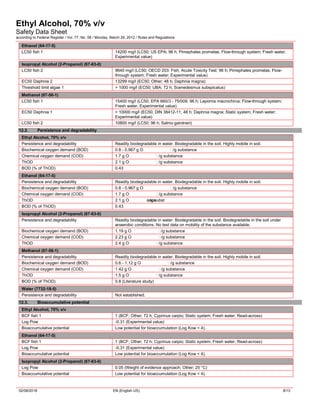
Ethyl Alcohol, 70% v/v
LC50 fish 1 14200 mg/l (LC50; US EPA; 96 h; Pimephales promelas; Flow-through system; Fresh water;
Experimental value)
Ethyl Alcohol, 70% v/v
Safety Data Sheet
according to Federal Register / Vol. 77, No. 58 / Monday, March 26, 2012 / Rules and Regulations
02/08/2018 EN (English US) 8/13
Ethanol (64-17-5)
LC50 fish 1 14200 mg/l (LC50; US EPA; 96 h; Pimephales promelas; Flow-through system; Fresh water;
Experimental value)
Isopropyl Alcohol (2-Propanol) (67-63-0)
LC50 fish 2 9640 mg/l (LC50; OECD 203: Fish, Acute Toxicity Test; 96 h; Pimephales promelas; Flow-
through system; Fresh water; Experimental value)
EC50 Daphnia 2 13299 mg/l (EC50; Other; 48 h; Daphnia magna)
Threshold limit algae 1 > 1000 mg/l (EC50; UBA; 72 h; Scenedesmus subspicatus)
Methanol (67-56-1)
LC50 fish 1 15400 mg/l (LC50; EPA 660/3 - 75/009; 96 h; Lepomis macrochirus; Flow-through system;
Fresh water; Experimental value)
EC50 Daphnia 1 > 10000 mg/l (EC50; DIN 38412-11; 48 h; Daphnia magna; Static system; Fresh water;
Experimental value)
LC50 fish 2 10800 mg/l (LC50; 96 h; Salmo gairdneri)
12.2. Persistence and degradability
Ethyl Alcohol, 70% v/v
Persistence and degradability Readily biodegradable in water. Biodegradable in the soil. Highly mobile in soil.
Biochemical oxygen demand (BOD) 0.8 - 0.967 g O ₂/g substance
Chemical oxygen demand (COD) 1.7 g O ₂/g substance
ThOD 2.1 g O ₂/g substance
BOD (% of ThOD) 0.43
Ethanol (64-17-5)
Persistence and degradability Readily biodegradable in water. Biodegradable in the soil. Highly mobile in soil.
Biochemical oxygen demand (BOD) 0.8 - 0.967 g O ₂/g substance
Chemical oxygen demand (COD) 1.7 g O ₂/g substance
ThOD 2.1 g O ₂/g substance
BOD (% of ThOD) 0.43
Isopropyl Alcohol (2-Propanol) (67-63-0)
Persistence and degradability Readily biodegradable in water. Biodegradable in the soil. Biodegradable in the soil under
anaerobic conditions. No test data on mobility of the substance available.
Biochemical oxygen demand (BOD) 1.19 g O ₂/g substance
Chemical oxygen demand (COD) 2.23 g O ₂/g substance
ThOD 2.4 g O ₂/g substance
Methanol (67-56-1)
Persistence and degradability Readily biodegradable in water. Biodegradable in the soil. Highly mobile in soil.
Biochemical oxygen demand (BOD) 0.6 - 1.12 g O ₂/g substance
Chemical oxygen demand (COD) 1.42 g O ₂/g substance
ThOD 1.5 g O ₂/g substance
BOD (% of ThOD) 0.8 (Literature study)
Water (7732-18-5)
Persistence and degradability Not established.
12.3. Bioaccumulative potential
Ethyl Alcohol, 70% v/v
BCF fish 1 1 (BCF; Other; 72 h; Cyprinus carpio; Static system; Fresh water; Read-across)
Log Pow -0.31 (Experimental value)
Bioaccumulative potential Low potential for bioaccumulation (Log Kow < 4).
Ethanol (64-17-5)
BCF fish 1 1 (BCF; Other; 72 h; Cyprinus carpio; Static system; Fresh water; Read-across)
Log Pow -0.31 (Experimental value)
Bioaccumulative potential Low potential for bioaccumulation (Log Kow < 4).
Isopropyl Alcohol (2-Propanol) (67-63-0)
Log Pow 0.05 (Weight of evidence approach; Other; 25 °C)
Bioaccumulative potential Low potential for bioaccumulation (Log Kow < 4).
Ethyl Alcohol, 70% v/v
Safety Data Sheet
according to Federal Register / Vol. 77, No. 58 / Monday, March 26, 2012 / Rules and Regulations
02/08/2018 EN (English US) 9/13
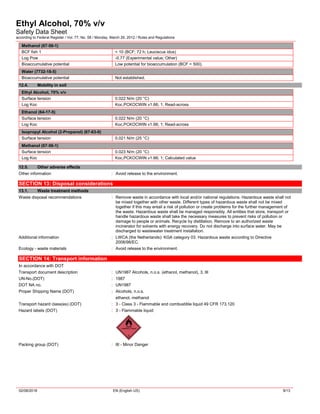
Methanol (67-56-1)
BCF fish 1 < 10 (BCF; 72 h; Leuciscus idus)
Log Pow -0.77 (Experimental value; Other)
Bioaccumulative potential Low potential for bioaccumulation (BCF < 500).
Water (7732-18-5)
Bioaccumulative potential Not established.
12.4. Mobility in soil
Ethyl Alcohol, 70% v/v
Surface tension 0.022 N/m (20 °C)
Log Koc Koc,PCKOCWIN v1.66; 1; Read-across
Ethanol (64-17-5)
Surface tension 0.022 N/m (20 °C)
Log Koc Koc,PCKOCWIN v1.66; 1; Read-across
Isopropyl Alcohol (2-Propanol) (67-63-0)
Surface tension 0.021 N/m (25 °C)
Methanol (67-56-1)
Surface tension 0.023 N/m (20 °C)
Log Koc Koc,PCKOCWIN v1.66; 1; Calculated value
12.5. Other adverse effects
Other information : Avoid release to the environment.
SECTION 13: Disposal considerations
13.1. Waste treatment methods
Waste disposal recommendations : Remove waste in accordance with local and/or national regulations. Hazardous waste shall not
be mixed together with other waste. Different types of hazardous waste shall not be mixed
together if this may entail a risk of pollution or create problems for the further management of
the waste. Hazardous waste shall be managed responsibly. All entities that store, transport or
handle hazardous waste shall take the necessary measures to prevent risks of pollution or
damage to people or animals. Recycle by distillation. Remove to an authorized waste
incinerator for solvents with energy recovery. Do not discharge into surface water. May be
discharged to wastewater treatment installation.
Additional information : LWCA (the Netherlands): KGA category 03. Hazardous waste according to Directive
2008/98/EC.
Ecology - waste materials : Avoid release to the environment.
SECTION 14: Transport information
In accordance with DOT
Transport document description : UN1987 Alcohols, n.o.s. (ethanol, methanol), 3, III
UN-No.(DOT) : 1987
DOT NA no. : UN1987
Proper Shipping Name (DOT) : Alcohols, n.o.s.
ethanol, methanol
Transport hazard class(es) (DOT) : 3 - Class 3 - Flammable and combustible liquid 49 CFR 173.120
Hazard labels (DOT) : 3 - Flammable liquid
Packing group (DOT) : III - Minor Danger
Ethyl Alcohol, 70% v/v
Safety Data Sheet
according to Federal Register / Vol. 77, No. 58 / Monday, March 26, 2012 / Rules and Regulations
02/08/2018 EN (English US) 10/13
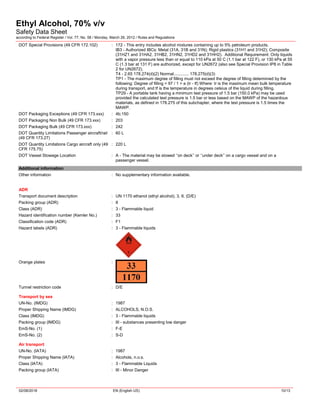
DOT Special Provisions (49 CFR 172.102) : 172 - This entry includes alcohol mixtures containing up to 5% petroleum products.
IB3 - Authorized IBCs: Metal (31A, 31B and 31N); Rigid plastics (31H1 and 31H2); Composite
(31HZ1 and 31HA2, 31HB2, 31HN2, 31HD2 and 31HH2). Additional Requirement: Only liquids
with a vapor pressure less than or equal to 110 kPa at 50 C (1.1 bar at 122 F), or 130 kPa at 55
C (1.3 bar at 131 F) are authorized, except for UN2672 (also see Special Provision IP8 in Table
2 for UN2672).
T4 - 2.65 178.274(d)(2) Normal............. 178.275(d)(3)
TP1 - The maximum degree of filling must not exceed the degree of filling determined by the
following: Degree of filling = 97 / 1 + a (tr - tf) Where: tr is the maximum mean bulk temperature
during transport, and tf is the temperature in degrees celsius of the liquid during filling.
TP29 - A portable tank having a minimum test pressure of 1.5 bar (150.0 kPa) may be used
provided the calculated test pressure is 1.5 bar or less based on the MAWP of the hazardous
materials, as defined in 178.275 of this subchapter, where the test pressure is 1.5 times the
MAWP.
DOT Packaging Exceptions (49 CFR 173.xxx) : 4b;150
DOT Packaging Non Bulk (49 CFR 173.xxx) : 203
DOT Packaging Bulk (49 CFR 173.xxx) : 242
DOT Quantity Limitations Passenger aircraft/rail
(49 CFR 173.27)
: 60 L
DOT Quantity Limitations Cargo aircraft only (49
CFR 175.75)
: 220 L
DOT Vessel Stowage Location : A - The material may be stowed ‘‘on deck’’ or ‘‘under deck’’ on a cargo vessel and on a
passenger vessel.
Additional information
Other information : No supplementary information available.
ADR
Transport document description : UN 1170 ethanol (ethyl alcohol), 3, II, (D/E)
Packing group (ADR) : II
Class (ADR) : 3 - Flammable liquid
Hazard identification number (Kemler No.) : 33
Classification code (ADR) : F1
Hazard labels (ADR) : 3 - Flammable liquids
Orange plates :
Tunnel restriction code : D/E
Transport by sea
UN-No. (IMDG) : 1987
Proper Shipping Name (IMDG) : ALCOHOLS, N.O.S.
Class (IMDG) : 3 - Flammable liquids
Packing group (IMDG) : III - substances presenting low danger
EmS-No. (1) : F-E
EmS-No. (2) : S-D
Air transport
UN-No. (IATA) : 1987
Proper Shipping Name (IATA) : Alcohols, n.o.s.
Class (IATA) : 3 - Flammable Liquids
Packing group (IATA) : III - Minor Danger
Ethyl Alcohol, 70% v/v
Safety Data Sheet
according to Federal Register / Vol. 77, No. 58 / Monday, March 26, 2012 / Rules and Regulations
02/08/2018 EN (English US) 11/13
SECTION 15: Regulatory information
15.1. US Federal regulations
Ethyl Alcohol, 70% v/v
SARA Section 311/312 Hazard Classes Physical hazard - Flammable (gases, aerosols, liquids, or solids)
Health hazard - Serious eye damage or eye irritation
Health hazard - Skin corrosion or Irritation
Health hazard - Specific target organ toxicity (single or repeated exposure)
Health hazard - Reproductive toxicity
Ethanol (64-17-5)
Listed on the United States TSCA (Toxic Substances Control Act) inventory
Isopropyl Alcohol (2-Propanol) (67-63-0)
Listed on the United States TSCA (Toxic Substances Control Act) inventory
Subject to reporting requirements of United States SARA Section 313
SARA Section 311/312 Hazard Classes Physical hazard - Flammable (gases, aerosols, liquids, or solids)
Health hazard - Serious eye damage or eye irritation
Health hazard - Specific target organ toxicity (single or repeated exposure)
Methanol (67-56-1)
Listed on the United States TSCA (Toxic Substances Control Act) inventory
Subject to reporting requirements of United States SARA Section 313
RQ (Reportable quantity, section 304 of EPA's
List of Lists)
5000 lb
SARA Section 311/312 Hazard Classes Physical hazard - Flammable (gases, aerosols, liquids, or solids)
Health hazard - Acute toxicity (any route of exposure)
Health hazard - Specific target organ toxicity (single or repeated exposure)
Water (7732-18-5)
Listed on the United States TSCA (Toxic Substances Control Act) inventory
15.2. International regulations
CANADA
Ethyl Alcohol, 70% v/v
WHMIS Classification Class B Division 3 - Combustible Liquid
Class D Division 2 Subdivision A - Very toxic material causing other toxic effects
Isopropyl Alcohol (2-Propanol) (67-63-0)
WHMIS Classification Class B Division 2 - Flammable Liquid
Class D Division 2 Subdivision B - Toxic material causing other toxic effects
Methanol (67-56-1)
Listed on the Canadian DSL (Domestic Substances List)
WHMIS Classification Class B Division 2 - Flammable Liquid
Class D Division 2 Subdivision A - Very toxic material causing other toxic effects
Class D Division 2 Subdivision B - Toxic material causing other toxic effects
Water (7732-18-5)
WHMIS Classification Uncontrolled product according to WHMIS classification criteria
EU-Regulations
Isopropyl Alcohol (2-Propanol) (67-63-0)
Methanol (67-56-1)
Water (7732-18-5)
Classification according to Regulation (EC) No. 1272/2008 [CLP]
Classification according to Directive 67/548/EEC [DSD] or 1999/45/EC [DPD]
F; R11
Full text of R-phrases: see section 16
15.2.2. National regulations
Ethyl Alcohol, 70% v/v
Safety Data Sheet
according to Federal Register / Vol. 77, No. 58 / Monday, March 26, 2012 / Rules and Regulations
02/08/2018 EN (English US) 12/13
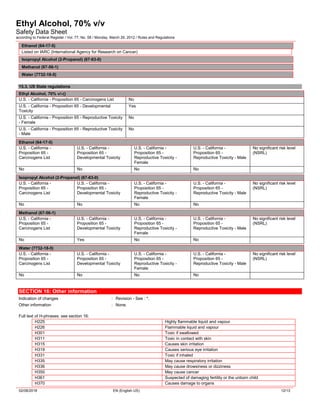
Ethanol (64-17-5)
Listed on IARC (International Agency for Research on Cancer)
Isopropyl Alcohol (2-Propanol) (67-63-0)
Methanol (67-56-1)
Water (7732-18-5)
15.3. US State regulations
Ethyl Alcohol, 70% v/v()
U.S. - California - Proposition 65 - Carcinogens List No
U.S. - California - Proposition 65 - Developmental
Toxicity
Yes
U.S. - California - Proposition 65 - Reproductive Toxicity
- Female
No
U.S. - California - Proposition 65 - Reproductive Toxicity
- Male
No
Ethanol (64-17-5)
U.S. - California -
Proposition 65 -
Carcinogens List
U.S. - California -
Proposition 65 -
Developmental Toxicity
U.S. - California -
Proposition 65 -
Reproductive Toxicity -
Female
U.S. - California -
Proposition 65 -
Reproductive Toxicity - Male
No significant risk level
(NSRL)
No No No No
Isopropyl Alcohol (2-Propanol) (67-63-0)
U.S. - California -
Proposition 65 -
Carcinogens List
U.S. - California -
Proposition 65 -
Developmental Toxicity
U.S. - California -
Proposition 65 -
Reproductive Toxicity -
Female
U.S. - California -
Proposition 65 -
Reproductive Toxicity - Male
No significant risk level
(NSRL)
No No No No
Methanol (67-56-1)
U.S. - California -
Proposition 65 -
Carcinogens List
U.S. - California -
Proposition 65 -
Developmental Toxicity
U.S. - California -
Proposition 65 -
Reproductive Toxicity -
Female
U.S. - California -
Proposition 65 -
Reproductive Toxicity - Male
No significant risk level
(NSRL)
No Yes No No
Water (7732-18-5)
U.S. - California -
Proposition 65 -
Carcinogens List
U.S. - California -
Proposition 65 -
Developmental Toxicity
U.S. - California -
Proposition 65 -
Reproductive Toxicity -
Female
U.S. - California -
Proposition 65 -
Reproductive Toxicity - Male
No significant risk level
(NSRL)
No No No No
SECTION 16: Other information
Indication of changes : Revision - See : *.
Other information : None.
Full text of H-phrases: see section 16:
------ H225 Highly flammable liquid and vapour
------ H226 Flammable liquid and vapour
------ H301 Toxic if swallowed
------ H311 Toxic in contact with skin
------ H315 Causes skin irritation
------ H319 Causes serious eye irritation
------ H331 Toxic if inhaled
------ H335 May cause respiratory irritation
------ H336 May cause drowsiness or dizziness
------ H350 May cause cancer
------ H361 Suspected of damaging fertility or the unborn child
------ H370 Causes damage to organs
Ethyl Alcohol, 70% v/v
Safety Data Sheet
according to Federal Register / Vol. 77, No. 58 / Monday, March 26, 2012 / Rules and Regulations
02/08/2018 EN (English US) 13/13
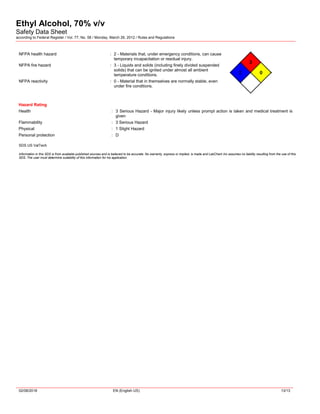
NFPA health hazard : 2 - Materials that, under emergency conditions, can cause
temporary incapacitation or residual injury.
NFPA fire hazard : 3 - Liquids and solids (including finely divided suspended
solids) that can be ignited under almost all ambient
temperature conditions.
NFPA reactivity : 0 - Material that in themselves are normally stable, even
under fire conditions.
Hazard Rating
Health : 3 Serious Hazard - Major injury likely unless prompt action is taken and medical treatment is
given
Flammability : 3 Serious Hazard
Physical : 1 Slight Hazard
Personal protection : D
SDS US ValTech
Information in this SDS is from available published sources and is believed to be accurate. No warranty, express or implied, is made and LabChem Inc assumes no liability resulting from the use of this
SDS. The user must determine suitability of this information for his application.

m13 Ethyl alcohol 70% msds sheet

  • 1.
    Ethyl Alcohol, 70%v/v Safety Data Sheet according to Federal Register / Vol. 77, No. 58 / Monday, March 26, 2012 / Rules and Regulations Date of issue: 08/13/2013 Revision date: 02/08/2018 Supersedes: 04/16/2014 Version: 1.3 02/08/2018 EN (English US) Page 1 SECTION 1: Identification of the substance/mixture and of the company/undertaking 1.1. Product identifier Product form : Mixtures Product name : Ethyl Alcohol, 70% v/v Product code : VT270 Other means of identification : Ethanol, Denatured, 70% v/v 1.2. Relevant identified uses of the substance or mixture and uses advised against Use of the substance/mixture : For laboratory and manufacturing use only. 1.3. Details of the supplier of the safety data sheet Val Tech Diagnostics, A Division of LabChem Inc Jackson's Pointe Commerce Park Building 1000 1010 Jackson's Pointe Court Zelienople, PA 16063 T 412-826-5230 F 724-473-0647 1.4. Emergency telephone number Emergency number : CHEMTREC: 1-800-424-9300 or 011-703-527-3887 SECTION 2: Hazards identification 2.1. Classification of the substance or mixture GHS-US classification Flam. Liq. 3 H226 Skin Irrit. 2 H315 Eye Irrit. 2A H319 Repr. 2 H361 STOT SE 3 H336 STOT SE 1 H370 Full text of H statements : see section 16 2.2. Label elements GHS-US labeling Hazard pictograms (GHS-US) : GHS02 GHS07 GHS08 Signal word (GHS-US) : Danger Hazard statements (GHS-US) : H226 - Flammable liquid and vapour H315 - Causes skin irritation H319 - Causes serious eye irritation H336 - May cause drowsiness or dizziness H361 - Suspected of damaging fertility or the unborn child H370 - Causes damage to organs (central nervous system, optic nerve) (oral, Dermal) Precautionary statements (GHS-US) : P201 - Obtain special instructions before use. P202 - Do not handle until all safety precautions have been read and understood. P210 - Keep away from heat, hot surfaces, open flames, sparks. - No smoking. P233 - Keep container tightly closed. P240 - Ground/bond container and receiving equipment. P241 - Use explosion-proof electrical, lighting, ventilating equipment P242 - Use only non-sparking tools. P243 - Take precautionary measures against static discharge. P260 - Do not breathe mist, spray, vapors. P264 - Wash exposed skin thoroughly after handling. P270 - Do not eat, drink or smoke when using this product. P271 - Use only outdoors or in a well-ventilated area. P280 - Wear eye protection, face protection, protective clothing, protective gloves.
  • 2.
    Ethyl Alcohol, 70%v/v Safety Data Sheet according to Federal Register / Vol. 77, No. 58 / Monday, March 26, 2012 / Rules and Regulations 02/08/2018 EN (English US) 2/13 P303+P361+P353 - IF ON SKIN (or hair): Remove/Take off immediately all contaminated clothing. Rinse skin with water/shower. P304+P340 - IF INHALED: Remove victim to fresh air and keep at rest in a position comfortable for breathing. P305+P351+P338 - If in eyes: Rinse cautiously with water for several minutes. Remove contact lenses, if present and easy to do. Continue rinsing P308+P313 - IF exposed or concerned: Get medical advice/attention. P312 - Call a POISON CENTER or doctor/physician if you feel unwell. P332+P313 - If skin irritation occurs: Get medical advice/attention. P337+P313 - If eye irritation persists: Get medical advice/attention. P363 - Wash contaminated clothing before reuse. P370+P378 - In case of fire: Use carbon dioxide (CO2), powder, alcohol-resistant foam to extinguish P403+P233 - Store in a well-ventilated place. Keep container tightly closed. P405 - Store locked up. P501 - Dispose of contents/container to comply with local, state and federal regulations P235 - Keep cool. 2.3. Other hazards Other hazards not contributing to the classification : None. 2.4. Unknown acute toxicity (GHS US) No data available SECTION 3: Composition/Information on ingredients 3.1. Substances Not applicable Full text of H-phrases: see section 16 3.2. Mixtures Name Product identifier % GHS-US classification Ethanol (CAS-No.) 64-17-5 52.3 - 57.5 Flam. Liq. 2, H225 Carc. 1A, H350 Repr. 2, H361 Water (CAS-No.) 7732-18-5 35.9 - 42.3 Not classified Isopropyl Alcohol (2-Propanol) (CAS-No.) 67-63-0 2.8 - 3.3 Flam. Liq. 2, H225 Eye Irrit. 2A, H319 STOT SE 3, H335 Methanol (CAS-No.) 67-56-1 2.6 - 3.3 Flam. Liq. 2, H225 Acute Tox. 3 (Oral), H301 Acute Tox. 3 (Dermal), H311 Acute Tox. 3 (Inhalation), H331 STOT SE 1, H370 SECTION 4: First aid measures 4.1. Description of first aid measures First-aid measures general : Check the vital functions. Unconscious: maintain adequate airway and respiration. Respiratory arrest: artificial respiration or oxygen. Cardiac arrest: perform resuscitation. Victim conscious with labored breathing: half-seated. Victim in shock: on his back with legs slightly raised. Vomiting: prevent asphyxia/aspiration pneumonia. Prevent cooling by covering the victim (no warming up). Keep watching the victim. Give psychological aid. Keep the victim calm, avoid physical strain. Depending on the victim's condition: doctor/hospital. Never give alcohol to drink. First-aid measures after inhalation : Remove the victim into fresh air. Respiratory problems: consult a doctor/medical service. First-aid measures after skin contact : Rinse with water. Take victim to a doctor if irritation persists. First-aid measures after eye contact : Rinse immediately with plenty of water. Do not apply neutralizing agents. Take victim to an ophthalmologist if irritation persists. First-aid measures after ingestion : Rinse mouth with water. Do not induce vomiting. Call Poison Information Centre (www.big.be/antigif.htm). Consult a doctor/medical service if you feel unwell. Ingestion of large quantities: immediately to hospital. 4.2. Most important symptoms and effects, both acute and delayed Symptoms/effects after inhalation : EXPOSURE TO HIGH CONCENTRATIONS: Dry/sore throat. Coughing. Irritation of the respiratory tract. Irritation of the nasal mucous membranes. Respiratory difficulties. Central nervous system depression. Symptoms similar to those listed under ingestion. Symptoms/effects after skin contact : Slight irritation.
  • 3.
    Ethyl Alcohol, 70%v/v Safety Data Sheet according to Federal Register / Vol. 77, No. 58 / Monday, March 26, 2012 / Rules and Regulations 02/08/2018 EN (English US) 3/13 Symptoms/effects after eye contact : Redness of the eye tissue. Lacrimation. ON CONTINUOUS EXPOSURE/CONTACT: Irritation of the eye tissue. Symptoms/effects after ingestion : AFTER ABSORPTION OF LARGE QUANTITIES: Risk of aspiration pneumonia. Red skin. Body temperature rise. Damp/clammy skin. Excited/restless. Accelerated heart action. Central nervous system depression. Dizziness. Narcosis. Headache. Drunkenness. Nausea. Vomiting. Disturbed motor response. Coordination disorders. Visual disturbances. Impaired concentration. Delusions. Disturbed sensation of pain. Disturbances of heart rate. Disturbances of consciousness. Tremor. Cramps/uncontrolled muscular contractions. Dilated pupils. Chronic symptoms : ON CONTINUOUS/REPEATED EXPOSURE/CONTACT: Dry skin. Gastrointestinal complaints. Enlargement/affection of the liver. Change in the haemogramme/blood composition. Cardiac and blood circulation effects. High arterial pressure. Impairment of the nervous system. Behavioural disturbances. Mental confusion. Disturbed tactile sensibility. Tremor. Affection of the bone marrow. Affection of the endocrine system. Weakening of the immune system. 4.3. Indication of any immediate medical attention and special treatment needed No additional information available SECTION 5: Firefighting measures 5.1. Extinguishing media Suitable extinguishing media : Water spray. Alcohol-resistant foam. BC powder. Carbon dioxide. Unsuitable extinguishing media : Solid water jet ineffective as extinguishing medium. 5.2. Special hazards arising from the substance or mixture Fire hazard : DIRECT FIRE HAZARD. Highly flammable. Gas/vapor flammable with air within explosion limits. INDIRECT FIRE HAZARD. May be ignited by sparks. Gas/vapor spreads at floor level: ignition hazard. Reactions involving a fire hazard: see "Reactivity Hazard". Explosion hazard : DIRECT EXPLOSION HAZARD. Gas/vapour explosive with air within explosion limits. INDIRECT EXPLOSION HAZARD. may be ignited by sparks. Reactions with explosion hazards: see "Reactivity Hazard". Reactivity : Upon combustion: CO and CO2 are formed. Reacts violently with many compounds e.g.: with (strong) oxidizers: (increased) risk of fire/explosion. Violent to explosive reaction with (some) acids. 5.3. Advice for firefighters Firefighting instructions : Cool tanks/drums with water spray/remove them into safety. Do not move the load if exposed to heat. Protection during firefighting : Heat/fire exposure: compressed air/oxygen apparatus. SECTION 6: Accidental release measures 6.1. Personal precautions, protective equipment and emergency procedures General measures : Remove ignition sources. Use special care to avoid static electric charges. No naked lights. No smoking. 6.1.1. For non-emergency personnel Protective equipment : Gloves. Protective goggles. Protective clothing. Large spills/in enclosed spaces: compressed air apparatus. See "Material-Handling" to select protective clothing. Emergency procedures : Keep upwind. Mark the danger area. Consider evacuation. Seal off low-lying areas. Close doors and windows of adjacent premises. Stop engines and no smoking. No naked flames or sparks. Spark- and explosion-proof appliances and lighting equipment. Keep containers closed. Wash contaminated clothes. 6.1.2. For emergency responders Protective equipment : Equip cleanup crew with proper protection. Avoid breathing mist, spray. Emergency procedures : Ventilate area. 6.2. Environmental precautions Prevent spreading in sewers. 6.3. Methods and material for containment and cleaning up For containment : Contain released substance, pump into suitable containers. Consult "Material-handling" to select material of containers. Plug the leak, cut off the supply. Dam up the liquid spill. Try to reduce evaporation. Measure the concentration of the explosive gas-air mixture. Dilute/disperse combustible gas/vapour with water curtain. Provide equipment/receptacles with earthing. Do not use compressed air for pumping over spills.
  • 4.
    Ethyl Alcohol, 70%v/v Safety Data Sheet according to Federal Register / Vol. 77, No. 58 / Monday, March 26, 2012 / Rules and Regulations 02/08/2018 EN (English US) 4/13 Methods for cleaning up : Take up liquid spill into a non combustible material e.g.: sand, earth, vermiculite or kieselguhr, powdered limestone. Scoop absorbed substance into closing containers. See "Material- handling" for suitable container materials. Carefully collect the spill/leftovers. Damaged/cooled tanks must be emptied. Do not use compressed air for pumping over spills. Clean contaminated surfaces with an excess of water. Take collected spill to manufacturer/competent authority. Wash clothing and equipment after handling. 6.4. Reference to other sections See Heading 8. Exposure controls and personal protection. SECTION 7: Handling and storage 7.1. Precautions for safe handling Precautions for safe handling : Comply with the legal requirements. Remove contaminated clothing immediately. Clean contaminated clothing. Handle uncleaned empty containers as full ones. Thoroughly clean/dry the installation before use. Do not discharge the waste into the drain. Do not use compressed air for pumping over. Use spark-/explosionproof appliances and lighting system. Take precautions against electrostatic charges. Keep away from naked flames/heat. Keep away from ignition sources/sparks. Observe normal hygiene standards. Keep container tightly closed. Measure the concentration in the air regularly. Work under local exhaust/ventilation. Hygiene measures : Wash exposed skin thoroughly after handling. 7.2. Conditions for safe storage, including any incompatibilities Technical measures : Proper grounding procedures to avoid static electricity should be followed. Ground/bond container and receiving equipment. Use explosion-proof electrical/ventilating/lighting/… equipment. Storage conditions : Keep container tightly closed. Keep only in the original container in a cool, well ventilated place away from : incompatible materials. Keep in fireproof place. Incompatible products : Strong bases. Strong acids. Incompatible materials : Sources of ignition. Direct sunlight. Heat sources. Heat-ignition : KEEP SUBSTANCE AWAY FROM: heat sources. ignition sources. Prohibitions on mixed storage : KEEP SUBSTANCE AWAY FROM: oxidizing agents. strong acids. water/moisture. Storage area : Keep out of direct sunlight. Store in a dry area. Ventilation at floor level. Fireproof storeroom. Provide for an automatic sprinkler system. Provide for a tub to collect spills. Provide the tank with earthing. Meet the legal requirements. Special rules on packaging : SPECIAL REQUIREMENTS: closing. dry. clean. correctly labelled. meet the legal requirements. Secure fragile packagings in solid containers. Packaging materials : SUITABLE MATERIAL: stainless steel. aluminium. iron. copper. nickel. synthetic material. glass. MATERIAL TO AVOID: No data available. 7.3. Specific end use(s) No additional information available SECTION 8: Exposure controls/personal protection 8.1. Control parameters Ethyl Alcohol, 70% v/v USA ACGIH ACGIH STEL (ppm) 1000 ppm (Ethanol; USA; Short time value; TLV - Adopted Value) USA OSHA OSHA PEL (TWA) (mg/m³) 1900 mg/m³ USA OSHA OSHA PEL (TWA) (ppm) 1000 ppm Ethanol (64-17-5) USA ACGIH ACGIH STEL (ppm) 1000 ppm (Ethanol; USA; Short time value; TLV - Adopted Value) USA OSHA OSHA PEL (TWA) (mg/m³) 1900 mg/m³ USA OSHA OSHA PEL (TWA) (ppm) 1000 ppm Isopropyl Alcohol (2-Propanol) (67-63-0) USA ACGIH ACGIH TWA (ppm) 200 ppm (2-propanol; USA; Time-weighted average exposure limit 8 h; TLV - Adopted Value) USA ACGIH ACGIH STEL (ppm) 400 ppm (2-propanol; USA; Short time value; TLV - Adopted Value) USA OSHA OSHA PEL (TWA) (mg/m³) 980 mg/m³ USA OSHA OSHA PEL (TWA) (ppm) 400 ppm
  • 5.
    Ethyl Alcohol, 70%v/v Safety Data Sheet according to Federal Register / Vol. 77, No. 58 / Monday, March 26, 2012 / Rules and Regulations 02/08/2018 EN (English US) 5/13 Methanol (67-56-1) USA ACGIH ACGIH TWA (ppm) 200 ppm (Methanol; USA; Time-weighted average exposure limit 8 h; TLV - Adopted Value) USA ACGIH ACGIH STEL (ppm) 250 ppm (Methanol; USA; Short time value; TLV - Adopted Value) USA OSHA OSHA PEL (TWA) (mg/m³) 260 mg/m³ USA OSHA OSHA PEL (TWA) (ppm) 200 ppm 8.2. Exposure controls Appropriate engineering controls : Emergency eye wash fountains and safety showers should be available in the immediate vicinity of any potential exposure. Provide local exhaust or general room ventilation. Personal protective equipment : Safety glasses. Gloves. Protective clothing. High gas/vapor concentration: gas mask with filter type A. Materials for protective clothing : GIVE EXCELLENT RESISTANCE: butyl rubber. viton. GIVE GOOD RESISTANCE: neoprene. tetrafluoroethylene. GIVE LESS RESISTANCE: nitrile rubber. polyethylene. GIVE POOR RESISTANCE: natural rubber. PVA. PVC. Hand protection : Gloves. Eye protection : Safety glasses. Skin and body protection : Protective clothing. Respiratory protection : Wear gas mask with filter type A if conc. in air > exposure limit. Other information : Do not eat, drink or smoke during use. SECTION 9: Physical and chemical properties 9.1. Information on basic physical and chemical properties Physical state : Liquid Appearance : Liquid. Molecular mass : 46.07 g/mol Color : Colourless. Odor : Alcohol odour. Pleasant odour. Odor threshold : 100 ppm 188 mg/m³ pH : No data available Relative evaporation rate (butyl acetate=1) : 2.4 Relative evaporation rate (ether=1) : 8.3 Melting point : -115 °C Freezing point : No data available Boiling point : 78 °C Flash point : 25 °C Critical temperature : 243 °C Auto-ignition temperature : 363 °C Decomposition temperature : No data available Flammability (solid, gas) : No data available Vapor pressure : 59 hPa (20 °C) Vapor pressure at 50 °C : 300 hPa (50 °C) Critical pressure : 63840 hPa Relative vapor density at 20 °C : 1.6 Relative density : 0.79 Relative density of saturated gas/air mixture : 1.04 Specific gravity / density : 0.881 g/l
  • 6.
    Ethyl Alcohol, 70%v/v Safety Data Sheet according to Federal Register / Vol. 77, No. 58 / Monday, March 26, 2012 / Rules and Regulations 02/08/2018 EN (English US) 6/13 Solubility : Soluble in water. Soluble in ether. Soluble in acetone. Soluble in chloroform. Soluble in oils/fats. Soluble in methanol. Soluble in acids. Water: Complete Ethanol: Not applicable Ether: Complete Acetone: Complete Log Pow : -0.31 (Experimental value) Log Kow : No data available Viscosity, kinematic : No data available Viscosity, dynamic : 0.0012 Pa.s (20 °C) Explosive properties : No data available Oxidizing properties : No data available Explosion limits : 3.3 - 19.0 vol % 67 - 290 g/m³ 9.2. Other information Specific conductivity : 130000 pS/m Saturation concentration : 112 g/m³ VOC content : 100 % Other properties : Gas/vapour heavier than air at 20°C. Clear. Hygroscopic. Volatile. Substance has neutral reaction. SECTION 10: Stability and reactivity 10.1. Reactivity Upon combustion: CO and CO2 are formed. Reacts violently with many compounds e.g.: with (strong) oxidizers: (increased) risk of fire/explosion. Violent to explosive reaction with (some) acids. 10.2. Chemical stability Hygroscopic. 10.3. Possibility of hazardous reactions Not established. 10.4. Conditions to avoid Direct sunlight. Extremely high or low temperatures. Open flame. 10.5. Incompatible materials Strong acids. Strong bases. 10.6. Hazardous decomposition products fume. Carbon monoxide. Carbon dioxide. May release flammable gases. SECTION 11: Toxicological information 11.1. Information on toxicological effects Acute toxicity : Not classified Ethyl Alcohol, 70% v/v LD50 oral rat 10740 mg/kg body weight (Rat; OECD 401: Acute Oral Toxicity; Experimental value) LD50 dermal rabbit > 16000 mg/kg (Rabbit; Literature study) Ethanol (64-17-5) LD50 oral rat 10740 mg/kg (Rat; Experimental value,Rat; Experimental value) LD50 dermal rabbit > 16000 mg/kg (Rabbit; Literature study) Isopropyl Alcohol (2-Propanol) (67-63-0) LD50 dermal rabbit 12870 mg/kg (Rabbit; Experimental value; Equivalent or similar to OECD 402; 16.4; Rabbit) LC50 inhalation rat (mg/l) 73 mg/l/4h (Rat) Methanol (67-56-1) LD50 oral rat > 5000 mg/kg (Rat; BASF test; Literature study; 1187-2769 mg/kg bodyweight; Rat; Weight of evidence) LD50 dermal rabbit 15800 mg/kg (Rabbit; Literature study) LC50 inhalation rat (mg/l) 85 mg/l/4h (Rat; Literature study)
  • 7.
    Ethyl Alcohol, 70%v/v Safety Data Sheet according to Federal Register / Vol. 77, No. 58 / Monday, March 26, 2012 / Rules and Regulations 02/08/2018 EN (English US) 7/13 Methanol (67-56-1) LC50 inhalation rat (ppm) 64000 ppm/4h (Rat; Literature study) Water (7732-18-5) LD50 oral rat ≥ 90000 mg/kg Skin corrosion/irritation : Causes skin irritation. Serious eye damage/irritation : Causes serious eye irritation. Respiratory or skin sensitization : Not classified Germ cell mutagenicity : Not classified Based on available data, the classification criteria are not met Carcinogenicity : Not classified Ethanol (64-17-5) IARC group 1 - Carcinogenic to humans Isopropyl Alcohol (2-Propanol) (67-63-0) IARC group 3 - Not classifiable Reproductive toxicity : Suspected of damaging fertility or the unborn child. Based on available data, the classification criteria are not met Specific target organ toxicity – single exposure : May cause drowsiness or dizziness. Causes damage to organs (central nervous system, optic nerve) (oral, Dermal). Specific target organ toxicity – repeated exposure : Not classified Based on available data, the classification criteria are not met Aspiration hazard : Not classified Based on available data, the classification criteria are not met Potential Adverse human health effects and symptoms : Harmful if swallowed. Based on available data, the classification criteria are not met. Symptoms/effects after inhalation : EXPOSURE TO HIGH CONCENTRATIONS: Dry/sore throat. Coughing. Irritation of the respiratory tract. Irritation of the nasal mucous membranes. Respiratory difficulties. Central nervous system depression. Symptoms similar to those listed under ingestion. Symptoms/effects after skin contact : Slight irritation. Symptoms/effects after eye contact : Redness of the eye tissue. Lacrimation. ON CONTINUOUS EXPOSURE/CONTACT: Irritation of the eye tissue. Symptoms/effects after ingestion : AFTER ABSORPTION OF LARGE QUANTITIES: Risk of aspiration pneumonia. Red skin. Body temperature rise. Damp/clammy skin. Excited/restless. Accelerated heart action. Central nervous system depression. Dizziness. Narcosis. Headache. Drunkenness. Nausea. Vomiting. Disturbed motor response. Coordination disorders. Visual disturbances. Impaired concentration. Delusions. Disturbed sensation of pain. Disturbances of heart rate. Disturbances of consciousness. Tremor. Cramps/uncontrolled muscular contractions. Dilated pupils. Chronic symptoms : ON CONTINUOUS/REPEATED EXPOSURE/CONTACT: Dry skin. Gastrointestinal complaints. Enlargement/affection of the liver. Change in the haemogramme/blood composition. Cardiac and blood circulation effects. High arterial pressure. Impairment of the nervous system. Behavioural disturbances. Mental confusion. Disturbed tactile sensibility. Tremor. Affection of the bone marrow. Affection of the endocrine system. Weakening of the immune system. SECTION 12: Ecological information 12.1. Toxicity Ecology - general : Not classified as dangerous for the environment according to the criteria of Regulation (EC) No 1272/2008. Ecology - air : Not classified as dangerous for the ozone layer (Regulation (EC) No 1005/2009). Not included in the list of substances which may contribute to the greenhouse effect (Regulation (EC) No 842/2006). TA-Luft Klasse 5.2.5. Ecology - water : Not harmful to fishes (LC50(96h) >1000 mg/l). Not harmful to invertebrates (Daphnia). Slightly harmful to algae (EC50 (72h): 100 - 1000 mg/l). Harmful to plankton. Not harmful to bacteria (EC50 >1000 mg/l). No inhibition of activated sludge. Ethyl Alcohol, 70% v/v LC50 fish 1 14200 mg/l (LC50; US EPA; 96 h; Pimephales promelas; Flow-through system; Fresh water; Experimental value)
  • 8.
    Ethyl Alcohol, 70%v/v Safety Data Sheet according to Federal Register / Vol. 77, No. 58 / Monday, March 26, 2012 / Rules and Regulations 02/08/2018 EN (English US) 8/13 Ethanol (64-17-5) LC50 fish 1 14200 mg/l (LC50; US EPA; 96 h; Pimephales promelas; Flow-through system; Fresh water; Experimental value) Isopropyl Alcohol (2-Propanol) (67-63-0) LC50 fish 2 9640 mg/l (LC50; OECD 203: Fish, Acute Toxicity Test; 96 h; Pimephales promelas; Flow- through system; Fresh water; Experimental value) EC50 Daphnia 2 13299 mg/l (EC50; Other; 48 h; Daphnia magna) Threshold limit algae 1 > 1000 mg/l (EC50; UBA; 72 h; Scenedesmus subspicatus) Methanol (67-56-1) LC50 fish 1 15400 mg/l (LC50; EPA 660/3 - 75/009; 96 h; Lepomis macrochirus; Flow-through system; Fresh water; Experimental value) EC50 Daphnia 1 > 10000 mg/l (EC50; DIN 38412-11; 48 h; Daphnia magna; Static system; Fresh water; Experimental value) LC50 fish 2 10800 mg/l (LC50; 96 h; Salmo gairdneri) 12.2. Persistence and degradability Ethyl Alcohol, 70% v/v Persistence and degradability Readily biodegradable in water. Biodegradable in the soil. Highly mobile in soil. Biochemical oxygen demand (BOD) 0.8 - 0.967 g O ₂/g substance Chemical oxygen demand (COD) 1.7 g O ₂/g substance ThOD 2.1 g O ₂/g substance BOD (% of ThOD) 0.43 Ethanol (64-17-5) Persistence and degradability Readily biodegradable in water. Biodegradable in the soil. Highly mobile in soil. Biochemical oxygen demand (BOD) 0.8 - 0.967 g O ₂/g substance Chemical oxygen demand (COD) 1.7 g O ₂/g substance ThOD 2.1 g O ₂/g substance BOD (% of ThOD) 0.43 Isopropyl Alcohol (2-Propanol) (67-63-0) Persistence and degradability Readily biodegradable in water. Biodegradable in the soil. Biodegradable in the soil under anaerobic conditions. No test data on mobility of the substance available. Biochemical oxygen demand (BOD) 1.19 g O ₂/g substance Chemical oxygen demand (COD) 2.23 g O ₂/g substance ThOD 2.4 g O ₂/g substance Methanol (67-56-1) Persistence and degradability Readily biodegradable in water. Biodegradable in the soil. Highly mobile in soil. Biochemical oxygen demand (BOD) 0.6 - 1.12 g O ₂/g substance Chemical oxygen demand (COD) 1.42 g O ₂/g substance ThOD 1.5 g O ₂/g substance BOD (% of ThOD) 0.8 (Literature study) Water (7732-18-5) Persistence and degradability Not established. 12.3. Bioaccumulative potential Ethyl Alcohol, 70% v/v BCF fish 1 1 (BCF; Other; 72 h; Cyprinus carpio; Static system; Fresh water; Read-across) Log Pow -0.31 (Experimental value) Bioaccumulative potential Low potential for bioaccumulation (Log Kow < 4). Ethanol (64-17-5) BCF fish 1 1 (BCF; Other; 72 h; Cyprinus carpio; Static system; Fresh water; Read-across) Log Pow -0.31 (Experimental value) Bioaccumulative potential Low potential for bioaccumulation (Log Kow < 4). Isopropyl Alcohol (2-Propanol) (67-63-0) Log Pow 0.05 (Weight of evidence approach; Other; 25 °C) Bioaccumulative potential Low potential for bioaccumulation (Log Kow < 4).
  • 9.
    Ethyl Alcohol, 70%v/v Safety Data Sheet according to Federal Register / Vol. 77, No. 58 / Monday, March 26, 2012 / Rules and Regulations 02/08/2018 EN (English US) 9/13 Methanol (67-56-1) BCF fish 1 < 10 (BCF; 72 h; Leuciscus idus) Log Pow -0.77 (Experimental value; Other) Bioaccumulative potential Low potential for bioaccumulation (BCF < 500). Water (7732-18-5) Bioaccumulative potential Not established. 12.4. Mobility in soil Ethyl Alcohol, 70% v/v Surface tension 0.022 N/m (20 °C) Log Koc Koc,PCKOCWIN v1.66; 1; Read-across Ethanol (64-17-5) Surface tension 0.022 N/m (20 °C) Log Koc Koc,PCKOCWIN v1.66; 1; Read-across Isopropyl Alcohol (2-Propanol) (67-63-0) Surface tension 0.021 N/m (25 °C) Methanol (67-56-1) Surface tension 0.023 N/m (20 °C) Log Koc Koc,PCKOCWIN v1.66; 1; Calculated value 12.5. Other adverse effects Other information : Avoid release to the environment. SECTION 13: Disposal considerations 13.1. Waste treatment methods Waste disposal recommendations : Remove waste in accordance with local and/or national regulations. Hazardous waste shall not be mixed together with other waste. Different types of hazardous waste shall not be mixed together if this may entail a risk of pollution or create problems for the further management of the waste. Hazardous waste shall be managed responsibly. All entities that store, transport or handle hazardous waste shall take the necessary measures to prevent risks of pollution or damage to people or animals. Recycle by distillation. Remove to an authorized waste incinerator for solvents with energy recovery. Do not discharge into surface water. May be discharged to wastewater treatment installation. Additional information : LWCA (the Netherlands): KGA category 03. Hazardous waste according to Directive 2008/98/EC. Ecology - waste materials : Avoid release to the environment. SECTION 14: Transport information In accordance with DOT Transport document description : UN1987 Alcohols, n.o.s. (ethanol, methanol), 3, III UN-No.(DOT) : 1987 DOT NA no. : UN1987 Proper Shipping Name (DOT) : Alcohols, n.o.s. ethanol, methanol Transport hazard class(es) (DOT) : 3 - Class 3 - Flammable and combustible liquid 49 CFR 173.120 Hazard labels (DOT) : 3 - Flammable liquid Packing group (DOT) : III - Minor Danger
  • 10.
    Ethyl Alcohol, 70%v/v Safety Data Sheet according to Federal Register / Vol. 77, No. 58 / Monday, March 26, 2012 / Rules and Regulations 02/08/2018 EN (English US) 10/13 DOT Special Provisions (49 CFR 172.102) : 172 - This entry includes alcohol mixtures containing up to 5% petroleum products. IB3 - Authorized IBCs: Metal (31A, 31B and 31N); Rigid plastics (31H1 and 31H2); Composite (31HZ1 and 31HA2, 31HB2, 31HN2, 31HD2 and 31HH2). Additional Requirement: Only liquids with a vapor pressure less than or equal to 110 kPa at 50 C (1.1 bar at 122 F), or 130 kPa at 55 C (1.3 bar at 131 F) are authorized, except for UN2672 (also see Special Provision IP8 in Table 2 for UN2672). T4 - 2.65 178.274(d)(2) Normal............. 178.275(d)(3) TP1 - The maximum degree of filling must not exceed the degree of filling determined by the following: Degree of filling = 97 / 1 + a (tr - tf) Where: tr is the maximum mean bulk temperature during transport, and tf is the temperature in degrees celsius of the liquid during filling. TP29 - A portable tank having a minimum test pressure of 1.5 bar (150.0 kPa) may be used provided the calculated test pressure is 1.5 bar or less based on the MAWP of the hazardous materials, as defined in 178.275 of this subchapter, where the test pressure is 1.5 times the MAWP. DOT Packaging Exceptions (49 CFR 173.xxx) : 4b;150 DOT Packaging Non Bulk (49 CFR 173.xxx) : 203 DOT Packaging Bulk (49 CFR 173.xxx) : 242 DOT Quantity Limitations Passenger aircraft/rail (49 CFR 173.27) : 60 L DOT Quantity Limitations Cargo aircraft only (49 CFR 175.75) : 220 L DOT Vessel Stowage Location : A - The material may be stowed ‘‘on deck’’ or ‘‘under deck’’ on a cargo vessel and on a passenger vessel. Additional information Other information : No supplementary information available. ADR Transport document description : UN 1170 ethanol (ethyl alcohol), 3, II, (D/E) Packing group (ADR) : II Class (ADR) : 3 - Flammable liquid Hazard identification number (Kemler No.) : 33 Classification code (ADR) : F1 Hazard labels (ADR) : 3 - Flammable liquids Orange plates : Tunnel restriction code : D/E Transport by sea UN-No. (IMDG) : 1987 Proper Shipping Name (IMDG) : ALCOHOLS, N.O.S. Class (IMDG) : 3 - Flammable liquids Packing group (IMDG) : III - substances presenting low danger EmS-No. (1) : F-E EmS-No. (2) : S-D Air transport UN-No. (IATA) : 1987 Proper Shipping Name (IATA) : Alcohols, n.o.s. Class (IATA) : 3 - Flammable Liquids Packing group (IATA) : III - Minor Danger
  • 11.
    Ethyl Alcohol, 70%v/v Safety Data Sheet according to Federal Register / Vol. 77, No. 58 / Monday, March 26, 2012 / Rules and Regulations 02/08/2018 EN (English US) 11/13 SECTION 15: Regulatory information 15.1. US Federal regulations Ethyl Alcohol, 70% v/v SARA Section 311/312 Hazard Classes Physical hazard - Flammable (gases, aerosols, liquids, or solids) Health hazard - Serious eye damage or eye irritation Health hazard - Skin corrosion or Irritation Health hazard - Specific target organ toxicity (single or repeated exposure) Health hazard - Reproductive toxicity Ethanol (64-17-5) Listed on the United States TSCA (Toxic Substances Control Act) inventory Isopropyl Alcohol (2-Propanol) (67-63-0) Listed on the United States TSCA (Toxic Substances Control Act) inventory Subject to reporting requirements of United States SARA Section 313 SARA Section 311/312 Hazard Classes Physical hazard - Flammable (gases, aerosols, liquids, or solids) Health hazard - Serious eye damage or eye irritation Health hazard - Specific target organ toxicity (single or repeated exposure) Methanol (67-56-1) Listed on the United States TSCA (Toxic Substances Control Act) inventory Subject to reporting requirements of United States SARA Section 313 RQ (Reportable quantity, section 304 of EPA's List of Lists) 5000 lb SARA Section 311/312 Hazard Classes Physical hazard - Flammable (gases, aerosols, liquids, or solids) Health hazard - Acute toxicity (any route of exposure) Health hazard - Specific target organ toxicity (single or repeated exposure) Water (7732-18-5) Listed on the United States TSCA (Toxic Substances Control Act) inventory 15.2. International regulations CANADA Ethyl Alcohol, 70% v/v WHMIS Classification Class B Division 3 - Combustible Liquid Class D Division 2 Subdivision A - Very toxic material causing other toxic effects Isopropyl Alcohol (2-Propanol) (67-63-0) WHMIS Classification Class B Division 2 - Flammable Liquid Class D Division 2 Subdivision B - Toxic material causing other toxic effects Methanol (67-56-1) Listed on the Canadian DSL (Domestic Substances List) WHMIS Classification Class B Division 2 - Flammable Liquid Class D Division 2 Subdivision A - Very toxic material causing other toxic effects Class D Division 2 Subdivision B - Toxic material causing other toxic effects Water (7732-18-5) WHMIS Classification Uncontrolled product according to WHMIS classification criteria EU-Regulations Isopropyl Alcohol (2-Propanol) (67-63-0) Methanol (67-56-1) Water (7732-18-5) Classification according to Regulation (EC) No. 1272/2008 [CLP] Classification according to Directive 67/548/EEC [DSD] or 1999/45/EC [DPD] F; R11 Full text of R-phrases: see section 16 15.2.2. National regulations
  • 12.
    Ethyl Alcohol, 70%v/v Safety Data Sheet according to Federal Register / Vol. 77, No. 58 / Monday, March 26, 2012 / Rules and Regulations 02/08/2018 EN (English US) 12/13 Ethanol (64-17-5) Listed on IARC (International Agency for Research on Cancer) Isopropyl Alcohol (2-Propanol) (67-63-0) Methanol (67-56-1) Water (7732-18-5) 15.3. US State regulations Ethyl Alcohol, 70% v/v() U.S. - California - Proposition 65 - Carcinogens List No U.S. - California - Proposition 65 - Developmental Toxicity Yes U.S. - California - Proposition 65 - Reproductive Toxicity - Female No U.S. - California - Proposition 65 - Reproductive Toxicity - Male No Ethanol (64-17-5) U.S. - California - Proposition 65 - Carcinogens List U.S. - California - Proposition 65 - Developmental Toxicity U.S. - California - Proposition 65 - Reproductive Toxicity - Female U.S. - California - Proposition 65 - Reproductive Toxicity - Male No significant risk level (NSRL) No No No No Isopropyl Alcohol (2-Propanol) (67-63-0) U.S. - California - Proposition 65 - Carcinogens List U.S. - California - Proposition 65 - Developmental Toxicity U.S. - California - Proposition 65 - Reproductive Toxicity - Female U.S. - California - Proposition 65 - Reproductive Toxicity - Male No significant risk level (NSRL) No No No No Methanol (67-56-1) U.S. - California - Proposition 65 - Carcinogens List U.S. - California - Proposition 65 - Developmental Toxicity U.S. - California - Proposition 65 - Reproductive Toxicity - Female U.S. - California - Proposition 65 - Reproductive Toxicity - Male No significant risk level (NSRL) No Yes No No Water (7732-18-5) U.S. - California - Proposition 65 - Carcinogens List U.S. - California - Proposition 65 - Developmental Toxicity U.S. - California - Proposition 65 - Reproductive Toxicity - Female U.S. - California - Proposition 65 - Reproductive Toxicity - Male No significant risk level (NSRL) No No No No SECTION 16: Other information Indication of changes : Revision - See : *. Other information : None. Full text of H-phrases: see section 16: ------ H225 Highly flammable liquid and vapour ------ H226 Flammable liquid and vapour ------ H301 Toxic if swallowed ------ H311 Toxic in contact with skin ------ H315 Causes skin irritation ------ H319 Causes serious eye irritation ------ H331 Toxic if inhaled ------ H335 May cause respiratory irritation ------ H336 May cause drowsiness or dizziness ------ H350 May cause cancer ------ H361 Suspected of damaging fertility or the unborn child ------ H370 Causes damage to organs
  • 13.
    Ethyl Alcohol, 70%v/v Safety Data Sheet according to Federal Register / Vol. 77, No. 58 / Monday, March 26, 2012 / Rules and Regulations 02/08/2018 EN (English US) 13/13 NFPA health hazard : 2 - Materials that, under emergency conditions, can cause temporary incapacitation or residual injury. NFPA fire hazard : 3 - Liquids and solids (including finely divided suspended solids) that can be ignited under almost all ambient temperature conditions. NFPA reactivity : 0 - Material that in themselves are normally stable, even under fire conditions. Hazard Rating Health : 3 Serious Hazard - Major injury likely unless prompt action is taken and medical treatment is given Flammability : 3 Serious Hazard Physical : 1 Slight Hazard Personal protection : D SDS US ValTech Information in this SDS is from available published sources and is believed to be accurate. No warranty, express or implied, is made and LabChem Inc assumes no liability resulting from the use of this SDS. The user must determine suitability of this information for his application.