Home | Products | Contact /Order Form | Credit App | Contact Info
www.ShamrockChicago.com
Phone Numbers
Home >> Products >> Antifreeze >> Prestone Extended Life Antifreeze >> MSDS Prestone Extended Life
M.S.D.S.
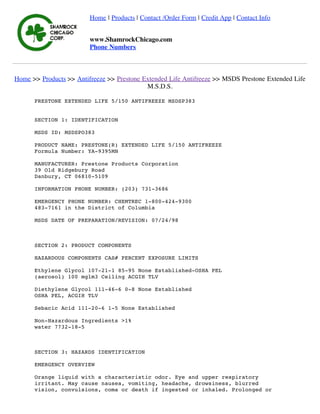
PRESTONE EXTENDED LIFE 5/150 ANTIFREEZE MSDSP383
SECTION 1: IDENTIFICATION
MSDS ID: MSDSPO383
PRODUCT NAME: PRESTONE(R) EXTENDED LIFE 5/150 ANTIFREEZE
Formula Number: YA-9395MN
MANUFACTURER: Prestone Products Corporation
39 Old Ridgebury Road
Danbury, CT 06810-5109
INFORMATION PHONE NUMBER: (203) 731-3686
EMERGENCY PHONE NUMBER: CHEMTREC 1-800-424-9300
483-7161 in the District of Columbia
MSDS DATE OF PREPARATION/REVISION: 07/24/98
SECTION 2: PRODUCT COMPONENTS
HAZARDOUS COMPONENTS CAS# PERCENT EXPOSURE LIMITS
Ethylene Glycol 107-21-1 85-95 None Established-OSHA PEL
(aerosol) 100 mglm3 Ceiling ACGIH TLV
Diethylene Glycol 111-46-6 0-8 None Established
OSHA PEL, ACGIH TLV
Sebacic Acid 111-20-6 1-5 None Established
Non-Hazardous Ingredients >1%
water 7732-18-5
SECTION 3: HAZARDS IDENTIFICATION
EMERGENCY OVERVIEW
Orange liquid with a characteristic odor. Eye and upper respiratory
irritant. May cause nausea, vomiting, headache, drowsiness, blurred
vision, convulsions, coma or death if ingested or inhaled. Prolonged or
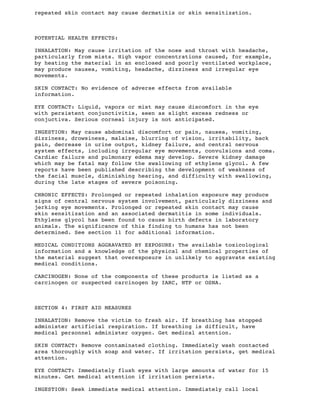
repeated skin contact may cause dermatitis or skin sensitization.
POTENTIAL HEALTH EFFECTS:
INHALATION: May cause irritation of the nose and throat with headache,
particularly from mists. High vapor concentrations caused, for example,
by heating the material in an enclosed and poorly ventilated workplace,
may produce nausea, vomiting, headache, dizziness and irregular eye
movements.
SKIN CONTACT: No evidence of adverse effects from available
information.
EYE CONTACT: Liquid, vapors or mist may cause discomfort in the eye
with persistent conjunctivitis, seen as slight excess redness or
conjuctiva. Serious corneal injury is not anticipated.
INGESTION: May cause abdominal discomfort or pain, nausea, vomiting,
dizziness, drowsiness, malaise, blurring of vision, irritability, back
pain, decrease in urine output, kidney failure, and central nervous
system effects, including irregular eye movements, convulsions and coma.
Cardiac failure and pulmonary edema may develop. Severe kidney damage
which may be fatal may follow the swallowing of ethylene glycol. A few
reports have been published describing the development of weakness of
the facial muscle, diminishing hearing, and difficulty with swallowing,
during the late stages of severe poisoning.
CHRONIC EFFECTS: Prolonged or repeated inhalation exposure may produce
signs of central nervous system involvement, particularly dizziness and
jerking eye movements. Prolonged or repeated skin contact may cause
skin sensitization and an associated dermatitis in some individuals.
Ethylene glycol has been found to cause birth defects in laboratory
animals. The significance of this finding to humans has not been
determined. See section 11 for additional information.
MEDICAL CONDITIONS AGGRAVATED BY EXPOSURE: The available toxicological
information and a knowledge of the physical and chemical properties of
the material suggest that overexposure in unlikely to aggravate existing
medical conditions.
CARCINOGEN: None of the components of these products is listed as a
carcinogen or suspected carcinogen by IARC, NTP or OSNA.
SECTION 4: FIRST AID MEASURES
INHALATION: Remove the victim to fresh air. If breathing has stopped
administer artificial respiration. If breathing is difficult, have
medical personnel administer oxygen. Get medical attention.
SKIN CONTACT: Remove contaminated clothing. Immediately wash contacted
area thoroughly with soap and water. If irritation persists, get medical
attention.
EYE CONTACT: Immediately flush eyes with large amounts of water for 15
minutes. Get medical attention if irritation persists.
INGESTION: Seek immediate medical attention. Immediately call local
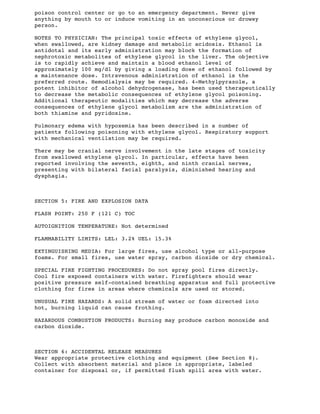
poison control center or go to an emergency department. Never give
anything by mouth to or induce vomiting in an unconscious or drowsy
person.
NOTES TO PHYSICIAN: The principal toxic effects of ethylene glycol,
when swallowed, are kidney damage and metabolic acidosis. Ethanol is
antidotal and its early administration may block the formation of
nephrotoxic metabolites of ethylene glycol in the liver. The objective
is to rapidly achieve and maintain a blood ethanol level of
approximately 100 mg/dl by giving a loading dose of ethanol followed by
a maintenance dose. Intravenous administration of ethanol is the
preferred route. Hemodialysis may be required. 4-Methylpyrazole, a
potent inhibitor of alcohol dehydrogenase, has been used therapeutically
to decrease the metabolic consequences of ethylene glycol poisoning.
Additional therapeutic modalities which may decrease the adverse
consequences of ethylene glycol metabolism are the administration of
both thiamine and pyridoxine.
Pulmonary edema with hypoxemia has been described in a number of
patients following poisoning with ethylene glycol. Respiratory support
with mechanical ventilation may be required.
There may be cranial nerve involvement in the late stages of toxicity
from swallowed ethylene glycol. In particular, effects have been
reported involving the seventh, eighth, and ninth cranial nerves,
presenting with bilateral facial paralysis, diminished hearing and
dysphagia.
SECTION 5: FIRE AND EXPLOSION DATA
FLASH POINT: 250 F (121 C) TOC
AUTOIGNITION TEMPERATURE: Not determined
FLAMMABILITY LIMITS: LEL: 3.2% UEL: l5.3%
EXTINGUISHING MEDIA: For large fires, use alcohol type or all-purpose
foams. For small fires, use water spray, carbon dioxide or dry chemical.
SPECIAL FIRE FIGHTING PROCEDURES: Do not spray pool fires directly.
Cool fire exposed containers with water. Firefighters should wear
positive pressure self-contained breathing apparatus and full protective
clothing for fires in areas where chemicals are used or stored.
UNUSUAL FIRE HAZARDS: A solid stream of water or foam directed into
hot, burning liquid can cause frothing.
HAZARDOUS COMBUSTION PRODUCTS: Burning may produce carbon monoxide and
carbon dioxide.
SECTION 6: ACCIDENTAL RELEASE MEASURES
Wear appropriate protective clothing and equipment (See Section 8).
Collect with absorbent material and place in appropriate, labeled
container for disposal or, if permitted flush spill area with water.
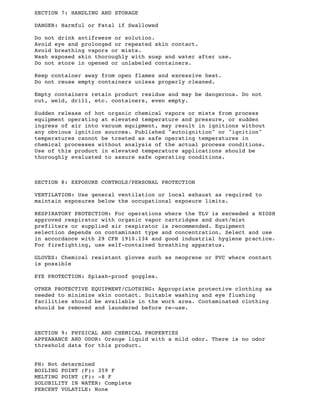
SECTION 7: HANDLING AND STORAGE
DANGER: Harmful or Fatal if Swallowed
Do not drink antifreeze or solution.
Avoid eye and prolonged or repeated skin contact.
Avoid breathing vapors or mists.
Wash exposed skin thoroughly with soap and water after use.
Do not store in opened or unlabeled containers.
Keep container away from open flames and excessive heat.
Do not reuse empty containers unless properly cleaned.
Empty containers retain product residue and may be dangerous. Do not
cut, weld, drill, etc. containers, even empty.
Sudden release of hot organic chemical vapors or mists from process
equipment operating at elevated temperature and pressure, or sudden
ingress of air into vacuum equipment, may result in ignitions without
any obvious ignition sources. Published "autoignition" or "ignition"
temperatures cannot be treated as safe operating temperatures in
chemical processes without analysis of the actual process conditions.
Use of this product in elevated temperature applications should be
thoroughly evaluated to assure safe operating conditions.
SECTION 8: EXPOSURE CONTROLS/PERSONAL PROTECTION
VENTILATION: Use general ventilation or local exhaust as required to
maintain exposures below the occupational exposure limits.
RESPIRATORY PROTECTION: For operations where the TLV is exceeded a NIOSH
approved respirator with organic vapor cartridges and dust/mist
prefilters or supplied air respirator is recommended. Equipment
selection depends on contaminant type and concentration. Select and use
in accordance with 29 CFR 1910.134 and good industrial hygiene practice.
For firefighting, use self-contained breathing apparatus.
GLOVES: Chemical resistant gloves such as neoprene or PVC where contact
is possible
EYE PROTECTION: Splash-proof goggles.
OTHER PROTECTIVE EQUIPMENT/CLOTHING: Appropriate protective clothing as
needed to minimize skin contact. Suitable washing and eye flushing
facilities should be available in the work area. Contaminated clothing
should be removed and laundered before re-use.
SECTION 9: PHYSICAL AND CHEMICAL PROPERTIES
APPEARANCE AND ODOR: Orange liquid with a mild odor. There is no odor
threshold data for this product.
PH: Not determined
BOILING POINT (F): 359 F
MELTING POINT (F): -8 F
SOLUBILITY IN WATER: Complete
PERCENT VOLATILE: None
SPECIFIC GRAVITY: Not determined
VAPOR PRESSURE: Less than 0.1
VAPOR DENSITY: 2.1
EVAPORATION RATE: Not determined
VISCOSITY: Not determined
SECTION 10: STABILITY AND REACTIVITY
STABILITY: Stable
CONDITIONS TO AVOID: None known.
INCOMPATIBILITY: Normally unreactive, however, avoid strong bases at
high temperatures, strong acids, strong oxidizing agents, and materials
reactive with hydroxyl compounds.
DECOMPOSITION PRODUCTS: Carbon monoxide, carbon dioxide.
HAZARDOUS POLYMERIZATION: Will not occur
CONDITIONS TO AVOID: None known.
SECTION 11: TOXICOLOGICAL INFORMATION
ACUTE TOXICITY VALUES:
Ethylene Glycol: LD5O Oral Rat: 4700 mg/kg
LD5O Skin Rabbit: 9530 mg/kg
Diethylene Glycol: LD5O Oral Rat: 12,565 mg/kg
LD5O Skin Rabbit: 11,890 mg/kg
SIGNIFICANT LABORATORY DATA WITH POSSIBLE RELEVANCE TO HUMAN HEALTH:
Ethylene glycol has been shown to produce dose-related teratogenic
effects in rats and mice when given by gavage or in drinking water at
high concentrations or doses. Also, in a preliminary study to assess
the effects of exposure of pregnant rats and mice to aerosols at
concentrations 150, 1,000 and 2,500 mg/m3 for 6 hours a day throughout
the period of organogenesis, teratogenic effects were produced at the
highest concentrations, but only in mice. The conditions of these
latter experiments did not allow a conclusion as to whether the
developmental toxicity was mediated by inhalation of aerosol,
percutaneous absorption of ethylene glycol from contaminated skin, or
swallowing of ethylene glycol as a result of grooming the wetted coat.
In a further study, comparing effects from high aerosol concentration by
whole-body or nose-only exposure, it was shown that nose-only exposure
resulted in maternal toxicity (1,000 and 2,500 mg/~~) and developmental
toxicity in with minimal evidence of teratogenicity (2,500 mg/m3). The
no-effects concentration (based on maternal toxicity) was 500 mg/m3. In
a further study in mice, no teratogenic effects could be produced when
ethylene glycol was applied to the skin of pregnant mice over the period
of organogenesis. The above observations suggest that ethylene glycol
is to be regarded as an animal teratogenic there is currently no
available information to suggest that ethylene glycol caused birth
defects in humans. Cutaneous application of ethylene glycol is
ineffective in producing developmental toxicity; exposure to high
aerosol concentration is only minimally effective in producing
developmental toxicity; the major route for producing developmental
toxicity is per orally.
Two chronic feeding studies, using rats and mice, have not produced any
evidence that ethylene glycol causes dose-related increases in tumor
incidence or a different pattern of tumors compared with untreated
controls. The absence of carcinogenic potential for ethylene glycol has
been supported by numerous invitro genotoxicity studies showing that it
does not produce mutagenic or clastogenic effects.
This products contains less than 0.5% tolytriazole which has
demonstrates mutagenic activity in a bacterial test system. A
correlation has been established between mutagenic activity and
carcinogenic activity for many chemicals. Tolytriazole has not been
identified as a carcinogen or probable carcinogen by NTP, IARC or OSHA.
SECTION 12: ECOLOGICAL INFORMATION
Ethylene Glycol: LC50 Goldfish: 5,000 mg/L/24 hr. at 20 C static
conditions.
Toxicity threshold (cell multiplication inhibition
test):
Bacterial (Pseudomonas putida): 10,000 mg/l
Protozoa (Entosiphon sulcatum and Uronema parduczi
Chatton-Lwoff): >10,000 mg/l
Algae (Microcystis aeruginosa): 2,000 mg/l
Green algae (Scenedesmus quandricauda): >101000 mg/l
SECTION 13: DISPOSAL INFORMATION
Dispose of product in accordance with all local, state/provincial and
federal regulations.
SECTION 14: TRANSPORT INFORMATION
U.S. DOT HAZARD CLASSIFICATION
PROPER SHIPPING NAME: None
UN NUMBER: None
LABELS REQUIRED: None
DOT MARINE POLLUTANTS: This product does not contains Marine
Pollutants
as defined in 49 CFR 171.8.
INDG CODE SHIPPING CLASSIFICATION
DESCRIPTION: Not Regulated
Note: IF A BULK SHIPMENT IS INVOLVED, THE FOLLOWING INFORMATION APPLIES:
U.S. DOT HAZARD CLASSIFICATION
PROPER SHIPPING NAME: Environmentally hazardous substance, liquid,
N.O.S. (Ethylene glycol)
UN NUMBER: UN308
LABELS REQUIRED: Class 9, UN3082
SECTION 15: REGULATORY INFORMATION
EPA SARA 311/312 HAZARD CLASSIFICATION: Acute health, chronic
health
EPA SARA 313: This Product Contains the Following Chemicals
Subject to Annual Release Reporting Requirements Under SARA Title
III, Section 313 (40 CFR 372):
Ethylene Glycol 107-21-1 85-95%
PROTECTION OF STRATOSPHERIC OZONE: This product is not known to
contain or to have been manufactured with ozone depleting
substances as defined in 40 CFR Part 82, Appendix A to Subpart A.
CERCLL SECTION 103: Spills of this product over the RQ (reportable
quantity) must be reported to the National Response Center. The RQ for
this product, based on the RQ for Ethylene Glycol (95~ maxim~) of 5,000
lbs, is 5,263 lbs. Many states have more stringent release reporting
Requirements. Report spills required under federal, state and local
regulations.
CALIFORNIA PROPOSITION 65 - This product may contain the following
substances known to the State of California to cause Cancer and/or
Reproductive Harm: 1,4-Dioxane (trace amount).
EPA TSCA INVENTORY: All of the caniponents of this material are listed
on the Toxic Substances Control Act (TSCA) Chemical Substances
Inventory.
CANADIAN ENVIRONMENTAL PROTECTION ACT: All of the ingredients are
listed on the Canadian Domestic Substances List.
CANADIAN WHMIS CLASSIFICATION: Class D - Division 2 - Subdivision B - (A
toxic material causing other chronic effects)
EUROPEAN INVENTORY OF EXISTING COMMERCIAL CHEMICAL SUBSTANCES:
(EINECS): All of the ingredients are listed on the EINECS inventory.
SECTION 16: OTHER INFORMATION
NFPA RATING (NFPA 704) - FIRE: 1
HEALTH: 2
REACTIVITY: 0
This MSDS is directed to professional users and bulk handlers of the
product. Consumer products are labeled in accordance with Federal
Hazardous Substances Act regulations.
While Prestone Products Corporation believes that the data contained
herein are factual and the opinions expressed are those of qualified
experts regarding the results of tests conducted, the data are not to
be taken as a warranty or representation for which Prestone Products
Corporation assumes legal responsibility. They are offered for your
consideration, investigation and verification. Any use of these data
and information must be determined by the user to be in accordance
with applicable federal, state and local laws and regulations.
If more information is needed, please contact: Stan Prunakowuki
Prestone Product Corporation
39 Old Ridgebury Road
Danbury, CT 06810-5109
(203)830-7865
Home | Products | Contact /Order Form | Credit App | Contact Infoss

Prestone dexcool antifreeze

  • 1.
    Home | Products| Contact /Order Form | Credit App | Contact Info www.ShamrockChicago.com Phone Numbers Home >> Products >> Antifreeze >> Prestone Extended Life Antifreeze >> MSDS Prestone Extended Life M.S.D.S. PRESTONE EXTENDED LIFE 5/150 ANTIFREEZE MSDSP383 SECTION 1: IDENTIFICATION MSDS ID: MSDSPO383 PRODUCT NAME: PRESTONE(R) EXTENDED LIFE 5/150 ANTIFREEZE Formula Number: YA-9395MN MANUFACTURER: Prestone Products Corporation 39 Old Ridgebury Road Danbury, CT 06810-5109 INFORMATION PHONE NUMBER: (203) 731-3686 EMERGENCY PHONE NUMBER: CHEMTREC 1-800-424-9300 483-7161 in the District of Columbia MSDS DATE OF PREPARATION/REVISION: 07/24/98 SECTION 2: PRODUCT COMPONENTS HAZARDOUS COMPONENTS CAS# PERCENT EXPOSURE LIMITS Ethylene Glycol 107-21-1 85-95 None Established-OSHA PEL (aerosol) 100 mglm3 Ceiling ACGIH TLV Diethylene Glycol 111-46-6 0-8 None Established OSHA PEL, ACGIH TLV Sebacic Acid 111-20-6 1-5 None Established Non-Hazardous Ingredients >1% water 7732-18-5 SECTION 3: HAZARDS IDENTIFICATION EMERGENCY OVERVIEW Orange liquid with a characteristic odor. Eye and upper respiratory irritant. May cause nausea, vomiting, headache, drowsiness, blurred vision, convulsions, coma or death if ingested or inhaled. Prolonged or
  • 2.
    repeated skin contactmay cause dermatitis or skin sensitization. POTENTIAL HEALTH EFFECTS: INHALATION: May cause irritation of the nose and throat with headache, particularly from mists. High vapor concentrations caused, for example, by heating the material in an enclosed and poorly ventilated workplace, may produce nausea, vomiting, headache, dizziness and irregular eye movements. SKIN CONTACT: No evidence of adverse effects from available information. EYE CONTACT: Liquid, vapors or mist may cause discomfort in the eye with persistent conjunctivitis, seen as slight excess redness or conjuctiva. Serious corneal injury is not anticipated. INGESTION: May cause abdominal discomfort or pain, nausea, vomiting, dizziness, drowsiness, malaise, blurring of vision, irritability, back pain, decrease in urine output, kidney failure, and central nervous system effects, including irregular eye movements, convulsions and coma. Cardiac failure and pulmonary edema may develop. Severe kidney damage which may be fatal may follow the swallowing of ethylene glycol. A few reports have been published describing the development of weakness of the facial muscle, diminishing hearing, and difficulty with swallowing, during the late stages of severe poisoning. CHRONIC EFFECTS: Prolonged or repeated inhalation exposure may produce signs of central nervous system involvement, particularly dizziness and jerking eye movements. Prolonged or repeated skin contact may cause skin sensitization and an associated dermatitis in some individuals. Ethylene glycol has been found to cause birth defects in laboratory animals. The significance of this finding to humans has not been determined. See section 11 for additional information. MEDICAL CONDITIONS AGGRAVATED BY EXPOSURE: The available toxicological information and a knowledge of the physical and chemical properties of the material suggest that overexposure in unlikely to aggravate existing medical conditions. CARCINOGEN: None of the components of these products is listed as a carcinogen or suspected carcinogen by IARC, NTP or OSNA. SECTION 4: FIRST AID MEASURES INHALATION: Remove the victim to fresh air. If breathing has stopped administer artificial respiration. If breathing is difficult, have medical personnel administer oxygen. Get medical attention. SKIN CONTACT: Remove contaminated clothing. Immediately wash contacted area thoroughly with soap and water. If irritation persists, get medical attention. EYE CONTACT: Immediately flush eyes with large amounts of water for 15 minutes. Get medical attention if irritation persists. INGESTION: Seek immediate medical attention. Immediately call local
  • 3.
    poison control centeror go to an emergency department. Never give anything by mouth to or induce vomiting in an unconscious or drowsy person. NOTES TO PHYSICIAN: The principal toxic effects of ethylene glycol, when swallowed, are kidney damage and metabolic acidosis. Ethanol is antidotal and its early administration may block the formation of nephrotoxic metabolites of ethylene glycol in the liver. The objective is to rapidly achieve and maintain a blood ethanol level of approximately 100 mg/dl by giving a loading dose of ethanol followed by a maintenance dose. Intravenous administration of ethanol is the preferred route. Hemodialysis may be required. 4-Methylpyrazole, a potent inhibitor of alcohol dehydrogenase, has been used therapeutically to decrease the metabolic consequences of ethylene glycol poisoning. Additional therapeutic modalities which may decrease the adverse consequences of ethylene glycol metabolism are the administration of both thiamine and pyridoxine. Pulmonary edema with hypoxemia has been described in a number of patients following poisoning with ethylene glycol. Respiratory support with mechanical ventilation may be required. There may be cranial nerve involvement in the late stages of toxicity from swallowed ethylene glycol. In particular, effects have been reported involving the seventh, eighth, and ninth cranial nerves, presenting with bilateral facial paralysis, diminished hearing and dysphagia. SECTION 5: FIRE AND EXPLOSION DATA FLASH POINT: 250 F (121 C) TOC AUTOIGNITION TEMPERATURE: Not determined FLAMMABILITY LIMITS: LEL: 3.2% UEL: l5.3% EXTINGUISHING MEDIA: For large fires, use alcohol type or all-purpose foams. For small fires, use water spray, carbon dioxide or dry chemical. SPECIAL FIRE FIGHTING PROCEDURES: Do not spray pool fires directly. Cool fire exposed containers with water. Firefighters should wear positive pressure self-contained breathing apparatus and full protective clothing for fires in areas where chemicals are used or stored. UNUSUAL FIRE HAZARDS: A solid stream of water or foam directed into hot, burning liquid can cause frothing. HAZARDOUS COMBUSTION PRODUCTS: Burning may produce carbon monoxide and carbon dioxide. SECTION 6: ACCIDENTAL RELEASE MEASURES Wear appropriate protective clothing and equipment (See Section 8). Collect with absorbent material and place in appropriate, labeled container for disposal or, if permitted flush spill area with water.
  • 4.
    SECTION 7: HANDLINGAND STORAGE DANGER: Harmful or Fatal if Swallowed Do not drink antifreeze or solution. Avoid eye and prolonged or repeated skin contact. Avoid breathing vapors or mists. Wash exposed skin thoroughly with soap and water after use. Do not store in opened or unlabeled containers. Keep container away from open flames and excessive heat. Do not reuse empty containers unless properly cleaned. Empty containers retain product residue and may be dangerous. Do not cut, weld, drill, etc. containers, even empty. Sudden release of hot organic chemical vapors or mists from process equipment operating at elevated temperature and pressure, or sudden ingress of air into vacuum equipment, may result in ignitions without any obvious ignition sources. Published "autoignition" or "ignition" temperatures cannot be treated as safe operating temperatures in chemical processes without analysis of the actual process conditions. Use of this product in elevated temperature applications should be thoroughly evaluated to assure safe operating conditions. SECTION 8: EXPOSURE CONTROLS/PERSONAL PROTECTION VENTILATION: Use general ventilation or local exhaust as required to maintain exposures below the occupational exposure limits. RESPIRATORY PROTECTION: For operations where the TLV is exceeded a NIOSH approved respirator with organic vapor cartridges and dust/mist prefilters or supplied air respirator is recommended. Equipment selection depends on contaminant type and concentration. Select and use in accordance with 29 CFR 1910.134 and good industrial hygiene practice. For firefighting, use self-contained breathing apparatus. GLOVES: Chemical resistant gloves such as neoprene or PVC where contact is possible EYE PROTECTION: Splash-proof goggles. OTHER PROTECTIVE EQUIPMENT/CLOTHING: Appropriate protective clothing as needed to minimize skin contact. Suitable washing and eye flushing facilities should be available in the work area. Contaminated clothing should be removed and laundered before re-use. SECTION 9: PHYSICAL AND CHEMICAL PROPERTIES APPEARANCE AND ODOR: Orange liquid with a mild odor. There is no odor threshold data for this product. PH: Not determined BOILING POINT (F): 359 F MELTING POINT (F): -8 F SOLUBILITY IN WATER: Complete PERCENT VOLATILE: None
  • 5.
    SPECIFIC GRAVITY: Notdetermined VAPOR PRESSURE: Less than 0.1 VAPOR DENSITY: 2.1 EVAPORATION RATE: Not determined VISCOSITY: Not determined SECTION 10: STABILITY AND REACTIVITY STABILITY: Stable CONDITIONS TO AVOID: None known. INCOMPATIBILITY: Normally unreactive, however, avoid strong bases at high temperatures, strong acids, strong oxidizing agents, and materials reactive with hydroxyl compounds. DECOMPOSITION PRODUCTS: Carbon monoxide, carbon dioxide. HAZARDOUS POLYMERIZATION: Will not occur CONDITIONS TO AVOID: None known. SECTION 11: TOXICOLOGICAL INFORMATION ACUTE TOXICITY VALUES: Ethylene Glycol: LD5O Oral Rat: 4700 mg/kg LD5O Skin Rabbit: 9530 mg/kg Diethylene Glycol: LD5O Oral Rat: 12,565 mg/kg LD5O Skin Rabbit: 11,890 mg/kg SIGNIFICANT LABORATORY DATA WITH POSSIBLE RELEVANCE TO HUMAN HEALTH: Ethylene glycol has been shown to produce dose-related teratogenic effects in rats and mice when given by gavage or in drinking water at high concentrations or doses. Also, in a preliminary study to assess the effects of exposure of pregnant rats and mice to aerosols at concentrations 150, 1,000 and 2,500 mg/m3 for 6 hours a day throughout the period of organogenesis, teratogenic effects were produced at the highest concentrations, but only in mice. The conditions of these latter experiments did not allow a conclusion as to whether the developmental toxicity was mediated by inhalation of aerosol, percutaneous absorption of ethylene glycol from contaminated skin, or swallowing of ethylene glycol as a result of grooming the wetted coat. In a further study, comparing effects from high aerosol concentration by whole-body or nose-only exposure, it was shown that nose-only exposure resulted in maternal toxicity (1,000 and 2,500 mg/~~) and developmental toxicity in with minimal evidence of teratogenicity (2,500 mg/m3). The no-effects concentration (based on maternal toxicity) was 500 mg/m3. In a further study in mice, no teratogenic effects could be produced when ethylene glycol was applied to the skin of pregnant mice over the period of organogenesis. The above observations suggest that ethylene glycol is to be regarded as an animal teratogenic there is currently no available information to suggest that ethylene glycol caused birth defects in humans. Cutaneous application of ethylene glycol is ineffective in producing developmental toxicity; exposure to high aerosol concentration is only minimally effective in producing developmental toxicity; the major route for producing developmental toxicity is per orally.
  • 6.
    Two chronic feedingstudies, using rats and mice, have not produced any evidence that ethylene glycol causes dose-related increases in tumor incidence or a different pattern of tumors compared with untreated controls. The absence of carcinogenic potential for ethylene glycol has been supported by numerous invitro genotoxicity studies showing that it does not produce mutagenic or clastogenic effects. This products contains less than 0.5% tolytriazole which has demonstrates mutagenic activity in a bacterial test system. A correlation has been established between mutagenic activity and carcinogenic activity for many chemicals. Tolytriazole has not been identified as a carcinogen or probable carcinogen by NTP, IARC or OSHA. SECTION 12: ECOLOGICAL INFORMATION Ethylene Glycol: LC50 Goldfish: 5,000 mg/L/24 hr. at 20 C static conditions. Toxicity threshold (cell multiplication inhibition test): Bacterial (Pseudomonas putida): 10,000 mg/l Protozoa (Entosiphon sulcatum and Uronema parduczi Chatton-Lwoff): >10,000 mg/l Algae (Microcystis aeruginosa): 2,000 mg/l Green algae (Scenedesmus quandricauda): >101000 mg/l SECTION 13: DISPOSAL INFORMATION Dispose of product in accordance with all local, state/provincial and federal regulations. SECTION 14: TRANSPORT INFORMATION U.S. DOT HAZARD CLASSIFICATION PROPER SHIPPING NAME: None UN NUMBER: None LABELS REQUIRED: None DOT MARINE POLLUTANTS: This product does not contains Marine Pollutants as defined in 49 CFR 171.8. INDG CODE SHIPPING CLASSIFICATION DESCRIPTION: Not Regulated Note: IF A BULK SHIPMENT IS INVOLVED, THE FOLLOWING INFORMATION APPLIES: U.S. DOT HAZARD CLASSIFICATION PROPER SHIPPING NAME: Environmentally hazardous substance, liquid, N.O.S. (Ethylene glycol) UN NUMBER: UN308 LABELS REQUIRED: Class 9, UN3082
  • 7.
    SECTION 15: REGULATORYINFORMATION EPA SARA 311/312 HAZARD CLASSIFICATION: Acute health, chronic health EPA SARA 313: This Product Contains the Following Chemicals Subject to Annual Release Reporting Requirements Under SARA Title III, Section 313 (40 CFR 372): Ethylene Glycol 107-21-1 85-95% PROTECTION OF STRATOSPHERIC OZONE: This product is not known to contain or to have been manufactured with ozone depleting substances as defined in 40 CFR Part 82, Appendix A to Subpart A. CERCLL SECTION 103: Spills of this product over the RQ (reportable quantity) must be reported to the National Response Center. The RQ for this product, based on the RQ for Ethylene Glycol (95~ maxim~) of 5,000 lbs, is 5,263 lbs. Many states have more stringent release reporting Requirements. Report spills required under federal, state and local regulations. CALIFORNIA PROPOSITION 65 - This product may contain the following substances known to the State of California to cause Cancer and/or Reproductive Harm: 1,4-Dioxane (trace amount). EPA TSCA INVENTORY: All of the caniponents of this material are listed on the Toxic Substances Control Act (TSCA) Chemical Substances Inventory. CANADIAN ENVIRONMENTAL PROTECTION ACT: All of the ingredients are listed on the Canadian Domestic Substances List. CANADIAN WHMIS CLASSIFICATION: Class D - Division 2 - Subdivision B - (A toxic material causing other chronic effects) EUROPEAN INVENTORY OF EXISTING COMMERCIAL CHEMICAL SUBSTANCES: (EINECS): All of the ingredients are listed on the EINECS inventory. SECTION 16: OTHER INFORMATION NFPA RATING (NFPA 704) - FIRE: 1 HEALTH: 2 REACTIVITY: 0 This MSDS is directed to professional users and bulk handlers of the product. Consumer products are labeled in accordance with Federal Hazardous Substances Act regulations. While Prestone Products Corporation believes that the data contained herein are factual and the opinions expressed are those of qualified experts regarding the results of tests conducted, the data are not to be taken as a warranty or representation for which Prestone Products Corporation assumes legal responsibility. They are offered for your consideration, investigation and verification. Any use of these data
  • 8.
    and information mustbe determined by the user to be in accordance with applicable federal, state and local laws and regulations. If more information is needed, please contact: Stan Prunakowuki Prestone Product Corporation 39 Old Ridgebury Road Danbury, CT 06810-5109 (203)830-7865 Home | Products | Contact /Order Form | Credit App | Contact Infoss