CONSTRUCTIVISM
Presentation by Group 5
TABLE OF CONTENTS
01 02 03 04
Definition
Of
Constructivis
m
Aims of
Education
Curriculum Roles of
the
Teacher
05
Roles of
the
Students
06
Classrom
Setup
Constructivism is the theory that
says learners construct knowledge
DEFINITION
Constructivism promotes social and
communication skills by creating a
classroom environment that
emphasizes collaboration and
exchange of ideas. Students must learn
how to articulate their ideas clearly as
well as to collaborate on tasks
effectively by sharing in group projects.
Examples Of Constructivist
Classroom Activities
Allow pairs of students to teach each other.
Learners pose their own questions and seek
answers to their questions via research and direct
observation. They present their supporting
evidence to answer the questions.
AIMS OF
EDUCTAION
 To offer experience alongside the
knowledge construction process
 To offer experience in multiple
dimensions
 To encourage learning in realistic
contexts
CURRICULUM
The curriculum is heavily influenced by the
philosophy of constructivism has students who
are actively engaged in learning in a social
environment. This includes such strategies as
project-based learning, cooperative learning,
opportunities for problem-solving.
For many, including opportunities for reflecting on
learning experiences helps students to build
knowledge is another aspect of constructivism.
ROLES OF THE
TEACHER
To prompt
and facilitate
classroom
GUIDE
Guiding students by
asking questions
that will lead them
to develop their
own conclusions on
the subject.
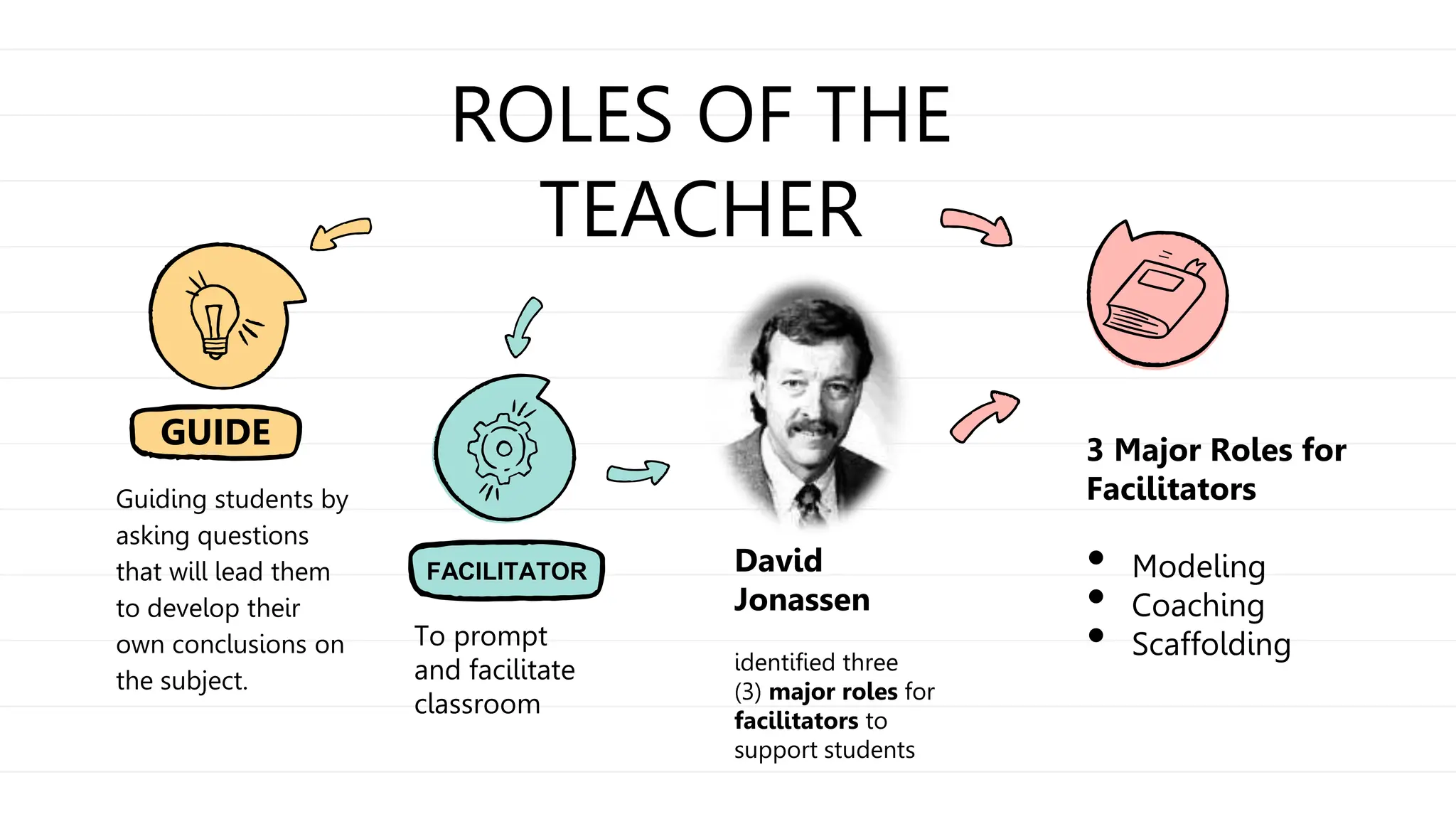
FACILITATOR David
Jonassen
identified three
(3) major roles for
facilitators to
support students
3 Major Roles for
Facilitators
• Modeling
• Coaching
• Scaffolding
ROLES OF THE TEACHER
ROLES OF THE STUDENTS
Students are actively engaged, and are
responsible for their learning.
Students are urged to be actively involved in their
own process of learning.
It requires student to be active and confident in
themselves and their abilities.
CLASSROOM SET UP
5E Instructional Model:
 Engage: Establish Relevancy – help to
determine need of learning new concepts
 Explore: Present the Content – discover more
about the topic
 Explain: Improve Understanding – establishing
definitions and explanations
 Elaborate: Construct New Learning – apply
prior learning and exercise skills
 Evaluate: Assess Learning – measure how
learning corresponds against goals

cONSTRUCTIVISM.concept of teaching. Learner

  • 1.
  • 2.
    TABLE OF CONTENTS 0102 03 04 Definition Of Constructivis m Aims of Education Curriculum Roles of the Teacher 05 Roles of the Students 06 Classrom Setup
  • 3.
    Constructivism is thetheory that says learners construct knowledge DEFINITION
  • 4.
    Constructivism promotes socialand communication skills by creating a classroom environment that emphasizes collaboration and exchange of ideas. Students must learn how to articulate their ideas clearly as well as to collaborate on tasks effectively by sharing in group projects.
  • 5.
    Examples Of Constructivist ClassroomActivities Allow pairs of students to teach each other. Learners pose their own questions and seek answers to their questions via research and direct observation. They present their supporting evidence to answer the questions.
  • 6.
    AIMS OF EDUCTAION  Tooffer experience alongside the knowledge construction process  To offer experience in multiple dimensions  To encourage learning in realistic contexts
  • 7.
    CURRICULUM The curriculum isheavily influenced by the philosophy of constructivism has students who are actively engaged in learning in a social environment. This includes such strategies as project-based learning, cooperative learning, opportunities for problem-solving. For many, including opportunities for reflecting on learning experiences helps students to build knowledge is another aspect of constructivism.
  • 8.
    ROLES OF THE TEACHER Toprompt and facilitate classroom GUIDE Guiding students by asking questions that will lead them to develop their own conclusions on the subject. FACILITATOR David Jonassen identified three (3) major roles for facilitators to support students 3 Major Roles for Facilitators • Modeling • Coaching • Scaffolding
  • 9.
    ROLES OF THETEACHER
  • 10.
    ROLES OF THESTUDENTS Students are actively engaged, and are responsible for their learning. Students are urged to be actively involved in their own process of learning. It requires student to be active and confident in themselves and their abilities.
  • 11.
    CLASSROOM SET UP 5EInstructional Model:  Engage: Establish Relevancy – help to determine need of learning new concepts  Explore: Present the Content – discover more about the topic  Explain: Improve Understanding – establishing definitions and explanations  Elaborate: Construct New Learning – apply prior learning and exercise skills  Evaluate: Assess Learning – measure how learning corresponds against goals