INNOVATIVE BUILDING MATERIALS
Prepared by,
S.INDHU
M.E.-STRUCTURAL ENGINEERING
INTRODUCTION:
 Nowadays many new emerging innovative
materials are being invented and many new
materials are being in research. New innovative
thinking and new invention is necessary to save
our valuable time and energy.
 Innovative building materials are imperative
considerably reduced the exploitative use of
concrete, wood and other traditional resources.
INNOVATIVE MATERIALS TO BE USED :
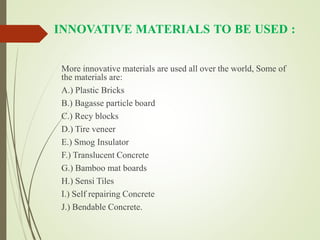
More innovative materials are used all over the world, Some of
the materials are:
A.) Plastic Bricks
B.) Bagasse particle board
C.) Recy blocks
D.) Tire veneer
E.) Smog Insulator
F.) Translucent Concrete
G.) Bamboo mat boards
H.) Sensi Tiles
I.) Self repairing Concrete
J.) Bendable Concrete.
A)Plastic Bricks:
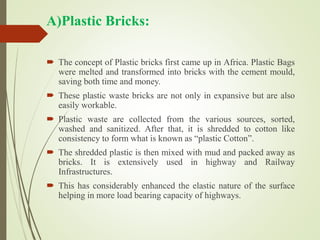
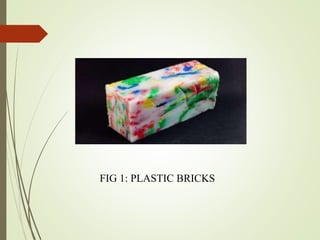
 The concept of Plastic bricks first came up in Africa. Plastic Bags
were melted and transformed into bricks with the cement mould,
saving both time and money.
 These plastic waste bricks are not only in expansive but are also
easily workable.
 Plastic waste are collected from the various sources, sorted,
washed and sanitized. After that, it is shredded to cotton like
consistency to form what is known as “plastic Cotton”.
 The shredded plastic is then mixed with mud and packed away as
bricks. It is extensively used in highway and Railway
Infrastructures.
 This has considerably enhanced the elastic nature of the surface
helping in more load bearing capacity of highways.
FIG 1: PLASTIC BRICKS
B)Bagasse Particle Board:
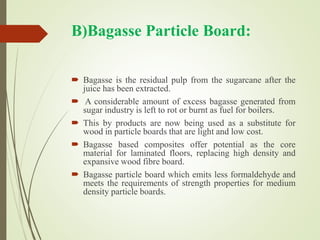
 Bagasse is the residual pulp from the sugarcane after the
juice has been extracted.
 A considerable amount of excess bagasse generated from
sugar industry is left to rot or burnt as fuel for boilers.
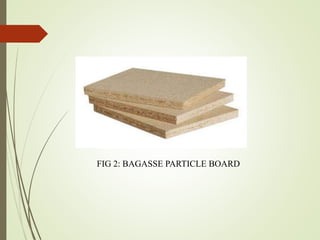
 This by products are now being used as a substitute for
wood in particle boards that are light and low cost.
 Bagasse based composites offer potential as the core
material for laminated floors, replacing high density and
expansive wood fibre board.
 Bagasse particle board which emits less formaldehyde and
meets the requirements of strength properties for medium
density particle boards.
FIG 2: BAGASSE PARTICLE BOARD
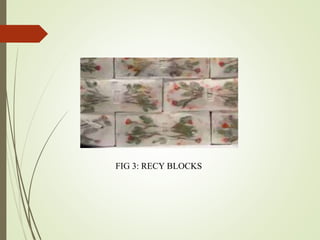
C) Recy Blocks:
 These colourful bricks are made from old plastic Bags, which are
notoriously difficult to recycle in any other way.
 Recycled bags or plastic packaging are placed in heat mould and forced
together to form the blocks.
 They are too light weight to act as load bearing walls, but can be used
to divide up rooms or outdoor areas.
 Their colour varies depending on the colour or print of the bags used,
and can be decorated with pressed flowers and other eco-accoutrement.
 An interesting block made of all sorts of plastic waste materials,
coloured plastic sheets and with an additions of special object made
from plastics(e.g. Flowers).
 Usage for in and outside applications such as recy block wall, sitting
elements or just remarkable decoration elements.
FIG 3: RECY BLOCKS
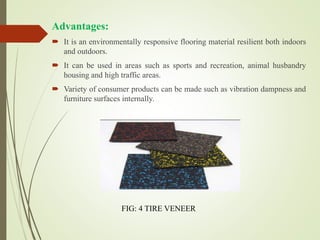
D) Tire Veneer:
 Rubber tiers play an essential role in modern life. Tires are
essential globally at all levels of development.
 Millions are discarded annually as they wear out relatively fast.
 This product makes use of recycling the materials into usuable
materials for various types of application.
 It is mainly used s flooring material.
Advantages:
 It is an environmentally responsive flooring material resilient both indoors
and outdoors.
 It can be used in areas such as sports and recreation, animal husbandry
housing and high traffic areas.
 Variety of consumer products can be made such as vibration dampness and
furniture surfaces internally.
FIG: 4 TIRE VENEER
E) Smog Insulators:
 One of our biggest waste receptacle is that, which is not great for our
lungs or for the human race’s chances of survived on planet that’s
rapidly getting hotter.
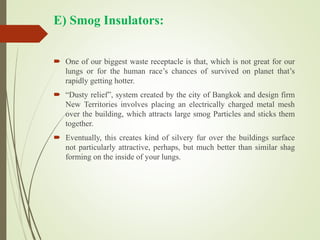
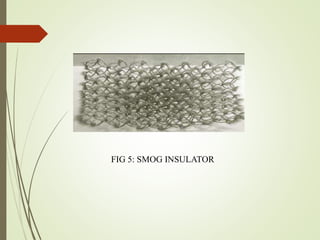
 “Dusty relief”, system created by the city of Bangkok and design firm
New Territories involves placing an electrically charged metal mesh
over the building, which attracts large smog Particles and sticks them
together.
 Eventually, this creates kind of silvery fur over the buildings surface
not particularly attractive, perhaps, but much better than similar shag
forming on the inside of your lungs.
FIG 5: SMOG INSULATOR
F) Translucent Concrete:
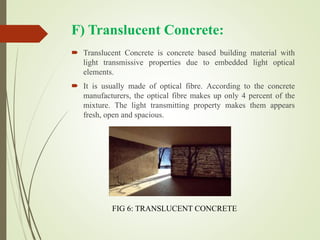
 Translucent Concrete is concrete based building material with
light transmissive properties due to embedded light optical
elements.
 It is usually made of optical fibre. According to the concrete
manufacturers, the optical fibre makes up only 4 percent of the
mixture. The light transmitting property makes them appears
fresh, open and spacious.
FIG 6: TRANSLUCENT CONCRETE
G) Bamboo Mat Boards:
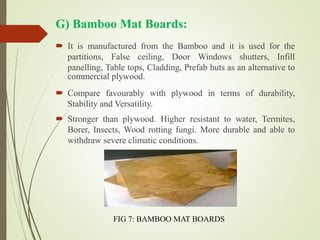
 It is manufactured from the Bamboo and it is used for the
partitions, False ceiling, Door Windows shutters, Infill
panelling, Table tops, Cladding, Prefab huts as an alternative to
commercial plywood.
 Compare favourably with plywood in terms of durability,
Stability and Versatility.
 Stronger than plywood. Higher resistant to water, Termites,
Borer, Insects, Wood rotting fungi. More durable and able to
withdraw severe climatic conditions.
FIG 7: BAMBOO MAT BOARDS
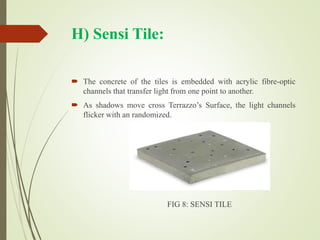
H) Sensi Tile:
 The concrete of the tiles is embedded with acrylic fibre-optic
channels that transfer light from one point to another.
 As shadows move cross Terrazzo’s Surface, the light channels
flicker with an randomized.
FIG 8: SENSI TILE
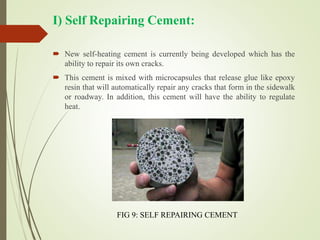
I) Self Repairing Cement:
 New self-heating cement is currently being developed which has the
ability to repair its own cracks.
 This cement is mixed with microcapsules that release glue like epoxy
resin that will automatically repair any cracks that form in the sidewalk
or roadway. In addition, this cement will have the ability to regulate
heat.
FIG 9: SELF REPAIRING CEMENT
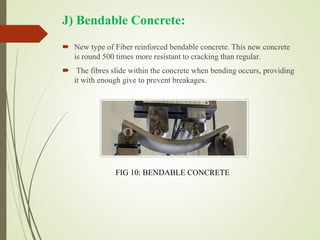
J) Bendable Concrete:
 New type of Fiber reinforced bendable concrete. This new concrete
is round 500 times more resistant to cracking than regular.
 The fibres slide within the concrete when bending occurs, providing
it with enough give to prevent breakages.
FIG 10: BENDABLE CONCRETE
CONCLUSION:
 These new emerging building materials should be replaced with
the old ones to improve and helps in Recycling of the materials.
which saves energy and make our country pollution free.
 If these materials are used in construction we can save time,
money and energy. So more new innovative materials should be
created and make construction of the building simpler with more
strength.
Thank you

Innovative building materials

  • 1.
    INNOVATIVE BUILDING MATERIALS Preparedby, S.INDHU M.E.-STRUCTURAL ENGINEERING
  • 2.
    INTRODUCTION:  Nowadays manynew emerging innovative materials are being invented and many new materials are being in research. New innovative thinking and new invention is necessary to save our valuable time and energy.  Innovative building materials are imperative considerably reduced the exploitative use of concrete, wood and other traditional resources.
  • 3.
    INNOVATIVE MATERIALS TOBE USED : More innovative materials are used all over the world, Some of the materials are: A.) Plastic Bricks B.) Bagasse particle board C.) Recy blocks D.) Tire veneer E.) Smog Insulator F.) Translucent Concrete G.) Bamboo mat boards H.) Sensi Tiles I.) Self repairing Concrete J.) Bendable Concrete.
  • 4.
    A)Plastic Bricks:  Theconcept of Plastic bricks first came up in Africa. Plastic Bags were melted and transformed into bricks with the cement mould, saving both time and money.  These plastic waste bricks are not only in expansive but are also easily workable.  Plastic waste are collected from the various sources, sorted, washed and sanitized. After that, it is shredded to cotton like consistency to form what is known as “plastic Cotton”.  The shredded plastic is then mixed with mud and packed away as bricks. It is extensively used in highway and Railway Infrastructures.  This has considerably enhanced the elastic nature of the surface helping in more load bearing capacity of highways.
  • 5.
  • 6.
    B)Bagasse Particle Board: Bagasse is the residual pulp from the sugarcane after the juice has been extracted.  A considerable amount of excess bagasse generated from sugar industry is left to rot or burnt as fuel for boilers.  This by products are now being used as a substitute for wood in particle boards that are light and low cost.  Bagasse based composites offer potential as the core material for laminated floors, replacing high density and expansive wood fibre board.  Bagasse particle board which emits less formaldehyde and meets the requirements of strength properties for medium density particle boards.
  • 7.
    FIG 2: BAGASSEPARTICLE BOARD
  • 8.
    C) Recy Blocks: These colourful bricks are made from old plastic Bags, which are notoriously difficult to recycle in any other way.  Recycled bags or plastic packaging are placed in heat mould and forced together to form the blocks.  They are too light weight to act as load bearing walls, but can be used to divide up rooms or outdoor areas.  Their colour varies depending on the colour or print of the bags used, and can be decorated with pressed flowers and other eco-accoutrement.  An interesting block made of all sorts of plastic waste materials, coloured plastic sheets and with an additions of special object made from plastics(e.g. Flowers).  Usage for in and outside applications such as recy block wall, sitting elements or just remarkable decoration elements.
  • 9.
  • 10.
    D) Tire Veneer: Rubber tiers play an essential role in modern life. Tires are essential globally at all levels of development.  Millions are discarded annually as they wear out relatively fast.  This product makes use of recycling the materials into usuable materials for various types of application.  It is mainly used s flooring material.
  • 11.
    Advantages:  It isan environmentally responsive flooring material resilient both indoors and outdoors.  It can be used in areas such as sports and recreation, animal husbandry housing and high traffic areas.  Variety of consumer products can be made such as vibration dampness and furniture surfaces internally. FIG: 4 TIRE VENEER
  • 12.
    E) Smog Insulators: One of our biggest waste receptacle is that, which is not great for our lungs or for the human race’s chances of survived on planet that’s rapidly getting hotter.  “Dusty relief”, system created by the city of Bangkok and design firm New Territories involves placing an electrically charged metal mesh over the building, which attracts large smog Particles and sticks them together.  Eventually, this creates kind of silvery fur over the buildings surface not particularly attractive, perhaps, but much better than similar shag forming on the inside of your lungs.
  • 13.
    FIG 5: SMOGINSULATOR
  • 14.
    F) Translucent Concrete: Translucent Concrete is concrete based building material with light transmissive properties due to embedded light optical elements.  It is usually made of optical fibre. According to the concrete manufacturers, the optical fibre makes up only 4 percent of the mixture. The light transmitting property makes them appears fresh, open and spacious. FIG 6: TRANSLUCENT CONCRETE
  • 15.
    G) Bamboo MatBoards:  It is manufactured from the Bamboo and it is used for the partitions, False ceiling, Door Windows shutters, Infill panelling, Table tops, Cladding, Prefab huts as an alternative to commercial plywood.  Compare favourably with plywood in terms of durability, Stability and Versatility.  Stronger than plywood. Higher resistant to water, Termites, Borer, Insects, Wood rotting fungi. More durable and able to withdraw severe climatic conditions. FIG 7: BAMBOO MAT BOARDS
  • 16.
    H) Sensi Tile: The concrete of the tiles is embedded with acrylic fibre-optic channels that transfer light from one point to another.  As shadows move cross Terrazzo’s Surface, the light channels flicker with an randomized. FIG 8: SENSI TILE
  • 17.
    I) Self RepairingCement:  New self-heating cement is currently being developed which has the ability to repair its own cracks.  This cement is mixed with microcapsules that release glue like epoxy resin that will automatically repair any cracks that form in the sidewalk or roadway. In addition, this cement will have the ability to regulate heat. FIG 9: SELF REPAIRING CEMENT
  • 18.
    J) Bendable Concrete: New type of Fiber reinforced bendable concrete. This new concrete is round 500 times more resistant to cracking than regular.  The fibres slide within the concrete when bending occurs, providing it with enough give to prevent breakages. FIG 10: BENDABLE CONCRETE
  • 19.
    CONCLUSION:  These newemerging building materials should be replaced with the old ones to improve and helps in Recycling of the materials. which saves energy and make our country pollution free.  If these materials are used in construction we can save time, money and energy. So more new innovative materials should be created and make construction of the building simpler with more strength.
  • 20.