CONSTRUCTION & MATERIAL 2
TOPIC
TIMBER DOORS
LECTURE 1
GATEWAY COLLEGE OF ARCHITECTURE (SONEPAT)
SESSION (2019 -2020) AR110C
Subject Faculty
Ar .Sher Singh Baghel
Ar. Anant Trivedi
INTENT
To familiarize the student with the various aspects of building construction with
the basic material wood
CONTENT
UNIT 1
Doors : Definition of terms , types of wooden doors ledged ,ledged and braced,
paneled,flush door . Hinged , single and double shutters , sliding , folding ,sliding
and folding , revolving ,pivoted
Fixing details of frame ,style ,rail ,panel ,glazing including fixtures and fastening
UNIT 2
Windows : Types of windows ,casement.top and bottom hung ,pivoted and sliding
sash . Ventilators and their details
Hardware : fixture , locks ,hinges ,fastenings for doors and windows : moldings
,architrave
UNIT 3
Flooring and staircase :
Types of wooden flooring ( ground and first floor ) , wooden staircase details
UNIT 4
Roof Trusses :
Timber trusses ,types :fixing detials showing purlin ,rafter ,tie ,strut,cleat etc .
Different types of roof covering : tiles ,asbestos and metal sheet etc . With fixing details .
DOOR
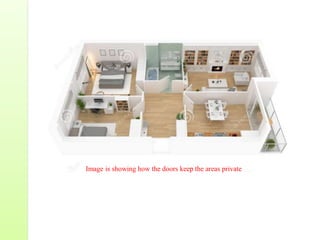
A door is a moveable barrier secured in a wall opening.
Functions:
1. They admit ventilation and light.
2. Controls the physical atmosphere within a space by
enclosing it,excluding air drafts, so that interiors may be
more effectively heated or cooled.
3. They act as a barrier to noise.
4. Used to screen areas of a building for aesthetic
purposes, Keeping formal and utility areas separate.
Location of door in a building
1. The number should be kept as minimum.
2. It should meet the functional requirement.
3. It should preferably be located at the corner of the
room, nearly 20 cm from corner.
4. If in a room, more than 2 doors are there, they shall
be located facing each other.
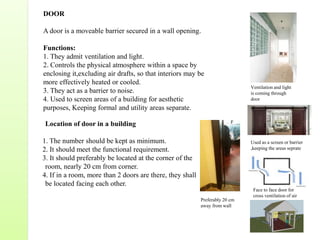
Ventilation and light
is coming through
door
Used as a screen or barrier
,keeping the areas seprate
Preferably 20 cm
away from wall
Face to face door for
cross ventilation of air
Image is showing how the doors keep the areas private
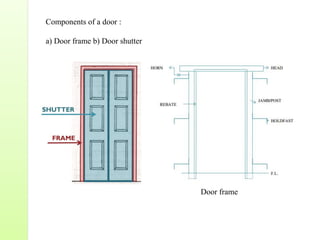
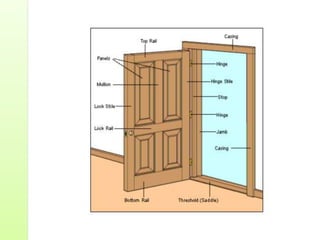
Components of a door :
a) Door frame b) Door shutter
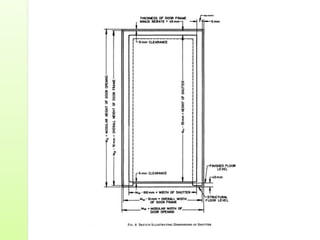
Door frame
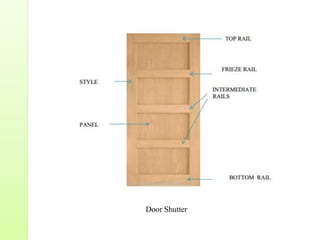
Door Shutter
TECHNICAL TERMS
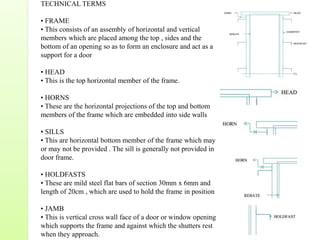
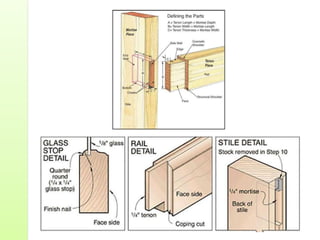
• FRAME
• This consists of an assembly of horizontal and vertical
members which are placed among the top , sides and the
bottom of an opening so as to form an enclosure and act as a
support for a door
• HEAD
• This is the top horizontal member of the frame.
• HORNS
• These are the horizontal projections of the top and bottom
members of the frame which are embedded into side walls
• SILLS
• This are horizontal bottom member of the frame which may
or may not be provided . The sill is generally not provided in
door frame.
• HOLDFASTS
• These are mild steel flat bars of section 30mm x 6mm and
length of 20cm , which are used to hold the frame in position
• JAMB
• This is vertical cross wall face of a door or window opening
which supports the frame and against which the shutters rest
when they approach.
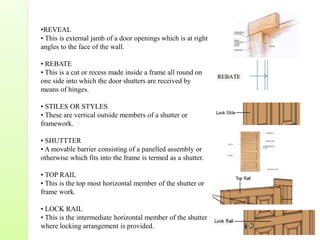
•REVEAL
• This is external jamb of a door openings which is at right
angles to the face of the wall.
• REBATE
• This is a cut or recess made inside a frame all round on
one side into which the door shutters are received by
means of hinges.
• STILES OR STYLES
• These are vertical outside members of a shutter or
framework.
• SHUTTTER
• A movable barrier consisting of a panelled assembly or
otherwise which fits into the frame is termed as a shutter.
• TOP RAIL
• This is the top most horizontal member of the shutter or
frame work.
• LOCK RAIL
• This is the intermediate horizontal member of the shutter
where locking arrangement is provided.
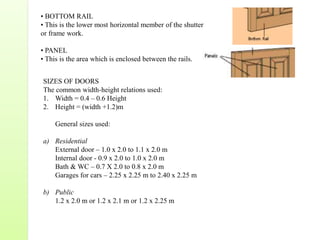
• BOTTOM RAIL
• This is the lower most horizontal member of the shutter
or frame work.
• PANEL
• This is the area which is enclosed between the rails.
SIZES OF DOORS
The common width-height relations used:
1. Width = 0.4 – 0.6 Height
2. Height = (width +1.2)m
General sizes used:
a) Residential
External door – 1.0 x 2.0 to 1.1 x 2.0 m
Internal door - 0.9 x 2.0 to 1.0 x 2.0 m
Bath & WC – 0.7 X 2.0 to 0.8 x 2.0 m
Garages for cars – 2.25 x 2.25 m to 2.40 x 2.25 m
b) Public
1.2 x 2.0 m or 1.2 x 2.1 m or 1.2 x 2.25 m
DOOR FRAMES
Materials used for door frames
1. Timber
2. Steel
3. Aluminium
4. Concrete
5. Stone
6. Glass
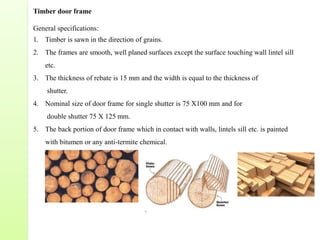
Timber door frame
General specifications:
1. Timber is sawn in the direction of grains.
2. The frames are smooth, well planed surfaces except the surface touching wall lintel sill
etc.
3. The thickness of rebate is 15 mm and the width is equal to the thickness of
shutter.
4. Nominal size of door frame for single shutter is 75 X100 mm and for
double shutter 75 X 125 mm.
5. The back portion of door frame which in contact with walls, lintels sill etc. is painted
with bitumen or any anti-termite chemical.
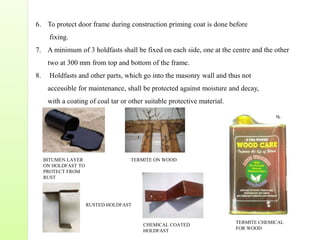
6. To protect door frame during construction priming coat is done before
fixing.
7. A minimum of 3 holdfasts shall be fixed on each side, one at the centre and the other
two at 300 mm from top and bottom of the frame.
8. Holdfasts and other parts, which go into the masonry wall and thus not
accessible for maintenance, shall be protected against moisture and decay,
with a coating of coal tar or other suitable protective material.
BITUMEN LAYER
ON HOLDFAST TO
PROTECT FROM
RUST
RUSTED HOLDFAST
TERMITE ON WOOD
CHEMICAL COATED
HOLDFAST
TERMITE CHEMICAL
FOR WOOD
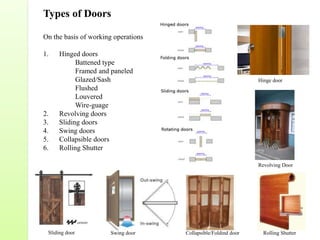
Types of Doors
On the basis of working operations
1. Hinged doors
Battened type
Framed and paneled
Glazed/Sash
Flushed
Louvered
Wire-guage
2. Revolving doors
3. Sliding doors
4. Swing doors
5. Collapsible doors
6. Rolling Shutter
Hinge door
Revolving Door
Rolling ShutterCollapsible/Foldind doorSwing doorSliding door
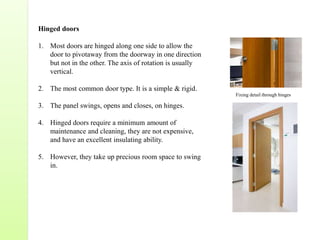
Hinged doors
1. Most doors are hinged along one side to allow the
door to pivotaway from the doorway in one direction
but not in the other. The axis of rotation is usually
vertical.
2. The most common door type. It is a simple & rigid.
3. The panel swings, opens and closes, on hinges.
4. Hinged doors require a minimum amount of
maintenance and cleaning, they are not expensive,
and have an excellent insulating ability.
5. However, they take up precious room space to swing
in.
Fixing detail through hinges
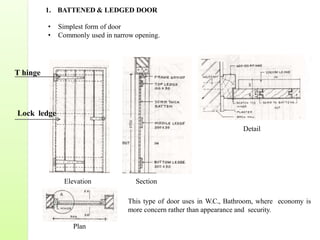
1. BATTENED & LEDGED DOOR
• Simplest form of door
• Commonly used in narrow opening.
T hinge
This type of door uses in W.C., Bathroom, where economy is
more concern rather than appearance and security.
Elevation Section
Plan
Detail
Lock ledge
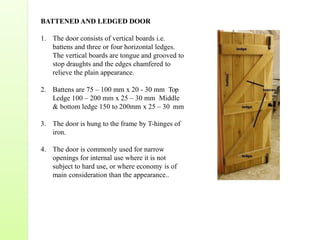
BATTENED AND LEDGED DOOR
1. The door consists of vertical boards i.e.
battens and three or four horizontal ledges.
The vertical boards are tongue and grooved to
stop draughts and the edges chamfered to
relieve the plain appearance.
2. Battens are 75 – 100 mm x 20 - 30 mm Top
Ledge 100 – 200 mm x 25 – 30 mm Middle
& bottom ledge 150 to 200mm x 25 – 30 mm
3. The door is hung to the frame by T-hinges of
iron.
4. The door is commonly used for narrow
openings for internal use where it is not
subject to hard use, or where economy is of
main consideration than the appearance..
This type of door uses in wider
opening where economy is more
concern rather than appearance and
security.
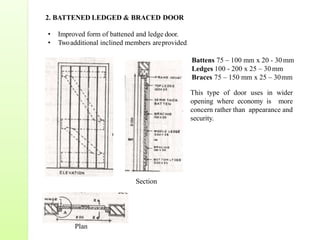
2. BATTENED LEDGED & BRACED DOOR
• Improved form of battened and ledge door.
• Twoadditional inclined members areprovided
Battens 75 – 100 mm x 20 - 30 mm
Ledges 100 - 200 x 25 – 30mm
Braces 75 – 150 mm x 25 – 30mm
Section
Plan
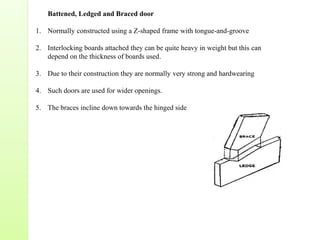
Battened, Ledged and Braced door
1. Normally constructed using a Z-shaped frame with tongue-and-groove
2. Interlocking boards attached they can be quite heavy in weight but this can
depend on the thickness of boards used.
3. Due to their construction they are normally very strong and hardwearing
4. Such doors are used for wider openings.
5. The braces incline down towards the hinged side
Size
Battens : 100-
150 mm wide &
20-30 mm thick
Ledges : 100-
200 mm thick
& 25-30 mm
thick
Braces: 75 -
150 mm wide &
25-30 mm thick
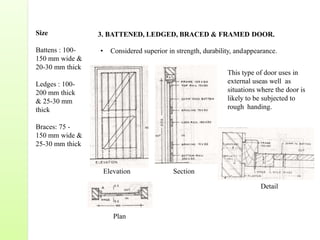
3. BATTENED, LEDGED, BRACED & FRAMED DOOR.
• Considered superior in strength, durability, andappearance.
This type of door uses in
external useas well as
situations where the door is
likely to be subjected to
rough handing.
Elevation Section
Plan
Detail
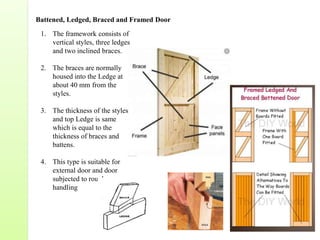
1. The framework consists of
vertical styles, three ledges
and two inclined braces.
2. The braces are normally
housed into the Ledge at
about 40 mm from the
styles.
3. The thickness of the styles
and top Ledge is same
which is equal to the
thickness of braces and
battens.
4. This type is suitable for
external door and door
subjected to rough
handling
Battened, Ledged, Braced and Framed Door
CONSTRUCTION & MATERIAL 2
TOPIC
TIMBER DOORS
LECTURE2
GATEWAY COLLEGE OF ARCHITECTURE (SONEPAT)
SESSION (2019 -2020) AR110C
Subject Faculty
Ar .Sher Singh Baghel
Ar. Anant Trivedi
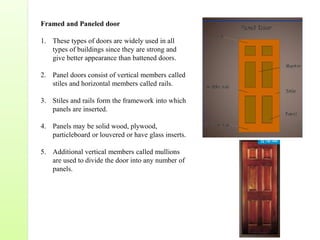
Framed and Paneled door
1. These types of doors are widely used in all
types of buildings since they are strong and
give better appearance than battened doors.
2. Panel doors consist of vertical members called
stiles and horizontal members called rails.
3. Stiles and rails form the framework into which
panels are inserted.
4. Panels may be solid wood, plywood,
particleboard or louvered or have glass inserts.
5. Additional vertical members called mullions
are used to divide the door into any number of
panels.
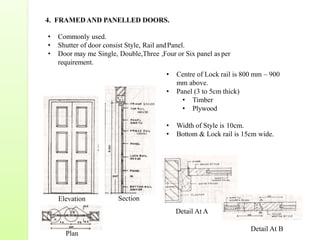
4. FRAMED AND PANELLED DOORS.
• Commonly used.
• Shutter of door consist Style, Rail andPanel.
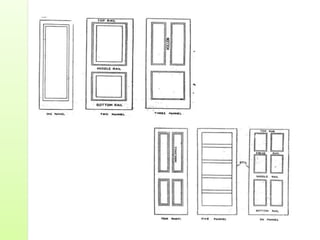
• Door may me Single, Double,Three ,Four or Six panel as per
requirement.
• Centre of Lock rail is 800 mm – 900
mm above.
• Panel (3 to 5cm thick)
• Timber
• Plywood
• Width of Style is 10cm.
• Bottom & Lock rail is 15cm wide.
Elevation Section
Plan
Detail At A
Detail At B
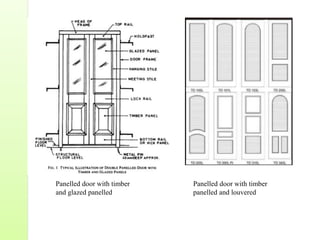
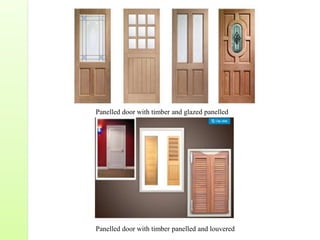
Panelled door with timber
and glazed panelled
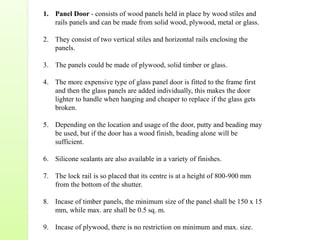
Panelled door with timber
panelled and louvered
Panelled door with timber and glazed panelled
Panelled door with timber panelled and louvered
1. Panel Door - consists of wood panels held in place by wood stiles and
rails panels and can be made from solid wood, plywood, metal or glass.
2. They consist of two vertical stiles and horizontal rails enclosing the
panels.
3. The panels could be made of plywood, solid timber or glass.
4. The more expensive type of glass panel door is fitted to the frame first
and then the glass panels are added individually, this makes the door
lighter to handle when hanging and cheaper to replace if the glass gets
broken.
5. Depending on the location and usage of the door, putty and beading may
be used, but if the door has a wood finish, beading alone will be
sufficient.
6. Silicone sealants are also available in a variety of finishes.
7. The lock rail is so placed that its centre is at a height of 800-900 mm
from the bottom of the shutter.
8. Incase of timber panels, the minimum size of the panel shall be 150 x 15
mm, while max. are shall be 0.5 sq. m.
9. Incase of plywood, there is no restriction on minimum and max. size.
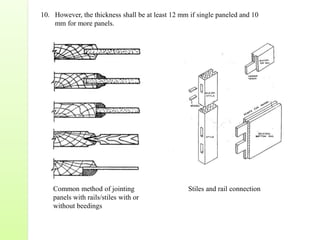
10. However, the thickness shall be at least 12 mm if single paneled and 10
mm for more panels.
Common method of jointing
panels with rails/stiles with or
without beedings
Stiles and rail connection
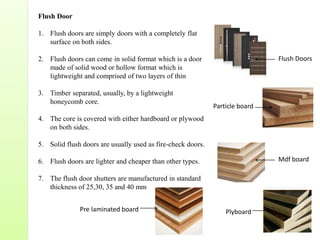
Flush Door
1. Flush doors are simply doors with a completely flat
surface on both sides.
2. Flush doors can come in solid format which is a door
made of solid wood or hollow format which is
lightweight and comprised of two layers of thin
3. Timber separated, usually, by a lightweight
honeycomb core.
4. The core is covered with either hardboard or plywood
on both sides.
5. Solid flush doors are usually used as fire-check doors.
6. Flush doors are lighter and cheaper than other types.
7. The flush door shutters are manufactured in standard
thickness of 25,30, 35 and 40 mm
Particle board
Mdf board
Pre laminated board Plyboard
Flush Doors
Types:
Solid core flush door
Hollow core
Cellular core
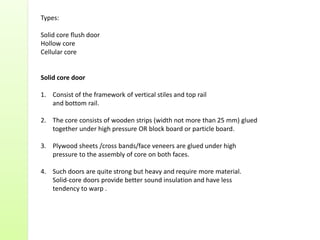
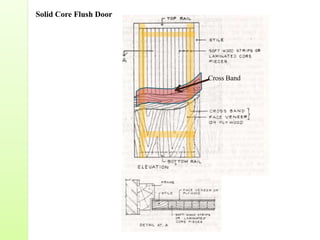
Solid core door
1. Consist of the framework of vertical stiles and top rail
and bottom rail.
2. The core consists of wooden strips (width not more than 25 mm) glued
together under high pressure OR block board or particle board.
3. Plywood sheets /cross bands/face veneers are glued under high
pressure to the assembly of core on both faces.
4. Such doors are quite strong but heavy and require more material.
Solid-core doors provide better sound insulation and have less
tendency to warp .
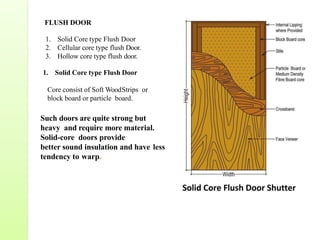
FLUSH DOOR
1. Solid Core type Flush Door
2. Cellular core type flush Door.
3. Hollow core type flush door.
Such doors are quite strong but
heavy and require more material.
Solid-core doors provide
better sound insulation and have less
tendency to warp.
1. Solid Core type Flush Door
Core consist of Soft WoodStrips or
block board or particle board.
Solid Core Flush Door
Cross Band
FLUSH DOOR
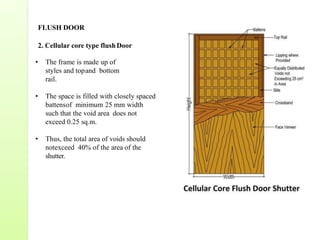
2. Cellular core type flushDoor
• The frame is made up of
styles and topand bottom
rail.
• The space is filled with closely spaced
battensof minimum 25 mm width
such that the void area does not
exceed 0.25 sq.m.
• Thus, the total area of voids should
notexceed 40% of the area of the
shutter.
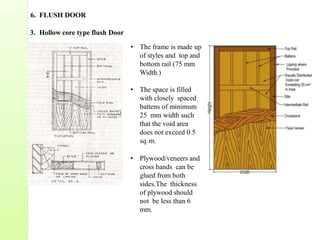
6. FLUSH DOOR
3. Hollow core type flush Door
• The frame is made up
of styles and top and
bottom rail (75 mm
Width.)
• The space is filled
with closely spaced
battens of minimum
25 mm width such
that the void area
does not exceed 0.5
sq.m.
• Plywood/veneers and
cross bands can be
glued from both
sides.The thickness
of plywood should
not be less than 6
mm.
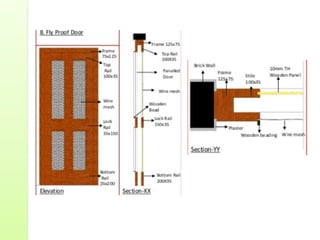
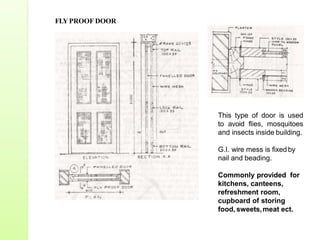
FLY PROOF DOOR
This type of door is used
to avoid flies, mosquitoes
and insects inside building.
G.I. wire mess is fixed by
nail and beading.
Commonly provided for
kitchens, canteens,
refreshment room,
cupboard of storing
food, sweets,meat ect.
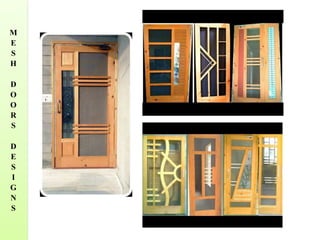
M
E
S
H
D
O
O
R
S
D
E
S
I
G
N
S
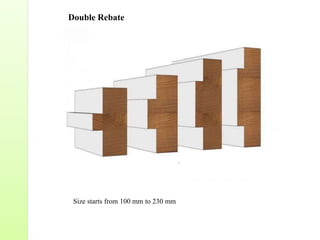
Size starts from 100 mm to 230 mm
Double Rebate
CONSTRUCTION & MATERIAL 2
TOPIC
TIMBER DOORS
LECTURE 3
GATEWAY COLLEGE OF ARCHITECTURE (SONEPAT)
SESSION (2019 -2020) AR110C
Subject Faculty
Ar .Sher Singh Baghel
Ar. Anant Trivedi
TYPESOFDOOR:
1. Classification on basis of arrangement of components (battend , ledged ,
braced).
2. Classifiction on the basis of method or manner of construction (framed ,
panelled , glazed , flushed , louvered , wire – gauged).
3. Classification on the basis of working .
• Revolving doors
• Sliding doors
• Folding doors
• Sliding and Folding Doors
• Swing doors
• Rolling shutters
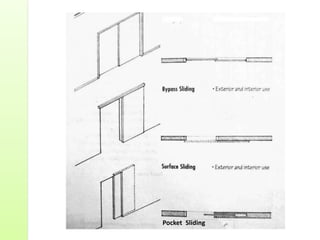
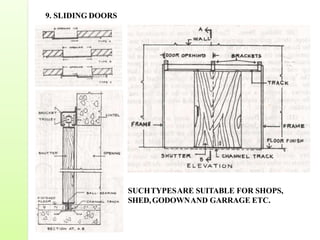
SLIDING DOORS
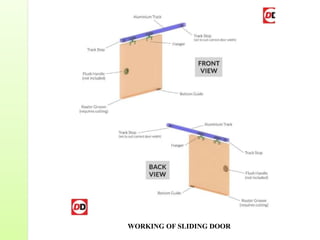
1. Some doors open and close without hinges by sliding back and forth
within tracks at head and sill .
2. The shutter slides on the sides with the help of runners and guide rails.
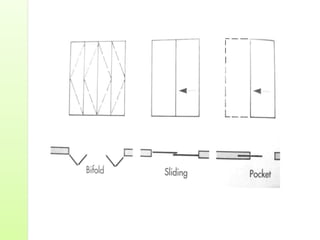
TYPE OF SLIDING DOOR
1. Bypass sliding
2. Surface sliding
3. Pocket sliding
4. Bifold doors
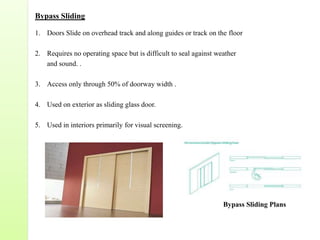
Bypass Sliding
1. Doors Slide on overhead track and along guides or track on the floor
2. Requires no operating space but is difficult to seal against weather
and sound. .
3. Access only through 50% of doorway width .
4. Used on exterior as sliding glass door.
5. Used in interiors primarily for visual screening.
Bypass Sliding Plans
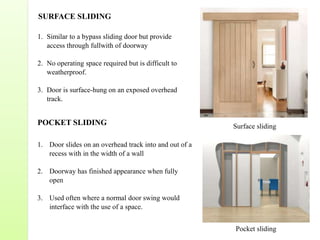
1. Similar to a bypass sliding door but provide
access through fullwith of doorway
2. No operating space required but is difficult to
weatherproof.
3. Door is surface-hung on an exposed overhead
track.
POCKET SLIDING
1. Door slides on an overhead track into and out of a
recess with in the width of a wall
2. Doorway has finished appearance when fully
open
3. Used often where a normal door swing would
interface with the use of a space.
SURFACE SLIDING
Surface sliding
Pocket sliding
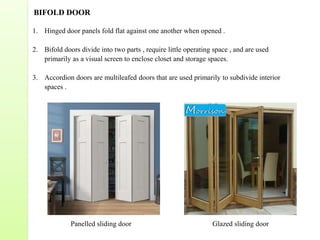
BIFOLD DOOR
1. Hinged door panels fold flat against one another when opened .
2. Bifold doors divide into two parts , require little operating space , and are used
primarily as a visual screen to enclose closet and storage spaces.
3. Accordion doors are multileafed doors that are used primarily to subdivide interior
spaces .
Panelled sliding door Glazed sliding door
WORKING OF SLIDING DOOR
Pocket Sliding
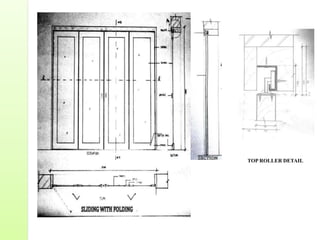
9. SLIDING DOORS
SUCHTYPESARE SUITABLE FOR SHOPS,
SHED,GODOWNAND GARRAGE ETC.
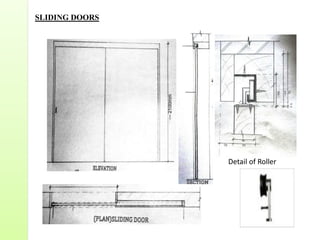
SLIDING DOORS
Detail of Roller
TOP ROLLER DETAIL
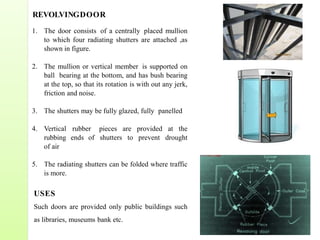
REVOLVINGDOOR
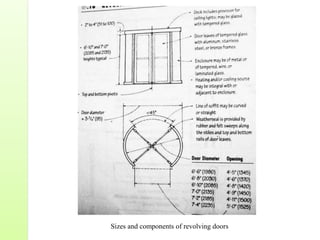
1. The door consists of a centrally placed mullion
to which four radiating shutters are attached ,as
shown in figure.
2. The mullion or vertical member is supported on
ball bearing at the bottom, and has bush bearing
at the top, so that its rotation is with out any jerk,
friction and noise.
3. The shutters may be fully glazed, fully panelled
4. Vertical rubber pieces are provided at the
rubbing ends of shutters to prevent drought
of air
5. The radiating shutters can be folded where traffic
is more.
USES
Such doors are provided only public buildings such
as libraries, museums bank etc.
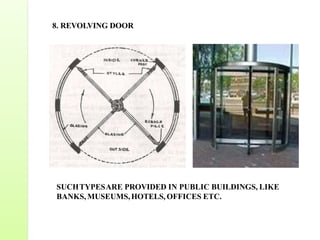
8. REVOLVING DOOR
SUCHTYPESARE PROVIDED IN PUBLIC BUILDINGS, LIKE
BANKS,MUSEUMS,HOTELS, OFFICES ETC.
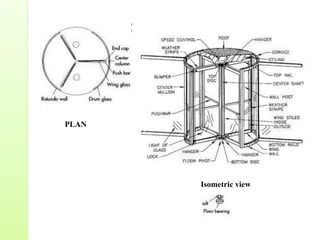
PLAN
Isometric view
Sizes and components of revolving doors
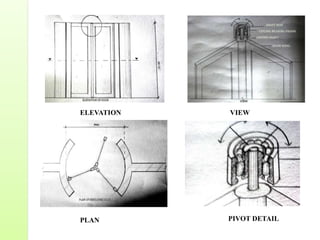
ELEVATION VIEW
PLAN PIVOT DETAIL
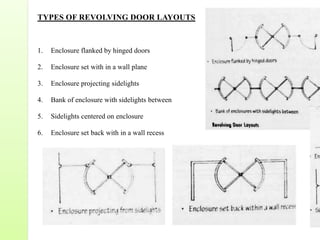
TYPES OF REVOLVING DOOR LAYOUTS
1. Enclosure flanked by hinged doors
2. Enclosure set with in a wall plane
3. Enclosure projecting sidelights
4. Bank of enclosure with sidelights between
5. Sidelights centered on enclosure
6. Enclosure set back with in a wall recess
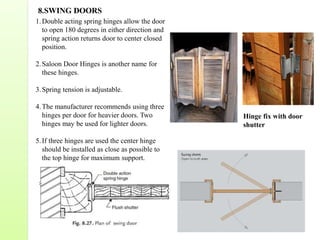
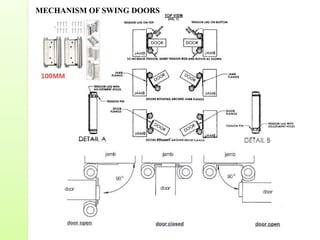
8.SWING DOORS
1.Double acting spring hinges allow the door
to open 180 degrees in either direction and
spring action returns door to center closed
position.
2.Saloon Door Hinges is another name for
these hinges.
3.Spring tension is adjustable.
4.The manufacturer recommends using three
hinges per door for heavier doors. Two
hinges may be used for lighter doors.
5.If three hinges are used the center hinge
should be installed as close as possible to
the top hinge for maximum support.
Hinge fix with door
shutter
MECHANISM OF SWING DOORS
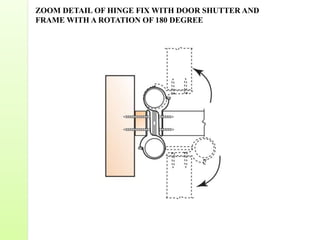
ZOOM DETAIL OF HINGE FIX WITH DOOR SHUTTER AND
FRAME WITH A ROTATION OF 180 DEGREE
CONSTRUCTION & MATERIAL 2
TOPIC
TIMBER WINDOWS
LECTURE 5
GATEWAY COLLEGE OF ARCHITECTURE (SONEPAT)
SESSION (2019 -2020) AR110C
Subject Faculty
Ar .Sher Singh Baghel
Ar. Anant Trivedi
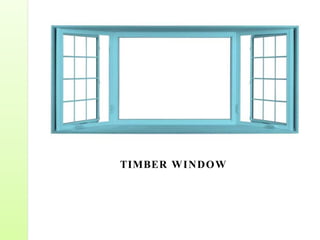
TIMBER WINDOW
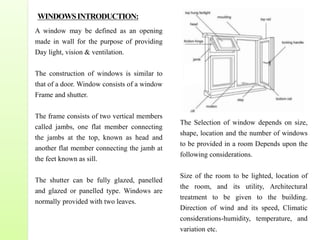
WINDOWSINTRODUCTION:
A window may be defined as an opening
made in wall for the purpose of providing
Day light, vision & ventilation.
The construction of windows is similar to
that of a door. Window consists of a window
Frame and shutter.
The frame consists of two vertical members
called jambs, one flat member connecting
the jambs at the top, known as head and
another flat member connecting the jamb at
the feet known as sill.
The shutter can be fully glazed, panelled
and glazed or panelled type. Windows are
normally provided with two leaves.
The Selection of window depends on size,
shape, location and the number of windows
to be provided in a room Depends upon the
following considerations.
Size of the room to be lighted, location of
the room, and its utility, Architectural
treatment to be given to the building.
Direction of wind and its speed, Climatic
considerations-humidity, temperature, and
variation etc.
CLASSIFICATIONOFWINDOWS:
Depending upon the material,operation, location windows
are broadly classified into
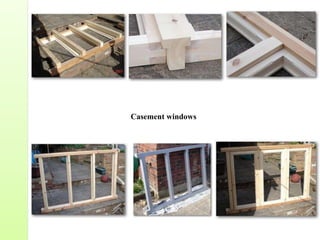
1. Casement windows
2. Sash or glazed windows
3. Fixed windows
4. Sliding windows
5. Pivoted windows
6. Double hung windows
7. Louvered windows
8. Bay windows
9. Corner windows
10. Clerestory windows
11. Dormer windows
12. Gable windows
13. Awning windows
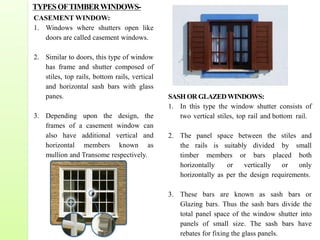
CASEMENT WINDOW:
1. Windows where shutters open like
doors are called casement windows.
2. Similar to doors, this type of window
has frame and shutter composed of
stiles, top rails, bottom rails, vertical
and horizontal sash bars with glass
panes.
3. Depending upon the design, the
frames of a casement window can
also have additional vertical and
horizontal members known as
mullion and Transome respectively.
SASH OR GLAZEDWINDOWS:
1. In this type the window shutter consists of
two vertical stiles, top rail and bottom rail.
2. The panel space between the stiles and
the rails is suitably divided by small
timber members or bars placed both
horizontally or vertically or only
horizontally as per the design requirements.
3. These bars are known as sash bars or
Glazing bars. Thus the sash bars divide the
total panel space of the window shutter into
panels of small size. The sash bars have
rebates for fixing the glass panels.
TYPESOFTIMBERWINDOWS-
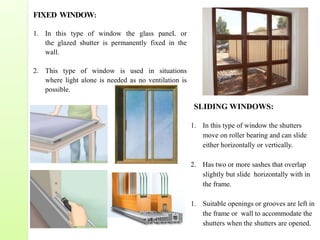
FIXED WINDOW:
1. In this type of window the glass paneL or
the glazed shutter is permanently fixed in the
wall.
2. This type of window is used in situations
where light alone is needed as no ventilation is
possible.
SLIDING WINDOWS:
1. In this type of window the shutters
move on roller bearing and can slide
either horizontally or vertically.
2. Has two or more sashes that overlap
slightly but slide horizontally with in
the frame.
1. Suitable openings or grooves are left in
the frame or wall to accommodate the
shutters when the shutters are opened.
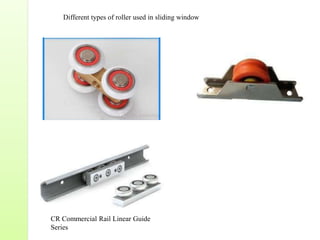
Different types of roller used in sliding window
CR Commercial Rail Linear Guide
Series
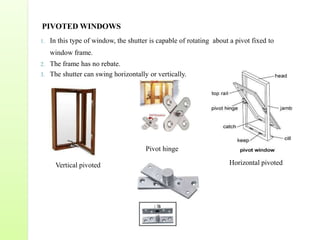
Horizontal pivotedVertical pivoted
PIVOTED WINDOWS
1. In this type of window, the shutter is capable of rotating about a pivot fixed to
window frame.
2. The frame has no rebate.
3. The shutter can swing horizontally or vertically.
Pivot hinge
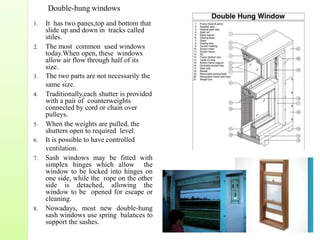
1. It has two panes,top and bottom that
slide up and down in tracks called
stiles.
2. The most common used windows
today.When open, these windows
allow air flow through half of its
size.
3. The two parts are not necessarily the
same size.
4. Traditionally,each shutter is provided
with a pair of counterweights
connected by cord or chain over
pulleys.
5. When the weights are pulled, the
shutters open to required level.
6. It is possible to have controlled
ventilation.
7. Sash windows may be fitted with
simplex hinges which allow the
window to be locked into hinges on
one side, while the rope on the other
side is detached, allowing the
window to be opened for escape or
cleaning.
8. Nowadays, most new double-hung
sash windows use spring balances to
support the sashes.
Double-hung windows
LOUVERED WINDOWS:
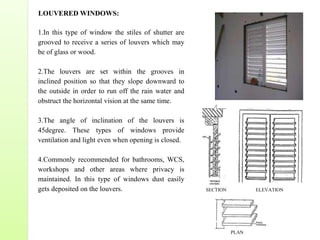
1.In this type of window the stiles of shutter are
grooved to receive a series of louvers which may
be of glass or wood.
2.The louvers are set within the grooves in
inclined position so that they slope downward to
the outside in order to run off the rain water and
obstruct the horizontal vision at the same time.
3.The angle of inclination of the louvers is
45degree. These types of windows provide
ventilation and light even when opening is closed.
4.Commonly recommended for bathrooms, WCS,
workshops and other areas where privacy is
maintained. In this type of windows dust easily
gets deposited on the louvers. ELEVATIONSECTION
PLAN
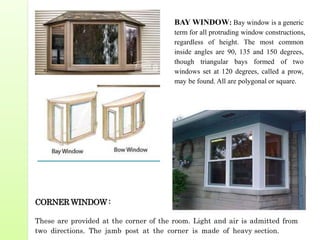
BAY WINDOW: Bay window is a generic
term for all protruding window constructions,
regardless of height. The most common
inside angles are 90, 135 and 150 degrees,
though triangular bays formed of two
windows set at 120 degrees, called a prow,
may be found. All are polygonal or square.
CORNER WINDOW :
These are provided at the corner of the room. Light and air is admitted from
two directions. The jamb post at the corner is made of heavy section.
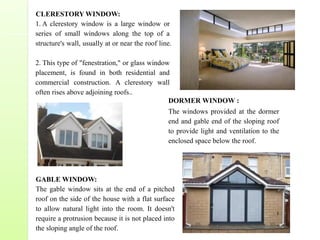
DORMER WINDOW :
The windows provided at the dormer
end and gable end of the sloping roof
to provide light and ventilation to the
enclosed space below the roof.
CLERESTORY WINDOW:
1. A clerestory window is a large window or
series of small windows along the top of a
structure's wall, usually at or near the roof line.
2. This type of "fenestration," or glass window
placement, is found in both residential and
commercial construction. A clerestory wall
often rises above adjoining roofs..
GABLE WINDOW:
The gable window sits at the end of a pitched
roof on the side of the house with a flat surface
to allow natural light into the room. It doesn't
require a protrusion because it is not placed into
the sloping angle of the roof.
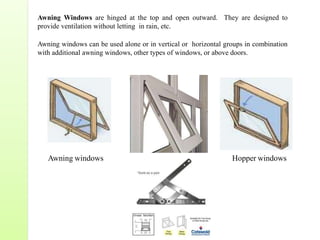
Awning Windows are hinged at the top and open outward. They are designed to
provide ventilation without letting in rain, etc.
Awning windows can be used alone or in vertical or horizontal groups in combination
with additional awning windows, other types of windows, or above doors.
Awning windows Hopper windows
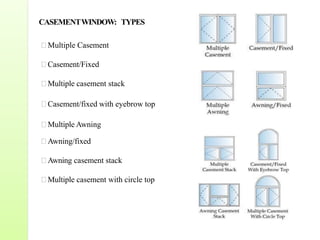
CASEMENTWINDOW: TYPES
Multiple Casement
Casement/Fixed
Multiple casement stack
Casement/fixed with eyebrow top
Multiple Awning
Awning/fixed
Awning casement stack
Multiple casement with circle top
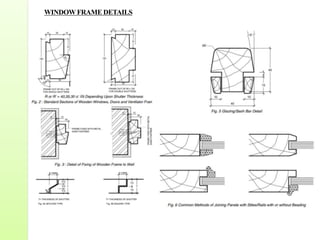
WINDOW FRAME DETAILS
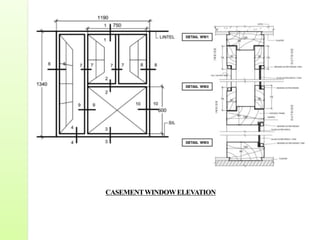
CASEMENTWINDOWELEVATION
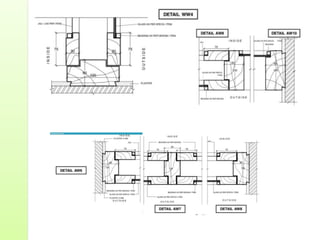
Casement windows

Construction and material 2

  • 1.
    CONSTRUCTION & MATERIAL2 TOPIC TIMBER DOORS LECTURE 1 GATEWAY COLLEGE OF ARCHITECTURE (SONEPAT) SESSION (2019 -2020) AR110C Subject Faculty Ar .Sher Singh Baghel Ar. Anant Trivedi
  • 2.
    INTENT To familiarize thestudent with the various aspects of building construction with the basic material wood CONTENT UNIT 1 Doors : Definition of terms , types of wooden doors ledged ,ledged and braced, paneled,flush door . Hinged , single and double shutters , sliding , folding ,sliding and folding , revolving ,pivoted Fixing details of frame ,style ,rail ,panel ,glazing including fixtures and fastening UNIT 2 Windows : Types of windows ,casement.top and bottom hung ,pivoted and sliding sash . Ventilators and their details Hardware : fixture , locks ,hinges ,fastenings for doors and windows : moldings ,architrave
  • 3.
    UNIT 3 Flooring andstaircase : Types of wooden flooring ( ground and first floor ) , wooden staircase details UNIT 4 Roof Trusses : Timber trusses ,types :fixing detials showing purlin ,rafter ,tie ,strut,cleat etc . Different types of roof covering : tiles ,asbestos and metal sheet etc . With fixing details .
  • 4.
    DOOR A door isa moveable barrier secured in a wall opening. Functions: 1. They admit ventilation and light. 2. Controls the physical atmosphere within a space by enclosing it,excluding air drafts, so that interiors may be more effectively heated or cooled. 3. They act as a barrier to noise. 4. Used to screen areas of a building for aesthetic purposes, Keeping formal and utility areas separate. Location of door in a building 1. The number should be kept as minimum. 2. It should meet the functional requirement. 3. It should preferably be located at the corner of the room, nearly 20 cm from corner. 4. If in a room, more than 2 doors are there, they shall be located facing each other. Ventilation and light is coming through door Used as a screen or barrier ,keeping the areas seprate Preferably 20 cm away from wall Face to face door for cross ventilation of air
  • 5.
    Image is showinghow the doors keep the areas private
  • 6.
    Components of adoor : a) Door frame b) Door shutter Door frame
  • 8.
  • 10.
    TECHNICAL TERMS • FRAME •This consists of an assembly of horizontal and vertical members which are placed among the top , sides and the bottom of an opening so as to form an enclosure and act as a support for a door • HEAD • This is the top horizontal member of the frame. • HORNS • These are the horizontal projections of the top and bottom members of the frame which are embedded into side walls • SILLS • This are horizontal bottom member of the frame which may or may not be provided . The sill is generally not provided in door frame. • HOLDFASTS • These are mild steel flat bars of section 30mm x 6mm and length of 20cm , which are used to hold the frame in position • JAMB • This is vertical cross wall face of a door or window opening which supports the frame and against which the shutters rest when they approach.
  • 11.
    •REVEAL • This isexternal jamb of a door openings which is at right angles to the face of the wall. • REBATE • This is a cut or recess made inside a frame all round on one side into which the door shutters are received by means of hinges. • STILES OR STYLES • These are vertical outside members of a shutter or framework. • SHUTTTER • A movable barrier consisting of a panelled assembly or otherwise which fits into the frame is termed as a shutter. • TOP RAIL • This is the top most horizontal member of the shutter or frame work. • LOCK RAIL • This is the intermediate horizontal member of the shutter where locking arrangement is provided.
  • 12.
    • BOTTOM RAIL •This is the lower most horizontal member of the shutter or frame work. • PANEL • This is the area which is enclosed between the rails. SIZES OF DOORS The common width-height relations used: 1. Width = 0.4 – 0.6 Height 2. Height = (width +1.2)m General sizes used: a) Residential External door – 1.0 x 2.0 to 1.1 x 2.0 m Internal door - 0.9 x 2.0 to 1.0 x 2.0 m Bath & WC – 0.7 X 2.0 to 0.8 x 2.0 m Garages for cars – 2.25 x 2.25 m to 2.40 x 2.25 m b) Public 1.2 x 2.0 m or 1.2 x 2.1 m or 1.2 x 2.25 m
  • 13.
    DOOR FRAMES Materials usedfor door frames 1. Timber 2. Steel 3. Aluminium 4. Concrete 5. Stone 6. Glass
  • 14.
    Timber door frame Generalspecifications: 1. Timber is sawn in the direction of grains. 2. The frames are smooth, well planed surfaces except the surface touching wall lintel sill etc. 3. The thickness of rebate is 15 mm and the width is equal to the thickness of shutter. 4. Nominal size of door frame for single shutter is 75 X100 mm and for double shutter 75 X 125 mm. 5. The back portion of door frame which in contact with walls, lintels sill etc. is painted with bitumen or any anti-termite chemical.
  • 15.
    6. To protectdoor frame during construction priming coat is done before fixing. 7. A minimum of 3 holdfasts shall be fixed on each side, one at the centre and the other two at 300 mm from top and bottom of the frame. 8. Holdfasts and other parts, which go into the masonry wall and thus not accessible for maintenance, shall be protected against moisture and decay, with a coating of coal tar or other suitable protective material. BITUMEN LAYER ON HOLDFAST TO PROTECT FROM RUST RUSTED HOLDFAST TERMITE ON WOOD CHEMICAL COATED HOLDFAST TERMITE CHEMICAL FOR WOOD
  • 16.
    Types of Doors Onthe basis of working operations 1. Hinged doors Battened type Framed and paneled Glazed/Sash Flushed Louvered Wire-guage 2. Revolving doors 3. Sliding doors 4. Swing doors 5. Collapsible doors 6. Rolling Shutter Hinge door Revolving Door Rolling ShutterCollapsible/Foldind doorSwing doorSliding door
  • 17.
    Hinged doors 1. Mostdoors are hinged along one side to allow the door to pivotaway from the doorway in one direction but not in the other. The axis of rotation is usually vertical. 2. The most common door type. It is a simple & rigid. 3. The panel swings, opens and closes, on hinges. 4. Hinged doors require a minimum amount of maintenance and cleaning, they are not expensive, and have an excellent insulating ability. 5. However, they take up precious room space to swing in. Fixing detail through hinges
  • 18.
    1. BATTENED &LEDGED DOOR • Simplest form of door • Commonly used in narrow opening. T hinge This type of door uses in W.C., Bathroom, where economy is more concern rather than appearance and security. Elevation Section Plan Detail Lock ledge
  • 19.
    BATTENED AND LEDGEDDOOR 1. The door consists of vertical boards i.e. battens and three or four horizontal ledges. The vertical boards are tongue and grooved to stop draughts and the edges chamfered to relieve the plain appearance. 2. Battens are 75 – 100 mm x 20 - 30 mm Top Ledge 100 – 200 mm x 25 – 30 mm Middle & bottom ledge 150 to 200mm x 25 – 30 mm 3. The door is hung to the frame by T-hinges of iron. 4. The door is commonly used for narrow openings for internal use where it is not subject to hard use, or where economy is of main consideration than the appearance..
  • 20.
    This type ofdoor uses in wider opening where economy is more concern rather than appearance and security. 2. BATTENED LEDGED & BRACED DOOR • Improved form of battened and ledge door. • Twoadditional inclined members areprovided Battens 75 – 100 mm x 20 - 30 mm Ledges 100 - 200 x 25 – 30mm Braces 75 – 150 mm x 25 – 30mm Section Plan
  • 21.
    Battened, Ledged andBraced door 1. Normally constructed using a Z-shaped frame with tongue-and-groove 2. Interlocking boards attached they can be quite heavy in weight but this can depend on the thickness of boards used. 3. Due to their construction they are normally very strong and hardwearing 4. Such doors are used for wider openings. 5. The braces incline down towards the hinged side
  • 22.
    Size Battens : 100- 150mm wide & 20-30 mm thick Ledges : 100- 200 mm thick & 25-30 mm thick Braces: 75 - 150 mm wide & 25-30 mm thick 3. BATTENED, LEDGED, BRACED & FRAMED DOOR. • Considered superior in strength, durability, andappearance. This type of door uses in external useas well as situations where the door is likely to be subjected to rough handing. Elevation Section Plan Detail
  • 23.
    1. The frameworkconsists of vertical styles, three ledges and two inclined braces. 2. The braces are normally housed into the Ledge at about 40 mm from the styles. 3. The thickness of the styles and top Ledge is same which is equal to the thickness of braces and battens. 4. This type is suitable for external door and door subjected to rough handling Battened, Ledged, Braced and Framed Door
  • 24.
    CONSTRUCTION & MATERIAL2 TOPIC TIMBER DOORS LECTURE2 GATEWAY COLLEGE OF ARCHITECTURE (SONEPAT) SESSION (2019 -2020) AR110C Subject Faculty Ar .Sher Singh Baghel Ar. Anant Trivedi
  • 25.
    Framed and Paneleddoor 1. These types of doors are widely used in all types of buildings since they are strong and give better appearance than battened doors. 2. Panel doors consist of vertical members called stiles and horizontal members called rails. 3. Stiles and rails form the framework into which panels are inserted. 4. Panels may be solid wood, plywood, particleboard or louvered or have glass inserts. 5. Additional vertical members called mullions are used to divide the door into any number of panels.
  • 26.
    4. FRAMED ANDPANELLED DOORS. • Commonly used. • Shutter of door consist Style, Rail andPanel. • Door may me Single, Double,Three ,Four or Six panel as per requirement. • Centre of Lock rail is 800 mm – 900 mm above. • Panel (3 to 5cm thick) • Timber • Plywood • Width of Style is 10cm. • Bottom & Lock rail is 15cm wide. Elevation Section Plan Detail At A Detail At B
  • 28.
    Panelled door withtimber and glazed panelled Panelled door with timber panelled and louvered
  • 29.
    Panelled door withtimber and glazed panelled Panelled door with timber panelled and louvered
  • 30.
    1. Panel Door- consists of wood panels held in place by wood stiles and rails panels and can be made from solid wood, plywood, metal or glass. 2. They consist of two vertical stiles and horizontal rails enclosing the panels. 3. The panels could be made of plywood, solid timber or glass. 4. The more expensive type of glass panel door is fitted to the frame first and then the glass panels are added individually, this makes the door lighter to handle when hanging and cheaper to replace if the glass gets broken. 5. Depending on the location and usage of the door, putty and beading may be used, but if the door has a wood finish, beading alone will be sufficient. 6. Silicone sealants are also available in a variety of finishes. 7. The lock rail is so placed that its centre is at a height of 800-900 mm from the bottom of the shutter. 8. Incase of timber panels, the minimum size of the panel shall be 150 x 15 mm, while max. are shall be 0.5 sq. m. 9. Incase of plywood, there is no restriction on minimum and max. size.
  • 31.
    10. However, thethickness shall be at least 12 mm if single paneled and 10 mm for more panels. Common method of jointing panels with rails/stiles with or without beedings Stiles and rail connection
  • 32.
    Flush Door 1. Flushdoors are simply doors with a completely flat surface on both sides. 2. Flush doors can come in solid format which is a door made of solid wood or hollow format which is lightweight and comprised of two layers of thin 3. Timber separated, usually, by a lightweight honeycomb core. 4. The core is covered with either hardboard or plywood on both sides. 5. Solid flush doors are usually used as fire-check doors. 6. Flush doors are lighter and cheaper than other types. 7. The flush door shutters are manufactured in standard thickness of 25,30, 35 and 40 mm Particle board Mdf board Pre laminated board Plyboard Flush Doors
  • 33.
    Types: Solid core flushdoor Hollow core Cellular core Solid core door 1. Consist of the framework of vertical stiles and top rail and bottom rail. 2. The core consists of wooden strips (width not more than 25 mm) glued together under high pressure OR block board or particle board. 3. Plywood sheets /cross bands/face veneers are glued under high pressure to the assembly of core on both faces. 4. Such doors are quite strong but heavy and require more material. Solid-core doors provide better sound insulation and have less tendency to warp .
  • 34.
    FLUSH DOOR 1. SolidCore type Flush Door 2. Cellular core type flush Door. 3. Hollow core type flush door. Such doors are quite strong but heavy and require more material. Solid-core doors provide better sound insulation and have less tendency to warp. 1. Solid Core type Flush Door Core consist of Soft WoodStrips or block board or particle board.
  • 35.
    Solid Core FlushDoor Cross Band
  • 36.
    FLUSH DOOR 2. Cellularcore type flushDoor • The frame is made up of styles and topand bottom rail. • The space is filled with closely spaced battensof minimum 25 mm width such that the void area does not exceed 0.25 sq.m. • Thus, the total area of voids should notexceed 40% of the area of the shutter.
  • 37.
    6. FLUSH DOOR 3.Hollow core type flush Door • The frame is made up of styles and top and bottom rail (75 mm Width.) • The space is filled with closely spaced battens of minimum 25 mm width such that the void area does not exceed 0.5 sq.m. • Plywood/veneers and cross bands can be glued from both sides.The thickness of plywood should not be less than 6 mm.
  • 38.
    FLY PROOF DOOR Thistype of door is used to avoid flies, mosquitoes and insects inside building. G.I. wire mess is fixed by nail and beading. Commonly provided for kitchens, canteens, refreshment room, cupboard of storing food, sweets,meat ect.
  • 40.
  • 41.
    Size starts from100 mm to 230 mm Double Rebate
  • 42.
    CONSTRUCTION & MATERIAL2 TOPIC TIMBER DOORS LECTURE 3 GATEWAY COLLEGE OF ARCHITECTURE (SONEPAT) SESSION (2019 -2020) AR110C Subject Faculty Ar .Sher Singh Baghel Ar. Anant Trivedi
  • 43.
    TYPESOFDOOR: 1. Classification onbasis of arrangement of components (battend , ledged , braced). 2. Classifiction on the basis of method or manner of construction (framed , panelled , glazed , flushed , louvered , wire – gauged). 3. Classification on the basis of working . • Revolving doors • Sliding doors • Folding doors • Sliding and Folding Doors • Swing doors • Rolling shutters
  • 44.
    SLIDING DOORS 1. Somedoors open and close without hinges by sliding back and forth within tracks at head and sill . 2. The shutter slides on the sides with the help of runners and guide rails. TYPE OF SLIDING DOOR 1. Bypass sliding 2. Surface sliding 3. Pocket sliding 4. Bifold doors
  • 45.
    Bypass Sliding 1. DoorsSlide on overhead track and along guides or track on the floor 2. Requires no operating space but is difficult to seal against weather and sound. . 3. Access only through 50% of doorway width . 4. Used on exterior as sliding glass door. 5. Used in interiors primarily for visual screening. Bypass Sliding Plans
  • 46.
    1. Similar toa bypass sliding door but provide access through fullwith of doorway 2. No operating space required but is difficult to weatherproof. 3. Door is surface-hung on an exposed overhead track. POCKET SLIDING 1. Door slides on an overhead track into and out of a recess with in the width of a wall 2. Doorway has finished appearance when fully open 3. Used often where a normal door swing would interface with the use of a space. SURFACE SLIDING Surface sliding Pocket sliding
  • 47.
    BIFOLD DOOR 1. Hingeddoor panels fold flat against one another when opened . 2. Bifold doors divide into two parts , require little operating space , and are used primarily as a visual screen to enclose closet and storage spaces. 3. Accordion doors are multileafed doors that are used primarily to subdivide interior spaces . Panelled sliding door Glazed sliding door
  • 48.
  • 49.
  • 51.
    9. SLIDING DOORS SUCHTYPESARESUITABLE FOR SHOPS, SHED,GODOWNAND GARRAGE ETC.
  • 52.
  • 53.
  • 54.
    REVOLVINGDOOR 1. The doorconsists of a centrally placed mullion to which four radiating shutters are attached ,as shown in figure. 2. The mullion or vertical member is supported on ball bearing at the bottom, and has bush bearing at the top, so that its rotation is with out any jerk, friction and noise. 3. The shutters may be fully glazed, fully panelled 4. Vertical rubber pieces are provided at the rubbing ends of shutters to prevent drought of air 5. The radiating shutters can be folded where traffic is more. USES Such doors are provided only public buildings such as libraries, museums bank etc.
  • 55.
    8. REVOLVING DOOR SUCHTYPESAREPROVIDED IN PUBLIC BUILDINGS, LIKE BANKS,MUSEUMS,HOTELS, OFFICES ETC.
  • 56.
  • 57.
    Sizes and componentsof revolving doors
  • 58.
  • 59.
    TYPES OF REVOLVINGDOOR LAYOUTS 1. Enclosure flanked by hinged doors 2. Enclosure set with in a wall plane 3. Enclosure projecting sidelights 4. Bank of enclosure with sidelights between 5. Sidelights centered on enclosure 6. Enclosure set back with in a wall recess
  • 60.
    8.SWING DOORS 1.Double actingspring hinges allow the door to open 180 degrees in either direction and spring action returns door to center closed position. 2.Saloon Door Hinges is another name for these hinges. 3.Spring tension is adjustable. 4.The manufacturer recommends using three hinges per door for heavier doors. Two hinges may be used for lighter doors. 5.If three hinges are used the center hinge should be installed as close as possible to the top hinge for maximum support. Hinge fix with door shutter
  • 61.
  • 62.
    ZOOM DETAIL OFHINGE FIX WITH DOOR SHUTTER AND FRAME WITH A ROTATION OF 180 DEGREE
  • 63.
    CONSTRUCTION & MATERIAL2 TOPIC TIMBER WINDOWS LECTURE 5 GATEWAY COLLEGE OF ARCHITECTURE (SONEPAT) SESSION (2019 -2020) AR110C Subject Faculty Ar .Sher Singh Baghel Ar. Anant Trivedi
  • 64.
  • 65.
    WINDOWSINTRODUCTION: A window maybe defined as an opening made in wall for the purpose of providing Day light, vision & ventilation. The construction of windows is similar to that of a door. Window consists of a window Frame and shutter. The frame consists of two vertical members called jambs, one flat member connecting the jambs at the top, known as head and another flat member connecting the jamb at the feet known as sill. The shutter can be fully glazed, panelled and glazed or panelled type. Windows are normally provided with two leaves. The Selection of window depends on size, shape, location and the number of windows to be provided in a room Depends upon the following considerations. Size of the room to be lighted, location of the room, and its utility, Architectural treatment to be given to the building. Direction of wind and its speed, Climatic considerations-humidity, temperature, and variation etc.
  • 66.
    CLASSIFICATIONOFWINDOWS: Depending upon thematerial,operation, location windows are broadly classified into 1. Casement windows 2. Sash or glazed windows 3. Fixed windows 4. Sliding windows 5. Pivoted windows 6. Double hung windows 7. Louvered windows 8. Bay windows 9. Corner windows 10. Clerestory windows 11. Dormer windows 12. Gable windows 13. Awning windows
  • 67.
    CASEMENT WINDOW: 1. Windowswhere shutters open like doors are called casement windows. 2. Similar to doors, this type of window has frame and shutter composed of stiles, top rails, bottom rails, vertical and horizontal sash bars with glass panes. 3. Depending upon the design, the frames of a casement window can also have additional vertical and horizontal members known as mullion and Transome respectively. SASH OR GLAZEDWINDOWS: 1. In this type the window shutter consists of two vertical stiles, top rail and bottom rail. 2. The panel space between the stiles and the rails is suitably divided by small timber members or bars placed both horizontally or vertically or only horizontally as per the design requirements. 3. These bars are known as sash bars or Glazing bars. Thus the sash bars divide the total panel space of the window shutter into panels of small size. The sash bars have rebates for fixing the glass panels. TYPESOFTIMBERWINDOWS-
  • 68.
    FIXED WINDOW: 1. Inthis type of window the glass paneL or the glazed shutter is permanently fixed in the wall. 2. This type of window is used in situations where light alone is needed as no ventilation is possible. SLIDING WINDOWS: 1. In this type of window the shutters move on roller bearing and can slide either horizontally or vertically. 2. Has two or more sashes that overlap slightly but slide horizontally with in the frame. 1. Suitable openings or grooves are left in the frame or wall to accommodate the shutters when the shutters are opened.
  • 69.
    Different types ofroller used in sliding window CR Commercial Rail Linear Guide Series
  • 70.
    Horizontal pivotedVertical pivoted PIVOTEDWINDOWS 1. In this type of window, the shutter is capable of rotating about a pivot fixed to window frame. 2. The frame has no rebate. 3. The shutter can swing horizontally or vertically. Pivot hinge
  • 71.
    1. It hastwo panes,top and bottom that slide up and down in tracks called stiles. 2. The most common used windows today.When open, these windows allow air flow through half of its size. 3. The two parts are not necessarily the same size. 4. Traditionally,each shutter is provided with a pair of counterweights connected by cord or chain over pulleys. 5. When the weights are pulled, the shutters open to required level. 6. It is possible to have controlled ventilation. 7. Sash windows may be fitted with simplex hinges which allow the window to be locked into hinges on one side, while the rope on the other side is detached, allowing the window to be opened for escape or cleaning. 8. Nowadays, most new double-hung sash windows use spring balances to support the sashes. Double-hung windows
  • 73.
    LOUVERED WINDOWS: 1.In thistype of window the stiles of shutter are grooved to receive a series of louvers which may be of glass or wood. 2.The louvers are set within the grooves in inclined position so that they slope downward to the outside in order to run off the rain water and obstruct the horizontal vision at the same time. 3.The angle of inclination of the louvers is 45degree. These types of windows provide ventilation and light even when opening is closed. 4.Commonly recommended for bathrooms, WCS, workshops and other areas where privacy is maintained. In this type of windows dust easily gets deposited on the louvers. ELEVATIONSECTION PLAN
  • 74.
    BAY WINDOW: Baywindow is a generic term for all protruding window constructions, regardless of height. The most common inside angles are 90, 135 and 150 degrees, though triangular bays formed of two windows set at 120 degrees, called a prow, may be found. All are polygonal or square. CORNER WINDOW : These are provided at the corner of the room. Light and air is admitted from two directions. The jamb post at the corner is made of heavy section.
  • 75.
    DORMER WINDOW : Thewindows provided at the dormer end and gable end of the sloping roof to provide light and ventilation to the enclosed space below the roof. CLERESTORY WINDOW: 1. A clerestory window is a large window or series of small windows along the top of a structure's wall, usually at or near the roof line. 2. This type of "fenestration," or glass window placement, is found in both residential and commercial construction. A clerestory wall often rises above adjoining roofs.. GABLE WINDOW: The gable window sits at the end of a pitched roof on the side of the house with a flat surface to allow natural light into the room. It doesn't require a protrusion because it is not placed into the sloping angle of the roof.
  • 76.
    Awning Windows arehinged at the top and open outward. They are designed to provide ventilation without letting in rain, etc. Awning windows can be used alone or in vertical or horizontal groups in combination with additional awning windows, other types of windows, or above doors. Awning windows Hopper windows
  • 77.
    CASEMENTWINDOW: TYPES Multiple Casement Casement/Fixed Multiplecasement stack Casement/fixed with eyebrow top Multiple Awning Awning/fixed Awning casement stack Multiple casement with circle top
  • 78.
  • 79.
  • 82.