

CONSTANCY
CONSTANCY (n.)
■ The human tendency to perceive objects as unchanging, despite changes in
sensory input.
■ People tend to perceive objects as constant and unchanging, despite changes
in perspective, lighting, color, or size. The ability to perceive objects as having
constant properties despite variations in how they are perceived eliminates the
need to reinterpret those objects when they are perceived under different
conditions. This indicates that perception involves more than simply receiving
sensory inputs; rather, it is a process of continuously reconciling sensory inputs
with memories about the properties of things in the world.
■ Example: A person viewed at a distance produces a smaller image on the retina
than that same person up close, but the perception of the size of the person is
constant.
SIZE CONSTANCY
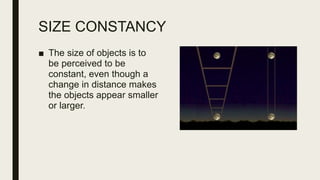
■ The size of objects is to
be perceived to be
constant, even though a
change in distance makes
the objects appear smaller
or larger.
BRIGHTNESS CONSTANCY
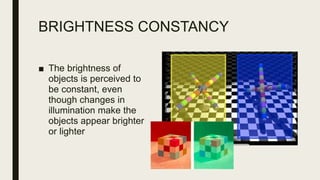
■ The brightness of
objects is perceived to
be constant, even
though changes in
illumination make the
objects appear brighter
or lighter
SHAPE CONSTANCY
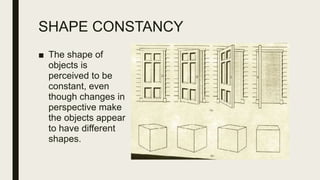
■ The shape of
objects is
perceived to be
constant, even
though changes in
perspective make
the objects appear
to have different
shapes.
LOUDNESS CONSTANCY
■ The loudness of a sound
is perceived to be
constant, even though a
change in distance
makes the sound seem
softer or louder.
CONSTANCY
ARCHITECTURE AND INTERIOR DESIGN
CONSTANCY
FASHION DESIGN
Constancy in design

Constancy in design

  • 1.
  • 2.
    CONSTANCY (n.) ■ Thehuman tendency to perceive objects as unchanging, despite changes in sensory input. ■ People tend to perceive objects as constant and unchanging, despite changes in perspective, lighting, color, or size. The ability to perceive objects as having constant properties despite variations in how they are perceived eliminates the need to reinterpret those objects when they are perceived under different conditions. This indicates that perception involves more than simply receiving sensory inputs; rather, it is a process of continuously reconciling sensory inputs with memories about the properties of things in the world. ■ Example: A person viewed at a distance produces a smaller image on the retina than that same person up close, but the perception of the size of the person is constant.
  • 4.
    SIZE CONSTANCY ■ Thesize of objects is to be perceived to be constant, even though a change in distance makes the objects appear smaller or larger.
  • 5.
    BRIGHTNESS CONSTANCY ■ Thebrightness of objects is perceived to be constant, even though changes in illumination make the objects appear brighter or lighter
  • 6.
    SHAPE CONSTANCY ■ Theshape of objects is perceived to be constant, even though changes in perspective make the objects appear to have different shapes.
  • 7.
    LOUDNESS CONSTANCY ■ Theloudness of a sound is perceived to be constant, even though a change in distance makes the sound seem softer or louder.
  • 8.
  • 11.