SENSATION AND PERCEPTION
MRS TAFADZWA
SENSATION AND PERCEPTION
 Sensation refers to the process of sensing our environment
through touch, taste, sight, sound, and smell.
 Sensation
 Process in which the sense organ’s receptor cells are stimulated and
relay initial information to the brain for further processing
Sensation requires transduction – which is the change of physical energy
to neural energy
 This information is sent to our brains in raw form where
perception comes into play.
 Perception is the way we interpret these sensations and therefore
make sense of everything around us.
 Perception can also be defined as the process by which organism
selects and interprets sensory input so that it acquires meaning (Do
something about it)
 How do you study it?
 Bottom Up: Stimuli to concept
 Top Down: Concept to stimuli
 Although intimately related, sensation and perception play two
complimentary but different roles in how we interpret our world.
SENSATION EXPLAINED
 Sensation is the process by which our senses gather information
and send it to the brain.
 A large amount of information is being sensed at any one time
such as room temperature, brightness of the lights, someone
talking, a distant train, or the smell of perfume.
Sensation cont’d
 With all this information coming into our senses, the majority of
our world never gets recognized.
 We don’t notice radio waves, x-rays, or the microscopic parasites
crawling on our skin.
 We don’t sense all the odors around us or taste every individual
spice in our gourmet dinner.
 We only sense those things we are able to since we don’t have the
sense of smell like a bloodhound or the sense of sight like a hawk;
our thresholds are different from these animals and often even
from each other.
Components in sensation
1. The absolute threshold is the point where something becomes
noticeable to our senses.
 It is the softest sound we can hear or the slightest touch we can
feel. Anything less than this goes unnoticed.
 The absolute threshold is therefore the point at which a stimuli
goes from undetectable to detectable to our senses.
Components in sensation
 Once a stimulus becomes detectable to us, how do we recognize if
this stimulus changes.
 When we notice the sound of the radio in the other room, how do
we notice when it becomes louder.
 It’s conceivable that someone could be turning it up so slightly
that the difference is undetectable.
2. The difference threshold is the amount of change needed for us to
recognize that a change has occurred.
 This change is referred to as the Just Noticeable Difference.
Sensation cont’d
 This difference is not absolute, however.
 This theory, named after its original observer, is referred to as
Weber’s Law.
 The change required to detect a difference represents a
percentage.
3. Signal detection theory implies making a determination as to
what is important to sense and what is background noise.
 This concept is referred to as signal detection because we attempt
detect what we want to focus on and ignore or minimize
everything else.
Sensation cont’d
 The last concept refers to stimuli which has become redundant or
remains unchanged for an extended period of time.
 Ever wonder why we notice certain smells or sounds right away
and then after a while they fade into the background?
 Once we adapt to the perfume or the ticking of the clock, we stop
recognizing it.
 4. This process of becoming less sensitive to unchanging stimulus
is referred to as sensory adaptation, after all, if it doesn’t change,
why do we need to constantly sense it?
PERCEPTION
 As mentioned in the introduction, perception refers to
interpretation of what we take in through our senses.
 The way we perceive our environment is what makes us different
from other animals and different from each other.
 In other words, perception is the process of how we make ‘sense’
of what we see, hear, taste, touch, and smell….
Gestalt Principles of Grouping
 The German word “Gestalt” roughly translates to “whole” or
“form,” and the Gestalt psychologist’s sincerely believed that the
whole is greater than the sum of its parts.
 In order to interpret what we receive through our senses, they
theorized that we attempt to organize this information into certain
groups.
Gestalt Principles of Grouping cont’d
 This allows us to interpret the information completely without
unneeded repetition.
 For example, when you see one dot, you perceive it as such, but
when you see five dots together, you group them together by
saying a “row of dots.”
 Without this tendency to group our perceptions, that same row
would be seen as “dot, dot, dot, dot, dot,” taking both longer to
process and reducing our perceptive ability.
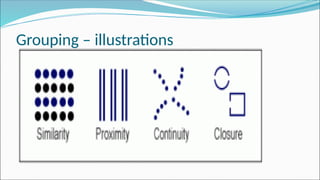
 The Gestalt principles of grouping include four types: similarity,
proximity, continuity, and closure.
Grouping – illustrations
Gestalt Principles of Grouping cont’d
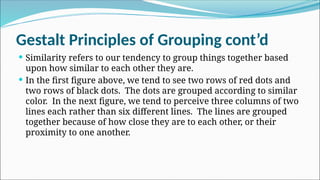
 Similarity refers to our tendency to group things together based
upon how similar to each other they are.
 In the first figure above, we tend to see two rows of red dots and
two rows of black dots. The dots are grouped according to similar
color. In the next figure, we tend to perceive three columns of two
lines each rather than six different lines. The lines are grouped
together because of how close they are to each other, or their
proximity to one another.
Gestalt Principles of Grouping cont’d
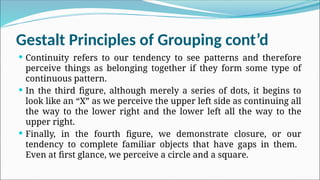
 Continuity refers to our tendency to see patterns and therefore
perceive things as belonging together if they form some type of
continuous pattern.
 In the third figure, although merely a series of dots, it begins to
look like an “X” as we perceive the upper left side as continuing all
the way to the lower right and the lower left all the way to the
upper right.
 Finally, in the fourth figure, we demonstrate closure, or our
tendency to complete familiar objects that have gaps in them.
Even at first glance, we perceive a circle and a square.
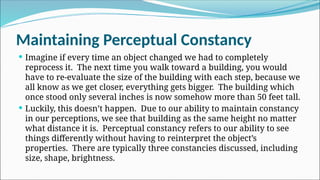
Maintaining Perceptual Constancy
 Imagine if every time an object changed we had to completely
reprocess it. The next time you walk toward a building, you would
have to re-evaluate the size of the building with each step, because we
all know as we get closer, everything gets bigger. The building which
once stood only several inches is now somehow more than 50 feet tall.
 Luckily, this doesn’t happen. Due to our ability to maintain constancy
in our perceptions, we see that building as the same height no matter
what distance it is. Perceptual constancy refers to our ability to see
things differently without having to reinterpret the object’s
properties. There are typically three constancies discussed, including
size, shape, brightness.
Maintaining Perceptual Constancy cont’d
 Size constancy refers to our ability to see objects as maintaining
the same size even when our distance from them makes things
appear larger or smaller.
 This holds true for all of our senses. As we walk away from our
radio, the song appears to get softer.
 We understand, and perceive it as being just as loud as before.
 The difference being our distance from what we are sensing.
Maintaining Perceptual Constancy cont’d
 Everybody has seen a plate shaped in the form of a circle.
 When we see that same plate from an angle, however, it looks
more like an ellipse.
 Shape constancy allows us to perceive a circle as a plate as still
being a circle even though the angle from which we view it
appears to distort the shape.
Maintaining Perceptual Constancy cont’d
 Brightness constancy refers to our ability to recognize that color
remains the same regardless of how it looks under different levels
of light.
 That deep blue shirt you wore to the beach suddenly looks black
when you walk indoors.
 Without color constancy, we would be constantly re-interpreting
color and would be amazed at the miraculous conversion our
clothes undertake.
Perceiving Distance
 We determine distance using two different cues: monocular and
binocular.
 Monocular cues are those cues which can be seen using only one
eye. They include size; texture, overlap, shading, height, and
clarity.
 Size refers to the fact that larger images are perceived as closer to
us, especially if the two images are of the same object.
 The texture of objects tend to become smoother as the object gets
farther away, suggesting that more detailed textured objects are
closer.
Perceiving Distance cont’d
 Due to overlap, those objects covering part of another object is
perceived as closer.
 The shading or shadows of objects can give a clue to their distance,
allowing closer objects to cast longer shadows which will overlap
objects which are farther away
Perceiving Distance cont’d
 Objects which are closer to the bottom of our visual field are seen
as closer to us due to our perception of the horizon, where higher
(height) means farther away.
 Similar to texture, objects tend to get blurry as they get farther
away, therefore, clearer or more crisp images tend to be perceived
as closer (clarity).
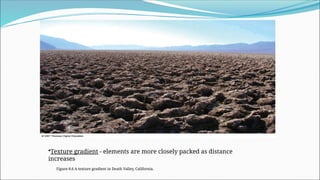
Figure 8.6 A texture gradient in Death Valley, California.
•Texture gradient - elements are more closely packed as distance
increases
Perceiving Distance cont’d
 Binocular cues refer to those depth cues in which both eyes are needed
to perceive.
 There are two important binocular cues; convergence and retinal
disparity.
 Convergence refers to the fact that the closer an object, the more
inward our eyes need to turn in order to focus.
 The further our eyes converge, the closer an object appears to be.
 Since our eyes see two images which are then sent to our brains for
interpretation, the distance between these two images, or their retinal
disparity, provides another cue regarding the distance of the object.
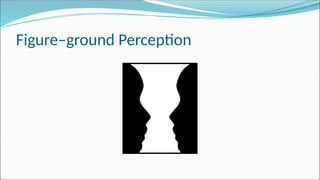
Figure–ground Perception
Figure–ground Perception cont’d
 Figure–ground organization is a type of perceptual grouping
which is a vital necessity for recognizing objects through vision.
 In Gestalt psychology it is known as identifying a figure from the
background.
 For example, you see words on a printed paper as the "figure" and
the white sheet as the "background
Figure–ground Perception cont’d
 The most famous example of figure–ground perception is probably
the faces–vase drawing that Danish psychologist Edgar Rubin
described.
 This drawing exemplifies one of the key aspects of figure–ground
organization, edge-assignment and its effect on shape perception.
 Notice in the faces/vase drawing, the perceived shape depends
critically on the direction in which the border (edge) between the
black and white regions is assigned.
Figure–ground Perception cont’d
 If the two curvy edges between the black and white regions are
assigned inward then the central white region is seen as a vase
shape in front of a black background.
 No faces are perceived in this case.
 On the other hand, if the edges are assigned outwards, then the
two black profile faces are perceived on a white background and
no vase shape is perceived.
Figure–ground Perception cont’d
 The human visual system will then settle on either of the
interpretations of the Rubin vase and alternate between them.
 Functional brain imaging shows that when people see the Rubin
image as a face, there is activity in the temporal lobe, specifically
in the face-selective region
Illusion
 Perceptual illusions represent gross misjudgment of false
perception of the sensory information.
 Illusions of size provide false information of the size of the objects.
It is caused on account of the change in the frame of reference or
background.
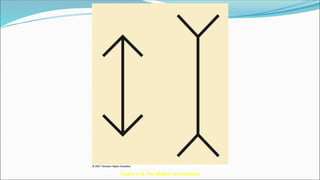
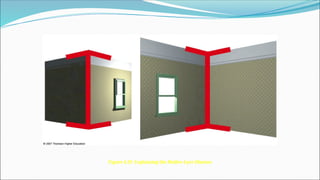
 Illusions of length is like the famous Muller-Lyer illusion is caused
on account of our interpretation of our angles at the ends od the
lines as perspective cues.
Figure 4.28 The Muller-Lyer illusion
Figure 4.29 Explaining the Muller-Lyer Illusion
Illusion cont’d
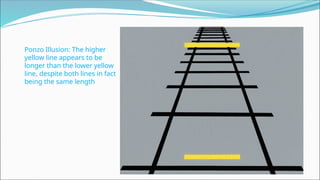
 Illusions of perspectives like famous ‘Ponzo illusion’ is caused on
account of misleading perspective cue.
 Other examples of illusions are: illusions of curvature; horizontal-
vertical illusions; illusions of movement; autokinetic illusion…..
Ponzo Illusion: The higher
yellow line appears to be
longer than the lower yellow
line, despite both lines in fact
being the same length.
Extra-Sensory Perception (ESP)
 1. EXTRA-SENSORY PERCEPTION
 2. Extra-sensory perception is so-called because it is perception
without the mediation of the senses. It includes clairvoyance,
psychokinesis, precognition and telepathy.
 3. 1. TELEPATHY - is thought transmission from one mind to
another.
 4. 2. CLAIRVOYANCE – is extrasensory awareness of objects.
 .
Extra-Sensory Perception (ESP)
 5. 3. PRECOGNITION – is foreknowledge of specific events without
any rational means.
 6. 4. PSYCHOKINESIS – includes mental operations that influences
a material body or an energy system as for example, influencing
the roll of a dice to go to a certain number merely by
concentrating hard on the number

LECT 7. SENSATION AND PERCEPTION.pptx

  • 1.
  • 2.
    SENSATION AND PERCEPTION Sensation refers to the process of sensing our environment through touch, taste, sight, sound, and smell.  Sensation  Process in which the sense organ’s receptor cells are stimulated and relay initial information to the brain for further processing Sensation requires transduction – which is the change of physical energy to neural energy  This information is sent to our brains in raw form where perception comes into play.
  • 3.
     Perception isthe way we interpret these sensations and therefore make sense of everything around us.  Perception can also be defined as the process by which organism selects and interprets sensory input so that it acquires meaning (Do something about it)  How do you study it?  Bottom Up: Stimuli to concept  Top Down: Concept to stimuli  Although intimately related, sensation and perception play two complimentary but different roles in how we interpret our world.
  • 4.
    SENSATION EXPLAINED  Sensationis the process by which our senses gather information and send it to the brain.  A large amount of information is being sensed at any one time such as room temperature, brightness of the lights, someone talking, a distant train, or the smell of perfume.
  • 5.
    Sensation cont’d  Withall this information coming into our senses, the majority of our world never gets recognized.  We don’t notice radio waves, x-rays, or the microscopic parasites crawling on our skin.  We don’t sense all the odors around us or taste every individual spice in our gourmet dinner.  We only sense those things we are able to since we don’t have the sense of smell like a bloodhound or the sense of sight like a hawk; our thresholds are different from these animals and often even from each other.
  • 6.
    Components in sensation 1.The absolute threshold is the point where something becomes noticeable to our senses.  It is the softest sound we can hear or the slightest touch we can feel. Anything less than this goes unnoticed.  The absolute threshold is therefore the point at which a stimuli goes from undetectable to detectable to our senses.
  • 7.
    Components in sensation Once a stimulus becomes detectable to us, how do we recognize if this stimulus changes.  When we notice the sound of the radio in the other room, how do we notice when it becomes louder.  It’s conceivable that someone could be turning it up so slightly that the difference is undetectable. 2. The difference threshold is the amount of change needed for us to recognize that a change has occurred.  This change is referred to as the Just Noticeable Difference.
  • 8.
    Sensation cont’d  Thisdifference is not absolute, however.  This theory, named after its original observer, is referred to as Weber’s Law.  The change required to detect a difference represents a percentage. 3. Signal detection theory implies making a determination as to what is important to sense and what is background noise.  This concept is referred to as signal detection because we attempt detect what we want to focus on and ignore or minimize everything else.
  • 9.
    Sensation cont’d  Thelast concept refers to stimuli which has become redundant or remains unchanged for an extended period of time.  Ever wonder why we notice certain smells or sounds right away and then after a while they fade into the background?  Once we adapt to the perfume or the ticking of the clock, we stop recognizing it.  4. This process of becoming less sensitive to unchanging stimulus is referred to as sensory adaptation, after all, if it doesn’t change, why do we need to constantly sense it?
  • 10.
    PERCEPTION  As mentionedin the introduction, perception refers to interpretation of what we take in through our senses.  The way we perceive our environment is what makes us different from other animals and different from each other.  In other words, perception is the process of how we make ‘sense’ of what we see, hear, taste, touch, and smell….
  • 11.
    Gestalt Principles ofGrouping  The German word “Gestalt” roughly translates to “whole” or “form,” and the Gestalt psychologist’s sincerely believed that the whole is greater than the sum of its parts.  In order to interpret what we receive through our senses, they theorized that we attempt to organize this information into certain groups.
  • 12.
    Gestalt Principles ofGrouping cont’d  This allows us to interpret the information completely without unneeded repetition.  For example, when you see one dot, you perceive it as such, but when you see five dots together, you group them together by saying a “row of dots.”  Without this tendency to group our perceptions, that same row would be seen as “dot, dot, dot, dot, dot,” taking both longer to process and reducing our perceptive ability.  The Gestalt principles of grouping include four types: similarity, proximity, continuity, and closure.
  • 13.
  • 14.
    Gestalt Principles ofGrouping cont’d  Similarity refers to our tendency to group things together based upon how similar to each other they are.  In the first figure above, we tend to see two rows of red dots and two rows of black dots. The dots are grouped according to similar color. In the next figure, we tend to perceive three columns of two lines each rather than six different lines. The lines are grouped together because of how close they are to each other, or their proximity to one another.
  • 15.
    Gestalt Principles ofGrouping cont’d  Continuity refers to our tendency to see patterns and therefore perceive things as belonging together if they form some type of continuous pattern.  In the third figure, although merely a series of dots, it begins to look like an “X” as we perceive the upper left side as continuing all the way to the lower right and the lower left all the way to the upper right.  Finally, in the fourth figure, we demonstrate closure, or our tendency to complete familiar objects that have gaps in them. Even at first glance, we perceive a circle and a square.
  • 16.
    Maintaining Perceptual Constancy Imagine if every time an object changed we had to completely reprocess it. The next time you walk toward a building, you would have to re-evaluate the size of the building with each step, because we all know as we get closer, everything gets bigger. The building which once stood only several inches is now somehow more than 50 feet tall.  Luckily, this doesn’t happen. Due to our ability to maintain constancy in our perceptions, we see that building as the same height no matter what distance it is. Perceptual constancy refers to our ability to see things differently without having to reinterpret the object’s properties. There are typically three constancies discussed, including size, shape, brightness.
  • 17.
    Maintaining Perceptual Constancycont’d  Size constancy refers to our ability to see objects as maintaining the same size even when our distance from them makes things appear larger or smaller.  This holds true for all of our senses. As we walk away from our radio, the song appears to get softer.  We understand, and perceive it as being just as loud as before.  The difference being our distance from what we are sensing.
  • 18.
    Maintaining Perceptual Constancycont’d  Everybody has seen a plate shaped in the form of a circle.  When we see that same plate from an angle, however, it looks more like an ellipse.  Shape constancy allows us to perceive a circle as a plate as still being a circle even though the angle from which we view it appears to distort the shape.
  • 19.
    Maintaining Perceptual Constancycont’d  Brightness constancy refers to our ability to recognize that color remains the same regardless of how it looks under different levels of light.  That deep blue shirt you wore to the beach suddenly looks black when you walk indoors.  Without color constancy, we would be constantly re-interpreting color and would be amazed at the miraculous conversion our clothes undertake.
  • 20.
    Perceiving Distance  Wedetermine distance using two different cues: monocular and binocular.  Monocular cues are those cues which can be seen using only one eye. They include size; texture, overlap, shading, height, and clarity.  Size refers to the fact that larger images are perceived as closer to us, especially if the two images are of the same object.  The texture of objects tend to become smoother as the object gets farther away, suggesting that more detailed textured objects are closer.
  • 21.
    Perceiving Distance cont’d Due to overlap, those objects covering part of another object is perceived as closer.  The shading or shadows of objects can give a clue to their distance, allowing closer objects to cast longer shadows which will overlap objects which are farther away
  • 22.
    Perceiving Distance cont’d Objects which are closer to the bottom of our visual field are seen as closer to us due to our perception of the horizon, where higher (height) means farther away.  Similar to texture, objects tend to get blurry as they get farther away, therefore, clearer or more crisp images tend to be perceived as closer (clarity).
  • 23.
    Figure 8.6 Atexture gradient in Death Valley, California. •Texture gradient - elements are more closely packed as distance increases
  • 24.
    Perceiving Distance cont’d Binocular cues refer to those depth cues in which both eyes are needed to perceive.  There are two important binocular cues; convergence and retinal disparity.  Convergence refers to the fact that the closer an object, the more inward our eyes need to turn in order to focus.  The further our eyes converge, the closer an object appears to be.  Since our eyes see two images which are then sent to our brains for interpretation, the distance between these two images, or their retinal disparity, provides another cue regarding the distance of the object.
  • 26.
  • 27.
    Figure–ground Perception cont’d Figure–ground organization is a type of perceptual grouping which is a vital necessity for recognizing objects through vision.  In Gestalt psychology it is known as identifying a figure from the background.  For example, you see words on a printed paper as the "figure" and the white sheet as the "background
  • 28.
    Figure–ground Perception cont’d The most famous example of figure–ground perception is probably the faces–vase drawing that Danish psychologist Edgar Rubin described.  This drawing exemplifies one of the key aspects of figure–ground organization, edge-assignment and its effect on shape perception.  Notice in the faces/vase drawing, the perceived shape depends critically on the direction in which the border (edge) between the black and white regions is assigned.
  • 29.
    Figure–ground Perception cont’d If the two curvy edges between the black and white regions are assigned inward then the central white region is seen as a vase shape in front of a black background.  No faces are perceived in this case.  On the other hand, if the edges are assigned outwards, then the two black profile faces are perceived on a white background and no vase shape is perceived.
  • 30.
    Figure–ground Perception cont’d The human visual system will then settle on either of the interpretations of the Rubin vase and alternate between them.  Functional brain imaging shows that when people see the Rubin image as a face, there is activity in the temporal lobe, specifically in the face-selective region
  • 31.
    Illusion  Perceptual illusionsrepresent gross misjudgment of false perception of the sensory information.  Illusions of size provide false information of the size of the objects. It is caused on account of the change in the frame of reference or background.  Illusions of length is like the famous Muller-Lyer illusion is caused on account of our interpretation of our angles at the ends od the lines as perspective cues.
  • 32.
    Figure 4.28 TheMuller-Lyer illusion
  • 33.
    Figure 4.29 Explainingthe Muller-Lyer Illusion
  • 34.
    Illusion cont’d  Illusionsof perspectives like famous ‘Ponzo illusion’ is caused on account of misleading perspective cue.  Other examples of illusions are: illusions of curvature; horizontal- vertical illusions; illusions of movement; autokinetic illusion…..
  • 35.
    Ponzo Illusion: Thehigher yellow line appears to be longer than the lower yellow line, despite both lines in fact being the same length.
  • 36.
    Extra-Sensory Perception (ESP) 1. EXTRA-SENSORY PERCEPTION  2. Extra-sensory perception is so-called because it is perception without the mediation of the senses. It includes clairvoyance, psychokinesis, precognition and telepathy.  3. 1. TELEPATHY - is thought transmission from one mind to another.  4. 2. CLAIRVOYANCE – is extrasensory awareness of objects.  .
  • 37.
    Extra-Sensory Perception (ESP) 5. 3. PRECOGNITION – is foreknowledge of specific events without any rational means.  6. 4. PSYCHOKINESIS – includes mental operations that influences a material body or an energy system as for example, influencing the roll of a dice to go to a certain number merely by concentrating hard on the number