Statement of
Changes in
Equity
What is the Statement
of Changes in Equity
(SoCE)?
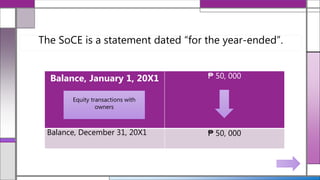
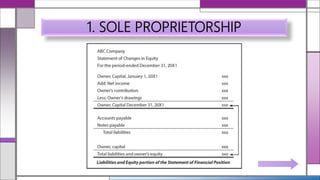
The SoCE is a statement dated “for the year-ended”.
Balance, January 1, 20X1 ₱ 50, 000
Balance, December 31, 20X1 ₱ 50, 000
Equity transactions with
owners
 The report shows a reconciliation of the
beginning and ending balances of the equity
accounts.
 It summarizes the equity transactions
with the owners of the business that occurred
during the year.
1. SOLE PROPRIETORSHIP
 The simplest form of a business organization.
 There is only one owner referred to as sole
proprietor, who oftentimes also acts as the manager.
 The business has no legal personality separate from
its owner, meaning the business and the owner is
one entity in the eyes of the law.
In Sole proprietorship,
The business and the owner are taxed as
one. Also, the claim of the creditors of the business
extends to the personal assets of the owner. As a
result, raising capital for the business is constrained
to the owner’s resources and credit standing.
2. PARTNERSHIP
 It is a business owned by two or more owners called
partners, who pool their resources together such as money,
property, and industry, to operate a business and divide the
profit among themselves.
 Partners are generally involved in the management of the
business.
 The agreement of the partners is stated in the contract of
partnership. Most importantly, it emphasizes the partners’
profit and loss sharing.
In Partnership,
it has a legal personality separate from its
owners. It is taxed separately from the partners except
for those formed for the practice of the profession of
the partners (i.e. lawyers, accountants, etc.). However,
the claims of the partnership creditors may extend to
the partners’ personal assets.
3. CORPORATION
• It is the most complex form of business organization.
• It is owned by many owners called stockholders or
shareholders.
• Ownership is divided into common stocks or shares of stocks.
One shareholder can own many stocks.
• One of its characteristics is the separation of ownership and
management. Shareholders invest their funds but are not
normally involved in the day-to day-operations. Rather, the
corporation is managed by professional managers.
In Corporation,
Each stock is normally entitled to one vote. A
stockholder that owns 1,000 stocks has 1,000 votes.
Therefore, the stockholder that owns 50% +1 of the total
stock outstanding can control the corporation. Rules that
govern the management of the corporation are written in
the Articles of Incorporation and By-Laws.
Preparation
of
SoCE
1. SOLE PROPRIETORSHIP
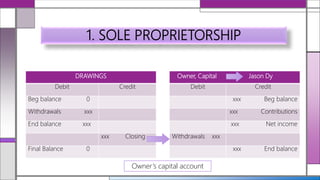
DRAWINGS
Debit Credit
Beg balance 0
Withdrawals xxx
End balance xxx
xxx Closing
Final Balance 0
Owner, Capital Jason Dy
Debit Credit
xxx Beg balance
xxx Contributions
xxx Net income
Withdrawals xxx
xxx End balance
Owner’s capital account
1. SOLE PROPRIETORSHIP
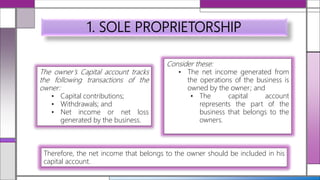
Consider these:
• The net income generated from
the operations of the business is
owned by the owner; and
• The capital account
represents the part of the
business that belongs to the
owners.
The owner’s Capital account tracks
the following transactions of the
owner:
• Capital contributions;
• Withdrawals; and
• Net income or net loss
generated by the business.
Therefore, the net income that belongs to the owner should be included in his
capital account.
1. SOLE PROPRIETORSHIP
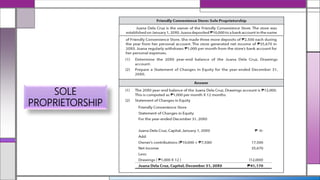
SOLE
PROPRIETORSHIP
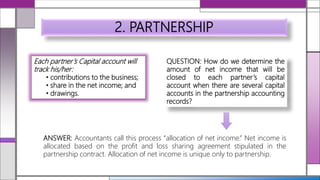
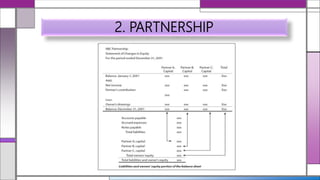
2. PARTNERSHIP
Each partner’s Capital account will
track his/her:
• contributions to the business;
• share in the net income; and
• drawings.
ANSWER: Accountants call this process “allocation of net income.” Net income is
allocated based on the profit and loss sharing agreement stipulated in the
partnership contract. Allocation of net income is unique only to partnership.
QUESTION: How do we determine the
amount of net income that will be
closed to each partner’s capital
account when there are several capital
accounts in the partnership accounting
records?
2. PARTNERSHIP
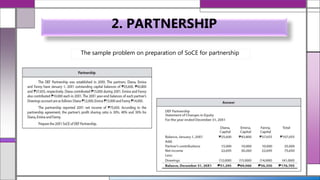
The sample problem on preparation of SoCE for partnership
2. PARTNERSHIP
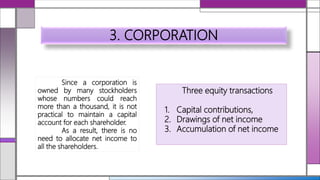
3. CORPORATION
Since a corporation is
owned by many stockholders
whose numbers could reach
more than a thousand, it is not
practical to maintain a capital
account for each shareholder.
As a result, there is no
need to allocate net income to
all the shareholders.
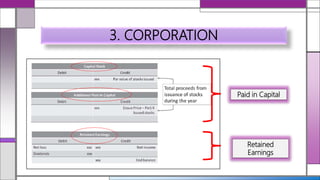
Three equity transactions
1. Capital contributions,
2. Drawings of net income
3. Accumulation of net income
3. CORPORATION
Paid in Capital
Retained
Earnings
Paid in Capital
The amount of contribution that was given or will be
given to the corporation in exchange for its common
stocks. It is composed of capital stock and additional paid
in capital
The balance of Capital Stock reflects the par value of
the issued common shares. Par value is the minimum
price by which corporations can issue stocks to
shareholders. However, corporations generally issue
stocks in exchange for an amount greater than par.
The excess of the issue price over the par is reported
as Additional Paid-In Capital.
3. CORPORATION
Retained
Earnings
The second half of the stockholders’ equity is the
Retained Earnings (This account reports the
undistributed earnings of the corporation.
The balance of retained earnings is computed as
follows: net income minus net losses and dividends from
the date of incorporation up to the cut-off or date of SFP.
Dividends are distributions to stockholders, similar to
owners’ drawings in sole proprietorship and partnership.
Dividends are deducted from retained earnings because
dividends are taken from income generated by the
corporation.
3. CORPORATION
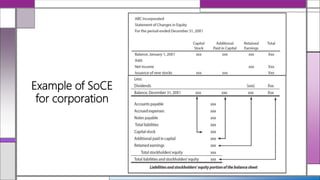
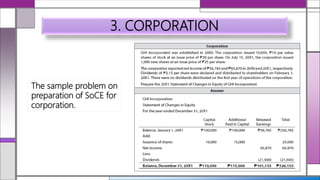
Example of SoCE
for corporation
The sample problem on
preparation of SoCE for
corporation.
3. CORPORATION
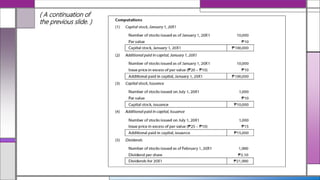
( A continuation of
the previous slide. )
Statement of Changes in Equity

Statement of Changes in Equity

  • 1.
  • 2.
    What is theStatement of Changes in Equity (SoCE)?
  • 3.
    The SoCE isa statement dated “for the year-ended”. Balance, January 1, 20X1 ₱ 50, 000 Balance, December 31, 20X1 ₱ 50, 000 Equity transactions with owners
  • 4.
     The reportshows a reconciliation of the beginning and ending balances of the equity accounts.  It summarizes the equity transactions with the owners of the business that occurred during the year.
  • 6.
    1. SOLE PROPRIETORSHIP The simplest form of a business organization.  There is only one owner referred to as sole proprietor, who oftentimes also acts as the manager.  The business has no legal personality separate from its owner, meaning the business and the owner is one entity in the eyes of the law.
  • 7.
    In Sole proprietorship, Thebusiness and the owner are taxed as one. Also, the claim of the creditors of the business extends to the personal assets of the owner. As a result, raising capital for the business is constrained to the owner’s resources and credit standing.
  • 8.
    2. PARTNERSHIP  Itis a business owned by two or more owners called partners, who pool their resources together such as money, property, and industry, to operate a business and divide the profit among themselves.  Partners are generally involved in the management of the business.  The agreement of the partners is stated in the contract of partnership. Most importantly, it emphasizes the partners’ profit and loss sharing.
  • 9.
    In Partnership, it hasa legal personality separate from its owners. It is taxed separately from the partners except for those formed for the practice of the profession of the partners (i.e. lawyers, accountants, etc.). However, the claims of the partnership creditors may extend to the partners’ personal assets.
  • 10.
    3. CORPORATION • Itis the most complex form of business organization. • It is owned by many owners called stockholders or shareholders. • Ownership is divided into common stocks or shares of stocks. One shareholder can own many stocks. • One of its characteristics is the separation of ownership and management. Shareholders invest their funds but are not normally involved in the day-to day-operations. Rather, the corporation is managed by professional managers.
  • 11.
    In Corporation, Each stockis normally entitled to one vote. A stockholder that owns 1,000 stocks has 1,000 votes. Therefore, the stockholder that owns 50% +1 of the total stock outstanding can control the corporation. Rules that govern the management of the corporation are written in the Articles of Incorporation and By-Laws.
  • 12.
  • 13.
    1. SOLE PROPRIETORSHIP DRAWINGS DebitCredit Beg balance 0 Withdrawals xxx End balance xxx xxx Closing Final Balance 0 Owner, Capital Jason Dy Debit Credit xxx Beg balance xxx Contributions xxx Net income Withdrawals xxx xxx End balance Owner’s capital account
  • 14.
    1. SOLE PROPRIETORSHIP Considerthese: • The net income generated from the operations of the business is owned by the owner; and • The capital account represents the part of the business that belongs to the owners. The owner’s Capital account tracks the following transactions of the owner: • Capital contributions; • Withdrawals; and • Net income or net loss generated by the business. Therefore, the net income that belongs to the owner should be included in his capital account.
  • 15.
  • 16.
  • 17.
    2. PARTNERSHIP Each partner’sCapital account will track his/her: • contributions to the business; • share in the net income; and • drawings. ANSWER: Accountants call this process “allocation of net income.” Net income is allocated based on the profit and loss sharing agreement stipulated in the partnership contract. Allocation of net income is unique only to partnership. QUESTION: How do we determine the amount of net income that will be closed to each partner’s capital account when there are several capital accounts in the partnership accounting records?
  • 18.
  • 19.
    The sample problemon preparation of SoCE for partnership 2. PARTNERSHIP
  • 20.
    3. CORPORATION Since acorporation is owned by many stockholders whose numbers could reach more than a thousand, it is not practical to maintain a capital account for each shareholder. As a result, there is no need to allocate net income to all the shareholders. Three equity transactions 1. Capital contributions, 2. Drawings of net income 3. Accumulation of net income
  • 21.
    3. CORPORATION Paid inCapital Retained Earnings
  • 22.
    Paid in Capital Theamount of contribution that was given or will be given to the corporation in exchange for its common stocks. It is composed of capital stock and additional paid in capital The balance of Capital Stock reflects the par value of the issued common shares. Par value is the minimum price by which corporations can issue stocks to shareholders. However, corporations generally issue stocks in exchange for an amount greater than par. The excess of the issue price over the par is reported as Additional Paid-In Capital. 3. CORPORATION
  • 23.
    Retained Earnings The second halfof the stockholders’ equity is the Retained Earnings (This account reports the undistributed earnings of the corporation. The balance of retained earnings is computed as follows: net income minus net losses and dividends from the date of incorporation up to the cut-off or date of SFP. Dividends are distributions to stockholders, similar to owners’ drawings in sole proprietorship and partnership. Dividends are deducted from retained earnings because dividends are taken from income generated by the corporation. 3. CORPORATION
  • 24.
  • 25.
    The sample problemon preparation of SoCE for corporation. 3. CORPORATION
  • 26.
    ( A continuationof the previous slide. )
  • 27.