Consistency proof of a feasible arithmetic inside a bounded arithmetic 
Consistency proof of a feasible arithmetic 
inside a bounded arithmetic 
Yoriyuki Yamagata 
Sendai Logic Seminar, Oct. 31, 2014
Consistency proof of a feasible arithmetic inside a bounded arithmetic 
Motivation 
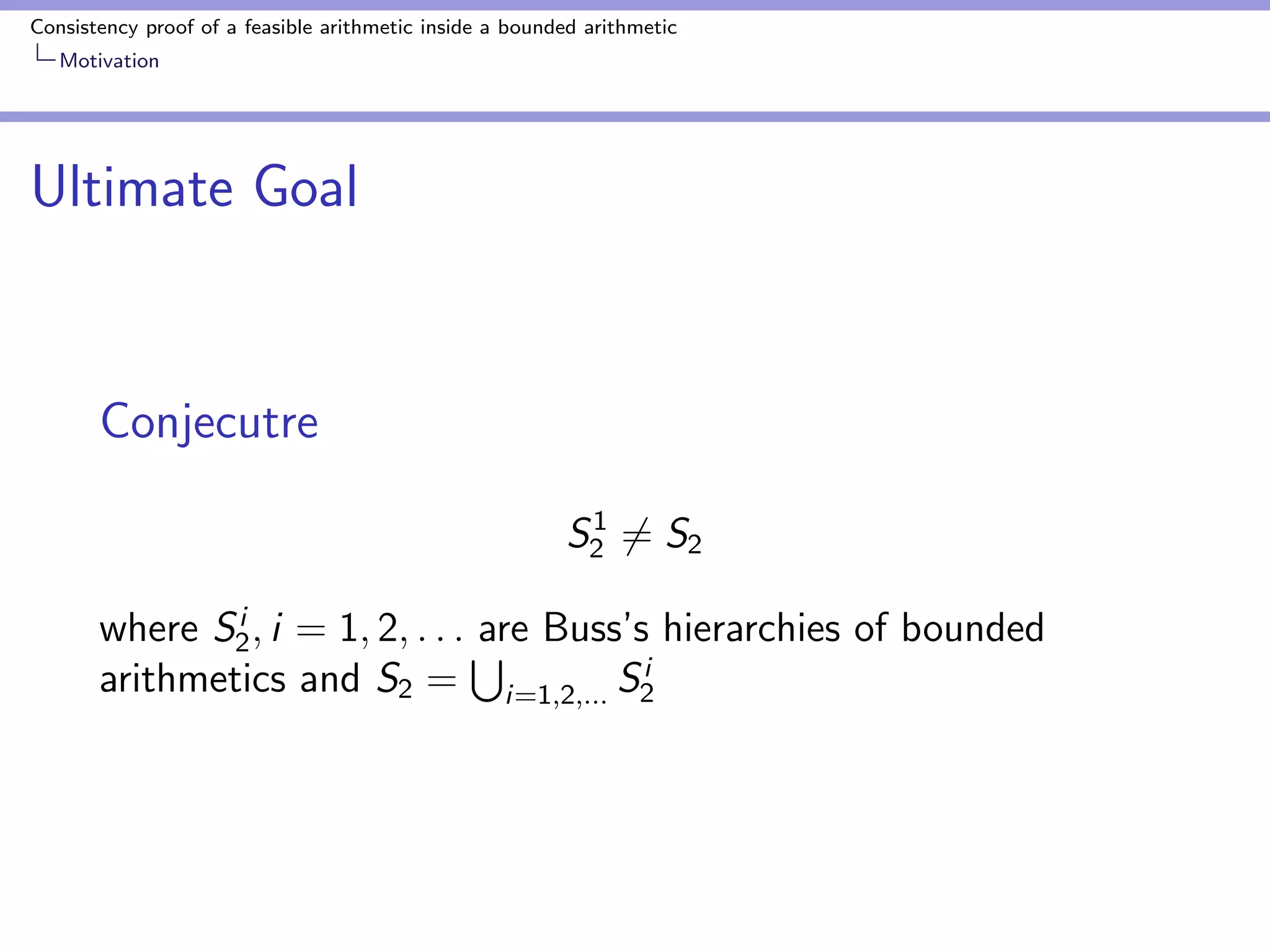
Ultimate Goal 
Conjecutre 
S1 
26= S2 
where Si2 
; i = 1; 2; : : : are Buss's hierarchies of bounded 
arithmetics and S2 = 
S 
i=1;2;::: Si2
Consistency proof of a feasible arithmetic inside a bounded arithmetic 
Motivation 
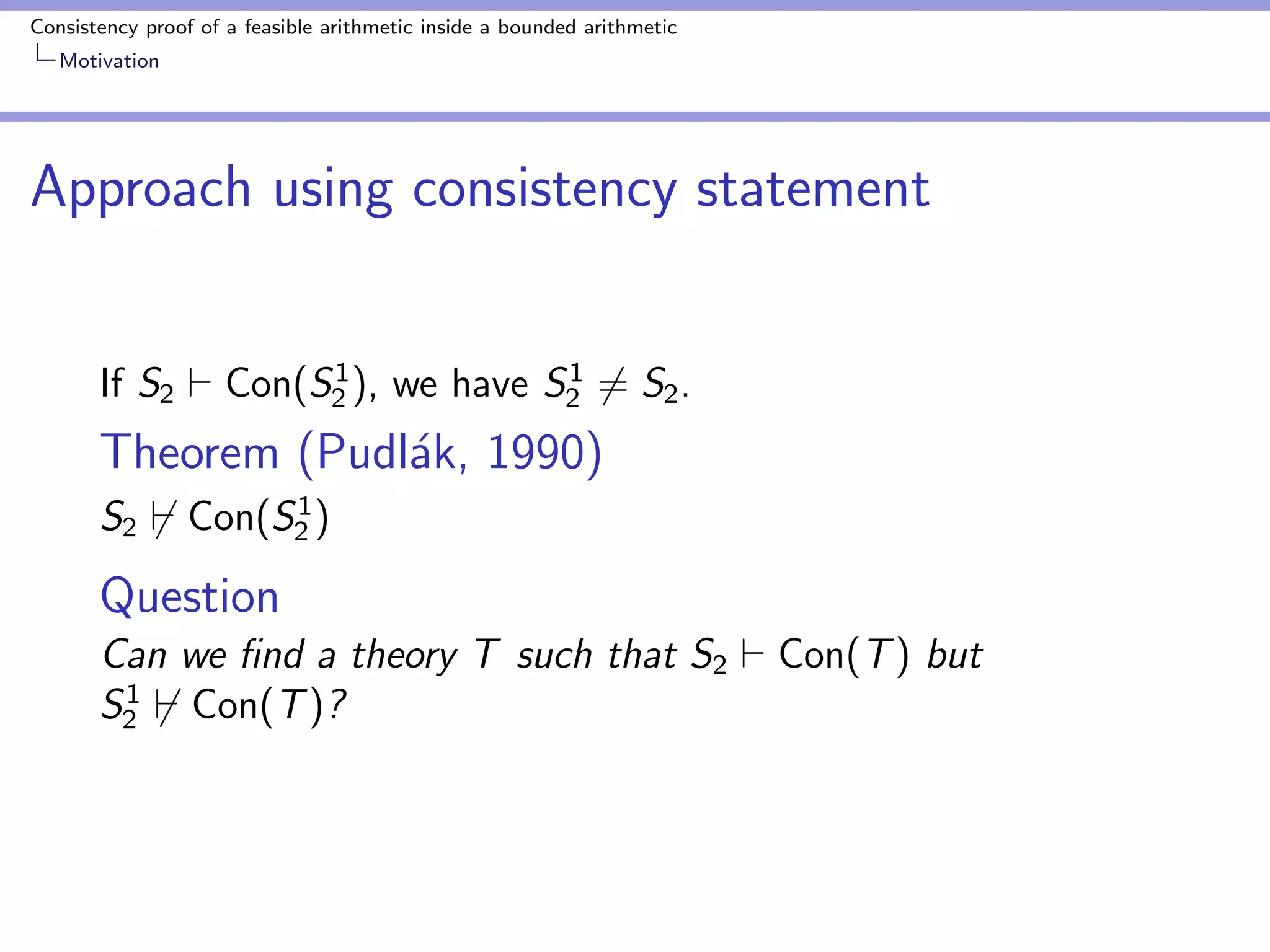
Approach using consistency statement 
If S2 ` Con(S1 
2 ), we have S1 
26= S2. 
Theorem (Pudlak, 1990) 
S26` Con(S1 
2 ) 
Question 
Can we
nd a theory T such that S2 ` Con(T) but 
S1 
26` Con(T)?
Consistency proof of a feasible arithmetic inside a bounded arithmetic 
Motivation 
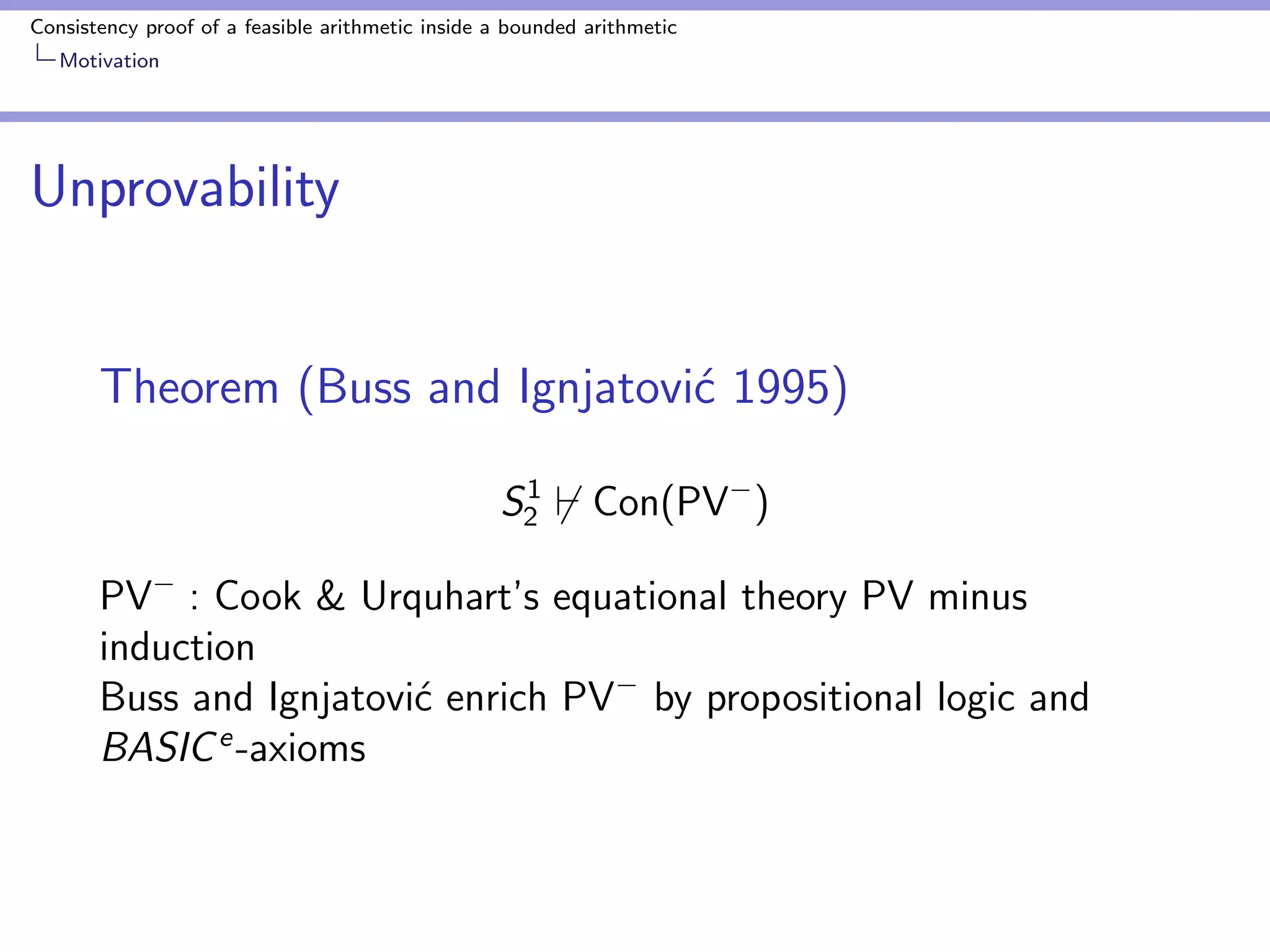
Unprovability 
Theorem (Buss and Ignjatovic 1995) 
S1 
26` Con(PV) 
PV : Cook  Urquhart's equational theory PV minus 
induction 
Buss and Ignjatovic enrich PV by propositional logic and 
BASICe-axioms
Consistency proof of a feasible arithmetic inside a bounded arithmetic 
Motivation 
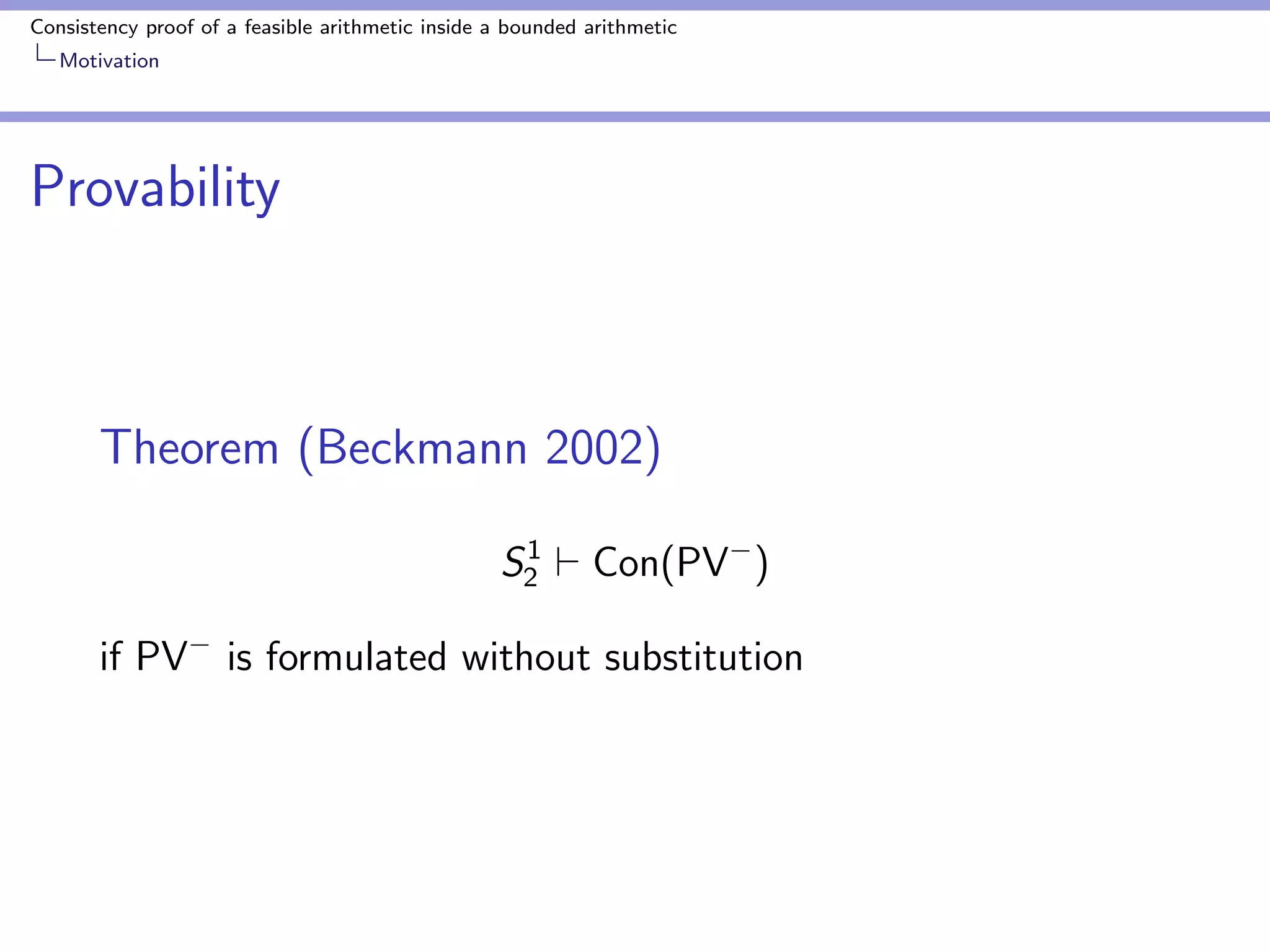
Provability 
Theorem (Beckmann 2002) 
S1 
2 ` Con(PV) 
if PV is formulated without substitution
Consistency proof of a feasible arithmetic inside a bounded arithmetic 
Main results 
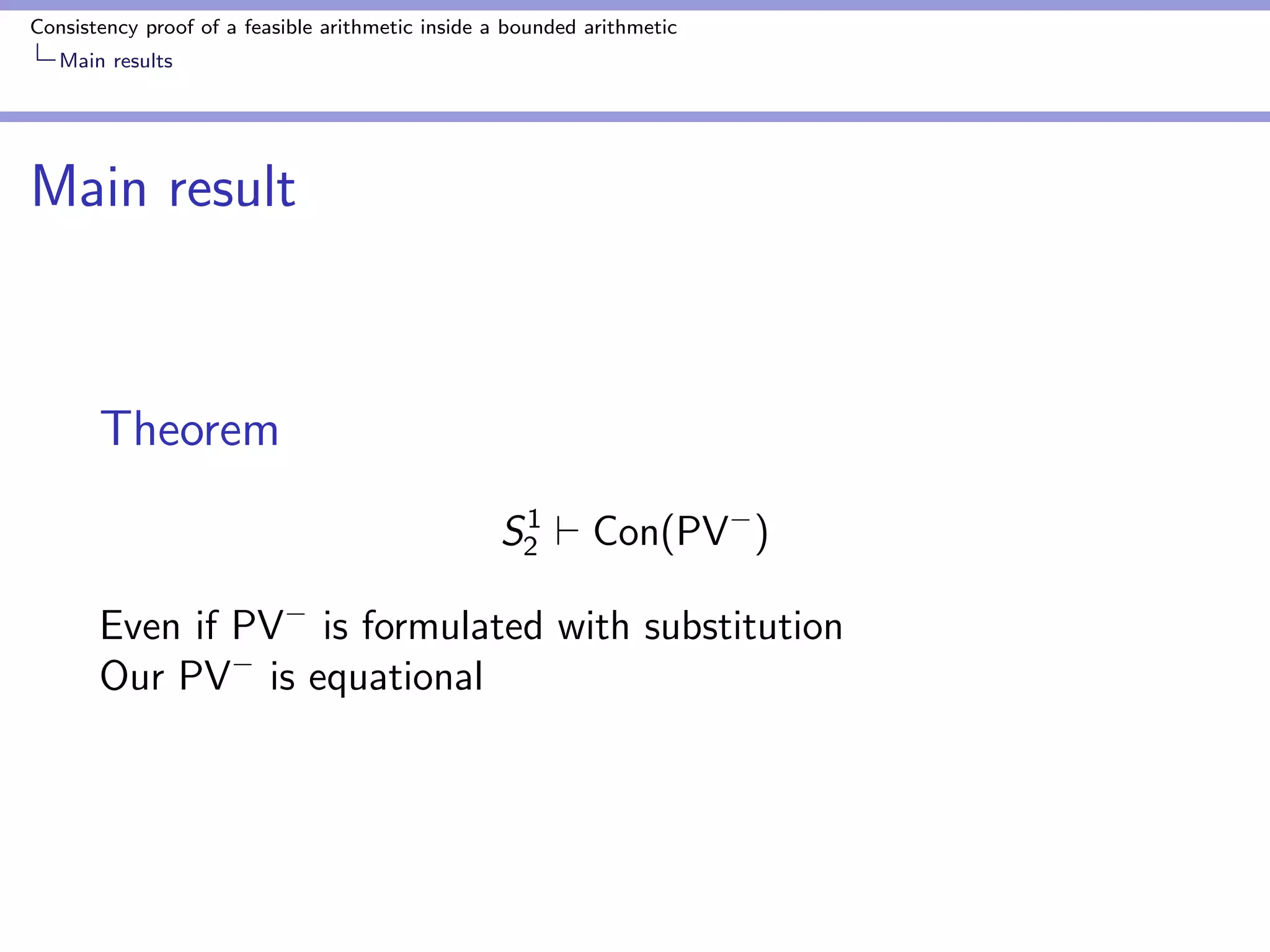
Main result 
Theorem 
S1 
2 ` Con(PV) 
Even if PV is formulated with substitution 
Our PV is equational
Consistency proof of a feasible arithmetic inside a bounded arithmetic 
Consistency of PV-Soundness 
theorem 
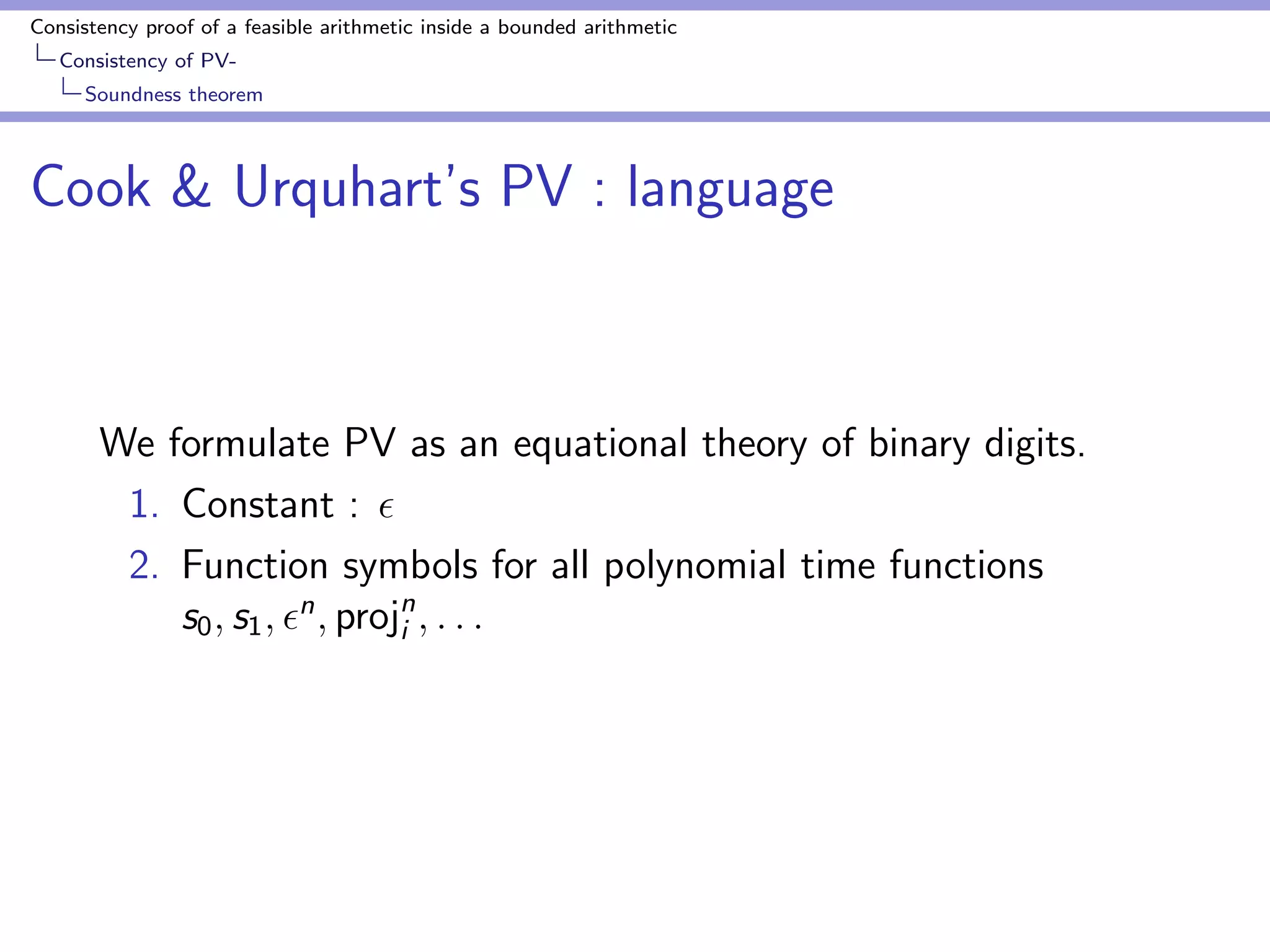
Cook  Urquhart's PV : language 
We formulate PV as an equational theory of binary digits. 
1. Constant :  
2. Function symbols for all polynomial time functions 
s0; s1; n; projni 
; : : :
Consistency proof of a feasible arithmetic inside a bounded arithmetic 
Consistency of PV-Soundness 
theorem 
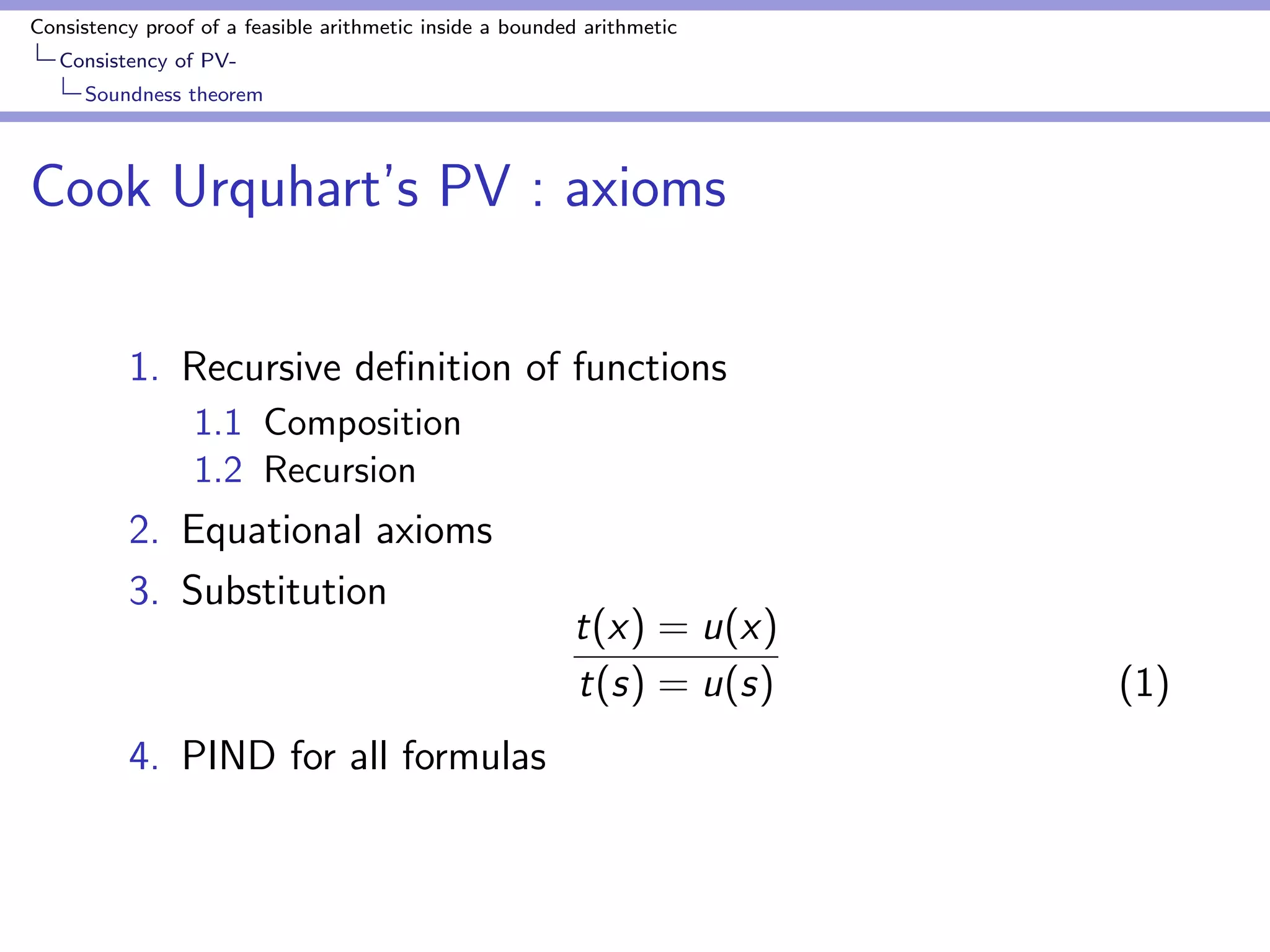
Cook Urquhart's PV : axioms 
1. Recursive de
nition of functions 
1.1 Composition 
1.2 Recursion 
2. Equational axioms 
3. Substitution 
t(x) = u(x) 
t(s) = u(s) (1) 
4. PIND for all formulas
Consistency proof of a feasible arithmetic inside a bounded arithmetic 
Consistency of PV-Soundness 
theorem 
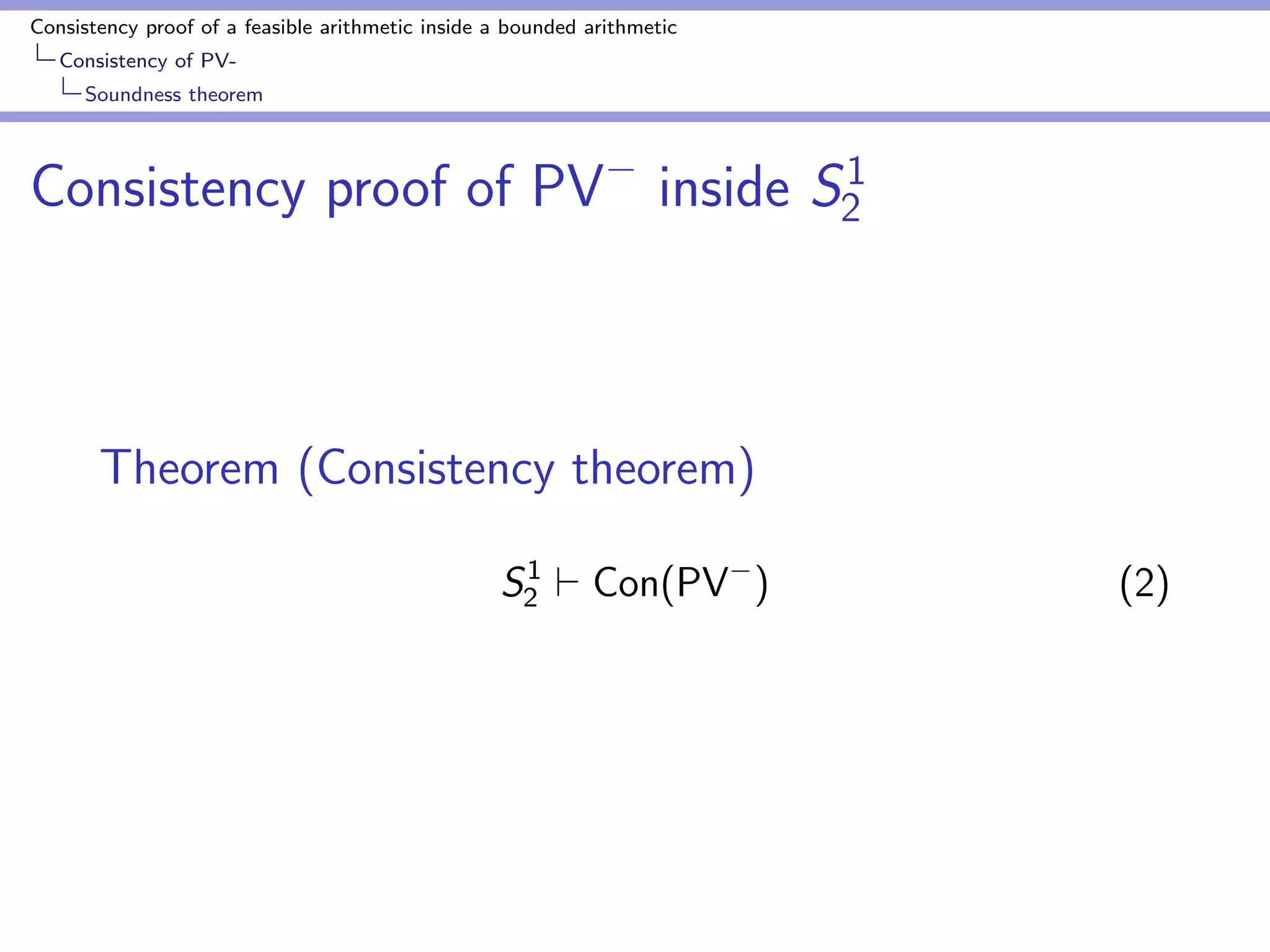
Consistency proof of PV inside S1 
2 
Theorem (Consistency theorem) 
S1 
2 ` Con(PV) (2)
Consistency proof of a feasible arithmetic inside a bounded arithmetic 
Consistency of PV-Soundness 
theorem 
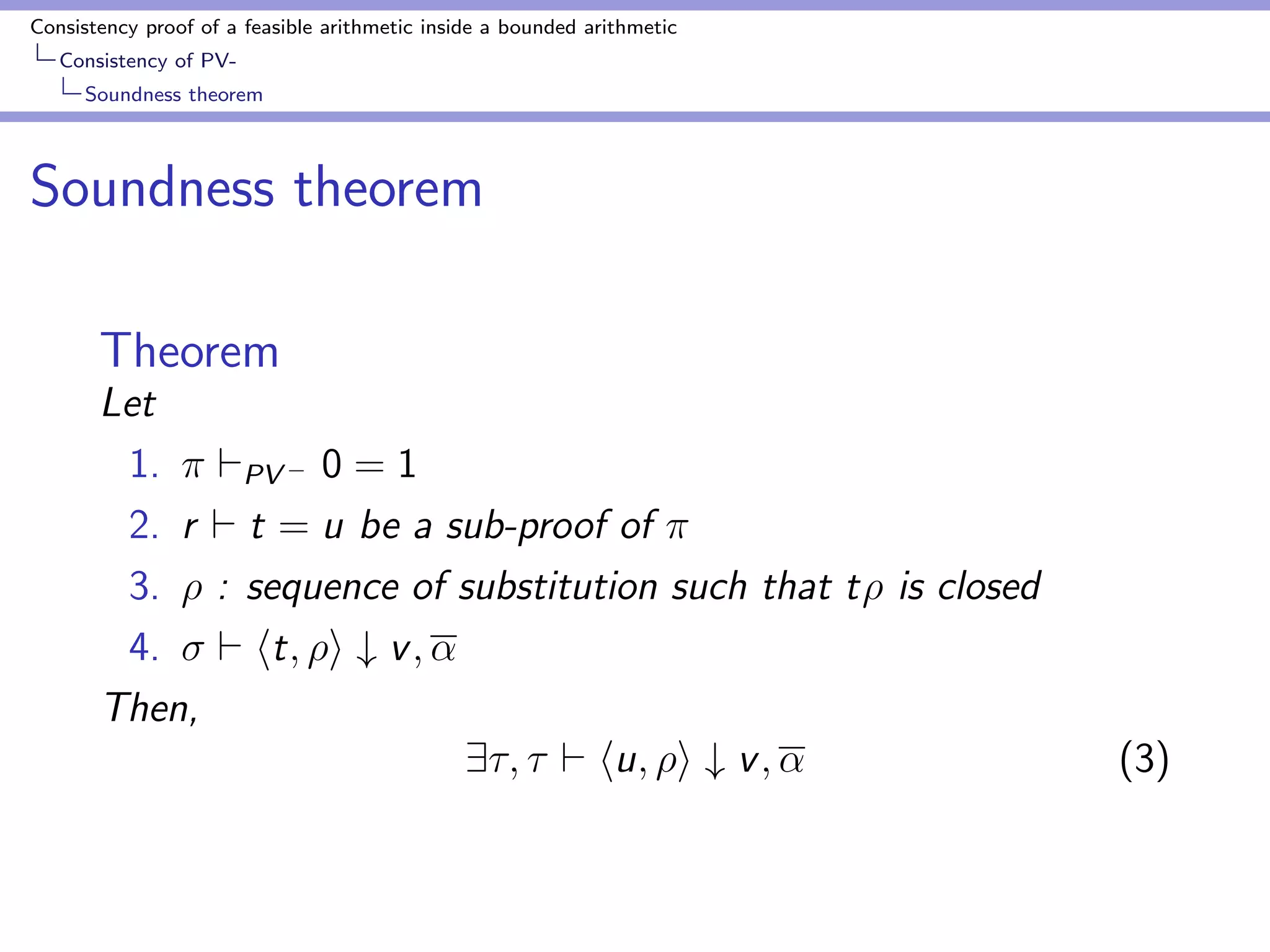
Soundness theorem 
Theorem 
Let 
1.  `PV 0 = 1 
2. r ` t = u be a sub-proof of  
3.  : sequence of substitution such that t is closed 
4.  ` ht; i # v;  
Then, 
9;  ` hu; i # v;  (3)
Consistency proof of a feasible arithmetic inside a bounded arithmetic 
Consistency of PV-Soundness 
theorem 
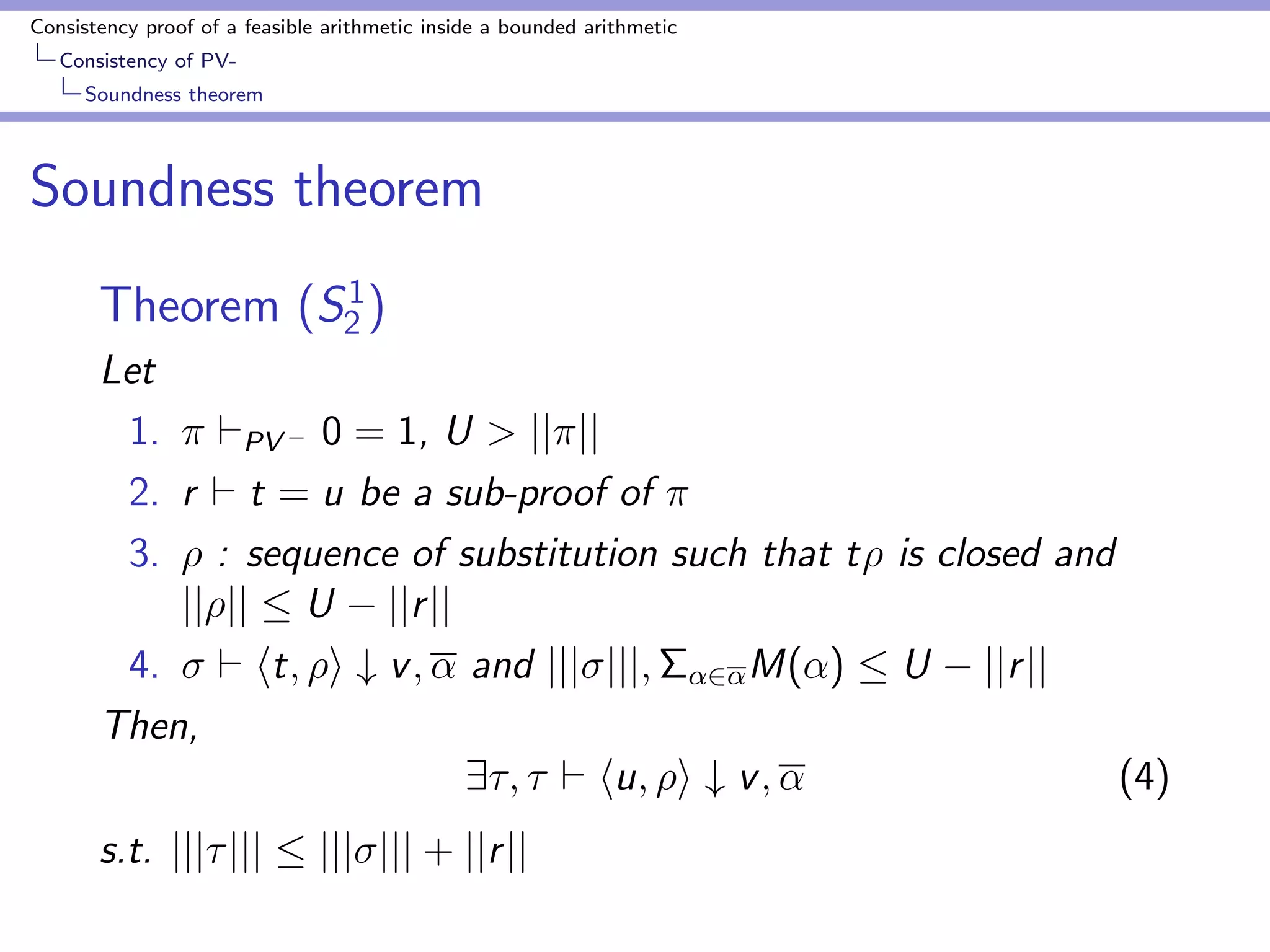
Soundness theorem 
Theorem (S1 
2 ) 
Let 
1.  `PV 0 = 1, U  jjjj 
2. r ` t = u be a sub-proof of  
3.  : sequence of substitution such that t is closed and 
jjjj  U  jjr jj 
4.  ` ht; i # v;  and jjjjjj;2M()  U  jjr jj 
Then, 
9;  ` hu; i # v;  (4) 
s.t. jjj jjj  jjjjjj + jjr jj
Consistency proof of a feasible arithmetic inside a bounded arithmetic 
Consistency of PV-Soundness 
theorem 
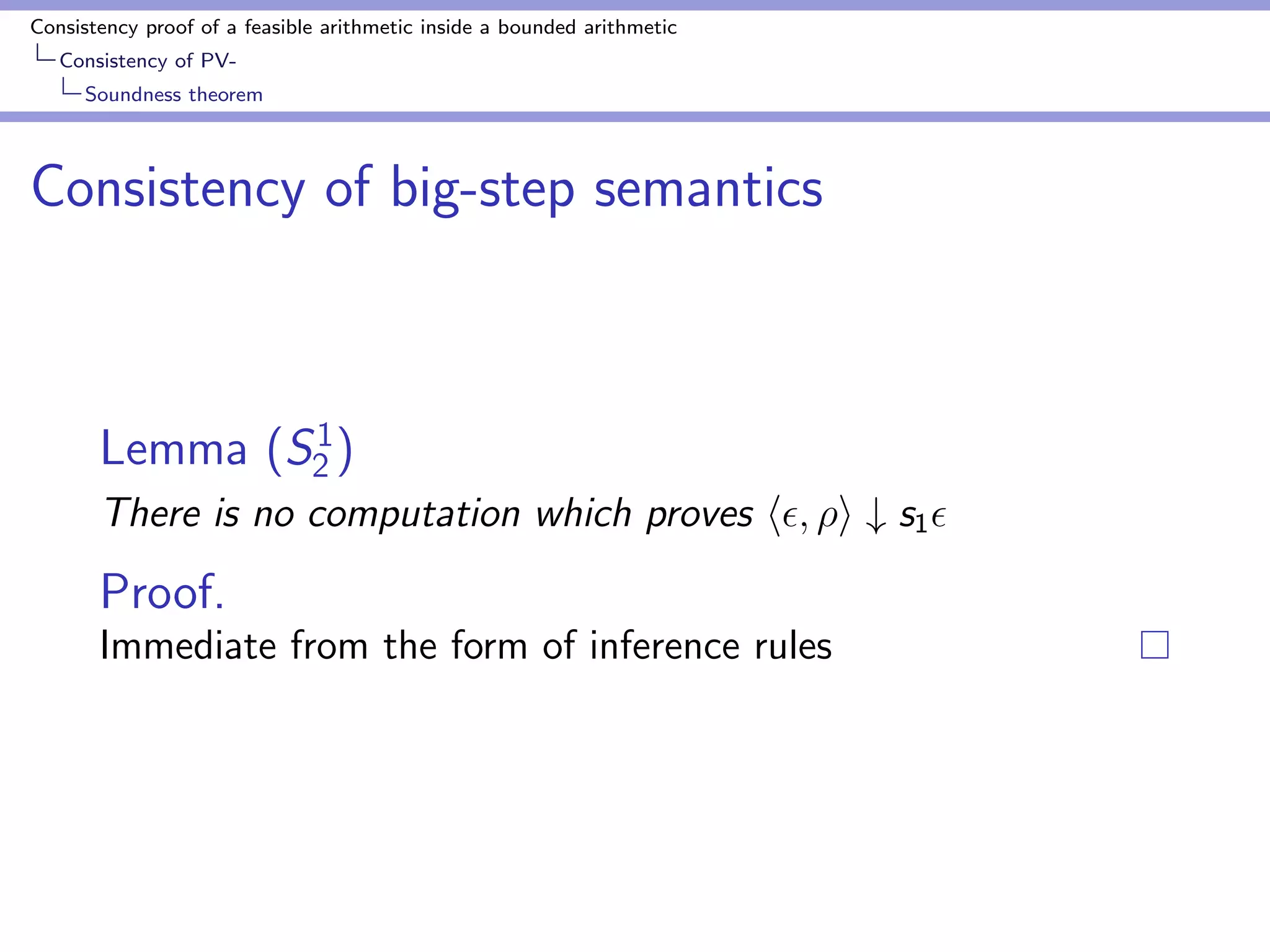
Consistency of big-step semantics 
Lemma (S1 
2 ) 
There is no computation which proves h; i # s1 
Proof. 
Immediate from the form of inference rules
Consistency proof of a feasible arithmetic inside a bounded arithmetic 
Consistency of PV-Big- 
step semantics 
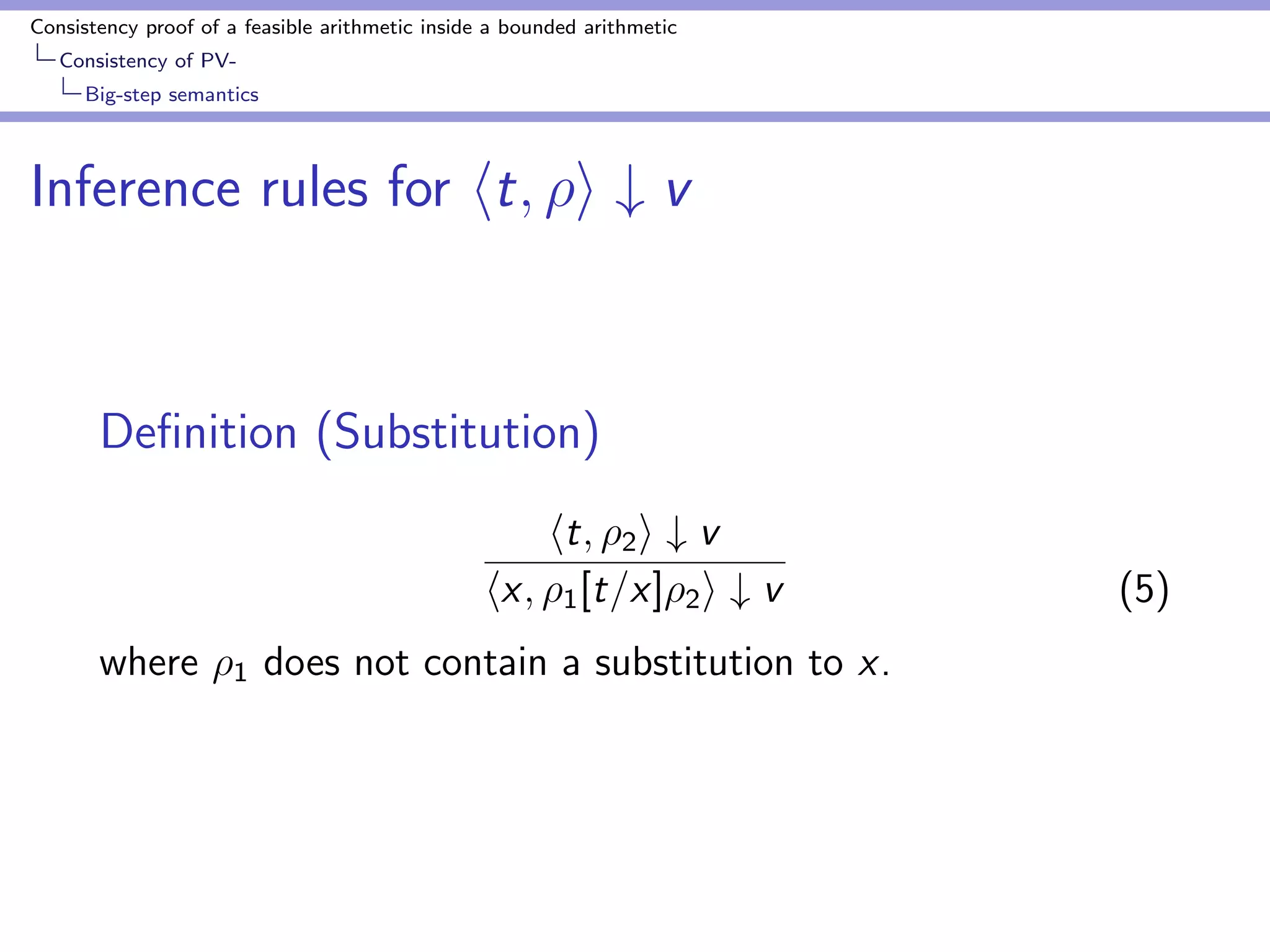
Inference rules for ht; i # v 
De
nition (Substitution) 
ht; 2i # v 
hx; 1[t=x]2i # v (5) 
where 1 does not contain a substitution to x.
Consistency proof of a feasible arithmetic inside a bounded arithmetic 
Consistency of PV-Big- 
step semantics 
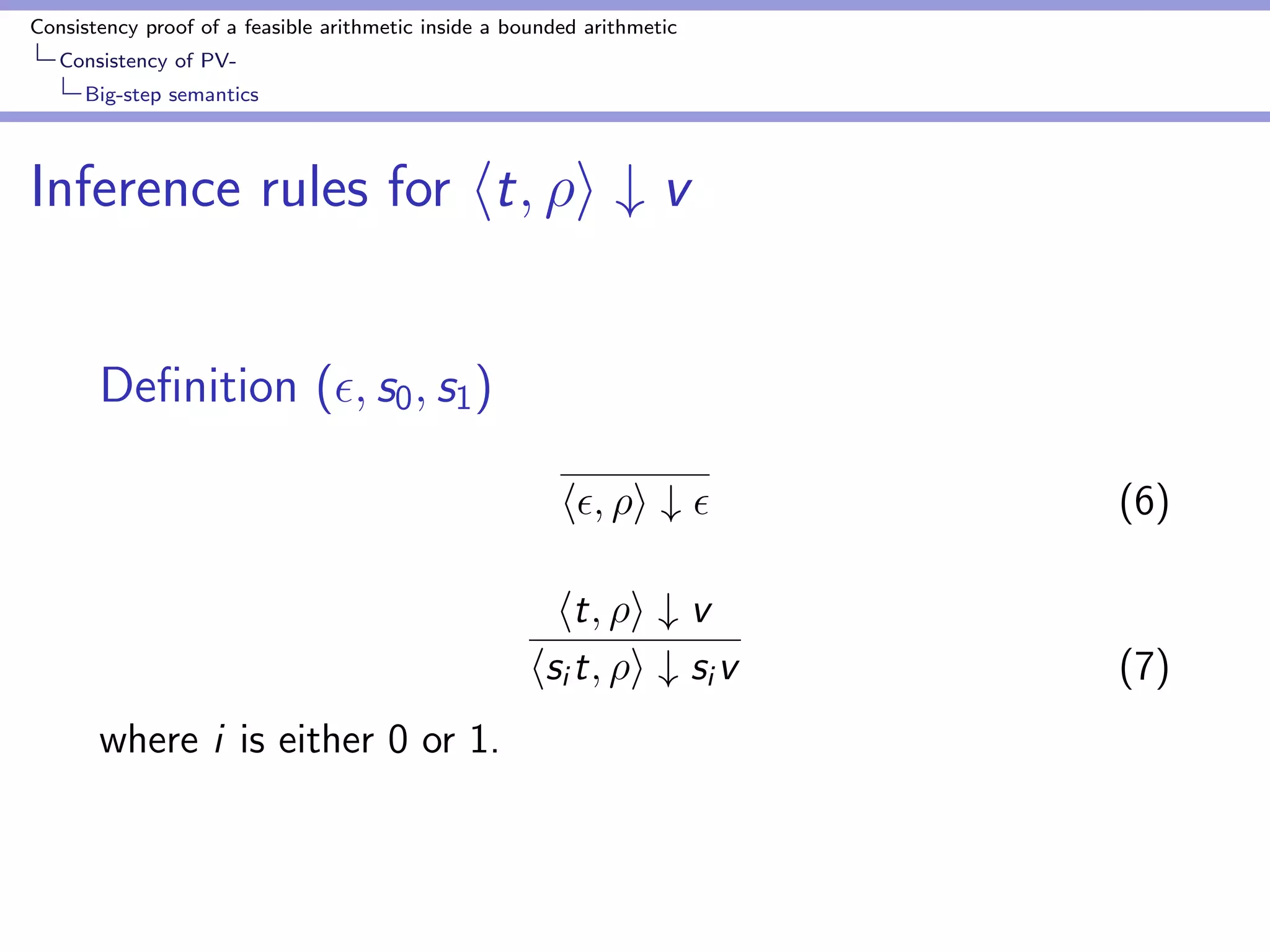
Inference rules for ht; i # v 
De
nition (; s0; s1) 
h; i #  (6) 
ht; i # v 
hsi t; i # siv (7) 
where i is either 0 or 1.
Consistency proof of a feasible arithmetic inside a bounded arithmetic 
Consistency of PV-Big- 
step semantics 
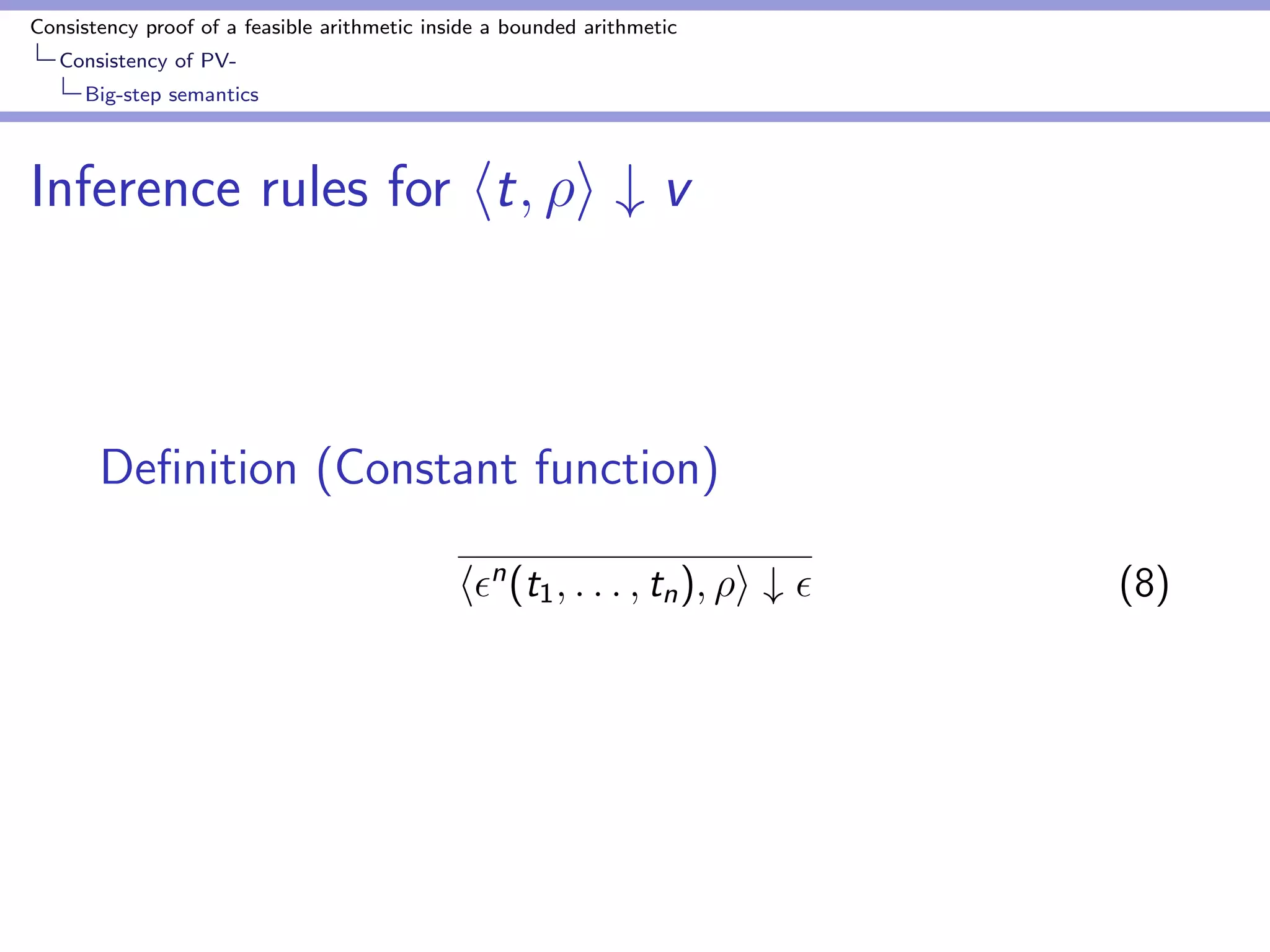
Inference rules for ht; i # v 
De
nition (Constant function) 
hn(t1; : : : ; tn); i #  (8)
Consistency proof of a feasible arithmetic inside a bounded arithmetic 
Consistency of PV-Big- 
step semantics 
Inference rules for ht; i # v 
De
nition (Projection) 
hti ; i # vi 
hprojni 
(t1; : : : ; tn); i # vi (9) 
for i = 1;    ; n.
Consistency proof of a feasible arithmetic inside a bounded arithmetic 
Consistency of PV-Big- 
step semantics 
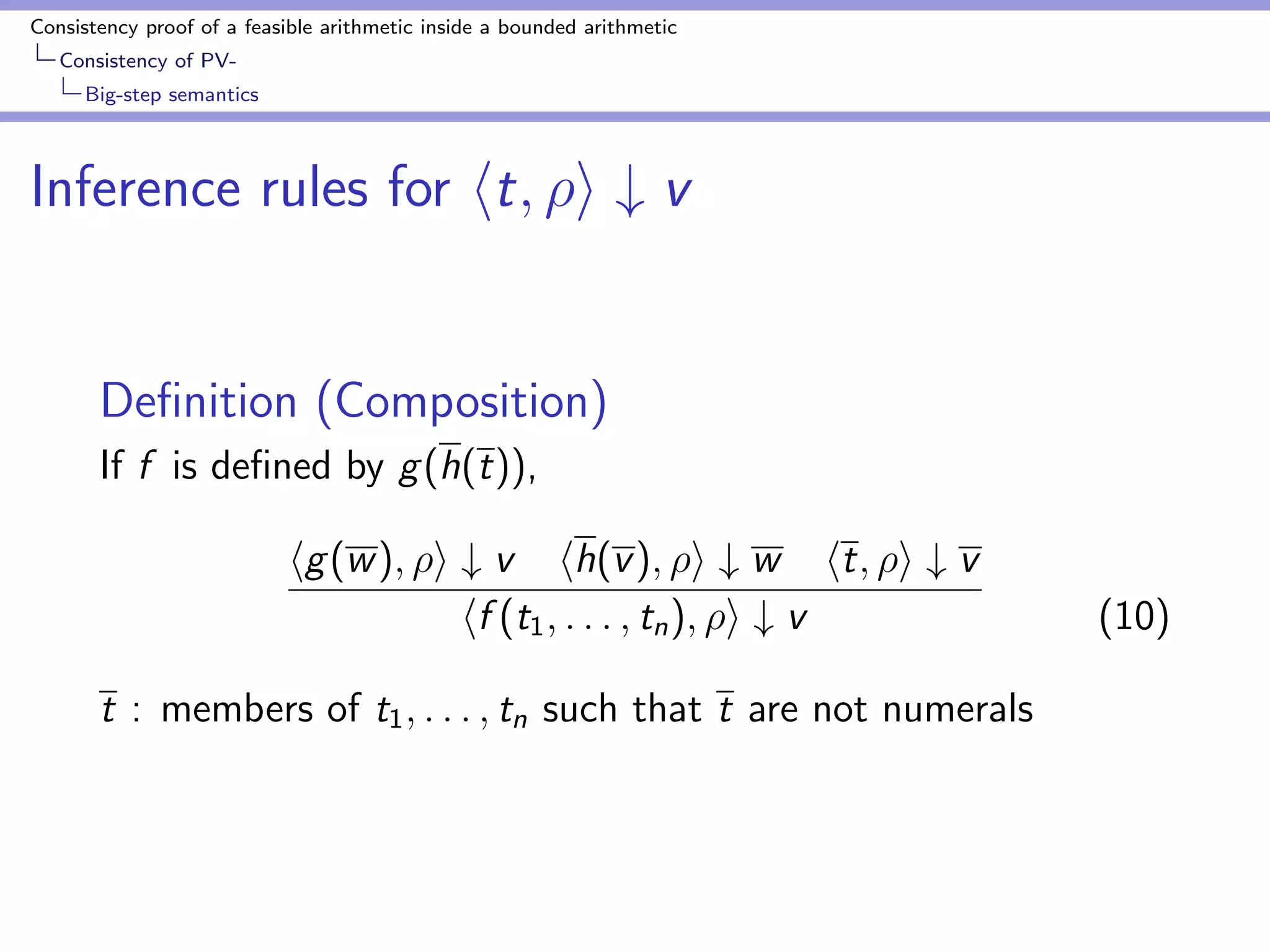
Inference rules for ht; i # v 
De
nition (Composition) 
If f is de
ned by g(h(t)), 
hg(w); i # v hh(v); i # w ht; i # v 
hf (t1; : : : ; tn); i # v (10) 
t : members of t1; : : : ; tn such that t are not numerals
Consistency proof of a feasible arithmetic inside a bounded arithmetic 
Consistency of PV-Big- 
step semantics 
Inference rules for ht; i # v 
De
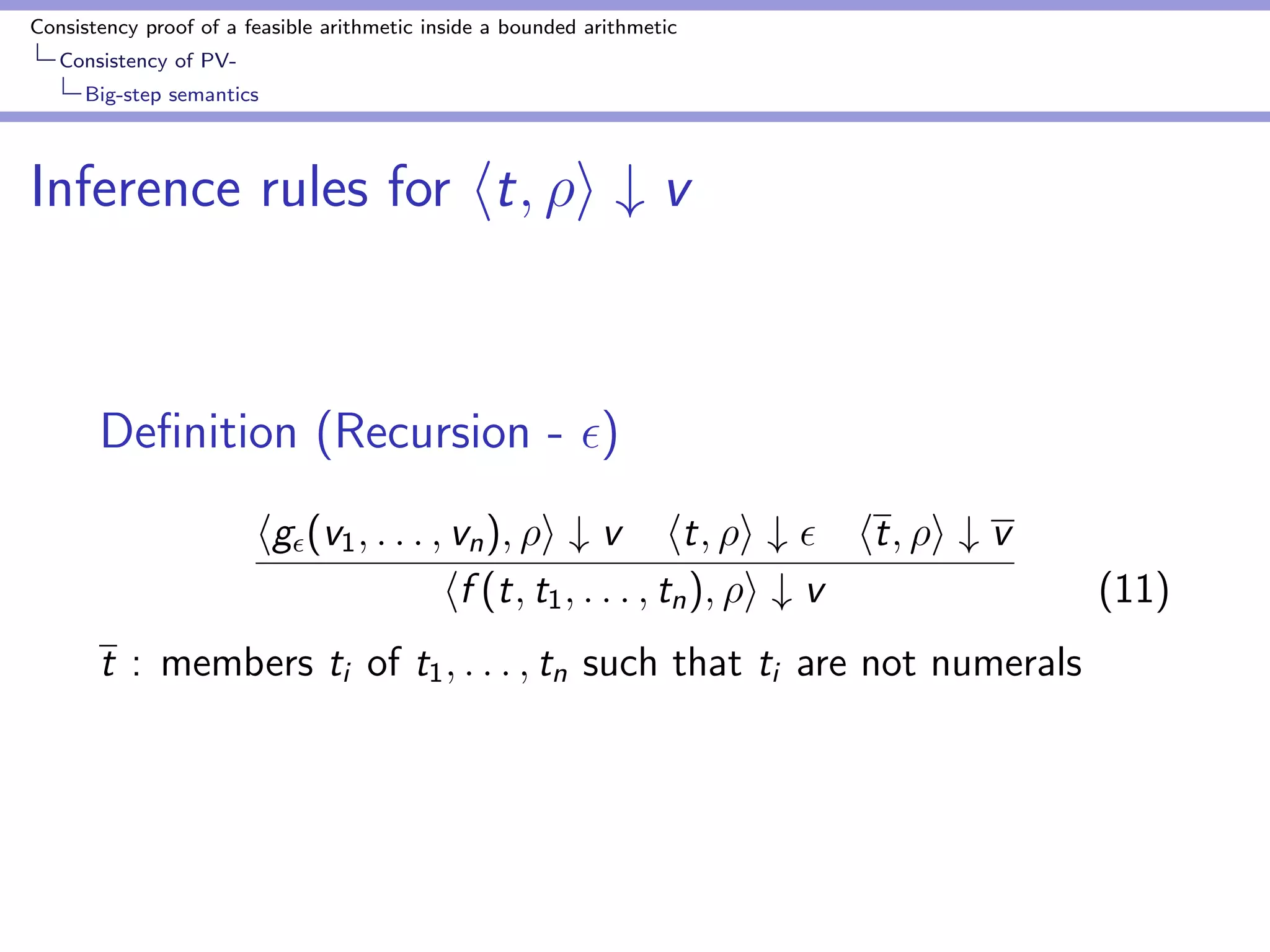
nition (Recursion - ) 
hg(v1; : : : ; vn); i # v ht; i #  ht; i # v 
hf (t; t1; : : : ; tn); i # v (11) 
t : members ti of t1; : : : ; tn such that ti are not numerals
Consistency proof of a feasible arithmetic inside a bounded arithmetic 
Consistency of PV-Big- 
step semantics 
Inference rules for ht; i # v 
De
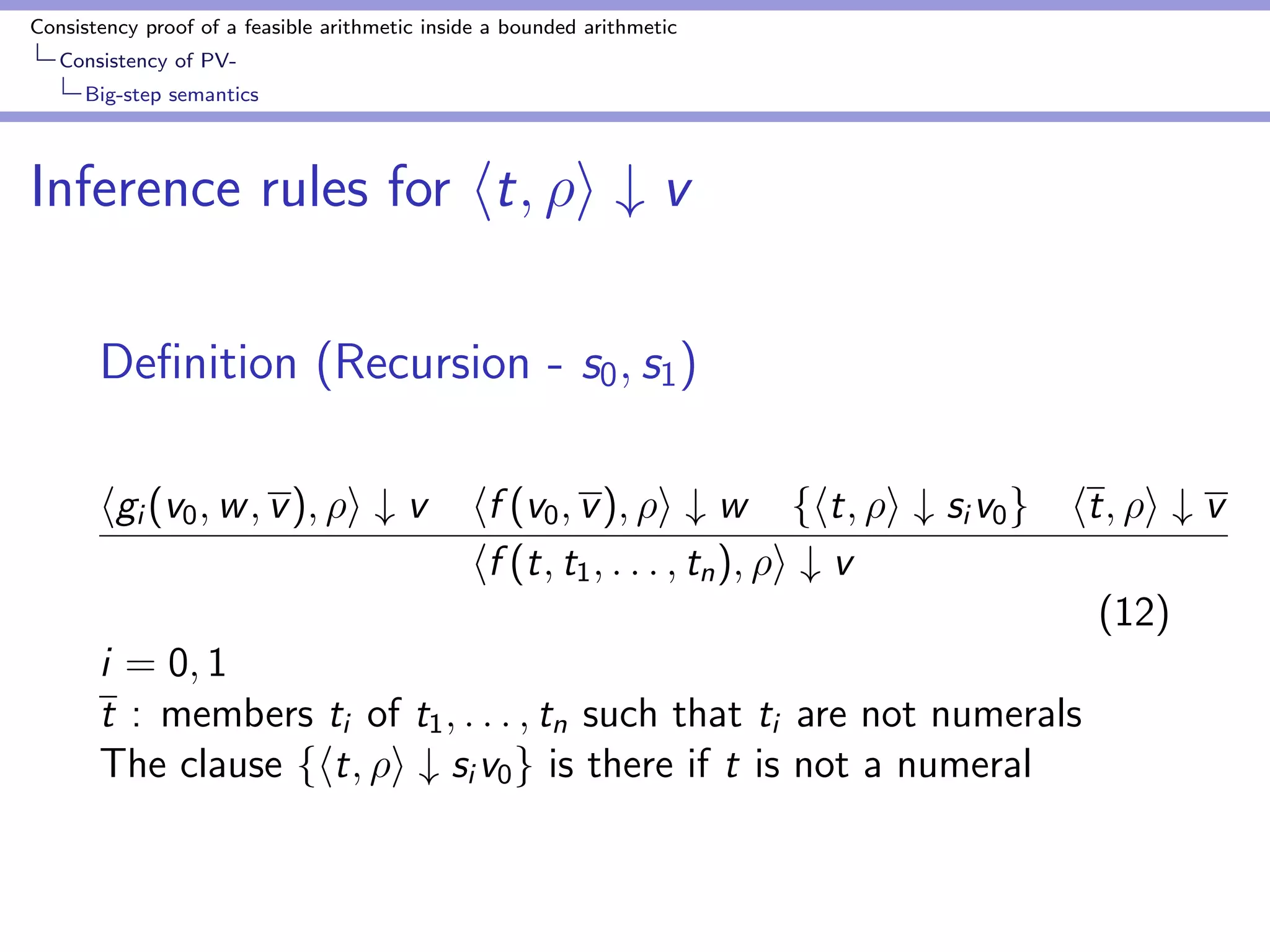
nition (Recursion - s0; s1) 
hgi (v0; w; v); i # v hf (v0; v); i # w fht; i # siv0g ht; i # v 
hf (t; t1; : : : ; tn); i # v 
(12) 
i = 0; 1 
t : members ti of t1; : : : ; tn such that ti are not numerals 
The clause fht; i # siv0g is there if t is not a numeral
Consistency proof of a feasible arithmetic inside a bounded arithmetic 
Consistency of PV-Big- 
step semantics 
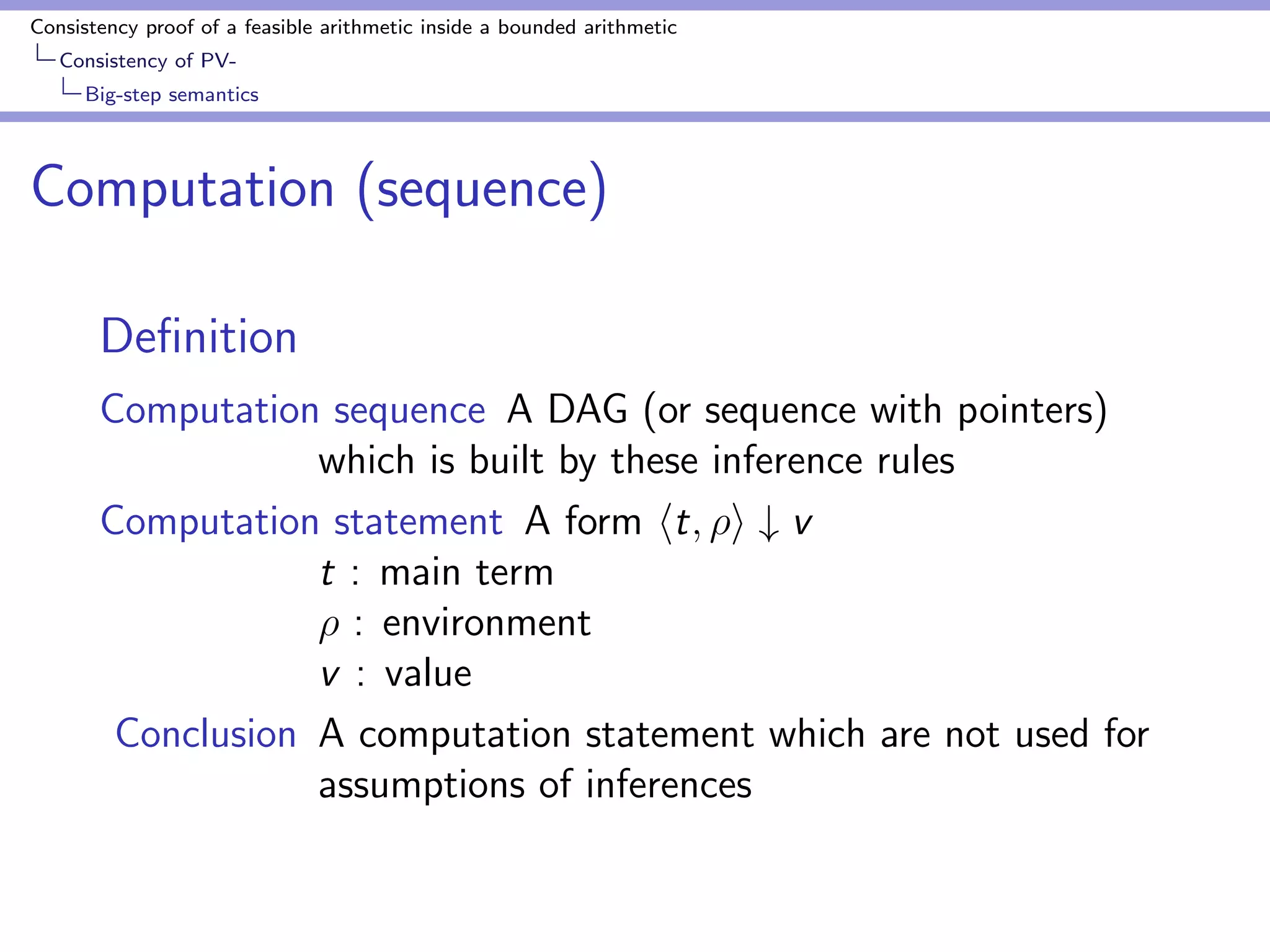
Computation (sequence) 
De
nition 
Computation sequence A DAG (or sequence with pointers) 
which is built by these inference rules 
Computation statement A form ht; i # v 
t : main term 
 : environment 
v : value 
Conclusion A computation statement which are not used for 
assumptions of inferences
Consistency proof of a feasible arithmetic inside a bounded arithmetic 
Consistency of PV-Bounding 
Godel numbers by number of nodes 
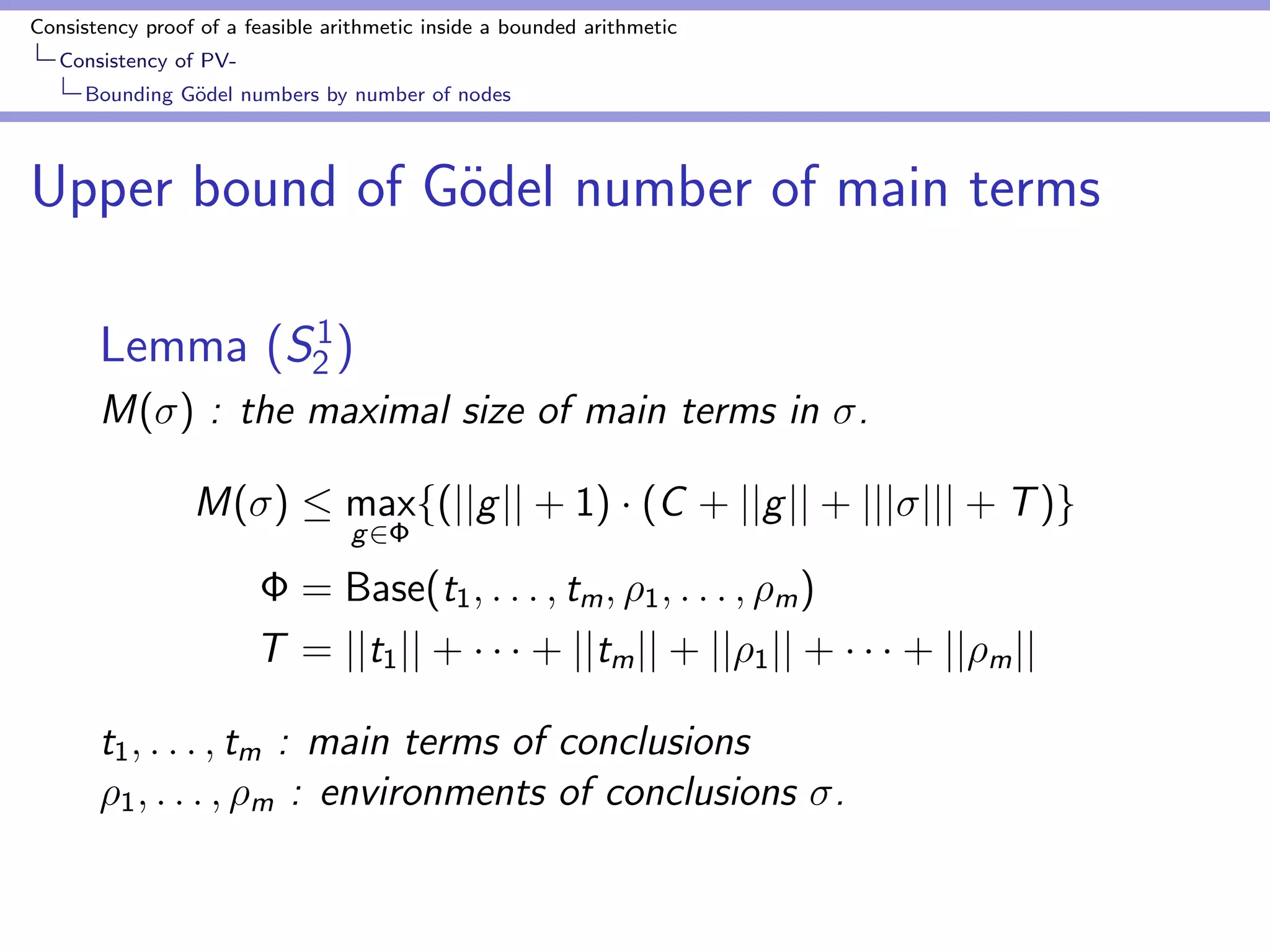
Upper bound of Godel number of main terms 
Lemma (S1 
2 ) 
M() : the maximal size of main terms in . 
M()  max 
g2 
f(jjgjj + 1)  (C + jjgjj + jjjjjj + T)g 
 = Base(t1; : : : ; tm; 1; : : : ; m) 
T = jjt1jj +    + jjtmjj + jj1jj +    + jjmjj 
t1; : : : ; tm : main terms of conclusions 
1; : : : ; m : environments of conclusions .
Consistency proof of a feasible arithmetic inside a bounded arithmetic 
Consistency of PV-Bounding 
Godel numbers by number of nodes 
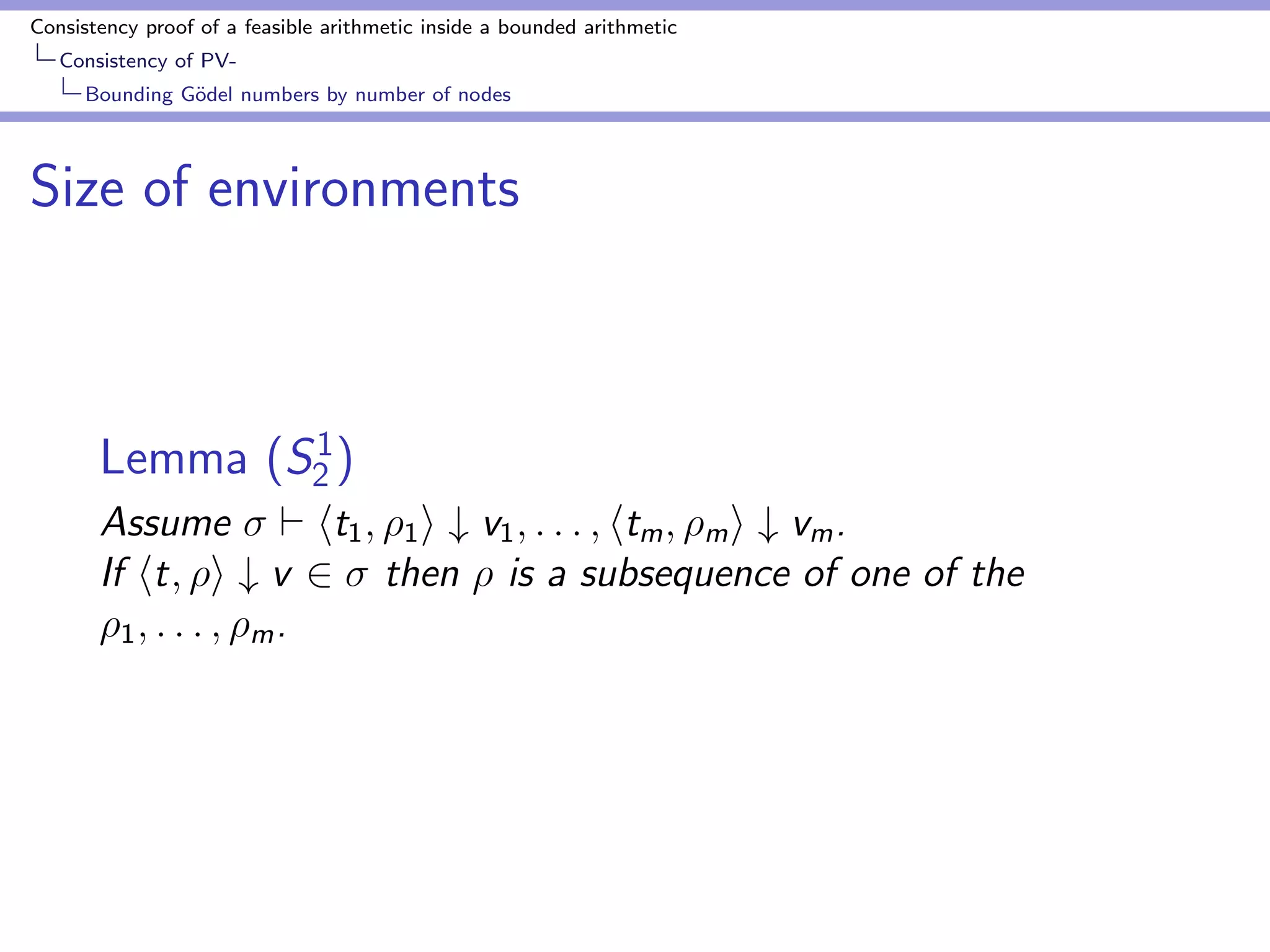
Size of environments 
Lemma (S1 
2 ) 
Assume  ` ht1; 1i # v1; : : : ; htm; mi # vm. 
If ht; i # v 2  then  is a subsequence of one of the 
1; : : : ; m.
Consistency proof of a feasible arithmetic inside a bounded arithmetic 
Consistency of PV-Bounding 
Godel numbers by number of nodes 
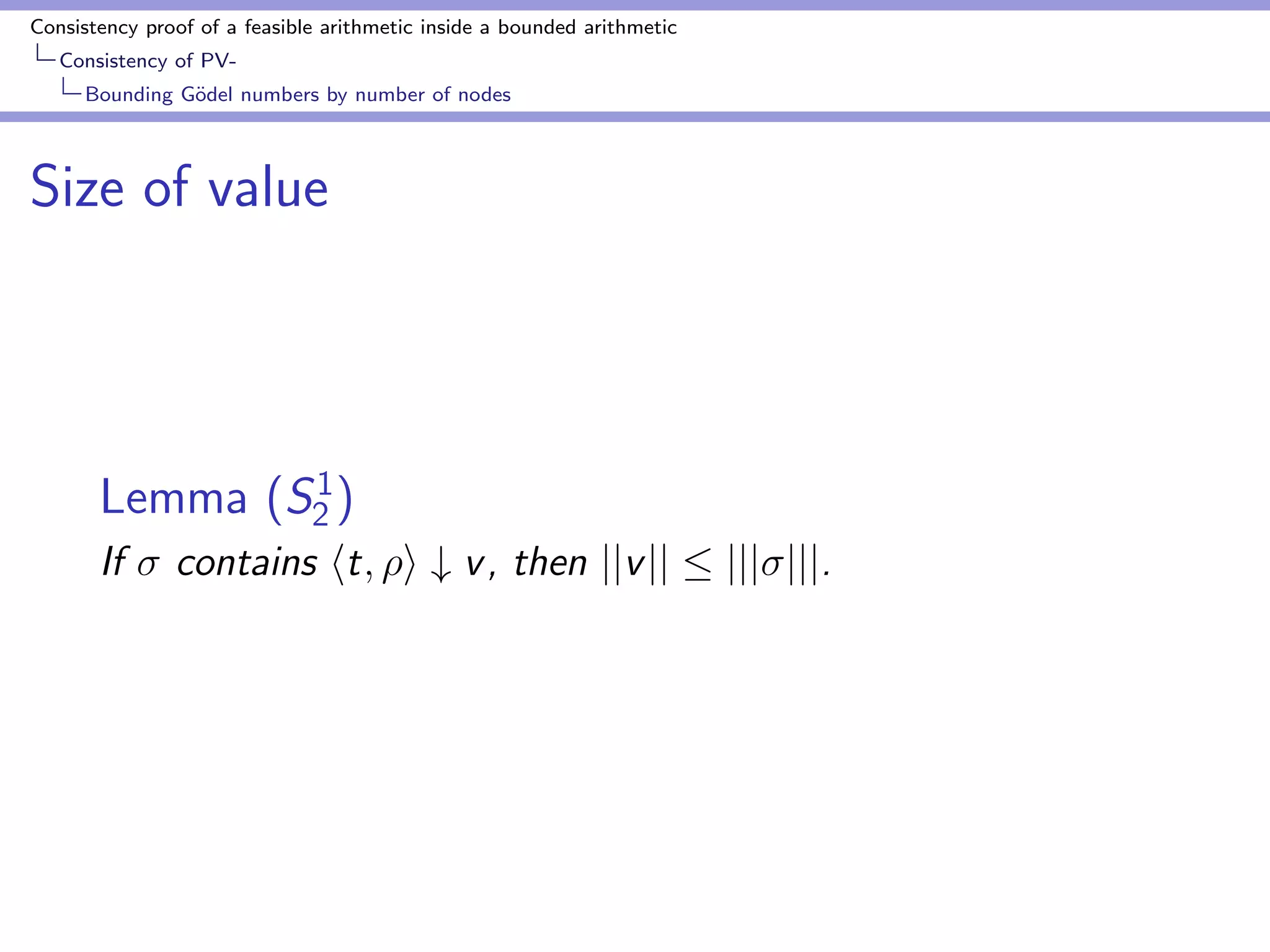
Size of value 
Lemma (S1 
2 ) 
If  contains ht; i # v, then jjvjj  jjjjjj.
Consistency proof of a feasible arithmetic inside a bounded arithmetic 
Consistency of PV-Bounding 
Godel numbers by number of nodes 
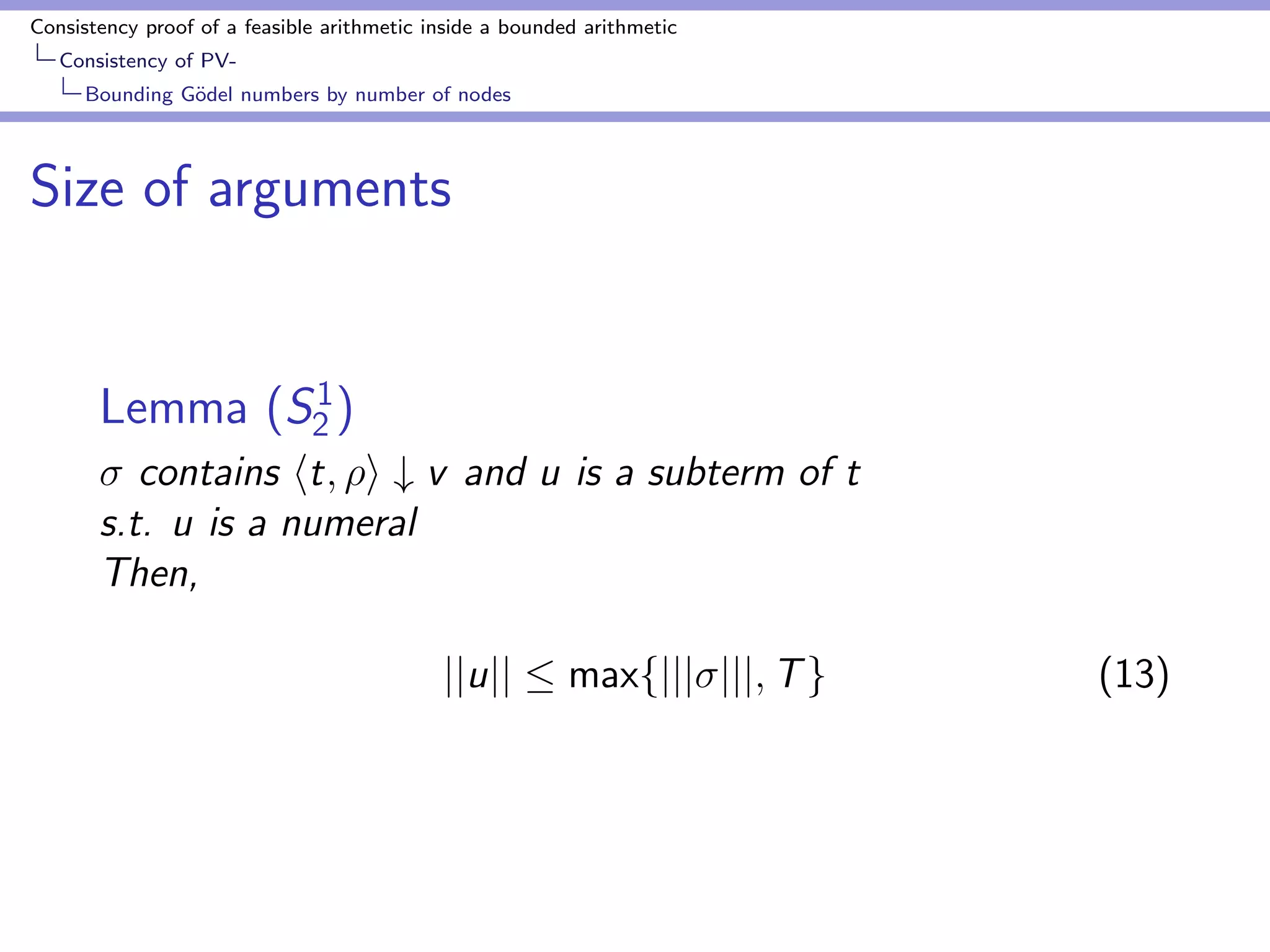
Size of arguments 
Lemma (S1 
2 ) 
 contains ht; i # v and u is a subterm of t 
s.t. u is a numeral 
Then, 
jjujj  maxfjjjjjj;Tg (13)
Consistency proof of a feasible arithmetic inside a bounded arithmetic 
Consistency of PV-Bounding 
Godel numbers by number of nodes 
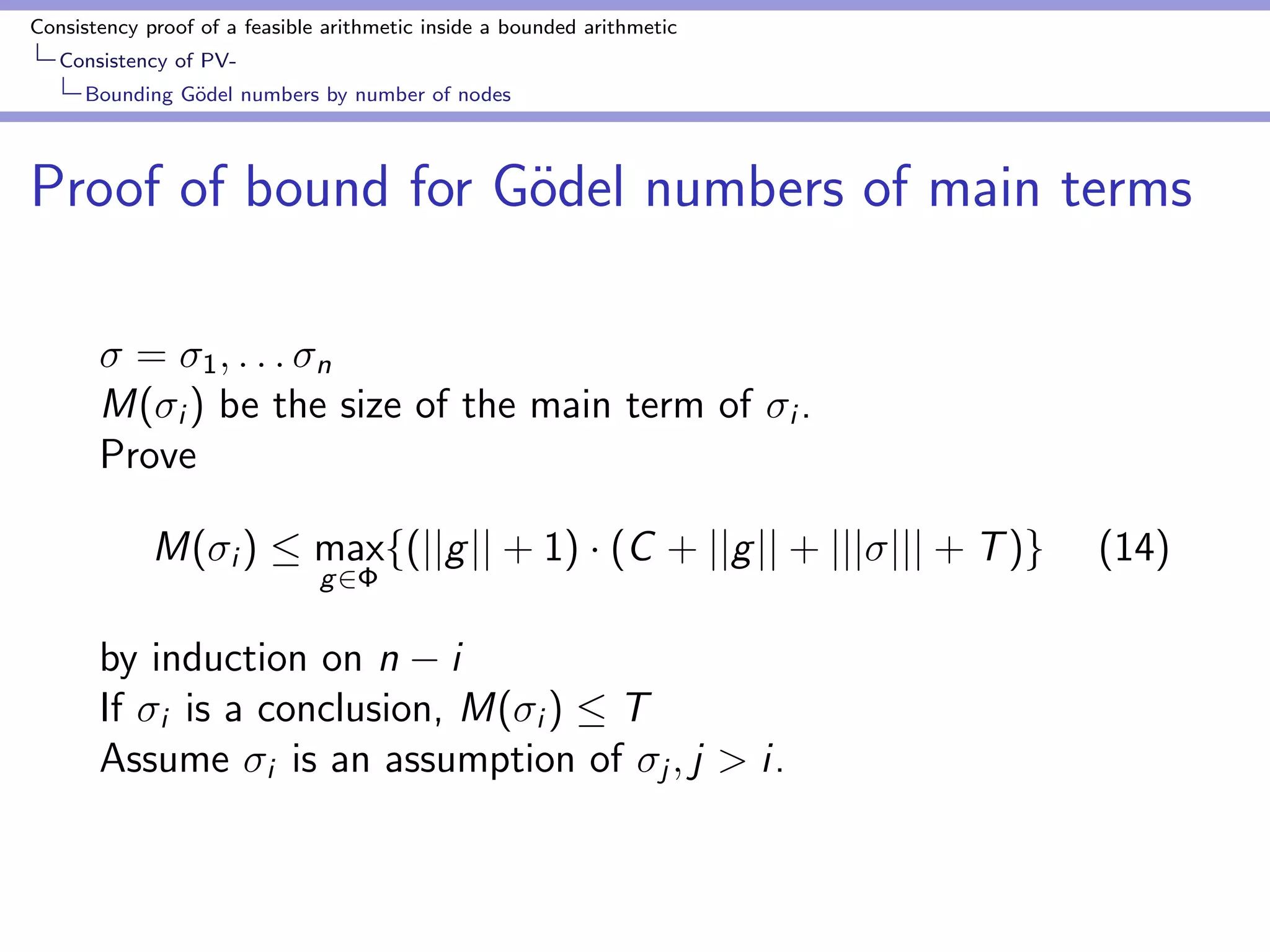
Proof of bound for Godel numbers of main terms 
 = 1; : : : n 
M(i ) be the size of the main term of i . 
Prove 
M(i )  max 
g2 
f(jjgjj + 1)  (C + jjgjj + jjjjjj + T)g (14) 
by induction on n  i 
If i is a conclusion, M(i )  T 
Assume i is an assumption of j ; j  i .
Consistency proof of a feasible arithmetic inside a bounded arithmetic 
Consistency of PV-Bounding 
Godel numbers by number of nodes 
Proof of bound for Godel numbers of main terms 
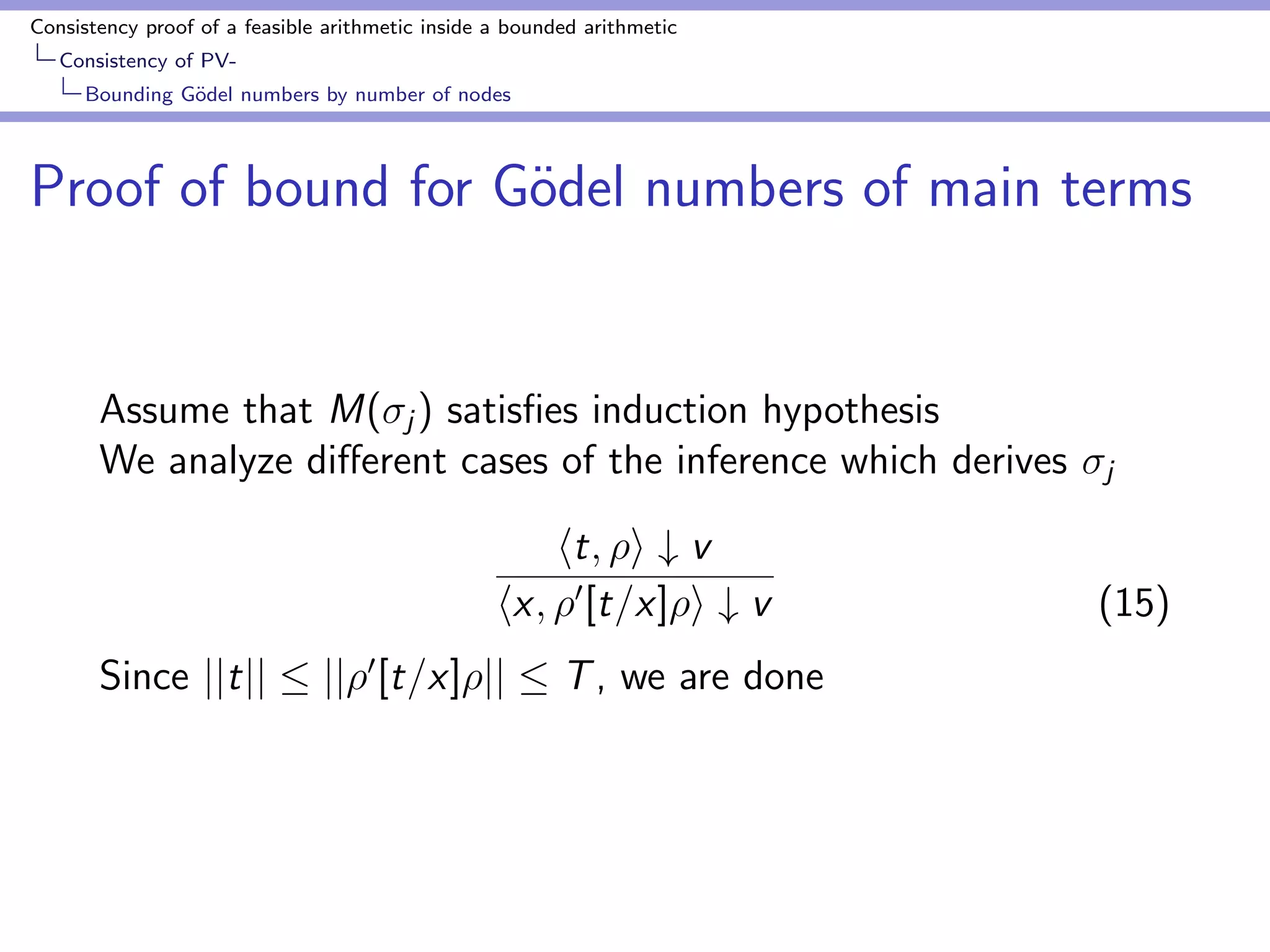
Assume that M(j ) satis
es induction hypothesis 
We analyze dierent cases of the inference which derives j 
ht; i # v 
hx; 0[t=x]i # v (15) 
Since jjtjj  jj0[t=x]jj  T, we are done
Consistency proof of a feasible arithmetic inside a bounded arithmetic 
Consistency of PV-Bounding 
Godel numbers by number of nodes 
Proof of bound for Godel numbers of main terms 
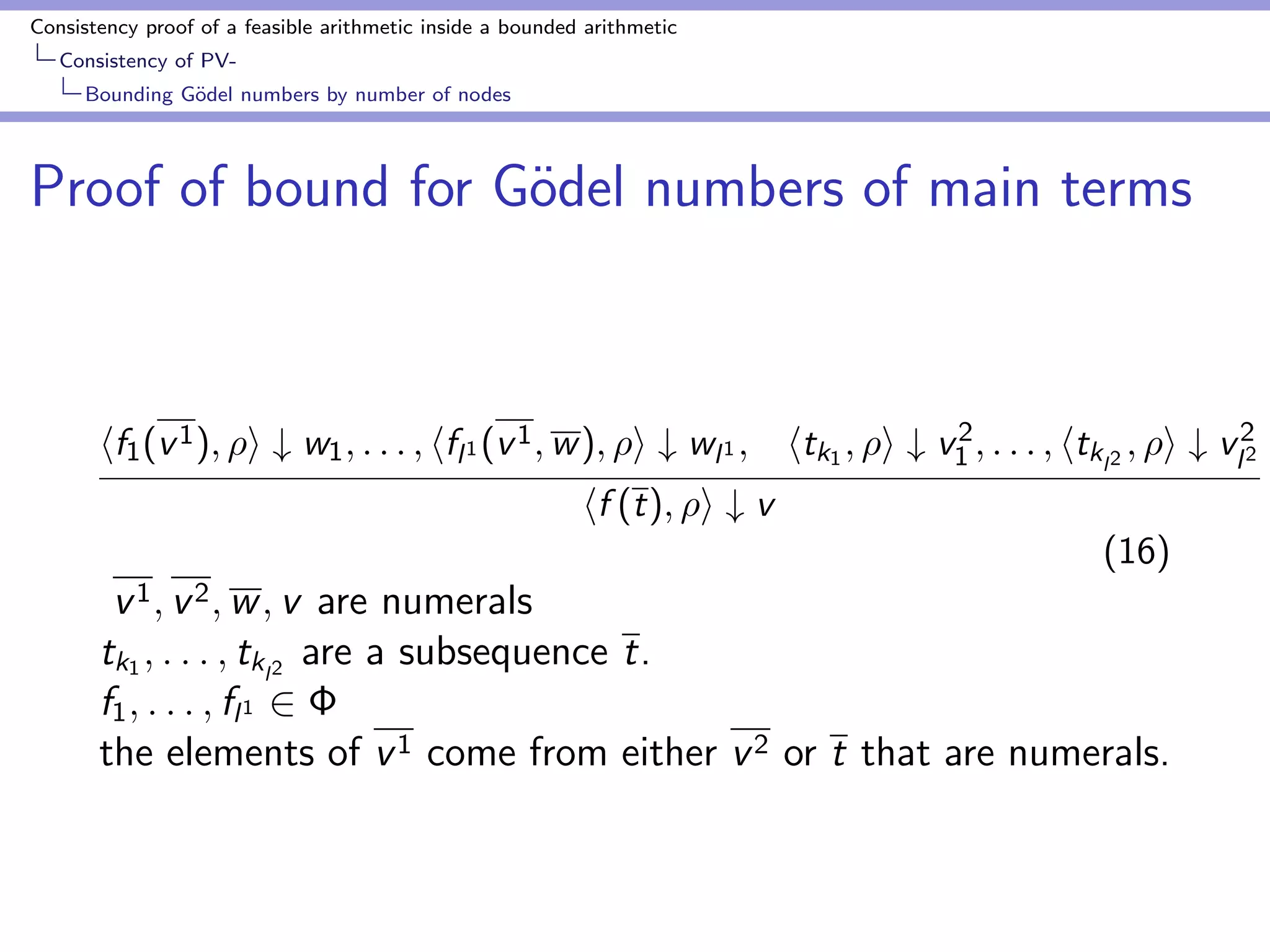
hf1(v1); i # w1; : : : ; hfl1(v1;w); i # wl1 ; htk1 ; i # v2 
1 ; : : : ; htkl2 ; i # v2 
l2 
hf (t); i # v 
(16) 
v1; v2; w; v are numerals 
tk1 ; : : : ; tkl2 are a subsequence t. 
f1; : : : ; fl1 2  
the elements of v1 come from either v2 or t that are numerals.
Consistency proof of a feasible arithmetic inside a bounded arithmetic 
Consistency of PV-Bounding 
Godel numbers by number of nodes 
Proof of bound for Godel numbers of main terms 
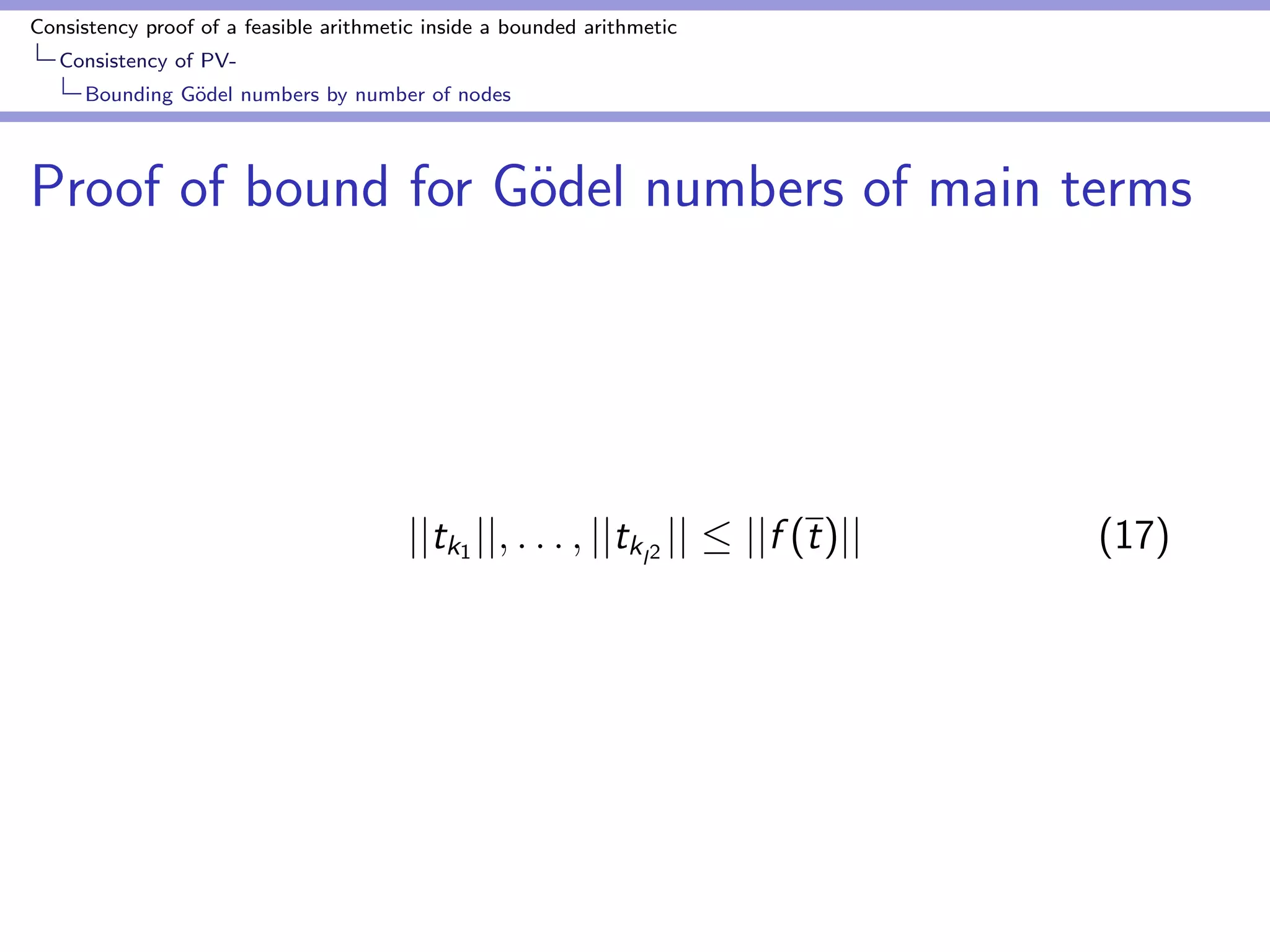
jjtk1 jj; : : : ; jjtkl2 jj  jjf (t)jj (17)
Consistency proof of a feasible arithmetic inside a bounded arithmetic 
Consistency of PV-Bounding 
Godel numbers by number of nodes 
Proof of bound for Godel numbers of main terms 
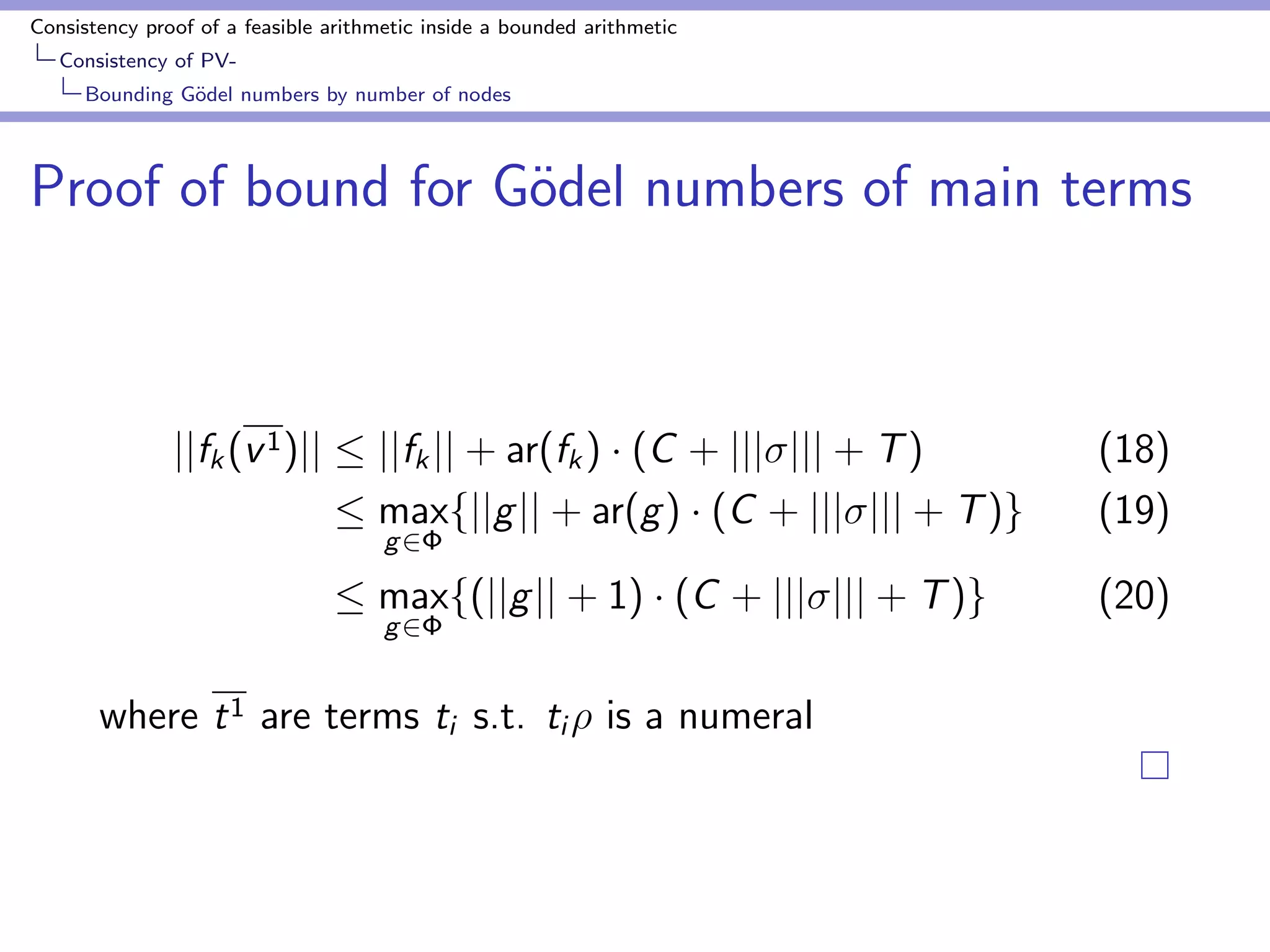
jjfk (v1)jj  jjfk jj + ar(fk )  (C + jjjjjj + T) (18) 
 max 
g2 
fjjgjj + ar(g)  (C + jjjjjj + T)g (19) 
 max 
g2 
f(jjgjj + 1)  (C + jjjjjj + T)g (20) 
where t1 are terms ti s.t. ti is a numeral
Consistency proof of a feasible arithmetic inside a bounded arithmetic 
Consistency of PV-Bounding 
Godel numbers by number of nodes 
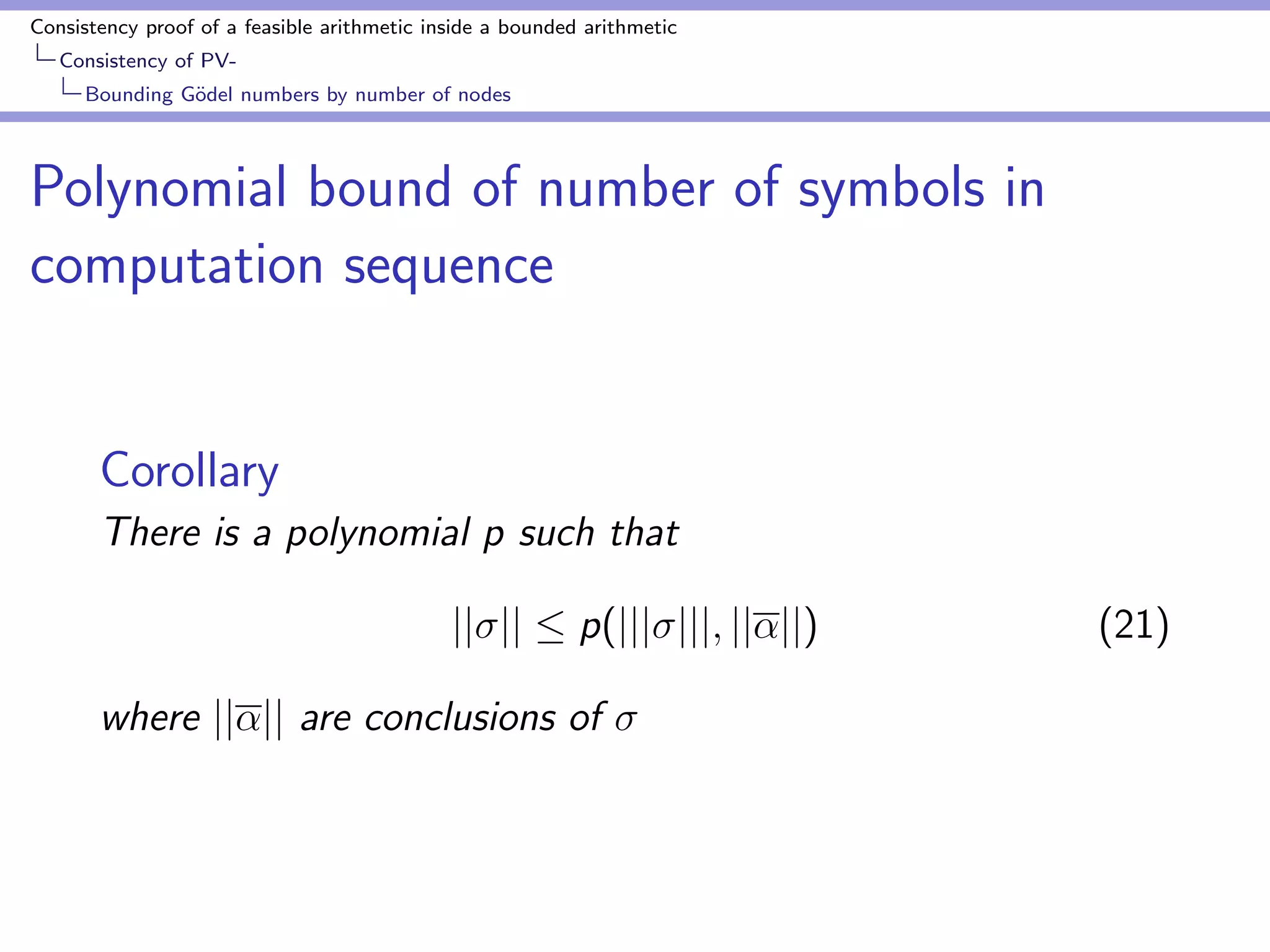
Polynomial bound of number of symbols in 
computation sequence 
Corollary 
There is a polynomial p such that 
jjjj  p(jjjjjj; jjjj) (21) 
where jjjj are conclusions of
Consistency proof of a feasible arithmetic inside a bounded arithmetic 
Consistency of PV-Bounding 
Godel numbers by number of nodes 
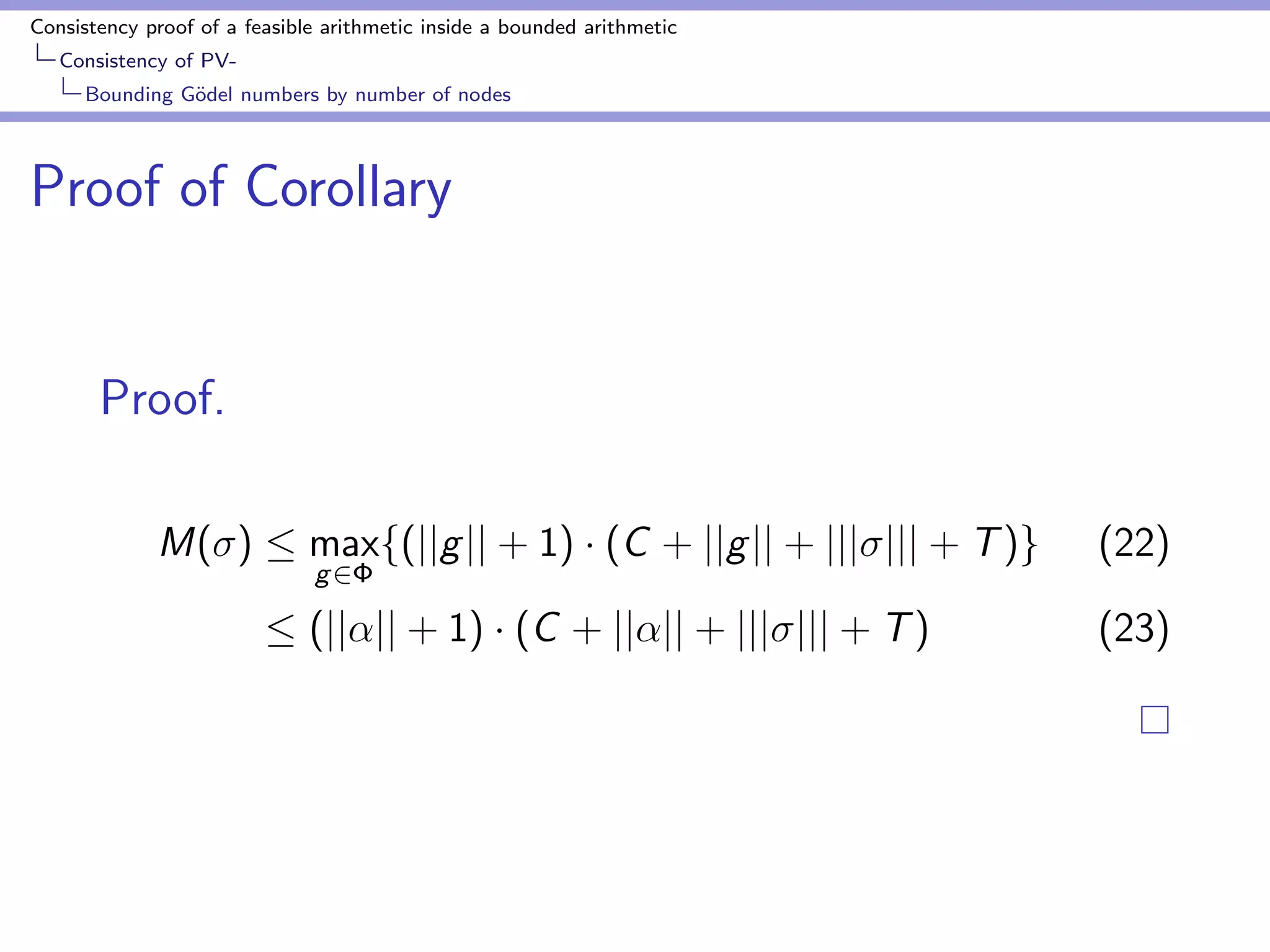
Proof of Corollary 
Proof. 
M()  max 
g2 
f(jjgjj + 1)  (C + jjgjj + jjjjjj + T)g (22) 
 (jjjj + 1)  (C + jjjj + jjjjjj + T) (23)
Consistency proof of a feasible arithmetic inside a bounded arithmetic 
Consistency of PV-Bounding 
Godel numbers by number of nodes 
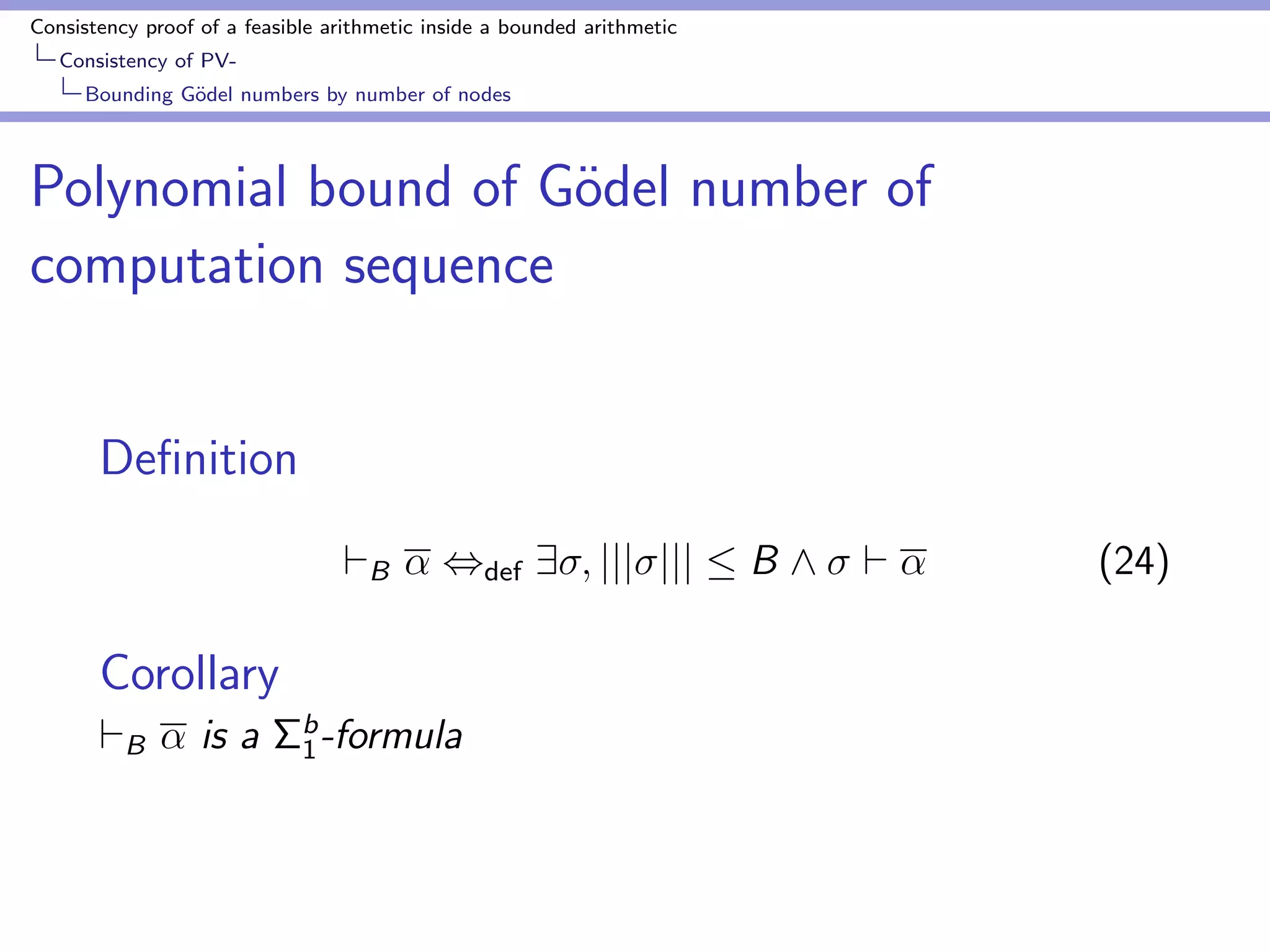
Polynomial bound of Godel number of 
computation sequence 
De
nition 
`B  ,def 9; jjjjjj  B ^  `  (24) 
Corollary 
`B  is a b1 
-formula
Consistency proof of a feasible arithmetic inside a bounded arithmetic 
Consistency of PV-Soundness 
of de
ning axioms 
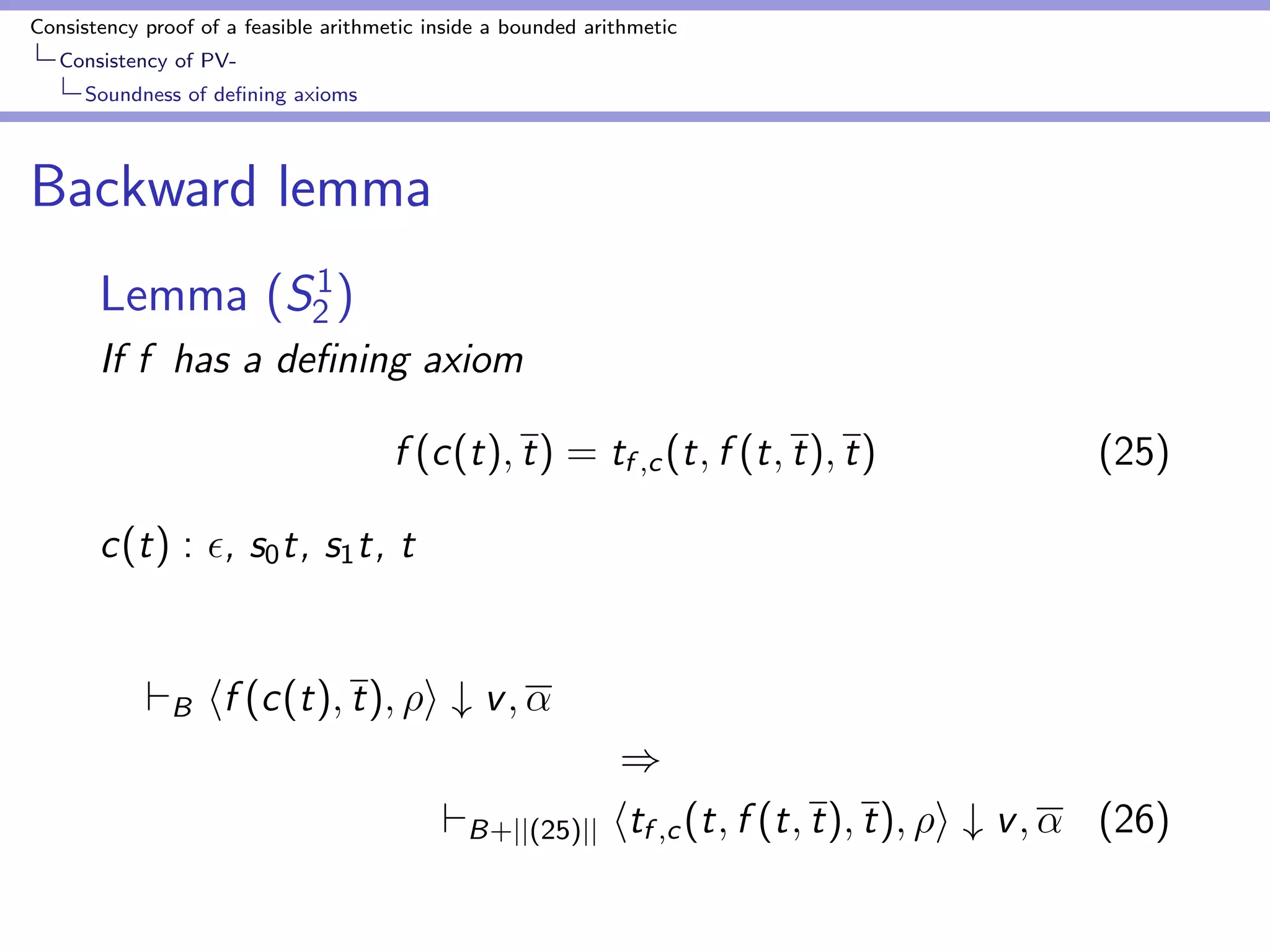
Backward lemma 
Lemma (S1 
2 ) 
If f has a de
ning axiom 
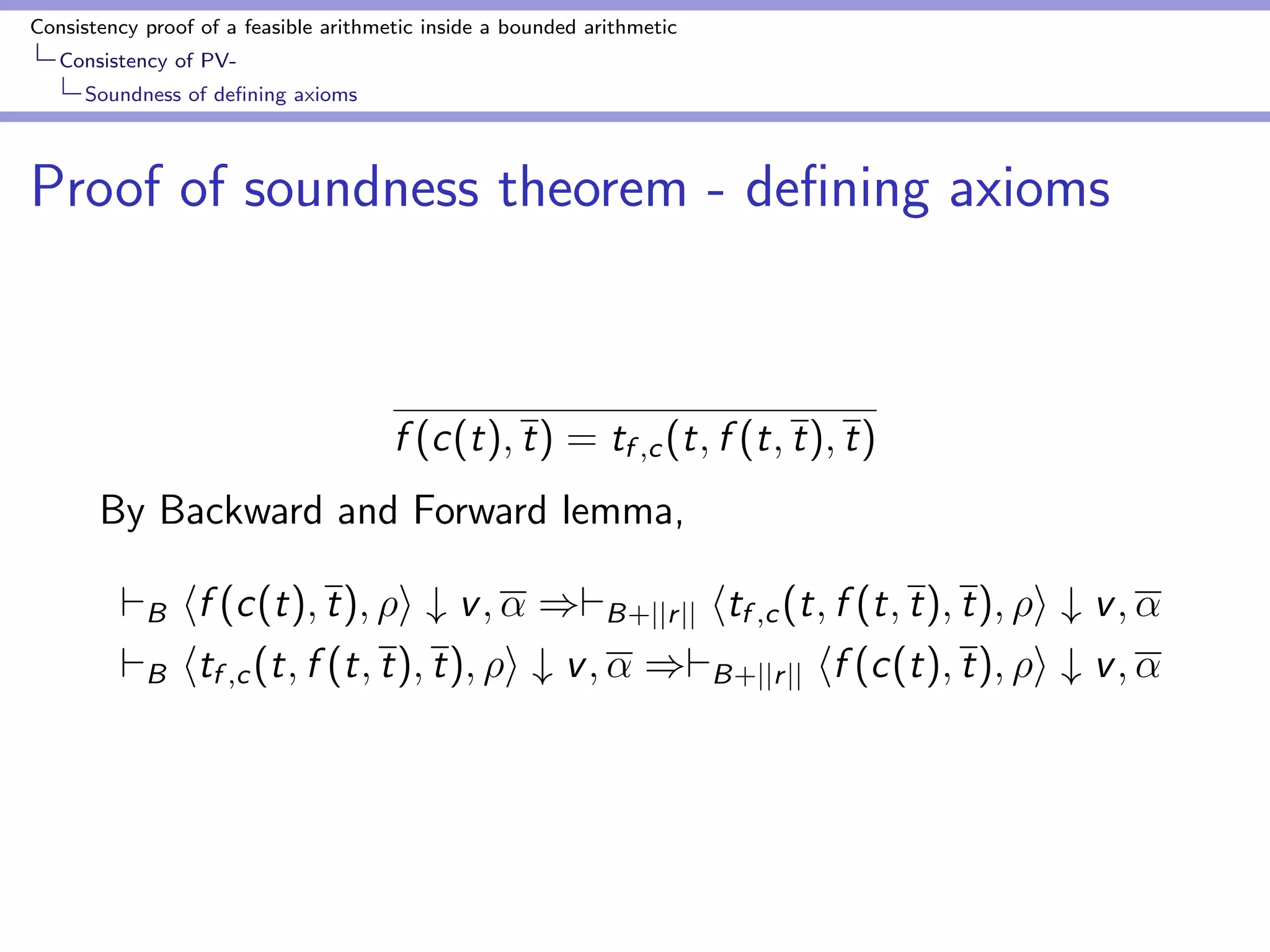
f (c(t); t) = tf ;c (t; f (t; t); t) (25) 
c(t) : , s0t, s1t, t 
`B hf (c(t); t); i # v;  
) 
`B+jj(25)jj htf ;c (t; f (t; t); t); i # v;  (26)
Consistency proof of a feasible arithmetic inside a bounded arithmetic 
Consistency of PV-Soundness 
of de
ning axioms 
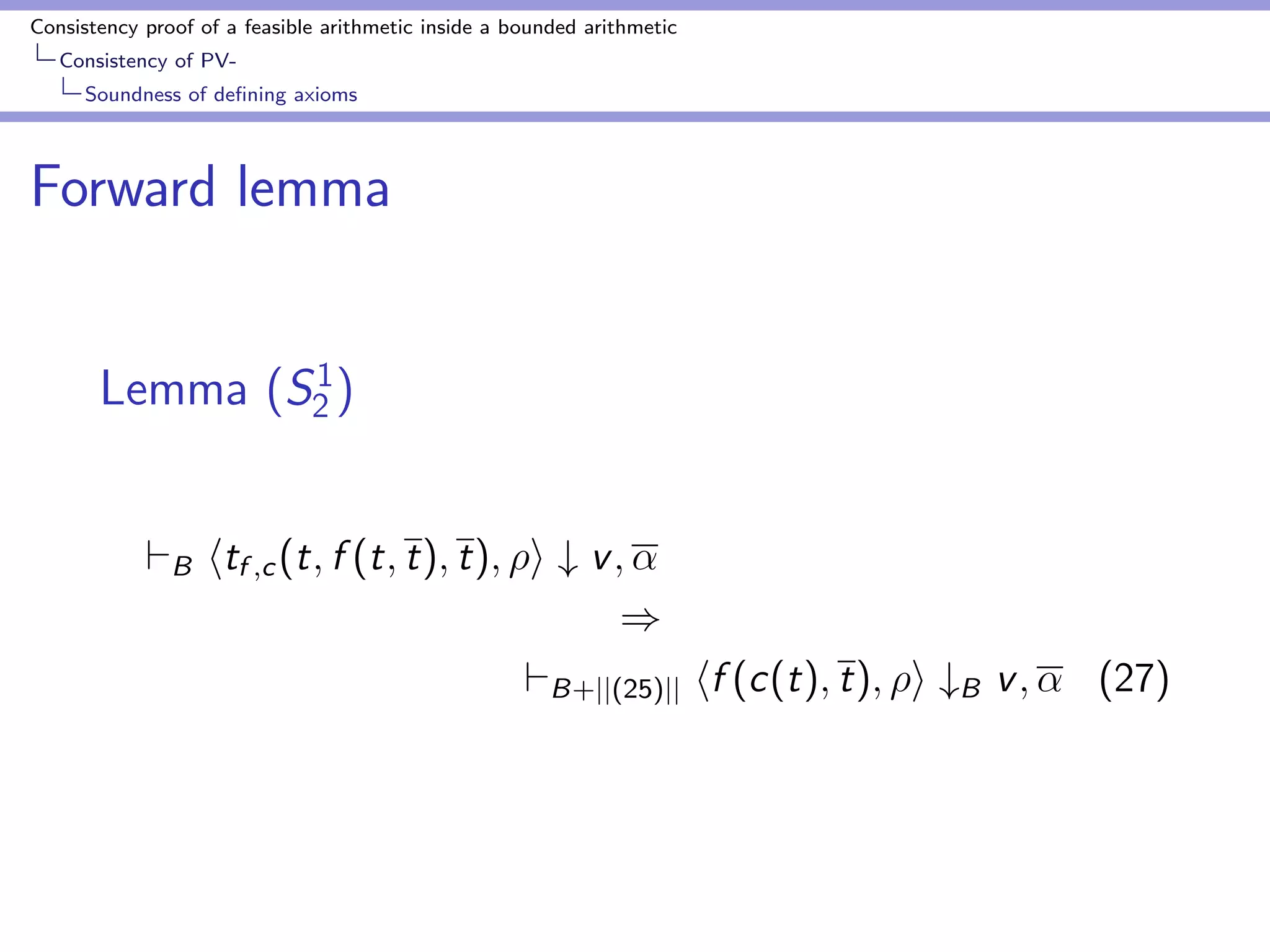
Forward lemma 
Lemma (S1 
2 ) 
`B htf ;c (t; f (t; t); t); i # v;  
) 
`B+jj(25)jj hf (c(t); t); i #B v;  (27)
Consistency proof of a feasible arithmetic inside a bounded arithmetic 
Consistency of PV-Soundness 
of de
ning axioms 
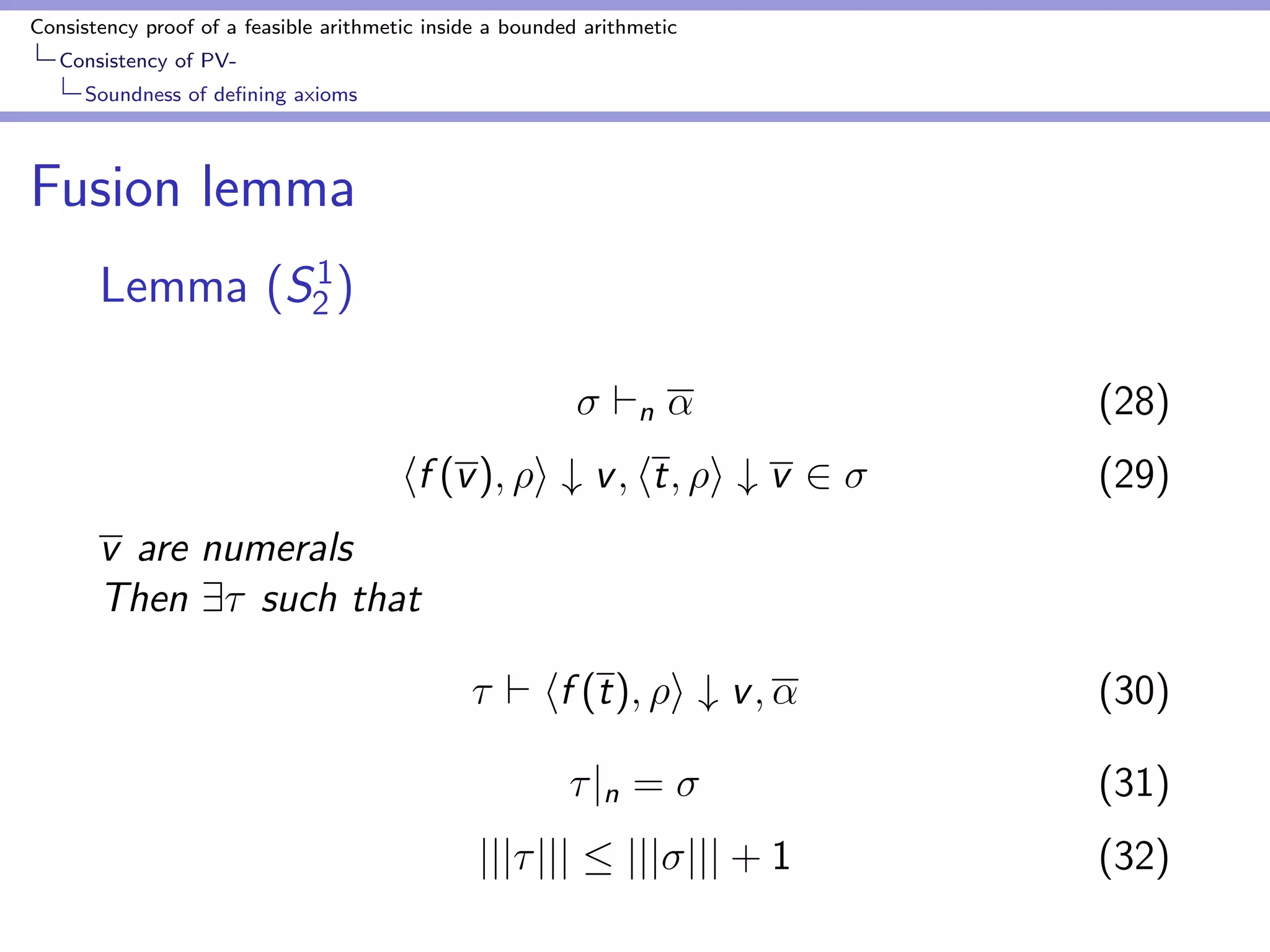
Fusion lemma 
Lemma (S1 
2 ) 
 `n  (28) 
hf (v); i # v; ht; i # v 2  (29) 
v are numerals 
Then 9 such that 
 ` hf (t); i # v;  (30) 
 jn =  (31) 
jjj jjj  jjjjjj + 1 (32)
Consistency proof of a feasible arithmetic inside a bounded arithmetic 
Consistency of PV-Soundness 
of de
ning axioms 
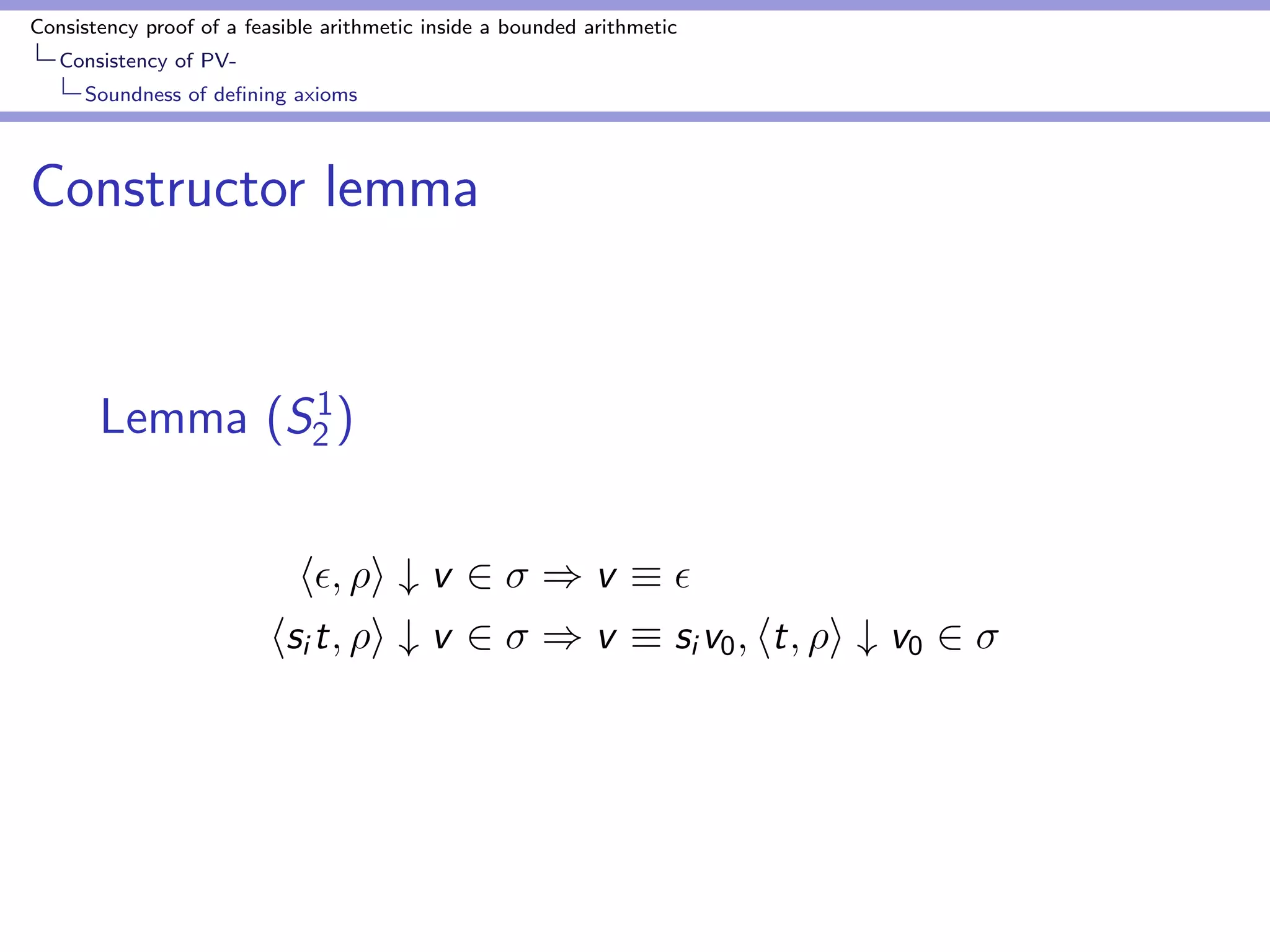
Constructor lemma 
Lemma (S1 
2 ) 
h; i # v 2  ) v   
hsi t; i # v 2  ) v  siv0; ht; i # v0 2
Consistency proof of a feasible arithmetic inside a bounded arithmetic 
Consistency of PV-Soundness 
of de
ning axioms 
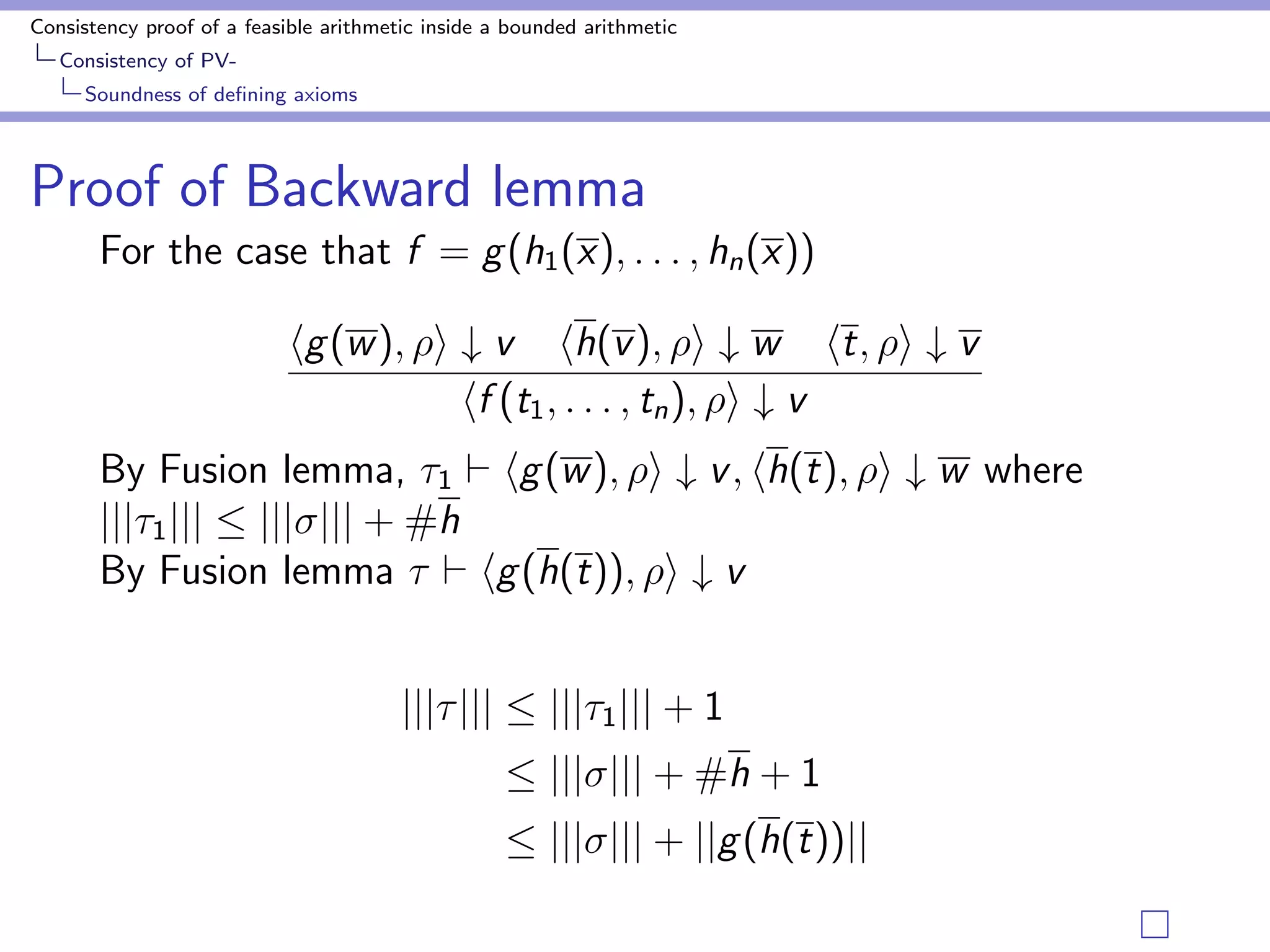
Proof of Backward lemma 
For the case that f = g(h1(x); : : : ; hn(x)) 
hg(w); i # v hh(v); i # w ht; i # v 
hf (t1; : : : ; tn); i # v 
By Fusion lemma, 1 ` hg(w); i # v; hh(t); i # w where 
jjj1jjj  jjjjjj + #h 
By Fusion lemma  ` hg(h(t)); i # v 
jjj jjj  jjj1jjj + 1 
 jjjjjj + #h + 1 
 jjjjjj + jjg(h(t))jj
Consistency proof of a feasible arithmetic inside a bounded arithmetic 
Consistency of PV-Soundness 
of de

Consistency proof of a feasible arithmetic inside a bounded arithmetic

  • 1.
    Consistency proof ofa feasible arithmetic inside a bounded arithmetic Consistency proof of a feasible arithmetic inside a bounded arithmetic Yoriyuki Yamagata Sendai Logic Seminar, Oct. 31, 2014
  • 2.
    Consistency proof ofa feasible arithmetic inside a bounded arithmetic Motivation Ultimate Goal Conjecutre S1 26= S2 where Si2 ; i = 1; 2; : : : are Buss's hierarchies of bounded arithmetics and S2 = S i=1;2;::: Si2
  • 3.
    Consistency proof ofa feasible arithmetic inside a bounded arithmetic Motivation Approach using consistency statement If S2 ` Con(S1 2 ), we have S1 26= S2. Theorem (Pudlak, 1990) S26` Con(S1 2 ) Question Can we
  • 4.
    nd a theoryT such that S2 ` Con(T) but S1 26` Con(T)?
  • 5.
    Consistency proof ofa feasible arithmetic inside a bounded arithmetic Motivation Unprovability Theorem (Buss and Ignjatovic 1995) S1 26` Con(PV) PV : Cook Urquhart's equational theory PV minus induction Buss and Ignjatovic enrich PV by propositional logic and BASICe-axioms
  • 6.
    Consistency proof ofa feasible arithmetic inside a bounded arithmetic Motivation Provability Theorem (Beckmann 2002) S1 2 ` Con(PV) if PV is formulated without substitution
  • 7.
    Consistency proof ofa feasible arithmetic inside a bounded arithmetic Main results Main result Theorem S1 2 ` Con(PV) Even if PV is formulated with substitution Our PV is equational
  • 8.
    Consistency proof ofa feasible arithmetic inside a bounded arithmetic Consistency of PV-Soundness theorem Cook Urquhart's PV : language We formulate PV as an equational theory of binary digits. 1. Constant : 2. Function symbols for all polynomial time functions s0; s1; n; projni ; : : :
  • 9.
    Consistency proof ofa feasible arithmetic inside a bounded arithmetic Consistency of PV-Soundness theorem Cook Urquhart's PV : axioms 1. Recursive de
  • 10.
    nition of functions 1.1 Composition 1.2 Recursion 2. Equational axioms 3. Substitution t(x) = u(x) t(s) = u(s) (1) 4. PIND for all formulas
  • 11.
    Consistency proof ofa feasible arithmetic inside a bounded arithmetic Consistency of PV-Soundness theorem Consistency proof of PV inside S1 2 Theorem (Consistency theorem) S1 2 ` Con(PV) (2)
  • 12.
    Consistency proof ofa feasible arithmetic inside a bounded arithmetic Consistency of PV-Soundness theorem Soundness theorem Theorem Let 1. `PV 0 = 1 2. r ` t = u be a sub-proof of 3. : sequence of substitution such that t is closed 4. ` ht; i # v; Then, 9; ` hu; i # v; (3)
  • 13.
    Consistency proof ofa feasible arithmetic inside a bounded arithmetic Consistency of PV-Soundness theorem Soundness theorem Theorem (S1 2 ) Let 1. `PV 0 = 1, U jjjj 2. r ` t = u be a sub-proof of 3. : sequence of substitution such that t is closed and jjjj U jjr jj 4. ` ht; i # v; and jjjjjj;2M() U jjr jj Then, 9; ` hu; i # v; (4) s.t. jjj jjj jjjjjj + jjr jj
  • 14.
    Consistency proof ofa feasible arithmetic inside a bounded arithmetic Consistency of PV-Soundness theorem Consistency of big-step semantics Lemma (S1 2 ) There is no computation which proves h; i # s1 Proof. Immediate from the form of inference rules
  • 15.
    Consistency proof ofa feasible arithmetic inside a bounded arithmetic Consistency of PV-Big- step semantics Inference rules for ht; i # v De
  • 16.
    nition (Substitution) ht;2i # v hx; 1[t=x]2i # v (5) where 1 does not contain a substitution to x.
  • 17.
    Consistency proof ofa feasible arithmetic inside a bounded arithmetic Consistency of PV-Big- step semantics Inference rules for ht; i # v De
  • 18.
    nition (; s0;s1) h; i # (6) ht; i # v hsi t; i # siv (7) where i is either 0 or 1.
  • 19.
    Consistency proof ofa feasible arithmetic inside a bounded arithmetic Consistency of PV-Big- step semantics Inference rules for ht; i # v De
  • 20.
    nition (Constant function) hn(t1; : : : ; tn); i # (8)
  • 21.
    Consistency proof ofa feasible arithmetic inside a bounded arithmetic Consistency of PV-Big- step semantics Inference rules for ht; i # v De
  • 22.
    nition (Projection) hti; i # vi hprojni (t1; : : : ; tn); i # vi (9) for i = 1; ; n.
  • 23.
    Consistency proof ofa feasible arithmetic inside a bounded arithmetic Consistency of PV-Big- step semantics Inference rules for ht; i # v De
  • 24.
  • 25.
    ned by g(h(t)), hg(w); i # v hh(v); i # w ht; i # v hf (t1; : : : ; tn); i # v (10) t : members of t1; : : : ; tn such that t are not numerals
  • 26.
    Consistency proof ofa feasible arithmetic inside a bounded arithmetic Consistency of PV-Big- step semantics Inference rules for ht; i # v De
  • 27.
    nition (Recursion -) hg(v1; : : : ; vn); i # v ht; i # ht; i # v hf (t; t1; : : : ; tn); i # v (11) t : members ti of t1; : : : ; tn such that ti are not numerals
  • 28.
    Consistency proof ofa feasible arithmetic inside a bounded arithmetic Consistency of PV-Big- step semantics Inference rules for ht; i # v De
  • 29.
    nition (Recursion -s0; s1) hgi (v0; w; v); i # v hf (v0; v); i # w fht; i # siv0g ht; i # v hf (t; t1; : : : ; tn); i # v (12) i = 0; 1 t : members ti of t1; : : : ; tn such that ti are not numerals The clause fht; i # siv0g is there if t is not a numeral
  • 30.
    Consistency proof ofa feasible arithmetic inside a bounded arithmetic Consistency of PV-Big- step semantics Computation (sequence) De
  • 31.
    nition Computation sequenceA DAG (or sequence with pointers) which is built by these inference rules Computation statement A form ht; i # v t : main term : environment v : value Conclusion A computation statement which are not used for assumptions of inferences
  • 32.
    Consistency proof ofa feasible arithmetic inside a bounded arithmetic Consistency of PV-Bounding Godel numbers by number of nodes Upper bound of Godel number of main terms Lemma (S1 2 ) M() : the maximal size of main terms in . M() max g2 f(jjgjj + 1) (C + jjgjj + jjjjjj + T)g = Base(t1; : : : ; tm; 1; : : : ; m) T = jjt1jj + + jjtmjj + jj1jj + + jjmjj t1; : : : ; tm : main terms of conclusions 1; : : : ; m : environments of conclusions .
  • 33.
    Consistency proof ofa feasible arithmetic inside a bounded arithmetic Consistency of PV-Bounding Godel numbers by number of nodes Size of environments Lemma (S1 2 ) Assume ` ht1; 1i # v1; : : : ; htm; mi # vm. If ht; i # v 2 then is a subsequence of one of the 1; : : : ; m.
  • 34.
    Consistency proof ofa feasible arithmetic inside a bounded arithmetic Consistency of PV-Bounding Godel numbers by number of nodes Size of value Lemma (S1 2 ) If contains ht; i # v, then jjvjj jjjjjj.
  • 35.
    Consistency proof ofa feasible arithmetic inside a bounded arithmetic Consistency of PV-Bounding Godel numbers by number of nodes Size of arguments Lemma (S1 2 ) contains ht; i # v and u is a subterm of t s.t. u is a numeral Then, jjujj maxfjjjjjj;Tg (13)
  • 36.
    Consistency proof ofa feasible arithmetic inside a bounded arithmetic Consistency of PV-Bounding Godel numbers by number of nodes Proof of bound for Godel numbers of main terms = 1; : : : n M(i ) be the size of the main term of i . Prove M(i ) max g2 f(jjgjj + 1) (C + jjgjj + jjjjjj + T)g (14) by induction on n i If i is a conclusion, M(i ) T Assume i is an assumption of j ; j i .
  • 37.
    Consistency proof ofa feasible arithmetic inside a bounded arithmetic Consistency of PV-Bounding Godel numbers by number of nodes Proof of bound for Godel numbers of main terms Assume that M(j ) satis
  • 38.
    es induction hypothesis We analyze dierent cases of the inference which derives j ht; i # v hx; 0[t=x]i # v (15) Since jjtjj jj0[t=x]jj T, we are done
  • 39.
    Consistency proof ofa feasible arithmetic inside a bounded arithmetic Consistency of PV-Bounding Godel numbers by number of nodes Proof of bound for Godel numbers of main terms hf1(v1); i # w1; : : : ; hfl1(v1;w); i # wl1 ; htk1 ; i # v2 1 ; : : : ; htkl2 ; i # v2 l2 hf (t); i # v (16) v1; v2; w; v are numerals tk1 ; : : : ; tkl2 are a subsequence t. f1; : : : ; fl1 2 the elements of v1 come from either v2 or t that are numerals.
  • 40.
    Consistency proof ofa feasible arithmetic inside a bounded arithmetic Consistency of PV-Bounding Godel numbers by number of nodes Proof of bound for Godel numbers of main terms jjtk1 jj; : : : ; jjtkl2 jj jjf (t)jj (17)
  • 41.
    Consistency proof ofa feasible arithmetic inside a bounded arithmetic Consistency of PV-Bounding Godel numbers by number of nodes Proof of bound for Godel numbers of main terms jjfk (v1)jj jjfk jj + ar(fk ) (C + jjjjjj + T) (18) max g2 fjjgjj + ar(g) (C + jjjjjj + T)g (19) max g2 f(jjgjj + 1) (C + jjjjjj + T)g (20) where t1 are terms ti s.t. ti is a numeral
  • 42.
    Consistency proof ofa feasible arithmetic inside a bounded arithmetic Consistency of PV-Bounding Godel numbers by number of nodes Polynomial bound of number of symbols in computation sequence Corollary There is a polynomial p such that jjjj p(jjjjjj; jjjj) (21) where jjjj are conclusions of
  • 43.
    Consistency proof ofa feasible arithmetic inside a bounded arithmetic Consistency of PV-Bounding Godel numbers by number of nodes Proof of Corollary Proof. M() max g2 f(jjgjj + 1) (C + jjgjj + jjjjjj + T)g (22) (jjjj + 1) (C + jjjj + jjjjjj + T) (23)
  • 44.
    Consistency proof ofa feasible arithmetic inside a bounded arithmetic Consistency of PV-Bounding Godel numbers by number of nodes Polynomial bound of Godel number of computation sequence De
  • 45.
    nition `B ,def 9; jjjjjj B ^ ` (24) Corollary `B is a b1 -formula
  • 46.
    Consistency proof ofa feasible arithmetic inside a bounded arithmetic Consistency of PV-Soundness of de
  • 47.
    ning axioms Backwardlemma Lemma (S1 2 ) If f has a de
  • 48.
    ning axiom f(c(t); t) = tf ;c (t; f (t; t); t) (25) c(t) : , s0t, s1t, t `B hf (c(t); t); i # v; ) `B+jj(25)jj htf ;c (t; f (t; t); t); i # v; (26)
  • 49.
    Consistency proof ofa feasible arithmetic inside a bounded arithmetic Consistency of PV-Soundness of de
  • 50.
    ning axioms Forwardlemma Lemma (S1 2 ) `B htf ;c (t; f (t; t); t); i # v; ) `B+jj(25)jj hf (c(t); t); i #B v; (27)
  • 51.
    Consistency proof ofa feasible arithmetic inside a bounded arithmetic Consistency of PV-Soundness of de
  • 52.
    ning axioms Fusionlemma Lemma (S1 2 ) `n (28) hf (v); i # v; ht; i # v 2 (29) v are numerals Then 9 such that ` hf (t); i # v; (30) jn = (31) jjj jjj jjjjjj + 1 (32)
  • 53.
    Consistency proof ofa feasible arithmetic inside a bounded arithmetic Consistency of PV-Soundness of de
  • 54.
    ning axioms Constructorlemma Lemma (S1 2 ) h; i # v 2 ) v hsi t; i # v 2 ) v siv0; ht; i # v0 2
  • 55.
    Consistency proof ofa feasible arithmetic inside a bounded arithmetic Consistency of PV-Soundness of de
  • 56.
    ning axioms Proofof Backward lemma For the case that f = g(h1(x); : : : ; hn(x)) hg(w); i # v hh(v); i # w ht; i # v hf (t1; : : : ; tn); i # v By Fusion lemma, 1 ` hg(w); i # v; hh(t); i # w where jjj1jjj jjjjjj + #h By Fusion lemma ` hg(h(t)); i # v jjj jjj jjj1jjj + 1 jjjjjj + #h + 1 jjjjjj + jjg(h(t))jj
  • 57.
    Consistency proof ofa feasible arithmetic inside a bounded arithmetic Consistency of PV-Soundness of de
  • 58.
    ning axioms Proofof Forward lemma ;
  • 59.
    1; ht0; i# v hh1(t); i # w1 ; : : : hg(h(t)); i # v is transformed to g(w);
  • 60.
    1 hh1(v); i# w1 ; : : : ; ht0; i # v hf (t); i # v:
  • 61.
    Consistency proof ofa feasible arithmetic inside a bounded arithmetic Consistency of PV-Soundness of de
  • 62.
    ning axioms Proofof soundness theorem - de
  • 63.
    ning axioms f(c(t); t) = tf ;c (t; f (t; t); t) By Backward and Forward lemma, `B hf (c(t); t); i # v; )`B+jjr jj htf ;c (t; f (t; t); t); i # v; `B htf ;c (t; f (t; t); t); i # v; )`B+jjr jj hf (c(t); t); i # v;
  • 64.
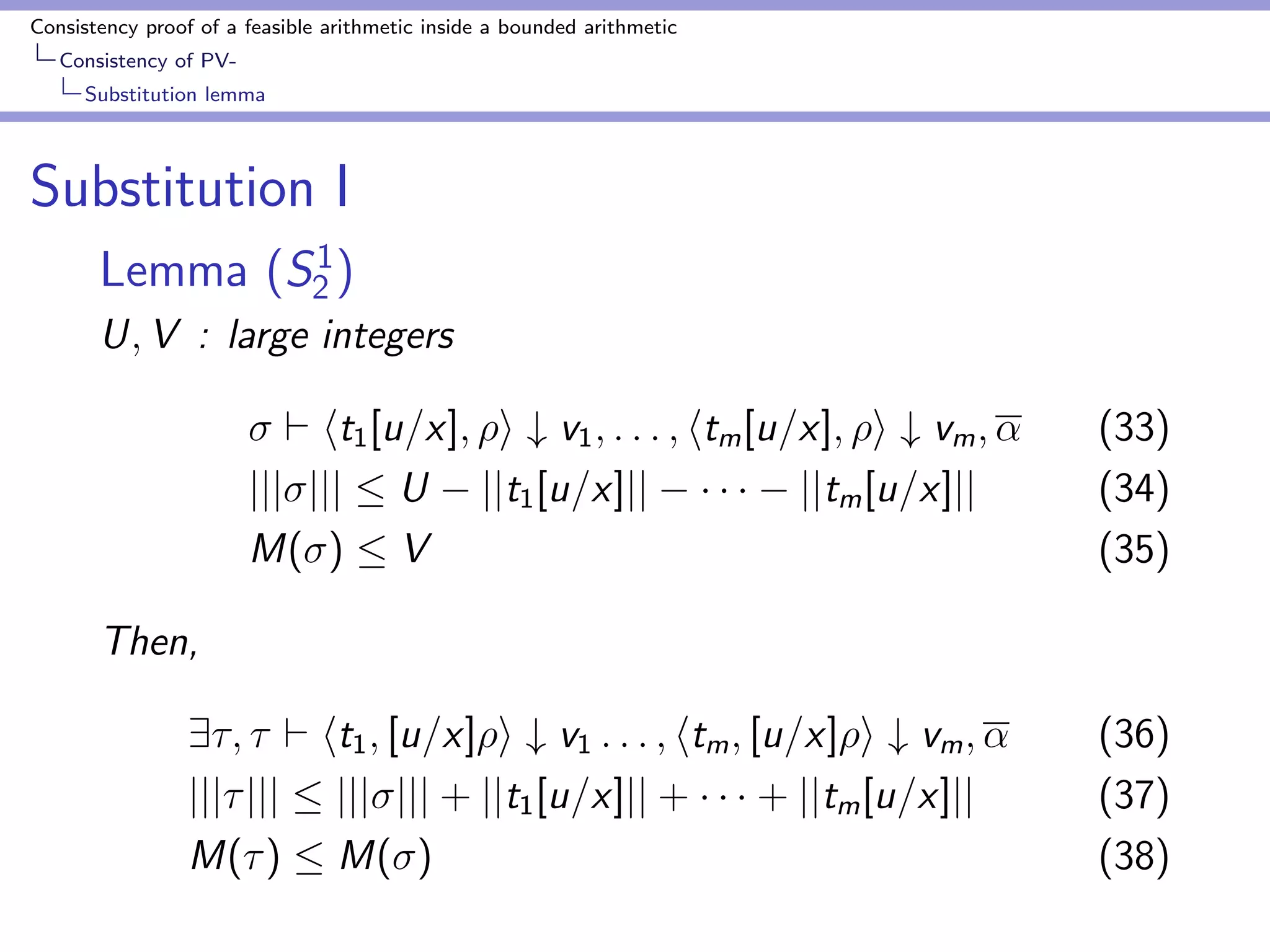
    Consistency proof ofa feasible arithmetic inside a bounded arithmetic Consistency of PV-Substitution lemma Substitution I Lemma (S1 2 ) U; V : large integers ` ht1[u=x]; i # v1; : : : ; htm[u=x]; i # vm; (33) jjjjjj U jjt1[u=x]jj jjtm[u=x]jj (34) M() V (35) Then, 9; ` ht1; [u=x]i # v1 : : : ; htm; [u=x]i # vm; (36) jjj jjj jjjjjj + jjt1[u=x]jj + + jjtm[u=x]jj (37) M( ) M() (38)
  • 65.
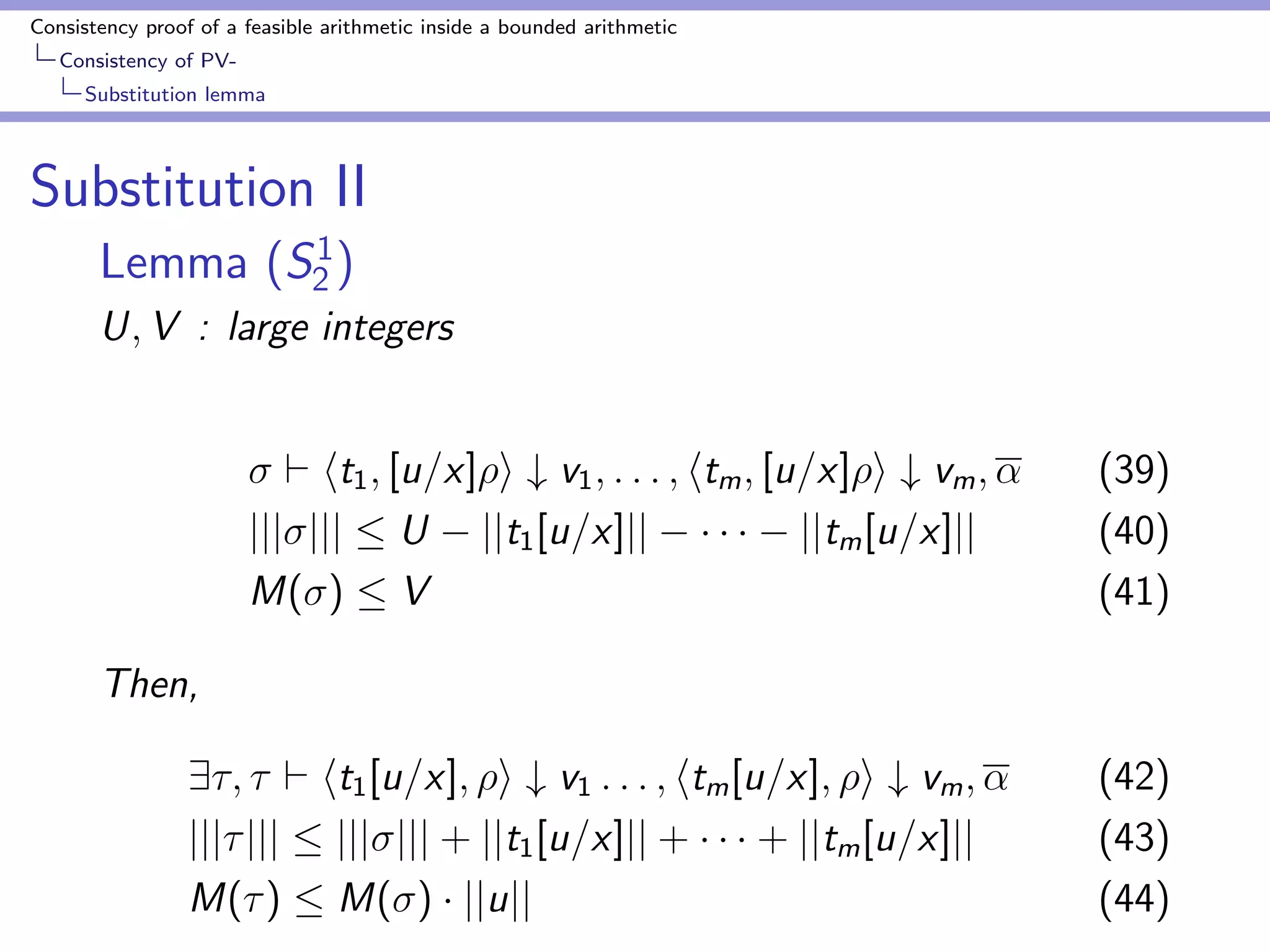
    Consistency proof ofa feasible arithmetic inside a bounded arithmetic Consistency of PV-Substitution lemma Substitution II Lemma (S1 2 ) U; V : large integers ` ht1; [u=x]i # v1; : : : ; htm; [u=x]i # vm; (39) jjjjjj U jjt1[u=x]jj jjtm[u=x]jj (40) M() V (41) Then, 9; ` ht1[u=x]; i # v1 : : : ; htm[u=x]; i # vm; (42) jjj jjj jjjjjj + jjt1[u=x]jj + + jjtm[u=x]jj (43) M( ) M() jjujj (44)
  • 66.
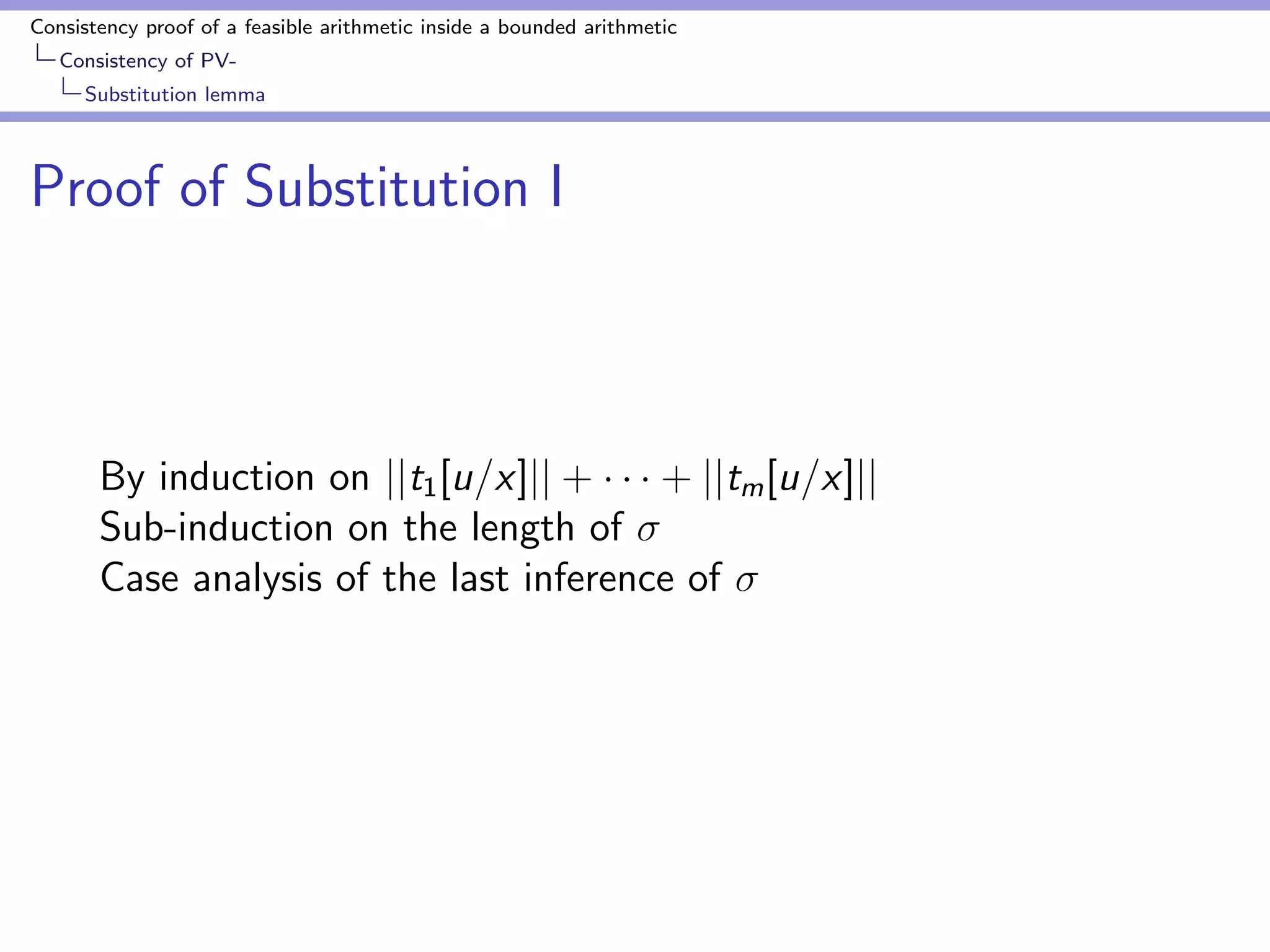
    Consistency proof ofa feasible arithmetic inside a bounded arithmetic Consistency of PV-Substitution lemma Proof of Substitution I By induction on jjt1[u=x]jj + + jjtm[u=x]jj Sub-induction on the length of Case analysis of the last inference of
  • 67.
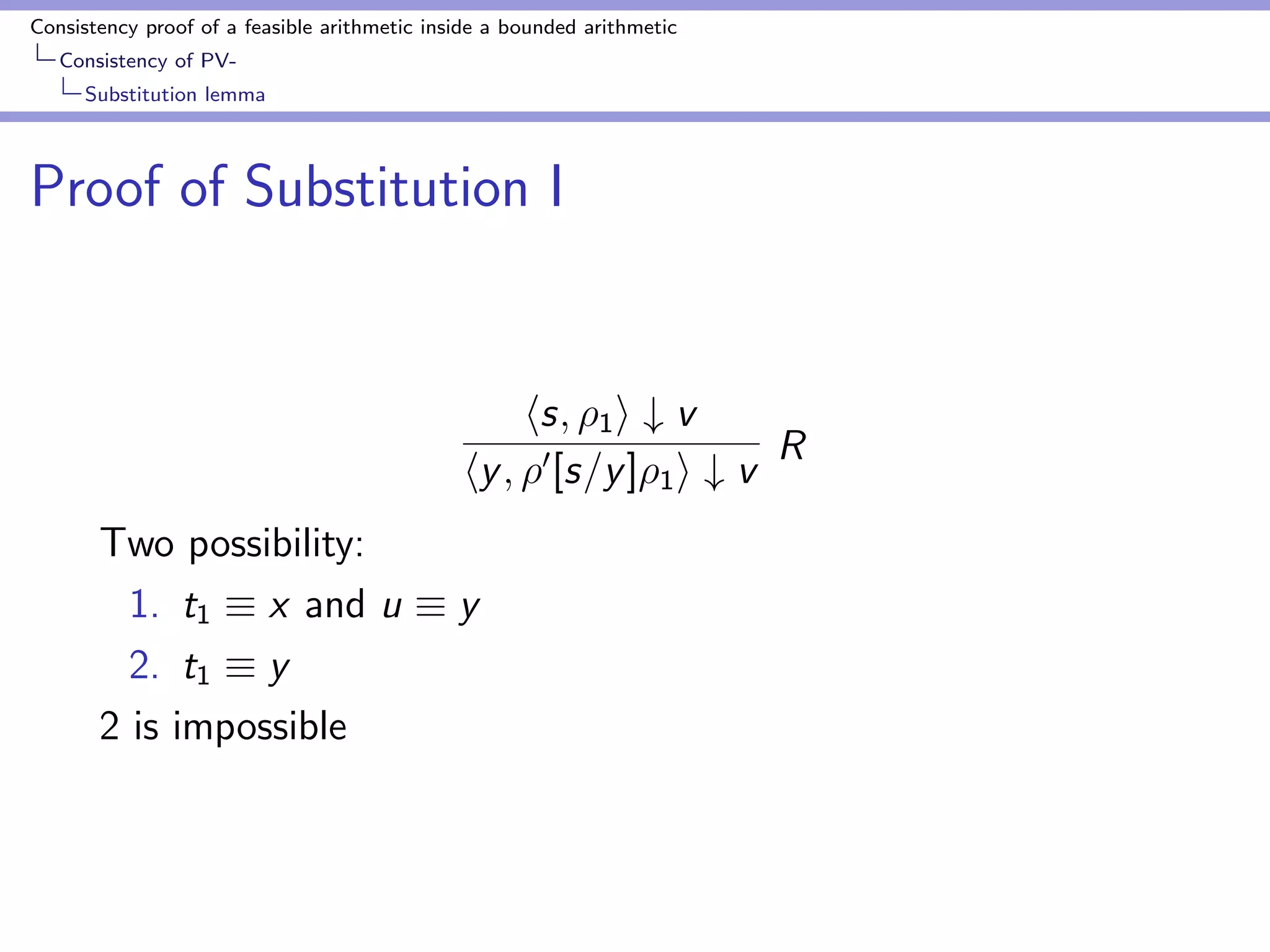
    Consistency proof ofa feasible arithmetic inside a bounded arithmetic Consistency of PV-Substitution lemma Proof of Substitution I hs; 1i # v hy; 0[s=y]1i # v R Two possibility: 1. t1 x and u y 2. t1 y 2 is impossible
  • 68.
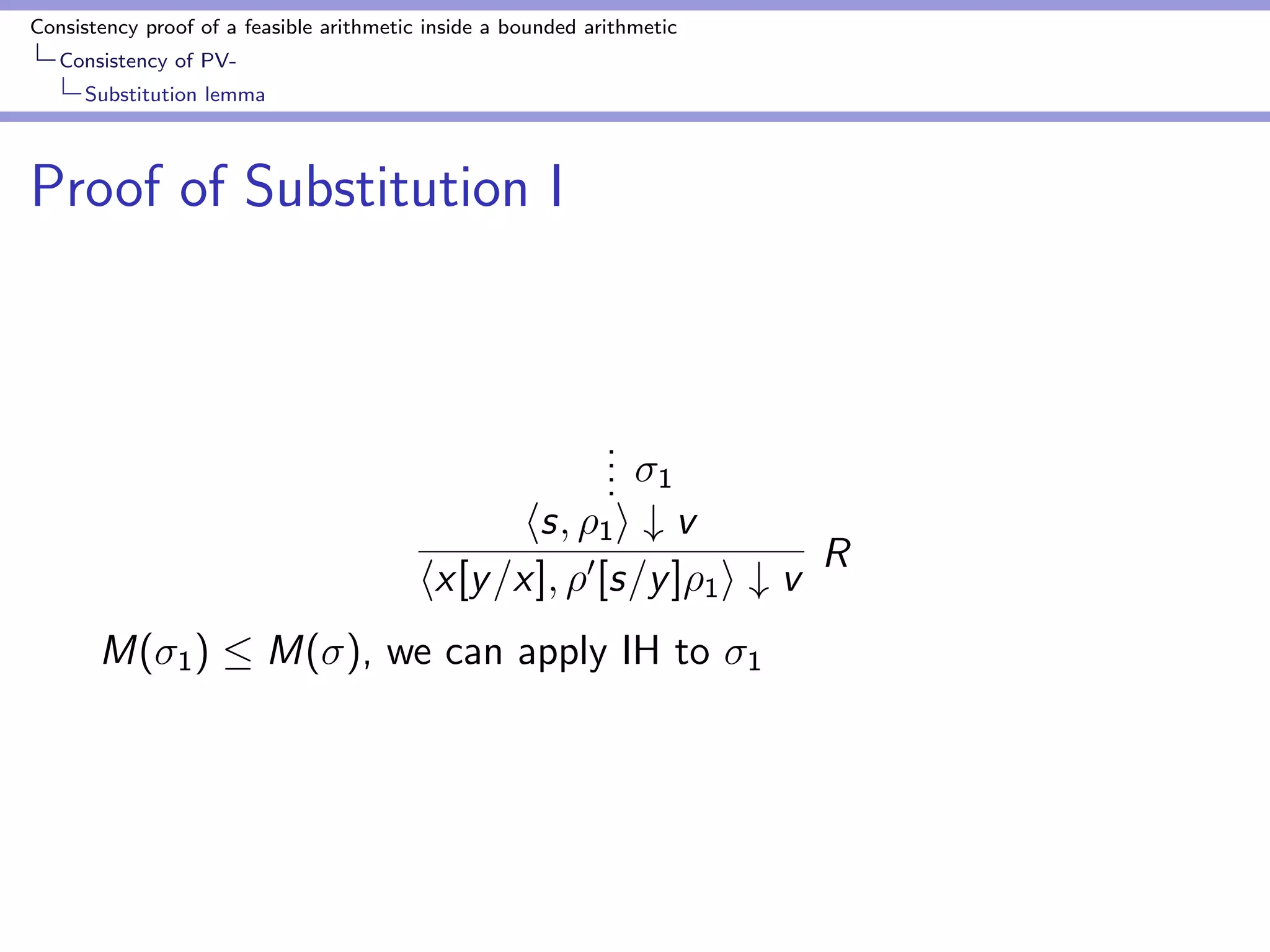
    Consistency proof ofa feasible arithmetic inside a bounded arithmetic Consistency of PV-Substitution lemma Proof of Substitution I .... 1 hs; 1i # v hx[y=x]; 0[s=y]1i # v R M(1) M(), we can apply IH to 1
  • 69.
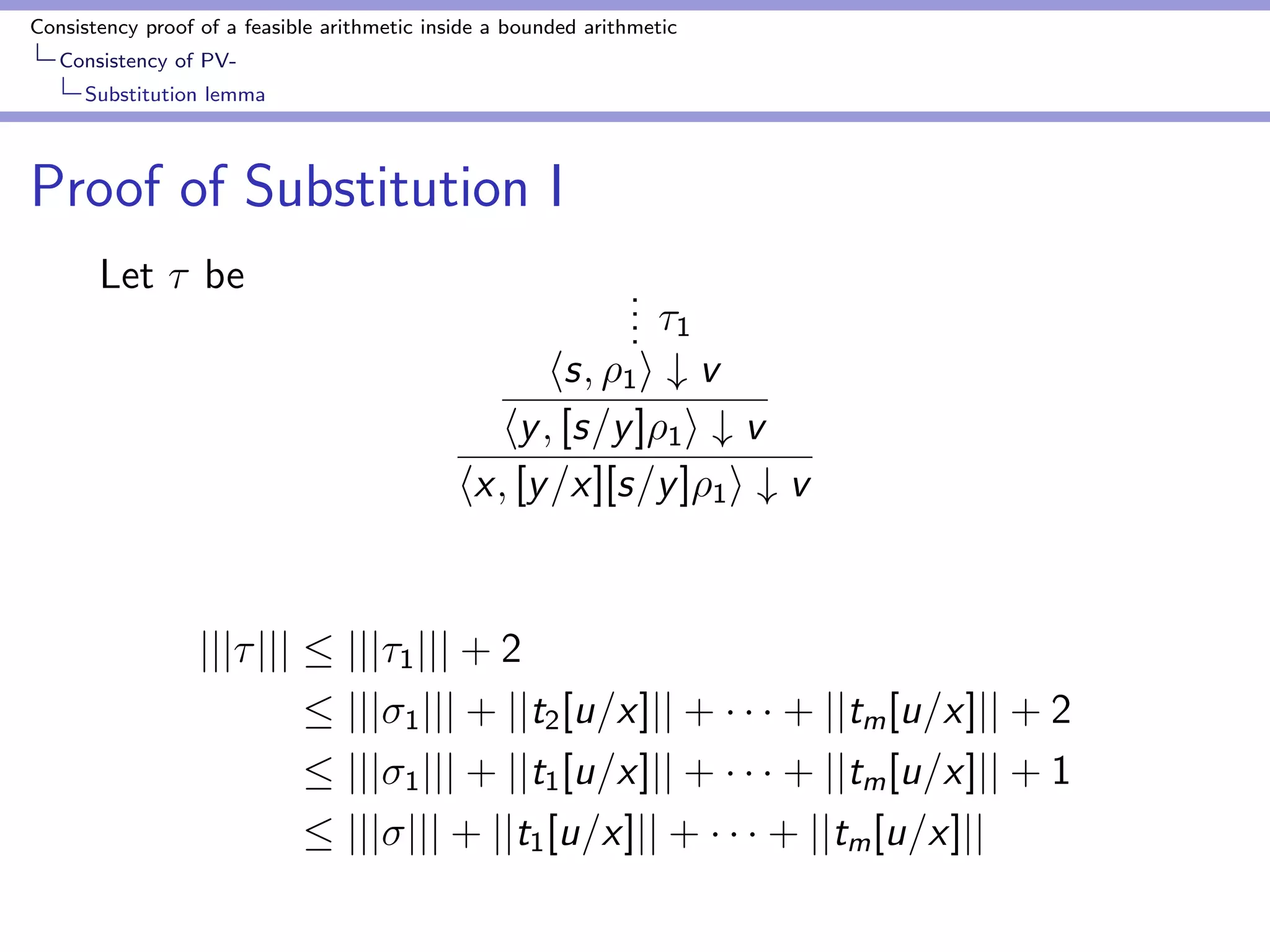
    Consistency proof ofa feasible arithmetic inside a bounded arithmetic Consistency of PV-Substitution lemma Proof of Substitution I Let be ....1 hs; 1i # v hy; [s=y]1i # v hx; [y=x][s=y]1i # v jjj jjj jjj1jjj + 2 jjj1jjj + jjt2[u=x]jj + + jjtm[u=x]jj + 2 jjj1jjj + jjt1[u=x]jj + + jjtm[u=x]jj + 1 jjjjjj + jjt1[u=x]jj + + jjtm[u=x]jj
  • 70.
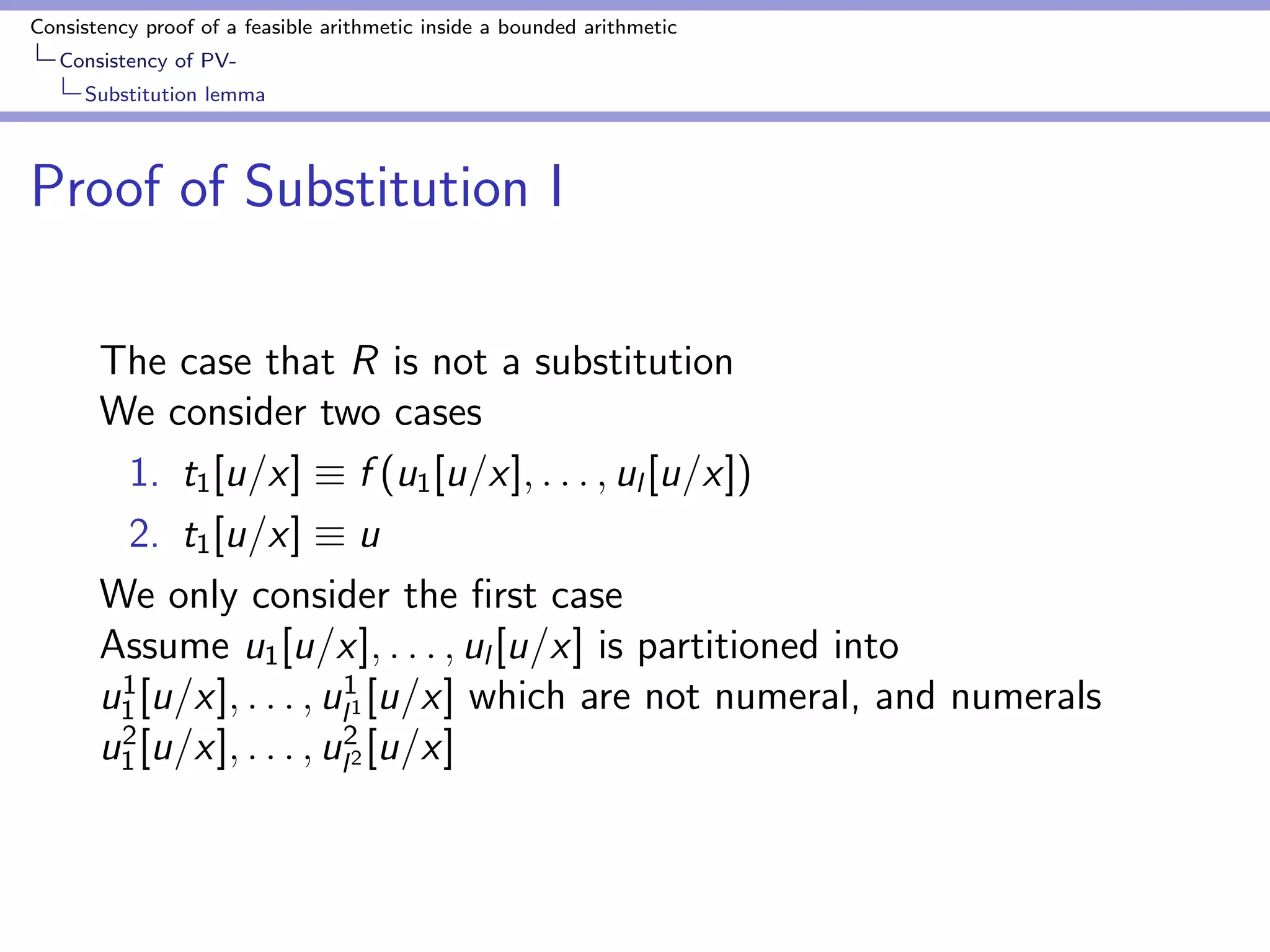
    Consistency proof ofa feasible arithmetic inside a bounded arithmetic Consistency of PV-Substitution lemma Proof of Substitution I The case that R is not a substitution We consider two cases 1. t1[u=x] f (u1[u=x]; : : : ; ul [u=x]) 2. t1[u=x] u We only consider the
  • 71.
    rst case Assumeu1[u=x]; : : : ; ul [u=x] is partitioned into u1 1[u=x]; : : : ; u1 l1 [u=x] which are not numeral, and numerals u2 1[u=x]; : : : ; u2 l2 [u=x]
  • 72.
    Consistency proof ofa feasible arithmetic inside a bounded arithmetic Consistency of PV-Substitution lemma Proof of Substitution I
  • 73.
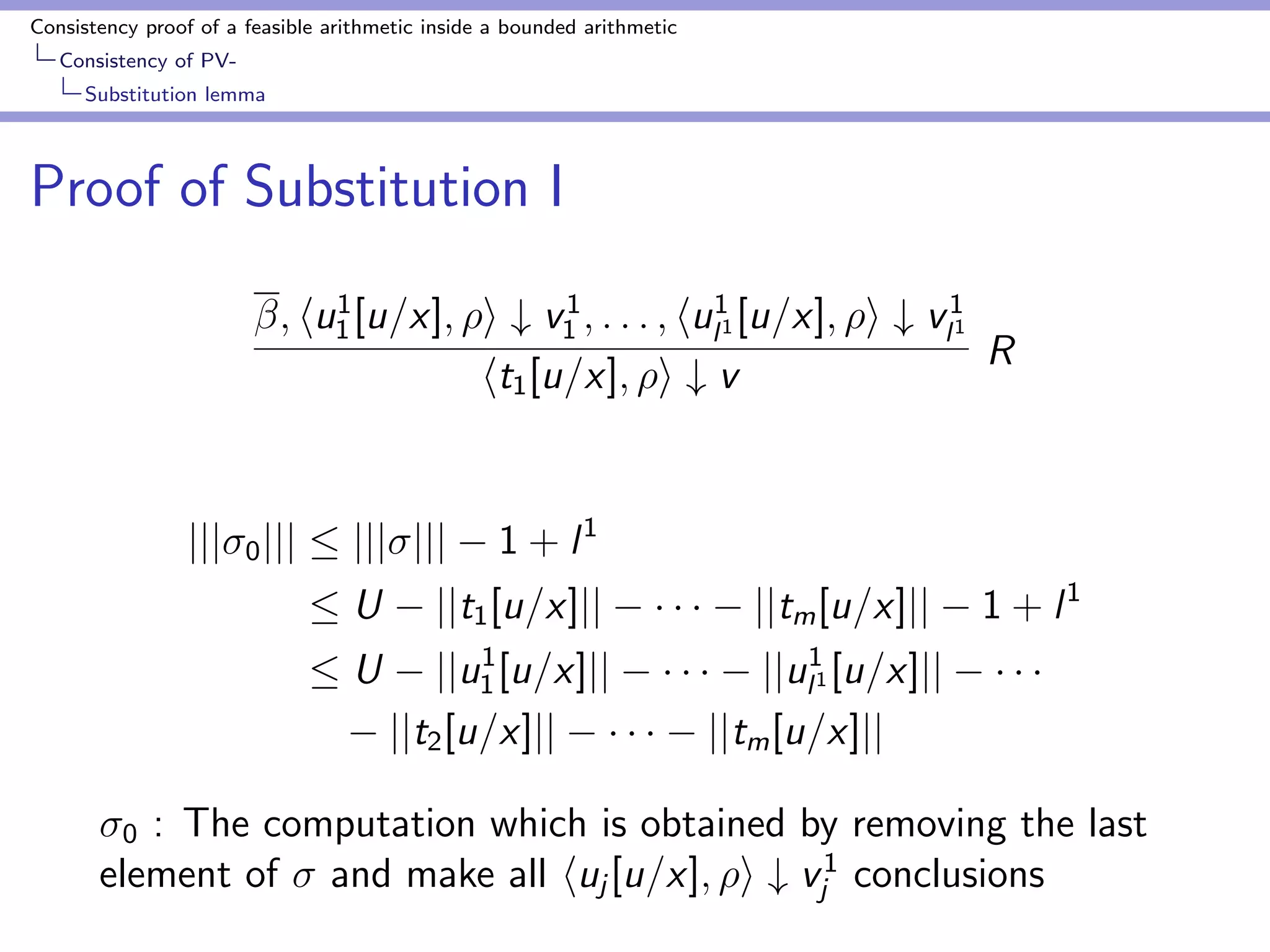
    ; hu1 1[u=x];i # v1 1 ; : : : ; hu1 l1 [u=x]; i # v1 l1 ht1[u=x]; i # v R jjj0jjj jjjjjj 1 + l 1 U jjt1[u=x]jj jjtm[u=x]jj 1 + l 1 U jju1 1[u=x]jj jju1 l1 [u=x]jj jjt2[u=x]jj jjtm[u=x]jj 0 : The computation which is obtained by removing the last element of and make all huj [u=x]; i # v1 j conclusions
  • 74.
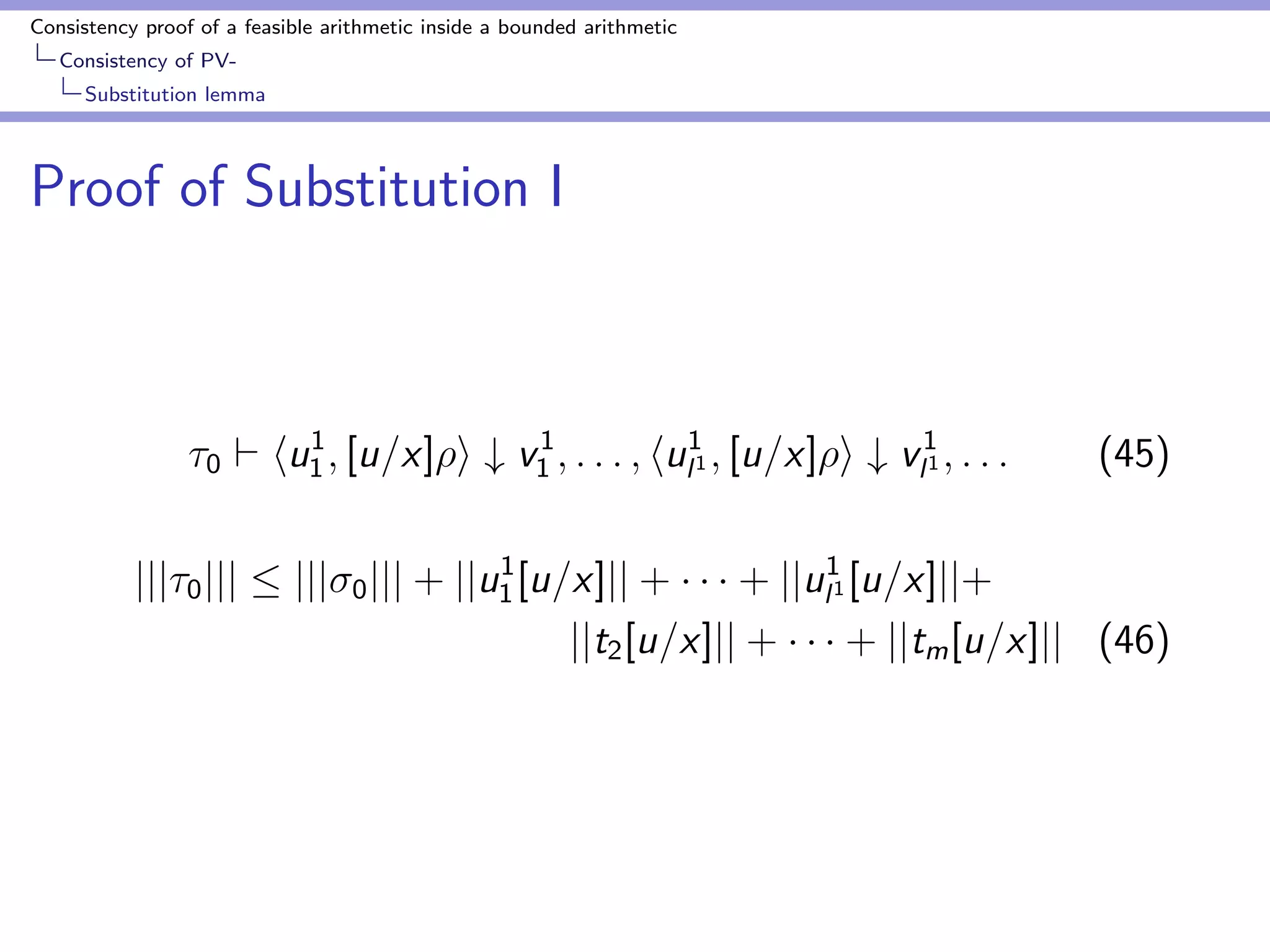
    Consistency proof ofa feasible arithmetic inside a bounded arithmetic Consistency of PV-Substitution lemma Proof of Substitution I 0 ` hu1 1; [u=x]i # v1 1 ; : : : ; hu1 l1 ; [u=x]i # v1 l1 ; : : : (45) jjj0jjj jjj0jjj + jju1 1[u=x]jj + + jju1 l1 [u=x]jj+ jjt2[u=x]jj + + jjtm[u=x]jj (46)
  • 75.
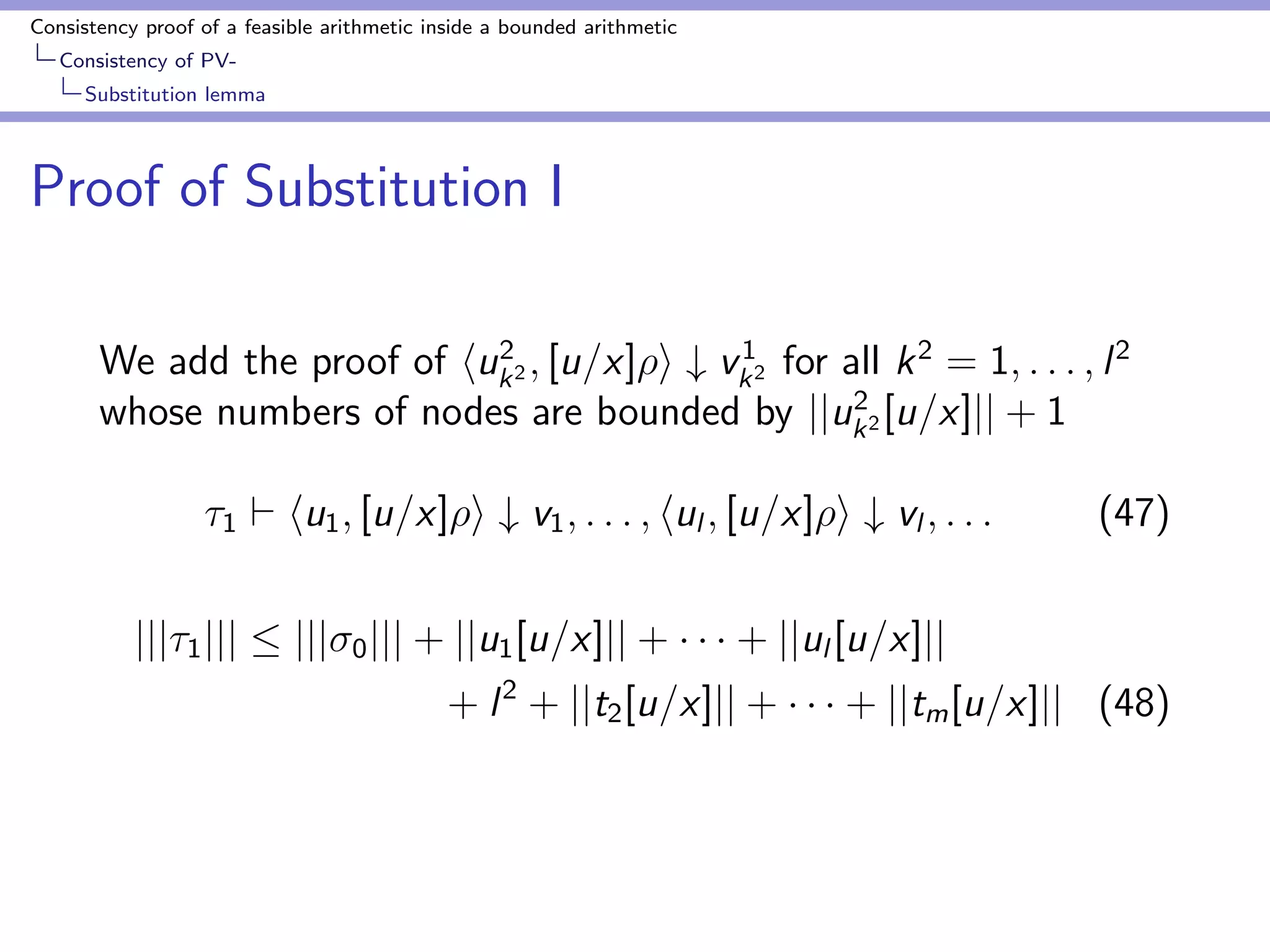
    Consistency proof ofa feasible arithmetic inside a bounded arithmetic Consistency of PV-Substitution lemma Proof of Substitution I We add the proof of hu2 k2 ; [u=x]i # v1 k2 for all k2 = 1; : : : ; l 2 whose numbers of nodes are bounded by jju2 k2 [u=x]jj + 1 1 ` hu1; [u=x]i # v1; : : : ; hul ; [u=x]i # vl ; : : : (47) jjj1jjj jjj0jjj + jju1[u=x]jj + + jjul [u=x]jj + l 2 + jjt2[u=x]jj + + jjtm[u=x]jj (48)
  • 76.
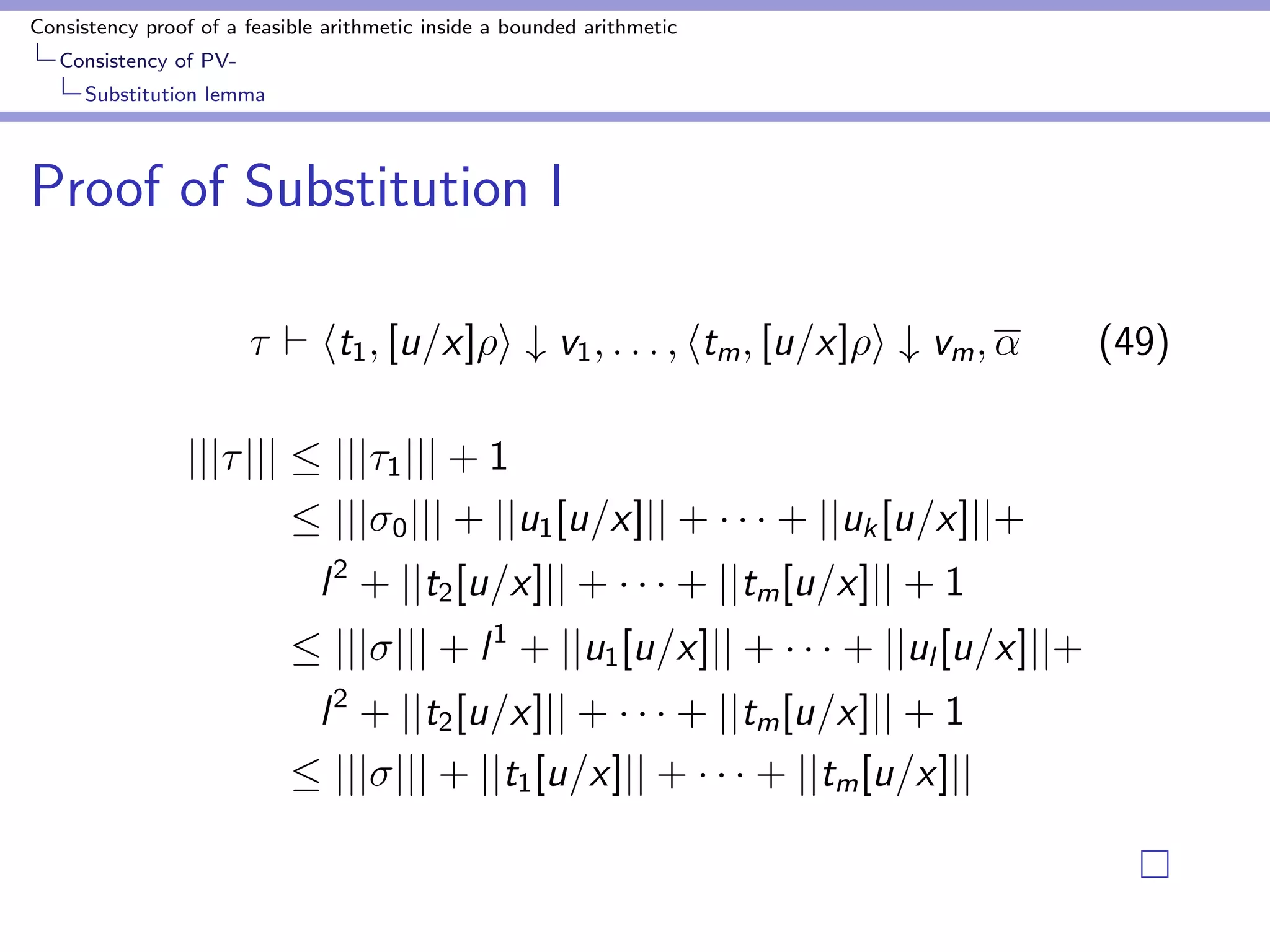
    Consistency proof ofa feasible arithmetic inside a bounded arithmetic Consistency of PV-Substitution lemma Proof of Substitution I ` ht1; [u=x]i # v1; : : : ; htm; [u=x]i # vm; (49) jjj jjj jjj1jjj + 1 jjj0jjj + jju1[u=x]jj + + jjuk [u=x]jj+ l 2 + jjt2[u=x]jj + + jjtm[u=x]jj + 1 jjjjjj + l 1 + jju1[u=x]jj + + jjul [u=x]jj+ l 2 + jjt2[u=x]jj + + jjtm[u=x]jj + 1 jjjjjj + jjt1[u=x]jj + + jjtm[u=x]jj
  • 77.
    Consistency proof ofa feasible arithmetic inside a bounded arithmetic Consistency of PV-Substitution lemma Proof of Substitution II Similar to the proof of Substitution I
  • 78.
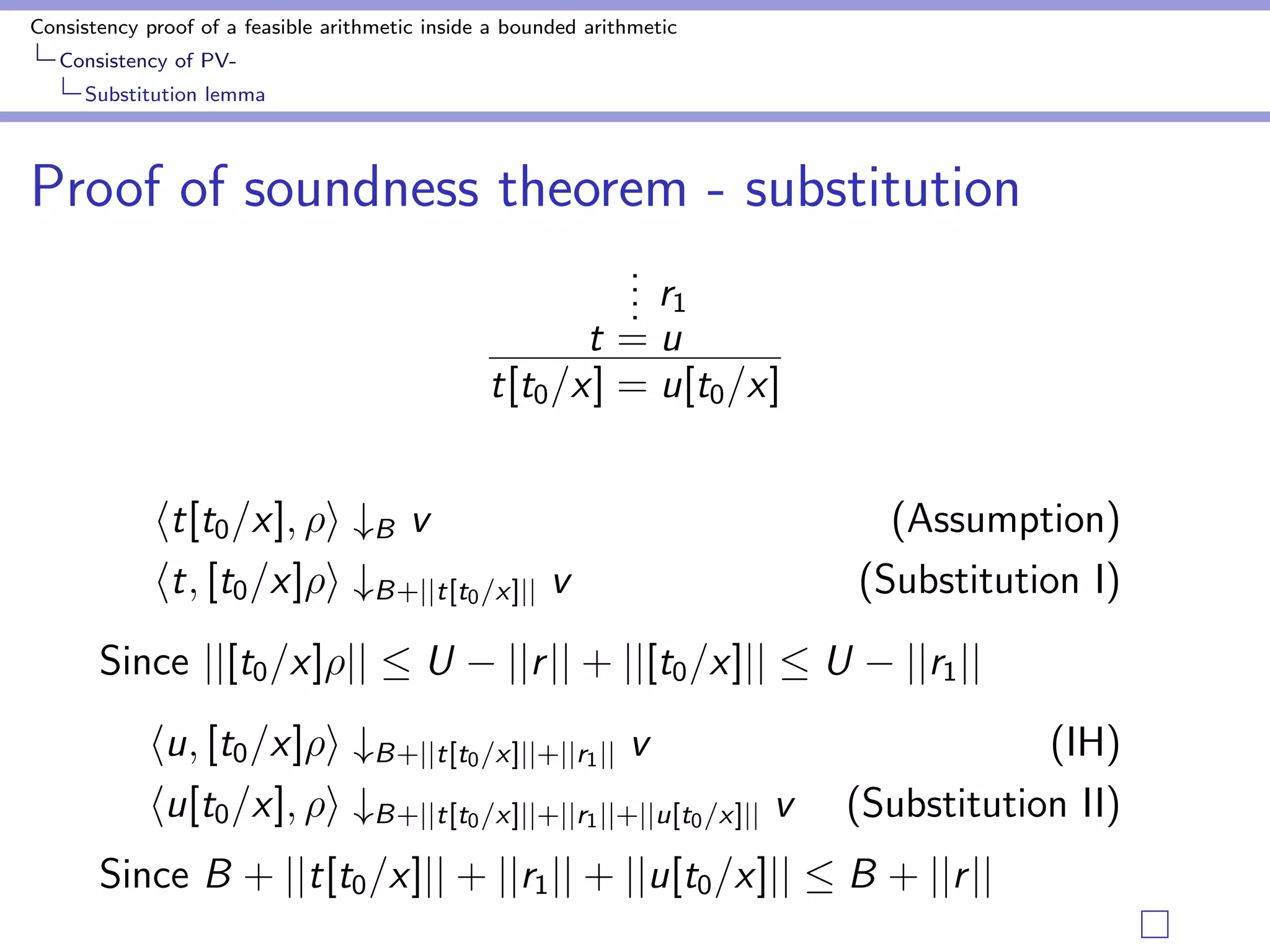
    Consistency proof ofa feasible arithmetic inside a bounded arithmetic Consistency of PV-Substitution lemma Proof of soundness theorem - substitution .... r1 t = u t[t0=x] = u[t0=x] ht[t0=x]; i #B v (Assumption) ht; [t0=x]i #B+jjt[t0=x]jj v (Substitution I) Since jj[t0=x]jj U jjr jj + jj[t0=x]jj U jjr1jj hu; [t0=x]i #B+jjt[t0=x]jj+jjr1jj v (IH) hu[t0=x]; i #B+jjt[t0=x]jj+jjr1jj+jju[t0=x]jj v (Substitution II) Since B + jjt[t0=x]jj + jjr1jj + jju[t0=x]jj B + jjr jj
  • 79.
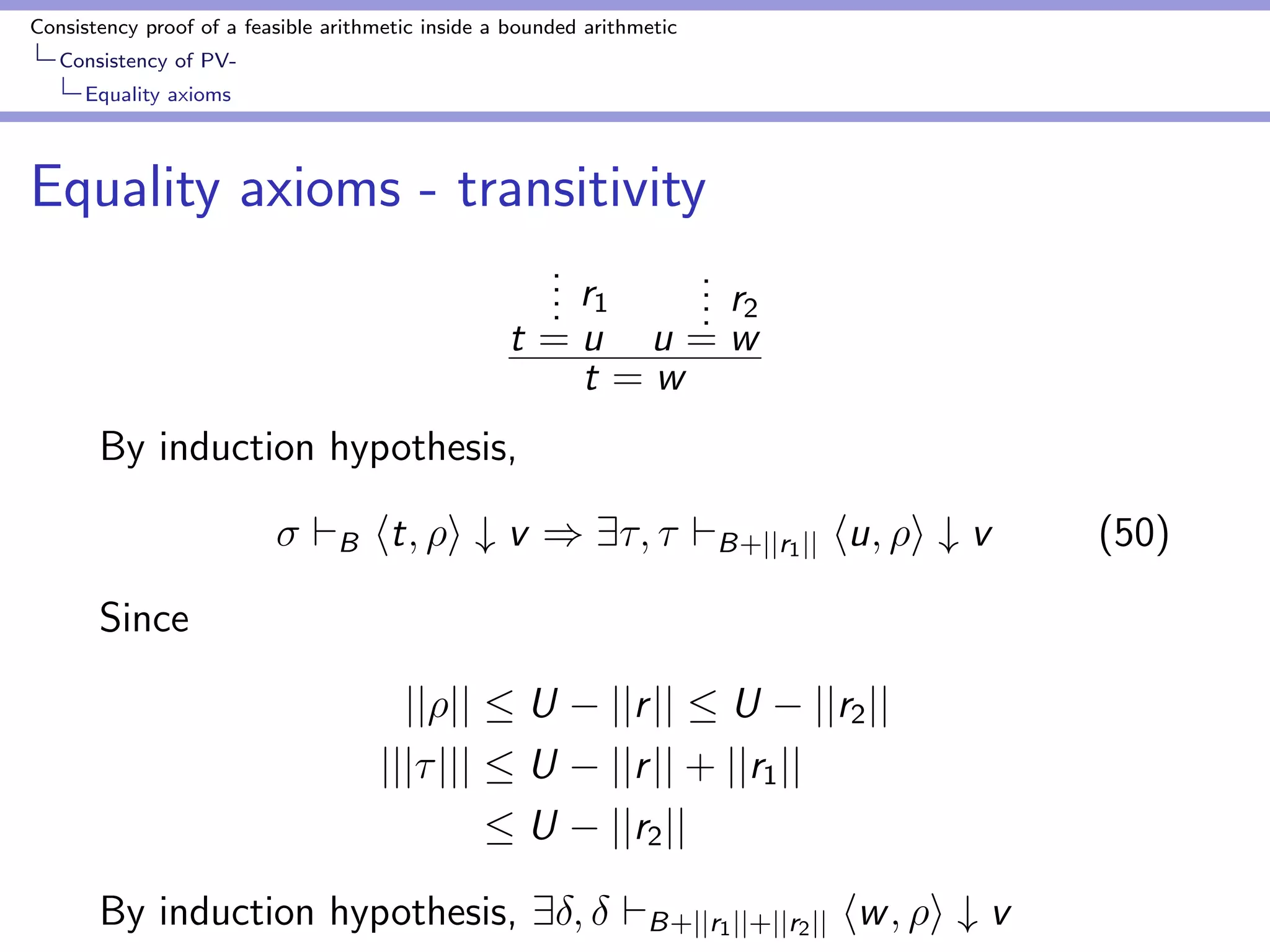
    Consistency proof ofa feasible arithmetic inside a bounded arithmetic Consistency of PV-Equality axioms Equality axioms - transitivity .... r1 t = u .... r2 u = w t = w By induction hypothesis, `B ht; i # v ) 9; `B+jjr1jj hu; i # v (50) Since jjjj U jjr jj U jjr2jj jjj jjj U jjr jj + jjr1jj U jjr2jj By induction hypothesis, 9; `B+jjr1jj+jjr2jj hw; i # v
  • 80.
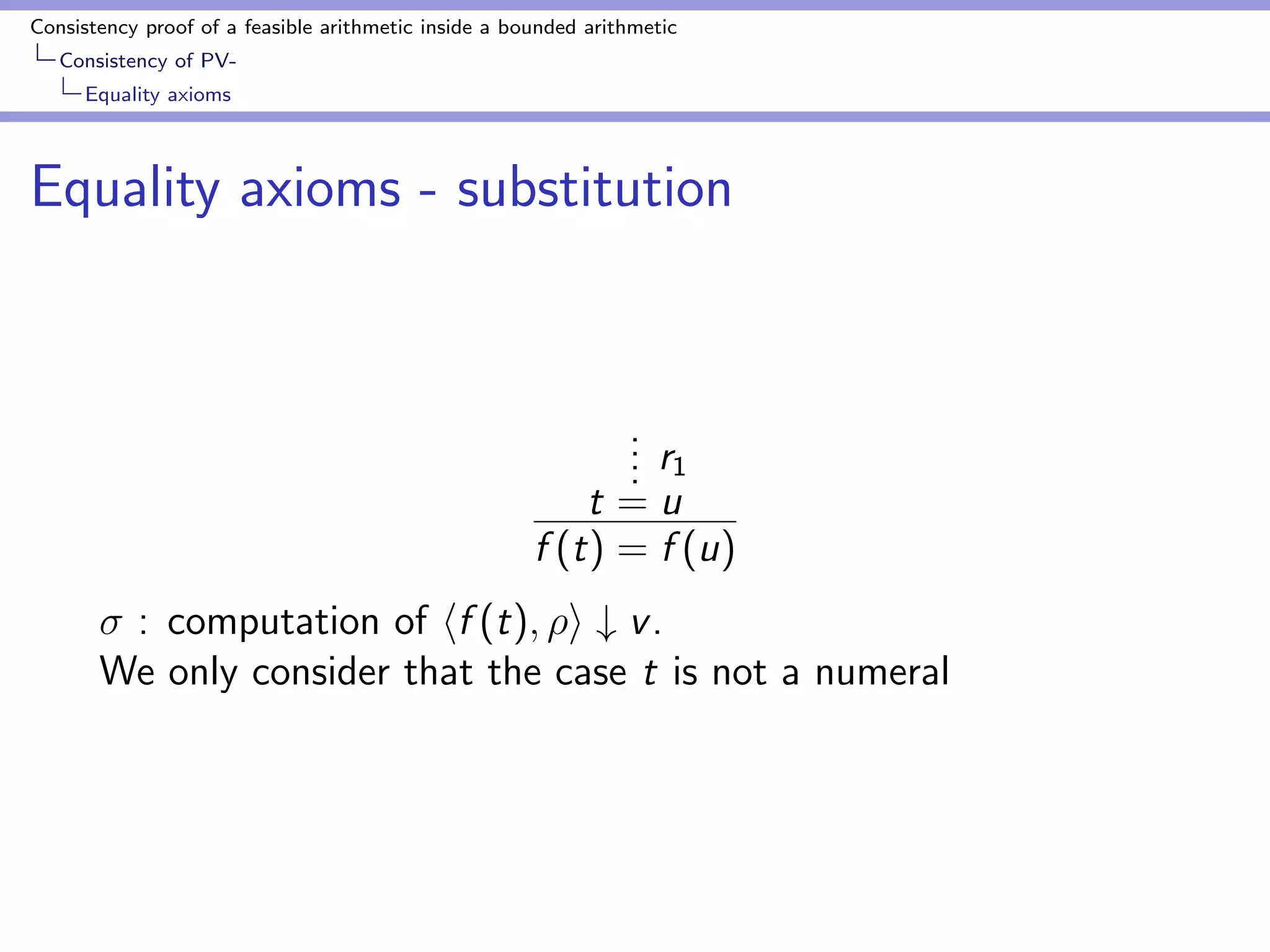
    Consistency proof ofa feasible arithmetic inside a bounded arithmetic Consistency of PV-Equality axioms Equality axioms - substitution .... r1 t = u f (t) = f (u) : computation of hf (t); i # v. We only consider that the case t is not a numeral
  • 81.
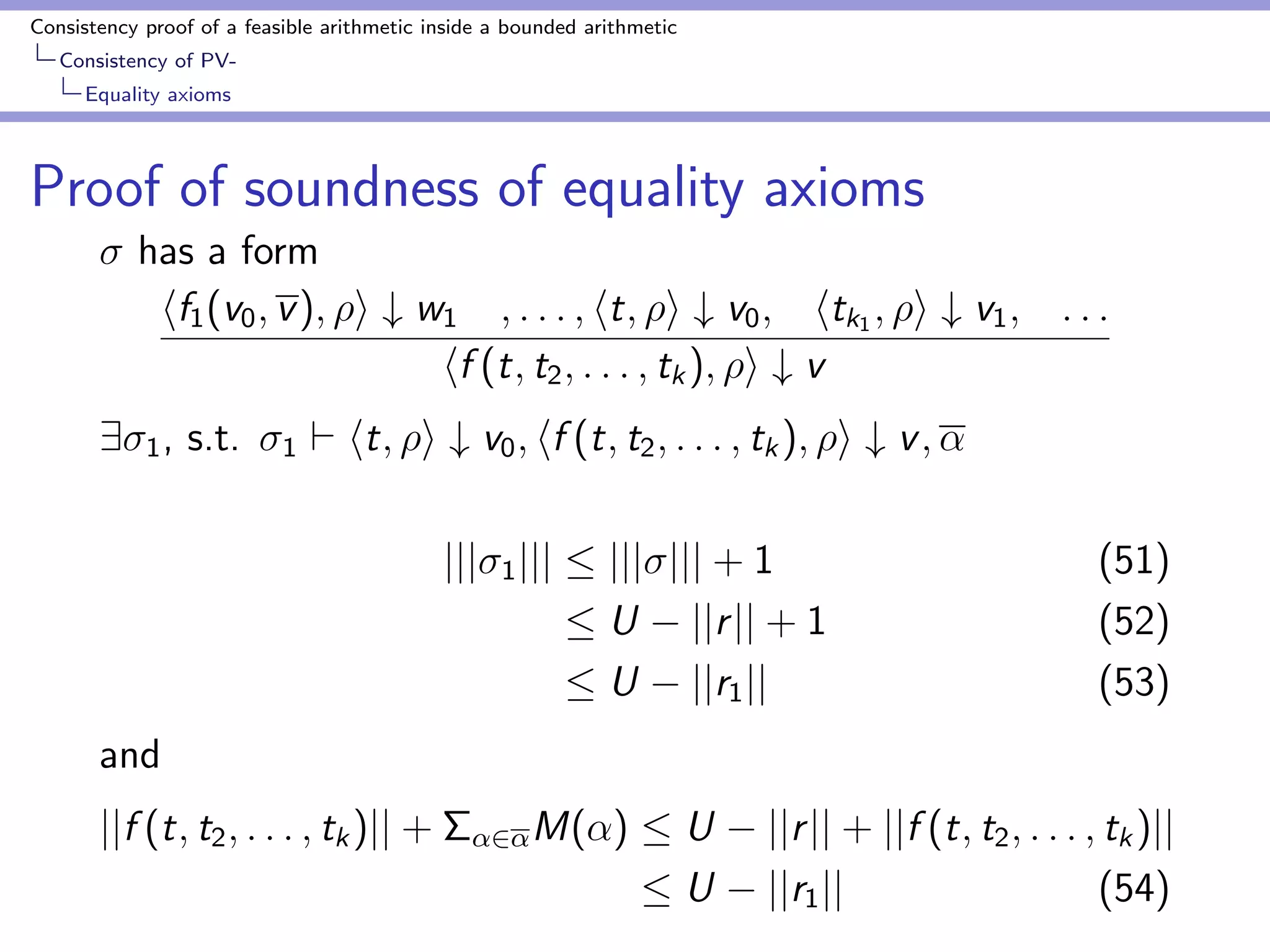
    Consistency proof ofa feasible arithmetic inside a bounded arithmetic Consistency of PV-Equality axioms Proof of soundness of equality axioms has a form hf1(v0; v); i # w1 ; : : : ; ht; i # v0; htk1 ; i # v1; : : : hf (t; t2; : : : ; tk ); i # v 91, s.t. 1 ` ht; i # v0; hf (t; t2; : : : ; tk ); i # v; jjj1jjj jjjjjj + 1 (51) U jjr jj + 1 (52) U jjr1jj (53) and jjf (t; t2; : : : ; tk )jj + 2M() U jjr jj + jjf (t; t2; : : : ; tk )jj U jjr1jj (54)
  • 82.
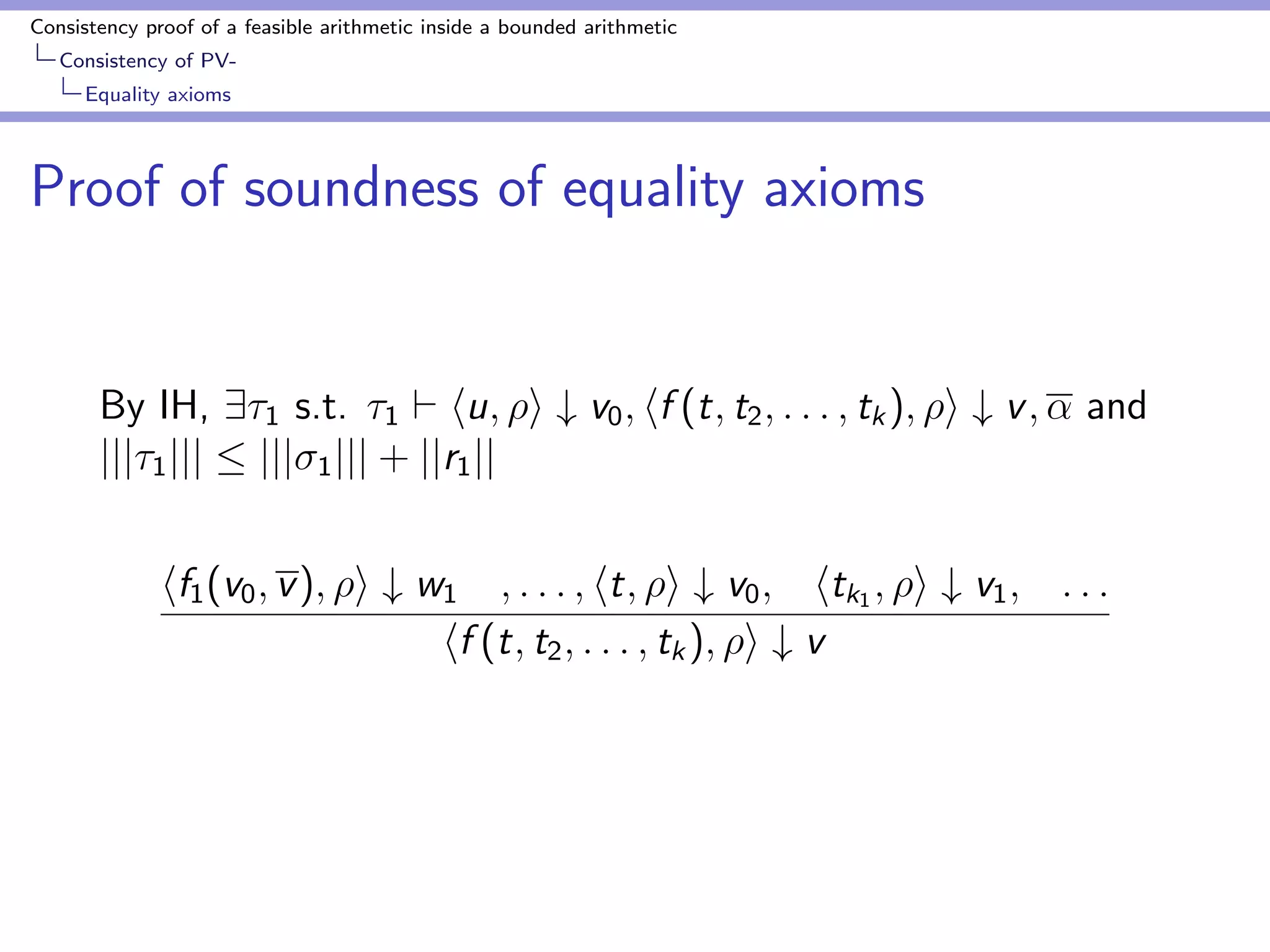
    Consistency proof ofa feasible arithmetic inside a bounded arithmetic Consistency of PV-Equality axioms Proof of soundness of equality axioms By IH, 91 s.t. 1 ` hu; i # v0; hf (t; t2; : : : ; tk ); i # v; and jjj1jjj jjj1jjj + jjr1jj hf1(v0; v); i # w1 ; : : : ; ht; i # v0; htk1 ; i # v1; : : : hf (t; t2; : : : ; tk ); i # v
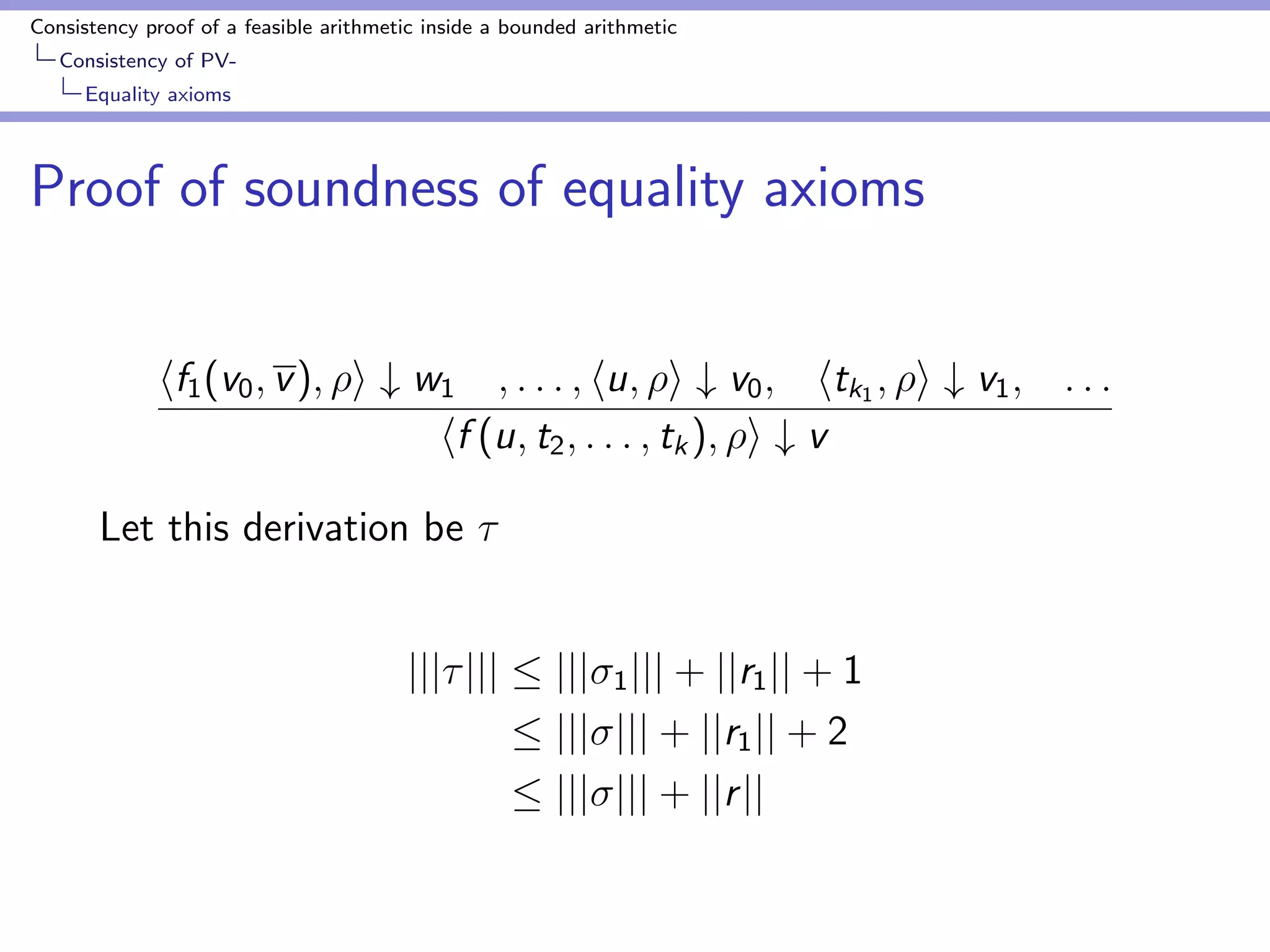
  • 83.
    Consistency proof ofa feasible arithmetic inside a bounded arithmetic Consistency of PV-Equality axioms Proof of soundness of equality axioms hf1(v0; v); i # w1 ; : : : ; hu; i # v0; htk1 ; i # v1; : : : hf (u; t2; : : : ; tk ); i # v Let this derivation be jjj jjj jjj1jjj + jjr1jj + 1 jjjjjj + jjr1jj + 2 jjjjjj + jjr jj