Iterative Compression
Input

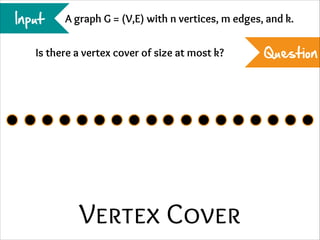
A graph G = (V,E) with n vertices, m edges, and k.

Is there a vertex cover of size at most k?

Vertex Cover

Question
Input

A graph G = (V,E) with n vertices, m edges, and k.

Is there a vertex cover of size at most k?

Vertex Cover

Question
Input

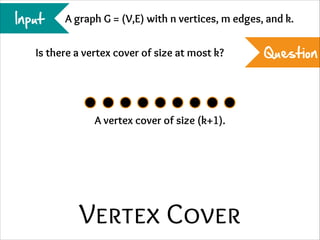
A graph G = (V,E) with n vertices, m edges, and k.

Is there a vertex cover of size at most k?

A vertex cover of size (k+1).

Vertex Cover

Question
Input

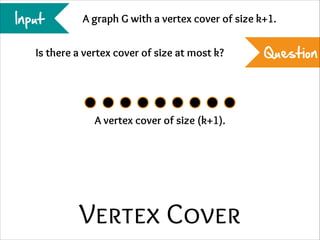
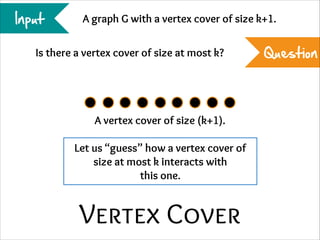
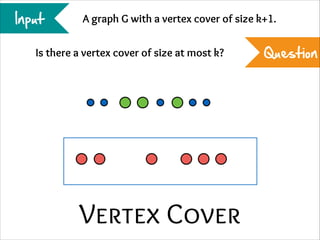
A graph G with a vertex cover of size k+1.

Is there a vertex cover of size at most k?

A vertex cover of size (k+1).

Vertex Cover

Question
Input

A graph G with a vertex cover of size k+1.

Is there a vertex cover of size at most k?

A vertex cover of size (k+1).

Vertex Cover

Question
Input

A graph G with a vertex cover of size k+1.

Is there a vertex cover of size at most k?

A vertex cover of size (k+1).
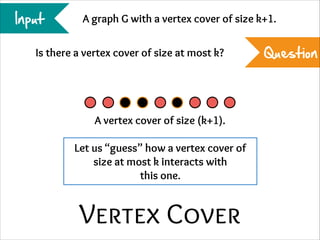
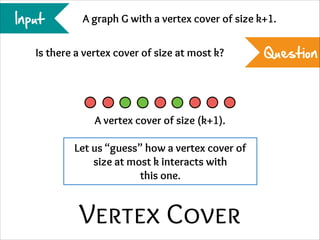
Let us “guess” how a vertex cover of
size at most k interacts with
this one.

Vertex Cover

Question
Input

A graph G with a vertex cover of size k+1.

Is there a vertex cover of size at most k?

A vertex cover of size (k+1).
Let us “guess” how a vertex cover of
size at most k interacts with
this one.

Vertex Cover

Question
Input

A graph G with a vertex cover of size k+1.

Is there a vertex cover of size at most k?

A vertex cover of size (k+1).
Let us “guess” how a vertex cover of
size at most k interacts with
this one.

Vertex Cover

Question
Input

A graph G with a vertex cover of size k+1.

Is there a vertex cover of size at most k?

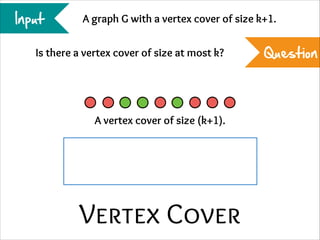
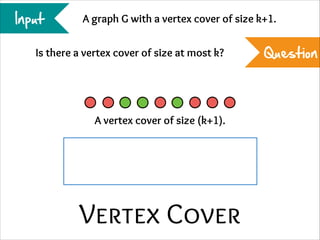
A vertex cover of size (k+1).

Vertex Cover

Question
Input

A graph G with a vertex cover of size k+1.

Is there a vertex cover of size at most k?

A vertex cover of size (k+1).
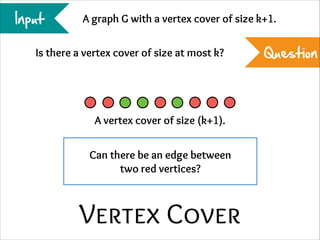
Can there be an edge between
two red vertices?

Vertex Cover

Question
Input

A graph G with a vertex cover of size k+1.

Is there a vertex cover of size at most k?

A vertex cover of size (k+1).

Vertex Cover

Question
Input

A graph G with a vertex cover of size k+1.

Is there a vertex cover of size at most k?

A vertex cover of size (k+1).
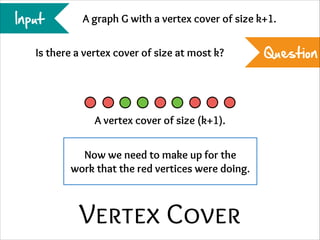
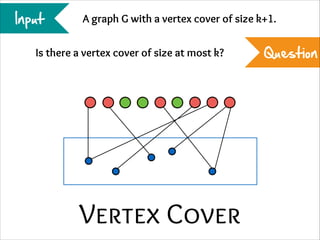
Now we need to make up for the
work that the red vertices were doing.

Vertex Cover

Question
Input

A graph G with a vertex cover of size k+1.

Is there a vertex cover of size at most k?

Vertex Cover

Question
Input

A graph G with a vertex cover of size k+1.

Is there a vertex cover of size at most k?

Vertex Cover

Question
Input

A graph G = (V,E) with n vertices, m edges, and k.

Is there a vertex cover of size at most k?

Vertex Cover

Question
Input

A graph G = (V,E) with n vertices, m edges, and k.

Is there a vertex cover of size at most k?

Vertex Cover

Question
Input

A graph G = (V,E) with n vertices, m edges, and k.

Is there a vertex cover of size at most k?

Vertex Cover

Question
Input

A graph G = (V,E) with n vertices, m edges, and k.

Is there a vertex cover of size at most k?

Vertex Cover

Question
Input

A graph G = (V,E) with n vertices, m edges, and k.

Is there a vertex cover of size at most k?

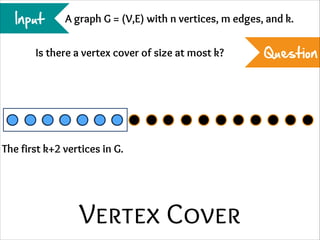
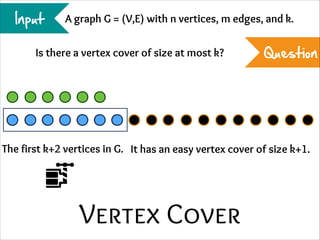
The first k+2 vertices in G.

Vertex Cover

Question
Input

A graph G = (V,E) with n vertices, m edges, and k.

Is there a vertex cover of size at most k?

Question

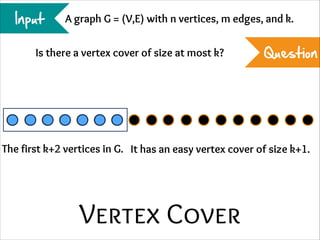
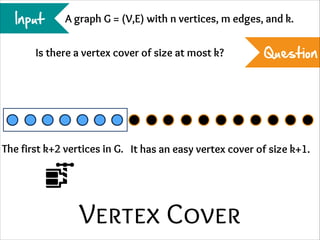
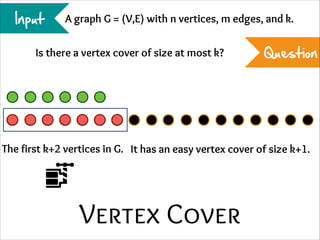
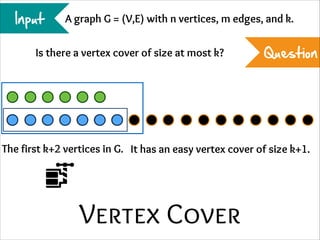
The first k+2 vertices in G. It has an easy vertex cover of size k+1.

Vertex Cover
Input

A graph G = (V,E) with n vertices, m edges, and k.

Is there a vertex cover of size at most k?

Question

The first k+2 vertices in G. It has an easy vertex cover of size k+1.

Vertex Cover
Input

A graph G = (V,E) with n vertices, m edges, and k.

Is there a vertex cover of size at most k?

Question

The first k+2 vertices in G. It has an easy vertex cover of size k+1.

Vertex Cover
Input

A graph G = (V,E) with n vertices, m edges, and k.

Is there a vertex cover of size at most k?

Question

The first k+2 vertices in G. It has an easy vertex cover of size k+1.

Vertex Cover
Input

A graph G = (V,E) with n vertices, m edges, and k.

Is there a vertex cover of size at most k?

Question

The first k+2 vertices in G. It has an easy vertex cover of size k+1.

Vertex Cover
Input

A graph G = (V,E) with n vertices, m edges, and k.

Is there a vertex cover of size at most k?

Question

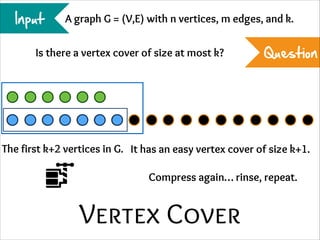
The first k+2 vertices in G. It has an easy vertex cover of size k+1.
Compress again… rinse, repeat.

Vertex Cover
Input

A graph G = (V,E) with n vertices, m edges, and k.

Is there a subset of vertices S of size at most k
that intersects all the edges?

Question

We have a O*(2k) algorithm for Vertex Cover.

Vertex Cover
Input

A graph G = (V,E) with n vertices, m edges, and k.

Is there a subset of vertices S of size at most k
that intersects all the edges?

Question

We have a O*(2k) algorithm for Vertex Cover.

Vertex Cover
Input

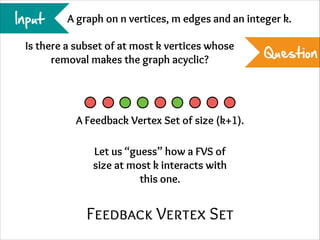
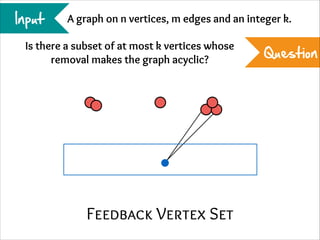
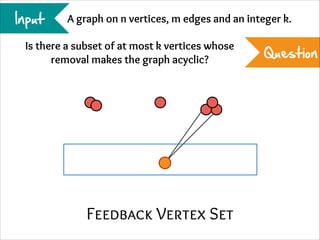
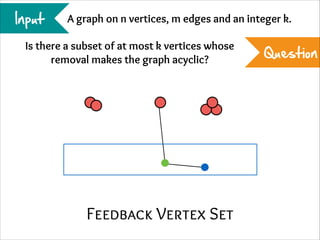
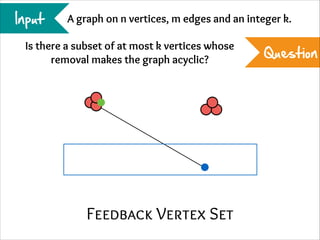
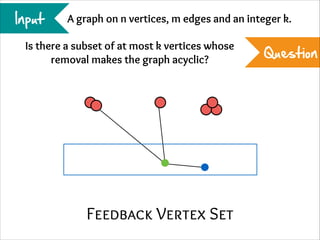
A graph on n vertices, m edges and an integer k.

Is there a subset of at most k vertices whose
removal makes the graph acyclic?

A Feedback Vertex Set of size (k+1).
Let us “guess” how a FVS of
size at most k interacts with
this one.

Feedback Vertex Set

Question
Input

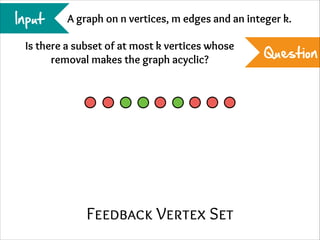
A graph on n vertices, m edges and an integer k.

Is there a subset of at most k vertices whose
removal makes the graph acyclic?

Feedback Vertex Set

Question
Input

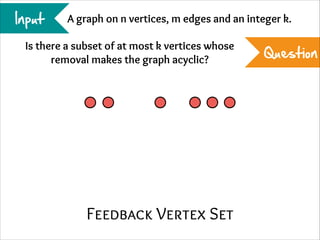
A graph on n vertices, m edges and an integer k.

Is there a subset of at most k vertices whose
removal makes the graph acyclic?

Feedback Vertex Set

Question
Input

A graph on n vertices, m edges and an integer k.

Is there a subset of at most k vertices whose
removal makes the graph acyclic?

Feedback Vertex Set

Question
Input

A graph on n vertices, m edges and an integer k.

Is there a subset of at most k vertices whose
removal makes the graph acyclic?

Feedback Vertex Set

Question
Input

A graph on n vertices, m edges and an integer k.

Is there a subset of at most k vertices whose
removal makes the graph acyclic?

Question

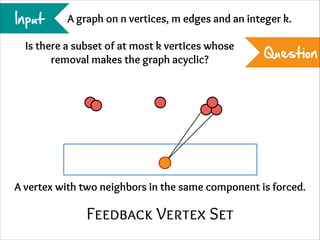
A vertex with two neighbors in the same component is forced.

Feedback Vertex Set
Input

A graph on n vertices, m edges and an integer k.

Is there a subset of at most k vertices whose
removal makes the graph acyclic?

Feedback Vertex Set

Question
Input

A graph on n vertices, m edges and an integer k.

Is there a subset of at most k vertices whose
removal makes the graph acyclic?

Question

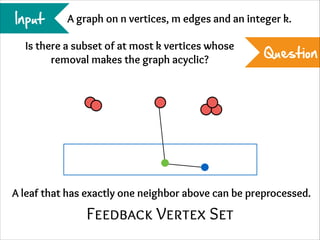
A leaf that has exactly one neighbor above can be preprocessed.

Feedback Vertex Set
Input

A graph on n vertices, m edges and an integer k.

Is there a subset of at most k vertices whose
removal makes the graph acyclic?

Feedback Vertex Set

Question
Input

A graph on n vertices, m edges and an integer k.

Is there a subset of at most k vertices whose
removal makes the graph acyclic?

Question

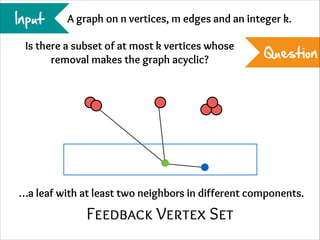
…a leaf with at least two neighbors in different components.

Feedback Vertex Set
Input

A graph on n vertices, m edges and an integer k.

Is there a subset of at most k vertices whose
removal makes the graph acyclic?

Feedback Vertex Set

Question
Input

A graph on n vertices, m edges and an integer k.

Is there a subset of at most k vertices whose
removal makes the graph acyclic?

Question

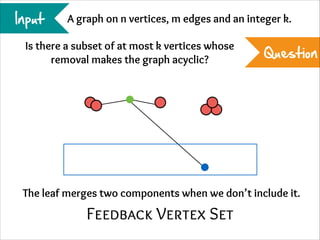
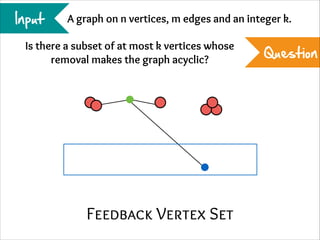
The leaf merges two components when we don’t include it.

Feedback Vertex Set
Input

A graph on n vertices, m edges and an integer k.

Is there a subset of at most k vertices whose
removal makes the graph acyclic?

Feedback Vertex Set

Question
Input

A graph on n vertices, m edges and an integer k.

Is there a subset of at most k vertices whose
removal makes the graph acyclic?

Question

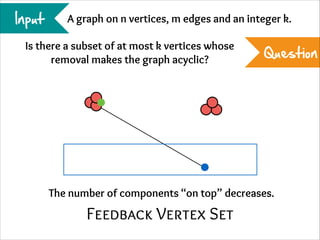
The number of components “on top” decreases.

Feedback Vertex Set
Input

A graph on n vertices, m edges and an integer k.

Is there a subset of at most k vertices whose
removal makes the graph acyclic?

Question

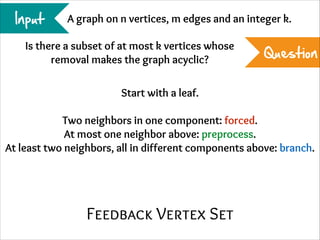
Start with a leaf.
!

Two neighbors in one component: forced.
At most one neighbor above: preprocess.
At least two neighbors, all in different components above: branch.

Feedback Vertex Set
Input

A graph on n vertices, m edges and an integer k.

Is there a subset of at most k vertices whose
removal makes the graph acyclic?

Feedback Vertex Set

Question
Input

A graph on n vertices, m edges and an integer k.

Is there a subset of at most k vertices whose
removal makes the graph acyclic?

Question

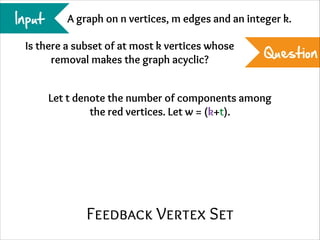
Let t denote the number of components among
the red vertices. Let w = (k+t).

Feedback Vertex Set
Input

A graph on n vertices, m edges and an integer k.

Is there a subset of at most k vertices whose
removal makes the graph acyclic?

Question

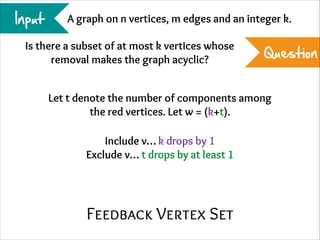
Let t denote the number of components among
the red vertices. Let w = (k+t).
Include v… k drops by 1
Exclude v… t drops by at least 1

Feedback Vertex Set
Input

A graph on n vertices, m edges and an integer k.

Is there a subset of at most k vertices whose
removal makes the graph acyclic?

Question

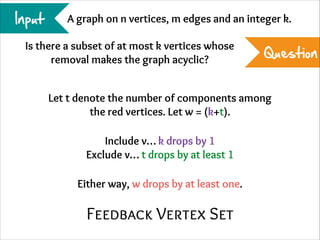
Let t denote the number of components among
the red vertices. Let w = (k+t).
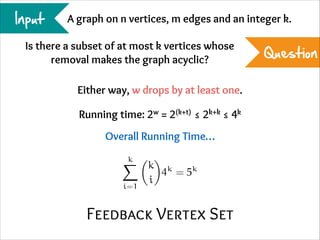
Include v… k drops by 1
Exclude v… t drops by at least 1
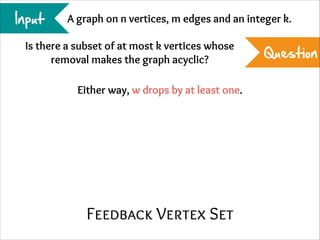
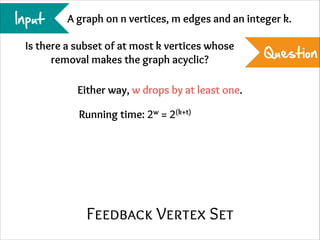
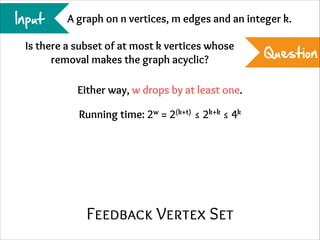
Either way, w drops by at least one.

Feedback Vertex Set
Input

A graph on n vertices, m edges and an integer k.

Is there a subset of at most k vertices whose
removal makes the graph acyclic?
Either way, w drops by at least one.

Feedback Vertex Set

Question
Input

A graph on n vertices, m edges and an integer k.

Is there a subset of at most k vertices whose
removal makes the graph acyclic?
Either way, w drops by at least one.
Running time: 2w = 2(k+t)

Feedback Vertex Set

Question
Input

A graph on n vertices, m edges and an integer k.

Is there a subset of at most k vertices whose
removal makes the graph acyclic?
Either way, w drops by at least one.
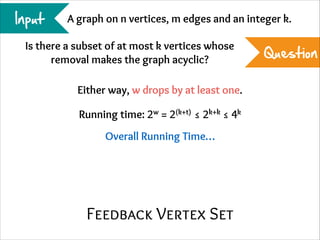
Running time: 2w = 2(k+t) ≤ 2k+k ≤ 4k

Feedback Vertex Set

Question
Input

A graph on n vertices, m edges and an integer k.

Is there a subset of at most k vertices whose
removal makes the graph acyclic?
Either way, w drops by at least one.
Running time: 2w = 2(k+t) ≤ 2k+k ≤ 4k
Overall Running Time…

Feedback Vertex Set

Question
Input

A graph on n vertices, m edges and an integer k.

Is there a subset of at most k vertices whose
removal makes the graph acyclic?
Either way, w drops by at least one.
Running time: 2w = 2(k+t) ≤ 2k+k ≤ 4k
Overall Running Time…
k

i=1

k k
k
4 =5
i

Feedback Vertex Set

Question
Input

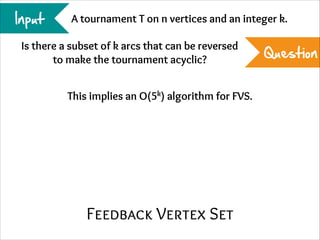
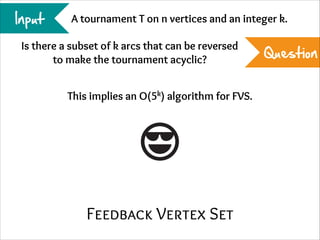
A tournament T on n vertices and an integer k.

Is there a subset of k arcs that can be reversed
to make the tournament acyclic?
This implies an O(5k) algorithm for FVS.

Feedback Vertex Set

Question
Input

A tournament T on n vertices and an integer k.

Is there a subset of k arcs that can be reversed
to make the tournament acyclic?
This implies an O(5k) algorithm for FVS.

Feedback Vertex Set

Question
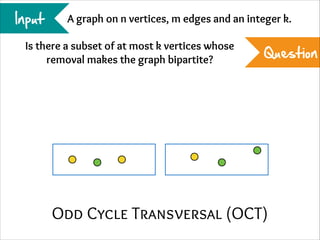
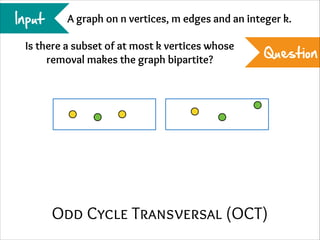
Input

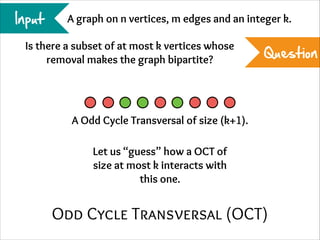
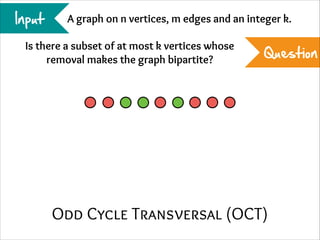
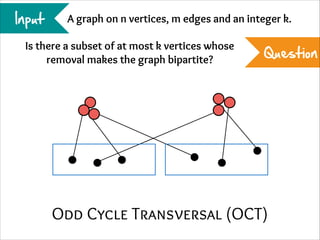
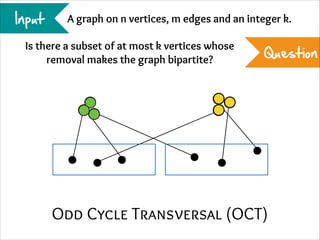
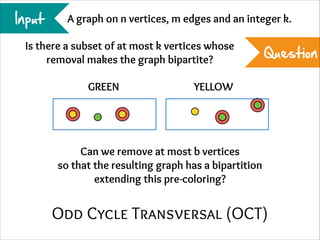
A graph on n vertices, m edges and an integer k.

Is there a subset of at most k vertices whose
removal makes the graph bipartite?

Question

A Odd Cycle Transversal of size (k+1).
Let us “guess” how a OCT of
size at most k interacts with
this one.

Odd Cycle Transversal (OCT)
Input

A graph on n vertices, m edges and an integer k.

Is there a subset of at most k vertices whose
removal makes the graph bipartite?

Question

Odd Cycle Transversal (OCT)
Input

A graph on n vertices, m edges and an integer k.

Is there a subset of at most k vertices whose
removal makes the graph bipartite?

Question

Odd Cycle Transversal (OCT)
Input

A graph on n vertices, m edges and an integer k.

Is there a subset of at most k vertices whose
removal makes the graph bipartite?

Question

Odd Cycle Transversal (OCT)
Input

A graph on n vertices, m edges and an integer k.

Is there a subset of at most k vertices whose
removal makes the graph bipartite?

Question

Odd Cycle Transversal (OCT)
Input

A graph on n vertices, m edges and an integer k.

Is there a subset of at most k vertices whose
removal makes the graph bipartite?

Question

Odd Cycle Transversal (OCT)
Input

A graph on n vertices, m edges and an integer k.

Is there a subset of at most k vertices whose
removal makes the graph bipartite?

Question

Odd Cycle Transversal (OCT)
Input

A graph on n vertices, m edges and an integer k.

Is there a subset of at most k vertices whose
removal makes the graph bipartite?

Question

Odd Cycle Transversal (OCT)
Input

A graph on n vertices, m edges and an integer k.

Is there a subset of at most k vertices whose
removal makes the graph bipartite?

Question

Odd Cycle Transversal (OCT)
Input

A graph on n vertices, m edges and an integer k.

Is there a subset of at most k vertices whose
removal makes the graph bipartite?

Question

Odd Cycle Transversal (OCT)
Input

A graph on n vertices, m edges and an integer k.

Is there a subset of at most k vertices whose
removal makes the graph bipartite?

Question

Odd Cycle Transversal (OCT)
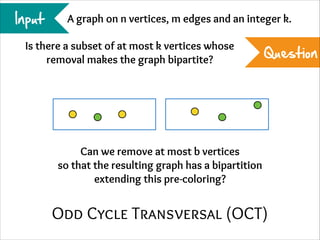
Input

A graph on n vertices, m edges and an integer k.

Is there a subset of at most k vertices whose
removal makes the graph bipartite?

Question

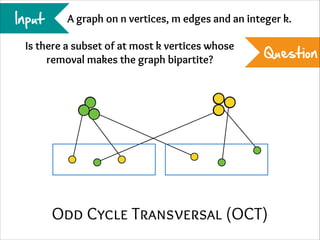
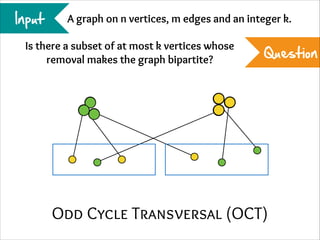
Can we remove at most b vertices
so that the resulting graph has a bipartition
extending this pre-coloring?

Odd Cycle Transversal (OCT)
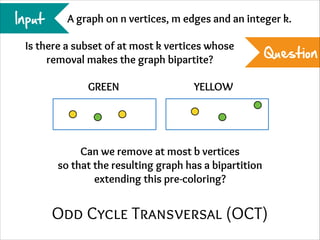
Input

A graph on n vertices, m edges and an integer k.

Is there a subset of at most k vertices whose
removal makes the graph bipartite?
GREEN

Question

YELLOW

Can we remove at most b vertices
so that the resulting graph has a bipartition
extending this pre-coloring?

Odd Cycle Transversal (OCT)
Input

A graph on n vertices, m edges and an integer k.

Is there a subset of at most k vertices whose
removal makes the graph bipartite?
GREEN

Question

YELLOW

Can we remove at most b vertices
so that the resulting graph has a bipartition
extending this pre-coloring?

Odd Cycle Transversal (OCT)
Input

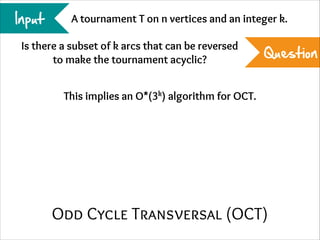
A tournament T on n vertices and an integer k.

Is there a subset of k arcs that can be reversed
to make the tournament acyclic?

Question

This implies an O*(3k) algorithm for OCT.

Odd Cycle Transversal (OCT)
Input

A tournament T on n vertices and an integer k.

Is there a subset of k arcs that can be reversed
to make the tournament acyclic?

Question

This implies an O*(3k) algorithm for OCT.

Odd Cycle Transversal (OCT)
Take Away…
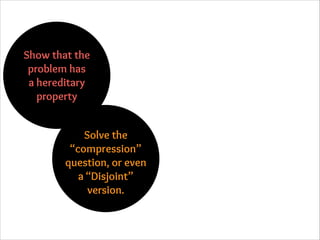
Show that the
problem has
a hereditary
property
Solve the
“compression”
question, or even
a “Disjoint”
version.
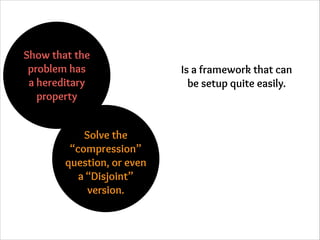
Show that the
problem has
a hereditary
property
Solve the
“compression”
question, or even
a “Disjoint”
version.
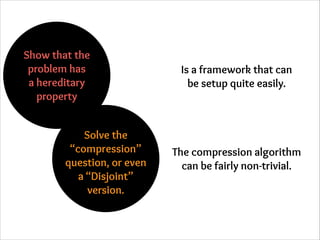
Is a framework that can
be setup quite easily.
Show that the
problem has
a hereditary
property
Solve the
“compression”
question, or even
a “Disjoint”
version.
Is a framework that can
be setup quite easily.
The compression algorithm
can be fairly non-trivial.

Iterative Compression

  • 1.
  • 2.
    Input A graph G= (V,E) with n vertices, m edges, and k. Is there a vertex cover of size at most k? Vertex Cover Question
  • 3.
    Input A graph G= (V,E) with n vertices, m edges, and k. Is there a vertex cover of size at most k? Vertex Cover Question
  • 4.
    Input A graph G= (V,E) with n vertices, m edges, and k. Is there a vertex cover of size at most k? A vertex cover of size (k+1). Vertex Cover Question
  • 5.
    Input A graph Gwith a vertex cover of size k+1. Is there a vertex cover of size at most k? A vertex cover of size (k+1). Vertex Cover Question
  • 6.
    Input A graph Gwith a vertex cover of size k+1. Is there a vertex cover of size at most k? A vertex cover of size (k+1). Vertex Cover Question
  • 7.
    Input A graph Gwith a vertex cover of size k+1. Is there a vertex cover of size at most k? A vertex cover of size (k+1). Let us “guess” how a vertex cover of size at most k interacts with this one. Vertex Cover Question
  • 8.
    Input A graph Gwith a vertex cover of size k+1. Is there a vertex cover of size at most k? A vertex cover of size (k+1). Let us “guess” how a vertex cover of size at most k interacts with this one. Vertex Cover Question
  • 9.
    Input A graph Gwith a vertex cover of size k+1. Is there a vertex cover of size at most k? A vertex cover of size (k+1). Let us “guess” how a vertex cover of size at most k interacts with this one. Vertex Cover Question
  • 10.
    Input A graph Gwith a vertex cover of size k+1. Is there a vertex cover of size at most k? A vertex cover of size (k+1). Vertex Cover Question
  • 11.
    Input A graph Gwith a vertex cover of size k+1. Is there a vertex cover of size at most k? A vertex cover of size (k+1). Can there be an edge between two red vertices? Vertex Cover Question
  • 12.
    Input A graph Gwith a vertex cover of size k+1. Is there a vertex cover of size at most k? A vertex cover of size (k+1). Vertex Cover Question
  • 13.
    Input A graph Gwith a vertex cover of size k+1. Is there a vertex cover of size at most k? A vertex cover of size (k+1). Now we need to make up for the work that the red vertices were doing. Vertex Cover Question
  • 14.
    Input A graph Gwith a vertex cover of size k+1. Is there a vertex cover of size at most k? Vertex Cover Question
  • 15.
    Input A graph Gwith a vertex cover of size k+1. Is there a vertex cover of size at most k? Vertex Cover Question
  • 16.
    Input A graph G= (V,E) with n vertices, m edges, and k. Is there a vertex cover of size at most k? Vertex Cover Question
  • 17.
    Input A graph G= (V,E) with n vertices, m edges, and k. Is there a vertex cover of size at most k? Vertex Cover Question
  • 18.
    Input A graph G= (V,E) with n vertices, m edges, and k. Is there a vertex cover of size at most k? Vertex Cover Question
  • 19.
    Input A graph G= (V,E) with n vertices, m edges, and k. Is there a vertex cover of size at most k? Vertex Cover Question
  • 20.
    Input A graph G= (V,E) with n vertices, m edges, and k. Is there a vertex cover of size at most k? The first k+2 vertices in G. Vertex Cover Question
  • 21.
    Input A graph G= (V,E) with n vertices, m edges, and k. Is there a vertex cover of size at most k? Question The first k+2 vertices in G. It has an easy vertex cover of size k+1. Vertex Cover
  • 22.
    Input A graph G= (V,E) with n vertices, m edges, and k. Is there a vertex cover of size at most k? Question The first k+2 vertices in G. It has an easy vertex cover of size k+1. Vertex Cover
  • 23.
    Input A graph G= (V,E) with n vertices, m edges, and k. Is there a vertex cover of size at most k? Question The first k+2 vertices in G. It has an easy vertex cover of size k+1. Vertex Cover
  • 24.
    Input A graph G= (V,E) with n vertices, m edges, and k. Is there a vertex cover of size at most k? Question The first k+2 vertices in G. It has an easy vertex cover of size k+1. Vertex Cover
  • 25.
    Input A graph G= (V,E) with n vertices, m edges, and k. Is there a vertex cover of size at most k? Question The first k+2 vertices in G. It has an easy vertex cover of size k+1. Vertex Cover
  • 26.
    Input A graph G= (V,E) with n vertices, m edges, and k. Is there a vertex cover of size at most k? Question The first k+2 vertices in G. It has an easy vertex cover of size k+1. Compress again… rinse, repeat. Vertex Cover
  • 27.
    Input A graph G= (V,E) with n vertices, m edges, and k. Is there a subset of vertices S of size at most k that intersects all the edges? Question We have a O*(2k) algorithm for Vertex Cover. Vertex Cover
  • 28.
    Input A graph G= (V,E) with n vertices, m edges, and k. Is there a subset of vertices S of size at most k that intersects all the edges? Question We have a O*(2k) algorithm for Vertex Cover. Vertex Cover
  • 29.
    Input A graph onn vertices, m edges and an integer k. Is there a subset of at most k vertices whose removal makes the graph acyclic? A Feedback Vertex Set of size (k+1). Let us “guess” how a FVS of size at most k interacts with this one. Feedback Vertex Set Question
  • 30.
    Input A graph onn vertices, m edges and an integer k. Is there a subset of at most k vertices whose removal makes the graph acyclic? Feedback Vertex Set Question
  • 31.
    Input A graph onn vertices, m edges and an integer k. Is there a subset of at most k vertices whose removal makes the graph acyclic? Feedback Vertex Set Question
  • 32.
    Input A graph onn vertices, m edges and an integer k. Is there a subset of at most k vertices whose removal makes the graph acyclic? Feedback Vertex Set Question
  • 33.
    Input A graph onn vertices, m edges and an integer k. Is there a subset of at most k vertices whose removal makes the graph acyclic? Feedback Vertex Set Question
  • 34.
    Input A graph onn vertices, m edges and an integer k. Is there a subset of at most k vertices whose removal makes the graph acyclic? Question A vertex with two neighbors in the same component is forced. Feedback Vertex Set
  • 35.
    Input A graph onn vertices, m edges and an integer k. Is there a subset of at most k vertices whose removal makes the graph acyclic? Feedback Vertex Set Question
  • 36.
    Input A graph onn vertices, m edges and an integer k. Is there a subset of at most k vertices whose removal makes the graph acyclic? Question A leaf that has exactly one neighbor above can be preprocessed. Feedback Vertex Set
  • 37.
    Input A graph onn vertices, m edges and an integer k. Is there a subset of at most k vertices whose removal makes the graph acyclic? Feedback Vertex Set Question
  • 38.
    Input A graph onn vertices, m edges and an integer k. Is there a subset of at most k vertices whose removal makes the graph acyclic? Question …a leaf with at least two neighbors in different components. Feedback Vertex Set
  • 39.
    Input A graph onn vertices, m edges and an integer k. Is there a subset of at most k vertices whose removal makes the graph acyclic? Feedback Vertex Set Question
  • 40.
    Input A graph onn vertices, m edges and an integer k. Is there a subset of at most k vertices whose removal makes the graph acyclic? Question The leaf merges two components when we don’t include it. Feedback Vertex Set
  • 41.
    Input A graph onn vertices, m edges and an integer k. Is there a subset of at most k vertices whose removal makes the graph acyclic? Feedback Vertex Set Question
  • 42.
    Input A graph onn vertices, m edges and an integer k. Is there a subset of at most k vertices whose removal makes the graph acyclic? Question The number of components “on top” decreases. Feedback Vertex Set
  • 43.
    Input A graph onn vertices, m edges and an integer k. Is there a subset of at most k vertices whose removal makes the graph acyclic? Question Start with a leaf. ! Two neighbors in one component: forced. At most one neighbor above: preprocess. At least two neighbors, all in different components above: branch. Feedback Vertex Set
  • 44.
    Input A graph onn vertices, m edges and an integer k. Is there a subset of at most k vertices whose removal makes the graph acyclic? Feedback Vertex Set Question
  • 45.
    Input A graph onn vertices, m edges and an integer k. Is there a subset of at most k vertices whose removal makes the graph acyclic? Question Let t denote the number of components among the red vertices. Let w = (k+t). Feedback Vertex Set
  • 46.
    Input A graph onn vertices, m edges and an integer k. Is there a subset of at most k vertices whose removal makes the graph acyclic? Question Let t denote the number of components among the red vertices. Let w = (k+t). Include v… k drops by 1 Exclude v… t drops by at least 1 Feedback Vertex Set
  • 47.
    Input A graph onn vertices, m edges and an integer k. Is there a subset of at most k vertices whose removal makes the graph acyclic? Question Let t denote the number of components among the red vertices. Let w = (k+t). Include v… k drops by 1 Exclude v… t drops by at least 1 Either way, w drops by at least one. Feedback Vertex Set
  • 48.
    Input A graph onn vertices, m edges and an integer k. Is there a subset of at most k vertices whose removal makes the graph acyclic? Either way, w drops by at least one. Feedback Vertex Set Question
  • 49.
    Input A graph onn vertices, m edges and an integer k. Is there a subset of at most k vertices whose removal makes the graph acyclic? Either way, w drops by at least one. Running time: 2w = 2(k+t) Feedback Vertex Set Question
  • 50.
    Input A graph onn vertices, m edges and an integer k. Is there a subset of at most k vertices whose removal makes the graph acyclic? Either way, w drops by at least one. Running time: 2w = 2(k+t) ≤ 2k+k ≤ 4k Feedback Vertex Set Question
  • 51.
    Input A graph onn vertices, m edges and an integer k. Is there a subset of at most k vertices whose removal makes the graph acyclic? Either way, w drops by at least one. Running time: 2w = 2(k+t) ≤ 2k+k ≤ 4k Overall Running Time… Feedback Vertex Set Question
  • 52.
    Input A graph onn vertices, m edges and an integer k. Is there a subset of at most k vertices whose removal makes the graph acyclic? Either way, w drops by at least one. Running time: 2w = 2(k+t) ≤ 2k+k ≤ 4k Overall Running Time… k i=1 k k k 4 =5 i Feedback Vertex Set Question
  • 53.
    Input A tournament Ton n vertices and an integer k. Is there a subset of k arcs that can be reversed to make the tournament acyclic? This implies an O(5k) algorithm for FVS. Feedback Vertex Set Question
  • 54.
    Input A tournament Ton n vertices and an integer k. Is there a subset of k arcs that can be reversed to make the tournament acyclic? This implies an O(5k) algorithm for FVS. Feedback Vertex Set Question
  • 55.
    Input A graph onn vertices, m edges and an integer k. Is there a subset of at most k vertices whose removal makes the graph bipartite? Question A Odd Cycle Transversal of size (k+1). Let us “guess” how a OCT of size at most k interacts with this one. Odd Cycle Transversal (OCT)
  • 56.
    Input A graph onn vertices, m edges and an integer k. Is there a subset of at most k vertices whose removal makes the graph bipartite? Question Odd Cycle Transversal (OCT)
  • 57.
    Input A graph onn vertices, m edges and an integer k. Is there a subset of at most k vertices whose removal makes the graph bipartite? Question Odd Cycle Transversal (OCT)
  • 58.
    Input A graph onn vertices, m edges and an integer k. Is there a subset of at most k vertices whose removal makes the graph bipartite? Question Odd Cycle Transversal (OCT)
  • 59.
    Input A graph onn vertices, m edges and an integer k. Is there a subset of at most k vertices whose removal makes the graph bipartite? Question Odd Cycle Transversal (OCT)
  • 60.
    Input A graph onn vertices, m edges and an integer k. Is there a subset of at most k vertices whose removal makes the graph bipartite? Question Odd Cycle Transversal (OCT)
  • 61.
    Input A graph onn vertices, m edges and an integer k. Is there a subset of at most k vertices whose removal makes the graph bipartite? Question Odd Cycle Transversal (OCT)
  • 62.
    Input A graph onn vertices, m edges and an integer k. Is there a subset of at most k vertices whose removal makes the graph bipartite? Question Odd Cycle Transversal (OCT)
  • 63.
    Input A graph onn vertices, m edges and an integer k. Is there a subset of at most k vertices whose removal makes the graph bipartite? Question Odd Cycle Transversal (OCT)
  • 64.
    Input A graph onn vertices, m edges and an integer k. Is there a subset of at most k vertices whose removal makes the graph bipartite? Question Odd Cycle Transversal (OCT)
  • 65.
    Input A graph onn vertices, m edges and an integer k. Is there a subset of at most k vertices whose removal makes the graph bipartite? Question Odd Cycle Transversal (OCT)
  • 66.
    Input A graph onn vertices, m edges and an integer k. Is there a subset of at most k vertices whose removal makes the graph bipartite? Question Can we remove at most b vertices so that the resulting graph has a bipartition extending this pre-coloring? Odd Cycle Transversal (OCT)
  • 67.
    Input A graph onn vertices, m edges and an integer k. Is there a subset of at most k vertices whose removal makes the graph bipartite? GREEN Question YELLOW Can we remove at most b vertices so that the resulting graph has a bipartition extending this pre-coloring? Odd Cycle Transversal (OCT)
  • 68.
    Input A graph onn vertices, m edges and an integer k. Is there a subset of at most k vertices whose removal makes the graph bipartite? GREEN Question YELLOW Can we remove at most b vertices so that the resulting graph has a bipartition extending this pre-coloring? Odd Cycle Transversal (OCT)
  • 69.
    Input A tournament Ton n vertices and an integer k. Is there a subset of k arcs that can be reversed to make the tournament acyclic? Question This implies an O*(3k) algorithm for OCT. Odd Cycle Transversal (OCT)
  • 70.
    Input A tournament Ton n vertices and an integer k. Is there a subset of k arcs that can be reversed to make the tournament acyclic? Question This implies an O*(3k) algorithm for OCT. Odd Cycle Transversal (OCT)
  • 71.
  • 73.
    Show that the problemhas a hereditary property Solve the “compression” question, or even a “Disjoint” version.
  • 74.
    Show that the problemhas a hereditary property Solve the “compression” question, or even a “Disjoint” version. Is a framework that can be setup quite easily.
  • 75.
    Show that the problemhas a hereditary property Solve the “compression” question, or even a “Disjoint” version. Is a framework that can be setup quite easily. The compression algorithm can be fairly non-trivial.