ECE 250 Algorithms and Data Structures
Douglas Wilhelm Harder, M.Math. LEL
Department of Electrical and Computer Engineering
University of Waterloo
Waterloo, Ontario, Canada
ece.uwaterloo.ca
dwharder@gmail.com
© 2006-2018 by Douglas Wilhelm Harder. Some rights reserved.
Mathematical background
2
Mathematical background
This topic reviews the basic mathematics required in this course:
– A justification for a mathematical framework
– The ceiling and floor functions
– L’Hôpital’s rule
– Logarithms
– Arithmetic and other polynomial series
• Mathematical induction
– Geometric series
– Recurrence relations
– Weighted averages
– Combinations
Outline
3
Mathematical background
Mathematics and engineering
For engineers, mathematics is a tool:
– Of course, that doesn’t mean it always works...
http://xkcd.com/55/
4
Mathematical background
Justification
However, as engineers, you will not be paid to say:
Method A is better than Method B
or
Algorithm A is faster than Algorithm B
Such comparisons are said to be qualitative:
qualitative, a. Relating to, connected or concerned with, quality or qualities.
Now usually in implied or expressed opposition to quantitative.
OED
5
Mathematical background
Qualitative statements cannot guide engineering design decisions:
– Algorithm A could be better than Algorithm B, but Algorithm A would
require three person weeks to implement, test, and integrate while
Algorithm B has already been implemented and has been used for the
past year
– There are circumstances where it may beneficial to use Algorithm A, but
not based on the word better
Justification
6
Mathematical background
Thus, we will look at a quantitative means of describing data
structures and algorithms:
quantitative, a. Relating to, concerned with, quantity or its measurement;
ascertaining or expressing quantity. OED
This will be based on mathematics, and therefore we will look at a
number of properties which will be used again and again throughout
this course
Justification
7
Mathematical background
Floor and ceiling functions
The floor function maps any real number x onto the greatest integer
less than or equal to x:
– Consider it rounding towards negative infinity
The ceiling function maps x onto the least integer greater than or
equal to x:
– Consider it rounding towards positive infinity
– The cmath library implements these as
double floor( double ); double ceil( double );
3.2 3 3
5.2 6 6
 
   
   
    
   
   
3.2 4 4
5.2 5 5
 
   
   
    
   
   
Necessary because double
have a range just under 21024
long can only represent
numbers as large as 263 – 1
8
Mathematical background
L’Hôpital’s rule
If you are attempting to determine
but both , it follows
Repeat as necessary…
 
 
lim
n
f n
g n

   
lim lim
n n
f n g n
 
  
 
 
 
 
 
 
1
1
lim lim
n n
f n f n
g n g n
 

 
 
k
f n
Note: the kth derivative will always be shown as
9
Mathematical background
We will begin with a review of logarithms:
If n = em, we define
m = ln( n )
It is always true that eln(n) = n; however, ln(en) = n requires that n is
real
Logarithms
10
Mathematical background
Exponentials grow faster than any non-constant polynomial
for any d > 0
Thus, their inverses—logarithms—grow slower than any polynomial
Logarithms
lim
n
d
n
e
n

 
ln( )
lim 0
d
n
n
n


11
Mathematical background
Example: is strictly greater than ln(n)
1/2
( )
f n n n
 
ln(n)
n
Logarithms
12
Mathematical background
Logarithms
grows slower but only up to n = 93
(93.354, 4.536)
ln(n)
3
n
1/3 3
( )
f n n n
 
13
Mathematical background
You can view this with any polynomial
ln(n)
4
n
Logarithms
(5503.66, 8.61)
14
Mathematical background
We have compared logarithms and polynomials
– How about log2(n) versus ln(n) versus log10(n)
You have seen the formula
All logarithms are scalar multiples of each others
)
ln(
)
ln(
)
(
log
b
n
n
b 
Logarithms
Constant
15
Mathematical background
A plot of log2(n) = lg(n), ln(n), and log10(n)
lg(n)
ln(n)
log10(n)
Logarithms
16
Mathematical background
Note: the base-2 logarithm log2(n) is written as lg(n)
It is an industry standard to implement the natural logarithm ln(n) as
double log( double );
The common logarithm log10(n) is implemented as
double log10( double );
Logarithms
17
Mathematical background
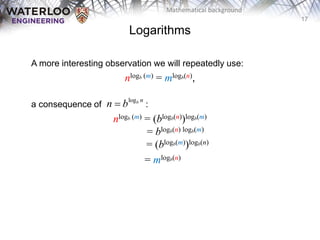
A more interesting observation we will repeatedly use:
nlogb (m) = mlogb(n),
a consequence of :
nlogb (m) = (blogb(n))logb(m)
= blogb(n) logb(m)
= (blogb(m))logb(n)
= mlogb(n)
Logarithms
logb n
n b

18
Mathematical background
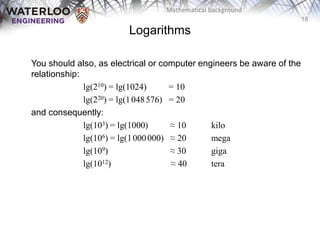
You should also, as electrical or computer engineers be aware of the
relationship:
lg(210) = lg(1024) = 10
lg(220) = lg(1048576) = 20
and consequently:
lg(103) = lg(1000) ≈ 10 kilo
lg(106) = lg(1000000) ≈ 20 mega
lg(109) ≈ 30 giga
lg(1012) ≈ 40 tera
Logarithms
19
Mathematical background
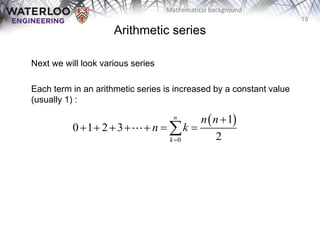
Next we will look various series
Each term in an arithmetic series is increased by a constant value
(usually 1) :
 
0
1
0 1 2 3
2
n
k
n n
n k


      

Arithmetic series
20
Mathematical background
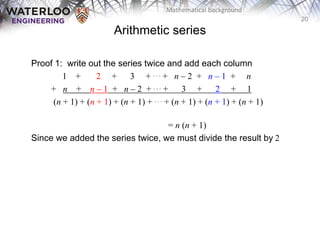
Proof 1: write out the series twice and add each column
1 + 2 + 3 + . . . + n – 2 + n – 1 + n
+ n + n – 1 + n – 2 + . . . + 3 + 2 + 1
(n + 1) + (n + 1) + (n + 1) + . . . + (n + 1) + (n + 1) + (n + 1)
= n (n + 1)
Since we added the series twice, we must divide the result by 2
Arithmetic series
21
Mathematical background
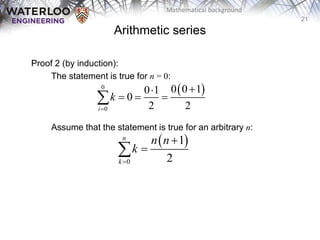
Proof 2 (by induction):
The statement is true for n = 0:
Assume that the statement is true for an arbitrary n:
 
0
0
0 0 1
0 1
0
2 2
i
k



  

 
0
1
2
n
k
n n
k




Arithmetic series
22
Mathematical background
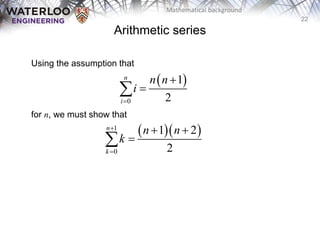
Using the assumption that
for n, we must show that
 
0
1
2
n
i
n n
i




  
1
0
1 2
2
n
k
n n
k


 


Arithmetic series
23
Mathematical background
Then, for n + 1, we have:
By assumption, the second sum is known:
 
1
0 0
1
n n
k i
k n k

 
  
 
 
 
   
  
1
1
2
1 2 1
2
1 2
2
n n
n
n n n
n n

  
  

 

Arithmetic series
24
Mathematical background
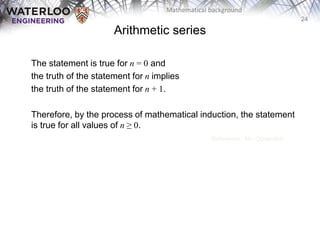
The statement is true for n = 0 and
the truth of the statement for n implies
the truth of the statement for n + 1.
Therefore, by the process of mathematical induction, the statement
is true for all values of n ≥ 0.
Reference: Mr. Oprendick
Arithmetic series
25
Mathematical background
We could repeat this process, after all:
however, it is easier to see the pattern:
 
2
2
3
0
1
4
n
k
n n
k




   3
2
0
1 2 1
6 3
n
k
n n n n
k

 
 

  
2
0
1 2 1
6
n
k
n n n
k

 


 
2
2 4
3
0
1
4 4
n
k
n n n
k


 

Other polynomial series
  2
0
1
2 2
n
k
n n n
k


 

26
Mathematical background
We can generalize this formula
Demonstrating with d = 3 and d = 4:
1
0 1
d
n
d
k
n
k
d





Other polynomial series
27
Mathematical background
The justification for the approximation is that we are approximating
the sum with an integral:
However, there is an
accumulating error:
1 1
0 0 0
0
1 1
n
n d d
n
d d
k x
x n
k x dx
d d
 
 
   
 
 
Other polynomial series
n2
28
Mathematical background
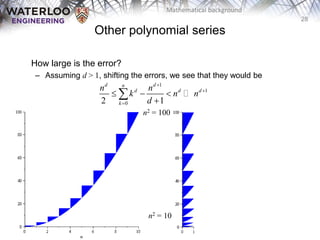
How large is the error?
– Assuming d > 1, shifting the errors, we see that they would be
Other polynomial series
1
1
0
2 1
d d
n
d d d
k
n n
k n n
d



  


n2 = 100
n2 = 10
29
Mathematical background
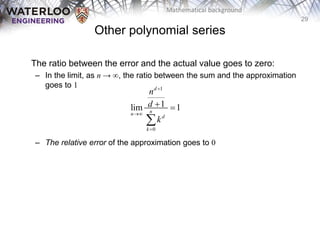
The ratio between the error and the actual value goes to zero:
– In the limit, as n → ∞, the ratio between the sum and the approximation
goes to 1
– The relative error of the approximation goes to 0
Other polynomial series
1
0
1
lim 1
d
n
n
d
k
n
d
k



 

30
Mathematical background
The next series we will look at is the geometric series with common
ratio r:
and if |r| < 1 then it is also true that
1
0
1
1
n
n
k
k
r
r
r






0
1
1
k
k
r
r





Geometric series
31
Mathematical background
Elegant proof: multiply by
Ref: Bret D. Whissel, A Derivation of Amortization
  0
0
0 0
2 2 1
1
1
1
1
(1 ) ( )
1
1
1
n k
n
k k
k
n n
k k
k k
n n n
n
r r
r
r
r r r
r
r r r r r r r
r
r
r


 








        







 
Geometric series
1
1
1
r
r



Telescoping series:
all but the first and last terms cancel
32
Mathematical background
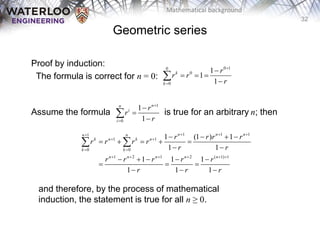
Proof by induction:
The formula is correct for n = 0:
Assume the formula is true for an arbitrary n; then
and therefore, by the process of mathematical
induction, the statement is true for all n ≥ 0.
0 1
0
0
0
1
1
1
k
k
r
r r
r



  


1
0
1
1
n
n
i
i
r
r
r






1 1 1
1
1 1
0 0
1 2 1 2 ( 1) 1
1 (1 ) 1
1 1
1 1 1
1 1 1
n n n
n n
k n k n
k k
n n n n n
r r r r
r r r r
r r
r r r r r
r r r
  

 
 
     
   
    
 
    
  
  
 
Geometric series
33
Mathematical background
Note that we can use a change-of-index with summations like we do
with integration:
Letting j = i – 1:


 






n
i
i
n
i
i
n
i
i
r
r
rr
r
1
1
1
1
1
r
r
r
r
r
n
n
j
j



 


1
1
1
0
Geometric series
34
Mathematical background
A common geometric series will involve the ratios r = ½ and r = 2:
  n
n
n
i
i














 2
2
1
1
2
1
2
1
1
2
1
0
1
1
0
1 2
2 2 1
1 2
n
n
k n
k




  


2
2
1
0










i
i
Geometric series
35
Mathematical background
Finally, we will review recurrence relations:
– Sequences may be defined explicitly: xn = 1/n
1, 1/2, 1/3, 1/4, ...
– A recurrence relationship is a means of defining a sequence based on
previous values in the sequence
– Such definitions of sequences are said to be recursive
Recurrence relations
36
Mathematical background
Define an initial value: e.g., x1 = 1
Defining xn in terms of previous values:
– For example,
xn = xn – 1 + 2
xn = 2xn – 1 + n
xn = xn – 1 + xn – 2
Recurrence relations
37
Mathematical background
Given the two recurrence relations
xn = xn – 1 + 2 xn = 2xn – 1 + n
and the initial condition x1 = 1 we would like to find explicit formulae
for the sequences
In this case, we have
xn = 2n – 1 xn = 2n + 1 – n – 2
respectively
Recurrence relations
38
Mathematical background
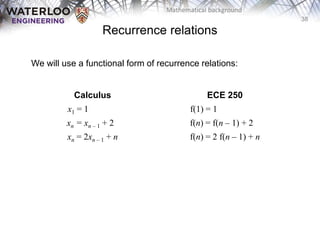
We will use a functional form of recurrence relations:
Calculus ECE 250
x1 = 1............. f(1) = 1...................
xn = xn – 1 + 2.. f(n) = f(n – 1) + 2...
xn = 2xn – 1 + n f(n) = 2 f(n – 1) + n
Recurrence relations
39
Mathematical background
The previous examples using the functional notation are:
f(n) = f(n – 1) + 2 g(n) = 2 g(n – 1) + n
With the initial conditions f(1) = g(1) = 1, the solutions are:
f(n) = 2n – 1 g(n) = 2n + 1 – n – 2
Recurrence relations
40
Mathematical background
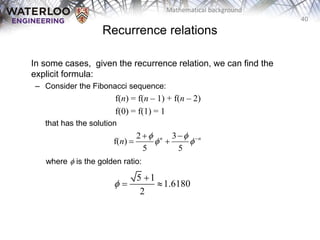
In some cases, given the recurrence relation, we can find the
explicit formula:
– Consider the Fibonacci sequence:
f(n) = f(n – 1) + f(n – 2)
f(0) = f(1) = 1
that has the solution
where f is the golden ratio:
2 3
f( )
5 5
n n
n
f f
f f
 
 
5 1
1.6180
2
f

 
Recurrence relations
41
Mathematical background
Weighted averages
Given n objects x1, x2, x3, ..., xn, the average is
Given a sequence of coefficients c1 , c2 , c3 , … , cn where
then we refer to
as a weighted average
For an average,
1 2 3 n
x x x x
n
   
1 2 3 1
n
c c c c
    
1 1 2 2 3 3 n n
c x c x c x c x
   
1 2 3
1
n
c c c c
n
    
42
Mathematical background
Weighted averages
Examples:
– Simpson’s method approximates an integral by sampling
the function at three points: f(a), f(b), f(c)
– The average value of the function is approximated by
– It can be shown that that
is a significant better approximation than
     
1 2 1
6 3 6
f a f b f c
 
     
  
1 2 1
6 3 6
f a f b f c c a
  
     
 
3
f a f b f c
c a
 

43
Mathematical background
Weighted averages
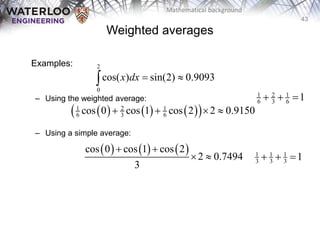
Examples:
– Using the weighted average:
– Using a simple average:
     
 
1 2 1
6 3 6
cos 0 cos 1 cos 2 2 0.9150
   
2
0
cos( ) sin(2) 0.9093
x dx  

     
cos 0 cos 1 cos 2
2 0.7494
3
 
 
1 2 1
6 3 6 1
  
1 1 1
3 3 3 1
  
44
Mathematical background
Combinations
Given n distinct items, in how many ways can you choose k of these?
– I.e., “In how many ways can you combine k items from n?”
– For example, given the set {1, 2, 3, 4, 5}, I can choose three of these
in any of the following ways:
{1, 2, 3}, {1, 2, 4}, {1, 2, 5}, {1, 3, 4}, {1, 3, 5},
{1, 4, 5}, {2, 3, 4}, {2, 3, 5}, {2, 4, 5}, {3, 4, 5},
The number of ways such items can be chosen is written
where is read as “n choose k”s
There is a recursive definition:
 
!
! !
n n
k k n k
 

 

 
n
k
 
 
 
1 1
1
n n n
k k k
 
     
 
     

     
45
Mathematical background
Combinations
The most common question we will ask in this vein:
– Given n items, in how many ways can we choose two of them?
– In this case, the formula simplifies to:
For example, given {0, 1, 2, 3, 4, 5, 6}, we have the following 21 pairs:
{0, 1}, {0, 2}, {0, 3}, {0, 4}, {0, 5}, {0, 6},
{1, 2}, {1, 3}, {1, 4}, {1, 5}, {1, 6},
{2, 3}, {2, 4}, {2, 5}, {2, 6},
{3, 4}, {3, 5}, {3, 6},
{4, 5}, {4, 6},
{5, 6}
 
 
1
!
2 2! 2 ! 2
n n n
n
n

 
 
 

 
46
Mathematical background
Combinations
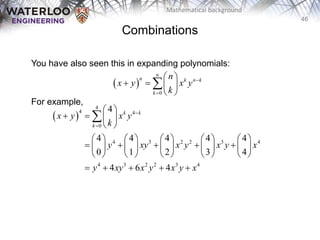
You have also seen this in expanding polynomials:
For example,
 
0
n
n k n k
k
n
x y x y
k


 
   
 

 
4
4 4
0
4 3 2 2 3 4
4 3 2 2 3 4
4
4 4 4 4 4
0 1 2 3 4
4 6 4
k k
k
x y x y
k
y xy x y x y x
y xy x y x y x


 
   
 
         
    
         
         
    

47
Mathematical background
Combinations
These are also the coefficients of Pascal’s triangle:
0
0
1 1
0 1
2 2 2
0 1 2
3 3 3 3
0 1 2 3
4 4 4 4 4
0 1 2 3 4
 
 
 
   
   
   
     
     
     
       
       
       
         
         
         
1
1 1
1 2 1
1 3 3 1
1 4 6 4 1
48
Mathematical background
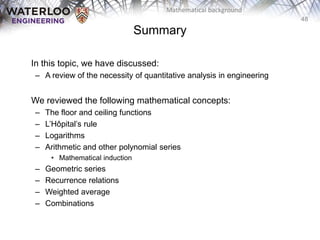
In this topic, we have discussed:
– A review of the necessity of quantitative analysis in engineering
We reviewed the following mathematical concepts:
– The floor and ceiling functions
– L’Hôpital’s rule
– Logarithms
– Arithmetic and other polynomial series
• Mathematical induction
– Geometric series
– Recurrence relations
– Weighted average
– Combinations
Summary
49
Mathematical background
[1] Cormen, Leiserson, and Rivest, Introduction to Algorithms,
McGraw Hill, 1990, Chs 2-3, p.42-76.
[2] Weiss, Data Structures and Algorithm Analysis in C++, 3rd Ed.,
Addison Wesley, §§ 1.2-3, p.2-11.
Reference
50
Mathematical background
Usage Notes
• These slides are made publicly available on the web for anyone to
use
• If you choose to use them, or a part thereof, for a course at another
institution, I ask only three things:
– that you inform me that you are using the slides,
– that you acknowledge my work, and
– that you alert me of any mistakes which I made or changes which you
make, and allow me the option of incorporating such changes (with an
acknowledgment) in my set of slides
Sincerely,
Douglas Wilhelm Harder, MMath
dwharder@alumni.uwaterloo.ca

1.02.Mathematical_background.pptx

  • 1.
    ECE 250 Algorithmsand Data Structures Douglas Wilhelm Harder, M.Math. LEL Department of Electrical and Computer Engineering University of Waterloo Waterloo, Ontario, Canada ece.uwaterloo.ca dwharder@gmail.com © 2006-2018 by Douglas Wilhelm Harder. Some rights reserved. Mathematical background
  • 2.
    2 Mathematical background This topicreviews the basic mathematics required in this course: – A justification for a mathematical framework – The ceiling and floor functions – L’Hôpital’s rule – Logarithms – Arithmetic and other polynomial series • Mathematical induction – Geometric series – Recurrence relations – Weighted averages – Combinations Outline
  • 3.
    3 Mathematical background Mathematics andengineering For engineers, mathematics is a tool: – Of course, that doesn’t mean it always works... http://xkcd.com/55/
  • 4.
    4 Mathematical background Justification However, asengineers, you will not be paid to say: Method A is better than Method B or Algorithm A is faster than Algorithm B Such comparisons are said to be qualitative: qualitative, a. Relating to, connected or concerned with, quality or qualities. Now usually in implied or expressed opposition to quantitative. OED
  • 5.
    5 Mathematical background Qualitative statementscannot guide engineering design decisions: – Algorithm A could be better than Algorithm B, but Algorithm A would require three person weeks to implement, test, and integrate while Algorithm B has already been implemented and has been used for the past year – There are circumstances where it may beneficial to use Algorithm A, but not based on the word better Justification
  • 6.
    6 Mathematical background Thus, wewill look at a quantitative means of describing data structures and algorithms: quantitative, a. Relating to, concerned with, quantity or its measurement; ascertaining or expressing quantity. OED This will be based on mathematics, and therefore we will look at a number of properties which will be used again and again throughout this course Justification
  • 7.
    7 Mathematical background Floor andceiling functions The floor function maps any real number x onto the greatest integer less than or equal to x: – Consider it rounding towards negative infinity The ceiling function maps x onto the least integer greater than or equal to x: – Consider it rounding towards positive infinity – The cmath library implements these as double floor( double ); double ceil( double ); 3.2 3 3 5.2 6 6                        3.2 4 4 5.2 5 5                        Necessary because double have a range just under 21024 long can only represent numbers as large as 263 – 1
  • 8.
    8 Mathematical background L’Hôpital’s rule Ifyou are attempting to determine but both , it follows Repeat as necessary…     lim n f n g n      lim lim n n f n g n                  1 1 lim lim n n f n f n g n g n        k f n Note: the kth derivative will always be shown as
  • 9.
    9 Mathematical background We willbegin with a review of logarithms: If n = em, we define m = ln( n ) It is always true that eln(n) = n; however, ln(en) = n requires that n is real Logarithms
  • 10.
    10 Mathematical background Exponentials growfaster than any non-constant polynomial for any d > 0 Thus, their inverses—logarithms—grow slower than any polynomial Logarithms lim n d n e n    ln( ) lim 0 d n n n  
  • 11.
    11 Mathematical background Example: isstrictly greater than ln(n) 1/2 ( ) f n n n   ln(n) n Logarithms
  • 12.
    12 Mathematical background Logarithms grows slowerbut only up to n = 93 (93.354, 4.536) ln(n) 3 n 1/3 3 ( ) f n n n  
  • 13.
    13 Mathematical background You canview this with any polynomial ln(n) 4 n Logarithms (5503.66, 8.61)
  • 14.
    14 Mathematical background We havecompared logarithms and polynomials – How about log2(n) versus ln(n) versus log10(n) You have seen the formula All logarithms are scalar multiples of each others ) ln( ) ln( ) ( log b n n b  Logarithms Constant
  • 15.
    15 Mathematical background A plotof log2(n) = lg(n), ln(n), and log10(n) lg(n) ln(n) log10(n) Logarithms
  • 16.
    16 Mathematical background Note: thebase-2 logarithm log2(n) is written as lg(n) It is an industry standard to implement the natural logarithm ln(n) as double log( double ); The common logarithm log10(n) is implemented as double log10( double ); Logarithms
  • 17.
    17 Mathematical background A moreinteresting observation we will repeatedly use: nlogb (m) = mlogb(n), a consequence of : nlogb (m) = (blogb(n))logb(m) = blogb(n) logb(m) = (blogb(m))logb(n) = mlogb(n) Logarithms logb n n b 
  • 18.
    18 Mathematical background You shouldalso, as electrical or computer engineers be aware of the relationship: lg(210) = lg(1024) = 10 lg(220) = lg(1048576) = 20 and consequently: lg(103) = lg(1000) ≈ 10 kilo lg(106) = lg(1000000) ≈ 20 mega lg(109) ≈ 30 giga lg(1012) ≈ 40 tera Logarithms
  • 19.
    19 Mathematical background Next wewill look various series Each term in an arithmetic series is increased by a constant value (usually 1) :   0 1 0 1 2 3 2 n k n n n k           Arithmetic series
  • 20.
    20 Mathematical background Proof 1:write out the series twice and add each column 1 + 2 + 3 + . . . + n – 2 + n – 1 + n + n + n – 1 + n – 2 + . . . + 3 + 2 + 1 (n + 1) + (n + 1) + (n + 1) + . . . + (n + 1) + (n + 1) + (n + 1) = n (n + 1) Since we added the series twice, we must divide the result by 2 Arithmetic series
  • 21.
    21 Mathematical background Proof 2(by induction): The statement is true for n = 0: Assume that the statement is true for an arbitrary n:   0 0 0 0 1 0 1 0 2 2 i k          0 1 2 n k n n k     Arithmetic series
  • 22.
    22 Mathematical background Using theassumption that for n, we must show that   0 1 2 n i n n i        1 0 1 2 2 n k n n k       Arithmetic series
  • 23.
    23 Mathematical background Then, forn + 1, we have: By assumption, the second sum is known:   1 0 0 1 n n k i k n k                    1 1 2 1 2 1 2 1 2 2 n n n n n n n n            Arithmetic series
  • 24.
    24 Mathematical background The statementis true for n = 0 and the truth of the statement for n implies the truth of the statement for n + 1. Therefore, by the process of mathematical induction, the statement is true for all values of n ≥ 0. Reference: Mr. Oprendick Arithmetic series
  • 25.
    25 Mathematical background We couldrepeat this process, after all: however, it is easier to see the pattern:   2 2 3 0 1 4 n k n n k        3 2 0 1 2 1 6 3 n k n n n n k          2 0 1 2 1 6 n k n n n k        2 2 4 3 0 1 4 4 n k n n n k      Other polynomial series   2 0 1 2 2 n k n n n k     
  • 26.
    26 Mathematical background We cangeneralize this formula Demonstrating with d = 3 and d = 4: 1 0 1 d n d k n k d      Other polynomial series
  • 27.
    27 Mathematical background The justificationfor the approximation is that we are approximating the sum with an integral: However, there is an accumulating error: 1 1 0 0 0 0 1 1 n n d d n d d k x x n k x dx d d             Other polynomial series n2
  • 28.
    28 Mathematical background How largeis the error? – Assuming d > 1, shifting the errors, we see that they would be Other polynomial series 1 1 0 2 1 d d n d d d k n n k n n d         n2 = 100 n2 = 10
  • 29.
    29 Mathematical background The ratiobetween the error and the actual value goes to zero: – In the limit, as n → ∞, the ratio between the sum and the approximation goes to 1 – The relative error of the approximation goes to 0 Other polynomial series 1 0 1 lim 1 d n n d k n d k      
  • 30.
    30 Mathematical background The nextseries we will look at is the geometric series with common ratio r: and if |r| < 1 then it is also true that 1 0 1 1 n n k k r r r       0 1 1 k k r r      Geometric series
  • 31.
    31 Mathematical background Elegant proof:multiply by Ref: Bret D. Whissel, A Derivation of Amortization   0 0 0 0 2 2 1 1 1 1 1 (1 ) ( ) 1 1 1 n k n k k k n n k k k k n n n n r r r r r r r r r r r r r r r r r r                               Geometric series 1 1 1 r r    Telescoping series: all but the first and last terms cancel
  • 32.
    32 Mathematical background Proof byinduction: The formula is correct for n = 0: Assume the formula is true for an arbitrary n; then and therefore, by the process of mathematical induction, the statement is true for all n ≥ 0. 0 1 0 0 0 1 1 1 k k r r r r         1 0 1 1 n n i i r r r       1 1 1 1 1 1 0 0 1 2 1 2 ( 1) 1 1 (1 ) 1 1 1 1 1 1 1 1 1 n n n n n k n k n k k n n n n n r r r r r r r r r r r r r r r r r r                                       Geometric series
  • 33.
    33 Mathematical background Note thatwe can use a change-of-index with summations like we do with integration: Letting j = i – 1:           n i i n i i n i i r r rr r 1 1 1 1 1 r r r r r n n j j        1 1 1 0 Geometric series
  • 34.
    34 Mathematical background A commongeometric series will involve the ratios r = ½ and r = 2:   n n n i i                2 2 1 1 2 1 2 1 1 2 1 0 1 1 0 1 2 2 2 1 1 2 n n k n k          2 2 1 0           i i Geometric series
  • 35.
    35 Mathematical background Finally, wewill review recurrence relations: – Sequences may be defined explicitly: xn = 1/n 1, 1/2, 1/3, 1/4, ... – A recurrence relationship is a means of defining a sequence based on previous values in the sequence – Such definitions of sequences are said to be recursive Recurrence relations
  • 36.
    36 Mathematical background Define aninitial value: e.g., x1 = 1 Defining xn in terms of previous values: – For example, xn = xn – 1 + 2 xn = 2xn – 1 + n xn = xn – 1 + xn – 2 Recurrence relations
  • 37.
    37 Mathematical background Given thetwo recurrence relations xn = xn – 1 + 2 xn = 2xn – 1 + n and the initial condition x1 = 1 we would like to find explicit formulae for the sequences In this case, we have xn = 2n – 1 xn = 2n + 1 – n – 2 respectively Recurrence relations
  • 38.
    38 Mathematical background We willuse a functional form of recurrence relations: Calculus ECE 250 x1 = 1............. f(1) = 1................... xn = xn – 1 + 2.. f(n) = f(n – 1) + 2... xn = 2xn – 1 + n f(n) = 2 f(n – 1) + n Recurrence relations
  • 39.
    39 Mathematical background The previousexamples using the functional notation are: f(n) = f(n – 1) + 2 g(n) = 2 g(n – 1) + n With the initial conditions f(1) = g(1) = 1, the solutions are: f(n) = 2n – 1 g(n) = 2n + 1 – n – 2 Recurrence relations
  • 40.
    40 Mathematical background In somecases, given the recurrence relation, we can find the explicit formula: – Consider the Fibonacci sequence: f(n) = f(n – 1) + f(n – 2) f(0) = f(1) = 1 that has the solution where f is the golden ratio: 2 3 f( ) 5 5 n n n f f f f     5 1 1.6180 2 f    Recurrence relations
  • 41.
    41 Mathematical background Weighted averages Givenn objects x1, x2, x3, ..., xn, the average is Given a sequence of coefficients c1 , c2 , c3 , … , cn where then we refer to as a weighted average For an average, 1 2 3 n x x x x n     1 2 3 1 n c c c c      1 1 2 2 3 3 n n c x c x c x c x     1 2 3 1 n c c c c n     
  • 42.
    42 Mathematical background Weighted averages Examples: –Simpson’s method approximates an integral by sampling the function at three points: f(a), f(b), f(c) – The average value of the function is approximated by – It can be shown that that is a significant better approximation than       1 2 1 6 3 6 f a f b f c            1 2 1 6 3 6 f a f b f c c a            3 f a f b f c c a   
  • 43.
    43 Mathematical background Weighted averages Examples: –Using the weighted average: – Using a simple average:         1 2 1 6 3 6 cos 0 cos 1 cos 2 2 0.9150     2 0 cos( ) sin(2) 0.9093 x dx          cos 0 cos 1 cos 2 2 0.7494 3     1 2 1 6 3 6 1    1 1 1 3 3 3 1   
  • 44.
    44 Mathematical background Combinations Given ndistinct items, in how many ways can you choose k of these? – I.e., “In how many ways can you combine k items from n?” – For example, given the set {1, 2, 3, 4, 5}, I can choose three of these in any of the following ways: {1, 2, 3}, {1, 2, 4}, {1, 2, 5}, {1, 3, 4}, {1, 3, 5}, {1, 4, 5}, {2, 3, 4}, {2, 3, 5}, {2, 4, 5}, {3, 4, 5}, The number of ways such items can be chosen is written where is read as “n choose k”s There is a recursive definition:   ! ! ! n n k k n k         n k       1 1 1 n n n k k k                       
  • 45.
    45 Mathematical background Combinations The mostcommon question we will ask in this vein: – Given n items, in how many ways can we choose two of them? – In this case, the formula simplifies to: For example, given {0, 1, 2, 3, 4, 5, 6}, we have the following 21 pairs: {0, 1}, {0, 2}, {0, 3}, {0, 4}, {0, 5}, {0, 6}, {1, 2}, {1, 3}, {1, 4}, {1, 5}, {1, 6}, {2, 3}, {2, 4}, {2, 5}, {2, 6}, {3, 4}, {3, 5}, {3, 6}, {4, 5}, {4, 6}, {5, 6}     1 ! 2 2! 2 ! 2 n n n n n          
  • 46.
    46 Mathematical background Combinations You havealso seen this in expanding polynomials: For example,   0 n n k n k k n x y x y k              4 4 4 0 4 3 2 2 3 4 4 3 2 2 3 4 4 4 4 4 4 4 0 1 2 3 4 4 6 4 k k k x y x y k y xy x y x y x y xy x y x y x                                                   
  • 47.
    47 Mathematical background Combinations These arealso the coefficients of Pascal’s triangle: 0 0 1 1 0 1 2 2 2 0 1 2 3 3 3 3 0 1 2 3 4 4 4 4 4 0 1 2 3 4                                                                                           1 1 1 1 2 1 1 3 3 1 1 4 6 4 1
  • 48.
    48 Mathematical background In thistopic, we have discussed: – A review of the necessity of quantitative analysis in engineering We reviewed the following mathematical concepts: – The floor and ceiling functions – L’Hôpital’s rule – Logarithms – Arithmetic and other polynomial series • Mathematical induction – Geometric series – Recurrence relations – Weighted average – Combinations Summary
  • 49.
    49 Mathematical background [1] Cormen,Leiserson, and Rivest, Introduction to Algorithms, McGraw Hill, 1990, Chs 2-3, p.42-76. [2] Weiss, Data Structures and Algorithm Analysis in C++, 3rd Ed., Addison Wesley, §§ 1.2-3, p.2-11. Reference
  • 50.
    50 Mathematical background Usage Notes •These slides are made publicly available on the web for anyone to use • If you choose to use them, or a part thereof, for a course at another institution, I ask only three things: – that you inform me that you are using the slides, – that you acknowledge my work, and – that you alert me of any mistakes which I made or changes which you make, and allow me the option of incorporating such changes (with an acknowledgment) in my set of slides Sincerely, Douglas Wilhelm Harder, MMath dwharder@alumni.uwaterloo.ca